
A Prosodic Theory of Nonconcatenative Morphology



Description: A Prosodic Theory of Nonconcatenative Morphology Autosegmental Phonology This approach to generative phonology was proposed by John Gold Smith in 1976. This theory was based on earlier ideas from several linguists: Bernard Bloch (1948) J.
Related Topics
Download Presentation
"A Prosodic Theory of Nonconcatenative Morphology" is the property of its rightful owner. Permission is granted to download and print the materials on this website for personal, non-commercial use only, and to display it on your personal computer provided you do not modify the materials and that you retain all copyright notices contained in the materials. By downloading content from our website, you accept the terms of this agreement.
Presentation Transcript
slide1. A Prosodic Theory of Nonconcatenative Morphology Autosegmental Phonology<br>
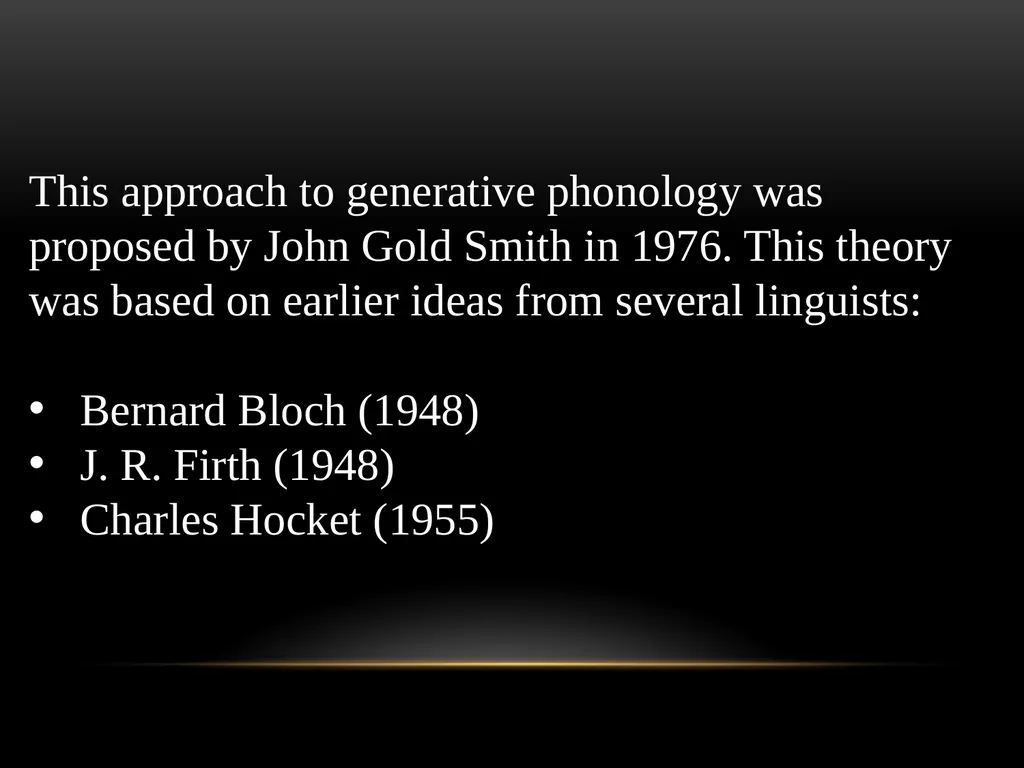
slide2. This approach to generative phonology was proposed by John Gold Smith in 1976. This theory was based on earlier ideas from several linguists:
Bernard Bloch (1948)
J. R. Firth (1948)
Charles Hocket (1955)<br>
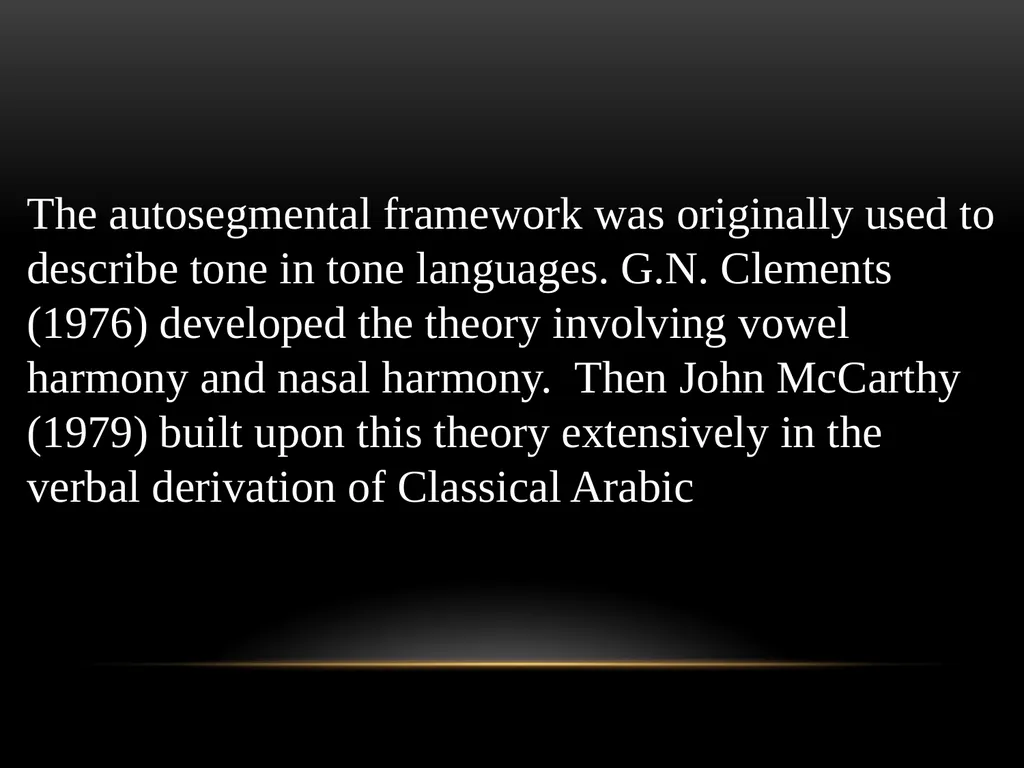
slide3. The autosegmental framework was originally used to describe tone in tone languages. G.N. Clements (1976) developed the theory involving vowel harmony and nasal harmony. Then John McCarthy (1979) built upon this theory extensively in the verbal derivation of Classical Arabic<br>
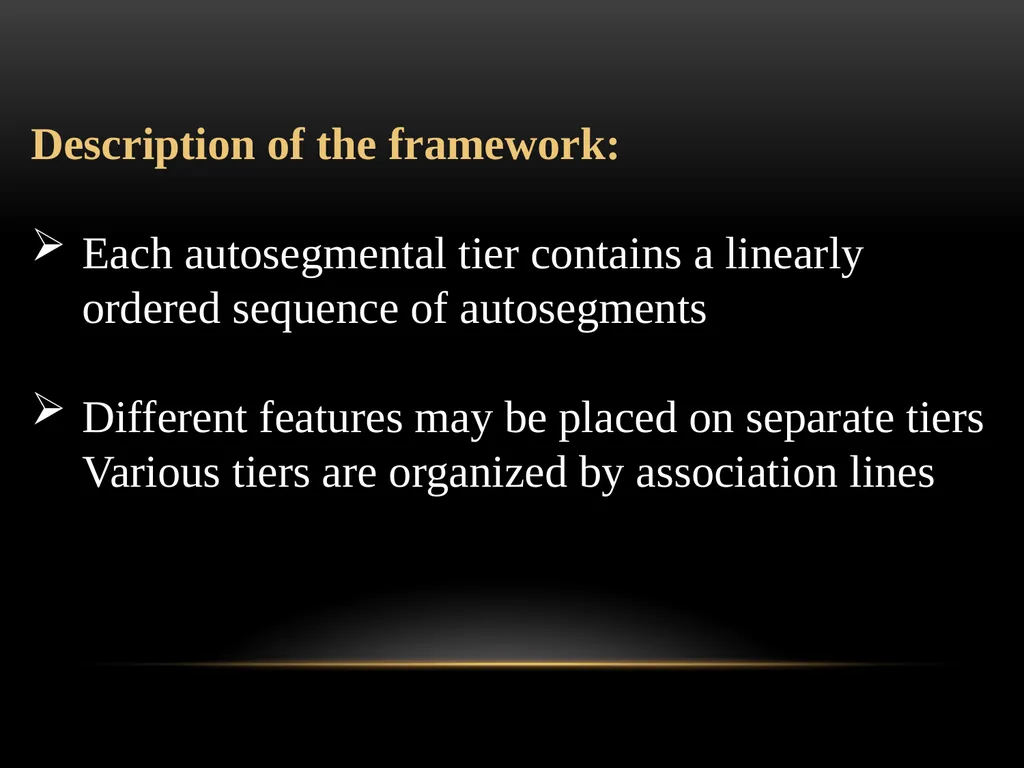
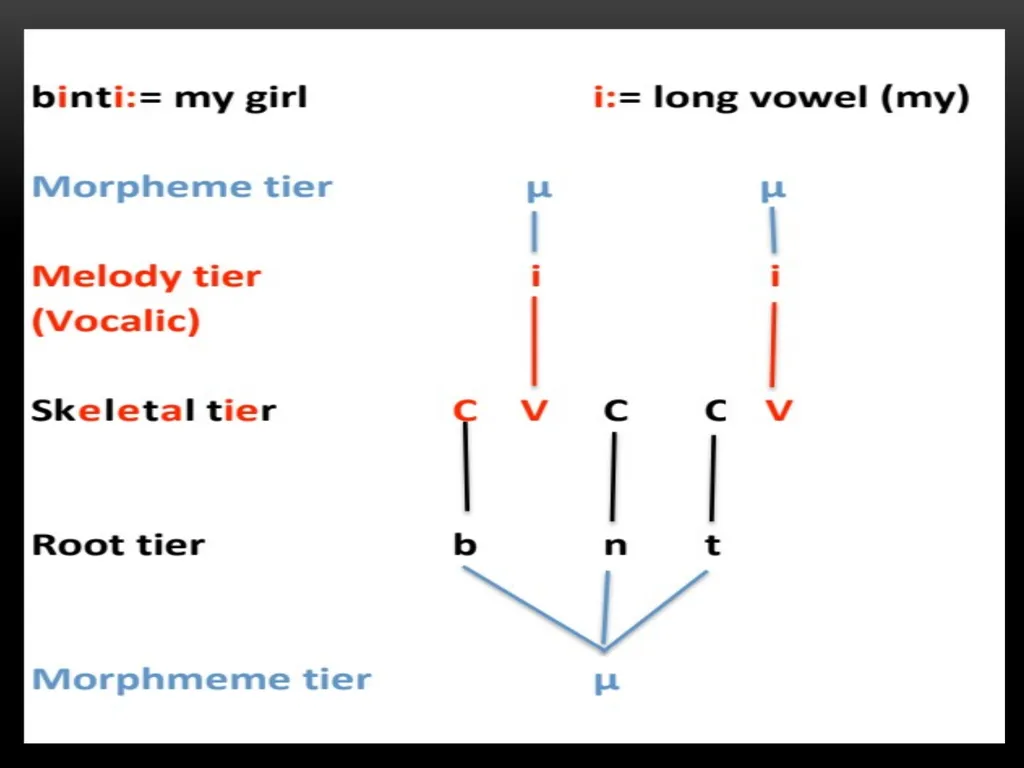
slide4. Description of the framework:
Each autosegmental tier contains a linearly ordered sequence of autosegments
Different features may be placed on separate tiers Various tiers are organized by association lines<br>
slide6. Autosegmental phonology deals with the consequences for generative phonology of multi-linear phonological analysis and representation
The underlying and surface forms consist of parallel strings of segments arranged in two or more tiers Features are distributed over the various tiers
No feature may appear on more than one tier<br>
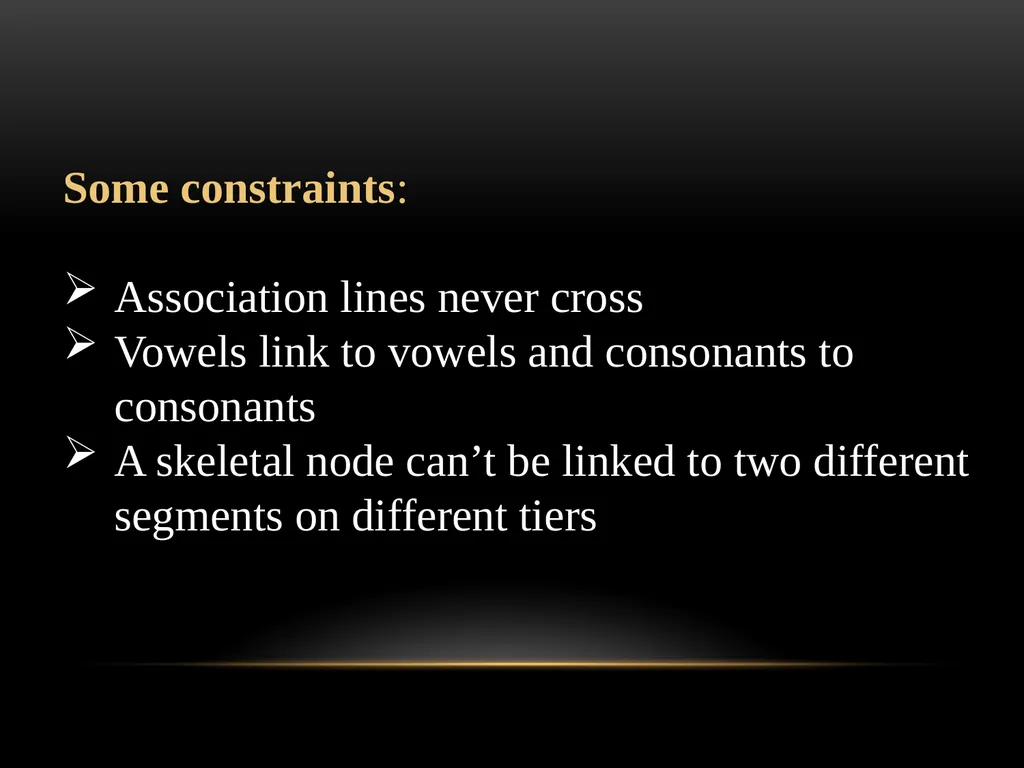
slide7. Some constraints:
Association lines never cross
Vowels link to vowels and consonants to consonants
A skeletal node can’t be linked to two different segments on different tiers<br>
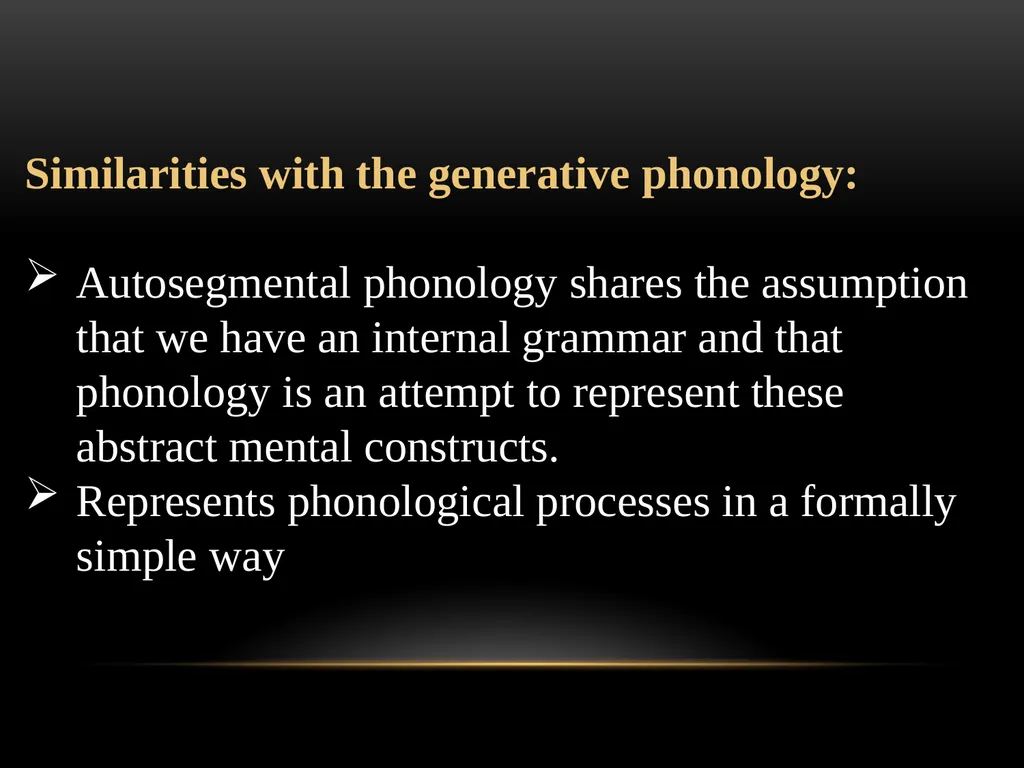
slide8. Similarities with the generative phonology:
Autosegmental phonology shares the assumption that we have an internal grammar and that phonology is an attempt to represent these abstract mental constructs.
Represents phonological processes in a formally simple way<br>
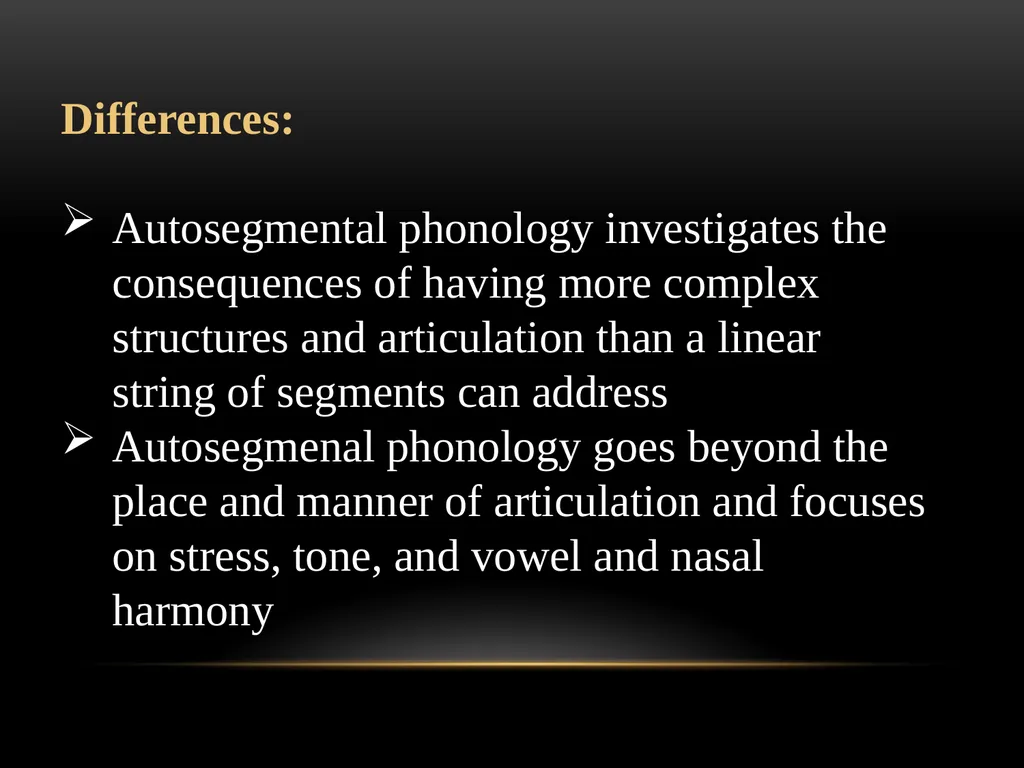
slide9. Differences:
Autosegmental phonology investigates the consequences of having more complex structures and articulation than a linear string of segments can address
Autosegmenal phonology goes beyond the place and manner of articulation and focuses on stress, tone, and vowel and nasal harmony<br>
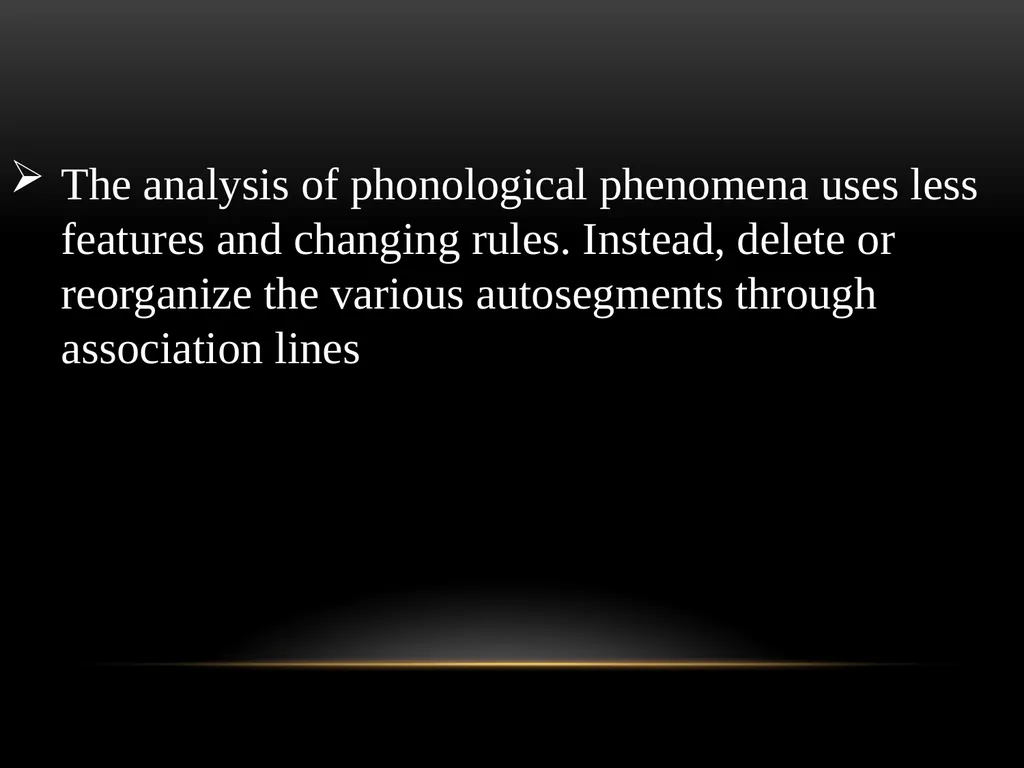
slide10. The analysis of phonological phenomena uses less features and changing rules. Instead, delete or reorganize the various autosegments through association lines<br>
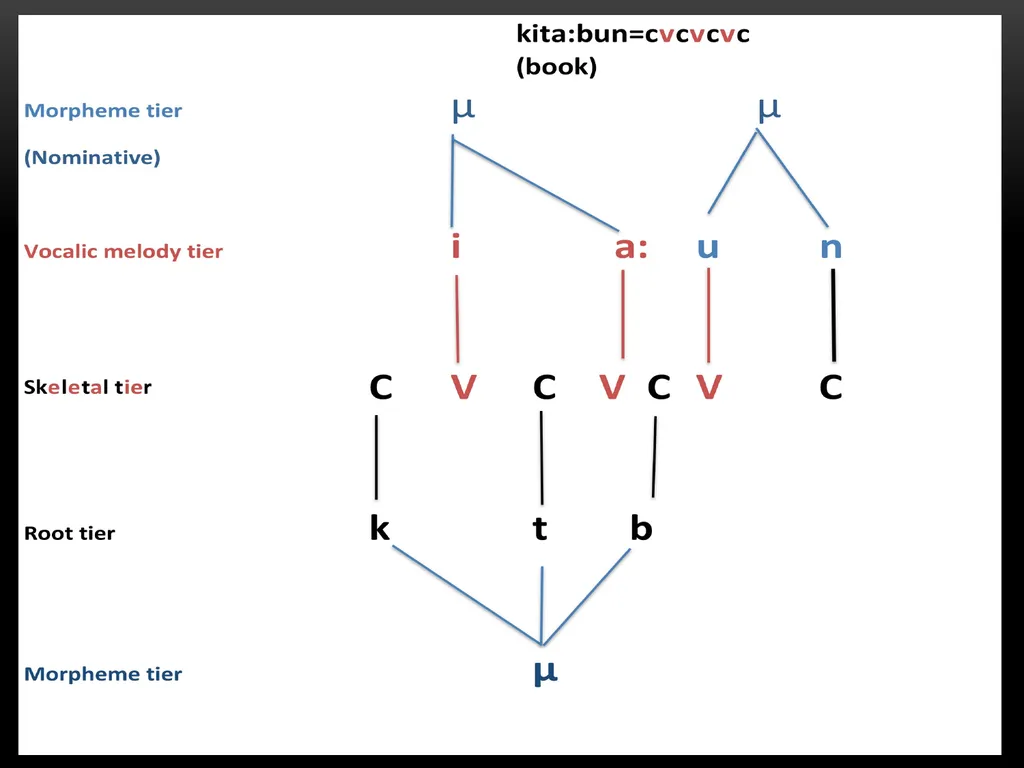
slide11. John McCarthy proposed an important development by showing that the derivation of words from consonantal roots in Arabic could be analyzed autosegmentally.
In Arabic, words may be formed by modifying the root itself internally and not simply by connecting of affixes, root compounding, or conversion<br>
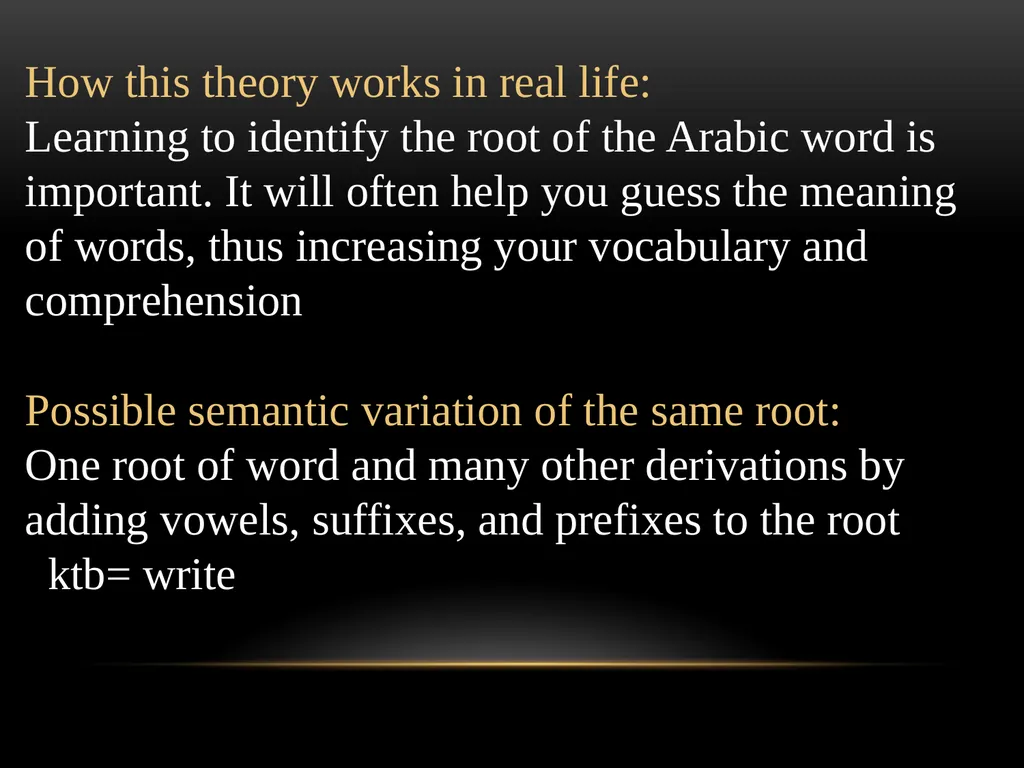
slide12. How this theory works in real life:
Learning to identify the root of the Arabic word is important. It will often help you guess the meaning of words, thus increasing your vocabulary and comprehension
Possible semantic variation of the same root:
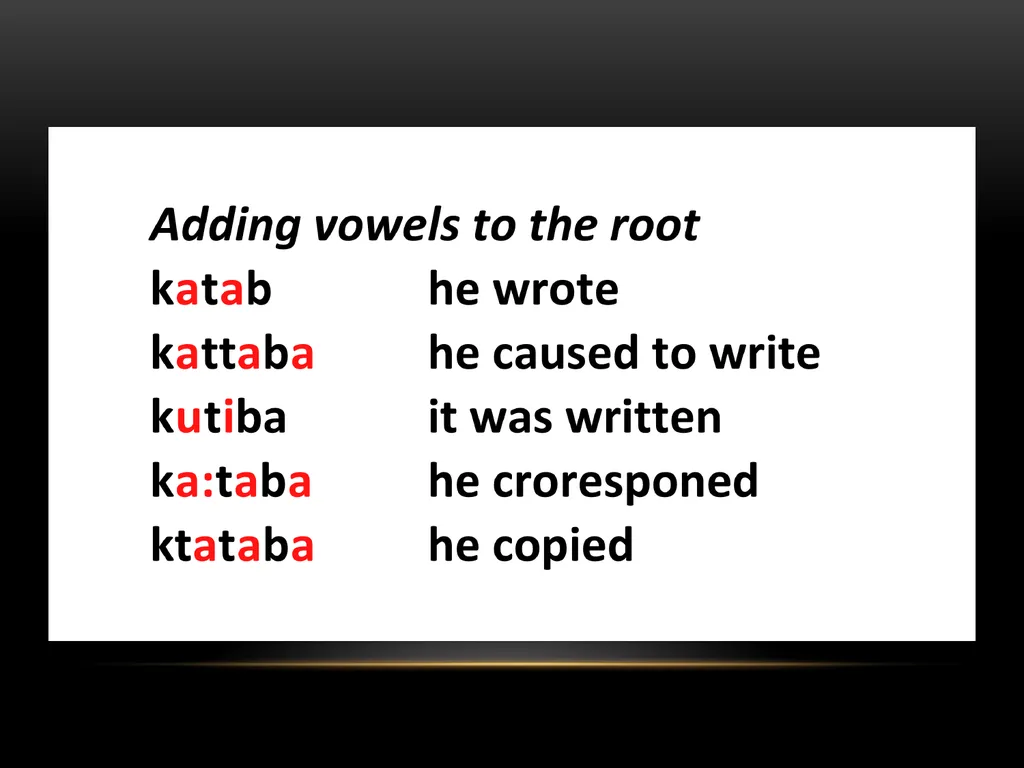
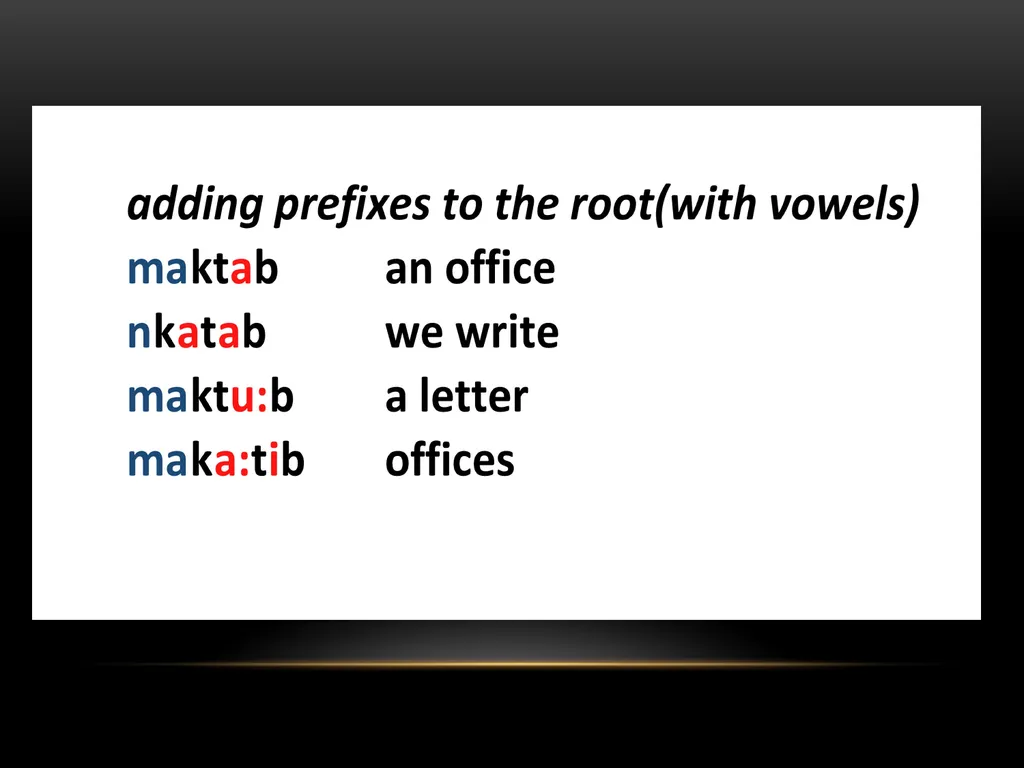
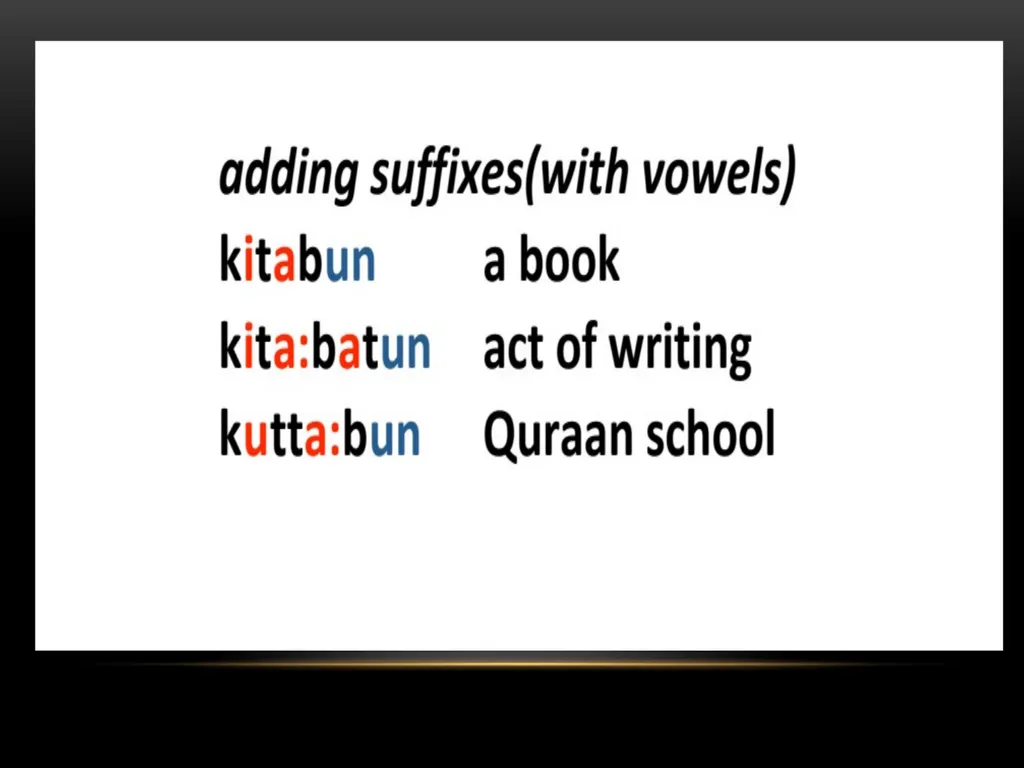
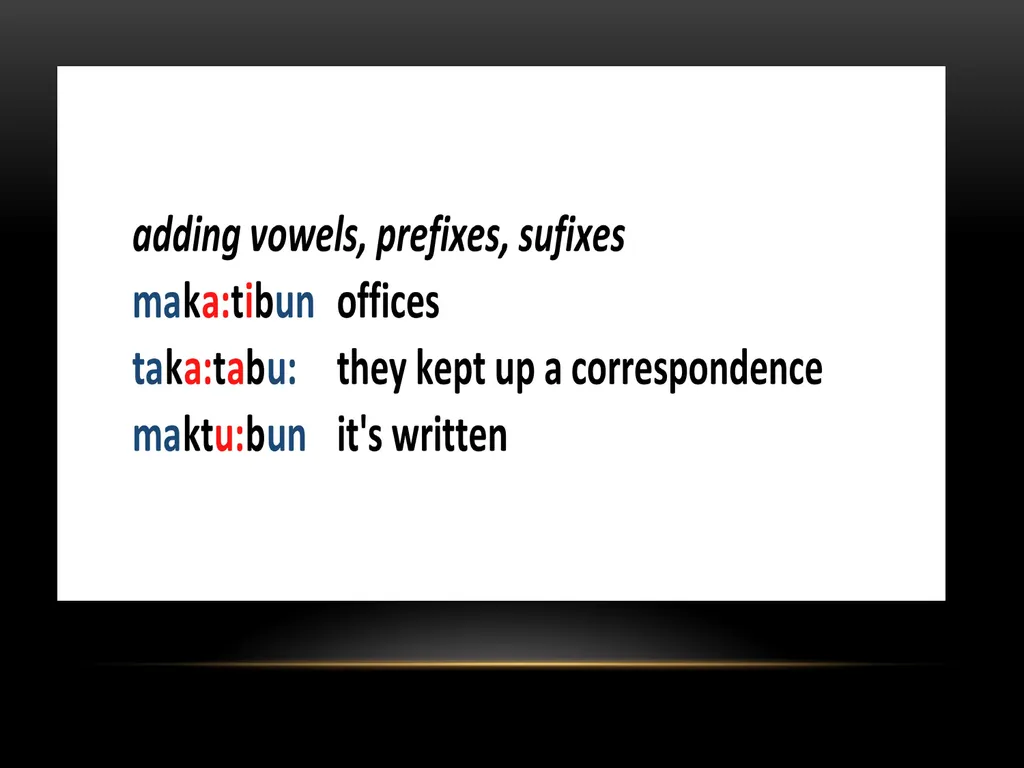
One root of word and many other derivations by adding vowels, suffixes, and prefixes to the root
ktb= write<br>
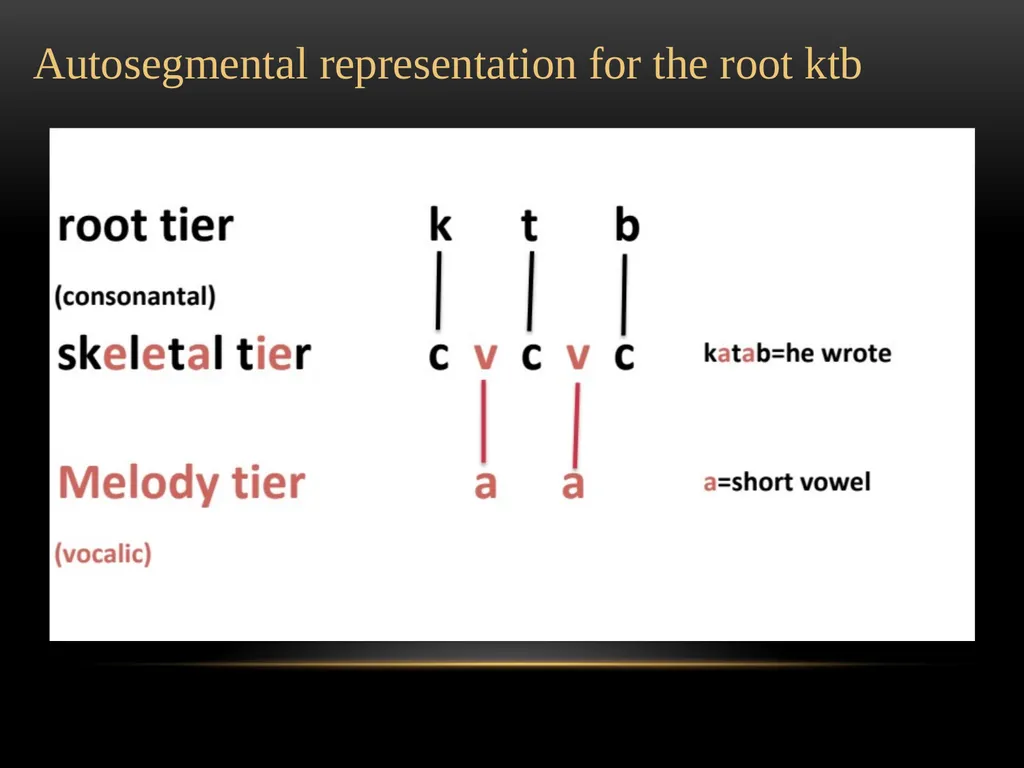
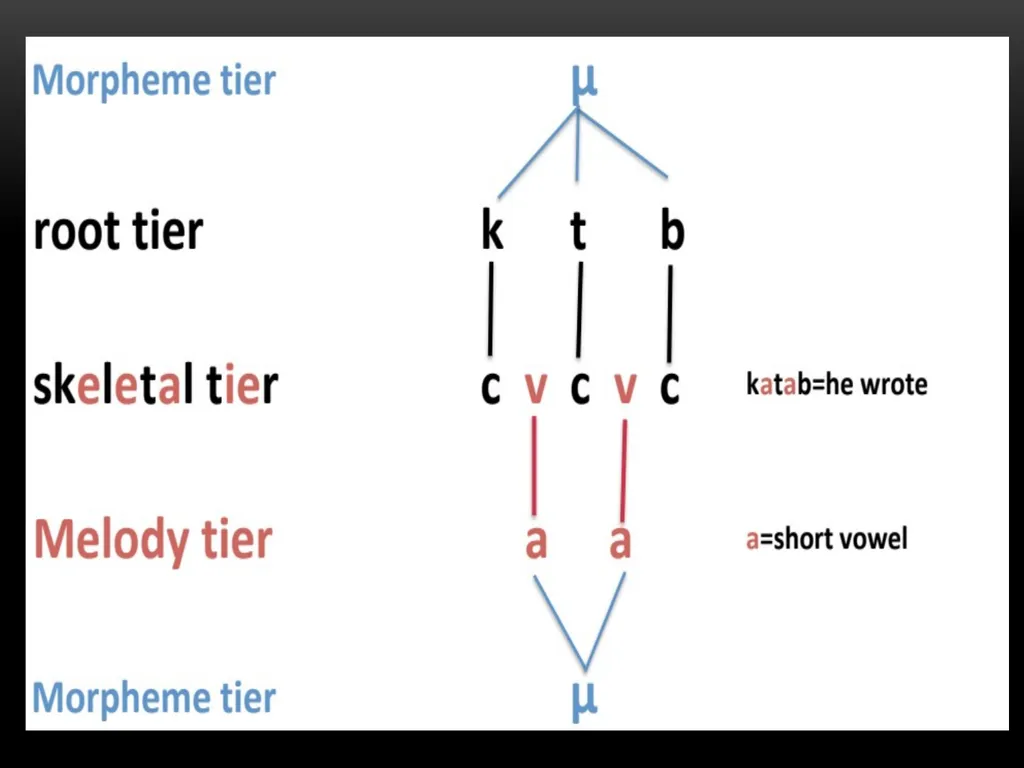
slide17. Autosegmental representation for the root ktb<br>
slide18. Arabic Patterns and roots
Arabic Framework:
Autosegmental representation in which features bundle for vowels and consonants were connected to C and V nodes on different tiers<br>
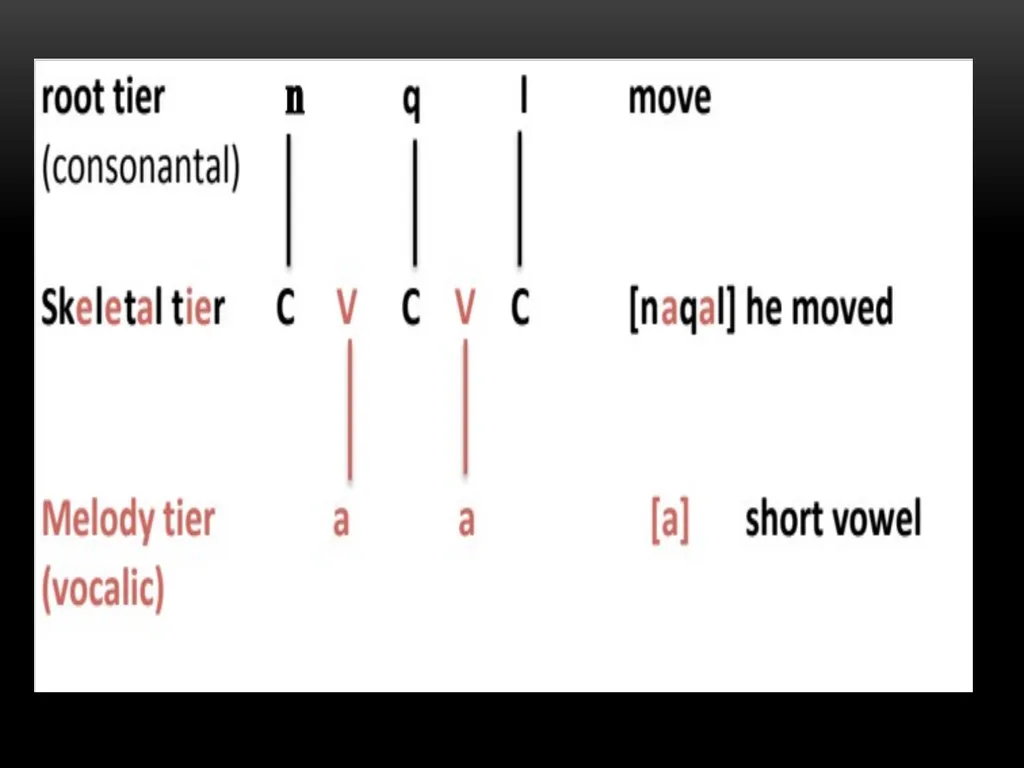
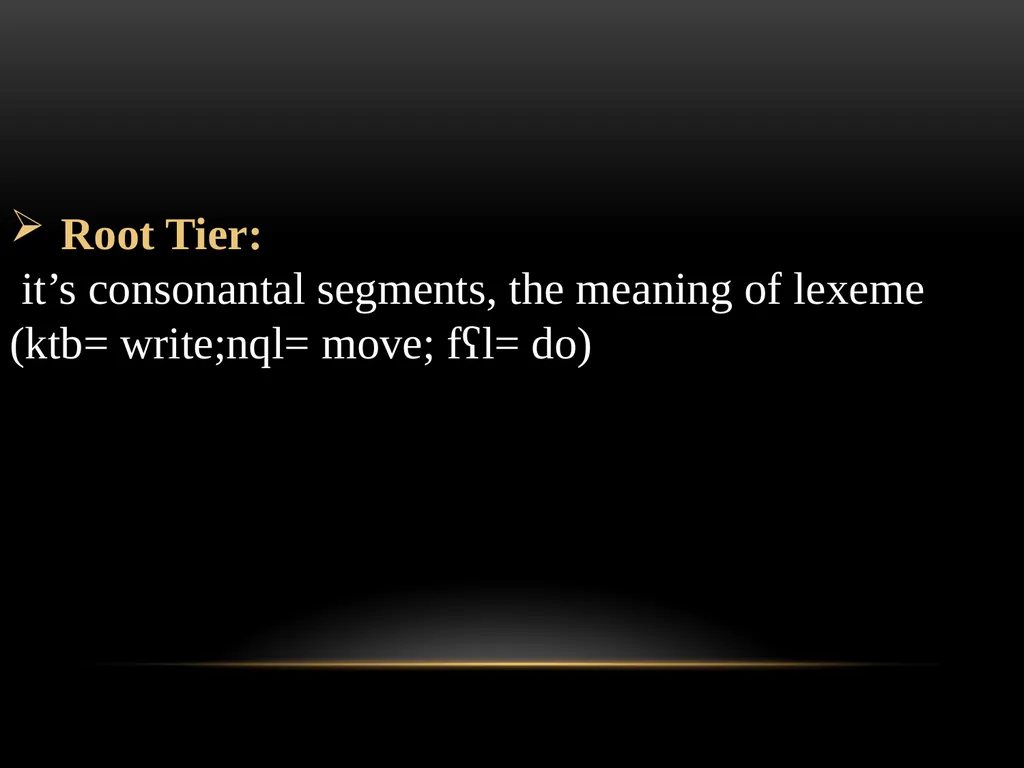
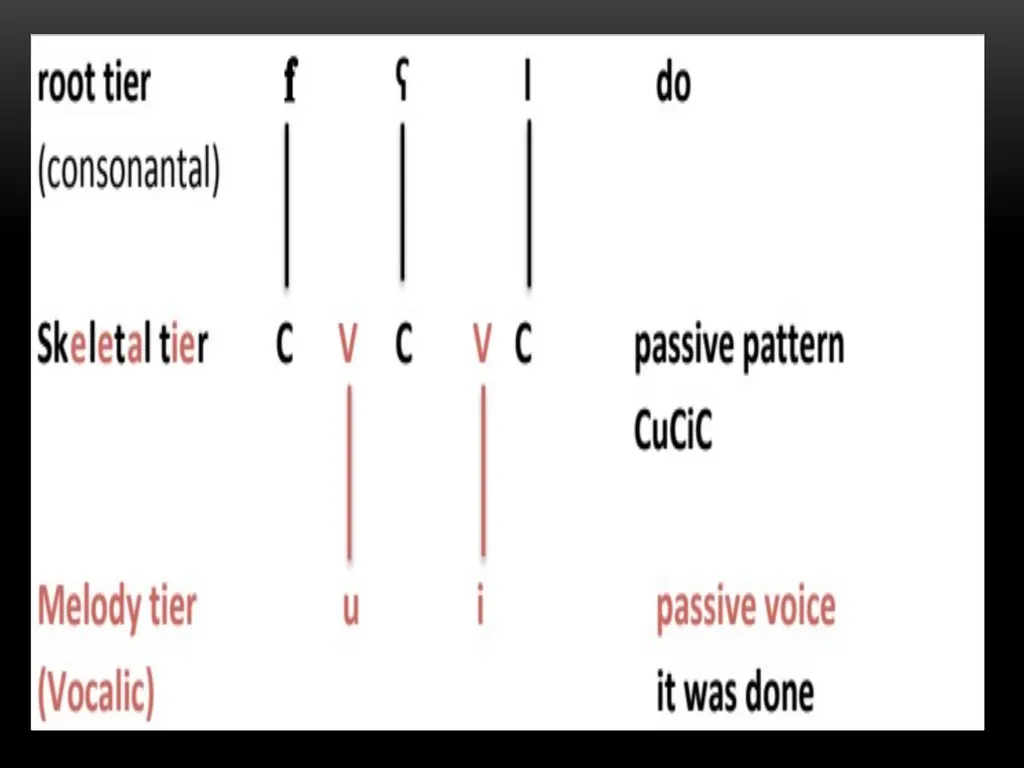
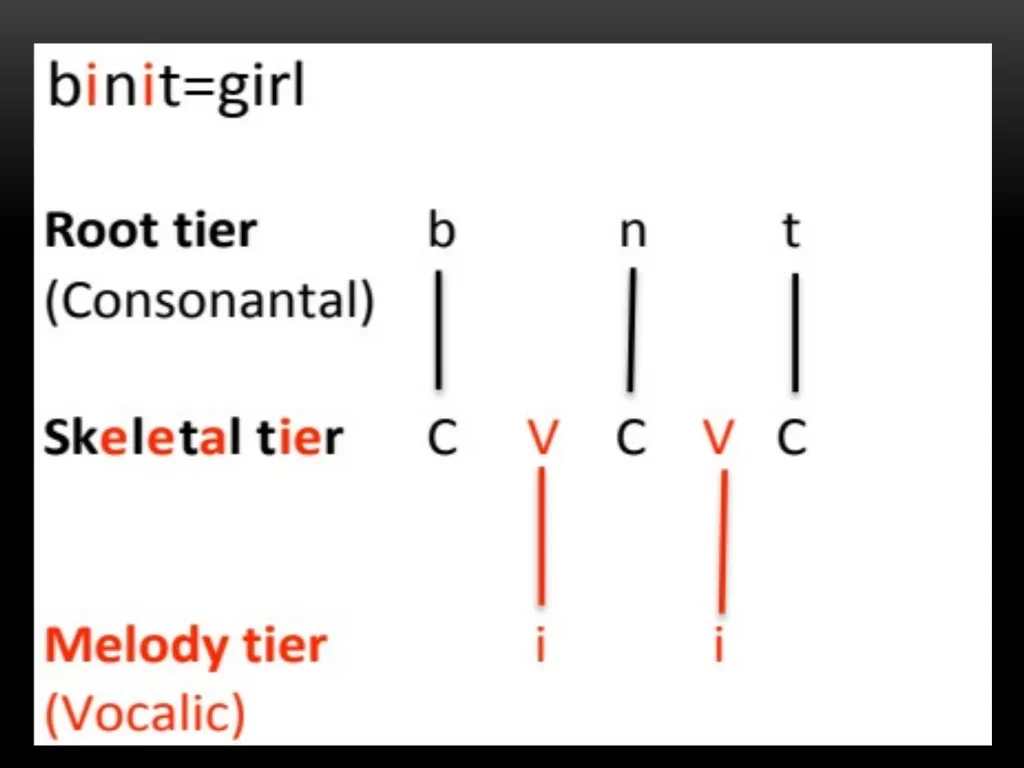
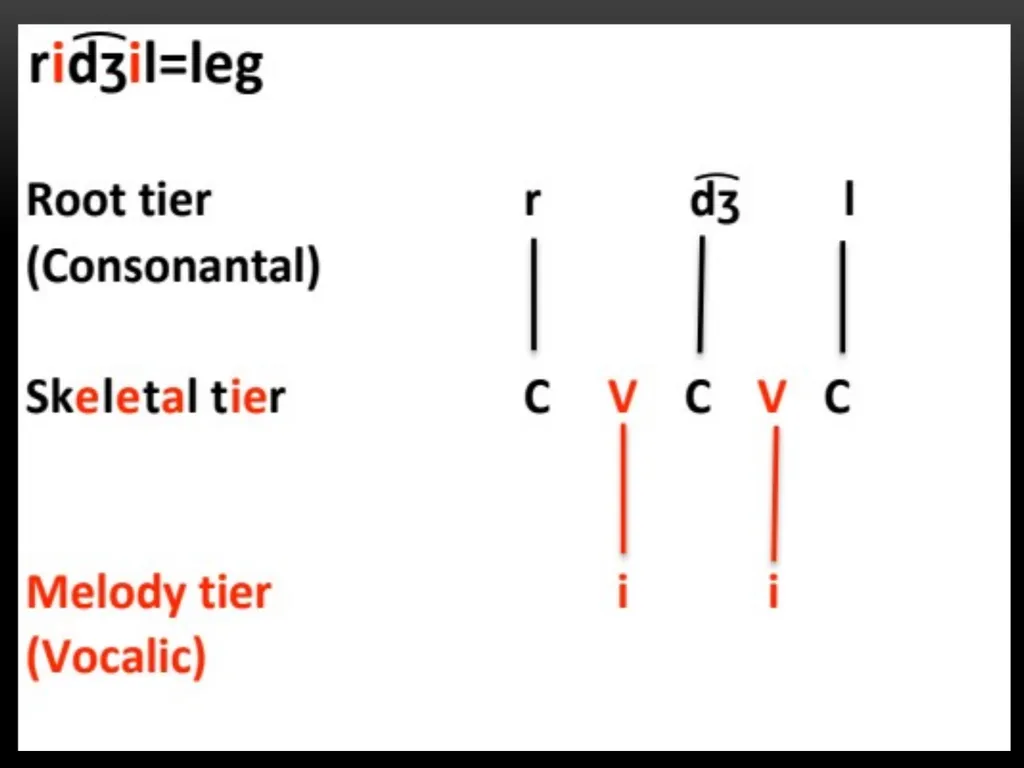
slide19. Root Tier:
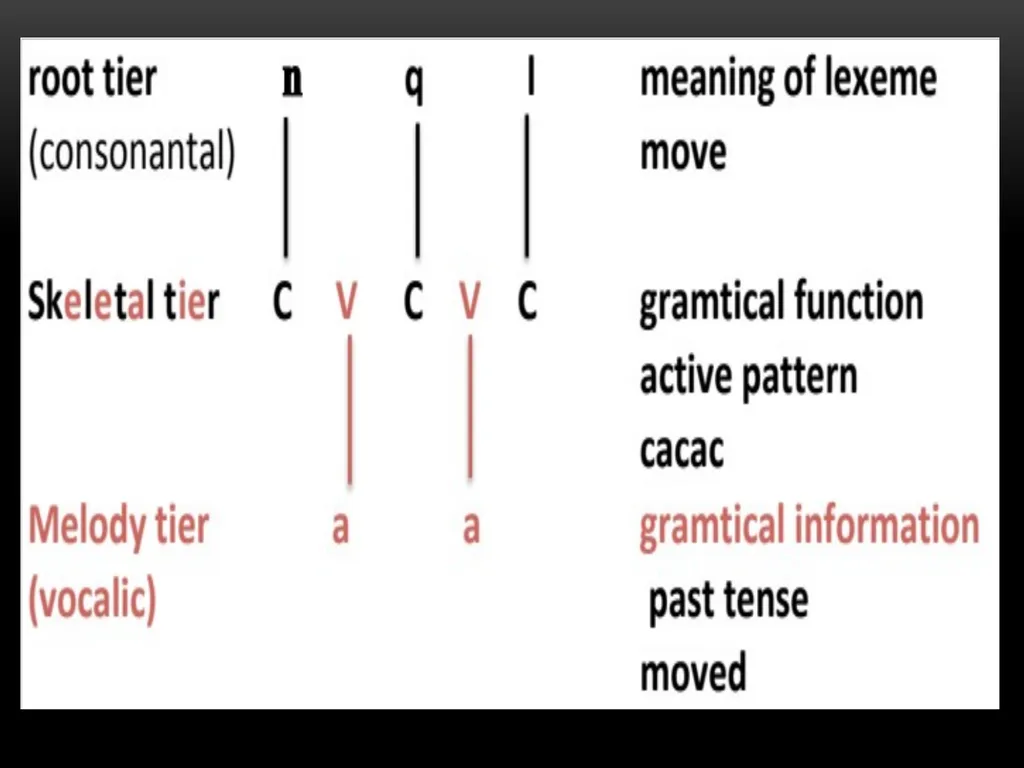
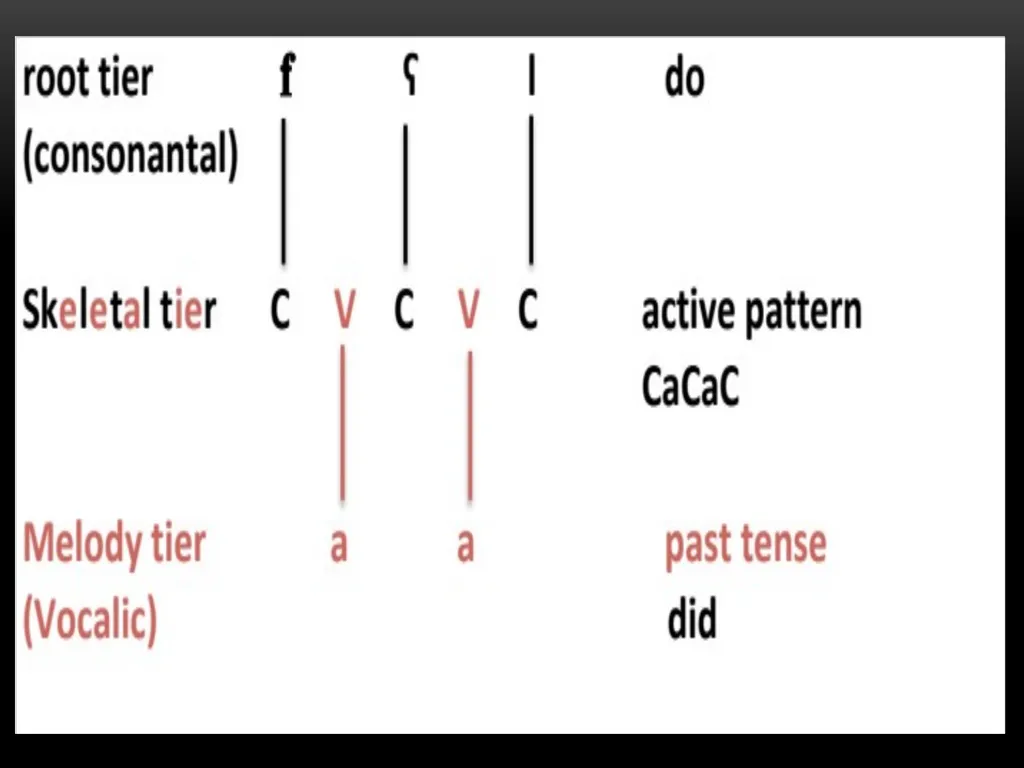
it’s consonantal segments, the meaning of lexeme (ktb= write;nql= move; fʕl= do)<br>
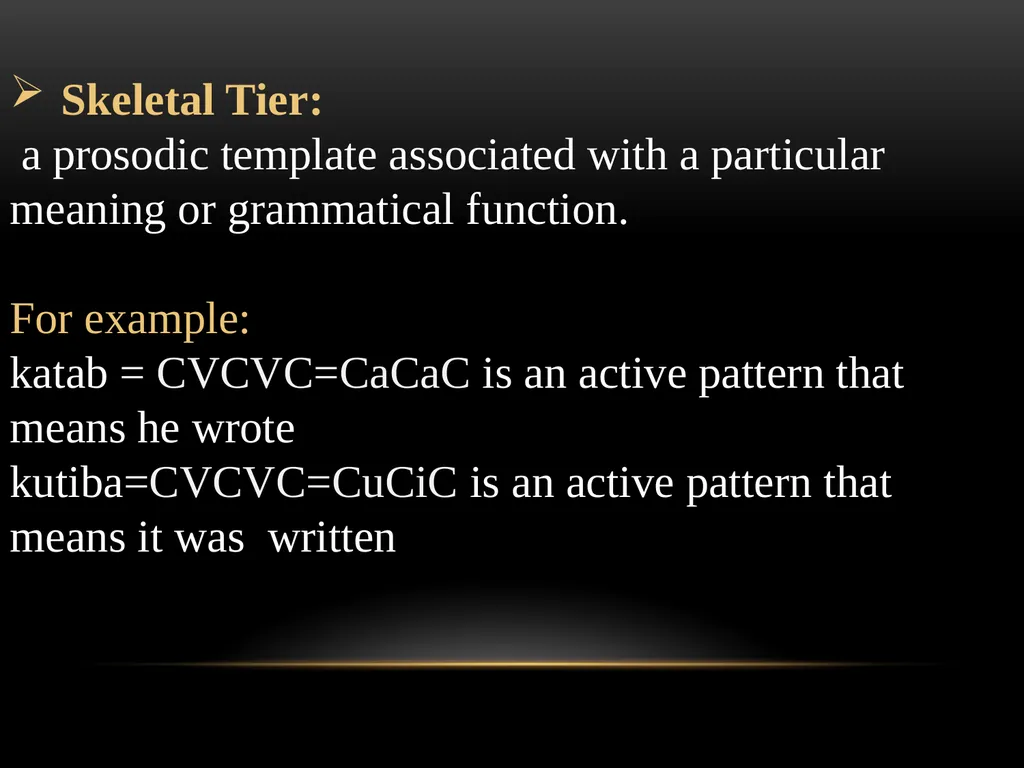
slide20. Skeletal Tier:
a prosodic template associated with a particular meaning or grammatical function.
For example:
katab = CVCVC=CaCaC is an active pattern that means he wrote
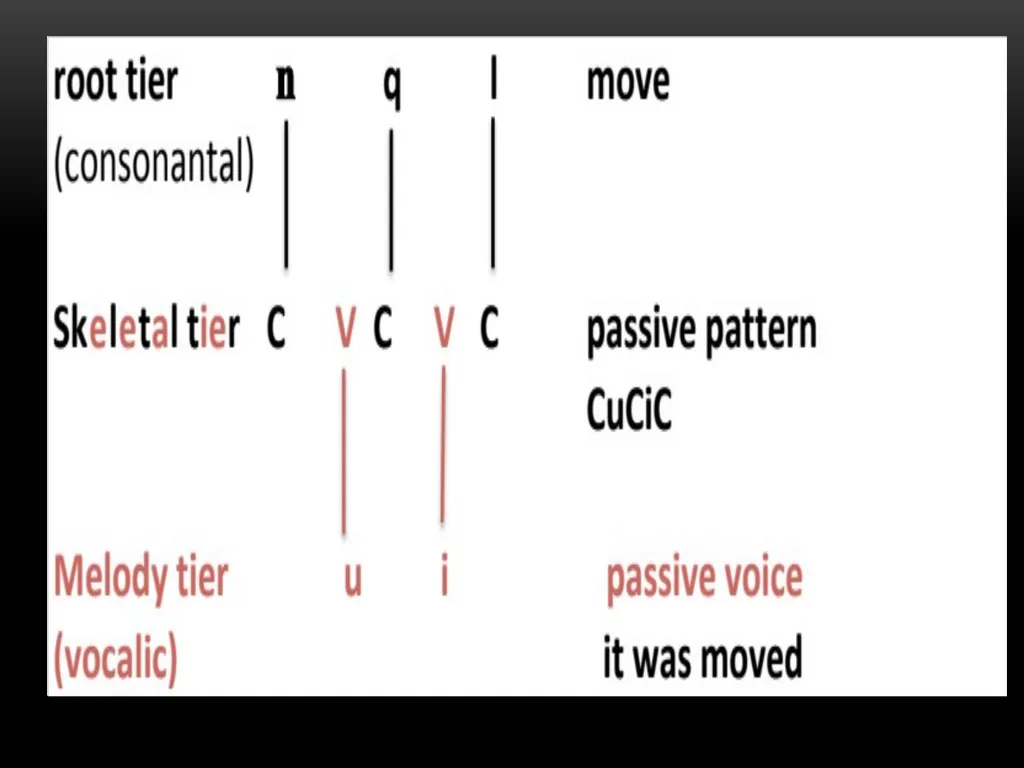
kutiba=CVCVC=CuCiC is an active pattern that means it was written<br>
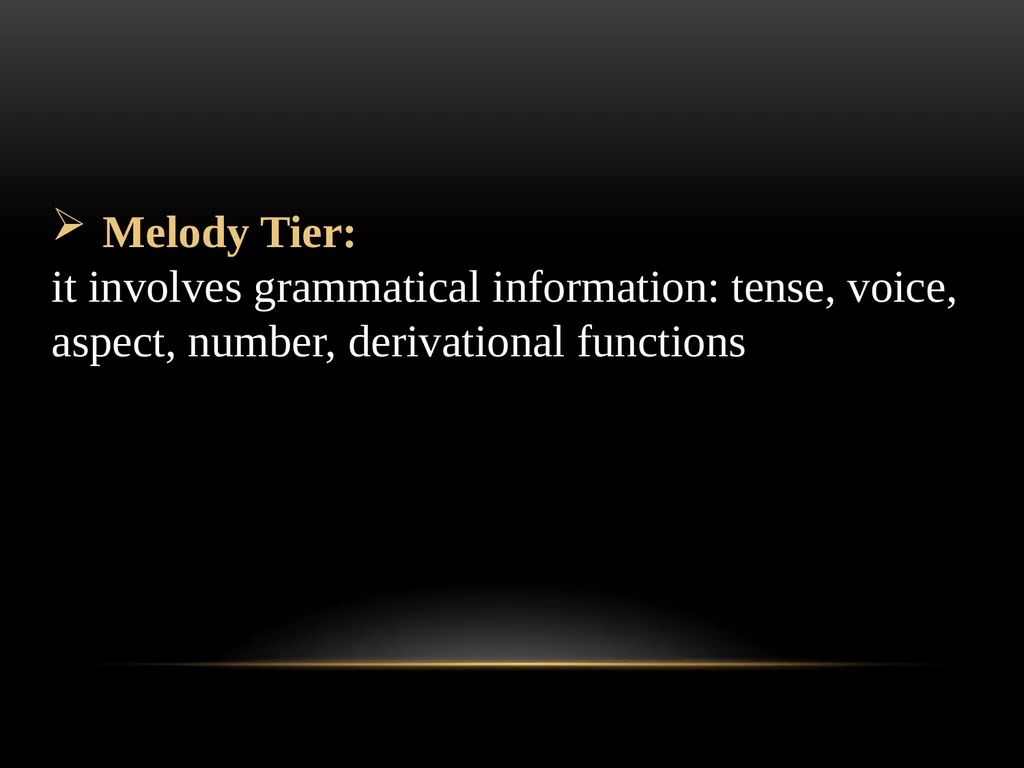
slide21. Melody Tier:
it involves grammatical information: tense, voice, aspect, number, derivational functions<br>
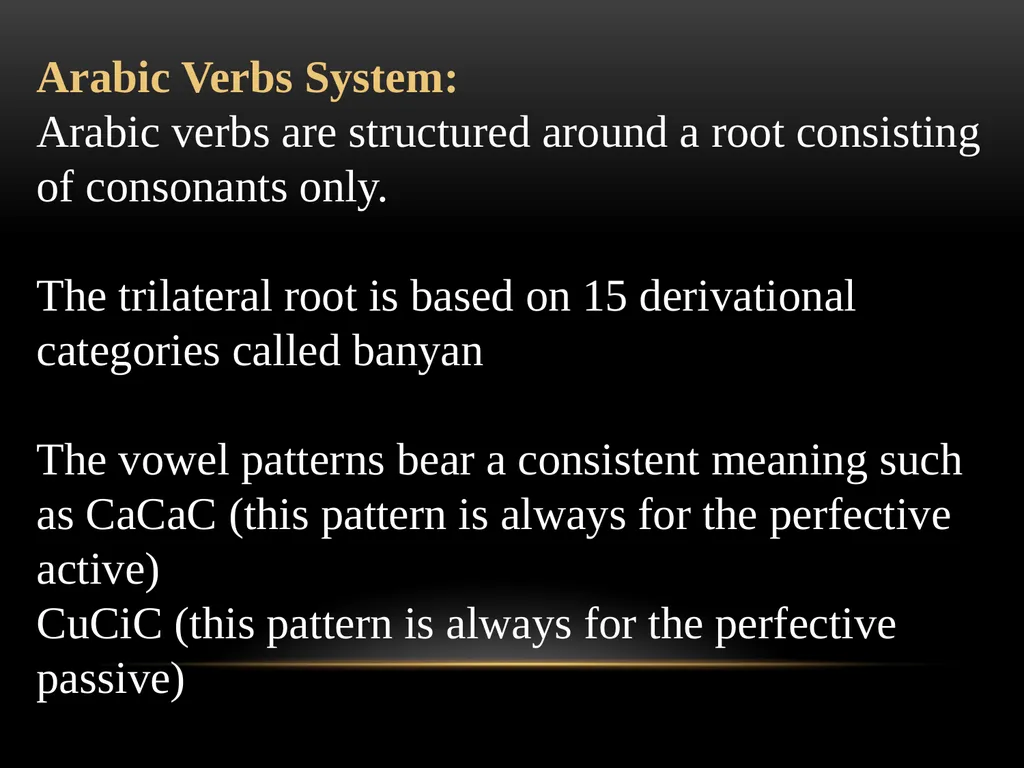
slide22. Arabic Verbs System:
Arabic verbs are structured around a root consisting of consonants only.
The trilateral root is based on 15 derivational categories called banyan
The vowel patterns bear a consistent meaning such as CaCaC (this pattern is always for the perfective active)
CuCiC (this pattern is always for the perfective passive)<br>
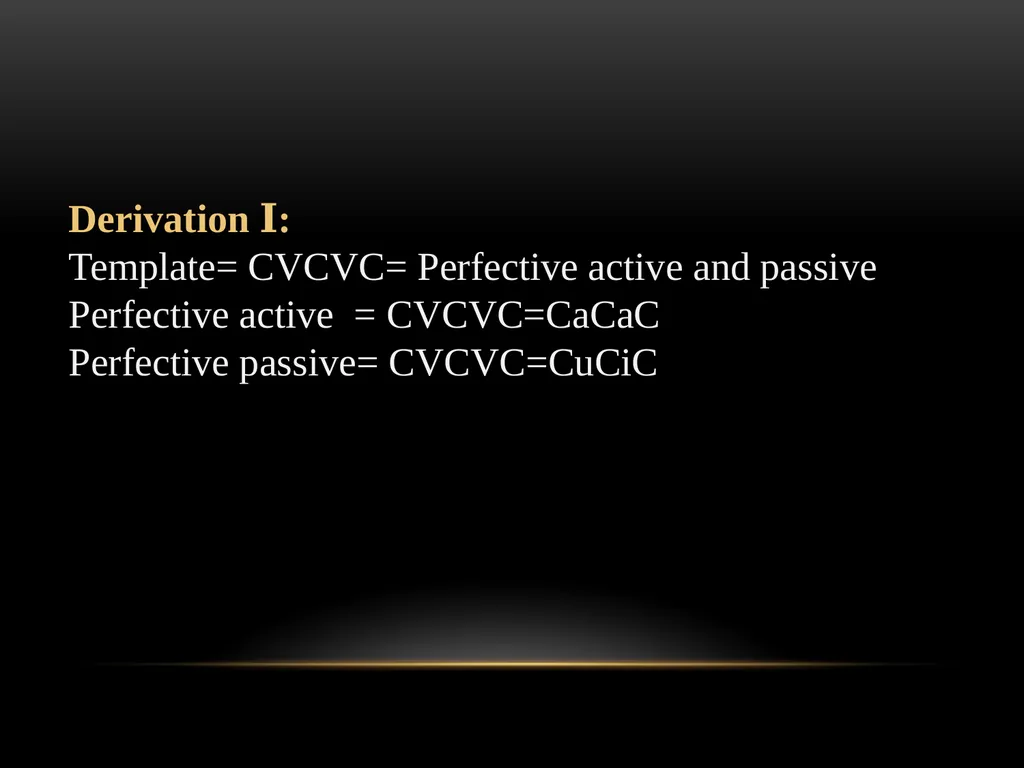
slide23. Derivation Ⅰ:
Template= CVCVC= Perfective active and passive
Perfective active = CVCVC=CaCaC
Perfective passive= CVCVC=CuCiC<br>
slide28. What about affixes? How can we recognize them? How can we know they’re a part of the root or not?<br>
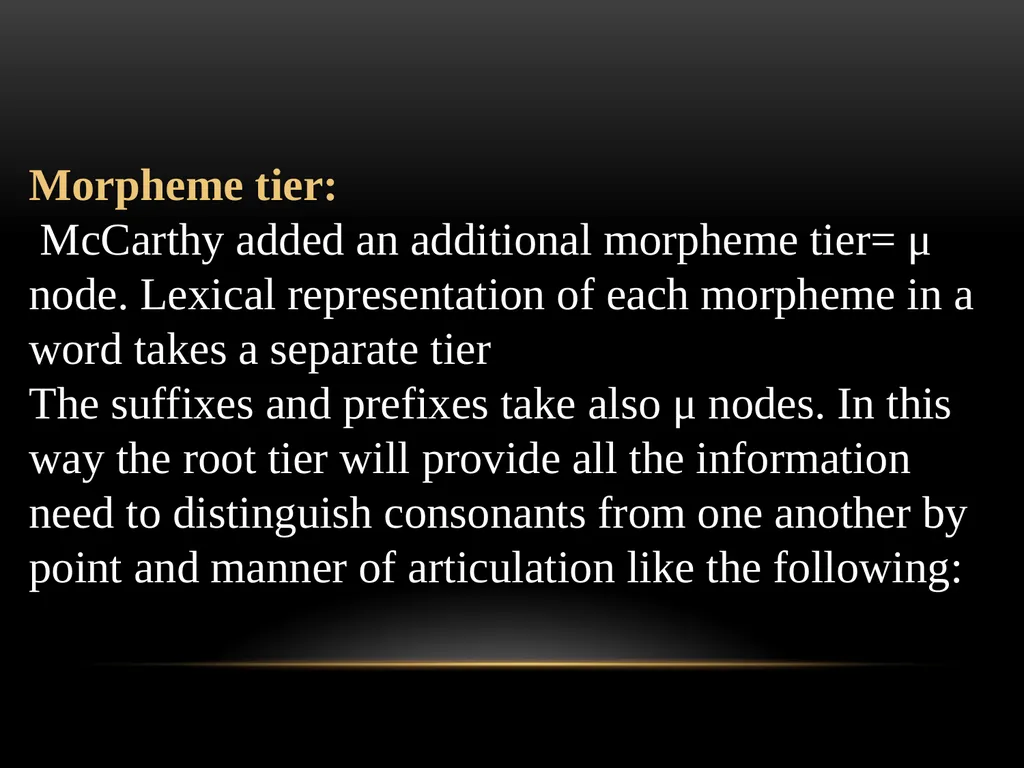
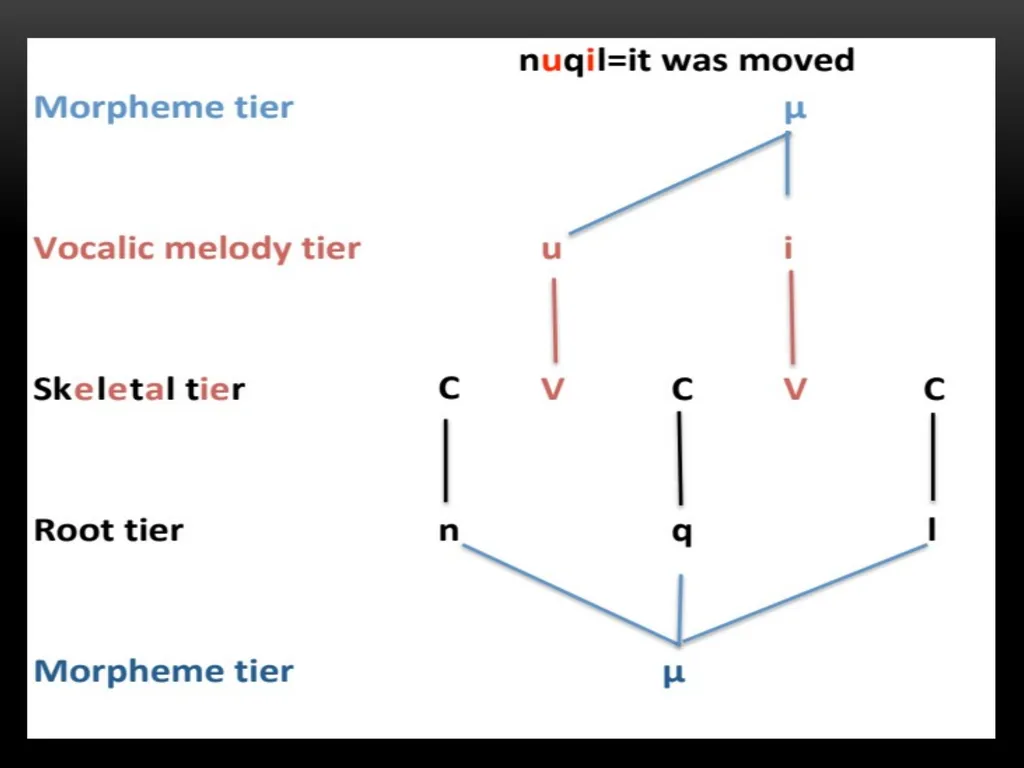
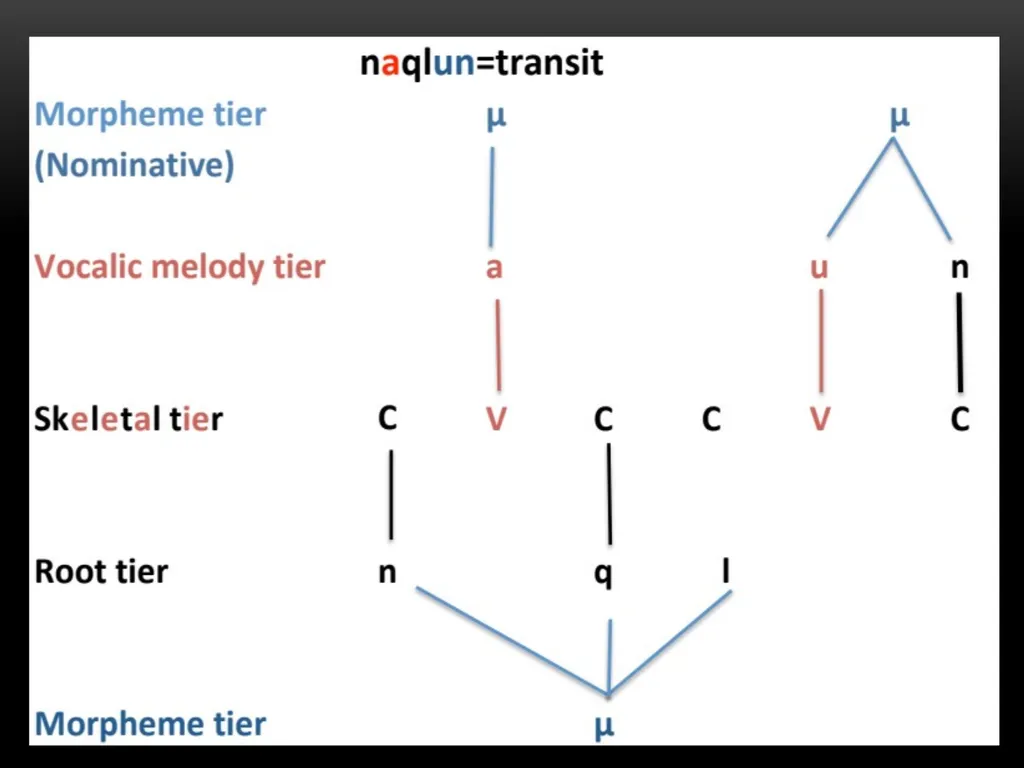
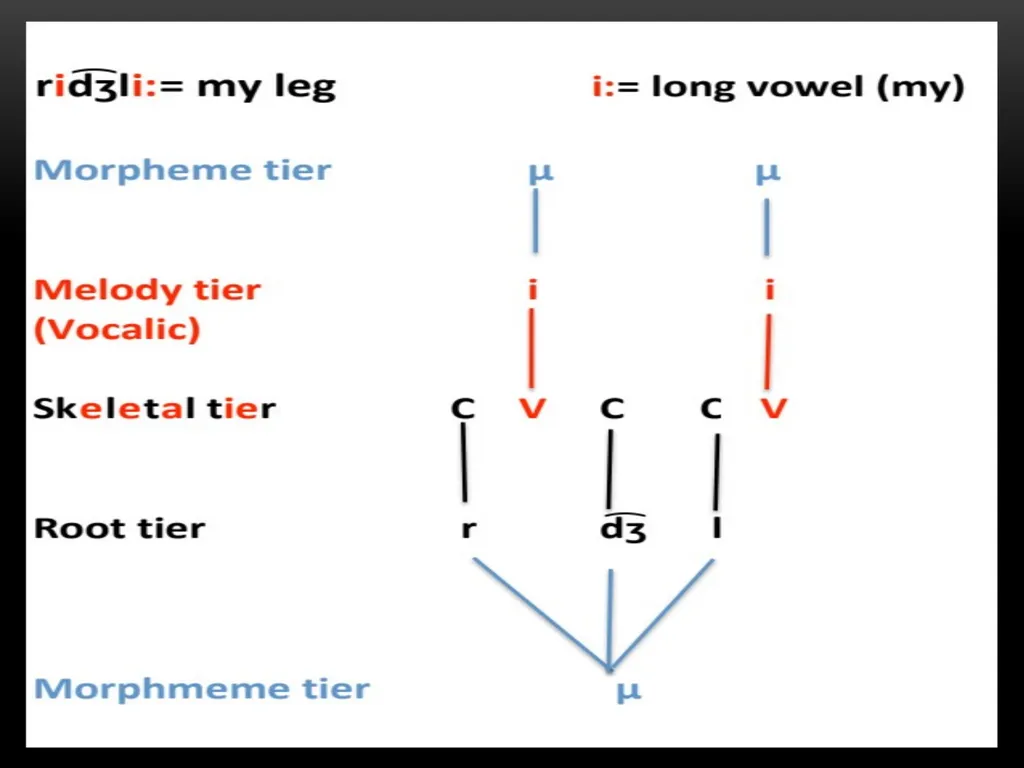
slide29. Morpheme tier:
McCarthy added an additional morpheme tier= μ node. Lexical representation of each morpheme in a word takes a separate tier
The suffixes and prefixes take also μ nodes. In this way the root tier will provide all the information need to distinguish consonants from one another by point and manner of articulation like the following:<br>
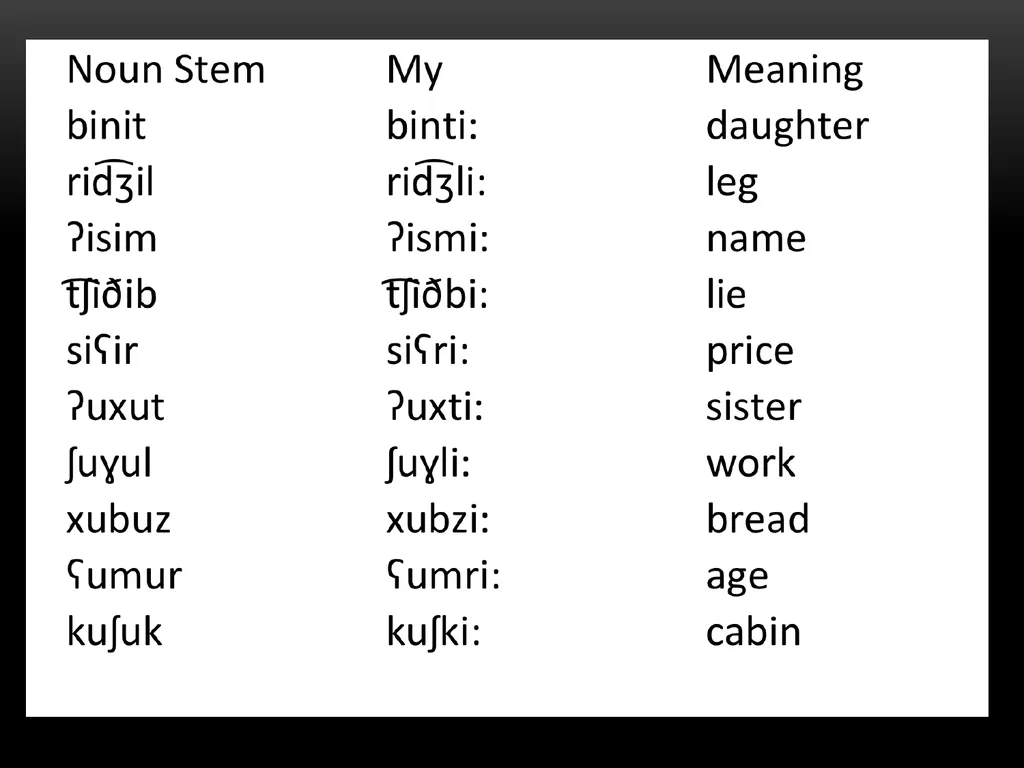
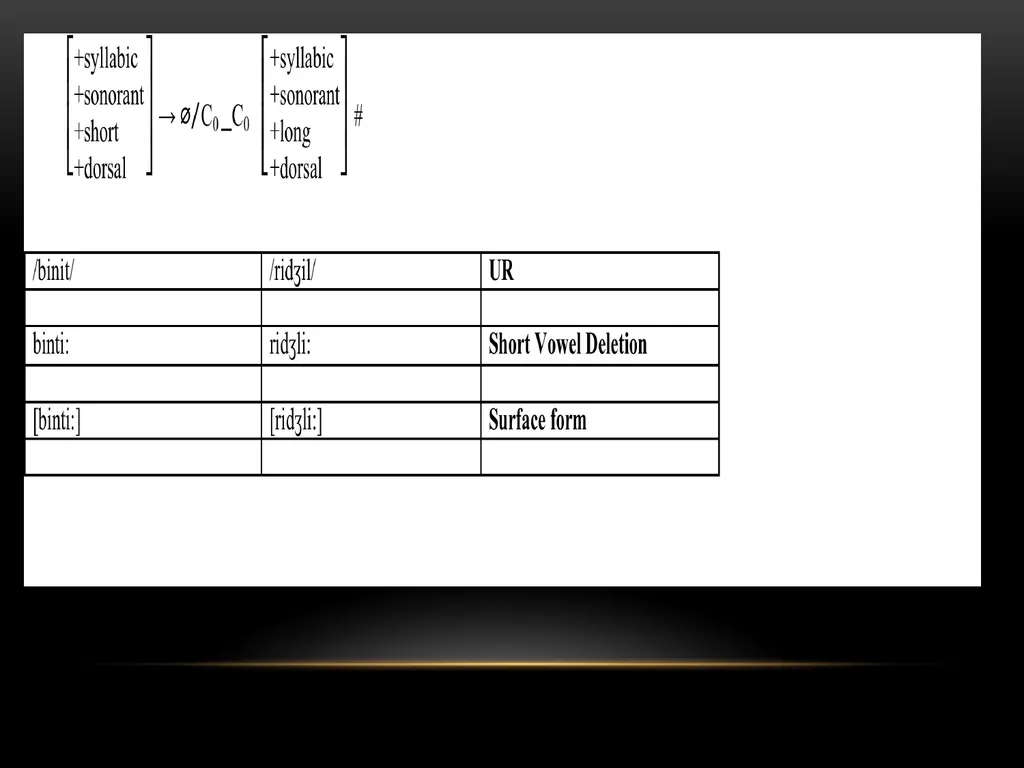
slide35. a linear analysis for the Arabic examples:<br>
slide37. A linear analysis is cumbersome and inelegant!<br>
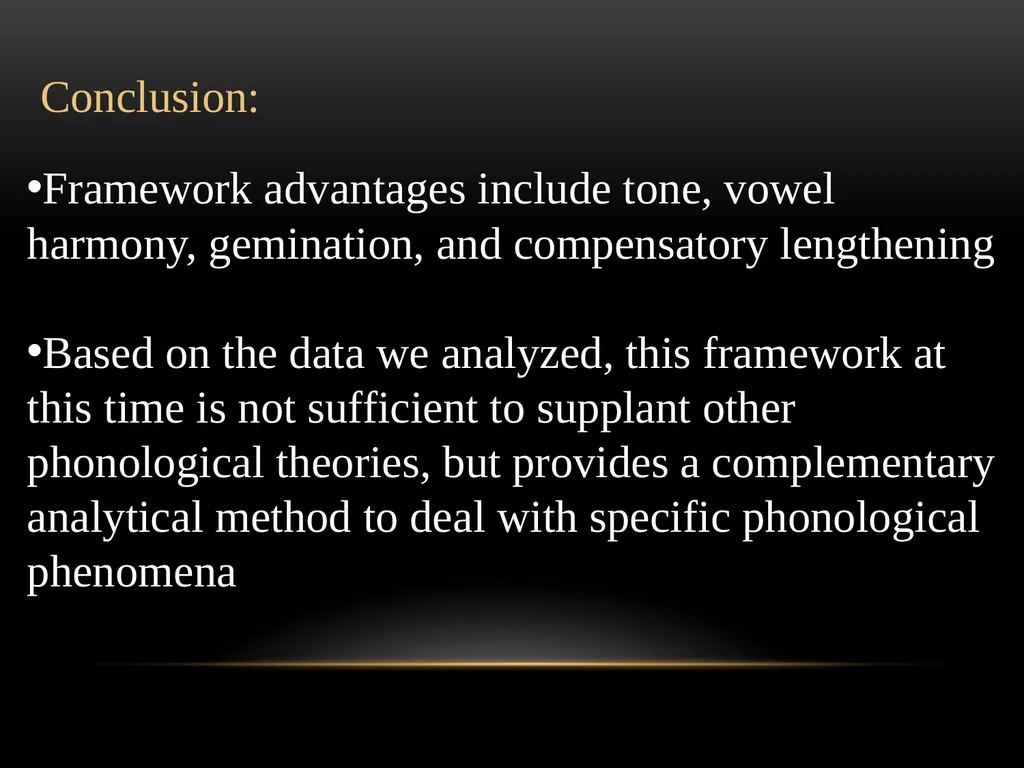
slide42. Conclusion: Framework advantages include tone, vowel harmony, gemination, and compensatory lengthening
Based on the data we analyzed, this framework at this time is not sufficient to supplant other phonological theories, but provides a complementary analytical method to deal with specific phonological phenomena<br>
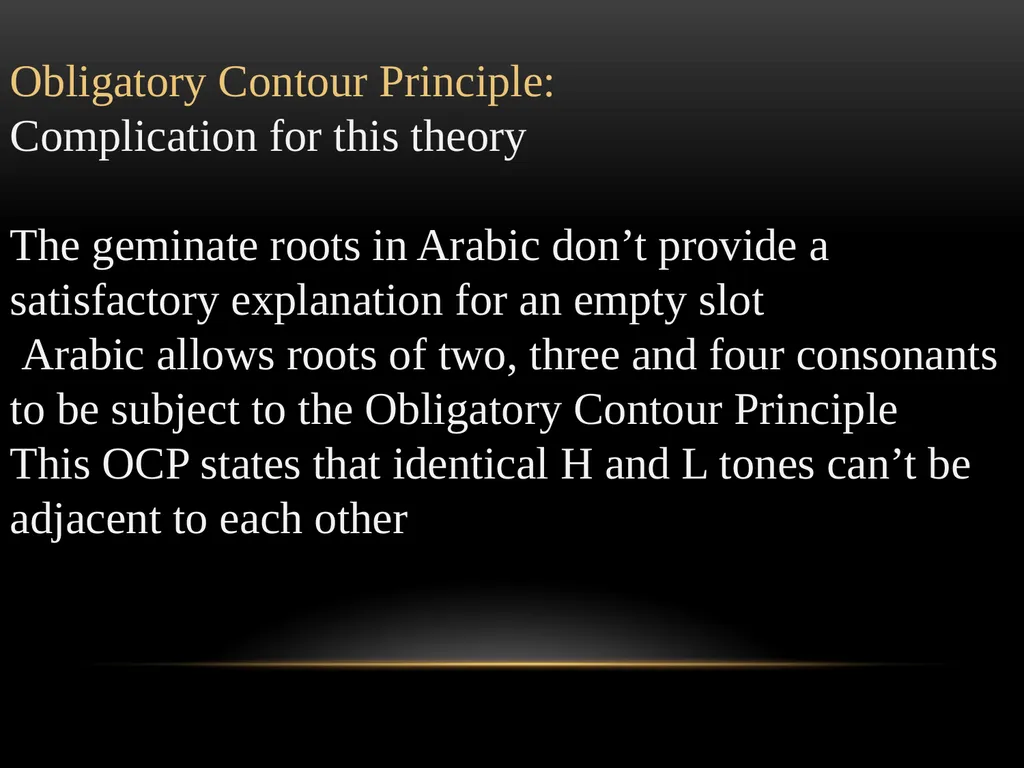
slide43. Obligatory Contour Principle:
Complication for this theory
The geminate roots in Arabic don’t provide a satisfactory explanation for an empty slot
Arabic allows roots of two, three and four consonants to be subject to the Obligatory Contour Principle
This OCP states that identical H and L tones can’t be adjacent to each other<br>
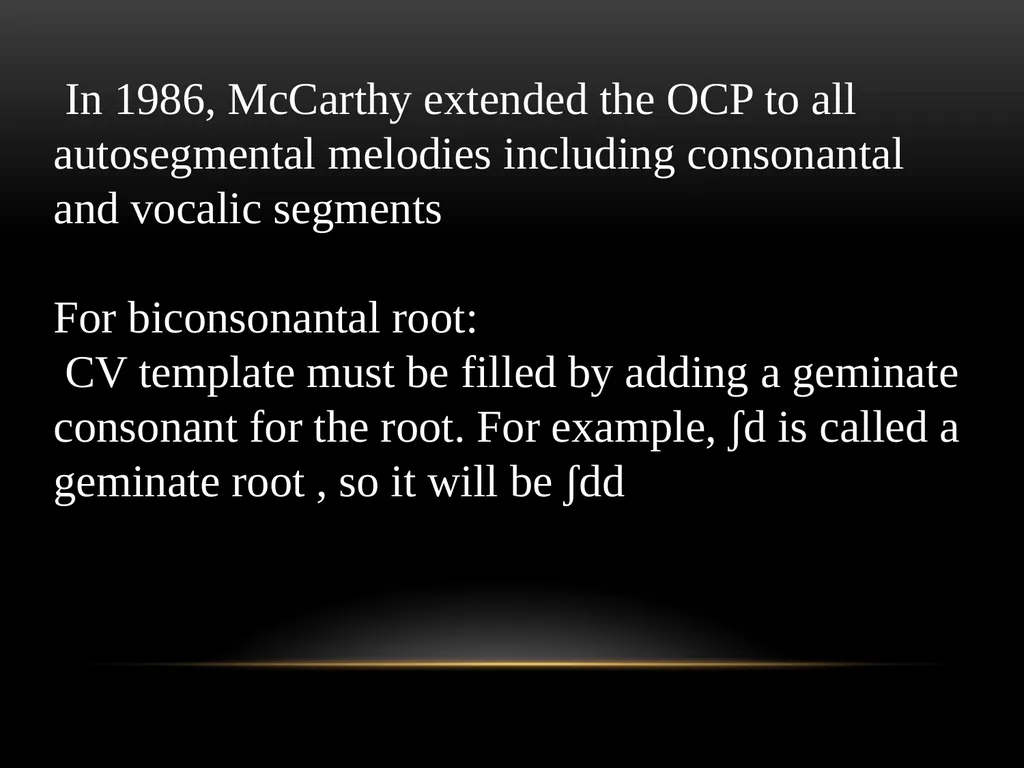
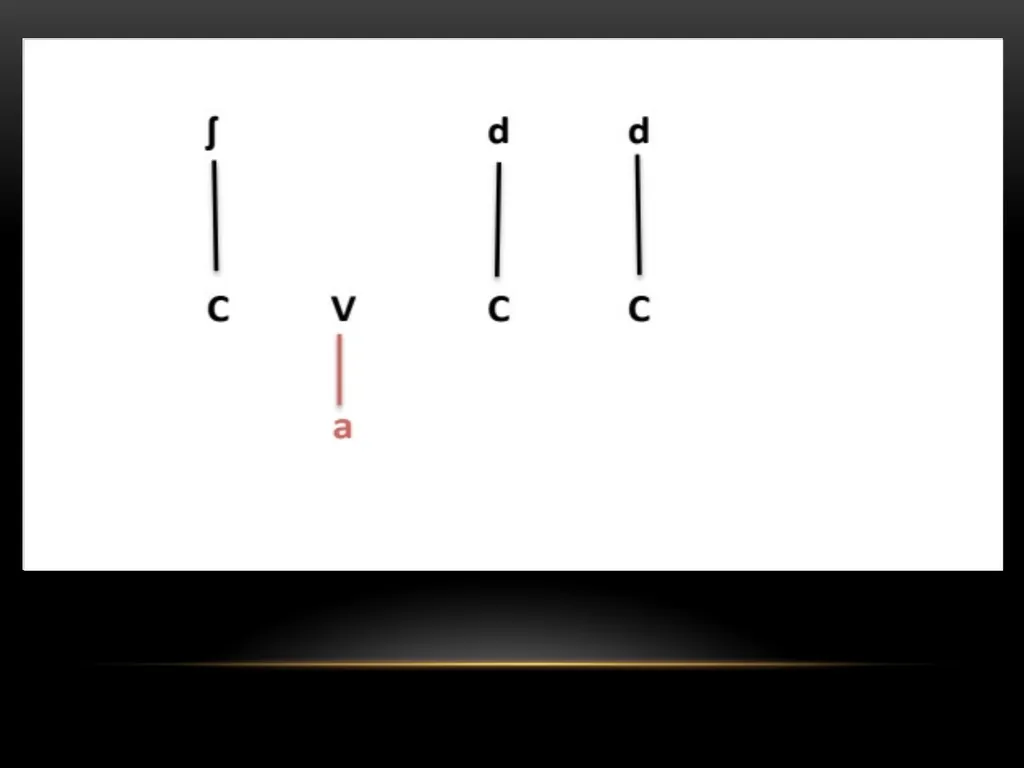
slide44. In 1986, McCarthy extended the OCP to all autosegmental melodies including consonantal and vocalic segments
For biconsonantal root:
CV template must be filled by adding a geminate consonant for the root. For example, ʃd is called a geminate root , so it will be ʃdd<br>
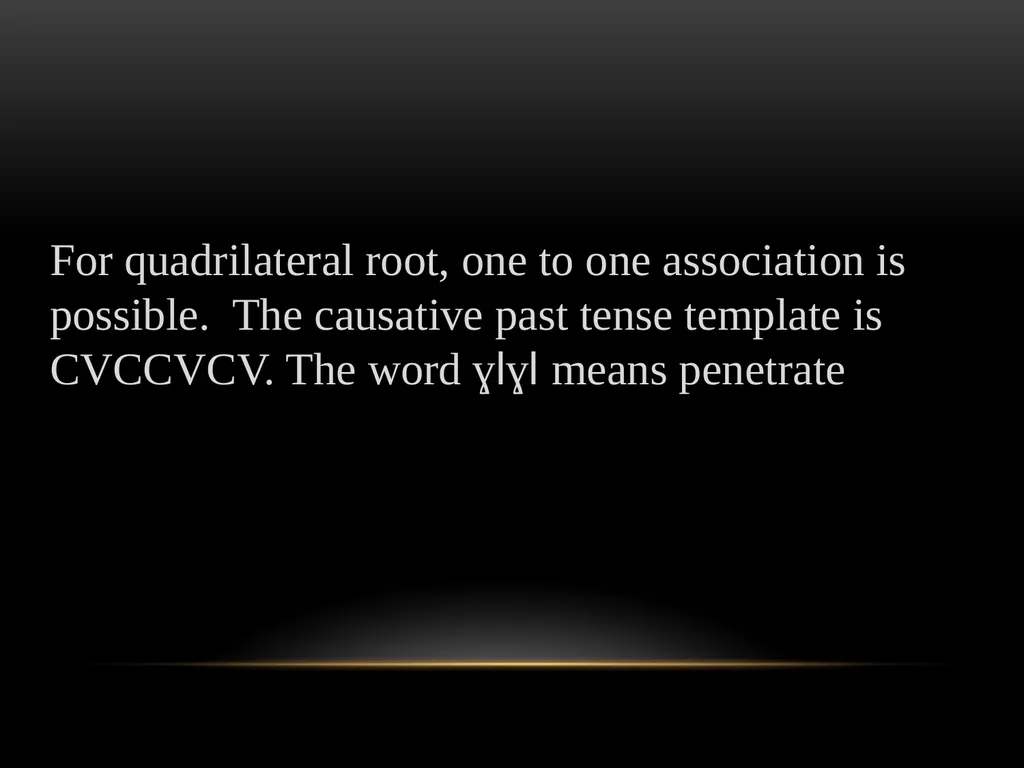
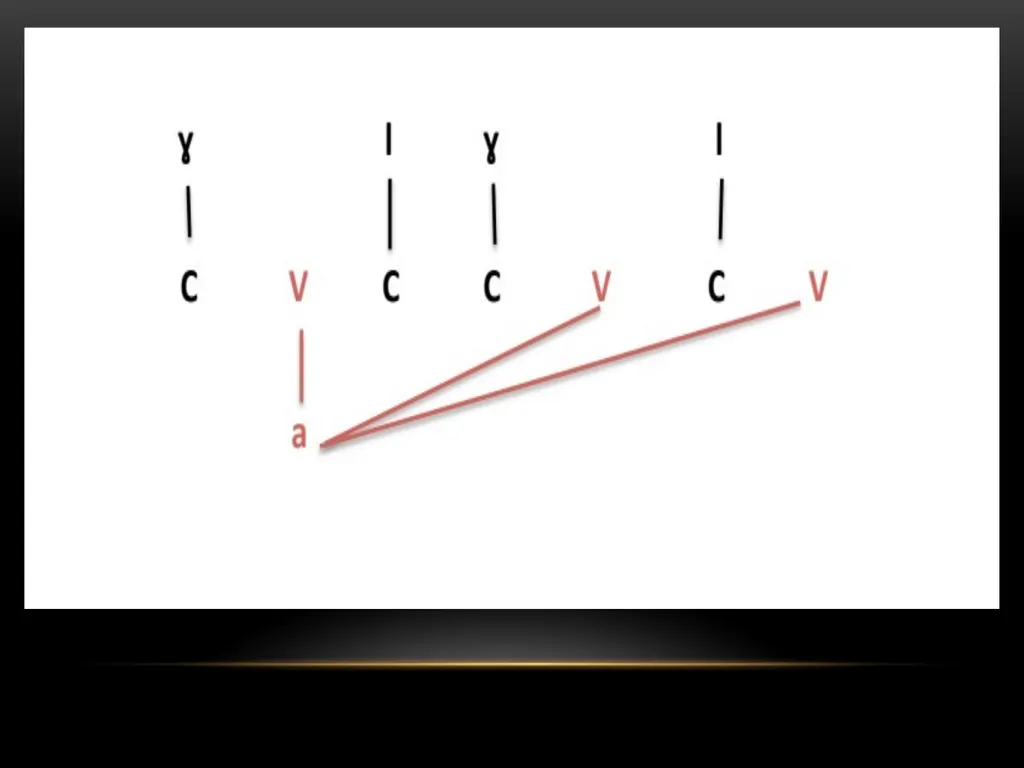
slide45. For quadrilateral root, one to one association is possible. The causative past tense template is CVCCVCV. The word ɣlɣl means penetrate<br>
slide2. This approach to generative phonology was proposed by John Gold Smith in 1976. This theory was based on earlier ideas from several linguists:
Bernard Bloch (1948)
J. R. Firth (1948)
Charles Hocket (1955)<br>
slide3. The autosegmental framework was originally used to describe tone in tone languages. G.N. Clements (1976) developed the theory involving vowel harmony and nasal harmony. Then John McCarthy (1979) built upon this theory extensively in the verbal derivation of Classical Arabic<br>
slide4. Description of the framework:
Each autosegmental tier contains a linearly ordered sequence of autosegments
Different features may be placed on separate tiers Various tiers are organized by association lines<br>
slide6. Autosegmental phonology deals with the consequences for generative phonology of multi-linear phonological analysis and representation
The underlying and surface forms consist of parallel strings of segments arranged in two or more tiers Features are distributed over the various tiers
No feature may appear on more than one tier<br>
slide7. Some constraints:
Association lines never cross
Vowels link to vowels and consonants to consonants
A skeletal node can’t be linked to two different segments on different tiers<br>
slide8. Similarities with the generative phonology:
Autosegmental phonology shares the assumption that we have an internal grammar and that phonology is an attempt to represent these abstract mental constructs.
Represents phonological processes in a formally simple way<br>
slide9. Differences:
Autosegmental phonology investigates the consequences of having more complex structures and articulation than a linear string of segments can address
Autosegmenal phonology goes beyond the place and manner of articulation and focuses on stress, tone, and vowel and nasal harmony<br>
slide10. The analysis of phonological phenomena uses less features and changing rules. Instead, delete or reorganize the various autosegments through association lines<br>
slide11. John McCarthy proposed an important development by showing that the derivation of words from consonantal roots in Arabic could be analyzed autosegmentally.
In Arabic, words may be formed by modifying the root itself internally and not simply by connecting of affixes, root compounding, or conversion<br>
slide12. How this theory works in real life:
Learning to identify the root of the Arabic word is important. It will often help you guess the meaning of words, thus increasing your vocabulary and comprehension
Possible semantic variation of the same root:
One root of word and many other derivations by adding vowels, suffixes, and prefixes to the root
ktb= write<br>
slide17. Autosegmental representation for the root ktb<br>
slide18. Arabic Patterns and roots
Arabic Framework:
Autosegmental representation in which features bundle for vowels and consonants were connected to C and V nodes on different tiers<br>
slide19. Root Tier:
it’s consonantal segments, the meaning of lexeme (ktb= write;nql= move; fʕl= do)<br>
slide20. Skeletal Tier:
a prosodic template associated with a particular meaning or grammatical function.
For example:
katab = CVCVC=CaCaC is an active pattern that means he wrote
kutiba=CVCVC=CuCiC is an active pattern that means it was written<br>
slide21. Melody Tier:
it involves grammatical information: tense, voice, aspect, number, derivational functions<br>
slide22. Arabic Verbs System:
Arabic verbs are structured around a root consisting of consonants only.
The trilateral root is based on 15 derivational categories called banyan
The vowel patterns bear a consistent meaning such as CaCaC (this pattern is always for the perfective active)
CuCiC (this pattern is always for the perfective passive)<br>
slide23. Derivation Ⅰ:
Template= CVCVC= Perfective active and passive
Perfective active = CVCVC=CaCaC
Perfective passive= CVCVC=CuCiC<br>
slide28. What about affixes? How can we recognize them? How can we know they’re a part of the root or not?<br>
slide29. Morpheme tier:
McCarthy added an additional morpheme tier= μ node. Lexical representation of each morpheme in a word takes a separate tier
The suffixes and prefixes take also μ nodes. In this way the root tier will provide all the information need to distinguish consonants from one another by point and manner of articulation like the following:<br>
slide35. a linear analysis for the Arabic examples:<br>
slide37. A linear analysis is cumbersome and inelegant!<br>
slide42. Conclusion: Framework advantages include tone, vowel harmony, gemination, and compensatory lengthening
Based on the data we analyzed, this framework at this time is not sufficient to supplant other phonological theories, but provides a complementary analytical method to deal with specific phonological phenomena<br>
slide43. Obligatory Contour Principle:
Complication for this theory
The geminate roots in Arabic don’t provide a satisfactory explanation for an empty slot
Arabic allows roots of two, three and four consonants to be subject to the Obligatory Contour Principle
This OCP states that identical H and L tones can’t be adjacent to each other<br>
slide44. In 1986, McCarthy extended the OCP to all autosegmental melodies including consonantal and vocalic segments
For biconsonantal root:
CV template must be filled by adding a geminate consonant for the root. For example, ʃd is called a geminate root , so it will be ʃdd<br>
slide45. For quadrilateral root, one to one association is possible. The causative past tense template is CVCCVCV. The word ɣlɣl means penetrate<br>