A quick introduction for newcomers HORIZON EUROPE Economic Impact Scientific Impact Societal Impact What is expected from an EU RI programme? Key Impact Pathways 1. Creating high-quality new knowledge 2. Strengthening human capital in RI
"A quick introduction for newcomers HORIZON EUROPE" is the property of its rightful owner. Permission is granted to
download and print the materials on this website for personal, non-commercial use only, and to display it
on your personal computer provided you do not modify the materials and that you retain all copyright
notices contained in the materials. By downloading content from our website, you accept the terms of this
agreement.
Presentation Transcript
01
A quick introduction for newcomers HORIZON EUROPE<br>
02
Economic
Impact Scientific
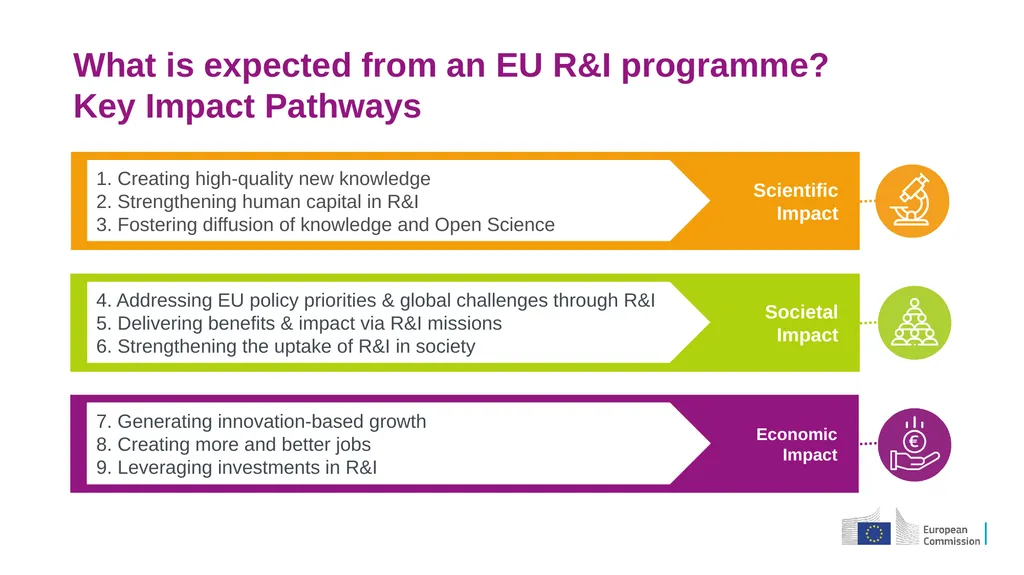
Impact Societal Impact What is expected from an EU R&I programme? Key Impact Pathways 1. Creating high-quality new knowledge
2. Strengthening human capital in R&I
3. Fostering diffusion of knowledge and Open Science 4. Addressing EU policy priorities & global challenges through R&I
5. Delivering benefits & impact via R&I missions
6. Strengthening the uptake of R&I in society 7. Generating innovation-based growth
8. Creating more and better jobs
9. Leveraging investments in R&I<br>
03
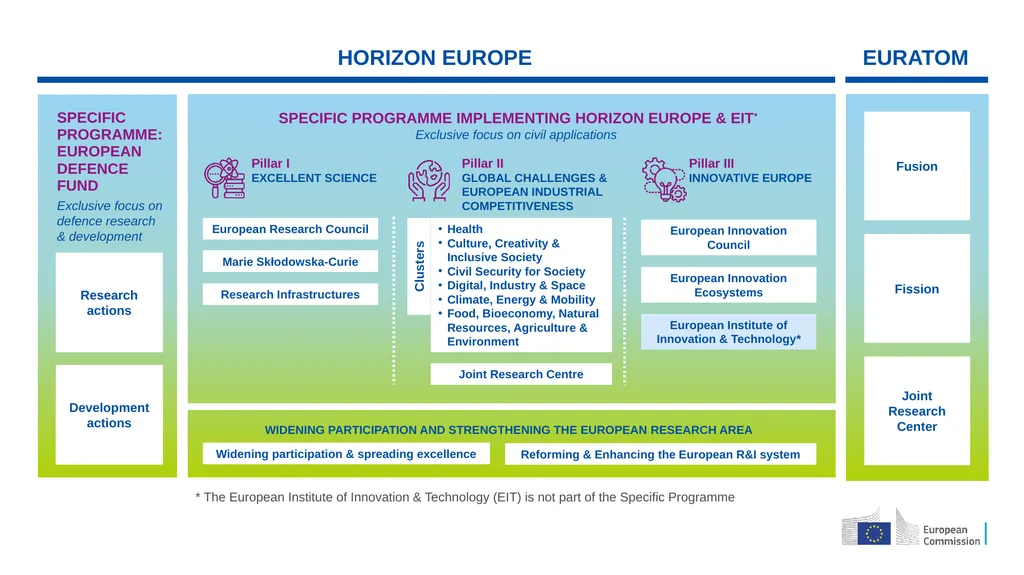
* The European Institute of Innovation & Technology (EIT) is not part of the Specific Programme EURATOM HORIZON EUROPE Research actions Development actions Specific Programme: European Defence Fund Specific Programme implementing Horizon Europe & EIT*
Exclusive focus on civil applications Widening Participation and Strengthening the European Research Area Reforming & Enhancing the European R&I system Widening participation & spreading excellence Exclusive focus on defence research & development<br>
04
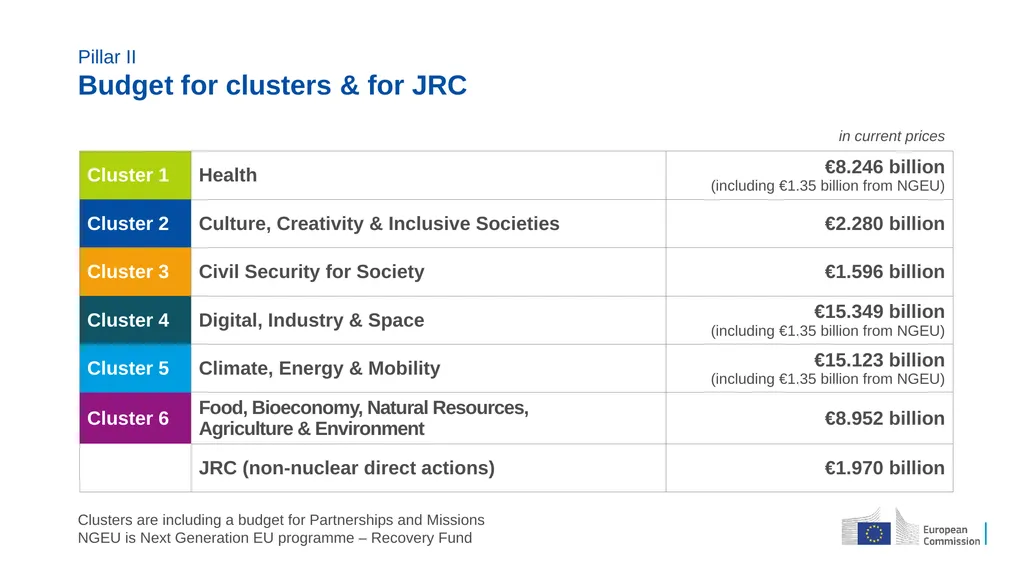
Pillar II Budget for clusters & for JRC in current prices Clusters are including a budget for Partnerships and Missions
NGEU is Next Generation EU programme – Recovery Fund<br>
05
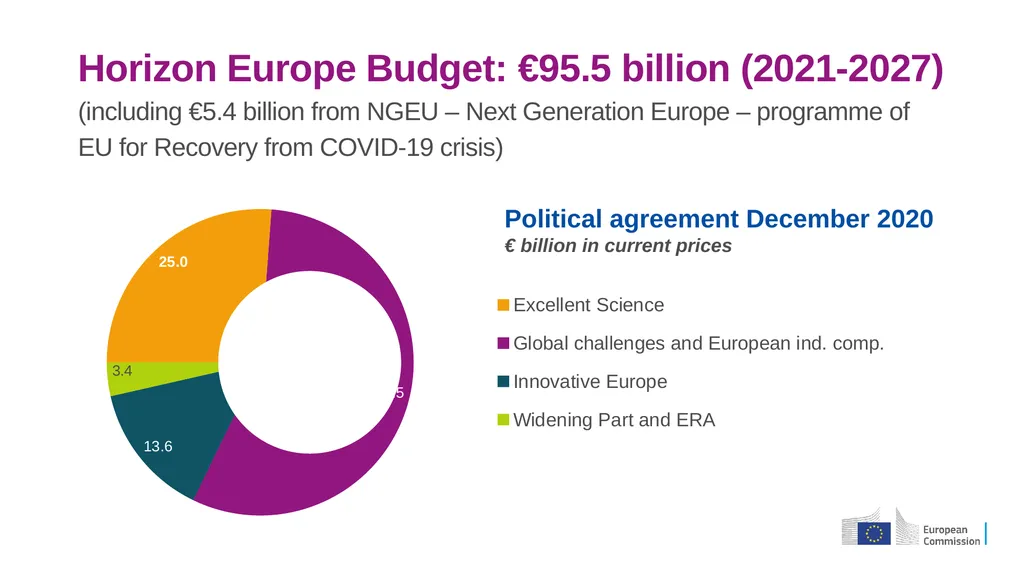
Political agreement December 2020
€ billion in current prices Horizon Europe Budget: €95.5 billion (2021-2027)
(including €5.4 billion from NGEU – Next Generation Europe – programme of EU for Recovery from COVID-19 crisis)<br>
06
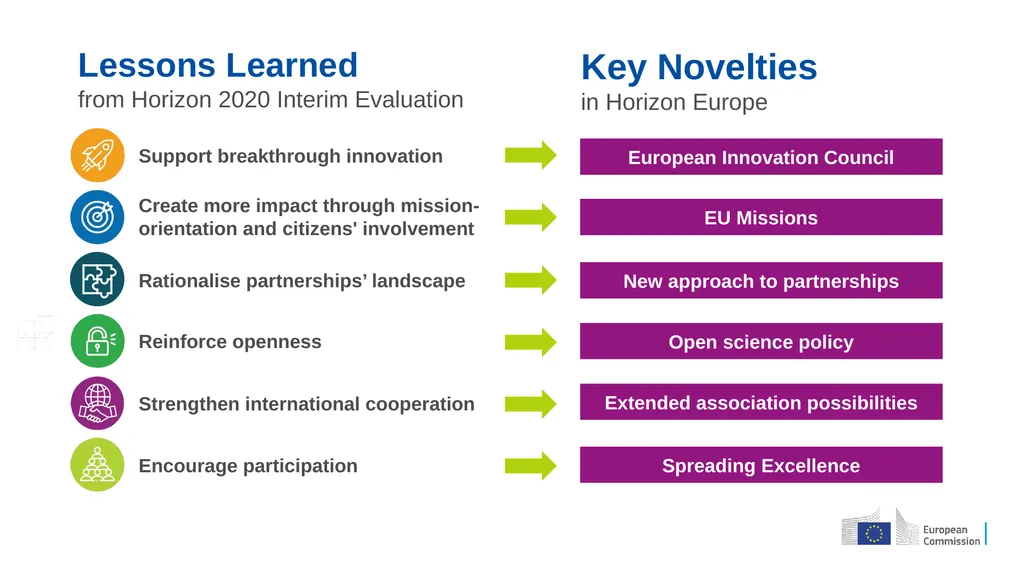
Lessons Learned
from Horizon 2020 Interim Evaluation Key Novelties in Horizon Europe European Innovation Council EU Missions New approach to partnerships Open science policy Spreading Excellence Support breakthrough innovation Create more impact through mission-orientation and citizens' involvement Strengthen international cooperation Reinforce openness Rationalise partnerships’ landscape Encourage participation Extended association possibilities<br>
07
SMEs in Horizon Europe HORIZON EUROPE<br>
08
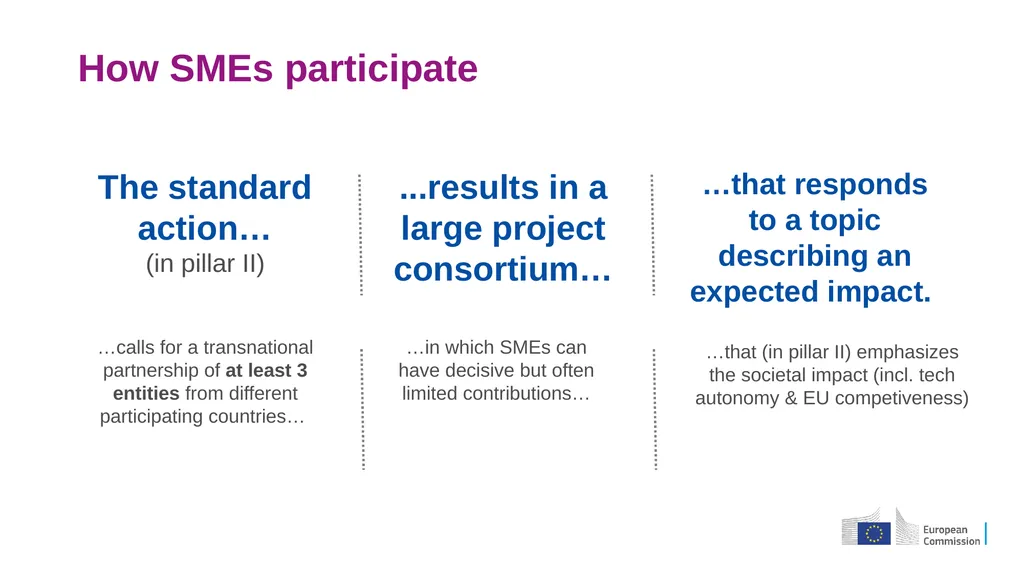
…calls for a transnational partnership of at least 3 entities from different participating countries… …that responds to a topic describing an expected impact. The standard action… (in pillar II) ...results in a large project consortium… How SMEs participate …in which SMEs can have decisive but often limited contributions… …that (in pillar II) emphasizes the societal impact (incl. tech autonomy & EU competiveness)<br>
09
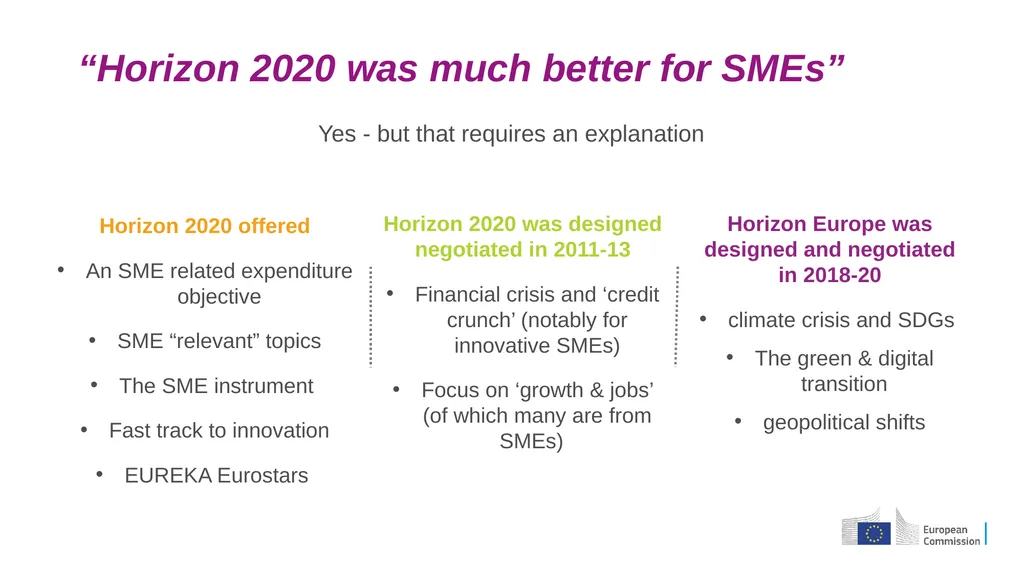
“Horizon 2020 was much better for SMEs” Yes - but that requires an explanation Horizon 2020 offered
An SME related expenditure objective
SME “relevant” topics
The SME instrument
Fast track to innovation
EUREKA Eurostars Horizon Europe was designed and negotiated in 2018-20
climate crisis and SDGs
The green & digital transition
geopolitical shifts Horizon 2020 was designed negotiated in 2011-13
Financial crisis and ‘credit crunch’ (notably for innovative SMEs)
Focus on ‘growth & jobs’ (of which many are from SMEs)<br>
10
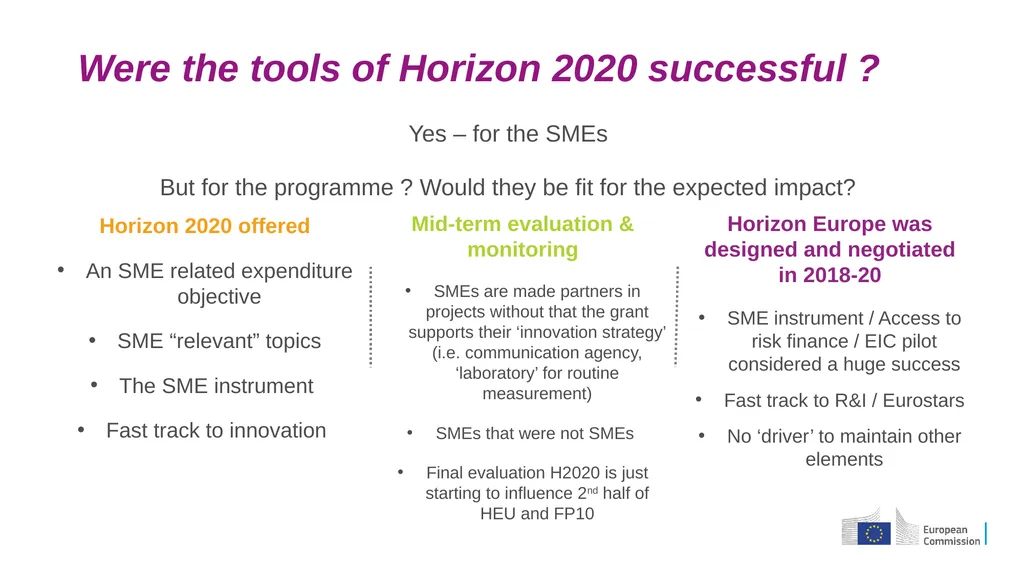
Were the tools of Horizon 2020 successful ? Yes – for the SMEs
But for the programme ? Would they be fit for the expected impact? Horizon 2020 offered
An SME related expenditure objective
SME “relevant” topics
The SME instrument
Fast track to innovation Horizon Europe was designed and negotiated in 2018-20
SME instrument / Access to risk finance / EIC pilot considered a huge success
Fast track to R&I / Eurostars
No ‘driver’ to maintain other elements Mid-term evaluation & monitoring
SMEs are made partners in projects without that the grant supports their ‘innovation strategy’ (i.e. communication agency, ‘laboratory’ for routine measurement)
SMEs that were not SMEs
Final evaluation H2020 is just starting to influence 2nd half of HEU and FP10<br>
11
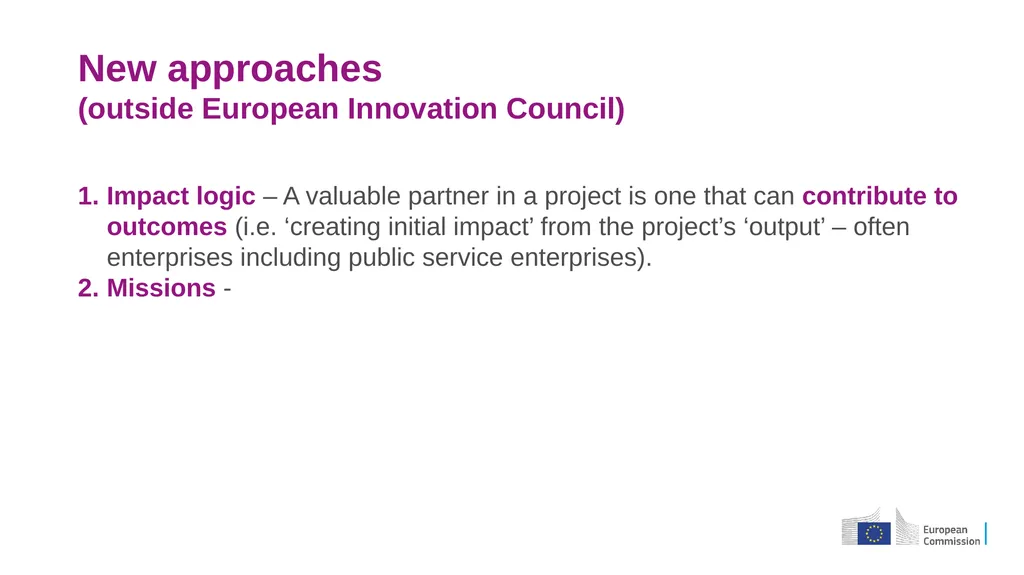
New approaches (outside European Innovation Council) Impact logic – A valuable partner in a project is one that can contribute to outcomes (i.e. ‘creating initial impact’ from the project’s ‘output’ – often enterprises including public service enterprises).
Missions -<br>
12
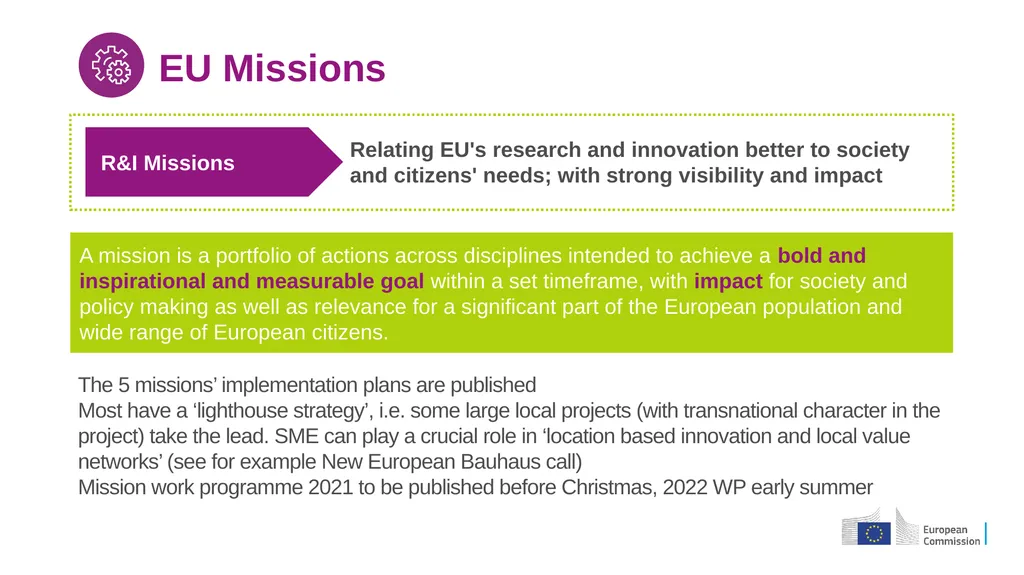
EU Missions Relating EU's research and innovation better to society and citizens' needs; with strong visibility and impact A mission is a portfolio of actions across disciplines intended to achieve a bold and inspirational and measurable goal within a set timeframe, with impact for society and policy making as well as relevance for a significant part of the European population and wide range of European citizens. R&I Missions The 5 missions’ implementation plans are published
Most have a ‘lighthouse strategy’, i.e. some large local projects (with transnational character in the project) take the lead. SME can play a crucial role in ‘location based innovation and local value networks’ (see for example New European Bauhaus call)
Mission work programme 2021 to be published before Christmas, 2022 WP early summer<br>
13
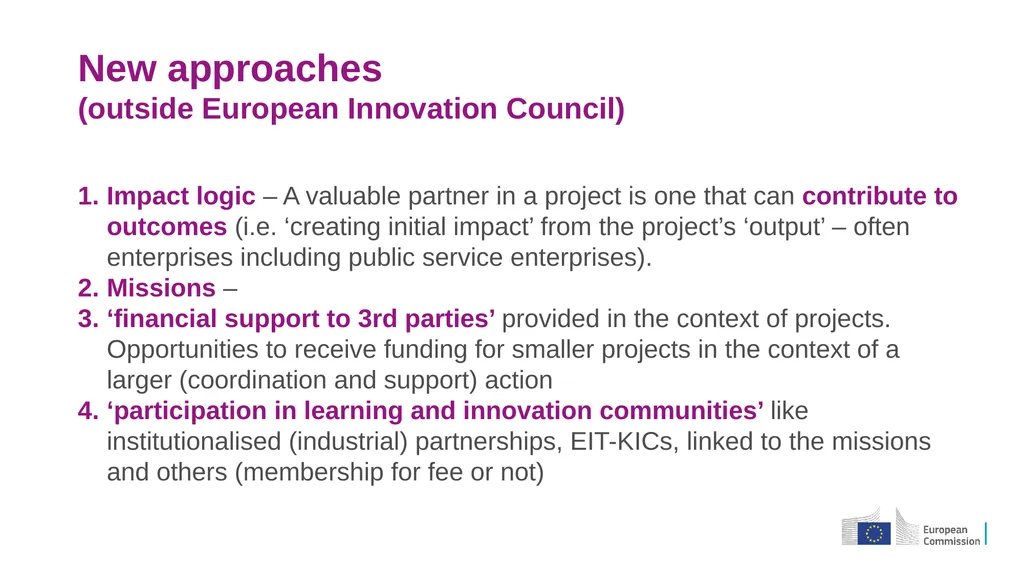
New approaches (outside European Innovation Council) Impact logic – A valuable partner in a project is one that can contribute to outcomes (i.e. ‘creating initial impact’ from the project’s ‘output’ – often enterprises including public service enterprises).
Missions –
‘financial support to 3rd parties’ provided in the context of projects. Opportunities to receive funding for smaller projects in the context of a larger (coordination and support) action
‘participation in learning and innovation communities’ like institutionalised (industrial) partnerships, EIT-KICs, linked to the missions and others (membership for fee or not)<br>
14
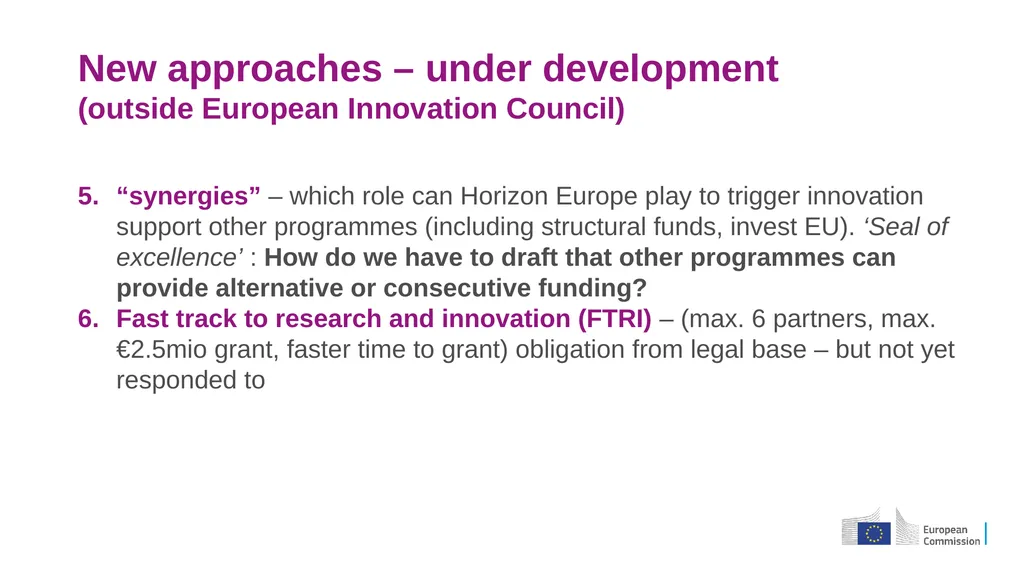
New approaches – under development (outside European Innovation Council) “synergies” – which role can Horizon Europe play to trigger innovation support other programmes (including structural funds, invest EU). ‘Seal of excellence’ : How do we have to draft that other programmes can provide alternative or consecutive funding?
Fast track to research and innovation (FTRI) – (max. 6 partners, max. €2.5mio grant, faster time to grant) obligation from legal base – but not yet responded to<br>
15
A specifc detail HORIZON EUROPE<br>
16
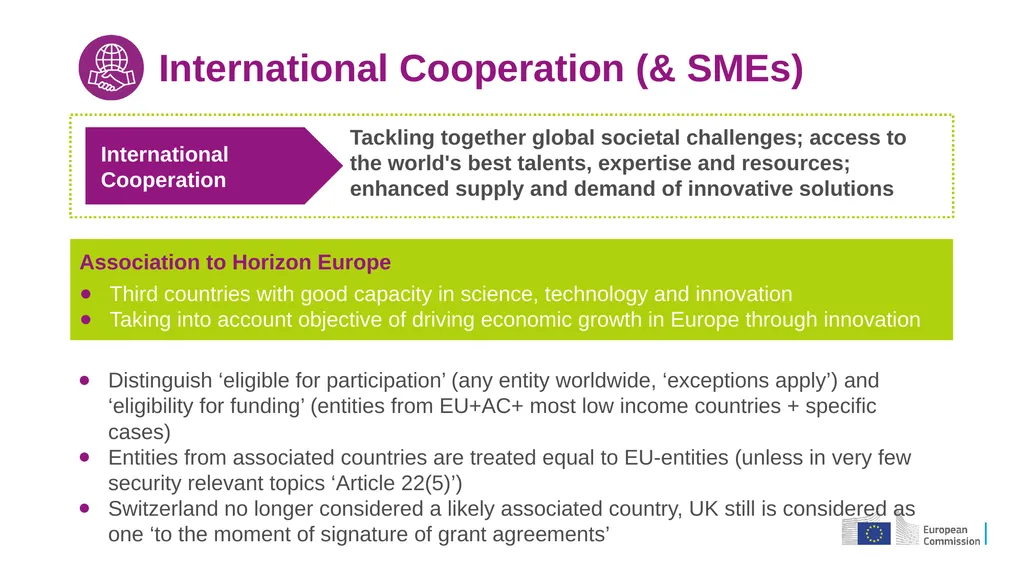
International Cooperation (& SMEs) Tackling together global societal challenges; access to the world's best talents, expertise and resources; enhanced supply and demand of innovative solutions Association to Horizon Europe
Third countries with good capacity in science, technology and innovation
Taking into account objective of driving economic growth in Europe through innovation International
Cooperation Distinguish ‘eligible for participation’ (any entity worldwide, ‘exceptions apply’) and ‘eligibility for funding’ (entities from EU+AC+ most low income countries + specific cases)
Entities from associated countries are treated equal to EU-entities (unless in very few security relevant topics ‘Article 22(5)’)
Switzerland no longer considered a likely associated country, UK still is considered as one ‘to the moment of signature of grant agreements’<br>