
A reflection on types Simon Peyton Jones,



Description: A reflection on types Simon Peyton Jones, Stephanie Weirich, Richard Eisenberg, Dimitrios Vytiniotis Microsoft Research University of Pennsylvania August 2016 CACM Dec 2015 Bad type systems All programs Programs that work Programs that are
Related Topics
Download Presentation
"A reflection on types Simon Peyton Jones," is the property of its rightful owner. Permission is granted to download and print the materials on this website for personal, non-commercial use only, and to display it on your personal computer provided you do not modify the materials and that you retain all copyright notices contained in the materials. By downloading content from our website, you accept the terms of this agreement.
Presentation Transcript
slide1. A reflection on types Simon Peyton Jones, Stephanie Weirich,
Richard Eisenberg, Dimitrios Vytiniotis
Microsoft Research University of Pennsylvania
August 2016<br>
slide2. CACM Dec 2015<br>
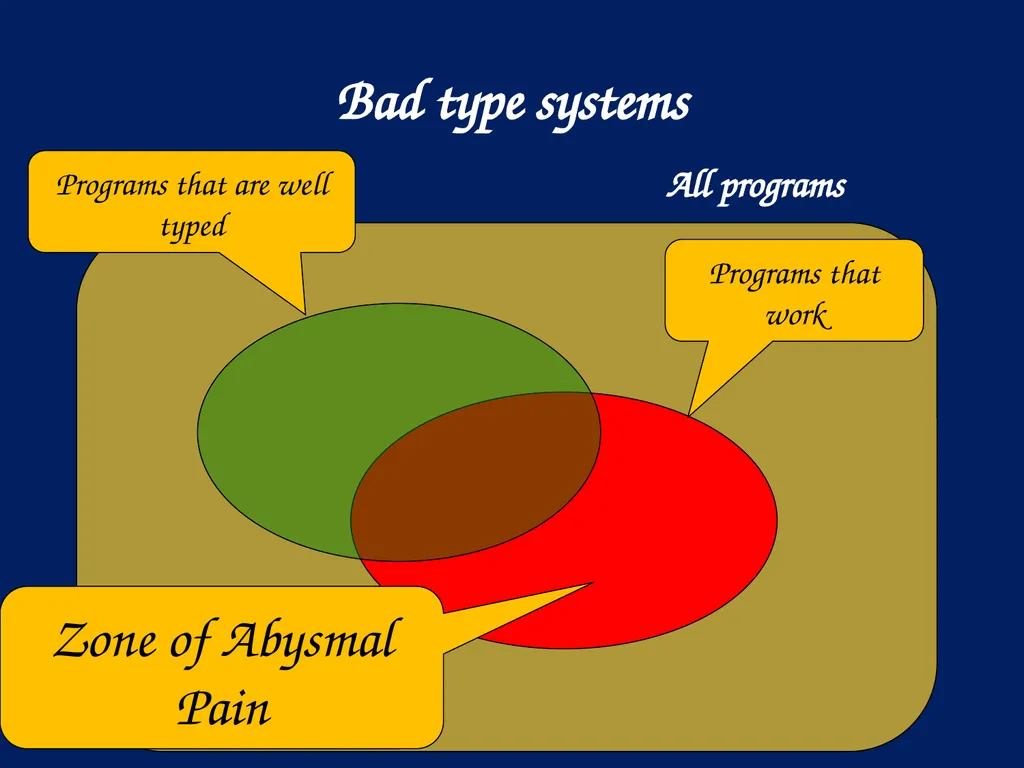
slide3. Bad type systems All programs Programs that work Programs that are well typed Zone of Abysmal Pain<br>
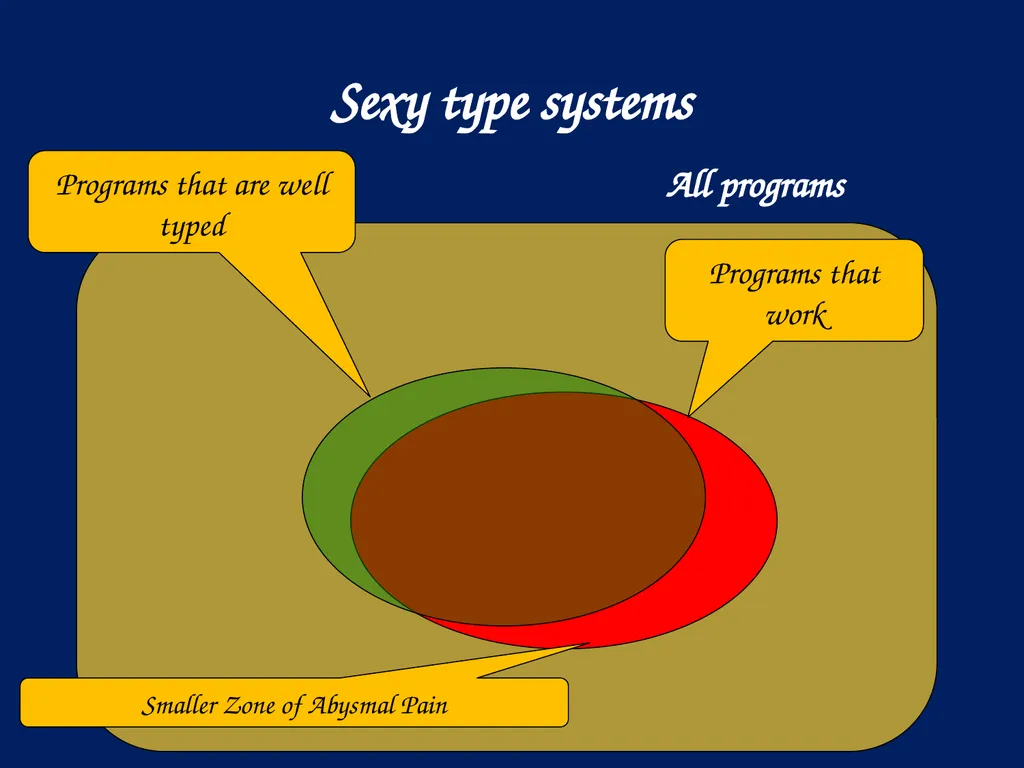
slide4. Sexy type systems All programs Programs that work Programs that are well typed Smaller Zone of Abysmal Pain<br>
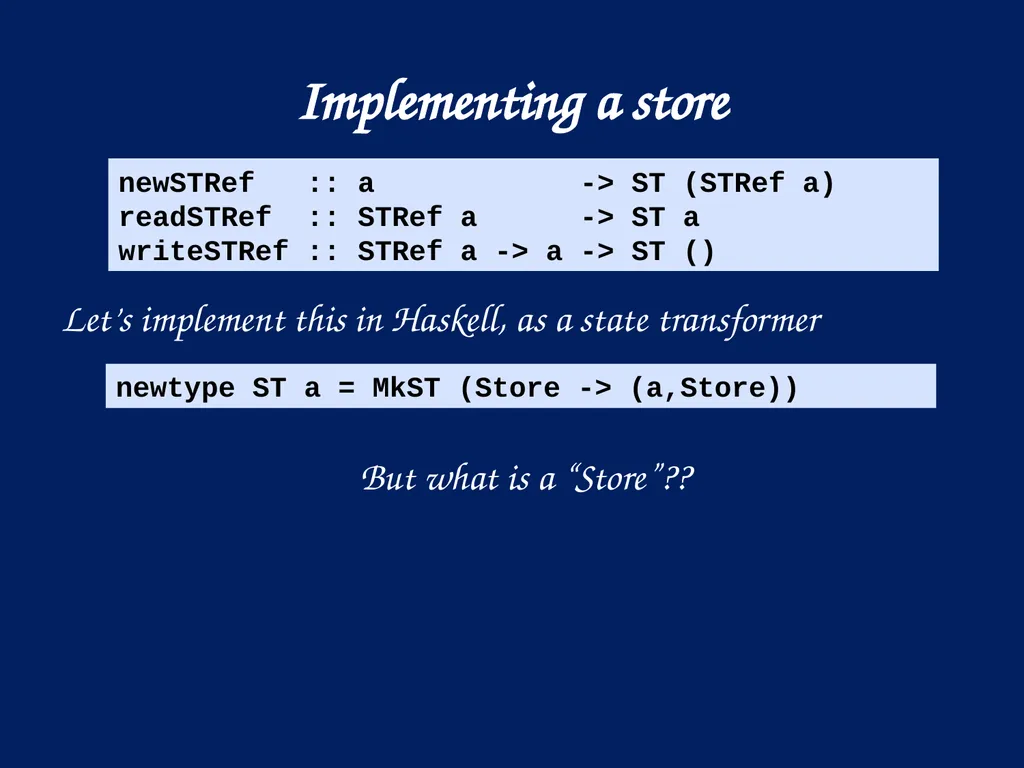
slide5. Implementing a store Let’s implement this in Haskell, as a state transformer newSTRef :: a -> ST (STRef a)
readSTRef :: STRef a -> ST a
writeSTRef :: STRef a -> a -> ST () newtype ST a = MkST (Store -> (a,Store)) But what is a “Store”??<br>
slide6. Promising failures<br>
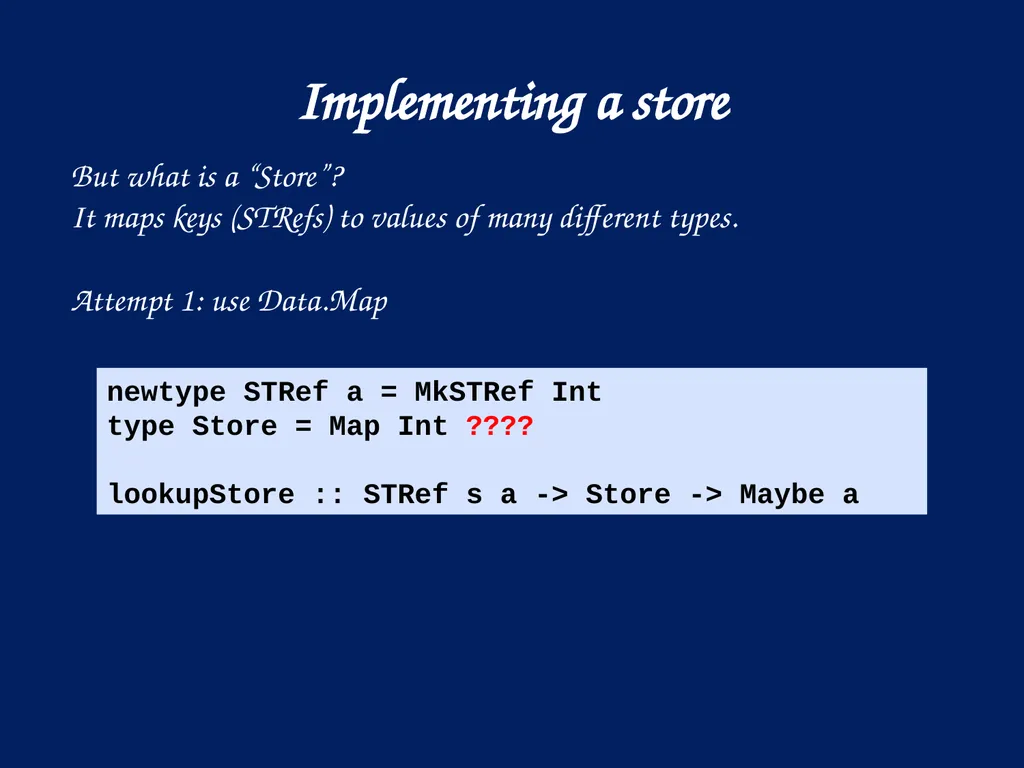
slide7. Implementing a store But what is a “Store”? It maps keys (STRefs) to values of many different types.
Attempt 1: use Data.Map newtype STRef a = MkSTRef Int
type Store = Map Int ????
lookupStore :: STRef s a -> Store -> Maybe a<br>
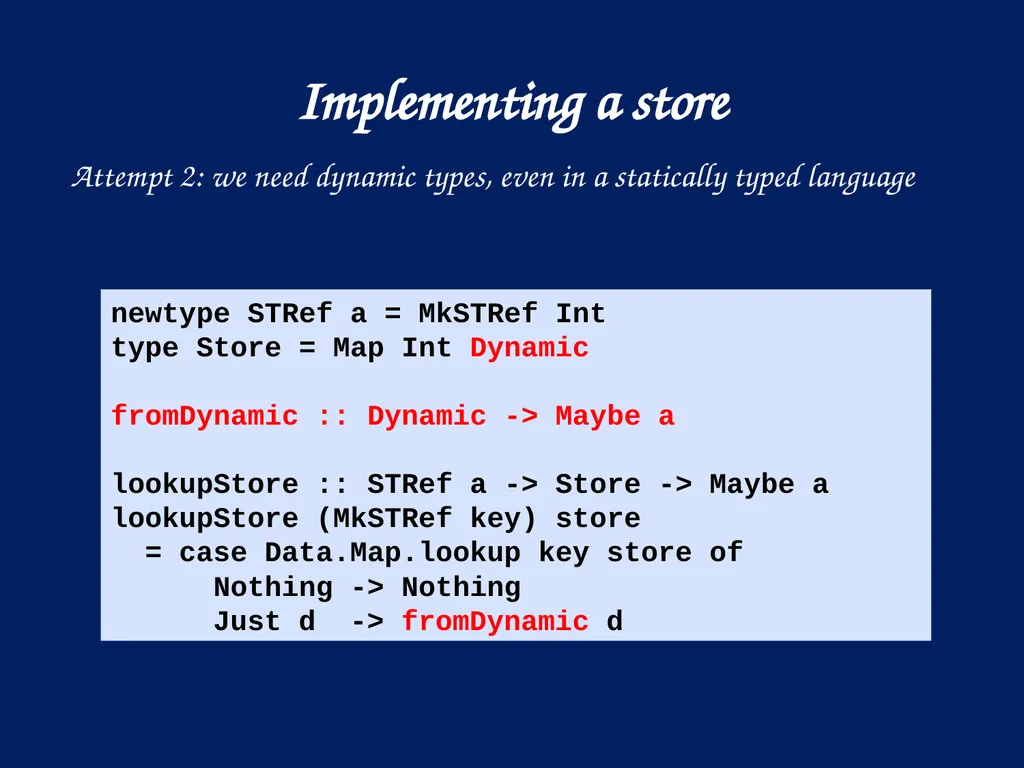
slide8. Implementing a store Attempt 2: we need dynamic types, even in a statically typed language newtype STRef a = MkSTRef Int
type Store = Map Int Dynamic
fromDynamic :: Dynamic -> Maybe a
lookupStore :: STRef a -> Store -> Maybe a
lookupStore (MkSTRef key) store
= case Data.Map.lookup key store of
Nothing -> Nothing
Just d -> fromDynamic d<br>
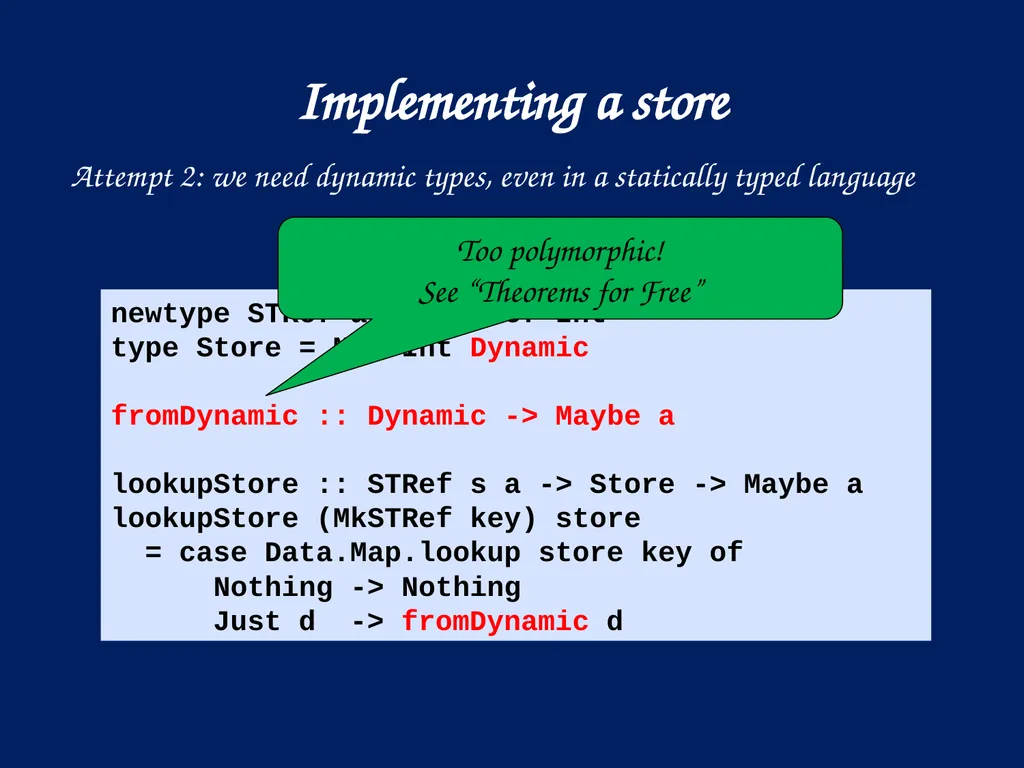
slide9. Implementing a store Attempt 2: we need dynamic types, even in a statically typed language newtype STRef a = MkSTRef Int
type Store = Map Int Dynamic
fromDynamic :: Dynamic -> Maybe a
lookupStore :: STRef s a -> Store -> Maybe a
lookupStore (MkSTRef key) store
= case Data.Map.lookup store key of
Nothing -> Nothing
Just d -> fromDynamic d Too polymorphic!
See “Theorems for Free”<br>
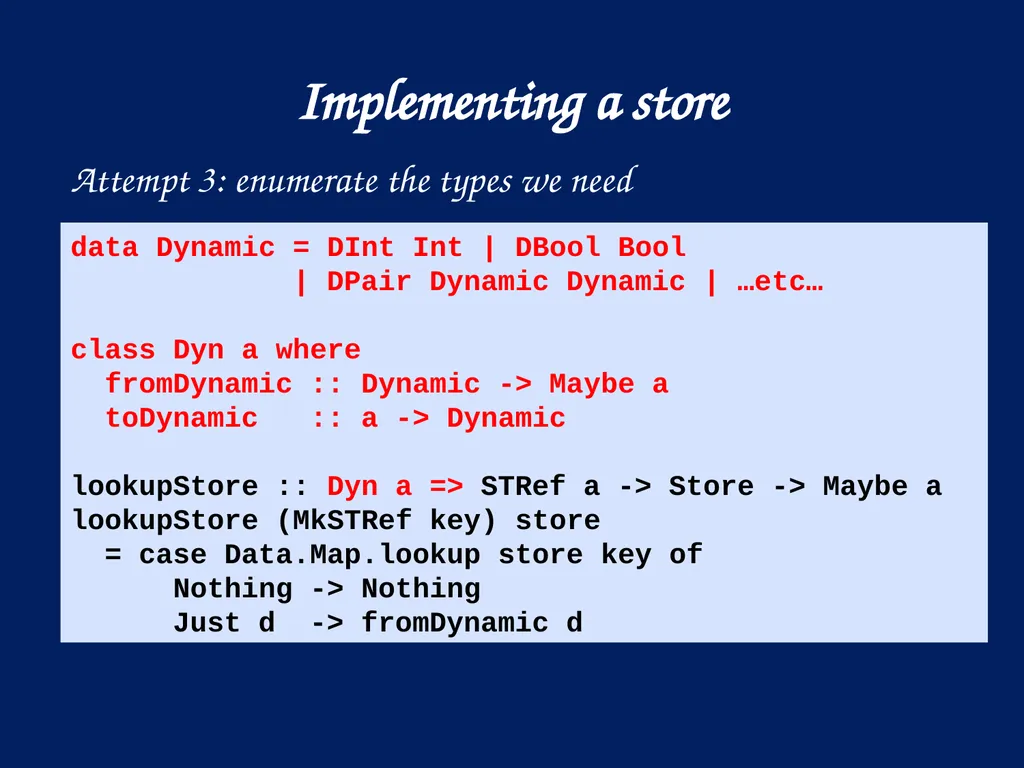
slide10. Implementing a store Attempt 3: enumerate the types we need data Dynamic = DInt Int | DBool Bool
| DPair Dynamic Dynamic | …etc…
class Dyn a where
fromDynamic :: Dynamic -> Maybe a
toDynamic :: a -> Dynamic
lookupStore :: Dyn a => STRef a -> Store -> Maybe a
lookupStore (MkSTRef key) store
= case Data.Map.lookup store key of
Nothing -> Nothing
Just d -> fromDynamic d<br>
slide11. Implementing a store data Dynamic = DInt Int | DBool Bool
| DPair Dynamic Dynamic | …etc…
class Dyn a where
fromDynamic :: Dynamic -> Maybe a
toDynamic :: a -> Dynamic
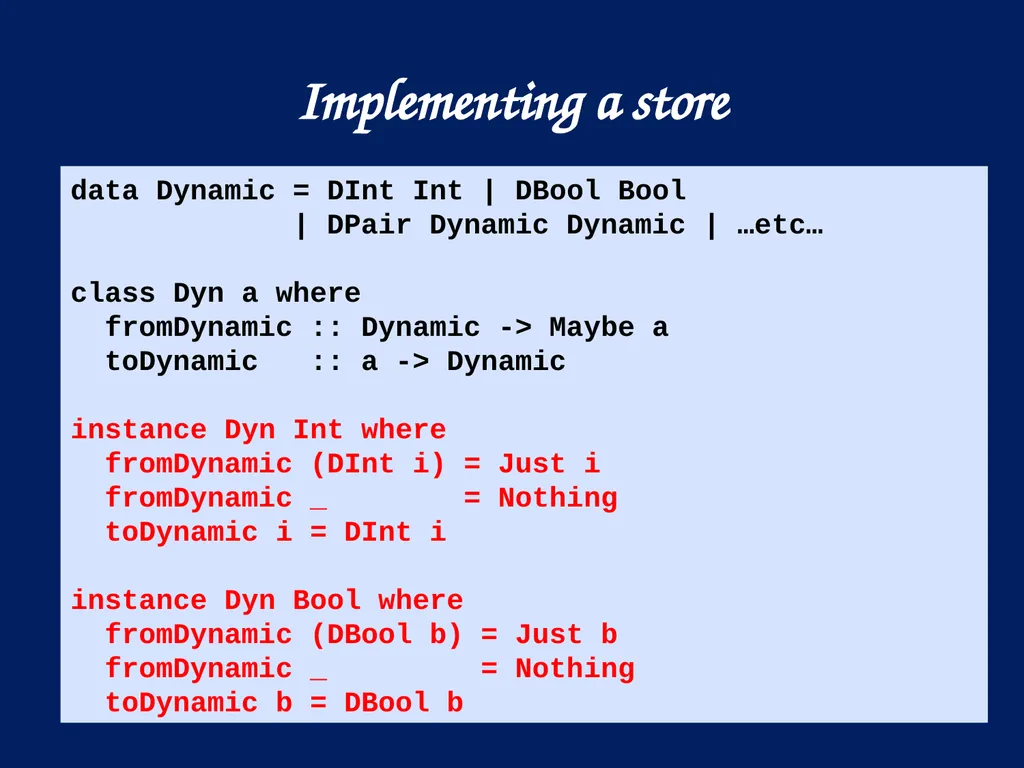
instance Dyn Int where
fromDynamic (DInt i) = Just i
fromDynamic _ = Nothing
toDynamic i = DInt i
instance Dyn Bool where
fromDynamic (DBool b) = Just b
fromDynamic _ = Nothing
toDynamic b = DBool b<br>
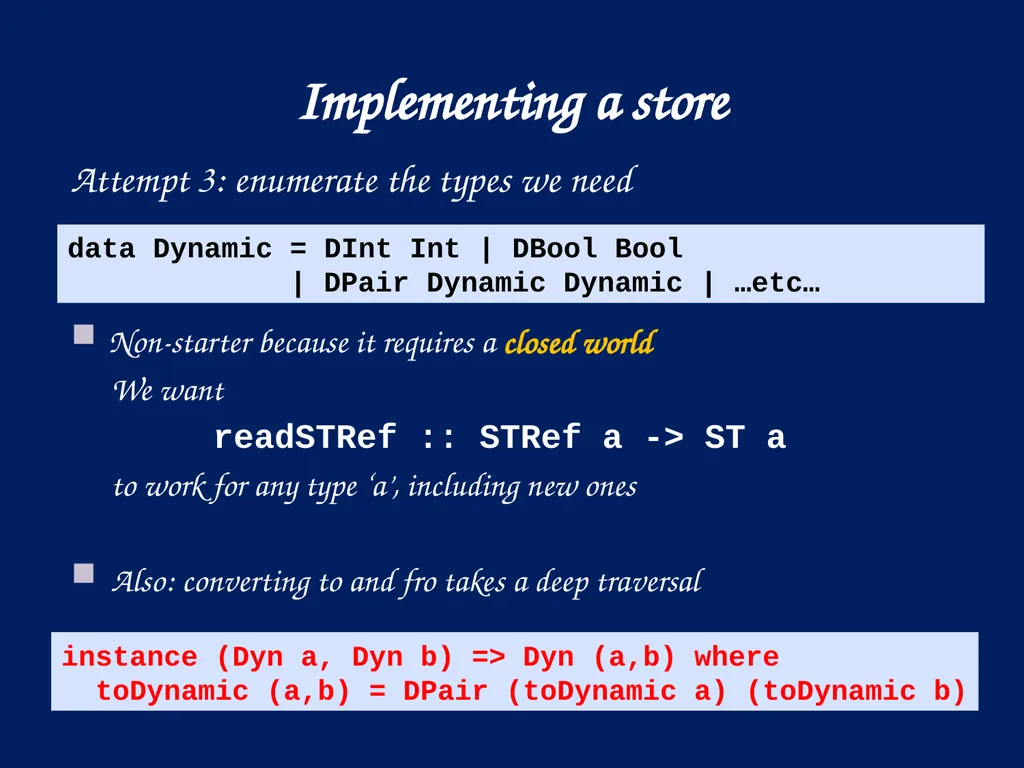
slide12. Implementing a store Attempt 3: enumerate the types we need data Dynamic = DInt Int | DBool Bool
| DPair Dynamic Dynamic | …etc… Non-starter because it requires a closed world
We want
readSTRef :: STRef a -> ST a
to work for any type ‘a’, including new ones
Also: converting to and fro takes a deep traversal instance (Dyn a, Dyn b) => Dyn (a,b) where
toDynamic (a,b) = DPair (toDynamic a) (toDynamic b)<br>
slide13. Getting closer (GHC )<br>
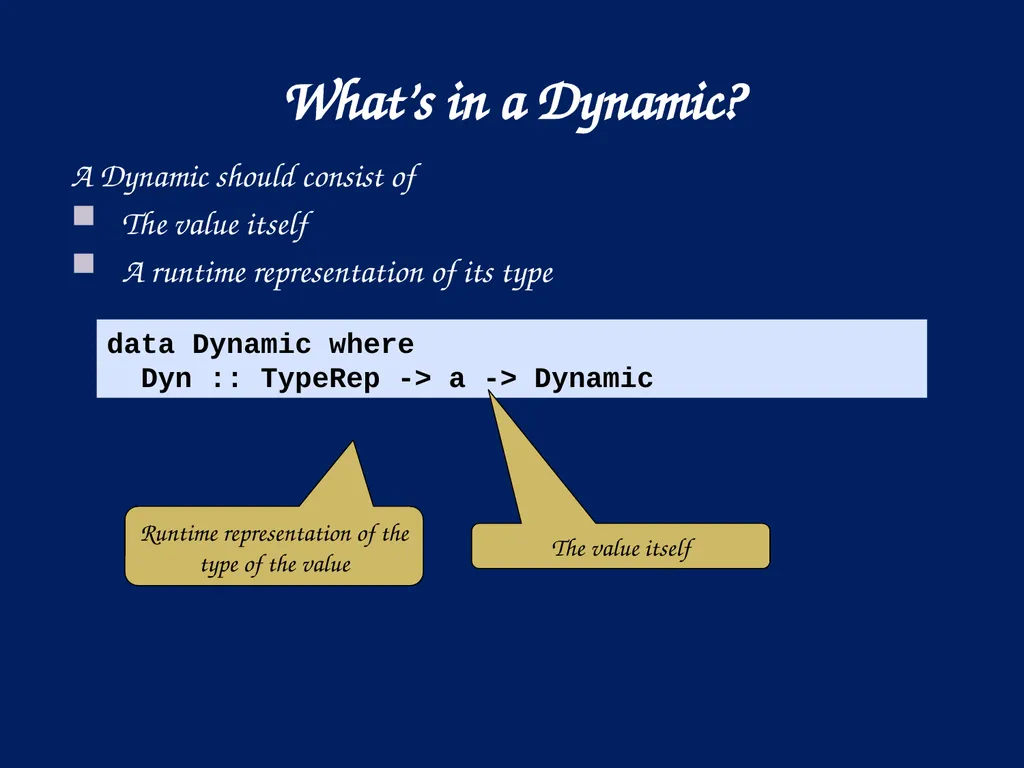
slide14. What’s in a Dynamic? A Dynamic should consist of
The value itself
A runtime representation of its type data Dynamic where
Dyn :: TypeRep -> a -> Dynamic Runtime representation of the type of the value The value itself<br>
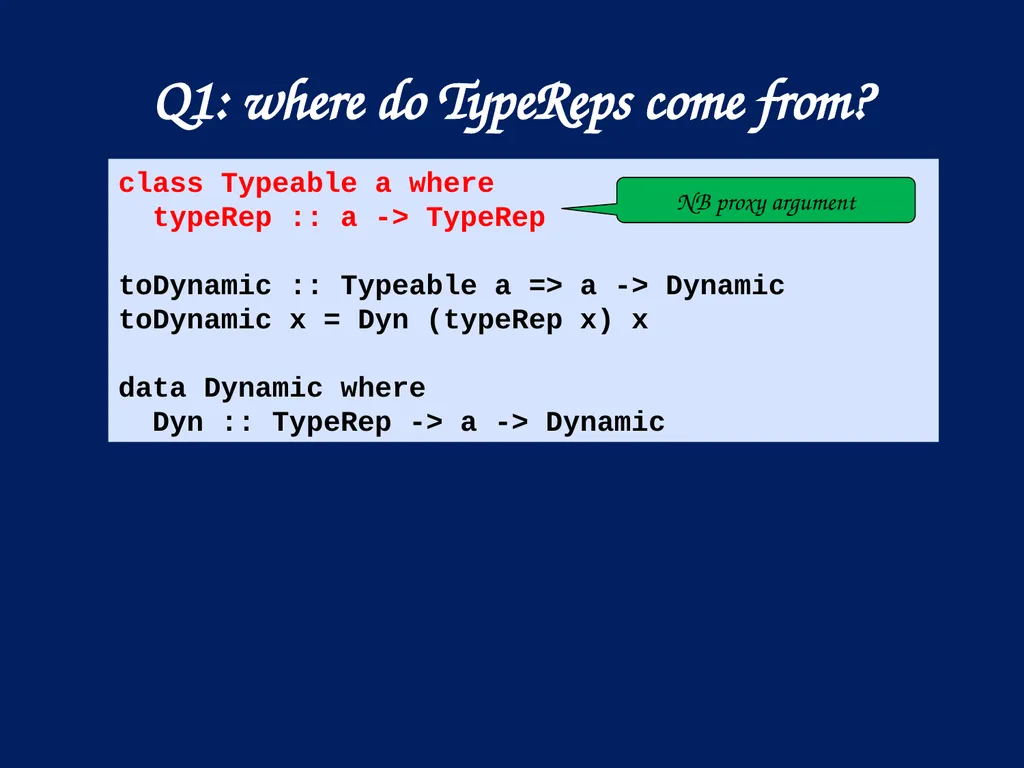
slide15. Q1: where do TypeReps come from? class Typeable a where
typeRep :: a -> TypeRep
toDynamic :: Typeable a => a -> Dynamic
toDynamic x = Dyn (typeRep x) x
data Dynamic where
Dyn :: TypeRep -> a -> Dynamic NB proxy argument<br>
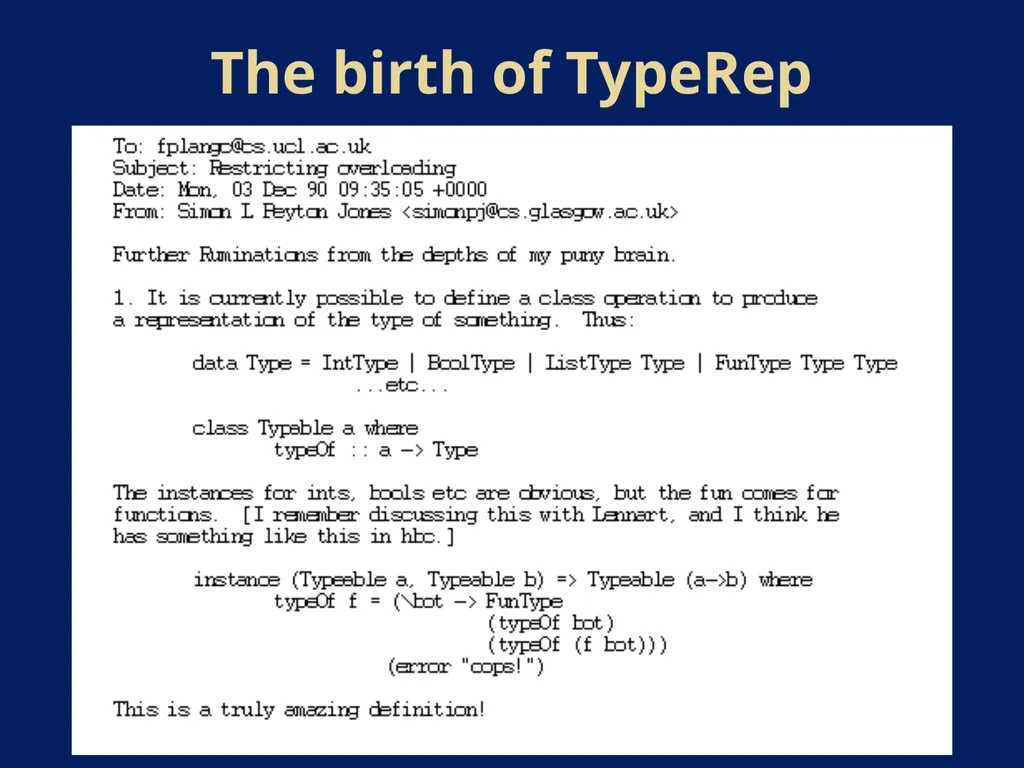
slide16. The birth of TypeRep<br>
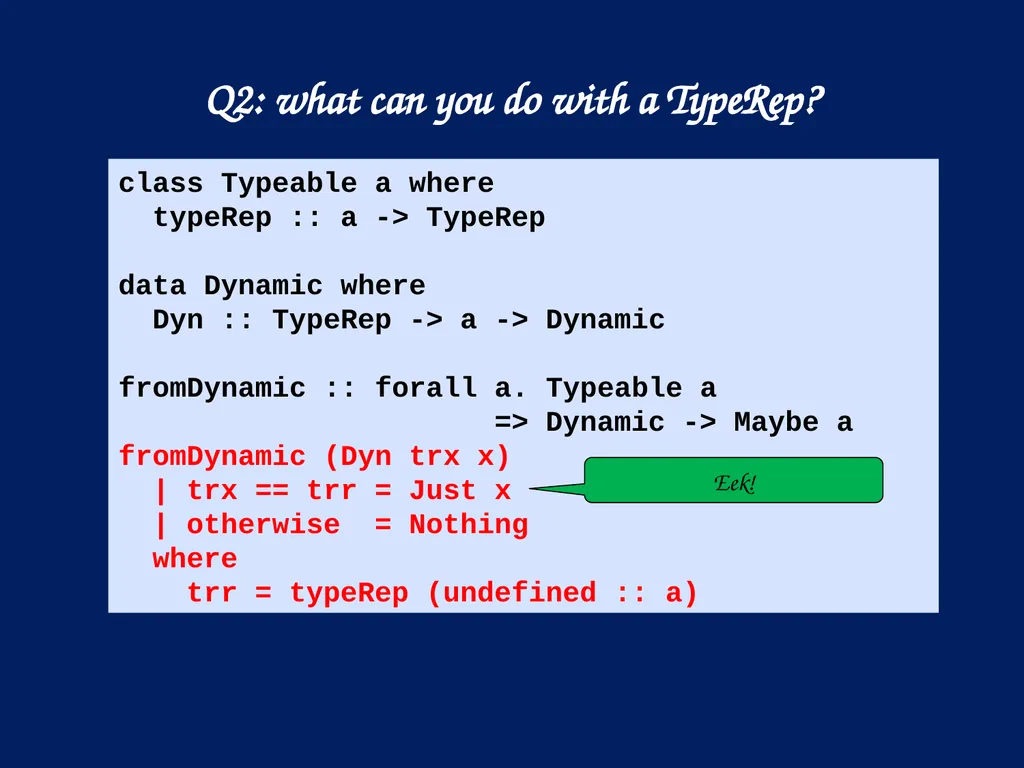
slide17. Q2: what can you do with a TypeRep? class Typeable a where
typeRep :: a -> TypeRep
data Dynamic where
Dyn :: TypeRep -> a -> Dynamic
fromDynamic :: forall a. Typeable a
=> Dynamic -> Maybe a
fromDynamic (Dyn trx x)
| trx == trr = Just x
| otherwise = Nothing
where
trr = typeRep (undefined :: a) Eek!<br>
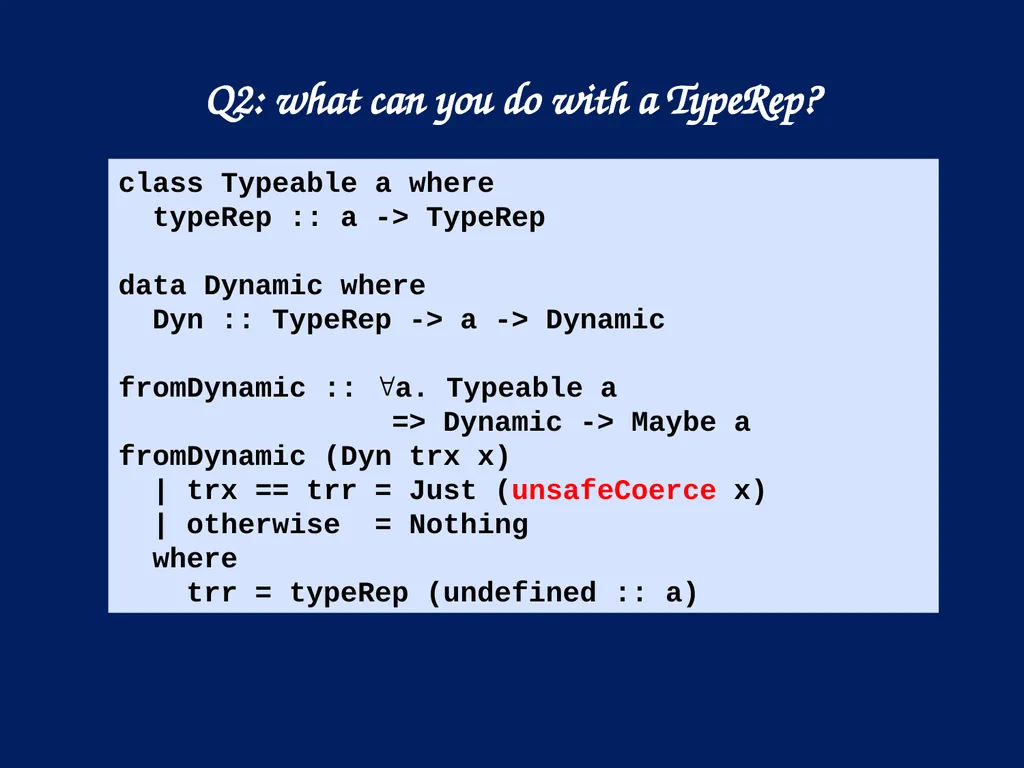
slide18. class Typeable a where
typeRep :: a -> TypeRep
data Dynamic where
Dyn :: TypeRep -> a -> Dynamic
fromDynamic :: a. Typeable a
=> Dynamic -> Maybe a
fromDynamic (Dyn trx x)
| trx == trr = Just (unsafeCoerce x)
| otherwise = Nothing
where
trr = typeRep (undefined :: a) Q2: what can you do with a TypeRep?<br>
slide19. The right way<br>
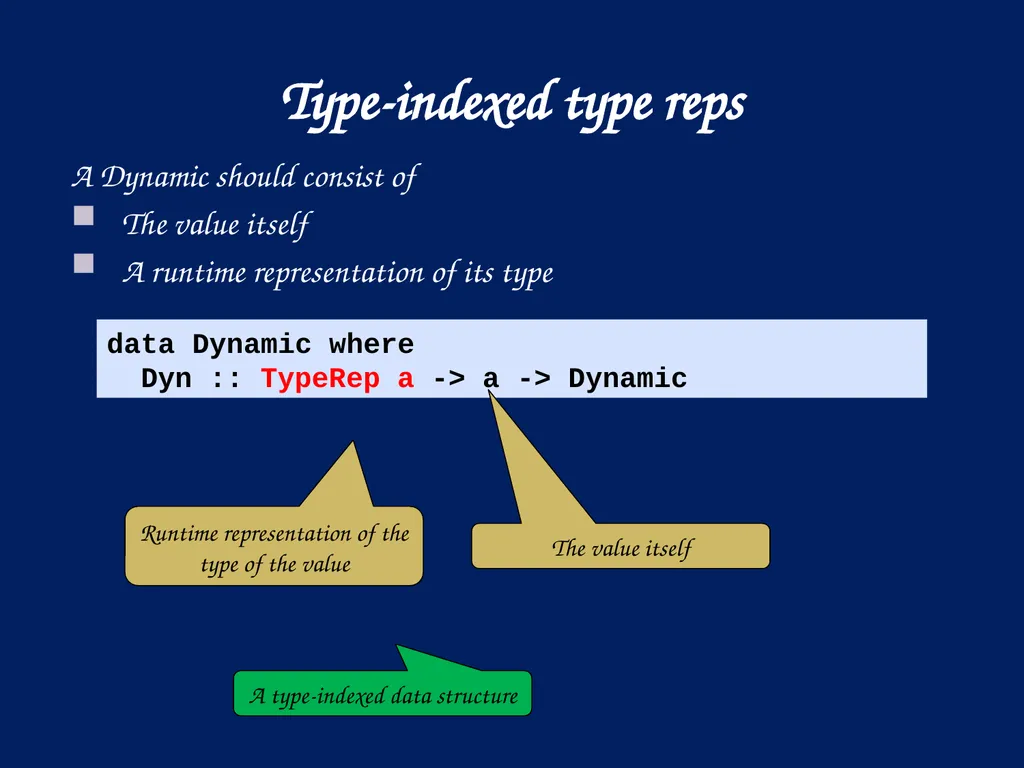
slide20. Type-indexed type reps A Dynamic should consist of
The value itself
A runtime representation of its type data Dynamic where
Dyn :: TypeRep a -> a -> Dynamic Runtime representation of the type of the value The value itself A type-indexed data structure<br>
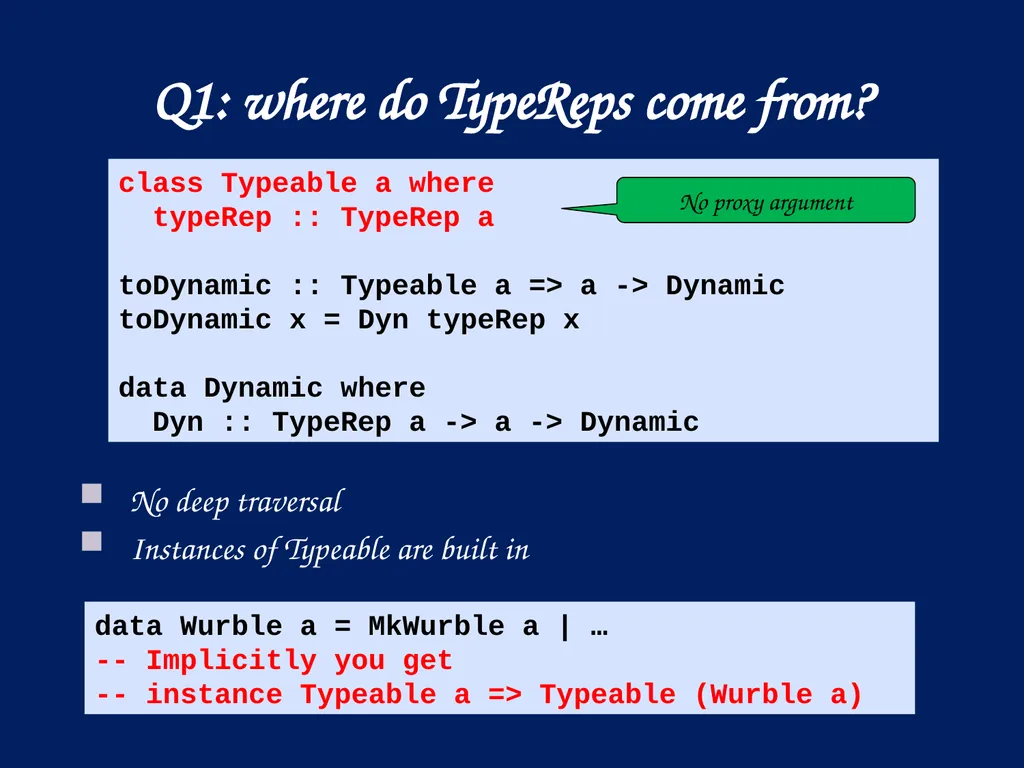
slide21. Q1: where do TypeReps come from? class Typeable a where
typeRep :: TypeRep a
toDynamic :: Typeable a => a -> Dynamic
toDynamic x = Dyn typeRep x
data Dynamic where
Dyn :: TypeRep a -> a -> Dynamic No deep traversal
Instances of Typeable are built in data Wurble a = MkWurble a | …
-- Implicitly you get
-- instance Typeable a => Typeable (Wurble a) No proxy argument<br>
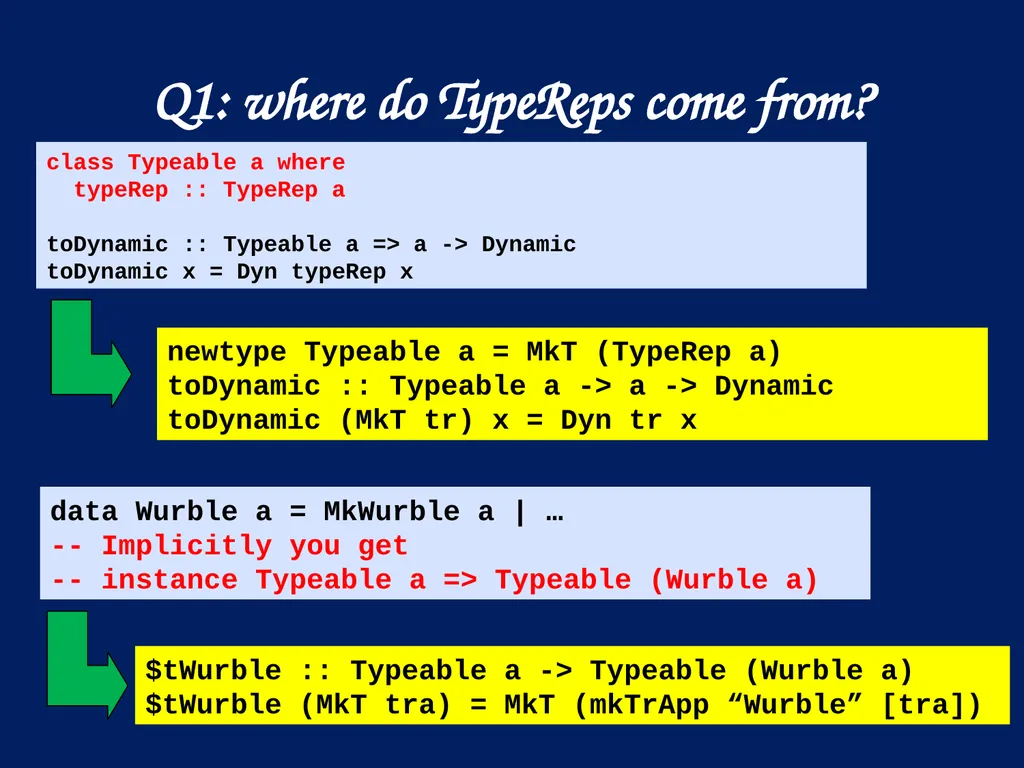
slide22. Q1: where do TypeReps come from? class Typeable a where
typeRep :: TypeRep a
toDynamic :: Typeable a => a -> Dynamic
toDynamic x = Dyn typeRep x data Wurble a = MkWurble a | …
-- Implicitly you get
-- instance Typeable a => Typeable (Wurble a) newtype Typeable a = MkT (TypeRep a)
toDynamic :: Typeable a -> a -> Dynamic
toDynamic (MkT tr) x = Dyn tr x $tWurble :: Typeable a -> Typeable (Wurble a)
$tWurble (MkT tra) = MkT (mkTrApp “Wurble” [tra])<br>
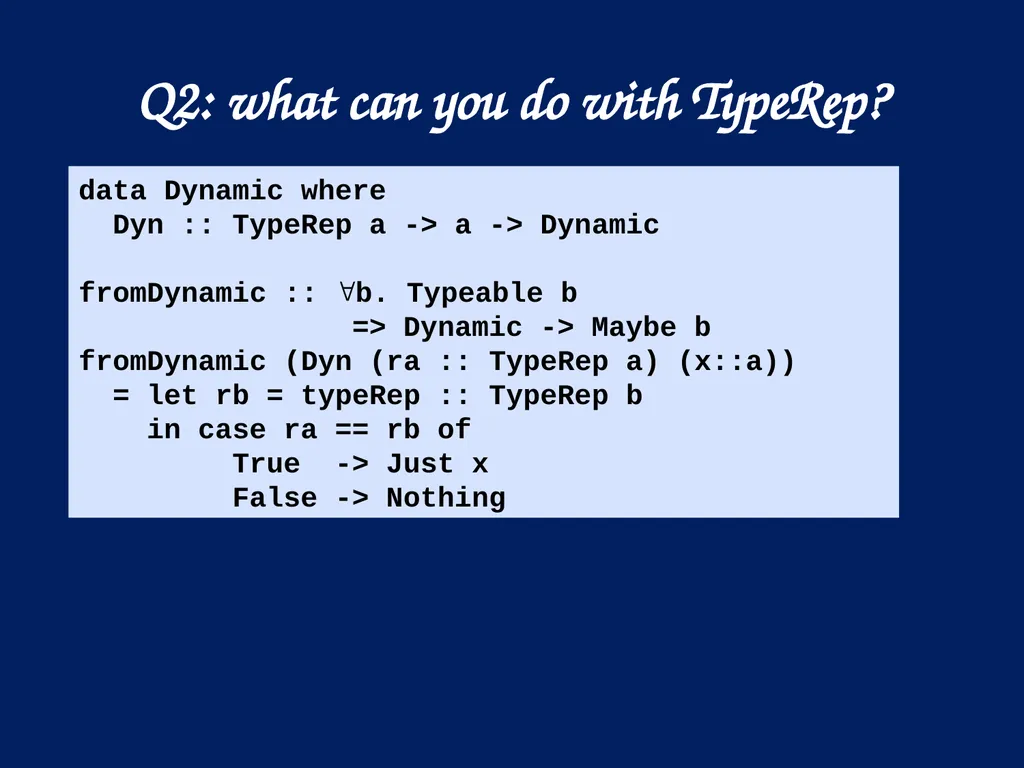
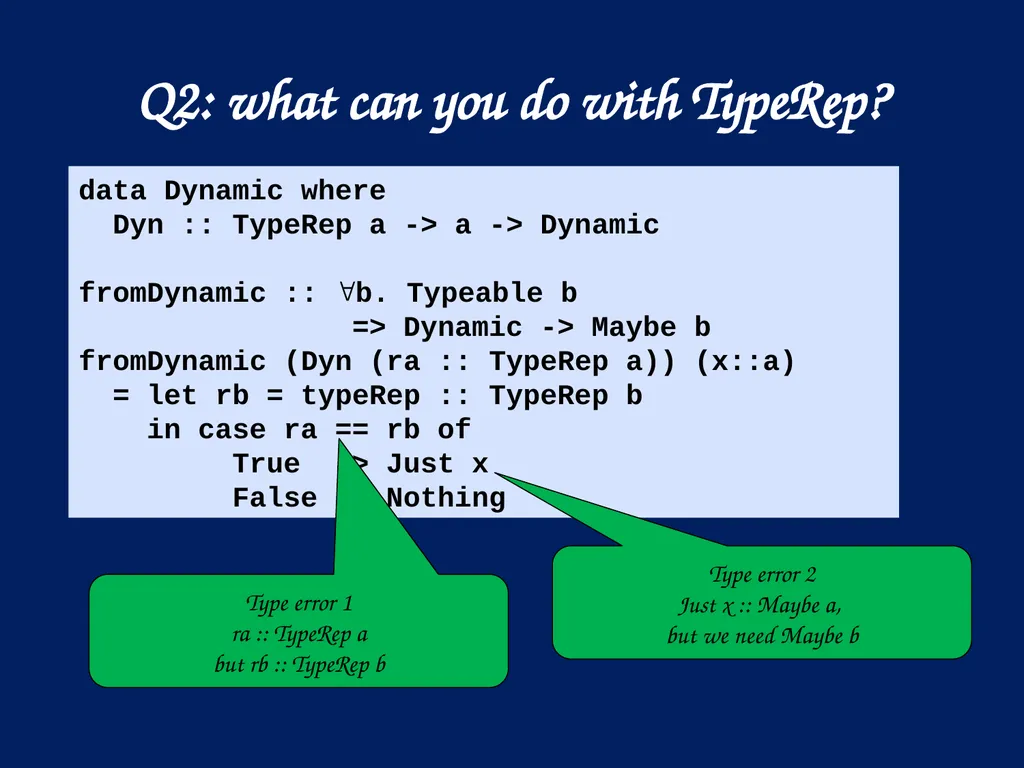
slide23. Q2: what can you do with TypeRep? data Dynamic where
Dyn :: TypeRep a -> a -> Dynamic
fromDynamic :: b. Typeable b
=> Dynamic -> Maybe b
fromDynamic (Dyn (ra :: TypeRep a) (x::a))
= let rb = typeRep :: TypeRep b
in case ra == rb of
True -> Just x
False -> Nothing<br>
slide24. Q2: what can you do with TypeRep? data Dynamic where
Dyn :: TypeRep a -> a -> Dynamic
fromDynamic :: b. Typeable b
=> Dynamic -> Maybe b
fromDynamic (Dyn (ra :: TypeRep a)) (x::a)
= let rb = typeRep :: TypeRep b
in case ra == rb of
True -> Just x
False -> Nothing Type error 2
Just x :: Maybe a,
but we need Maybe b Type error 1
ra :: TypeRep a
but rb :: TypeRep b<br>
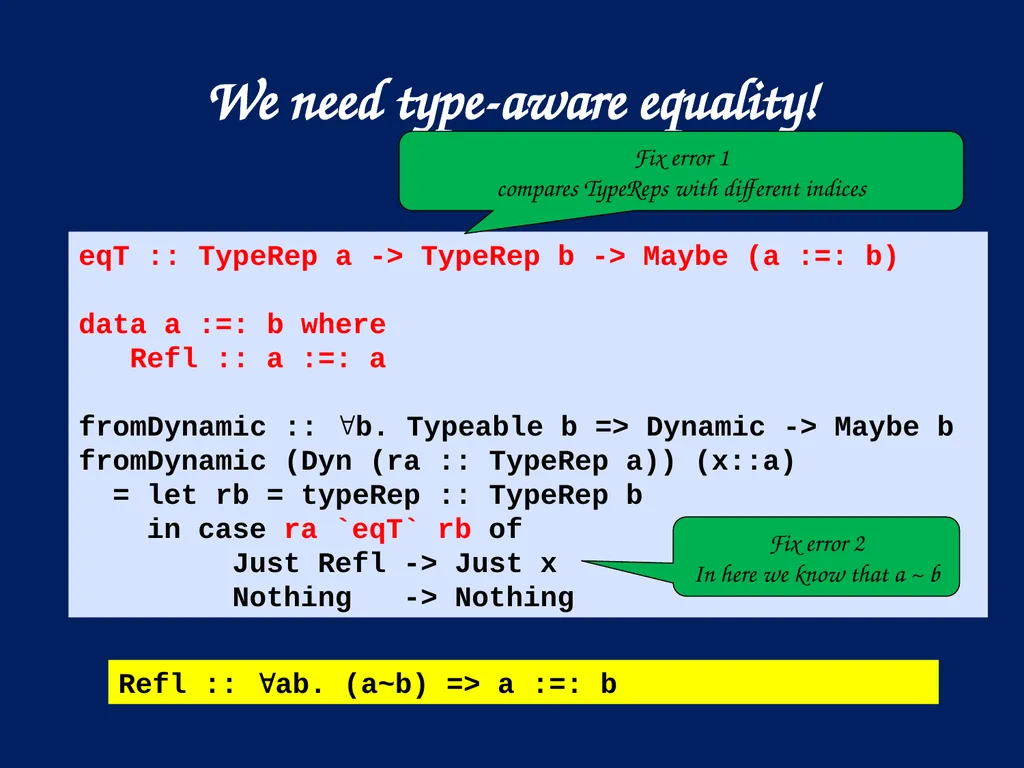
slide25. We need type-aware equality! eqT :: TypeRep a -> TypeRep b -> Maybe (a :=: b)
data a :=: b where
Refl :: a :=: a
fromDynamic :: b. Typeable b => Dynamic -> Maybe b
fromDynamic (Dyn (ra :: TypeRep a)) (x::a)
= let rb = typeRep :: TypeRep b
in case ra `eqT` rb of
Just Refl -> Just x
Nothing -> Nothing Fix error 2
In here we know that a ~ b Fix error 1 compares TypeReps with different indices Refl :: ab. (a~b) => a :=: b<br>
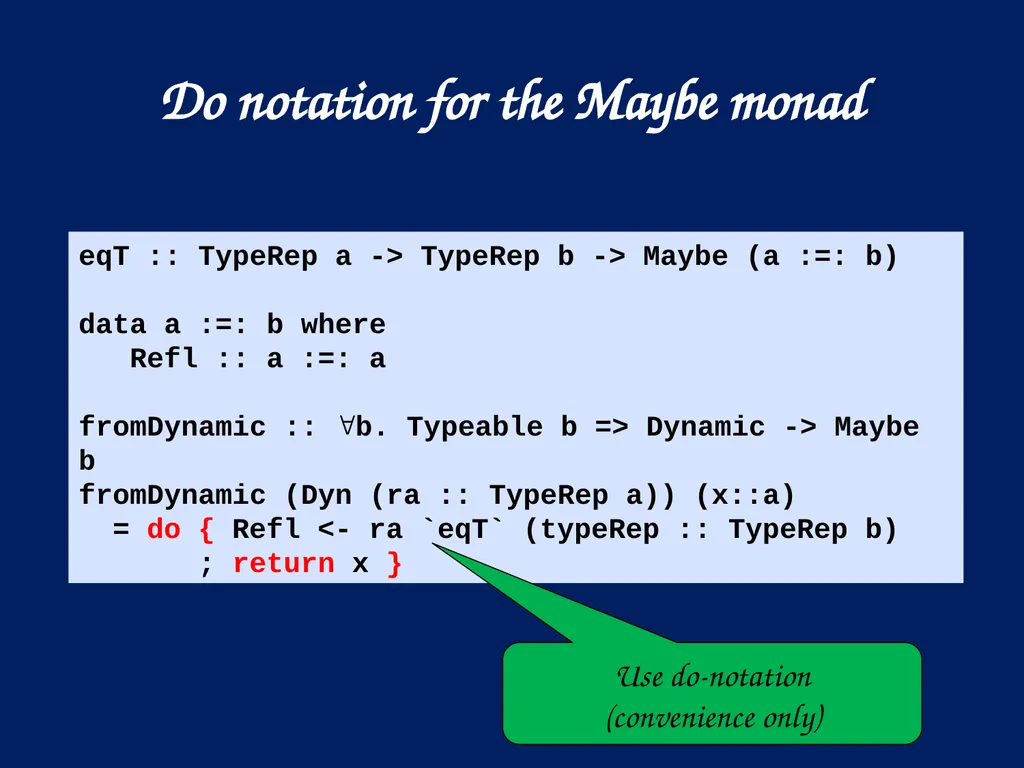
slide26. Do notation for the Maybe monad eqT :: TypeRep a -> TypeRep b -> Maybe (a :=: b)
data a :=: b where
Refl :: a :=: a
fromDynamic :: b. Typeable b => Dynamic -> Maybe b
fromDynamic (Dyn (ra :: TypeRep a)) (x::a)
= do { Refl <- ra `eqT` (typeRep :: TypeRep b)
; return x } Use do-notation
(convenience only)<br>
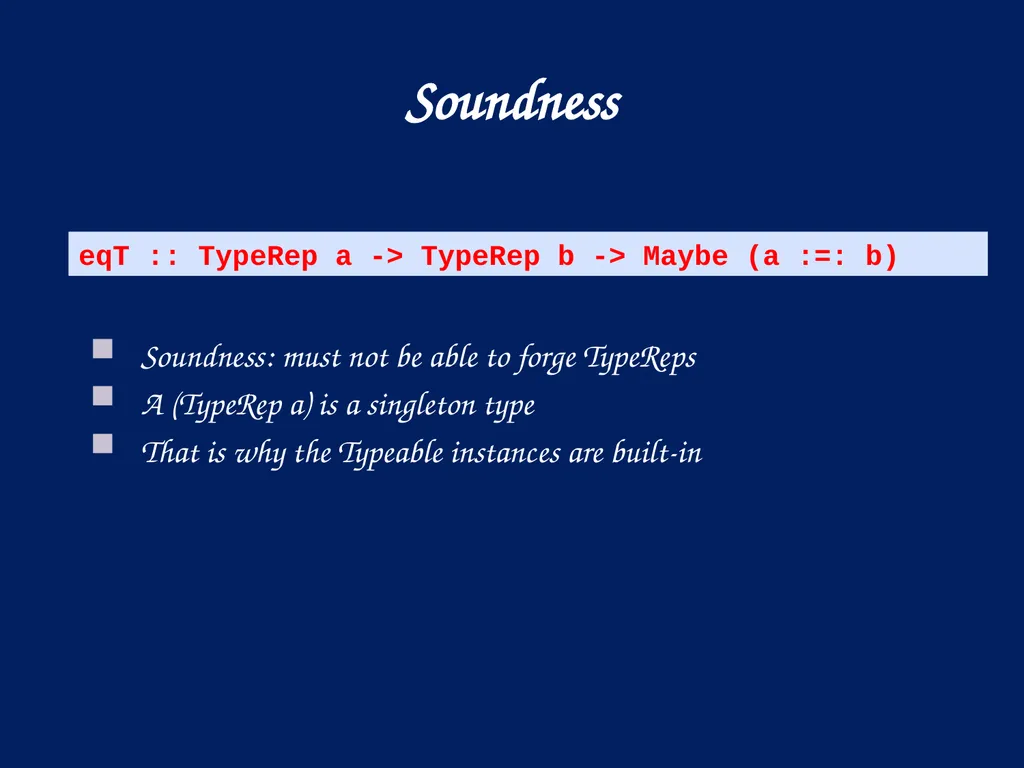
slide27. Soundness eqT :: TypeRep a -> TypeRep b -> Maybe (a :=: b) Soundness: must not be able to forge TypeReps
A (TypeRep a) is a singleton type
That is why the Typeable instances are built-in<br>
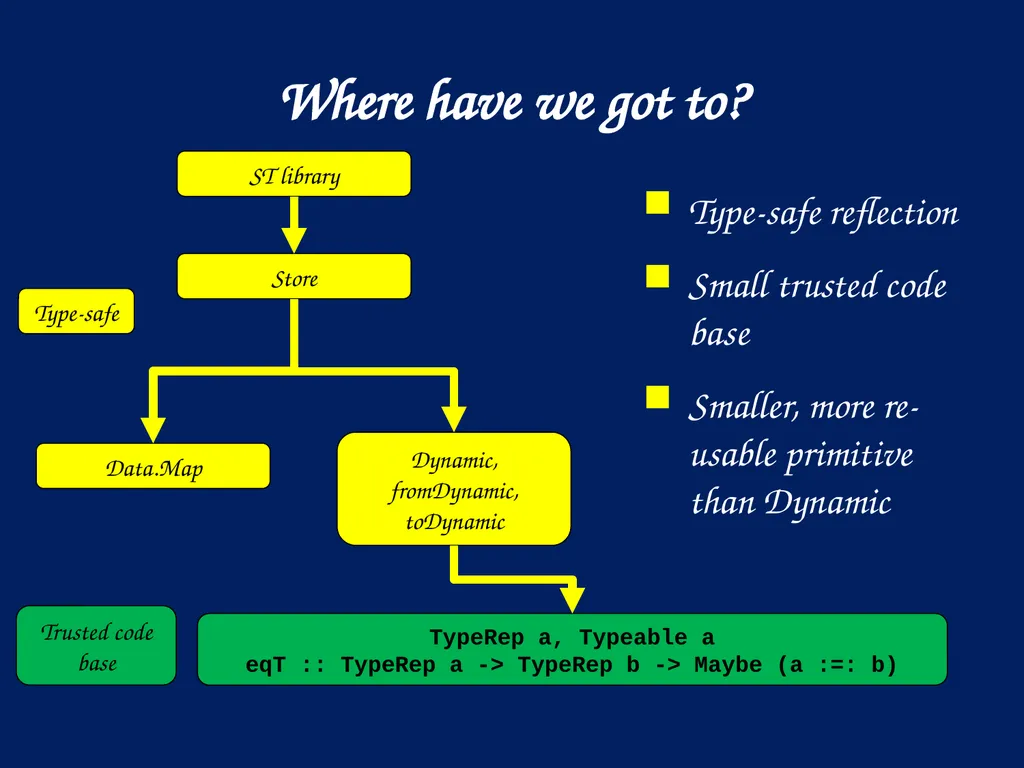
slide28. Where have we got to? ST library Store Dynamic, fromDynamic, toDynamic Data.Map TypeRep a, Typeable a eqT :: TypeRep a -> TypeRep b -> Maybe (a :=: b) Type-safe Trusted code base Type-safe reflection
Small trusted code base
Smaller, more re-usable primitive than Dynamic<br>
slide29. Typeable and TypeRep<br>
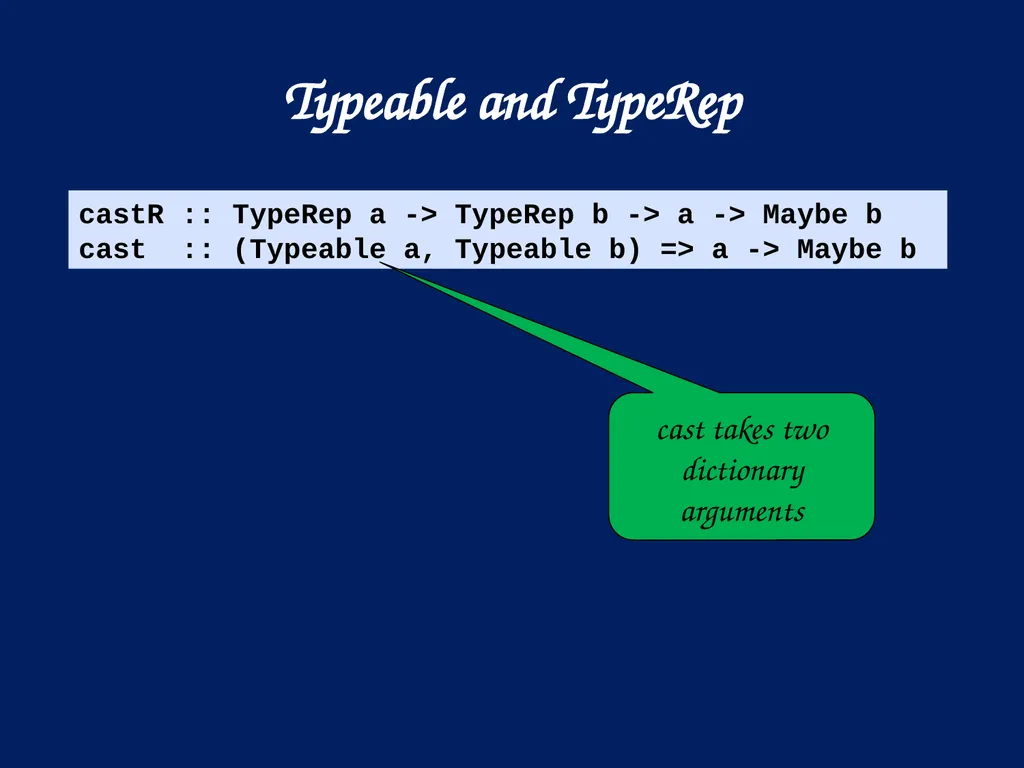
slide30. Typeable and TypeRep castR :: TypeRep a -> TypeRep b -> a -> Maybe b
cast :: (Typeable a, Typeable b) => a -> Maybe b cast takes two dictionary arguments<br>
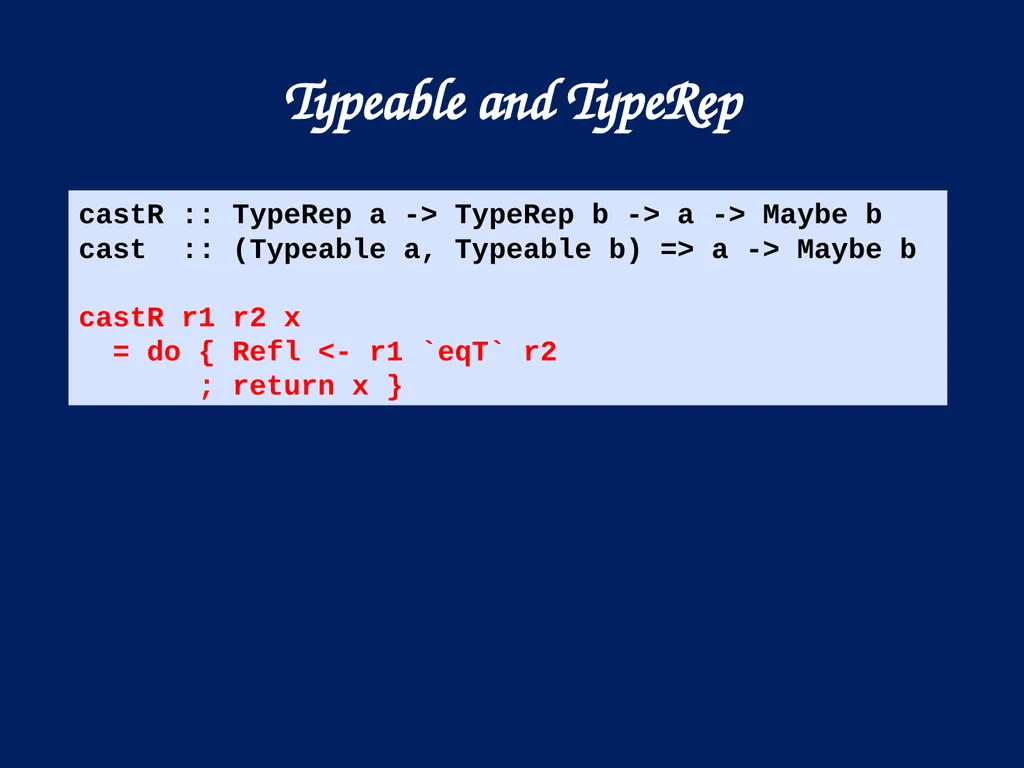
slide31. Typeable and TypeRep castR :: TypeRep a -> TypeRep b -> a -> Maybe b
cast :: (Typeable a, Typeable b) => a -> Maybe b
castR r1 r2 x
= do { Refl <- r1 `eqT` r2
; return x }<br>
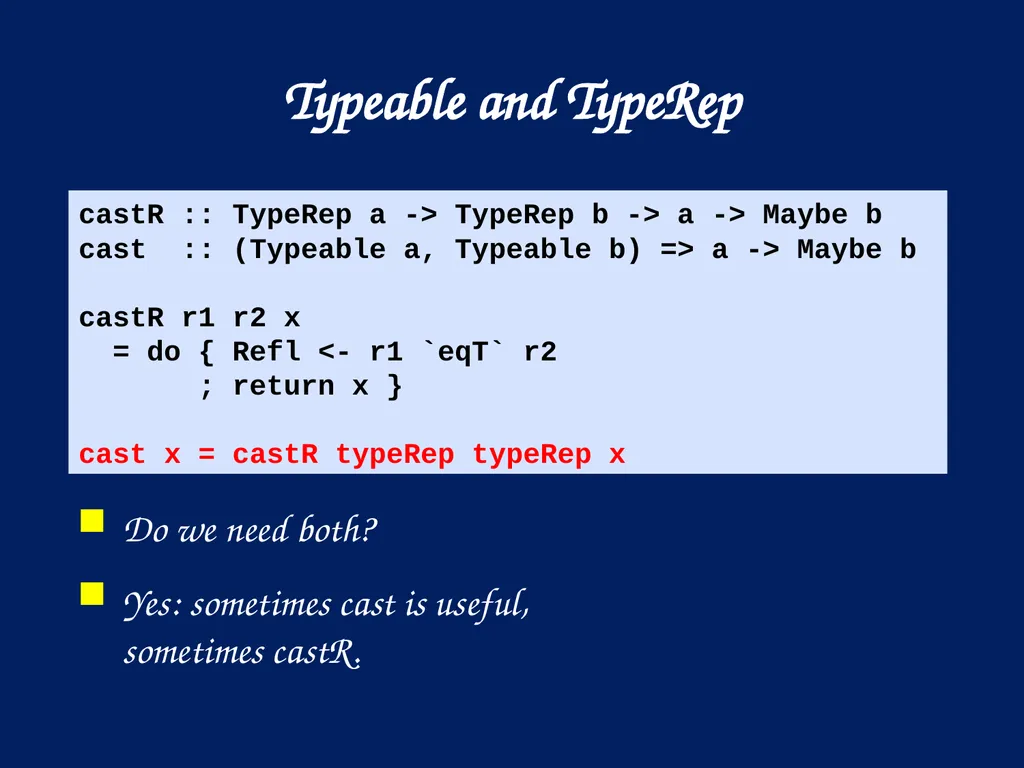
slide32. Typeable and TypeRep Do we need both?
Yes: sometimes cast is useful, sometimes castR. castR :: TypeRep a -> TypeRep b -> a -> Maybe b
cast :: (Typeable a, Typeable b) => a -> Maybe b
castR r1 r2 x
= do { Refl <- r1 `eqT` r2
; return x }
cast x = castR typeRep typeRep x<br>
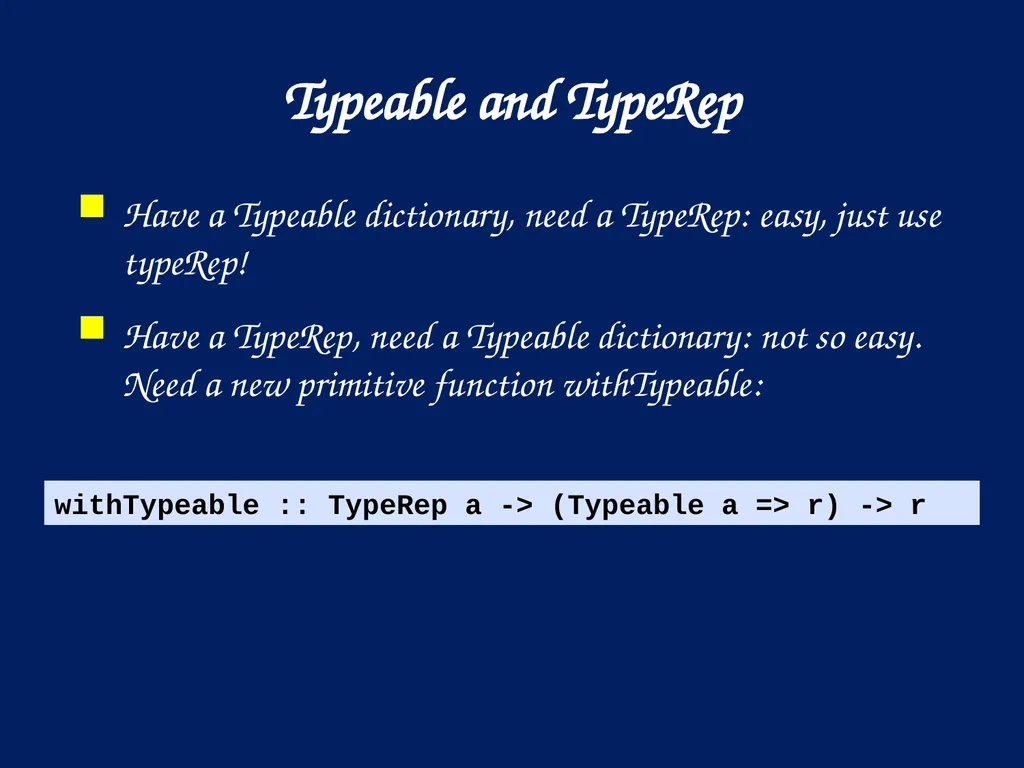
slide33. Typeable and TypeRep Have a Typeable dictionary, need a TypeRep: easy, just use typeRep!
Have a TypeRep, need a Typeable dictionary: not so easy. Need a new primitive function withTypeable: withTypeable :: TypeRep a -> (Typeable a => r) -> r<br>
slide34. Decomposing TypeRep<br>
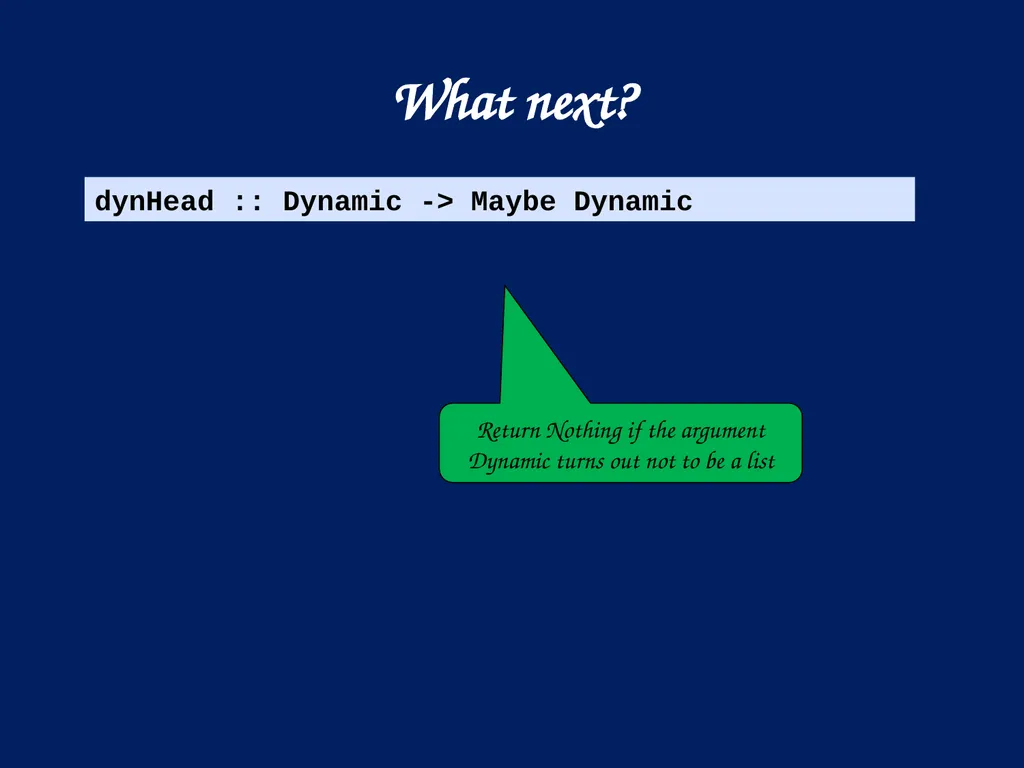
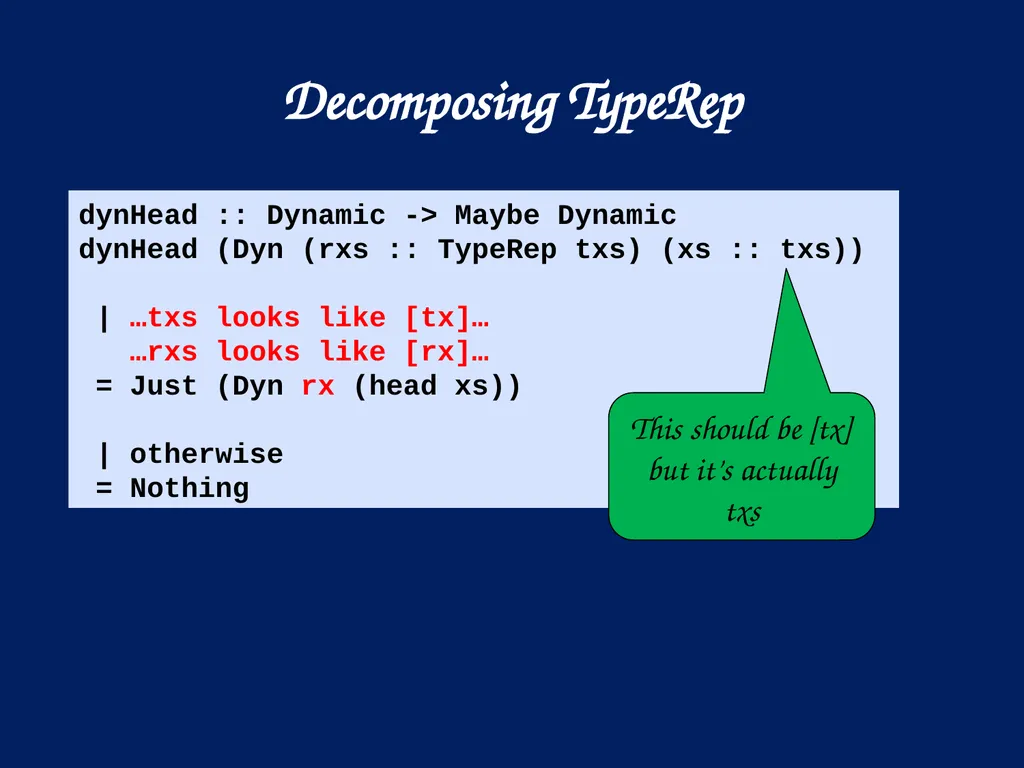
slide35. What next? dynHead :: Dynamic -> Maybe Dynamic Return Nothing if the argument Dynamic turns out not to be a list<br>
slide36. Decomposing TypeRep dynHead :: Dynamic -> Maybe Dynamic
dynHead (Dyn (rxs :: TypeRep txs) (xs :: txs))
| …txs looks like [tx]…
…rxs looks like [rx]…
= Just (Dyn rx (head xs))
| otherwise
= Nothing This should be [tx] but it’s actually txs<br>
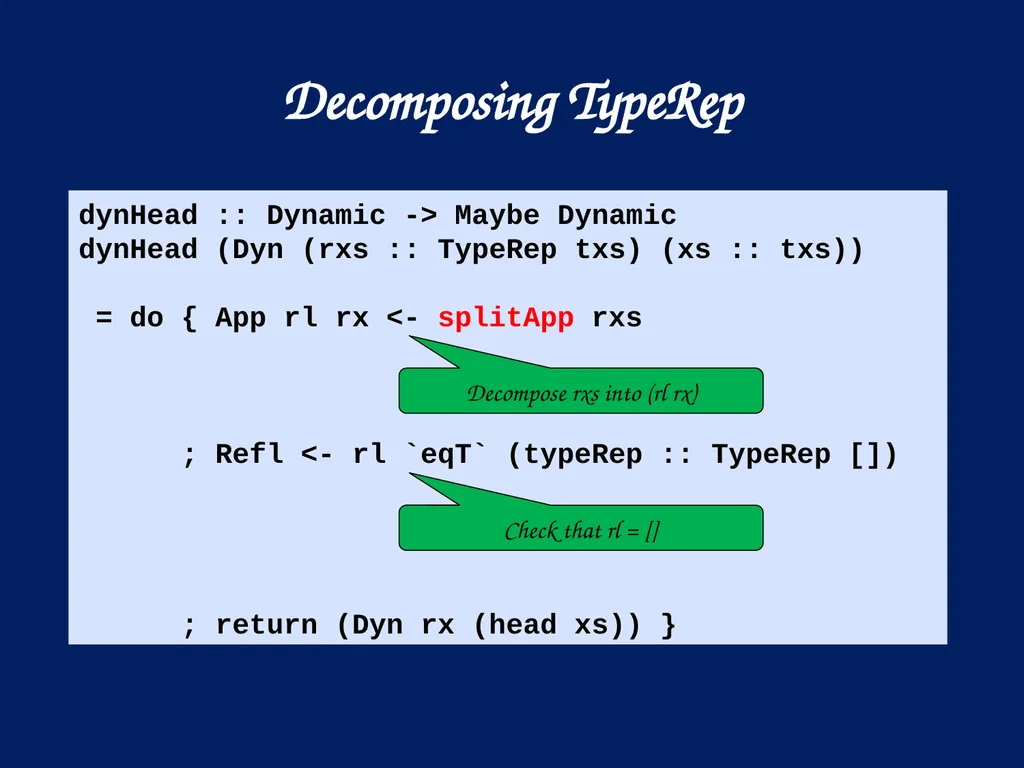
slide37. Decomposing TypeRep dynHead :: Dynamic -> Maybe Dynamic
dynHead (Dyn (rxs :: TypeRep txs) (xs :: txs))
= do { App rl rx <- splitApp rxs
; Refl <- rl `eqT` (typeRep :: TypeRep [])
; return (Dyn rx (head xs)) } Decompose rxs into (rl rx) Check that rl = []<br>
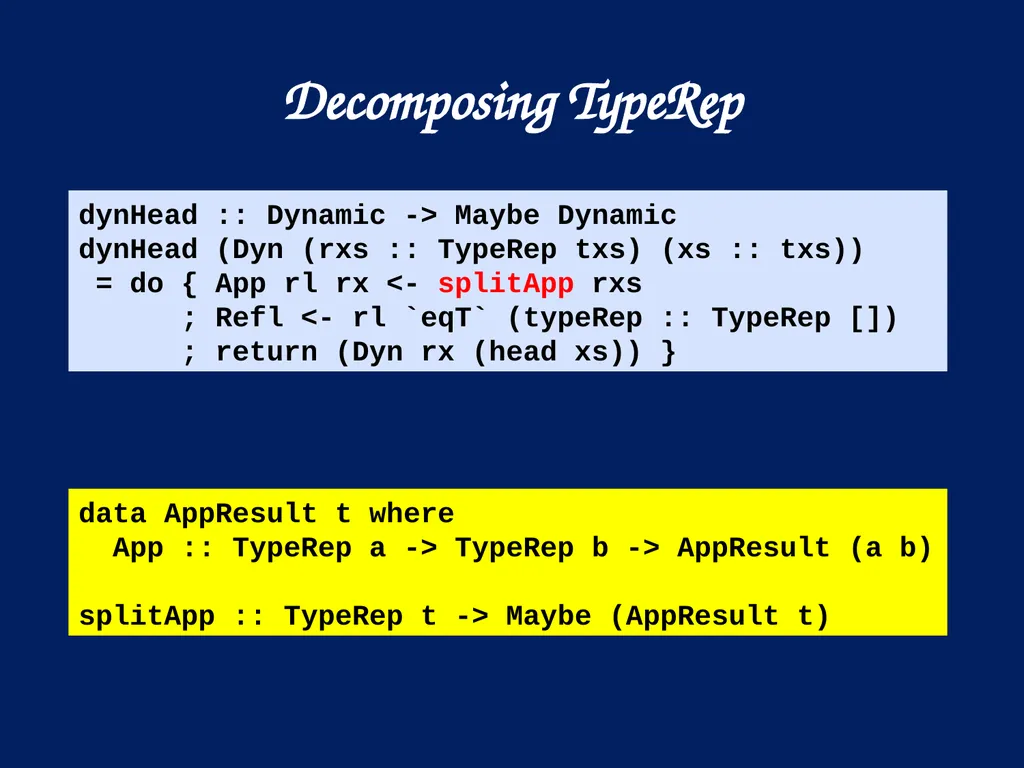
slide38. Decomposing TypeRep dynHead :: Dynamic -> Maybe Dynamic
dynHead (Dyn (rxs :: TypeRep txs) (xs :: txs))
= do { App rl rx <- splitApp rxs
; Refl <- rl `eqT` (typeRep :: TypeRep [])
; return (Dyn rx (head xs)) } data AppResult t where
App :: TypeRep a -> TypeRep b -> AppResult (a b)
splitApp :: TypeRep t -> Maybe (AppResult t)<br>
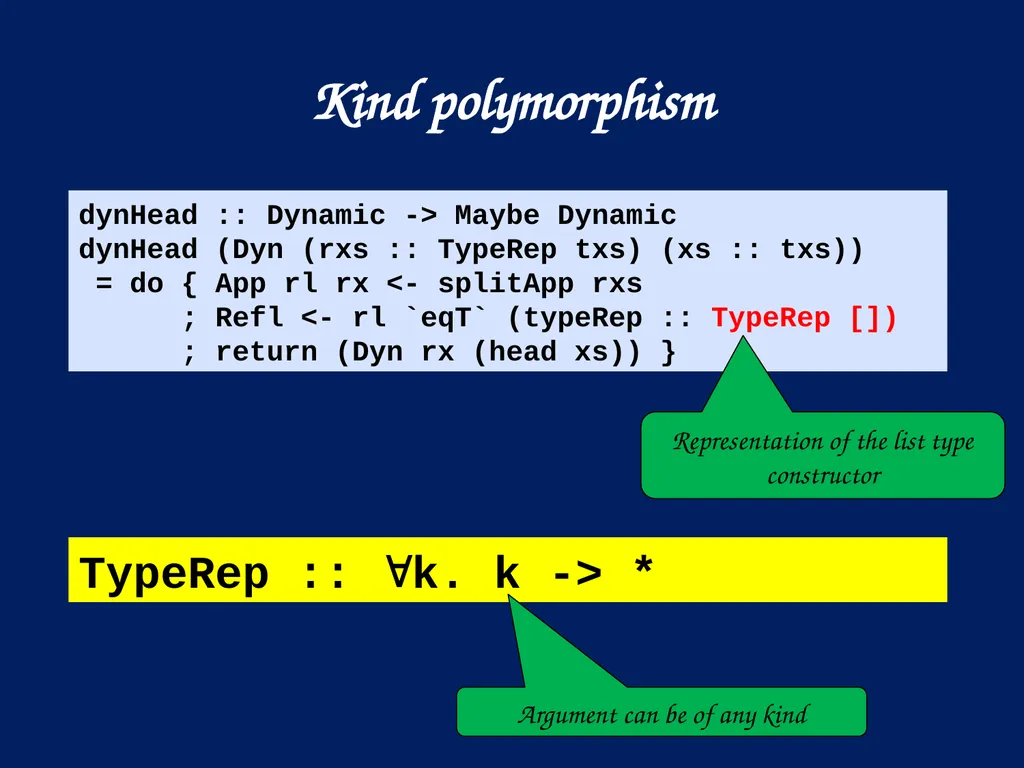
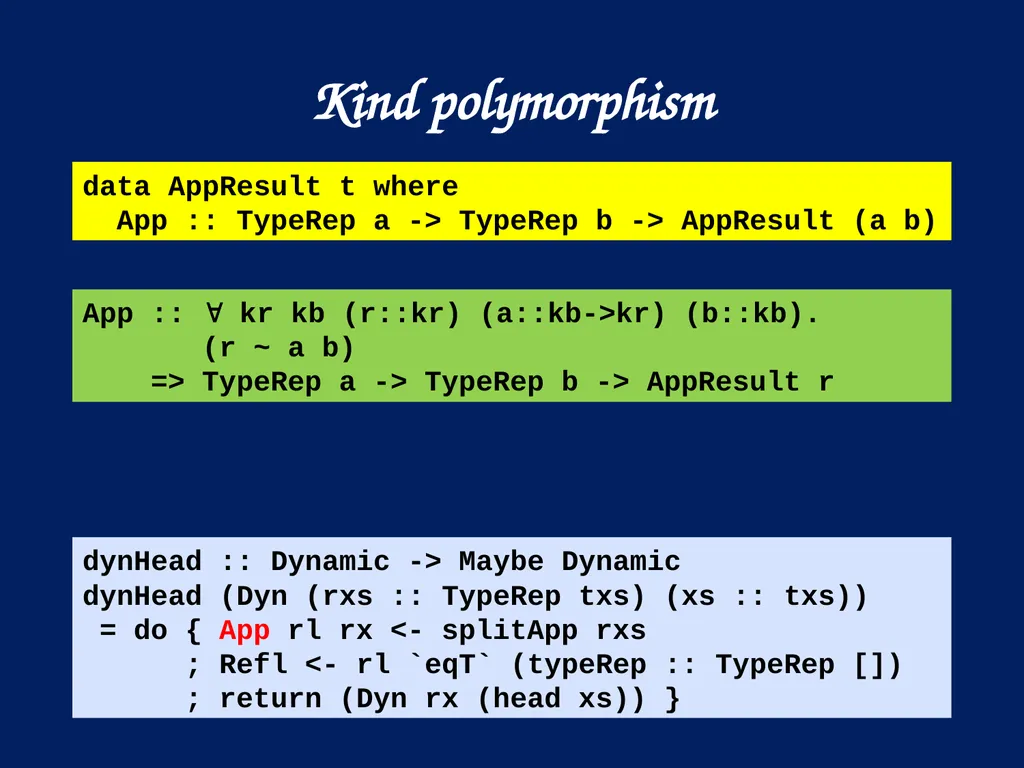
slide39. Kind polymorphism dynHead :: Dynamic -> Maybe Dynamic
dynHead (Dyn (rxs :: TypeRep txs) (xs :: txs))
= do { App rl rx <- splitApp rxs
; Refl <- rl `eqT` (typeRep :: TypeRep [])
; return (Dyn rx (head xs)) } Representation of the list type constructor TypeRep :: k. k -> * Argument can be of any kind<br>
slide40. Kind polymorphism data AppResult t where
App :: TypeRep a -> TypeRep b -> AppResult (a b) App :: kr kb (r::kr) (a::kb->kr) (b::kb).
(r ~ a b)
=> TypeRep a -> TypeRep b -> AppResult r dynHead :: Dynamic -> Maybe Dynamic
dynHead (Dyn (rxs :: TypeRep txs) (xs :: txs))
= do { App rl rx <- splitApp rxs
; Refl <- rl `eqT` (typeRep :: TypeRep [])
; return (Dyn rx (head xs)) }<br>
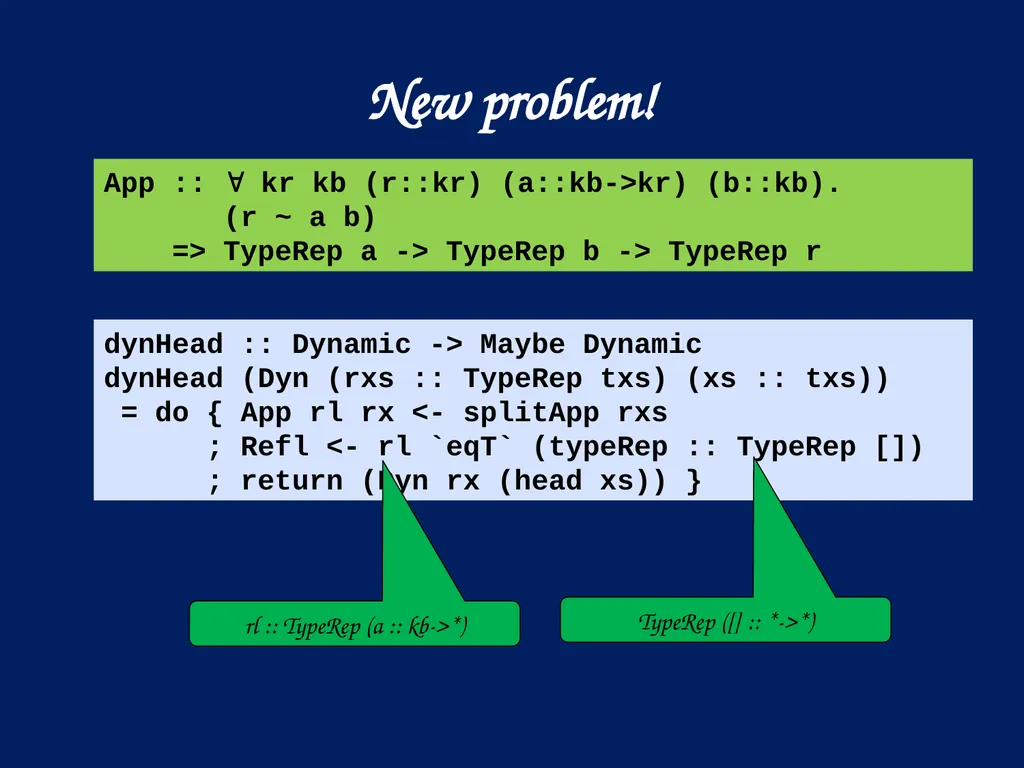
slide41. New problem! App :: kr kb (r::kr) (a::kb->kr) (b::kb).
(r ~ a b)
=> TypeRep a -> TypeRep b -> TypeRep r dynHead :: Dynamic -> Maybe Dynamic
dynHead (Dyn (rxs :: TypeRep txs) (xs :: txs))
= do { App rl rx <- splitApp rxs
; Refl <- rl `eqT` (typeRep :: TypeRep [])
; return (Dyn rx (head xs)) } rl :: TypeRep (a :: kb->*) TypeRep ([] :: *->*)<br>
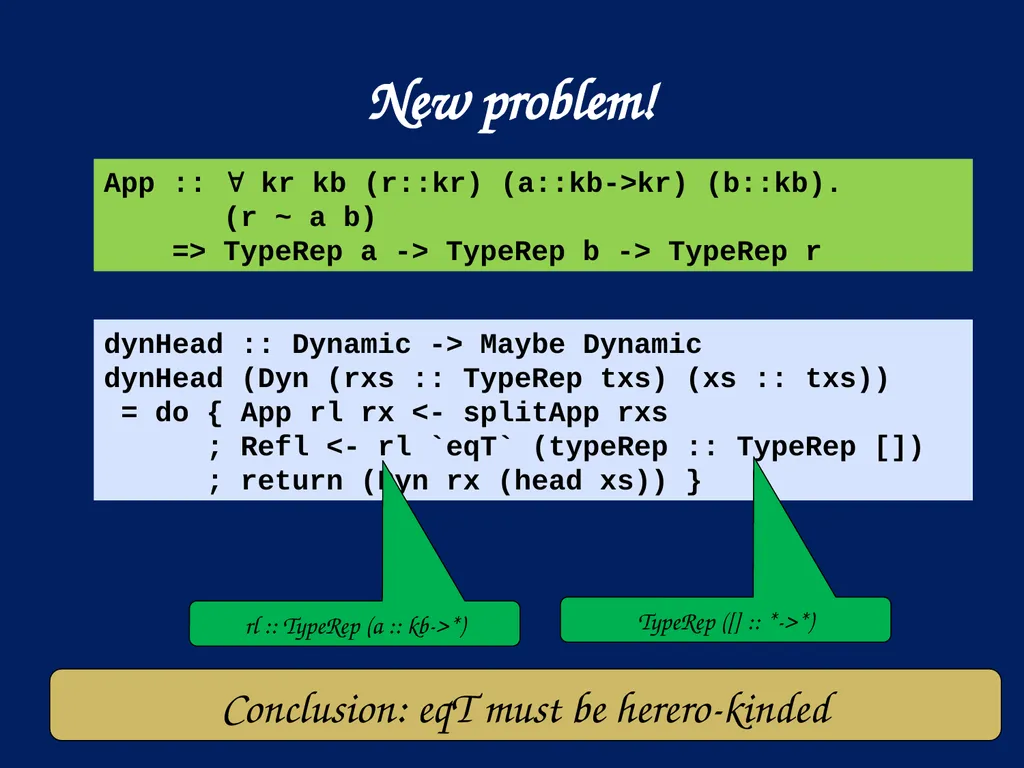
slide42. New problem! App :: kr kb (r::kr) (a::kb->kr) (b::kb).
(r ~ a b)
=> TypeRep a -> TypeRep b -> TypeRep r dynHead :: Dynamic -> Maybe Dynamic
dynHead (Dyn (rxs :: TypeRep txs) (xs :: txs))
= do { App rl rx <- splitApp rxs
; Refl <- rl `eqT` (typeRep :: TypeRep [])
; return (Dyn rx (head xs)) } rl :: TypeRep (a :: kb->*) TypeRep ([] :: *->*) Conclusion: eqT must be herero-kinded<br>
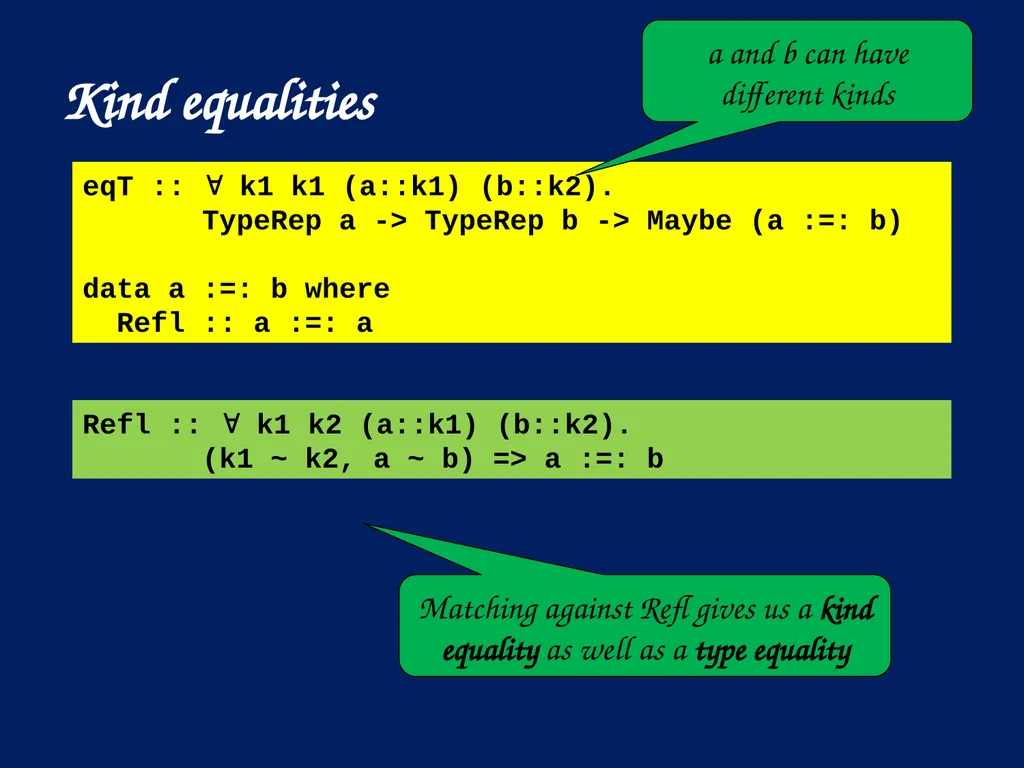
slide43. Kind equalities eqT :: k1 k1 (a::k1) (b::k2).
TypeRep a -> TypeRep b -> Maybe (a :=: b)
data a :=: b where
Refl :: a :=: a Refl :: k1 k2 (a::k1) (b::k2).
(k1 ~ k2, a ~ b) => a :=: b a and b can have different kinds Matching against Refl gives us a kind equality as well as a type equality<br>
slide44. Implementing TypeRep<br>
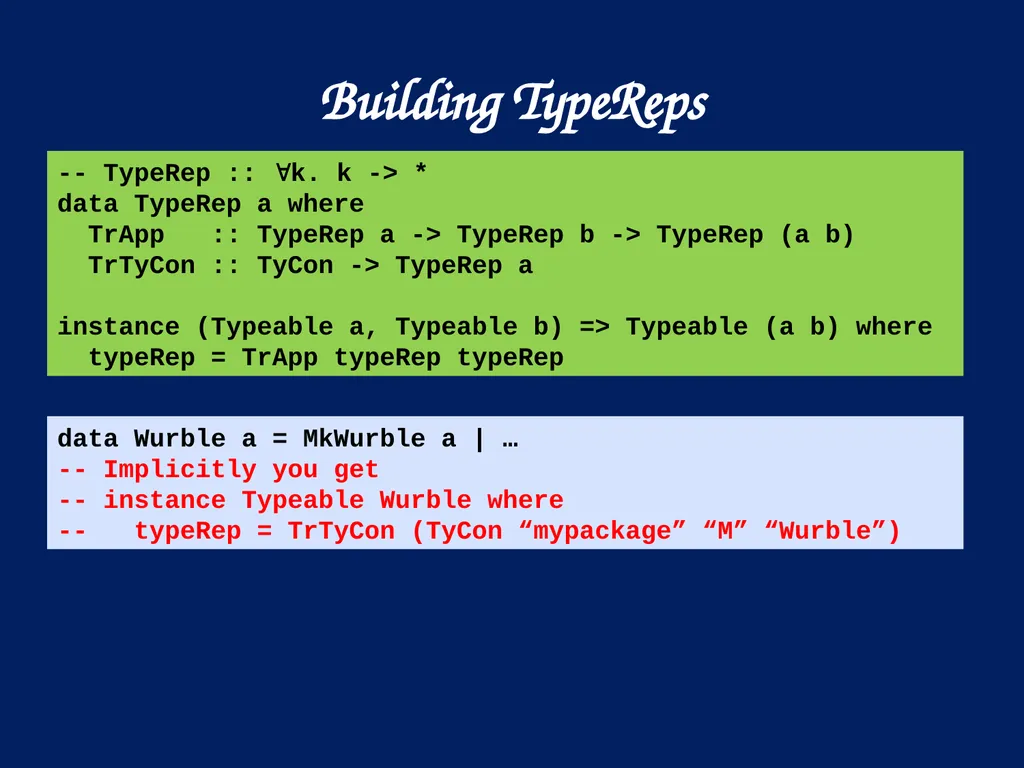
slide45. Building TypeReps -- TypeRep :: k. k -> *
data TypeRep a where
TrApp :: TypeRep a -> TypeRep b -> TypeRep (a b)
TrTyCon :: TyCon -> TypeRep a
instance (Typeable a, Typeable b) => Typeable (a b) where
typeRep = TrApp typeRep typeRep data Wurble a = MkWurble a | …
-- Implicitly you get
-- instance Typeable Wurble where
-- typeRep = TrTyCon (TyCon “mypackage” “M” “Wurble”)<br>
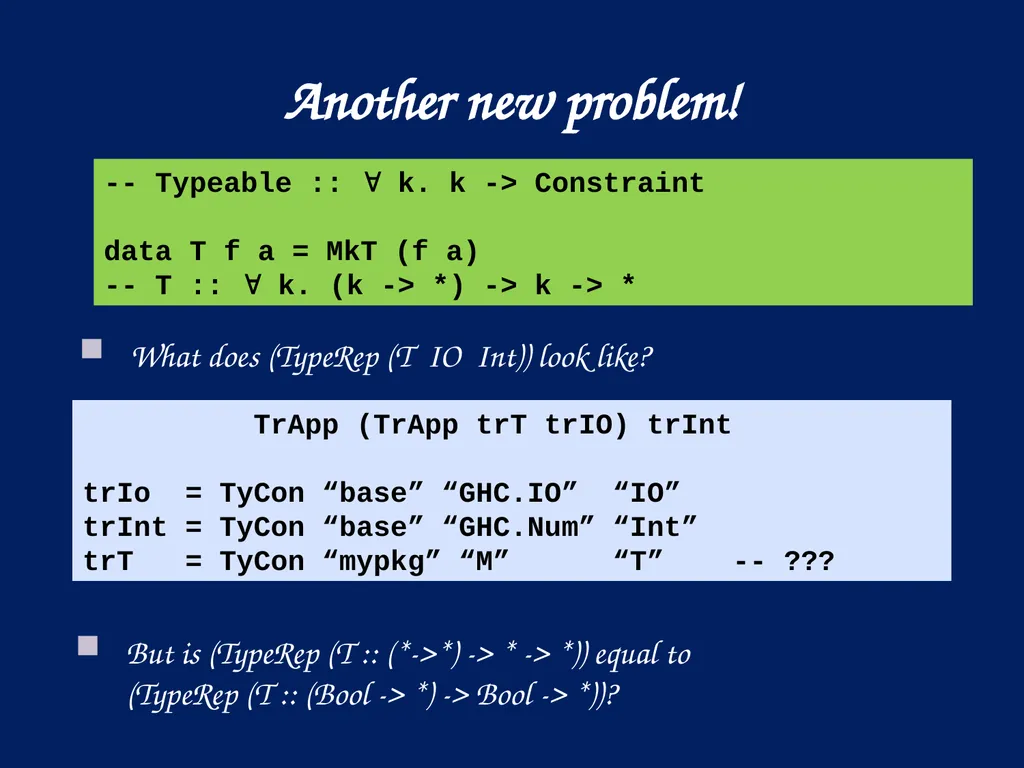
slide46. Another new problem! -- Typeable :: k. k -> Constraint
data T f a = MkT (f a)
-- T :: k. (k -> *) -> k -> * TrApp (TrApp trT trIO) trInt
trIo = TyCon “base” “GHC.IO” “IO”
trInt = TyCon “base” “GHC.Num” “Int”
trT = TyCon “mypkg” “M” “T” -- ??? What does (TypeRep (T IO Int)) look like? But is (TypeRep (T :: (*->*) -> * -> *)) equal to (TypeRep (T :: (Bool -> *) -> Bool -> *))?<br>
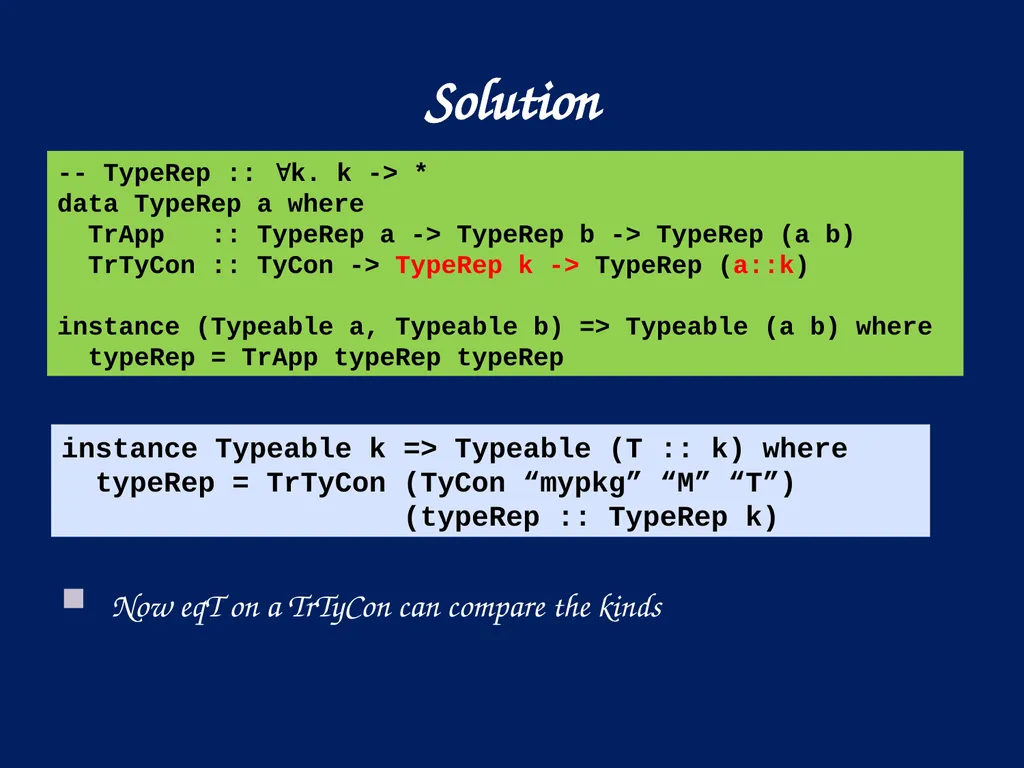
slide47. Solution -- TypeRep :: k. k -> *
data TypeRep a where
TrApp :: TypeRep a -> TypeRep b -> TypeRep (a b)
TrTyCon :: TyCon -> TypeRep k -> TypeRep (a::k)
instance (Typeable a, Typeable b) => Typeable (a b) where
typeRep = TrApp typeRep typeRep instance Typeable k => Typeable (T :: k) where
typeRep = TrTyCon (TyCon “mypkg” “M” “T”)
(typeRep :: TypeRep k) Now eqT on a TrTyCon can compare the kinds<br>
slide48. Shortcomings<br>
slide49. Polymorphic types Can we have (TypeRep (a. [a] -> [a])) to use to make a Dynamic value for polymorphic ‘reverse’?
Alas no:
that would require impredicative polymorphism
and what would the TypeRep look like?
and how could you decompose it?
I have no idea how to solve this<br>
slide50. Where does that leave us? Type-safe reflection, with extensible dynamic types, and a small trusted code base
Requires some Heavy Duty Type Artillery
Type classes
GADTs and local type equalities
Kind polymorphism
Kind-heterogeneous type equalities
Local kind equalities
Type support implemented in GHC 8.0 TypeRep library changes in GHC 8.2<br>
Microsoft Research University of Pennsylvania
August 2016<br>
slide2. CACM Dec 2015<br>
slide3. Bad type systems All programs Programs that work Programs that are well typed Zone of Abysmal Pain<br>
slide4. Sexy type systems All programs Programs that work Programs that are well typed Smaller Zone of Abysmal Pain<br>
slide5. Implementing a store Let’s implement this in Haskell, as a state transformer newSTRef :: a -> ST (STRef a)
readSTRef :: STRef a -> ST a
writeSTRef :: STRef a -> a -> ST () newtype ST a = MkST (Store -> (a,Store)) But what is a “Store”??<br>
slide6. Promising failures<br>
slide7. Implementing a store But what is a “Store”? It maps keys (STRefs) to values of many different types.
Attempt 1: use Data.Map newtype STRef a = MkSTRef Int
type Store = Map Int ????
lookupStore :: STRef s a -> Store -> Maybe a<br>
slide8. Implementing a store Attempt 2: we need dynamic types, even in a statically typed language newtype STRef a = MkSTRef Int
type Store = Map Int Dynamic
fromDynamic :: Dynamic -> Maybe a
lookupStore :: STRef a -> Store -> Maybe a
lookupStore (MkSTRef key) store
= case Data.Map.lookup key store of
Nothing -> Nothing
Just d -> fromDynamic d<br>
slide9. Implementing a store Attempt 2: we need dynamic types, even in a statically typed language newtype STRef a = MkSTRef Int
type Store = Map Int Dynamic
fromDynamic :: Dynamic -> Maybe a
lookupStore :: STRef s a -> Store -> Maybe a
lookupStore (MkSTRef key) store
= case Data.Map.lookup store key of
Nothing -> Nothing
Just d -> fromDynamic d Too polymorphic!
See “Theorems for Free”<br>
slide10. Implementing a store Attempt 3: enumerate the types we need data Dynamic = DInt Int | DBool Bool
| DPair Dynamic Dynamic | …etc…
class Dyn a where
fromDynamic :: Dynamic -> Maybe a
toDynamic :: a -> Dynamic
lookupStore :: Dyn a => STRef a -> Store -> Maybe a
lookupStore (MkSTRef key) store
= case Data.Map.lookup store key of
Nothing -> Nothing
Just d -> fromDynamic d<br>
slide11. Implementing a store data Dynamic = DInt Int | DBool Bool
| DPair Dynamic Dynamic | …etc…
class Dyn a where
fromDynamic :: Dynamic -> Maybe a
toDynamic :: a -> Dynamic
instance Dyn Int where
fromDynamic (DInt i) = Just i
fromDynamic _ = Nothing
toDynamic i = DInt i
instance Dyn Bool where
fromDynamic (DBool b) = Just b
fromDynamic _ = Nothing
toDynamic b = DBool b<br>
slide12. Implementing a store Attempt 3: enumerate the types we need data Dynamic = DInt Int | DBool Bool
| DPair Dynamic Dynamic | …etc… Non-starter because it requires a closed world
We want
readSTRef :: STRef a -> ST a
to work for any type ‘a’, including new ones
Also: converting to and fro takes a deep traversal instance (Dyn a, Dyn b) => Dyn (a,b) where
toDynamic (a,b) = DPair (toDynamic a) (toDynamic b)<br>
slide13. Getting closer (GHC )<br>
slide14. What’s in a Dynamic? A Dynamic should consist of
The value itself
A runtime representation of its type data Dynamic where
Dyn :: TypeRep -> a -> Dynamic Runtime representation of the type of the value The value itself<br>
slide15. Q1: where do TypeReps come from? class Typeable a where
typeRep :: a -> TypeRep
toDynamic :: Typeable a => a -> Dynamic
toDynamic x = Dyn (typeRep x) x
data Dynamic where
Dyn :: TypeRep -> a -> Dynamic NB proxy argument<br>
slide16. The birth of TypeRep<br>
slide17. Q2: what can you do with a TypeRep? class Typeable a where
typeRep :: a -> TypeRep
data Dynamic where
Dyn :: TypeRep -> a -> Dynamic
fromDynamic :: forall a. Typeable a
=> Dynamic -> Maybe a
fromDynamic (Dyn trx x)
| trx == trr = Just x
| otherwise = Nothing
where
trr = typeRep (undefined :: a) Eek!<br>
slide18. class Typeable a where
typeRep :: a -> TypeRep
data Dynamic where
Dyn :: TypeRep -> a -> Dynamic
fromDynamic :: a. Typeable a
=> Dynamic -> Maybe a
fromDynamic (Dyn trx x)
| trx == trr = Just (unsafeCoerce x)
| otherwise = Nothing
where
trr = typeRep (undefined :: a) Q2: what can you do with a TypeRep?<br>
slide19. The right way<br>
slide20. Type-indexed type reps A Dynamic should consist of
The value itself
A runtime representation of its type data Dynamic where
Dyn :: TypeRep a -> a -> Dynamic Runtime representation of the type of the value The value itself A type-indexed data structure<br>
slide21. Q1: where do TypeReps come from? class Typeable a where
typeRep :: TypeRep a
toDynamic :: Typeable a => a -> Dynamic
toDynamic x = Dyn typeRep x
data Dynamic where
Dyn :: TypeRep a -> a -> Dynamic No deep traversal
Instances of Typeable are built in data Wurble a = MkWurble a | …
-- Implicitly you get
-- instance Typeable a => Typeable (Wurble a) No proxy argument<br>
slide22. Q1: where do TypeReps come from? class Typeable a where
typeRep :: TypeRep a
toDynamic :: Typeable a => a -> Dynamic
toDynamic x = Dyn typeRep x data Wurble a = MkWurble a | …
-- Implicitly you get
-- instance Typeable a => Typeable (Wurble a) newtype Typeable a = MkT (TypeRep a)
toDynamic :: Typeable a -> a -> Dynamic
toDynamic (MkT tr) x = Dyn tr x $tWurble :: Typeable a -> Typeable (Wurble a)
$tWurble (MkT tra) = MkT (mkTrApp “Wurble” [tra])<br>
slide23. Q2: what can you do with TypeRep? data Dynamic where
Dyn :: TypeRep a -> a -> Dynamic
fromDynamic :: b. Typeable b
=> Dynamic -> Maybe b
fromDynamic (Dyn (ra :: TypeRep a) (x::a))
= let rb = typeRep :: TypeRep b
in case ra == rb of
True -> Just x
False -> Nothing<br>
slide24. Q2: what can you do with TypeRep? data Dynamic where
Dyn :: TypeRep a -> a -> Dynamic
fromDynamic :: b. Typeable b
=> Dynamic -> Maybe b
fromDynamic (Dyn (ra :: TypeRep a)) (x::a)
= let rb = typeRep :: TypeRep b
in case ra == rb of
True -> Just x
False -> Nothing Type error 2
Just x :: Maybe a,
but we need Maybe b Type error 1
ra :: TypeRep a
but rb :: TypeRep b<br>
slide25. We need type-aware equality! eqT :: TypeRep a -> TypeRep b -> Maybe (a :=: b)
data a :=: b where
Refl :: a :=: a
fromDynamic :: b. Typeable b => Dynamic -> Maybe b
fromDynamic (Dyn (ra :: TypeRep a)) (x::a)
= let rb = typeRep :: TypeRep b
in case ra `eqT` rb of
Just Refl -> Just x
Nothing -> Nothing Fix error 2
In here we know that a ~ b Fix error 1 compares TypeReps with different indices Refl :: ab. (a~b) => a :=: b<br>
slide26. Do notation for the Maybe monad eqT :: TypeRep a -> TypeRep b -> Maybe (a :=: b)
data a :=: b where
Refl :: a :=: a
fromDynamic :: b. Typeable b => Dynamic -> Maybe b
fromDynamic (Dyn (ra :: TypeRep a)) (x::a)
= do { Refl <- ra `eqT` (typeRep :: TypeRep b)
; return x } Use do-notation
(convenience only)<br>
slide27. Soundness eqT :: TypeRep a -> TypeRep b -> Maybe (a :=: b) Soundness: must not be able to forge TypeReps
A (TypeRep a) is a singleton type
That is why the Typeable instances are built-in<br>
slide28. Where have we got to? ST library Store Dynamic, fromDynamic, toDynamic Data.Map TypeRep a, Typeable a eqT :: TypeRep a -> TypeRep b -> Maybe (a :=: b) Type-safe Trusted code base Type-safe reflection
Small trusted code base
Smaller, more re-usable primitive than Dynamic<br>
slide29. Typeable and TypeRep<br>
slide30. Typeable and TypeRep castR :: TypeRep a -> TypeRep b -> a -> Maybe b
cast :: (Typeable a, Typeable b) => a -> Maybe b cast takes two dictionary arguments<br>
slide31. Typeable and TypeRep castR :: TypeRep a -> TypeRep b -> a -> Maybe b
cast :: (Typeable a, Typeable b) => a -> Maybe b
castR r1 r2 x
= do { Refl <- r1 `eqT` r2
; return x }<br>
slide32. Typeable and TypeRep Do we need both?
Yes: sometimes cast is useful, sometimes castR. castR :: TypeRep a -> TypeRep b -> a -> Maybe b
cast :: (Typeable a, Typeable b) => a -> Maybe b
castR r1 r2 x
= do { Refl <- r1 `eqT` r2
; return x }
cast x = castR typeRep typeRep x<br>
slide33. Typeable and TypeRep Have a Typeable dictionary, need a TypeRep: easy, just use typeRep!
Have a TypeRep, need a Typeable dictionary: not so easy. Need a new primitive function withTypeable: withTypeable :: TypeRep a -> (Typeable a => r) -> r<br>
slide34. Decomposing TypeRep<br>
slide35. What next? dynHead :: Dynamic -> Maybe Dynamic Return Nothing if the argument Dynamic turns out not to be a list<br>
slide36. Decomposing TypeRep dynHead :: Dynamic -> Maybe Dynamic
dynHead (Dyn (rxs :: TypeRep txs) (xs :: txs))
| …txs looks like [tx]…
…rxs looks like [rx]…
= Just (Dyn rx (head xs))
| otherwise
= Nothing This should be [tx] but it’s actually txs<br>
slide37. Decomposing TypeRep dynHead :: Dynamic -> Maybe Dynamic
dynHead (Dyn (rxs :: TypeRep txs) (xs :: txs))
= do { App rl rx <- splitApp rxs
; Refl <- rl `eqT` (typeRep :: TypeRep [])
; return (Dyn rx (head xs)) } Decompose rxs into (rl rx) Check that rl = []<br>
slide38. Decomposing TypeRep dynHead :: Dynamic -> Maybe Dynamic
dynHead (Dyn (rxs :: TypeRep txs) (xs :: txs))
= do { App rl rx <- splitApp rxs
; Refl <- rl `eqT` (typeRep :: TypeRep [])
; return (Dyn rx (head xs)) } data AppResult t where
App :: TypeRep a -> TypeRep b -> AppResult (a b)
splitApp :: TypeRep t -> Maybe (AppResult t)<br>
slide39. Kind polymorphism dynHead :: Dynamic -> Maybe Dynamic
dynHead (Dyn (rxs :: TypeRep txs) (xs :: txs))
= do { App rl rx <- splitApp rxs
; Refl <- rl `eqT` (typeRep :: TypeRep [])
; return (Dyn rx (head xs)) } Representation of the list type constructor TypeRep :: k. k -> * Argument can be of any kind<br>
slide40. Kind polymorphism data AppResult t where
App :: TypeRep a -> TypeRep b -> AppResult (a b) App :: kr kb (r::kr) (a::kb->kr) (b::kb).
(r ~ a b)
=> TypeRep a -> TypeRep b -> AppResult r dynHead :: Dynamic -> Maybe Dynamic
dynHead (Dyn (rxs :: TypeRep txs) (xs :: txs))
= do { App rl rx <- splitApp rxs
; Refl <- rl `eqT` (typeRep :: TypeRep [])
; return (Dyn rx (head xs)) }<br>
slide41. New problem! App :: kr kb (r::kr) (a::kb->kr) (b::kb).
(r ~ a b)
=> TypeRep a -> TypeRep b -> TypeRep r dynHead :: Dynamic -> Maybe Dynamic
dynHead (Dyn (rxs :: TypeRep txs) (xs :: txs))
= do { App rl rx <- splitApp rxs
; Refl <- rl `eqT` (typeRep :: TypeRep [])
; return (Dyn rx (head xs)) } rl :: TypeRep (a :: kb->*) TypeRep ([] :: *->*)<br>
slide42. New problem! App :: kr kb (r::kr) (a::kb->kr) (b::kb).
(r ~ a b)
=> TypeRep a -> TypeRep b -> TypeRep r dynHead :: Dynamic -> Maybe Dynamic
dynHead (Dyn (rxs :: TypeRep txs) (xs :: txs))
= do { App rl rx <- splitApp rxs
; Refl <- rl `eqT` (typeRep :: TypeRep [])
; return (Dyn rx (head xs)) } rl :: TypeRep (a :: kb->*) TypeRep ([] :: *->*) Conclusion: eqT must be herero-kinded<br>
slide43. Kind equalities eqT :: k1 k1 (a::k1) (b::k2).
TypeRep a -> TypeRep b -> Maybe (a :=: b)
data a :=: b where
Refl :: a :=: a Refl :: k1 k2 (a::k1) (b::k2).
(k1 ~ k2, a ~ b) => a :=: b a and b can have different kinds Matching against Refl gives us a kind equality as well as a type equality<br>
slide44. Implementing TypeRep<br>
slide45. Building TypeReps -- TypeRep :: k. k -> *
data TypeRep a where
TrApp :: TypeRep a -> TypeRep b -> TypeRep (a b)
TrTyCon :: TyCon -> TypeRep a
instance (Typeable a, Typeable b) => Typeable (a b) where
typeRep = TrApp typeRep typeRep data Wurble a = MkWurble a | …
-- Implicitly you get
-- instance Typeable Wurble where
-- typeRep = TrTyCon (TyCon “mypackage” “M” “Wurble”)<br>
slide46. Another new problem! -- Typeable :: k. k -> Constraint
data T f a = MkT (f a)
-- T :: k. (k -> *) -> k -> * TrApp (TrApp trT trIO) trInt
trIo = TyCon “base” “GHC.IO” “IO”
trInt = TyCon “base” “GHC.Num” “Int”
trT = TyCon “mypkg” “M” “T” -- ??? What does (TypeRep (T IO Int)) look like? But is (TypeRep (T :: (*->*) -> * -> *)) equal to (TypeRep (T :: (Bool -> *) -> Bool -> *))?<br>
slide47. Solution -- TypeRep :: k. k -> *
data TypeRep a where
TrApp :: TypeRep a -> TypeRep b -> TypeRep (a b)
TrTyCon :: TyCon -> TypeRep k -> TypeRep (a::k)
instance (Typeable a, Typeable b) => Typeable (a b) where
typeRep = TrApp typeRep typeRep instance Typeable k => Typeable (T :: k) where
typeRep = TrTyCon (TyCon “mypkg” “M” “T”)
(typeRep :: TypeRep k) Now eqT on a TrTyCon can compare the kinds<br>
slide48. Shortcomings<br>
slide49. Polymorphic types Can we have (TypeRep (a. [a] -> [a])) to use to make a Dynamic value for polymorphic ‘reverse’?
Alas no:
that would require impredicative polymorphism
and what would the TypeRep look like?
and how could you decompose it?
I have no idea how to solve this<br>
slide50. Where does that leave us? Type-safe reflection, with extensible dynamic types, and a small trusted code base
Requires some Heavy Duty Type Artillery
Type classes
GADTs and local type equalities
Kind polymorphism
Kind-heterogeneous type equalities
Local kind equalities
Type support implemented in GHC 8.0 TypeRep library changes in GHC 8.2<br>