
A survival Guide for Chamberlanders - Governance

Description: A survival Guide for Chamberlanders - Governance 101 Tracy Acorn, Manager Chamber Services May 2019 1 Topics Role Purpose of the ACC MissionsVision Legal Duties Board Responsibilities Practical Board Tips Financial Responsibilities
Related Topics
Download Presentation
"A survival Guide for Chamberlanders - Governance" is the property of its rightful owner. Permission is granted to download and print the materials on this website for personal, non-commercial use only, and to display it on your personal computer provided you do not modify the materials and that you retain all copyright notices contained in the materials. By downloading content from our website, you accept the terms of this agreement.
Presentation Transcript
slide1. A survival Guide for Chamberlanders - Governance 101
Tracy Acorn,
Manager Chamber Services May 2019 1<br>
slide2. Topics Role/ Purpose of the ACC
Missions/Vision
Legal Duties
Board Responsibilities Practical Board Tips
Financial Responsibilities
Committees
Meetings
Recruiting Leaders 2<br>
slide3. Ground Rules Informal session- ask questions as they arise
Put your Chamber hat on & think in terms of your role as a director and the future wellbeing of YOUR Chamber Alberta Chambers , Geared for Success 3<br>
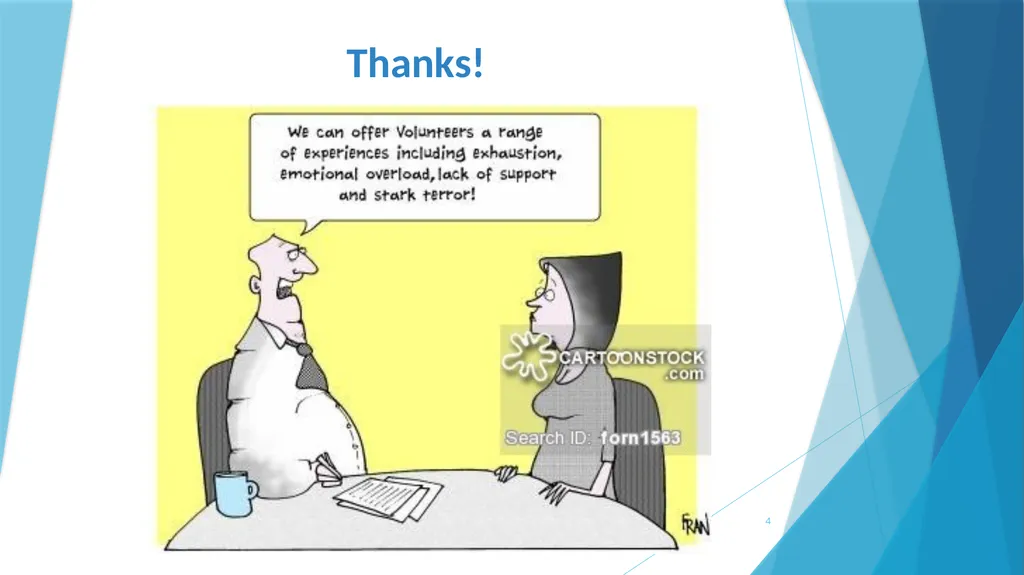
slide4. Thanks! 4<br>
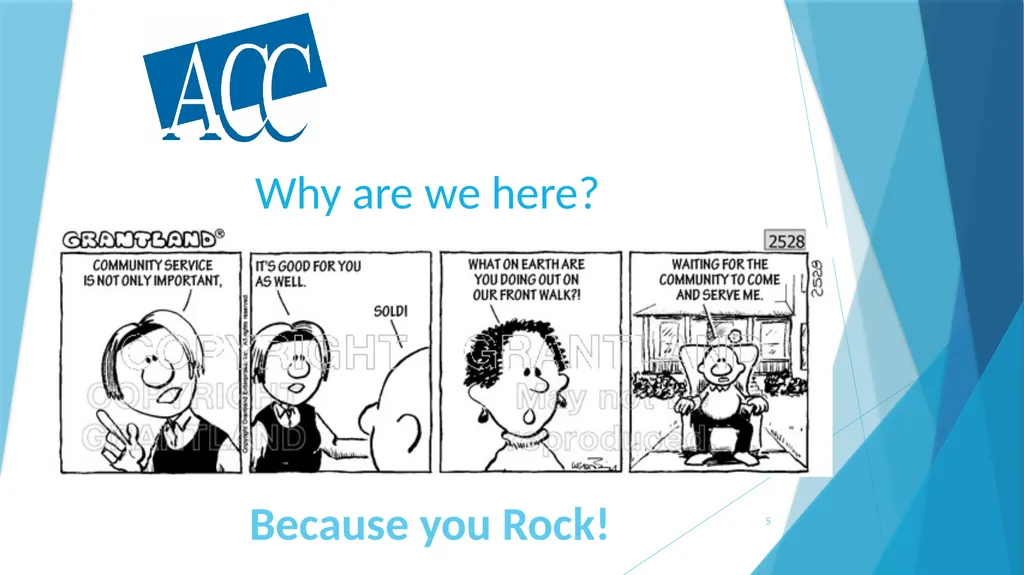
slide5. Why are we here? 5 Because you Rock!<br>
slide6. Role of the ACC We are a federation of 122 provincial Chambers
Represent the business interests of over 25,5000 members in 28 federal and 87 provincial electoral districts
We are The Advocate for Alberta Business
One influential and respected voice in matters of provincial and federal concern
We provide leadership giving business a strong and collective voice 6<br>
slide7. Your Chamber – How do you connect to the ACC and the CCC?
Municipal advocacy – 124 chambers Provincial advocacy – 124 chambers Federal advocacy – 124 chambers (and proxy vote) September 2018 7<br>
slide8. ACC Committees Policy & Advocacy
Audit
Nominating
Executive
The ACC is always looking for business minded individuals. I invite you to look into how you may serve at the Alberta Chamber level. 8<br>
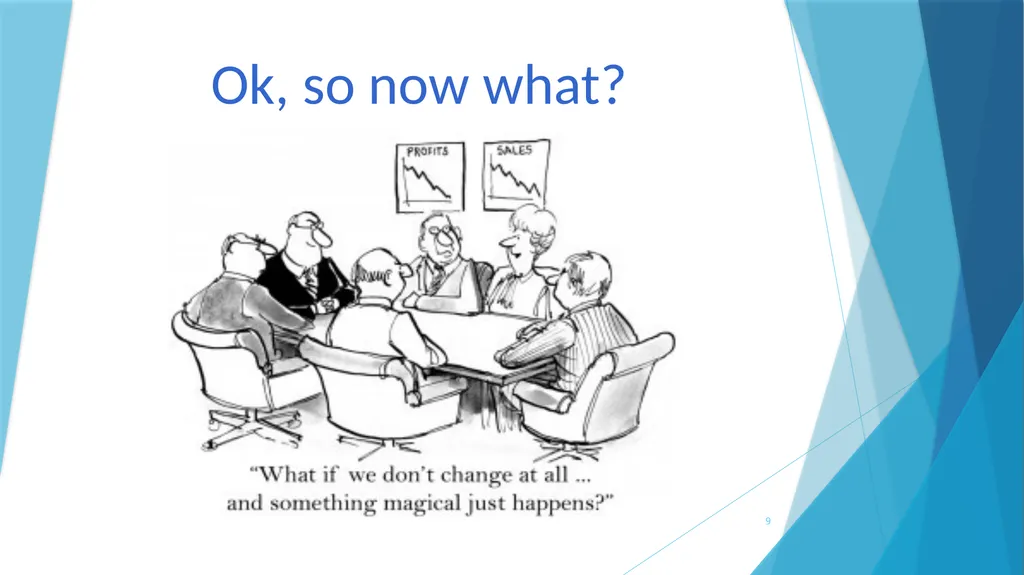
slide9. 9 Ok, so now what?<br>
slide10. 10 How is your Chamber Incorporated?
Why does this matter?
What do you need to know?
BOTA and Societies Act<br>
slide11. 11 Mission and Vision Statements and Why do they matter?
Mission statements focus on today and what your chamber does to achieve it. Answers the What, Who and How?
Visions statements focus on tomorrow and what your chamber wants to become. Speaks to aspirations, who and what are we aspiring to change and what problem are we solving?
Values statements define the ethics of your chamber.<br>
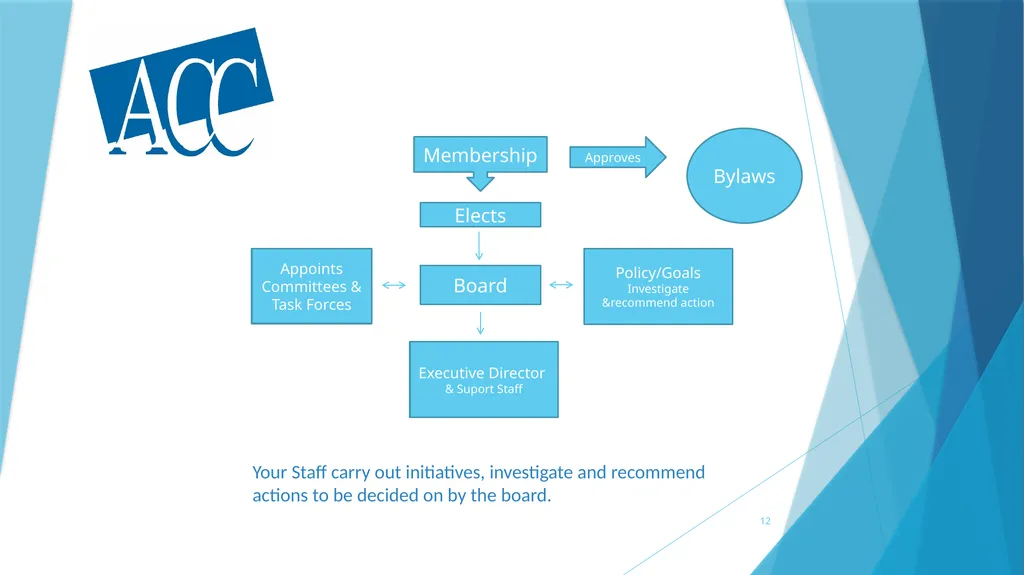
slide12. 12 Membership Elects Board Policy/Goals
Investigate &recommend action Appoints
Committees & Task Forces Executive Director
& Suport Staff Your Staff carry out initiatives, investigate and recommend actions to be decided on by the board. Approves Bylaws<br>
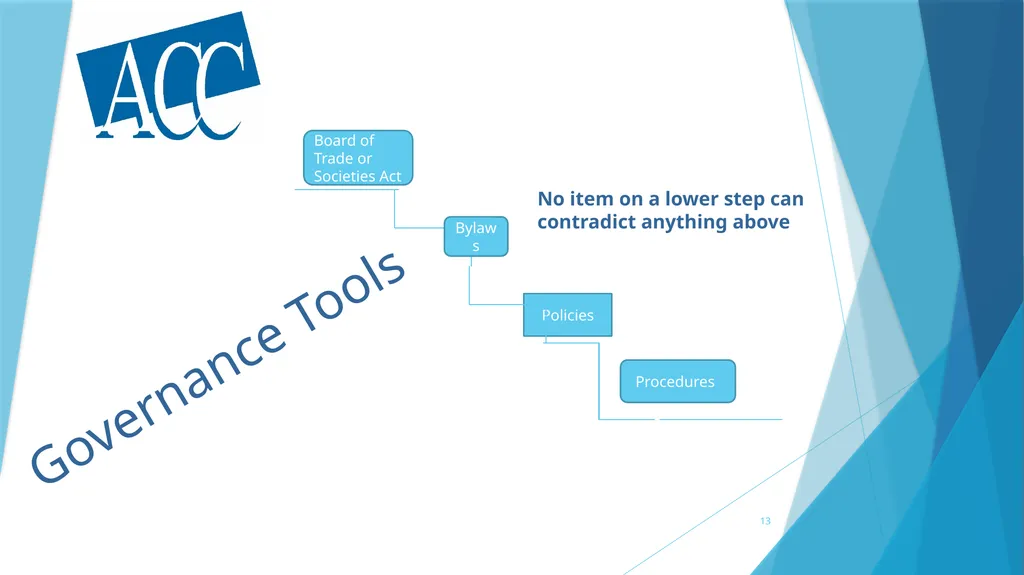
slide13. Governance Tools Policies 13 Board of Trade or Societies Act Bylaws Procedures No item on a lower step can contradict anything above<br>
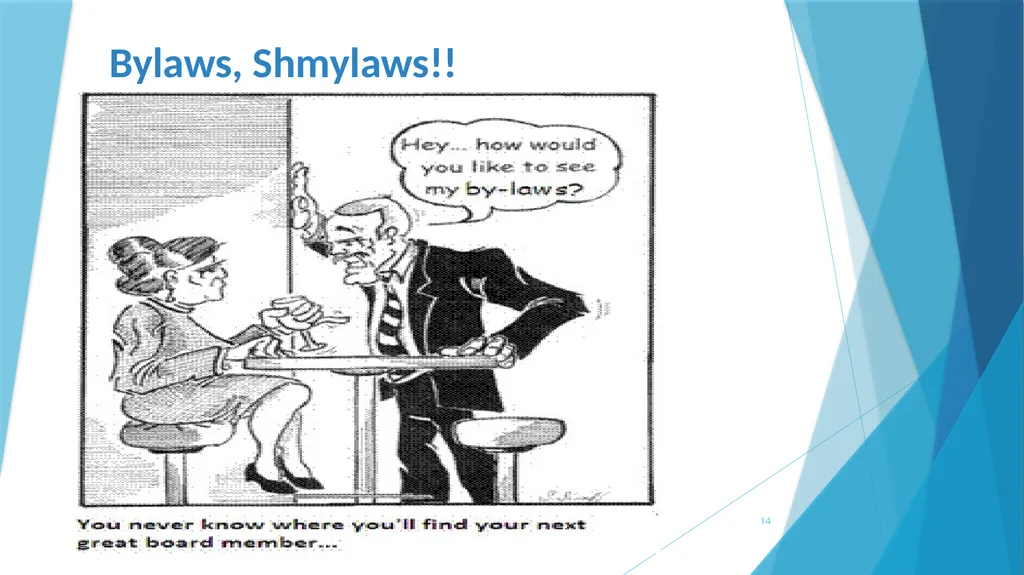
slide14. Bylaws, Shmylaws!! 14<br>
slide15. 15 Board of Directors Working vs. Governance – is there really one kind of board?
No, not completely - all boards “Work” on some level, but Governance is a MUST.<br>
slide16. 16 What’s the difference, you Ask?
Activity
What distinguishes a working board's involvement in a chambers operations or capitol needs, from what a board focused solely on the governing function does is simply the kind of activity undertaken by each.
Successful Boards do BOTH
Governance is a must, it’s not an either or proposition
% 0f time staff, (when lucky enough to he them) to help shape the dynamic.
A working board should set their agendas putting the governance segment first. If the staff levels or “In the Weeds” operations, come first it can be quite challenging to shift to the more strategic view that’s necessary to make good governing decisions. It's generally easier to shift "down" than "up“!
A good board understands that the “Work” has to happen while they strategically move towards a more governance focus.<br>
slide17. Your Chamber is a business so what's your plan? NFP refers only to your Chambers tax status and NOT your business plan
Everything you do should ,
Make you MONEY
Make you FRIENDS
Make you FAMOUS
Goal 15-20% revenue on events and educational sessions 17<br>
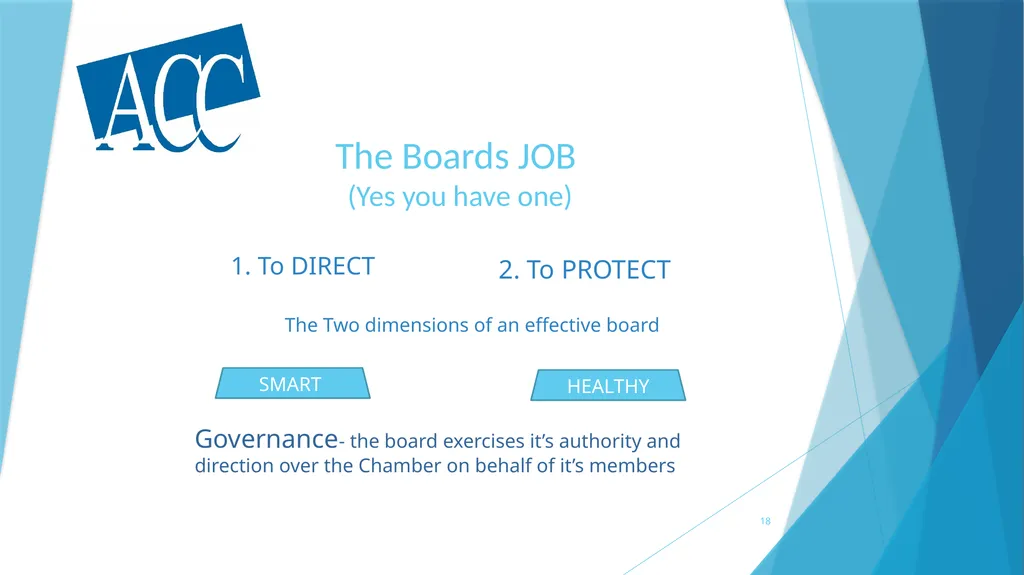
slide18. The Boards JOB (Yes you have one) 1. To DIRECT 18 2. To PROTECT The Two dimensions of an effective board SMART HEALTHY Governance- the board exercises it’s authority and direction over the Chamber on behalf of it’s members<br>
slide19. You are the Ambassadors for your Chamber Always have 2-3 questions or topics your board can discuss when opportunities arise.
This keeps you cohesive and relevant.
Questions need to be specific and not allow for yes or no answers. 19<br>
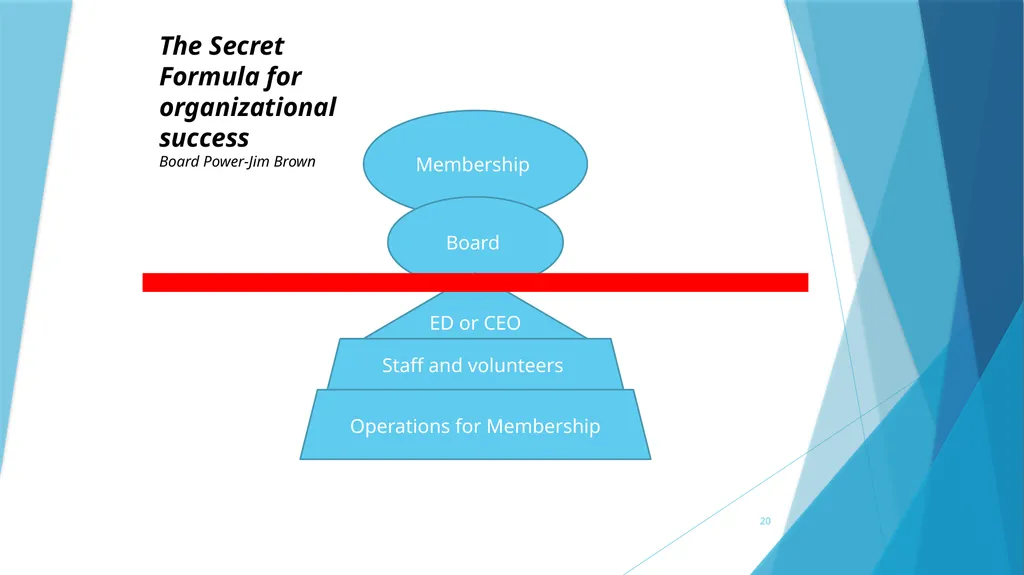
slide20. 20 Membership Board ED or CEO Staff and volunteers Operations for Membership The Secret Formula for organizational success
Board Power-Jim Brown<br>
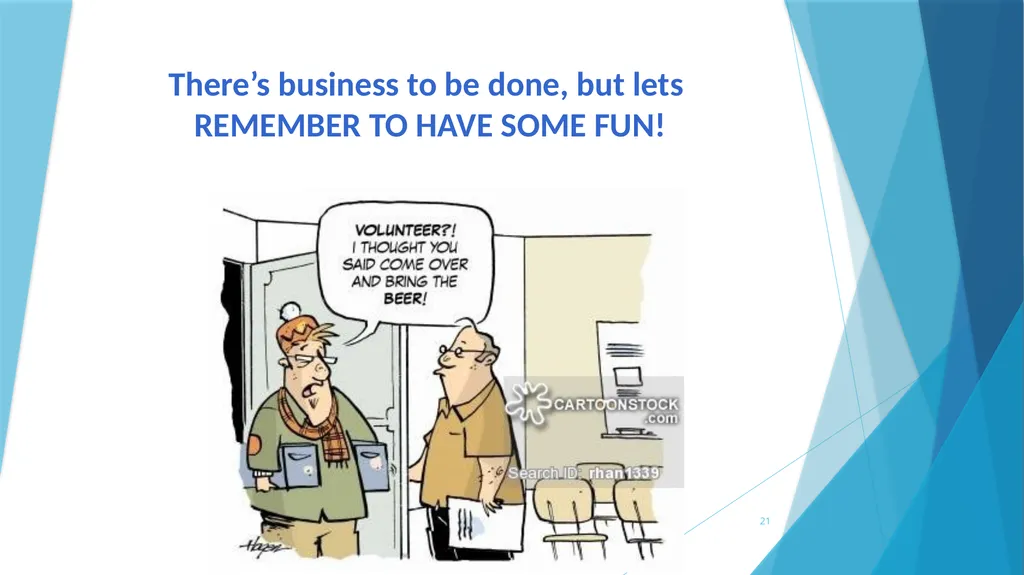
slide21. 21 There’s business to be done, but lets REMEMBER TO HAVE SOME FUN!<br>
slide22. Board Legal Considerations Duty of care
Good business judgment at all times, Due diligence in decision making
Duty of loyalty
Avoid Conflicts of interest
Duty of Obedience
Faithful to the Chambers Mission & Goals, Follow your governing
documents 22<br>
slide23. Board Legal Considerations Courts have given common terms to:
Honesty; Directors must tell not only the truth but also the whole truth
Duty of Care; Requires caution and conscientiousness
Duty of Diligence; Make those inquiries, which a person of ordinary care in their position or in managing their affairs would make. Directors rely on Officers and outside experts at their own risk 23<br>
slide24. Board Legal Considerations Duty of Prudence; requires Directors to use common sense. Acting prudently is acting carefully, deliberately and cautiously trying to foresee the probable consequences of the act.
Duty of Skill; In Common law, a Director is not required to exercise a greater degree of skill than can be reasonably expected from a person of their knowledge and experience . Directors are not liable for mere errors in judgment.
There is absolutely nothing that can be contained in a contract or in the constitution or bylaws that relieves a Director of these duties. 24<br>
slide25. What YOU CANNOT do to Minimize risk Do nothing- Taking no action is no excuse even if you did not directly participate
See no evil- You must do whatever necessary to correct a wrong
Resign- resigning after you see an issue that is not corrected does not remove liability 25<br>
slide26. What YOU CAN do to Minimize Risk Know the people involved
Know your bylaws
Have a working knowledge of what’ s going on
Monitor the finances
Use common sense and intuition
Liability Insurance for Directors is a MUST 26<br>
slide27. Code of Conduct Direct the activities AS A WHOLE
Maintain confidentiality of the details & dynamics
Contributions are positive, constructive and ALL interactions are courteous and respectful
All issues of importance are ratified by the Board
Always adhere to your Mission and Bylaws 27<br>
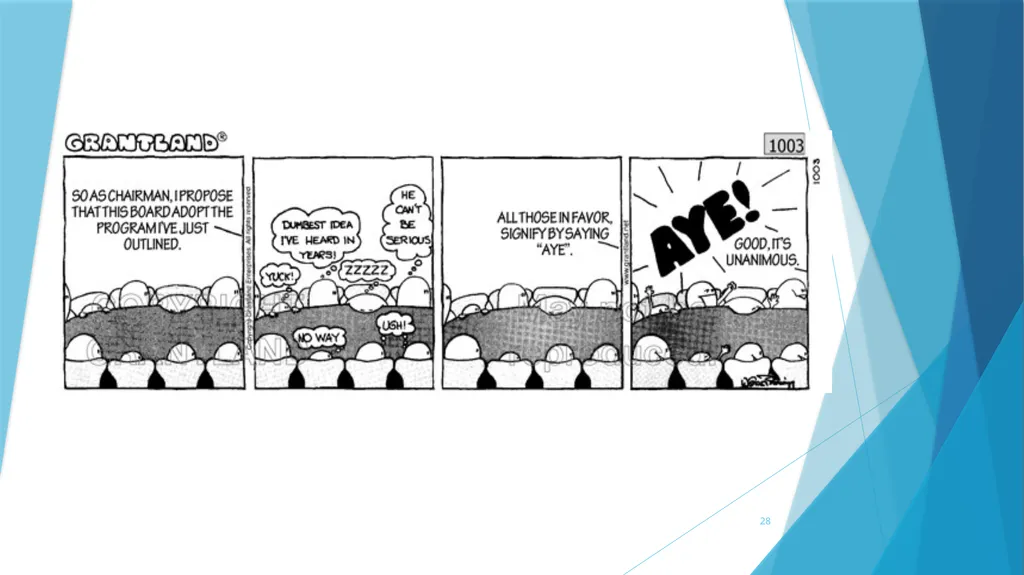
slide28. 28<br>
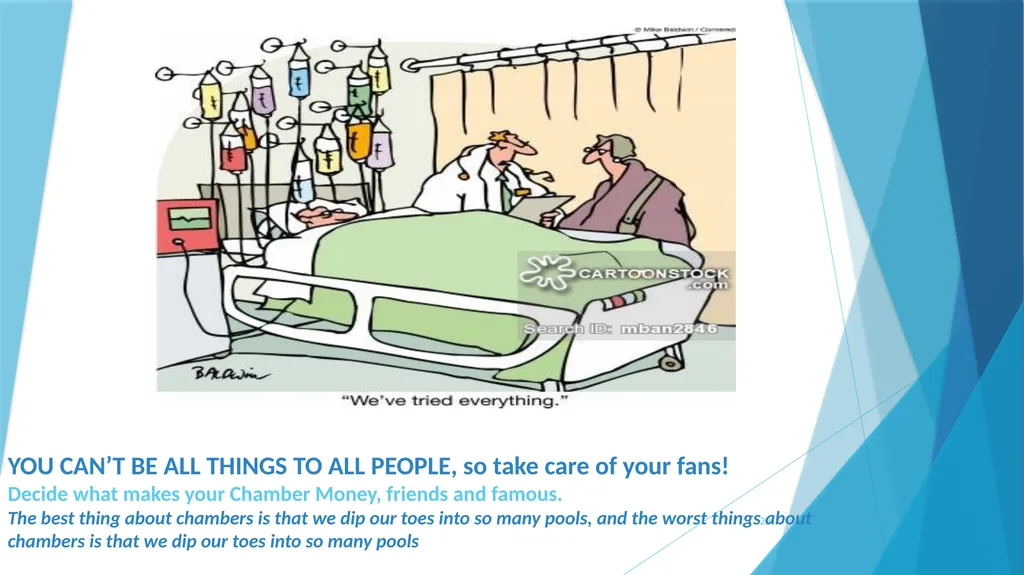
slide29. YOU CAN’T BE ALL THINGS TO ALL PEOPLE, so take care of your fans! Decide what makes your Chamber Money, friends and famous. The best thing about chambers is that we dip our toes into so many pools, and the worst things about chambers is that we dip our toes into so many pools 29<br>
slide30. Projects and Events When planning any project or event ask the following;
Is it a Mission fit?
Will it build strength for the business community?
Will it strengthen communications and relationships?
Will it strengthen the advocacy process (governmental affairs)?
Is it value added for our membership?
Are we making Money, friends and our Chamber famous? 30<br>
slide31. 31<br>
slide32. 32<br>
slide33. Cautionary Notes Your Membership is the first and last authority
A Director has no authority to commit the Chamber to any action, project of financial obligation
No Director may speak for the Chamber except on matters where the Chamber has a clearly defined policy
Avoid conflicts of interest 33<br>
slide34. Conflict of Interest A conflict of interest occurs when an individual or organization is involved in multiple interests, one of which could possibly corrupt their motivation.
A “conflict of interest” exists if the decision COULD be influenced – it is not necessary that the influence actually takes place. (Excerpt from a policy template developed by the BC Law Reform Commission) 34<br>
slide35. The Board Staff Relationship The Board and Staff MUST be partners, collaborating and aligned for the good of the Chamber
Tips:
Avoid micromanagement
Be clear with your expectations
Respect time
Understand all that happens in the day to day when
adding more tasks or events
“ The Board is responsible for creating the future, not minding the shop” John Carver 35<br>
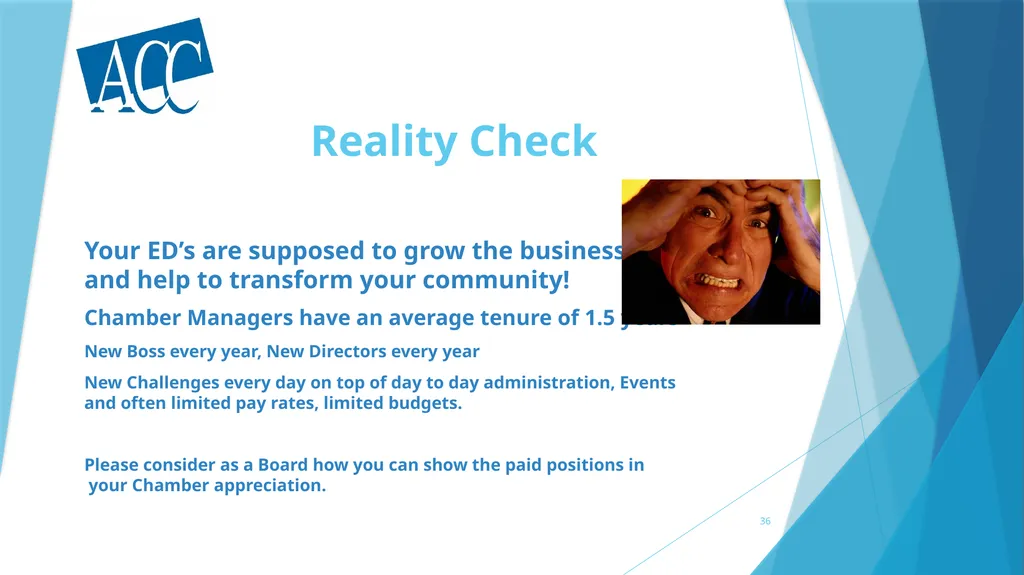
slide36. Reality Check Your ED’s are supposed to grow the business and help to transform your community!
Chamber Managers have an average tenure of 1.5 years
New Boss every year, New Directors every year
New Challenges every day on top of day to day administration, Events and often limited pay rates, limited budgets.
Please consider as a Board how you can show the paid positions in your Chamber appreciation. 36<br>
slide37. Budget & Finances Your budget is your future. Your Chamber’s program should be based on;
Clear cut objectives
Realistic goals
Ample finances to achieve the goal
If the goal is good for the chamber and achievable go for it
Operating reserve (6-12 months) & Capital budget
“Non Profit” is your tax status-not your business plan 37<br>
slide38. Practical Steps for Board Service To make the most out of your Service for both you and the Chamber consider;
Attend all Board and general meetings
Start and end meetings on time (Chair)
Review agenda and supporting documents prior
Be prepared if you are to present or speak on an issue
Treat all discussions and information as confidential when applicable
Chair at least one committee
Go through the President for any requests of staff 38<br>
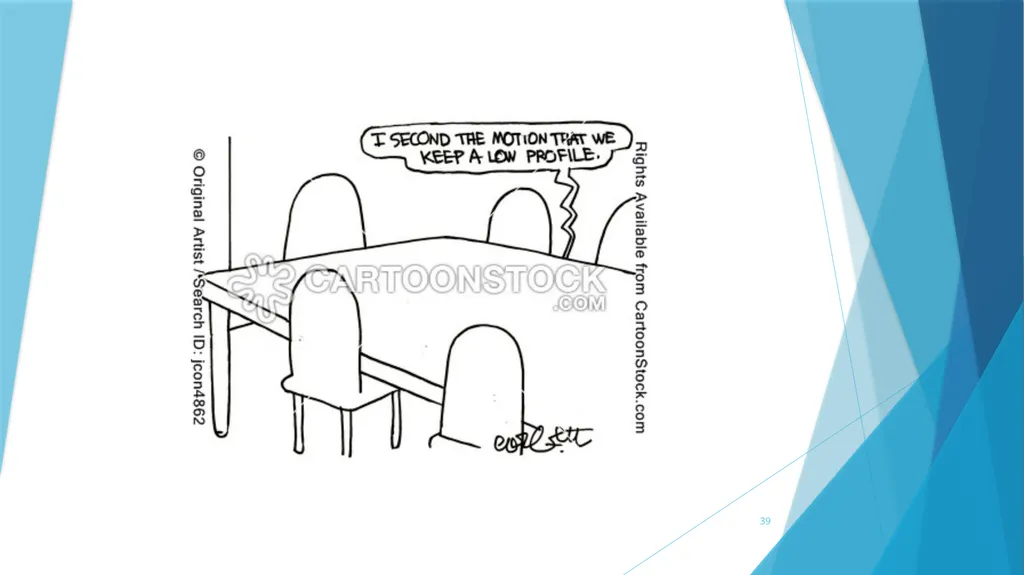
slide39. 39<br>
slide40. Role of the President The President provides leadership to the Board of Directors ensuring policy and procedure is followed
Chair and implement the planned agenda for all meetings
Act as a guide not as a boss
Ensure ALL board members have an opportunity to speak and share their opinions, and knowledge in a respectful environment
Respect start and end times for all meetings
Represent your Boards decisions at community meetings and events
Be the liaison between the wishes of the Board and your Staff
Meet regularly with your Executive Director (ED) or Manager
In consultation with your Board and Executive committee annually review performance of ED. Provide constructive feedback to improve performance when needed.
Act as a signing officer for the Chamber 40<br>
slide41. Role of the Vice President or Chair 41 The Vice or Incoming President provides leadership to the Board in the absence of the President
Chair meetings when President is absent
Serve as an Officer and signing authority for the Chamber
Learn the role of the President and develop relationships with Staff.<br>
slide42. Role of the Treasurer 42 The Treasurer ensures proper financial records are maintained and assist in preparation of the annual budget
Ensures that all expenditures of the Chamber are accurately recorded
Be a signing Officer and ensure banking is done regularly via staff
Present financials at Board and general meetings as required
Assist in preparation and monitoring of events and annual budgets
Work with the staff who perform accounting functions<br>
slide43. 43 Role of the Past President The Past President provides continuity to the Board, especially during transition
Assist the Newly elected President as needed
Often Chairs the Nominating Committee
Provides historical knowledge<br>
slide44. The ED ensures adequate records are maintained & assists in conducting the business affairs in accordance with directives and policies Manage the day to day affairs Hire and discharge any additional staff Prepare for, record and circulate minutes of meetings Ensure files for financials, minutes, correspondence and other relative information is maintained Act as a signing authority for the Chamber 44 Role of the Executive Director<br>
slide45. Executive Committee The goal for an Executive Committee is to conduct business between Board meetings with recommendations to be ratified by Board
Authorized by the bylaws and restricted by established
polices and precedents
Allows important business to be conducted as emerging issues arise 45<br>
slide46. Financial Responsibilities The Board is responsible to…
Review all financial reports
Prepare and Approve Annual Budget (Treasurer and ED)
Present financial reports (monthly, event and project based)
Ensure year end procedures are completed as per bylaws 46<br>
slide47. Financial Responsibilities Tenders and Quotes
Operational Policy for ED/ staff
HR committee
Year End Procedures 47<br>
slide48. 48<br>
slide49. Committees Committees Make your Board Successful
After your AGM set up Chairs for annual committees from your board of Directors.
Ask your members to sit on committees. This helps the staff and board get work done
Allow for functional, productive Board meetings not clogged up with general decisions 49<br>
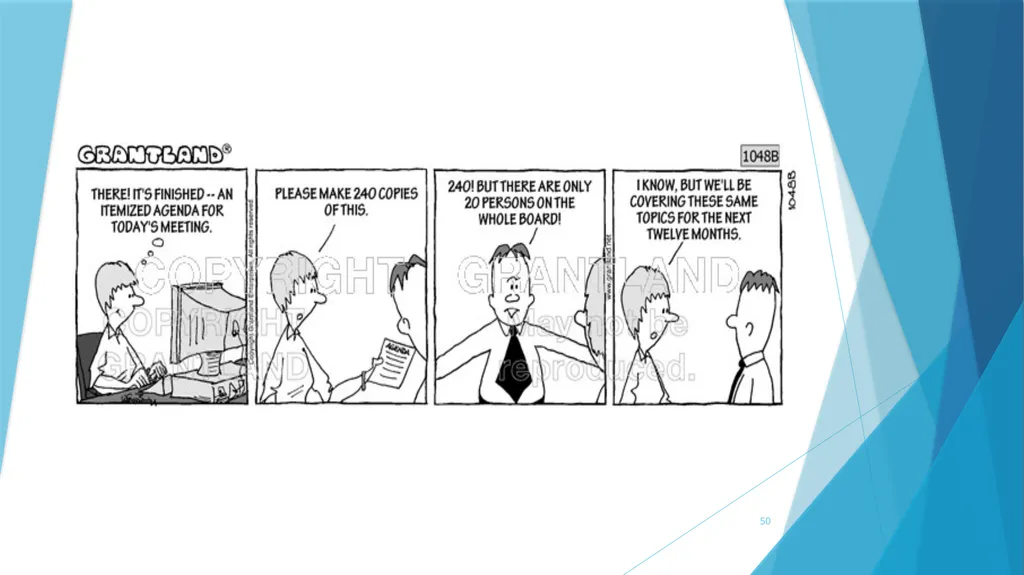
slide50. 50<br>
slide51. Structure of Committees Committee Chair is responsible for the committee
- Develop Terms of Reference- the 5 W’s
Put responsibilities of your volunteers on paper- be specific
Committee Chair is responsible to report to the Board
Committee Chair is responsible for the budget
Chair should keep the President advised of progress
Committee types- Ad Hoc and Task Force, Special Interest, Virtual
- 51<br>
slide52. Board Meetings Preparation is Key
Distribute notice and materials in advance
Review agenda so your prepared
Prepare any written reports and provide to Chamber digitally and in advance
Formulate your questions in advance
Listen to all viewpoints before forming your final opinion 52<br>
slide53. Board Meetings Rules of Order
Procedural rules maintain order at meetings
Must be recognised by the Chair before speaking
Set Time limits on agenda items
Learn the basic rules of order to be sure motions & procedures are understood
Look at using a consent agenda
. 53<br>
slide54. Board Meetings Accountability
Directors are accountable to each other
Deal with non performance
Celebrate successes of individuals and the whole
Reward performance of the Board and the staff
Recruiting Leaders
Identify future leaders in your midst-Nominating Committee plays a key role
Committees may be a source for future leaders
Key- recruit the doers in your community 54<br>
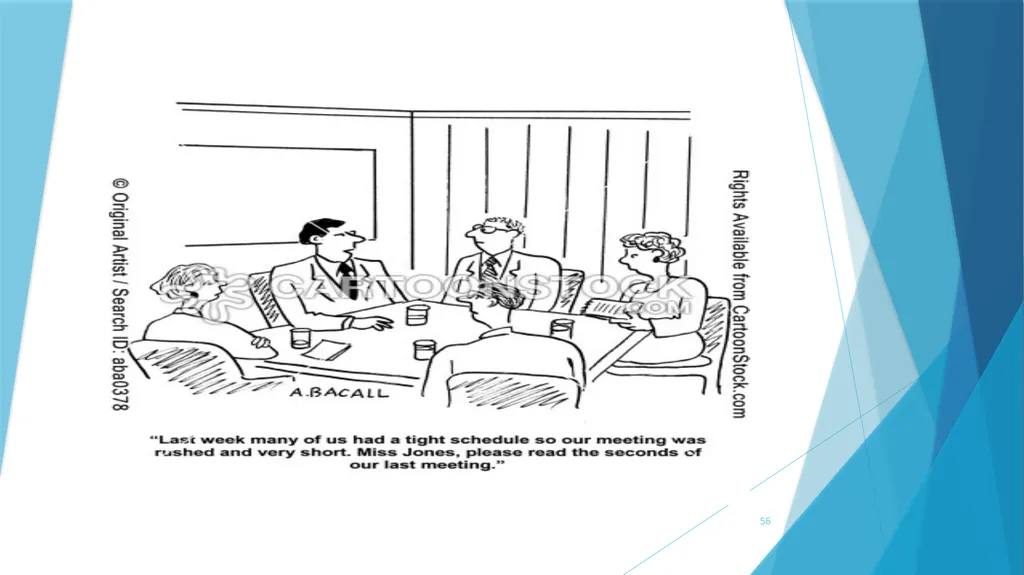
slide55. Minutes Minutes are a legal record
Do not record side conversations or reminders in your minutes.
No audio is maintained once minutes are approved
Minutes are to be approved at next convened meeting
Motions should “stand alone” 55<br>
slide56. 56<br>
slide57. Strategic Planning Process Set aside time specifically for planning
Find a venue that is relaxing and allows for good stretch breaks and a little fun
Once a draft plan is in place allow members an opportunity to provide input before formally adopting
Once adopted promote your success- inform the press about your key pillars
Implement the plan 1-3 years 57<br>
slide58. Goal Setting Identify 4-6 goals annually- you don’t want to exhaust resources or show failures if you attempt to do to much
Identify strategies within your goals-have objectives so achievability is measured
Within the strategies have tasks assigned to certain committees or volunteers.
“A goal properly set is halfway achieved”
Abraham Lincoln 58<br>
slide59. Measuring Performance Survey members regularly, Constant Contact is free for Chambers and has a survey component
Keep surveys short- never more than 10 questions, 3-5 questions has the best response rate
Ask others who have dealings with you
Budget- understand where your gains are 59<br>
slide60. Risk Management Evaluate the activities of the Chamber that create risk;
for e.g.. alcohol at meetings, physical activity, off site
events
Eliminate risk where possible
Ensure liability coverage and licensing is in place for all activities
Review and evaluate the risk benefit ratio 60<br>
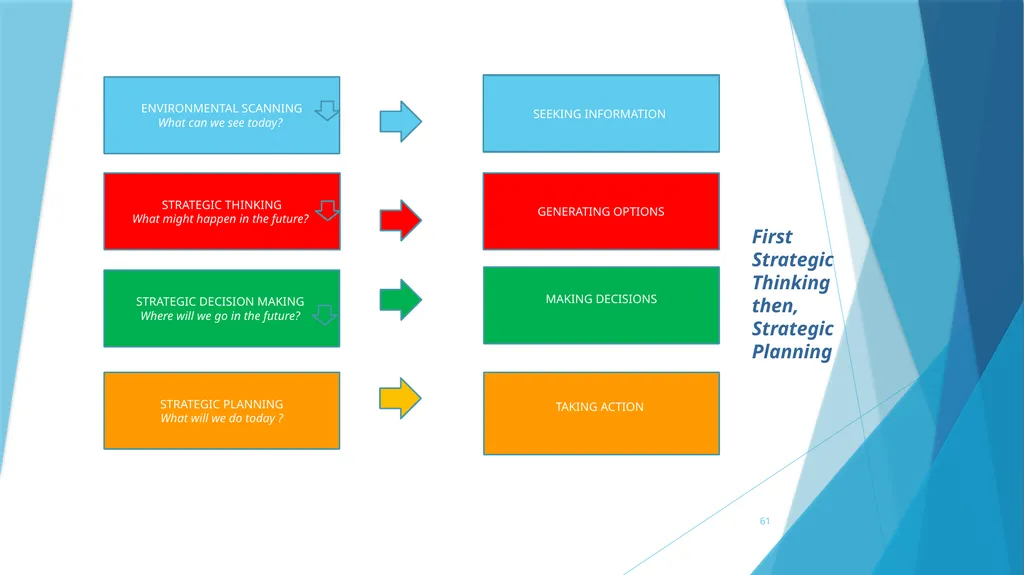
slide61. 61 ENVIRONMENTAL SCANNING
What can we see today? SEEKING INFORMATION STRATEGIC DECISION MAKING
Where will we go in the future? STRATEGIC THINKING
What might happen in the future? MAKING DECISIONS GENERATING OPTIONS TAKING ACTION STRATEGIC PLANNING
What will we do today ? Borrowed from Futures Thinking Model by Maree Conway First Strategic Thinking then,
Strategic Planning<br>
slide62. Thank you! Your Board experience should be positive
The Board is the Caretaker of the Chamber and should always speak as one voice
No Board member should have any more or less input or authority than another on matters within the Chamber 62<br>
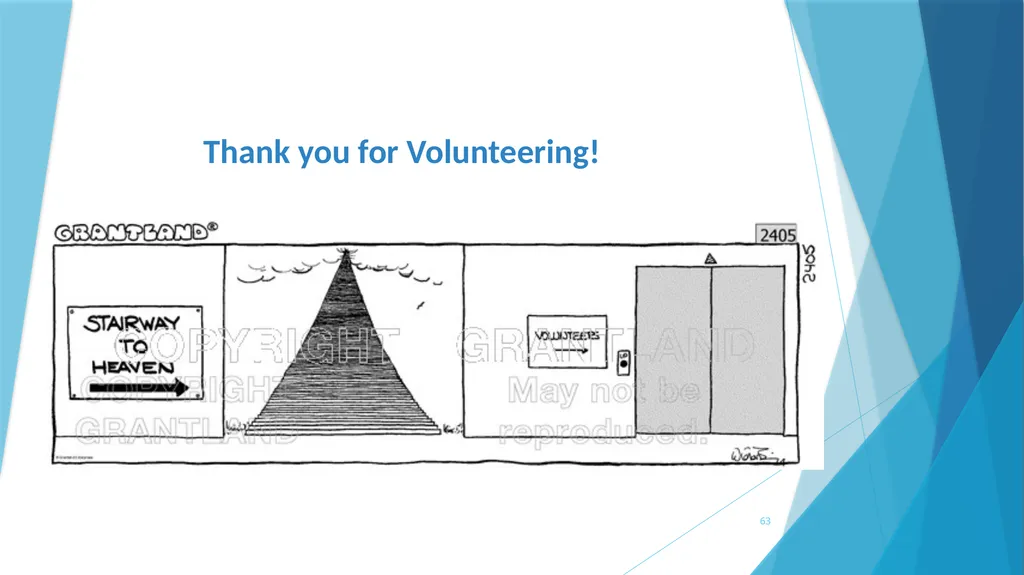
slide63. Thank you for Volunteering! 63<br>
Tracy Acorn,
Manager Chamber Services May 2019 1<br>
slide2. Topics Role/ Purpose of the ACC
Missions/Vision
Legal Duties
Board Responsibilities Practical Board Tips
Financial Responsibilities
Committees
Meetings
Recruiting Leaders 2<br>
slide3. Ground Rules Informal session- ask questions as they arise
Put your Chamber hat on & think in terms of your role as a director and the future wellbeing of YOUR Chamber Alberta Chambers , Geared for Success 3<br>
slide4. Thanks! 4<br>
slide5. Why are we here? 5 Because you Rock!<br>
slide6. Role of the ACC We are a federation of 122 provincial Chambers
Represent the business interests of over 25,5000 members in 28 federal and 87 provincial electoral districts
We are The Advocate for Alberta Business
One influential and respected voice in matters of provincial and federal concern
We provide leadership giving business a strong and collective voice 6<br>
slide7. Your Chamber – How do you connect to the ACC and the CCC?
Municipal advocacy – 124 chambers Provincial advocacy – 124 chambers Federal advocacy – 124 chambers (and proxy vote) September 2018 7<br>
slide8. ACC Committees Policy & Advocacy
Audit
Nominating
Executive
The ACC is always looking for business minded individuals. I invite you to look into how you may serve at the Alberta Chamber level. 8<br>
slide9. 9 Ok, so now what?<br>
slide10. 10 How is your Chamber Incorporated?
Why does this matter?
What do you need to know?
BOTA and Societies Act<br>
slide11. 11 Mission and Vision Statements and Why do they matter?
Mission statements focus on today and what your chamber does to achieve it. Answers the What, Who and How?
Visions statements focus on tomorrow and what your chamber wants to become. Speaks to aspirations, who and what are we aspiring to change and what problem are we solving?
Values statements define the ethics of your chamber.<br>
slide12. 12 Membership Elects Board Policy/Goals
Investigate &recommend action Appoints
Committees & Task Forces Executive Director
& Suport Staff Your Staff carry out initiatives, investigate and recommend actions to be decided on by the board. Approves Bylaws<br>
slide13. Governance Tools Policies 13 Board of Trade or Societies Act Bylaws Procedures No item on a lower step can contradict anything above<br>
slide14. Bylaws, Shmylaws!! 14<br>
slide15. 15 Board of Directors Working vs. Governance – is there really one kind of board?
No, not completely - all boards “Work” on some level, but Governance is a MUST.<br>
slide16. 16 What’s the difference, you Ask?
Activity
What distinguishes a working board's involvement in a chambers operations or capitol needs, from what a board focused solely on the governing function does is simply the kind of activity undertaken by each.
Successful Boards do BOTH
Governance is a must, it’s not an either or proposition
% 0f time staff, (when lucky enough to he them) to help shape the dynamic.
A working board should set their agendas putting the governance segment first. If the staff levels or “In the Weeds” operations, come first it can be quite challenging to shift to the more strategic view that’s necessary to make good governing decisions. It's generally easier to shift "down" than "up“!
A good board understands that the “Work” has to happen while they strategically move towards a more governance focus.<br>
slide17. Your Chamber is a business so what's your plan? NFP refers only to your Chambers tax status and NOT your business plan
Everything you do should ,
Make you MONEY
Make you FRIENDS
Make you FAMOUS
Goal 15-20% revenue on events and educational sessions 17<br>
slide18. The Boards JOB (Yes you have one) 1. To DIRECT 18 2. To PROTECT The Two dimensions of an effective board SMART HEALTHY Governance- the board exercises it’s authority and direction over the Chamber on behalf of it’s members<br>
slide19. You are the Ambassadors for your Chamber Always have 2-3 questions or topics your board can discuss when opportunities arise.
This keeps you cohesive and relevant.
Questions need to be specific and not allow for yes or no answers. 19<br>
slide20. 20 Membership Board ED or CEO Staff and volunteers Operations for Membership The Secret Formula for organizational success
Board Power-Jim Brown<br>
slide21. 21 There’s business to be done, but lets REMEMBER TO HAVE SOME FUN!<br>
slide22. Board Legal Considerations Duty of care
Good business judgment at all times, Due diligence in decision making
Duty of loyalty
Avoid Conflicts of interest
Duty of Obedience
Faithful to the Chambers Mission & Goals, Follow your governing
documents 22<br>
slide23. Board Legal Considerations Courts have given common terms to:
Honesty; Directors must tell not only the truth but also the whole truth
Duty of Care; Requires caution and conscientiousness
Duty of Diligence; Make those inquiries, which a person of ordinary care in their position or in managing their affairs would make. Directors rely on Officers and outside experts at their own risk 23<br>
slide24. Board Legal Considerations Duty of Prudence; requires Directors to use common sense. Acting prudently is acting carefully, deliberately and cautiously trying to foresee the probable consequences of the act.
Duty of Skill; In Common law, a Director is not required to exercise a greater degree of skill than can be reasonably expected from a person of their knowledge and experience . Directors are not liable for mere errors in judgment.
There is absolutely nothing that can be contained in a contract or in the constitution or bylaws that relieves a Director of these duties. 24<br>
slide25. What YOU CANNOT do to Minimize risk Do nothing- Taking no action is no excuse even if you did not directly participate
See no evil- You must do whatever necessary to correct a wrong
Resign- resigning after you see an issue that is not corrected does not remove liability 25<br>
slide26. What YOU CAN do to Minimize Risk Know the people involved
Know your bylaws
Have a working knowledge of what’ s going on
Monitor the finances
Use common sense and intuition
Liability Insurance for Directors is a MUST 26<br>
slide27. Code of Conduct Direct the activities AS A WHOLE
Maintain confidentiality of the details & dynamics
Contributions are positive, constructive and ALL interactions are courteous and respectful
All issues of importance are ratified by the Board
Always adhere to your Mission and Bylaws 27<br>
slide28. 28<br>
slide29. YOU CAN’T BE ALL THINGS TO ALL PEOPLE, so take care of your fans! Decide what makes your Chamber Money, friends and famous. The best thing about chambers is that we dip our toes into so many pools, and the worst things about chambers is that we dip our toes into so many pools 29<br>
slide30. Projects and Events When planning any project or event ask the following;
Is it a Mission fit?
Will it build strength for the business community?
Will it strengthen communications and relationships?
Will it strengthen the advocacy process (governmental affairs)?
Is it value added for our membership?
Are we making Money, friends and our Chamber famous? 30<br>
slide31. 31<br>
slide32. 32<br>
slide33. Cautionary Notes Your Membership is the first and last authority
A Director has no authority to commit the Chamber to any action, project of financial obligation
No Director may speak for the Chamber except on matters where the Chamber has a clearly defined policy
Avoid conflicts of interest 33<br>
slide34. Conflict of Interest A conflict of interest occurs when an individual or organization is involved in multiple interests, one of which could possibly corrupt their motivation.
A “conflict of interest” exists if the decision COULD be influenced – it is not necessary that the influence actually takes place. (Excerpt from a policy template developed by the BC Law Reform Commission) 34<br>
slide35. The Board Staff Relationship The Board and Staff MUST be partners, collaborating and aligned for the good of the Chamber
Tips:
Avoid micromanagement
Be clear with your expectations
Respect time
Understand all that happens in the day to day when
adding more tasks or events
“ The Board is responsible for creating the future, not minding the shop” John Carver 35<br>
slide36. Reality Check Your ED’s are supposed to grow the business and help to transform your community!
Chamber Managers have an average tenure of 1.5 years
New Boss every year, New Directors every year
New Challenges every day on top of day to day administration, Events and often limited pay rates, limited budgets.
Please consider as a Board how you can show the paid positions in your Chamber appreciation. 36<br>
slide37. Budget & Finances Your budget is your future. Your Chamber’s program should be based on;
Clear cut objectives
Realistic goals
Ample finances to achieve the goal
If the goal is good for the chamber and achievable go for it
Operating reserve (6-12 months) & Capital budget
“Non Profit” is your tax status-not your business plan 37<br>
slide38. Practical Steps for Board Service To make the most out of your Service for both you and the Chamber consider;
Attend all Board and general meetings
Start and end meetings on time (Chair)
Review agenda and supporting documents prior
Be prepared if you are to present or speak on an issue
Treat all discussions and information as confidential when applicable
Chair at least one committee
Go through the President for any requests of staff 38<br>
slide39. 39<br>
slide40. Role of the President The President provides leadership to the Board of Directors ensuring policy and procedure is followed
Chair and implement the planned agenda for all meetings
Act as a guide not as a boss
Ensure ALL board members have an opportunity to speak and share their opinions, and knowledge in a respectful environment
Respect start and end times for all meetings
Represent your Boards decisions at community meetings and events
Be the liaison between the wishes of the Board and your Staff
Meet regularly with your Executive Director (ED) or Manager
In consultation with your Board and Executive committee annually review performance of ED. Provide constructive feedback to improve performance when needed.
Act as a signing officer for the Chamber 40<br>
slide41. Role of the Vice President or Chair 41 The Vice or Incoming President provides leadership to the Board in the absence of the President
Chair meetings when President is absent
Serve as an Officer and signing authority for the Chamber
Learn the role of the President and develop relationships with Staff.<br>
slide42. Role of the Treasurer 42 The Treasurer ensures proper financial records are maintained and assist in preparation of the annual budget
Ensures that all expenditures of the Chamber are accurately recorded
Be a signing Officer and ensure banking is done regularly via staff
Present financials at Board and general meetings as required
Assist in preparation and monitoring of events and annual budgets
Work with the staff who perform accounting functions<br>
slide43. 43 Role of the Past President The Past President provides continuity to the Board, especially during transition
Assist the Newly elected President as needed
Often Chairs the Nominating Committee
Provides historical knowledge<br>
slide44. The ED ensures adequate records are maintained & assists in conducting the business affairs in accordance with directives and policies Manage the day to day affairs Hire and discharge any additional staff Prepare for, record and circulate minutes of meetings Ensure files for financials, minutes, correspondence and other relative information is maintained Act as a signing authority for the Chamber 44 Role of the Executive Director<br>
slide45. Executive Committee The goal for an Executive Committee is to conduct business between Board meetings with recommendations to be ratified by Board
Authorized by the bylaws and restricted by established
polices and precedents
Allows important business to be conducted as emerging issues arise 45<br>
slide46. Financial Responsibilities The Board is responsible to…
Review all financial reports
Prepare and Approve Annual Budget (Treasurer and ED)
Present financial reports (monthly, event and project based)
Ensure year end procedures are completed as per bylaws 46<br>
slide47. Financial Responsibilities Tenders and Quotes
Operational Policy for ED/ staff
HR committee
Year End Procedures 47<br>
slide48. 48<br>
slide49. Committees Committees Make your Board Successful
After your AGM set up Chairs for annual committees from your board of Directors.
Ask your members to sit on committees. This helps the staff and board get work done
Allow for functional, productive Board meetings not clogged up with general decisions 49<br>
slide50. 50<br>
slide51. Structure of Committees Committee Chair is responsible for the committee
- Develop Terms of Reference- the 5 W’s
Put responsibilities of your volunteers on paper- be specific
Committee Chair is responsible to report to the Board
Committee Chair is responsible for the budget
Chair should keep the President advised of progress
Committee types- Ad Hoc and Task Force, Special Interest, Virtual
- 51<br>
slide52. Board Meetings Preparation is Key
Distribute notice and materials in advance
Review agenda so your prepared
Prepare any written reports and provide to Chamber digitally and in advance
Formulate your questions in advance
Listen to all viewpoints before forming your final opinion 52<br>
slide53. Board Meetings Rules of Order
Procedural rules maintain order at meetings
Must be recognised by the Chair before speaking
Set Time limits on agenda items
Learn the basic rules of order to be sure motions & procedures are understood
Look at using a consent agenda
. 53<br>
slide54. Board Meetings Accountability
Directors are accountable to each other
Deal with non performance
Celebrate successes of individuals and the whole
Reward performance of the Board and the staff
Recruiting Leaders
Identify future leaders in your midst-Nominating Committee plays a key role
Committees may be a source for future leaders
Key- recruit the doers in your community 54<br>
slide55. Minutes Minutes are a legal record
Do not record side conversations or reminders in your minutes.
No audio is maintained once minutes are approved
Minutes are to be approved at next convened meeting
Motions should “stand alone” 55<br>
slide56. 56<br>
slide57. Strategic Planning Process Set aside time specifically for planning
Find a venue that is relaxing and allows for good stretch breaks and a little fun
Once a draft plan is in place allow members an opportunity to provide input before formally adopting
Once adopted promote your success- inform the press about your key pillars
Implement the plan 1-3 years 57<br>
slide58. Goal Setting Identify 4-6 goals annually- you don’t want to exhaust resources or show failures if you attempt to do to much
Identify strategies within your goals-have objectives so achievability is measured
Within the strategies have tasks assigned to certain committees or volunteers.
“A goal properly set is halfway achieved”
Abraham Lincoln 58<br>
slide59. Measuring Performance Survey members regularly, Constant Contact is free for Chambers and has a survey component
Keep surveys short- never more than 10 questions, 3-5 questions has the best response rate
Ask others who have dealings with you
Budget- understand where your gains are 59<br>
slide60. Risk Management Evaluate the activities of the Chamber that create risk;
for e.g.. alcohol at meetings, physical activity, off site
events
Eliminate risk where possible
Ensure liability coverage and licensing is in place for all activities
Review and evaluate the risk benefit ratio 60<br>
slide61. 61 ENVIRONMENTAL SCANNING
What can we see today? SEEKING INFORMATION STRATEGIC DECISION MAKING
Where will we go in the future? STRATEGIC THINKING
What might happen in the future? MAKING DECISIONS GENERATING OPTIONS TAKING ACTION STRATEGIC PLANNING
What will we do today ? Borrowed from Futures Thinking Model by Maree Conway First Strategic Thinking then,
Strategic Planning<br>
slide62. Thank you! Your Board experience should be positive
The Board is the Caretaker of the Chamber and should always speak as one voice
No Board member should have any more or less input or authority than another on matters within the Chamber 62<br>
slide63. Thank you for Volunteering! 63<br>