04
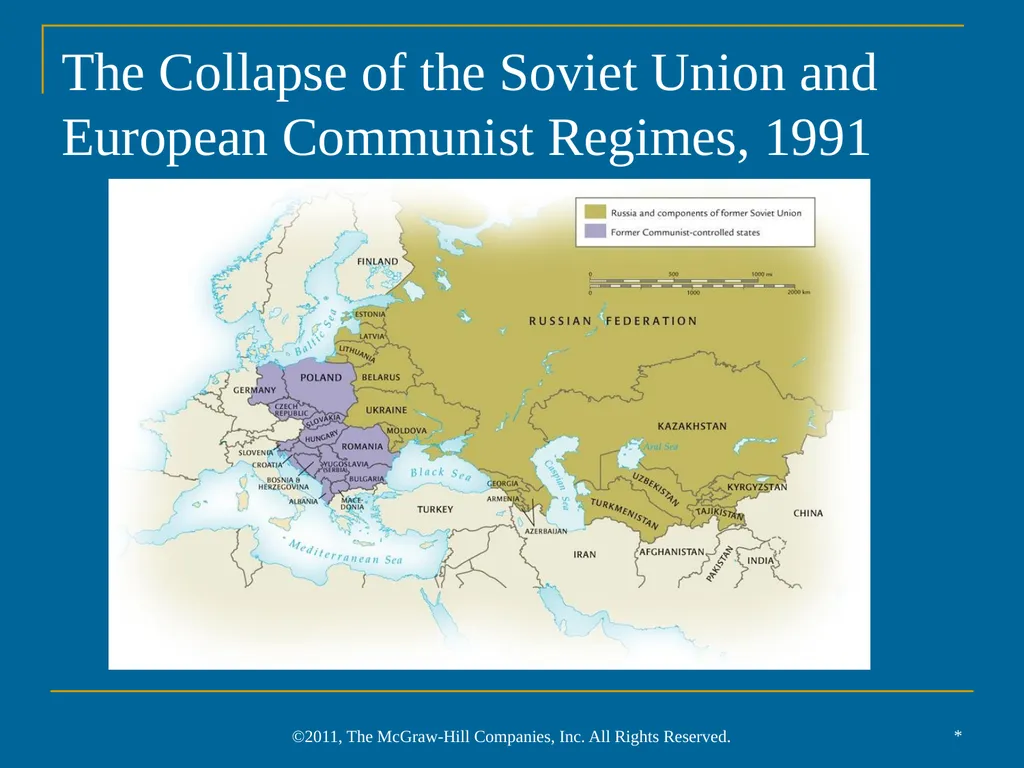
The Collapse of the Soviet Union and European Communist Regimes, 1991 ©2011, The McGraw-Hill Companies, Inc. All Rights Reserved. *<br>
05
Soviet Setbacks in Afghanistan Pressures on Soviet system exacerbated by 1979 invasion of Afghanistan
Nine-year battle against Afghan mujahideen (Islamic warriors)
CIA supplies them with ground-to-air Stinger missiles
1986, USSR forced to pull out
UN-negotiated cease-fire leads to full withdrawal in 1989 ©2011, The McGraw-Hill Companies, Inc. All Rights Reserved. *<br>
06
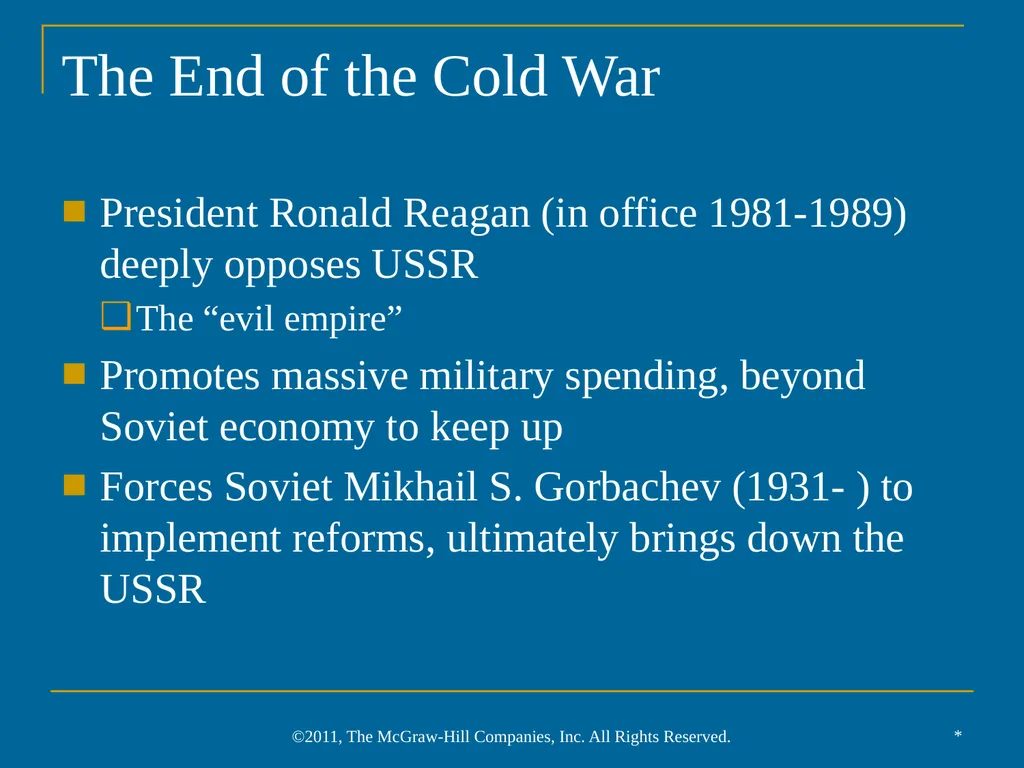
Collapse of the Soviet Union Reforms under Gorbachev
Economic, social
Perestroika: “restructuring”
Glasnost: “openness”
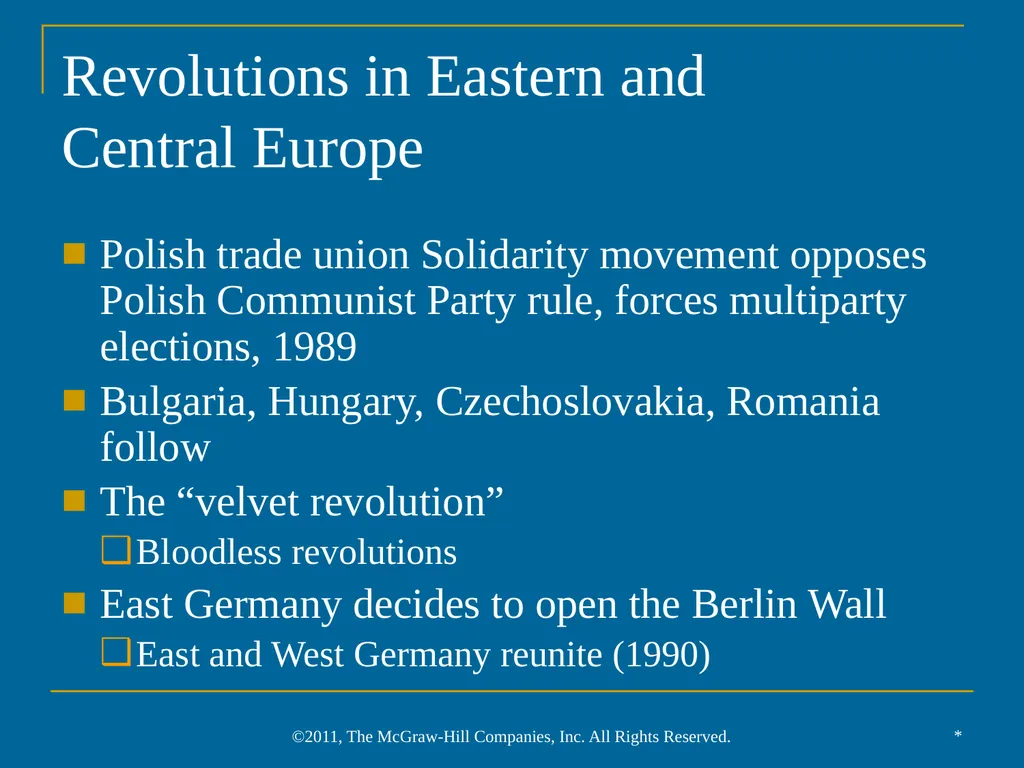
Nationalist sentiments, long suppressed, come to the surface
Several non-Russian republics secede, August 1991
Attempted hardliner takeover in Moscow fails; Soviet Union collapses by end of the year ©2011, The McGraw-Hill Companies, Inc. All Rights Reserved. *<br>
07
Economic Globalization Reduction and removal of barriers between national borders to facilitate the flow of goods, capital, services, and labor
General Agreement on Tariffs and Trade (GATT, 1947), 23 member nations
World Trade Organization (WTO) takes over from GATT in 1995
Global corporations expand, treat globe as single market
Decentralize as necessary to take maximum advantage of regional markets, labor pools, taxation policies ©2011, The McGraw-Hill Companies, Inc. All Rights Reserved. *<br>
08
Economic Growth in Asia Japan benefits from Marshall Plan, treaty limitations on defense spending
Massive postwar economic expansion, slowed in 1990s
“Four little tigers”
Interrelated economies fragile; financial crisis in 1997
China integrates elements of market economy, benefits from huge cheap labor pool * ©2011, The McGraw-Hill Companies, Inc. All Rights Reserved.<br>
09
Trading Blocs European Union
Six nations when formed in 1957
Maastricht Treaty of 1993: moving toward political integration
Organization of Petroleum Exporting Countries (OPEC)
Established in 1960; dominated by Arab and Muslim countries
Used economic might to place embargo on U.S. oil, 1973-1975
Association of Southeast Asian Nations (ASEAN) ©2011, The McGraw-Hill Companies, Inc. All Rights Reserved. *<br>
10
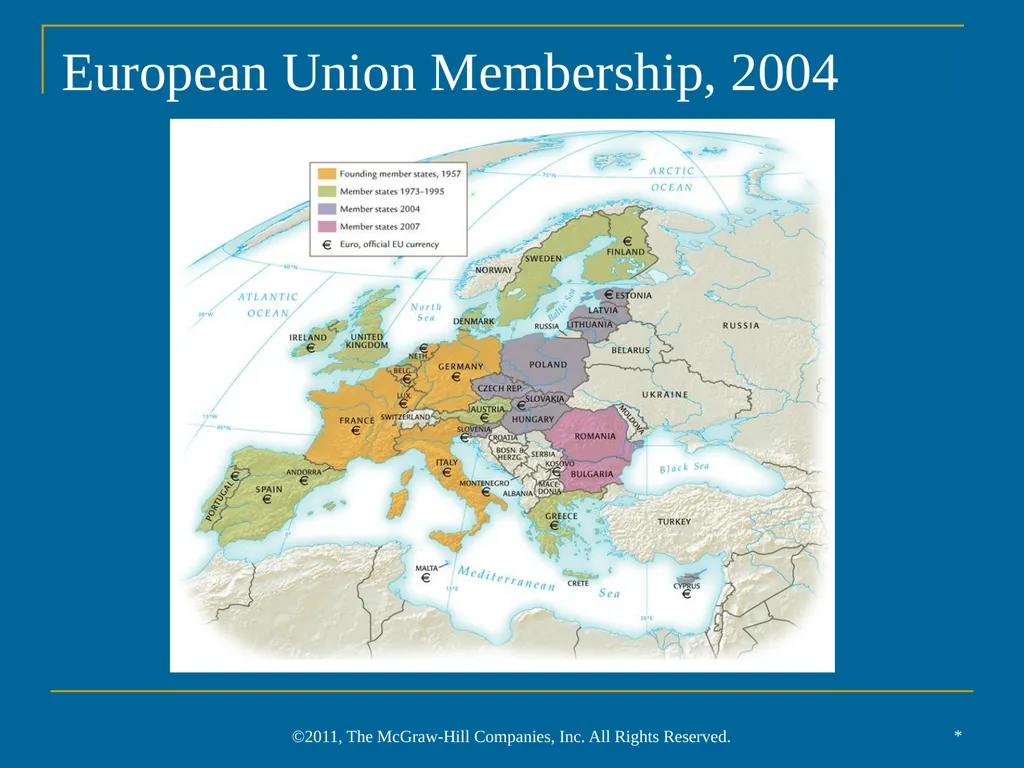
European Union Membership, 2004 ©2011, The McGraw-Hill Companies, Inc. All Rights Reserved. *<br>
11
Consumption and Cultural Interaction “Americanization” or “McDonaldization”
American culture exported
Yet cultural borrowings from non-American societies
Internal transformations: Latino culture in America
English language becomes predominant
Influence of British colonialism, America, the Internet * ©2011, The McGraw-Hill Companies, Inc. All Rights Reserved.<br>
12
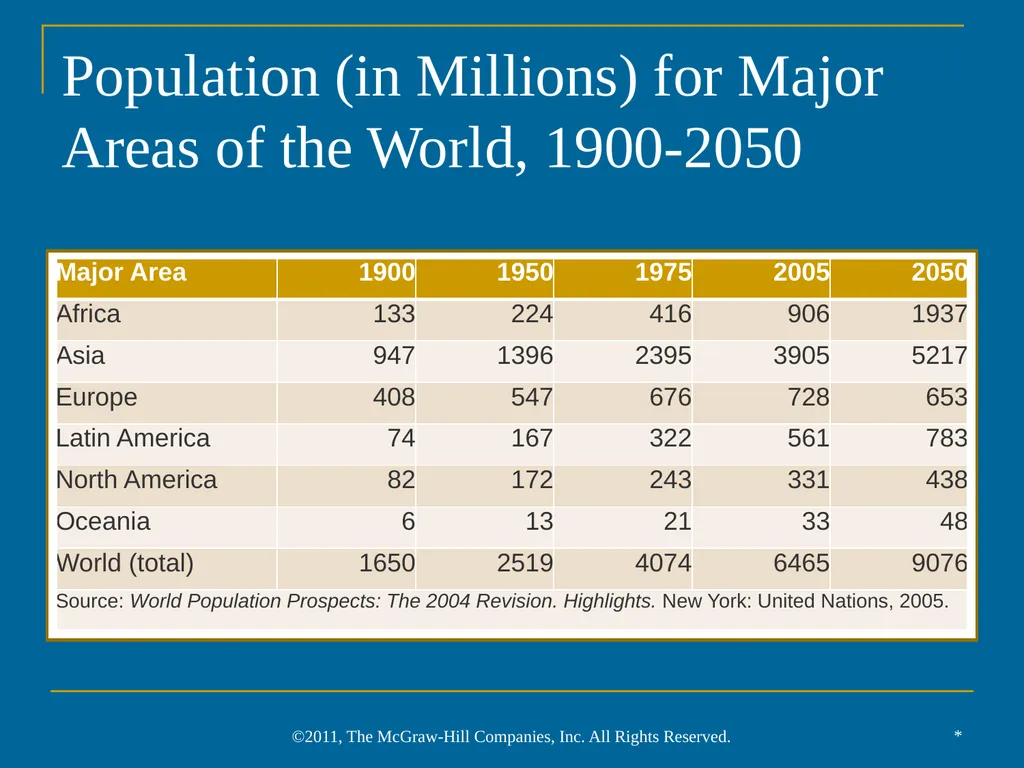
Population (in Millions) for Major Areas of the World, 1900-2050 ©2011, The McGraw-Hill Companies, Inc. All Rights Reserved. *<br>
13
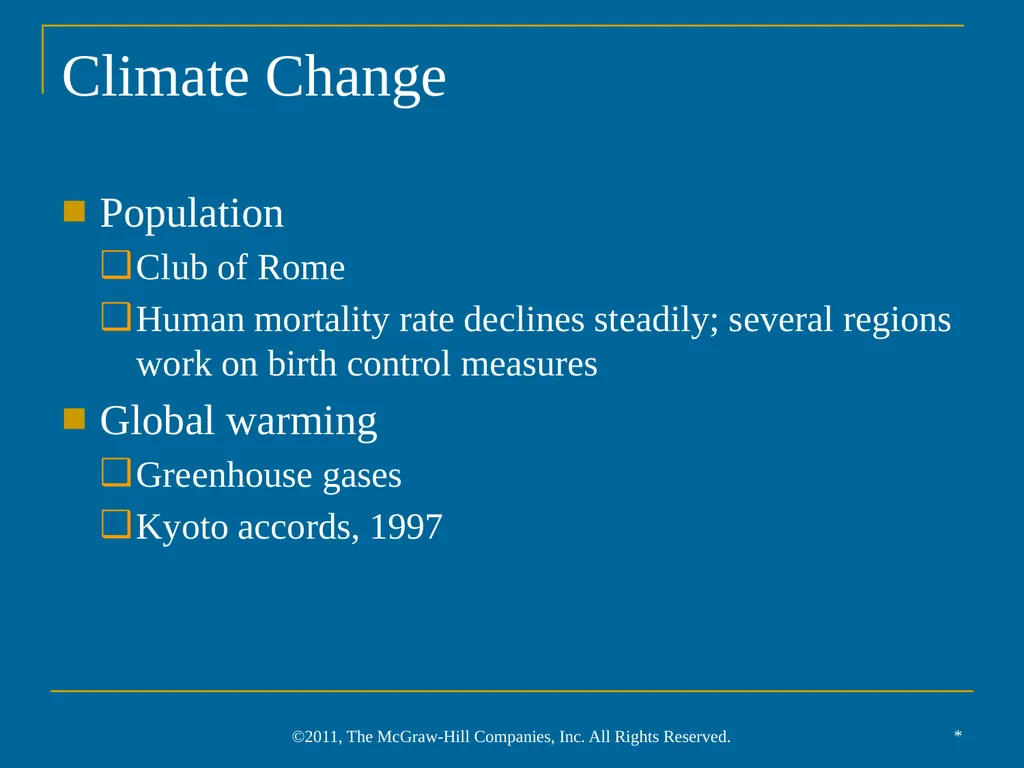
Climate Change Population
Club of Rome
Human mortality rate declines steadily; several regions work on birth control measures
Global warming
Greenhouse gases
Kyoto accords, 1997 ©2011, The McGraw-Hill Companies, Inc. All Rights Reserved. *<br>
14
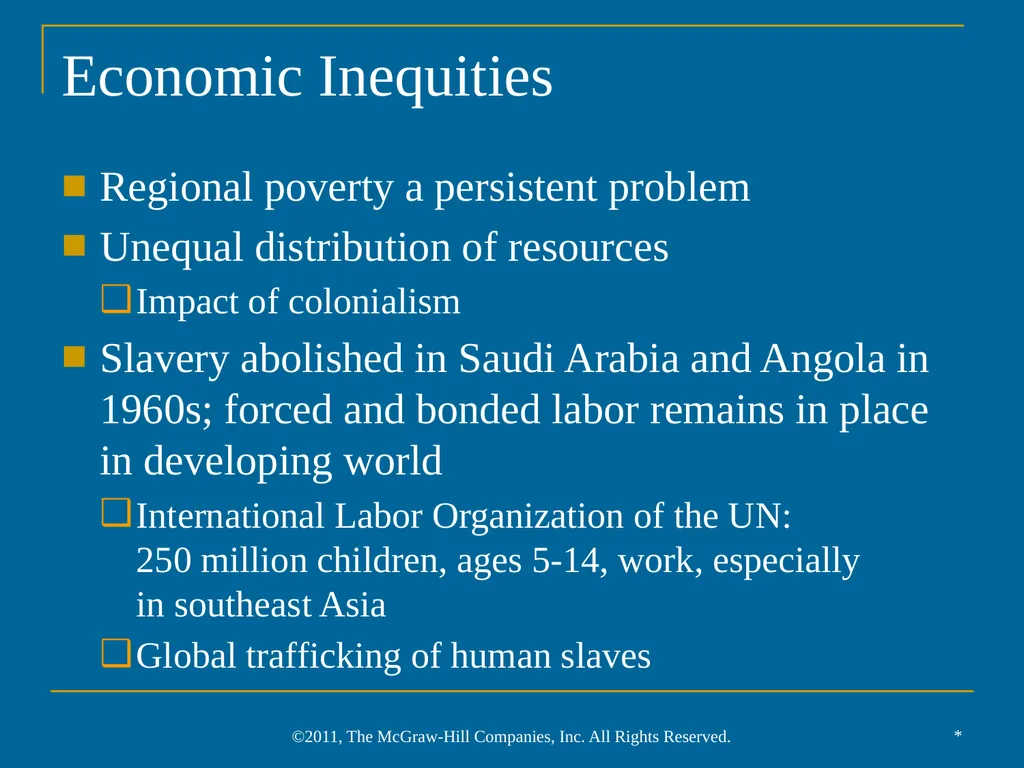
Economic Inequities Regional poverty a persistent problem
Unequal distribution of resources
Impact of colonialism
Slavery abolished in Saudi Arabia and Angola in 1960s; forced and bonded labor remains in place in developing world
International Labor Organization of the UN: �250 million children, ages 5-14, work, especially �in southeast Asia
Global trafficking of human slaves * ©2011, The McGraw-Hill Companies, Inc. All Rights Reserved.<br>
15
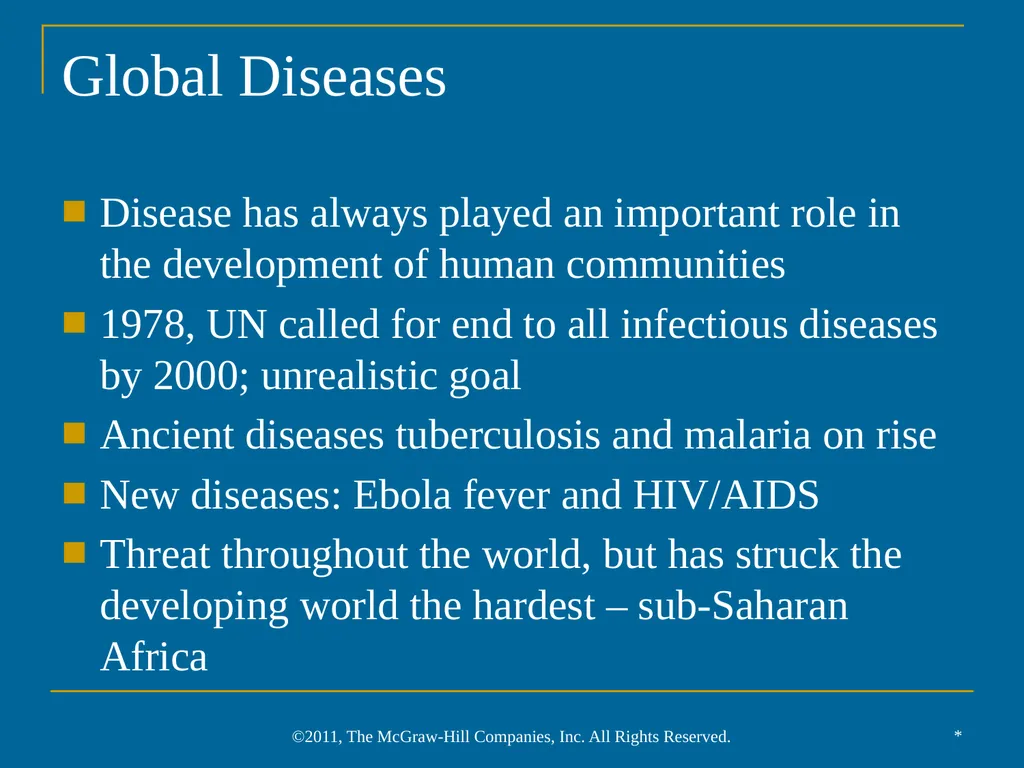
Global Diseases Disease has always played an important role in the development of human communities
1978, UN called for end to all infectious diseases by 2000; unrealistic goal
Ancient diseases tuberculosis and malaria on rise
New diseases: Ebola fever and HIV/AIDS
Threat throughout the world, but has struck the developing world the hardest – sub-Saharan Africa * ©2011, The McGraw-Hill Companies, Inc. All Rights Reserved.<br>
16
Global Terrorism Terrorism: deliberate, systematic use of violence against civilians
Cheaper, more effective than conventional war, thus accessible to smaller groups
September 11, 2001: four planes hijacked by terrorists
Crash into World Trade Center buildings (NYC), Pentagon, field in Pennsylvania (passengers thwarted mission, intended target)
Masterminded by Islamic extremist Osama bin Laden (1957- ), leader of al-Qaeda (“the Base”) ©2011, The McGraw-Hill Companies, Inc. All Rights Reserved. *<br>
17
War in Afghanistan and Iraq President George W. Bush (1946- ) invades Afghanistan to destroy al-Qaeda training bases
Overthrows Taliban government
Invasion of Iraq to overthrow Saddam Hussein, perceived as ally of Osama bin Laden ©2011, The McGraw-Hill Companies, Inc. All Rights Reserved. *<br>
18
The United Nations Superseded the League of Nations (1920-1946)
Charter: to maintain international peace and security
Weak body in military areas, influential in larger public health projects
Eradication of smallpox
Supporters of universal human rights * ©2011, The McGraw-Hill Companies, Inc. All Rights Reserved.<br>
19
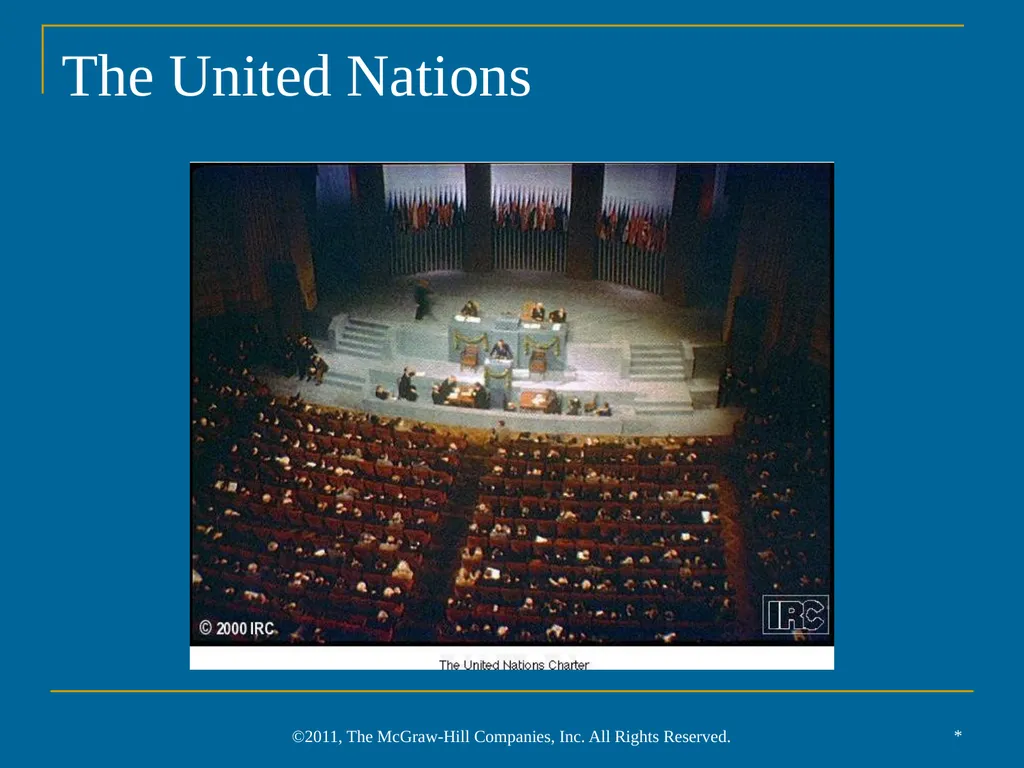
The United Nations * ©2011, The McGraw-Hill Companies, Inc. All Rights Reserved.<br>
20
Global Feminism Displaced from jobs by returning soldiers after World War II, women in industrialized nations agitate for equal opportunities
Demand control over bodies: access to birth control and abortion, achieved in 1960s and 1970s
Arab and Muslim lands: continued gaps in literacy
Increasing number of women national leaders
Indira Gandhi (India), Golda Meir (Israel), Margaret Thatcher (UK) * ©2011, The McGraw-Hill Companies, Inc. All Rights Reserved.<br>
21
Migration Patterns Rural areas depopulating to urban regions
Creation of slums
Immigration for economic reasons
Refugees fleeing war, poverty
Tourism increasingly common in twenty-first century * ©2011, The McGraw-Hill Companies, Inc. All Rights Reserved.<br>