
AAHRPP Site Visit Preparation (Key Personnel)
A
Published · 48 slides · 0 views

1 / 1

Description
AAHRPP Site Visit Preparation (Key Personnel) AAHRPP AAHRPP Association for the Accreditation of Human Research Protection Programs AAHRPPs Mission AAHRPP accredits high-quality human research protection programs in order to promote
Related Topics
Share
Embed code
Download this presentation From Below
"AAHRPP Site Visit Preparation (Key Personnel)" is the property of its rightful owner. Permission is granted to download and print the materials on this website for personal, non-commercial use only, and to display it on your personal computer provided you do not modify the materials and that you retain all copyright notices contained in the materials. By downloading content from our website, you accept the terms of this agreement.
Presentation Transcript
01
AAHRPP
Site Visit Preparation (Key Personnel)<br>
02
AAHRPP AAHRPP – Association for the Accreditation of Human Research Protection Programs
AAHRPP’s Mission – “AAHRPP accredits high-quality human research protection programs in order to promote excellent, ethically sound research. Through partnerships with research organizations, researchers, sponsors, and the public, AAHRPP encourages effective, efficient, and innovative systems of protection for human research participants.”<br>
AAHRPP’s Mission – “AAHRPP accredits high-quality human research protection programs in order to promote excellent, ethically sound research. Through partnerships with research organizations, researchers, sponsors, and the public, AAHRPP encourages effective, efficient, and innovative systems of protection for human research participants.”<br>
03
What is an HRPP? A Human Research Protection Program (HRPP) is a comprehensive and organized system to ensure the protection of human volunteers participating in research.<br>
04
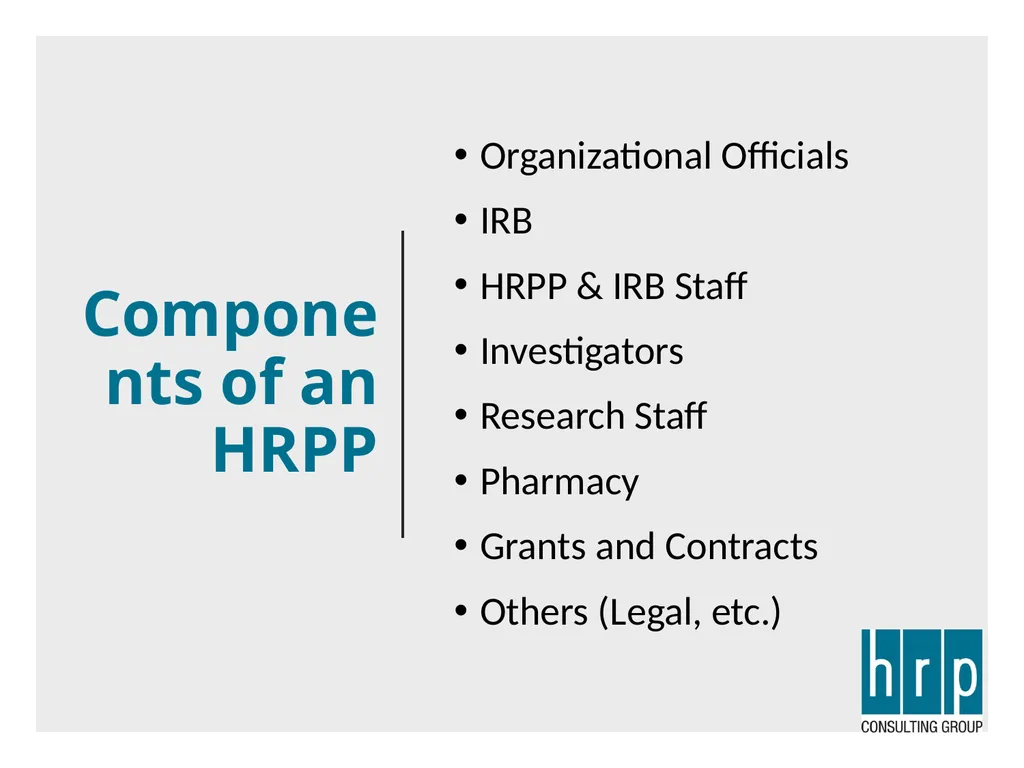
Components of an HRPP Organizational Officials
IRB
HRPP & IRB Staff
Investigators
Research Staff
Pharmacy
Grants and Contracts
Others (Legal, etc.)<br>
IRB
HRPP & IRB Staff
Investigators
Research Staff
Pharmacy
Grants and Contracts
Others (Legal, etc.)<br>
05
Key Functions
of an HRPP Education
Policies & Procedures
Protocol Review & Oversight
Institutional
IRB (Internal and external)
Other Committees (SRC, COI, IBC, RSC, etc.)
Quality Assurance & Improvement
Research activities
IRB activities
Other HRPP components<br>
Policies & Procedures
Protocol Review & Oversight
Institutional
IRB (Internal and external)
Other Committees (SRC, COI, IBC, RSC, etc.)
Quality Assurance & Improvement
Research activities
IRB activities
Other HRPP components<br>
06
Effective HRPPs Human research protection is a shared responsibility
Key to an effective HRPP is coordination and communication
Each HRPP component has a role to play
Components must coordinate policies and procedures that impact human research
There must be clear communication between components<br>
Key to an effective HRPP is coordination and communication
Each HRPP component has a role to play
Components must coordinate policies and procedures that impact human research
There must be clear communication between components<br>
07
AAHRPP’s Basic Principles The purpose of accreditation is to help organizations have better HRPPs through self-evaluation and peer review
AAHRPP’s goal is to help organizations become accredited
Accreditation process is intended to be collegial and supportive<br>
AAHRPP’s goal is to help organizations become accredited
Accreditation process is intended to be collegial and supportive<br>
08
AAHRPP Accreditation Process AAHRPP accreditation: Rigorous, flexible, transparent, and accessible
Standards
Follow federal regulations and guidance
Fill in “gaps” not specifically covered by the regulations
Rigorous and flexible can co-exist
Accreditation is outcomes based – more than one way to “get there” (i.e., flexible)<br>
Standards
Follow federal regulations and guidance
Fill in “gaps” not specifically covered by the regulations
Rigorous and flexible can co-exist
Accreditation is outcomes based – more than one way to “get there” (i.e., flexible)<br>
09
Multi-step Process Self-evaluation
Step 1 submission
Step 2 submission
Site Visit
AAHRPP Council
Ongoing reports<br>
Step 1 submission
Step 2 submission
Site Visit
AAHRPP Council
Ongoing reports<br>
10
The Site Visit An important part of the accreditation process.
Just because you have good written materials does not mean that you have a good human research protection program.
The site visit is used to observe how well the “theory/policies” meet the “practice.”<br>
Just because you have good written materials does not mean that you have a good human research protection program.
The site visit is used to observe how well the “theory/policies” meet the “practice.”<br>
11
Site Visit Interviews Interviewees are identified based on role within the HRPP.
Site visitors ask general questions and questions related to interviewees’ position/function.
In group interviews, questions are generally directed to the group but may be directed to individuals:
Based on the topic the site visitors are trying to evaluate, or
When not everyone is engaging in the conversation.
Site visitors validate that the processes described by interviewees are consistent with accreditation standards and the organization’s written materials.<br>
Site visitors ask general questions and questions related to interviewees’ position/function.
In group interviews, questions are generally directed to the group but may be directed to individuals:
Based on the topic the site visitors are trying to evaluate, or
When not everyone is engaging in the conversation.
Site visitors validate that the processes described by interviewees are consistent with accreditation standards and the organization’s written materials.<br>
12
Site Visit Interviews The interview will be collegial and friendly
It is a validation, not an inspection or audit.
This is not a test of how well people know the regulations
AAHRPP doesn’t expect perfection. They do expect that you know how/where to seek out help & information<br>
It is a validation, not an inspection or audit.
This is not a test of how well people know the regulations
AAHRPP doesn’t expect perfection. They do expect that you know how/where to seek out help & information<br>
13
How to approach the interview You should be collegial, open, and prepared to educate the site visitors about research at your organization and about processes relevant to your role.
Provide examples whenever possible, this helps “make it real”.
It is okay if you don’t know every answer, explain how you obtain answers to your questions when uncertain about something.<br>
Provide examples whenever possible, this helps “make it real”.
It is okay if you don’t know every answer, explain how you obtain answers to your questions when uncertain about something.<br>
14
Focus of Questions Who? What? When? How?<br>
15
Interview Questions Not all possible questions covered
Site visitors will ask questions on a variety of topics
Nothing worse than “canned” answers
People should think about their own answers<br>
Site visitors will ask questions on a variety of topics
Nothing worse than “canned” answers
People should think about their own answers<br>
16
Role in HRPP What is your role in research/the HRPP? Tell us about your responsibilities.
How do you/does your department/office communicate and coordinate with other components of the HRPP, like the IRB(s) and investigators?<br>
How do you/does your department/office communicate and coordinate with other components of the HRPP, like the IRB(s) and investigators?<br>
17
General Questions What do you see as strengths of the HRPP? Of the IRB(s)?
What do you see as weaknesses of the program? Of the IRB(s)?
Do you ever provide feedback about the program or the IRBs? Can you provide an example? What happened as a result?<br>
What do you see as weaknesses of the program? Of the IRB(s)?
Do you ever provide feedback about the program or the IRBs? Can you provide an example? What happened as a result?<br>
18
Pandemic How has research at McLaren been impacted by the pandemic?
How were your responsibilities impacted?
What was the impact on the overall program/processes for human research protections?
How was/is information communicated to the research community?<br>
How were your responsibilities impacted?
What was the impact on the overall program/processes for human research protections?
How was/is information communicated to the research community?<br>
19
HRPP Leadership Manager of Research Integrity/Office of Research Protections
Expected to be the most knowledgeable about regulations and ethics. Should be able to speak to all aspects of the HRPP not just those addressed in the following slides.<br>
Expected to be the most knowledgeable about regulations and ethics. Should be able to speak to all aspects of the HRPP not just those addressed in the following slides.<br>
20
HRPP Leadership What is the difference between the HRPP and the IRB?
What are the central components of the HRPP?
What other components of the organization have a role in human research?
How is communication and coordination with these components managed?
How often do you meet with the IO or IO designee? What is discussed?
How else/what else do you communicate with the IO/designee?<br>
What are the central components of the HRPP?
What other components of the organization have a role in human research?
How is communication and coordination with these components managed?
How often do you meet with the IO or IO designee? What is discussed?
How else/what else do you communicate with the IO/designee?<br>
21
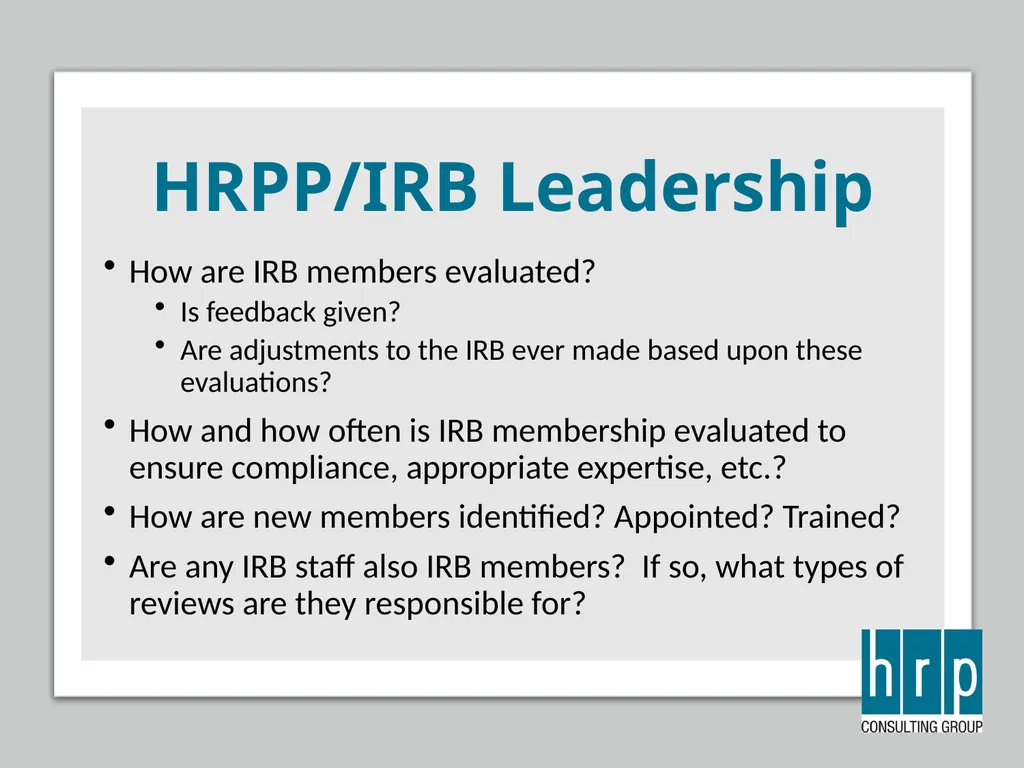
HRPP/IRB Leadership How are IRB members evaluated?
Is feedback given?
Are adjustments to the IRB ever made based upon these evaluations?
How and how often is IRB membership evaluated to ensure compliance, appropriate expertise, etc.?
How are new members identified? Appointed? Trained?
Are any IRB staff also IRB members? If so, what types of reviews are they responsible for?<br>
Is feedback given?
Are adjustments to the IRB ever made based upon these evaluations?
How and how often is IRB membership evaluated to ensure compliance, appropriate expertise, etc.?
How are new members identified? Appointed? Trained?
Are any IRB staff also IRB members? If so, what types of reviews are they responsible for?<br>
22
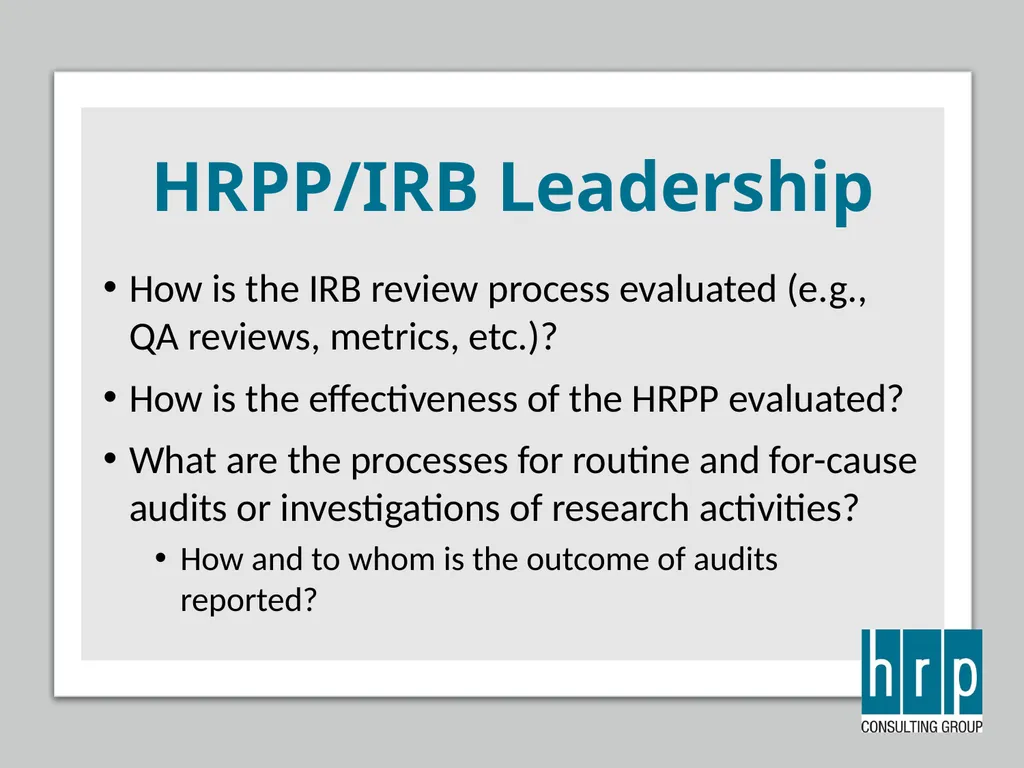
HRPP/IRB Leadership How is the IRB review process evaluated (e.g., QA reviews, metrics, etc.)?
How is the effectiveness of the HRPP evaluated?
What are the processes for routine and for-cause audits or investigations of research activities?
How and to whom is the outcome of audits reported?<br>
How is the effectiveness of the HRPP evaluated?
What are the processes for routine and for-cause audits or investigations of research activities?
How and to whom is the outcome of audits reported?<br>
23
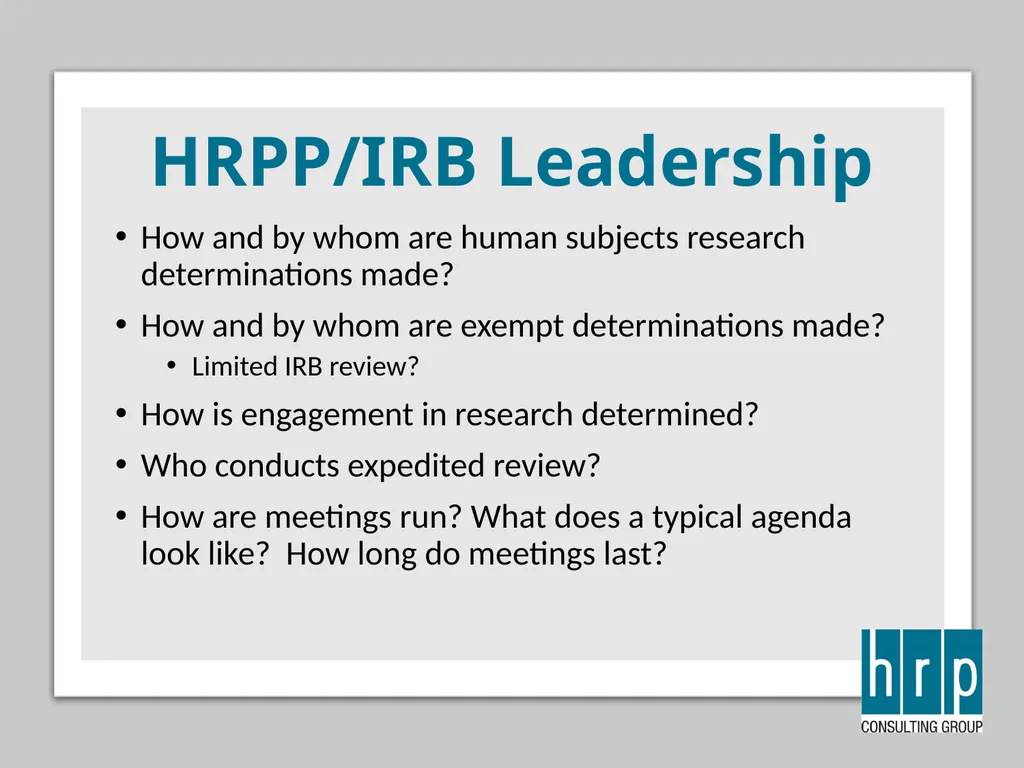
HRPP/IRB Leadership How and by whom are human subjects research determinations made?
How and by whom are exempt determinations made?
Limited IRB review?
How is engagement in research determined?
Who conducts expedited review?
How are meetings run? What does a typical agenda look like? How long do meetings last?<br>
How and by whom are exempt determinations made?
Limited IRB review?
How is engagement in research determined?
Who conducts expedited review?
How are meetings run? What does a typical agenda look like? How long do meetings last?<br>
24
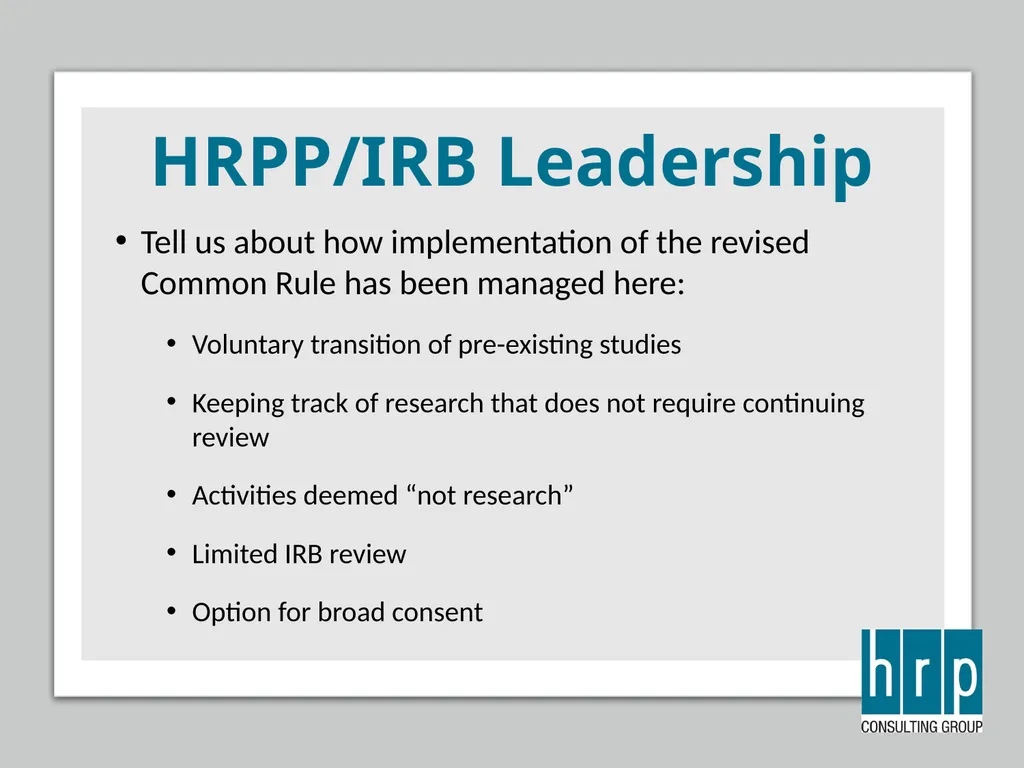
HRPP/IRB Leadership Tell us about how implementation of the revised Common Rule has been managed here:
Voluntary transition of pre-existing studies
Keeping track of research that does not require continuing review
Activities deemed “not research”
Limited IRB review
Option for broad consent<br>
Voluntary transition of pre-existing studies
Keeping track of research that does not require continuing review
Activities deemed “not research”
Limited IRB review
Option for broad consent<br>
25
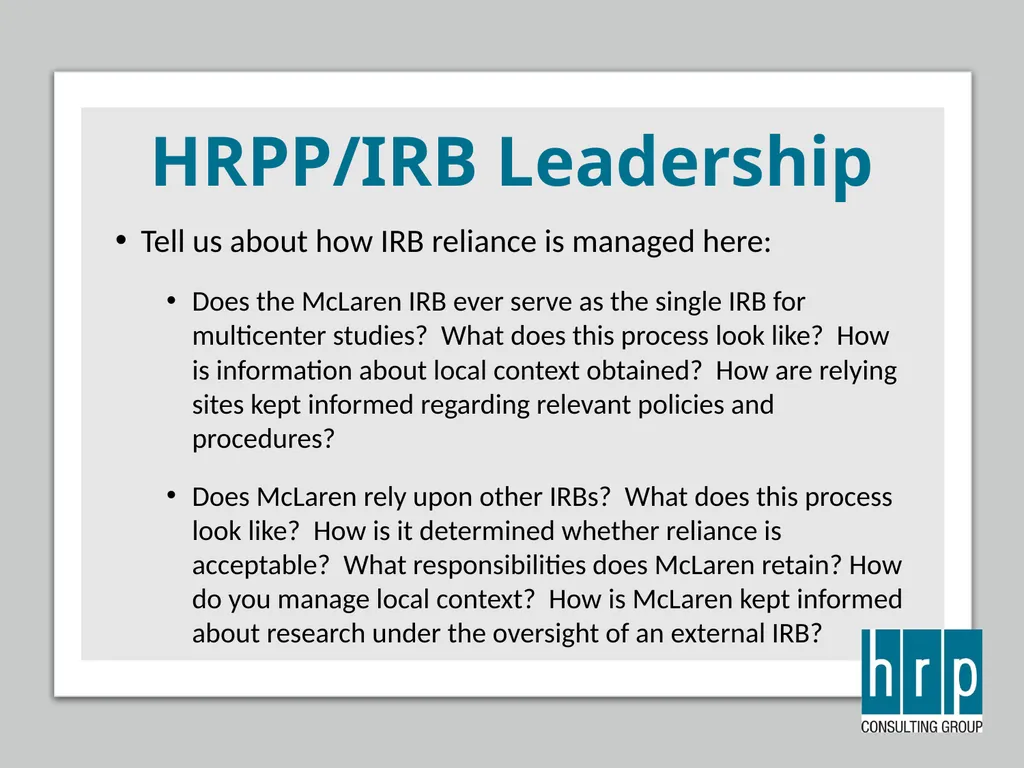
HRPP/IRB Leadership Tell us about how IRB reliance is managed here:
Does the McLaren IRB ever serve as the single IRB for multicenter studies? What does this process look like? How is information about local context obtained? How are relying sites kept informed regarding relevant policies and procedures?
Does McLaren rely upon other IRBs? What does this process look like? How is it determined whether reliance is acceptable? What responsibilities does McLaren retain? How do you manage local context? How is McLaren kept informed about research under the oversight of an external IRB?<br>
Does the McLaren IRB ever serve as the single IRB for multicenter studies? What does this process look like? How is information about local context obtained? How are relying sites kept informed regarding relevant policies and procedures?
Does McLaren rely upon other IRBs? What does this process look like? How is it determined whether reliance is acceptable? What responsibilities does McLaren retain? How do you manage local context? How is McLaren kept informed about research under the oversight of an external IRB?<br>
26
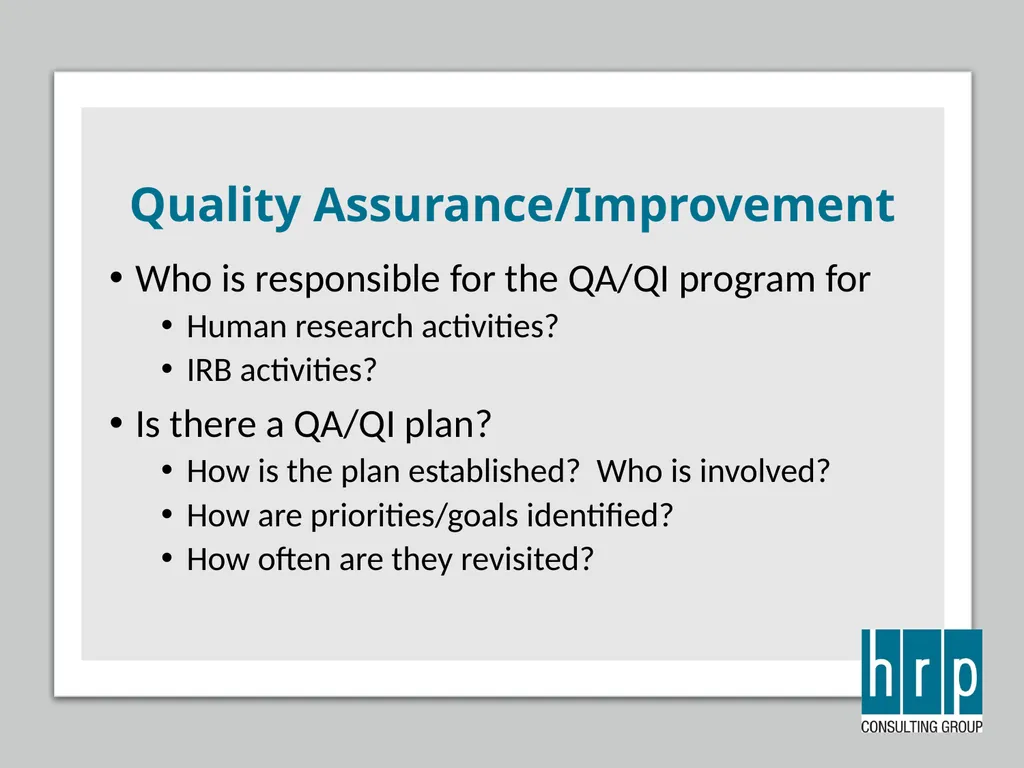
Quality Assurance/Improvement Who is responsible for the QA/QI program for
Human research activities?
IRB activities?
Is there a QA/QI plan?
How is the plan established? Who is involved?
How are priorities/goals identified?
How often are they revisited?<br>
Human research activities?
IRB activities?
Is there a QA/QI plan?
How is the plan established? Who is involved?
How are priorities/goals identified?
How often are they revisited?<br>
27
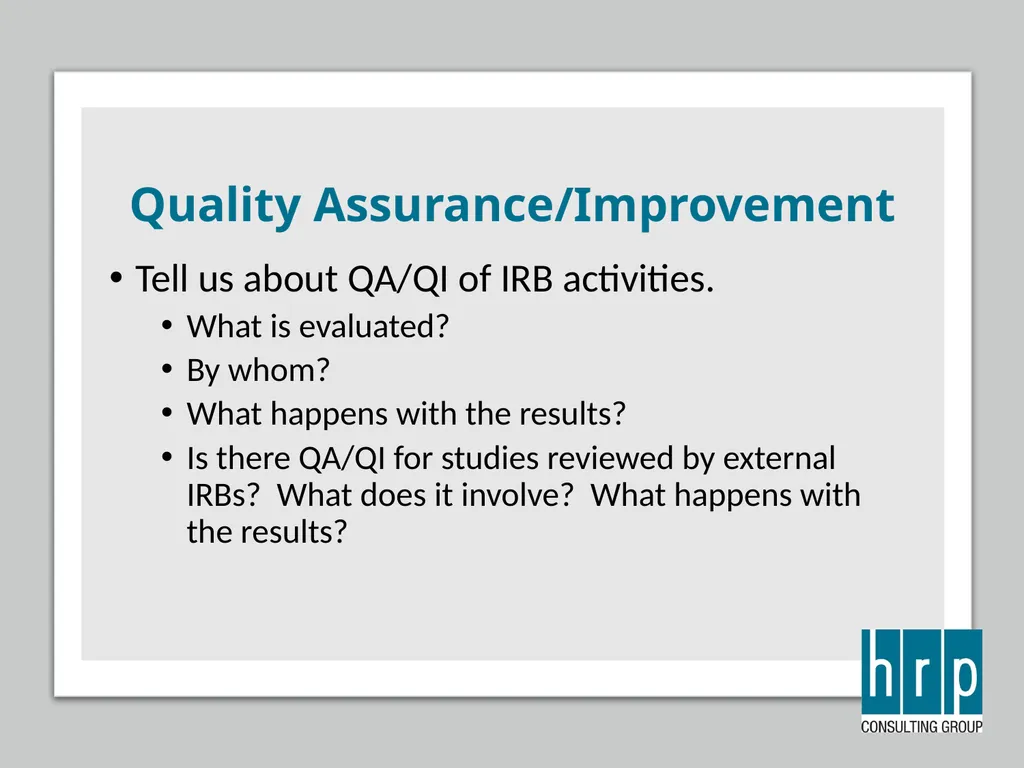
Quality Assurance/Improvement Tell us about QA/QI of IRB activities.
What is evaluated?
By whom?
What happens with the results?
Is there QA/QI for studies reviewed by external IRBs? What does it involve? What happens with the results?<br>
What is evaluated?
By whom?
What happens with the results?
Is there QA/QI for studies reviewed by external IRBs? What does it involve? What happens with the results?<br>
28
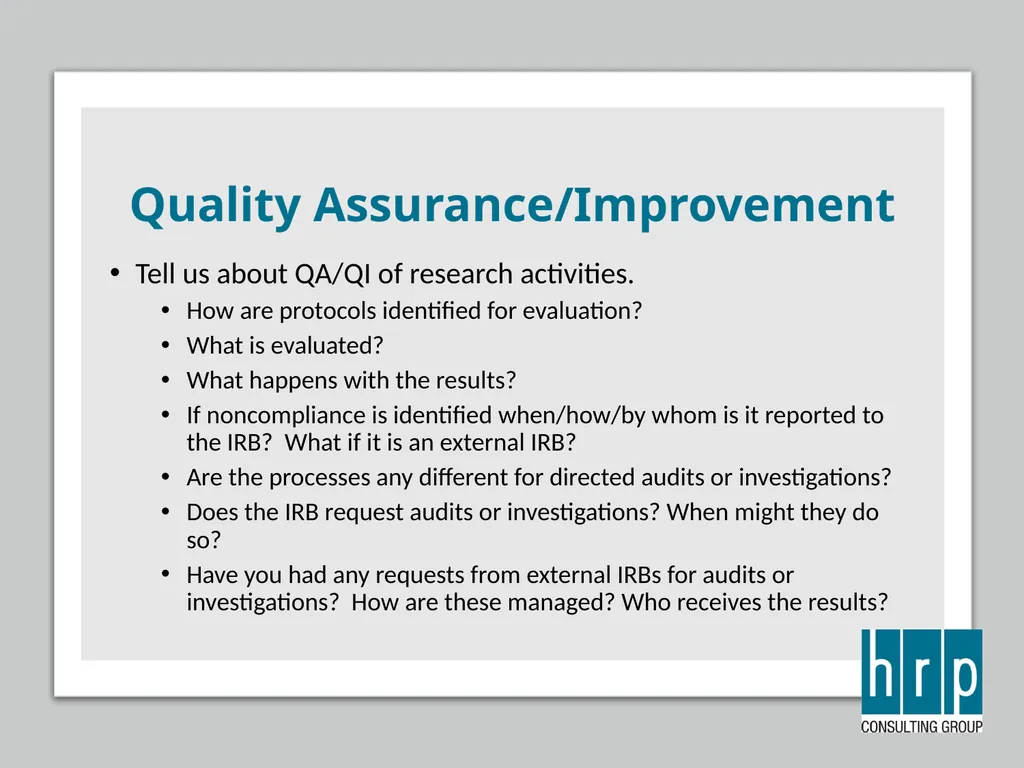
Quality Assurance/Improvement Tell us about QA/QI of research activities.
How are protocols identified for evaluation?
What is evaluated?
What happens with the results?
If noncompliance is identified when/how/by whom is it reported to the IRB? What if it is an external IRB?
Are the processes any different for directed audits or investigations?
Does the IRB request audits or investigations? When might they do so?
Have you had any requests from external IRBs for audits or investigations? How are these managed? Who receives the results?<br>
How are protocols identified for evaluation?
What is evaluated?
What happens with the results?
If noncompliance is identified when/how/by whom is it reported to the IRB? What if it is an external IRB?
Are the processes any different for directed audits or investigations?
Does the IRB request audits or investigations? When might they do so?
Have you had any requests from external IRBs for audits or investigations? How are these managed? Who receives the results?<br>
29
Education Tell us about your role and responsibilities
What are the basic training requirements (initial and continuing) for
Researchers (and research staff)?
IRB Members?
HRPP/IRB Staff?
How are these trainings tracked?<br>
What are the basic training requirements (initial and continuing) for
Researchers (and research staff)?
IRB Members?
HRPP/IRB Staff?
How are these trainings tracked?<br>
30
Education What types of educational offerings are provided? To whom? How is it delivered (e.g., in-person, on-line, etc.)?
Tell us about how people were informed and educated about the revised Common Rule
How have you managed educational offerings during the pandemic? What has changed?<br>
Tell us about how people were informed and educated about the revised Common Rule
How have you managed educational offerings during the pandemic? What has changed?<br>
31
Education How do you determine what educational offerings to provide?
What resources are available to you when selecting or developing educational offerings? How do you resolve your questions if you are uncertain of something?
How do you collaborate with other staff and other components of the HRPP in your role?
Are you involved in public outreach activities? Tell us about it.
How do you evaluate the effectiveness of educational offerings? Outreach activities? How is this information used?<br>
What resources are available to you when selecting or developing educational offerings? How do you resolve your questions if you are uncertain of something?
How do you collaborate with other staff and other components of the HRPP in your role?
Are you involved in public outreach activities? Tell us about it.
How do you evaluate the effectiveness of educational offerings? Outreach activities? How is this information used?<br>
32
Pharmacist Describe the relationship of pharmacy with the IRB.
Is there a dedicated research pharmacy or pharmacists?
How is the pharmacy made aware of research studies?
How is the pharmacy kept informed about the status of a study (e.g., of IRB approval, suspensions or terminations)?<br>
Is there a dedicated research pharmacy or pharmacists?
How is the pharmacy made aware of research studies?
How is the pharmacy kept informed about the status of a study (e.g., of IRB approval, suspensions or terminations)?<br>
33
Pharmacist Tell us about emergency uses and expanded access uses of investigational products. How does that work here? How is pharmacy involved?
When a study involves an investigational drug or off-label use, does pharmacy confirm whether an IND is in place or if an IND is not required? How?<br>
When a study involves an investigational drug or off-label use, does pharmacy confirm whether an IND is in place or if an IND is not required? How?<br>
34
Pharmacist How is pharmacy involved in the management of
Inpatient studies?
Outpatient studies?
Investigator-initiated studies?
How does pharmacy ensure the control of investigational product (e.g., so that IP is only used for approved protocols and enrolled subjects)?<br>
Inpatient studies?
Outpatient studies?
Investigator-initiated studies?
How does pharmacy ensure the control of investigational product (e.g., so that IP is only used for approved protocols and enrolled subjects)?<br>
35
Legal Counsel Describe relationship with the HRPP
Does legal counsel advise the HRPP and IRB on matters of state law?
What is the age of majority in your jurisdiction? Are individuals under the age of majority ever allowed to provide informed consent themselves? When?
Who may serve as a legally authorized representative? When is this permissible?
Are there other state laws that impact human subjects research? (e.g., privacy rules, mandated reports, etc.)
What if research occurs in other jurisdictions?<br>
Does legal counsel advise the HRPP and IRB on matters of state law?
What is the age of majority in your jurisdiction? Are individuals under the age of majority ever allowed to provide informed consent themselves? When?
Who may serve as a legally authorized representative? When is this permissible?
Are there other state laws that impact human subjects research? (e.g., privacy rules, mandated reports, etc.)
What if research occurs in other jurisdictions?<br>
36
Compliance Tell us about Compliance’s role and responsibilities related to human subjects research.
On what matters and how do Compliance and the HRPP interact and communicate?<br>
On what matters and how do Compliance and the HRPP interact and communicate?<br>
37
Compliance Do you have any involvement in QA/QI of research? Of the IRB(s)? How are you involved?
Are you involved when the IRB requests a for-cause (or directed) audit or investigation? How?
What kinds of problems or incidents are reported to you? What do you do with these reports?
Do you ever receive complaints from research participants? How do you manage these?<br>
Are you involved when the IRB requests a for-cause (or directed) audit or investigation? How?
What kinds of problems or incidents are reported to you? What do you do with these reports?
Do you ever receive complaints from research participants? How do you manage these?<br>
38
Conflict of Interest How are potential Conflicts of Interest identified and evaluated?
IRB members
Researchers (and research staff)
Institutional
What needs to be disclosed? When? How?
How are conflicts managed? Can you provide a few examples?<br>
IRB members
Researchers (and research staff)
Institutional
What needs to be disclosed? When? How?
How are conflicts managed? Can you provide a few examples?<br>
39
Conflict of Interest What is the process for ensuring the IRB receives and reviews COI management plans?
What if the research is being reviewed by an external IRB?
What is the IRB’s responsibility when there is a COI/CMP?
How is information communicated between those responsible for COI and the IRB?<br>
What if the research is being reviewed by an external IRB?
What is the IRB’s responsibility when there is a COI/CMP?
How is information communicated between those responsible for COI and the IRB?<br>
40
Institutional Conflict of Interest What kinds of activities does your organization engage in that might be perceived as institutional conflicts of interest?
Are there relationships with commercial entities that the public might perceive as conflicts of interest?
How are significant gifts to the institution managed?
How are the financial interests of senior leaders and board members managed?<br>
Are there relationships with commercial entities that the public might perceive as conflicts of interest?
How are significant gifts to the institution managed?
How are the financial interests of senior leaders and board members managed?<br>
41
Institutional Conflict of Interest How are institutional conflicts of interests identified and managed? Can you provide an example?
How does the organization ensure that business interests and relationships do not influence IRB review?<br>
How does the organization ensure that business interests and relationships do not influence IRB review?<br>
42
Technology Transfer/Patents Tell us a bit about the types of human research activities this organization engages in that result in commercialization? Can you provide an example?
How are conflicts of interest identified and managed in these situations?
When MTAs are under consideration for human materials that were gathered or generated for research, is there a process to validate that the transfer is consistent with the IRB approved protocol and consent? Tell us about it.<br>
How are conflicts of interest identified and managed in these situations?
When MTAs are under consideration for human materials that were gathered or generated for research, is there a process to validate that the transfer is consistent with the IRB approved protocol and consent? Tell us about it.<br>
43
Technology Transfer/Patents What kinds of activities (or relationships) does your organization engage in that might be perceived by the public as conflicts of interest?
How are institutional conflicts of interests managed? Can you provide an example?
How does the organization ensure that business interests do not influence IRB review?<br>
How are institutional conflicts of interests managed? Can you provide an example?
How does the organization ensure that business interests do not influence IRB review?<br>
44
Scientific Review How does Scientific Review work here?
Who is responsible?
What is the process?
What does the review consist of?
Does the review occur prior to IRB review or is it in parallel?
How is the outcome of the review documented and communicated to researchers? To the IRB?
What if the research is reviewed by an external IRB?<br>
Who is responsible?
What is the process?
What does the review consist of?
Does the review occur prior to IRB review or is it in parallel?
How is the outcome of the review documented and communicated to researchers? To the IRB?
What if the research is reviewed by an external IRB?<br>
45
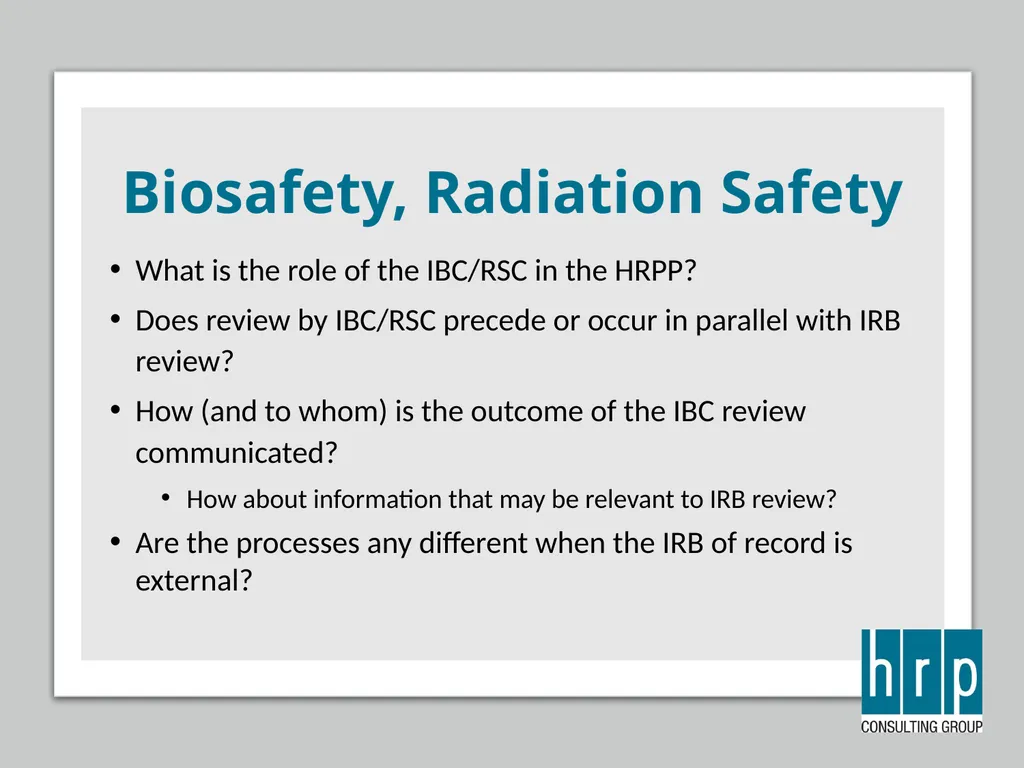
Biosafety, Radiation Safety What is the role of the IBC/RSC in the HRPP?
Does review by IBC/RSC precede or occur in parallel with IRB review?
How (and to whom) is the outcome of the IBC review communicated?
How about information that may be relevant to IRB review?
Are the processes any different when the IRB of record is external?<br>
Does review by IBC/RSC precede or occur in parallel with IRB review?
How (and to whom) is the outcome of the IBC review communicated?
How about information that may be relevant to IRB review?
Are the processes any different when the IRB of record is external?<br>
46
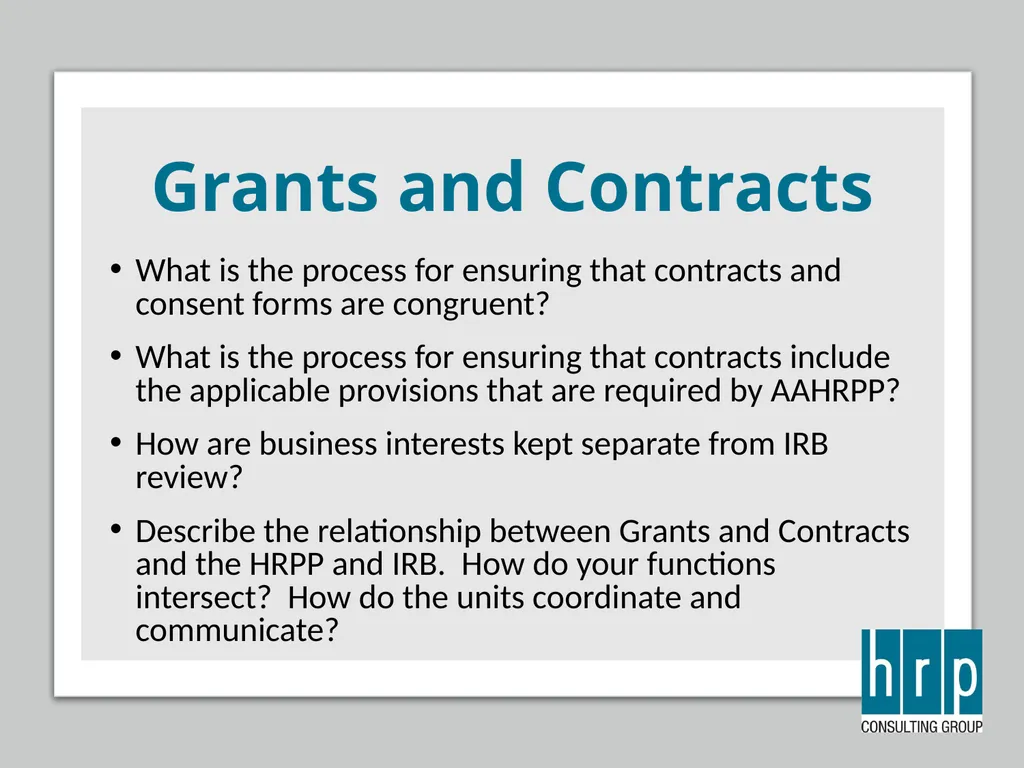
Grants and Contracts What is the process for ensuring that contracts and consent forms are congruent?
What is the process for ensuring that contracts include the applicable provisions that are required by AAHRPP?
How are business interests kept separate from IRB review?
Describe the relationship between Grants and Contracts and the HRPP and IRB. How do your functions intersect? How do the units coordinate and communicate?<br>
What is the process for ensuring that contracts include the applicable provisions that are required by AAHRPP?
How are business interests kept separate from IRB review?
Describe the relationship between Grants and Contracts and the HRPP and IRB. How do your functions intersect? How do the units coordinate and communicate?<br>
47
Conclusions Interview will be collegial
It’s about the program, not any individual. The comments of a single person will not alter the outcome.
Be honest, but don’t overexplain or use this as an opportunity to complain
When in doubt or if you don’t know an answer, explain how you go about resolving questions<br>
It’s about the program, not any individual. The comments of a single person will not alter the outcome.
Be honest, but don’t overexplain or use this as an opportunity to complain
When in doubt or if you don’t know an answer, explain how you go about resolving questions<br>