
Aaron Tan 20 – 24 August 2018 2. The Logic
BR
Published · 84 slides · 0 views

1 / 1

Description
Aaron Tan 20 24 August 2018 2. The Logic of Compound Statements Logical Form and Logical Equivalence Conditional Statements Valid and Invalid Arguments 1 Logical Form and Logical Equivalence Conditional Statements Valid and Invalid
Related Topics
Share
Embed code
Download this presentation From Below
"Aaron Tan 20 – 24 August 2018 2. The Logic" is the property of its rightful owner. Permission is granted to download and print the materials on this website for personal, non-commercial use only, and to display it on your personal computer provided you do not modify the materials and that you retain all copyright notices contained in the materials. By downloading content from our website, you accept the terms of this agreement.
Presentation Transcript
01
Aaron Tan
20 – 24 August 2018 2. The Logic of Compound Statements Logical Form and Logical Equivalence Conditional Statements Valid and Invalid Arguments 1<br>
20 – 24 August 2018 2. The Logic of Compound Statements Logical Form and Logical Equivalence Conditional Statements Valid and Invalid Arguments 1<br>
02
Logical Form and Logical Equivalence Conditional Statements Valid and Invalid Arguments 2 2. The Logic of Compound Statements<br>
03
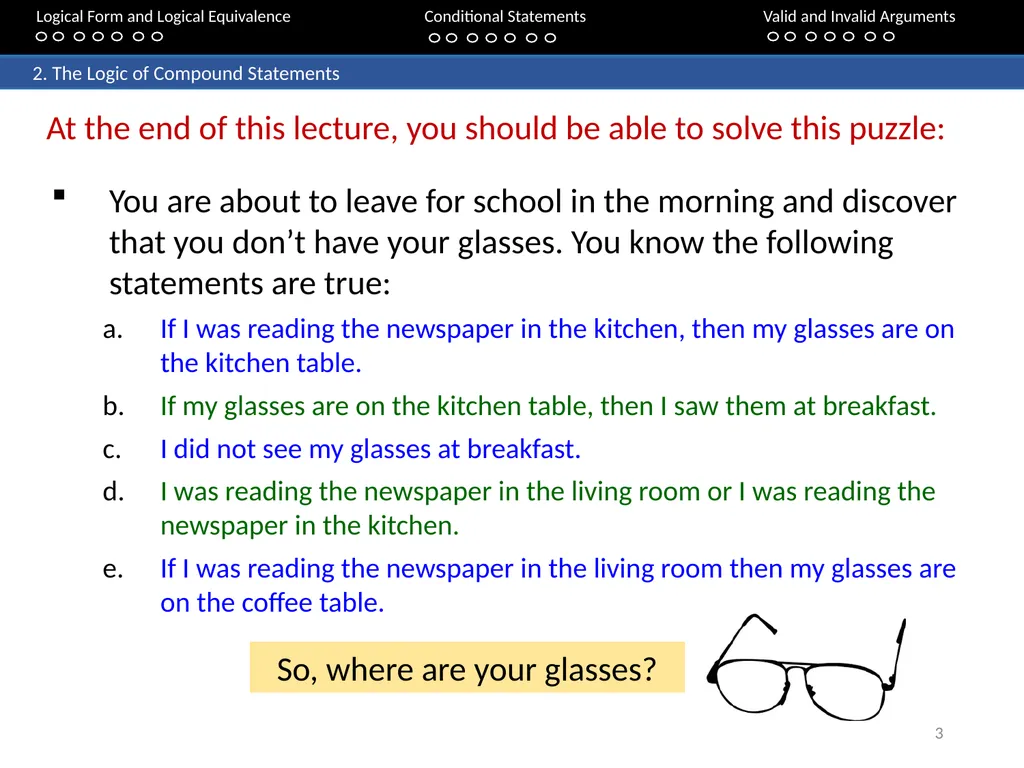
Logical Form and Logical Equivalence Conditional Statements Valid and Invalid Arguments 3 2. The Logic of Compound Statements At the end of this lecture, you should be able to solve this puzzle: You are about to leave for school in the morning and discover that you don’t have your glasses. You know the following statements are true:
If I was reading the newspaper in the kitchen, then my glasses are on the kitchen table.
If my glasses are on the kitchen table, then I saw them at breakfast.
I did not see my glasses at breakfast.
I was reading the newspaper in the living room or I was reading the newspaper in the kitchen.
If I was reading the newspaper in the living room then my glasses are on the coffee table. So, where are your glasses?<br>
If I was reading the newspaper in the kitchen, then my glasses are on the kitchen table.
If my glasses are on the kitchen table, then I saw them at breakfast.
I did not see my glasses at breakfast.
I was reading the newspaper in the living room or I was reading the newspaper in the kitchen.
If I was reading the newspaper in the living room then my glasses are on the coffee table. So, where are your glasses?<br>
04
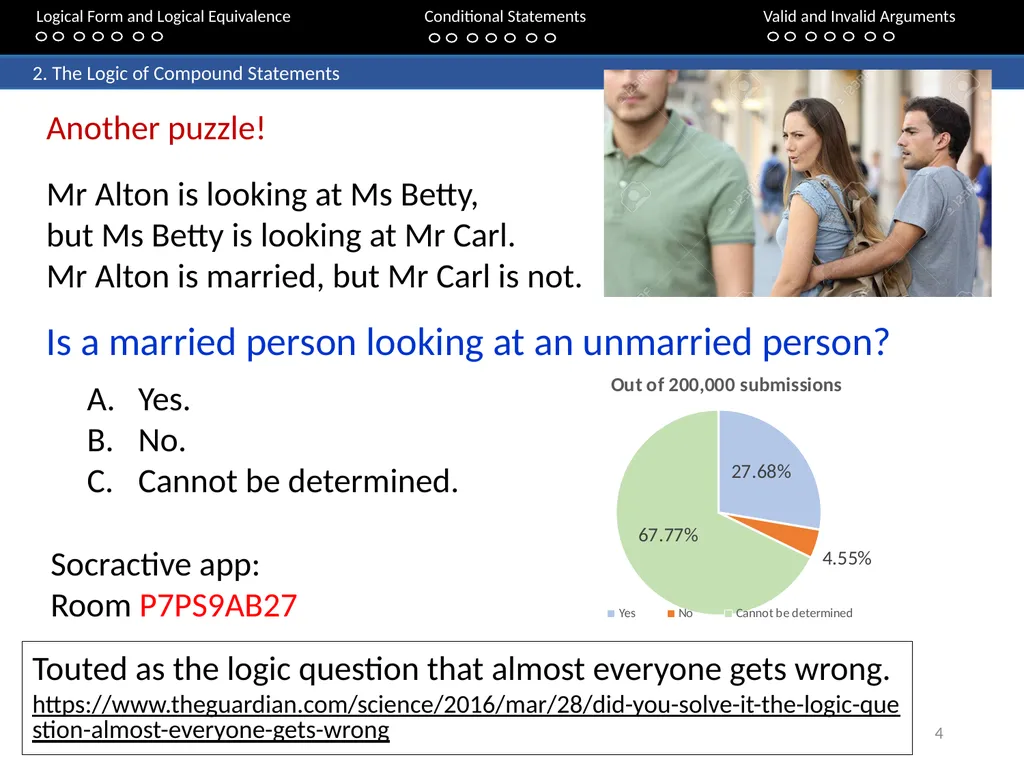
Logical Form and Logical Equivalence Conditional Statements Valid and Invalid Arguments 4 2. The Logic of Compound Statements Another puzzle! Mr Alton is looking at Ms Betty,
but Ms Betty is looking at Mr Carl.
Mr Alton is married, but Mr Carl is not. Is a married person looking at an unmarried person? Yes.
No.
Cannot be determined. Touted as the logic question that almost everyone gets wrong.
https://www.theguardian.com/science/2016/mar/28/did-you-solve-it-the-logic-question-almost-everyone-gets-wrong Socractive app:
Room P7PS9AB27<br>
Mr Alton is married, but Mr Carl is not. Is a married person looking at an unmarried person? Yes.
No.
Cannot be determined. Touted as the logic question that almost everyone gets wrong.
https://www.theguardian.com/science/2016/mar/28/did-you-solve-it-the-logic-question-almost-everyone-gets-wrong Socractive app:
Room P7PS9AB27<br>
05
Logical Form and Logical Equivalence Conditional Statements Valid and Invalid Arguments 5 2.1 Logical Form and Logical Equivalence<br>
06
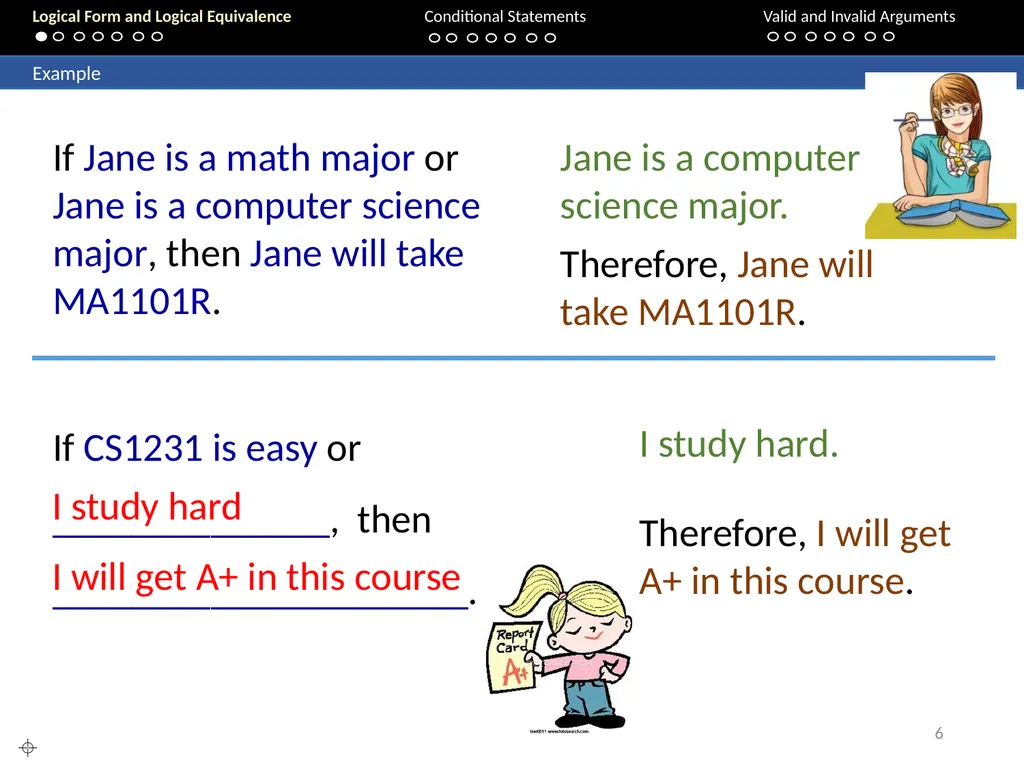
Logical Form and Logical Equivalence Conditional Statements Valid and Invalid Arguments Example If Jane is a math major or Jane is a computer science major, then Jane will take MA1101R. Jane is a computer science major. Therefore, Jane will take MA1101R. 6 If CS1231 is easy or ______________, then _____________________. I study hard. Therefore, I will get A+ in this course. I study hard I will get A+ in this course<br>
07
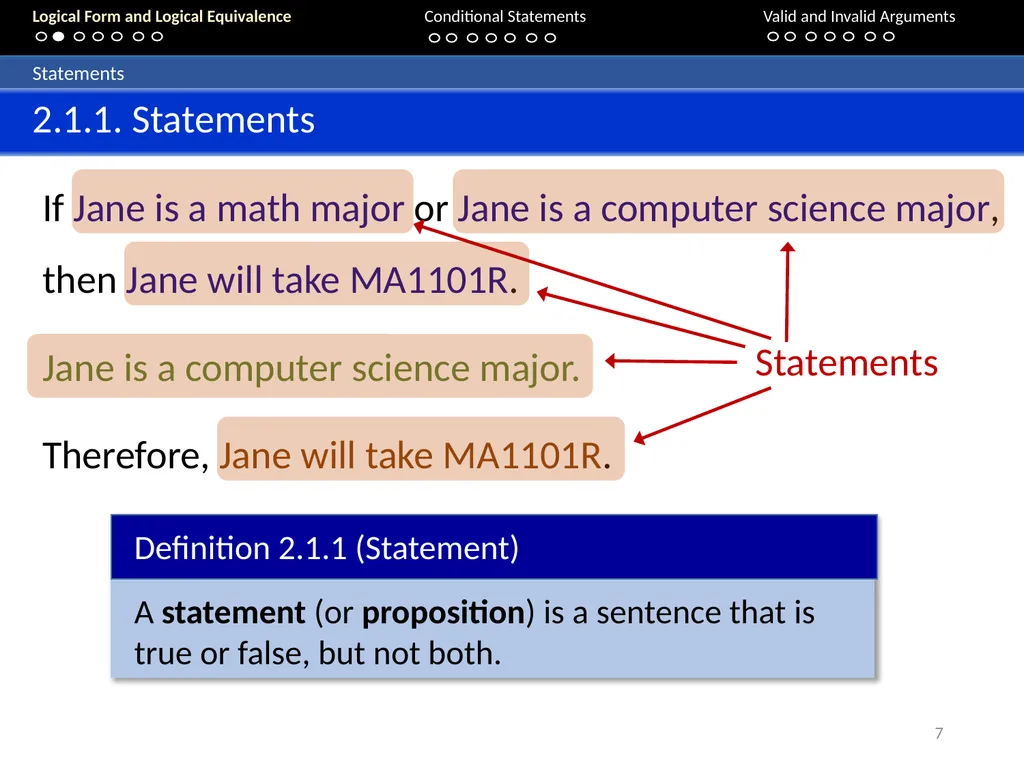
Logical Form and Logical Equivalence Conditional Statements Valid and Invalid Arguments Statements If Jane is a math major or Jane is a computer science major, then Jane will take MA1101R. Jane is a computer science major. Therefore, Jane will take MA1101R. 7 2.1.1. Statements<br>
08
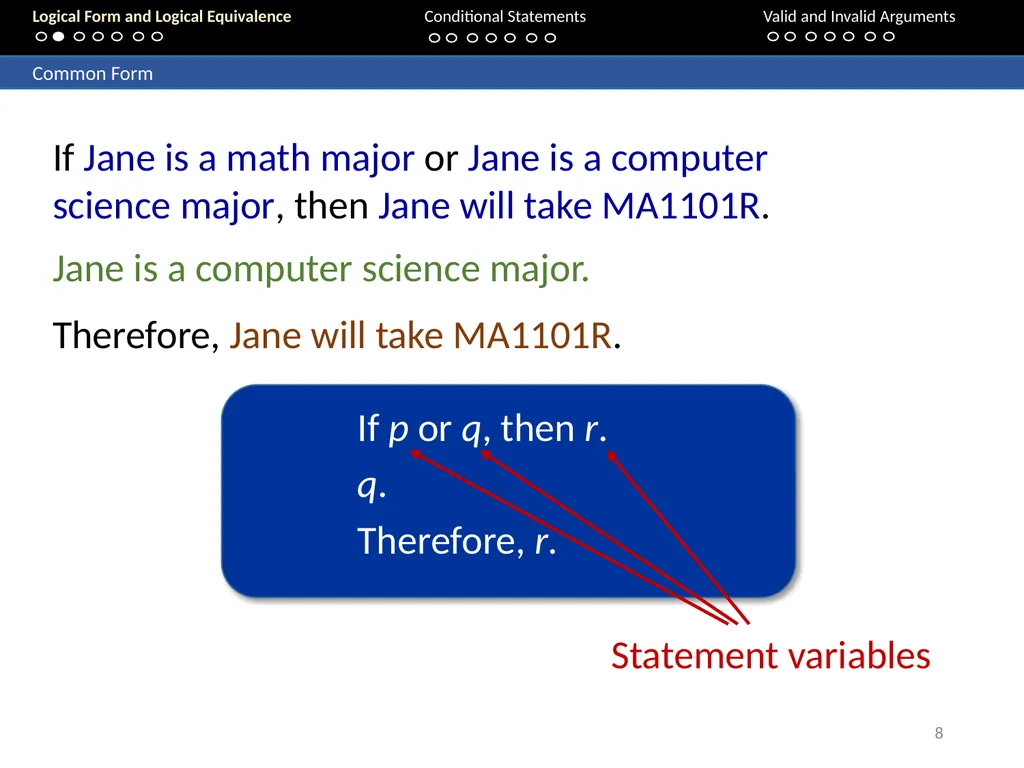
Logical Form and Logical Equivalence Conditional Statements Valid and Invalid Arguments Common Form If Jane is a math major or Jane is a computer science major, then Jane will take MA1101R. Jane is a computer science major. Therefore, Jane will take MA1101R. 8 If p or q, then r.
q.
Therefore, r.<br>
q.
Therefore, r.<br>
09
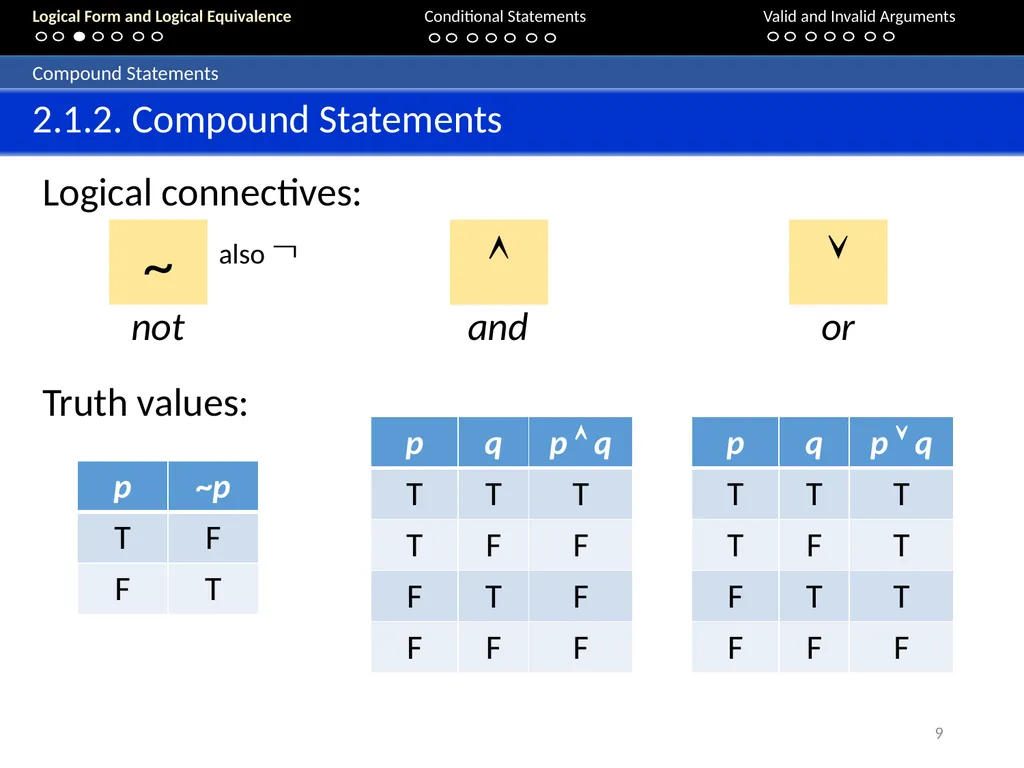
Logical Form and Logical Equivalence Conditional Statements Valid and Invalid Arguments Compound Statements 9 2.1.2. Compound Statements also Truth values: Logical connectives:<br>
10
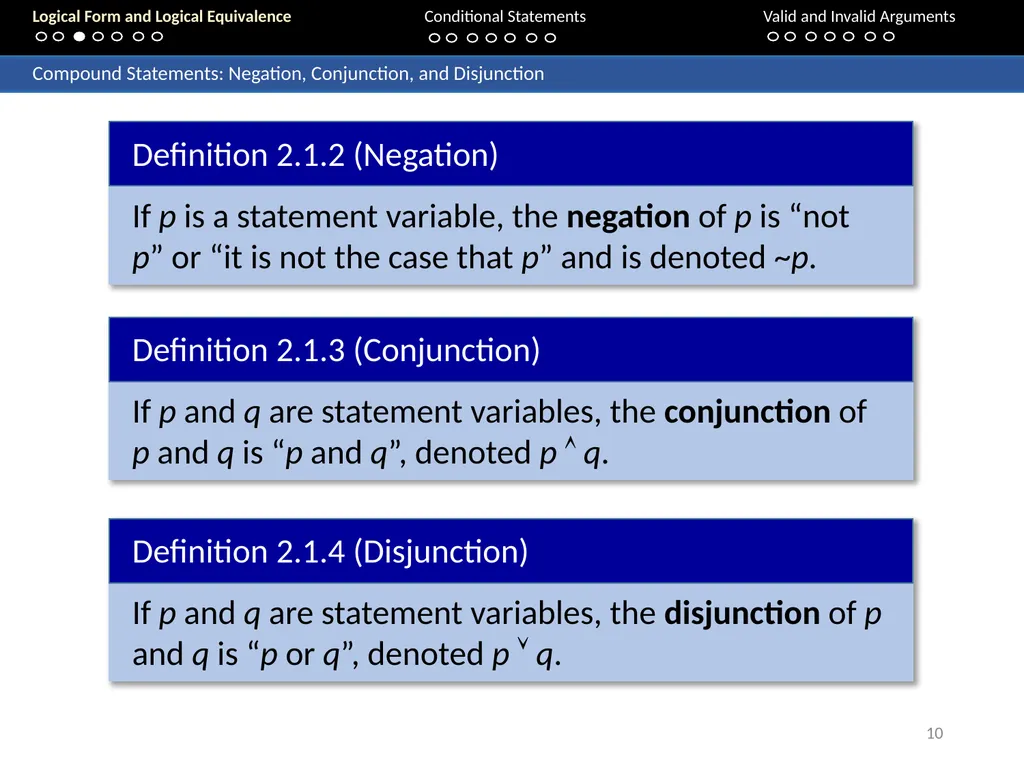
Logical Form and Logical Equivalence Conditional Statements Valid and Invalid Arguments Compound Statements: Negation, Conjunction, and Disjunction 10<br>
11
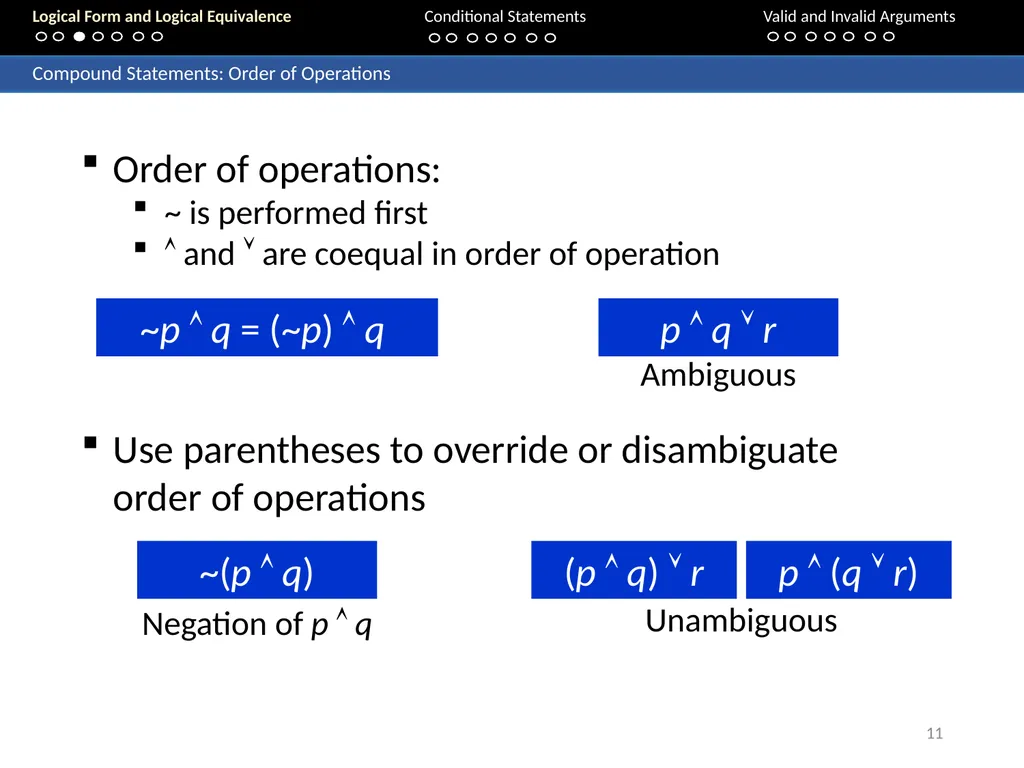
Logical Form and Logical Equivalence Conditional Statements Valid and Invalid Arguments Compound Statements: Order of Operations 11 Order of operations:
~ is performed first
and are coequal in order of operation ~p q = (~p) q Use parentheses to override or disambiguate order of operations<br>
~ is performed first
and are coequal in order of operation ~p q = (~p) q Use parentheses to override or disambiguate order of operations<br>
12
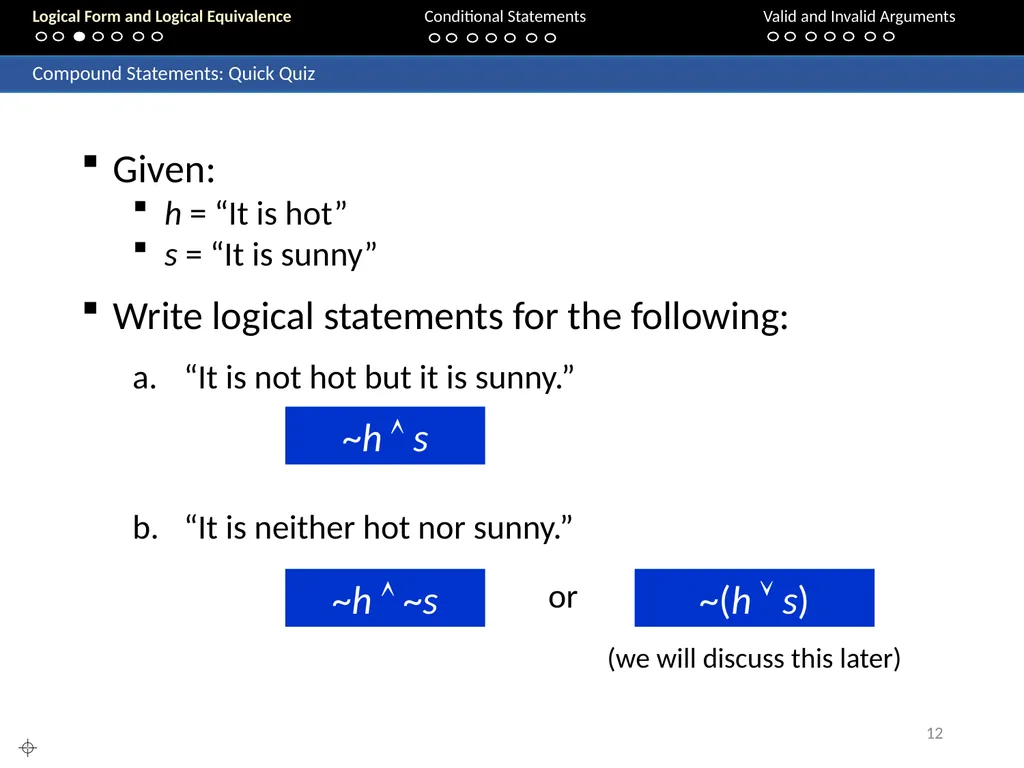
Logical Form and Logical Equivalence Conditional Statements Valid and Invalid Arguments Compound Statements: Quick Quiz 12 Given:
h = “It is hot”
s = “It is sunny”
Write logical statements for the following:
“It is not hot but it is sunny.”
“It is neither hot nor sunny.” ~h s ~(h s) or ~h ~s (we will discuss this later)<br>
h = “It is hot”
s = “It is sunny”
Write logical statements for the following:
“It is not hot but it is sunny.”
“It is neither hot nor sunny.” ~h s ~(h s) or ~h ~s (we will discuss this later)<br>
13
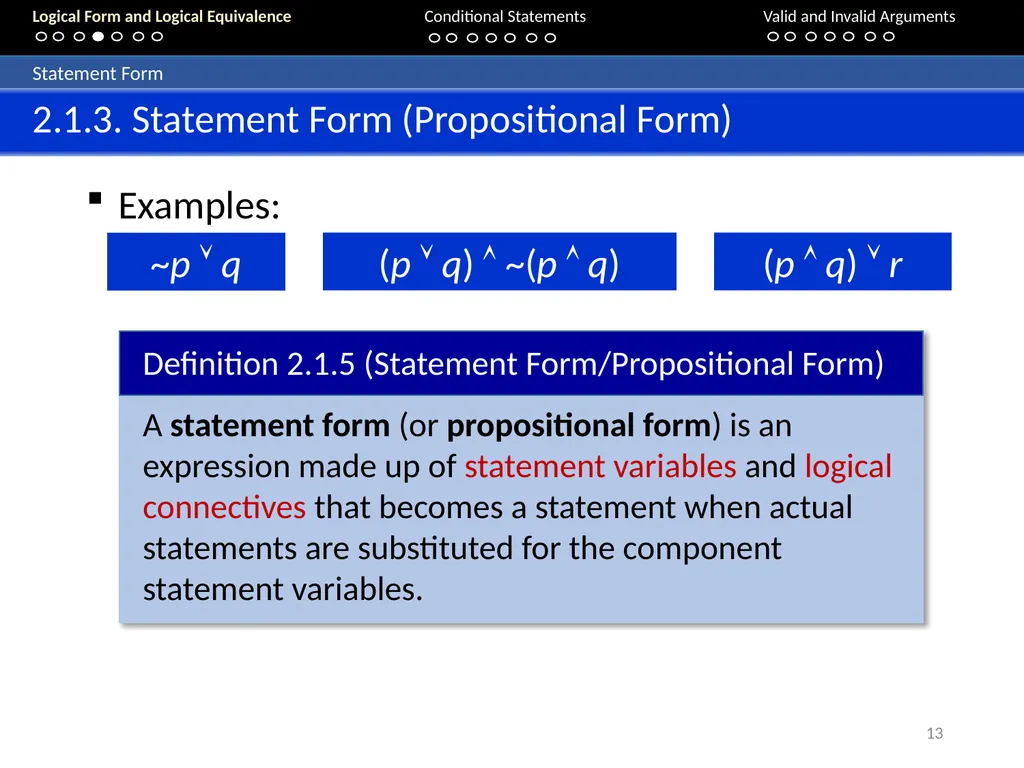
Logical Form and Logical Equivalence Conditional Statements Valid and Invalid Arguments Statement Form 13 Examples: 2.1.3. Statement Form (Propositional Form) ~p q (p q) ~(p q) (p q) r<br>
14
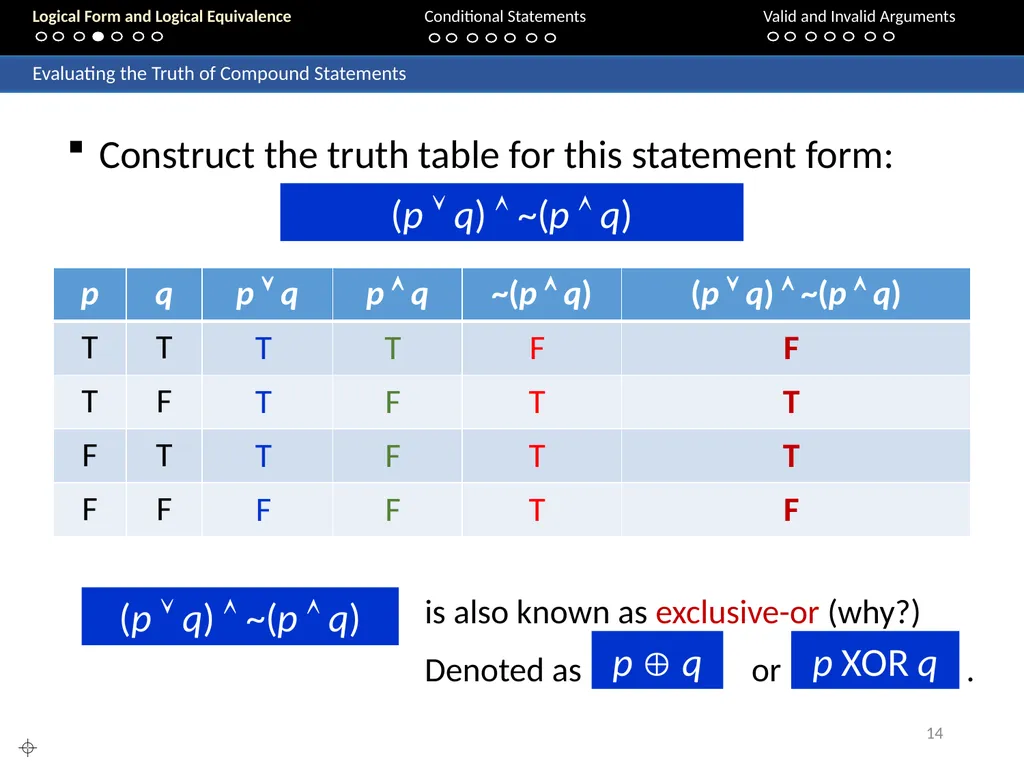
Logical Form and Logical Equivalence Conditional Statements Valid and Invalid Arguments Evaluating the Truth of Compound Statements 14 Construct the truth table for this statement form: (p q) ~(p q) T
T
T
F T
F
F
F F
T
T
T F
T
T
F<br>
T
T
F T
F
F
F F
T
T
T F
T
T
F<br>
15
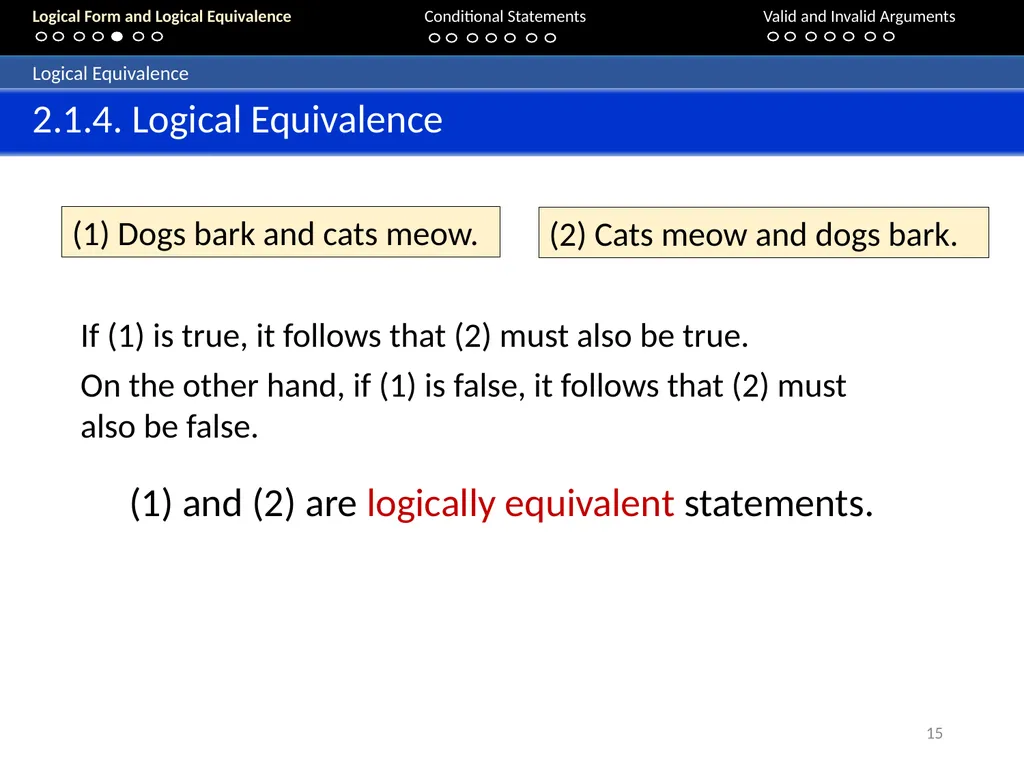
Logical Form and Logical Equivalence Conditional Statements Valid and Invalid Arguments Logical Equivalence 15 2.1.4. Logical Equivalence (1) Dogs bark and cats meow. (2) Cats meow and dogs bark. If (1) is true, it follows that (2) must also be true.
On the other hand, if (1) is false, it follows that (2) must also be false. (1) and (2) are logically equivalent statements.<br>
On the other hand, if (1) is false, it follows that (2) must also be false. (1) and (2) are logically equivalent statements.<br>
16
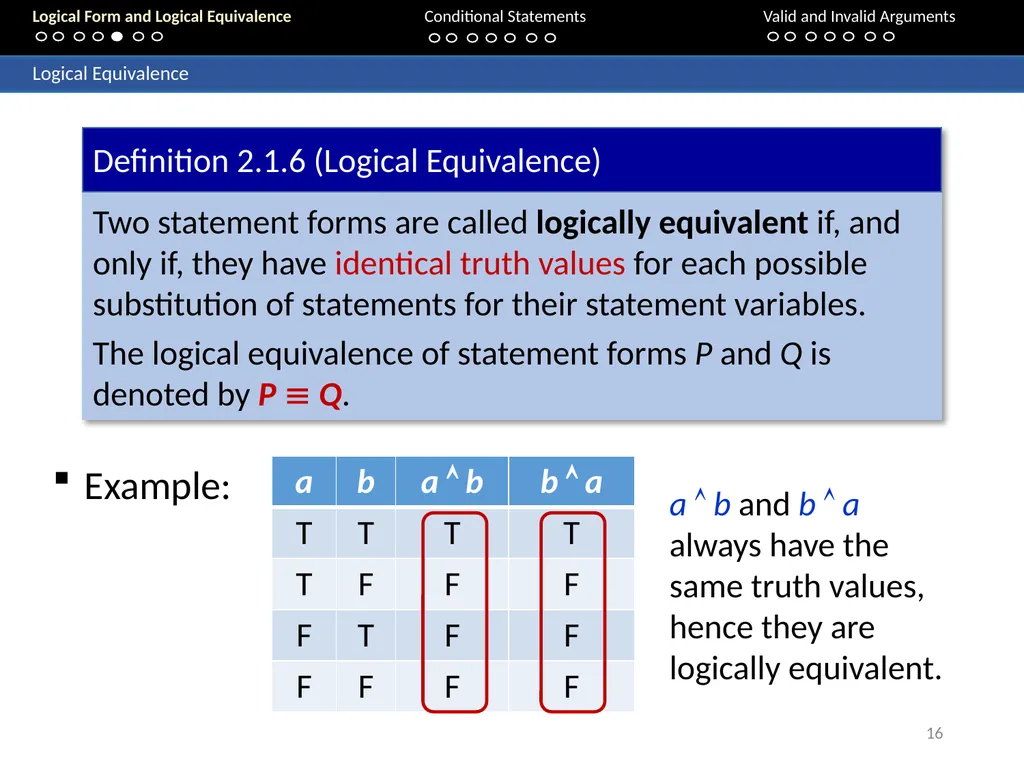
Logical Form and Logical Equivalence Conditional Statements Valid and Invalid Arguments Logical Equivalence 16 Example: a b and b a always have the same truth values, hence they are logically equivalent.<br>
17
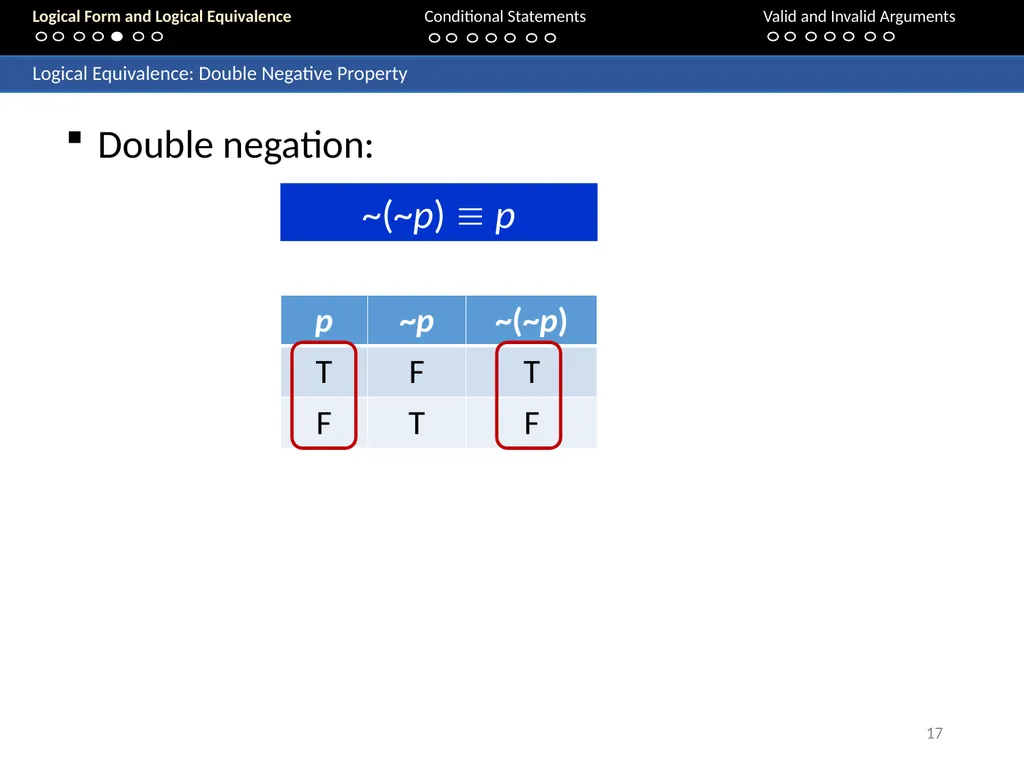
Logical Form and Logical Equivalence Conditional Statements Valid and Invalid Arguments Logical Equivalence: Double Negative Property 17 ~(~p) p Double negation:<br>
18
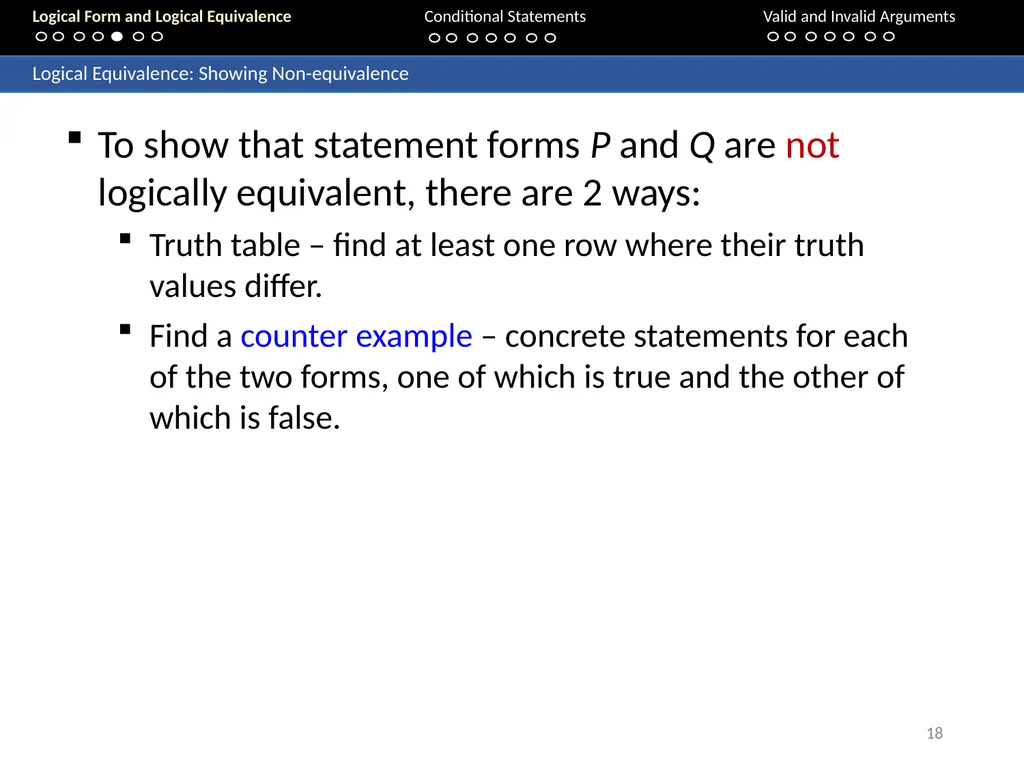
Logical Form and Logical Equivalence Conditional Statements Valid and Invalid Arguments Logical Equivalence: Showing Non-equivalence 18 To show that statement forms P and Q are not logically equivalent, there are 2 ways:
Truth table – find at least one row where their truth values differ.
Find a counter example – concrete statements for each of the two forms, one of which is true and the other of which is false.<br>
Truth table – find at least one row where their truth values differ.
Find a counter example – concrete statements for each of the two forms, one of which is true and the other of which is false.<br>
19
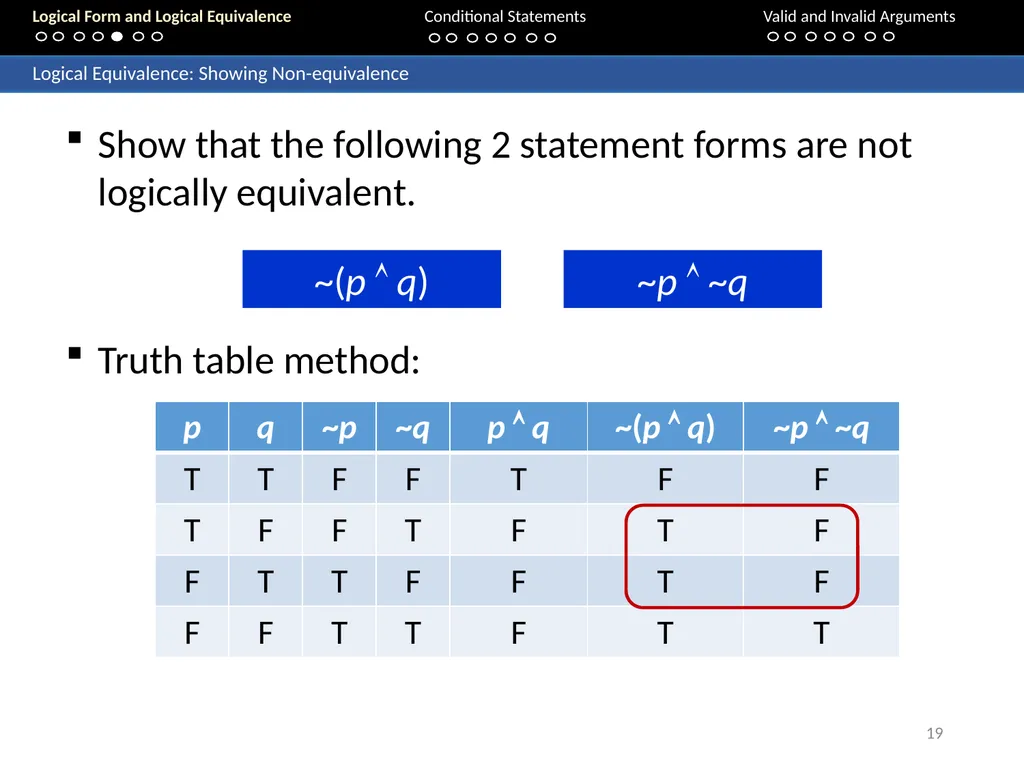
Logical Form and Logical Equivalence Conditional Statements Valid and Invalid Arguments Logical Equivalence: Showing Non-equivalence 19 Show that the following 2 statement forms are not logically equivalent. ~(p q) ~p ~q Truth table method:<br>
20
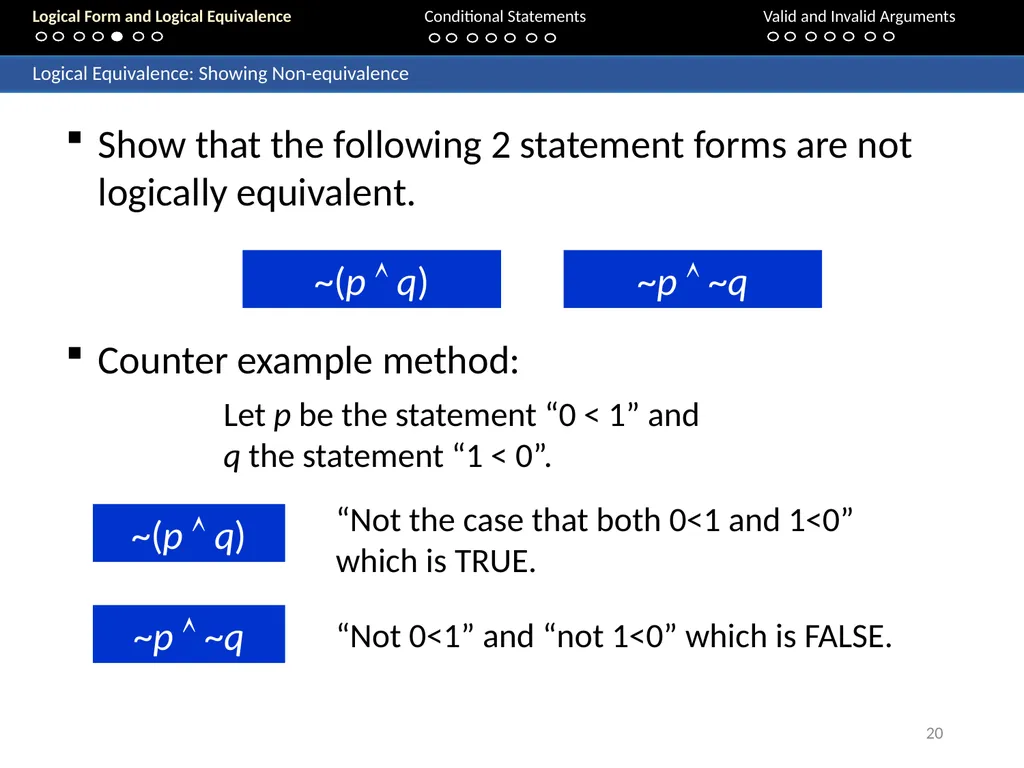
Logical Form and Logical Equivalence Conditional Statements Valid and Invalid Arguments Logical Equivalence: Showing Non-equivalence 20 Show that the following 2 statement forms are not logically equivalent. ~(p q) ~p ~q Counter example method: Let p be the statement “0 < 1” and q the statement “1 < 0”.<br>
21
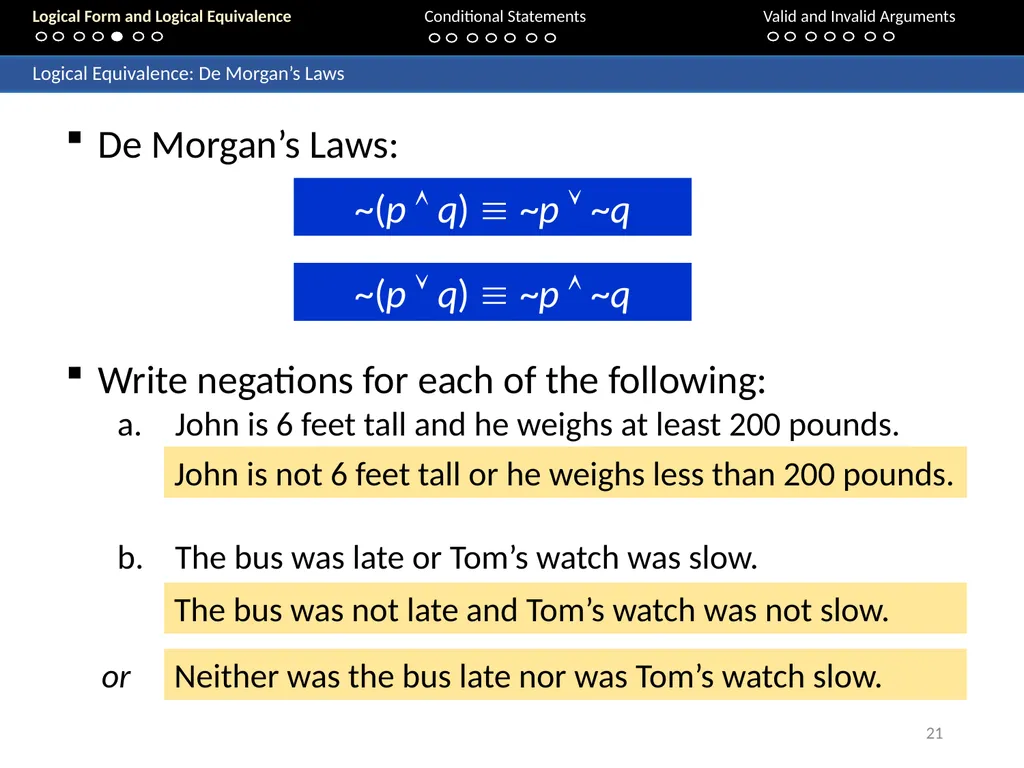
Logical Form and Logical Equivalence Conditional Statements Valid and Invalid Arguments Logical Equivalence: De Morgan’s Laws 21 ~(p q) ~p ~q De Morgan’s Laws: ~(p q) ~p ~q Write negations for each of the following:
John is 6 feet tall and he weighs at least 200 pounds.
The bus was late or Tom’s watch was slow. John is not 6 feet tall or he weighs less than 200 pounds. The bus was not late and Tom’s watch was not slow. or Neither was the bus late nor was Tom’s watch slow.<br>
John is 6 feet tall and he weighs at least 200 pounds.
The bus was late or Tom’s watch was slow. John is not 6 feet tall or he weighs less than 200 pounds. The bus was not late and Tom’s watch was not slow. or Neither was the bus late nor was Tom’s watch slow.<br>
22
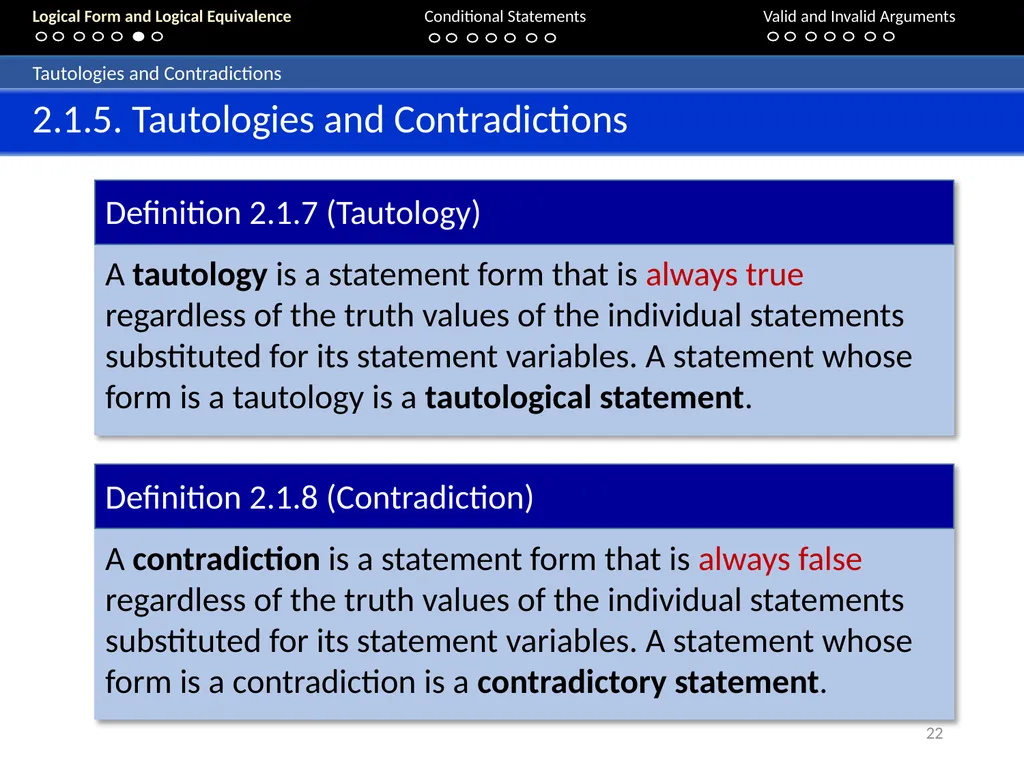
Logical Form and Logical Equivalence Conditional Statements Valid and Invalid Arguments Tautologies and Contradictions 22 2.1.5. Tautologies and Contradictions<br>
23
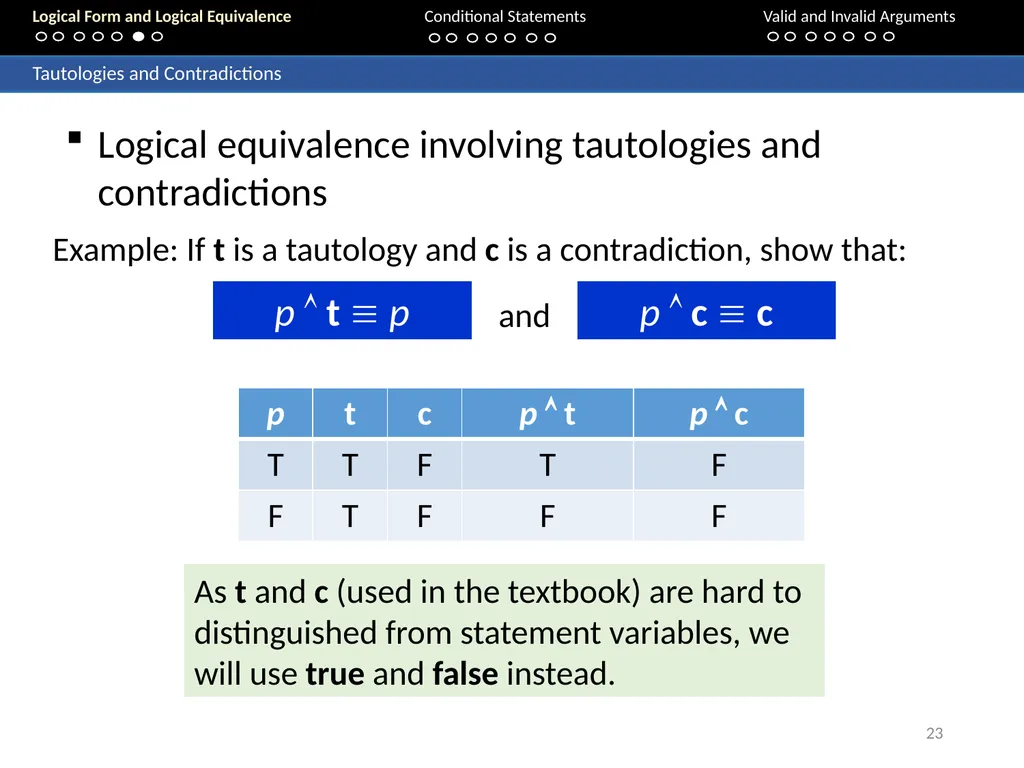
Logical Form and Logical Equivalence Conditional Statements Valid and Invalid Arguments Tautologies and Contradictions 23 Logical equivalence involving tautologies and contradictions Example: If t is a tautology and c is a contradiction, show that: p t p and p c c As t and c (used in the textbook) are hard to distinguished from statement variables, we will use true and false instead.<br>
24
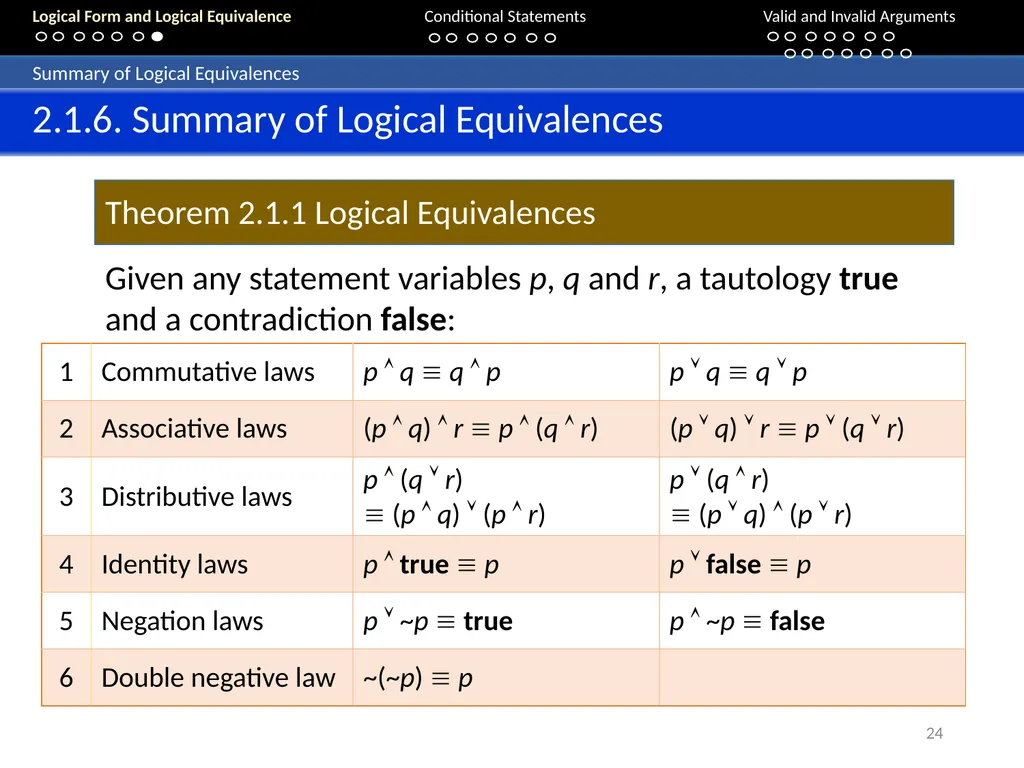
Logical Form and Logical Equivalence Conditional Statements Valid and Invalid Arguments Summary of Logical Equivalences 24 2.1.6. Summary of Logical Equivalences Theorem 2.1.1 Logical Equivalences Given any statement variables p, q and r, a tautology true and a contradiction false:<br>
25
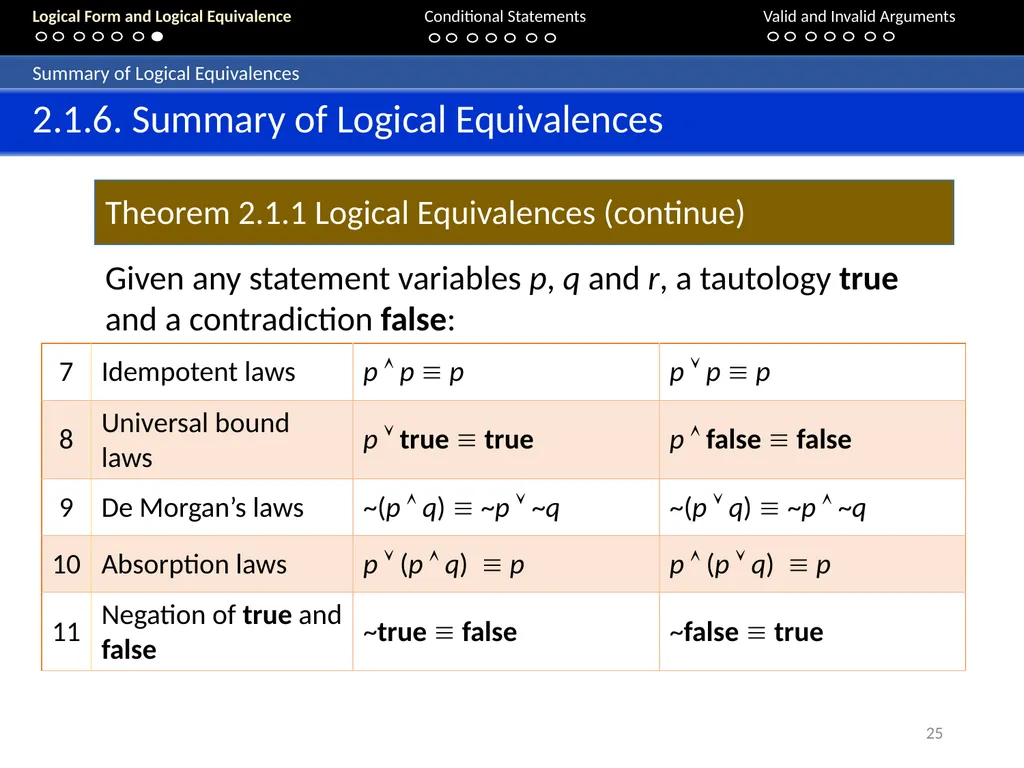
Logical Form and Logical Equivalence Conditional Statements Valid and Invalid Arguments Summary of Logical Equivalences 25 2.1.6. Summary of Logical Equivalences Theorem 2.1.1 Logical Equivalences (continue) Given any statement variables p, q and r, a tautology true and a contradiction false:<br>
26
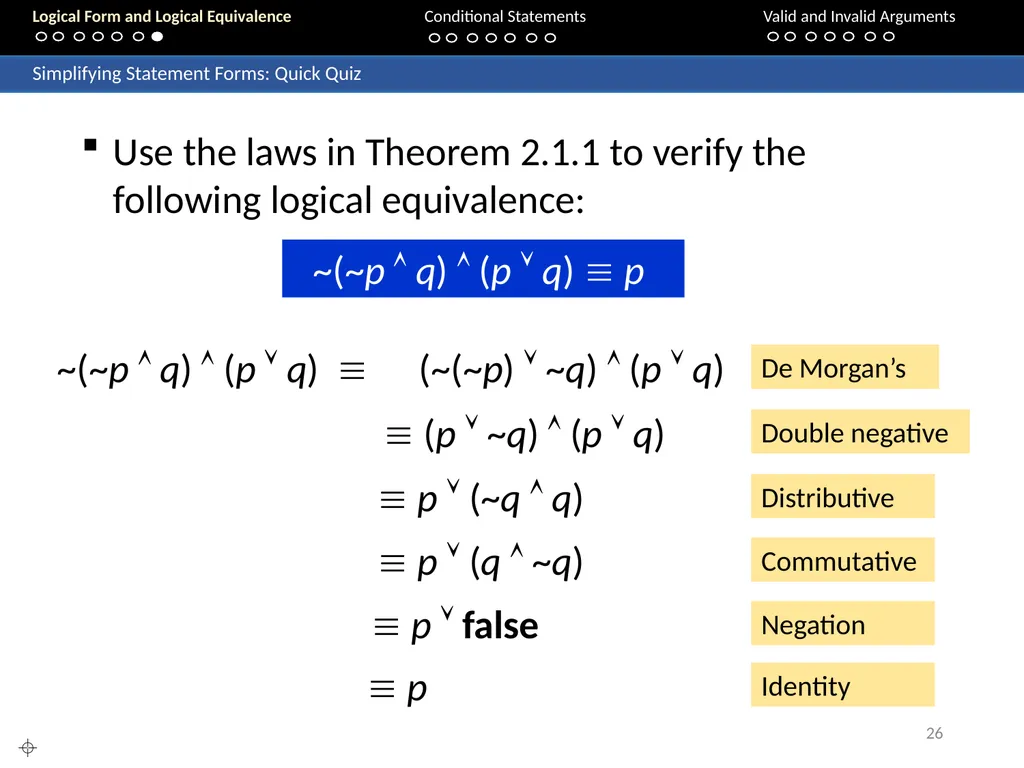
Logical Form and Logical Equivalence Conditional Statements Valid and Invalid Arguments Simplifying Statement Forms: Quick Quiz 26 Use the laws in Theorem 2.1.1 to verify the following logical equivalence: ~(~p q) (p q) p ~(~p q) (p q) (~(~p) ~q) (p q) (p ~q) (p q) De Morgan’s Double negative p (~q q) Distributive p (q ~q) Commutative p false Negation p Identity<br>
27
Logical Form and Logical Equivalence Conditional Statements Valid and Invalid Arguments 27 2.2 Conditional Statements<br>
28
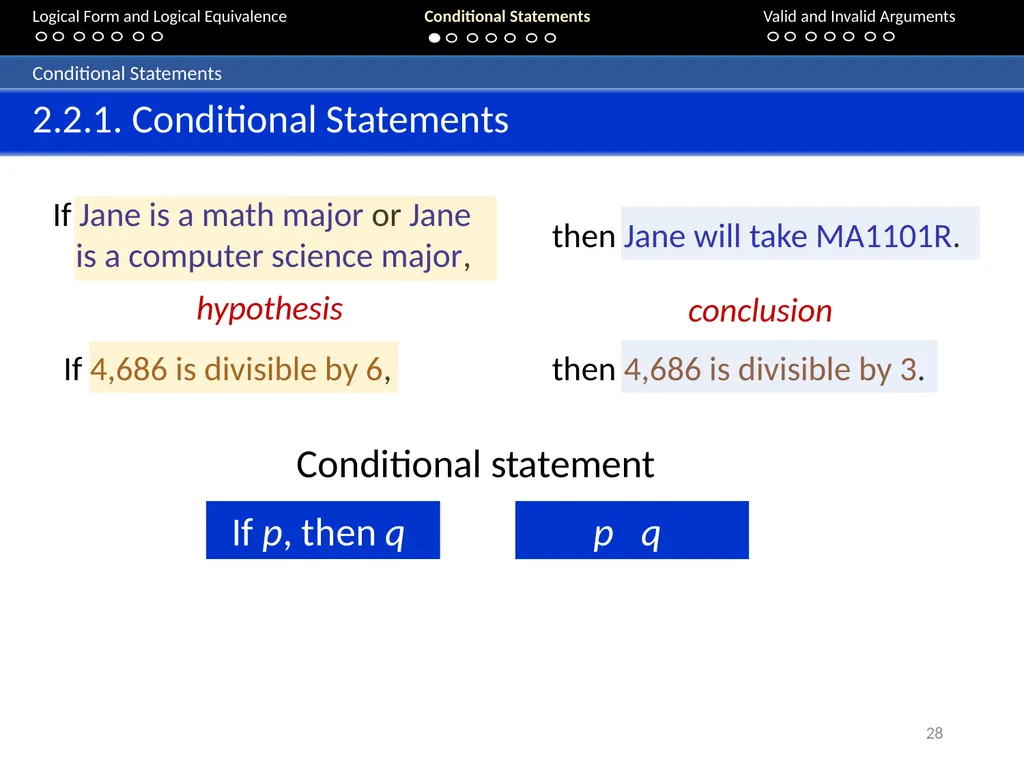
Logical Form and Logical Equivalence Conditional Statements Valid and Invalid Arguments Conditional Statements 28 If Jane is a math major or Jane
is a computer science major, If 4,686 is divisible by 6, then Jane will take MA1101R. then 4,686 is divisible by 3. hypothesis conclusion If p, then q p q Conditional statement 2.2.1. Conditional Statements<br>
is a computer science major, If 4,686 is divisible by 6, then Jane will take MA1101R. then 4,686 is divisible by 3. hypothesis conclusion If p, then q p q Conditional statement 2.2.1. Conditional Statements<br>
29
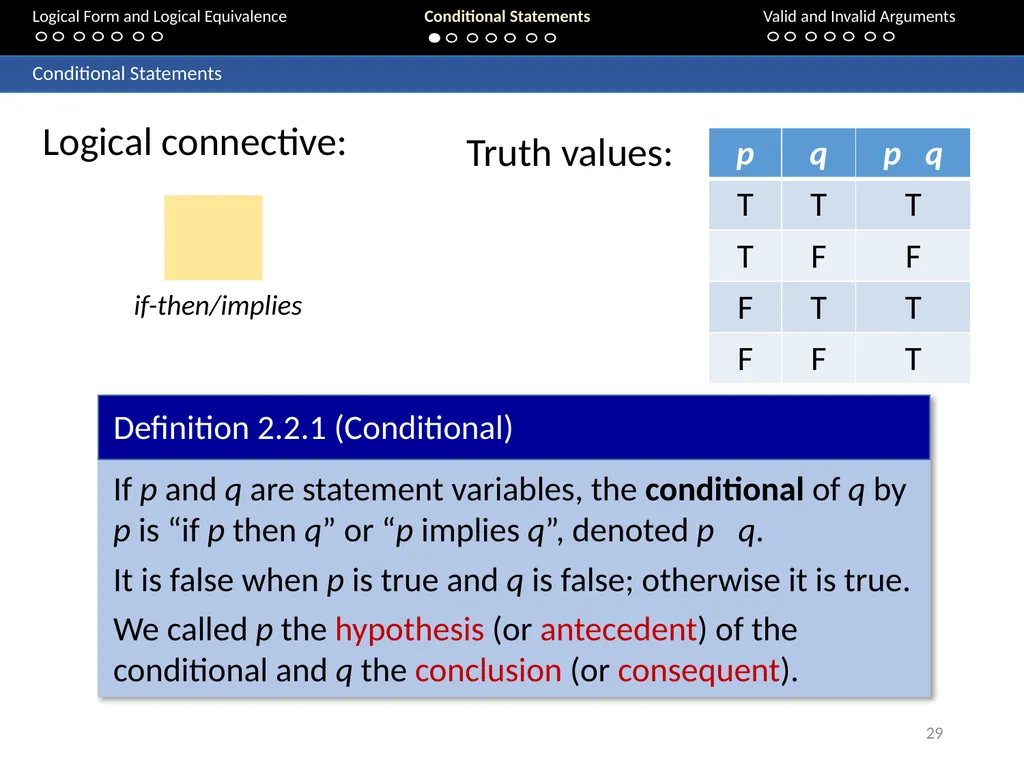
Logical Form and Logical Equivalence Conditional Statements Valid and Invalid Arguments Conditional Statements 29 Logical connective: Truth values:<br>
30
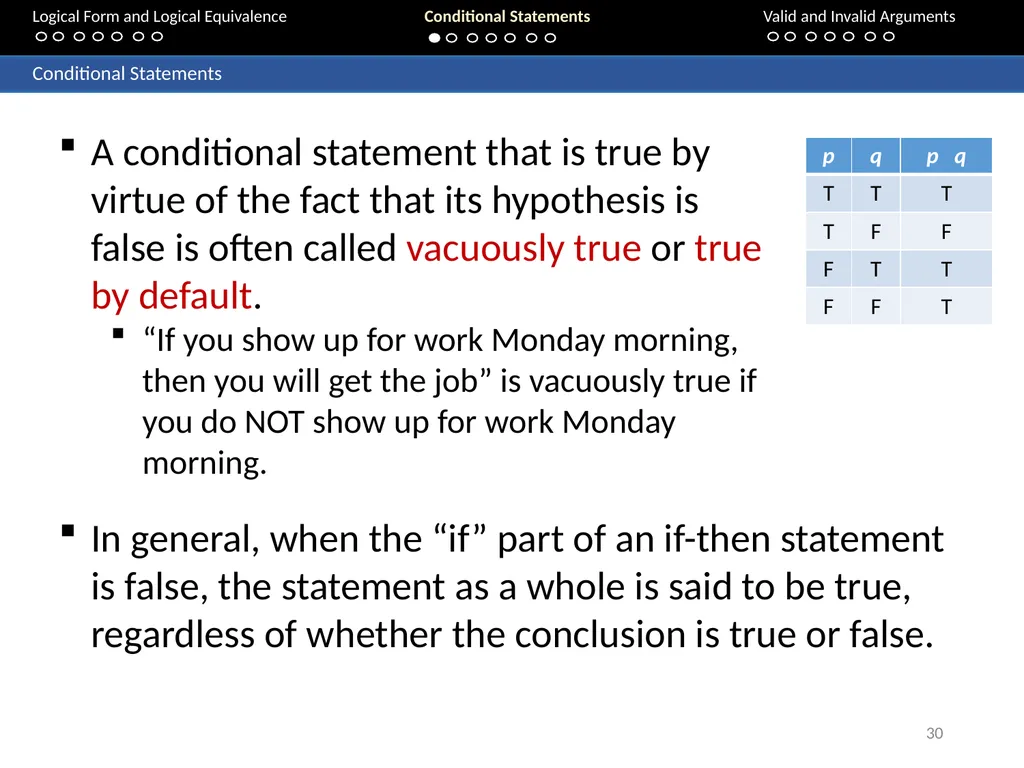
Logical Form and Logical Equivalence Conditional Statements Valid and Invalid Arguments Conditional Statements 30 A conditional statement that is true by virtue of the fact that its hypothesis is false is often called vacuously true or true by default.
“If you show up for work Monday morning, then you will get the job” is vacuously true if you do NOT show up for work Monday morning. In general, when the “if” part of an if-then statement is false, the statement as a whole is said to be true, regardless of whether the conclusion is true or false.<br>
“If you show up for work Monday morning, then you will get the job” is vacuously true if you do NOT show up for work Monday morning. In general, when the “if” part of an if-then statement is false, the statement as a whole is said to be true, regardless of whether the conclusion is true or false.<br>
31
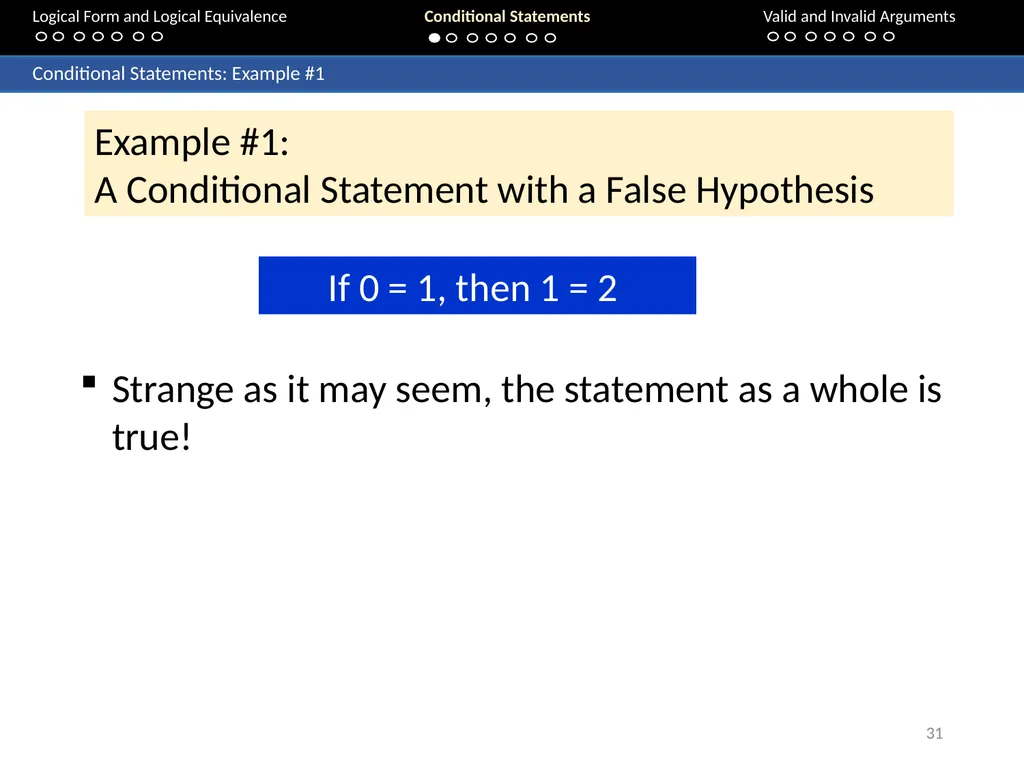
Logical Form and Logical Equivalence Conditional Statements Valid and Invalid Arguments Conditional Statements: Example #1 31 Strange as it may seem, the statement as a whole is true! Example #1:
A Conditional Statement with a False Hypothesis If 0 = 1, then 1 = 2<br>
A Conditional Statement with a False Hypothesis If 0 = 1, then 1 = 2<br>
32
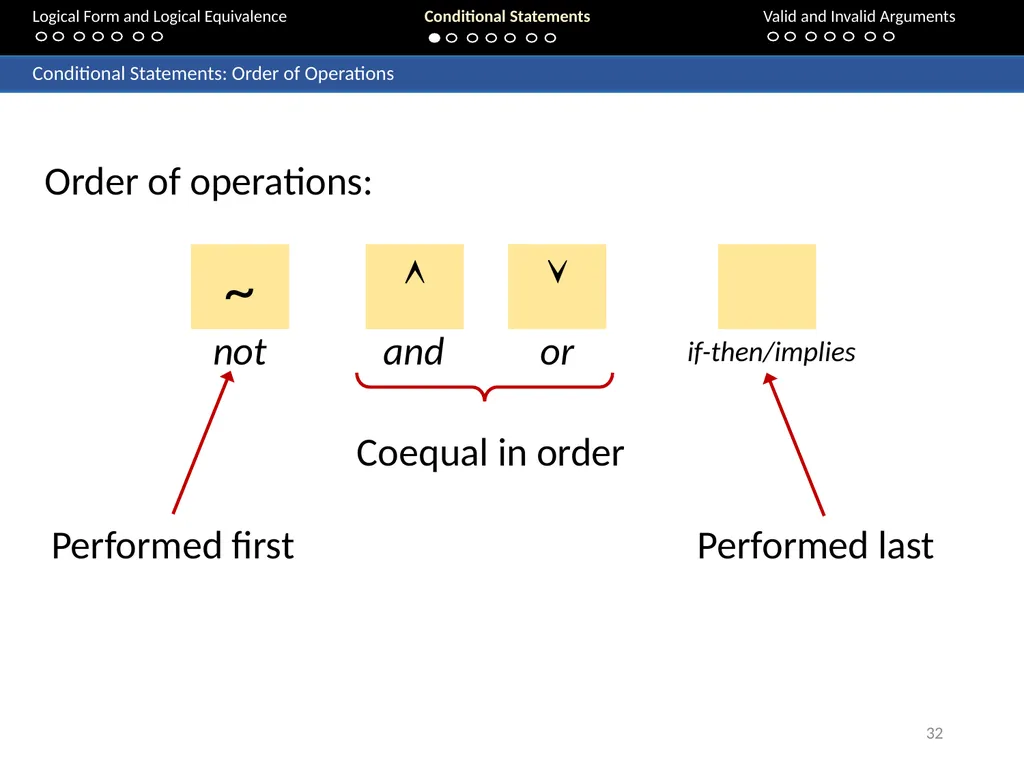
Logical Form and Logical Equivalence Conditional Statements Valid and Invalid Arguments Conditional Statements: Order of Operations 32 Order of operations:<br>
33
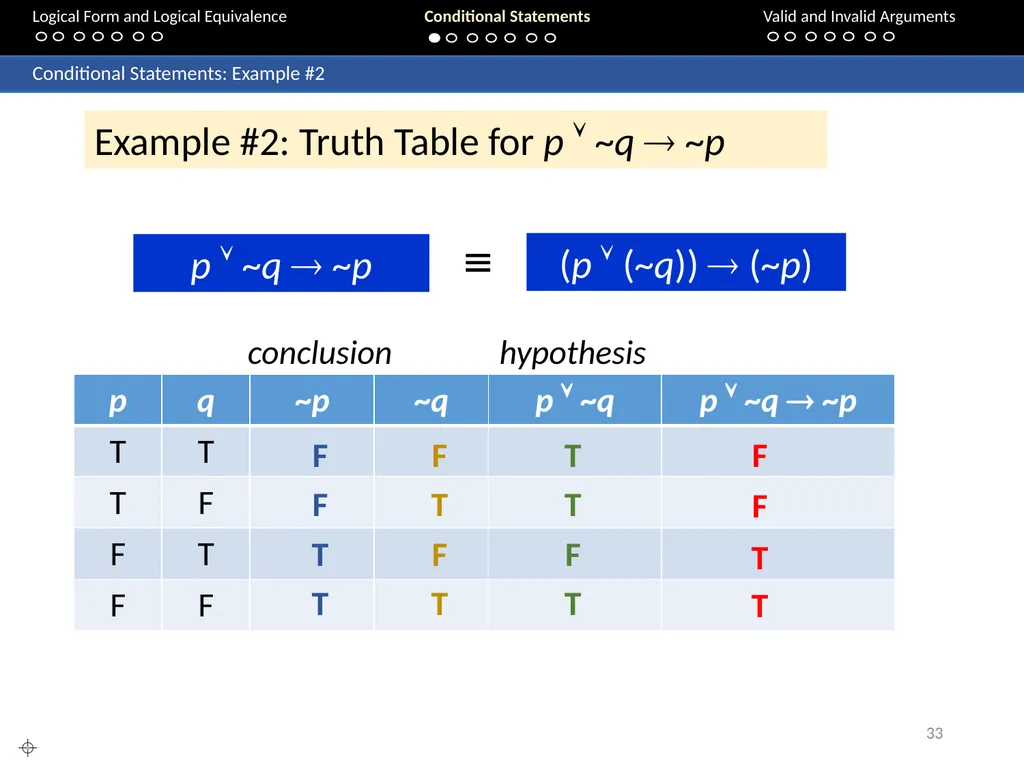
Logical Form and Logical Equivalence Conditional Statements Valid and Invalid Arguments Conditional Statements: Example #2 33 Example #2: Truth Table for p ~q ~p p ~q ~p (p (~q)) (~p) F
F
T
T F
T
F
T T
T
F
T F F T T hypothesis conclusion<br>
F
T
T F
T
F
T T
T
F
T F F T T hypothesis conclusion<br>
34
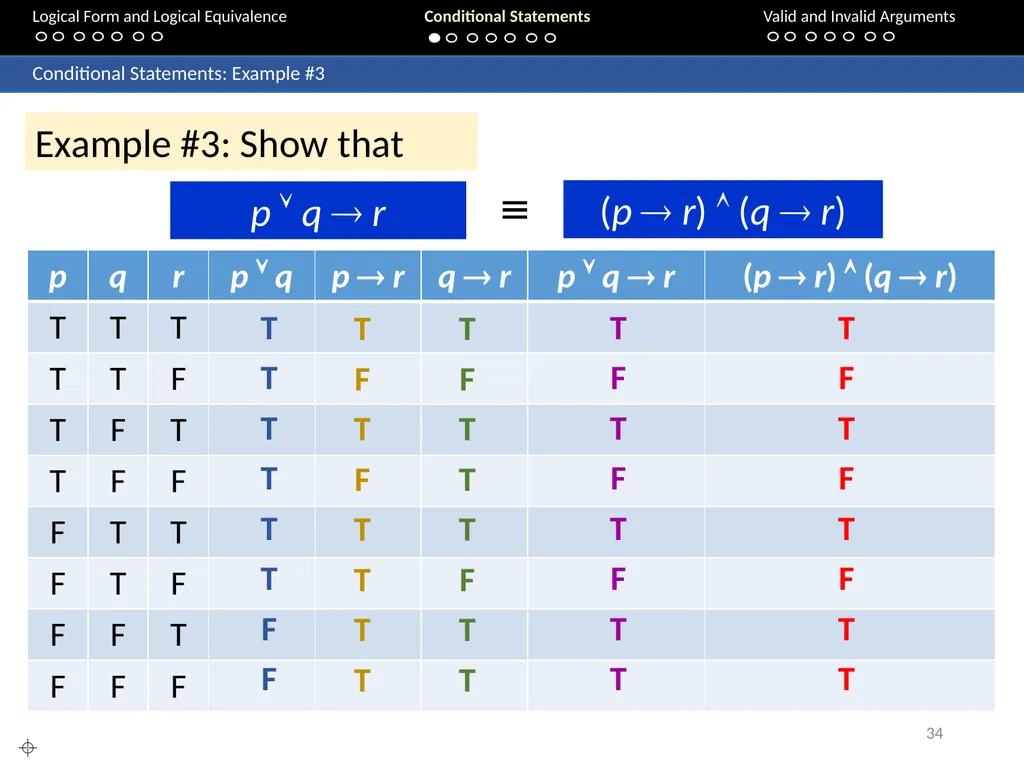
Logical Form and Logical Equivalence Conditional Statements Valid and Invalid Arguments Conditional Statements: Example #3 34 Example #3: Show that p q r (p r) (q r) T
T
T
T
T
T
F
F T
F
T
F
T
T
T
T T
F
T
T
T
F
T
T T
F
T
F
T
F
T
T T
F
T
F
T
F
T
T<br>
T
T
T
T
T
F
F T
F
T
F
T
T
T
T T
F
T
T
T
F
T
T T
F
T
F
T
F
T
T T
F
T
F
T
F
T
T<br>
35
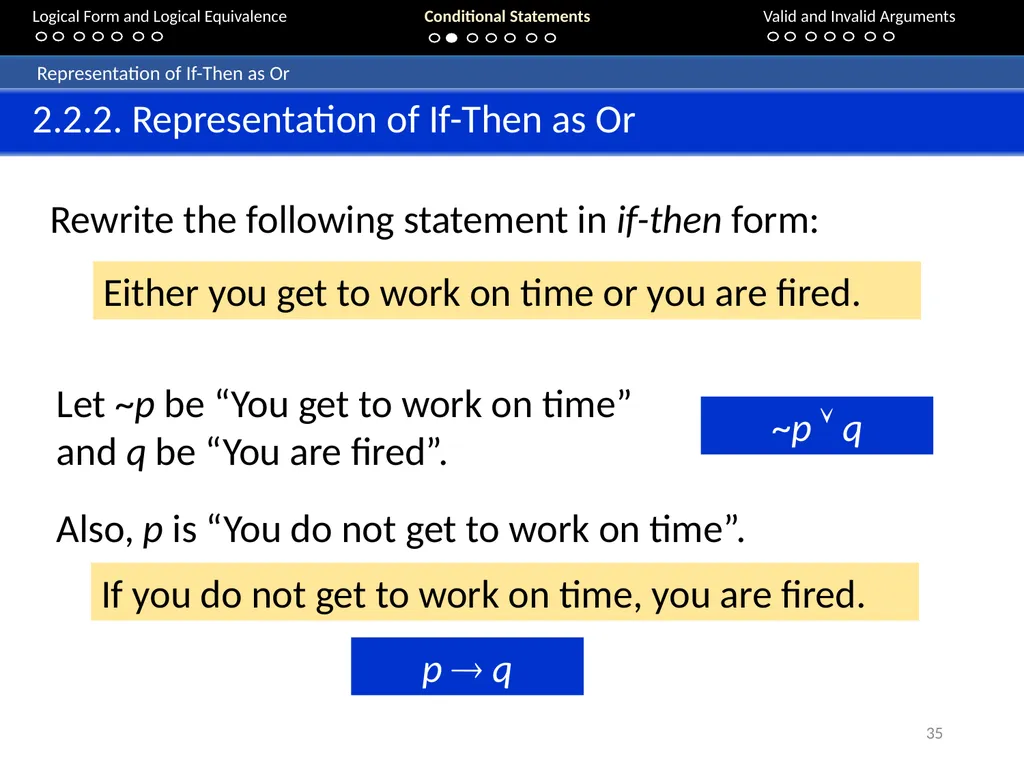
Logical Form and Logical Equivalence Conditional Statements Valid and Invalid Arguments Representation of If-Then as Or 35 2.2.2. Representation of If-Then as Or Rewrite the following statement in if-then form: Either you get to work on time or you are fired. Let ~p be “You get to work on time”
and q be “You are fired”. ~p q Also, p is “You do not get to work on time”. If you do not get to work on time, you are fired. p q<br>
and q be “You are fired”. ~p q Also, p is “You do not get to work on time”. If you do not get to work on time, you are fired. p q<br>
36
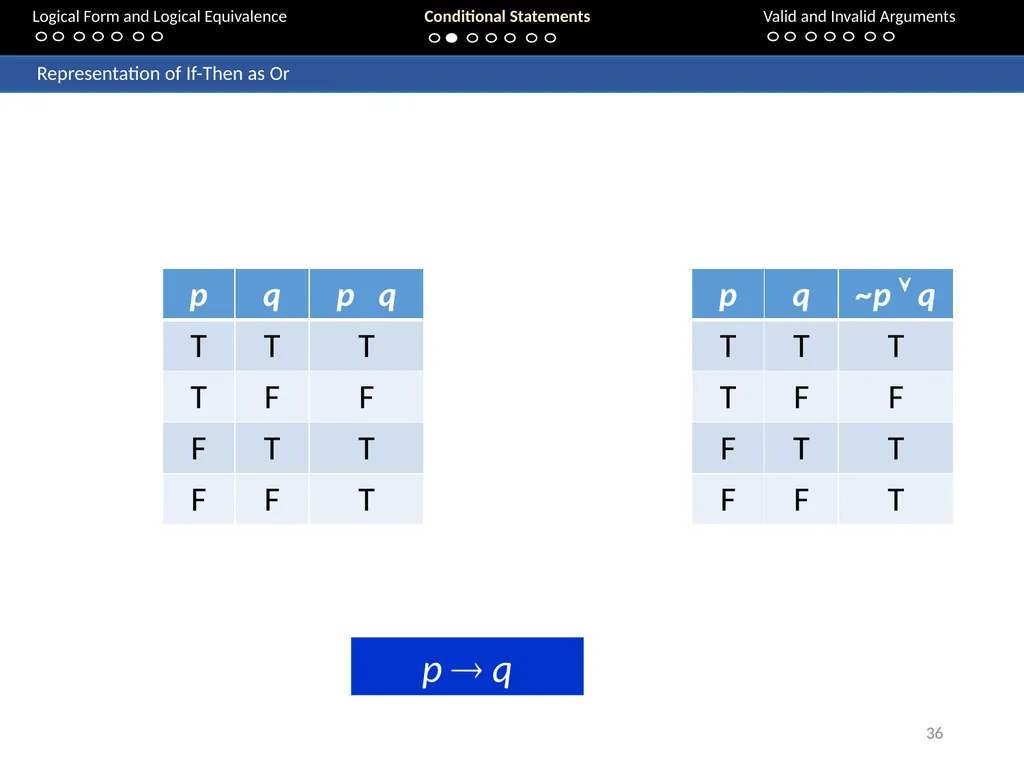
Logical Form and Logical Equivalence Conditional Statements Valid and Invalid Arguments Representation of If-Then as Or 36 ~p q p q<br>
37
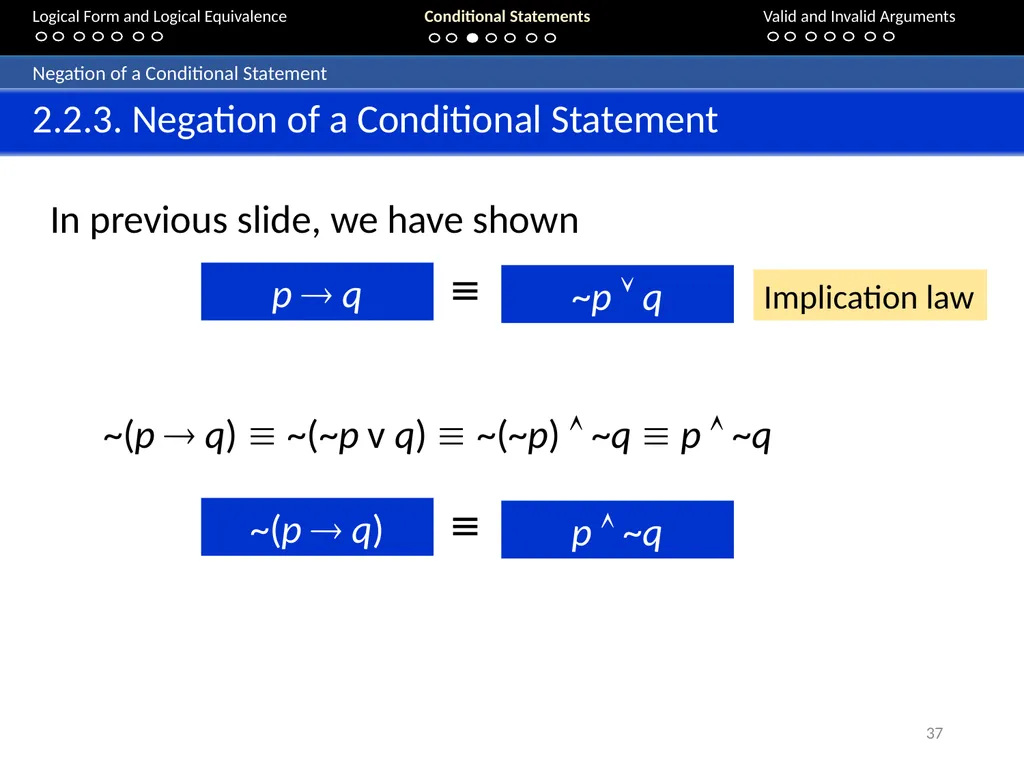
Logical Form and Logical Equivalence Conditional Statements Valid and Invalid Arguments Negation of a Conditional Statement 37 2.2.3. Negation of a Conditional Statement In previous slide, we have shown ~(p q) ~(~p v q) ~(~p) ~q p ~q Implication law<br>
38
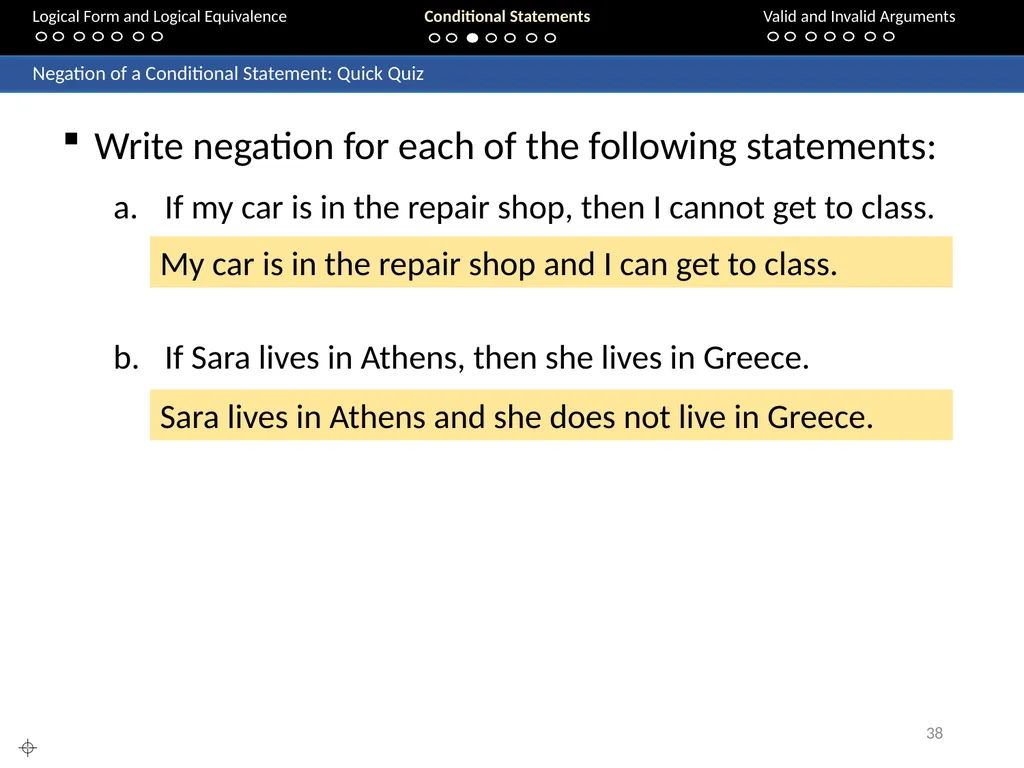
Logical Form and Logical Equivalence Conditional Statements Valid and Invalid Arguments Negation of a Conditional Statement: Quick Quiz 38 Write negation for each of the following statements:
If my car is in the repair shop, then I cannot get to class.
If Sara lives in Athens, then she lives in Greece. My car is in the repair shop and I can get to class. Sara lives in Athens and she does not live in Greece.<br>
If my car is in the repair shop, then I cannot get to class.
If Sara lives in Athens, then she lives in Greece. My car is in the repair shop and I can get to class. Sara lives in Athens and she does not live in Greece.<br>
39
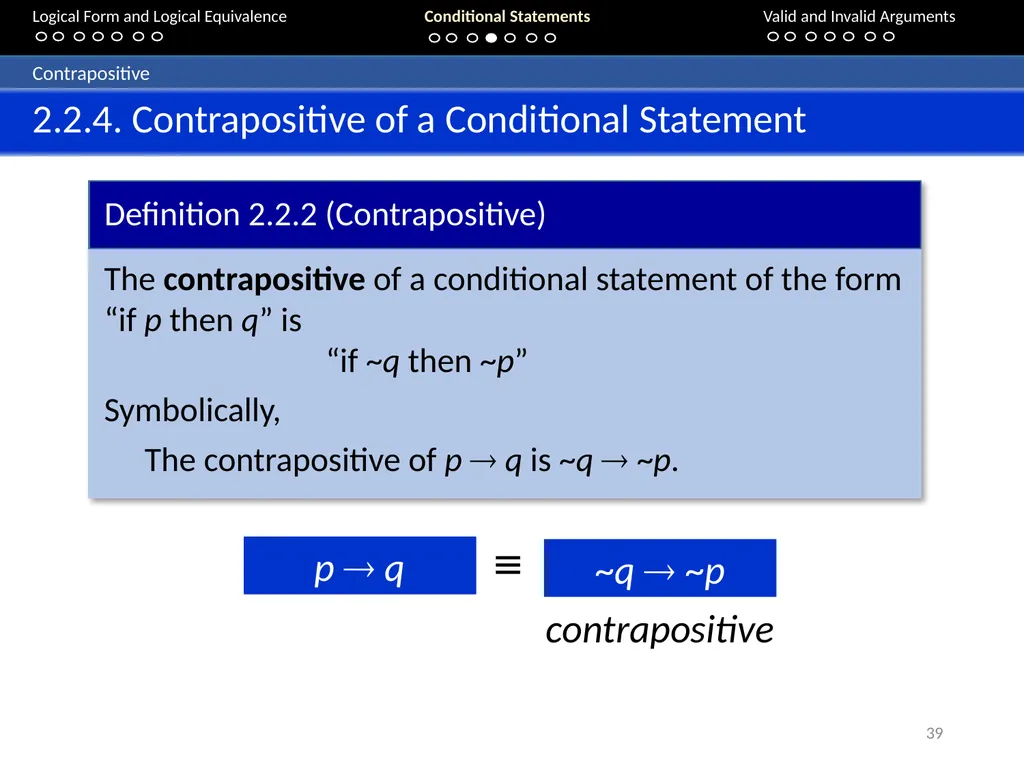
Logical Form and Logical Equivalence Conditional Statements Valid and Invalid Arguments Contrapositive 39 2.2.4. Contrapositive of a Conditional Statement<br>
40
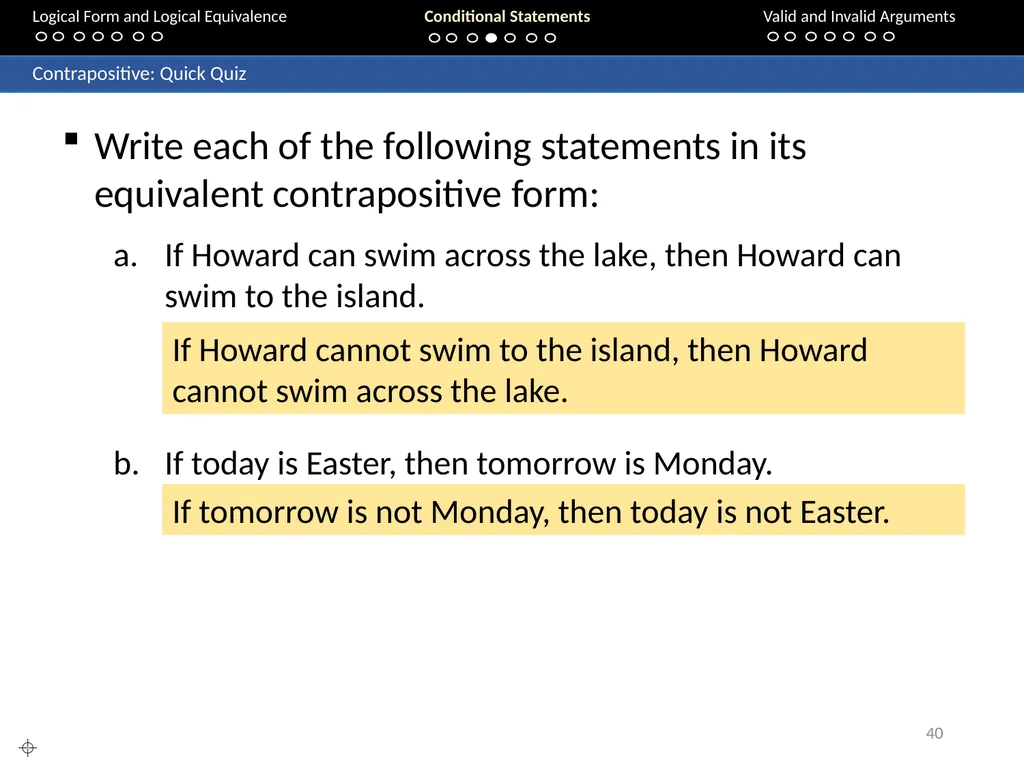
Logical Form and Logical Equivalence Conditional Statements Valid and Invalid Arguments Contrapositive: Quick Quiz 40 Write each of the following statements in its equivalent contrapositive form:
If Howard can swim across the lake, then Howard can swim to the island.
If today is Easter, then tomorrow is Monday. If Howard cannot swim to the island, then Howard cannot swim across the lake. If tomorrow is not Monday, then today is not Easter.<br>
If Howard can swim across the lake, then Howard can swim to the island.
If today is Easter, then tomorrow is Monday. If Howard cannot swim to the island, then Howard cannot swim across the lake. If tomorrow is not Monday, then today is not Easter.<br>
41
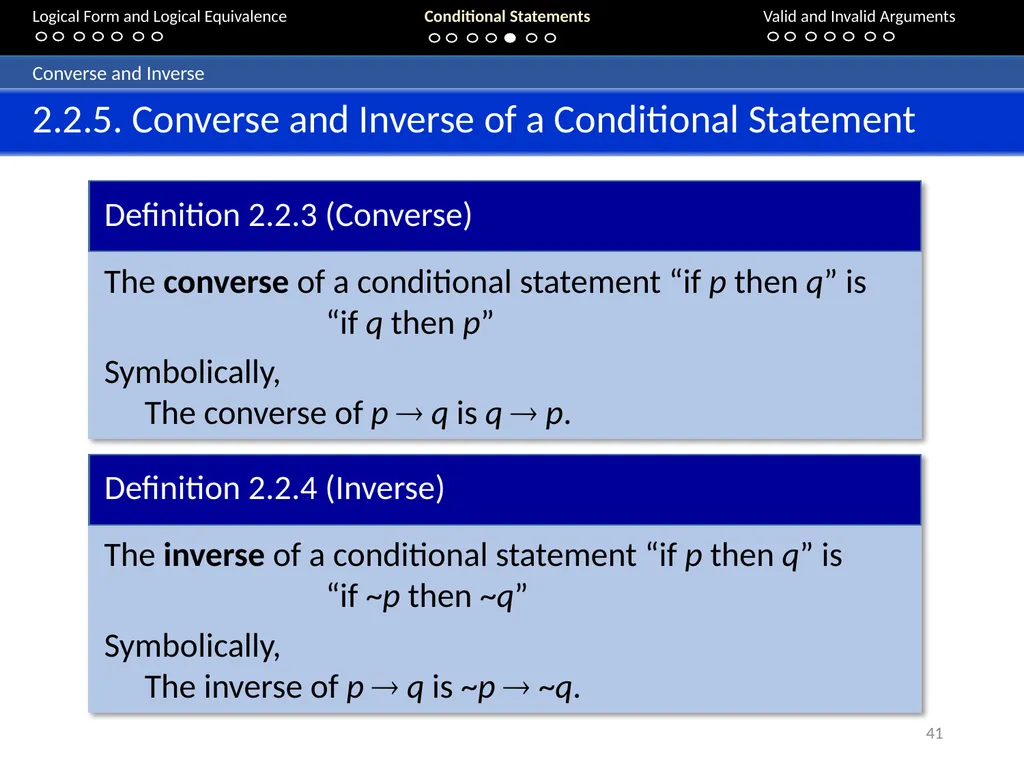
Logical Form and Logical Equivalence Conditional Statements Valid and Invalid Arguments Converse and Inverse 41 2.2.5. Converse and Inverse of a Conditional Statement<br>
42
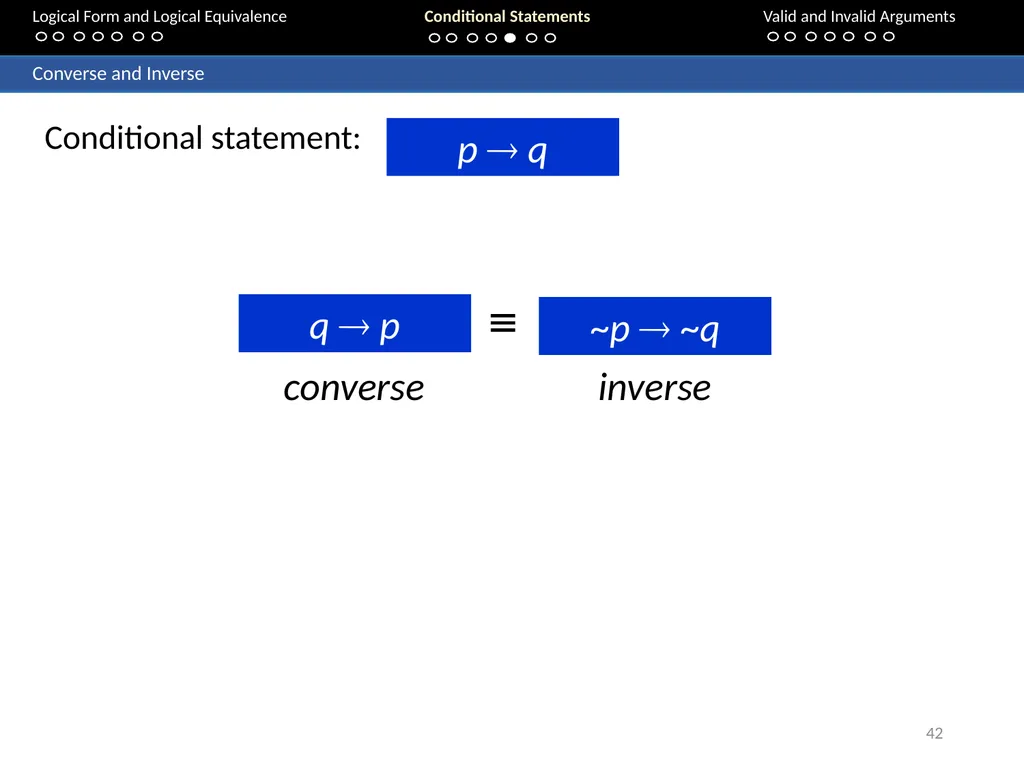
Logical Form and Logical Equivalence Conditional Statements Valid and Invalid Arguments Converse and Inverse 42 Conditional statement: p q<br>
43
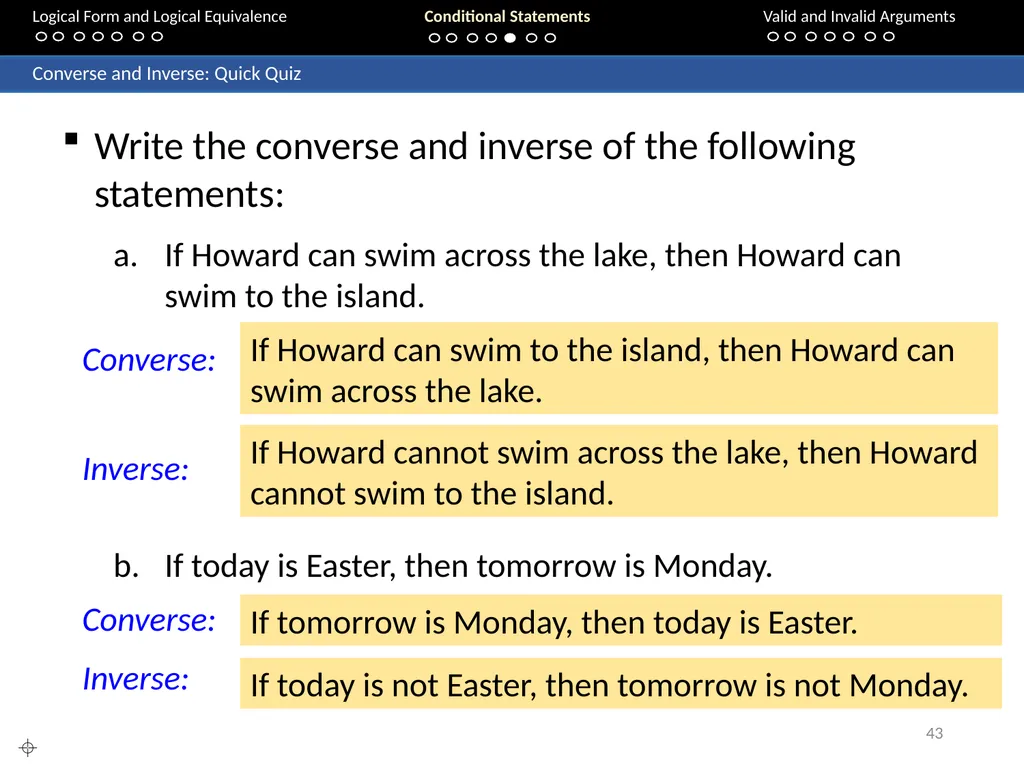
Logical Form and Logical Equivalence Conditional Statements Valid and Invalid Arguments Converse and Inverse: Quick Quiz 43 Write the converse and inverse of the following statements:
If Howard can swim across the lake, then Howard can swim to the island.
If today is Easter, then tomorrow is Monday. If Howard can swim to the island, then Howard can swim across the lake. If Howard cannot swim across the lake, then Howard cannot swim to the island. Converse: Inverse: Converse: Inverse: If tomorrow is Monday, then today is Easter. If today is not Easter, then tomorrow is not Monday.<br>
If Howard can swim across the lake, then Howard can swim to the island.
If today is Easter, then tomorrow is Monday. If Howard can swim to the island, then Howard can swim across the lake. If Howard cannot swim across the lake, then Howard cannot swim to the island. Converse: Inverse: Converse: Inverse: If tomorrow is Monday, then today is Easter. If today is not Easter, then tomorrow is not Monday.<br>
44
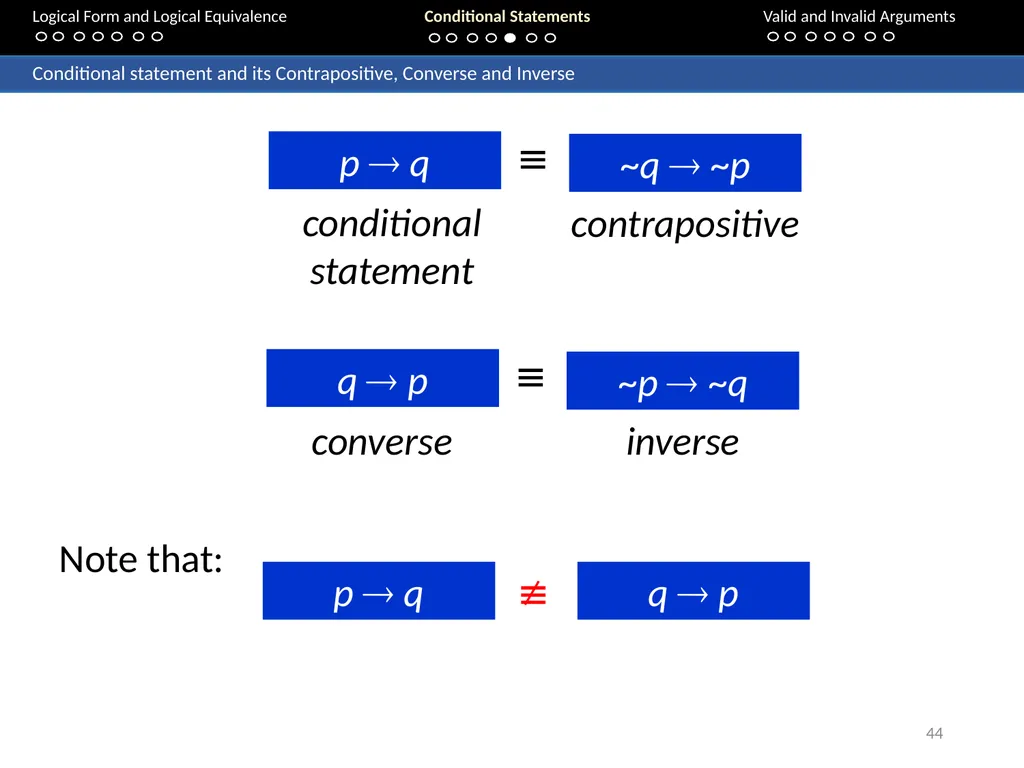
Logical Form and Logical Equivalence Conditional Statements Valid and Invalid Arguments Conditional statement and its Contrapositive, Converse and Inverse 44 q p<br>
45
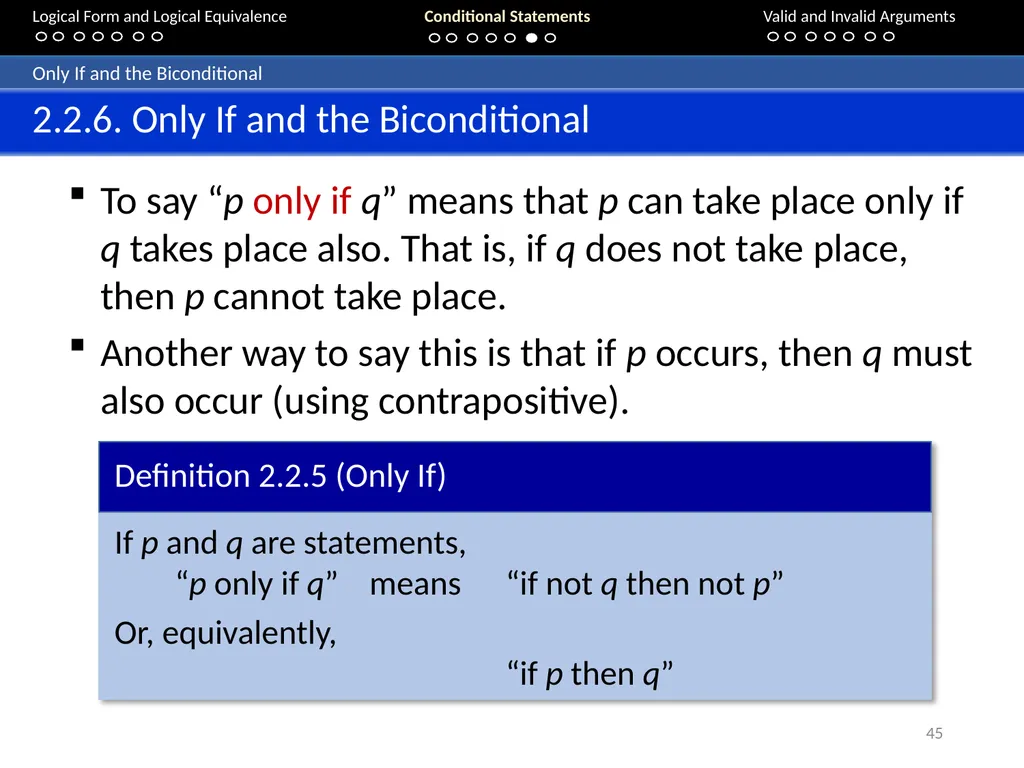
Logical Form and Logical Equivalence Conditional Statements Valid and Invalid Arguments Only If and the Biconditional 45 2.2.6. Only If and the Biconditional To say “p only if q” means that p can take place only if q takes place also. That is, if q does not take place, then p cannot take place.
Another way to say this is that if p occurs, then q must also occur (using contrapositive).<br>
Another way to say this is that if p occurs, then q must also occur (using contrapositive).<br>
46
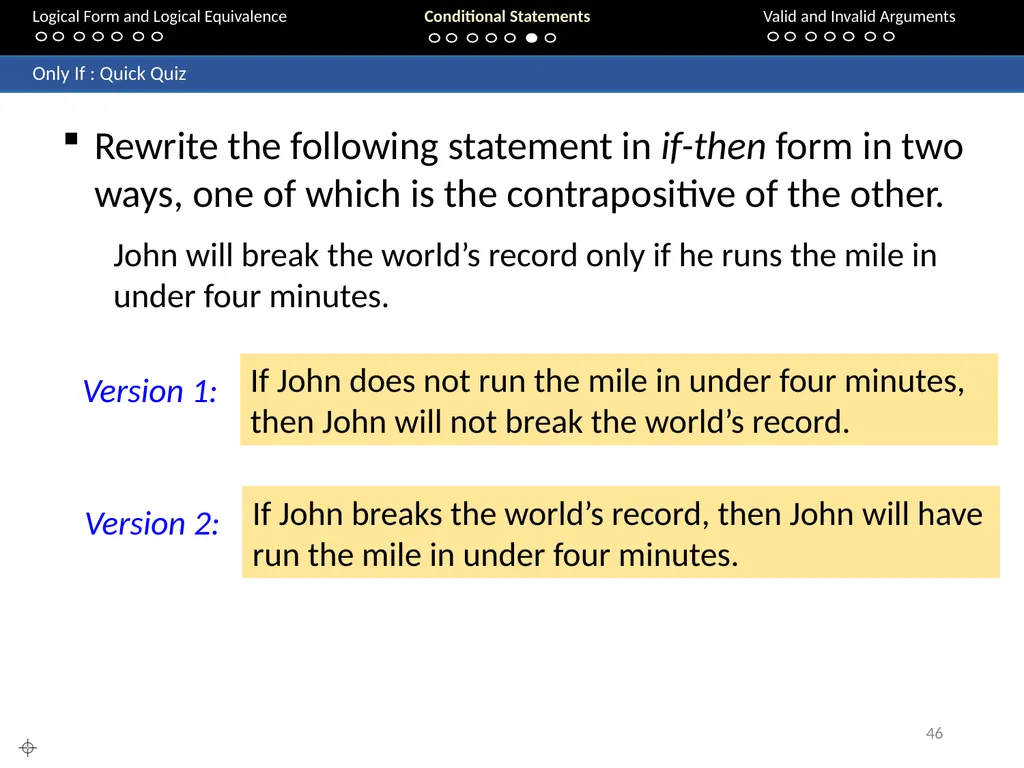
Logical Form and Logical Equivalence Conditional Statements Valid and Invalid Arguments Only If : Quick Quiz 46 Rewrite the following statement in if-then form in two ways, one of which is the contrapositive of the other.
John will break the world’s record only if he runs the mile in under four minutes. If John does not run the mile in under four minutes, then John will not break the world’s record. Version 1: If John breaks the world’s record, then John will have run the mile in under four minutes. Version 2:<br>
John will break the world’s record only if he runs the mile in under four minutes. If John does not run the mile in under four minutes, then John will not break the world’s record. Version 1: If John breaks the world’s record, then John will have run the mile in under four minutes. Version 2:<br>
47
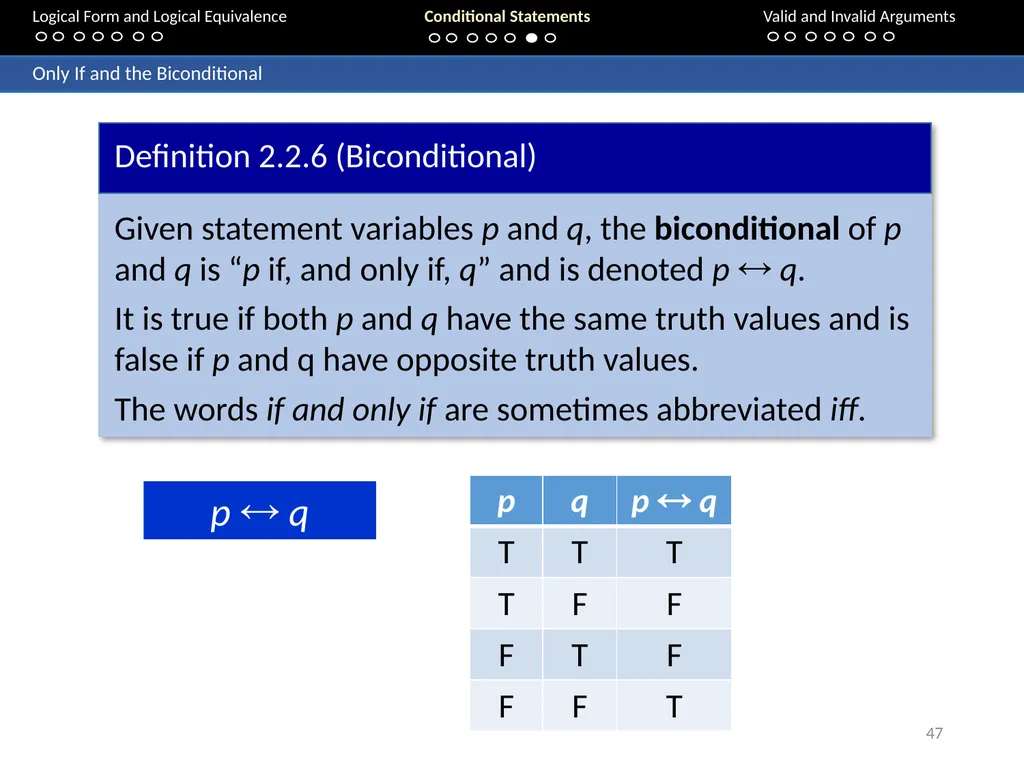
Logical Form and Logical Equivalence Conditional Statements Valid and Invalid Arguments Only If and the Biconditional 47 p q<br>
48
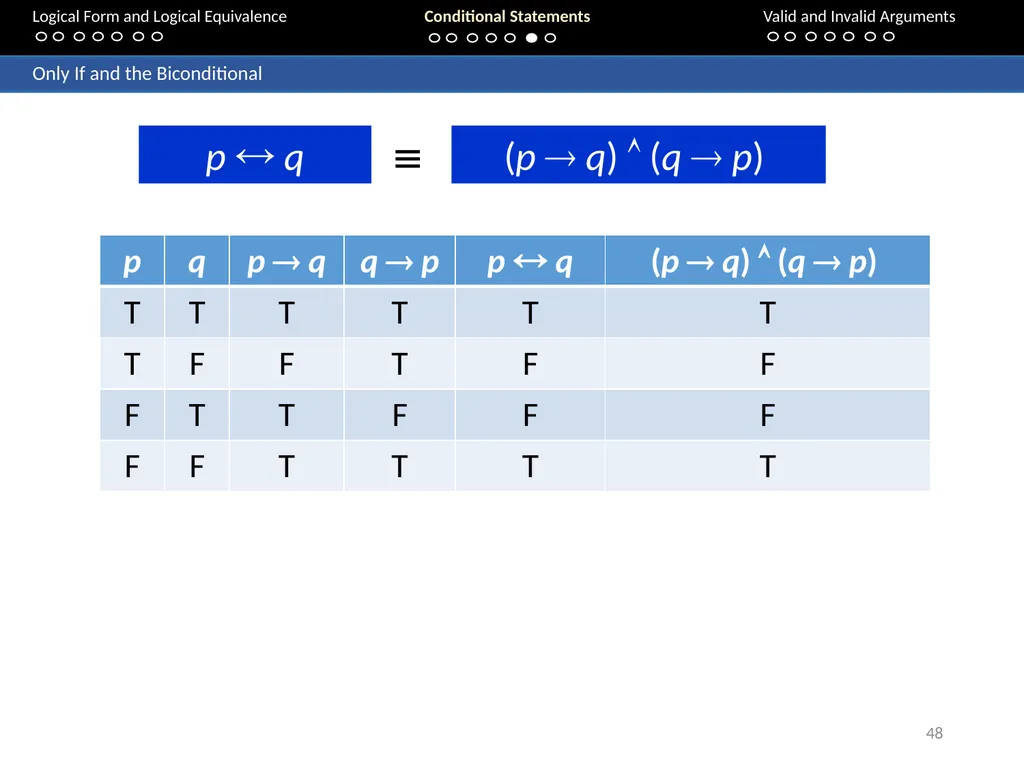
Logical Form and Logical Equivalence Conditional Statements Valid and Invalid Arguments Only If and the Biconditional 48 p q (p q) (q p) <br>
49
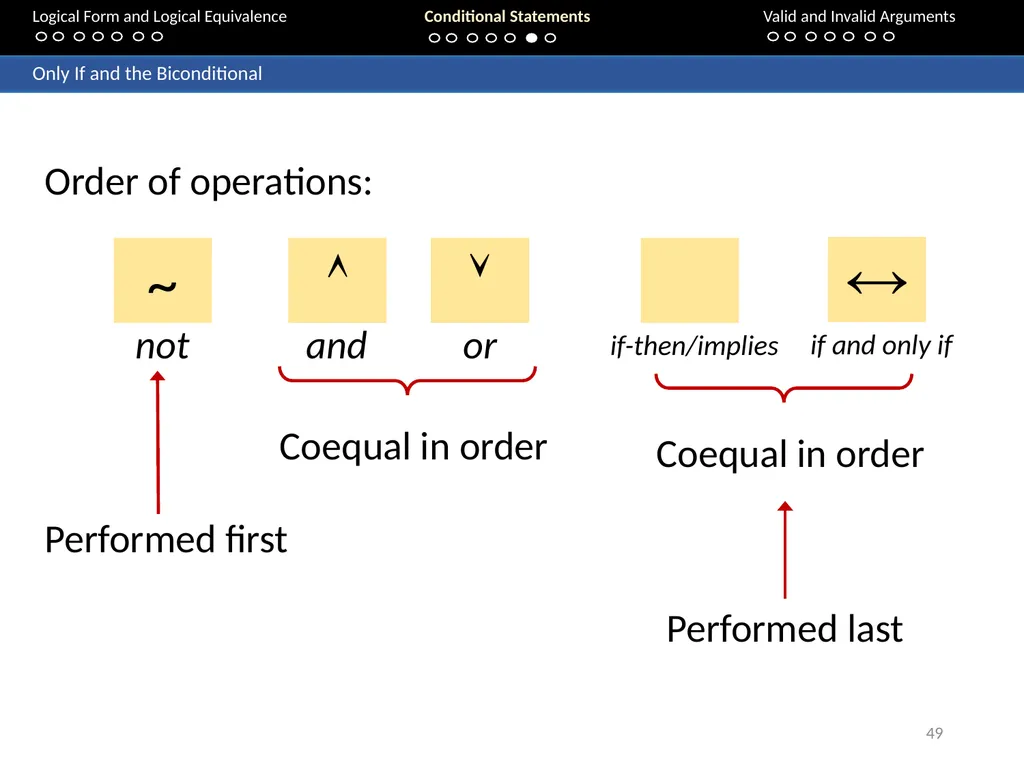
Logical Form and Logical Equivalence Conditional Statements Valid and Invalid Arguments Only If and the Biconditional 49 Order of operations:<br>
50
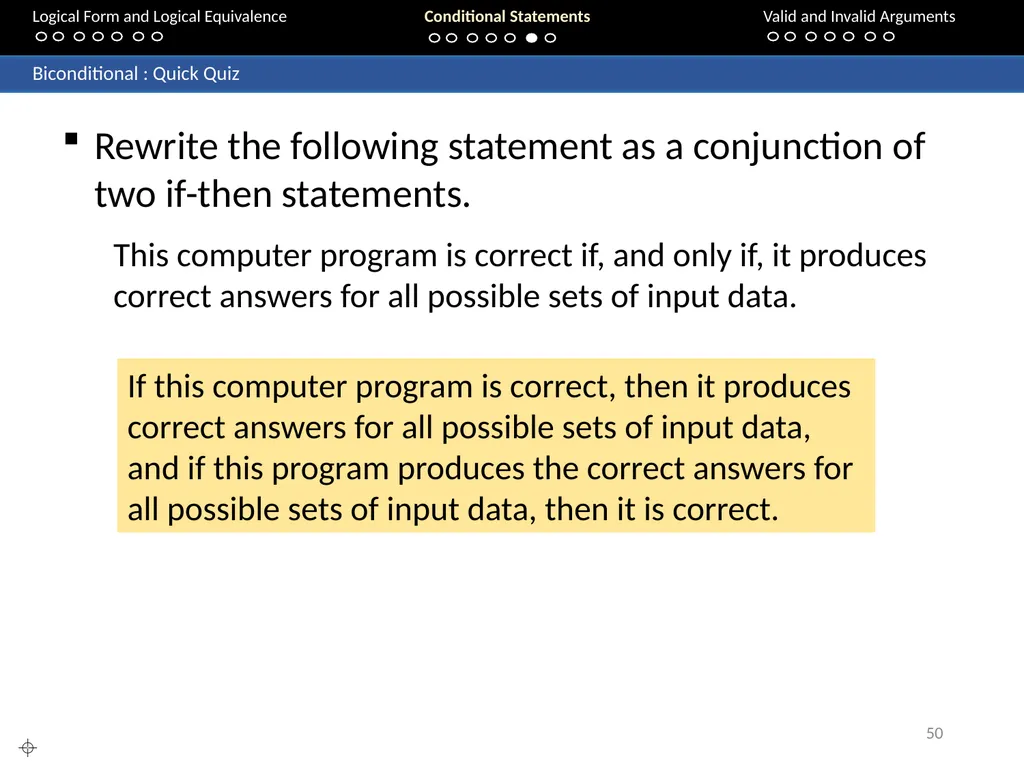
Logical Form and Logical Equivalence Conditional Statements Valid and Invalid Arguments Biconditional : Quick Quiz 50 Rewrite the following statement as a conjunction of two if-then statements.
This computer program is correct if, and only if, it produces correct answers for all possible sets of input data. If this computer program is correct, then it produces correct answers for all possible sets of input data, and if this program produces the correct answers for all possible sets of input data, then it is correct.<br>
This computer program is correct if, and only if, it produces correct answers for all possible sets of input data. If this computer program is correct, then it produces correct answers for all possible sets of input data, and if this program produces the correct answers for all possible sets of input data, then it is correct.<br>
51
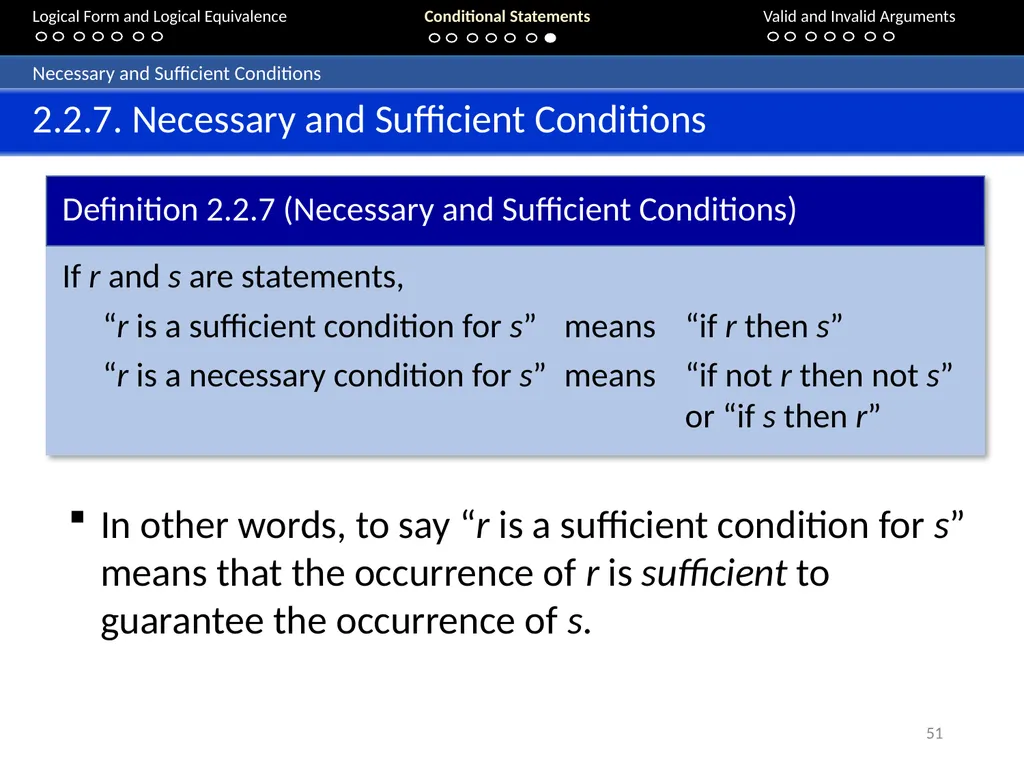
Logical Form and Logical Equivalence Conditional Statements Valid and Invalid Arguments Necessary and Sufficient Conditions 51 2.2.7. Necessary and Sufficient Conditions In other words, to say “r is a sufficient condition for s” means that the occurrence of r is sufficient to guarantee the occurrence of s.<br>
52
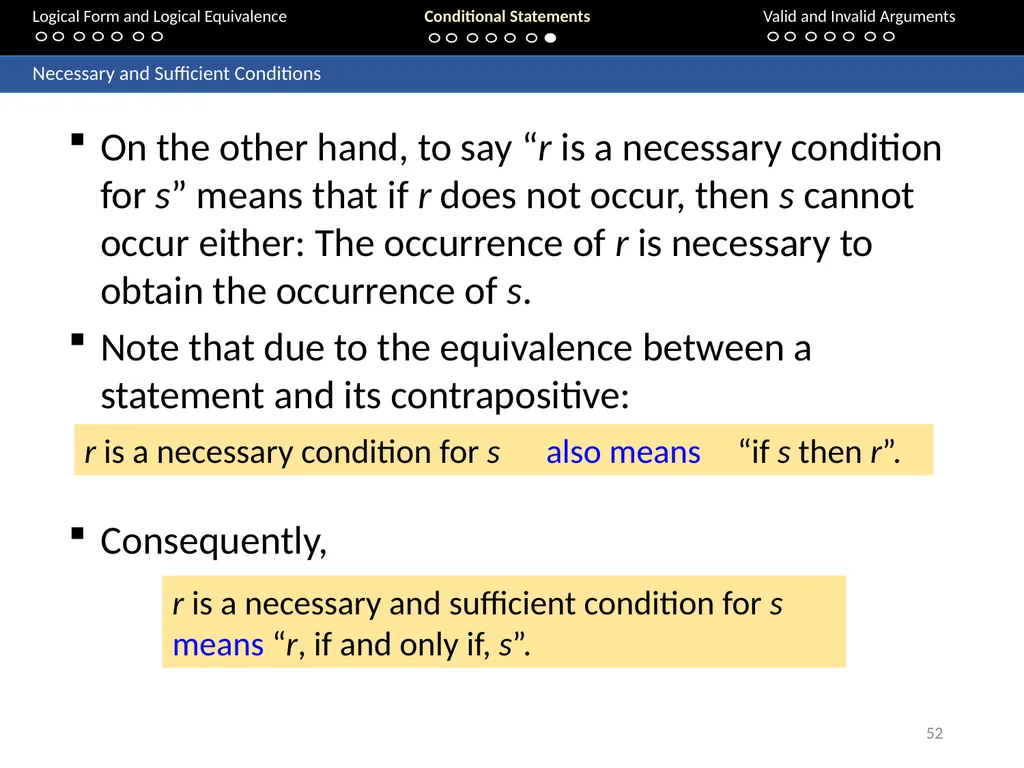
Logical Form and Logical Equivalence Conditional Statements Valid and Invalid Arguments Necessary and Sufficient Conditions 52 On the other hand, to say “r is a necessary condition for s” means that if r does not occur, then s cannot occur either: The occurrence of r is necessary to obtain the occurrence of s.
Note that due to the equivalence between a statement and its contrapositive: r is a necessary condition for s also means “if s then r”. Consequently, r is a necessary and sufficient condition for s
means “r, if and only if, s”.<br>
Note that due to the equivalence between a statement and its contrapositive: r is a necessary condition for s also means “if s then r”. Consequently, r is a necessary and sufficient condition for s
means “r, if and only if, s”.<br>
53
Logical Form and Logical Equivalence Conditional Statements Valid and Invalid Arguments 53 2.3 Valid and Invalid Arguments<br>
54
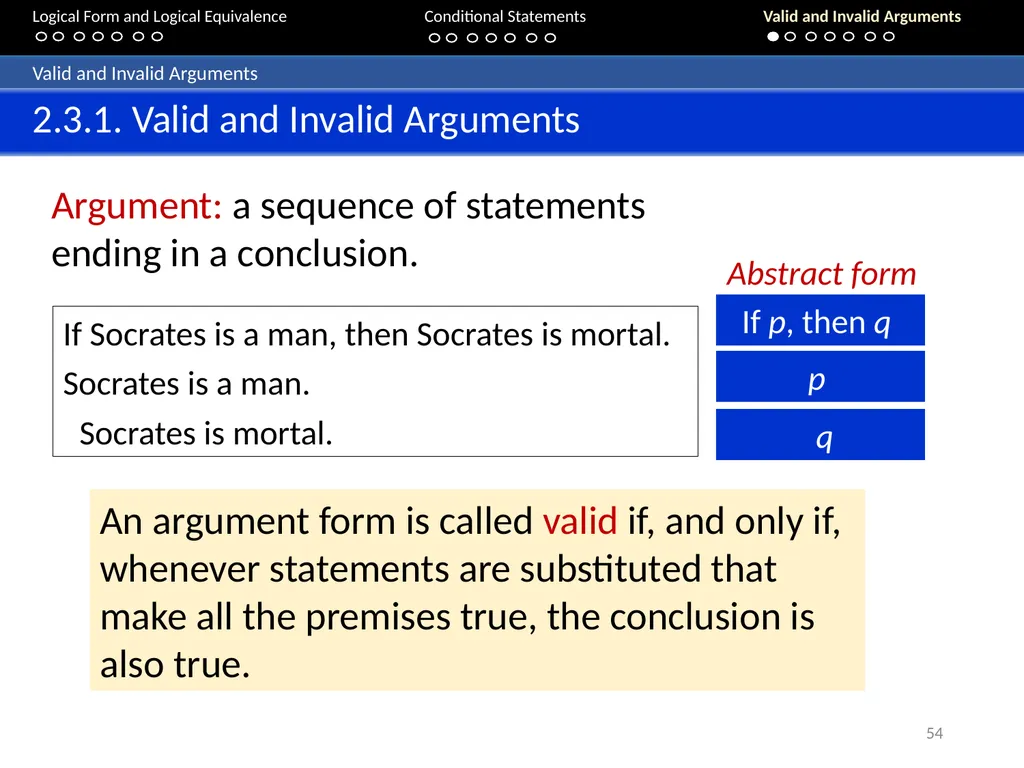
Logical Form and Logical Equivalence Conditional Statements Valid and Invalid Arguments Valid and Invalid Arguments 54 If Socrates is a man, then Socrates is mortal.
Socrates is a man.
Socrates is mortal. An argument form is called valid if, and only if, whenever statements are substituted that make all the premises true, the conclusion is also true. 2.3.1. Valid and Invalid Arguments Argument: a sequence of statements ending in a conclusion.<br>
Socrates is a man.
Socrates is mortal. An argument form is called valid if, and only if, whenever statements are substituted that make all the premises true, the conclusion is also true. 2.3.1. Valid and Invalid Arguments Argument: a sequence of statements ending in a conclusion.<br>
55
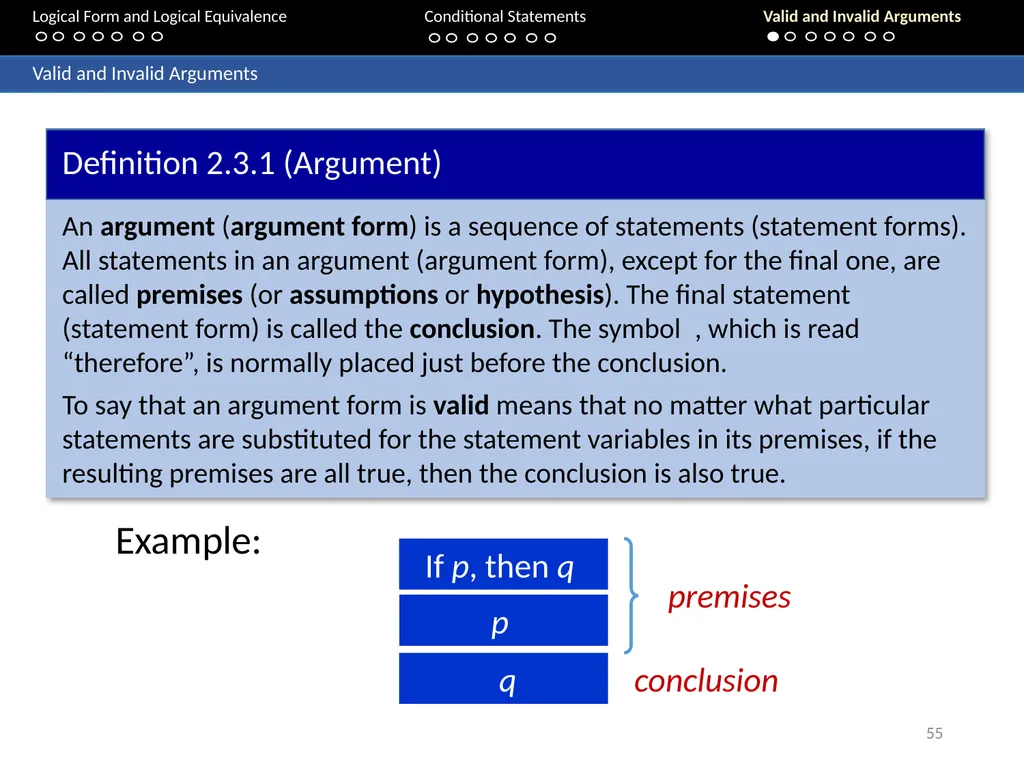
Logical Form and Logical Equivalence Conditional Statements Valid and Invalid Arguments Valid and Invalid Arguments 55<br>
56
Logical Form and Logical Equivalence Conditional Statements Valid and Invalid Arguments Valid and Invalid Arguments 56 When an argument is valid and its premises are true, the truth of the conclusion is said to be inferred or deduced from the truth of the premises.
If a conclusion “ain’t necessarily so”, then it isn’t a valid deduction.<br>
If a conclusion “ain’t necessarily so”, then it isn’t a valid deduction.<br>
57
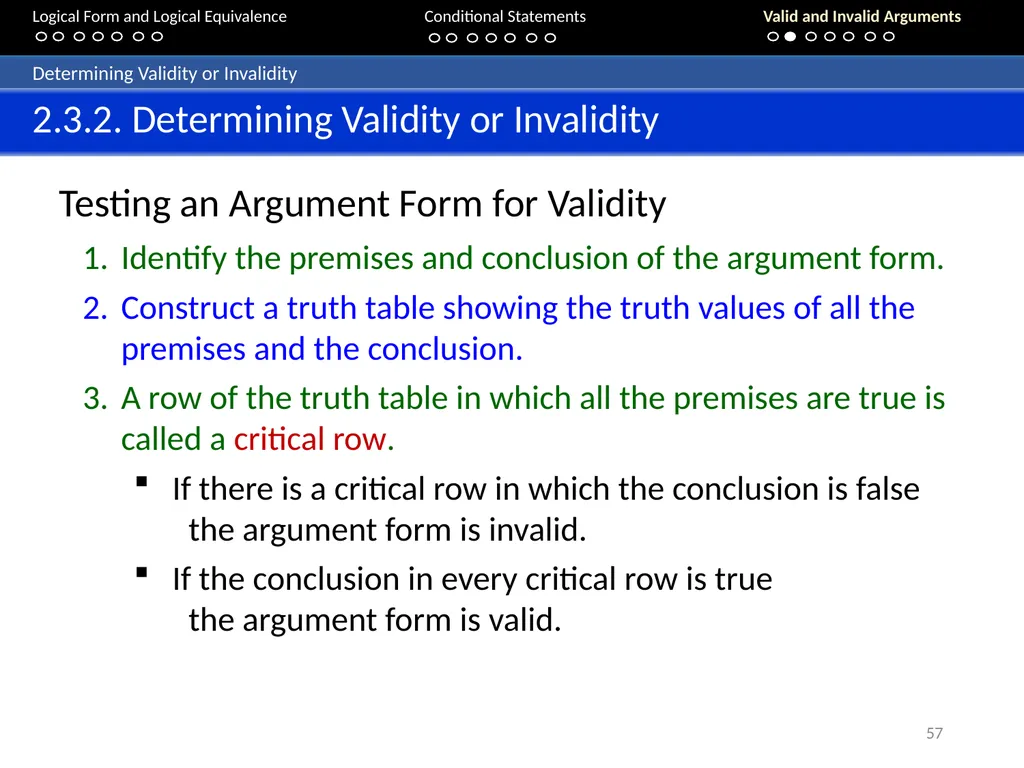
Logical Form and Logical Equivalence Conditional Statements Valid and Invalid Arguments Determining Validity or Invalidity 57 Testing an Argument Form for Validity Identify the premises and conclusion of the argument form.
Construct a truth table showing the truth values of all the premises and the conclusion.
A row of the truth table in which all the premises are true is called a critical row.
If there is a critical row in which the conclusion is false the argument form is invalid.
If the conclusion in every critical row is true the argument form is valid. 2.3.2. Determining Validity or Invalidity<br>
Construct a truth table showing the truth values of all the premises and the conclusion.
A row of the truth table in which all the premises are true is called a critical row.
If there is a critical row in which the conclusion is false the argument form is invalid.
If the conclusion in every critical row is true the argument form is valid. 2.3.2. Determining Validity or Invalidity<br>
58
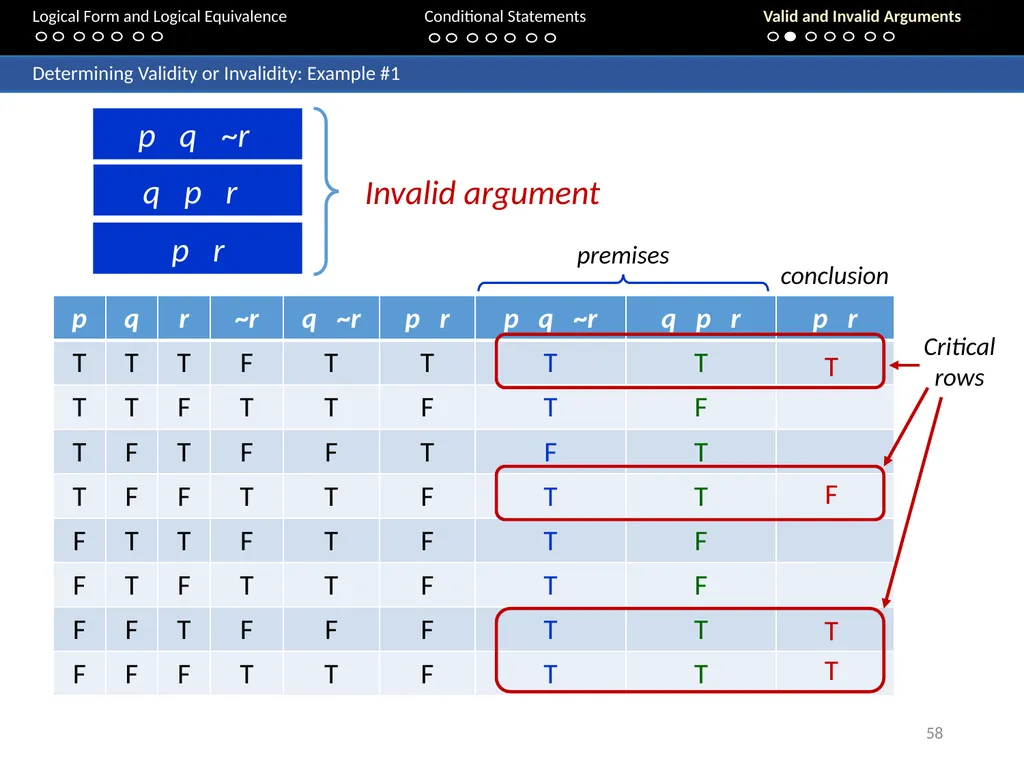
Logical Form and Logical Equivalence Conditional Statements Valid and Invalid Arguments Determining Validity or Invalidity: Example #1 58 T F T T conclusion<br>
59
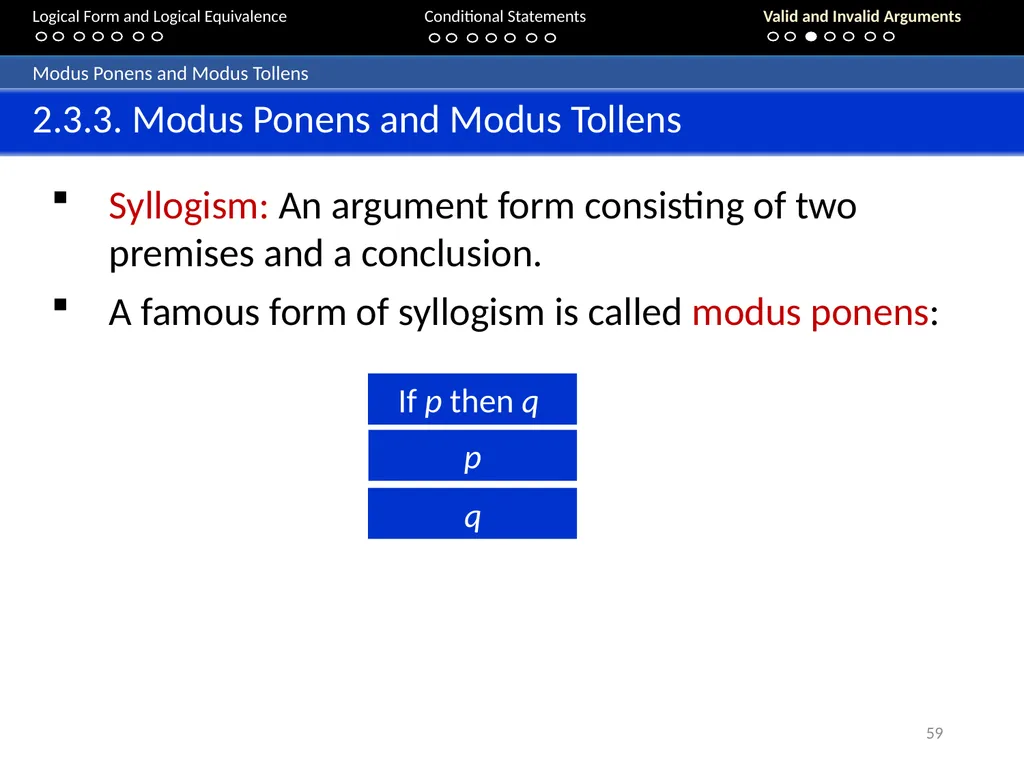
Logical Form and Logical Equivalence Conditional Statements Valid and Invalid Arguments Modus Ponens and Modus Tollens 59 2.3.3. Modus Ponens and Modus Tollens Syllogism: An argument form consisting of two premises and a conclusion. A famous form of syllogism is called modus ponens:<br>
60
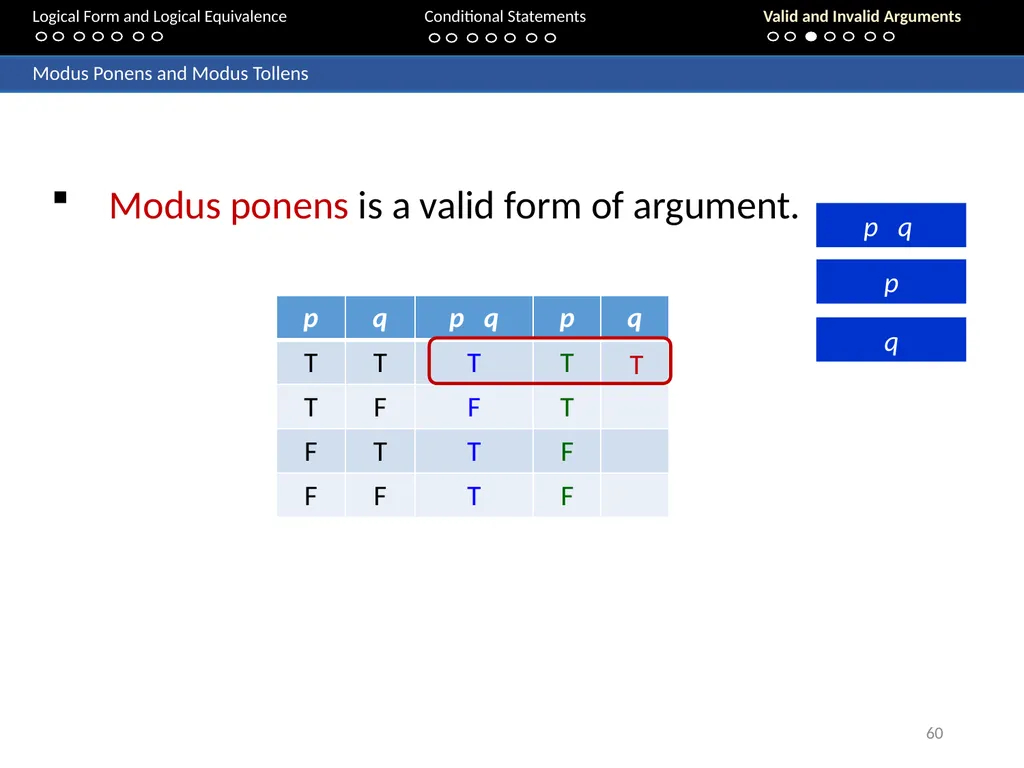
Logical Form and Logical Equivalence Conditional Statements Valid and Invalid Arguments Modus Ponens and Modus Tollens 60 Modus ponens is a valid form of argument. T<br>
61
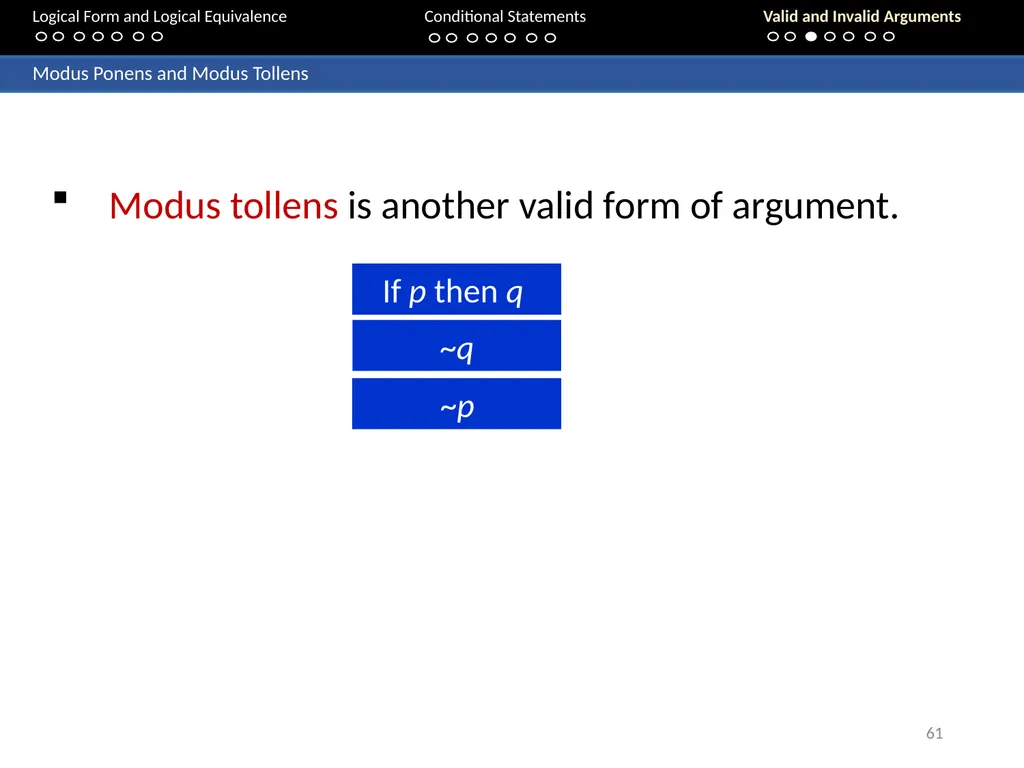
Logical Form and Logical Equivalence Conditional Statements Valid and Invalid Arguments Modus Ponens and Modus Tollens 61 Modus tollens is another valid form of argument.<br>
62
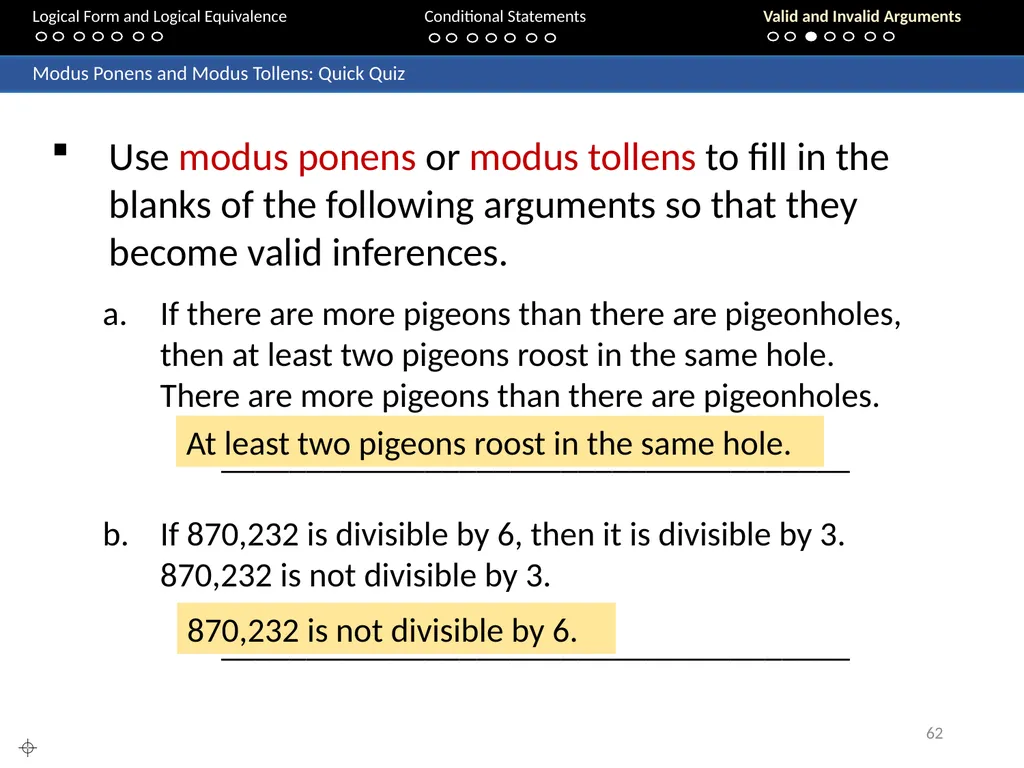
Logical Form and Logical Equivalence Conditional Statements Valid and Invalid Arguments Modus Ponens and Modus Tollens: Quick Quiz 62 Use modus ponens or modus tollens to fill in the blanks of the following arguments so that they become valid inferences.
If there are more pigeons than there are pigeonholes, then at least two pigeons roost in the same hole. There are more pigeons than there are pigeonholes.
_____________________________________
If 870,232 is divisible by 6, then it is divisible by 3. 870,232 is not divisible by 3.
_____________________________________ At least two pigeons roost in the same hole. 870,232 is not divisible by 6. <br>
If there are more pigeons than there are pigeonholes, then at least two pigeons roost in the same hole. There are more pigeons than there are pigeonholes.
_____________________________________
If 870,232 is divisible by 6, then it is divisible by 3. 870,232 is not divisible by 3.
_____________________________________ At least two pigeons roost in the same hole. 870,232 is not divisible by 6. <br>
63
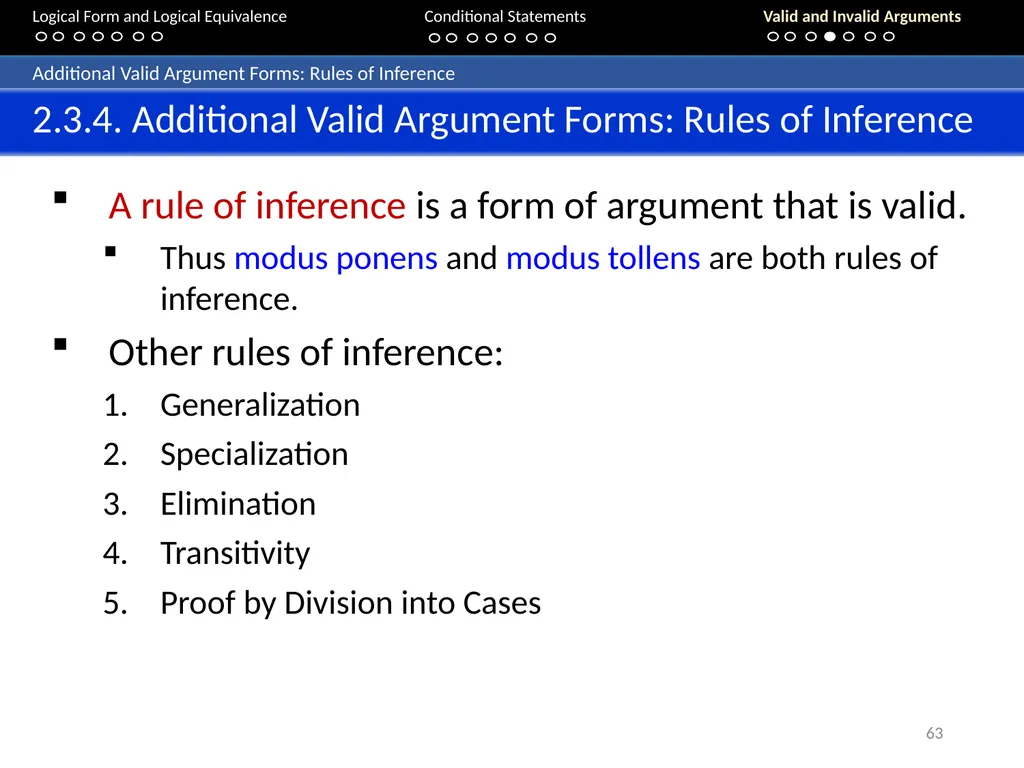
Logical Form and Logical Equivalence Conditional Statements Valid and Invalid Arguments Additional Valid Argument Forms: Rules of Inference 63 2.3.4. Additional Valid Argument Forms: Rules of Inference A rule of inference is a form of argument that is valid.
Thus modus ponens and modus tollens are both rules of inference.
Other rules of inference:
Generalization
Specialization
Elimination
Transitivity
Proof by Division into Cases<br>
Thus modus ponens and modus tollens are both rules of inference.
Other rules of inference:
Generalization
Specialization
Elimination
Transitivity
Proof by Division into Cases<br>
64
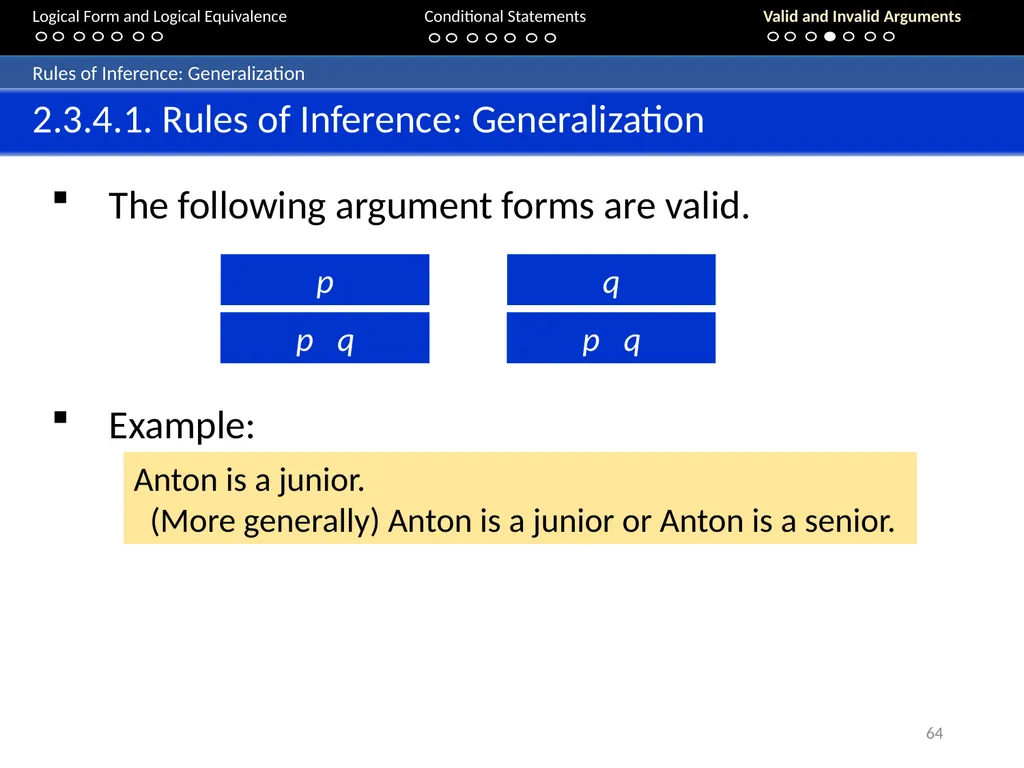
Logical Form and Logical Equivalence Conditional Statements Valid and Invalid Arguments Rules of Inference: Generalization 64 2.3.4.1. Rules of Inference: Generalization The following argument forms are valid. Example: Anton is a junior.
(More generally) Anton is a junior or Anton is a senior.<br>
(More generally) Anton is a junior or Anton is a senior.<br>
65
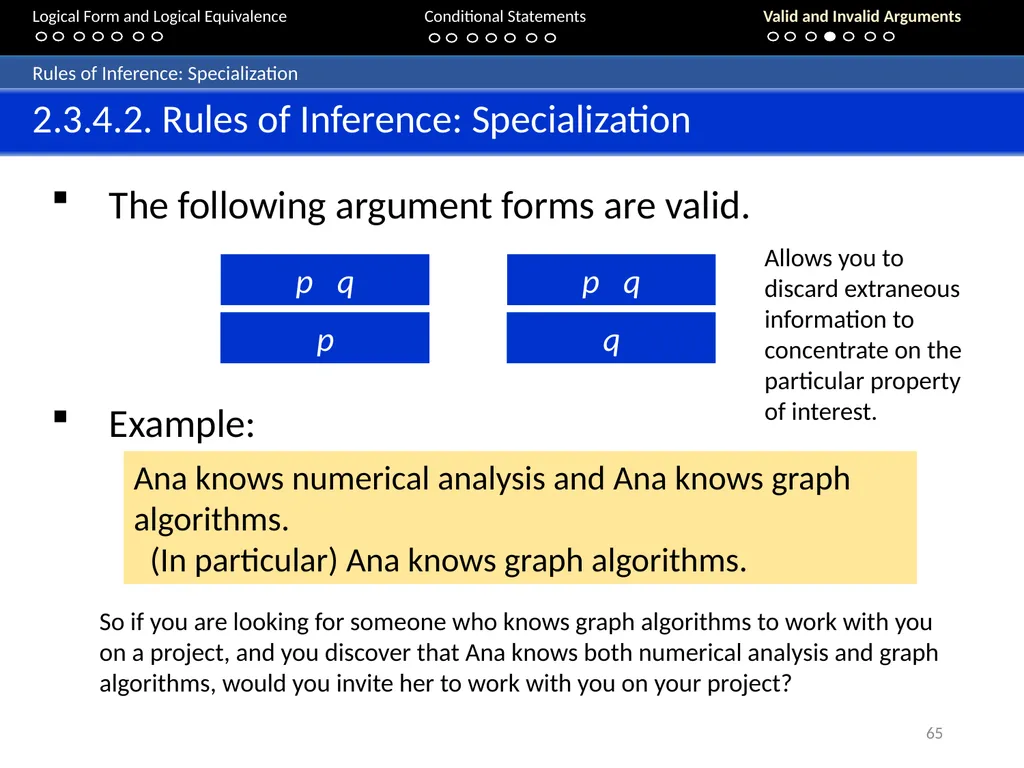
Logical Form and Logical Equivalence Conditional Statements Valid and Invalid Arguments Rules of Inference: Specialization 65 2.3.4.2. Rules of Inference: Specialization The following argument forms are valid. Example: Ana knows numerical analysis and Ana knows graph algorithms.
(In particular) Ana knows graph algorithms. Allows you to discard extraneous information to concentrate on the particular property of interest. So if you are looking for someone who knows graph algorithms to work with you on a project, and you discover that Ana knows both numerical analysis and graph algorithms, would you invite her to work with you on your project?<br>
(In particular) Ana knows graph algorithms. Allows you to discard extraneous information to concentrate on the particular property of interest. So if you are looking for someone who knows graph algorithms to work with you on a project, and you discover that Ana knows both numerical analysis and graph algorithms, would you invite her to work with you on your project?<br>
66
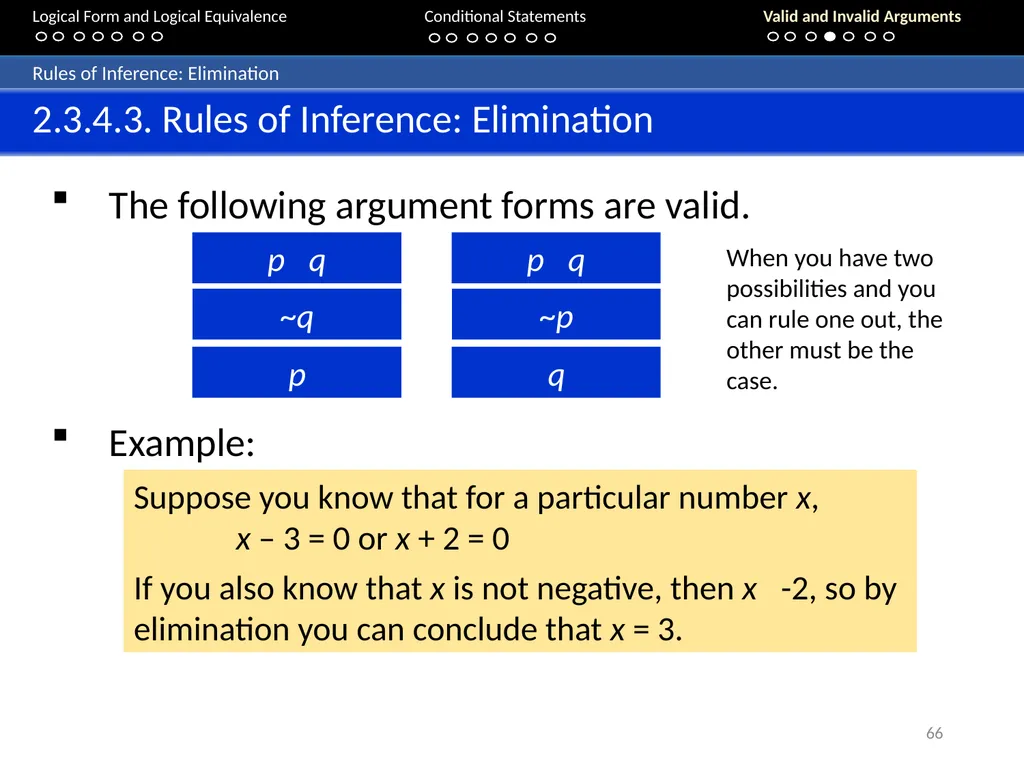
Logical Form and Logical Equivalence Conditional Statements Valid and Invalid Arguments Rules of Inference: Elimination 66 2.3.4.3. Rules of Inference: Elimination The following argument forms are valid. Example: Suppose you know that for a particular number x,
x – 3 = 0 or x + 2 = 0
If you also know that x is not negative, then x -2, so by elimination you can conclude that x = 3. When you have two possibilities and you can rule one out, the other must be the case.<br>
x – 3 = 0 or x + 2 = 0
If you also know that x is not negative, then x -2, so by elimination you can conclude that x = 3. When you have two possibilities and you can rule one out, the other must be the case.<br>
67
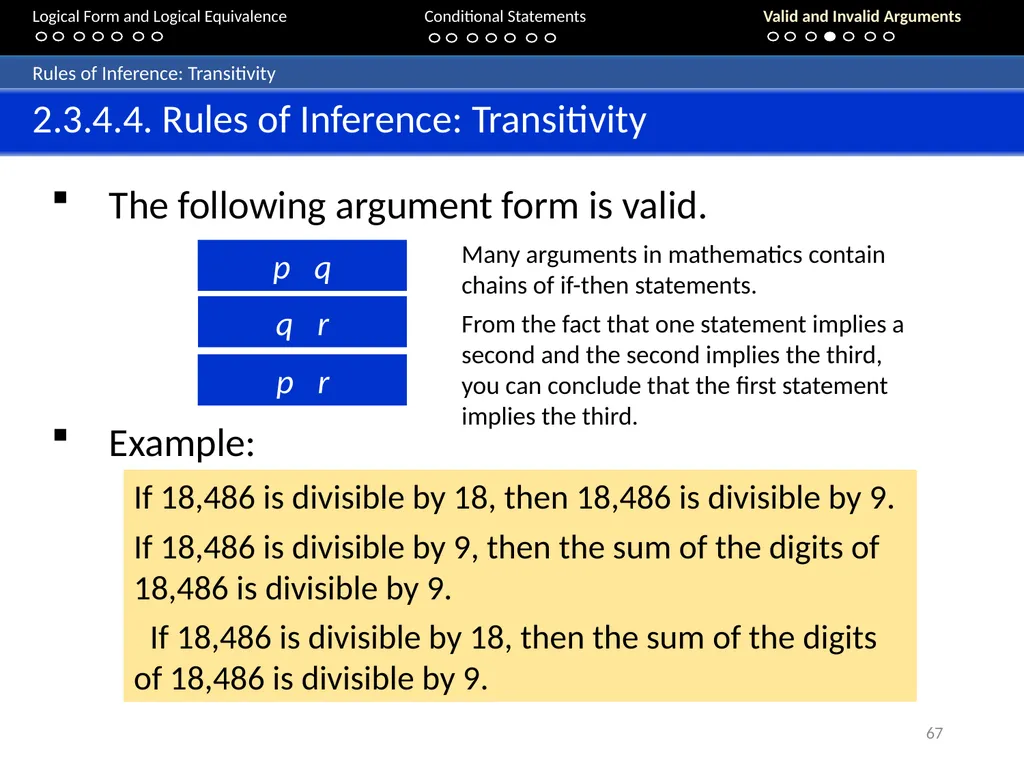
Logical Form and Logical Equivalence Conditional Statements Valid and Invalid Arguments Rules of Inference: Transitivity 67 2.3.4.4. Rules of Inference: Transitivity The following argument form is valid. Example: If 18,486 is divisible by 18, then 18,486 is divisible by 9.
If 18,486 is divisible by 9, then the sum of the digits of 18,486 is divisible by 9.
If 18,486 is divisible by 18, then the sum of the digits of 18,486 is divisible by 9. Many arguments in mathematics contain chains of if-then statements.
From the fact that one statement implies a second and the second implies the third, you can conclude that the first statement implies the third.<br>
If 18,486 is divisible by 9, then the sum of the digits of 18,486 is divisible by 9.
If 18,486 is divisible by 18, then the sum of the digits of 18,486 is divisible by 9. Many arguments in mathematics contain chains of if-then statements.
From the fact that one statement implies a second and the second implies the third, you can conclude that the first statement implies the third.<br>
68
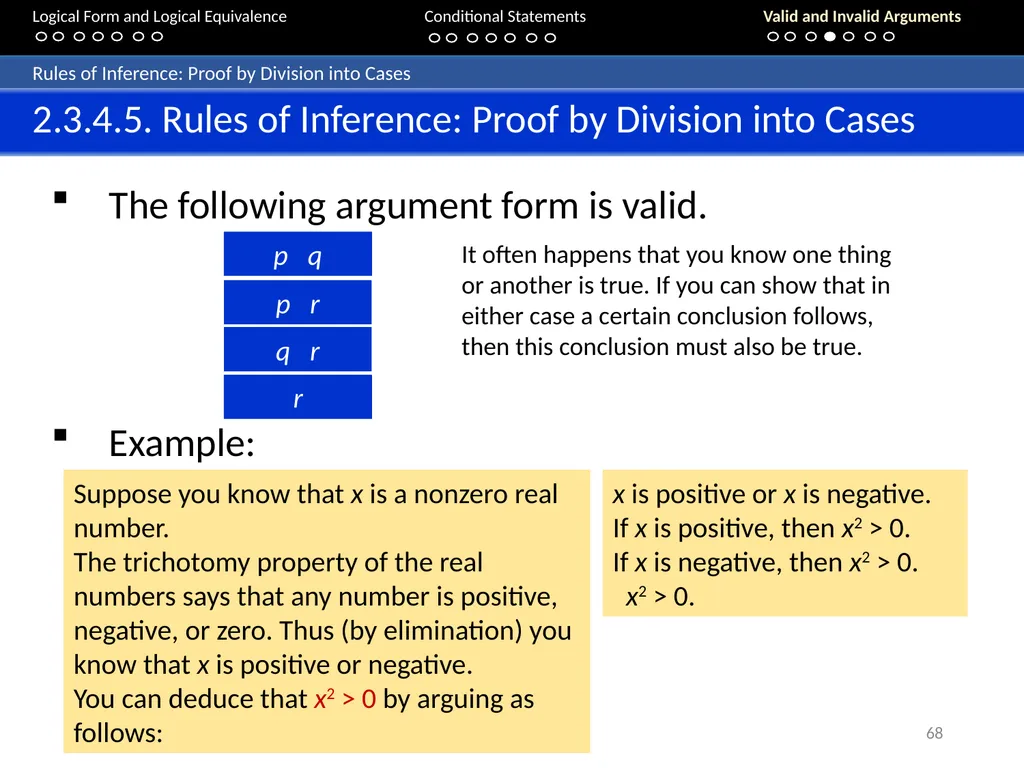
Logical Form and Logical Equivalence Conditional Statements Valid and Invalid Arguments Rules of Inference: Proof by Division into Cases 68 2.3.4.5. Rules of Inference: Proof by Division into Cases The following argument form is valid. Example: Suppose you know that x is a nonzero real number.
The trichotomy property of the real numbers says that any number is positive, negative, or zero. Thus (by elimination) you know that x is positive or negative.
You can deduce that x2 > 0 by arguing as follows: It often happens that you know one thing or another is true. If you can show that in either case a certain conclusion follows, then this conclusion must also be true. x is positive or x is negative.
If x is positive, then x2 > 0.
If x is negative, then x2 > 0.
x2 > 0.<br>
The trichotomy property of the real numbers says that any number is positive, negative, or zero. Thus (by elimination) you know that x is positive or negative.
You can deduce that x2 > 0 by arguing as follows: It often happens that you know one thing or another is true. If you can show that in either case a certain conclusion follows, then this conclusion must also be true. x is positive or x is negative.
If x is positive, then x2 > 0.
If x is negative, then x2 > 0.
x2 > 0.<br>
69
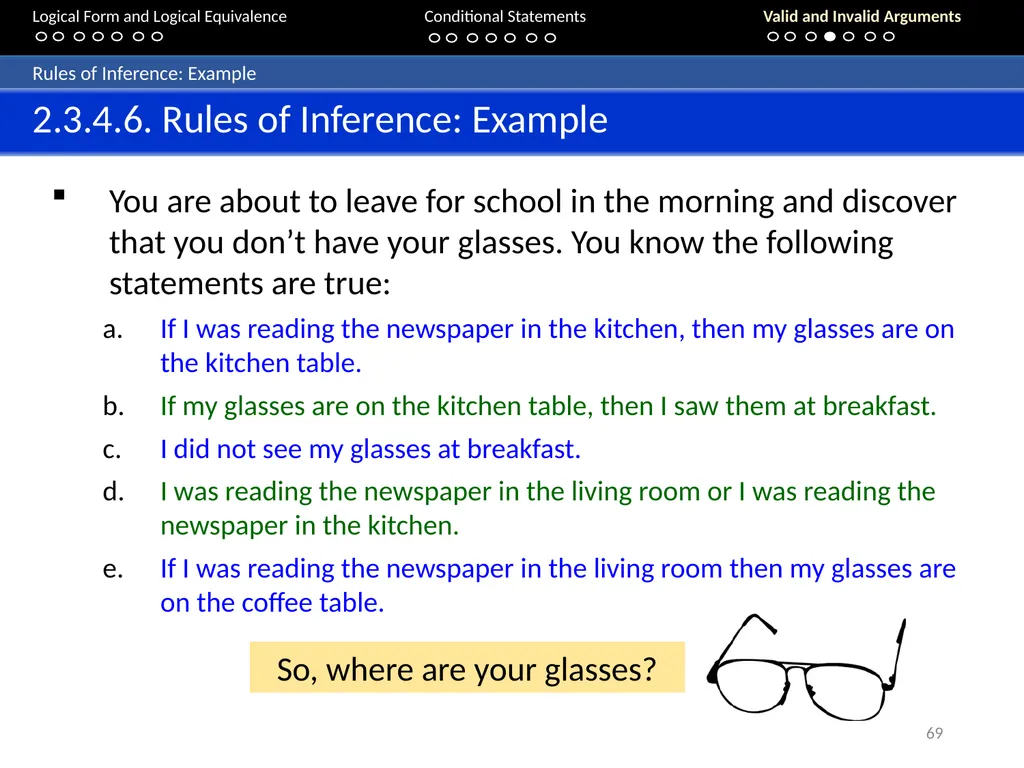
Logical Form and Logical Equivalence Conditional Statements Valid and Invalid Arguments Rules of Inference: Example 69 2.3.4.6. Rules of Inference: Example You are about to leave for school in the morning and discover that you don’t have your glasses. You know the following statements are true:
If I was reading the newspaper in the kitchen, then my glasses are on the kitchen table.
If my glasses are on the kitchen table, then I saw them at breakfast.
I did not see my glasses at breakfast.
I was reading the newspaper in the living room or I was reading the newspaper in the kitchen.
If I was reading the newspaper in the living room then my glasses are on the coffee table. So, where are your glasses?<br>
If I was reading the newspaper in the kitchen, then my glasses are on the kitchen table.
If my glasses are on the kitchen table, then I saw them at breakfast.
I did not see my glasses at breakfast.
I was reading the newspaper in the living room or I was reading the newspaper in the kitchen.
If I was reading the newspaper in the living room then my glasses are on the coffee table. So, where are your glasses?<br>
70
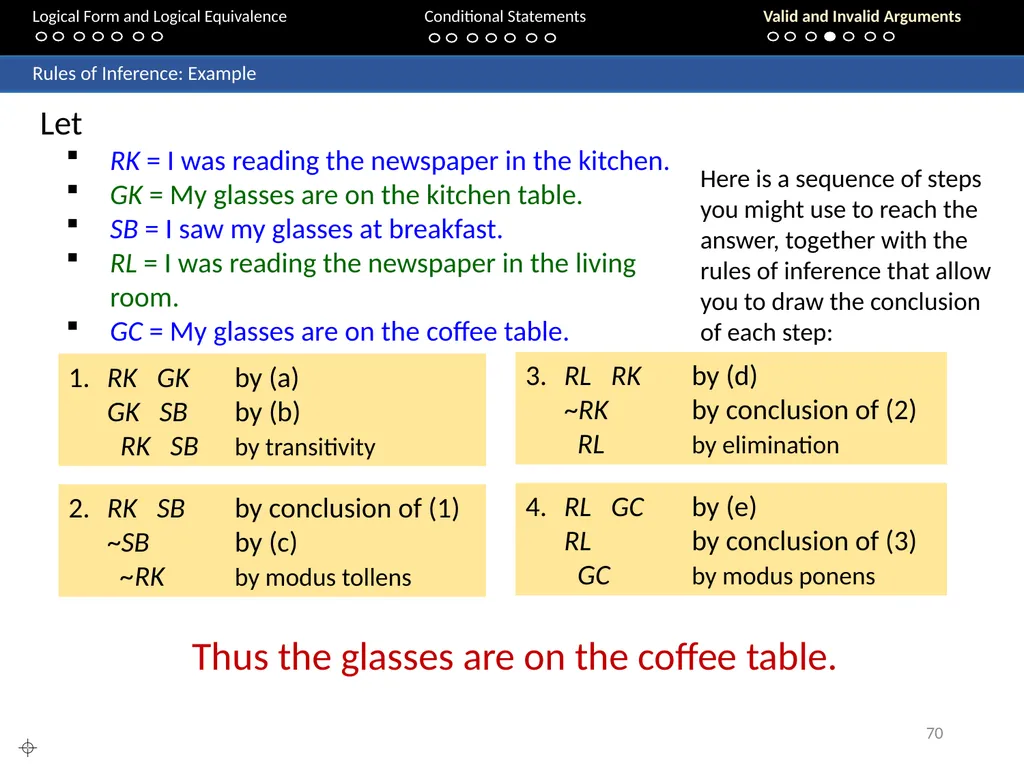
Logical Form and Logical Equivalence Conditional Statements Valid and Invalid Arguments Rules of Inference: Example 70 Let
RK = I was reading the newspaper in the kitchen.
GK = My glasses are on the kitchen table.
SB = I saw my glasses at breakfast.
RL = I was reading the newspaper in the living room.
GC = My glasses are on the coffee table. Here is a sequence of steps you might use to reach the answer, together with the rules of inference that allow you to draw the conclusion of each step: 1. RK GK by (a)
GK SB by (b)
RK SB by transitivity 2. RK SB by conclusion of (1)
~SB by (c)
~RK by modus tollens 3. RL RK by (d)
~RK by conclusion of (2)
RL by elimination 4. RL GC by (e)
RL by conclusion of (3)
GC by modus ponens Thus the glasses are on the coffee table. <br>
RK = I was reading the newspaper in the kitchen.
GK = My glasses are on the kitchen table.
SB = I saw my glasses at breakfast.
RL = I was reading the newspaper in the living room.
GC = My glasses are on the coffee table. Here is a sequence of steps you might use to reach the answer, together with the rules of inference that allow you to draw the conclusion of each step: 1. RK GK by (a)
GK SB by (b)
RK SB by transitivity 2. RK SB by conclusion of (1)
~SB by (c)
~RK by modus tollens 3. RL RK by (d)
~RK by conclusion of (2)
RL by elimination 4. RL GC by (e)
RL by conclusion of (3)
GC by modus ponens Thus the glasses are on the coffee table. <br>
71
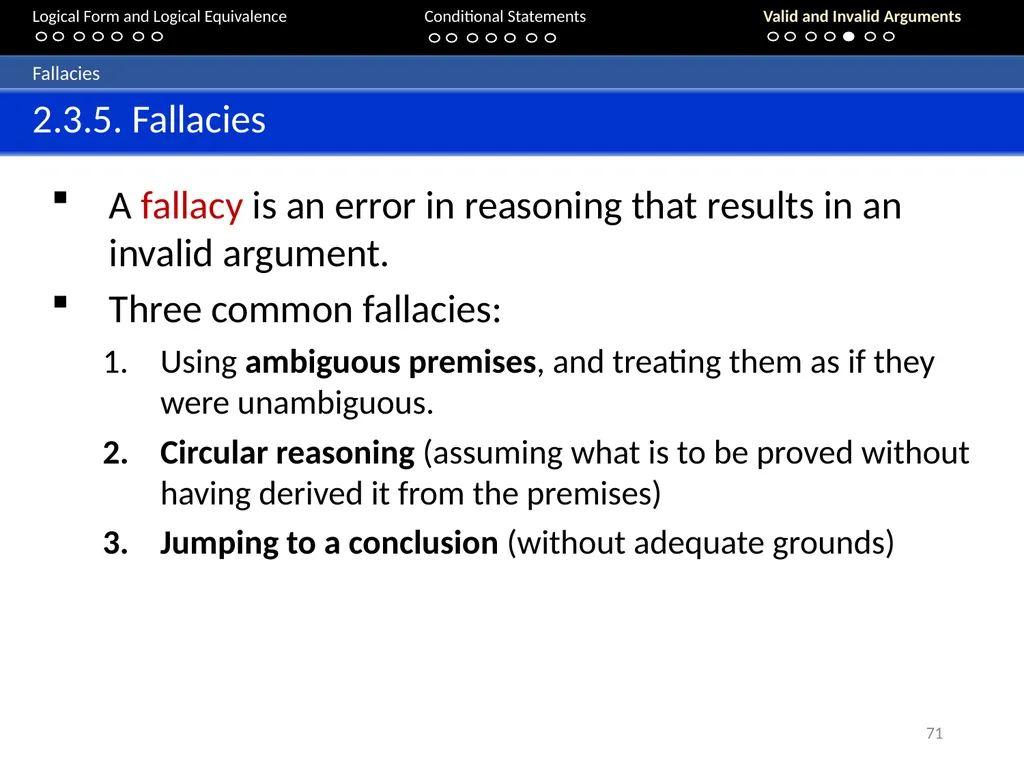
Logical Form and Logical Equivalence Conditional Statements Valid and Invalid Arguments Fallacies 71 2.3.5. Fallacies A fallacy is an error in reasoning that results in an invalid argument.
Three common fallacies:
Using ambiguous premises, and treating them as if they were unambiguous.
Circular reasoning (assuming what is to be proved without having derived it from the premises)
Jumping to a conclusion (without adequate grounds)<br>
Three common fallacies:
Using ambiguous premises, and treating them as if they were unambiguous.
Circular reasoning (assuming what is to be proved without having derived it from the premises)
Jumping to a conclusion (without adequate grounds)<br>
72
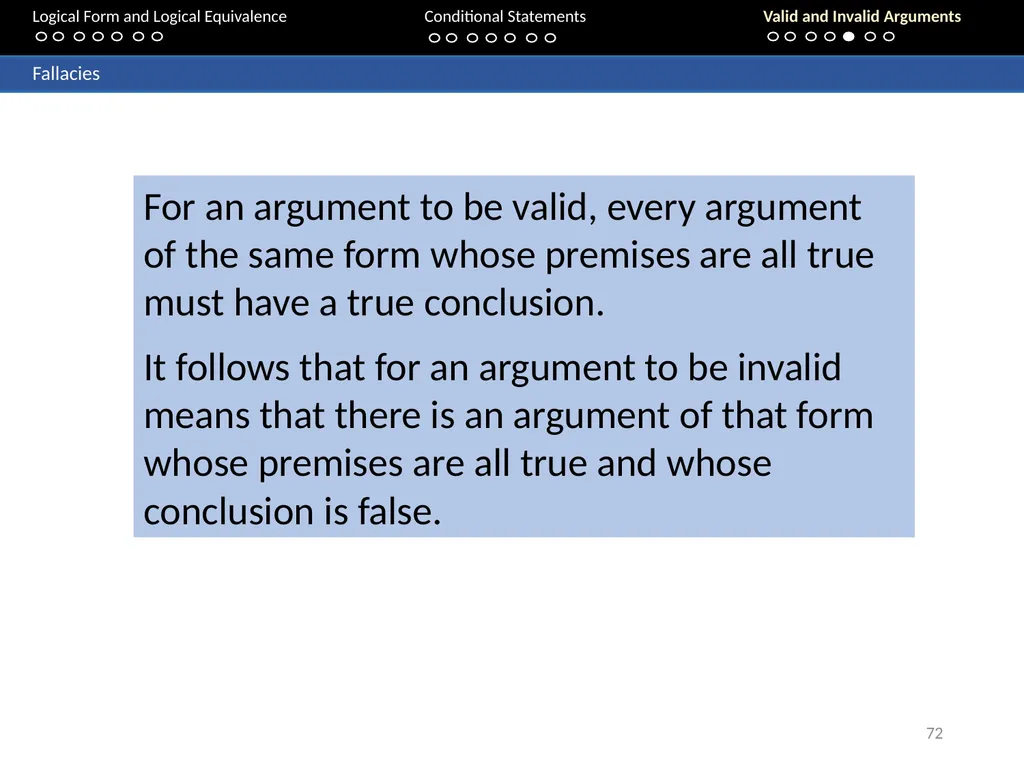
Logical Form and Logical Equivalence Conditional Statements Valid and Invalid Arguments Fallacies 72 For an argument to be valid, every argument of the same form whose premises are all true must have a true conclusion.
It follows that for an argument to be invalid means that there is an argument of that form whose premises are all true and whose conclusion is false.<br>
It follows that for an argument to be invalid means that there is an argument of that form whose premises are all true and whose conclusion is false.<br>
73
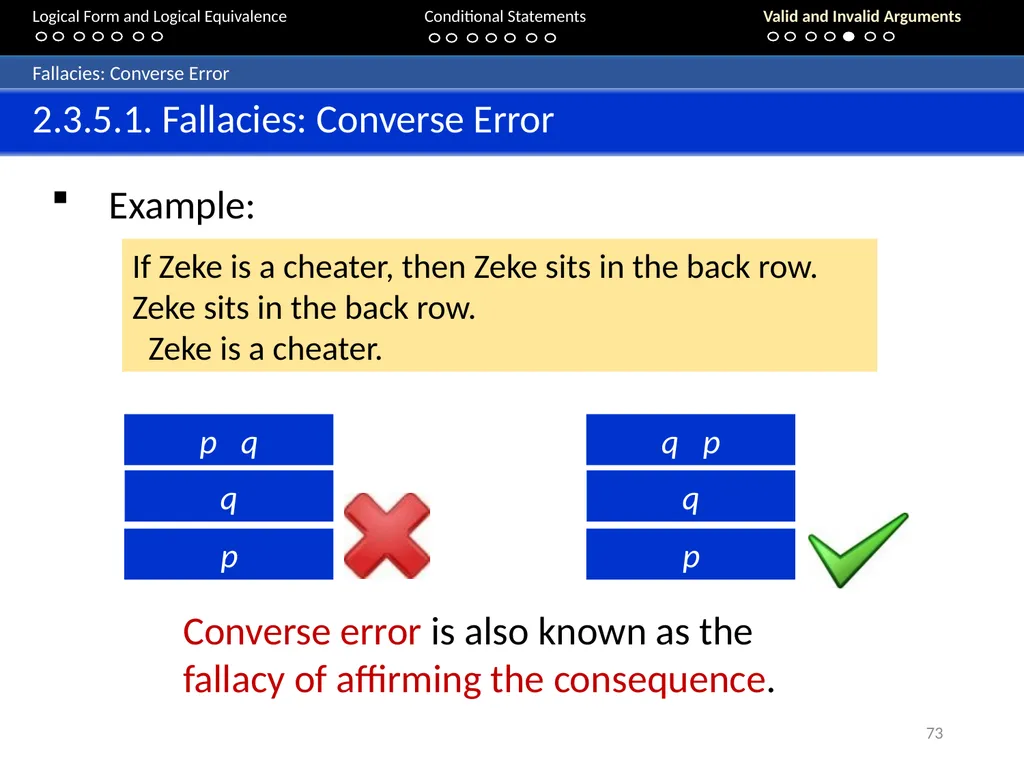
Logical Form and Logical Equivalence Conditional Statements Valid and Invalid Arguments Fallacies: Converse Error 73 2.3.5.1. Fallacies: Converse Error Example: If Zeke is a cheater, then Zeke sits in the back row.
Zeke sits in the back row.
Zeke is a cheater. Converse error is also known as the fallacy of affirming the consequence.<br>
Zeke sits in the back row.
Zeke is a cheater. Converse error is also known as the fallacy of affirming the consequence.<br>
74
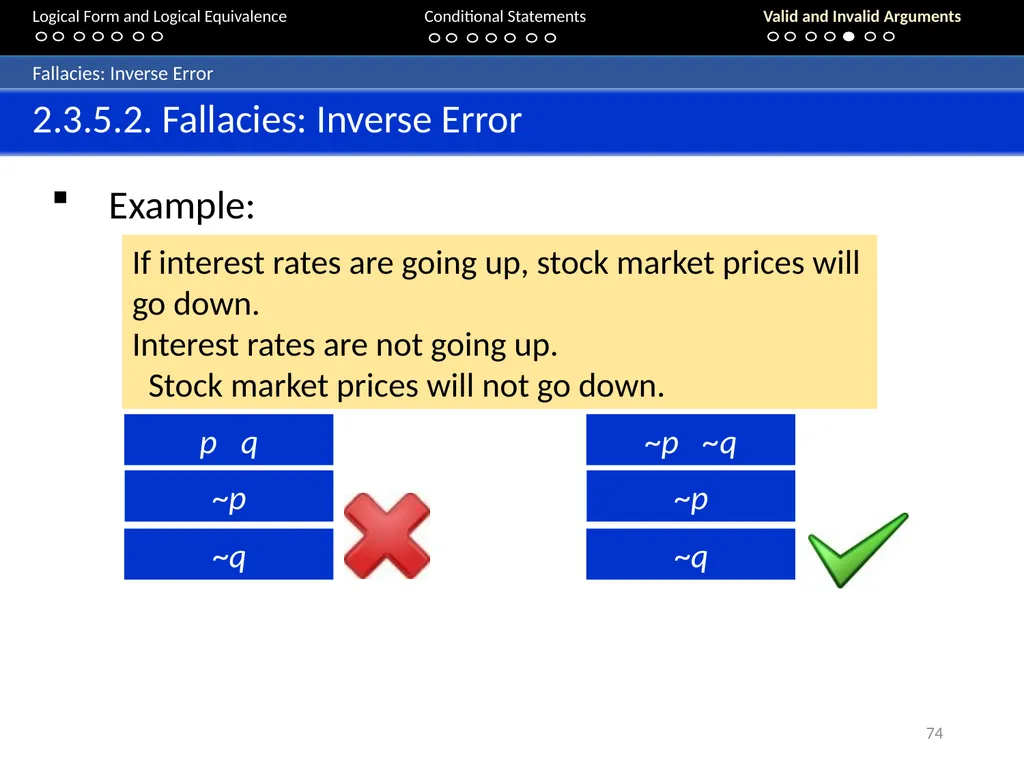
Logical Form and Logical Equivalence Conditional Statements Valid and Invalid Arguments Fallacies: Inverse Error 74 2.3.5.2. Fallacies: Inverse Error Example: If interest rates are going up, stock market prices will go down.
Interest rates are not going up.
Stock market prices will not go down.<br>
Interest rates are not going up.
Stock market prices will not go down.<br>
75
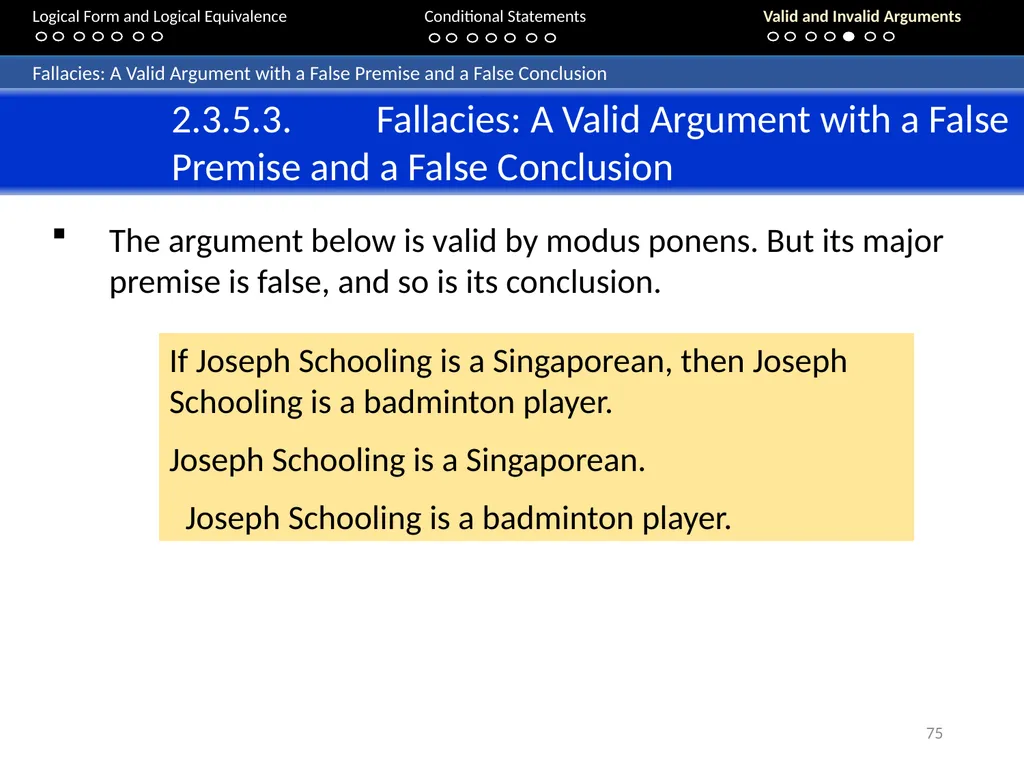
Logical Form and Logical Equivalence Conditional Statements Valid and Invalid Arguments Fallacies: A Valid Argument with a False Premise and a False Conclusion 75 2.3.5.3. Fallacies: A Valid Argument with a False Premise and a False Conclusion The argument below is valid by modus ponens. But its major premise is false, and so is its conclusion. If Joseph Schooling is a Singaporean, then Joseph Schooling is a badminton player.
Joseph Schooling is a Singaporean.
Joseph Schooling is a badminton player.<br>
Joseph Schooling is a Singaporean.
Joseph Schooling is a badminton player.<br>
76
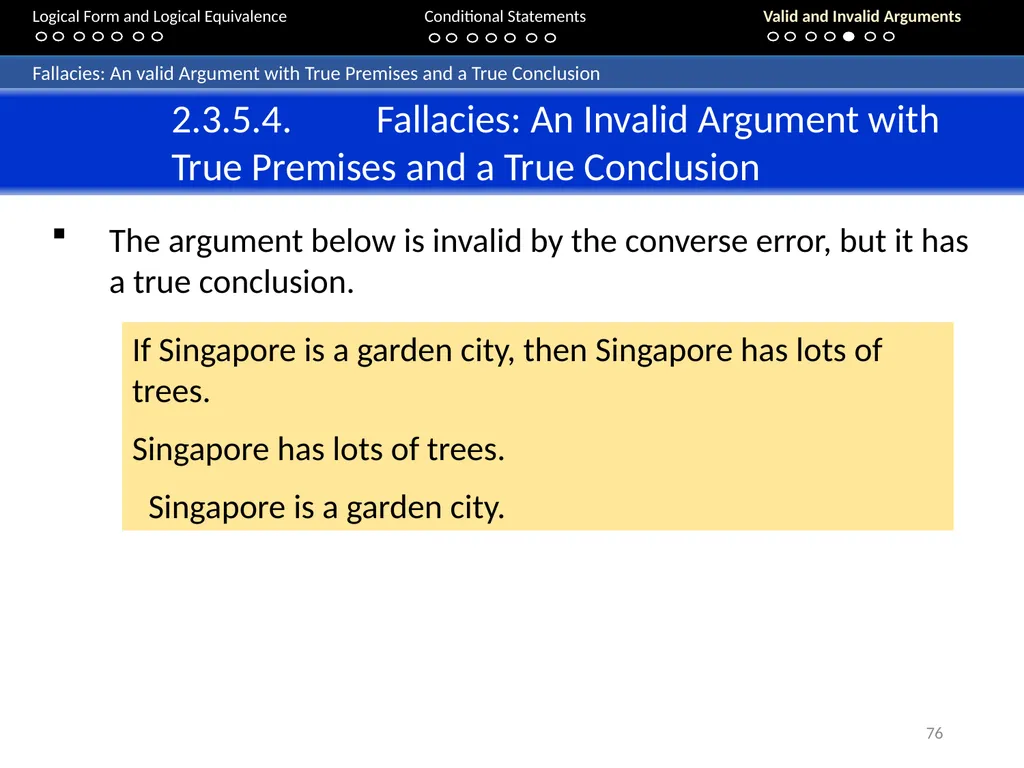
Logical Form and Logical Equivalence Conditional Statements Valid and Invalid Arguments Fallacies: An valid Argument with True Premises and a True Conclusion 76 2.3.5.4. Fallacies: An Invalid Argument with True Premises and a True Conclusion The argument below is invalid by the converse error, but it has a true conclusion. If Singapore is a garden city, then Singapore has lots of trees.
Singapore has lots of trees.
Singapore is a garden city.<br>
Singapore has lots of trees.
Singapore is a garden city.<br>
77
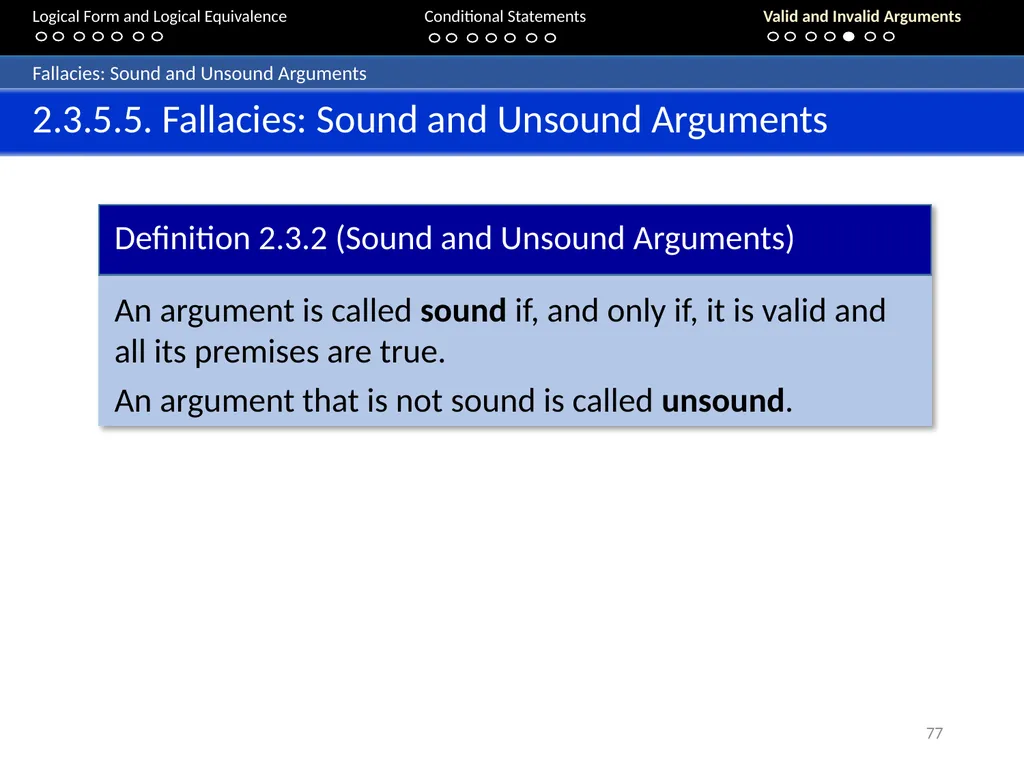
Logical Form and Logical Equivalence Conditional Statements Valid and Invalid Arguments Fallacies: Sound and Unsound Arguments 77 2.3.5.5. Fallacies: Sound and Unsound Arguments<br>
78
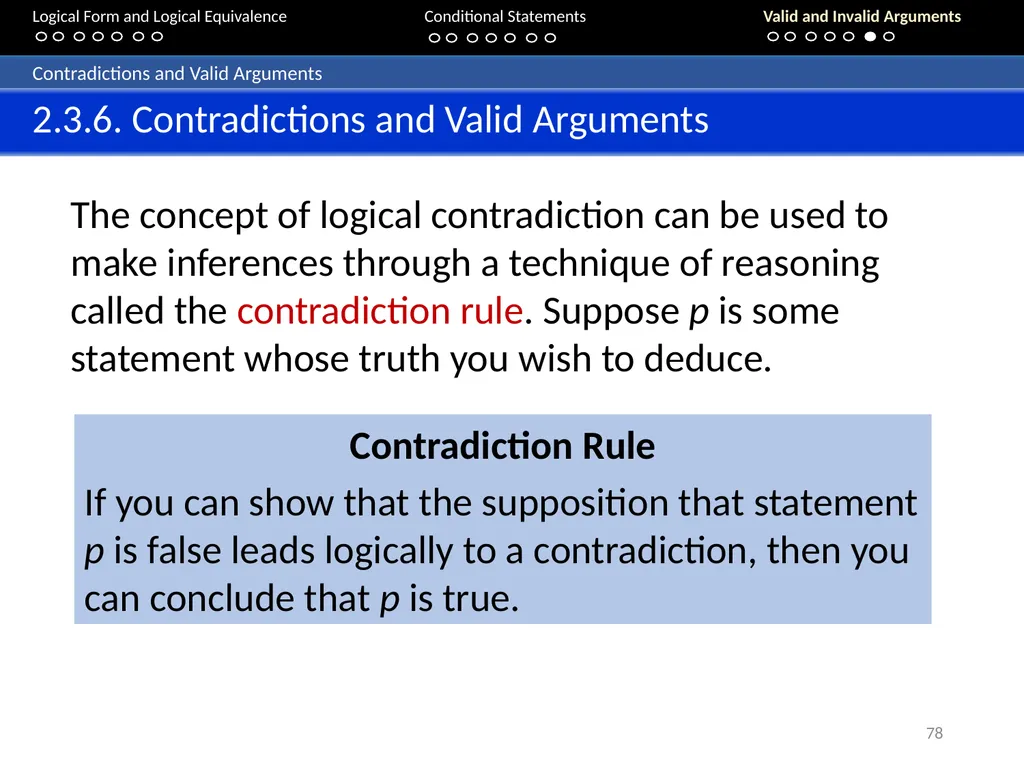
Logical Form and Logical Equivalence Conditional Statements Valid and Invalid Arguments Contradictions and Valid Arguments 78 2.3.6. Contradictions and Valid Arguments The concept of logical contradiction can be used to make inferences through a technique of reasoning called the contradiction rule. Suppose p is some statement whose truth you wish to deduce. Contradiction Rule
If you can show that the supposition that statement p is false leads logically to a contradiction, then you can conclude that p is true.<br>
If you can show that the supposition that statement p is false leads logically to a contradiction, then you can conclude that p is true.<br>
79
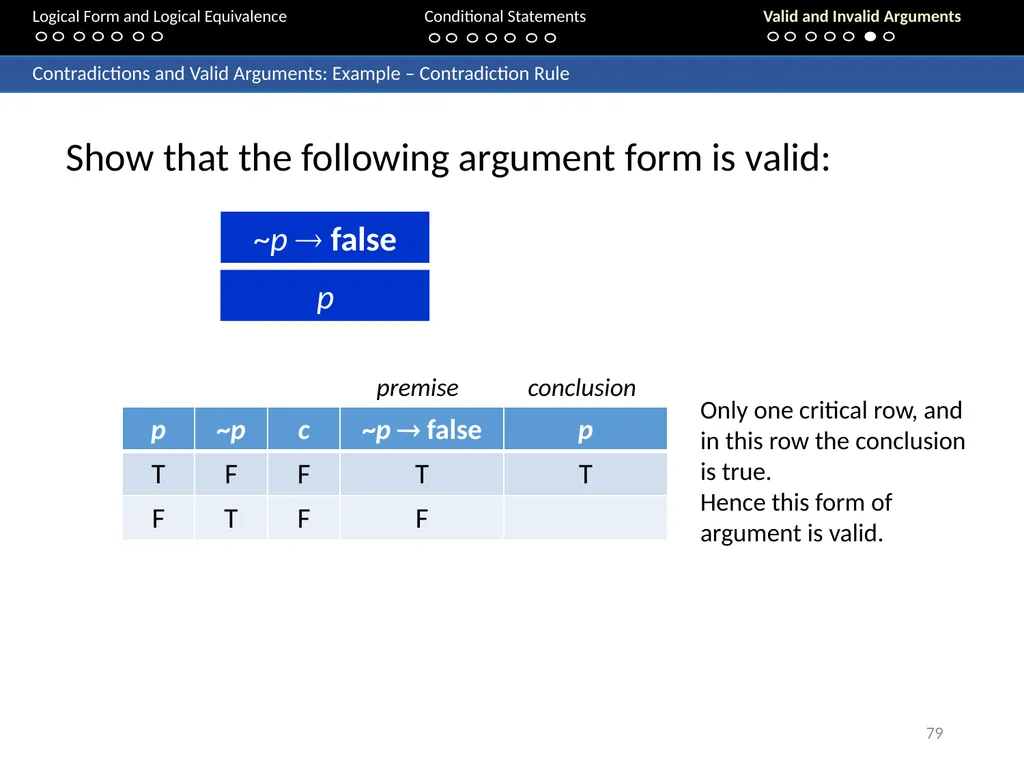
Logical Form and Logical Equivalence Conditional Statements Valid and Invalid Arguments Contradictions and Valid Arguments: Example – Contradiction Rule 79 Show that the following argument form is valid: premise conclusion Only one critical row, and in this row the conclusion is true.
Hence this form of argument is valid.<br>
Hence this form of argument is valid.<br>
80
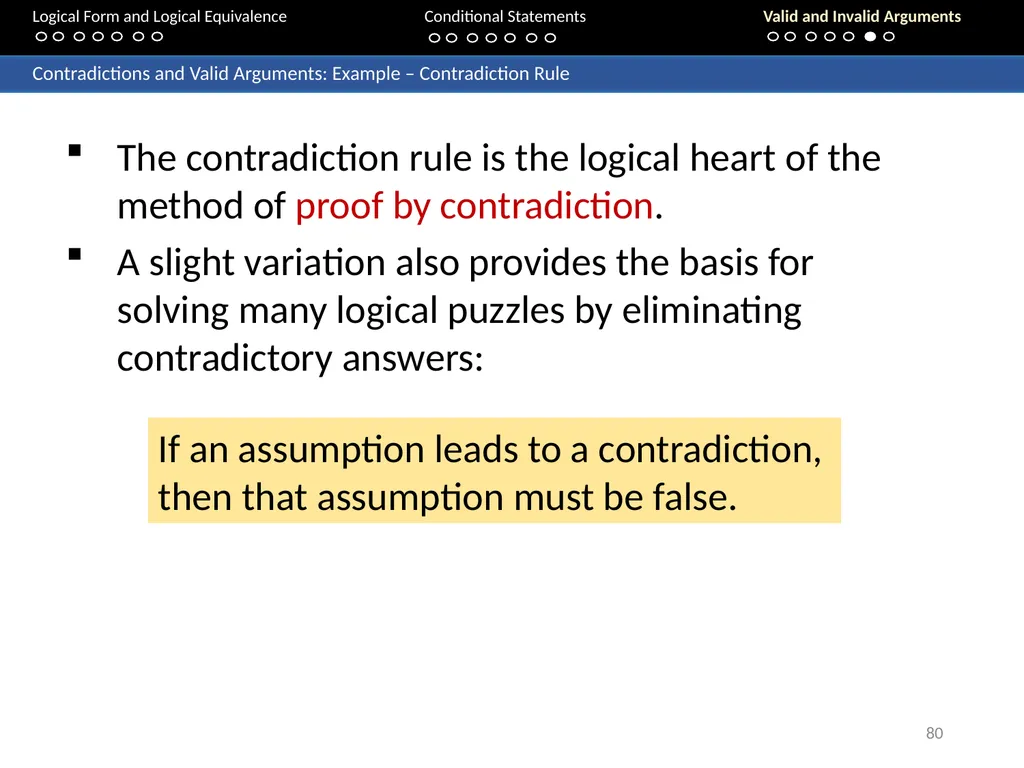
Logical Form and Logical Equivalence Conditional Statements Valid and Invalid Arguments Contradictions and Valid Arguments: Example – Contradiction Rule 80 The contradiction rule is the logical heart of the method of proof by contradiction.
A slight variation also provides the basis for solving many logical puzzles by eliminating contradictory answers: If an assumption leads to a contradiction, then that assumption must be false.<br>
A slight variation also provides the basis for solving many logical puzzles by eliminating contradictory answers: If an assumption leads to a contradiction, then that assumption must be false.<br>
81
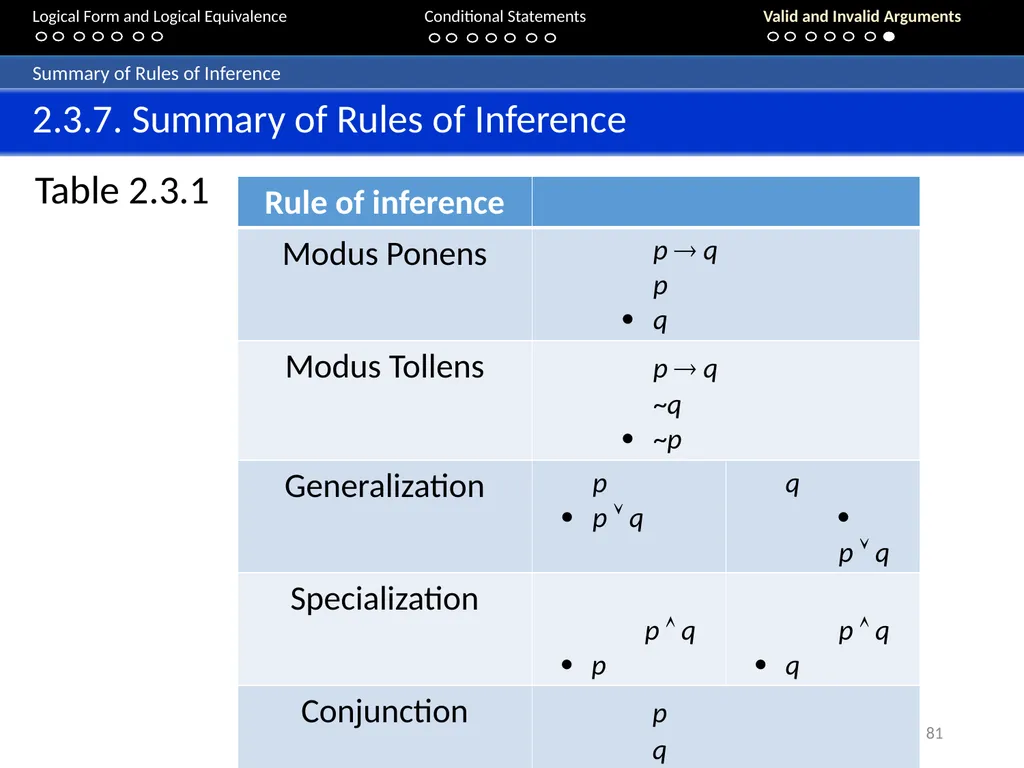
Logical Form and Logical Equivalence Conditional Statements Valid and Invalid Arguments Summary of Rules of Inference 81 2.3.7. Summary of Rules of Inference Table 2.3.1<br>
82
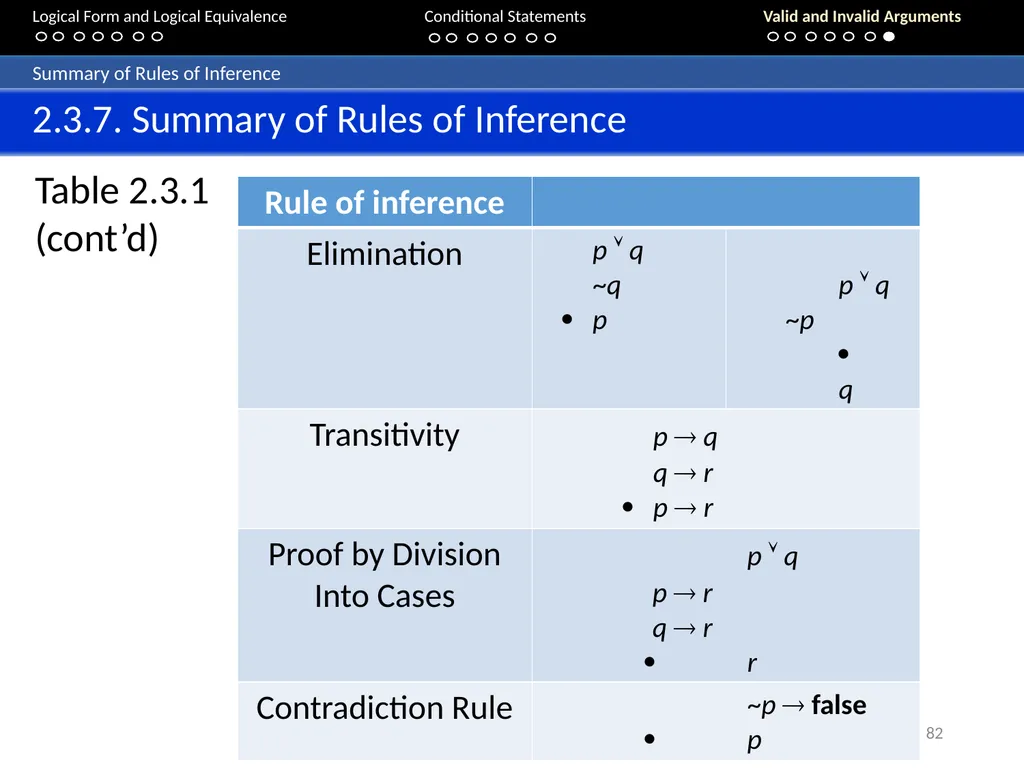
Logical Form and Logical Equivalence Conditional Statements Valid and Invalid Arguments Summary of Rules of Inference 82 2.3.7. Summary of Rules of Inference Table 2.3.1
(cont’d)<br>
(cont’d)<br>
83
83 Next week’s lectures 3. The Logic of Quantified Statements <br>
84
84 END OF FILE<br>