
Aaron Tan Lecture 1: Speaking Mathematically





Description: Aaron Tan Lecture 1: Speaking Mathematically Variables and Important Sets Mathematical Statements Proofs 1 AY202627 Semester 1 Variables and Important Sets Mathematical Statements Proofs 2 1. Speaking Mathematically Reference: Epps
Related Topics
Download Presentation
"Aaron Tan Lecture 1: Speaking Mathematically" is the property of its rightful owner. Permission is granted to download and print the materials on this website for personal, non-commercial use only, and to display it on your personal computer provided you do not modify the materials and that you retain all copyright notices contained in the materials. By downloading content from our website, you accept the terms of this agreement.
Presentation Transcript
slide1. Aaron Tan Lecture 1: Speaking Mathematically Variables and Important Sets Mathematical Statements Proofs 1 AY2026/27 Semester 1<br>
slide2. Variables and Important Sets Mathematical Statements Proofs 2 1. Speaking Mathematically Reference: Epp’s Chapter 1 Speaking Mathematically<br>
slide3. 1. Speaking Mathematically Variables and Important Sets Mathematical Statements Proofs 3 1. Speaking Mathematically The language of mathematics is the systems used by mathematicians to communicate mathematical ideas among themselves. Symbols, vocabulary, grammatical structures, conventions, abbreviations.<br>
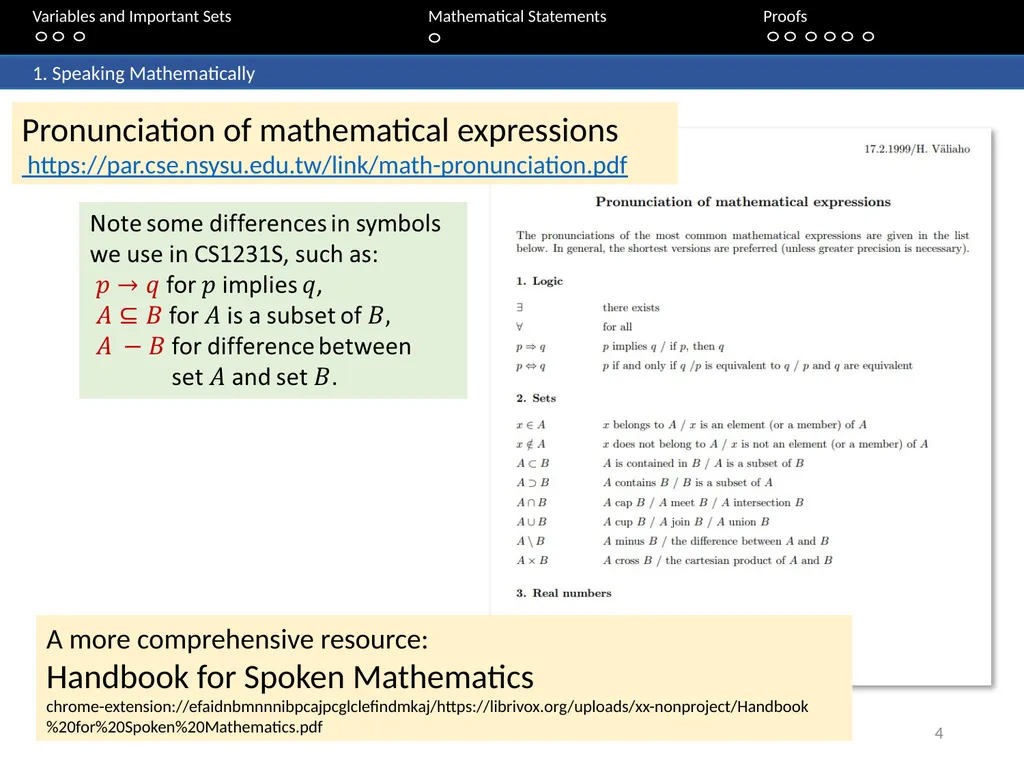
slide4. Variables and Important Sets Mathematical Statements Proofs 4 1. Speaking Mathematically Pronunciation of mathematical expressions
https://par.cse.nsysu.edu.tw/link/math-pronunciation.pdf A more comprehensive resource:
Handbook for Spoken Mathematics
chrome-extension://efaidnbmnnnibpcajpcglclefindmkaj/https://librivox.org/uploads/xx-nonproject/Handbook%20for%20Spoken%20Mathematics.pdf<br>
slide5. Variables and Important Sets Mathematical Statements Proofs 5 1.1 Variables and Important Sets<br>
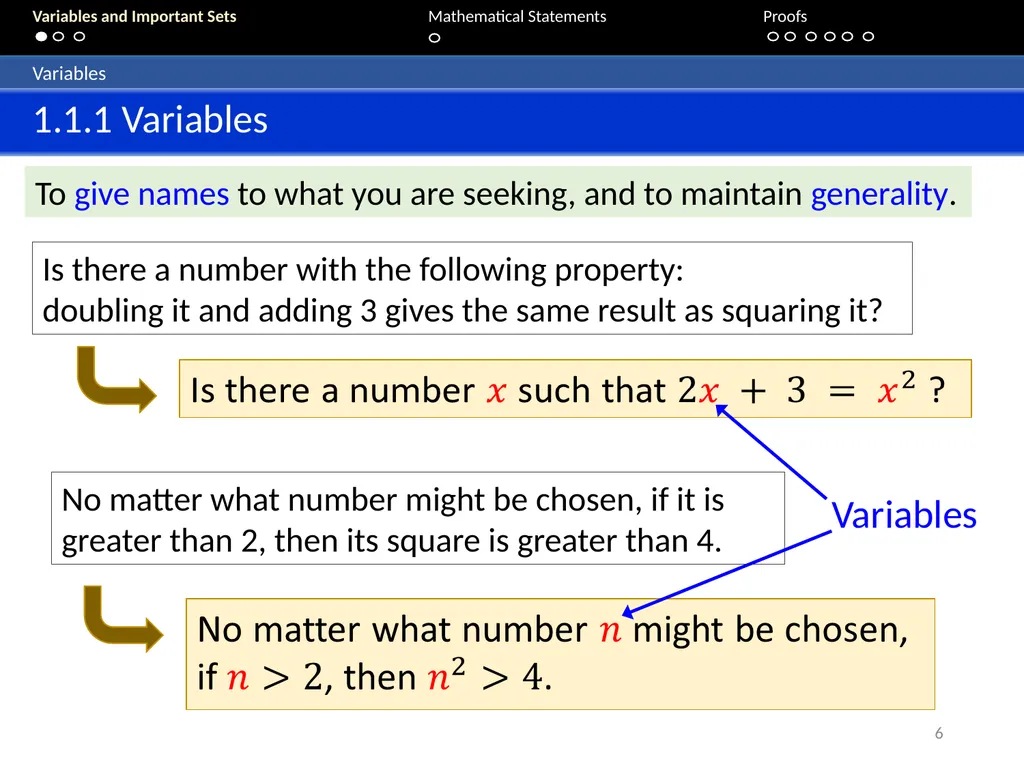
slide6. Variables and Important Sets Mathematical Statements Proofs Variables Is there a number with the following property:
doubling it and adding 3 gives the same result as squaring it? 6 1.1.1 Variables No matter what number might be chosen, if it is greater than 2, then its square is greater than 4. To give names to what you are seeking, and to maintain generality.<br>
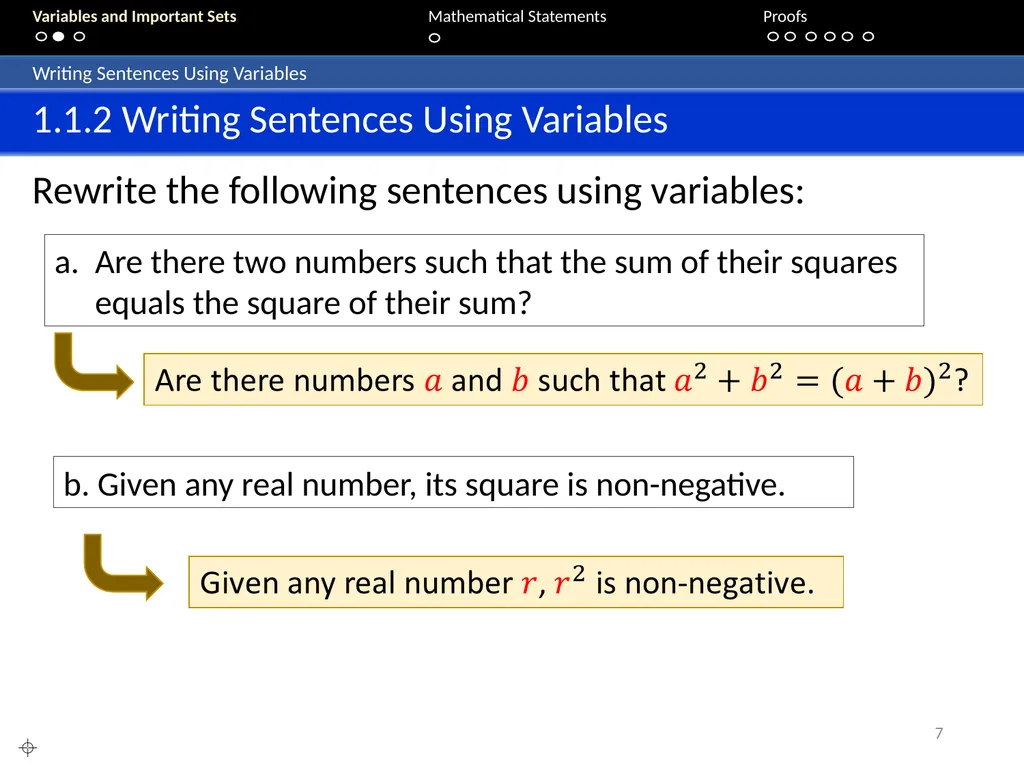
slide7. Variables and Important Sets Mathematical Statements Proofs Writing Sentences Using Variables a. Are there two numbers such that the sum of their squares equals the square of their sum? 7 1.1.2 Writing Sentences Using Variables b. Given any real number, its square is non-negative. Rewrite the following sentences using variables:<br>
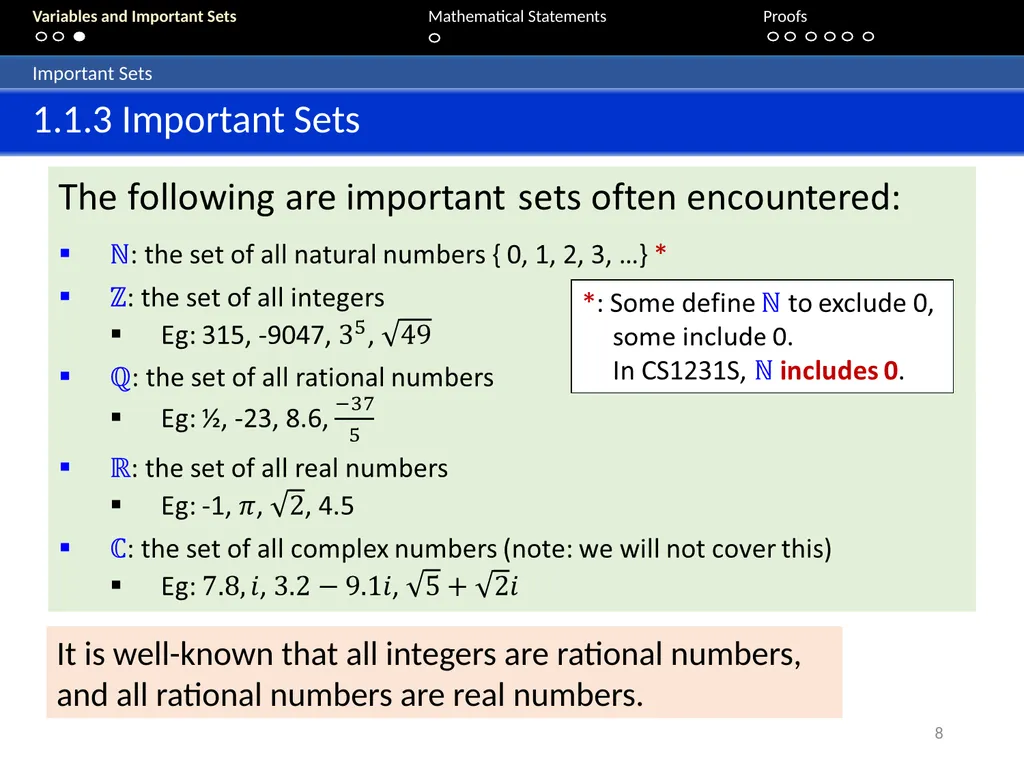
slide8. Variables and Important Sets Mathematical Statements Proofs Important Sets 8 1.1.3 Important Sets It is well-known that all integers are rational numbers, and all rational numbers are real numbers.<br>
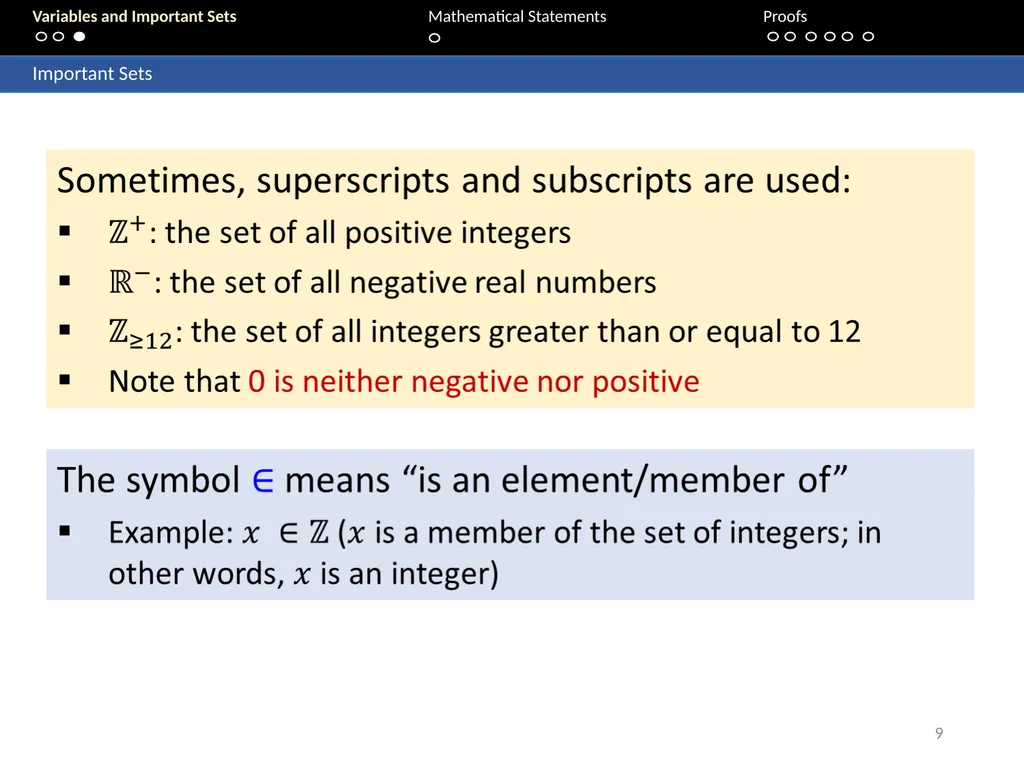
slide9. Variables and Important Sets Mathematical Statements Proofs Important Sets 9<br>
slide10. Variables and Important Sets Mathematical Statements Proofs 10 1.2 Some Important Kinds of Mathematical Statements<br>
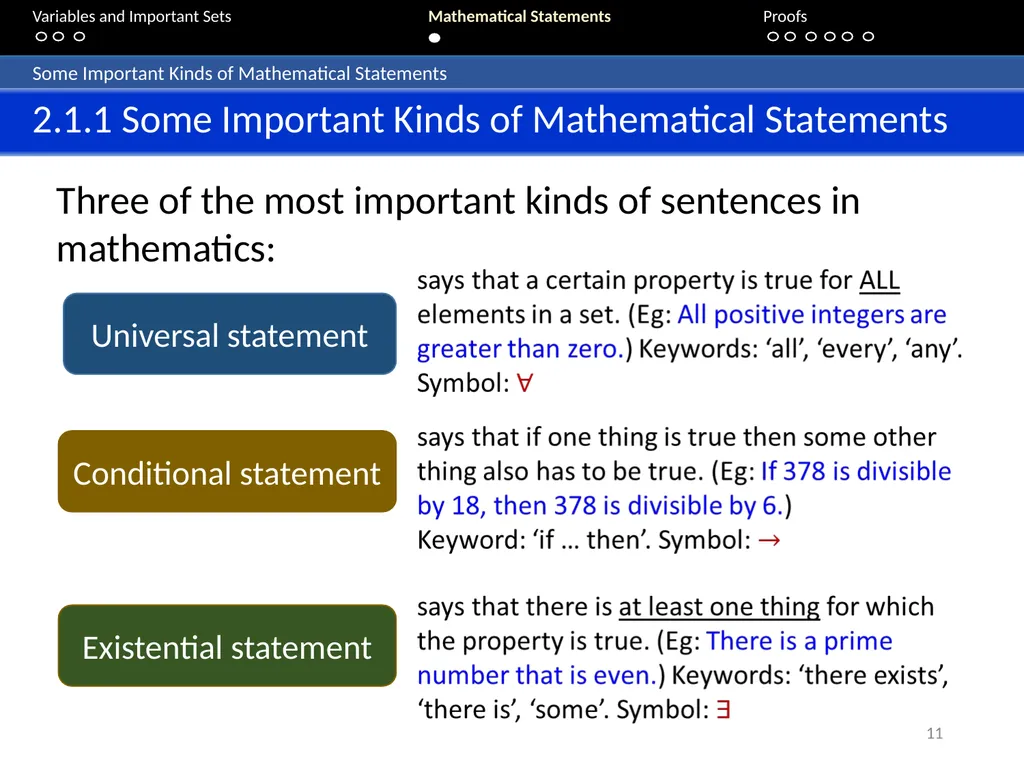
slide11. Variables and Important Sets Mathematical Statements Proofs Some Important Kinds of Mathematical Statements 11 2.1.1 Some Important Kinds of Mathematical Statements Three of the most important kinds of sentences in mathematics: Universal statement Conditional statement Existential statement<br>
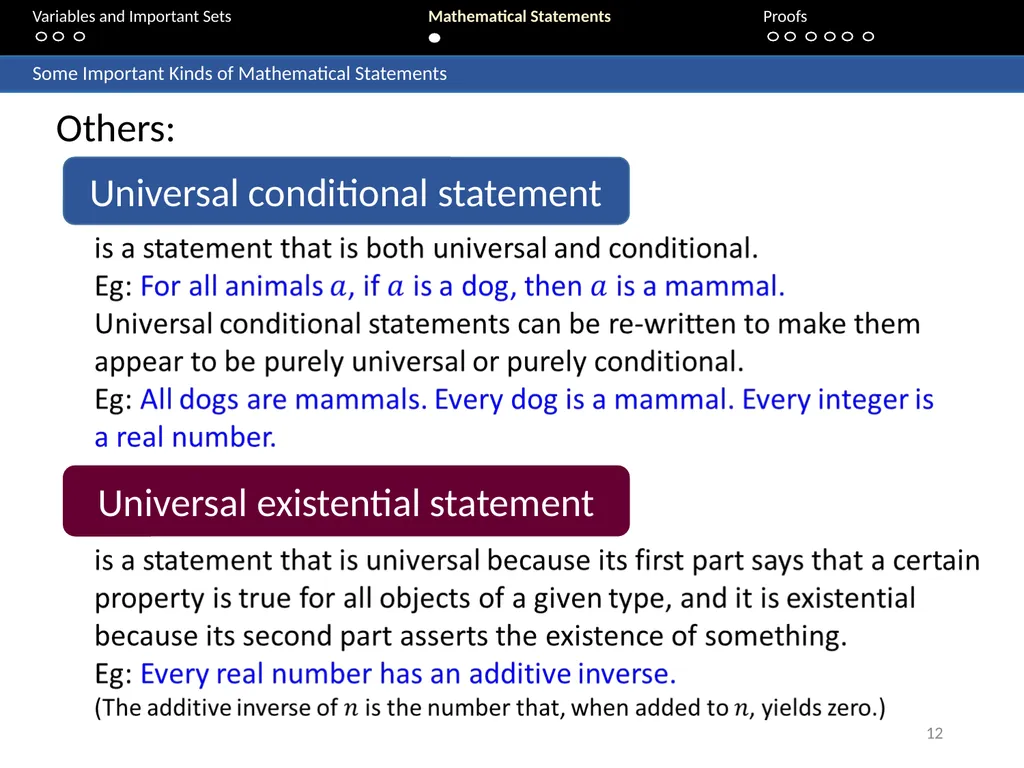
slide12. Variables and Important Sets Mathematical Statements Proofs Some Important Kinds of Mathematical Statements 12 Others: Universal conditional statement Universal existential statement<br>
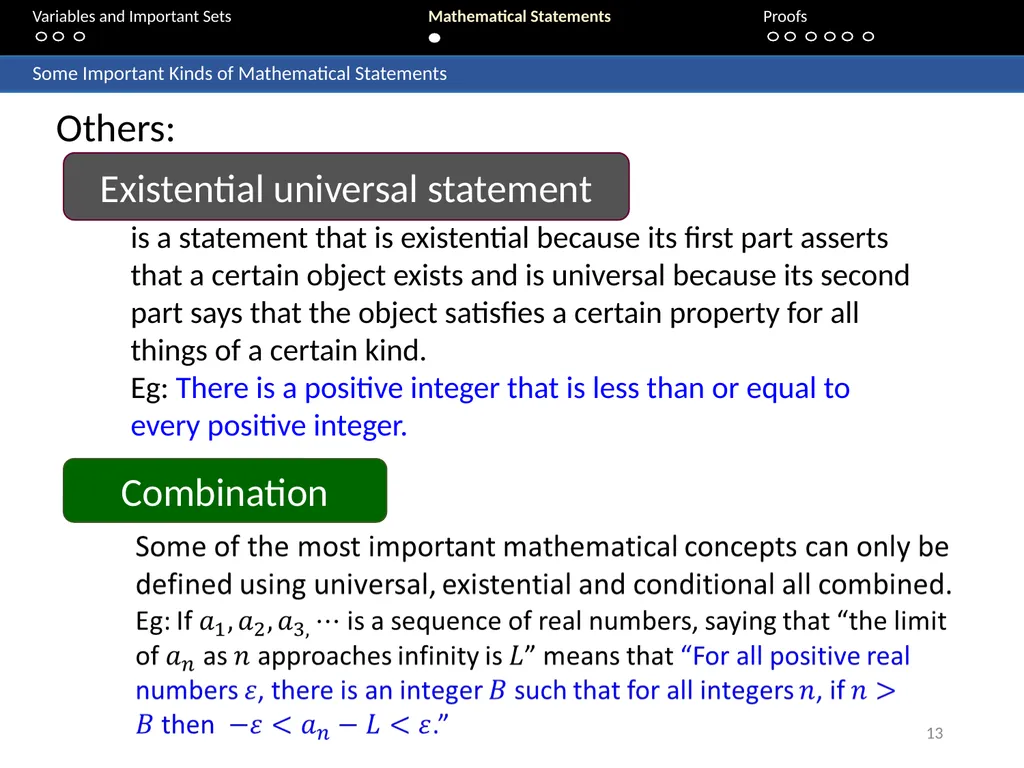
slide13. Variables and Important Sets Mathematical Statements Proofs Some Important Kinds of Mathematical Statements 13 Others: Existential universal statement is a statement that is existential because its first part asserts that a certain object exists and is universal because its second part says that the object satisfies a certain property for all things of a certain kind.
Eg: There is a positive integer that is less than or equal to every positive integer. Combination<br>
slide14. Variables and Important Sets Mathematical Statements Proofs Some Important Kinds of Mathematical Statements 14 Peeking ahead Universal, Existential and Conditional Statements
Chapter 2 The Logic of Compound Statements
Chapter 3 The Logic of Quantified Statements<br>
slide15. Variables and Important Sets Mathematical Statements Proofs 15 1.3 Proofs<br>
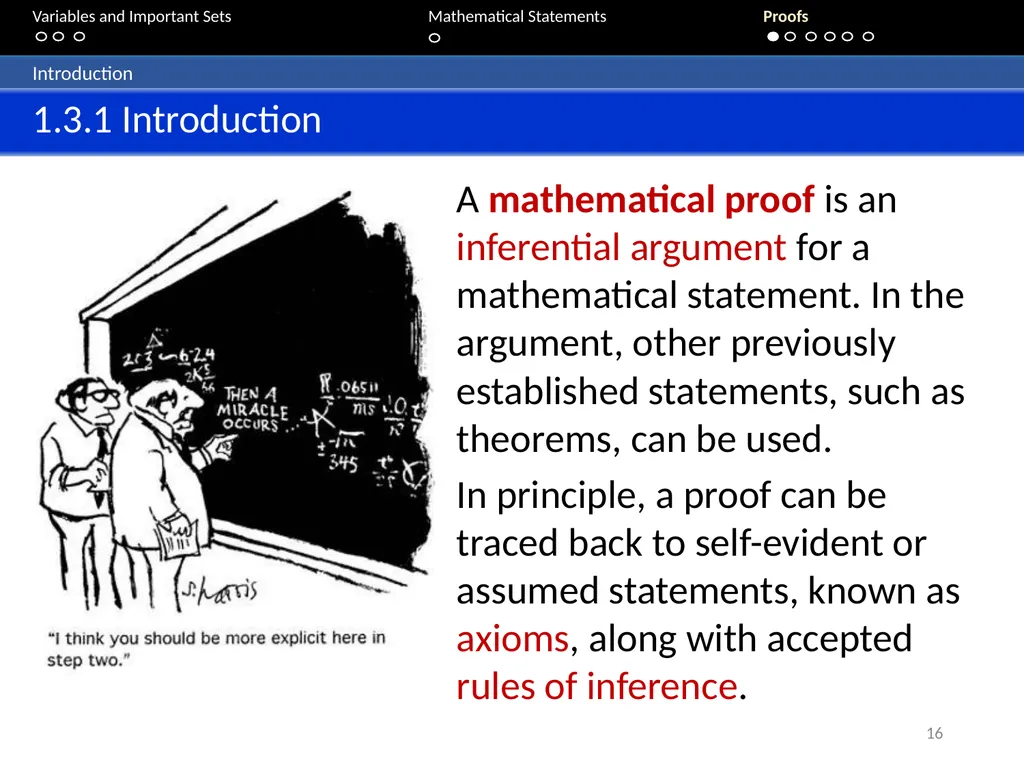
slide16. Variables and Important Sets Mathematical Statements Proofs Introduction 16 1.3.1 Introduction A mathematical proof is an inferential argument for a mathematical statement. In the argument, other previously established statements, such as theorems, can be used.
In principle, a proof can be traced back to self-evident or assumed statements, known as axioms, along with accepted rules of inference.<br>
slide17. Variables and Important Sets Mathematical Statements Proofs Introduction 17 Proof methods
Direct proof
Proof by construction
Disproof by counterexample
Proof by exhaustion
Proof by contradiction
Proof by contraposition
Proof by mathematical induction
Combinatorial proof
etc… This section shows only a few examples. More to come in subsequent lectures.<br>
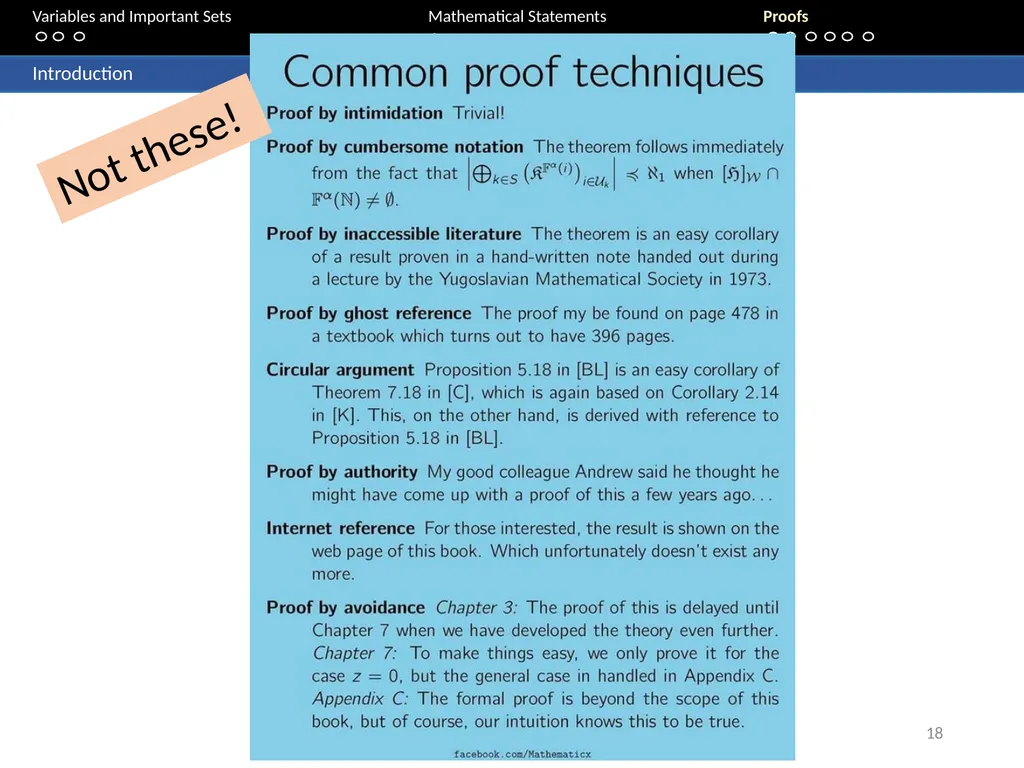
slide18. Variables and Important Sets Mathematical Statements Proofs Introduction 18 Not these!<br>
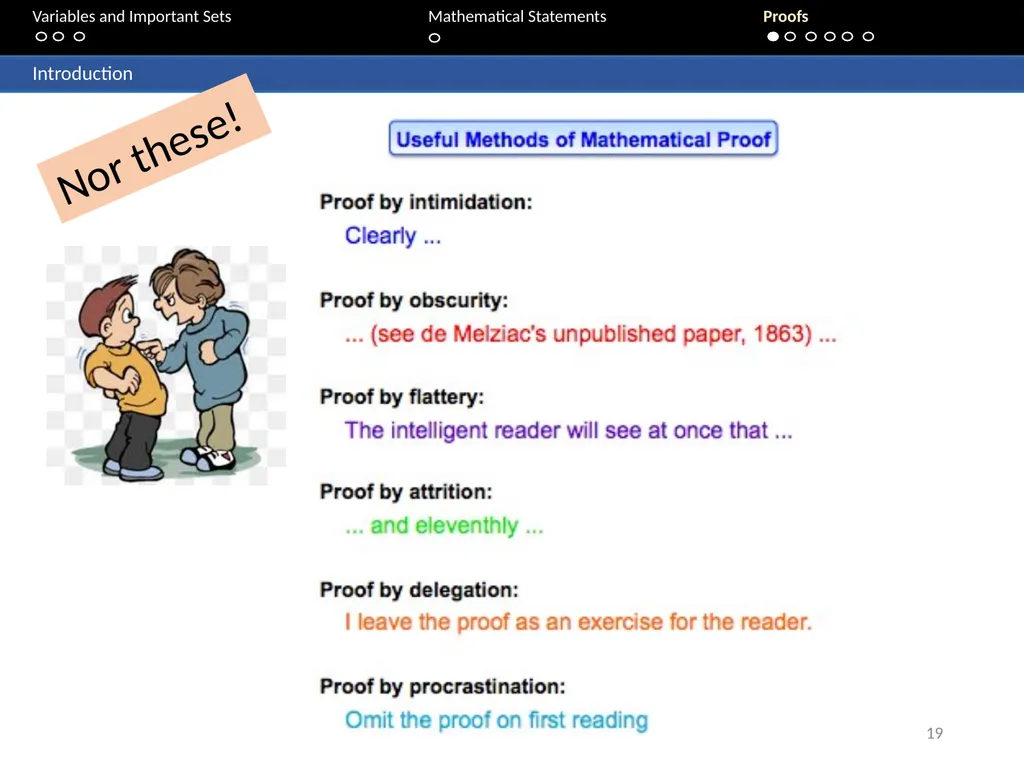
slide19. Variables and Important Sets Mathematical Statements Proofs Introduction 19 Nor these!<br>
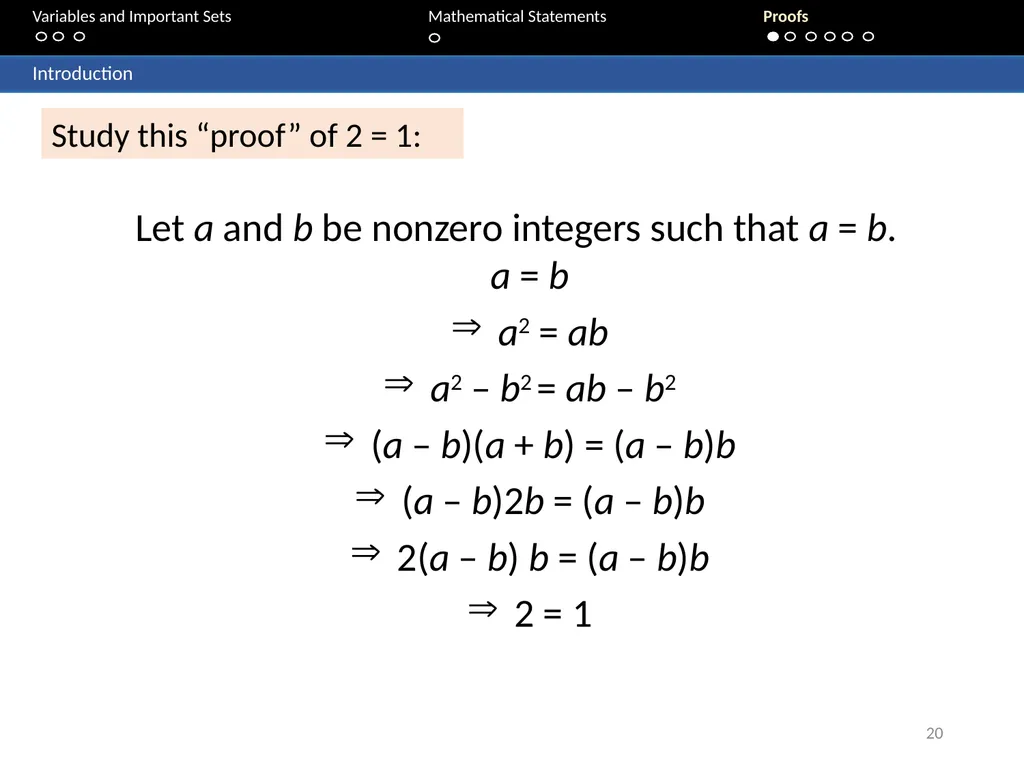
slide20. Variables and Important Sets Mathematical Statements Proofs Introduction 20 Study this “proof” of 2 = 1: Let a and b be nonzero integers such that a = b.
a = b
a2 = ab
a2 – b2 = ab – b2
(a – b)(a + b) = (a – b)b
(a – b)2b = (a – b)b
2(a – b) b = (a – b)b
2 = 1<br>
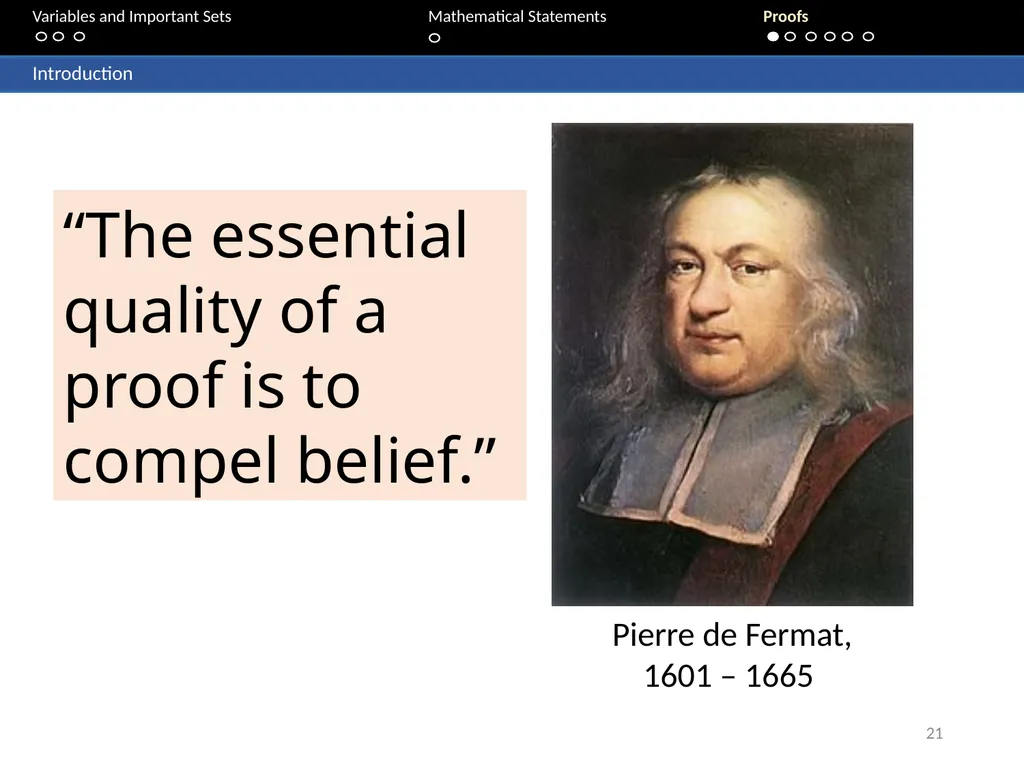
slide21. Variables and Important Sets Mathematical Statements Proofs Introduction 21 “The essential quality of a proof is to compel belief.” Pierre de Fermat,
1601 – 1665<br>
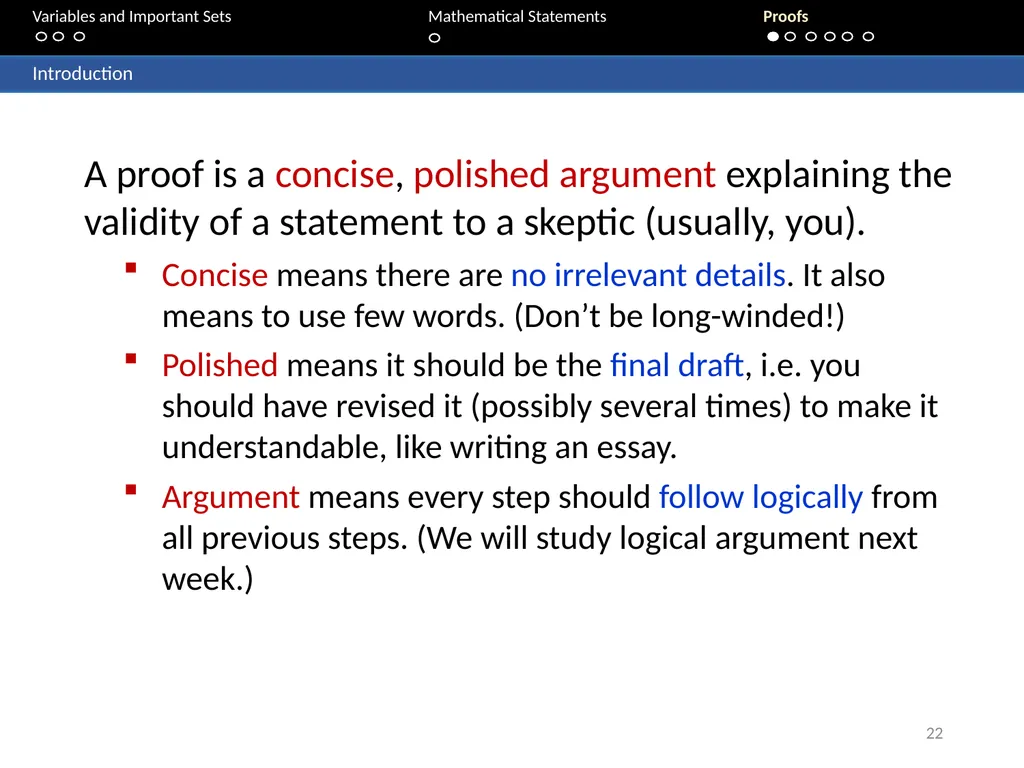
slide22. Variables and Important Sets Mathematical Statements Proofs Introduction 22 A proof is a concise, polished argument explaining the validity of a statement to a skeptic (usually, you).
Concise means there are no irrelevant details. It also means to use few words. (Don’t be long-winded!)
Polished means it should be the final draft, i.e. you should have revised it (possibly several times) to make it understandable, like writing an essay.
Argument means every step should follow logically from all previous steps. (We will study logical argument next week.)<br>
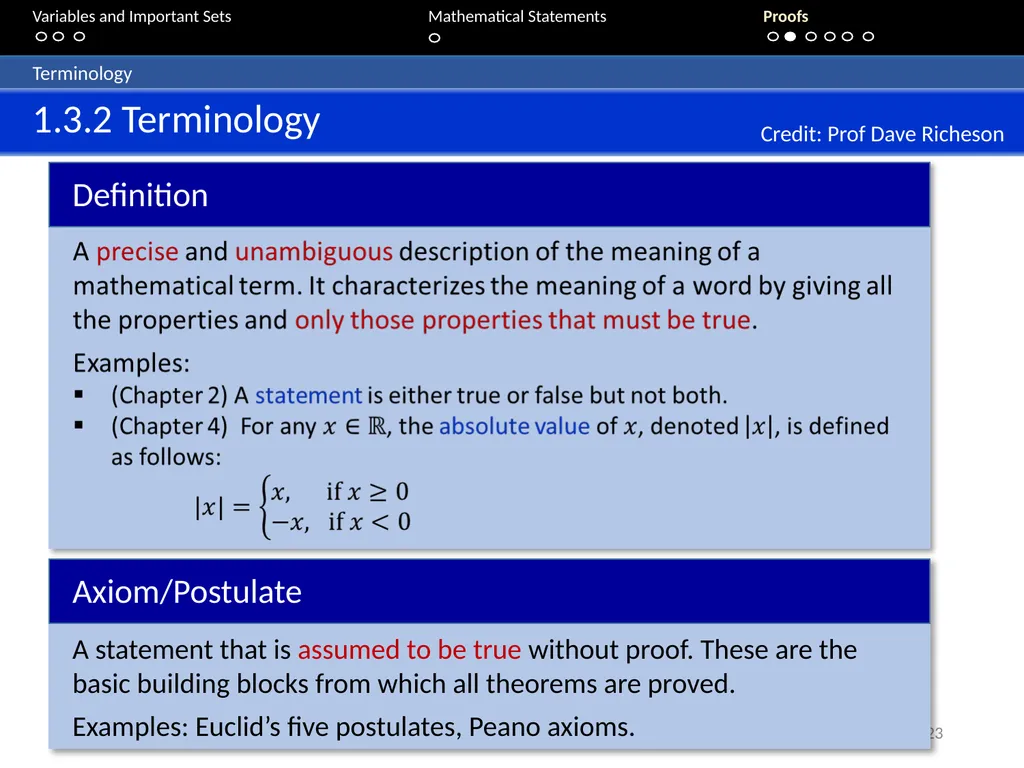
slide23. Variables and Important Sets Mathematical Statements Proofs Terminology 23 1.3.2 Terminology Credit: Prof Dave Richeson<br>
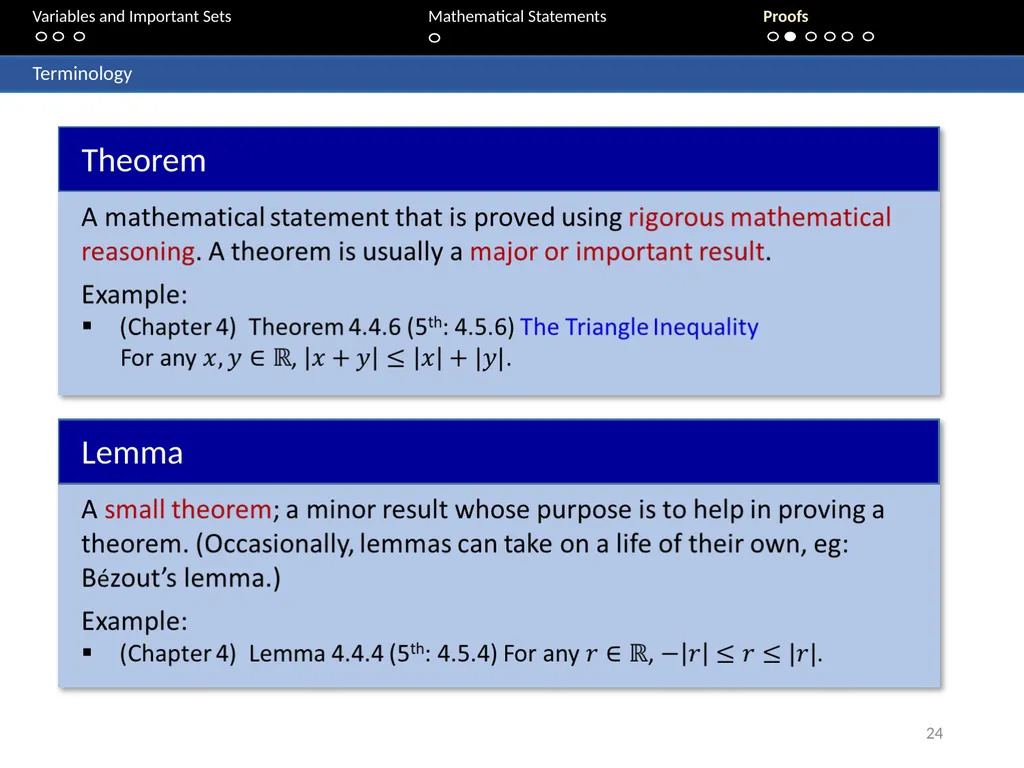
slide24. Variables and Important Sets Mathematical Statements Proofs Terminology 24<br>
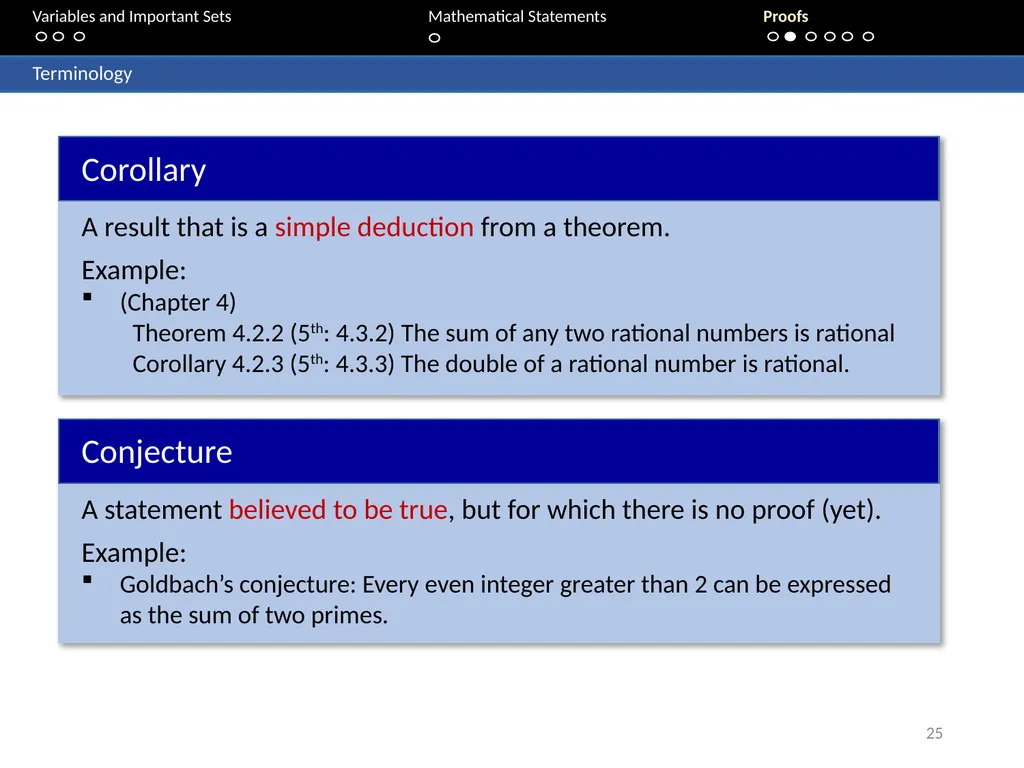
slide25. Variables and Important Sets Mathematical Statements Proofs Terminology 25<br>
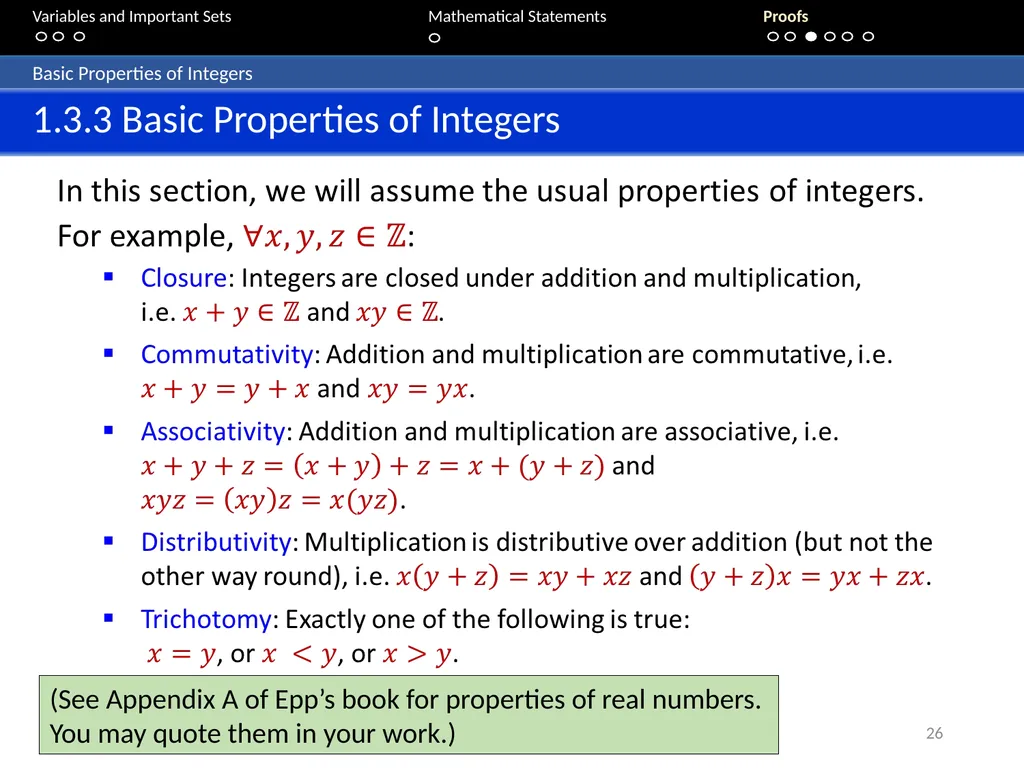
slide26. Variables and Important Sets Mathematical Statements Proofs Basic Properties of Integers 26 1.3.3 Basic Properties of Integers (See Appendix A of Epp’s book for properties of real numbers.
You may quote them in your work.)<br>
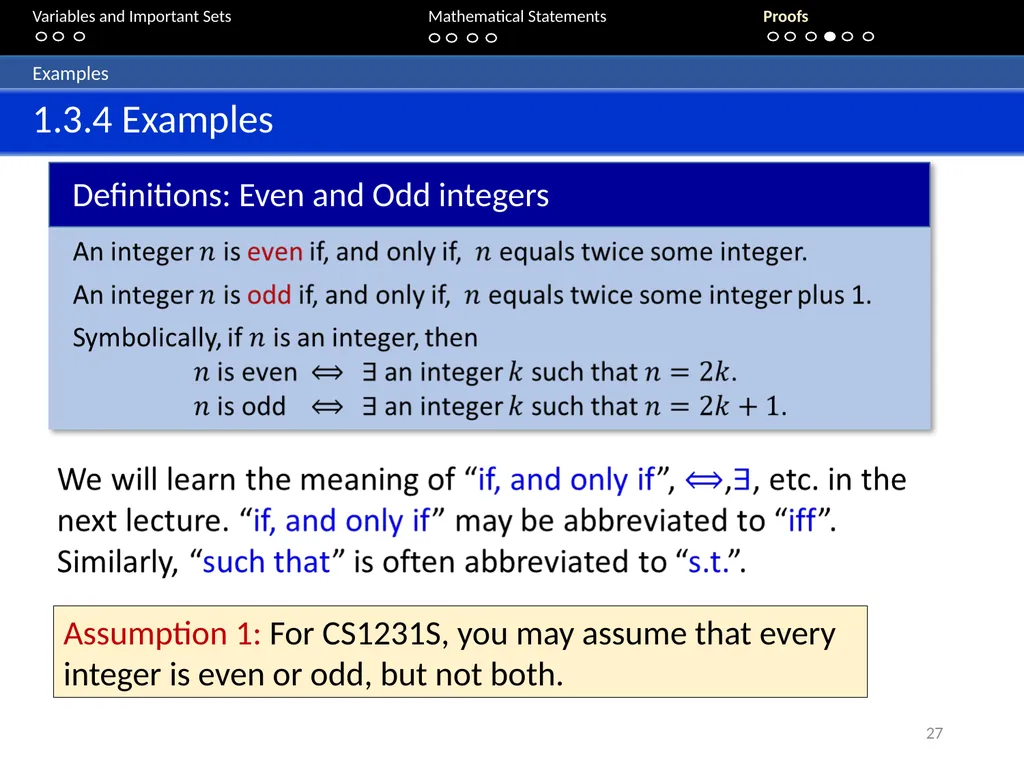
slide27. Variables and Important Sets Mathematical Statements Proofs Examples 27 1.3.4 Examples Assumption 1: For CS1231S, you may assume that every integer is even or odd, but not both.<br>
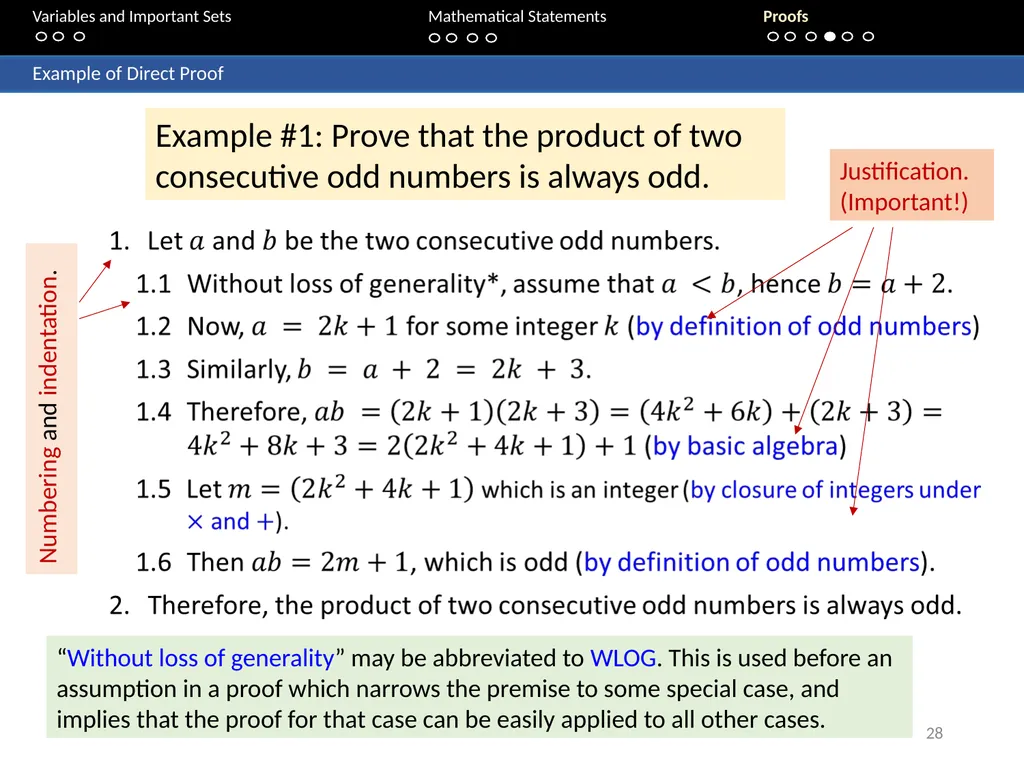
slide28. Variables and Important Sets Mathematical Statements Proofs Example of Direct Proof 28 Example #1: Prove that the product of two consecutive odd numbers is always odd. “Without loss of generality” may be abbreviated to WLOG. This is used before an assumption in a proof which narrows the premise to some special case, and implies that the proof for that case can be easily applied to all other cases.<br>
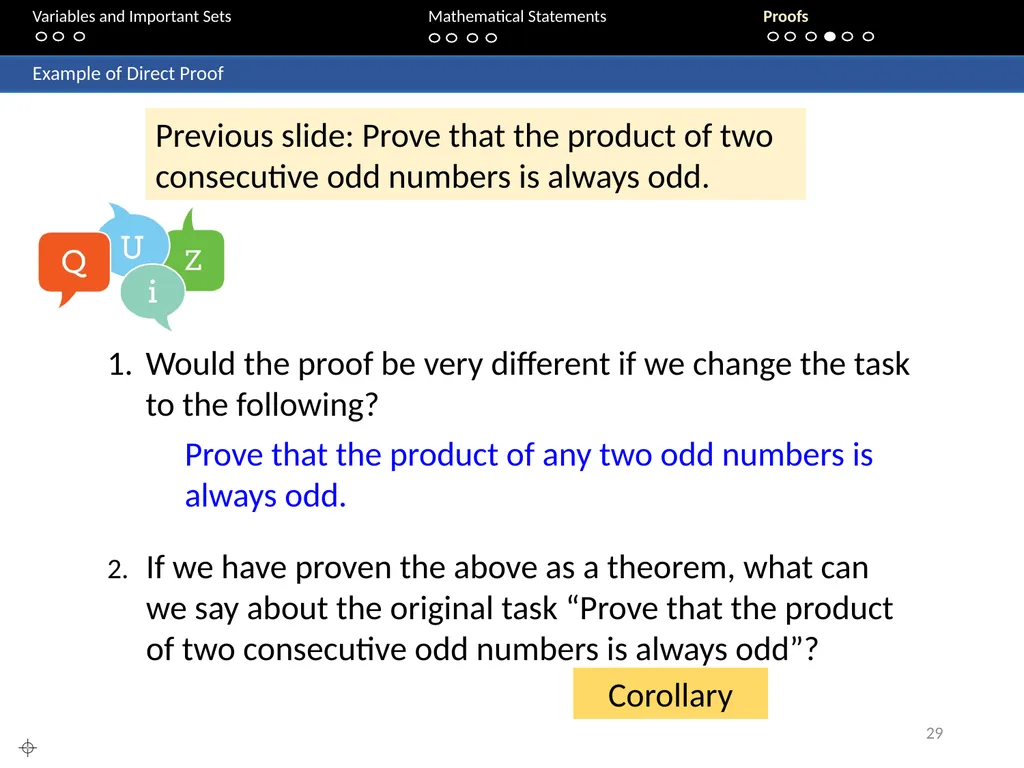
slide29. Variables and Important Sets Mathematical Statements Proofs Example of Direct Proof 29 Previous slide: Prove that the product of two consecutive odd numbers is always odd. Would the proof be very different if we change the task to the following?
Prove that the product of any two odd numbers is always odd.
2. If we have proven the above as a theorem, what can we say about the original task “Prove that the product of two consecutive odd numbers is always odd”? Corollary<br>
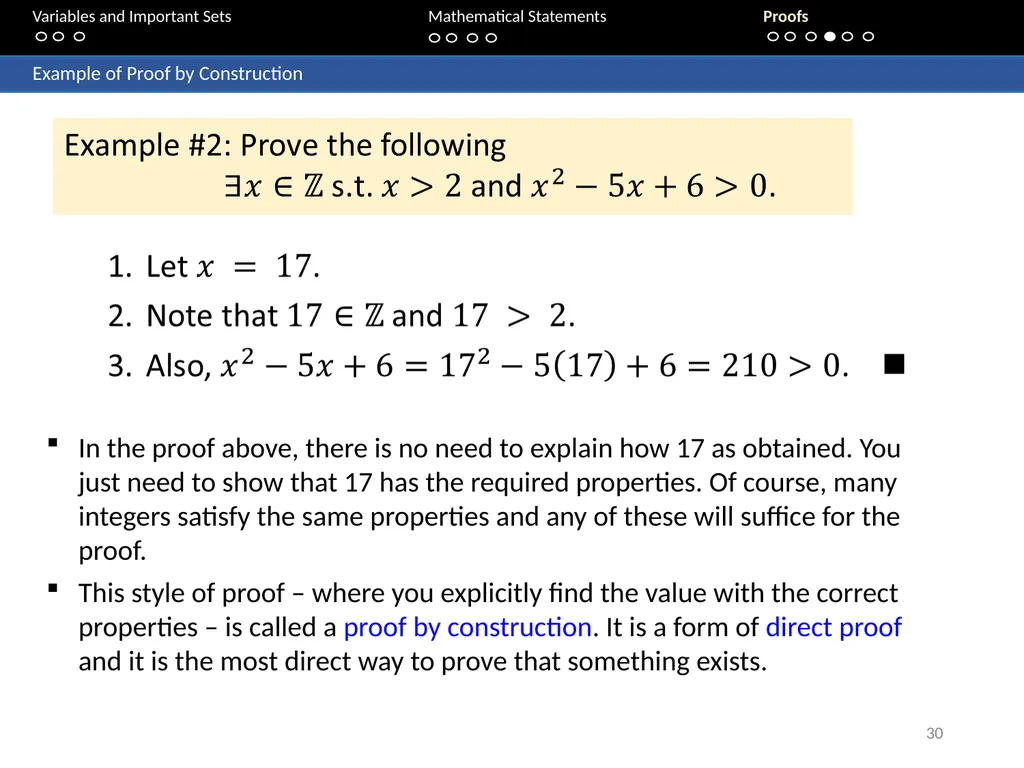
slide30. Variables and Important Sets Mathematical Statements Proofs Example of Proof by Construction 30 In the proof above, there is no need to explain how 17 as obtained. You just need to show that 17 has the required properties. Of course, many integers satisfy the same properties and any of these will suffice for the proof.
This style of proof – where you explicitly find the value with the correct properties – is called a proof by construction. It is a form of direct proof and it is the most direct way to prove that something exists.<br>
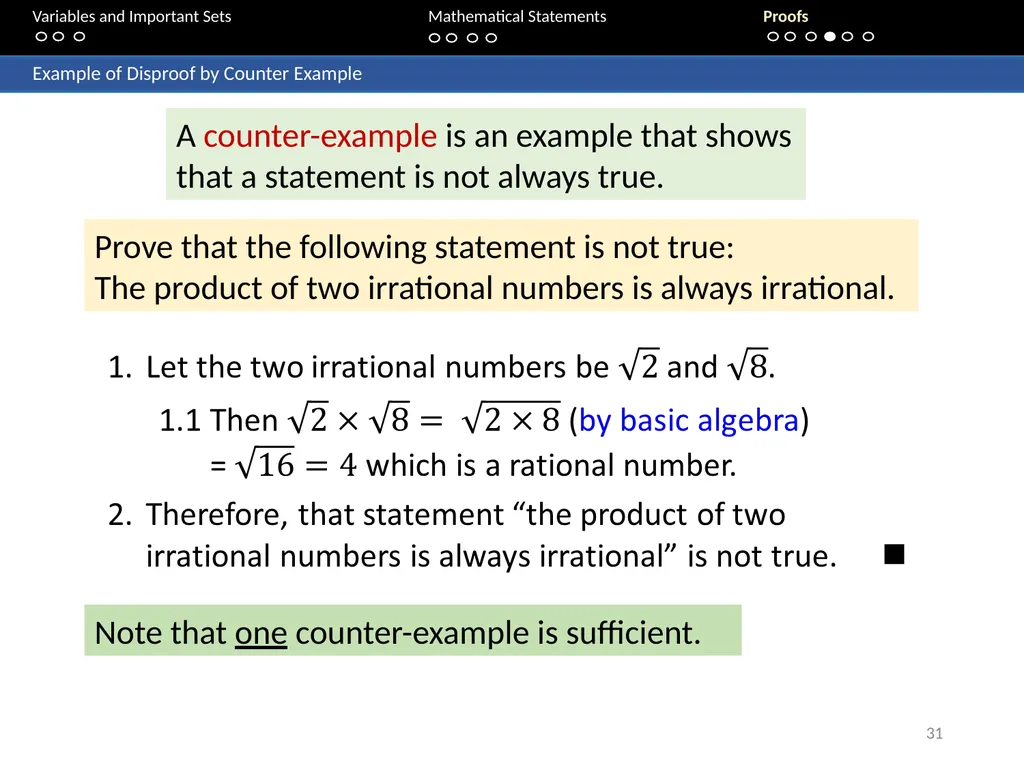
slide31. Variables and Important Sets Mathematical Statements Proofs Example of Disproof by Counter Example 31 A counter-example is an example that shows that a statement is not always true. Prove that the following statement is not true:
The product of two irrational numbers is always irrational. Note that one counter-example is sufficient.<br>
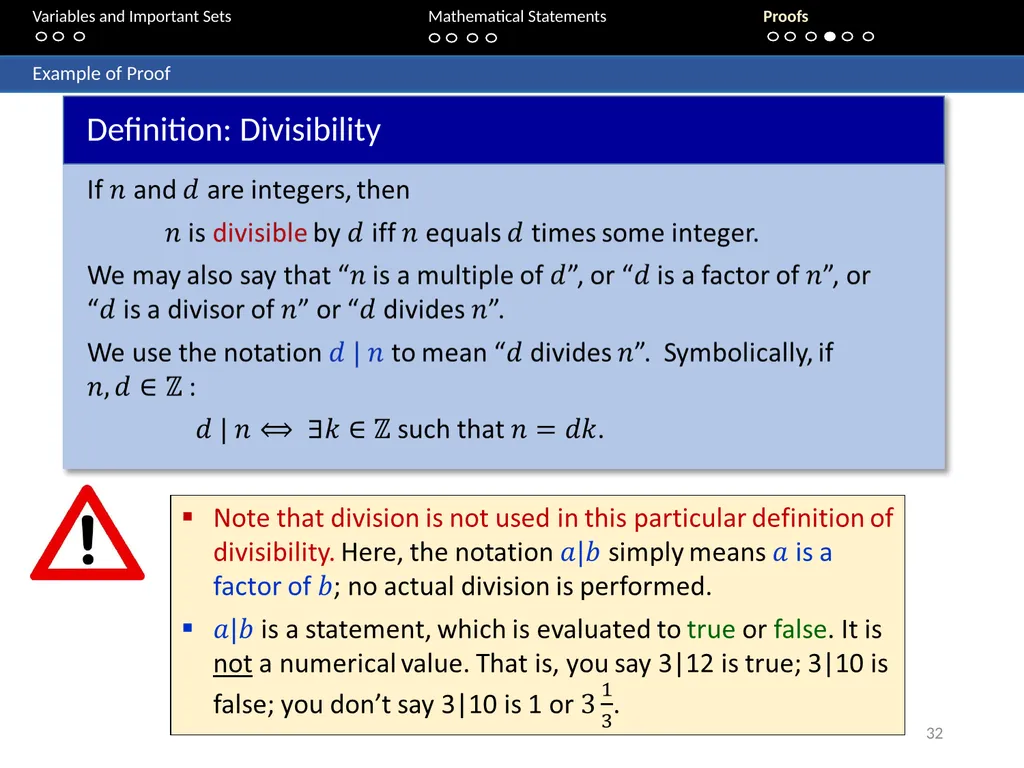
slide32. Variables and Important Sets Mathematical Statements Proofs Example of Proof 32<br>
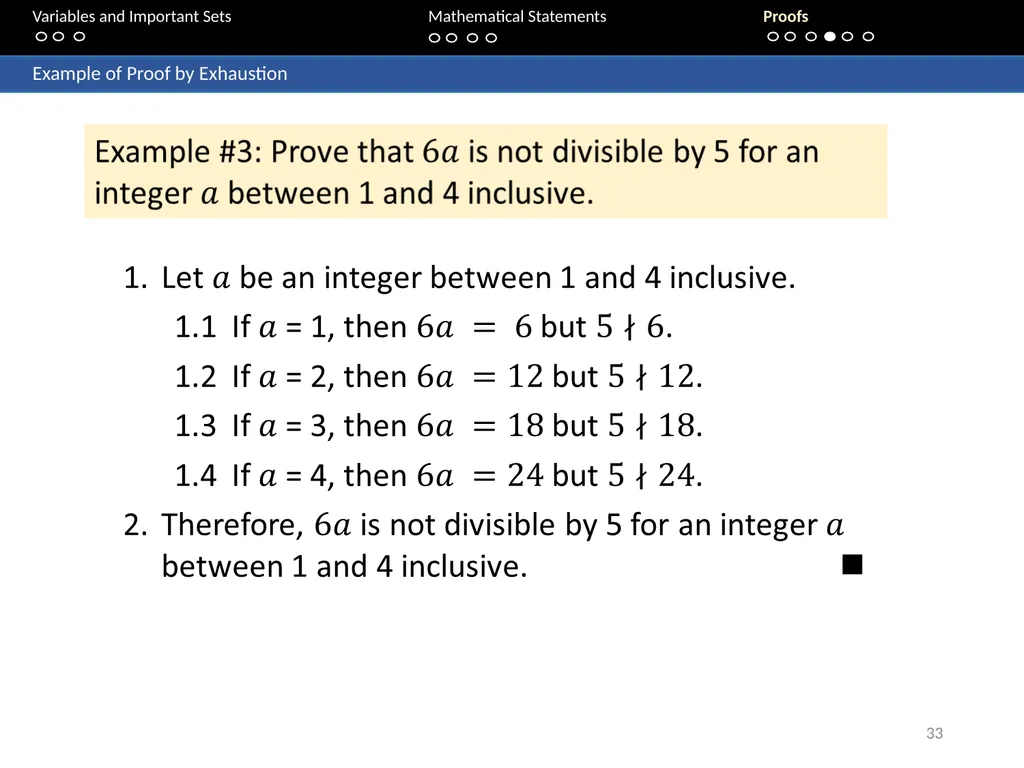
slide33. Variables and Important Sets Mathematical Statements Proofs Example of Proof by Exhaustion 33<br>
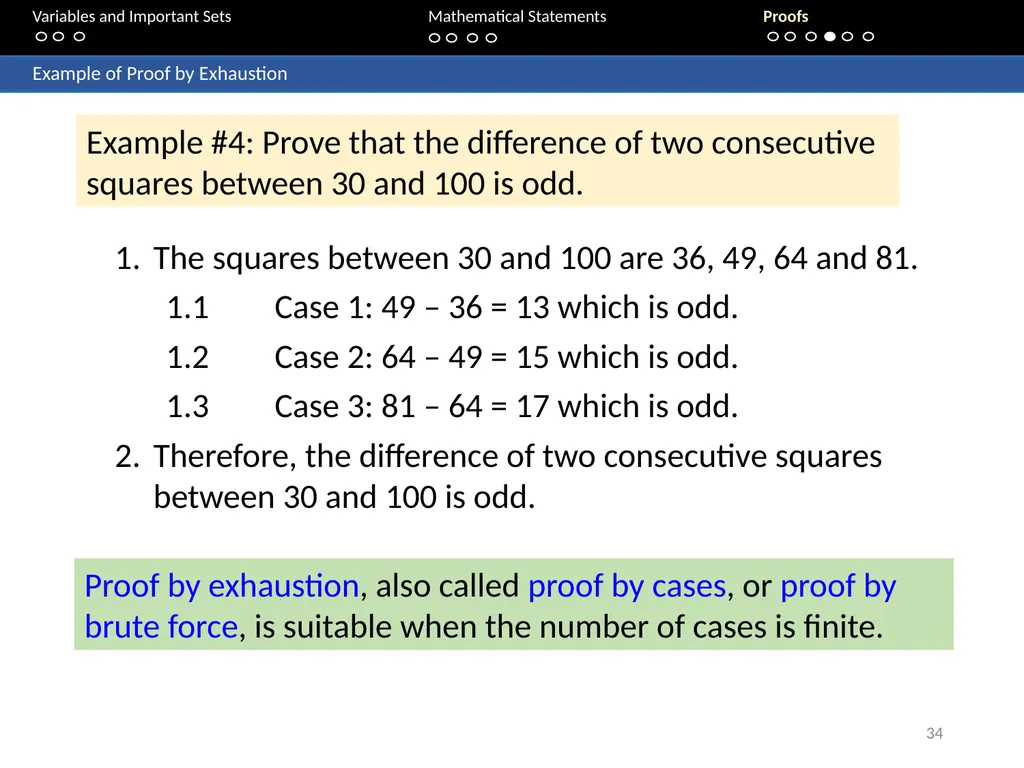
slide34. Variables and Important Sets Mathematical Statements Proofs Example of Proof by Exhaustion 34 The squares between 30 and 100 are 36, 49, 64 and 81.
1.1 Case 1: 49 – 36 = 13 which is odd.
1.2 Case 2: 64 – 49 = 15 which is odd.
1.3 Case 3: 81 – 64 = 17 which is odd.
Therefore, the difference of two consecutive squares between 30 and 100 is odd. Example #4: Prove that the difference of two consecutive squares between 30 and 100 is odd. Proof by exhaustion, also called proof by cases, or proof by brute force, is suitable when the number of cases is finite.<br>
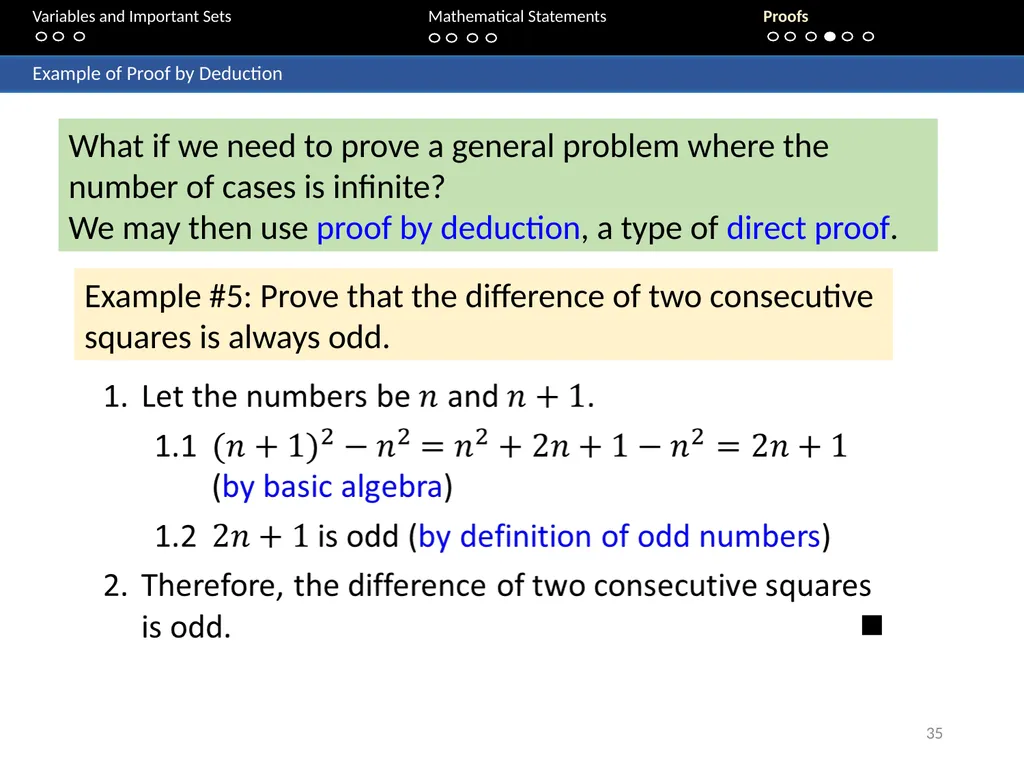
slide35. Variables and Important Sets Mathematical Statements Proofs Example of Proof by Deduction 35 What if we need to prove a general problem where the number of cases is infinite?
We may then use proof by deduction, a type of direct proof. Example #5: Prove that the difference of two consecutive squares is always odd.<br>
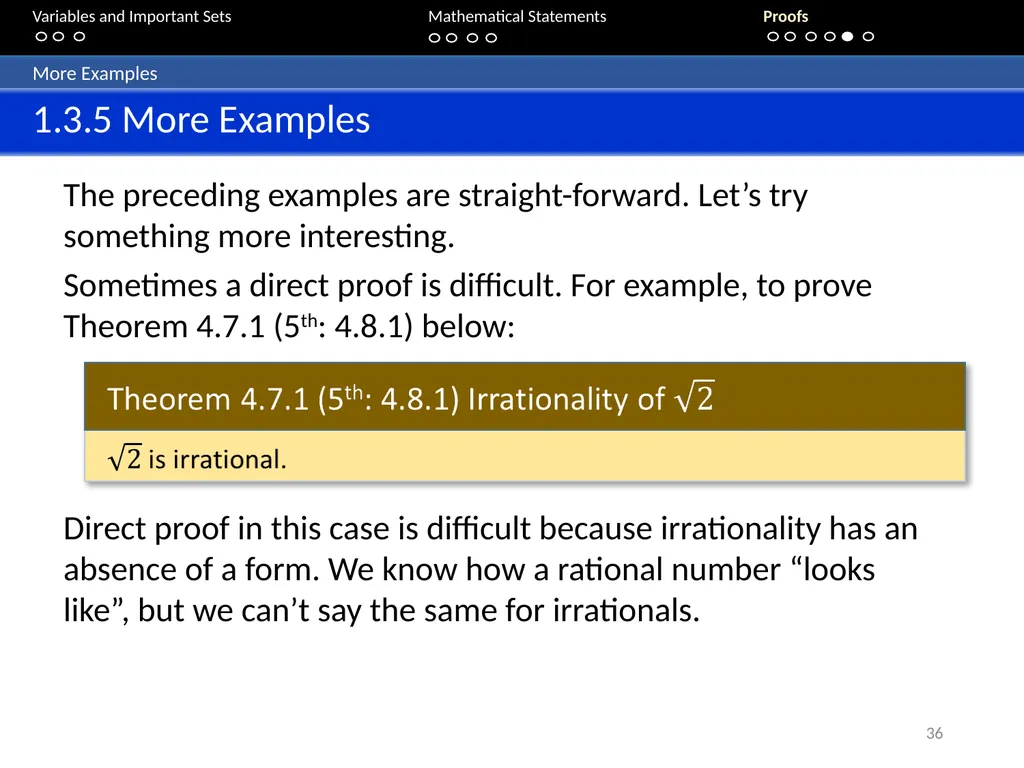
slide36. Variables and Important Sets Mathematical Statements Proofs More Examples 36 The preceding examples are straight-forward. Let’s try something more interesting.
Sometimes a direct proof is difficult. For example, to prove Theorem 4.7.1 (5th: 4.8.1) below: 1.3.5 More Examples Direct proof in this case is difficult because irrationality has an absence of a form. We know how a rational number “looks like”, but we can’t say the same for irrationals.<br>
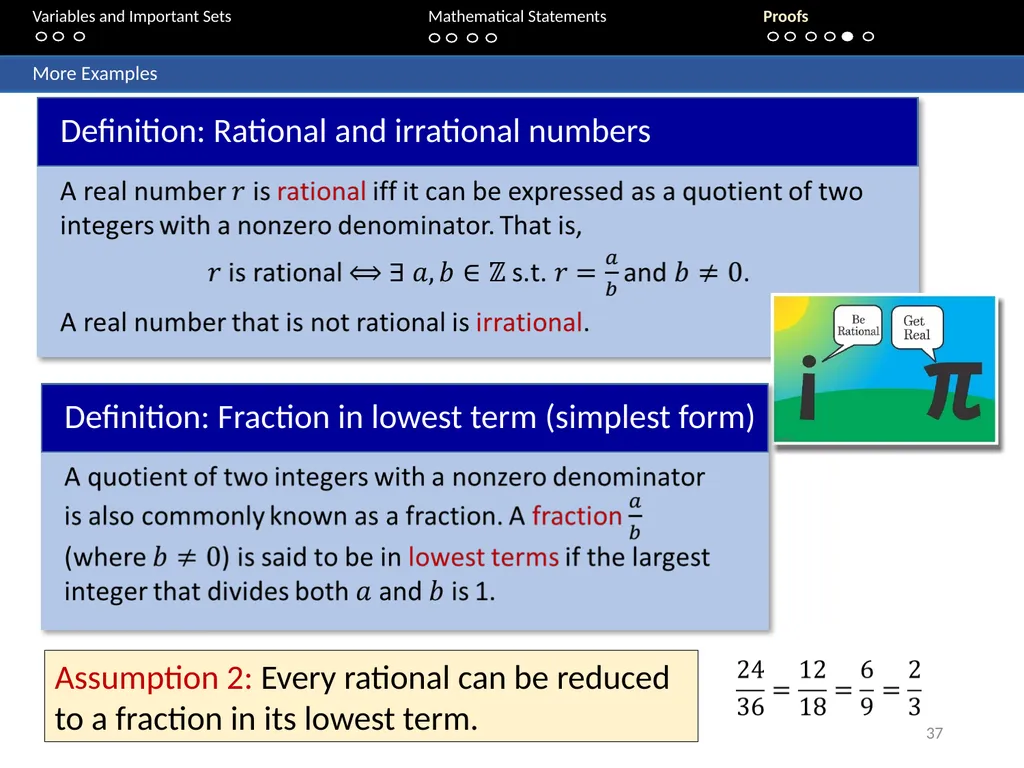
slide37. Variables and Important Sets Mathematical Statements Proofs More Examples 37 Assumption 2: Every rational can be reduced to a fraction in its lowest term.<br>
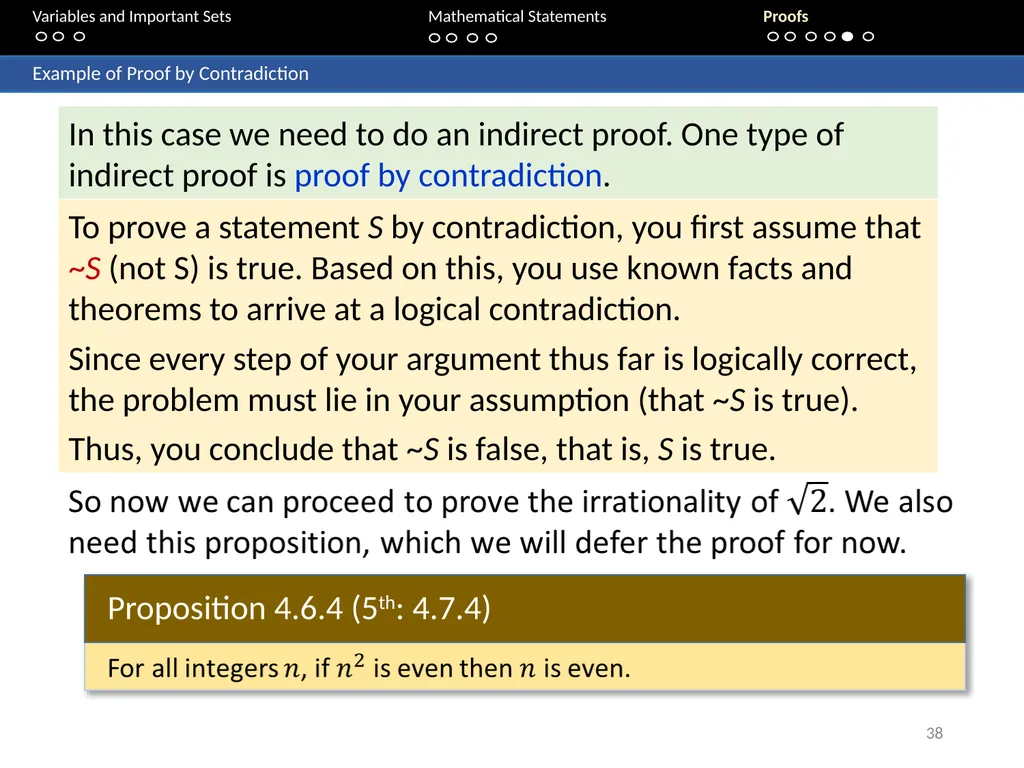
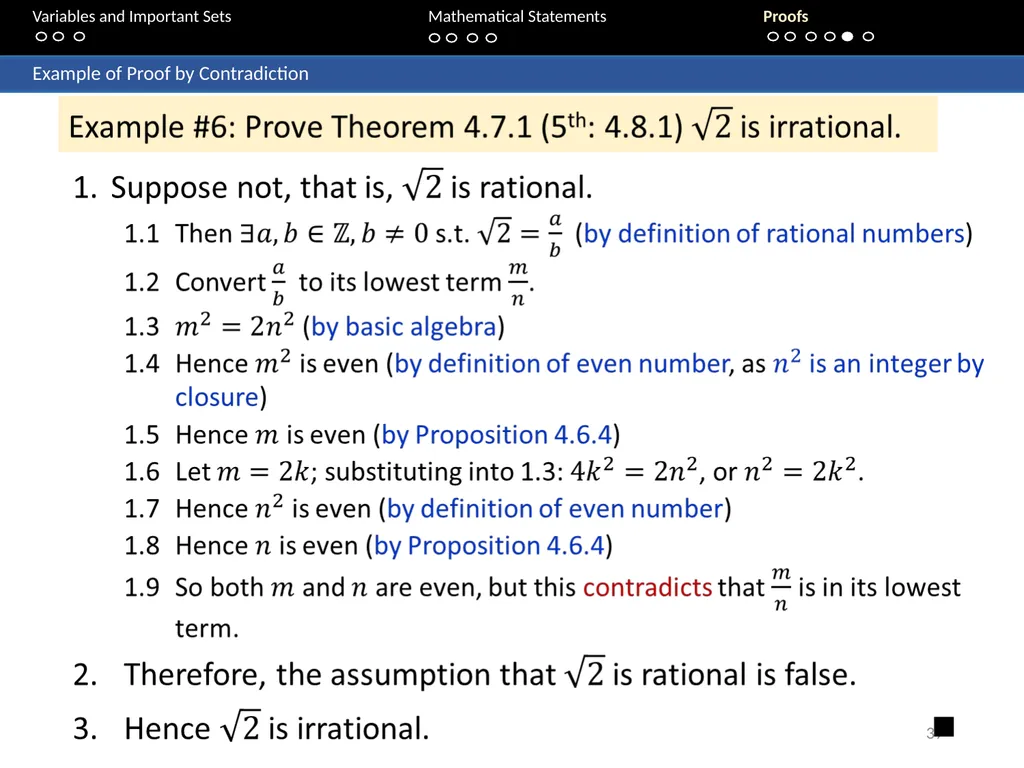
slide38. Variables and Important Sets Mathematical Statements Proofs Example of Proof by Contradiction 38 In this case we need to do an indirect proof. One type of indirect proof is proof by contradiction. To prove a statement S by contradiction, you first assume that ~S (not S) is true. Based on this, you use known facts and theorems to arrive at a logical contradiction.
Since every step of your argument thus far is logically correct, the problem must lie in your assumption (that ~S is true).
Thus, you conclude that ~S is false, that is, S is true.<br>
slide39. Variables and Important Sets Mathematical Statements Proofs Example of Proof by Contradiction 39<br>
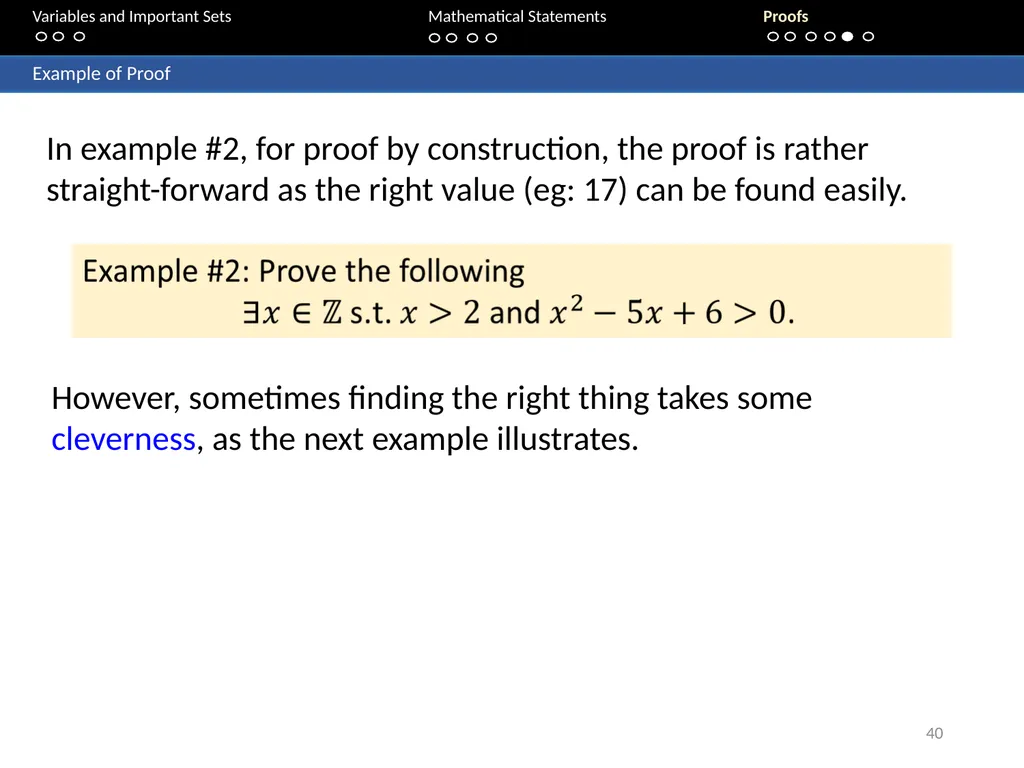
slide40. Variables and Important Sets Mathematical Statements Proofs Example of Proof 40 In example #2, for proof by construction, the proof is rather straight-forward as the right value (eg: 17) can be found easily. However, sometimes finding the right thing takes some cleverness, as the next example illustrates.<br>
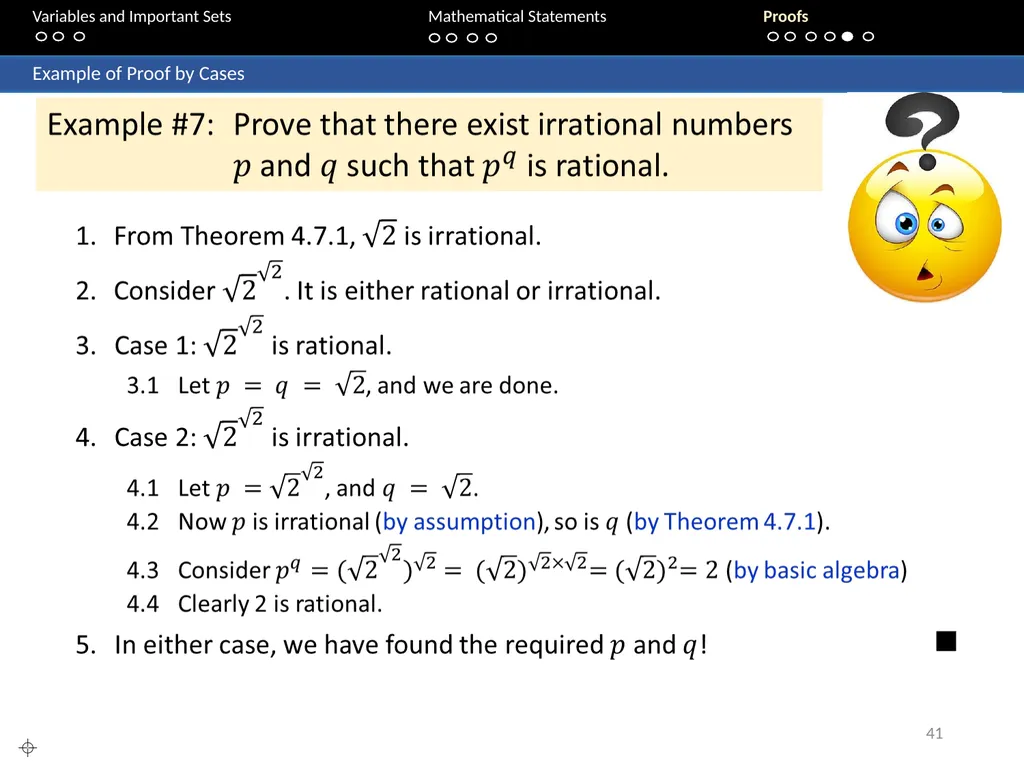
slide41. Variables and Important Sets Mathematical Statements Proofs Example of Proof by Cases 41 <br>
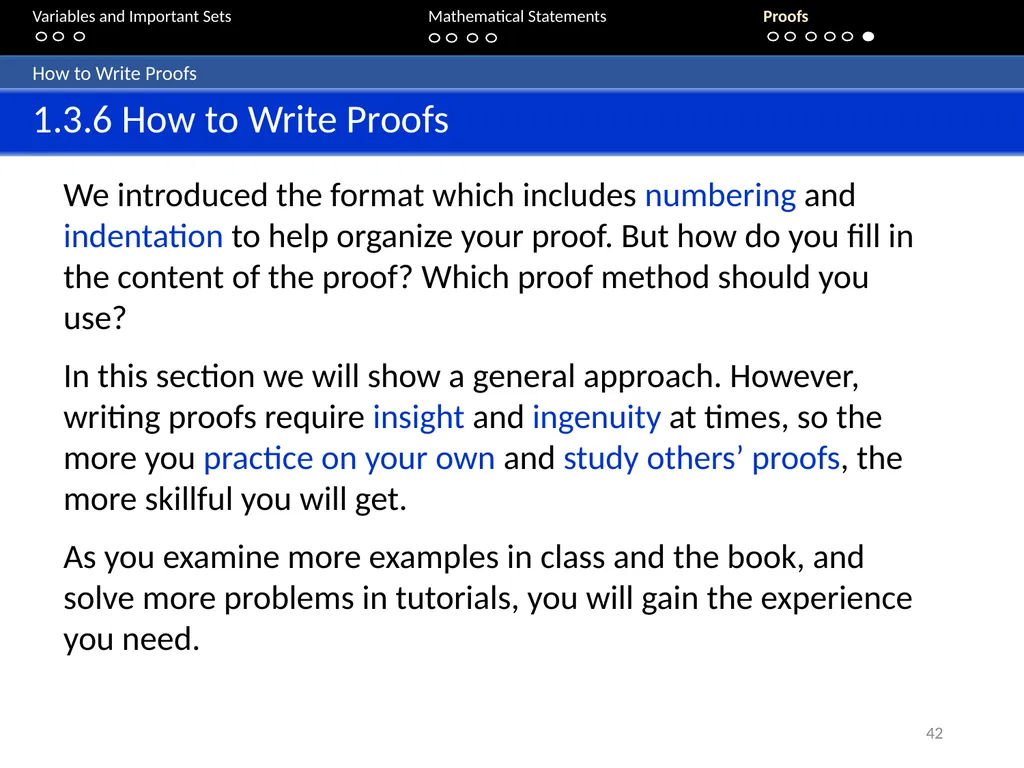
slide42. Variables and Important Sets Mathematical Statements Proofs How to Write Proofs 42 We introduced the format which includes numbering and indentation to help organize your proof. But how do you fill in the content of the proof? Which proof method should you use?
In this section we will show a general approach. However, writing proofs require insight and ingenuity at times, so the more you practice on your own and study others’ proofs, the more skillful you will get.
As you examine more examples in class and the book, and solve more problems in tutorials, you will gain the experience you need. 1.3.6 How to Write Proofs<br>
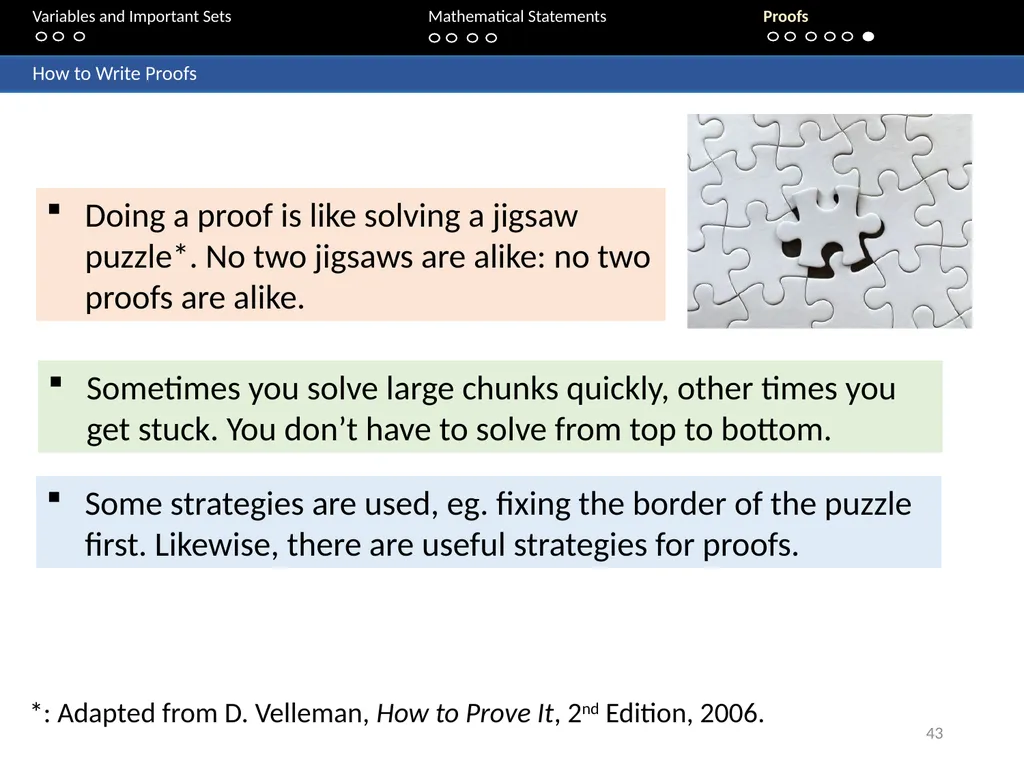
slide43. Variables and Important Sets Mathematical Statements Proofs How to Write Proofs 43 Doing a proof is like solving a jigsaw puzzle*. No two jigsaws are alike: no two proofs are alike. *: Adapted from D. Velleman, How to Prove It, 2nd Edition, 2006. Sometimes you solve large chunks quickly, other times you get stuck. You don’t have to solve from top to bottom. Some strategies are used, eg. fixing the border of the puzzle first. Likewise, there are useful strategies for proofs.<br>
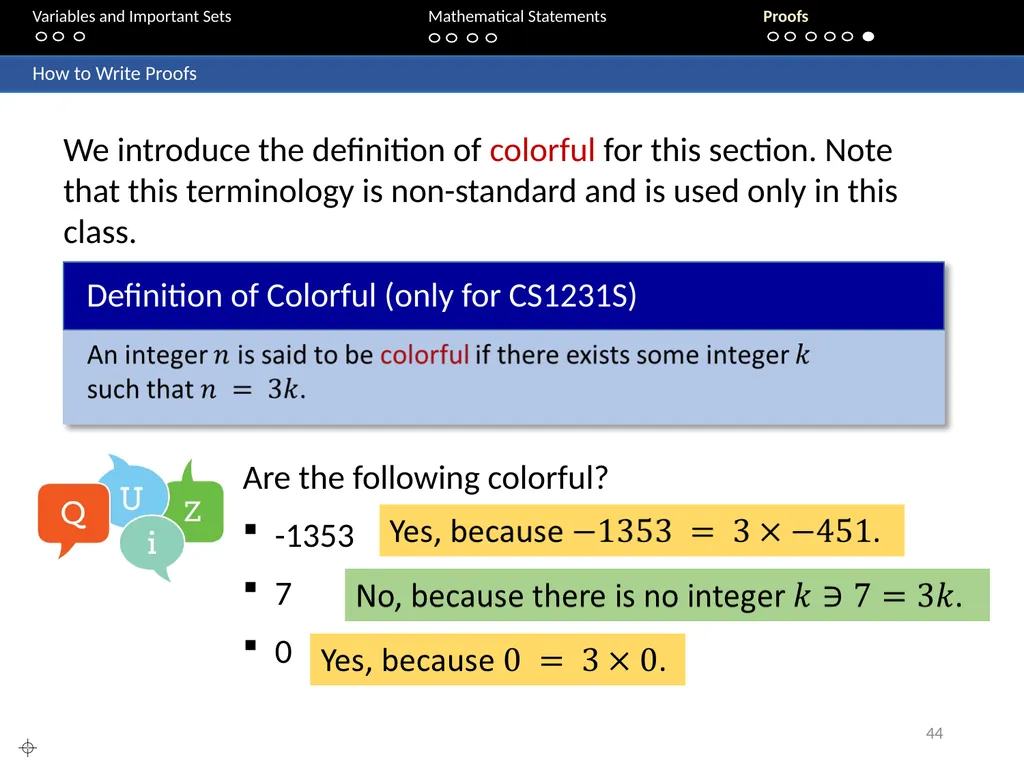
slide44. Variables and Important Sets Mathematical Statements Proofs How to Write Proofs 44 We introduce the definition of colorful for this section. Note that this terminology is non-standard and is used only in this class. Are the following colorful?
-1353
7
0<br>
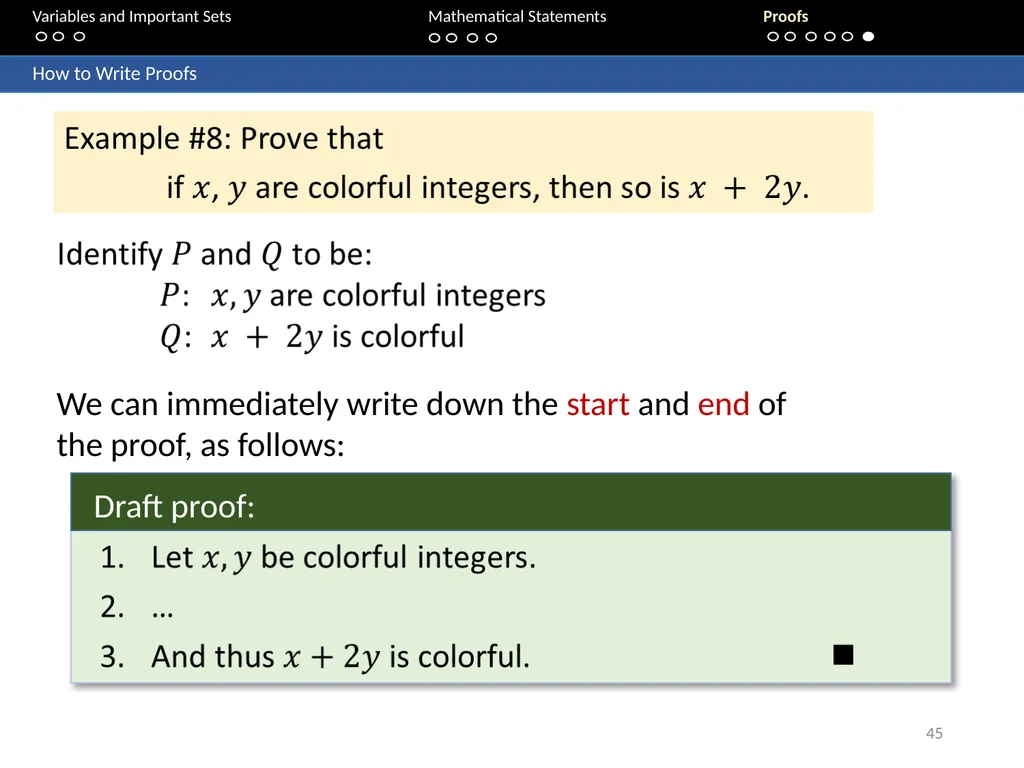
slide45. Variables and Important Sets Mathematical Statements Proofs How to Write Proofs 45 We can immediately write down the start and end of the proof, as follows:<br>
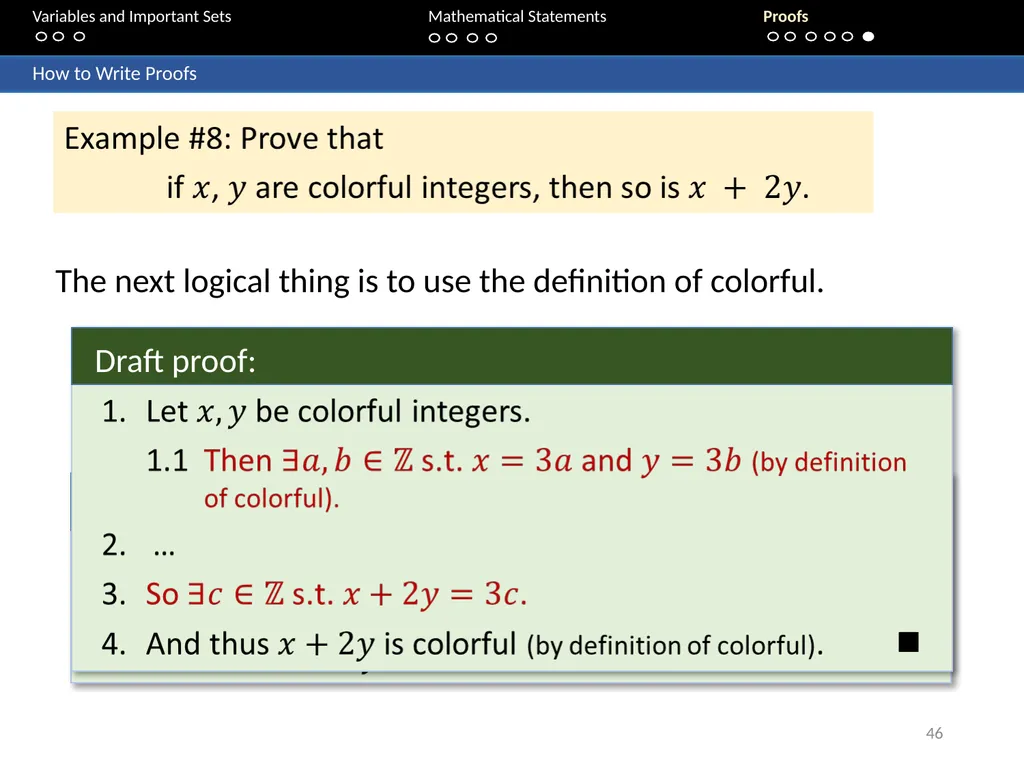
slide46. Variables and Important Sets Mathematical Statements Proofs How to Write Proofs 46 The next logical thing is to use the definition of colorful.<br>
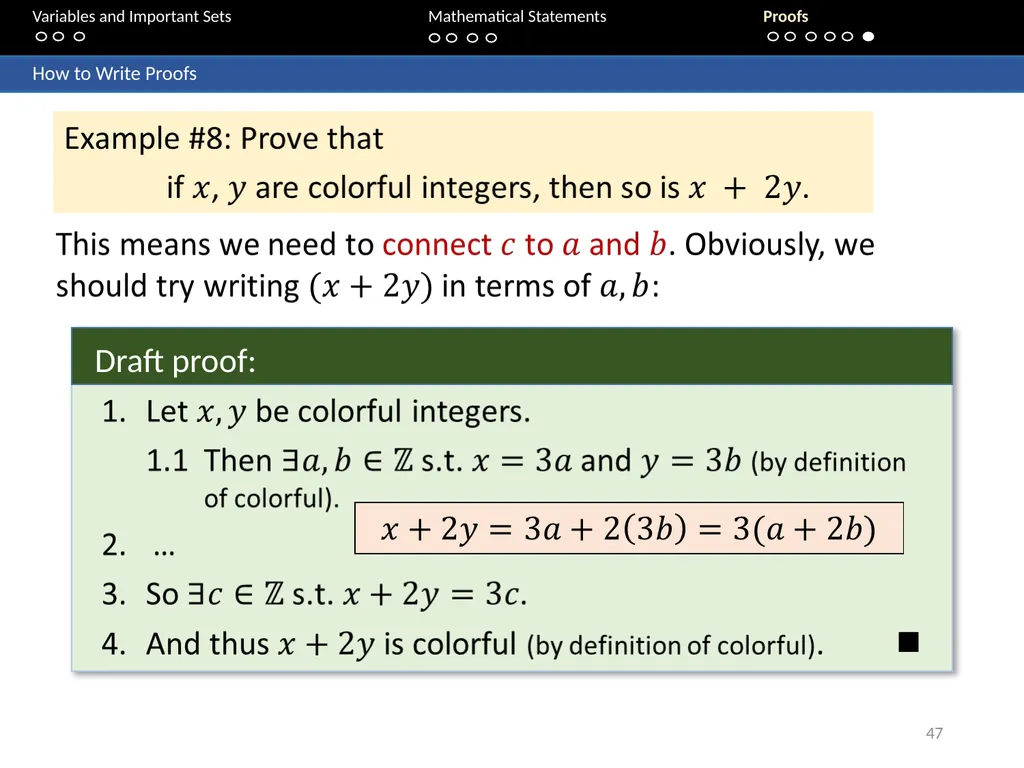
slide47. Variables and Important Sets Mathematical Statements Proofs How to Write Proofs 47<br>
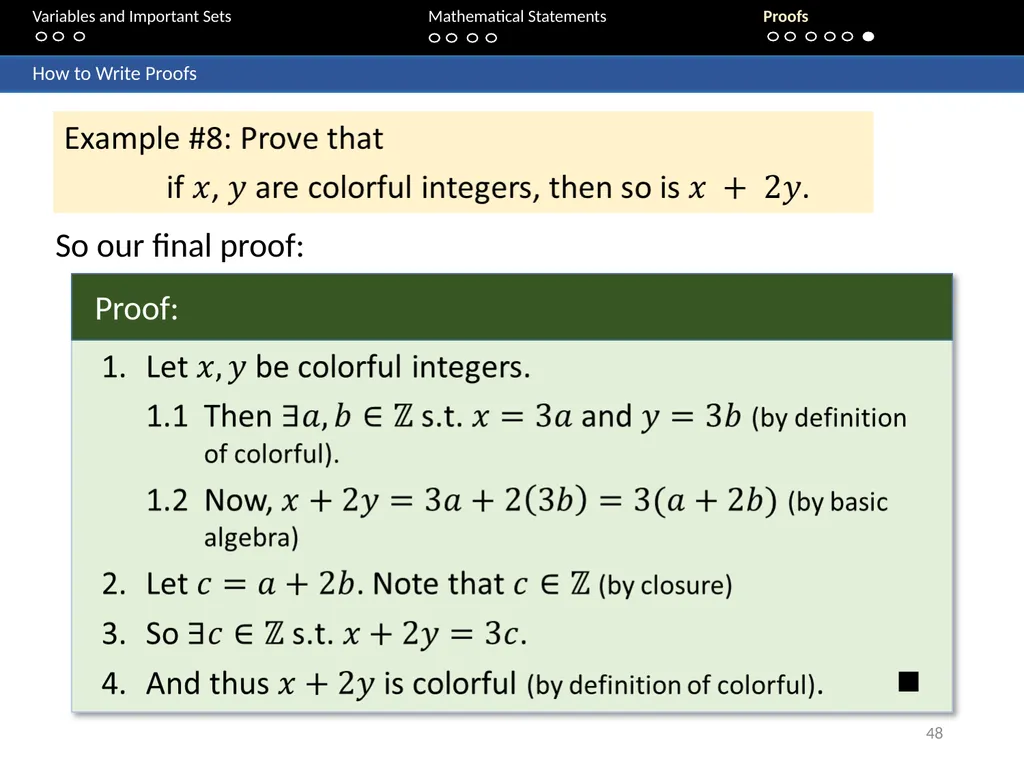
slide48. Variables and Important Sets Mathematical Statements Proofs How to Write Proofs 48 So our final proof:<br>
slide49. 49 Extra: Thinking Mathematically Observing structures Working systematically Modelling Visualising Reasoning No rote learning!<br>
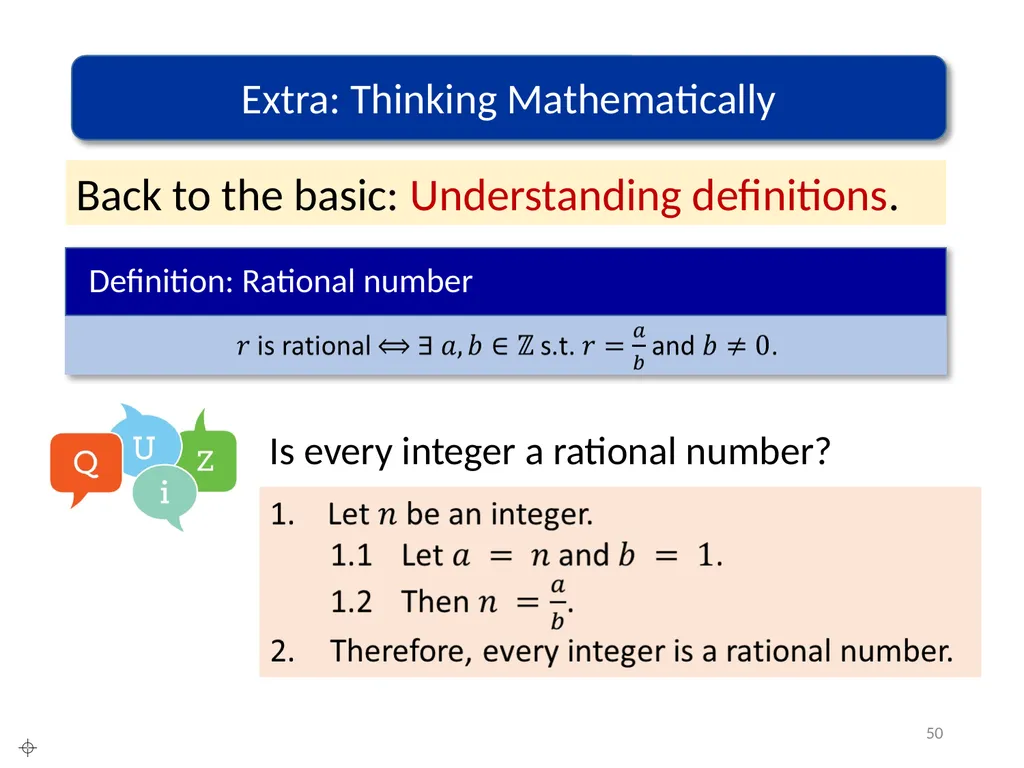
slide50. 50 Extra: Thinking Mathematically Back to the basic: Understanding definitions. Is every integer a rational number? <br>
slide51. 51 Extra: Thinking Mathematically In AY2017/18 Semester 1 exam paper, the following new definitions are given and 7 questions are based on them! No rote learning!<br>
slide52. 52 Extra: Thinking Mathematically<br>
slide53. 53 Next lecture 2. The Logic of Compound Statements<br>
slide54. 54 END OF FILE<br>
slide2. Variables and Important Sets Mathematical Statements Proofs 2 1. Speaking Mathematically Reference: Epp’s Chapter 1 Speaking Mathematically<br>
slide3. 1. Speaking Mathematically Variables and Important Sets Mathematical Statements Proofs 3 1. Speaking Mathematically The language of mathematics is the systems used by mathematicians to communicate mathematical ideas among themselves. Symbols, vocabulary, grammatical structures, conventions, abbreviations.<br>
slide4. Variables and Important Sets Mathematical Statements Proofs 4 1. Speaking Mathematically Pronunciation of mathematical expressions
https://par.cse.nsysu.edu.tw/link/math-pronunciation.pdf A more comprehensive resource:
Handbook for Spoken Mathematics
chrome-extension://efaidnbmnnnibpcajpcglclefindmkaj/https://librivox.org/uploads/xx-nonproject/Handbook%20for%20Spoken%20Mathematics.pdf<br>
slide5. Variables and Important Sets Mathematical Statements Proofs 5 1.1 Variables and Important Sets<br>
slide6. Variables and Important Sets Mathematical Statements Proofs Variables Is there a number with the following property:
doubling it and adding 3 gives the same result as squaring it? 6 1.1.1 Variables No matter what number might be chosen, if it is greater than 2, then its square is greater than 4. To give names to what you are seeking, and to maintain generality.<br>
slide7. Variables and Important Sets Mathematical Statements Proofs Writing Sentences Using Variables a. Are there two numbers such that the sum of their squares equals the square of their sum? 7 1.1.2 Writing Sentences Using Variables b. Given any real number, its square is non-negative. Rewrite the following sentences using variables:<br>
slide8. Variables and Important Sets Mathematical Statements Proofs Important Sets 8 1.1.3 Important Sets It is well-known that all integers are rational numbers, and all rational numbers are real numbers.<br>
slide9. Variables and Important Sets Mathematical Statements Proofs Important Sets 9<br>
slide10. Variables and Important Sets Mathematical Statements Proofs 10 1.2 Some Important Kinds of Mathematical Statements<br>
slide11. Variables and Important Sets Mathematical Statements Proofs Some Important Kinds of Mathematical Statements 11 2.1.1 Some Important Kinds of Mathematical Statements Three of the most important kinds of sentences in mathematics: Universal statement Conditional statement Existential statement<br>
slide12. Variables and Important Sets Mathematical Statements Proofs Some Important Kinds of Mathematical Statements 12 Others: Universal conditional statement Universal existential statement<br>
slide13. Variables and Important Sets Mathematical Statements Proofs Some Important Kinds of Mathematical Statements 13 Others: Existential universal statement is a statement that is existential because its first part asserts that a certain object exists and is universal because its second part says that the object satisfies a certain property for all things of a certain kind.
Eg: There is a positive integer that is less than or equal to every positive integer. Combination<br>
slide14. Variables and Important Sets Mathematical Statements Proofs Some Important Kinds of Mathematical Statements 14 Peeking ahead Universal, Existential and Conditional Statements
Chapter 2 The Logic of Compound Statements
Chapter 3 The Logic of Quantified Statements<br>
slide15. Variables and Important Sets Mathematical Statements Proofs 15 1.3 Proofs<br>
slide16. Variables and Important Sets Mathematical Statements Proofs Introduction 16 1.3.1 Introduction A mathematical proof is an inferential argument for a mathematical statement. In the argument, other previously established statements, such as theorems, can be used.
In principle, a proof can be traced back to self-evident or assumed statements, known as axioms, along with accepted rules of inference.<br>
slide17. Variables and Important Sets Mathematical Statements Proofs Introduction 17 Proof methods
Direct proof
Proof by construction
Disproof by counterexample
Proof by exhaustion
Proof by contradiction
Proof by contraposition
Proof by mathematical induction
Combinatorial proof
etc… This section shows only a few examples. More to come in subsequent lectures.<br>
slide18. Variables and Important Sets Mathematical Statements Proofs Introduction 18 Not these!<br>
slide19. Variables and Important Sets Mathematical Statements Proofs Introduction 19 Nor these!<br>
slide20. Variables and Important Sets Mathematical Statements Proofs Introduction 20 Study this “proof” of 2 = 1: Let a and b be nonzero integers such that a = b.
a = b
a2 = ab
a2 – b2 = ab – b2
(a – b)(a + b) = (a – b)b
(a – b)2b = (a – b)b
2(a – b) b = (a – b)b
2 = 1<br>
slide21. Variables and Important Sets Mathematical Statements Proofs Introduction 21 “The essential quality of a proof is to compel belief.” Pierre de Fermat,
1601 – 1665<br>
slide22. Variables and Important Sets Mathematical Statements Proofs Introduction 22 A proof is a concise, polished argument explaining the validity of a statement to a skeptic (usually, you).
Concise means there are no irrelevant details. It also means to use few words. (Don’t be long-winded!)
Polished means it should be the final draft, i.e. you should have revised it (possibly several times) to make it understandable, like writing an essay.
Argument means every step should follow logically from all previous steps. (We will study logical argument next week.)<br>
slide23. Variables and Important Sets Mathematical Statements Proofs Terminology 23 1.3.2 Terminology Credit: Prof Dave Richeson<br>
slide24. Variables and Important Sets Mathematical Statements Proofs Terminology 24<br>
slide25. Variables and Important Sets Mathematical Statements Proofs Terminology 25<br>
slide26. Variables and Important Sets Mathematical Statements Proofs Basic Properties of Integers 26 1.3.3 Basic Properties of Integers (See Appendix A of Epp’s book for properties of real numbers.
You may quote them in your work.)<br>
slide27. Variables and Important Sets Mathematical Statements Proofs Examples 27 1.3.4 Examples Assumption 1: For CS1231S, you may assume that every integer is even or odd, but not both.<br>
slide28. Variables and Important Sets Mathematical Statements Proofs Example of Direct Proof 28 Example #1: Prove that the product of two consecutive odd numbers is always odd. “Without loss of generality” may be abbreviated to WLOG. This is used before an assumption in a proof which narrows the premise to some special case, and implies that the proof for that case can be easily applied to all other cases.<br>
slide29. Variables and Important Sets Mathematical Statements Proofs Example of Direct Proof 29 Previous slide: Prove that the product of two consecutive odd numbers is always odd. Would the proof be very different if we change the task to the following?
Prove that the product of any two odd numbers is always odd.
2. If we have proven the above as a theorem, what can we say about the original task “Prove that the product of two consecutive odd numbers is always odd”? Corollary<br>
slide30. Variables and Important Sets Mathematical Statements Proofs Example of Proof by Construction 30 In the proof above, there is no need to explain how 17 as obtained. You just need to show that 17 has the required properties. Of course, many integers satisfy the same properties and any of these will suffice for the proof.
This style of proof – where you explicitly find the value with the correct properties – is called a proof by construction. It is a form of direct proof and it is the most direct way to prove that something exists.<br>
slide31. Variables and Important Sets Mathematical Statements Proofs Example of Disproof by Counter Example 31 A counter-example is an example that shows that a statement is not always true. Prove that the following statement is not true:
The product of two irrational numbers is always irrational. Note that one counter-example is sufficient.<br>
slide32. Variables and Important Sets Mathematical Statements Proofs Example of Proof 32<br>
slide33. Variables and Important Sets Mathematical Statements Proofs Example of Proof by Exhaustion 33<br>
slide34. Variables and Important Sets Mathematical Statements Proofs Example of Proof by Exhaustion 34 The squares between 30 and 100 are 36, 49, 64 and 81.
1.1 Case 1: 49 – 36 = 13 which is odd.
1.2 Case 2: 64 – 49 = 15 which is odd.
1.3 Case 3: 81 – 64 = 17 which is odd.
Therefore, the difference of two consecutive squares between 30 and 100 is odd. Example #4: Prove that the difference of two consecutive squares between 30 and 100 is odd. Proof by exhaustion, also called proof by cases, or proof by brute force, is suitable when the number of cases is finite.<br>
slide35. Variables and Important Sets Mathematical Statements Proofs Example of Proof by Deduction 35 What if we need to prove a general problem where the number of cases is infinite?
We may then use proof by deduction, a type of direct proof. Example #5: Prove that the difference of two consecutive squares is always odd.<br>
slide36. Variables and Important Sets Mathematical Statements Proofs More Examples 36 The preceding examples are straight-forward. Let’s try something more interesting.
Sometimes a direct proof is difficult. For example, to prove Theorem 4.7.1 (5th: 4.8.1) below: 1.3.5 More Examples Direct proof in this case is difficult because irrationality has an absence of a form. We know how a rational number “looks like”, but we can’t say the same for irrationals.<br>
slide37. Variables and Important Sets Mathematical Statements Proofs More Examples 37 Assumption 2: Every rational can be reduced to a fraction in its lowest term.<br>
slide38. Variables and Important Sets Mathematical Statements Proofs Example of Proof by Contradiction 38 In this case we need to do an indirect proof. One type of indirect proof is proof by contradiction. To prove a statement S by contradiction, you first assume that ~S (not S) is true. Based on this, you use known facts and theorems to arrive at a logical contradiction.
Since every step of your argument thus far is logically correct, the problem must lie in your assumption (that ~S is true).
Thus, you conclude that ~S is false, that is, S is true.<br>
slide39. Variables and Important Sets Mathematical Statements Proofs Example of Proof by Contradiction 39<br>
slide40. Variables and Important Sets Mathematical Statements Proofs Example of Proof 40 In example #2, for proof by construction, the proof is rather straight-forward as the right value (eg: 17) can be found easily. However, sometimes finding the right thing takes some cleverness, as the next example illustrates.<br>
slide41. Variables and Important Sets Mathematical Statements Proofs Example of Proof by Cases 41 <br>
slide42. Variables and Important Sets Mathematical Statements Proofs How to Write Proofs 42 We introduced the format which includes numbering and indentation to help organize your proof. But how do you fill in the content of the proof? Which proof method should you use?
In this section we will show a general approach. However, writing proofs require insight and ingenuity at times, so the more you practice on your own and study others’ proofs, the more skillful you will get.
As you examine more examples in class and the book, and solve more problems in tutorials, you will gain the experience you need. 1.3.6 How to Write Proofs<br>
slide43. Variables and Important Sets Mathematical Statements Proofs How to Write Proofs 43 Doing a proof is like solving a jigsaw puzzle*. No two jigsaws are alike: no two proofs are alike. *: Adapted from D. Velleman, How to Prove It, 2nd Edition, 2006. Sometimes you solve large chunks quickly, other times you get stuck. You don’t have to solve from top to bottom. Some strategies are used, eg. fixing the border of the puzzle first. Likewise, there are useful strategies for proofs.<br>
slide44. Variables and Important Sets Mathematical Statements Proofs How to Write Proofs 44 We introduce the definition of colorful for this section. Note that this terminology is non-standard and is used only in this class. Are the following colorful?
-1353
7
0<br>
slide45. Variables and Important Sets Mathematical Statements Proofs How to Write Proofs 45 We can immediately write down the start and end of the proof, as follows:<br>
slide46. Variables and Important Sets Mathematical Statements Proofs How to Write Proofs 46 The next logical thing is to use the definition of colorful.<br>
slide47. Variables and Important Sets Mathematical Statements Proofs How to Write Proofs 47<br>
slide48. Variables and Important Sets Mathematical Statements Proofs How to Write Proofs 48 So our final proof:<br>
slide49. 49 Extra: Thinking Mathematically Observing structures Working systematically Modelling Visualising Reasoning No rote learning!<br>
slide50. 50 Extra: Thinking Mathematically Back to the basic: Understanding definitions. Is every integer a rational number? <br>
slide51. 51 Extra: Thinking Mathematically In AY2017/18 Semester 1 exam paper, the following new definitions are given and 7 questions are based on them! No rote learning!<br>
slide52. 52 Extra: Thinking Mathematically<br>
slide53. 53 Next lecture 2. The Logic of Compound Statements<br>
slide54. 54 END OF FILE<br>