
Aaron Tan Relations on Sets Reflexivity, Symmetry

Description: Aaron Tan Relations on Sets Reflexivity, Symmetry and Transitivity Equivalence Relations Partial Order Relations 1 Lecture 6: Relations AY202627 Semester 1 Part of the contents here is taken from Dr Wong Tin Loks lecture notes. 2 6.
Related Topics
Download Presentation
"Aaron Tan Relations on Sets Reflexivity, Symmetry" is the property of its rightful owner. Permission is granted to download and print the materials on this website for personal, non-commercial use only, and to display it on your personal computer provided you do not modify the materials and that you retain all copyright notices contained in the materials. By downloading content from our website, you accept the terms of this agreement.
Presentation Transcript
slide1. Aaron Tan Relations on Sets Reflexivity, Symmetry and Transitivity Equivalence Relations Partial Order Relations 1 Lecture 6: Relations AY2026/27 Semester 1 Part of the contents here is taken from Dr Wong Tin Lok’s lecture notes.<br>
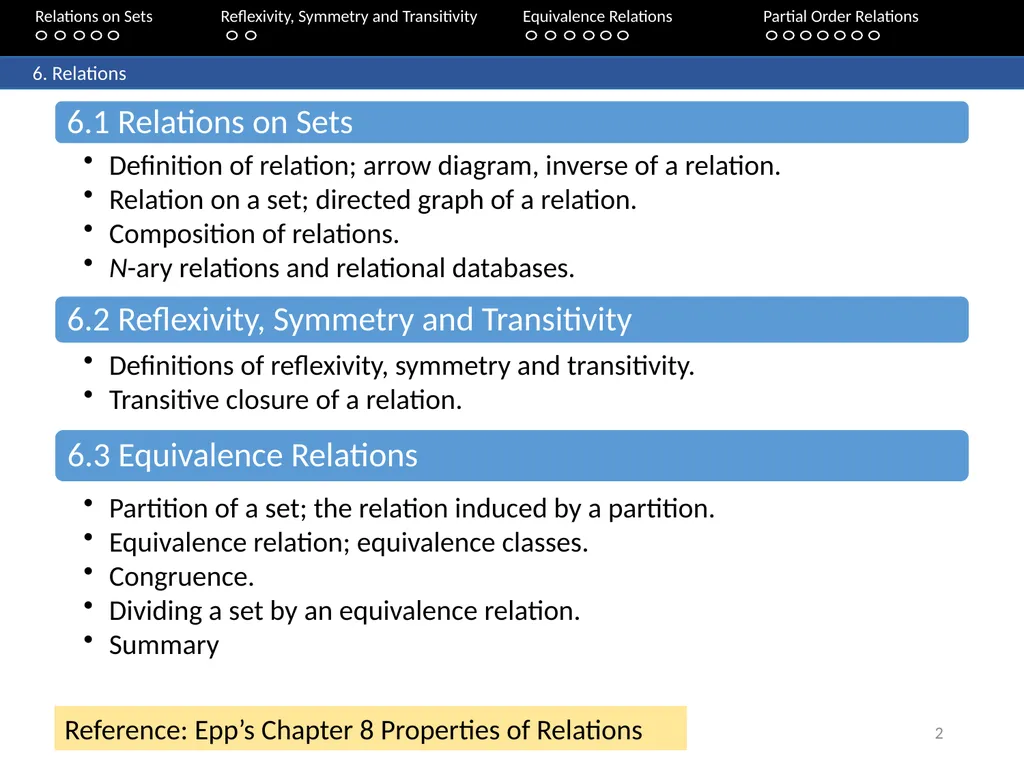
slide2. 2 6. Relations Relations on Sets Reflexivity, Symmetry and Transitivity Equivalence Relations Partial Order Relations Reference: Epp’s Chapter 8 Properties of Relations<br>
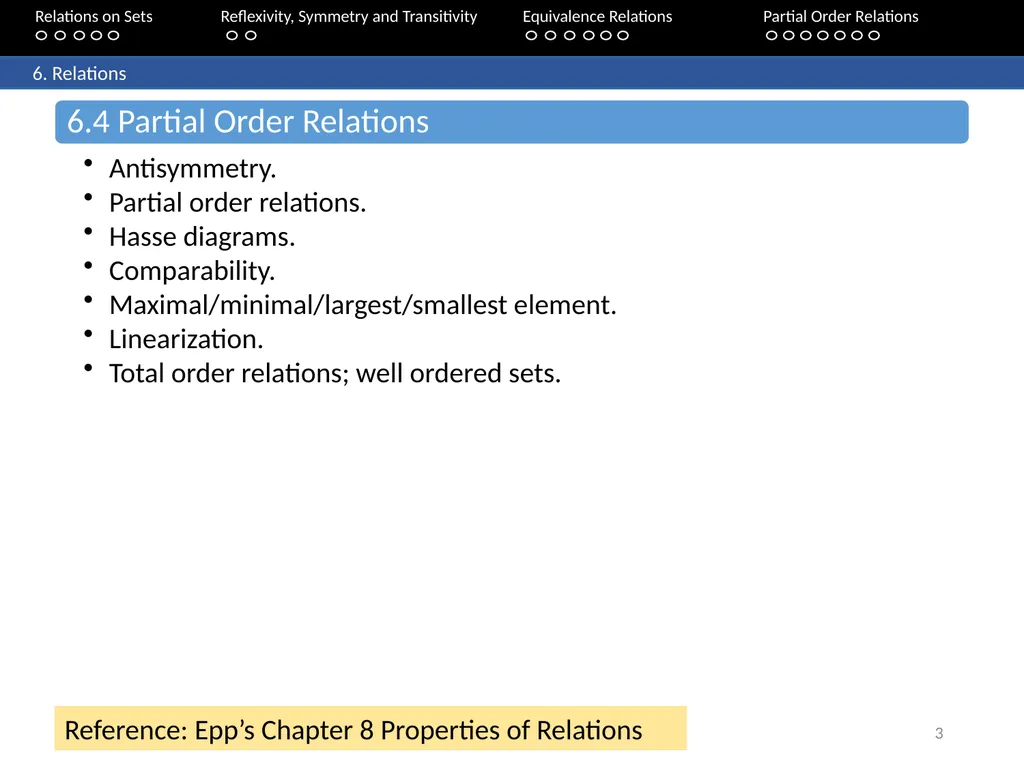
slide3. 3 6. Relations Relations on Sets Reflexivity, Symmetry and Transitivity Equivalence Relations Partial Order Relations Reference: Epp’s Chapter 8 Properties of Relations<br>
slide4. Relations on Sets Reflexivity, Symmetry and Transitivity Equivalence Relations Partial Order Relations 4 6.1 Relations on Sets<br>
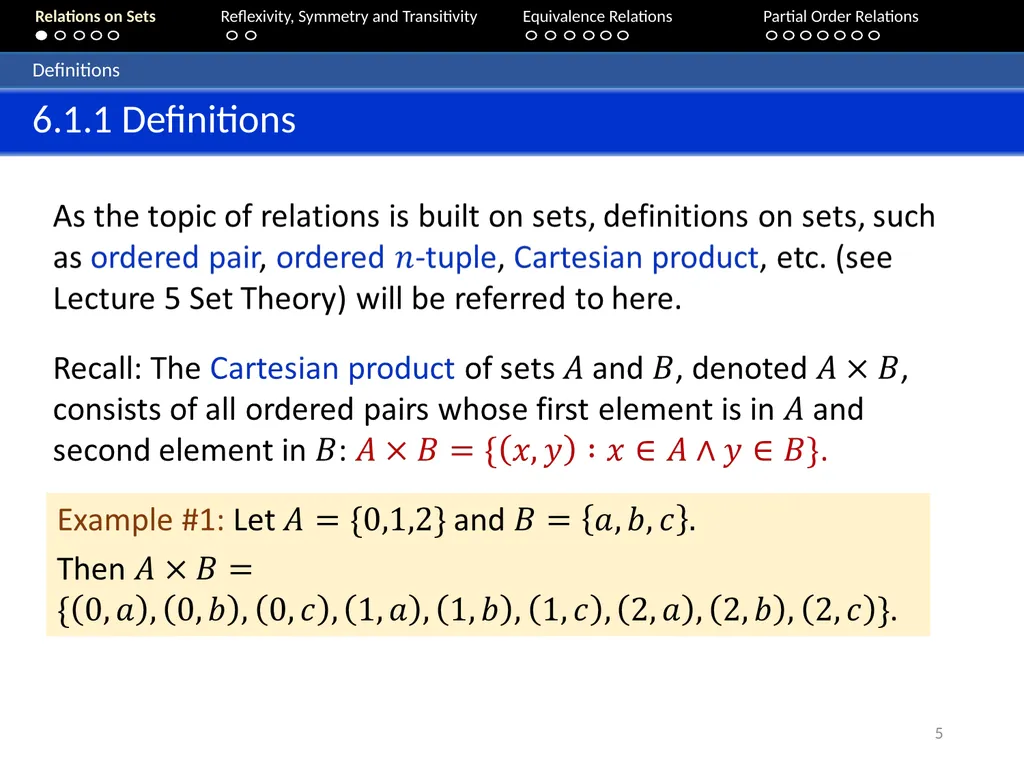
slide5. Relations on Sets Reflexivity, Symmetry and Transitivity Equivalence Relations Partial Order Relations Definitions 5 6.1.1 Definitions<br>
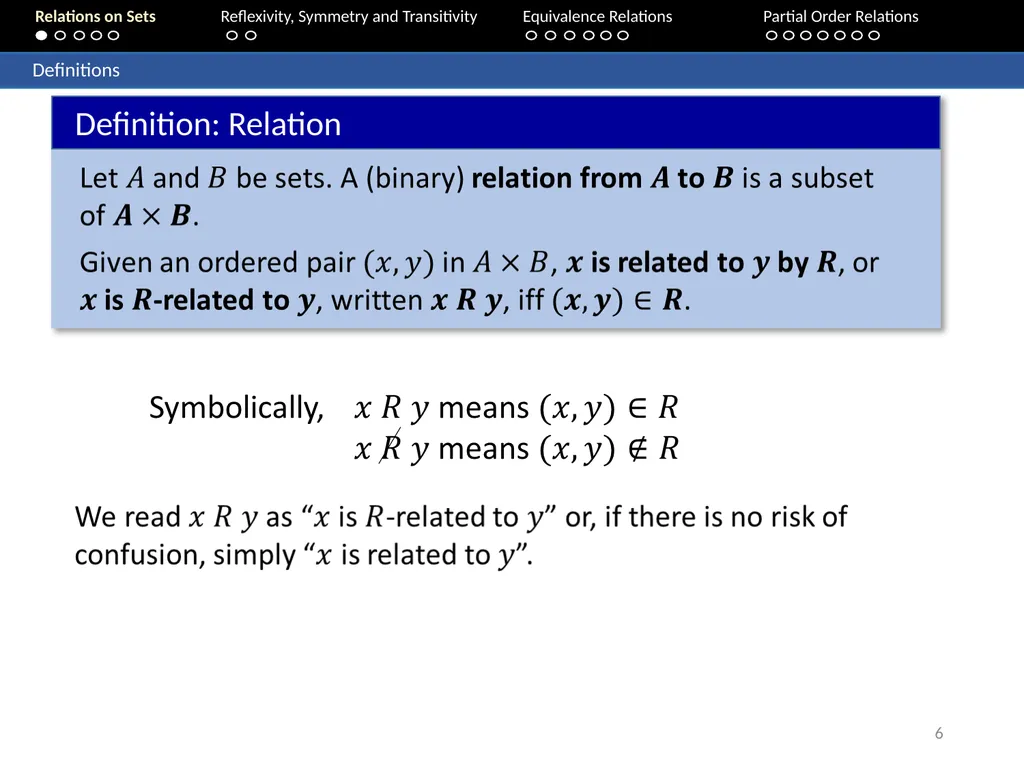
slide6. Relations on Sets Reflexivity, Symmetry and Transitivity Equivalence Relations Partial Order Relations Definitions 6<br>
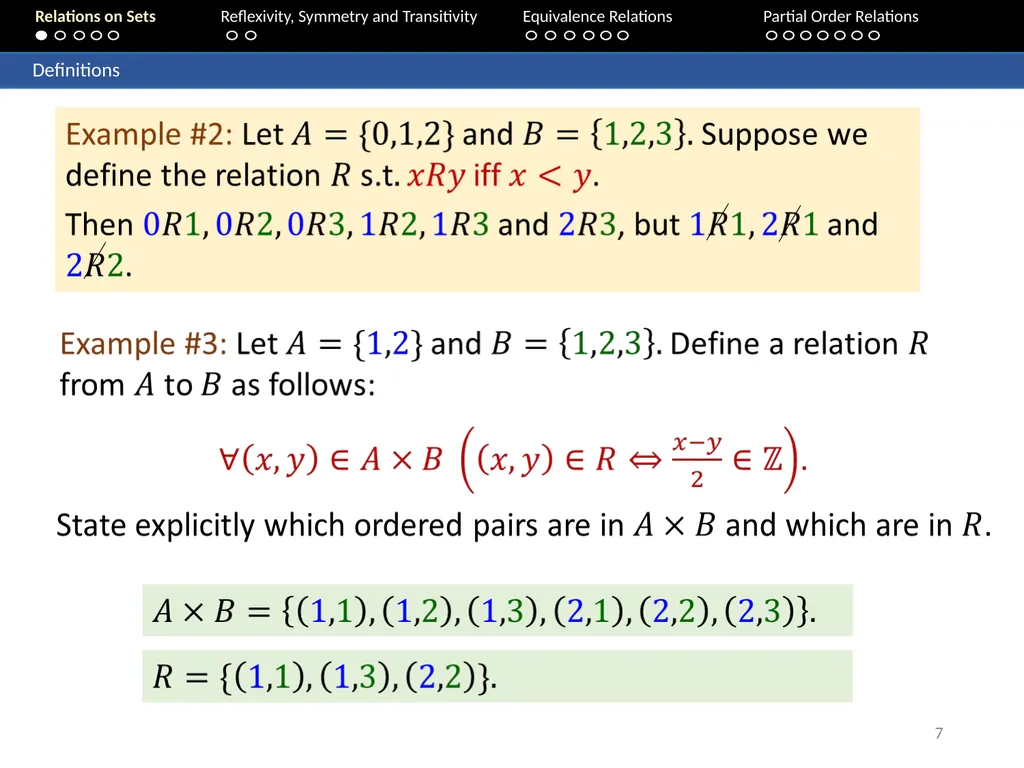
slide7. Relations on Sets Reflexivity, Symmetry and Transitivity Equivalence Relations Partial Order Relations Definitions 7<br>
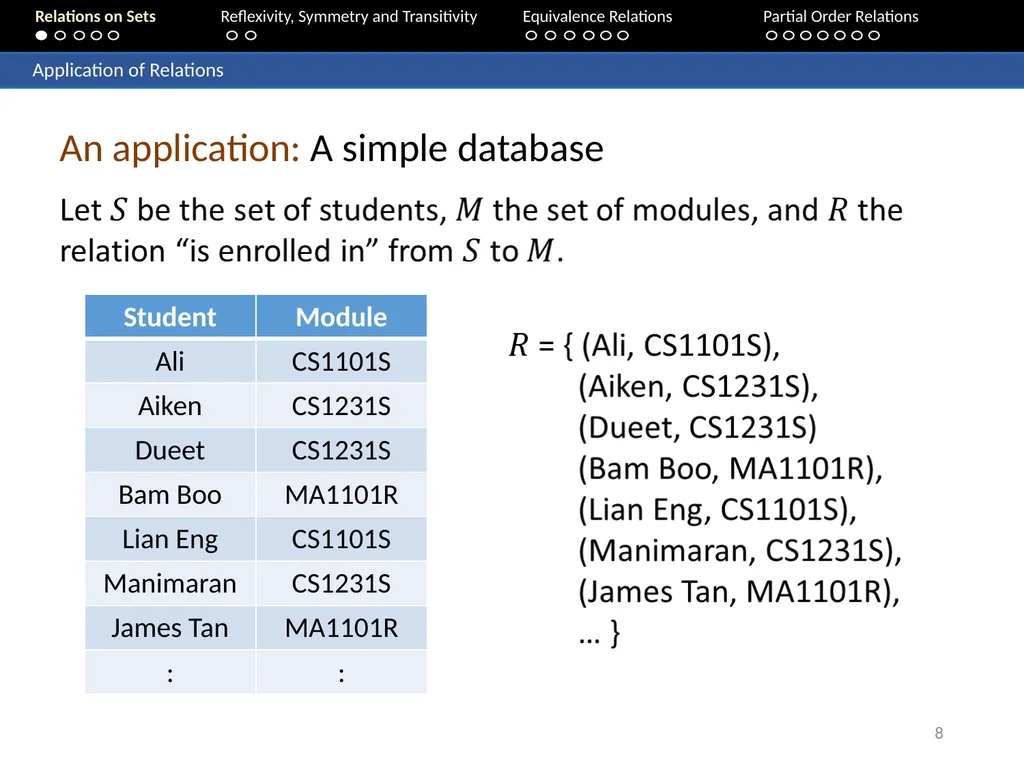
slide8. Relations on Sets Reflexivity, Symmetry and Transitivity Equivalence Relations Partial Order Relations Application of Relations 8 An application: A simple database<br>
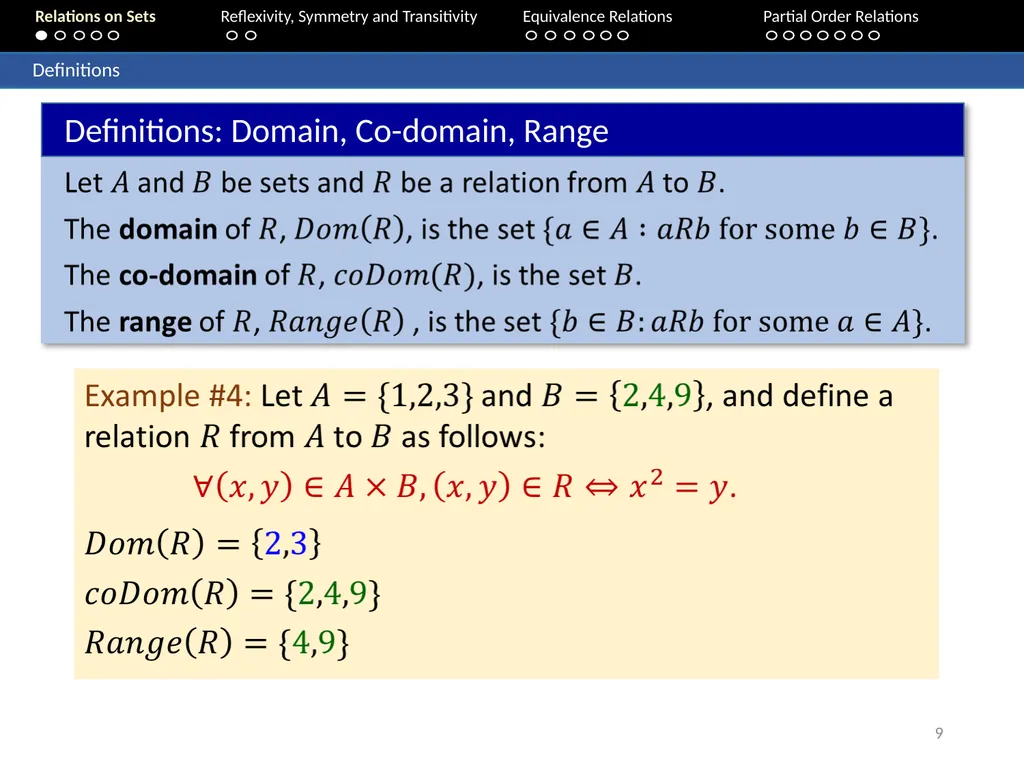
slide9. Relations on Sets Reflexivity, Symmetry and Transitivity Equivalence Relations Partial Order Relations Definitions 9<br>
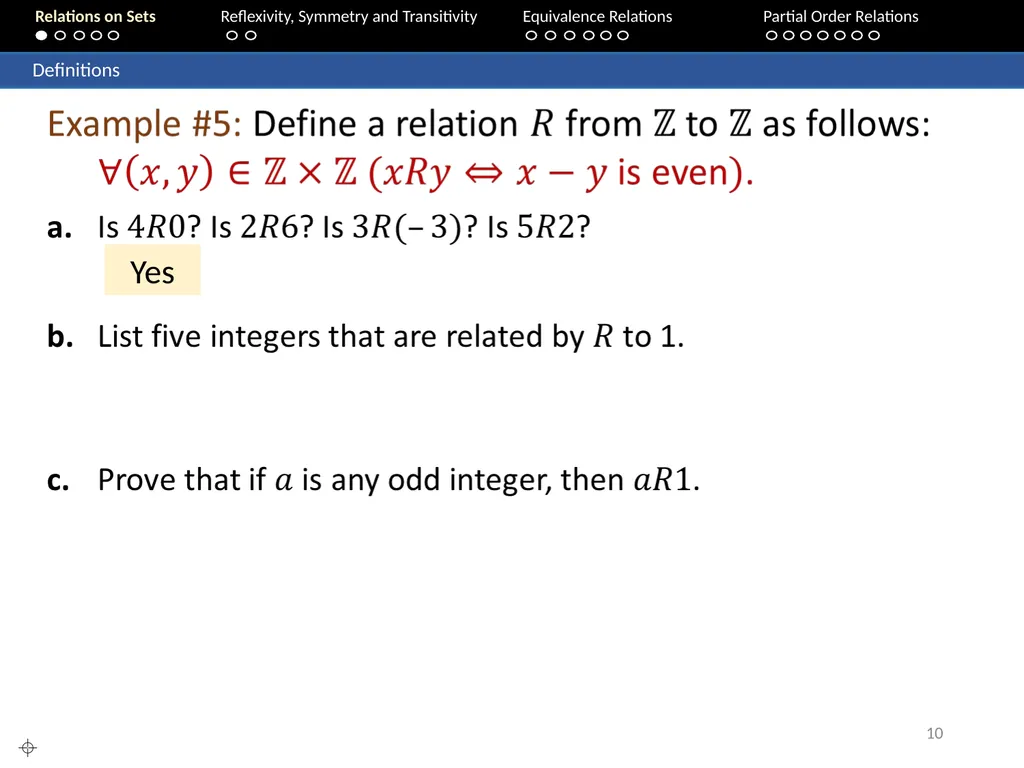
slide10. Relations on Sets Reflexivity, Symmetry and Transitivity Equivalence Relations Partial Order Relations Definitions 10 Yes <br>
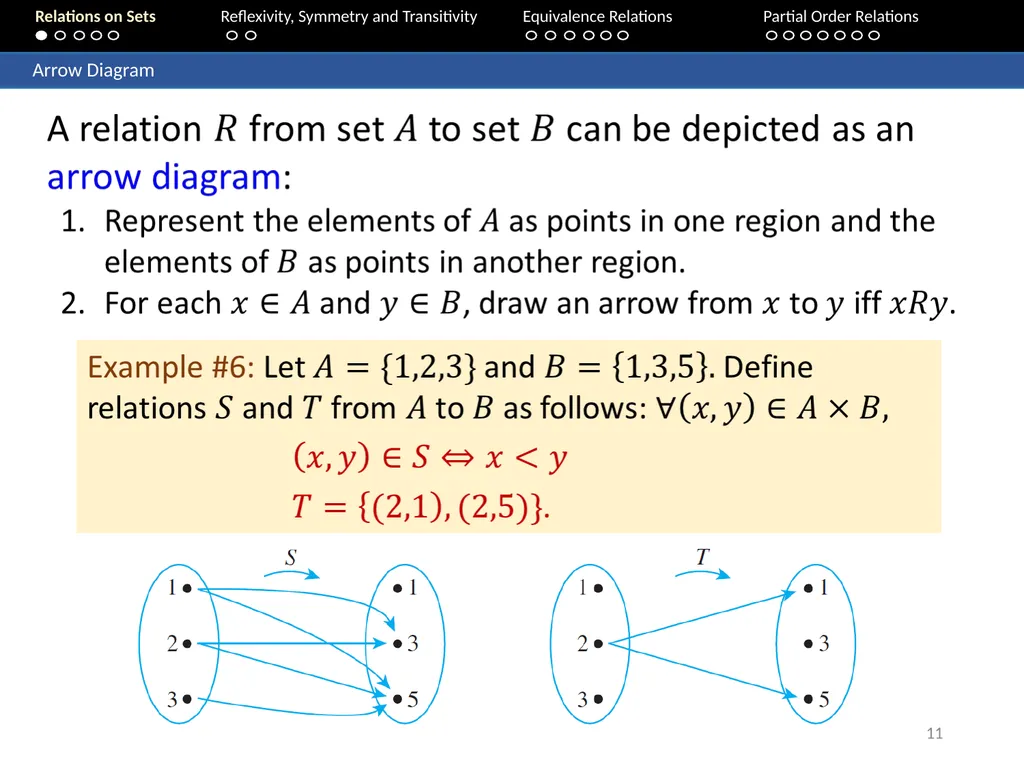
slide11. Relations on Sets Reflexivity, Symmetry and Transitivity Equivalence Relations Partial Order Relations Arrow Diagram 11<br>
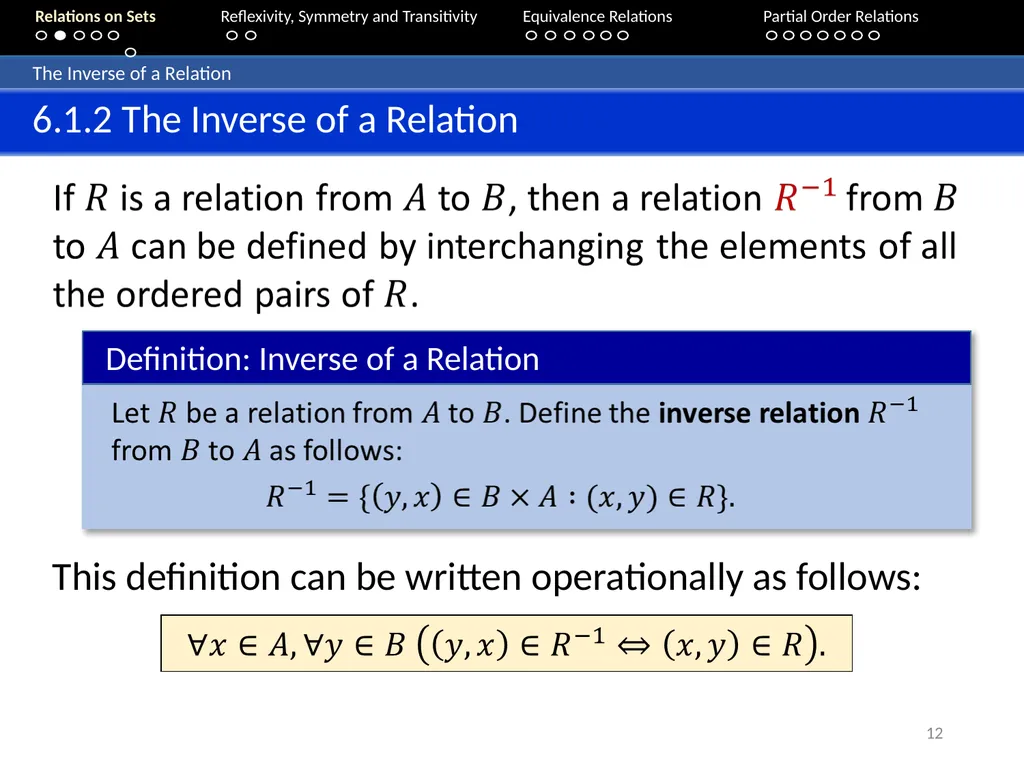
slide12. Relations on Sets Reflexivity, Symmetry and Transitivity Equivalence Relations Partial Order Relations The Inverse of a Relation 12 6.1.2 The Inverse of a Relation This definition can be written operationally as follows:<br>
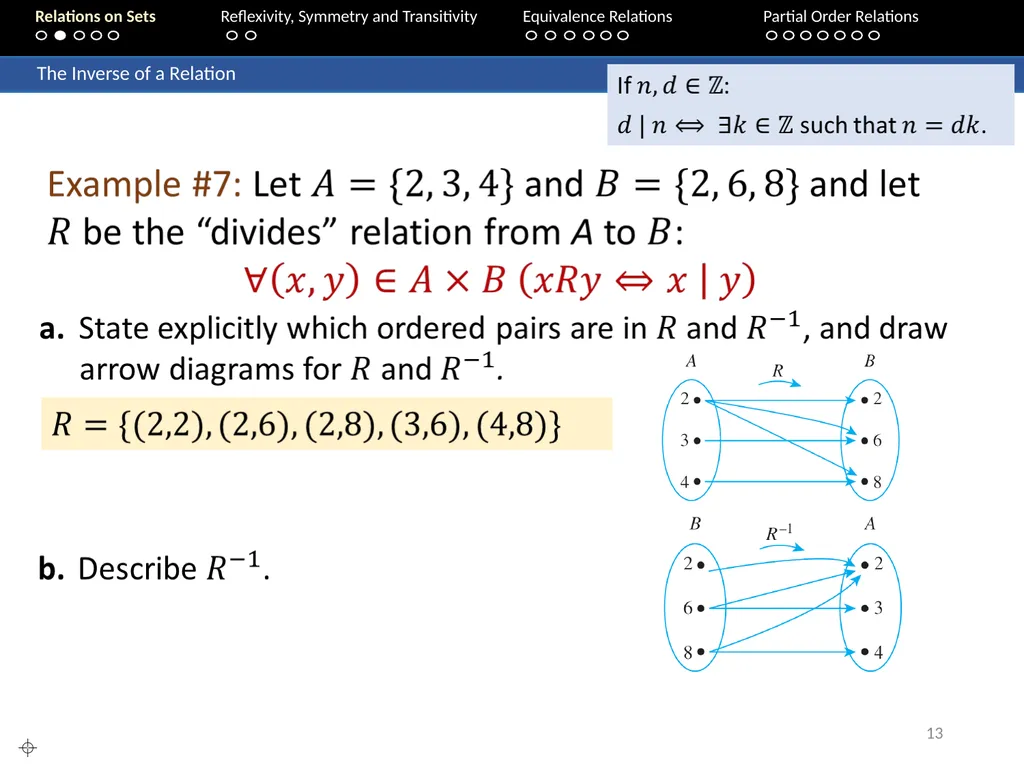
slide13. The Inverse of a Relation 13 Relations on Sets Reflexivity, Symmetry and Transitivity Equivalence Relations Partial Order Relations<br>
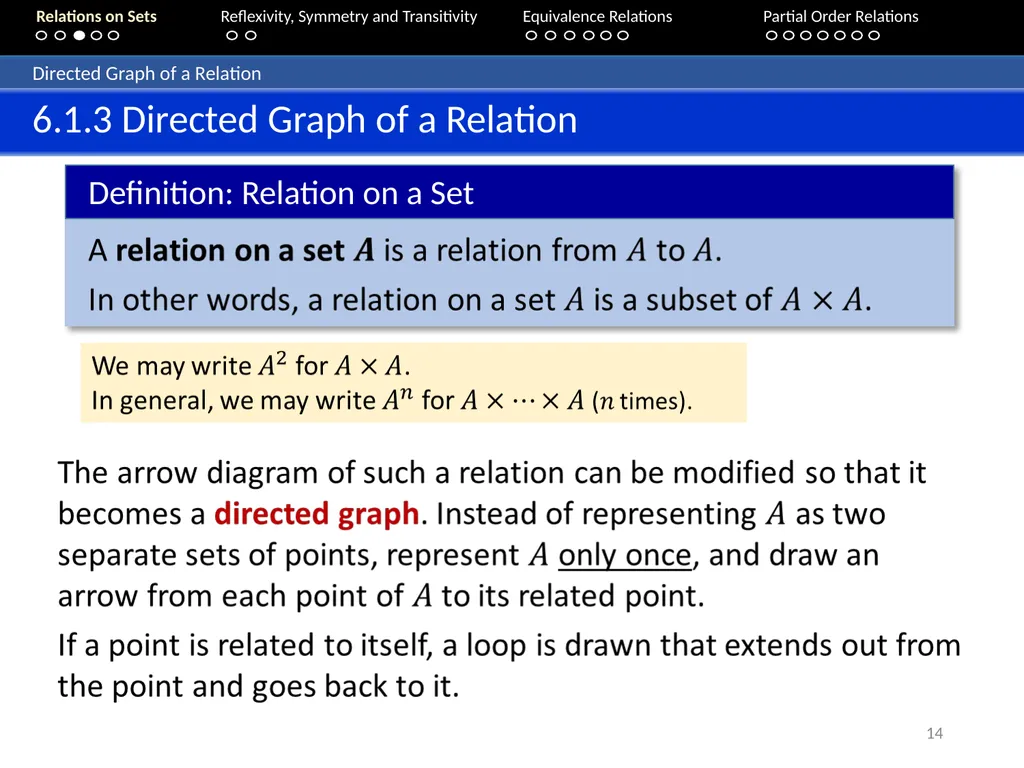
slide14. Relations on Sets Reflexivity, Symmetry and Transitivity Equivalence Relations Partial Order Relations Directed Graph of a Relation 14 6.1.3 Directed Graph of a Relation<br>
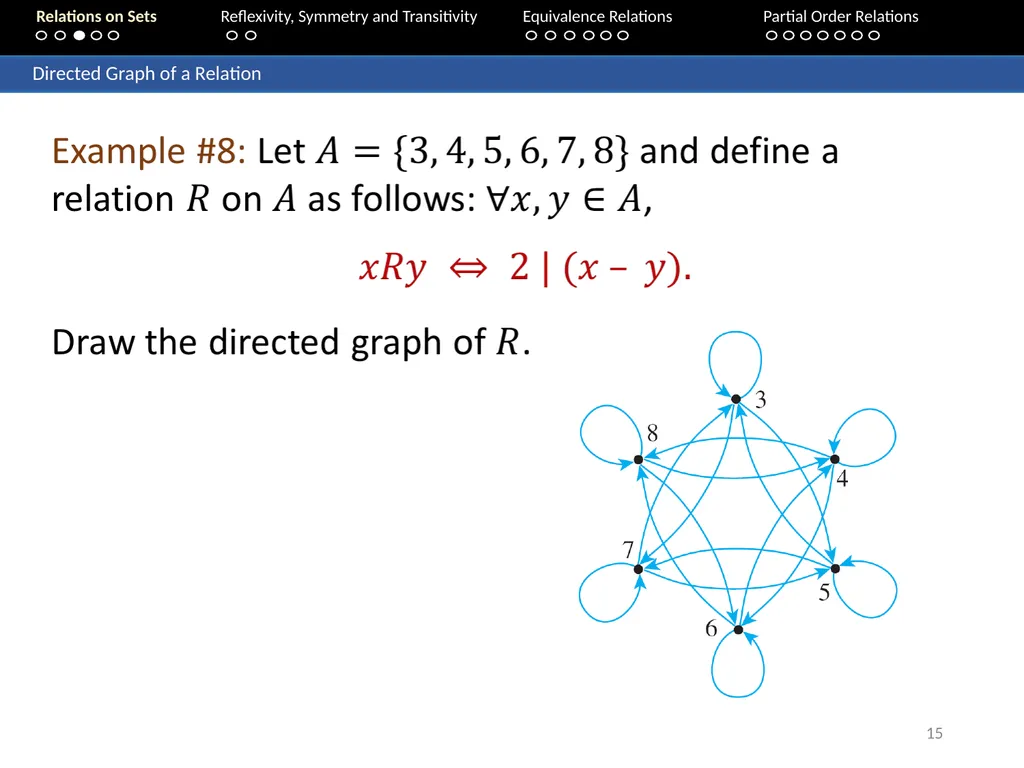
slide15. Relations on Sets Reflexivity, Symmetry and Transitivity Equivalence Relations Partial Order Relations Directed Graph of a Relation 15<br>
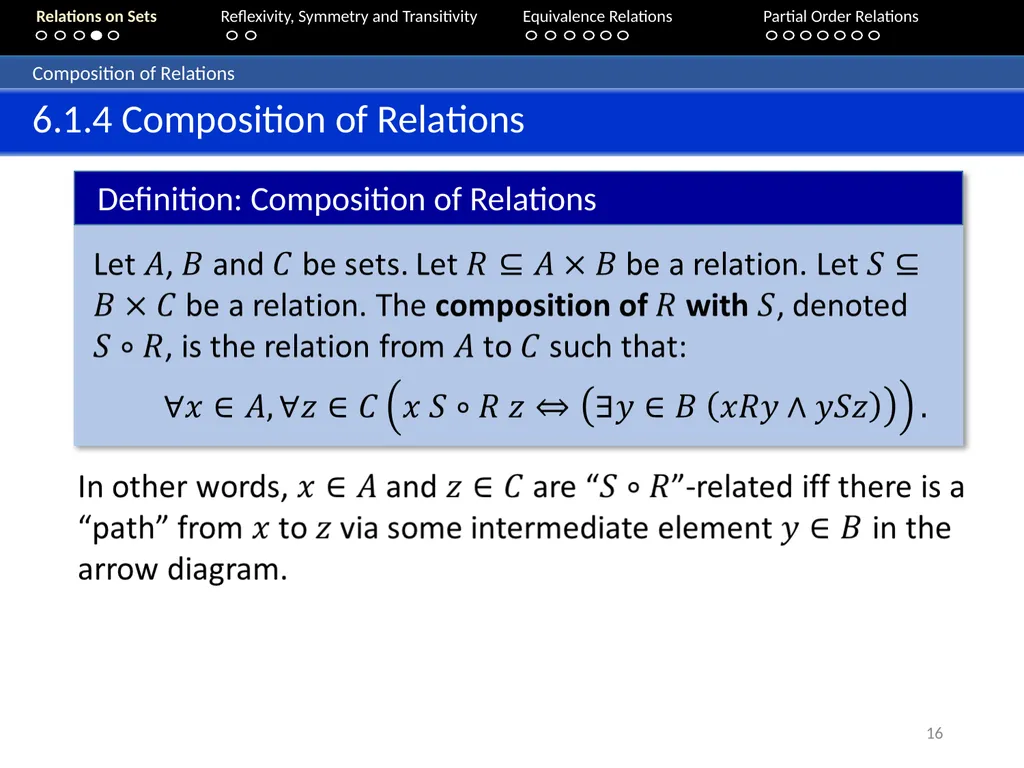
slide16. Relations on Sets Reflexivity, Symmetry and Transitivity Equivalence Relations Partial Order Relations Composition of Relations 16 6.1.4 Composition of Relations<br>
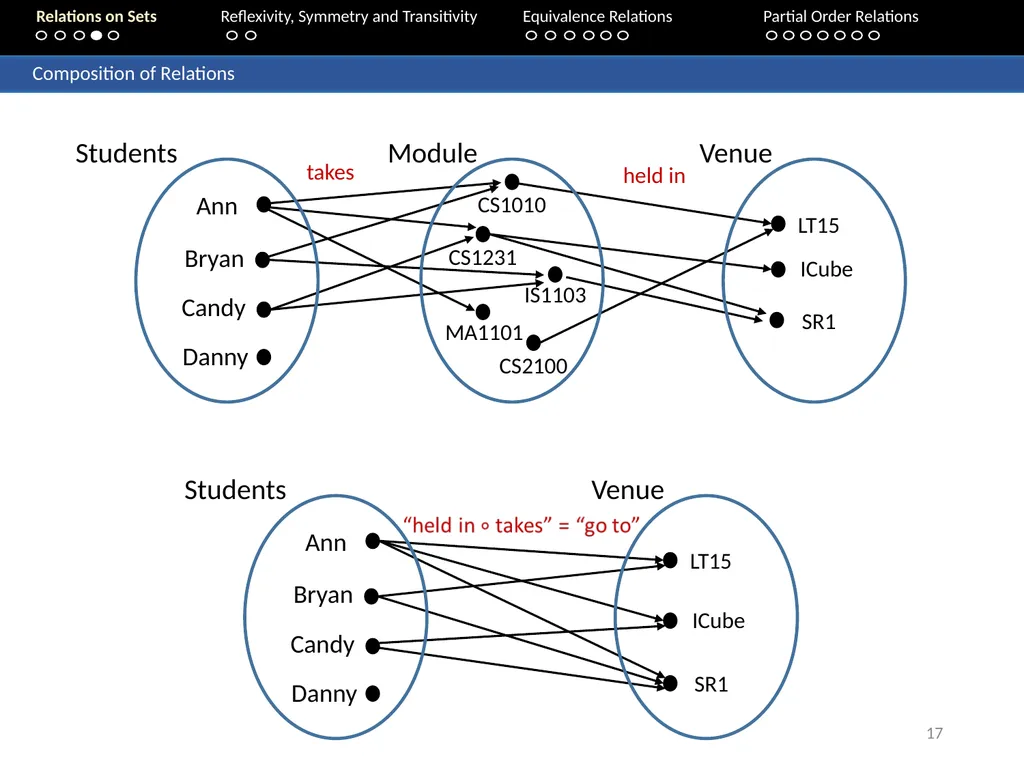
slide17. Relations on Sets Reflexivity, Symmetry and Transitivity Equivalence Relations Partial Order Relations Composition of Relations 17<br>
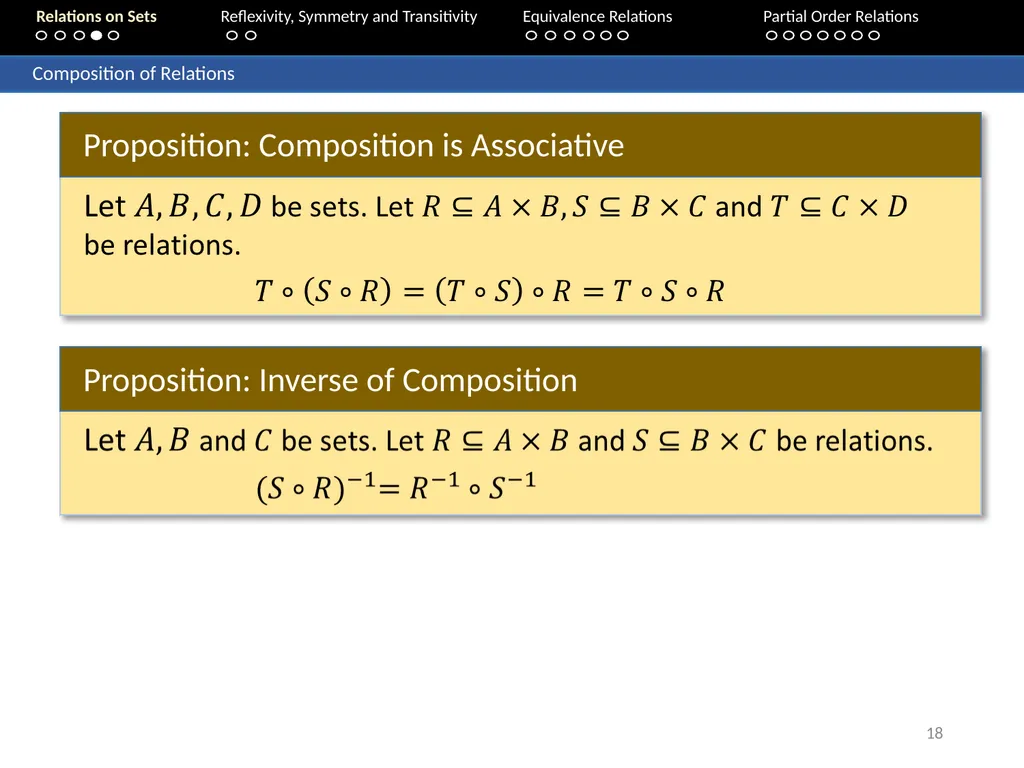
slide18. Relations on Sets Reflexivity, Symmetry and Transitivity Equivalence Relations Partial Order Relations Composition of Relations 18<br>
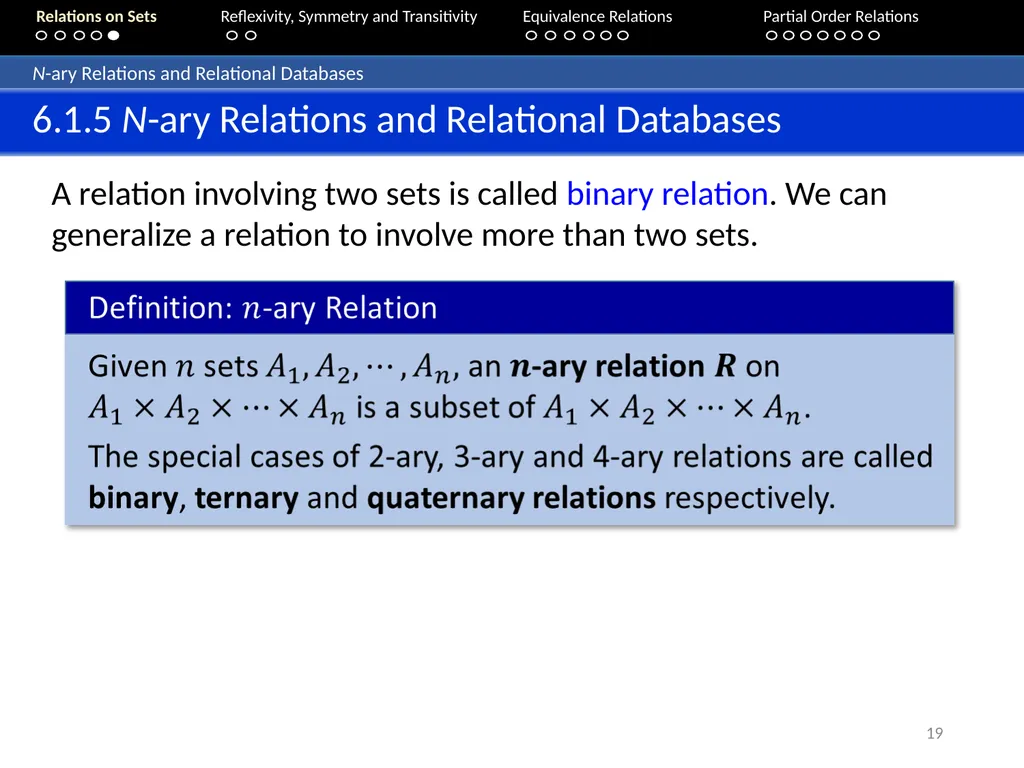
slide19. Relations on Sets Reflexivity, Symmetry and Transitivity Equivalence Relations Partial Order Relations N-ary Relations and Relational Databases 19 6.1.5 N-ary Relations and Relational Databases A relation involving two sets is called binary relation. We can generalize a relation to involve more than two sets.<br>
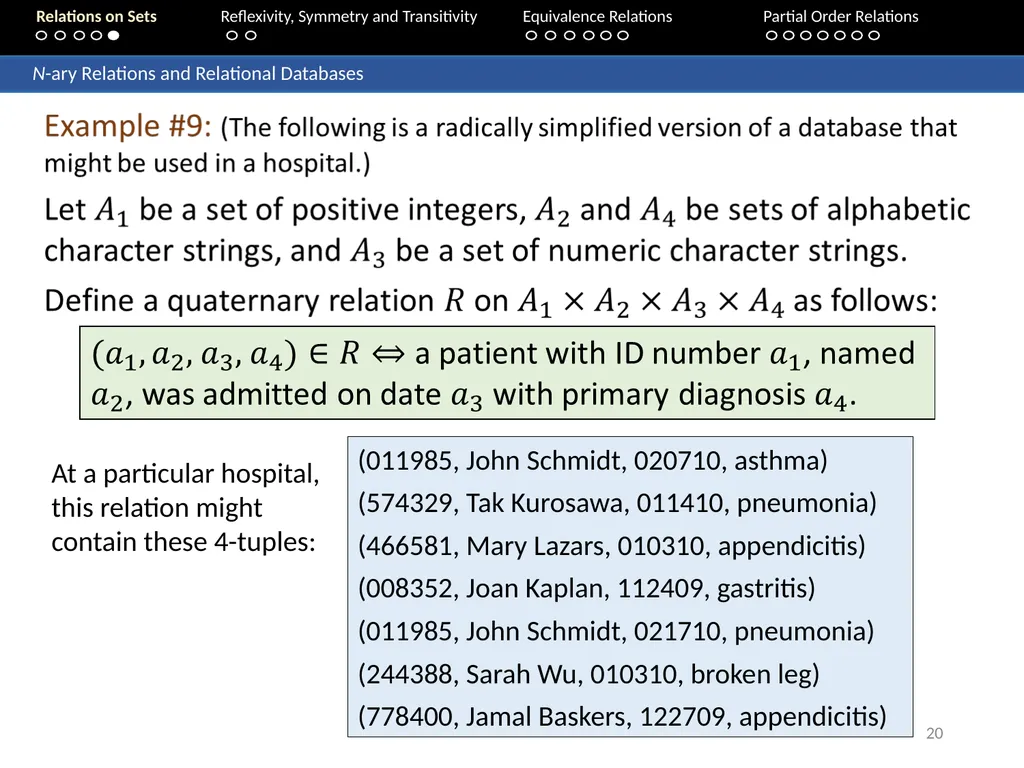
slide20. Relations on Sets Reflexivity, Symmetry and Transitivity Equivalence Relations Partial Order Relations N-ary Relations and Relational Databases 20<br>
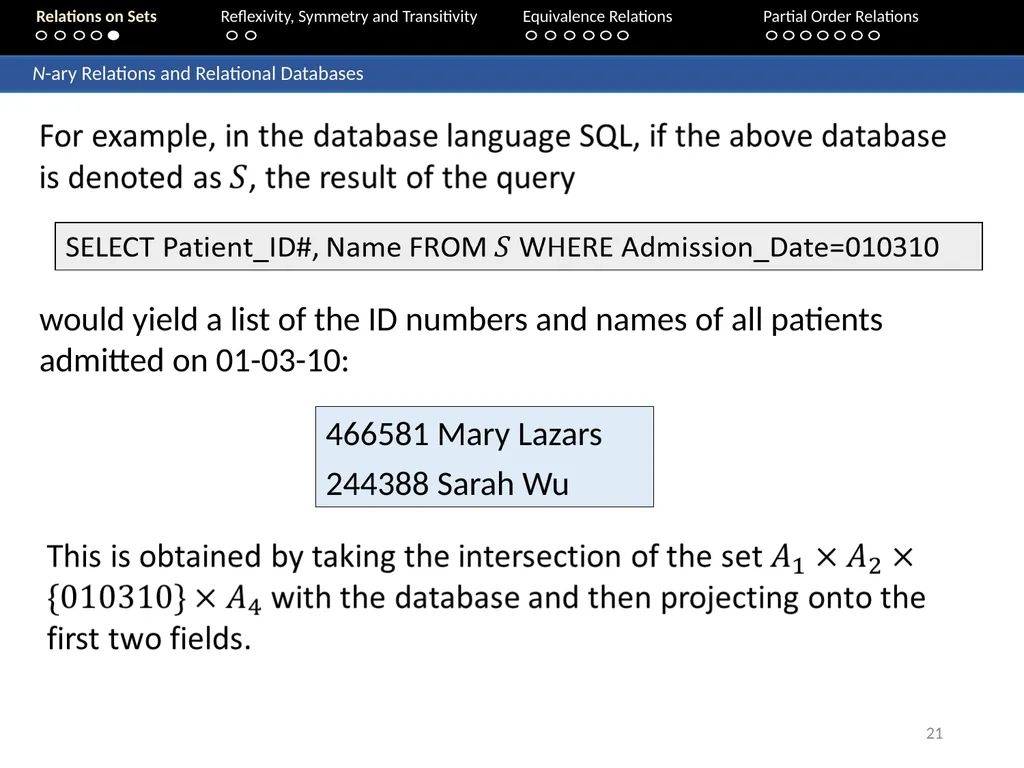
slide21. Relations on Sets Reflexivity, Symmetry and Transitivity Equivalence Relations Partial Order Relations N-ary Relations and Relational Databases 21 would yield a list of the ID numbers and names of all patients admitted on 01-03-10: 466581 Mary Lazars
244388 Sarah Wu<br>
slide22. Relations on Sets Reflexivity, Symmetry and Transitivity Equivalence Relations Partial Order Relations 22 6.2 Reflexivity, Symmetry and Transitivity<br>
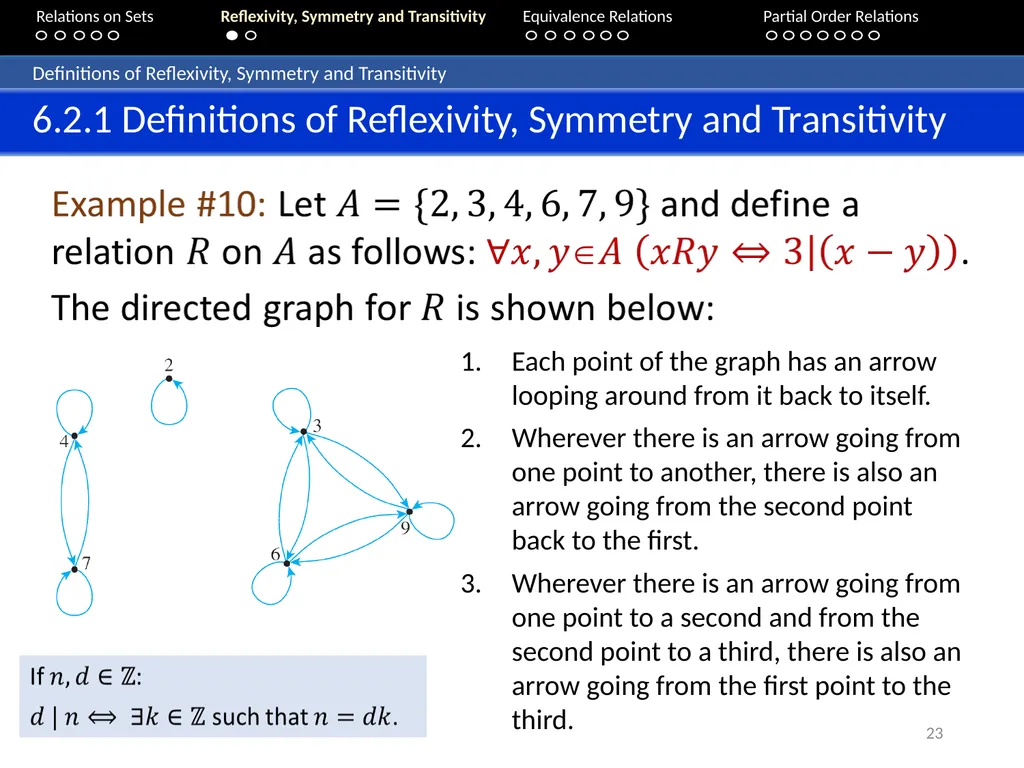
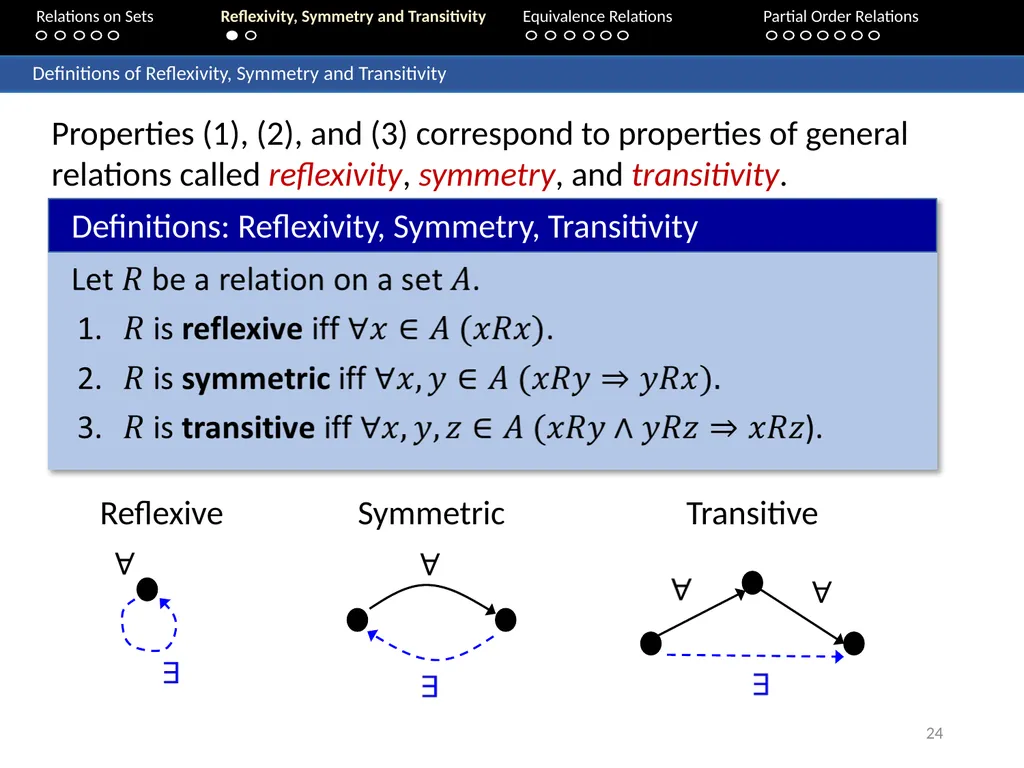
slide23. Relations on Sets Reflexivity, Symmetry and Transitivity Equivalence Relations Partial Order Relations Definitions of Reflexivity, Symmetry and Transitivity 23 6.2.1 Definitions of Reflexivity, Symmetry and Transitivity Each point of the graph has an arrow looping around from it back to itself.
Wherever there is an arrow going from one point to another, there is also an arrow going from the second point back to the first.
Wherever there is an arrow going from one point to a second and from the second point to a third, there is also an arrow going from the first point to the third.<br>
slide24. Relations on Sets Reflexivity, Symmetry and Transitivity Equivalence Relations Partial Order Relations Definitions of Reflexivity, Symmetry and Transitivity 24 Properties (1), (2), and (3) correspond to properties of general relations called reflexivity, symmetry, and transitivity. Reflexive Symmetric Transitive<br>
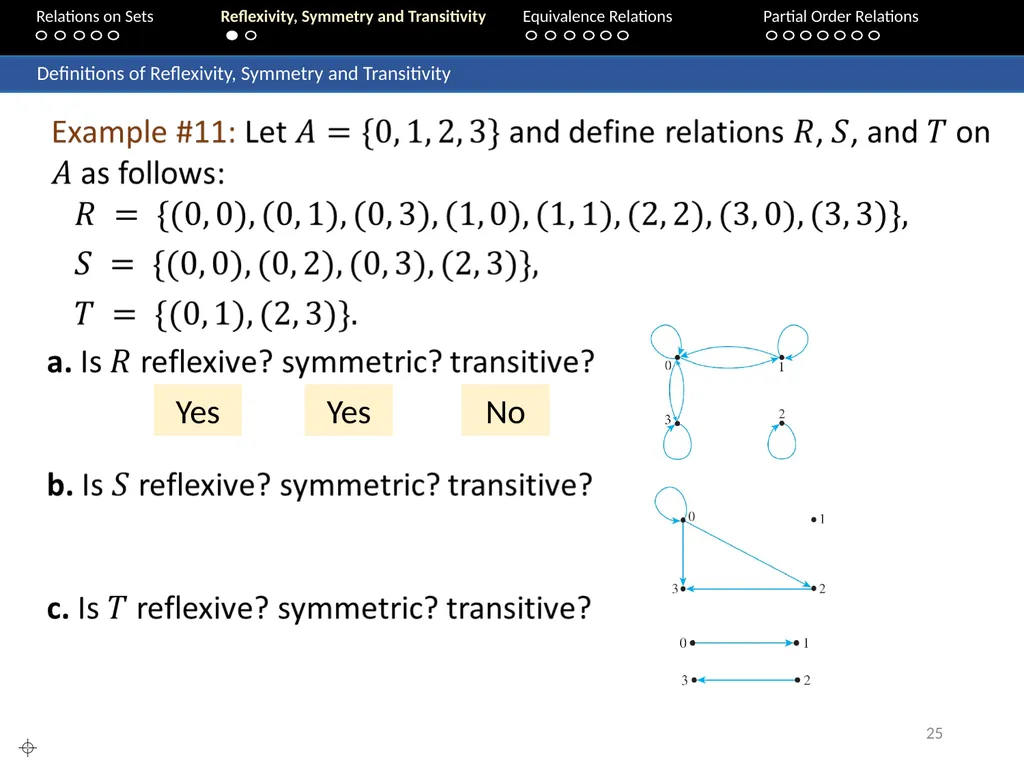
slide25. Relations on Sets Reflexivity, Symmetry and Transitivity Equivalence Relations Partial Order Relations Definitions of Reflexivity, Symmetry and Transitivity 25 Yes Yes No<br>
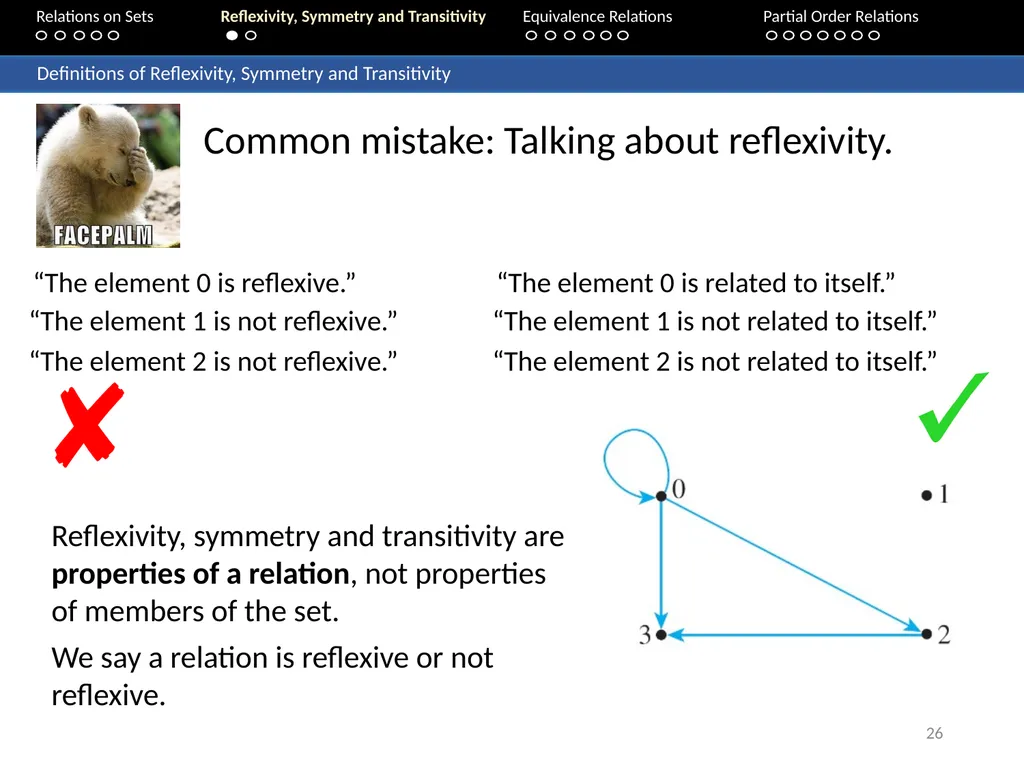
slide26. Relations on Sets Reflexivity, Symmetry and Transitivity Equivalence Relations Partial Order Relations Definitions of Reflexivity, Symmetry and Transitivity 26 Common mistake: Talking about reflexivity. Reflexivity, symmetry and transitivity are properties of a relation, not properties of members of the set.
We say a relation is reflexive or not reflexive.<br>
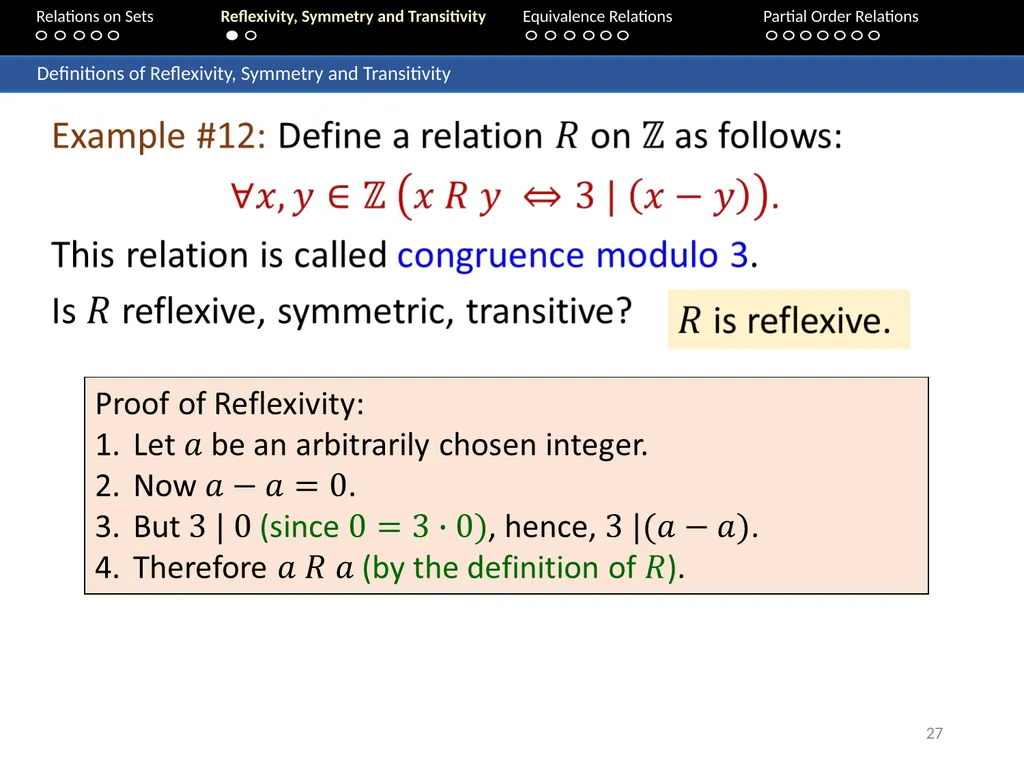
slide27. Relations on Sets Reflexivity, Symmetry and Transitivity Equivalence Relations Partial Order Relations Definitions of Reflexivity, Symmetry and Transitivity 27<br>
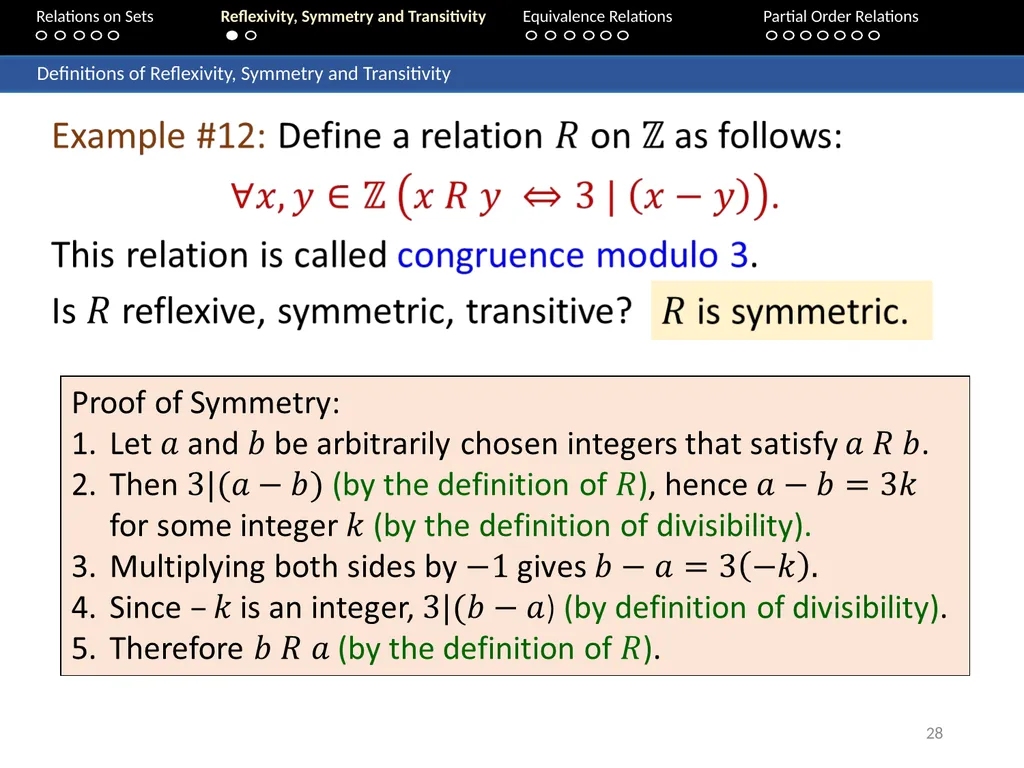
slide28. Relations on Sets Reflexivity, Symmetry and Transitivity Equivalence Relations Partial Order Relations Definitions of Reflexivity, Symmetry and Transitivity 28<br>
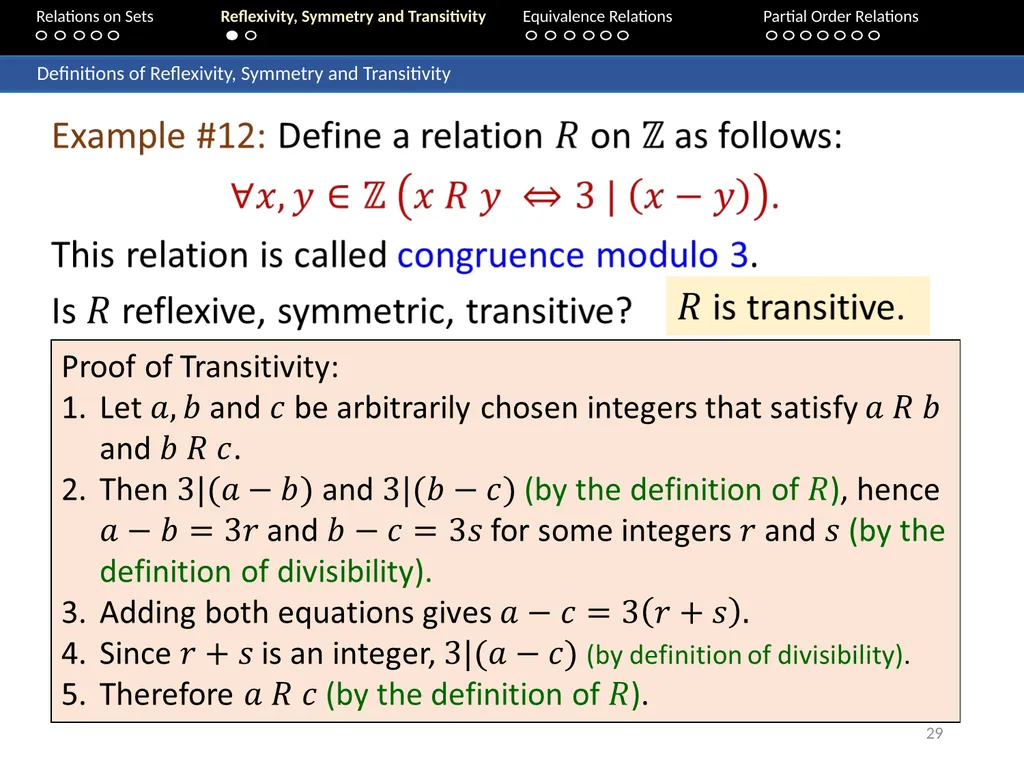
slide29. Relations on Sets Reflexivity, Symmetry and Transitivity Equivalence Relations Partial Order Relations Definitions of Reflexivity, Symmetry and Transitivity 29<br>
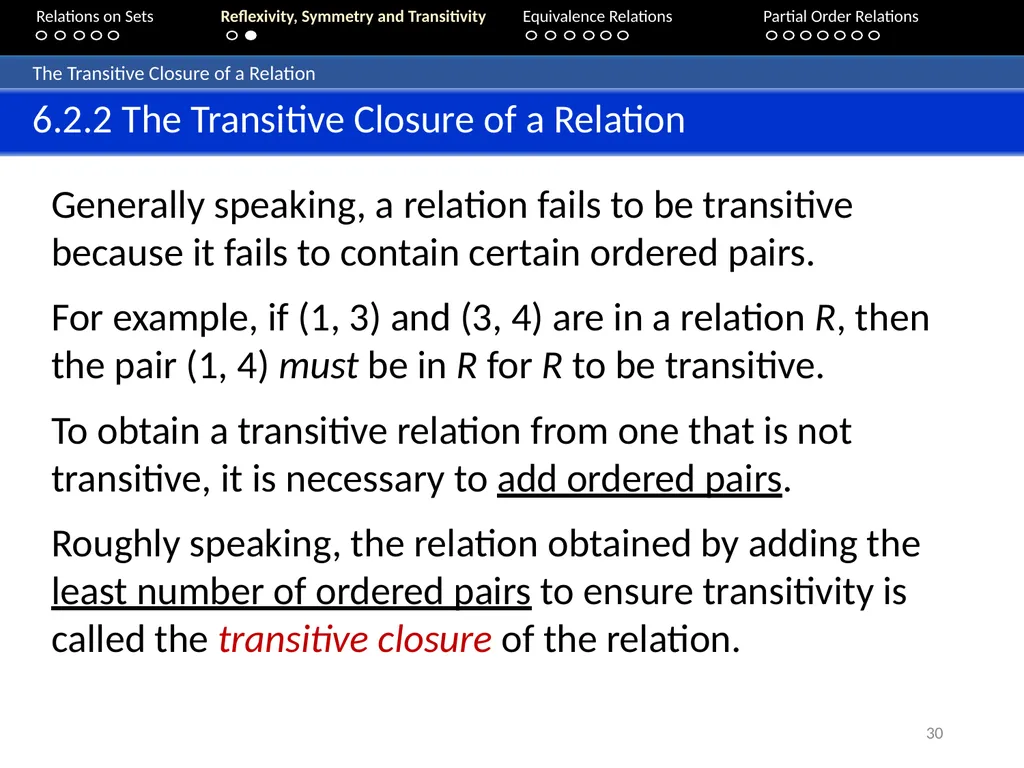
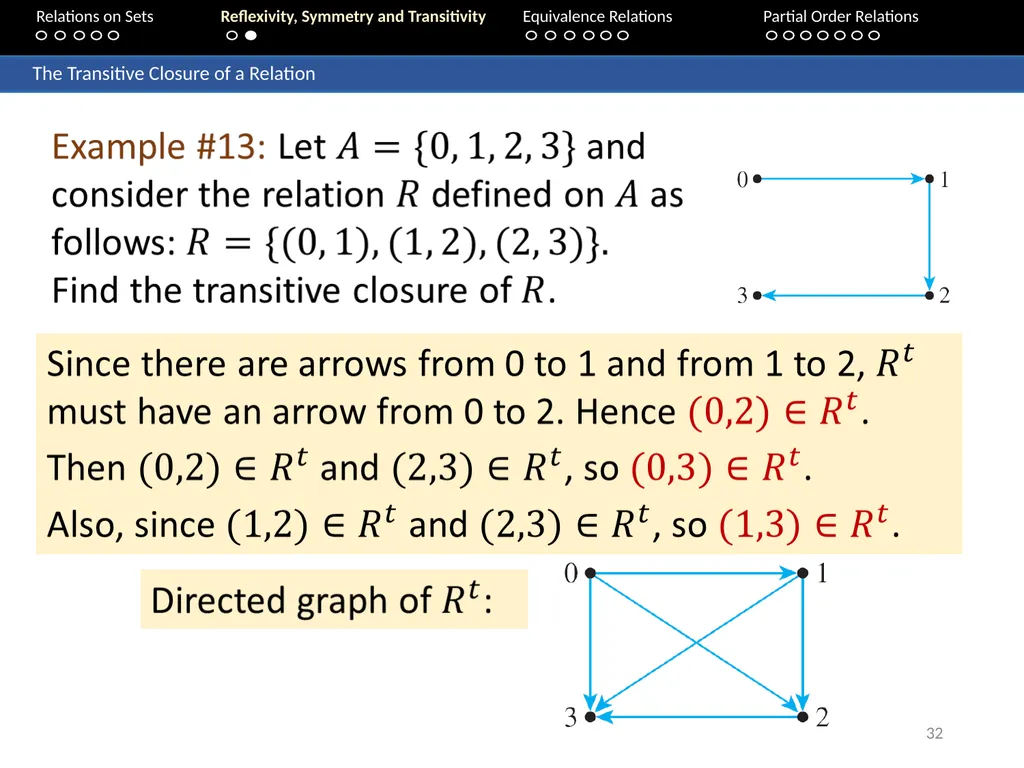
slide30. Relations on Sets Reflexivity, Symmetry and Transitivity Equivalence Relations Partial Order Relations The Transitive Closure of a Relation 30 6.2.2 The Transitive Closure of a Relation Generally speaking, a relation fails to be transitive because it fails to contain certain ordered pairs.
For example, if (1, 3) and (3, 4) are in a relation R, then the pair (1, 4) must be in R for R to be transitive.
To obtain a transitive relation from one that is not transitive, it is necessary to add ordered pairs.
Roughly speaking, the relation obtained by adding the least number of ordered pairs to ensure transitivity is called the transitive closure of the relation.<br>
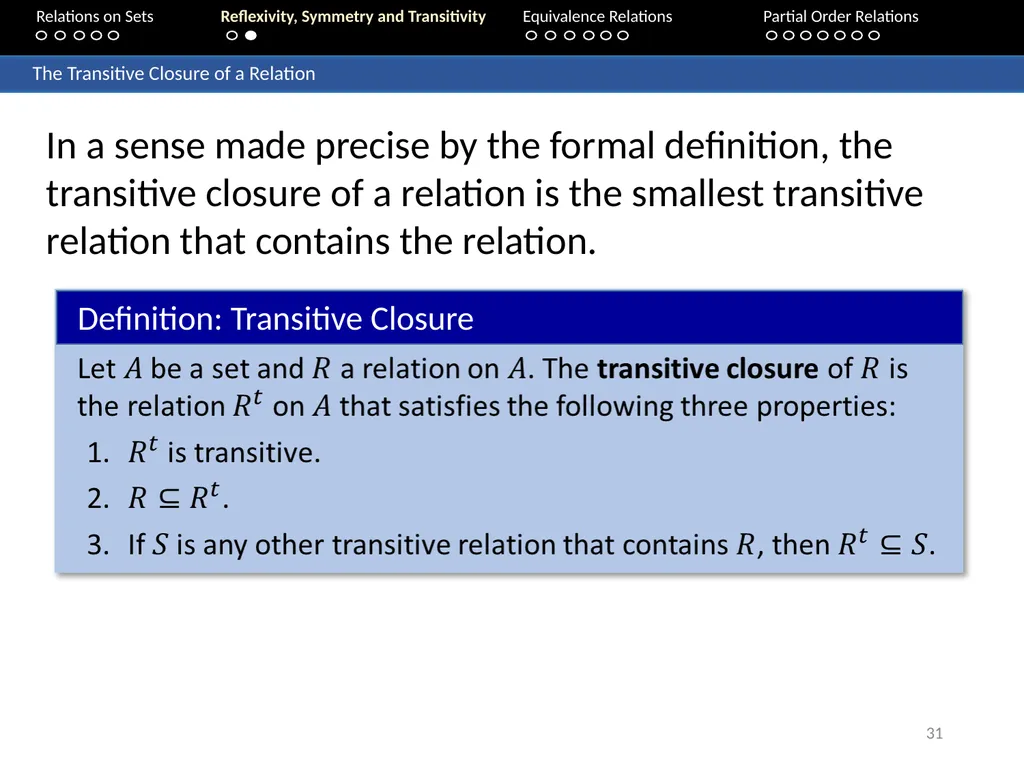
slide31. Relations on Sets Reflexivity, Symmetry and Transitivity Equivalence Relations Partial Order Relations The Transitive Closure of a Relation 31 In a sense made precise by the formal definition, the transitive closure of a relation is the smallest transitive relation that contains the relation.<br>
slide32. Relations on Sets Reflexivity, Symmetry and Transitivity Equivalence Relations Partial Order Relations The Transitive Closure of a Relation 32<br>
slide33. Relations on Sets Reflexivity, Symmetry and Transitivity Equivalence Relations Partial Order Relations 33 6.3 Equivalence Relations<br>
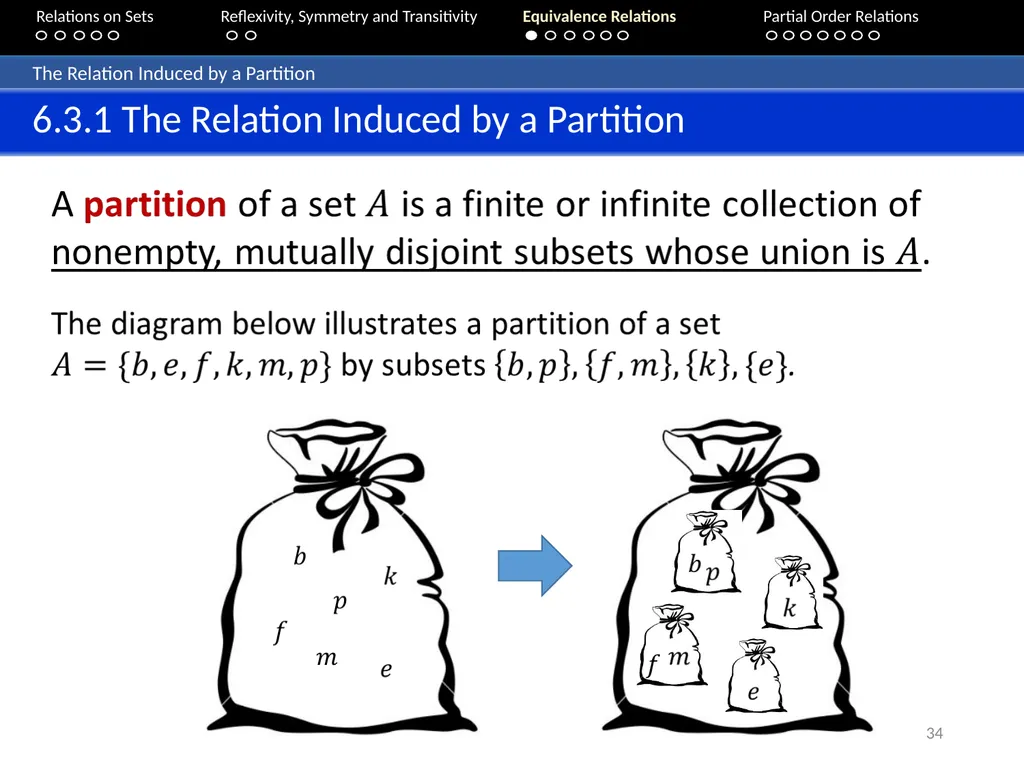
slide34. Relations on Sets Reflexivity, Symmetry and Transitivity Equivalence Relations Partial Order Relations The Relation Induced by a Partition 34 6.3.1 The Relation Induced by a Partition<br>
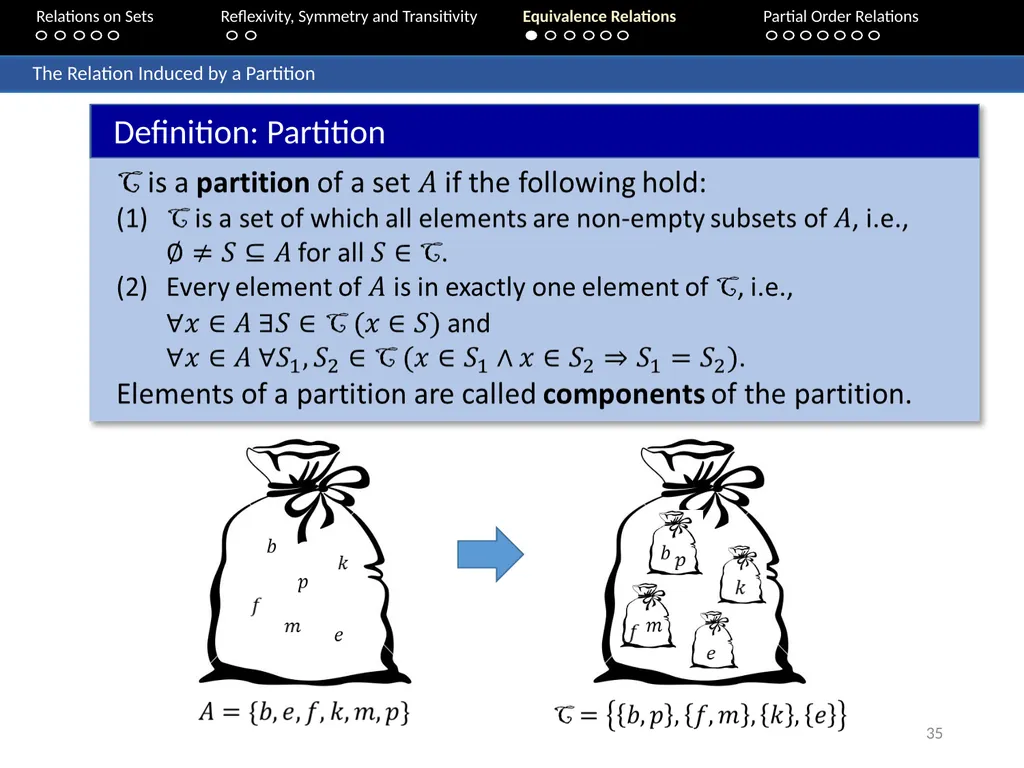
slide35. Relations on Sets Reflexivity, Symmetry and Transitivity Equivalence Relations Partial Order Relations The Relation Induced by a Partition 35<br>
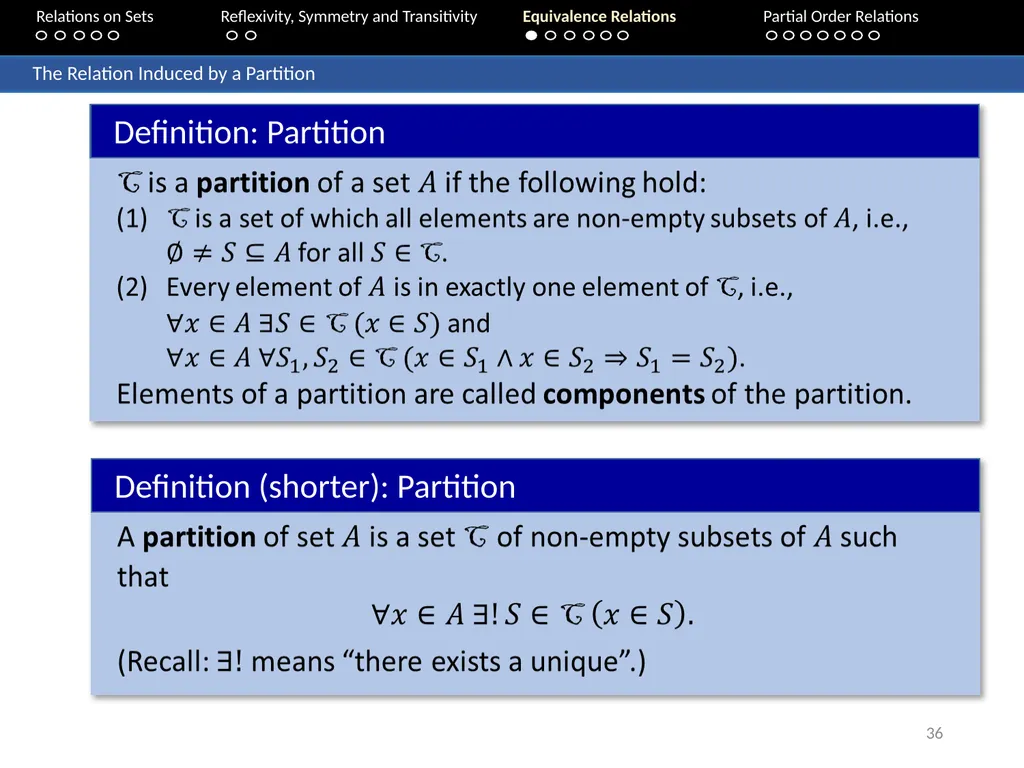
slide36. Relations on Sets Reflexivity, Symmetry and Transitivity Equivalence Relations Partial Order Relations The Relation Induced by a Partition 36<br>
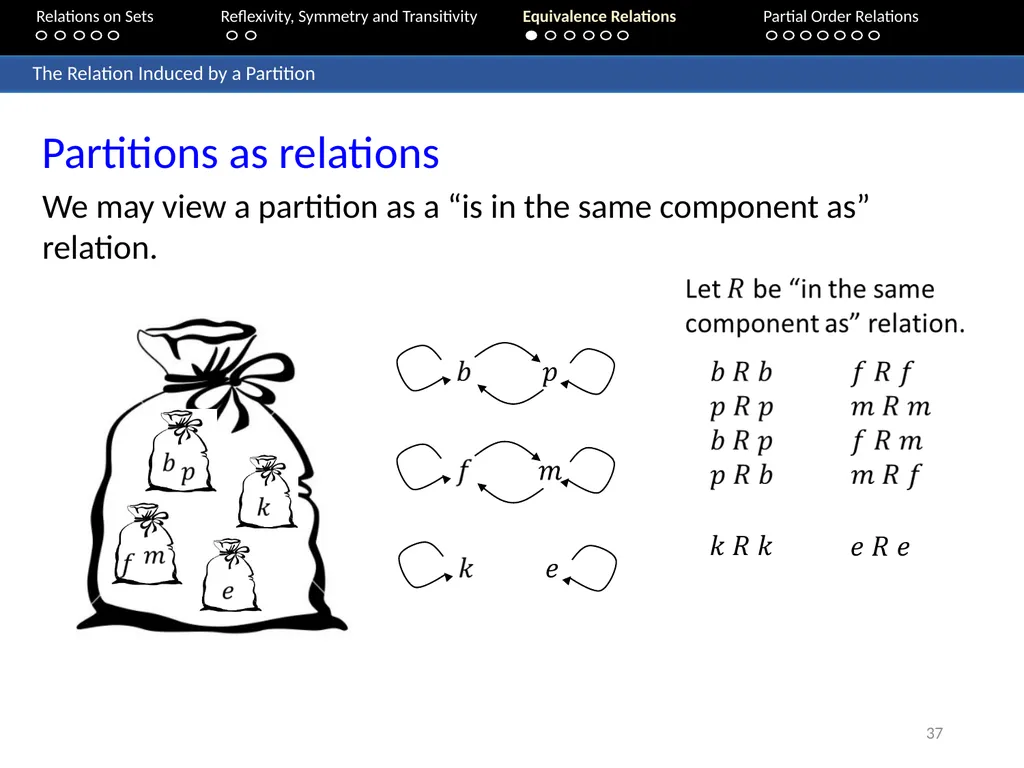
slide37. Relations on Sets Reflexivity, Symmetry and Transitivity Equivalence Relations Partial Order Relations The Relation Induced by a Partition 37 Partitions as relations We may view a partition as a “is in the same component as” relation.<br>
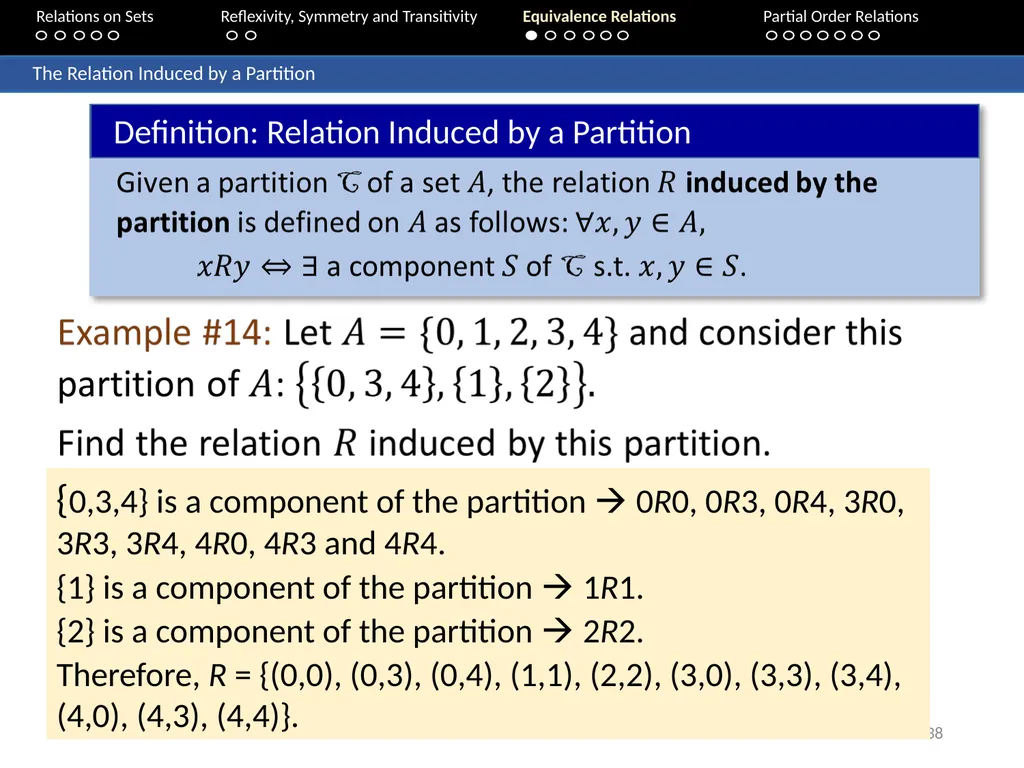
slide38. Relations on Sets Reflexivity, Symmetry and Transitivity Equivalence Relations Partial Order Relations The Relation Induced by a Partition 38 {0,3,4} is a component of the partition 0R0, 0R3, 0R4, 3R0, 3R3, 3R4, 4R0, 4R3 and 4R4.
{1} is a component of the partition 1R1.
{2} is a component of the partition 2R2.
Therefore, R = {(0,0), (0,3), (0,4), (1,1), (2,2), (3,0), (3,3), (3,4), (4,0), (4,3), (4,4)}.<br>
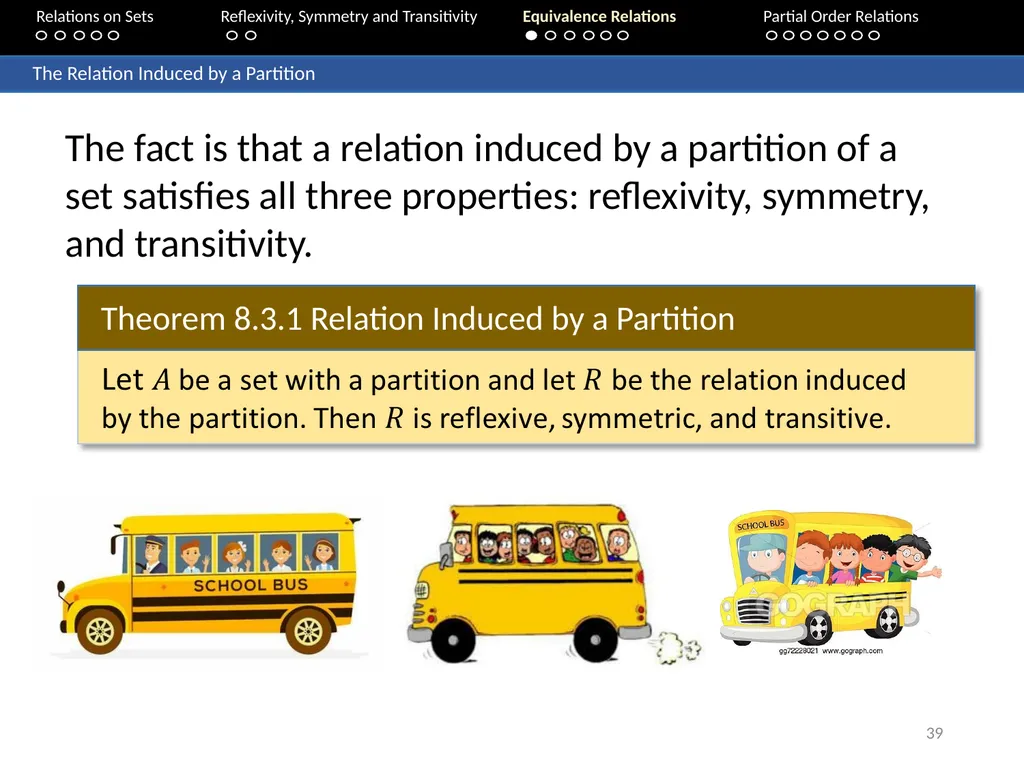
slide39. Relations on Sets Reflexivity, Symmetry and Transitivity Equivalence Relations Partial Order Relations The Relation Induced by a Partition 39 The fact is that a relation induced by a partition of a set satisfies all three properties: reflexivity, symmetry, and transitivity.<br>
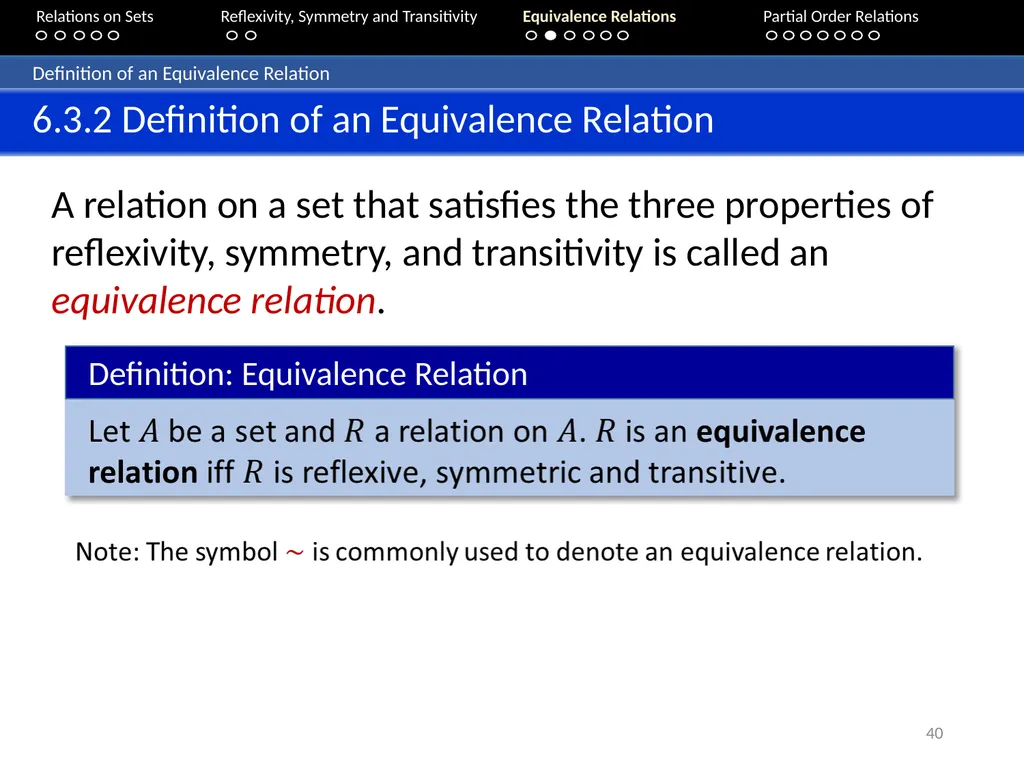
slide40. Relations on Sets Reflexivity, Symmetry and Transitivity Equivalence Relations Partial Order Relations Definition of an Equivalence Relation 40 6.3.2 Definition of an Equivalence Relation A relation on a set that satisfies the three properties of reflexivity, symmetry, and transitivity is called an equivalence relation.<br>
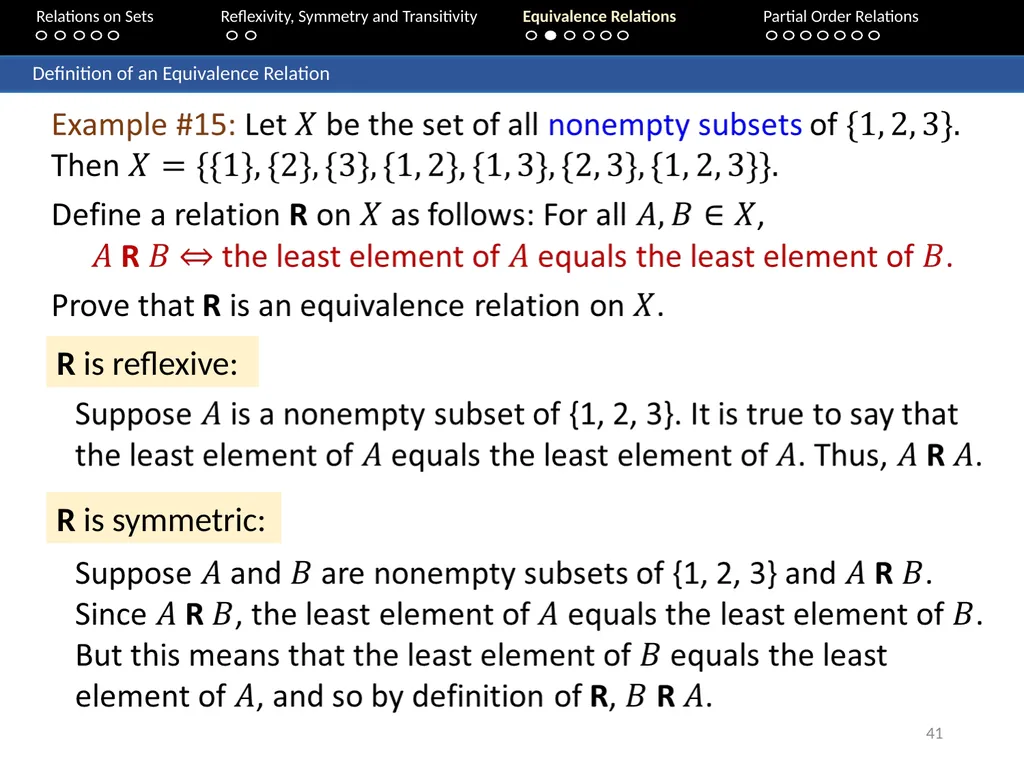
slide41. Relations on Sets Reflexivity, Symmetry and Transitivity Equivalence Relations Partial Order Relations Definition of an Equivalence Relation 41 R is reflexive: R is symmetric:<br>
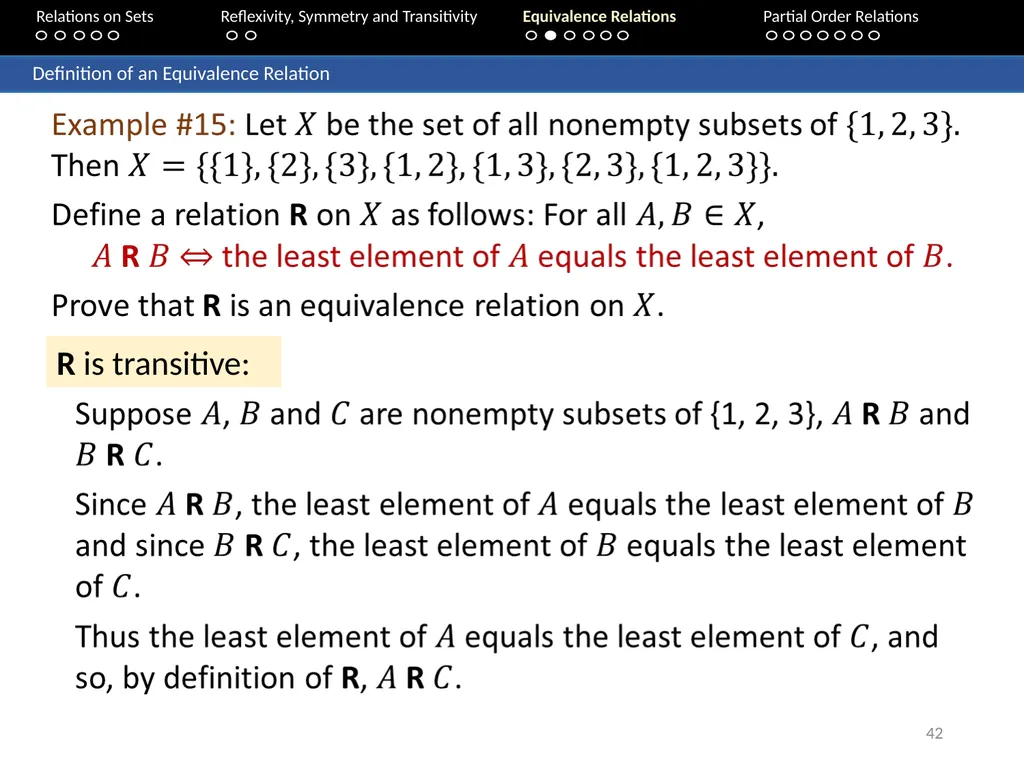
slide42. Relations on Sets Reflexivity, Symmetry and Transitivity Equivalence Relations Partial Order Relations Definition of an Equivalence Relation 42 R is transitive:<br>
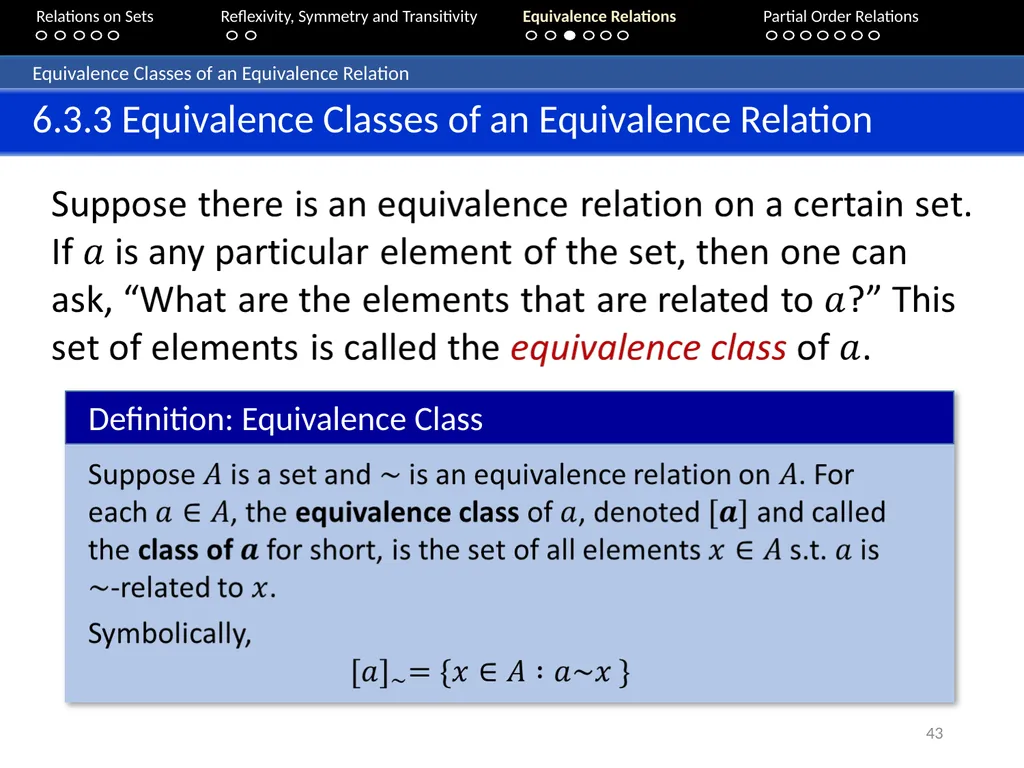
slide43. Relations on Sets Reflexivity, Symmetry and Transitivity Equivalence Relations Partial Order Relations Equivalence Classes of an Equivalence Relation 43 6.3.3 Equivalence Classes of an Equivalence Relation<br>
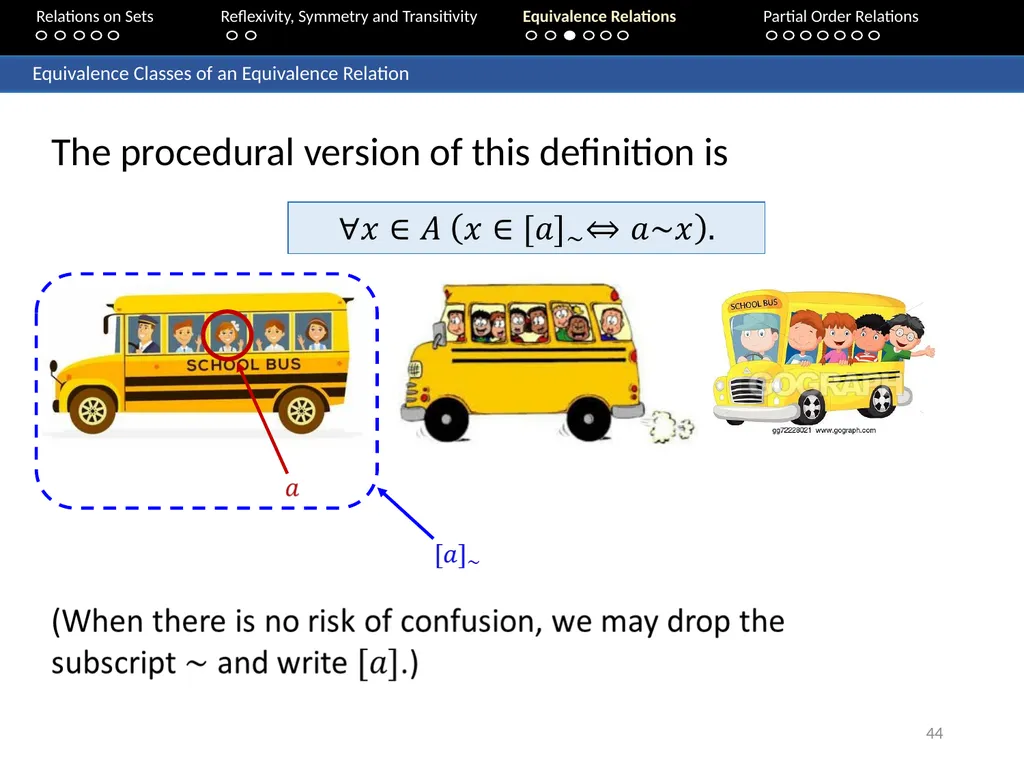
slide44. Relations on Sets Reflexivity, Symmetry and Transitivity Equivalence Relations Partial Order Relations Equivalence Classes of an Equivalence Relation 44 The procedural version of this definition is<br>
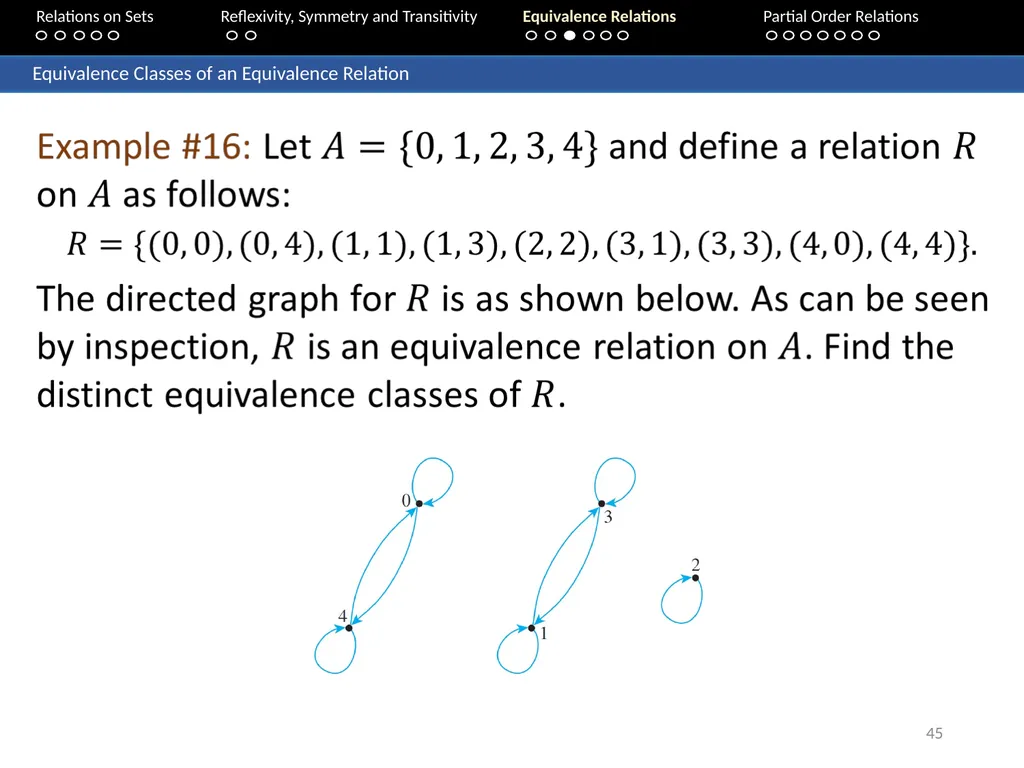
slide45. Relations on Sets Reflexivity, Symmetry and Transitivity Equivalence Relations Partial Order Relations Equivalence Classes of an Equivalence Relation 45<br>
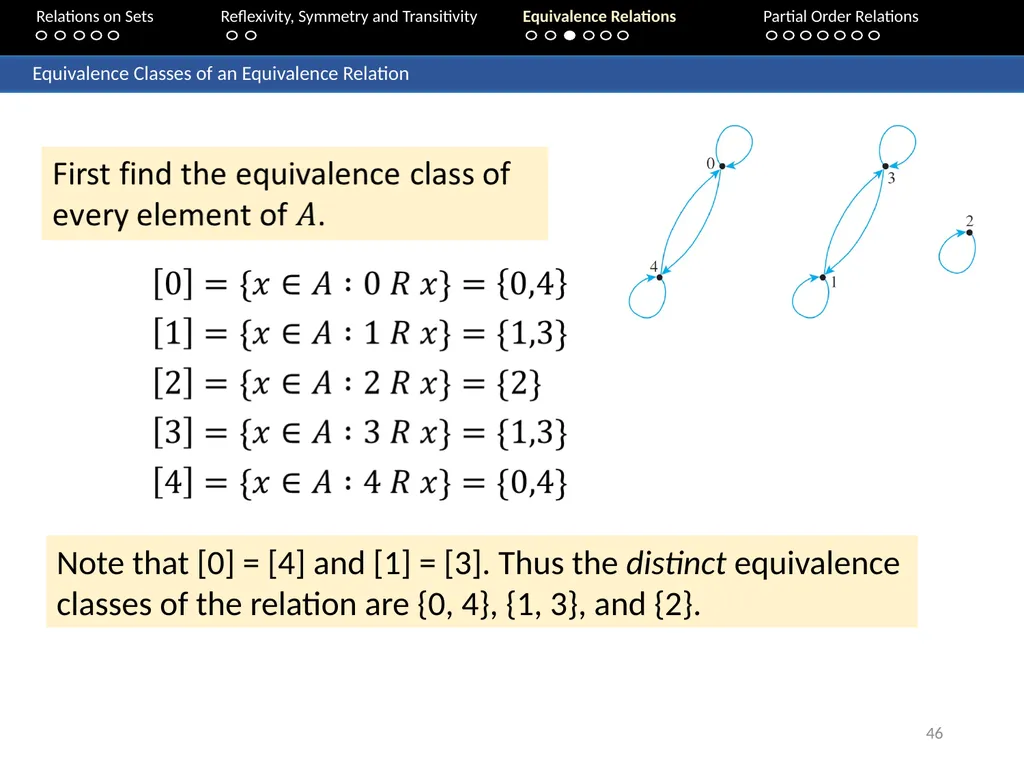
slide46. Relations on Sets Reflexivity, Symmetry and Transitivity Equivalence Relations Partial Order Relations Equivalence Classes of an Equivalence Relation 46 Note that [0] = [4] and [1] = [3]. Thus the distinct equivalence classes of the relation are {0, 4}, {1, 3}, and {2}.<br>
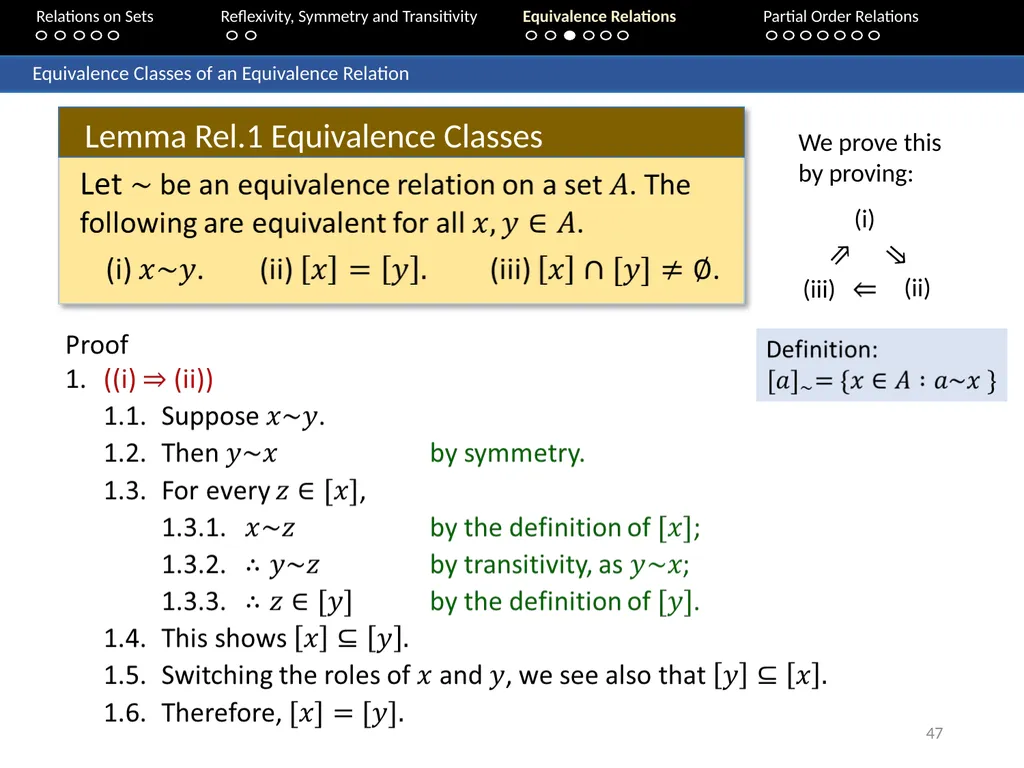
slide47. Relations on Sets Reflexivity, Symmetry and Transitivity Equivalence Relations Partial Order Relations Equivalence Classes of an Equivalence Relation 47 We prove this by proving:<br>
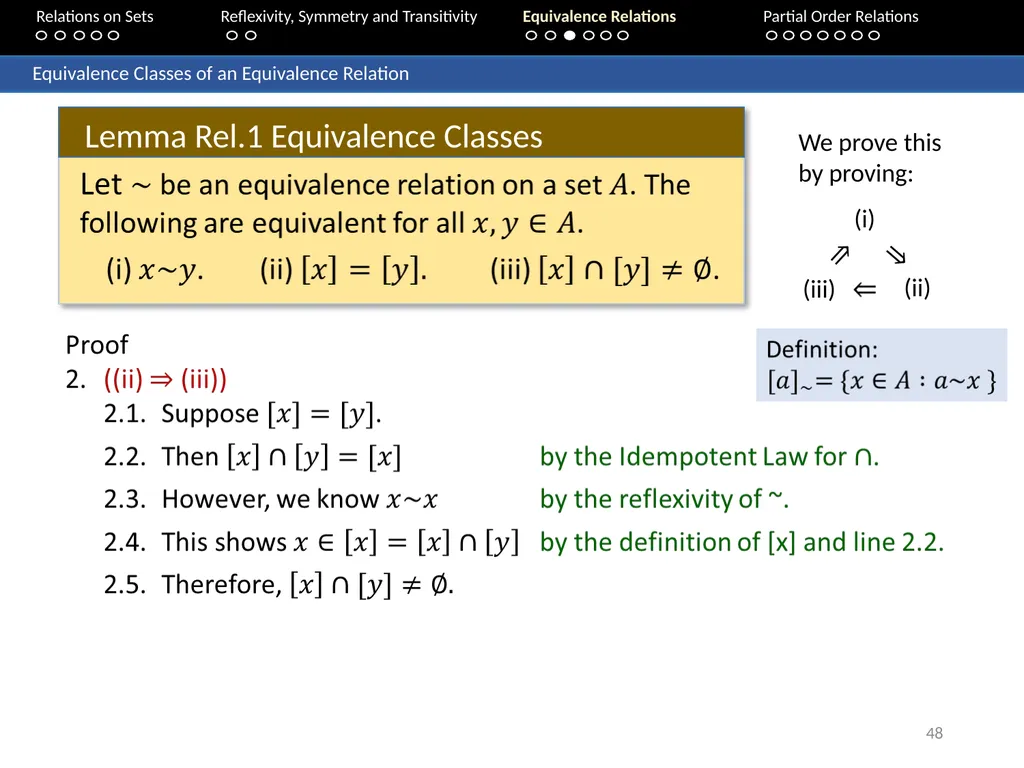
slide48. Relations on Sets Reflexivity, Symmetry and Transitivity Equivalence Relations Partial Order Relations Equivalence Classes of an Equivalence Relation 48 We prove this by proving:<br>
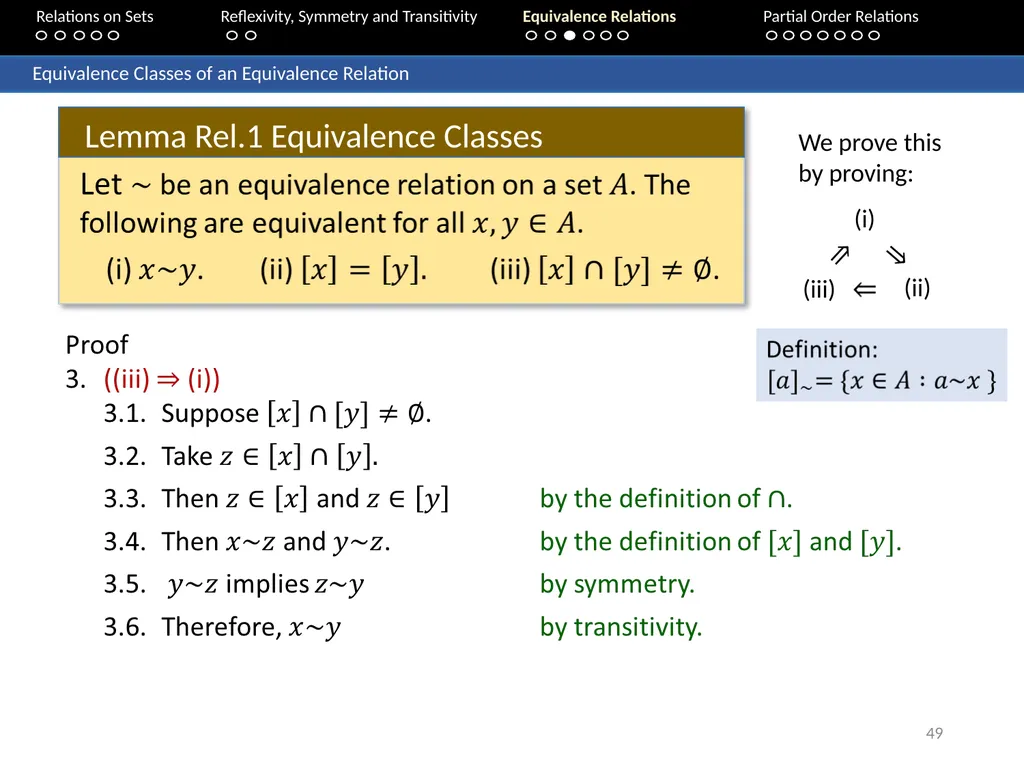
slide49. Relations on Sets Reflexivity, Symmetry and Transitivity Equivalence Relations Partial Order Relations Equivalence Classes of an Equivalence Relation 49 We prove this by proving:<br>
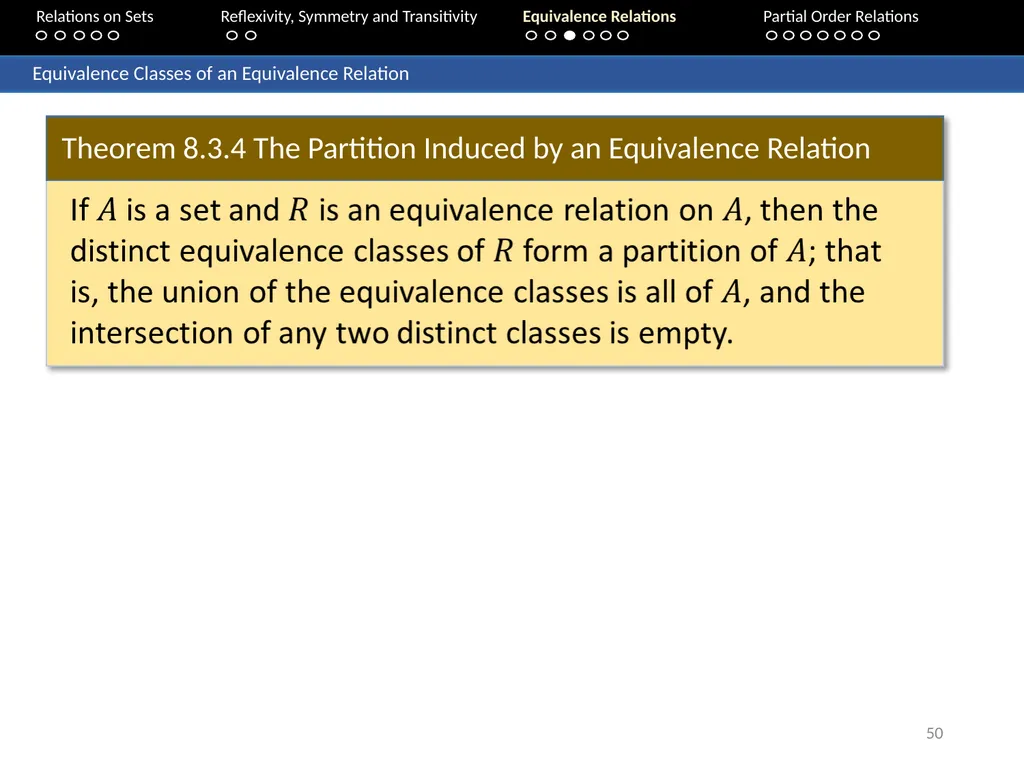
slide50. Relations on Sets Reflexivity, Symmetry and Transitivity Equivalence Relations Partial Order Relations Equivalence Classes of an Equivalence Relation 50<br>
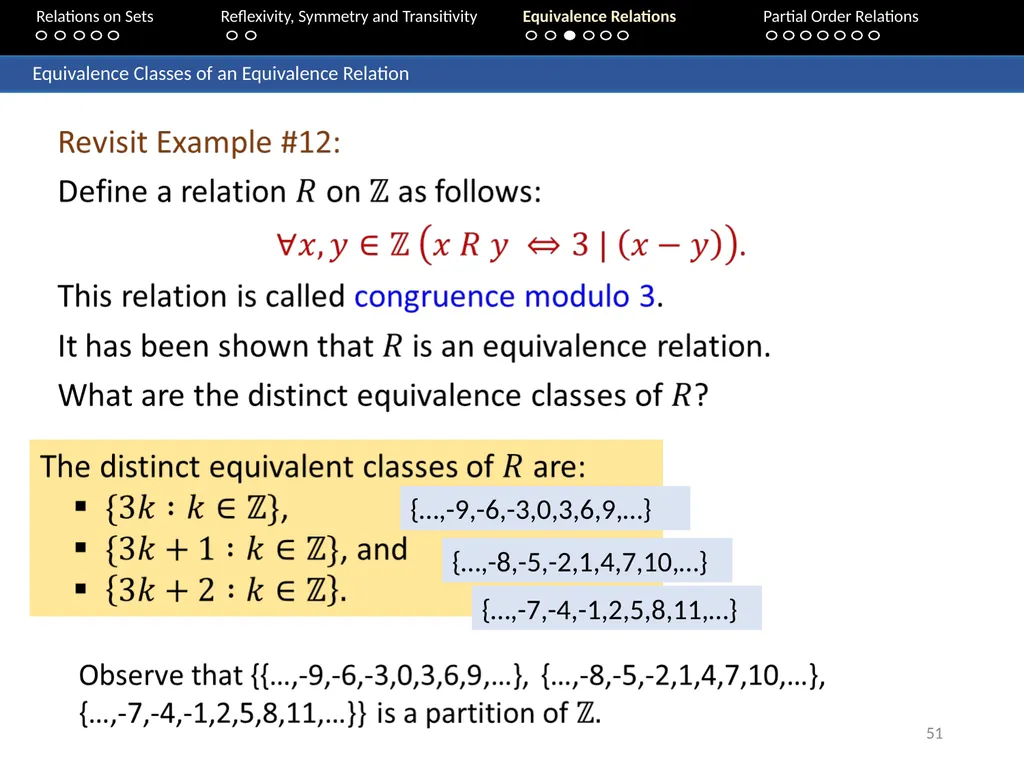
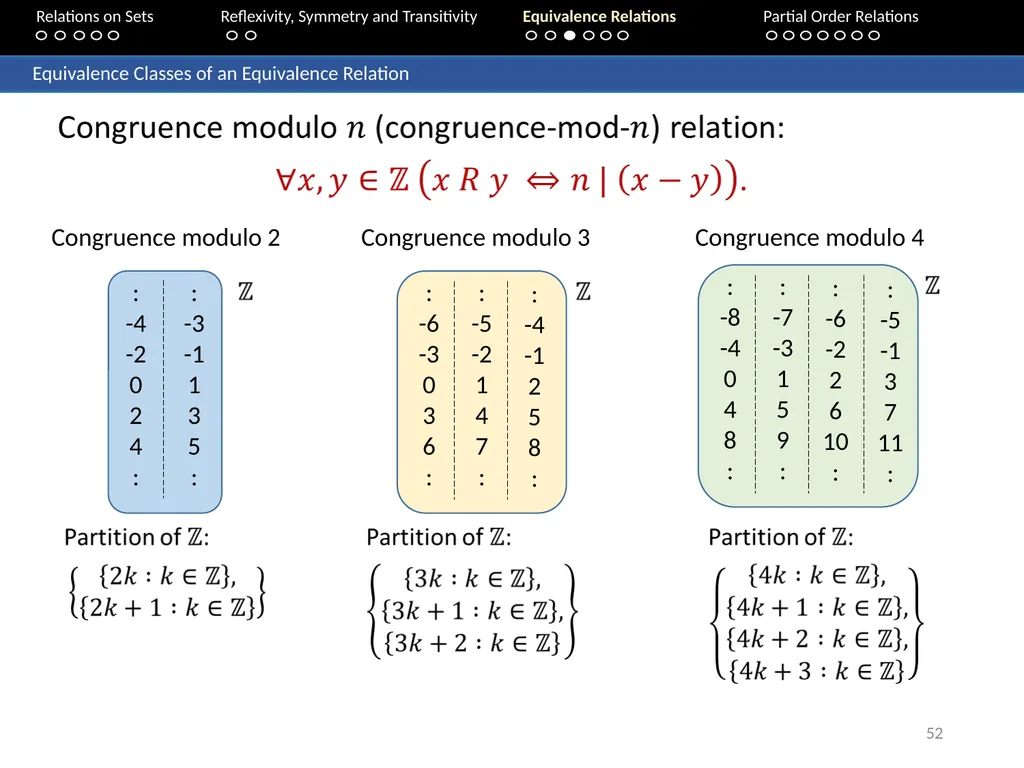
slide51. Relations on Sets Reflexivity, Symmetry and Transitivity Equivalence Relations Partial Order Relations Equivalence Classes of an Equivalence Relation 51 {…,-9,-6,-3,0,3,6,9,…} {…,-8,-5,-2,1,4,7,10,…} {…,-7,-4,-1,2,5,8,11,…}<br>
slide52. Relations on Sets Reflexivity, Symmetry and Transitivity Equivalence Relations Partial Order Relations Equivalence Classes of an Equivalence Relation 52 Congruence modulo 2 Congruence modulo 3 Congruence modulo 4<br>
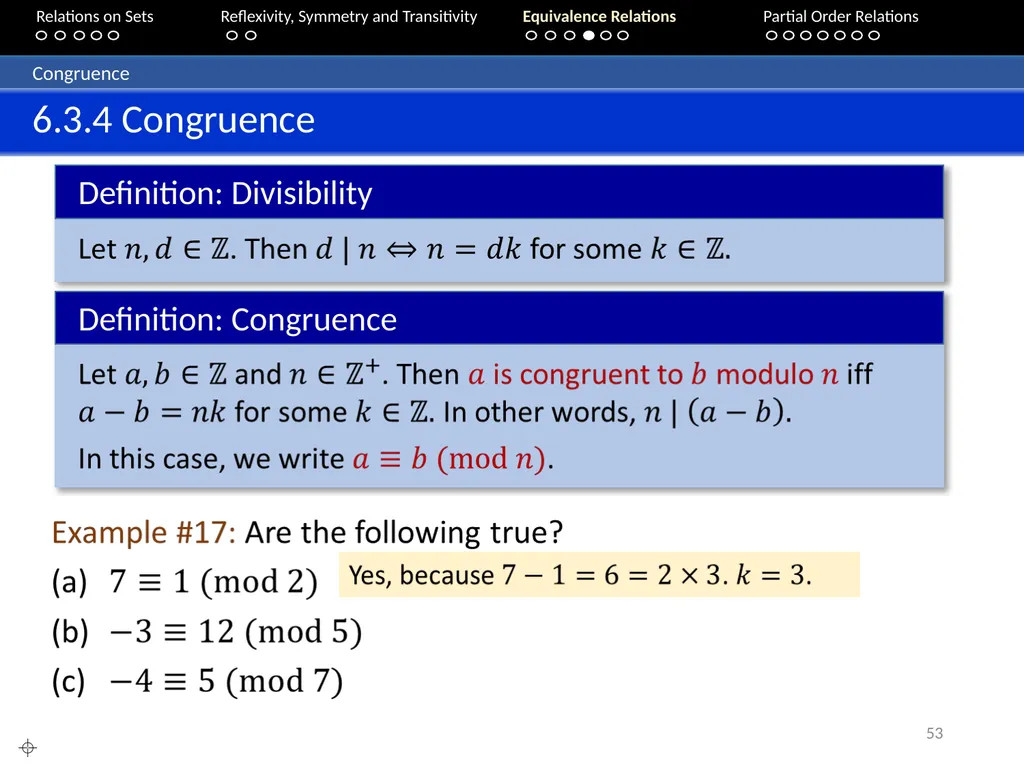
slide53. Relations on Sets Reflexivity, Symmetry and Transitivity Equivalence Relations Partial Order Relations Congruence 53 6.3.4 Congruence <br>
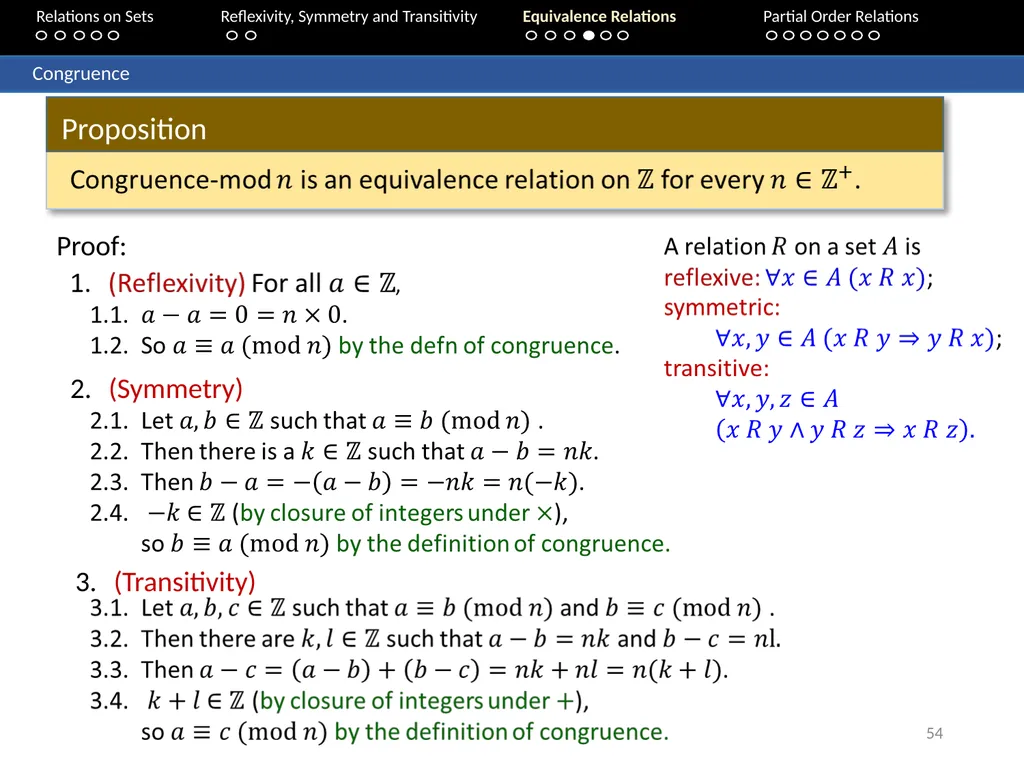
slide54. Relations on Sets Reflexivity, Symmetry and Transitivity Equivalence Relations Partial Order Relations Congruence 54 Proof: 2. (Symmetry) 3. (Transitivity)<br>
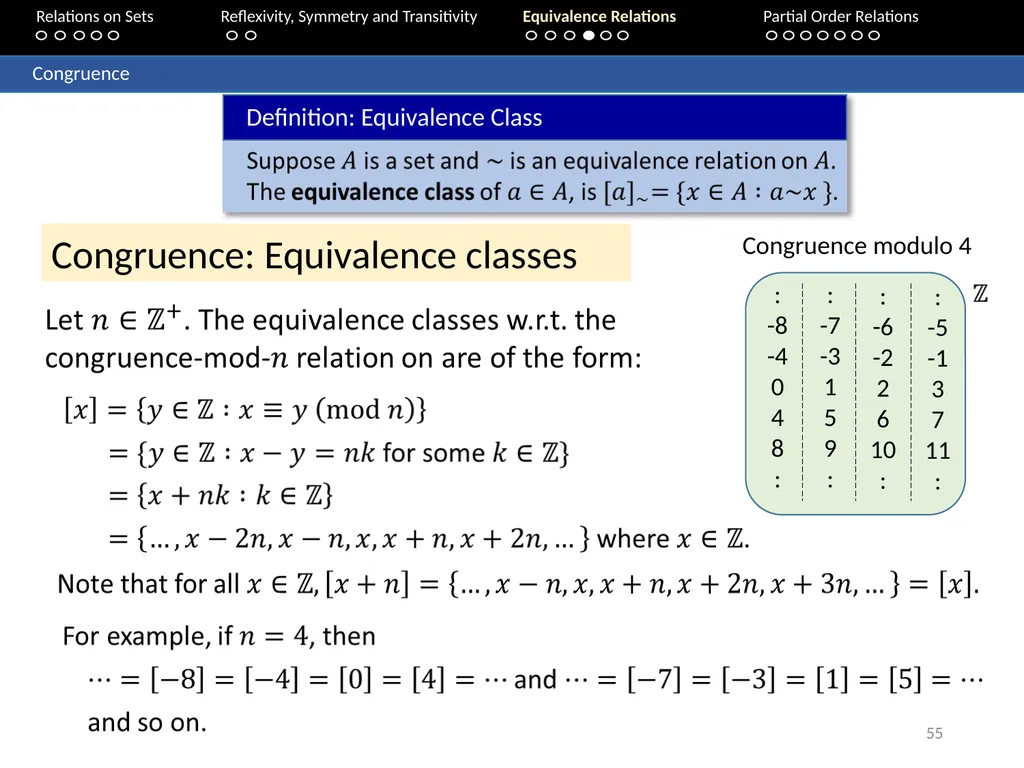
slide55. Relations on Sets Reflexivity, Symmetry and Transitivity Equivalence Relations Partial Order Relations Congruence 55 Congruence: Equivalence classes Congruence modulo 4<br>
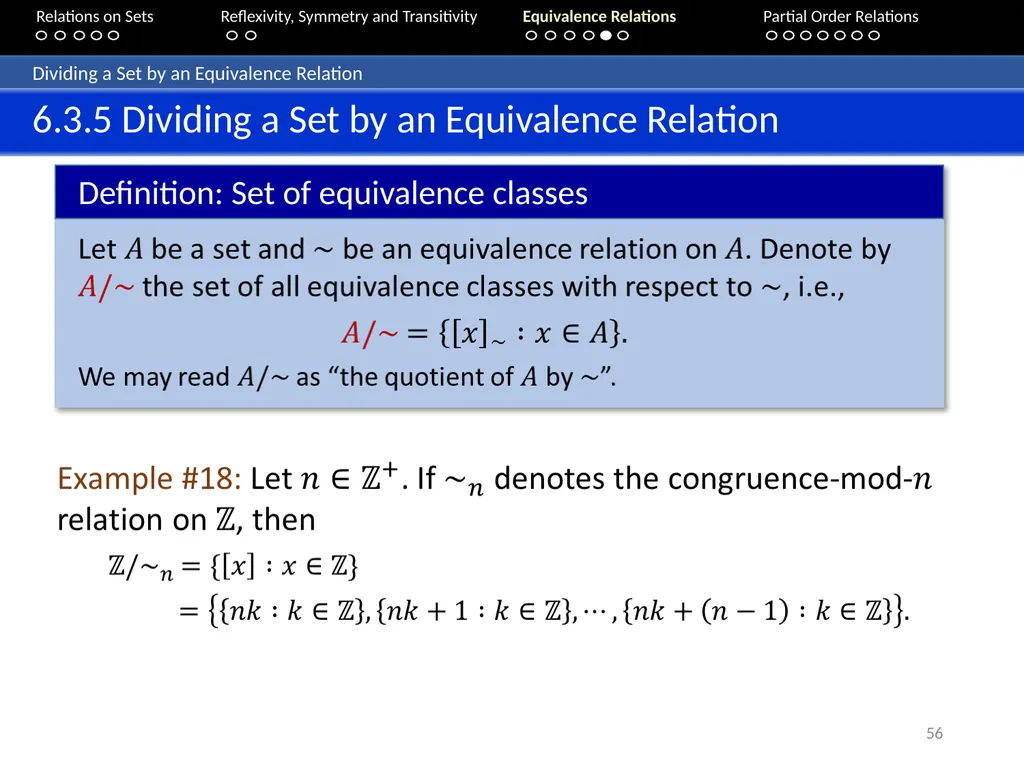
slide56. Relations on Sets Reflexivity, Symmetry and Transitivity Equivalence Relations Partial Order Relations Dividing a Set by an Equivalence Relation 56 6.3.5 Dividing a Set by an Equivalence Relation<br>
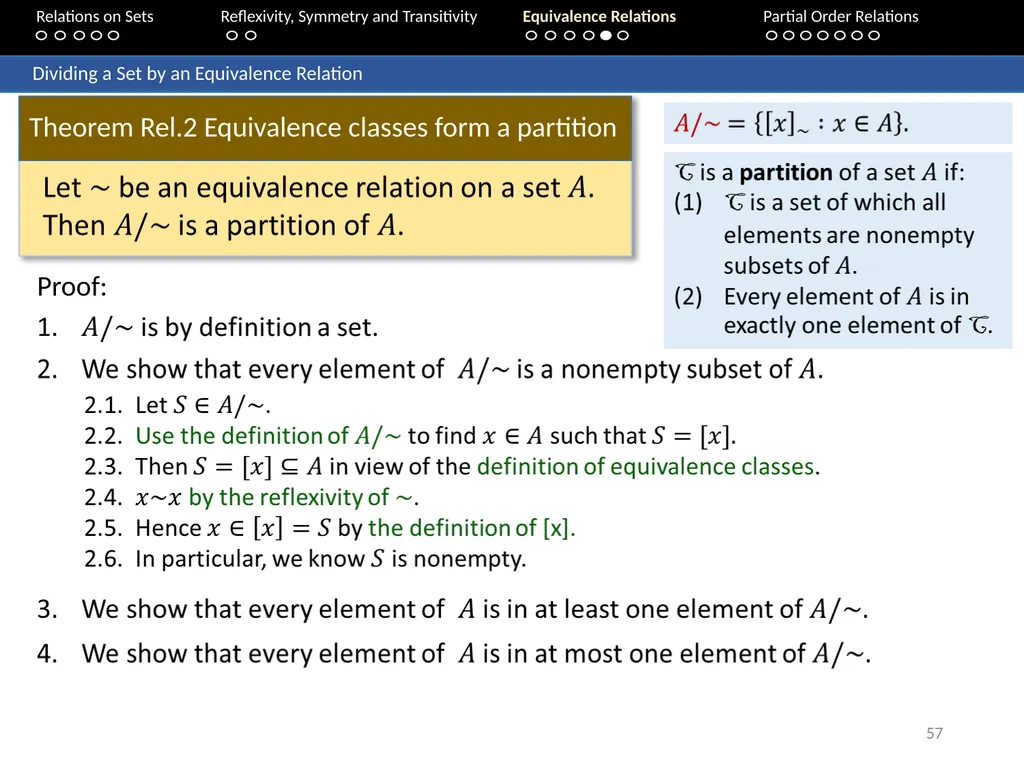
slide57. Relations on Sets Reflexivity, Symmetry and Transitivity Equivalence Relations Partial Order Relations Dividing a Set by an Equivalence Relation 57 Proof: Theorem Rel.2 Equivalence classes form a partition<br>
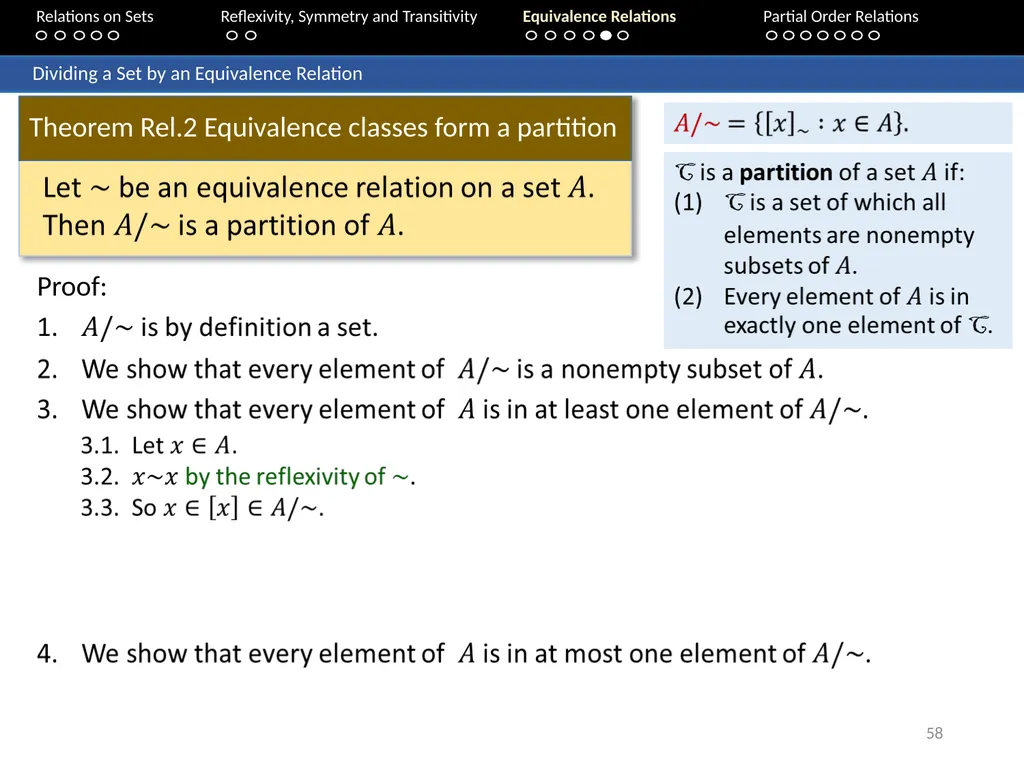
slide58. Relations on Sets Reflexivity, Symmetry and Transitivity Equivalence Relations Partial Order Relations Dividing a Set by an Equivalence Relation 58 Proof:<br>
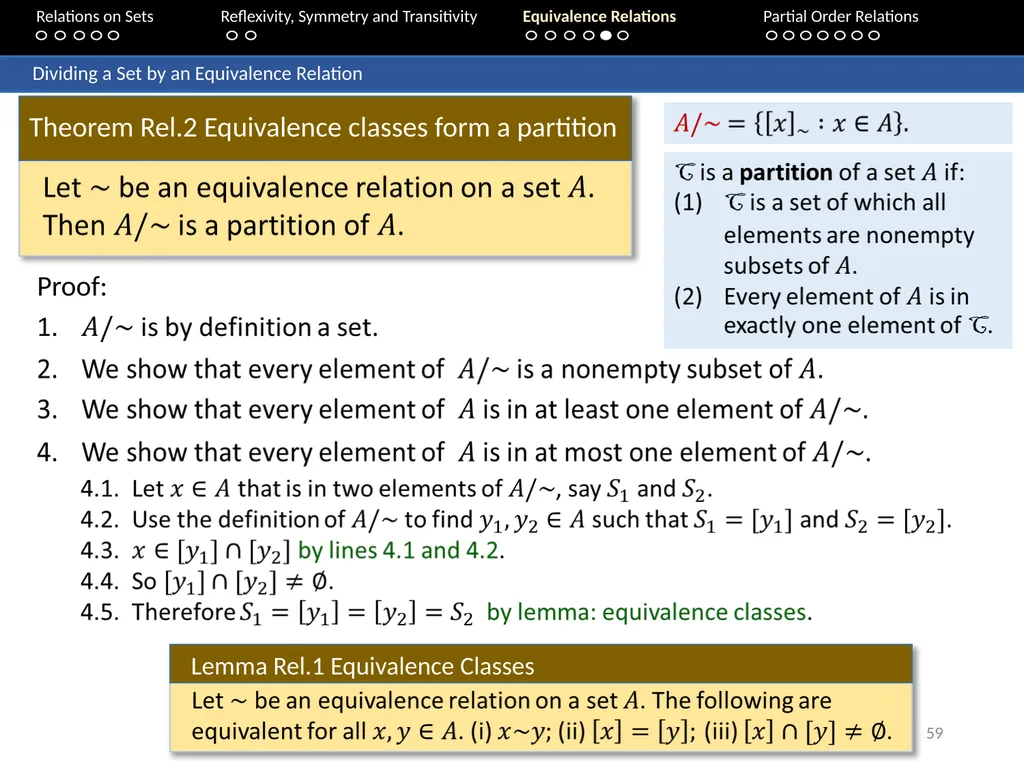
slide59. Relations on Sets Reflexivity, Symmetry and Transitivity Equivalence Relations Partial Order Relations Dividing a Set by an Equivalence Relation 59 Proof: Theorem Rel.2 Equivalence classes form a partition<br>
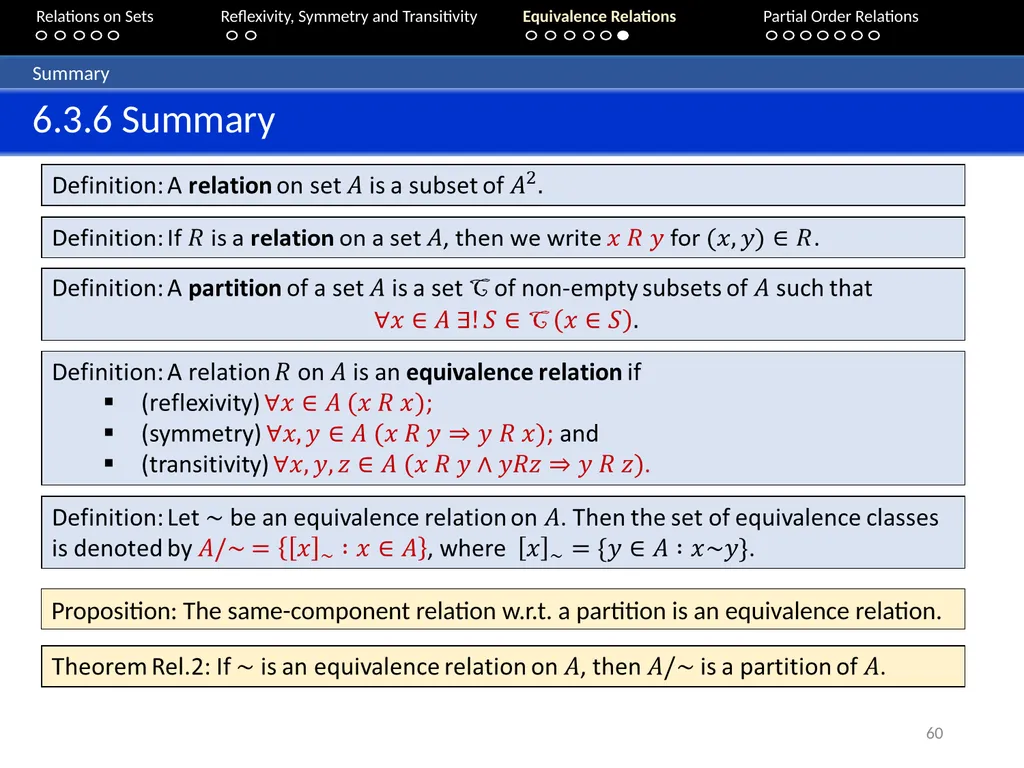
slide60. Relations on Sets Reflexivity, Symmetry and Transitivity Equivalence Relations Partial Order Relations Summary 60 6.3.6 Summary Proposition: The same-component relation w.r.t. a partition is an equivalence relation.<br>
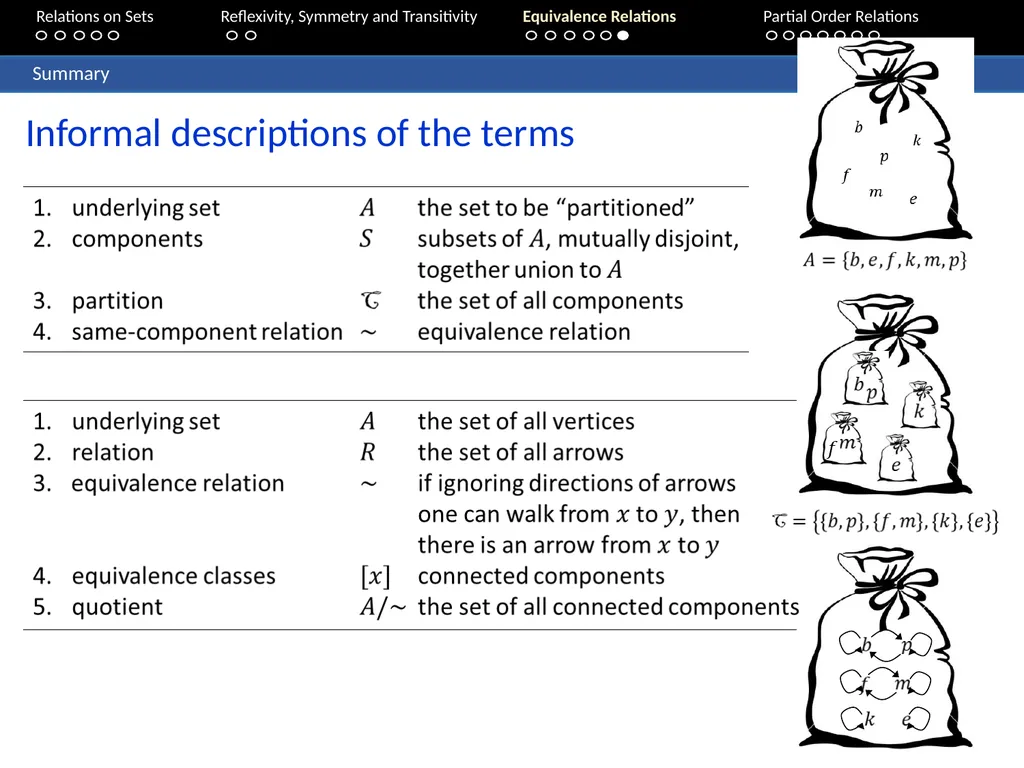
slide61. Relations on Sets Reflexivity, Symmetry and Transitivity Equivalence Relations Partial Order Relations Summary 61 Informal descriptions of the terms<br>
slide62. Relations on Sets Reflexivity, Symmetry and Transitivity Equivalence Relations Partial Order Relations 62 6.4 Partial Order Relations<br>
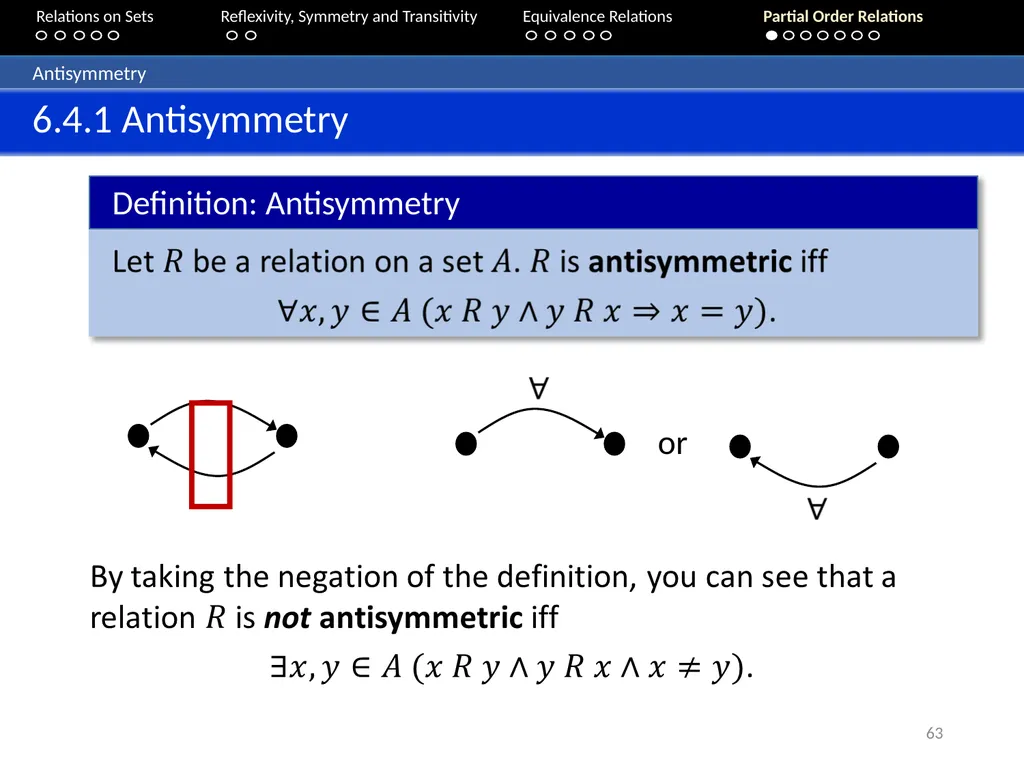
slide63. Relations on Sets Reflexivity, Symmetry and Transitivity Equivalence Relations Partial Order Relations Antisymmetry 63 6.4.1 Antisymmetry or <br>
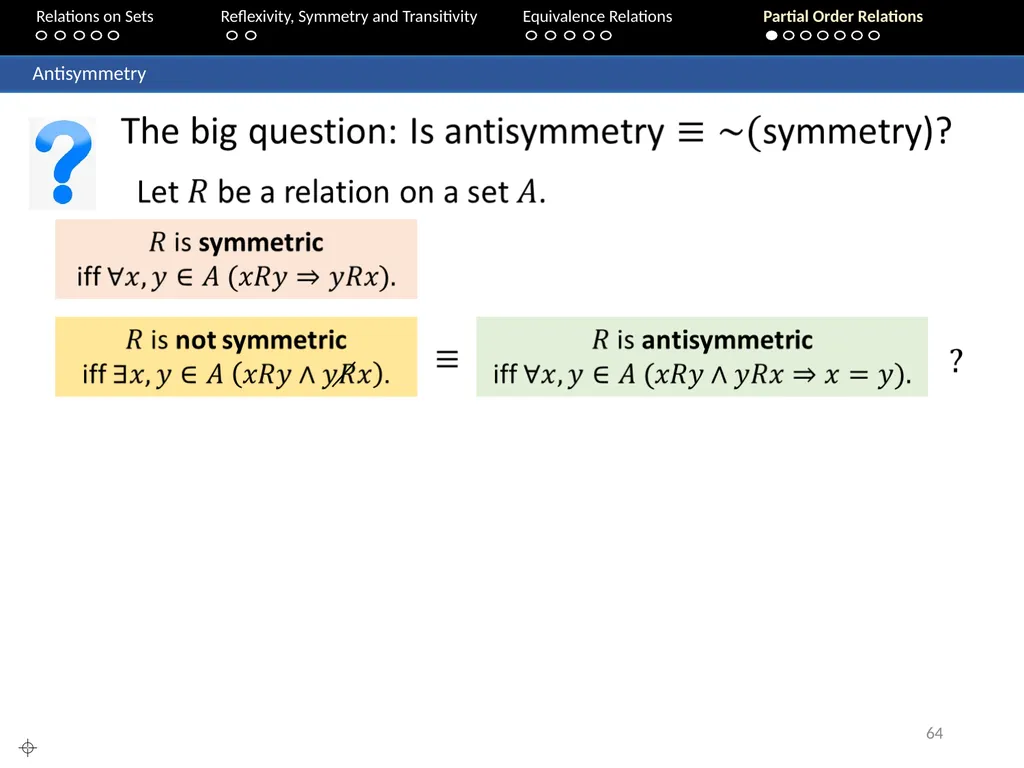
slide64. Relations on Sets Reflexivity, Symmetry and Transitivity Equivalence Relations Partial Order Relations Antisymmetry 64 <br>
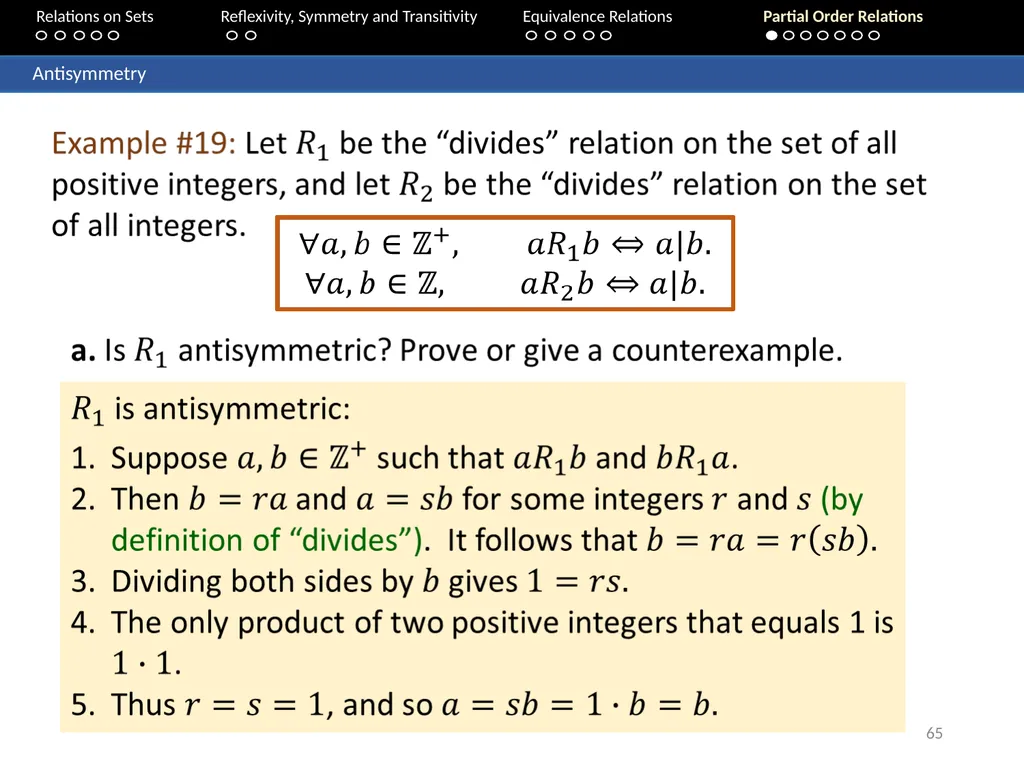
slide65. Relations on Sets Reflexivity, Symmetry and Transitivity Equivalence Relations Partial Order Relations Antisymmetry 65<br>
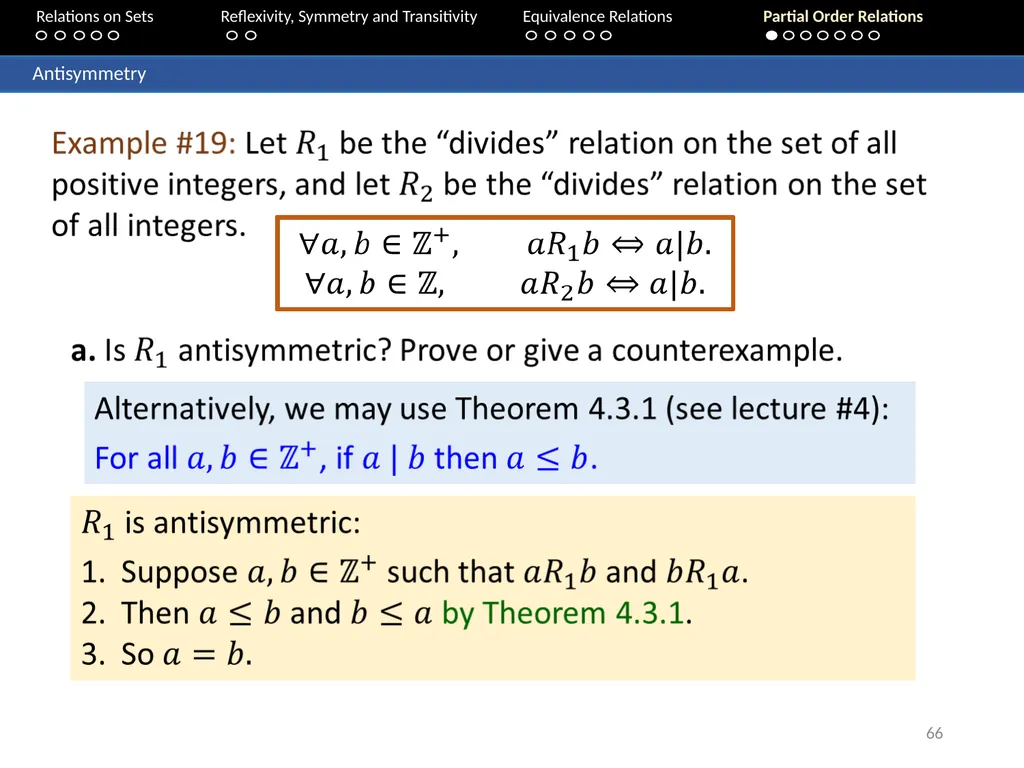
slide66. Relations on Sets Reflexivity, Symmetry and Transitivity Equivalence Relations Partial Order Relations Antisymmetry 66<br>
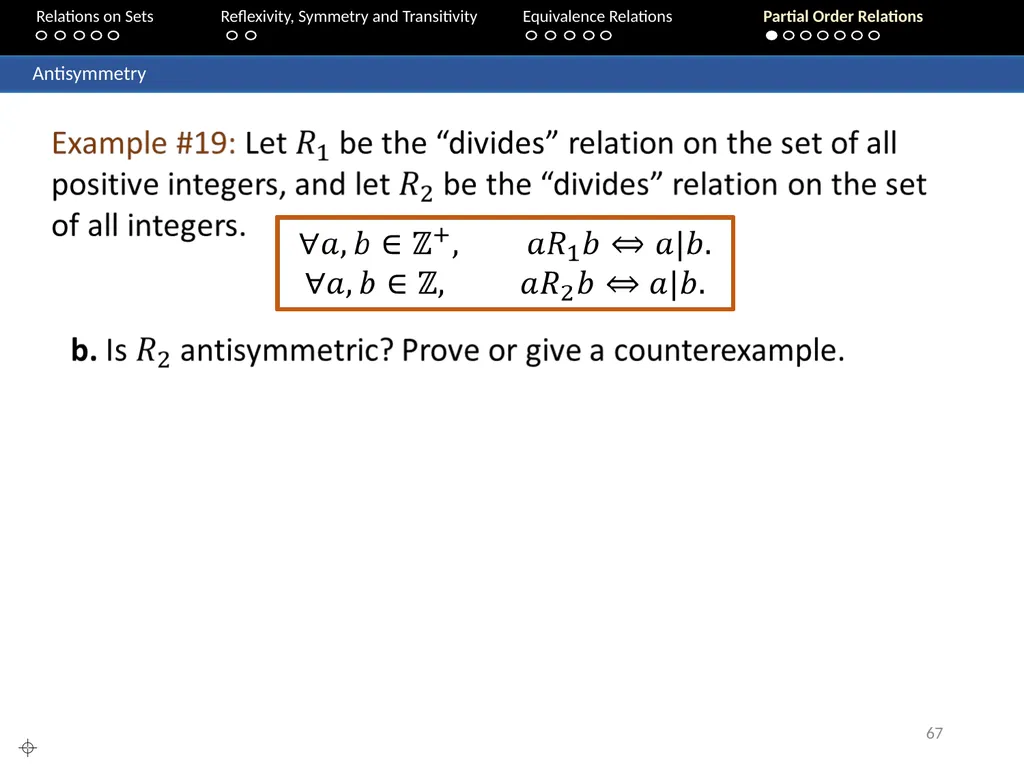
slide67. Relations on Sets Reflexivity, Symmetry and Transitivity Equivalence Relations Partial Order Relations Antisymmetry 67 <br>
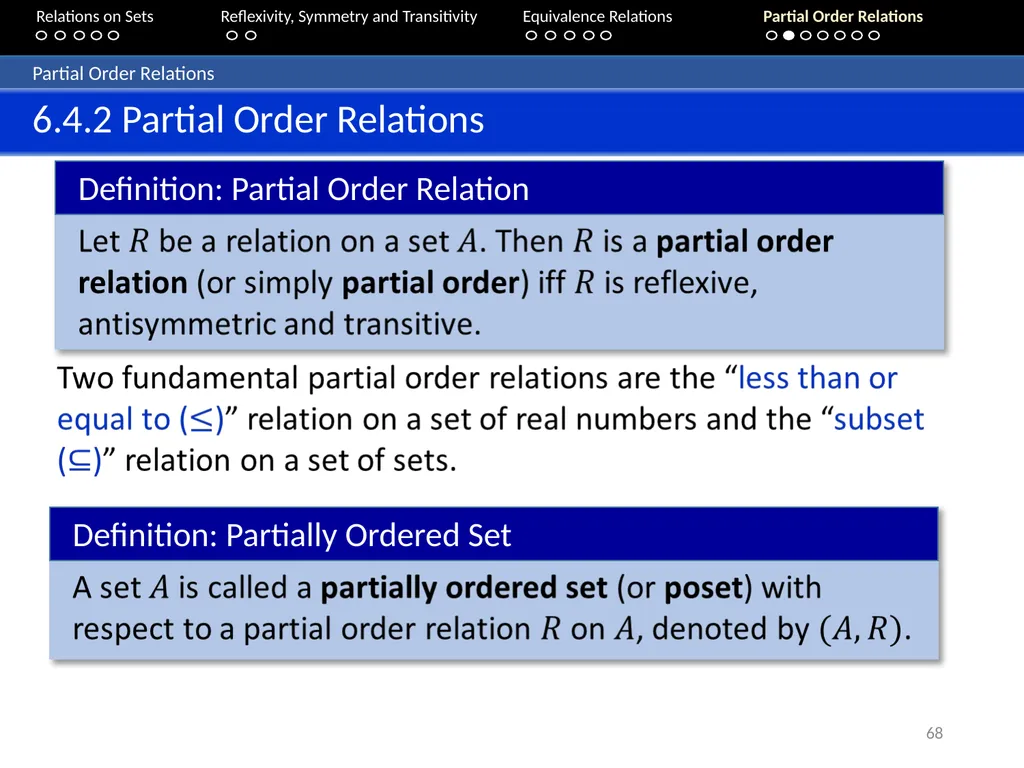
slide68. Relations on Sets Reflexivity, Symmetry and Transitivity Equivalence Relations Partial Order Relations Partial Order Relations 68 6.4.2 Partial Order Relations<br>
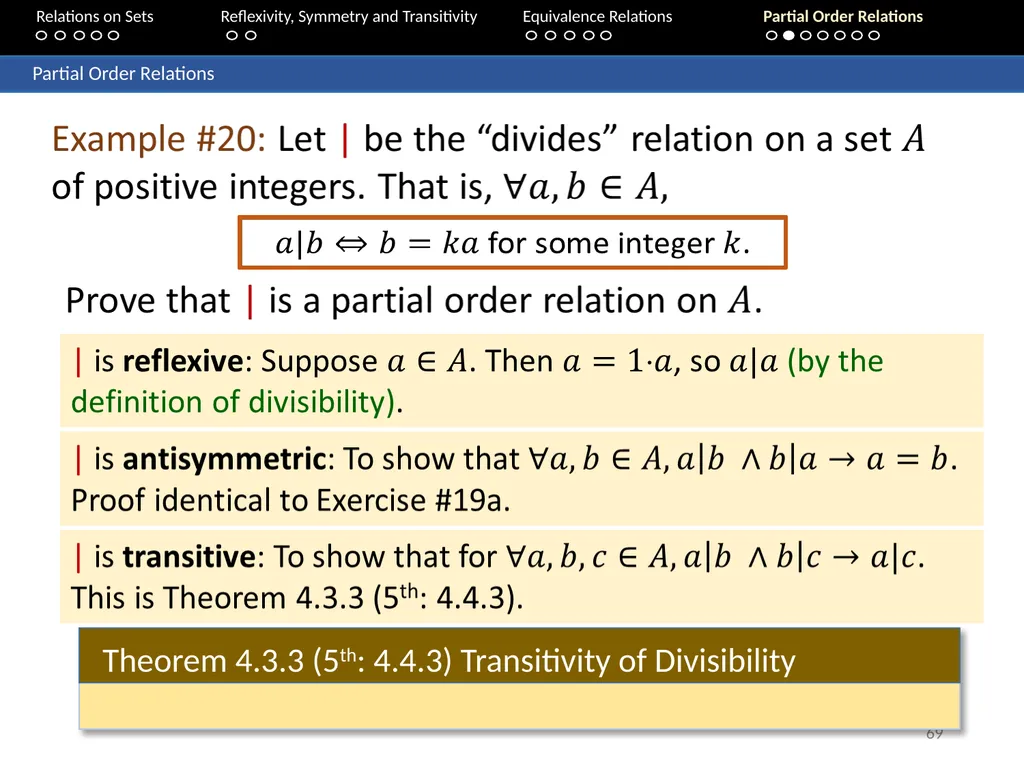
slide69. Relations on Sets Reflexivity, Symmetry and Transitivity Equivalence Relations Partial Order Relations Partial Order Relations 69<br>
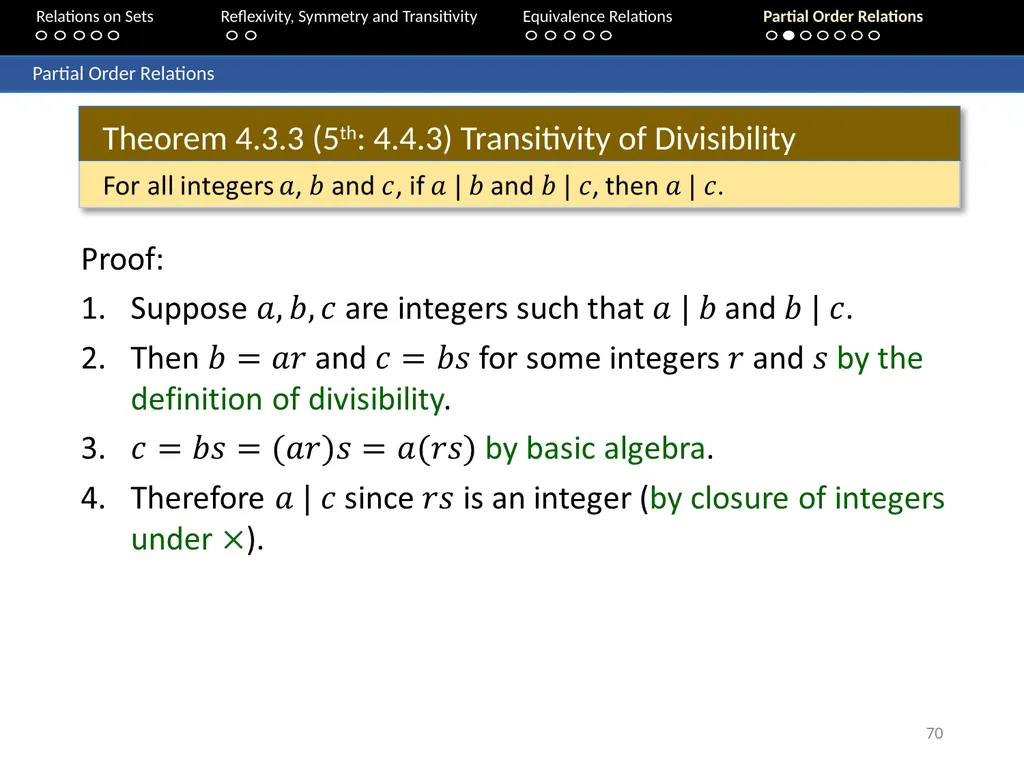
slide70. Relations on Sets Reflexivity, Symmetry and Transitivity Equivalence Relations Partial Order Relations Partial Order Relations 70<br>
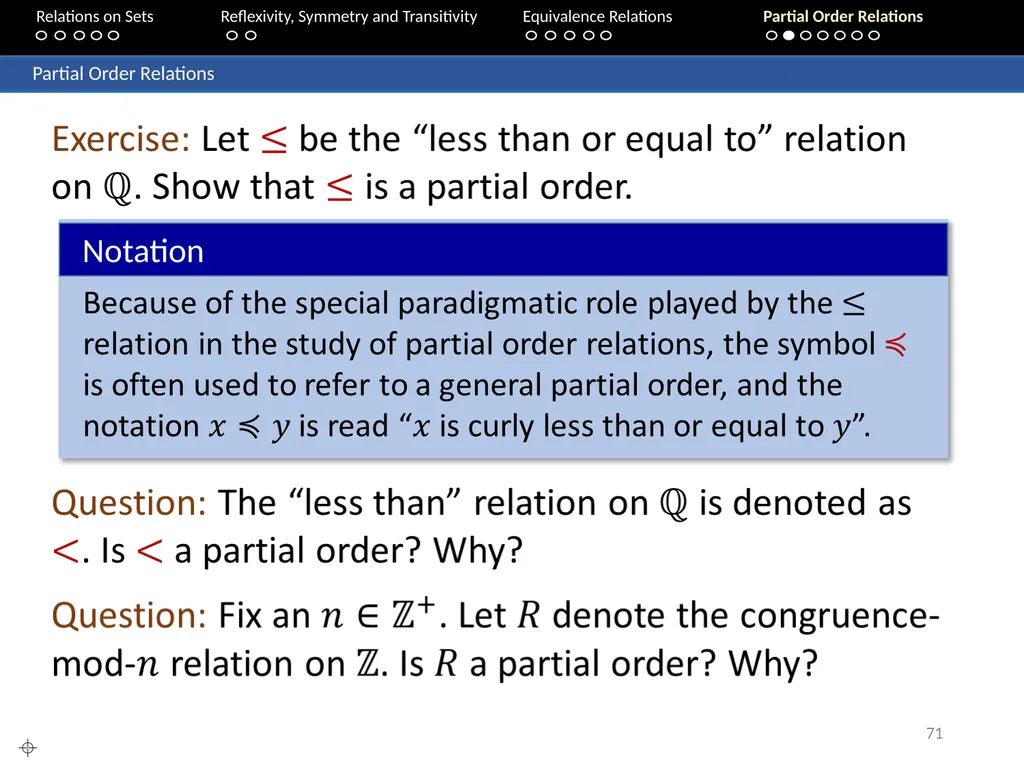
slide71. Relations on Sets Reflexivity, Symmetry and Transitivity Equivalence Relations Partial Order Relations Partial Order Relations 71 <br>
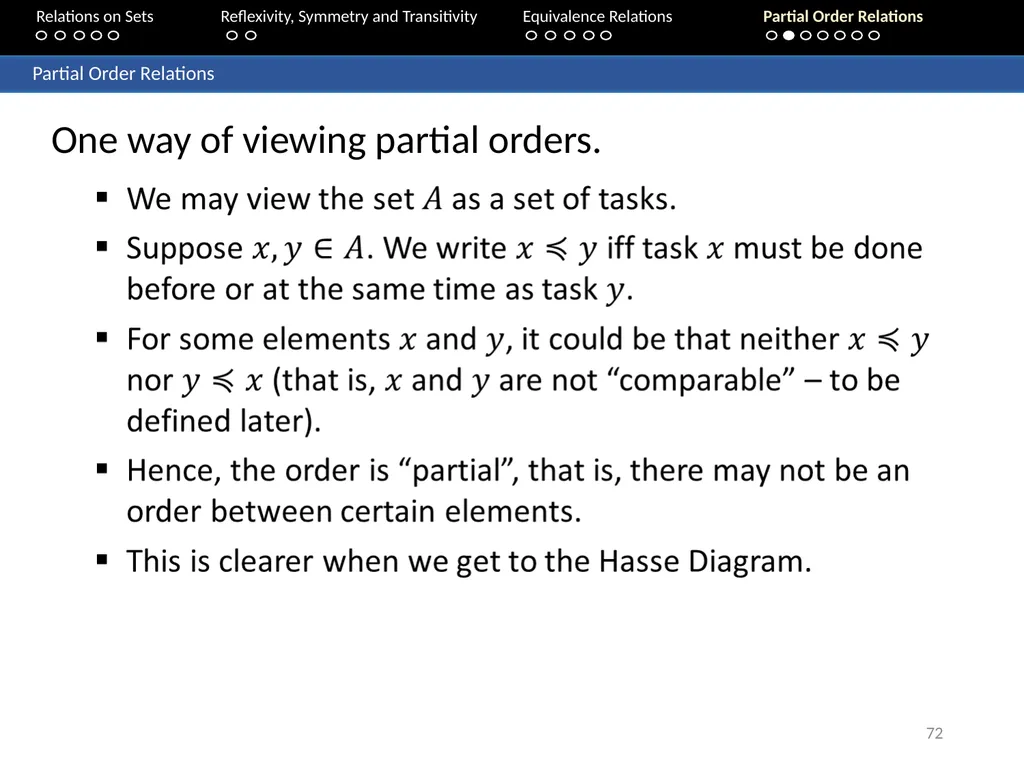
slide72. Relations on Sets Reflexivity, Symmetry and Transitivity Equivalence Relations Partial Order Relations Partial Order Relations 72 One way of viewing partial orders.<br>
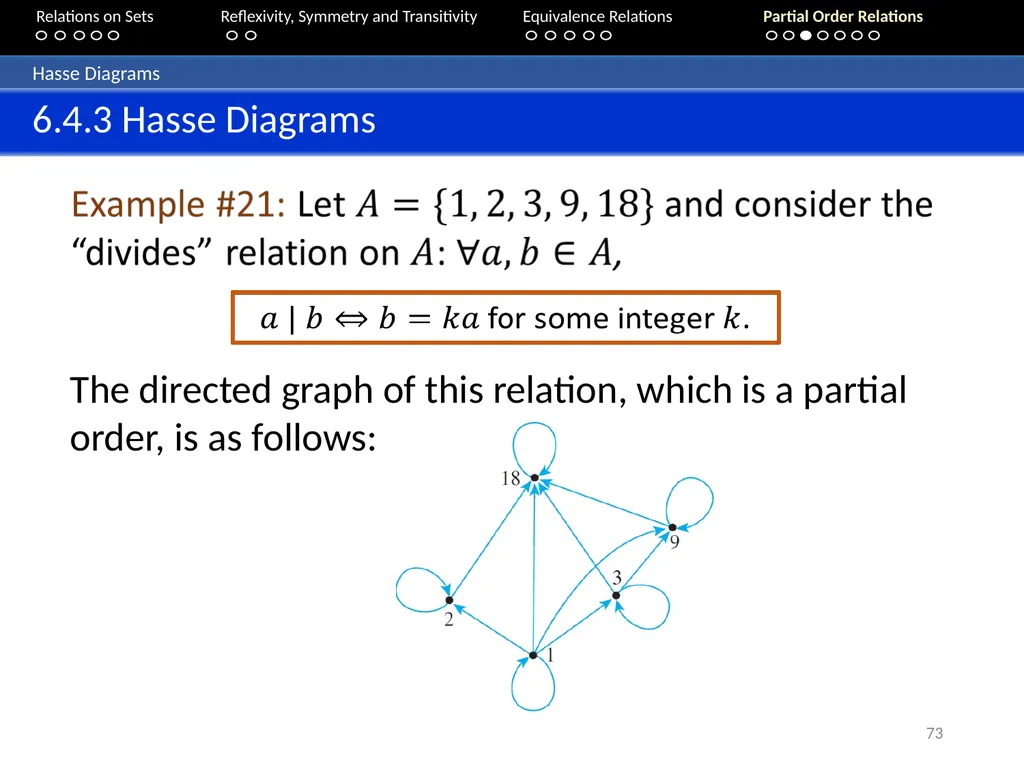
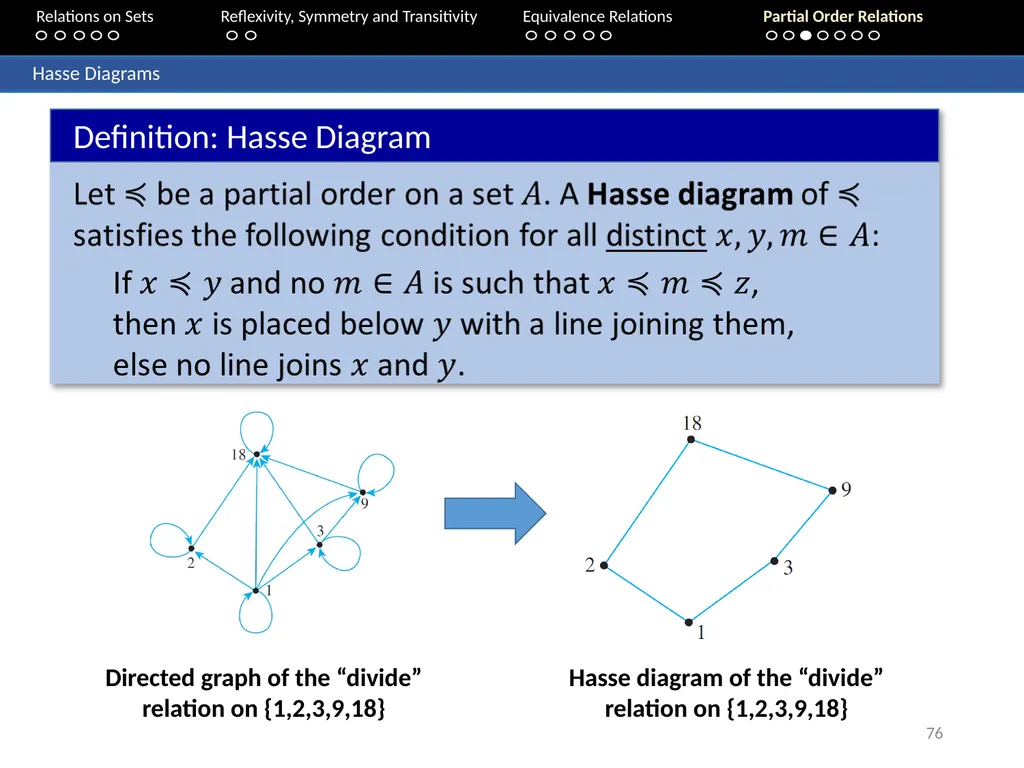
slide73. Relations on Sets Reflexivity, Symmetry and Transitivity Equivalence Relations Partial Order Relations Hasse Diagrams 73 6.4.3 Hasse Diagrams The directed graph of this relation, which is a partial order, is as follows:<br>
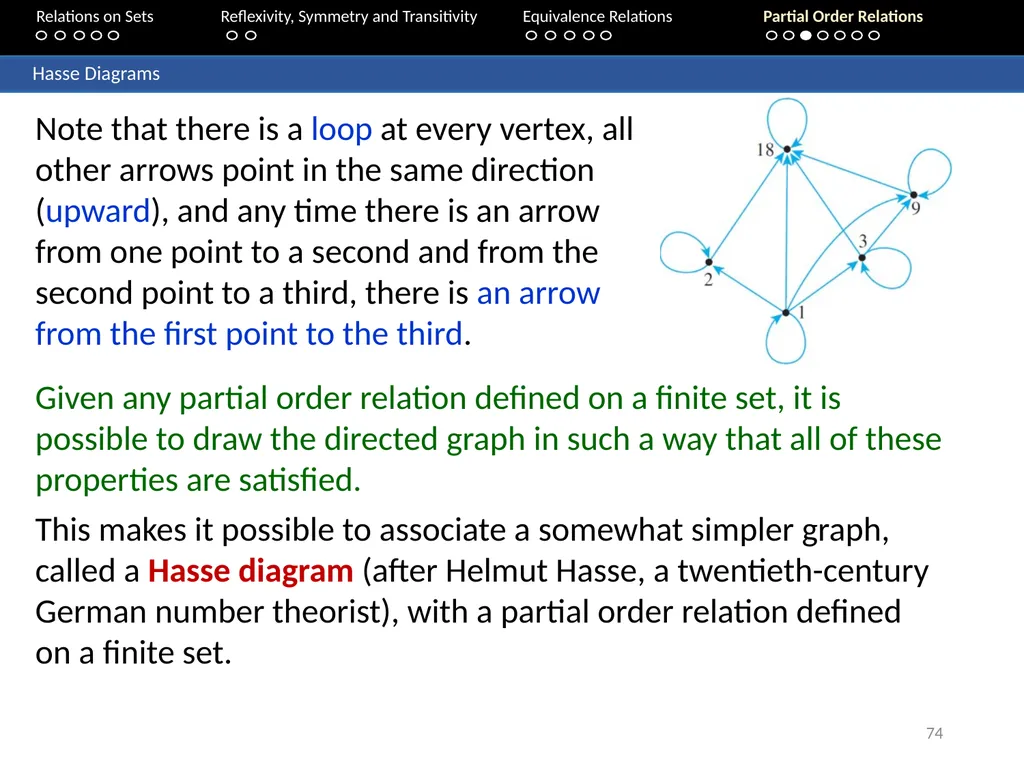
slide74. Relations on Sets Reflexivity, Symmetry and Transitivity Equivalence Relations Partial Order Relations Hasse Diagrams 74 Note that there is a loop at every vertex, all other arrows point in the same direction (upward), and any time there is an arrow from one point to a second and from the second point to a third, there is an arrow from the first point to the third. Given any partial order relation defined on a finite set, it is possible to draw the directed graph in such a way that all of these properties are satisfied.
This makes it possible to associate a somewhat simpler graph, called a Hasse diagram (after Helmut Hasse, a twentieth-century German number theorist), with a partial order relation defined on a finite set.<br>
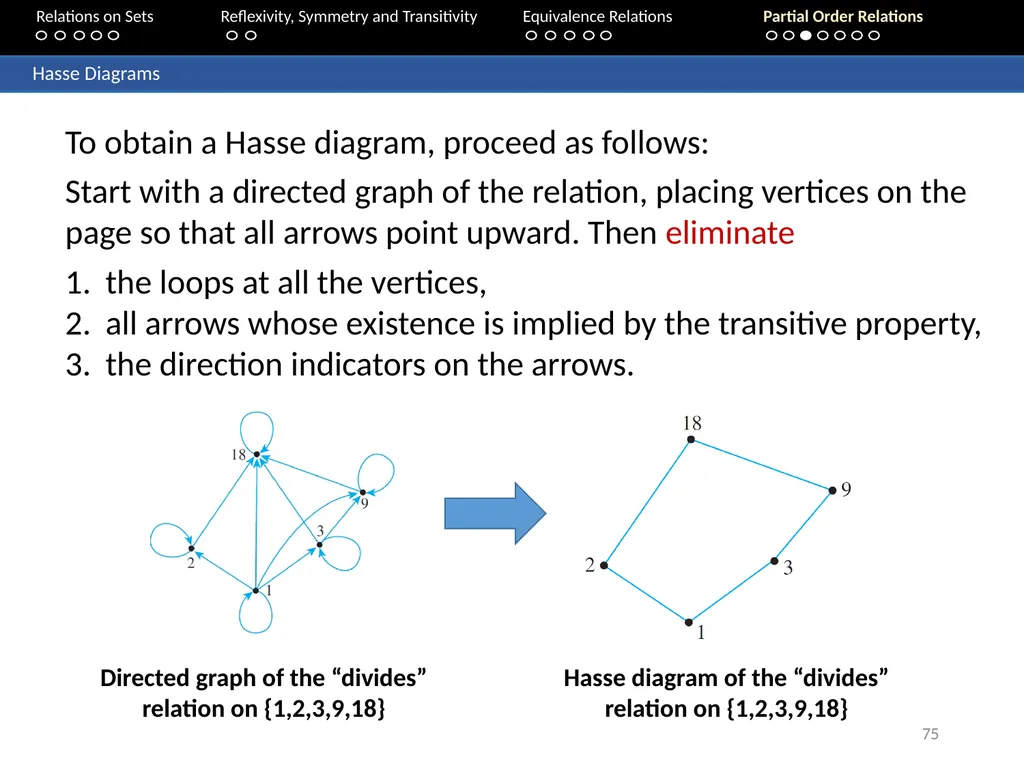
slide75. Relations on Sets Reflexivity, Symmetry and Transitivity Equivalence Relations Partial Order Relations Hasse Diagrams 75 To obtain a Hasse diagram, proceed as follows:
Start with a directed graph of the relation, placing vertices on the page so that all arrows point upward. Then eliminate
1. the loops at all the vertices,
2. all arrows whose existence is implied by the transitive property,
3. the direction indicators on the arrows.<br>
slide76. Relations on Sets Reflexivity, Symmetry and Transitivity Equivalence Relations Partial Order Relations Hasse Diagrams 76<br>
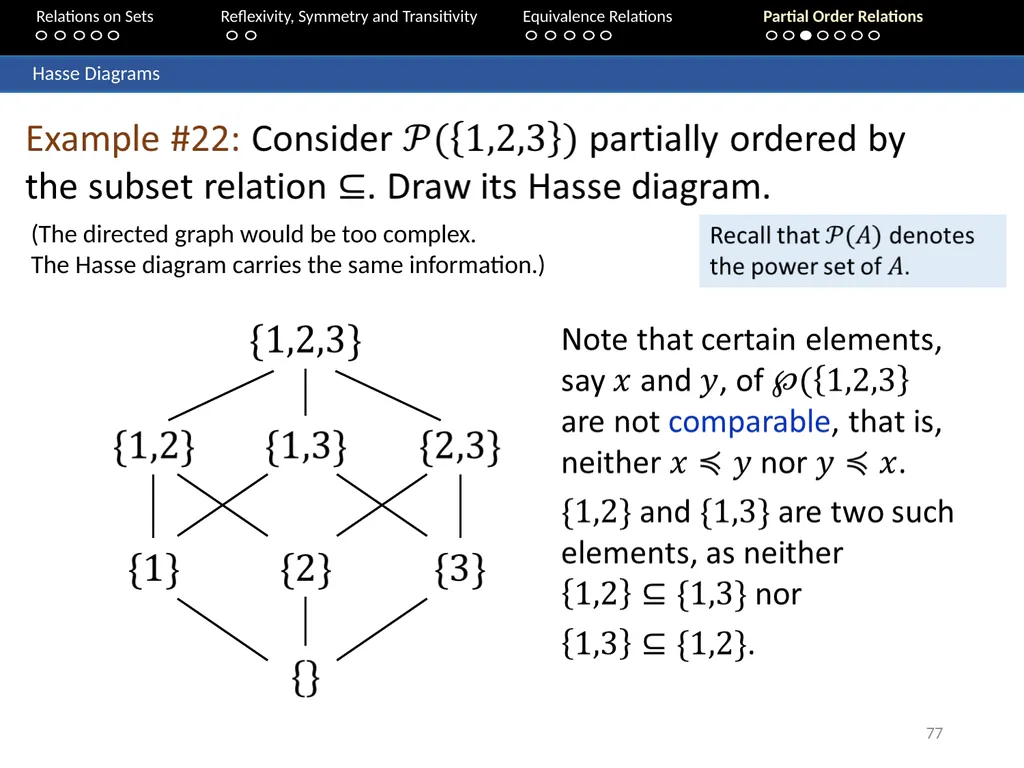
slide77. Relations on Sets Reflexivity, Symmetry and Transitivity Equivalence Relations Partial Order Relations Hasse Diagrams 77 (The directed graph would be too complex.
The Hasse diagram carries the same information.)<br>
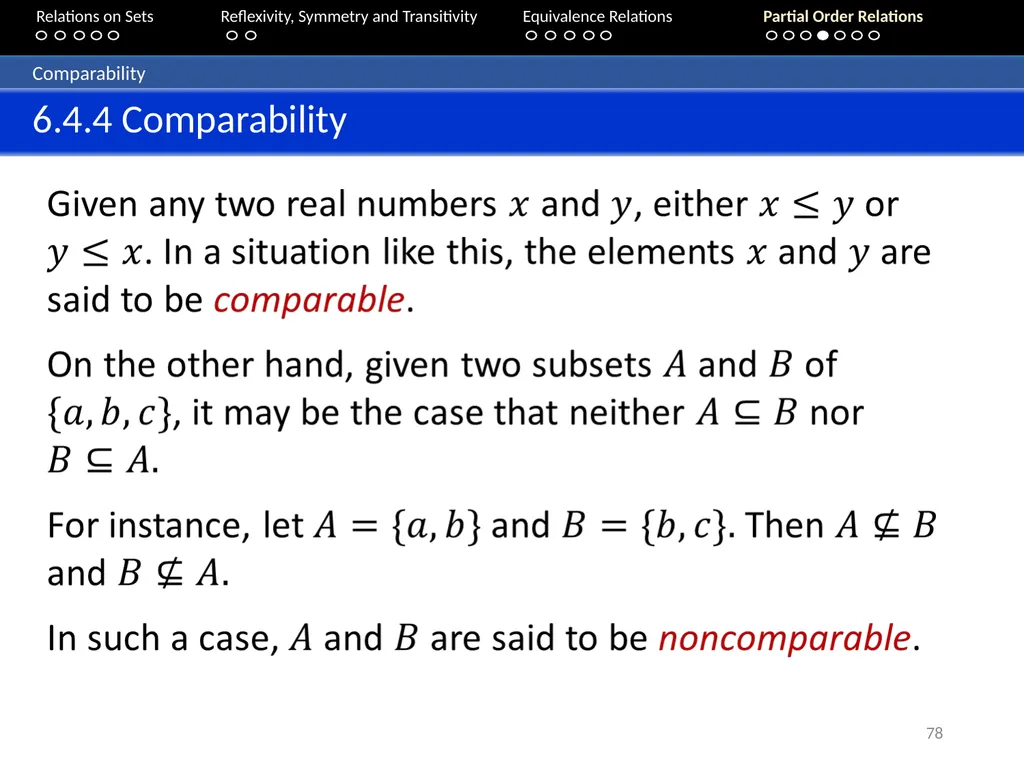
slide78. Relations on Sets Reflexivity, Symmetry and Transitivity Equivalence Relations Partial Order Relations Comparability 78 6.4.4 Comparability<br>
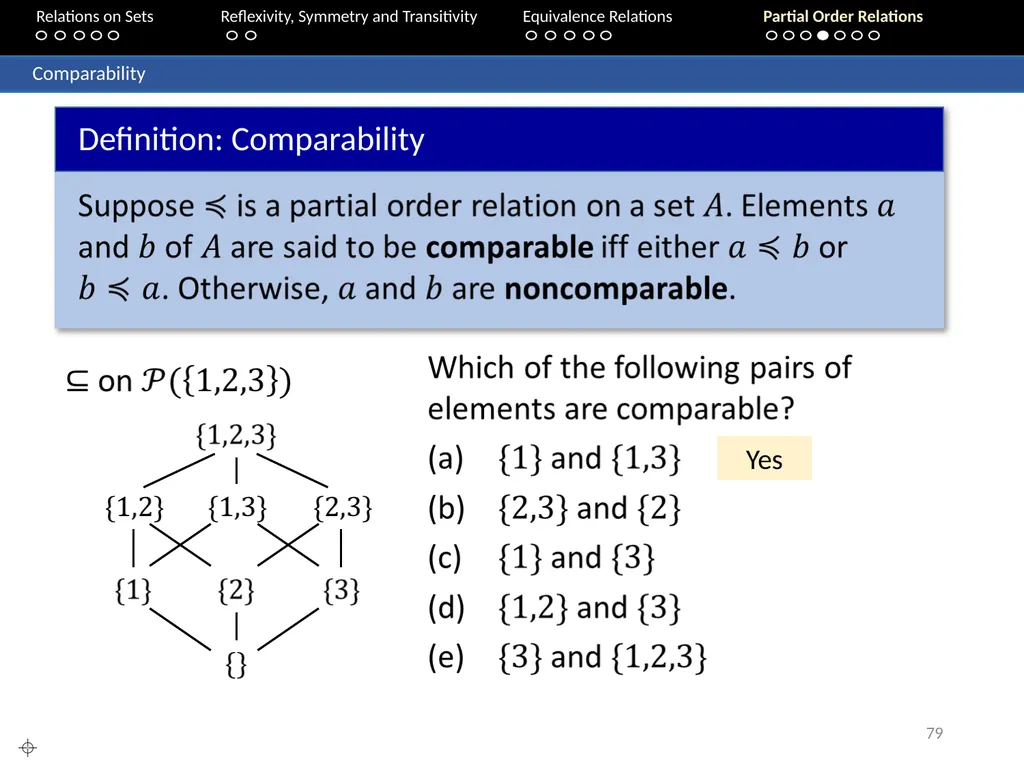
slide79. Relations on Sets Reflexivity, Symmetry and Transitivity Equivalence Relations Partial Order Relations Comparability 79 Yes<br>
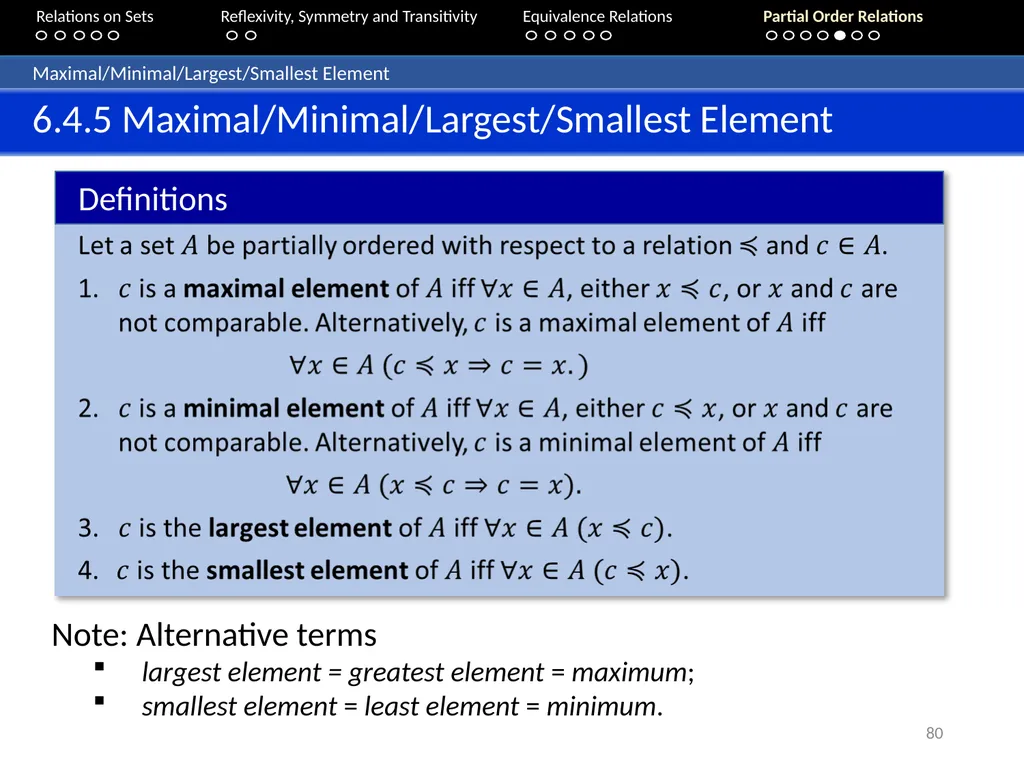
slide80. Relations on Sets Reflexivity, Symmetry and Transitivity Equivalence Relations Partial Order Relations Maximal/Minimal/Largest/Smallest Element 80 6.4.5 Maximal/Minimal/Largest/Smallest Element Note: Alternative terms
largest element = greatest element = maximum;
smallest element = least element = minimum.<br>
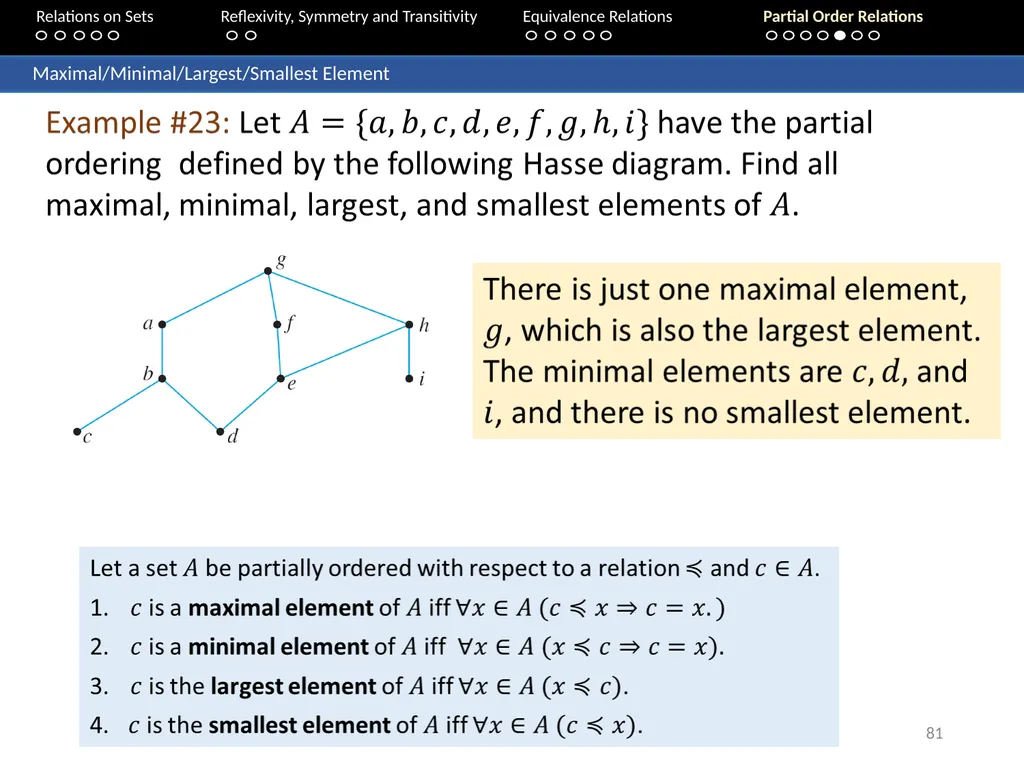
slide81. Relations on Sets Reflexivity, Symmetry and Transitivity Equivalence Relations Partial Order Relations Maximal/Minimal/Largest/Smallest Element 81<br>
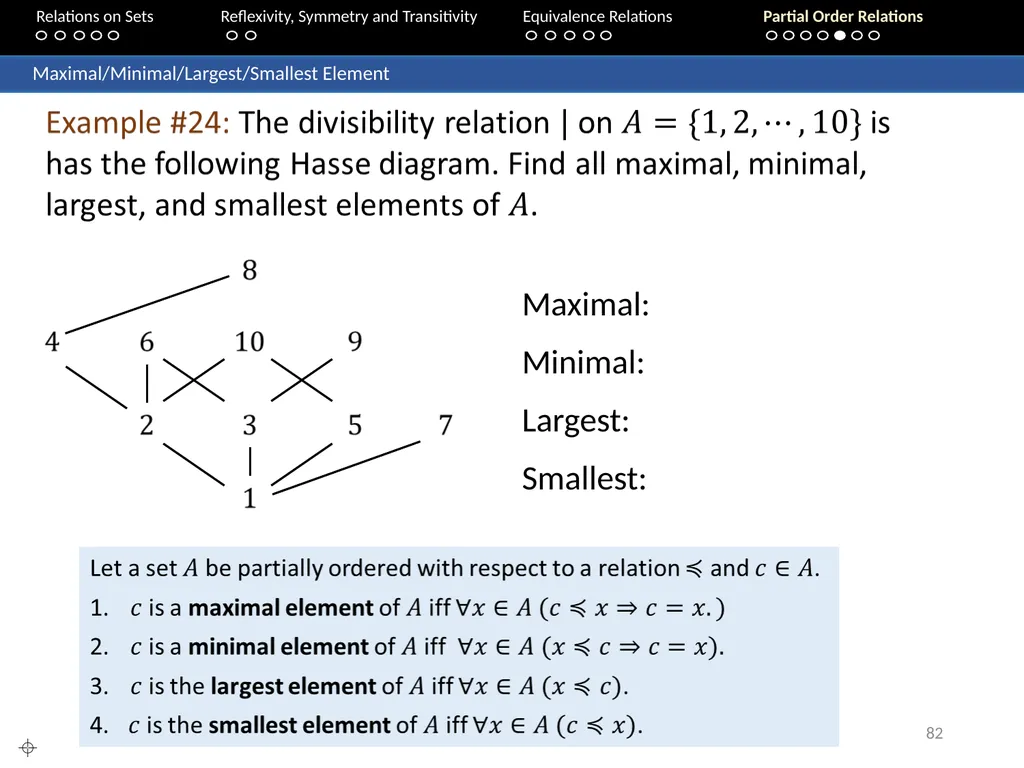
slide82. Relations on Sets Reflexivity, Symmetry and Transitivity Equivalence Relations Partial Order Relations Maximal/Minimal/Largest/Smallest Element 82 Maximal:
Minimal:
Largest:
Smallest: <br>
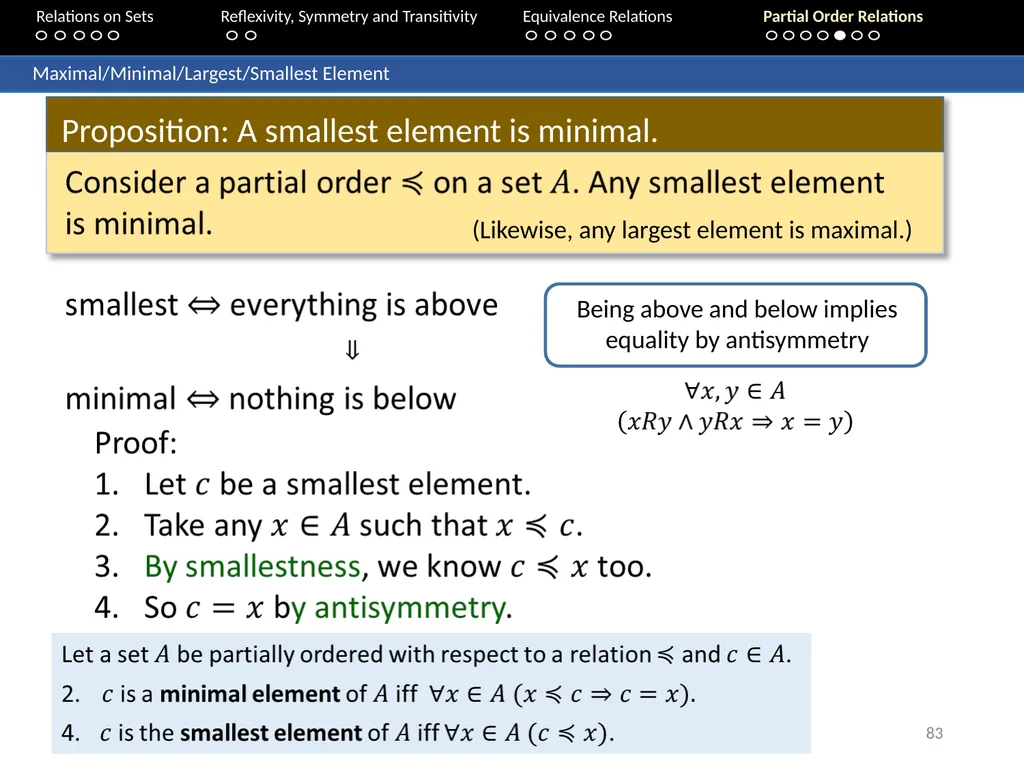
slide83. Relations on Sets Reflexivity, Symmetry and Transitivity Equivalence Relations Partial Order Relations Maximal/Minimal/Largest/Smallest Element 83 (Likewise, any largest element is maximal.)<br>
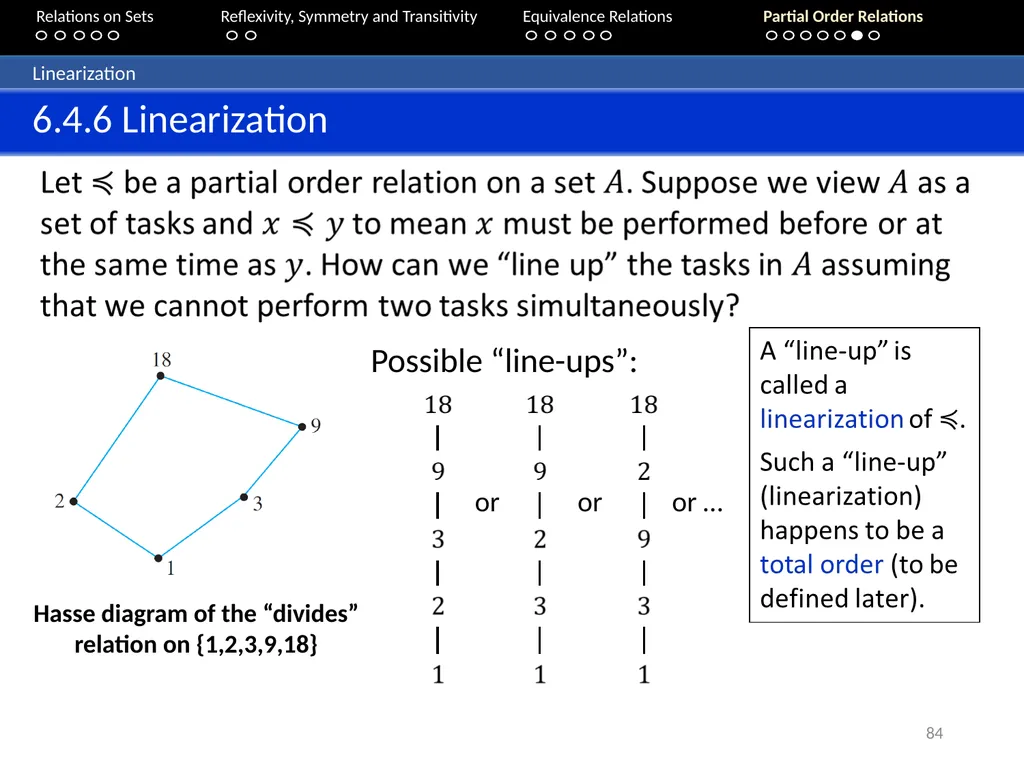
slide84. Relations on Sets Reflexivity, Symmetry and Transitivity Equivalence Relations Partial Order Relations Linearization 84 6.4.6 Linearization Possible “line-ups”: or or or …<br>
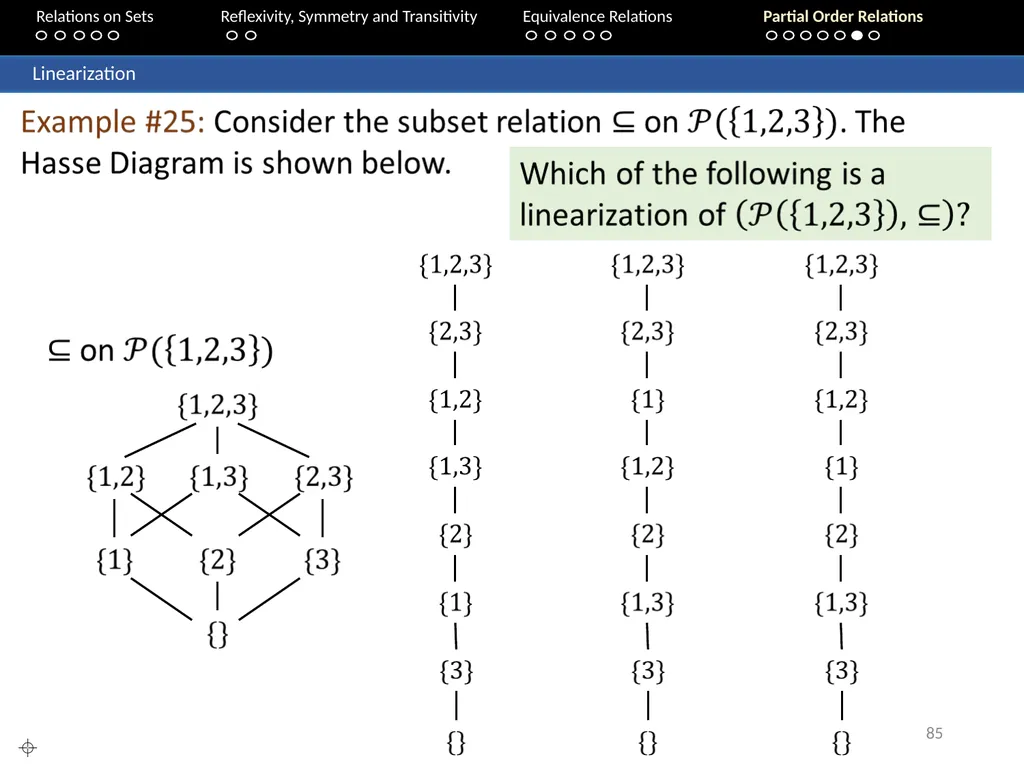
slide85. Relations on Sets Reflexivity, Symmetry and Transitivity Equivalence Relations Partial Order Relations Linearization 85 <br>
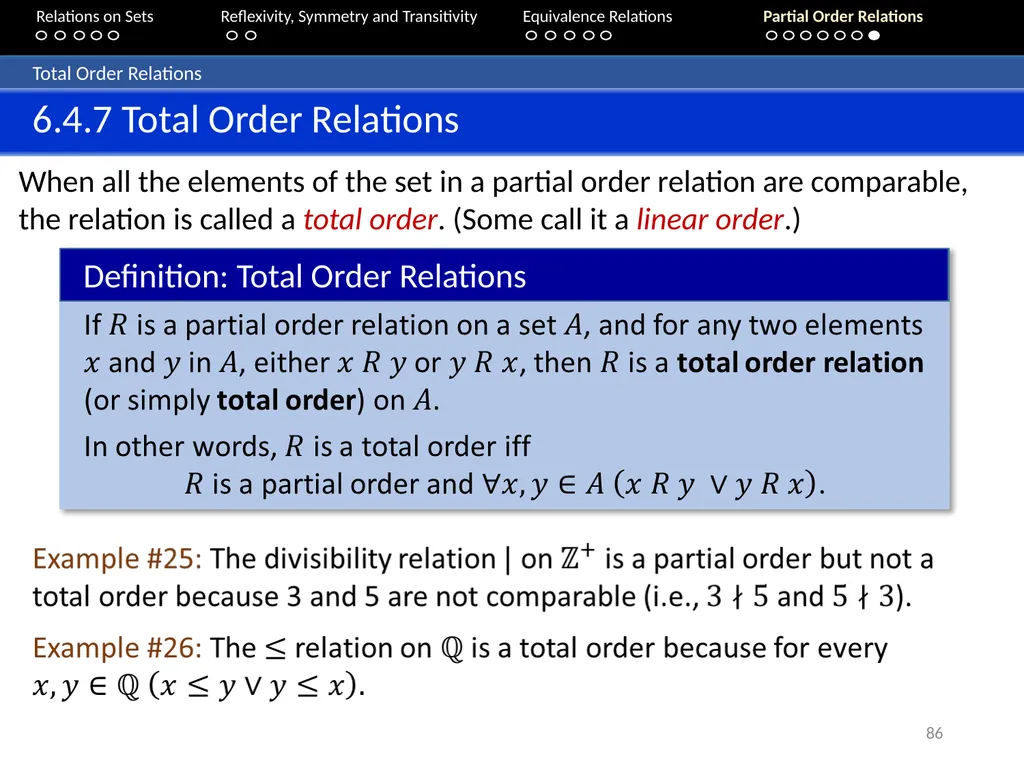
slide86. Relations on Sets Reflexivity, Symmetry and Transitivity Equivalence Relations Partial Order Relations Total Order Relations 86 6.4.7 Total Order Relations When all the elements of the set in a partial order relation are comparable, the relation is called a total order. (Some call it a linear order.)<br>
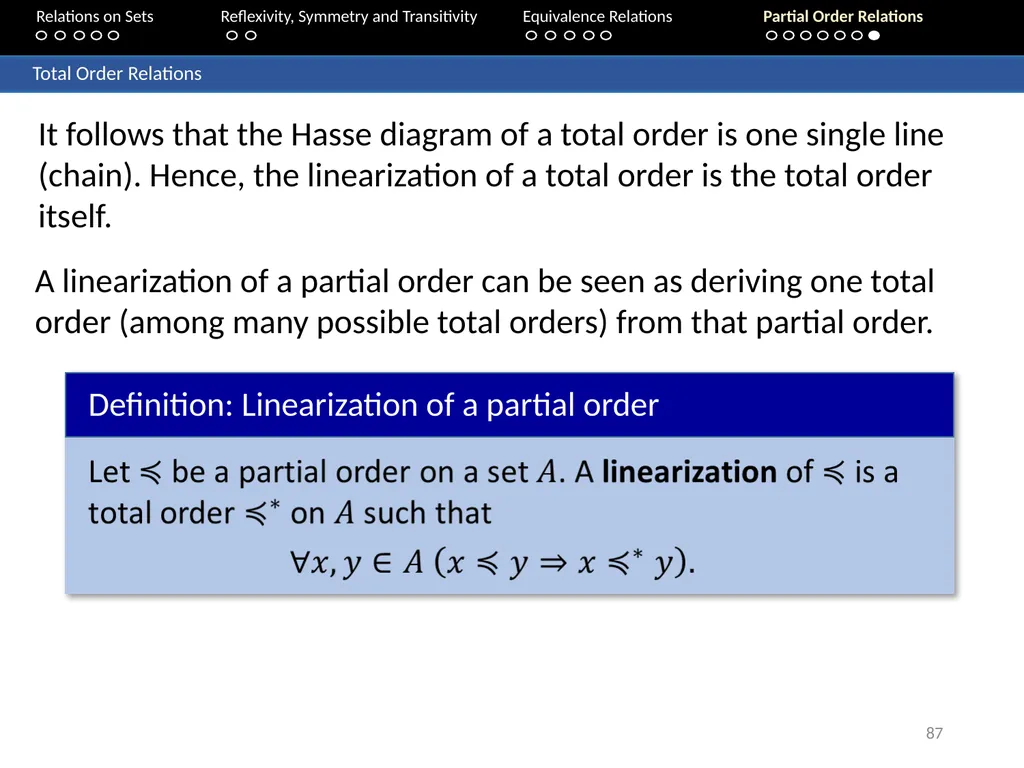
slide87. Relations on Sets Reflexivity, Symmetry and Transitivity Equivalence Relations Partial Order Relations Total Order Relations 87 It follows that the Hasse diagram of a total order is one single line (chain). Hence, the linearization of a total order is the total order itself. A linearization of a partial order can be seen as deriving one total order (among many possible total orders) from that partial order.<br>
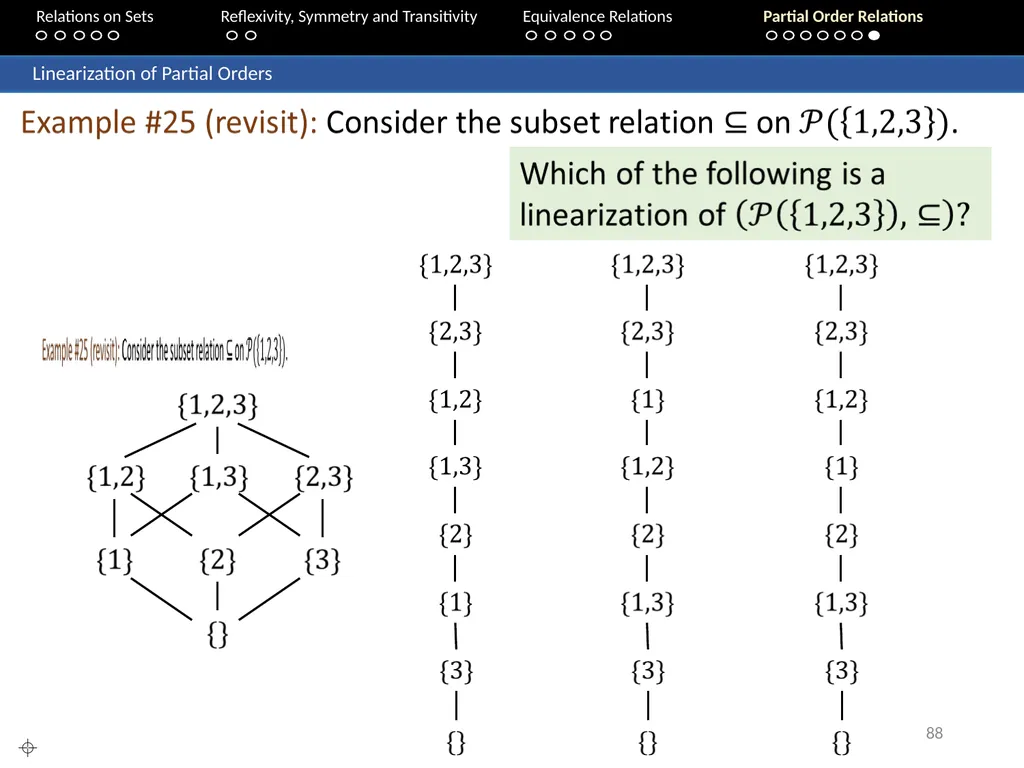
slide88. Relations on Sets Reflexivity, Symmetry and Transitivity Equivalence Relations Partial Order Relations Linearization of Partial Orders 88 <br>
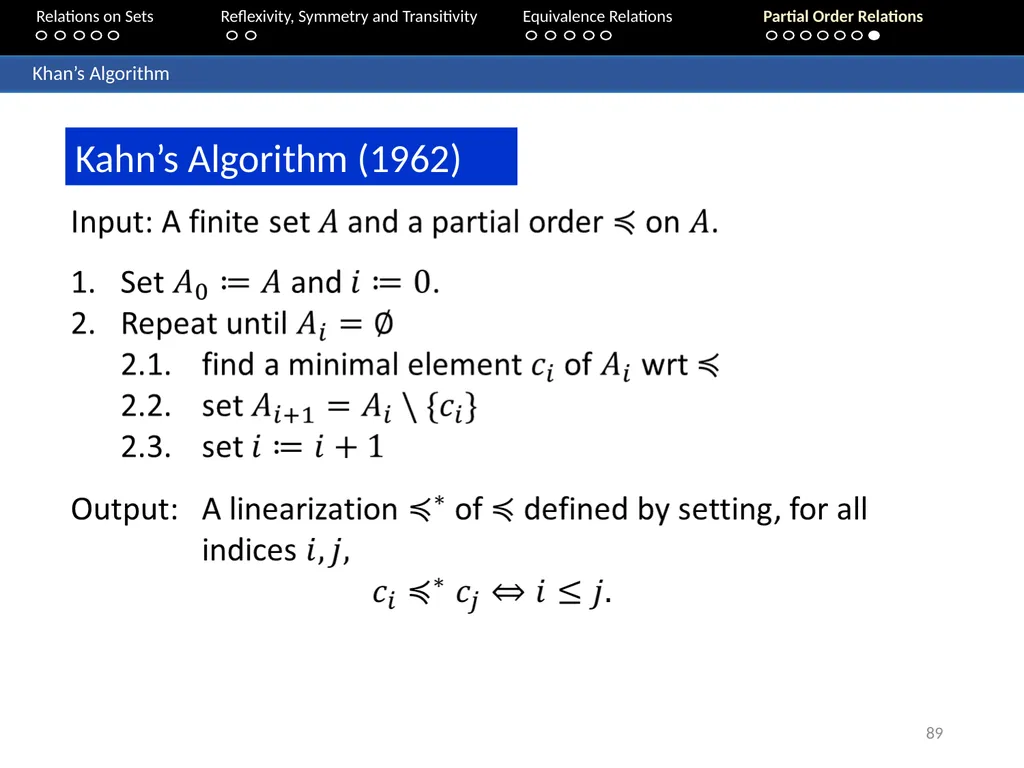
slide89. Relations on Sets Reflexivity, Symmetry and Transitivity Equivalence Relations Partial Order Relations Khan’s Algorithm 89 Kahn’s Algorithm (1962)<br>
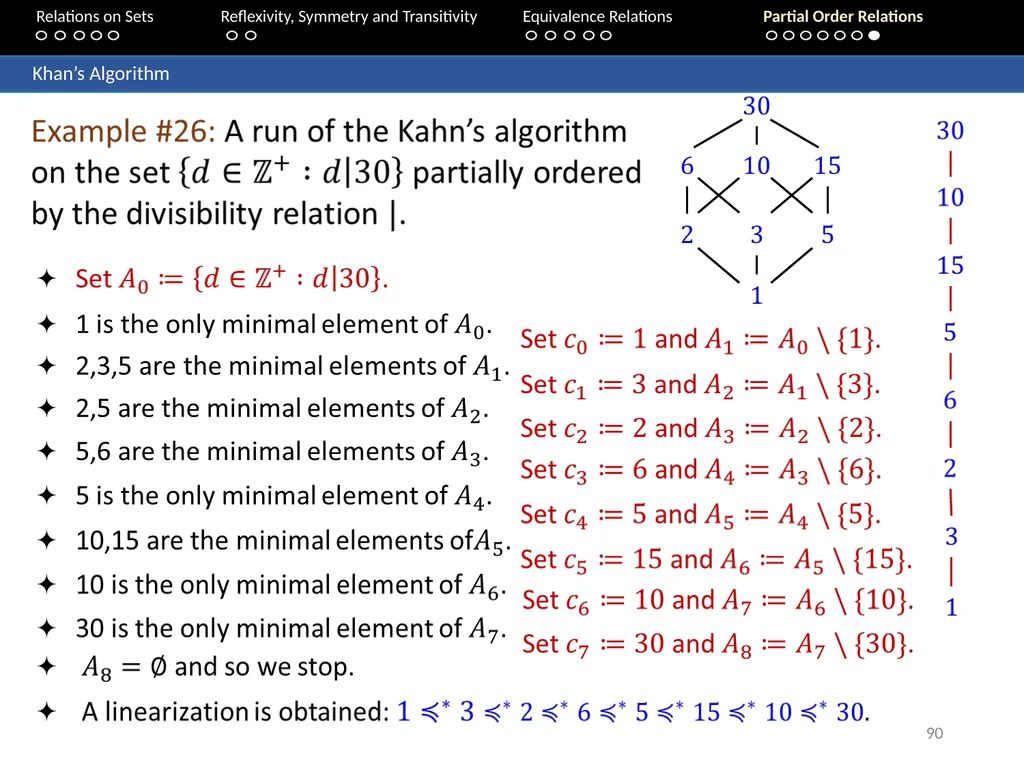
slide90. Relations on Sets Reflexivity, Symmetry and Transitivity Equivalence Relations Partial Order Relations Khan’s Algorithm 90<br>
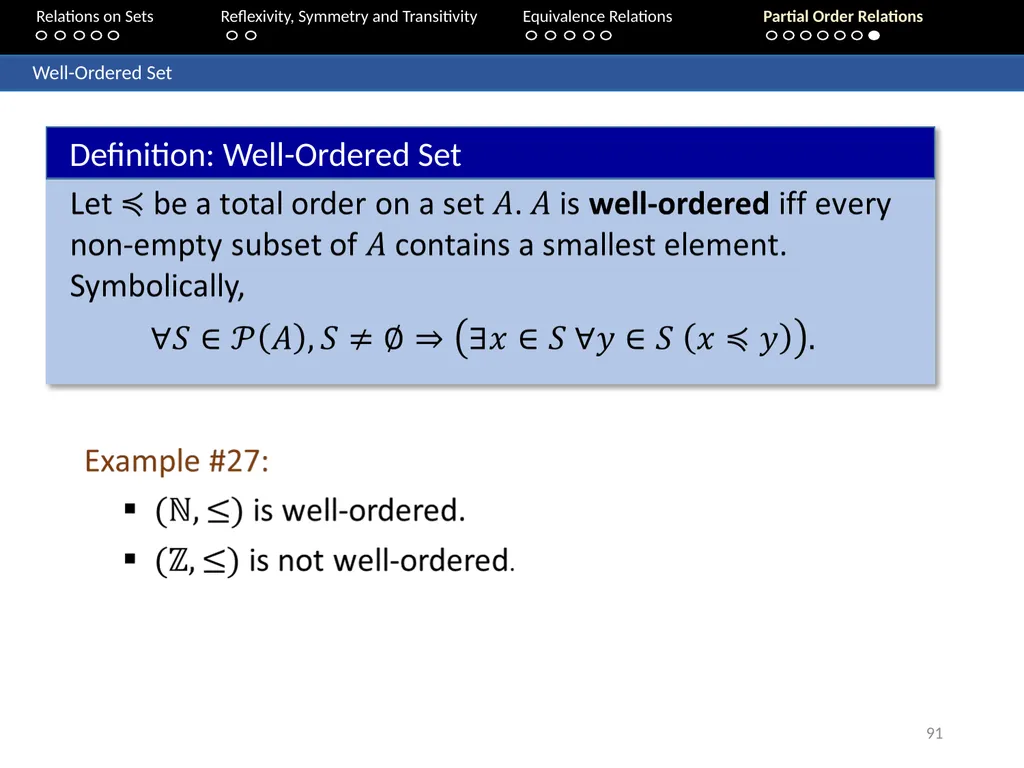
slide91. Relations on Sets Reflexivity, Symmetry and Transitivity Equivalence Relations Partial Order Relations Well-Ordered Set 91<br>
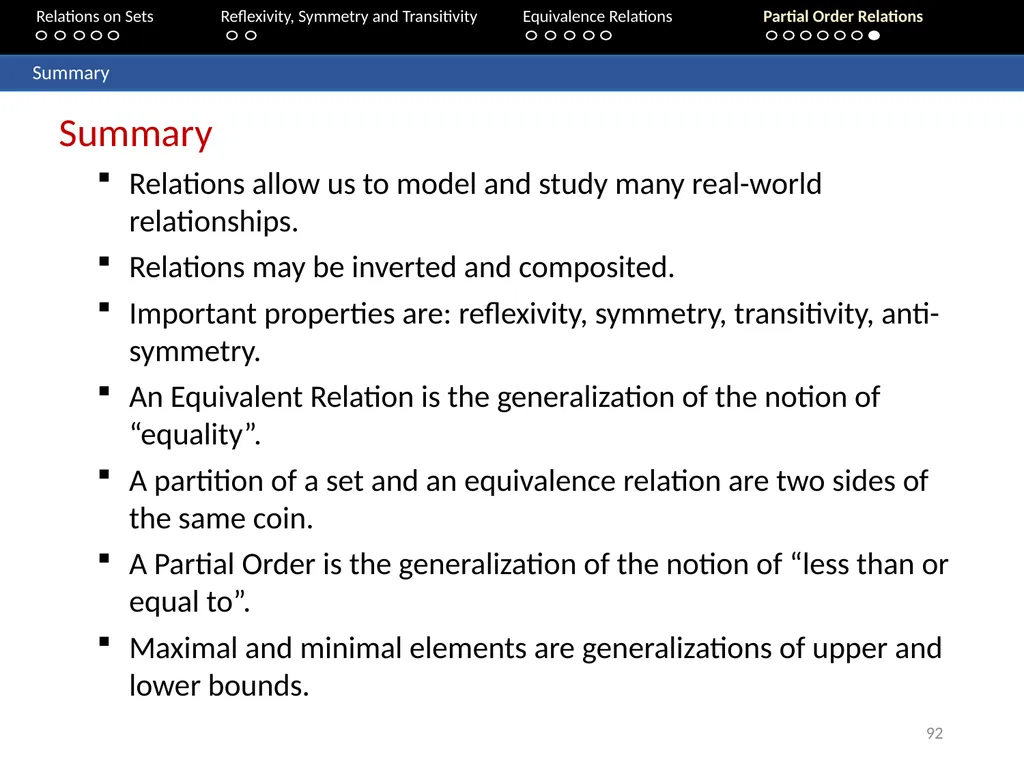
slide92. Relations on Sets Reflexivity, Symmetry and Transitivity Equivalence Relations Partial Order Relations Summary 92 Summary
Relations allow us to model and study many real-world relationships.
Relations may be inverted and composited.
Important properties are: reflexivity, symmetry, transitivity, anti-symmetry.
An Equivalent Relation is the generalization of the notion of “equality”.
A partition of a set and an equivalence relation are two sides of the same coin.
A Partial Order is the generalization of the notion of “less than or equal to”.
Maximal and minimal elements are generalizations of upper and lower bounds.<br>
slide93. 93 END OF FILE<br>
slide2. 2 6. Relations Relations on Sets Reflexivity, Symmetry and Transitivity Equivalence Relations Partial Order Relations Reference: Epp’s Chapter 8 Properties of Relations<br>
slide3. 3 6. Relations Relations on Sets Reflexivity, Symmetry and Transitivity Equivalence Relations Partial Order Relations Reference: Epp’s Chapter 8 Properties of Relations<br>
slide4. Relations on Sets Reflexivity, Symmetry and Transitivity Equivalence Relations Partial Order Relations 4 6.1 Relations on Sets<br>
slide5. Relations on Sets Reflexivity, Symmetry and Transitivity Equivalence Relations Partial Order Relations Definitions 5 6.1.1 Definitions<br>
slide6. Relations on Sets Reflexivity, Symmetry and Transitivity Equivalence Relations Partial Order Relations Definitions 6<br>
slide7. Relations on Sets Reflexivity, Symmetry and Transitivity Equivalence Relations Partial Order Relations Definitions 7<br>
slide8. Relations on Sets Reflexivity, Symmetry and Transitivity Equivalence Relations Partial Order Relations Application of Relations 8 An application: A simple database<br>
slide9. Relations on Sets Reflexivity, Symmetry and Transitivity Equivalence Relations Partial Order Relations Definitions 9<br>
slide10. Relations on Sets Reflexivity, Symmetry and Transitivity Equivalence Relations Partial Order Relations Definitions 10 Yes <br>
slide11. Relations on Sets Reflexivity, Symmetry and Transitivity Equivalence Relations Partial Order Relations Arrow Diagram 11<br>
slide12. Relations on Sets Reflexivity, Symmetry and Transitivity Equivalence Relations Partial Order Relations The Inverse of a Relation 12 6.1.2 The Inverse of a Relation This definition can be written operationally as follows:<br>
slide13. The Inverse of a Relation 13 Relations on Sets Reflexivity, Symmetry and Transitivity Equivalence Relations Partial Order Relations<br>
slide14. Relations on Sets Reflexivity, Symmetry and Transitivity Equivalence Relations Partial Order Relations Directed Graph of a Relation 14 6.1.3 Directed Graph of a Relation<br>
slide15. Relations on Sets Reflexivity, Symmetry and Transitivity Equivalence Relations Partial Order Relations Directed Graph of a Relation 15<br>
slide16. Relations on Sets Reflexivity, Symmetry and Transitivity Equivalence Relations Partial Order Relations Composition of Relations 16 6.1.4 Composition of Relations<br>
slide17. Relations on Sets Reflexivity, Symmetry and Transitivity Equivalence Relations Partial Order Relations Composition of Relations 17<br>
slide18. Relations on Sets Reflexivity, Symmetry and Transitivity Equivalence Relations Partial Order Relations Composition of Relations 18<br>
slide19. Relations on Sets Reflexivity, Symmetry and Transitivity Equivalence Relations Partial Order Relations N-ary Relations and Relational Databases 19 6.1.5 N-ary Relations and Relational Databases A relation involving two sets is called binary relation. We can generalize a relation to involve more than two sets.<br>
slide20. Relations on Sets Reflexivity, Symmetry and Transitivity Equivalence Relations Partial Order Relations N-ary Relations and Relational Databases 20<br>
slide21. Relations on Sets Reflexivity, Symmetry and Transitivity Equivalence Relations Partial Order Relations N-ary Relations and Relational Databases 21 would yield a list of the ID numbers and names of all patients admitted on 01-03-10: 466581 Mary Lazars
244388 Sarah Wu<br>
slide22. Relations on Sets Reflexivity, Symmetry and Transitivity Equivalence Relations Partial Order Relations 22 6.2 Reflexivity, Symmetry and Transitivity<br>
slide23. Relations on Sets Reflexivity, Symmetry and Transitivity Equivalence Relations Partial Order Relations Definitions of Reflexivity, Symmetry and Transitivity 23 6.2.1 Definitions of Reflexivity, Symmetry and Transitivity Each point of the graph has an arrow looping around from it back to itself.
Wherever there is an arrow going from one point to another, there is also an arrow going from the second point back to the first.
Wherever there is an arrow going from one point to a second and from the second point to a third, there is also an arrow going from the first point to the third.<br>
slide24. Relations on Sets Reflexivity, Symmetry and Transitivity Equivalence Relations Partial Order Relations Definitions of Reflexivity, Symmetry and Transitivity 24 Properties (1), (2), and (3) correspond to properties of general relations called reflexivity, symmetry, and transitivity. Reflexive Symmetric Transitive<br>
slide25. Relations on Sets Reflexivity, Symmetry and Transitivity Equivalence Relations Partial Order Relations Definitions of Reflexivity, Symmetry and Transitivity 25 Yes Yes No<br>
slide26. Relations on Sets Reflexivity, Symmetry and Transitivity Equivalence Relations Partial Order Relations Definitions of Reflexivity, Symmetry and Transitivity 26 Common mistake: Talking about reflexivity. Reflexivity, symmetry and transitivity are properties of a relation, not properties of members of the set.
We say a relation is reflexive or not reflexive.<br>
slide27. Relations on Sets Reflexivity, Symmetry and Transitivity Equivalence Relations Partial Order Relations Definitions of Reflexivity, Symmetry and Transitivity 27<br>
slide28. Relations on Sets Reflexivity, Symmetry and Transitivity Equivalence Relations Partial Order Relations Definitions of Reflexivity, Symmetry and Transitivity 28<br>
slide29. Relations on Sets Reflexivity, Symmetry and Transitivity Equivalence Relations Partial Order Relations Definitions of Reflexivity, Symmetry and Transitivity 29<br>
slide30. Relations on Sets Reflexivity, Symmetry and Transitivity Equivalence Relations Partial Order Relations The Transitive Closure of a Relation 30 6.2.2 The Transitive Closure of a Relation Generally speaking, a relation fails to be transitive because it fails to contain certain ordered pairs.
For example, if (1, 3) and (3, 4) are in a relation R, then the pair (1, 4) must be in R for R to be transitive.
To obtain a transitive relation from one that is not transitive, it is necessary to add ordered pairs.
Roughly speaking, the relation obtained by adding the least number of ordered pairs to ensure transitivity is called the transitive closure of the relation.<br>
slide31. Relations on Sets Reflexivity, Symmetry and Transitivity Equivalence Relations Partial Order Relations The Transitive Closure of a Relation 31 In a sense made precise by the formal definition, the transitive closure of a relation is the smallest transitive relation that contains the relation.<br>
slide32. Relations on Sets Reflexivity, Symmetry and Transitivity Equivalence Relations Partial Order Relations The Transitive Closure of a Relation 32<br>
slide33. Relations on Sets Reflexivity, Symmetry and Transitivity Equivalence Relations Partial Order Relations 33 6.3 Equivalence Relations<br>
slide34. Relations on Sets Reflexivity, Symmetry and Transitivity Equivalence Relations Partial Order Relations The Relation Induced by a Partition 34 6.3.1 The Relation Induced by a Partition<br>
slide35. Relations on Sets Reflexivity, Symmetry and Transitivity Equivalence Relations Partial Order Relations The Relation Induced by a Partition 35<br>
slide36. Relations on Sets Reflexivity, Symmetry and Transitivity Equivalence Relations Partial Order Relations The Relation Induced by a Partition 36<br>
slide37. Relations on Sets Reflexivity, Symmetry and Transitivity Equivalence Relations Partial Order Relations The Relation Induced by a Partition 37 Partitions as relations We may view a partition as a “is in the same component as” relation.<br>
slide38. Relations on Sets Reflexivity, Symmetry and Transitivity Equivalence Relations Partial Order Relations The Relation Induced by a Partition 38 {0,3,4} is a component of the partition 0R0, 0R3, 0R4, 3R0, 3R3, 3R4, 4R0, 4R3 and 4R4.
{1} is a component of the partition 1R1.
{2} is a component of the partition 2R2.
Therefore, R = {(0,0), (0,3), (0,4), (1,1), (2,2), (3,0), (3,3), (3,4), (4,0), (4,3), (4,4)}.<br>
slide39. Relations on Sets Reflexivity, Symmetry and Transitivity Equivalence Relations Partial Order Relations The Relation Induced by a Partition 39 The fact is that a relation induced by a partition of a set satisfies all three properties: reflexivity, symmetry, and transitivity.<br>
slide40. Relations on Sets Reflexivity, Symmetry and Transitivity Equivalence Relations Partial Order Relations Definition of an Equivalence Relation 40 6.3.2 Definition of an Equivalence Relation A relation on a set that satisfies the three properties of reflexivity, symmetry, and transitivity is called an equivalence relation.<br>
slide41. Relations on Sets Reflexivity, Symmetry and Transitivity Equivalence Relations Partial Order Relations Definition of an Equivalence Relation 41 R is reflexive: R is symmetric:<br>
slide42. Relations on Sets Reflexivity, Symmetry and Transitivity Equivalence Relations Partial Order Relations Definition of an Equivalence Relation 42 R is transitive:<br>
slide43. Relations on Sets Reflexivity, Symmetry and Transitivity Equivalence Relations Partial Order Relations Equivalence Classes of an Equivalence Relation 43 6.3.3 Equivalence Classes of an Equivalence Relation<br>
slide44. Relations on Sets Reflexivity, Symmetry and Transitivity Equivalence Relations Partial Order Relations Equivalence Classes of an Equivalence Relation 44 The procedural version of this definition is<br>
slide45. Relations on Sets Reflexivity, Symmetry and Transitivity Equivalence Relations Partial Order Relations Equivalence Classes of an Equivalence Relation 45<br>
slide46. Relations on Sets Reflexivity, Symmetry and Transitivity Equivalence Relations Partial Order Relations Equivalence Classes of an Equivalence Relation 46 Note that [0] = [4] and [1] = [3]. Thus the distinct equivalence classes of the relation are {0, 4}, {1, 3}, and {2}.<br>
slide47. Relations on Sets Reflexivity, Symmetry and Transitivity Equivalence Relations Partial Order Relations Equivalence Classes of an Equivalence Relation 47 We prove this by proving:<br>
slide48. Relations on Sets Reflexivity, Symmetry and Transitivity Equivalence Relations Partial Order Relations Equivalence Classes of an Equivalence Relation 48 We prove this by proving:<br>
slide49. Relations on Sets Reflexivity, Symmetry and Transitivity Equivalence Relations Partial Order Relations Equivalence Classes of an Equivalence Relation 49 We prove this by proving:<br>
slide50. Relations on Sets Reflexivity, Symmetry and Transitivity Equivalence Relations Partial Order Relations Equivalence Classes of an Equivalence Relation 50<br>
slide51. Relations on Sets Reflexivity, Symmetry and Transitivity Equivalence Relations Partial Order Relations Equivalence Classes of an Equivalence Relation 51 {…,-9,-6,-3,0,3,6,9,…} {…,-8,-5,-2,1,4,7,10,…} {…,-7,-4,-1,2,5,8,11,…}<br>
slide52. Relations on Sets Reflexivity, Symmetry and Transitivity Equivalence Relations Partial Order Relations Equivalence Classes of an Equivalence Relation 52 Congruence modulo 2 Congruence modulo 3 Congruence modulo 4<br>
slide53. Relations on Sets Reflexivity, Symmetry and Transitivity Equivalence Relations Partial Order Relations Congruence 53 6.3.4 Congruence <br>
slide54. Relations on Sets Reflexivity, Symmetry and Transitivity Equivalence Relations Partial Order Relations Congruence 54 Proof: 2. (Symmetry) 3. (Transitivity)<br>
slide55. Relations on Sets Reflexivity, Symmetry and Transitivity Equivalence Relations Partial Order Relations Congruence 55 Congruence: Equivalence classes Congruence modulo 4<br>
slide56. Relations on Sets Reflexivity, Symmetry and Transitivity Equivalence Relations Partial Order Relations Dividing a Set by an Equivalence Relation 56 6.3.5 Dividing a Set by an Equivalence Relation<br>
slide57. Relations on Sets Reflexivity, Symmetry and Transitivity Equivalence Relations Partial Order Relations Dividing a Set by an Equivalence Relation 57 Proof: Theorem Rel.2 Equivalence classes form a partition<br>
slide58. Relations on Sets Reflexivity, Symmetry and Transitivity Equivalence Relations Partial Order Relations Dividing a Set by an Equivalence Relation 58 Proof:<br>
slide59. Relations on Sets Reflexivity, Symmetry and Transitivity Equivalence Relations Partial Order Relations Dividing a Set by an Equivalence Relation 59 Proof: Theorem Rel.2 Equivalence classes form a partition<br>
slide60. Relations on Sets Reflexivity, Symmetry and Transitivity Equivalence Relations Partial Order Relations Summary 60 6.3.6 Summary Proposition: The same-component relation w.r.t. a partition is an equivalence relation.<br>
slide61. Relations on Sets Reflexivity, Symmetry and Transitivity Equivalence Relations Partial Order Relations Summary 61 Informal descriptions of the terms<br>
slide62. Relations on Sets Reflexivity, Symmetry and Transitivity Equivalence Relations Partial Order Relations 62 6.4 Partial Order Relations<br>
slide63. Relations on Sets Reflexivity, Symmetry and Transitivity Equivalence Relations Partial Order Relations Antisymmetry 63 6.4.1 Antisymmetry or <br>
slide64. Relations on Sets Reflexivity, Symmetry and Transitivity Equivalence Relations Partial Order Relations Antisymmetry 64 <br>
slide65. Relations on Sets Reflexivity, Symmetry and Transitivity Equivalence Relations Partial Order Relations Antisymmetry 65<br>
slide66. Relations on Sets Reflexivity, Symmetry and Transitivity Equivalence Relations Partial Order Relations Antisymmetry 66<br>
slide67. Relations on Sets Reflexivity, Symmetry and Transitivity Equivalence Relations Partial Order Relations Antisymmetry 67 <br>
slide68. Relations on Sets Reflexivity, Symmetry and Transitivity Equivalence Relations Partial Order Relations Partial Order Relations 68 6.4.2 Partial Order Relations<br>
slide69. Relations on Sets Reflexivity, Symmetry and Transitivity Equivalence Relations Partial Order Relations Partial Order Relations 69<br>
slide70. Relations on Sets Reflexivity, Symmetry and Transitivity Equivalence Relations Partial Order Relations Partial Order Relations 70<br>
slide71. Relations on Sets Reflexivity, Symmetry and Transitivity Equivalence Relations Partial Order Relations Partial Order Relations 71 <br>
slide72. Relations on Sets Reflexivity, Symmetry and Transitivity Equivalence Relations Partial Order Relations Partial Order Relations 72 One way of viewing partial orders.<br>
slide73. Relations on Sets Reflexivity, Symmetry and Transitivity Equivalence Relations Partial Order Relations Hasse Diagrams 73 6.4.3 Hasse Diagrams The directed graph of this relation, which is a partial order, is as follows:<br>
slide74. Relations on Sets Reflexivity, Symmetry and Transitivity Equivalence Relations Partial Order Relations Hasse Diagrams 74 Note that there is a loop at every vertex, all other arrows point in the same direction (upward), and any time there is an arrow from one point to a second and from the second point to a third, there is an arrow from the first point to the third. Given any partial order relation defined on a finite set, it is possible to draw the directed graph in such a way that all of these properties are satisfied.
This makes it possible to associate a somewhat simpler graph, called a Hasse diagram (after Helmut Hasse, a twentieth-century German number theorist), with a partial order relation defined on a finite set.<br>
slide75. Relations on Sets Reflexivity, Symmetry and Transitivity Equivalence Relations Partial Order Relations Hasse Diagrams 75 To obtain a Hasse diagram, proceed as follows:
Start with a directed graph of the relation, placing vertices on the page so that all arrows point upward. Then eliminate
1. the loops at all the vertices,
2. all arrows whose existence is implied by the transitive property,
3. the direction indicators on the arrows.<br>
slide76. Relations on Sets Reflexivity, Symmetry and Transitivity Equivalence Relations Partial Order Relations Hasse Diagrams 76<br>
slide77. Relations on Sets Reflexivity, Symmetry and Transitivity Equivalence Relations Partial Order Relations Hasse Diagrams 77 (The directed graph would be too complex.
The Hasse diagram carries the same information.)<br>
slide78. Relations on Sets Reflexivity, Symmetry and Transitivity Equivalence Relations Partial Order Relations Comparability 78 6.4.4 Comparability<br>
slide79. Relations on Sets Reflexivity, Symmetry and Transitivity Equivalence Relations Partial Order Relations Comparability 79 Yes<br>
slide80. Relations on Sets Reflexivity, Symmetry and Transitivity Equivalence Relations Partial Order Relations Maximal/Minimal/Largest/Smallest Element 80 6.4.5 Maximal/Minimal/Largest/Smallest Element Note: Alternative terms
largest element = greatest element = maximum;
smallest element = least element = minimum.<br>
slide81. Relations on Sets Reflexivity, Symmetry and Transitivity Equivalence Relations Partial Order Relations Maximal/Minimal/Largest/Smallest Element 81<br>
slide82. Relations on Sets Reflexivity, Symmetry and Transitivity Equivalence Relations Partial Order Relations Maximal/Minimal/Largest/Smallest Element 82 Maximal:
Minimal:
Largest:
Smallest: <br>
slide83. Relations on Sets Reflexivity, Symmetry and Transitivity Equivalence Relations Partial Order Relations Maximal/Minimal/Largest/Smallest Element 83 (Likewise, any largest element is maximal.)<br>
slide84. Relations on Sets Reflexivity, Symmetry and Transitivity Equivalence Relations Partial Order Relations Linearization 84 6.4.6 Linearization Possible “line-ups”: or or or …<br>
slide85. Relations on Sets Reflexivity, Symmetry and Transitivity Equivalence Relations Partial Order Relations Linearization 85 <br>
slide86. Relations on Sets Reflexivity, Symmetry and Transitivity Equivalence Relations Partial Order Relations Total Order Relations 86 6.4.7 Total Order Relations When all the elements of the set in a partial order relation are comparable, the relation is called a total order. (Some call it a linear order.)<br>
slide87. Relations on Sets Reflexivity, Symmetry and Transitivity Equivalence Relations Partial Order Relations Total Order Relations 87 It follows that the Hasse diagram of a total order is one single line (chain). Hence, the linearization of a total order is the total order itself. A linearization of a partial order can be seen as deriving one total order (among many possible total orders) from that partial order.<br>
slide88. Relations on Sets Reflexivity, Symmetry and Transitivity Equivalence Relations Partial Order Relations Linearization of Partial Orders 88 <br>
slide89. Relations on Sets Reflexivity, Symmetry and Transitivity Equivalence Relations Partial Order Relations Khan’s Algorithm 89 Kahn’s Algorithm (1962)<br>
slide90. Relations on Sets Reflexivity, Symmetry and Transitivity Equivalence Relations Partial Order Relations Khan’s Algorithm 90<br>
slide91. Relations on Sets Reflexivity, Symmetry and Transitivity Equivalence Relations Partial Order Relations Well-Ordered Set 91<br>
slide92. Relations on Sets Reflexivity, Symmetry and Transitivity Equivalence Relations Partial Order Relations Summary 92 Summary
Relations allow us to model and study many real-world relationships.
Relations may be inverted and composited.
Important properties are: reflexivity, symmetry, transitivity, anti-symmetry.
An Equivalent Relation is the generalization of the notion of “equality”.
A partition of a set and an equivalence relation are two sides of the same coin.
A Partial Order is the generalization of the notion of “less than or equal to”.
Maximal and minimal elements are generalizations of upper and lower bounds.<br>
slide93. 93 END OF FILE<br>