
AATCC Test Method 61-2013e(2020)e2 Colorfastness
Description: AATCC Test Method 61-2013e(2020)e2 Colorfastness to Laundering: Accelerated Principle An accelerated test (45 minutes or less) produces color and surface changes similar to that produced by five hand or home launderings. May NOT predict
Related Topics
Download Presentation
"AATCC Test Method 61-2013e(2020)e2 Colorfastness" is the property of its rightful owner. Permission is granted to download and print the materials on this website for personal, non-commercial use only, and to display it on your personal computer provided you do not modify the materials and that you retain all copyright notices contained in the materials. By downloading content from our website, you accept the terms of this agreement.
Presentation Transcript
slide1. AATCC Test Method 61-2013e(2020)e2 Colorfastness to Laundering: Accelerated<br>
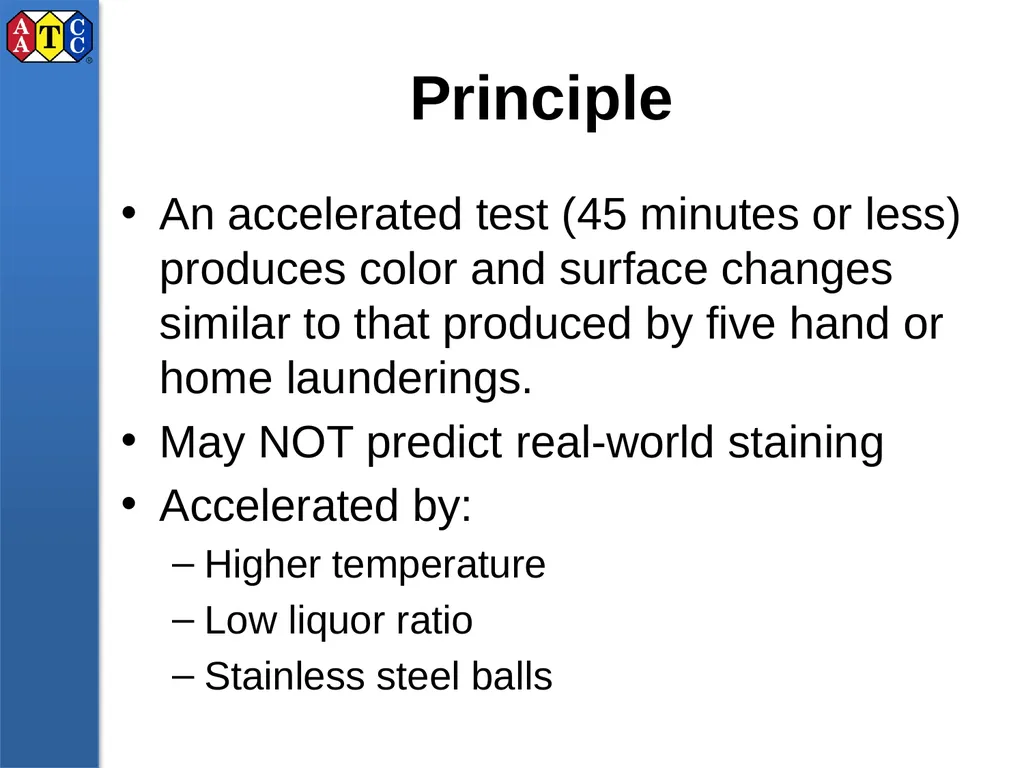
slide2. Principle An accelerated test (45 minutes or less) produces color and surface changes similar to that produced by five hand or home launderings.
May NOT predict real-world staining
Accelerated by:
Higher temperature
Low liquor ratio
Stainless steel balls<br>
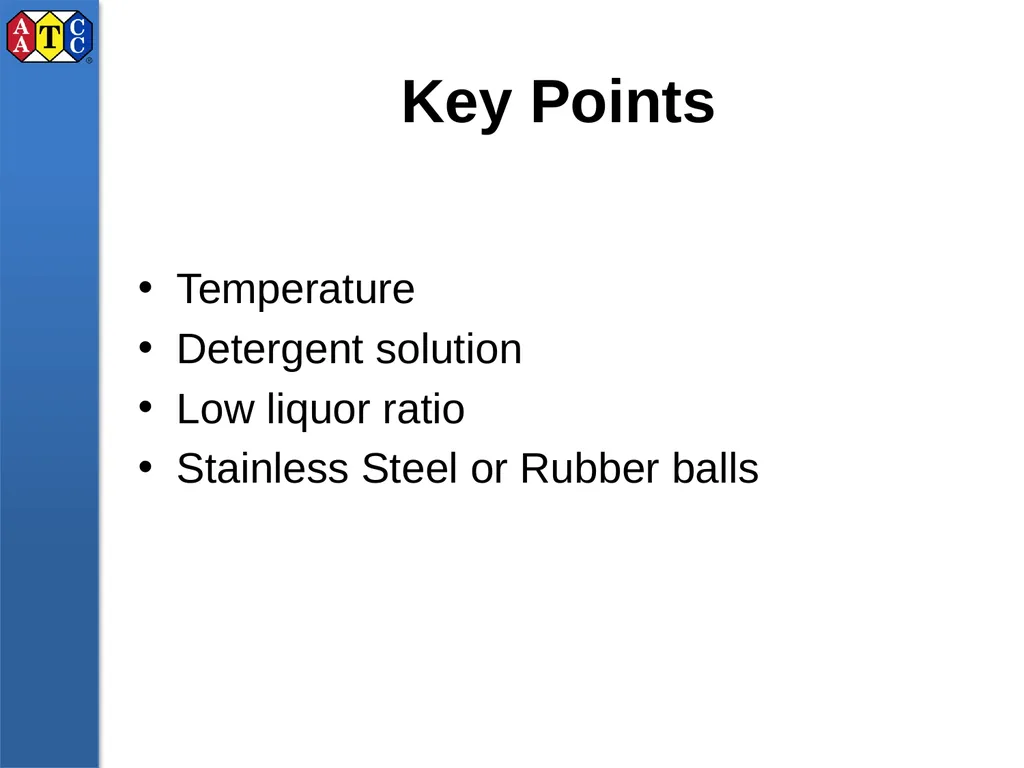
slide3. Key Points Temperature
Detergent solution
Low liquor ratio
Stainless Steel or Rubber balls<br>
slide4. Definitions laundering, n. of textile materials, a process intended to remove soils and/or stains by treatment (washing) with an aqueous detergent solution and normally including subsequent rinsing, extracting and drying.
colorfastness, n. the resistance of a material to change in any of its color characteristics; to transfer any of its colorants to adjacent materials or both, as a result of the exposure of the material to any environment that might be encountered during the processing, testing, or storage of the material.<br>
slide5. Limitations: Polyester/Spandex Note: Results for staining obtained by this method on fabrics dyed to dark shades (navy, black, etc.) that contain a combination of polyester and spandex, or their blends, may not show the full staining propensity of such fabrics in consumer use.<br>
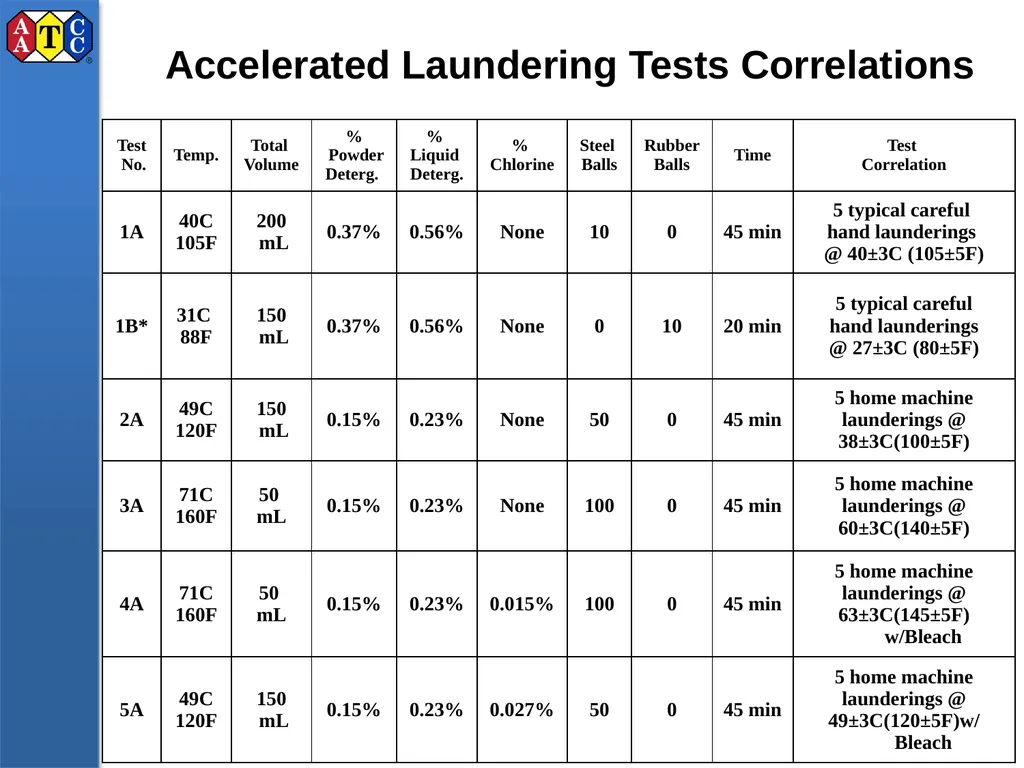
slide6. Accelerated Laundering Tests Correlations<br>
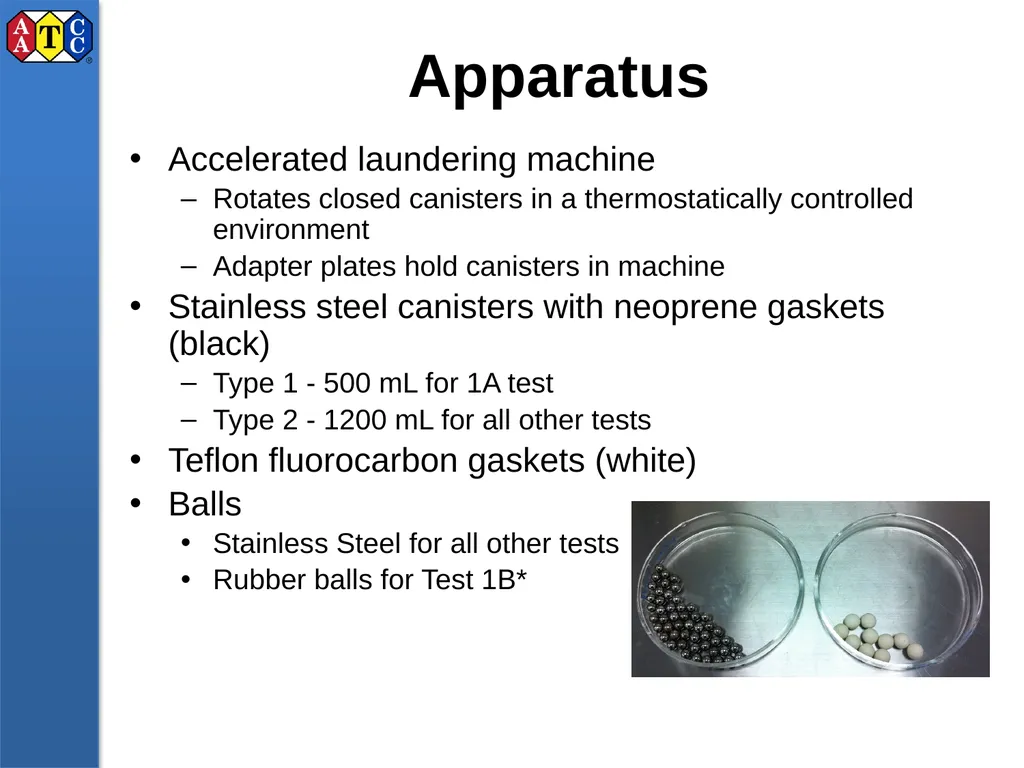
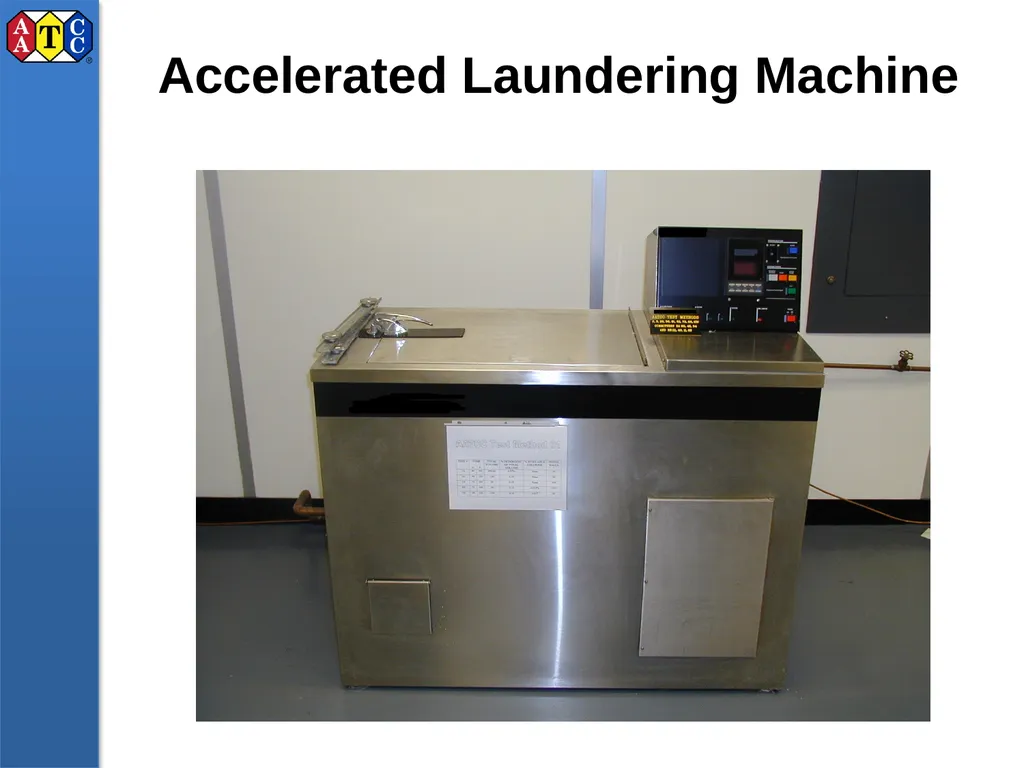
slide7. Apparatus Accelerated laundering machine
Rotates closed canisters in a thermostatically controlled environment
Adapter plates hold canisters in machine
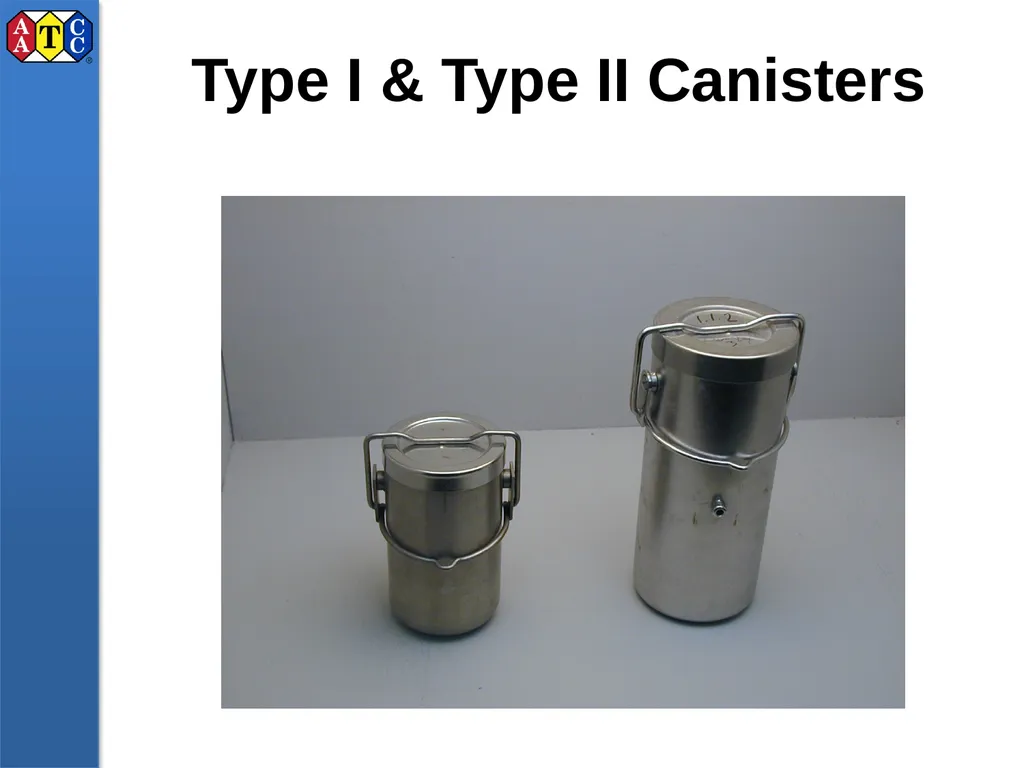
Stainless steel canisters with neoprene gaskets (black)
Type 1 - 500 mL for 1A test
Type 2 - 1200 mL for all other tests
Teflon fluorocarbon gaskets (white)
Balls
Stainless Steel for all other tests
Rubber balls for Test 1B*<br>
slide8. Accelerated Laundering Machine<br>
slide9. Type I & Type II Canisters<br>
slide10. Apparatus Scales for rating test results
Gray Scale for Color Change
AATCC 9-step Chromatic Transference Scale
Gray Scale for Staining<br>
slide11. Reagents and Materials Multifiber (1A, 1B, 2A, optional for 3A)
Bleached Cotton Test Fabric (for knits; opt. for 3A staining)
Distilled or Deionized Water
AATCC Standard Reference Detergent
Powder
With or without brightener
4A, 5A:
Sodium Hypochlorite (NaOCl)
Sulfuric Acid (H2SO4) 10%
Potassium Iodide (KI) 10%
Sodium Thiosulfate (Na2S2O3)<br>
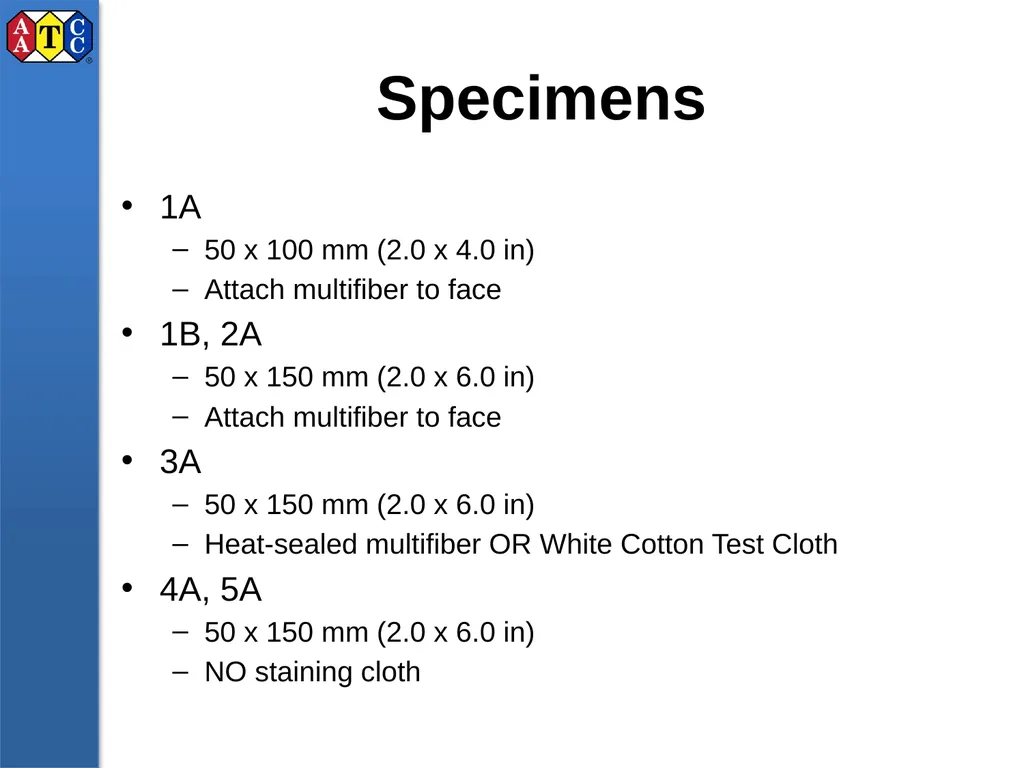
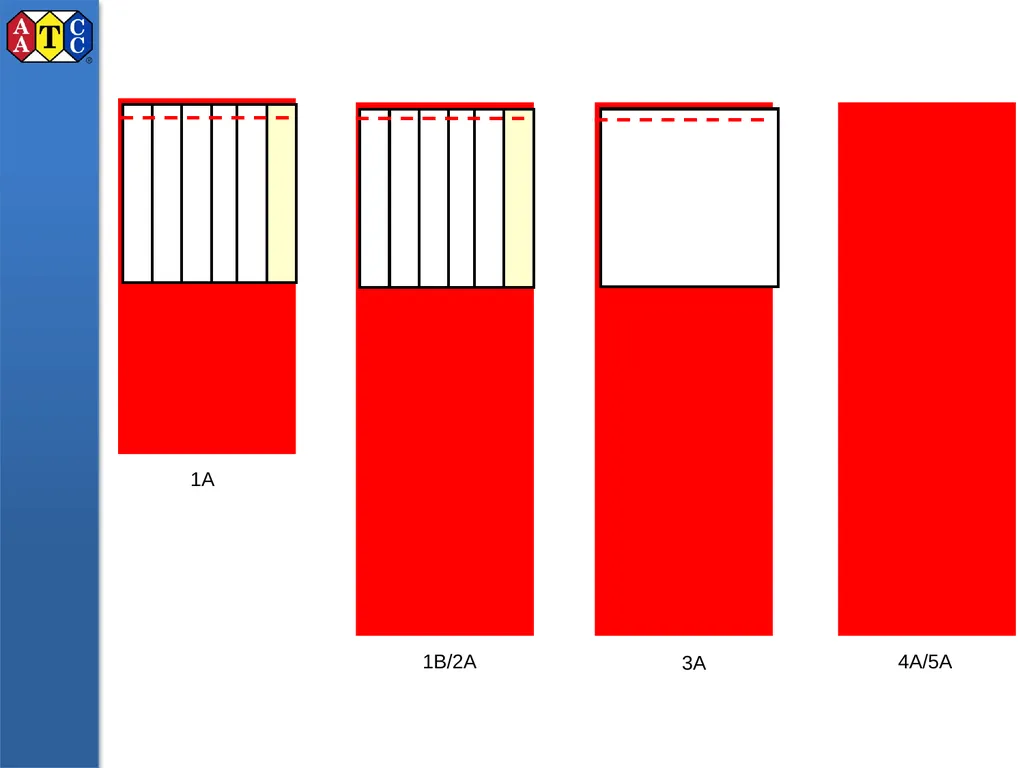
slide12. Specimens 1A
50 x 100 mm (2.0 x 4.0 in)
Attach multifiber to face
1B, 2A
50 x 150 mm (2.0 x 6.0 in)
Attach multifiber to face
3A
50 x 150 mm (2.0 x 6.0 in)
Heat-sealed multifiber OR White Cotton Test Cloth
4A, 5A
50 x 150 mm (2.0 x 6.0 in)
NO staining cloth<br>
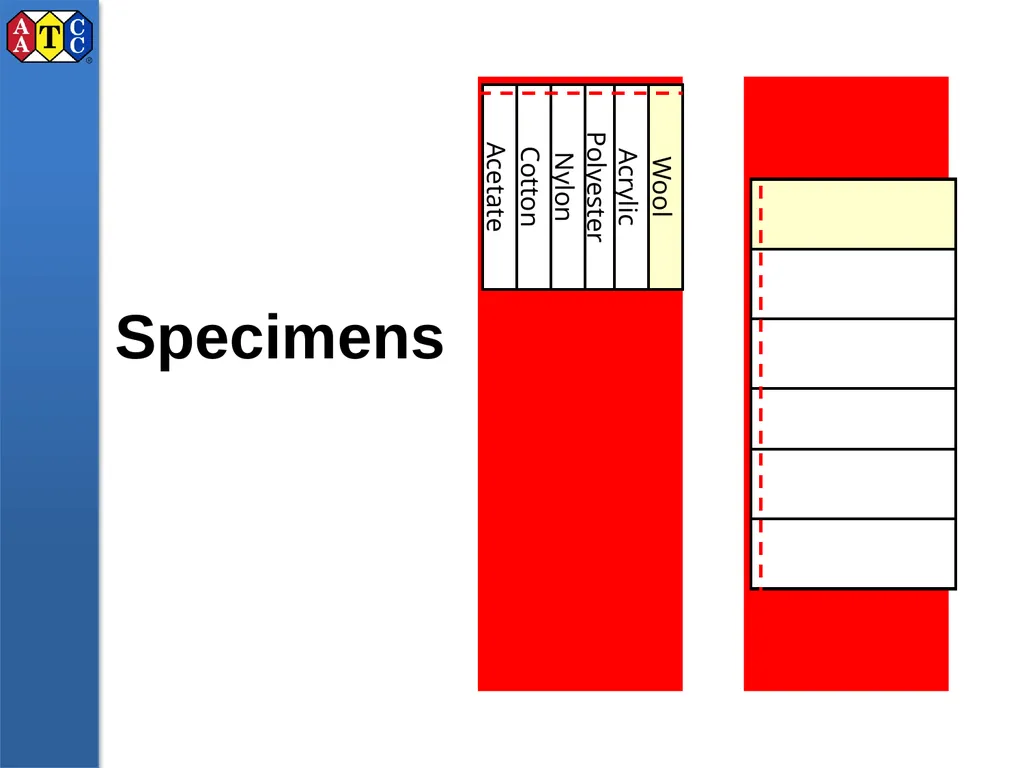
slide13. Specimens<br>
slide14. 1A 4A/5A 3A 1B/2A<br>
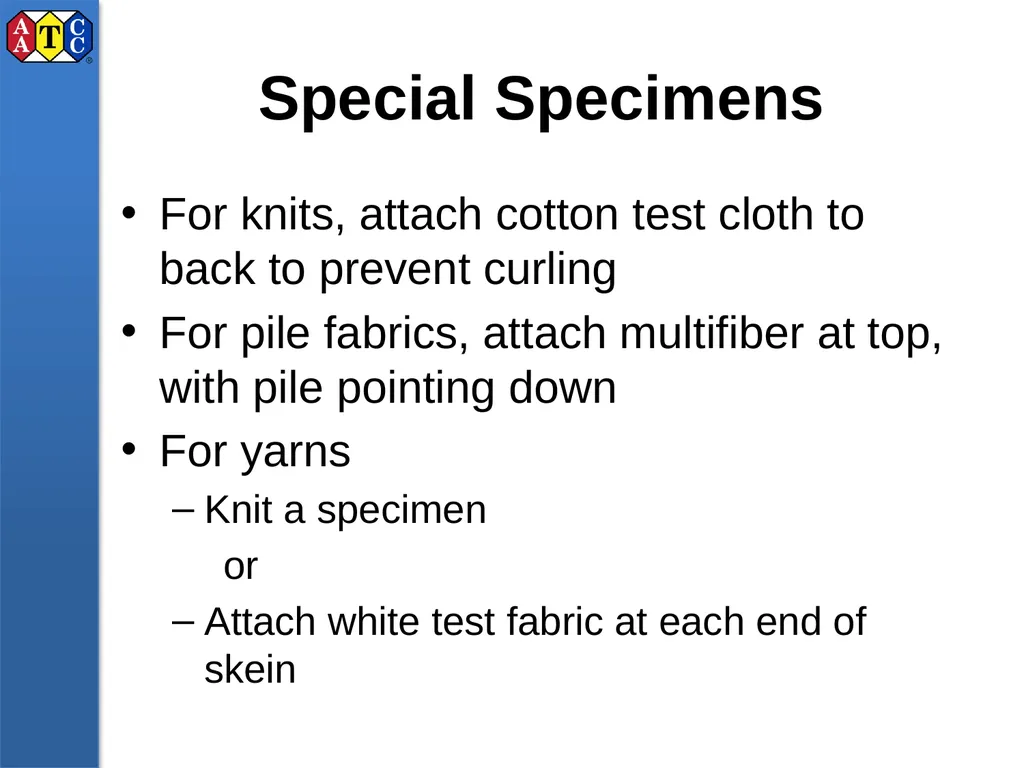
slide15. Special Specimens For knits, attach cotton test cloth to back to prevent curling
For pile fabrics, attach multifiber at top, with pile pointing down
For yarns
Knit a specimen
or
Attach white test fabric at each end of skein<br>
slide16. Specimen Preparation Cut sample according to test requirements
Attach multifiber or adjacent fabric
Position depends on the size multifiber being used.
8 mm filling bands: wool strip on right (fiber bands parallel to lengthwise direction of the specimen)
15 mm filling bands: wool strip at top to avoid fiber loss (fiber bands parallel to the widthwise direction of the specimen)<br>
slide17. Detergent Solutions 1993 AATCC Standard Reference Powder Detergent
- With OR without optical brighteners<br>
slide18. Detergent Solutions 1A, 1B: Mix 3.7 g powder detergent (5.6 g liquid detergent) with 1 L distilled water until dissolved
2A, 3A, 4A, 5A - Mix 1.5 g powder detergent (2.3 g liquid detergent) with 1 L distilled water until dissolved
4A: Add 0.015% available chlorine.
5A: Add 0.027% available chlorine.<br>
slide19. Chlorine Solution Titration 2.0 g of liquid sodium hypochlorite
Dilute with 50 mL deionized water
Add 10 mL 10% sulfuric acid
Add 10 mL 10% potassium iodide (the solution is brown)
Titrate with 0.1N sodium thiosulfate until colorless<br>
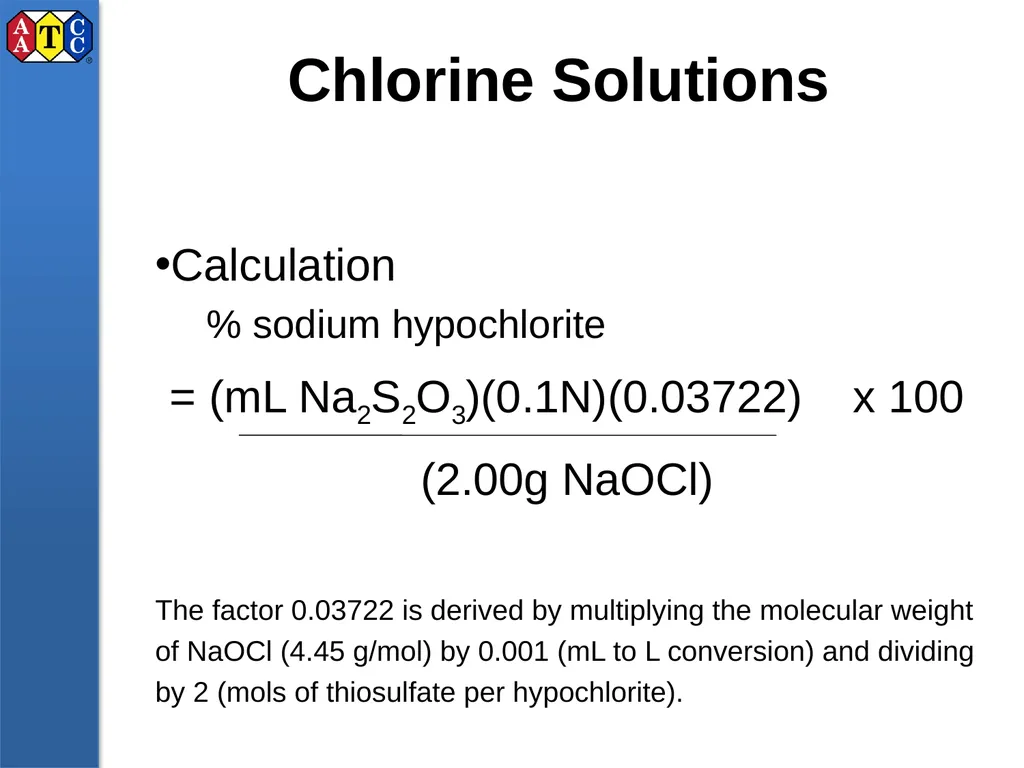
slide20. Chlorine Solutions Calculation
% sodium hypochlorite
= (mL Na2S2O3)(0.1N)(0.03722) x 100
(2.00g NaOCl)
The factor 0.03722 is derived by multiplying the molecular weight of NaOCl (4.45 g/mol) by 0.001 (mL to L conversion) and dividing by 2 (mols of thiosulfate per hypochlorite).<br>
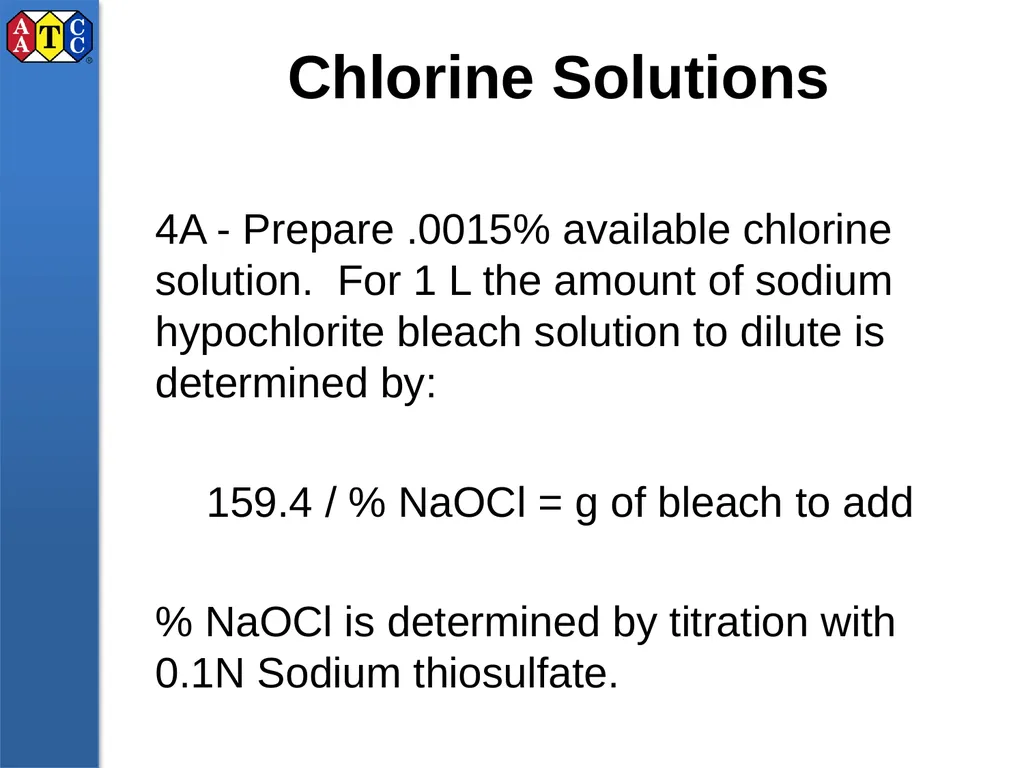
slide21. Chlorine Solutions 4A - Prepare .0015% available chlorine solution. For 1 L the amount of sodium hypochlorite bleach solution to dilute is determined by:
159.4 / % NaOCl = g of bleach to add
% NaOCl is determined by titration with 0.1N Sodium thiosulfate.<br>
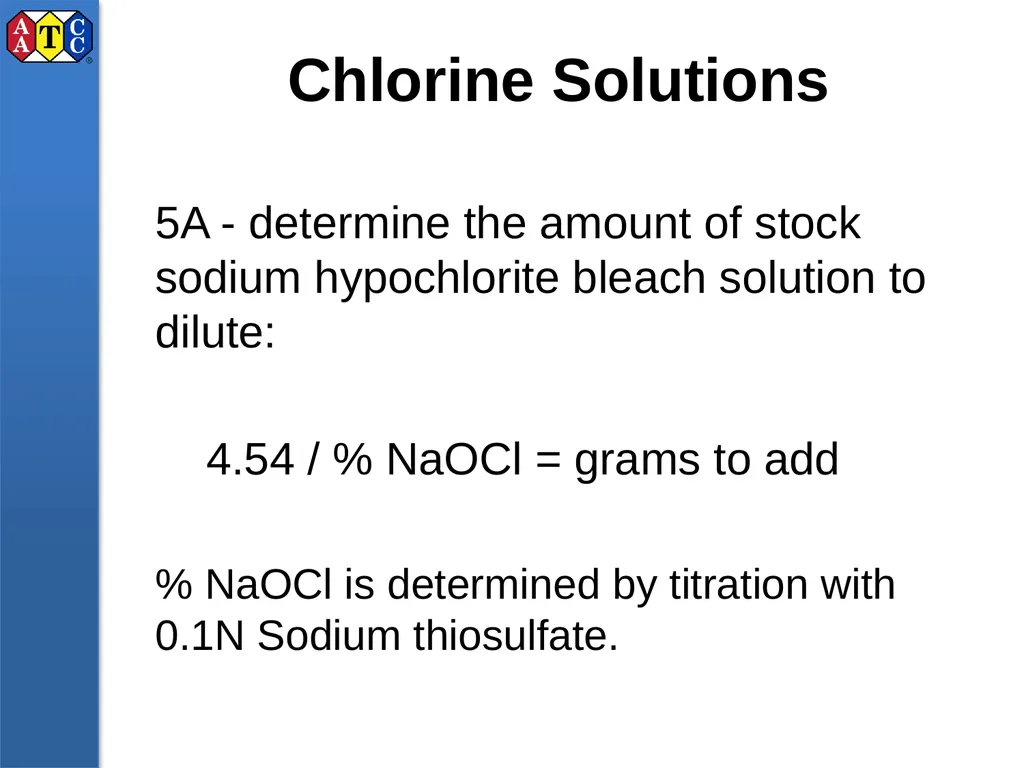
slide22. Chlorine Solutions 5A - determine the amount of stock sodium hypochlorite bleach solution to dilute:
4.54 / % NaOCl = grams to add
% NaOCl is determined by titration with 0.1N Sodium thiosulfate.<br>
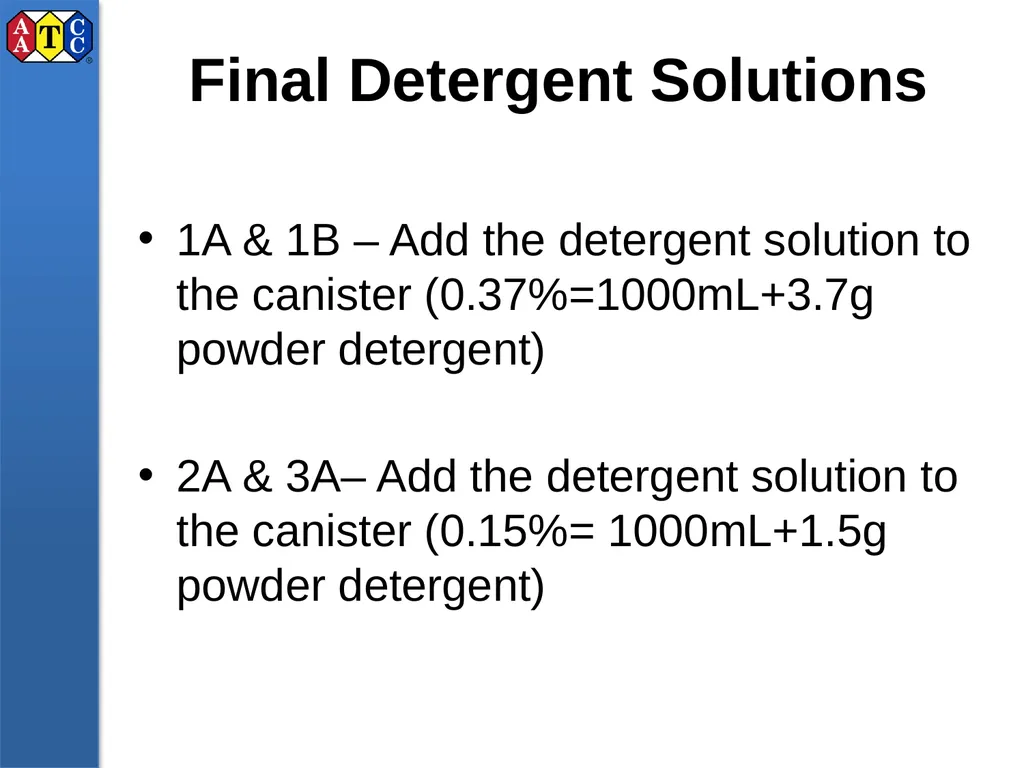
slide23. Final Detergent Solutions 1A & 1B – Add the detergent solution to the canister (0.37%=1000mL+3.7g powder detergent)
2A & 3A– Add the detergent solution to the canister (0.15%= 1000mL+1.5g powder detergent)<br>
slide24. Final Detergent/Chlorine Solutions 4A – Add 45 mL of detergent solution to canister. Add 5 mL of .015% available chlorine solution to the canister for a total of 50 mL
5A – Weigh correct amount of bleach into graduated cylinder and add detergent solution to make a total volume of 150 mL<br>
slide25. Procedure Set temperature in laundering machine
Add detergent (& chlorine) solution to canister
Add stainless steel (or rubber in Option 1B) balls to canister
Load canister in machine
Balance canisters on shaft
Mount Type 1 vertically
Mount Type 2 horizontally
Preheat detergent solution
Add test specimen<br>
slide26. Procedure Run test
Remove canisters after test cycle is completed
Empty contents into beaker
Rinse test specimen 3 times at 40 ± 3°C for 1 minute periods
Blot excess water
Dry specimens in oven, air dry, or tumble dry in nylon mesh bag<br>
slide27. Evaluation Allow specimens to condition at 65 ± 5% relative humidity and 21 ± 2°C for 1 hour before evaluating.
Prepare specimens and multifiber for evaluation.
Trim unraveled yarns
Brush to remove loose fibers on specimen surface or to restore pile
Smooth specimen
Align yarn specimens<br>
slide28. Evaluation Evaluate the color change of the test specimens
Evaluation Procedure 1 using the Gray Scale for Color Change
Evaluation Procedure 7 can be used for instrumental evaluation of the specimens.<br>
slide29. Evaluation Evaluate the staining of multifiber or adjacent fabric
Evaluation Procedure 2 using the Gray Scale for Staining.
Evaluation Procedure 8 can be used for evaluation of the specimens using the 9-step Chromatic Transference Scale.
Evaluation Procedure 12 can be used for instrumental evaluation of the specimens.<br>
slide30. Report Report the test number used
Report the grade number determined for the color change and staining
State which scale was used for evaluating staining<br>
slide31. Report Report the multifiber or adjacent fabric used
Report the detergent used
Report the laundering machine used<br>
slide2. Principle An accelerated test (45 minutes or less) produces color and surface changes similar to that produced by five hand or home launderings.
May NOT predict real-world staining
Accelerated by:
Higher temperature
Low liquor ratio
Stainless steel balls<br>
slide3. Key Points Temperature
Detergent solution
Low liquor ratio
Stainless Steel or Rubber balls<br>
slide4. Definitions laundering, n. of textile materials, a process intended to remove soils and/or stains by treatment (washing) with an aqueous detergent solution and normally including subsequent rinsing, extracting and drying.
colorfastness, n. the resistance of a material to change in any of its color characteristics; to transfer any of its colorants to adjacent materials or both, as a result of the exposure of the material to any environment that might be encountered during the processing, testing, or storage of the material.<br>
slide5. Limitations: Polyester/Spandex Note: Results for staining obtained by this method on fabrics dyed to dark shades (navy, black, etc.) that contain a combination of polyester and spandex, or their blends, may not show the full staining propensity of such fabrics in consumer use.<br>
slide6. Accelerated Laundering Tests Correlations<br>
slide7. Apparatus Accelerated laundering machine
Rotates closed canisters in a thermostatically controlled environment
Adapter plates hold canisters in machine
Stainless steel canisters with neoprene gaskets (black)
Type 1 - 500 mL for 1A test
Type 2 - 1200 mL for all other tests
Teflon fluorocarbon gaskets (white)
Balls
Stainless Steel for all other tests
Rubber balls for Test 1B*<br>
slide8. Accelerated Laundering Machine<br>
slide9. Type I & Type II Canisters<br>
slide10. Apparatus Scales for rating test results
Gray Scale for Color Change
AATCC 9-step Chromatic Transference Scale
Gray Scale for Staining<br>
slide11. Reagents and Materials Multifiber (1A, 1B, 2A, optional for 3A)
Bleached Cotton Test Fabric (for knits; opt. for 3A staining)
Distilled or Deionized Water
AATCC Standard Reference Detergent
Powder
With or without brightener
4A, 5A:
Sodium Hypochlorite (NaOCl)
Sulfuric Acid (H2SO4) 10%
Potassium Iodide (KI) 10%
Sodium Thiosulfate (Na2S2O3)<br>
slide12. Specimens 1A
50 x 100 mm (2.0 x 4.0 in)
Attach multifiber to face
1B, 2A
50 x 150 mm (2.0 x 6.0 in)
Attach multifiber to face
3A
50 x 150 mm (2.0 x 6.0 in)
Heat-sealed multifiber OR White Cotton Test Cloth
4A, 5A
50 x 150 mm (2.0 x 6.0 in)
NO staining cloth<br>
slide13. Specimens<br>
slide14. 1A 4A/5A 3A 1B/2A<br>
slide15. Special Specimens For knits, attach cotton test cloth to back to prevent curling
For pile fabrics, attach multifiber at top, with pile pointing down
For yarns
Knit a specimen
or
Attach white test fabric at each end of skein<br>
slide16. Specimen Preparation Cut sample according to test requirements
Attach multifiber or adjacent fabric
Position depends on the size multifiber being used.
8 mm filling bands: wool strip on right (fiber bands parallel to lengthwise direction of the specimen)
15 mm filling bands: wool strip at top to avoid fiber loss (fiber bands parallel to the widthwise direction of the specimen)<br>
slide17. Detergent Solutions 1993 AATCC Standard Reference Powder Detergent
- With OR without optical brighteners<br>
slide18. Detergent Solutions 1A, 1B: Mix 3.7 g powder detergent (5.6 g liquid detergent) with 1 L distilled water until dissolved
2A, 3A, 4A, 5A - Mix 1.5 g powder detergent (2.3 g liquid detergent) with 1 L distilled water until dissolved
4A: Add 0.015% available chlorine.
5A: Add 0.027% available chlorine.<br>
slide19. Chlorine Solution Titration 2.0 g of liquid sodium hypochlorite
Dilute with 50 mL deionized water
Add 10 mL 10% sulfuric acid
Add 10 mL 10% potassium iodide (the solution is brown)
Titrate with 0.1N sodium thiosulfate until colorless<br>
slide20. Chlorine Solutions Calculation
% sodium hypochlorite
= (mL Na2S2O3)(0.1N)(0.03722) x 100
(2.00g NaOCl)
The factor 0.03722 is derived by multiplying the molecular weight of NaOCl (4.45 g/mol) by 0.001 (mL to L conversion) and dividing by 2 (mols of thiosulfate per hypochlorite).<br>
slide21. Chlorine Solutions 4A - Prepare .0015% available chlorine solution. For 1 L the amount of sodium hypochlorite bleach solution to dilute is determined by:
159.4 / % NaOCl = g of bleach to add
% NaOCl is determined by titration with 0.1N Sodium thiosulfate.<br>
slide22. Chlorine Solutions 5A - determine the amount of stock sodium hypochlorite bleach solution to dilute:
4.54 / % NaOCl = grams to add
% NaOCl is determined by titration with 0.1N Sodium thiosulfate.<br>
slide23. Final Detergent Solutions 1A & 1B – Add the detergent solution to the canister (0.37%=1000mL+3.7g powder detergent)
2A & 3A– Add the detergent solution to the canister (0.15%= 1000mL+1.5g powder detergent)<br>
slide24. Final Detergent/Chlorine Solutions 4A – Add 45 mL of detergent solution to canister. Add 5 mL of .015% available chlorine solution to the canister for a total of 50 mL
5A – Weigh correct amount of bleach into graduated cylinder and add detergent solution to make a total volume of 150 mL<br>
slide25. Procedure Set temperature in laundering machine
Add detergent (& chlorine) solution to canister
Add stainless steel (or rubber in Option 1B) balls to canister
Load canister in machine
Balance canisters on shaft
Mount Type 1 vertically
Mount Type 2 horizontally
Preheat detergent solution
Add test specimen<br>
slide26. Procedure Run test
Remove canisters after test cycle is completed
Empty contents into beaker
Rinse test specimen 3 times at 40 ± 3°C for 1 minute periods
Blot excess water
Dry specimens in oven, air dry, or tumble dry in nylon mesh bag<br>
slide27. Evaluation Allow specimens to condition at 65 ± 5% relative humidity and 21 ± 2°C for 1 hour before evaluating.
Prepare specimens and multifiber for evaluation.
Trim unraveled yarns
Brush to remove loose fibers on specimen surface or to restore pile
Smooth specimen
Align yarn specimens<br>
slide28. Evaluation Evaluate the color change of the test specimens
Evaluation Procedure 1 using the Gray Scale for Color Change
Evaluation Procedure 7 can be used for instrumental evaluation of the specimens.<br>
slide29. Evaluation Evaluate the staining of multifiber or adjacent fabric
Evaluation Procedure 2 using the Gray Scale for Staining.
Evaluation Procedure 8 can be used for evaluation of the specimens using the 9-step Chromatic Transference Scale.
Evaluation Procedure 12 can be used for instrumental evaluation of the specimens.<br>
slide30. Report Report the test number used
Report the grade number determined for the color change and staining
State which scale was used for evaluating staining<br>
slide31. Report Report the multifiber or adjacent fabric used
Report the detergent used
Report the laundering machine used<br>