
About Project & Project Proponent M/s Insulations
MJ
Published · 70 slides · 0 views
1 / 1


Description
About Project Project Proponent Ms Insulations Polymers Pvt Ltd got incorporated under the Companies Act 1967 on 03101967; it was later taken over by current management. IPPL started hydrogenation of organic chemicals from 1995.
Related Topics
Share
Embed code
Download this presentation From Below
"About Project & Project Proponent M/s Insulations" is the property of its rightful owner. Permission is granted to download and print the materials on this website for personal, non-commercial use only, and to display it on your personal computer provided you do not modify the materials and that you retain all copyright notices contained in the materials. By downloading content from our website, you accept the terms of this agreement.
Presentation Transcript
01
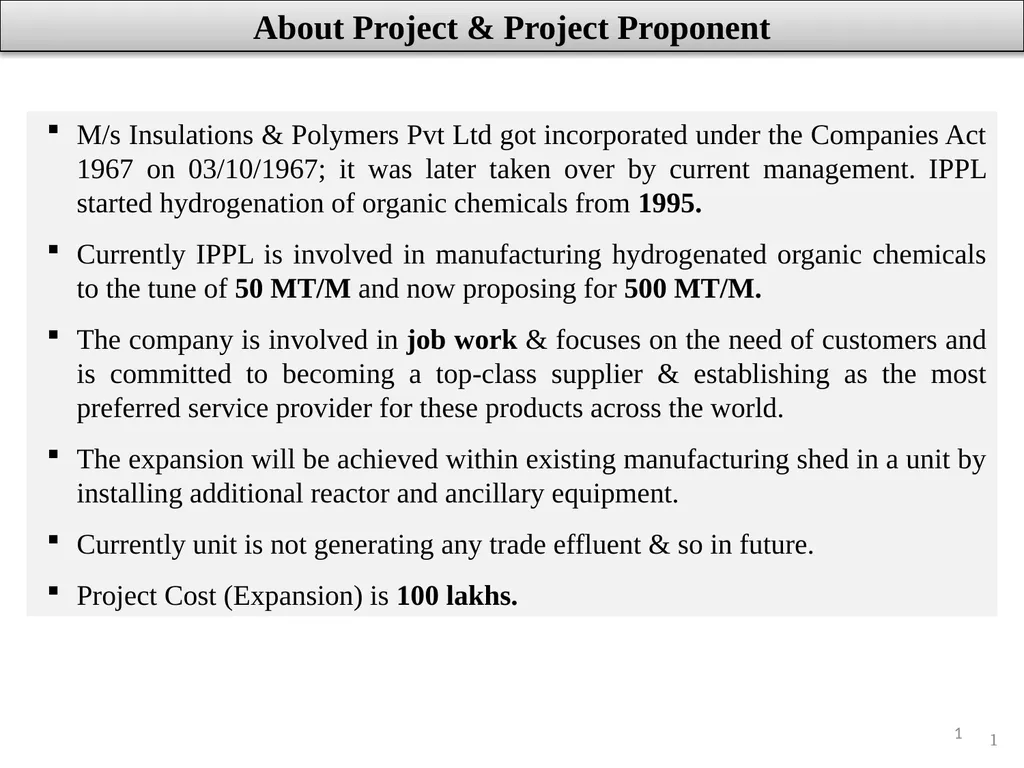
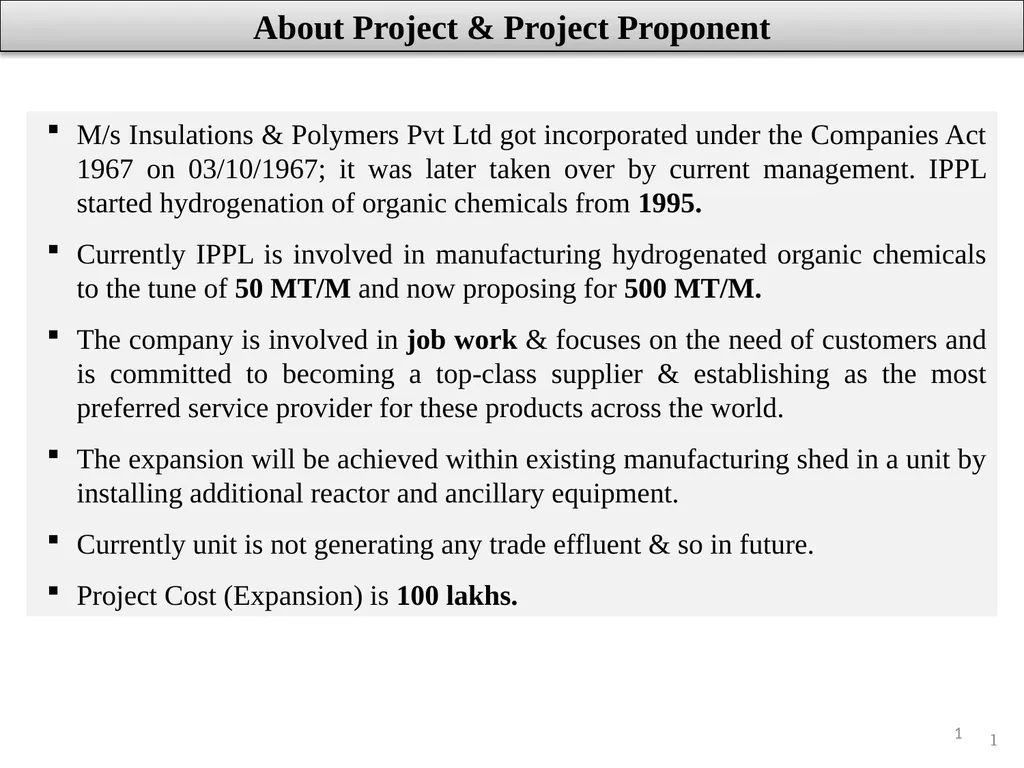
About Project & Project Proponent M/s Insulations & Polymers Pvt Ltd got incorporated under the Companies Act 1967 on 03/10/1967; it was later taken over by current management. IPPL started hydrogenation of organic chemicals from 1995.
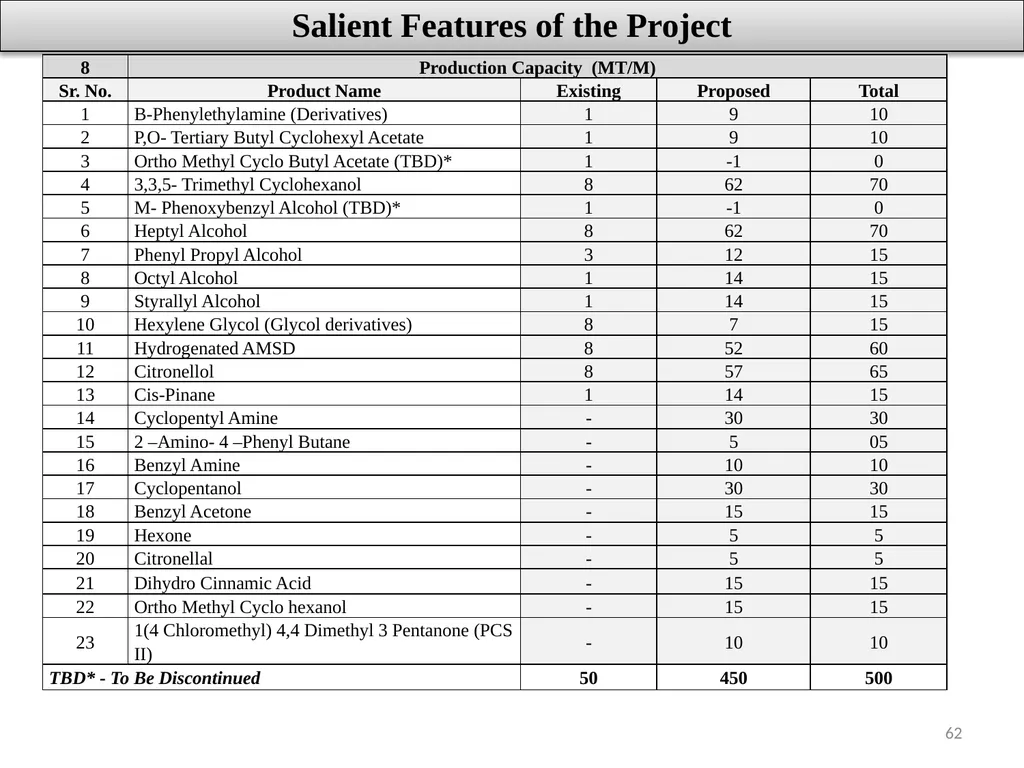
Currently IPPL is involved in manufacturing hydrogenated organic chemicals to the tune of 50 MT/M and now proposing for 500 MT/M.
The company is involved in job work & focuses on the need of customers and is committed to becoming a top-class supplier & establishing as the most preferred service provider for these products across the world.
The expansion will be achieved within existing manufacturing shed in a unit by installing additional reactor and ancillary equipment.
Currently unit is not generating any trade effluent & so in future.
Project Cost (Expansion) is 100 lakhs. 1 1<br>
Currently IPPL is involved in manufacturing hydrogenated organic chemicals to the tune of 50 MT/M and now proposing for 500 MT/M.
The company is involved in job work & focuses on the need of customers and is committed to becoming a top-class supplier & establishing as the most preferred service provider for these products across the world.
The expansion will be achieved within existing manufacturing shed in a unit by installing additional reactor and ancillary equipment.
Currently unit is not generating any trade effluent & so in future.
Project Cost (Expansion) is 100 lakhs. 1 1<br>
02
2 Additional Mitigation Measures suggested by MoEFCC in the O.M. dated 31/10/19 &
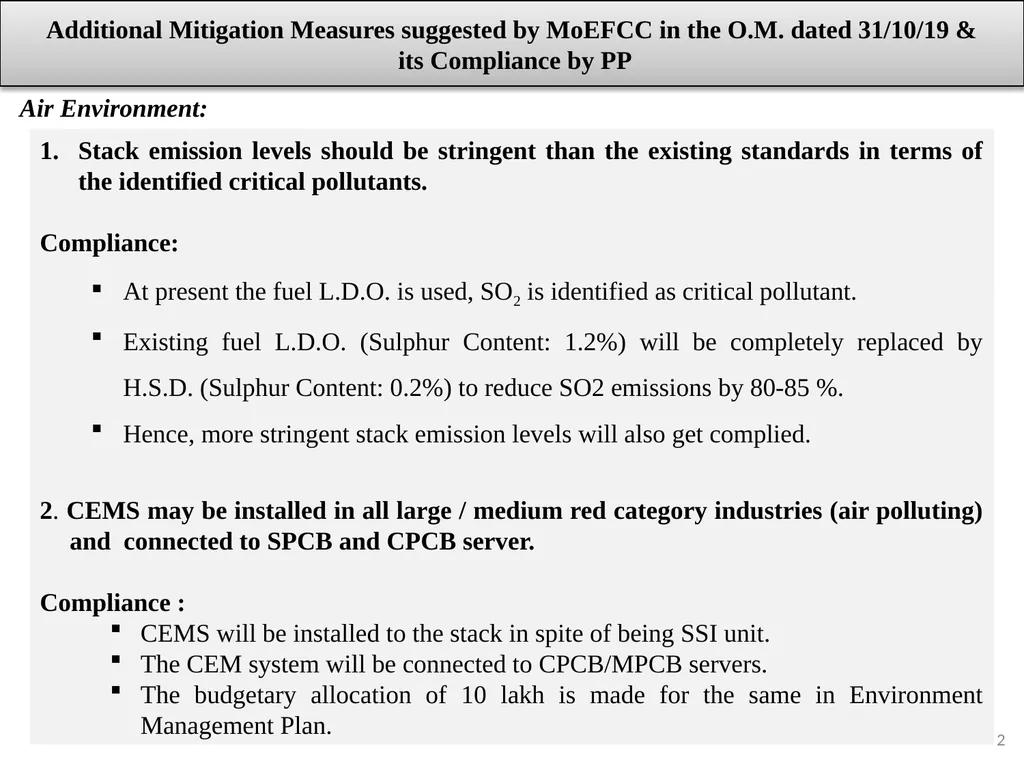
its Compliance by PP Air Environment: Stack emission levels should be stringent than the existing standards in terms of the identified critical pollutants.
Compliance:
At present the fuel L.D.O. is used, SO2 is identified as critical pollutant.
Existing fuel L.D.O. (Sulphur Content: 1.2%) will be completely replaced by H.S.D. (Sulphur Content: 0.2%) to reduce SO2 emissions by 80-85 %.
Hence, more stringent stack emission levels will also get complied.
2. CEMS may be installed in all large / medium red category industries (air polluting) and connected to SPCB and CPCB server.
Compliance :
CEMS will be installed to the stack in spite of being SSI unit.
The CEM system will be connected to CPCB/MPCB servers.
The budgetary allocation of 10 lakh is made for the same in Environment Management Plan.<br>
its Compliance by PP Air Environment: Stack emission levels should be stringent than the existing standards in terms of the identified critical pollutants.
Compliance:
At present the fuel L.D.O. is used, SO2 is identified as critical pollutant.
Existing fuel L.D.O. (Sulphur Content: 1.2%) will be completely replaced by H.S.D. (Sulphur Content: 0.2%) to reduce SO2 emissions by 80-85 %.
Hence, more stringent stack emission levels will also get complied.
2. CEMS may be installed in all large / medium red category industries (air polluting) and connected to SPCB and CPCB server.
Compliance :
CEMS will be installed to the stack in spite of being SSI unit.
The CEM system will be connected to CPCB/MPCB servers.
The budgetary allocation of 10 lakh is made for the same in Environment Management Plan.<br>
03
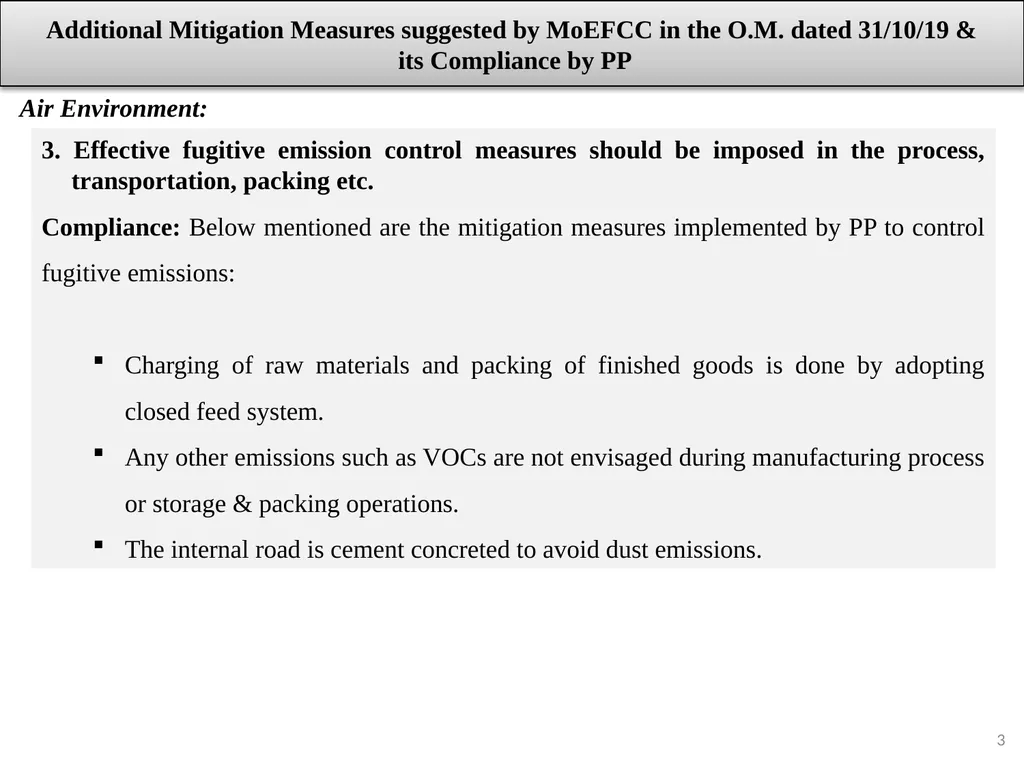
3 3. Effective fugitive emission control measures should be imposed in the process, transportation, packing etc.
Compliance: Below mentioned are the mitigation measures implemented by PP to control fugitive emissions:
Charging of raw materials and packing of finished goods is done by adopting closed feed system.
Any other emissions such as VOCs are not envisaged during manufacturing process or storage & packing operations.
The internal road is cement concreted to avoid dust emissions. Additional Mitigation Measures suggested by MoEFCC in the O.M. dated 31/10/19 &
its Compliance by PP Air Environment:<br>
Compliance: Below mentioned are the mitigation measures implemented by PP to control fugitive emissions:
Charging of raw materials and packing of finished goods is done by adopting closed feed system.
Any other emissions such as VOCs are not envisaged during manufacturing process or storage & packing operations.
The internal road is cement concreted to avoid dust emissions. Additional Mitigation Measures suggested by MoEFCC in the O.M. dated 31/10/19 &
its Compliance by PP Air Environment:<br>
04
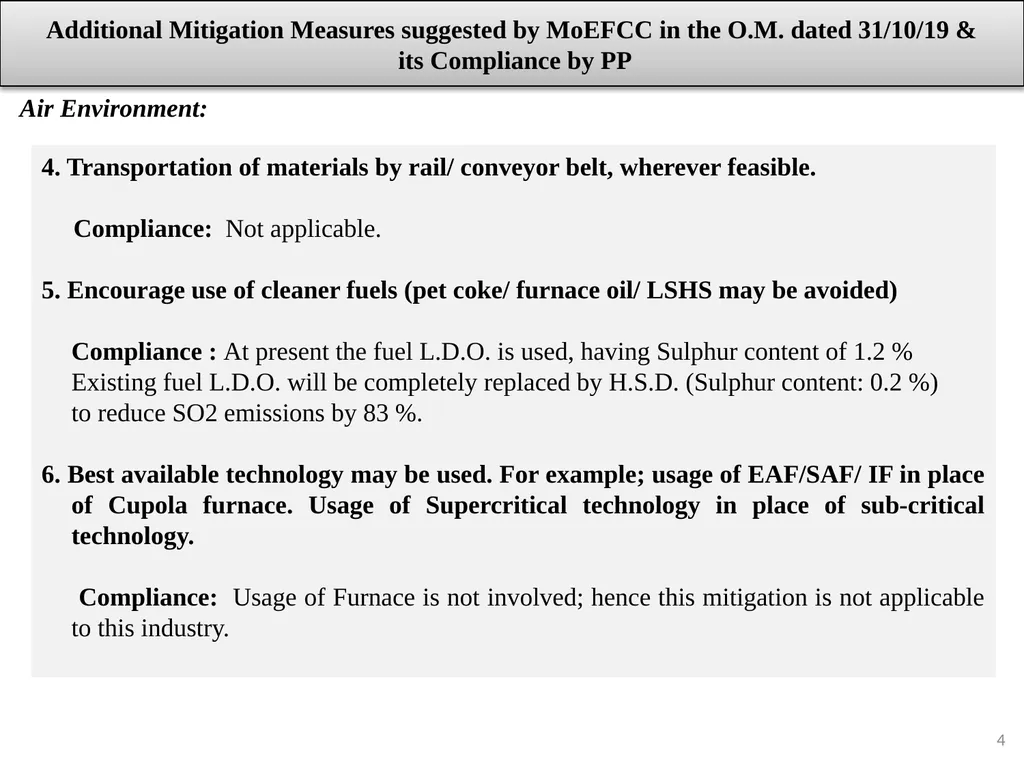
4 4. Transportation of materials by rail/ conveyor belt, wherever feasible.
Compliance: Not applicable.
5. Encourage use of cleaner fuels (pet coke/ furnace oil/ LSHS may be avoided)
Compliance : At present the fuel L.D.O. is used, having Sulphur content of 1.2 %
Existing fuel L.D.O. will be completely replaced by H.S.D. (Sulphur content: 0.2 %)
to reduce SO2 emissions by 83 %.
6. Best available technology may be used. For example; usage of EAF/SAF/ IF in place of Cupola furnace. Usage of Supercritical technology in place of sub-critical technology.
Compliance: Usage of Furnace is not involved; hence this mitigation is not applicable to this industry. Additional Mitigation Measures suggested by MoEFCC in the O.M. dated 31/10/19 &
its Compliance by PP Air Environment:<br>
Compliance: Not applicable.
5. Encourage use of cleaner fuels (pet coke/ furnace oil/ LSHS may be avoided)
Compliance : At present the fuel L.D.O. is used, having Sulphur content of 1.2 %
Existing fuel L.D.O. will be completely replaced by H.S.D. (Sulphur content: 0.2 %)
to reduce SO2 emissions by 83 %.
6. Best available technology may be used. For example; usage of EAF/SAF/ IF in place of Cupola furnace. Usage of Supercritical technology in place of sub-critical technology.
Compliance: Usage of Furnace is not involved; hence this mitigation is not applicable to this industry. Additional Mitigation Measures suggested by MoEFCC in the O.M. dated 31/10/19 &
its Compliance by PP Air Environment:<br>
05
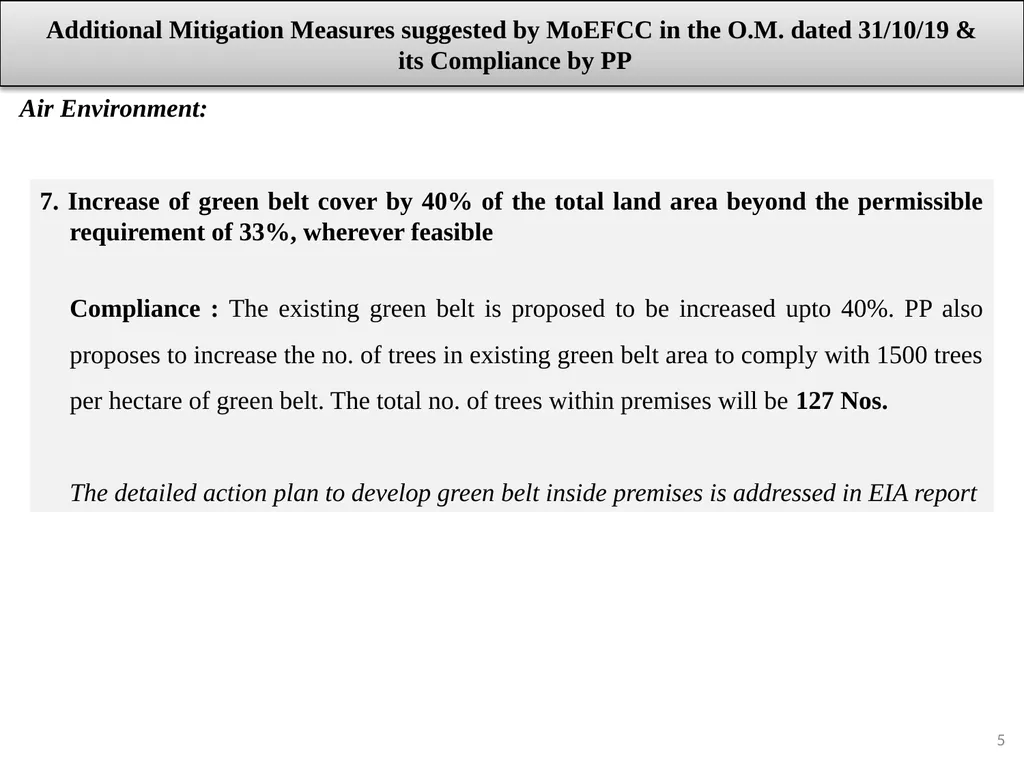
5 7. Increase of green belt cover by 40% of the total land area beyond the permissible requirement of 33%, wherever feasible
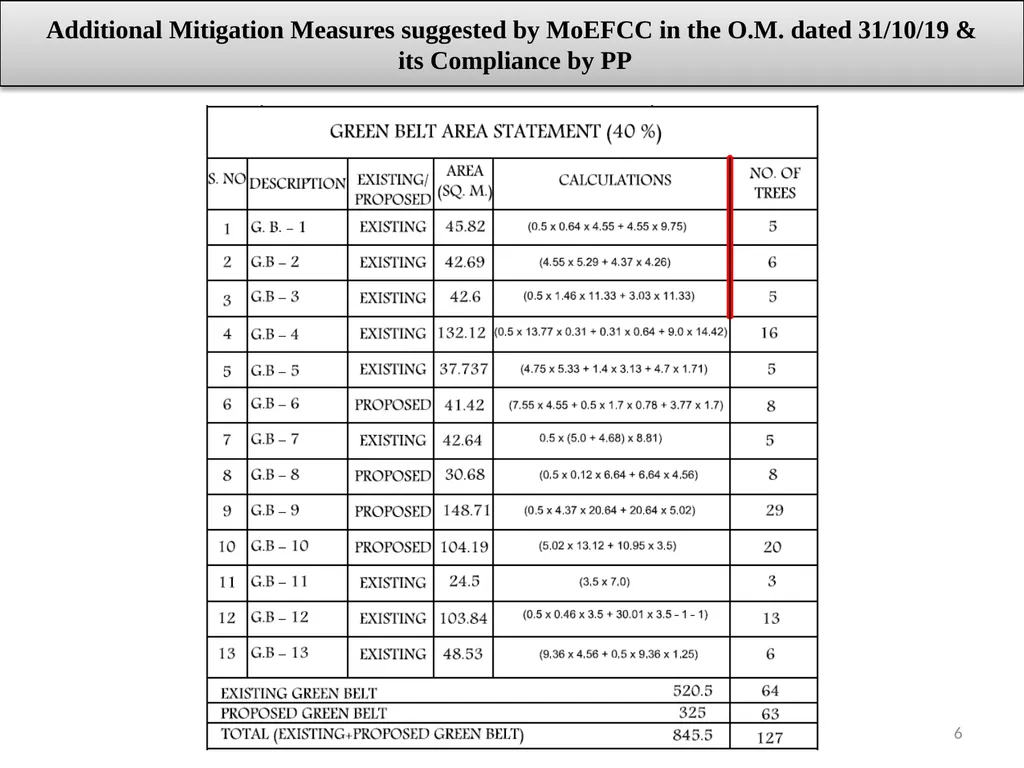
Compliance : The existing green belt is proposed to be increased upto 40%. PP also proposes to increase the no. of trees in existing green belt area to comply with 1500 trees per hectare of green belt. The total no. of trees within premises will be 127 Nos.
The detailed action plan to develop green belt inside premises is addressed in EIA report Additional Mitigation Measures suggested by MoEFCC in the O.M. dated 31/10/19 &
its Compliance by PP Air Environment:<br>
Compliance : The existing green belt is proposed to be increased upto 40%. PP also proposes to increase the no. of trees in existing green belt area to comply with 1500 trees per hectare of green belt. The total no. of trees within premises will be 127 Nos.
The detailed action plan to develop green belt inside premises is addressed in EIA report Additional Mitigation Measures suggested by MoEFCC in the O.M. dated 31/10/19 &
its Compliance by PP Air Environment:<br>
06
6 Additional Mitigation Measures suggested by MoEFCC in the O.M. dated 31/10/19 &
its Compliance by PP<br>
its Compliance by PP<br>
07
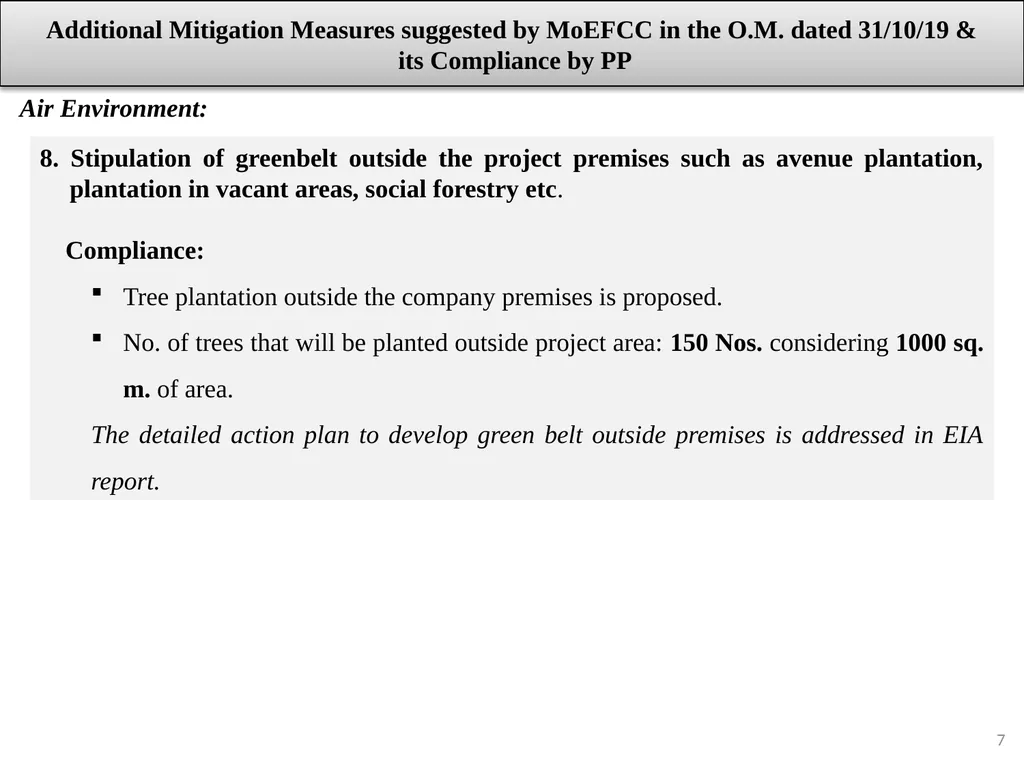
7 8. Stipulation of greenbelt outside the project premises such as avenue plantation, plantation in vacant areas, social forestry etc.
Compliance:
Tree plantation outside the company premises is proposed.
No. of trees that will be planted outside project area: 150 Nos. considering 1000 sq. m. of area.
The detailed action plan to develop green belt outside premises is addressed in EIA report. Additional Mitigation Measures suggested by MoEFCC in the O.M. dated 31/10/19 &
its Compliance by PP Air Environment:<br>
Compliance:
Tree plantation outside the company premises is proposed.
No. of trees that will be planted outside project area: 150 Nos. considering 1000 sq. m. of area.
The detailed action plan to develop green belt outside premises is addressed in EIA report. Additional Mitigation Measures suggested by MoEFCC in the O.M. dated 31/10/19 &
its Compliance by PP Air Environment:<br>
08
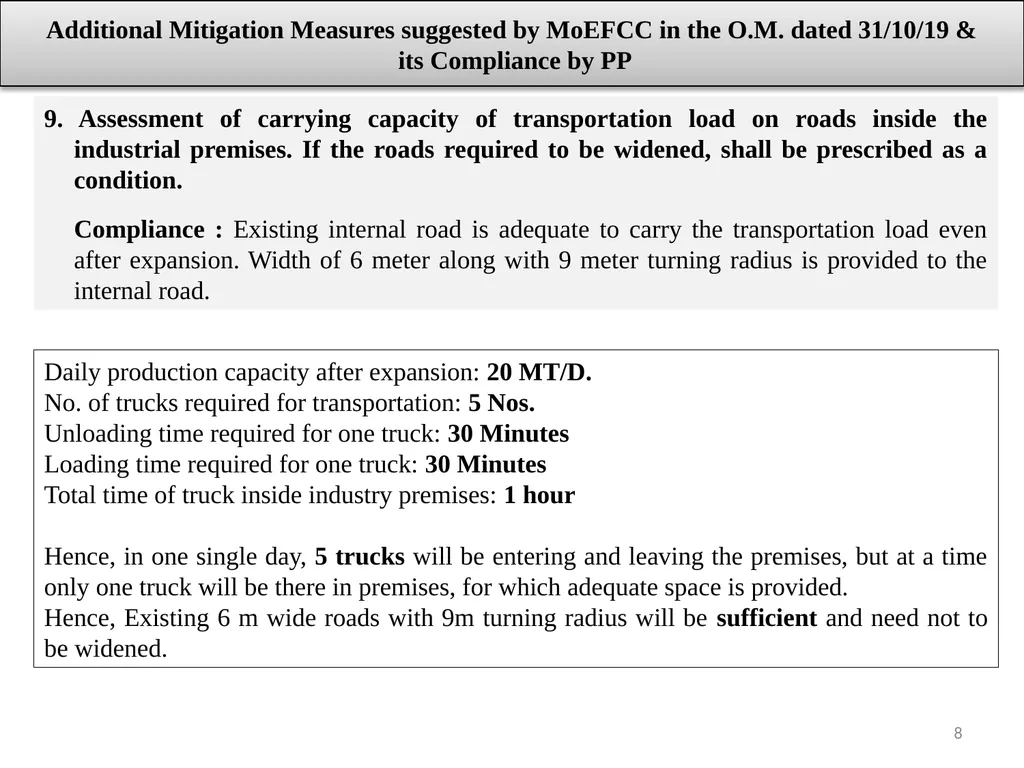
8 9. Assessment of carrying capacity of transportation load on roads inside the industrial premises. If the roads required to be widened, shall be prescribed as a condition.
Compliance : Existing internal road is adequate to carry the transportation load even after expansion. Width of 6 meter along with 9 meter turning radius is provided to the internal road. Additional Mitigation Measures suggested by MoEFCC in the O.M. dated 31/10/19 &
its Compliance by PP Daily production capacity after expansion: 20 MT/D.
No. of trucks required for transportation: 5 Nos.
Unloading time required for one truck: 30 Minutes
Loading time required for one truck: 30 Minutes
Total time of truck inside industry premises: 1 hour
Hence, in one single day, 5 trucks will be entering and leaving the premises, but at a time only one truck will be there in premises, for which adequate space is provided.
Hence, Existing 6 m wide roads with 9m turning radius will be sufficient and need not to be widened.<br>
Compliance : Existing internal road is adequate to carry the transportation load even after expansion. Width of 6 meter along with 9 meter turning radius is provided to the internal road. Additional Mitigation Measures suggested by MoEFCC in the O.M. dated 31/10/19 &
its Compliance by PP Daily production capacity after expansion: 20 MT/D.
No. of trucks required for transportation: 5 Nos.
Unloading time required for one truck: 30 Minutes
Loading time required for one truck: 30 Minutes
Total time of truck inside industry premises: 1 hour
Hence, in one single day, 5 trucks will be entering and leaving the premises, but at a time only one truck will be there in premises, for which adequate space is provided.
Hence, Existing 6 m wide roads with 9m turning radius will be sufficient and need not to be widened.<br>
09
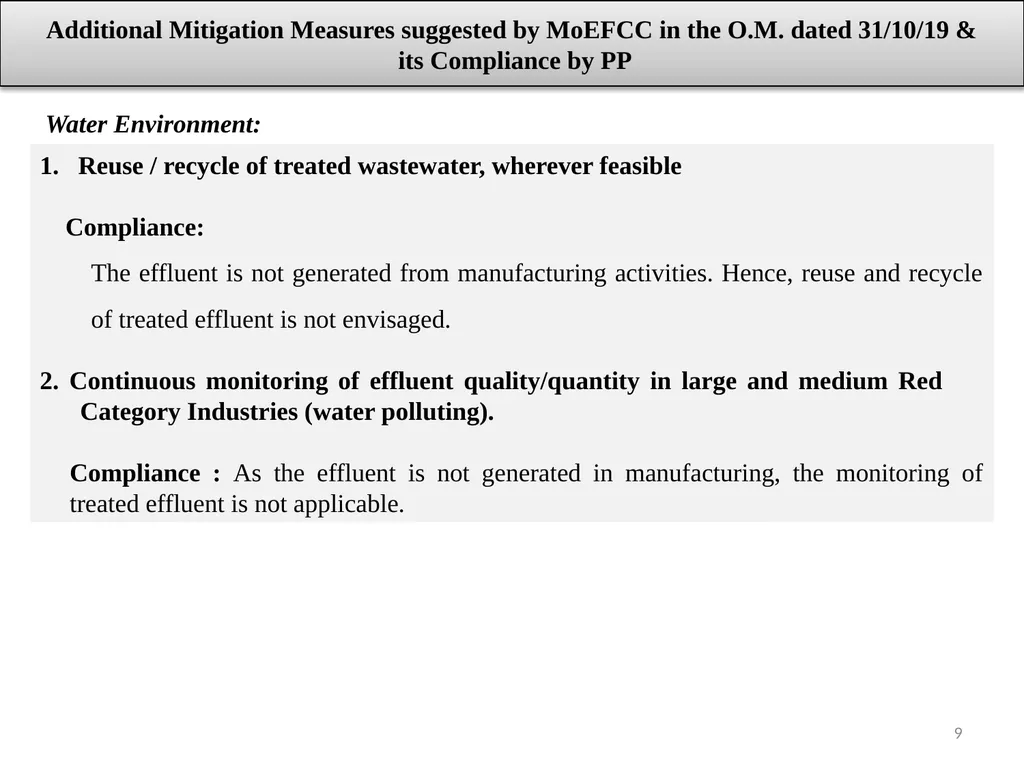
9 Reuse / recycle of treated wastewater, wherever feasible
Compliance:
The effluent is not generated from manufacturing activities. Hence, reuse and recycle of treated effluent is not envisaged.
2. Continuous monitoring of effluent quality/quantity in large and medium Red Category Industries (water polluting).
Compliance : As the effluent is not generated in manufacturing, the monitoring of treated effluent is not applicable. Water Environment: Additional Mitigation Measures suggested by MoEFCC in the O.M. dated 31/10/19 &
its Compliance by PP<br>
Compliance:
The effluent is not generated from manufacturing activities. Hence, reuse and recycle of treated effluent is not envisaged.
2. Continuous monitoring of effluent quality/quantity in large and medium Red Category Industries (water polluting).
Compliance : As the effluent is not generated in manufacturing, the monitoring of treated effluent is not applicable. Water Environment: Additional Mitigation Measures suggested by MoEFCC in the O.M. dated 31/10/19 &
its Compliance by PP<br>
10
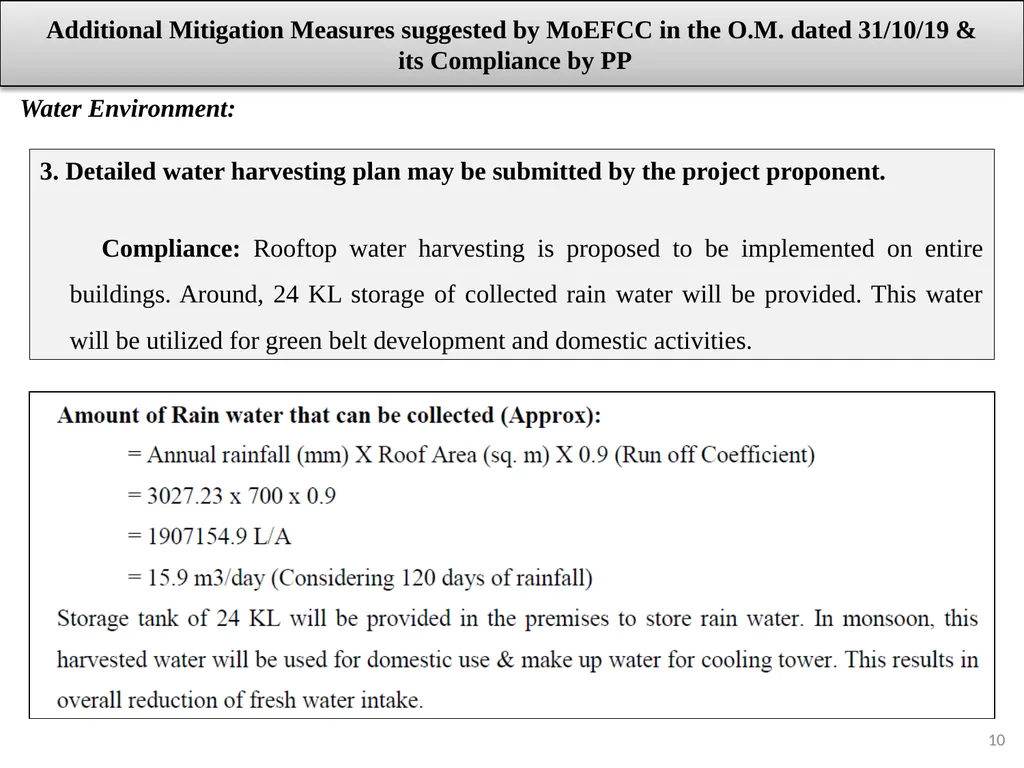
10 3. Detailed water harvesting plan may be submitted by the project proponent.
Compliance: Rooftop water harvesting is proposed to be implemented on entire buildings. Around, 24 KL storage of collected rain water will be provided. This water will be utilized for green belt development and domestic activities. Additional Mitigation Measures suggested by MoEFCC in the O.M. dated 31/10/19 &
its Compliance by PP Water Environment:<br>
Compliance: Rooftop water harvesting is proposed to be implemented on entire buildings. Around, 24 KL storage of collected rain water will be provided. This water will be utilized for green belt development and domestic activities. Additional Mitigation Measures suggested by MoEFCC in the O.M. dated 31/10/19 &
its Compliance by PP Water Environment:<br>
11
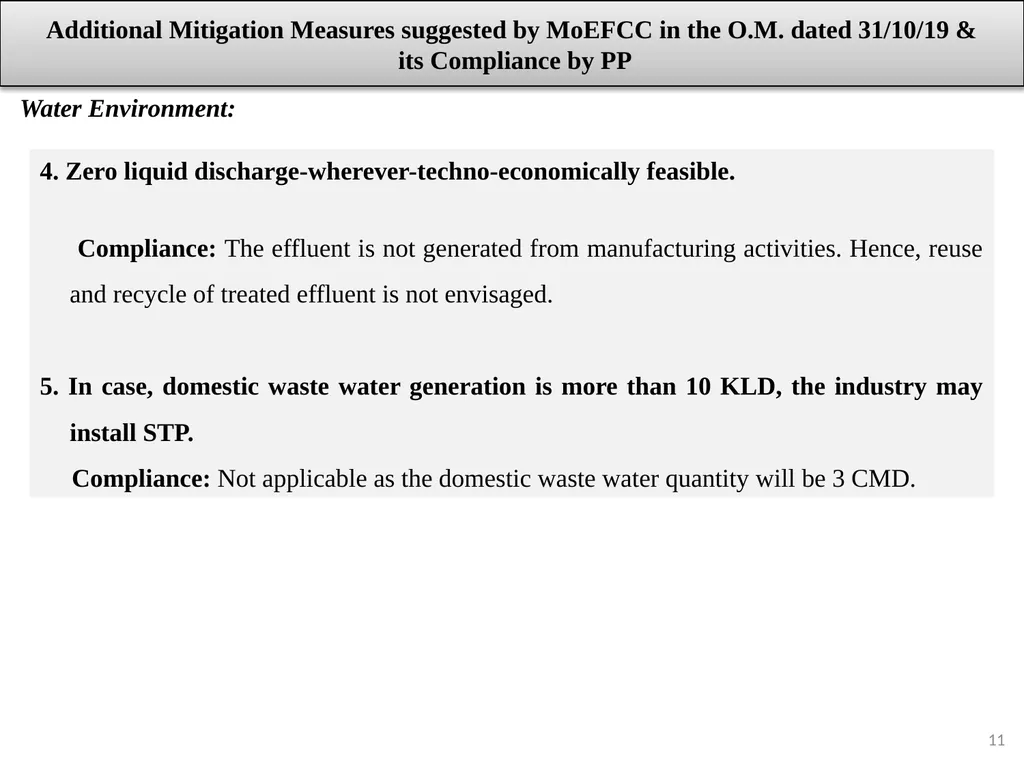
11 4. Zero liquid discharge-wherever-techno-economically feasible.
Compliance: The effluent is not generated from manufacturing activities. Hence, reuse and recycle of treated effluent is not envisaged.
5. In case, domestic waste water generation is more than 10 KLD, the industry may install STP.
Compliance: Not applicable as the domestic waste water quantity will be 3 CMD. Additional Mitigation Measures suggested by MoEFCC in the O.M. dated 31/10/19 &
its Compliance by PP Water Environment:<br>
Compliance: The effluent is not generated from manufacturing activities. Hence, reuse and recycle of treated effluent is not envisaged.
5. In case, domestic waste water generation is more than 10 KLD, the industry may install STP.
Compliance: Not applicable as the domestic waste water quantity will be 3 CMD. Additional Mitigation Measures suggested by MoEFCC in the O.M. dated 31/10/19 &
its Compliance by PP Water Environment:<br>
12
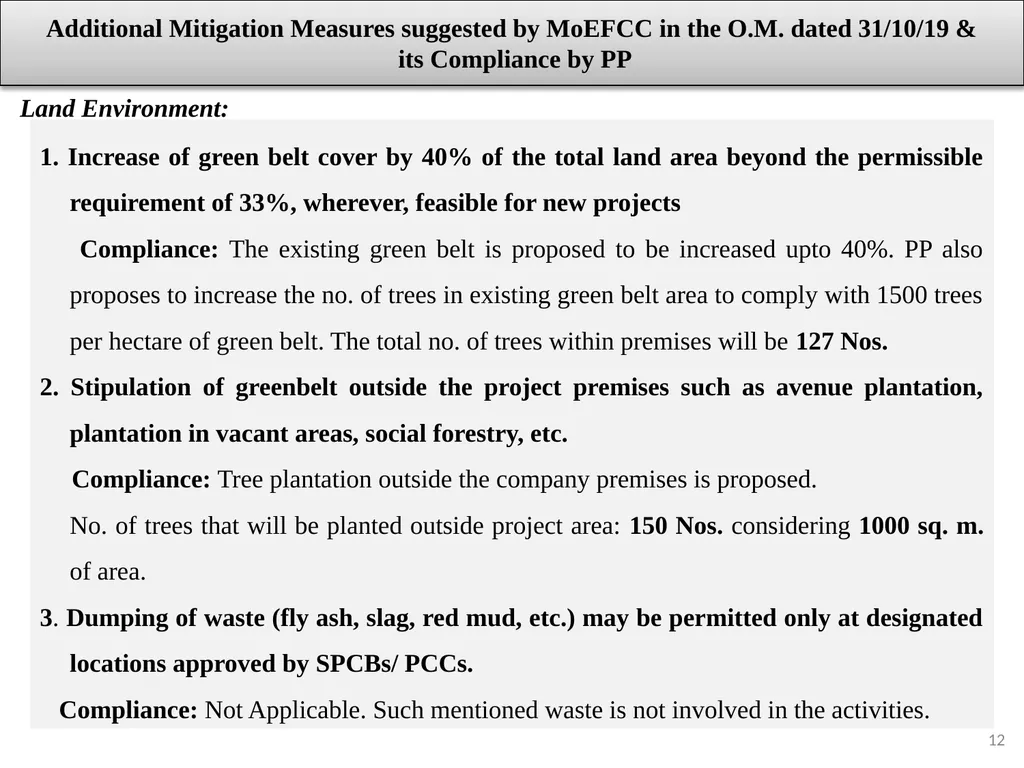
12 1. Increase of green belt cover by 40% of the total land area beyond the permissible requirement of 33%, wherever, feasible for new projects
Compliance: The existing green belt is proposed to be increased upto 40%. PP also proposes to increase the no. of trees in existing green belt area to comply with 1500 trees per hectare of green belt. The total no. of trees within premises will be 127 Nos.
2. Stipulation of greenbelt outside the project premises such as avenue plantation, plantation in vacant areas, social forestry, etc.
Compliance: Tree plantation outside the company premises is proposed.
No. of trees that will be planted outside project area: 150 Nos. considering 1000 sq. m. of area.
3. Dumping of waste (fly ash, slag, red mud, etc.) may be permitted only at designated locations approved by SPCBs/ PCCs.
Compliance: Not Applicable. Such mentioned waste is not involved in the activities. Additional Mitigation Measures suggested by MoEFCC in the O.M. dated 31/10/19 &
its Compliance by PP Land Environment:<br>
Compliance: The existing green belt is proposed to be increased upto 40%. PP also proposes to increase the no. of trees in existing green belt area to comply with 1500 trees per hectare of green belt. The total no. of trees within premises will be 127 Nos.
2. Stipulation of greenbelt outside the project premises such as avenue plantation, plantation in vacant areas, social forestry, etc.
Compliance: Tree plantation outside the company premises is proposed.
No. of trees that will be planted outside project area: 150 Nos. considering 1000 sq. m. of area.
3. Dumping of waste (fly ash, slag, red mud, etc.) may be permitted only at designated locations approved by SPCBs/ PCCs.
Compliance: Not Applicable. Such mentioned waste is not involved in the activities. Additional Mitigation Measures suggested by MoEFCC in the O.M. dated 31/10/19 &
its Compliance by PP Land Environment:<br>
13
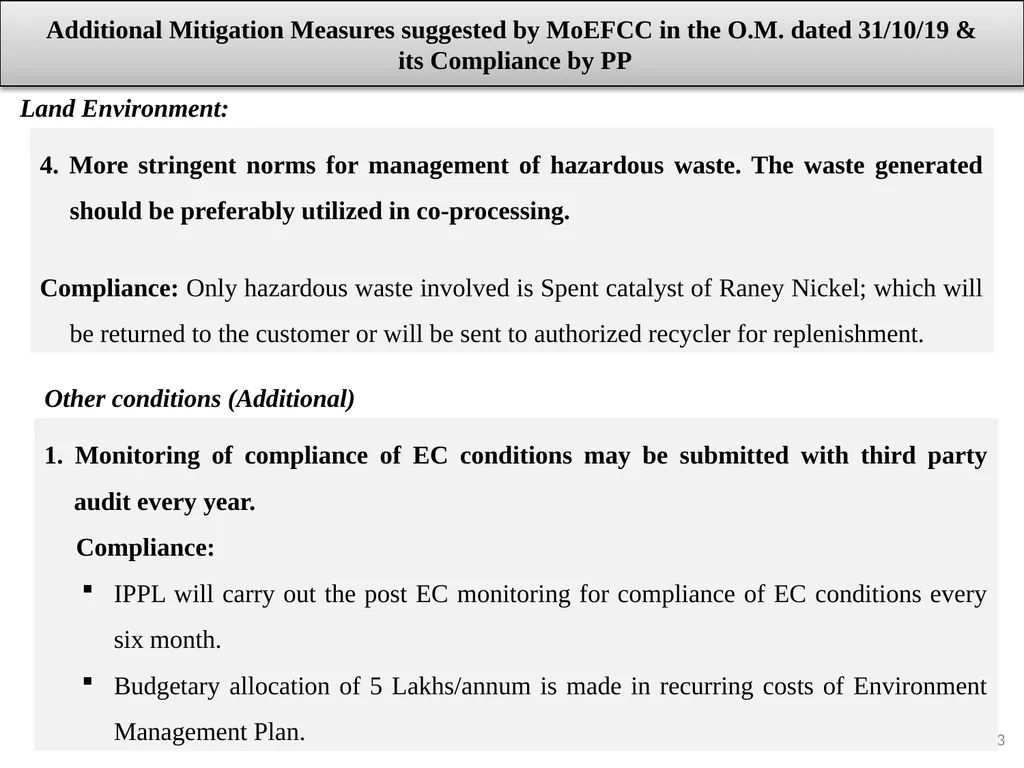
13 4. More stringent norms for management of hazardous waste. The waste generated should be preferably utilized in co-processing.
Compliance: Only hazardous waste involved is Spent catalyst of Raney Nickel; which will be returned to the customer or will be sent to authorized recycler for replenishment. Additional Mitigation Measures suggested by MoEFCC in the O.M. dated 31/10/19 &
its Compliance by PP Land Environment: Other conditions (Additional) 1. Monitoring of compliance of EC conditions may be submitted with third party audit every year.
Compliance:
IPPL will carry out the post EC monitoring for compliance of EC conditions every six month.
Budgetary allocation of 5 Lakhs/annum is made in recurring costs of Environment Management Plan.<br>
Compliance: Only hazardous waste involved is Spent catalyst of Raney Nickel; which will be returned to the customer or will be sent to authorized recycler for replenishment. Additional Mitigation Measures suggested by MoEFCC in the O.M. dated 31/10/19 &
its Compliance by PP Land Environment: Other conditions (Additional) 1. Monitoring of compliance of EC conditions may be submitted with third party audit every year.
Compliance:
IPPL will carry out the post EC monitoring for compliance of EC conditions every six month.
Budgetary allocation of 5 Lakhs/annum is made in recurring costs of Environment Management Plan.<br>
14
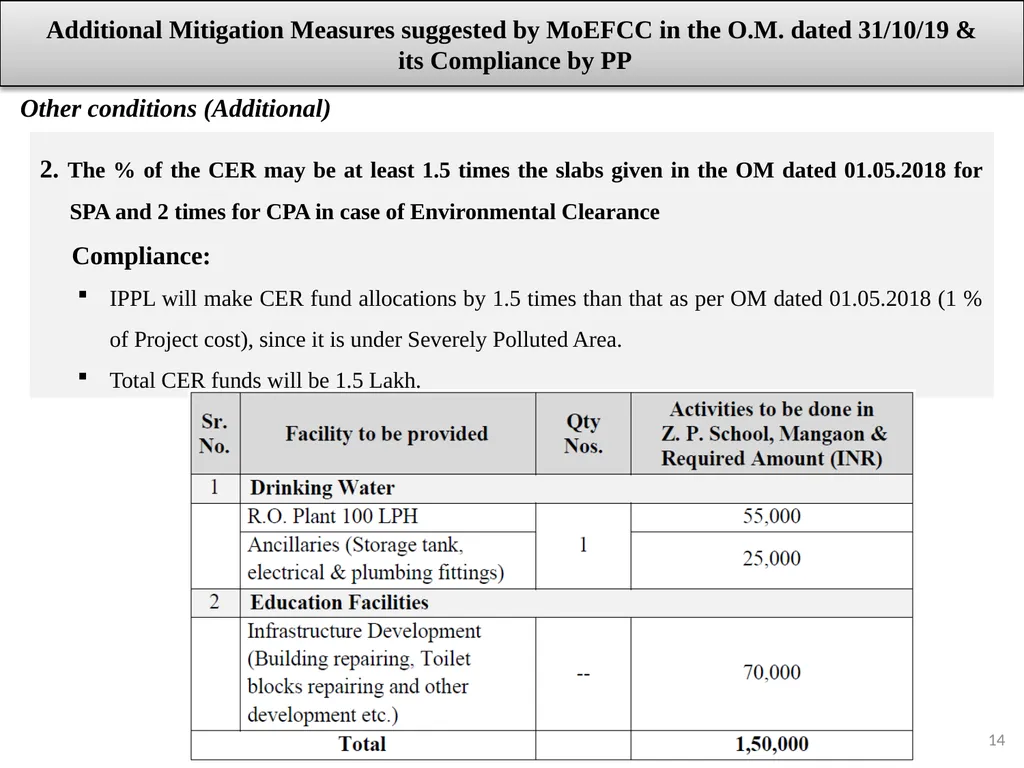
14 Other conditions (Additional) 2. The % of the CER may be at least 1.5 times the slabs given in the OM dated 01.05.2018 for SPA and 2 times for CPA in case of Environmental Clearance
Compliance:
IPPL will make CER fund allocations by 1.5 times than that as per OM dated 01.05.2018 (1 % of Project cost), since it is under Severely Polluted Area.
Total CER funds will be 1.5 Lakh. Additional Mitigation Measures suggested by MoEFCC in the O.M. dated 31/10/19 &
its Compliance by PP<br>
Compliance:
IPPL will make CER fund allocations by 1.5 times than that as per OM dated 01.05.2018 (1 % of Project cost), since it is under Severely Polluted Area.
Total CER funds will be 1.5 Lakh. Additional Mitigation Measures suggested by MoEFCC in the O.M. dated 31/10/19 &
its Compliance by PP<br>
15
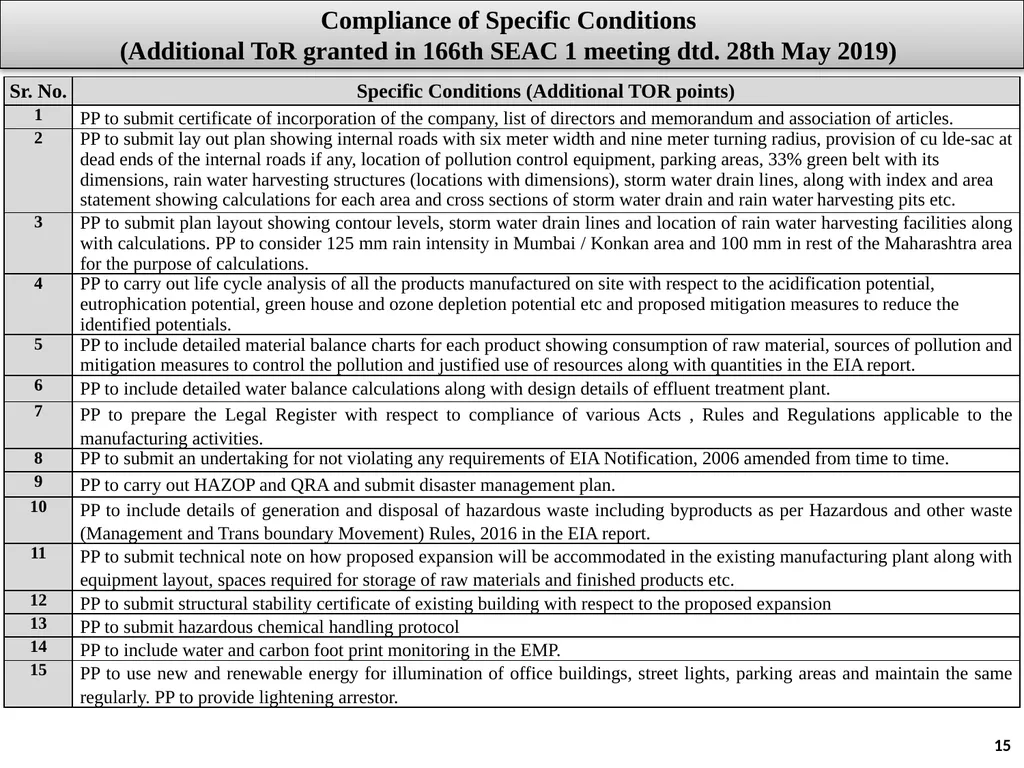
Compliance of Specific Conditions
(Additional ToR granted in 166th SEAC 1 meeting dtd. 28th May 2019) 15<br>
16
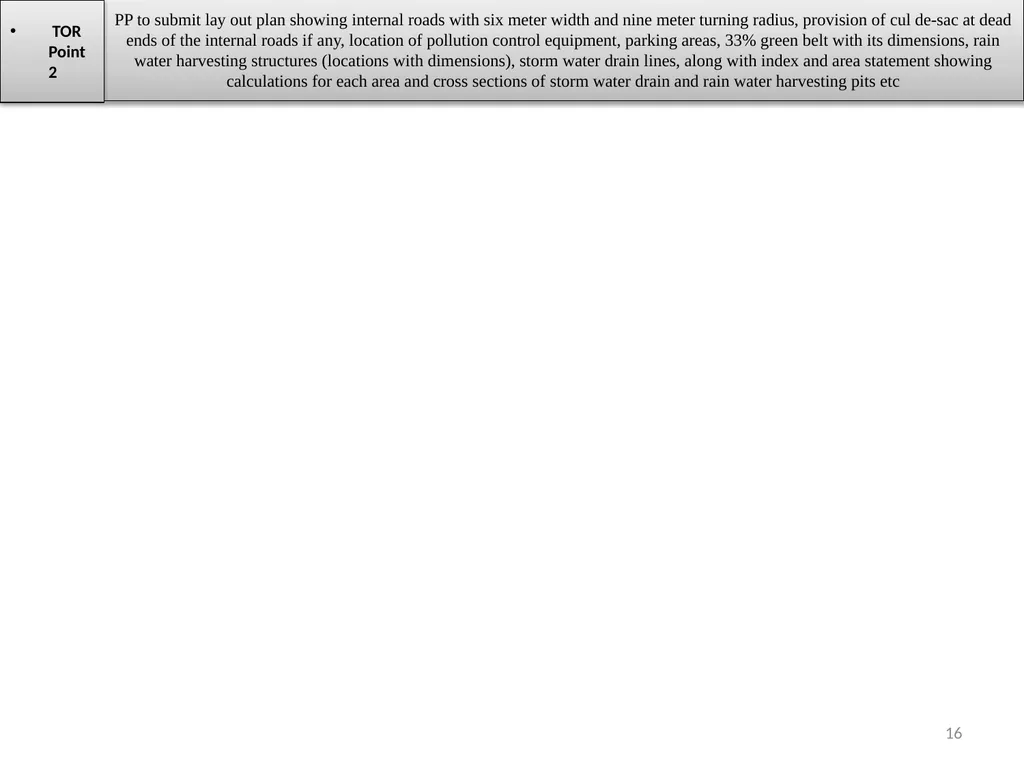
16 PP to submit lay out plan showing internal roads with six meter width and nine meter turning radius, provision of cul de-sac at dead ends of the internal roads if any, location of pollution control equipment, parking areas, 33% green belt with its dimensions, rain water harvesting structures (locations with dimensions), storm water drain lines, along with index and area statement showing calculations for each area and cross sections of storm water drain and rain water harvesting pits etc TOR Point 2<br>
17
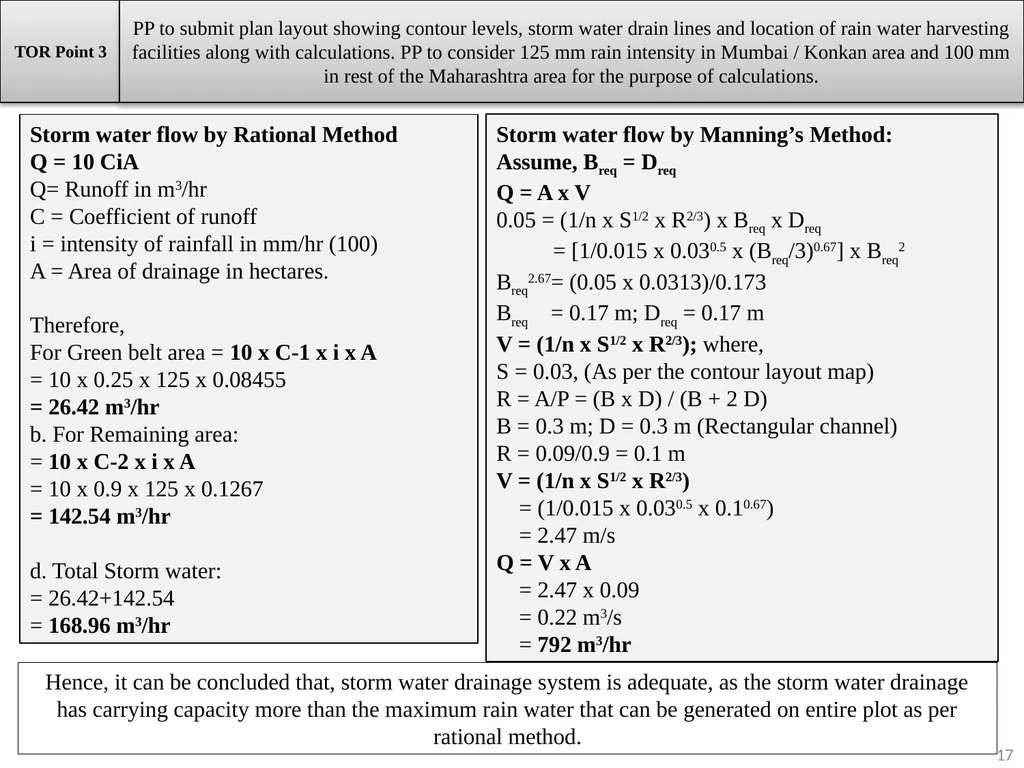
17 Hence, it can be concluded that, storm water drainage system is adequate, as the storm water drainage has carrying capacity more than the maximum rain water that can be generated on entire plot as per rational method. Storm water flow by Rational Method
Q = 10 CiA
Q= Runoff in m3/hr
C = Coefficient of runoff
i = intensity of rainfall in mm/hr (100)
A = Area of drainage in hectares.
Therefore,
For Green belt area = 10 x C-1 x i x A
= 10 x 0.25 x 125 x 0.08455
= 26.42 m3/hr
b. For Remaining area:
= 10 x C-2 x i x A
= 10 x 0.9 x 125 x 0.1267
= 142.54 m3/hr
d. Total Storm water:
= 26.42+142.54
= 168.96 m3/hr Storm water flow by Manning’s Method:
Assume, Breq = Dreq
Q = A x V
0.05 = (1/n x S1/2 x R2/3) x Breq x Dreq
= [1/0.015 x 0.030.5 x (Breq/3)0.67] x Breq2
Breq2.67= (0.05 x 0.0313)/0.173
Breq = 0.17 m; Dreq = 0.17 m
V = (1/n x S1/2 x R2/3); where,
S = 0.03, (As per the contour layout map)
R = A/P = (B x D) / (B + 2 D)
B = 0.3 m; D = 0.3 m (Rectangular channel)
R = 0.09/0.9 = 0.1 m
V = (1/n x S1/2 x R2/3)
= (1/0.015 x 0.030.5 x 0.10.67)
= 2.47 m/s
Q = V x A
= 2.47 x 0.09
= 0.22 m3/s
= 792 m3/hr TOR Point 3 PP to submit plan layout showing contour levels, storm water drain lines and location of rain water harvesting facilities along with calculations. PP to consider 125 mm rain intensity in Mumbai / Konkan area and 100 mm in rest of the Maharashtra area for the purpose of calculations.<br>
Q = 10 CiA
Q= Runoff in m3/hr
C = Coefficient of runoff
i = intensity of rainfall in mm/hr (100)
A = Area of drainage in hectares.
Therefore,
For Green belt area = 10 x C-1 x i x A
= 10 x 0.25 x 125 x 0.08455
= 26.42 m3/hr
b. For Remaining area:
= 10 x C-2 x i x A
= 10 x 0.9 x 125 x 0.1267
= 142.54 m3/hr
d. Total Storm water:
= 26.42+142.54
= 168.96 m3/hr Storm water flow by Manning’s Method:
Assume, Breq = Dreq
Q = A x V
0.05 = (1/n x S1/2 x R2/3) x Breq x Dreq
= [1/0.015 x 0.030.5 x (Breq/3)0.67] x Breq2
Breq2.67= (0.05 x 0.0313)/0.173
Breq = 0.17 m; Dreq = 0.17 m
V = (1/n x S1/2 x R2/3); where,
S = 0.03, (As per the contour layout map)
R = A/P = (B x D) / (B + 2 D)
B = 0.3 m; D = 0.3 m (Rectangular channel)
R = 0.09/0.9 = 0.1 m
V = (1/n x S1/2 x R2/3)
= (1/0.015 x 0.030.5 x 0.10.67)
= 2.47 m/s
Q = V x A
= 2.47 x 0.09
= 0.22 m3/s
= 792 m3/hr TOR Point 3 PP to submit plan layout showing contour levels, storm water drain lines and location of rain water harvesting facilities along with calculations. PP to consider 125 mm rain intensity in Mumbai / Konkan area and 100 mm in rest of the Maharashtra area for the purpose of calculations.<br>
18
PP to carry out life cycle analysis of all the products manufactured on site with respect to the acidification potential, eutrophication potential, green house and ozone depletion potential etc and proposed mitigation measures to reduce the identified potentials. TOR Point 4 18 Mitigation Measures Suggested For Reduction In Global Warming Potential Reduction in Sulphur Percentage in atmosphere by using HSD
By adopting High Speed Diesel (HSD) as fuel instead of Light Diesel Oil (LDO), SO2 emission in the atmosphere will be reduced because of lesser Sulphur content which in turn reduces Acidification, Global warming & Eutrophication potential. This mitigation measure is accounted in Life Cycle Assessment of all products.
Reduction in fuel consumption due to reuse of excess heat
Due to the exothermic nature of hydrogenation reactions, heating is dominantly required only initially. The excess heat generated in the reaction is reused in the system for the other reactions. By this, fuel consumption is reduced.
Reduction in Energy Consumption After Utilizing Solar Energy Alternatives
Solar energy will be utilized for illumination of parking, office building, common areas and streets; which results in overall reduction of energy consumption of each product.<br>
By adopting High Speed Diesel (HSD) as fuel instead of Light Diesel Oil (LDO), SO2 emission in the atmosphere will be reduced because of lesser Sulphur content which in turn reduces Acidification, Global warming & Eutrophication potential. This mitigation measure is accounted in Life Cycle Assessment of all products.
Reduction in fuel consumption due to reuse of excess heat
Due to the exothermic nature of hydrogenation reactions, heating is dominantly required only initially. The excess heat generated in the reaction is reused in the system for the other reactions. By this, fuel consumption is reduced.
Reduction in Energy Consumption After Utilizing Solar Energy Alternatives
Solar energy will be utilized for illumination of parking, office building, common areas and streets; which results in overall reduction of energy consumption of each product.<br>
19
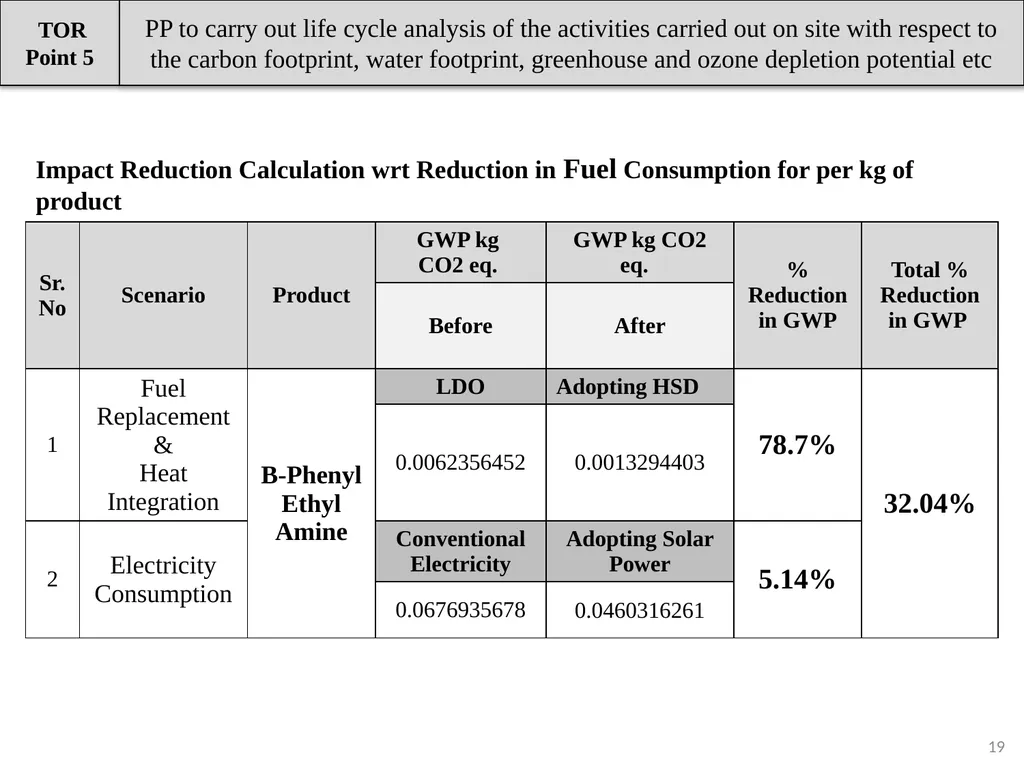
19 TOR Point 5 PP to carry out life cycle analysis of the activities carried out on site with respect to the carbon footprint, water footprint, greenhouse and ozone depletion potential etc Impact Reduction Calculation wrt Reduction in Fuel Consumption for per kg of product<br>
20
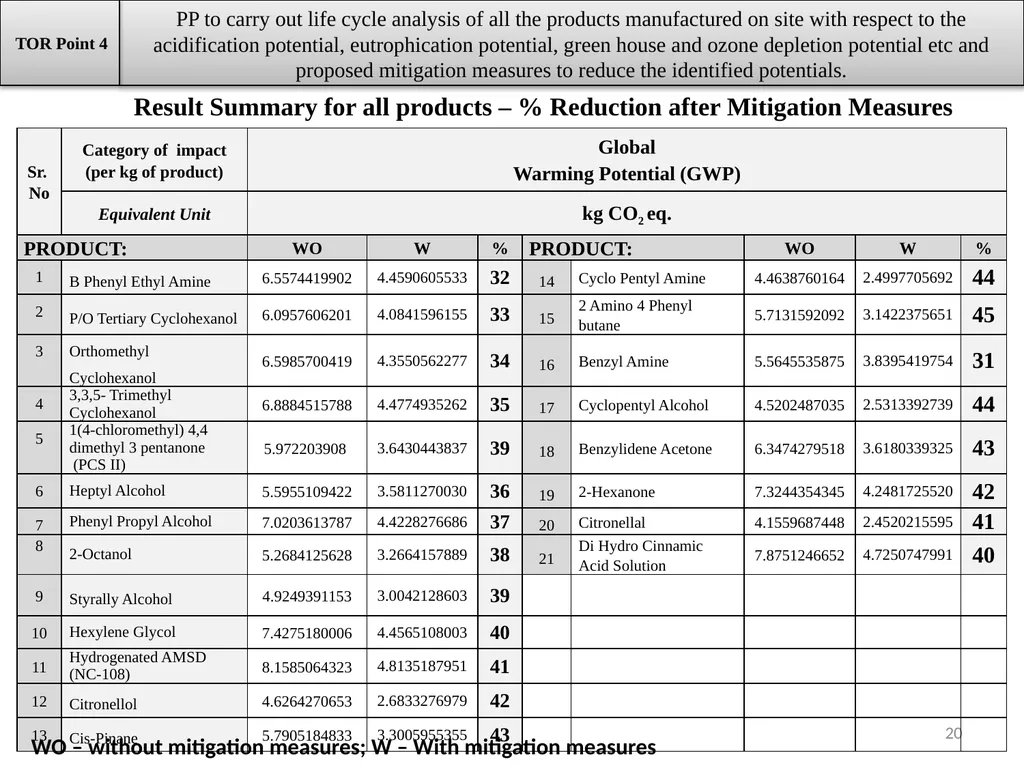
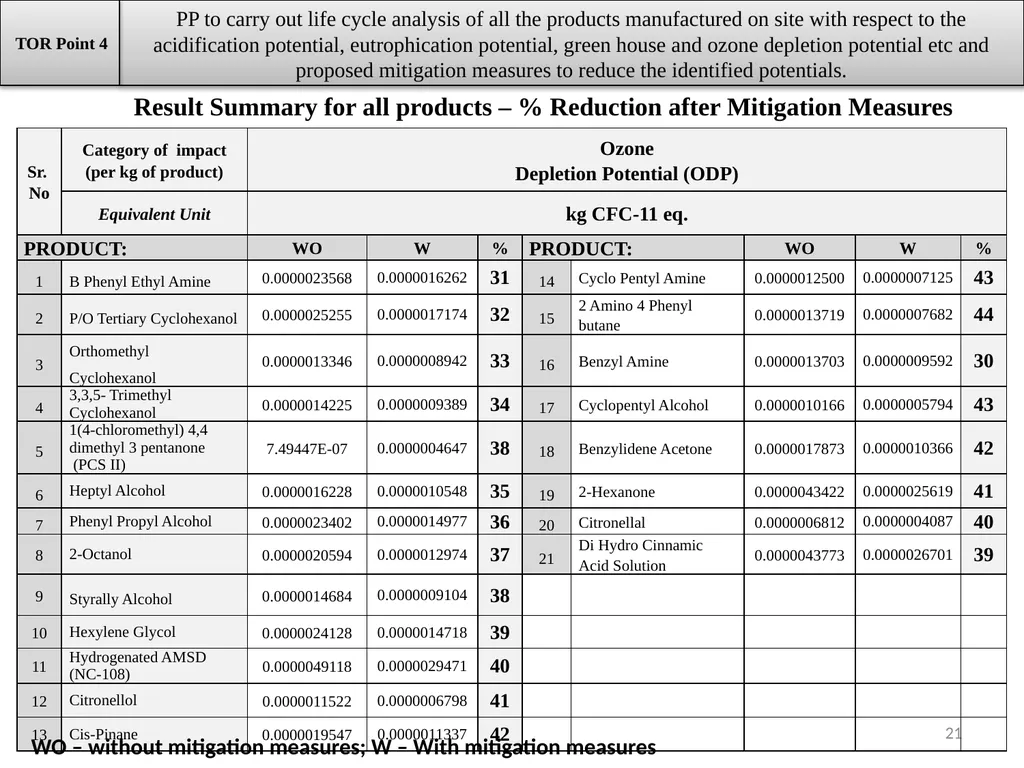
20 Result Summary for all products – % Reduction after Mitigation Measures PP to carry out life cycle analysis of all the products manufactured on site with respect to the acidification potential, eutrophication potential, green house and ozone depletion potential etc and proposed mitigation measures to reduce the identified potentials. TOR Point 4 WO – without mitigation measures; W – With mitigation measures<br>
21
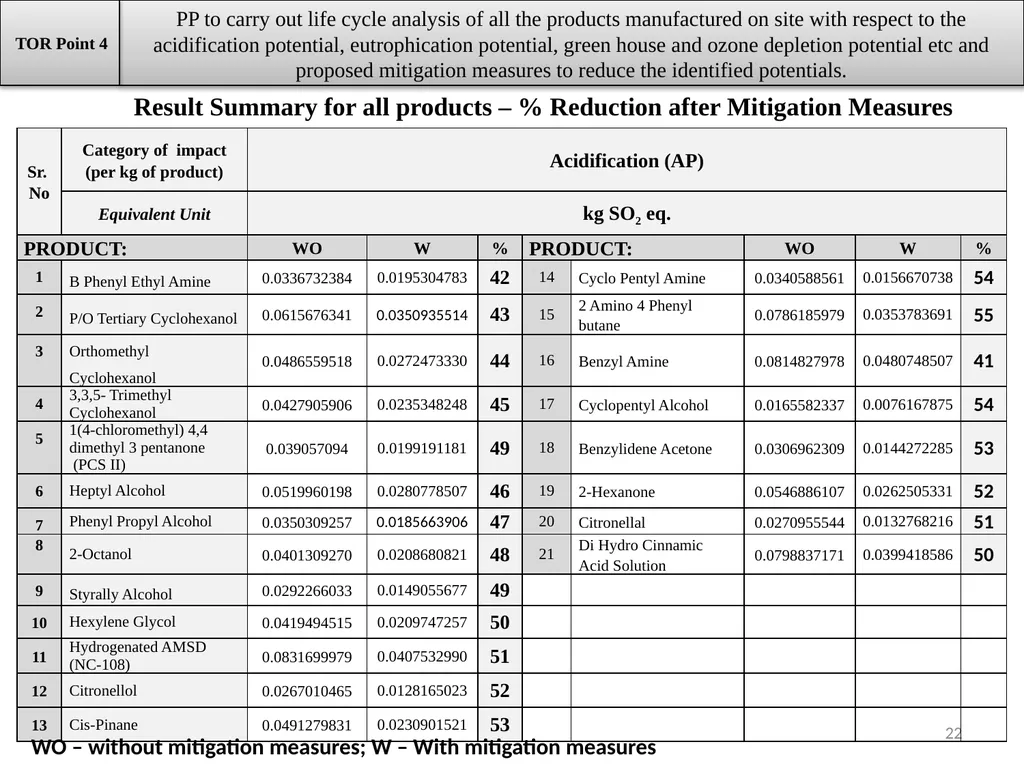
21 Result Summary for all products – % Reduction after Mitigation Measures PP to carry out life cycle analysis of all the products manufactured on site with respect to the acidification potential, eutrophication potential, green house and ozone depletion potential etc and proposed mitigation measures to reduce the identified potentials. TOR Point 4 WO – without mitigation measures; W – With mitigation measures<br>
22
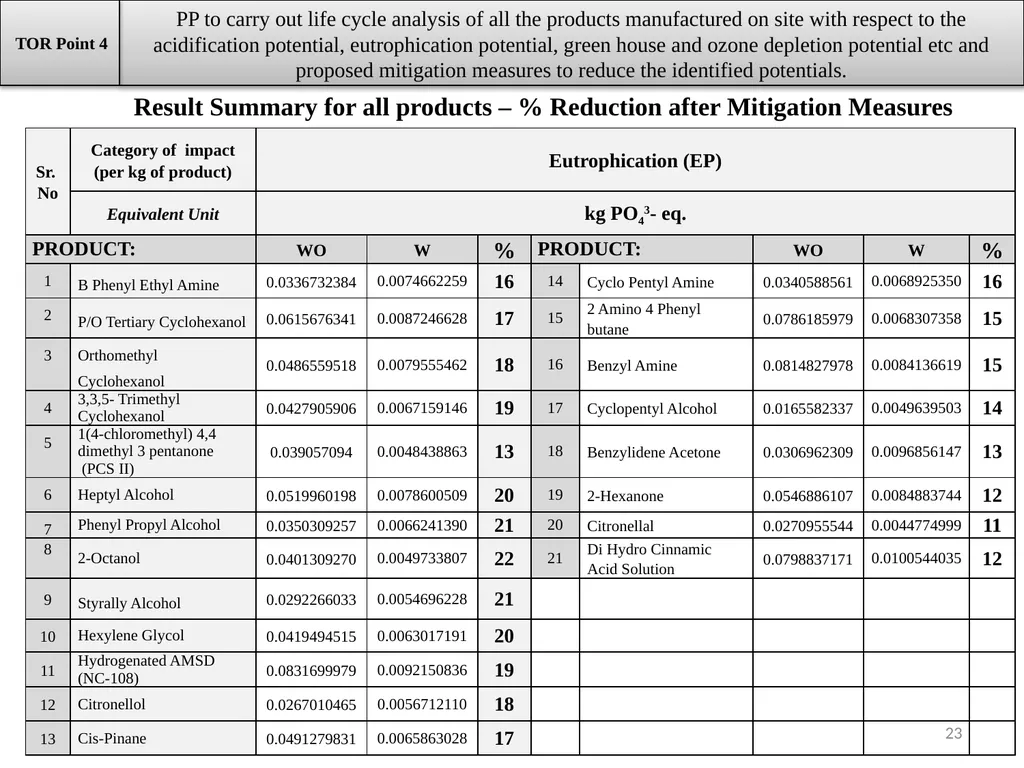
22 Result Summary for all products – % Reduction after Mitigation Measures PP to carry out life cycle analysis of all the products manufactured on site with respect to the acidification potential, eutrophication potential, green house and ozone depletion potential etc and proposed mitigation measures to reduce the identified potentials. TOR Point 4 WO – without mitigation measures; W – With mitigation measures<br>
23
23 Result Summary for all products – % Reduction after Mitigation Measures PP to carry out life cycle analysis of all the products manufactured on site with respect to the acidification potential, eutrophication potential, green house and ozone depletion potential etc and proposed mitigation measures to reduce the identified potentials. TOR Point 4<br>
24
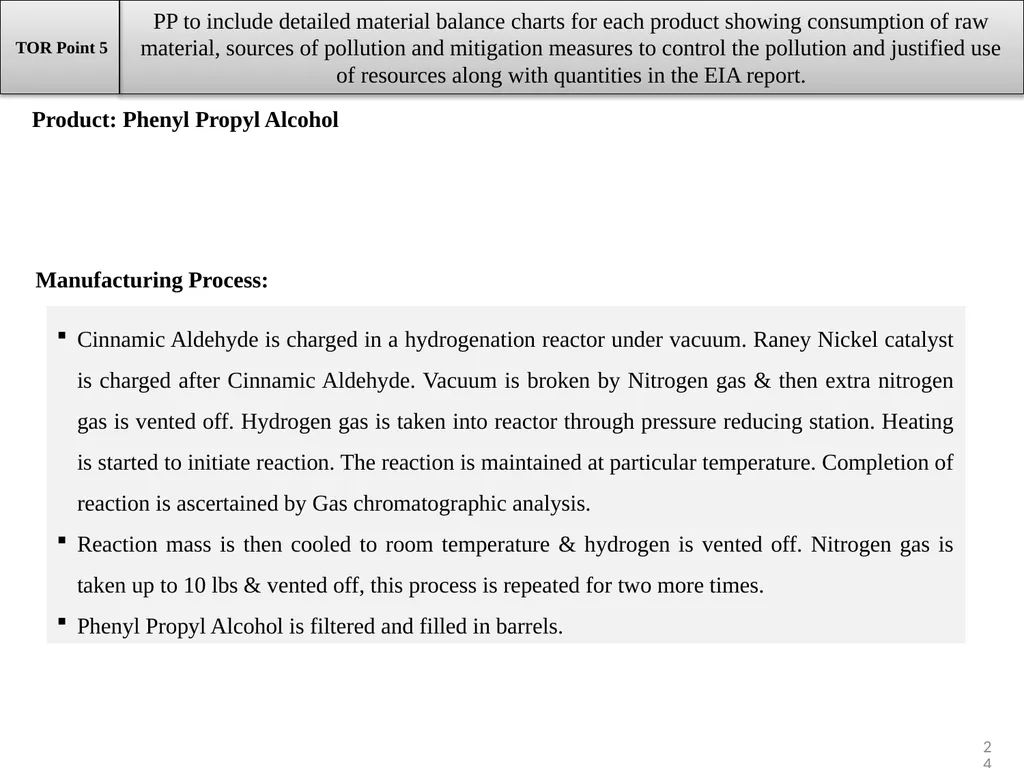
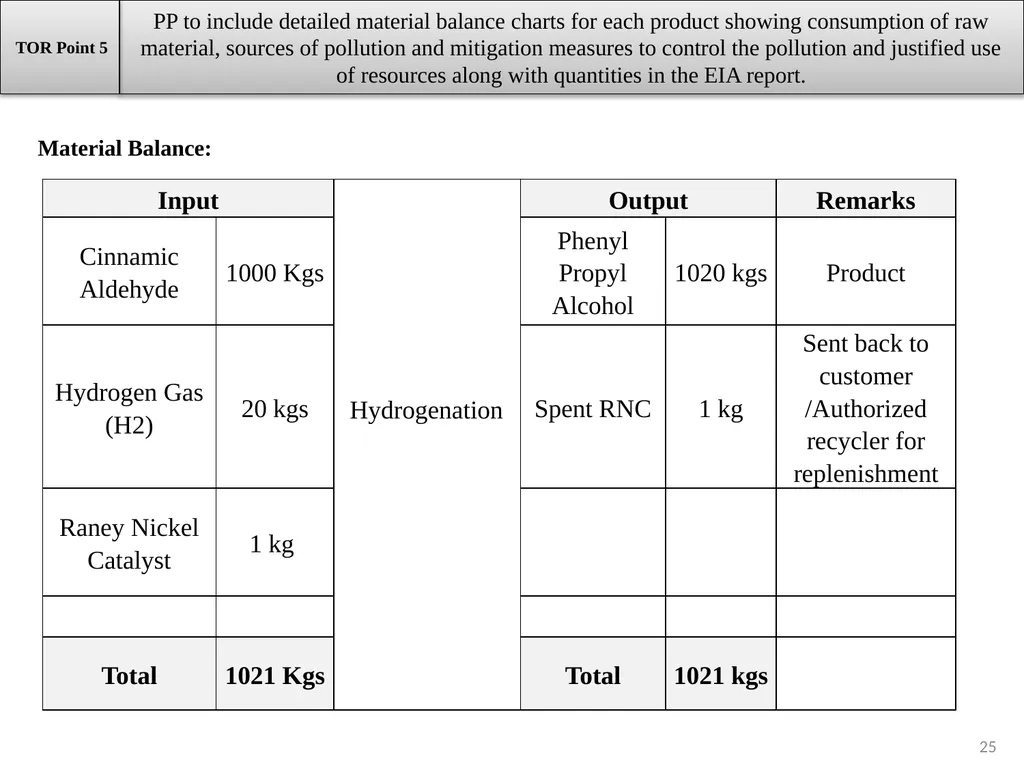
PP to include detailed material balance charts for each product showing consumption of raw material, sources of pollution and mitigation measures to control the pollution and justified use of resources along with quantities in the EIA report. TOR Point 5 Product: Phenyl Propyl Alcohol 24 Manufacturing Process: Cinnamic Aldehyde is charged in a hydrogenation reactor under vacuum. Raney Nickel catalyst is charged after Cinnamic Aldehyde. Vacuum is broken by Nitrogen gas & then extra nitrogen gas is vented off. Hydrogen gas is taken into reactor through pressure reducing station. Heating is started to initiate reaction. The reaction is maintained at particular temperature. Completion of reaction is ascertained by Gas chromatographic analysis.
Reaction mass is then cooled to room temperature & hydrogen is vented off. Nitrogen gas is taken up to 10 lbs & vented off, this process is repeated for two more times.
Phenyl Propyl Alcohol is filtered and filled in barrels.<br>
Reaction mass is then cooled to room temperature & hydrogen is vented off. Nitrogen gas is taken up to 10 lbs & vented off, this process is repeated for two more times.
Phenyl Propyl Alcohol is filtered and filled in barrels.<br>
25
PP to include detailed material balance charts for each product showing consumption of raw material, sources of pollution and mitigation measures to control the pollution and justified use of resources along with quantities in the EIA report. TOR Point 5 25 Material Balance:<br>
26
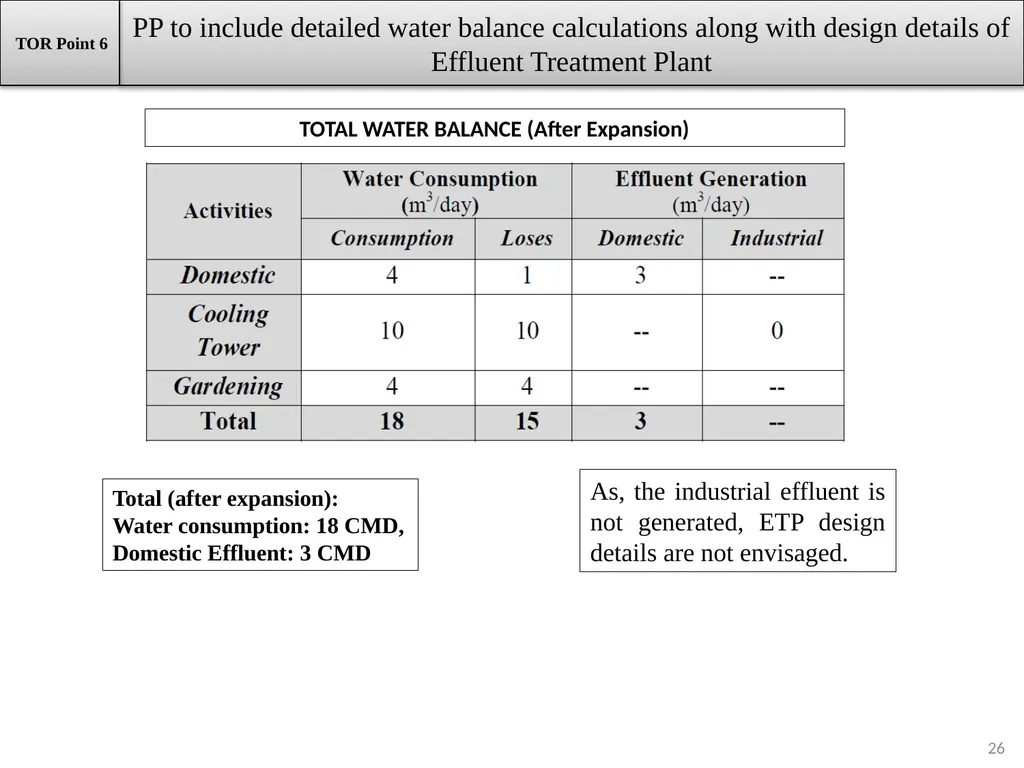
28 PP to include detailed water balance calculations along with design details of Effluent Treatment Plant TOR Point 6 26 Total (after expansion):
Water consumption: 18 CMD,
Domestic Effluent: 3 CMD TOTAL WATER BALANCE (After Expansion) As, the industrial effluent is not generated, ETP design details are not envisaged.<br>
Water consumption: 18 CMD,
Domestic Effluent: 3 CMD TOTAL WATER BALANCE (After Expansion) As, the industrial effluent is not generated, ETP design details are not envisaged.<br>
27
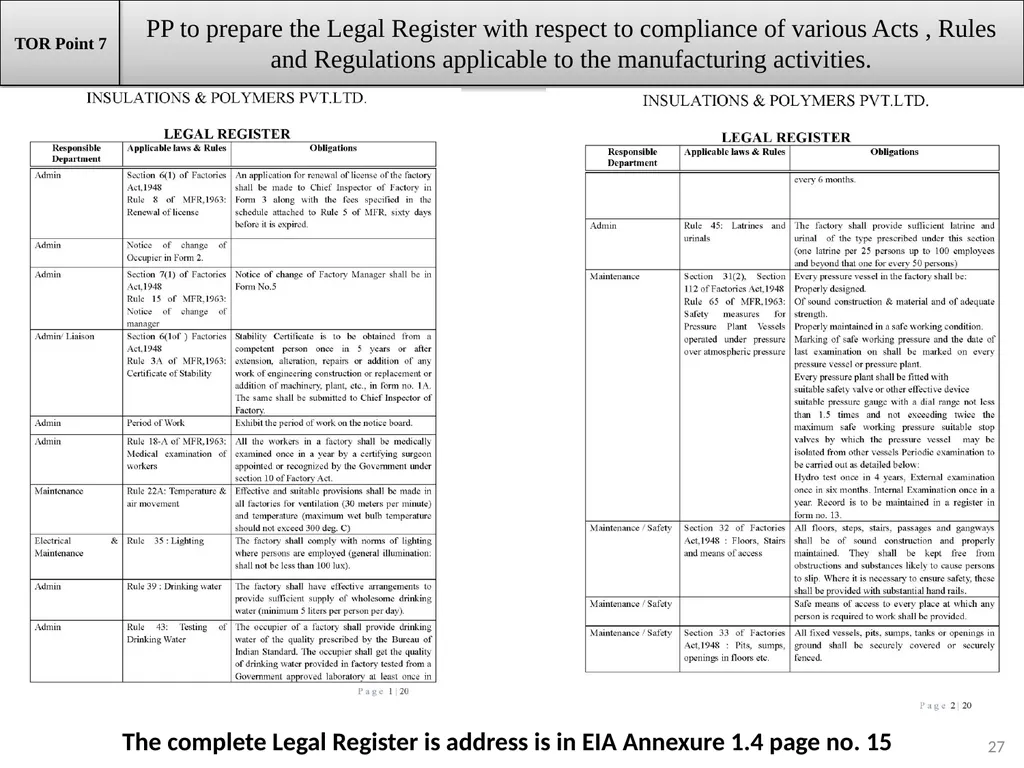
27 PP to prepare the Legal Register with respect to compliance of various Acts , Rules and Regulations applicable to the manufacturing activities. TOR Point 7 The complete Legal Register is address is in EIA Annexure 1.4 page no. 15<br>
28
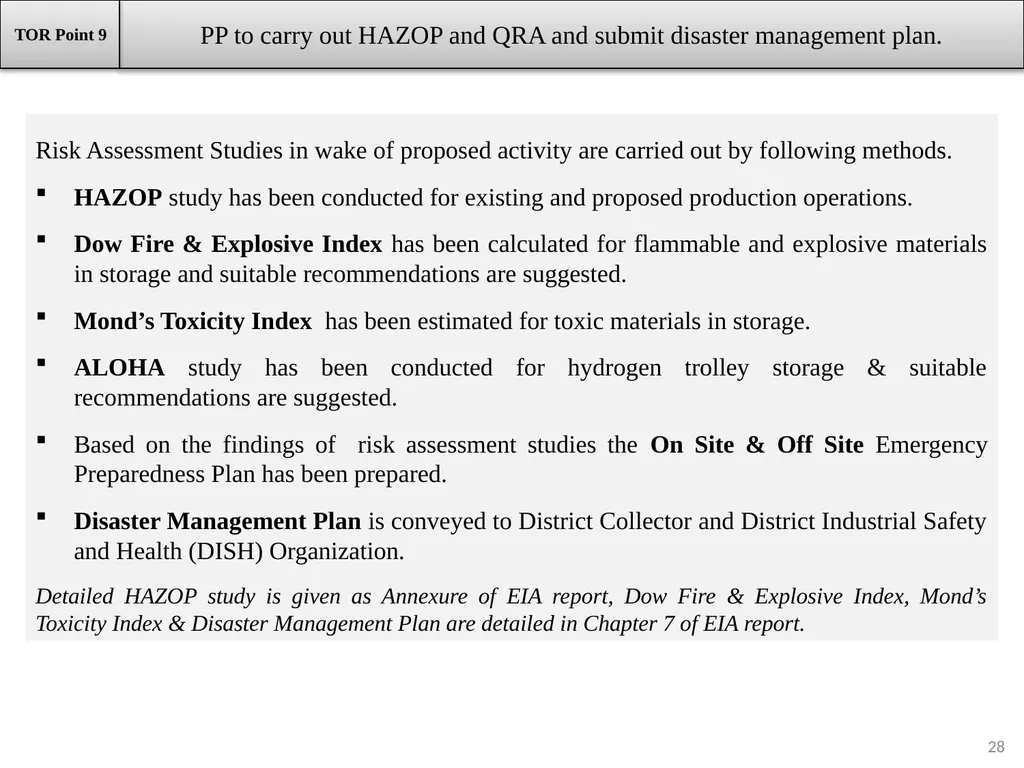
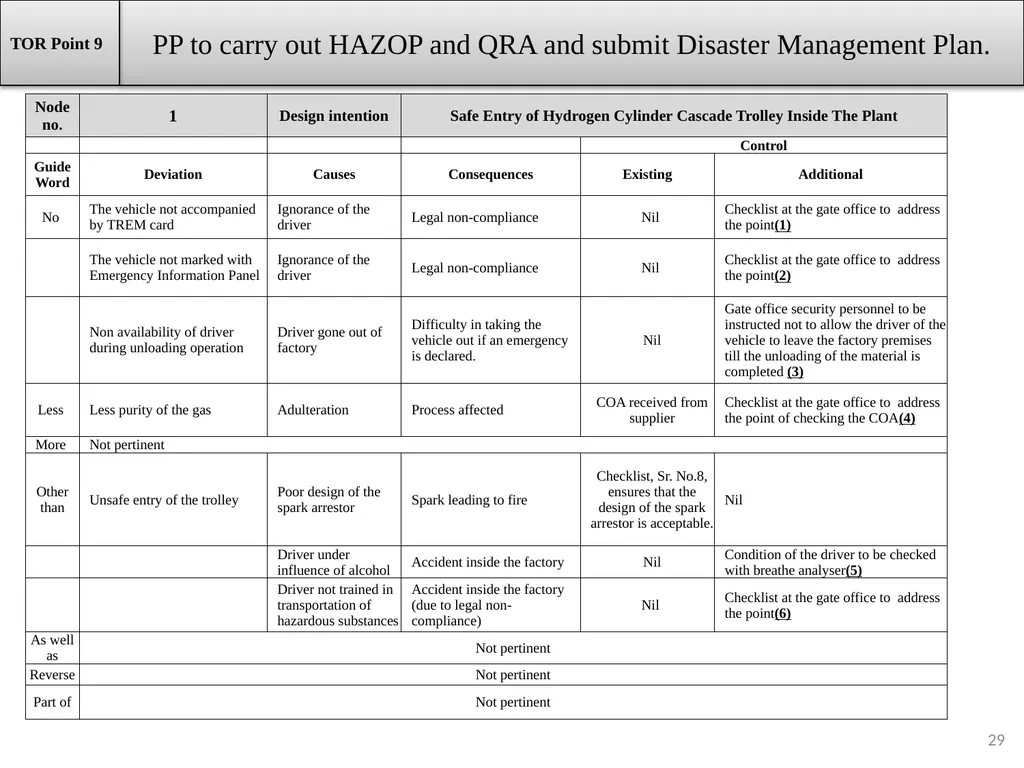
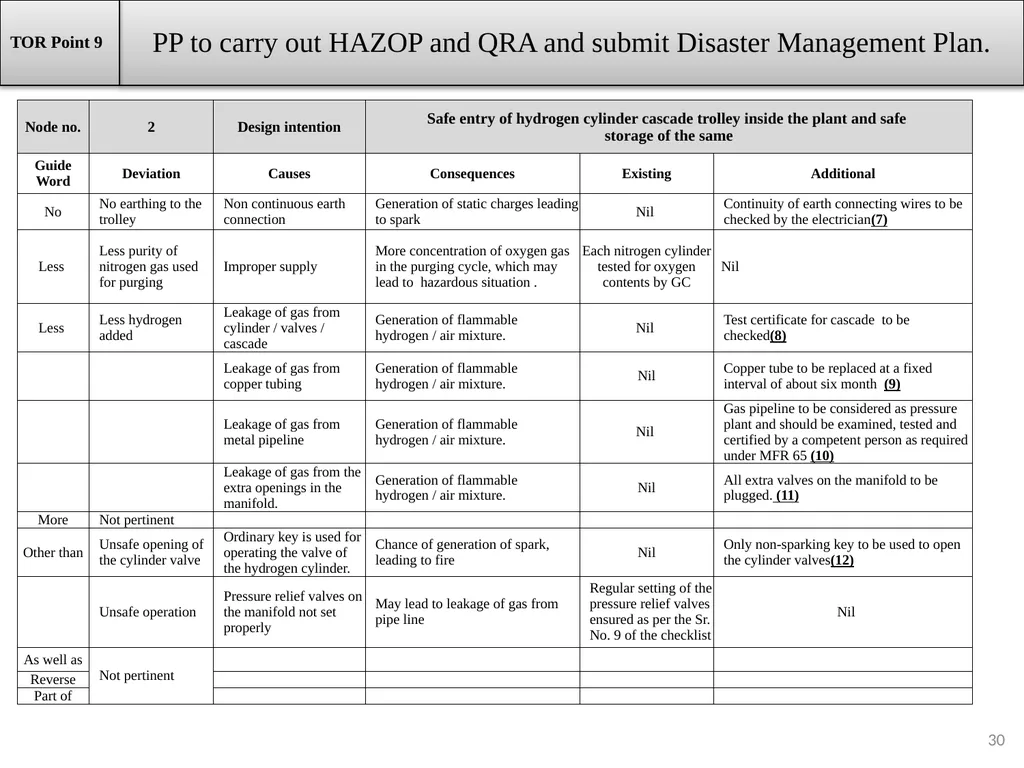
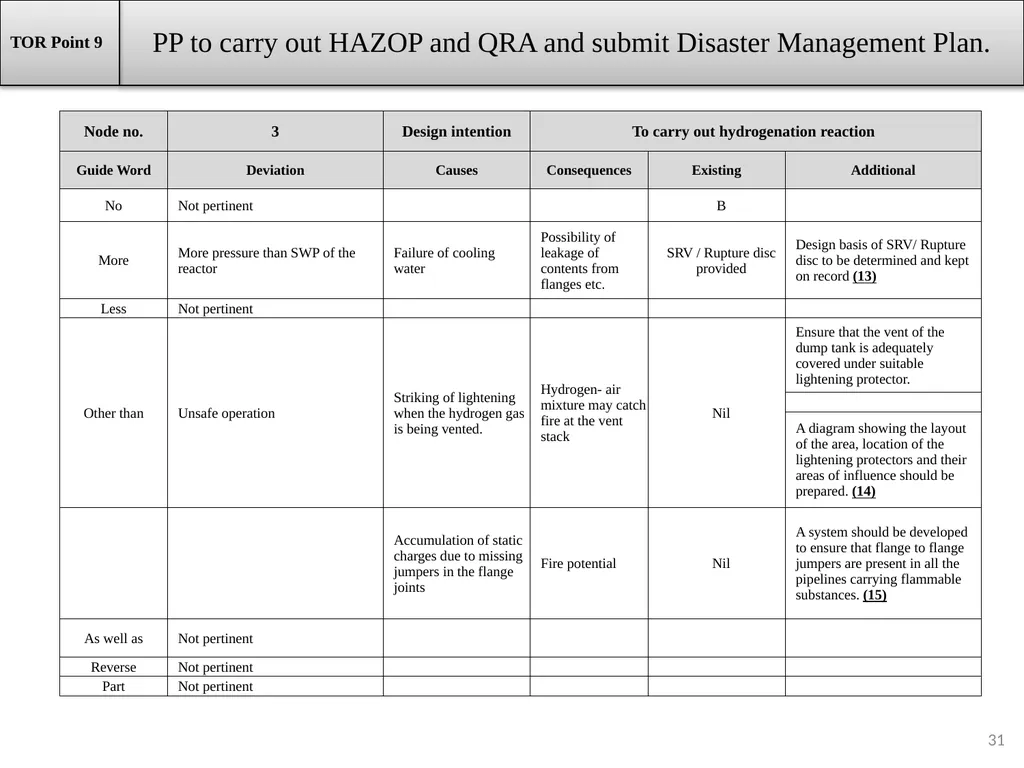
28 PP to carry out HAZOP and QRA and submit disaster management plan. TOR Point 9 Risk Assessment Studies in wake of proposed activity are carried out by following methods.
HAZOP study has been conducted for existing and proposed production operations.
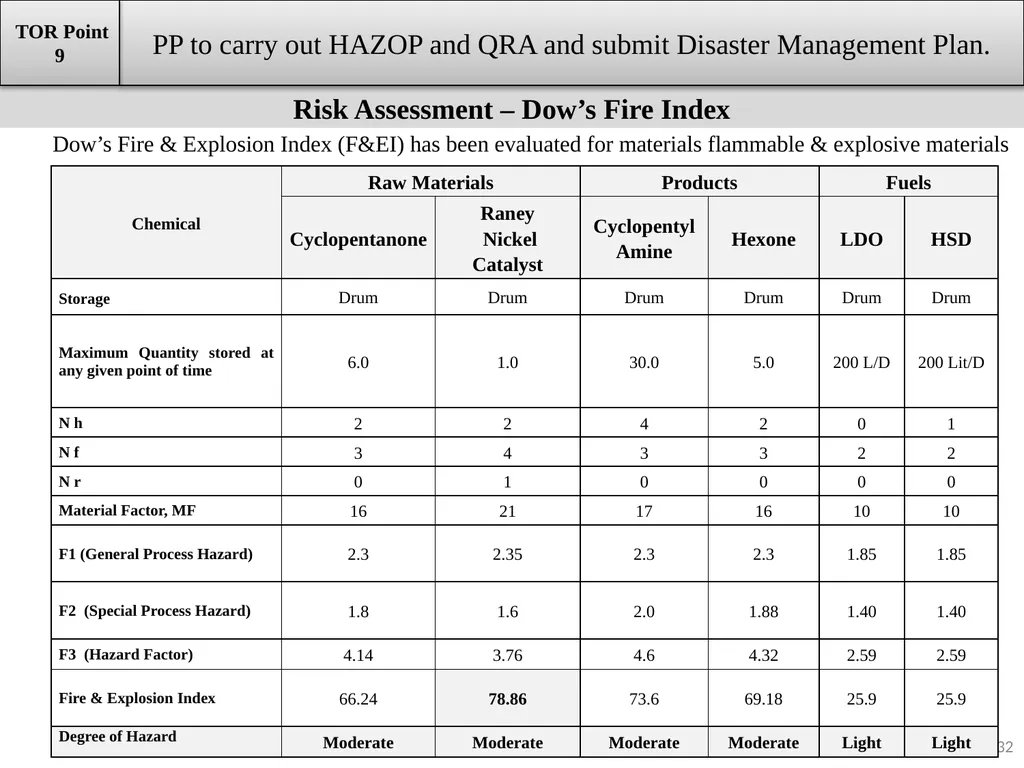
Dow Fire & Explosive Index has been calculated for flammable and explosive materials in storage and suitable recommendations are suggested.
Mond’s Toxicity Index has been estimated for toxic materials in storage.
ALOHA study has been conducted for hydrogen trolley storage & suitable recommendations are suggested.
Based on the findings of risk assessment studies the On Site & Off Site Emergency Preparedness Plan has been prepared.
Disaster Management Plan is conveyed to District Collector and District Industrial Safety and Health (DISH) Organization.
Detailed HAZOP study is given as Annexure of EIA report, Dow Fire & Explosive Index, Mond’s Toxicity Index & Disaster Management Plan are detailed in Chapter 7 of EIA report.<br>
HAZOP study has been conducted for existing and proposed production operations.
Dow Fire & Explosive Index has been calculated for flammable and explosive materials in storage and suitable recommendations are suggested.
Mond’s Toxicity Index has been estimated for toxic materials in storage.
ALOHA study has been conducted for hydrogen trolley storage & suitable recommendations are suggested.
Based on the findings of risk assessment studies the On Site & Off Site Emergency Preparedness Plan has been prepared.
Disaster Management Plan is conveyed to District Collector and District Industrial Safety and Health (DISH) Organization.
Detailed HAZOP study is given as Annexure of EIA report, Dow Fire & Explosive Index, Mond’s Toxicity Index & Disaster Management Plan are detailed in Chapter 7 of EIA report.<br>
29
29 PP to carry out HAZOP and QRA and submit Disaster Management Plan. TOR Point 9<br>
30
30 PP to carry out HAZOP and QRA and submit Disaster Management Plan. TOR Point 9<br>
31
31 PP to carry out HAZOP and QRA and submit Disaster Management Plan. TOR Point 9<br>
32
32 Dow’s Fire & Explosion Index (F&EI) has been evaluated for materials flammable & explosive materials Risk Assessment – Dow’s Fire Index PP to carry out HAZOP and QRA and submit Disaster Management Plan. TOR Point 9<br>
33
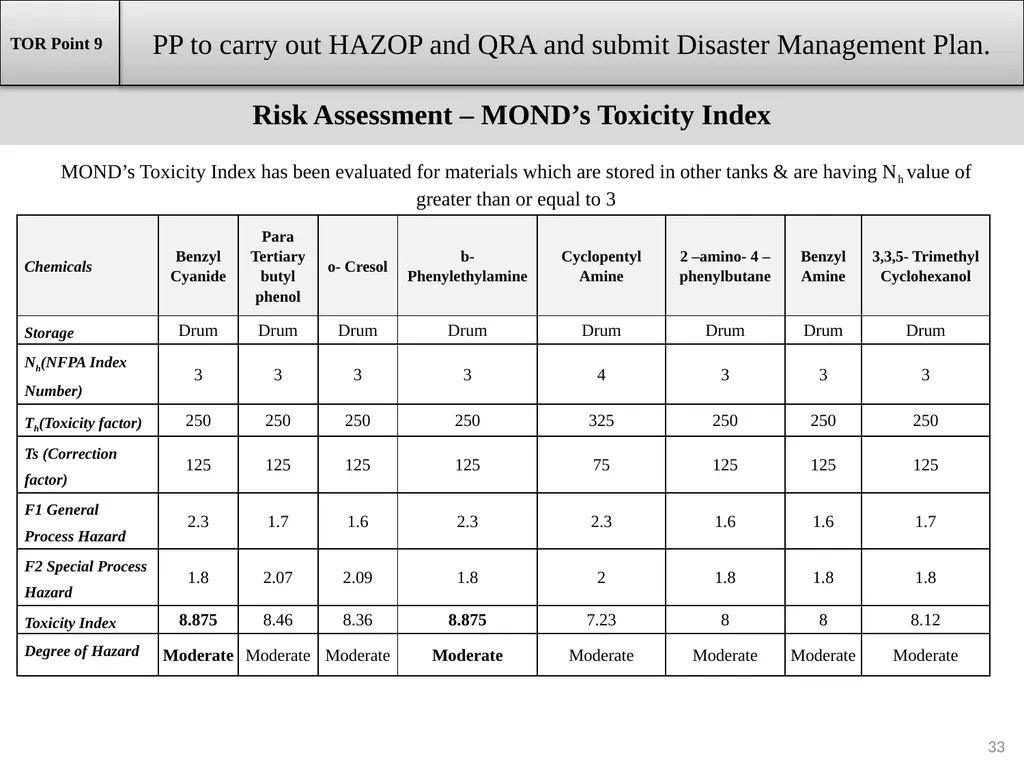
33 Risk Assessment – MOND’s Toxicity Index MOND’s Toxicity Index has been evaluated for materials which are stored in other tanks & are having Nh value of greater than or equal to 3 PP to carry out HAZOP and QRA and submit Disaster Management Plan. TOR Point 9<br>
34
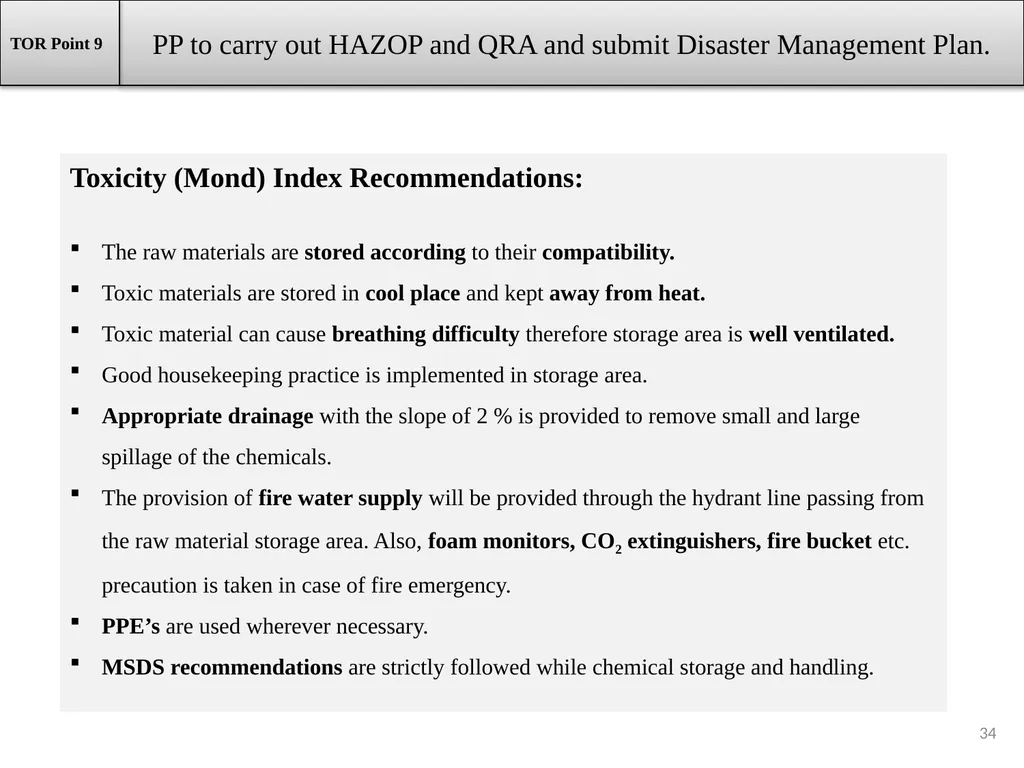
Toxicity (Mond) Index Recommendations:
The raw materials are stored according to their compatibility.
Toxic materials are stored in cool place and kept away from heat.
Toxic material can cause breathing difficulty therefore storage area is well ventilated.
Good housekeeping practice is implemented in storage area.
Appropriate drainage with the slope of 2 % is provided to remove small and large spillage of the chemicals.
The provision of fire water supply will be provided through the hydrant line passing from the raw material storage area. Also, foam monitors, CO2 extinguishers, fire bucket etc. precaution is taken in case of fire emergency.
PPE’s are used wherever necessary.
MSDS recommendations are strictly followed while chemical storage and handling. 34 PP to carry out HAZOP and QRA and submit Disaster Management Plan. TOR Point 9<br>
The raw materials are stored according to their compatibility.
Toxic materials are stored in cool place and kept away from heat.
Toxic material can cause breathing difficulty therefore storage area is well ventilated.
Good housekeeping practice is implemented in storage area.
Appropriate drainage with the slope of 2 % is provided to remove small and large spillage of the chemicals.
The provision of fire water supply will be provided through the hydrant line passing from the raw material storage area. Also, foam monitors, CO2 extinguishers, fire bucket etc. precaution is taken in case of fire emergency.
PPE’s are used wherever necessary.
MSDS recommendations are strictly followed while chemical storage and handling. 34 PP to carry out HAZOP and QRA and submit Disaster Management Plan. TOR Point 9<br>
35
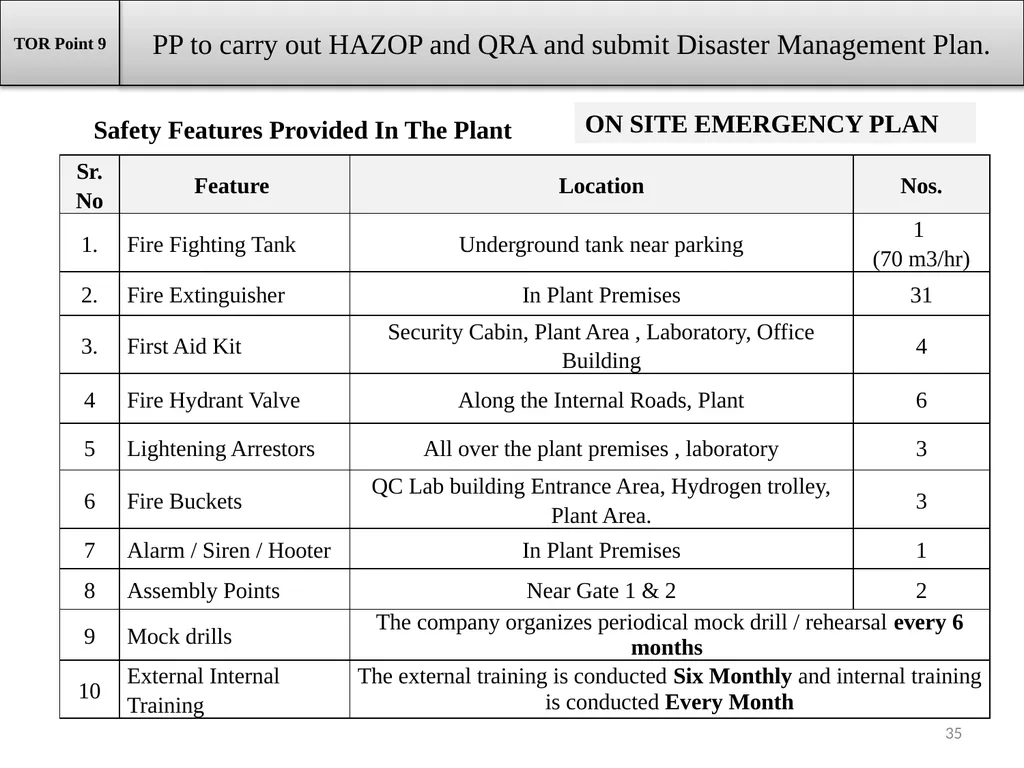
35 PP to carry out HAZOP and QRA and submit Disaster Management Plan. Safety Features Provided In The Plant ON SITE EMERGENCY PLAN TOR Point 9<br>
36
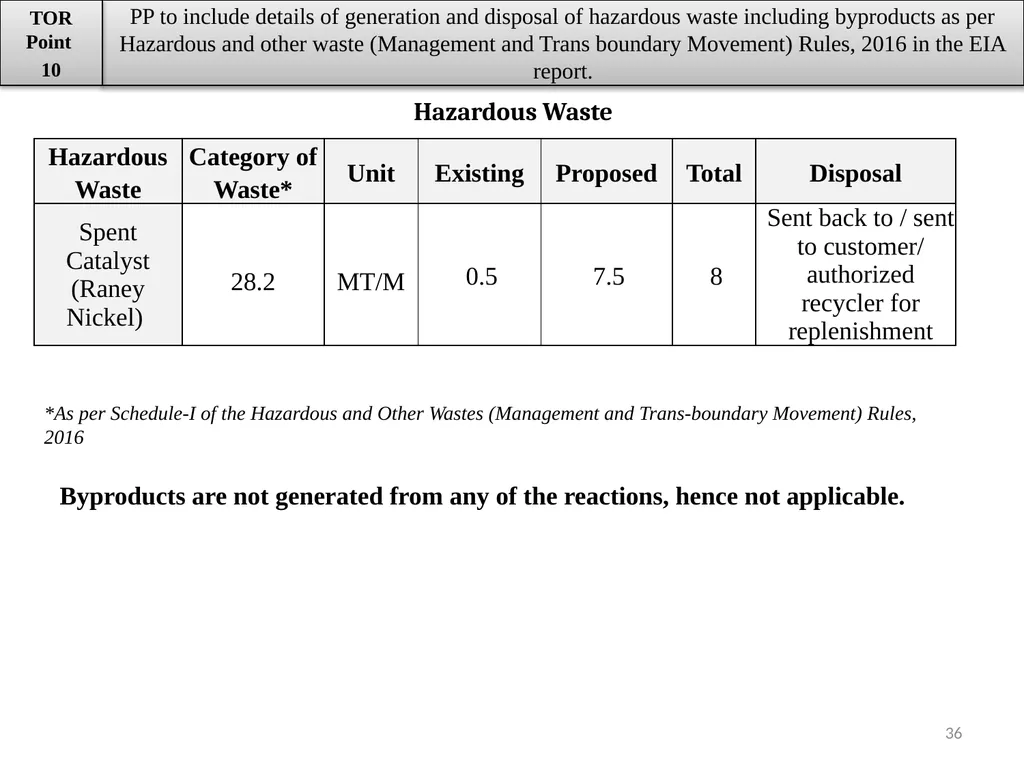
36 PP to include details of generation and disposal of hazardous waste including byproducts as per Hazardous and other waste (Management and Trans boundary Movement) Rules, 2016 in the EIA report. TOR Point
10 Hazardous Waste *As per Schedule-I of the Hazardous and Other Wastes (Management and Trans-boundary Movement) Rules, 2016 Byproducts are not generated from any of the reactions, hence not applicable.<br>
10 Hazardous Waste *As per Schedule-I of the Hazardous and Other Wastes (Management and Trans-boundary Movement) Rules, 2016 Byproducts are not generated from any of the reactions, hence not applicable.<br>
37
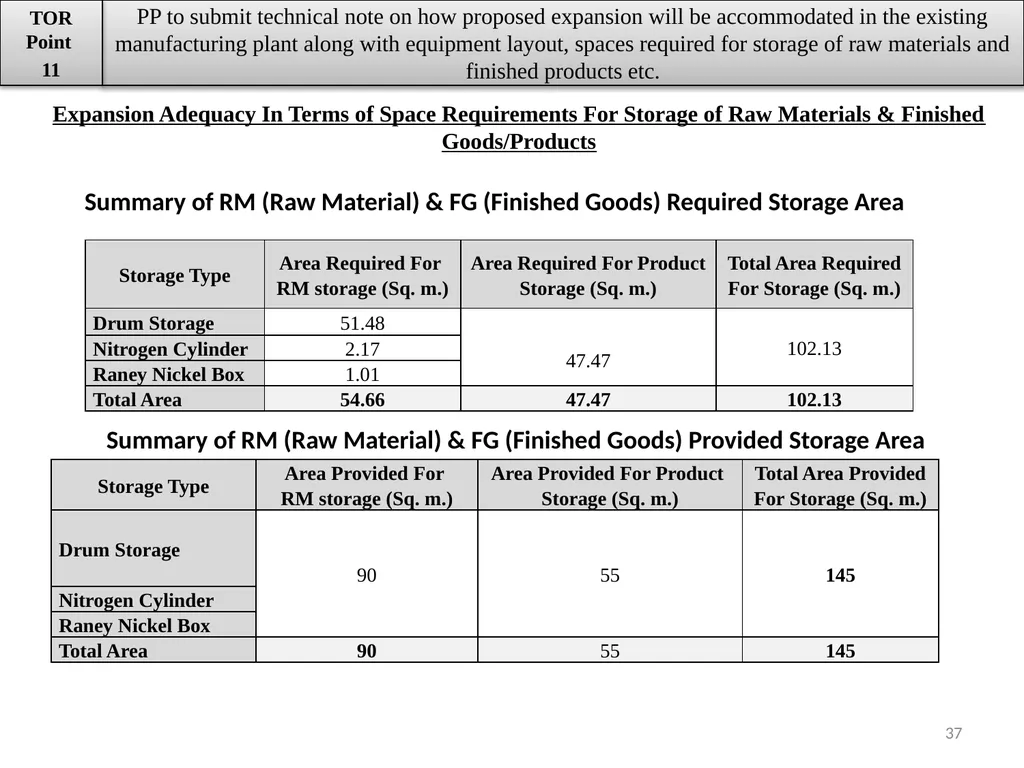
37 PP to submit technical note on how proposed expansion will be accommodated in the existing manufacturing plant along with equipment layout, spaces required for storage of raw materials and finished products etc. TOR Point
11 Summary of RM (Raw Material) & FG (Finished Goods) Provided Storage Area Summary of RM (Raw Material) & FG (Finished Goods) Required Storage Area Expansion Adequacy In Terms of Space Requirements For Storage of Raw Materials & Finished Goods/Products<br>
11 Summary of RM (Raw Material) & FG (Finished Goods) Provided Storage Area Summary of RM (Raw Material) & FG (Finished Goods) Required Storage Area Expansion Adequacy In Terms of Space Requirements For Storage of Raw Materials & Finished Goods/Products<br>
38
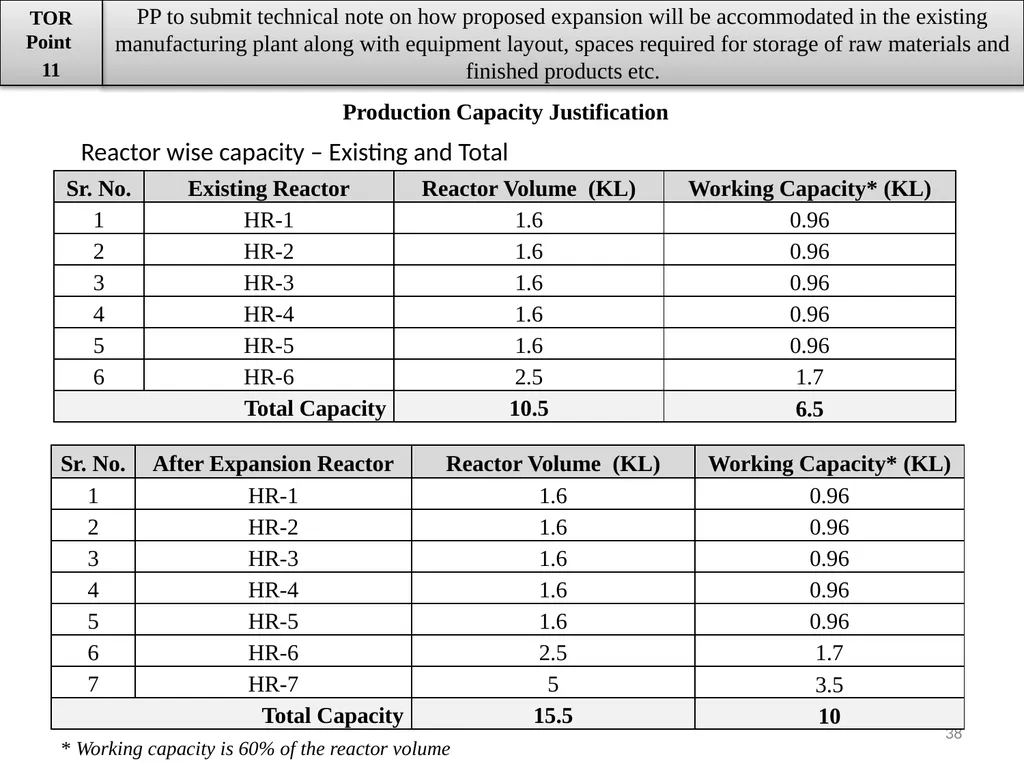
Production Capacity Justification PP to submit technical note on how proposed expansion will be accommodated in the existing manufacturing plant along with equipment layout, spaces required for storage of raw materials and finished products etc. TOR Point
11 * Working capacity is 60% of the reactor volume Reactor wise capacity – Existing and Total 38<br>
11 * Working capacity is 60% of the reactor volume Reactor wise capacity – Existing and Total 38<br>
39
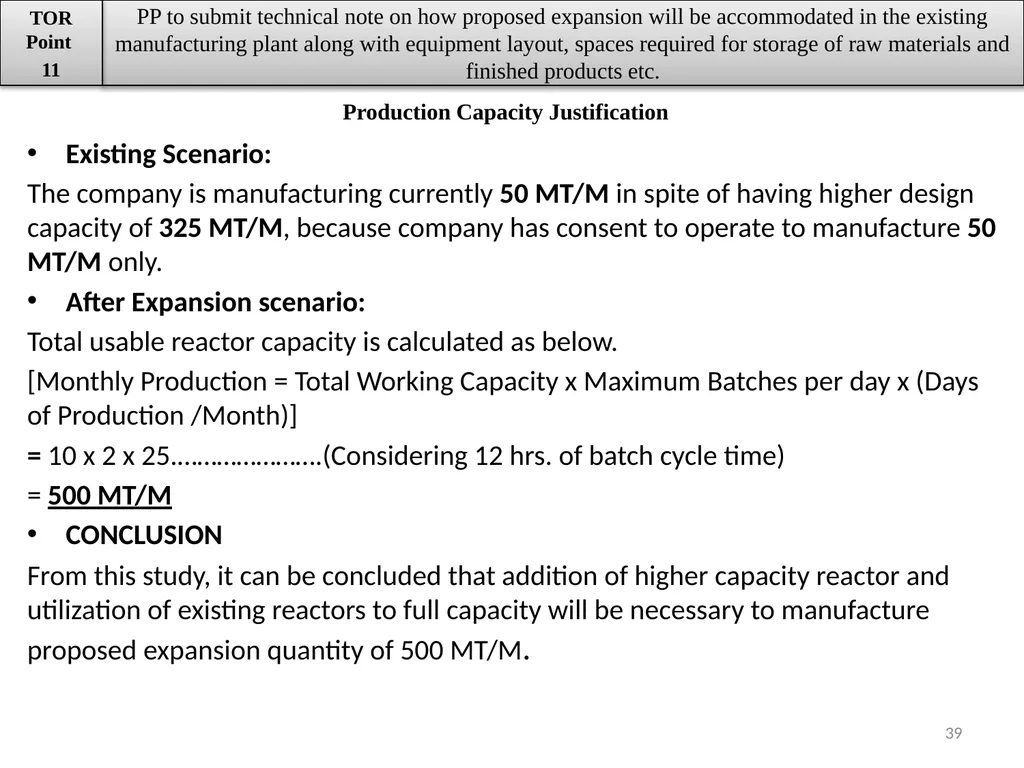
Existing Scenario:
The company is manufacturing currently 50 MT/M in spite of having higher design capacity of 325 MT/M, because company has consent to operate to manufacture 50 MT/M only.
After Expansion scenario:
Total usable reactor capacity is calculated as below.
[Monthly Production = Total Working Capacity x Maximum Batches per day x (Days of Production /Month)]
= 10 x 2 x 25.………………….(Considering 12 hrs. of batch cycle time)
= 500 MT/M
Conclusion
From this study, it can be concluded that addition of higher capacity reactor and utilization of existing reactors to full capacity will be necessary to manufacture proposed expansion quantity of 500 MT/M. 39 PP to submit technical note on how proposed expansion will be accommodated in the existing manufacturing plant along with equipment layout, spaces required for storage of raw materials and finished products etc. TOR Point
11 Production Capacity Justification<br>
The company is manufacturing currently 50 MT/M in spite of having higher design capacity of 325 MT/M, because company has consent to operate to manufacture 50 MT/M only.
After Expansion scenario:
Total usable reactor capacity is calculated as below.
[Monthly Production = Total Working Capacity x Maximum Batches per day x (Days of Production /Month)]
= 10 x 2 x 25.………………….(Considering 12 hrs. of batch cycle time)
= 500 MT/M
Conclusion
From this study, it can be concluded that addition of higher capacity reactor and utilization of existing reactors to full capacity will be necessary to manufacture proposed expansion quantity of 500 MT/M. 39 PP to submit technical note on how proposed expansion will be accommodated in the existing manufacturing plant along with equipment layout, spaces required for storage of raw materials and finished products etc. TOR Point
11 Production Capacity Justification<br>
40
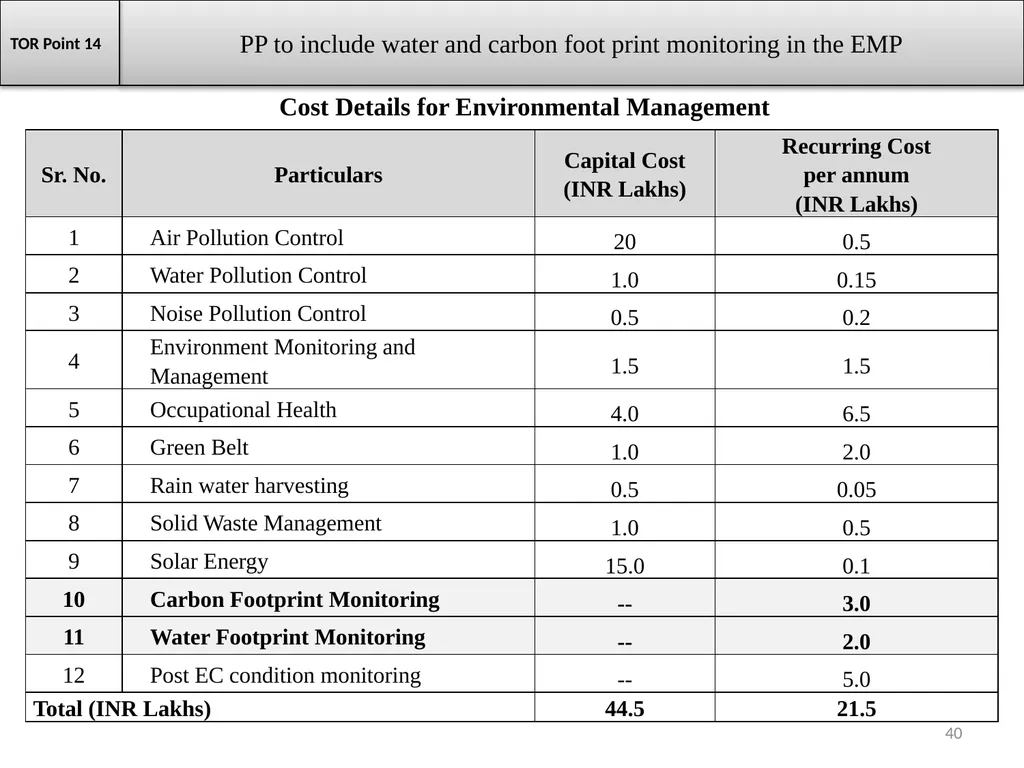
40 PP to include water and carbon foot print monitoring in the EMP TOR Point 14 Cost Details for Environmental Management<br>
41
Baseline Status Monitoring period for collecting the baseline data is March to May 2019.
Baseline data is collected as per the Standard Terms of Reference published by MOEF & CC on April 2015 & OM No. J-11013/41/2006-IA-II(I) Part) (Govt. of India, MoEF & CC dtd. 29.08.2017.
EIA report is prepared in accordance with the Standard TOR, April 2015 published by MoEF & CC and additional TOR give by 166th SEAC 1. 41<br>
Baseline data is collected as per the Standard Terms of Reference published by MOEF & CC on April 2015 & OM No. J-11013/41/2006-IA-II(I) Part) (Govt. of India, MoEF & CC dtd. 29.08.2017.
EIA report is prepared in accordance with the Standard TOR, April 2015 published by MoEF & CC and additional TOR give by 166th SEAC 1. 41<br>
42
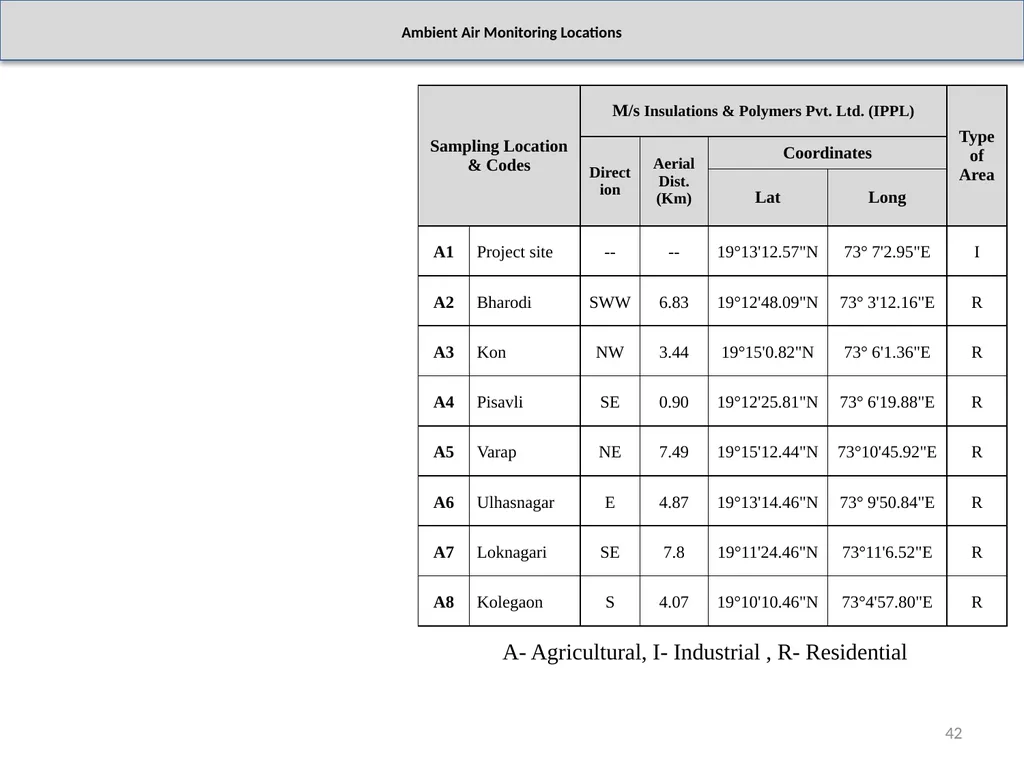
Ambient Air Monitoring Locations 42 A- Agricultural, I- Industrial , R- Residential<br>
43
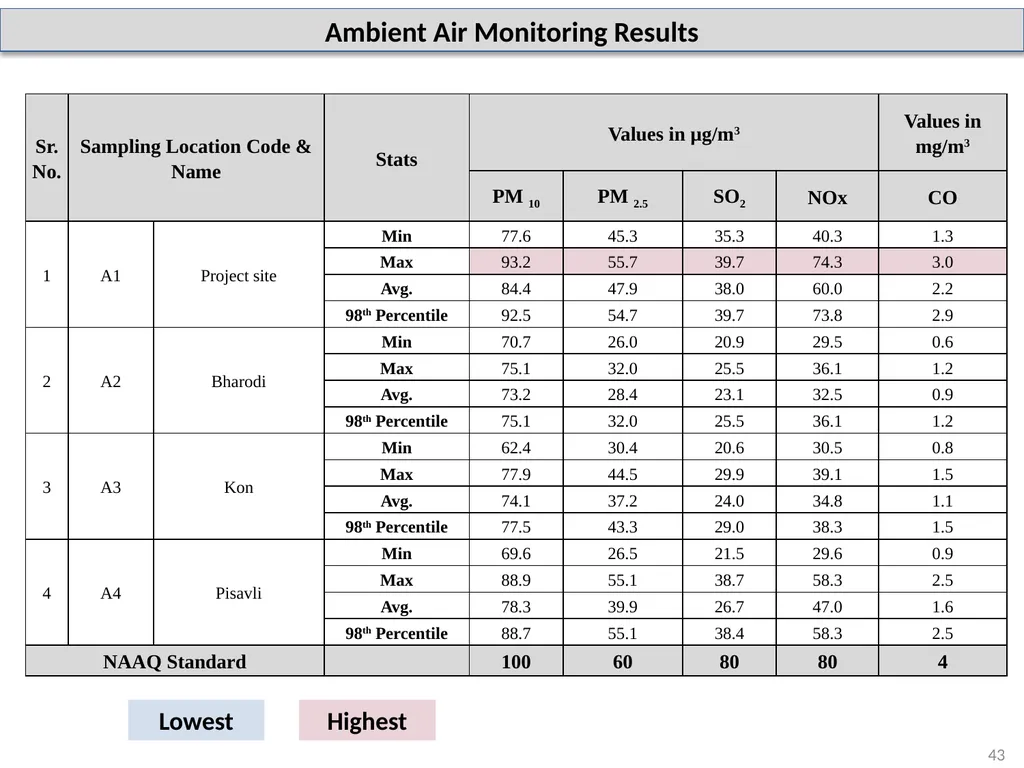
Ambient Air Monitoring Results 43 Lowest Highest<br>
44
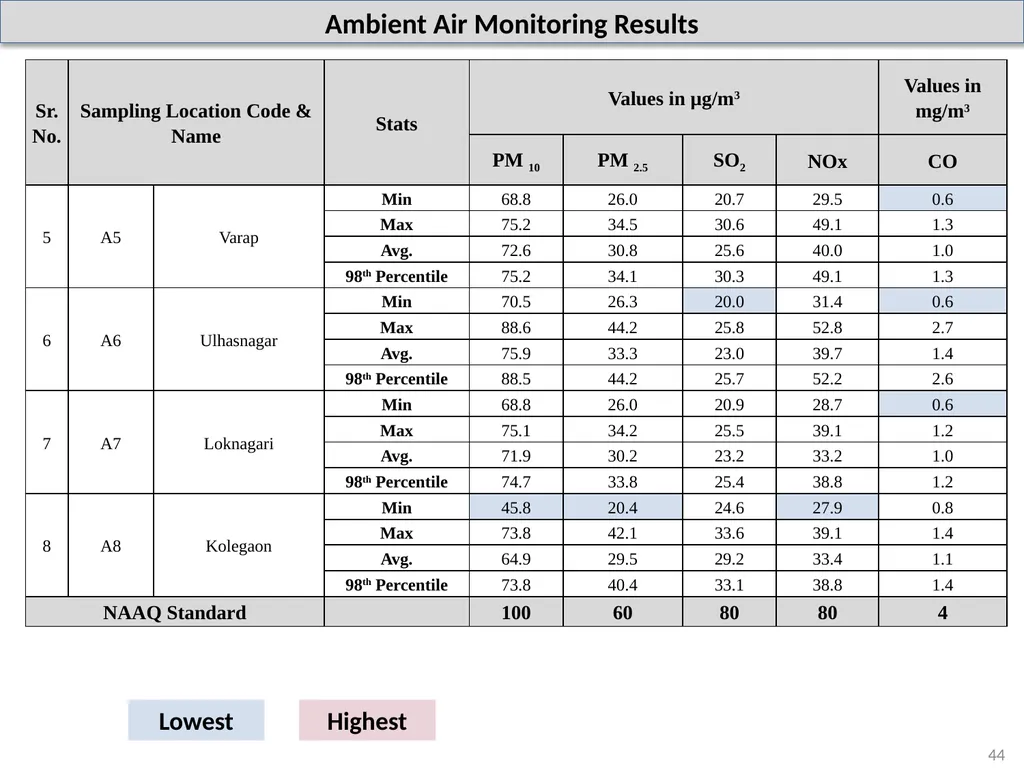
Ambient Air Monitoring Results 44 Lowest Highest<br>
45
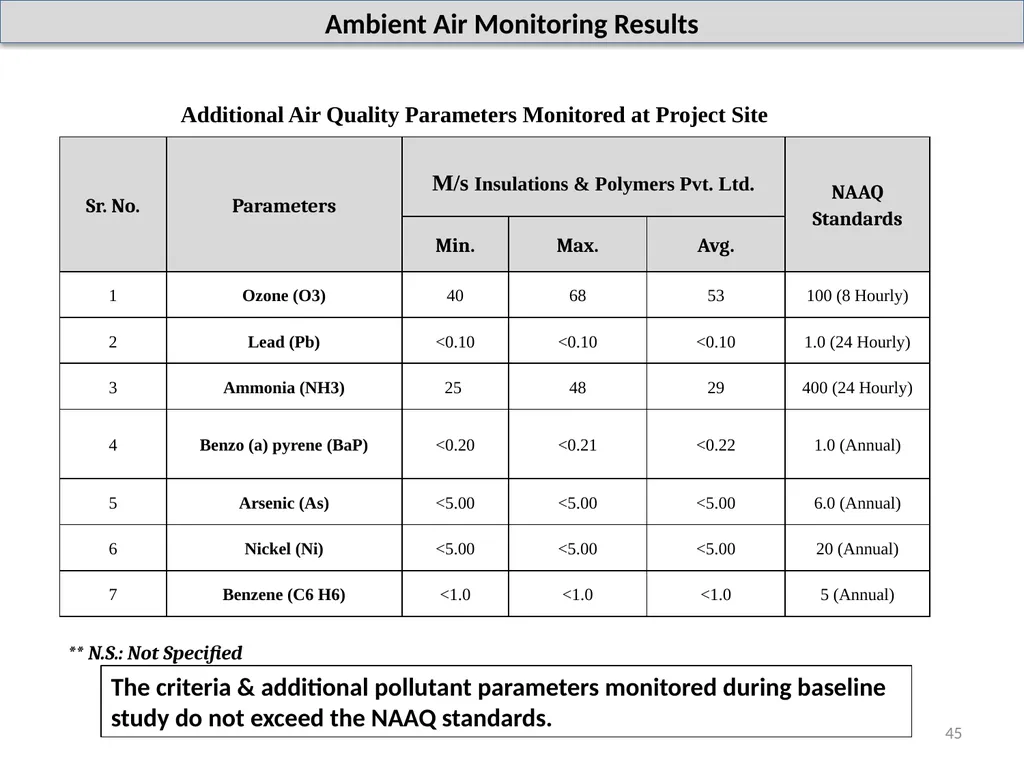
45 Additional Air Quality Parameters Monitored at Project Site Ambient Air Monitoring Results The criteria & additional pollutant parameters monitored during baseline study do not exceed the NAAQ standards.<br>
46
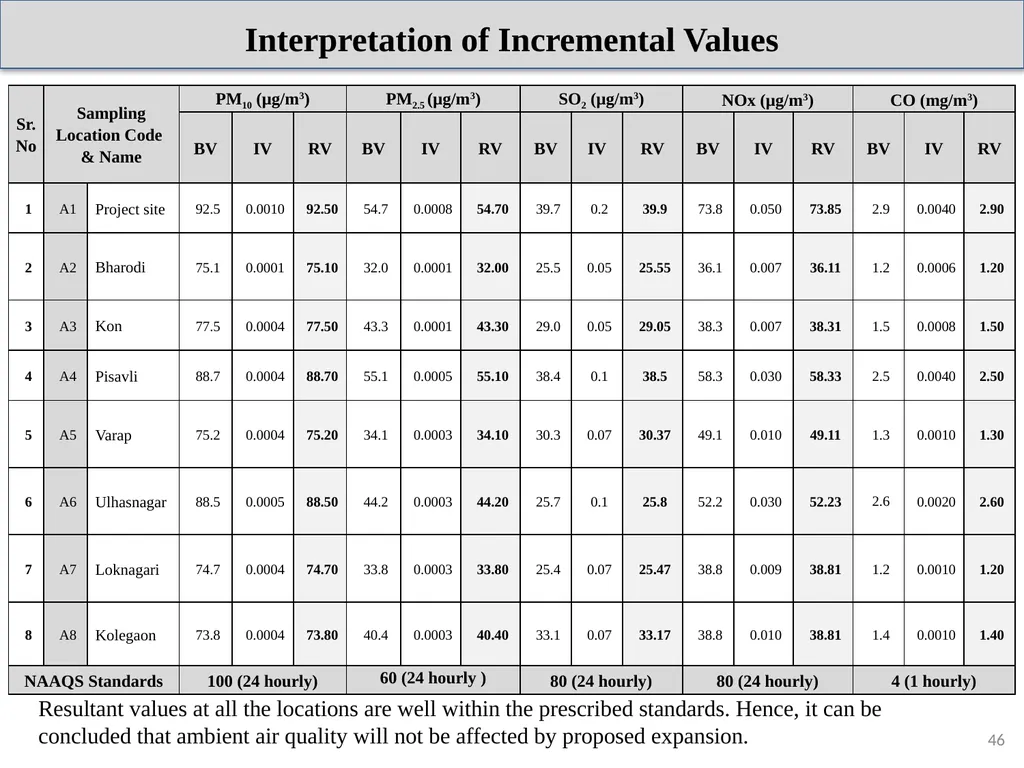
Interpretation of Incremental Values BV: Baseline Value IV: Incremental Value RV: Resultant Value All values are in µg/m3 except CO which is expressed as mg/m3 46 Resultant values at all the locations are well within the prescribed standards. Hence, it can be concluded that ambient air quality will not be affected by proposed expansion.<br>
47
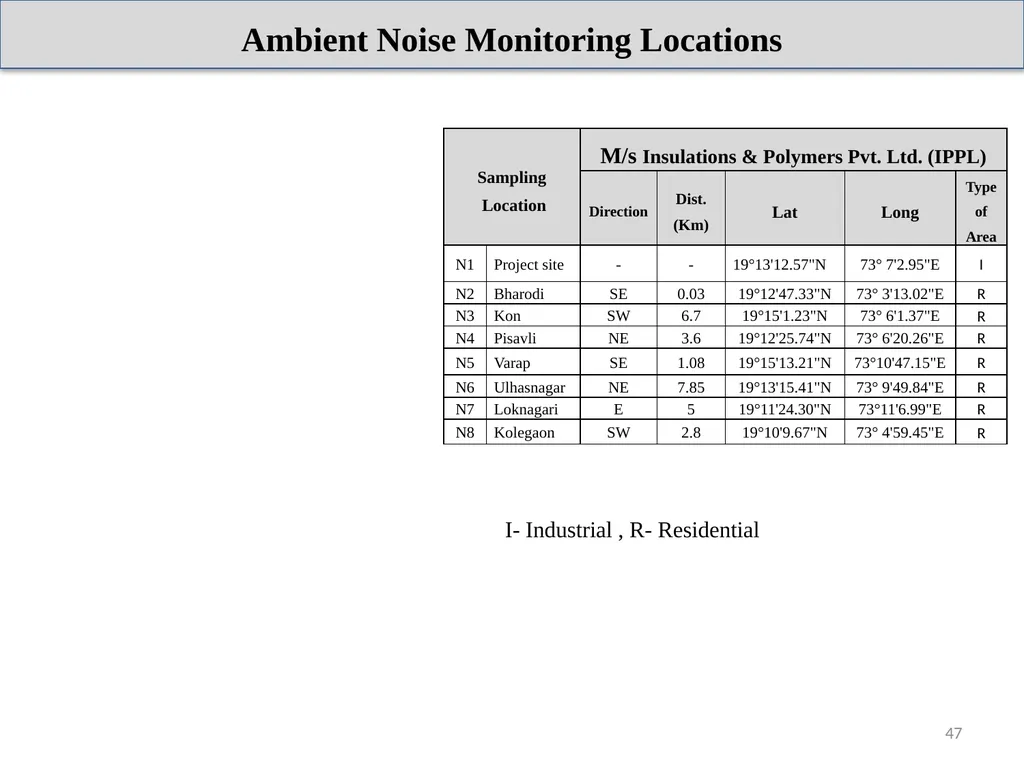
Ambient Noise Monitoring Locations 47 I- Industrial , R- Residential<br>
48
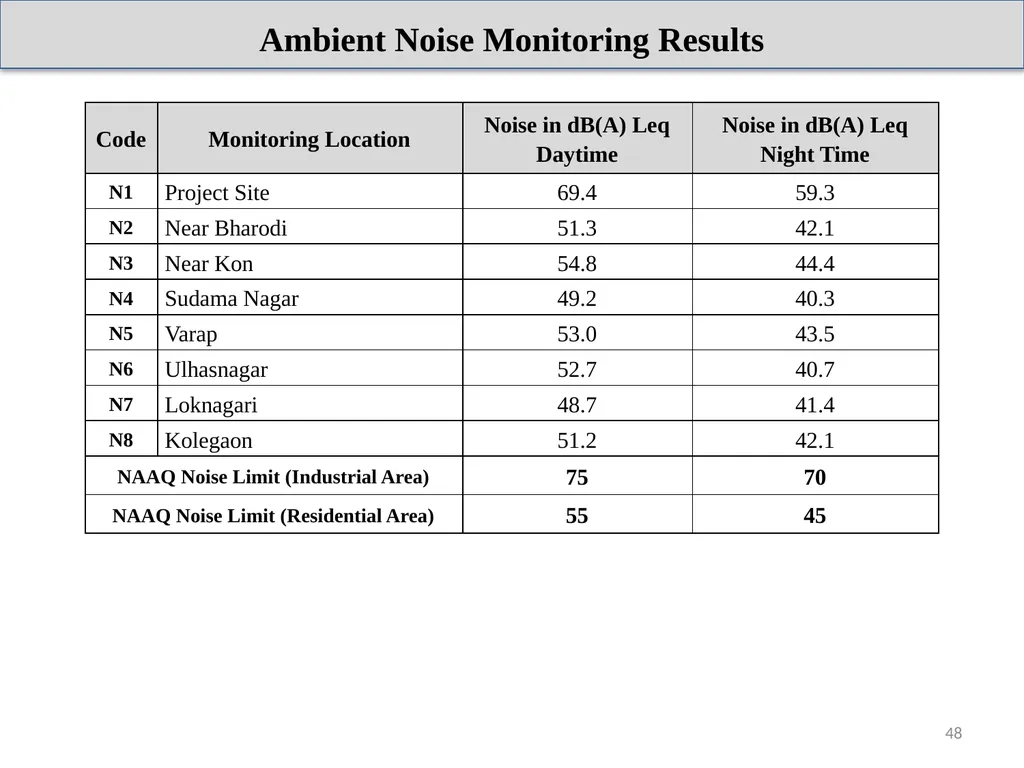
Ambient Noise Monitoring Results 48<br>
49
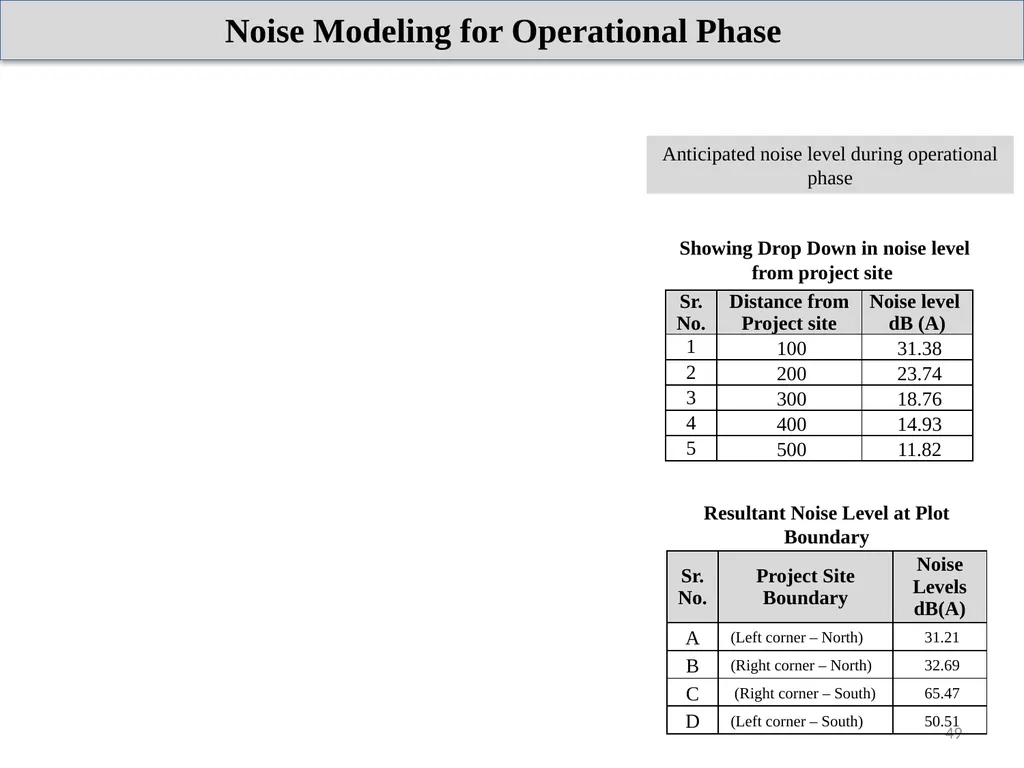
Noise Modeling for Operational Phase Anticipated noise level during operational phase 49 Resultant Noise Level at Plot Boundary Showing Drop Down in noise level from project site<br>
50
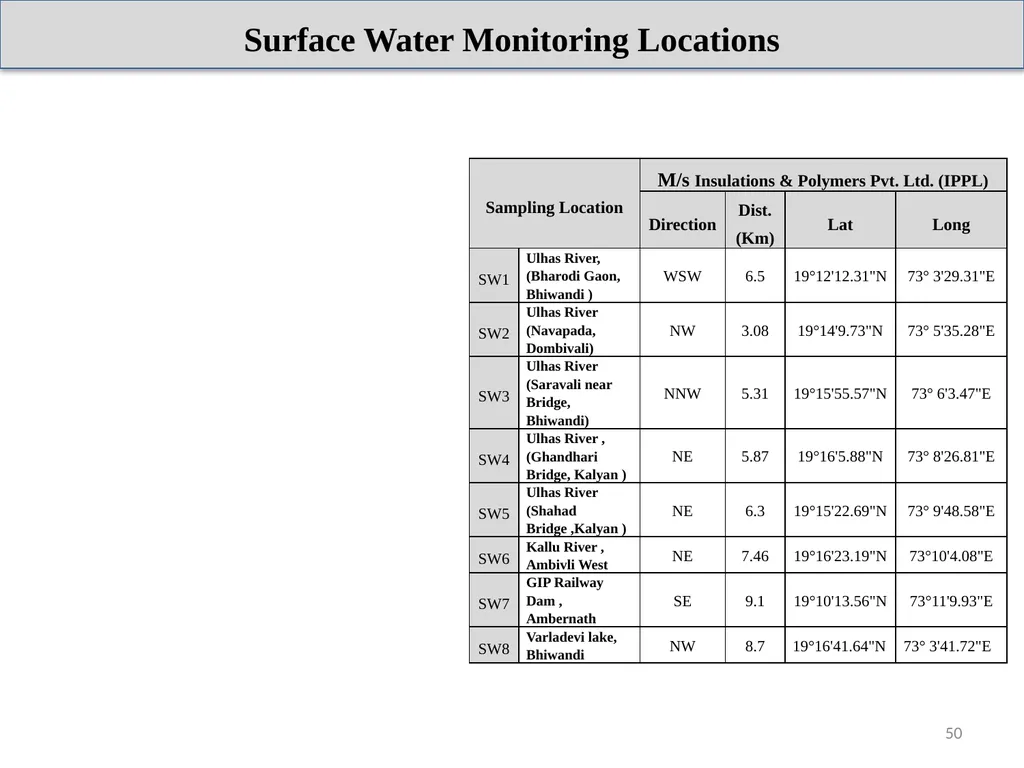
Surface Water Monitoring Locations 50<br>
51
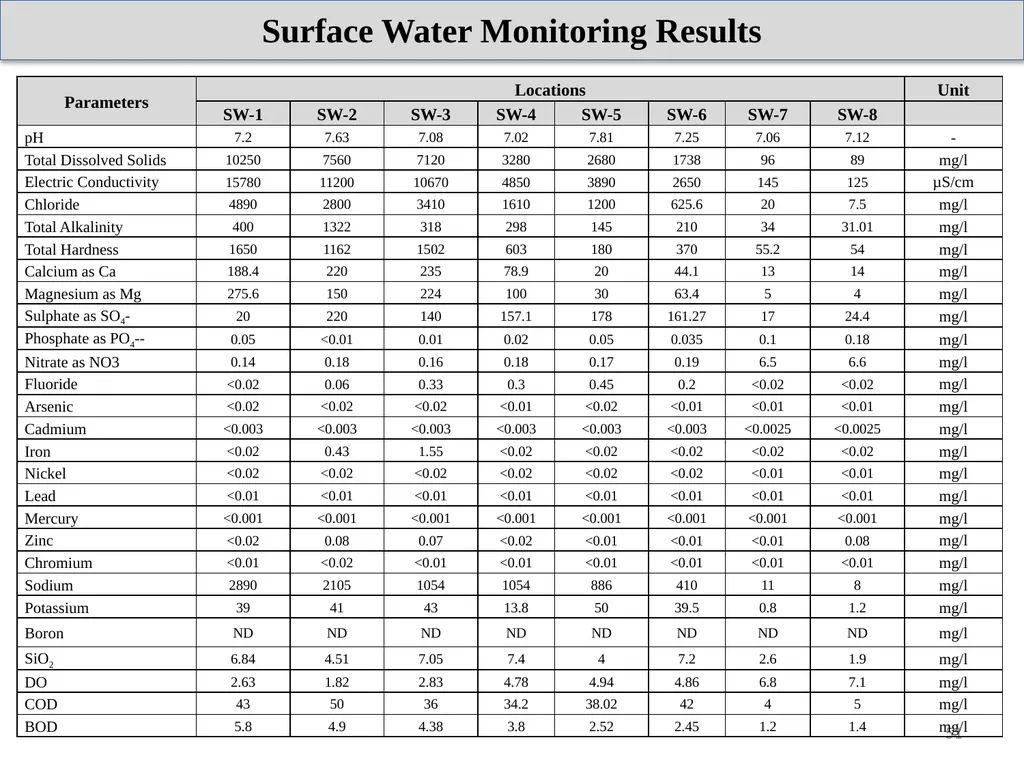
Surface Water Monitoring Results 51<br>
52
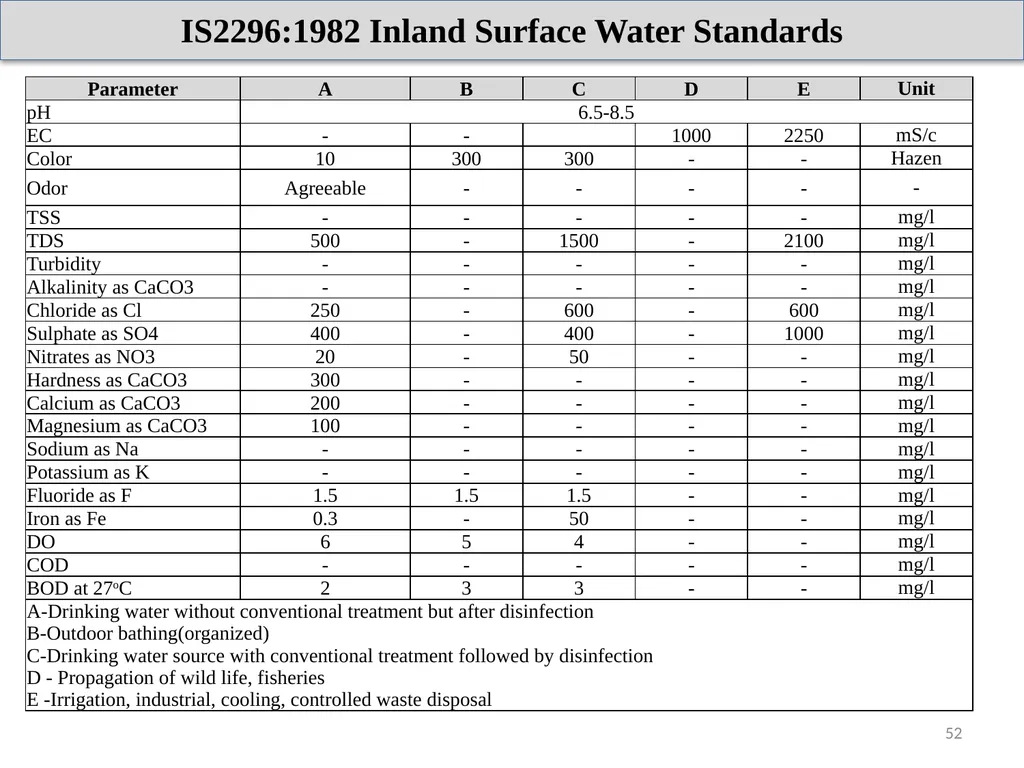
IS2296:1982 Inland Surface Water Standards 52<br>
53
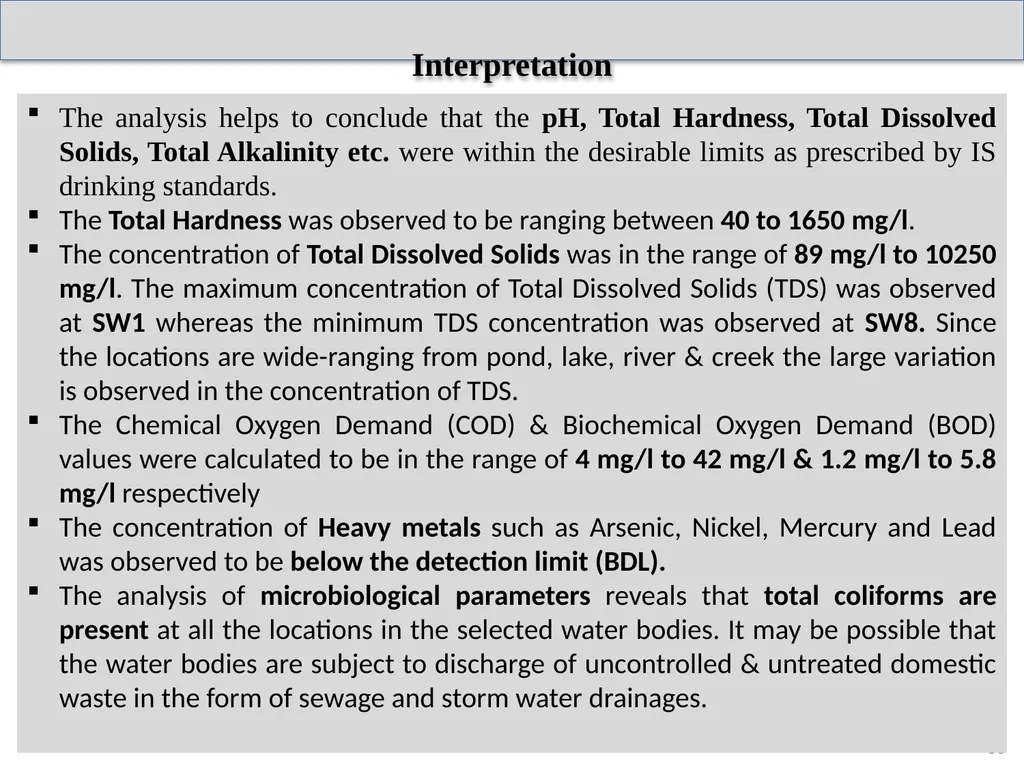
53 Interpretation The analysis helps to conclude that the pH, Total Hardness, Total Dissolved Solids, Total Alkalinity etc. were within the desirable limits as prescribed by IS drinking standards.
The Total Hardness was observed to be ranging between 40 to 1650 mg/l.
The concentration of Total Dissolved Solids was in the range of 89 mg/l to 10250 mg/l. The maximum concentration of Total Dissolved Solids (TDS) was observed at SW1 whereas the minimum TDS concentration was observed at SW8. Since the locations are wide-ranging from pond, lake, river & creek the large variation is observed in the concentration of TDS.
The Chemical Oxygen Demand (COD) & Biochemical Oxygen Demand (BOD) values were calculated to be in the range of 4 mg/l to 42 mg/l & 1.2 mg/l to 5.8 mg/l respectively
The concentration of Heavy metals such as Arsenic, Nickel, Mercury and Lead was observed to be below the detection limit (BDL).
The analysis of microbiological parameters reveals that total coliforms are present at all the locations in the selected water bodies. It may be possible that the water bodies are subject to discharge of uncontrolled & untreated domestic waste in the form of sewage and storm water drainages.<br>
The Total Hardness was observed to be ranging between 40 to 1650 mg/l.
The concentration of Total Dissolved Solids was in the range of 89 mg/l to 10250 mg/l. The maximum concentration of Total Dissolved Solids (TDS) was observed at SW1 whereas the minimum TDS concentration was observed at SW8. Since the locations are wide-ranging from pond, lake, river & creek the large variation is observed in the concentration of TDS.
The Chemical Oxygen Demand (COD) & Biochemical Oxygen Demand (BOD) values were calculated to be in the range of 4 mg/l to 42 mg/l & 1.2 mg/l to 5.8 mg/l respectively
The concentration of Heavy metals such as Arsenic, Nickel, Mercury and Lead was observed to be below the detection limit (BDL).
The analysis of microbiological parameters reveals that total coliforms are present at all the locations in the selected water bodies. It may be possible that the water bodies are subject to discharge of uncontrolled & untreated domestic waste in the form of sewage and storm water drainages.<br>
54
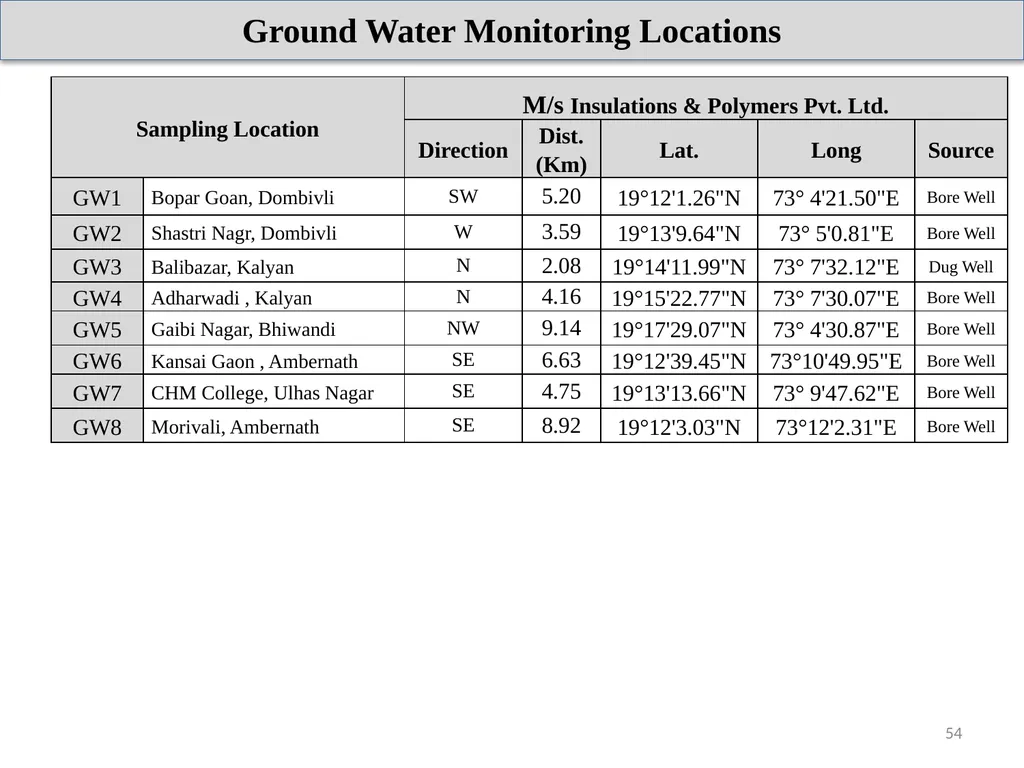
Ground Water Monitoring Locations 54<br>
55
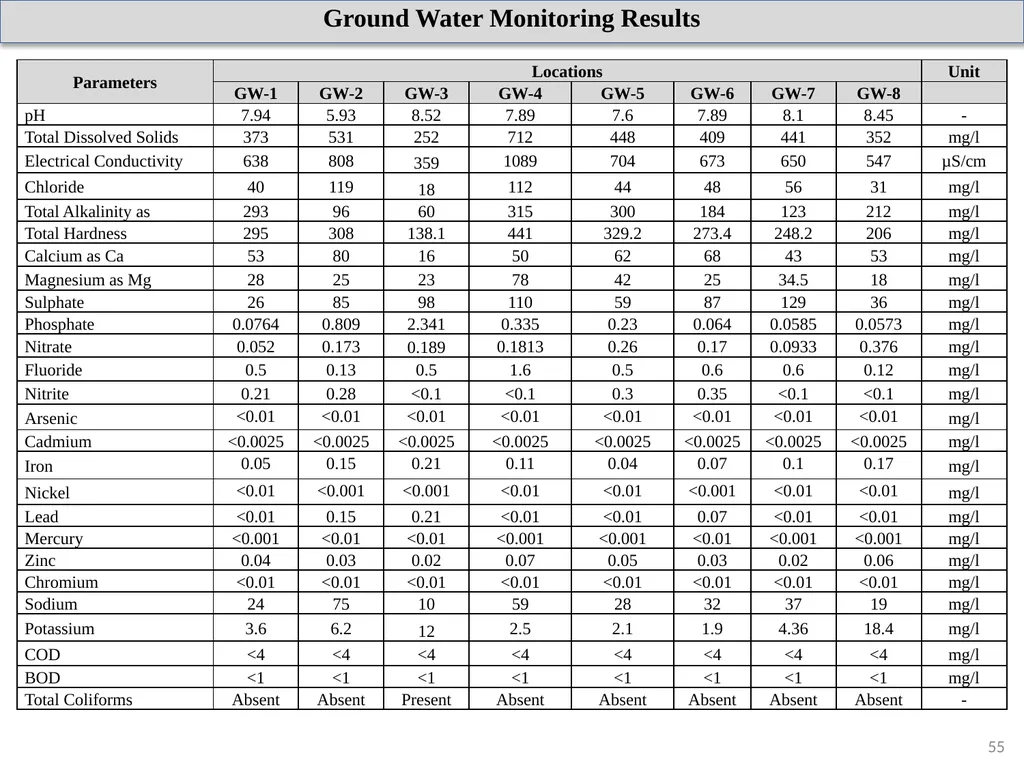
Ground Water Monitoring Results 55<br>
56
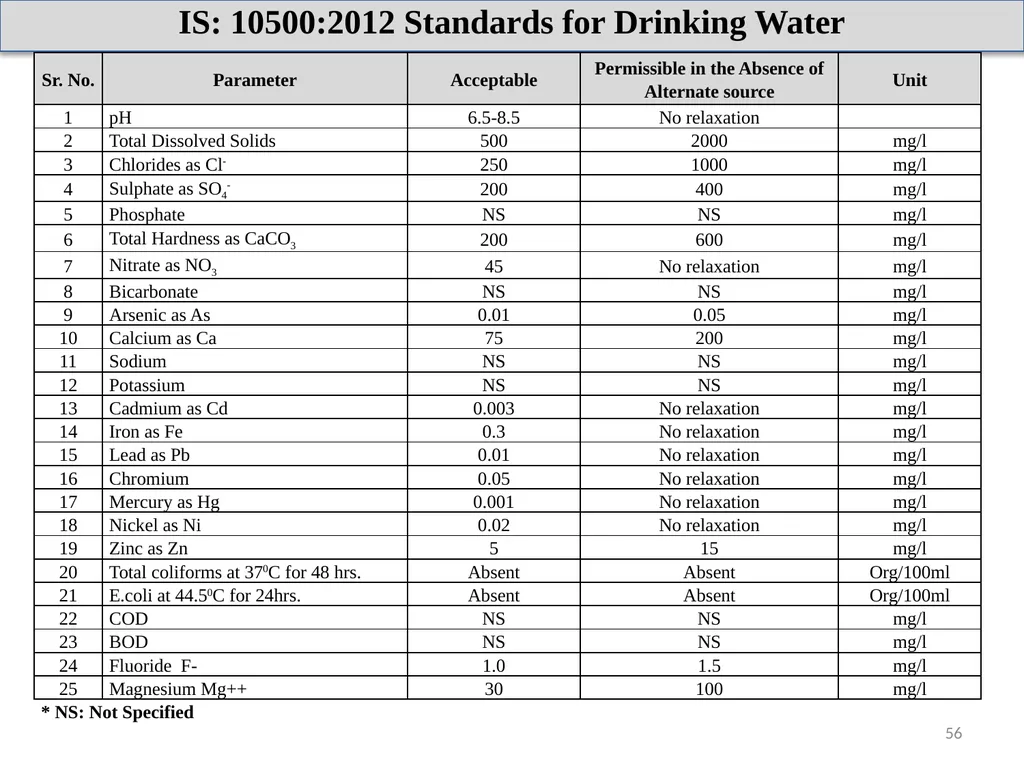
IS: 10500:2012 Standards for Drinking Water 56<br>
57
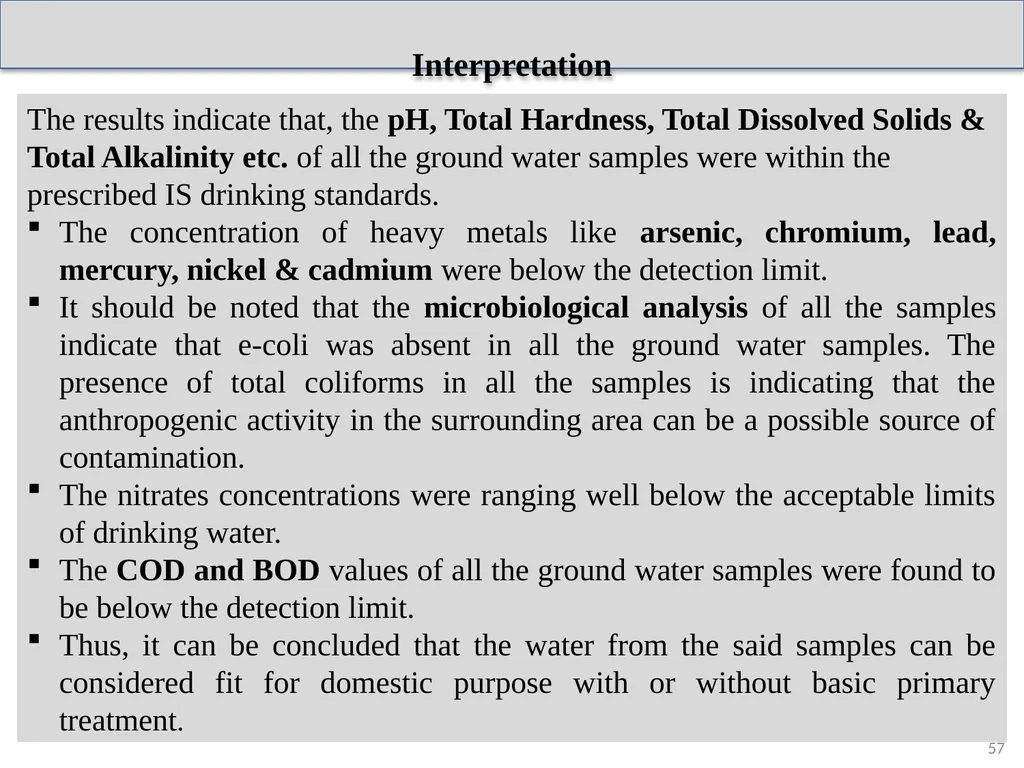
Interpretation 57 The results indicate that, the pH, Total Hardness, Total Dissolved Solids & Total Alkalinity etc. of all the ground water samples were within the prescribed IS drinking standards.
The concentration of heavy metals like arsenic, chromium, lead, mercury, nickel & cadmium were below the detection limit.
It should be noted that the microbiological analysis of all the samples indicate that e-coli was absent in all the ground water samples. The presence of total coliforms in all the samples is indicating that the anthropogenic activity in the surrounding area can be a possible source of contamination.
The nitrates concentrations were ranging well below the acceptable limits of drinking water.
The COD and BOD values of all the ground water samples were found to be below the detection limit.
Thus, it can be concluded that the water from the said samples can be considered fit for domestic purpose with or without basic primary treatment.<br>
The concentration of heavy metals like arsenic, chromium, lead, mercury, nickel & cadmium were below the detection limit.
It should be noted that the microbiological analysis of all the samples indicate that e-coli was absent in all the ground water samples. The presence of total coliforms in all the samples is indicating that the anthropogenic activity in the surrounding area can be a possible source of contamination.
The nitrates concentrations were ranging well below the acceptable limits of drinking water.
The COD and BOD values of all the ground water samples were found to be below the detection limit.
Thus, it can be concluded that the water from the said samples can be considered fit for domestic purpose with or without basic primary treatment.<br>
58
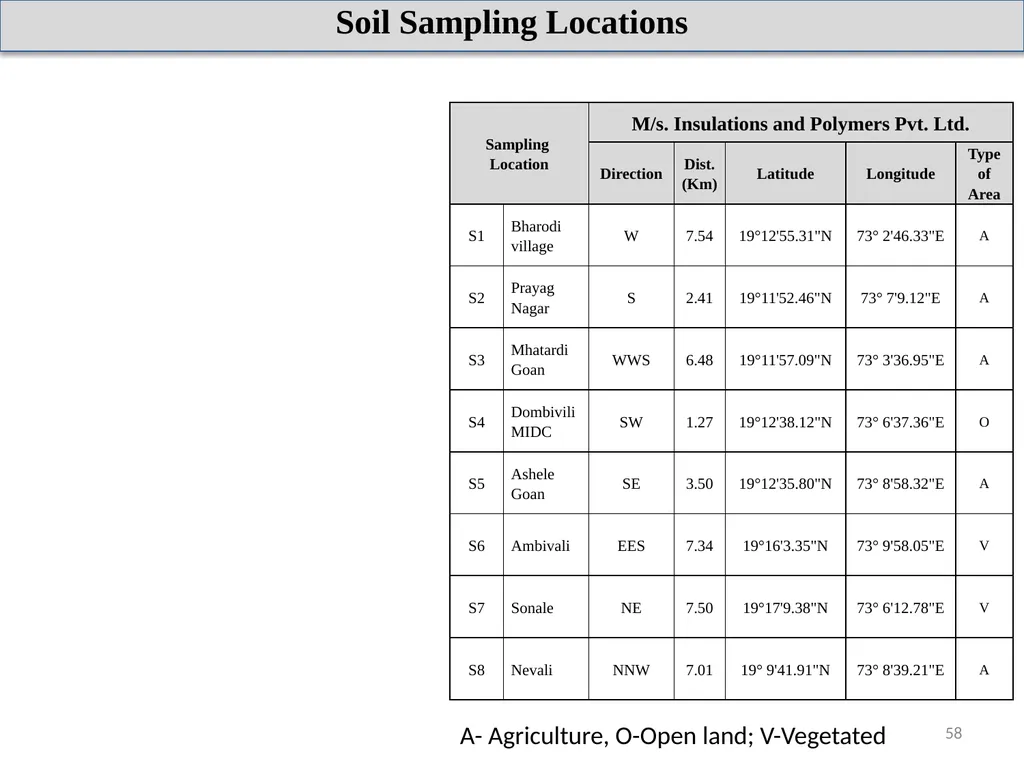
Soil Sampling Locations 58 A- Agriculture, O-Open land; V-Vegetated<br>
59
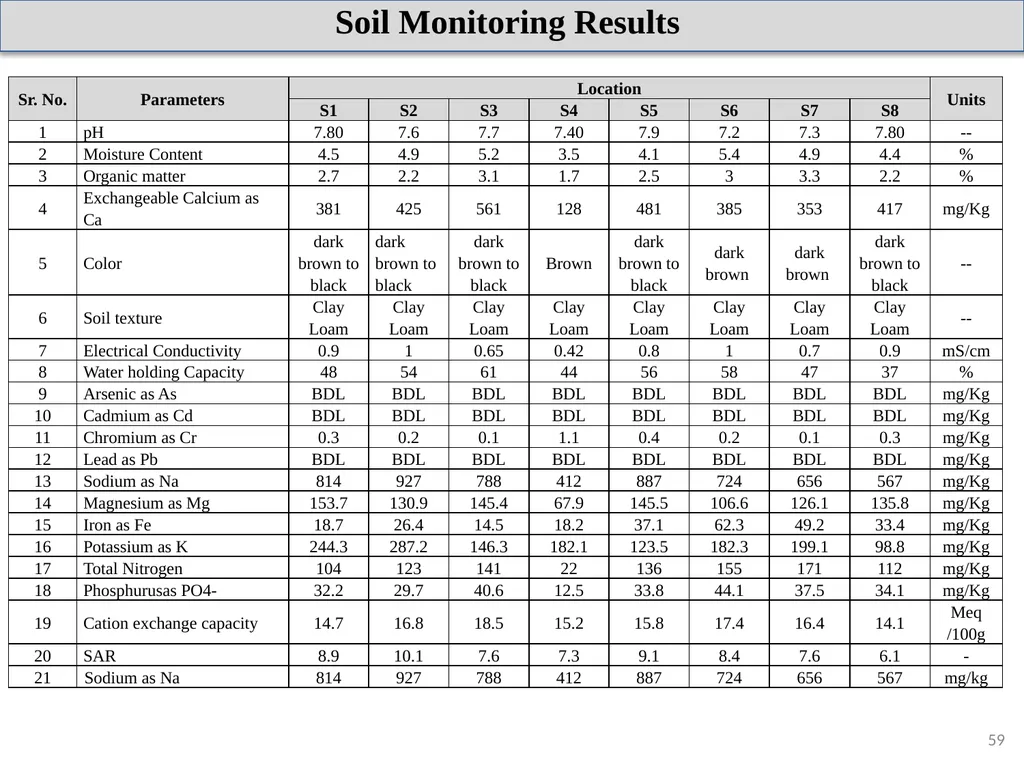
Soil Monitoring Results 59<br>
60
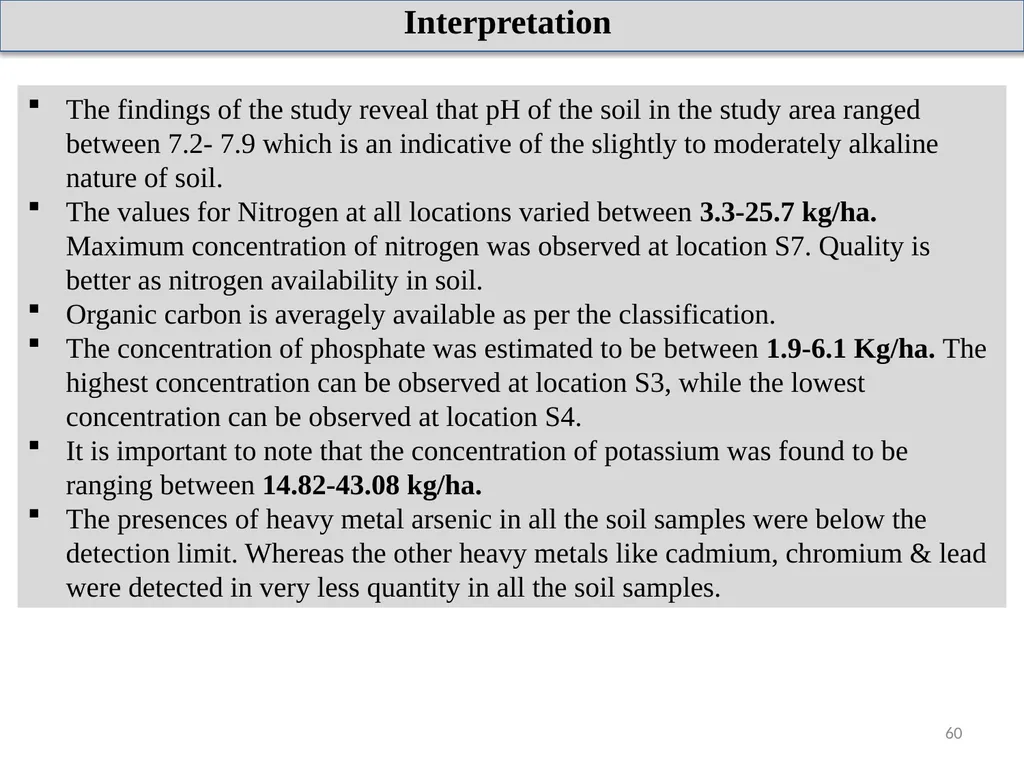
Interpretation 60 The findings of the study reveal that pH of the soil in the study area ranged between 7.2- 7.9 which is an indicative of the slightly to moderately alkaline nature of soil.
The values for Nitrogen at all locations varied between 3.3-25.7 kg/ha. Maximum concentration of nitrogen was observed at location S7. Quality is better as nitrogen availability in soil.
Organic carbon is averagely available as per the classification.
The concentration of phosphate was estimated to be between 1.9-6.1 Kg/ha. The highest concentration can be observed at location S3, while the lowest concentration can be observed at location S4.
It is important to note that the concentration of potassium was found to be ranging between 14.82-43.08 kg/ha.
The presences of heavy metal arsenic in all the soil samples were below the detection limit. Whereas the other heavy metals like cadmium, chromium & lead were detected in very less quantity in all the soil samples.<br>
The values for Nitrogen at all locations varied between 3.3-25.7 kg/ha. Maximum concentration of nitrogen was observed at location S7. Quality is better as nitrogen availability in soil.
Organic carbon is averagely available as per the classification.
The concentration of phosphate was estimated to be between 1.9-6.1 Kg/ha. The highest concentration can be observed at location S3, while the lowest concentration can be observed at location S4.
It is important to note that the concentration of potassium was found to be ranging between 14.82-43.08 kg/ha.
The presences of heavy metal arsenic in all the soil samples were below the detection limit. Whereas the other heavy metals like cadmium, chromium & lead were detected in very less quantity in all the soil samples.<br>
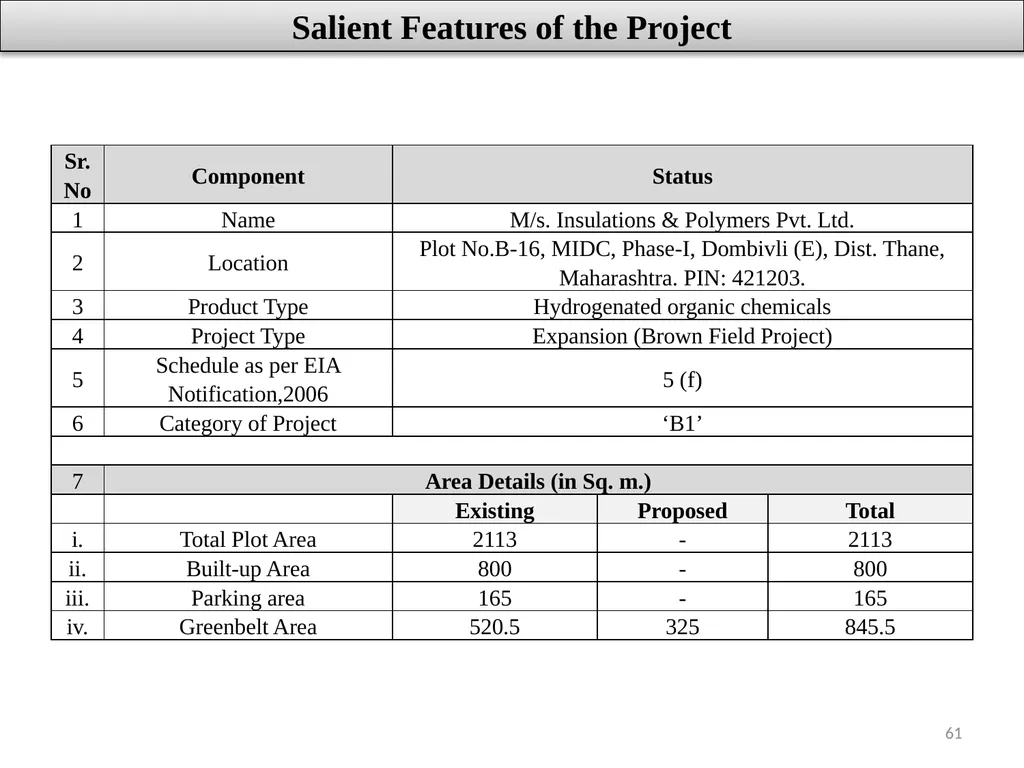
61
61 Salient Features of the Project<br>
62
62 Salient Features of the Project<br>
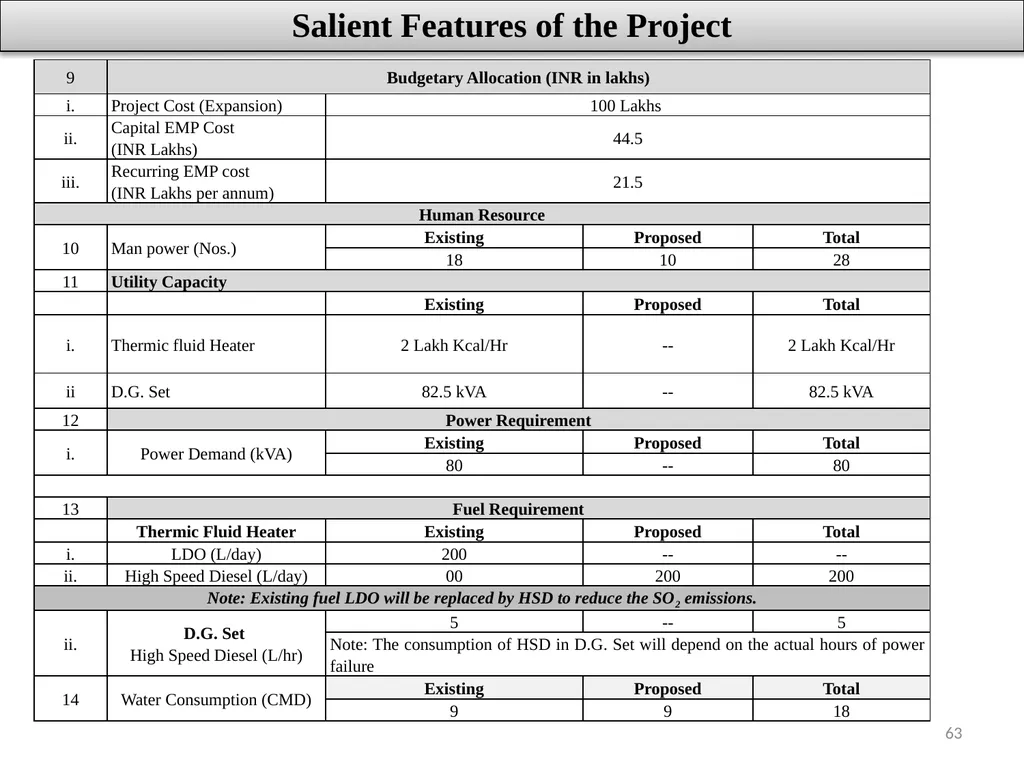
63
63 Salient Features of the Project<br>
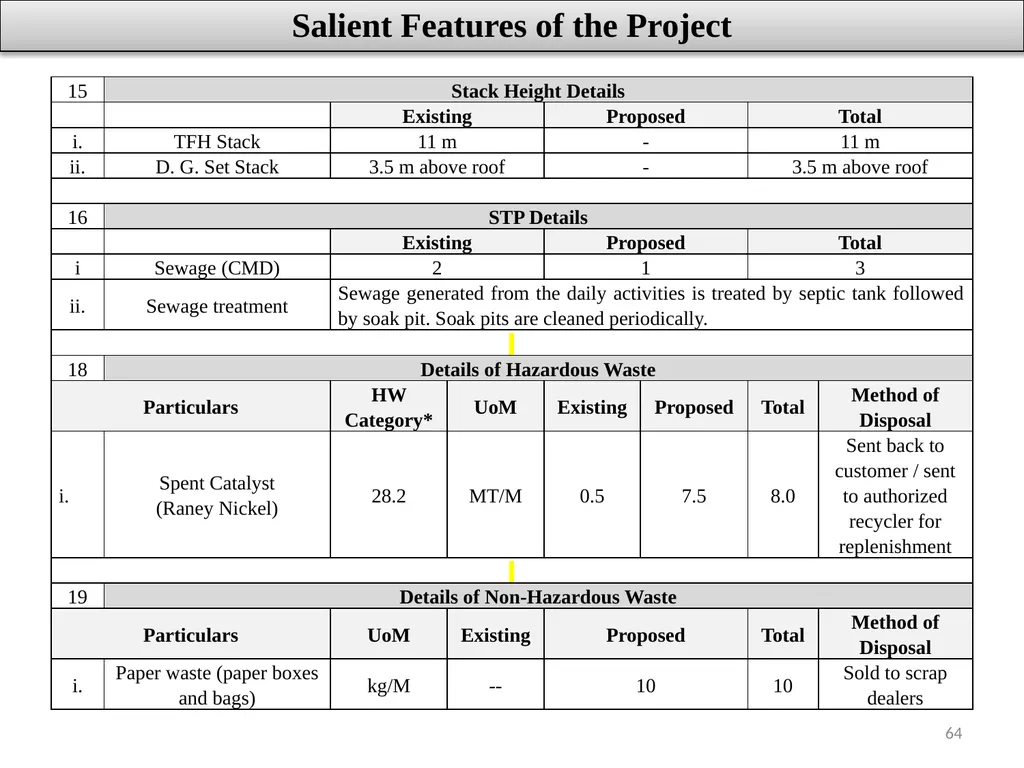
64
64 Salient Features of the Project<br>
65
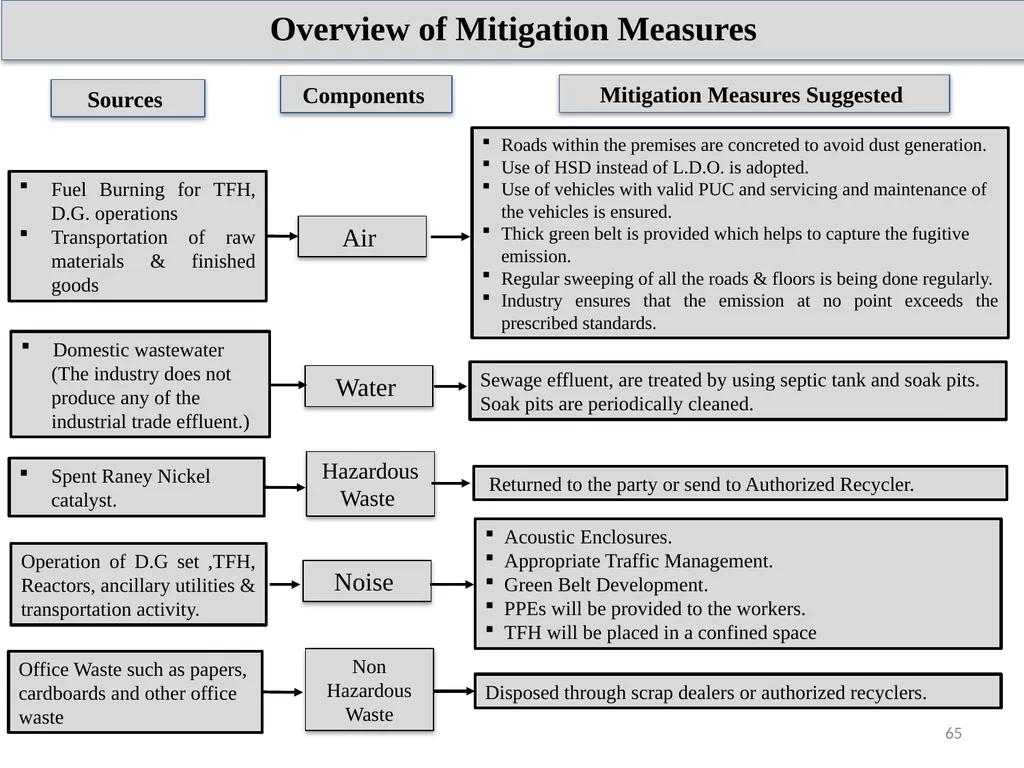
65 Components Air Water Hazardous Waste Noise Sources Mitigation Measures Suggested Operation of D.G set ,TFH, Reactors, ancillary utilities & transportation activity. Acoustic Enclosures.
Appropriate Traffic Management.
Green Belt Development.
PPEs will be provided to the workers.
TFH will be placed in a confined space Spent Raney Nickel catalyst. Returned to the party or send to Authorized Recycler. Fuel Burning for TFH, D.G. operations
Transportation of raw materials & finished goods Roads within the premises are concreted to avoid dust generation.
Use of HSD instead of L.D.O. is adopted.
Use of vehicles with valid PUC and servicing and maintenance of the vehicles is ensured.
Thick green belt is provided which helps to capture the fugitive emission.
Regular sweeping of all the roads & floors is being done regularly.
Industry ensures that the emission at no point exceeds the prescribed standards. Overview of Mitigation Measures Office Waste such as papers, cardboards and other office waste Non Hazardous Waste Disposed through scrap dealers or authorized recyclers. Domestic wastewater
(The industry does not produce any of the industrial trade effluent.) Sewage effluent, are treated by using septic tank and soak pits.
Soak pits are periodically cleaned.<br>
Appropriate Traffic Management.
Green Belt Development.
PPEs will be provided to the workers.
TFH will be placed in a confined space Spent Raney Nickel catalyst. Returned to the party or send to Authorized Recycler. Fuel Burning for TFH, D.G. operations
Transportation of raw materials & finished goods Roads within the premises are concreted to avoid dust generation.
Use of HSD instead of L.D.O. is adopted.
Use of vehicles with valid PUC and servicing and maintenance of the vehicles is ensured.
Thick green belt is provided which helps to capture the fugitive emission.
Regular sweeping of all the roads & floors is being done regularly.
Industry ensures that the emission at no point exceeds the prescribed standards. Overview of Mitigation Measures Office Waste such as papers, cardboards and other office waste Non Hazardous Waste Disposed through scrap dealers or authorized recyclers. Domestic wastewater
(The industry does not produce any of the industrial trade effluent.) Sewage effluent, are treated by using septic tank and soak pits.
Soak pits are periodically cleaned.<br>
66
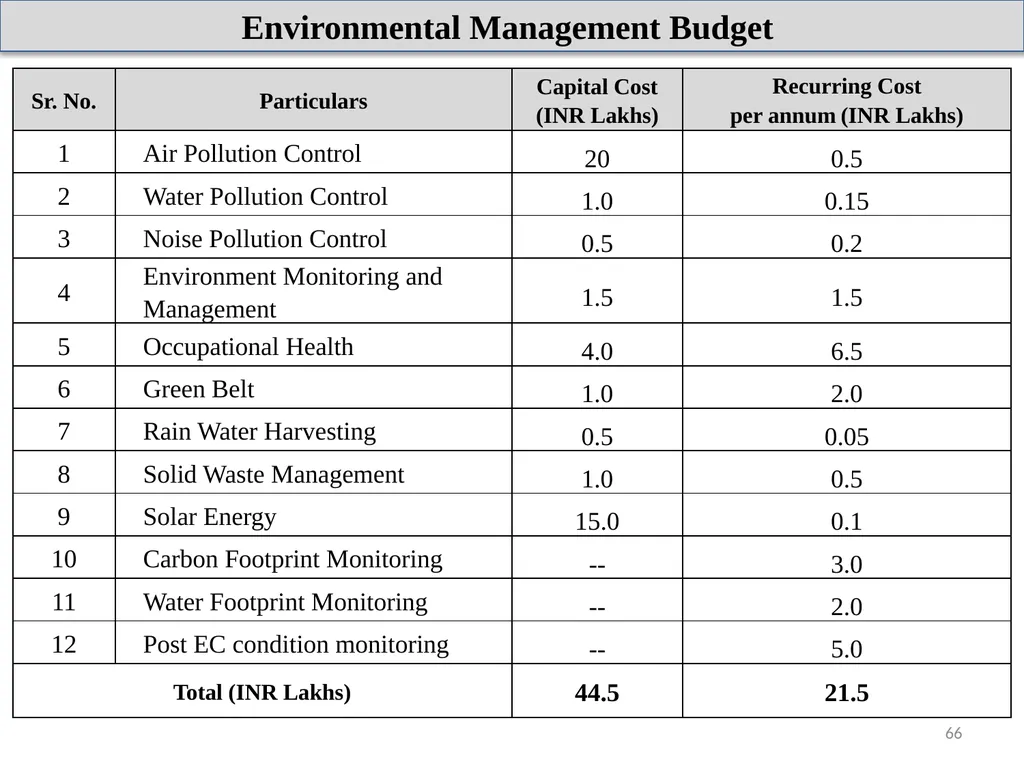
Environmental Management Budget 66<br>
67
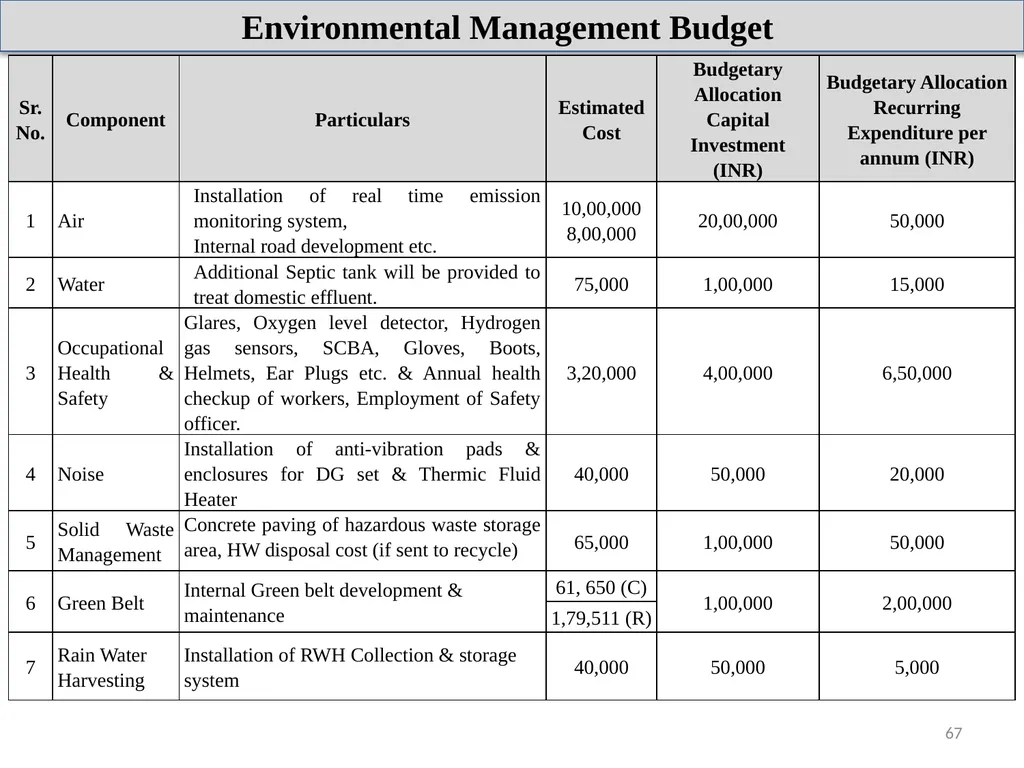
Environmental Management Budget 67<br>
68
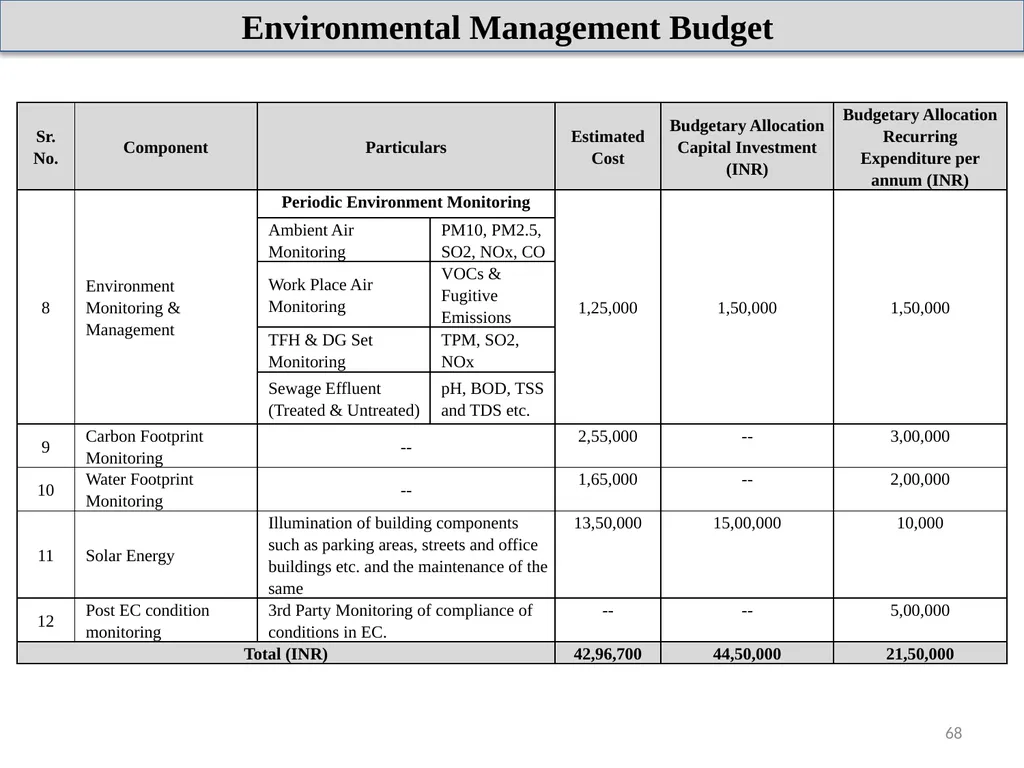
Environmental Management Budget 68<br>
69
Appeal Project Proponent request the SEAC-1 committee to kindly recommend the project for grant of Environmental Clearance. 69<br>
70
70 THANK YOU. . .<br>