
About Science Prof Online PowerPoint Resources
MY
Published · 31 slides · 0 views

1 / 1










Description
About Science Prof Online PowerPoint Resources Science Prof Online (SPO) is a free science education website that provides fully-developed Virtual Science Classrooms, science-related PowerPoints, articles and images. The site is designed to
Related Topics
Share
Embed code
Download this presentation From Below
"About Science Prof Online PowerPoint Resources" is the property of its rightful owner. Permission is granted to download and print the materials on this website for personal, non-commercial use only, and to display it on your personal computer provided you do not modify the materials and that you retain all copyright notices contained in the materials. By downloading content from our website, you accept the terms of this agreement.
Presentation Transcript
01
About Science Prof Online
PowerPoint Resources Science Prof Online (SPO) is a free science education website that provides fully-developed Virtual Science Classrooms, science-related PowerPoints, articles and images. The site is designed to be a helpful resource for students, educators, and anyone interested in learning about science.
The SPO Virtual Classrooms offer many educational resources, including practice test questions, review questions, lecture PowerPoints, video tutorials, sample assignments and course syllabi. New materials are continually being developed, so check back frequently, or follow us on Facebook (Science Prof Online) or Twitter (ScienceProfSPO) for updates.
Many SPO PowerPoints are available in a variety of formats, such as fully editable PowerPoint files (.ppt), as well as uneditable versions in smaller file sizes, such as PowerPoint Shows (.pps) and Portable Document Format (.pdf), for ease of printing. The font “Jokerman” is used frequently in titles. It has a microbiology feel to it. If you do not have this font, some titles may appear odd, oversized and off-center. Find free downloads of Jokerman by Googling “download jokerman font microsoft”.
Images used on this resource, and on the SPO website are, wherever possible, credited and linked to their source. Any words underlined and appearing in blue are links that can be clicked on for more information. PPT files must be viewed in slide show mode to use the hyperlinks directly.
Several helpful links to fun and interactive learning tools are included throughout the PPT and on the Smart Links slide, near the end of each presentation. You must be in slide show mode to utilize hyperlinks and animations.
This digital resource is licensed under Creative Commons Attribution-ShareAlike 3.0:
http://creativecommons.org/licenses/by-sa/3.0/ Alicia Cepaitis, MS
Chief Creative Nerd
Science Prof Online
Online Education Resources, LLC
alicia@scienceprofonline.com From the Virtual Microbiology Classroom on ScienceProfOnline.com Image: Compound microscope objectives, T. Port Tami Port, MS
Creator of Science Prof Online
Chief Executive Nerd
Science Prof Online
Online Education Resources, LLC
info@scienceprofonline.com<br>
PowerPoint Resources Science Prof Online (SPO) is a free science education website that provides fully-developed Virtual Science Classrooms, science-related PowerPoints, articles and images. The site is designed to be a helpful resource for students, educators, and anyone interested in learning about science.
The SPO Virtual Classrooms offer many educational resources, including practice test questions, review questions, lecture PowerPoints, video tutorials, sample assignments and course syllabi. New materials are continually being developed, so check back frequently, or follow us on Facebook (Science Prof Online) or Twitter (ScienceProfSPO) for updates.
Many SPO PowerPoints are available in a variety of formats, such as fully editable PowerPoint files (.ppt), as well as uneditable versions in smaller file sizes, such as PowerPoint Shows (.pps) and Portable Document Format (.pdf), for ease of printing. The font “Jokerman” is used frequently in titles. It has a microbiology feel to it. If you do not have this font, some titles may appear odd, oversized and off-center. Find free downloads of Jokerman by Googling “download jokerman font microsoft”.
Images used on this resource, and on the SPO website are, wherever possible, credited and linked to their source. Any words underlined and appearing in blue are links that can be clicked on for more information. PPT files must be viewed in slide show mode to use the hyperlinks directly.
Several helpful links to fun and interactive learning tools are included throughout the PPT and on the Smart Links slide, near the end of each presentation. You must be in slide show mode to utilize hyperlinks and animations.
This digital resource is licensed under Creative Commons Attribution-ShareAlike 3.0:
http://creativecommons.org/licenses/by-sa/3.0/ Alicia Cepaitis, MS
Chief Creative Nerd
Science Prof Online
Online Education Resources, LLC
alicia@scienceprofonline.com From the Virtual Microbiology Classroom on ScienceProfOnline.com Image: Compound microscope objectives, T. Port Tami Port, MS
Creator of Science Prof Online
Chief Executive Nerd
Science Prof Online
Online Education Resources, LLC
info@scienceprofonline.com<br>
02
History of
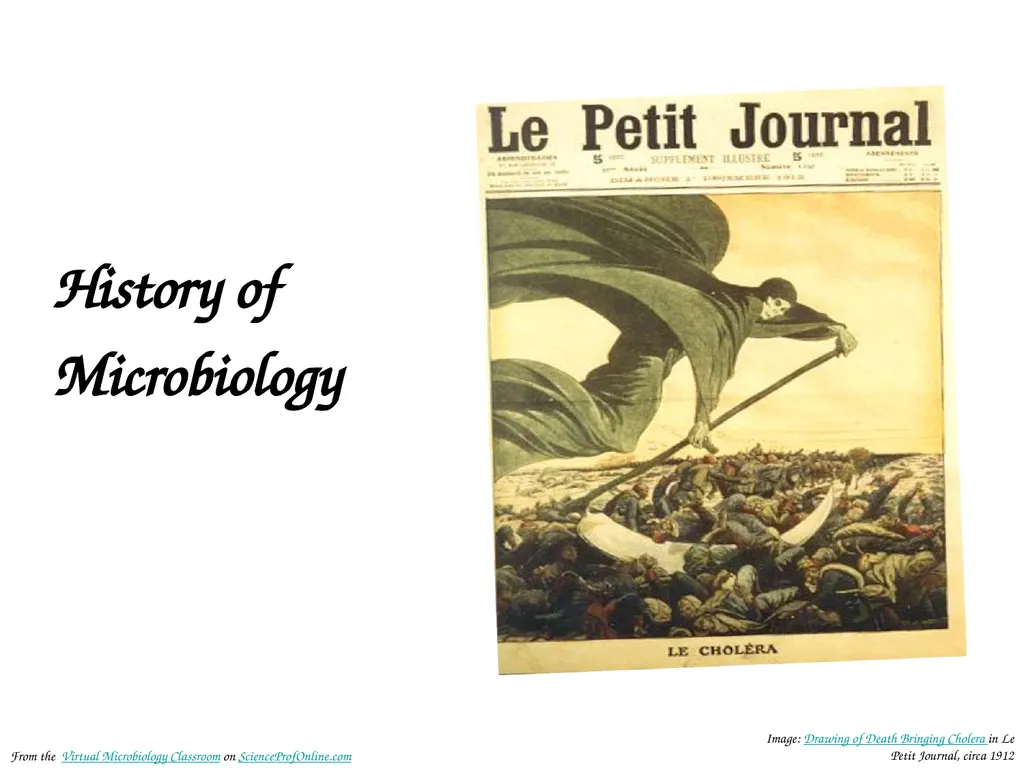
Microbiology Image: Drawing of Death Bringing Cholera in Le Petit Journal, circa 1912 From the Virtual Microbiology Classroom on ScienceProfOnline.com<br>
Microbiology Image: Drawing of Death Bringing Cholera in Le Petit Journal, circa 1912 From the Virtual Microbiology Classroom on ScienceProfOnline.com<br>
03
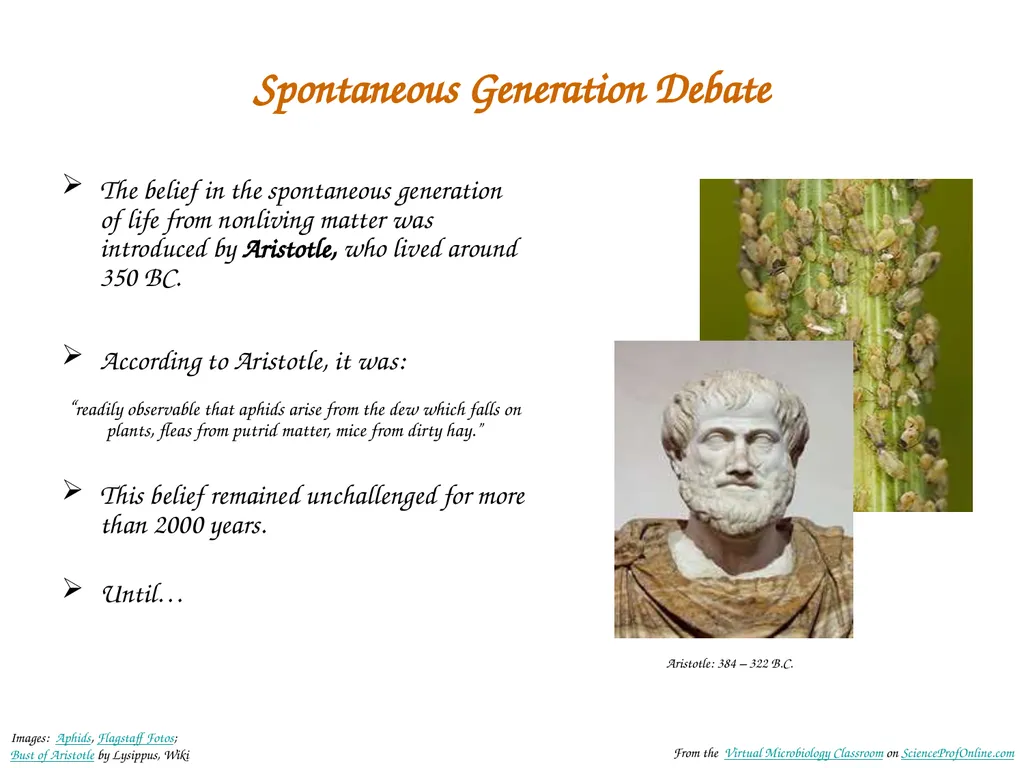
Spontaneous Generation Debate The belief in the spontaneous generation of life from nonliving matter was introduced by Aristotle, who lived around 350 BC.
According to Aristotle, it was:
“readily observable that aphids arise from the dew which falls on plants, fleas from putrid matter, mice from dirty hay.”
This belief remained unchallenged for more than 2000 years.
Until… Images: Aphids, Flagstaff Fotos; Bust of Aristotle by Lysippus, Wiki Aristotle: 384 – 322 B.C. From the Virtual Microbiology Classroom on ScienceProfOnline.com<br>
According to Aristotle, it was:
“readily observable that aphids arise from the dew which falls on plants, fleas from putrid matter, mice from dirty hay.”
This belief remained unchallenged for more than 2000 years.
Until… Images: Aphids, Flagstaff Fotos; Bust of Aristotle by Lysippus, Wiki Aristotle: 384 – 322 B.C. From the Virtual Microbiology Classroom on ScienceProfOnline.com<br>
04
Spontaneous Generation Debate
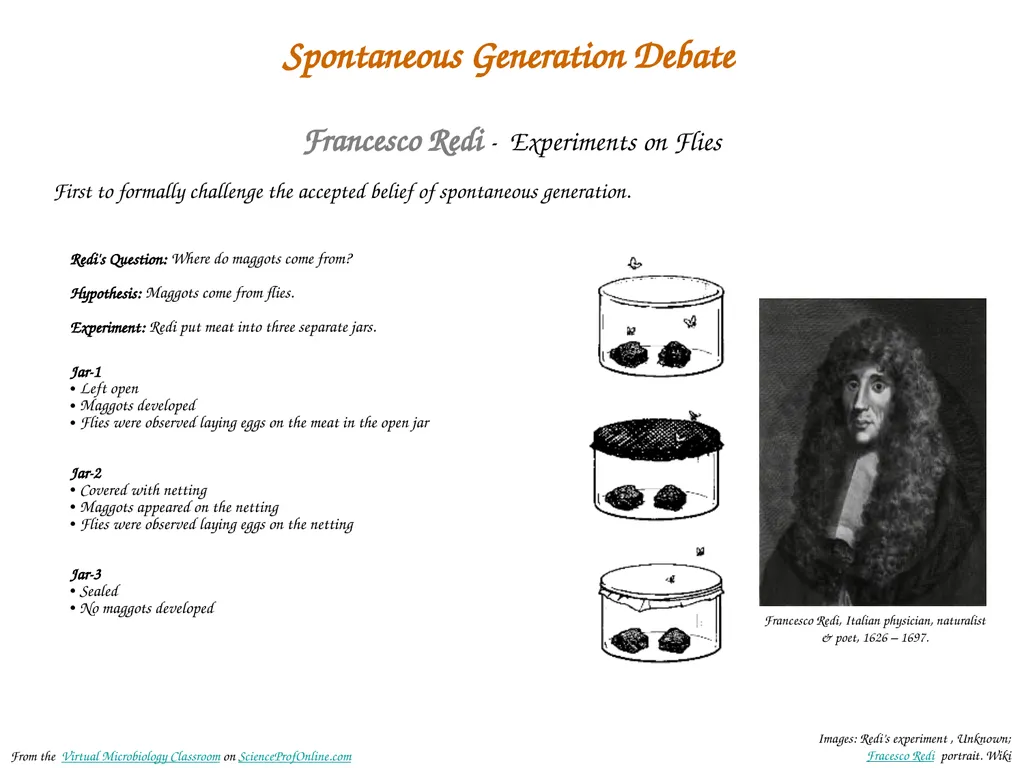
Francesco Redi - Experiments on Flies First to formally challenge the accepted belief of spontaneous generation. Francesco Redi, Italian physician, naturalist & poet, 1626 – 1697. Images: Redi’s experiment , Unknown; Fracesco Redi portrait. Wiki From the Virtual Microbiology Classroom on ScienceProfOnline.com<br>
05
Spontaneous Generation Debate
Anton van Leeuwenhoek’s “Animalcules”
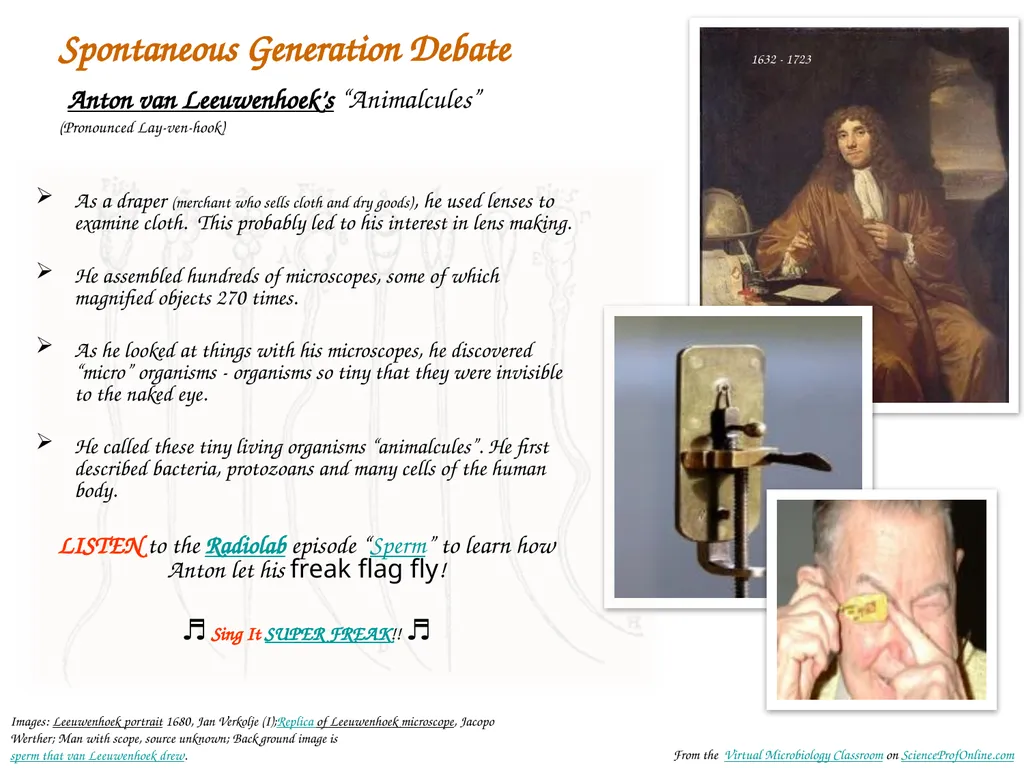
(Pronounced Lay-ven-hook) Images: Leeuwenhoek portrait 1680, Jan Verkolje (I);Replica of Leeuwenhoek microscope, Jacopo Werther; Man with scope, source unknown; Background image is sperm that van Leeuwenhoek drew. 1632 - 1723 From the Virtual Microbiology Classroom on ScienceProfOnline.com As a draper (merchant who sells cloth and dry goods), he used lenses to examine cloth. This probably led to his interest in lens making.
He assembled hundreds of microscopes, some of which magnified objects 270 times.
As he looked at things with his microscopes, he discovered “micro” organisms - organisms so tiny that they were invisible to the naked eye.
He called these tiny living organisms “animalcules”. He first described bacteria, protozoans and many cells of the human body.
LISTEN to the Radiolab episode “Sperm” to learn how Anton let his freak flag fly!
♬ Sing It SUPER FREAK!! ♬<br>
He assembled hundreds of microscopes, some of which magnified objects 270 times.
As he looked at things with his microscopes, he discovered “micro” organisms - organisms so tiny that they were invisible to the naked eye.
He called these tiny living organisms “animalcules”. He first described bacteria, protozoans and many cells of the human body.
LISTEN to the Radiolab episode “Sperm” to learn how Anton let his freak flag fly!
♬ Sing It SUPER FREAK!! ♬<br>
06
Anton van Leeuwenhoek: “Animalcules”
(Pronounced Lay-when-hook) Below is a poem about Van Leeuwenhoek by Maxine Kumin, from the fantastic book of science-related poetry The Tree That Time Built.
The Microscope
Anton Leeuwenhoek was Dutch. He sold pincushions, cloth, and such.
The waiting townsfolk fumed and fussed, as Anton’s dry goods gathered dust.
He worked, instead of tending store,
At grinding special lenses for
A microscope. Some of the things
He looked at were: mosquitoes’ wings,
the hairs of sheep, the legs of lice,
the skin of people, dogs, and mice;
ox eyes, spiders’ spinning gear,
fishes’ scales, a little smear
of his own blood, and best of all,
the unknown, busy, very small
bugs that swim and bump and hop
inside a simple water drop.
Impossible! Most Dutchmen said.
This Anton’s crazy in the head!
We ought to ship him off to Spain!
He says he’s seen a housefly’s brain!
He says the water that we drink
Is full of bugs! He’s mad, we think!
They called him dumkopf, which means dope.
That’s how we got the microscope. From the Virtual Cell Biology Classroom on ScienceProfOnline.com Watch Video:
“Pond Life Under the Microscope”<br>
The Microscope
Anton Leeuwenhoek was Dutch. He sold pincushions, cloth, and such.
The waiting townsfolk fumed and fussed, as Anton’s dry goods gathered dust.
He worked, instead of tending store,
At grinding special lenses for
A microscope. Some of the things
He looked at were: mosquitoes’ wings,
the hairs of sheep, the legs of lice,
the skin of people, dogs, and mice;
ox eyes, spiders’ spinning gear,
fishes’ scales, a little smear
of his own blood, and best of all,
the unknown, busy, very small
bugs that swim and bump and hop
inside a simple water drop.
Impossible! Most Dutchmen said.
This Anton’s crazy in the head!
We ought to ship him off to Spain!
He says he’s seen a housefly’s brain!
He says the water that we drink
Is full of bugs! He’s mad, we think!
They called him dumkopf, which means dope.
That’s how we got the microscope. From the Virtual Cell Biology Classroom on ScienceProfOnline.com Watch Video:
“Pond Life Under the Microscope”<br>
07
The Controversy Over Spontaneous Generation
John Needham & Lazzaro Spallanzani The Question:
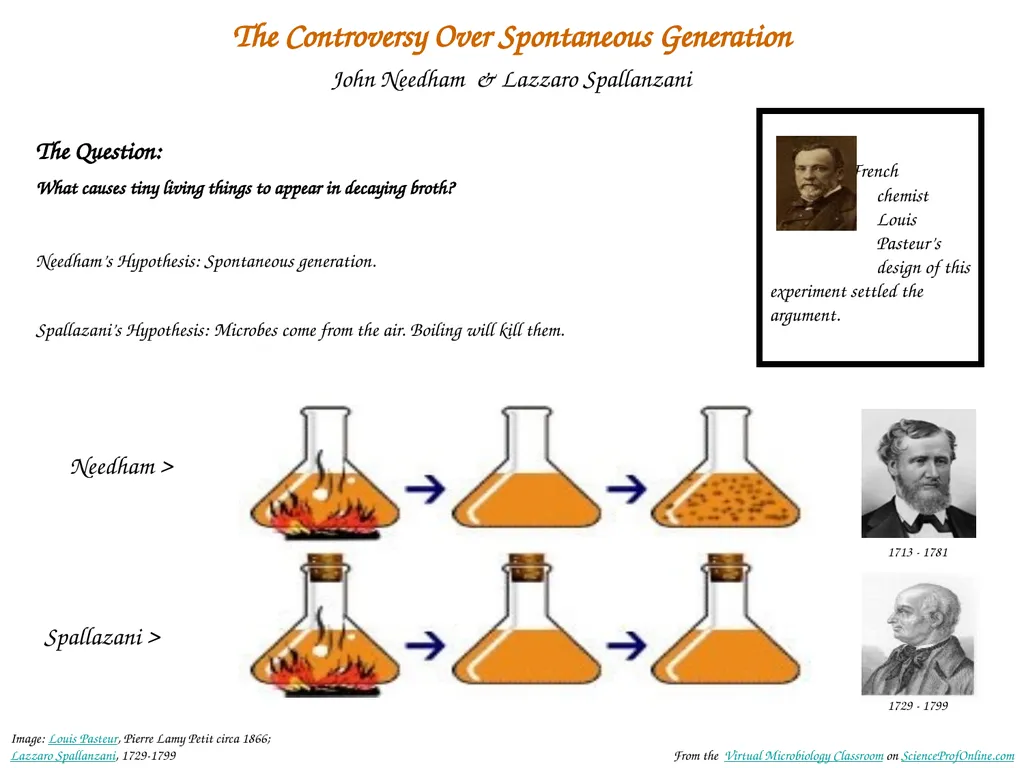
What causes tiny living things to appear in decaying broth?
Needham’s Hypothesis: Spontaneous generation.
Spallazani’s Hypothesis: Microbes come from the air. Boiling will kill them. Needham > Spallazani > French chemist Louis Pasteur’s design of this experiment settled the argument. Image: Louis Pasteur, Pierre Lamy Petit circa 1866; Lazzaro Spallanzani, 1729-1799 1713 - 1781 1729 - 1799 From the Virtual Microbiology Classroom on ScienceProfOnline.com<br>
What causes tiny living things to appear in decaying broth?
Needham’s Hypothesis: Spontaneous generation.
Spallazani’s Hypothesis: Microbes come from the air. Boiling will kill them. Needham > Spallazani > French chemist Louis Pasteur’s design of this experiment settled the argument. Image: Louis Pasteur, Pierre Lamy Petit circa 1866; Lazzaro Spallanzani, 1729-1799 1713 - 1781 1729 - 1799 From the Virtual Microbiology Classroom on ScienceProfOnline.com<br>
08
The Controversy Over Spontaneous Generation
Louis Pasteur & Industrial Microbiology - Q: What is fermentation?
- What causes fermentation?
Some scientists thought that air caused fermentation
Others thought that microbes caused fermentation.
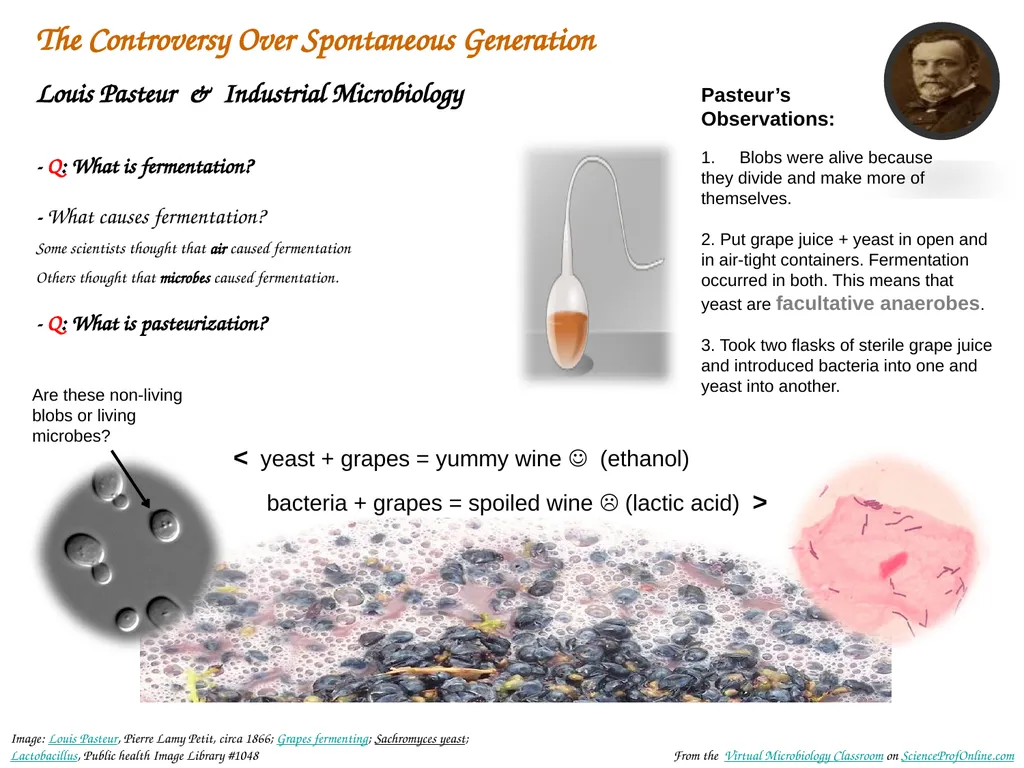
- Q: What is pasteurization? Image: Louis Pasteur, Pierre Lamy Petit, circa 1866; Grapes fermenting; Sachromyces yeast; Lactobacillus, Public health Image Library #1048 From the Virtual Microbiology Classroom on ScienceProfOnline.com < yeast + grapes = yummy wine (ethanol)
bacteria + grapes = spoiled wine (lactic acid) > Are these non-living blobs or living microbes? Pasteur’s
Observations:
Blobs were alive because
they divide and make more of themselves.
2. Put grape juice + yeast in open and in air-tight containers. Fermentation occurred in both. This means that yeast are facultative anaerobes.
3. Took two flasks of sterile grape juice and introduced bacteria into one and yeast into another.<br>
- What causes fermentation?
Some scientists thought that air caused fermentation
Others thought that microbes caused fermentation.
- Q: What is pasteurization? Image: Louis Pasteur, Pierre Lamy Petit, circa 1866; Grapes fermenting; Sachromyces yeast; Lactobacillus, Public health Image Library #1048 From the Virtual Microbiology Classroom on ScienceProfOnline.com < yeast + grapes = yummy wine (ethanol)
bacteria + grapes = spoiled wine (lactic acid) > Are these non-living blobs or living microbes? Pasteur’s
Observations:
Blobs were alive because
they divide and make more of themselves.
2. Put grape juice + yeast in open and in air-tight containers. Fermentation occurred in both. This means that yeast are facultative anaerobes.
3. Took two flasks of sterile grape juice and introduced bacteria into one and yeast into another.<br>
09
REVIEW! Animated lesson of experiments testing Spontaneous Generation From the Virtual Microbiology Classroom on ScienceProfOnline.com Images: Redi’s experiment , Unknown; Swan neck flask, Wiki<br>
10
The Germ Theory of Disease Sherlock This…
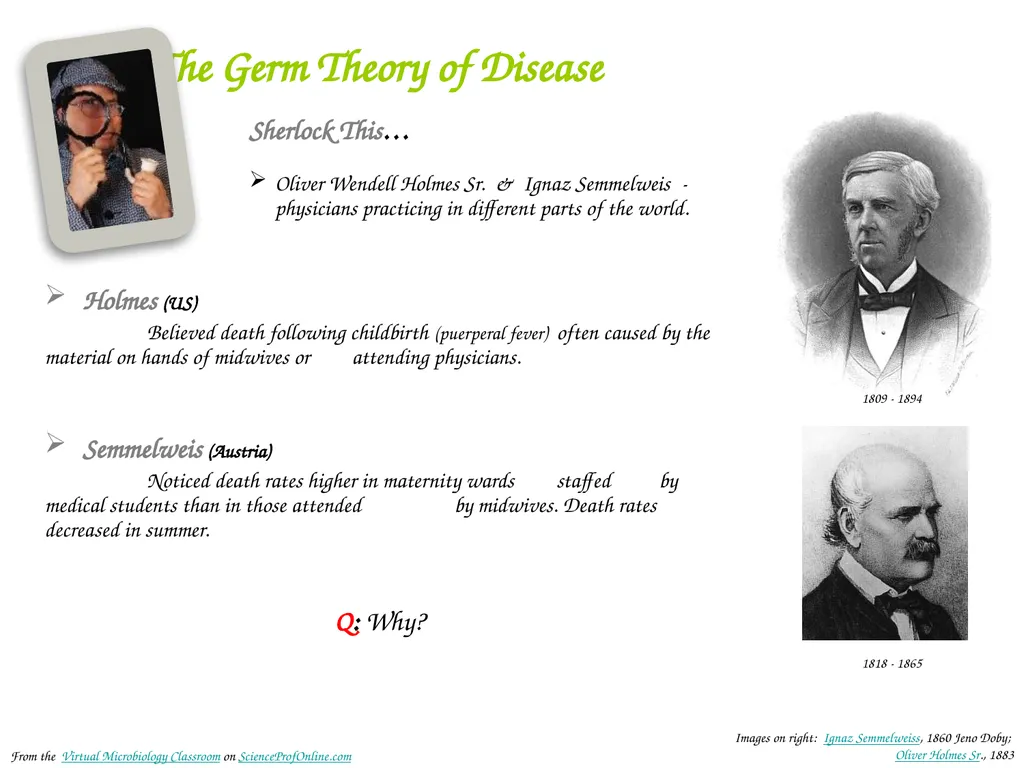
Oliver Wendell Holmes Sr. & Ignaz Semmelweis - physicians practicing in different parts of the world.
Holmes (US)
Believed death following childbirth (puerperal fever) often caused by the material on hands of midwives or attending physicians.
Semmelweis (Austria)
Noticed death rates higher in maternity wards staffed by medical students than in those attended by midwives. Death rates decreased in summer.
Q: Why? Images on right: Ignaz Semmelweiss, 1860 Jeno Doby; Oliver Holmes Sr., 1883 1809 - 1894 1818 - 1865 From the Virtual Microbiology Classroom on ScienceProfOnline.com<br>
Oliver Wendell Holmes Sr. & Ignaz Semmelweis - physicians practicing in different parts of the world.
Holmes (US)
Believed death following childbirth (puerperal fever) often caused by the material on hands of midwives or attending physicians.
Semmelweis (Austria)
Noticed death rates higher in maternity wards staffed by medical students than in those attended by midwives. Death rates decreased in summer.
Q: Why? Images on right: Ignaz Semmelweiss, 1860 Jeno Doby; Oliver Holmes Sr., 1883 1809 - 1894 1818 - 1865 From the Virtual Microbiology Classroom on ScienceProfOnline.com<br>
11
The Germ Theory of Disease
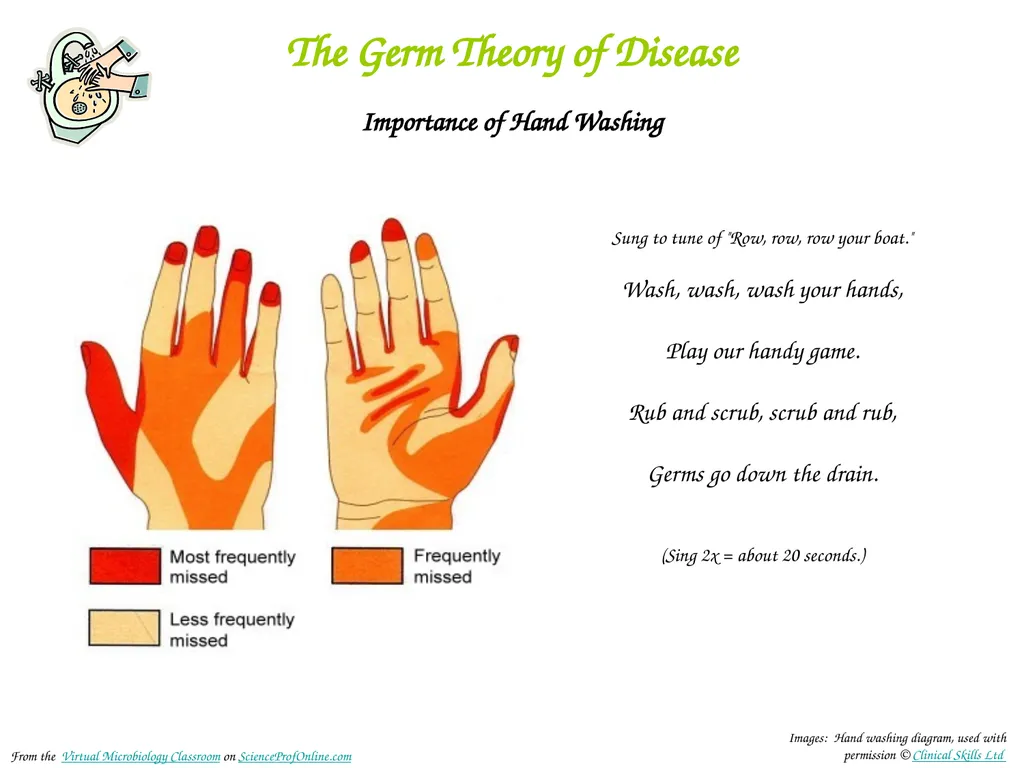
Importance of Hand Washing Images: Hand washing diagram, used with permission © Clinical Skills Ltd Sung to tune of "Row, row, row your boat."
Wash, wash, wash your hands,
Play our handy game.
Rub and scrub, scrub and rub,
Germs go down the drain.
(Sing 2x = about 20 seconds.) From the Virtual Microbiology Classroom on ScienceProfOnline.com<br>
Wash, wash, wash your hands,
Play our handy game.
Rub and scrub, scrub and rub,
Germs go down the drain.
(Sing 2x = about 20 seconds.) From the Virtual Microbiology Classroom on ScienceProfOnline.com<br>
12
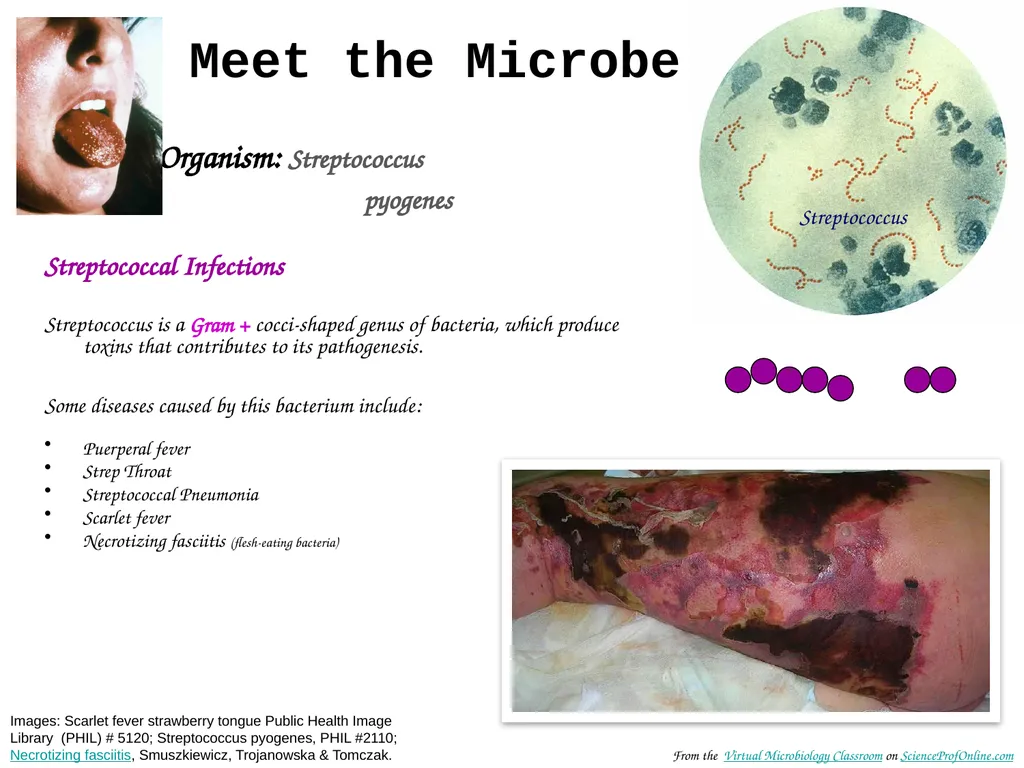
Meet the Microbe! Organism: Streptococcus
pyogenes
Streptococcal Infections
Streptococcus is a Gram + cocci-shaped genus of bacteria, which produce toxins that contributes to its pathogenesis.
Some diseases caused by this bacterium include:
Puerperal fever
Strep Throat
Streptococcal Pneumonia
Scarlet fever
Necrotizing fasciitis (flesh-eating bacteria) Streptococcus Images: Scarlet fever strawberry tongue Public Health Image Library (PHIL) # 5120; Streptococcus pyogenes, PHIL #2110; Necrotizing fasciitis, Smuszkiewicz, Trojanowska & Tomczak. From the Virtual Microbiology Classroom on ScienceProfOnline.com<br>
pyogenes
Streptococcal Infections
Streptococcus is a Gram + cocci-shaped genus of bacteria, which produce toxins that contributes to its pathogenesis.
Some diseases caused by this bacterium include:
Puerperal fever
Strep Throat
Streptococcal Pneumonia
Scarlet fever
Necrotizing fasciitis (flesh-eating bacteria) Streptococcus Images: Scarlet fever strawberry tongue Public Health Image Library (PHIL) # 5120; Streptococcus pyogenes, PHIL #2110; Necrotizing fasciitis, Smuszkiewicz, Trojanowska & Tomczak. From the Virtual Microbiology Classroom on ScienceProfOnline.com<br>
13
Germ Theory of Disease
Dr. John Snow & the Investigation of Cholera Played key role in setting standards for good public hygiene and preventing spread of infectious disease.
Snow skeptic of the then-dominant “miasma theory” (disease caused by bad air).
Believed cholera transmitted by water contaminated with waste of other cholera sufferers.
Mapped occurrence of cholera cases during epidemic in London and found cases centered around a specific public water supply.
Asked city of London to dismantle the pump.
Q: What do you think happened once water pump was dismantled? Images: Snow’s map of London, published by C.F. Cheffins, 1854;. John Snow, 1813-1858, Wiki 1813 - 1858 From the Virtual Microbiology Classroom on ScienceProfOnline.com<br>
Snow skeptic of the then-dominant “miasma theory” (disease caused by bad air).
Believed cholera transmitted by water contaminated with waste of other cholera sufferers.
Mapped occurrence of cholera cases during epidemic in London and found cases centered around a specific public water supply.
Asked city of London to dismantle the pump.
Q: What do you think happened once water pump was dismantled? Images: Snow’s map of London, published by C.F. Cheffins, 1854;. John Snow, 1813-1858, Wiki 1813 - 1858 From the Virtual Microbiology Classroom on ScienceProfOnline.com<br>
14
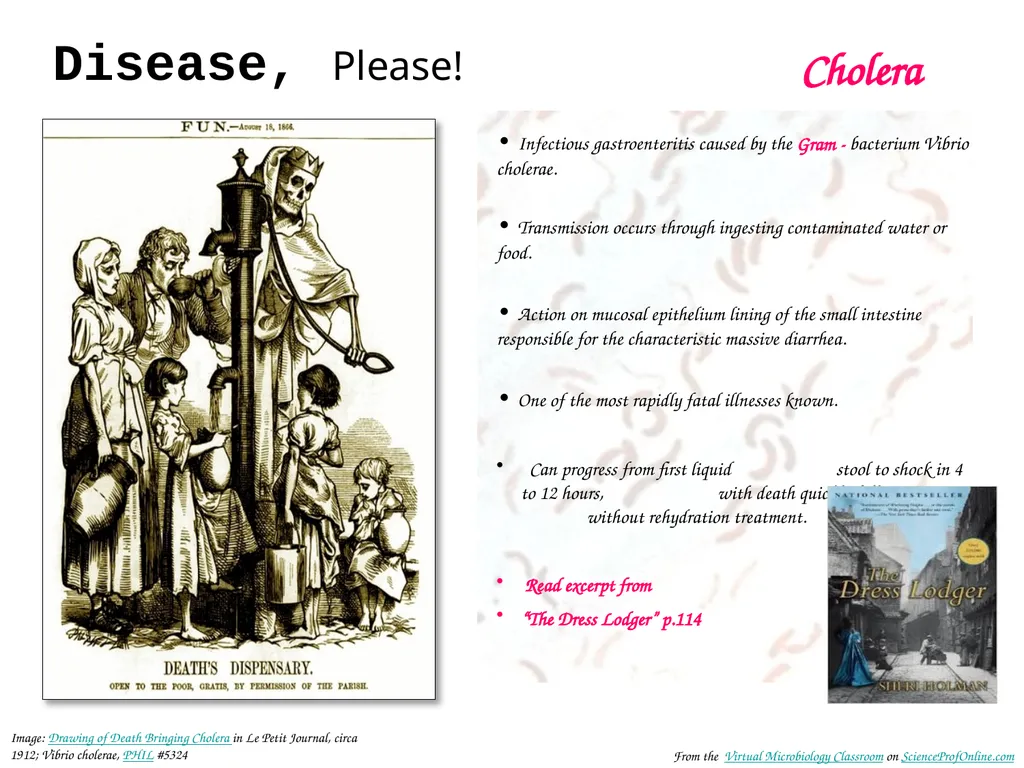
Cholera Disease, Please! • Infectious gastroenteritis caused by the Gram - bacterium Vibrio cholerae.
• Transmission occurs through ingesting contaminated water or food.
• Action on mucosal epithelium lining of the small intestine responsible for the characteristic massive diarrhea.
• One of the most rapidly fatal illnesses known.
Can progress from first liquid stool to shock in 4 to 12 hours, with death quickly following without rehydration treatment.
Read excerpt from
“The Dress Lodger” p.114 Image: Drawing of Death Bringing Cholera in Le Petit Journal, circa 1912; Vibrio cholerae, PHIL #5324 From the Virtual Microbiology Classroom on ScienceProfOnline.com<br>
• Transmission occurs through ingesting contaminated water or food.
• Action on mucosal epithelium lining of the small intestine responsible for the characteristic massive diarrhea.
• One of the most rapidly fatal illnesses known.
Can progress from first liquid stool to shock in 4 to 12 hours, with death quickly following without rehydration treatment.
Read excerpt from
“The Dress Lodger” p.114 Image: Drawing of Death Bringing Cholera in Le Petit Journal, circa 1912; Vibrio cholerae, PHIL #5324 From the Virtual Microbiology Classroom on ScienceProfOnline.com<br>
15
Germ Theory of Disease
John Tyndall and the Discovery of Endospores Discovered that some bacteria existed in two forms:
1. heat-stable form (endospore)
2. heat-sensitive form (vegetative cell)
Need prolonged or intermittent heating to destroy the heat-stable endospores.
His research resulted in a method of sterilizing liquid by heating it to boiling point on successive days, referred to as Tyndallization.
Tyndallization is useful for sterilization of growth media in science classes and other situations where autoclaves not available for pressure sterilization. Images: John Tyndall; , H.B. Hall N.Y. 1878; Endospore stain T. Port 1820 - 1893 From the Virtual Microbiology Classroom on ScienceProfOnline.com Variations in endospore morphology: (1, 4) central endospore; (2, 3, 5)
terminal endospore; (6) lateral endospore<br>
1. heat-stable form (endospore)
2. heat-sensitive form (vegetative cell)
Need prolonged or intermittent heating to destroy the heat-stable endospores.
His research resulted in a method of sterilizing liquid by heating it to boiling point on successive days, referred to as Tyndallization.
Tyndallization is useful for sterilization of growth media in science classes and other situations where autoclaves not available for pressure sterilization. Images: John Tyndall; , H.B. Hall N.Y. 1878; Endospore stain T. Port 1820 - 1893 From the Virtual Microbiology Classroom on ScienceProfOnline.com Variations in endospore morphology: (1, 4) central endospore; (2, 3, 5)
terminal endospore; (6) lateral endospore<br>
16
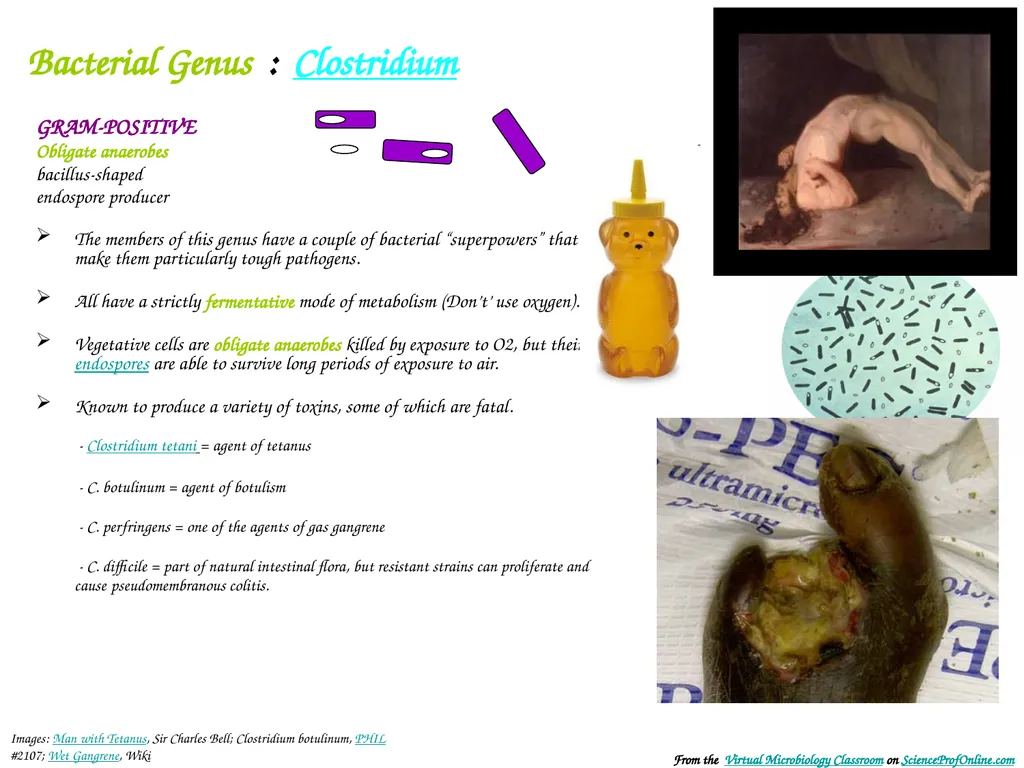
Bacterial Genus : Clostridium GRAM-POSITIVE
Obligate anaerobes
bacillus-shaped
endospore producer
The members of this genus have a couple of bacterial “superpowers” that make them particularly tough pathogens.
All have a strictly fermentative mode of metabolism (Don’t’ use oxygen).
Vegetative cells are obligate anaerobes killed by exposure to O2, but their endospores are able to survive long periods of exposure to air.
Known to produce a variety of toxins, some of which are fatal.
- Clostridium tetani = agent of tetanus
- C. botulinum = agent of botulism
- C. perfringens = one of the agents of gas gangrene
- C. difficile = part of natural intestinal flora, but resistant strains can proliferate and cause pseudomembranous colitis. Images: Man with Tetanus, Sir Charles Bell; Clostridium botulinum, PHIL #2107; Wet Gangrene, Wiki From the Virtual Microbiology Classroom on ScienceProfOnline.com<br>
Obligate anaerobes
bacillus-shaped
endospore producer
The members of this genus have a couple of bacterial “superpowers” that make them particularly tough pathogens.
All have a strictly fermentative mode of metabolism (Don’t’ use oxygen).
Vegetative cells are obligate anaerobes killed by exposure to O2, but their endospores are able to survive long periods of exposure to air.
Known to produce a variety of toxins, some of which are fatal.
- Clostridium tetani = agent of tetanus
- C. botulinum = agent of botulism
- C. perfringens = one of the agents of gas gangrene
- C. difficile = part of natural intestinal flora, but resistant strains can proliferate and cause pseudomembranous colitis. Images: Man with Tetanus, Sir Charles Bell; Clostridium botulinum, PHIL #2107; Wet Gangrene, Wiki From the Virtual Microbiology Classroom on ScienceProfOnline.com<br>
17
Germ Theory of Disease
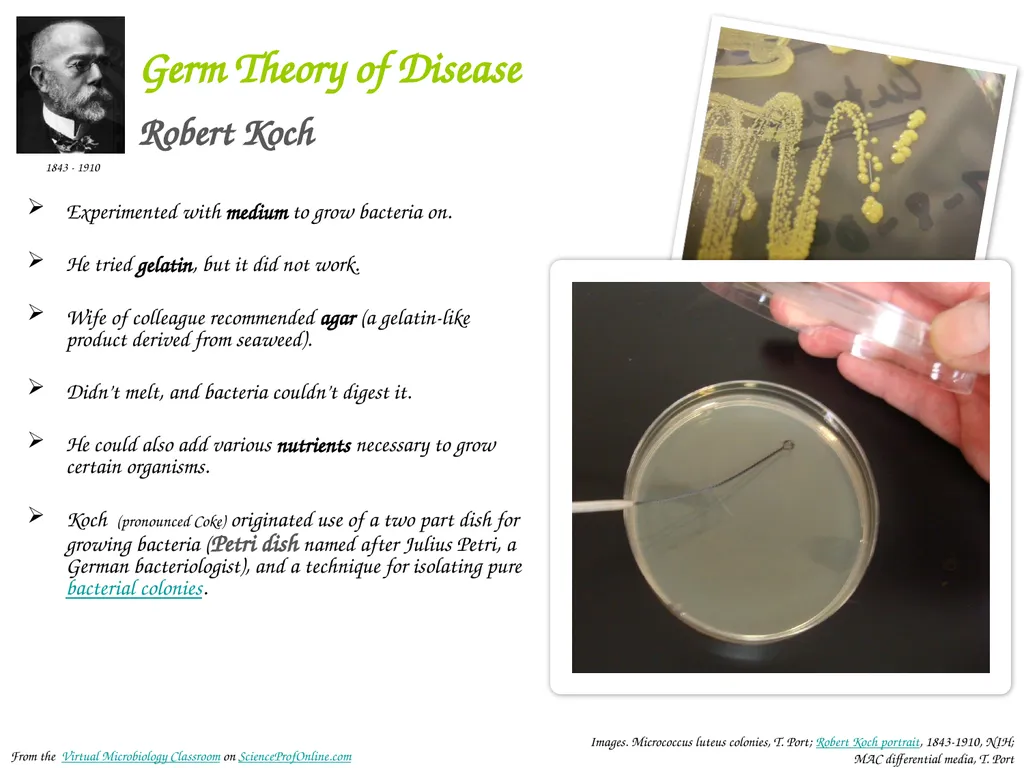
Robert Koch Experimented with medium to grow bacteria on.
He tried gelatin, but it did not work.
Wife of colleague recommended agar (a gelatin-like product derived from seaweed).
Didn’t melt, and bacteria couldn’t digest it.
He could also add various nutrients necessary to grow certain organisms.
Koch (pronounced Coke) originated use of a two part dish for growing bacteria (Petri dish named after Julius Petri, a German bacteriologist), and a technique for isolating pure bacterial colonies. Images. Micrococcus luteus colonies, T. Port; Robert Koch portrait, 1843-1910, NIH; MAC differential media, T. Port 1843 - 1910 From the Virtual Microbiology Classroom on ScienceProfOnline.com<br>
He tried gelatin, but it did not work.
Wife of colleague recommended agar (a gelatin-like product derived from seaweed).
Didn’t melt, and bacteria couldn’t digest it.
He could also add various nutrients necessary to grow certain organisms.
Koch (pronounced Coke) originated use of a two part dish for growing bacteria (Petri dish named after Julius Petri, a German bacteriologist), and a technique for isolating pure bacterial colonies. Images. Micrococcus luteus colonies, T. Port; Robert Koch portrait, 1843-1910, NIH; MAC differential media, T. Port 1843 - 1910 From the Virtual Microbiology Classroom on ScienceProfOnline.com<br>
18
Anthrax
Gram + bacteria
Bacillus anthracis
An endospore-producing bacterium.
(Genera Bacillus & Clostridium examples of
endospore producing bacteria.)
Bacillus anthracis first bacterium
proven to be the cause of a disease.
Anthrax was a disease killing European livestock. Farm animals, apparently healthy in the morning, might die by the end of the day, blood turned black.
Humans interacting with the animals were also at risk of becoming ill.
In 1877, Robert Koch grew Bacillus anthracis in pure culture, demonstrated its ability to form endospores, and produced experimental anthrax by injecting it into animals.
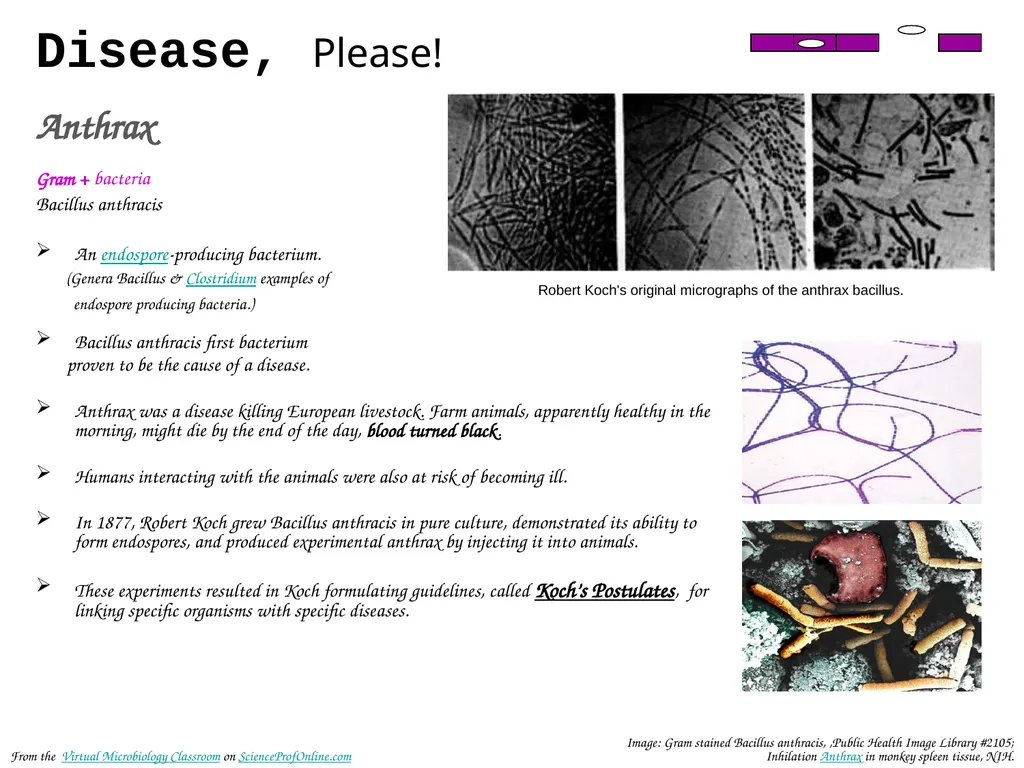
These experiments resulted in Koch formulating guidelines, called Koch’s Postulates, for linking specific organisms with specific diseases. Robert Koch's original micrographs of the anthrax bacillus. Disease, Please! Image: Gram stained Bacillus anthracis, ,Public Health Image Library #2105; Inhilation Anthrax in monkey spleen tissue, NIH. From the Virtual Microbiology Classroom on ScienceProfOnline.com<br>
Gram + bacteria
Bacillus anthracis
An endospore-producing bacterium.
(Genera Bacillus & Clostridium examples of
endospore producing bacteria.)
Bacillus anthracis first bacterium
proven to be the cause of a disease.
Anthrax was a disease killing European livestock. Farm animals, apparently healthy in the morning, might die by the end of the day, blood turned black.
Humans interacting with the animals were also at risk of becoming ill.
In 1877, Robert Koch grew Bacillus anthracis in pure culture, demonstrated its ability to form endospores, and produced experimental anthrax by injecting it into animals.
These experiments resulted in Koch formulating guidelines, called Koch’s Postulates, for linking specific organisms with specific diseases. Robert Koch's original micrographs of the anthrax bacillus. Disease, Please! Image: Gram stained Bacillus anthracis, ,Public Health Image Library #2105; Inhilation Anthrax in monkey spleen tissue, NIH. From the Virtual Microbiology Classroom on ScienceProfOnline.com<br>
19
Germ Theory of Disease
Koch’s Postulates From the Virtual Microbiology Classroom on ScienceProfOnline.com REVIEW!
Click through animated lesson on Koch’s Postulates connecting Bacillus anthracis with the disease anthrax.<br>
Click through animated lesson on Koch’s Postulates connecting Bacillus anthracis with the disease anthrax.<br>
20
Germ Theory of Disease
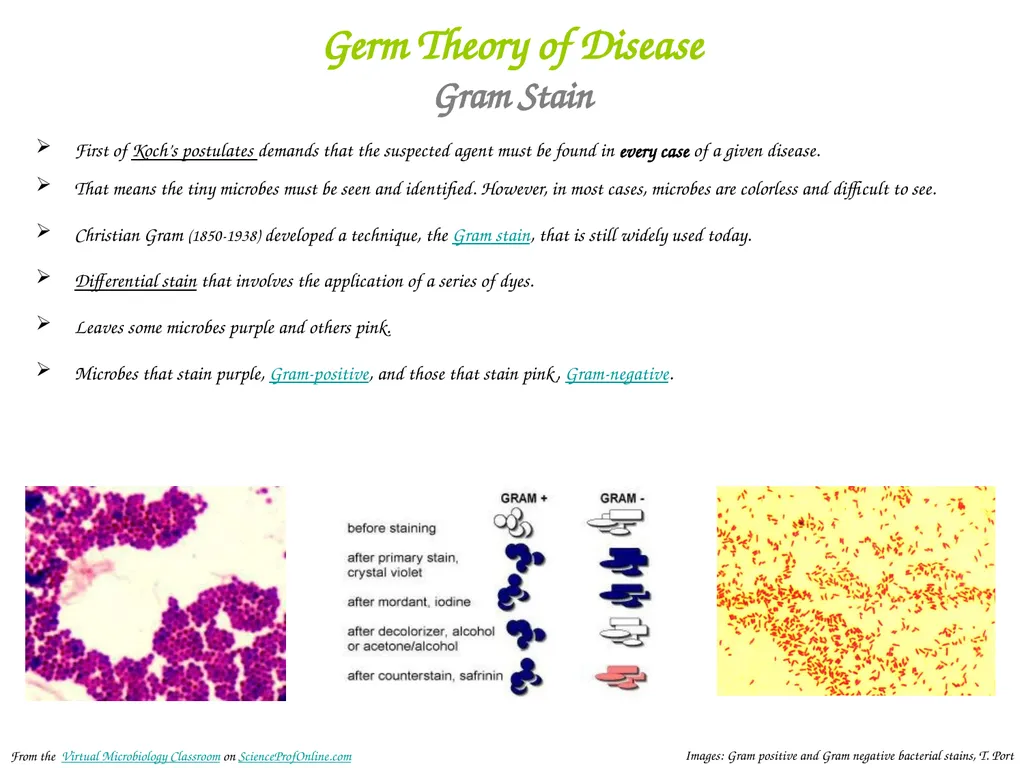
Gram Stain First of Koch’s postulates demands that the suspected agent must be found in every case of a given disease.
That means the tiny microbes must be seen and identified. However, in most cases, microbes are colorless and difficult to see.
Christian Gram (1850-1938) developed a technique, the Gram stain, that is still widely used today.
Differential stain that involves the application of a series of dyes.
Leaves some microbes purple and others pink.
Microbes that stain purple, Gram-positive, and those that stain pink, Gram-negative. Images: Gram positive and Gram negative bacterial stains, T. Port From the Virtual Microbiology Classroom on ScienceProfOnline.com<br>
That means the tiny microbes must be seen and identified. However, in most cases, microbes are colorless and difficult to see.
Christian Gram (1850-1938) developed a technique, the Gram stain, that is still widely used today.
Differential stain that involves the application of a series of dyes.
Leaves some microbes purple and others pink.
Microbes that stain purple, Gram-positive, and those that stain pink, Gram-negative. Images: Gram positive and Gram negative bacterial stains, T. Port From the Virtual Microbiology Classroom on ScienceProfOnline.com<br>
21
The Germ Theory of Disease
Dr. Joseph Lister – Father of Modern Antisepsis Prevailing belief = Wound infection due to exposed to stinking "miasma" in air.
Lister had read a paper by Pasteur showing that rotting could occur without
oxygen if microorganisms present.
Maybe microorganisms were causing gangrene?
Pasteur suggested three methods to get rid of microorganisms:
________________________________
2. ________________________________
________________________________
The first two inappropriate for use in human wounds, so Lister experimented with the third.
Carbolic acid was used for deodorizing sewage, so Lister tried spraying instruments, surgical incisions, wounds and dressings with solution.
It markedly reduced the incidence of gangrene.
As germ theory became more widely accepted, understood infection best avoided by preventing bacteria from getting into wounds in the first place. This led to the rise of sterile surgery. Image: Joseph Lister, circa 1860, Wiki 1827 - 1912 From the Virtual Microbiology Classroom on ScienceProfOnline.com<br>
Lister had read a paper by Pasteur showing that rotting could occur without
oxygen if microorganisms present.
Maybe microorganisms were causing gangrene?
Pasteur suggested three methods to get rid of microorganisms:
________________________________
2. ________________________________
________________________________
The first two inappropriate for use in human wounds, so Lister experimented with the third.
Carbolic acid was used for deodorizing sewage, so Lister tried spraying instruments, surgical incisions, wounds and dressings with solution.
It markedly reduced the incidence of gangrene.
As germ theory became more widely accepted, understood infection best avoided by preventing bacteria from getting into wounds in the first place. This led to the rise of sterile surgery. Image: Joseph Lister, circa 1860, Wiki 1827 - 1912 From the Virtual Microbiology Classroom on ScienceProfOnline.com<br>
22
The Germ Theory of Disease
Florence Nightingale and Nursing English nurse who was a proponent of cleanliness and antiseptic techniques to the field of nursing.
She came to prominence for her pioneering work in nursing during the Crimean War (say cry-me-in), where she tended to wounded soldiers.
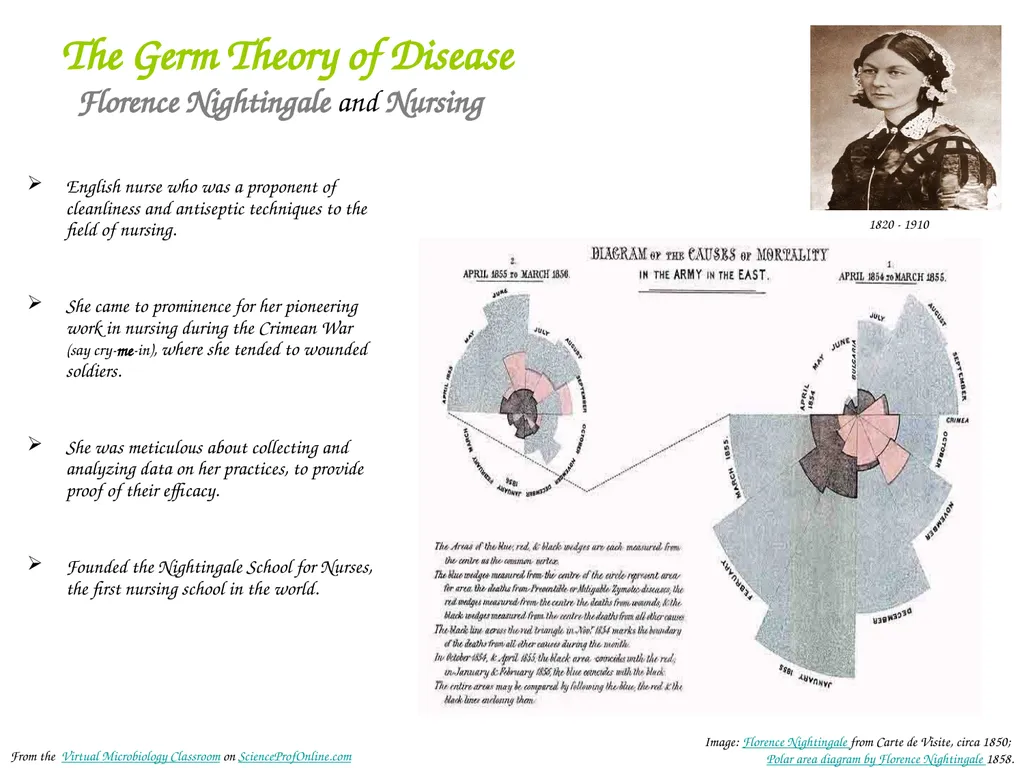
She was meticulous about collecting and analyzing data on her practices, to provide proof of their efficacy.
Founded the Nightingale School for Nurses, the first nursing school in the world. Image: Florence Nightingale from Carte de Visite, circa 1850; Polar area diagram by Florence Nightingale 1858. 1820 - 1910 From the Virtual Microbiology Classroom on ScienceProfOnline.com<br>
She came to prominence for her pioneering work in nursing during the Crimean War (say cry-me-in), where she tended to wounded soldiers.
She was meticulous about collecting and analyzing data on her practices, to provide proof of their efficacy.
Founded the Nightingale School for Nurses, the first nursing school in the world. Image: Florence Nightingale from Carte de Visite, circa 1850; Polar area diagram by Florence Nightingale 1858. 1820 - 1910 From the Virtual Microbiology Classroom on ScienceProfOnline.com<br>
23
Discovery of Antimicrobial Agents
Sulfa Drugs (Sulfonamides) Dr. Gerhard Domagk (say Doe-mock), a German chemist, discovered that the dye Prontosil was effective against a wide range of bacteria.
Sulfanilamide portion of the Prontosil molecule is responsible for its antibacterial effect. Inhibits essential enzyme activity in effected bacteria.
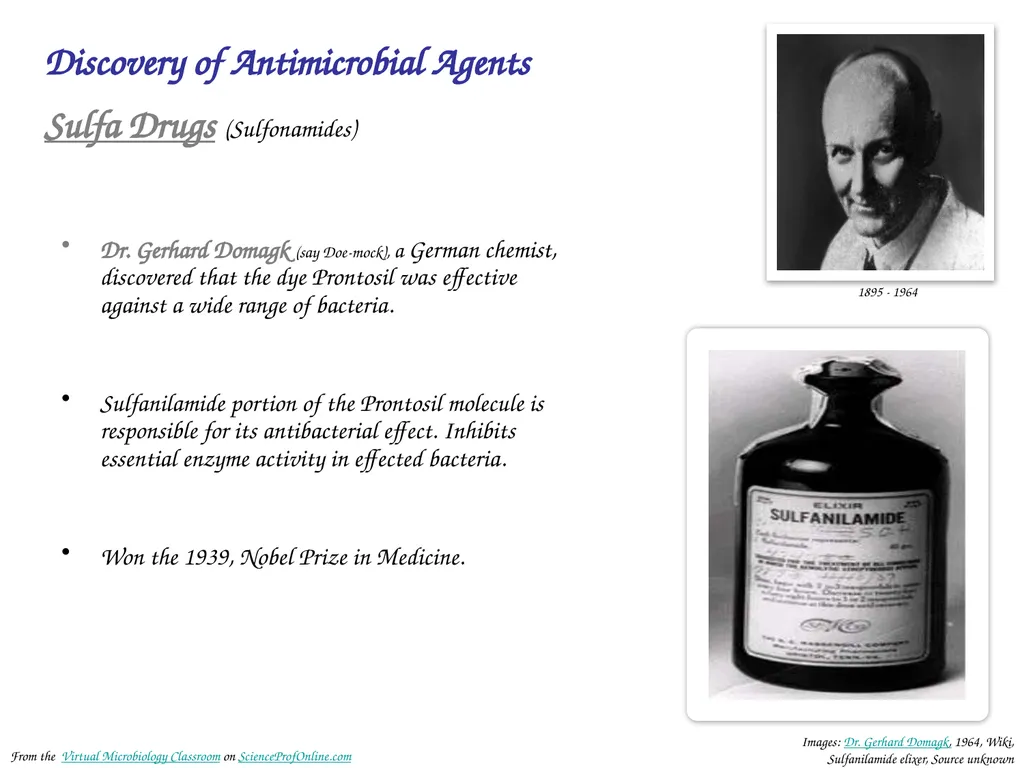
Won the 1939, Nobel Prize in Medicine. Images: Dr. Gerhard Domagk, 1964, Wiki, Sulfanilamide elixer, Source unknown 1895 - 1964 From the Virtual Microbiology Classroom on ScienceProfOnline.com<br>
Sulfanilamide portion of the Prontosil molecule is responsible for its antibacterial effect. Inhibits essential enzyme activity in effected bacteria.
Won the 1939, Nobel Prize in Medicine. Images: Dr. Gerhard Domagk, 1964, Wiki, Sulfanilamide elixer, Source unknown 1895 - 1964 From the Virtual Microbiology Classroom on ScienceProfOnline.com<br>
24
Discovery of Antimicrobial Agents
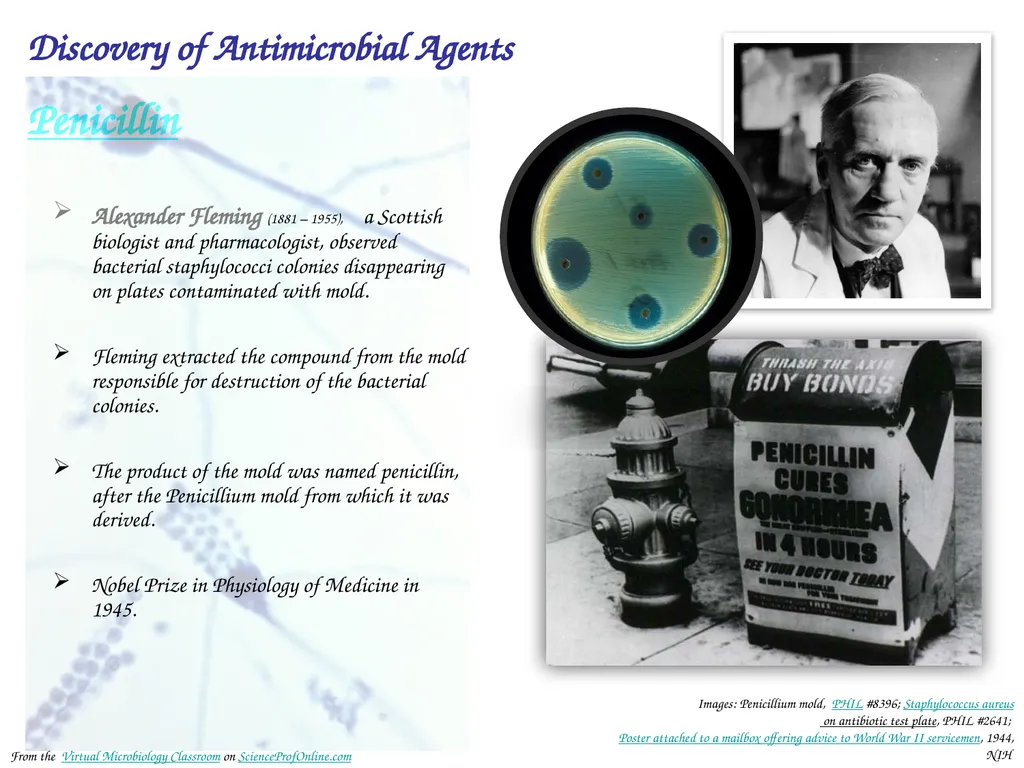
Penicillin Images: Penicillium mold, PHIL #8396; Staphylococcus aureus on antibiotic test plate, PHIL #2641; Poster attached to a mailbox offering advice to World War II servicemen, 1944, NIH From the Virtual Microbiology Classroom on ScienceProfOnline.com Alexander Fleming (1881 – 1955), a Scottish biologist and pharmacologist, observed bacterial staphylococci colonies disappearing on plates contaminated with mold.
Fleming extracted the compound from the mold responsible for destruction of the bacterial colonies.
The product of the mold was named penicillin, after the Penicillium mold from which it was derived.
Nobel Prize in Physiology of Medicine in 1945.<br>
Fleming extracted the compound from the mold responsible for destruction of the bacterial colonies.
The product of the mold was named penicillin, after the Penicillium mold from which it was derived.
Nobel Prize in Physiology of Medicine in 1945.<br>
25
Discovery of Antimicrobial Agents
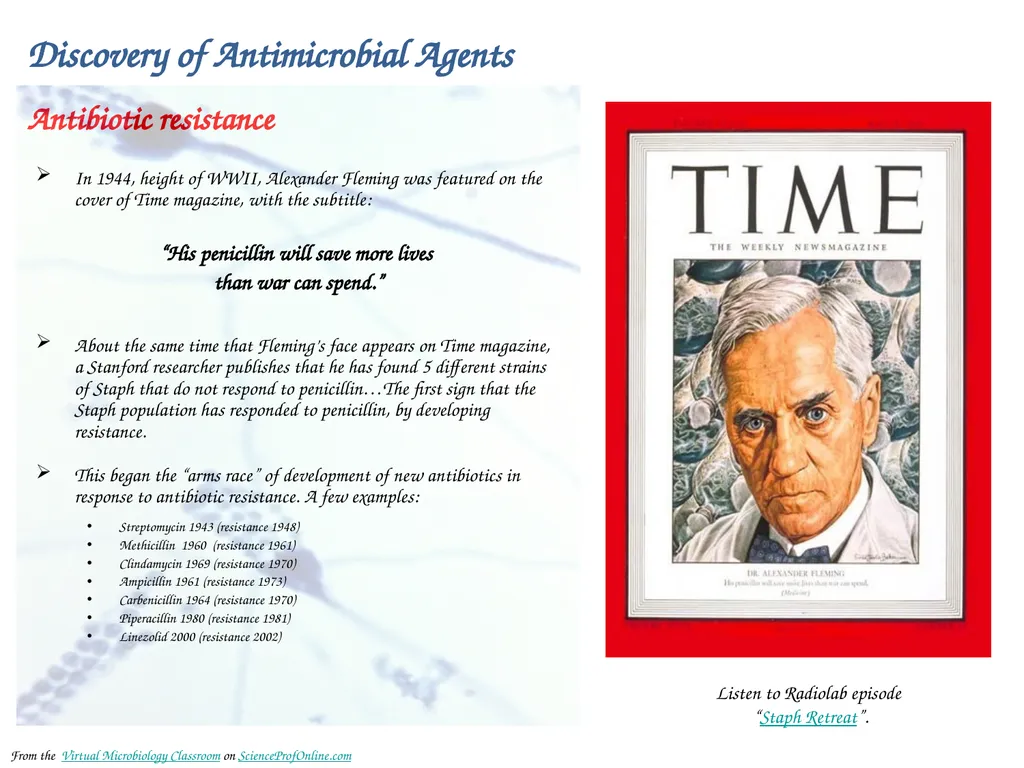
Antibiotic resistance From the Virtual Microbiology Classroom on ScienceProfOnline.com In 1944, height of WWII, Alexander Fleming was featured on the cover of Time magazine, with the subtitle:
“His penicillin will save more lives
than war can spend.”
About the same time that Fleming’s face appears on Time magazine, a Stanford researcher publishes that he has found 5 different strains of Staph that do not respond to penicillin…The first sign that the Staph population has responded to penicillin, by developing resistance.
This began the “arms race” of development of new antibiotics in response to antibiotic resistance. A few examples:
Streptomycin 1943 (resistance 1948)
Methicillin 1960 (resistance 1961)
Clindamycin 1969 (resistance 1970)
Ampicillin 1961 (resistance 1973)
Carbenicillin 1964 (resistance 1970)
Piperacillin 1980 (resistance 1981)
Linezolid 2000 (resistance 2002) Listen to Radiolab episode
“Staph Retreat”.<br>
“His penicillin will save more lives
than war can spend.”
About the same time that Fleming’s face appears on Time magazine, a Stanford researcher publishes that he has found 5 different strains of Staph that do not respond to penicillin…The first sign that the Staph population has responded to penicillin, by developing resistance.
This began the “arms race” of development of new antibiotics in response to antibiotic resistance. A few examples:
Streptomycin 1943 (resistance 1948)
Methicillin 1960 (resistance 1961)
Clindamycin 1969 (resistance 1970)
Ampicillin 1961 (resistance 1973)
Carbenicillin 1964 (resistance 1970)
Piperacillin 1980 (resistance 1981)
Linezolid 2000 (resistance 2002) Listen to Radiolab episode
“Staph Retreat”.<br>
26
REVIEW! From the Virtual Microbiology Classroom on ScienceProfOnline.com Image: Salmonella, Public Health Image Library,PHIL #10973 See brief SPO Class Notes articles:
“Early Germ Theory:
Leeuwenhoek, Semmelweiss
& Snow”
&
“Late Germ Theory:
Contributions of Pasteur, Lister, Koch,
Domagk & Fleming”<br>
“Early Germ Theory:
Leeuwenhoek, Semmelweiss
& Snow”
&
“Late Germ Theory:
Contributions of Pasteur, Lister, Koch,
Domagk & Fleming”<br>
27
Early History of Immunology
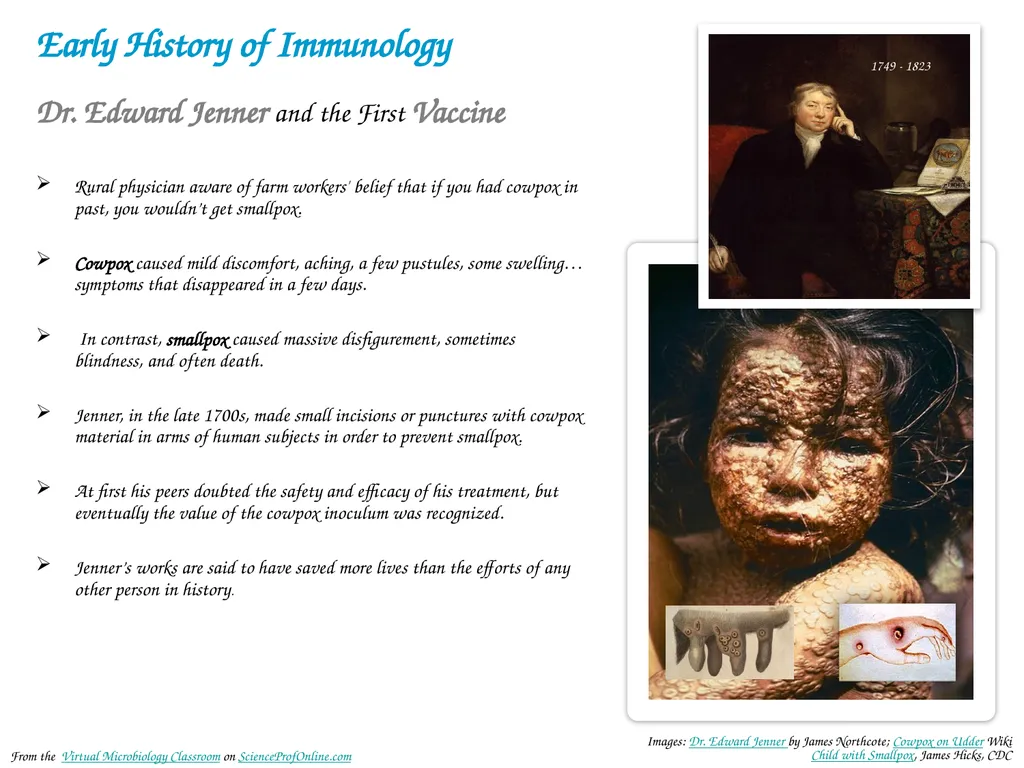
Dr. Edward Jenner and the First Vaccine Rural physician aware of farm workers' belief that if you had cowpox in past, you wouldn’t get smallpox.
Cowpox caused mild discomfort, aching, a few pustules, some swelling…symptoms that disappeared in a few days.
In contrast, smallpox caused massive disfigurement, sometimes blindness, and often death.
Jenner, in the late 1700s, made small incisions or punctures with cowpox material in arms of human subjects in order to prevent smallpox.
At first his peers doubted the safety and efficacy of his treatment, but eventually the value of the cowpox inoculum was recognized.
Jenner’s works are said to have saved more lives than the efforts of any other person in history. Images: Dr. Edward Jenner by James Northcote; Cowpox on Udder Wiki Child with Smallpox, James Hicks, CDC 1749 - 1823 From the Virtual Microbiology Classroom on ScienceProfOnline.com<br>
Cowpox caused mild discomfort, aching, a few pustules, some swelling…symptoms that disappeared in a few days.
In contrast, smallpox caused massive disfigurement, sometimes blindness, and often death.
Jenner, in the late 1700s, made small incisions or punctures with cowpox material in arms of human subjects in order to prevent smallpox.
At first his peers doubted the safety and efficacy of his treatment, but eventually the value of the cowpox inoculum was recognized.
Jenner’s works are said to have saved more lives than the efforts of any other person in history. Images: Dr. Edward Jenner by James Northcote; Cowpox on Udder Wiki Child with Smallpox, James Hicks, CDC 1749 - 1823 From the Virtual Microbiology Classroom on ScienceProfOnline.com<br>
28
Early History of Immunology
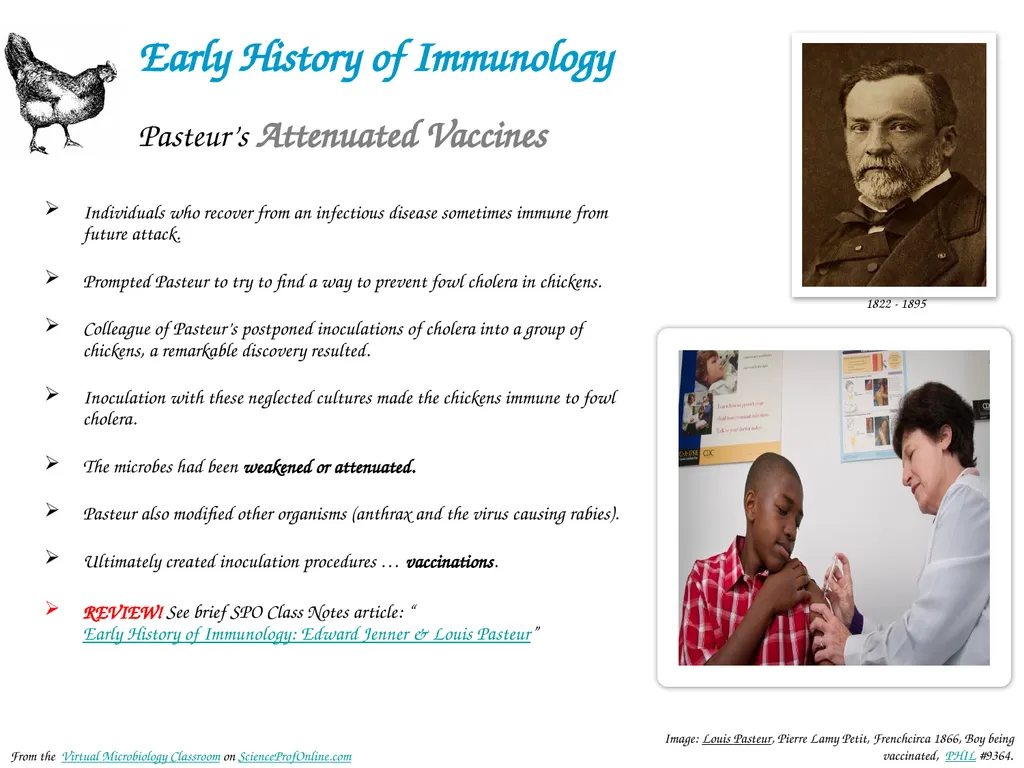
Pasteur’s Attenuated Vaccines Individuals who recover from an infectious disease sometimes immune from future attack.
Prompted Pasteur to try to find a way to prevent fowl cholera in chickens.
Colleague of Pasteur’s postponed inoculations of cholera into a group of chickens, a remarkable discovery resulted.
Inoculation with these neglected cultures made the chickens immune to fowl cholera.
The microbes had been weakened or attenuated.
Pasteur also modified other organisms (anthrax and the virus causing rabies).
Ultimately created inoculation procedures … vaccinations.
REVIEW! See brief SPO Class Notes article: “Early History of Immunology: Edward Jenner & Louis Pasteur” Image: Louis Pasteur, Pierre Lamy Petit, Frenchcirca 1866, Boy being vaccinated, PHIL #9364. 1822 - 1895 From the Virtual Microbiology Classroom on ScienceProfOnline.com<br>
Prompted Pasteur to try to find a way to prevent fowl cholera in chickens.
Colleague of Pasteur’s postponed inoculations of cholera into a group of chickens, a remarkable discovery resulted.
Inoculation with these neglected cultures made the chickens immune to fowl cholera.
The microbes had been weakened or attenuated.
Pasteur also modified other organisms (anthrax and the virus causing rabies).
Ultimately created inoculation procedures … vaccinations.
REVIEW! See brief SPO Class Notes article: “Early History of Immunology: Edward Jenner & Louis Pasteur” Image: Louis Pasteur, Pierre Lamy Petit, Frenchcirca 1866, Boy being vaccinated, PHIL #9364. 1822 - 1895 From the Virtual Microbiology Classroom on ScienceProfOnline.com<br>
29
Rabies is an infectious disease caused by a virus.
Mortality rate of nearly 100%.
Description of rabies, from RadioLab “Rodney vs. Death” Podcast, from WNYC Public Radio (segment time 8:00 to 11:06). See Virtual Microbiology Classroom Main Page for homework assignment on this podcast.
Video of rabies in humans. Image: Cover of book Rabid, Rabies virus as seen through electron microscope, PHIL, image #5611; Portrait of Louis Pasteur in his lab 1885, by Albert Edelfelt From the Virtual Microbiology Classroom on ScienceProfOnline.com Disease, Please! Rabies Pasteur developed his rabies vaccine by growing the virus in rabbits, then drying the infected nerve tissue to weaken (attenuate) the virus.
On July 6, 1885, the vaccine was administered to a 9-year-old boy who had been attacked by a rabid dog. The boy did not develop symptoms of rabies and survived.
Most rabies cases reported to the CDC each year occur in wild animals like raccoons, skunks, bats, and foxes. Rabies virus looks like little tiny bullets!<br>
Mortality rate of nearly 100%.
Description of rabies, from RadioLab “Rodney vs. Death” Podcast, from WNYC Public Radio (segment time 8:00 to 11:06). See Virtual Microbiology Classroom Main Page for homework assignment on this podcast.
Video of rabies in humans. Image: Cover of book Rabid, Rabies virus as seen through electron microscope, PHIL, image #5611; Portrait of Louis Pasteur in his lab 1885, by Albert Edelfelt From the Virtual Microbiology Classroom on ScienceProfOnline.com Disease, Please! Rabies Pasteur developed his rabies vaccine by growing the virus in rabbits, then drying the infected nerve tissue to weaken (attenuate) the virus.
On July 6, 1885, the vaccine was administered to a 9-year-old boy who had been attacked by a rabid dog. The boy did not develop symptoms of rabies and survived.
Most rabies cases reported to the CDC each year occur in wild animals like raccoons, skunks, bats, and foxes. Rabies virus looks like little tiny bullets!<br>
30
Confused?
Here are links to fun resources that further
explain aerobic respiration:
History Microbiology Main Page on the Virtual Microbiology Classroom of Science Prof Online.
“Got the Time” music video by Anthrax.
Experiments Testing Spontaneous Generation, animation and quiz.
The Dress Lodger , a historical novel about cholera, prostitution and body snatching set in Sunderland England 1831.
Brief History of Microbiology online flashcards from Quizlet.
Microbe Hunters, a classic book by Paul De Kruif Harvest Books.
Play “Fling The Teacher”, an interactive “Medicine: Infectious Disease” Quiz in which you get to build a teacher (victim), then fling them with a trebuchet if you correctly answer the quiz questions.
History of Microbiology interactive timeline from Microbe World.
Play Disease Defenders educational video game, Rice University.
(You must be in PPT slideshow view to click on links.) Smart Links From the Virtual Microbiology Classroom on ScienceProfOnline.com<br>
Here are links to fun resources that further
explain aerobic respiration:
History Microbiology Main Page on the Virtual Microbiology Classroom of Science Prof Online.
“Got the Time” music video by Anthrax.
Experiments Testing Spontaneous Generation, animation and quiz.
The Dress Lodger , a historical novel about cholera, prostitution and body snatching set in Sunderland England 1831.
Brief History of Microbiology online flashcards from Quizlet.
Microbe Hunters, a classic book by Paul De Kruif Harvest Books.
Play “Fling The Teacher”, an interactive “Medicine: Infectious Disease” Quiz in which you get to build a teacher (victim), then fling them with a trebuchet if you correctly answer the quiz questions.
History of Microbiology interactive timeline from Microbe World.
Play Disease Defenders educational video game, Rice University.
(You must be in PPT slideshow view to click on links.) Smart Links From the Virtual Microbiology Classroom on ScienceProfOnline.com<br>
31
practice test questions
review questions
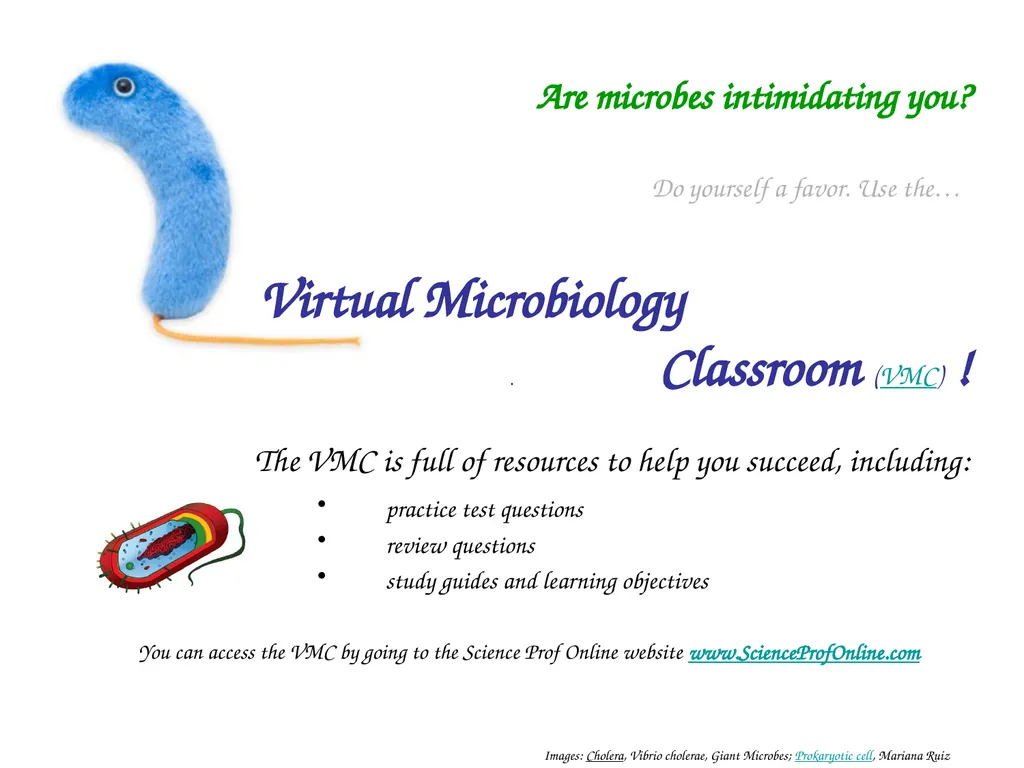
study guides and learning objectives You can access the VMC by going to the Science Prof Online website www.ScienceProfOnline.com Images: Cholera, Vibrio cholerae, Giant Microbes; Prokaryotic cell, Mariana Ruiz Are microbes intimidating you? Do yourself a favor. Use the… Virtual Microbiology Classroom (VMC) ! The VMC is full of resources to help you succeed, including:<br>
review questions
study guides and learning objectives You can access the VMC by going to the Science Prof Online website www.ScienceProfOnline.com Images: Cholera, Vibrio cholerae, Giant Microbes; Prokaryotic cell, Mariana Ruiz Are microbes intimidating you? Do yourself a favor. Use the… Virtual Microbiology Classroom (VMC) ! The VMC is full of resources to help you succeed, including:<br>