
Academic Debate Academic Debate & Critical
CP
Published · 25 slides · 0 views

1 / 1


Description
Academic Debate Academic Debate Critical Thinking DBT 101 First year IRD Ishik University Fall 2018-19 Modified Delivered by: Dr. Dilshad Hamad 1 Prepared by: Mustafa Bingol Debate sample https:www.youtube.comwatch?vVn29UnXLL9M
Related Topics
Share
Embed code
Download this presentation From Below
"Academic Debate Academic Debate & Critical" is the property of its rightful owner. Permission is granted to download and print the materials on this website for personal, non-commercial use only, and to display it on your personal computer provided you do not modify the materials and that you retain all copyright notices contained in the materials. By downloading content from our website, you accept the terms of this agreement.
Presentation Transcript
01
Academic Debate Academic Debate & Critical Thinking
DBT 101
First year IRD
Ishik University
Fall 2018-19
Modified & Delivered by: Dr. Dilshad Hamad 1 Prepared by: Mustafa Bingol<br>
DBT 101
First year IRD
Ishik University
Fall 2018-19
Modified & Delivered by: Dr. Dilshad Hamad 1 Prepared by: Mustafa Bingol<br>
02
Debate sample https://www.youtube.com/watch?v=Vn29UnXLL9M
https://www.youtube.com/watch?v=S1-7uziXlwE 2 Prepared by: Mustafa Bingol<br>
https://www.youtube.com/watch?v=S1-7uziXlwE 2 Prepared by: Mustafa Bingol<br>
03
3 Prepared by: Mustafa Bingol<br>
04
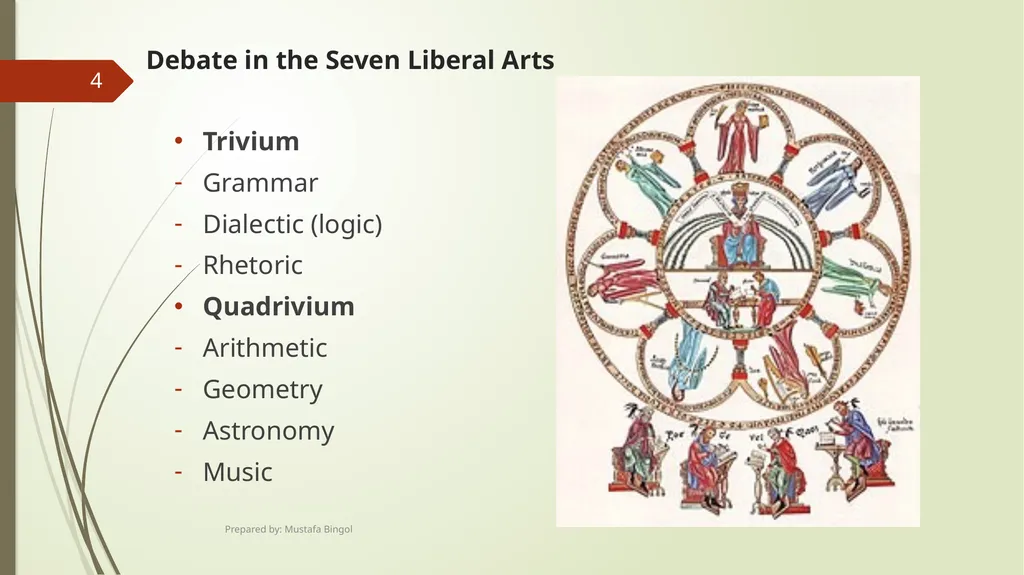
Debate in the Seven Liberal Arts Trivium
Grammar
Dialectic (logic)
Rhetoric
Quadrivium
Arithmetic
Geometry
Astronomy
Music 4 Prepared by: Mustafa Bingol<br>
Grammar
Dialectic (logic)
Rhetoric
Quadrivium
Arithmetic
Geometry
Astronomy
Music 4 Prepared by: Mustafa Bingol<br>
05
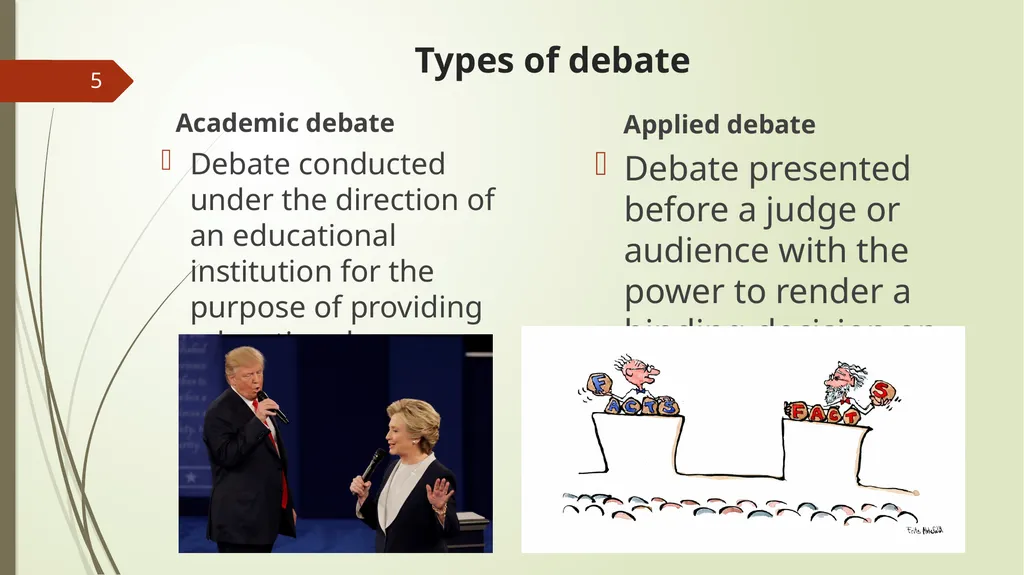
Types of debate Academic debate Debate conducted under the direction of an educational institution for the purpose of providing educational opportunities for its students. Applied debate Debate presented before a judge or audience with the power to render a binding decision on the proposition. 5 Prepared by: Mustafa Bingol<br>
06
Applied debate Examples Special debate (political)
Bush-Clinton
Hilary-Trump
Judicial debate
Conducted at courts according to rules and regulations
Parliamentary debate
national parliaments
EU parliament
Nonformula debate
Constitutional debate
Federalism debate 6 Prepared by: Mustafa Bingol<br>
Bush-Clinton
Hilary-Trump
Judicial debate
Conducted at courts according to rules and regulations
Parliamentary debate
national parliaments
EU parliament
Nonformula debate
Constitutional debate
Federalism debate 6 Prepared by: Mustafa Bingol<br>
07
An Argument With Rules And Time
Two Teams Present A Resolution (Sometimes Called A Proposition) Or Topic That They Will Debate
One Team Is For The Resolution (PRO Or Affirmative) And The Other Team Is (AGAINST Or Negative)
A Judge Decides At The End Of The Debate Who Is The Winner (Based On Point System) What is a Debate? 7 Prepared by: Mustafa Bingol<br>
Two Teams Present A Resolution (Sometimes Called A Proposition) Or Topic That They Will Debate
One Team Is For The Resolution (PRO Or Affirmative) And The Other Team Is (AGAINST Or Negative)
A Judge Decides At The End Of The Debate Who Is The Winner (Based On Point System) What is a Debate? 7 Prepared by: Mustafa Bingol<br>
08
To provide meaningful listening, speaking, writing practice
To develop argumentation skills for persuasive speech and writing
To increase social skills and conflict resolution abilities
To enhance self-esteem and academic confidence
To lead to competitive success in the future Why Debate? 8 Prepared by: Mustafa Bingol<br>
To develop argumentation skills for persuasive speech and writing
To increase social skills and conflict resolution abilities
To enhance self-esteem and academic confidence
To lead to competitive success in the future Why Debate? 8 Prepared by: Mustafa Bingol<br>
09
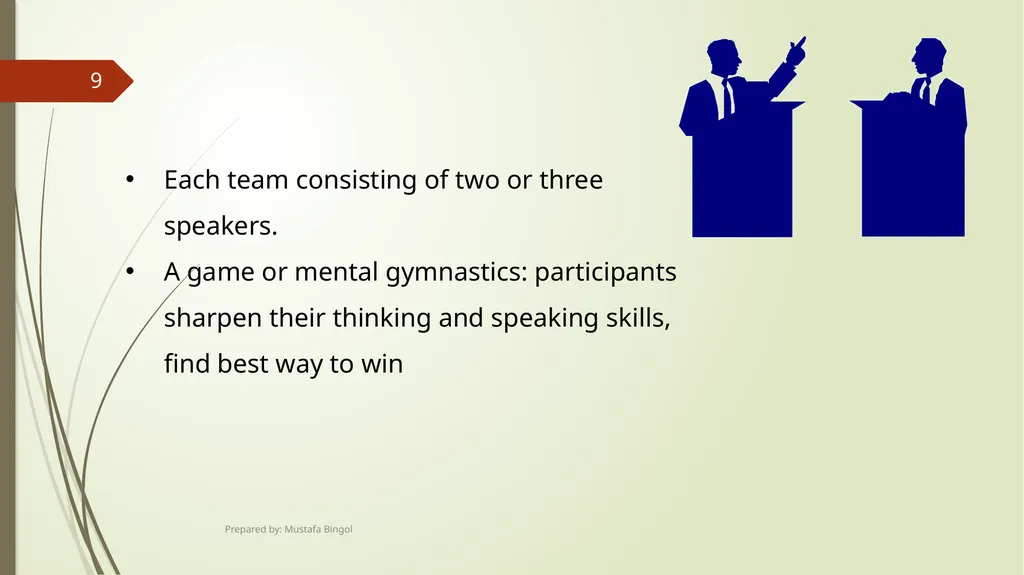
Each team consisting of two or three speakers.
A game or mental gymnastics: participants sharpen their thinking and speaking skills, find best way to win 9 Prepared by: Mustafa Bingol<br>
A game or mental gymnastics: participants sharpen their thinking and speaking skills, find best way to win 9 Prepared by: Mustafa Bingol<br>
10
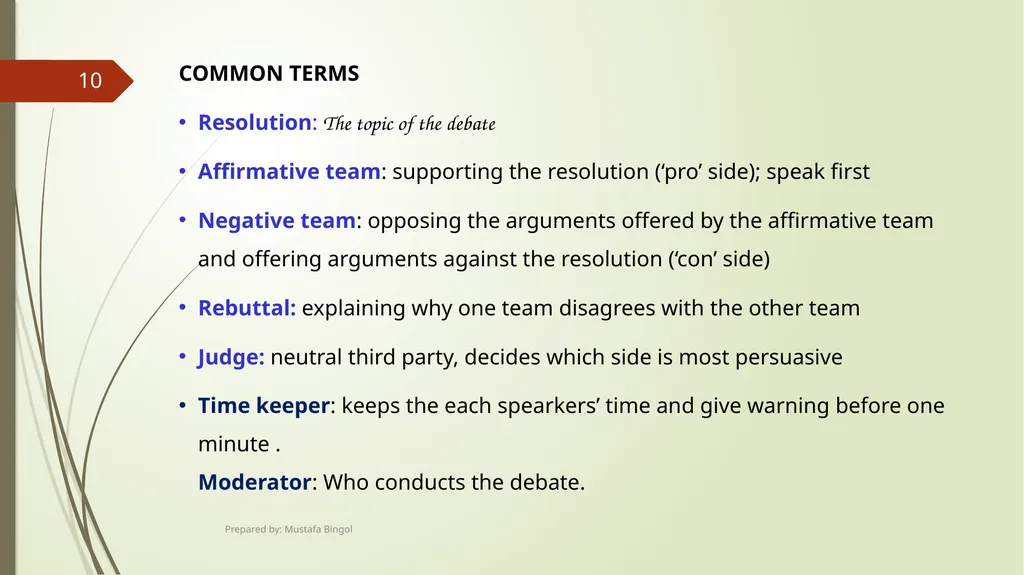
COMMON TERMS
Resolution: The topic of the debate
Affirmative team: supporting the resolution (‘pro’ side); speak first
Negative team: opposing the arguments offered by the affirmative team and offering arguments against the resolution (‘con’ side)
Rebuttal: explaining why one team disagrees with the other team
Judge: neutral third party, decides which side is most persuasive
Time keeper: keeps the each spearkers’ time and give warning before one minute . Moderator: Who conducts the debate. 10 Prepared by: Mustafa Bingol<br>
Resolution: The topic of the debate
Affirmative team: supporting the resolution (‘pro’ side); speak first
Negative team: opposing the arguments offered by the affirmative team and offering arguments against the resolution (‘con’ side)
Rebuttal: explaining why one team disagrees with the other team
Judge: neutral third party, decides which side is most persuasive
Time keeper: keeps the each spearkers’ time and give warning before one minute . Moderator: Who conducts the debate. 10 Prepared by: Mustafa Bingol<br>
11
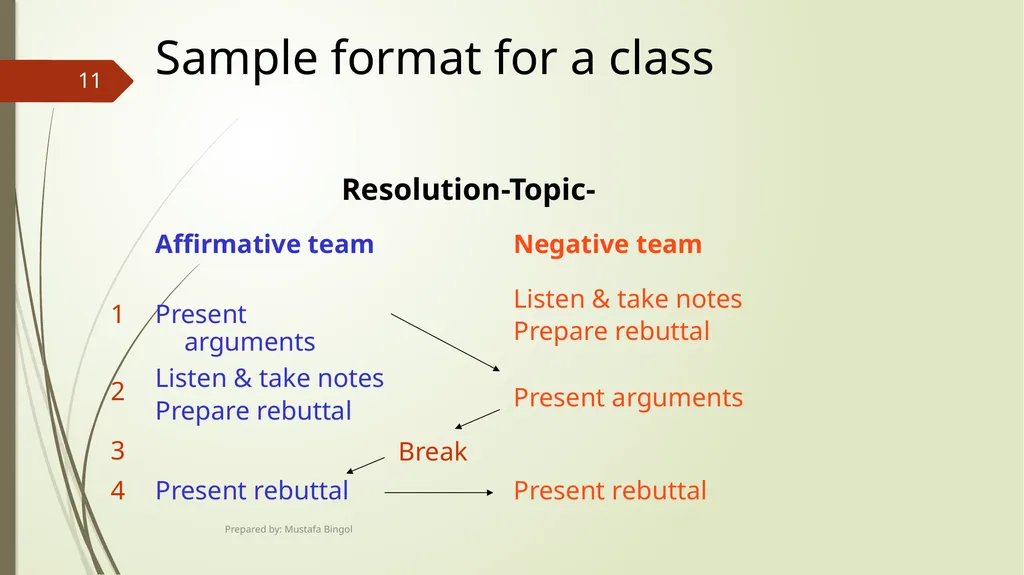
Resolution-Topic- Sample format for a class Affirmative team Negative team Present arguments Listen & take notes
Prepare rebuttal Present arguments Listen & take notes
Prepare rebuttal Break Present rebuttal Present rebuttal 1 2 4 3 11 Prepared by: Mustafa Bingol<br>
Prepare rebuttal Present arguments Listen & take notes
Prepare rebuttal Break Present rebuttal Present rebuttal 1 2 4 3 11 Prepared by: Mustafa Bingol<br>
12
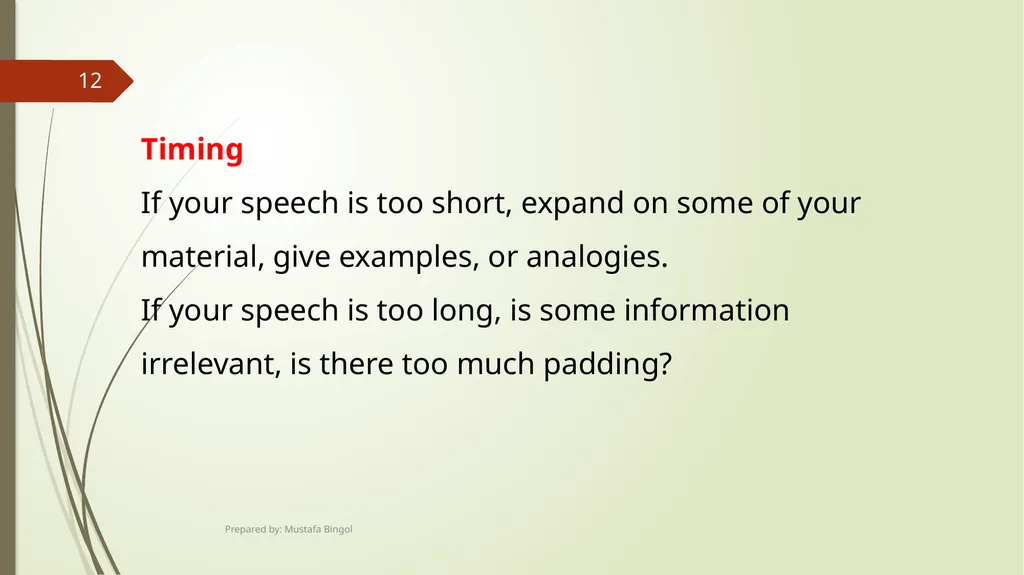
Timing
If your speech is too short, expand on some of your material, give examples, or analogies.
If your speech is too long, is some information irrelevant, is there too much padding? 12 Prepared by: Mustafa Bingol<br>
If your speech is too short, expand on some of your material, give examples, or analogies.
If your speech is too long, is some information irrelevant, is there too much padding? 12 Prepared by: Mustafa Bingol<br>
13
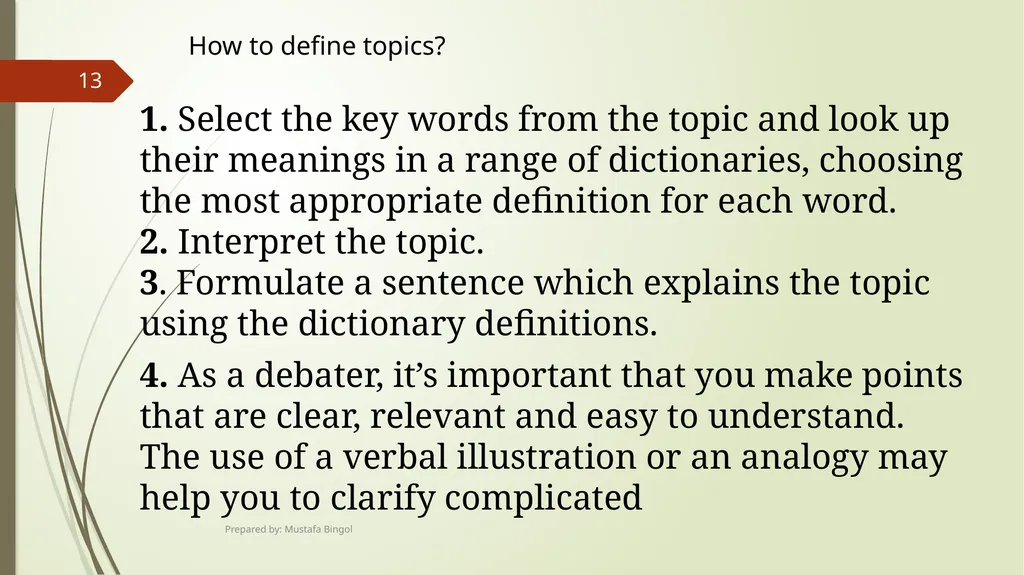
How to define topics? 1. Select the key words from the topic and look up their meanings in a range of dictionaries, choosing the most appropriate definition for each word.
2. Interpret the topic.
3. Formulate a sentence which explains the topic using the dictionary definitions.
4. As a debater, it’s important that you make points that are clear, relevant and easy to understand. The use of a verbal illustration or an analogy may help you to clarify complicated 13 Prepared by: Mustafa Bingol<br>
4. As a debater, it’s important that you make points that are clear, relevant and easy to understand. The use of a verbal illustration or an analogy may help you to clarify complicated 13 Prepared by: Mustafa Bingol<br>
14
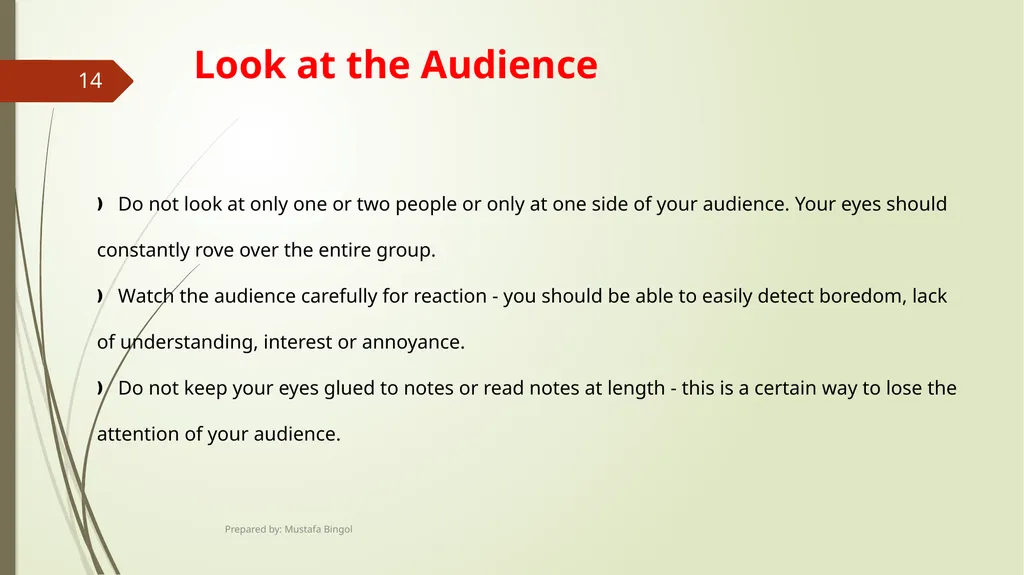
Do not look at only one or two people or only at one side of your audience. Your eyes should constantly rove over the entire group.
Watch the audience carefully for reaction - you should be able to easily detect boredom, lack of understanding, interest or annoyance.
Do not keep your eyes glued to notes or read notes at length - this is a certain way to lose the attention of your audience. Look at the Audience 14 Prepared by: Mustafa Bingol<br>
15
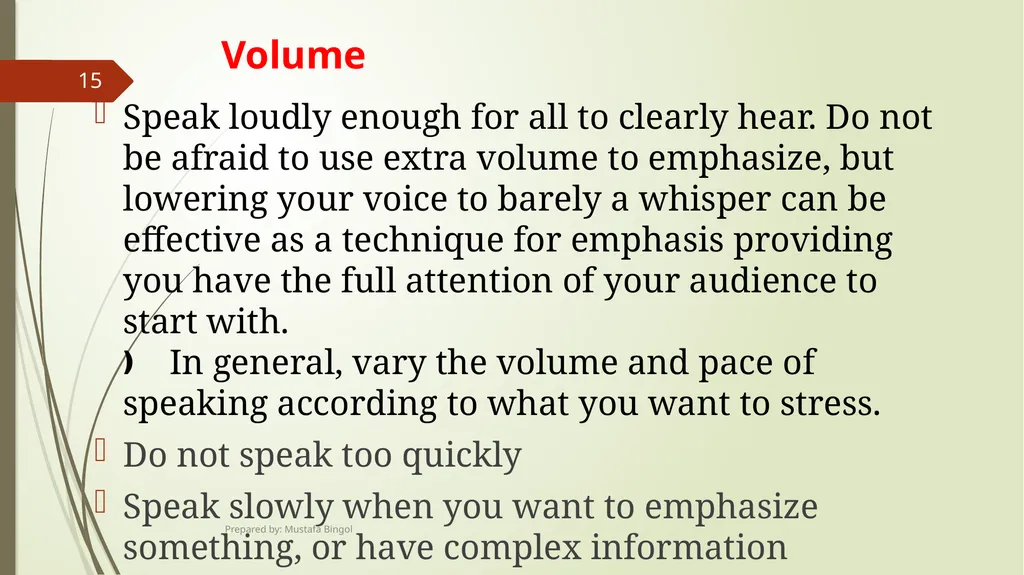
Volume Speak loudly enough for all to clearly hear. Do not be afraid to use extra volume to emphasize, but lowering your voice to barely a whisper can be effective as a technique for emphasis providing you have the full attention of your audience to start with.
In general, vary the volume and pace of speaking according to what you want to stress.
Do not speak too quickly
Speak slowly when you want to emphasize something, or have complex information 15 Prepared by: Mustafa Bingol<br>
Do not speak too quickly
Speak slowly when you want to emphasize something, or have complex information 15 Prepared by: Mustafa Bingol<br>
16
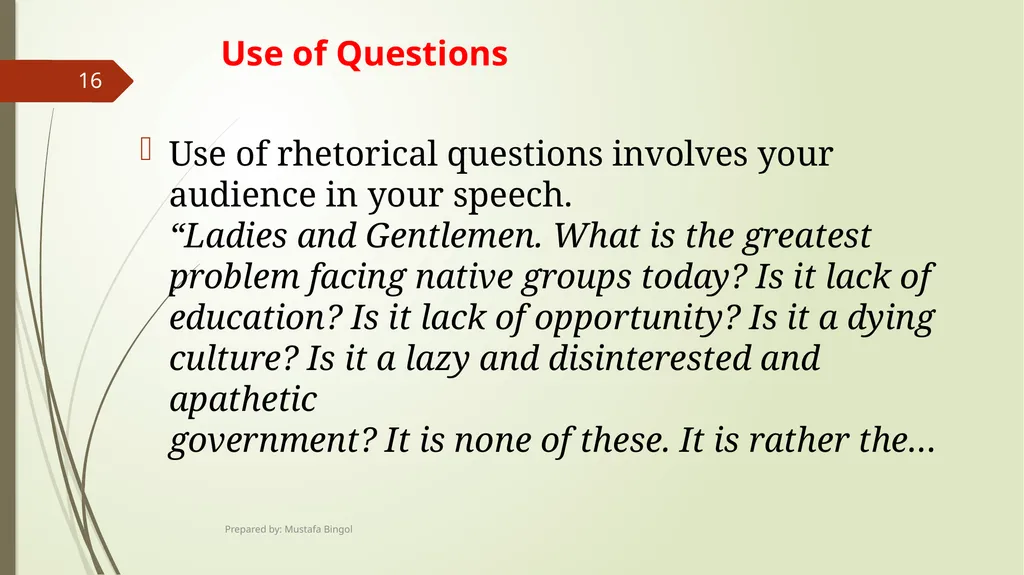
Use of Questions Use of rhetorical questions involves your audience in your speech.
“Ladies and Gentlemen. What is the greatest problem facing native groups today? Is it lack of
education? Is it lack of opportunity? Is it a dying culture? Is it a lazy and disinterested and apathetic
government? It is none of these. It is rather the… 16 Prepared by: Mustafa Bingol<br>
17
Nervousness Ways to reduce nervousness include:
Knowing what you are going to say. Thorough preparation usually eliminates all nervousness
Taking a few deep breaths before standing to speak.
Relaxing in the knowledge that every speaker is nervous.
Just keep talking as though it was not there.
Feel confident about what you are saying and you’ll avoid ‘ums’, ‘errs’ and the like. 17 Prepared by: Mustafa Bingol<br>
Knowing what you are going to say. Thorough preparation usually eliminates all nervousness
Taking a few deep breaths before standing to speak.
Relaxing in the knowledge that every speaker is nervous.
Just keep talking as though it was not there.
Feel confident about what you are saying and you’ll avoid ‘ums’, ‘errs’ and the like. 17 Prepared by: Mustafa Bingol<br>
18
Planning There are a number of things that you can do in preparation for a debate. Below are some suggestions.
- Keep up with newspapers, magazines and books
- Record material, ideas and keep notes
- Observe and assess other speakers, including public figures
- Evaluate your material
- Talk to other people, ask their opinions 18 Prepared by: Mustafa Bingol<br>
19
Notes Keep notes short on small cards, but in big writing. Number each card so that if they fall you can sort them easily. Notes are a little reminder of what you want to say. You rule them, not they you. 19 Prepared by: Mustafa Bingol<br>
20
“Be it resolved that the legal drinking age be changed.” 20 Prepared by: Mustafa Bingol<br>
21
It’s helpful to keep the following in mind: 1. Develop eye contact with the audience
2. Use your hands and body naturally to emphasize points
3. Vary your voice pitch and modulation
4. Don’t write your debate in full – make headings and notes on your cue cards.
5. Number each card
6. Avoid slang – use good conversational English.
7. Open and close your speech with a device such as a joke, illustration, or quote. 21 Prepared by: Mustafa Bingol<br>
22
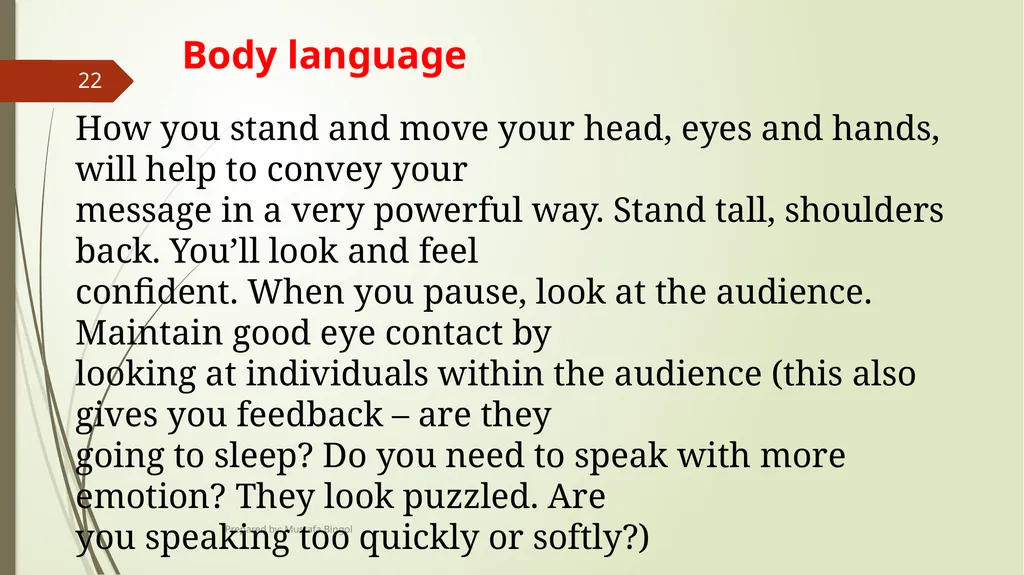
Body language How you stand and move your head, eyes and hands, will help to convey your
message in a very powerful way. Stand tall, shoulders back. You’ll look and feel
confident. When you pause, look at the audience. Maintain good eye contact by
looking at individuals within the audience (this also gives you feedback – are they
going to sleep? Do you need to speak with more emotion? They look puzzled. Are
you speaking too quickly or softly?) 22 Prepared by: Mustafa Bingol<br>
23
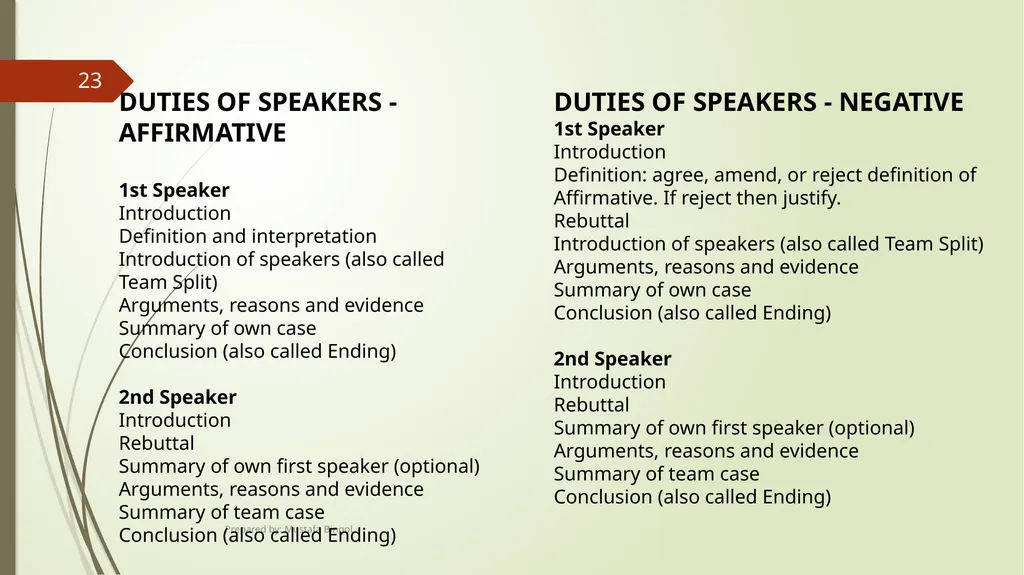
DUTIES OF SPEAKERS - AFFIRMATIVE
1st Speaker Introduction Definition and interpretation Introduction of speakers (also called Team Split) Arguments, reasons and evidence Summary of own case Conclusion (also called Ending)
2nd Speaker Introduction Rebuttal Summary of own first speaker (optional) Arguments, reasons and evidence Summary of team case Conclusion (also called Ending) DUTIES OF SPEAKERS - NEGATIVE 1st Speaker Introduction Definition: agree, amend, or reject definition of Affirmative. If reject then justify. Rebuttal Introduction of speakers (also called Team Split) Arguments, reasons and evidence Summary of own case Conclusion (also called Ending)
2nd Speaker Introduction Rebuttal Summary of own first speaker (optional) Arguments, reasons and evidence Summary of team case Conclusion (also called Ending) 23 Prepared by: Mustafa Bingol<br>
1st Speaker Introduction Definition and interpretation Introduction of speakers (also called Team Split) Arguments, reasons and evidence Summary of own case Conclusion (also called Ending)
2nd Speaker Introduction Rebuttal Summary of own first speaker (optional) Arguments, reasons and evidence Summary of team case Conclusion (also called Ending) DUTIES OF SPEAKERS - NEGATIVE 1st Speaker Introduction Definition: agree, amend, or reject definition of Affirmative. If reject then justify. Rebuttal Introduction of speakers (also called Team Split) Arguments, reasons and evidence Summary of own case Conclusion (also called Ending)
2nd Speaker Introduction Rebuttal Summary of own first speaker (optional) Arguments, reasons and evidence Summary of team case Conclusion (also called Ending) 23 Prepared by: Mustafa Bingol<br>
24
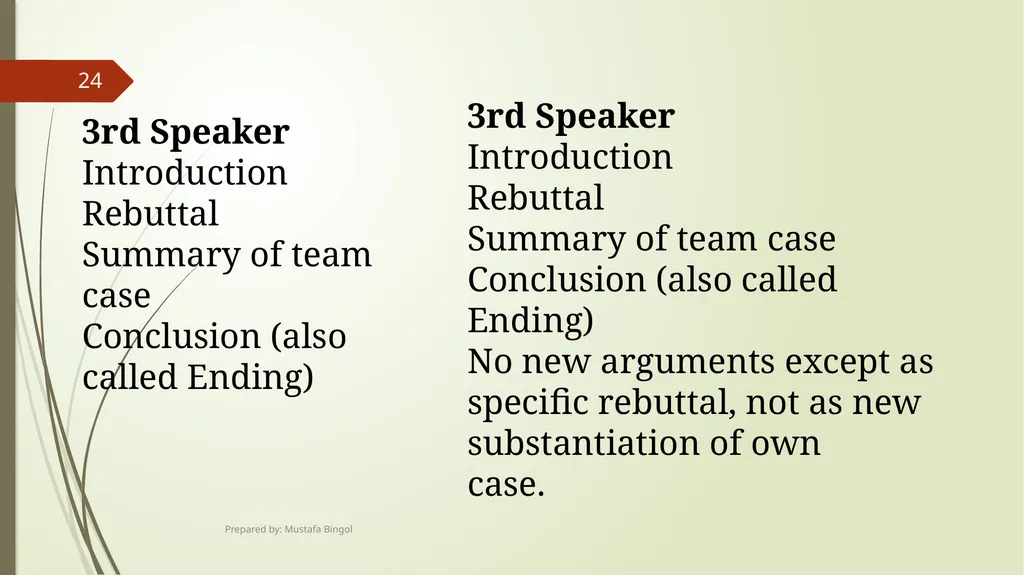
3rd Speaker
Introduction
Rebuttal
Summary of team case
Conclusion (also called Ending) 3rd Speaker
Introduction
Rebuttal
Summary of team case
Conclusion (also called Ending)
No new arguments except as specific rebuttal, not as new substantiation of own
case. 24 Prepared by: Mustafa Bingol<br>
25
0-1-2-3-4-5
Information
Rebuttal-Why
Use of Facts/Statistics
Teamwork
Understanding of Topic
Respect for Other Team 25 Prepared by: Mustafa Bingol<br>
Information
Rebuttal-Why
Use of Facts/Statistics
Teamwork
Understanding of Topic
Respect for Other Team 25 Prepared by: Mustafa Bingol<br>