Academic Freedom and Shared Governance Deans Council, March 4, 2024 Professors Pauline Strong, Brian Evans, Andrea Gore UT Austin advocacy chapter American Association of University Professors (AAUP) Overview AAUP as a national, state, and
"Academic Freedom and Shared Governance Dean’s" is the property of its rightful owner. Permission is granted to
download and print the materials on this website for personal, non-commercial use only, and to display it
on your personal computer provided you do not modify the materials and that you retain all copyright
notices contained in the materials. By downloading content from our website, you accept the terms of this
agreement.
Presentation Transcript
01
Academic Freedom and Shared Governance Dean’s Council, March 4, 2024 Professors Pauline Strong, Brian Evans, Andrea Gore
UT Austin advocacy chapter
American Association of University Professors (AAUP)<br>
02
Overview AAUP as a national, state, and local organization (with links to resources)
Four constituent elements of academic freedom
Academic freedom and First-Amendment free speech
Protections for academic freedom
The roles of CCAFR and AAUP at UT Austin
AAUP’s legislative work
AAUP as a resource
Q&A
AAUP officers speak for ourselves as individuals and not for our institution.<br>
03
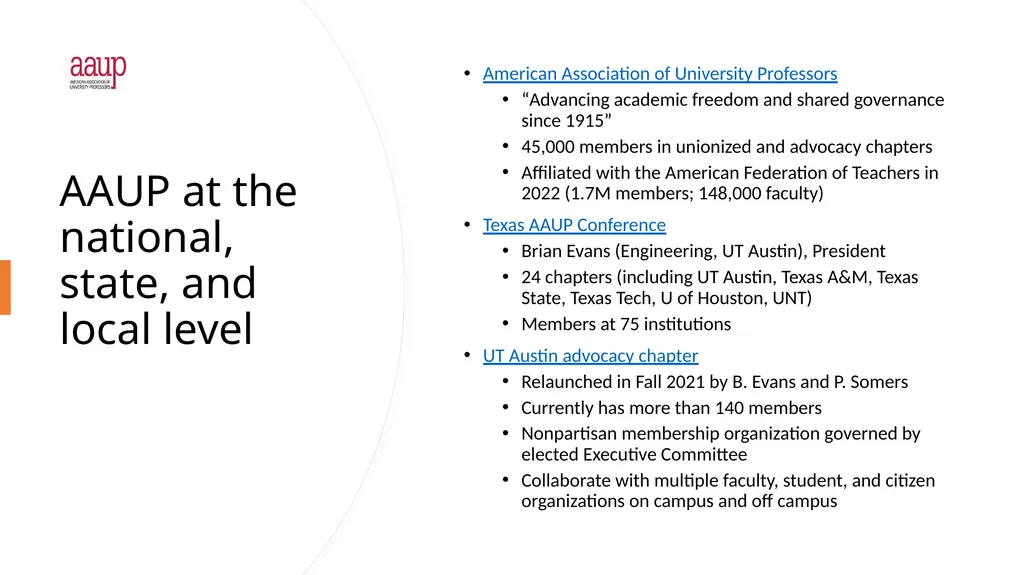
AAUP at the national, state, and local level American Association of University Professors
“Advancing academic freedom and shared governance since 1915”
45,000 members in unionized and advocacy chapters
Affiliated with the American Federation of Teachers in 2022 (1.7M members; 148,000 faculty)
Texas AAUP Conference
Brian Evans (Engineering, UT Austin), President
24 chapters (including UT Austin, Texas A&M, Texas State, Texas Tech, U of Houston, UNT)
Members at 75 institutions
UT Austin advocacy chapter
Relaunched in Fall 2021 by B. Evans and P. Somers
Currently has more than 140 members
Nonpartisan membership organization governed by elected Executive Committee
Collaborate with multiple faculty, student, and citizen organizations on campus and off campus<br>
04
Principles of Academic Freedom Defined in 1915, 1925 and 1940 AAUP/AAC&U Statement of Principles on Academic Freedom & Tenure
Jointly formulated by AAUP representing faculty and AAC&U representing college & university presidents
Endorsed by more than 250 disciplinary associations
Widely adopted including in UT Austin and UT System policies
Based on the importance of free inquiry for the common good and the concepts of disciplinary expertise and self-regulation (including professional ethics)
Applies to all teachers, including professional faculty and graduate teaching assistants (all those engaged in teaching who exercise professional judgment) (AAUP statement on contingent appointments, 2012)
Safeguards include tenure, shared governance, and due process for those accused of violating University policies
AAUP Resources for Advancing Academic Freedom<br>
05
Four Constituent Elements of Academic Freedom and Responsibility 1. Freedom in the Classroom
Freedom to discuss all material that is germane to the subject matter of a course
Fosters viewpoint diversity: protects teachers in developing and disseminating new knowledge from all viewpoints, including conservative, moderate, liberal, and apolitical
Gives teachers the full freedom to help students develop the critical thinking, knowledge, training, and professional networks needed for successful careers.
Grounded in the teacher’s disciplinary expertise, subject to professional codes of ethics
Classroom defined as ”any location, real or virtual, in which instruction occurs”; Academic freedom protections apply in classrooms of all types (AF and Electronic Communications)
2. Freedom in Research
Freedom to explore all avenues of scholarship, research, and creative expression and to publish the results of such work
Subject to the adequate performance of other academic duties.
Research for pecuniary return based on an understanding with the authorities of the institution.<br>
06
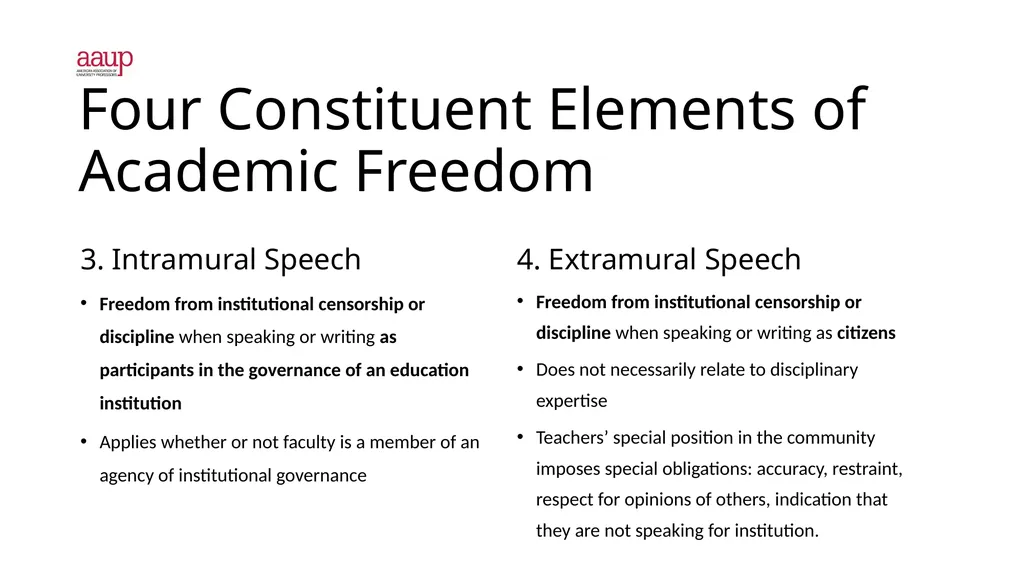
Four Constituent Elements of Academic Freedom 3. Intramural Speech
Freedom from institutional censorship or discipline when speaking or writing as participants in the governance of an education institution
Applies whether or not faculty is a member of an agency of institutional governance
4. Extramural Speech
Freedom from institutional censorship or discipline when speaking or writing as citizens
Does not necessarily relate to disciplinary expertise
Teachers’ special position in the community imposes special obligations: accuracy, restraint, respect for opinions of others, indication that they are not speaking for institution.<br>
07
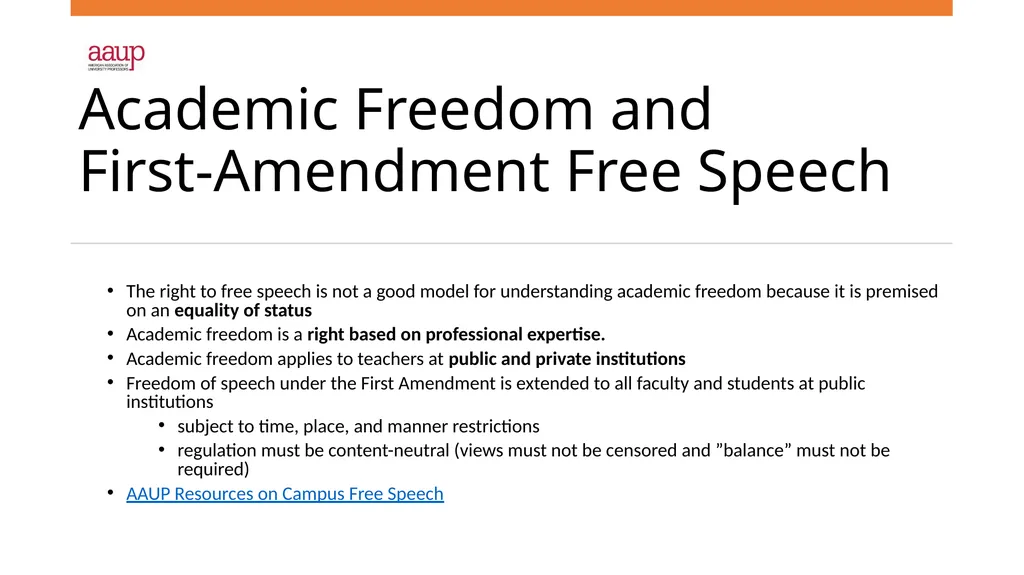
Academic Freedom and First-Amendment Free Speech The right to free speech is not a good model for understanding academic freedom because it is premised on an equality of status
Academic freedom is a right based on professional expertise.
Academic freedom applies to teachers at public and private institutions
Freedom of speech under the First Amendment is extended to all faculty and students at public institutions
subject to time, place, and manner restrictions
regulation must be content-neutral (views must not be censored and ”balance” must not be required)
AAUP Resources on Campus Free Speech<br>
08
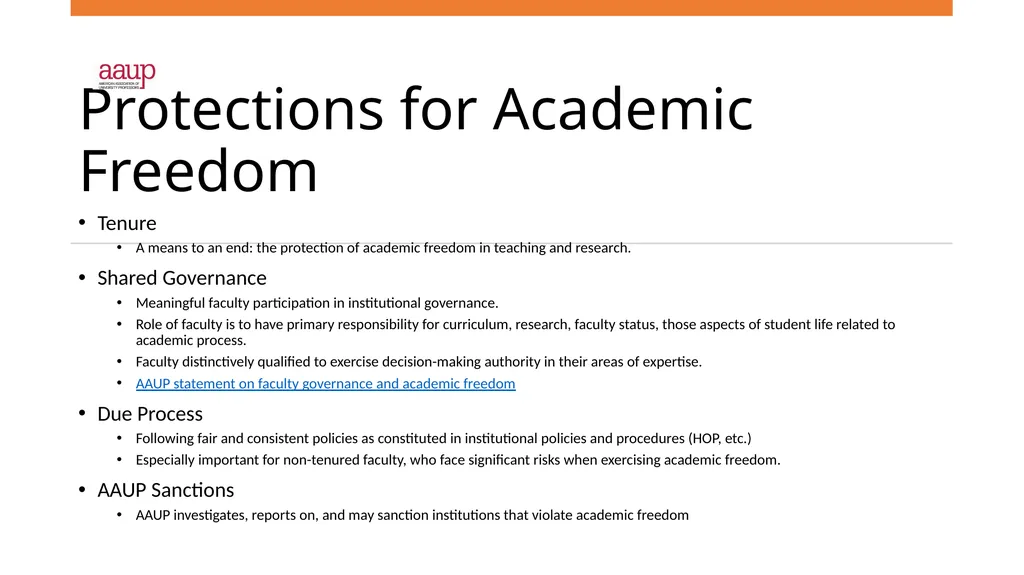
Protections for Academic Freedom Tenure
A means to an end: the protection of academic freedom in teaching and research.
Shared Governance
Meaningful faculty participation in institutional governance.
Role of faculty is to have primary responsibility for curriculum, research, faculty status, those aspects of student life related to academic process.
Faculty distinctively qualified to exercise decision-making authority in their areas of expertise.
AAUP statement on faculty governance and academic freedom
Due Process
Following fair and consistent policies as constituted in institutional policies and procedures (HOP, etc.)
Especially important for non-tenured faculty, who face significant risks when exercising academic freedom.
AAUP Sanctions
AAUP investigates, reports on, and may sanction institutions that violate academic freedom<br>
09
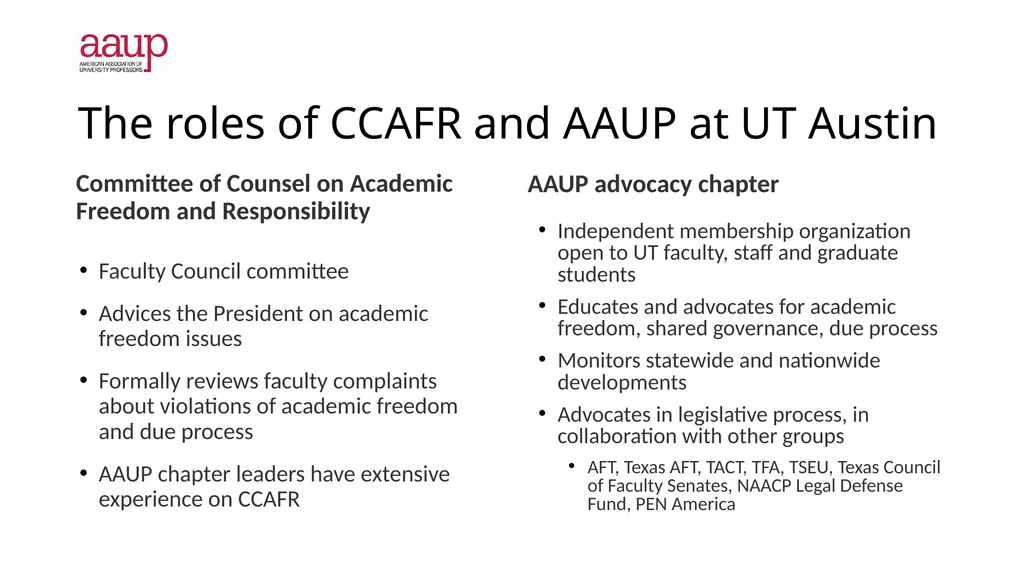
The roles of CCAFR and AAUP at UT Austin Committee of Counsel on Academic Freedom and Responsibility Faculty Council committee
Advices the President on academic freedom issues
Formally reviews faculty complaints about violations of academic freedom and due process
AAUP chapter leaders have extensive experience on CCAFR AAUP advocacy chapter Independent membership organization open to UT faculty, staff and graduate students
Educates and advocates for academic freedom, shared governance, due process
Monitors statewide and nationwide developments
Advocates in legislative process, in collaboration with other groups
AFT, Texas AFT, TACT, TFA, TSEU, Texas Council of Faculty Senates, NAACP Legal Defense Fund, PEN America<br>
10
AAUP’s legislative work UT advocacy chapter re-established in the context of nationwide “siege” on academic institutions
Model legislation introduced in multiple states
National AAUP offers many resources on advancing academic freedom, shared governance, resisting political interference
Texas AAUP worked with partners and legislators to remove teaching and research from SB 17
Concerns about transparency necessary for shared governance
Concerns about possible academic freedom violations in implementation
Texas AAUP worked to maintain a tenure system in SB 18
Concerns about campus-level implementation
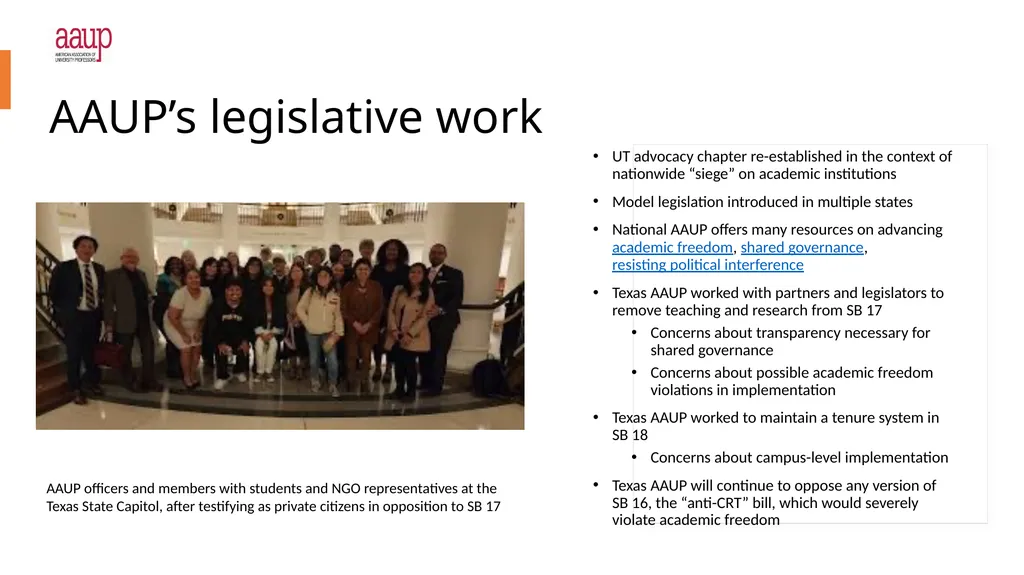
Texas AAUP will continue to oppose any version of SB 16, the “anti-CRT” bill, which would severely violate academic freedom AAUP officers and members with students and NGO representatives at the
Texas State Capitol, after testifying as private citizens in opposition to SB 17<br>
11
AAUP as a campus resource Collaborate with Faculty Council and Office of the Provost
Offer regular workshops on academic freedom for faculty and students
Participate each year in Free Speech Week activities
Work to resolve faculty and graduate student concerns as they arise
Sponsor monthly social hours to raise awareness of academic freedom issues
Write op-eds and maintain active social media presence
Plan to participate in faculty and graduate student orientations
Are available to work with departments, schools, and colleges upon request<br>
12
Thank you! Questions or Comments? American Association of University Professors<br>