
Academic Freedom, Shared Governance, and Faculty
A
Published · 21 slides · 0 views
1 / 1





Description
Academic Freedom, Shared Governance, and Faculty Rights August 30, 2024 Faculty Senate President, The University of Texas at Austin, 2019-2020 President, Texas Conference of the American Association of University Professors
Related Topics
Share
Embed code
Download this presentation From Below
"Academic Freedom, Shared Governance, and Faculty" is the property of its rightful owner. Permission is granted to download and print the materials on this website for personal, non-commercial use only, and to display it on your personal computer provided you do not modify the materials and that you retain all copyright notices contained in the materials. By downloading content from our website, you accept the terms of this agreement.
Presentation Transcript
01
Academic Freedom,
Shared Governance, and Faculty Rights August 30, 2024 Faculty Senate President, The University of Texas at Austin, 2019-2020
President, Texas Conference of the American Association of University Professors
aaup.texas@gmail.com Brian L. Evans, PhD Speaking for myself as an individual
Not speaking on behalf of any group, institution, or organization<br>
President, Texas Conference of the American Association of University Professors
aaup.texas@gmail.com Brian L. Evans, PhD Speaking for myself as an individual
Not speaking on behalf of any group, institution, or organization<br>
02
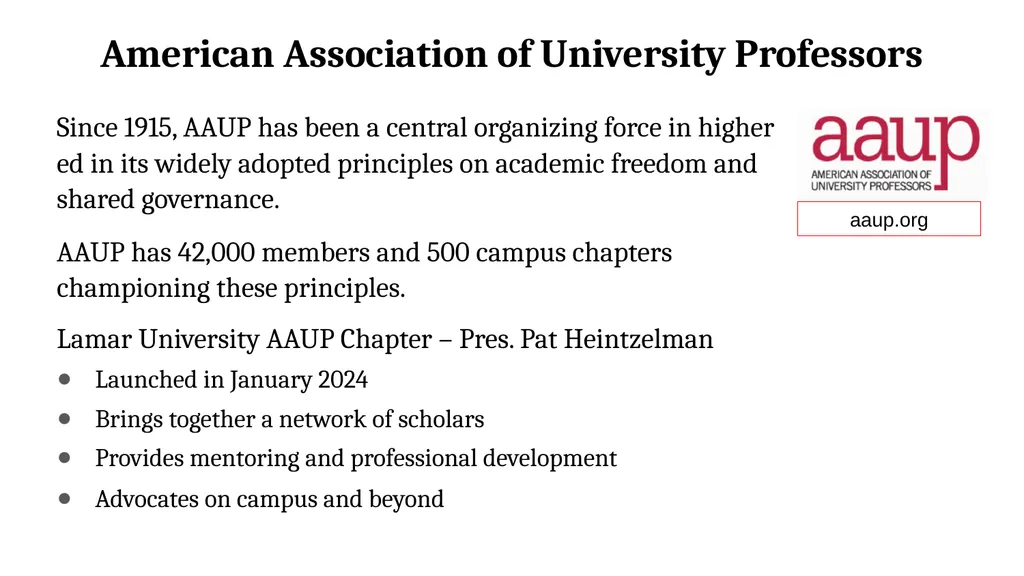
American Association of University Professors Since 1915, AAUP has been a central organizing force in higher ed in its widely adopted principles on academic freedom and shared governance.
AAUP has 42,000 members and 500 campus chapters championing these principles.
Lamar University AAUP Chapter – Pres. Pat Heintzelman
Launched in January 2024
Brings together a network of scholars
Provides mentoring and professional development
Advocates on campus and beyond aaup.org<br>
AAUP has 42,000 members and 500 campus chapters championing these principles.
Lamar University AAUP Chapter – Pres. Pat Heintzelman
Launched in January 2024
Brings together a network of scholars
Provides mentoring and professional development
Advocates on campus and beyond aaup.org<br>
03
American Association of University Professors AAUP affiliated with American Federation of Teaches (AFT) in August 2022: 1.8M members including 300,000 in higher education
Texas AAUP Conference
Formed in 1964 and affiliated with Texas AFT in March 2024
Provides professional development for a network of scholars
Mobilizes members on 75, and chapters on 28, campuses
Helps faculty navigate policies, investigations, and grievances
Advocates at the Texas Legislature
Upcoming Events
Sept. 14, 2024, Texas Higher Education Summit, Beaumont, Texas, Elegante Hotel, 9am-6pm, Free registration. RSVP Pat Heintzelman.
Sept. 28, 2024, Texas AAUP-AFT Fall Meeting, 9am-1pm. Zoom. RSVP Brian Evans.<br>
Texas AAUP Conference
Formed in 1964 and affiliated with Texas AFT in March 2024
Provides professional development for a network of scholars
Mobilizes members on 75, and chapters on 28, campuses
Helps faculty navigate policies, investigations, and grievances
Advocates at the Texas Legislature
Upcoming Events
Sept. 14, 2024, Texas Higher Education Summit, Beaumont, Texas, Elegante Hotel, 9am-6pm, Free registration. RSVP Pat Heintzelman.
Sept. 28, 2024, Texas AAUP-AFT Fall Meeting, 9am-1pm. Zoom. RSVP Brian Evans.<br>
04
1940 Joint AAUP/AAC&U Statement of Principles on Academic Freedom & Tenure (2600 words) Jointly formulated by Faculty (AAUP) and Presidents (AAC&U)
American Association Colleges & Universities (AAC&U): 860+ institutions
Principles adopted by all seven public university systems in Texas
Academic Freedom for teachers consists of interrelated elements
freedom to explore all avenues of scholarship, research, and creative expression and to publish the results of such work
freedom to discuss all relevant matters in the classroom
freedom from institutional censorship or discipline when speaking or writing as participants in the governance of an educational institution
freedom from institutional censorship when speaking or writing as a citizen
Free inquiry, free expression, and open dissent are critical for student learning and the advancement of knowledge 1940 Statement: https://www.aaup.org/report/1940-statement-principles-academic-freedom-and-tenure here “citizen” means a member of society<br>
American Association Colleges & Universities (AAC&U): 860+ institutions
Principles adopted by all seven public university systems in Texas
Academic Freedom for teachers consists of interrelated elements
freedom to explore all avenues of scholarship, research, and creative expression and to publish the results of such work
freedom to discuss all relevant matters in the classroom
freedom from institutional censorship or discipline when speaking or writing as participants in the governance of an educational institution
freedom from institutional censorship when speaking or writing as a citizen
Free inquiry, free expression, and open dissent are critical for student learning and the advancement of knowledge 1940 Statement: https://www.aaup.org/report/1940-statement-principles-academic-freedom-and-tenure here “citizen” means a member of society<br>
05
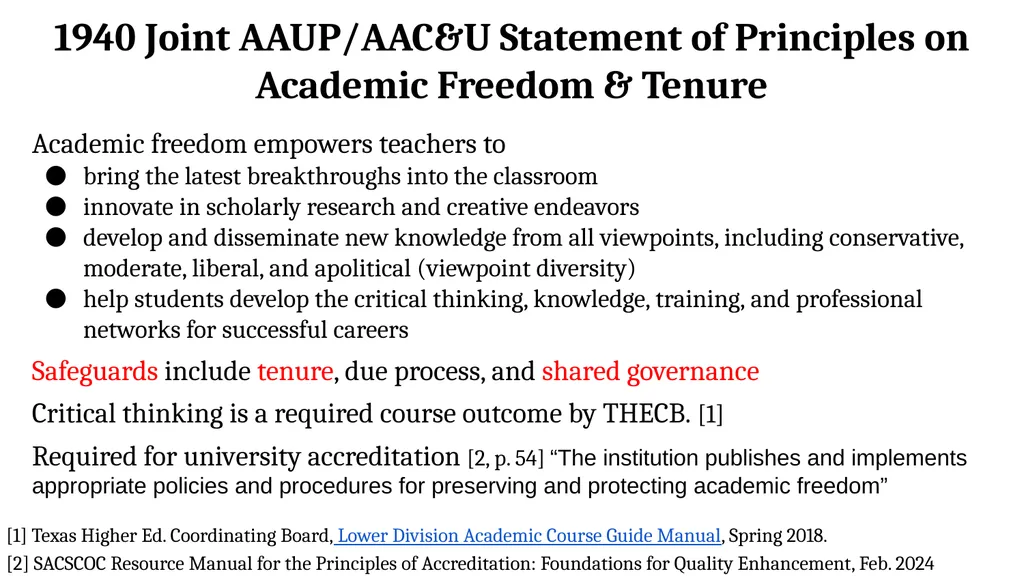
Academic freedom empowers teachers to
bring the latest breakthroughs into the classroom
innovate in scholarly research and creative endeavors
develop and disseminate new knowledge from all viewpoints, including conservative, moderate, liberal, and apolitical (viewpoint diversity)
help students develop the critical thinking, knowledge, training, and professional networks for successful careers
Safeguards include tenure, due process, and shared governance
Critical thinking is a required course outcome by THECB. [1]
Required for university accreditation [2, p. 54] “The institution publishes and implements appropriate policies and procedures for preserving and protecting academic freedom” [1] Texas Higher Ed. Coordinating Board, Lower Division Academic Course Guide Manual, Spring 2018. [2] SACSCOC Resource Manual for the Principles of Accreditation: Foundations for Quality Enhancement, Feb. 2024 1940 Joint AAUP/AAC&U Statement of Principles on Academic Freedom & Tenure<br>
bring the latest breakthroughs into the classroom
innovate in scholarly research and creative endeavors
develop and disseminate new knowledge from all viewpoints, including conservative, moderate, liberal, and apolitical (viewpoint diversity)
help students develop the critical thinking, knowledge, training, and professional networks for successful careers
Safeguards include tenure, due process, and shared governance
Critical thinking is a required course outcome by THECB. [1]
Required for university accreditation [2, p. 54] “The institution publishes and implements appropriate policies and procedures for preserving and protecting academic freedom” [1] Texas Higher Ed. Coordinating Board, Lower Division Academic Course Guide Manual, Spring 2018. [2] SACSCOC Resource Manual for the Principles of Accreditation: Foundations for Quality Enhancement, Feb. 2024 1940 Joint AAUP/AAC&U Statement of Principles on Academic Freedom & Tenure<br>
06
4.7 Rights and Responsibilities as a Teacher and as a Citizen
4.7.1. Classroom. The faculty member is entitled to freedom in the classroom in discussing the faculty member’s subject but should be judicious in the use of controversial material in the classroom and should introduce such material only as it has clear relationship to the subject field.
4.7.2. Research and Publication. The faculty member is entitled to freedom in research and in the publication of the results in accordance with responsible academic and professional practices.
4.7.3. Speaking as a Citizen. The faculty member is a citizen, a member of a learned profession, and an employee of an educational component supported by the State. When the faculty member speaks or writes as a citizen, the faculty member should be free from component censorship or discipline; but, the faculty member’s special position in the community imposes special obligations. As a person of learning and a faculty member of a state funded educational component, the faculty member should remember that the public may judge his or her profession and component by his or her utterance. Hence, the faculty member should at all times be accurate, exercise appropriate restraint, and should show respect for the opinions of others…. Texas State University System Rules and Regulations https://gato-docs.its.txst.edu/jcr:fe4852f4-5dfe-4e6a-837d-750ac9621db9/TSUS_Rules_and_Regs_thru_02-07-19.pdf Restatement of the 1940 AAUP/AAC&U Statement on Principles of Academic Freedom and Tenure<br>
4.7.1. Classroom. The faculty member is entitled to freedom in the classroom in discussing the faculty member’s subject but should be judicious in the use of controversial material in the classroom and should introduce such material only as it has clear relationship to the subject field.
4.7.2. Research and Publication. The faculty member is entitled to freedom in research and in the publication of the results in accordance with responsible academic and professional practices.
4.7.3. Speaking as a Citizen. The faculty member is a citizen, a member of a learned profession, and an employee of an educational component supported by the State. When the faculty member speaks or writes as a citizen, the faculty member should be free from component censorship or discipline; but, the faculty member’s special position in the community imposes special obligations. As a person of learning and a faculty member of a state funded educational component, the faculty member should remember that the public may judge his or her profession and component by his or her utterance. Hence, the faculty member should at all times be accurate, exercise appropriate restraint, and should show respect for the opinions of others…. Texas State University System Rules and Regulations https://gato-docs.its.txst.edu/jcr:fe4852f4-5dfe-4e6a-837d-750ac9621db9/TSUS_Rules_and_Regs_thru_02-07-19.pdf Restatement of the 1940 AAUP/AAC&U Statement on Principles of Academic Freedom and Tenure<br>
07
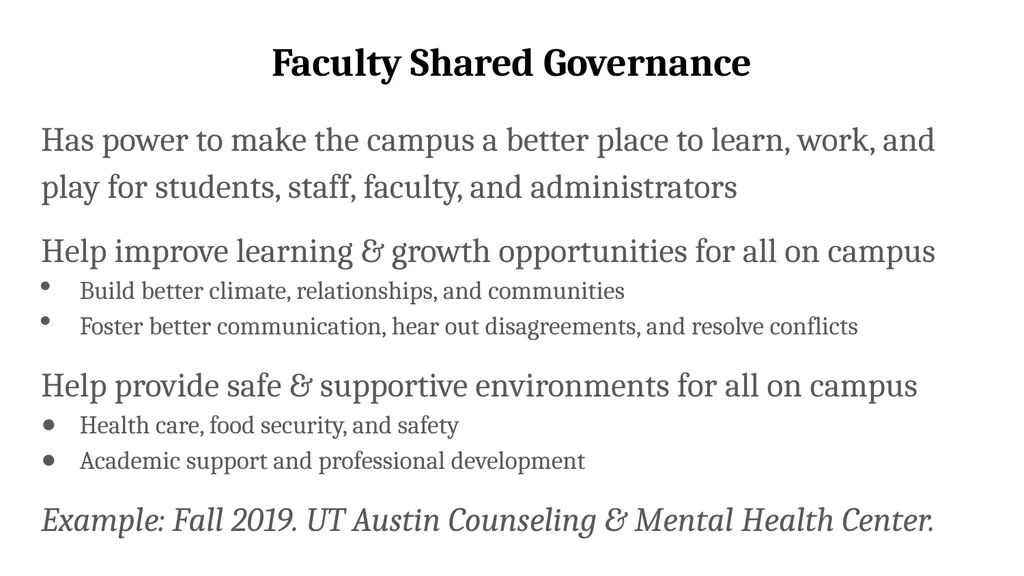
Faculty Shared Governance Has power to make the campus a better place to learn, work, and play for students, staff, faculty, and administrators
Help improve learning & growth opportunities for all on campus
Build better climate, relationships, and communities
Foster better communication, hear out disagreements, and resolve conflicts
Help provide safe & supportive environments for all on campus
Health care, food security, and safety
Academic support and professional development
Example: Fall 2019. UT Austin Counseling & Mental Health Center.<br>
Help improve learning & growth opportunities for all on campus
Build better climate, relationships, and communities
Foster better communication, hear out disagreements, and resolve conflicts
Help provide safe & supportive environments for all on campus
Health care, food security, and safety
Academic support and professional development
Example: Fall 2019. UT Austin Counseling & Mental Health Center.<br>
08
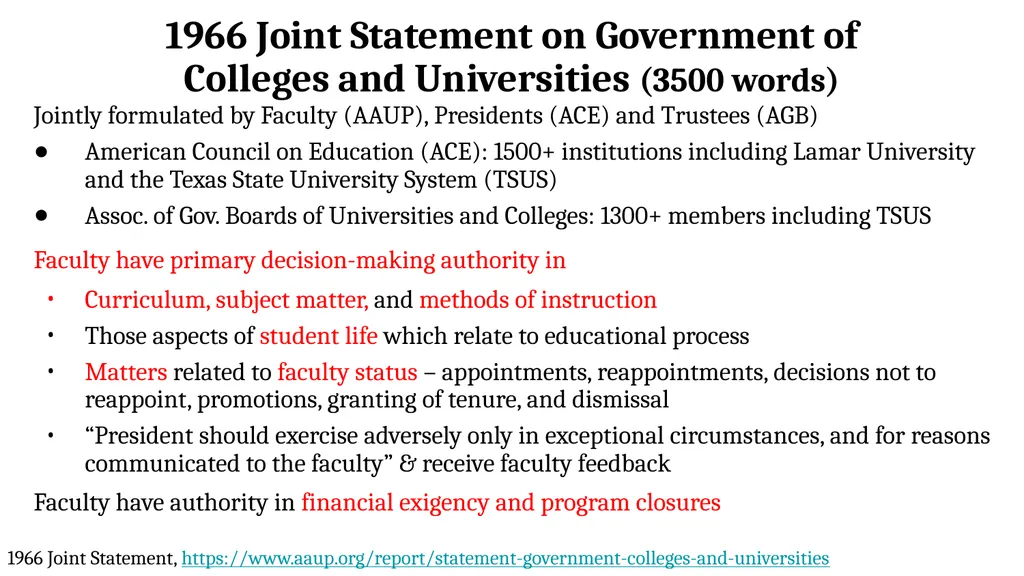
Jointly formulated by Faculty (AAUP), Presidents (ACE) and Trustees (AGB)
American Council on Education (ACE): 1500+ institutions including Lamar University and the Texas State University System (TSUS)
Assoc. of Gov. Boards of Universities and Colleges: 1300+ members including TSUS
Faculty have primary decision-making authority in
Curriculum, subject matter, and methods of instruction
Those aspects of student life which relate to educational process
Matters related to faculty status – appointments, reappointments, decisions not to reappoint, promotions, granting of tenure, and dismissal
“President should exercise adversely only in exceptional circumstances, and for reasons communicated to the faculty” & receive faculty feedback
Faculty have authority in financial exigency and program closures 1966 Joint Statement, https://www.aaup.org/report/statement-government-colleges-and-universities 1966 Joint Statement on Government of Colleges and Universities (3500 words)<br>
American Council on Education (ACE): 1500+ institutions including Lamar University and the Texas State University System (TSUS)
Assoc. of Gov. Boards of Universities and Colleges: 1300+ members including TSUS
Faculty have primary decision-making authority in
Curriculum, subject matter, and methods of instruction
Those aspects of student life which relate to educational process
Matters related to faculty status – appointments, reappointments, decisions not to reappoint, promotions, granting of tenure, and dismissal
“President should exercise adversely only in exceptional circumstances, and for reasons communicated to the faculty” & receive faculty feedback
Faculty have authority in financial exigency and program closures 1966 Joint Statement, https://www.aaup.org/report/statement-government-colleges-and-universities 1966 Joint Statement on Government of Colleges and Universities (3500 words)<br>
09
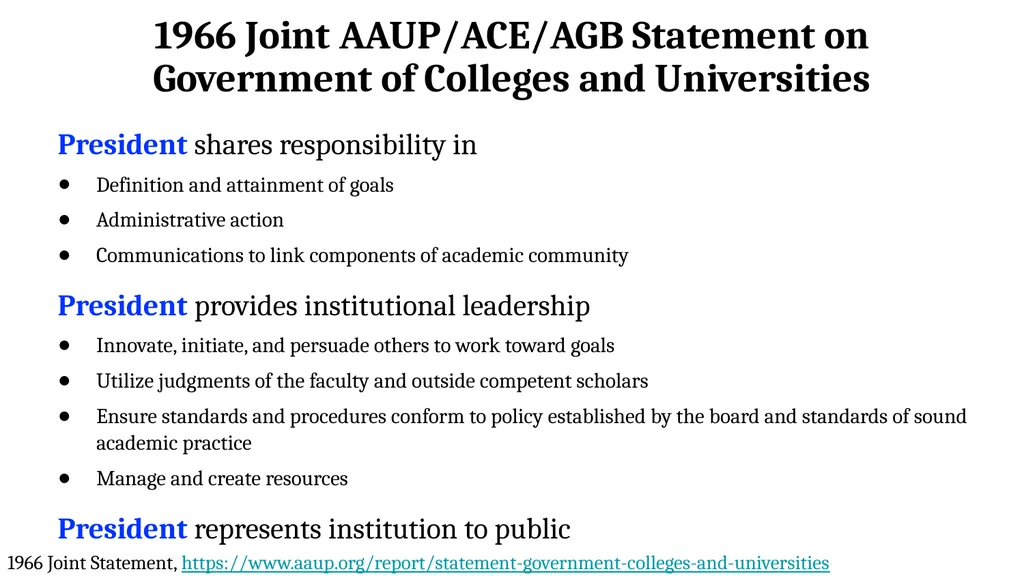
President shares responsibility in
Definition and attainment of goals
Administrative action
Communications to link components of academic community
President provides institutional leadership
Innovate, initiate, and persuade others to work toward goals
Utilize judgments of the faculty and outside competent scholars
Ensure standards and procedures conform to policy established by the board and standards of sound academic practice
Manage and create resources
President represents institution to public 1966 Joint Statement, https://www.aaup.org/report/statement-government-colleges-and-universities 1966 Joint AAUP/ACE/AGB Statement on Government of Colleges and Universities<br>
Definition and attainment of goals
Administrative action
Communications to link components of academic community
President provides institutional leadership
Innovate, initiate, and persuade others to work toward goals
Utilize judgments of the faculty and outside competent scholars
Ensure standards and procedures conform to policy established by the board and standards of sound academic practice
Manage and create resources
President represents institution to public 1966 Joint Statement, https://www.aaup.org/report/statement-government-colleges-and-universities 1966 Joint AAUP/ACE/AGB Statement on Government of Colleges and Universities<br>
10
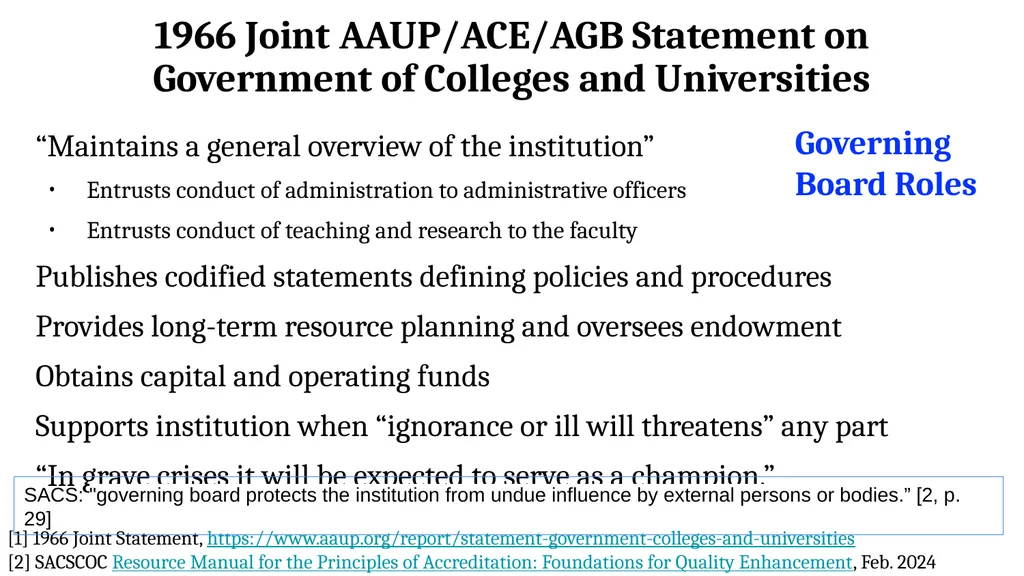
“Maintains a general overview of the institution”
Entrusts conduct of administration to administrative officers
Entrusts conduct of teaching and research to the faculty
Publishes codified statements defining policies and procedures
Provides long-term resource planning and oversees endowment
Obtains capital and operating funds
Supports institution when “ignorance or ill will threatens” any part
“In grave crises it will be expected to serve as a champion.” [1] 1966 Joint Statement, https://www.aaup.org/report/statement-government-colleges-and-universities [2] SACSCOC Resource Manual for the Principles of Accreditation: Foundations for Quality Enhancement, Feb. 2024 1966 Joint AAUP/ACE/AGB Statement on Government of Colleges and Universities Governing Board Roles SACS: "governing board protects the institution from undue influence by external persons or bodies.” [2, p. 29]<br>
Entrusts conduct of administration to administrative officers
Entrusts conduct of teaching and research to the faculty
Publishes codified statements defining policies and procedures
Provides long-term resource planning and oversees endowment
Obtains capital and operating funds
Supports institution when “ignorance or ill will threatens” any part
“In grave crises it will be expected to serve as a champion.” [1] 1966 Joint Statement, https://www.aaup.org/report/statement-government-colleges-and-universities [2] SACSCOC Resource Manual for the Principles of Accreditation: Foundations for Quality Enhancement, Feb. 2024 1966 Joint AAUP/ACE/AGB Statement on Government of Colleges and Universities Governing Board Roles SACS: "governing board protects the institution from undue influence by external persons or bodies.” [2, p. 29]<br>
11
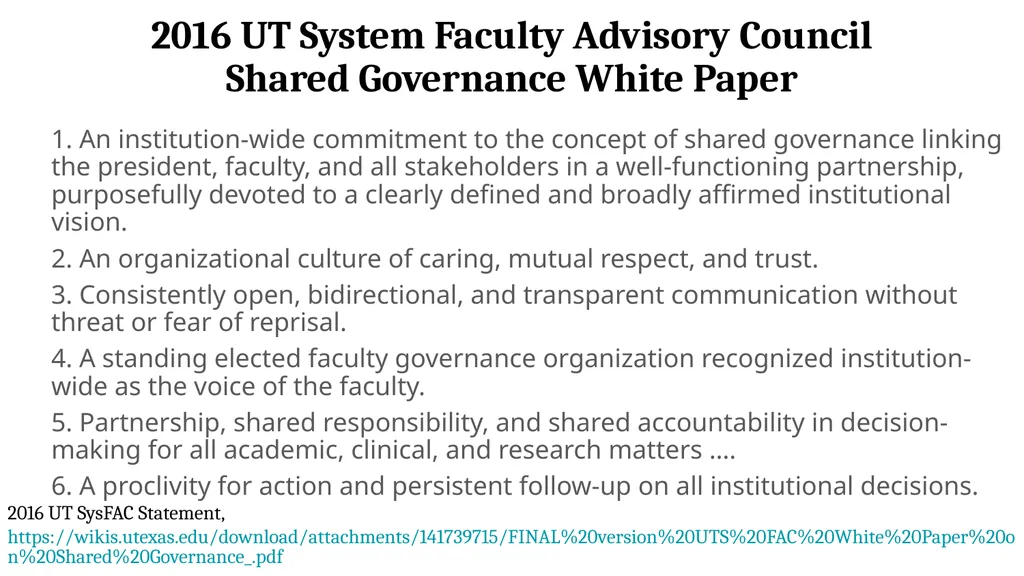
1. An institution-wide commitment to the concept of shared governance linking the president, faculty, and all stakeholders in a well-functioning partnership, purposefully devoted to a clearly defined and broadly affirmed institutional vision.
2. An organizational culture of caring, mutual respect, and trust.
3. Consistently open, bidirectional, and transparent communication without threat or fear of reprisal.
4. A standing elected faculty governance organization recognized institution-wide as the voice of the faculty.
5. Partnership, shared responsibility, and shared accountability in decision-making for all academic, clinical, and research matters ….
6. A proclivity for action and persistent follow-up on all institutional decisions. 2016 UT SysFAC Statement, https://wikis.utexas.edu/download/attachments/141739715/FINAL%20version%20UTS%20FAC%20White%20Paper%20on%20Shared%20Governance_.pdf 2016 UT System Faculty Advisory Council Shared Governance White Paper<br>
2. An organizational culture of caring, mutual respect, and trust.
3. Consistently open, bidirectional, and transparent communication without threat or fear of reprisal.
4. A standing elected faculty governance organization recognized institution-wide as the voice of the faculty.
5. Partnership, shared responsibility, and shared accountability in decision-making for all academic, clinical, and research matters ….
6. A proclivity for action and persistent follow-up on all institutional decisions. 2016 UT SysFAC Statement, https://wikis.utexas.edu/download/attachments/141739715/FINAL%20version%20UTS%20FAC%20White%20Paper%20on%20Shared%20Governance_.pdf 2016 UT System Faculty Advisory Council Shared Governance White Paper<br>
12
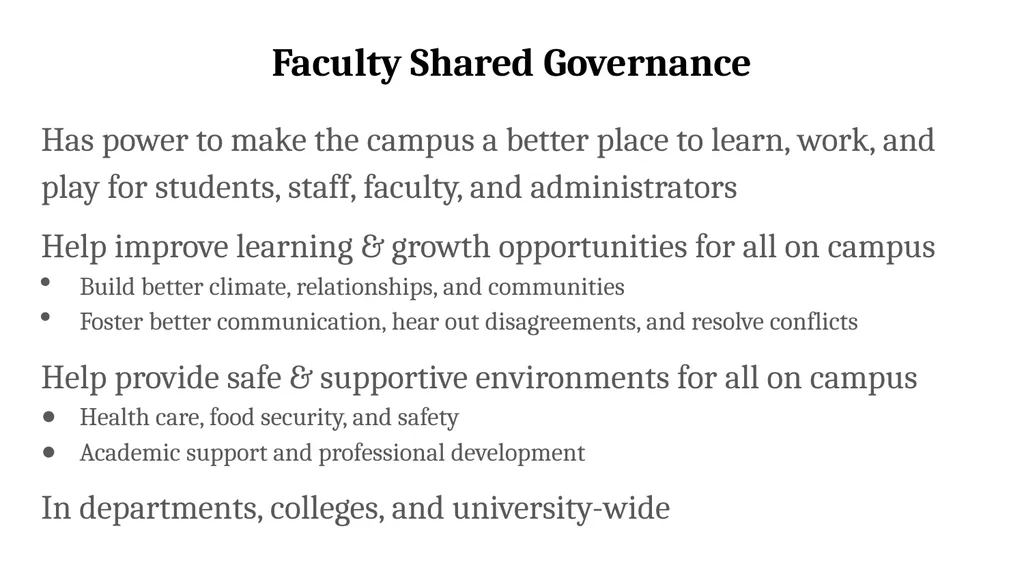
Faculty Shared Governance Has power to make the campus a better place to learn, work, and play for students, staff, faculty, and administrators
Help improve learning & growth opportunities for all on campus
Build better climate, relationships, and communities
Foster better communication, hear out disagreements, and resolve conflicts
Help provide safe & supportive environments for all on campus
Health care, food security, and safety
Academic support and professional development
In departments, colleges, and university-wide<br>
Help improve learning & growth opportunities for all on campus
Build better climate, relationships, and communities
Foster better communication, hear out disagreements, and resolve conflicts
Help provide safe & supportive environments for all on campus
Health care, food security, and safety
Academic support and professional development
In departments, colleges, and university-wide<br>
13
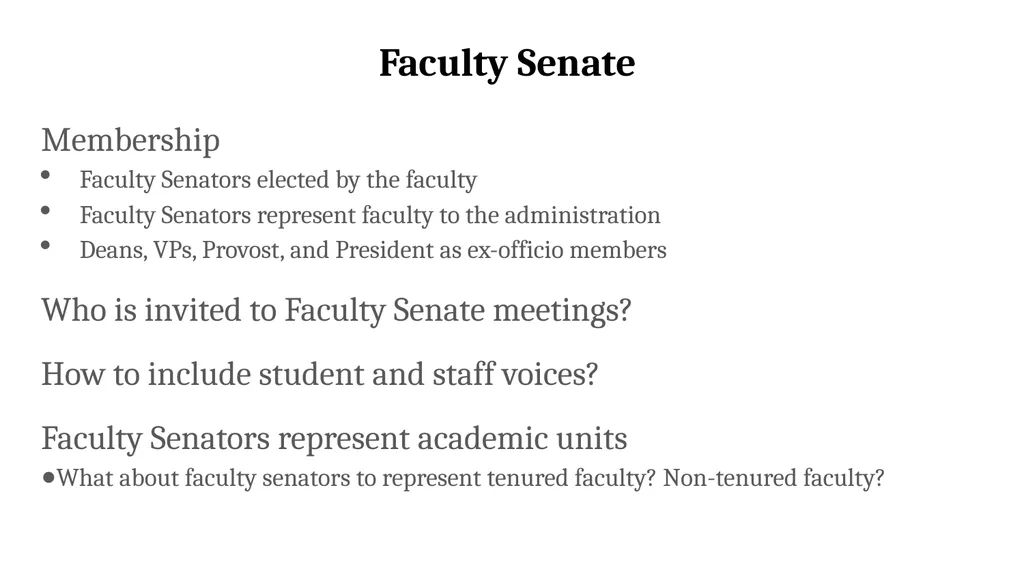
Faculty Senate Membership
Faculty Senators elected by the faculty
Faculty Senators represent faculty to the administration
Deans, VPs, Provost, and President as ex-officio members
Who is invited to Faculty Senate meetings?
How to include student and staff voices?
Faculty Senators represent academic units
What about faculty senators to represent tenured faculty? Non-tenured faculty?<br>
Faculty Senators elected by the faculty
Faculty Senators represent faculty to the administration
Deans, VPs, Provost, and President as ex-officio members
Who is invited to Faculty Senate meetings?
How to include student and staff voices?
Faculty Senators represent academic units
What about faculty senators to represent tenured faculty? Non-tenured faculty?<br>
14
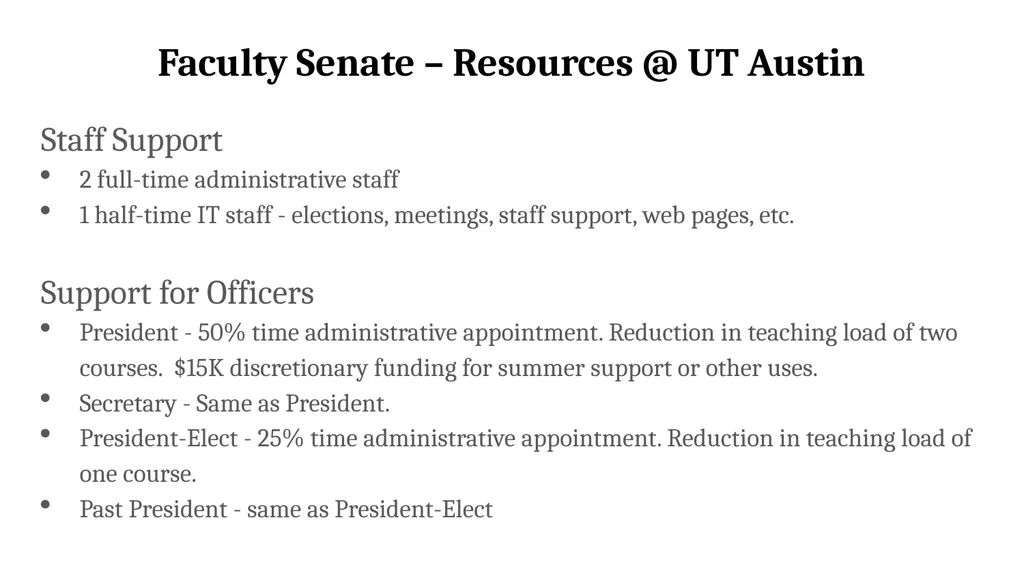
Faculty Senate – Resources @ UT Austin Staff Support
2 full-time administrative staff
1 half-time IT staff - elections, meetings, staff support, web pages, etc.
Support for Officers
President - 50% time administrative appointment. Reduction in teaching load of two courses. $15K discretionary funding for summer support or other uses.
Secretary - Same as President.
President-Elect - 25% time administrative appointment. Reduction in teaching load of one course.
Past President - same as President-Elect<br>
2 full-time administrative staff
1 half-time IT staff - elections, meetings, staff support, web pages, etc.
Support for Officers
President - 50% time administrative appointment. Reduction in teaching load of two courses. $15K discretionary funding for summer support or other uses.
Secretary - Same as President.
President-Elect - 25% time administrative appointment. Reduction in teaching load of one course.
Past President - same as President-Elect<br>
15
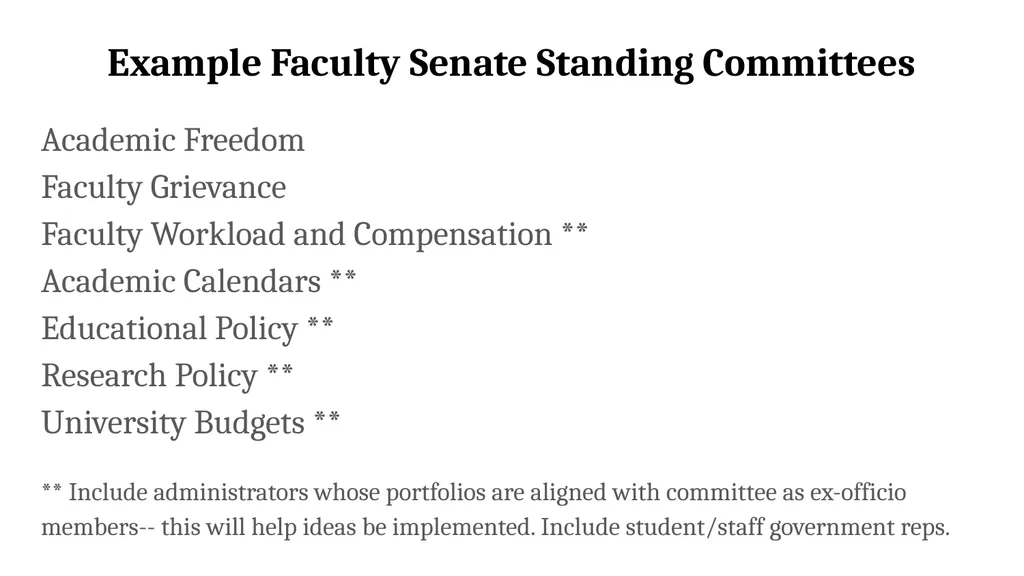
Example Faculty Senate Standing Committees Academic Freedom
Faculty Grievance
Faculty Workload and Compensation **
Academic Calendars **
Educational Policy **
Research Policy **
University Budgets **
** Include administrators whose portfolios are aligned with committee as ex-officio members-- this will help ideas be implemented. Include student/staff government reps.<br>
Faculty Grievance
Faculty Workload and Compensation **
Academic Calendars **
Educational Policy **
Research Policy **
University Budgets **
** Include administrators whose portfolios are aligned with committee as ex-officio members-- this will help ideas be implemented. Include student/staff government reps.<br>
16
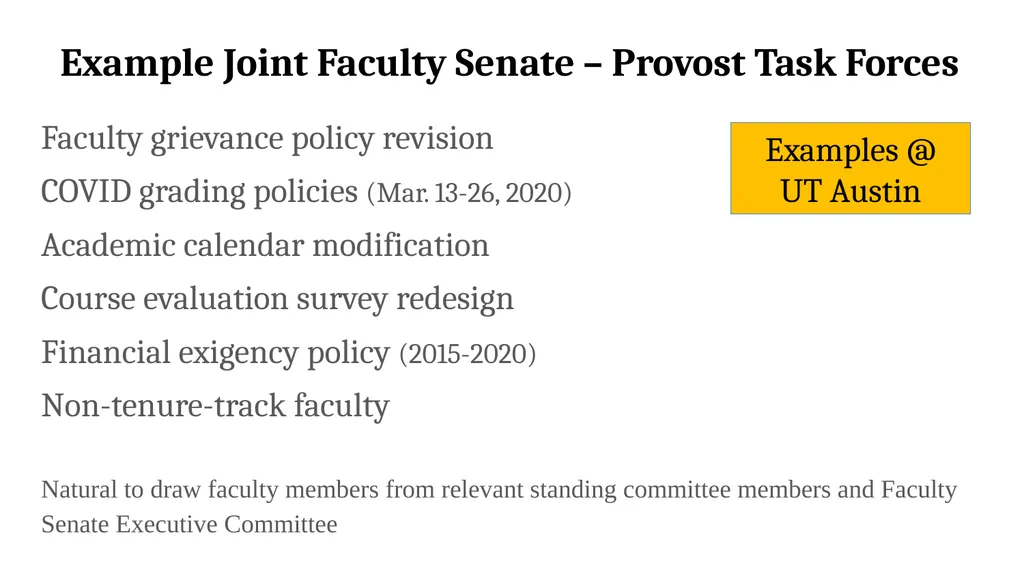
Example Joint Faculty Senate – Provost Task Forces Faculty grievance policy revision
COVID grading policies (Mar. 13-26, 2020)
Academic calendar modification
Course evaluation survey redesign
Financial exigency policy (2015-2020)
Non-tenure-track faculty
Natural to draw faculty members from relevant standing committee members and Faculty Senate Executive Committee Examples @ UT Austin<br>
COVID grading policies (Mar. 13-26, 2020)
Academic calendar modification
Course evaluation survey redesign
Financial exigency policy (2015-2020)
Non-tenure-track faculty
Natural to draw faculty members from relevant standing committee members and Faculty Senate Executive Committee Examples @ UT Austin<br>
17
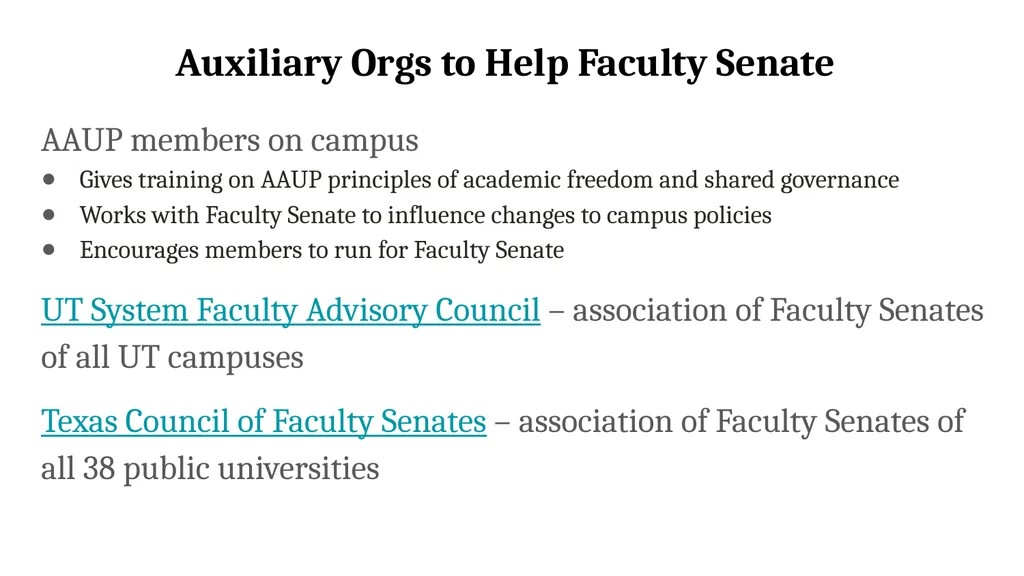
Auxiliary Orgs to Help Faculty Senate AAUP members on campus
Gives training on AAUP principles of academic freedom and shared governance
Works with Faculty Senate to influence changes to campus policies
Encourages members to run for Faculty Senate
UT System Faculty Advisory Council – association of Faculty Senates of all UT campuses
Texas Council of Faculty Senates – association of Faculty Senates of all 38 public universities<br>
Gives training on AAUP principles of academic freedom and shared governance
Works with Faculty Senate to influence changes to campus policies
Encourages members to run for Faculty Senate
UT System Faculty Advisory Council – association of Faculty Senates of all UT campuses
Texas Council of Faculty Senates – association of Faculty Senates of all 38 public universities<br>
18
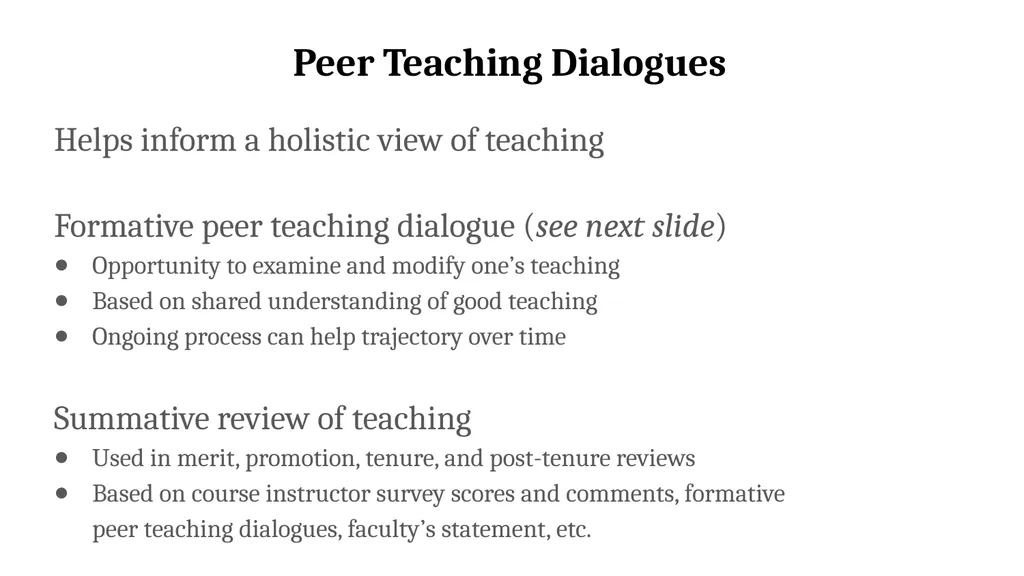
Peer Teaching Dialogues Helps inform a holistic view of teaching
Formative peer teaching dialogue (see next slide)
Opportunity to examine and modify one’s teaching
Based on shared understanding of good teaching
Ongoing process can help trajectory over time
Summative review of teaching
Used in merit, promotion, tenure, and post-tenure reviews
Based on course instructor survey scores and comments, formative peer teaching dialogues, faculty’s statement, etc.<br>
Formative peer teaching dialogue (see next slide)
Opportunity to examine and modify one’s teaching
Based on shared understanding of good teaching
Ongoing process can help trajectory over time
Summative review of teaching
Used in merit, promotion, tenure, and post-tenure reviews
Based on course instructor survey scores and comments, formative peer teaching dialogues, faculty’s statement, etc.<br>
19
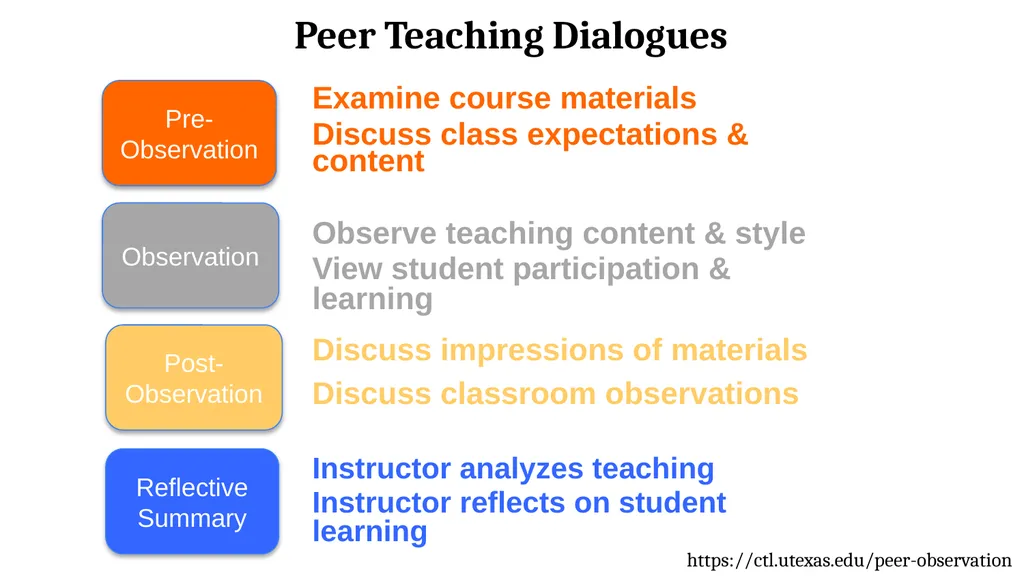
Examine course materials
Discuss class expectations & content https://ctl.utexas.edu/peer-observation Pre-Observation Observation Post-Observation Reflective
Summary Observe teaching content & style
View student participation & learning Discuss impressions of materials
Discuss classroom observations Instructor analyzes teaching
Instructor reflects on student learning Peer Teaching Dialogues<br>
Discuss class expectations & content https://ctl.utexas.edu/peer-observation Pre-Observation Observation Post-Observation Reflective
Summary Observe teaching content & style
View student participation & learning Discuss impressions of materials
Discuss classroom observations Instructor analyzes teaching
Instructor reflects on student learning Peer Teaching Dialogues<br>
20
Supplemental Slides<br>
21
1940 Joint AAUP/AAC&U Statement of
Principles on Academic Freedom & Tenure Tenure provides the conditions for faculty to pursue research and innovation and draw evidence-based conclusions free from corporate or political pressure
Tenure is an indefinite appointment terminated only for cause or extraordinary circumstances such as financial exigency
All full-time faculty members, regardless of rank, are to be considered eligible for tenure 1940 Statement: https://www.aaup.org/report/1940-statement-principles-academic-freedom-and-tenure<br>
Tenure is an indefinite appointment terminated only for cause or extraordinary circumstances such as financial exigency
All full-time faculty members, regardless of rank, are to be considered eligible for tenure 1940 Statement: https://www.aaup.org/report/1940-statement-principles-academic-freedom-and-tenure<br>