ACCLIMATIZATION AND TREKKING WITH A VICTIM IN MOUNTAINS 1 Presented By:- Dileep Kumar,2IC OBJECTIVES Upon the completion of session, you will be able to know- What is Acclimatization? Why Acclimatization is Critical. Stages of
"ACCLIMATIZATION AND TREKKING WITH A VICTIM IN" is the property of its rightful owner. Permission is granted to
download and print the materials on this website for personal, non-commercial use only, and to display it
on your personal computer provided you do not modify the materials and that you retain all copyright
notices contained in the materials. By downloading content from our website, you accept the terms of this
agreement.
Presentation Transcript
01
ACCLIMATIZATION AND TREKKING WITH A VICTIM IN MOUNTAINS 1 Presented By:- Dileep Kumar,2IC<br>
02
OBJECTIVES Upon the completion of session, you will be able to know-
What is Acclimatization?
Why Acclimatization is Critical.
Stages of Acclimatization
Common Altitude Illnesses
Managing a Victim on a Trek
Evacuation Techniques
Safety and Team Roles
Prevention strategies 2<br>
03
WHAT IS ACCLIMATIZATION? Definition: Gradual physiological adaptation to lower oxygen levels at high altitudes
Key factors: oxygen levels, altitude gain, physical conditioning
Body changes: increased breathing rate, red blood cell production 3<br>
04
WHY ACCLIMATIZATION IS CRITICAL ? Prevents Acute Mountain Sickness (AMS), HAPE, and HACE
Reduces risk of fatigue, confusion, and collapse
Supports safer movement in emergencies 4<br>
05
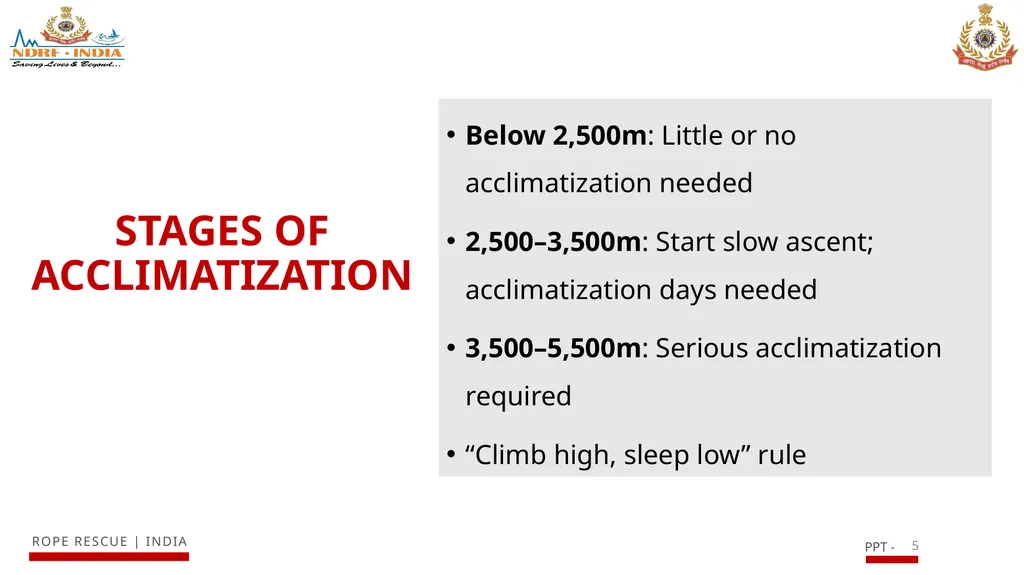
STAGES OF ACCLIMATIZATION Below 2,500m: Little or no acclimatization needed
2,500–3,500m: Start slow ascent; acclimatization days needed
3,500–5,500m: Serious acclimatization required
“Climb high, sleep low” rule 5<br>
06
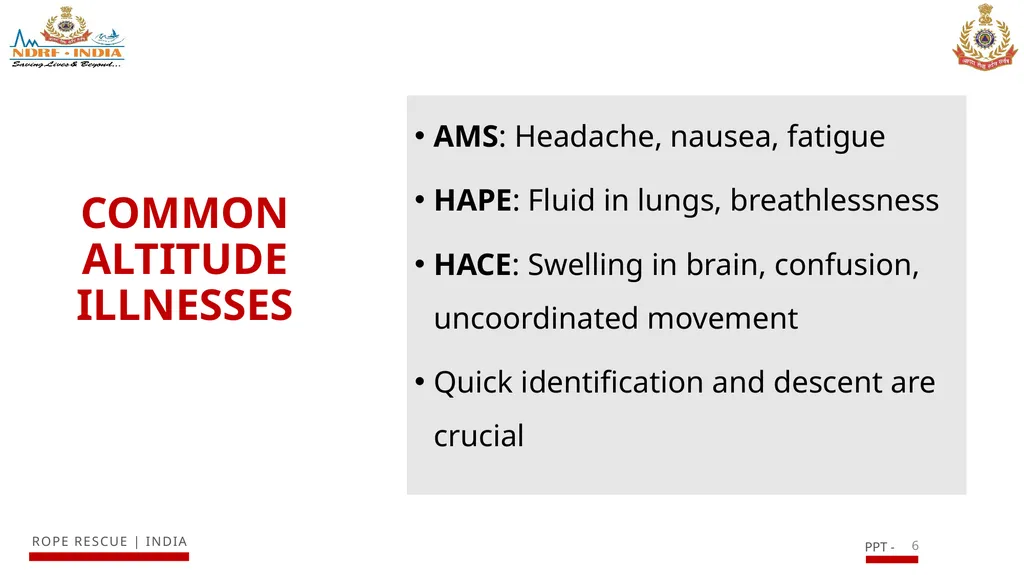
COMMON ALTITUDE ILLNESSES AMS: Headache, nausea, fatigue
HAPE: Fluid in lungs, breathlessness
HACE: Swelling in brain, confusion, uncoordinated movement
Quick identification and descent are crucial 6<br>
07
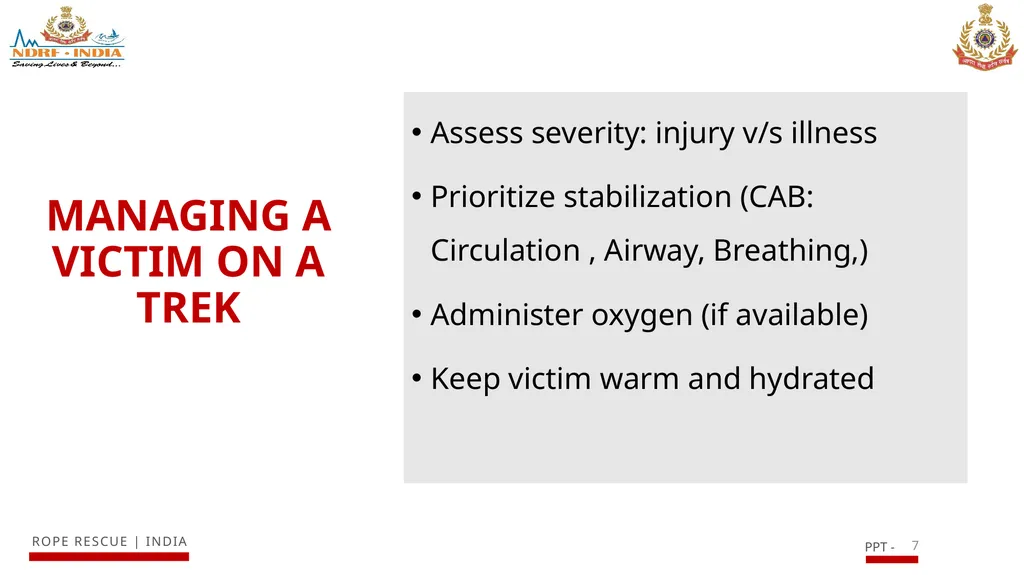
MANAGING A VICTIM ON A TREK Assess severity: injury v/s illness
Prioritize stabilization (CAB: Circulation , Airway, Breathing,)
Administer oxygen (if available)
Keep victim warm and hydrated 7<br>
08
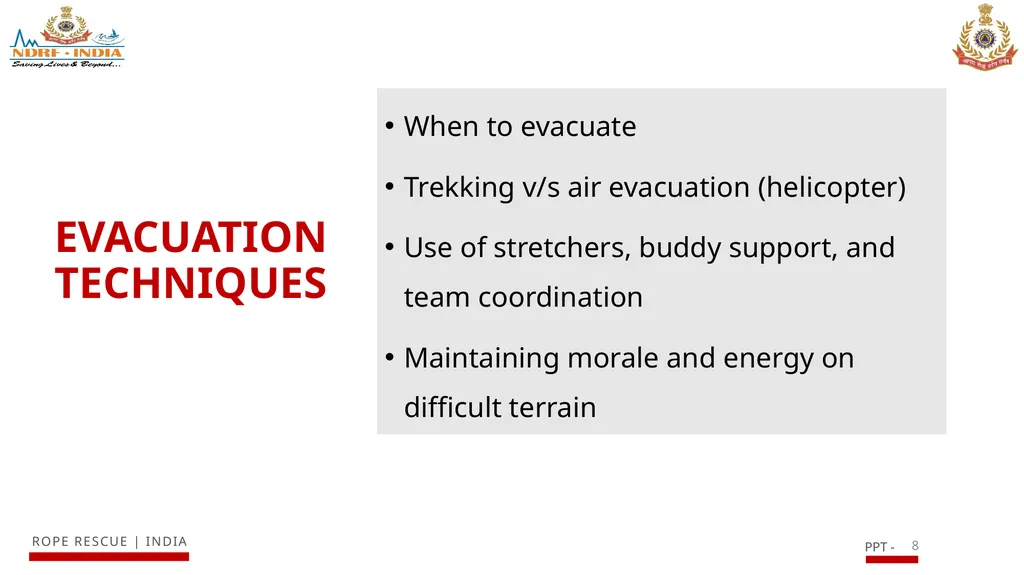
EVACUATION TECHNIQUES When to evacuate
Trekking v/s air evacuation (helicopter)
Use of stretchers, buddy support, and team coordination
Maintaining morale and energy on difficult terrain 8<br>
09
SAFETY AND TEAM ROLES Clear role delegation: leader, medic, navigator, porters
Maintain communication
Monitor all team members for signs of altitude sickness
Frequent rest, hydration, and nutrition 9<br>
10
PREVENTION STRATEGIES Proper acclimatization schedule
Pre-trek fitness and screening
Carry essential medical supplies (oxygen, Diamox, etc.)
Training in mountain first aid 10<br>
11
REVIEW After the completion of lecture, you learnt the followings.
What is Acclimatization?
Why Acclimatization is Critical.
Stages of Acclimatization
Common Altitude Illnesses
Managing a Victim on a Trek
Evacuation Techniques
Safety and Team Roles
Preventation strategies 11<br>
12
ANY QUESTION ? 12<br>
13
EVALUATION Que:1 During a mountain rescue, the safest way to assist a semi-conscious victim is ?
a. Let them walk with support b. Wait for them to regain full consciousness c. Carry them on a stretcher with head
elevated d. Administer high doses of oxygen without movement. 13<br>
14
Que:2. What is the main purpose of acclimatization at high altitudes?
a. To improve cardiovascular fitness b. To prevent cold injuries C. To adapt to reduced oxygen levels d. To prevent dehydration 14 EVALUATION<br>