Accounting information and investment properties: economic and financial stakes for listed groups Aurélien DECAMPS KEDGE Business School aurelien.decampskedgebs.com Stéphane OUVRARD KEDGE Business School stephane.ouvrardkedgebs.com
"Accounting information and investment properties:" is the property of its rightful owner. Permission is granted to
download and print the materials on this website for personal, non-commercial use only, and to display it
on your personal computer provided you do not modify the materials and that you retain all copyright
notices contained in the materials. By downloading content from our website, you accept the terms of this
agreement.
Presentation Transcript
01
Accounting information and investment properties: economic and financial stakes for listed groups Aurélien DECAMPS
KEDGE Business School
aurelien.decamps@kedgebs.com Stéphane OUVRARD
KEDGE Business School
stephane.ouvrard@kedgebs.com<br>
02
Research Question Does accounting choice for corporate investment property have an impact on economic and financial disclosures for listed companies ?<br>
03
Aim Understand accounting choice of listed companies concerning their investment property
Estimate the impact of this choice on their consolidated financial statement<br>
04
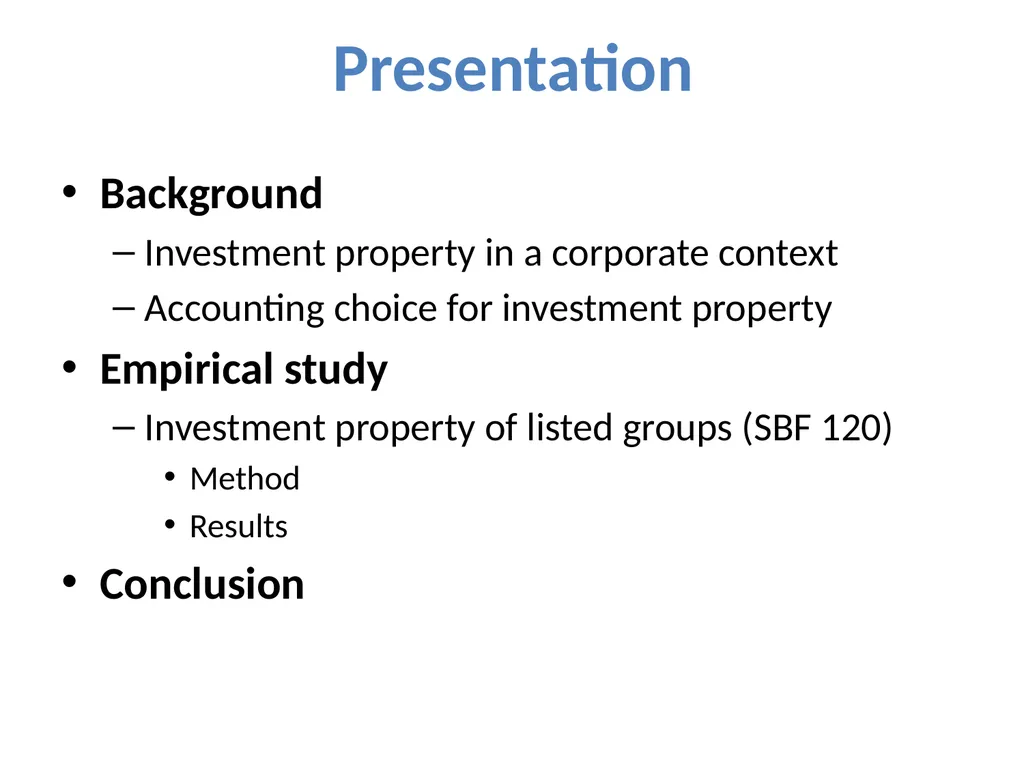
Presentation Background
Investment property in a corporate context
Accounting choice for investment property
Empirical study
Investment property of listed groups (SBF 120)
Method
Results
Conclusion<br>
05
Background
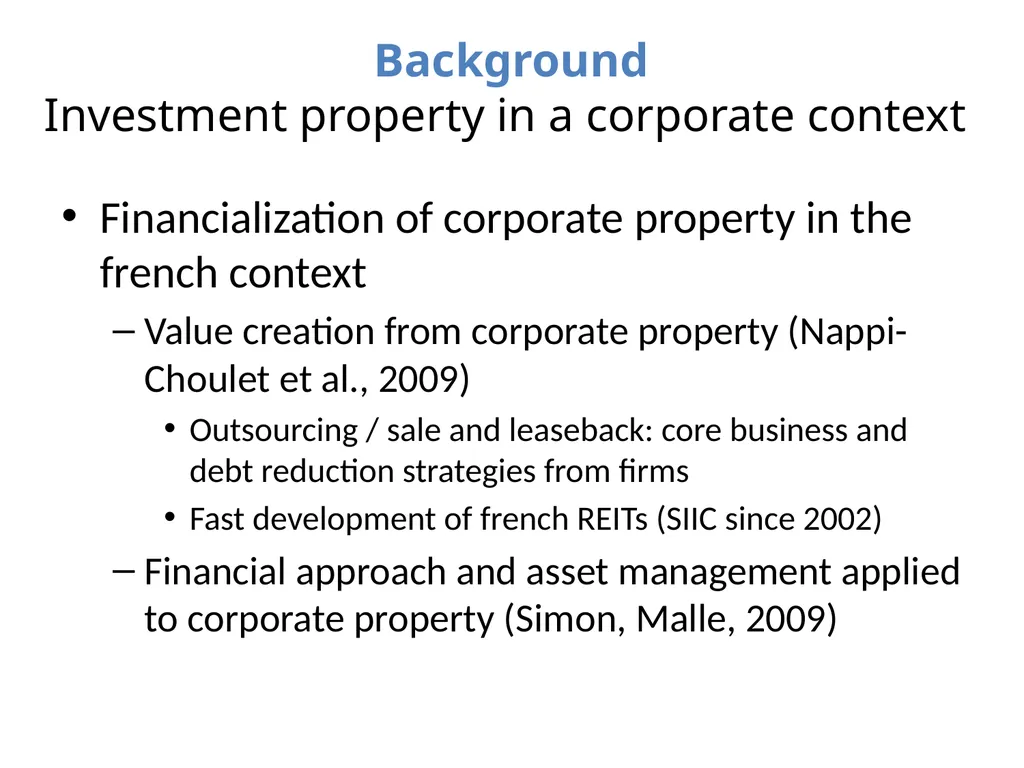
Investment property in a corporate context Financialization of corporate property in the french context
Value creation from corporate property (Nappi-Choulet et al., 2009)
Outsourcing / sale and leaseback: core business and debt reduction strategies from firms
Fast development of french REITs (SIIC since 2002)
Financial approach and asset management applied to corporate property (Simon, Malle, 2009)<br>
06
Background
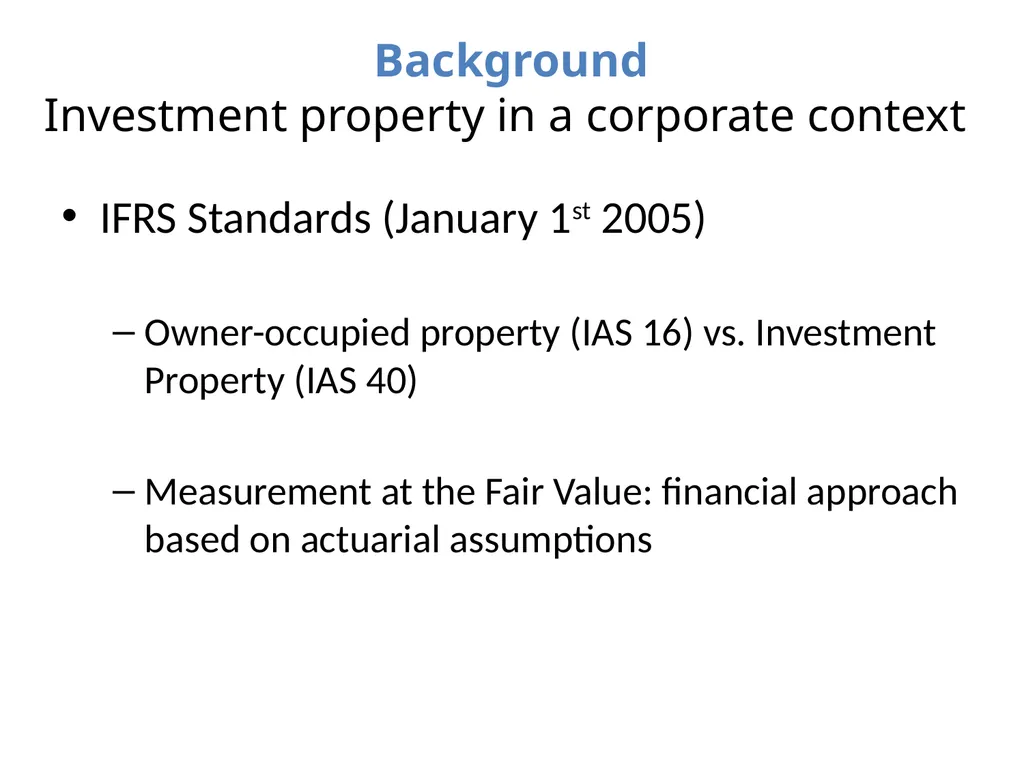
Investment property in a corporate context IFRS Standards (January 1st 2005)
Owner-occupied property (IAS 16) vs. Investment Property (IAS 40)
Measurement at the Fair Value: financial approach based on actuarial assumptions<br>
07
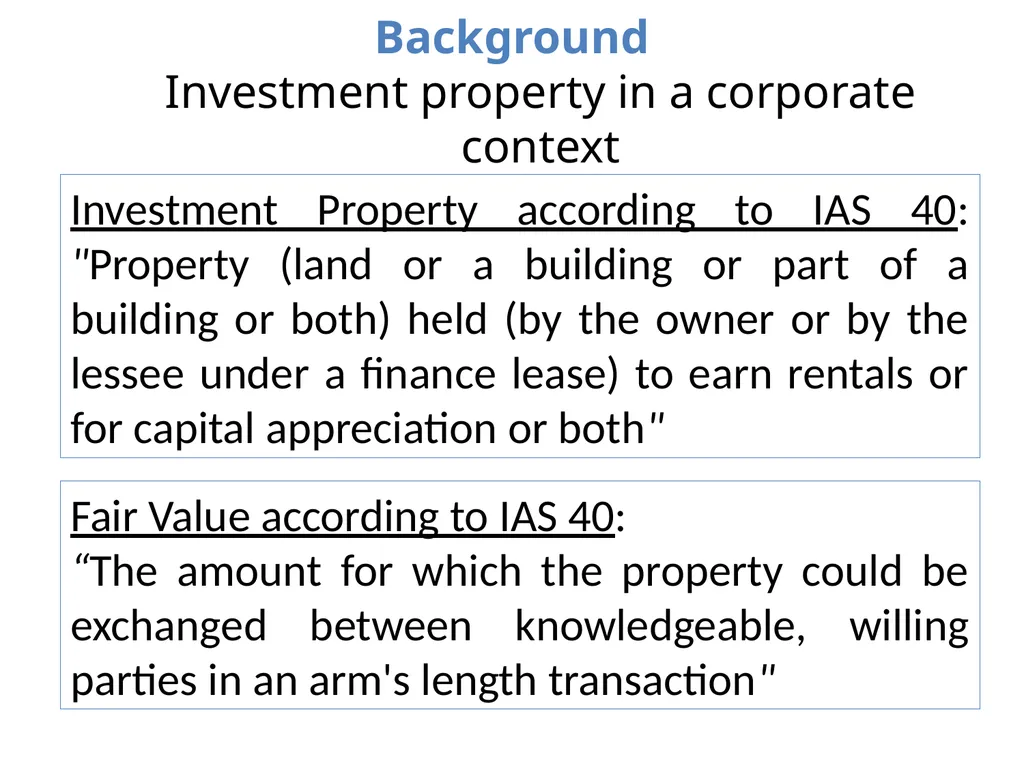
Background Investment property in a corporate context Investment Property according to IAS 40: "Property (land or a building or part of a building or both) held (by the owner or by the lessee under a finance lease) to earn rentals or for capital appreciation or both" Fair Value according to IAS 40:
“The amount for which the property could be exchanged between knowledgeable, willing parties in an arm's length transaction"<br>
08
Background
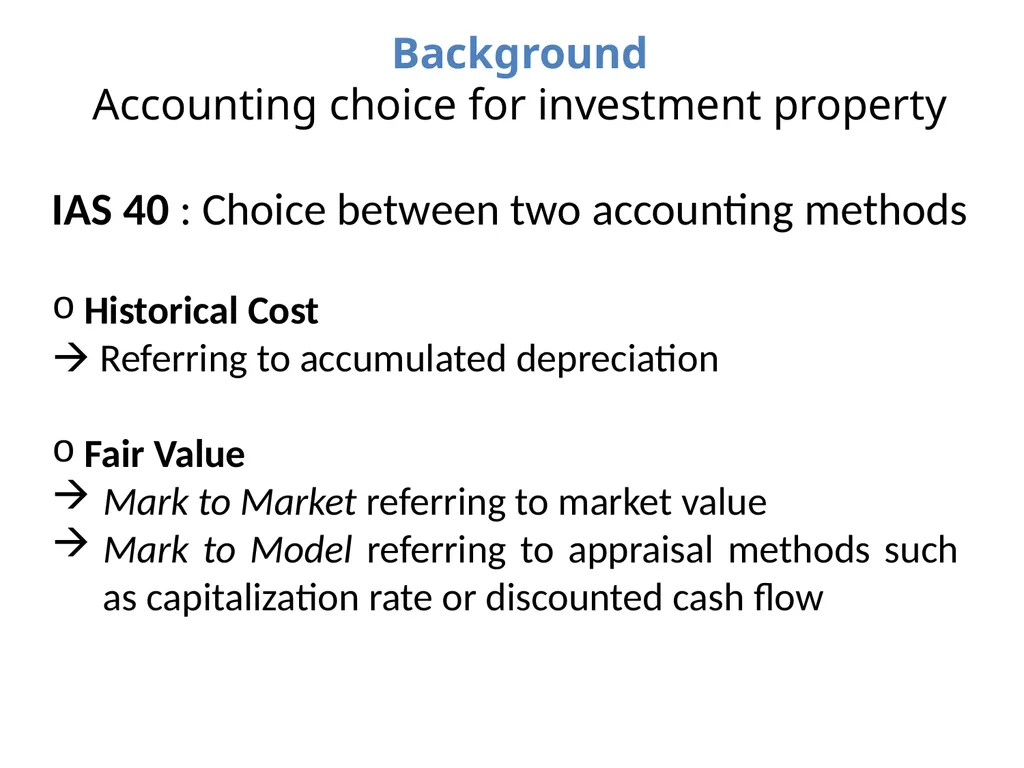
Accounting choice for investment property Historical Cost
Referring to accumulated depreciation
Fair Value
Mark to Market referring to market value
Mark to Model referring to appraisal methods such as capitalization rate or discounted cash flow IAS 40 : Choice between two accounting methods<br>
09
Background
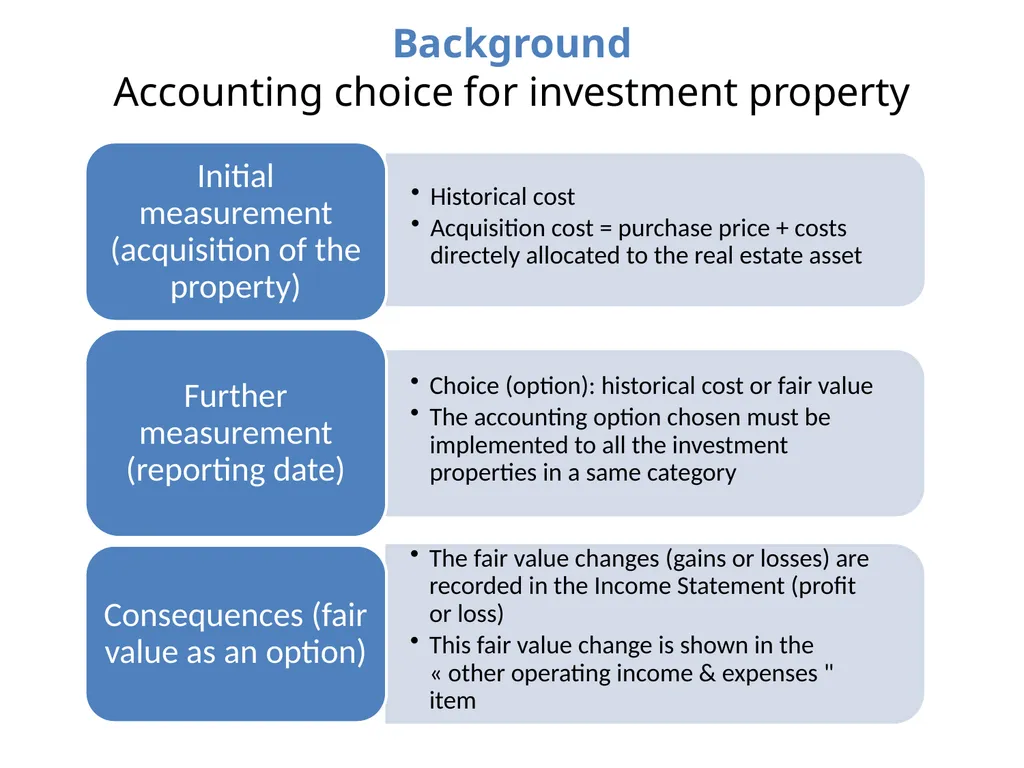
Accounting choice for investment property<br>
10
Background
Accounting choice for investment property
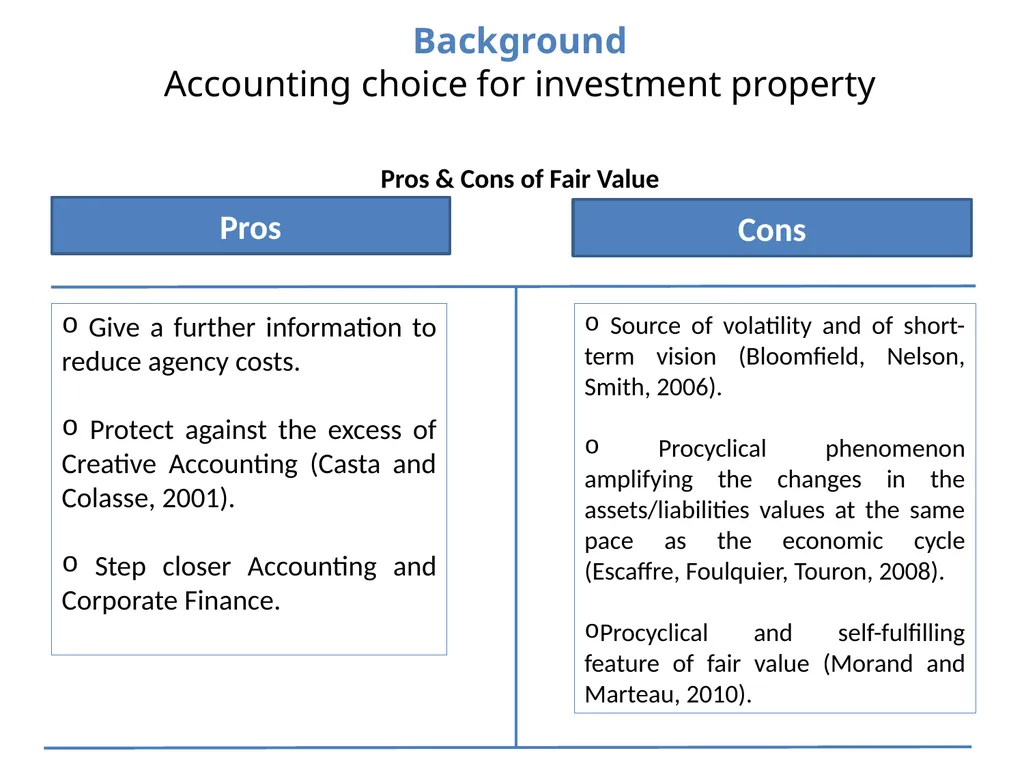
Pros & Cons of Fair Value Give a further information to reduce agency costs.
Protect against the excess of Creative Accounting (Casta and Colasse, 2001).
Step closer Accounting and Corporate Finance. Source of volatility and of short-term vision (Bloomfield, Nelson, Smith, 2006).
Procyclical phenomenon amplifying the changes in the assets/liabilities values at the same pace as the economic cycle (Escaffre, Foulquier, Touron, 2008).
Procyclical and self-fulfilling feature of fair value (Morand and Marteau, 2010). Pros Cons<br>
11
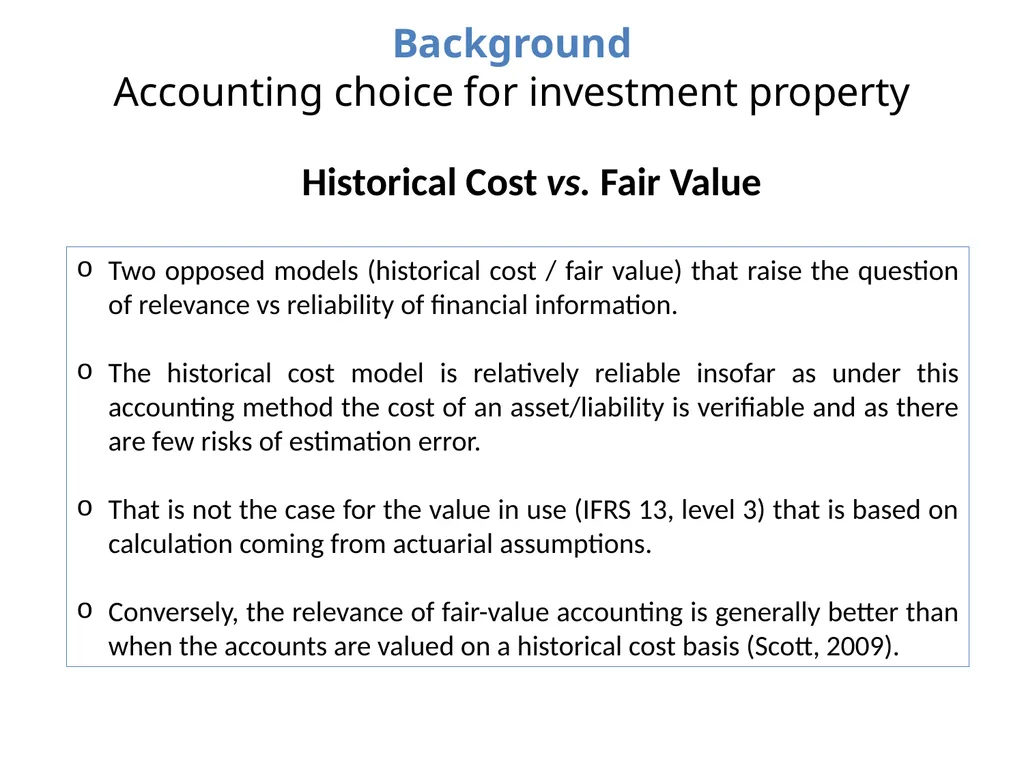
Two opposed models (historical cost / fair value) that raise the question of relevance vs reliability of financial information.
The historical cost model is relatively reliable insofar as under this accounting method the cost of an asset/liability is verifiable and as there are few risks of estimation error.
That is not the case for the value in use (IFRS 13, level 3) that is based on calculation coming from actuarial assumptions.
Conversely, the relevance of fair-value accounting is generally better than when the accounts are valued on a historical cost basis (Scott, 2009). Historical Cost vs. Fair Value Background
Accounting choice for investment property<br>
12
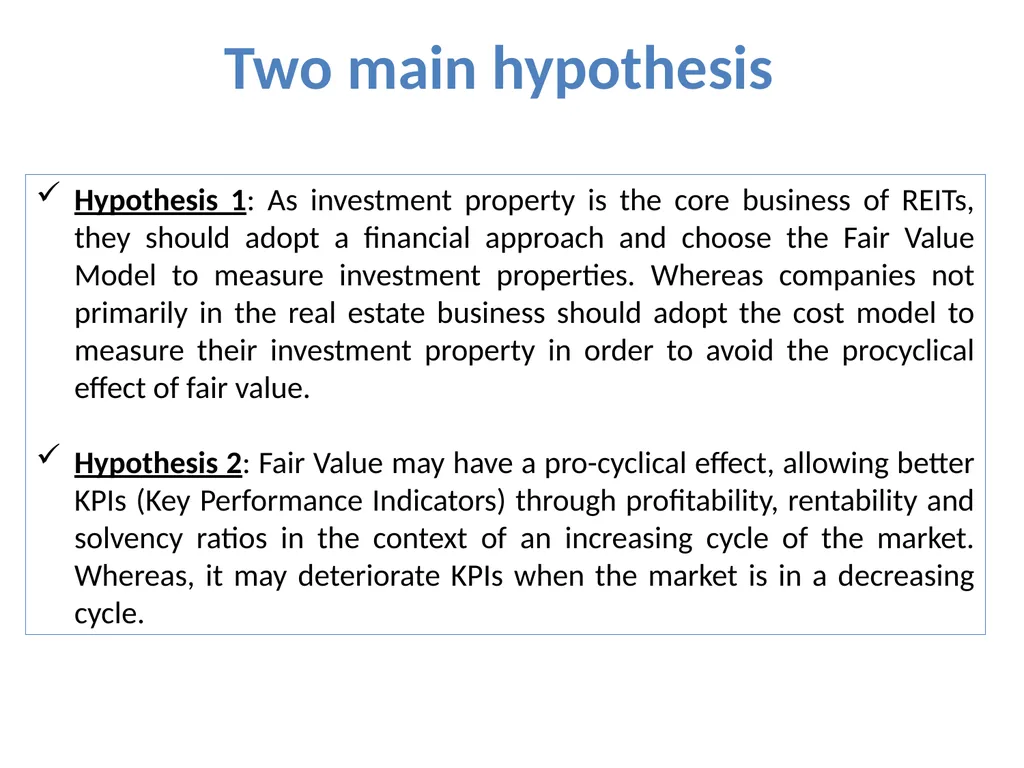
Two main hypothesis Hypothesis 1: As investment property is the core business of REITs, they should adopt a financial approach and choose the Fair Value Model to measure investment properties. Whereas companies not primarily in the real estate business should adopt the cost model to measure their investment property in order to avoid the procyclical effect of fair value.
Hypothesis 2: Fair Value may have a pro-cyclical effect, allowing better KPIs (Key Performance Indicators) through profitability, rentability and solvency ratios in the context of an increasing cycle of the market. Whereas, it may deteriorate KPIs when the market is in a decreasing cycle.<br>
13
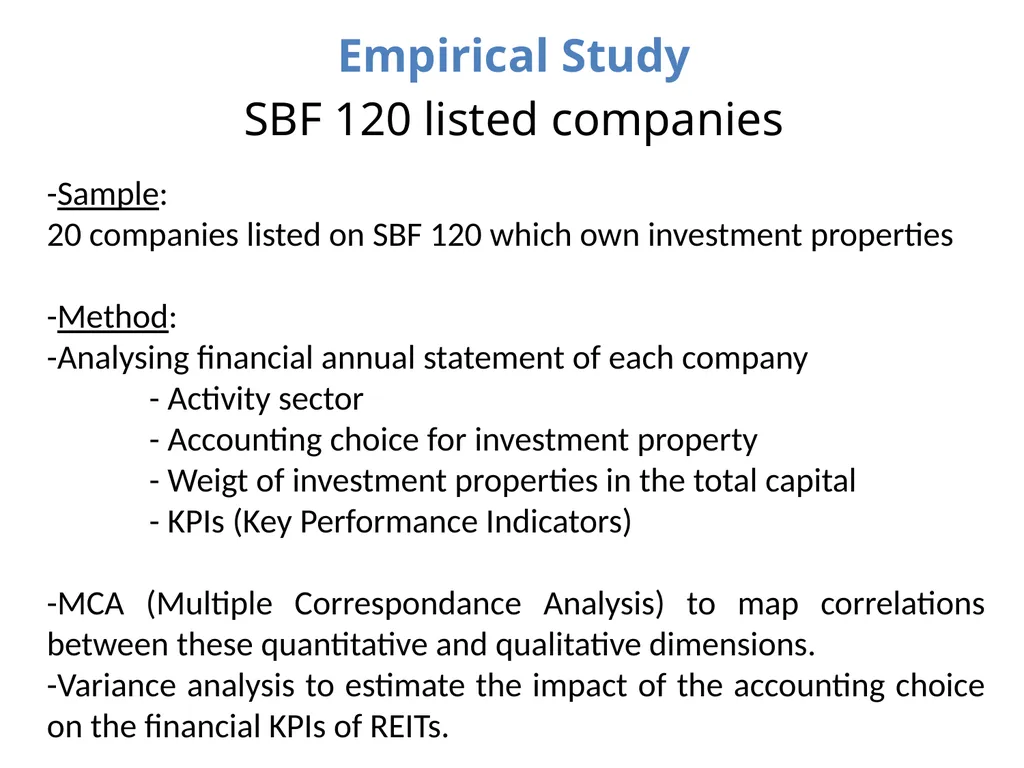
-Sample:
20 companies listed on SBF 120 which own investment properties
-Method:
-Analysing financial annual statement of each company
- Activity sector
- Accounting choice for investment property
- Weigt of investment properties in the total capital
- KPIs (Key Performance Indicators)
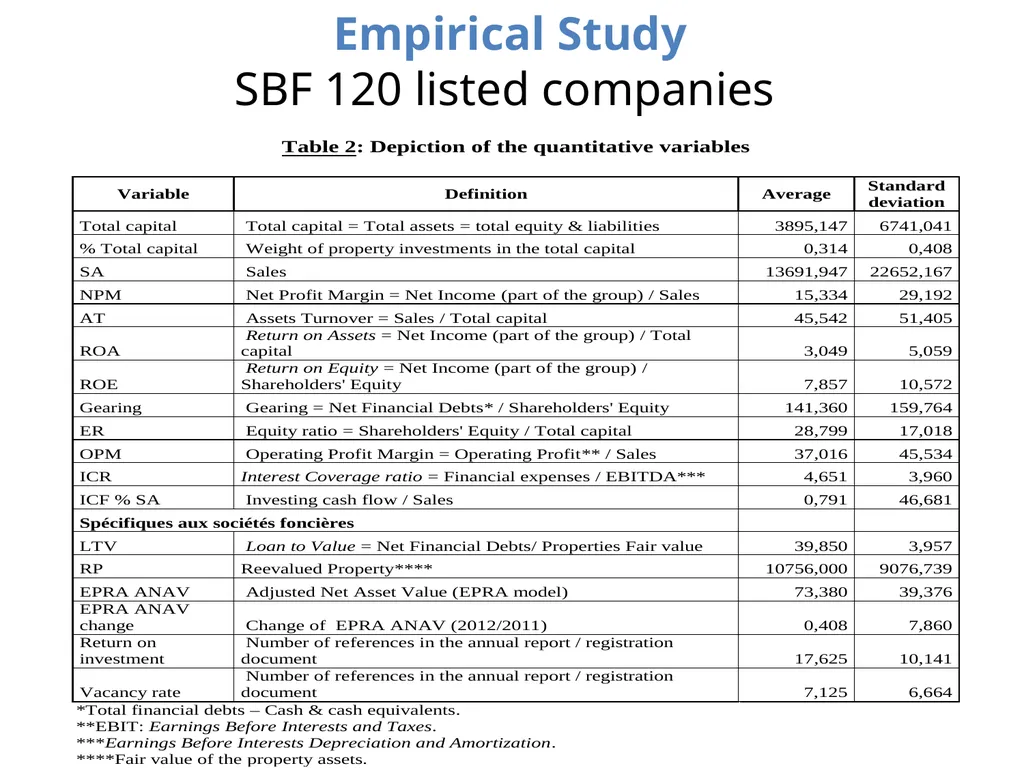
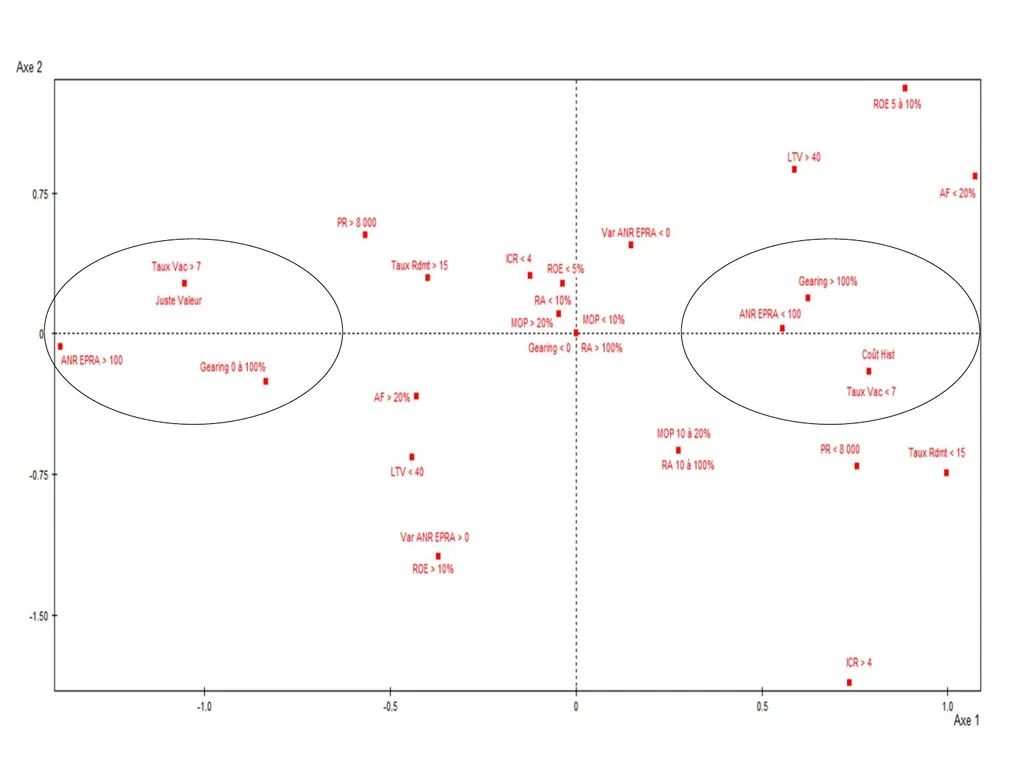
-MCA (Multiple Correspondance Analysis) to map correlations between these quantitative and qualitative dimensions.
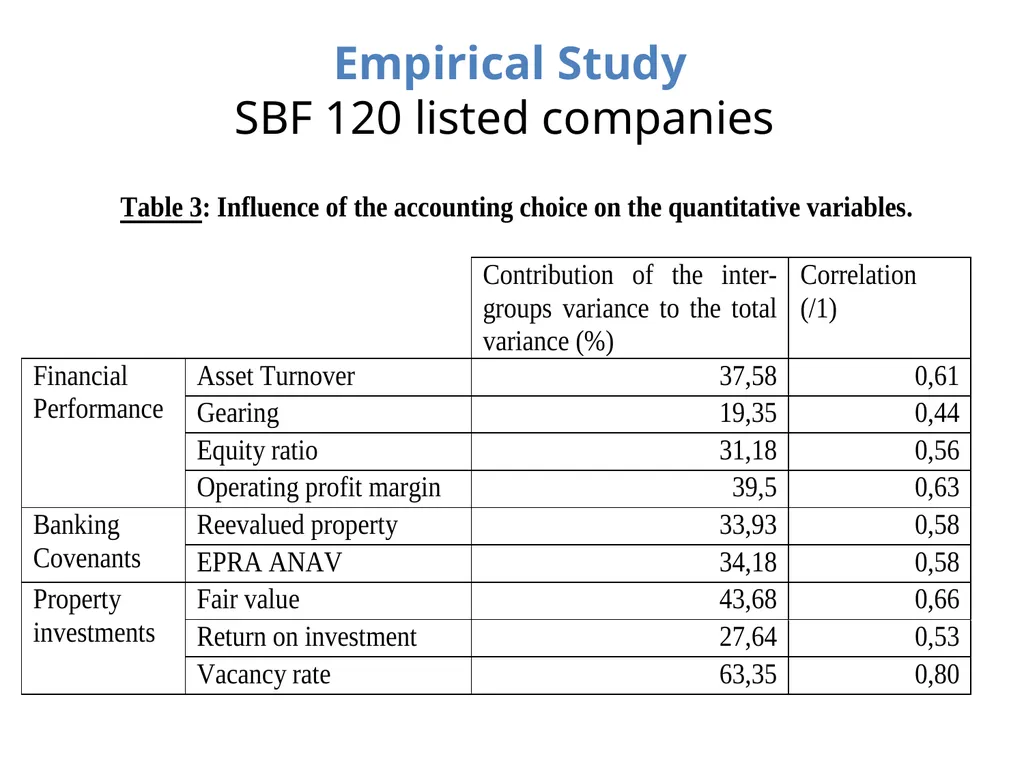
-Variance analysis to estimate the impact of the accounting choice on the financial KPIs of REITs. Empirical Study
SBF 120 listed companies<br>
14
Empirical Study
SBF 120 listed companies<br>
15
3ème partie - Etude empirique: les groupes cotés du SBF 120<br>
16
Empirical Study
SBF 120 listed companies<br>
17
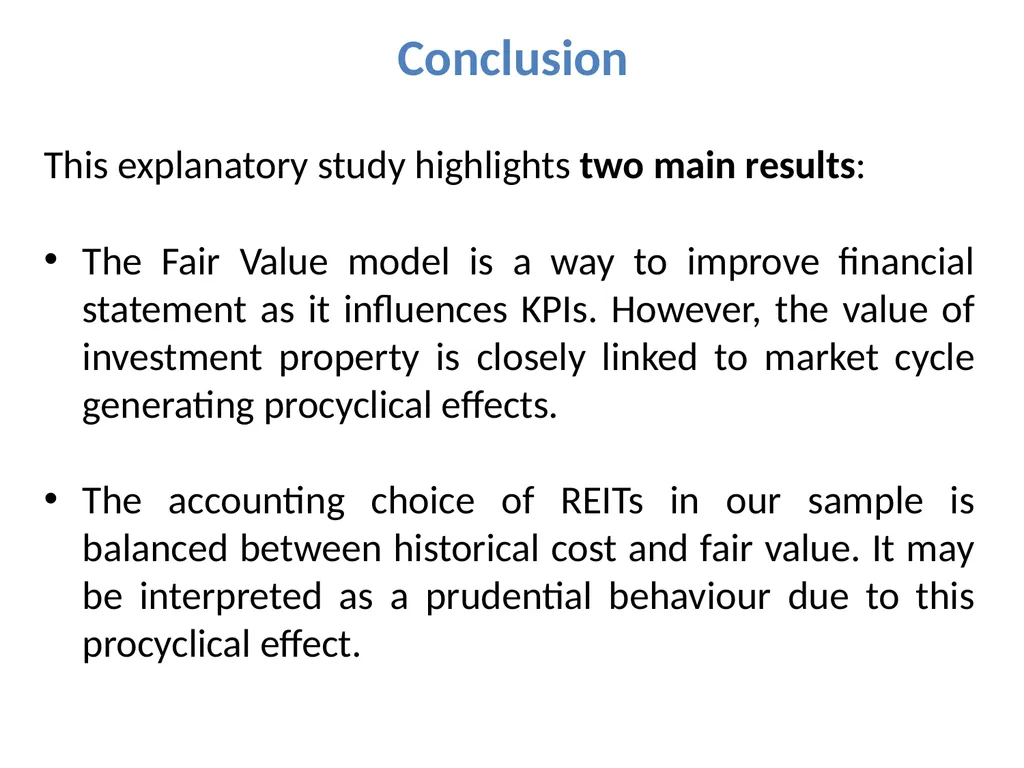
Conclusion This explanatory study highlights two main results:
The Fair Value model is a way to improve financial statement as it influences KPIs. However, the value of investment property is closely linked to market cycle generating procyclical effects.
The accounting choice of REITs in our sample is balanced between historical cost and fair value. It may be interpreted as a prudential behaviour due to this procyclical effect.<br>
18
Research Perspectives A wider sample of REITs should improve our results:
Confirm the impact of the Fair Value model on financial KPIs
Link the accounting choice of investment property to the REITs’ business model<br>