
Accreditation of Prior Experiential Learning for


Description: Accreditation of Prior Experiential Learning for Access (APEL.A) Education For All Prior Learning Assessment Centre (PLACe) Version 2025 Edition APEL.A Learners Handbook Prior Learning Assessment Centre (PLACe) APEL.A Learners Handbook
Related Topics
Download Presentation
"Accreditation of Prior Experiential Learning for" is the property of its rightful owner. Permission is granted to download and print the materials on this website for personal, non-commercial use only, and to display it on your personal computer provided you do not modify the materials and that you retain all copyright notices contained in the materials. By downloading content from our website, you accept the terms of this agreement.
Presentation Transcript
slide1. Accreditation of
Prior Experiential Learning for Access (APEL.A) Education For All Prior Learning Assessment Centre (PLACe) Version 2025 Edition APEL.A Learner’s
Handbook<br>
slide2. Prior Learning Assessment Centre (PLACe) APEL.A Learner’s Handbook APEL.A Learner’s Handbook:
Accreditation of Prior Experiential Learning for Access (APEL.A)
First Edition 2025
© 2025 Prior Learning Assessment Centre (PLACe), Lincoln University College
This handbook is intended for learners of Lincoln University College and serves as a comprehensive guide to support all learners throughout the APEL.A assessment process.<br>
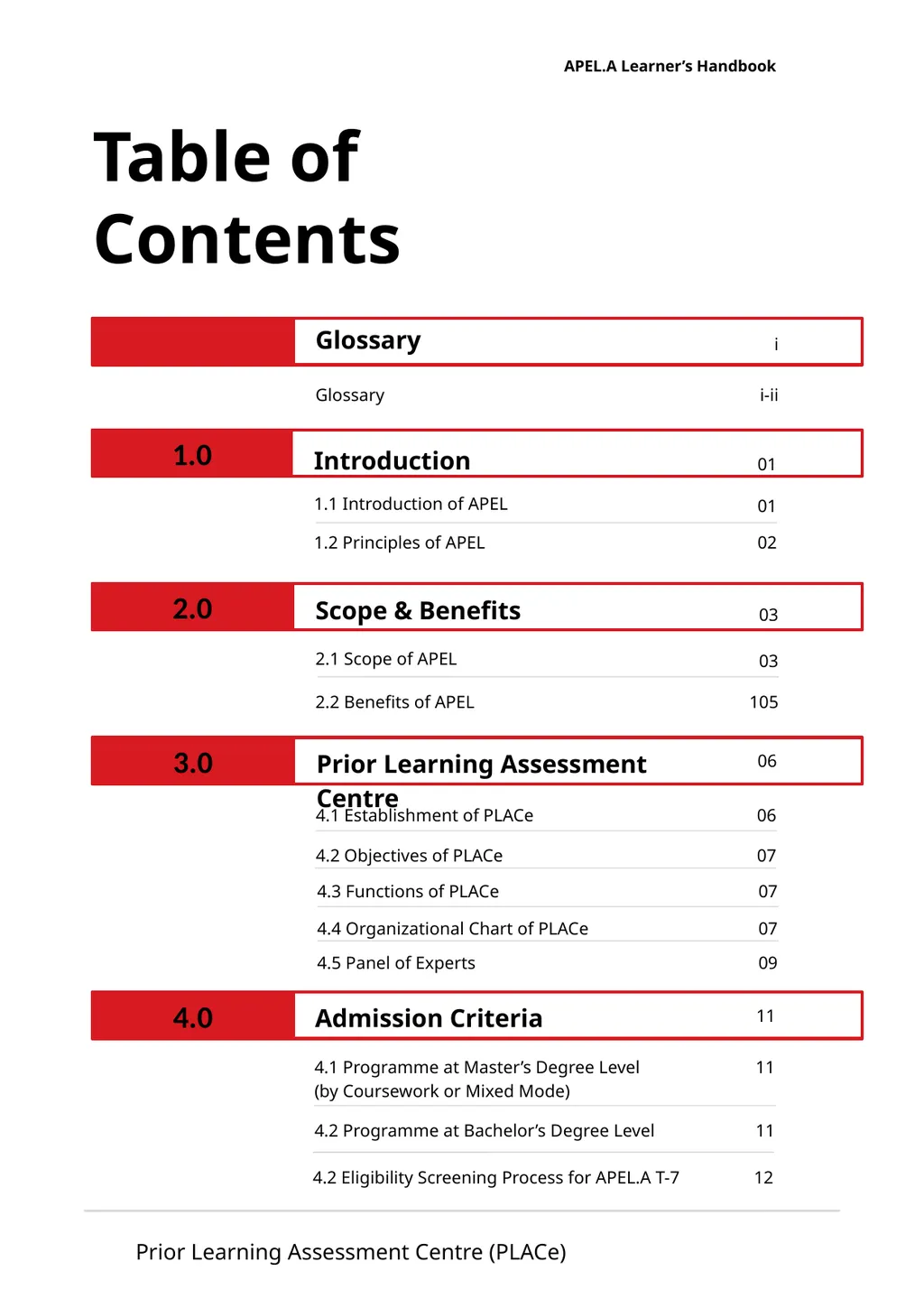
slide3. 1.0 3.0 2.0 4.0 Admission Criteria 4.1 Programme at Master’s Degree Level
(by Coursework or Mixed Mode) 4.2 Programme at Bachelor’s Degree Level 11 11 11 Table of Contents Prior Learning Assessment Centre (PLACe) Introduction 1.1 Introduction of APEL 1.2 Principles of APEL 01 02 01 Glossary Glossary i-ii i Scope & Benefits 2.1 Scope of APEL 2.2 Benefits of APEL 03 105 03 Prior Learning Assessment Centre 4.1 Establishment of PLACe 4.2 Objectives of PLACe 06 07 06 4.3 Functions of PLACe 4.4 Organizational Chart of PLACe 07 07 4.5 Panel of Experts 09 4.2 Eligibility Screening Process for APEL.A T-7 12 APEL.A Learner’s Handbook<br>
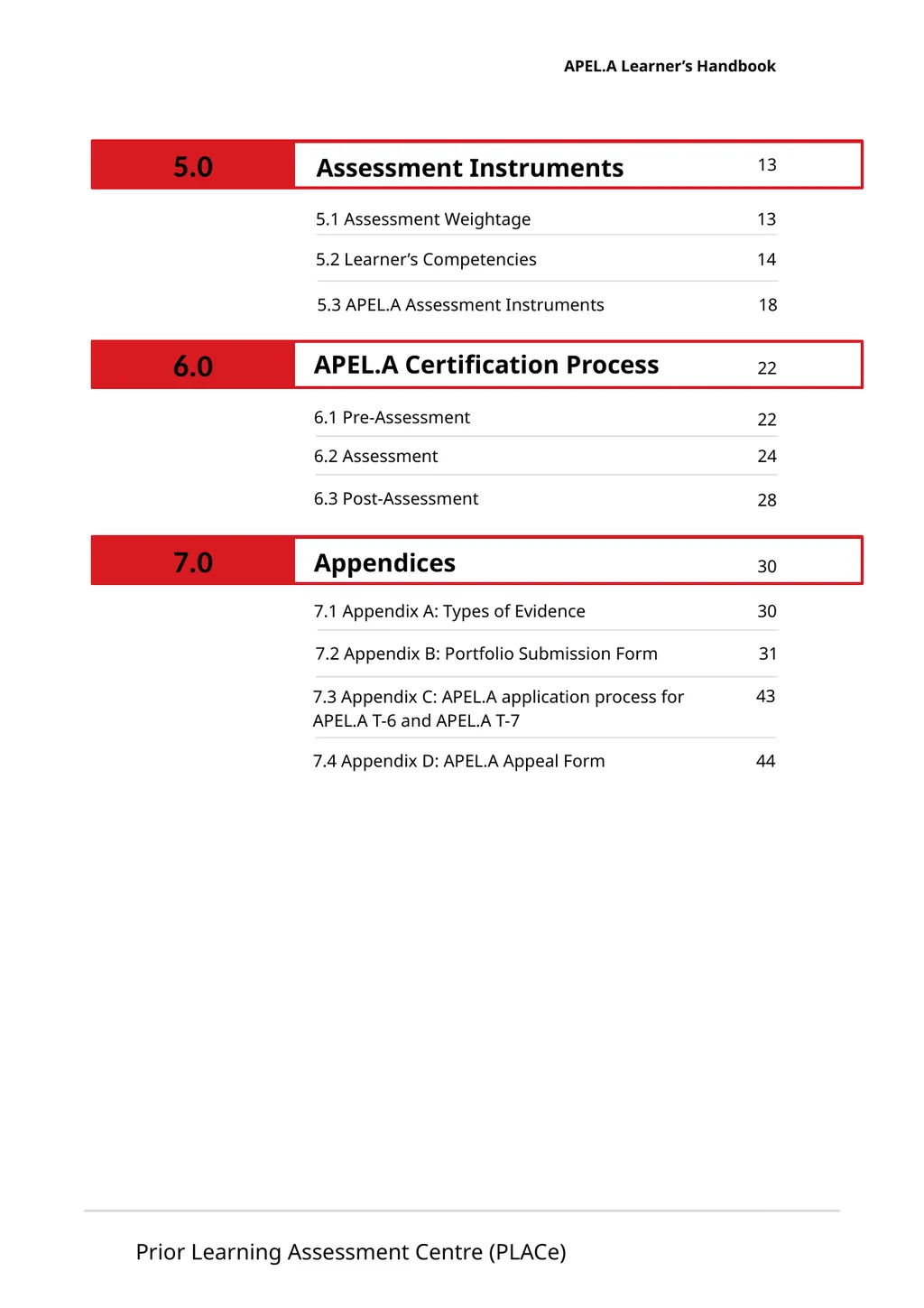
slide4. 7.0 6.0 Appendices 7.1 Appendix A: Types of Evidence 30 30 APEL.A Certification Process 6.1 Pre-Assessment 6.2 Assessment 6.3 Post-Assessment 22 24 28 22 Prior Learning Assessment Centre (PLACe) 7.3 Appendix C: APEL.A application process for APEL.A T-6 and APEL.A T-7 43 7.2 Appendix B: Portfolio Submission Form 31 7.4 Appendix D: APEL.A Appeal Form 44 5.0 Assessment Instruments 5.1 Assessment Weightage 5.2 Learner’s Competencies 13 14 13 5.3 APEL.A Assessment Instruments 18 APEL.A Learner’s Handbook<br>
slide5. GLOSSARY 1. Accreditation of Prior Experiential Learning (APEL) A systematic process that involves the identification, documentation and assessment of prior experiential learning (i.e., knowledge, skills and attitudes) to determine the extent to which an individual has achieved the desired learning outcomes, for access to a programme of study and/or award of credits. Prior Learning Assessment Centre (PLACe) 2. Accreditation of Prior Experiential Learning for Access (APEL.A) Accreditation of prior experiential learning for the purposes of admission/access into a programme of study under the various Malaysian. 3. APEL Assessments A combination of various assessments (i.e., aptitude test, portfolio, interview, presentation, etc.) that an applicant must pass to be awarded the APEL certificate. 4. APEL Certification Process An indication of the competencies and readiness of an applicant to pursue a particular programme in higher education. 5. Aptitude Test A formal examination which the learner must pass. It is a test to assess the readiness of the learner to commence the tertiary education and not the ability to follow through with the entire programme of study. 6. Credit A quantitative measurement that represents the learning volume or the academic load to achieve the respective learning outcomes. 7. Field of Study A field of study consists of a broad area of academic and skills qualifications that come under a similar branch of subject knowledge (i.e. Business & Management, Information & Communication Technologies, Education, etc) i APEL.A Learner’s Handbook<br>
slide6. 8. Formal Learning Intentional learning or programme of study delivered within an organized and structured context (pre-school, primary school, secondary school, technical college and university) that may lead to formal recognition or a recognized qualification. Example, SPM, A-Level, certificate, diploma and bachelor’s degree programme. Prior Learning Assessment Centre (PLACe) 9. Informal Learning Learning which takes place continuously through life and work experiences (sometimes known as experiential learning). Example, on the job training and job rotation, coaching and mentoring activities. 10. Malaysian Qualifications Framework (MQF) An instrument that classifies qualifications based on a set of criteria that are approved nationally and benchmarked against international best practices. 11. Non-formal Learning Learning that takes place alongside the mainstream systems of education and training. It may be assessed but does not normally lead to formal certification. Example, language courses and specific skills training courses. 12. Portfolio A compilation that documents the prior experiences of a learner which include formal, informal and non-formal learning. The portfolio is prepared by the learner to demonstrate that the learning acquired is relevant and specific to the five (5) cluster of learning outcomes outline in the MQF. 13. Programme A set of modules that are structured for a specified duration and learning volume to achieve the stated learning outcomes, which usually leads to an award of a qualification. 14. Work Experience The experience acquired in a proper working environment with assigned roles and responsibilities. ii APEL.A Learner’s Handbook<br>
slide7. Introduction of APEL Malaysian Qualifications Agency (MQA) through the MQA Act 2007 (Act 679) have an on- going commitment in assisting individuals in utilising their prior learning as much as possible. MQA assists in identifying learning that have taken place through various types of experiences throughout life that are not formally certified.
This process is called Accreditation of Prior Experiential Learning (APEL) and was set under the Malaysian Qualifications Framework (MQF). APEL allows individuals to progress in the context of lifelong learning and widens the mobility of student participation and adult learners.
In the Malaysian context, APEL can be requested by a learner to support transition between informal and formal learning. In other words, the learners can base their application on any combinations of formal, non-formal or informal learning.
After the implementation of the APEL assessment to the public for the purpose of admissions to the Bachelor’s programme (Level 6, MQF) on 1st September 2011, MQA continued to implement the APEL assessment for admissions to the Certificate (Level 3, MQF) and Diploma (Level 4, MQF) programmes beginning 1st February 2013. The implementation of APEL was then extended for student admissions to the Master's programme by coursework and mixed mode (Level 7, MQF) beginning 18th February 2014. From 1st March 2023 onward, the APEL assessment is extended to MQF Level 7 (Master) research-based programmes and MQF Level 8 (Doctorate) coursework, mixed mode, and research-based programmes. 1.1 Prior Learning Assessment Centre (PLACe) 01 1.0 INTRODUCTION APEL.A Learner’s Handbook<br>
slide8. APEL in Malaysia is upheld by the following core principles: Prior experiential learning should be recognized regardless of how and where it was obtained, provided it is related to learning or a form of competency acquisition;
Assessment will be based on authentic, flexible, current and reliable evidence;
Assessment will be conducted by practitioners/experts in the subject, in the related field;
The method of assessment will be tailored to the level and experience of the learners, thus providing an opportunity for learners to demonstrate their acquired competencies;
Decisions of APEL assessments should be transparent and subject to appeal and review;
Information and support services will be actively publicized, taking into account the diversity of the students; and
Quality assurance mechanisms should be clear and transparent. Lincoln University College (LUC) has been appointed as APEL.A Assessment Centre for Malaysian who would like to pursue a Bachelor’s Degree (MQF Level 6) or Master’s Degree (MQF Level 7) (by coursework or mixed mode) programme at Lincoln University College. This Staff Handbook provides an overview of the APEL.A criteria, assessment framework, documentation requirements, and guidelines on the application, evaluation, and approval processes for APEL.A. 02 Prior Learning Assessment Centre (PLACe) Principles of APEL 1.2 APEL.A Learner’s Handbook<br>
slide9. Recognition of Prior Learning 2.1.1 APEL.A is offered to Malaysian citizens seeking recognition of their prior learning.
The APEL.A certification is an indication of the competencies and readiness of the learner to pursue a particular programme.
However, the certification does not guarantee admission into the Lincoln University College’s programme.
Learners are still subjected to the procedures and additional requirements (if any) as determined by the University. 03 Prior Learning Assessment Centre (PLACe) 2.0 SCOPE & BENEFITS OF APEL APEL.A certification can only be used for the purpose of learners furthering their studies in the chosen field, which should be relevant to their prior learning.
It is not equivalent to the knowledge and competencies of a particular academic degree programme at an MQF level.
The certification cannot be used for the purpose of seeking employment. APEL.A Certification 2.1.2 Scope of APEL.A 2.1 APEL.A Learner’s Handbook<br>
slide10. The APEL.A certification obtained through assessment at Lincoln University College will allow the learner to apply for a Bachelor’s degree or Master’s degree programme (by Coursework or Mixed Mode) at Lincoln University College only.
For Master’s degree programme, the learner is only allowed to apply into the intended field of study at Lincoln University College as specified during the APEL.A application.
Learner needs to undertake another APEL.A assessment when changing the field of study for the Master’s degree programme. Programme Admission 2.1.3 Prior Learning Assessment Centre (PLACe) 04 APEL.A Learner’s Handbook<br>
slide11. The APEL has been identified as a powerful tool for bringing adult learners into the mainstream of higher education by recognizing the relevant skills and competencies that they have previously acquired. Learners seek the APEL because it can help them:
Increase self confidence and enhance the motivation to continue learning.
Get access and recognition to higher qualifications.
Document knowledge, skills and experience better through the preparation of a portfolio of evidence; plan for further learning and personal career development.
Map prior learning onto the MQF to identify a notional level.
Develop analytical and learning skills through the process of undertaking the APEL itself.
Increase mobility and employability.
Reduce time and cost. Prior Learning Assessment Centre (PLACe) 05 2.2.1 Learners The APEL can help education institutions:
Increase access and widen participation for non-conventional learners.
Support the development of the curriculum.
Enrich the teaching-learning experience with the presence of non-conventional learners. 2.2.2 Institutions Benefit of APEL 2.2 APEL.A Learner’s Handbook<br>
slide12. Lincoln University College (LUC) received formal approval from the Malaysian Qualifications Agency (MQA) to operate as an Accreditation of Prior Experiential Learning for Access (APEL.A) Assessment Centre in July 2023. This recognition constitutes a significant milestone in LUC’s contribution to the Lifelong Learning agenda advocated by the Ministry of Higher Education Malaysia. The promotion of a lifelong learning culture is instrumental in enhancing the overall quality of education within Malaysian society, spanning from foundational education to advanced academic qualifications. Such an approach broadens access to educational opportunities and supports individuals in improving their socio-economic well-being and quality of life.
The APEL framework plays a critical role in the development of highly skilled and competent human capital to support the nation’s future growth. As an integral component of the lifelong learning paradigm, APEL provides an alternative educational pathway for individuals who possess substantial work experience but limited or no formal academic qualifications. Through this mechanism, diverse segments of society are afforded equitable opportunities to pursue higher education at institutions of higher learning.
At Lincoln University College, the Prior Learning Assessment Centre (PLACe) is entrusted with the administration of all assessment processes based on learners’ prior experiential learning, with the objective of awarding APEL.A certification to eligible learners. The PLACe processes APEL.A applications for admission into Bachelor’s Degree programmes (APEL T-6) and Master’s Degree programmes (APEL T-7). The centre adopts a rigorous and systematic assessment approach in strict compliance with the guidelines prescribed by MQA. The APEL.A assessment process comprises an aptitude test, portfolio evaluation, and, for Level 7 learners, a structured interview. Upon completion, the assessment outcomes are submitted to MQA for official record-keeping. Subsequently, MQA issues formal notifications of results and confers the APEL.A certificate upon successful learners.
The APEL.A certificate enables learners to apply for admission into their intended academic programmes at Lincoln University College. Establishments of PLACe 3.1 06 Prior Learning Assessment Centre (PLACe) 3.0 PRIOR LEARNING ASSESSMENT CENTRE (PLACe) APEL.A Learner’s Handbook<br>
slide13. Objectives of PLACe 3.2 Objectives of Prior Learning Assessment Centre (PLACe): Prior Learning Assessment Centre (PLACe) 07 To promote and strengthen lifelong learning programmes as a key strategic priority within the national higher education system.
To establish Lincoln University College (LUC) as a reputable, high-quality APEL assessment centre with global recognition. Functions of PLACe 3.3 Functions of Prior Learning Assessment Centre (PLACe): To serve as the primary reference and resource centre for APEL applications, assessments, and certification processes.
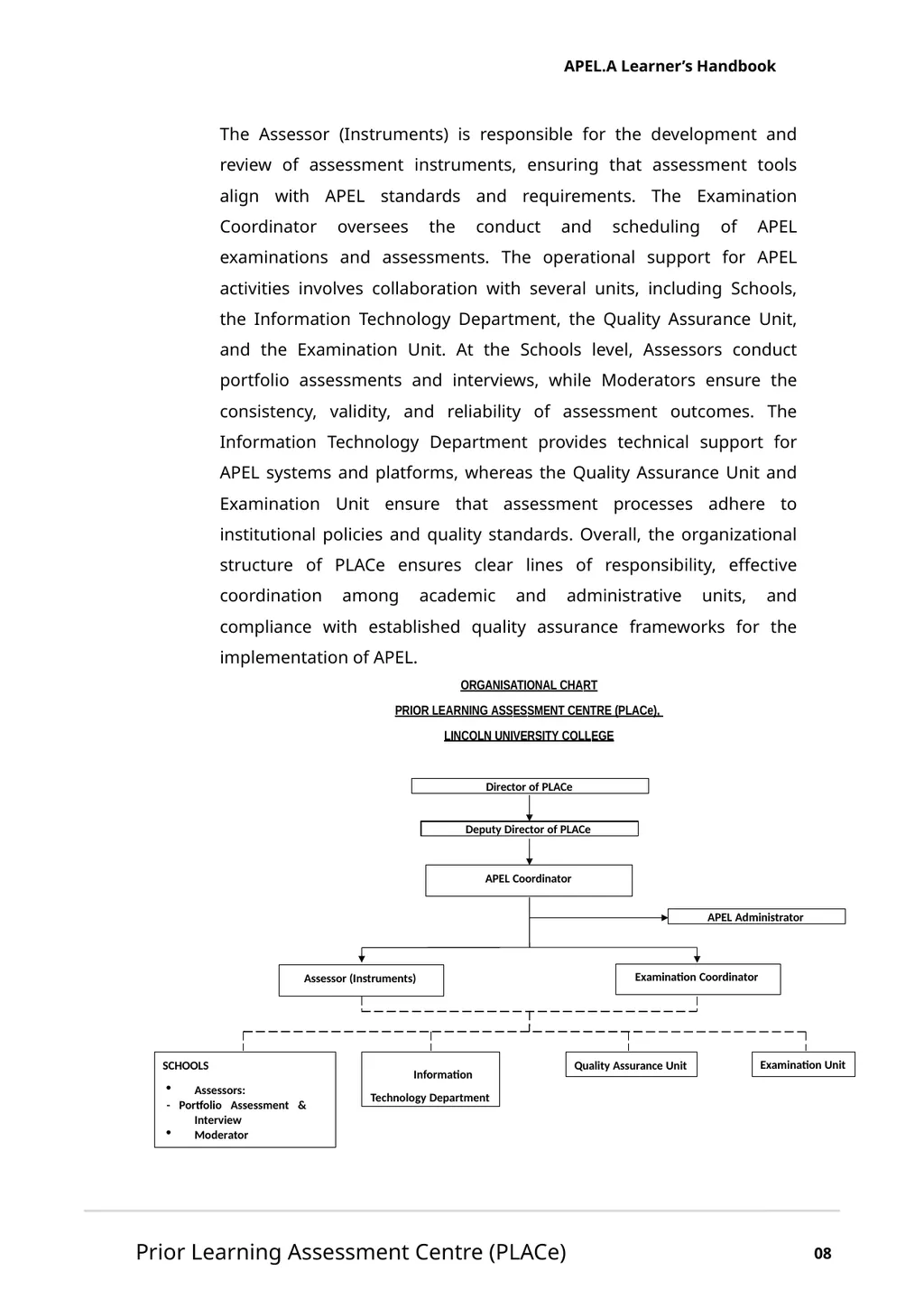
To oversee and coordinate the APEL.A application process and assessment instruments for admission into higher education institutions (HEIs). Organisational Chart of PLACe 3.4 The Prior Learning Assessment Centre (PLACe) is headed by the Director of PLACe, who provides overall leadership and strategic direction for the Centre. The Director is supported by the Deputy Director of PLACe, who assists in managing and coordinating the Centre’s operations. Reporting to the Deputy Director is the APEL Coordinator, who plays a central role in overseeing the planning, coordination, and implementation of Accreditation of Prior Experiential Learning for Access (APEL.A) activities.
The APEL Coordinator works closely with the APEL Administrator, who is responsible for managing administrative processes, documentation, and record-keeping related to APEL.A assessments. Under the coordination structure, two key functional roles are identified: the Assessor (Instruments) and the Examination Coordinator. APEL.A Learner’s Handbook<br>
slide14. The Assessor (Instruments) is responsible for the development and review of assessment instruments, ensuring that assessment tools align with APEL standards and requirements. The Examination Coordinator oversees the conduct and scheduling of APEL examinations and assessments. The operational support for APEL activities involves collaboration with several units, including Schools, the Information Technology Department, the Quality Assurance Unit, and the Examination Unit. At the Schools level, Assessors conduct portfolio assessments and interviews, while Moderators ensure the consistency, validity, and reliability of assessment outcomes. The Information Technology Department provides technical support for APEL systems and platforms, whereas the Quality Assurance Unit and Examination Unit ensure that assessment processes adhere to institutional policies and quality standards. Overall, the organizational structure of PLACe ensures clear lines of responsibility, effective coordination among academic and administrative units, and compliance with established quality assurance frameworks for the implementation of APEL. Prior Learning Assessment Centre (PLACe) 08 ORGANISATIONAL CHART
PRIOR LEARNING ASSESSMENT CENTRE (PLACe),
LINCOLN UNIVERSITY COLLEGE APEL Coordinator Deputy Director of PLACe Director of PLACe APEL Administrator Assessor (Instruments) Information Technology Department Quality Assurance Unit Examination Unit SCHOOLS Assessors:
- Portfolio Assessment & Interview
Moderator Examination Coordinator APEL.A Learner’s Handbook<br>
slide15. Panel of Experts 3.5 Prior Learning Assessment Centre (PLACe) 09 The primary responsibilities of an Assessor include:
conducting objective evaluations based on the approved assessment instruments, learning outcomes, and specified assessment criteria; and
ensuring the provision of constructive, clear, and comprehensible feedback to learners.
Beyond professional and methodological competence, the attitudes and value judgements of the panel of experts may significantly influence the overall quality of the assessment. 3.5.1 Assessors The panel of experts, comprising Assessors and Moderators, represents key stakeholders responsible for safeguarding the integrity and credibility of the APEL.A assessments. These experts possess specialized knowledge and expertise in the development and implementation of discipline-specific assessment instruments.
In order to fulfil their roles effectively, members of the panel must be thoroughly familiar with established assessment procedures and demonstrate a clear understanding of the content-related principles and requirements underpinning the assessments. Additionally, they are required to complete the relevant training programmes on APEL.A policies, procedures, and assessment practices prior to assuming their responsibilities as Assessors or Moderators.
In accordance with established procedures, assessment instruments for APEL.A applications—namely the Portfolio and Interview—must be evaluated by two (2) Assessors, comprising a subject-matter expert and an assessment instrument expert. This dual-assessment approach is intended to enhance the reliability and consistency of the assessment process. APEL.A Learner’s Handbook<br>
slide16. Prior Learning Assessment Centre (PLACe) 10 In addition to assessors, moderators with appropriate competencies are appointed to ensure the validity and reliability of the assessment instruments.
All assessment instruments developed, as well as the assessments of learners’ work, are required to undergo moderation by the appointed moderator.
This process ensures that the assessment materials and instruments are aligned with the prescribed level of study and that the assessment decisions are verified for accuracy and consistency. 3.5.1 Moderators It is therefore essential that assessments are conducted in an independent and impartial manner. The principles of independence and impartiality encompass, but are not limited to, the following considerations:
the Assessor must have no direct conflict of interest with the learner, such as being the learner’s employer or a direct competitor, which could potentially impede fair recognition of the learner’s prior experiential learning;
where an Assessor possesses prior knowledge of a learner’s competencies or skills that is not evidenced in the submitted documentation, such information must be disregarded when making assessment decisions; and
the Assessor must not allow personal attitudes or biases towards the learner’s professional activities or perspectives (for example, affiliation with a different school of thought) to influence the assessment outcome. APEL.A Learner’s Handbook<br>
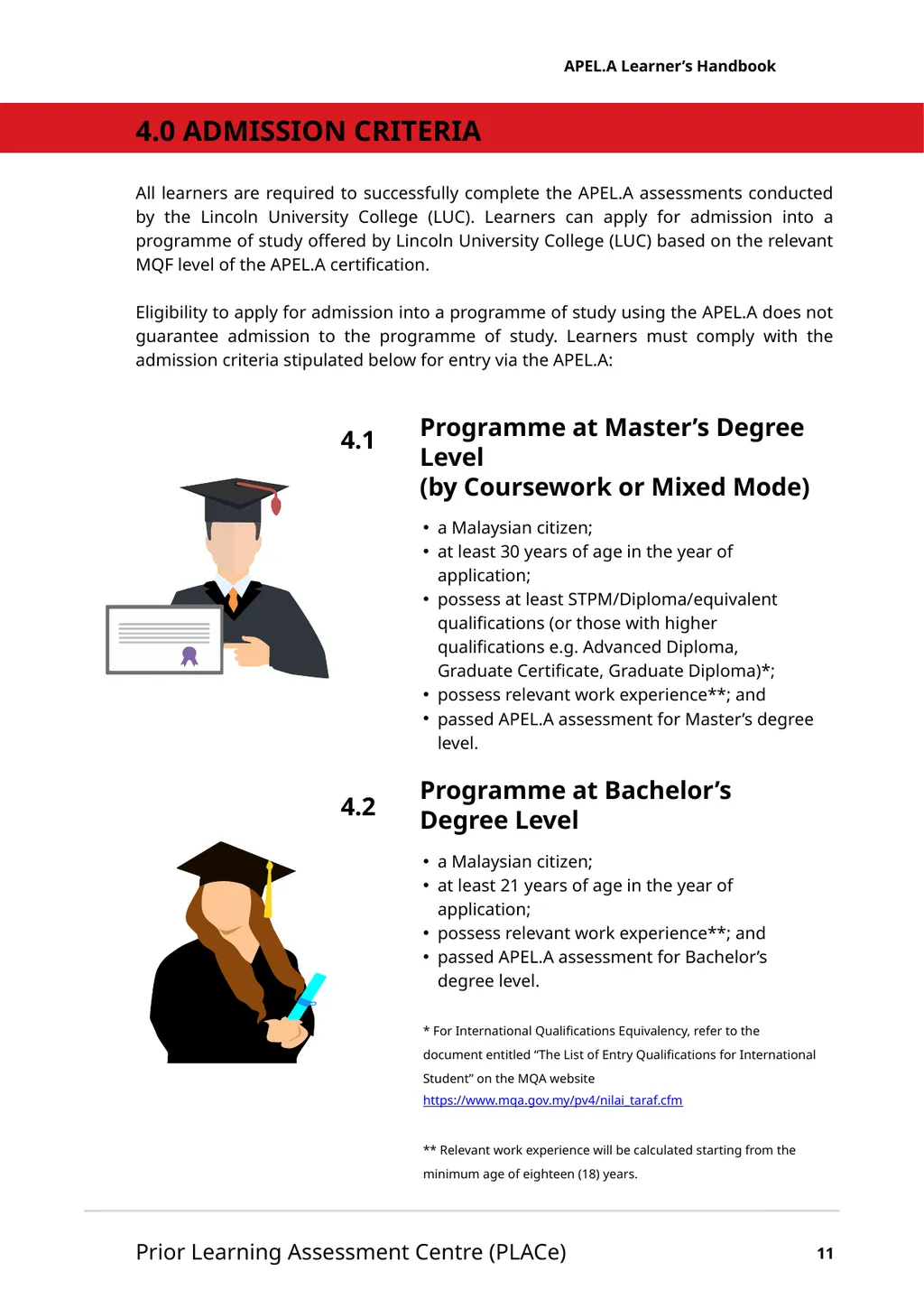
slide17. Programme at Master’s Degree Level
(by Coursework or Mixed Mode) Programme at Bachelor’s Degree Level 4.1 4.2 a Malaysian citizen;
at least 30 years of age in the year of application;
possess at least STPM/Diploma/equivalent qualifications (or those with higher qualifications e.g. Advanced Diploma, Graduate Certificate, Graduate Diploma)*;
possess relevant work experience**; and
passed APEL.A assessment for Master’s degree level. 11 Prior Learning Assessment Centre (PLACe) All learners are required to successfully complete the APEL.A assessments conducted by the Lincoln University College (LUC). Learners can apply for admission into a programme of study offered by Lincoln University College (LUC) based on the relevant MQF level of the APEL.A certification.
Eligibility to apply for admission into a programme of study using the APEL.A does not guarantee admission to the programme of study. Learners must comply with the admission criteria stipulated below for entry via the APEL.A: a Malaysian citizen;
at least 21 years of age in the year of application;
possess relevant work experience**; and
passed APEL.A assessment for Bachelor’s degree level. * For International Qualifications Equivalency, refer to the document entitled “The List of Entry Qualifications for International Student” on the MQA website https://www.mqa.gov.my/pv4/nilai_taraf.cfm
** Relevant work experience will be calculated starting from the minimum age of eighteen (18) years. 4.0 ADMISSION CRITERIA APEL.A Learner’s Handbook<br>
slide18. 12 Prior Learning Assessment Centre (PLACe) Eligibility Screening Process for APEL.A
(MQF Level 7) Applications 4.3 Accreditation of Prior Experiential Learning for Access (APEL.A) at Malaysian Qualifications Framework (MQF) Level 7 are subject to a structured eligibility screening process administered by the PLACe Screening Committee. This process is designed to ensure that all learners meet the minimum academic entry requirements prior to progressing to the full APEL.A assessment stage.
Upon receipt of an APEL.A application, the Screening Committee conducts a comprehensive review of the learner’s submitted academic qualifications, with particular emphasis on the Diploma qualification presented as part of the application. This review aims to establish the authenticity, relevance, and eligibility of the qualification in accordance with the standards set by the Malaysian Qualifications Agency (MQA). Verification of the Diploma qualification is carried out through a formal validation process, which includes confirming the qualification’s recognition status via the Malaysian Qualifications Register (MQR) portal, as well as cross-referencing the qualification in the MQA eSisraf portal. These platforms serve as authoritative sources for determining whether the qualification has been formally accredited and recognized within the Malaysian higher education system.
The outcomes of the verification process are subsequently tabled and deliberated during a Screening Committee meeting. Based on these findings, the Committee determines whether the learner satisfies the necessary academic eligibility criteria to proceed with the APEL.A application process. Approval at this stage permits the learner to advance to the subsequent phases of APEL.A assessment, subject to institutional regulations and MQA guidelines. In instances where there is insufficient evidence to confirm the formal recognition of the Diploma qualification, the application will be deemed unsuccessful at the eligibility screening stage. The learner will be formally notified of the outcome and provided with guidance to submit an appeal to the Malaysian Qualifications Agency (MQA). APEL.A Learner’s Handbook<br>
slide19. The assessment instruments that will be utilized to assess the prior experiential learning of the learners for admission into a programme of study comprise a combination of instruments from the following components, depending on the MQF level; Aptitude Test
Portfolio
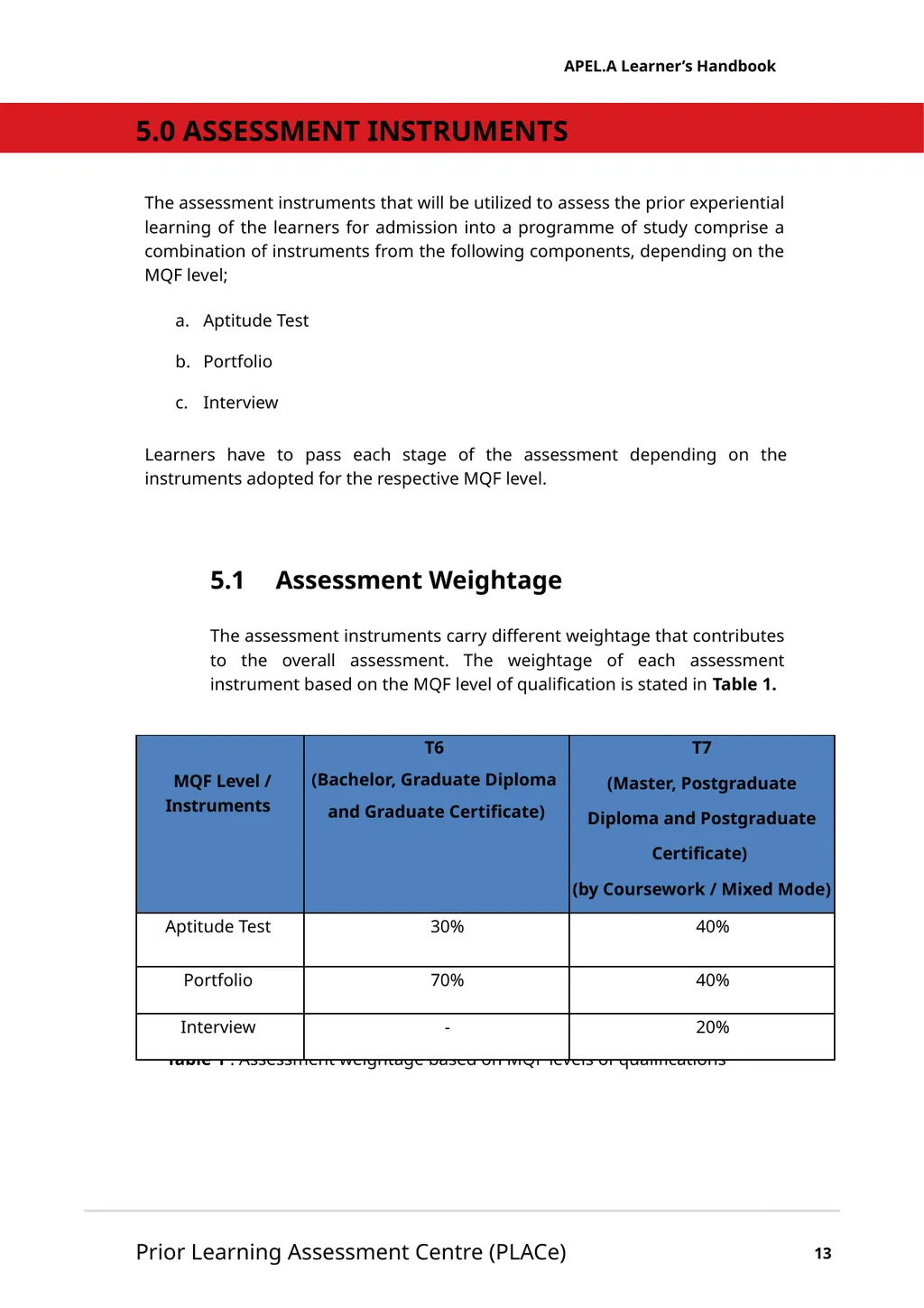
Interview Prior Learning Assessment Centre (PLACe) Assessment Weightage 5.1 The assessment instruments carry different weightage that contributes to the overall assessment. The weightage of each assessment instrument based on the MQF level of qualification is stated in Table 1. Table 1 : Assessment weightage based on MQF levels of qualifications Learners have to pass each stage of the assessment depending on the instruments adopted for the respective MQF level. 13 5.0 ASSESSMENT INSTRUMENTS APEL.A Learner’s Handbook<br>
slide20. The required competencies for the APEL.A assessment are guided by the MQF’s five clusters of learning outcomes. Therefore, the APEL.A assessments conducted by Prior Learning Assessment Centre (PLACe), Lincoln University College aims to ensure that learners will have the following minimum competencies to pursue higher education: Knowledge and understanding
Cognitive skills
Functional work skills with focus on:
a. Practical skills
b. Interpersonal and communication skills
c. Digital and numeracy skills
d. Leadership, autonomy and responsibility
Personal and entrepreneurial skills
Ethics and professionalism. Prior Learning Assessment Centre (PLACe) 14 Learner’s Competencies 5.2 Knowledge and understanding 5.2.1 Knowledge and understanding refers to a systematic understanding of facts, ideas, information, principles, concepts, theories, technical knowledge, regulations, numeracy, practical skills, tools to use, processes and systems.
It may relate to a subject, a field of study or discipline, as well as to technical and occupational or workplace aspects of knowledge and understanding. It starts with basic general knowledge and progress to varied, broader, specialized and advanced knowledge including those relating to sustainable practices, rules and regulations, health and safety, especially relevant to Technical and Vocational Education and Training (TVET) type of and even professional programmes. APEL.A Learner’s Handbook<br>
slide21. Cognitive skills relate to thinking or intellectual capabilities and the ability to apply knowledge and skills. The capacity to develop levels of intellectual skills progressively begins from understanding, critical/creative thinking, assessment, and applying, analyzing, problem solving as well as synthesizing to create new ideas, solutions, strategies or new practices. Such intellectual skills enable the learner to search and comprehend new information from different fields of knowledge and practices. Prior Learning Assessment Centre (PLACe) Cognitive skills 5.2.2 15 These are generally work skills and operational skills applicable in common employment environment such as planning; organizational skills; selection of tools, material, technology methods and procedures, whilst in study context, it may include study skills and preparations, undertaking procedures, scientific skills, designs, research and so forth.
It also includes specialized skills which are set by specific subject, discipline, technical or occupation-related work skills and professional practice which enhance professional competence. It should include safe and sustainable practices as well. 5.2.3.1 Practical skills Functional work skills 5.2.3 The scope of knowledge should include the common everyday knowledge within the environment of learners. This may also be acquired through formal, informal and non- formal learning circumstances-experiences. Developing personal values and ethics may derive from knowledge and experiences. Knowledge and understanding enables the learners to relate their prior knowledge in the course of learning and/or work, as well as to expand to related fields. Knowledge provides the basis for applications of all other competencies. APEL.A Learner’s Handbook<br>
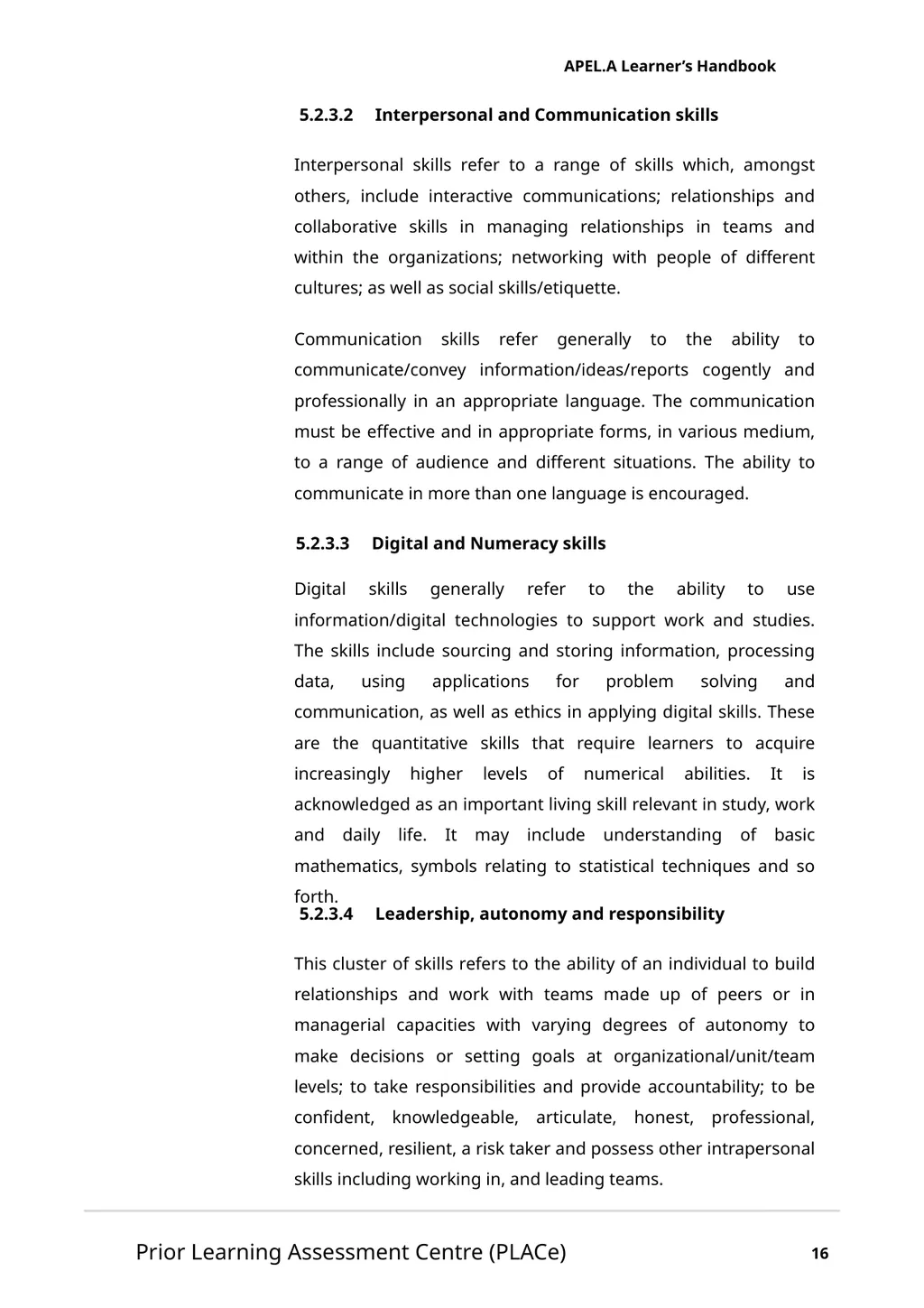
slide22. 16 Digital skills generally refer to the ability to use information/digital technologies to support work and studies. The skills include sourcing and storing information, processing data, using applications for problem solving and communication, as well as ethics in applying digital skills. These are the quantitative skills that require learners to acquire increasingly higher levels of numerical abilities. It is acknowledged as an important living skill relevant in study, work and daily life. It may include understanding of basic mathematics, symbols relating to statistical techniques and so forth. This cluster of skills refers to the ability of an individual to build relationships and work with teams made up of peers or in managerial capacities with varying degrees of autonomy to make decisions or setting goals at organizational/unit/team levels; to take responsibilities and provide accountability; to be confident, knowledgeable, articulate, honest, professional, concerned, resilient, a risk taker and possess other intrapersonal skills including working in, and leading teams. 5.2.3.4 Leadership, autonomy and responsibility Prior Learning Assessment Centre (PLACe) 5.2.3.3 Digital and Numeracy skills Interpersonal skills refer to a range of skills which, amongst others, include interactive communications; relationships and collaborative skills in managing relationships in teams and within the organizations; networking with people of different cultures; as well as social skills/etiquette.
Communication skills refer generally to the ability to communicate/convey information/ideas/reports cogently and professionally in an appropriate language. The communication must be effective and in appropriate forms, in various medium, to a range of audience and different situations. The ability to communicate in more than one language is encouraged. 5.2.3.2 Interpersonal and Communication skills APEL.A Learner’s Handbook<br>
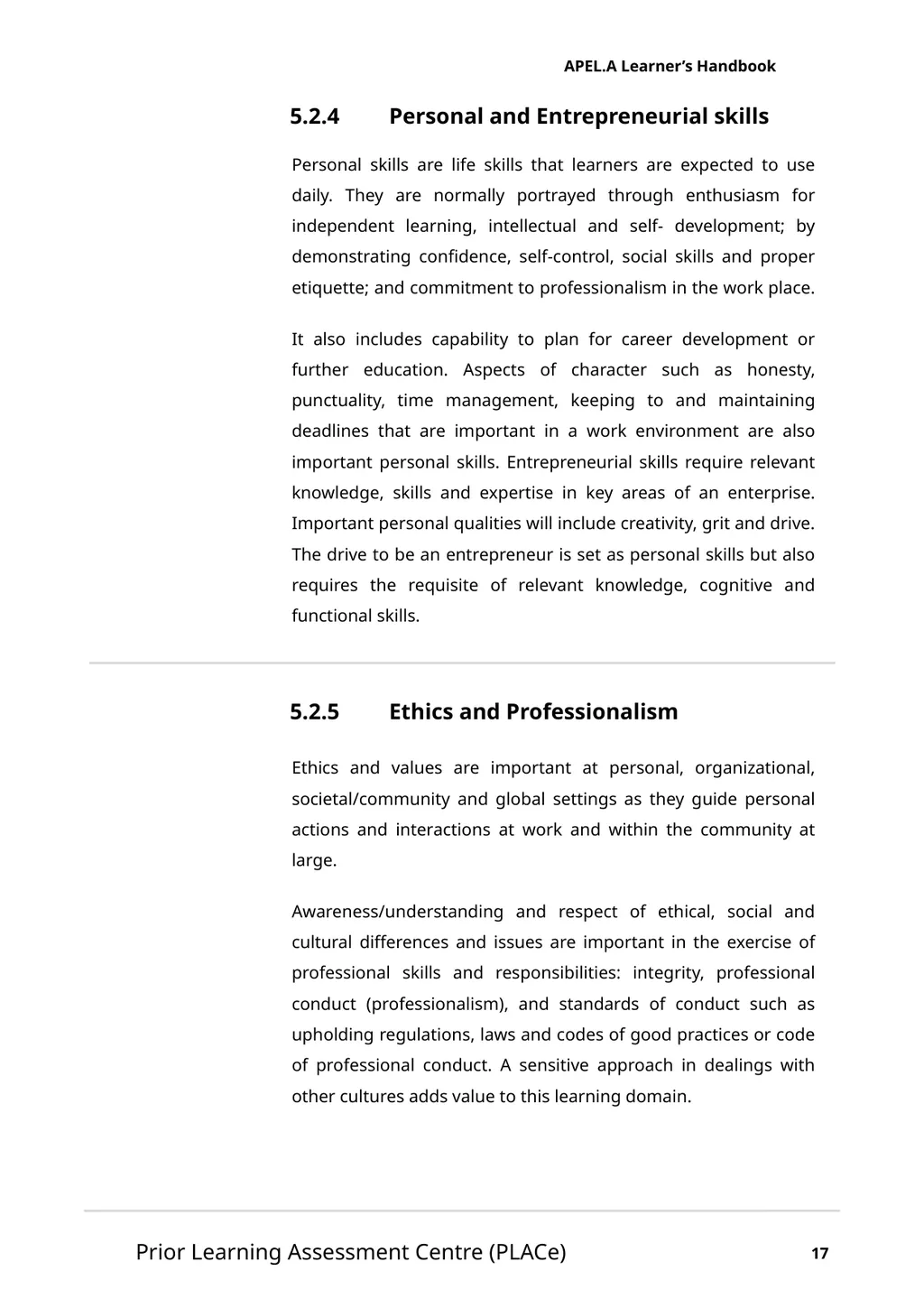
slide23. 17 Ethics and values are important at personal, organizational, societal/community and global settings as they guide personal actions and interactions at work and within the community at large.
Awareness/understanding and respect of ethical, social and cultural differences and issues are important in the exercise of professional skills and responsibilities: integrity, professional conduct (professionalism), and standards of conduct such as upholding regulations, laws and codes of good practices or code of professional conduct. A sensitive approach in dealings with other cultures adds value to this learning domain. Prior Learning Assessment Centre (PLACe) Ethics and Professionalism 5.2.5 Personal skills are life skills that learners are expected to use daily. They are normally portrayed through enthusiasm for independent learning, intellectual and self- development; by demonstrating confidence, self-control, social skills and proper etiquette; and commitment to professionalism in the work place.
It also includes capability to plan for career development or further education. Aspects of character such as honesty, punctuality, time management, keeping to and maintaining deadlines that are important in a work environment are also important personal skills. Entrepreneurial skills require relevant knowledge, skills and expertise in key areas of an enterprise. Important personal qualities will include creativity, grit and drive. The drive to be an entrepreneur is set as personal skills but also requires the requisite of relevant knowledge, cognitive and functional skills. Personal and Entrepreneurial skills 5.2.4 APEL.A Learner’s Handbook<br>
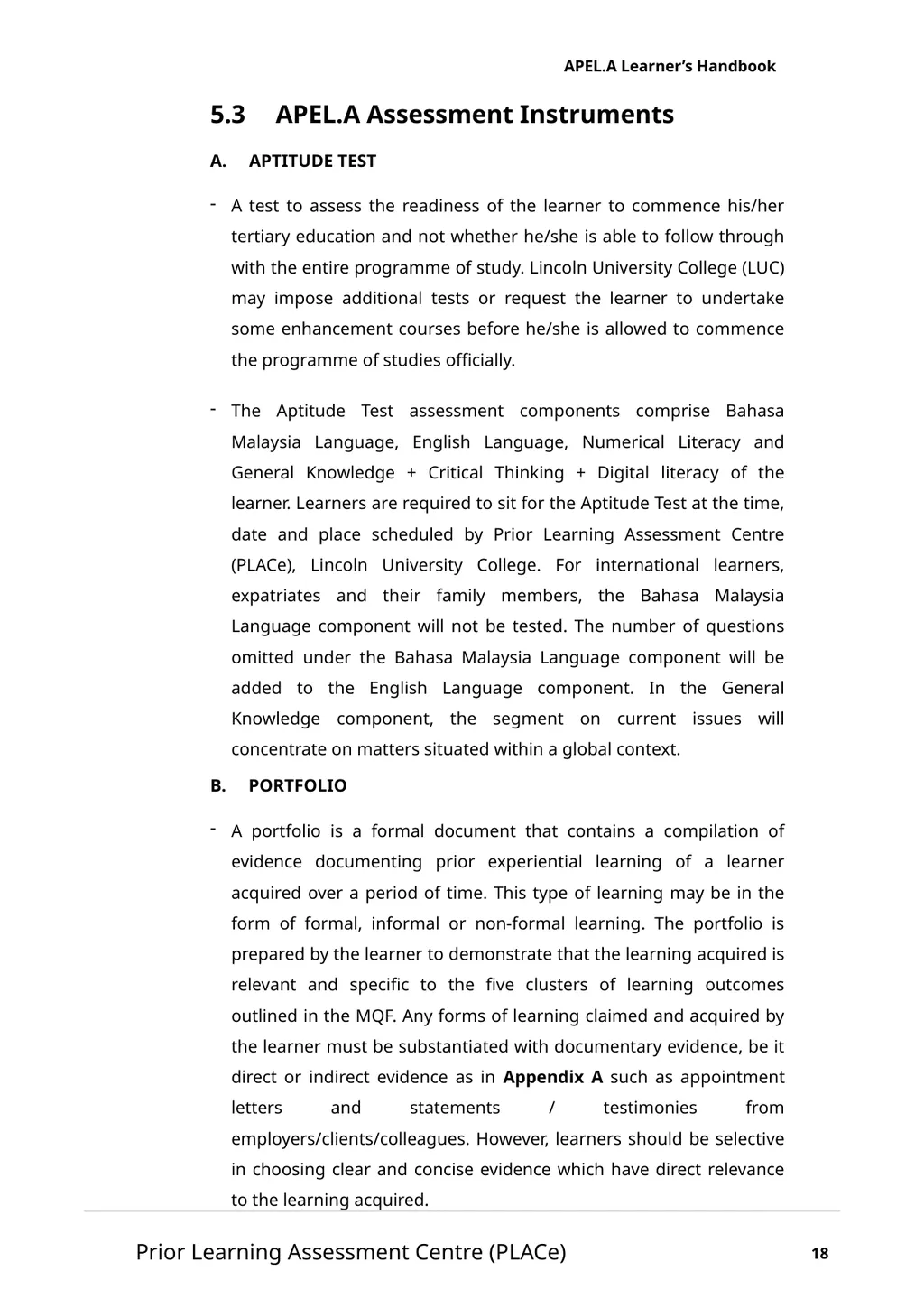
slide24. Prior Learning Assessment Centre (PLACe) A test to assess the readiness of the learner to commence his/her tertiary education and not whether he/she is able to follow through with the entire programme of study. Lincoln University College (LUC) may impose additional tests or request the learner to undertake some enhancement courses before he/she is allowed to commence the programme of studies officially.
The Aptitude Test assessment components comprise Bahasa Malaysia Language, English Language, Numerical Literacy and General Knowledge + Critical Thinking + Digital literacy of the learner. Learners are required to sit for the Aptitude Test at the time, date and place scheduled by Prior Learning Assessment Centre (PLACe), Lincoln University College. For international learners, expatriates and their family members, the Bahasa Malaysia Language component will not be tested. The number of questions omitted under the Bahasa Malaysia Language component will be added to the English Language component. In the General Knowledge component, the segment on current issues will concentrate on matters situated within a global context. A portfolio is a formal document that contains a compilation of evidence documenting prior experiential learning of a learner acquired over a period of time. This type of learning may be in the form of formal, informal or non-formal learning. The portfolio is prepared by the learner to demonstrate that the learning acquired is relevant and specific to the five clusters of learning outcomes outlined in the MQF. Any forms of learning claimed and acquired by the learner must be substantiated with documentary evidence, be it direct or indirect evidence as in Appendix A such as appointment letters and statements / testimonies from employers/clients/colleagues. However, learners should be selective in choosing clear and concise evidence which have direct relevance to the learning acquired. A. APTITUDE TEST B. PORTFOLIO 18 APEL.A Assessment Instruments 5.3 APEL.A Learner’s Handbook<br>
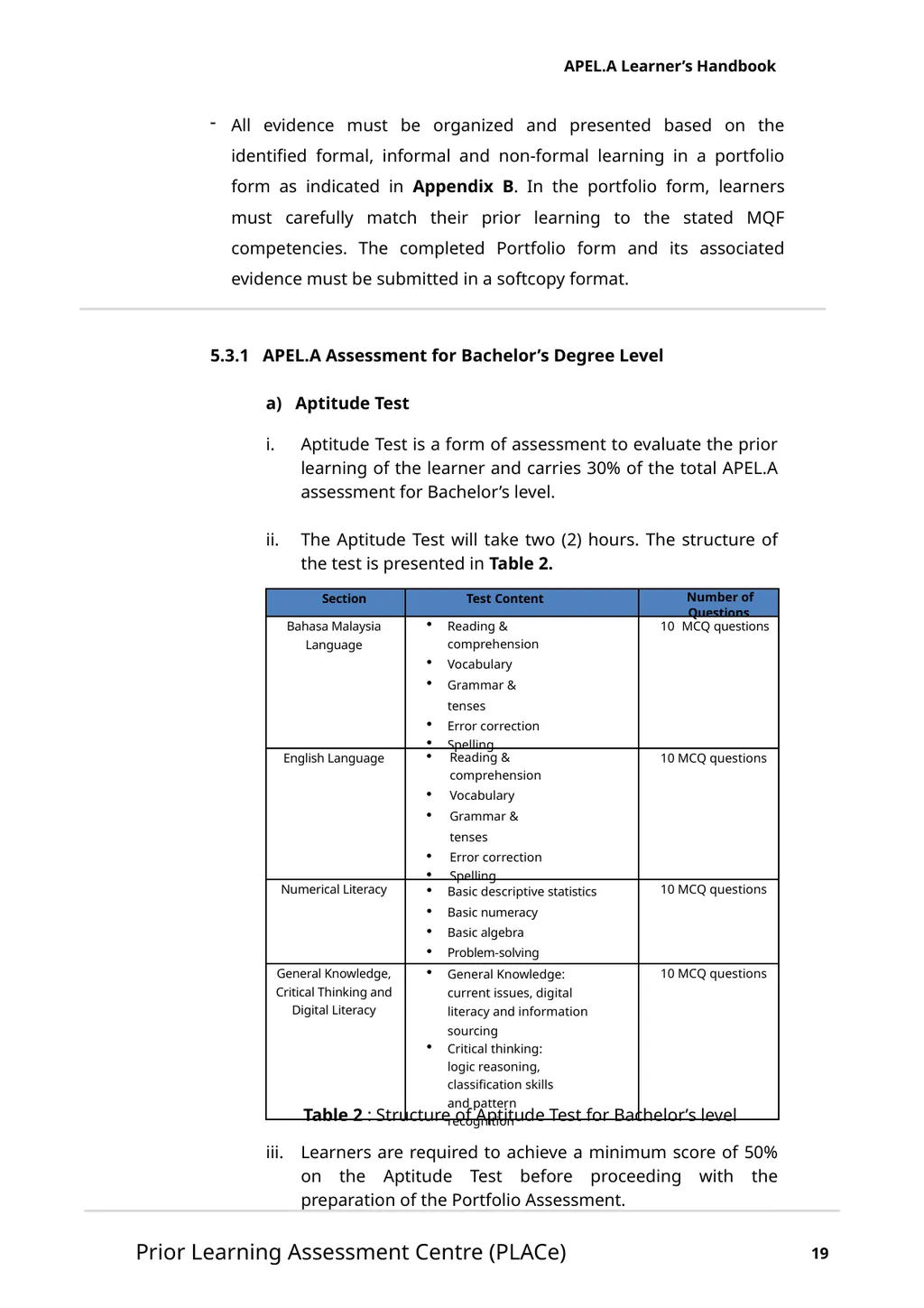
slide25. Prior Learning Assessment Centre (PLACe) Aptitude Test is a form of assessment to evaluate the prior learning of the learner and carries 30% of the total APEL.A assessment for Bachelor’s level.
The Aptitude Test will take two (2) hours. The structure of the test is presented in Table 2. 5.3.1 APEL.A Assessment for Bachelor’s Degree Level a) Aptitude Test Learners are required to achieve a minimum score of 50% on the Aptitude Test before proceeding with the preparation of the Portfolio Assessment. All evidence must be organized and presented based on the identified formal, informal and non-formal learning in a portfolio form as indicated in Appendix B. In the portfolio form, learners must carefully match their prior learning to the stated MQF competencies. The completed Portfolio form and its associated evidence must be submitted in a softcopy format. Table 2 : Structure of Aptitude Test for Bachelor’s level 19 APEL.A Learner’s Handbook<br>
slide26. Prior Learning Assessment Centre (PLACe) The learner will be required to submit a portfolio within 1 (one) month upon successful completion of the Aptitude Test. The portfolio will be assessed by the Panel of Assessors appointed by the Prior Learning Assessment Centre (PLACe).
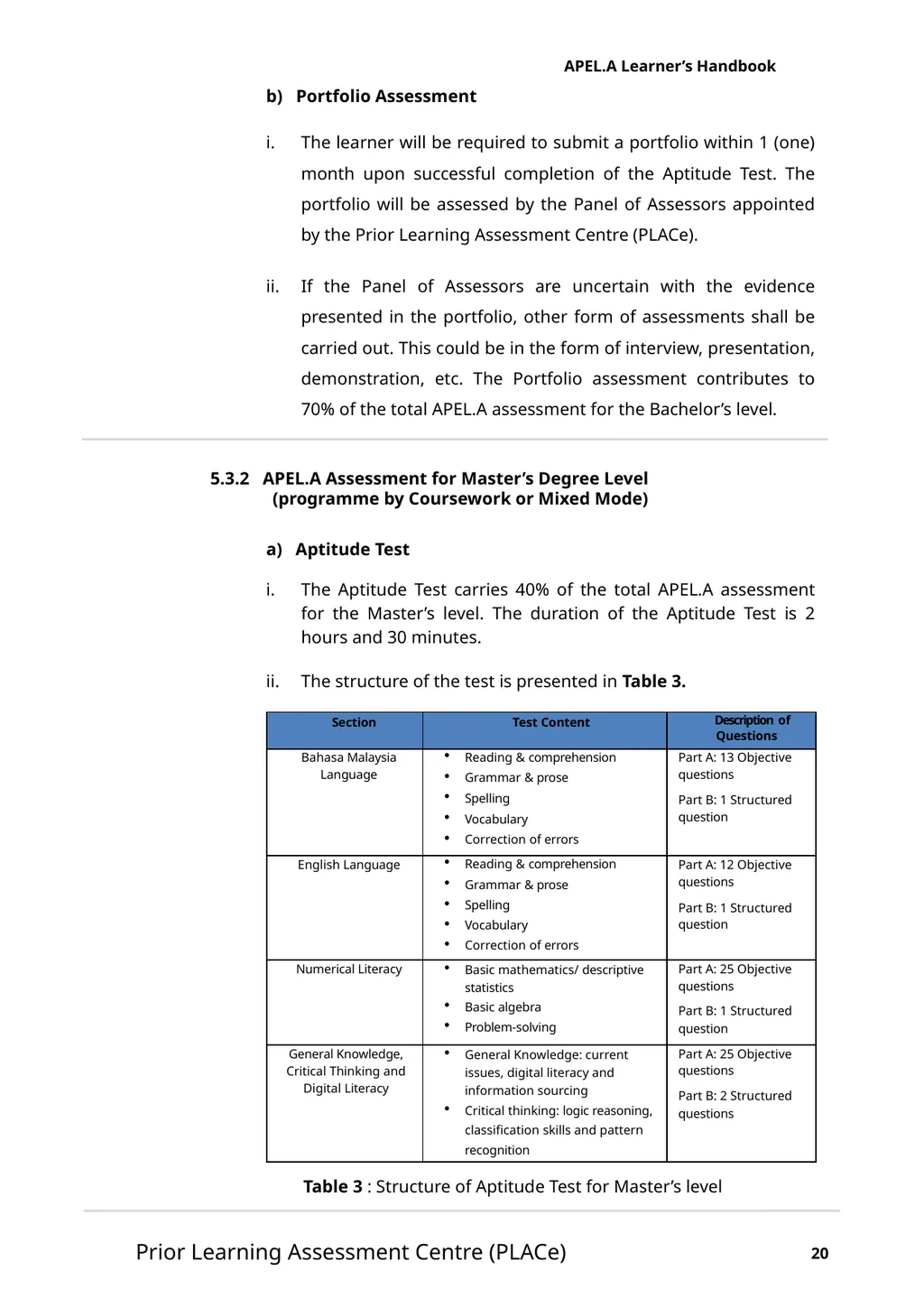
If the Panel of Assessors are uncertain with the evidence presented in the portfolio, other form of assessments shall be carried out. This could be in the form of interview, presentation, demonstration, etc. The Portfolio assessment contributes to 70% of the total APEL.A assessment for the Bachelor’s level. b) Portfolio Assessment The Aptitude Test carries 40% of the total APEL.A assessment for the Master’s level. The duration of the Aptitude Test is 2 hours and 30 minutes.
The structure of the test is presented in Table 3. a) Aptitude Test 5.3.2 APEL.A Assessment for Master’s Degree Level
(programme by Coursework or Mixed Mode) Table 3 : Structure of Aptitude Test for Master’s level 20 APEL.A Learner’s Handbook<br>
slide27. Prior Learning Assessment Centre (PLACe) The learner will be required to submit a portfolio within 1 (one) month upon successful completion of the Aptitude Test. The portfolio will be assessed by the Panel of Assessors appointed by the Prior Learning Assessment Centre (PLACe).
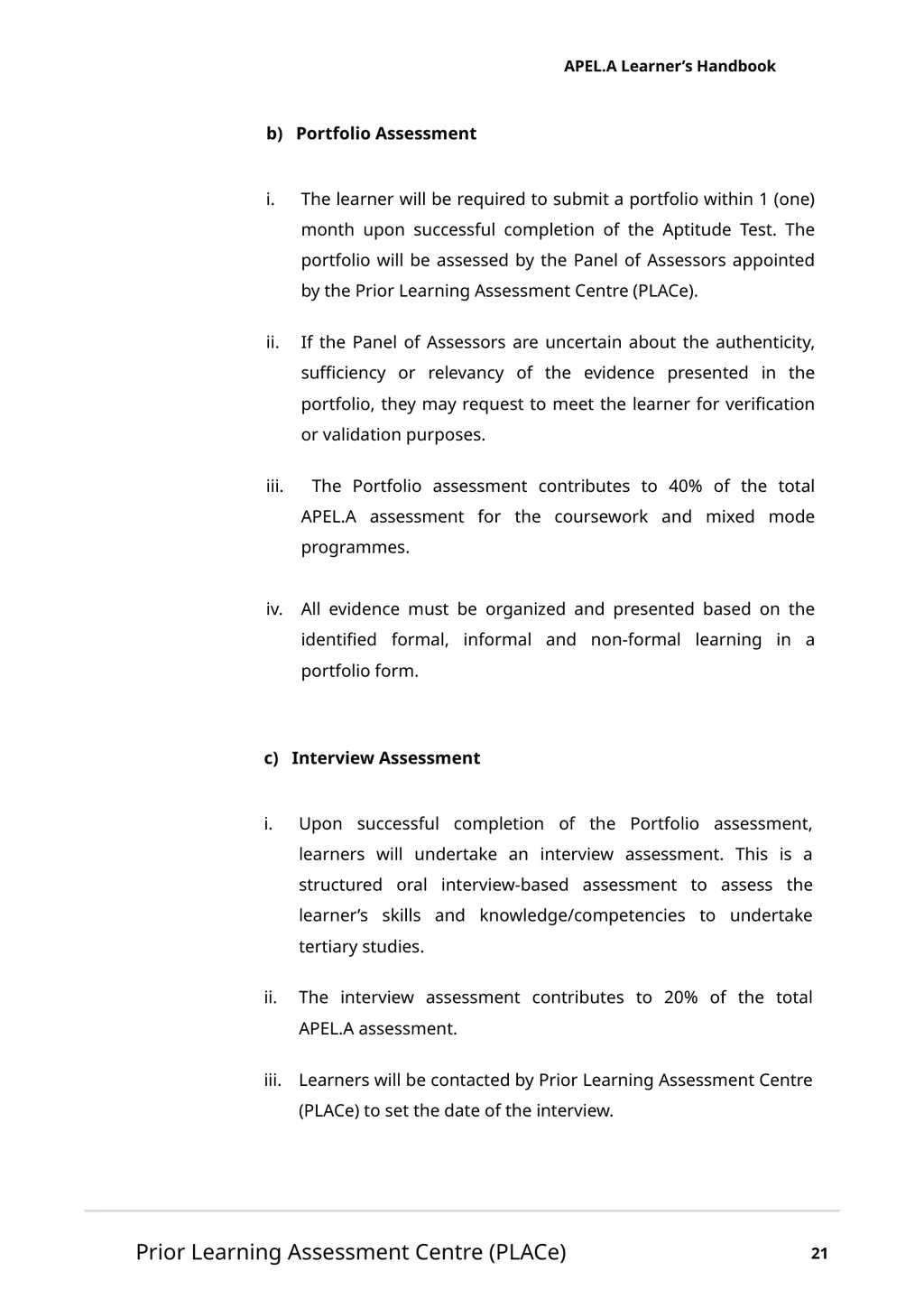
If the Panel of Assessors are uncertain about the authenticity, sufficiency or relevancy of the evidence presented in the portfolio, they may request to meet the learner for verification or validation purposes.
The Portfolio assessment contributes to 40% of the total APEL.A assessment for the coursework and mixed mode programmes.
All evidence must be organized and presented based on the identified formal, informal and non-formal learning in a portfolio form. b) Portfolio Assessment Upon successful completion of the Portfolio assessment, learners will undertake an interview assessment. This is a structured oral interview-based assessment to assess the learner’s skills and knowledge/competencies to undertake tertiary studies.
The interview assessment contributes to 20% of the total APEL.A assessment.
Learners will be contacted by Prior Learning Assessment Centre (PLACe) to set the date of the interview. c) Interview Assessment 21 APEL.A Learner’s Handbook<br>
slide28. Pre-Application 6.1 In deciding whether or not to undertake APEL, learners will need to consider the fact that it is a highly individualized process which will require the use of their skills such as self-motivation, reflection and time management. Learners must first ensure that the basic admission criteria stipulated in Section 4 of this handbook are met, i.e., age and academic qualification requirements (only Master’s degree level admission require academic qualification).
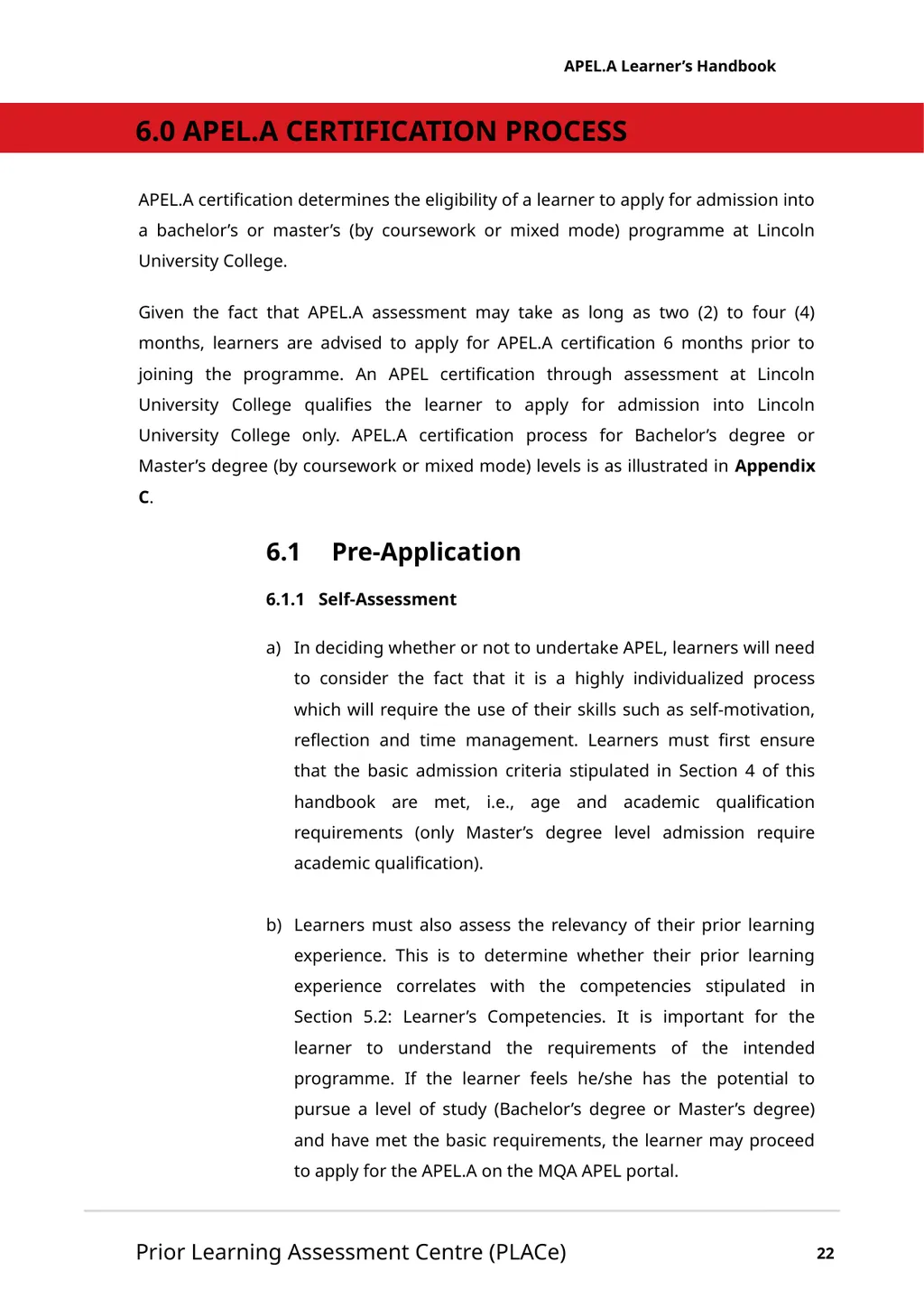
Learners must also assess the relevancy of their prior learning experience. This is to determine whether their prior learning experience correlates with the competencies stipulated in Section 5.2: Learner’s Competencies. It is important for the learner to understand the requirements of the intended programme. If the learner feels he/she has the potential to pursue a level of study (Bachelor’s degree or Master’s degree) and have met the basic requirements, the learner may proceed to apply for the APEL.A on the MQA APEL portal. 22 Prior Learning Assessment Centre (PLACe) APEL.A certification determines the eligibility of a learner to apply for admission into a bachelor’s or master’s (by coursework or mixed mode) programme at Lincoln University College.
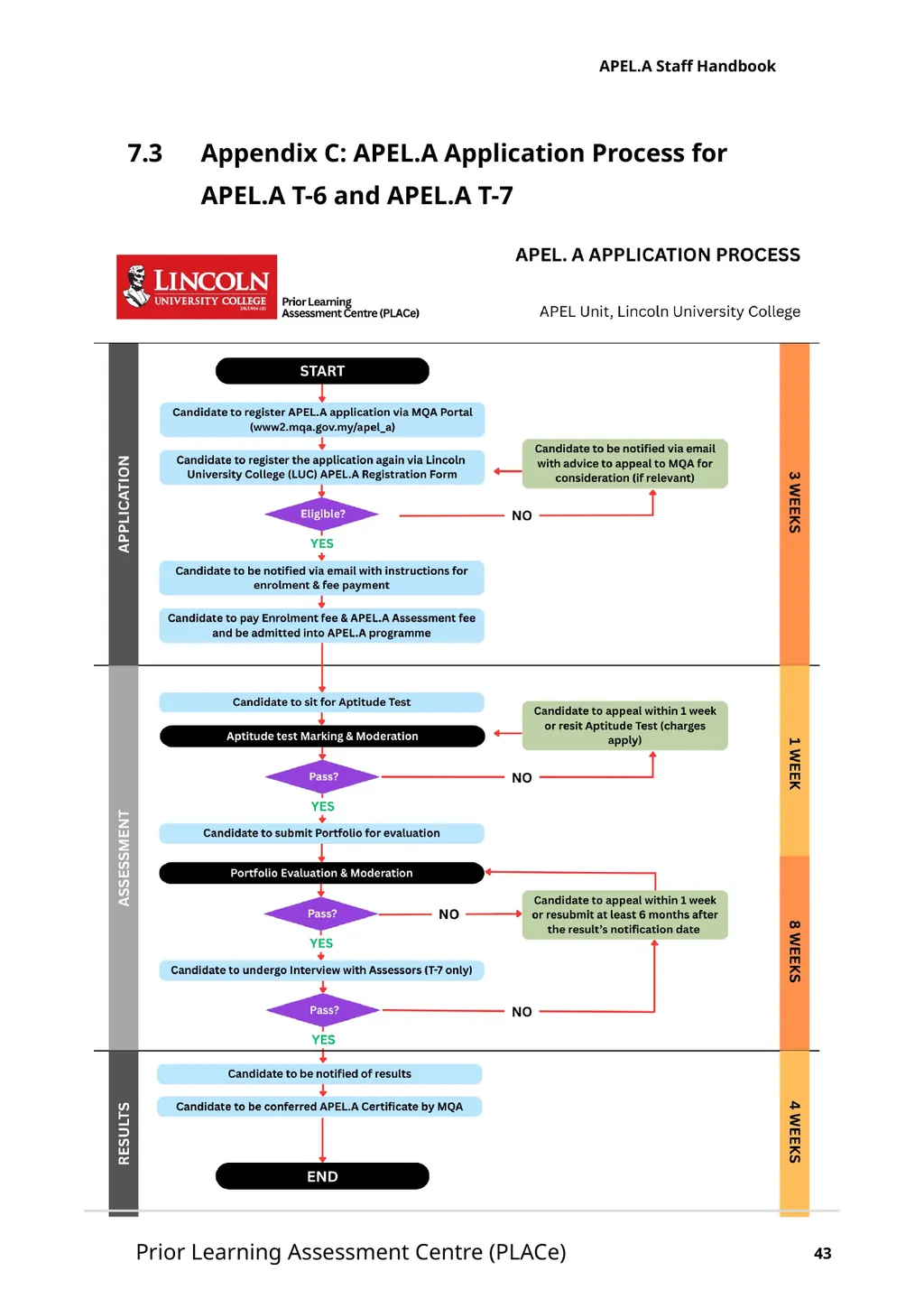
Given the fact that APEL.A assessment may take as long as two (2) to four (4) months, learners are advised to apply for APEL.A certification 6 months prior to joining the programme. An APEL certification through assessment at Lincoln University College qualifies the learner to apply for admission into Lincoln University College only. APEL.A certification process for Bachelor’s degree or Master’s degree (by coursework or mixed mode) levels is as illustrated in Appendix C. 6.1.1 Self-Assessment 6.0 APEL.A CERTIFICATION PROCESS APEL.A Learner’s Handbook<br>
slide29. Prior Learning Assessment Centre (PLACe) Learner must register at MQA website https://www2.mqa.gov.my/apel_a/ and indicate Lincoln University College as the designated APEL.A Assessment Centre to conduct the assessment.
MQA will notify the learner upon receipt of the registration and direct the learner to Lincoln University College for subsequent application and assessment.
Learners must pay the application fee and submit the proof of payment together with the following documents (certified true copies) to Prior Learning Assessment Centre (PLACe), LUC:
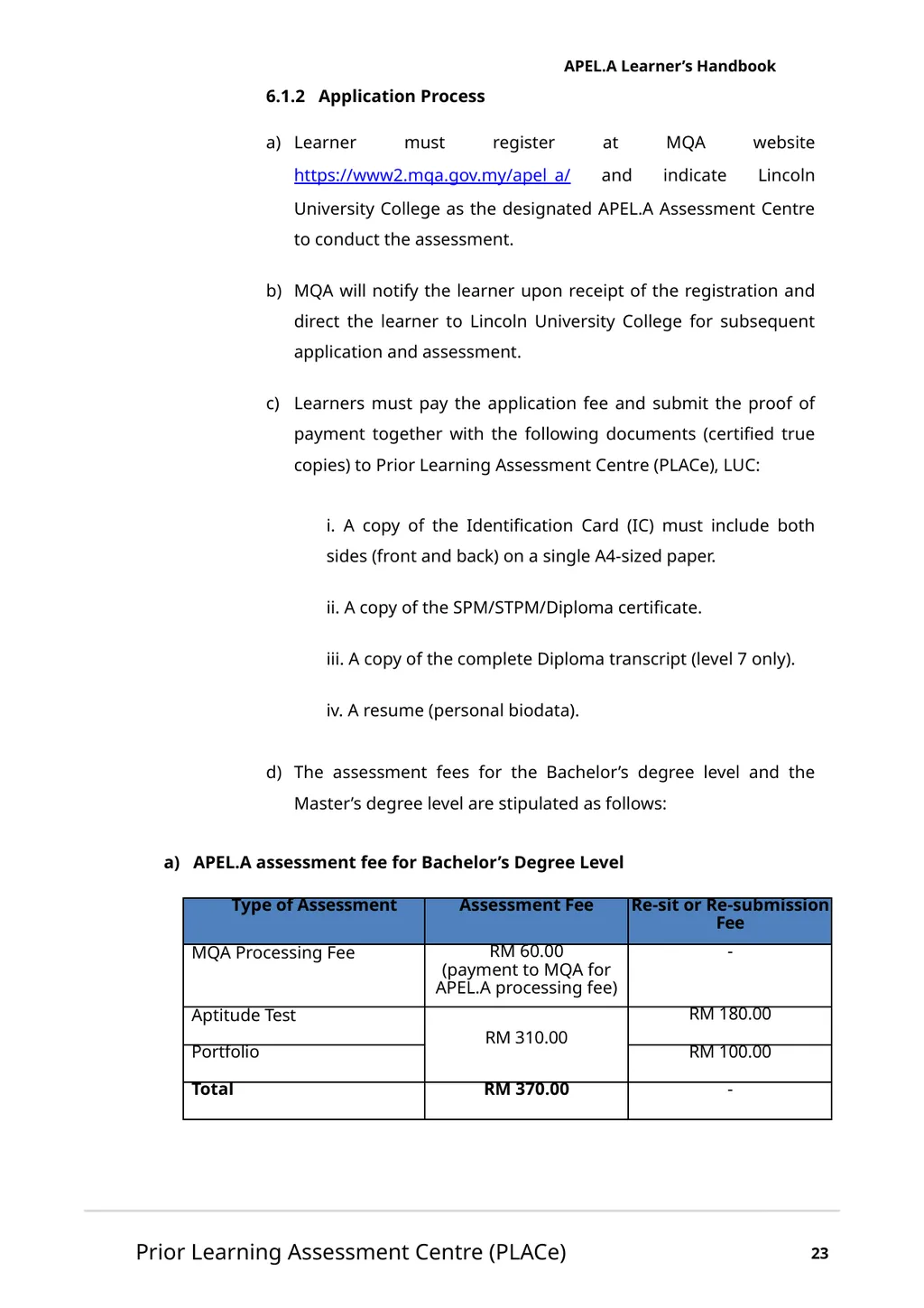
The assessment fees for the Bachelor’s degree level and the Master’s degree level are stipulated as follows: 6.1.2 Application Process i. A copy of the Identification Card (IC) must include both sides (front and back) on a single A4-sized paper.
ii. A copy of the SPM/STPM/Diploma certificate.
iii. A copy of the complete Diploma transcript (level 7 only).
iv. A resume (personal biodata). 23 a) APEL.A assessment fee for Bachelor’s Degree Level APEL.A Learner’s Handbook<br>
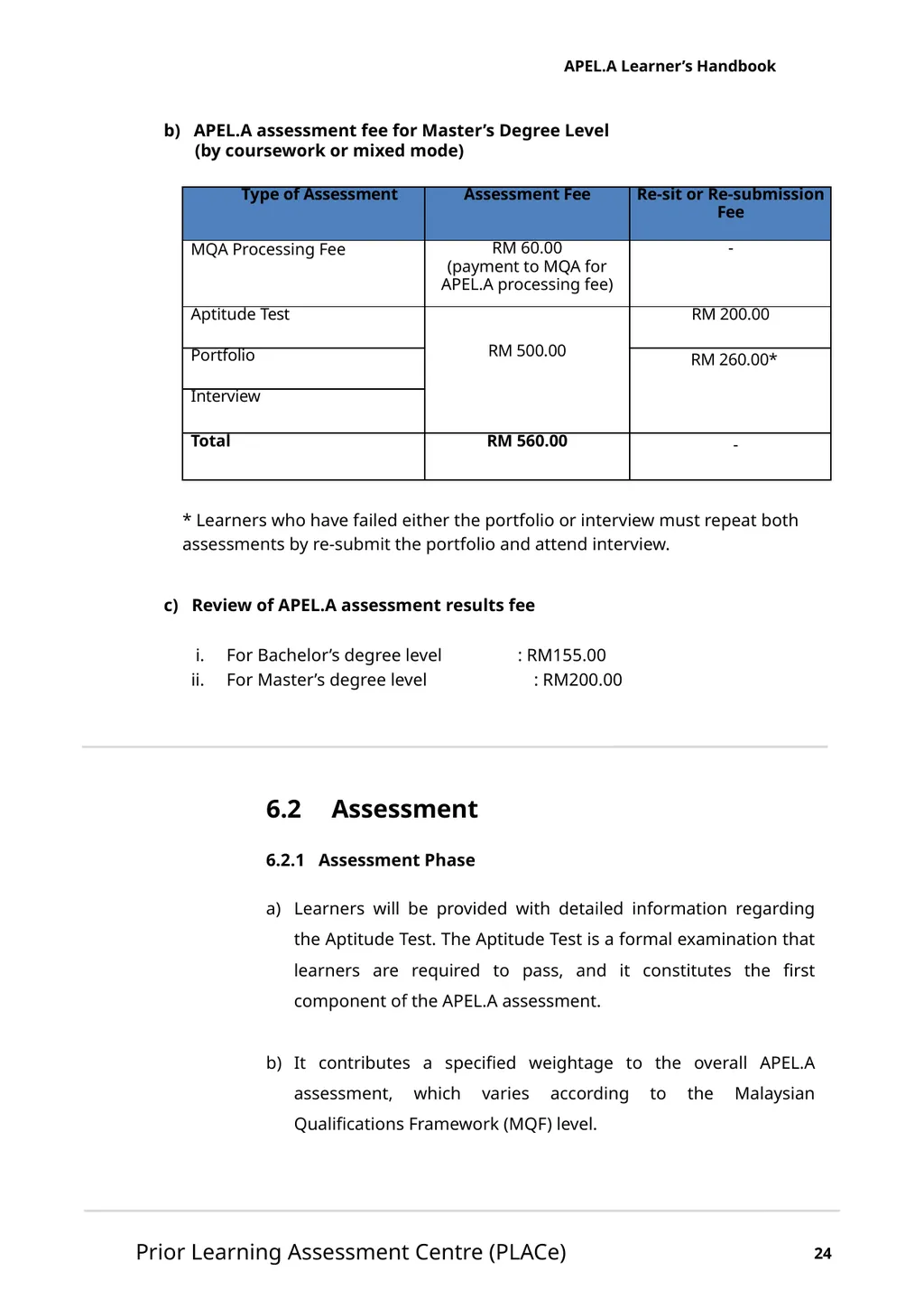
slide30. 24 Prior Learning Assessment Centre (PLACe) c) Review of APEL.A assessment results fee b) APEL.A assessment fee for Master’s Degree Level
(by coursework or mixed mode) * Learners who have failed either the portfolio or interview must repeat both assessments by re-submit the portfolio and attend interview. i. For Bachelor’s degree level : RM155.00
ii. For Master’s degree level : RM200.00 Assessment 6.2 Learners will be provided with detailed information regarding the Aptitude Test. The Aptitude Test is a formal examination that learners are required to pass, and it constitutes the first component of the APEL.A assessment.
It contributes a specified weightage to the overall APEL.A assessment, which varies according to the Malaysian Qualifications Framework (MQF) level. 6.2.1 Assessment Phase APEL.A Learner’s Handbook<br>
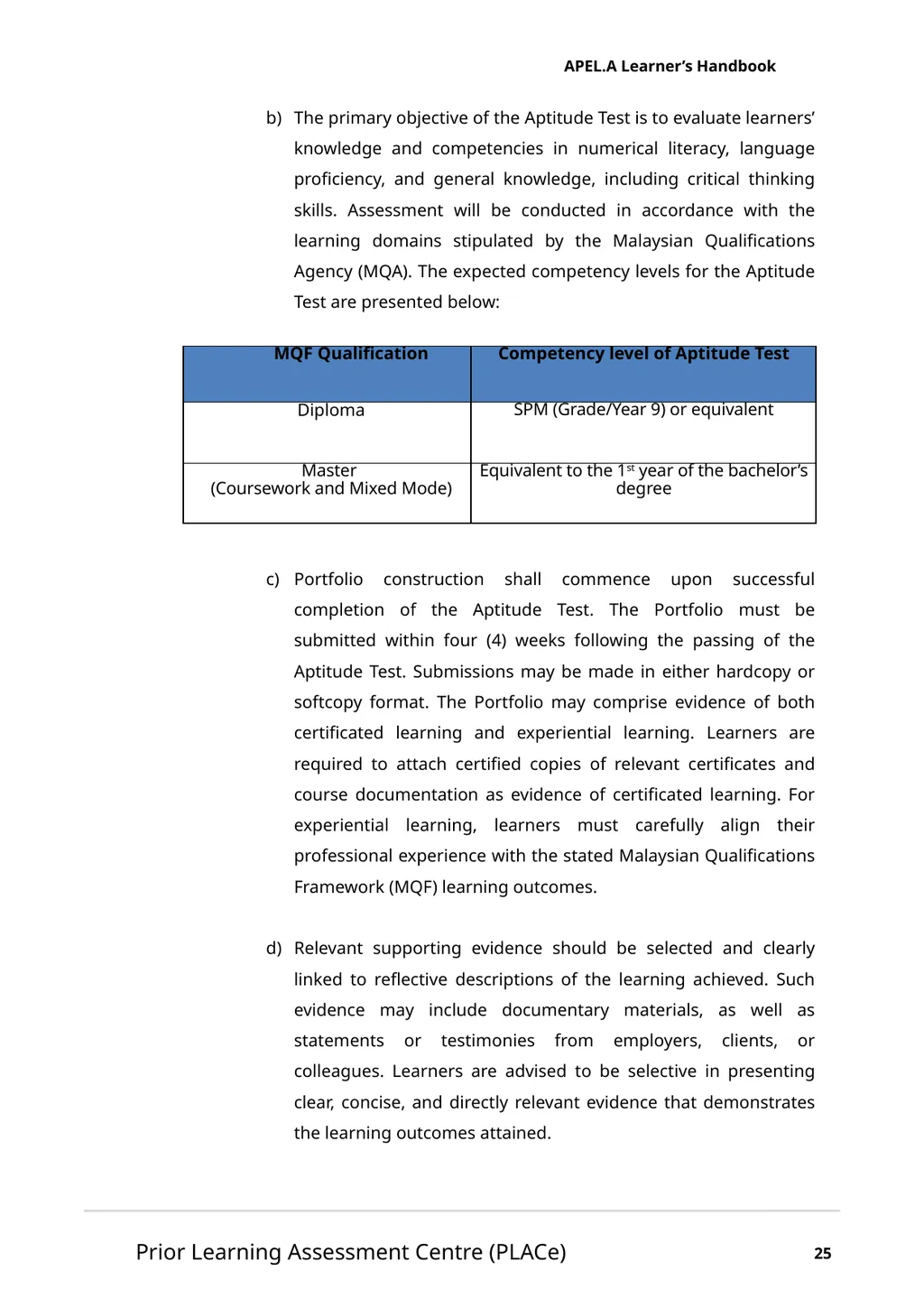
slide31. 25 Prior Learning Assessment Centre (PLACe) The primary objective of the Aptitude Test is to evaluate learners’ knowledge and competencies in numerical literacy, language proficiency, and general knowledge, including critical thinking skills. Assessment will be conducted in accordance with the learning domains stipulated by the Malaysian Qualifications Agency (MQA). The expected competency levels for the Aptitude Test are presented below:
Portfolio construction shall commence upon successful completion of the Aptitude Test. The Portfolio must be submitted within four (4) weeks following the passing of the Aptitude Test. Submissions may be made in either hardcopy or softcopy format. The Portfolio may comprise evidence of both certificated learning and experiential learning. Learners are required to attach certified copies of relevant certificates and course documentation as evidence of certificated learning. For experiential learning, learners must carefully align their professional experience with the stated Malaysian Qualifications Framework (MQF) learning outcomes.
Relevant supporting evidence should be selected and clearly linked to reflective descriptions of the learning achieved. Such evidence may include documentary materials, as well as statements or testimonies from employers, clients, or colleagues. Learners are advised to be selective in presenting clear, concise, and directly relevant evidence that demonstrates the learning outcomes attained. APEL.A Learner’s Handbook<br>
slide32. Prior Learning Assessment Centre (PLACe) 6.2.2 Moderation Process To ensure that the assessment of APEL.A learners is conducted in accordance with the standards stipulated by the Malaysian Qualifications Agency (MQA) and to minimize potential assessor bias, each APEL.A evaluation will be undertaken by two independent assessors, as required by the MQA.
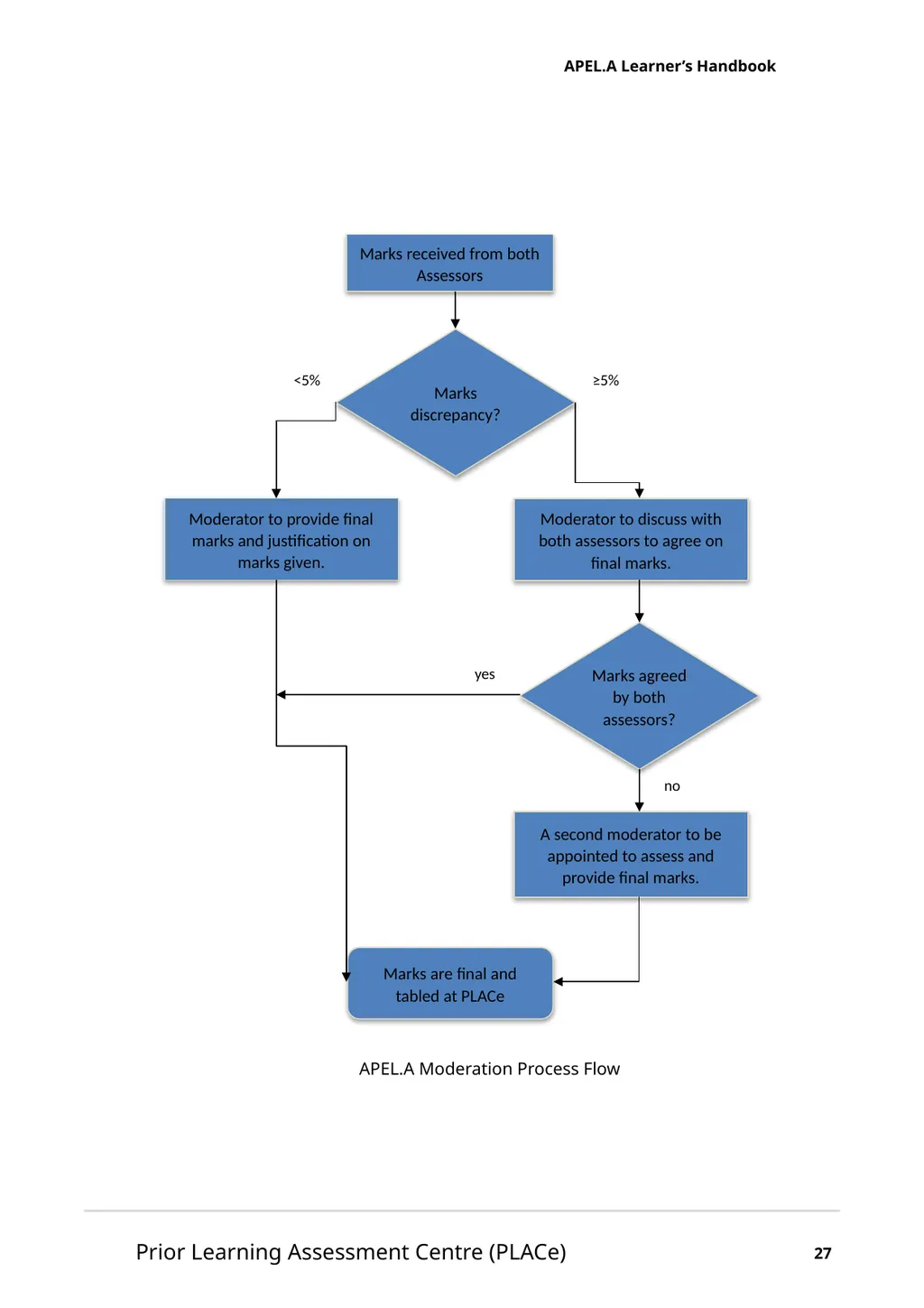
In addition, a moderator will be appointed to oversee the assessment process and to ensure consistency and fairness in marking. In instances where discrepancies of 5% or more arise between the assessors’ marks, the moderator will facilitate a deliberation between the assessors to reach a consensus on the final score.
Should consensus not be achieved, a second moderator will be appointed, whose decision will be deemed final. 26 The PLACe shall notify the panel of evaluators within five (5) working days to commence the evaluation of the Portfolio. Upon successful evaluation, learners will be informed of the outcome within seven (7) working days from the final date of Portfolio assessment. During this period, coordination meetings and score reviews will be conducted. In the event of an unsuccessful outcome, learners may submit an appeal to the Lincoln University College APEL Centre.
For APEL T-7 learners, an interview will be conducted approximately one (1) month after the Portfolio submission. A coordination meeting and review of the APEL.A evaluation scores will be held prior to the notification of results. Evaluation outcomes for APEL T-7 learners will be communicated within one (1) month following the interview. APEL.A Learner’s Handbook<br>
slide33. Prior Learning Assessment Centre (PLACe) 27 Marks received from both Assessors Moderator to provide final marks and justification on marks given. A second moderator to be appointed to assess and provide final marks. Marks are final and tabled at PLACe Moderator to discuss with both assessors to agree on final marks. Marks agreed by both assessors? Marks discrepancy? <5% ≥5% yes no APEL.A Moderation Process Flow APEL.A Learner’s Handbook<br>
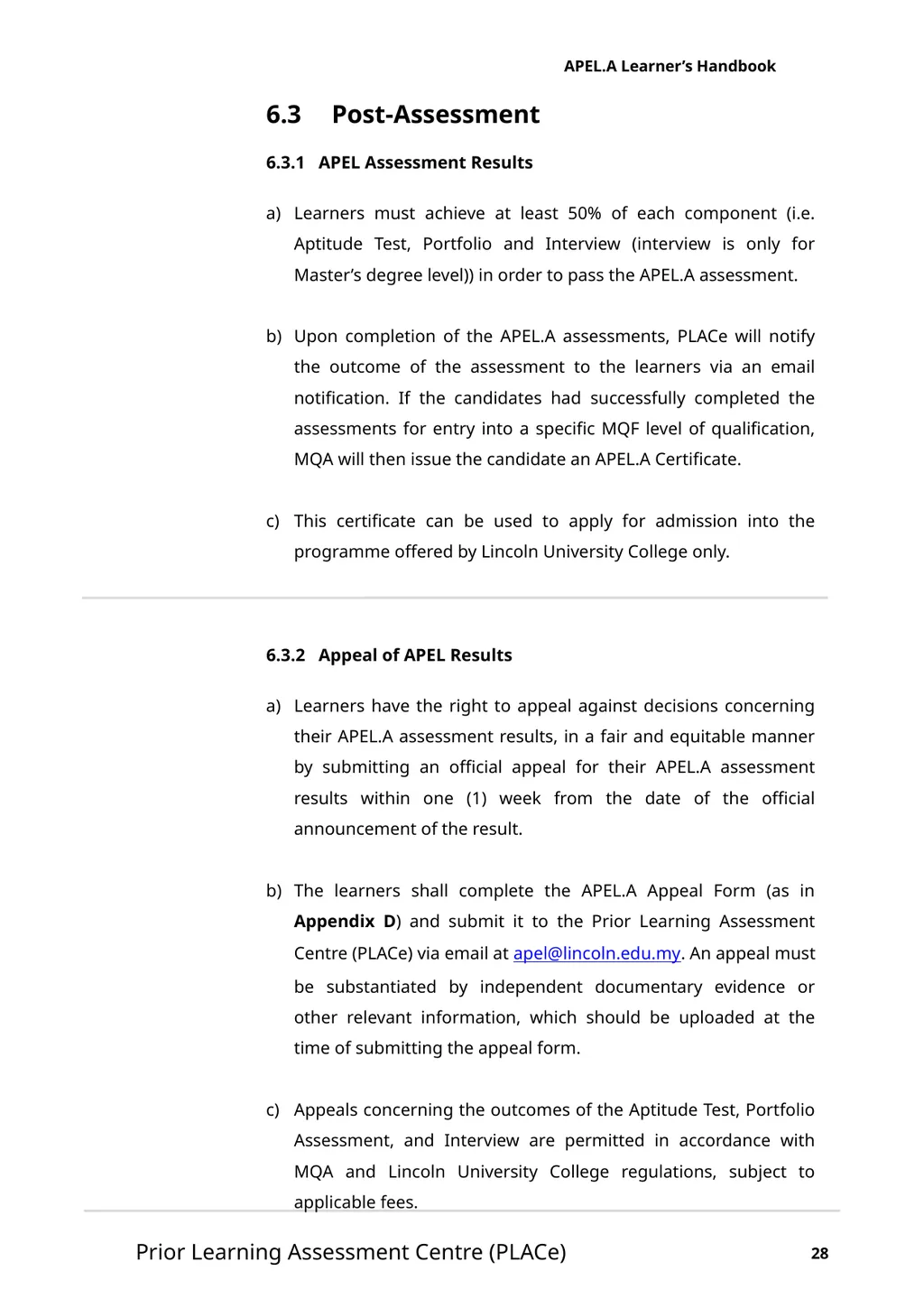
slide34. Prior Learning Assessment Centre (PLACe) 28 6.3.1 APEL Assessment Results Learners must achieve at least 50% of each component (i.e. Aptitude Test, Portfolio and Interview (interview is only for Master’s degree level)) in order to pass the APEL.A assessment.
Upon completion of the APEL.A assessments, PLACe will notify the outcome of the assessment to the learners via an email notification. If the candidates had successfully completed the assessments for entry into a specific MQF level of qualification, MQA will then issue the candidate an APEL.A Certificate.
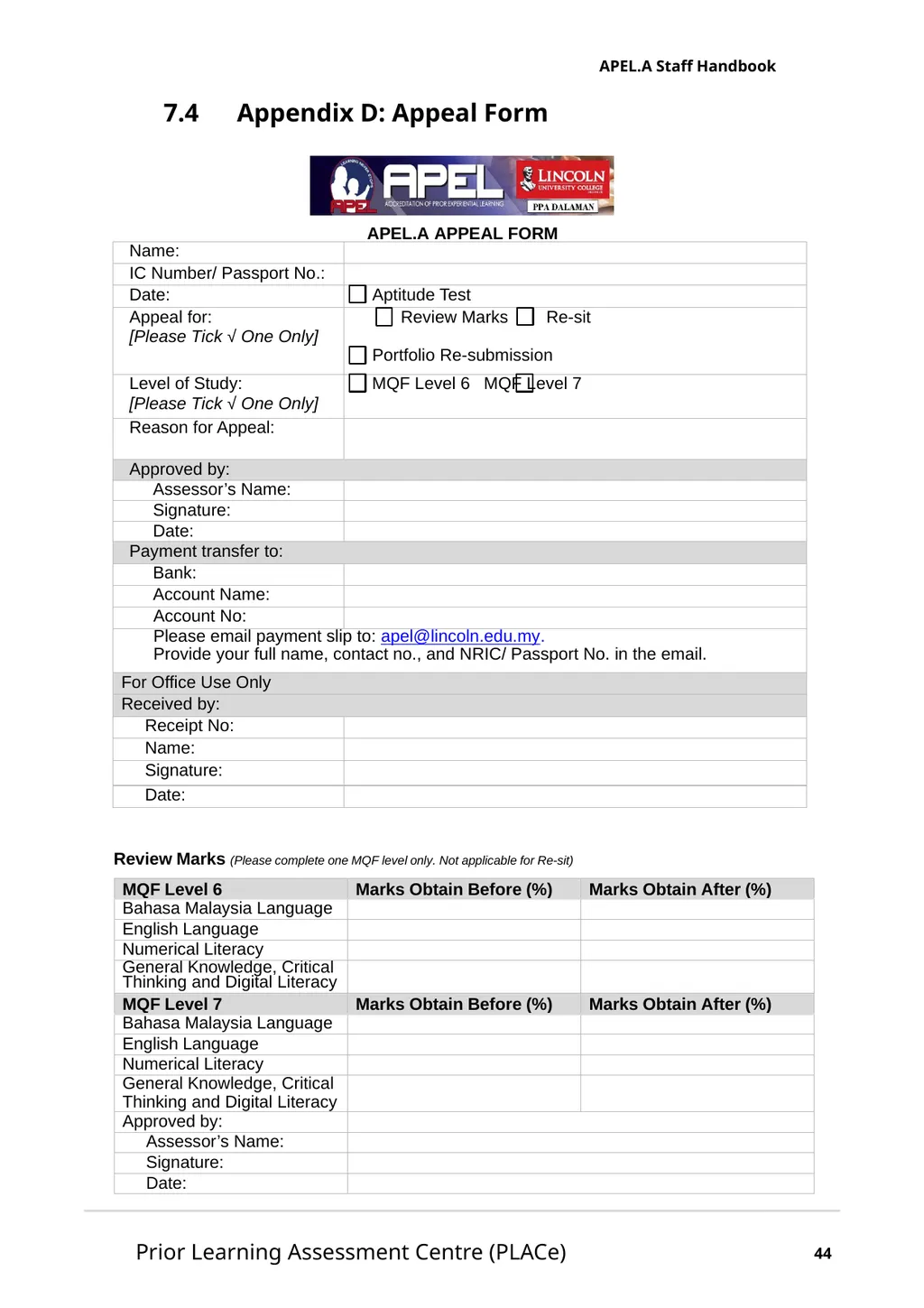
This certificate can be used to apply for admission into the programme offered by Lincoln University College only. Post-Assessment 6.3 6.3.2 Appeal of APEL Results Learners have the right to appeal against decisions concerning their APEL.A assessment results, in a fair and equitable manner by submitting an official appeal for their APEL.A assessment results within one (1) week from the date of the official announcement of the result.
The learners shall complete the APEL.A Appeal Form (as in Appendix D) and submit it to the Prior Learning Assessment Centre (PLACe) via email at apel@lincoln.edu.my. An appeal must be substantiated by independent documentary evidence or other relevant information, which should be uploaded at the time of submitting the appeal form.
Appeals concerning the outcomes of the Aptitude Test, Portfolio Assessment, and Interview are permitted in accordance with MQA and Lincoln University College regulations, subject to applicable fees. APEL.A Learner’s Handbook<br>
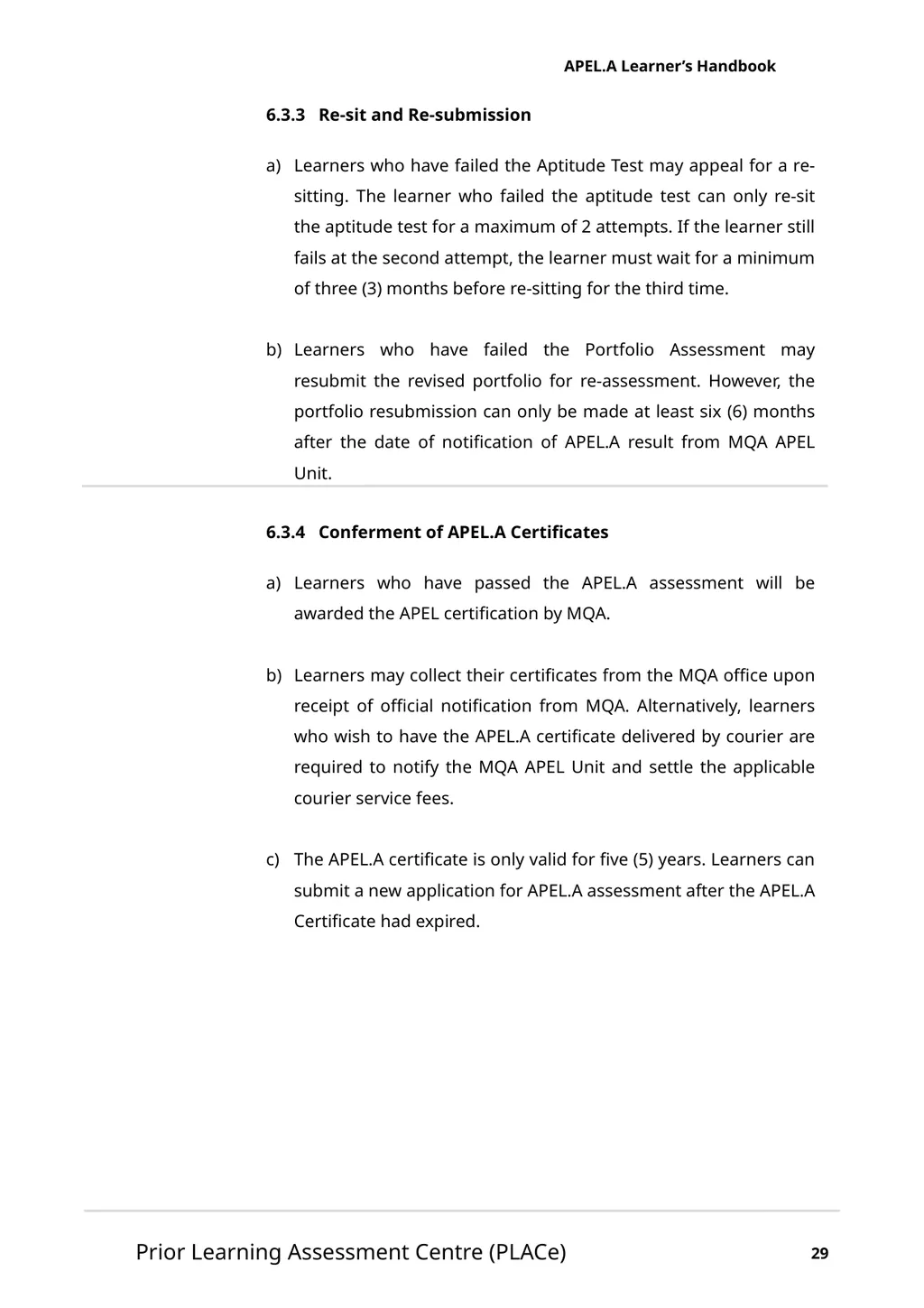
slide35. Prior Learning Assessment Centre (PLACe) 29 6.3.3 Re-sit and Re-submission Learners who have failed the Aptitude Test may appeal for a re-sitting. The learner who failed the aptitude test can only re-sit the aptitude test for a maximum of 2 attempts. If the learner still fails at the second attempt, the learner must wait for a minimum of three (3) months before re-sitting for the third time.
Learners who have failed the Portfolio Assessment may resubmit the revised portfolio for re-assessment. However, the portfolio resubmission can only be made at least six (6) months after the date of notification of APEL.A result from MQA APEL Unit. 6.3.4 Conferment of APEL.A Certificates Learners who have passed the APEL.A assessment will be awarded the APEL certification by MQA.
Learners may collect their certificates from the MQA office upon receipt of official notification from MQA. Alternatively, learners who wish to have the APEL.A certificate delivered by courier are required to notify the MQA APEL Unit and settle the applicable courier service fees.
The APEL.A certificate is only valid for five (5) years. Learners can submit a new application for APEL.A assessment after the APEL.A Certificate had expired. APEL.A Learner’s Handbook<br>
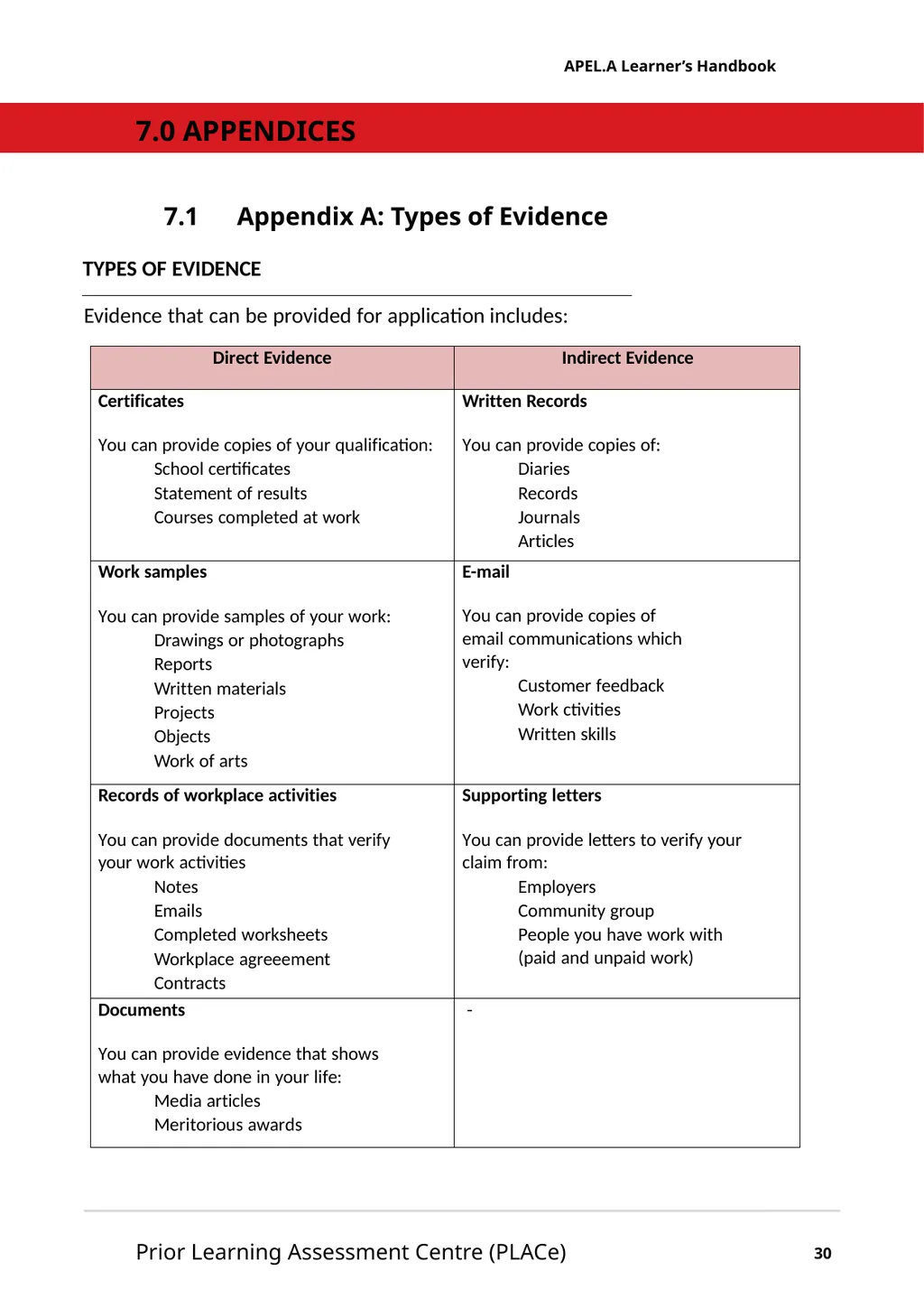
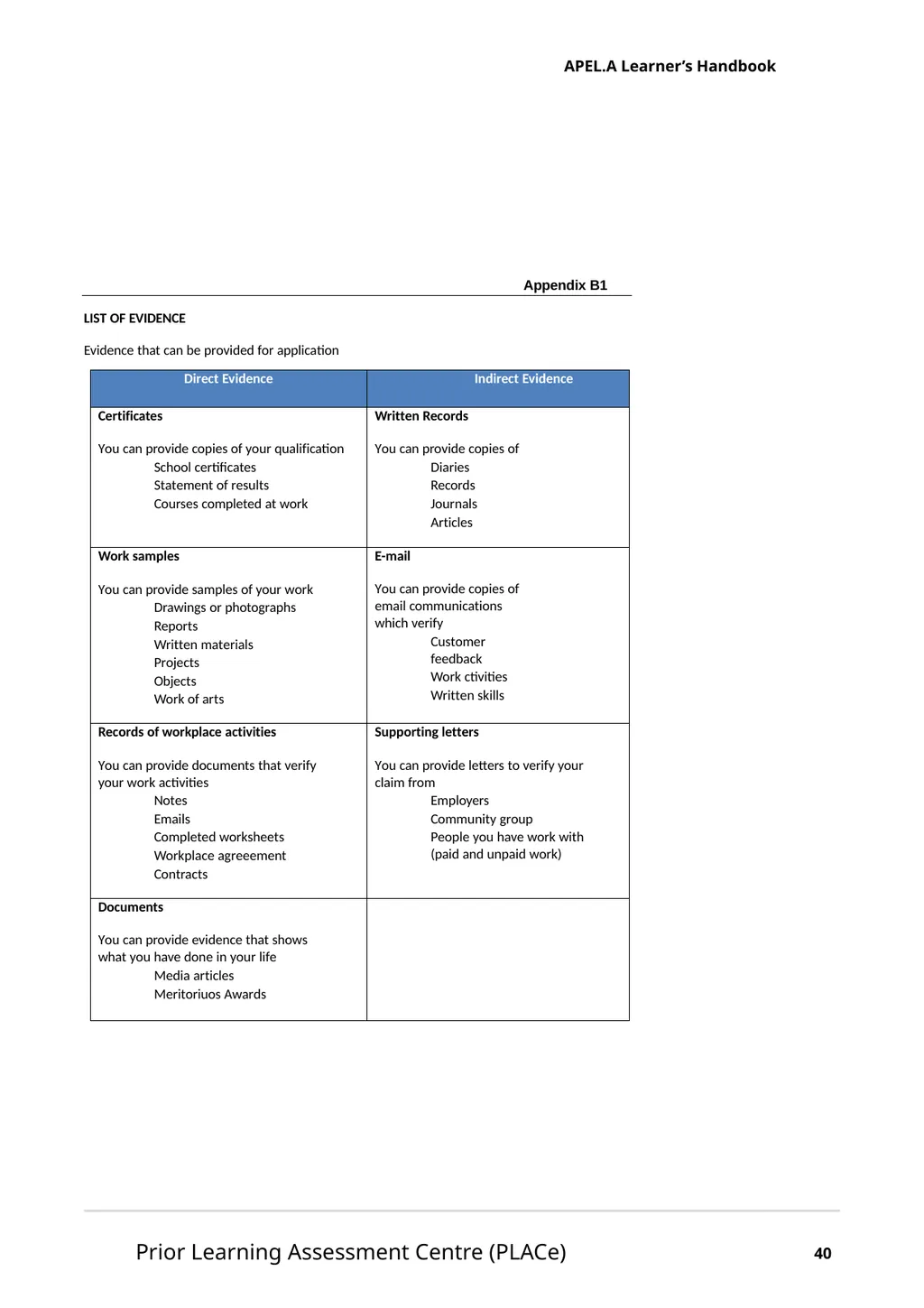
slide36. TYPES OF EVIDENCE
Evidence that can be provided for application includes: 30 Prior Learning Assessment Centre (PLACe) Appendix A: Types of Evidence 7.1 7.0 APPENDICES APEL.A Learner’s Handbook<br>
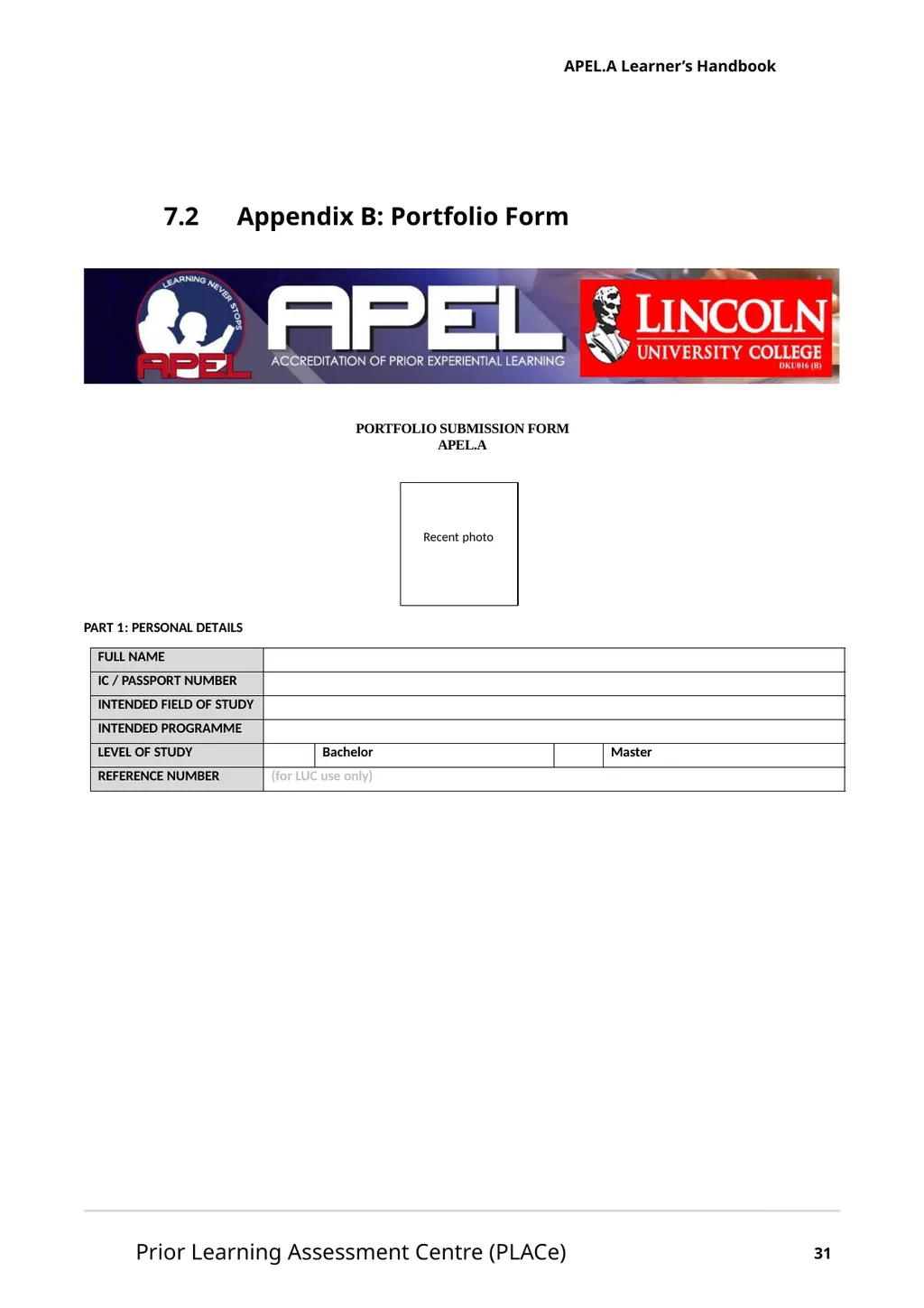
slide37. PORTFOLIO SUBMISSION FORM APEL.A PART 1: PERSONAL DETAILS Recent photo 31 Prior Learning Assessment Centre (PLACe) Appendix B: Portfolio Form 7.2 APEL.A Learner’s Handbook<br>
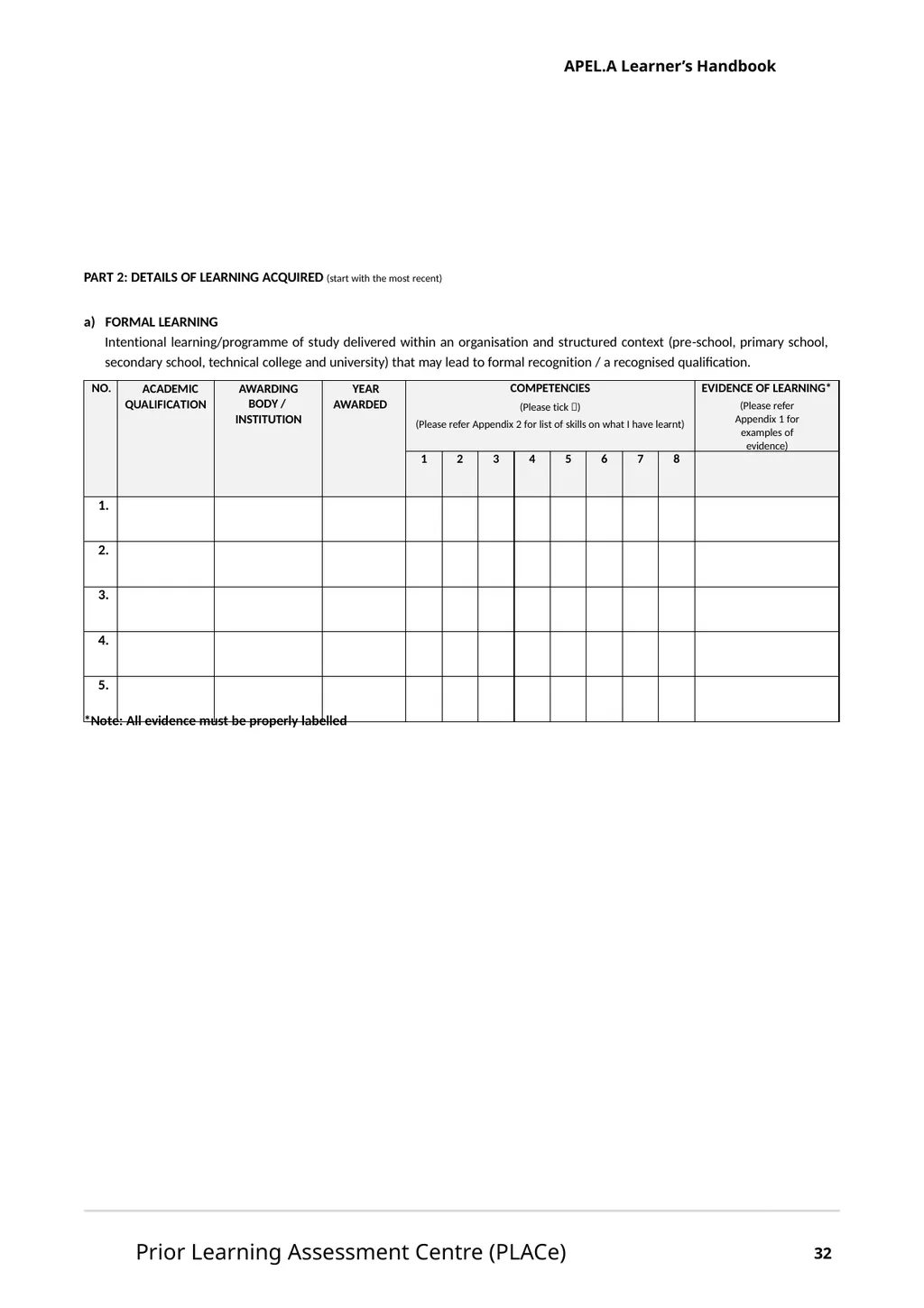
slide38. PART 2: DETAILS OF LEARNING ACQUIRED (start with the most recent)
a) FORMAL LEARNING
Intentional learning/programme of study delivered within an organisation and structured context (pre-school, primary school, secondary school, technical college and university) that may lead to formal recognition / a recognised qualification. *Note: All evidence must be properly labelled 32 Prior Learning Assessment Centre (PLACe) APEL.A Learner’s Handbook<br>
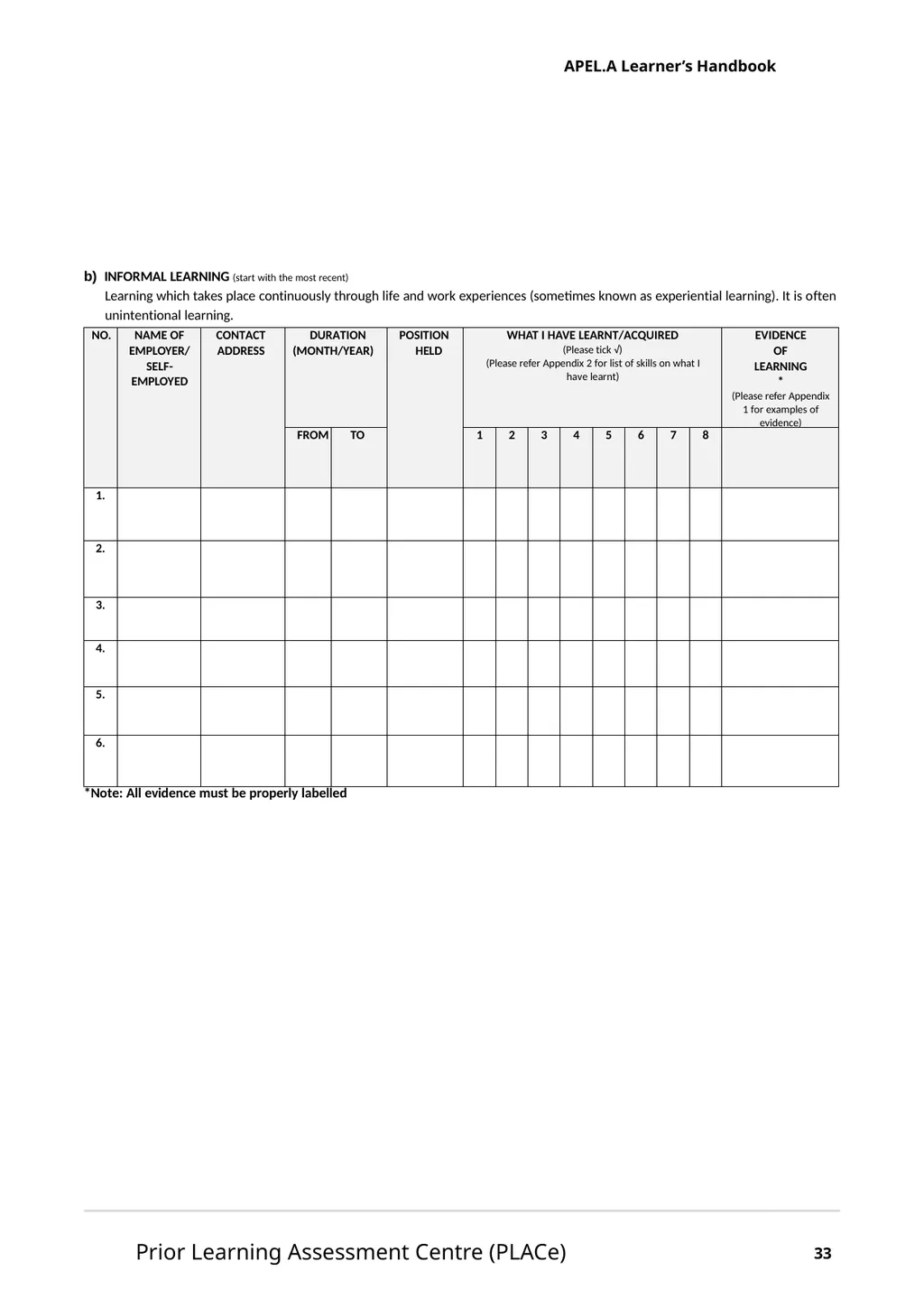
slide39. b) INFORMAL LEARNING (start with the most recent)
Learning which takes place continuously through life and work experiences (sometimes known as experiential learning). It is often unintentional learning. *Note: All evidence must be properly labelled 33 Prior Learning Assessment Centre (PLACe) APEL.A Learner’s Handbook<br>
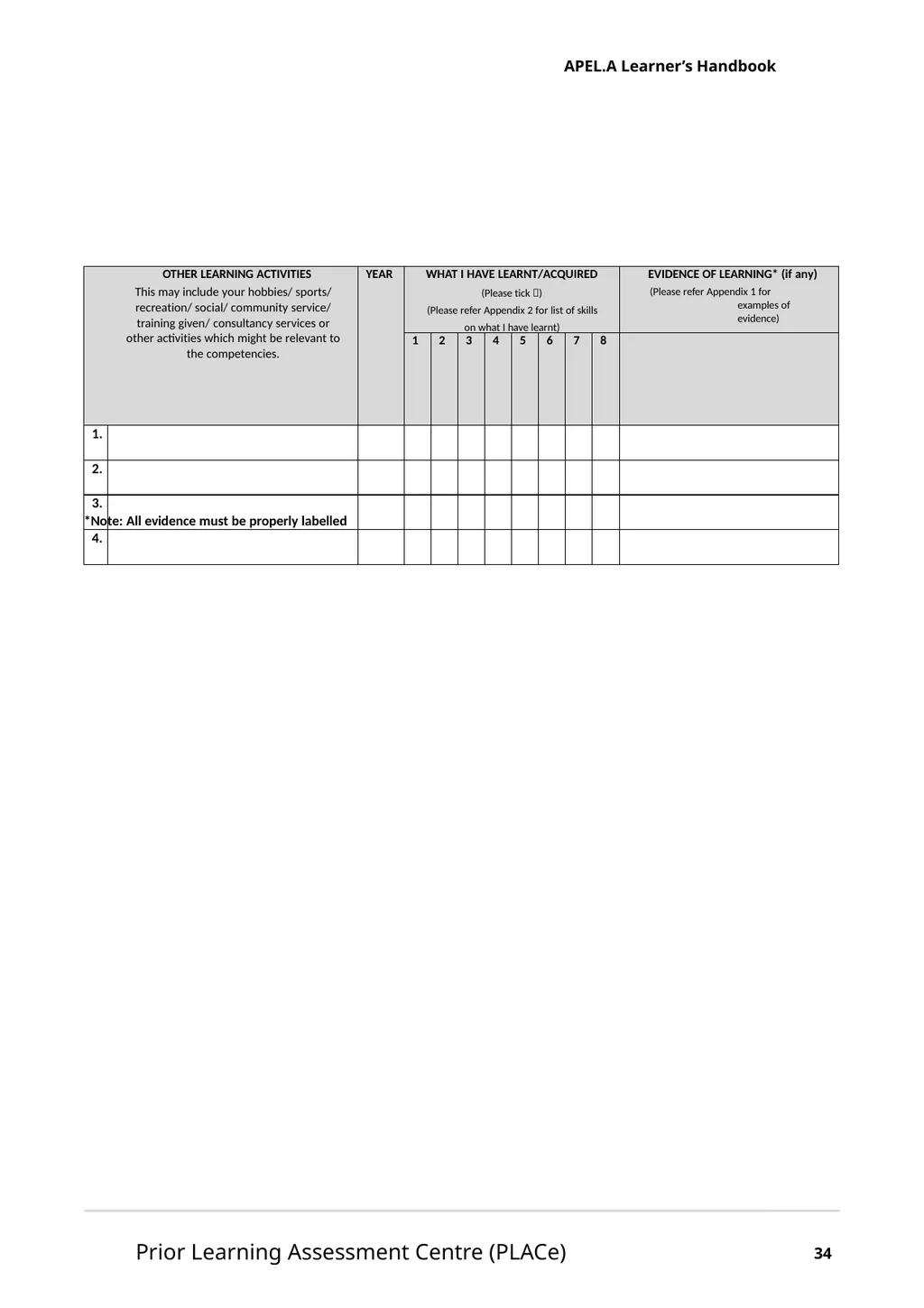
slide40. *Note: All evidence must be properly labelled 34 Prior Learning Assessment Centre (PLACe) APEL.A Learner’s Handbook<br>
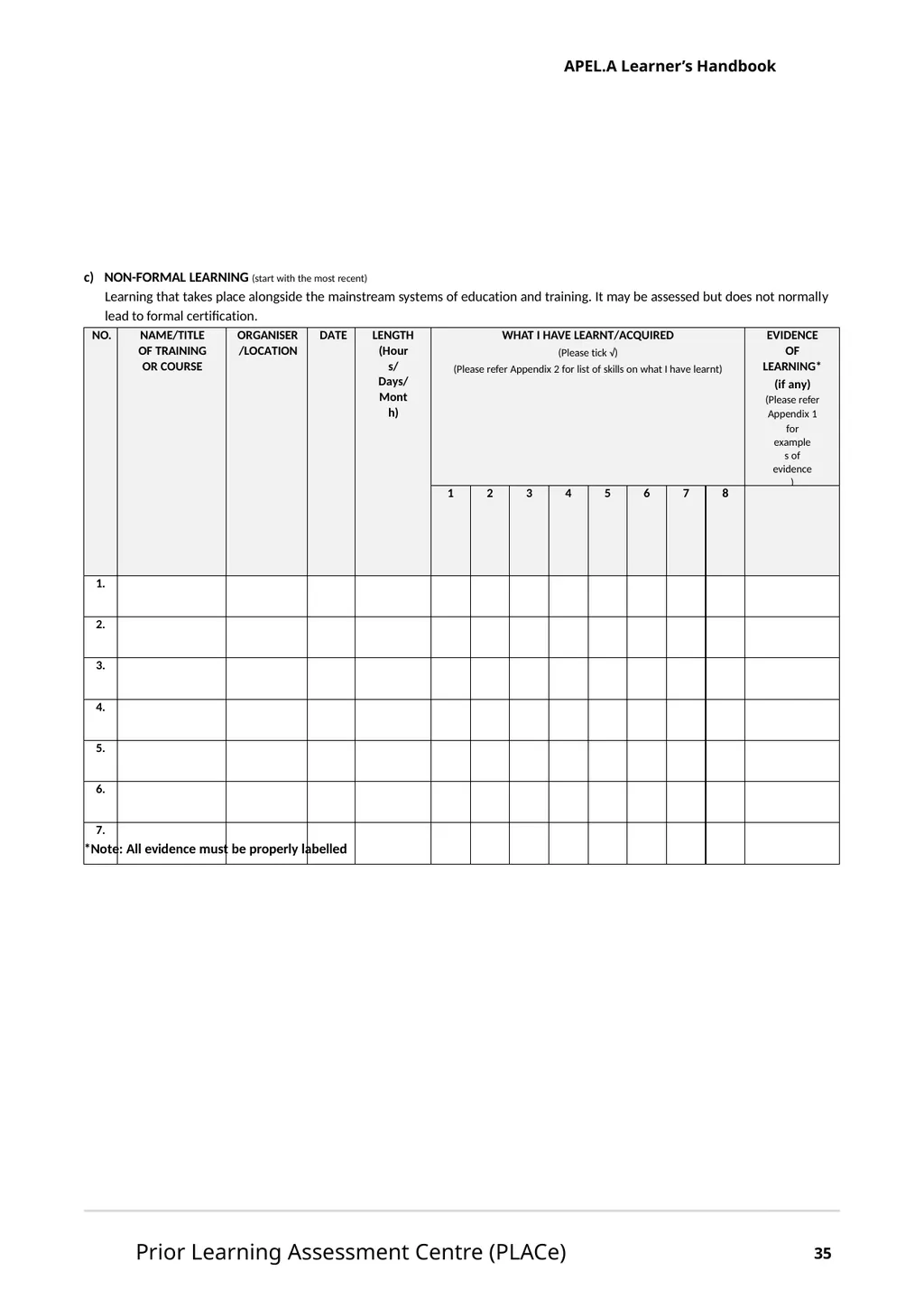
slide41. c) NON-FORMAL LEARNING (start with the most recent)
Learning that takes place alongside the mainstream systems of education and training. It may be assessed but does not normally
lead to formal certification. *Note: All evidence must be properly labelled 35 Prior Learning Assessment Centre (PLACe) APEL.A Learner’s Handbook<br>
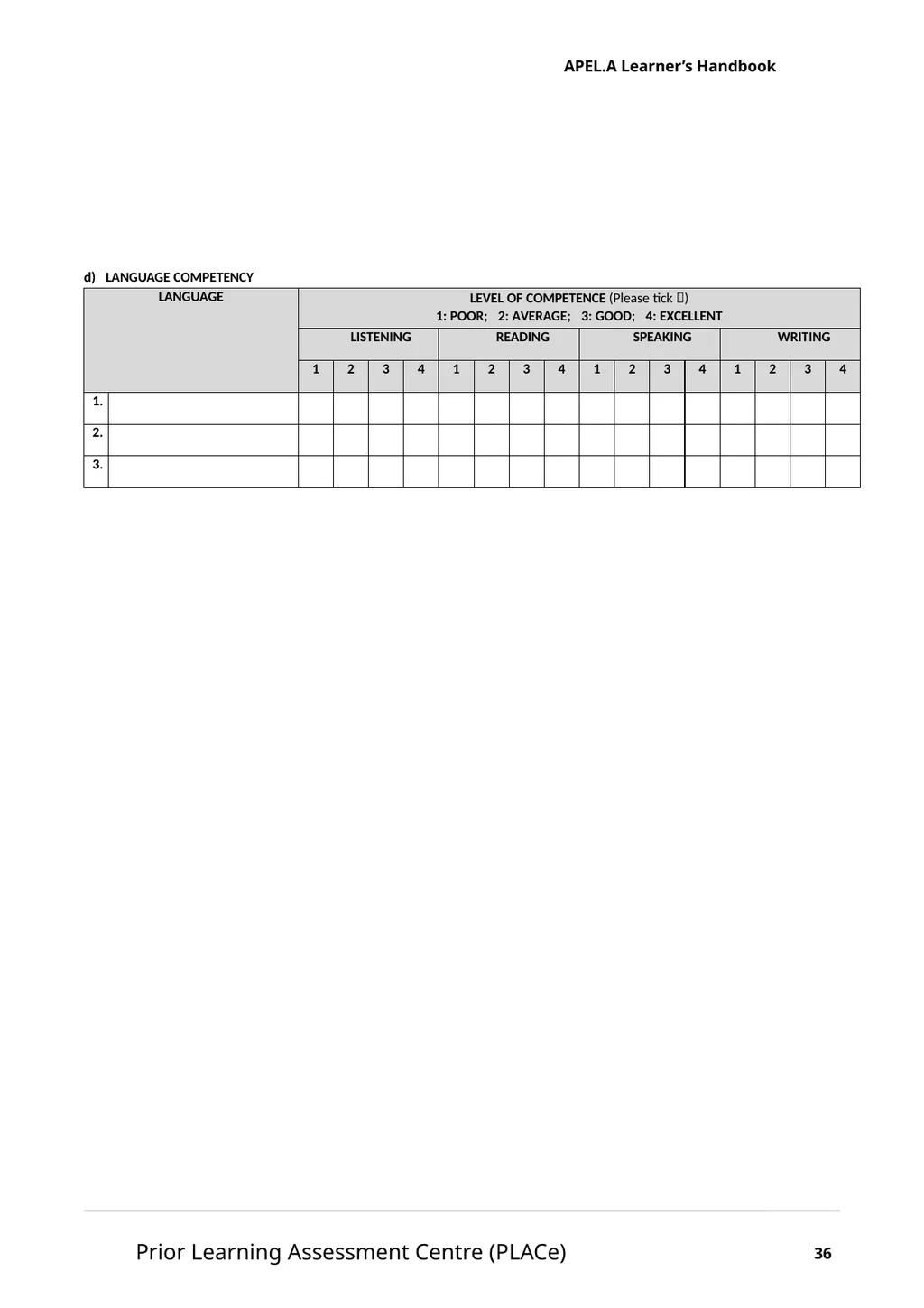
slide42. d) LANGUAGE COMPETENCY 36 Prior Learning Assessment Centre (PLACe) APEL.A Learner’s Handbook<br>
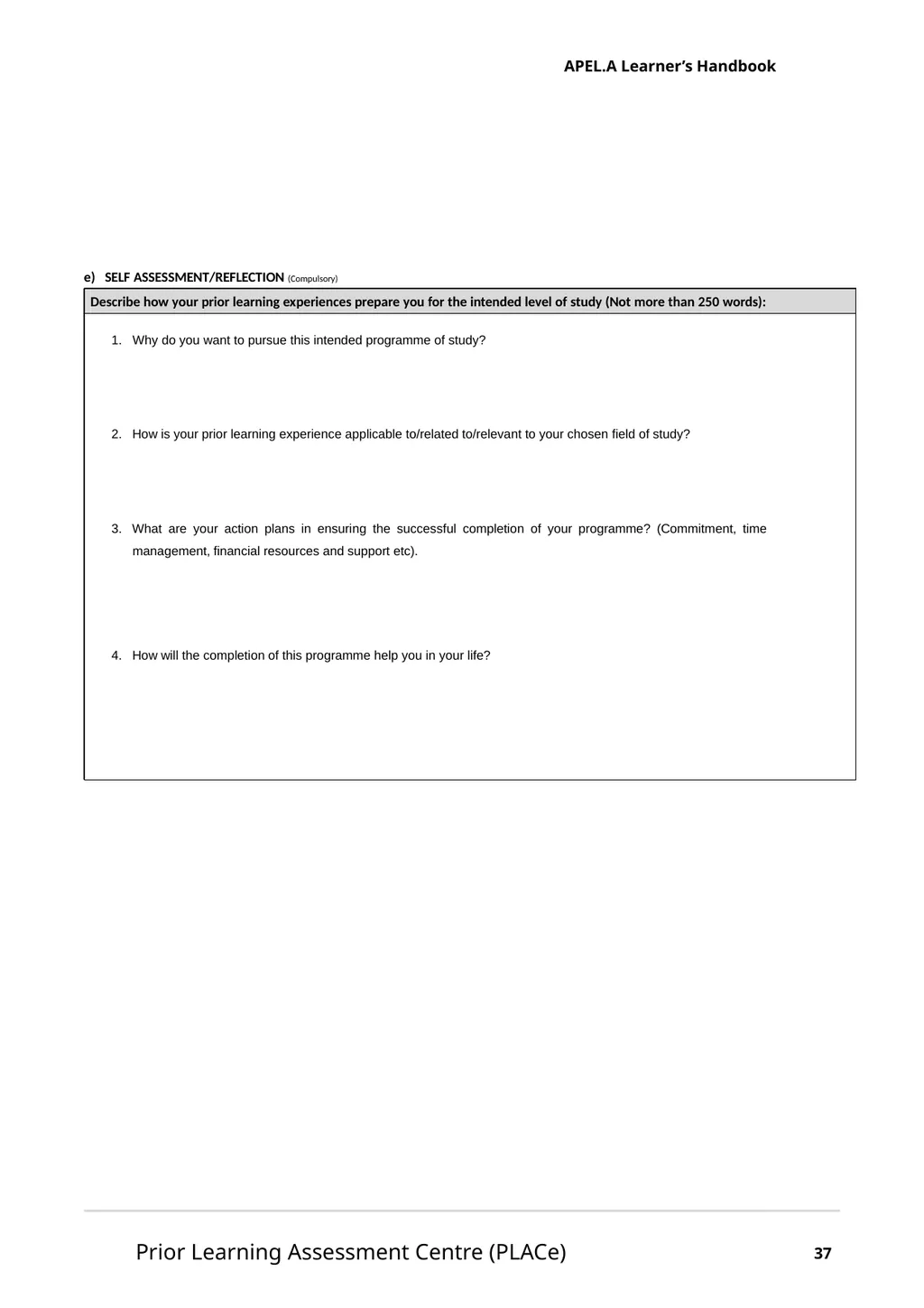
slide43. SELF ASSESSMENT/REFLECTION (Compulsory)
Describe how your prior learning experiences prepare you for the intended level of study (Not more than 250 words):
Why do you want to pursue this intended programme of study? 2. How is your prior learning experience applicable to/related to/relevant to your chosen field of study? 3. What are your action plans in ensuring the successful completion of your programme? (Commitment, time management, financial resources and support etc). 4. How will the completion of this programme help you in your life? 37 Prior Learning Assessment Centre (PLACe) APEL.A Learner’s Handbook<br>
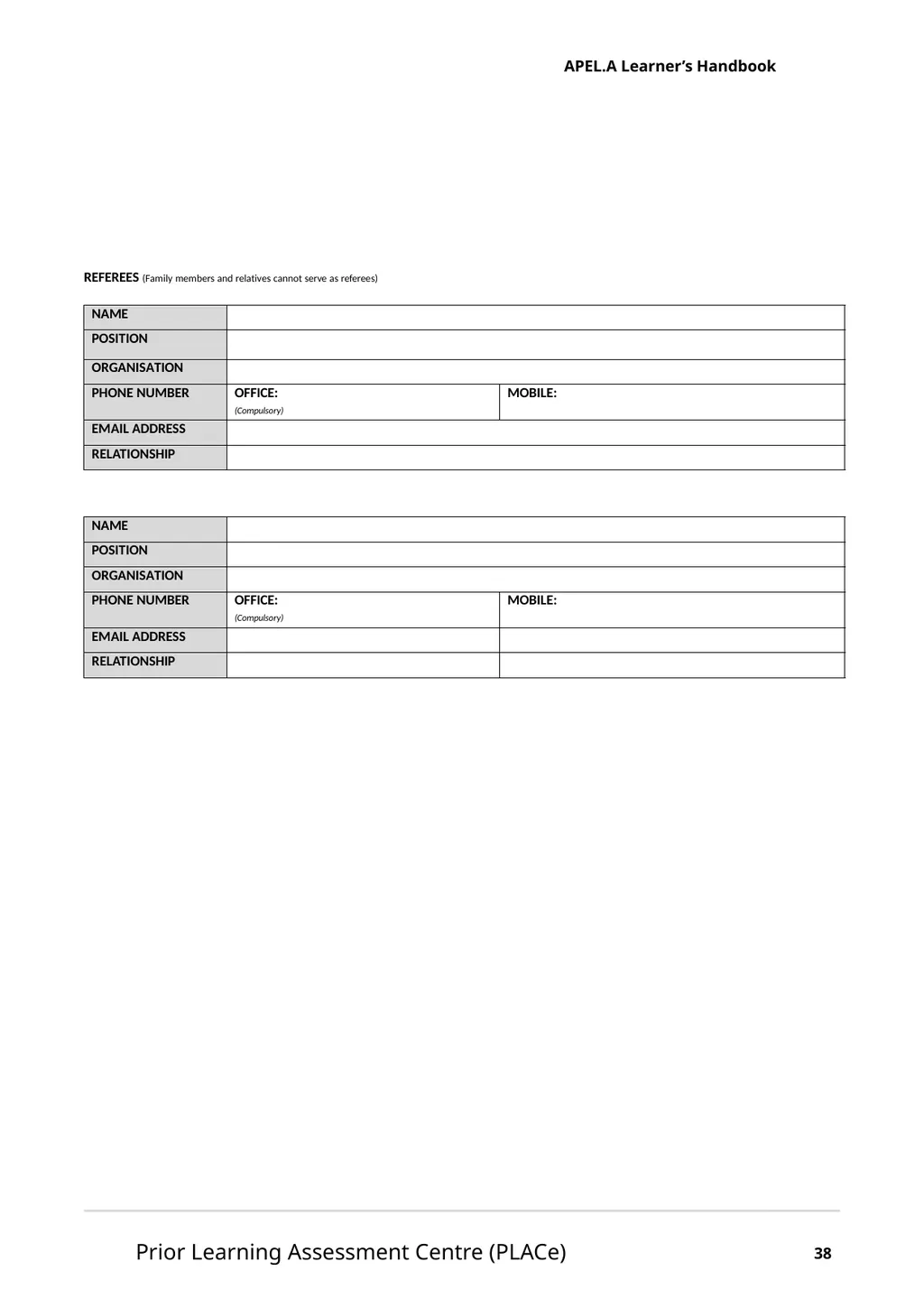
slide44. REFEREES (Family members and relatives cannot serve as referees) 38 Prior Learning Assessment Centre (PLACe) APEL.A Learner’s Handbook<br>
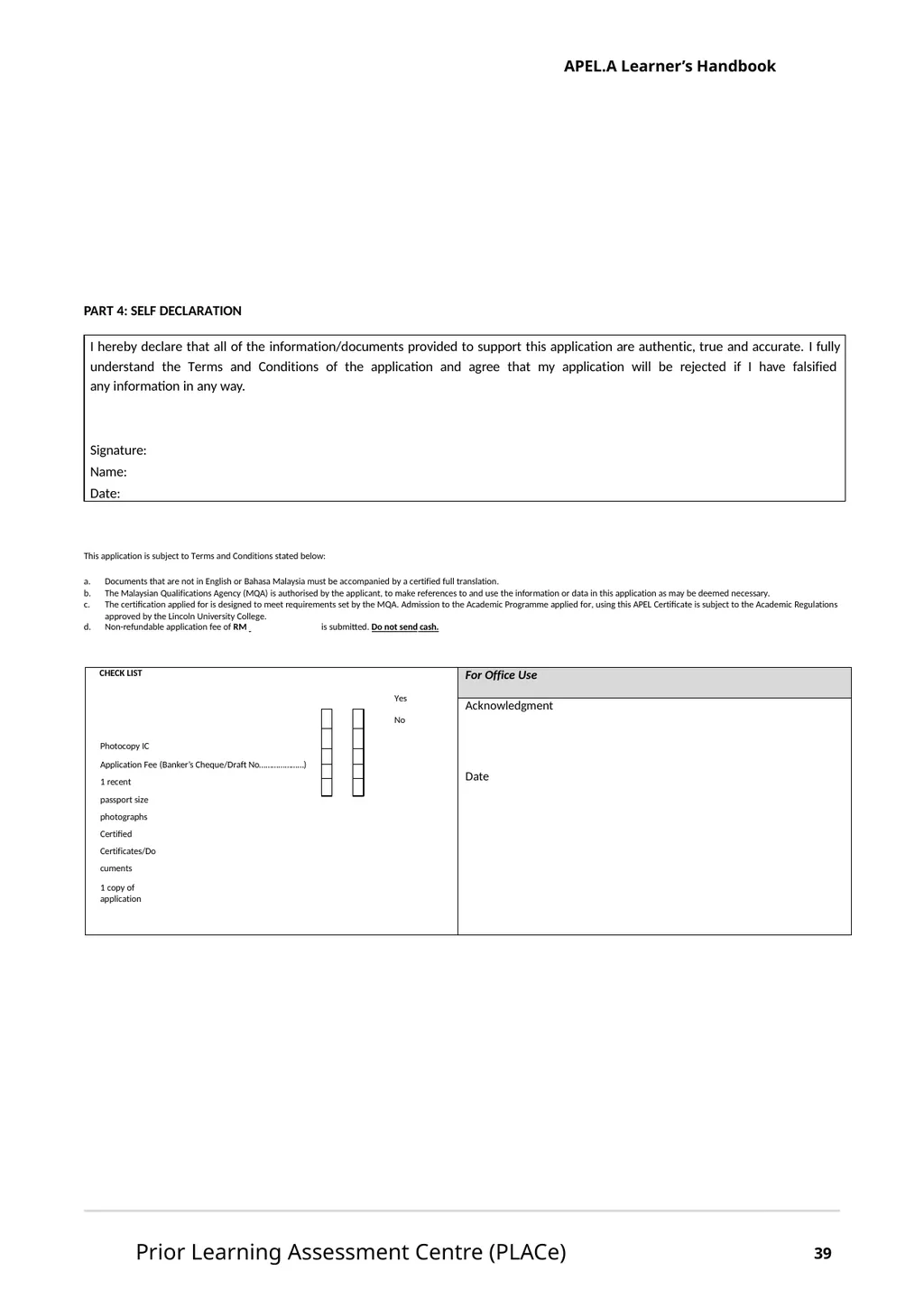
slide45. PART 4: SELF DECLARATION I hereby declare that all of the information/documents provided to support this application are authentic, true and accurate. I fully understand the Terms and Conditions of the application and agree that my application will be rejected if I have falsified any information in any way.
Signature: Name: Date: This application is subject to Terms and Conditions stated below:
Documents that are not in English or Bahasa Malaysia must be accompanied by a certified full translation.
The Malaysian Qualifications Agency (MQA) is authorised by the applicant, to make references to and use the information or data in this application as may be deemed necessary.
The certification applied for is designed to meet requirements set by the MQA. Admission to the Academic Programme applied for, using this APEL Certificate is subject to the Academic Regulations approved by the Lincoln University College.
Non-refundable application fee of RM is submitted. Do not send cash. 39 Prior Learning Assessment Centre (PLACe) APEL.A Learner’s Handbook<br>
slide46. Appendix B1
LIST OF EVIDENCE
Evidence that can be provided for application 40 Prior Learning Assessment Centre (PLACe) APEL.A Learner’s Handbook<br>
slide47. Appendix B2
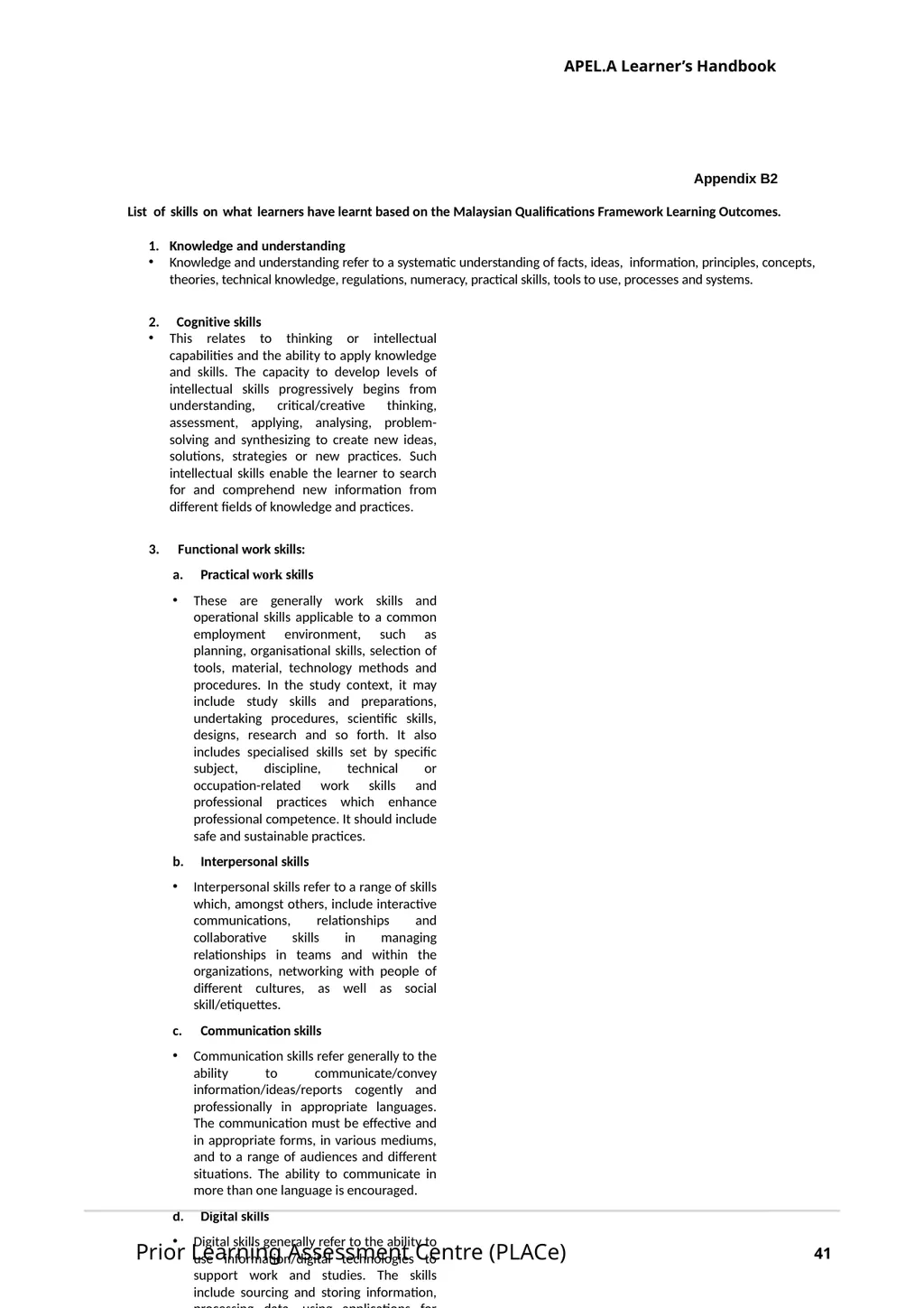
List of skills on what learners have learnt based on the Malaysian Qualifications Framework Learning Outcomes.
Knowledge and understanding
Knowledge and understanding refer to a systematic understanding of facts, ideas, information, principles, concepts, theories, technical knowledge, regulations, numeracy, practical skills, tools to use, processes and systems.
Cognitive skills
This relates to thinking or intellectual capabilities and the ability to apply knowledge and skills. The capacity to develop levels of intellectual skills progressively begins from understanding, critical/creative thinking, assessment, applying, analysing, problem-solving and synthesizing to create new ideas, solutions, strategies or new practices. Such intellectual skills enable the learner to search for and comprehend new information from different fields of knowledge and practices.
3. Functional work skills:
Practical work skills
These are generally work skills and operational skills applicable to a common employment environment, such as planning, organisational skills, selection of tools, material, technology methods and procedures. In the study context, it may include study skills and preparations, undertaking procedures, scientific skills, designs, research and so forth. It also includes specialised skills set by specific subject, discipline, technical or occupation-related work skills and professional practices which enhance professional competence. It should include safe and sustainable practices.
Interpersonal skills
Interpersonal skills refer to a range of skills which, amongst others, include interactive communications, relationships and collaborative skills in managing relationships in teams and within the organizations, networking with people of different cultures, as well as social skill/etiquettes.
Communication skills
Communication skills refer generally to the ability to communicate/convey information/ideas/reports cogently and professionally in appropriate languages. The communication must be effective and in appropriate forms, in various mediums, and to a range of audiences and different situations. The ability to communicate in more than one language is encouraged.
Digital skills
Digital skills generally refer to the ability to use information/digital technologies to support work and studies. The skills include sourcing and storing information, processing data, using applications for problem-solving and communication, as well as ethics in applying digital skills.
Numeracy skills
These are the quantitative skills that require learners to acquire increasingly higher levels of numerical abilities. It is acknowledges as an important living skill relevant to study, work and daily life. Within the Malaysian Qualifications Framework levels, this learning outcome may not be specifically mentioned for every level, but it is expected that the requirement of numerical skills as an outcome ought to be indicated for every specific programme. It may include an understanding of basic mathematics, symbols relating to statistical techniques, etc.
Leadership, autonomy and responsibility
This cluster of skills refers to the ability of an individual to build relationships and work with teams made up of peers, as well as the capability of the individual in managerial capacities with varying degrees of autonomy to make decisions or set goals at organisational/unit/team levels. The individual is also expected to take responsibility and provide accountability, to be confident, knowledgeable, articulate, honest, professional, concerned and resilient, to be at risk taker and to possess other intrapersonal skills including working in and leading teams. 41 Prior Learning Assessment Centre (PLACe) APEL.A Learner’s Handbook<br>
slide48. Appendix B2
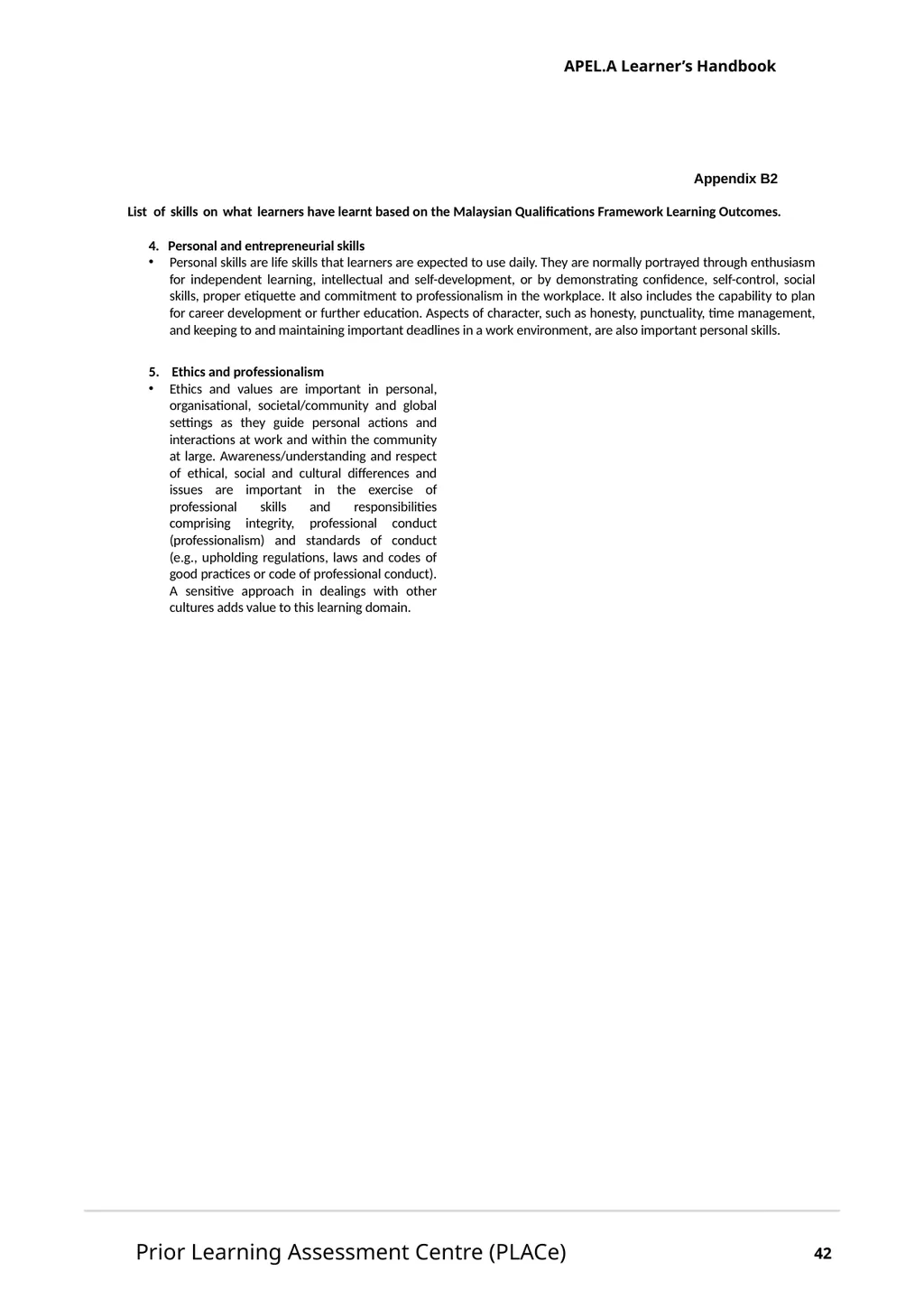
List of skills on what learners have learnt based on the Malaysian Qualifications Framework Learning Outcomes.
4. Personal and entrepreneurial skills
Personal skills are life skills that learners are expected to use daily. They are normally portrayed through enthusiasm for independent learning, intellectual and self-development, or by demonstrating confidence, self-control, social skills, proper etiquette and commitment to professionalism in the workplace. It also includes the capability to plan for career development or further education. Aspects of character, such as honesty, punctuality, time management, and keeping to and maintaining important deadlines in a work environment, are also important personal skills.
5. Ethics and professionalism
Ethics and values are important in personal, organisational, societal/community and global settings as they guide personal actions and interactions at work and within the community at large. Awareness/understanding and respect of ethical, social and cultural differences and issues are important in the exercise of professional skills and responsibilities comprising integrity, professional conduct (professionalism) and standards of conduct (e.g., upholding regulations, laws and codes of good practices or code of professional conduct). A sensitive approach in dealings with other cultures adds value to this learning domain. 42 Prior Learning Assessment Centre (PLACe) APEL.A Learner’s Handbook<br>
slide49. Appendix C: APEL.A Application Process for
APEL.A T-6 and APEL.A T-7 7.3 43 Prior Learning Assessment Centre (PLACe) APEL.A Staff Handbook<br>
slide50. APEL.A APPEAL FORM Review Marks (Please complete one MQF level only. Not applicable for Re-sit) Appendix D: Appeal Form 7.4 44 Prior Learning Assessment Centre (PLACe) APEL.A Staff Handbook<br>
slide51. Thank You Contact Information Thank you for taking the time to explore this APEL.A Learner’s Handbook. We appreciate your commitment to recognizing and validating your prior learning and experiences.
This handbook has been designed to guide you through the APEL.A process with clarity and confidence, and we hope it supports you in demonstrating the valuable knowledge, skills, and competencies you have gained throughout your personal, professional, and lifelong learning journey.
Your dedication to furthering your education is commendable. We wish you every success as you progress through the APEL.A assessment and continue toward achieving your academic and career goals. Fax Email Website +603-7806 3479 info@lincoln.edu.my www.lincoln.edu.my Address No 12, 14, 16 & 18, Jalan SS 6/12, 47301 Petaling Jaya,
Selangor, MALAYSIA. Phone +603-7806 3478 APEL.A Learner’s Handbook<br>
Prior Experiential Learning for Access (APEL.A) Education For All Prior Learning Assessment Centre (PLACe) Version 2025 Edition APEL.A Learner’s
Handbook<br>
slide2. Prior Learning Assessment Centre (PLACe) APEL.A Learner’s Handbook APEL.A Learner’s Handbook:
Accreditation of Prior Experiential Learning for Access (APEL.A)
First Edition 2025
© 2025 Prior Learning Assessment Centre (PLACe), Lincoln University College
This handbook is intended for learners of Lincoln University College and serves as a comprehensive guide to support all learners throughout the APEL.A assessment process.<br>
slide3. 1.0 3.0 2.0 4.0 Admission Criteria 4.1 Programme at Master’s Degree Level
(by Coursework or Mixed Mode) 4.2 Programme at Bachelor’s Degree Level 11 11 11 Table of Contents Prior Learning Assessment Centre (PLACe) Introduction 1.1 Introduction of APEL 1.2 Principles of APEL 01 02 01 Glossary Glossary i-ii i Scope & Benefits 2.1 Scope of APEL 2.2 Benefits of APEL 03 105 03 Prior Learning Assessment Centre 4.1 Establishment of PLACe 4.2 Objectives of PLACe 06 07 06 4.3 Functions of PLACe 4.4 Organizational Chart of PLACe 07 07 4.5 Panel of Experts 09 4.2 Eligibility Screening Process for APEL.A T-7 12 APEL.A Learner’s Handbook<br>
slide4. 7.0 6.0 Appendices 7.1 Appendix A: Types of Evidence 30 30 APEL.A Certification Process 6.1 Pre-Assessment 6.2 Assessment 6.3 Post-Assessment 22 24 28 22 Prior Learning Assessment Centre (PLACe) 7.3 Appendix C: APEL.A application process for APEL.A T-6 and APEL.A T-7 43 7.2 Appendix B: Portfolio Submission Form 31 7.4 Appendix D: APEL.A Appeal Form 44 5.0 Assessment Instruments 5.1 Assessment Weightage 5.2 Learner’s Competencies 13 14 13 5.3 APEL.A Assessment Instruments 18 APEL.A Learner’s Handbook<br>
slide5. GLOSSARY 1. Accreditation of Prior Experiential Learning (APEL) A systematic process that involves the identification, documentation and assessment of prior experiential learning (i.e., knowledge, skills and attitudes) to determine the extent to which an individual has achieved the desired learning outcomes, for access to a programme of study and/or award of credits. Prior Learning Assessment Centre (PLACe) 2. Accreditation of Prior Experiential Learning for Access (APEL.A) Accreditation of prior experiential learning for the purposes of admission/access into a programme of study under the various Malaysian. 3. APEL Assessments A combination of various assessments (i.e., aptitude test, portfolio, interview, presentation, etc.) that an applicant must pass to be awarded the APEL certificate. 4. APEL Certification Process An indication of the competencies and readiness of an applicant to pursue a particular programme in higher education. 5. Aptitude Test A formal examination which the learner must pass. It is a test to assess the readiness of the learner to commence the tertiary education and not the ability to follow through with the entire programme of study. 6. Credit A quantitative measurement that represents the learning volume or the academic load to achieve the respective learning outcomes. 7. Field of Study A field of study consists of a broad area of academic and skills qualifications that come under a similar branch of subject knowledge (i.e. Business & Management, Information & Communication Technologies, Education, etc) i APEL.A Learner’s Handbook<br>
slide6. 8. Formal Learning Intentional learning or programme of study delivered within an organized and structured context (pre-school, primary school, secondary school, technical college and university) that may lead to formal recognition or a recognized qualification. Example, SPM, A-Level, certificate, diploma and bachelor’s degree programme. Prior Learning Assessment Centre (PLACe) 9. Informal Learning Learning which takes place continuously through life and work experiences (sometimes known as experiential learning). Example, on the job training and job rotation, coaching and mentoring activities. 10. Malaysian Qualifications Framework (MQF) An instrument that classifies qualifications based on a set of criteria that are approved nationally and benchmarked against international best practices. 11. Non-formal Learning Learning that takes place alongside the mainstream systems of education and training. It may be assessed but does not normally lead to formal certification. Example, language courses and specific skills training courses. 12. Portfolio A compilation that documents the prior experiences of a learner which include formal, informal and non-formal learning. The portfolio is prepared by the learner to demonstrate that the learning acquired is relevant and specific to the five (5) cluster of learning outcomes outline in the MQF. 13. Programme A set of modules that are structured for a specified duration and learning volume to achieve the stated learning outcomes, which usually leads to an award of a qualification. 14. Work Experience The experience acquired in a proper working environment with assigned roles and responsibilities. ii APEL.A Learner’s Handbook<br>
slide7. Introduction of APEL Malaysian Qualifications Agency (MQA) through the MQA Act 2007 (Act 679) have an on- going commitment in assisting individuals in utilising their prior learning as much as possible. MQA assists in identifying learning that have taken place through various types of experiences throughout life that are not formally certified.
This process is called Accreditation of Prior Experiential Learning (APEL) and was set under the Malaysian Qualifications Framework (MQF). APEL allows individuals to progress in the context of lifelong learning and widens the mobility of student participation and adult learners.
In the Malaysian context, APEL can be requested by a learner to support transition between informal and formal learning. In other words, the learners can base their application on any combinations of formal, non-formal or informal learning.
After the implementation of the APEL assessment to the public for the purpose of admissions to the Bachelor’s programme (Level 6, MQF) on 1st September 2011, MQA continued to implement the APEL assessment for admissions to the Certificate (Level 3, MQF) and Diploma (Level 4, MQF) programmes beginning 1st February 2013. The implementation of APEL was then extended for student admissions to the Master's programme by coursework and mixed mode (Level 7, MQF) beginning 18th February 2014. From 1st March 2023 onward, the APEL assessment is extended to MQF Level 7 (Master) research-based programmes and MQF Level 8 (Doctorate) coursework, mixed mode, and research-based programmes. 1.1 Prior Learning Assessment Centre (PLACe) 01 1.0 INTRODUCTION APEL.A Learner’s Handbook<br>
slide8. APEL in Malaysia is upheld by the following core principles: Prior experiential learning should be recognized regardless of how and where it was obtained, provided it is related to learning or a form of competency acquisition;
Assessment will be based on authentic, flexible, current and reliable evidence;
Assessment will be conducted by practitioners/experts in the subject, in the related field;
The method of assessment will be tailored to the level and experience of the learners, thus providing an opportunity for learners to demonstrate their acquired competencies;
Decisions of APEL assessments should be transparent and subject to appeal and review;
Information and support services will be actively publicized, taking into account the diversity of the students; and
Quality assurance mechanisms should be clear and transparent. Lincoln University College (LUC) has been appointed as APEL.A Assessment Centre for Malaysian who would like to pursue a Bachelor’s Degree (MQF Level 6) or Master’s Degree (MQF Level 7) (by coursework or mixed mode) programme at Lincoln University College. This Staff Handbook provides an overview of the APEL.A criteria, assessment framework, documentation requirements, and guidelines on the application, evaluation, and approval processes for APEL.A. 02 Prior Learning Assessment Centre (PLACe) Principles of APEL 1.2 APEL.A Learner’s Handbook<br>
slide9. Recognition of Prior Learning 2.1.1 APEL.A is offered to Malaysian citizens seeking recognition of their prior learning.
The APEL.A certification is an indication of the competencies and readiness of the learner to pursue a particular programme.
However, the certification does not guarantee admission into the Lincoln University College’s programme.
Learners are still subjected to the procedures and additional requirements (if any) as determined by the University. 03 Prior Learning Assessment Centre (PLACe) 2.0 SCOPE & BENEFITS OF APEL APEL.A certification can only be used for the purpose of learners furthering their studies in the chosen field, which should be relevant to their prior learning.
It is not equivalent to the knowledge and competencies of a particular academic degree programme at an MQF level.
The certification cannot be used for the purpose of seeking employment. APEL.A Certification 2.1.2 Scope of APEL.A 2.1 APEL.A Learner’s Handbook<br>
slide10. The APEL.A certification obtained through assessment at Lincoln University College will allow the learner to apply for a Bachelor’s degree or Master’s degree programme (by Coursework or Mixed Mode) at Lincoln University College only.
For Master’s degree programme, the learner is only allowed to apply into the intended field of study at Lincoln University College as specified during the APEL.A application.
Learner needs to undertake another APEL.A assessment when changing the field of study for the Master’s degree programme. Programme Admission 2.1.3 Prior Learning Assessment Centre (PLACe) 04 APEL.A Learner’s Handbook<br>
slide11. The APEL has been identified as a powerful tool for bringing adult learners into the mainstream of higher education by recognizing the relevant skills and competencies that they have previously acquired. Learners seek the APEL because it can help them:
Increase self confidence and enhance the motivation to continue learning.
Get access and recognition to higher qualifications.
Document knowledge, skills and experience better through the preparation of a portfolio of evidence; plan for further learning and personal career development.
Map prior learning onto the MQF to identify a notional level.
Develop analytical and learning skills through the process of undertaking the APEL itself.
Increase mobility and employability.
Reduce time and cost. Prior Learning Assessment Centre (PLACe) 05 2.2.1 Learners The APEL can help education institutions:
Increase access and widen participation for non-conventional learners.
Support the development of the curriculum.
Enrich the teaching-learning experience with the presence of non-conventional learners. 2.2.2 Institutions Benefit of APEL 2.2 APEL.A Learner’s Handbook<br>
slide12. Lincoln University College (LUC) received formal approval from the Malaysian Qualifications Agency (MQA) to operate as an Accreditation of Prior Experiential Learning for Access (APEL.A) Assessment Centre in July 2023. This recognition constitutes a significant milestone in LUC’s contribution to the Lifelong Learning agenda advocated by the Ministry of Higher Education Malaysia. The promotion of a lifelong learning culture is instrumental in enhancing the overall quality of education within Malaysian society, spanning from foundational education to advanced academic qualifications. Such an approach broadens access to educational opportunities and supports individuals in improving their socio-economic well-being and quality of life.
The APEL framework plays a critical role in the development of highly skilled and competent human capital to support the nation’s future growth. As an integral component of the lifelong learning paradigm, APEL provides an alternative educational pathway for individuals who possess substantial work experience but limited or no formal academic qualifications. Through this mechanism, diverse segments of society are afforded equitable opportunities to pursue higher education at institutions of higher learning.
At Lincoln University College, the Prior Learning Assessment Centre (PLACe) is entrusted with the administration of all assessment processes based on learners’ prior experiential learning, with the objective of awarding APEL.A certification to eligible learners. The PLACe processes APEL.A applications for admission into Bachelor’s Degree programmes (APEL T-6) and Master’s Degree programmes (APEL T-7). The centre adopts a rigorous and systematic assessment approach in strict compliance with the guidelines prescribed by MQA. The APEL.A assessment process comprises an aptitude test, portfolio evaluation, and, for Level 7 learners, a structured interview. Upon completion, the assessment outcomes are submitted to MQA for official record-keeping. Subsequently, MQA issues formal notifications of results and confers the APEL.A certificate upon successful learners.
The APEL.A certificate enables learners to apply for admission into their intended academic programmes at Lincoln University College. Establishments of PLACe 3.1 06 Prior Learning Assessment Centre (PLACe) 3.0 PRIOR LEARNING ASSESSMENT CENTRE (PLACe) APEL.A Learner’s Handbook<br>
slide13. Objectives of PLACe 3.2 Objectives of Prior Learning Assessment Centre (PLACe): Prior Learning Assessment Centre (PLACe) 07 To promote and strengthen lifelong learning programmes as a key strategic priority within the national higher education system.
To establish Lincoln University College (LUC) as a reputable, high-quality APEL assessment centre with global recognition. Functions of PLACe 3.3 Functions of Prior Learning Assessment Centre (PLACe): To serve as the primary reference and resource centre for APEL applications, assessments, and certification processes.
To oversee and coordinate the APEL.A application process and assessment instruments for admission into higher education institutions (HEIs). Organisational Chart of PLACe 3.4 The Prior Learning Assessment Centre (PLACe) is headed by the Director of PLACe, who provides overall leadership and strategic direction for the Centre. The Director is supported by the Deputy Director of PLACe, who assists in managing and coordinating the Centre’s operations. Reporting to the Deputy Director is the APEL Coordinator, who plays a central role in overseeing the planning, coordination, and implementation of Accreditation of Prior Experiential Learning for Access (APEL.A) activities.
The APEL Coordinator works closely with the APEL Administrator, who is responsible for managing administrative processes, documentation, and record-keeping related to APEL.A assessments. Under the coordination structure, two key functional roles are identified: the Assessor (Instruments) and the Examination Coordinator. APEL.A Learner’s Handbook<br>
slide14. The Assessor (Instruments) is responsible for the development and review of assessment instruments, ensuring that assessment tools align with APEL standards and requirements. The Examination Coordinator oversees the conduct and scheduling of APEL examinations and assessments. The operational support for APEL activities involves collaboration with several units, including Schools, the Information Technology Department, the Quality Assurance Unit, and the Examination Unit. At the Schools level, Assessors conduct portfolio assessments and interviews, while Moderators ensure the consistency, validity, and reliability of assessment outcomes. The Information Technology Department provides technical support for APEL systems and platforms, whereas the Quality Assurance Unit and Examination Unit ensure that assessment processes adhere to institutional policies and quality standards. Overall, the organizational structure of PLACe ensures clear lines of responsibility, effective coordination among academic and administrative units, and compliance with established quality assurance frameworks for the implementation of APEL. Prior Learning Assessment Centre (PLACe) 08 ORGANISATIONAL CHART
PRIOR LEARNING ASSESSMENT CENTRE (PLACe),
LINCOLN UNIVERSITY COLLEGE APEL Coordinator Deputy Director of PLACe Director of PLACe APEL Administrator Assessor (Instruments) Information Technology Department Quality Assurance Unit Examination Unit SCHOOLS Assessors:
- Portfolio Assessment & Interview
Moderator Examination Coordinator APEL.A Learner’s Handbook<br>
slide15. Panel of Experts 3.5 Prior Learning Assessment Centre (PLACe) 09 The primary responsibilities of an Assessor include:
conducting objective evaluations based on the approved assessment instruments, learning outcomes, and specified assessment criteria; and
ensuring the provision of constructive, clear, and comprehensible feedback to learners.
Beyond professional and methodological competence, the attitudes and value judgements of the panel of experts may significantly influence the overall quality of the assessment. 3.5.1 Assessors The panel of experts, comprising Assessors and Moderators, represents key stakeholders responsible for safeguarding the integrity and credibility of the APEL.A assessments. These experts possess specialized knowledge and expertise in the development and implementation of discipline-specific assessment instruments.
In order to fulfil their roles effectively, members of the panel must be thoroughly familiar with established assessment procedures and demonstrate a clear understanding of the content-related principles and requirements underpinning the assessments. Additionally, they are required to complete the relevant training programmes on APEL.A policies, procedures, and assessment practices prior to assuming their responsibilities as Assessors or Moderators.
In accordance with established procedures, assessment instruments for APEL.A applications—namely the Portfolio and Interview—must be evaluated by two (2) Assessors, comprising a subject-matter expert and an assessment instrument expert. This dual-assessment approach is intended to enhance the reliability and consistency of the assessment process. APEL.A Learner’s Handbook<br>
slide16. Prior Learning Assessment Centre (PLACe) 10 In addition to assessors, moderators with appropriate competencies are appointed to ensure the validity and reliability of the assessment instruments.
All assessment instruments developed, as well as the assessments of learners’ work, are required to undergo moderation by the appointed moderator.
This process ensures that the assessment materials and instruments are aligned with the prescribed level of study and that the assessment decisions are verified for accuracy and consistency. 3.5.1 Moderators It is therefore essential that assessments are conducted in an independent and impartial manner. The principles of independence and impartiality encompass, but are not limited to, the following considerations:
the Assessor must have no direct conflict of interest with the learner, such as being the learner’s employer or a direct competitor, which could potentially impede fair recognition of the learner’s prior experiential learning;
where an Assessor possesses prior knowledge of a learner’s competencies or skills that is not evidenced in the submitted documentation, such information must be disregarded when making assessment decisions; and
the Assessor must not allow personal attitudes or biases towards the learner’s professional activities or perspectives (for example, affiliation with a different school of thought) to influence the assessment outcome. APEL.A Learner’s Handbook<br>
slide17. Programme at Master’s Degree Level
(by Coursework or Mixed Mode) Programme at Bachelor’s Degree Level 4.1 4.2 a Malaysian citizen;
at least 30 years of age in the year of application;
possess at least STPM/Diploma/equivalent qualifications (or those with higher qualifications e.g. Advanced Diploma, Graduate Certificate, Graduate Diploma)*;
possess relevant work experience**; and
passed APEL.A assessment for Master’s degree level. 11 Prior Learning Assessment Centre (PLACe) All learners are required to successfully complete the APEL.A assessments conducted by the Lincoln University College (LUC). Learners can apply for admission into a programme of study offered by Lincoln University College (LUC) based on the relevant MQF level of the APEL.A certification.
Eligibility to apply for admission into a programme of study using the APEL.A does not guarantee admission to the programme of study. Learners must comply with the admission criteria stipulated below for entry via the APEL.A: a Malaysian citizen;
at least 21 years of age in the year of application;
possess relevant work experience**; and
passed APEL.A assessment for Bachelor’s degree level. * For International Qualifications Equivalency, refer to the document entitled “The List of Entry Qualifications for International Student” on the MQA website https://www.mqa.gov.my/pv4/nilai_taraf.cfm
** Relevant work experience will be calculated starting from the minimum age of eighteen (18) years. 4.0 ADMISSION CRITERIA APEL.A Learner’s Handbook<br>
slide18. 12 Prior Learning Assessment Centre (PLACe) Eligibility Screening Process for APEL.A
(MQF Level 7) Applications 4.3 Accreditation of Prior Experiential Learning for Access (APEL.A) at Malaysian Qualifications Framework (MQF) Level 7 are subject to a structured eligibility screening process administered by the PLACe Screening Committee. This process is designed to ensure that all learners meet the minimum academic entry requirements prior to progressing to the full APEL.A assessment stage.
Upon receipt of an APEL.A application, the Screening Committee conducts a comprehensive review of the learner’s submitted academic qualifications, with particular emphasis on the Diploma qualification presented as part of the application. This review aims to establish the authenticity, relevance, and eligibility of the qualification in accordance with the standards set by the Malaysian Qualifications Agency (MQA). Verification of the Diploma qualification is carried out through a formal validation process, which includes confirming the qualification’s recognition status via the Malaysian Qualifications Register (MQR) portal, as well as cross-referencing the qualification in the MQA eSisraf portal. These platforms serve as authoritative sources for determining whether the qualification has been formally accredited and recognized within the Malaysian higher education system.
The outcomes of the verification process are subsequently tabled and deliberated during a Screening Committee meeting. Based on these findings, the Committee determines whether the learner satisfies the necessary academic eligibility criteria to proceed with the APEL.A application process. Approval at this stage permits the learner to advance to the subsequent phases of APEL.A assessment, subject to institutional regulations and MQA guidelines. In instances where there is insufficient evidence to confirm the formal recognition of the Diploma qualification, the application will be deemed unsuccessful at the eligibility screening stage. The learner will be formally notified of the outcome and provided with guidance to submit an appeal to the Malaysian Qualifications Agency (MQA). APEL.A Learner’s Handbook<br>
slide19. The assessment instruments that will be utilized to assess the prior experiential learning of the learners for admission into a programme of study comprise a combination of instruments from the following components, depending on the MQF level; Aptitude Test
Portfolio
Interview Prior Learning Assessment Centre (PLACe) Assessment Weightage 5.1 The assessment instruments carry different weightage that contributes to the overall assessment. The weightage of each assessment instrument based on the MQF level of qualification is stated in Table 1. Table 1 : Assessment weightage based on MQF levels of qualifications Learners have to pass each stage of the assessment depending on the instruments adopted for the respective MQF level. 13 5.0 ASSESSMENT INSTRUMENTS APEL.A Learner’s Handbook<br>
slide20. The required competencies for the APEL.A assessment are guided by the MQF’s five clusters of learning outcomes. Therefore, the APEL.A assessments conducted by Prior Learning Assessment Centre (PLACe), Lincoln University College aims to ensure that learners will have the following minimum competencies to pursue higher education: Knowledge and understanding
Cognitive skills
Functional work skills with focus on:
a. Practical skills
b. Interpersonal and communication skills
c. Digital and numeracy skills
d. Leadership, autonomy and responsibility
Personal and entrepreneurial skills
Ethics and professionalism. Prior Learning Assessment Centre (PLACe) 14 Learner’s Competencies 5.2 Knowledge and understanding 5.2.1 Knowledge and understanding refers to a systematic understanding of facts, ideas, information, principles, concepts, theories, technical knowledge, regulations, numeracy, practical skills, tools to use, processes and systems.
It may relate to a subject, a field of study or discipline, as well as to technical and occupational or workplace aspects of knowledge and understanding. It starts with basic general knowledge and progress to varied, broader, specialized and advanced knowledge including those relating to sustainable practices, rules and regulations, health and safety, especially relevant to Technical and Vocational Education and Training (TVET) type of and even professional programmes. APEL.A Learner’s Handbook<br>
slide21. Cognitive skills relate to thinking or intellectual capabilities and the ability to apply knowledge and skills. The capacity to develop levels of intellectual skills progressively begins from understanding, critical/creative thinking, assessment, and applying, analyzing, problem solving as well as synthesizing to create new ideas, solutions, strategies or new practices. Such intellectual skills enable the learner to search and comprehend new information from different fields of knowledge and practices. Prior Learning Assessment Centre (PLACe) Cognitive skills 5.2.2 15 These are generally work skills and operational skills applicable in common employment environment such as planning; organizational skills; selection of tools, material, technology methods and procedures, whilst in study context, it may include study skills and preparations, undertaking procedures, scientific skills, designs, research and so forth.
It also includes specialized skills which are set by specific subject, discipline, technical or occupation-related work skills and professional practice which enhance professional competence. It should include safe and sustainable practices as well. 5.2.3.1 Practical skills Functional work skills 5.2.3 The scope of knowledge should include the common everyday knowledge within the environment of learners. This may also be acquired through formal, informal and non- formal learning circumstances-experiences. Developing personal values and ethics may derive from knowledge and experiences. Knowledge and understanding enables the learners to relate their prior knowledge in the course of learning and/or work, as well as to expand to related fields. Knowledge provides the basis for applications of all other competencies. APEL.A Learner’s Handbook<br>
slide22. 16 Digital skills generally refer to the ability to use information/digital technologies to support work and studies. The skills include sourcing and storing information, processing data, using applications for problem solving and communication, as well as ethics in applying digital skills. These are the quantitative skills that require learners to acquire increasingly higher levels of numerical abilities. It is acknowledged as an important living skill relevant in study, work and daily life. It may include understanding of basic mathematics, symbols relating to statistical techniques and so forth. This cluster of skills refers to the ability of an individual to build relationships and work with teams made up of peers or in managerial capacities with varying degrees of autonomy to make decisions or setting goals at organizational/unit/team levels; to take responsibilities and provide accountability; to be confident, knowledgeable, articulate, honest, professional, concerned, resilient, a risk taker and possess other intrapersonal skills including working in, and leading teams. 5.2.3.4 Leadership, autonomy and responsibility Prior Learning Assessment Centre (PLACe) 5.2.3.3 Digital and Numeracy skills Interpersonal skills refer to a range of skills which, amongst others, include interactive communications; relationships and collaborative skills in managing relationships in teams and within the organizations; networking with people of different cultures; as well as social skills/etiquette.
Communication skills refer generally to the ability to communicate/convey information/ideas/reports cogently and professionally in an appropriate language. The communication must be effective and in appropriate forms, in various medium, to a range of audience and different situations. The ability to communicate in more than one language is encouraged. 5.2.3.2 Interpersonal and Communication skills APEL.A Learner’s Handbook<br>
slide23. 17 Ethics and values are important at personal, organizational, societal/community and global settings as they guide personal actions and interactions at work and within the community at large.
Awareness/understanding and respect of ethical, social and cultural differences and issues are important in the exercise of professional skills and responsibilities: integrity, professional conduct (professionalism), and standards of conduct such as upholding regulations, laws and codes of good practices or code of professional conduct. A sensitive approach in dealings with other cultures adds value to this learning domain. Prior Learning Assessment Centre (PLACe) Ethics and Professionalism 5.2.5 Personal skills are life skills that learners are expected to use daily. They are normally portrayed through enthusiasm for independent learning, intellectual and self- development; by demonstrating confidence, self-control, social skills and proper etiquette; and commitment to professionalism in the work place.
It also includes capability to plan for career development or further education. Aspects of character such as honesty, punctuality, time management, keeping to and maintaining deadlines that are important in a work environment are also important personal skills. Entrepreneurial skills require relevant knowledge, skills and expertise in key areas of an enterprise. Important personal qualities will include creativity, grit and drive. The drive to be an entrepreneur is set as personal skills but also requires the requisite of relevant knowledge, cognitive and functional skills. Personal and Entrepreneurial skills 5.2.4 APEL.A Learner’s Handbook<br>
slide24. Prior Learning Assessment Centre (PLACe) A test to assess the readiness of the learner to commence his/her tertiary education and not whether he/she is able to follow through with the entire programme of study. Lincoln University College (LUC) may impose additional tests or request the learner to undertake some enhancement courses before he/she is allowed to commence the programme of studies officially.
The Aptitude Test assessment components comprise Bahasa Malaysia Language, English Language, Numerical Literacy and General Knowledge + Critical Thinking + Digital literacy of the learner. Learners are required to sit for the Aptitude Test at the time, date and place scheduled by Prior Learning Assessment Centre (PLACe), Lincoln University College. For international learners, expatriates and their family members, the Bahasa Malaysia Language component will not be tested. The number of questions omitted under the Bahasa Malaysia Language component will be added to the English Language component. In the General Knowledge component, the segment on current issues will concentrate on matters situated within a global context. A portfolio is a formal document that contains a compilation of evidence documenting prior experiential learning of a learner acquired over a period of time. This type of learning may be in the form of formal, informal or non-formal learning. The portfolio is prepared by the learner to demonstrate that the learning acquired is relevant and specific to the five clusters of learning outcomes outlined in the MQF. Any forms of learning claimed and acquired by the learner must be substantiated with documentary evidence, be it direct or indirect evidence as in Appendix A such as appointment letters and statements / testimonies from employers/clients/colleagues. However, learners should be selective in choosing clear and concise evidence which have direct relevance to the learning acquired. A. APTITUDE TEST B. PORTFOLIO 18 APEL.A Assessment Instruments 5.3 APEL.A Learner’s Handbook<br>
slide25. Prior Learning Assessment Centre (PLACe) Aptitude Test is a form of assessment to evaluate the prior learning of the learner and carries 30% of the total APEL.A assessment for Bachelor’s level.
The Aptitude Test will take two (2) hours. The structure of the test is presented in Table 2. 5.3.1 APEL.A Assessment for Bachelor’s Degree Level a) Aptitude Test Learners are required to achieve a minimum score of 50% on the Aptitude Test before proceeding with the preparation of the Portfolio Assessment. All evidence must be organized and presented based on the identified formal, informal and non-formal learning in a portfolio form as indicated in Appendix B. In the portfolio form, learners must carefully match their prior learning to the stated MQF competencies. The completed Portfolio form and its associated evidence must be submitted in a softcopy format. Table 2 : Structure of Aptitude Test for Bachelor’s level 19 APEL.A Learner’s Handbook<br>
slide26. Prior Learning Assessment Centre (PLACe) The learner will be required to submit a portfolio within 1 (one) month upon successful completion of the Aptitude Test. The portfolio will be assessed by the Panel of Assessors appointed by the Prior Learning Assessment Centre (PLACe).
If the Panel of Assessors are uncertain with the evidence presented in the portfolio, other form of assessments shall be carried out. This could be in the form of interview, presentation, demonstration, etc. The Portfolio assessment contributes to 70% of the total APEL.A assessment for the Bachelor’s level. b) Portfolio Assessment The Aptitude Test carries 40% of the total APEL.A assessment for the Master’s level. The duration of the Aptitude Test is 2 hours and 30 minutes.
The structure of the test is presented in Table 3. a) Aptitude Test 5.3.2 APEL.A Assessment for Master’s Degree Level
(programme by Coursework or Mixed Mode) Table 3 : Structure of Aptitude Test for Master’s level 20 APEL.A Learner’s Handbook<br>
slide27. Prior Learning Assessment Centre (PLACe) The learner will be required to submit a portfolio within 1 (one) month upon successful completion of the Aptitude Test. The portfolio will be assessed by the Panel of Assessors appointed by the Prior Learning Assessment Centre (PLACe).
If the Panel of Assessors are uncertain about the authenticity, sufficiency or relevancy of the evidence presented in the portfolio, they may request to meet the learner for verification or validation purposes.
The Portfolio assessment contributes to 40% of the total APEL.A assessment for the coursework and mixed mode programmes.
All evidence must be organized and presented based on the identified formal, informal and non-formal learning in a portfolio form. b) Portfolio Assessment Upon successful completion of the Portfolio assessment, learners will undertake an interview assessment. This is a structured oral interview-based assessment to assess the learner’s skills and knowledge/competencies to undertake tertiary studies.
The interview assessment contributes to 20% of the total APEL.A assessment.
Learners will be contacted by Prior Learning Assessment Centre (PLACe) to set the date of the interview. c) Interview Assessment 21 APEL.A Learner’s Handbook<br>
slide28. Pre-Application 6.1 In deciding whether or not to undertake APEL, learners will need to consider the fact that it is a highly individualized process which will require the use of their skills such as self-motivation, reflection and time management. Learners must first ensure that the basic admission criteria stipulated in Section 4 of this handbook are met, i.e., age and academic qualification requirements (only Master’s degree level admission require academic qualification).
Learners must also assess the relevancy of their prior learning experience. This is to determine whether their prior learning experience correlates with the competencies stipulated in Section 5.2: Learner’s Competencies. It is important for the learner to understand the requirements of the intended programme. If the learner feels he/she has the potential to pursue a level of study (Bachelor’s degree or Master’s degree) and have met the basic requirements, the learner may proceed to apply for the APEL.A on the MQA APEL portal. 22 Prior Learning Assessment Centre (PLACe) APEL.A certification determines the eligibility of a learner to apply for admission into a bachelor’s or master’s (by coursework or mixed mode) programme at Lincoln University College.
Given the fact that APEL.A assessment may take as long as two (2) to four (4) months, learners are advised to apply for APEL.A certification 6 months prior to joining the programme. An APEL certification through assessment at Lincoln University College qualifies the learner to apply for admission into Lincoln University College only. APEL.A certification process for Bachelor’s degree or Master’s degree (by coursework or mixed mode) levels is as illustrated in Appendix C. 6.1.1 Self-Assessment 6.0 APEL.A CERTIFICATION PROCESS APEL.A Learner’s Handbook<br>
slide29. Prior Learning Assessment Centre (PLACe) Learner must register at MQA website https://www2.mqa.gov.my/apel_a/ and indicate Lincoln University College as the designated APEL.A Assessment Centre to conduct the assessment.
MQA will notify the learner upon receipt of the registration and direct the learner to Lincoln University College for subsequent application and assessment.
Learners must pay the application fee and submit the proof of payment together with the following documents (certified true copies) to Prior Learning Assessment Centre (PLACe), LUC:
The assessment fees for the Bachelor’s degree level and the Master’s degree level are stipulated as follows: 6.1.2 Application Process i. A copy of the Identification Card (IC) must include both sides (front and back) on a single A4-sized paper.
ii. A copy of the SPM/STPM/Diploma certificate.
iii. A copy of the complete Diploma transcript (level 7 only).
iv. A resume (personal biodata). 23 a) APEL.A assessment fee for Bachelor’s Degree Level APEL.A Learner’s Handbook<br>
slide30. 24 Prior Learning Assessment Centre (PLACe) c) Review of APEL.A assessment results fee b) APEL.A assessment fee for Master’s Degree Level
(by coursework or mixed mode) * Learners who have failed either the portfolio or interview must repeat both assessments by re-submit the portfolio and attend interview. i. For Bachelor’s degree level : RM155.00
ii. For Master’s degree level : RM200.00 Assessment 6.2 Learners will be provided with detailed information regarding the Aptitude Test. The Aptitude Test is a formal examination that learners are required to pass, and it constitutes the first component of the APEL.A assessment.
It contributes a specified weightage to the overall APEL.A assessment, which varies according to the Malaysian Qualifications Framework (MQF) level. 6.2.1 Assessment Phase APEL.A Learner’s Handbook<br>
slide31. 25 Prior Learning Assessment Centre (PLACe) The primary objective of the Aptitude Test is to evaluate learners’ knowledge and competencies in numerical literacy, language proficiency, and general knowledge, including critical thinking skills. Assessment will be conducted in accordance with the learning domains stipulated by the Malaysian Qualifications Agency (MQA). The expected competency levels for the Aptitude Test are presented below:
Portfolio construction shall commence upon successful completion of the Aptitude Test. The Portfolio must be submitted within four (4) weeks following the passing of the Aptitude Test. Submissions may be made in either hardcopy or softcopy format. The Portfolio may comprise evidence of both certificated learning and experiential learning. Learners are required to attach certified copies of relevant certificates and course documentation as evidence of certificated learning. For experiential learning, learners must carefully align their professional experience with the stated Malaysian Qualifications Framework (MQF) learning outcomes.
Relevant supporting evidence should be selected and clearly linked to reflective descriptions of the learning achieved. Such evidence may include documentary materials, as well as statements or testimonies from employers, clients, or colleagues. Learners are advised to be selective in presenting clear, concise, and directly relevant evidence that demonstrates the learning outcomes attained. APEL.A Learner’s Handbook<br>
slide32. Prior Learning Assessment Centre (PLACe) 6.2.2 Moderation Process To ensure that the assessment of APEL.A learners is conducted in accordance with the standards stipulated by the Malaysian Qualifications Agency (MQA) and to minimize potential assessor bias, each APEL.A evaluation will be undertaken by two independent assessors, as required by the MQA.
In addition, a moderator will be appointed to oversee the assessment process and to ensure consistency and fairness in marking. In instances where discrepancies of 5% or more arise between the assessors’ marks, the moderator will facilitate a deliberation between the assessors to reach a consensus on the final score.
Should consensus not be achieved, a second moderator will be appointed, whose decision will be deemed final. 26 The PLACe shall notify the panel of evaluators within five (5) working days to commence the evaluation of the Portfolio. Upon successful evaluation, learners will be informed of the outcome within seven (7) working days from the final date of Portfolio assessment. During this period, coordination meetings and score reviews will be conducted. In the event of an unsuccessful outcome, learners may submit an appeal to the Lincoln University College APEL Centre.
For APEL T-7 learners, an interview will be conducted approximately one (1) month after the Portfolio submission. A coordination meeting and review of the APEL.A evaluation scores will be held prior to the notification of results. Evaluation outcomes for APEL T-7 learners will be communicated within one (1) month following the interview. APEL.A Learner’s Handbook<br>
slide33. Prior Learning Assessment Centre (PLACe) 27 Marks received from both Assessors Moderator to provide final marks and justification on marks given. A second moderator to be appointed to assess and provide final marks. Marks are final and tabled at PLACe Moderator to discuss with both assessors to agree on final marks. Marks agreed by both assessors? Marks discrepancy? <5% ≥5% yes no APEL.A Moderation Process Flow APEL.A Learner’s Handbook<br>
slide34. Prior Learning Assessment Centre (PLACe) 28 6.3.1 APEL Assessment Results Learners must achieve at least 50% of each component (i.e. Aptitude Test, Portfolio and Interview (interview is only for Master’s degree level)) in order to pass the APEL.A assessment.
Upon completion of the APEL.A assessments, PLACe will notify the outcome of the assessment to the learners via an email notification. If the candidates had successfully completed the assessments for entry into a specific MQF level of qualification, MQA will then issue the candidate an APEL.A Certificate.
This certificate can be used to apply for admission into the programme offered by Lincoln University College only. Post-Assessment 6.3 6.3.2 Appeal of APEL Results Learners have the right to appeal against decisions concerning their APEL.A assessment results, in a fair and equitable manner by submitting an official appeal for their APEL.A assessment results within one (1) week from the date of the official announcement of the result.
The learners shall complete the APEL.A Appeal Form (as in Appendix D) and submit it to the Prior Learning Assessment Centre (PLACe) via email at apel@lincoln.edu.my. An appeal must be substantiated by independent documentary evidence or other relevant information, which should be uploaded at the time of submitting the appeal form.
Appeals concerning the outcomes of the Aptitude Test, Portfolio Assessment, and Interview are permitted in accordance with MQA and Lincoln University College regulations, subject to applicable fees. APEL.A Learner’s Handbook<br>
slide35. Prior Learning Assessment Centre (PLACe) 29 6.3.3 Re-sit and Re-submission Learners who have failed the Aptitude Test may appeal for a re-sitting. The learner who failed the aptitude test can only re-sit the aptitude test for a maximum of 2 attempts. If the learner still fails at the second attempt, the learner must wait for a minimum of three (3) months before re-sitting for the third time.
Learners who have failed the Portfolio Assessment may resubmit the revised portfolio for re-assessment. However, the portfolio resubmission can only be made at least six (6) months after the date of notification of APEL.A result from MQA APEL Unit. 6.3.4 Conferment of APEL.A Certificates Learners who have passed the APEL.A assessment will be awarded the APEL certification by MQA.
Learners may collect their certificates from the MQA office upon receipt of official notification from MQA. Alternatively, learners who wish to have the APEL.A certificate delivered by courier are required to notify the MQA APEL Unit and settle the applicable courier service fees.
The APEL.A certificate is only valid for five (5) years. Learners can submit a new application for APEL.A assessment after the APEL.A Certificate had expired. APEL.A Learner’s Handbook<br>
slide36. TYPES OF EVIDENCE
Evidence that can be provided for application includes: 30 Prior Learning Assessment Centre (PLACe) Appendix A: Types of Evidence 7.1 7.0 APPENDICES APEL.A Learner’s Handbook<br>
slide37. PORTFOLIO SUBMISSION FORM APEL.A PART 1: PERSONAL DETAILS Recent photo 31 Prior Learning Assessment Centre (PLACe) Appendix B: Portfolio Form 7.2 APEL.A Learner’s Handbook<br>
slide38. PART 2: DETAILS OF LEARNING ACQUIRED (start with the most recent)
a) FORMAL LEARNING
Intentional learning/programme of study delivered within an organisation and structured context (pre-school, primary school, secondary school, technical college and university) that may lead to formal recognition / a recognised qualification. *Note: All evidence must be properly labelled 32 Prior Learning Assessment Centre (PLACe) APEL.A Learner’s Handbook<br>
slide39. b) INFORMAL LEARNING (start with the most recent)
Learning which takes place continuously through life and work experiences (sometimes known as experiential learning). It is often unintentional learning. *Note: All evidence must be properly labelled 33 Prior Learning Assessment Centre (PLACe) APEL.A Learner’s Handbook<br>
slide40. *Note: All evidence must be properly labelled 34 Prior Learning Assessment Centre (PLACe) APEL.A Learner’s Handbook<br>
slide41. c) NON-FORMAL LEARNING (start with the most recent)
Learning that takes place alongside the mainstream systems of education and training. It may be assessed but does not normally
lead to formal certification. *Note: All evidence must be properly labelled 35 Prior Learning Assessment Centre (PLACe) APEL.A Learner’s Handbook<br>
slide42. d) LANGUAGE COMPETENCY 36 Prior Learning Assessment Centre (PLACe) APEL.A Learner’s Handbook<br>
slide43. SELF ASSESSMENT/REFLECTION (Compulsory)
Describe how your prior learning experiences prepare you for the intended level of study (Not more than 250 words):
Why do you want to pursue this intended programme of study? 2. How is your prior learning experience applicable to/related to/relevant to your chosen field of study? 3. What are your action plans in ensuring the successful completion of your programme? (Commitment, time management, financial resources and support etc). 4. How will the completion of this programme help you in your life? 37 Prior Learning Assessment Centre (PLACe) APEL.A Learner’s Handbook<br>
slide44. REFEREES (Family members and relatives cannot serve as referees) 38 Prior Learning Assessment Centre (PLACe) APEL.A Learner’s Handbook<br>
slide45. PART 4: SELF DECLARATION I hereby declare that all of the information/documents provided to support this application are authentic, true and accurate. I fully understand the Terms and Conditions of the application and agree that my application will be rejected if I have falsified any information in any way.
Signature: Name: Date: This application is subject to Terms and Conditions stated below:
Documents that are not in English or Bahasa Malaysia must be accompanied by a certified full translation.
The Malaysian Qualifications Agency (MQA) is authorised by the applicant, to make references to and use the information or data in this application as may be deemed necessary.
The certification applied for is designed to meet requirements set by the MQA. Admission to the Academic Programme applied for, using this APEL Certificate is subject to the Academic Regulations approved by the Lincoln University College.
Non-refundable application fee of RM is submitted. Do not send cash. 39 Prior Learning Assessment Centre (PLACe) APEL.A Learner’s Handbook<br>
slide46. Appendix B1
LIST OF EVIDENCE
Evidence that can be provided for application 40 Prior Learning Assessment Centre (PLACe) APEL.A Learner’s Handbook<br>
slide47. Appendix B2
List of skills on what learners have learnt based on the Malaysian Qualifications Framework Learning Outcomes.
Knowledge and understanding
Knowledge and understanding refer to a systematic understanding of facts, ideas, information, principles, concepts, theories, technical knowledge, regulations, numeracy, practical skills, tools to use, processes and systems.
Cognitive skills
This relates to thinking or intellectual capabilities and the ability to apply knowledge and skills. The capacity to develop levels of intellectual skills progressively begins from understanding, critical/creative thinking, assessment, applying, analysing, problem-solving and synthesizing to create new ideas, solutions, strategies or new practices. Such intellectual skills enable the learner to search for and comprehend new information from different fields of knowledge and practices.
3. Functional work skills:
Practical work skills
These are generally work skills and operational skills applicable to a common employment environment, such as planning, organisational skills, selection of tools, material, technology methods and procedures. In the study context, it may include study skills and preparations, undertaking procedures, scientific skills, designs, research and so forth. It also includes specialised skills set by specific subject, discipline, technical or occupation-related work skills and professional practices which enhance professional competence. It should include safe and sustainable practices.
Interpersonal skills
Interpersonal skills refer to a range of skills which, amongst others, include interactive communications, relationships and collaborative skills in managing relationships in teams and within the organizations, networking with people of different cultures, as well as social skill/etiquettes.
Communication skills
Communication skills refer generally to the ability to communicate/convey information/ideas/reports cogently and professionally in appropriate languages. The communication must be effective and in appropriate forms, in various mediums, and to a range of audiences and different situations. The ability to communicate in more than one language is encouraged.
Digital skills
Digital skills generally refer to the ability to use information/digital technologies to support work and studies. The skills include sourcing and storing information, processing data, using applications for problem-solving and communication, as well as ethics in applying digital skills.
Numeracy skills
These are the quantitative skills that require learners to acquire increasingly higher levels of numerical abilities. It is acknowledges as an important living skill relevant to study, work and daily life. Within the Malaysian Qualifications Framework levels, this learning outcome may not be specifically mentioned for every level, but it is expected that the requirement of numerical skills as an outcome ought to be indicated for every specific programme. It may include an understanding of basic mathematics, symbols relating to statistical techniques, etc.
Leadership, autonomy and responsibility
This cluster of skills refers to the ability of an individual to build relationships and work with teams made up of peers, as well as the capability of the individual in managerial capacities with varying degrees of autonomy to make decisions or set goals at organisational/unit/team levels. The individual is also expected to take responsibility and provide accountability, to be confident, knowledgeable, articulate, honest, professional, concerned and resilient, to be at risk taker and to possess other intrapersonal skills including working in and leading teams. 41 Prior Learning Assessment Centre (PLACe) APEL.A Learner’s Handbook<br>
slide48. Appendix B2
List of skills on what learners have learnt based on the Malaysian Qualifications Framework Learning Outcomes.
4. Personal and entrepreneurial skills
Personal skills are life skills that learners are expected to use daily. They are normally portrayed through enthusiasm for independent learning, intellectual and self-development, or by demonstrating confidence, self-control, social skills, proper etiquette and commitment to professionalism in the workplace. It also includes the capability to plan for career development or further education. Aspects of character, such as honesty, punctuality, time management, and keeping to and maintaining important deadlines in a work environment, are also important personal skills.
5. Ethics and professionalism
Ethics and values are important in personal, organisational, societal/community and global settings as they guide personal actions and interactions at work and within the community at large. Awareness/understanding and respect of ethical, social and cultural differences and issues are important in the exercise of professional skills and responsibilities comprising integrity, professional conduct (professionalism) and standards of conduct (e.g., upholding regulations, laws and codes of good practices or code of professional conduct). A sensitive approach in dealings with other cultures adds value to this learning domain. 42 Prior Learning Assessment Centre (PLACe) APEL.A Learner’s Handbook<br>
slide49. Appendix C: APEL.A Application Process for
APEL.A T-6 and APEL.A T-7 7.3 43 Prior Learning Assessment Centre (PLACe) APEL.A Staff Handbook<br>
slide50. APEL.A APPEAL FORM Review Marks (Please complete one MQF level only. Not applicable for Re-sit) Appendix D: Appeal Form 7.4 44 Prior Learning Assessment Centre (PLACe) APEL.A Staff Handbook<br>
slide51. Thank You Contact Information Thank you for taking the time to explore this APEL.A Learner’s Handbook. We appreciate your commitment to recognizing and validating your prior learning and experiences.
This handbook has been designed to guide you through the APEL.A process with clarity and confidence, and we hope it supports you in demonstrating the valuable knowledge, skills, and competencies you have gained throughout your personal, professional, and lifelong learning journey.
Your dedication to furthering your education is commendable. We wish you every success as you progress through the APEL.A assessment and continue toward achieving your academic and career goals. Fax Email Website +603-7806 3479 info@lincoln.edu.my www.lincoln.edu.my Address No 12, 14, 16 & 18, Jalan SS 6/12, 47301 Petaling Jaya,
Selangor, MALAYSIA. Phone +603-7806 3478 APEL.A Learner’s Handbook<br>