
Acid, Base and Buffer Arrhenius Acid base theory
MY
Published · 36 slides · 0 views
1 / 1



Description
Acid, Base and Buffer Arrhenius Acid base theory Acid is defined as a substance which when dissolved in water gives hydrogen ions. (H ) Examples. Base is defined as a substance which when dissolved in water gives hydroxyl ions. (OH-)
Related Topics
Share
Embed code
Download this presentation From Below
"Acid, Base and Buffer Arrhenius Acid base theory" is the property of its rightful owner. Permission is granted to download and print the materials on this website for personal, non-commercial use only, and to display it on your personal computer provided you do not modify the materials and that you retain all copyright notices contained in the materials. By downloading content from our website, you accept the terms of this agreement.
Presentation Transcript
01
Acid, Base and Buffer<br>
02
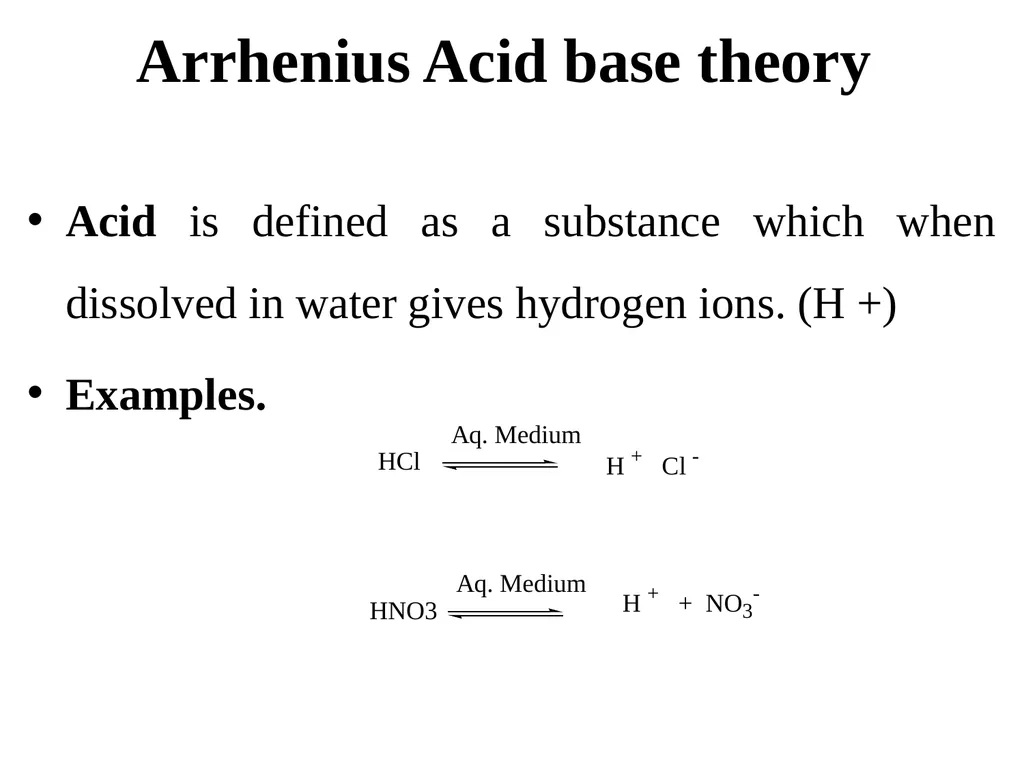
Arrhenius Acid base theory Acid is defined as a substance which when dissolved in water gives hydrogen ions. (H +)
Examples.<br>
Examples.<br>
03
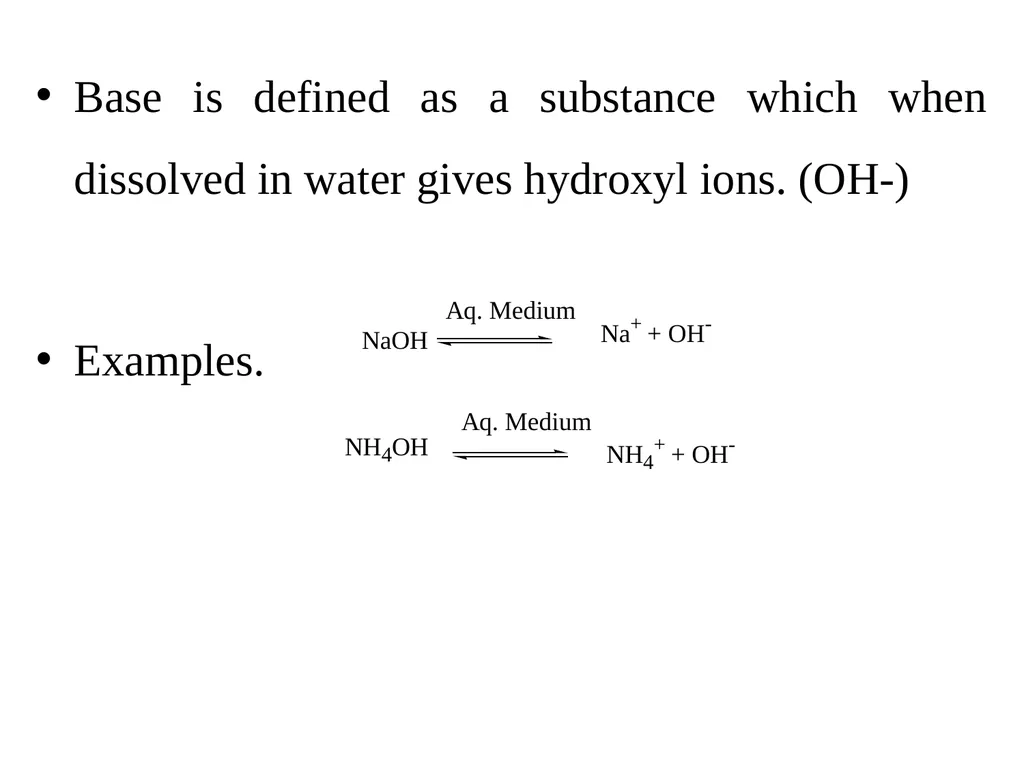
Base is defined as a substance which when dissolved in water gives hydroxyl ions. (OH-)
Examples.<br>
Examples.<br>
04
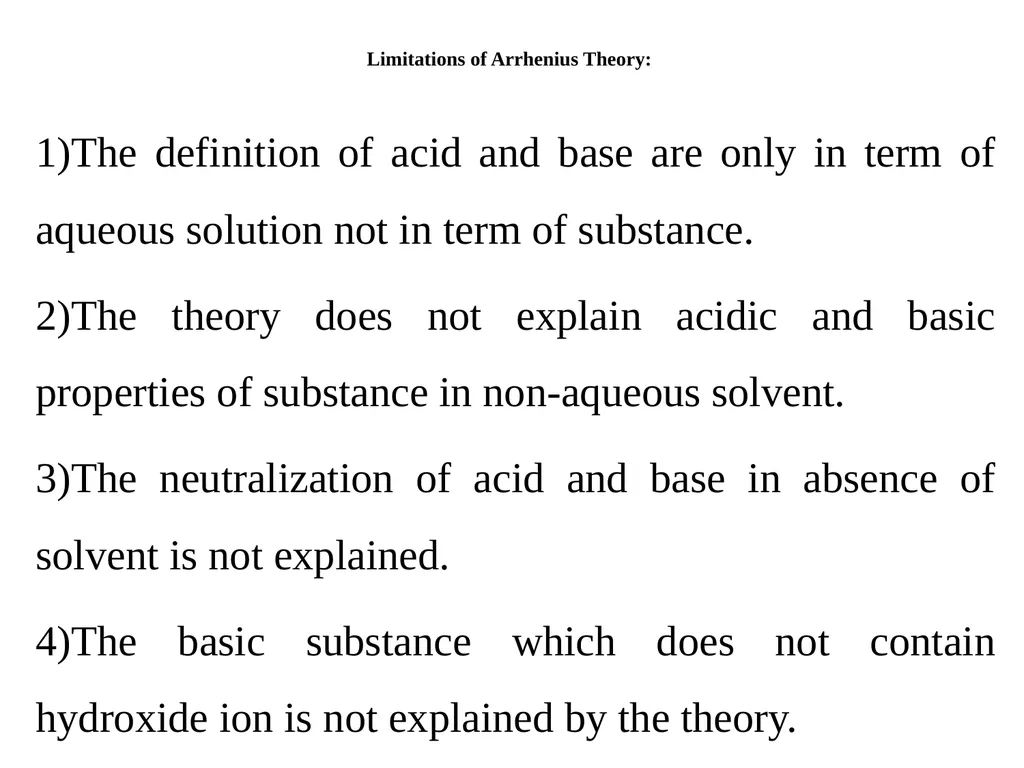
Limitations of Arrhenius Theory: 1)The definition of acid and base are only in term of aqueous solution not in term of substance.
2)The theory does not explain acidic and basic properties of substance in non-aqueous solvent.
3)The neutralization of acid and base in absence of solvent is not explained.
4)The basic substance which does not contain hydroxide ion is not explained by the theory.<br>
2)The theory does not explain acidic and basic properties of substance in non-aqueous solvent.
3)The neutralization of acid and base in absence of solvent is not explained.
4)The basic substance which does not contain hydroxide ion is not explained by the theory.<br>
05
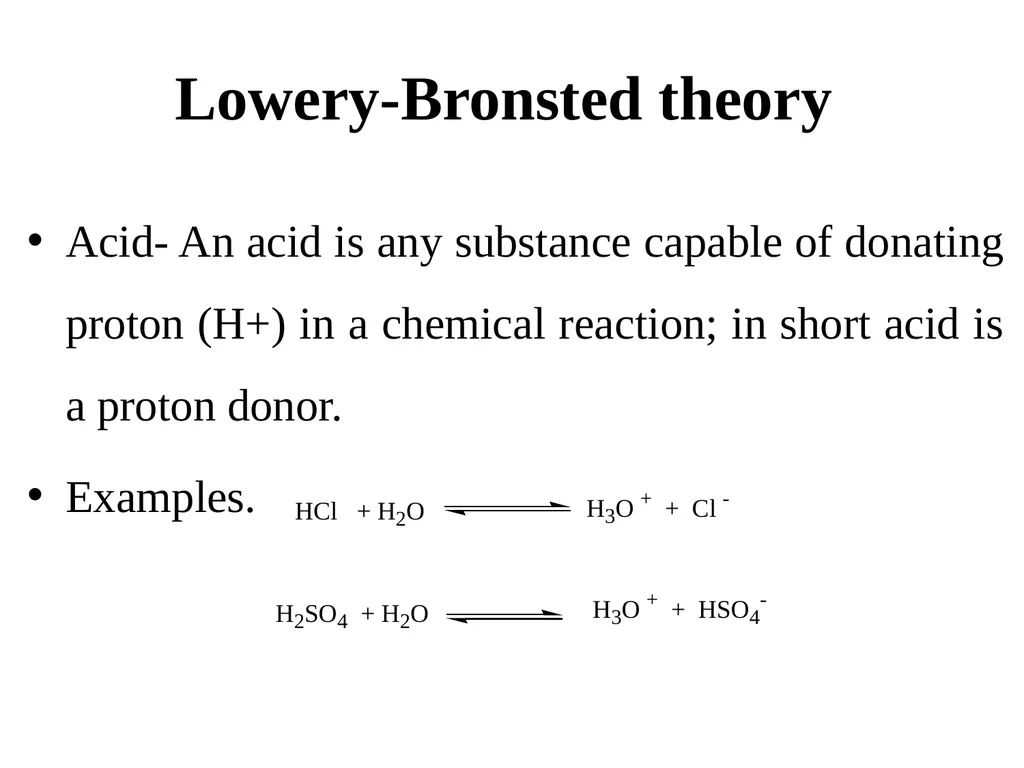
Lowery-Bronsted theory Acid- An acid is any substance capable of donating proton (H+) in a chemical reaction; in short acid is a proton donor.
Examples.<br>
Examples.<br>
06
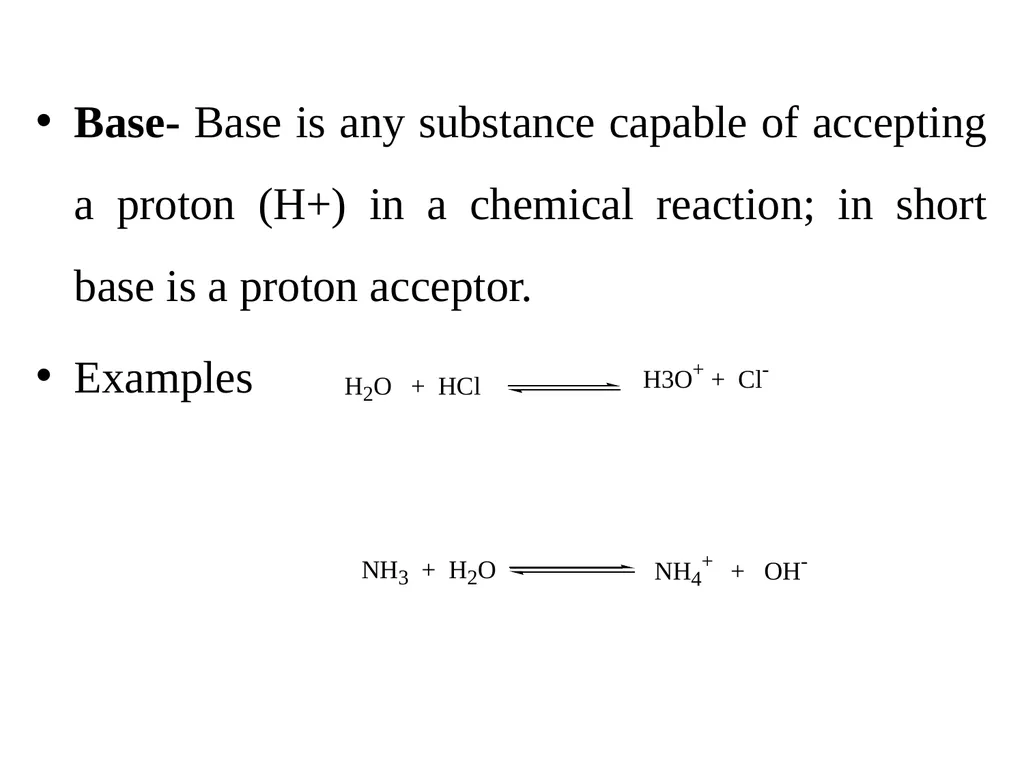
Base- Base is any substance capable of accepting a proton (H+) in a chemical reaction; in short base is a proton acceptor.
Examples<br>
Examples<br>
07
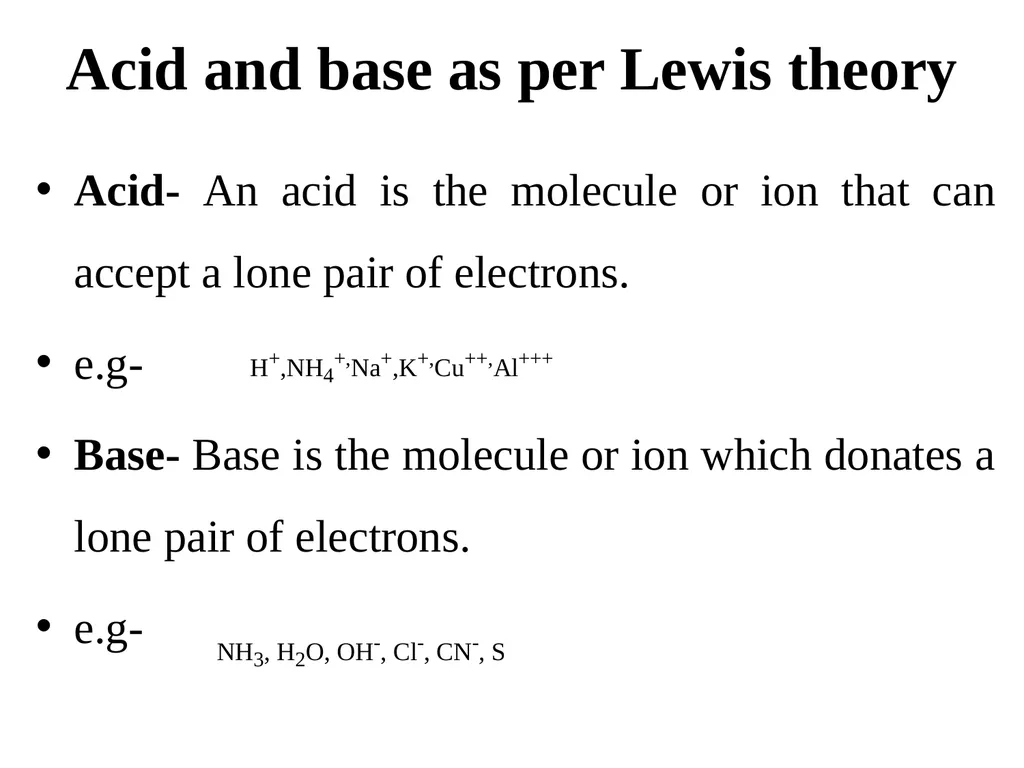
Acid and base as per Lewis theory Acid- An acid is the molecule or ion that can accept a lone pair of electrons.
e.g-
Base- Base is the molecule or ion which donates a lone pair of electrons.
e.g-<br>
e.g-
Base- Base is the molecule or ion which donates a lone pair of electrons.
e.g-<br>
08
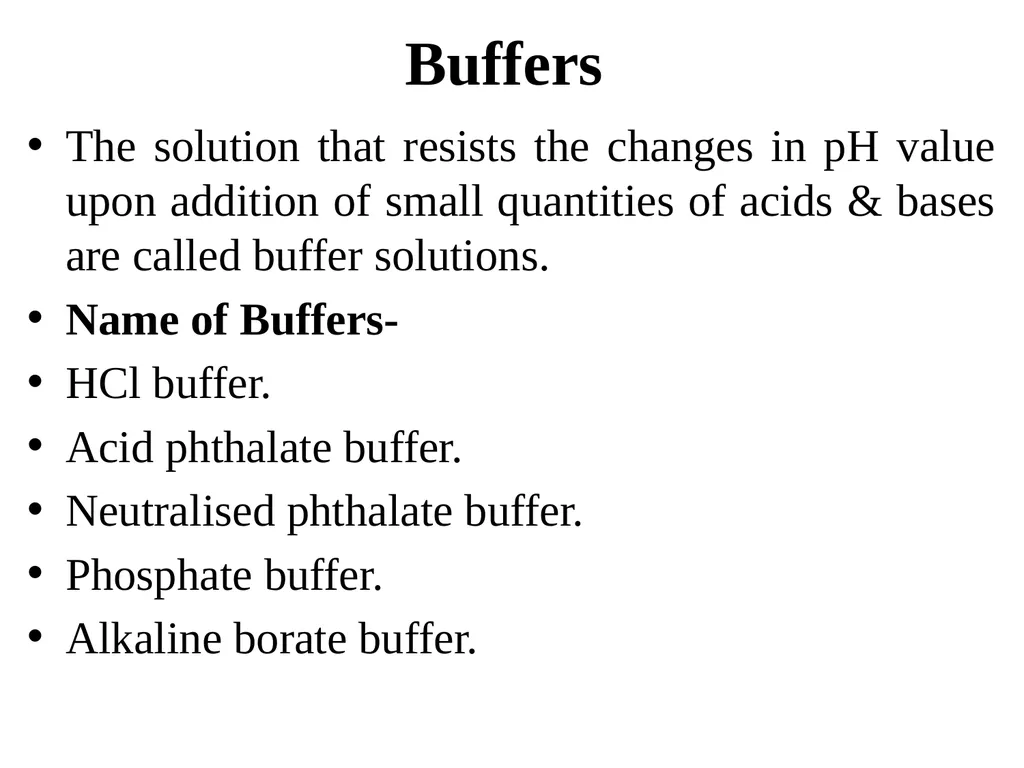
Buffers The solution that resists the changes in pH value upon addition of small quantities of acids & bases are called buffer solutions.
Name of Buffers-
HCl buffer.
Acid phthalate buffer.
Neutralised phthalate buffer.
Phosphate buffer.
Alkaline borate buffer.<br>
Name of Buffers-
HCl buffer.
Acid phthalate buffer.
Neutralised phthalate buffer.
Phosphate buffer.
Alkaline borate buffer.<br>
09
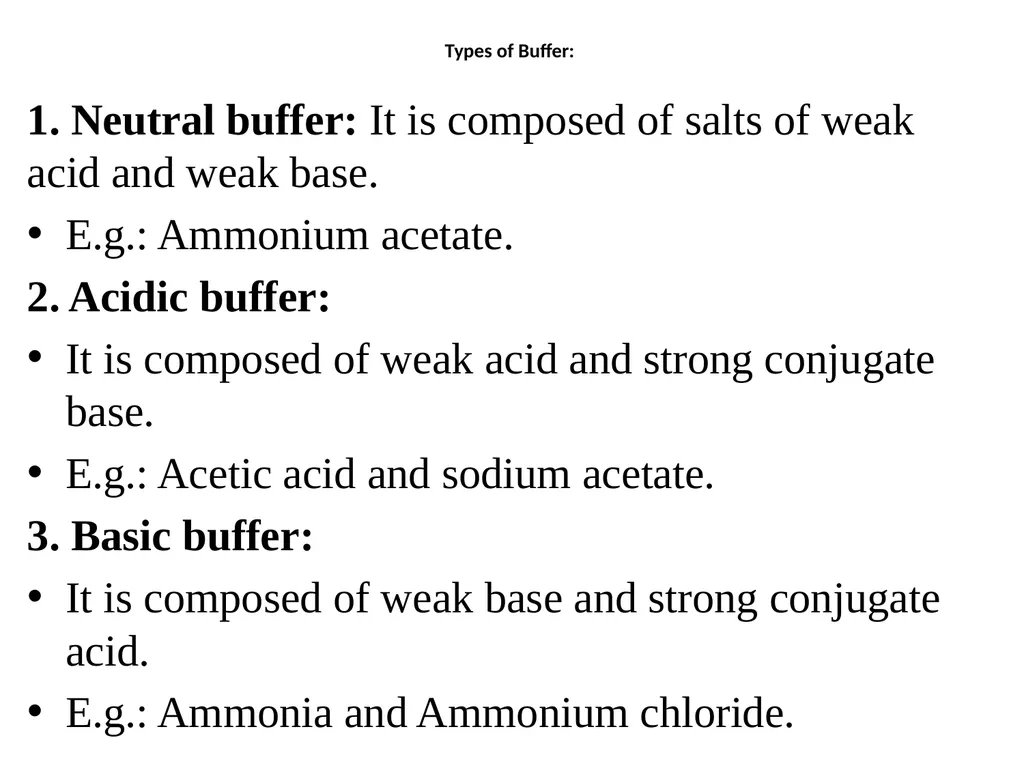
Types of Buffer: 1. Neutral buffer: It is composed of salts of weak acid and weak base.
E.g.: Ammonium acetate.
2. Acidic buffer:
It is composed of weak acid and strong conjugate base.
E.g.: Acetic acid and sodium acetate.
3. Basic buffer:
It is composed of weak base and strong conjugate acid.
E.g.: Ammonia and Ammonium chloride.<br>
E.g.: Ammonium acetate.
2. Acidic buffer:
It is composed of weak acid and strong conjugate base.
E.g.: Acetic acid and sodium acetate.
3. Basic buffer:
It is composed of weak base and strong conjugate acid.
E.g.: Ammonia and Ammonium chloride.<br>
10
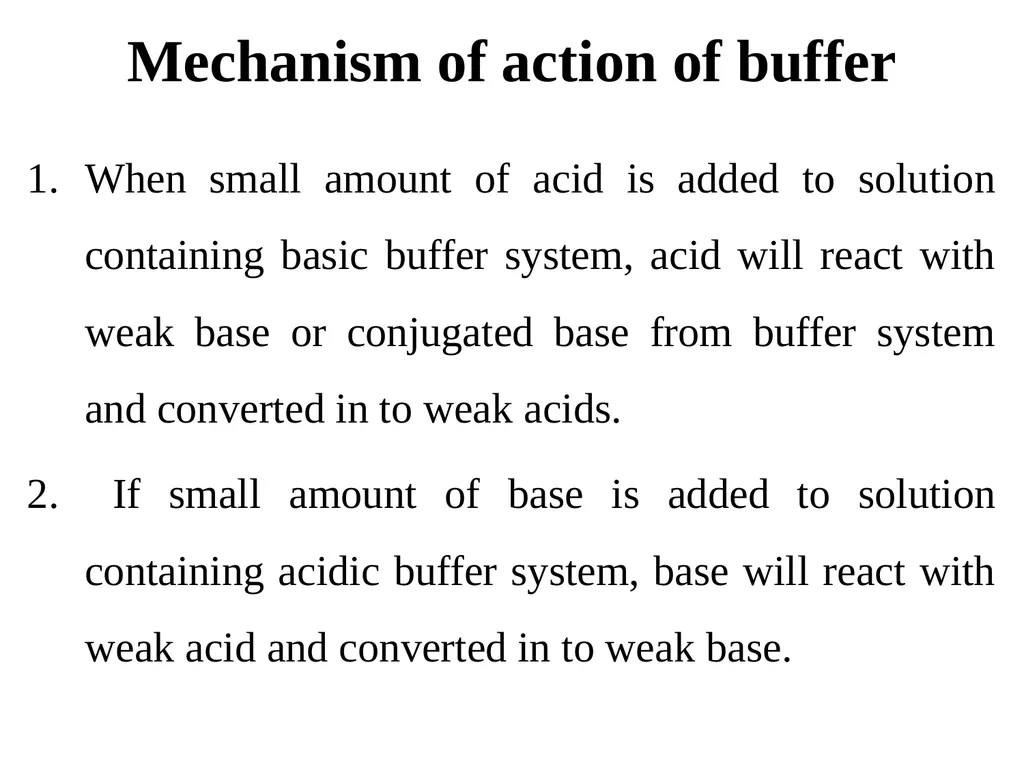
Mechanism of action of buffer When small amount of acid is added to solution containing basic buffer system, acid will react with weak base or conjugated base from buffer system and converted in to weak acids.
If small amount of base is added to solution containing acidic buffer system, base will react with weak acid and converted in to weak base.<br>
If small amount of base is added to solution containing acidic buffer system, base will react with weak acid and converted in to weak base.<br>
11
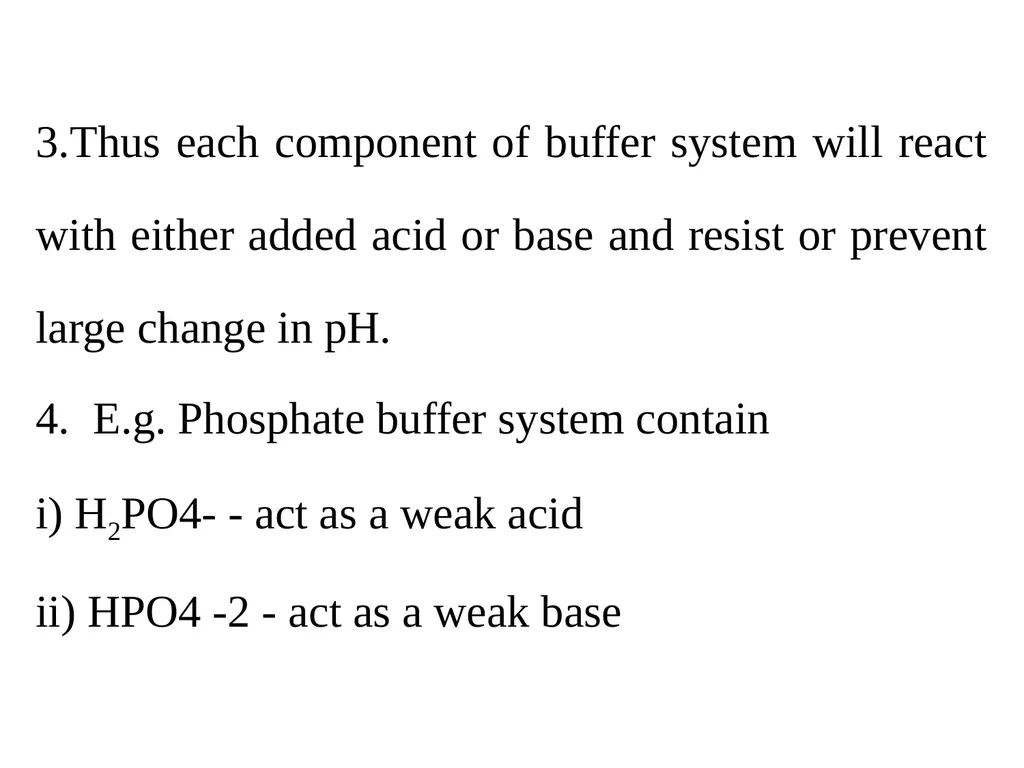
3.Thus each component of buffer system will react with either added acid or base and resist or prevent large change in pH.
E.g. Phosphate buffer system contain
i) H2PO4- - act as a weak acid
ii) HPO4 -2 - act as a weak base<br>
E.g. Phosphate buffer system contain
i) H2PO4- - act as a weak acid
ii) HPO4 -2 - act as a weak base<br>
12
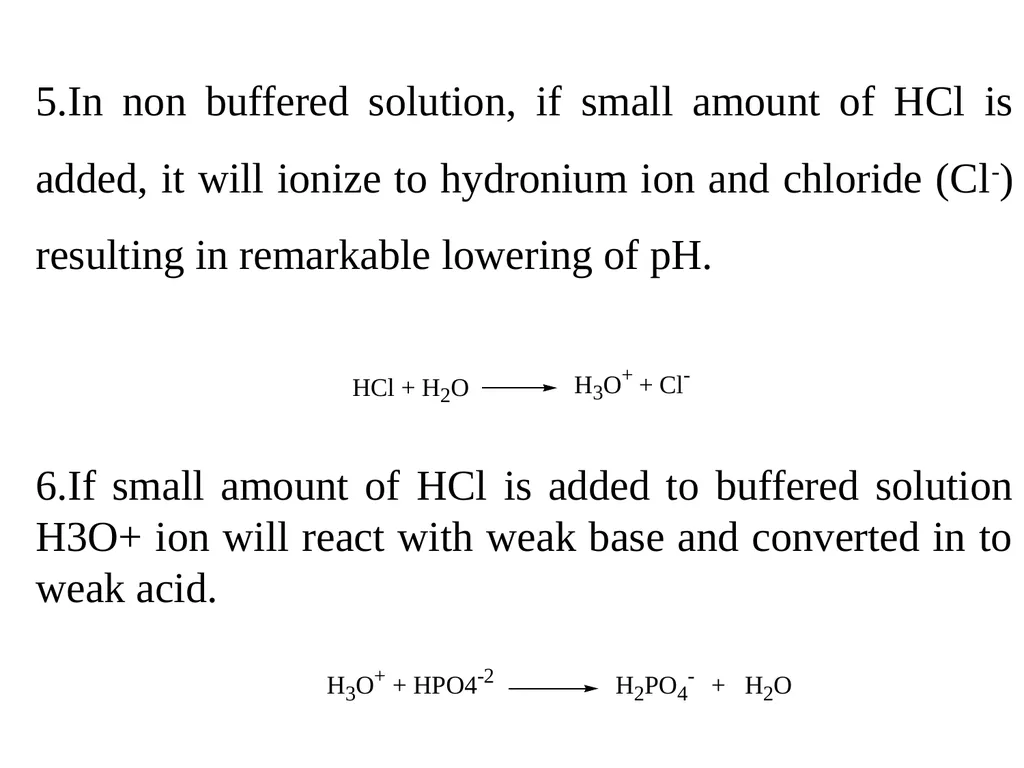
5.In non buffered solution, if small amount of HCl is added, it will ionize to hydronium ion and chloride (Cl-) resulting in remarkable lowering of pH.
6.If small amount of HCl is added to buffered solution H3O+ ion will react with weak base and converted in to weak acid.<br>
6.If small amount of HCl is added to buffered solution H3O+ ion will react with weak base and converted in to weak acid.<br>
13
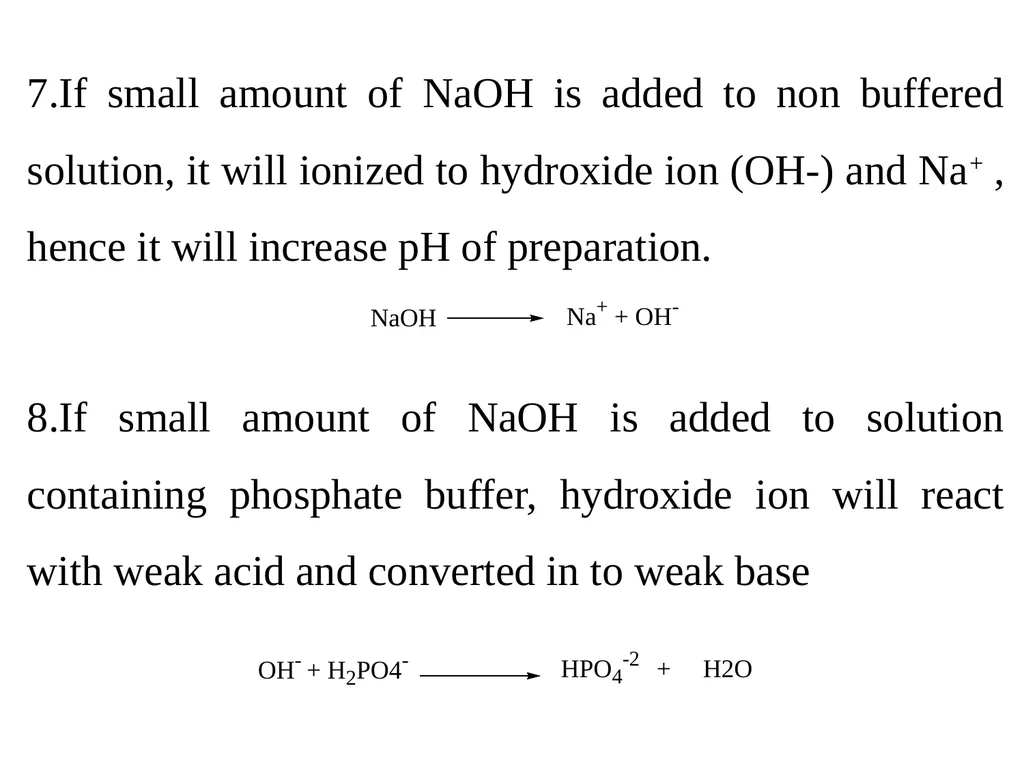
7.If small amount of NaOH is added to non buffered solution, it will ionized to hydroxide ion (OH-) and Na+ , hence it will increase pH of preparation.
8.If small amount of NaOH is added to solution containing phosphate buffer, hydroxide ion will react with weak acid and converted in to weak base<br>
8.If small amount of NaOH is added to solution containing phosphate buffer, hydroxide ion will react with weak acid and converted in to weak base<br>
14
Importance of buffer in pharmacy: Stability of certain compounds-
Certain compounds are stable in specific pH.
Citric acid is used for stabilizing milk of magnesia.
Adrenaline is rapidly oxidized by dissolved oxygen to adrenochrome in an alkaline media.
Hence its pH is stabilized by using a buffer of pH range 2.5 to 3.0. Penicillin preparations are stabilized by addition of calcium carbonate, sodium citrate or aluminum hydroxide.<br>
Certain compounds are stable in specific pH.
Citric acid is used for stabilizing milk of magnesia.
Adrenaline is rapidly oxidized by dissolved oxygen to adrenochrome in an alkaline media.
Hence its pH is stabilized by using a buffer of pH range 2.5 to 3.0. Penicillin preparations are stabilized by addition of calcium carbonate, sodium citrate or aluminum hydroxide.<br>
15
Structural stability-
Some compounds are structurally unstable within certain pH range, usually due to auto oxidation.
Sulfonamide preparations are stabilized by NaHCO3, sodium acetate or sodium citrate.
Colour –
Colour of many natural dyes, present in fluid extracts or of certain synthetic drugs has been found to be pH dependent.
E.g. red colour of cherry & raspberry syrups is maintained at acidic pH which becomes pale yellow to nearly colourless at alkaline pH<br>
Some compounds are structurally unstable within certain pH range, usually due to auto oxidation.
Sulfonamide preparations are stabilized by NaHCO3, sodium acetate or sodium citrate.
Colour –
Colour of many natural dyes, present in fluid extracts or of certain synthetic drugs has been found to be pH dependent.
E.g. red colour of cherry & raspberry syrups is maintained at acidic pH which becomes pale yellow to nearly colourless at alkaline pH<br>
16
For patient comfort-
Injectables & preparations for internal or external use become irritating if their pH is different greatly from that for the particular tissues involved.
An extremely acid or alkaline pH must be avoided as it can cause tissue damage.
Optimum pH
conditions for activity of certain medicinal compounds have to be maintained.
E.g. Lower pH of sodium hypochlorite usually improves the germicidal efficiency of the preparation.<br>
Injectables & preparations for internal or external use become irritating if their pH is different greatly from that for the particular tissues involved.
An extremely acid or alkaline pH must be avoided as it can cause tissue damage.
Optimum pH
conditions for activity of certain medicinal compounds have to be maintained.
E.g. Lower pH of sodium hypochlorite usually improves the germicidal efficiency of the preparation.<br>
17
In analysis
Buffers of known pH are required as standards in analytical laboratories
Eg calibration of pH meter etc.
Solubility-
Solubility of compounds is controlled by providing a medium of suitable pH.
Eg Iron salts, phosphates, borates are soluble in acidic medium but precipitate in alkaline medium.<br>
Buffers of known pH are required as standards in analytical laboratories
Eg calibration of pH meter etc.
Solubility-
Solubility of compounds is controlled by providing a medium of suitable pH.
Eg Iron salts, phosphates, borates are soluble in acidic medium but precipitate in alkaline medium.<br>
18
Boric acid- Synonym: Orthoboric acid.
Formula: H3BO3
Mole weight:61.83
Properties:
It is a white, colorless crystalline powder, odorless, unctuous to touch.
It has bitter, sweetish after taste
It is soluble in alcohol, freely soluble in glycerin, propylene glycol and boiling water<br>
Formula: H3BO3
Mole weight:61.83
Properties:
It is a white, colorless crystalline powder, odorless, unctuous to touch.
It has bitter, sweetish after taste
It is soluble in alcohol, freely soluble in glycerin, propylene glycol and boiling water<br>
19
Stable in air, on heating at 1000C it is converted in to metaboric acid,
At 1600C in to tetraboric acid,
At more than 1600C boric acid is converted in to boron trioxide.
Boric acid is very weak acid, so it cannot be titrated accurately with standard alkali. Hence glycerin is added in its titration.
Incompatibility: It is incompatible with tannins, bases.<br>
At 1600C in to tetraboric acid,
At more than 1600C boric acid is converted in to boron trioxide.
Boric acid is very weak acid, so it cannot be titrated accurately with standard alkali. Hence glycerin is added in its titration.
Incompatibility: It is incompatible with tannins, bases.<br>
20
Storage of Boric acid- It should be stored in air-tight, well closed container.
Uses of Boric acid-
It has weak bacteriostatic and fungistatic action
It is used as local anti-infective drug in the form of cream, ointment and lotion.
Buffer in topical preparations.
Vehicle for ophthalmic solution.
Boric acid is useful as suppositories base.<br>
Uses of Boric acid-
It has weak bacteriostatic and fungistatic action
It is used as local anti-infective drug in the form of cream, ointment and lotion.
Buffer in topical preparations.
Vehicle for ophthalmic solution.
Boric acid is useful as suppositories base.<br>
21
Explain why glycerin is used in the assay of boric acid. Give reactions involved. Glycerin is used in the assay of Boric Acid because; boric acid is a very weak acid which is to be,
Titrated against strong alkali like sodium hydroxide, but it does not give sharp end point.<br>
Titrated against strong alkali like sodium hydroxide, but it does not give sharp end point.<br>
22
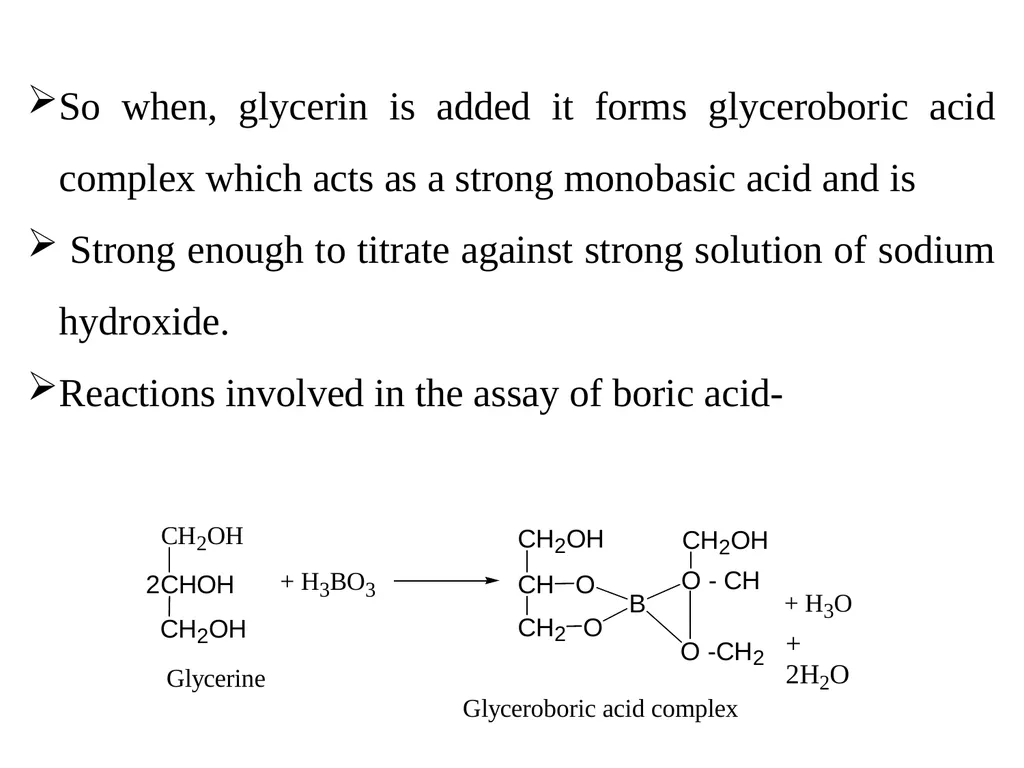
So when, glycerin is added it forms glyceroboric acid complex which acts as a strong monobasic acid and is
Strong enough to titrate against strong solution of sodium hydroxide.
Reactions involved in the assay of boric acid-<br>
Strong enough to titrate against strong solution of sodium hydroxide.
Reactions involved in the assay of boric acid-<br>
23
Sodium hydroxide Mole formula: NaOH
Mole weight: 40
Synonym: Caustic soda
Properties
It occurs as dry hard brittle palletes which are white in colour.
It is alkaline in nature
Soluble in water alcohol ether<br>
Mole weight: 40
Synonym: Caustic soda
Properties
It occurs as dry hard brittle palletes which are white in colour.
It is alkaline in nature
Soluble in water alcohol ether<br>
24
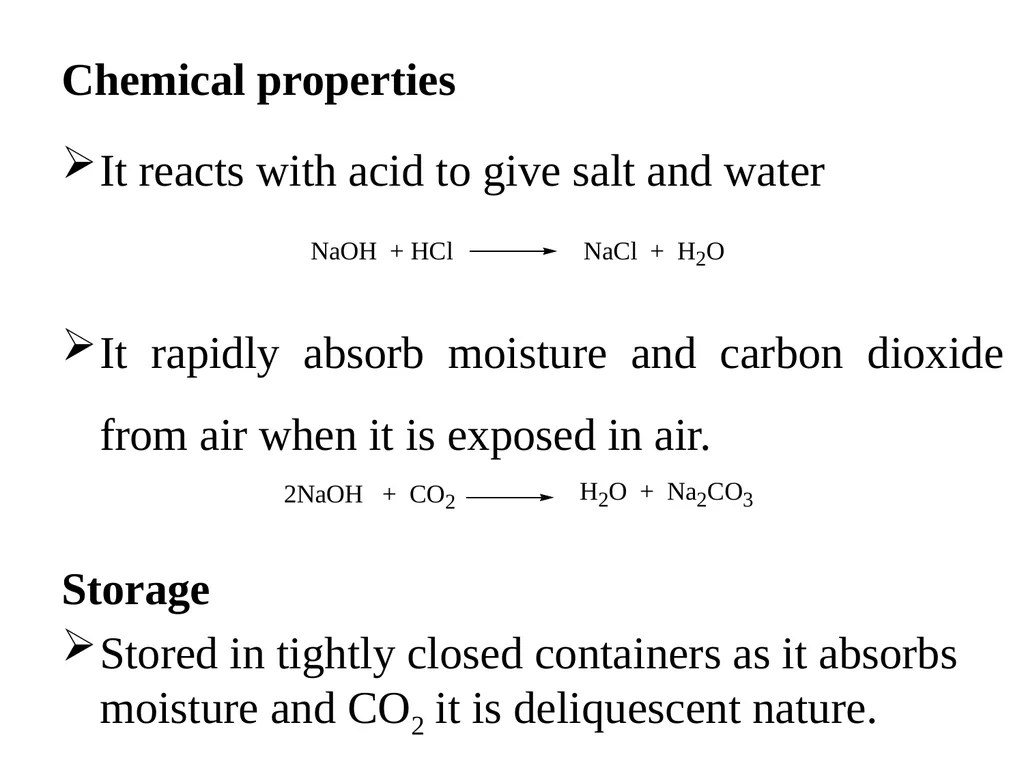
Chemical properties
It reacts with acid to give salt and water
It rapidly absorb moisture and carbon dioxide from air when it is exposed in air.
Storage
Stored in tightly closed containers as it absorbs moisture and CO2 it is deliquescent nature.<br>
It reacts with acid to give salt and water
It rapidly absorb moisture and carbon dioxide from air when it is exposed in air.
Storage
Stored in tightly closed containers as it absorbs moisture and CO2 it is deliquescent nature.<br>
25
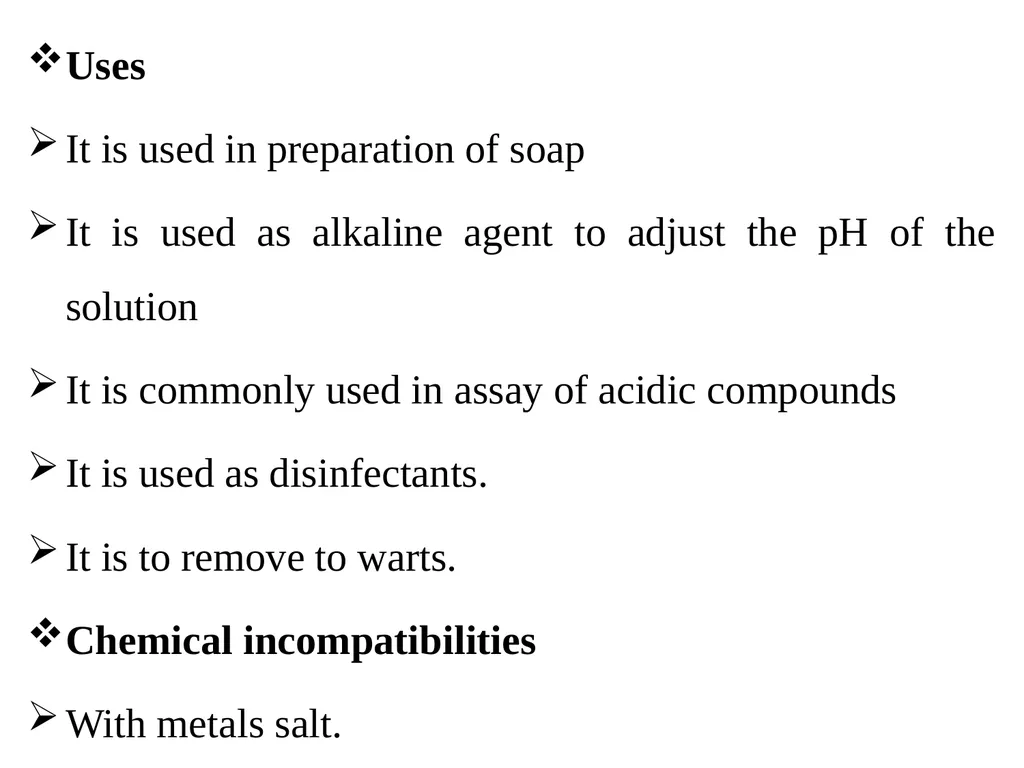
Uses
It is used in preparation of soap
It is used as alkaline agent to adjust the pH of the solution
It is commonly used in assay of acidic compounds
It is used as disinfectants.
It is to remove to warts.
Chemical incompatibilities
With metals salt.<br>
It is used in preparation of soap
It is used as alkaline agent to adjust the pH of the solution
It is commonly used in assay of acidic compounds
It is used as disinfectants.
It is to remove to warts.
Chemical incompatibilities
With metals salt.<br>
26
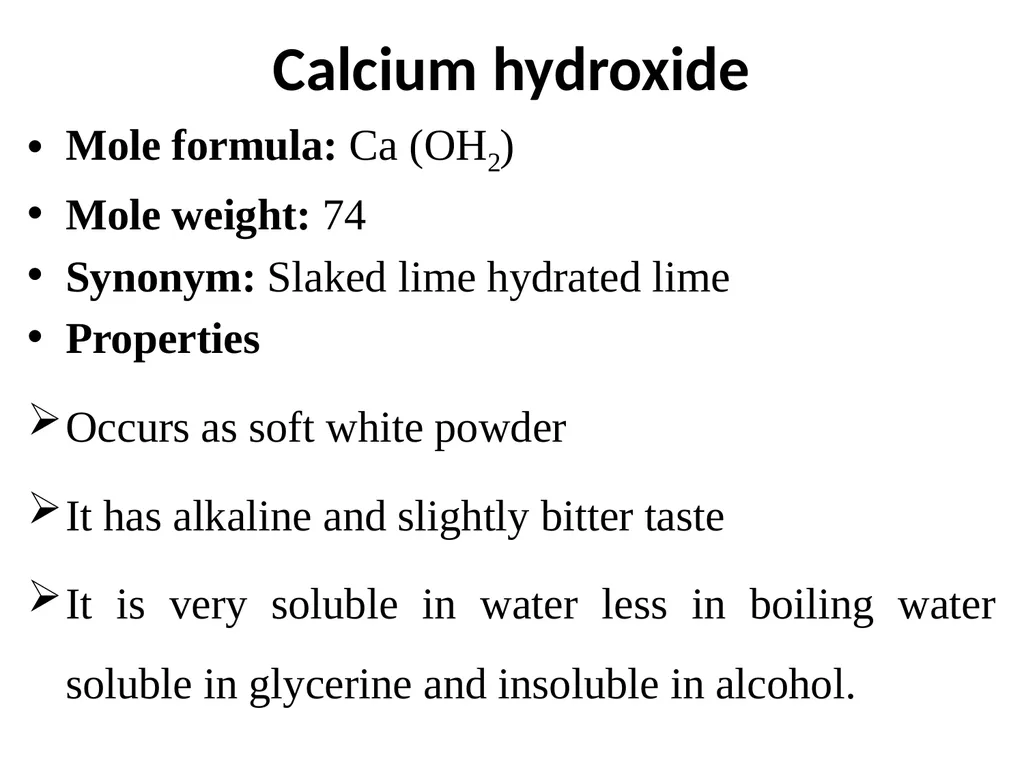
Calcium hydroxide Mole formula: Ca (OH2)
Mole weight: 74
Synonym: Slaked lime hydrated lime
Properties
Occurs as soft white powder
It has alkaline and slightly bitter taste
It is very soluble in water less in boiling water soluble in glycerine and insoluble in alcohol.<br>
Mole weight: 74
Synonym: Slaked lime hydrated lime
Properties
Occurs as soft white powder
It has alkaline and slightly bitter taste
It is very soluble in water less in boiling water soluble in glycerine and insoluble in alcohol.<br>
27
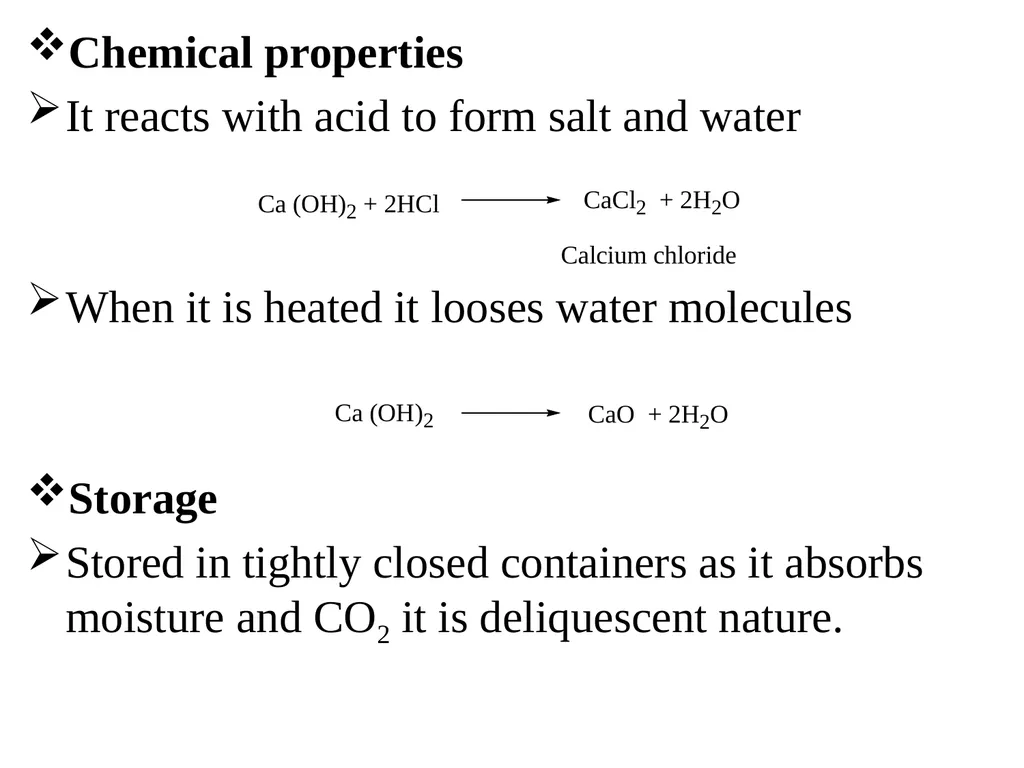
Chemical properties
It reacts with acid to form salt and water
When it is heated it looses water molecules
Storage
Stored in tightly closed containers as it absorbs moisture and CO2 it is deliquescent nature.<br>
It reacts with acid to form salt and water
When it is heated it looses water molecules
Storage
Stored in tightly closed containers as it absorbs moisture and CO2 it is deliquescent nature.<br>
28
Uses
It is used as antacid.
It is used as astringent.
It is used in the preparation of skin lotion.
It is used as fluid electrolyte replenisher.
It is used as emulsifying agent.
It is used for preparation of soda lime.<br>
It is used as antacid.
It is used as astringent.
It is used in the preparation of skin lotion.
It is used as fluid electrolyte replenisher.
It is used as emulsifying agent.
It is used for preparation of soda lime.<br>
29
It is used in diarrhoea and vomiting in the form of lime water.
Chemical incompatibility
With acids, CO2<br>
Chemical incompatibility
With acids, CO2<br>
30
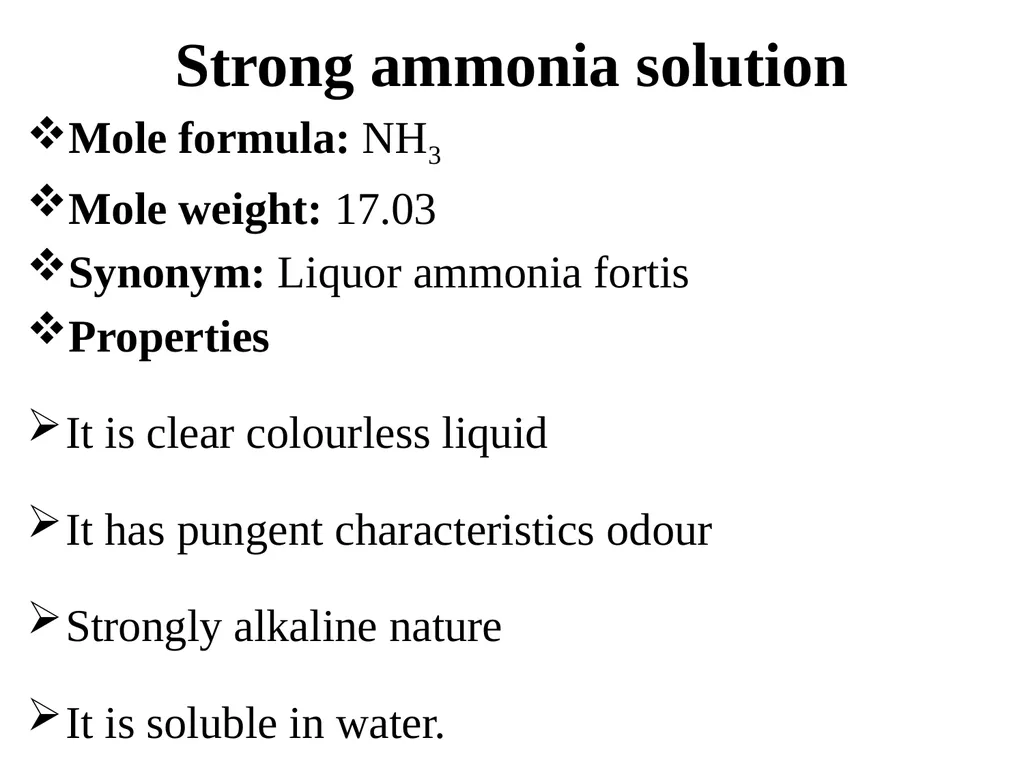
Strong ammonia solution Mole formula: NH3
Mole weight: 17.03
Synonym: Liquor ammonia fortis
Properties
It is clear colourless liquid
It has pungent characteristics odour
Strongly alkaline nature
It is soluble in water.<br>
Mole weight: 17.03
Synonym: Liquor ammonia fortis
Properties
It is clear colourless liquid
It has pungent characteristics odour
Strongly alkaline nature
It is soluble in water.<br>
31
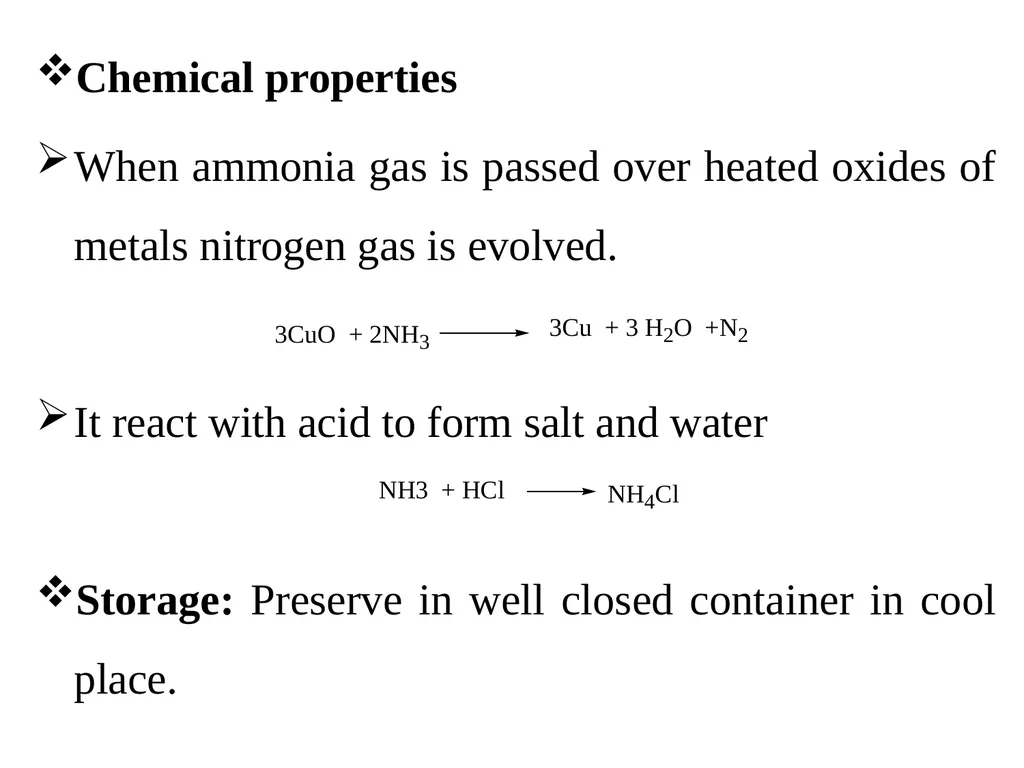
Chemical properties
When ammonia gas is passed over heated oxides of metals nitrogen gas is evolved.
It react with acid to form salt and water
Storage: Preserve in well closed container in cool place.<br>
When ammonia gas is passed over heated oxides of metals nitrogen gas is evolved.
It react with acid to form salt and water
Storage: Preserve in well closed container in cool place.<br>
32
Uses
Its salts are used as antacid.
Used as respiratory stimulant.
It is used as counter irritant.
It is ingredient of aromatic spirit of ammonia.
Used in manufacturing of nitric acid and sodium bicarbonate.
Chemical incompatibilities
With iodine, silver salt, alkaloidal salt and tannins<br>
Its salts are used as antacid.
Used as respiratory stimulant.
It is used as counter irritant.
It is ingredient of aromatic spirit of ammonia.
Used in manufacturing of nitric acid and sodium bicarbonate.
Chemical incompatibilities
With iodine, silver salt, alkaloidal salt and tannins<br>
33
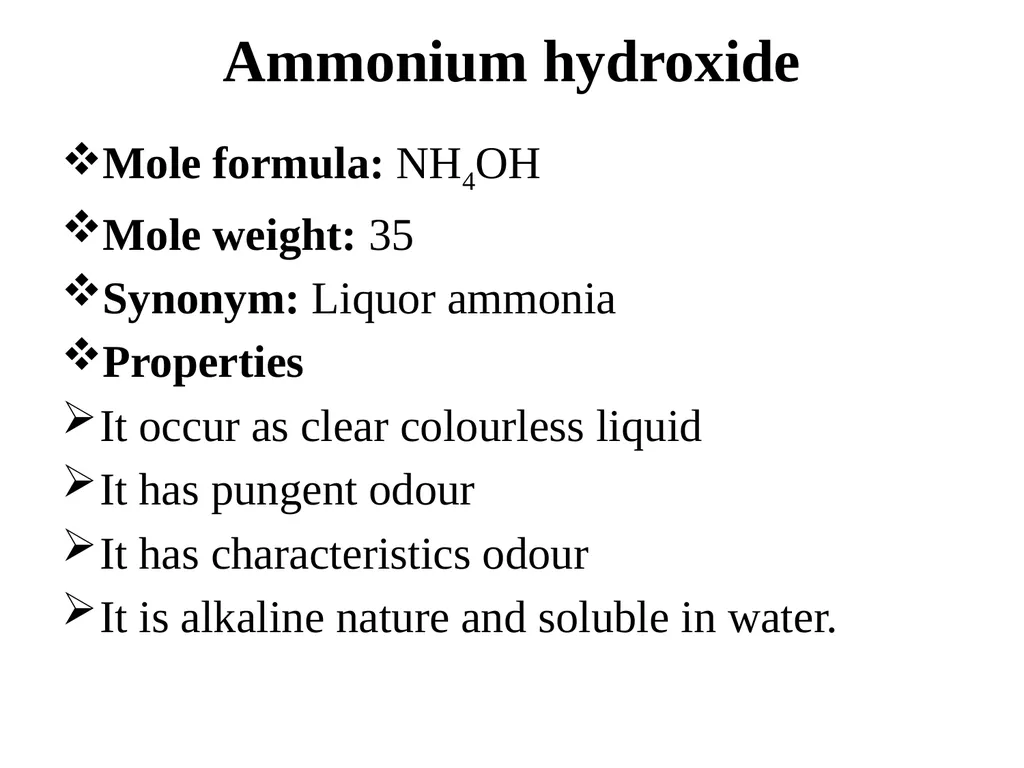
Ammonium hydroxide Mole formula: NH4OH
Mole weight: 35
Synonym: Liquor ammonia
Properties
It occur as clear colourless liquid
It has pungent odour
It has characteristics odour
It is alkaline nature and soluble in water.<br>
Mole weight: 35
Synonym: Liquor ammonia
Properties
It occur as clear colourless liquid
It has pungent odour
It has characteristics odour
It is alkaline nature and soluble in water.<br>
34
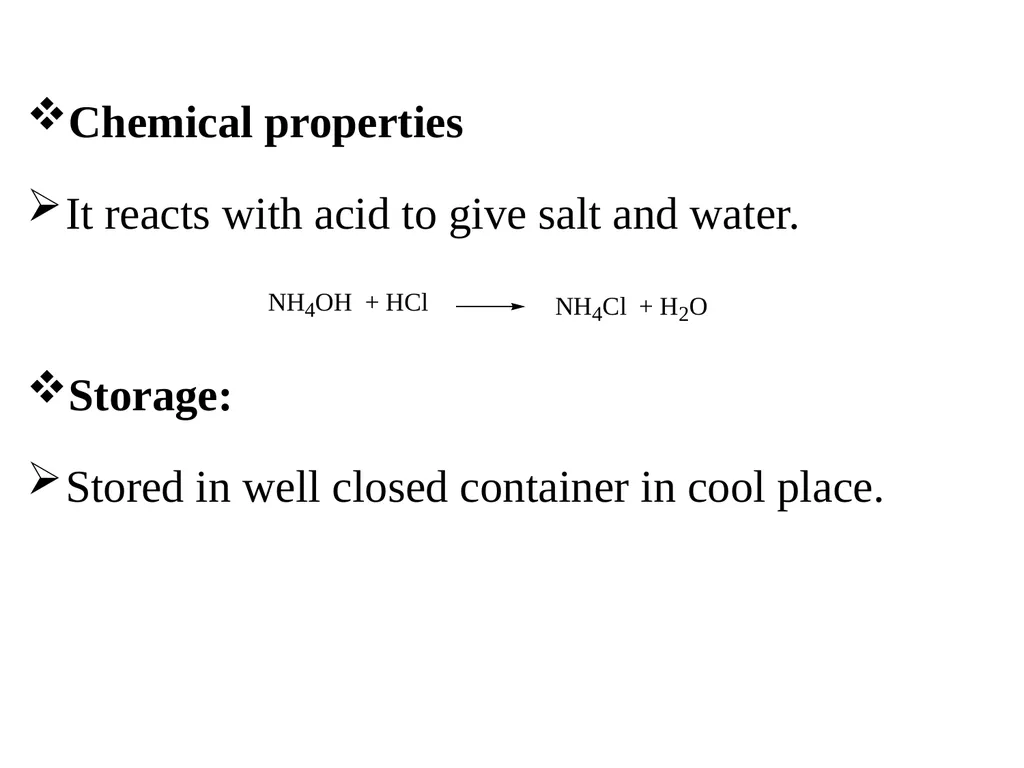
Chemical properties
It reacts with acid to give salt and water.
Storage:
Stored in well closed container in cool place.<br>
It reacts with acid to give salt and water.
Storage:
Stored in well closed container in cool place.<br>
35
Uses
It is used in preparation of strong and dilute ammonia.
It is used as stimulant.
It is used as laboratory reagent.
It is used as alkaline agent to adjust the pH of the solution.<br>
It is used in preparation of strong and dilute ammonia.
It is used as stimulant.
It is used as laboratory reagent.
It is used as alkaline agent to adjust the pH of the solution.<br>
36
References Pharmaceutical analysis volume – I, by Dr. A.V Kasture published by nirali prakashan pune page no 6.1- .6.23.
Pharmaceutical inorganic chemistry volume – I, by G. R. Chatwal published by himalaya page no. 103
https://www.google.co.in/image<br>
Pharmaceutical inorganic chemistry volume – I, by G. R. Chatwal published by himalaya page no. 103
https://www.google.co.in/image<br>