
Active Shooter Preparedness DISCLAIMER This
CS
Published · 29 slides · 0 views
1 / 1
Description
Active Shooter Preparedness DISCLAIMER This training material presents very important, pertinent information. It should not be assumed, however, that this program satisfies every legal requirement of every state. Some states require the
Related Topics
Share
Embed code
Download this presentation From Below
"Active Shooter Preparedness DISCLAIMER This" is the property of its rightful owner. Permission is granted to download and print the materials on this website for personal, non-commercial use only, and to display it on your personal computer provided you do not modify the materials and that you retain all copyright notices contained in the materials. By downloading content from our website, you accept the terms of this agreement.
Presentation Transcript
01
Active Shooter
Preparedness<br>
02
DISCLAIMER
This training material presents very important, pertinent information. It should not be assumed, however, that this program satisfies every legal requirement of every state. Some states require the training be developed and delivered by an individual with specific training and experience.
This training is AWARENESS LEVEL and does not authorize any person to perform work or validate their level of competency; it must be supplemented with operation and process-specific assessments and training, as well as management oversight, to assure that all training is understood and followed. Your organization must do an evaluation of all exposures and applicable codes and regulations. In addition, establish proper controls, training, and protective measures to effectively control exposures and assure compliance.
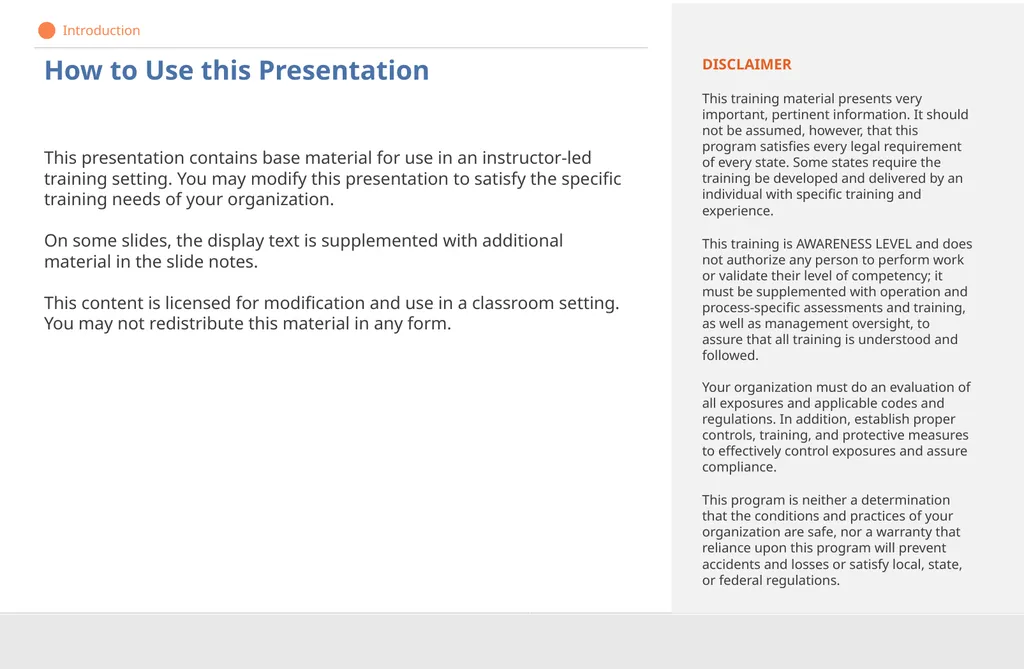
This program is neither a determination that the conditions and practices of your organization are safe, nor a warranty that reliance upon this program will prevent accidents and losses or satisfy local, state, or federal regulations. How to Use this Presentation This presentation contains base material for use in an instructor-led training setting. You may modify this presentation to satisfy the specific training needs of your organization.
On some slides, the display text is supplemented with additional material in the slide notes.
This content is licensed for modification and use in a classroom setting. You may not redistribute this material in any form. Introduction<br>
This training is AWARENESS LEVEL and does not authorize any person to perform work or validate their level of competency; it must be supplemented with operation and process-specific assessments and training, as well as management oversight, to assure that all training is understood and followed. Your organization must do an evaluation of all exposures and applicable codes and regulations. In addition, establish proper controls, training, and protective measures to effectively control exposures and assure compliance.
This program is neither a determination that the conditions and practices of your organization are safe, nor a warranty that reliance upon this program will prevent accidents and losses or satisfy local, state, or federal regulations. How to Use this Presentation This presentation contains base material for use in an instructor-led training setting. You may modify this presentation to satisfy the specific training needs of your organization.
On some slides, the display text is supplemented with additional material in the slide notes.
This content is licensed for modification and use in a classroom setting. You may not redistribute this material in any form. Introduction<br>
03
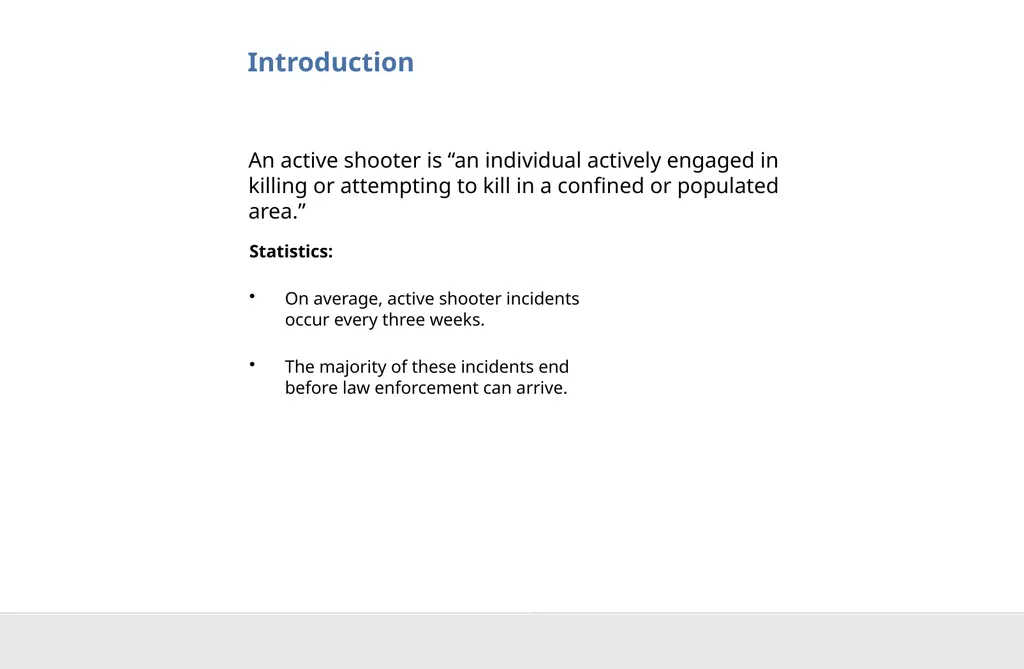
Introduction Statistics:
On average, active shooter incidents occur every three weeks.
The majority of these incidents end before law enforcement can arrive. An active shooter is “an individual actively engaged in killing or attempting to kill in a confined or populated area.”<br>
On average, active shooter incidents occur every three weeks.
The majority of these incidents end before law enforcement can arrive. An active shooter is “an individual actively engaged in killing or attempting to kill in a confined or populated area.”<br>
04
Course Outline Organizational Preparedness
Active Shooter Response
Post-Incident Actions<br>
Active Shooter Response
Post-Incident Actions<br>
05
Organizational Preparedness What you need to know:
Emergency action plan
Training exercises
Other preventive measures and responsibilities
Warning signs of workplace violence<br>
Emergency action plan
Training exercises
Other preventive measures and responsibilities
Warning signs of workplace violence<br>
06
Emergency Action Plan Organizational Preparedness The benefits:
Preparing an emergency action plan helps all employees to know and understand proper procedures for dealing with an active shooter situation and its aftermath.
Resources:
When creating the plan, consult with internal departments such as Human Resources (HR) and training departments, as well as external resources such as facility owners and operators, property management, local law enforcement, and emergency response services. A successful plan should include the following:
How to report emergencies to the proper authorities, services, and individuals stationed at remote locations within the premises
Evacuation policies and escape procedures, including multiple clearly posted routes and safe areas
Contact information for area hospitals and individuals who perform specific tasks during emergencies<br>
Preparing an emergency action plan helps all employees to know and understand proper procedures for dealing with an active shooter situation and its aftermath.
Resources:
When creating the plan, consult with internal departments such as Human Resources (HR) and training departments, as well as external resources such as facility owners and operators, property management, local law enforcement, and emergency response services. A successful plan should include the following:
How to report emergencies to the proper authorities, services, and individuals stationed at remote locations within the premises
Evacuation policies and escape procedures, including multiple clearly posted routes and safe areas
Contact information for area hospitals and individuals who perform specific tasks during emergencies<br>
07
Training Exercises Organizational Preparedness The benefits:
Powerfully educating employees about the emergency action plan
Reinforcing practices that may save lives
Enlisting help:
Contact local law enforcement and emergency response agencies for their assistance in designing or facilitating any trainings. Offer your facility as a site for future active shooter trainings. Develop training exercises that simulate active shooter situations. Training includes the following:
Recognizing the sound of gunfire
How to react to gunfire
When to dial 911
What to do when law enforcement arrives
Developing a “survival mindset” The next section will discuss in greater detail what should be included in employee training.<br>
Powerfully educating employees about the emergency action plan
Reinforcing practices that may save lives
Enlisting help:
Contact local law enforcement and emergency response agencies for their assistance in designing or facilitating any trainings. Offer your facility as a site for future active shooter trainings. Develop training exercises that simulate active shooter situations. Training includes the following:
Recognizing the sound of gunfire
How to react to gunfire
When to dial 911
What to do when law enforcement arrives
Developing a “survival mindset” The next section will discuss in greater detail what should be included in employee training.<br>
08
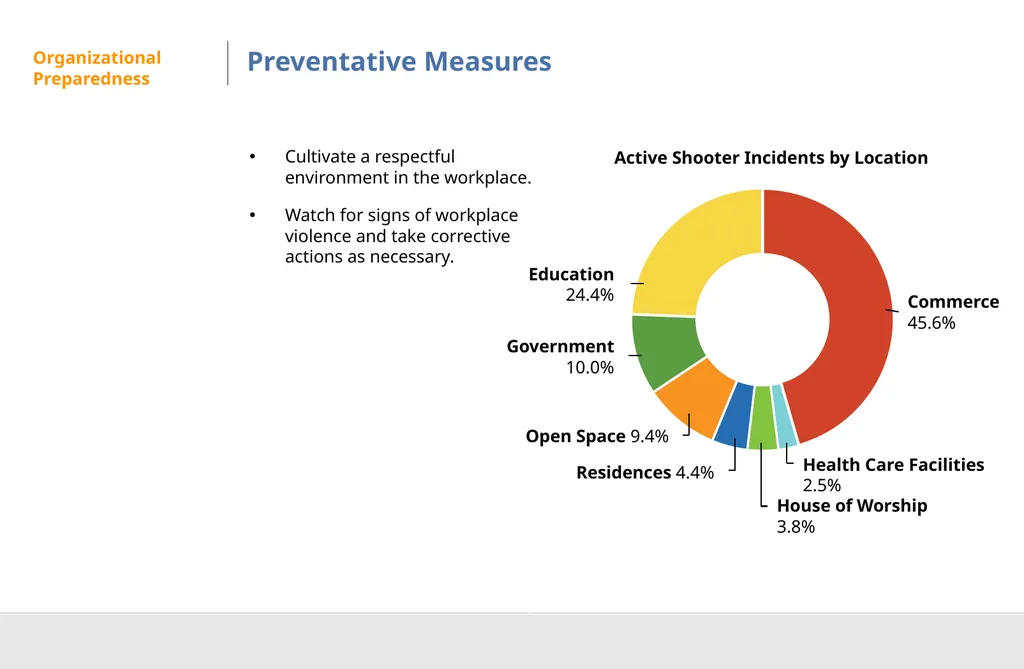
Preventative Measures Cultivate a respectful environment in the workplace.
Watch for signs of workplace violence and take corrective actions as necessary. Organizational Preparedness Active Shooter Incidents by Location<br>
Watch for signs of workplace violence and take corrective actions as necessary. Organizational Preparedness Active Shooter Incidents by Location<br>
09
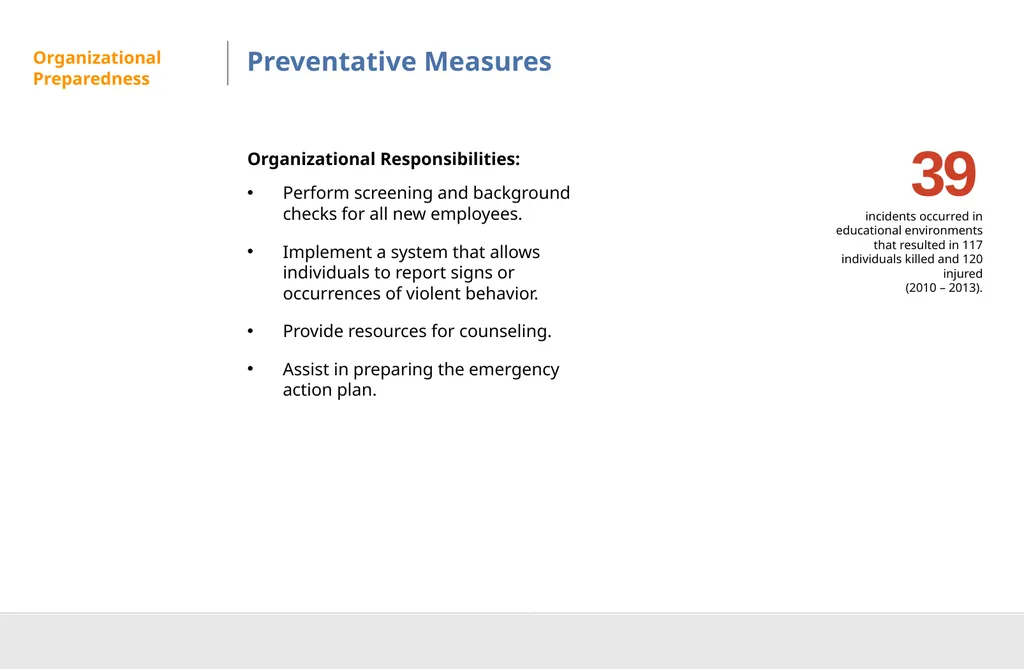
Preventative Measures Organizational Responsibilities:
Perform screening and background checks for all new employees.
Implement a system that allows individuals to report signs or occurrences of violent behavior.
Provide resources for counseling.
Assist in preparing the emergency action plan. Organizational Preparedness 39
incidents occurred in educational environments that resulted in 117 individuals killed and 120 injured (2010 – 2013).<br>
Perform screening and background checks for all new employees.
Implement a system that allows individuals to report signs or occurrences of violent behavior.
Provide resources for counseling.
Assist in preparing the emergency action plan. Organizational Preparedness 39
incidents occurred in educational environments that resulted in 117 individuals killed and 120 injured (2010 – 2013).<br>
10
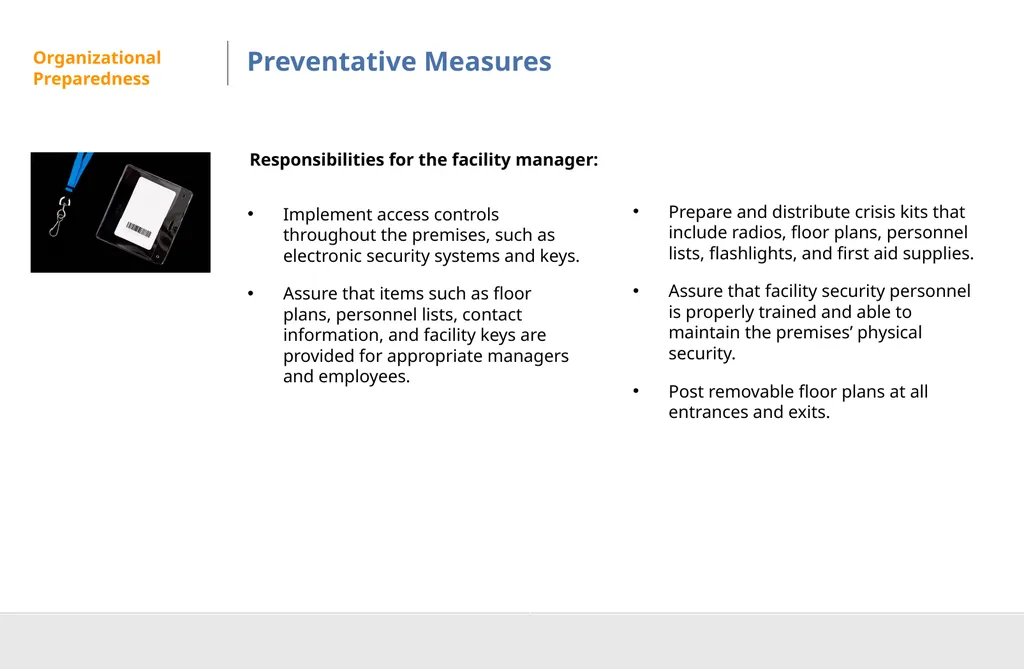
Preventative Measures Responsibilities for the facility manager: Organizational Preparedness Prepare and distribute crisis kits that include radios, floor plans, personnel lists, flashlights, and first aid supplies.
Assure that facility security personnel is properly trained and able to maintain the premises’ physical security.
Post removable floor plans at all entrances and exits. Implement access controls throughout the premises, such as electronic security systems and keys.
Assure that items such as floor plans, personnel lists, contact information, and facility keys are provided for appropriate managers and employees.<br>
Assure that facility security personnel is properly trained and able to maintain the premises’ physical security.
Post removable floor plans at all entrances and exits. Implement access controls throughout the premises, such as electronic security systems and keys.
Assure that items such as floor plans, personnel lists, contact information, and facility keys are provided for appropriate managers and employees.<br>
11
Warning Signs Before an incident, active shooters usually exhibit traits of potentially violent behavior over an extended period of time. Organizational Preparedness Know the warning signs and train employees to be aware of them.
Employees should report signs of potentially violent behavior to a manager or HR.
These signs may indicate issues that can be treated or managed with medication or therapy.<br>
Employees should report signs of potentially violent behavior to a manager or HR.
These signs may indicate issues that can be treated or managed with medication or therapy.<br>
12
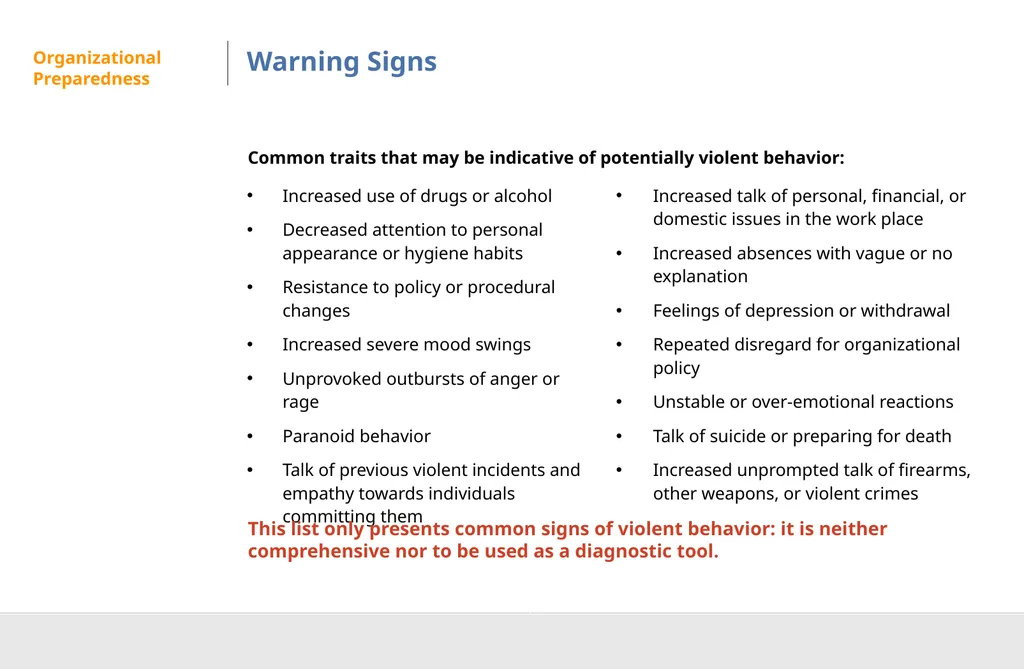
Warning Signs This list only presents common signs of violent behavior: it is neither comprehensive nor to be used as a diagnostic tool. Organizational Preparedness Common traits that may be indicative of potentially violent behavior:<br>
13
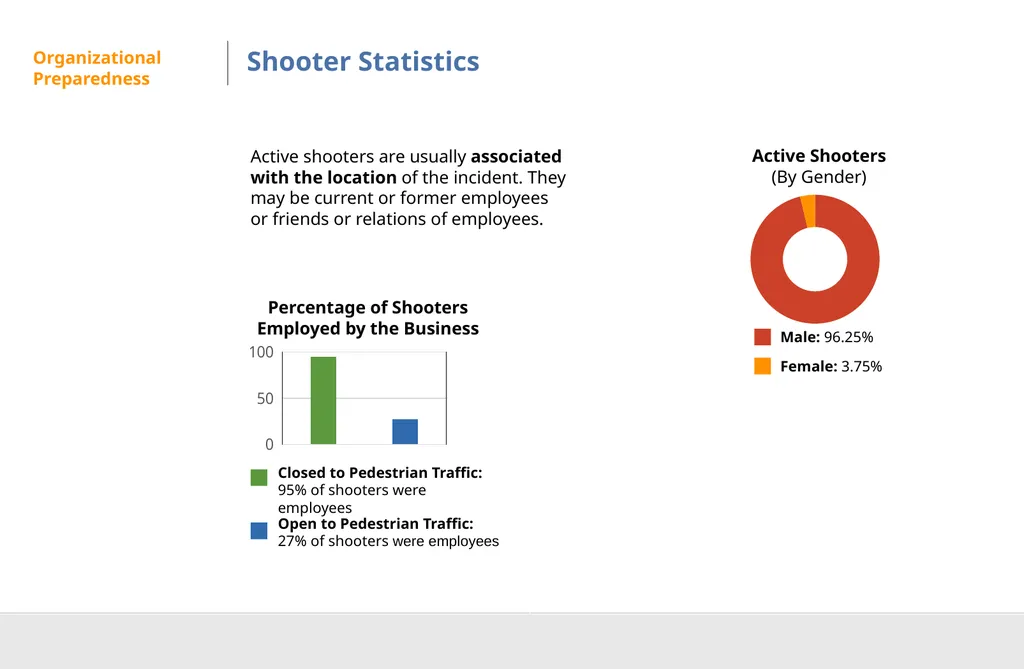
Shooter Statistics Active shooters are usually associated with the location of the incident. They may be current or former employees or friends or relations of employees. Organizational Preparedness Closed to Pedestrian Traffic: 95% of shooters were employees Open to Pedestrian Traffic: 27% of shooters were employees Percentage of Shooters Employed by the Business Active Shooters
(By Gender) Male: 96.25% Female: 3.75%<br>
14
Active Shooter Response What you need to know:
What to do during an active shooter incident
When it is safe to call 911
How to react once emergency personnel arrive<br>
What to do during an active shooter incident
When it is safe to call 911
How to react once emergency personnel arrive<br>
15
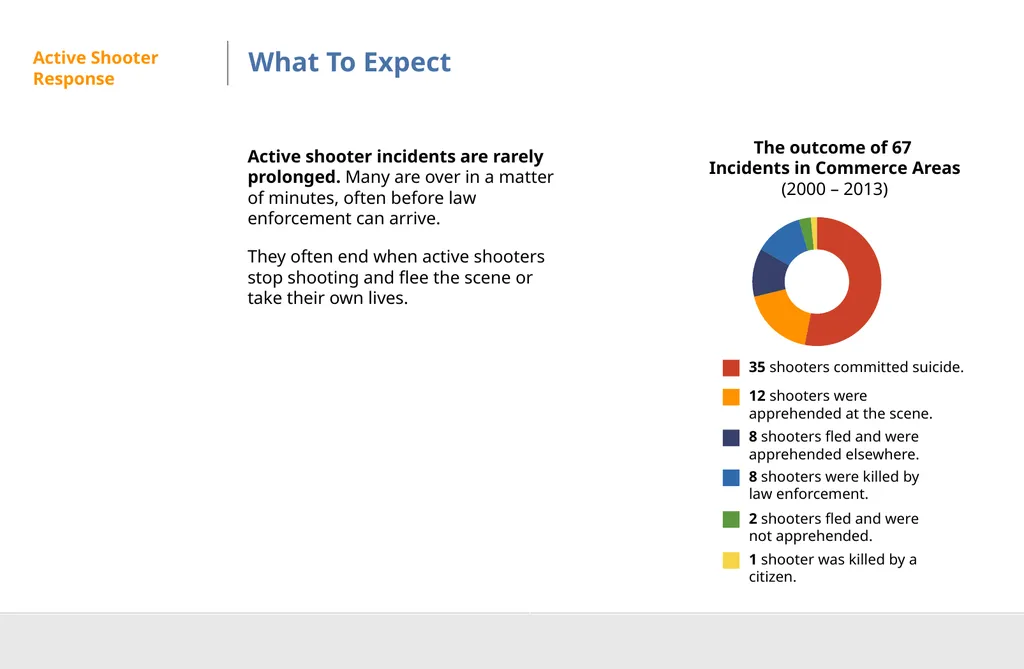
What To Expect Active Shooter Response Active shooter incidents are rarely prolonged. Many are over in a matter of minutes, often before law enforcement can arrive.
They often end when active shooters stop shooting and flee the scene or take their own lives. The outcome of 67
Incidents in Commerce Areas (2000 – 2013) 35 shooters committed suicide. 12 shooters were apprehended at the scene. 8 shooters fled and were apprehended elsewhere. 8 shooters were killed by law enforcement. 2 shooters fled and were not apprehended. 1 shooter was killed by a citizen.<br>
They often end when active shooters stop shooting and flee the scene or take their own lives. The outcome of 67
Incidents in Commerce Areas (2000 – 2013) 35 shooters committed suicide. 12 shooters were apprehended at the scene. 8 shooters fled and were apprehended elsewhere. 8 shooters were killed by law enforcement. 2 shooters fled and were not apprehended. 1 shooter was killed by a citizen.<br>
16
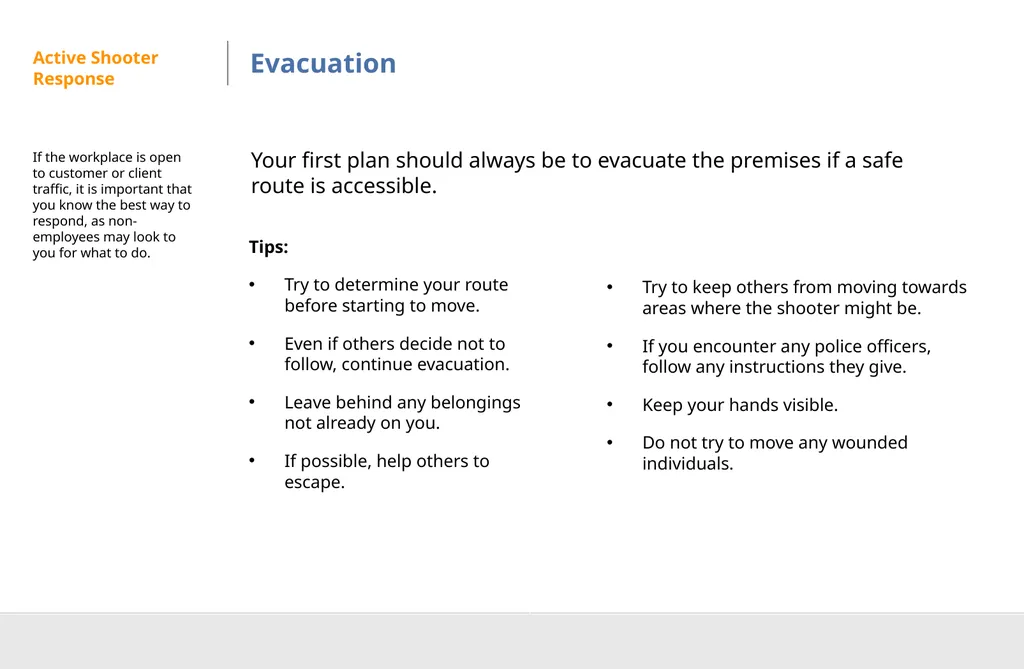
Evacuation Tips:
Try to determine your route before starting to move.
Even if others decide not to follow, continue evacuation.
Leave behind any belongings not already on you.
If possible, help others to escape. Your first plan should always be to evacuate the premises if a safe route is accessible. Try to keep others from moving towards areas where the shooter might be.
If you encounter any police officers, follow any instructions they give.
Keep your hands visible.
Do not try to move any wounded individuals. Active Shooter Response If the workplace is open to customer or client traffic, it is important that you know the best way to respond, as non-employees may look to you for what to do.<br>
Try to determine your route before starting to move.
Even if others decide not to follow, continue evacuation.
Leave behind any belongings not already on you.
If possible, help others to escape. Your first plan should always be to evacuate the premises if a safe route is accessible. Try to keep others from moving towards areas where the shooter might be.
If you encounter any police officers, follow any instructions they give.
Keep your hands visible.
Do not try to move any wounded individuals. Active Shooter Response If the workplace is open to customer or client traffic, it is important that you know the best way to respond, as non-employees may look to you for what to do.<br>
17
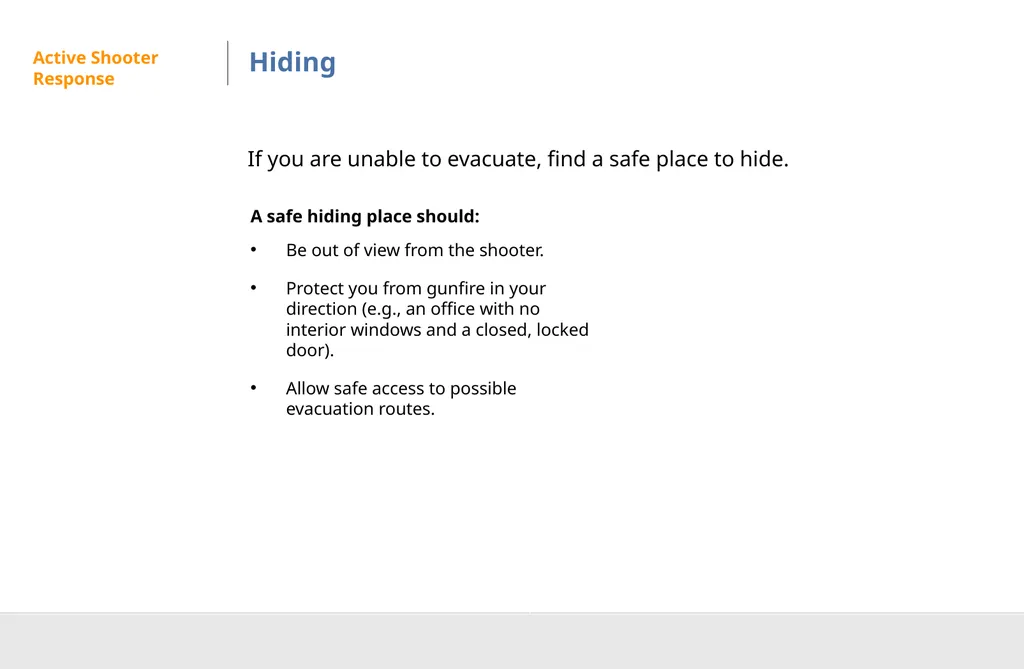
Hiding A safe hiding place should:
Be out of view from the shooter.
Protect you from gunfire in your direction (e.g., an office with no interior windows and a closed, locked door).
Allow safe access to possible evacuation routes. If you are unable to evacuate, find a safe place to hide. Active Shooter Response<br>
Be out of view from the shooter.
Protect you from gunfire in your direction (e.g., an office with no interior windows and a closed, locked door).
Allow safe access to possible evacuation routes. If you are unable to evacuate, find a safe place to hide. Active Shooter Response<br>
18
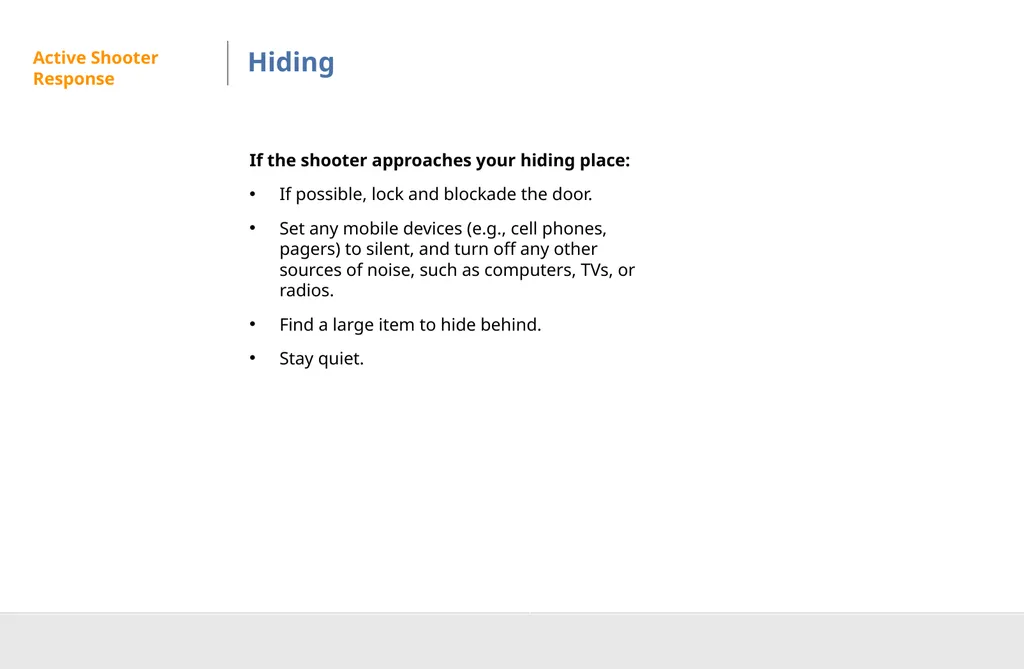
Hiding If the shooter approaches your hiding place:
If possible, lock and blockade the door.
Set any mobile devices (e.g., cell phones, pagers) to silent, and turn off any other sources of noise, such as computers, TVs, or radios.
Find a large item to hide behind.
Stay quiet. Active Shooter Response<br>
If possible, lock and blockade the door.
Set any mobile devices (e.g., cell phones, pagers) to silent, and turn off any other sources of noise, such as computers, TVs, or radios.
Find a large item to hide behind.
Stay quiet. Active Shooter Response<br>
19
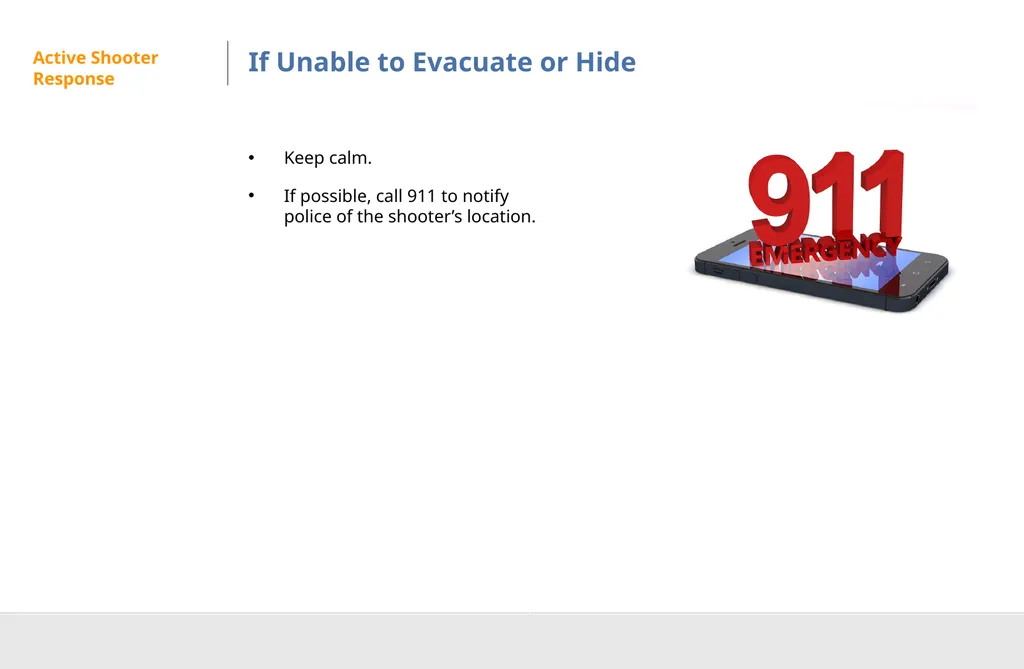
If Unable to Evacuate or Hide Keep calm.
If possible, call 911 to notify police of the shooter’s location. Active Shooter Response<br>
If possible, call 911 to notify police of the shooter’s location. Active Shooter Response<br>
20
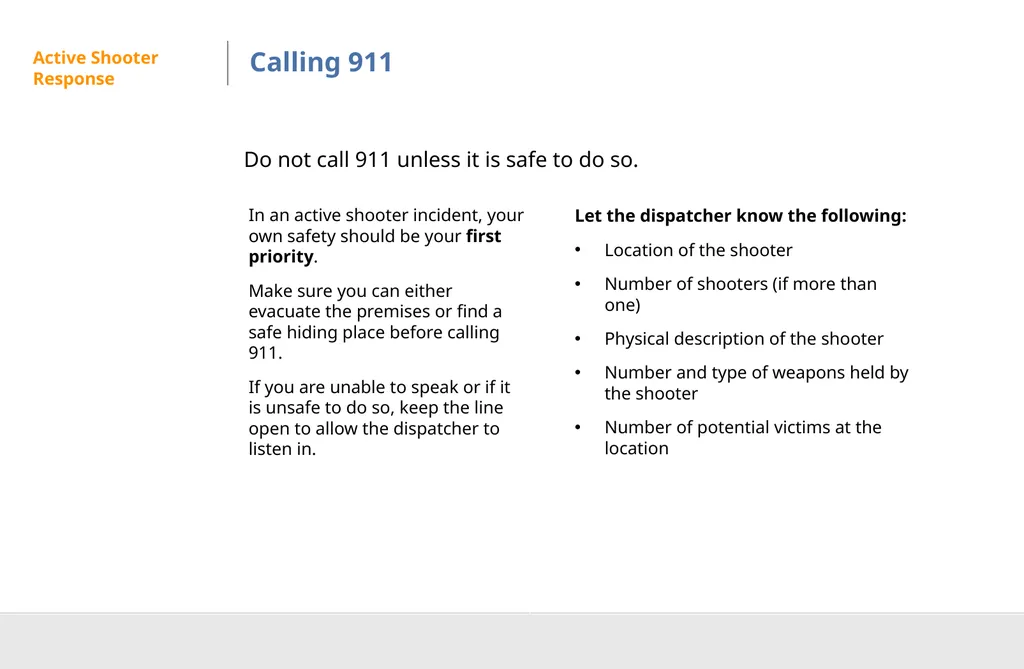
Calling 911 In an active shooter incident, your own safety should be your first priority.
Make sure you can either evacuate the premises or find a safe hiding place before calling 911.
If you are unable to speak or if it is unsafe to do so, keep the line open to allow the dispatcher to listen in. Do not call 911 unless it is safe to do so. Let the dispatcher know the following:
Location of the shooter
Number of shooters (if more than one)
Physical description of the shooter
Number and type of weapons held by the shooter
Number of potential victims at the location Active Shooter Response<br>
Make sure you can either evacuate the premises or find a safe hiding place before calling 911.
If you are unable to speak or if it is unsafe to do so, keep the line open to allow the dispatcher to listen in. Do not call 911 unless it is safe to do so. Let the dispatcher know the following:
Location of the shooter
Number of shooters (if more than one)
Physical description of the shooter
Number and type of weapons held by the shooter
Number of potential victims at the location Active Shooter Response<br>
21
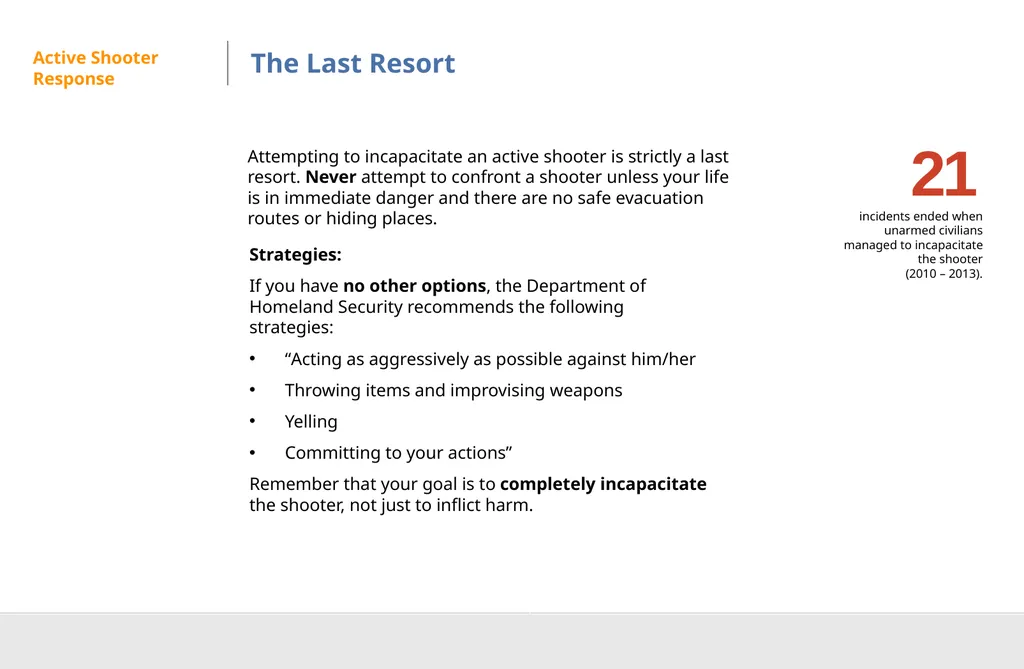
The Last Resort 21
incidents ended when unarmed civilians managed to incapacitate the shooter (2010 – 2013). Attempting to incapacitate an active shooter is strictly a last resort. Never attempt to confront a shooter unless your life is in immediate danger and there are no safe evacuation routes or hiding places. Strategies:
If you have no other options, the Department of Homeland Security recommends the following strategies:
“Acting as aggressively as possible against him/her
Throwing items and improvising weapons
Yelling
Committing to your actions”
Remember that your goal is to completely incapacitate the shooter, not just to inflict harm. Active Shooter Response<br>
incidents ended when unarmed civilians managed to incapacitate the shooter (2010 – 2013). Attempting to incapacitate an active shooter is strictly a last resort. Never attempt to confront a shooter unless your life is in immediate danger and there are no safe evacuation routes or hiding places. Strategies:
If you have no other options, the Department of Homeland Security recommends the following strategies:
“Acting as aggressively as possible against him/her
Throwing items and improvising weapons
Yelling
Committing to your actions”
Remember that your goal is to completely incapacitate the shooter, not just to inflict harm. Active Shooter Response<br>
22
When Law Enforcement Arrives Law enforcement and other emergency responders will be dispatched to the scene of the incident as soon as they are notified.
Police:
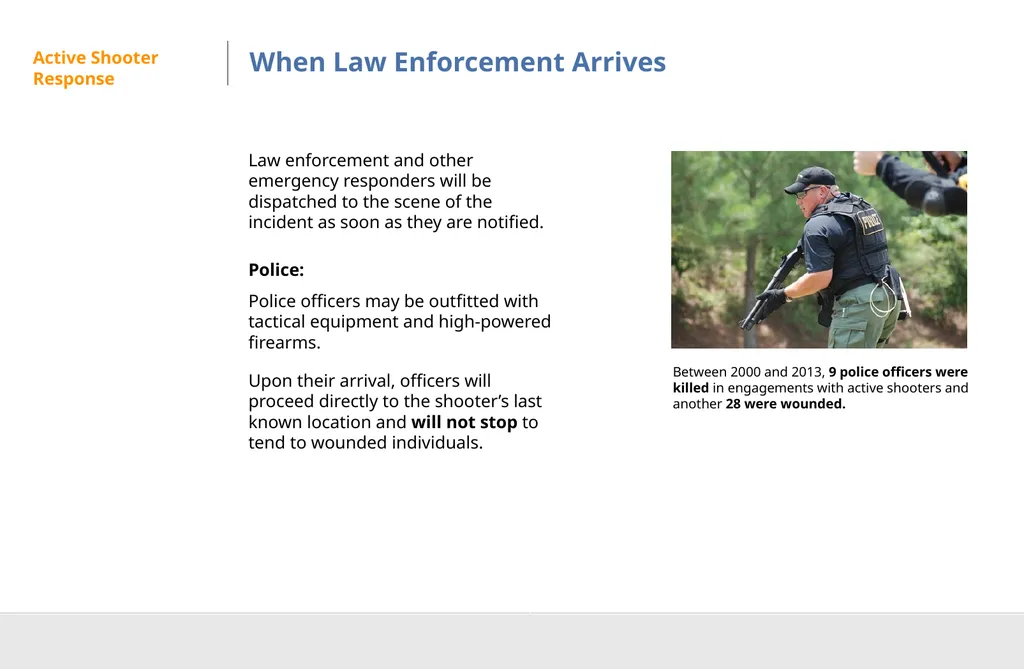
Police officers may be outfitted with tactical equipment and high-powered firearms.
Upon their arrival, officers will proceed directly to the shooter’s last known location and will not stop to tend to wounded individuals. Between 2000 and 2013, 9 police officers were killed in engagements with active shooters and another 28 were wounded. Active Shooter Response<br>
Police:
Police officers may be outfitted with tactical equipment and high-powered firearms.
Upon their arrival, officers will proceed directly to the shooter’s last known location and will not stop to tend to wounded individuals. Between 2000 and 2013, 9 police officers were killed in engagements with active shooters and another 28 were wounded. Active Shooter Response<br>
23
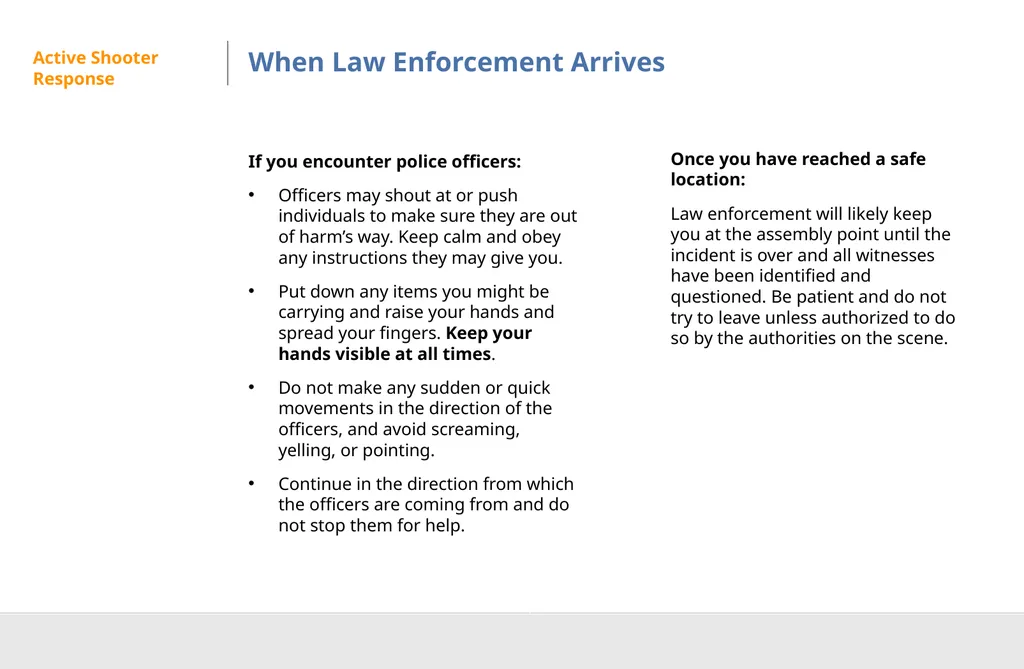
When Law Enforcement Arrives If you encounter police officers:
Officers may shout at or push individuals to make sure they are out of harm’s way. Keep calm and obey any instructions they may give you.
Put down any items you might be carrying and raise your hands and spread your fingers. Keep your hands visible at all times.
Do not make any sudden or quick movements in the direction of the officers, and avoid screaming, yelling, or pointing.
Continue in the direction from which the officers are coming from and do not stop them for help. Once you have reached a safe location:
Law enforcement will likely keep you at the assembly point until the incident is over and all witnesses have been identified and questioned. Be patient and do not try to leave unless authorized to do so by the authorities on the scene. Active Shooter Response<br>
Officers may shout at or push individuals to make sure they are out of harm’s way. Keep calm and obey any instructions they may give you.
Put down any items you might be carrying and raise your hands and spread your fingers. Keep your hands visible at all times.
Do not make any sudden or quick movements in the direction of the officers, and avoid screaming, yelling, or pointing.
Continue in the direction from which the officers are coming from and do not stop them for help. Once you have reached a safe location:
Law enforcement will likely keep you at the assembly point until the incident is over and all witnesses have been identified and questioned. Be patient and do not try to leave unless authorized to do so by the authorities on the scene. Active Shooter Response<br>
24
When Law Enforcement Arrives Rescue teams:
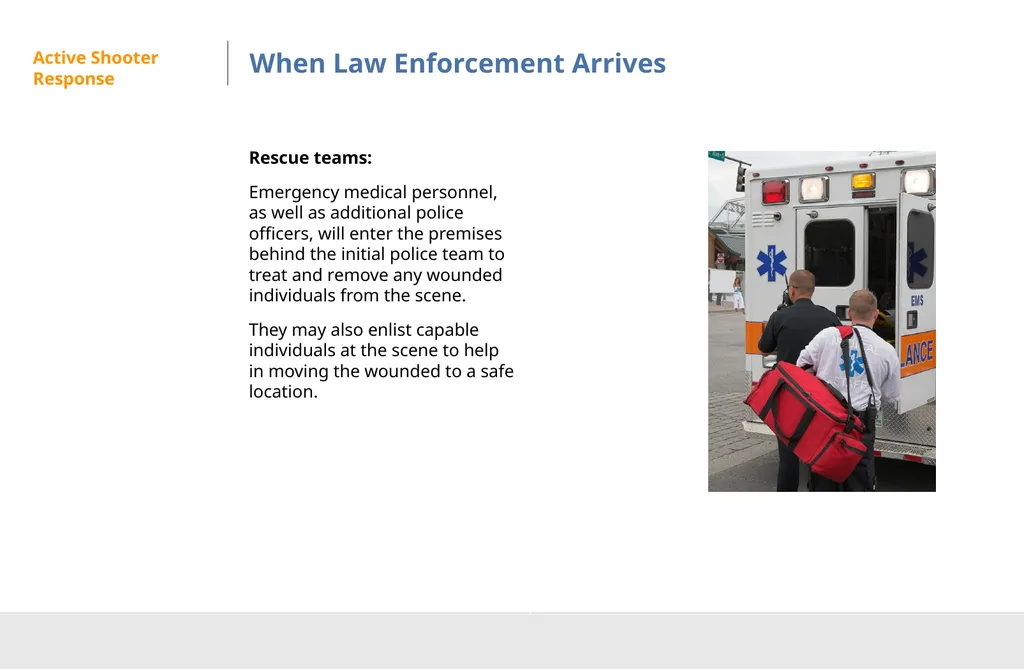
Emergency medical personnel, as well as additional police officers, will enter the premises behind the initial police team to treat and remove any wounded individuals from the scene.
They may also enlist capable individuals at the scene to help in moving the wounded to a safe location. Active Shooter Response<br>
Emergency medical personnel, as well as additional police officers, will enter the premises behind the initial police team to treat and remove any wounded individuals from the scene.
They may also enlist capable individuals at the scene to help in moving the wounded to a safe location. Active Shooter Response<br>
25
Post-Incident Actions What you need to know:
Managing aftermath
Analyzing the incident<br>
Managing aftermath
Analyzing the incident<br>
26
Immediate Response Take a count of personnel to determine whether anyone is missing and possibly wounded.
Contact the families of those involved in the incident. In worst cases, this may include reporting casualties.
Implement plans to provide counseling or psychological care for employees as requested or needed.
Determine if any critical roles in the organization require filling due to the incident and reassign present personnel as necessary. Post-Incident Actions<br>
Contact the families of those involved in the incident. In worst cases, this may include reporting casualties.
Implement plans to provide counseling or psychological care for employees as requested or needed.
Determine if any critical roles in the organization require filling due to the incident and reassign present personnel as necessary. Post-Incident Actions<br>
27
Analyzing the Incident Thoroughly document the incident.
Document response activities.
Identify successful actions and procedures that took place.
Identify areas where stronger preventative measures or more training is required.
Evaluate the existing emergency action plan’s effectiveness. Make recommendations for improvement as necessary. Post-Incident Actions<br>
Document response activities.
Identify successful actions and procedures that took place.
Identify areas where stronger preventative measures or more training is required.
Evaluate the existing emergency action plan’s effectiveness. Make recommendations for improvement as necessary. Post-Incident Actions<br>
28
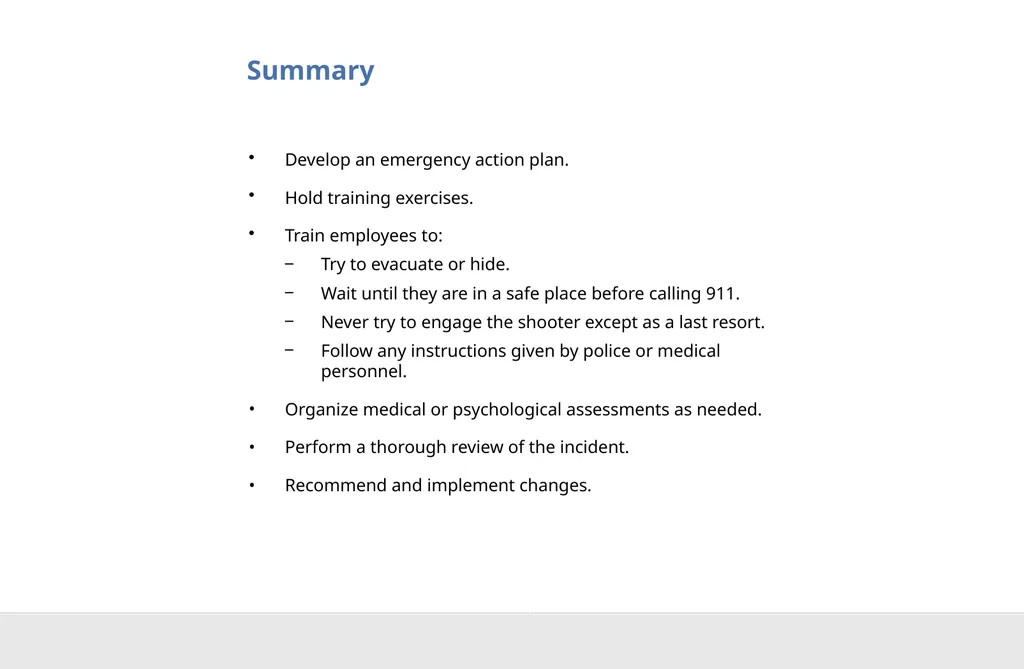
Summary Develop an emergency action plan.
Hold training exercises.
Train employees to:
Try to evacuate or hide.
Wait until they are in a safe place before calling 911.
Never try to engage the shooter except as a last resort.
Follow any instructions given by police or medical personnel.
Organize medical or psychological assessments as needed.
Perform a thorough review of the incident.
Recommend and implement changes.<br>
Hold training exercises.
Train employees to:
Try to evacuate or hide.
Wait until they are in a safe place before calling 911.
Never try to engage the shooter except as a last resort.
Follow any instructions given by police or medical personnel.
Organize medical or psychological assessments as needed.
Perform a thorough review of the incident.
Recommend and implement changes.<br>
29
Congratulations! You have completed
Active Shooter Preparedness.<br>