Active Shooter Sgt. Smith Security Division What is an active shooter An individual actively engaged in attempting to kill people in a confined space or populated area. In most cases, active shooters use firearms and have no pattern or
"Active Shooter Sgt. Smith Security Division What" is the property of its rightful owner. Permission is granted to
download and print the materials on this website for personal, non-commercial use only, and to display it
on your personal computer provided you do not modify the materials and that you retain all copyright
notices contained in the materials. By downloading content from our website, you accept the terms of this
agreement.
Presentation Transcript
01
Active Shooter Sgt. Smith
Security Division<br>
02
What is an active shooter An individual actively engaged in attempting to kill people in a confined space or populated area. In most cases, active shooters use firearms and have no pattern or method to their selection of victims.<br>
03
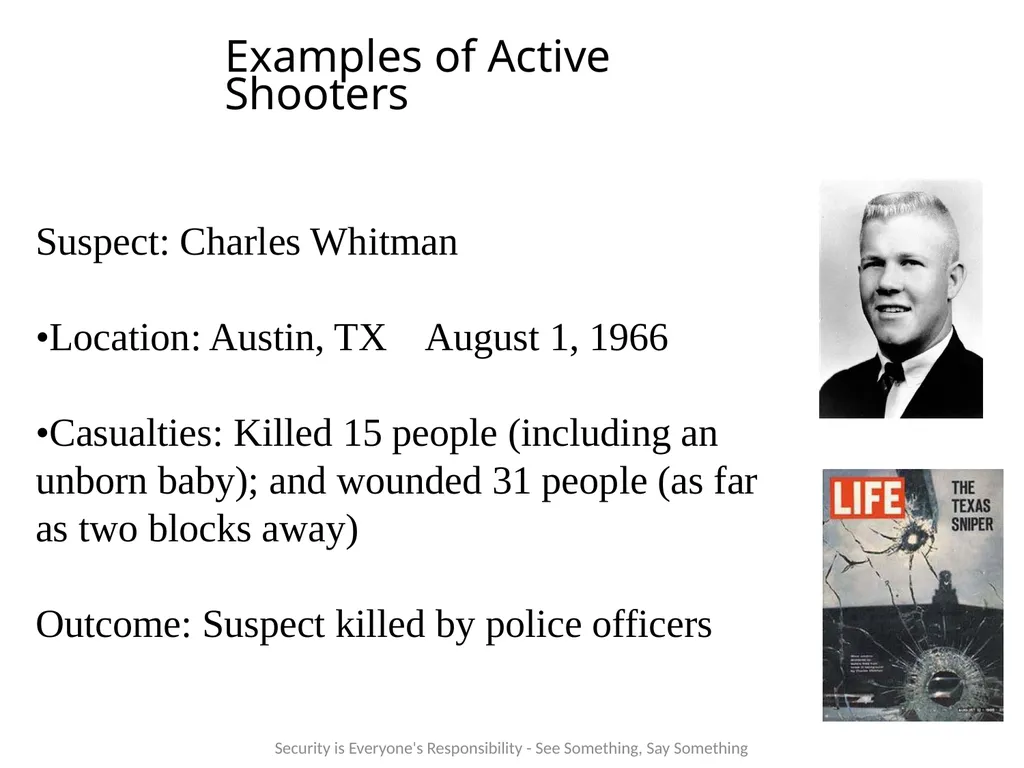
Examples of Active Shooters Security is Everyone's Responsibility - See Something, Say Something Suspect: Charles Whitman
•Location: Austin, TX August 1, 1966
•Casualties: Killed 15 people (including an unborn baby); and wounded 31 people (as far as two blocks away)
Outcome: Suspect killed by police officers 3<br>
04
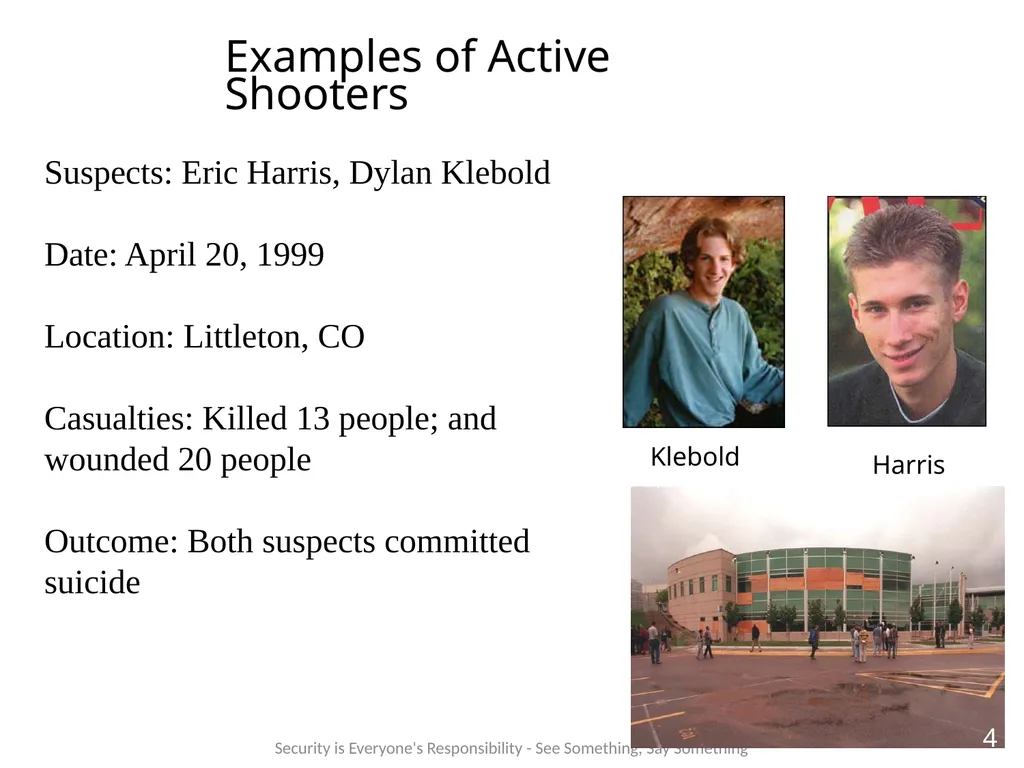
Examples of Active Shooters Security is Everyone's Responsibility - See Something, Say Something Suspects: Eric Harris, Dylan Klebold
Date: April 20, 1999
Location: Littleton, CO
Casualties: Killed 13 people; and
wounded 20 people
Outcome: Both suspects committed
suicide Klebold Harris 4<br>
05
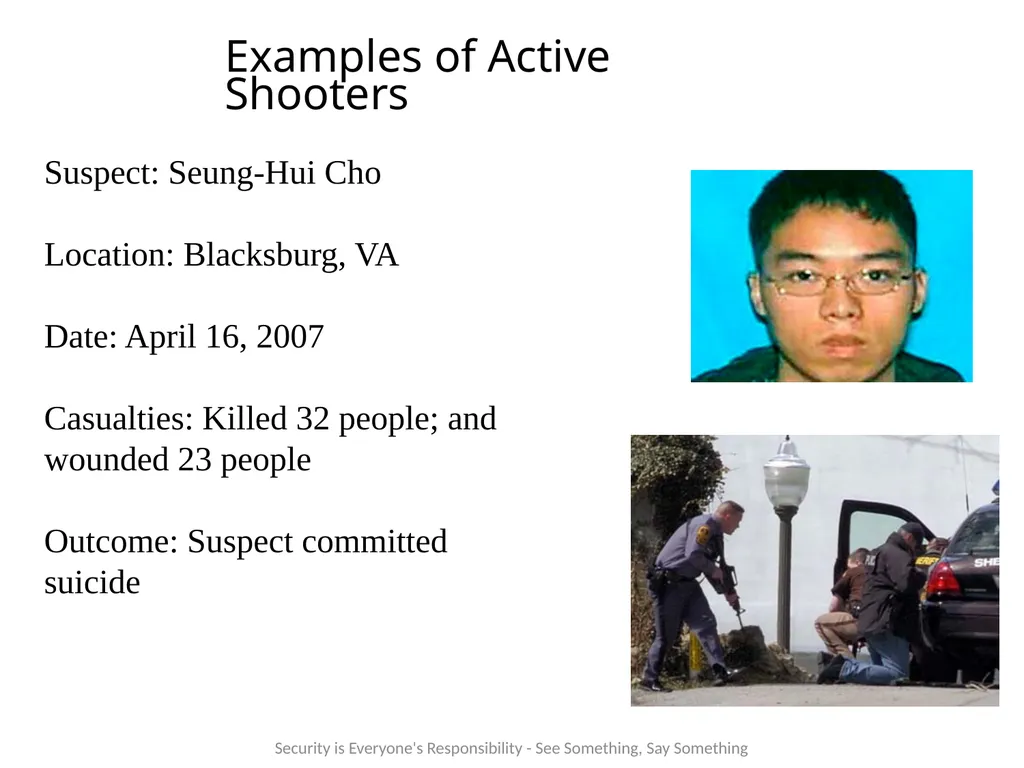
Suspect: Seung-Hui Cho
Location: Blacksburg, VA
Date: April 16, 2007
Casualties: Killed 32 people; and
wounded 23 people
Outcome: Suspect committed
suicide 5 Examples of Active Shooters Security is Everyone's Responsibility - See Something, Say Something<br>
06
Common Denominators Location familiar to shooter
Shooting stops upon police confrontation
Victims fighting back saves lives
Warning signs are overlooked
40% of active shooters told a coworker of intent
54% of those told of active shooter’s intent did nothing!<br>
07
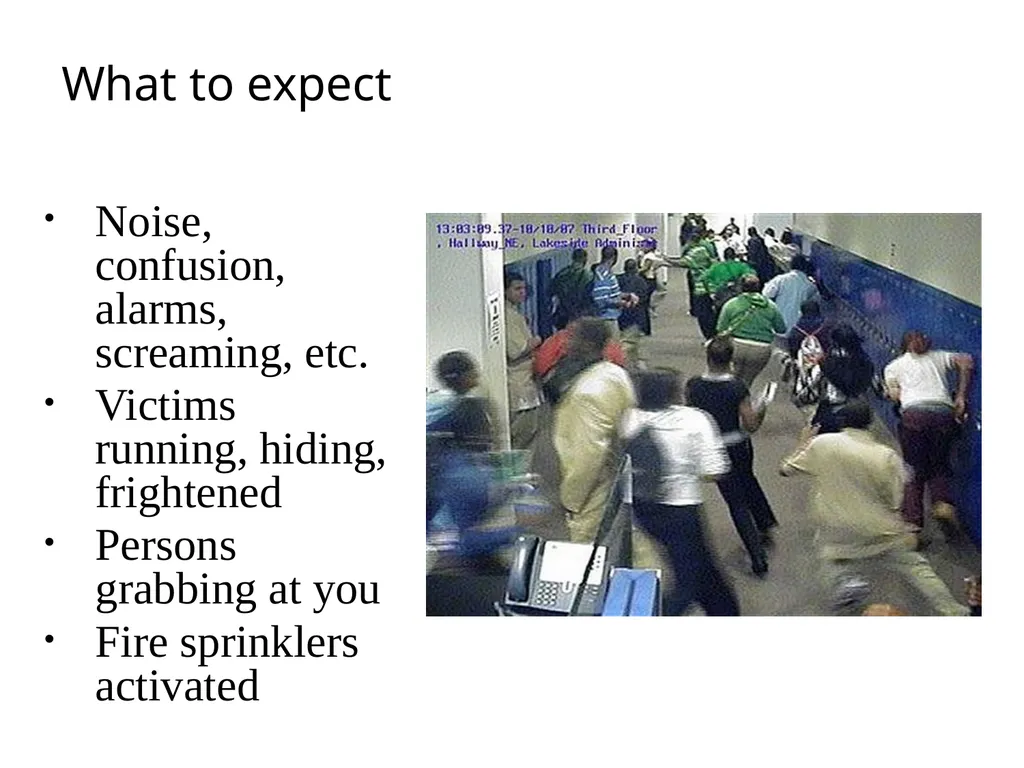
What to expect Noise, confusion, alarms, screaming, etc.
Victims running, hiding, frightened
Persons grabbing at you
Fire sprinklers activated<br>
08
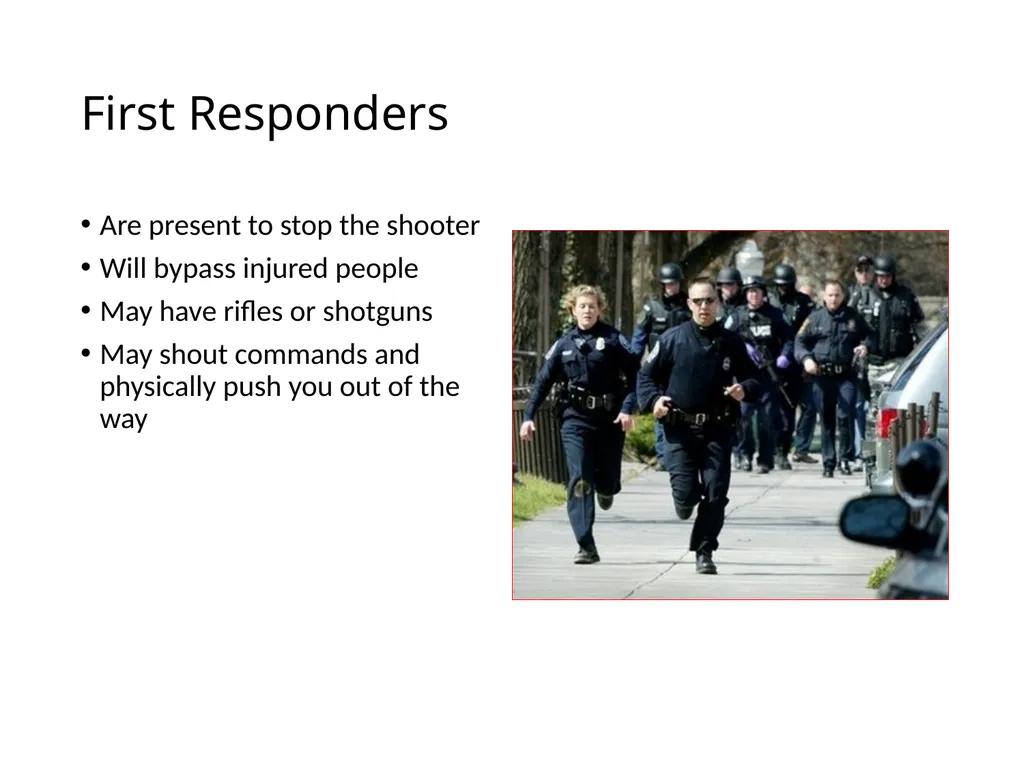
First Responders Are present to stop the shooter
Will bypass injured people
May have rifles or shotguns
May shout commands and physically push you out of the way<br>
09
What to Do in an Active Shooter Event Run
Hide
Fight<br>
10
Run Getting away from the shooter or shooters is the top priority.
Leave your belongings behind and get away.
Help others escape, if possible, but evacuate regardless of whether others agree to follow.
Warn and prevent individuals from entering an area where the active shooter may be.
Call 911 when you are safe, and describe shooter, location, and weapons.<br>
11
Hide Get out of the shooter’s view and stay very quiet.
Silence all electronic devices and make sure they won’t vibrate.
Lock and block doors, close blinds, and turn off lights.
Don’t hide in groups - spread out along walls or hide separately to make it more difficult for the shooter.
Try to communicate with police silently. Use text message or social media to tag your location, or put a sign in a window.
Stay in place until law enforcement gives you the all clear.
Your hiding place should be out of the shooter's view and provide protection if shots are fired in your direction.<br>
12
Fight The last resort when in immediate danger
Commit to your actions and act as aggressively as possible against the shooter.
Recruit others to ambush the shooter with makeshift weapons like chairs, fire extinguishers, scissors, books, etc.
Be prepared to cause severe or lethal injury to the shooter.
Throw items and improvise weapons to distract and disarm the shooter<br>
13
After the event Keep hands visible and empty.
Follow law enforcement instructions and evacuate in the direction they come from, unless otherwise instructed.
Take care of yourself first, and then you may be able to help the wounded before first responders arrive.
If the injured are in immediate danger, help get them to safety.<br>
14
After the Event - continued While you wait for first responders to arrive, provide first aid. Apply direct pressure to wounded areas and use tourniquets if you have been trained to do so.
Turn wounded people onto their sides if they are unconscious and keep them warm.
Consider seeking professional help for you and your family to cope with the long-term effects of the trauma.<br>
15
How to Prepare for an Active Shooter If you see something, say something to an authority right away.
Sign up to receive local emergency alerts and register your work and personal contact information with any work sponsored alert system.
Be aware of your environment and any possible dangers.<br>
16
How to Prepare for an Active Shooter - continued Make a plan with your family, and ensure everyone knows what they would do if confronted with an active shooter.
Look for the two nearest exits anywhere you go, have an escape path in mind, and identify places you could hide.
Understand the plans for individuals with disabilities or other access and functional needs.<br>