ACTIVITY 1 TOILETS AROUND THE WORLD 1 Note for educators You know your students best. The following slides are created to support a secondary social studies class around a 9th grade level. Please feel free to adapt these slides and
"ACTIVITY 1 TOILETS AROUND THE WORLD 1 Note for" is the property of its rightful owner. Permission is granted to
download and print the materials on this website for personal, non-commercial use only, and to display it
on your personal computer provided you do not modify the materials and that you retain all copyright
notices contained in the materials. By downloading content from our website, you accept the terms of this
agreement.
Presentation Transcript
01
ACTIVITY 1 TOILETS AROUND THE WORLD 1 Note for educators You know your students best. The following slides are created to support a secondary social studies class around a 9th grade level. Please feel free to adapt these slides and materials to best fit your students.
Access to high-quality sanitation is highly dependent on income. Cultural preferences around toilets can vary widely across the world. It is important to emphasize that high-quality sanitation is a human right that everyone should have, but that it will look different in different countries.<br>
02
2 Activity 1 Toilets Across the World<br>
03
Learning Objectives Students will be able to describe shared human needs from sanitation systems.
Students will be able to explain how global inequalities influence access to sanitation systems.
Students will be able to express their own cultural toilet preferences within a global context.<br>
04
Discuss – What is your ideal toilet? ACTIVITY 1 TOILETS AROUND THE WORLD 4 What are the characteristics of a toilet that you would want to use? Describe it.
What do you hope happens to your waste after you use the toilet? Put differently, what do you want in a sanitation system?<br>
05
Squat vs. pedestal toilet – Which have you used before? Vanshika Sharma for Dollar Street 2018 Abhineet Malhotra for Dollar Street 2015 ACTIVITY 1 TOILETS AROUND THE WORLD 5<br>
06
Explore Dollar Street ACTIVITY 1 TOILETS AROUND THE WORLD 6 Navigate to gapminder.org/dollar-street.
Use the left drop-down menu (initially selected for “Families”) to select “Toilets” instead.” You should now see only images of toilets from across the world.
Use the right drop-down menu (initially labeled “The World”) to select at least one African country (Ethiopia or South Africa are good options). Observe the different toilets that families in that country have. You can click into each family to see more about how they live.
Switch the right drop-down menu to explore toilets in at least one Asian country (China or India are good options).
Switch the right drop-down menu to explore toilets in at least one European country (Turkey or Ukraine are good options).<br>
07
Investigate Dollar Street ACTIVITY 1 TOILETS AROUND THE WORLD 7 Continue exploring a selection of different toilets from families across the world. Answer the following questions:
In what parts of the world are squat toilets most common? In what parts of the world are pedestal toilets most common?
What patterns do you observe based on family income? What changes about toilets as people have more income?
Write the name and location of four different families whose toilet you would be comfortable using. Each family must be from a different continent.<br>
08
Reflect on Dollar Street ACTIVITY 1 TOILETS AROUND THE WORLD 8 What factors influence what type of toilet/sanitation people have access to?
How might inequalities in the world influence access to safely managed sanitation?<br>
09
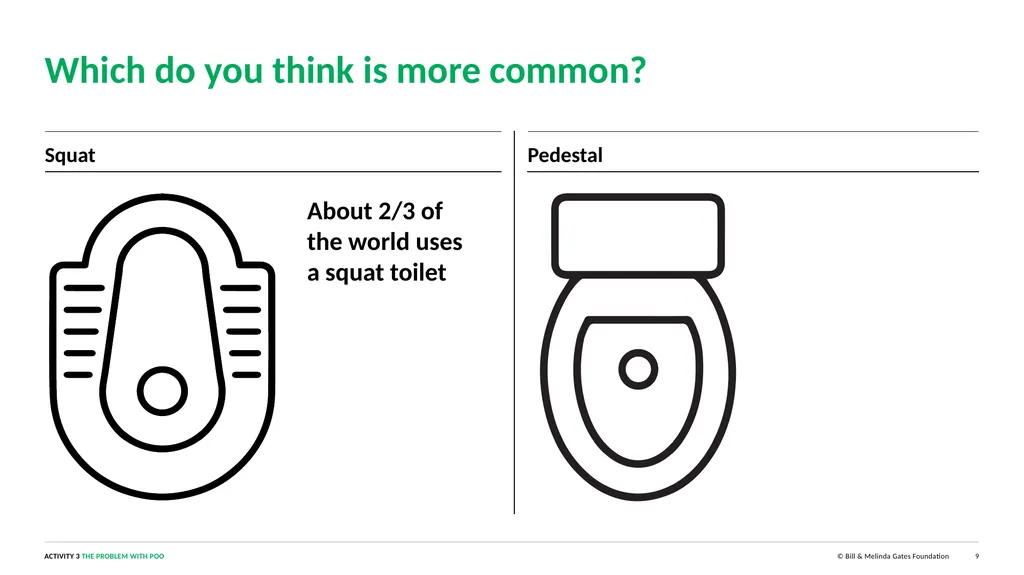
Which do you think is more common? Squat Pedestal About 2/3 of the world uses a squat toilet ACTIVITY 3 THE PROBLEM WITH POO 9<br>
10
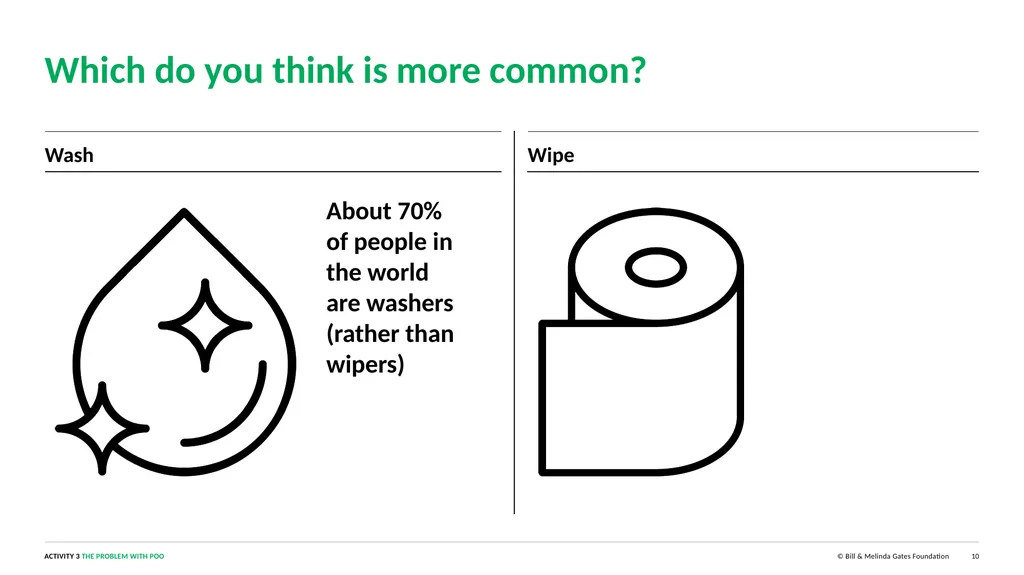
Which do you think is more common? Wash Wipe ACTIVITY 3 THE PROBLEM WITH POO 10 About 70% of people in the world are washers (rather than wipers)<br>
11
Take a guess… ACTIVITY 1 TOILETS AROUND THE WORLD 11 How many people do you think lack access to a toilet that safely manages their waste?
3.6 billion! Almost half the world’s population!
This includes:
People who have access to a toilet that isn’t connect to a machine or system that treats that waste safely.
People who practice open defecation (i.e., who do not use or do not have access to a toilet).
Both can spread disease!<br>
12
Final reflection ACTIVITY 1 TOILETS AROUND THE WORLD 12 How might it look different in different places? What do all people need from a sanitation system?
How does safe and effective sanitation look different across the world?
Why do some people have access to safe and effective sanitation while others do not?<br>