
ACTIVITY BASED COSTING D JAGANNATAN Cost
LO
Published · 40 slides · 0 views
1 / 1
Description
ACTIVITY BASED COSTING D JAGANNATAN Cost Management System A cost management system (CMS) is a collection of tools and techniques that identifies how managements decisions affect costs. Cost Management System The primary purposes of a cost
Related Topics
Download this presentation From Below
"ACTIVITY BASED COSTING D JAGANNATAN Cost" is the property of its rightful owner. Permission is granted to download and print the materials on this website for personal, non-commercial use only, and to display it on your personal computer provided you do not modify the materials and that you retain all copyright notices contained in the materials. By downloading content from our website, you accept the terms of this agreement.
Share
Embed code
Presentation Transcript
01
ACTIVITY BASED COSTING D JAGANNATAN<br>
02
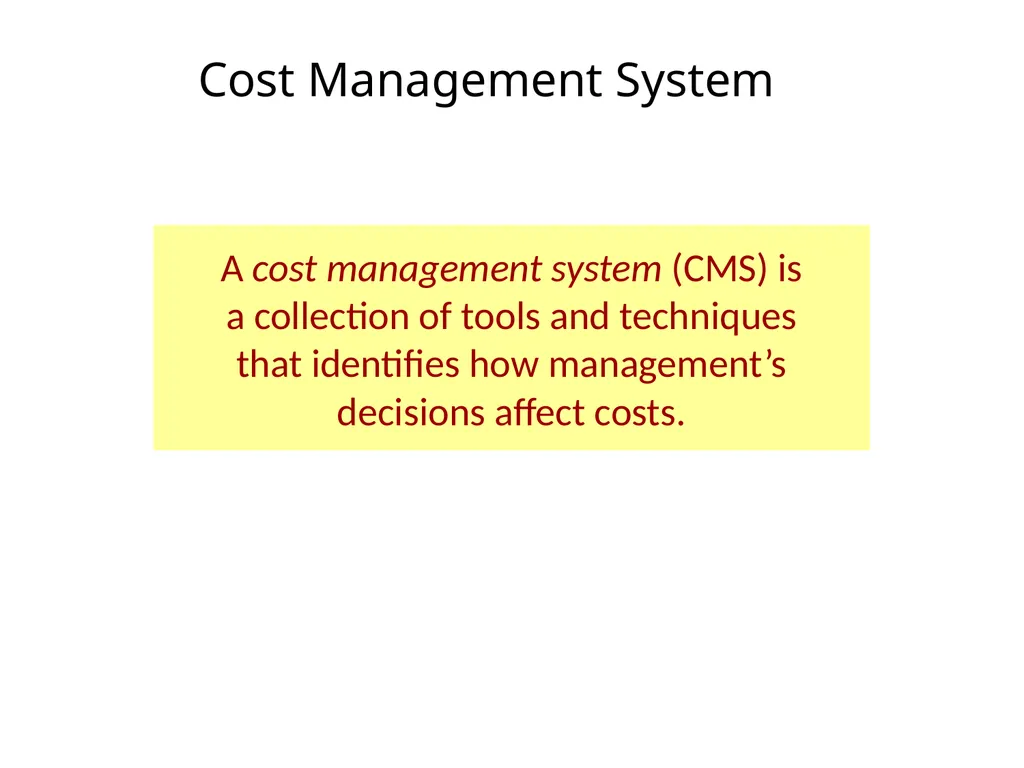
Cost Management System A cost management system (CMS) is
a collection of tools and techniques
that identifies how management’s
decisions affect costs.<br>
a collection of tools and techniques
that identifies how management’s
decisions affect costs.<br>
03
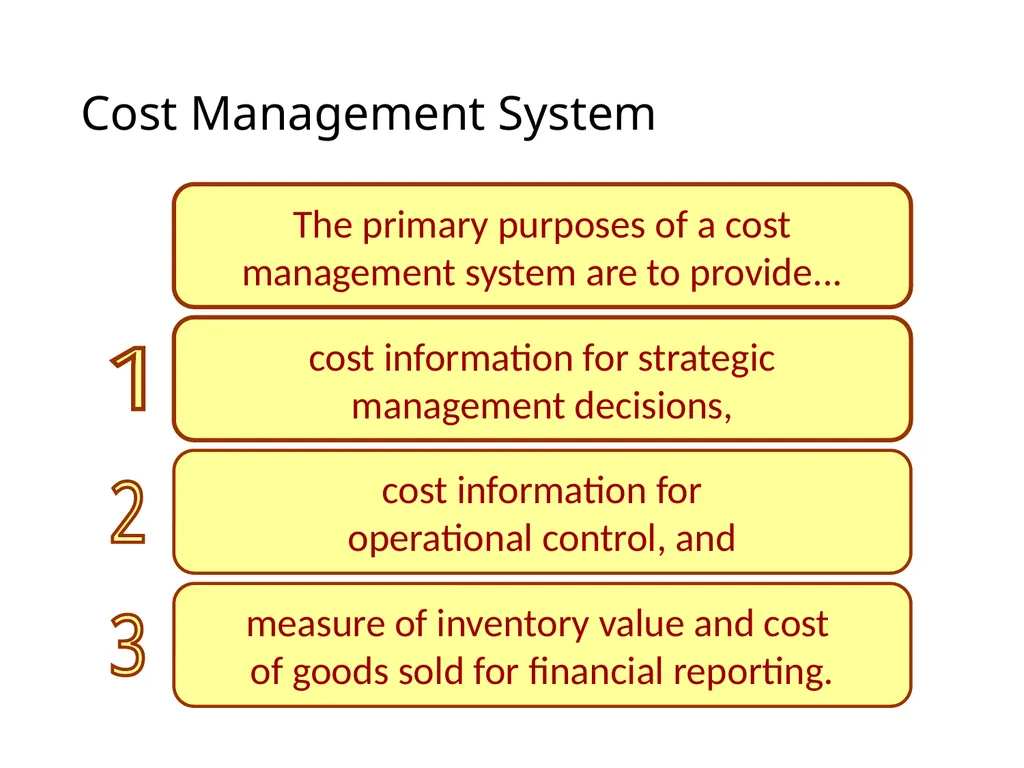
Cost Management System The primary purposes of a cost
management system are to provide...<br>
management system are to provide...<br>
04
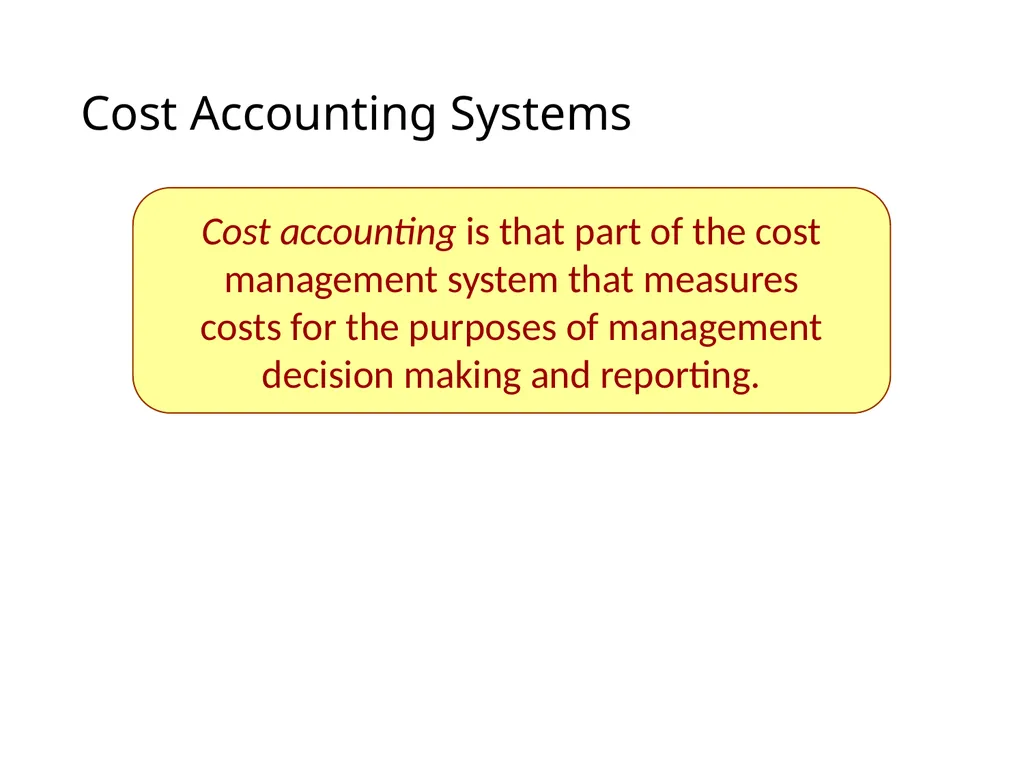
Cost Accounting Systems Cost accounting is that part of the cost
management system that measures
costs for the purposes of management
decision making and reporting.<br>
management system that measures
costs for the purposes of management
decision making and reporting.<br>
05
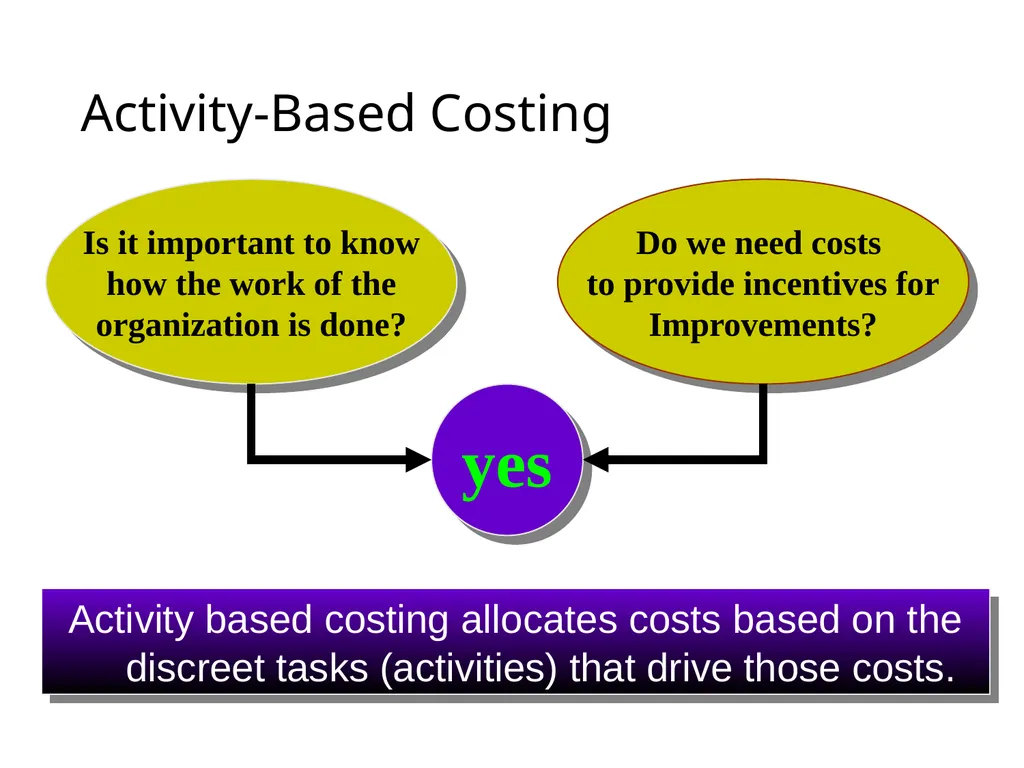
Activity-Based Costing 4-5 yes Activity based costing allocates costs based on the discreet tasks (activities) that drive those costs.<br>
06
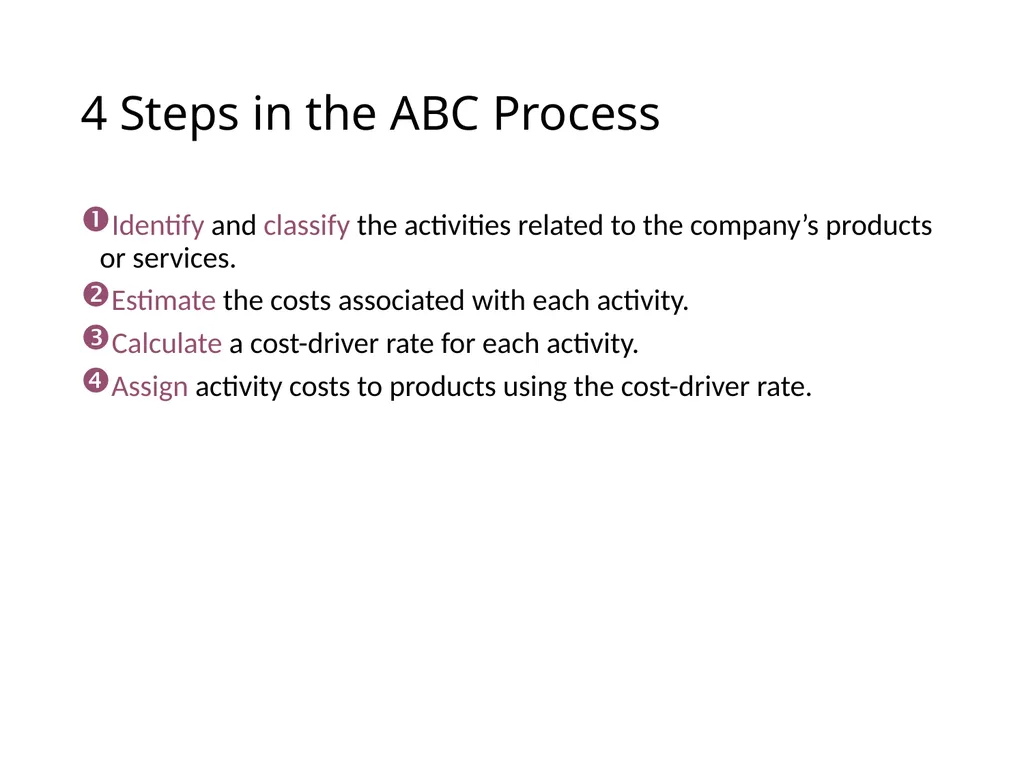
4 Steps in the ABC Process Identify and classify the activities related to the company’s products or services.
Estimate the costs associated with each activity.
Calculate a cost-driver rate for each activity.
Assign activity costs to products using the cost-driver rate.<br>
Estimate the costs associated with each activity.
Calculate a cost-driver rate for each activity.
Assign activity costs to products using the cost-driver rate.<br>
07
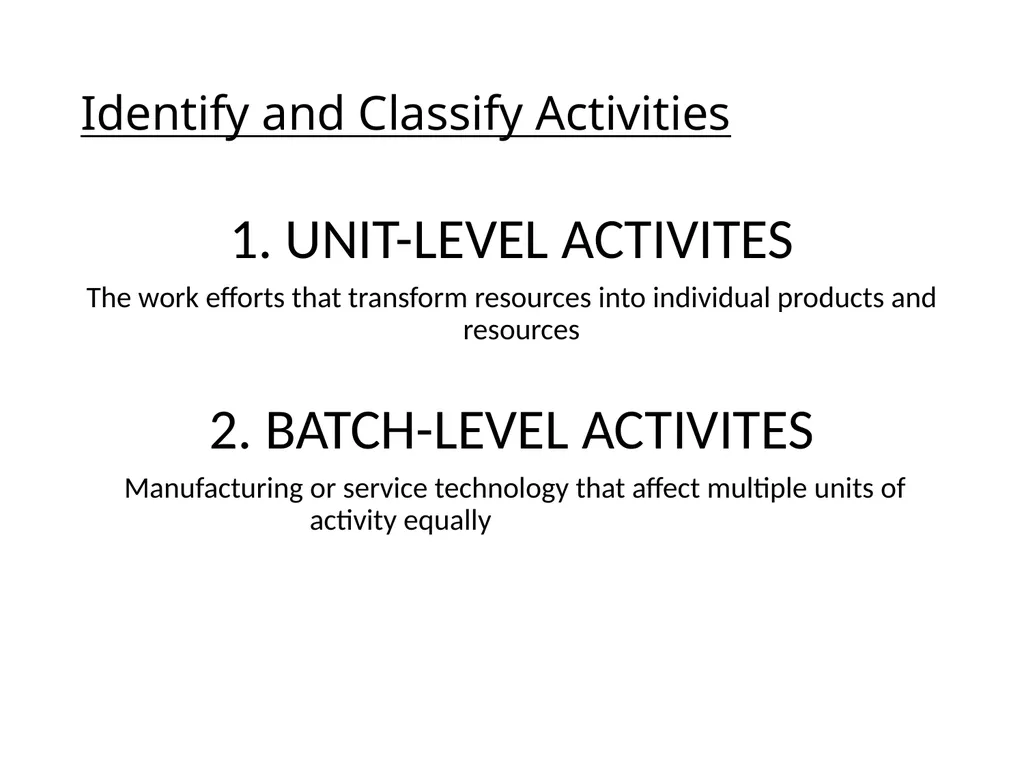
Identify and Classify Activities 1. UNIT-LEVEL ACTIVITES
The work efforts that transform resources into individual products and resources
2. BATCH-LEVEL ACTIVITES
Manufacturing or service technology that affect multiple units of activity equally and simultaneously<br>
The work efforts that transform resources into individual products and resources
2. BATCH-LEVEL ACTIVITES
Manufacturing or service technology that affect multiple units of activity equally and simultaneously<br>
08
3.PRODUCT - LEVEL ACTIVITES
Support specific products or service lines
4.CUSTOMER- LEVEL ACTIVITES
Performed to meet the needs of specific customers
5.FACILITY-LEVEL ACTIVITIES
Support all of the organizations processes<br>
Support specific products or service lines
4.CUSTOMER- LEVEL ACTIVITES
Performed to meet the needs of specific customers
5.FACILITY-LEVEL ACTIVITIES
Support all of the organizations processes<br>
09
COST DRIVER An appropriate cost driver base should:
Have a cause-effect relationship with the activity and the use of resources (costs).
Be feasible to measure.
Predict or explain activities’ use of resources (cost) with reasonable accuracy.
Be based on the practical capacity of the resources to support activities<br>
Have a cause-effect relationship with the activity and the use of resources (costs).
Be feasible to measure.
Predict or explain activities’ use of resources (cost) with reasonable accuracy.
Be based on the practical capacity of the resources to support activities<br>
10
Cost drivers-contd. Activity cost drivers are the central innovation of activity-based cost systems
They are also the most costly to measure
Particularly the quantity of each activity cost driver used by each product
Accordingly, it is important to understand the issues involved in selecting activity cost drivers
The selection of an activity cost driver reflects a subjective trade-off between accuracy and the cost of measurement
An ABC system with 50 activity cost drivers and 2,000 products would require that 100,000 data elements be estimated<br>
They are also the most costly to measure
Particularly the quantity of each activity cost driver used by each product
Accordingly, it is important to understand the issues involved in selecting activity cost drivers
The selection of an activity cost driver reflects a subjective trade-off between accuracy and the cost of measurement
An ABC system with 50 activity cost drivers and 2,000 products would require that 100,000 data elements be estimated<br>
11
Cost drivers-contd. Because of the large number of potential activity-to-product linkages, management accountants attempt to economize on the number of different activity cost drivers
Activities triggered by the same event may all use the same activity cost driver
For example, preparing production orders, scheduling production runs, performing first part inspections, and moving materials may all use the number of production runs
ABC system designers choose from three different types of activity cost drivers:
Transaction
Duration
Intensity (direct charging)
The choice of a transaction, duration, or intensity cost driver can occur for almost any activity<br>
Activities triggered by the same event may all use the same activity cost driver
For example, preparing production orders, scheduling production runs, performing first part inspections, and moving materials may all use the number of production runs
ABC system designers choose from three different types of activity cost drivers:
Transaction
Duration
Intensity (direct charging)
The choice of a transaction, duration, or intensity cost driver can occur for almost any activity<br>
12
Transaction Drivers Least expensive type of cost driver
Also the least accurate
They assume that the same quantity of resources is required every time an activity is performed
For example, a transaction driver such as the number of setups assumes that all setups take about the same time to perform
For many activities, the variation in the quantity of resources used by each is small enough that a transaction driver will be fine for assigning activity expenses to the cost object
E.g., all setup times are between 30 and 35 minutes
If the amount of resources required to perform the activity varies considerably from product to product then more accurate and more expensive types of cost drivers should be used
E.g., Setup times range from 30 minutes to 6 hours<br>
Also the least accurate
They assume that the same quantity of resources is required every time an activity is performed
For example, a transaction driver such as the number of setups assumes that all setups take about the same time to perform
For many activities, the variation in the quantity of resources used by each is small enough that a transaction driver will be fine for assigning activity expenses to the cost object
E.g., all setup times are between 30 and 35 minutes
If the amount of resources required to perform the activity varies considerably from product to product then more accurate and more expensive types of cost drivers should be used
E.g., Setup times range from 30 minutes to 6 hours<br>
13
Duration Drivers Represent the amount of time required to perform an activity
Should be used when significant variations exist in the amount of activity required for different outputs
A transaction driver such as number of setups will overcost the resources required to set up simple products and undercost the resources required for complex products
More expensive to implement because they require an estimate of time needed each time an activity is performed
The choice between a duration driver and a transactional driver is, as always, one of economics:
Balancing the benefits of increased accuracy against the costs of increased measurement<br>
Should be used when significant variations exist in the amount of activity required for different outputs
A transaction driver such as number of setups will overcost the resources required to set up simple products and undercost the resources required for complex products
More expensive to implement because they require an estimate of time needed each time an activity is performed
The choice between a duration driver and a transactional driver is, as always, one of economics:
Balancing the benefits of increased accuracy against the costs of increased measurement<br>
14
Intensity Drivers Directly charge for the resources used each time an activity is performed
A duration driver, such as setup cost per hour, assumes that all hours are equally costly but does not reflect the higher costs that may be required on some setups:
E.g., extra personnel, more skilled personnel, more expensive machinery
Activity costs may have to be charged directly to the output, based on work orders or other records that accumulate the activity expenses incurred for that output
Intensity drivers are the most accurate activity cost drivers but the most expensive to implement
Intensity drivers should be used only when the resources associated with performing an activity are both expensive and variable each time an activity is performed unless the measurements are inexpensive<br>
A duration driver, such as setup cost per hour, assumes that all hours are equally costly but does not reflect the higher costs that may be required on some setups:
E.g., extra personnel, more skilled personnel, more expensive machinery
Activity costs may have to be charged directly to the output, based on work orders or other records that accumulate the activity expenses incurred for that output
Intensity drivers are the most accurate activity cost drivers but the most expensive to implement
Intensity drivers should be used only when the resources associated with performing an activity are both expensive and variable each time an activity is performed unless the measurements are inexpensive<br>
15
Step 2 -Estimate the Cost of Activities
When estimating the cost of an activity, only the costs associated with the product should be used (practical capacity). The cost of “unused capacity” should not be applied to products.
Step 3: Compute the Cost-Driver Rates
Two pieces of information are required to compute the cost-driver rate:
Activity Cost & Activity Volume
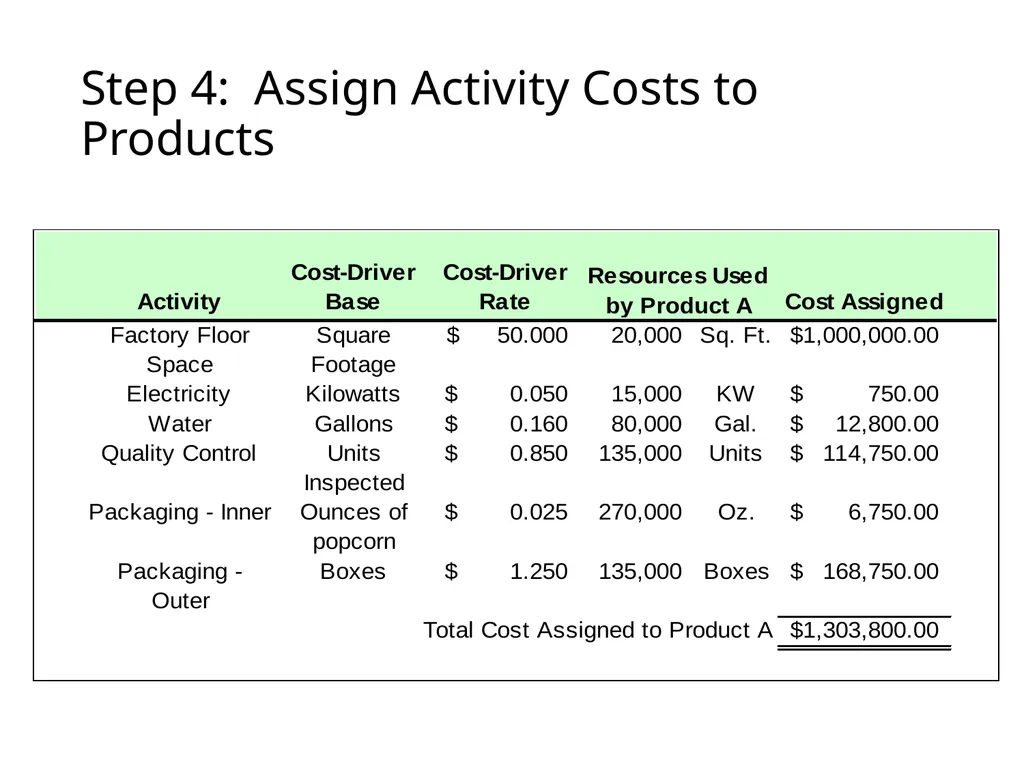
Step 4: Assign Activity Costs to Products<br>
When estimating the cost of an activity, only the costs associated with the product should be used (practical capacity). The cost of “unused capacity” should not be applied to products.
Step 3: Compute the Cost-Driver Rates
Two pieces of information are required to compute the cost-driver rate:
Activity Cost & Activity Volume
Step 4: Assign Activity Costs to Products<br>
16
Step 4: Assign Activity Costs to Products 4-16<br>
17
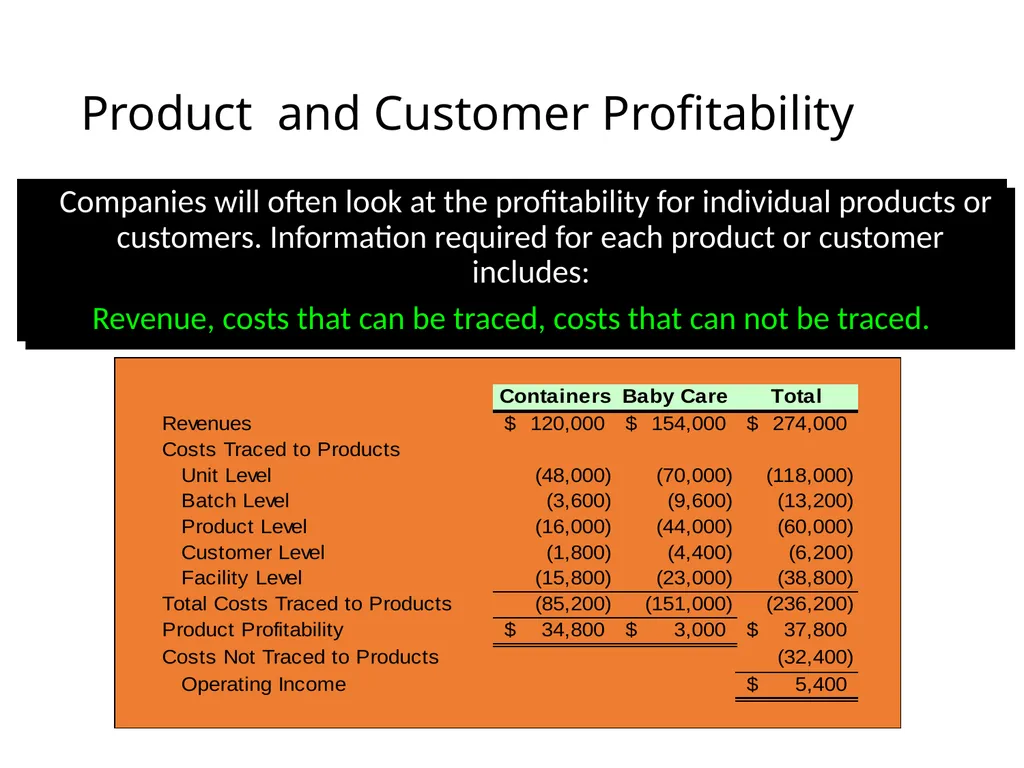
Product and Customer Profitability Companies will often look at the profitability for individual products or customers. Information required for each product or customer includes:
Revenue, costs that can be traced, costs that can not be traced. 4-17 Exh.
4.7<br>
Revenue, costs that can be traced, costs that can not be traced. 4-17 Exh.
4.7<br>
18
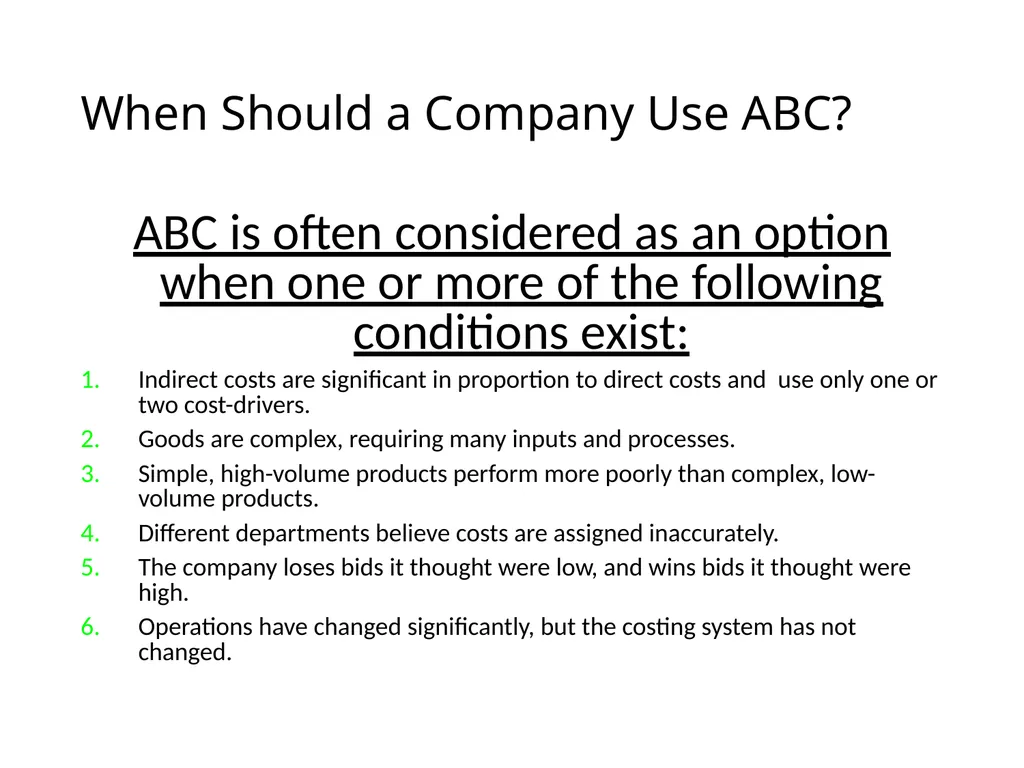
When Should a Company Use ABC? ABC is often considered as an option when one or more of the following conditions exist:
Indirect costs are significant in proportion to direct costs and use only one or two cost-drivers.
Goods are complex, requiring many inputs and processes.
Simple, high-volume products perform more poorly than complex, low-volume products.
Different departments believe costs are assigned inaccurately.
The company loses bids it thought were low, and wins bids it thought were high.
Operations have changed significantly, but the costing system has not changed.<br>
Indirect costs are significant in proportion to direct costs and use only one or two cost-drivers.
Goods are complex, requiring many inputs and processes.
Simple, high-volume products perform more poorly than complex, low-volume products.
Different departments believe costs are assigned inaccurately.
The company loses bids it thought were low, and wins bids it thought were high.
Operations have changed significantly, but the costing system has not changed.<br>
19
Problems Implementing ABC Several problems arise in practice from the common approach to activity-based costing that assigns many resource expenses to activities based on interviews, surveys, and direct observation of production and support processes
The interview and survey processes are time consuming and costly
This front-end cost to an ABC analysis is often a barrier to widespread ABC adoption<br>
The interview and survey processes are time consuming and costly
This front-end cost to an ABC analysis is often a barrier to widespread ABC adoption<br>
20
Inaccuracies and bias may affect the accuracy of cost driver rates derived from individuals’ subjective estimates of their past or future behavior
Companies must periodically repeat the interviewing and surveying processes if they want to keep their activity-based cost systems updated
High updating cost leads to infrequent updates of many ABC systems and, eventually, to obsolete cost driver estimates
Adding new activities to the system is also difficult, requiring re-estimates of the relative amount of resource time and effort required by the new activity<br>
Companies must periodically repeat the interviewing and surveying processes if they want to keep their activity-based cost systems updated
High updating cost leads to infrequent updates of many ABC systems and, eventually, to obsolete cost driver estimates
Adding new activities to the system is also difficult, requiring re-estimates of the relative amount of resource time and effort required by the new activity<br>
21
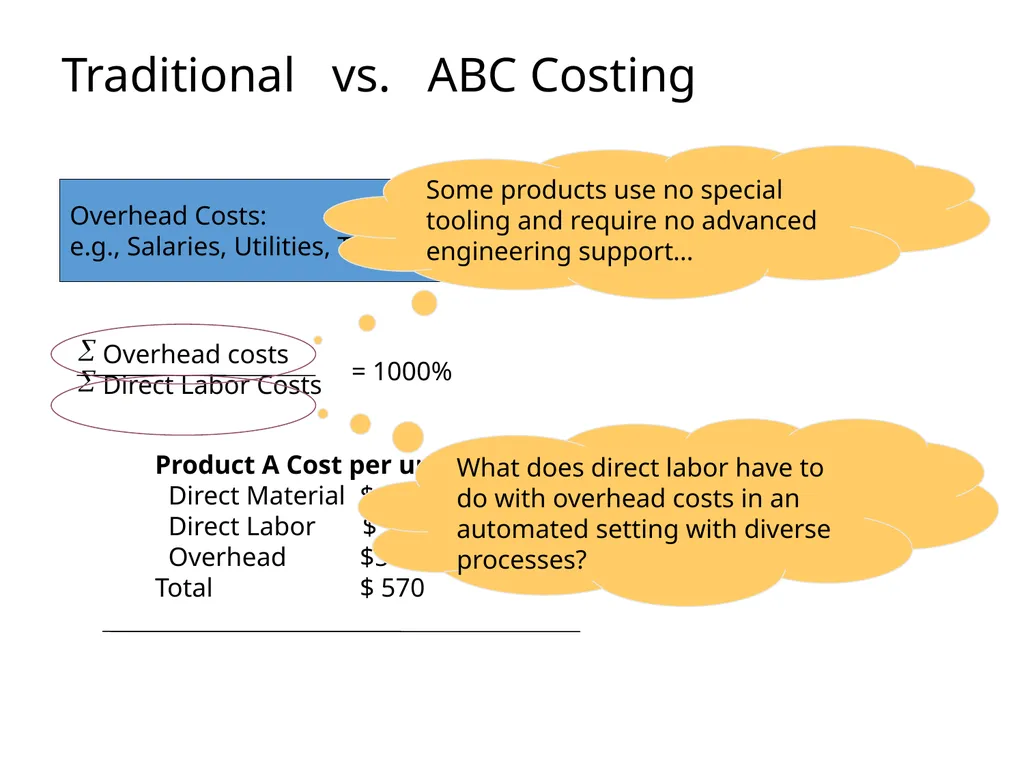
Traditional vs. ABC Costing Overhead Costs:
e.g., Salaries, Utilities, Tooling Overhead costs
Direct Labor Costs = 1000% Product A Cost per unit
Direct Material $ 20
Direct Labor $ 50
Overhead $500 ($50 x 1000%)
Total $ 570 Some products use no special tooling and require no advanced engineering support… What does direct labor have to do with overhead costs in an automated setting with diverse processes?<br>
e.g., Salaries, Utilities, Tooling Overhead costs
Direct Labor Costs = 1000% Product A Cost per unit
Direct Material $ 20
Direct Labor $ 50
Overhead $500 ($50 x 1000%)
Total $ 570 Some products use no special tooling and require no advanced engineering support… What does direct labor have to do with overhead costs in an automated setting with diverse processes?<br>
22
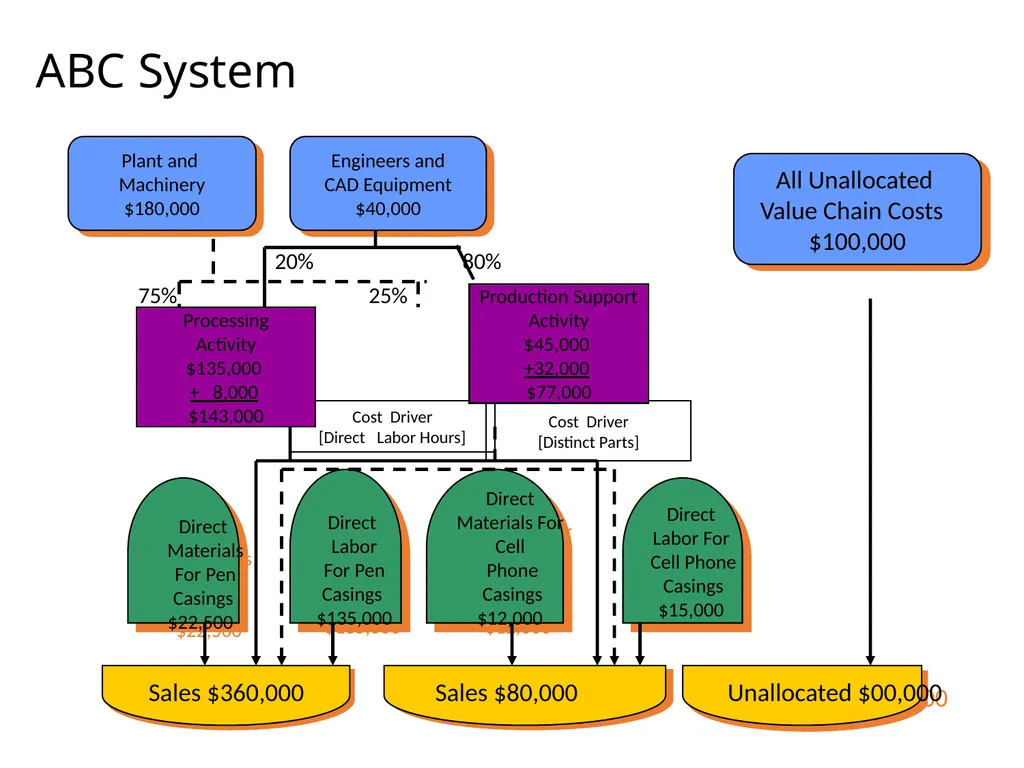
ABC System Direct
Materials
For Pen
Casings
$22,500 Direct
Labor
For Pen
Casings
$135,000 Direct
Materials For
Cell
Phone
Casings
$12,000 Direct
Labor For
Cell Phone
Casings
$15,000 Sales $360,000 Sales $80,000 Unallocated $00,000 Plant and
Machinery
$180,000 All Unallocated
Value Chain Costs
$100,000 Cost Driver
[Direct Labor Hours] Cost Driver
[Distinct Parts] Engineers and
CAD Equipment
$40,000 Processing
Activity
$135,000
+ 8,000
$143,000 Production Support
Activity
$45,000
+32,000
$77,000 75% 25% 20% 80%<br>
Materials
For Pen
Casings
$22,500 Direct
Labor
For Pen
Casings
$135,000 Direct
Materials For
Cell
Phone
Casings
$12,000 Direct
Labor For
Cell Phone
Casings
$15,000 Sales $360,000 Sales $80,000 Unallocated $00,000 Plant and
Machinery
$180,000 All Unallocated
Value Chain Costs
$100,000 Cost Driver
[Direct Labor Hours] Cost Driver
[Distinct Parts] Engineers and
CAD Equipment
$40,000 Processing
Activity
$135,000
+ 8,000
$143,000 Production Support
Activity
$45,000
+32,000
$77,000 75% 25% 20% 80%<br>
23
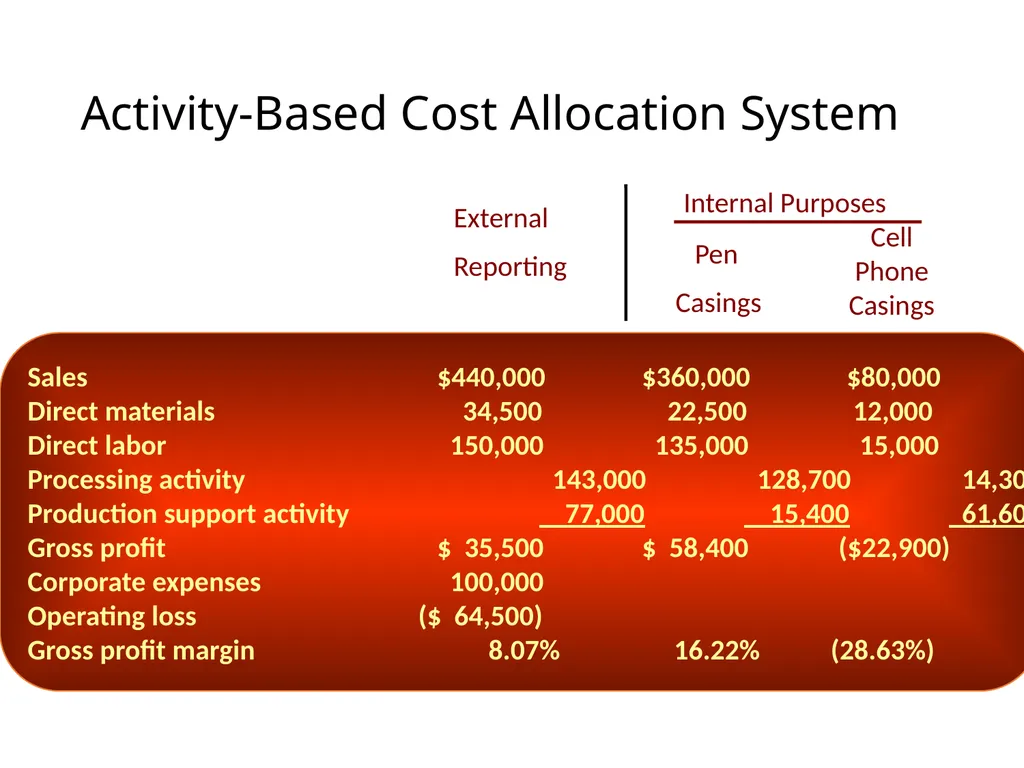
Activity-Based Cost Allocation System External
Reporting Internal Purposes Pen
Casings Cell Phone Casings<br>
Reporting Internal Purposes Pen
Casings Cell Phone Casings<br>
24
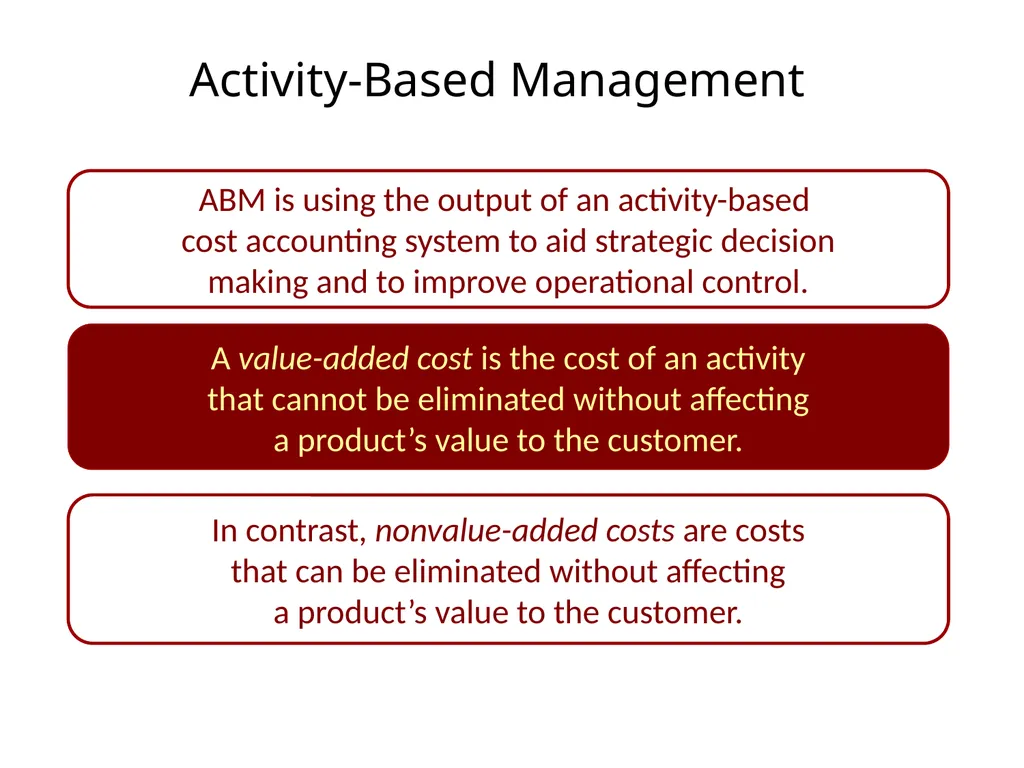
ABM is using the output of an activity-based
cost accounting system to aid strategic decision
making and to improve operational control. Activity-Based Management A value-added cost is the cost of an activity
that cannot be eliminated without affecting
a product’s value to the customer. In contrast, nonvalue-added costs are costs
that can be eliminated without affecting
a product’s value to the customer.<br>
cost accounting system to aid strategic decision
making and to improve operational control. Activity-Based Management A value-added cost is the cost of an activity
that cannot be eliminated without affecting
a product’s value to the customer. In contrast, nonvalue-added costs are costs
that can be eliminated without affecting
a product’s value to the customer.<br>
25
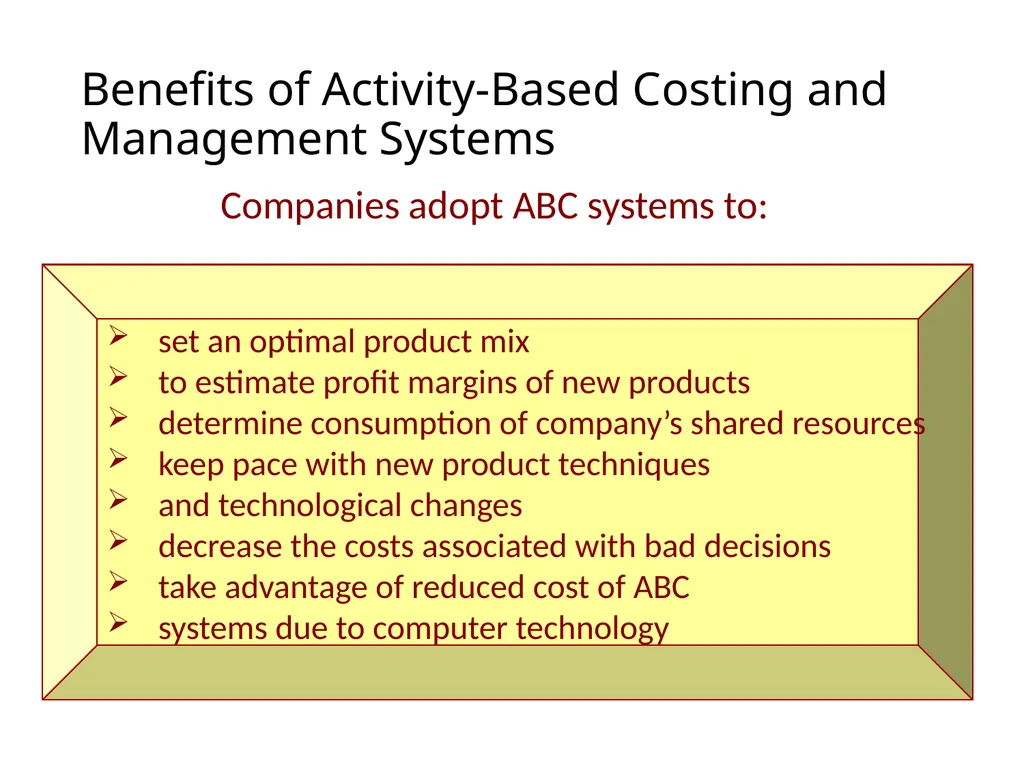
Benefits of Activity-Based Costing and Management Systems set an optimal product mix
to estimate profit margins of new products
determine consumption of company’s shared resources
keep pace with new product techniques
and technological changes
decrease the costs associated with bad decisions
take advantage of reduced cost of ABC
systems due to computer technology Companies adopt ABC systems to:<br>
to estimate profit margins of new products
determine consumption of company’s shared resources
keep pace with new product techniques
and technological changes
decrease the costs associated with bad decisions
take advantage of reduced cost of ABC
systems due to computer technology Companies adopt ABC systems to:<br>
26
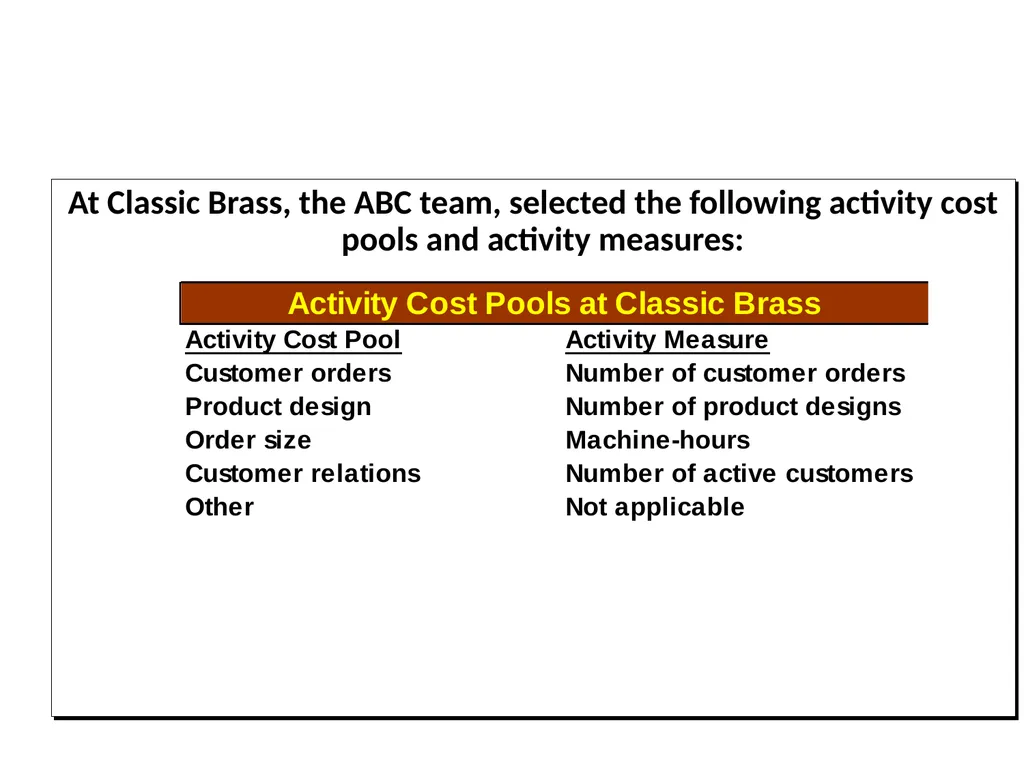
At Classic Brass, the ABC team, selected the following activity cost pools and activity measures:<br>
27
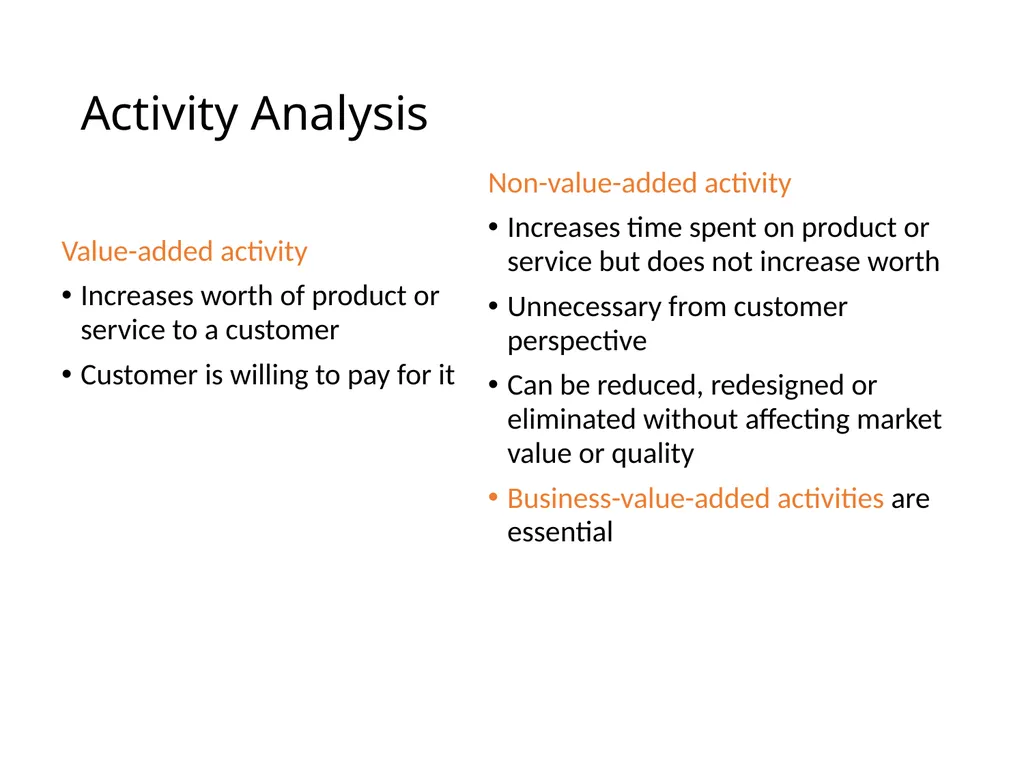
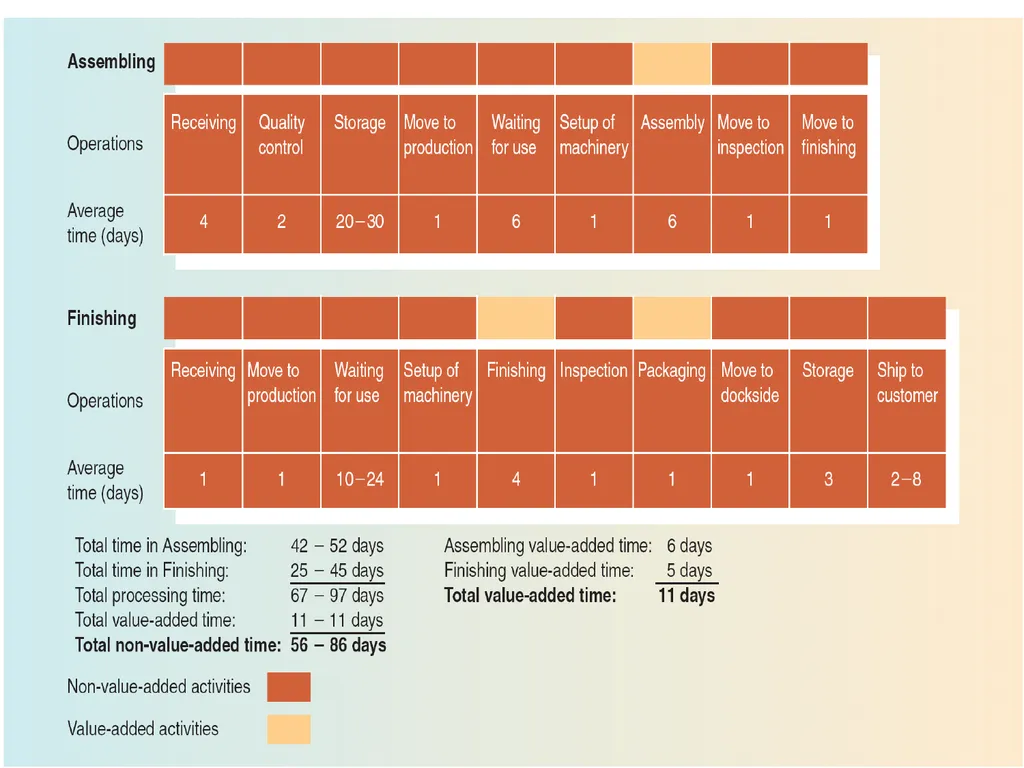
Activity Analysis Value-added activity
Increases worth of product or service to a customer
Customer is willing to pay for it Non-value-added activity
Increases time spent on product or service but does not increase worth
Unnecessary from customer perspective
Can be reduced, redesigned or eliminated without affecting market value or quality
Business-value-added activities are essential<br>
Increases worth of product or service to a customer
Customer is willing to pay for it Non-value-added activity
Increases time spent on product or service but does not increase worth
Unnecessary from customer perspective
Can be reduced, redesigned or eliminated without affecting market value or quality
Business-value-added activities are essential<br>
28
Process A process is a series of activities that, when performed together, satisfy a specific objective
Production
Distribution
Selling
Administration<br>
Production
Distribution
Selling
Administration<br>
29
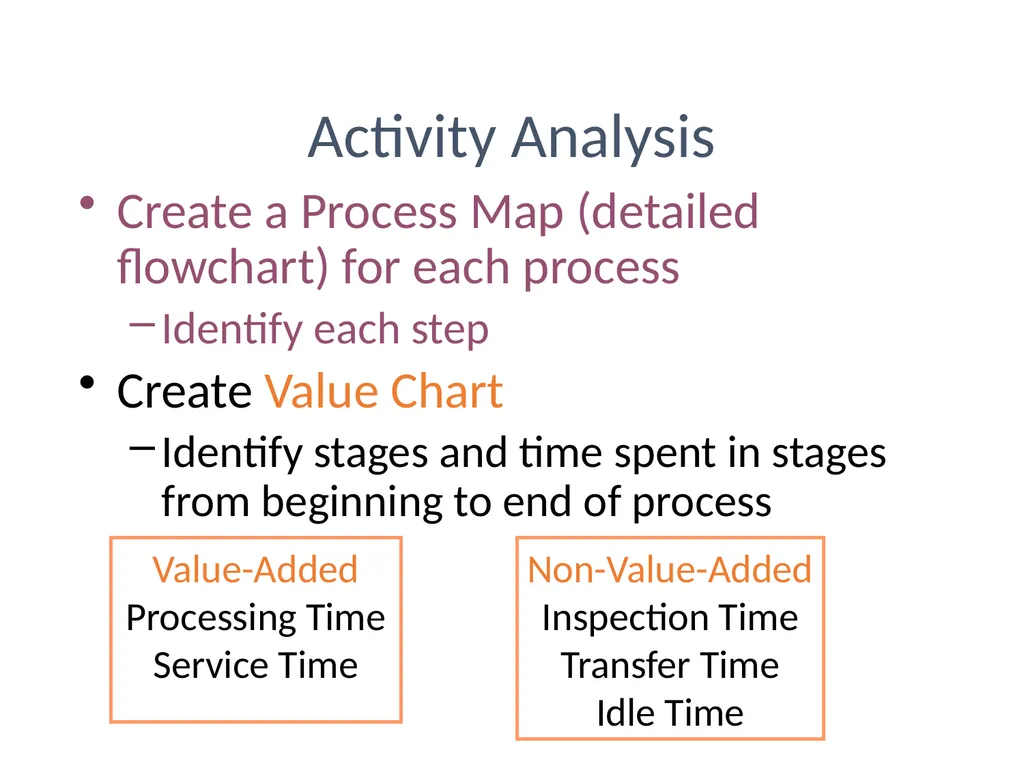
Activity Analysis Create a Process Map (detailed flowchart) for each process
Identify each step
Create Value Chart
Identify stages and time spent in stages from beginning to end of process Value-Added
Processing Time
Service Time Non-Value-Added
Inspection Time
Transfer Time
Idle Time<br>
Identify each step
Create Value Chart
Identify stages and time spent in stages from beginning to end of process Value-Added
Processing Time
Service Time Non-Value-Added
Inspection Time
Transfer Time
Idle Time<br>
30
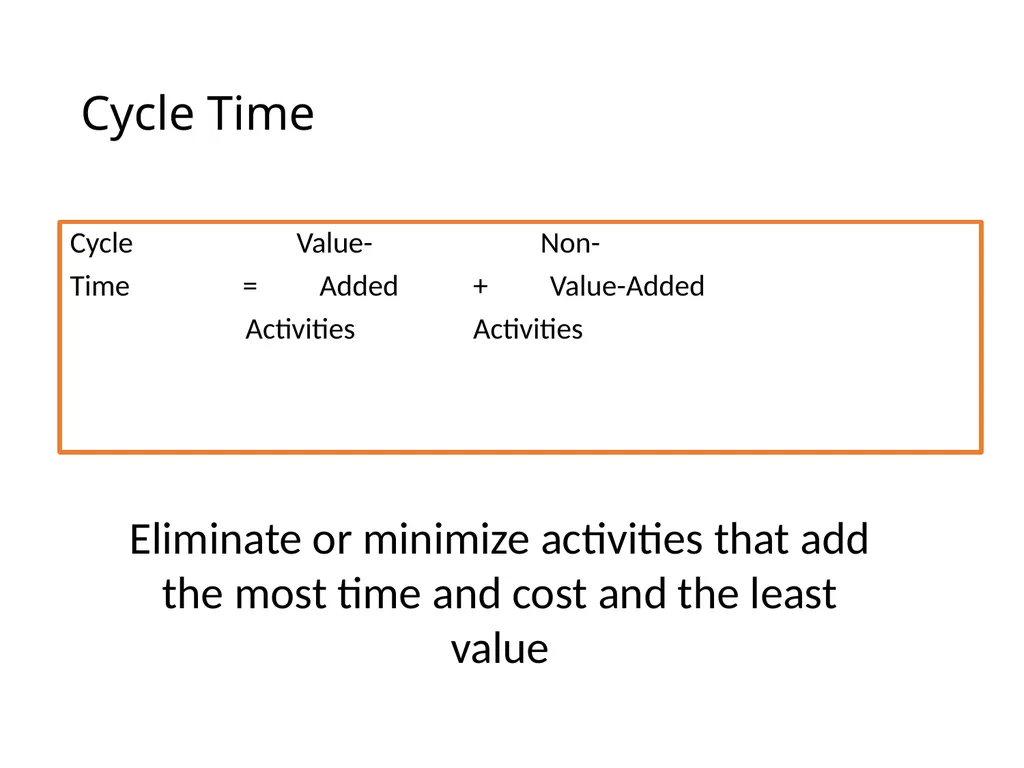
Cycle Time Cycle Value- Non-
Time = Added + Value-Added
Activities Activities Eliminate or minimize activities that add the most time and cost and the least value<br>
Time = Added + Value-Added
Activities Activities Eliminate or minimize activities that add the most time and cost and the least value<br>
31
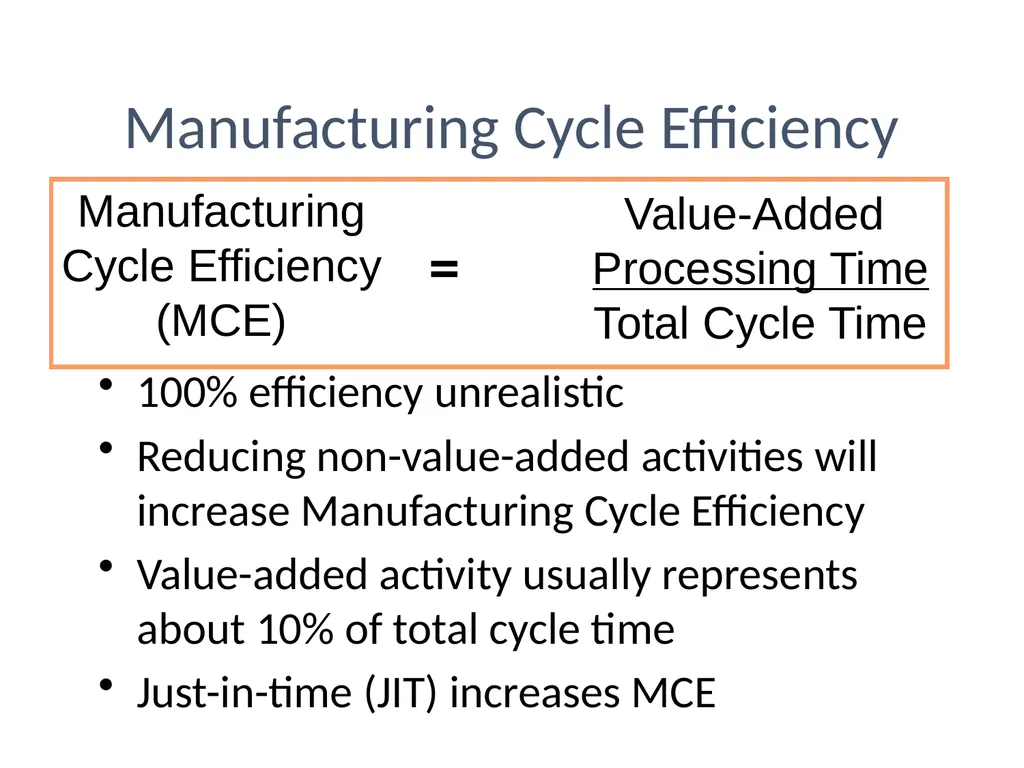
Manufacturing Cycle Efficiency 100% efficiency unrealistic
Reducing non-value-added activities will increase Manufacturing Cycle Efficiency
Value-added activity usually represents about 10% of total cycle time
Just-in-time (JIT) increases MCE<br>
Reducing non-value-added activities will increase Manufacturing Cycle Efficiency
Value-added activity usually represents about 10% of total cycle time
Just-in-time (JIT) increases MCE<br>
32
Non-Value-Added Activities Attributed to following factors
Systemic
Physical
Human
Eliminating or reducing non-value-added activities that create the most costs will
Increase product/service quality
Decrease cycle time and cost<br>
Systemic
Physical
Human
Eliminating or reducing non-value-added activities that create the most costs will
Increase product/service quality
Decrease cycle time and cost<br>
33
A Management Tool Combine
Activity analysis
What activities are non-value-added?
Cost driver analysis
What causes costs to be incurred?<br>
Activity analysis
What activities are non-value-added?
Cost driver analysis
What causes costs to be incurred?<br>
34
Current Research Issues in ABC and Cost Management Economics of modern production (and service)
Increased infrastructure costs
Cost behavior (e.g., “stickiness”)
Interorganizational (boundary of the firm) cost management: transaction costs, trust and intangible assets
Risk management: managing uncertainty and volatility of costs
Managerial Behavior
Cognitive bias and other behavioral influences on cost management decisions
Agency issues in cost management<br>
Increased infrastructure costs
Cost behavior (e.g., “stickiness”)
Interorganizational (boundary of the firm) cost management: transaction costs, trust and intangible assets
Risk management: managing uncertainty and volatility of costs
Managerial Behavior
Cognitive bias and other behavioral influences on cost management decisions
Agency issues in cost management<br>
35
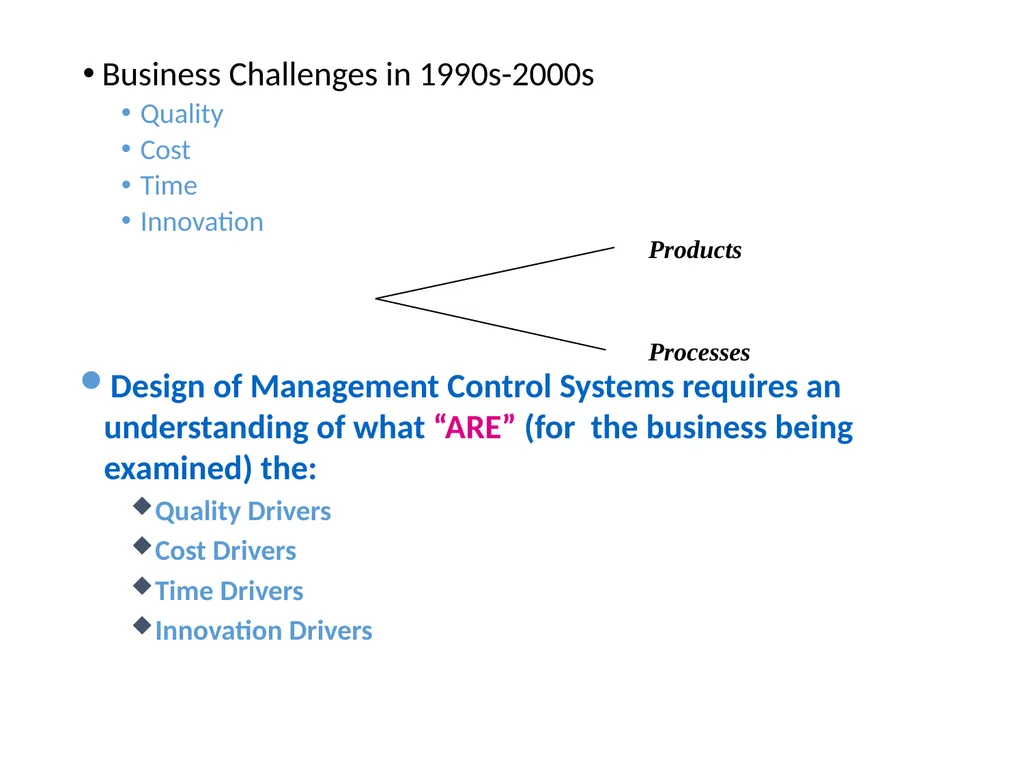
Business Challenges in 1990s-2000s
Quality
Cost
Time
Innovation Processes Products Design of Management Control Systems requires an understanding of what “ARE” (for the business being examined) the:
Quality Drivers
Cost Drivers
Time Drivers
Innovation Drivers<br>
Quality
Cost
Time
Innovation Processes Products Design of Management Control Systems requires an understanding of what “ARE” (for the business being examined) the:
Quality Drivers
Cost Drivers
Time Drivers
Innovation Drivers<br>
36
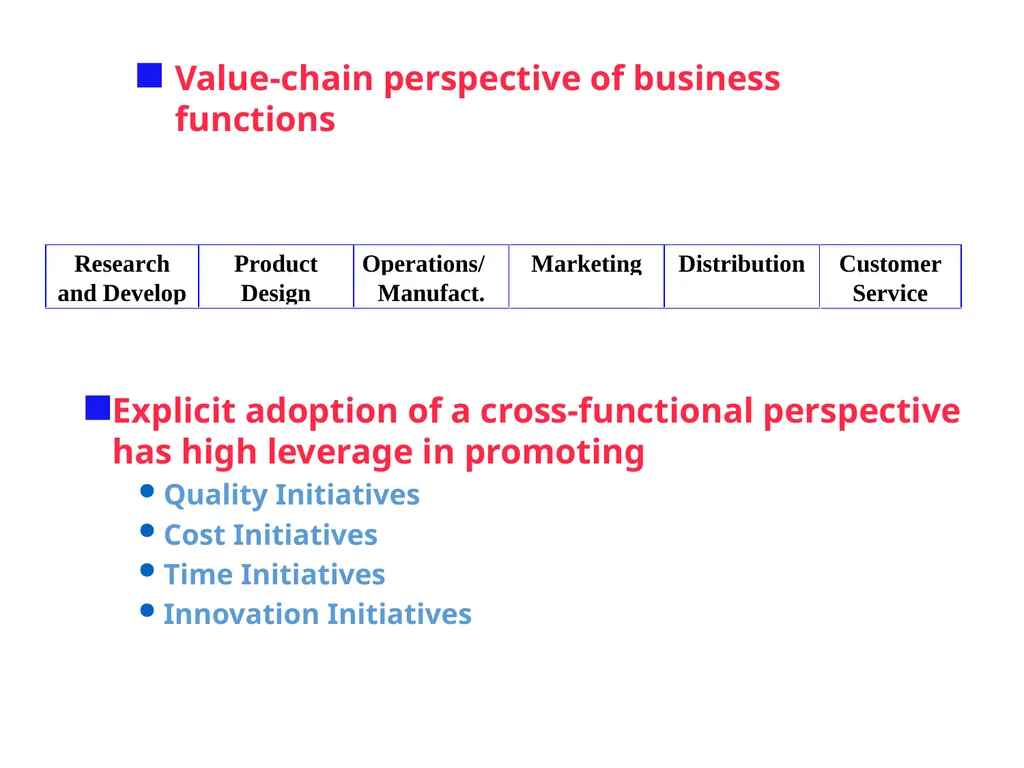
Value-chain perspective of business functions Explicit adoption of a cross-functional perspective has high leverage in promoting
Quality Initiatives
Cost Initiatives
Time Initiatives
Innovation Initiatives<br>
Quality Initiatives
Cost Initiatives
Time Initiatives
Innovation Initiatives<br>
37
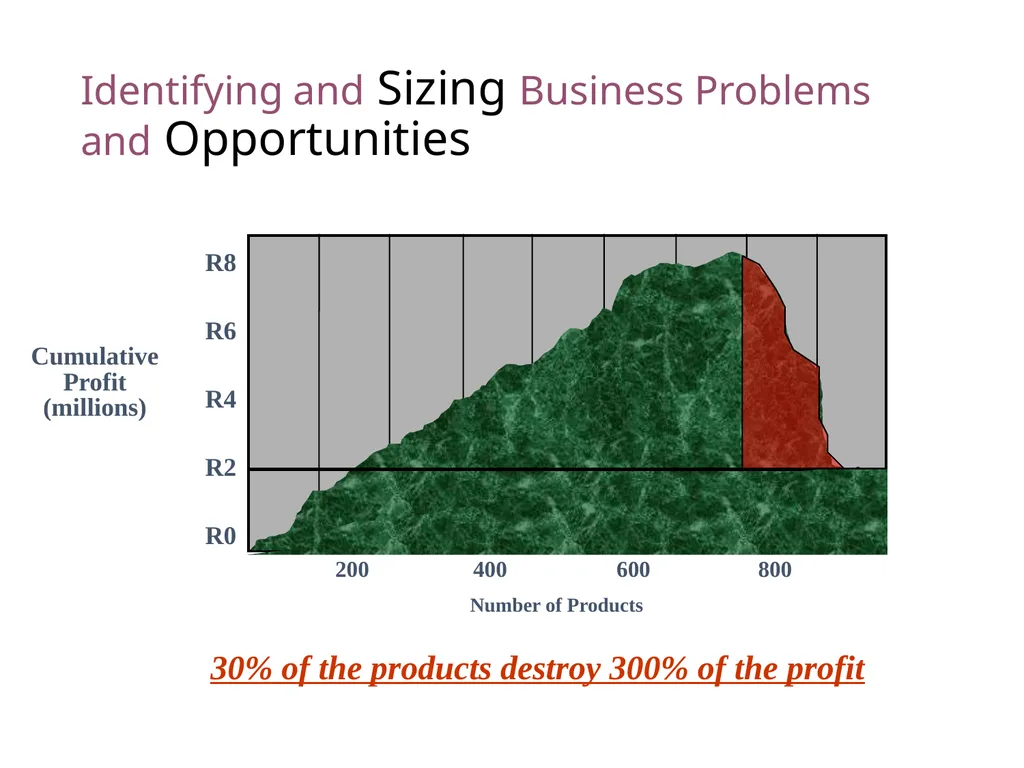
Net profit accumulated across multiple products 70% of the products generate 400% of the profit 30% of the products destroy 300% of the profit Identifying and Sizing Business Problems and Opportunities<br>
38
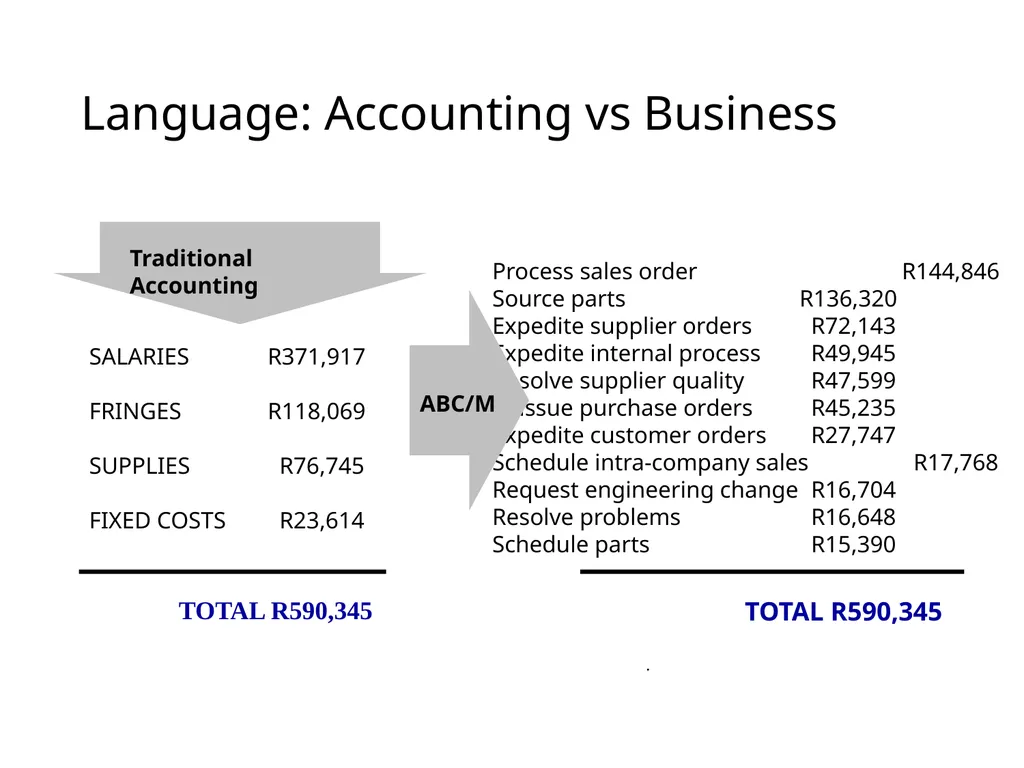
Language: Accounting vs Business .<br>
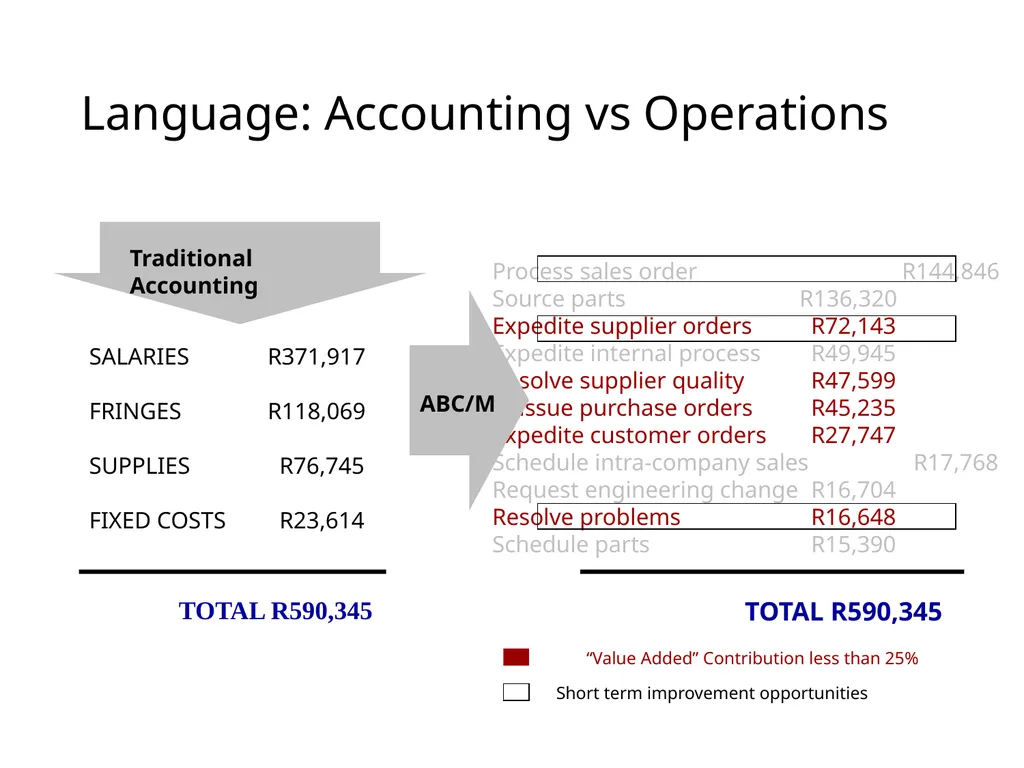
39
Language: Accounting vs Operations “Value Added” Contribution less than 25%<br>