
Acute liver failure Clinical Practice Guidelines
AS
Published · 57 slides · 0 views

1 / 1






Description
Acute liver failure Clinical Practice Guidelines About these slides These slides give a comprehensive overview of the EASL clinical practice guidelines on the management of acute (fulminant) liver failure The guidelines were published in
Related Topics
Share
Embed code
Download this presentation From Below
"Acute liver failure Clinical Practice Guidelines" is the property of its rightful owner. Permission is granted to download and print the materials on this website for personal, non-commercial use only, and to display it on your personal computer provided you do not modify the materials and that you retain all copyright notices contained in the materials. By downloading content from our website, you accept the terms of this agreement.
Presentation Transcript
01
Acute liver failure Clinical Practice Guidelines<br>
02
About these slides These slides give a comprehensive overview of the EASL clinical practice guidelines on the management of acute (fulminant) liver failure
The guidelines were published in full in the May 2017 issue of the Journal of Hepatology
The full publication can be downloaded from the Clinical Practice Guidelines section of the EASL website
Please cite the published article as: European Association for the Study of the Liver. EASL 2017 Clinical Practice Guidelines on the management of acute (fulminant) liver failure. J Hepatol 2017;66:1047–81
Please feel free to use, adapt, and share these slides for your own personal use; however, please acknowledge EASL as the source<br>
The guidelines were published in full in the May 2017 issue of the Journal of Hepatology
The full publication can be downloaded from the Clinical Practice Guidelines section of the EASL website
Please cite the published article as: European Association for the Study of the Liver. EASL 2017 Clinical Practice Guidelines on the management of acute (fulminant) liver failure. J Hepatol 2017;66:1047–81
Please feel free to use, adapt, and share these slides for your own personal use; however, please acknowledge EASL as the source<br>
03
About these slides Definitions of all abbreviations shown in these slides are provided within the slide notes
When you see a home symbol like this one: , you can click on this to return to the outline or topics pages, depending on which section you are in
Please send any feedback to: slidedeck_feedback@easloffice.eu These slides are intended for use as an educational resource and should not be used in isolation to make patient management decisions. All information included should be verified before treating patients or using any therapies described in these materials<br>
When you see a home symbol like this one: , you can click on this to return to the outline or topics pages, depending on which section you are in
Please send any feedback to: slidedeck_feedback@easloffice.eu These slides are intended for use as an educational resource and should not be used in isolation to make patient management decisions. All information included should be verified before treating patients or using any therapies described in these materials<br>
04
Chair
Julia Wendon
Panel members
Juan Cordoba, Anil Dhawan, Fin Stolze Larsen, Michael Manns, Frederik Nevens, Didier Samuel, Kenneth J Simpson, Ilan Yaron, Mauro Bernardi (EASL Governing Board Representative)
Reviewers
Ali Canbay, François Durand, Ludwig Kramer Guideline panel EASL CPG ALF. J Hepatol 2017;66:1047–81<br>
Julia Wendon
Panel members
Juan Cordoba, Anil Dhawan, Fin Stolze Larsen, Michael Manns, Frederik Nevens, Didier Samuel, Kenneth J Simpson, Ilan Yaron, Mauro Bernardi (EASL Governing Board Representative)
Reviewers
Ali Canbay, François Durand, Ludwig Kramer Guideline panel EASL CPG ALF. J Hepatol 2017;66:1047–81<br>
05
Outline EASL CPG ALF. J Hepatol 2017;66:1047–81 Disease burden
Principal aetiologies<br>
Principal aetiologies<br>
06
Methods Grading evidence and recommendations<br>
07
Grading evidence and recommendations 1. Guyatt GH, et al. BMJ. 2008:336:924–6;
EASL CPG ALF. J Hepatol 2017;66:1047–81 Grading is adapted from the GRADE system1<br>
08
Background Definition of ALF
Sub-classifications
Disease burden
Principal aetiologies<br>
Sub-classifications
Disease burden
Principal aetiologies<br>
09
Definition and clinical course of ALF *Patients with an acute presentation of chronic autoimmune hepatitis, Wilson disease and Budd–Chiari syndrome are considered as having ALF if they develop hepatic encephalopathy, despite the presence of a pre-existing liver disease in the context of appropriate abnormalities in liver blood tests and coagulation profile;
†Usually INR >1.5 or prolongation of PT
EASL CPG ALF. J Hepatol 2017;66:1047–81 In hepatological practice, ALF is a highly specific and rare syndrome, characterized by an acute deterioration of liver function without underlying chronic liver disease<br>
EASL CPG ALF. J Hepatol 2017;66:1047–81 In hepatological practice, ALF is a highly specific and rare syndrome, characterized by an acute deterioration of liver function without underlying chronic liver disease<br>
10
Sub-classifications of ALF 1. O'Grady JG, et al. Lancet 1993;342:2735; 2. Bernal W, et al. Lancet 2010;376:190201;
EASL CPG ALF. J Hepatol 2017;66:1047–81 Weeks from development of jaundice to development of HE1 +++ High severity; ++ Medium severity; + Low severity; +/- Present or absent<br>
EASL CPG ALF. J Hepatol 2017;66:1047–81 Weeks from development of jaundice to development of HE1 +++ High severity; ++ Medium severity; + Low severity; +/- Present or absent<br>
11
Burden of ALF in Europe EASL CPG ALF. J Hepatol 2017;66:1047–81 Rare syndrome whose true prevalence across Europe is unknown
Incidence of virally induced ALF has declined substantially in Europe
Remains the most common cause worldwide
Most frequent aetiology of ALF in Europe is now drug-induced liver injury (DILI)<br>
Incidence of virally induced ALF has declined substantially in Europe
Remains the most common cause worldwide
Most frequent aetiology of ALF in Europe is now drug-induced liver injury (DILI)<br>
12
Principal aetiologies of ALF EASL CPG ALF. J Hepatol 2017;66:1047–81<br>
13
Aetiology of ALF varies with geography *’Other causes’ refers to identified causes that are not: HAV, HBV, HEV, paracetamol or other drugs
Bernal W, Wendon J. New Eng J Med 2013;369:252534 Top three causes of ALF in selected countries<br>
Bernal W, Wendon J. New Eng J Med 2013;369:252534 Top three causes of ALF in selected countries<br>
14
Guidelines Key recommendations<br>
15
Topics EASL CPG ALF. J Hepatol 2017;66:1047–81 Assessment and management at presentation
Organ-specific management
Cardiovascular
Respiratory
Gastrointestinal
Metabolic
Acute kidney injury and renal replacement therapy
Coagulation
Sepsis, inflammation and anti-inflammatory
The brain in ALF
Artificial and bioartificial liver devices
Liver transplantation
Paediatric ALF Click on a topic to skip to that section<br>
Organ-specific management
Cardiovascular
Respiratory
Gastrointestinal
Metabolic
Acute kidney injury and renal replacement therapy
Coagulation
Sepsis, inflammation and anti-inflammatory
The brain in ALF
Artificial and bioartificial liver devices
Liver transplantation
Paediatric ALF Click on a topic to skip to that section<br>
16
Assessment and management at presentation EASL CPG ALF. J Hepatol 2017;66:1047–81 Immediate measures
Exclude cirrhosis, alcohol-induced liver injury or malignant infiltration
Initiate early discussions with tertiary liver/transplant centre
Even if not immediately relevant
Screen intensively for hepatic encephalopathy
Determine aetiology
To guide treatment and determine prognosis
Assess suitability for liver transplant
Contraindications should not preclude transfer to tertiary liver/transplant centre
Transfer to a specialized unit early
If the patient has an INR >1.5 and onset of hepatic encephalopathy or other poor prognostic features<br>
Exclude cirrhosis, alcohol-induced liver injury or malignant infiltration
Initiate early discussions with tertiary liver/transplant centre
Even if not immediately relevant
Screen intensively for hepatic encephalopathy
Determine aetiology
To guide treatment and determine prognosis
Assess suitability for liver transplant
Contraindications should not preclude transfer to tertiary liver/transplant centre
Transfer to a specialized unit early
If the patient has an INR >1.5 and onset of hepatic encephalopathy or other poor prognostic features<br>
17
Assessment and management at presentation *Should be performed preferably by a transjugular route, in an experienced centre, with access to a histopathologist with liver experience
EASL CPG ALF. J Hepatol 2017;66:1047–81 Immediate measures
Exclude cirrhosis, alcohol-induced liver injury or malignant infiltration
Initiate early discussions with tertiary liver/transplant centre
Even if not immediately relevant<br>
EASL CPG ALF. J Hepatol 2017;66:1047–81 Immediate measures
Exclude cirrhosis, alcohol-induced liver injury or malignant infiltration
Initiate early discussions with tertiary liver/transplant centre
Even if not immediately relevant<br>
18
Assessment and management at presentation EASL CPG ALF. J Hepatol 2017;66:1047–81 Immediate measures
Determine aetiology to guide treatment, especially LTx Primary or secondary causes of ALF and need for transplantation No indication for emergency LTx Possible indication for emergency LTx<br>
Determine aetiology to guide treatment, especially LTx Primary or secondary causes of ALF and need for transplantation No indication for emergency LTx Possible indication for emergency LTx<br>
19
Differential diagnosis based on clinical features EASL CPG ALF. J Hepatol 2017;66:1047–81 No indication for emergency LTx Possible indication for emergency LTx<br>
20
Aetiologies with no indication for LTx EASL CPG ALF. J Hepatol 2017;66:1047–81 Malignant infiltration of the liver and acute ischaemic injury are not indications for LTx<br>
21
Aetiologies with possible indication for LTx EASL CPG ALF. J Hepatol 2017;66:1047–81 Drug-induced liver injury is the most frequent cause of severe ALI and ALF
Especially paracetamol overdose<br>
Especially paracetamol overdose<br>
22
Aetiologies with possible indication for LTx EASL CPG ALF. J Hepatol 2017;66:1047–81 Viral and autoimmune ALF
HBV (most common), HAV, HEV, and VZV, HSV-1 and -2 (rare) can cause ALF
Existence of other autoimmune conditions should raise suspicion of autoimmune hepatitis<br>
HBV (most common), HAV, HEV, and VZV, HSV-1 and -2 (rare) can cause ALF
Existence of other autoimmune conditions should raise suspicion of autoimmune hepatitis<br>
23
Aetiologies with possible indication for LTx EASL CPG ALF. J Hepatol 2017;66:1047–81 Uncommon aetiologies
In most cases a potential positive effect of specific intervention will be too late to be beneficial
Consideration for emergency LTx should not be delayed<br>
In most cases a potential positive effect of specific intervention will be too late to be beneficial
Consideration for emergency LTx should not be delayed<br>
24
General support outside ICU: anamnesis *Based on the individual case; †Specialist input required
EASL CPG ALF. J Hepatol 2017;66:1047–81 Questions for patients and relatives at admission<br>
EASL CPG ALF. J Hepatol 2017;66:1047–81 Questions for patients and relatives at admission<br>
25
General support outside ICU *Including LDH, conjugated and unconjugated bilirubin and creatinine kinase;
†Low urea is a marker of severe liver dysfunction;
‡ANAs, ASMA, anti-soluble liver antigen, globulin profile, ANCAs, HLA typing
EASL CPG ALF. J Hepatol 2017;66:1047–81<br>
†Low urea is a marker of severe liver dysfunction;
‡ANAs, ASMA, anti-soluble liver antigen, globulin profile, ANCAs, HLA typing
EASL CPG ALF. J Hepatol 2017;66:1047–81<br>
26
General support outside ICU *Glycaemic target ± 140 mg/dl, Na 135–145 mmol/l;
EASL CPG ALF. J Hepatol 2017;66:1047–81 In case of HE
Transfer to an appropriate level of care (ideally critical care) at the first symptoms of mental alterations
Quiet surrounding, head of bed >30°C, head in neutral position and intubate, ventilate, and sedate if progression to >3 coma
Low threshold for empirical start of antibiotics if haemodynamic deterioration and/or increasing encephalopathy with inflammatory phenotype
In case of evolving HE, intubation and sedation prior to the transfer
Ensure volume replete and normalize biochemical variables (Na, Mg, PO4, K)<br>
EASL CPG ALF. J Hepatol 2017;66:1047–81 In case of HE
Transfer to an appropriate level of care (ideally critical care) at the first symptoms of mental alterations
Quiet surrounding, head of bed >30°C, head in neutral position and intubate, ventilate, and sedate if progression to >3 coma
Low threshold for empirical start of antibiotics if haemodynamic deterioration and/or increasing encephalopathy with inflammatory phenotype
In case of evolving HE, intubation and sedation prior to the transfer
Ensure volume replete and normalize biochemical variables (Na, Mg, PO4, K)<br>
27
Assessment and management at presentation EASL CPG ALF. J Hepatol 2017;66:1047–81 Immediate measures
Assess suitability for liver transplant and initiate early discussions with transplant unit
Even if not immediately relevant Suggested criteria for referral of cases of ALF to specialist units<br>
Assess suitability for liver transplant and initiate early discussions with transplant unit
Even if not immediately relevant Suggested criteria for referral of cases of ALF to specialist units<br>
28
Assessment and management at presentation EASL CPG ALF. J Hepatol 2017;66:1047–81 Immediate measures
Transfer to a specialized unit early
Evolution of ALF is highly unpredictable
Experience of specialized units is required to improve patient outcomes<br>
Transfer to a specialized unit early
Evolution of ALF is highly unpredictable
Experience of specialized units is required to improve patient outcomes<br>
29
Organ-specific management EASL CPG ALF. J Hepatol 2017;66:1047–81 Main organ-specific complications in ALF Coagulation/haemostasis Unbalanced haemostasis
Thrombocytopenia Infection Bacterial, fungal
Pneumopathy
Septicaemia
Urinary infection Haemodynamic Hyperkinetic syndrome
Arrhythmia Neurological = cerebral oedema Acute liver failure Pulmonary Pneumopathy
Acute respiratory distress syndrome
Pulmonary overload Cranial hypertension Brain death Metabolic Hypoglycaemia
Hyponatraemia
Hypophosphataemia
Hypokalaemia Renal Toxic
Functional<br>
Thrombocytopenia Infection Bacterial, fungal
Pneumopathy
Septicaemia
Urinary infection Haemodynamic Hyperkinetic syndrome
Arrhythmia Neurological = cerebral oedema Acute liver failure Pulmonary Pneumopathy
Acute respiratory distress syndrome
Pulmonary overload Cranial hypertension Brain death Metabolic Hypoglycaemia
Hyponatraemia
Hypophosphataemia
Hypokalaemia Renal Toxic
Functional<br>
30
Organ-specific management: cardiovascular EASL CPG ALF. J Hepatol 2017;66:1047–81 Most patients presenting with ALF or severe ALI develop systemic vasodilation with reduced effective central blood volume<br>
31
Organ-specific management: respiratory EASL CPG ALF. J Hepatol 2017;66:1047–81 Invasive airway management is required in the face of progression to high-grade HE to ensure airway protection<br>
32
Organ-specific management: gastrointestinal EASL CPG ALF. J Hepatol 2017;66:1047–81 Guidance regarding nutritional needs in patients with ALF is largely empirical
Oral nutrition should be encouraged in patients with ALI
Progressive HE or anorexia is likely to result in decreased calorie intake<br>
Oral nutrition should be encouraged in patients with ALI
Progressive HE or anorexia is likely to result in decreased calorie intake<br>
33
Organ-specific management: metabolic EASL CPG ALF. J Hepatol 2017;66:1047–81 ALF is frequently associated with electrolyte and metabolic imbalance
Hypoglycaemia and hyponatraemia
Acidosis
Alterations in serum phosphate, magnesium, ionised calcium and potassium<br>
Hypoglycaemia and hyponatraemia
Acidosis
Alterations in serum phosphate, magnesium, ionised calcium and potassium<br>
34
AKI and renal replacement therapy EASL CPG ALF. J Hepatol 2017;66:1047–81 4080% of ALF patients referred to liver units have AKI
Associated with increased mortality and longer hospital stays
Increased age, paracetamol-induced ALI, SIRS, hypotension, and infection increase risk<br>
Associated with increased mortality and longer hospital stays
Increased age, paracetamol-induced ALI, SIRS, hypotension, and infection increase risk<br>
35
Rapid changes in PT or INR are characteristic of ALF
Significant prognostic value
Common in ALF
Thrombocytopenia
Reduced circulating pro- and anti-coagulant proteins
Increased PAI-1
Abnormal coagulation does not translate to increased risk of bleeding
Most patients’ coagulation is normal despite abnormal INR and PT Coagulation: monitoring and management 1. Agarwal B, et al. J Hepatol 2012;57:780–6; EASL CPG ALF. J Hepatol 2017;66:1047–81<br>
Significant prognostic value
Common in ALF
Thrombocytopenia
Reduced circulating pro- and anti-coagulant proteins
Increased PAI-1
Abnormal coagulation does not translate to increased risk of bleeding
Most patients’ coagulation is normal despite abnormal INR and PT Coagulation: monitoring and management 1. Agarwal B, et al. J Hepatol 2012;57:780–6; EASL CPG ALF. J Hepatol 2017;66:1047–81<br>
36
Coagulation: monitoring and management EASL CPG ALF. J Hepatol 2017;66:1047–81 Prophylactic correction of coagulation or platelet levels is not necessary
May instead adversely affect prognosis
May increase the risk of thrombosis or transfusion-related acute lung injury<br>
May instead adversely affect prognosis
May increase the risk of thrombosis or transfusion-related acute lung injury<br>
37
Sepsis, inflammation and anti-inflammatory management *Guided by the use of biomarkers
EASL CPG ALF. J Hepatol 2017;66:1047–81 Patients with ALF are at increased risk of developing infections, sepsis and septic shock
Severe, untreated infection may preclude LTx and complicate the post-operative course
ALF is associated with dynamic immune dysfunction
Imbalance can contribute to organ failure and death<br>
EASL CPG ALF. J Hepatol 2017;66:1047–81 Patients with ALF are at increased risk of developing infections, sepsis and septic shock
Severe, untreated infection may preclude LTx and complicate the post-operative course
ALF is associated with dynamic immune dysfunction
Imbalance can contribute to organ failure and death<br>
38
The brain in ALF: hepatic encephalopathy EASL CPG ALF. J Hepatol 2017;66:1047–81 HE tends to fluctuate
May progress from a trivial lack of awareness to deep coma
Multiple additional manifestations
Headache, vomiting, asterixis, agitation, hyperreflexia and clonus
Clinical diagnosis is one of exclusion
Course dictated by outcome and phenotype of liver failure
Usually parallels evolution of liver function parameters
Neurological outcomes may be worse in some circumstances
Coexistence of infection
Presence of inflammation without sepsis
Other organ failure<br>
May progress from a trivial lack of awareness to deep coma
Multiple additional manifestations
Headache, vomiting, asterixis, agitation, hyperreflexia and clonus
Clinical diagnosis is one of exclusion
Course dictated by outcome and phenotype of liver failure
Usually parallels evolution of liver function parameters
Neurological outcomes may be worse in some circumstances
Coexistence of infection
Presence of inflammation without sepsis
Other organ failure<br>
39
The brain in ALF: management of HE *Grade 3 coma in this context is not defined by asterixis (hepatic flap) but by the development of marked agitation and frequent aggression with a decrease in GCS (usually E1–2, V 3–4 and M4); †Grade 4 coma is associated with marked reduction in GCS (E1, V 1–2 and M1–3); ‡This may protect from ICH and reduce the risk of seizures;
§e.g. levetiracetam or lacosamide (prophylactic use of antiepileptic drugs is not warranted)
EASL CPG ALF. J Hepatol 2017;66:1047–81 Regular clinical and neurological examination to monitor progression in a quiet environment
On progression to Grade 3 HE:*
Intubate and provide mechanical ventilation to protect the airway, prevent aspiration and provide safer respiratory care
On progression to Grade 4 HE:†
Minimize risk of pulmonary barotraumas
Target PaCO2 between 4.5–5.5 kPa (34–42 mmHg) and use propofol as a sedative agent‡
Add a short-acting opiate for adequate analgesia
In case of concern of seizure activity:
Monitor EEG
Administer antiepileptic drugs with low risk of hepatotoxicity§<br>
EASL CPG ALF. J Hepatol 2017;66:1047–81 Regular clinical and neurological examination to monitor progression in a quiet environment
On progression to Grade 3 HE:*
Intubate and provide mechanical ventilation to protect the airway, prevent aspiration and provide safer respiratory care
On progression to Grade 4 HE:†
Minimize risk of pulmonary barotraumas
Target PaCO2 between 4.5–5.5 kPa (34–42 mmHg) and use propofol as a sedative agent‡
Add a short-acting opiate for adequate analgesia
In case of concern of seizure activity:
Monitor EEG
Administer antiepileptic drugs with low risk of hepatotoxicity§<br>
40
Brain oedema-induced ICH is a classic complication of HE in ALF
Incidence of ICH has decreased recently1
Improvements in preventative medical care
Use of emergency LTx in high-risk patients2
Still may affect one-third of cases who progress to Grade 3 or 4 HE
Risk of ICH is highest in patients with:
Hyperacute or acute phenotype
Younger age
Renal impairment
Need for inotropic support
Persistent elevation of arterial ammonia The brain in ALF: intracranial hypertension *Proportion of 1,549 patients with ALF developing clinical signs of ICH. Error bars are 95% CI; p<0.00001 1. Bernal W, et al. J Hepatol 2013;59:74–80; 2. Bernal W, et al. J Hepatol 2015;62(1 Suppl):S112–20;
EASL CPG ALF. J Hepatol 2017;66:1047–81<br>
Incidence of ICH has decreased recently1
Improvements in preventative medical care
Use of emergency LTx in high-risk patients2
Still may affect one-third of cases who progress to Grade 3 or 4 HE
Risk of ICH is highest in patients with:
Hyperacute or acute phenotype
Younger age
Renal impairment
Need for inotropic support
Persistent elevation of arterial ammonia The brain in ALF: intracranial hypertension *Proportion of 1,549 patients with ALF developing clinical signs of ICH. Error bars are 95% CI; p<0.00001 1. Bernal W, et al. J Hepatol 2013;59:74–80; 2. Bernal W, et al. J Hepatol 2015;62(1 Suppl):S112–20;
EASL CPG ALF. J Hepatol 2017;66:1047–81<br>
41
The brain in ALF EASL CPG ALF. J Hepatol 2017;66:1047–81 Regular clinical and neurological examination is mandatory
Detection of early signs of HE and progression to high-grade HE is critical<br>
Detection of early signs of HE and progression to high-grade HE is critical<br>
42
The brain in ALF EASL CPG ALF. J Hepatol 2017;66:1047–81 Additional monitoring is required in some patients<br>
43
Artificial and bioartificial liver devices *HVP defined as exchange of 8–12 or 15% of ideal body weight with fresh frozen plasma, for 3 days was superior to SMT regarding transplant-free and overall hospital survival
Larsen FS, et al. J Hepatol. 2016;64:69–78; EASL CPG ALF. J Hepatol 2017;66:1047–81 Liver-assist devices are intended to provide a ‘bridge’ to LTx or recovery of liver function, reducing the need for transplant
Experience with ‘liver support devices’ to date has been disappointing
High-volume plasma exchange improved outcome in an RCT in ALF*<br>
Larsen FS, et al. J Hepatol. 2016;64:69–78; EASL CPG ALF. J Hepatol 2017;66:1047–81 Liver-assist devices are intended to provide a ‘bridge’ to LTx or recovery of liver function, reducing the need for transplant
Experience with ‘liver support devices’ to date has been disappointing
High-volume plasma exchange improved outcome in an RCT in ALF*<br>
44
LTx has been the most significant development in the treatment of ALF in 40 years and has transformed survival
1-year survival following emergency LTx for ALF is now around 80%
Selection for LTx depends on:
Accurate prediction of survival without transplant
Consideration of the survival potential after LTx
Consideration of whether a patient is too sick to transplant Impact of liver transplantation in ALF 1.Germani G, et al. J Hepatol 2012;57:288–96; EASL CPG ALF. J Hepatol 2017;66:1047–81 Patient survival after liver transplantation for ALF, Europe 1988–20091 p<0.001 for survival 2004–2009 vs. previous time periods<br>
1-year survival following emergency LTx for ALF is now around 80%
Selection for LTx depends on:
Accurate prediction of survival without transplant
Consideration of the survival potential after LTx
Consideration of whether a patient is too sick to transplant Impact of liver transplantation in ALF 1.Germani G, et al. J Hepatol 2012;57:288–96; EASL CPG ALF. J Hepatol 2017;66:1047–81 Patient survival after liver transplantation for ALF, Europe 1988–20091 p<0.001 for survival 2004–2009 vs. previous time periods<br>
45
ALF poor prognosis criteria in use for selection of candidates for liver transplantation *Bilirubin not included in paracetamol criteria
EASL CPG ALF. J Hepatol 2017;66:1047–81 A variety of prognostic evaluation systems are used to select candidates for transplantation
Common prognostic criteria:
Patient age
Presence of HE
Liver injury severity (magnitude of coagulopathy or jaundice)
In general, falling aminotransferases, increasing bilirubin and INR, and shrinking liver are poor prognostic signs
Should result in considering transfer of patient to a transplant centre<br>
Common prognostic criteria:
Patient age
Presence of HE
Liver injury severity (magnitude of coagulopathy or jaundice)
In general, falling aminotransferases, increasing bilirubin and INR, and shrinking liver are poor prognostic signs
Should result in considering transfer of patient to a transplant centre<br>
46
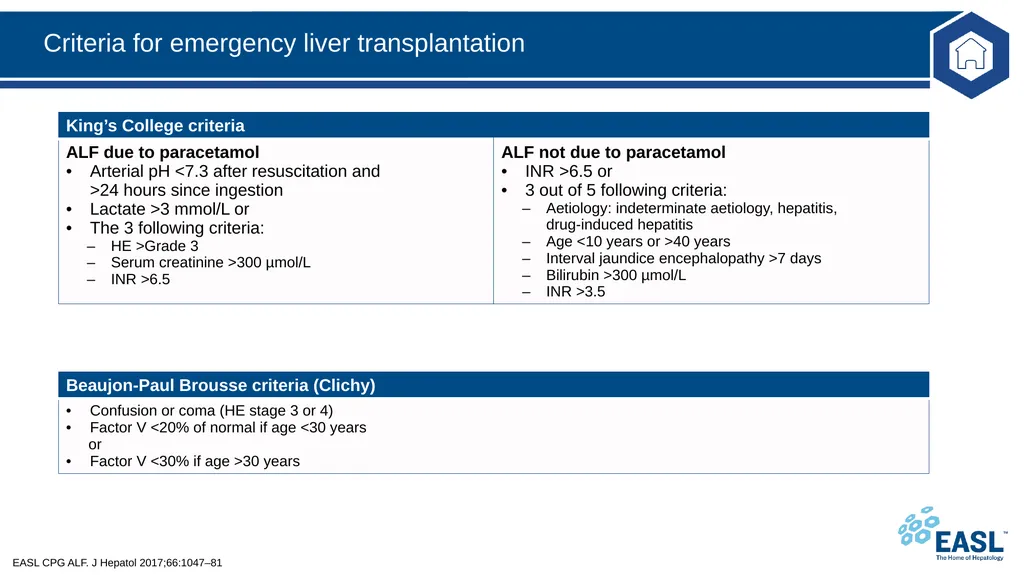
Criteria for emergency liver transplantation EASL CPG ALF. J Hepatol 2017;66:1047–81<br>
47
Comparison of traditional criteria for emergency liver transplantation compared with new alternatives *Gc-globulin is a multifunctional protein involved in the scavenging of actin released from necrotic cells1
1. Schiodt FV et al. Liver Transpl 2005;11:1223–7; EASL CPG ALF. J Hepatol 2017;66:1047–81 Many new marker studies report better diagnostic performance than existing criteria
Often small in size, have limited methodological quality and are seldom internally or externally validated
Few (if any) have been adopted internationally and cannot be recommended for routine use<br>
1. Schiodt FV et al. Liver Transpl 2005;11:1223–7; EASL CPG ALF. J Hepatol 2017;66:1047–81 Many new marker studies report better diagnostic performance than existing criteria
Often small in size, have limited methodological quality and are seldom internally or externally validated
Few (if any) have been adopted internationally and cannot be recommended for routine use<br>
48
Liver transplantation EASL CPG ALF. J Hepatol 2017;66:1047–81 Evaluation of patient prognosis is key at the earliest opportunity<br>
49
Liver transplantation EASL CPG ALF. J Hepatol 2017;66:1047–81 Evaluation of patient prognosis is key at the earliest opportunity<br>
50
Paediatric ALF EASL CPG ALF. J Hepatol 2017;66:1047–81<br>
51
Most common aetiologies of ALF in children<br>
52
Most common aetiologies of ALF in children Dhawan A. Liver Transpl. 2008;14 Suppl 2:S80-4. 331 patients with acute liver failure, data from the USA and Canada
(PALFSG data set)<br>
53
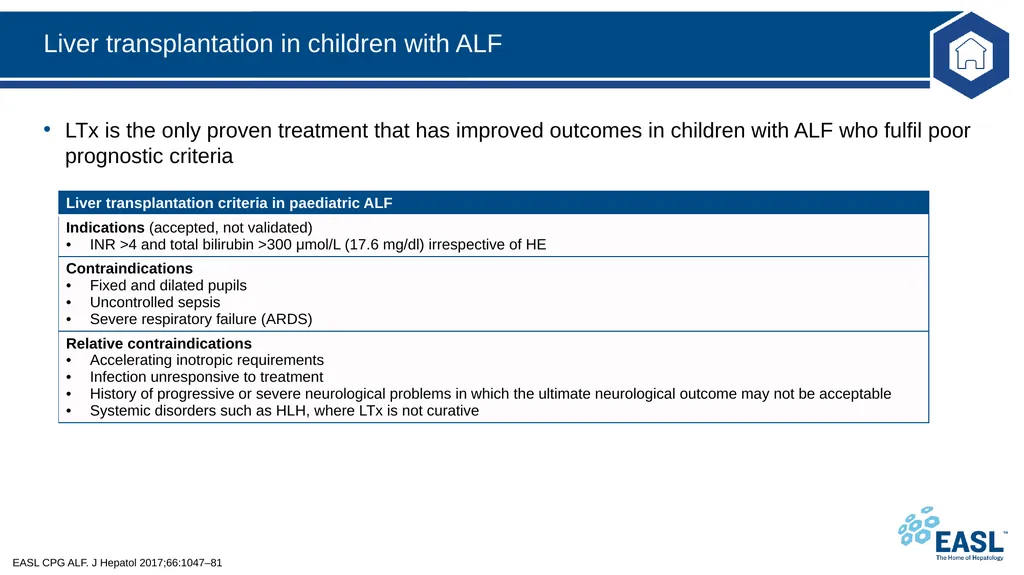
Liver transplantation in children with ALF EASL CPG ALF. J Hepatol 2017;66:1047–81 LTx is the only proven treatment that has improved outcomes in children with ALF who fulfil poor prognostic criteria<br>
54
The future for ALF Considerations for future studies<br>
55
Burden, definition, assessment, and management EASL CPG ALF. J Hepatol 2017;66:1047–81<br>
56
Organ-specific management EASL CPG ALF. J Hepatol 2017;66:1047–81<br>
57
Artificial and bioartificial liver devices
Well-designed RCTs of new liver support systems in well-defined patient cohorts
Development of dynamic measures of liver function to assess metabolic and synthetic capacity
Antimicrobial clearance and dosing when utilizing various liver support systems such as PE Liver transplantation and artificial liver devices EASL CPG ALF. J Hepatol 2017;66:1047–81 Liver transplantation
Prospective studies of high methodological quality and sufficient size, enrolling from multiple centres, to assess the current natural history of ALF
Avoid the assumption that transplantation equals non-survival for prognostic modelling purposes
Definition and validation of contraindications to transplant in patients with ALF
Definition and validation of futility of LTx in patients with ALF
Clarification of the role of auxiliary LTx in patients with ALF
Definition of long-term outcomes including quality of life in both transplant recipients and spontaneous survivors
Biomarkers of regenerative capacity Considerations for future studies<br>
Well-designed RCTs of new liver support systems in well-defined patient cohorts
Development of dynamic measures of liver function to assess metabolic and synthetic capacity
Antimicrobial clearance and dosing when utilizing various liver support systems such as PE Liver transplantation and artificial liver devices EASL CPG ALF. J Hepatol 2017;66:1047–81 Liver transplantation
Prospective studies of high methodological quality and sufficient size, enrolling from multiple centres, to assess the current natural history of ALF
Avoid the assumption that transplantation equals non-survival for prognostic modelling purposes
Definition and validation of contraindications to transplant in patients with ALF
Definition and validation of futility of LTx in patients with ALF
Clarification of the role of auxiliary LTx in patients with ALF
Definition of long-term outcomes including quality of life in both transplant recipients and spontaneous survivors
Biomarkers of regenerative capacity Considerations for future studies<br>