Adaptation in the 2015 Agreement Operationalising the Global Goal for Adaptation Xolisa Ngwadla Council for Scientific and Industrial Research (CSIR), South Africa european capacity building initiative initiative européenne de renforcement
"Adaptation in the 2015 Agreement Operationalising" is the property of its rightful owner. Permission is granted to
download and print the materials on this website for personal, non-commercial use only, and to display it
on your personal computer provided you do not modify the materials and that you retain all copyright
notices contained in the materials. By downloading content from our website, you accept the terms of this
agreement.
Presentation Transcript
01
Adaptation in the 2015 Agreement
Operationalising the Global Goal for Adaptation
Xolisa Ngwadla
Council for Scientific and Industrial Research (CSIR), South Africa european capacity building initiative
initiative européenne de renforcement des capacités ecbi for sustained capacity building in support of international climate change negotiations
pour un renforcement durable des capacités en appui aux négociations internationales sur les changements climatiques<br>
02
GGA: context The global goal for adaptation operationalise the view by AMCEN and CAHOSCC that adaptation is priority for Africa and should receive equal treatment as mitigation, and be at the centre of the Agreement
The legal basis is the objective of the Convention (Art 2), and commitments (Art 4), and builds on previous decisions under the CoP, particularly 1/CP.16
It provides for a further elaboration and codification of adaptation in the post 2020 period, by defining
projected impacts and costs,
planning and implementation,
adaptation support,
intl. cooperation, and
assessment for adequacy<br>
03
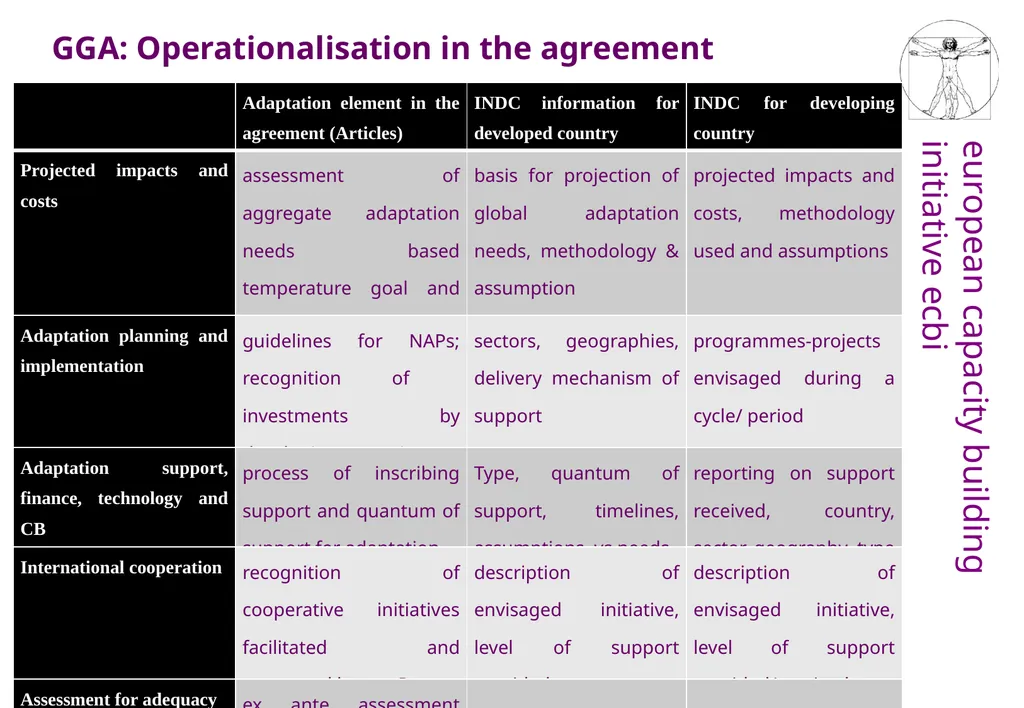
GGA: Operationalisation in the agreement<br>
04
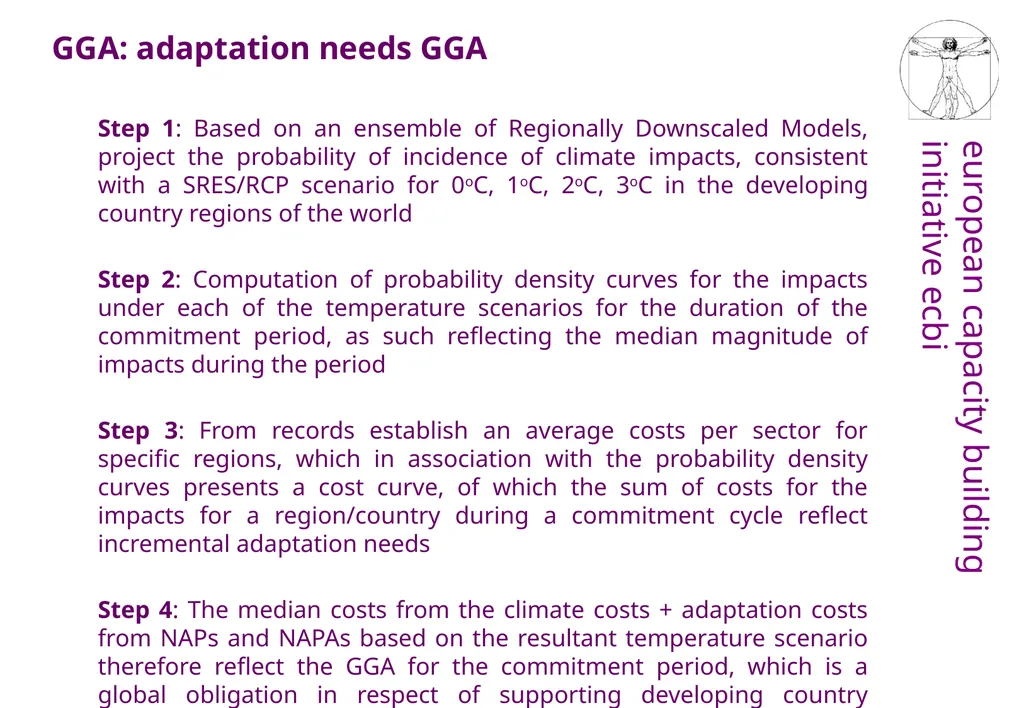
Step 1: Based on an ensemble of Regionally Downscaled Models, project the probability of incidence of climate impacts, consistent with a SRES/RCP scenario for 0oC, 1oC, 2oC, 3oC in the developing country regions of the world
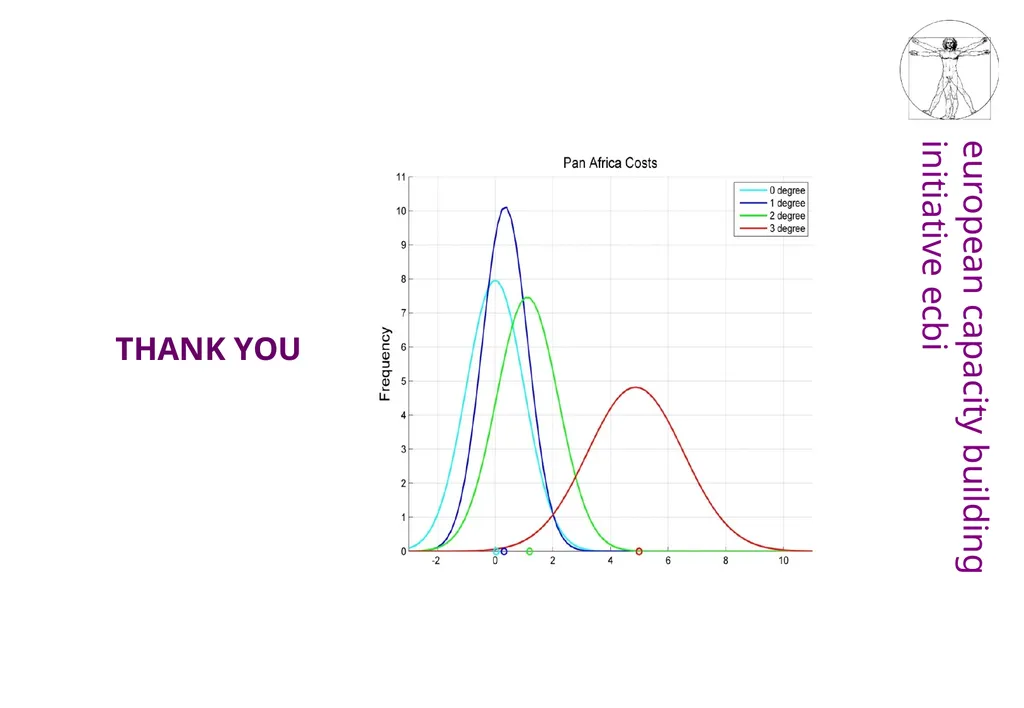
Step 2: Computation of probability density curves for the impacts under each of the temperature scenarios for the duration of the commitment period, as such reflecting the median magnitude of impacts during the period
Step 3: From records establish an average costs per sector for specific regions, which in association with the probability density curves presents a cost curve, of which the sum of costs for the impacts for a region/country during a commitment cycle reflect incremental adaptation needs
Step 4: The median costs from the climate costs + adaptation costs from NAPs and NAPAs based on the resultant temperature scenario therefore reflect the GGA for the commitment period, which is a global obligation in respect of supporting developing country adaptation action GGA: adaptation needs GGA<br>