Adapting Peer Navigation for Older People with HIV in Ukraine 19 July 2023 Sheela Shenoi MD MPH Julia Rozanova PhD AIDS Program, Yale School of Medicine Disclosure: My spouse worked for Merck until 2007 and retains company stock in his
"Adapting Peer Navigation for Older People with HIV" is the property of its rightful owner. Permission is granted to
download and print the materials on this website for personal, non-commercial use only, and to display it
on your personal computer provided you do not modify the materials and that you retain all copyright
notices contained in the materials. By downloading content from our website, you accept the terms of this
agreement.
Presentation Transcript
01
Adapting Peer Navigation for Older People with HIV in Ukraine 19 July 2023
Sheela Shenoi MD MPH
Julia Rozanova PhD
AIDS Program, Yale School of Medicine<br>
02
Disclosure:
My spouse worked for Merck until 2007 and retains company stock in his retirement account. There are no conflicts with respect to this presentation.<br>
03
Increasing incidence of older adults with HIV Observed a significant increase in older adults with HIV among incident HIV cases
Older adults were significantly more likely to present with AIDS compared to younger age groups
Loss to follow up from HIV care was 3.6 times greater among OPWH compared to younger adults
OPWH were 50% more likely not to initiate ART
Older adults were significantly more likely to experience mortality within the year of diagnosis compared to younger age groups Rozanova et al 2021; Allen et al 2021<br>
04
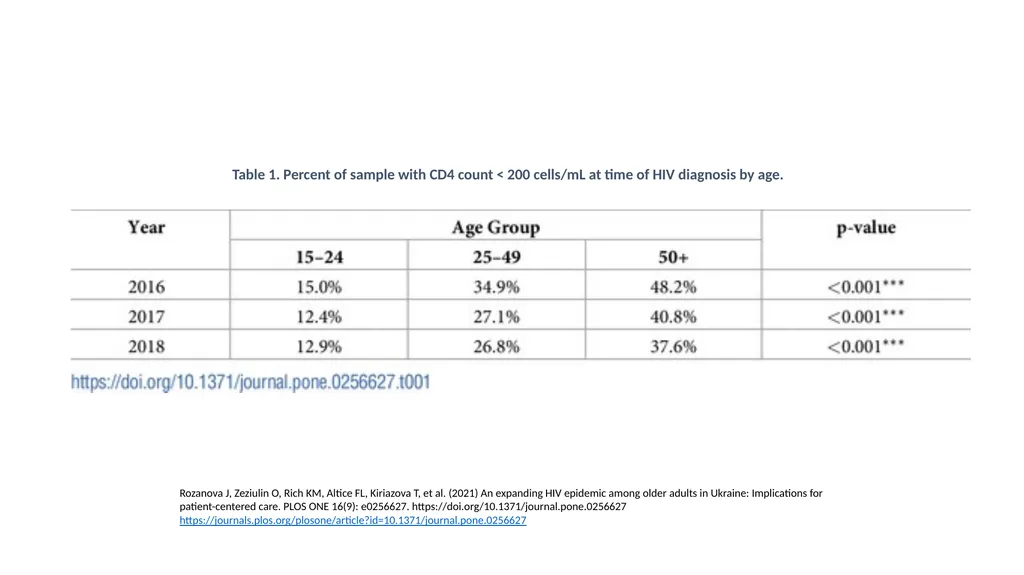
Table 1. Percent of sample with CD4 count < 200 cells/mL at time of HIV diagnosis by age. Rozanova J, Zeziulin O, Rich KM, Altice FL, Kiriazova T, et al. (2021) An expanding HIV epidemic among older adults in Ukraine: Implications for patient-centered care. PLOS ONE 16(9): e0256627. https://doi.org/10.1371/journal.pone.0256627
https://journals.plos.org/plosone/article?id=10.1371/journal.pone.0256627<br>
05
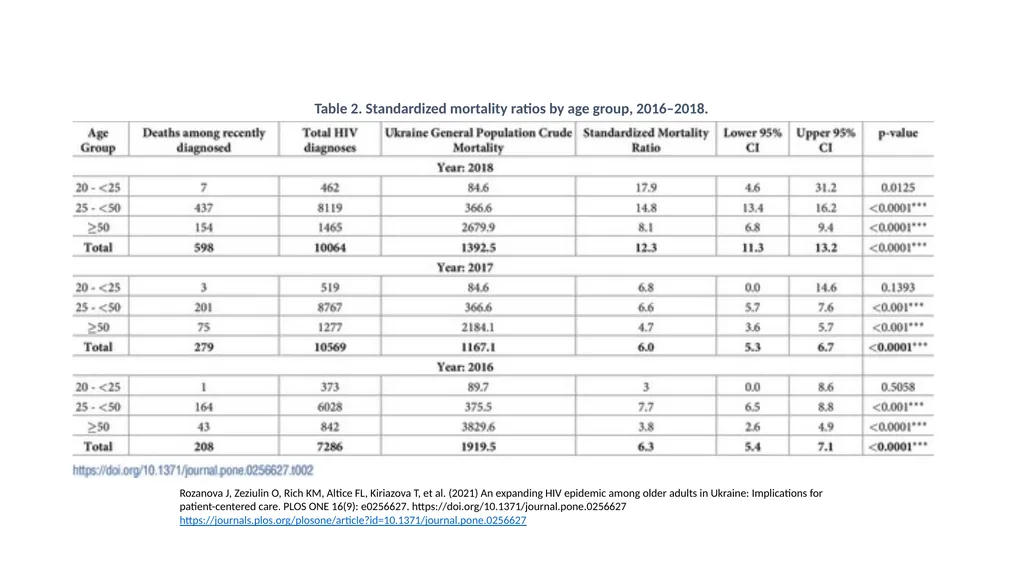
Table 2. Standardized mortality ratios by age group, 2016–2018. Rozanova J, Zeziulin O, Rich KM, Altice FL, Kiriazova T, et al. (2021) An expanding HIV epidemic among older adults in Ukraine: Implications for patient-centered care. PLOS ONE 16(9): e0256627. https://doi.org/10.1371/journal.pone.0256627
https://journals.plos.org/plosone/article?id=10.1371/journal.pone.0256627<br>
06
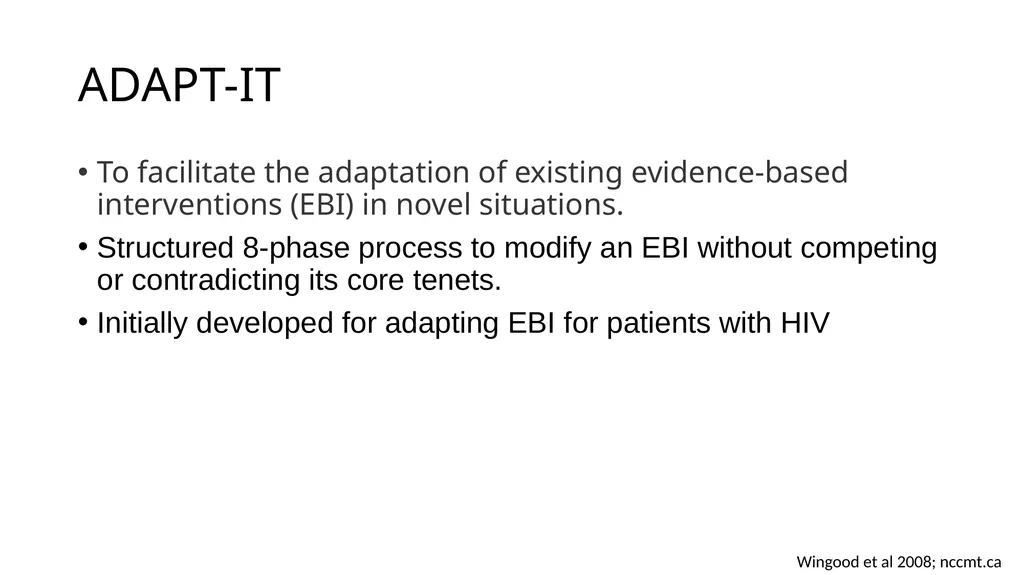
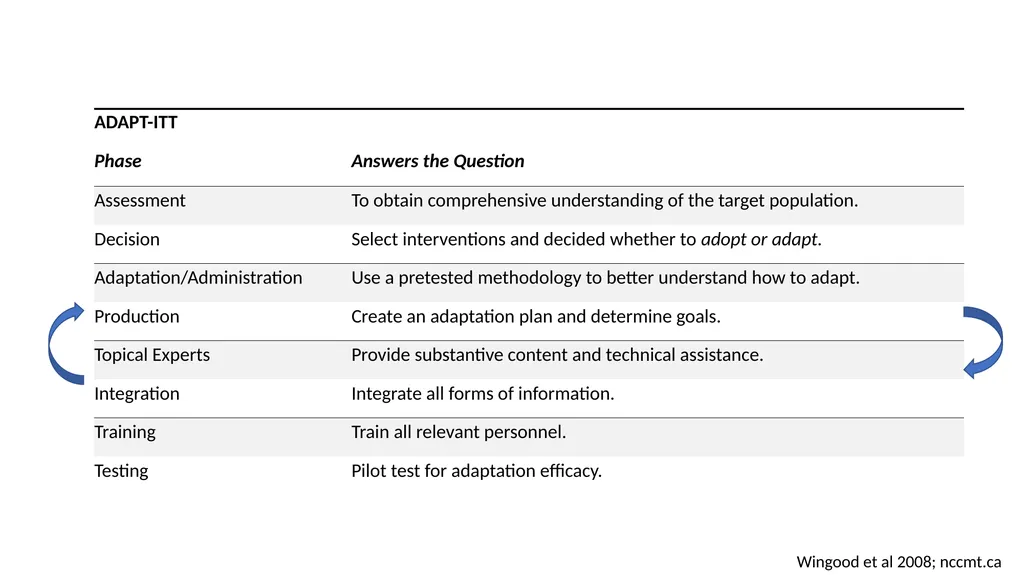
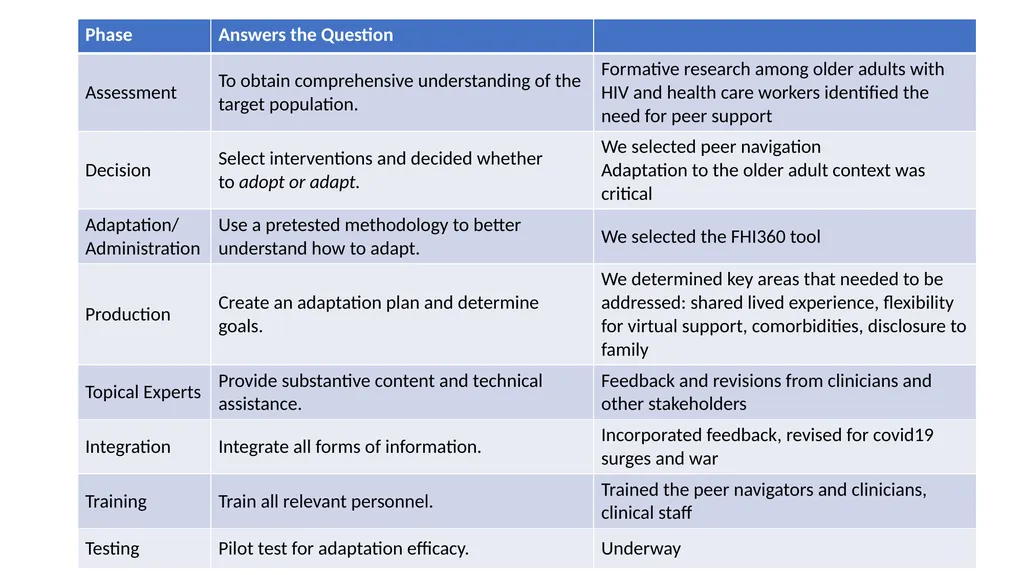
ADAPT-IT To facilitate the adaptation of existing evidence-based interventions (EBI) in novel situations.
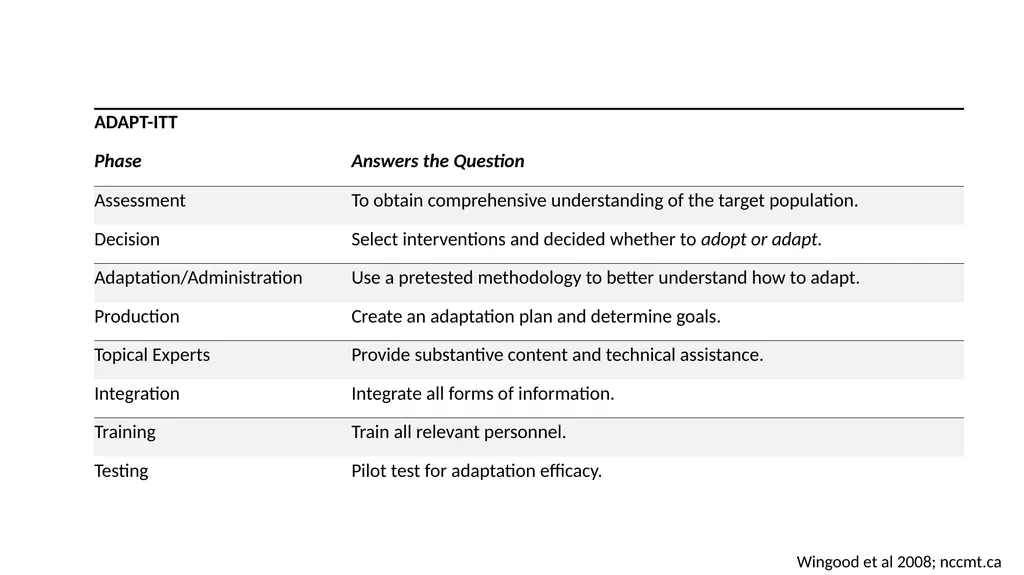
Structured 8-phase process to modify an EBI without competing or contradicting its core tenets.
Initially developed for adapting EBI for patients with HIV Wingood et al 2008; nccmt.ca<br>
07
Wingood et al 2008; nccmt.ca<br>
08
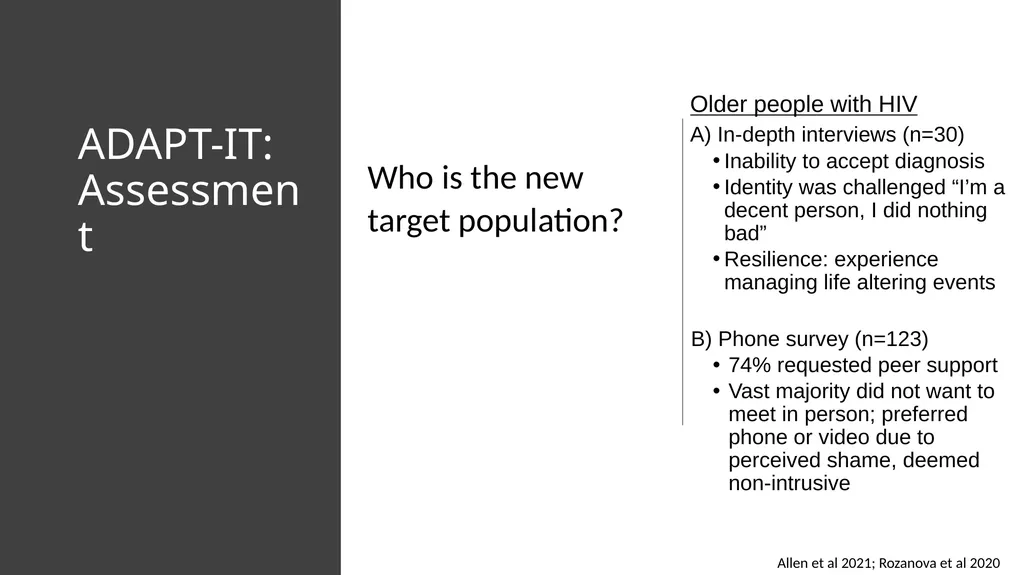
ADAPT-IT: Assessment Who is the new
target population? Older people with HIV
A) In-depth interviews (n=30)
Inability to accept diagnosis
Identity was challenged “I’m a decent person, I did nothing bad”
Resilience: experience managing life altering events
B) Phone survey (n=123)
74% requested peer support
Vast majority did not want to meet in person; preferred phone or video due to perceived shame, deemed non-intrusive Allen et al 2021; Rozanova et al 2020<br>
09
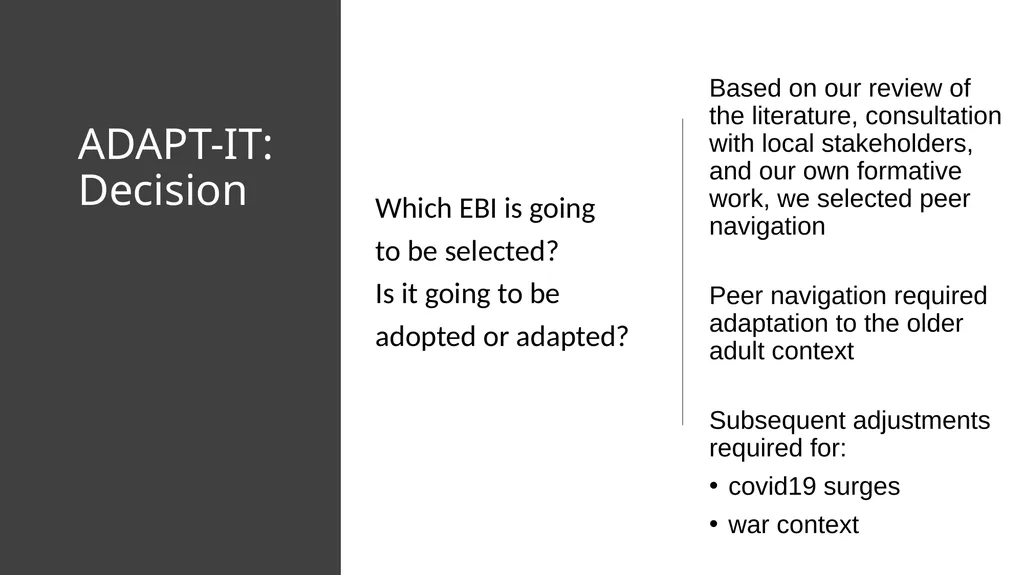
ADAPT-IT: Decision Which EBI is going
to be selected?
Is it going to be
adopted or adapted? Based on our review of the literature, consultation with local stakeholders, and our own formative work, we selected peer navigation
Peer navigation required adaptation to the older adult context
Subsequent adjustments required for:
covid19 surges
war context<br>
10
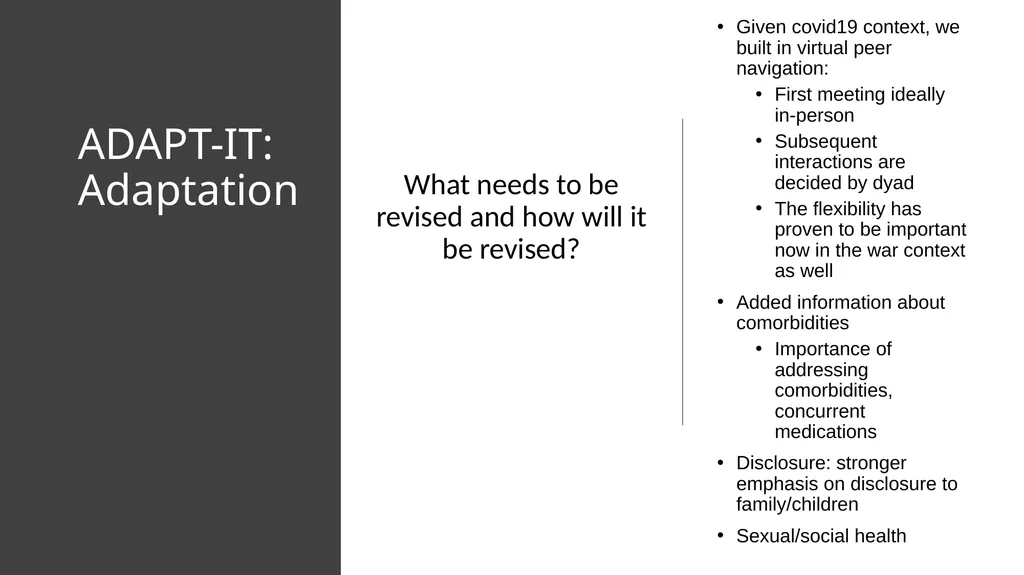
ADAPT-IT: Adaptation What needs to be revised and how will it be revised? Given covid19 context, we built in virtual peer navigation:
First meeting ideally in-person
Subsequent interactions are decided by dyad
The flexibility has proven to be important now in the war context as well
Added information about comorbidities
Importance of addressing comorbidities, concurrent medications
Disclosure: stronger emphasis on disclosure to family/children
Sexual/social health<br>
11
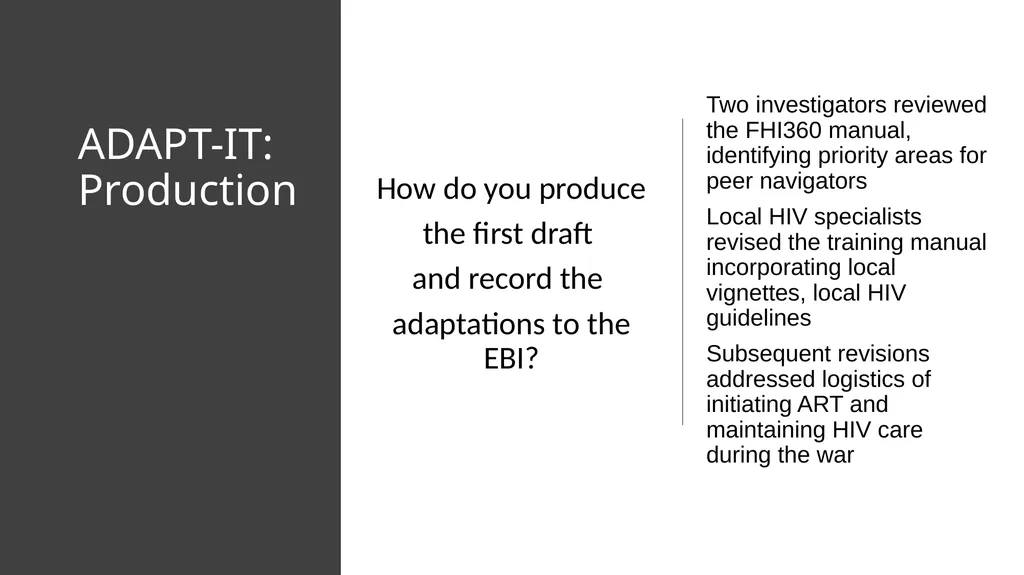
ADAPT-IT: Production How do you produce
the first draft
and record the
adaptations to the EBI? Two investigators reviewed the FHI360 manual, identifying priority areas for peer navigators
Local HIV specialists revised the training manual incorporating local vignettes, local HIV guidelines
Subsequent revisions addressed logistics of initiating ART and maintaining HIV care during the war<br>
12
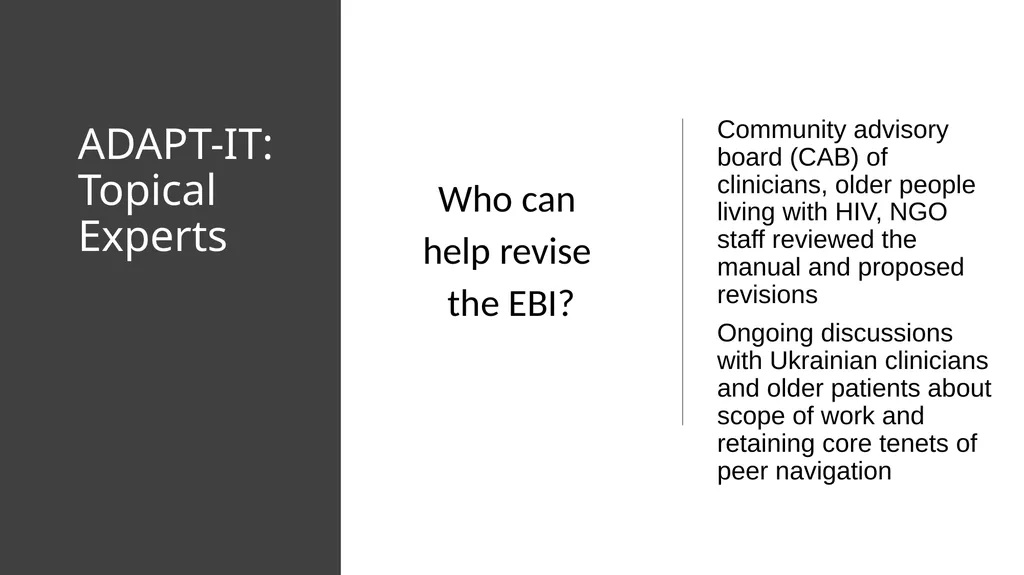
ADAPT-IT: Topical Experts Who can
help revise
the EBI? Community advisory board (CAB) of clinicians, older people living with HIV, NGO staff reviewed the manual and proposed revisions
Ongoing discussions with Ukrainian clinicians and older patients about scope of work and retaining core tenets of peer navigation<br>
13
Wingood et al 2008; nccmt.ca<br>
14
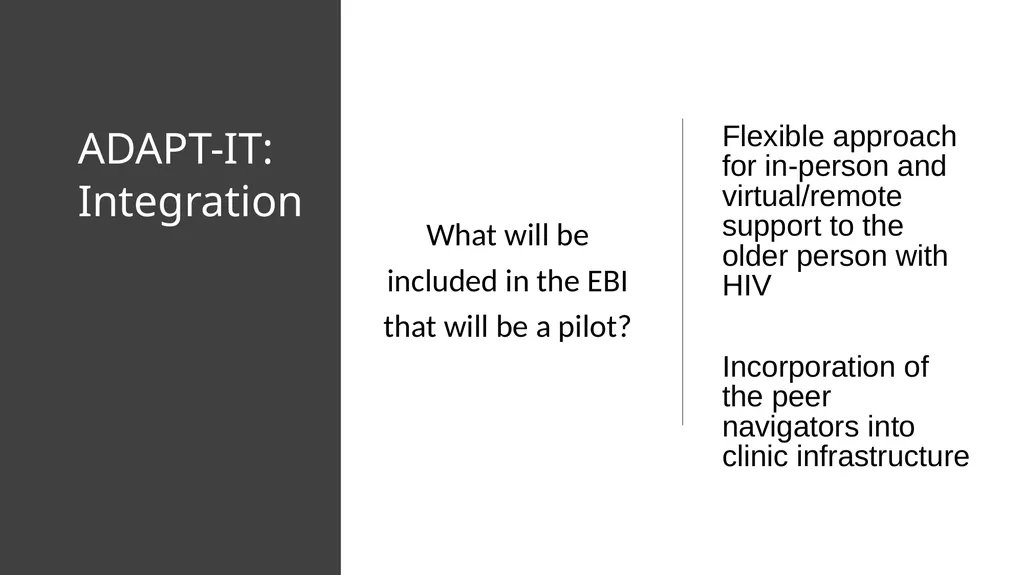
ADAPT-IT: Integration What will be
included in the EBI
that will be a pilot? Flexible approach for in-person and virtual/remote support to the older person with HIV
Incorporation of the peer navigators into clinic infrastructure<br>
15
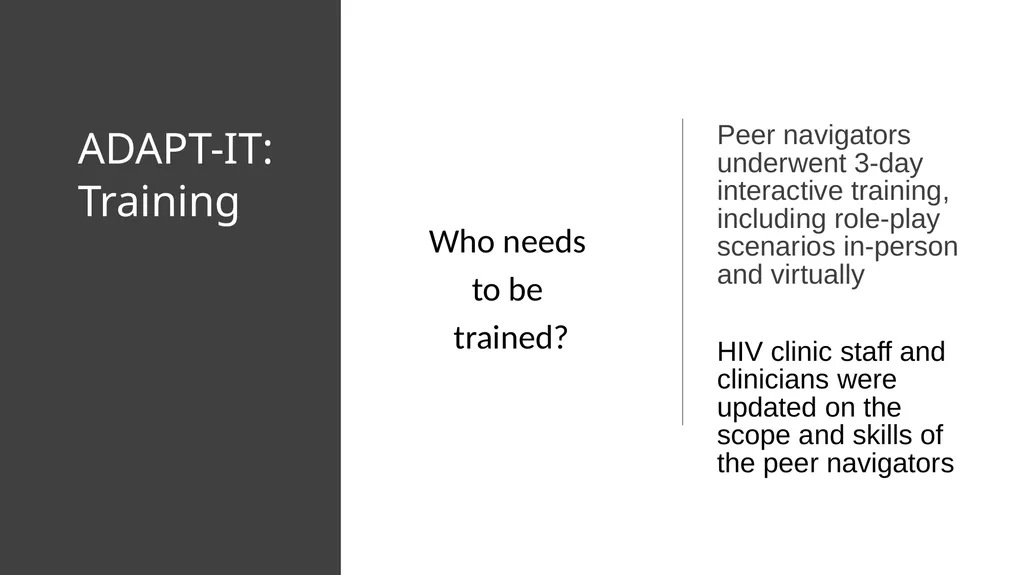
ADAPT-IT: Training Who needs
to be
trained? Peer navigators underwent 3-day interactive training, including role-play scenarios in-person and virtually
HIV clinic staff and clinicians were updated on the scope and skills of the peer navigators<br>
16
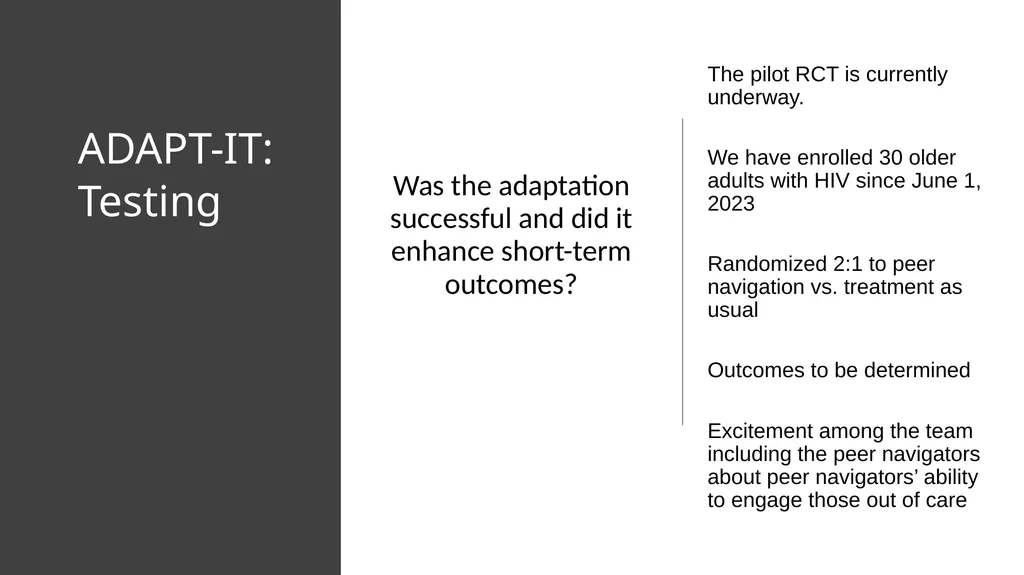
ADAPT-IT: Testing Was the adaptation successful and did it enhance short-term outcomes? The pilot RCT is currently underway.
We have enrolled 30 older adults with HIV since June 1, 2023
Randomized 2:1 to peer navigation vs. treatment as usual
Outcomes to be determined
Excitement among the team including the peer navigators about peer navigators’ ability to engage those out of care<br>
17
Next Steps Complete the pilot RCT
Develop protocol for a larger, multi-site evaluation of peer navigation for older adults
Linkage to care
Retention in care
Viral load suppression
Quality of life
Present results to Ukrainian Ministry of Health, local NGO agencies, Kyiv AIDS Centre, Kyiv Addiction Centre, Odessa AIDS Center<br>
18
Acknowledgements Julia Rozanova
Oleksandr Zeziulin
Tetiana Kiriazova
Irina Zaviryukha
Rick Altice
European Institute for Public Health Policy (EIPHP)<br>