
Administering Title IV for Nonterm Credit Hour
CM
Published · 39 slides · 0 views

1 / 1


Description
Administering Title IV for Nonterm Credit Hour Programs (for Foreign Schools) Byron Scott U.S. Department of Education 2021 Virtual FSA Training Conference for Financial Aid Professionals foreign schools Session 2 introduction This session
Related Topics
Share
Embed code
Download this presentation From Below
"Administering Title IV for Nonterm Credit Hour" is the property of its rightful owner. Permission is granted to download and print the materials on this website for personal, non-commercial use only, and to display it on your personal computer provided you do not modify the materials and that you retain all copyright notices contained in the materials. By downloading content from our website, you accept the terms of this agreement.
Presentation Transcript
01
Administering Title IV for Nonterm Credit Hour Programs
(for Foreign Schools) Byron Scott
U.S. Department of Education
2021 Virtual FSA Training Conference for Financial Aid Professionals foreign schools Session #2<br>
(for Foreign Schools) Byron Scott
U.S. Department of Education
2021 Virtual FSA Training Conference for Financial Aid Professionals foreign schools Session #2<br>
02
introduction This session is designed for foreign schools so it will not include information on administering Federal Pell Grants or any of the Campus-Based programs for schools with nonterm credit hour programs
This session will include information about administering the William D. Ford Federal Direct Loan (Direct Loan) program for foreign schools that offer credit hour programs with a nonterm academic calendar, or those that due to the structure of their academic calendar with nonstandard not substantially equal (NSE) terms must administer the Direct Loan program using nonterm payment period definitions 2<br>
This session will include information about administering the William D. Ford Federal Direct Loan (Direct Loan) program for foreign schools that offer credit hour programs with a nonterm academic calendar, or those that due to the structure of their academic calendar with nonstandard not substantially equal (NSE) terms must administer the Direct Loan program using nonterm payment period definitions 2<br>
03
3 Agenda When is a credit hour program nonterm for Title IV purposes?
Direct Loan loan periods and payment periods
Awarding and disbursing Direct Loans for nonterm credit hour programs
Return to Title IV (R2T4) for nonterm credit hour programs<br>
Direct Loan loan periods and payment periods
Awarding and disbursing Direct Loans for nonterm credit hour programs
Return to Title IV (R2T4) for nonterm credit hour programs<br>
04
When is a credit hour program nonterm for
Title IV purposes? 4<br>
05
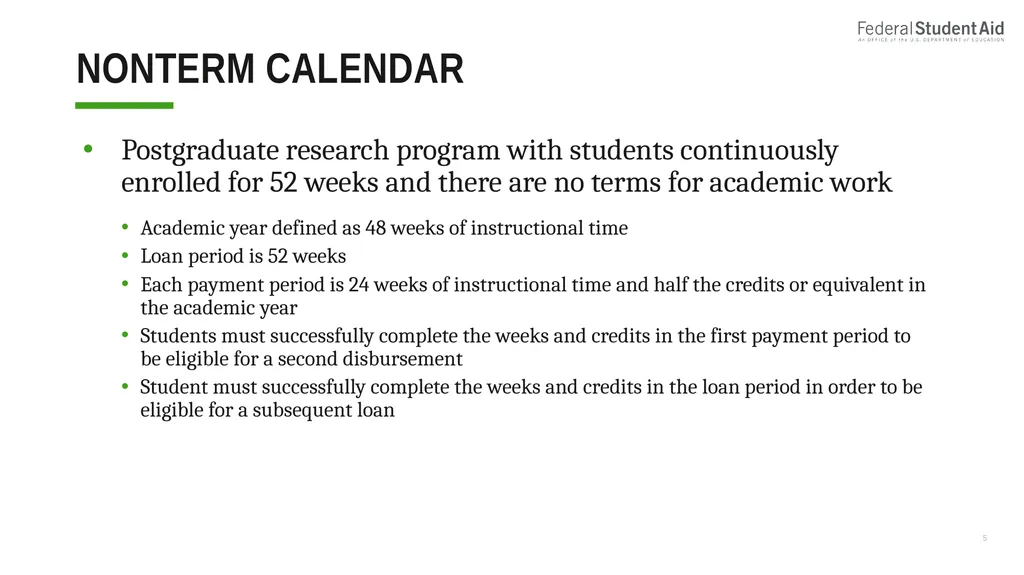
Nonterm calendar Postgraduate research program with students continuously enrolled for 52 weeks and there are no terms for academic work
Academic year defined as 48 weeks of instructional time
Loan period is 52 weeks
Each payment period is 24 weeks of instructional time and half the credits or equivalent in the academic year
Students must successfully complete the weeks and credits in the first payment period to be eligible for a second disbursement
Student must successfully complete the weeks and credits in the loan period in order to be eligible for a subsequent loan 5<br>
Academic year defined as 48 weeks of instructional time
Loan period is 52 weeks
Each payment period is 24 weeks of instructional time and half the credits or equivalent in the academic year
Students must successfully complete the weeks and credits in the first payment period to be eligible for a second disbursement
Student must successfully complete the weeks and credits in the loan period in order to be eligible for a subsequent loan 5<br>
06
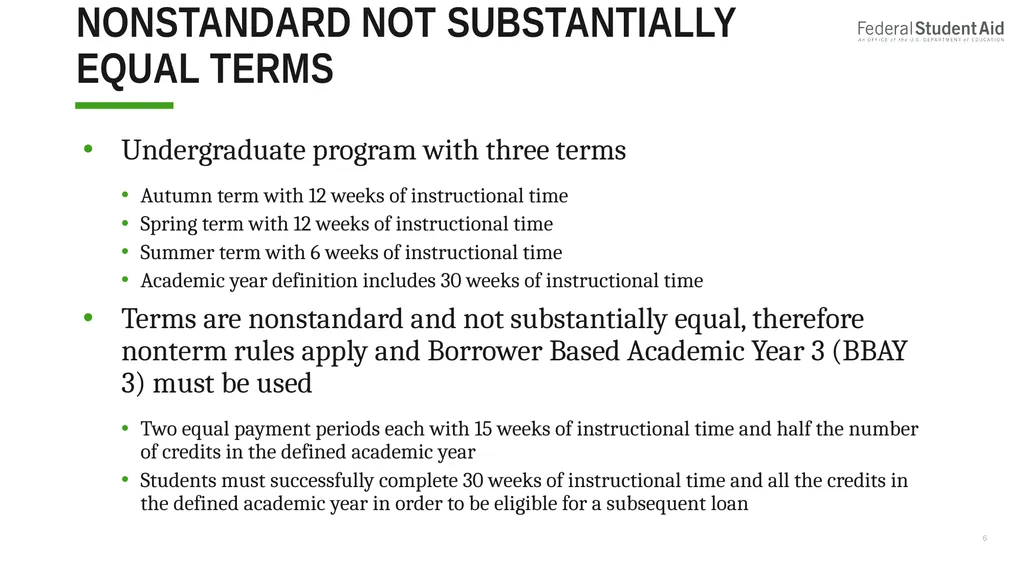
Nonstandard not substantially equal terms Undergraduate program with three terms
Autumn term with 12 weeks of instructional time
Spring term with 12 weeks of instructional time
Summer term with 6 weeks of instructional time
Academic year definition includes 30 weeks of instructional time
Terms are nonstandard and not substantially equal, therefore nonterm rules apply and Borrower Based Academic Year 3 (BBAY 3) must be used
Two equal payment periods each with 15 weeks of instructional time and half the number of credits in the defined academic year
Students must successfully complete 30 weeks of instructional time and all the credits in the defined academic year in order to be eligible for a subsequent loan 6<br>
Autumn term with 12 weeks of instructional time
Spring term with 12 weeks of instructional time
Summer term with 6 weeks of instructional time
Academic year definition includes 30 weeks of instructional time
Terms are nonstandard and not substantially equal, therefore nonterm rules apply and Borrower Based Academic Year 3 (BBAY 3) must be used
Two equal payment periods each with 15 weeks of instructional time and half the number of credits in the defined academic year
Students must successfully complete 30 weeks of instructional time and all the credits in the defined academic year in order to be eligible for a subsequent loan 6<br>
07
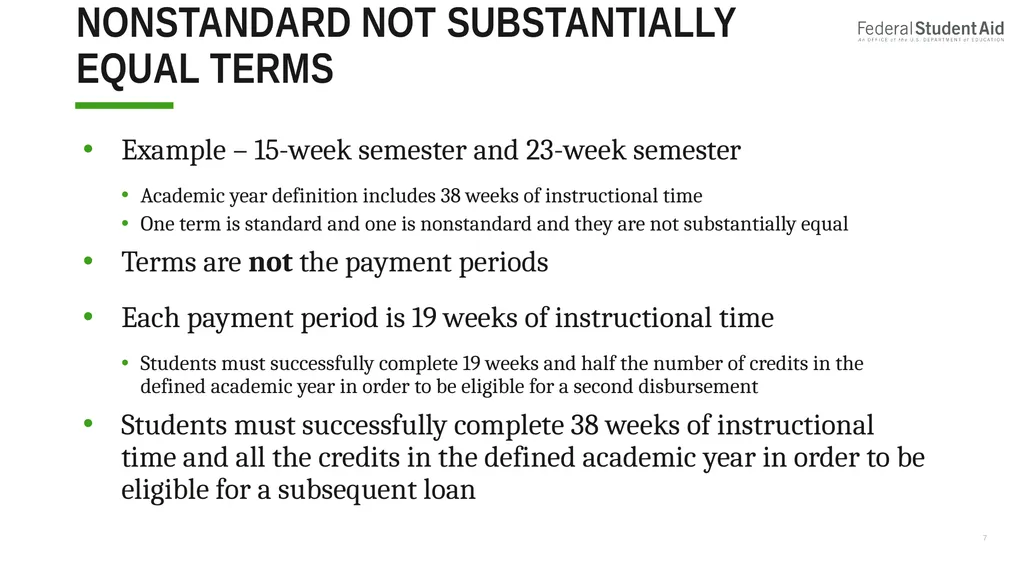
Nonstandard not substantially equal terms Example – 15-week semester and 23-week semester
Academic year definition includes 38 weeks of instructional time
One term is standard and one is nonstandard and they are not substantially equal
Terms are not the payment periods
Each payment period is 19 weeks of instructional time
Students must successfully complete 19 weeks and half the number of credits in the defined academic year in order to be eligible for a second disbursement
Students must successfully complete 38 weeks of instructional time and all the credits in the defined academic year in order to be eligible for a subsequent loan 7<br>
Academic year definition includes 38 weeks of instructional time
One term is standard and one is nonstandard and they are not substantially equal
Terms are not the payment periods
Each payment period is 19 weeks of instructional time
Students must successfully complete 19 weeks and half the number of credits in the defined academic year in order to be eligible for a second disbursement
Students must successfully complete 38 weeks of instructional time and all the credits in the defined academic year in order to be eligible for a subsequent loan 7<br>
08
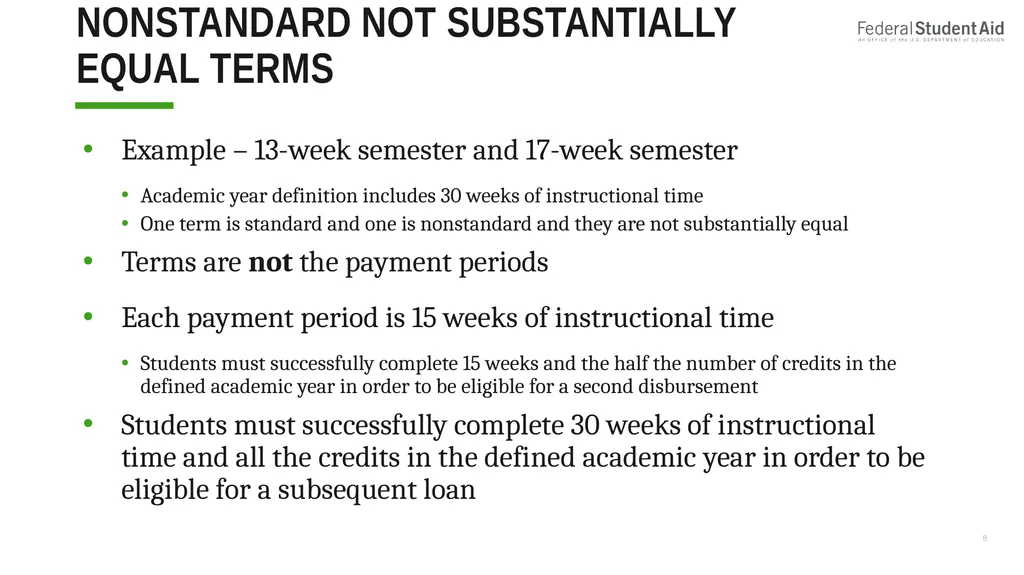
Nonstandard not substantially equal terms Example – 13-week semester and 17-week semester
Academic year definition includes 30 weeks of instructional time
One term is standard and one is nonstandard and they are not substantially equal
Terms are not the payment periods
Each payment period is 15 weeks of instructional time
Students must successfully complete 15 weeks and the half the number of credits in the defined academic year in order to be eligible for a second disbursement
Students must successfully complete 30 weeks of instructional time and all the credits in the defined academic year in order to be eligible for a subsequent loan 8<br>
Academic year definition includes 30 weeks of instructional time
One term is standard and one is nonstandard and they are not substantially equal
Terms are not the payment periods
Each payment period is 15 weeks of instructional time
Students must successfully complete 15 weeks and the half the number of credits in the defined academic year in order to be eligible for a second disbursement
Students must successfully complete 30 weeks of instructional time and all the credits in the defined academic year in order to be eligible for a subsequent loan 8<br>
09
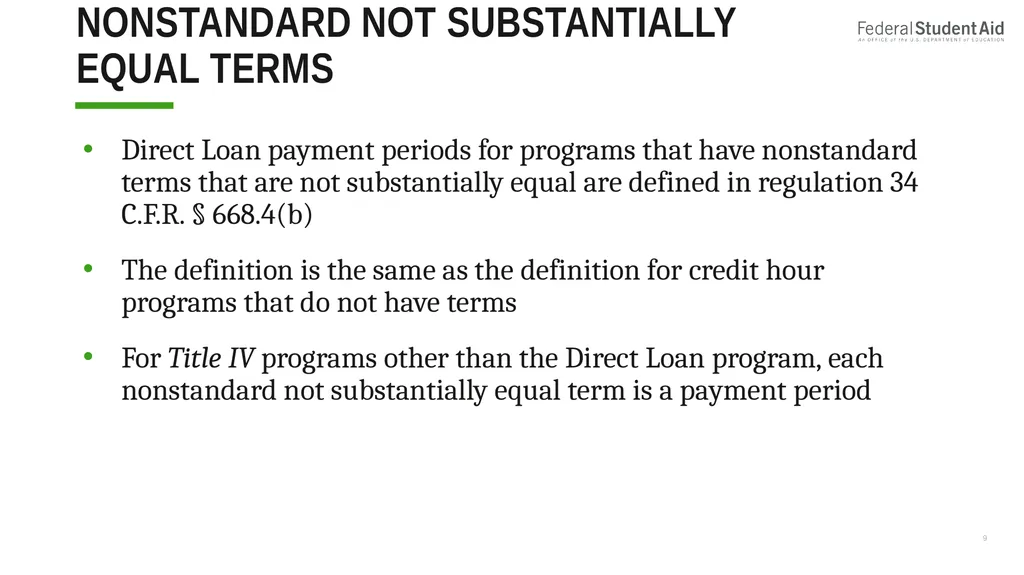
Nonstandard not substantially equal terms Direct Loan payment periods for programs that have nonstandard terms that are not substantially equal are defined in regulation 34 C.F.R. § 668.4(b)
The definition is the same as the definition for credit hour programs that do not have terms
For Title IV programs other than the Direct Loan program, each nonstandard not substantially equal term is a payment period 9<br>
The definition is the same as the definition for credit hour programs that do not have terms
For Title IV programs other than the Direct Loan program, each nonstandard not substantially equal term is a payment period 9<br>
10
Direct Loan Loan periods and payment periods 10<br>
11
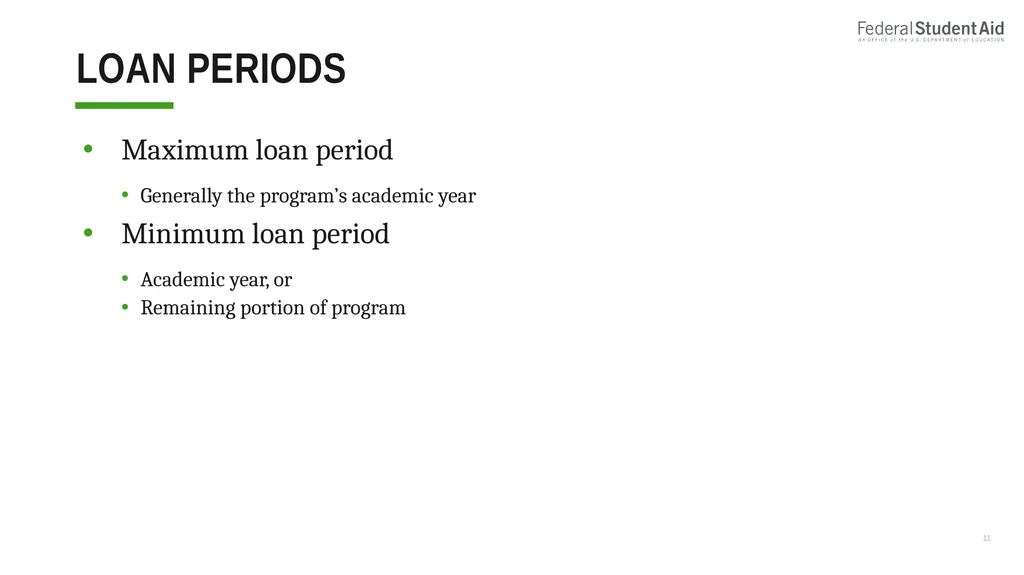
Loan periods Maximum loan period
Generally the program’s academic year
Minimum loan period
Academic year, or
Remaining portion of program 11<br>
Generally the program’s academic year
Minimum loan period
Academic year, or
Remaining portion of program 11<br>
12
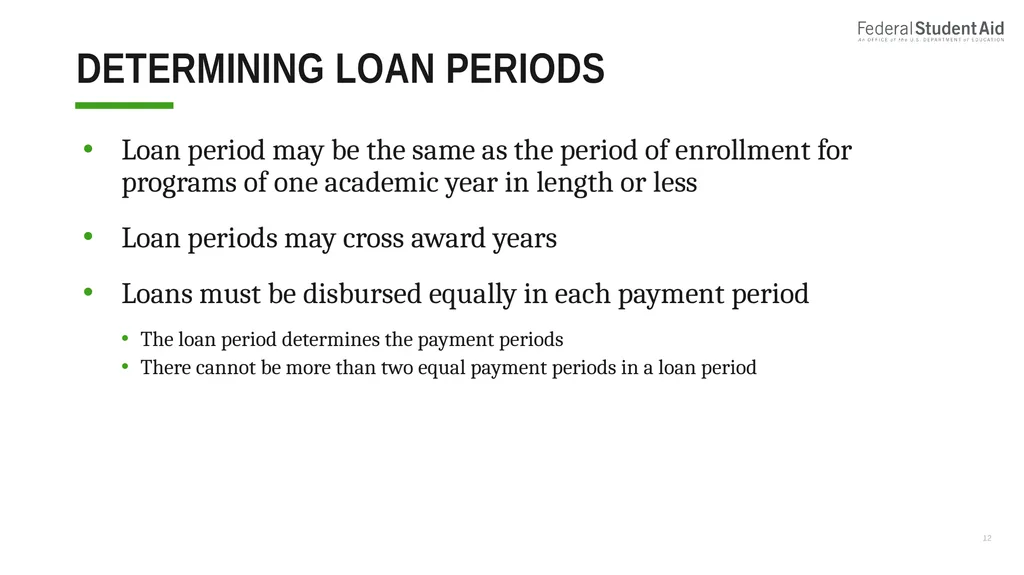
Determining loan periods Loan period may be the same as the period of enrollment for programs of one academic year in length or less
Loan periods may cross award years
Loans must be disbursed equally in each payment period
The loan period determines the payment periods
There cannot be more than two equal payment periods in a loan period 12<br>
Loan periods may cross award years
Loans must be disbursed equally in each payment period
The loan period determines the payment periods
There cannot be more than two equal payment periods in a loan period 12<br>
13
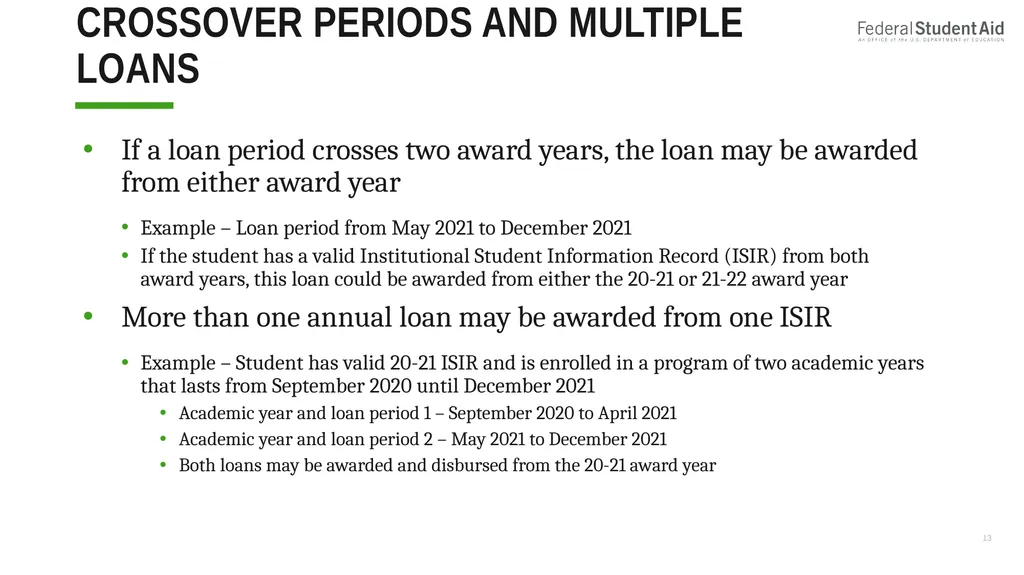
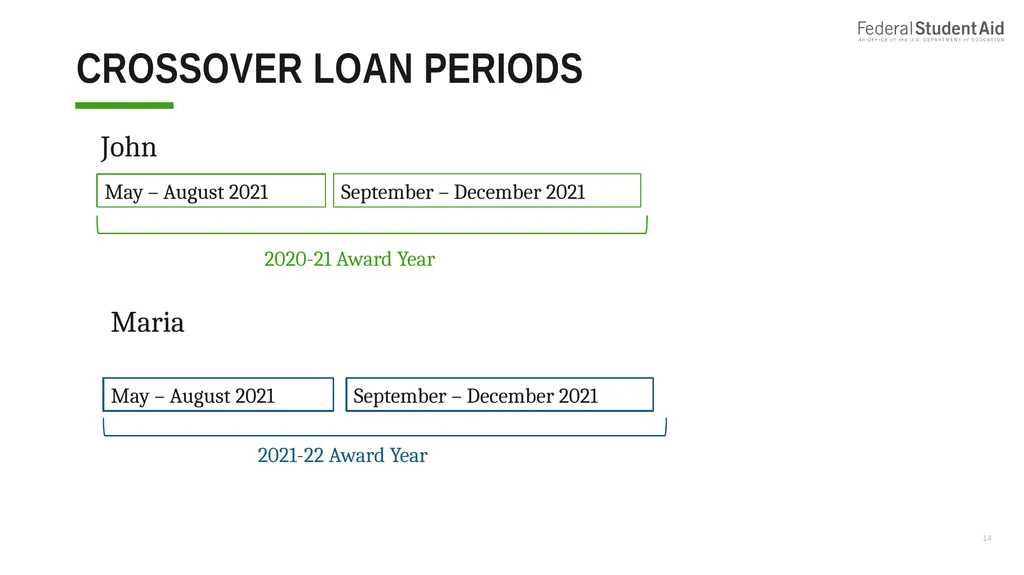
Crossover periods and Multiple Loans If a loan period crosses two award years, the loan may be awarded from either award year
Example – Loan period from May 2021 to December 2021
If the student has a valid Institutional Student Information Record (ISIR) from both award years, this loan could be awarded from either the 20-21 or 21-22 award year
More than one annual loan may be awarded from one ISIR
Example – Student has valid 20-21 ISIR and is enrolled in a program of two academic years that lasts from September 2020 until December 2021
Academic year and loan period 1 – September 2020 to April 2021
Academic year and loan period 2 – May 2021 to December 2021
Both loans may be awarded and disbursed from the 20-21 award year 13<br>
Example – Loan period from May 2021 to December 2021
If the student has a valid Institutional Student Information Record (ISIR) from both award years, this loan could be awarded from either the 20-21 or 21-22 award year
More than one annual loan may be awarded from one ISIR
Example – Student has valid 20-21 ISIR and is enrolled in a program of two academic years that lasts from September 2020 until December 2021
Academic year and loan period 1 – September 2020 to April 2021
Academic year and loan period 2 – May 2021 to December 2021
Both loans may be awarded and disbursed from the 20-21 award year 13<br>
14
Crossover loan periods 2021-22 Award Year May – August 2021 September – December 2021 September – December 2021 2020-21 Award Year Maria John May – August 2021 14<br>
15
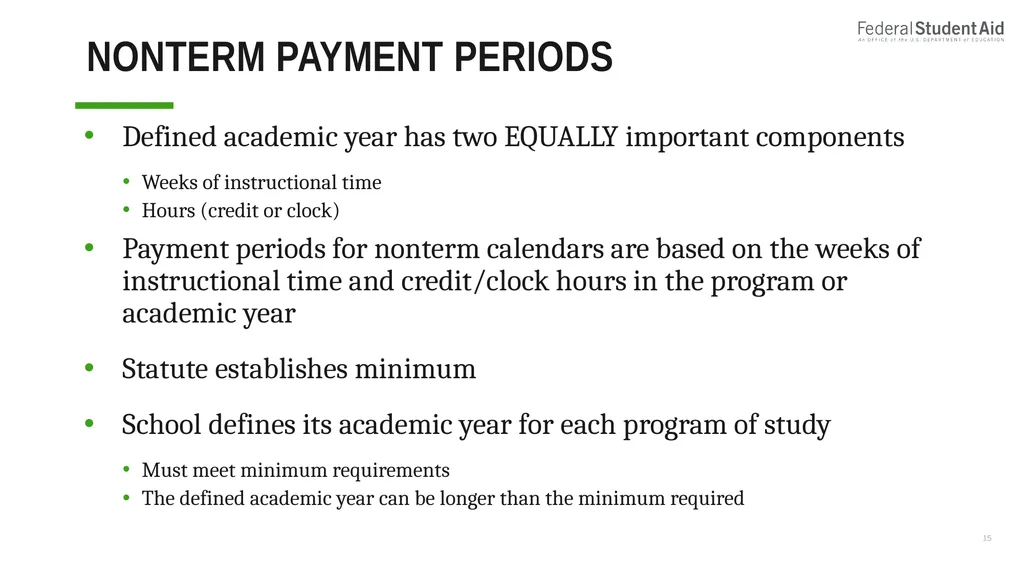
15 Nonterm Payment periods Defined academic year has two EQUALLY important components
Weeks of instructional time
Hours (credit or clock)
Payment periods for nonterm calendars are based on the weeks of instructional time and credit/clock hours in the program or academic year
Statute establishes minimum
School defines its academic year for each program of study
Must meet minimum requirements
The defined academic year can be longer than the minimum required<br>
Weeks of instructional time
Hours (credit or clock)
Payment periods for nonterm calendars are based on the weeks of instructional time and credit/clock hours in the program or academic year
Statute establishes minimum
School defines its academic year for each program of study
Must meet minimum requirements
The defined academic year can be longer than the minimum required<br>
16
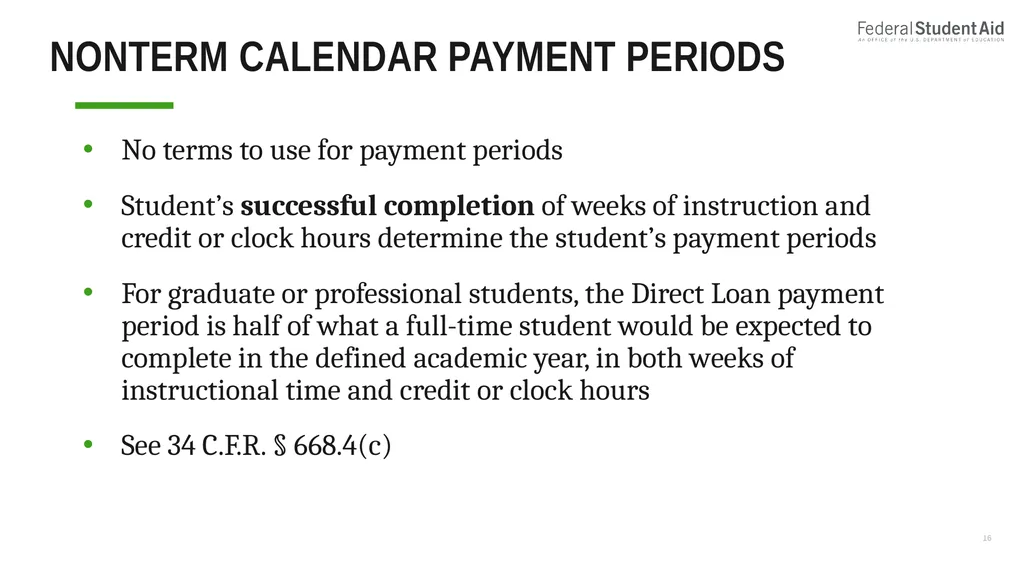
16 Nonterm Calendar Payment Periods No terms to use for payment periods
Student’s successful completion of weeks of instruction and credit or clock hours determine the student’s payment periods
For graduate or professional students, the Direct Loan payment period is half of what a full-time student would be expected to complete in the defined academic year, in both weeks of instructional time and credit or clock hours
See 34 C.F.R. § 668.4(c)<br>
Student’s successful completion of weeks of instruction and credit or clock hours determine the student’s payment periods
For graduate or professional students, the Direct Loan payment period is half of what a full-time student would be expected to complete in the defined academic year, in both weeks of instructional time and credit or clock hours
See 34 C.F.R. § 668.4(c)<br>
17
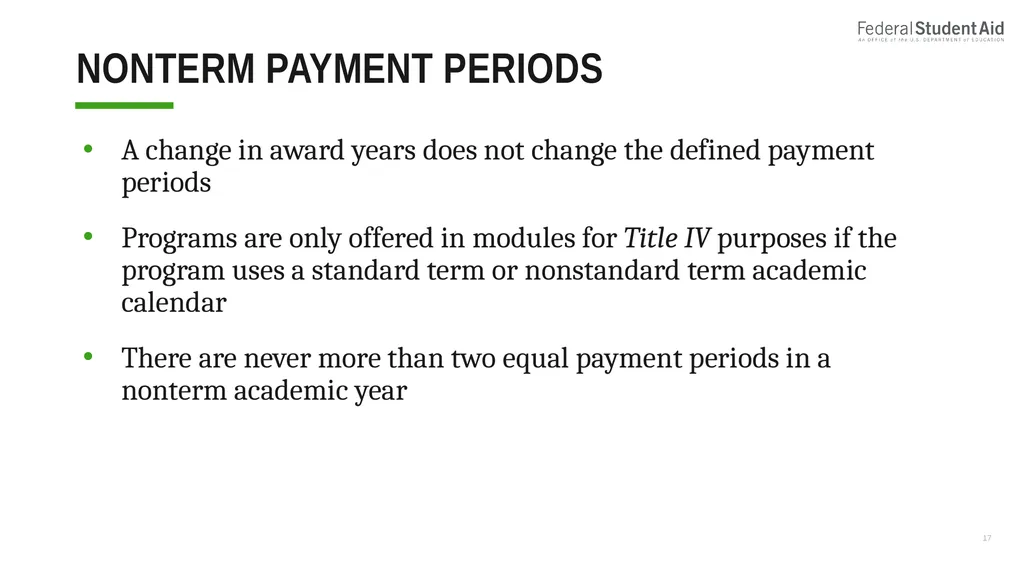
Nonterm payment periods A change in award years does not change the defined payment periods
Programs are only offered in modules for Title IV purposes if the program uses a standard term or nonstandard term academic calendar
There are never more than two equal payment periods in a nonterm academic year 17<br>
Programs are only offered in modules for Title IV purposes if the program uses a standard term or nonstandard term academic calendar
There are never more than two equal payment periods in a nonterm academic year 17<br>
18
Program of one academic year or less The program is divided into two equal payment periods
First payment period is the period of time when the student completes half the number of credit hours and half the weeks of instructional time in the program
Second payment period is the period of time in which the student successfully completes the remainder of the program 18<br>
First payment period is the period of time when the student completes half the number of credit hours and half the weeks of instructional time in the program
Second payment period is the period of time in which the student successfully completes the remainder of the program 18<br>
19
Program greater THAN ONE ACADEMIC YEAR If the remainder of a program longer than an academic year is more than half an academic year but less than a full academic year in length
First payment period is half the credit hours and half the weeks of instructional time remaining in the program
Second payment period is the time necessary to complete the remainder of the program
If remainder of program is less than half an academic year in weeks or credit hours
Final payment period is remainder of academic program 19<br>
First payment period is half the credit hours and half the weeks of instructional time remaining in the program
Second payment period is the time necessary to complete the remainder of the program
If remainder of program is less than half an academic year in weeks or credit hours
Final payment period is remainder of academic program 19<br>
20
Program greater THAN ONE ACADEMIC YEAR For the first academic year and any full academic year after that:
First payment period is the period of time when the student completes half the number of credit hours and half the weeks of instructional time in the academic year
Second payment period is the period of time in which the student successfully completes the remainder of the academic year 20<br>
First payment period is the period of time when the student completes half the number of credit hours and half the weeks of instructional time in the academic year
Second payment period is the period of time in which the student successfully completes the remainder of the academic year 20<br>
21
Awarding and disbursing Direct Loans for nonterm programs 21<br>
22
Full-Time and half-time definitions A student carrying a full-time workload determined by the school under a standard applicable to all students enrolled in a program
Workload may include any combination of courses, work, research or special studies that the school considers sufficient to classify the student as full time
A half-time student is carrying a half-time academic workload as defined by the institution that amounts to at least half of the workload of the applicable minimum requirement defined for a full-time student
See 34 C.F.R. § 668.2 22<br>
Workload may include any combination of courses, work, research or special studies that the school considers sufficient to classify the student as full time
A half-time student is carrying a half-time academic workload as defined by the institution that amounts to at least half of the workload of the applicable minimum requirement defined for a full-time student
See 34 C.F.R. § 668.2 22<br>
23
Full-Time Student Definition The minimum standard for a full-time undergraduate student in a credit hour program that does not have terms is 24 semester or 36 quarter credit hours over the weeks of instructional time in the academic year
The regulations do not establish a minimum standard for full-time status for graduate students 23<br>
The regulations do not establish a minimum standard for full-time status for graduate students 23<br>
24
Loan awarding for transfer students Upon transfer into a nonterm program at second school within the academic year of a loan at previous school -
New school certifies loan for remaining balance of annual loan period for period that covers remaining portion of academic year (not loan period) at first school
Abbreviated loan period starts with first day of enrollment at the new school and ends on the last day of the academic year that began at the previous school
Loan amount may not exceed annual loan limit for grade level applicable at new school
Cost of attendance for loan based on length of abbreviated loan period
See page 3-151 to 3-153 of 2020-21 FSA Handbook
The key data element is the academic year, not the loan period from the loan at the previous school
Academic year data for the previous loan can be found in the Department’s Common Origination and Disbursement System (COD) 24<br>
New school certifies loan for remaining balance of annual loan period for period that covers remaining portion of academic year (not loan period) at first school
Abbreviated loan period starts with first day of enrollment at the new school and ends on the last day of the academic year that began at the previous school
Loan amount may not exceed annual loan limit for grade level applicable at new school
Cost of attendance for loan based on length of abbreviated loan period
See page 3-151 to 3-153 of 2020-21 FSA Handbook
The key data element is the academic year, not the loan period from the loan at the previous school
Academic year data for the previous loan can be found in the Department’s Common Origination and Disbursement System (COD) 24<br>
25
Loan awarding for transfer students After abbreviated loan period completed, student progresses to new loan period and annual loan limit
There are special requirements for students who withdraw from an abbreviated loan period
The abbreviated loan period does not meet the definition of an R2T4 payment period and should not be used as the definition of a payment period for R2T4 purposes
See page 5-91 through 5-94 of the 2020-21 FSA Handbook 25<br>
There are special requirements for students who withdraw from an abbreviated loan period
The abbreviated loan period does not meet the definition of an R2T4 payment period and should not be used as the definition of a payment period for R2T4 purposes
See page 5-91 through 5-94 of the 2020-21 FSA Handbook 25<br>
26
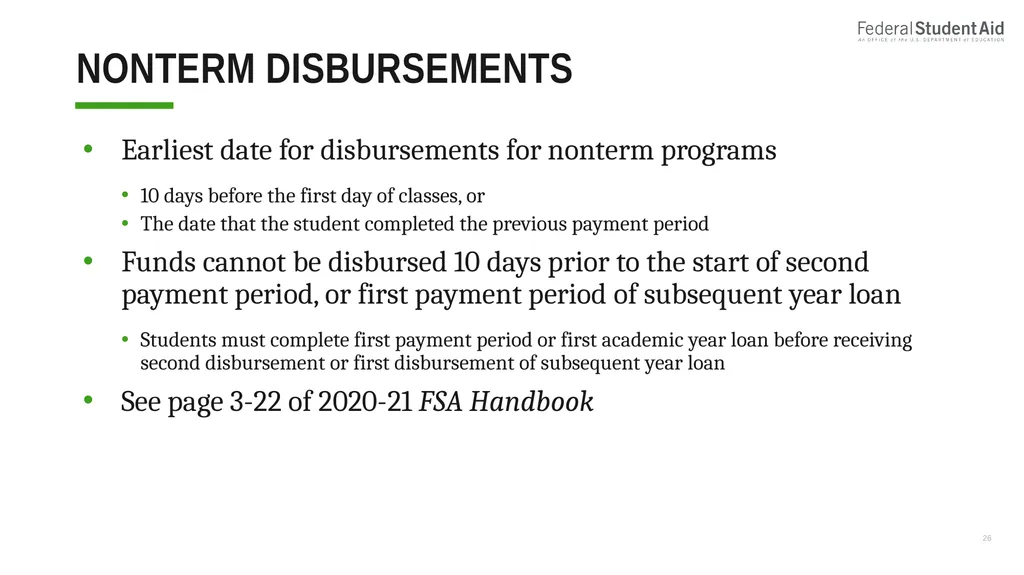
Nonterm Disbursements Earliest date for disbursements for nonterm programs
10 days before the first day of classes, or
The date that the student completed the previous payment period
Funds cannot be disbursed 10 days prior to the start of second payment period, or first payment period of subsequent year loan
Students must complete first payment period or first academic year loan before receiving second disbursement or first disbursement of subsequent year loan
See page 3-22 of 2020-21 FSA Handbook 26<br>
10 days before the first day of classes, or
The date that the student completed the previous payment period
Funds cannot be disbursed 10 days prior to the start of second payment period, or first payment period of subsequent year loan
Students must complete first payment period or first academic year loan before receiving second disbursement or first disbursement of subsequent year loan
See page 3-22 of 2020-21 FSA Handbook 26<br>
27
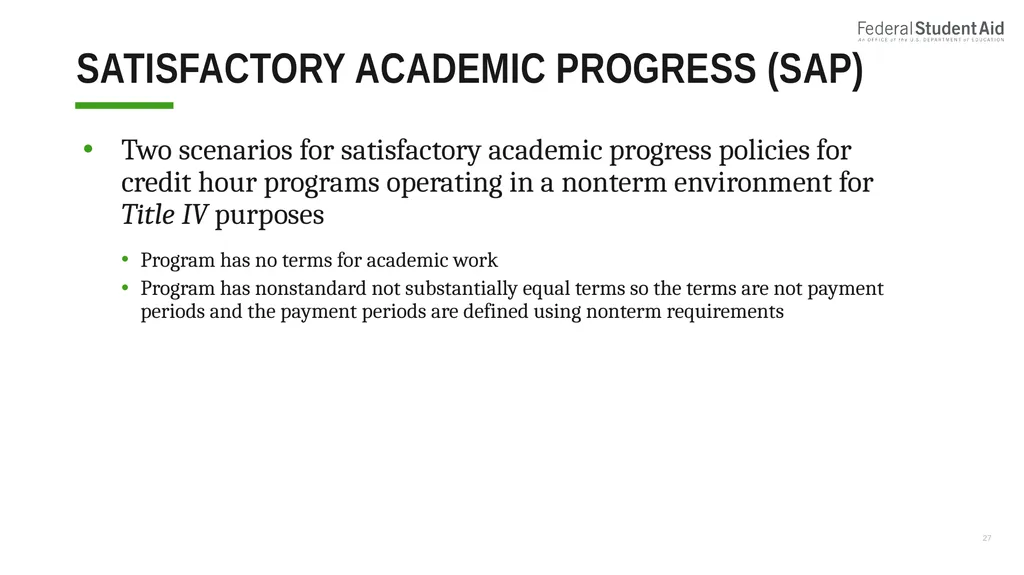
Satisfactory Academic Progress (SAP) Two scenarios for satisfactory academic progress policies for credit hour programs operating in a nonterm environment for Title IV purposes
Program has no terms for academic work
Program has nonstandard not substantially equal terms so the terms are not payment periods and the payment periods are defined using nonterm requirements 27<br>
Program has no terms for academic work
Program has nonstandard not substantially equal terms so the terms are not payment periods and the payment periods are defined using nonterm requirements 27<br>
28
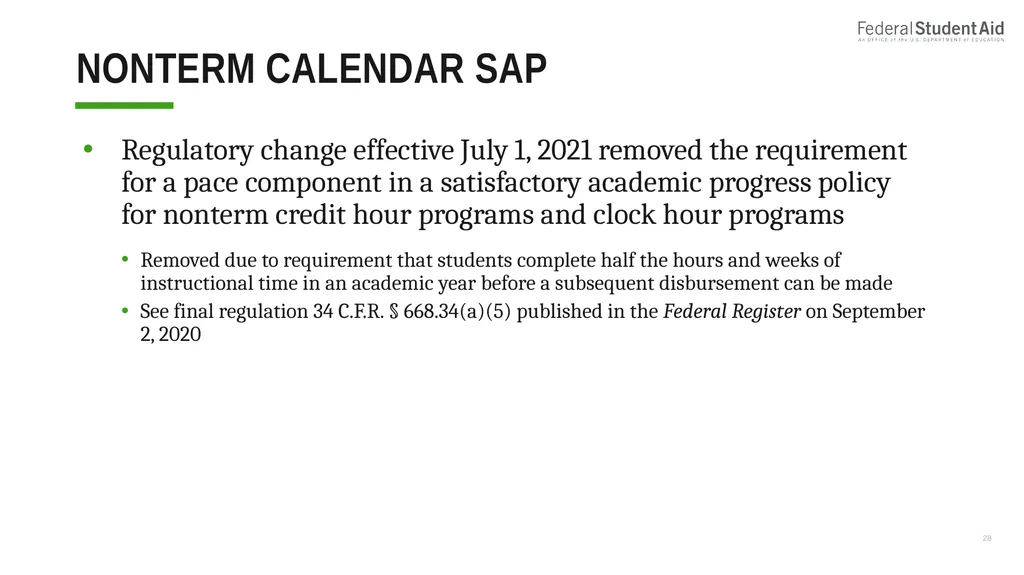
Nonterm Calendar SAP Regulatory change effective July 1, 2021 removed the requirement for a pace component in a satisfactory academic progress policy for nonterm credit hour programs and clock hour programs
Removed due to requirement that students complete half the hours and weeks of instructional time in an academic year before a subsequent disbursement can be made
See final regulation 34 C.F.R. § 668.34(a)(5) published in the Federal Register on September 2, 2020 28<br>
Removed due to requirement that students complete half the hours and weeks of instructional time in an academic year before a subsequent disbursement can be made
See final regulation 34 C.F.R. § 668.34(a)(5) published in the Federal Register on September 2, 2020 28<br>
29
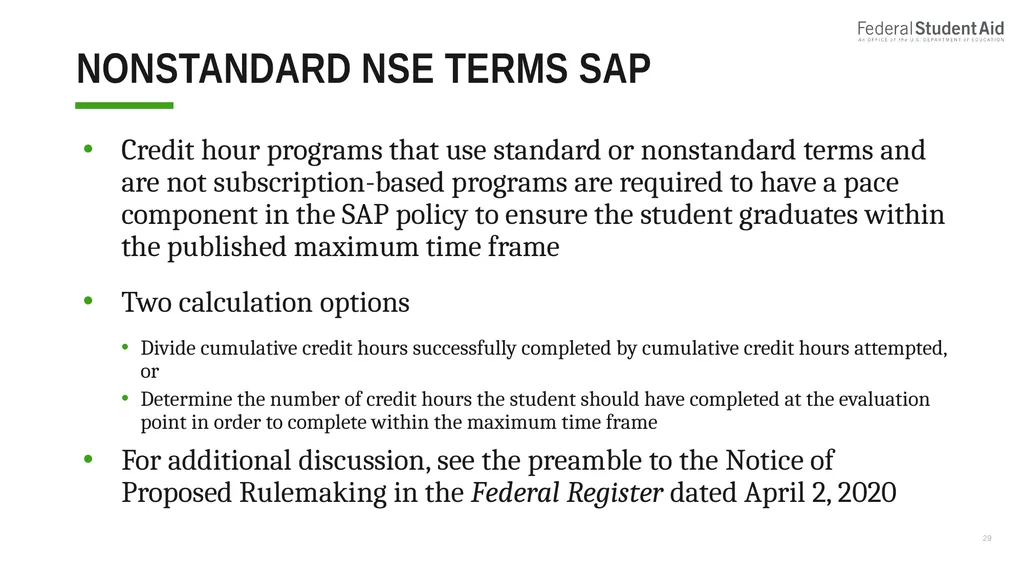
Nonstandard nse terms SAP Credit hour programs that use standard or nonstandard terms and are not subscription-based programs are required to have a pace component in the SAP policy to ensure the student graduates within the published maximum time frame
Two calculation options
Divide cumulative credit hours successfully completed by cumulative credit hours attempted, or
Determine the number of credit hours the student should have completed at the evaluation point in order to complete within the maximum time frame
For additional discussion, see the preamble to the Notice of Proposed Rulemaking in the Federal Register dated April 2, 2020 29<br>
Two calculation options
Divide cumulative credit hours successfully completed by cumulative credit hours attempted, or
Determine the number of credit hours the student should have completed at the evaluation point in order to complete within the maximum time frame
For additional discussion, see the preamble to the Notice of Proposed Rulemaking in the Federal Register dated April 2, 2020 29<br>
30
Return to Title IV (R2t4) for nonterm credit hour programs 30<br>
31
nonterm credit hour r2t4 For students who withdraw from a nonstandard term-based or nonterm-based programs, schools may perform R2T4 calculations on the period of enrollment or payment period
If using period of enrollment, the period must be consistent with the loan period used
This is the length of the period used as the denominator in the R2T4 calculation
Choice must be defined in policies and procedures and consistently applied to all students within the program
Exception allowed for students who transfer into or withdraw from these types of programs
If exception used must apply to all students who transfer into or reenter the program
Special requirements for students who fail or withdraw from some courses prior to complete withdrawal 31<br>
If using period of enrollment, the period must be consistent with the loan period used
This is the length of the period used as the denominator in the R2T4 calculation
Choice must be defined in policies and procedures and consistently applied to all students within the program
Exception allowed for students who transfer into or withdraw from these types of programs
If exception used must apply to all students who transfer into or reenter the program
Special requirements for students who fail or withdraw from some courses prior to complete withdrawal 31<br>
32
Projecting completion date For students who withdraw from credit-hour nonterm programs when completion date depends on individual student progress, the end date of the period must be projected based on the student’s progress as of the withdrawal date
Total number of calendar days in the period for R2T4 purposes must reflect the actual number of days the student would have had to attend to successfully complete all the credit hours originally scheduled in the period
See Dear Colleague Letter GEN-04-03, revised November 2004 32<br>
Total number of calendar days in the period for R2T4 purposes must reflect the actual number of days the student would have had to attend to successfully complete all the credit hours originally scheduled in the period
See Dear Colleague Letter GEN-04-03, revised November 2004 32<br>
33
Not progressing as scheduled Payment periods and periods of enrollment have scheduled end dates
If as of withdrawal date the student is not progressing as scheduled through the period, the completion date of the period must be projected based on the student’s individual progress
Withdrawal or failure of a class within the period
Taking longer than scheduled to complete a class or classes
Example – Student completed a class scheduled for five weeks in eight weeks 33<br>
If as of withdrawal date the student is not progressing as scheduled through the period, the completion date of the period must be projected based on the student’s individual progress
Withdrawal or failure of a class within the period
Taking longer than scheduled to complete a class or classes
Example – Student completed a class scheduled for five weeks in eight weeks 33<br>
34
Projecting completion date If a student withdraws from self-paced nonterm program prior to earning any credits, the institution must have a reasonable method for projecting the completion date of the period
If students do not earn credits or complete classes as they move through the program, schools must have reasonable procedures for projecting the completion date of the period based on the student’s progress prior to withdrawal 34<br>
If students do not earn credits or complete classes as they move through the program, schools must have reasonable procedures for projecting the completion date of the period based on the student’s progress prior to withdrawal 34<br>
35
Projecting completion date Four examples of methodologies for projecting the completion date for a student who withdraws from a nonterm credit hour program are found in Volume 5, Chapter 2 of the FSA Handbook
Lessons completed
Nothing completed – Schools may use institutional records to identify the longest it took any student to complete the period
Percentage completed – Days attended are divided by the percentage of credits earned to project the number of days in the period
Projecting for withdrawal from self-paced nonterm program 35<br>
Lessons completed
Nothing completed – Schools may use institutional records to identify the longest it took any student to complete the period
Percentage completed – Days attended are divided by the percentage of credits earned to project the number of days in the period
Projecting for withdrawal from self-paced nonterm program 35<br>
36
Return after withdrawal A student who ceases attendance and returns within 180 days is considered to remain in the same payment period
R2T4 calculation is reversed and funds redisbursed
Extend original loan period and academic year dates
May need to request extended processing from COD if disbursement will extend past program-year closeout deadline
A student who ceases attendance and returns after 180 days or begins a different program at the same school within any time period starts a new payment period
All periods of a student’s attendance in a program are subject to SAP maximum time frame 36<br>
R2T4 calculation is reversed and funds redisbursed
Extend original loan period and academic year dates
May need to request extended processing from COD if disbursement will extend past program-year closeout deadline
A student who ceases attendance and returns after 180 days or begins a different program at the same school within any time period starts a new payment period
All periods of a student’s attendance in a program are subject to SAP maximum time frame 36<br>
37
QUESTIONS? FSA.Foreign.Schools.Team@ed.gov 37<br>
38
Session CONTACT To contact the Department with follow-up questions about this session:
Email: FSA.Foreign.Schools.Team@ed.gov
Phone: 202-377-3168
Fax: 202-377-3486
Mail:
U.S. Department of Education
Multi-Regional and Foreign Schools Participation Division
Union Center Plaza, 7th Floor
830 First Street, NE
Washington DC, 20202 (20002-5340 if overnight/courier) 38<br>
Email: FSA.Foreign.Schools.Team@ed.gov
Phone: 202-377-3168
Fax: 202-377-3486
Mail:
U.S. Department of Education
Multi-Regional and Foreign Schools Participation Division
Union Center Plaza, 7th Floor
830 First Street, NE
Washington DC, 20202 (20002-5340 if overnight/courier) 38<br>
39
SCHOOL ELIGIBILITY and OVERSIGHT SERVICE GROUP (SEOSG) Martina Fernandez-Rosario – Director, School Eligibility and Oversight Services Group
415-486-5605
School Eligibility and Oversight Services Group General Number: 202-377-3173 or email: CaseTeams@ed.gov
Or call/email the appropriate School Participation Division team below for information and guidance on audit resolution, financial analysis, program reviews, school and program eligibility/recertification, heightened cash monitoring claim processing and school closure. New York/Boston School Participation Division
Connecticut, Maine, Massachusetts, New Hampshire, Rhode Island, Vermont, New Jersey, New York, Puerto Rico, Virgin Islands
E-mail Mailbox: NYBostonSPD@ed.gov
Chris Curry, Acting Division Chief 646-428-3738
Jen Uhlir – Boston 617-289-0121
Teresa Martinez – New York 646-428-3748
Philadelphia School Participation Division
District of Columbia, Delaware, Maryland, Pennsylvania, Virginia, West Virginia
E-mail Mailbox: PhiladelphiaSPD@ed.gov
Nancy P. Gifford, Division Chief 215-656-6436
Sherrie Bell – Washington, DC 202-377-3349
Manny Loera – Philadelphia 215-656-8503
Bronsdon Thompson – Washington, DC 202-377-3747
Multi-Regional and Foreign School Participation Division
E-mail Mailbox: Multi-RegionalSPD@ed.gov FSA.Foreign.Schools.Team@ed.gov
Michael Frola, Division Chief 202-377-3364
Mark Busskohl – Washington, DC 202-377-4572
Michelle Allred – Dallas 214-661-9466
David Garza – Dallas 214-661-9694 Atlanta School Participation and Financial Analysis Division
Alabama, Florida, Georgia, Mississippi, North Carolina,
South Carolina
E-mail Mailbox: AtlantaSPD@ed.gov
Christopher Miller, Division Chief 404-974-9297
Vanessa Dillard – Atlanta 404-974-9418
Vinita Simpson Miller – Atlanta 404-974-9260
Angelique James – Atlanta 404-974-9441
Rhonda Puffer – Kansas City 816-268-0547
Dallas School Participation Division
Arkansas, Louisiana, New Mexico, Oklahoma, Texas
E-mail Mailbox: DallasSPD@ed.gov
Cynthia Thornton, Division Chief 214-661-9457
Jesus Moya – Dallas 214-661-9472
Kim Peeler – Dallas 214-661-9471
Kansas City School Participation and
Third-Party Services Division
Iowa, Kansas, Kentucky, Missouri, Nebraska, Tennessee
E-mail Mailbox: KansascitySPD@ed.gov
FSAPC3rdpartyserviceroversight@ed.gov
Dvak Corwin, Division Chief 816-268-0420 Angie Beam – Kansas City 816-268-0534
Kathy Feith – Kansas City 816-268-0406 Chicago/Denver School Participation Division
Illinois, Minnesota, Ohio, Wisconsin, Indiana, Colorado, Michigan, Montana, North Dakota, South Dakota, Utah, Wyoming
E-mail Mailbox: Chicago.Denver.SPD@ed.gov
Jeremy Early, Division Chief 312-730-1529
Jason Charlton – Chicago 312-730-1695
Tammi Sawyer − Chicago 312-730-1531
Brenda Edwards − Chicago 312-730-1522
San Francisco/Seattle School Participation Division
American Samoa, Arizona, California, Guam, Hawaii, Nevada, Palau, Marshall Islands, North Marianas, State of Micronesia, Alaska, Idaho, Oregon, Washington
E-mail Mailbox: Sanfrancisco.Seattle.SPD@ed.gov
Martina Fernandez-Rosario, Acting Division Chief 415-486-5605
Erik Fosker – San Francisco 415-486-5606
Kim Meadows − Washington, DC 202-377-3058 39<br>
Or call/email the appropriate School Participation Division team below for information and guidance on audit resolution, financial analysis, program reviews, school and program eligibility/recertification, heightened cash monitoring claim processing and school closure. New York/Boston School Participation Division
Connecticut, Maine, Massachusetts, New Hampshire, Rhode Island, Vermont, New Jersey, New York, Puerto Rico, Virgin Islands
E-mail Mailbox: NYBostonSPD@ed.gov
Chris Curry, Acting Division Chief 646-428-3738
Jen Uhlir – Boston 617-289-0121
Teresa Martinez – New York 646-428-3748
Philadelphia School Participation Division
District of Columbia, Delaware, Maryland, Pennsylvania, Virginia, West Virginia
E-mail Mailbox: PhiladelphiaSPD@ed.gov
Nancy P. Gifford, Division Chief 215-656-6436
Sherrie Bell – Washington, DC 202-377-3349
Manny Loera – Philadelphia 215-656-8503
Bronsdon Thompson – Washington, DC 202-377-3747
Multi-Regional and Foreign School Participation Division
E-mail Mailbox: Multi-RegionalSPD@ed.gov FSA.Foreign.Schools.Team@ed.gov
Michael Frola, Division Chief 202-377-3364
Mark Busskohl – Washington, DC 202-377-4572
Michelle Allred – Dallas 214-661-9466
David Garza – Dallas 214-661-9694 Atlanta School Participation and Financial Analysis Division
Alabama, Florida, Georgia, Mississippi, North Carolina,
South Carolina
E-mail Mailbox: AtlantaSPD@ed.gov
Christopher Miller, Division Chief 404-974-9297
Vanessa Dillard – Atlanta 404-974-9418
Vinita Simpson Miller – Atlanta 404-974-9260
Angelique James – Atlanta 404-974-9441
Rhonda Puffer – Kansas City 816-268-0547
Dallas School Participation Division
Arkansas, Louisiana, New Mexico, Oklahoma, Texas
E-mail Mailbox: DallasSPD@ed.gov
Cynthia Thornton, Division Chief 214-661-9457
Jesus Moya – Dallas 214-661-9472
Kim Peeler – Dallas 214-661-9471
Kansas City School Participation and
Third-Party Services Division
Iowa, Kansas, Kentucky, Missouri, Nebraska, Tennessee
E-mail Mailbox: KansascitySPD@ed.gov
FSAPC3rdpartyserviceroversight@ed.gov
Dvak Corwin, Division Chief 816-268-0420 Angie Beam – Kansas City 816-268-0534
Kathy Feith – Kansas City 816-268-0406 Chicago/Denver School Participation Division
Illinois, Minnesota, Ohio, Wisconsin, Indiana, Colorado, Michigan, Montana, North Dakota, South Dakota, Utah, Wyoming
E-mail Mailbox: Chicago.Denver.SPD@ed.gov
Jeremy Early, Division Chief 312-730-1529
Jason Charlton – Chicago 312-730-1695
Tammi Sawyer − Chicago 312-730-1531
Brenda Edwards − Chicago 312-730-1522
San Francisco/Seattle School Participation Division
American Samoa, Arizona, California, Guam, Hawaii, Nevada, Palau, Marshall Islands, North Marianas, State of Micronesia, Alaska, Idaho, Oregon, Washington
E-mail Mailbox: Sanfrancisco.Seattle.SPD@ed.gov
Martina Fernandez-Rosario, Acting Division Chief 415-486-5605
Erik Fosker – San Francisco 415-486-5606
Kim Meadows − Washington, DC 202-377-3058 39<br>