04
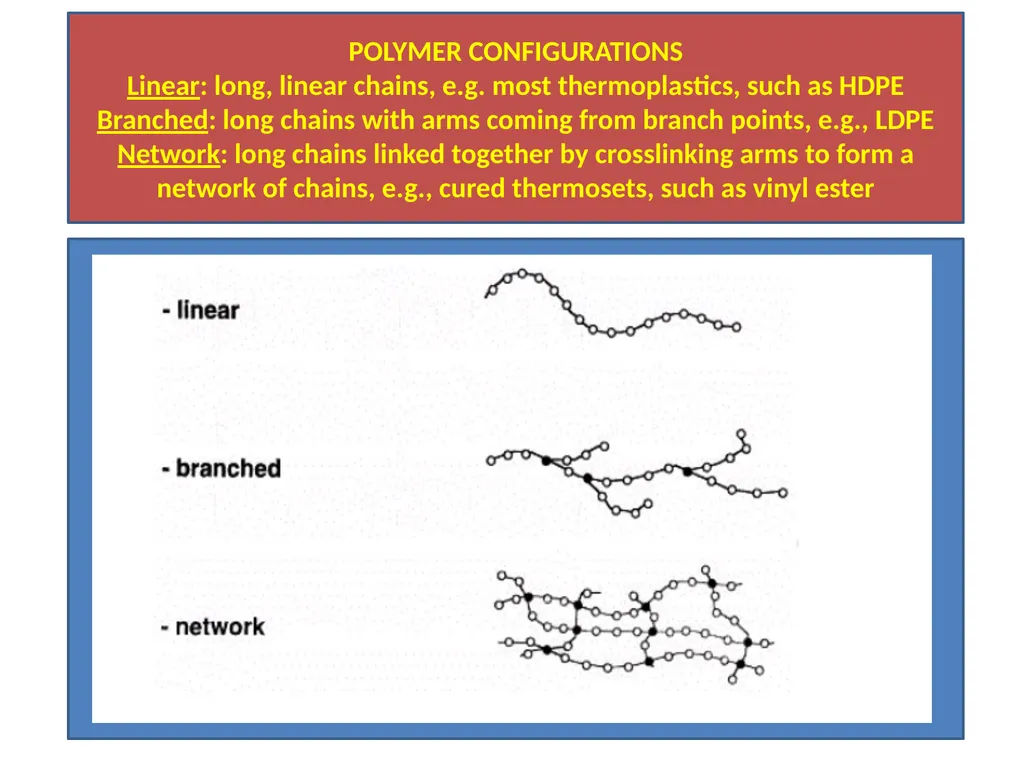
POLYMER CONFIGURATIONS
Linear: long, linear chains, e.g. most thermoplastics, such as HDPE
Branched: long chains with arms coming from branch points, e.g., LDPE
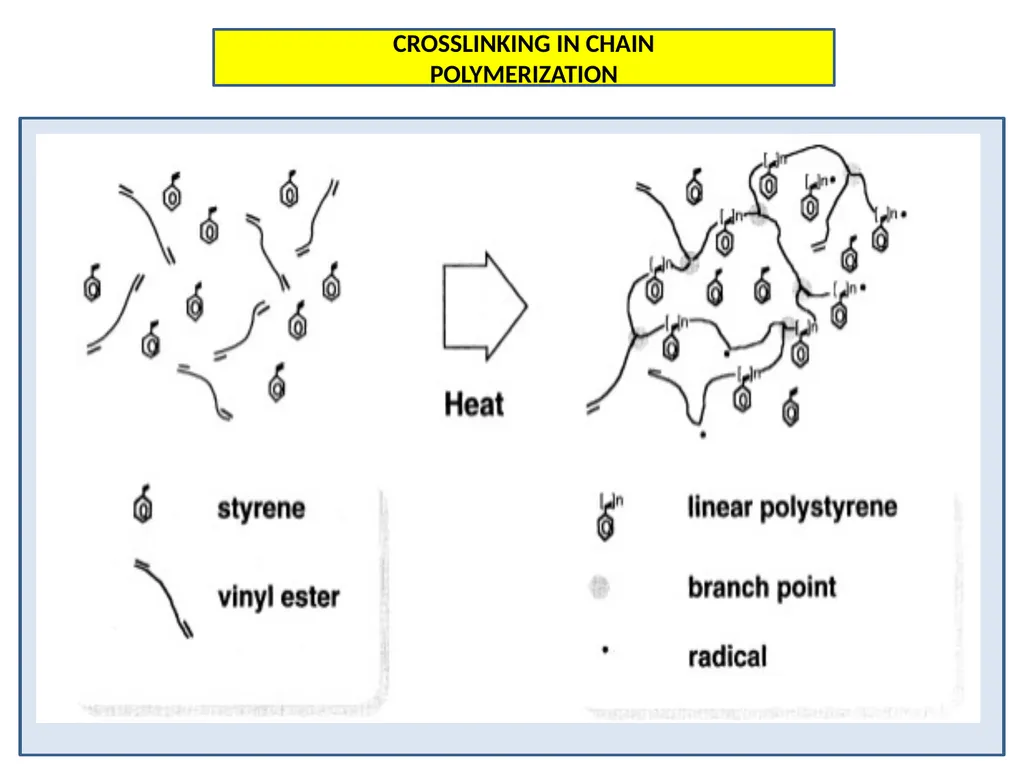
Network: long chains linked together by crosslinking arms to form a
network of chains, e.g., cured thermosets, such as vinyl ester<br>
05
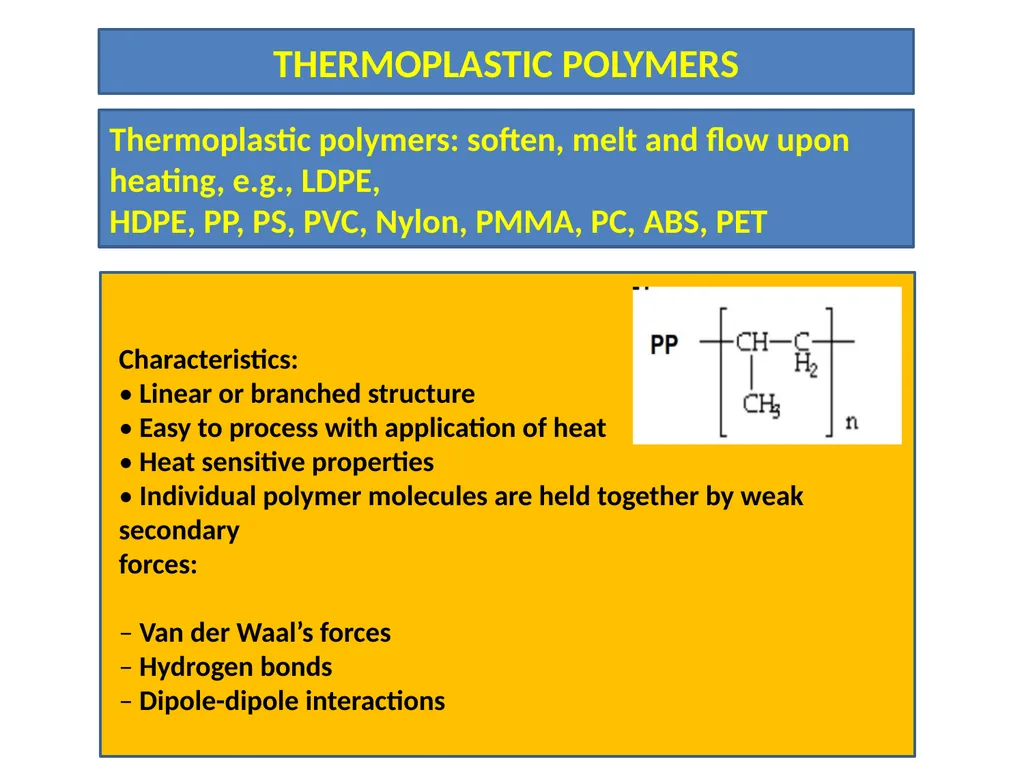
THERMOPLASTIC POLYMERS Thermoplastic polymers: soften, melt and flow upon heating, e.g., LDPE,
HDPE, PP, PS, PVC, Nylon, PMMA, PC, ABS, PET Characteristics:
• Linear or branched structure
• Easy to process with application of heat
• Heat sensitive properties
• Individual polymer molecules are held together by weak secondary
forces:
– Van der Waal’s forces
– Hydrogen bonds
– Dipole-dipole interactions<br>
06
Advantages:
• Unlimited shelf life -won't undergo reaction during storage
• Easy to handle (no tackiness)
• Shorter fabrication time
• Recyclable - they undergo melt and solidify cycles
• Easy to repair by welding, solvent bonding, etc.
• Postformable
• Higher fracture toughness and better delamination resistance
under fatigue than epoxy
Disadvantages:
• Poor creep resistance
• Poor thermal stability
• Poor melt flow characteristics (high viscosity ~ 1,000,000 cP)<br>
07
Thermosets: do not flow upon reheating, e.g. unsaturated polyesters,
vinyl esters, epoxies, phenol formaldehyde, urethane
• Upon application of heat, liquid resin becomes cured / rigid
• Cured polymer is less temp. sensitive than thermoplastics
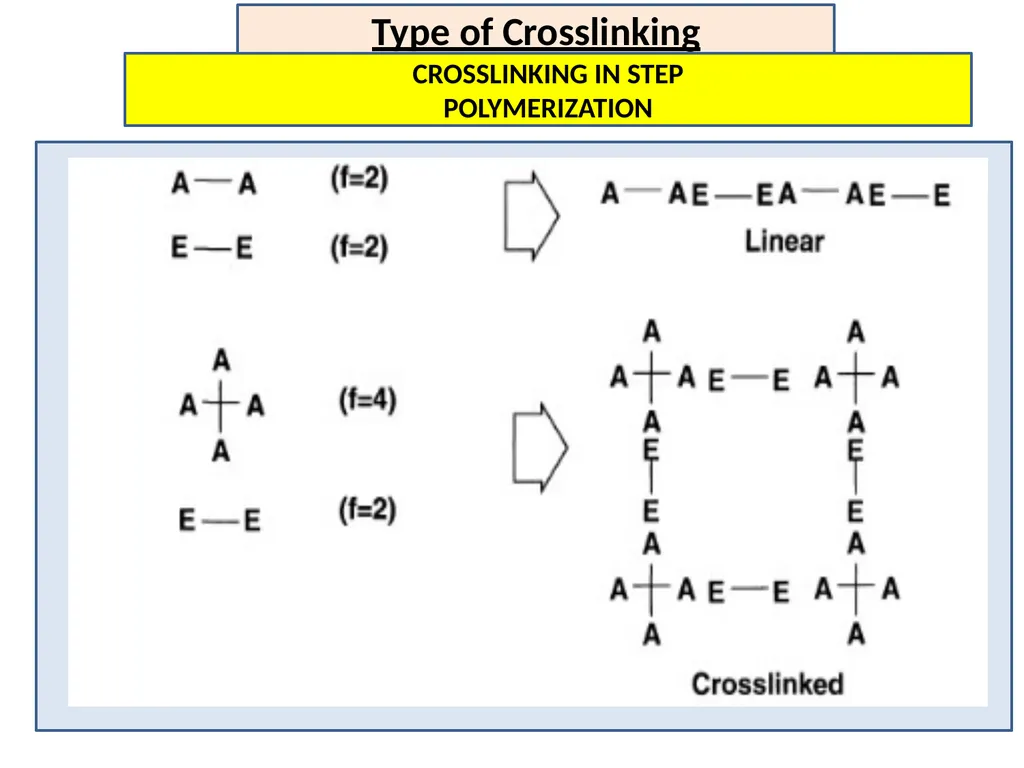
• Crosslinked network structure (formed from chemical bonds,
i.e. primary forces) exists throughout the part
• Crosslinking provides thermal stability such that polymer will
not melt or flow upon heating. THERMOSET POLYMERS Characteristics:<br>
08
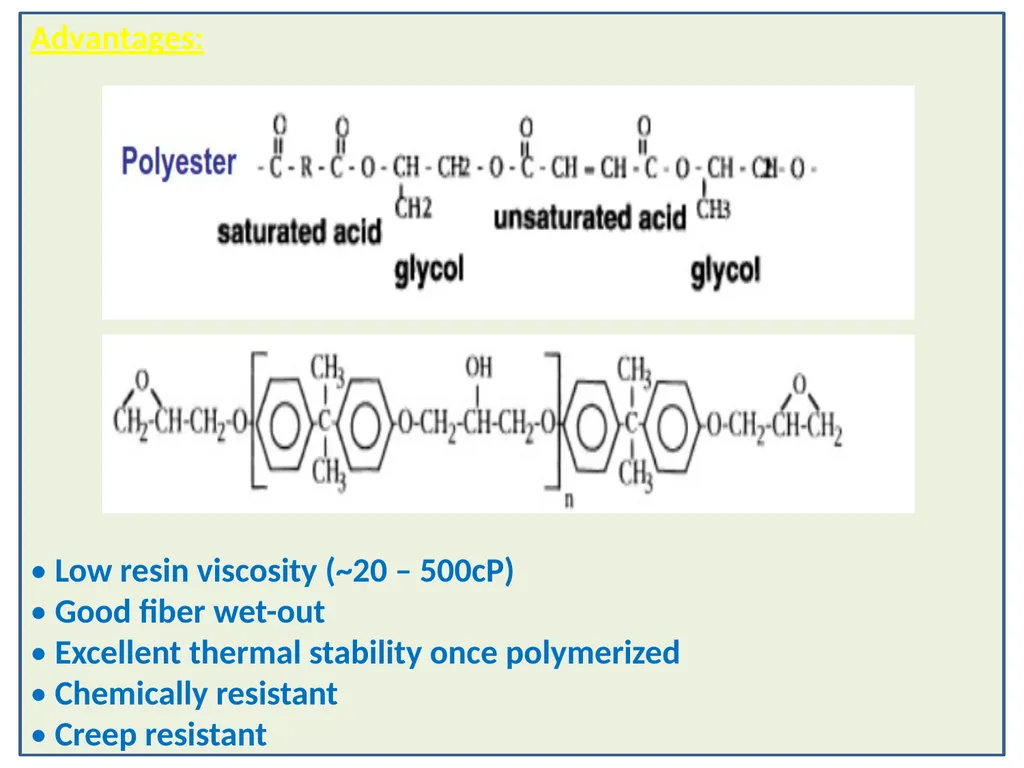
Advantages:
• Low resin viscosity (~20 – 500cP)
• Good fiber wet-out
• Excellent thermal stability once polymerized
• Chemically resistant
• Creep resistant<br>
09
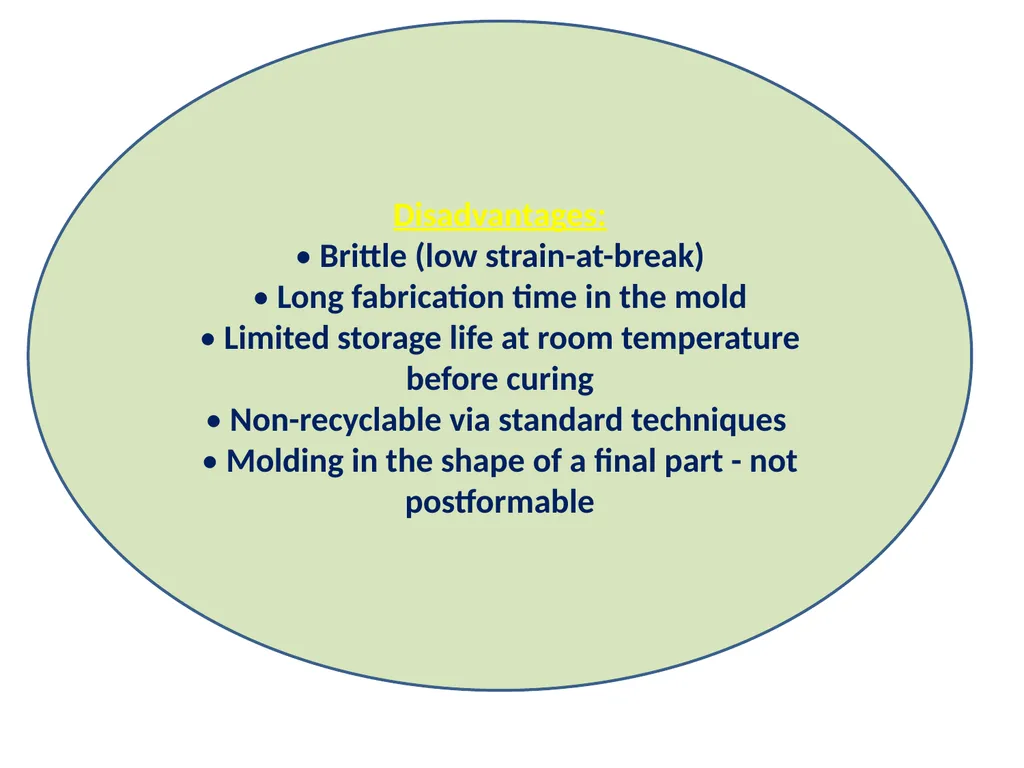
Disadvantages:
• Brittle (low strain-at-break)
• Long fabrication time in the mold
• Limited storage life at room temperature before curing
• Non-recyclable via standard techniques
• Molding in the shape of a final part - not postformable<br>
10
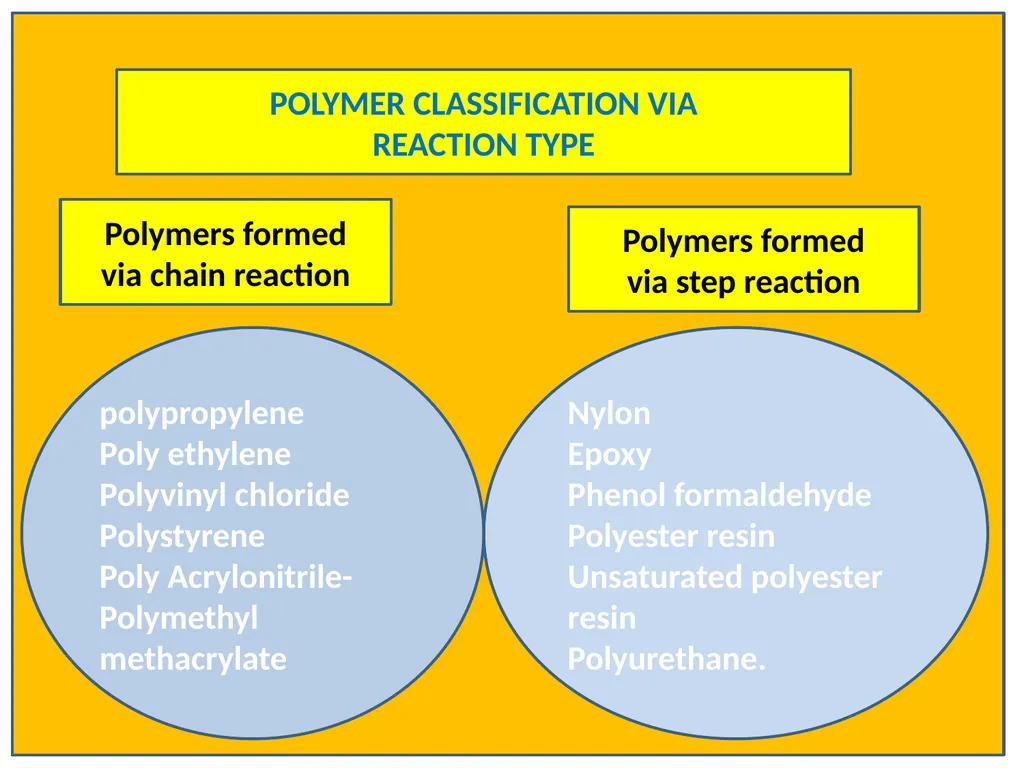
POLYMER CLASSIFICATION VIA
REACTION TYPE Polymers formed
via chain reaction Polymers formed
via step reaction polypropylene
Poly ethylene
Polyvinyl chloride
Polystyrene
Poly Acrylonitrile-Polymethyl methacrylate Nylon
Epoxy
Phenol formaldehyde
Polyester resin
Unsaturated polyester resin
Polyurethane.<br>
11
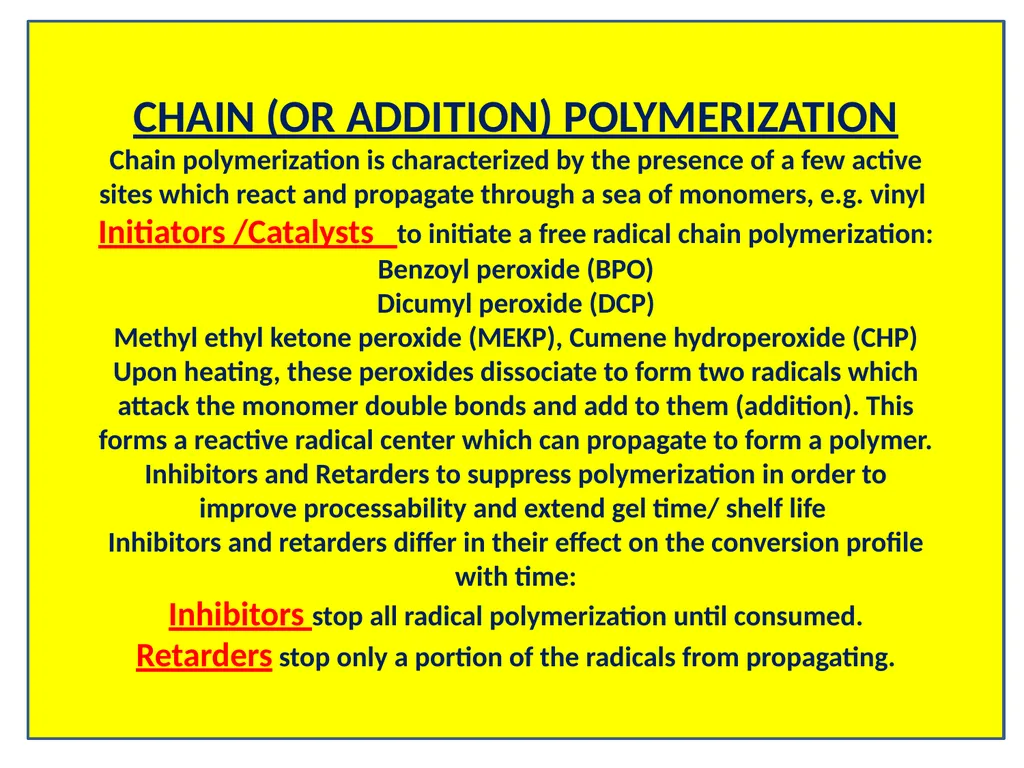
CHAIN (OR ADDITION) POLYMERIZATION
Chain polymerization is characterized by the presence of a few active
sites which react and propagate through a sea of monomers, e.g. vinyl
Initiators /Catalysts to initiate a free radical chain polymerization:
Benzoyl peroxide (BPO)
Dicumyl peroxide (DCP)
Methyl ethyl ketone peroxide (MEKP), Cumene hydroperoxide (CHP)
Upon heating, these peroxides dissociate to form two radicals which
attack the monomer double bonds and add to them (addition). This
forms a reactive radical center which can propagate to form a polymer.
Inhibitors and Retarders to suppress polymerization in order to
improve processability and extend gel time/ shelf life
Inhibitors and retarders differ in their effect on the conversion profile
with time:
Inhibitors stop all radical polymerization until consumed.
Retarders stop only a portion of the radicals from propagating.<br>
12
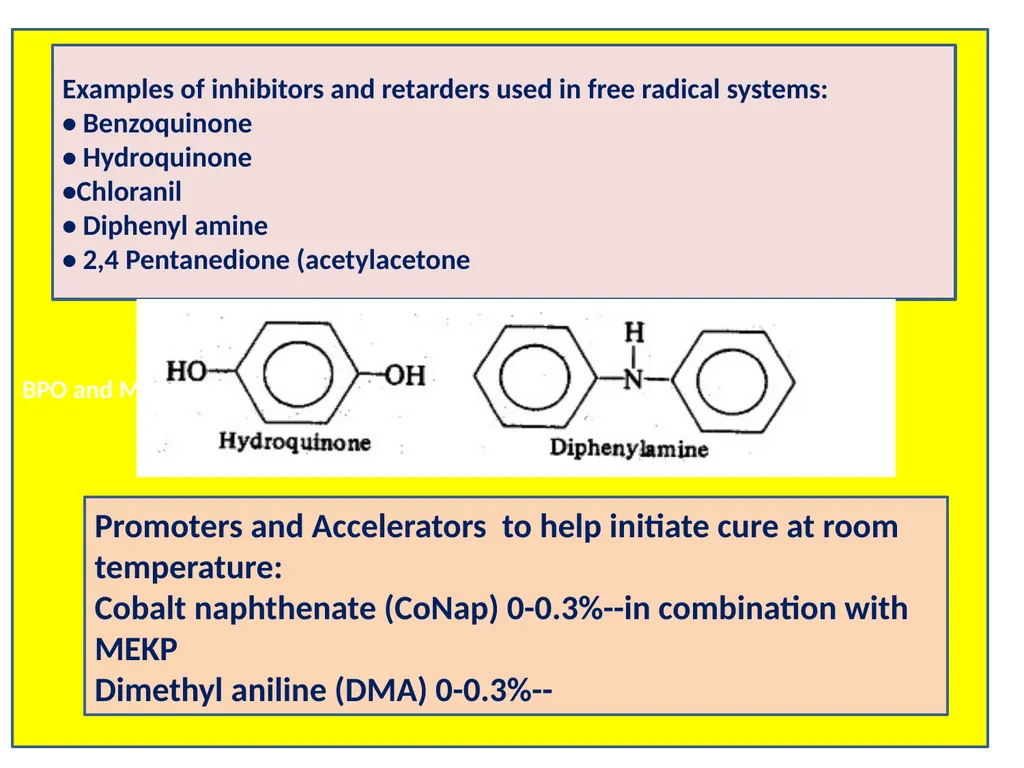
BPO and MEKP Examples of inhibitors and retarders used in free radical systems:
• Benzoquinone
• Hydroquinone
•Chloranil
• Diphenyl amine
• 2,4 Pentanedione (acetylacetone Promoters and Accelerators to help initiate cure at room temperature:
Cobalt naphthenate (CoNap) 0-0.3%--in combination with MEKP
Dimethyl aniline (DMA) 0-0.3%--<br>
13
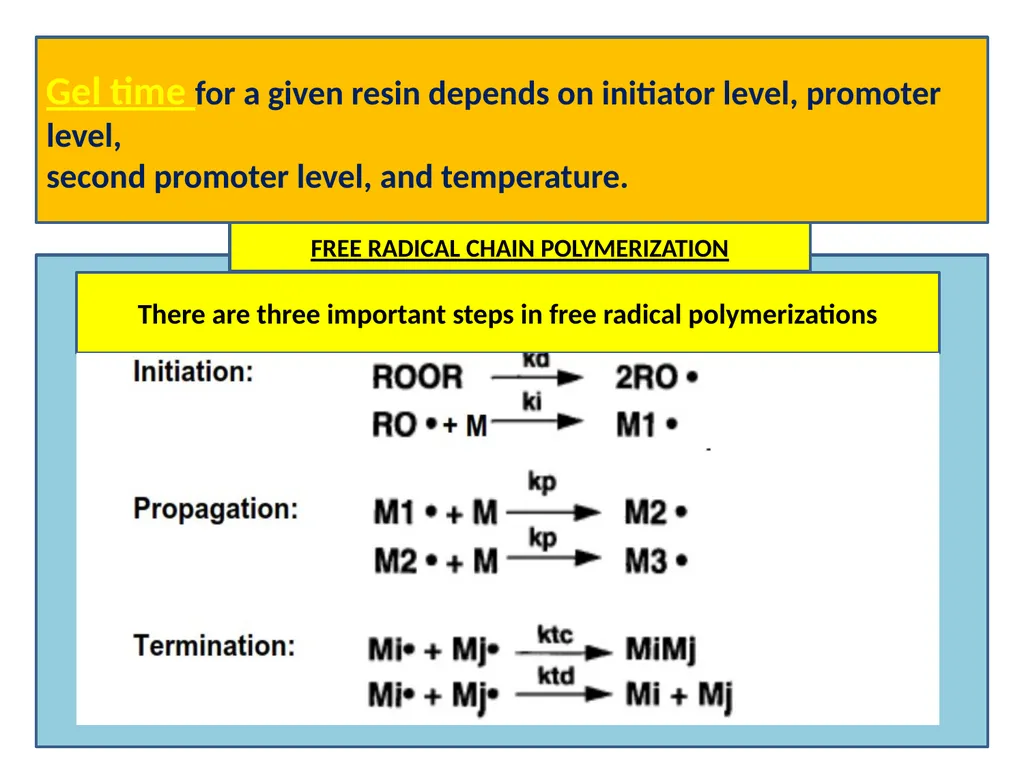
Gel time for a given resin depends on initiator level, promoter level,
second promoter level, and temperature. FREE RADICAL CHAIN POLYMERIZATION There are three important steps in free radical polymerizations<br>
14
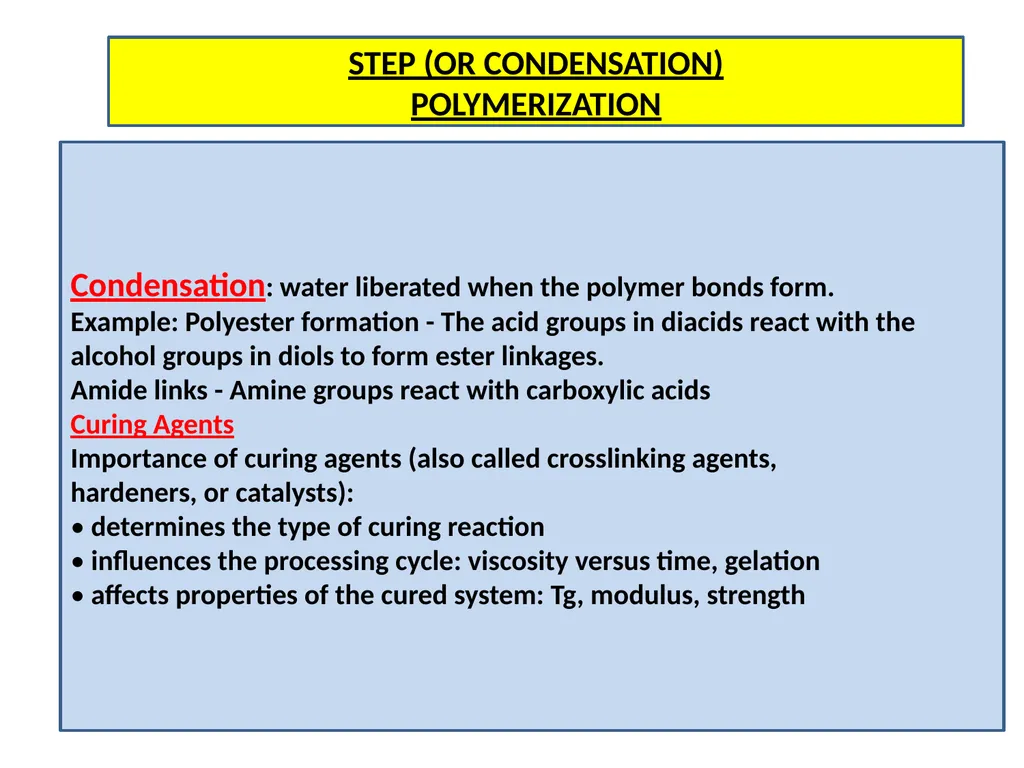
STEP (OR CONDENSATION)
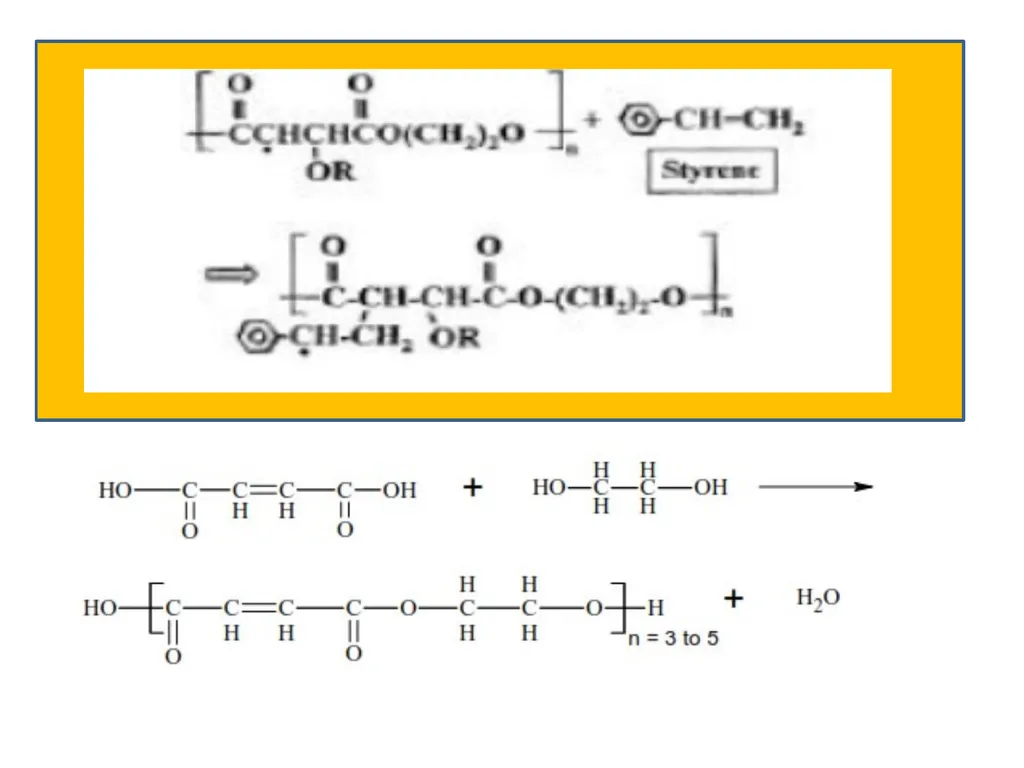
POLYMERIZATION Condensation: water liberated when the polymer bonds form.
Example: Polyester formation - The acid groups in diacids react with the
alcohol groups in diols to form ester linkages.
Amide links - Amine groups react with carboxylic acids
Curing Agents
Importance of curing agents (also called crosslinking agents,
hardeners, or catalysts):
• determines the type of curing reaction
• influences the processing cycle: viscosity versus time, gelation
• affects properties of the cured system: Tg, modulus, strength<br>
15
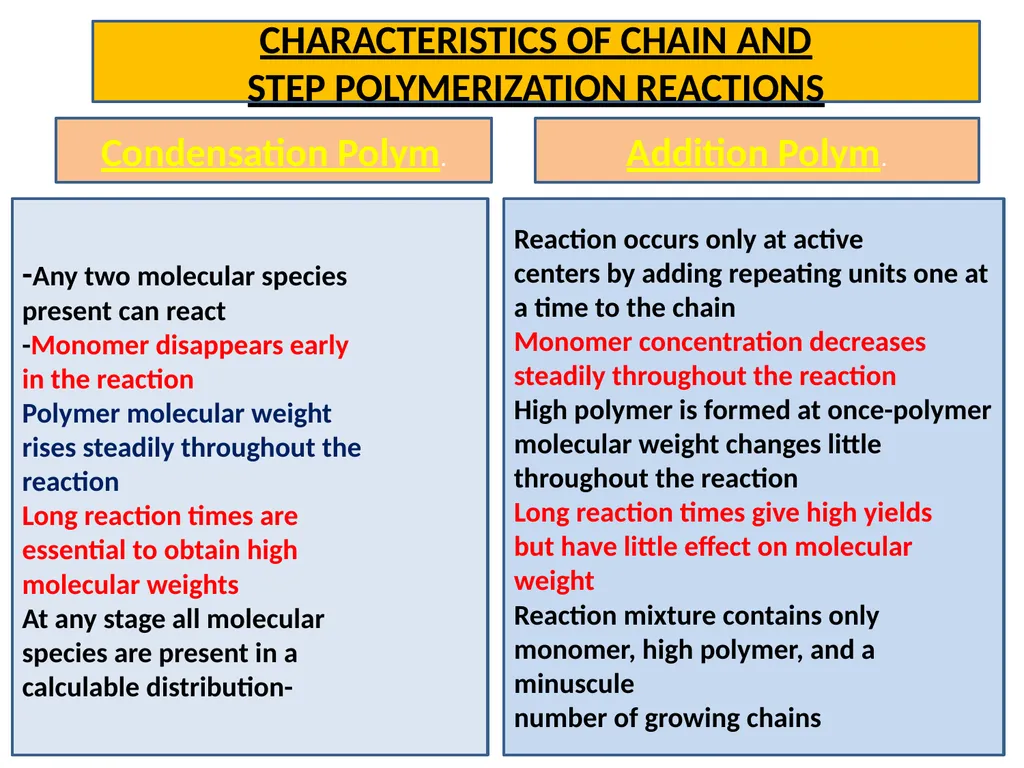
CHARACTERISTICS OF CHAIN AND
STEP POLYMERIZATION REACTIONS Addition Polym. Condensation Polym. -Any two molecular species
present can react
-Monomer disappears early
in the reaction
Polymer molecular weight
rises steadily throughout the
reaction
Long reaction times are
essential to obtain high
molecular weights
At any stage all molecular
species are present in a
calculable distribution- Reaction occurs only at active
centers by adding repeating units one at
a time to the chain
Monomer concentration decreases
steadily throughout the reaction
High polymer is formed at once-polymer
molecular weight changes little
throughout the reaction
Long reaction times give high yields
but have little effect on molecular weight
Reaction mixture contains only
monomer, high polymer, and a minuscule
number of growing chains<br>
16
Type of Crosslinking CROSSLINKING IN STEP
POLYMERIZATION<br>
17
CROSSLINKING IN CHAIN
POLYMERIZATION<br>
18
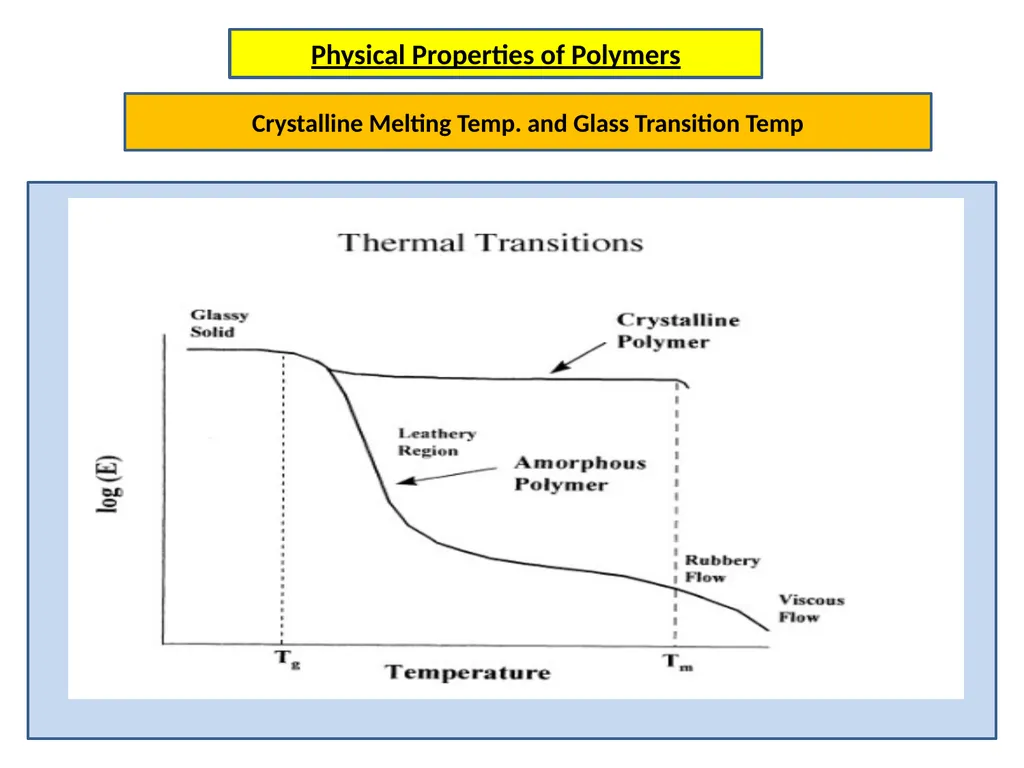
Physical Properties of Polymers Crystalline Melting Temp. and Glass Transition Temp<br>
19
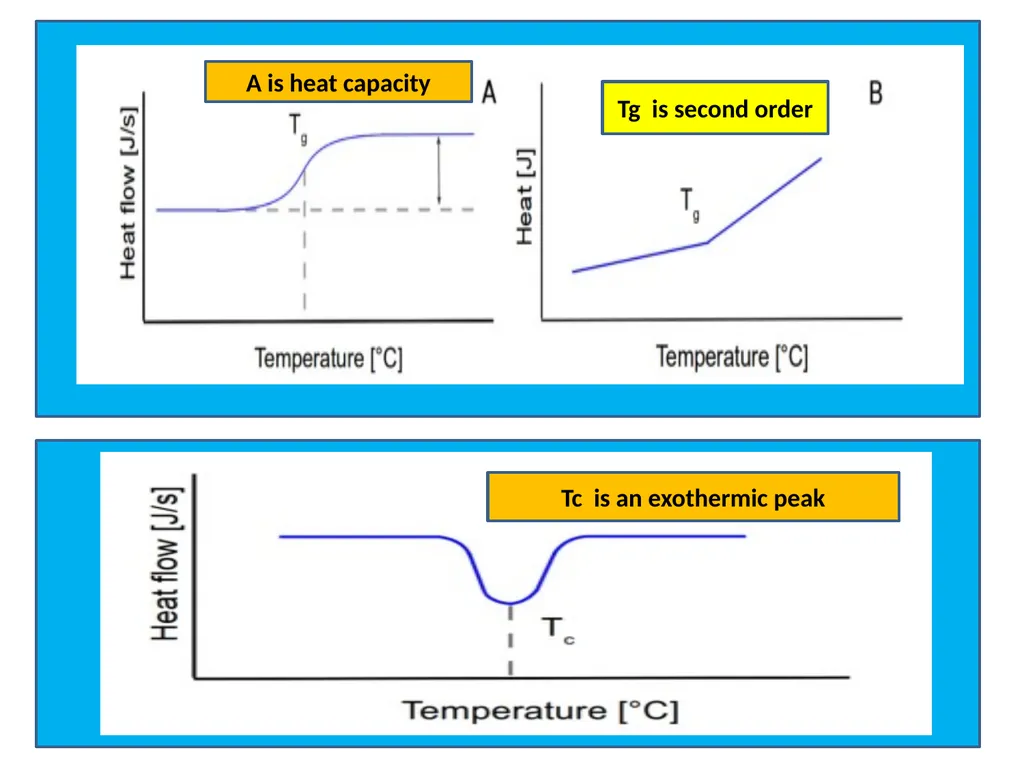
Tc is an exothermic peak A is heat capacity Tg is second order<br>
20
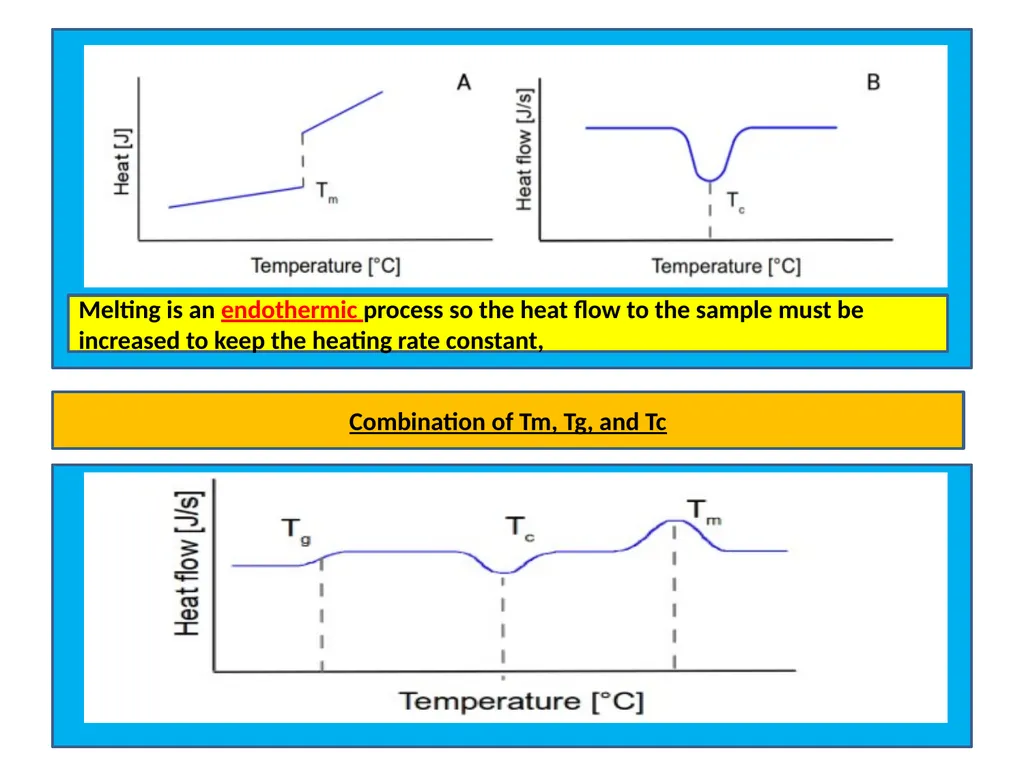
Melting is an endothermic process so the heat flow to the sample must be
increased to keep the heating rate constant, Combination of Tm, Tg, and Tc<br>
21
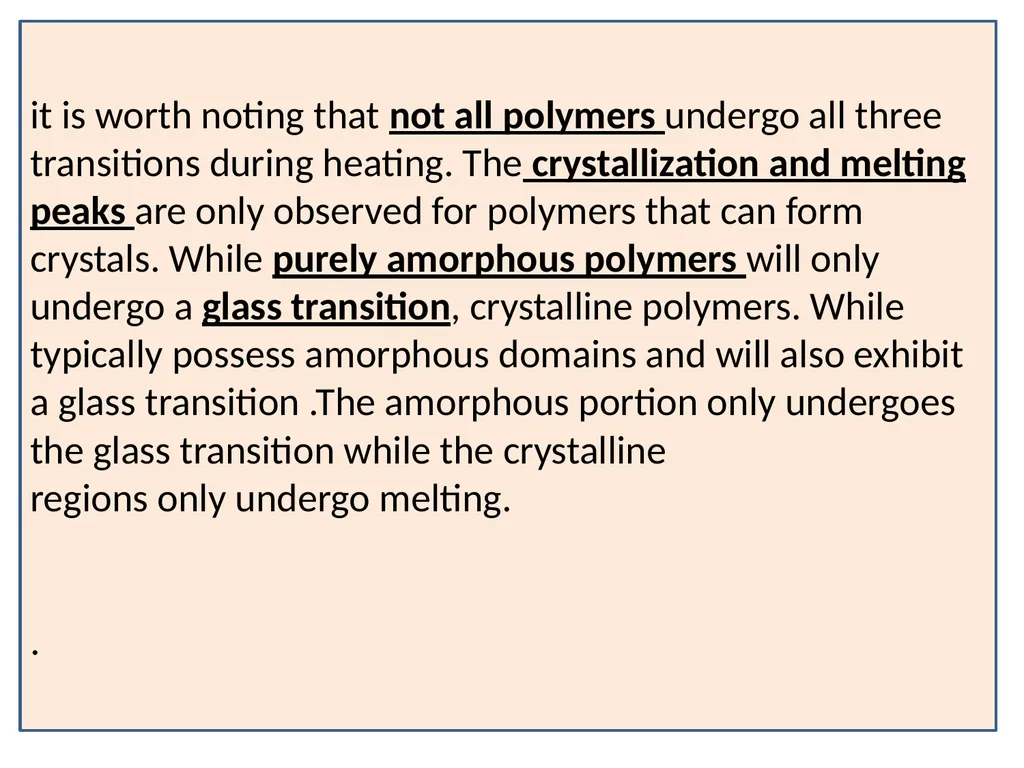
it is worth noting that not all polymers undergo all three transitions during heating. The crystallization and melting peaks are only observed for polymers that can form crystals. While purely amorphous polymers will only undergo a glass transition, crystalline polymers. While typically possess amorphous domains and will also exhibit a glass transition .The amorphous portion only undergoes the glass transition while the crystalline
regions only undergo melting.
.<br>
22
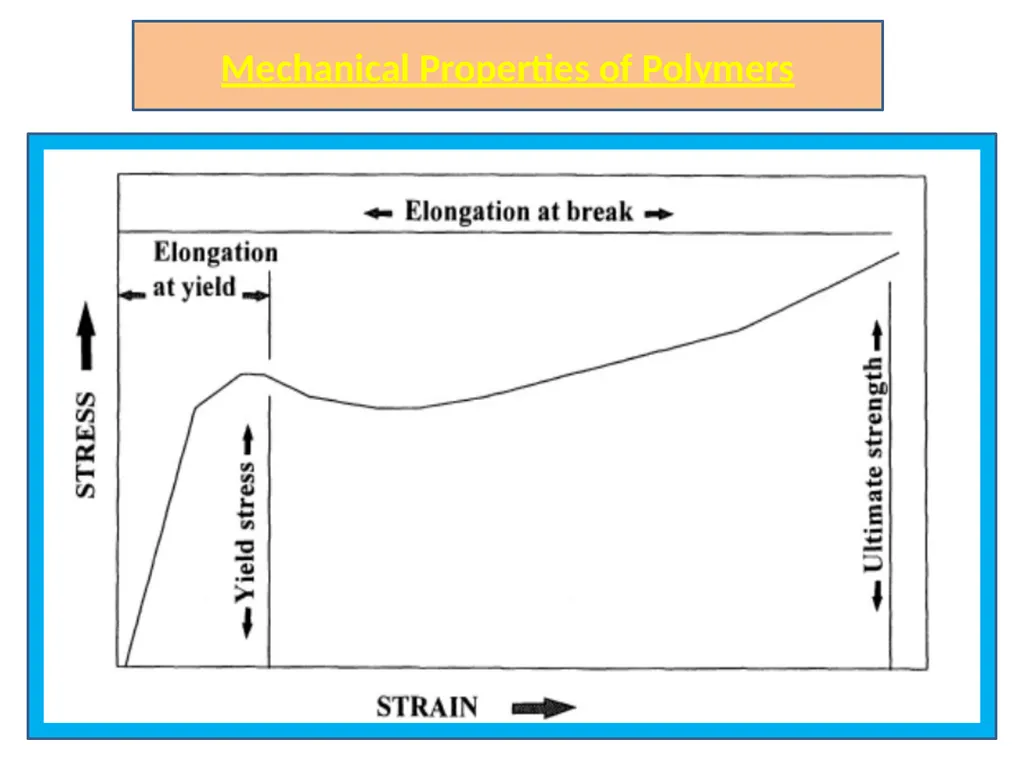
Mechanical Properties of Polymers<br>
23
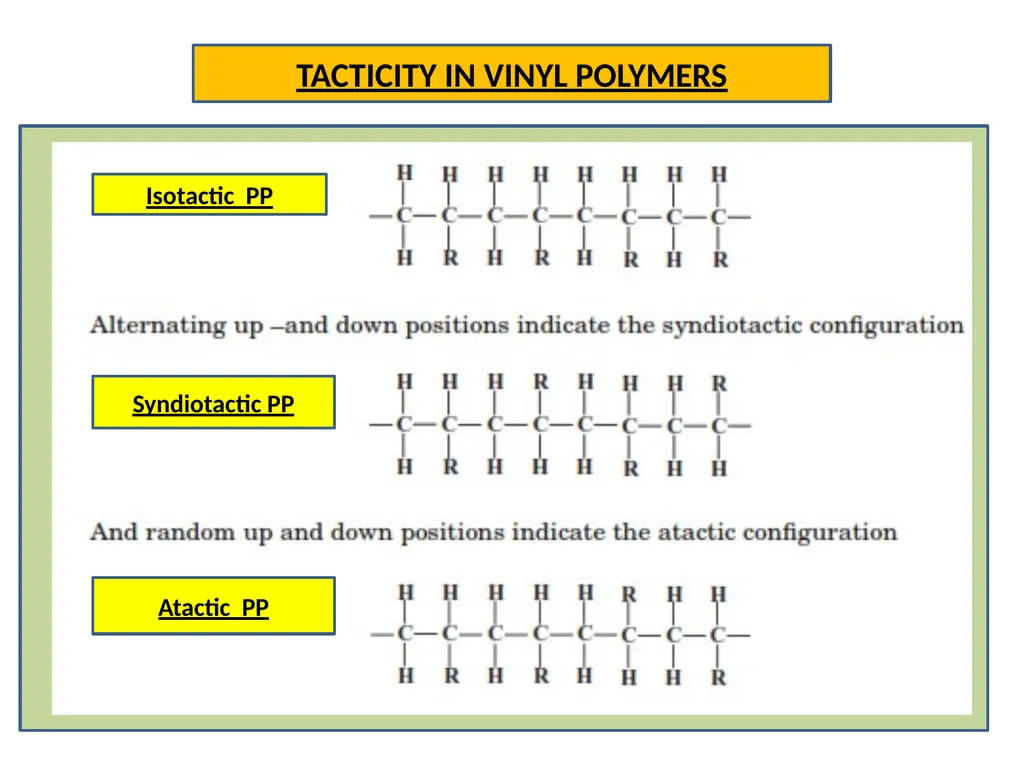
TACTICITY IN VINYL POLYMERS Isotactic PP Syndiotactic PP Atactic PP<br>
24
Pr.D.Widad .Salih.Hanoosh<br>