Advanced Analytical Chemistry 1 Separation Technique, Chromatography For Postgraduate (Masters degrees) Lecture No. 1 By Asst. Prof. Dr. Layla Salih Al-Omran How two molecules can be separated from each other? When the components of the
"Advanced Analytical Chemistry 1 Separation" is the property of its rightful owner. Permission is granted to
download and print the materials on this website for personal, non-commercial use only, and to display it
on your personal computer provided you do not modify the materials and that you retain all copyright
notices contained in the materials. By downloading content from our website, you accept the terms of this
agreement.
Lecture No. 1
By
Asst. Prof. Dr. Layla Salih Al-Omran<br>
02
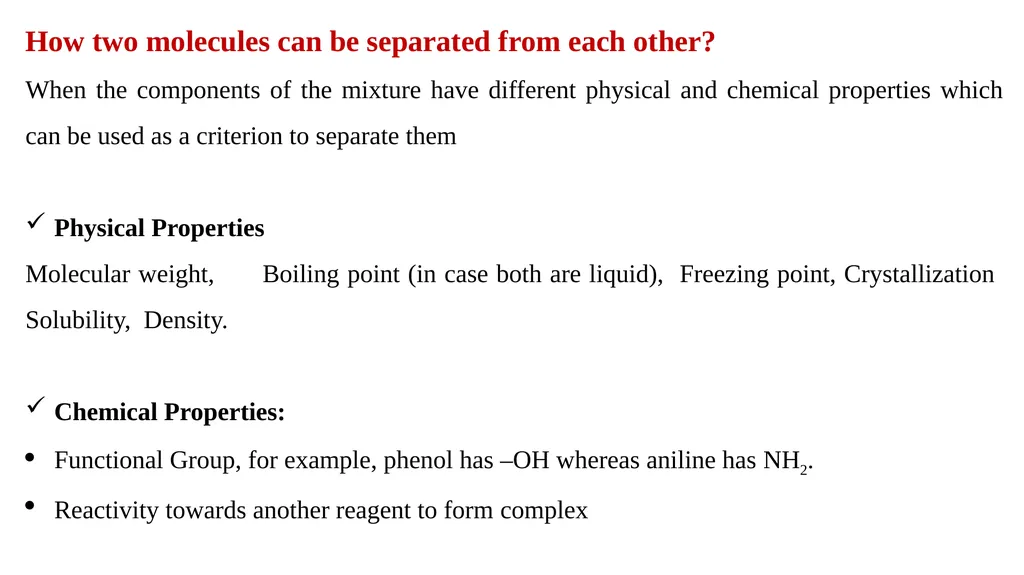
How two molecules can be separated from each other?
When the components of the mixture have different physical and chemical properties which can be used as a criterion to separate them
Physical Properties
Molecular weight, Boiling point (in case both are liquid), Freezing point, Crystallization Solubility, Density.
Chemical Properties:
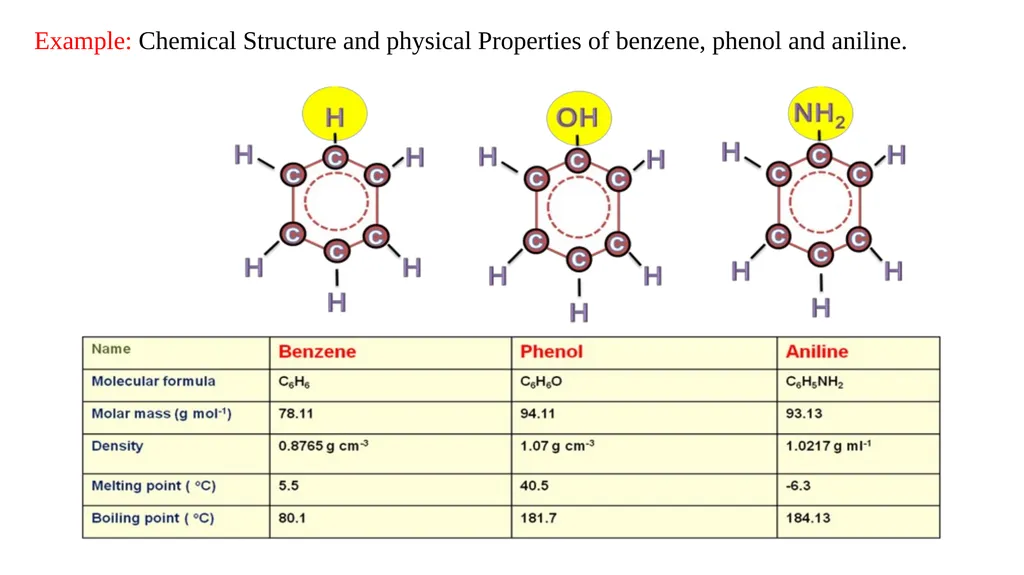
Functional Group, for example, phenol has –OH whereas aniline has NH2.
Reactivity towards another reagent to form complex<br>
03
Example: Chemical Structure and physical Properties of benzene, phenol and aniline.<br>
04
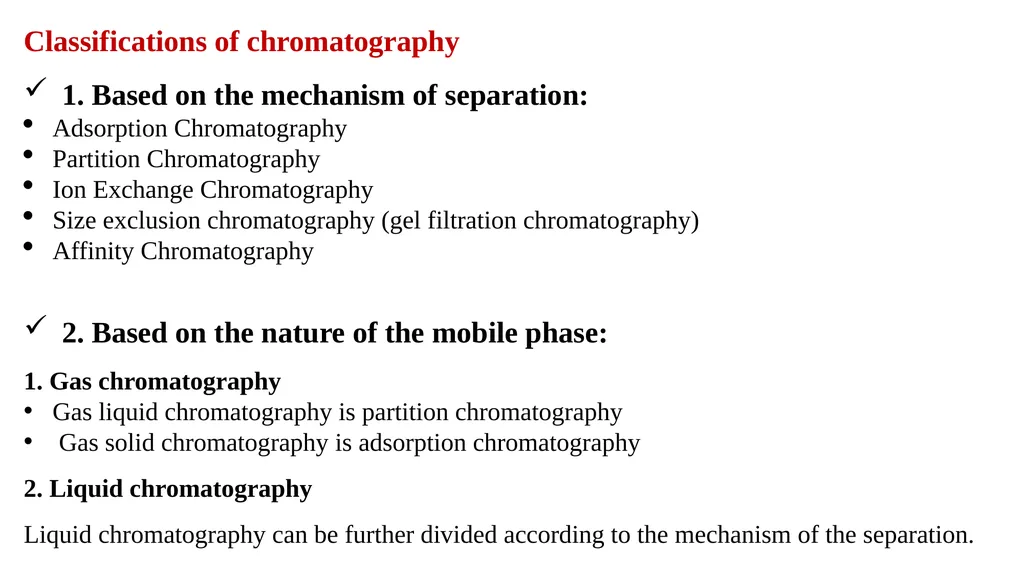
Classifications of chromatography
1. Based on the mechanism of separation:
Adsorption Chromatography
Partition Chromatography
Ion Exchange Chromatography
Size exclusion chromatography (gel filtration chromatography)
Affinity Chromatography
2. Based on the nature of the mobile phase:
1. Gas chromatography
Gas liquid chromatography is partition chromatography
Gas solid chromatography is adsorption chromatography
2. Liquid chromatography
Liquid chromatography can be further divided according to the mechanism of the separation.<br>
05
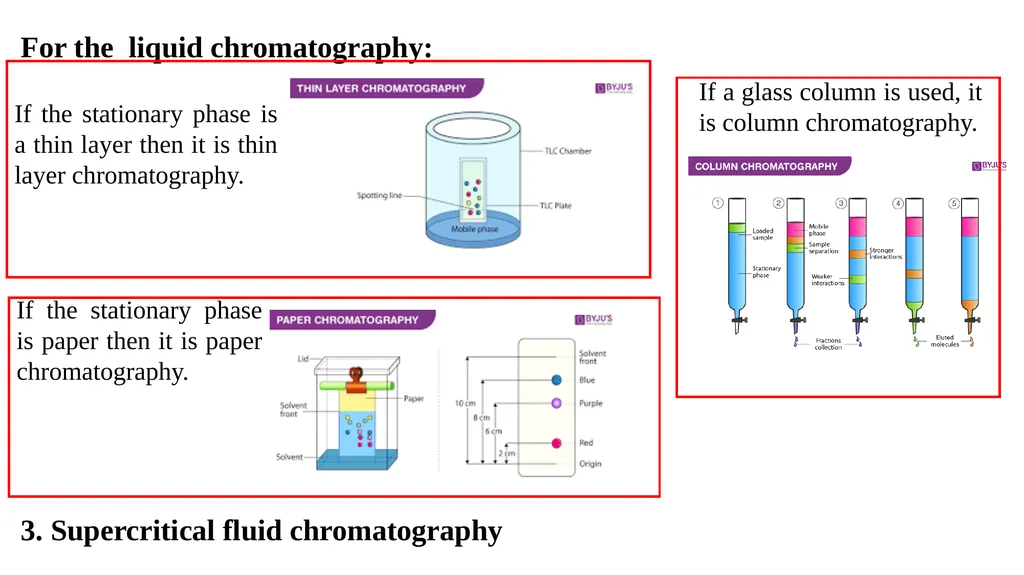
For the liquid chromatography:
3. Supercritical fluid chromatography If the stationary phase is paper then it is paper chromatography. If a glass column is used, it is column chromatography. If the stationary phase is a thin layer then it is thin layer chromatography.<br>
06
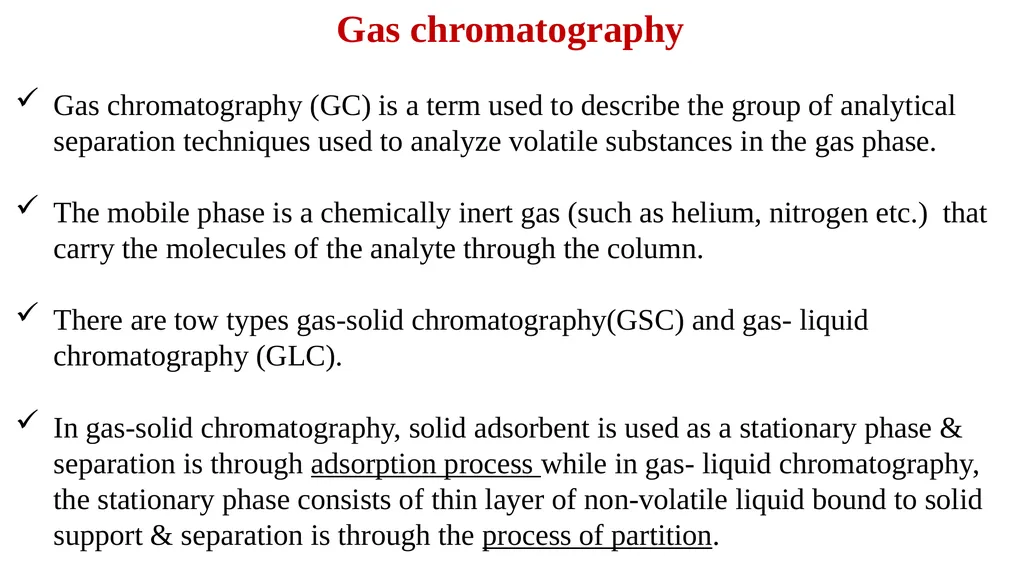
Gas chromatography
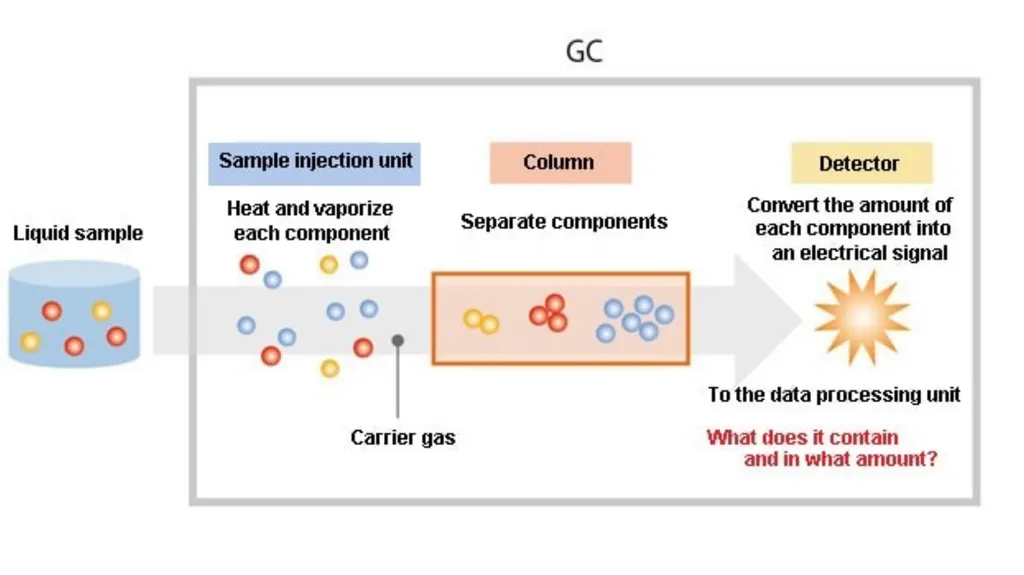
Gas chromatography (GC) is a term used to describe the group of analytical separation techniques used to analyze volatile substances in the gas phase.
The mobile phase is a chemically inert gas (such as helium, nitrogen etc.) that carry the molecules of the analyte through the column.
There are tow types gas-solid chromatography(GSC) and gas- liquid chromatography (GLC).
In gas-solid chromatography, solid adsorbent is used as a stationary phase & separation is through adsorption process while in gas- liquid chromatography, the stationary phase consists of thin layer of non-volatile liquid bound to solid support & separation is through the process of partition.<br>
07
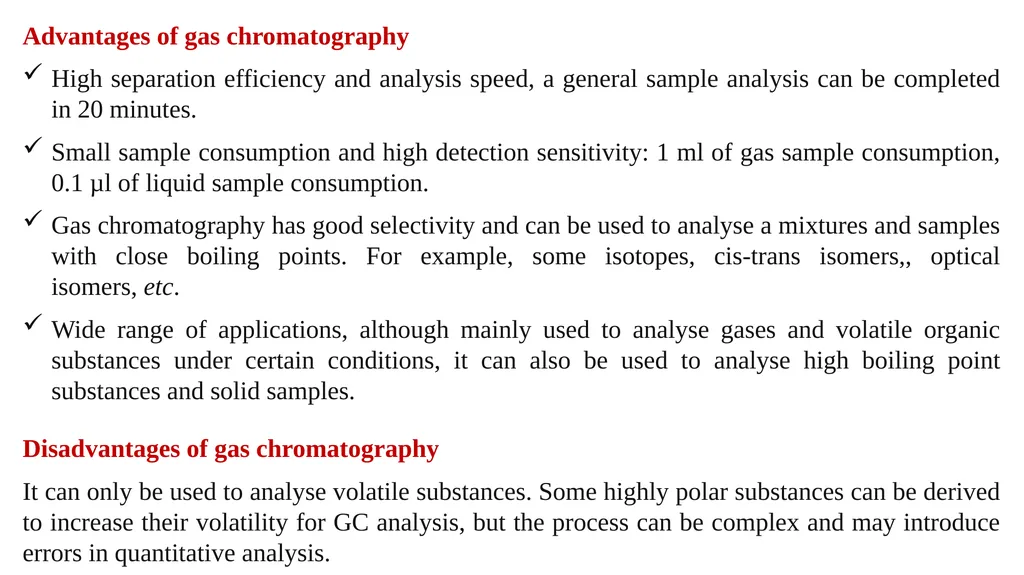
Advantages of gas chromatography
High separation efficiency and analysis speed, a general sample analysis can be completed in 20 minutes.
Small sample consumption and high detection sensitivity: 1 ml of gas sample consumption, 0.1 µl of liquid sample consumption.
Gas chromatography has good selectivity and can be used to analyse a mixtures and samples with close boiling points. For example, some isotopes, cis-trans isomers,, optical isomers, etc.
Wide range of applications, although mainly used to analyse gases and volatile organic substances under certain conditions, it can also be used to analyse high boiling point substances and solid samples.
Disadvantages of gas chromatography
It can only be used to analyse volatile substances. Some highly polar substances can be derived to increase their volatility for GC analysis, but the process can be complex and may introduce errors in quantitative analysis.<br>
08
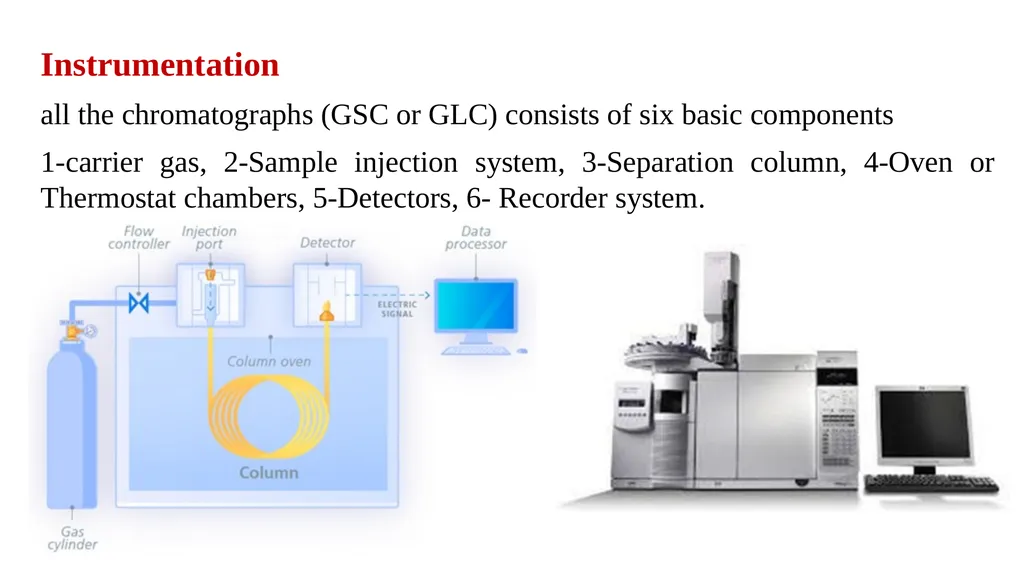
Instrumentation
all the chromatographs (GSC or GLC) consists of six basic components
1-carrier gas, 2-Sample injection system, 3-Separation column, 4-Oven or Thermostat chambers, 5-Detectors, 6- Recorder system.<br>
09
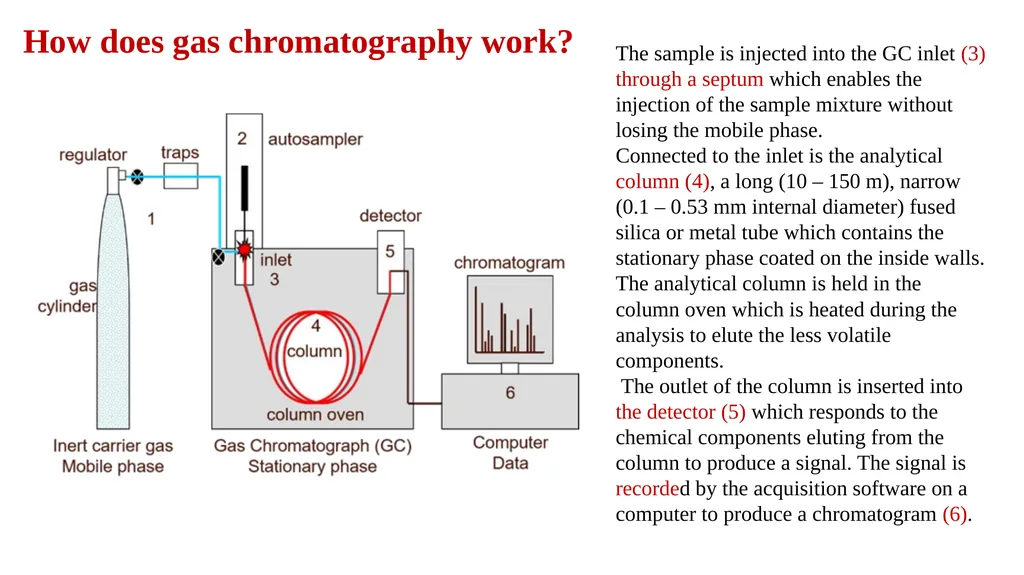
How does gas chromatography work? The sample is injected into the GC inlet (3) through a septum which enables the injection of the sample mixture without losing the mobile phase.
Connected to the inlet is the analytical column (4), a long (10 – 150 m), narrow (0.1 – 0.53 mm internal diameter) fused silica or metal tube which contains the stationary phase coated on the inside walls.
The analytical column is held in the column oven which is heated during the analysis to elute the less volatile components.
The outlet of the column is inserted into the detector (5) which responds to the chemical components eluting from the column to produce a signal. The signal is recorded by the acquisition software on a computer to produce a chromatogram (6).<br>
10
Instrumentation
Carrier Gas (mobile phase)
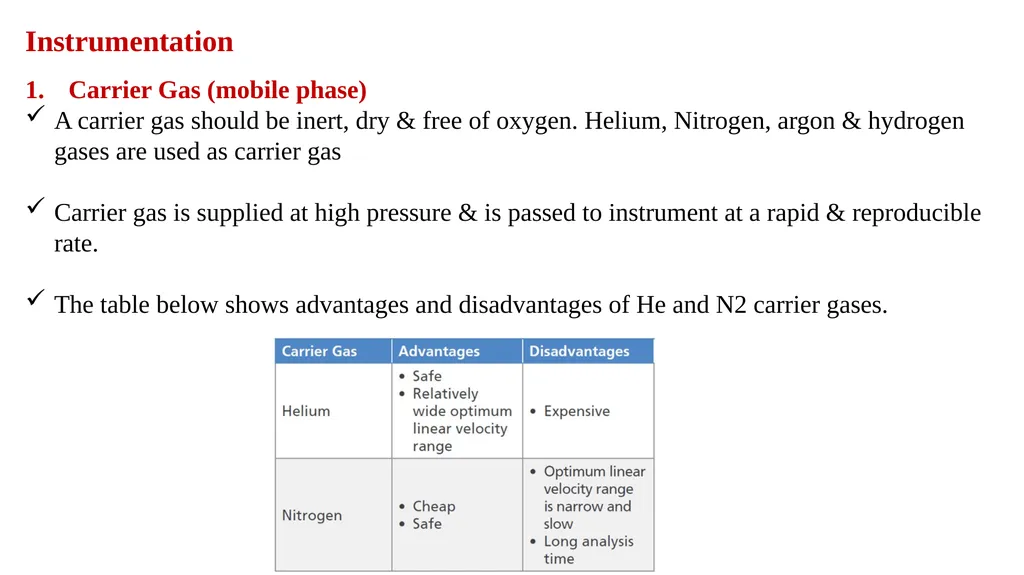
A carrier gas should be inert, dry & free of oxygen. Helium, Nitrogen, argon & hydrogen gases are used as carrier gas
Carrier gas is supplied at high pressure & is passed to instrument at a rapid & reproducible rate.
The table below shows advantages and disadvantages of He and N2 carrier gases.<br>
11
Sample injection system
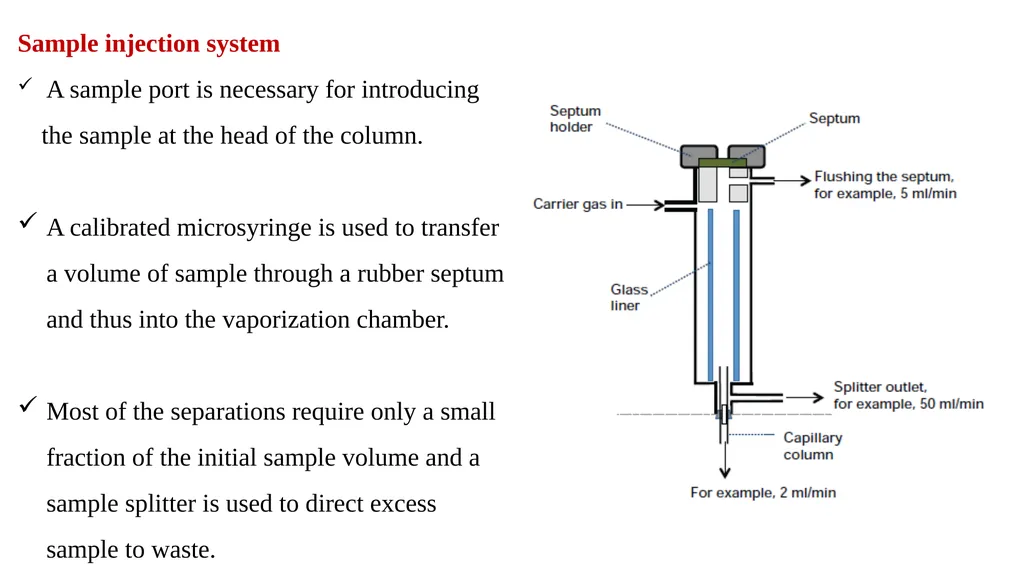
A sample port is necessary for introducing the sample at the head of the column.
A calibrated microsyringe is used to transfer a volume of sample through a rubber septum and thus into the vaporization chamber.
Most of the separations require only a small fraction of the initial sample volume and a sample splitter is used to direct excess sample to waste.<br>
12
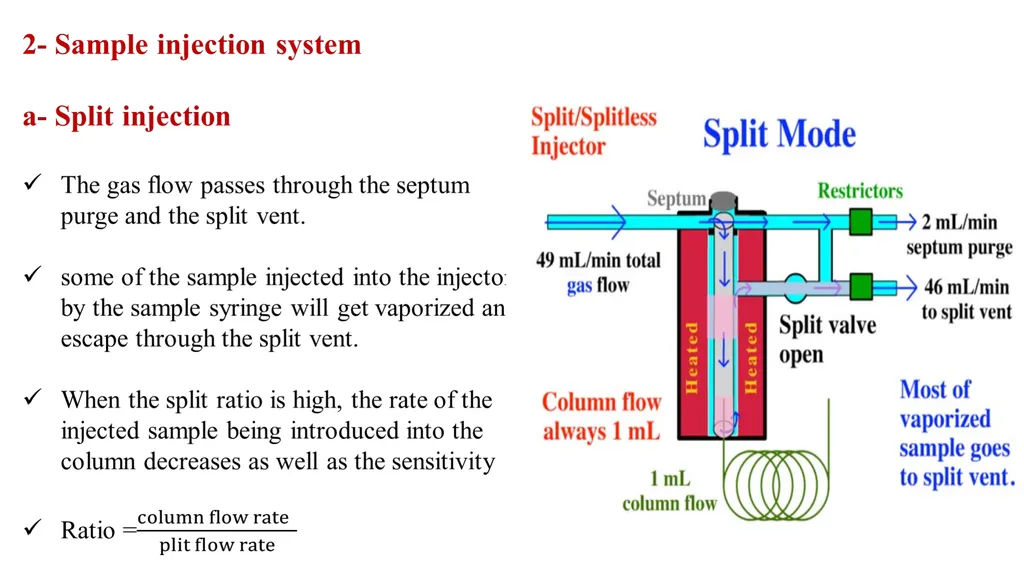
Commercial gas chromatographs involve the use of both split and splitless injections when alternating between packed columns and capillary columns.
Capillary column requires smaller amounts of injected analytes compared to packed columns.
The vaporization chamber is typically heated 50 °C above the lowest boiling point of the sample and subsequently mixed with the carrier gas to transport the sample into the column.<br>
13
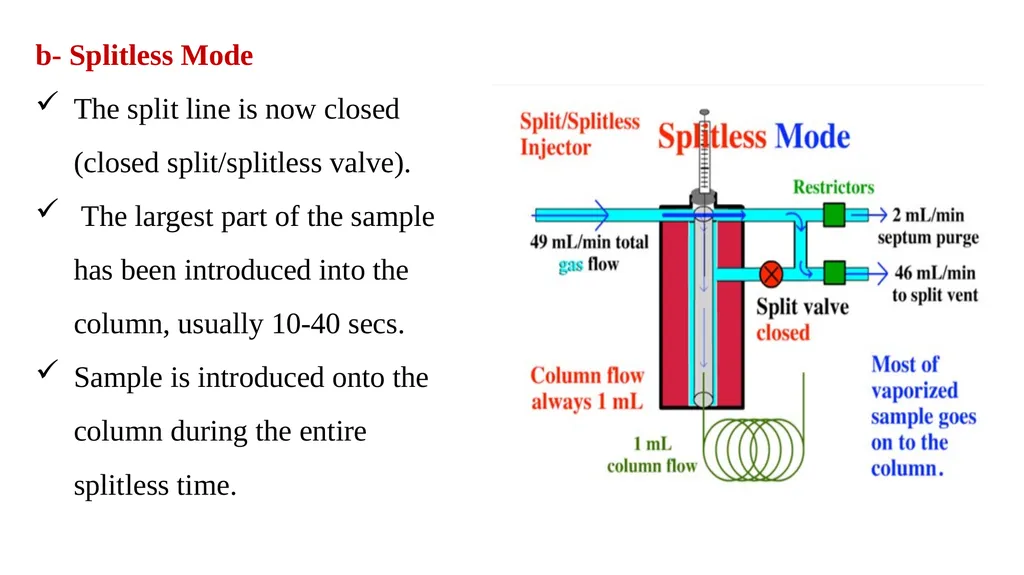
b- Splitless Mode
The split line is now closed (closed split/splitless valve).
The largest part of the sample has been introduced into the column, usually 10-40 secs.
Sample is introduced onto the column during the entire splitless time.<br>
14
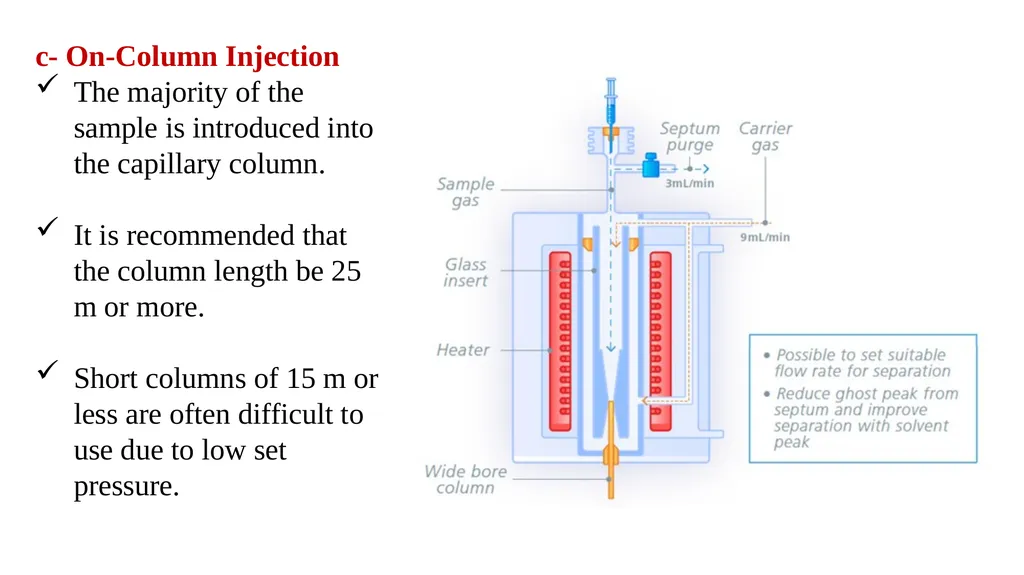
c- On-Column Injection
The majority of the sample is introduced into the capillary column.
It is recommended that the column length be 25 m or more.
Short columns of 15 m or less are often difficult to use due to low set pressure.<br>