
ADVANCED EDUCATIONAL PSYCHOLOGY DR. SANTHAKUMARI
MY
Published · 22 slides · 0 views

1 / 1

Description
ADVANCED EDUCATIONAL PSYCHOLOGY DR. SANTHAKUMARI PRINCIPAL DHANALAKSHMI SRINIVASAN COLLEGE OF EDUCATION PERAMBALUR EDUCATIONAL PSYCHOLOGY According to Crow and Crow, Educational psychology describes and explains the learining experiences of
Related Topics
Share
Embed code
Download this presentation From Below
"ADVANCED EDUCATIONAL PSYCHOLOGY DR. SANTHAKUMARI" is the property of its rightful owner. Permission is granted to download and print the materials on this website for personal, non-commercial use only, and to display it on your personal computer provided you do not modify the materials and that you retain all copyright notices contained in the materials. By downloading content from our website, you accept the terms of this agreement.
Presentation Transcript
01
ADVANCED EDUCATIONAL PSYCHOLOGY DR. SANTHAKUMARI
PRINCIPAL
DHANALAKSHMI SRINIVASAN COLLEGE OF EDUCATION
PERAMBALUR<br>
PRINCIPAL
DHANALAKSHMI SRINIVASAN COLLEGE OF EDUCATION
PERAMBALUR<br>
02
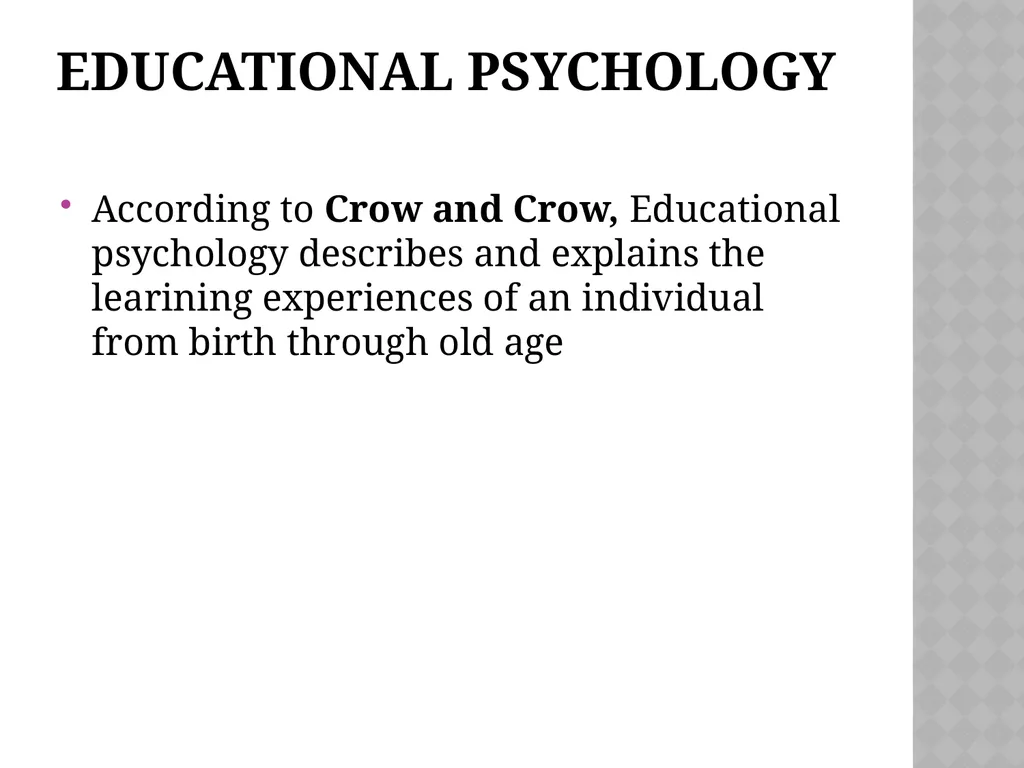
EDUCATIONAL PSYCHOLOGY According to Crow and Crow, Educational psychology describes and explains the learining experiences of an individual from birth through old age<br>
03
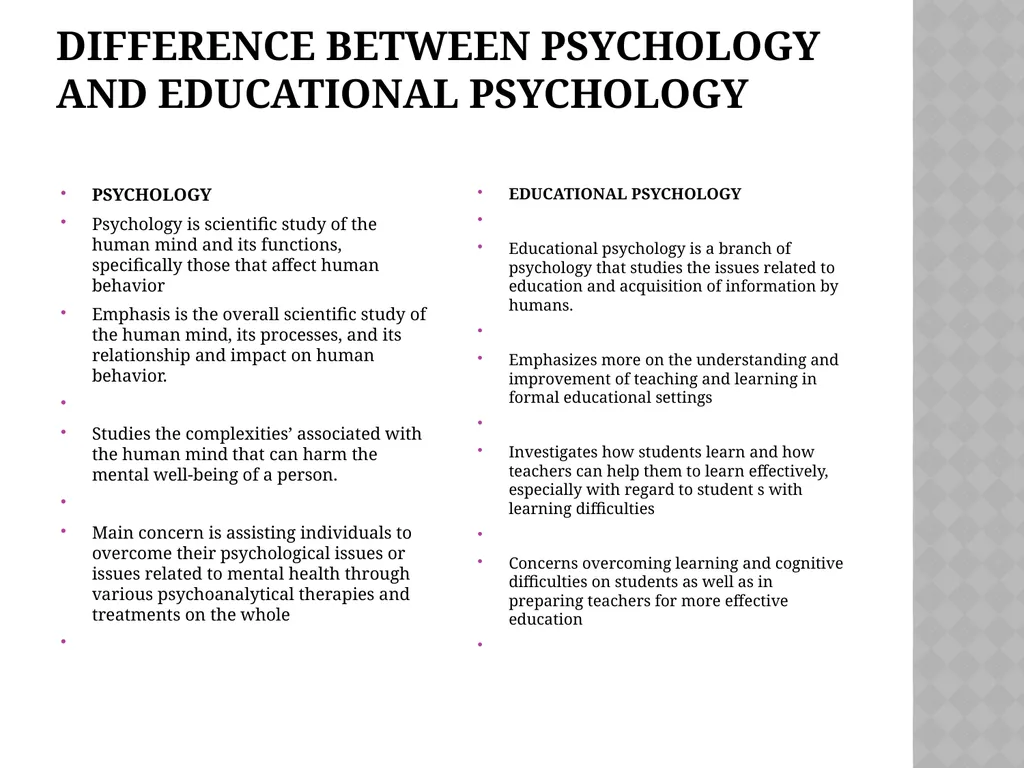
DIFFERENCE BETWEEN PSYCHOLOGY AND EDUCATIONAL PSYCHOLOGY PSYCHOLOGY
Psychology is scientific study of the human mind and its functions, specifically those that affect human behavior
Emphasis is the overall scientific study of the human mind, its processes, and its relationship and impact on human behavior.
Studies the complexities’ associated with the human mind that can harm the mental well-being of a person.
Main concern is assisting individuals to overcome their psychological issues or issues related to mental health through various psychoanalytical therapies and treatments on the whole EDUCATIONAL PSYCHOLOGY
Educational psychology is a branch of psychology that studies the issues related to education and acquisition of information by humans.
Emphasizes more on the understanding and improvement of teaching and learning in formal educational settings
Investigates how students learn and how teachers can help them to learn effectively, especially with regard to student s with learning difficulties
Concerns overcoming learning and cognitive difficulties on students as well as in preparing teachers for more effective education<br>
Psychology is scientific study of the human mind and its functions, specifically those that affect human behavior
Emphasis is the overall scientific study of the human mind, its processes, and its relationship and impact on human behavior.
Studies the complexities’ associated with the human mind that can harm the mental well-being of a person.
Main concern is assisting individuals to overcome their psychological issues or issues related to mental health through various psychoanalytical therapies and treatments on the whole EDUCATIONAL PSYCHOLOGY
Educational psychology is a branch of psychology that studies the issues related to education and acquisition of information by humans.
Emphasizes more on the understanding and improvement of teaching and learning in formal educational settings
Investigates how students learn and how teachers can help them to learn effectively, especially with regard to student s with learning difficulties
Concerns overcoming learning and cognitive difficulties on students as well as in preparing teachers for more effective education<br>
04
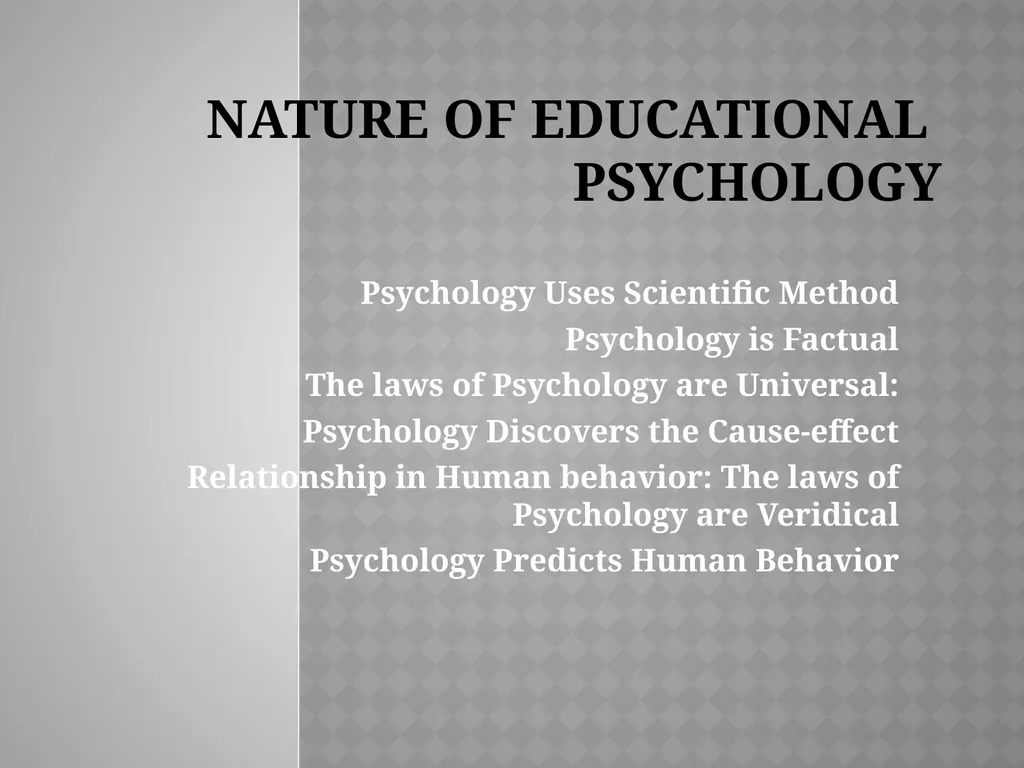
NATURE OF EDUCATIONAL PSYCHOLOGY Psychology Uses Scientific Method
Psychology is Factual
The laws of Psychology are Universal:
Psychology Discovers the Cause-effect
Relationship in Human behavior: The laws of Psychology are Veridical
Psychology Predicts Human Behavior<br>
Psychology is Factual
The laws of Psychology are Universal:
Psychology Discovers the Cause-effect
Relationship in Human behavior: The laws of Psychology are Veridical
Psychology Predicts Human Behavior<br>
05
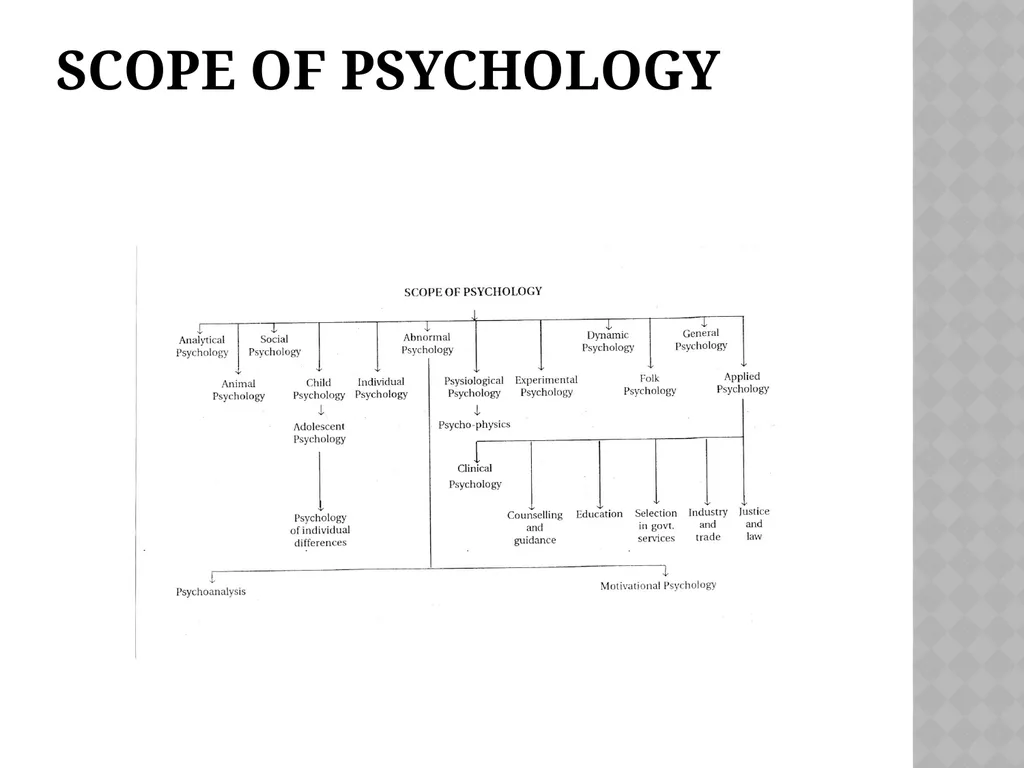
SCOPE OF PSYCHOLOGY<br>
06
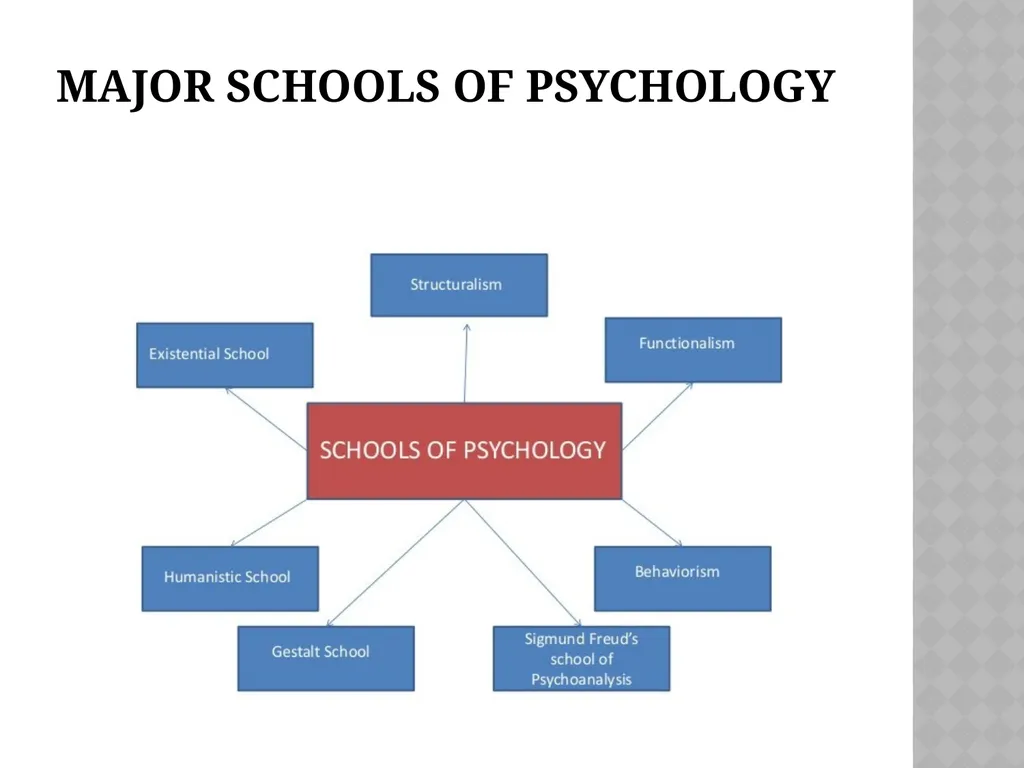
MAJOR SCHOOLS OF PSYCHOLOGY<br>
07
TIME LINE OF SCHOOL OF PSYCHOLOGY 1890s: first began to see the foundations of school psychology as a spearate practice
1896: Lightner Whitmer: First Psychological Clinic in North America at University of Penn. Seen as father of school and clinical psychology (specially for discovering problems in children)
1905: publication of Standford-Binet scales (original Binet scales for sorting children in Paris schools)
1910s: Child Guidance Clincs and Mental Hygiene Movement
1920s: “School Psychology / School Psychologist” emerge as terms
1971: APA Accredits their first doctoral program<br>
1896: Lightner Whitmer: First Psychological Clinic in North America at University of Penn. Seen as father of school and clinical psychology (specially for discovering problems in children)
1905: publication of Standford-Binet scales (original Binet scales for sorting children in Paris schools)
1910s: Child Guidance Clincs and Mental Hygiene Movement
1920s: “School Psychology / School Psychologist” emerge as terms
1971: APA Accredits their first doctoral program<br>
08
STRUCTURALISM Wihelm Wundt as German philosopher
Wundt who noted psychology as a science apart from biology and philosophy, was the first person to over call himself a psychologist. He is widely regarded as the father of experimental psychology.
In 1879, Wundt founded the first formal laboratory for psychological research at the University of Leipzig. This marked psychology as an independent field of study.
The school of psychology that Wundt began and championed all his life is referred to a “structuralism”. For this reason, Wundt is often referred to as the father of structuralism.<br>
Wundt who noted psychology as a science apart from biology and philosophy, was the first person to over call himself a psychologist. He is widely regarded as the father of experimental psychology.
In 1879, Wundt founded the first formal laboratory for psychological research at the University of Leipzig. This marked psychology as an independent field of study.
The school of psychology that Wundt began and championed all his life is referred to a “structuralism”. For this reason, Wundt is often referred to as the father of structuralism.<br>
09
BEHAVIORISM Behaviorism became a dominant school of thought during the 1950s. it was based upon the work of thinkers such as:
John B Watson,
Ivan Pavlvov,
B.F. Skinner.
Behaviorism suggests that all behavior can be explained by environmental causes rather than internal forces.
Behaviorism is focused on observable behavior.
Theories of learning including classical conditioning and operant conditioning were the focus of a great deal of research .
The behavioral school of psychology had a significant influence on the course of psychology and many of the ideas and techniques that emerged from this school of thought are still widely used today. Behavior techniques still frequently used in psychotherapy and behavior modification program are:
Behavioral training,
token economies,
aversion therapy and
other techniques<br>
John B Watson,
Ivan Pavlvov,
B.F. Skinner.
Behaviorism suggests that all behavior can be explained by environmental causes rather than internal forces.
Behaviorism is focused on observable behavior.
Theories of learning including classical conditioning and operant conditioning were the focus of a great deal of research .
The behavioral school of psychology had a significant influence on the course of psychology and many of the ideas and techniques that emerged from this school of thought are still widely used today. Behavior techniques still frequently used in psychotherapy and behavior modification program are:
Behavioral training,
token economies,
aversion therapy and
other techniques<br>
10
FUNCTIONALISIM School of thought proposed by William James
Influenced by Charles Darwin and natural selection
Behavior was purposeful because it led to survival
How do our mental and behavioral processes function?
Offered a psychology course at Harvard
Today’s study of psychology is based in functionalism
A school in psychology that focused on how our mental and behavioral process function. How do we functions in the real world, how to adapt, live, work and play. It proposed by William James: function our thoughts and feelings.
It influenced modern fields:
Educational psychology
Evolutionary psychology
Industrial/organizational psychology<br>
Influenced by Charles Darwin and natural selection
Behavior was purposeful because it led to survival
How do our mental and behavioral processes function?
Offered a psychology course at Harvard
Today’s study of psychology is based in functionalism
A school in psychology that focused on how our mental and behavioral process function. How do we functions in the real world, how to adapt, live, work and play. It proposed by William James: function our thoughts and feelings.
It influenced modern fields:
Educational psychology
Evolutionary psychology
Industrial/organizational psychology<br>
11
HUMANISTIC PSYCHOLOGY Humanistic psychology developed as a response to psychoanalysis and behaviorism.
Humanistic psychology instead focused on individual free will, personal growth and the concept of self-actualization.
While early schools of thought were primarily centered on abnormal human behavior, humanistic psychology differed considerably in its emphasis on helping people achieve and fulfill their potential.
Major humanist thinkers include-
Abraham Maslow and
Carl Rogers.
Humanistic psychology remains quite popular today and has had a significant influence on other areas of psychology including positive psychology. This particular branch of psychology is centered on helping people living happier, more fulfilling lives.<br>
Humanistic psychology instead focused on individual free will, personal growth and the concept of self-actualization.
While early schools of thought were primarily centered on abnormal human behavior, humanistic psychology differed considerably in its emphasis on helping people achieve and fulfill their potential.
Major humanist thinkers include-
Abraham Maslow and
Carl Rogers.
Humanistic psychology remains quite popular today and has had a significant influence on other areas of psychology including positive psychology. This particular branch of psychology is centered on helping people living happier, more fulfilling lives.<br>
12
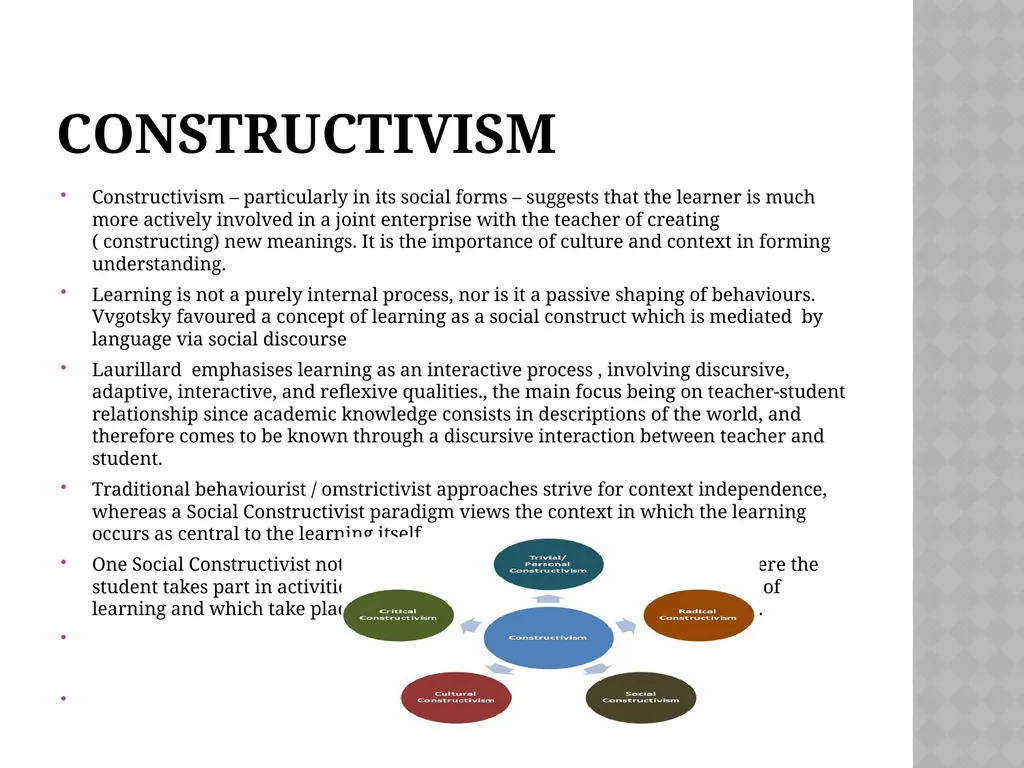
CONSTRUCTIVISM Constructivism – particularly in its social forms – suggests that the learner is much more actively involved in a joint enterprise with the teacher of creating ( constructing) new meanings. It is the importance of culture and context in forming understanding.
Learning is not a purely internal process, nor is it a passive shaping of behaviours. Vvgotsky favoured a concept of learning as a social construct which is mediated by language via social discourse
Laurillard emphasises learning as an interactive process , involving discursive, adaptive, interactive, and reflexive qualities., the main focus being on teacher-student relationship since academic knowledge consists in descriptions of the world, and therefore comes to be known through a discursive interaction between teacher and student.
Traditional behaviourist / omstrictivist approaches strive for context independence, whereas a Social Constructivist paradigm views the context in which the learning occurs as central to the learning itself.
One Social Constructivist notion is that of authentic or situated learning, where the student takes part in activities which are directly relevant to the application of learning and which take place within a culture similar to the applied setting.<br>
Learning is not a purely internal process, nor is it a passive shaping of behaviours. Vvgotsky favoured a concept of learning as a social construct which is mediated by language via social discourse
Laurillard emphasises learning as an interactive process , involving discursive, adaptive, interactive, and reflexive qualities., the main focus being on teacher-student relationship since academic knowledge consists in descriptions of the world, and therefore comes to be known through a discursive interaction between teacher and student.
Traditional behaviourist / omstrictivist approaches strive for context independence, whereas a Social Constructivist paradigm views the context in which the learning occurs as central to the learning itself.
One Social Constructivist notion is that of authentic or situated learning, where the student takes part in activities which are directly relevant to the application of learning and which take place within a culture similar to the applied setting.<br>
13
Psychoanalysis & gestalt psychology PSYCHOANALYSIS
Psychoanalysis: Sigmund Freud was the found of psychodynamic approach.
This school of thought emphasizes the influence of the unconscious mind on behavior.
Freud believed that the human mind was composed of three elements: the id, the ego, and the superego. Other major
psychodynamic thinkers include Anna Freud, Carl Jung, and Erik Erikson. GESTALT PSYCHOLOGY
Gestalt psychology is based upon the idea that we experience things as unified wholes.
This approach to psychology began in Germany and Austria during the late 19th century in response to the molecular approach of structuralism.
Rather that breaking down thoughts and behavior to their smallest element, the gestalt psychologists believed that you must look at the whole of experience.
According to the gestalt thinkers, the whole is greater than the sum of its parts.<br>
Psychoanalysis: Sigmund Freud was the found of psychodynamic approach.
This school of thought emphasizes the influence of the unconscious mind on behavior.
Freud believed that the human mind was composed of three elements: the id, the ego, and the superego. Other major
psychodynamic thinkers include Anna Freud, Carl Jung, and Erik Erikson. GESTALT PSYCHOLOGY
Gestalt psychology is based upon the idea that we experience things as unified wholes.
This approach to psychology began in Germany and Austria during the late 19th century in response to the molecular approach of structuralism.
Rather that breaking down thoughts and behavior to their smallest element, the gestalt psychologists believed that you must look at the whole of experience.
According to the gestalt thinkers, the whole is greater than the sum of its parts.<br>
14
COGNITIVE PSYCHOLOGY: Cognitive psychology is the branch of psychology that studies mental processes including how people think, perceive, remember, and learn.
As part of the larger field of cognitive science, this branch of psychology is related to other disciplines including neuroscience, philosophy, and linguistics.
One of the most influential theories from this school of thought was the stages of cognitive development theory proposed by Jean Piaget.<br>
As part of the larger field of cognitive science, this branch of psychology is related to other disciplines including neuroscience, philosophy, and linguistics.
One of the most influential theories from this school of thought was the stages of cognitive development theory proposed by Jean Piaget.<br>
15
METHODS OF PSYCHOLOGY INTROSPECTIN METHOD
DESCRIPTIVE METHOD
OBSERVATION
CASE STUDY
SURVEY METHOD
EXPERIMENTAL METHOD<br>
DESCRIPTIVE METHOD
OBSERVATION
CASE STUDY
SURVEY METHOD
EXPERIMENTAL METHOD<br>
16
INTROSPECTIN METHOD Introspection is defined as the process of directly examining ones own conscious mental states and processes or an examination of ones own conscious thoughts and feeling. Introduced by EB Tichener. Also known as self-observation method.
Has the following characteristic
The subject gets direct, immediate and intuitive knowledge about the mind
The subject has actually to observe his own metal processes. He cannot speculate about them
LIMITATIONS
In introspection one needs to examine ones mental processes carefully in the form of feelings, thoughts, and sensation.
The state of one’s mental processes is continuously changing. Therefore when one concentrates on introspecting a particular phase of one’s mental activity that phase of one’s mental activity that phase passes off.<br>
Has the following characteristic
The subject gets direct, immediate and intuitive knowledge about the mind
The subject has actually to observe his own metal processes. He cannot speculate about them
LIMITATIONS
In introspection one needs to examine ones mental processes carefully in the form of feelings, thoughts, and sensation.
The state of one’s mental processes is continuously changing. Therefore when one concentrates on introspecting a particular phase of one’s mental activity that phase of one’s mental activity that phase passes off.<br>
17
DESCRIPTIVE METHOD Research studies that do not test specific relationships between variables are called descriptive, or qualitative, studies.
These studies are used to describe general or specific behaviors and attributes that are observed and measured.
Descriptive method characteristics of the study group or a certain occurrence are described.
Useful in gathering data on a certain population or a specific occurrence.
Aim is to describe the characteristics of the study group, thus answering the question what is.
Typically includes sociological and psychological studies. Uses both qualitative and quantitative methodologies<br>
These studies are used to describe general or specific behaviors and attributes that are observed and measured.
Descriptive method characteristics of the study group or a certain occurrence are described.
Useful in gathering data on a certain population or a specific occurrence.
Aim is to describe the characteristics of the study group, thus answering the question what is.
Typically includes sociological and psychological studies. Uses both qualitative and quantitative methodologies<br>
18
OBSERVATION Observation is one method for collecting research data. It involves watching a participant and recording relevant behavior for later analysis.
Albert Bandura, a psychologist and learning theories who first proposed social learning theory can be credited for first having noted observation learning.
It is a powerful tool of psychological enquiry. Deliberate and purposeful.
It is an important method of data collection, different type’s observations exist. Scientific observation is systematic.
Nevertheless have limitations that need to be overcome by complementing with other research methods like interviews of participants and use of experiments.
Limitations
Used to generate new ideas, the entire situation can be studied.
Not possible to observe all types of behavior in a natural setting. Many instances behavior do not repeat themselves.<br>
Albert Bandura, a psychologist and learning theories who first proposed social learning theory can be credited for first having noted observation learning.
It is a powerful tool of psychological enquiry. Deliberate and purposeful.
It is an important method of data collection, different type’s observations exist. Scientific observation is systematic.
Nevertheless have limitations that need to be overcome by complementing with other research methods like interviews of participants and use of experiments.
Limitations
Used to generate new ideas, the entire situation can be studied.
Not possible to observe all types of behavior in a natural setting. Many instances behavior do not repeat themselves.<br>
19
CASE STUDY A case study is an in depth investigation of an individual or a small group. Because case studies go so in depth about one particular person, the researcher can really learn a lot about that person.
Psychologists use what they learn in a case study to generalize broader principles that apply to the larger population. Cases studies describe, but do not predict.
Case study is systematic inquire into an event or a set of related events which aims to describe and explain the phenomenon of interest.
LIMITATIONS
Provides a depth of information from a group members view point. Unexpected discoveries can be incorporated into research. Can study social behavior not always feasible with other forms of study.
Difficult to generalize findings from one group to another group. Presence of researcher can influence results. Hard to duplicate. Takes a lot of time<br>
Psychologists use what they learn in a case study to generalize broader principles that apply to the larger population. Cases studies describe, but do not predict.
Case study is systematic inquire into an event or a set of related events which aims to describe and explain the phenomenon of interest.
LIMITATIONS
Provides a depth of information from a group members view point. Unexpected discoveries can be incorporated into research. Can study social behavior not always feasible with other forms of study.
Difficult to generalize findings from one group to another group. Presence of researcher can influence results. Hard to duplicate. Takes a lot of time<br>
20
SURVEY METHOD A survey is a data collection tool used to gather information about individuals. Surveys are commonly used in psychology research to collect self-report data from study participants. A survey may focus on factual information about individuals, or it might aim to obtain the opinions of the survey takers.
Using public polling techniques to answer psychological questions. Sometimes the best way to find out something about someone is to just ask them. In a survey, people are asked to respond to a series of questions about a particular subject. The survey is the most widely used research method among psychologists.
LIMITATIONS
Surveys are useful in describing the characteristics of a large population. No other research method can provide this broad capability, which ensures a more accurate sample to gather targeted results in which to draw conclusions and make important decisions.
The reliability of survey data may depend on the following factors: Respondents may not feel encouraged to provide accurate, honest answers. ... Respondents may not be fully aware of their reasons for any given answer because of lack of memory on the subject, or even boredom<br>
Using public polling techniques to answer psychological questions. Sometimes the best way to find out something about someone is to just ask them. In a survey, people are asked to respond to a series of questions about a particular subject. The survey is the most widely used research method among psychologists.
LIMITATIONS
Surveys are useful in describing the characteristics of a large population. No other research method can provide this broad capability, which ensures a more accurate sample to gather targeted results in which to draw conclusions and make important decisions.
The reliability of survey data may depend on the following factors: Respondents may not feel encouraged to provide accurate, honest answers. ... Respondents may not be fully aware of their reasons for any given answer because of lack of memory on the subject, or even boredom<br>
21
EXPERIMENTAL METHOD In an experiment, an independent variable (the cause) is manipulated and the dependent variable (the effect) is measured; any extraneous variables are controlled. An advantage is that experiments should be objective. The views and opinions of the researcher should not affect the results of a study.
Experimentation provides a method of hypothesis testing. After defining the problem, a tentative answer or hypothesis is formulated. Experimenters manipulate certain stimuli, treatments or environmental conditions and observe how the condition or behavior of the subject is affected or changed. It involves the comparison of the effects of a particular treatment with that of a different treatment or no treatment.
LIMITATIONS
It is most systematic method and condition can be completely controlled. The data collected can be analyzed an objective manner and so its reliable. A cause effect relationship of individuals behavior can be established. The findings of experimental method are open to critical examination and verification. It discards subjective experiments.
As human behavior is changeable, identical behavior of the same individual not occurs even under identical conditions at different times. This experimental method is costly and time consuming. This method must have specialized skills to conduct experiments. The tools used in experiments may not be satisfactory and therefore the obtained data may not be reliable.<br>
Experimentation provides a method of hypothesis testing. After defining the problem, a tentative answer or hypothesis is formulated. Experimenters manipulate certain stimuli, treatments or environmental conditions and observe how the condition or behavior of the subject is affected or changed. It involves the comparison of the effects of a particular treatment with that of a different treatment or no treatment.
LIMITATIONS
It is most systematic method and condition can be completely controlled. The data collected can be analyzed an objective manner and so its reliable. A cause effect relationship of individuals behavior can be established. The findings of experimental method are open to critical examination and verification. It discards subjective experiments.
As human behavior is changeable, identical behavior of the same individual not occurs even under identical conditions at different times. This experimental method is costly and time consuming. This method must have specialized skills to conduct experiments. The tools used in experiments may not be satisfactory and therefore the obtained data may not be reliable.<br>
22
Thank you<br>