
Advanced parsing David Kauchak CS159 – Spring 2019
TA
Published · 57 slides · 0 views
1 / 1

Description
Advanced parsing David Kauchak CS159 Spring 2019 some slides adapted from Dan Klein Admin Assignment 3? Assignment 4 (A and B) Lab on Wednesday Parsing evaluation Youve constructed a parser You want to know how good it is Ideas? Parsing
Related Topics
Share
Embed code
Download this presentation From Below
"Advanced parsing David Kauchak CS159 – Spring 2019" is the property of its rightful owner. Permission is granted to download and print the materials on this website for personal, non-commercial use only, and to display it on your personal computer provided you do not modify the materials and that you retain all copyright notices contained in the materials. By downloading content from our website, you accept the terms of this agreement.
Presentation Transcript
01
Advanced parsing David Kauchak
CS159 – Spring 2019 some slides adapted from Dan Klein<br>
CS159 – Spring 2019 some slides adapted from Dan Klein<br>
02
Admin Assignment 3?
Assignment 4 (A and B)
Lab on Wednesday<br>
Assignment 4 (A and B)
Lab on Wednesday<br>
03
Parsing evaluation You’ve constructed a parser
You want to know how good it is
Ideas?<br>
You want to know how good it is
Ideas?<br>
04
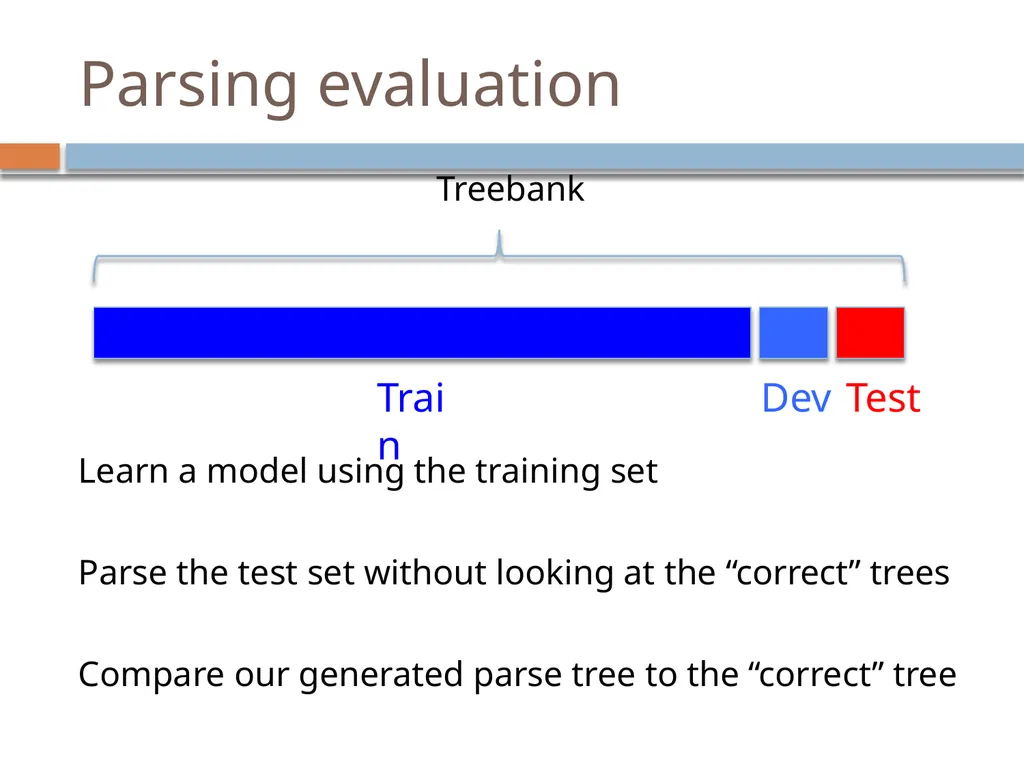
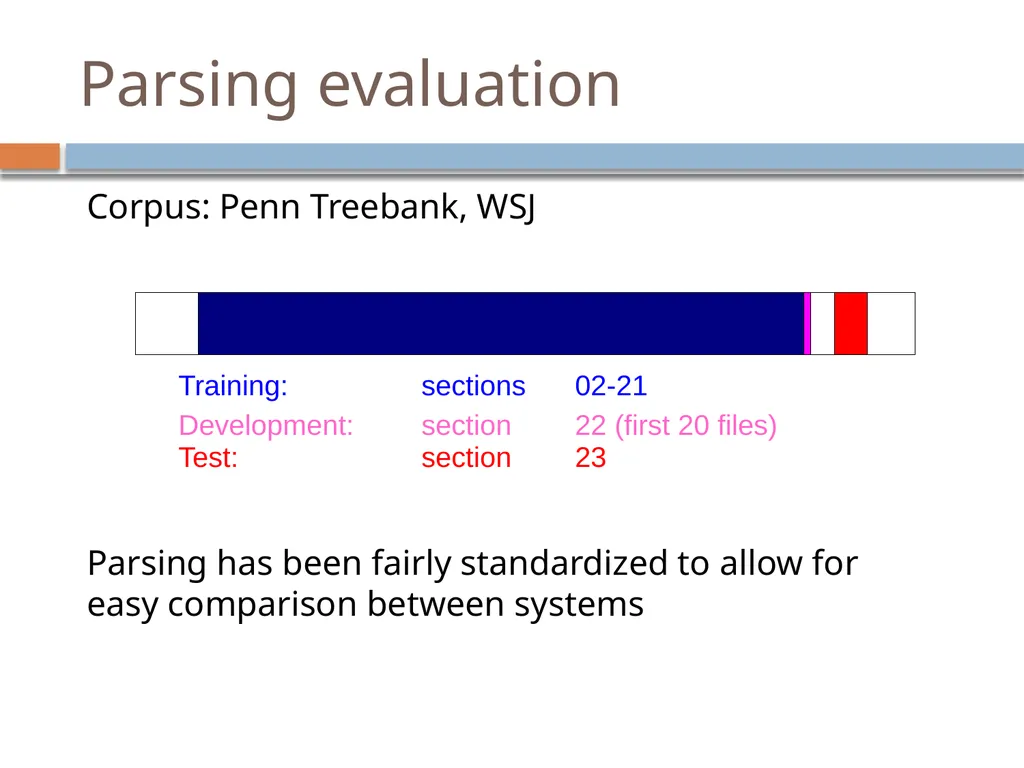
Parsing evaluation Learn a model using the training set
Parse the test set without looking at the “correct” trees
Compare our generated parse tree to the “correct” tree Treebank Train Dev Test<br>
Parse the test set without looking at the “correct” trees
Compare our generated parse tree to the “correct” tree Treebank Train Dev Test<br>
05
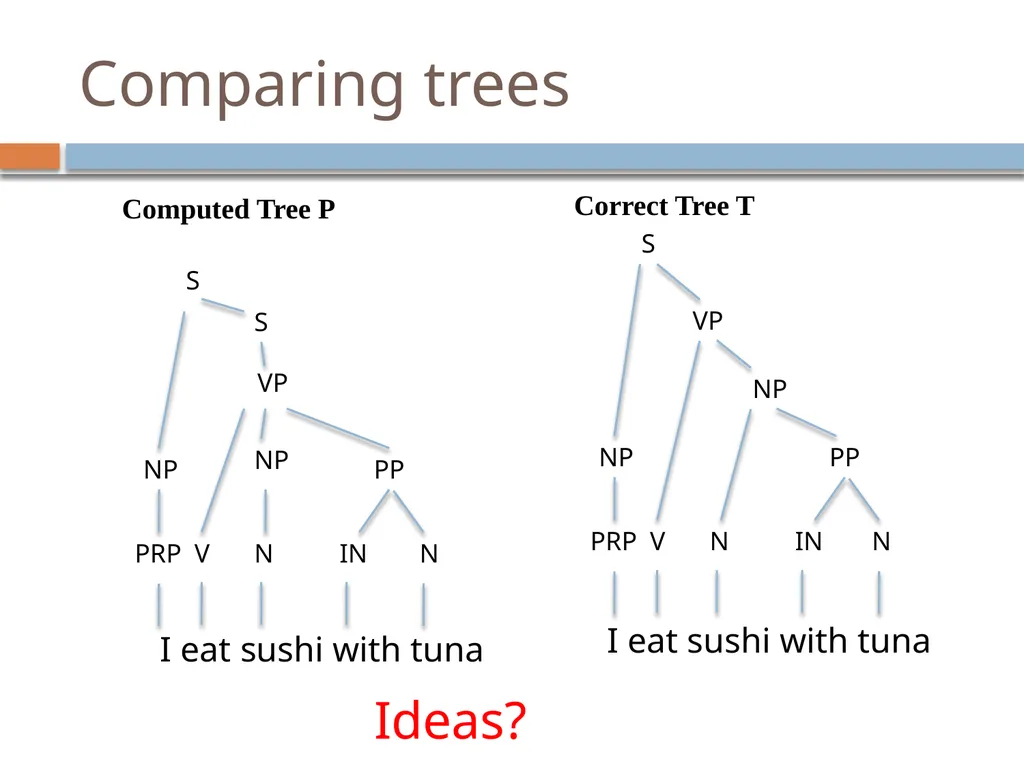
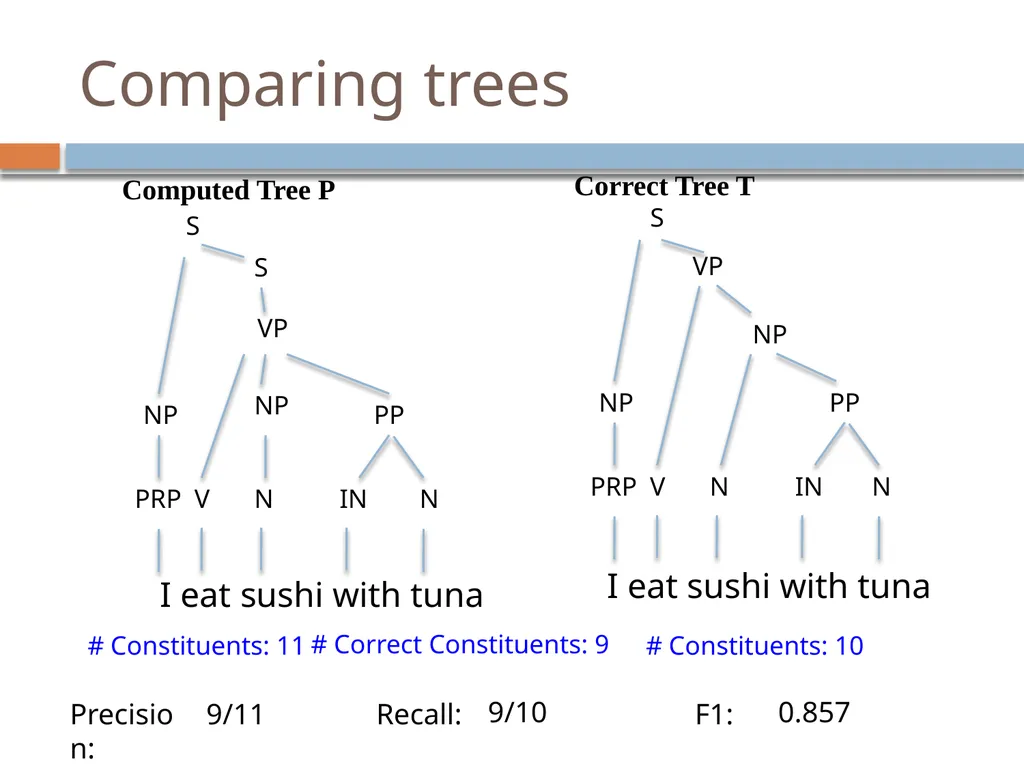
Comparing trees Correct Tree T Computed Tree P Ideas? I eat sushi with tuna PRP NP V N IN N PP NP VP S I eat sushi with tuna PRP NP V N IN PP NP VP S N S<br>
06
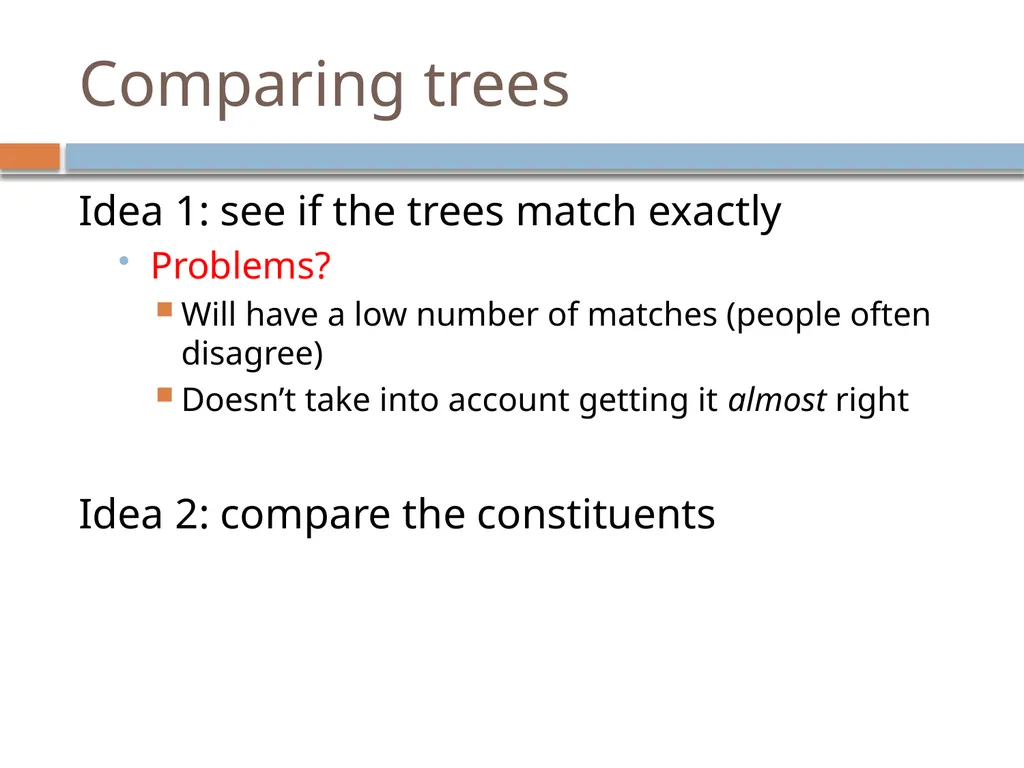
Comparing trees Idea 1: see if the trees match exactly
Problems?
Will have a low number of matches (people often disagree)
Doesn’t take into account getting it almost right
Idea 2: compare the constituents<br>
Problems?
Will have a low number of matches (people often disagree)
Doesn’t take into account getting it almost right
Idea 2: compare the constituents<br>
07
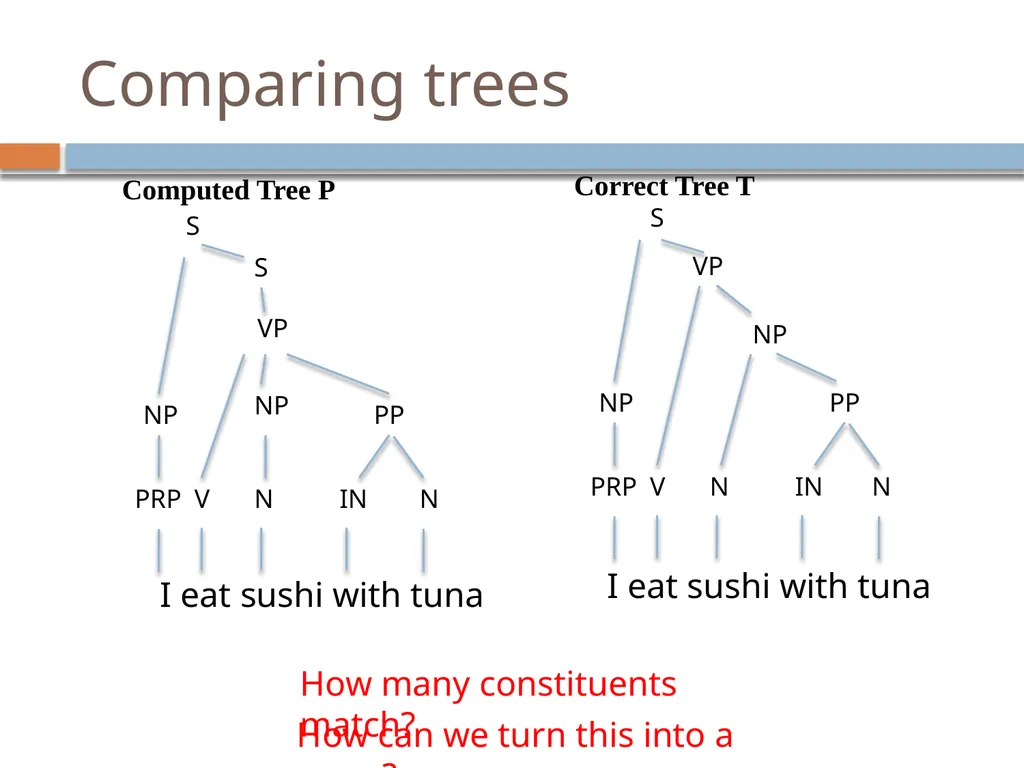
Comparing trees Correct Tree T Computed Tree P I eat sushi with tuna PRP NP V N IN N PP NP VP S I eat sushi with tuna PRP NP V N IN PP NP VP S How can we turn this into a score? How many constituents match? N S<br>
08
Evaluation measures Precision
Recall
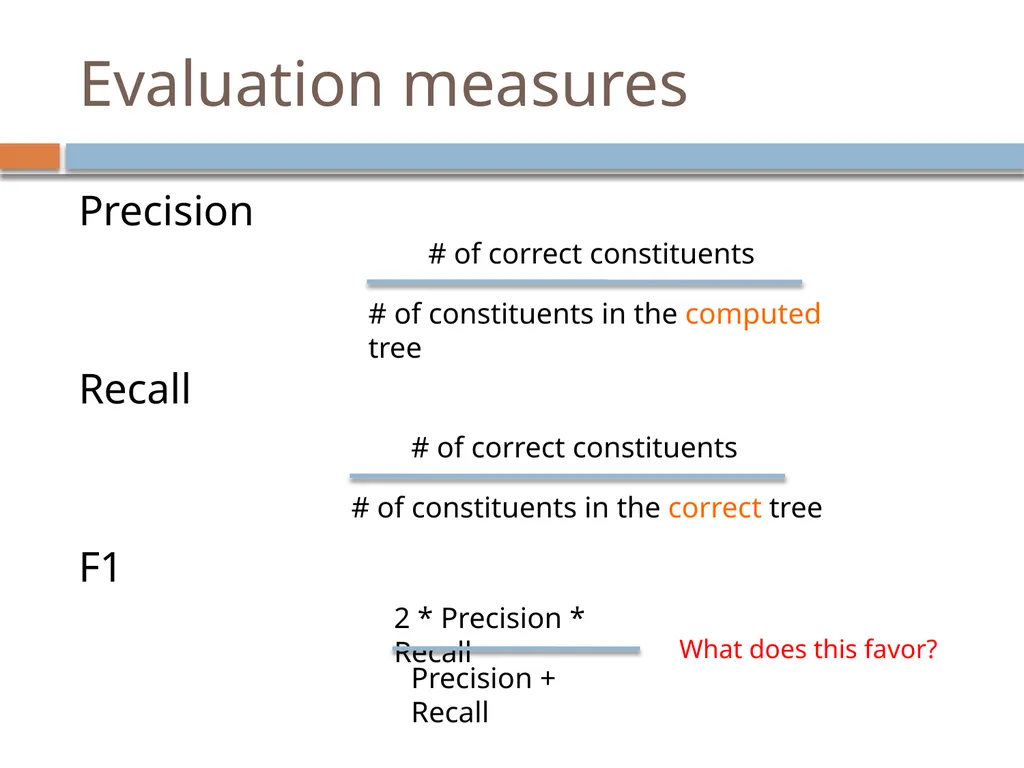
F1 # of correct constituents # of constituents in the computed tree # of correct constituents # of constituents in the correct tree 2 * Precision * Recall Precision + Recall What does this favor?<br>
Recall
F1 # of correct constituents # of constituents in the computed tree # of correct constituents # of constituents in the correct tree 2 * Precision * Recall Precision + Recall What does this favor?<br>
09
Comparing trees Correct Tree T Computed Tree P I eat sushi with tuna PRP NP V N IN N PP NP VP S # Constituents: 11 # Constituents: 10 # Correct Constituents: 9 Precision: Recall: F1: 9/11 9/10 0.857 I eat sushi with tuna PRP NP V N IN PP NP VP S N S<br>
10
Parsing evaluation Corpus: Penn Treebank, WSJ
Parsing has been fairly standardized to allow for easy comparison between systems<br>
Parsing has been fairly standardized to allow for easy comparison between systems<br>
11
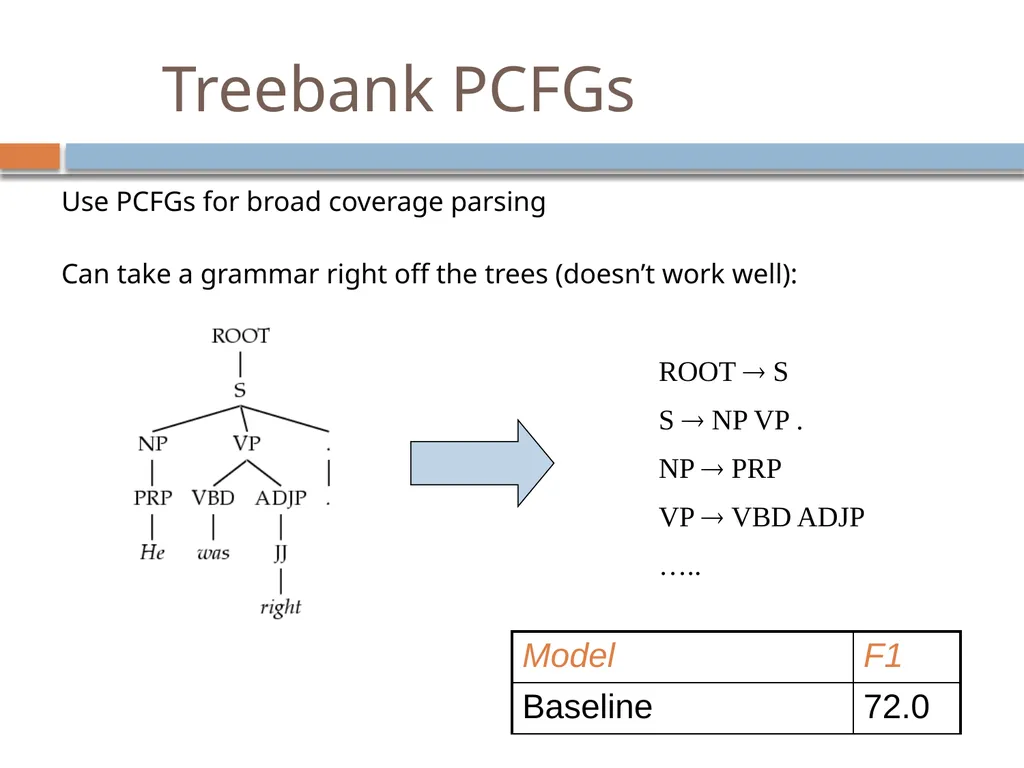
Treebank PCFGs Use PCFGs for broad coverage parsing
Can take a grammar right off the trees (doesn’t work well): ROOT S
S NP VP .
NP PRP
VP VBD ADJP
…..<br>
Can take a grammar right off the trees (doesn’t work well): ROOT S
S NP VP .
NP PRP
VP VBD ADJP
…..<br>
12
Generic PCFG Limitations PCFGs do not use any information about where the current constituent is in the tree
PCFGs do not rely on specific words or concepts, only general structural disambiguation is possible (e.g. prefer to attach PPs to Nominals)
MLE estimates are not always the best<br>
PCFGs do not rely on specific words or concepts, only general structural disambiguation is possible (e.g. prefer to attach PPs to Nominals)
MLE estimates are not always the best<br>
13
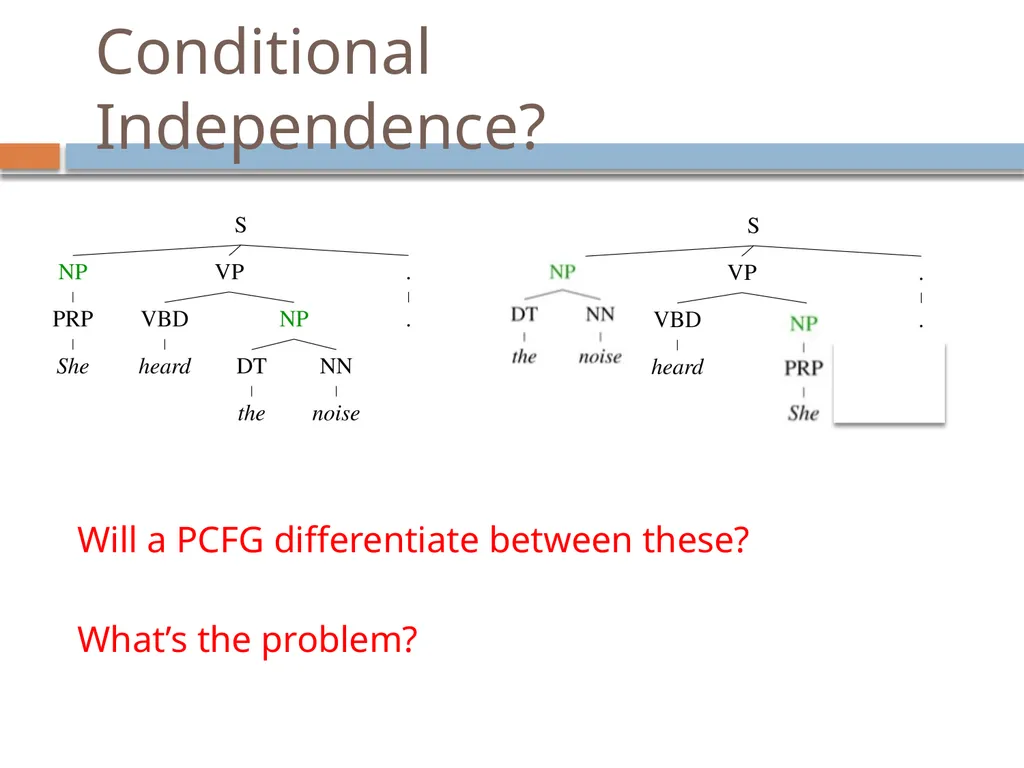
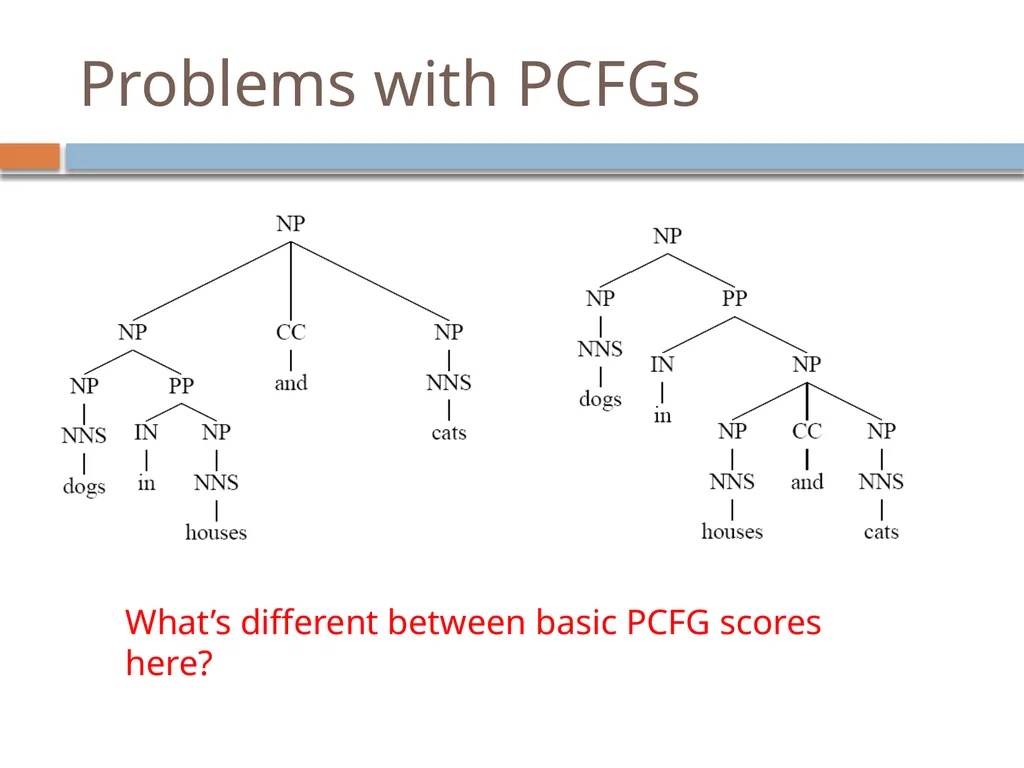
Conditional Independence? Will a PCFG differentiate between these?
What’s the problem?<br>
What’s the problem?<br>
14
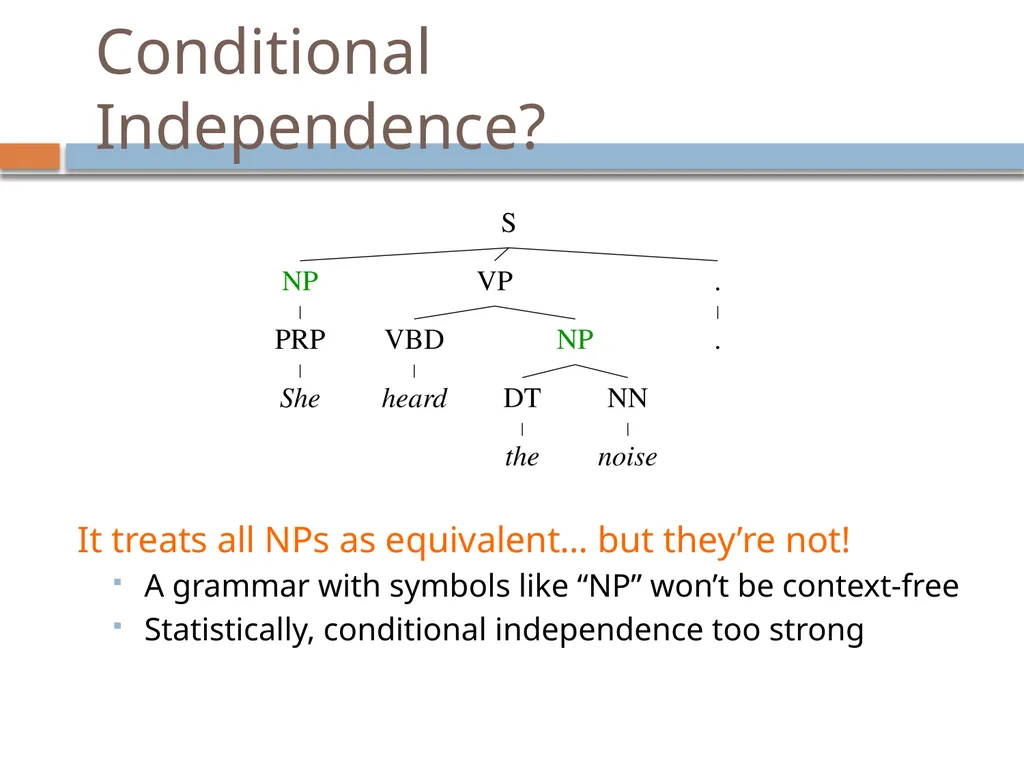
Conditional Independence? It treats all NPs as equivalent… but they’re not!
A grammar with symbols like “NP” won’t be context-free
Statistically, conditional independence too strong<br>
A grammar with symbols like “NP” won’t be context-free
Statistically, conditional independence too strong<br>
15
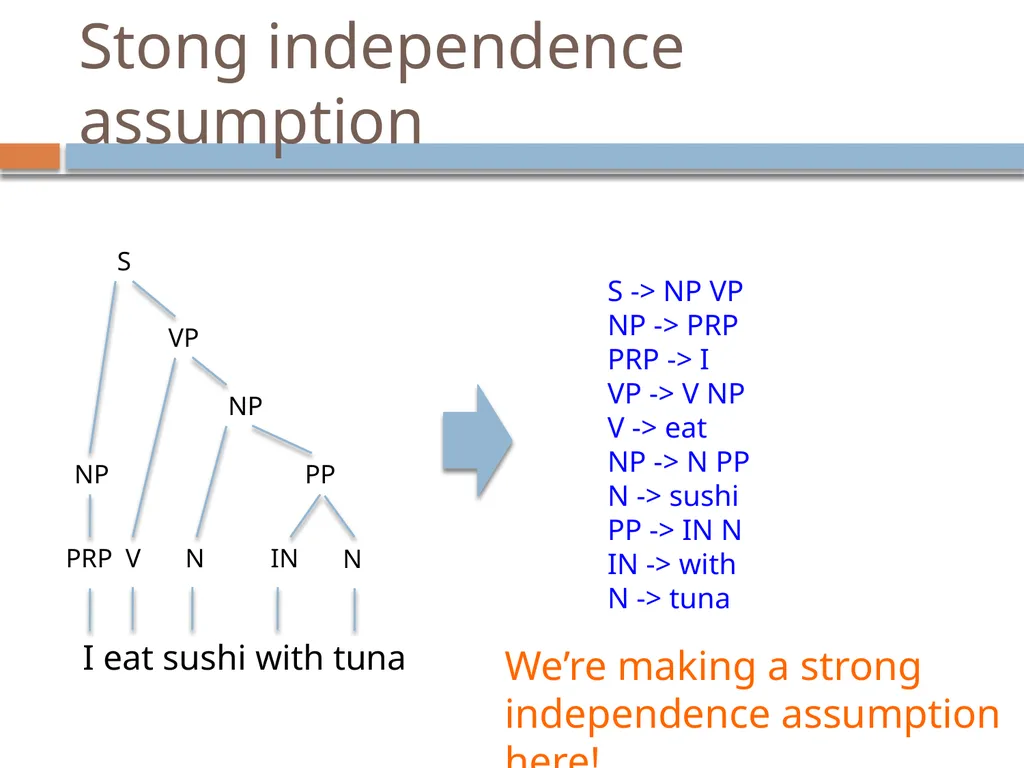
Stong independence assumption PRP NP V N IN PP NP VP S I eat sushi with tuna N S -> NP VP
NP -> PRP
PRP -> I
VP -> V NP
V -> eat
NP -> N PP
N -> sushi
PP -> IN N
IN -> with
N -> tuna We’re making a strong independence assumption here!<br>
NP -> PRP
PRP -> I
VP -> V NP
V -> eat
NP -> N PP
N -> sushi
PP -> IN N
IN -> with
N -> tuna We’re making a strong independence assumption here!<br>
16
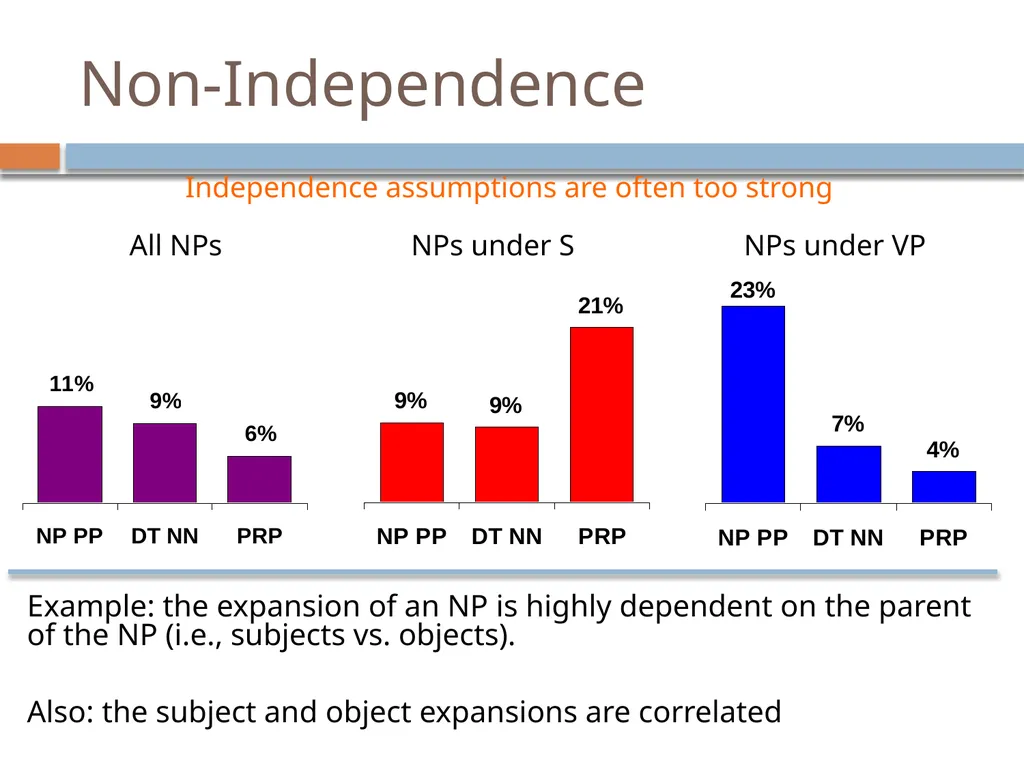
Non-Independence Example: the expansion of an NP is highly dependent on the parent of the NP (i.e., subjects vs. objects).
Also: the subject and object expansions are correlated All NPs NPs under S NPs under VP Independence assumptions are often too strong<br>
Also: the subject and object expansions are correlated All NPs NPs under S NPs under VP Independence assumptions are often too strong<br>
17
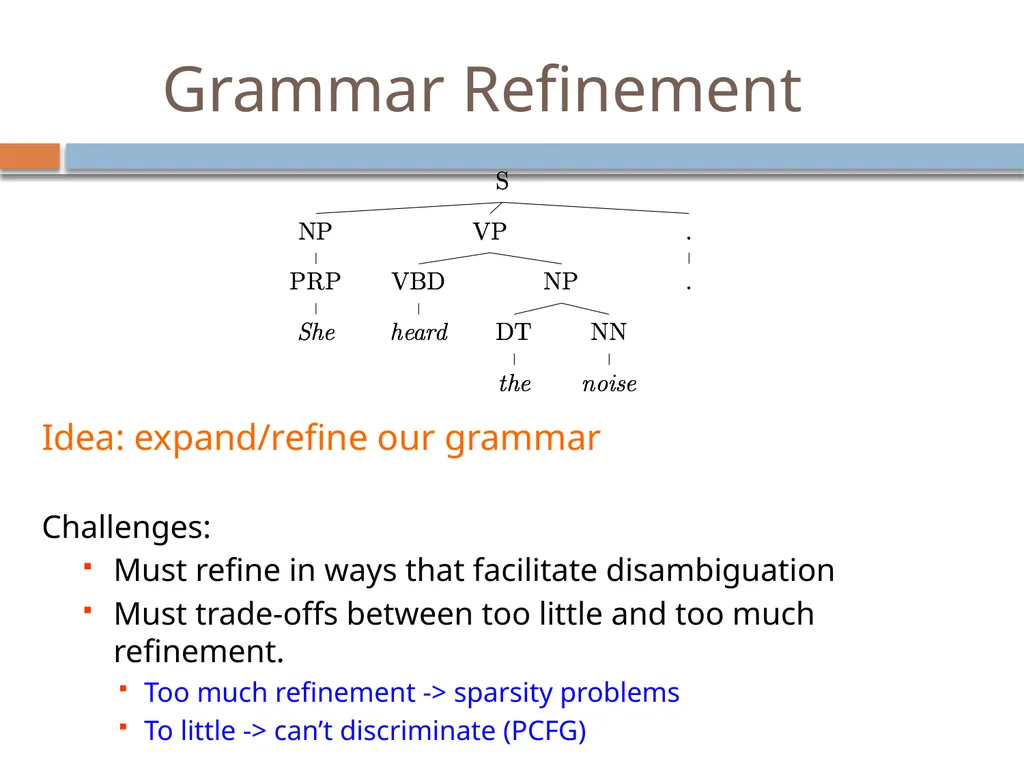
Grammar Refinement Idea: expand/refine our grammar
Challenges:
Must refine in ways that facilitate disambiguation
Must trade-offs between too little and too much refinement.
Too much refinement -> sparsity problems
To little -> can’t discriminate (PCFG)<br>
Challenges:
Must refine in ways that facilitate disambiguation
Must trade-offs between too little and too much refinement.
Too much refinement -> sparsity problems
To little -> can’t discriminate (PCFG)<br>
18
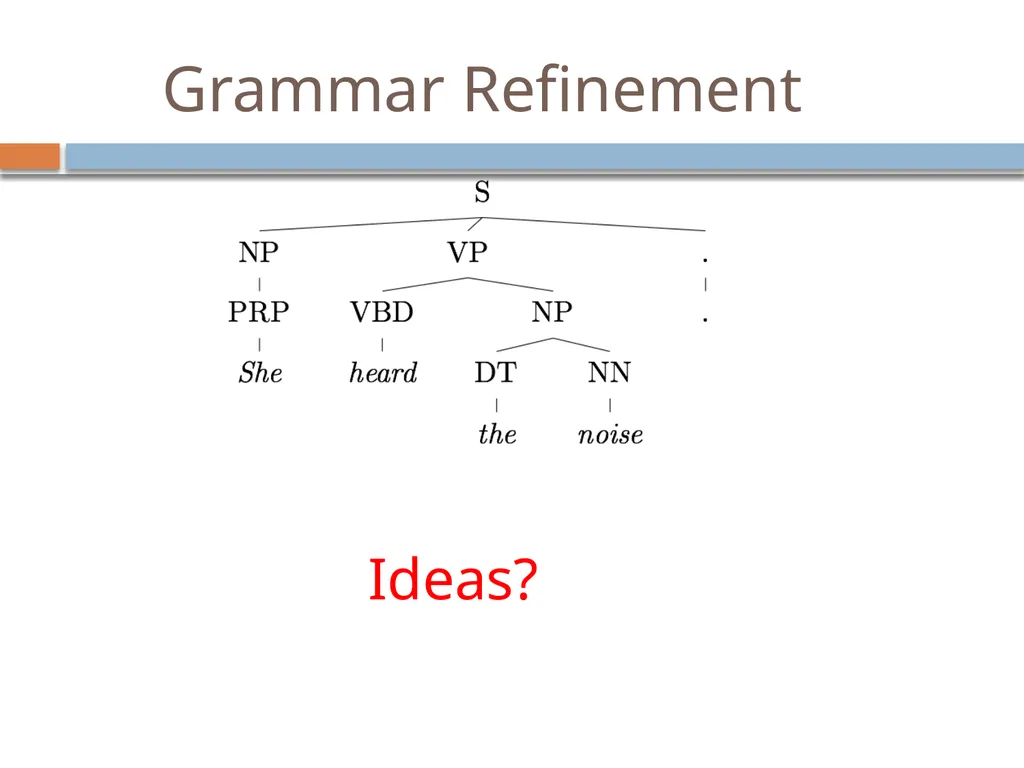
Grammar Refinement Ideas?<br>
19
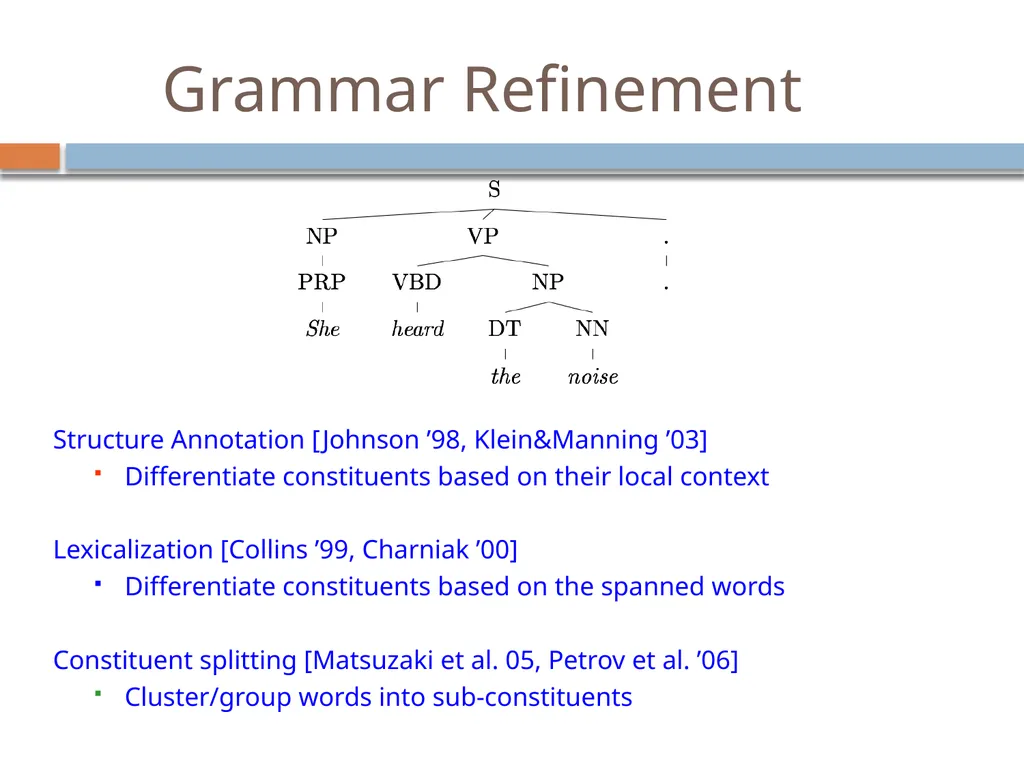
Grammar Refinement Structure Annotation [Johnson ’98, Klein&Manning ’03]
Differentiate constituents based on their local context
Lexicalization [Collins ’99, Charniak ’00]
Differentiate constituents based on the spanned words
Constituent splitting [Matsuzaki et al. 05, Petrov et al. ’06]
Cluster/group words into sub-constituents<br>
Differentiate constituents based on their local context
Lexicalization [Collins ’99, Charniak ’00]
Differentiate constituents based on the spanned words
Constituent splitting [Matsuzaki et al. 05, Petrov et al. ’06]
Cluster/group words into sub-constituents<br>
20
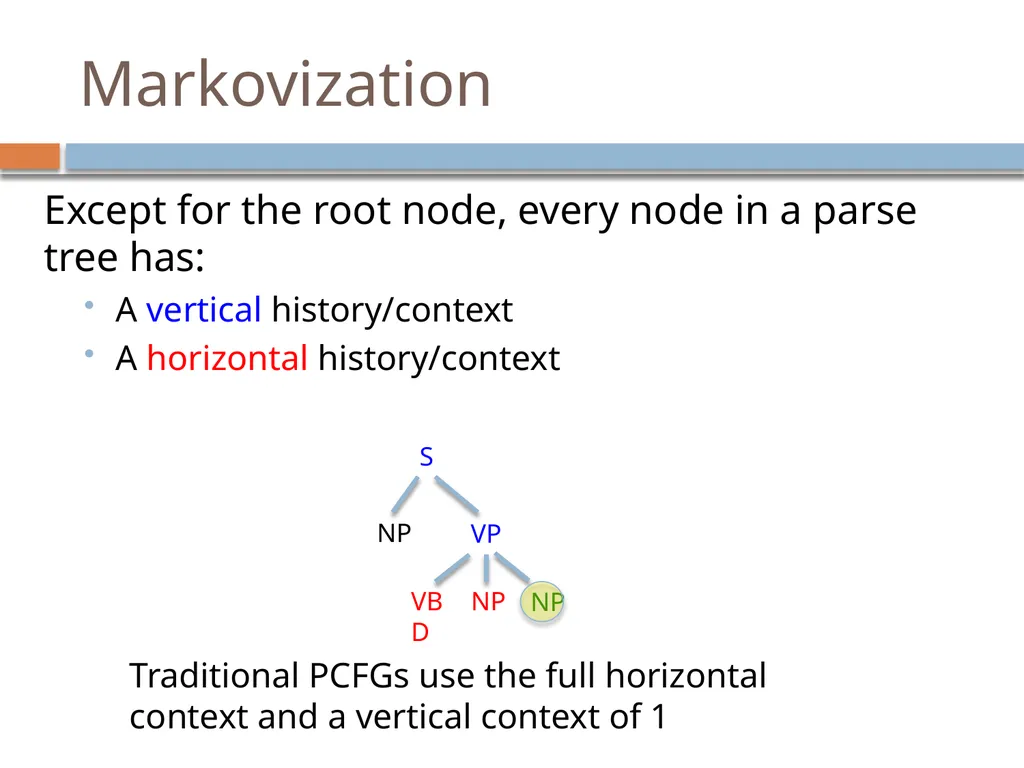
Markovization Except for the root node, every node in a parse tree has:
A vertical history/context
A horizontal history/context NP NP VP S NP VBD Traditional PCFGs use the full horizontal context and a vertical context of 1<br>
A vertical history/context
A horizontal history/context NP NP VP S NP VBD Traditional PCFGs use the full horizontal context and a vertical context of 1<br>
21
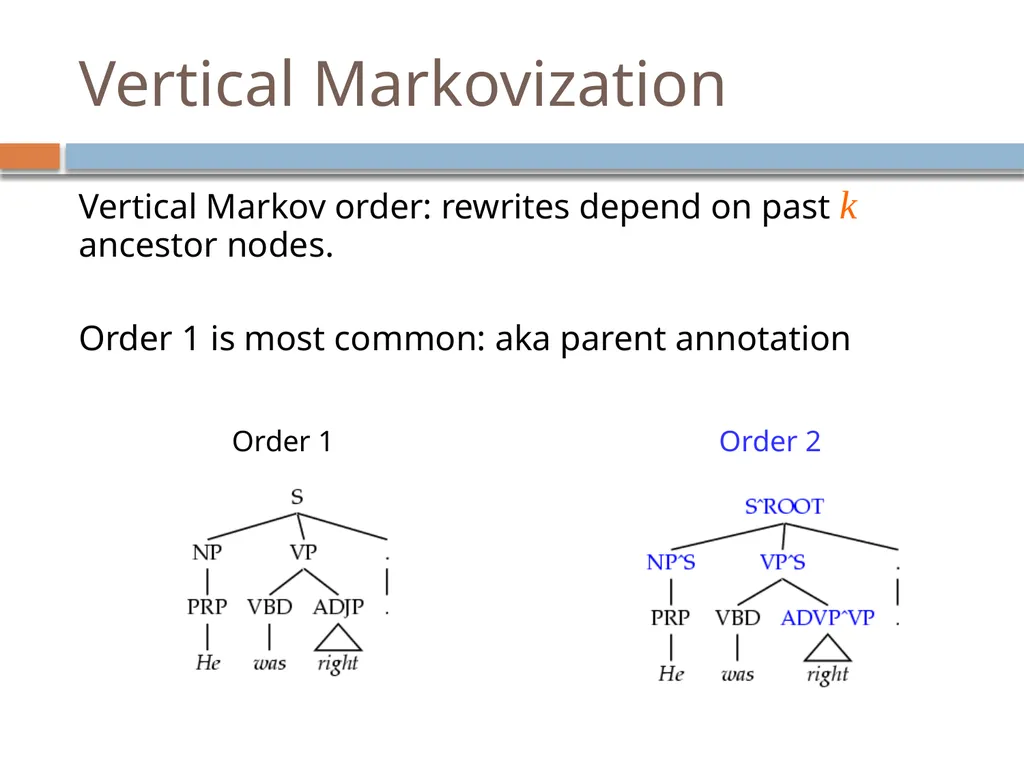
Vertical Markovization Vertical Markov order: rewrites depend on past k ancestor nodes.
Order 1 is most common: aka parent annotation Order 1 Order 2<br>
Order 1 is most common: aka parent annotation Order 1 Order 2<br>
22
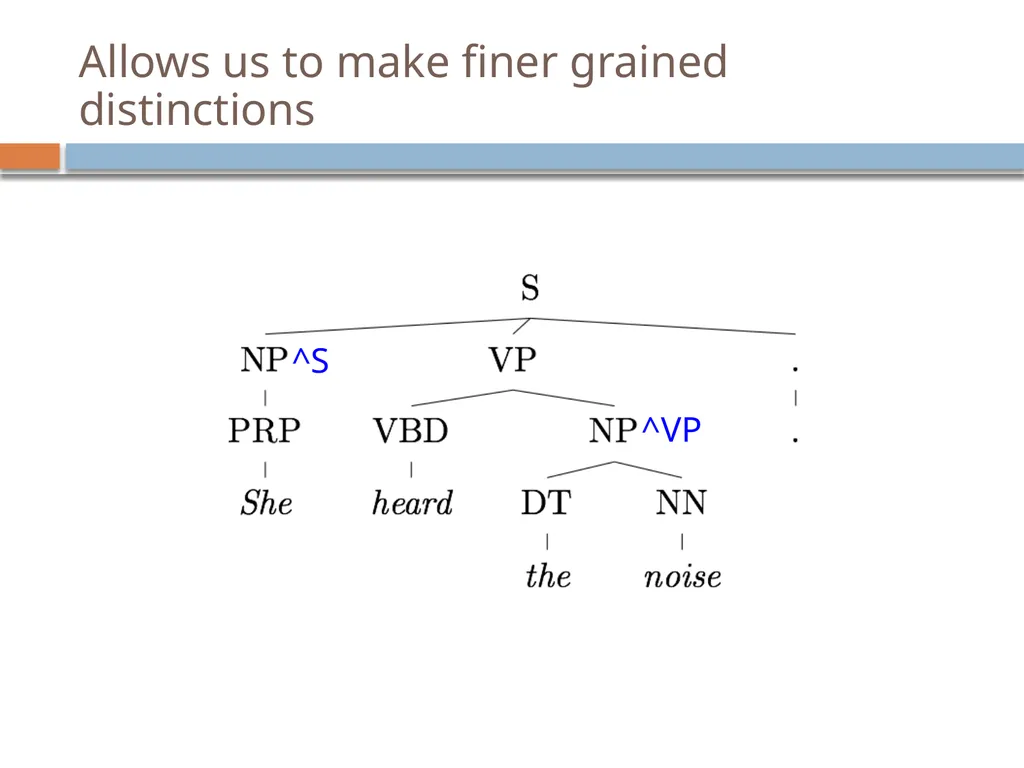
Allows us to make finer grained distinctions ^S ^VP<br>
23
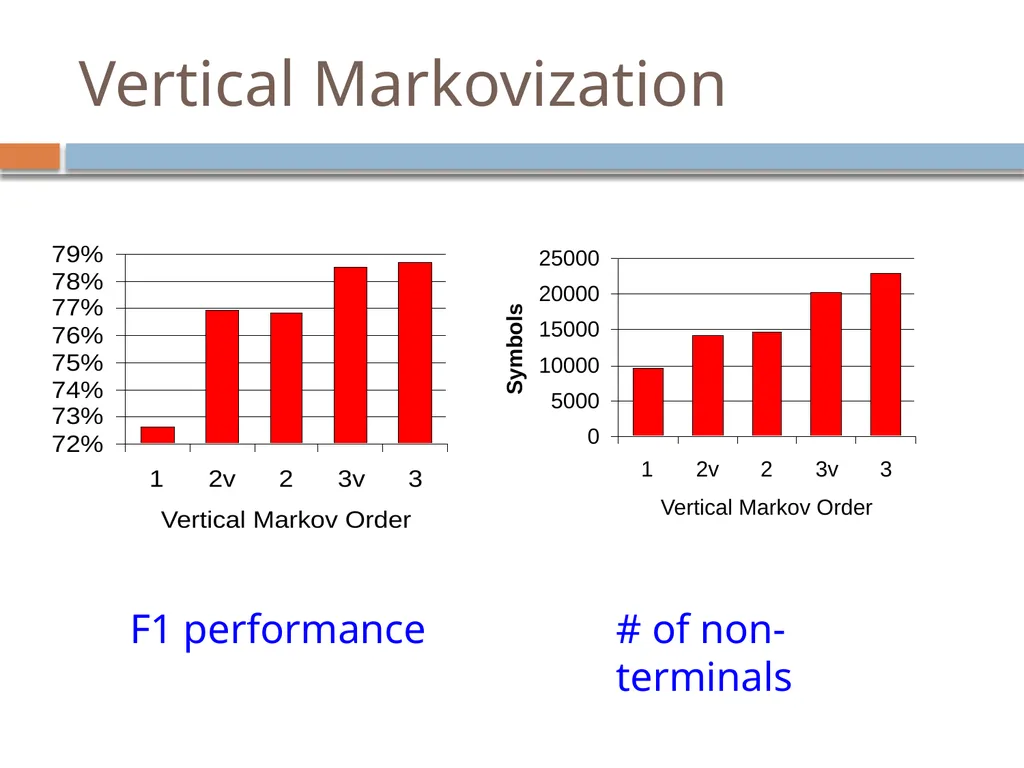
Vertical Markovization F1 performance # of non-terminals<br>
24
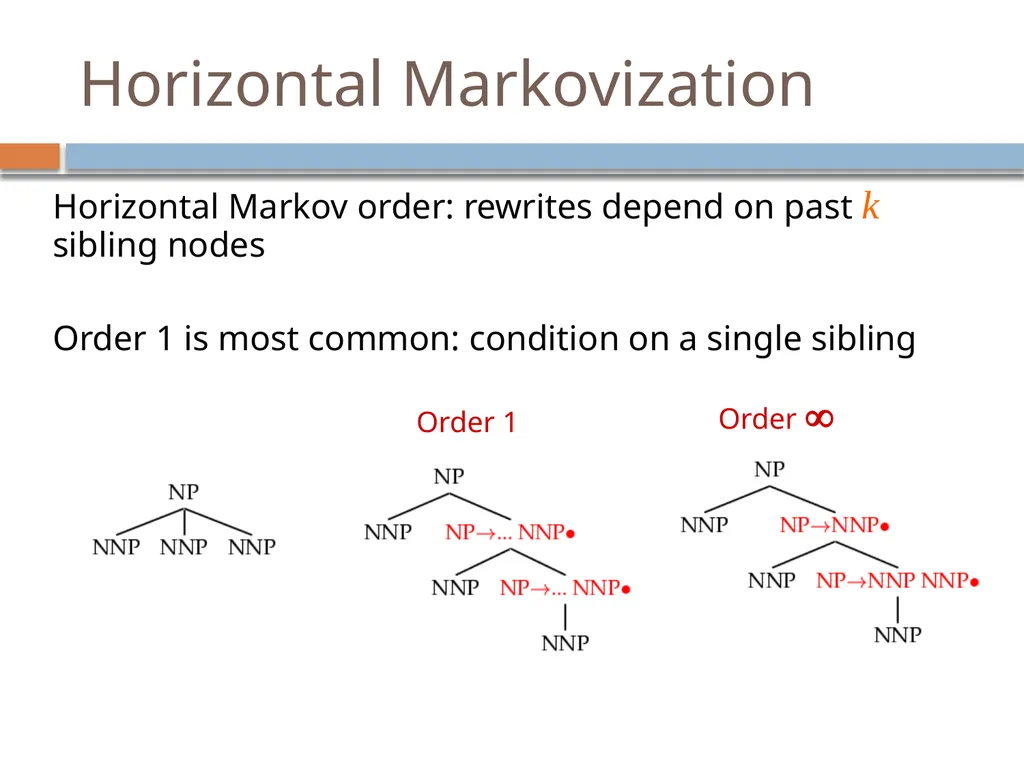
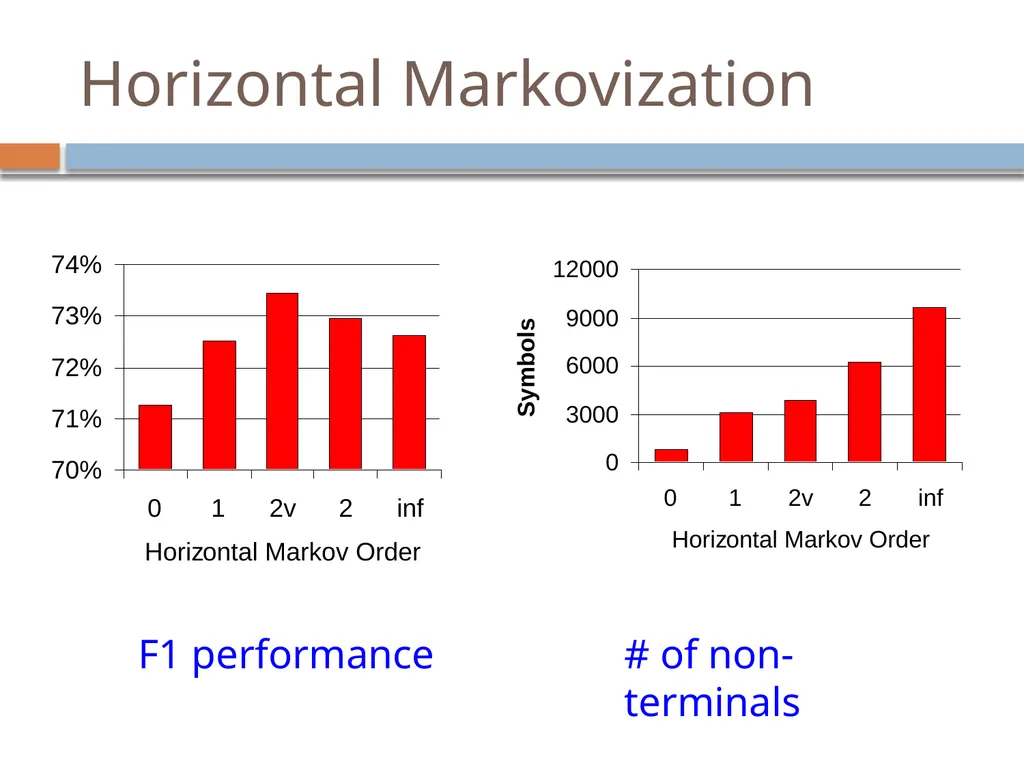
Horizontal Markovization Order 1 Order Horizontal Markov order: rewrites depend on past k sibling nodes
Order 1 is most common: condition on a single sibling<br>
Order 1 is most common: condition on a single sibling<br>
25
Horizontal Markovization F1 performance # of non-terminals<br>
26
Problems with PCFGs What’s different between basic PCFG scores here?<br>
27
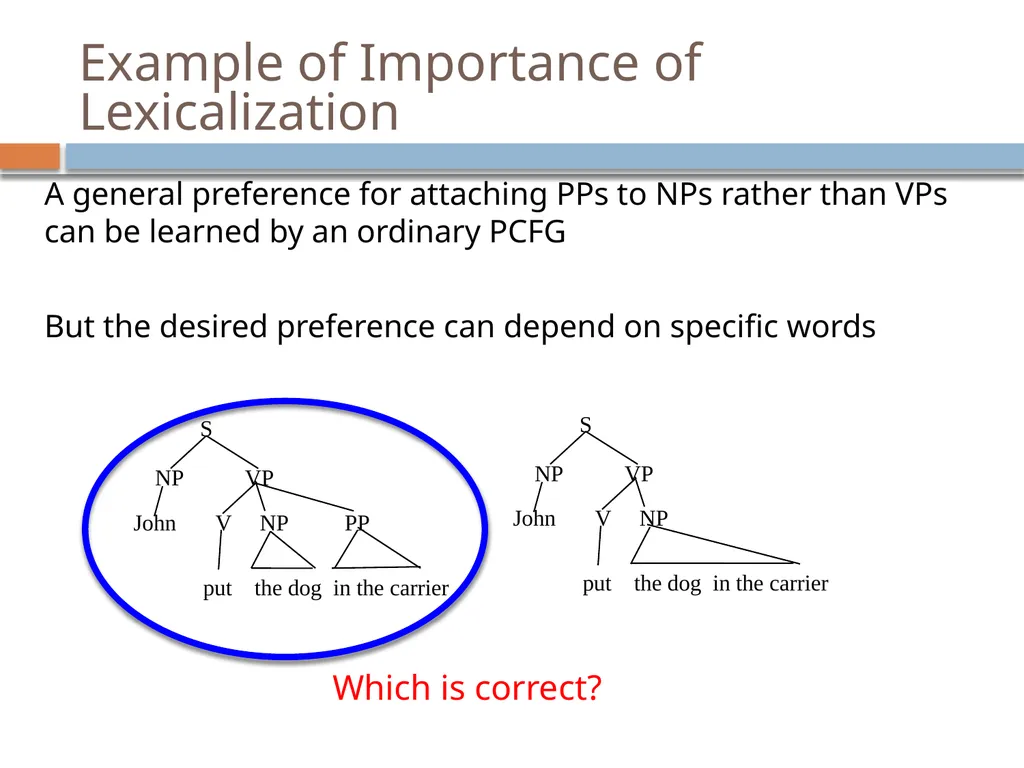
Example of Importance of Lexicalization A general preference for attaching PPs to NPs rather than VPs can be learned by an ordinary PCFG
But the desired preference can depend on specific words S NP VP John V NP put the dog in the carrier Which is correct?<br>
But the desired preference can depend on specific words S NP VP John V NP put the dog in the carrier Which is correct?<br>
28
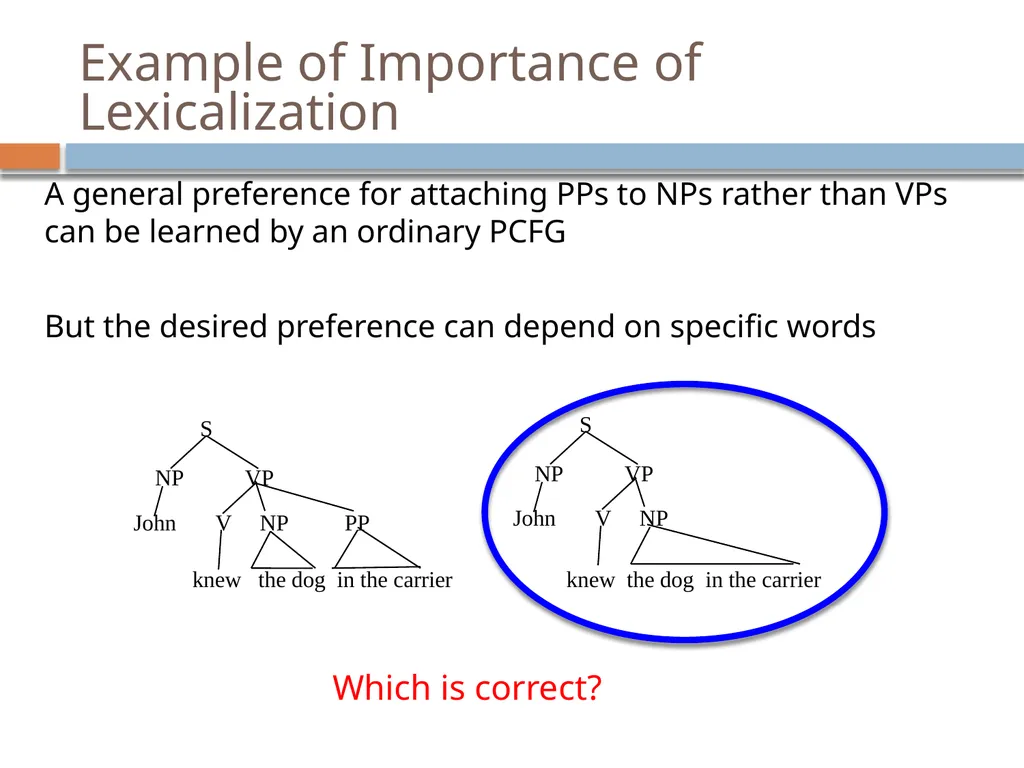
Example of Importance of Lexicalization A general preference for attaching PPs to NPs rather than VPs can be learned by an ordinary PCFG
But the desired preference can depend on specific words S NP VP John V NP knew the dog in the carrier Which is correct?<br>
But the desired preference can depend on specific words S NP VP John V NP knew the dog in the carrier Which is correct?<br>
29
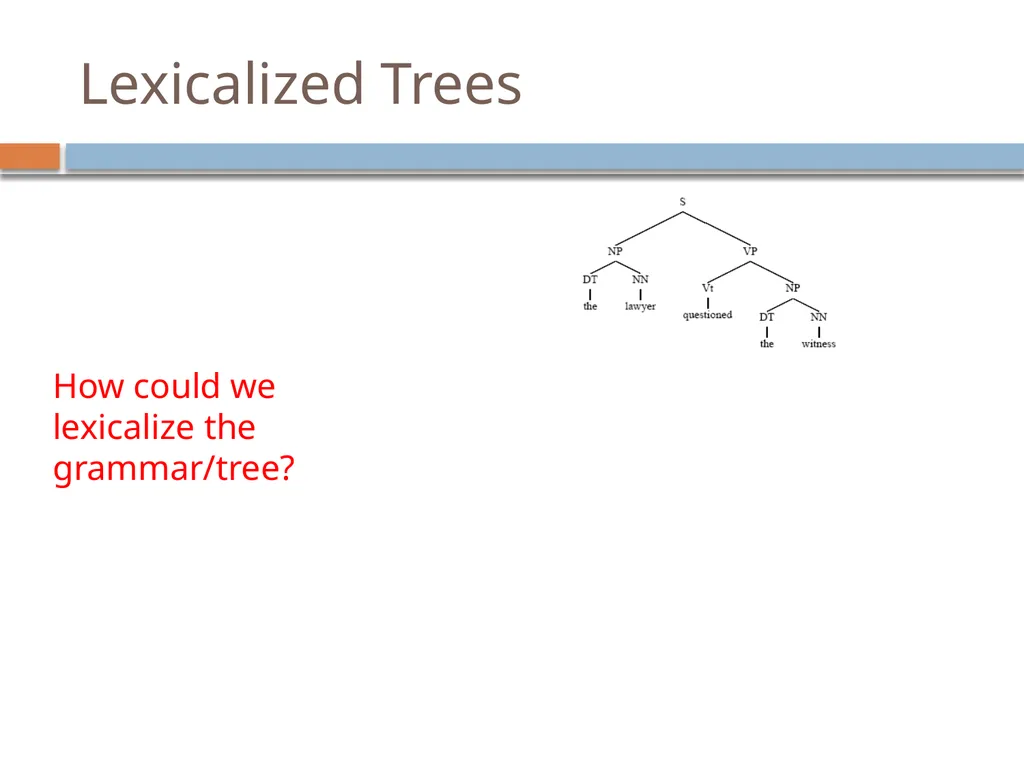
Lexicalized Trees How could we lexicalize the grammar/tree?<br>
30
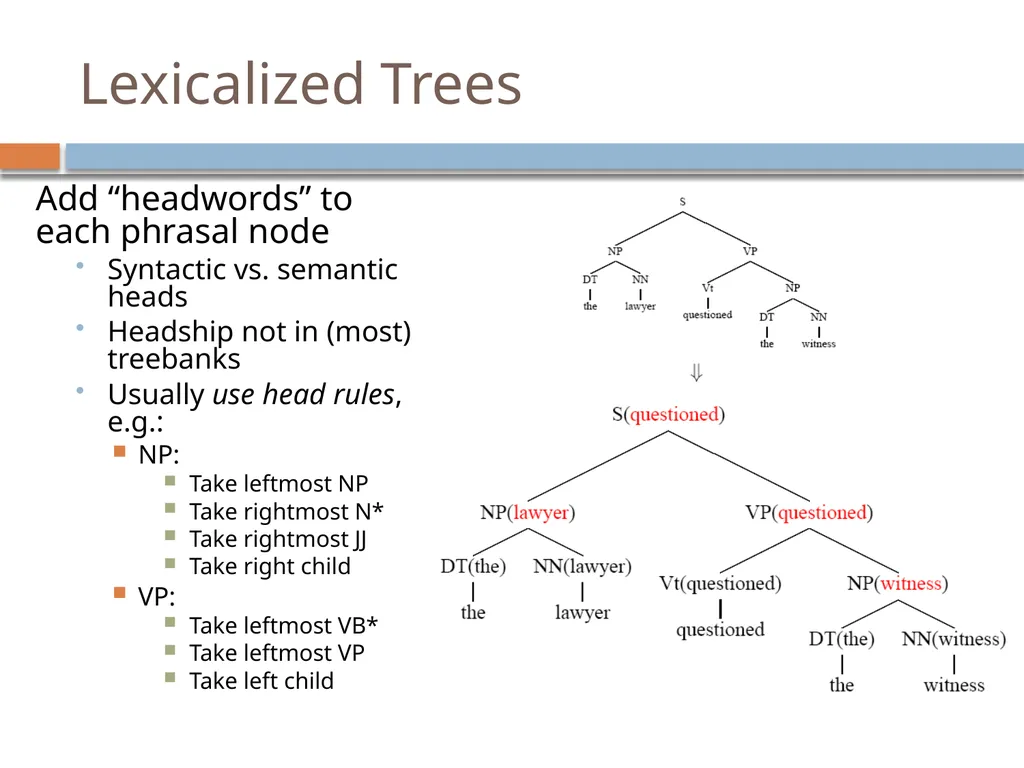
Lexicalized Trees Add “headwords” to each phrasal node
Syntactic vs. semantic heads
Headship not in (most) treebanks
Usually use head rules, e.g.:
NP:
Take leftmost NP
Take rightmost N*
Take rightmost JJ
Take right child
VP:
Take leftmost VB*
Take leftmost VP
Take left child<br>
Syntactic vs. semantic heads
Headship not in (most) treebanks
Usually use head rules, e.g.:
NP:
Take leftmost NP
Take rightmost N*
Take rightmost JJ
Take right child
VP:
Take leftmost VB*
Take leftmost VP
Take left child<br>
31
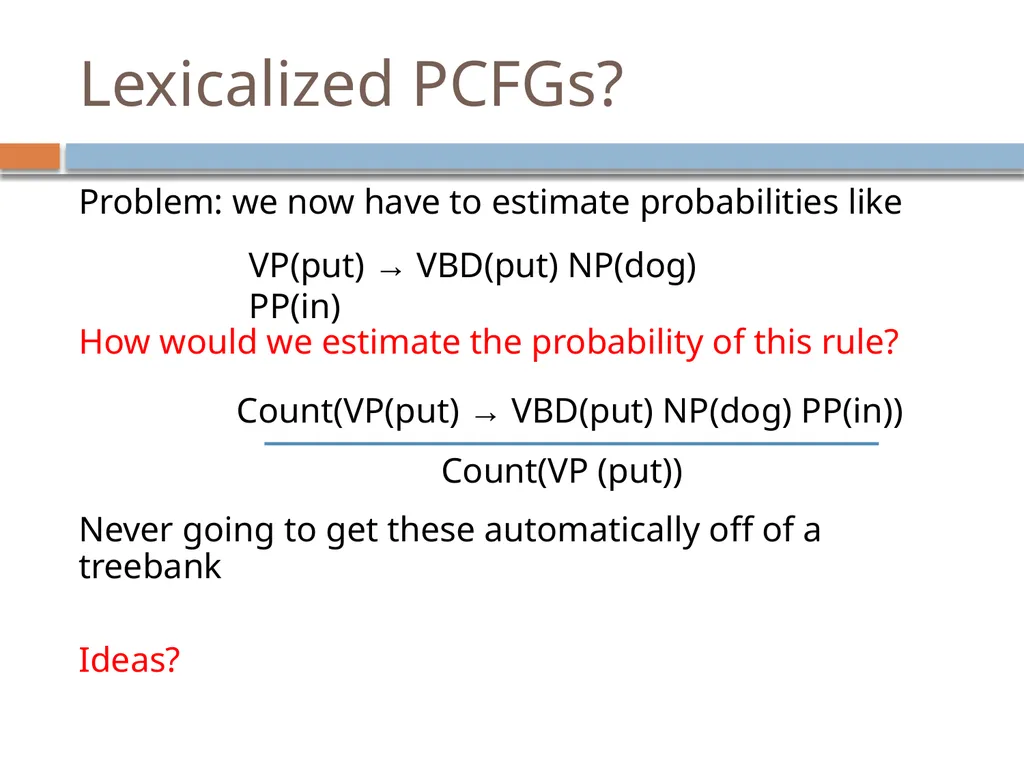
Lexicalized PCFGs? Problem: we now have to estimate probabilities like
How would we estimate the probability of this rule?
Never going to get these automatically off of a treebank
Ideas? VP(put) → VBD(put) NP(dog) PP(in)<br>
How would we estimate the probability of this rule?
Never going to get these automatically off of a treebank
Ideas? VP(put) → VBD(put) NP(dog) PP(in)<br>
32
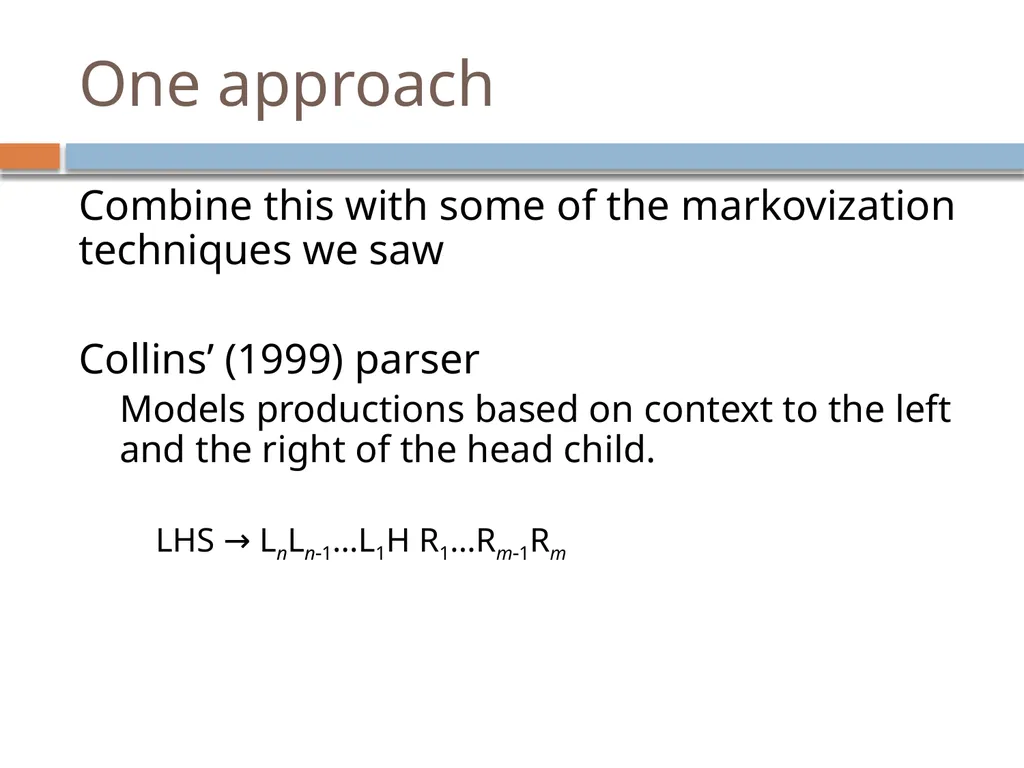
One approach Combine this with some of the markovization techniques we saw
Collins’ (1999) parser
Models productions based on context to the left and the right of the head child.
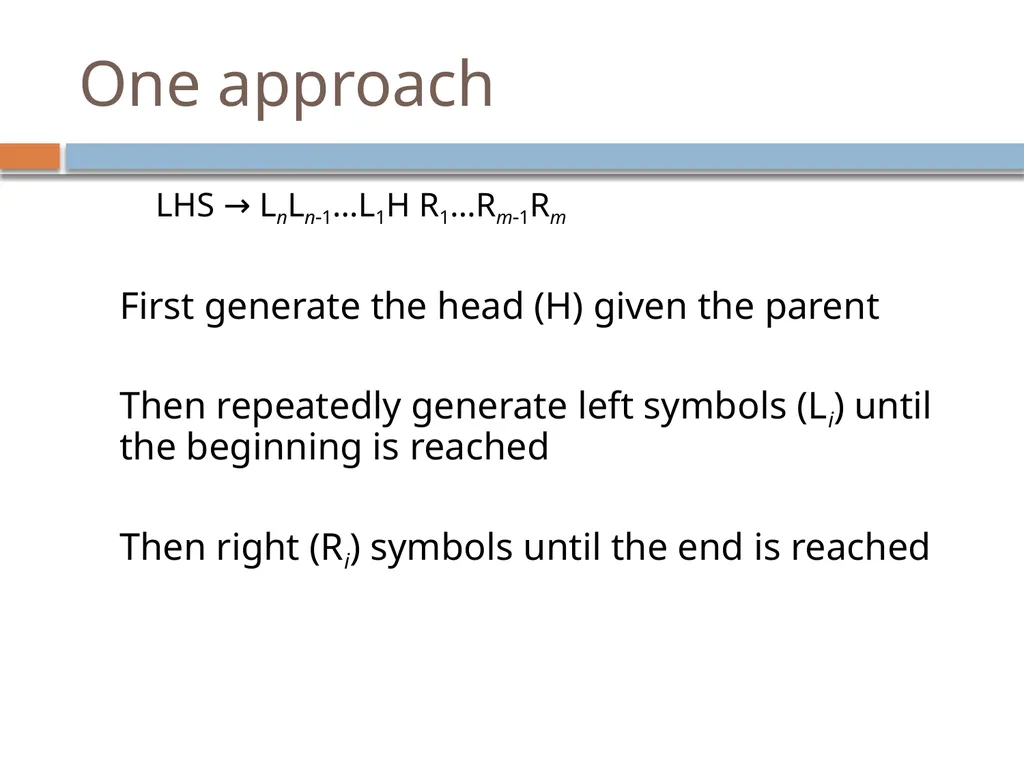
LHS → LnLn1…L1H R1…Rm1Rm<br>
Collins’ (1999) parser
Models productions based on context to the left and the right of the head child.
LHS → LnLn1…L1H R1…Rm1Rm<br>
33
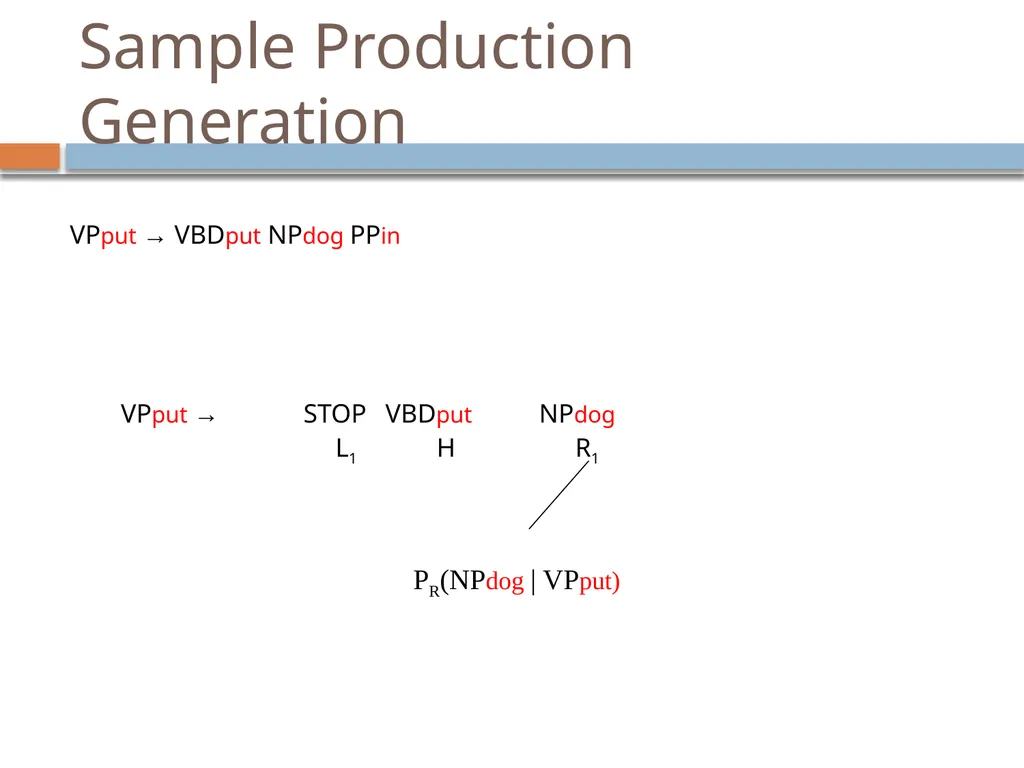
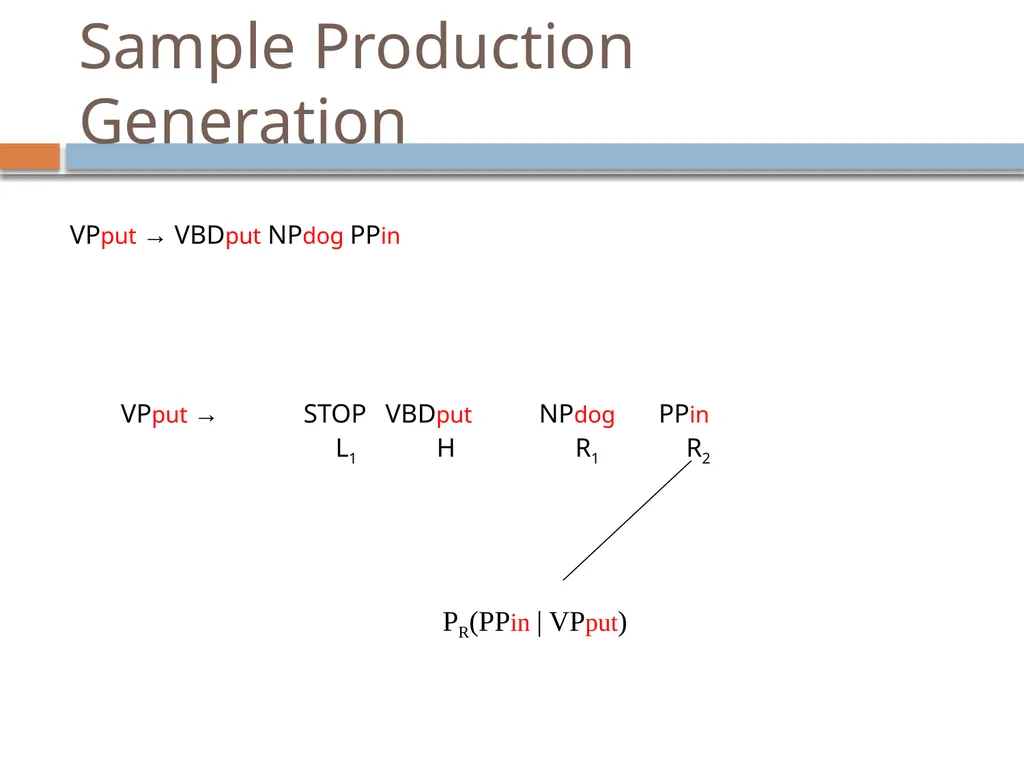
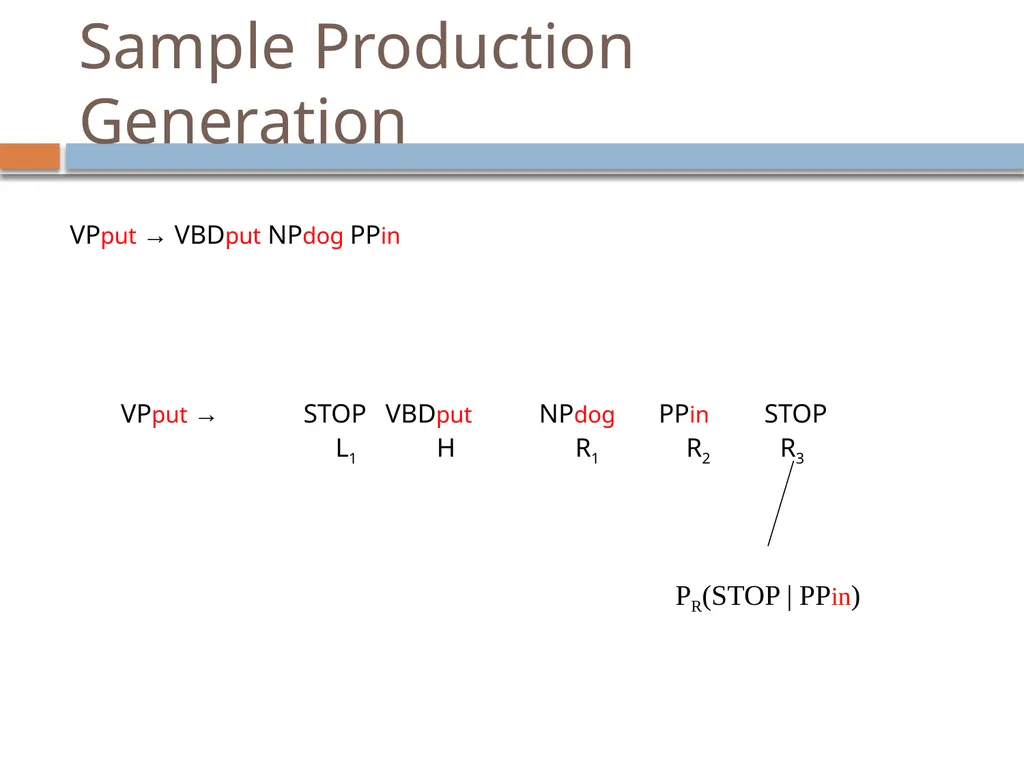
One approach LHS → LnLn1…L1H R1…Rm1Rm
First generate the head (H) given the parent
Then repeatedly generate left symbols (Li) until the beginning is reached
Then right (Ri) symbols until the end is reached<br>
First generate the head (H) given the parent
Then repeatedly generate left symbols (Li) until the beginning is reached
Then right (Ri) symbols until the end is reached<br>
34
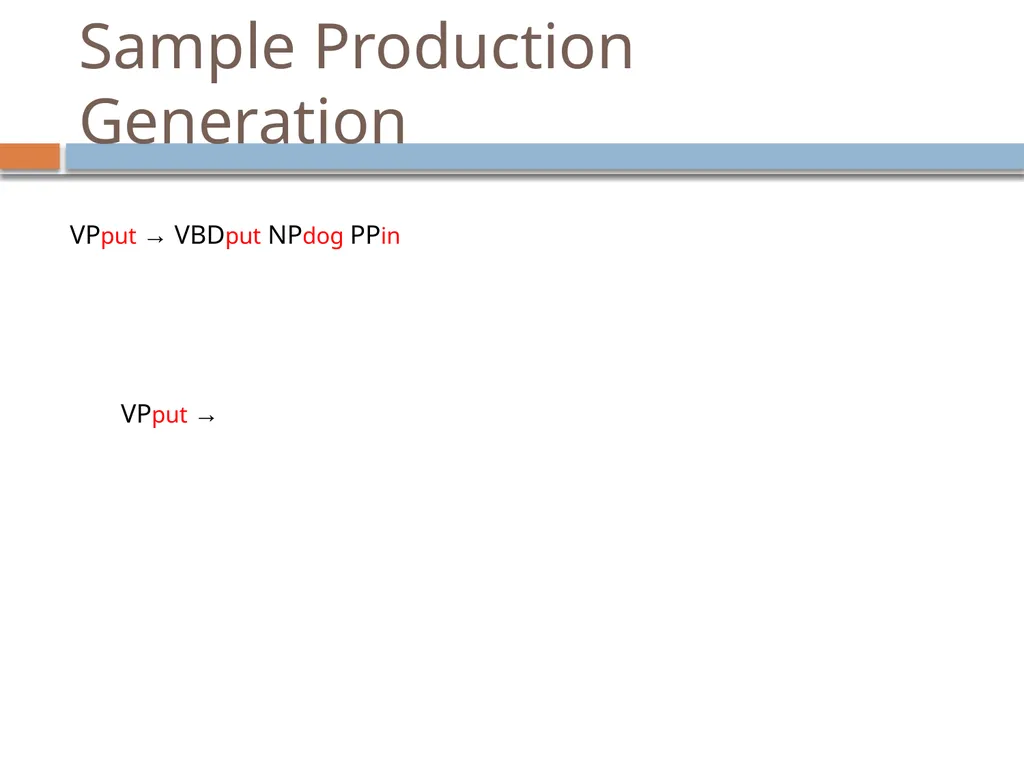
Sample Production Generation VPput → VBDput NPdog PPin VPput →<br>
35
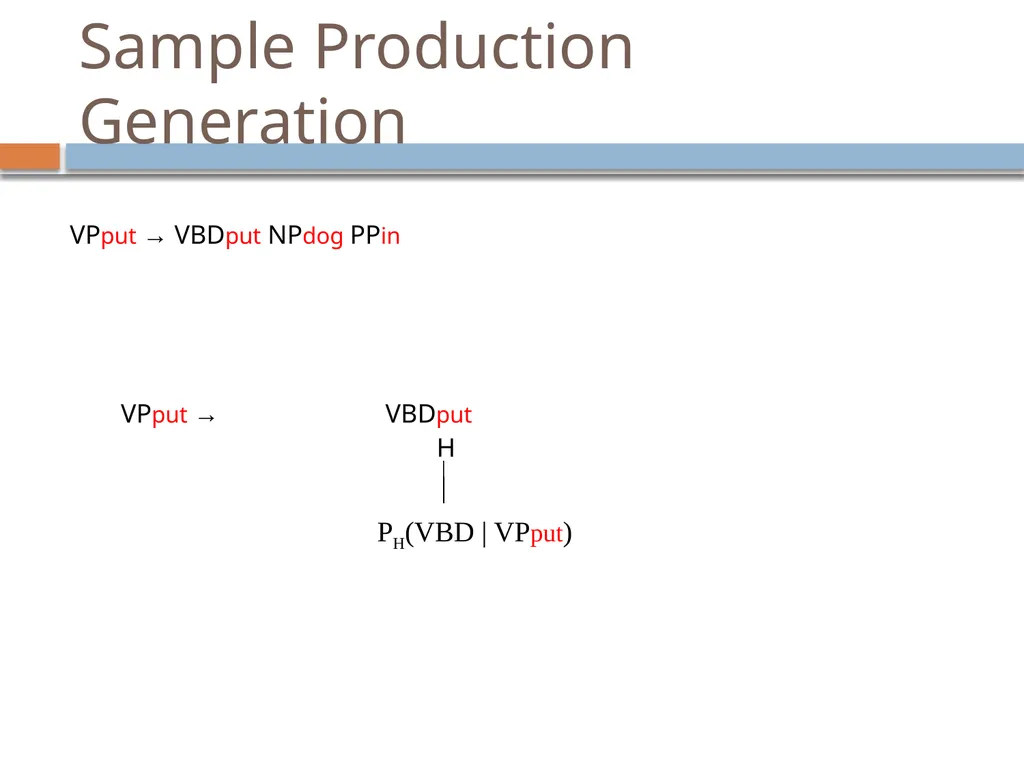
Sample Production Generation VPput → VBDput NPdog PPin VPput → VBDput H PH(VBD | VPput)<br>
36
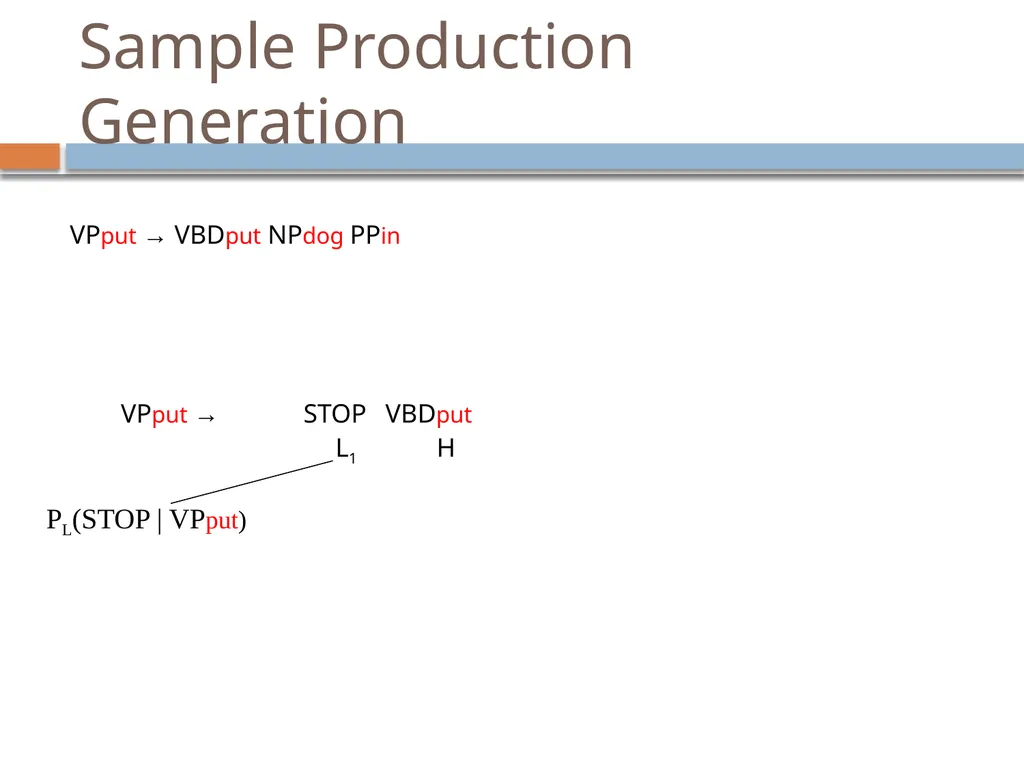
Sample Production Generation VPput → VBDput NPdog PPin VPput → VBDput H L1 STOP PL(STOP | VPput)<br>
37
Sample Production Generation VPput → VBDput NPdog PPin VPput → VBDput NPdog H L1 STOP R1 PR(NPdog | VPput)<br>
38
Sample Production Generation VPput → VBDput NPdog PPin VPput → VBDput NPdog H L1 STOP PPin R1 R2 PR(PPin | VPput)<br>
39
Sample Production Generation VPput → VBDput NPdog PPin VPput → VBDput NPdog H L1 STOP PPin STOP R1 R2 R3 PR(STOP | PPin)<br>
40
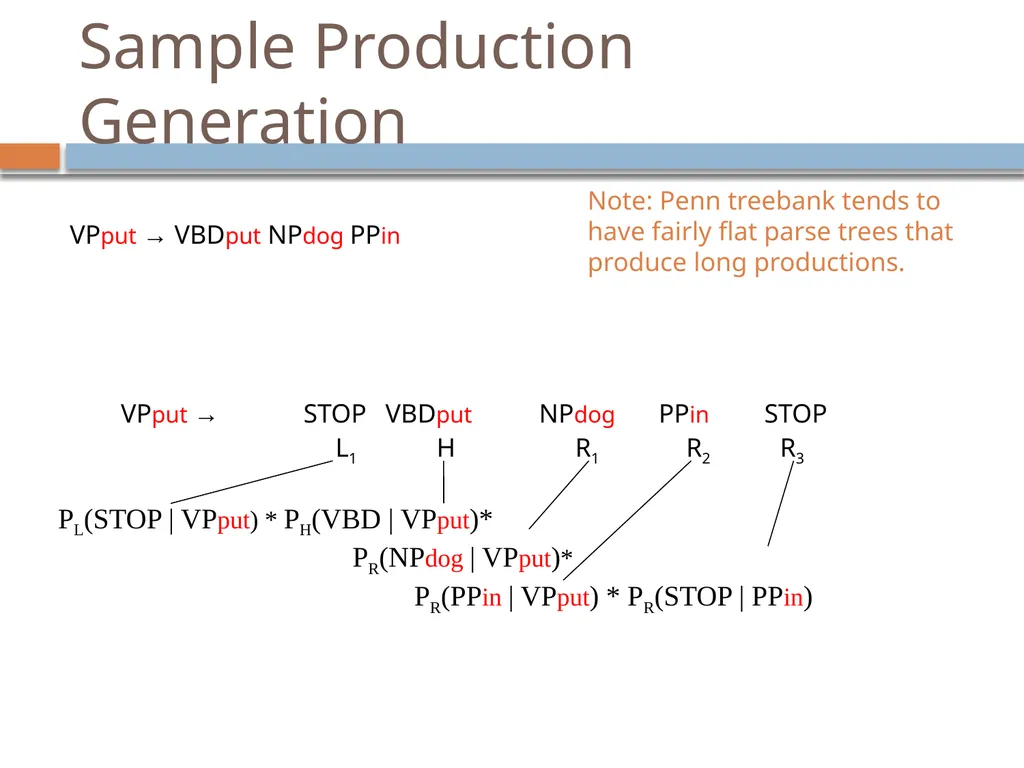
Sample Production Generation VPput → VBDput NPdog PPin Note: Penn treebank tends to
have fairly flat parse trees that
produce long productions. VPput → VBDput NPdog H L1 STOP PPin STOP R1 R2 R3 PL(STOP | VPput) * PH(VBD | VPput)*
PR(NPdog | VPput)*
PR(PPin | VPput) * PR(STOP | PPin)<br>
have fairly flat parse trees that
produce long productions. VPput → VBDput NPdog H L1 STOP PPin STOP R1 R2 R3 PL(STOP | VPput) * PH(VBD | VPput)*
PR(NPdog | VPput)*
PR(PPin | VPput) * PR(STOP | PPin)<br>
41
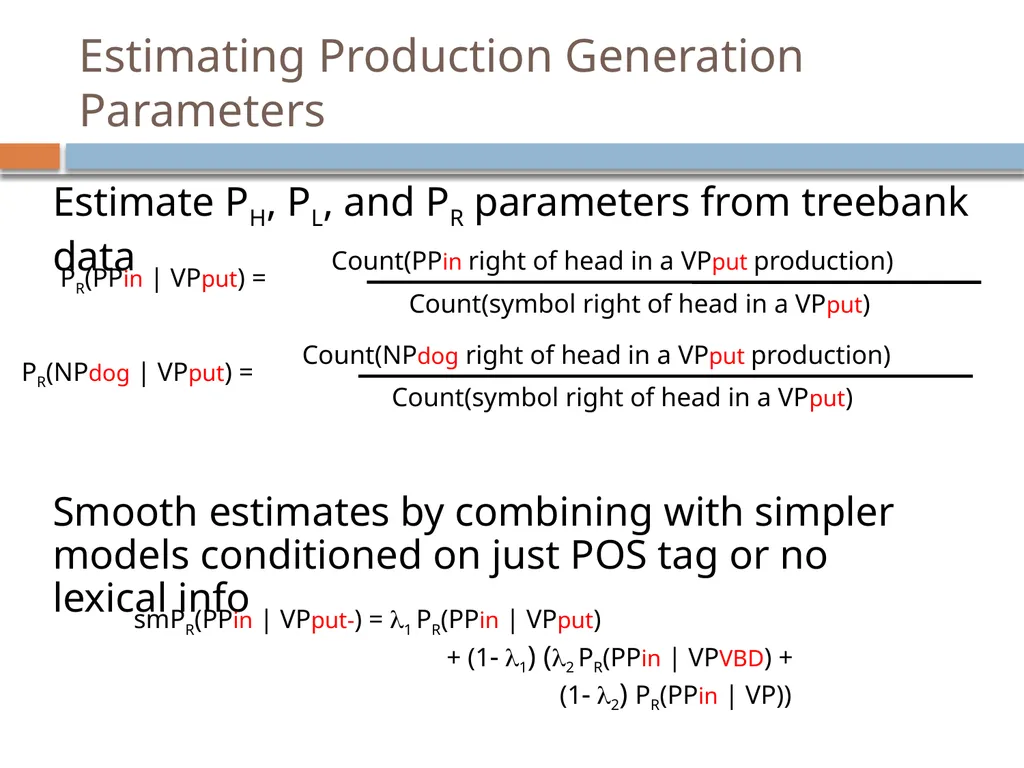
Count(PPin right of head in a VPput production) Estimating Production Generation Parameters Estimate PH, PL, and PR parameters from treebank data PR(PPin | VPput) = Count(symbol right of head in a VPput) Count(NPdog right of head in a VPput production) PR(NPdog | VPput) = Smooth estimates by combining with simpler models conditioned on just POS tag or no lexical info smPR(PPin | VPput-) = 1 PR(PPin | VPput)
+ (1 1) (2 PR(PPin | VPVBD) +
(1 2) PR(PPin | VP)) Count(symbol right of head in a VPput)<br>
+ (1 1) (2 PR(PPin | VPVBD) +
(1 2) PR(PPin | VP)) Count(symbol right of head in a VPput)<br>
42
Problems with lexicalization We’ve solved the estimation problem
There’s also the issue of performance
Lexicalization causes the size of the number of grammar rules to explode!
Our parsing algorithms take too long too finish
Ideas?<br>
There’s also the issue of performance
Lexicalization causes the size of the number of grammar rules to explode!
Our parsing algorithms take too long too finish
Ideas?<br>
43
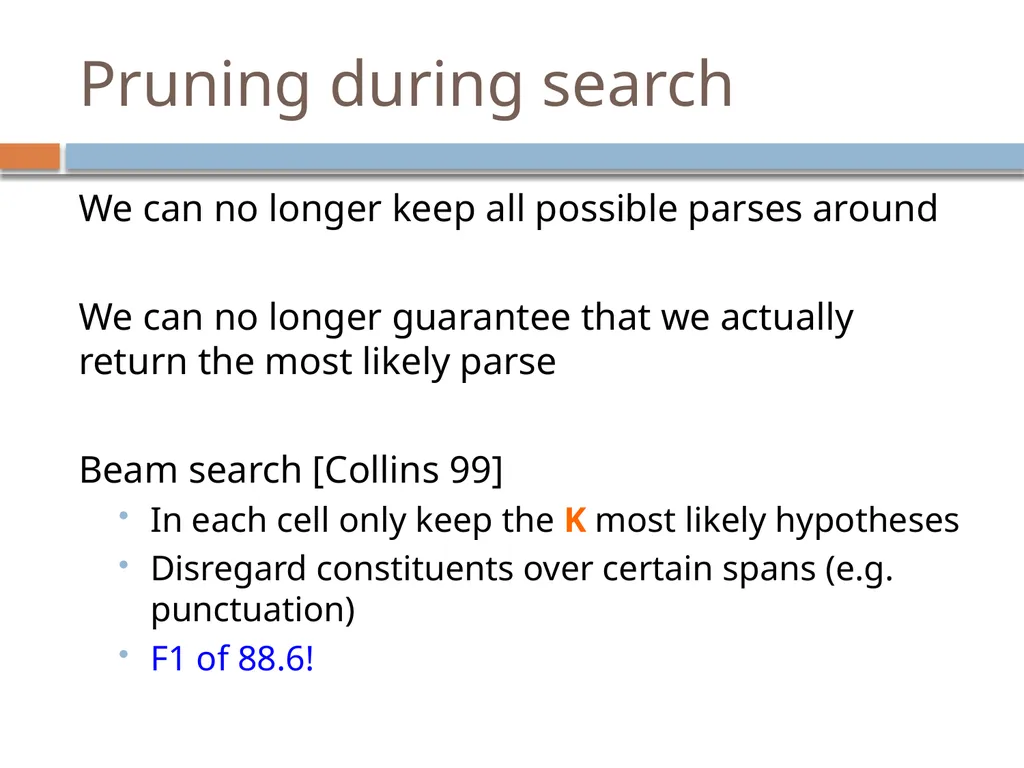
Pruning during search We can no longer keep all possible parses around
We can no longer guarantee that we actually return the most likely parse
Beam search [Collins 99]
In each cell only keep the K most likely hypotheses
Disregard constituents over certain spans (e.g. punctuation)
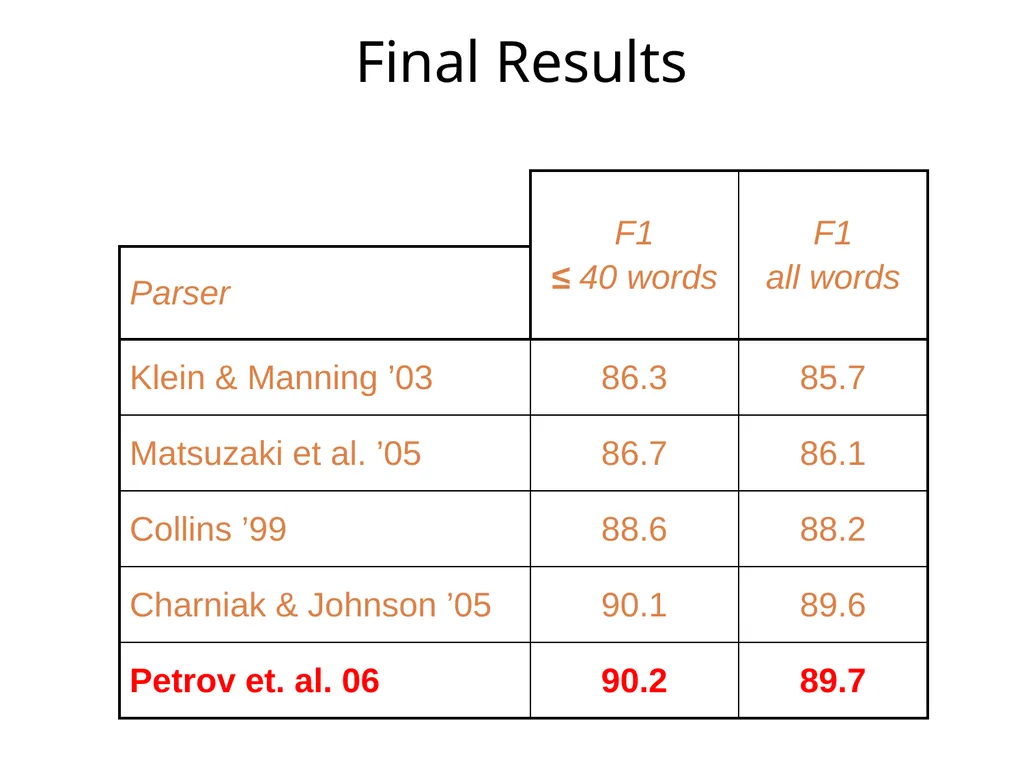
F1 of 88.6!<br>
We can no longer guarantee that we actually return the most likely parse
Beam search [Collins 99]
In each cell only keep the K most likely hypotheses
Disregard constituents over certain spans (e.g. punctuation)
F1 of 88.6!<br>
44
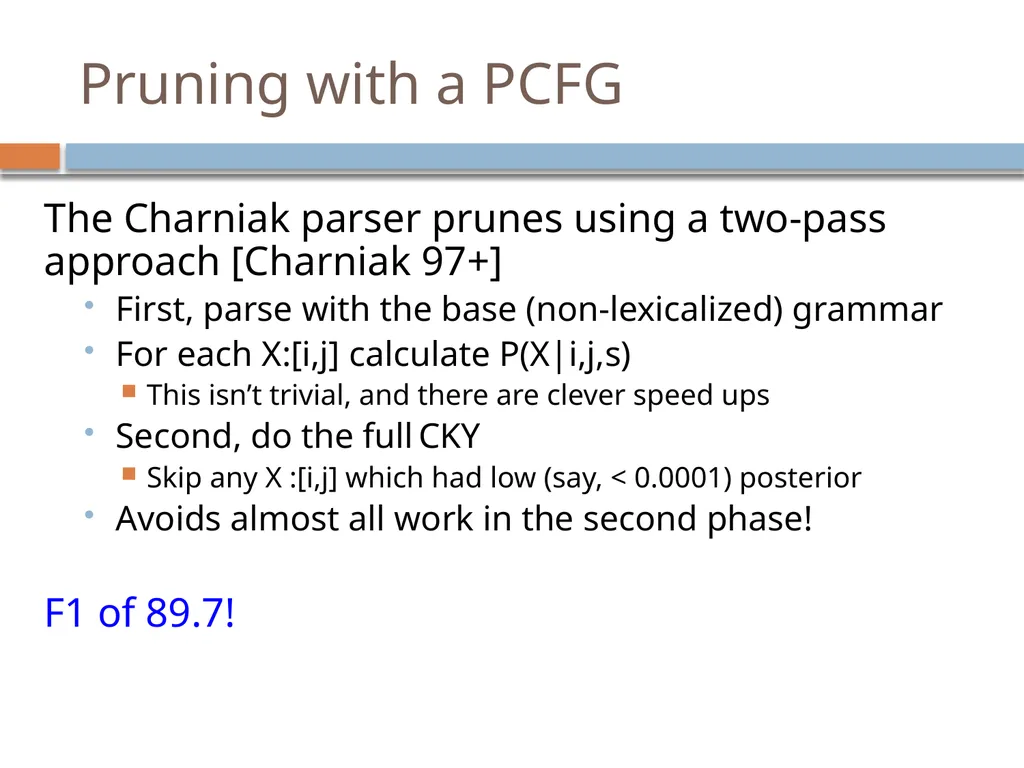
Pruning with a PCFG The Charniak parser prunes using a two-pass approach [Charniak 97+]
First, parse with the base (non-lexicalized) grammar
For each X:[i,j] calculate P(X|i,j,s)
This isn’t trivial, and there are clever speed ups
Second, do the full CKY
Skip any X :[i,j] which had low (say, < 0.0001) posterior
Avoids almost all work in the second phase!
F1 of 89.7!<br>
First, parse with the base (non-lexicalized) grammar
For each X:[i,j] calculate P(X|i,j,s)
This isn’t trivial, and there are clever speed ups
Second, do the full CKY
Skip any X :[i,j] which had low (say, < 0.0001) posterior
Avoids almost all work in the second phase!
F1 of 89.7!<br>
45
Tag splitting Lexicalization is an extreme case of splitting the tags to allow for better discrimination
Idea: what if rather than doing it for all words, we just split some of the tags<br>
Idea: what if rather than doing it for all words, we just split some of the tags<br>
46
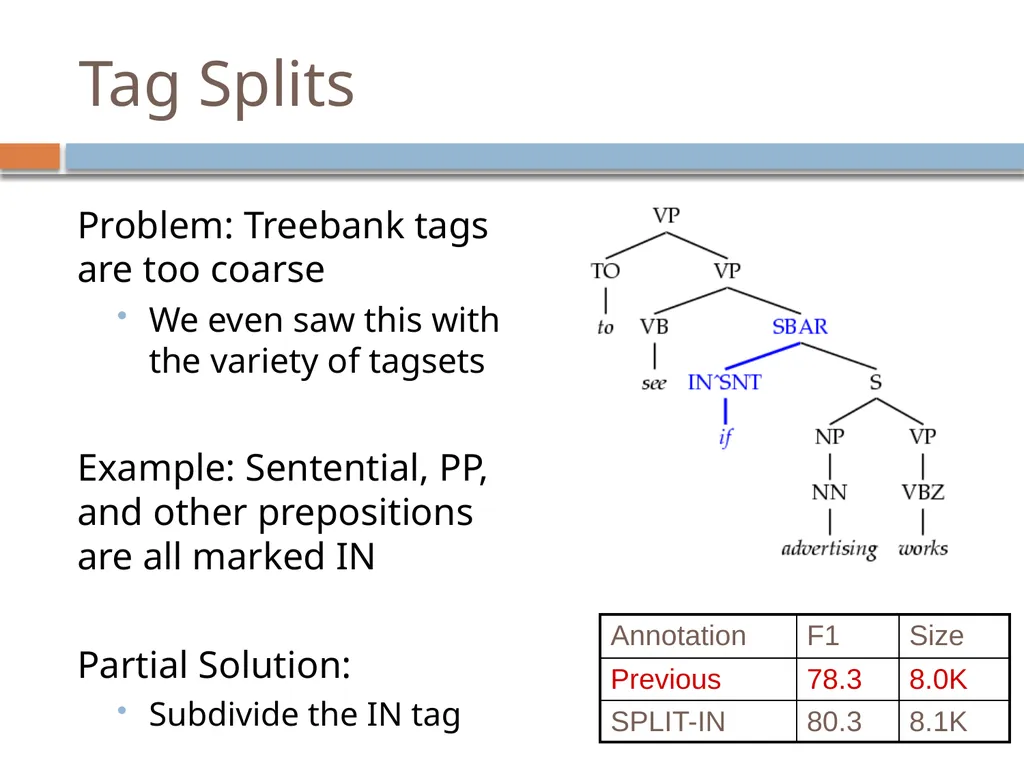
Tag Splits Problem: Treebank tags are too coarse
We even saw this with the variety of tagsets
Example: Sentential, PP, and other prepositions are all marked IN
Partial Solution:
Subdivide the IN tag<br>
We even saw this with the variety of tagsets
Example: Sentential, PP, and other prepositions are all marked IN
Partial Solution:
Subdivide the IN tag<br>
47
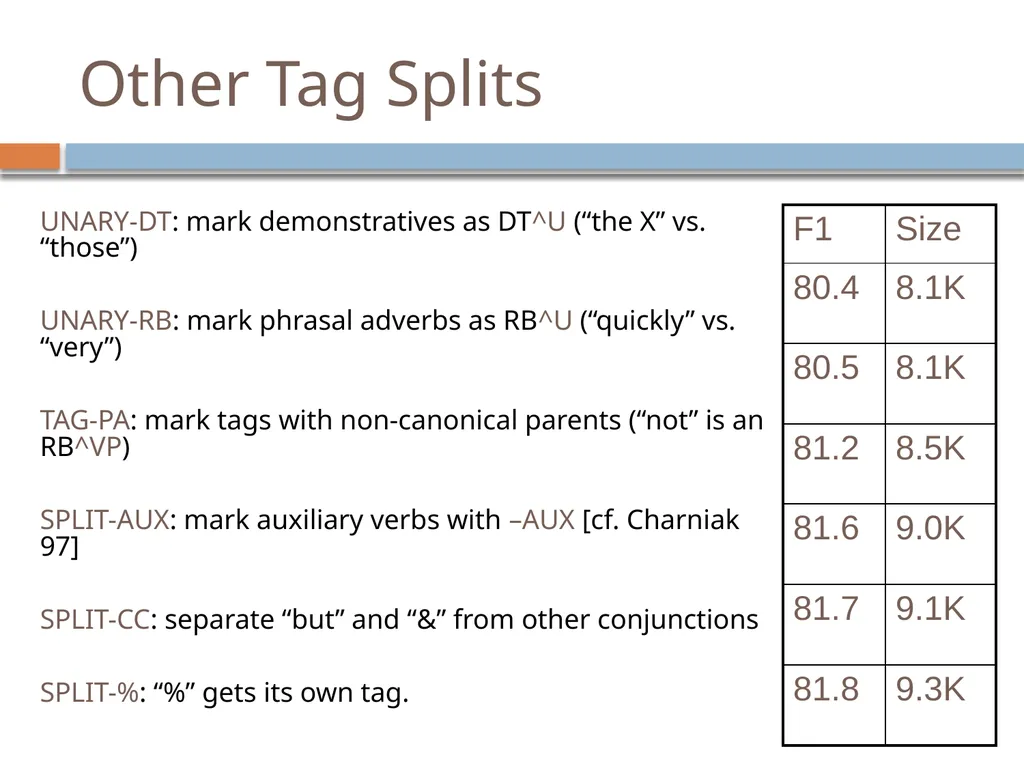
Other Tag Splits UNARY-DT: mark demonstratives as DT^U (“the X” vs. “those”)
UNARY-RB: mark phrasal adverbs as RB^U (“quickly” vs. “very”)
TAG-PA: mark tags with non-canonical parents (“not” is an RB^VP)
SPLIT-AUX: mark auxiliary verbs with –AUX [cf. Charniak 97]
SPLIT-CC: separate “but” and “&” from other conjunctions
SPLIT-%: “%” gets its own tag.<br>
UNARY-RB: mark phrasal adverbs as RB^U (“quickly” vs. “very”)
TAG-PA: mark tags with non-canonical parents (“not” is an RB^VP)
SPLIT-AUX: mark auxiliary verbs with –AUX [cf. Charniak 97]
SPLIT-CC: separate “but” and “&” from other conjunctions
SPLIT-%: “%” gets its own tag.<br>
48
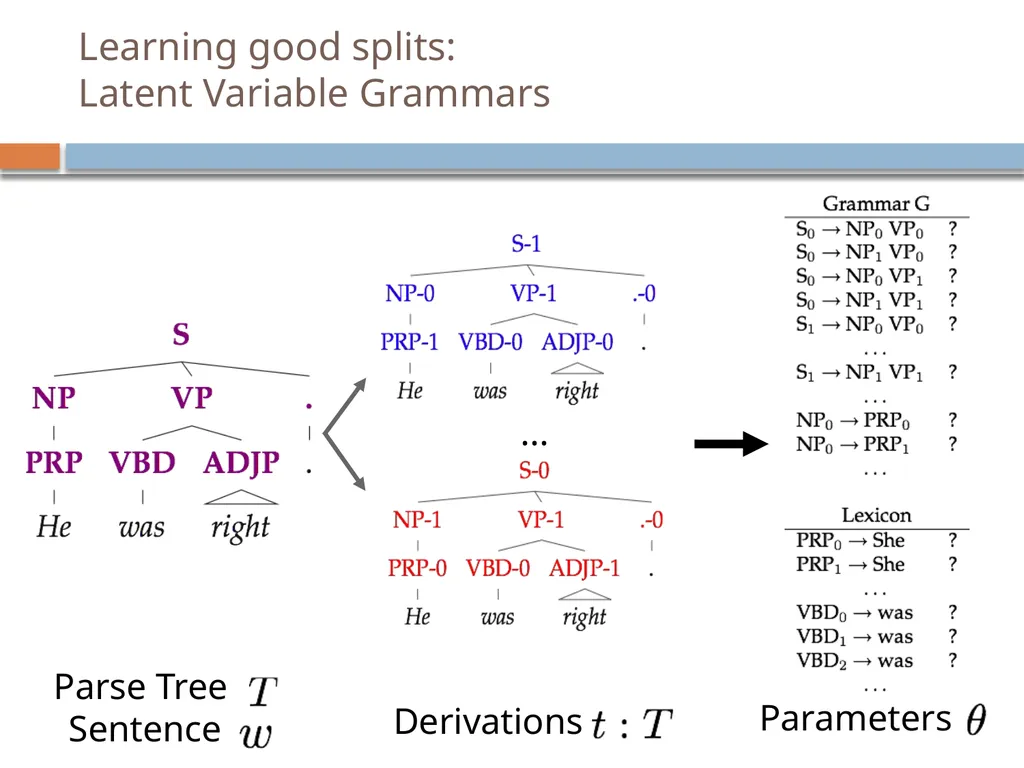
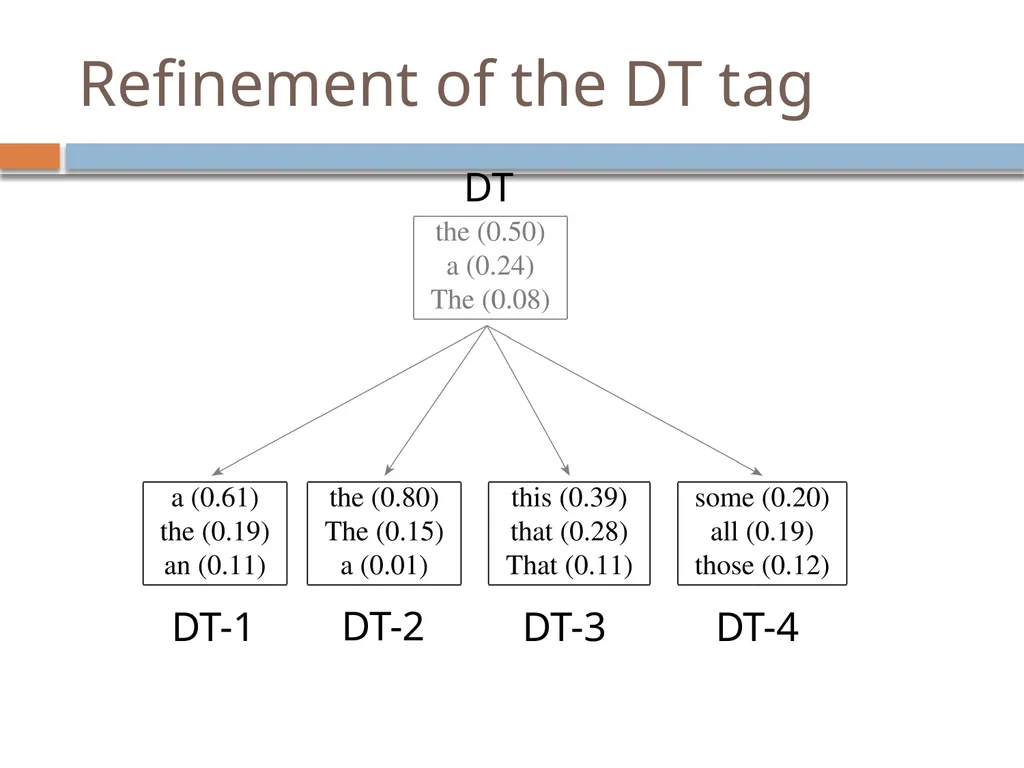
Learning good splits:
Latent Variable Grammars<br>
49
Refinement of the DT tag DT<br>
50
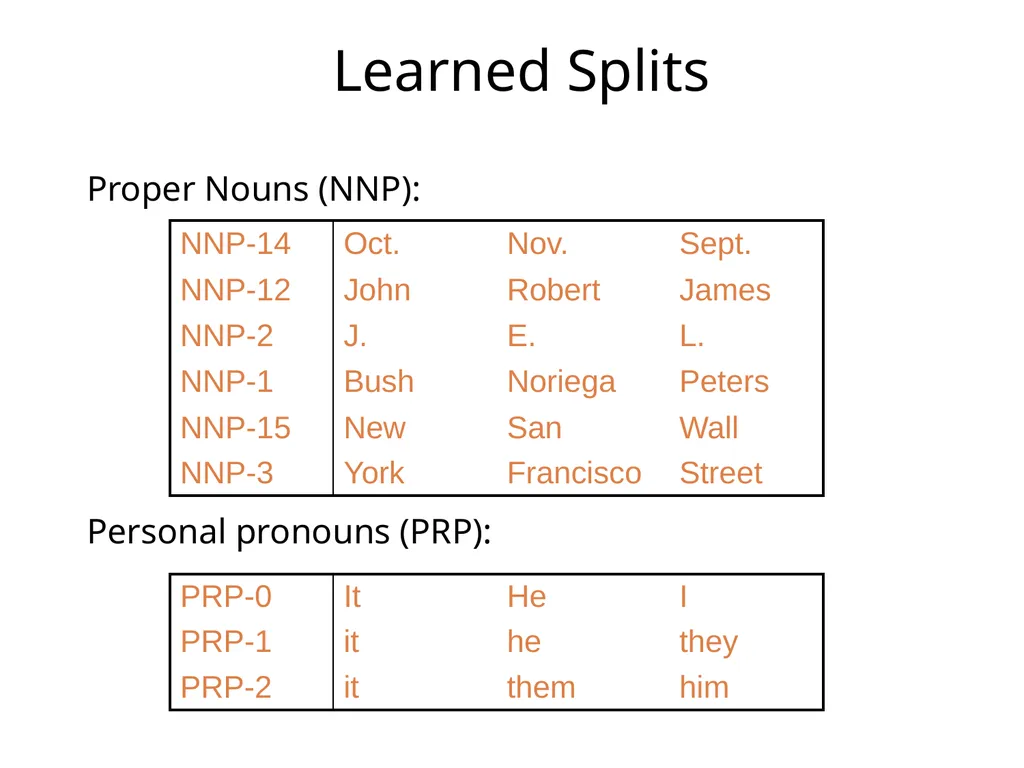
Learned Splits Proper Nouns (NNP):
Personal pronouns (PRP):<br>
Personal pronouns (PRP):<br>
51
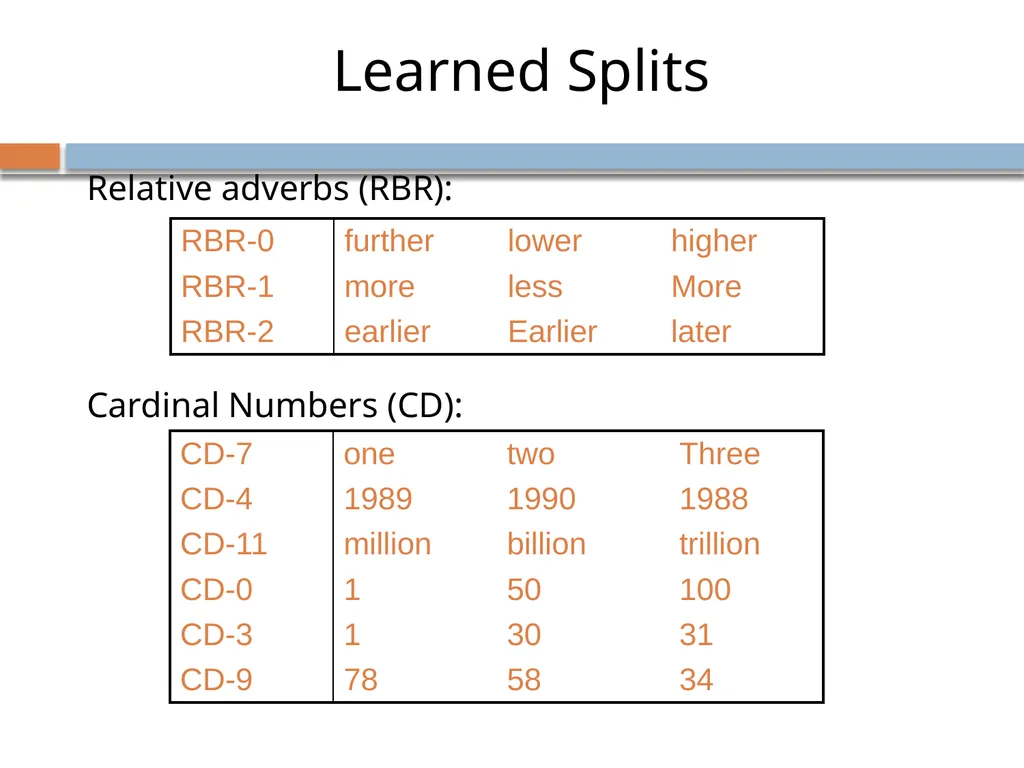
Relative adverbs (RBR):
Cardinal Numbers (CD): Learned Splits<br>
Cardinal Numbers (CD): Learned Splits<br>
52
Final Results<br>
53
Human Parsing How do humans do it?
How might you try and figure it out computationally/experimentally?<br>
How might you try and figure it out computationally/experimentally?<br>
54
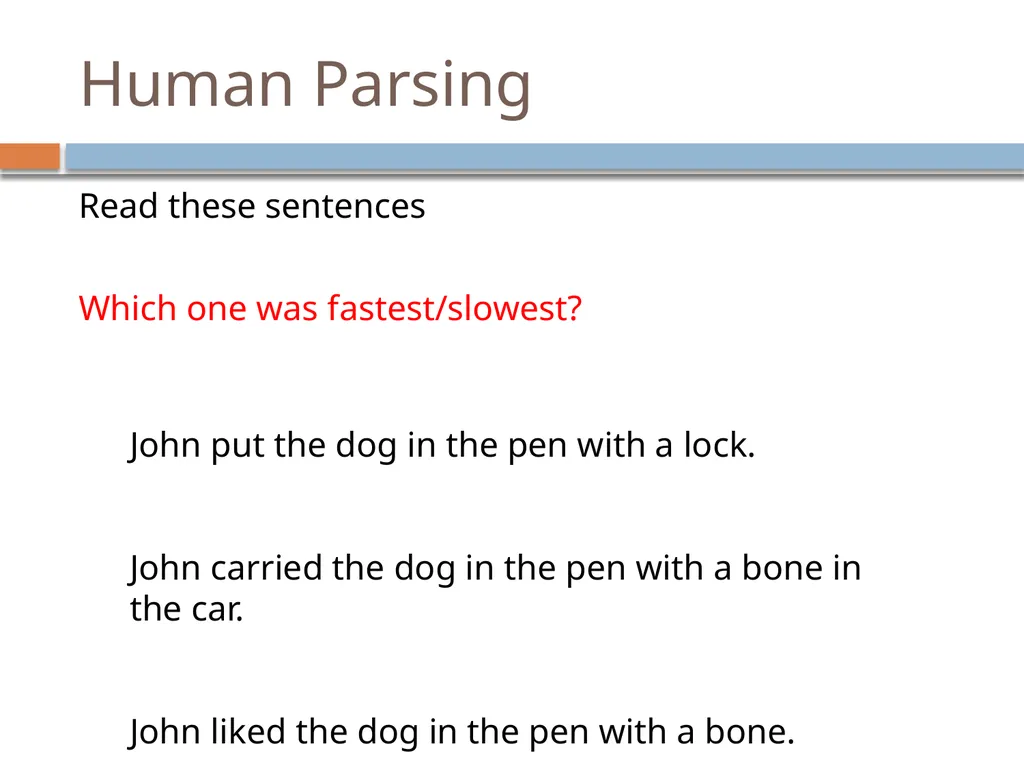
Human Parsing Read these sentences
Which one was fastest/slowest? John put the dog in the pen with a lock.
John carried the dog in the pen with a bone in the car.
John liked the dog in the pen with a bone.<br>
Which one was fastest/slowest? John put the dog in the pen with a lock.
John carried the dog in the pen with a bone in the car.
John liked the dog in the pen with a bone.<br>
55
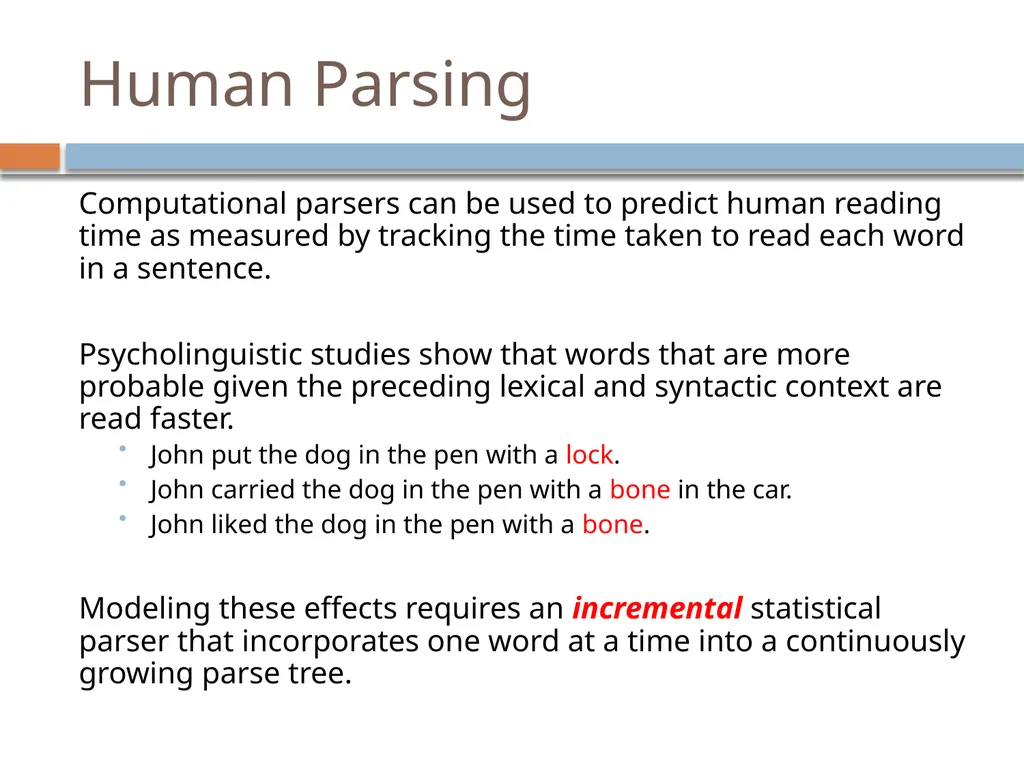
Human Parsing Computational parsers can be used to predict human reading time as measured by tracking the time taken to read each word in a sentence.
Psycholinguistic studies show that words that are more probable given the preceding lexical and syntactic context are read faster.
John put the dog in the pen with a lock.
John carried the dog in the pen with a bone in the car.
John liked the dog in the pen with a bone.
Modeling these effects requires an incremental statistical parser that incorporates one word at a time into a continuously growing parse tree.<br>
Psycholinguistic studies show that words that are more probable given the preceding lexical and syntactic context are read faster.
John put the dog in the pen with a lock.
John carried the dog in the pen with a bone in the car.
John liked the dog in the pen with a bone.
Modeling these effects requires an incremental statistical parser that incorporates one word at a time into a continuously growing parse tree.<br>
56
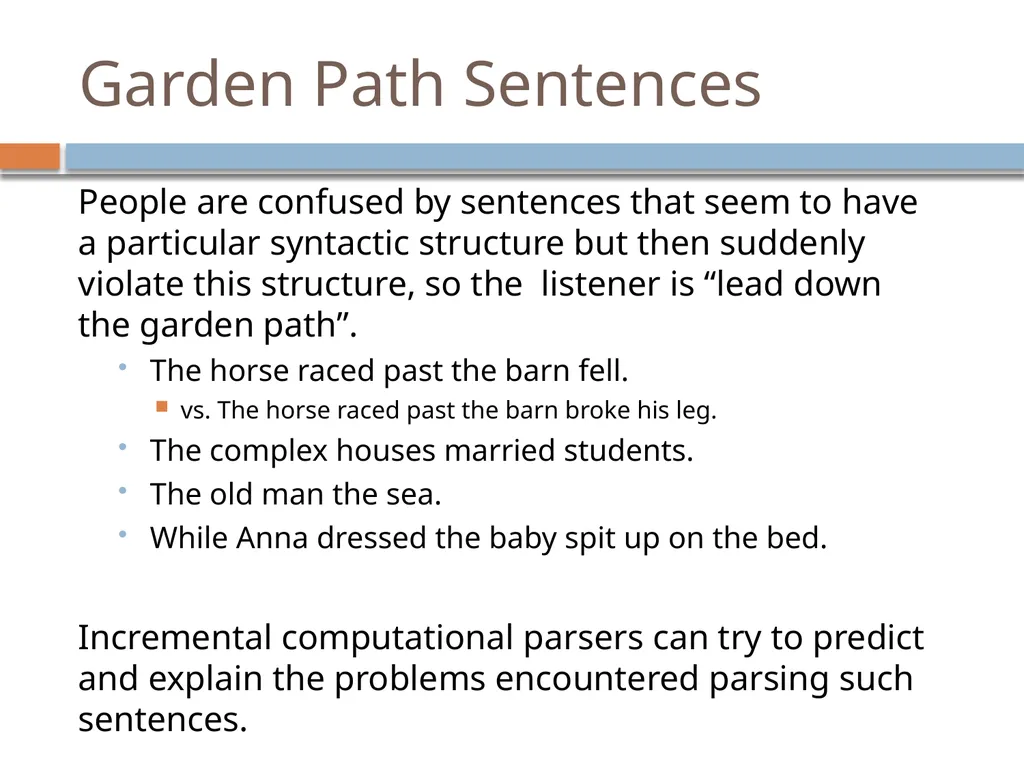
Garden Path Sentences People are confused by sentences that seem to have a particular syntactic structure but then suddenly violate this structure, so the listener is “lead down the garden path”.
The horse raced past the barn fell.
vs. The horse raced past the barn broke his leg.
The complex houses married students.
The old man the sea.
While Anna dressed the baby spit up on the bed.
Incremental computational parsers can try to predict and explain the problems encountered parsing such sentences.<br>
The horse raced past the barn fell.
vs. The horse raced past the barn broke his leg.
The complex houses married students.
The old man the sea.
While Anna dressed the baby spit up on the bed.
Incremental computational parsers can try to predict and explain the problems encountered parsing such sentences.<br>
57
More garden sentences The prime number few.
Fat people eat accumulates.
The cotton clothing is usually made of grows in Mississippi.
Until the police arrest the drug dealers control the street.
The man who hunts ducks out on weekends.
When Fred eats food gets thrown.
Mary gave the child the dog bit a bandaid.
The girl told the story cried.
I convinced her children are noisy.
Helen is expecting tomorrow to be a bad day.
The horse raced past the barn fell.
I know the words to that song about the queen don't rhyme.
She told me a little white lie will come back to haunt me.
The dog that I had really loved bones.
That Jill is never here hurts.
The man who whistles tunes pianos.
The old man the boat.
Have the students who failed the exam take the supplementary.
The raft floated down the river sank.
We painted the wall with cracks.
The tycoon sold the offshore oil tracts for a lot of money wanted to kill JR. http://www.fun-with-words.com/ambiguous_garden_path.html<br>
Fat people eat accumulates.
The cotton clothing is usually made of grows in Mississippi.
Until the police arrest the drug dealers control the street.
The man who hunts ducks out on weekends.
When Fred eats food gets thrown.
Mary gave the child the dog bit a bandaid.
The girl told the story cried.
I convinced her children are noisy.
Helen is expecting tomorrow to be a bad day.
The horse raced past the barn fell.
I know the words to that song about the queen don't rhyme.
She told me a little white lie will come back to haunt me.
The dog that I had really loved bones.
That Jill is never here hurts.
The man who whistles tunes pianos.
The old man the boat.
Have the students who failed the exam take the supplementary.
The raft floated down the river sank.
We painted the wall with cracks.
The tycoon sold the offshore oil tracts for a lot of money wanted to kill JR. http://www.fun-with-words.com/ambiguous_garden_path.html<br>