
Parsing David Kauchak CS159 – Fall 2024 Admin

Description: Parsing David Kauchak CS159 Fall 2024 Admin Assignment 3 Quiz 1 Context free grammar S NP VP left hand side (single symbol) right hand side (one or more symbols) CFG: Example Many possible CFGs for English, here is an example
Related Topics
Download Presentation
"Parsing David Kauchak CS159 – Fall 2024 Admin" is the property of its rightful owner. Permission is granted to download and print the materials on this website for personal, non-commercial use only, and to display it on your personal computer provided you do not modify the materials and that you retain all copyright notices contained in the materials. By downloading content from our website, you accept the terms of this agreement.
Presentation Transcript
slide1. Parsing David Kauchak
CS159 – Fall 2024<br>
slide2. Admin Assignment 3
Quiz #1<br>
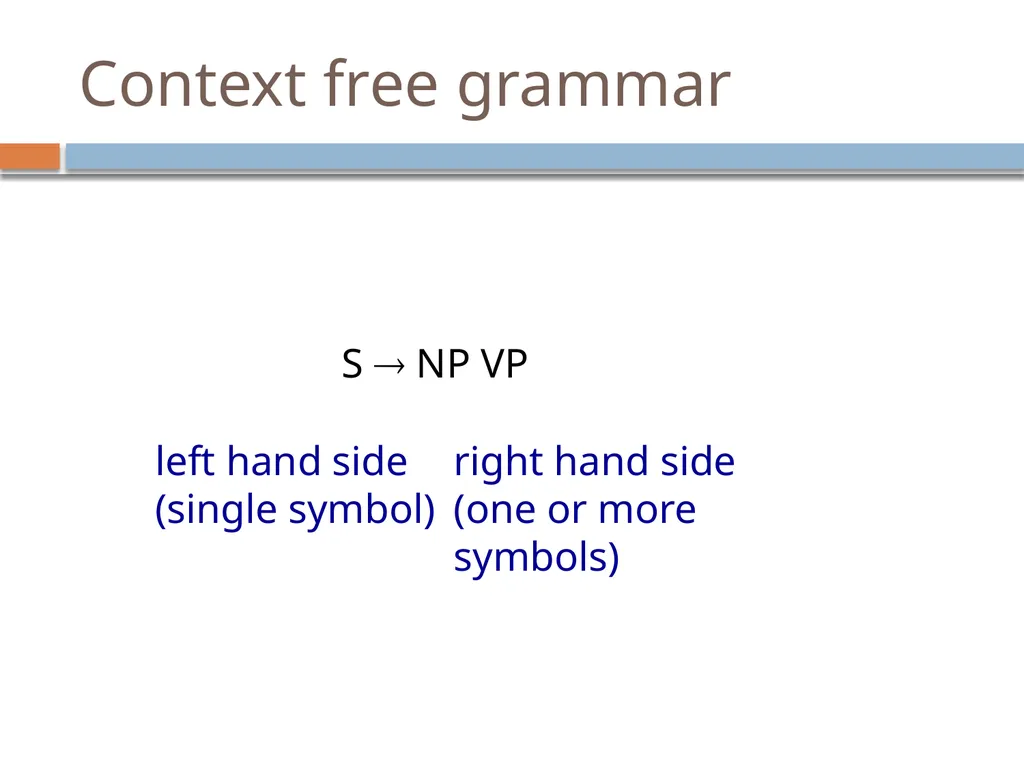
slide3. Context free grammar S NP VP left hand side
(single symbol) right hand side
(one or more symbols)<br>
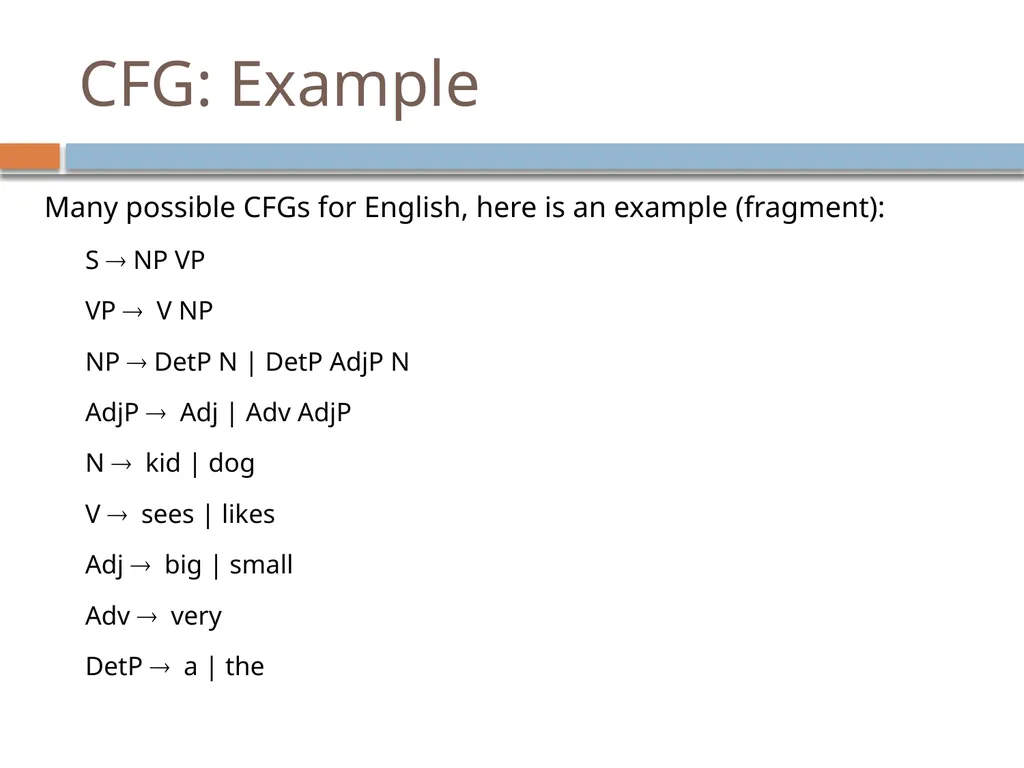
slide4. CFG: Example Many possible CFGs for English, here is an example (fragment):
S NP VP
VP V NP
NP DetP N | DetP AdjP N
AdjP Adj | Adv AdjP
N kid | dog
V sees | likes
Adj big | small
Adv very
DetP a | the<br>
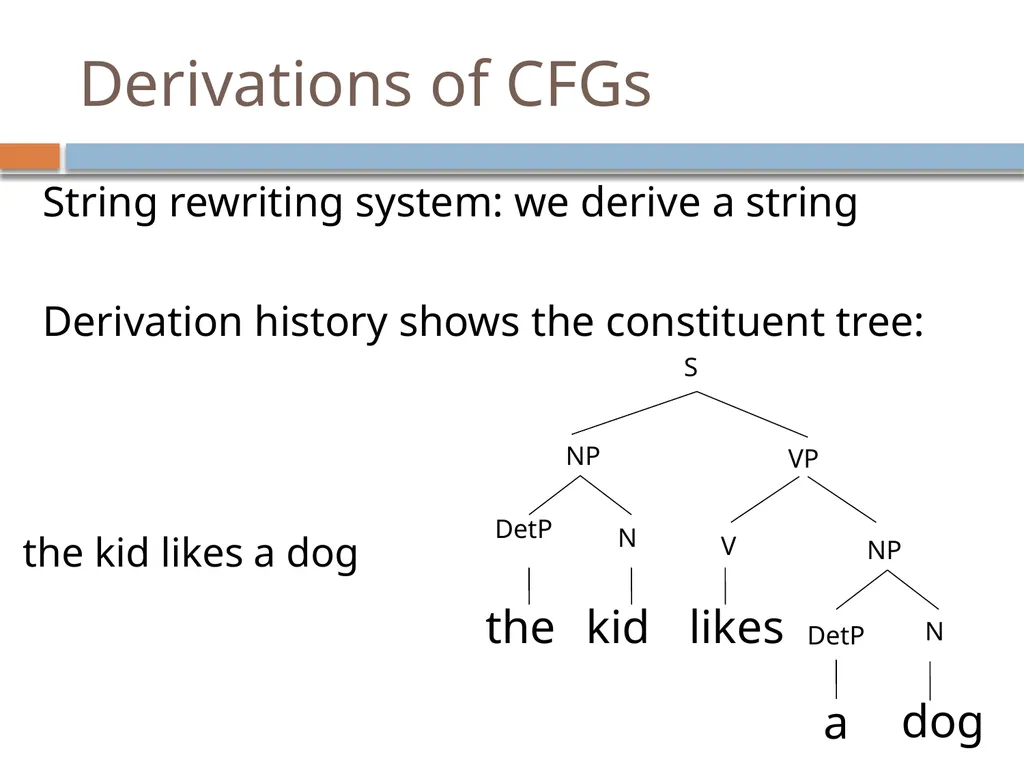
slide5. Derivations of CFGs String rewriting system: we derive a string
Derivation history shows the constituent tree: the kid likes a dog kid the likes DetP NP dog a NP DetP S VP N N V<br>
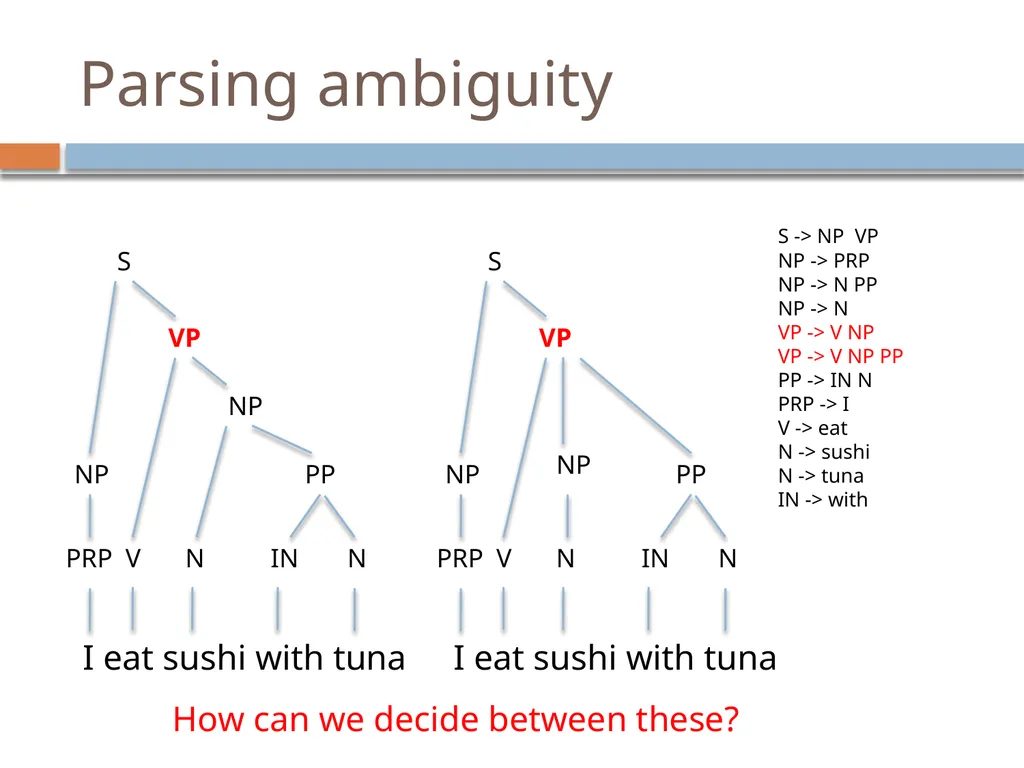
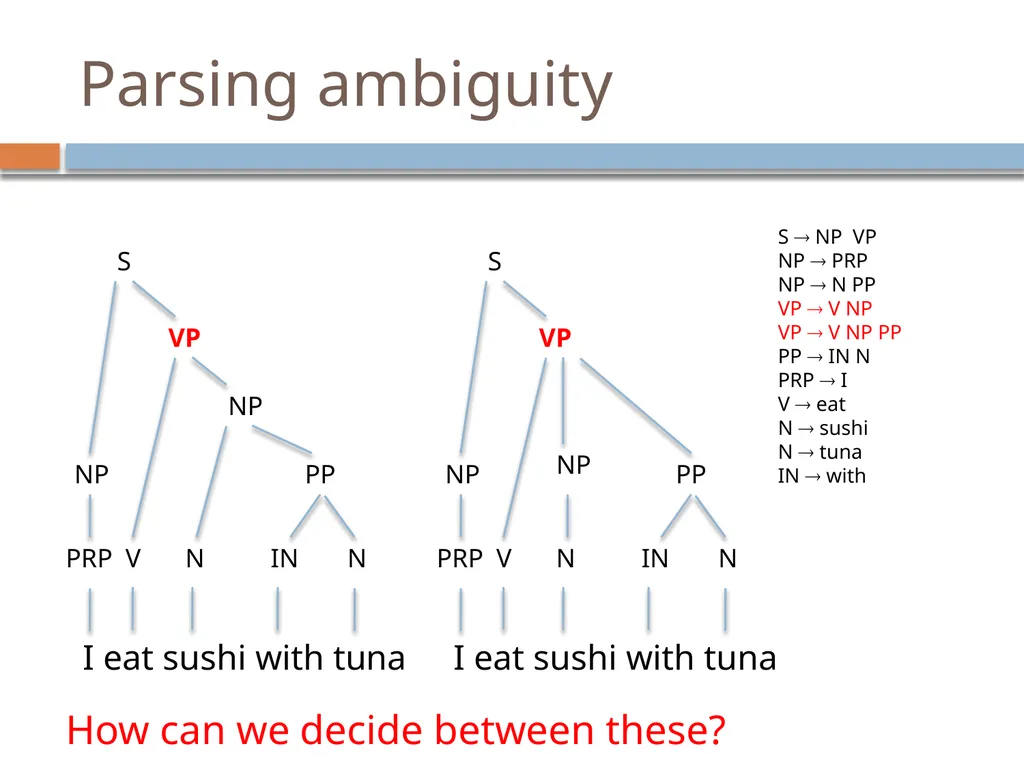
slide6. Parsing ambiguity I eat sushi with tuna PRP NP V N IN N PP NP VP S I eat sushi with tuna PRP NP V N IN N PP NP VP S S -> NP VP
NP -> PRP
NP -> N PP
NP -> N
VP -> V NP
VP -> V NP PP
PP -> IN N
PRP -> I
V -> eat
N -> sushi
N -> tuna
IN -> with How can we decide between these?<br>
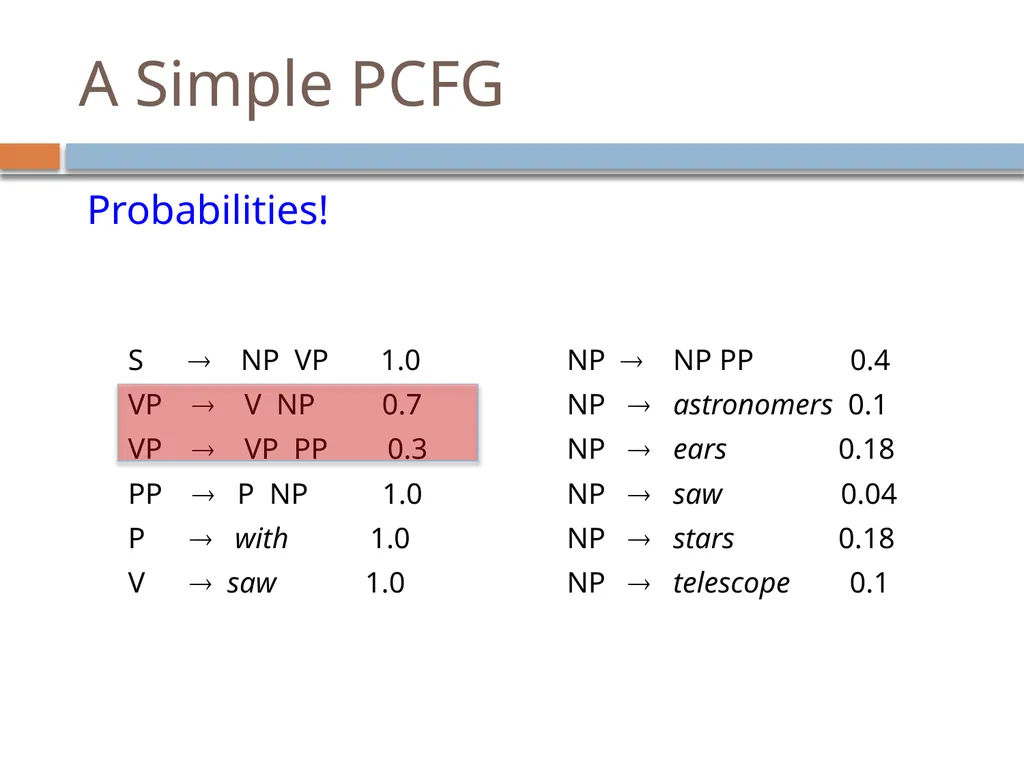
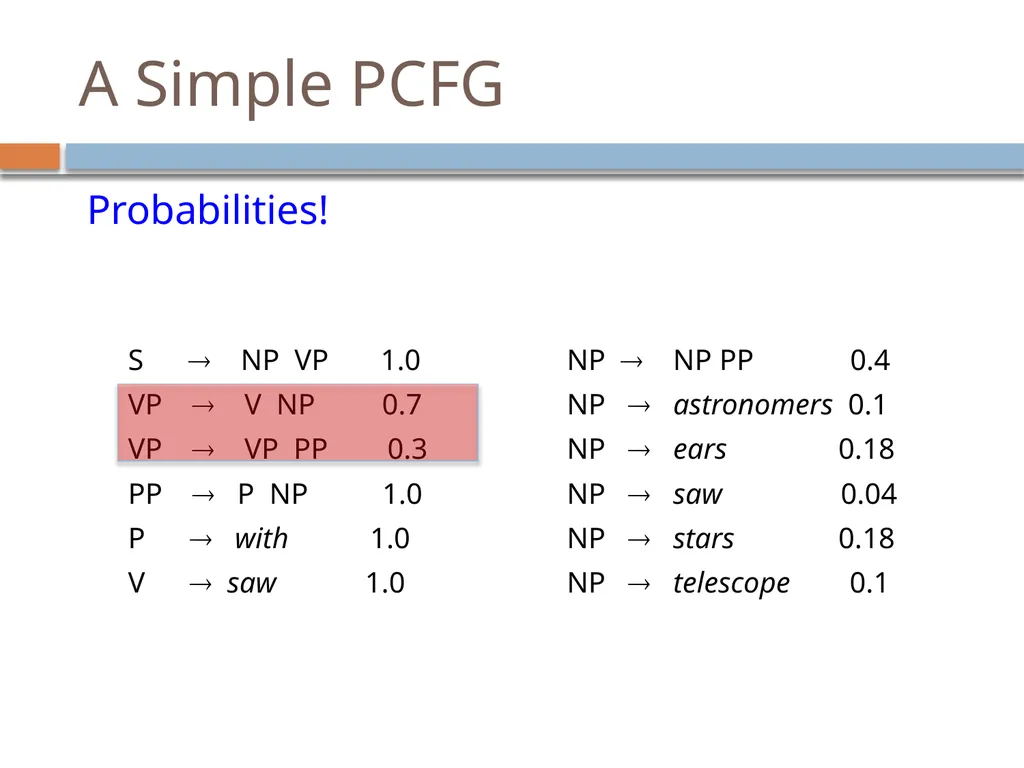
slide7. A Simple PCFG Probabilities!<br>
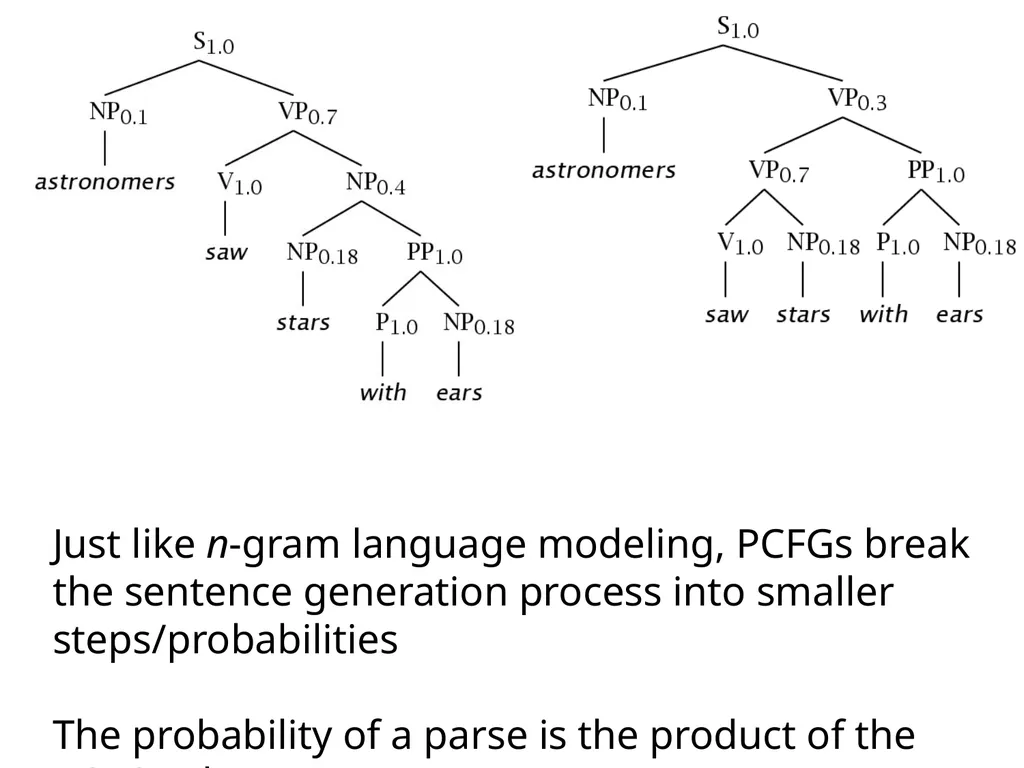
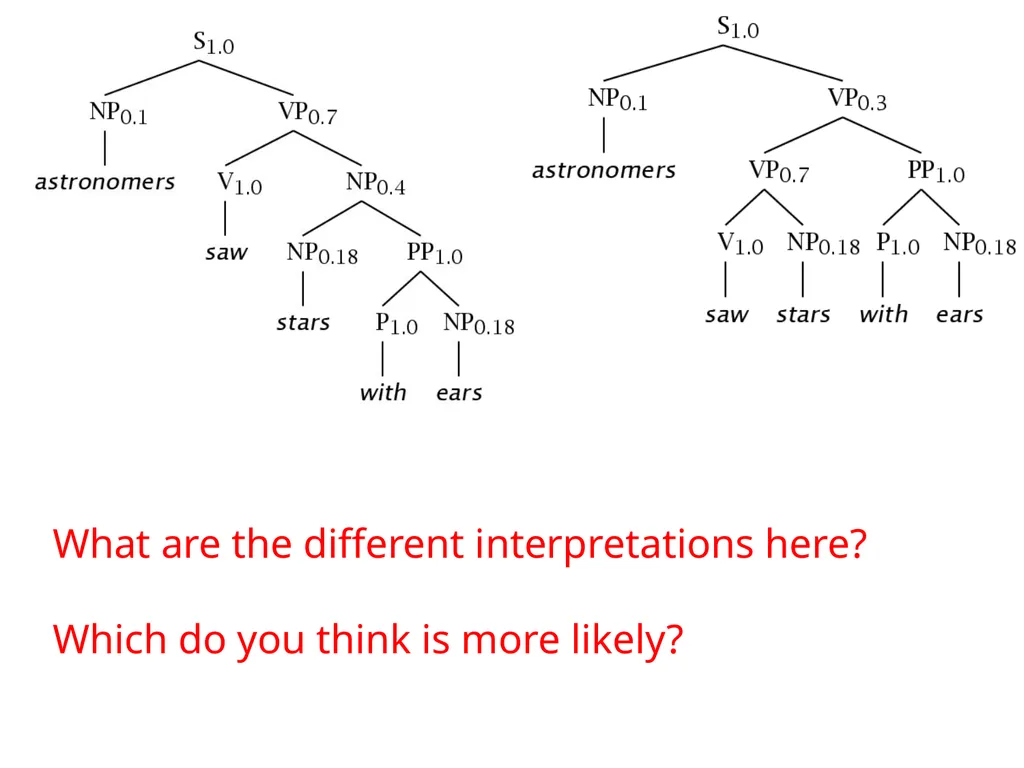
slide8. Just like n-gram language modeling, PCFGs break the sentence generation process into smaller steps/probabilities
The probability of a parse is the product of the PCFG rules<br>
slide9. What are the different interpretations here?
Which do you think is more likely?<br>
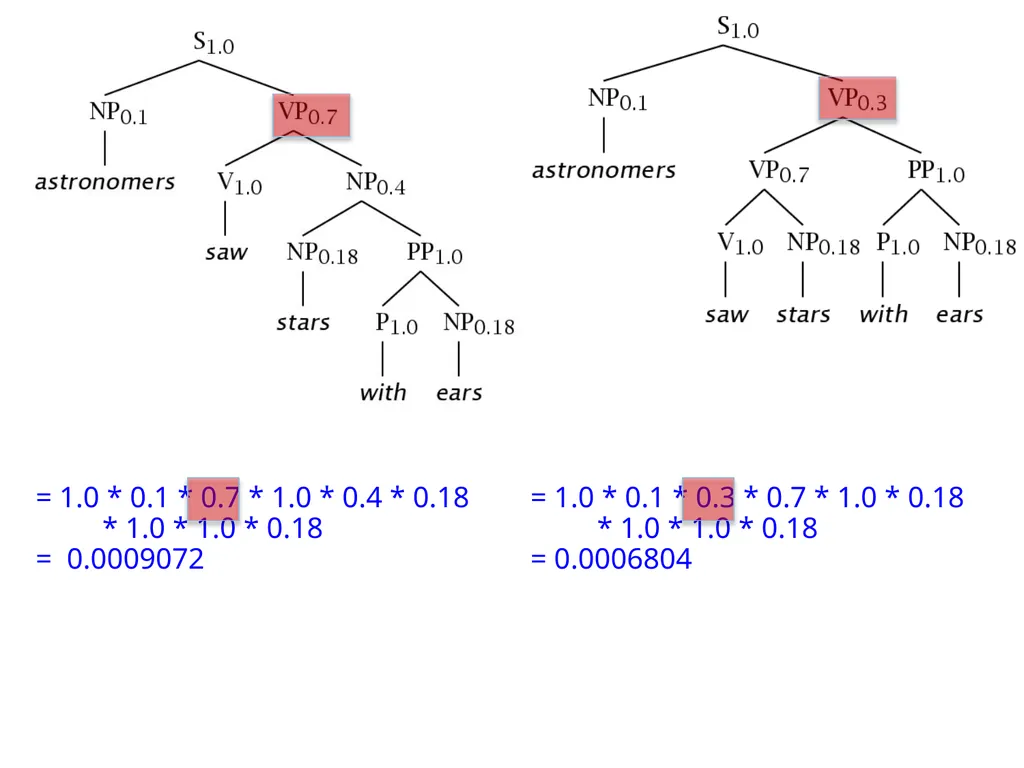
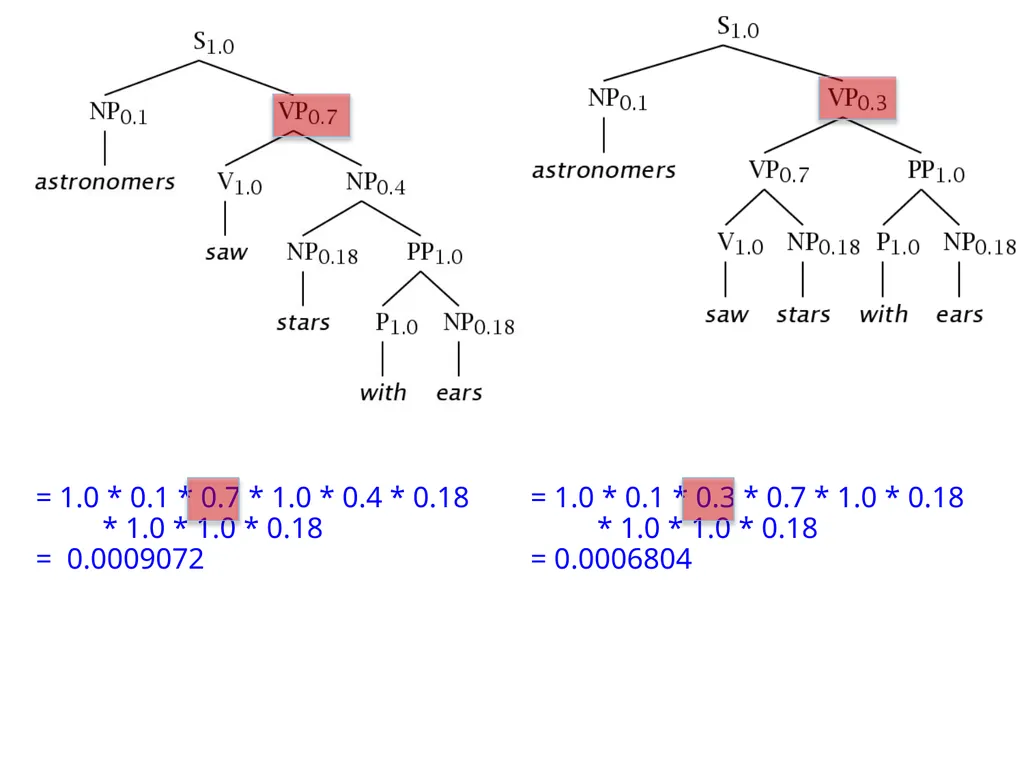
slide10. = 1.0 * 0.1 * 0.7 * 1.0 * 0.4 * 0.18
* 1.0 * 1.0 * 0.18
= 0.0009072 = 1.0 * 0.1 * 0.3 * 0.7 * 1.0 * 0.18
* 1.0 * 1.0 * 0.18
= 0.0006804<br>
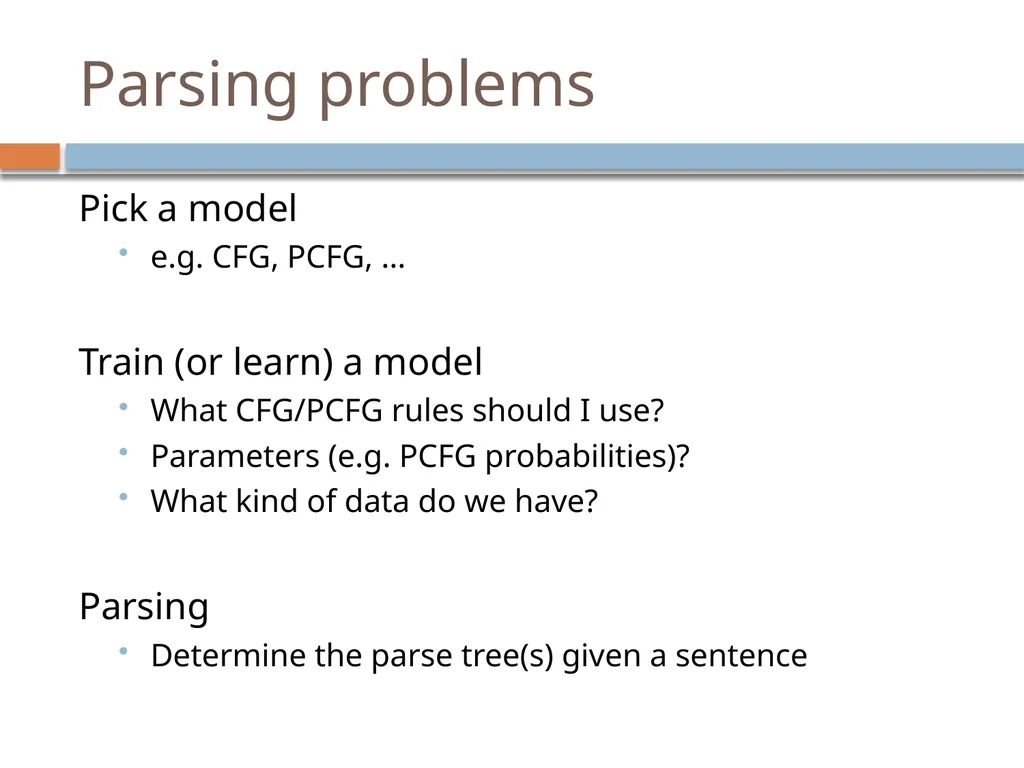
slide11. Parsing problems Pick a model
e.g. CFG, PCFG, …
Train (or learn) a model
What CFG/PCFG rules should I use?
Parameters (e.g. PCFG probabilities)?
What kind of data do we have?
Parsing
Determine the parse tree(s) given a sentence<br>
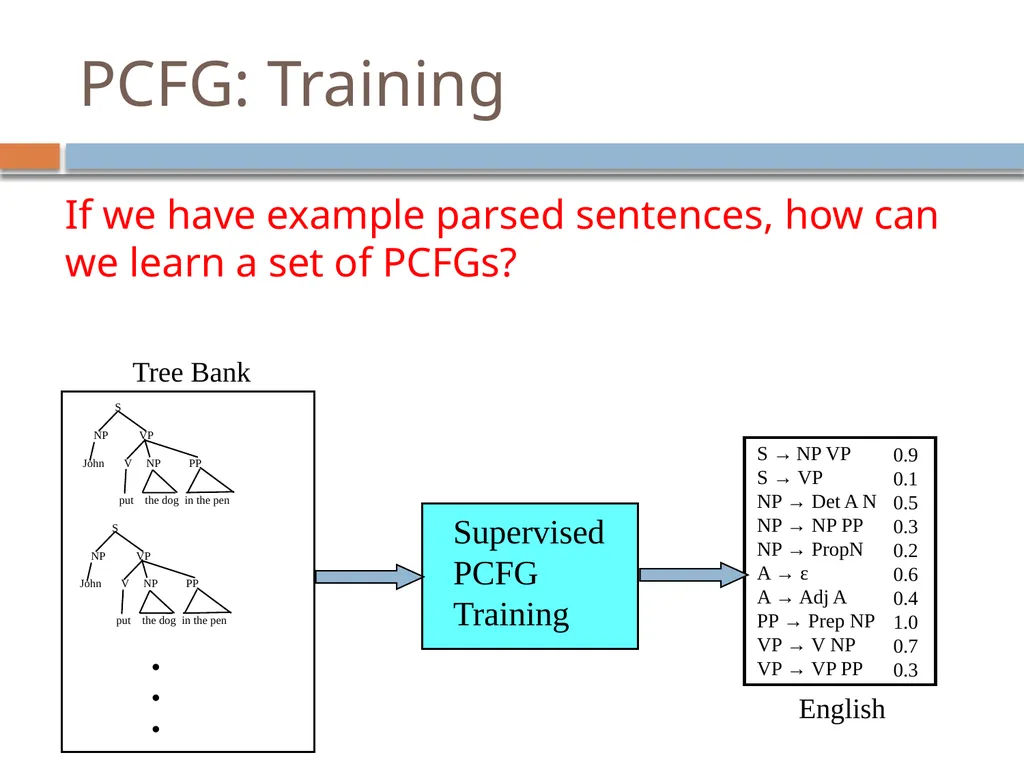
slide12. PCFG: Training If we have example parsed sentences, how can we learn a set of PCFGs? .
.
. Tree Bank<br>
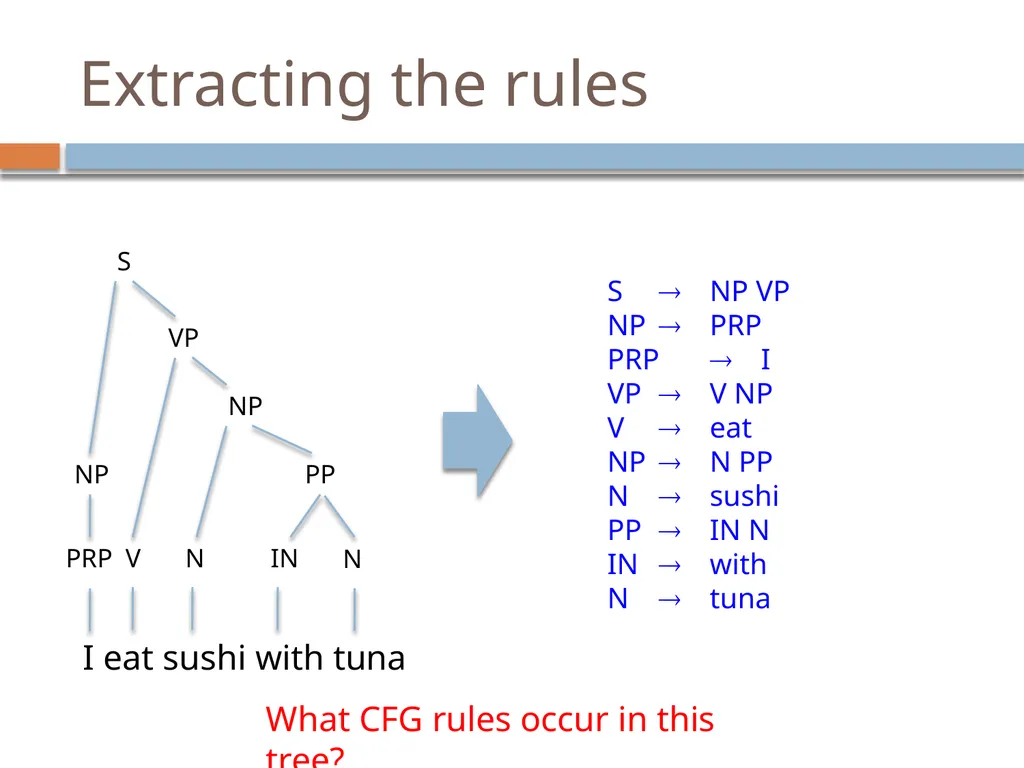
slide13. Extracting the rules PRP NP V N IN PP NP VP S I eat sushi with tuna N What CFG rules occur in this tree? S NP VP
NP PRP
PRP I
VP V NP
V eat
NP N PP
N sushi
PP IN N
IN with
N tuna<br>
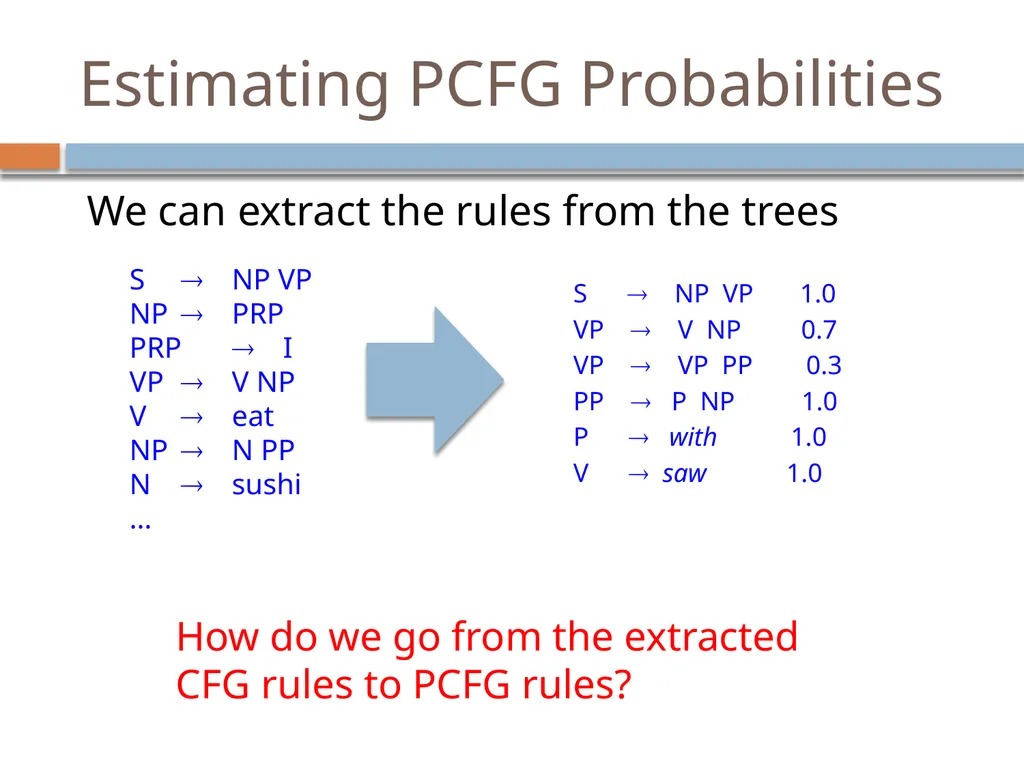
slide14. Estimating PCFG Probabilities We can extract the rules from the trees S NP VP 1.0
VP V NP 0.7
VP VP PP 0.3
PP P NP 1.0
P with 1.0
V saw 1.0 How do we go from the extracted CFG rules to PCFG rules? S NP VP
NP PRP
PRP I
VP V NP
V eat
NP N PP
N sushi
…<br>
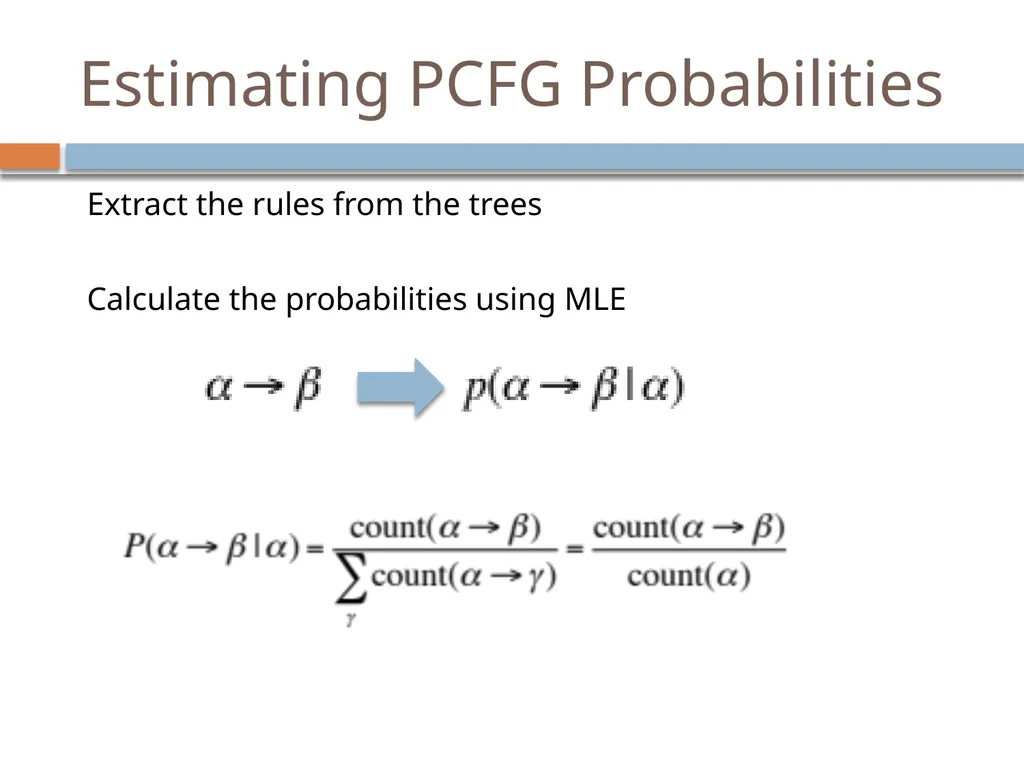
slide15. Estimating PCFG Probabilities Extract the rules from the trees
Calculate the probabilities using MLE<br>
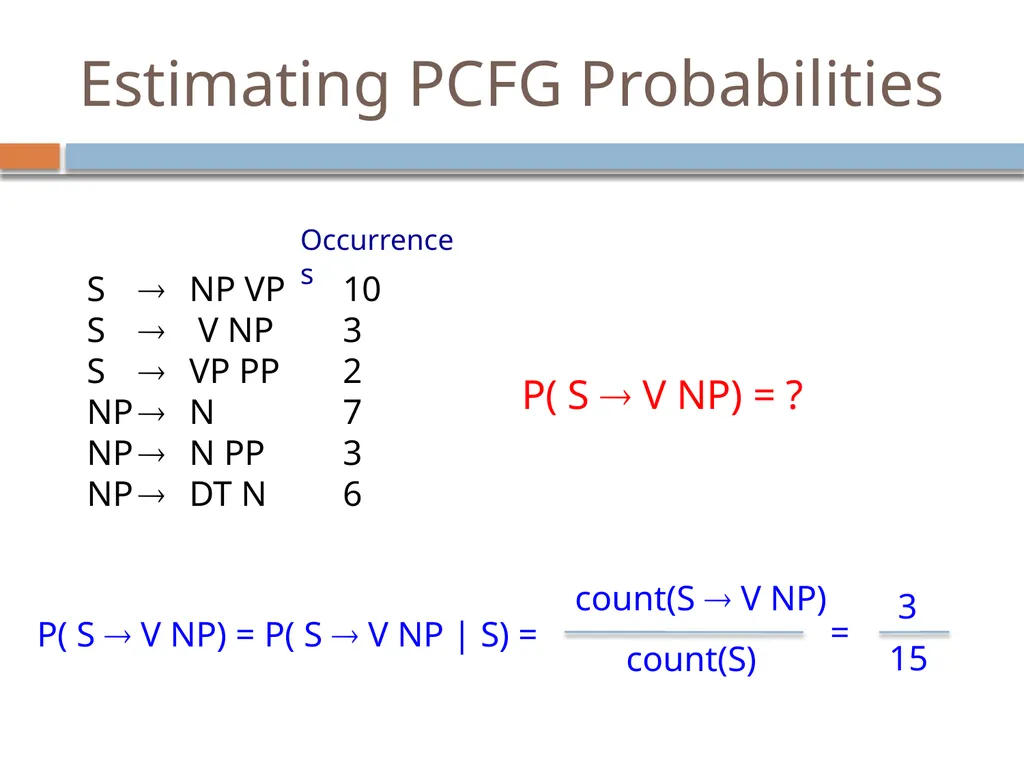
slide16. Estimating PCFG Probabilities S NP VP 10
S V NP 3
S VP PP 2
NP N 7
NP N PP 3
NP DT N 6 P( S V NP) = ? Occurrences<br>
slide17. Grammar Equivalence What does it mean for two grammars to be equal?<br>
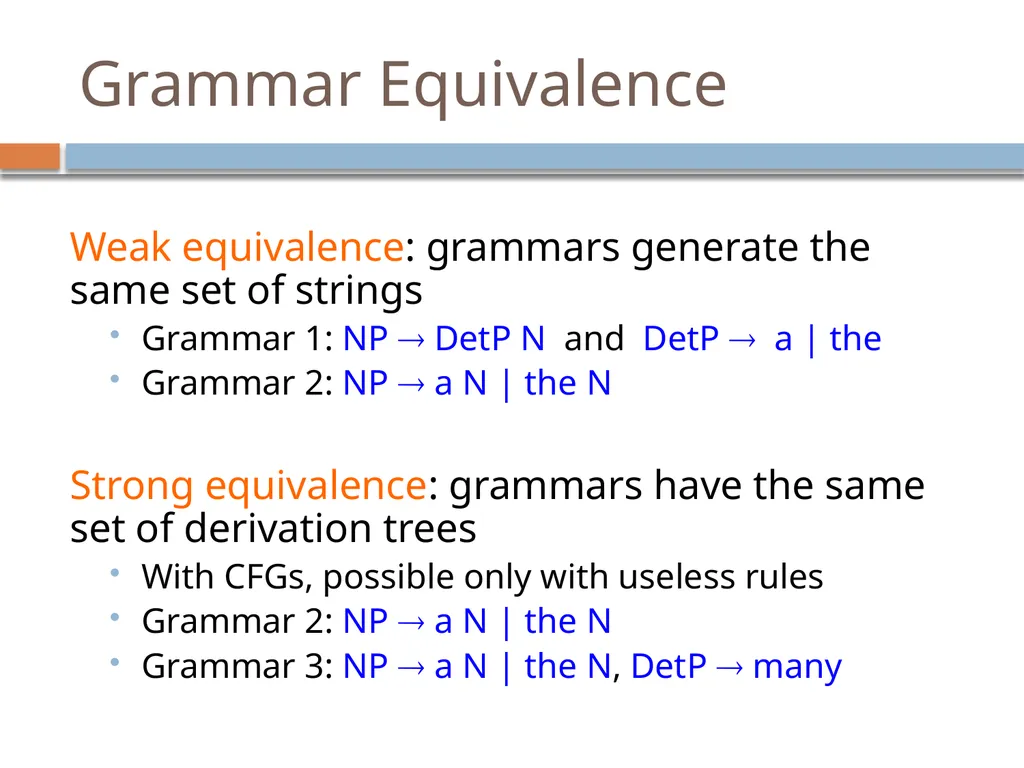
slide18. Grammar Equivalence Weak equivalence: grammars generate the same set of strings
Grammar 1: NP DetP N and DetP a | the
Grammar 2: NP a N | the N
Strong equivalence: grammars have the same set of derivation trees
With CFGs, possible only with useless rules
Grammar 2: NP a N | the N
Grammar 3: NP a N | the N, DetP many<br>
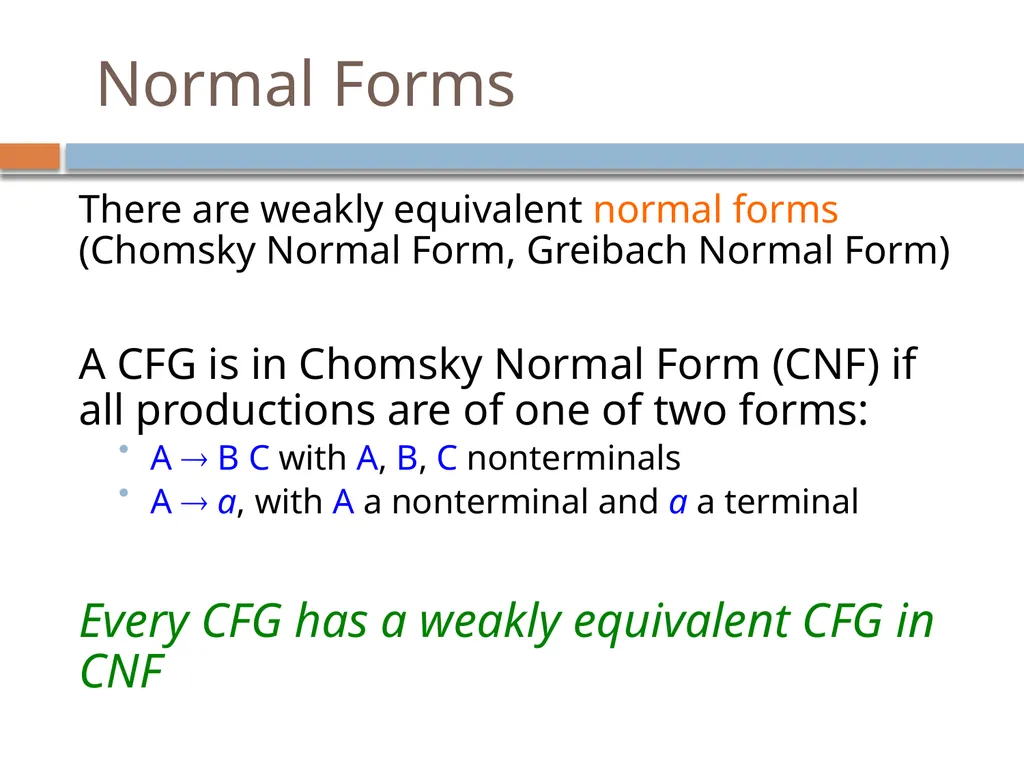
slide19. Normal Forms There are weakly equivalent normal forms (Chomsky Normal Form, Greibach Normal Form)
A CFG is in Chomsky Normal Form (CNF) if all productions are of one of two forms:
A B C with A, B, C nonterminals
A a, with A a nonterminal and a a terminal
Every CFG has a weakly equivalent CFG in CNF<br>
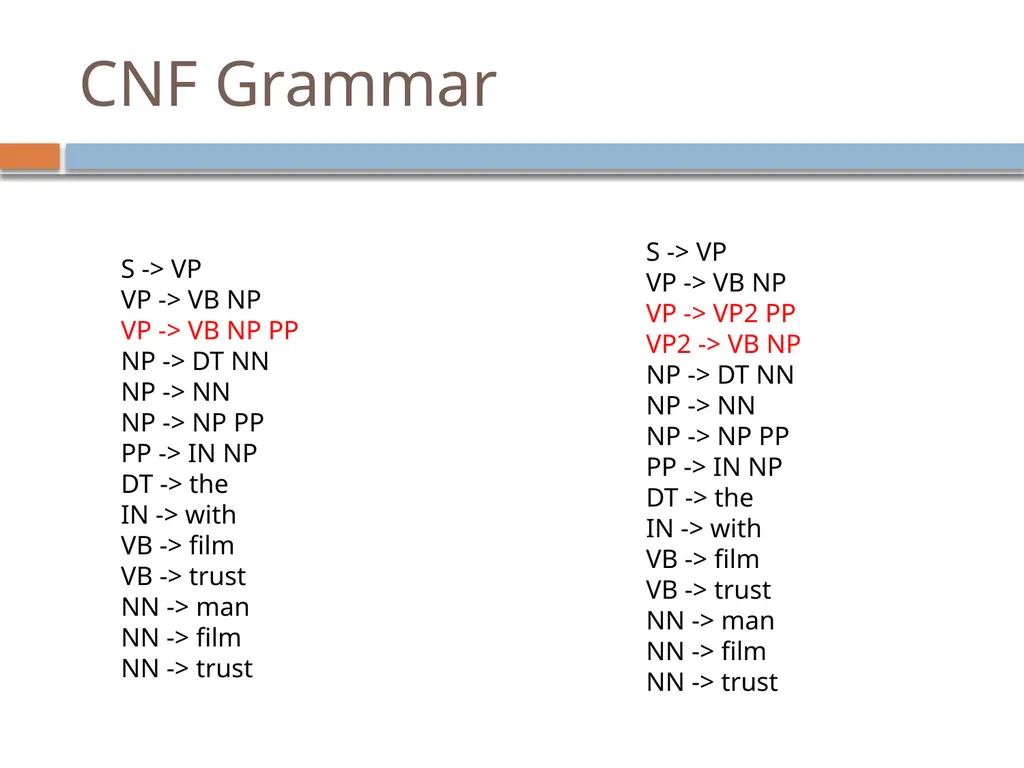
slide20. CNF Grammar S -> VP
VP -> VB NP
VP -> VB NP PP
NP -> DT NN
NP -> NN
NP -> NP PP
PP -> IN NP
DT -> the
IN -> with
VB -> film
VB -> trust
NN -> man
NN -> film
NN -> trust S -> VP
VP -> VB NP
VP -> VP2 PP
VP2 -> VB NP
NP -> DT NN
NP -> NN
NP -> NP PP
PP -> IN NP
DT -> the
IN -> with
VB -> film
VB -> trust
NN -> man
NN -> film
NN -> trust<br>
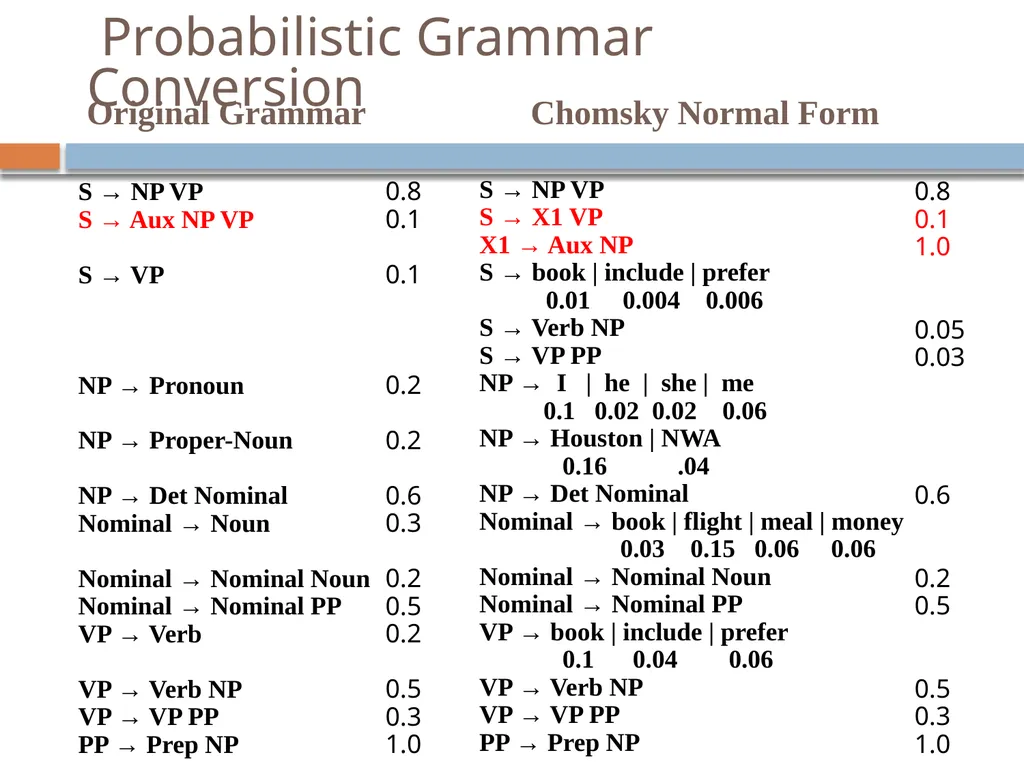
slide21. Probabilistic Grammar Conversion S → NP VP
S → Aux NP VP
S → VP
NP → Pronoun
NP → Proper-Noun
NP → Det Nominal
Nominal → Noun
Nominal → Nominal Noun
Nominal → Nominal PP
VP → Verb
VP → Verb NP
VP → VP PP
PP → Prep NP Original Grammar Chomsky Normal Form 0.8
0.1
0.1
0.2
0.2
0.6
0.3
0.2
0.5
0.2
0.5
0.3
1.0<br>
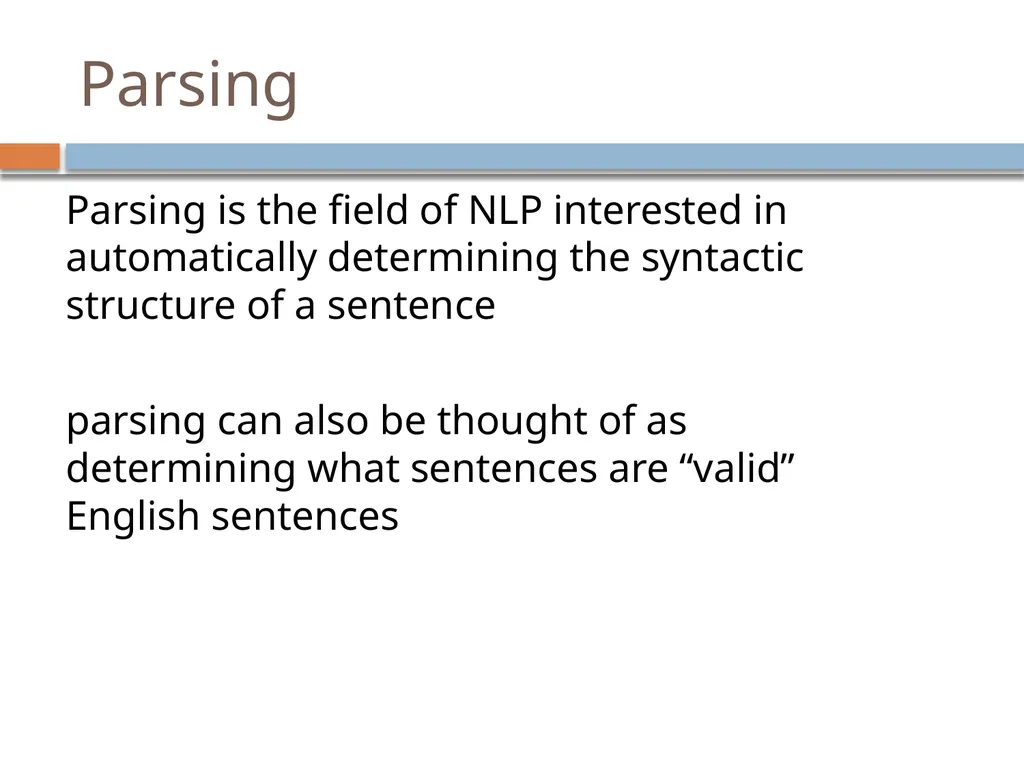
slide22. Parsing Parsing is the field of NLP interested in automatically determining the syntactic structure of a sentence
parsing can also be thought of as determining what sentences are “valid” English sentences<br>
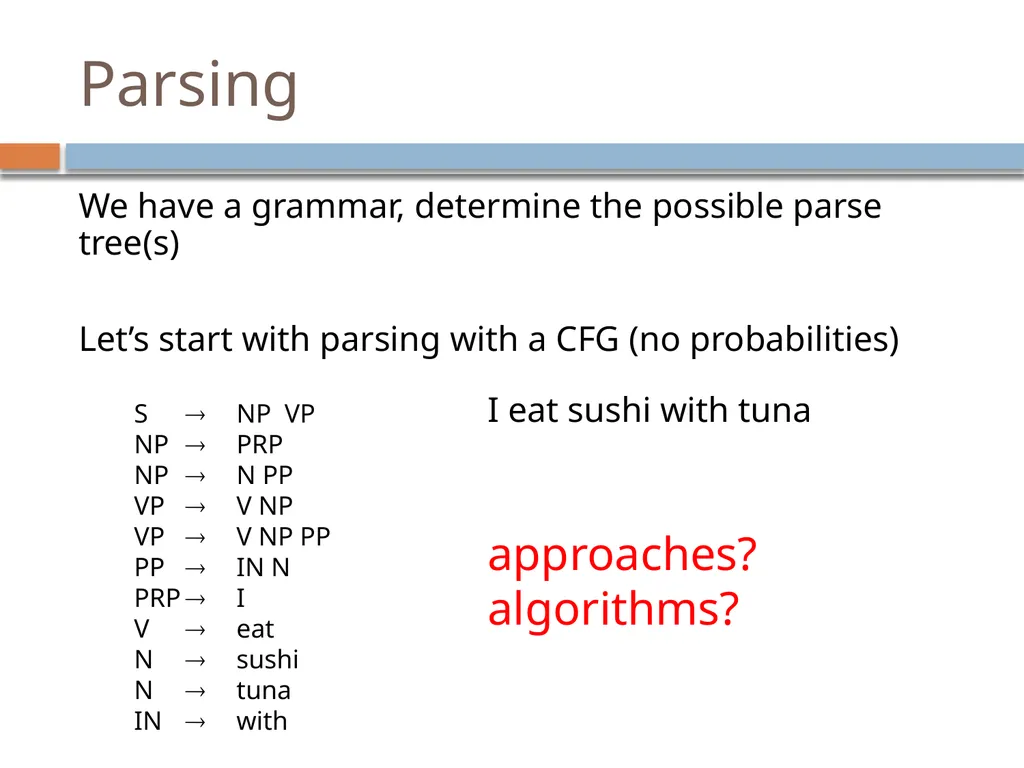
slide23. Parsing We have a grammar, determine the possible parse tree(s)
Let’s start with parsing with a CFG (no probabilities) S NP VP
NP PRP
NP N PP
VP V NP
VP V NP PP
PP IN N
PRP I
V eat
N sushi
N tuna
IN with I eat sushi with tuna approaches? algorithms?<br>
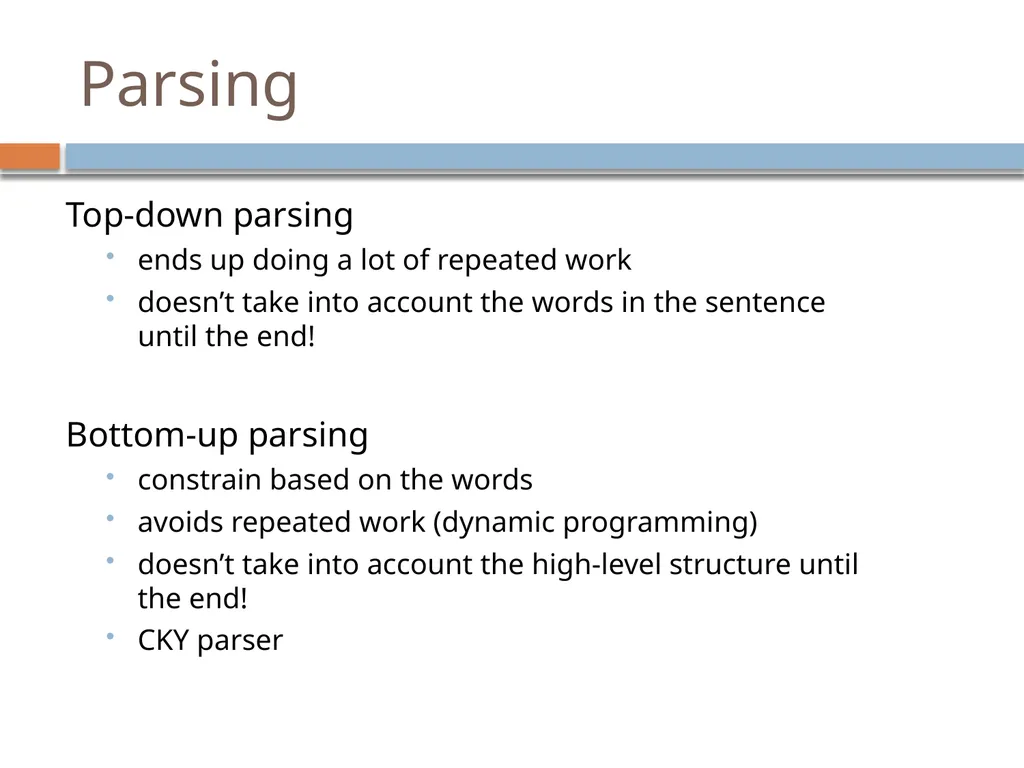
slide24. Parsing Top-down parsing
ends up doing a lot of repeated work
doesn’t take into account the words in the sentence until the end!
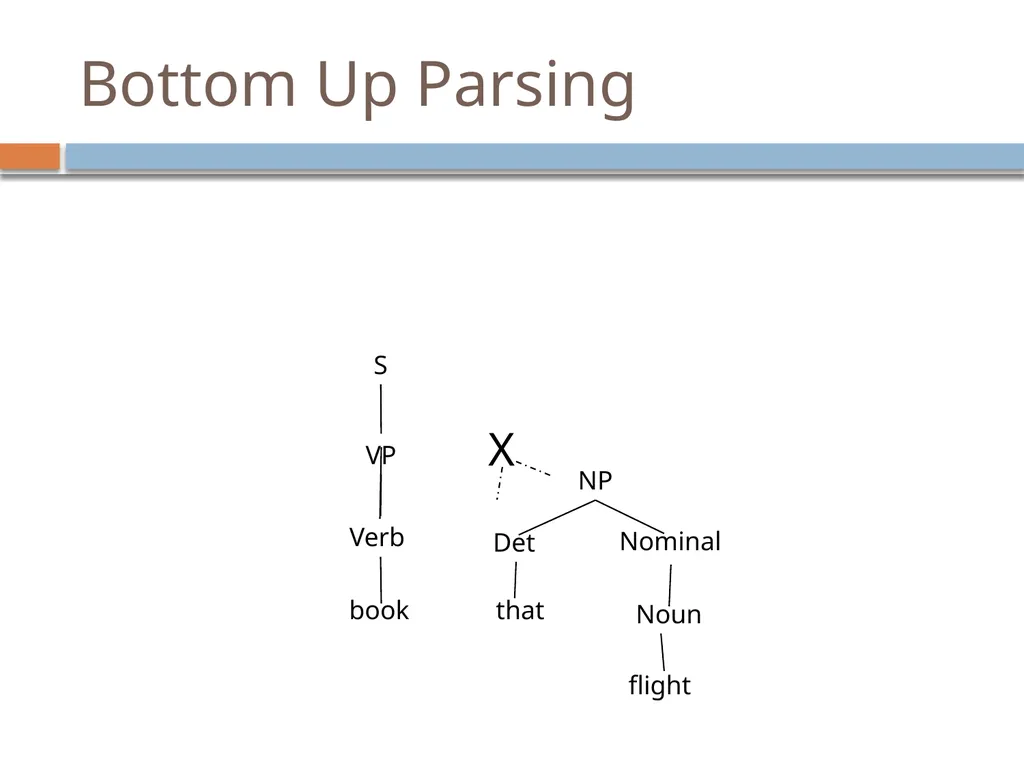
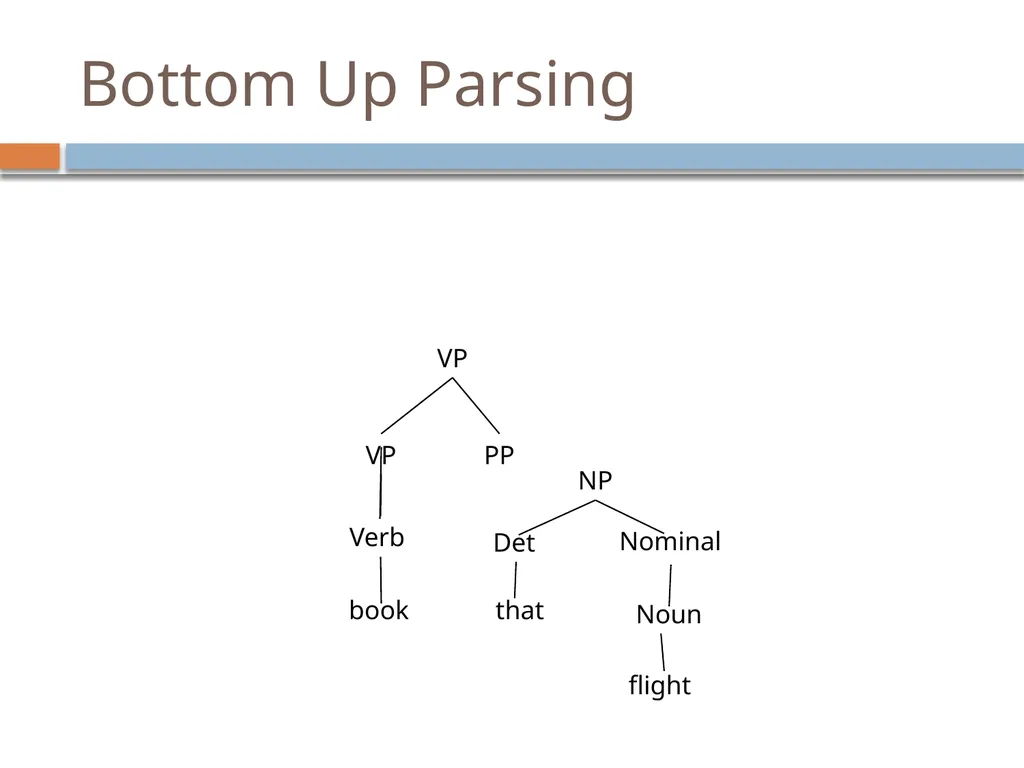
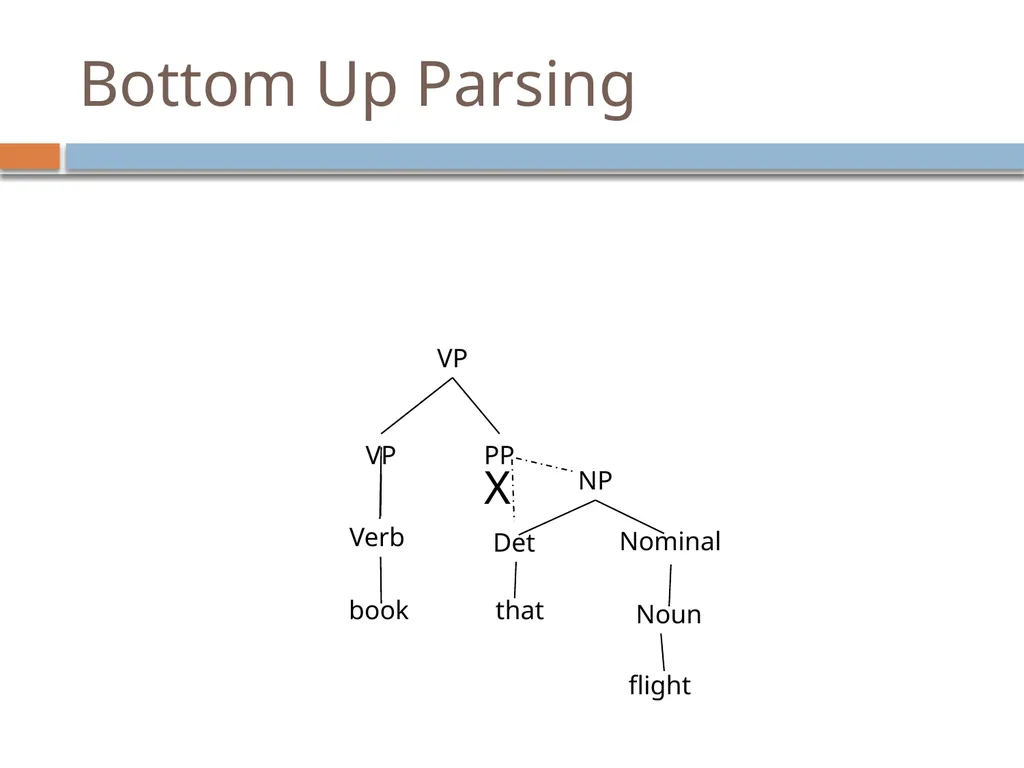
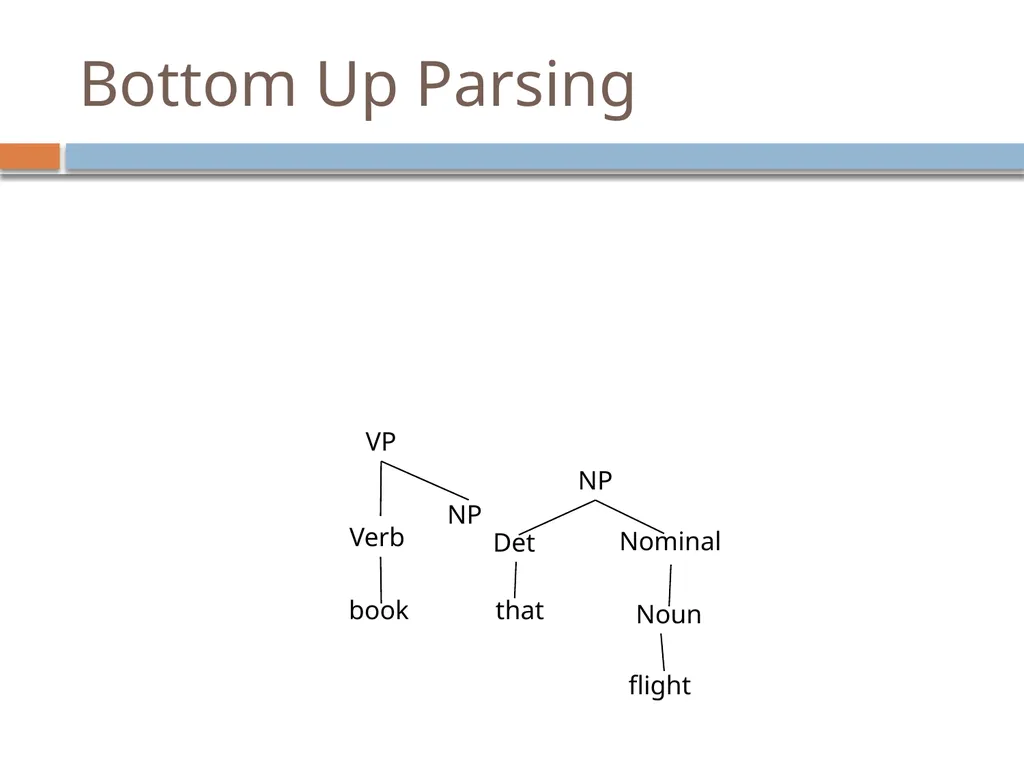
Bottom-up parsing
constrain based on the words
avoids repeated work (dynamic programming)
doesn’t take into account the high-level structure until the end!
CKY parser<br>
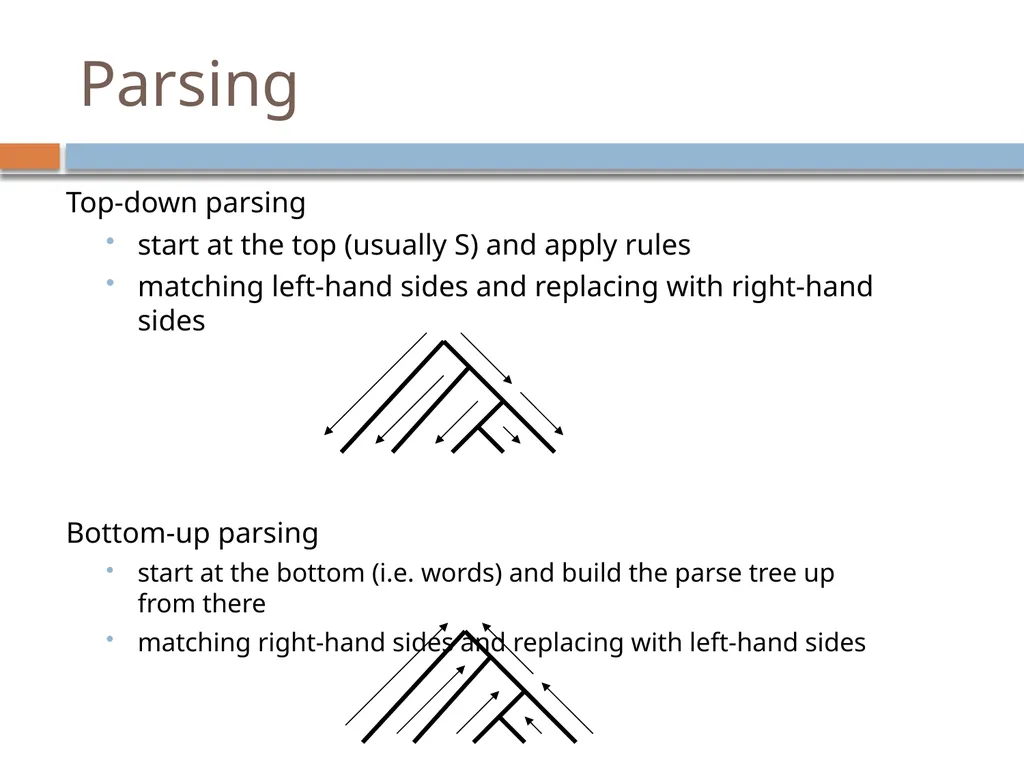
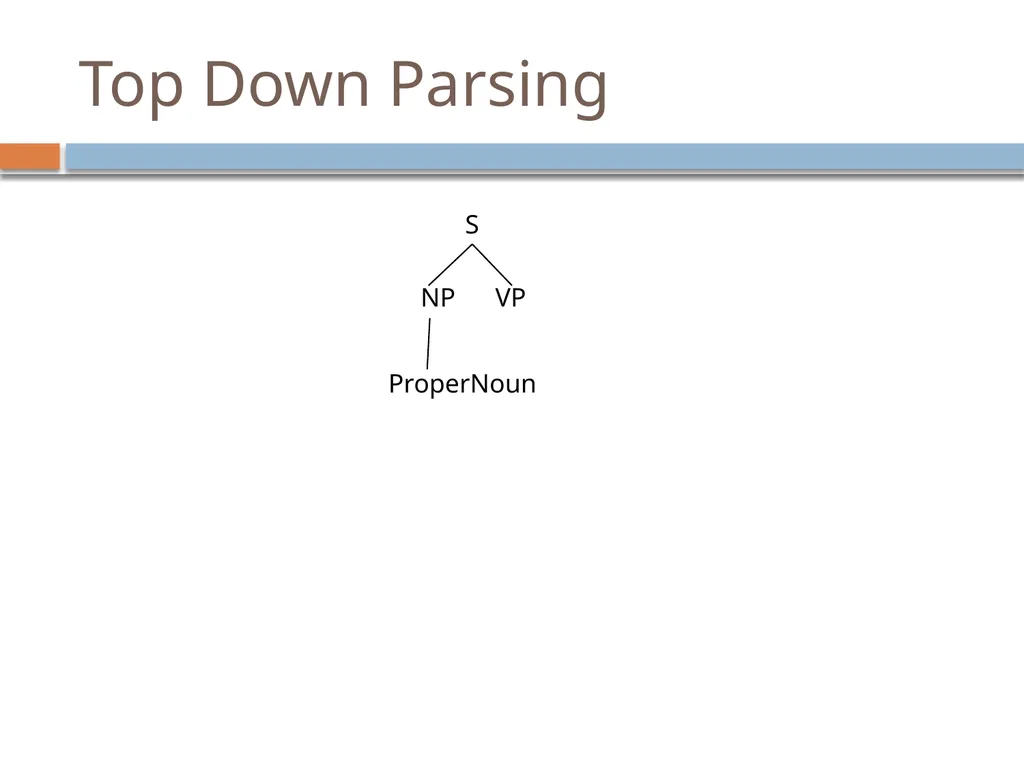
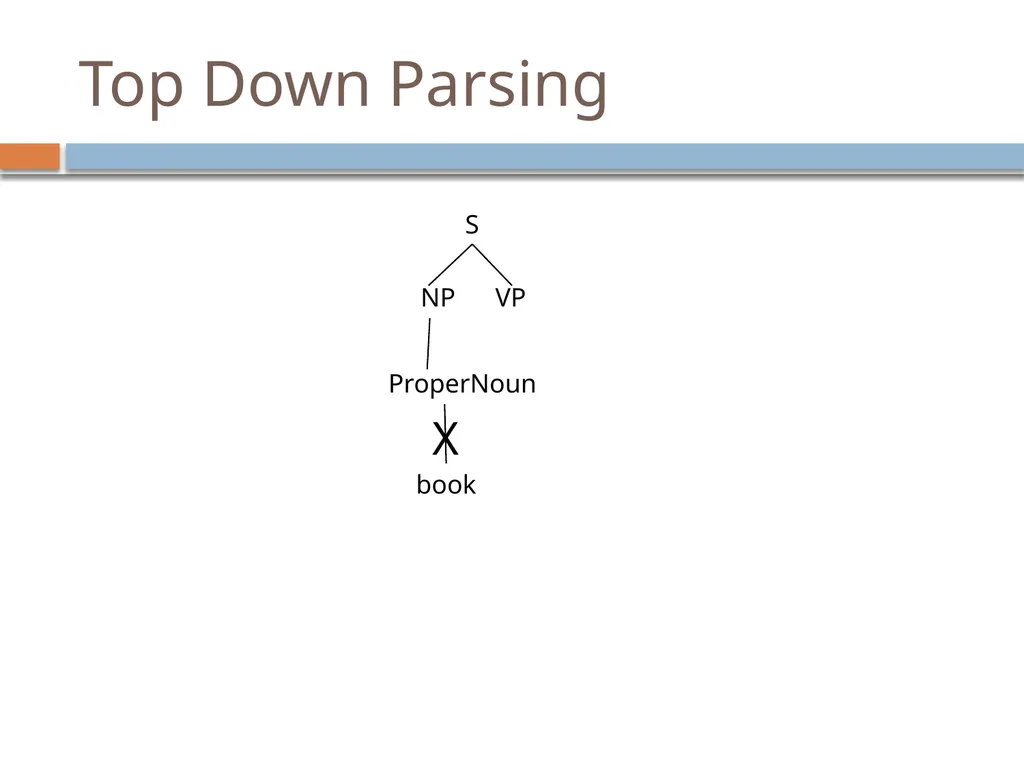
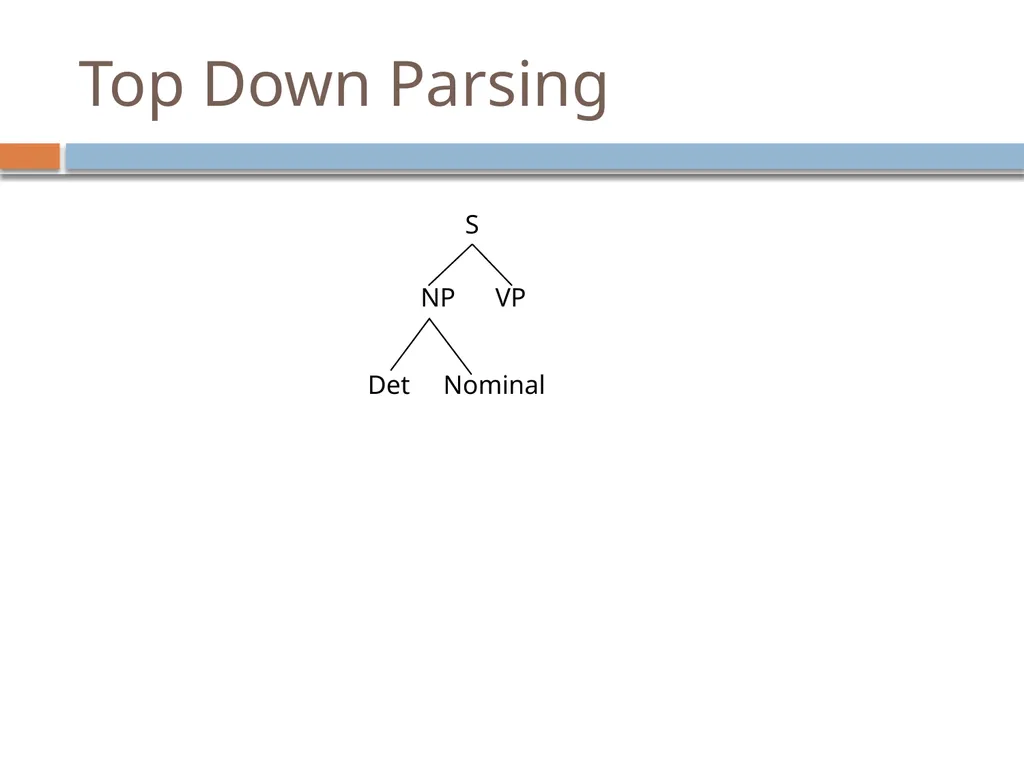
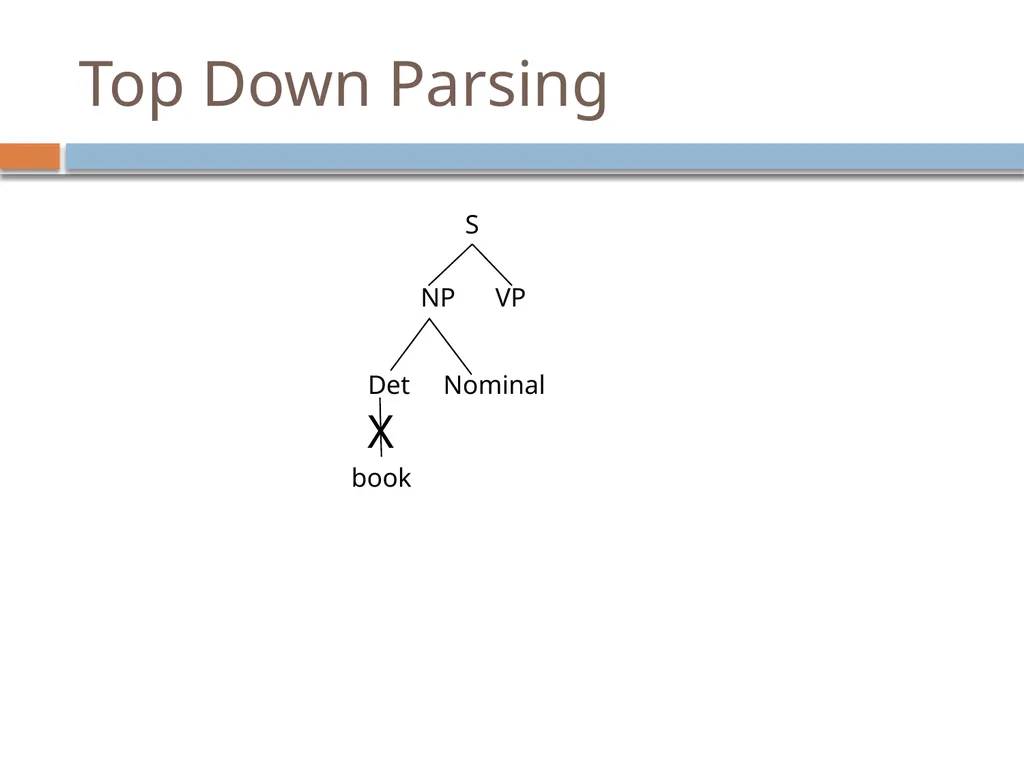
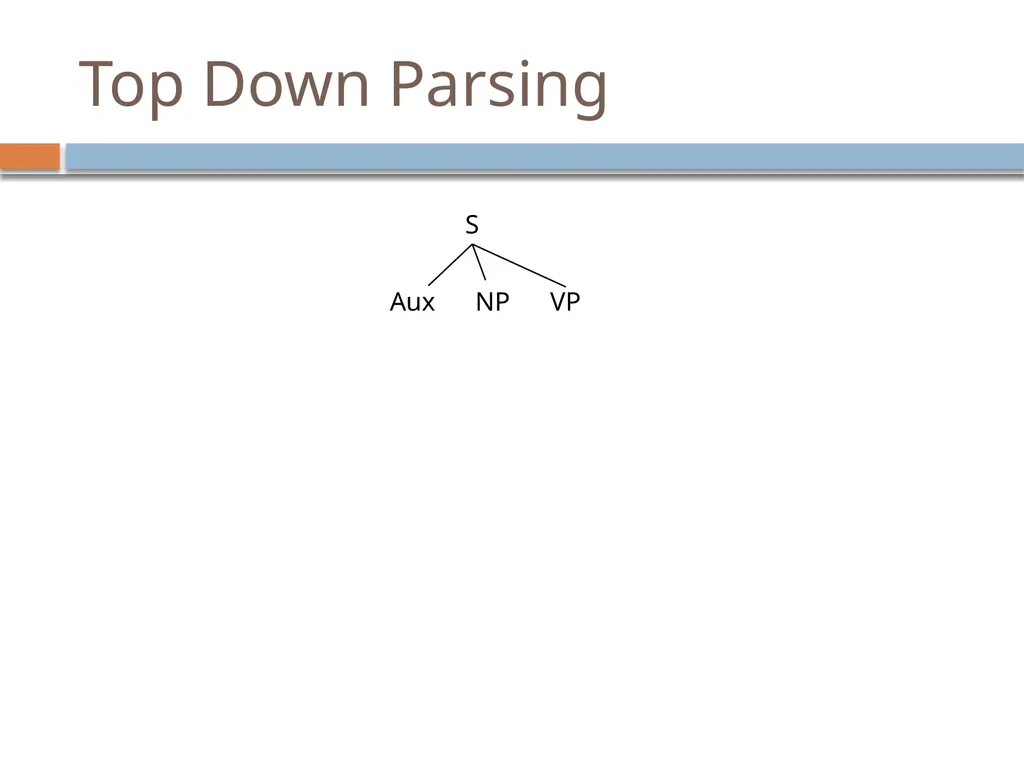
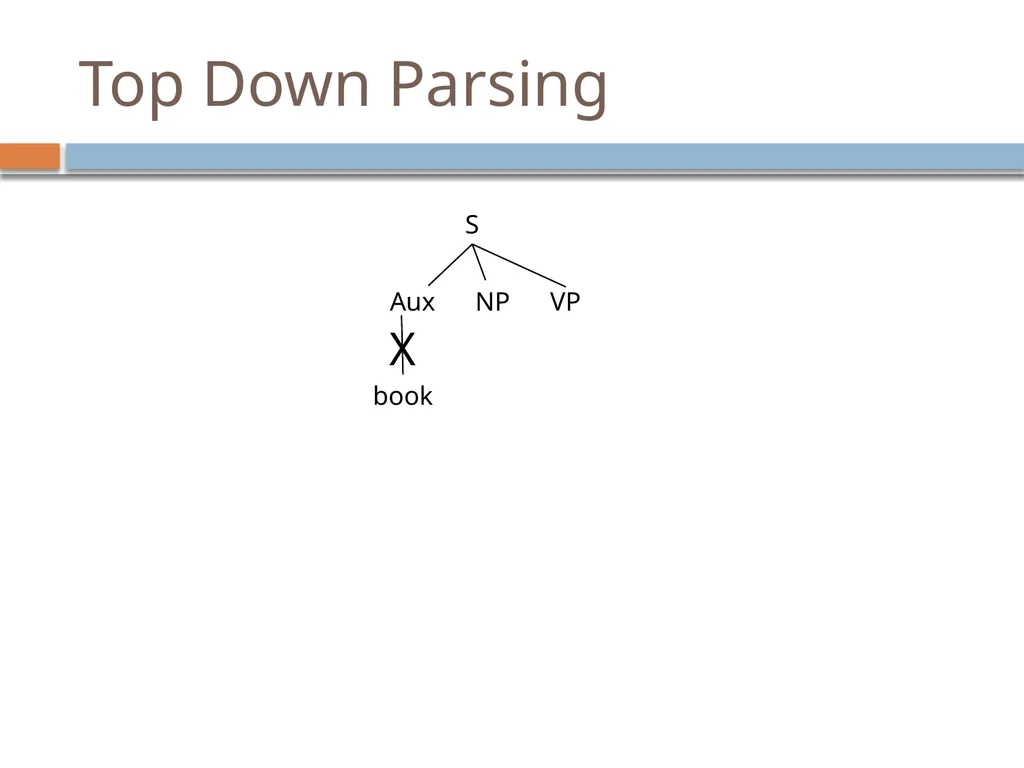
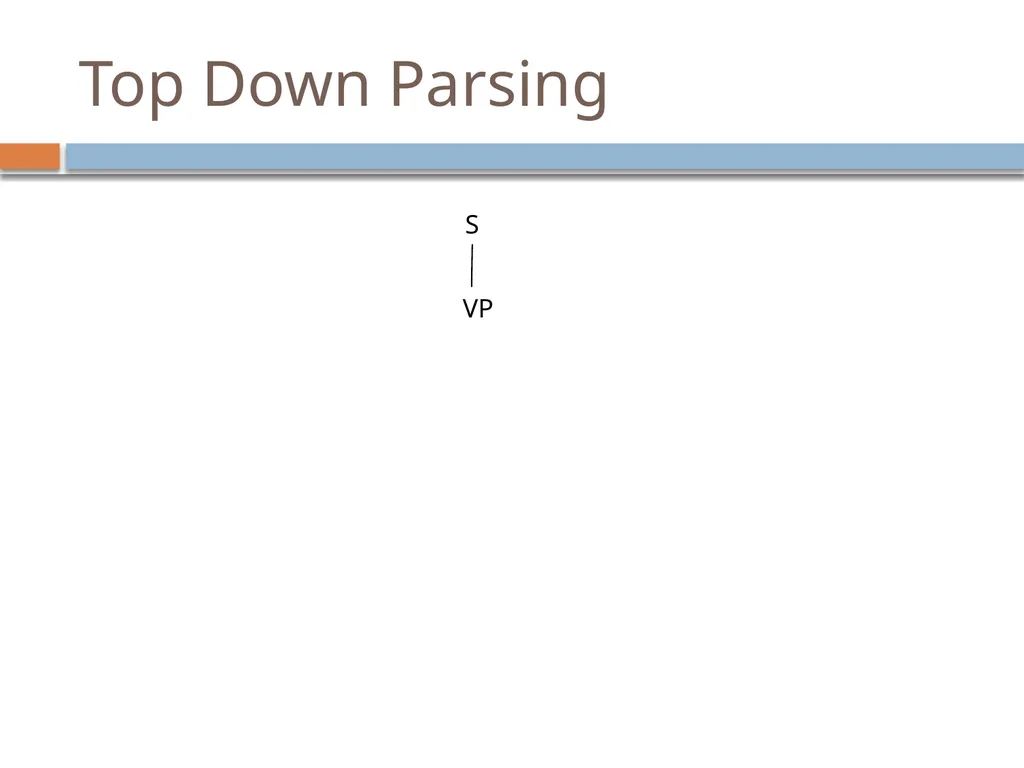
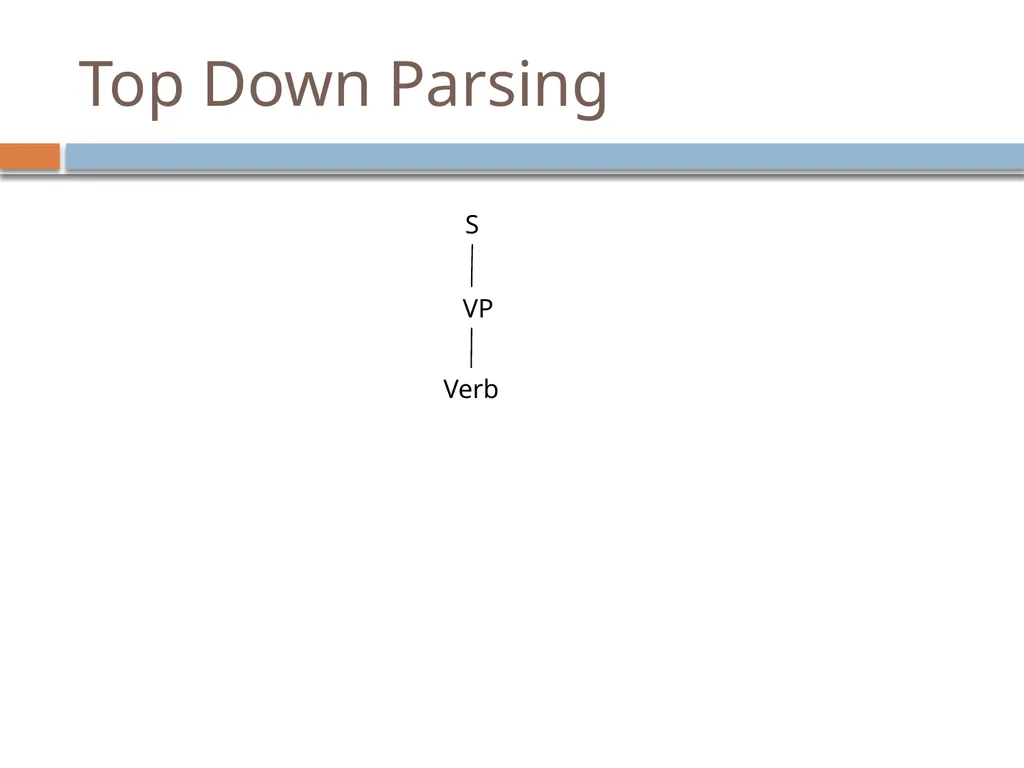
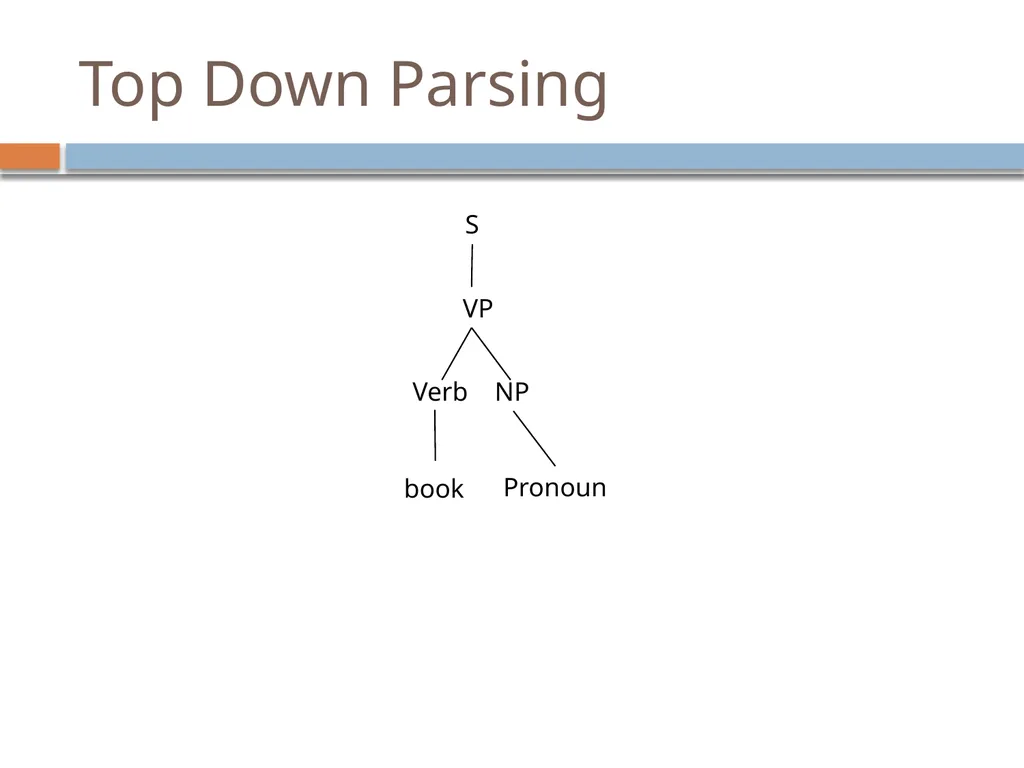
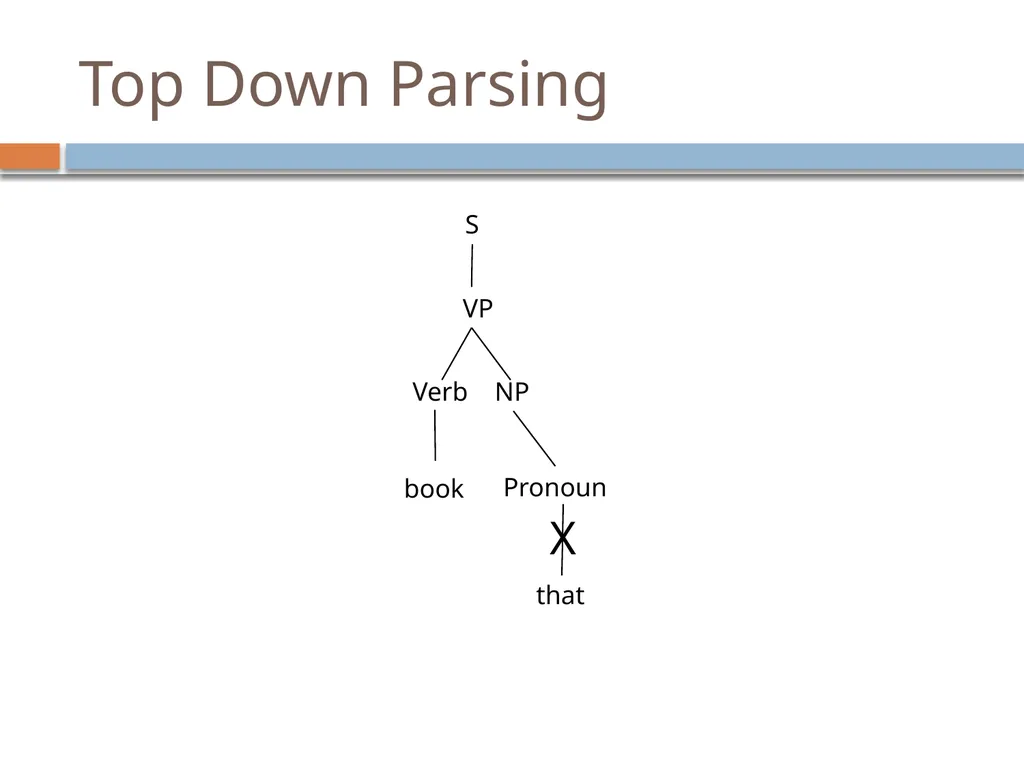
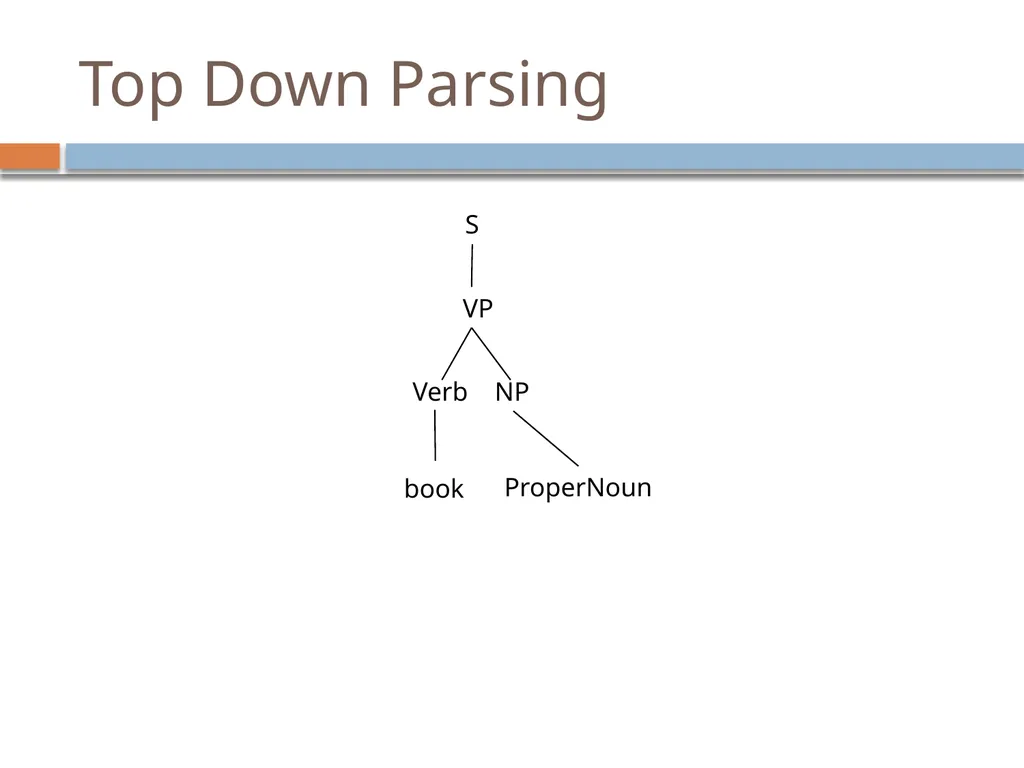
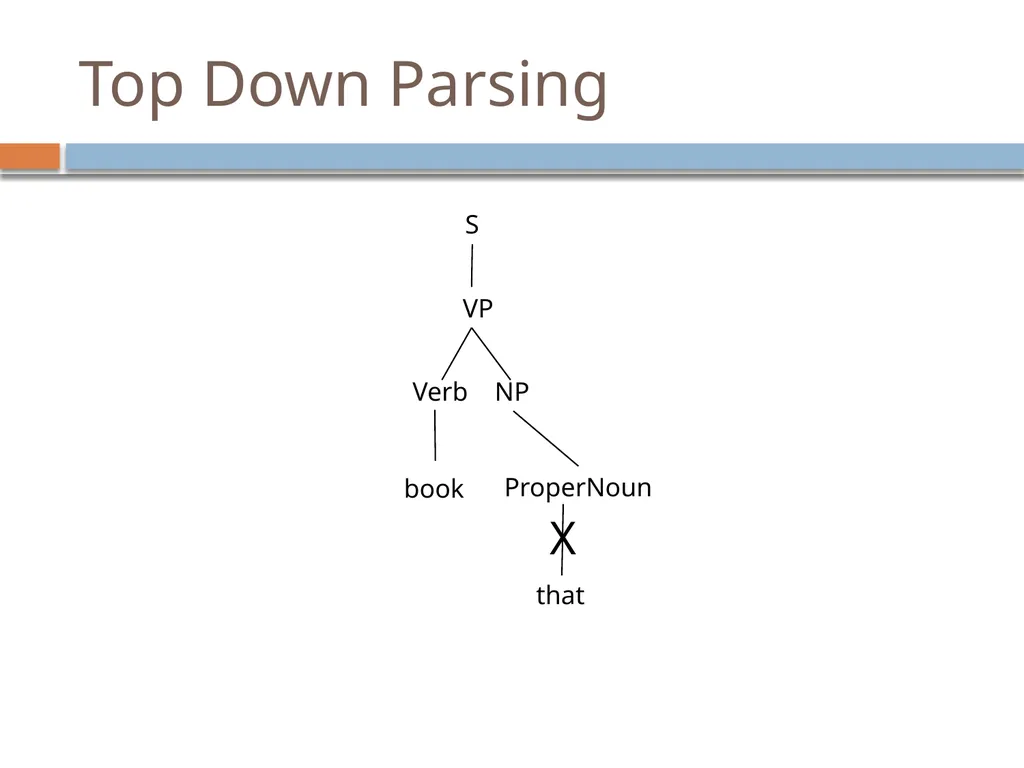
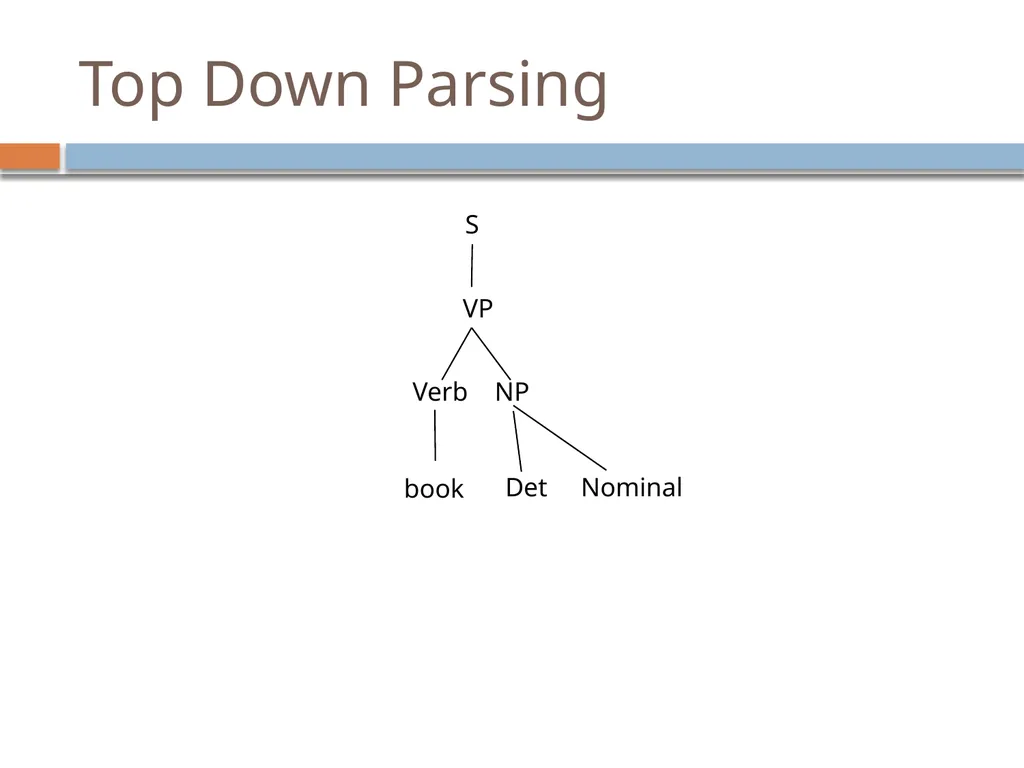
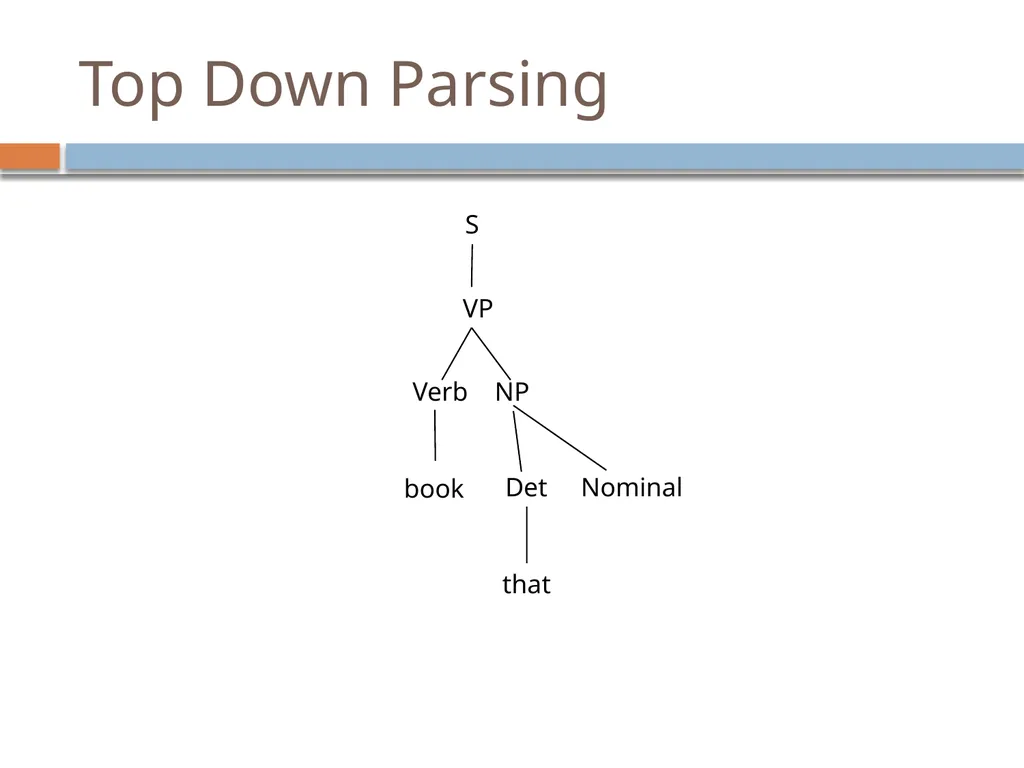
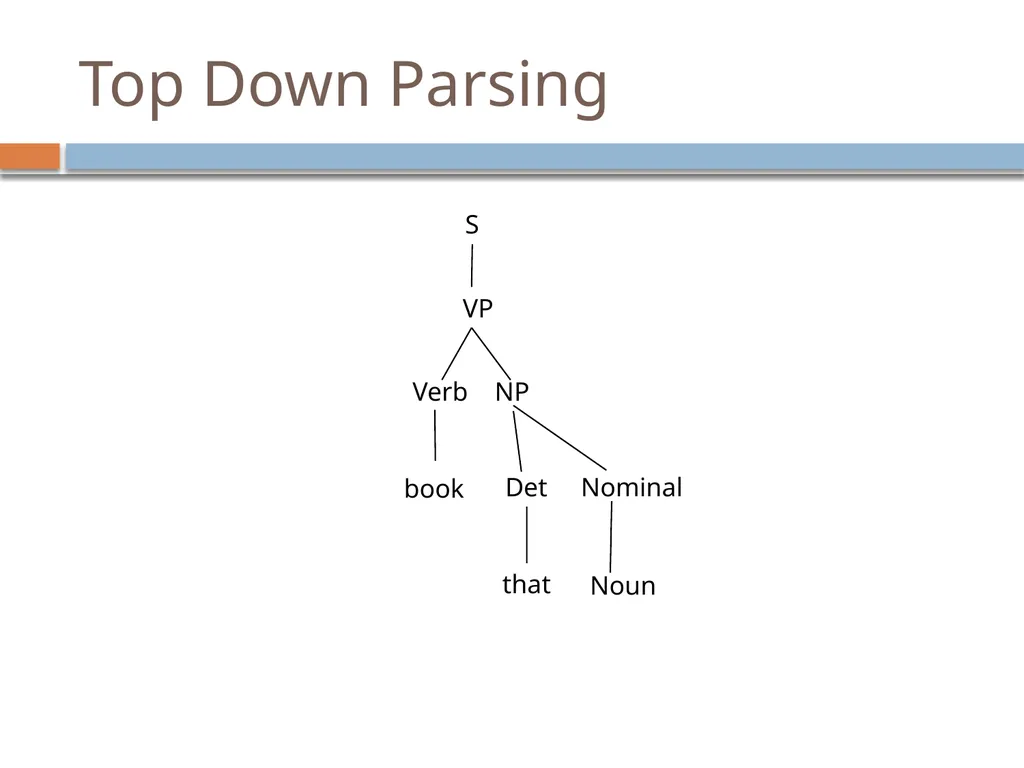
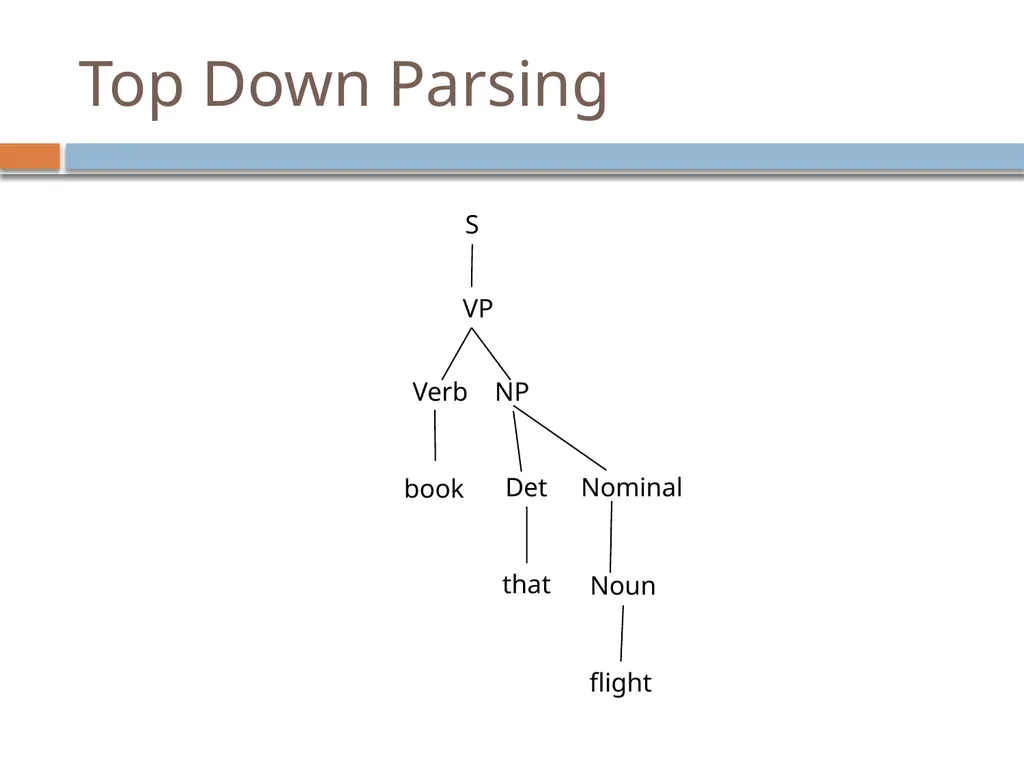
slide25. Parsing Top-down parsing
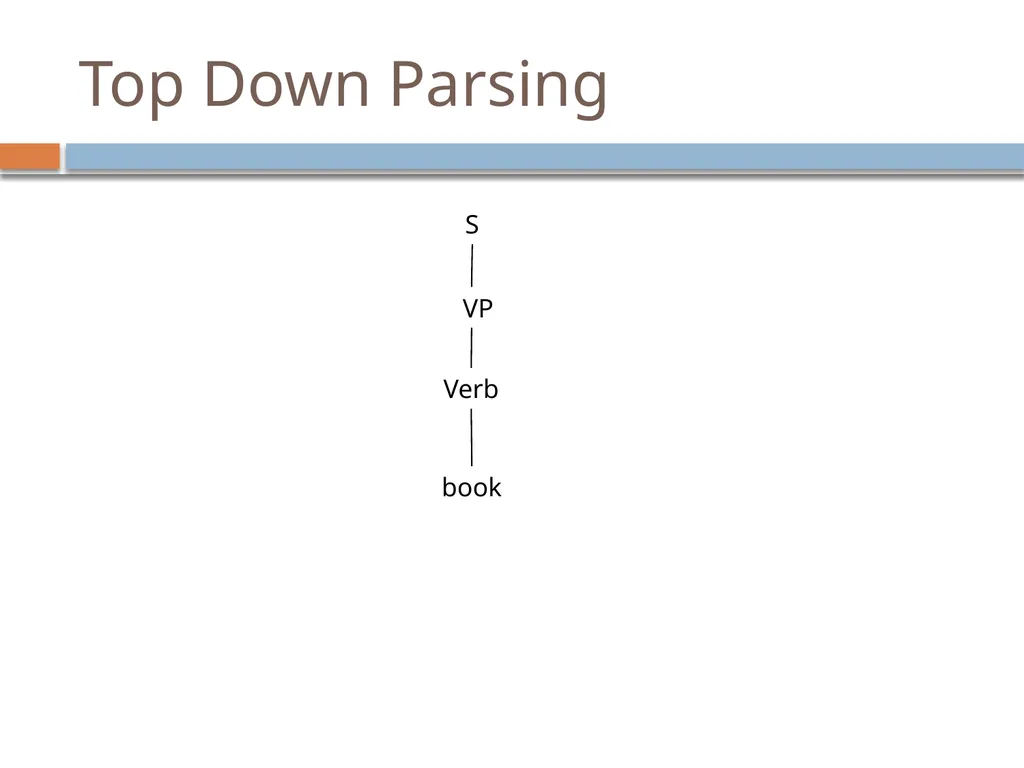
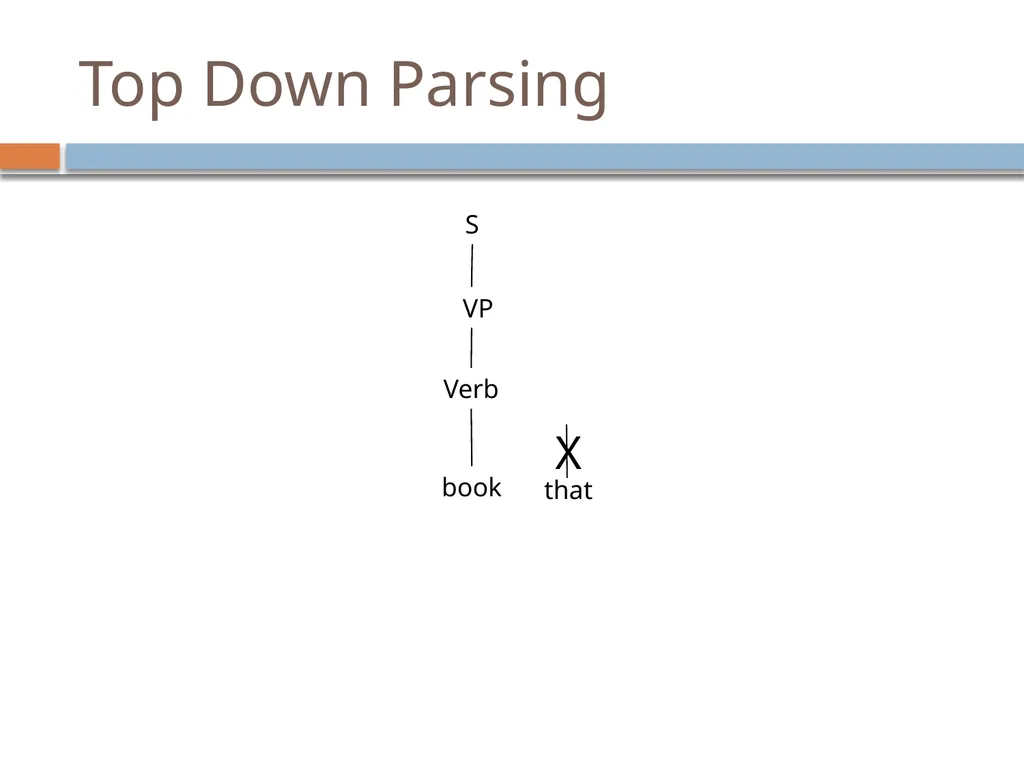
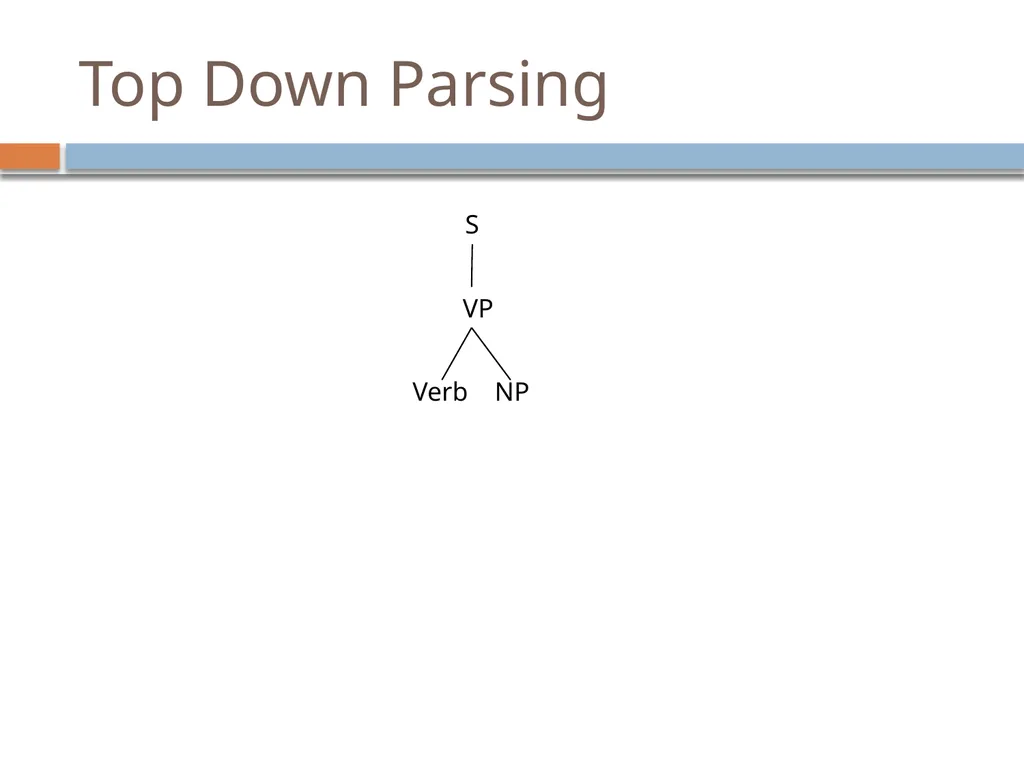
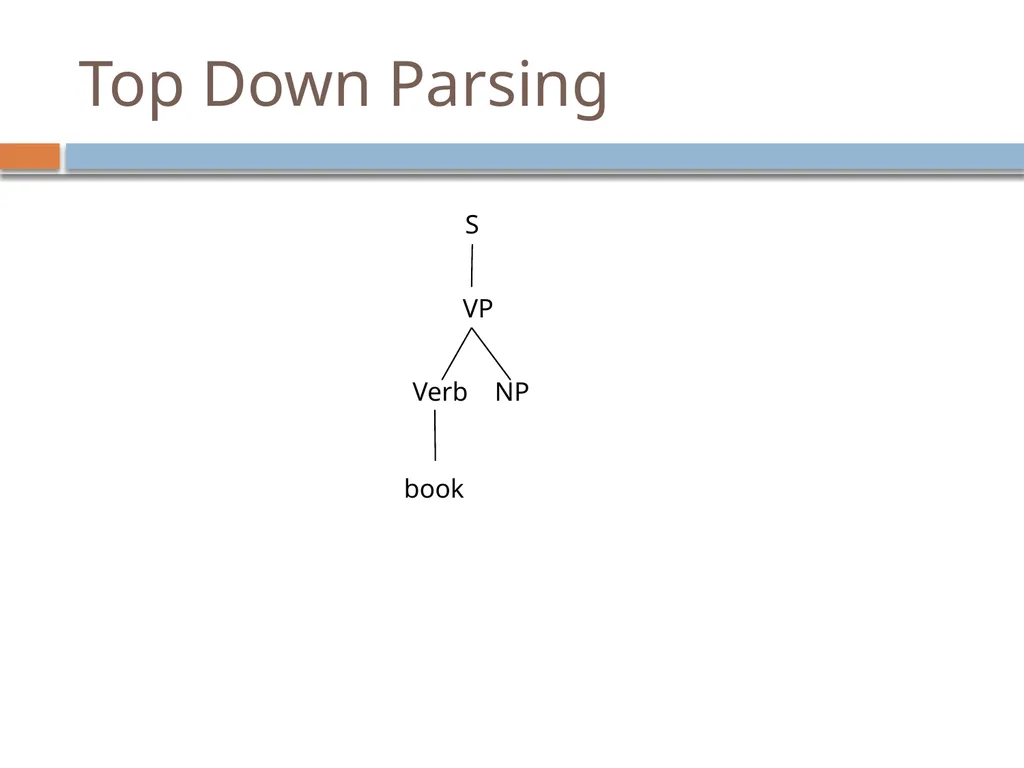
start at the top (usually S) and apply rules
matching left-hand sides and replacing with right-hand sides
Bottom-up parsing
start at the bottom (i.e. words) and build the parse tree up from there
matching right-hand sides and replacing with left-hand sides<br>
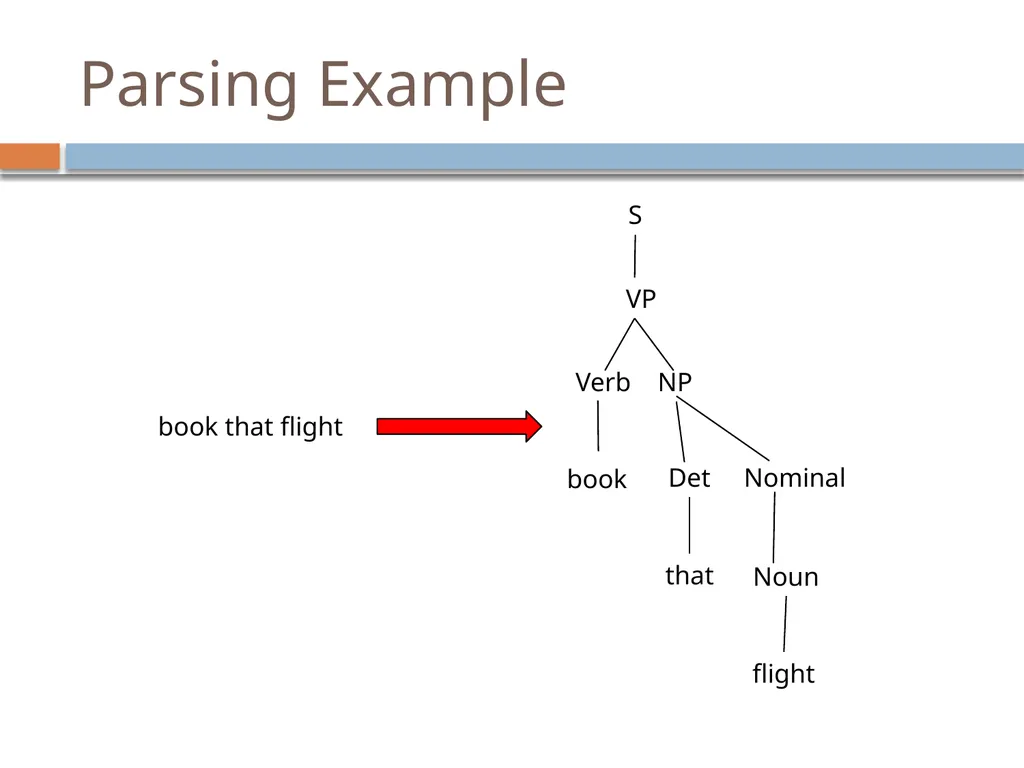
slide26. Parsing Example S VP Verb NP book Det Nominal that Noun flight book that flight<br>
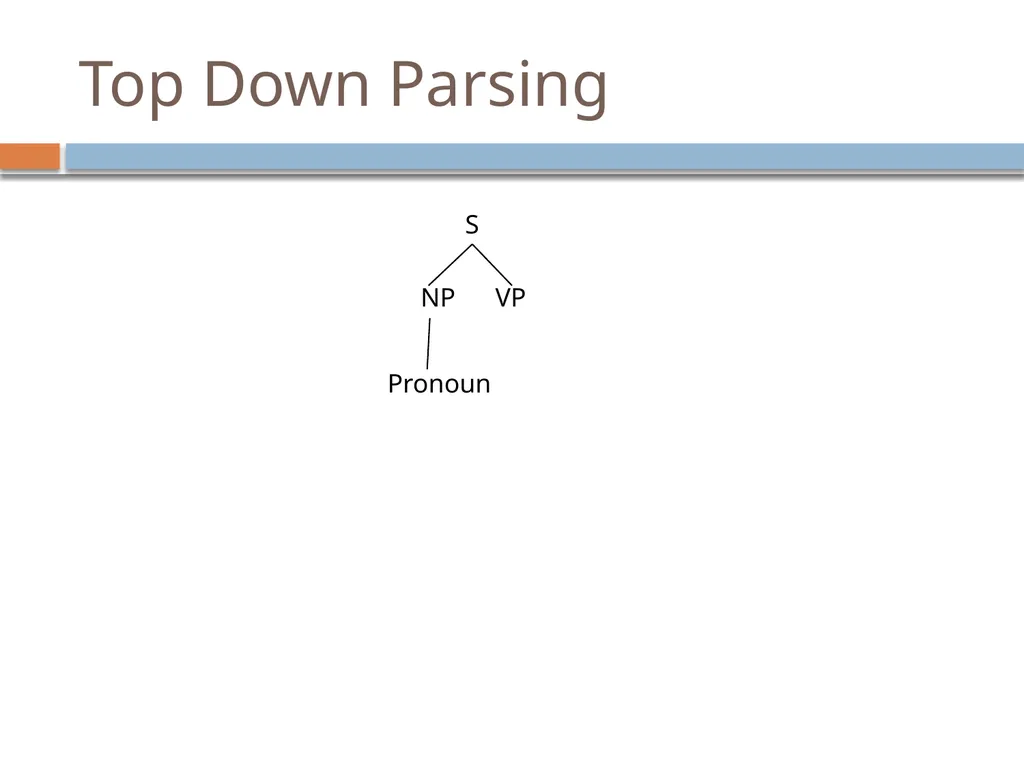
slide27. Top Down Parsing S Pronoun<br>
slide28. Top Down Parsing S Pronoun<br>
slide29. Top Down Parsing S ProperNoun<br>
slide30. Top Down Parsing S ProperNoun<br>
slide31. Top Down Parsing S Det Nominal<br>
slide32. Top Down Parsing S Det Nominal<br>
slide33. Top Down Parsing S Aux NP VP<br>
slide34. Top Down Parsing S Aux NP VP<br>
slide35. Top Down Parsing S VP<br>
slide36. Top Down Parsing S VP Verb<br>
slide37. Top Down Parsing S VP Verb book<br>
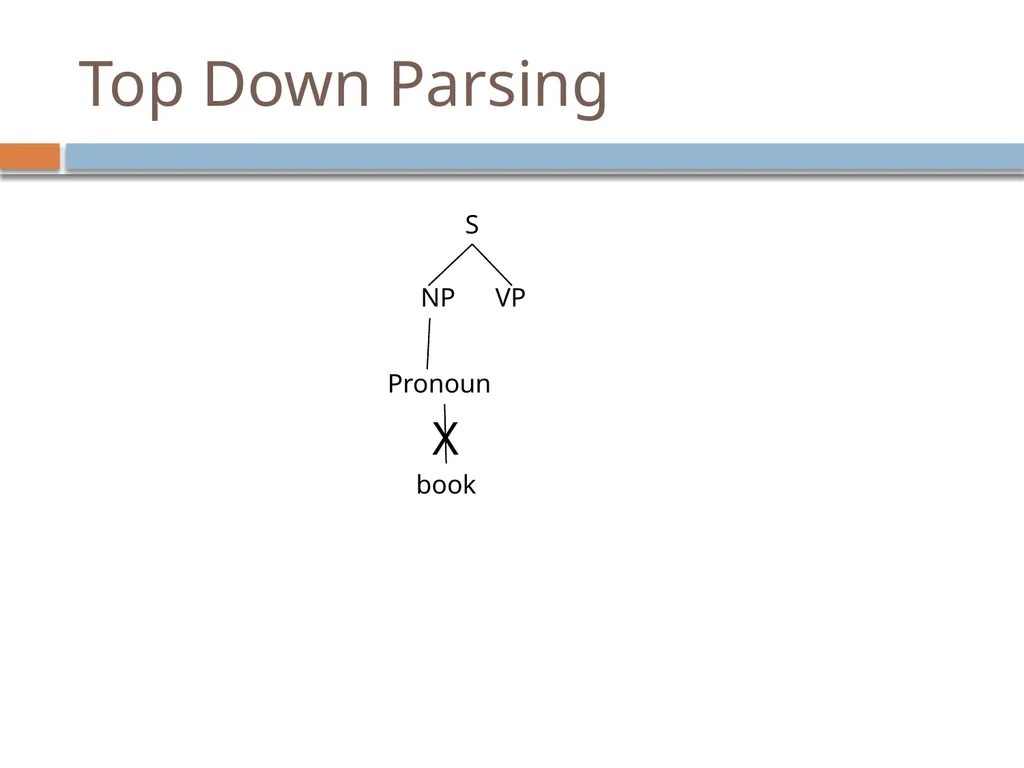
slide38. Top Down Parsing S VP Verb book X that<br>
slide39. Top Down Parsing S VP Verb NP<br>
slide40. Top Down Parsing S VP Verb NP book<br>
slide41. Top Down Parsing S VP Verb NP book Pronoun<br>
slide42. Top Down Parsing S VP Verb NP book Pronoun<br>
slide43. Top Down Parsing S VP Verb NP book ProperNoun<br>
slide44. Top Down Parsing S VP Verb NP book ProperNoun<br>
slide45. Top Down Parsing S VP Verb NP book Det Nominal<br>
slide46. Top Down Parsing S VP Verb NP book Det Nominal that<br>
slide47. Top Down Parsing S VP Verb NP book Det Nominal that Noun<br>
slide48. Top Down Parsing S VP Verb NP book Det Nominal that Noun flight<br>
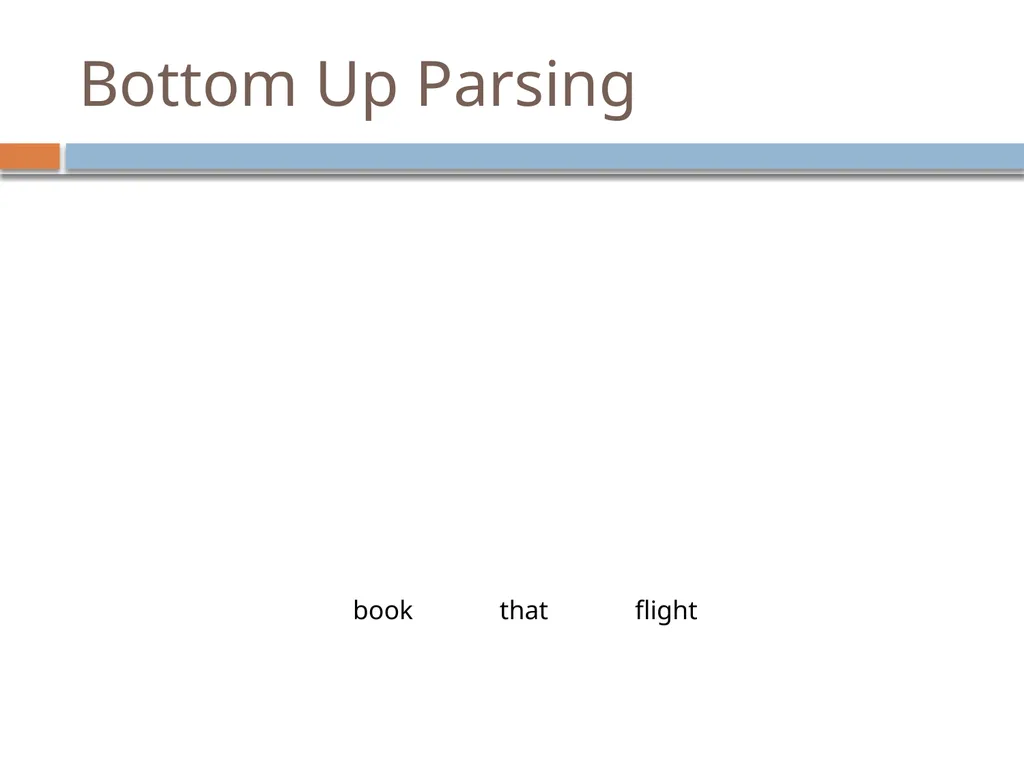
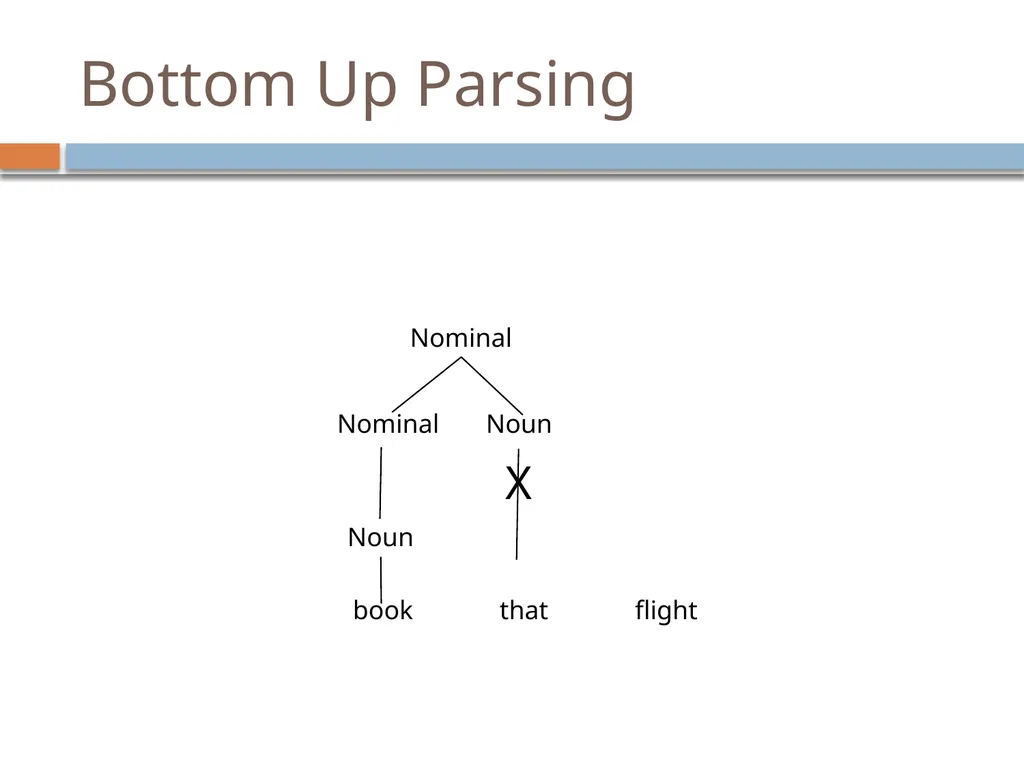
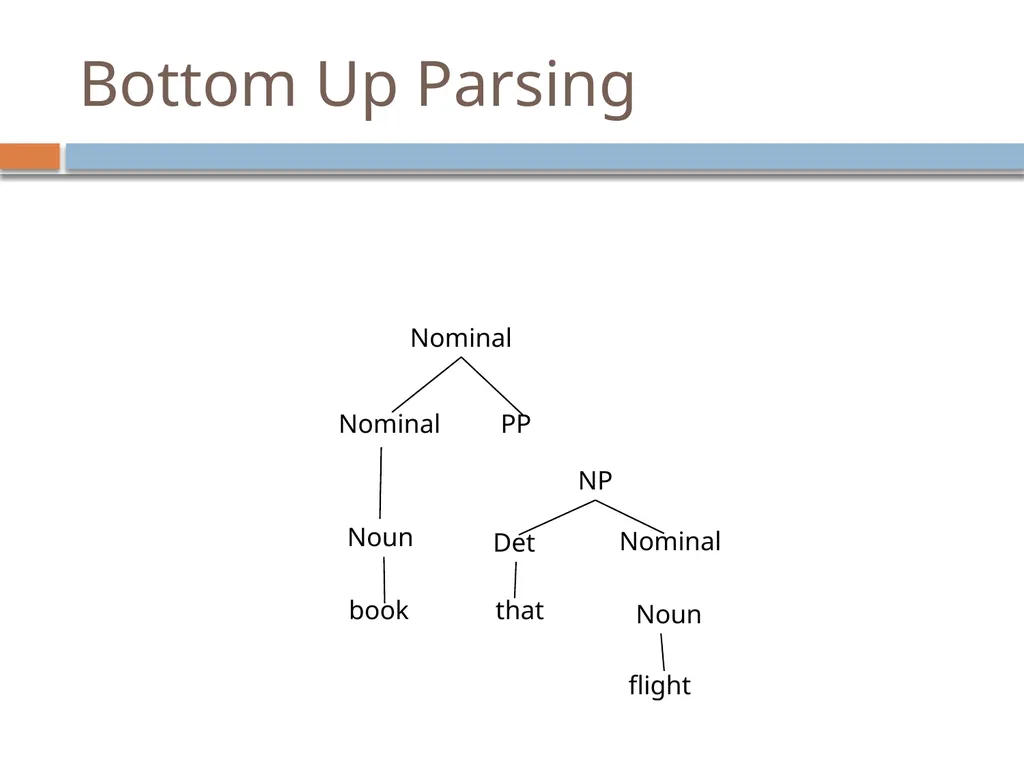
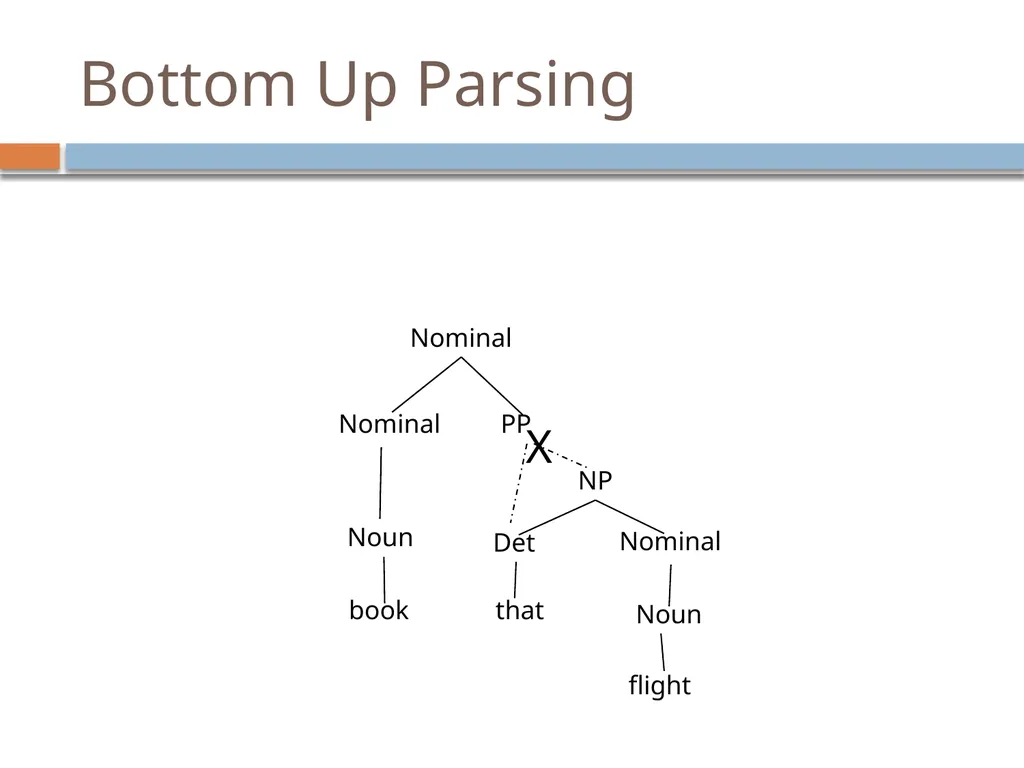
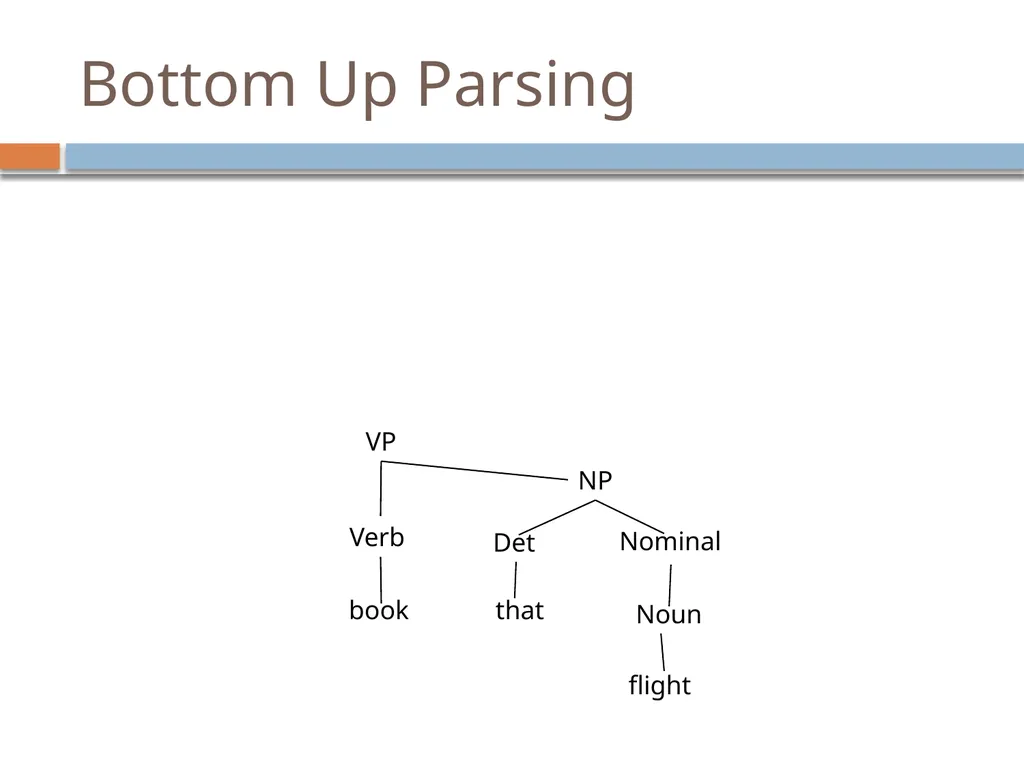
slide49. Bottom Up Parsing book that flight<br>
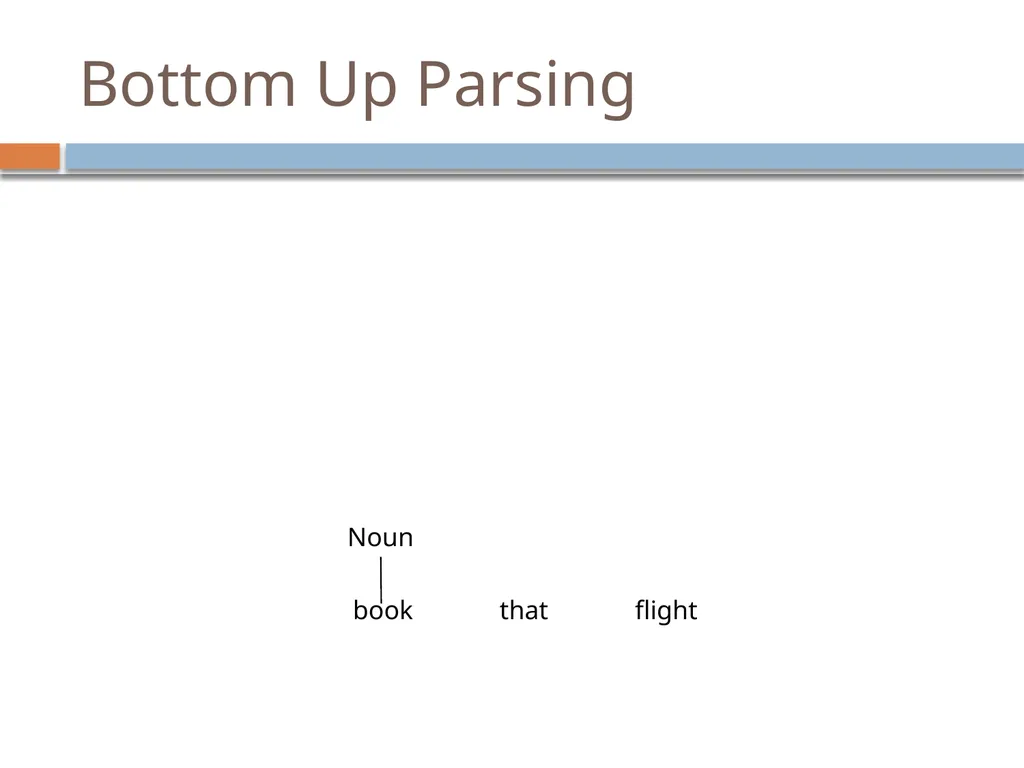
slide50. Bottom Up Parsing book that flight Noun<br>
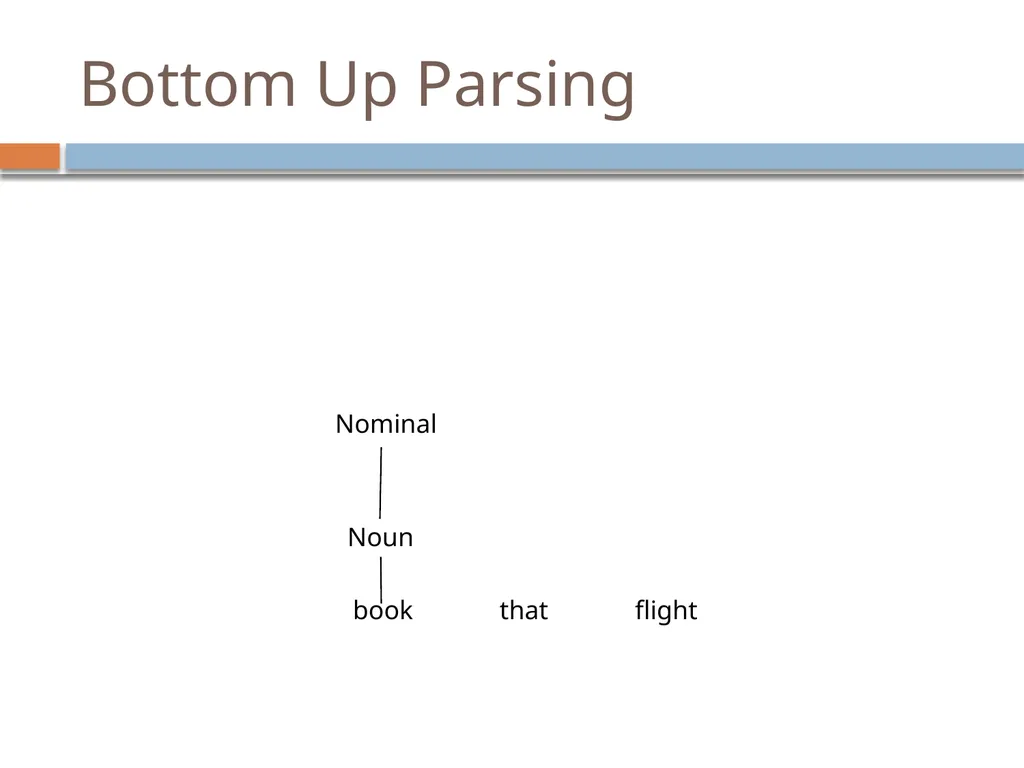
slide51. Bottom Up Parsing book that flight Noun Nominal<br>
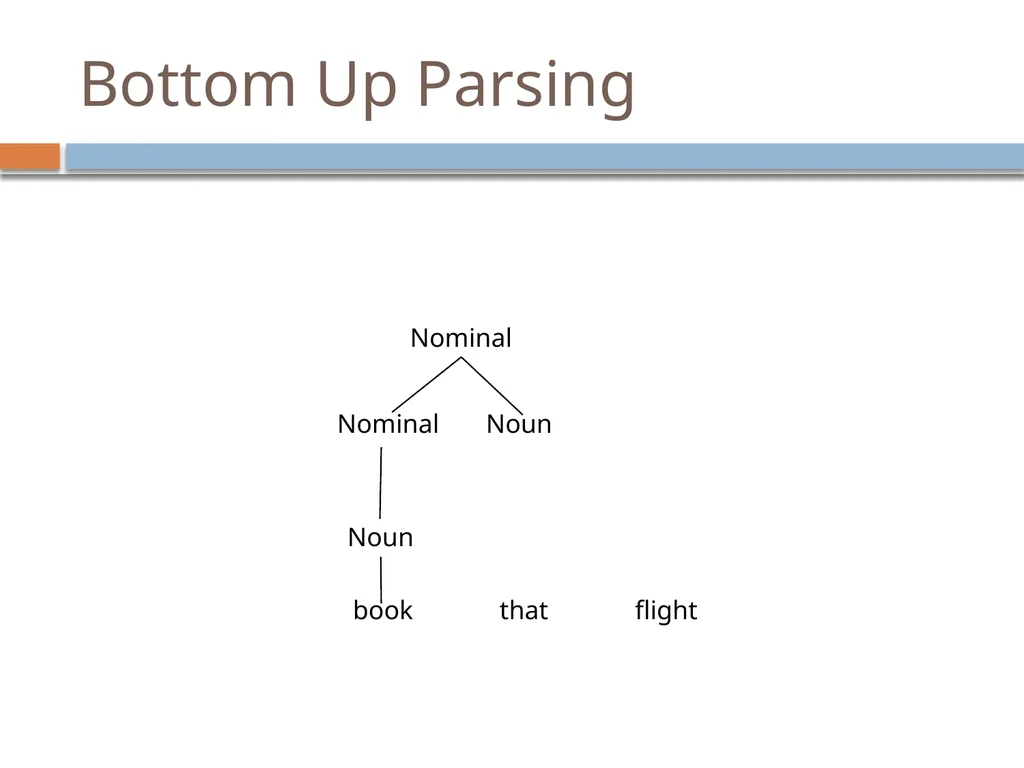
slide52. Bottom Up Parsing book that flight Noun Nominal Noun Nominal<br>
slide53. Bottom Up Parsing book that flight Noun Nominal Noun Nominal<br>
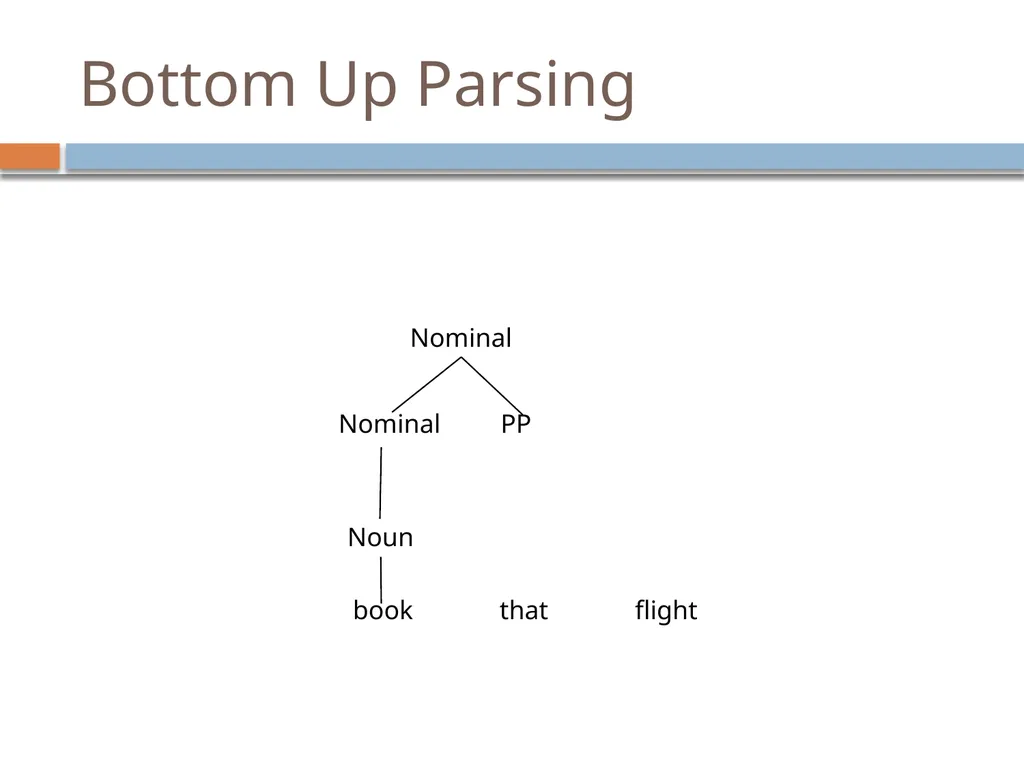
slide54. Bottom Up Parsing book that flight Noun Nominal PP Nominal<br>
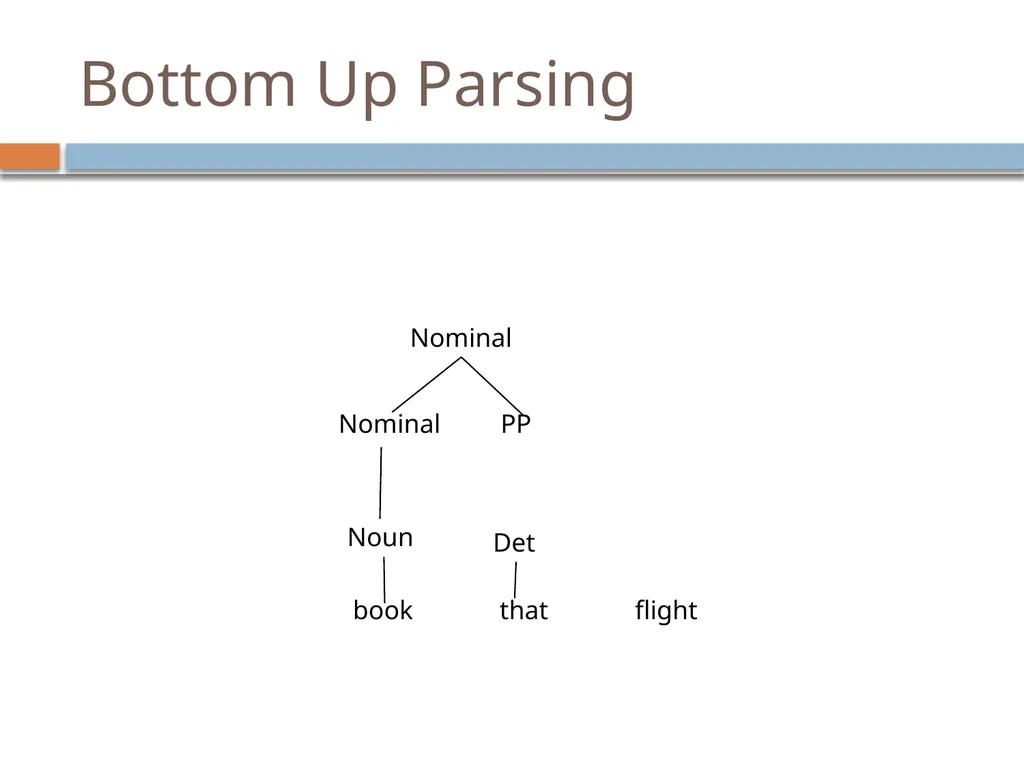
slide55. Bottom Up Parsing book that flight Noun Det Nominal PP Nominal<br>
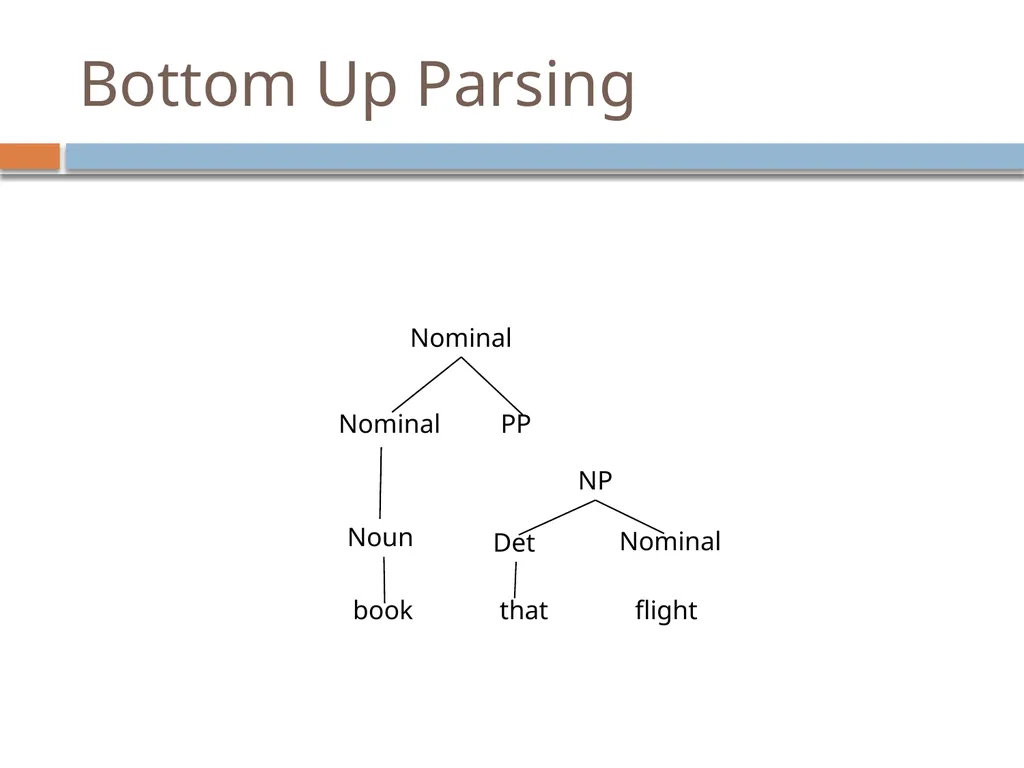
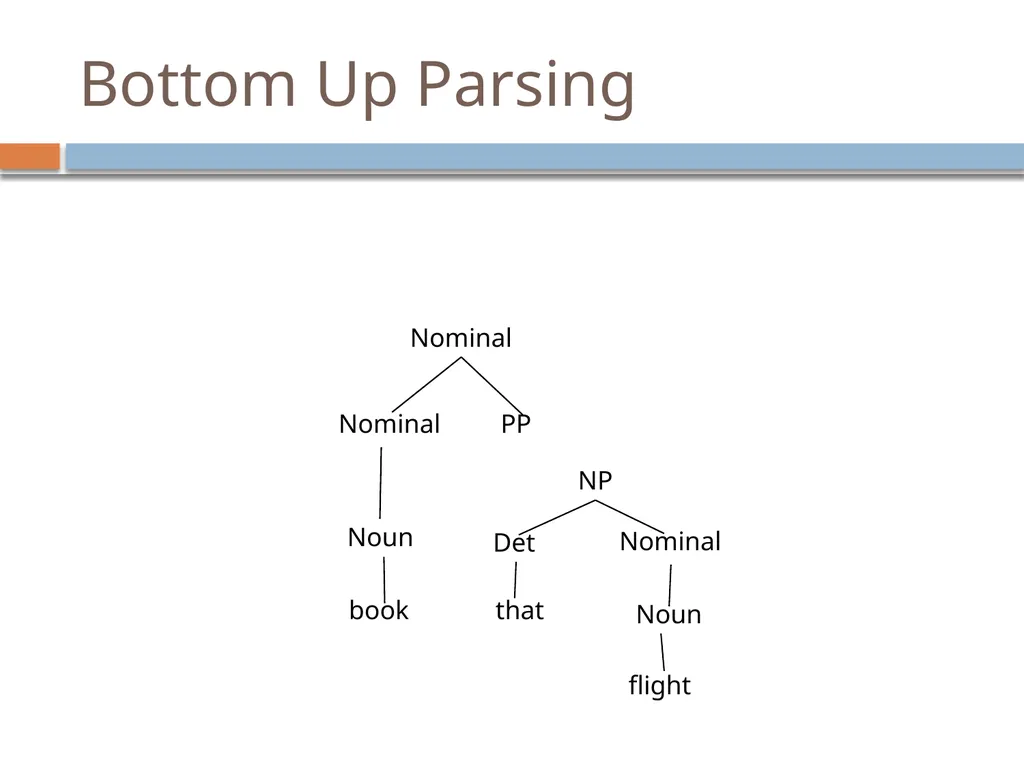
slide56. Bottom Up Parsing book that flight Noun Det NP Nominal Nominal PP Nominal<br>
slide57. Bottom Up Parsing book that Noun Det NP Nominal flight Noun Nominal PP Nominal<br>
slide58. Bottom Up Parsing book that Noun Det NP Nominal flight Noun Nominal PP Nominal<br>
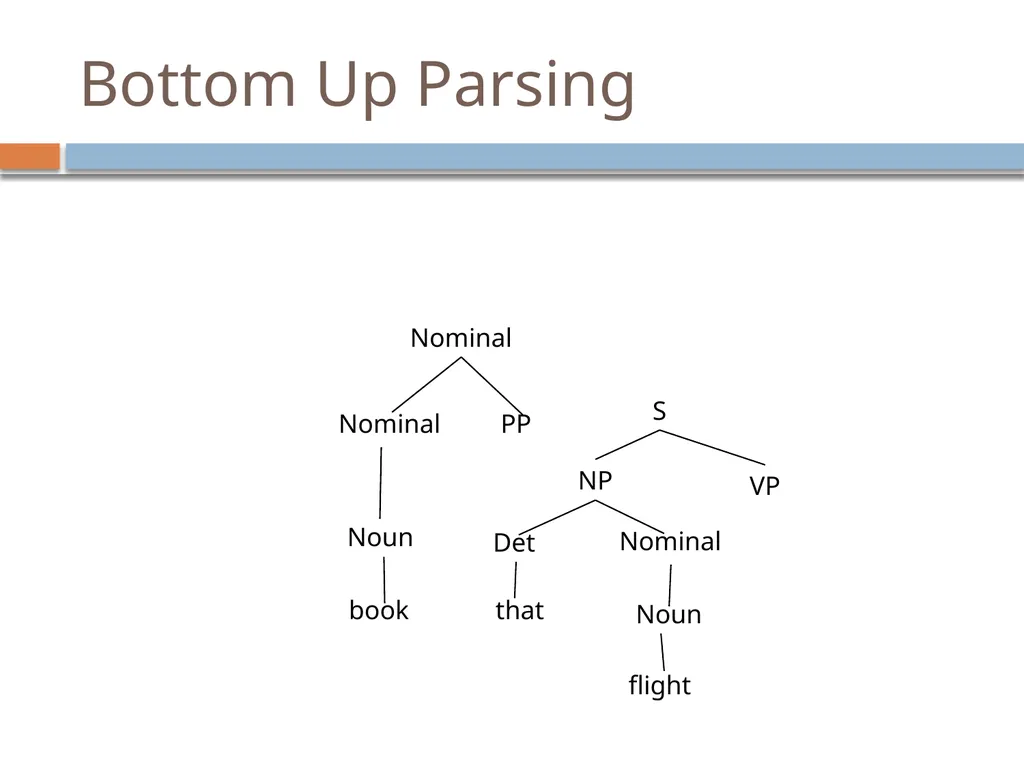
slide59. Bottom Up Parsing book that Noun Det NP Nominal flight Noun S VP Nominal PP Nominal<br>
slide60. Bottom Up Parsing book that Noun Det NP Nominal flight Noun S VP Nominal PP Nominal<br>
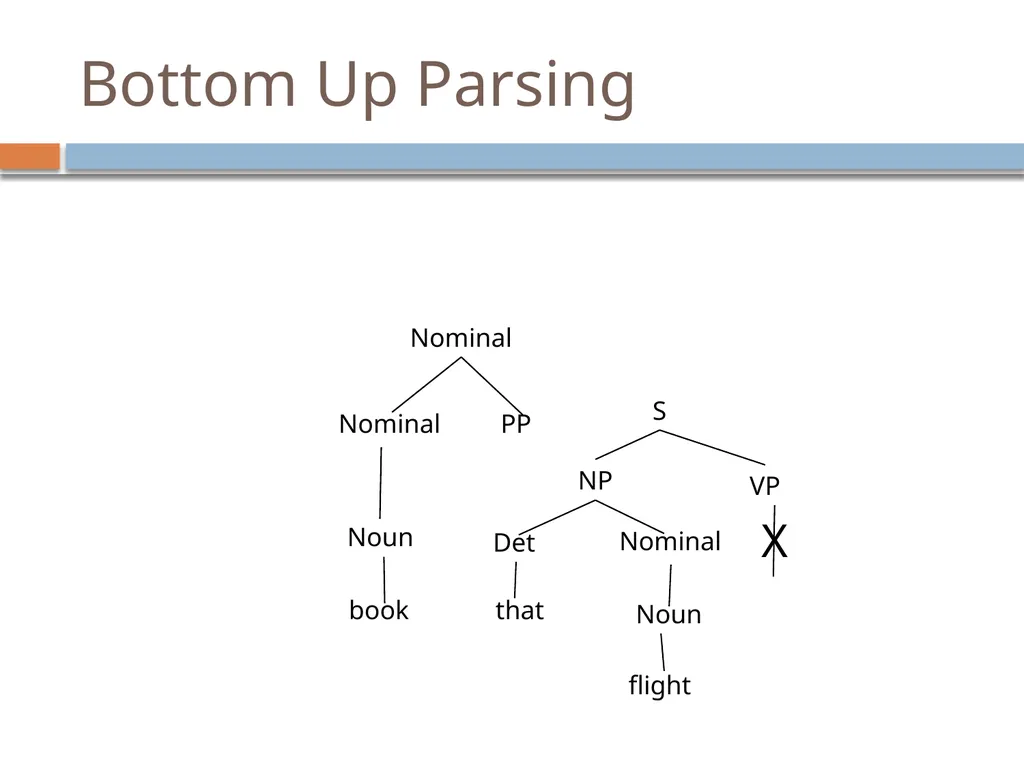
slide61. Bottom Up Parsing book that Noun Det NP Nominal flight Noun Nominal PP Nominal X<br>
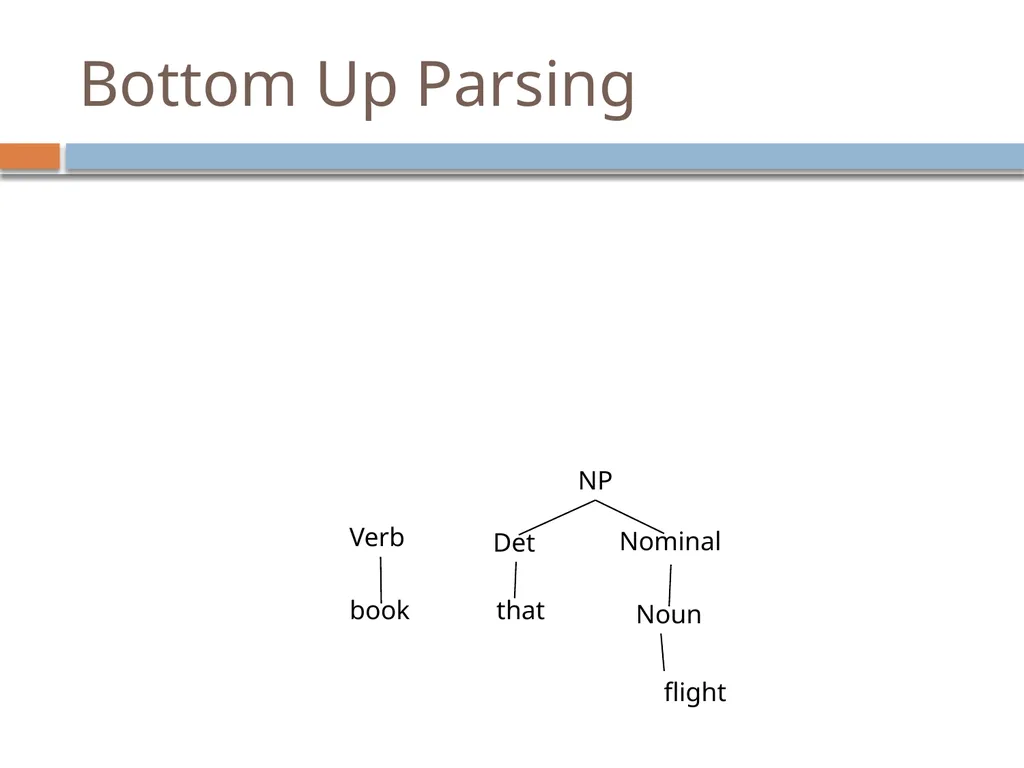
slide62. Bottom Up Parsing book that Verb Det NP Nominal flight Noun<br>
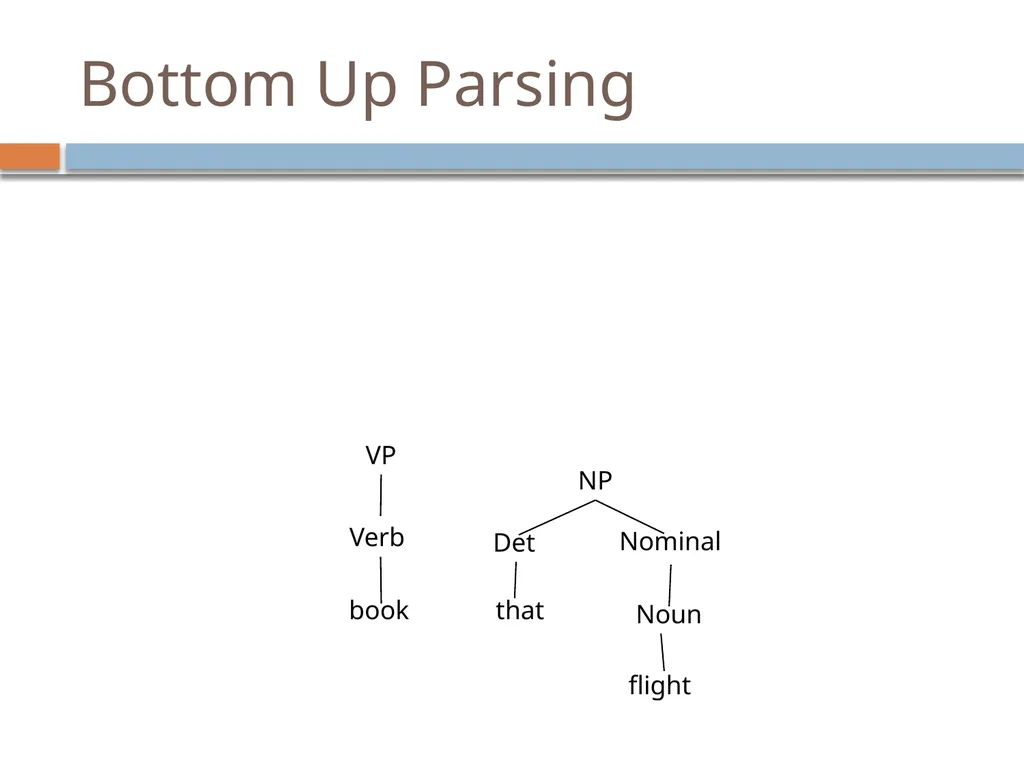
slide63. Bottom Up Parsing book that Verb VP Det NP Nominal flight Noun<br>
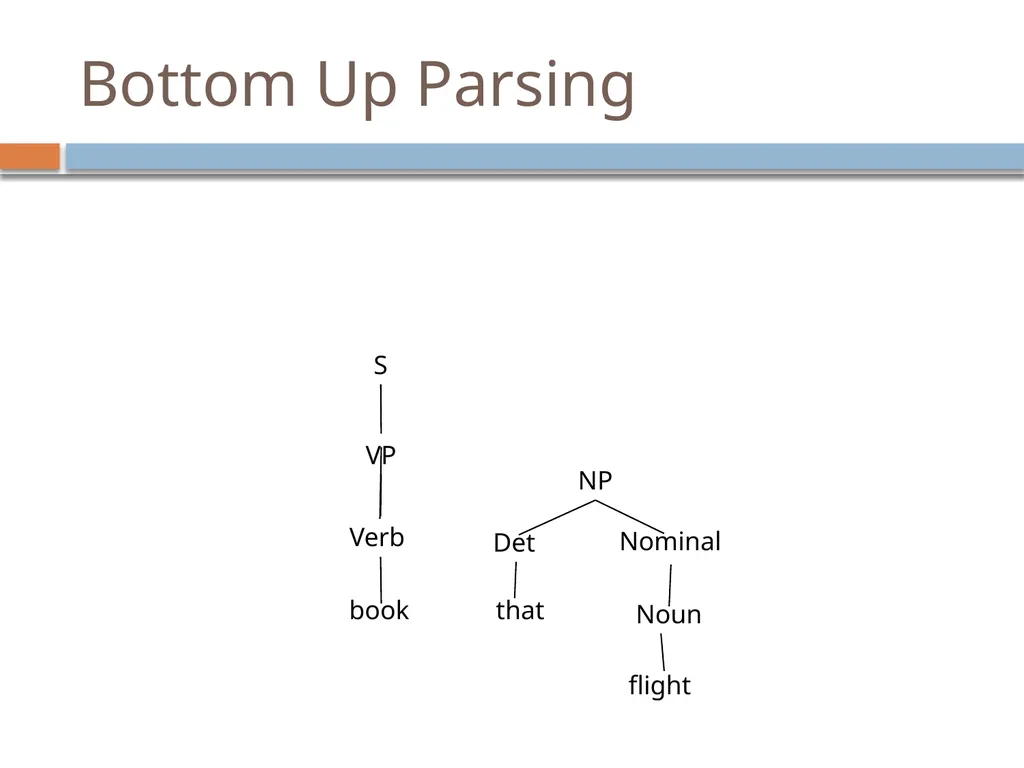
slide64. Det Bottom Up Parsing book that Verb VP S NP Nominal flight Noun<br>
slide65. Det Bottom Up Parsing book that Verb VP S X NP Nominal flight Noun<br>
slide66. Bottom Up Parsing book that Verb VP VP PP Det NP Nominal flight Noun<br>
slide67. Bottom Up Parsing book that Verb VP VP PP Det NP Nominal flight Noun X<br>
slide68. Bottom Up Parsing book that Verb VP Det NP Nominal flight Noun NP<br>
slide69. Bottom Up Parsing book that Verb VP Det NP Nominal flight Noun<br>
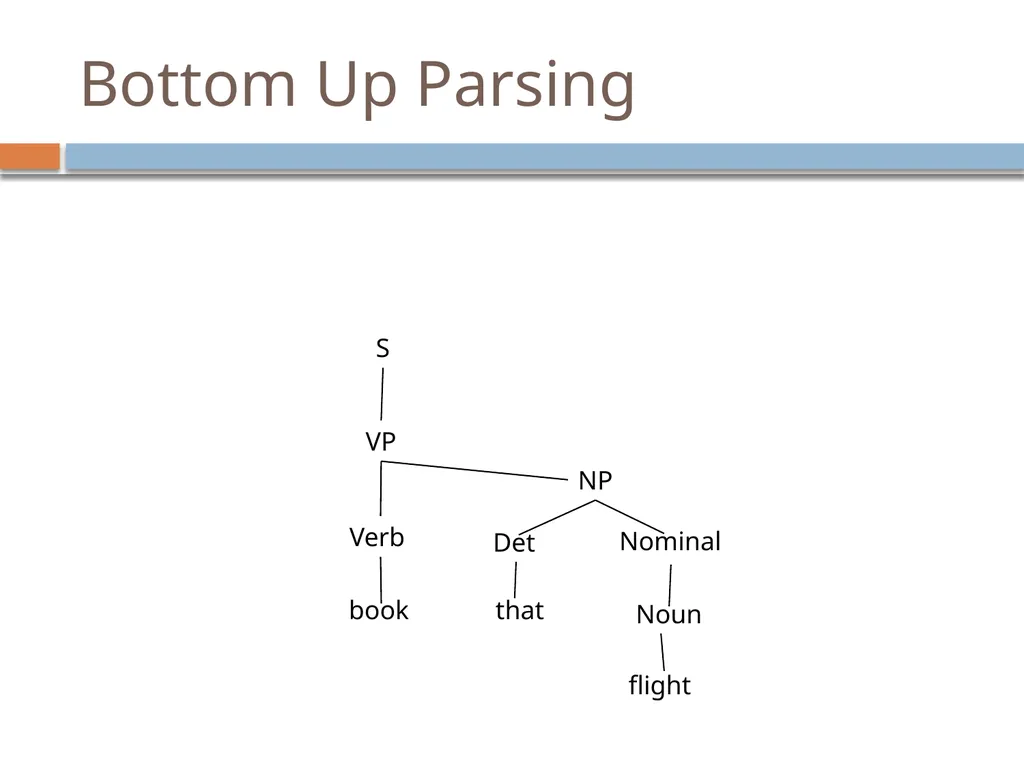
slide70. Bottom Up Parsing book that Verb VP Det NP Nominal flight Noun S<br>
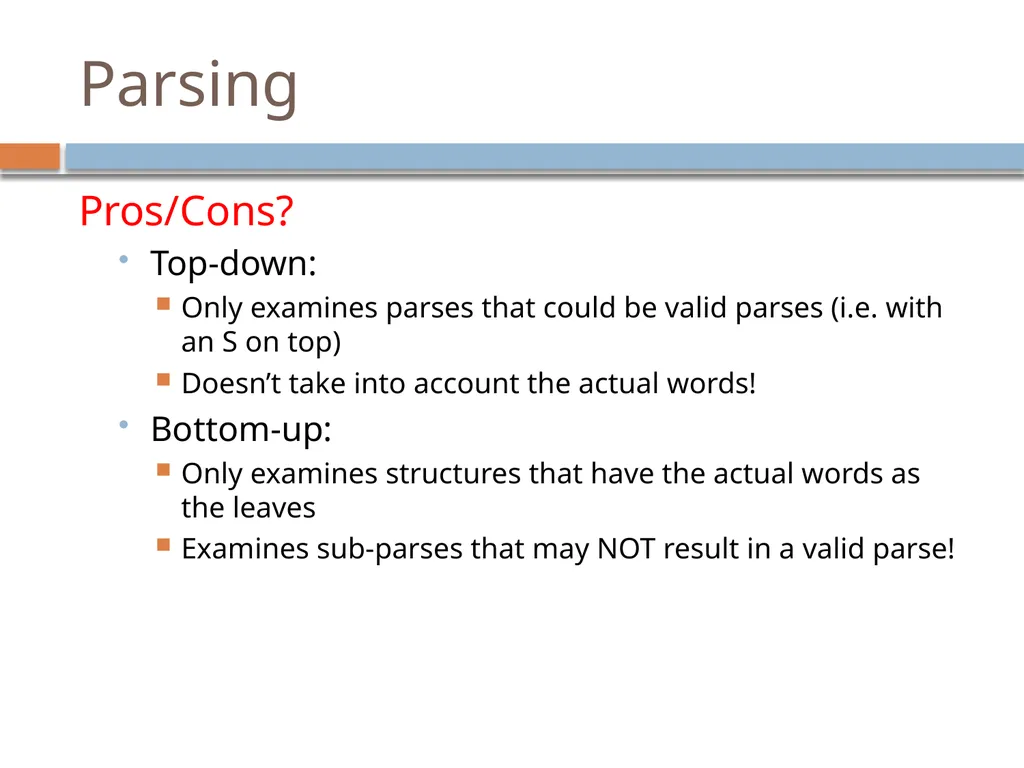
slide71. Parsing Pros/Cons?
Top-down:
Only examines parses that could be valid parses (i.e. with an S on top)
Doesn’t take into account the actual words!
Bottom-up:
Only examines structures that have the actual words as the leaves
Examines sub-parses that may NOT result in a valid parse!<br>
slide72. Why is parsing hard? Actual grammars are large
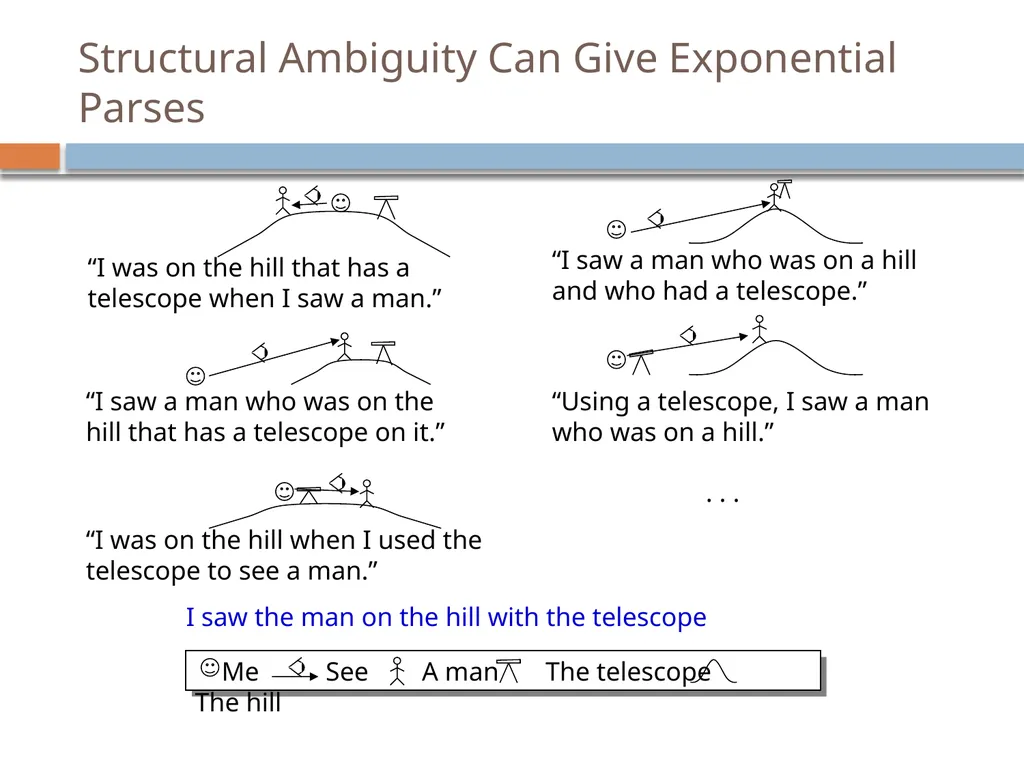
Lots of ambiguity!
Most sentences have many parses
Some sentences have a lot of parses
Even for sentences that are not ambiguous, there is often ambiguity for subtrees (i.e. multiple ways to parse a phrase)<br>
slide73. Why is parsing hard? I saw the man on the hill with the telescope What are some interpretations?<br>
slide74. Structural Ambiguity Can Give Exponential Parses Me See A man The telescope The hill . . . I saw the man on the hill with the telescope<br>
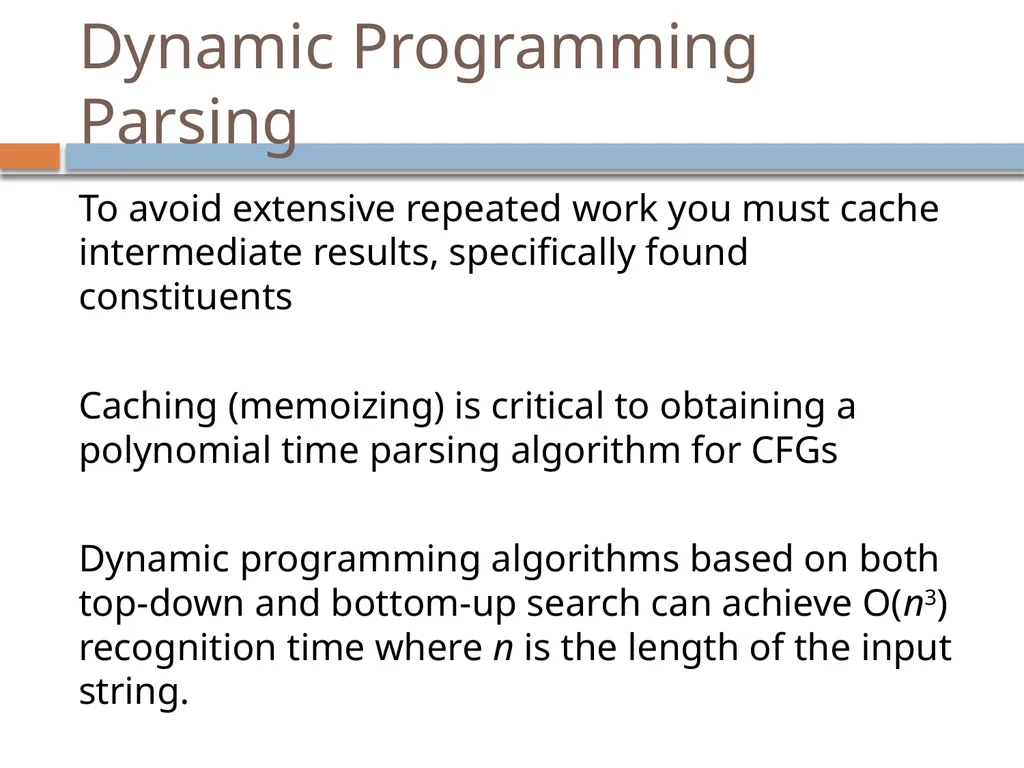
slide75. Dynamic Programming Parsing To avoid extensive repeated work you must cache intermediate results, specifically found constituents
Caching (memoizing) is critical to obtaining a polynomial time parsing algorithm for CFGs
Dynamic programming algorithms based on both top-down and bottom-up search can achieve O(n3) recognition time where n is the length of the input string.<br>
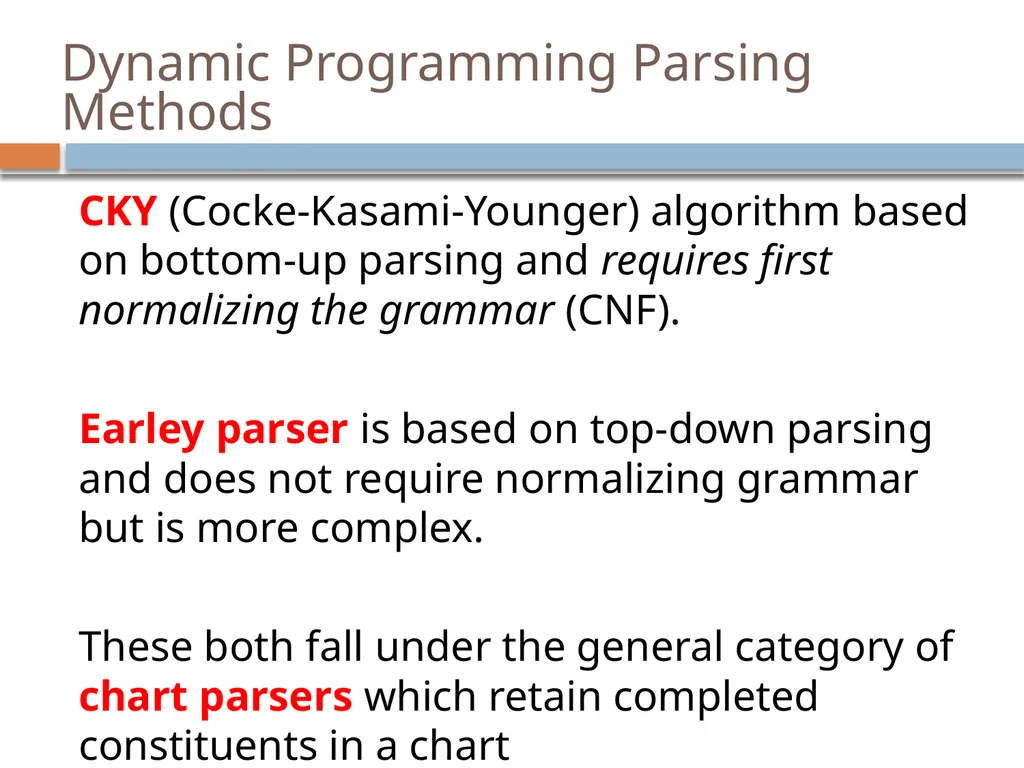
slide76. Dynamic Programming Parsing Methods CKY (Cocke-Kasami-Younger) algorithm based on bottom-up parsing and requires first normalizing the grammar (CNF).
Earley parser is based on top-down parsing and does not require normalizing grammar but is more complex.
These both fall under the general category of chart parsers which retain completed constituents in a chart<br>
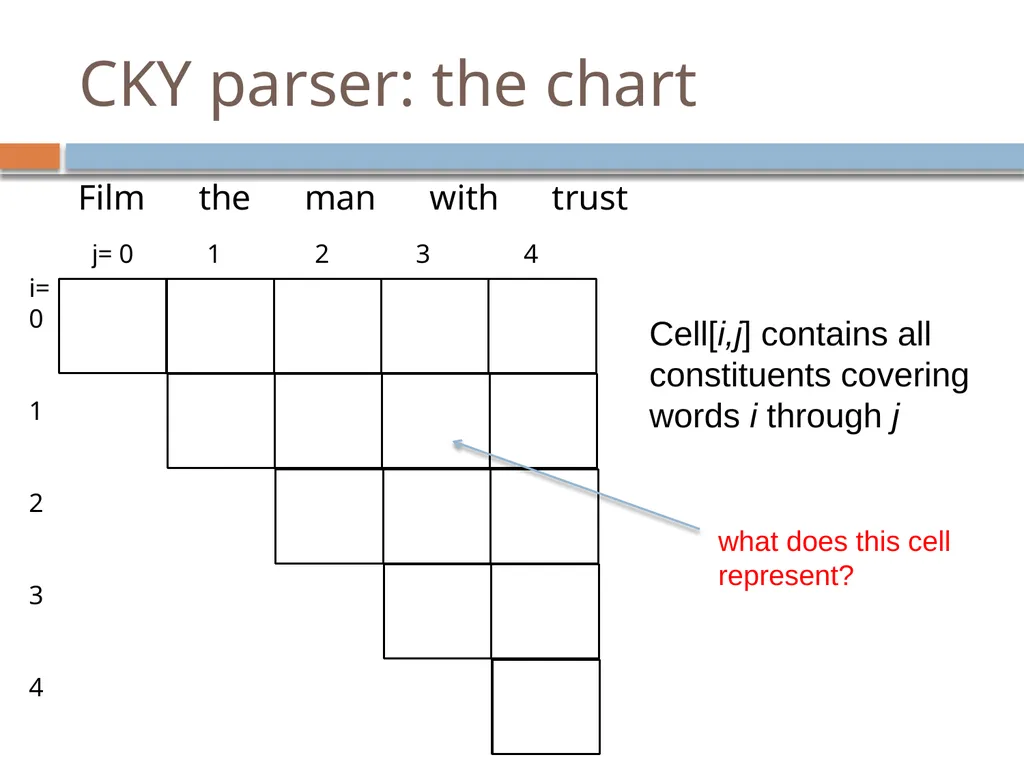
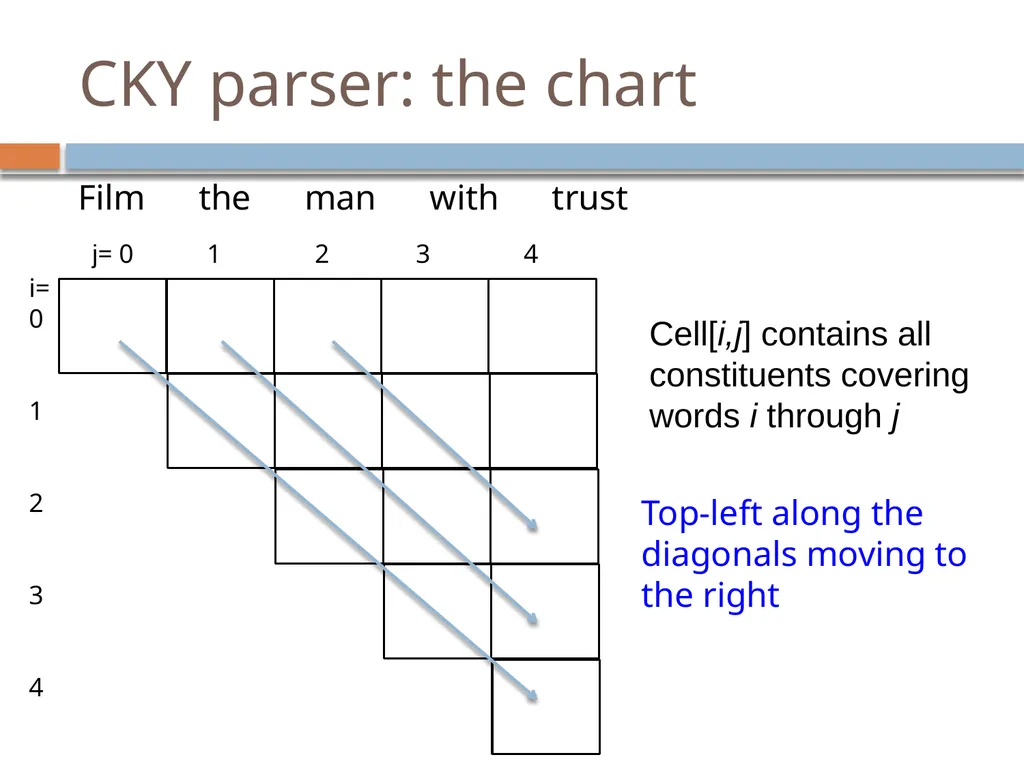
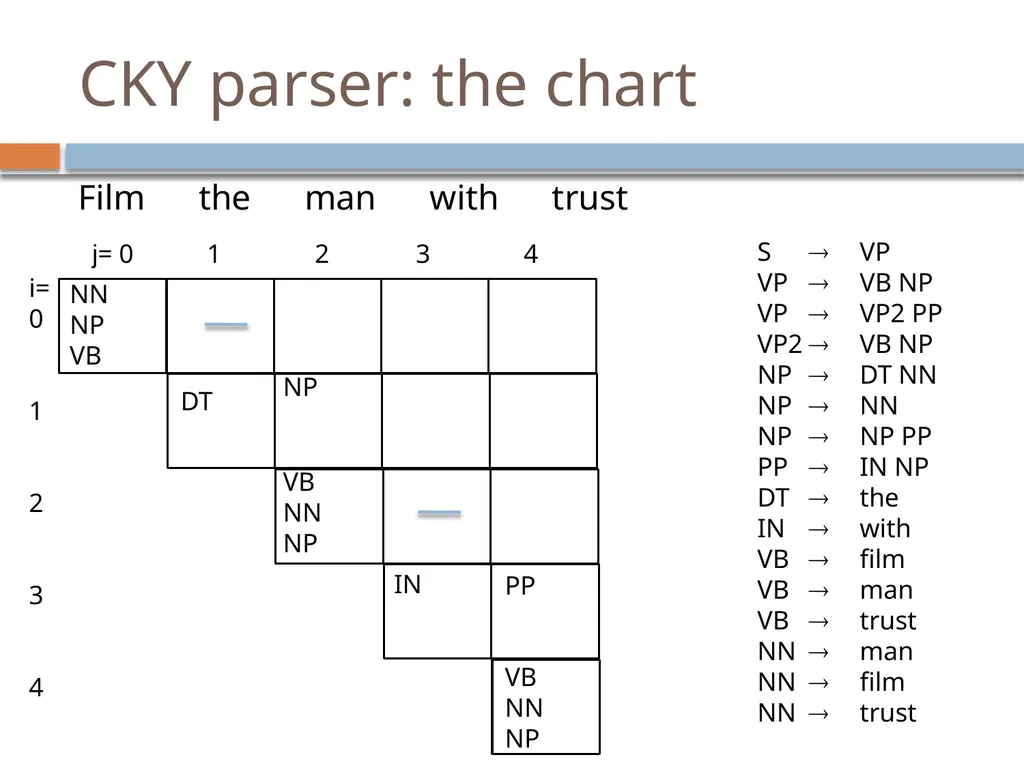
slide77. CKY parser: the chart i=
0
1
2
3
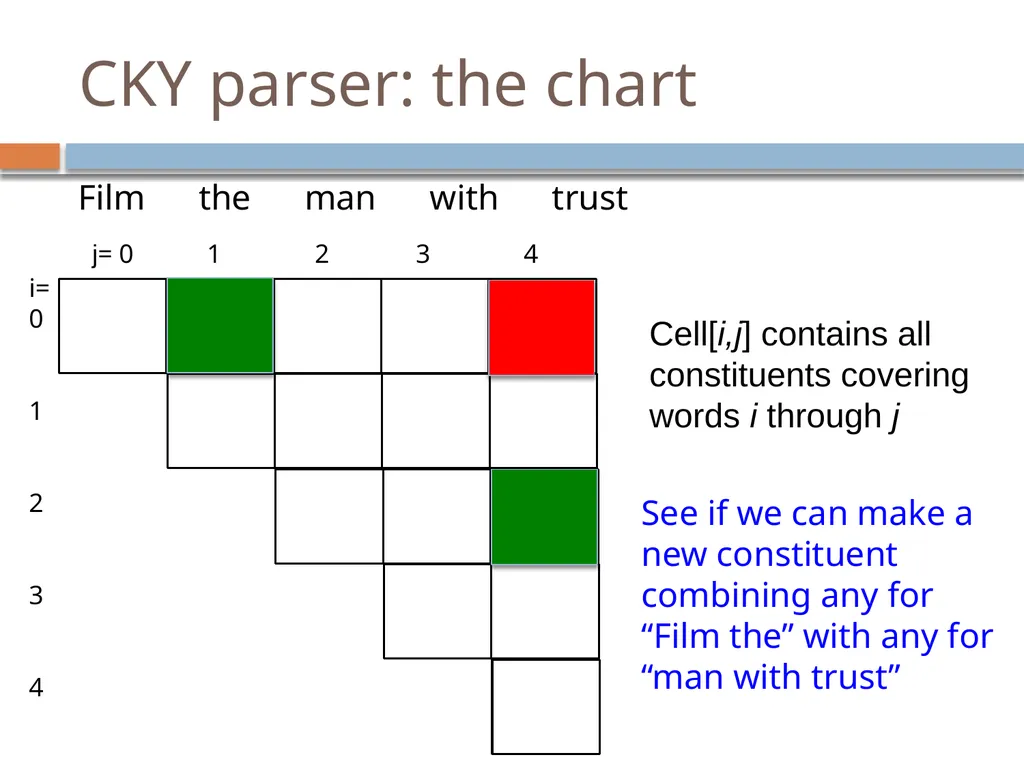
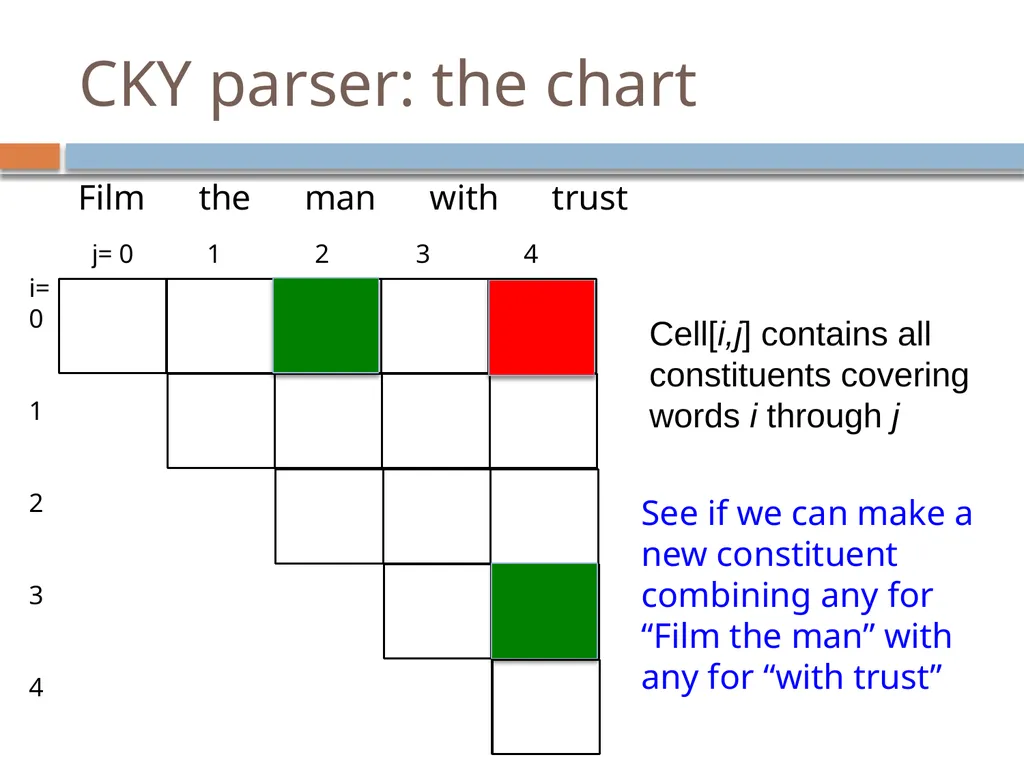
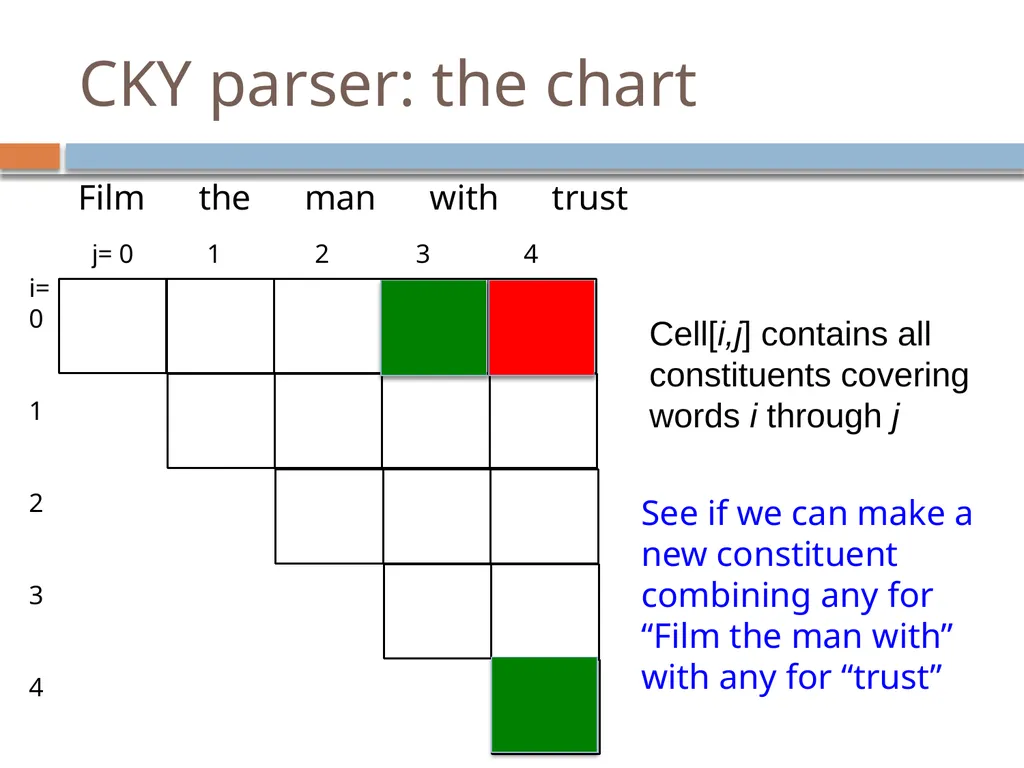
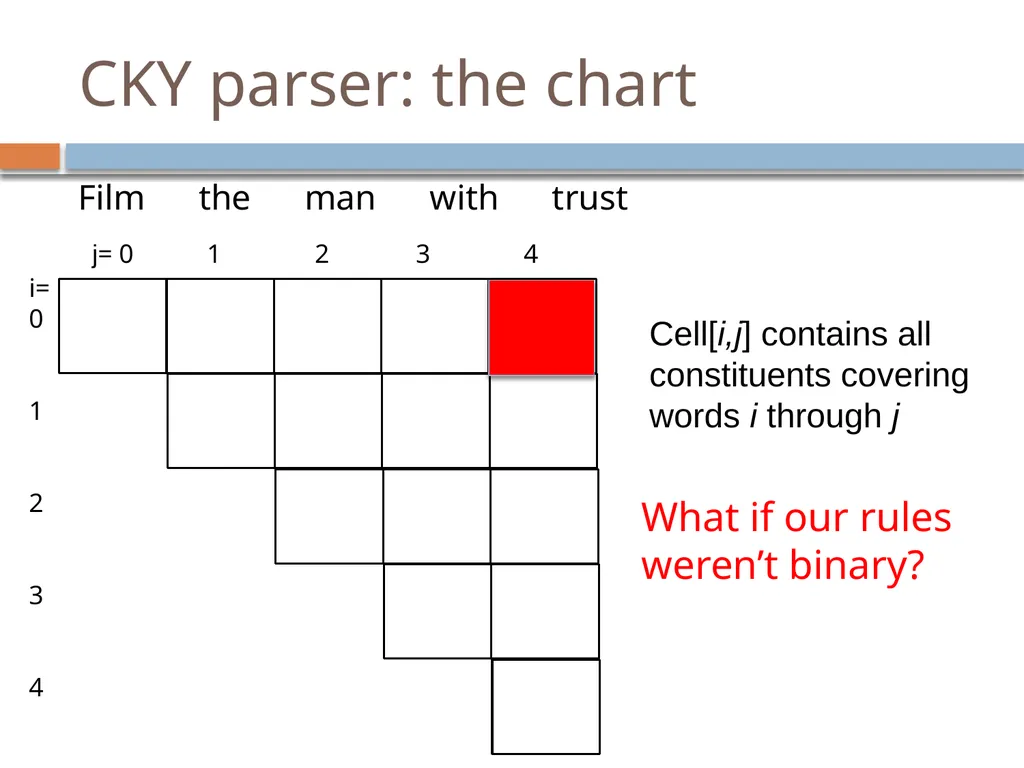
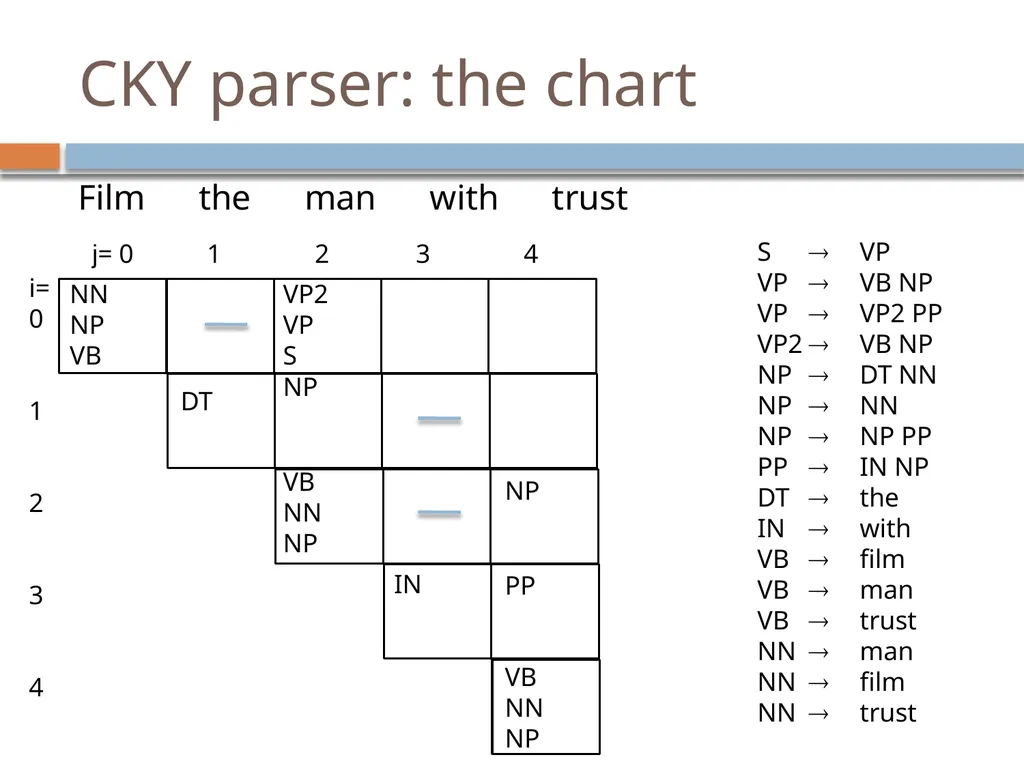
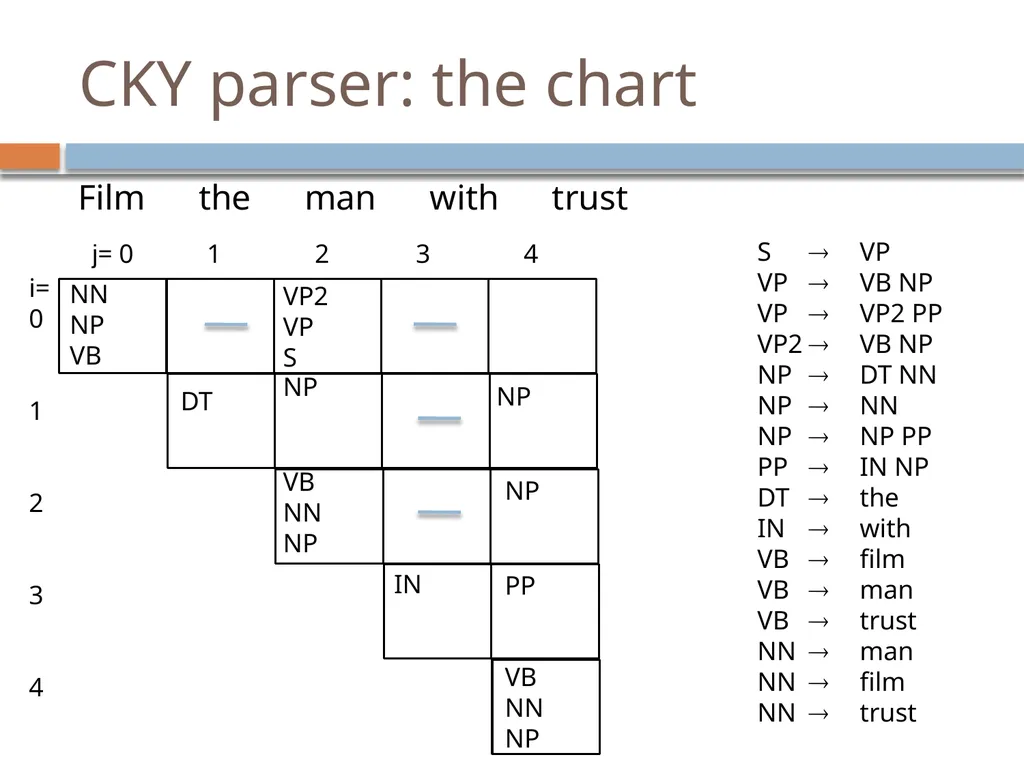
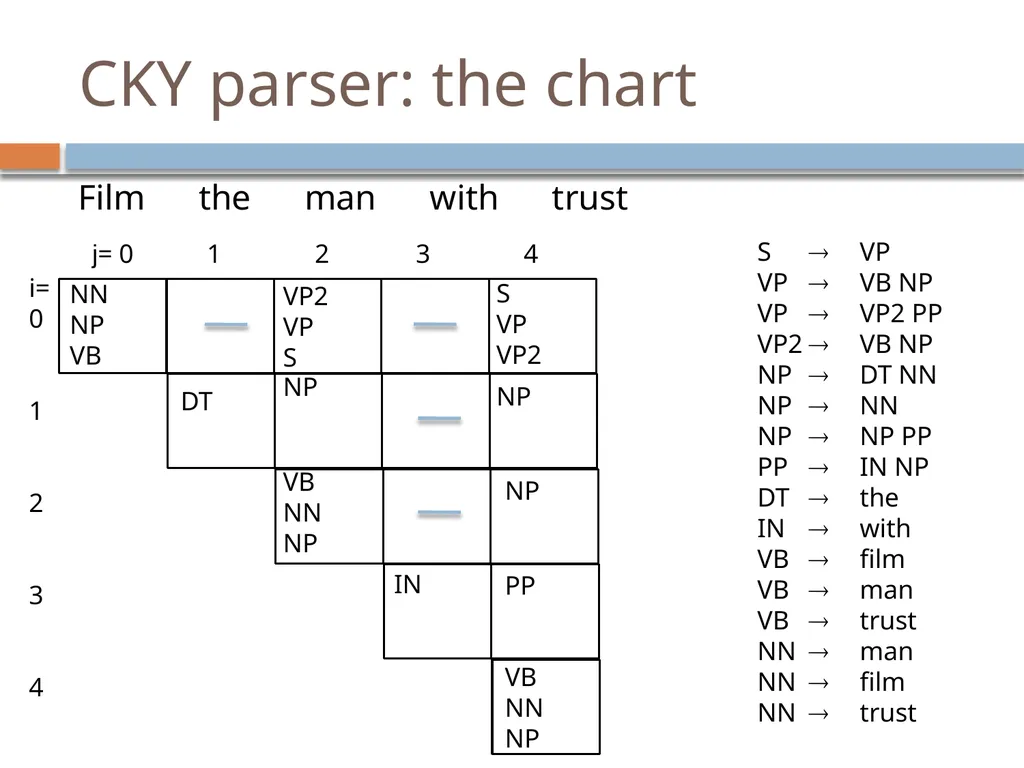
4 j= 0 1 2 3 4 Cell[i,j] contains all
constituents covering words i through j Film the man with trust what does this cell represent?<br>
slide78. CKY parser: the chart i=
0
1
2
3
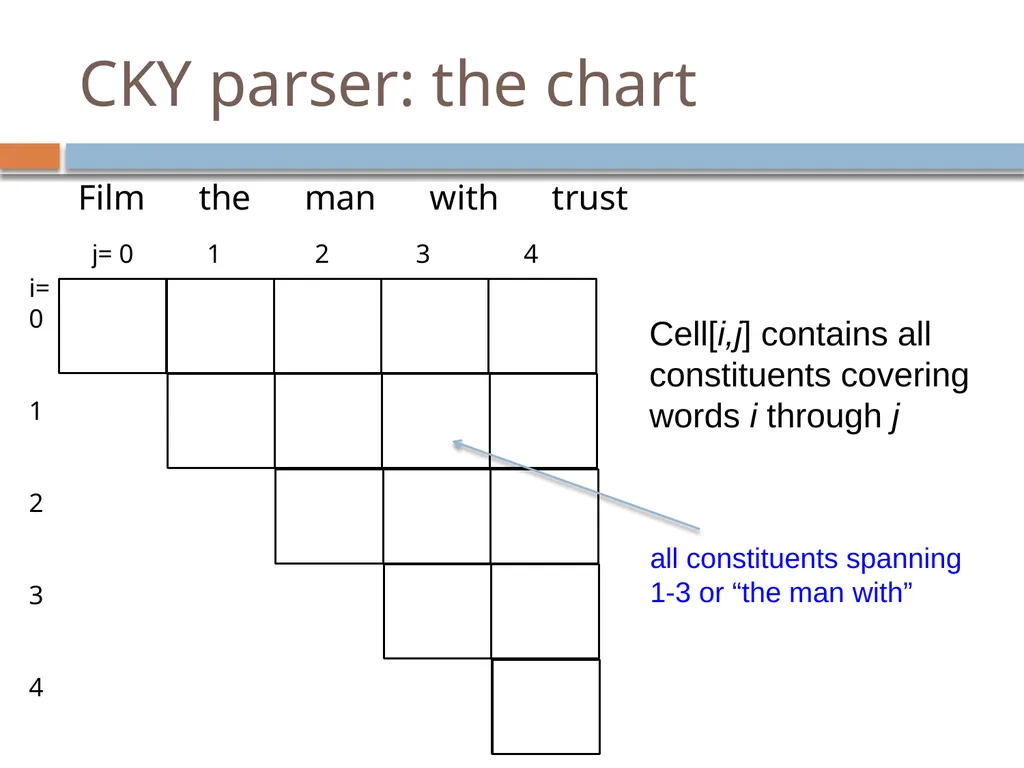
4 j= 0 1 2 3 4 Cell[i,j] contains all
constituents covering words i through j Film the man with trust all constituents spanning
1-3 or “the man with”<br>
slide79. CKY parser: the chart i=
0
1
2
3
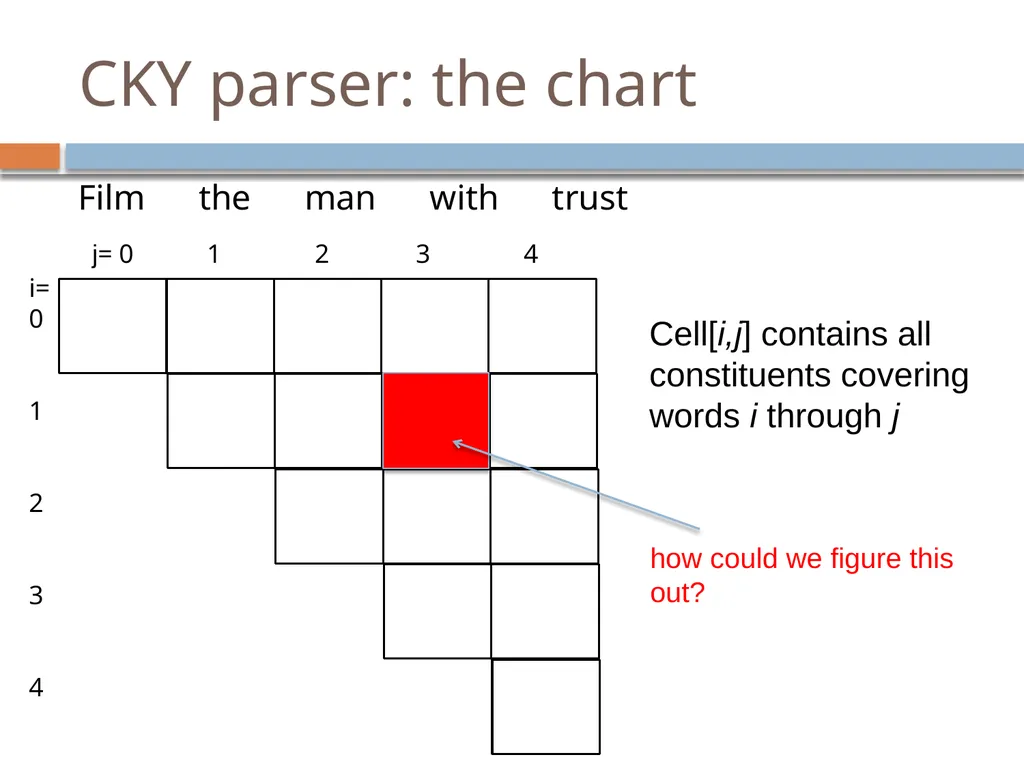
4 j= 0 1 2 3 4 Cell[i,j] contains all
constituents covering words i through j Film the man with trust how could we figure this out?<br>
slide80. CKY parser: the chart i=
0
1
2
3
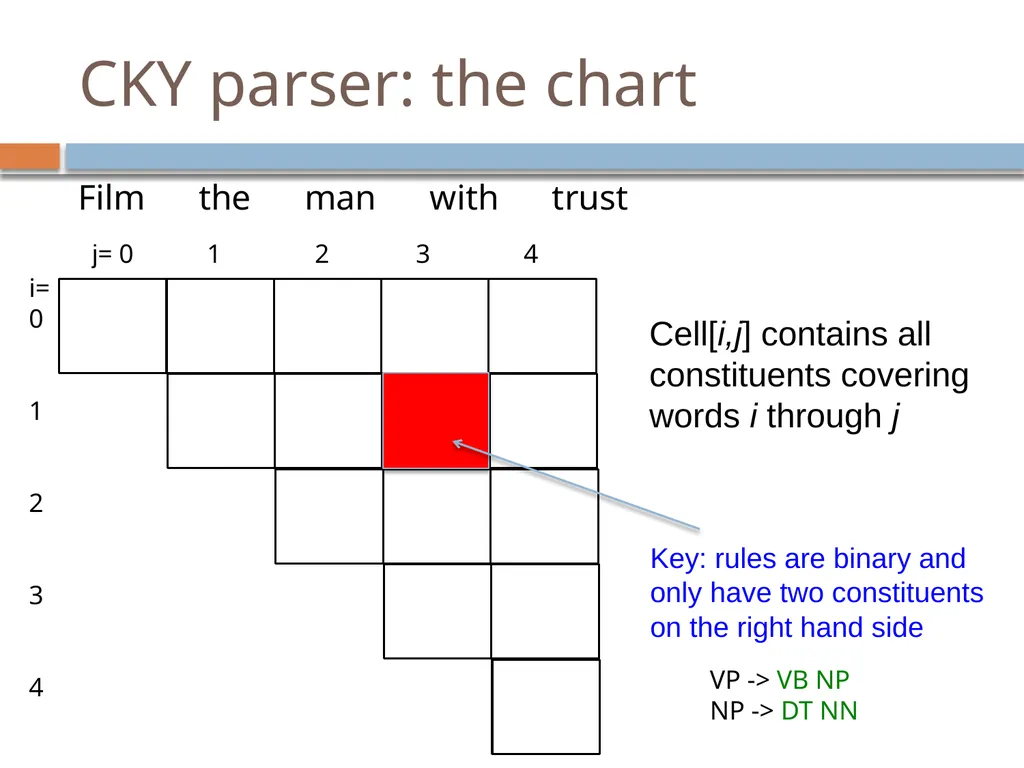
4 j= 0 1 2 3 4 Cell[i,j] contains all
constituents covering words i through j Film the man with trust Key: rules are binary and only have two constituents on the right hand side VP -> VB NP
NP -> DT NN<br>
slide81. CKY parser: the chart i=
0
1
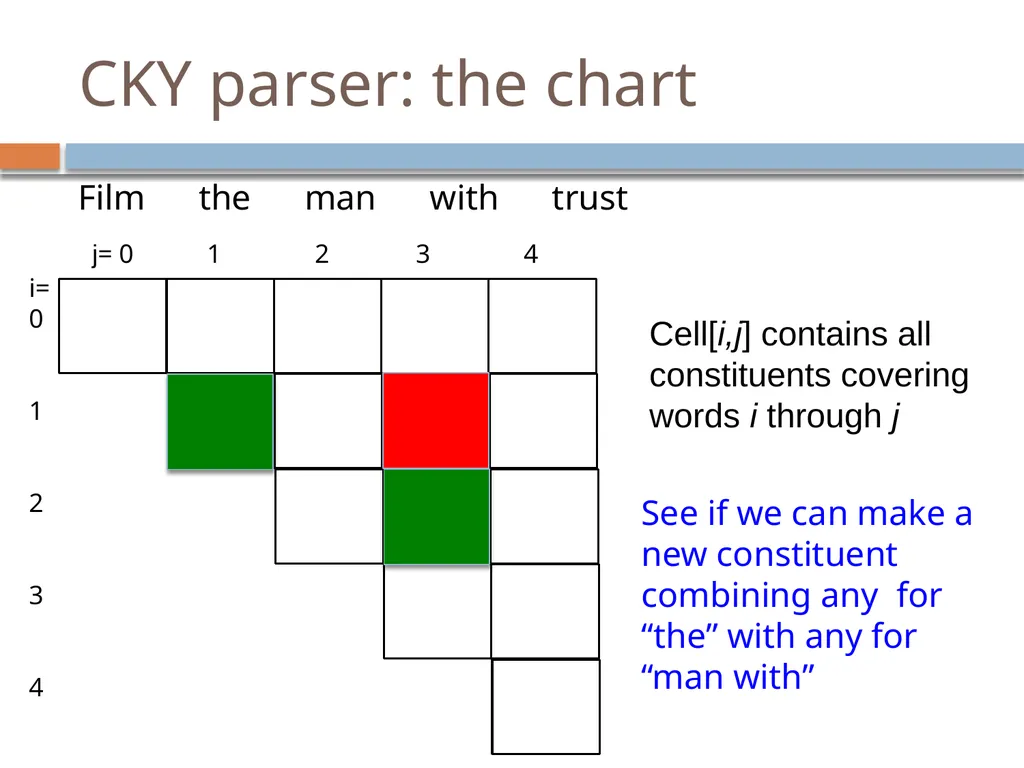
2
3
4 j= 0 1 2 3 4 Cell[i,j] contains all
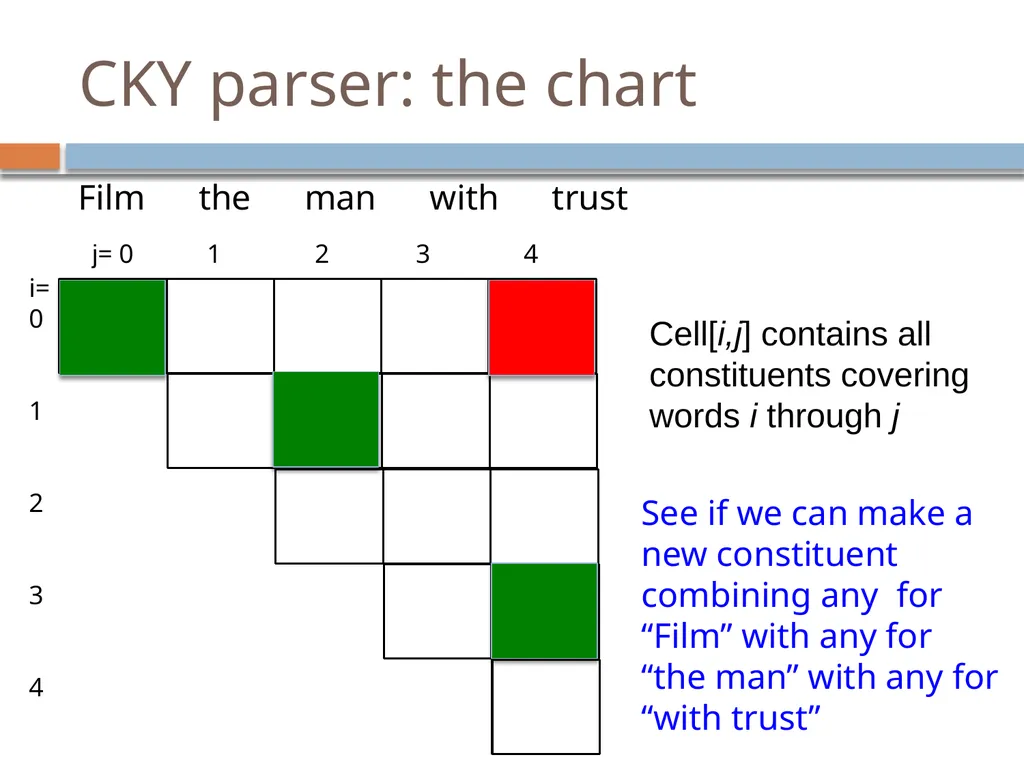
constituents covering words i through j Film the man with trust See if we can make a new constituent combining any for “the” with any for “man with”<br>
slide82. CKY parser: the chart i=
0
1
2
3
4 j= 0 1 2 3 4 Cell[i,j] contains all
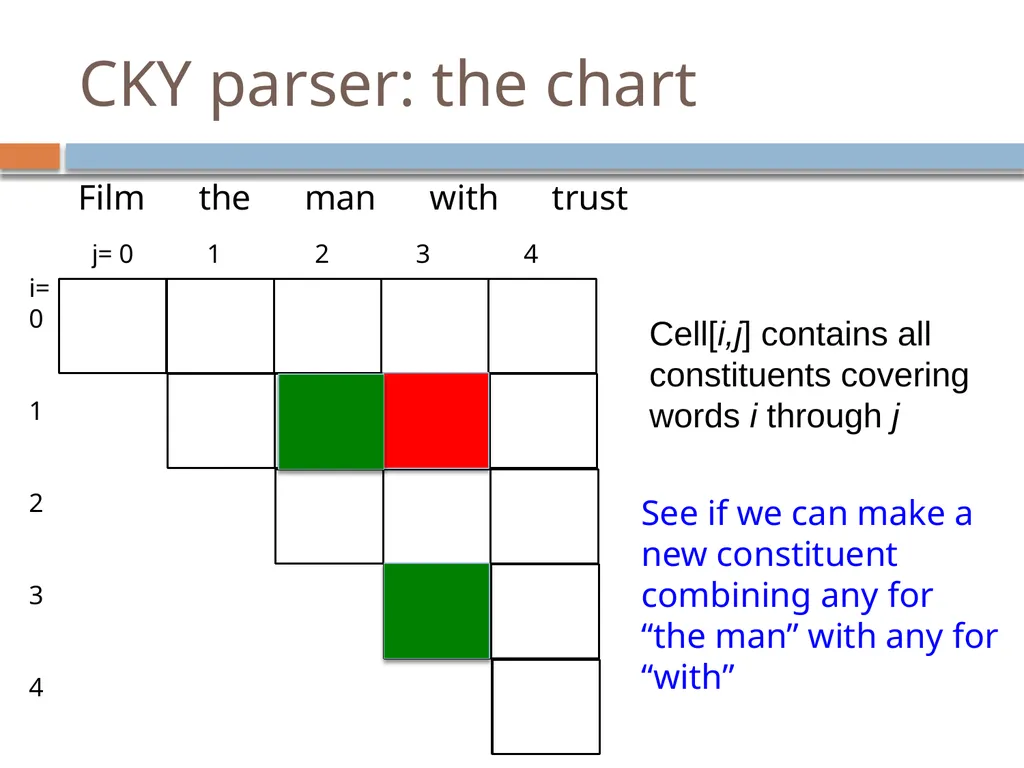
constituents covering words i through j Film the man with trust See if we can make a new constituent combining any for “the man” with any for “with”<br>
slide83. CKY parser: the chart i=
0
1
2
3
4 j= 0 1 2 3 4 Cell[i,j] contains all
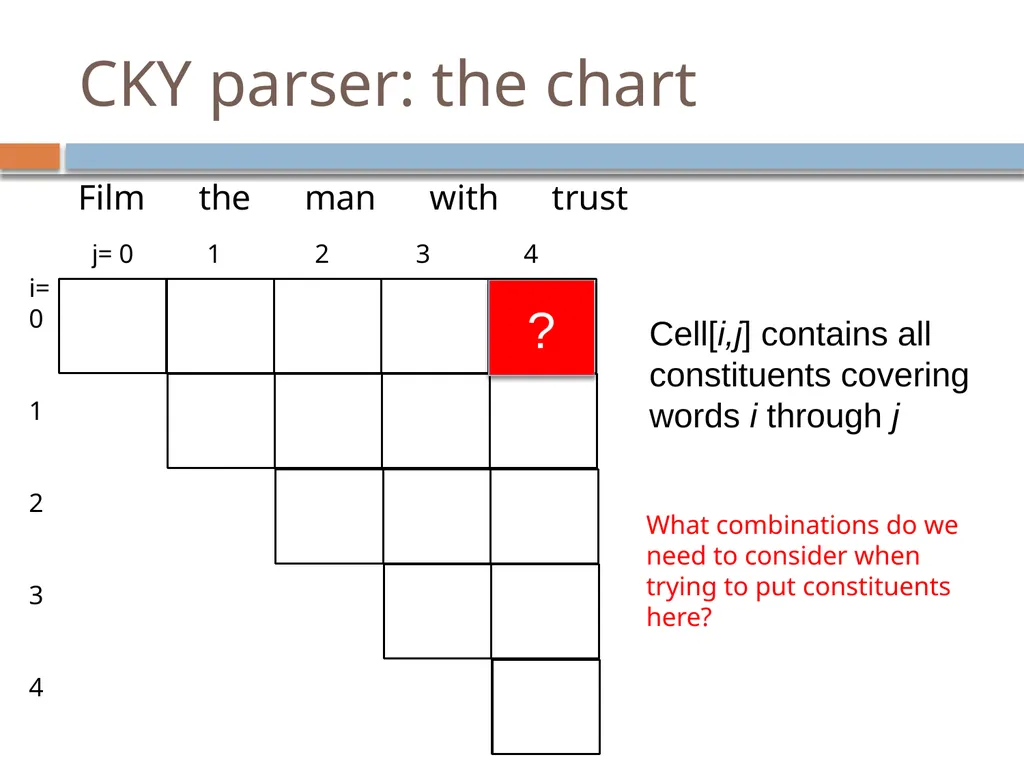
constituents covering words i through j Film the man with trust ? What combinations do we need to consider when trying to put constituents here?<br>
slide84. CKY parser: the chart i=
0
1
2
3
4 j= 0 1 2 3 4 Cell[i,j] contains all
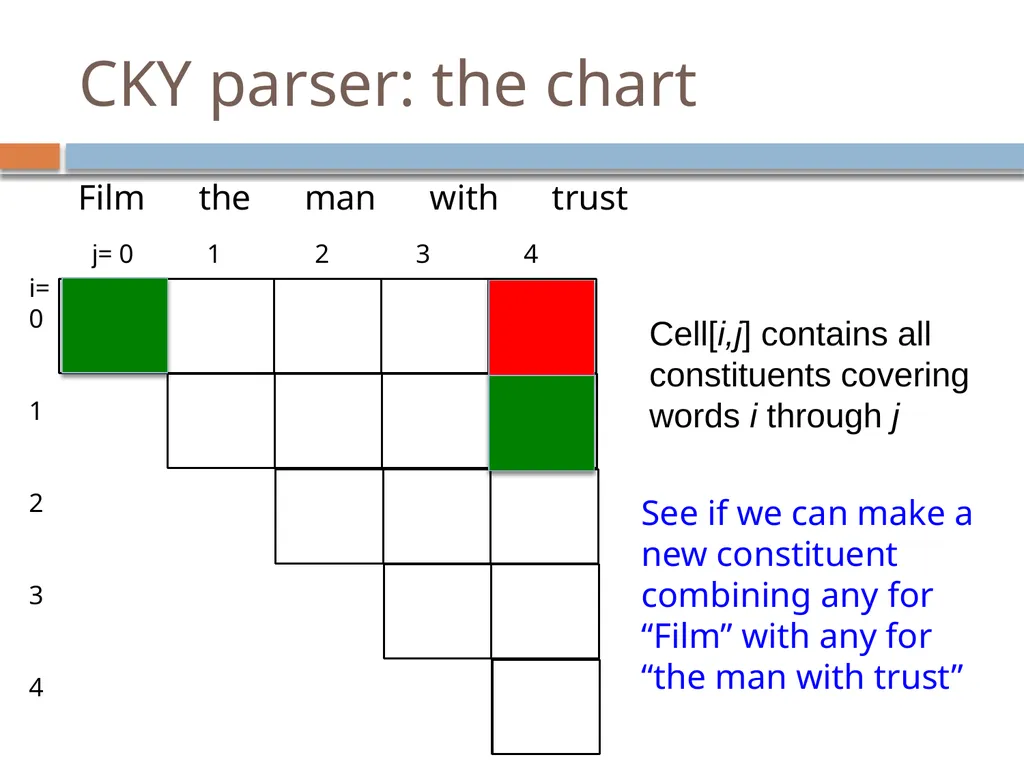
constituents covering words i through j Film the man with trust See if we can make a new constituent combining any for “Film” with any for “the man with trust”<br>
slide85. CKY parser: the chart i=
0
1
2
3
4 j= 0 1 2 3 4 Cell[i,j] contains all
constituents covering words i through j Film the man with trust See if we can make a new constituent combining any for “Film the” with any for “man with trust”<br>
slide86. CKY parser: the chart i=
0
1
2
3
4 j= 0 1 2 3 4 Cell[i,j] contains all
constituents covering words i through j Film the man with trust See if we can make a new constituent combining any for “Film the man” with any for “with trust”<br>
slide87. CKY parser: the chart i=
0
1
2
3
4 j= 0 1 2 3 4 Cell[i,j] contains all
constituents covering words i through j Film the man with trust See if we can make a new constituent combining any for “Film the man with” with any for “trust”<br>
slide88. CKY parser: the chart i=
0
1
2
3
4 j= 0 1 2 3 4 Cell[i,j] contains all
constituents covering words i through j Film the man with trust What if our rules weren’t binary?<br>
slide89. CKY parser: the chart i=
0
1
2
3
4 j= 0 1 2 3 4 Cell[i,j] contains all
constituents covering words i through j Film the man with trust See if we can make a new constituent combining any for “Film” with any for “the man” with any for “with trust”<br>
slide90. CKY parser: the chart i=
0
1
2
3
4 j= 0 1 2 3 4 Cell[i,j] contains all
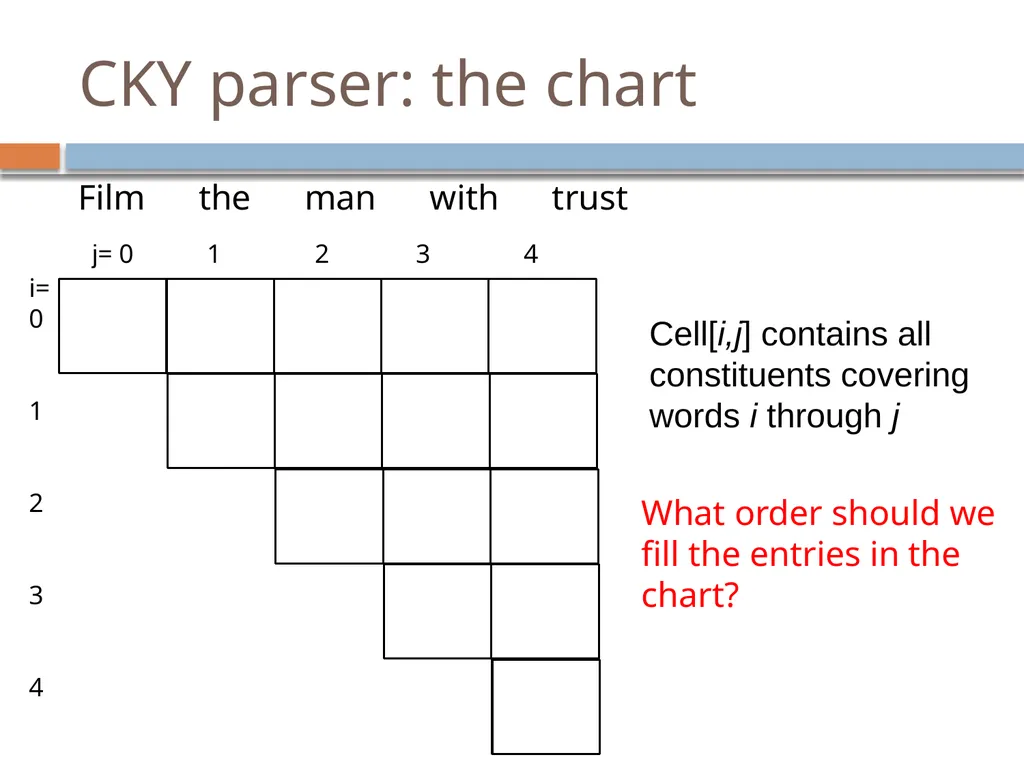
constituents covering words i through j Film the man with trust What order should we fill the entries in the chart?<br>
slide91. CKY parser: the chart i=
0
1
2
3
4 j= 0 1 2 3 4 Cell[i,j] contains all
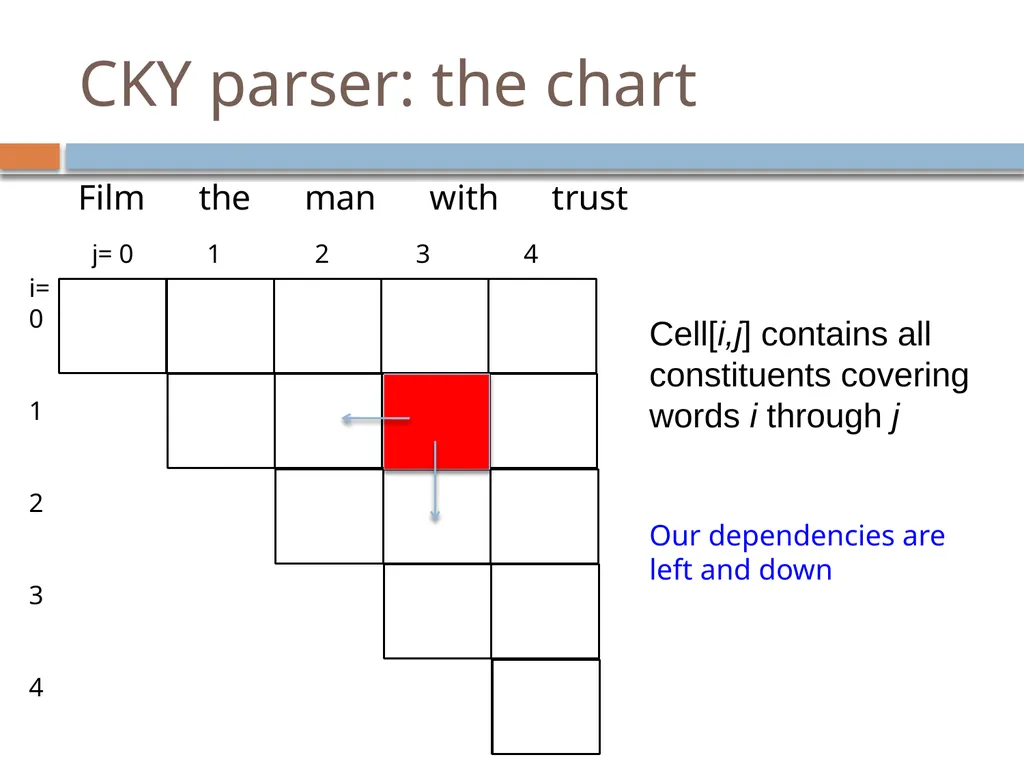
constituents covering words i through j Film the man with trust Our dependencies are left and down<br>
slide92. CKY parser: the chart i=
0
1
2
3
4 j= 0 1 2 3 4 Cell[i,j] contains all
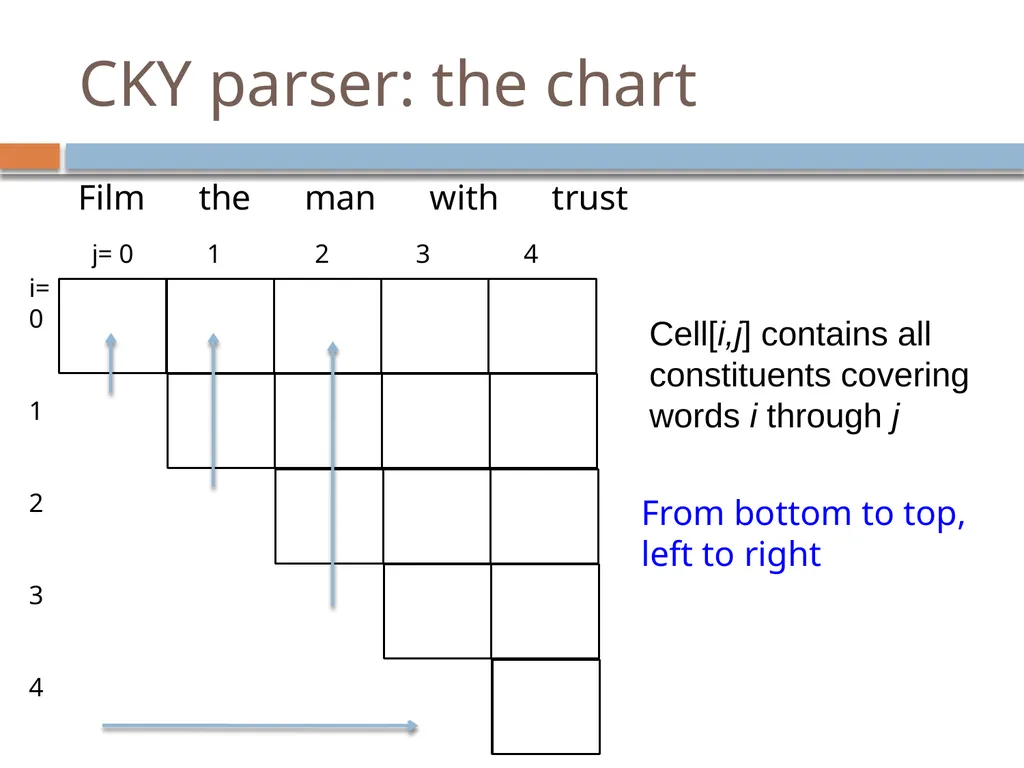
constituents covering words i through j Film the man with trust From bottom to top, left to right<br>
slide93. CKY parser: the chart i=
0
1
2
3
4 j= 0 1 2 3 4 Cell[i,j] contains all
constituents covering words i through j Film the man with trust Top-left along the diagonals moving to the right<br>
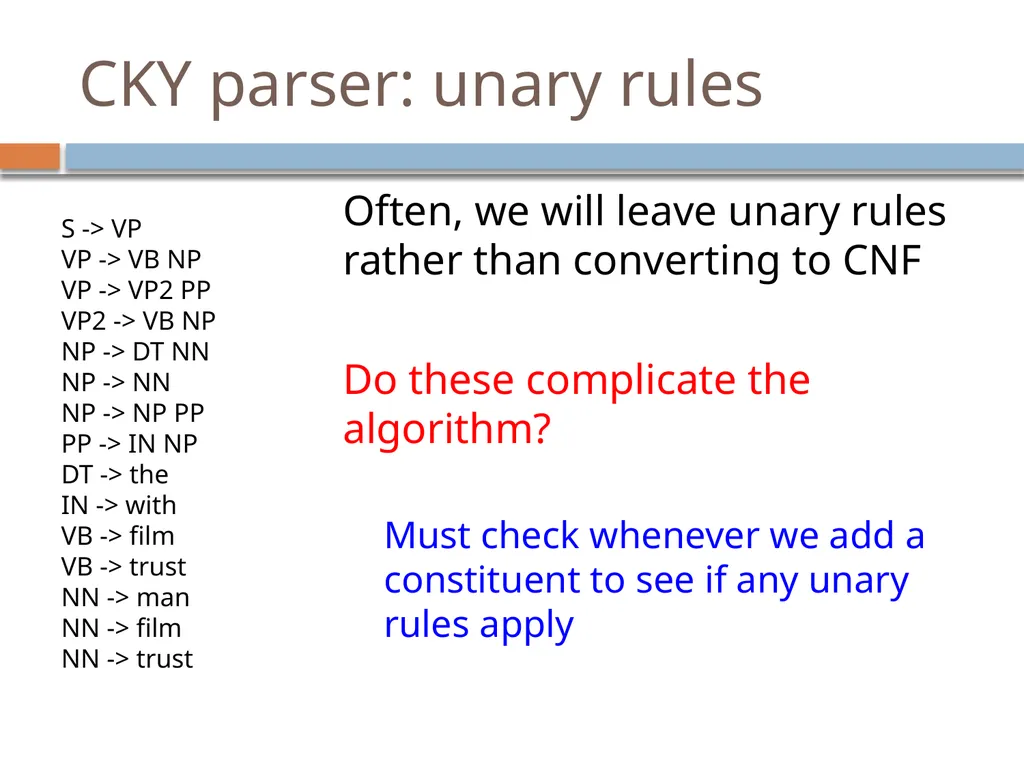
slide94. CKY parser: unary rules Often, we will leave unary rules rather than converting to CNF
Do these complicate the algorithm?
Must check whenever we add a constituent to see if any unary rules apply S -> VP
VP -> VB NP
VP -> VP2 PP
VP2 -> VB NP
NP -> DT NN
NP -> NN
NP -> NP PP
PP -> IN NP
DT -> the
IN -> with
VB -> film
VB -> trust
NN -> man
NN -> film
NN -> trust<br>
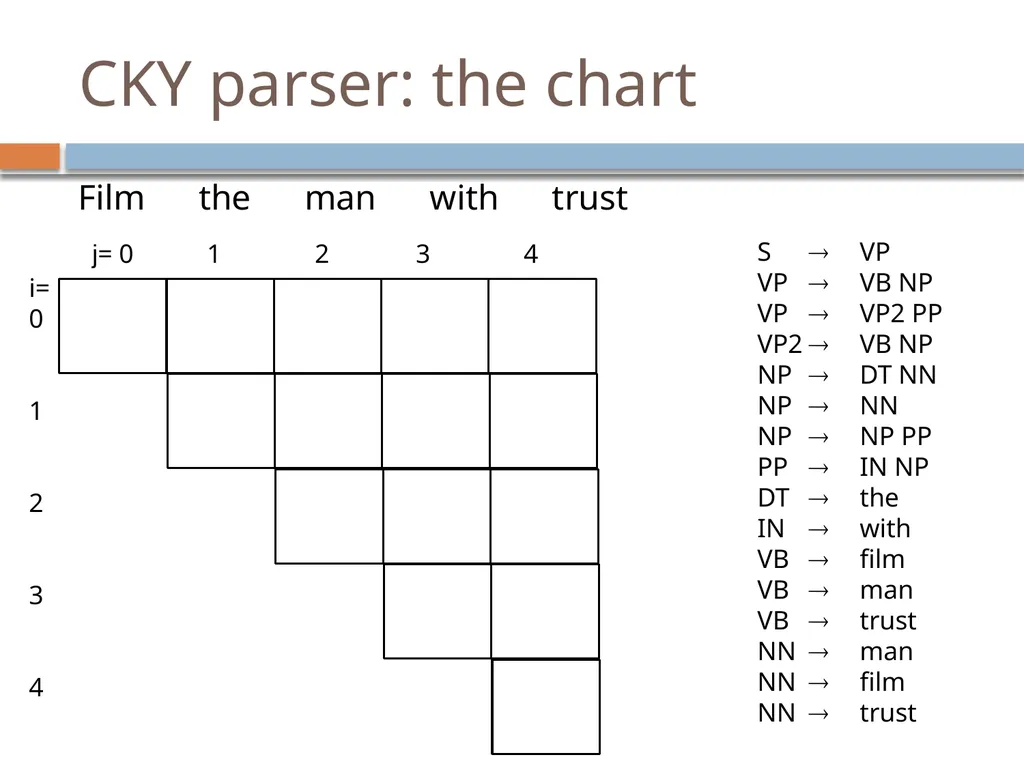
slide95. CKY parser: the chart i=
0
1
2
3
4 j= 0 1 2 3 4 Film the man with trust S VP
VP VB NP
VP VP2 PP
VP2 VB NP
NP DT NN
NP NN
NP NP PP
PP IN NP
DT the
IN with
VB film
VB man
VB trust
NN man
NN film
NN trust<br>
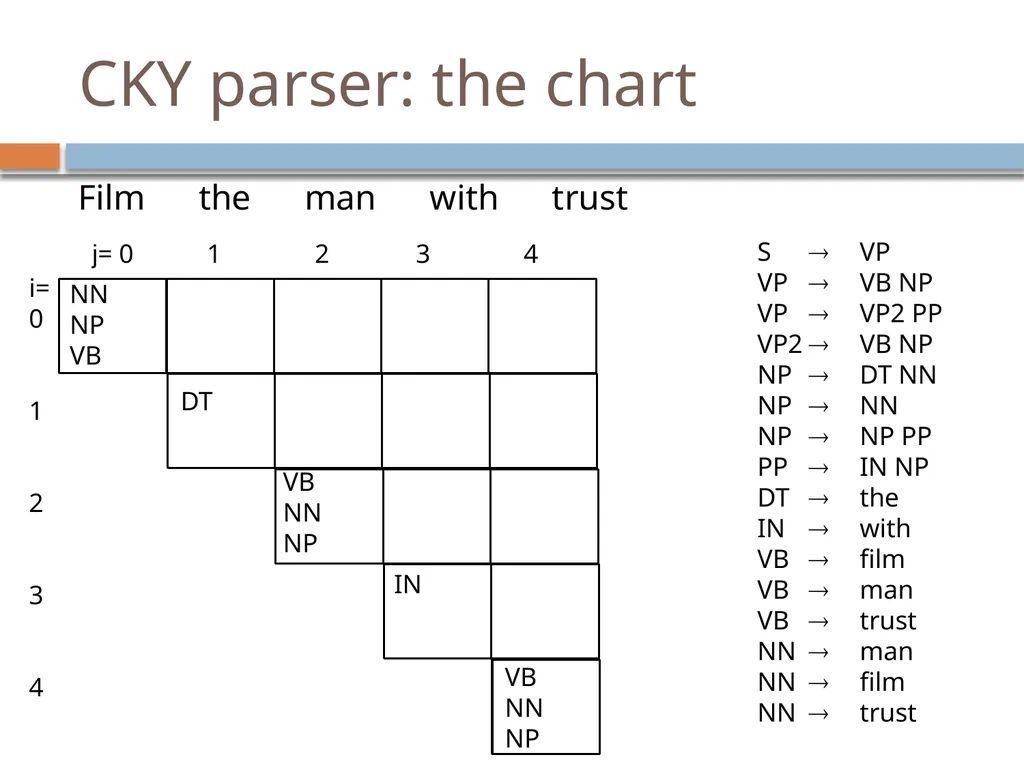
slide96. CKY parser: the chart i=
0
1
2
3
4 j= 0 1 2 3 4 Film the man with trust NN
NP
VB DT VB
NN
NP IN VB
NN
NP S VP
VP VB NP
VP VP2 PP
VP2 VB NP
NP DT NN
NP NN
NP NP PP
PP IN NP
DT the
IN with
VB film
VB man
VB trust
NN man
NN film
NN trust<br>
slide97. CKY parser: the chart i=
0
1
2
3
4 j= 0 1 2 3 4 Film the man with trust DT VB
NN
NP IN VB
NN
NP NP PP NN
NP
VB S VP
VP VB NP
VP VP2 PP
VP2 VB NP
NP DT NN
NP NN
NP NP PP
PP IN NP
DT the
IN with
VB film
VB man
VB trust
NN man
NN film
NN trust<br>
slide98. CKY parser: the chart i=
0
1
2
3
4 j= 0 1 2 3 4 Film the man with trust DT VB
NN
NP IN VB
NN
NP NP PP VP2
VP
S NP NN
NP
VB S VP
VP VB NP
VP VP2 PP
VP2 VB NP
NP DT NN
NP NN
NP NP PP
PP IN NP
DT the
IN with
VB film
VB man
VB trust
NN man
NN film
NN trust<br>
slide99. CKY parser: the chart i=
0
1
2
3
4 j= 0 1 2 3 4 Film the man with trust DT VB
NN
NP IN VB
NN
NP NP PP VP2
VP
S NP NP NN
NP
VB S VP
VP VB NP
VP VP2 PP
VP2 VB NP
NP DT NN
NP NN
NP NP PP
PP IN NP
DT the
IN with
VB film
VB man
VB trust
NN man
NN film
NN trust<br>
slide100. CKY parser: the chart i=
0
1
2
3
4 j= 0 1 2 3 4 Film the man with trust DT VB
NN
NP IN VB
NN
NP NP PP VP2
VP
S NP NP S
VP
VP2 NN
NP
VB S VP
VP VB NP
VP VP2 PP
VP2 VB NP
NP DT NN
NP NN
NP NP PP
PP IN NP
DT the
IN with
VB film
VB man
VB trust
NN man
NN film
NN trust<br>
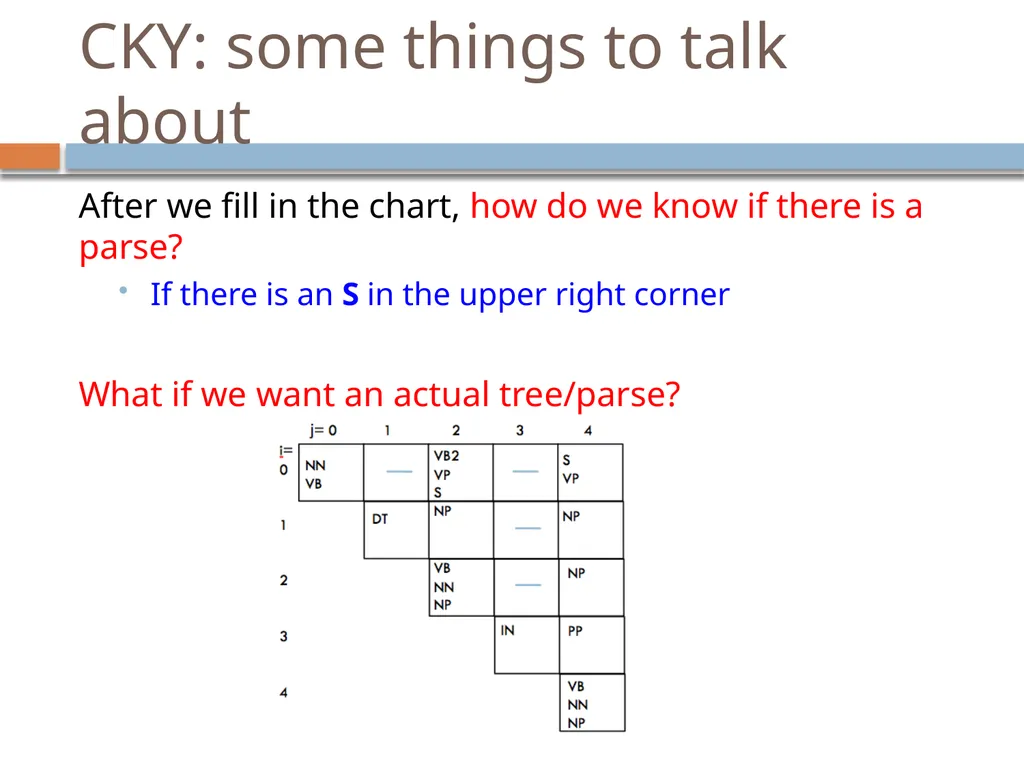
slide101. CKY: some things to talk about After we fill in the chart, how do we know if there is a parse?
If there is an S in the upper right corner
What if we want an actual tree/parse?<br>
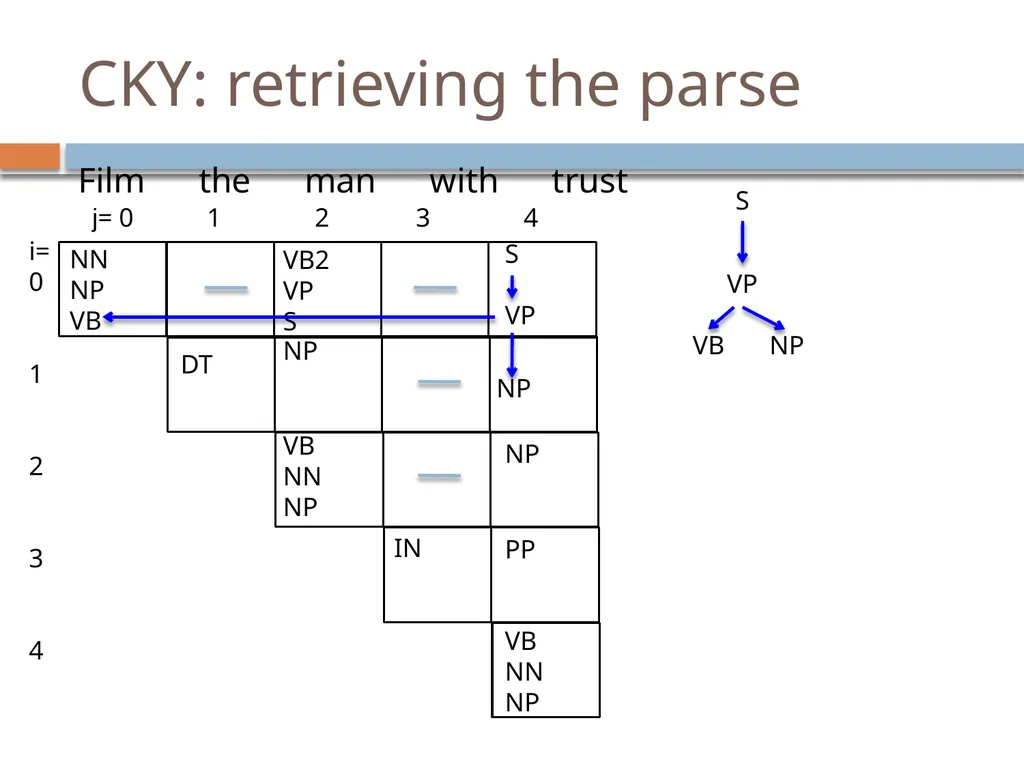
slide102. CKY: retrieving the parse i=
0
1
2
3
4 j= 0 1 2 3 4 DT VB
NN
NP IN VB
NN
NP NP PP VB2
VP
S NP NP S
VP S VP VB NP Film the man with trust NN
NP
VB<br>
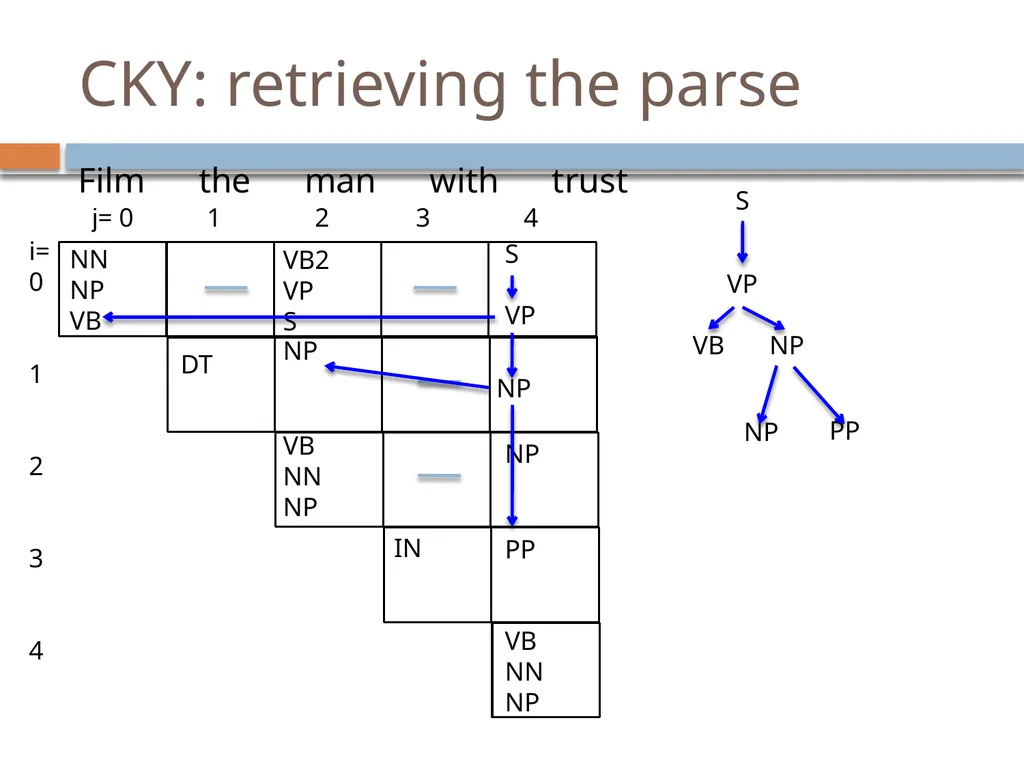
slide103. CKY: retrieving the parse i=
0
1
2
3
4 j= 0 1 2 3 4 DT VB
NN
NP IN VB
NN
NP NP PP VB2
VP
S NP NP S
VP S VP VB NP NP PP Film the man with trust NN
NP
VB<br>
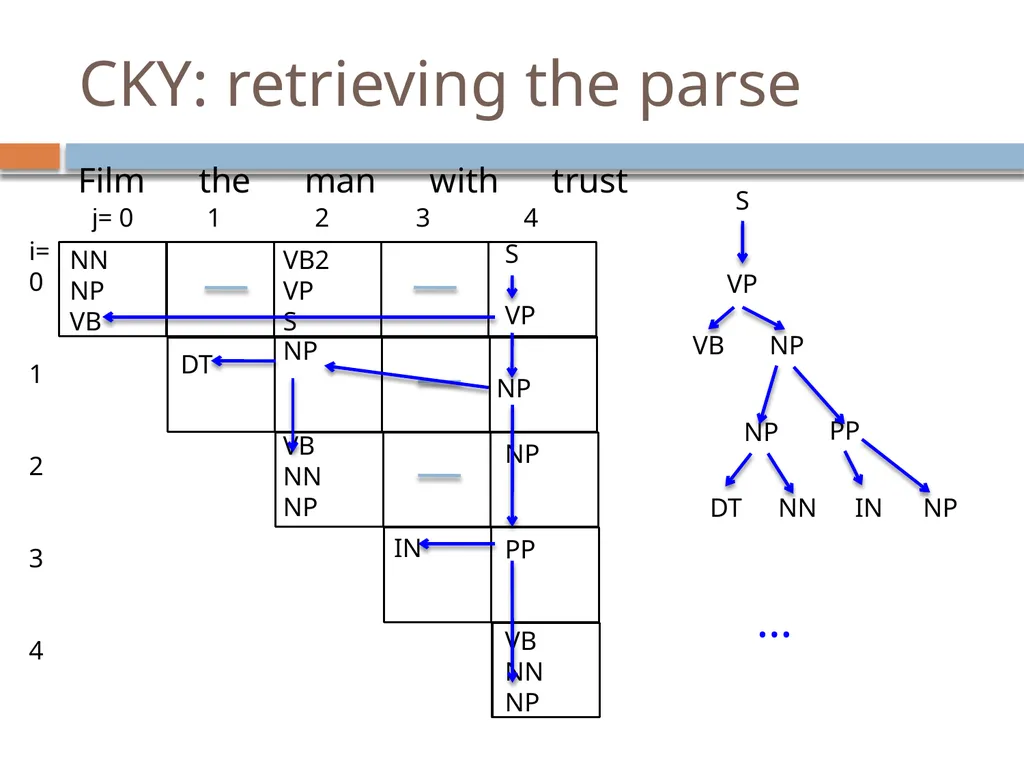
slide104. CKY: retrieving the parse i=
0
1
2
3
4 j= 0 1 2 3 4 DT VB
NN
NP IN VB
NN
NP NP PP VB2
VP
S NP NP S
VP S VP VB NP NP PP Film the man with trust DT NN IN NP … NN
NP
VB<br>
slide105. CKY: retrieving the parse i=
0
1
2
3
4 j= 0 1 2 3 4 DT VB
NN
NP IN VB
NN
NP NP PP VB2
VP
S NP NP S
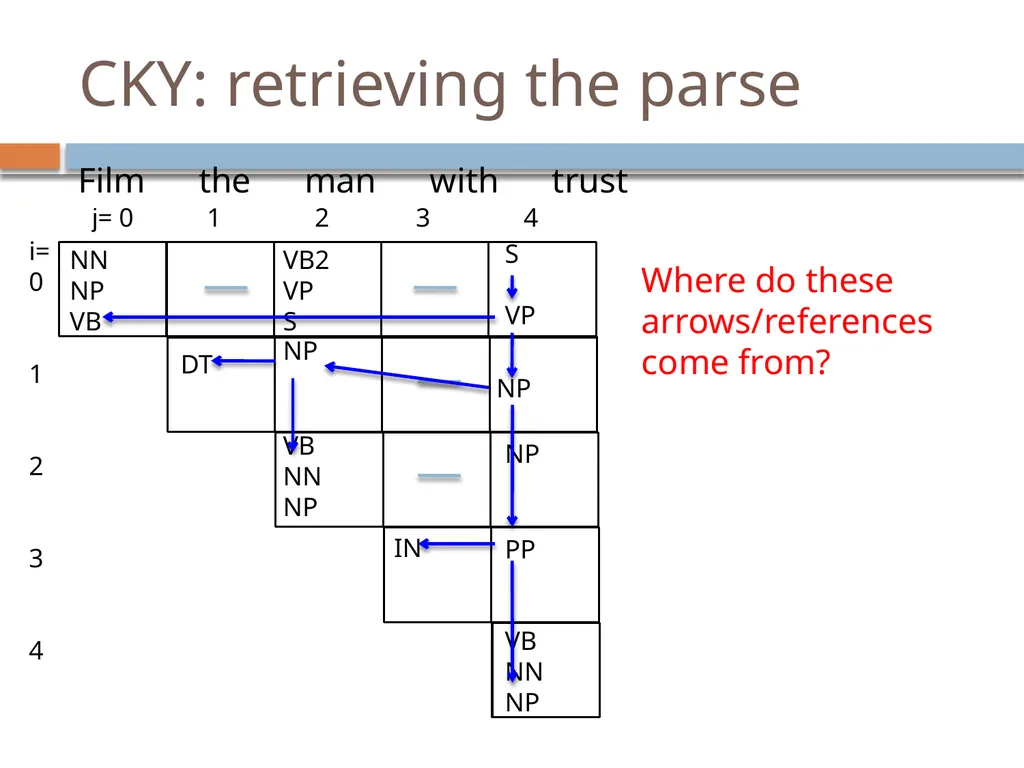
VP Film the man with trust Where do these arrows/references come from? NN
NP
VB<br>
slide106. CKY: retrieving the parse i=
0
1
2
3
4 j= 0 1 2 3 4 DT VB
NN
NP IN VB
NN
NP NP PP VB2
VP
S NP NP S
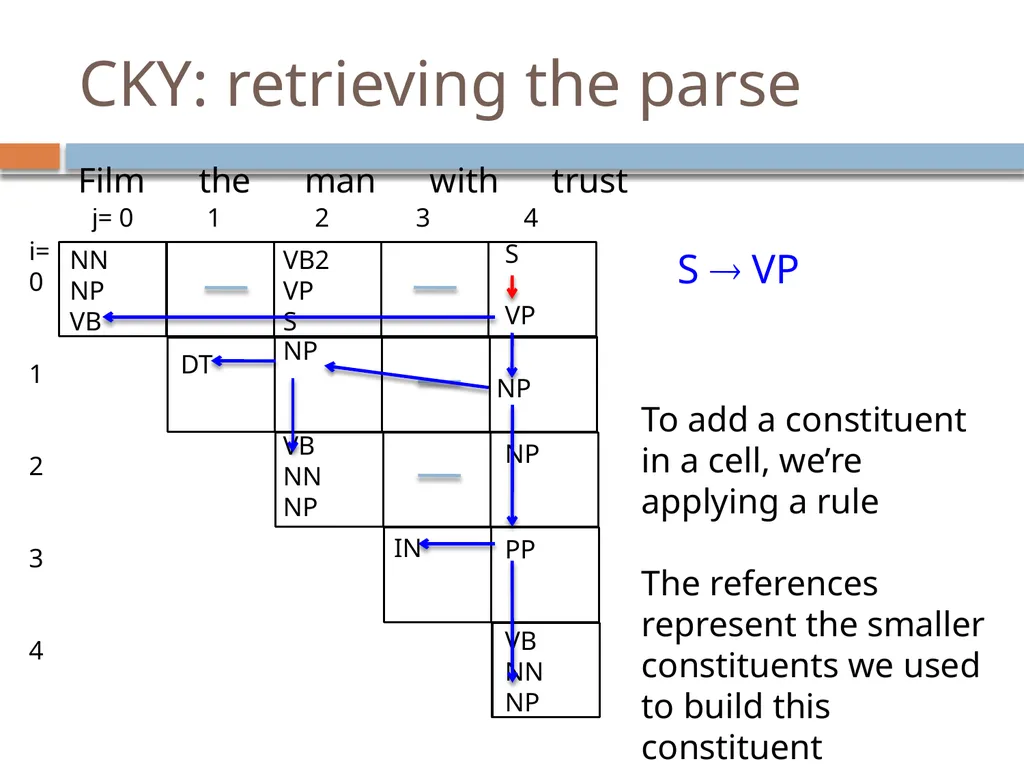
VP Film the man with trust To add a constituent in a cell, we’re applying a rule
The references represent the smaller constituents we used to build this constituent S VP NN
NP
VB<br>
slide107. CKY: retrieving the parse i=
0
1
2
3
4 j= 0 1 2 3 4 DT VB
NN
NP IN VB
NN
NP NP PP VB2
VP
S NP NP S
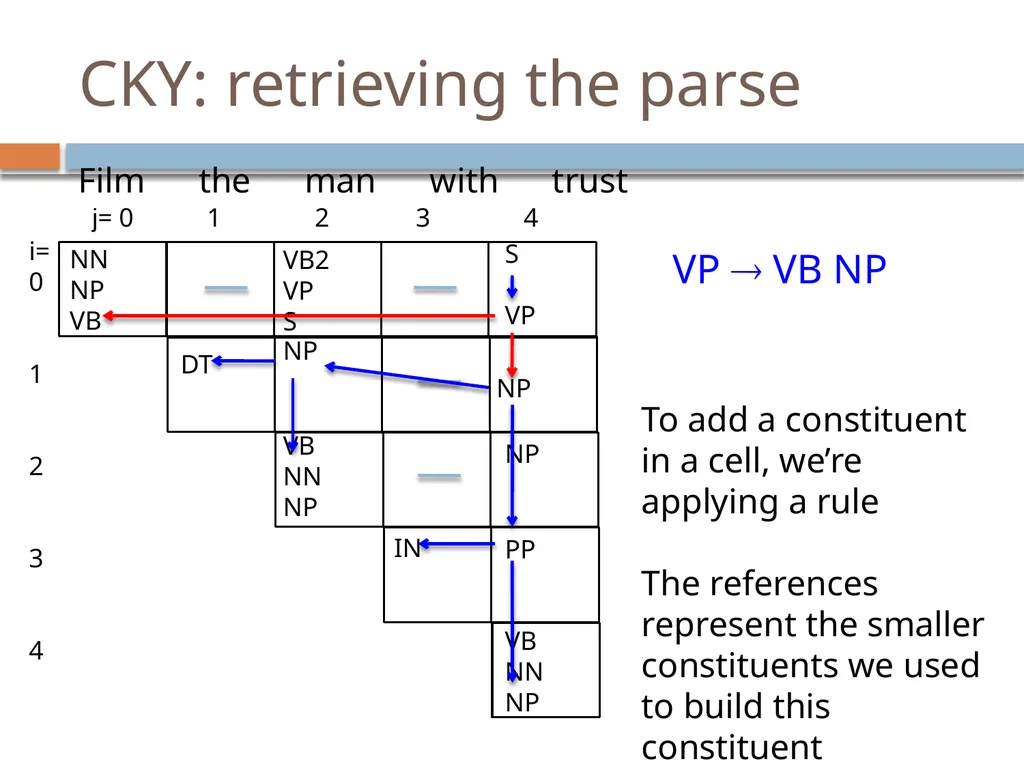
VP Film the man with trust To add a constituent in a cell, we’re applying a rule
The references represent the smaller constituents we used to build this constituent VP VB NP NN
NP
VB<br>
slide108. CKY: retrieving the parse i=
0
1
2
3
4 j= 0 1 2 3 4 DT VB
NN
NP IN VB
NN
NP NP PP VB2
VP
S NP NP S
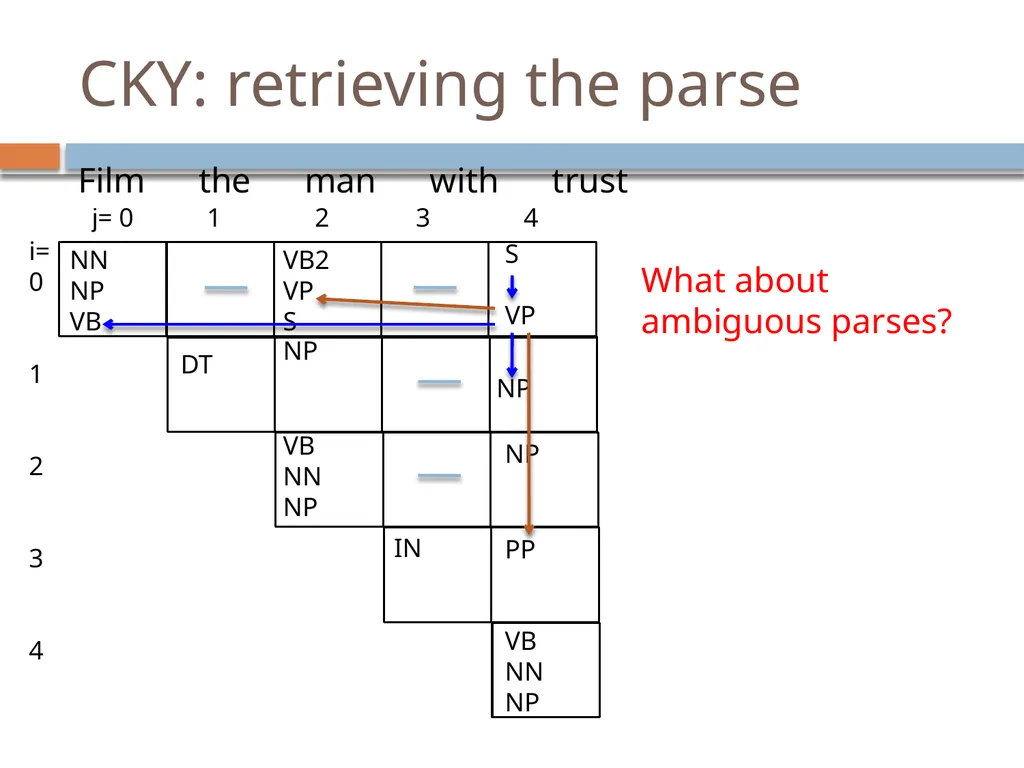
VP Film the man with trust What about ambiguous parses? NN
NP
VB<br>
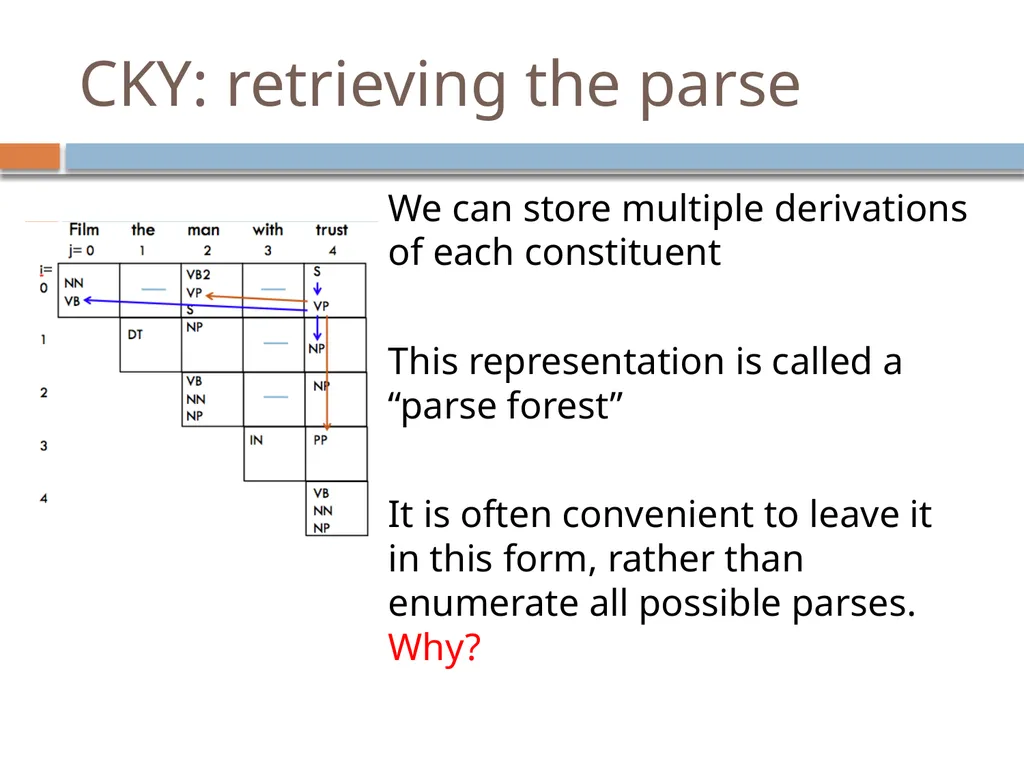
slide109. CKY: retrieving the parse We can store multiple derivations of each constituent
This representation is called a “parse forest”
It is often convenient to leave it in this form, rather than enumerate all possible parses. Why?<br>
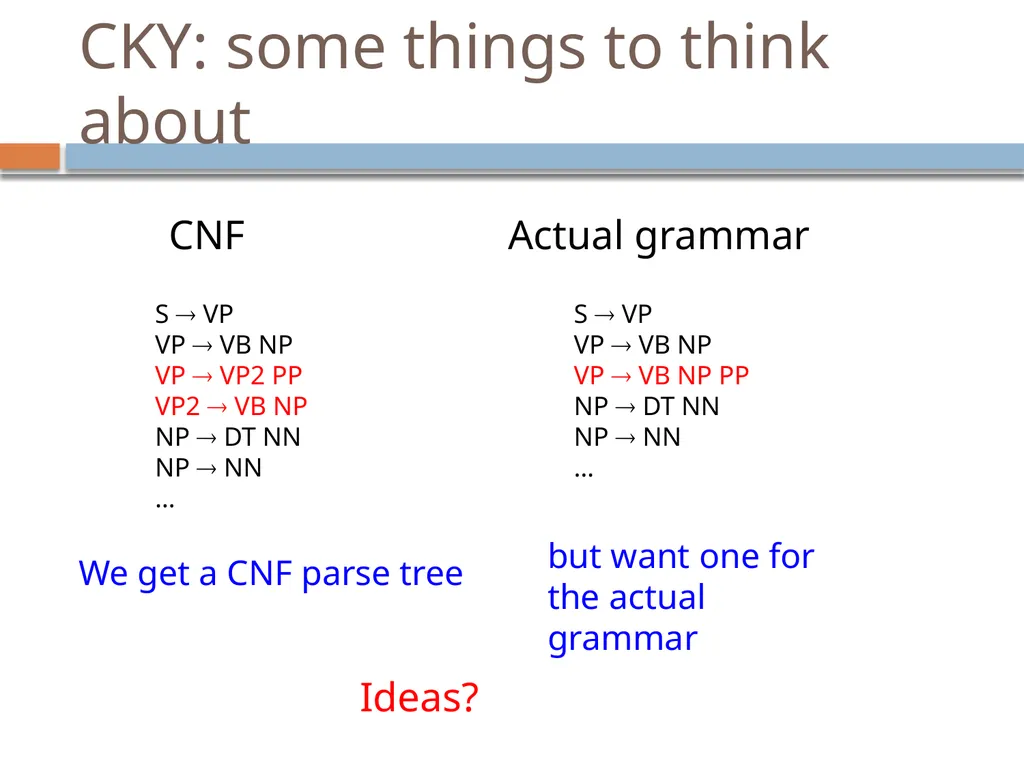
slide110. CKY: some things to think about S VP
VP VB NP
VP VB NP PP
NP DT NN
NP NN
… S VP
VP VB NP
VP VP2 PP
VP2 VB NP
NP DT NN
NP NN
… Actual grammar CNF We get a CNF parse tree but want one for the actual grammar Ideas?<br>
slide111. Parsing ambiguity I eat sushi with tuna PRP NP V N IN N PP NP VP S I eat sushi with tuna PRP NP V N IN N PP NP VP S S NP VP
NP PRP
NP N PP
VP V NP
VP V NP PP
PP IN N
PRP I
V eat
N sushi
N tuna
IN with How can we decide between these?<br>
slide112. A Simple PCFG Probabilities!<br>
slide113. = 1.0 * 0.1 * 0.7 * 1.0 * 0.4 * 0.18
* 1.0 * 1.0 * 0.18
= 0.0009072 = 1.0 * 0.1 * 0.3 * 0.7 * 1.0 * 0.18
* 1.0 * 1.0 * 0.18
= 0.0006804<br>
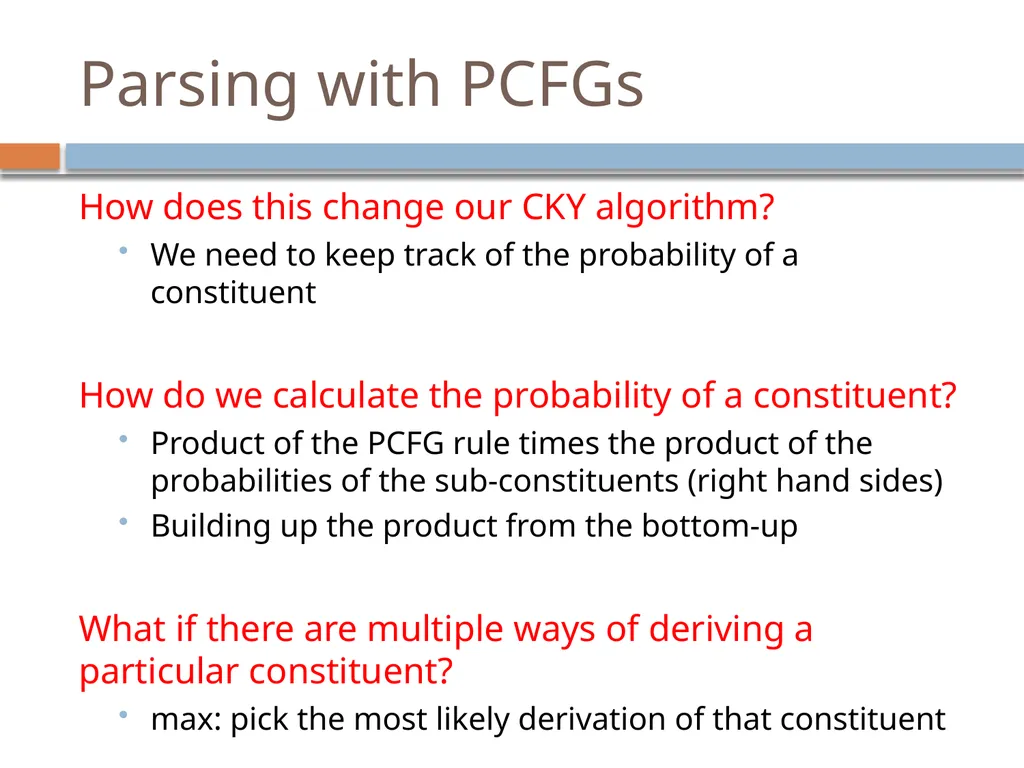
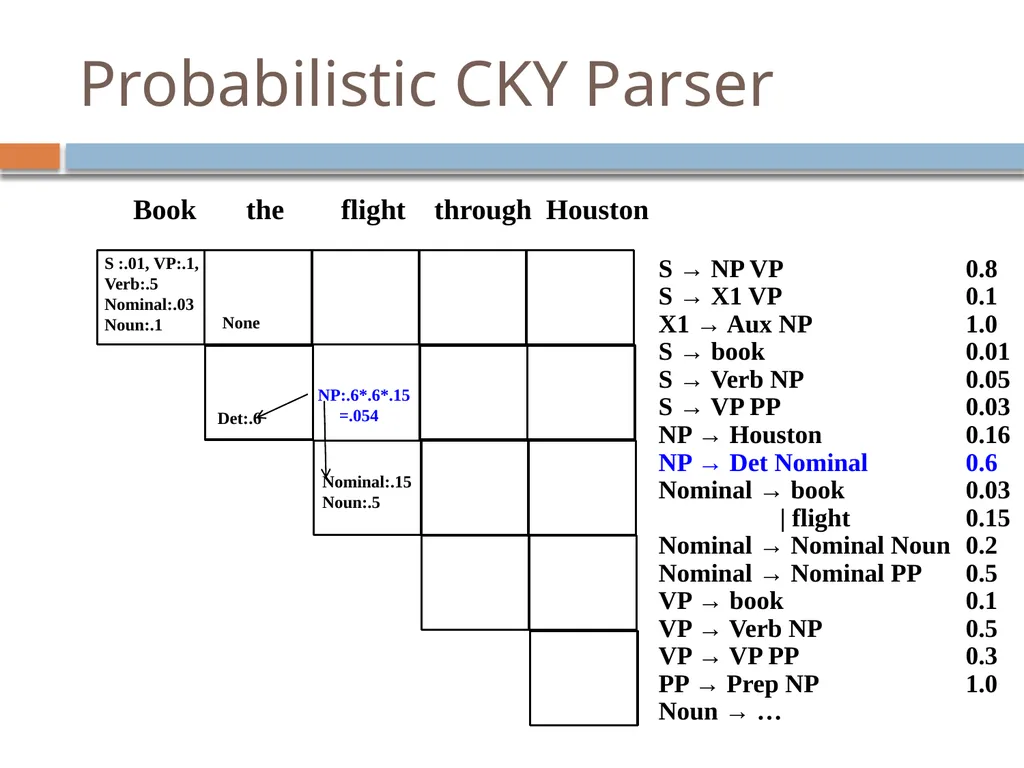
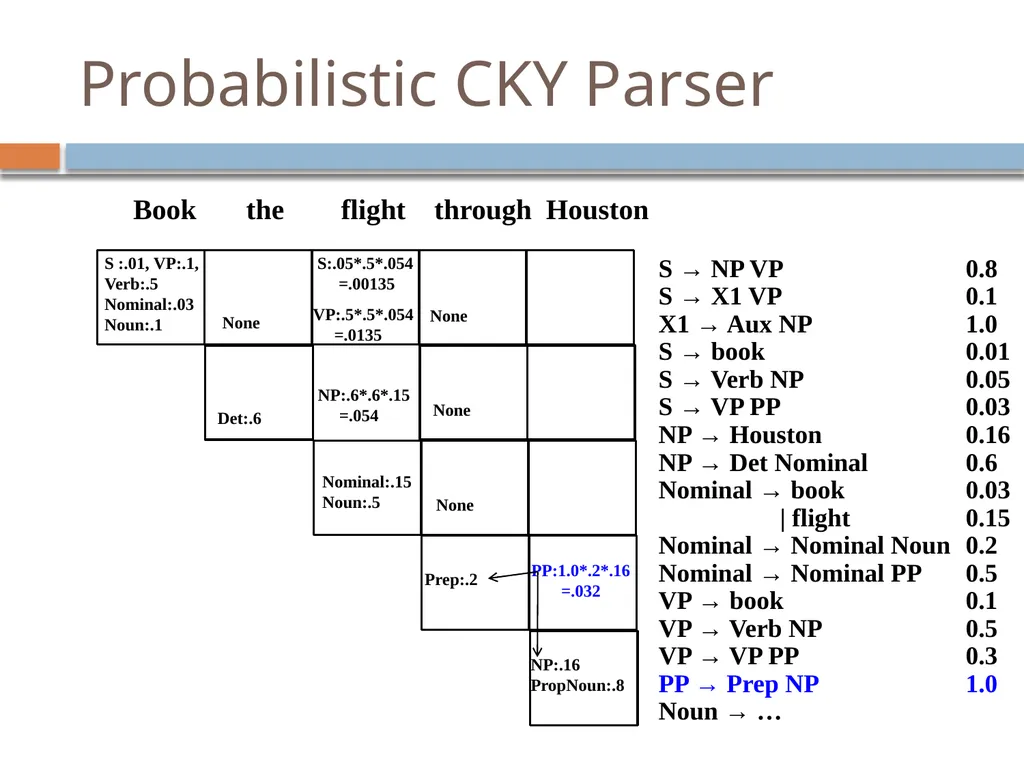
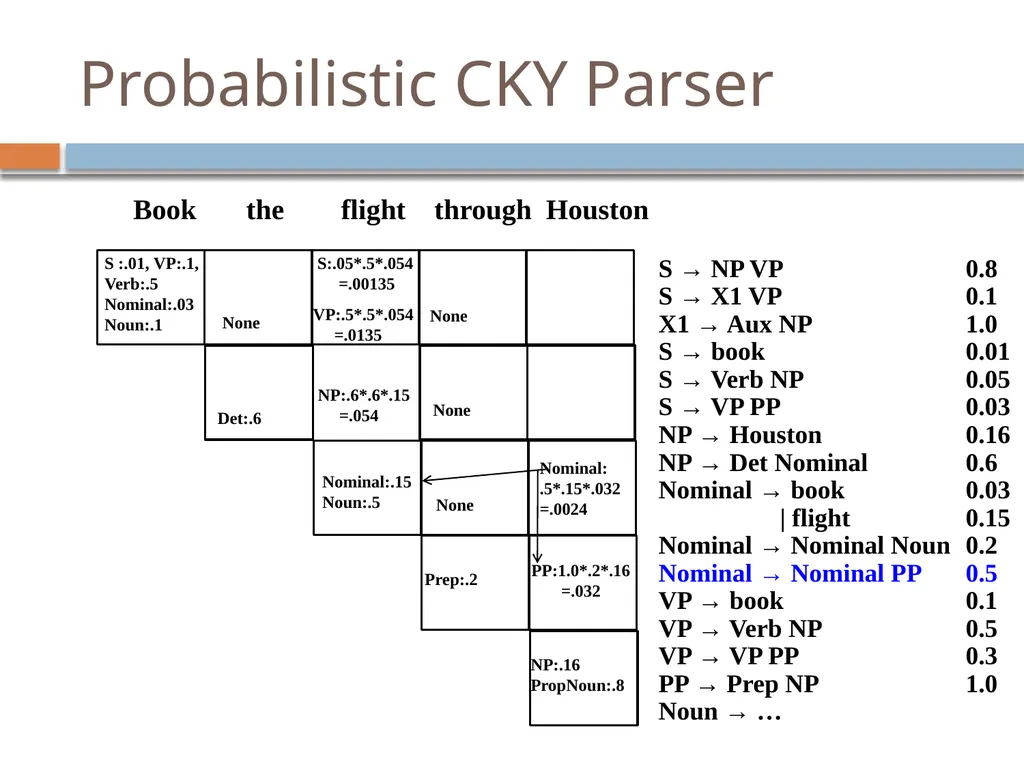
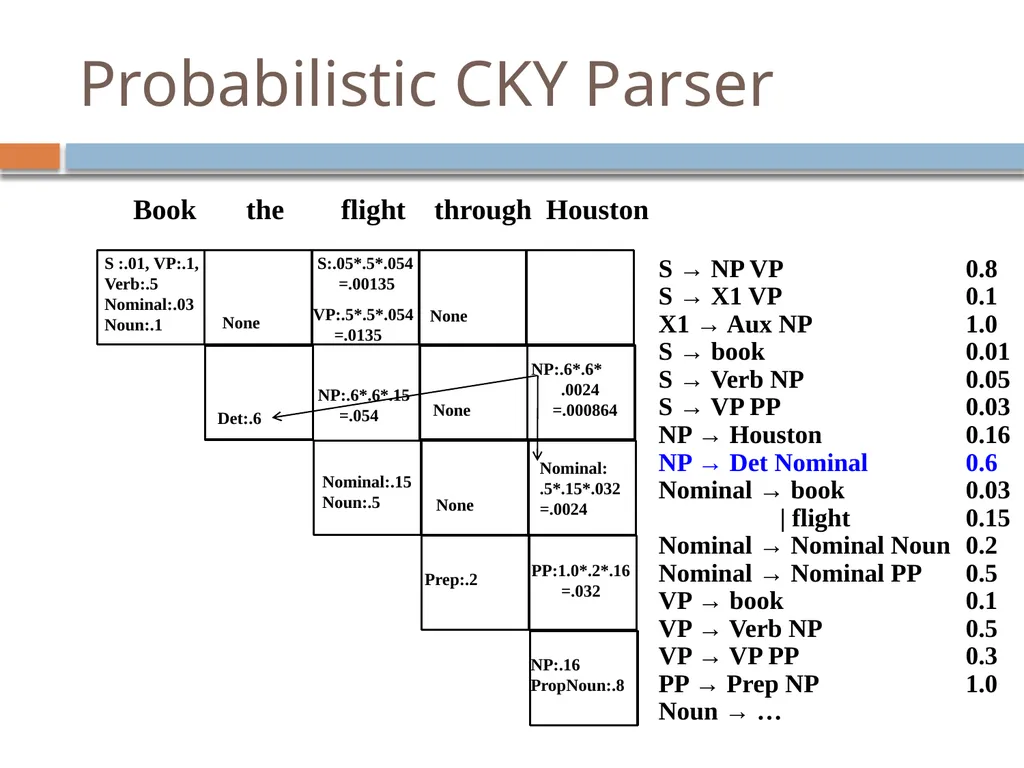
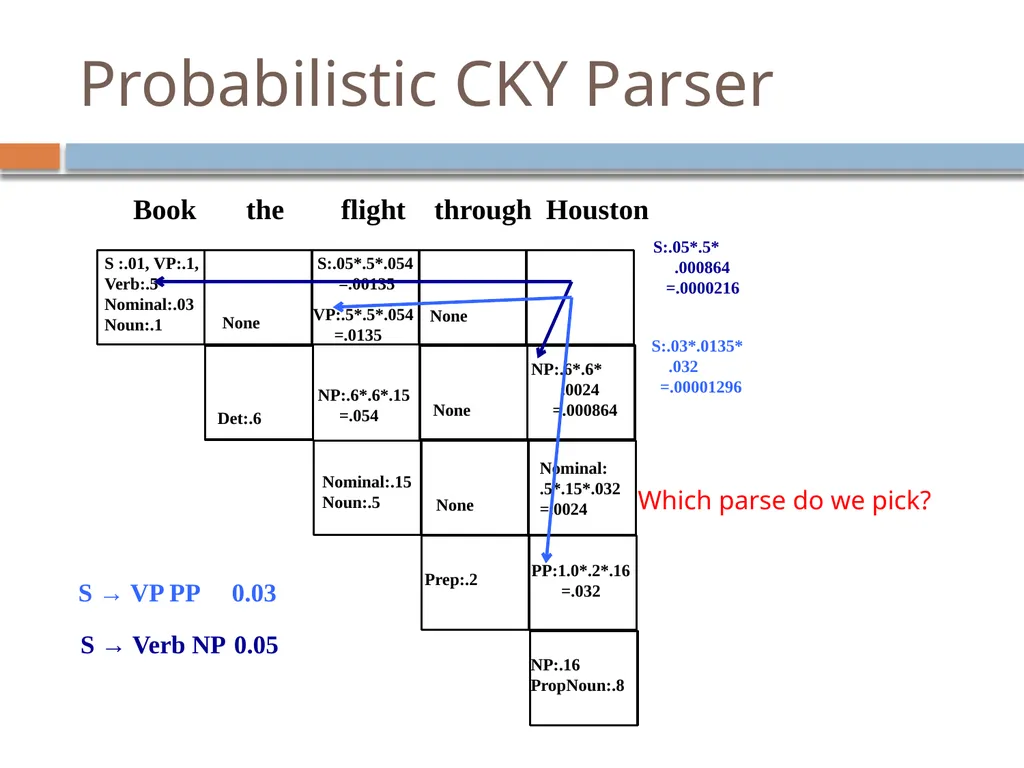
slide114. Parsing with PCFGs How does this change our CKY algorithm?
We need to keep track of the probability of a constituent
How do we calculate the probability of a constituent?
Product of the PCFG rule times the product of the probabilities of the sub-constituents (right hand sides)
Building up the product from the bottom-up
What if there are multiple ways of deriving a particular constituent?
max: pick the most likely derivation of that constituent<br>
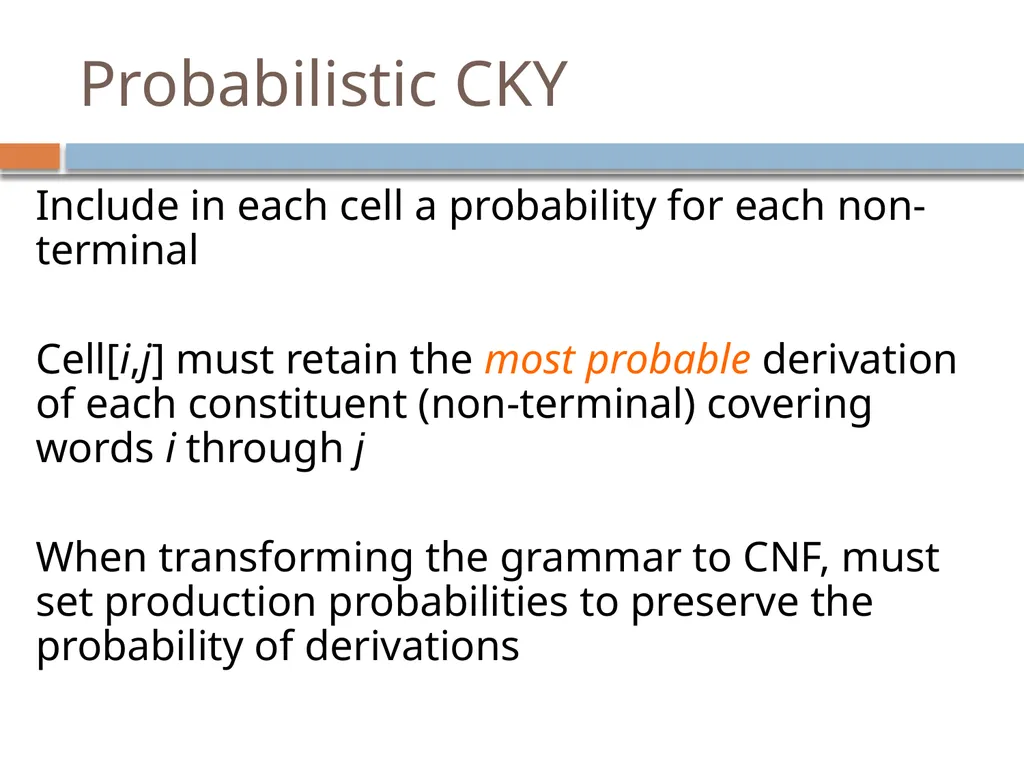
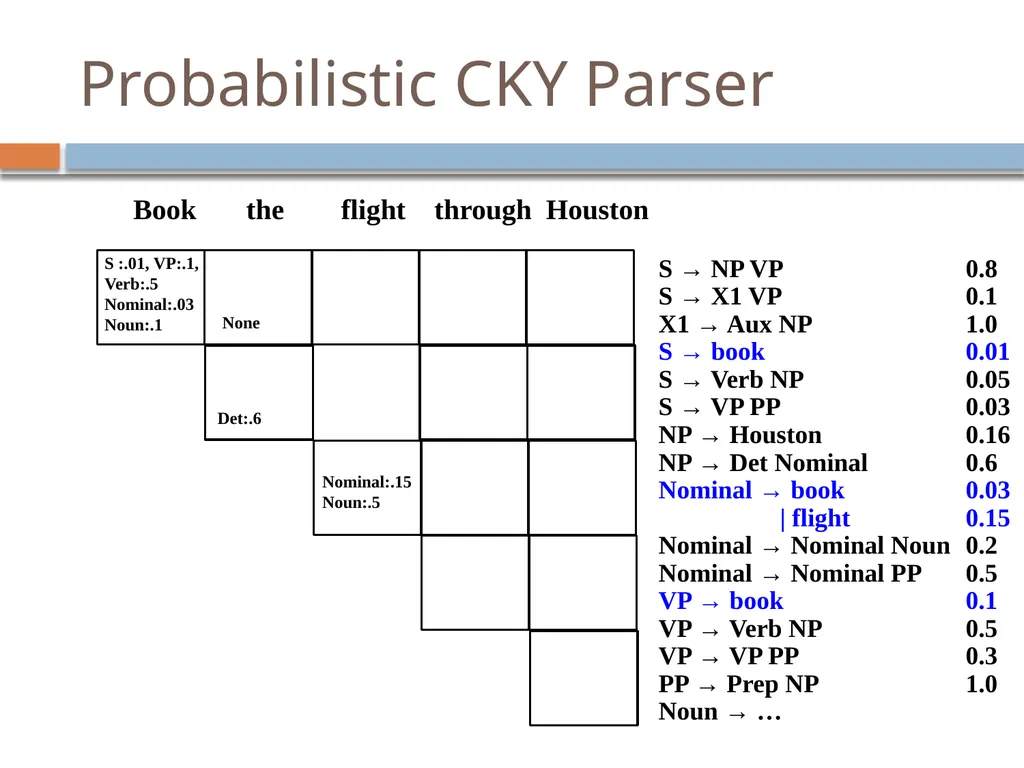
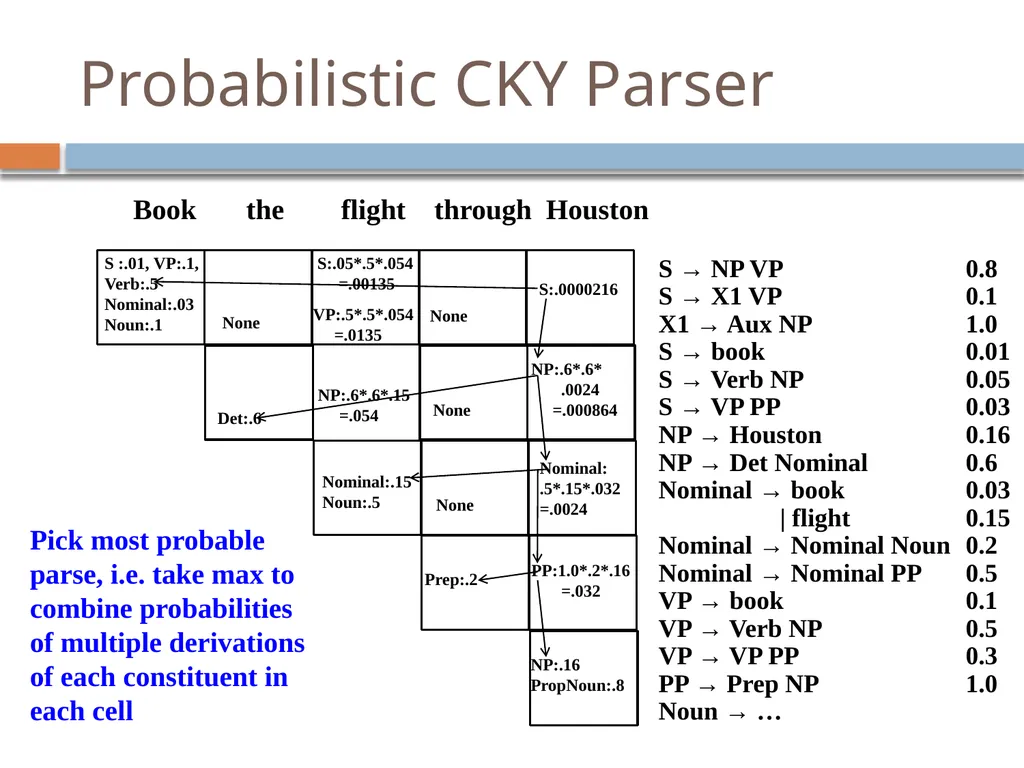
slide115. Probabilistic CKY Include in each cell a probability for each non-terminal
Cell[i,j] must retain the most probable derivation of each constituent (non-terminal) covering words i through j
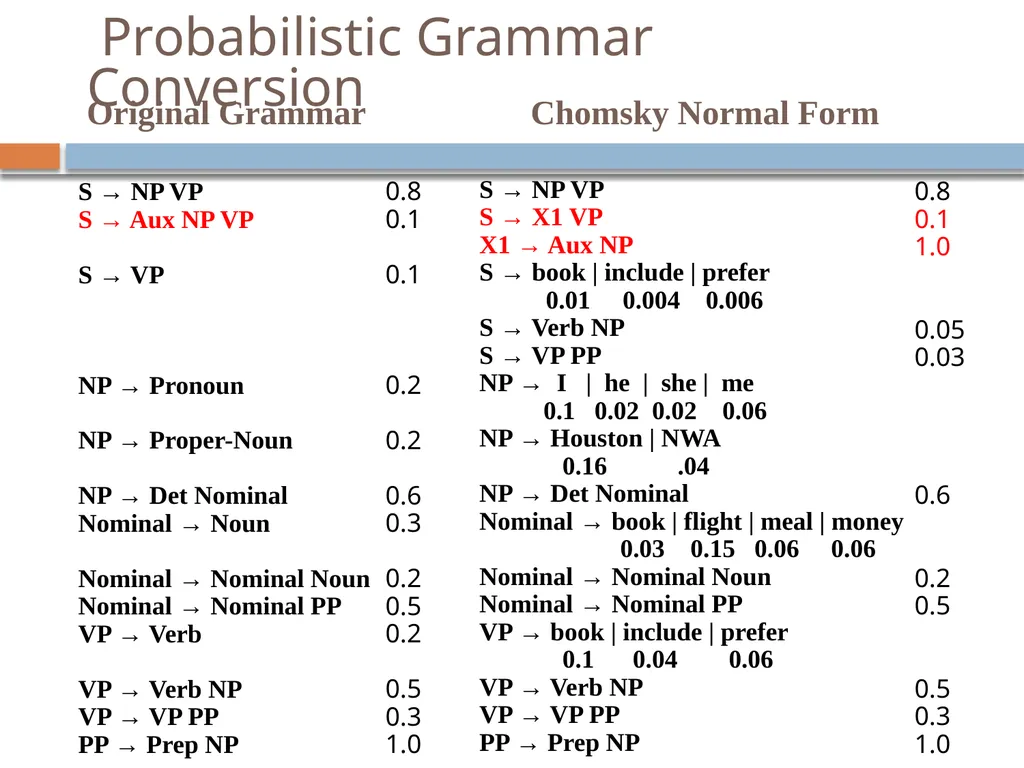
When transforming the grammar to CNF, must set production probabilities to preserve the probability of derivations<br>
slide116. Probabilistic Grammar Conversion S → NP VP
S → Aux NP VP
S → VP
NP → Pronoun
NP → Proper-Noun
NP → Det Nominal
Nominal → Noun
Nominal → Nominal Noun
Nominal → Nominal PP
VP → Verb
VP → Verb NP
VP → VP PP
PP → Prep NP Original Grammar Chomsky Normal Form S → NP VP
S → X1 VP
X1 → Aux NP
S → book | include | prefer
0.01 0.004 0.006
S → Verb NP
S → VP PP
NP → I | he | she | me
0.1 0.02 0.02 0.06
NP → Houston | NWA
0.16 .04
NP → Det Nominal
Nominal → book | flight | meal | money
0.03 0.15 0.06 0.06
Nominal → Nominal Noun
Nominal → Nominal PP
VP → book | include | prefer
0.1 0.04 0.06
VP → Verb NP
VP → VP PP
PP → Prep NP 0.8
0.1
0.1
0.2
0.2
0.6
0.3
0.2
0.5
0.2
0.5
0.3
1.0 0.8
0.1
1.0
0.05
0.03
0.6
0.2
0.5
0.5
0.3
1.0<br>
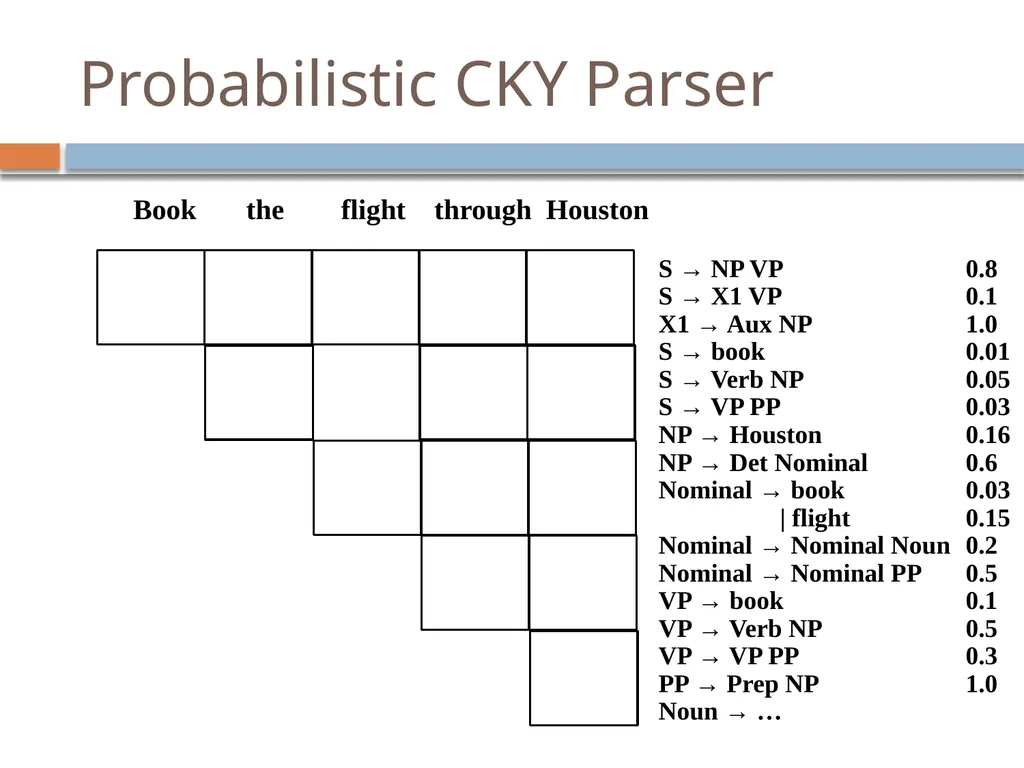
slide117. Probabilistic CKY Parser Book the flight through Houston S → NP VP 0.8
S → X1 VP 0.1
X1 → Aux NP 1.0
S → book 0.01
S → Verb NP 0.05
S → VP PP 0.03
NP → Houston 0.16
NP → Det Nominal 0.6
Nominal → book 0.03
| flight 0.15
Nominal → Nominal Noun 0.2
Nominal → Nominal PP 0.5
VP → book 0.1
VP → Verb NP 0.5
VP → VP PP 0.3
PP → Prep NP 1.0
Noun → …<br>
slide118. Probabilistic CKY Parser Book the flight through Houston S :.01, VP:.1,
Verb:.5
Nominal:.03
Noun:.1 Det:.6 Nominal:.15
Noun:.5 None S → NP VP 0.8
S → X1 VP 0.1
X1 → Aux NP 1.0
S → book 0.01
S → Verb NP 0.05
S → VP PP 0.03
NP → Houston 0.16
NP → Det Nominal 0.6
Nominal → book 0.03
| flight 0.15
Nominal → Nominal Noun 0.2
Nominal → Nominal PP 0.5
VP → book 0.1
VP → Verb NP 0.5
VP → VP PP 0.3
PP → Prep NP 1.0
Noun → …<br>
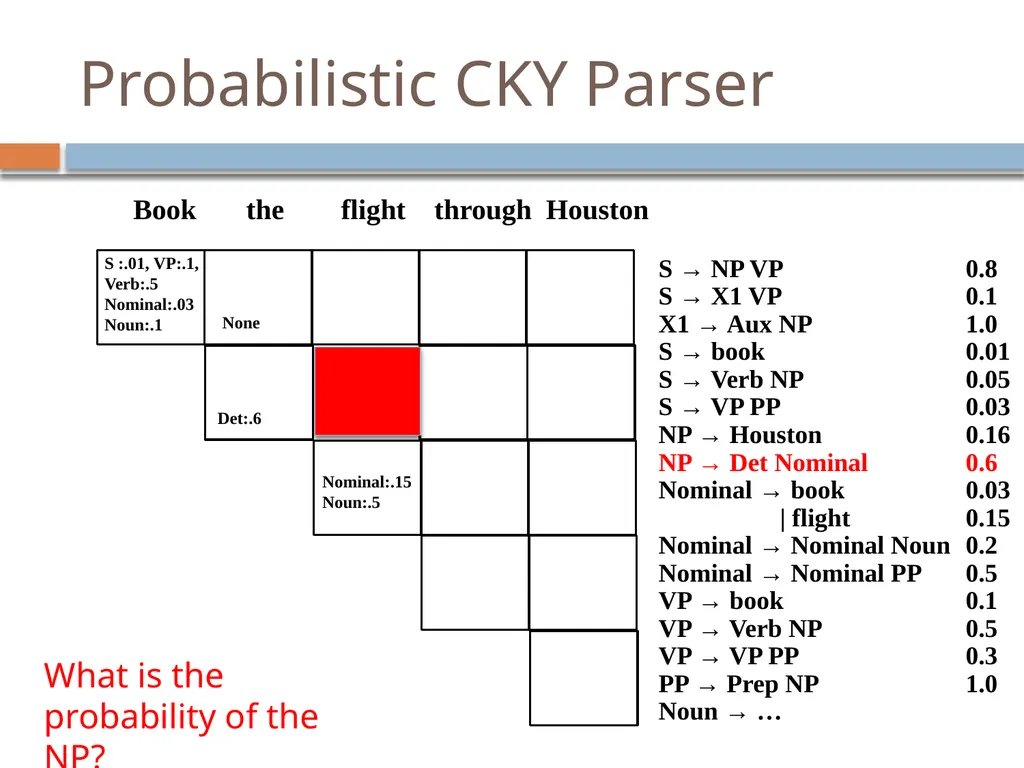
slide119. Probabilistic CKY Parser Book the flight through Houston S :.01, VP:.1,
Verb:.5
Nominal:.03
Noun:.1 Det:.6 Nominal:.15
Noun:.5 None What is the probability of the NP? S → NP VP 0.8
S → X1 VP 0.1
X1 → Aux NP 1.0
S → book 0.01
S → Verb NP 0.05
S → VP PP 0.03
NP → Houston 0.16
NP → Det Nominal 0.6
Nominal → book 0.03
| flight 0.15
Nominal → Nominal Noun 0.2
Nominal → Nominal PP 0.5
VP → book 0.1
VP → Verb NP 0.5
VP → VP PP 0.3
PP → Prep NP 1.0
Noun → …<br>
slide120. Probabilistic CKY Parser Book the flight through Houston S :.01, VP:.1,
Verb:.5
Nominal:.03
Noun:.1 Det:.6 Nominal:.15
Noun:.5 None NP:.6*.6*.15
=.054 S → NP VP 0.8
S → X1 VP 0.1
X1 → Aux NP 1.0
S → book 0.01
S → Verb NP 0.05
S → VP PP 0.03
NP → Houston 0.16
NP → Det Nominal 0.6
Nominal → book 0.03
| flight 0.15
Nominal → Nominal Noun 0.2
Nominal → Nominal PP 0.5
VP → book 0.1
VP → Verb NP 0.5
VP → VP PP 0.3
PP → Prep NP 1.0
Noun → …<br>
slide121. Probabilistic CKY Parser Book the flight through Houston S :.01, VP:.1,
Verb:.5
Nominal:.03
Noun:.1 Det:.6 Nominal:.15
Noun:.5 None NP:.6*.6*.15
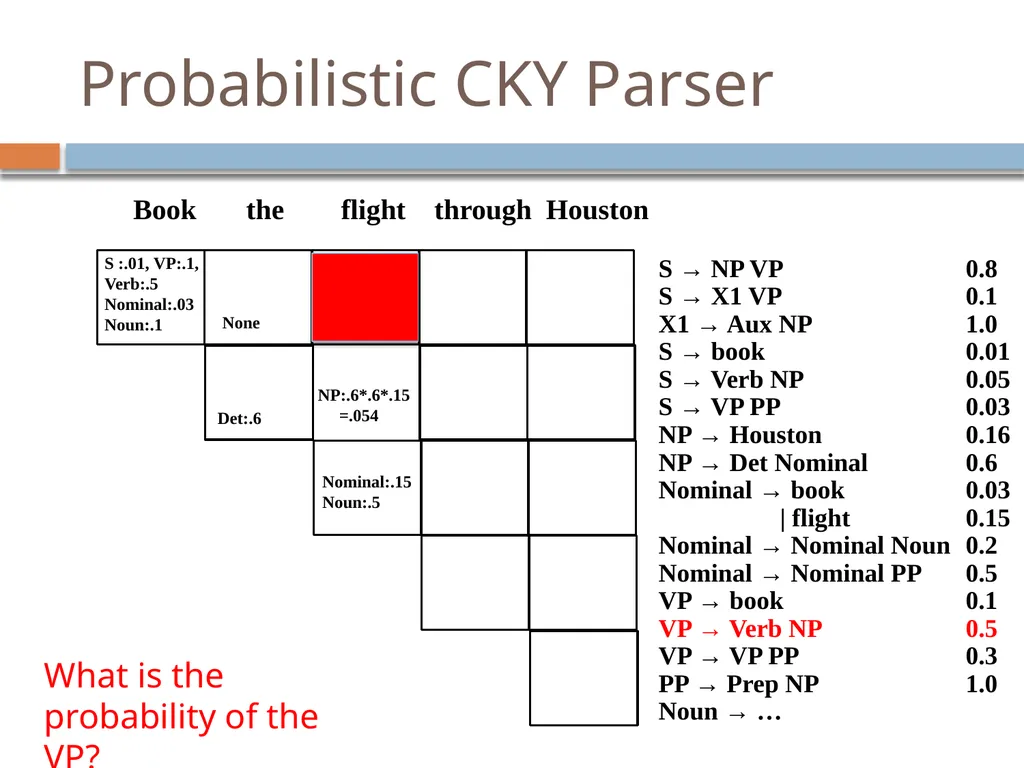
=.054 What is the probability of the VP? S → NP VP 0.8
S → X1 VP 0.1
X1 → Aux NP 1.0
S → book 0.01
S → Verb NP 0.05
S → VP PP 0.03
NP → Houston 0.16
NP → Det Nominal 0.6
Nominal → book 0.03
| flight 0.15
Nominal → Nominal Noun 0.2
Nominal → Nominal PP 0.5
VP → book 0.1
VP → Verb NP 0.5
VP → VP PP 0.3
PP → Prep NP 1.0
Noun → …<br>
slide122. Probabilistic CKY Parser Book the flight through Houston S :.01, VP:.1,
Verb:.5
Nominal:.03
Noun:.1 Det:.6 Nominal:.15
Noun:.5 None NP:.6*.6*.15
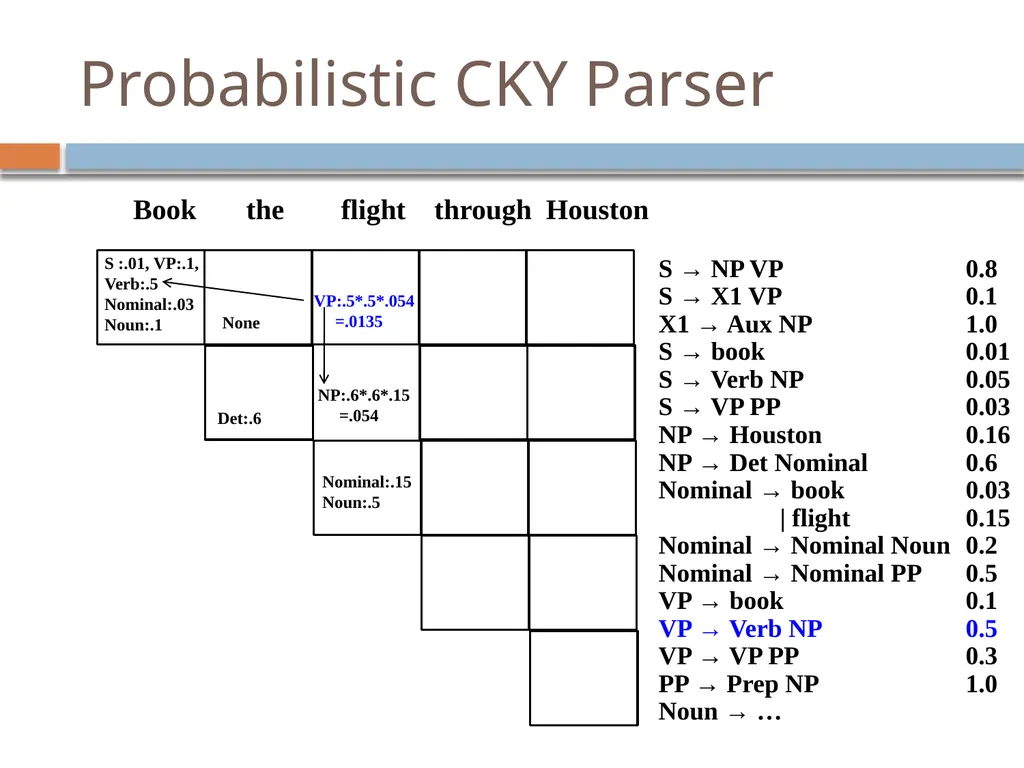
=.054 VP:.5*.5*.054
=.0135 S → NP VP 0.8
S → X1 VP 0.1
X1 → Aux NP 1.0
S → book 0.01
S → Verb NP 0.05
S → VP PP 0.03
NP → Houston 0.16
NP → Det Nominal 0.6
Nominal → book 0.03
| flight 0.15
Nominal → Nominal Noun 0.2
Nominal → Nominal PP 0.5
VP → book 0.1
VP → Verb NP 0.5
VP → VP PP 0.3
PP → Prep NP 1.0
Noun → …<br>
slide123. Probabilistic CKY Parser Book the flight through Houston S :.01, VP:.1,
Verb:.5
Nominal:.03
Noun:.1 Det:.6 Nominal:.15
Noun:.5 None NP:.6*.6*.15
=.054 VP:.5*.5*.054
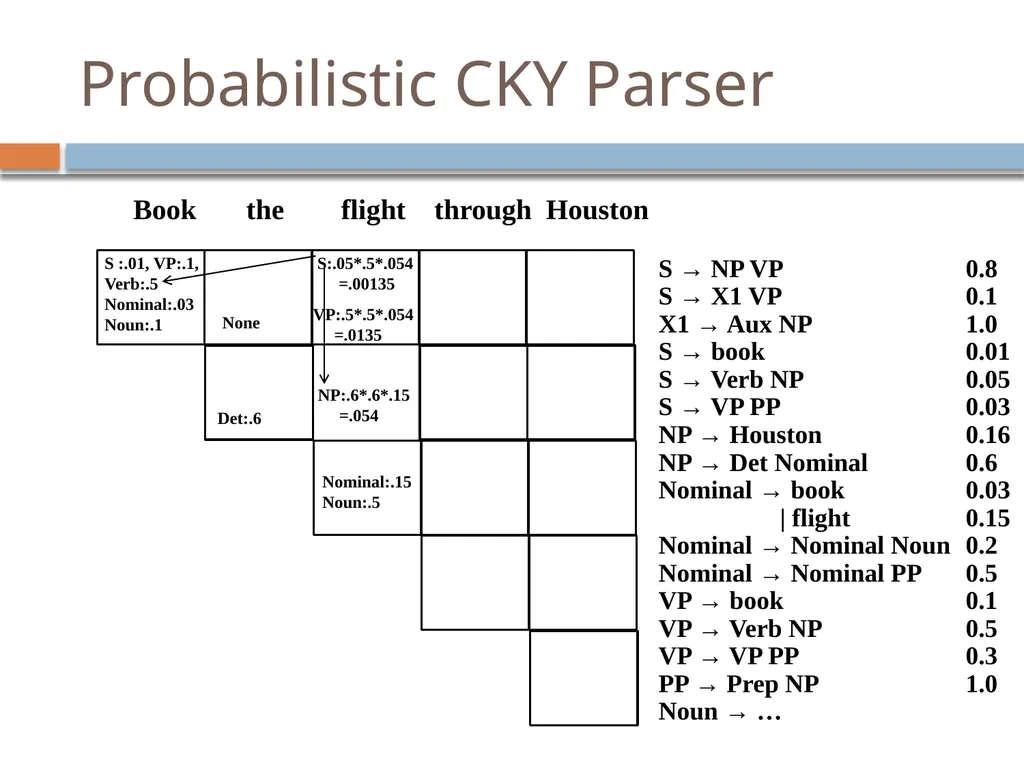
=.0135 S:.05*.5*.054
=.00135 S → NP VP 0.8
S → X1 VP 0.1
X1 → Aux NP 1.0
S → book 0.01
S → Verb NP 0.05
S → VP PP 0.03
NP → Houston 0.16
NP → Det Nominal 0.6
Nominal → book 0.03
| flight 0.15
Nominal → Nominal Noun 0.2
Nominal → Nominal PP 0.5
VP → book 0.1
VP → Verb NP 0.5
VP → VP PP 0.3
PP → Prep NP 1.0
Noun → …<br>
slide124. Probabilistic CKY Parser Book the flight through Houston S :.01, VP:.1,
Verb:.5
Nominal:.03
Noun:.1 Det:.6 Nominal:.15
Noun:.5 None NP:.6*.6*.15
=.054 VP:.5*.5*.054
=.0135 S:.05*.5*.054
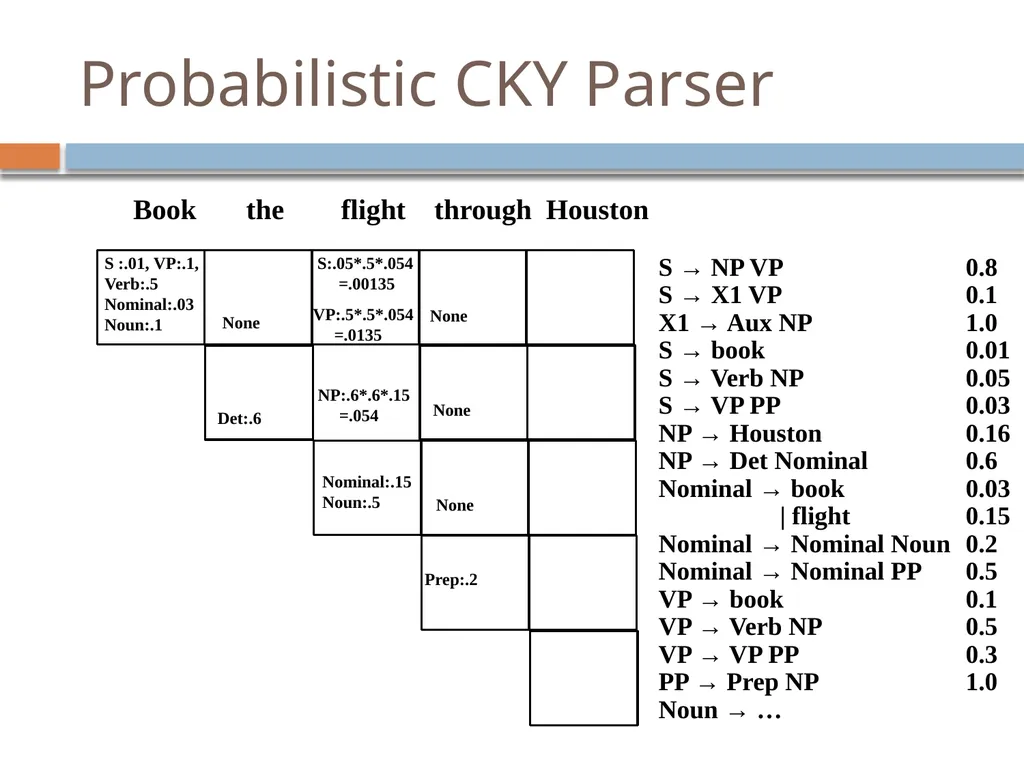
=.00135 None None None Prep:.2 S → NP VP 0.8
S → X1 VP 0.1
X1 → Aux NP 1.0
S → book 0.01
S → Verb NP 0.05
S → VP PP 0.03
NP → Houston 0.16
NP → Det Nominal 0.6
Nominal → book 0.03
| flight 0.15
Nominal → Nominal Noun 0.2
Nominal → Nominal PP 0.5
VP → book 0.1
VP → Verb NP 0.5
VP → VP PP 0.3
PP → Prep NP 1.0
Noun → …<br>
slide125. Probabilistic CKY Parser Book the flight through Houston S :.01, VP:.1,
Verb:.5
Nominal:.03
Noun:.1 Det:.6 Nominal:.15
Noun:.5 None NP:.6*.6*.15
=.054 VP:.5*.5*.054
=.0135 S:.05*.5*.054
=.00135 None None None Prep:.2 NP:.16
PropNoun:.8 PP:1.0*.2*.16
=.032 S → NP VP 0.8
S → X1 VP 0.1
X1 → Aux NP 1.0
S → book 0.01
S → Verb NP 0.05
S → VP PP 0.03
NP → Houston 0.16
NP → Det Nominal 0.6
Nominal → book 0.03
| flight 0.15
Nominal → Nominal Noun 0.2
Nominal → Nominal PP 0.5
VP → book 0.1
VP → Verb NP 0.5
VP → VP PP 0.3
PP → Prep NP 1.0
Noun → …<br>
slide126. Probabilistic CKY Parser Book the flight through Houston S :.01, VP:.1,
Verb:.5
Nominal:.03
Noun:.1 Det:.6 Nominal:.15
Noun:.5 None NP:.6*.6*.15
=.054 VP:.5*.5*.054
=.0135 S:.05*.5*.054
=.00135 None None None Prep:.2 NP:.16
PropNoun:.8 PP:1.0*.2*.16
=.032 Nominal:
.5*.15*.032
=.0024 S → NP VP 0.8
S → X1 VP 0.1
X1 → Aux NP 1.0
S → book 0.01
S → Verb NP 0.05
S → VP PP 0.03
NP → Houston 0.16
NP → Det Nominal 0.6
Nominal → book 0.03
| flight 0.15
Nominal → Nominal Noun 0.2
Nominal → Nominal PP 0.5
VP → book 0.1
VP → Verb NP 0.5
VP → VP PP 0.3
PP → Prep NP 1.0
Noun → …<br>
slide127. Probabilistic CKY Parser Book the flight through Houston S :.01, VP:.1,
Verb:.5
Nominal:.03
Noun:.1 Det:.6 Nominal:.15
Noun:.5 None NP:.6*.6*.15
=.054 VP:.5*.5*.054
=.0135 S:.05*.5*.054
=.00135 None None None Prep:.2 NP:.16
PropNoun:.8 PP:1.0*.2*.16
=.032 Nominal:
.5*.15*.032
=.0024 NP:.6*.6*
.0024
=.000864 S → NP VP 0.8
S → X1 VP 0.1
X1 → Aux NP 1.0
S → book 0.01
S → Verb NP 0.05
S → VP PP 0.03
NP → Houston 0.16
NP → Det Nominal 0.6
Nominal → book 0.03
| flight 0.15
Nominal → Nominal Noun 0.2
Nominal → Nominal PP 0.5
VP → book 0.1
VP → Verb NP 0.5
VP → VP PP 0.3
PP → Prep NP 1.0
Noun → …<br>
slide128. Probabilistic CKY Parser Book the flight through Houston S :.01, VP:.1,
Verb:.5
Nominal:.03
Noun:.1 Det:.6 Nominal:.15
Noun:.5 None NP:.6*.6*.15
=.054 VP:.5*.5*.054
=.0135 S:.05*.5*.054
=.00135 None None None Prep:.2 NP:.16
PropNoun:.8 PP:1.0*.2*.16
=.032 Nominal:
.5*.15*.032
=.0024 NP:.6*.6*
.0024
=.000864 S:.05*.5*
.000864
=.0000216 S:.03*.0135*
.032
=.00001296 S → VP PP 0.03 S → Verb NP 0.05 Which parse do we pick?<br>
slide129. Probabilistic CKY Parser Book the flight through Houston S :.01, VP:.1,
Verb:.5
Nominal:.03
Noun:.1 Det:.6 Nominal:.15
Noun:.5 None NP:.6*.6*.15
=.054 VP:.5*.5*.054
=.0135 S:.05*.5*.054
=.00135 None None None Prep:.2 NP:.16
PropNoun:.8 PP:1.0*.2*.16
=.032 Nominal:
.5*.15*.032
=.0024 NP:.6*.6*
.0024
=.000864 S:.0000216 Pick most probable
parse, i.e. take max to
combine probabilities
of multiple derivations
of each constituent in
each cell S → NP VP 0.8
S → X1 VP 0.1
X1 → Aux NP 1.0
S → book 0.01
S → Verb NP 0.05
S → VP PP 0.03
NP → Houston 0.16
NP → Det Nominal 0.6
Nominal → book 0.03
| flight 0.15
Nominal → Nominal Noun 0.2
Nominal → Nominal PP 0.5
VP → book 0.1
VP → Verb NP 0.5
VP → VP PP 0.3
PP → Prep NP 1.0
Noun → …<br>
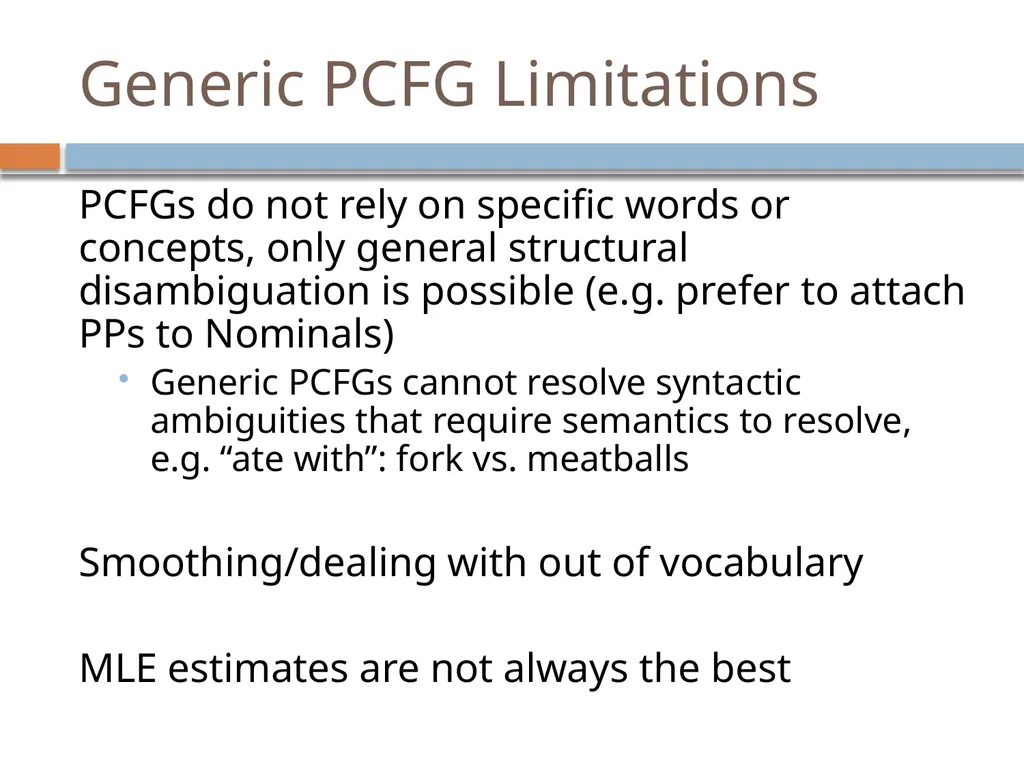
slide130. Generic PCFG Limitations PCFGs do not rely on specific words or concepts, only general structural disambiguation is possible (e.g. prefer to attach PPs to Nominals)
Generic PCFGs cannot resolve syntactic ambiguities that require semantics to resolve, e.g. “ate with”: fork vs. meatballs
Smoothing/dealing with out of vocabulary
MLE estimates are not always the best<br>
CS159 – Fall 2024<br>
slide2. Admin Assignment 3
Quiz #1<br>
slide3. Context free grammar S NP VP left hand side
(single symbol) right hand side
(one or more symbols)<br>
slide4. CFG: Example Many possible CFGs for English, here is an example (fragment):
S NP VP
VP V NP
NP DetP N | DetP AdjP N
AdjP Adj | Adv AdjP
N kid | dog
V sees | likes
Adj big | small
Adv very
DetP a | the<br>
slide5. Derivations of CFGs String rewriting system: we derive a string
Derivation history shows the constituent tree: the kid likes a dog kid the likes DetP NP dog a NP DetP S VP N N V<br>
slide6. Parsing ambiguity I eat sushi with tuna PRP NP V N IN N PP NP VP S I eat sushi with tuna PRP NP V N IN N PP NP VP S S -> NP VP
NP -> PRP
NP -> N PP
NP -> N
VP -> V NP
VP -> V NP PP
PP -> IN N
PRP -> I
V -> eat
N -> sushi
N -> tuna
IN -> with How can we decide between these?<br>
slide7. A Simple PCFG Probabilities!<br>
slide8. Just like n-gram language modeling, PCFGs break the sentence generation process into smaller steps/probabilities
The probability of a parse is the product of the PCFG rules<br>
slide9. What are the different interpretations here?
Which do you think is more likely?<br>
slide10. = 1.0 * 0.1 * 0.7 * 1.0 * 0.4 * 0.18
* 1.0 * 1.0 * 0.18
= 0.0009072 = 1.0 * 0.1 * 0.3 * 0.7 * 1.0 * 0.18
* 1.0 * 1.0 * 0.18
= 0.0006804<br>
slide11. Parsing problems Pick a model
e.g. CFG, PCFG, …
Train (or learn) a model
What CFG/PCFG rules should I use?
Parameters (e.g. PCFG probabilities)?
What kind of data do we have?
Parsing
Determine the parse tree(s) given a sentence<br>
slide12. PCFG: Training If we have example parsed sentences, how can we learn a set of PCFGs? .
.
. Tree Bank<br>
slide13. Extracting the rules PRP NP V N IN PP NP VP S I eat sushi with tuna N What CFG rules occur in this tree? S NP VP
NP PRP
PRP I
VP V NP
V eat
NP N PP
N sushi
PP IN N
IN with
N tuna<br>
slide14. Estimating PCFG Probabilities We can extract the rules from the trees S NP VP 1.0
VP V NP 0.7
VP VP PP 0.3
PP P NP 1.0
P with 1.0
V saw 1.0 How do we go from the extracted CFG rules to PCFG rules? S NP VP
NP PRP
PRP I
VP V NP
V eat
NP N PP
N sushi
…<br>
slide15. Estimating PCFG Probabilities Extract the rules from the trees
Calculate the probabilities using MLE<br>
slide16. Estimating PCFG Probabilities S NP VP 10
S V NP 3
S VP PP 2
NP N 7
NP N PP 3
NP DT N 6 P( S V NP) = ? Occurrences<br>
slide17. Grammar Equivalence What does it mean for two grammars to be equal?<br>
slide18. Grammar Equivalence Weak equivalence: grammars generate the same set of strings
Grammar 1: NP DetP N and DetP a | the
Grammar 2: NP a N | the N
Strong equivalence: grammars have the same set of derivation trees
With CFGs, possible only with useless rules
Grammar 2: NP a N | the N
Grammar 3: NP a N | the N, DetP many<br>
slide19. Normal Forms There are weakly equivalent normal forms (Chomsky Normal Form, Greibach Normal Form)
A CFG is in Chomsky Normal Form (CNF) if all productions are of one of two forms:
A B C with A, B, C nonterminals
A a, with A a nonterminal and a a terminal
Every CFG has a weakly equivalent CFG in CNF<br>
slide20. CNF Grammar S -> VP
VP -> VB NP
VP -> VB NP PP
NP -> DT NN
NP -> NN
NP -> NP PP
PP -> IN NP
DT -> the
IN -> with
VB -> film
VB -> trust
NN -> man
NN -> film
NN -> trust S -> VP
VP -> VB NP
VP -> VP2 PP
VP2 -> VB NP
NP -> DT NN
NP -> NN
NP -> NP PP
PP -> IN NP
DT -> the
IN -> with
VB -> film
VB -> trust
NN -> man
NN -> film
NN -> trust<br>
slide21. Probabilistic Grammar Conversion S → NP VP
S → Aux NP VP
S → VP
NP → Pronoun
NP → Proper-Noun
NP → Det Nominal
Nominal → Noun
Nominal → Nominal Noun
Nominal → Nominal PP
VP → Verb
VP → Verb NP
VP → VP PP
PP → Prep NP Original Grammar Chomsky Normal Form 0.8
0.1
0.1
0.2
0.2
0.6
0.3
0.2
0.5
0.2
0.5
0.3
1.0<br>
slide22. Parsing Parsing is the field of NLP interested in automatically determining the syntactic structure of a sentence
parsing can also be thought of as determining what sentences are “valid” English sentences<br>
slide23. Parsing We have a grammar, determine the possible parse tree(s)
Let’s start with parsing with a CFG (no probabilities) S NP VP
NP PRP
NP N PP
VP V NP
VP V NP PP
PP IN N
PRP I
V eat
N sushi
N tuna
IN with I eat sushi with tuna approaches? algorithms?<br>
slide24. Parsing Top-down parsing
ends up doing a lot of repeated work
doesn’t take into account the words in the sentence until the end!
Bottom-up parsing
constrain based on the words
avoids repeated work (dynamic programming)
doesn’t take into account the high-level structure until the end!
CKY parser<br>
slide25. Parsing Top-down parsing
start at the top (usually S) and apply rules
matching left-hand sides and replacing with right-hand sides
Bottom-up parsing
start at the bottom (i.e. words) and build the parse tree up from there
matching right-hand sides and replacing with left-hand sides<br>
slide26. Parsing Example S VP Verb NP book Det Nominal that Noun flight book that flight<br>
slide27. Top Down Parsing S Pronoun<br>
slide28. Top Down Parsing S Pronoun<br>
slide29. Top Down Parsing S ProperNoun<br>
slide30. Top Down Parsing S ProperNoun<br>
slide31. Top Down Parsing S Det Nominal<br>
slide32. Top Down Parsing S Det Nominal<br>
slide33. Top Down Parsing S Aux NP VP<br>
slide34. Top Down Parsing S Aux NP VP<br>
slide35. Top Down Parsing S VP<br>
slide36. Top Down Parsing S VP Verb<br>
slide37. Top Down Parsing S VP Verb book<br>
slide38. Top Down Parsing S VP Verb book X that<br>
slide39. Top Down Parsing S VP Verb NP<br>
slide40. Top Down Parsing S VP Verb NP book<br>
slide41. Top Down Parsing S VP Verb NP book Pronoun<br>
slide42. Top Down Parsing S VP Verb NP book Pronoun<br>
slide43. Top Down Parsing S VP Verb NP book ProperNoun<br>
slide44. Top Down Parsing S VP Verb NP book ProperNoun<br>
slide45. Top Down Parsing S VP Verb NP book Det Nominal<br>
slide46. Top Down Parsing S VP Verb NP book Det Nominal that<br>
slide47. Top Down Parsing S VP Verb NP book Det Nominal that Noun<br>
slide48. Top Down Parsing S VP Verb NP book Det Nominal that Noun flight<br>
slide49. Bottom Up Parsing book that flight<br>
slide50. Bottom Up Parsing book that flight Noun<br>
slide51. Bottom Up Parsing book that flight Noun Nominal<br>
slide52. Bottom Up Parsing book that flight Noun Nominal Noun Nominal<br>
slide53. Bottom Up Parsing book that flight Noun Nominal Noun Nominal<br>
slide54. Bottom Up Parsing book that flight Noun Nominal PP Nominal<br>
slide55. Bottom Up Parsing book that flight Noun Det Nominal PP Nominal<br>
slide56. Bottom Up Parsing book that flight Noun Det NP Nominal Nominal PP Nominal<br>
slide57. Bottom Up Parsing book that Noun Det NP Nominal flight Noun Nominal PP Nominal<br>
slide58. Bottom Up Parsing book that Noun Det NP Nominal flight Noun Nominal PP Nominal<br>
slide59. Bottom Up Parsing book that Noun Det NP Nominal flight Noun S VP Nominal PP Nominal<br>
slide60. Bottom Up Parsing book that Noun Det NP Nominal flight Noun S VP Nominal PP Nominal<br>
slide61. Bottom Up Parsing book that Noun Det NP Nominal flight Noun Nominal PP Nominal X<br>
slide62. Bottom Up Parsing book that Verb Det NP Nominal flight Noun<br>
slide63. Bottom Up Parsing book that Verb VP Det NP Nominal flight Noun<br>
slide64. Det Bottom Up Parsing book that Verb VP S NP Nominal flight Noun<br>
slide65. Det Bottom Up Parsing book that Verb VP S X NP Nominal flight Noun<br>
slide66. Bottom Up Parsing book that Verb VP VP PP Det NP Nominal flight Noun<br>
slide67. Bottom Up Parsing book that Verb VP VP PP Det NP Nominal flight Noun X<br>
slide68. Bottom Up Parsing book that Verb VP Det NP Nominal flight Noun NP<br>
slide69. Bottom Up Parsing book that Verb VP Det NP Nominal flight Noun<br>
slide70. Bottom Up Parsing book that Verb VP Det NP Nominal flight Noun S<br>
slide71. Parsing Pros/Cons?
Top-down:
Only examines parses that could be valid parses (i.e. with an S on top)
Doesn’t take into account the actual words!
Bottom-up:
Only examines structures that have the actual words as the leaves
Examines sub-parses that may NOT result in a valid parse!<br>
slide72. Why is parsing hard? Actual grammars are large
Lots of ambiguity!
Most sentences have many parses
Some sentences have a lot of parses
Even for sentences that are not ambiguous, there is often ambiguity for subtrees (i.e. multiple ways to parse a phrase)<br>
slide73. Why is parsing hard? I saw the man on the hill with the telescope What are some interpretations?<br>
slide74. Structural Ambiguity Can Give Exponential Parses Me See A man The telescope The hill . . . I saw the man on the hill with the telescope<br>
slide75. Dynamic Programming Parsing To avoid extensive repeated work you must cache intermediate results, specifically found constituents
Caching (memoizing) is critical to obtaining a polynomial time parsing algorithm for CFGs
Dynamic programming algorithms based on both top-down and bottom-up search can achieve O(n3) recognition time where n is the length of the input string.<br>
slide76. Dynamic Programming Parsing Methods CKY (Cocke-Kasami-Younger) algorithm based on bottom-up parsing and requires first normalizing the grammar (CNF).
Earley parser is based on top-down parsing and does not require normalizing grammar but is more complex.
These both fall under the general category of chart parsers which retain completed constituents in a chart<br>
slide77. CKY parser: the chart i=
0
1
2
3
4 j= 0 1 2 3 4 Cell[i,j] contains all
constituents covering words i through j Film the man with trust what does this cell represent?<br>
slide78. CKY parser: the chart i=
0
1
2
3
4 j= 0 1 2 3 4 Cell[i,j] contains all
constituents covering words i through j Film the man with trust all constituents spanning
1-3 or “the man with”<br>
slide79. CKY parser: the chart i=
0
1
2
3
4 j= 0 1 2 3 4 Cell[i,j] contains all
constituents covering words i through j Film the man with trust how could we figure this out?<br>
slide80. CKY parser: the chart i=
0
1
2
3
4 j= 0 1 2 3 4 Cell[i,j] contains all
constituents covering words i through j Film the man with trust Key: rules are binary and only have two constituents on the right hand side VP -> VB NP
NP -> DT NN<br>
slide81. CKY parser: the chart i=
0
1
2
3
4 j= 0 1 2 3 4 Cell[i,j] contains all
constituents covering words i through j Film the man with trust See if we can make a new constituent combining any for “the” with any for “man with”<br>
slide82. CKY parser: the chart i=
0
1
2
3
4 j= 0 1 2 3 4 Cell[i,j] contains all
constituents covering words i through j Film the man with trust See if we can make a new constituent combining any for “the man” with any for “with”<br>
slide83. CKY parser: the chart i=
0
1
2
3
4 j= 0 1 2 3 4 Cell[i,j] contains all
constituents covering words i through j Film the man with trust ? What combinations do we need to consider when trying to put constituents here?<br>
slide84. CKY parser: the chart i=
0
1
2
3
4 j= 0 1 2 3 4 Cell[i,j] contains all
constituents covering words i through j Film the man with trust See if we can make a new constituent combining any for “Film” with any for “the man with trust”<br>
slide85. CKY parser: the chart i=
0
1
2
3
4 j= 0 1 2 3 4 Cell[i,j] contains all
constituents covering words i through j Film the man with trust See if we can make a new constituent combining any for “Film the” with any for “man with trust”<br>
slide86. CKY parser: the chart i=
0
1
2
3
4 j= 0 1 2 3 4 Cell[i,j] contains all
constituents covering words i through j Film the man with trust See if we can make a new constituent combining any for “Film the man” with any for “with trust”<br>
slide87. CKY parser: the chart i=
0
1
2
3
4 j= 0 1 2 3 4 Cell[i,j] contains all
constituents covering words i through j Film the man with trust See if we can make a new constituent combining any for “Film the man with” with any for “trust”<br>
slide88. CKY parser: the chart i=
0
1
2
3
4 j= 0 1 2 3 4 Cell[i,j] contains all
constituents covering words i through j Film the man with trust What if our rules weren’t binary?<br>
slide89. CKY parser: the chart i=
0
1
2
3
4 j= 0 1 2 3 4 Cell[i,j] contains all
constituents covering words i through j Film the man with trust See if we can make a new constituent combining any for “Film” with any for “the man” with any for “with trust”<br>
slide90. CKY parser: the chart i=
0
1
2
3
4 j= 0 1 2 3 4 Cell[i,j] contains all
constituents covering words i through j Film the man with trust What order should we fill the entries in the chart?<br>
slide91. CKY parser: the chart i=
0
1
2
3
4 j= 0 1 2 3 4 Cell[i,j] contains all
constituents covering words i through j Film the man with trust Our dependencies are left and down<br>
slide92. CKY parser: the chart i=
0
1
2
3
4 j= 0 1 2 3 4 Cell[i,j] contains all
constituents covering words i through j Film the man with trust From bottom to top, left to right<br>
slide93. CKY parser: the chart i=
0
1
2
3
4 j= 0 1 2 3 4 Cell[i,j] contains all
constituents covering words i through j Film the man with trust Top-left along the diagonals moving to the right<br>
slide94. CKY parser: unary rules Often, we will leave unary rules rather than converting to CNF
Do these complicate the algorithm?
Must check whenever we add a constituent to see if any unary rules apply S -> VP
VP -> VB NP
VP -> VP2 PP
VP2 -> VB NP
NP -> DT NN
NP -> NN
NP -> NP PP
PP -> IN NP
DT -> the
IN -> with
VB -> film
VB -> trust
NN -> man
NN -> film
NN -> trust<br>
slide95. CKY parser: the chart i=
0
1
2
3
4 j= 0 1 2 3 4 Film the man with trust S VP
VP VB NP
VP VP2 PP
VP2 VB NP
NP DT NN
NP NN
NP NP PP
PP IN NP
DT the
IN with
VB film
VB man
VB trust
NN man
NN film
NN trust<br>
slide96. CKY parser: the chart i=
0
1
2
3
4 j= 0 1 2 3 4 Film the man with trust NN
NP
VB DT VB
NN
NP IN VB
NN
NP S VP
VP VB NP
VP VP2 PP
VP2 VB NP
NP DT NN
NP NN
NP NP PP
PP IN NP
DT the
IN with
VB film
VB man
VB trust
NN man
NN film
NN trust<br>
slide97. CKY parser: the chart i=
0
1
2
3
4 j= 0 1 2 3 4 Film the man with trust DT VB
NN
NP IN VB
NN
NP NP PP NN
NP
VB S VP
VP VB NP
VP VP2 PP
VP2 VB NP
NP DT NN
NP NN
NP NP PP
PP IN NP
DT the
IN with
VB film
VB man
VB trust
NN man
NN film
NN trust<br>
slide98. CKY parser: the chart i=
0
1
2
3
4 j= 0 1 2 3 4 Film the man with trust DT VB
NN
NP IN VB
NN
NP NP PP VP2
VP
S NP NN
NP
VB S VP
VP VB NP
VP VP2 PP
VP2 VB NP
NP DT NN
NP NN
NP NP PP
PP IN NP
DT the
IN with
VB film
VB man
VB trust
NN man
NN film
NN trust<br>
slide99. CKY parser: the chart i=
0
1
2
3
4 j= 0 1 2 3 4 Film the man with trust DT VB
NN
NP IN VB
NN
NP NP PP VP2
VP
S NP NP NN
NP
VB S VP
VP VB NP
VP VP2 PP
VP2 VB NP
NP DT NN
NP NN
NP NP PP
PP IN NP
DT the
IN with
VB film
VB man
VB trust
NN man
NN film
NN trust<br>
slide100. CKY parser: the chart i=
0
1
2
3
4 j= 0 1 2 3 4 Film the man with trust DT VB
NN
NP IN VB
NN
NP NP PP VP2
VP
S NP NP S
VP
VP2 NN
NP
VB S VP
VP VB NP
VP VP2 PP
VP2 VB NP
NP DT NN
NP NN
NP NP PP
PP IN NP
DT the
IN with
VB film
VB man
VB trust
NN man
NN film
NN trust<br>
slide101. CKY: some things to talk about After we fill in the chart, how do we know if there is a parse?
If there is an S in the upper right corner
What if we want an actual tree/parse?<br>
slide102. CKY: retrieving the parse i=
0
1
2
3
4 j= 0 1 2 3 4 DT VB
NN
NP IN VB
NN
NP NP PP VB2
VP
S NP NP S
VP S VP VB NP Film the man with trust NN
NP
VB<br>
slide103. CKY: retrieving the parse i=
0
1
2
3
4 j= 0 1 2 3 4 DT VB
NN
NP IN VB
NN
NP NP PP VB2
VP
S NP NP S
VP S VP VB NP NP PP Film the man with trust NN
NP
VB<br>
slide104. CKY: retrieving the parse i=
0
1
2
3
4 j= 0 1 2 3 4 DT VB
NN
NP IN VB
NN
NP NP PP VB2
VP
S NP NP S
VP S VP VB NP NP PP Film the man with trust DT NN IN NP … NN
NP
VB<br>
slide105. CKY: retrieving the parse i=
0
1
2
3
4 j= 0 1 2 3 4 DT VB
NN
NP IN VB
NN
NP NP PP VB2
VP
S NP NP S
VP Film the man with trust Where do these arrows/references come from? NN
NP
VB<br>
slide106. CKY: retrieving the parse i=
0
1
2
3
4 j= 0 1 2 3 4 DT VB
NN
NP IN VB
NN
NP NP PP VB2
VP
S NP NP S
VP Film the man with trust To add a constituent in a cell, we’re applying a rule
The references represent the smaller constituents we used to build this constituent S VP NN
NP
VB<br>
slide107. CKY: retrieving the parse i=
0
1
2
3
4 j= 0 1 2 3 4 DT VB
NN
NP IN VB
NN
NP NP PP VB2
VP
S NP NP S
VP Film the man with trust To add a constituent in a cell, we’re applying a rule
The references represent the smaller constituents we used to build this constituent VP VB NP NN
NP
VB<br>
slide108. CKY: retrieving the parse i=
0
1
2
3
4 j= 0 1 2 3 4 DT VB
NN
NP IN VB
NN
NP NP PP VB2
VP
S NP NP S
VP Film the man with trust What about ambiguous parses? NN
NP
VB<br>
slide109. CKY: retrieving the parse We can store multiple derivations of each constituent
This representation is called a “parse forest”
It is often convenient to leave it in this form, rather than enumerate all possible parses. Why?<br>
slide110. CKY: some things to think about S VP
VP VB NP
VP VB NP PP
NP DT NN
NP NN
… S VP
VP VB NP
VP VP2 PP
VP2 VB NP
NP DT NN
NP NN
… Actual grammar CNF We get a CNF parse tree but want one for the actual grammar Ideas?<br>
slide111. Parsing ambiguity I eat sushi with tuna PRP NP V N IN N PP NP VP S I eat sushi with tuna PRP NP V N IN N PP NP VP S S NP VP
NP PRP
NP N PP
VP V NP
VP V NP PP
PP IN N
PRP I
V eat
N sushi
N tuna
IN with How can we decide between these?<br>
slide112. A Simple PCFG Probabilities!<br>
slide113. = 1.0 * 0.1 * 0.7 * 1.0 * 0.4 * 0.18
* 1.0 * 1.0 * 0.18
= 0.0009072 = 1.0 * 0.1 * 0.3 * 0.7 * 1.0 * 0.18
* 1.0 * 1.0 * 0.18
= 0.0006804<br>
slide114. Parsing with PCFGs How does this change our CKY algorithm?
We need to keep track of the probability of a constituent
How do we calculate the probability of a constituent?
Product of the PCFG rule times the product of the probabilities of the sub-constituents (right hand sides)
Building up the product from the bottom-up
What if there are multiple ways of deriving a particular constituent?
max: pick the most likely derivation of that constituent<br>
slide115. Probabilistic CKY Include in each cell a probability for each non-terminal
Cell[i,j] must retain the most probable derivation of each constituent (non-terminal) covering words i through j
When transforming the grammar to CNF, must set production probabilities to preserve the probability of derivations<br>
slide116. Probabilistic Grammar Conversion S → NP VP
S → Aux NP VP
S → VP
NP → Pronoun
NP → Proper-Noun
NP → Det Nominal
Nominal → Noun
Nominal → Nominal Noun
Nominal → Nominal PP
VP → Verb
VP → Verb NP
VP → VP PP
PP → Prep NP Original Grammar Chomsky Normal Form S → NP VP
S → X1 VP
X1 → Aux NP
S → book | include | prefer
0.01 0.004 0.006
S → Verb NP
S → VP PP
NP → I | he | she | me
0.1 0.02 0.02 0.06
NP → Houston | NWA
0.16 .04
NP → Det Nominal
Nominal → book | flight | meal | money
0.03 0.15 0.06 0.06
Nominal → Nominal Noun
Nominal → Nominal PP
VP → book | include | prefer
0.1 0.04 0.06
VP → Verb NP
VP → VP PP
PP → Prep NP 0.8
0.1
0.1
0.2
0.2
0.6
0.3
0.2
0.5
0.2
0.5
0.3
1.0 0.8
0.1
1.0
0.05
0.03
0.6
0.2
0.5
0.5
0.3
1.0<br>
slide117. Probabilistic CKY Parser Book the flight through Houston S → NP VP 0.8
S → X1 VP 0.1
X1 → Aux NP 1.0
S → book 0.01
S → Verb NP 0.05
S → VP PP 0.03
NP → Houston 0.16
NP → Det Nominal 0.6
Nominal → book 0.03
| flight 0.15
Nominal → Nominal Noun 0.2
Nominal → Nominal PP 0.5
VP → book 0.1
VP → Verb NP 0.5
VP → VP PP 0.3
PP → Prep NP 1.0
Noun → …<br>
slide118. Probabilistic CKY Parser Book the flight through Houston S :.01, VP:.1,
Verb:.5
Nominal:.03
Noun:.1 Det:.6 Nominal:.15
Noun:.5 None S → NP VP 0.8
S → X1 VP 0.1
X1 → Aux NP 1.0
S → book 0.01
S → Verb NP 0.05
S → VP PP 0.03
NP → Houston 0.16
NP → Det Nominal 0.6
Nominal → book 0.03
| flight 0.15
Nominal → Nominal Noun 0.2
Nominal → Nominal PP 0.5
VP → book 0.1
VP → Verb NP 0.5
VP → VP PP 0.3
PP → Prep NP 1.0
Noun → …<br>
slide119. Probabilistic CKY Parser Book the flight through Houston S :.01, VP:.1,
Verb:.5
Nominal:.03
Noun:.1 Det:.6 Nominal:.15
Noun:.5 None What is the probability of the NP? S → NP VP 0.8
S → X1 VP 0.1
X1 → Aux NP 1.0
S → book 0.01
S → Verb NP 0.05
S → VP PP 0.03
NP → Houston 0.16
NP → Det Nominal 0.6
Nominal → book 0.03
| flight 0.15
Nominal → Nominal Noun 0.2
Nominal → Nominal PP 0.5
VP → book 0.1
VP → Verb NP 0.5
VP → VP PP 0.3
PP → Prep NP 1.0
Noun → …<br>
slide120. Probabilistic CKY Parser Book the flight through Houston S :.01, VP:.1,
Verb:.5
Nominal:.03
Noun:.1 Det:.6 Nominal:.15
Noun:.5 None NP:.6*.6*.15
=.054 S → NP VP 0.8
S → X1 VP 0.1
X1 → Aux NP 1.0
S → book 0.01
S → Verb NP 0.05
S → VP PP 0.03
NP → Houston 0.16
NP → Det Nominal 0.6
Nominal → book 0.03
| flight 0.15
Nominal → Nominal Noun 0.2
Nominal → Nominal PP 0.5
VP → book 0.1
VP → Verb NP 0.5
VP → VP PP 0.3
PP → Prep NP 1.0
Noun → …<br>
slide121. Probabilistic CKY Parser Book the flight through Houston S :.01, VP:.1,
Verb:.5
Nominal:.03
Noun:.1 Det:.6 Nominal:.15
Noun:.5 None NP:.6*.6*.15
=.054 What is the probability of the VP? S → NP VP 0.8
S → X1 VP 0.1
X1 → Aux NP 1.0
S → book 0.01
S → Verb NP 0.05
S → VP PP 0.03
NP → Houston 0.16
NP → Det Nominal 0.6
Nominal → book 0.03
| flight 0.15
Nominal → Nominal Noun 0.2
Nominal → Nominal PP 0.5
VP → book 0.1
VP → Verb NP 0.5
VP → VP PP 0.3
PP → Prep NP 1.0
Noun → …<br>
slide122. Probabilistic CKY Parser Book the flight through Houston S :.01, VP:.1,
Verb:.5
Nominal:.03
Noun:.1 Det:.6 Nominal:.15
Noun:.5 None NP:.6*.6*.15
=.054 VP:.5*.5*.054
=.0135 S → NP VP 0.8
S → X1 VP 0.1
X1 → Aux NP 1.0
S → book 0.01
S → Verb NP 0.05
S → VP PP 0.03
NP → Houston 0.16
NP → Det Nominal 0.6
Nominal → book 0.03
| flight 0.15
Nominal → Nominal Noun 0.2
Nominal → Nominal PP 0.5
VP → book 0.1
VP → Verb NP 0.5
VP → VP PP 0.3
PP → Prep NP 1.0
Noun → …<br>
slide123. Probabilistic CKY Parser Book the flight through Houston S :.01, VP:.1,
Verb:.5
Nominal:.03
Noun:.1 Det:.6 Nominal:.15
Noun:.5 None NP:.6*.6*.15
=.054 VP:.5*.5*.054
=.0135 S:.05*.5*.054
=.00135 S → NP VP 0.8
S → X1 VP 0.1
X1 → Aux NP 1.0
S → book 0.01
S → Verb NP 0.05
S → VP PP 0.03
NP → Houston 0.16
NP → Det Nominal 0.6
Nominal → book 0.03
| flight 0.15
Nominal → Nominal Noun 0.2
Nominal → Nominal PP 0.5
VP → book 0.1
VP → Verb NP 0.5
VP → VP PP 0.3
PP → Prep NP 1.0
Noun → …<br>
slide124. Probabilistic CKY Parser Book the flight through Houston S :.01, VP:.1,
Verb:.5
Nominal:.03
Noun:.1 Det:.6 Nominal:.15
Noun:.5 None NP:.6*.6*.15
=.054 VP:.5*.5*.054
=.0135 S:.05*.5*.054
=.00135 None None None Prep:.2 S → NP VP 0.8
S → X1 VP 0.1
X1 → Aux NP 1.0
S → book 0.01
S → Verb NP 0.05
S → VP PP 0.03
NP → Houston 0.16
NP → Det Nominal 0.6
Nominal → book 0.03
| flight 0.15
Nominal → Nominal Noun 0.2
Nominal → Nominal PP 0.5
VP → book 0.1
VP → Verb NP 0.5
VP → VP PP 0.3
PP → Prep NP 1.0
Noun → …<br>
slide125. Probabilistic CKY Parser Book the flight through Houston S :.01, VP:.1,
Verb:.5
Nominal:.03
Noun:.1 Det:.6 Nominal:.15
Noun:.5 None NP:.6*.6*.15
=.054 VP:.5*.5*.054
=.0135 S:.05*.5*.054
=.00135 None None None Prep:.2 NP:.16
PropNoun:.8 PP:1.0*.2*.16
=.032 S → NP VP 0.8
S → X1 VP 0.1
X1 → Aux NP 1.0
S → book 0.01
S → Verb NP 0.05
S → VP PP 0.03
NP → Houston 0.16
NP → Det Nominal 0.6
Nominal → book 0.03
| flight 0.15
Nominal → Nominal Noun 0.2
Nominal → Nominal PP 0.5
VP → book 0.1
VP → Verb NP 0.5
VP → VP PP 0.3
PP → Prep NP 1.0
Noun → …<br>
slide126. Probabilistic CKY Parser Book the flight through Houston S :.01, VP:.1,
Verb:.5
Nominal:.03
Noun:.1 Det:.6 Nominal:.15
Noun:.5 None NP:.6*.6*.15
=.054 VP:.5*.5*.054
=.0135 S:.05*.5*.054
=.00135 None None None Prep:.2 NP:.16
PropNoun:.8 PP:1.0*.2*.16
=.032 Nominal:
.5*.15*.032
=.0024 S → NP VP 0.8
S → X1 VP 0.1
X1 → Aux NP 1.0
S → book 0.01
S → Verb NP 0.05
S → VP PP 0.03
NP → Houston 0.16
NP → Det Nominal 0.6
Nominal → book 0.03
| flight 0.15
Nominal → Nominal Noun 0.2
Nominal → Nominal PP 0.5
VP → book 0.1
VP → Verb NP 0.5
VP → VP PP 0.3
PP → Prep NP 1.0
Noun → …<br>
slide127. Probabilistic CKY Parser Book the flight through Houston S :.01, VP:.1,
Verb:.5
Nominal:.03
Noun:.1 Det:.6 Nominal:.15
Noun:.5 None NP:.6*.6*.15
=.054 VP:.5*.5*.054
=.0135 S:.05*.5*.054
=.00135 None None None Prep:.2 NP:.16
PropNoun:.8 PP:1.0*.2*.16
=.032 Nominal:
.5*.15*.032
=.0024 NP:.6*.6*
.0024
=.000864 S → NP VP 0.8
S → X1 VP 0.1
X1 → Aux NP 1.0
S → book 0.01
S → Verb NP 0.05
S → VP PP 0.03
NP → Houston 0.16
NP → Det Nominal 0.6
Nominal → book 0.03
| flight 0.15
Nominal → Nominal Noun 0.2
Nominal → Nominal PP 0.5
VP → book 0.1
VP → Verb NP 0.5
VP → VP PP 0.3
PP → Prep NP 1.0
Noun → …<br>
slide128. Probabilistic CKY Parser Book the flight through Houston S :.01, VP:.1,
Verb:.5
Nominal:.03
Noun:.1 Det:.6 Nominal:.15
Noun:.5 None NP:.6*.6*.15
=.054 VP:.5*.5*.054
=.0135 S:.05*.5*.054
=.00135 None None None Prep:.2 NP:.16
PropNoun:.8 PP:1.0*.2*.16
=.032 Nominal:
.5*.15*.032
=.0024 NP:.6*.6*
.0024
=.000864 S:.05*.5*
.000864
=.0000216 S:.03*.0135*
.032
=.00001296 S → VP PP 0.03 S → Verb NP 0.05 Which parse do we pick?<br>
slide129. Probabilistic CKY Parser Book the flight through Houston S :.01, VP:.1,
Verb:.5
Nominal:.03
Noun:.1 Det:.6 Nominal:.15
Noun:.5 None NP:.6*.6*.15
=.054 VP:.5*.5*.054
=.0135 S:.05*.5*.054
=.00135 None None None Prep:.2 NP:.16
PropNoun:.8 PP:1.0*.2*.16
=.032 Nominal:
.5*.15*.032
=.0024 NP:.6*.6*
.0024
=.000864 S:.0000216 Pick most probable
parse, i.e. take max to
combine probabilities
of multiple derivations
of each constituent in
each cell S → NP VP 0.8
S → X1 VP 0.1
X1 → Aux NP 1.0
S → book 0.01
S → Verb NP 0.05
S → VP PP 0.03
NP → Houston 0.16
NP → Det Nominal 0.6
Nominal → book 0.03
| flight 0.15
Nominal → Nominal Noun 0.2
Nominal → Nominal PP 0.5
VP → book 0.1
VP → Verb NP 0.5
VP → VP PP 0.3
PP → Prep NP 1.0
Noun → …<br>
slide130. Generic PCFG Limitations PCFGs do not rely on specific words or concepts, only general structural disambiguation is possible (e.g. prefer to attach PPs to Nominals)
Generic PCFGs cannot resolve syntactic ambiguities that require semantics to resolve, e.g. “ate with”: fork vs. meatballs
Smoothing/dealing with out of vocabulary
MLE estimates are not always the best<br>