
Advanced Topic in Cognitive Neuroscience and
Description: Advanced Topic in Cognitive Neuroscience and Embodied Intelligence Lab3 Neurons and what they can do. Prof. Janusz Starzyk has made a version of the Emergent lab notes based on my notes in Polish language, so now I am using his CE7427
Related Topics
Download Presentation
"Advanced Topic in Cognitive Neuroscience and" is the property of its rightful owner. Permission is granted to download and print the materials on this website for personal, non-commercial use only, and to display it on your personal computer provided you do not modify the materials and that you retain all copyright notices contained in the materials. By downloading content from our website, you accept the terms of this agreement.
Presentation Transcript
slide1. Advanced Topic in Cognitive
Neuroscience and Embodied Intelligence Lab3
Neurons and what they can do.
Prof. Janusz Starzyk has made a version of the Emergent lab notes based on my notes in Polish language, so now I am using his CE7427<br>
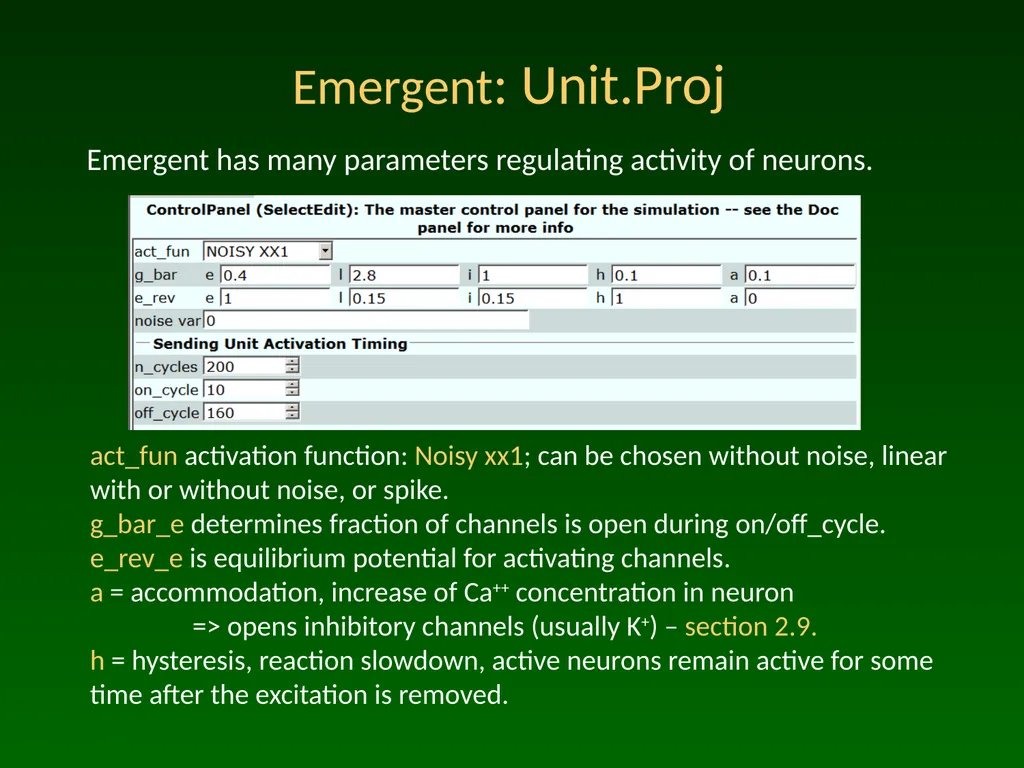
slide2. Emergent: Unit.Proj act_fun activation function: Noisy xx1; can be chosen without noise, linear with or without noise, or spike.
g_bar_e determines fraction of channels is open during on/off_cycle.
e_rev_e is equilibrium potential for activating channels.
a = accommodation, increase of Ca++ concentration in neuron => opens inhibitory channels (usually K+) – section 2.9.
h = hysteresis, reaction slowdown, active neurons remain active for some time after the excitation is removed. Emergent has many parameters regulating activity of neurons.<br>
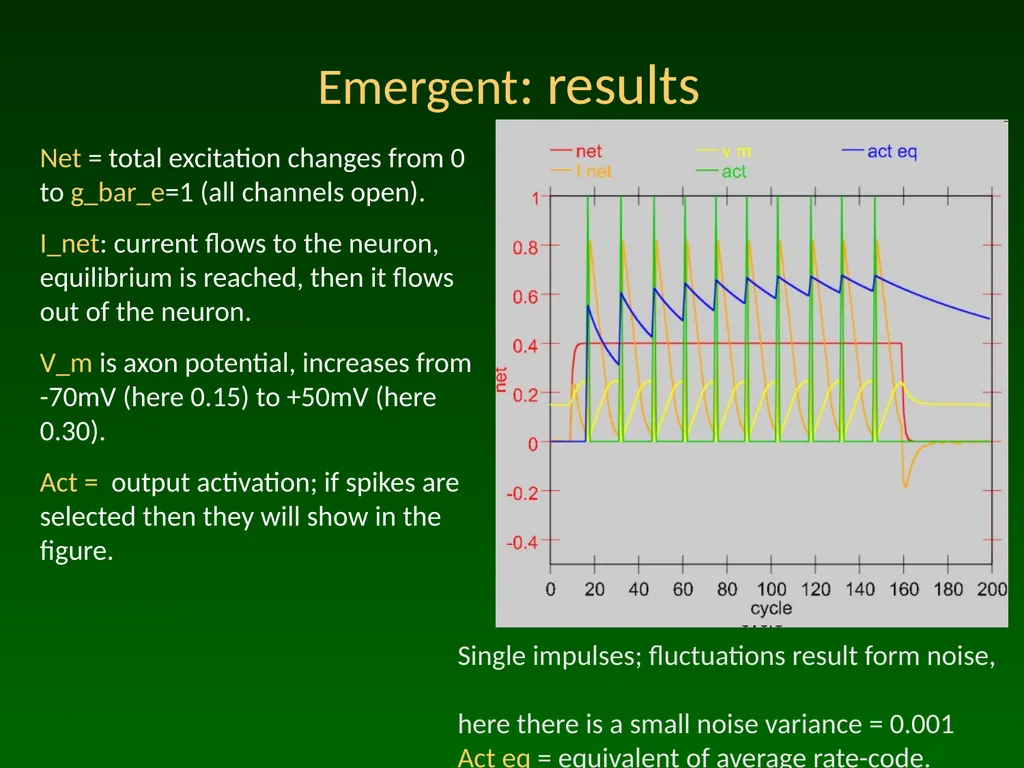
slide3. Emergent: results Net = total excitation changes from 0 to g_bar_e=1 (all channels open).
I_net: current flows to the neuron, equilibrium is reached, then it flows out of the neuron.
V_m is axon potential, increases from -70mV (here 0.15) to +50mV (here 0.30).
Act = output activation; if spikes are selected then they will show in the figure. Single impulses; fluctuations result form noise, here there is a small noise variance = 0.001
Act eq = equivalent of average rate-code.<br>
slide4. Advantages of model simulations Models help to understand phenomena:
enable new inspirations, perspectives on a problem
allow to simulate effects of damages and disorders (drugs, poisoning)
help to understand behavior
models can be formulated on various levels of complexity
models of phenomena overlapping in a continuous fashion (e.g. motion or perception)
models allow detailed control of experimental conditions and exact analysis of the results.
Models require exact specification of underlying assumptions:
allow for new predictions
perform deconstructions of psychological concepts (working memory?)
allow to understand the complexity of a problem
allow for simplifications enabling analysis of a complex system
provide a uniform, cohesive plan of action<br>
slide5. Disadvantages of simulations One must consider limitations of designed models:
Models are often too simple, they should contain many levels.
Models can be too complex, theory may give simpler explanation
why there are no hurricanes on the equator? - due to Coriolis effect
It’s not always known what to provide for in a model.
Even if models work, that doesn’t mean that we understand the mechanisms.
Many alternative yet very different models can explain the same phenomenon.
Models need to be carefully designed to fit the observations:
What’s important in building a model are general rules
the more phenomena a model explains, the more plausible and universal it is.
Allowing for interaction and emergence (construction) is very important.
Knowledge acquired from models should undergo accumulation.<br>
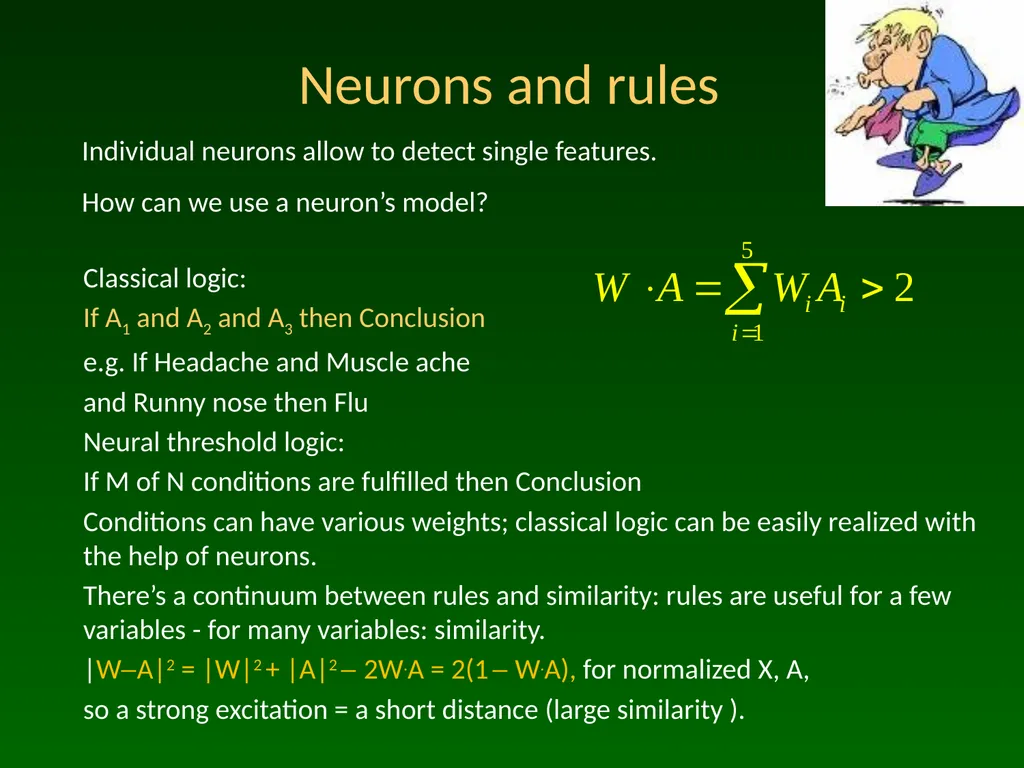
slide6. Neurons and rules Individual neurons allow to detect single features.
How can we use a neuron’s model? Classical logic:
If A1 and A2 and A3 then Conclusion
e.g. If Headache and Muscle ache
and Runny nose then Flu
Neural threshold logic:
If M of N conditions are fulfilled then Conclusion
Conditions can have various weights; classical logic can be easily realized with the help of neurons.
There’s a continuum between rules and similarity: rules are useful for a few variables - for many variables: similarity.
|W-A|2 = |W|2 + |A|2 - 2W.A = 2(1 - W.A), for normalized X, A,
so a strong excitation = a short distance (large similarity ).<br>
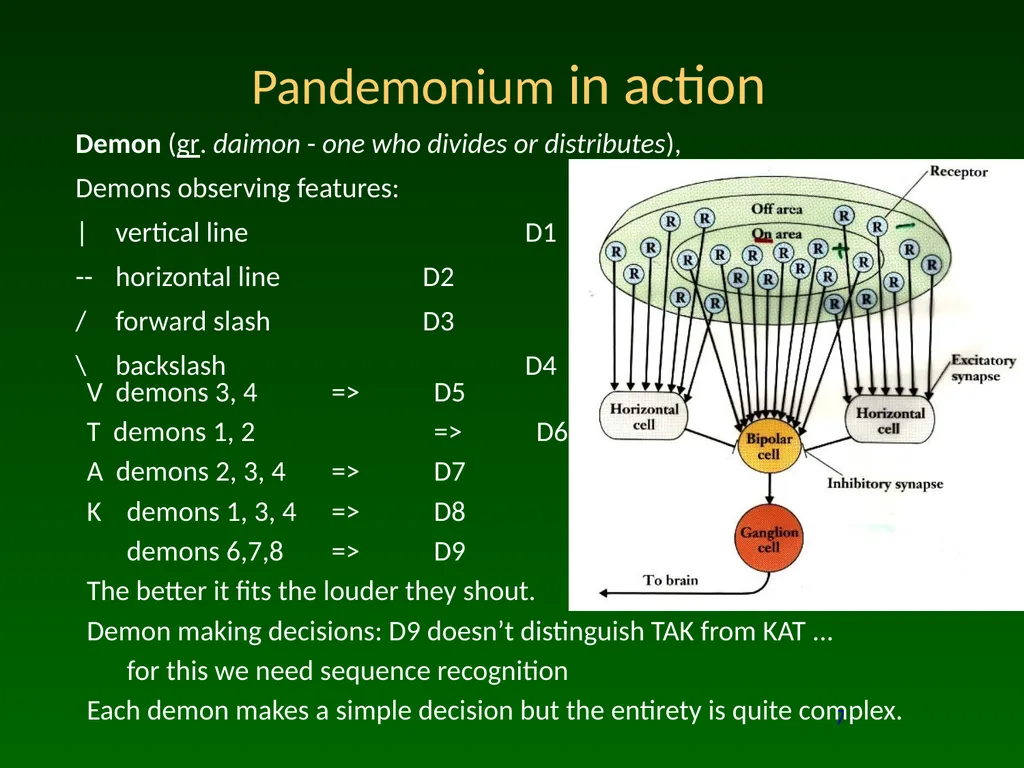
slide7. 7 Pandemonium in action Demon (gr. daimon - one who divides or distributes),
Demons observing features:
| vertical line D1
-- horizontal line D2
/ forward slash D3
\ backslash D4 V demons 3, 4 => D5
T demons 1, 2 => D6
A demons 2, 3, 4 => D7
K demons 1, 3, 4 => D8
demons 6,7,8 => D9
The better it fits the louder they shout.
Demon making decisions: D9 doesn’t distinguish TAK from KAT ...
for this we need sequence recognition
Each demon makes a simple decision but the entirety is quite complex.<br>
slide8. Neurons and networks What properties does a neural network have?
How to set a neural network to do something interesting? Biology: networks are in the cortex (neocortex) and subcortical structures.
Excitatory neurons (85%) and inhibitory neurons (15%). Excitations can be:
mainly in one direction
signal transformation;
or in both directions
supplementing missing information
agreeing upon hypotheses and strengthening weak signals.
most excitatory neurons are bi-directional.
Inhibition: controls mutual excitations, necessary to avoid extra feedback (epilepsy results from lack of inhibition).
The whole network response enables interpretation of incoming information in the light of knowledge of its meaning, encoded in the network structure.<br>
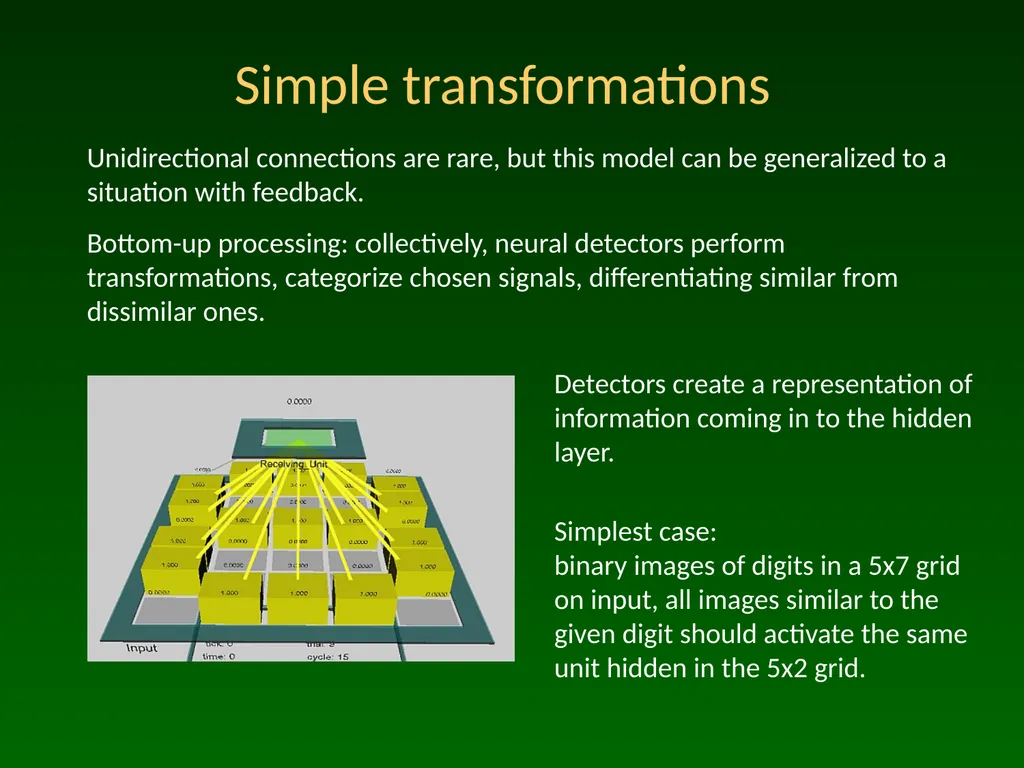
slide9. Simple transformations Unidirectional connections are rare, but this model can be generalized to a situation with feedback.
Bottom-up processing: collectively, neural detectors perform transformations, categorize chosen signals, differentiating similar from dissimilar ones. Detectors create a representation of information coming in to the hidden layer.
Simplest case: binary images of digits in a 5x7 grid on input, all images similar to the given digit should activate the same unit hidden in the 5x2 grid.<br>
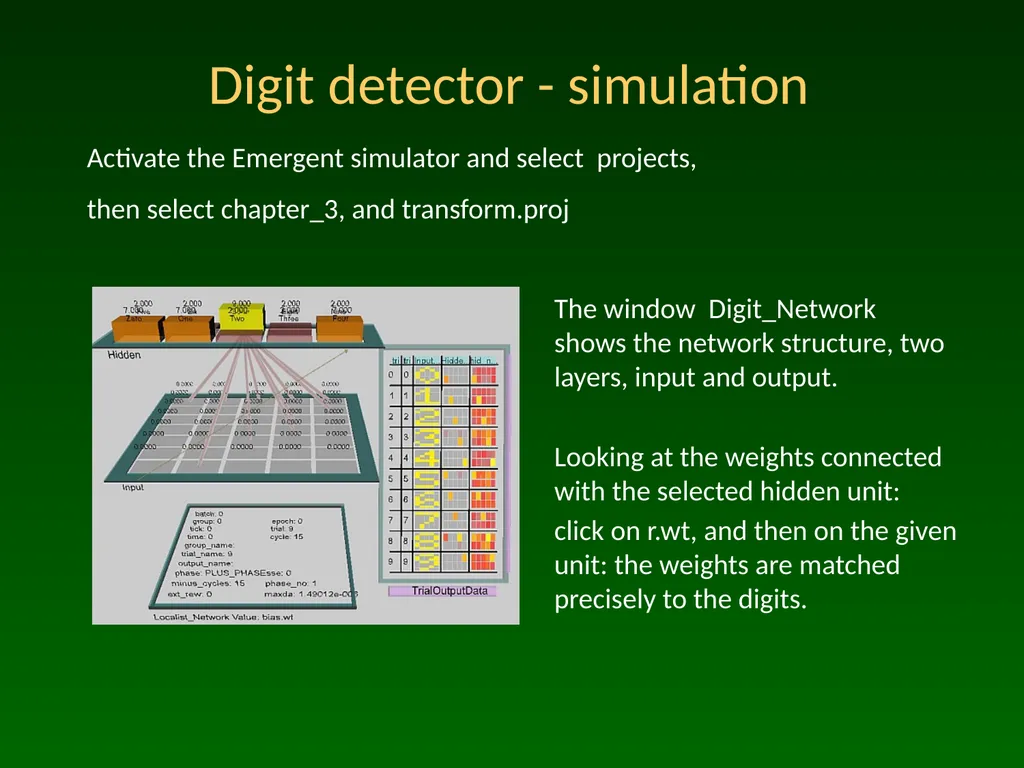
slide10. Digit detector - simulation Activate the Emergent simulator and select projects,
then select chapter_3, and transform.proj The window Digit_Network shows the network structure, two layers, input and output.
Looking at the weights connected with the selected hidden unit:
click on r.wt, and then on the given unit: the weights are matched precisely to the digits.<br>
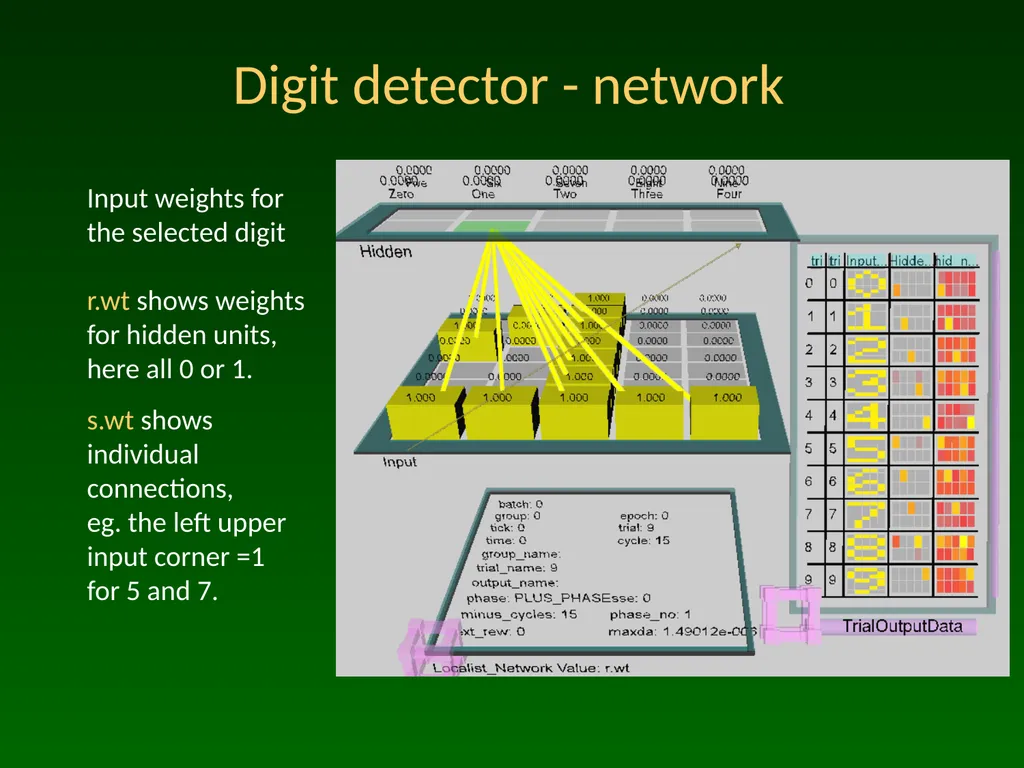
slide11. Digit detector - network Input weights for the selected digit r.wt shows weights for hidden units, here all 0 or 1.
s.wt shows individual connections, eg. the left upper input corner =1 for 5 and 7.<br>
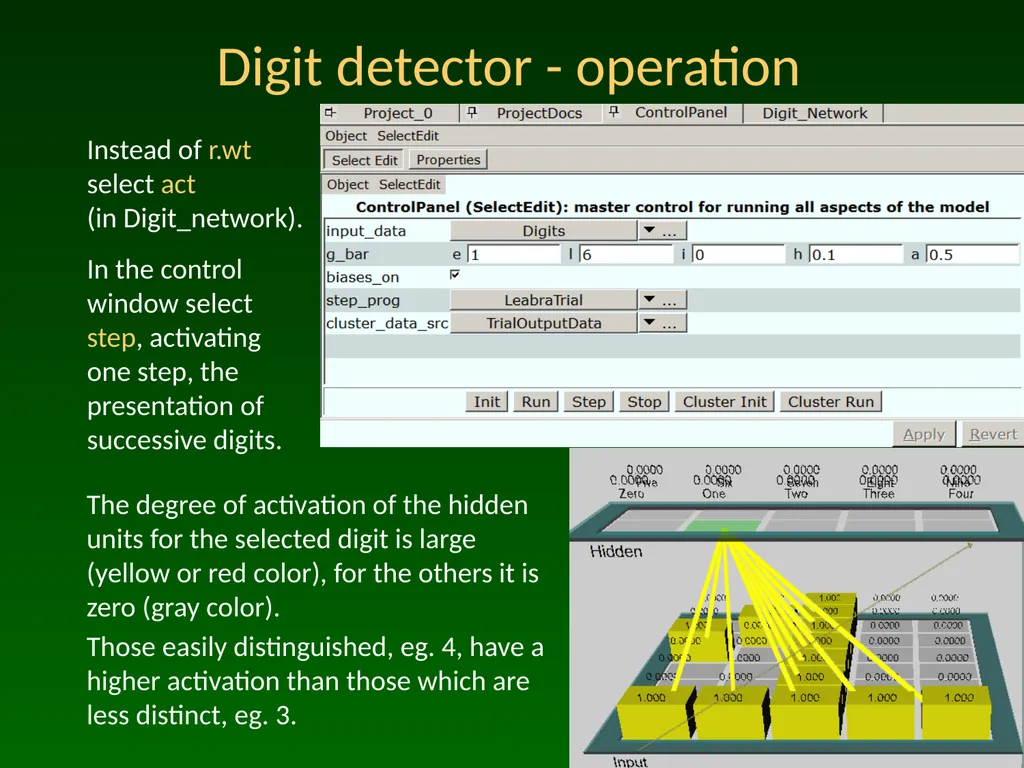
slide12. Digit detector - operation Instead of r.wt select act (in Digit_network).
In the control window select step, activating one step, the presentation of successive digits. The degree of activation of the hidden units for the selected digit is large (yellow or red color), for the others it is zero (gray color).
Those easily distinguished, eg. 4, have a higher activation than those which are less distinct, eg. 3.<br>
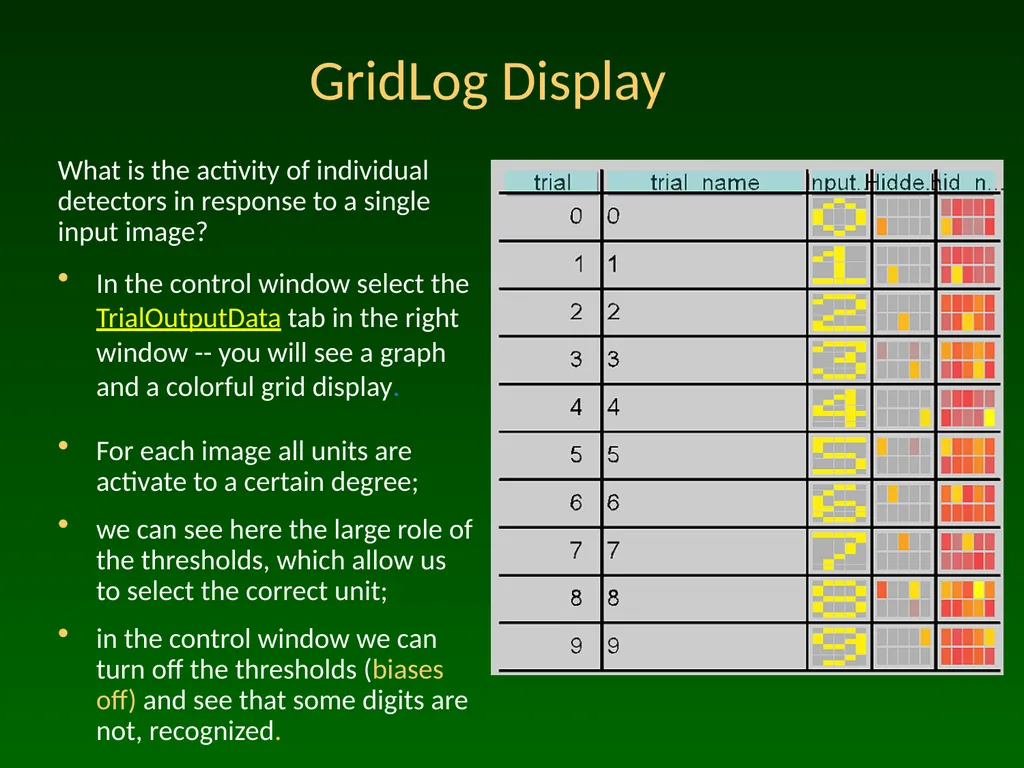
slide13. GridLog Display What is the activity of individual detectors in response to a single input image?
In the control window select the TrialOutputData tab in the right window -- you will see a graph and a colorful grid display.
For each image all units are activate to a certain degree;
we can see here the large role of the thresholds, which allow us to select the correct unit;
in the control window we can turn off the thresholds (biases off) and see that some digits are not, recognized.<br>
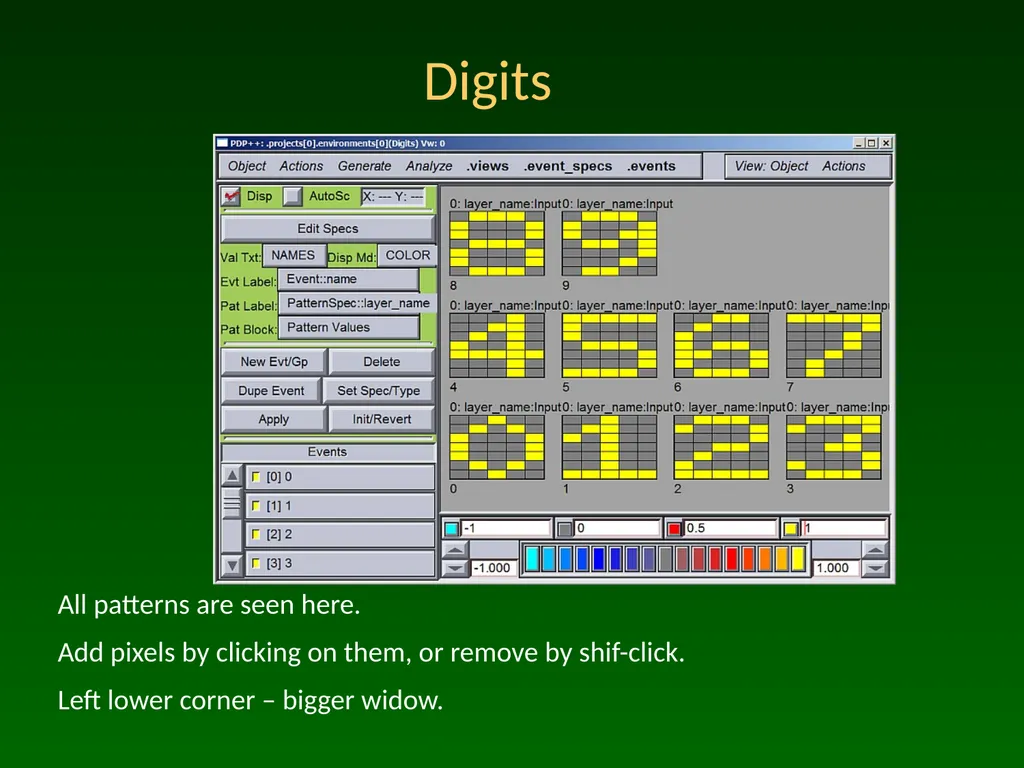
slide14. Digits All patterns are seen here.
Add pixels by clicking on them, or remove by shif-click.
Left lower corner – bigger widow.<br>
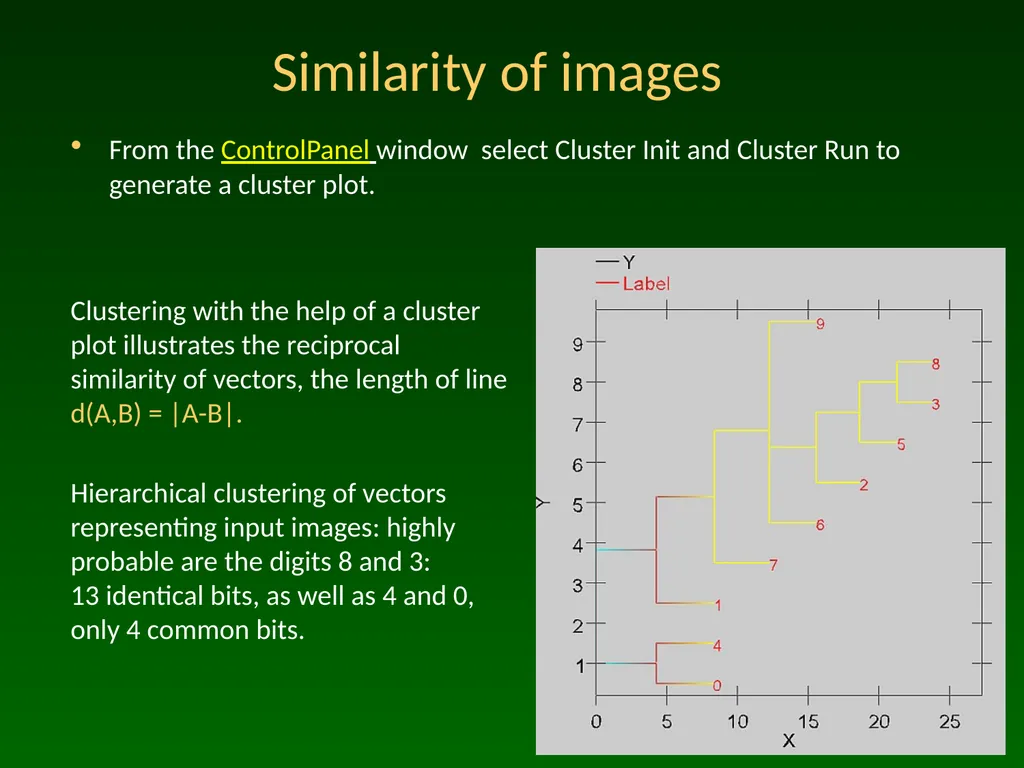
slide15. 15 Similarity of images From the ControlPanel window select Cluster Init and Cluster Run to generate a cluster plot. Clustering with the help of a cluster plot illustrates the reciprocal similarity of vectors, the length of line d(A,B) = |A-B|.
Hierarchical clustering of vectors representing input images: highly probable are the digits 8 and 3: 13 identical bits, as well as 4 and 0, only 4 common bits.<br>
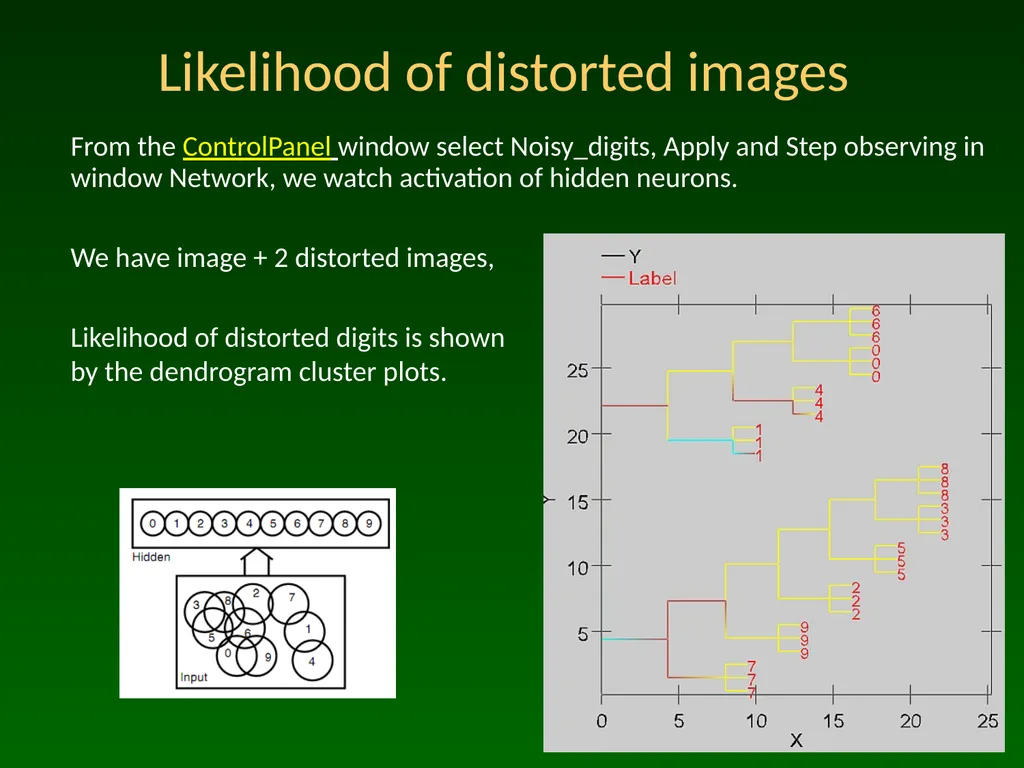
slide16. 16 Likelihood of distorted images From the ControlPanel window select Noisy_digits, Apply and Step observing in window Network, we watch activation of hidden neurons. We have image + 2 distorted images,
Likelihood of distorted digits is shown by the dendrogram cluster plots.<br>
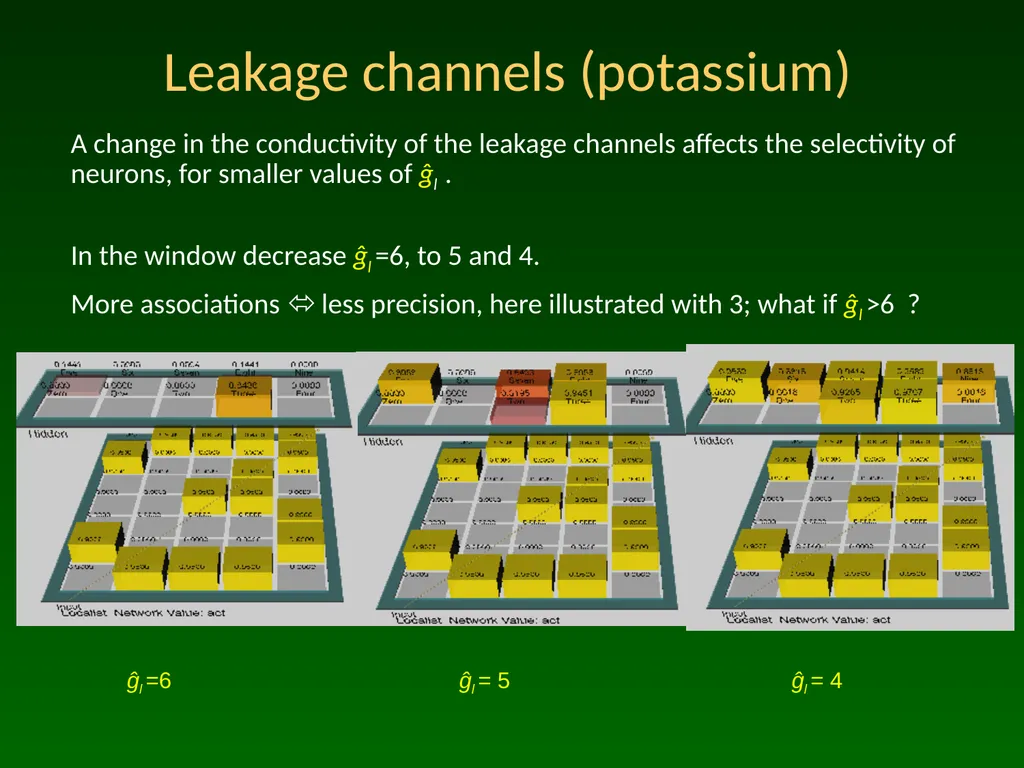
slide17. Leakage channels (potassium) A change in the conductivity of the leakage channels affects the selectivity of neurons, for smaller values of ĝl .
In the window decrease ĝl =6, to 5 and 4.
More associations less precision, here illustrated with 3; what if ĝl >6 ? ĝl =6 ĝl = 5 ĝl = 4<br>
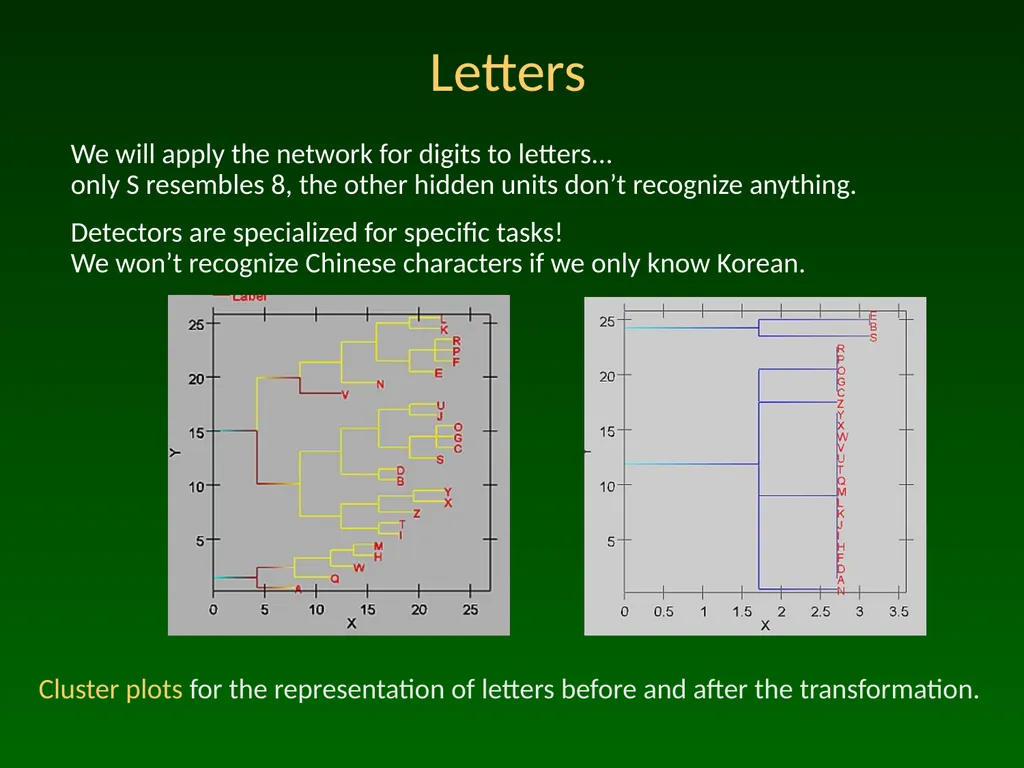
slide18. Letters We will apply the network for digits to letters... only S resembles 8, the other hidden units don’t recognize anything.
Detectors are specialized for specific tasks! We won’t recognize Chinese characters if we only know Korean. Cluster plots for the representation of letters before and after the transformation.<br>
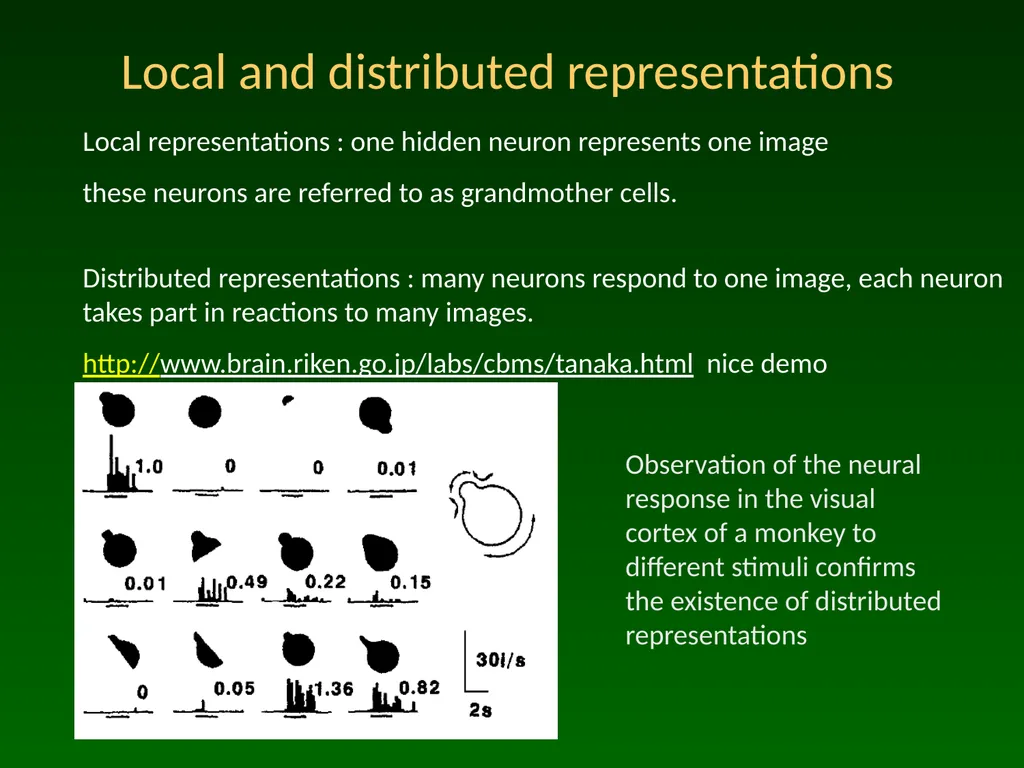
slide19. Local and distributed representations Local representations : one hidden neuron represents one image
these neurons are referred to as grandmother cells.
Distributed representations : many neurons respond to one image, each neuron takes part in reactions to many images.
http://www.brain.riken.go.jp/labs/cbms/tanaka.html nice demo Observation of the neural
response in the visual
cortex of a monkey to
different stimuli confirms
the existence of distributed
representations<br>
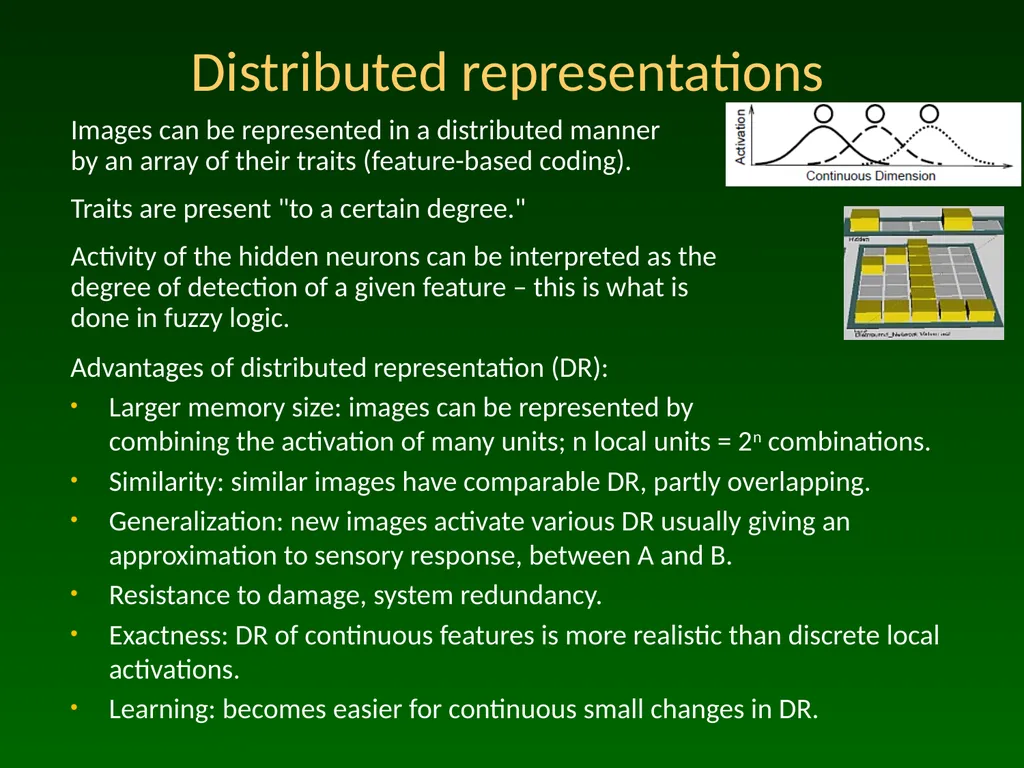
slide20. Distributed representations Images can be represented in a distributed manner by an array of their traits (feature-based coding).
Traits are present "to a certain degree."
Activity of the hidden neurons can be interpreted as the degree of detection of a given feature – this is what is done in fuzzy logic. Advantages of distributed representation (DR):
Larger memory size: images can be represented by combining the activation of many units; n local units = 2n combinations.
Similarity: similar images have comparable DR, partly overlapping.
Generalization: new images activate various DR usually giving an approximation to sensory response, between A and B.
Resistance to damage, system redundancy.
Exactness: DR of continuous features is more realistic than discrete local activations.
Learning: becomes easier for continuous small changes in DR.<br>
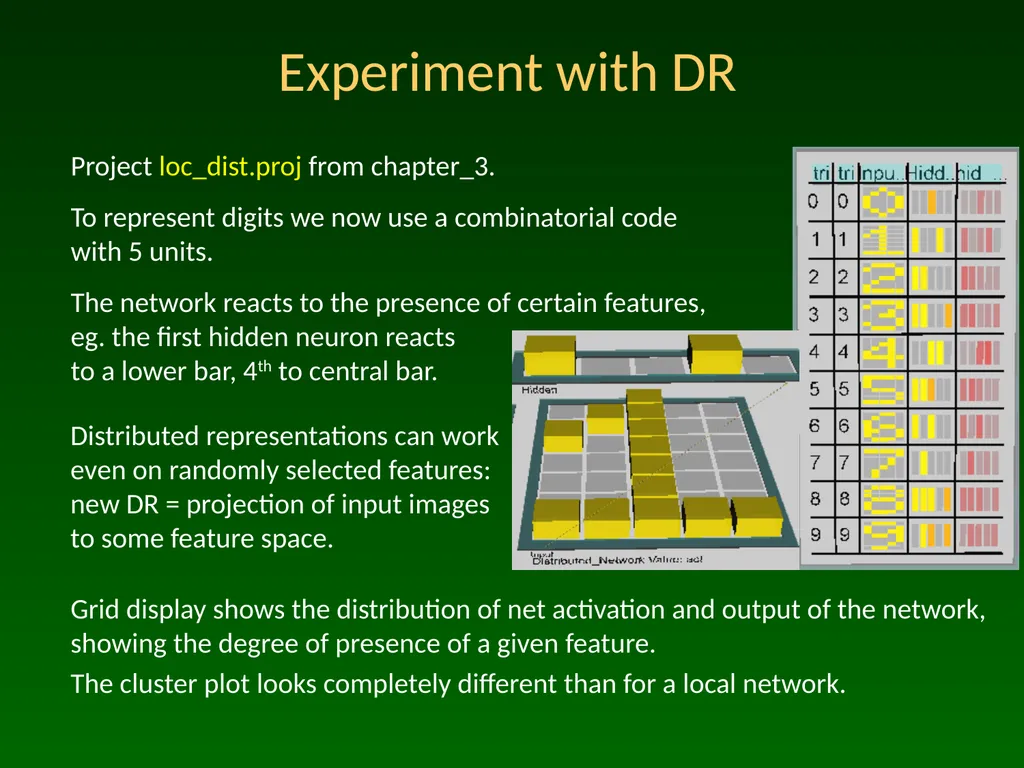
slide21. Experiment with DR Project loc_dist.proj from chapter_3.
To represent digits we now use a combinatorial code with 5 units.
The network reacts to the presence of certain features, eg. the first hidden neuron reacts to a lower bar, 4th to central bar. Distributed representations can work even on randomly selected features: new DR = projection of input images to some feature space. Grid display shows the distribution of net activation and output of the network, showing the degree of presence of a given feature.
The cluster plot looks completely different than for a local network.<br>
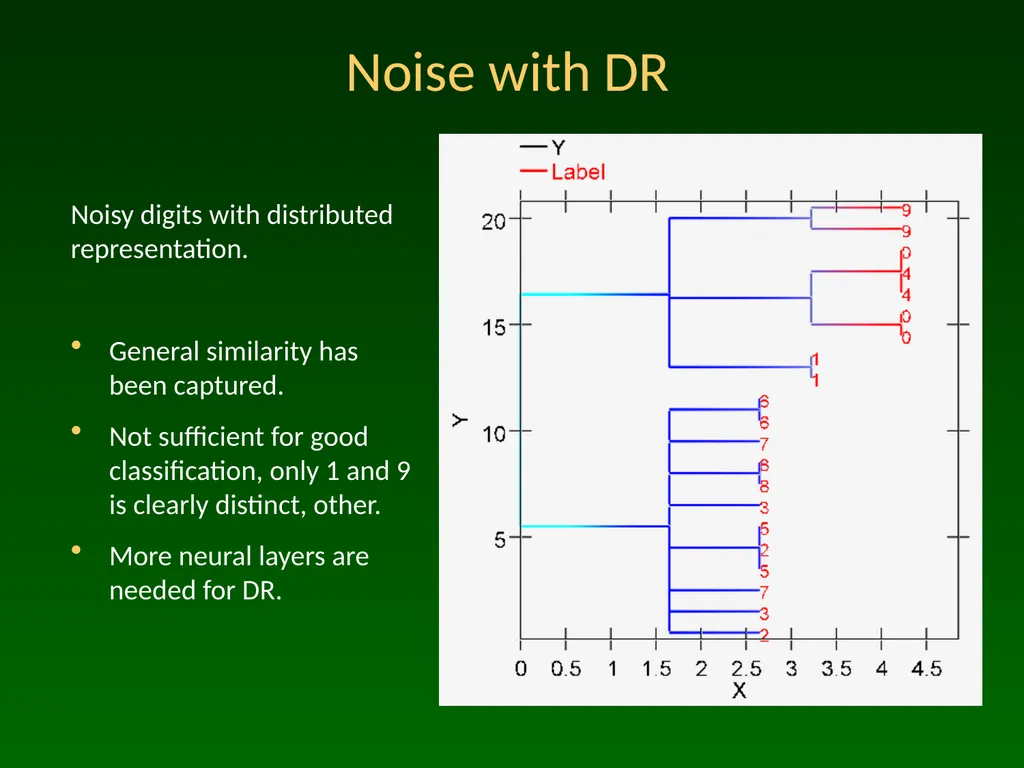
slide22. Noise with DR Noisy digits with distributed representation.
General similarity has been captured.
Not sufficient for good classification, only 1 and 9 is clearly distinct, other.
More neural layers are needed for DR.<br>
slide23. Q1 Please answer these questions given here for each unit.
CECN1 Pattern Completion (pat_complete.proj) -- Pattern completion Question 3.7 (a) Given the pattern of weights, what is the minimal number of units that need to be clamped to produce pattern completion to the full 8? Toggle off the units in the event pattern one-by-one until the network no longer produces the complete pattern when it is Run. (b) The g_bar_l parameter can be altered (in the ControlPanel) to lower this minimal number. What value of this parameter allows completion with only 5 inputs active? Change the g_bar_l value back to 3
Question 3.8 (a) What happens if you activate only inputs which are not part of the 8 pattern? Why this happens? (b) Could the weights in this layer be configured to support the representation of another pattern in addition to the 8 (such that this new pattern could be distinctly activated by a partial input), and do you think it would make a difference how similar this new pattern was to the 8 pattern? Explain your answer.<br>
slide24. Q2 Please answer these questions given here for each unit.
CECN1 Distributed Top-down Amplification (amp_top_down_dist.proj) -- Top-down amplification in distributed network Question 3.9 (a) List the values of g_bar.l where the network's behavior exhibited a qualitative transition in what was activated at the end of settling, and describe these network states.
(b) Using the value of g_bar.l that activated only the desired two hidden units at the end of settling, try increasing the dt_vm parameter from .03 to .04, which will cause the network to settle faster in the same number of cycles by increasing the rate at which the membrane potential is updated on each cycle -- this is just like running the network for longer. Do only the left two hidden feature units still become active? What does this tell you about your previous results? (Hint - if the network is were left to settle indefinitely, do you think there's any value of leak that would allow the features of TV but not Synth to become active?<br>
Neurons and what they can do.
Prof. Janusz Starzyk has made a version of the Emergent lab notes based on my notes in Polish language, so now I am using his CE7427<br>
slide2. Emergent: Unit.Proj act_fun activation function: Noisy xx1; can be chosen without noise, linear with or without noise, or spike.
g_bar_e determines fraction of channels is open during on/off_cycle.
e_rev_e is equilibrium potential for activating channels.
a = accommodation, increase of Ca++ concentration in neuron => opens inhibitory channels (usually K+) – section 2.9.
h = hysteresis, reaction slowdown, active neurons remain active for some time after the excitation is removed. Emergent has many parameters regulating activity of neurons.<br>
slide3. Emergent: results Net = total excitation changes from 0 to g_bar_e=1 (all channels open).
I_net: current flows to the neuron, equilibrium is reached, then it flows out of the neuron.
V_m is axon potential, increases from -70mV (here 0.15) to +50mV (here 0.30).
Act = output activation; if spikes are selected then they will show in the figure. Single impulses; fluctuations result form noise, here there is a small noise variance = 0.001
Act eq = equivalent of average rate-code.<br>
slide4. Advantages of model simulations Models help to understand phenomena:
enable new inspirations, perspectives on a problem
allow to simulate effects of damages and disorders (drugs, poisoning)
help to understand behavior
models can be formulated on various levels of complexity
models of phenomena overlapping in a continuous fashion (e.g. motion or perception)
models allow detailed control of experimental conditions and exact analysis of the results.
Models require exact specification of underlying assumptions:
allow for new predictions
perform deconstructions of psychological concepts (working memory?)
allow to understand the complexity of a problem
allow for simplifications enabling analysis of a complex system
provide a uniform, cohesive plan of action<br>
slide5. Disadvantages of simulations One must consider limitations of designed models:
Models are often too simple, they should contain many levels.
Models can be too complex, theory may give simpler explanation
why there are no hurricanes on the equator? - due to Coriolis effect
It’s not always known what to provide for in a model.
Even if models work, that doesn’t mean that we understand the mechanisms.
Many alternative yet very different models can explain the same phenomenon.
Models need to be carefully designed to fit the observations:
What’s important in building a model are general rules
the more phenomena a model explains, the more plausible and universal it is.
Allowing for interaction and emergence (construction) is very important.
Knowledge acquired from models should undergo accumulation.<br>
slide6. Neurons and rules Individual neurons allow to detect single features.
How can we use a neuron’s model? Classical logic:
If A1 and A2 and A3 then Conclusion
e.g. If Headache and Muscle ache
and Runny nose then Flu
Neural threshold logic:
If M of N conditions are fulfilled then Conclusion
Conditions can have various weights; classical logic can be easily realized with the help of neurons.
There’s a continuum between rules and similarity: rules are useful for a few variables - for many variables: similarity.
|W-A|2 = |W|2 + |A|2 - 2W.A = 2(1 - W.A), for normalized X, A,
so a strong excitation = a short distance (large similarity ).<br>
slide7. 7 Pandemonium in action Demon (gr. daimon - one who divides or distributes),
Demons observing features:
| vertical line D1
-- horizontal line D2
/ forward slash D3
\ backslash D4 V demons 3, 4 => D5
T demons 1, 2 => D6
A demons 2, 3, 4 => D7
K demons 1, 3, 4 => D8
demons 6,7,8 => D9
The better it fits the louder they shout.
Demon making decisions: D9 doesn’t distinguish TAK from KAT ...
for this we need sequence recognition
Each demon makes a simple decision but the entirety is quite complex.<br>
slide8. Neurons and networks What properties does a neural network have?
How to set a neural network to do something interesting? Biology: networks are in the cortex (neocortex) and subcortical structures.
Excitatory neurons (85%) and inhibitory neurons (15%). Excitations can be:
mainly in one direction
signal transformation;
or in both directions
supplementing missing information
agreeing upon hypotheses and strengthening weak signals.
most excitatory neurons are bi-directional.
Inhibition: controls mutual excitations, necessary to avoid extra feedback (epilepsy results from lack of inhibition).
The whole network response enables interpretation of incoming information in the light of knowledge of its meaning, encoded in the network structure.<br>
slide9. Simple transformations Unidirectional connections are rare, but this model can be generalized to a situation with feedback.
Bottom-up processing: collectively, neural detectors perform transformations, categorize chosen signals, differentiating similar from dissimilar ones. Detectors create a representation of information coming in to the hidden layer.
Simplest case: binary images of digits in a 5x7 grid on input, all images similar to the given digit should activate the same unit hidden in the 5x2 grid.<br>
slide10. Digit detector - simulation Activate the Emergent simulator and select projects,
then select chapter_3, and transform.proj The window Digit_Network shows the network structure, two layers, input and output.
Looking at the weights connected with the selected hidden unit:
click on r.wt, and then on the given unit: the weights are matched precisely to the digits.<br>
slide11. Digit detector - network Input weights for the selected digit r.wt shows weights for hidden units, here all 0 or 1.
s.wt shows individual connections, eg. the left upper input corner =1 for 5 and 7.<br>
slide12. Digit detector - operation Instead of r.wt select act (in Digit_network).
In the control window select step, activating one step, the presentation of successive digits. The degree of activation of the hidden units for the selected digit is large (yellow or red color), for the others it is zero (gray color).
Those easily distinguished, eg. 4, have a higher activation than those which are less distinct, eg. 3.<br>
slide13. GridLog Display What is the activity of individual detectors in response to a single input image?
In the control window select the TrialOutputData tab in the right window -- you will see a graph and a colorful grid display.
For each image all units are activate to a certain degree;
we can see here the large role of the thresholds, which allow us to select the correct unit;
in the control window we can turn off the thresholds (biases off) and see that some digits are not, recognized.<br>
slide14. Digits All patterns are seen here.
Add pixels by clicking on them, or remove by shif-click.
Left lower corner – bigger widow.<br>
slide15. 15 Similarity of images From the ControlPanel window select Cluster Init and Cluster Run to generate a cluster plot. Clustering with the help of a cluster plot illustrates the reciprocal similarity of vectors, the length of line d(A,B) = |A-B|.
Hierarchical clustering of vectors representing input images: highly probable are the digits 8 and 3: 13 identical bits, as well as 4 and 0, only 4 common bits.<br>
slide16. 16 Likelihood of distorted images From the ControlPanel window select Noisy_digits, Apply and Step observing in window Network, we watch activation of hidden neurons. We have image + 2 distorted images,
Likelihood of distorted digits is shown by the dendrogram cluster plots.<br>
slide17. Leakage channels (potassium) A change in the conductivity of the leakage channels affects the selectivity of neurons, for smaller values of ĝl .
In the window decrease ĝl =6, to 5 and 4.
More associations less precision, here illustrated with 3; what if ĝl >6 ? ĝl =6 ĝl = 5 ĝl = 4<br>
slide18. Letters We will apply the network for digits to letters... only S resembles 8, the other hidden units don’t recognize anything.
Detectors are specialized for specific tasks! We won’t recognize Chinese characters if we only know Korean. Cluster plots for the representation of letters before and after the transformation.<br>
slide19. Local and distributed representations Local representations : one hidden neuron represents one image
these neurons are referred to as grandmother cells.
Distributed representations : many neurons respond to one image, each neuron takes part in reactions to many images.
http://www.brain.riken.go.jp/labs/cbms/tanaka.html nice demo Observation of the neural
response in the visual
cortex of a monkey to
different stimuli confirms
the existence of distributed
representations<br>
slide20. Distributed representations Images can be represented in a distributed manner by an array of their traits (feature-based coding).
Traits are present "to a certain degree."
Activity of the hidden neurons can be interpreted as the degree of detection of a given feature – this is what is done in fuzzy logic. Advantages of distributed representation (DR):
Larger memory size: images can be represented by combining the activation of many units; n local units = 2n combinations.
Similarity: similar images have comparable DR, partly overlapping.
Generalization: new images activate various DR usually giving an approximation to sensory response, between A and B.
Resistance to damage, system redundancy.
Exactness: DR of continuous features is more realistic than discrete local activations.
Learning: becomes easier for continuous small changes in DR.<br>
slide21. Experiment with DR Project loc_dist.proj from chapter_3.
To represent digits we now use a combinatorial code with 5 units.
The network reacts to the presence of certain features, eg. the first hidden neuron reacts to a lower bar, 4th to central bar. Distributed representations can work even on randomly selected features: new DR = projection of input images to some feature space. Grid display shows the distribution of net activation and output of the network, showing the degree of presence of a given feature.
The cluster plot looks completely different than for a local network.<br>
slide22. Noise with DR Noisy digits with distributed representation.
General similarity has been captured.
Not sufficient for good classification, only 1 and 9 is clearly distinct, other.
More neural layers are needed for DR.<br>
slide23. Q1 Please answer these questions given here for each unit.
CECN1 Pattern Completion (pat_complete.proj) -- Pattern completion Question 3.7 (a) Given the pattern of weights, what is the minimal number of units that need to be clamped to produce pattern completion to the full 8? Toggle off the units in the event pattern one-by-one until the network no longer produces the complete pattern when it is Run. (b) The g_bar_l parameter can be altered (in the ControlPanel) to lower this minimal number. What value of this parameter allows completion with only 5 inputs active? Change the g_bar_l value back to 3
Question 3.8 (a) What happens if you activate only inputs which are not part of the 8 pattern? Why this happens? (b) Could the weights in this layer be configured to support the representation of another pattern in addition to the 8 (such that this new pattern could be distinctly activated by a partial input), and do you think it would make a difference how similar this new pattern was to the 8 pattern? Explain your answer.<br>
slide24. Q2 Please answer these questions given here for each unit.
CECN1 Distributed Top-down Amplification (amp_top_down_dist.proj) -- Top-down amplification in distributed network Question 3.9 (a) List the values of g_bar.l where the network's behavior exhibited a qualitative transition in what was activated at the end of settling, and describe these network states.
(b) Using the value of g_bar.l that activated only the desired two hidden units at the end of settling, try increasing the dt_vm parameter from .03 to .04, which will cause the network to settle faster in the same number of cycles by increasing the rate at which the membrane potential is updated on each cycle -- this is just like running the network for longer. Do only the left two hidden feature units still become active? What does this tell you about your previous results? (Hint - if the network is were left to settle indefinitely, do you think there's any value of leak that would allow the features of TV but not Synth to become active?<br>