
ADVERSE DRUG REACTIONS : IDENTIFICATION,
AS
Published · 32 slides · 0 views
1 / 1




Description
ADVERSE DRUG REACTIONS : IDENTIFICATION, MANAGEMENT AND REPORTING SYSTEM Prof. Rakesh Kumar Tewari, M.D.(Ay.) I.M.S.(BHU), Head, Deptt Of Dravyaguna, R.A.M.C.H, Bareilly (UP). E mail : vdrakesh.tiwarigmail.com IMPORTANCE OF KNOWING ADRs
Related Topics
Share
Embed code
Download this presentation From Below
"ADVERSE DRUG REACTIONS : IDENTIFICATION," is the property of its rightful owner. Permission is granted to download and print the materials on this website for personal, non-commercial use only, and to display it on your personal computer provided you do not modify the materials and that you retain all copyright notices contained in the materials. By downloading content from our website, you accept the terms of this agreement.
Presentation Transcript
01
ADVERSE DRUG REACTIONS : IDENTIFICATION, MANAGEMENT AND REPORTING SYSTEM Prof. Rakesh Kumar Tewari, M.D.(Ay.) I.M.S.(BHU),
Head, Deptt Of Dravyaguna,
R.A.M.C.H, Bareilly (UP).
E mail : vdrakesh.tiwari@gmail.com<br>
Head, Deptt Of Dravyaguna,
R.A.M.C.H, Bareilly (UP).
E mail : vdrakesh.tiwari@gmail.com<br>
02
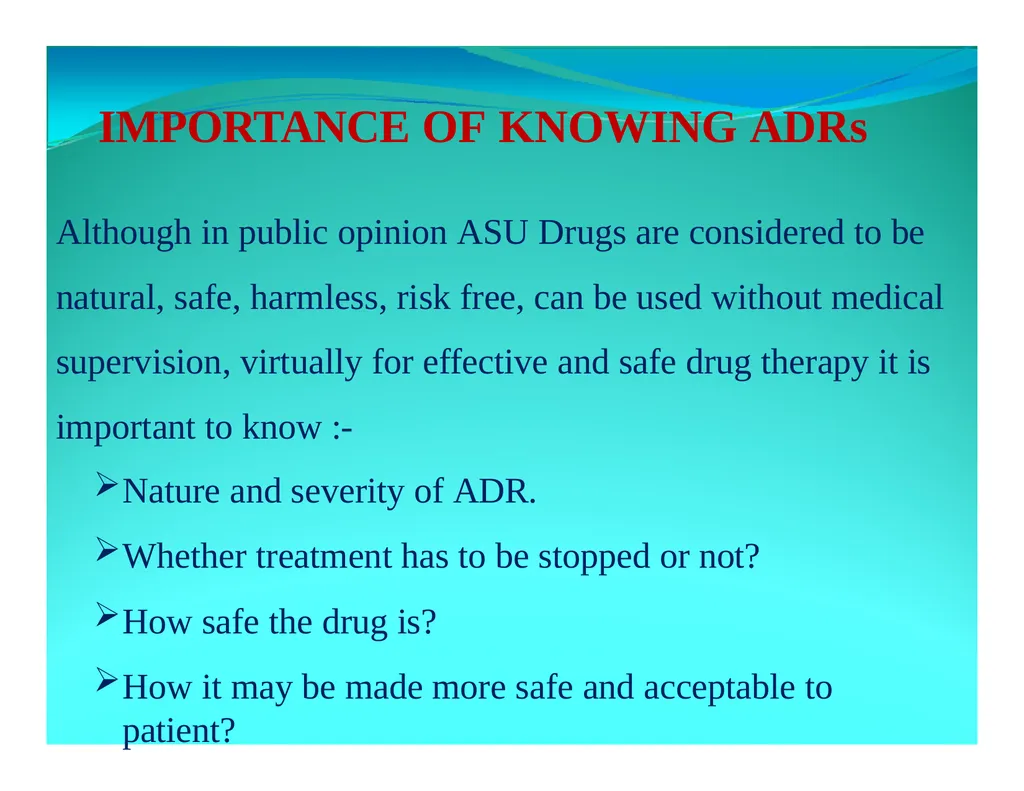
IMPORTANCE OF KNOWING ADRs Although in public opinion ASU Drugs are considered to be natural, safe, harmless, risk free, can be used without medical supervision, virtually for effective and safe drug therapy it is important to know :-
Nature and severity of ADR.
Whether treatment has to be stopped or not?
How safe the drug is?
How it may be made more safe and acceptable to patient?<br>
Nature and severity of ADR.
Whether treatment has to be stopped or not?
How safe the drug is?
How it may be made more safe and acceptable to patient?<br>
03
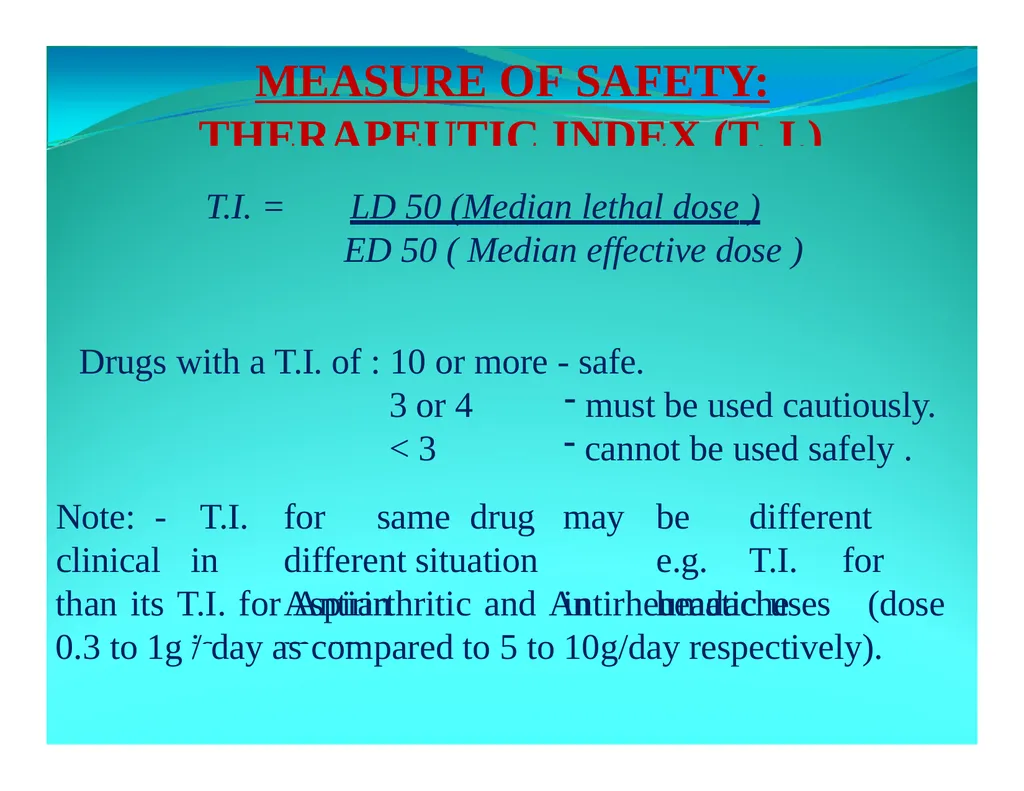
MEASURE OF SAFETY: THERAPEUTIC INDEX (T. I.) T.I. = LD 50 (Median lethal dose ) ED 50 ( Median effective dose ) Drugs with a T.I. of : 10 or more - safe. 3 or 4
< 3 must be used cautiously.
cannot be used safely . Note: - clinical T.I. for same drug may be different in different situation e.g. T.I. for Aspirin in headache is more than its T.I. for Antiarthritic and Antirheumatic uses (dose 0.3 to 1g / day as compared to 5 to 10g/day respectively).<br>
< 3 must be used cautiously.
cannot be used safely . Note: - clinical T.I. for same drug may be different in different situation e.g. T.I. for Aspirin in headache is more than its T.I. for Antiarthritic and Antirheumatic uses (dose 0.3 to 1g / day as compared to 5 to 10g/day respectively).<br>
04
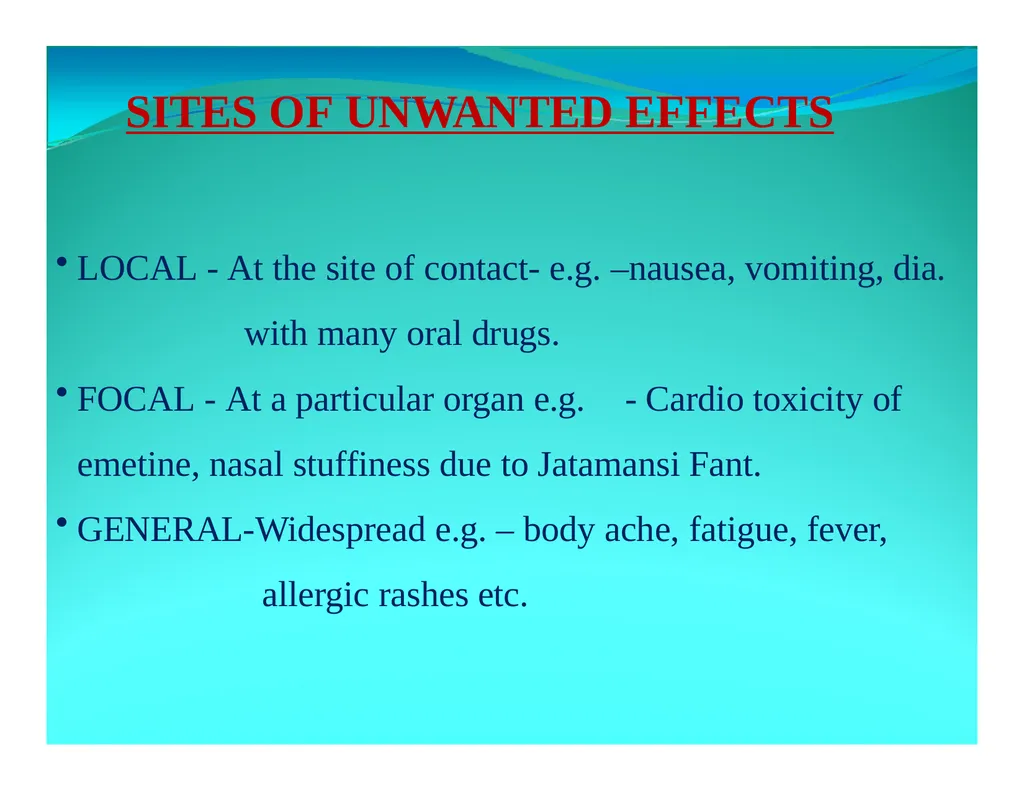
SITES OF UNWANTED EFFECTS LOCAL - At the site of contact- e.g. –nausea, vomiting, dia. with many oral drugs.
FOCAL - At a particular organ e.g. - Cardio toxicity of emetine, nasal stuffiness due to Jatamansi Fant.
GENERAL-Widespread e.g. – body ache, fatigue, fever, allergic rashes etc.<br>
FOCAL - At a particular organ e.g. - Cardio toxicity of emetine, nasal stuffiness due to Jatamansi Fant.
GENERAL-Widespread e.g. – body ache, fatigue, fever, allergic rashes etc.<br>
05
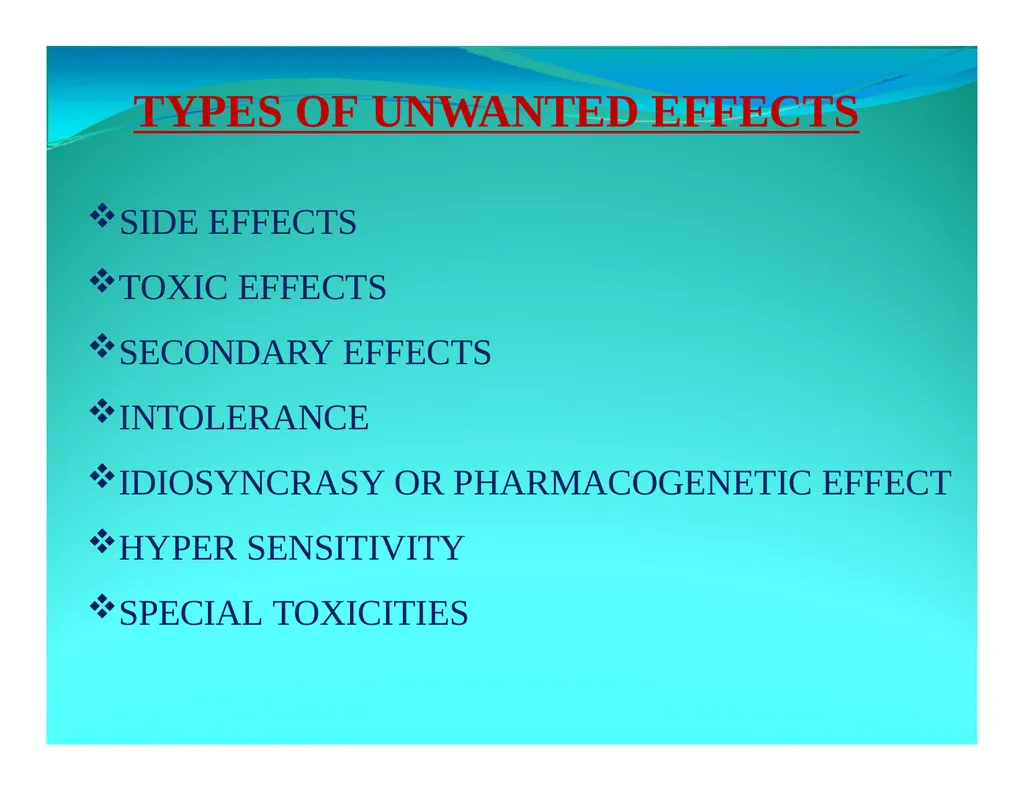
TYPES OF UNWANTED EFFECTS SIDE EFFECTS
TOXIC EFFECTS
SECONDARY EFFECTS
INTOLERANCE
IDIOSYNCRASY OR PHARMACOGENETIC EFFECT
HYPER SENSITIVITY
SPECIAL TOXICITIES<br>
TOXIC EFFECTS
SECONDARY EFFECTS
INTOLERANCE
IDIOSYNCRASY OR PHARMACOGENETIC EFFECT
HYPER SENSITIVITY
SPECIAL TOXICITIES<br>
06
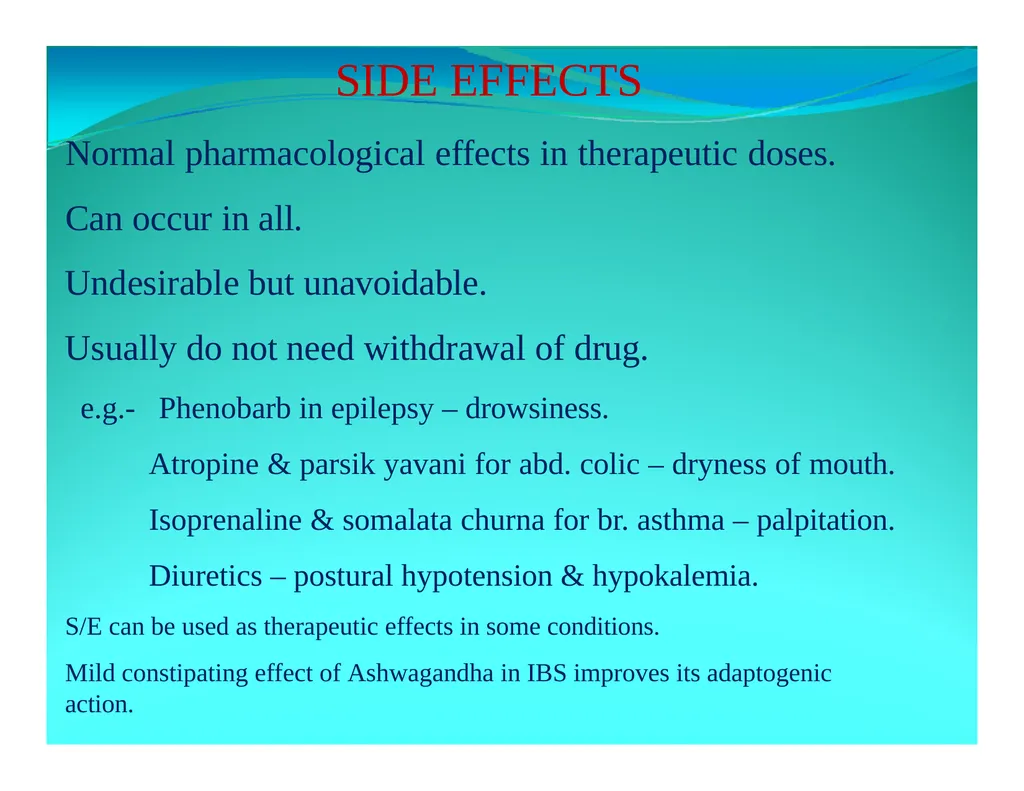
SIDE EFFECTS Normal pharmacological effects in therapeutic doses. Can occur in all.
Undesirable but unavoidable.
Usually do not need withdrawal of drug.
e.g.- Phenobarb in epilepsy – drowsiness.
Atropine & parsik yavani for abd. colic – dryness of mouth. Isoprenaline & somalata churna for br. asthma – palpitation. Diuretics – postural hypotension & hypokalemia.
S/E can be used as therapeutic effects in some conditions.
Mild constipating effect of Ashwagandha in IBS improves its adaptogenic action.<br>
Undesirable but unavoidable.
Usually do not need withdrawal of drug.
e.g.- Phenobarb in epilepsy – drowsiness.
Atropine & parsik yavani for abd. colic – dryness of mouth. Isoprenaline & somalata churna for br. asthma – palpitation. Diuretics – postural hypotension & hypokalemia.
S/E can be used as therapeutic effects in some conditions.
Mild constipating effect of Ashwagandha in IBS improves its adaptogenic action.<br>
07
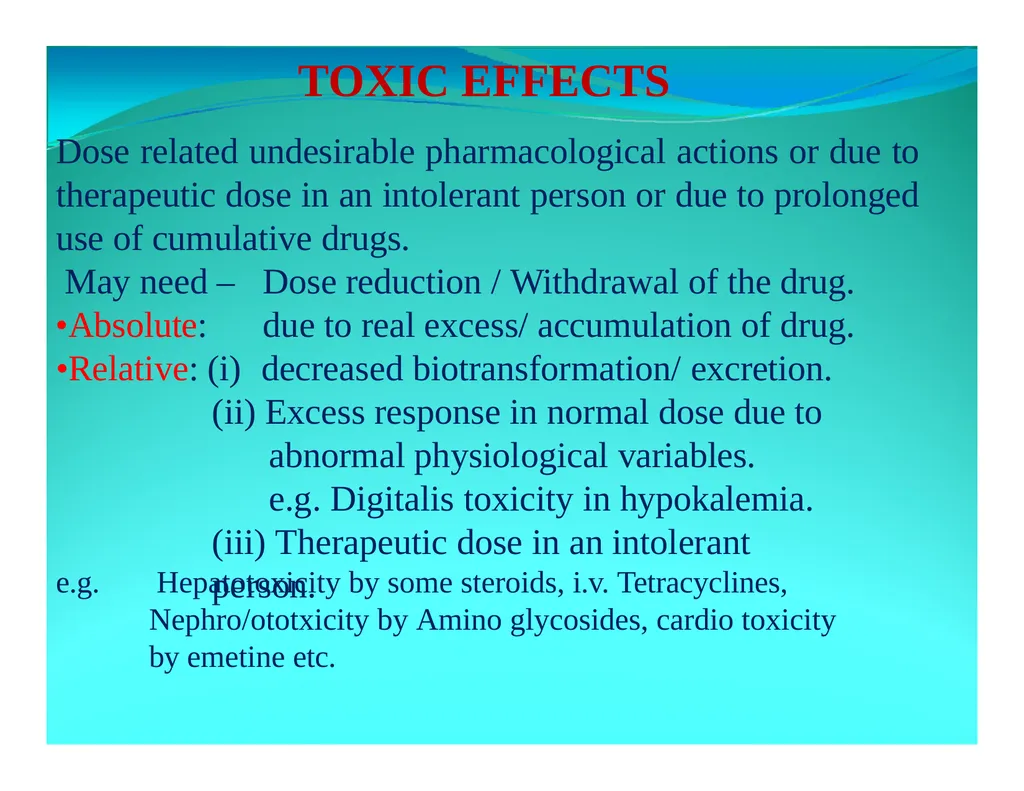
TOXIC EFFECTS Dose related undesirable pharmacological actions or due to therapeutic dose in an intolerant person or due to prolonged use of cumulative drugs. May need –
•Absolute: Dose reduction / Withdrawal of the drug. due to real excess/ accumulation of drug. •Relative: (i) decreased biotransformation/ excretion.
(ii) Excess response in normal dose due to abnormal physiological variables.
e.g. Digitalis toxicity in hypokalemia.
(iii) Therapeutic dose in an intolerant person. e.g. Hepatotoxicity by some steroids, i.v. Tetracyclines, Nephro/ototxicity by Amino glycosides, cardio toxicity by emetine etc.<br>
•Absolute: Dose reduction / Withdrawal of the drug. due to real excess/ accumulation of drug. •Relative: (i) decreased biotransformation/ excretion.
(ii) Excess response in normal dose due to abnormal physiological variables.
e.g. Digitalis toxicity in hypokalemia.
(iii) Therapeutic dose in an intolerant person. e.g. Hepatotoxicity by some steroids, i.v. Tetracyclines, Nephro/ototxicity by Amino glycosides, cardio toxicity by emetine etc.<br>
08
INTOLERANCE/ HYPER-REACTIVITY Excessive but expected pharmacological response due to biological variation.
e.g. Sedative dose of pnenobarb leading to severe CNS depression.<br>
e.g. Sedative dose of pnenobarb leading to severe CNS depression.<br>
09
IDIOSYNCRASY or PHARMACO – GENETIC EFFECT Unexpected & abnormal pharmacological response due to Genetic peculiarity.
Example:
Haemolysis with primaquine, sulfones & sulphonamides ( G-6-PD deficiency )
Succinylcholine Apnoea (due to atypical pseudo cholinesterase)
Cinchonism with Quinine & quinidine Salicylism with salicylates. Note : Therapy may have to be stopped or dose to be titrated.<br>
Example:
Haemolysis with primaquine, sulfones & sulphonamides ( G-6-PD deficiency )
Succinylcholine Apnoea (due to atypical pseudo cholinesterase)
Cinchonism with Quinine & quinidine Salicylism with salicylates. Note : Therapy may have to be stopped or dose to be titrated.<br>
10
HYPERSENSITIVITY REACTIONS or ALLERGIC REACTIONS Qualitatively abnormal response
Not related to pharmacological response Not related to dose
Based on Antigen Antibody Reaction Requires prior sensitization to drug
(Direct exposure or indirectly through food or environmental factors)
Drugs act as partial antigens (HAPTENs) which combine with body proteins & become complete antigens.
Contd.<br>
Not related to pharmacological response Not related to dose
Based on Antigen Antibody Reaction Requires prior sensitization to drug
(Direct exposure or indirectly through food or environmental factors)
Drugs act as partial antigens (HAPTENs) which combine with body proteins & become complete antigens.
Contd.<br>
11
HYPERSENSITIVITY REACTIONS or ALLERGIC REACTIONS
Antigen or Allergen may be – 1. Drug itself Metabolite of drug.
Preservative / vehicle.
contaminant/adulterant Classification: (on the basis of +ve skin tests with antigens)
•Immediate Type – Type I, II & III.
•Delayed Type – Type IV.<br>
Antigen or Allergen may be – 1. Drug itself Metabolite of drug.
Preservative / vehicle.
contaminant/adulterant Classification: (on the basis of +ve skin tests with antigens)
•Immediate Type – Type I, II & III.
•Delayed Type – Type IV.<br>
12
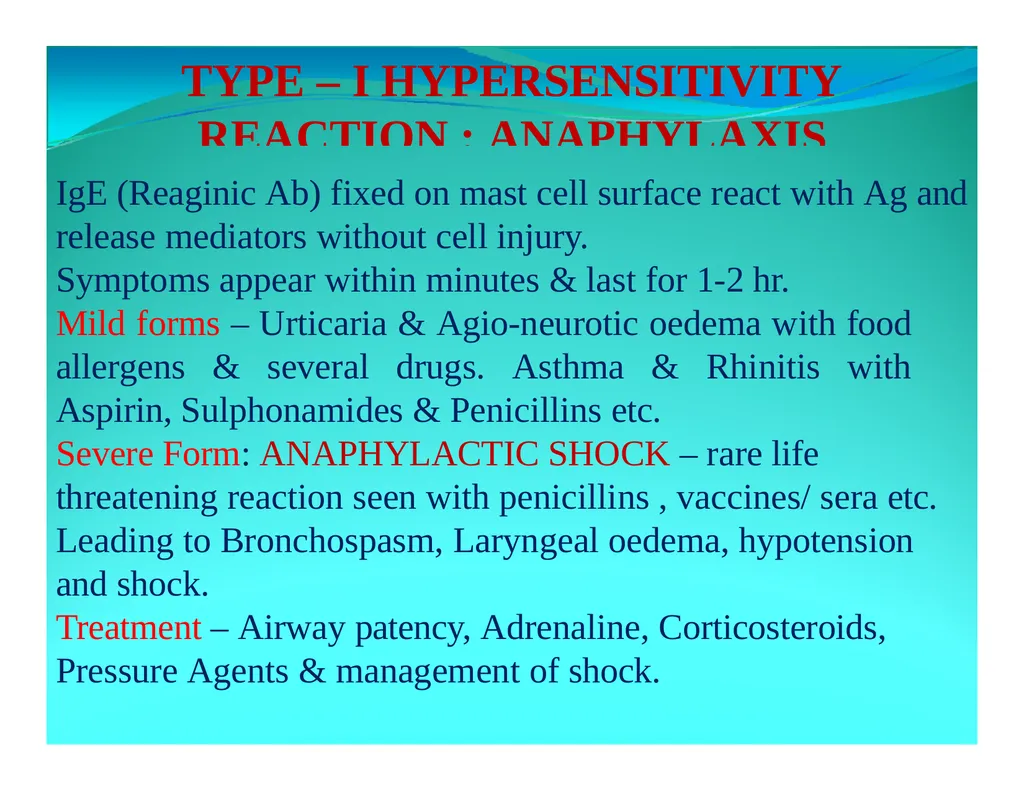
TYPE – I HYPERSENSITIVITY REACTION : ANAPHYLAXIS IgE (Reaginic Ab) fixed on mast cell surface react with Ag and release mediators without cell injury.
Symptoms appear within minutes & last for 1-2 hr.
Mild forms – Urticaria & Agio-neurotic oedema with food allergens & several drugs. Asthma & Rhinitis with Aspirin, Sulphonamides & Penicillins etc.
Severe Form: ANAPHYLACTIC SHOCK – rare life threatening reaction seen with penicillins , vaccines/ sera etc. Leading to Bronchospasm, Laryngeal oedema, hypotension and shock.
Treatment – Airway patency, Adrenaline, Corticosteroids, Pressure Agents & management of shock.<br>
Symptoms appear within minutes & last for 1-2 hr.
Mild forms – Urticaria & Agio-neurotic oedema with food allergens & several drugs. Asthma & Rhinitis with Aspirin, Sulphonamides & Penicillins etc.
Severe Form: ANAPHYLACTIC SHOCK – rare life threatening reaction seen with penicillins , vaccines/ sera etc. Leading to Bronchospasm, Laryngeal oedema, hypotension and shock.
Treatment – Airway patency, Adrenaline, Corticosteroids, Pressure Agents & management of shock.<br>
13
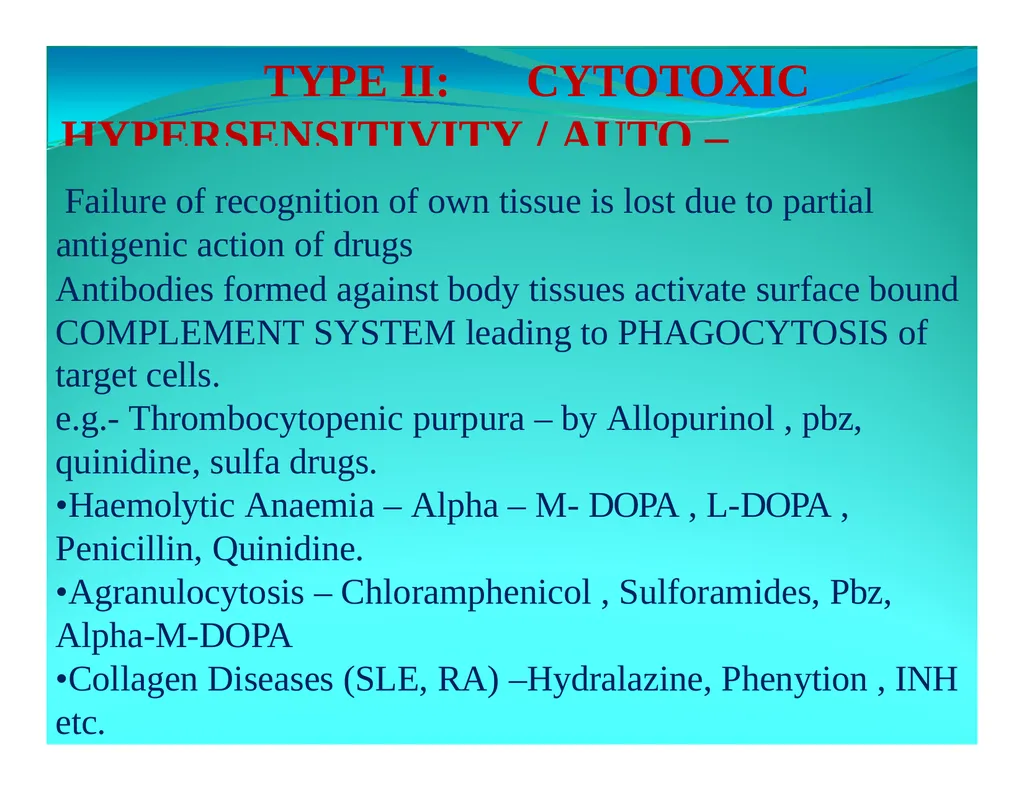
TYPE II: CYTOTOXIC HYPERSENSITIVITY / AUTO – ALLERGY Failure of recognition of own tissue is lost due to partial antigenic action of drugs
Antibodies formed against body tissues activate surface bound COMPLEMENT SYSTEM leading to PHAGOCYTOSIS of
target cells.
e.g.- Thrombocytopenic purpura – by Allopurinol , pbz, quinidine, sulfa drugs.
•Haemolytic Anaemia – Alpha – M- DOPA , L-DOPA , Penicillin, Quinidine.
•Agranulocytosis – Chloramphenicol , Sulforamides, Pbz, Alpha-M-DOPA
•Collagen Diseases (SLE, RA) –Hydralazine, Phenytion , INH etc.<br>
Antibodies formed against body tissues activate surface bound COMPLEMENT SYSTEM leading to PHAGOCYTOSIS of
target cells.
e.g.- Thrombocytopenic purpura – by Allopurinol , pbz, quinidine, sulfa drugs.
•Haemolytic Anaemia – Alpha – M- DOPA , L-DOPA , Penicillin, Quinidine.
•Agranulocytosis – Chloramphenicol , Sulforamides, Pbz, Alpha-M-DOPA
•Collagen Diseases (SLE, RA) –Hydralazine, Phenytion , INH etc.<br>
14
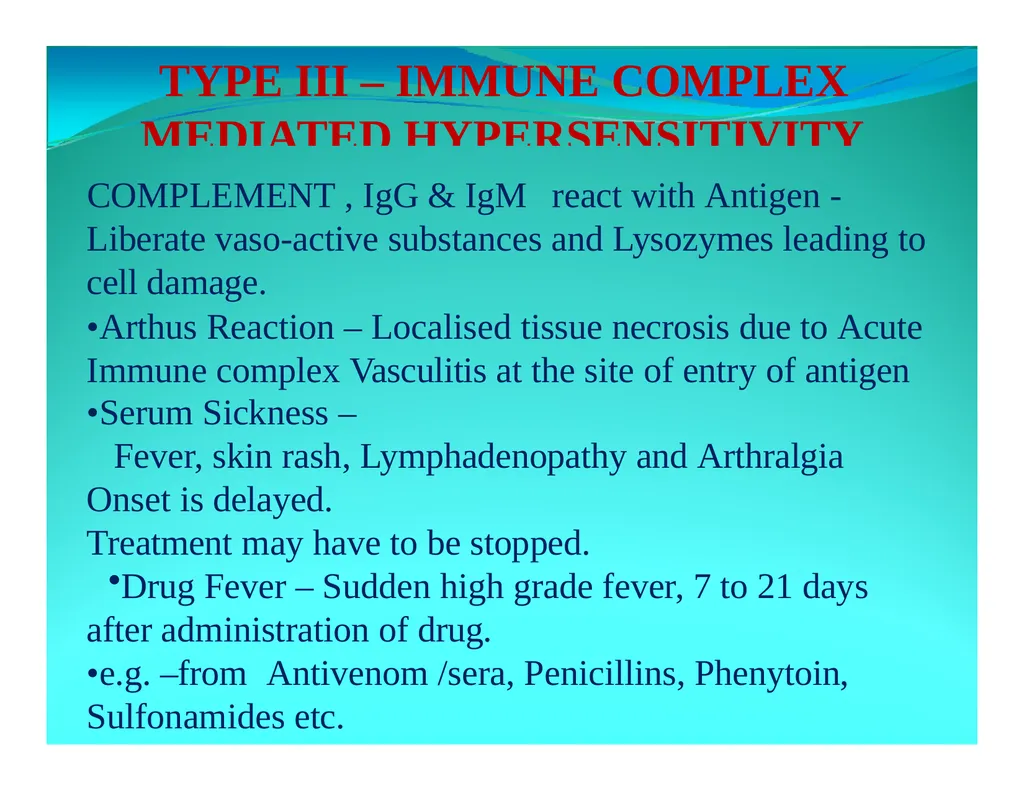
TYPE III – IMMUNE COMPLEX MEDIATED HYPERSENSITIVITY COMPLEMENT , IgG & IgM react with Antigen - Liberate vaso-active substances and Lysozymes leading to cell damage.
•Arthus Reaction – Localised tissue necrosis due to Acute Immune complex Vasculitis at the site of entry of antigen
•Serum Sickness –
Fever, skin rash, Lymphadenopathy and Arthralgia Onset is delayed.
Treatment may have to be stopped.
Drug Fever – Sudden high grade fever, 7 to 21 days after administration of drug.
•e.g. –from Antivenom /sera, Penicillins, Phenytoin, Sulfonamides etc.<br>
•Arthus Reaction – Localised tissue necrosis due to Acute Immune complex Vasculitis at the site of entry of antigen
•Serum Sickness –
Fever, skin rash, Lymphadenopathy and Arthralgia Onset is delayed.
Treatment may have to be stopped.
Drug Fever – Sudden high grade fever, 7 to 21 days after administration of drug.
•e.g. –from Antivenom /sera, Penicillins, Phenytoin, Sulfonamides etc.<br>
15
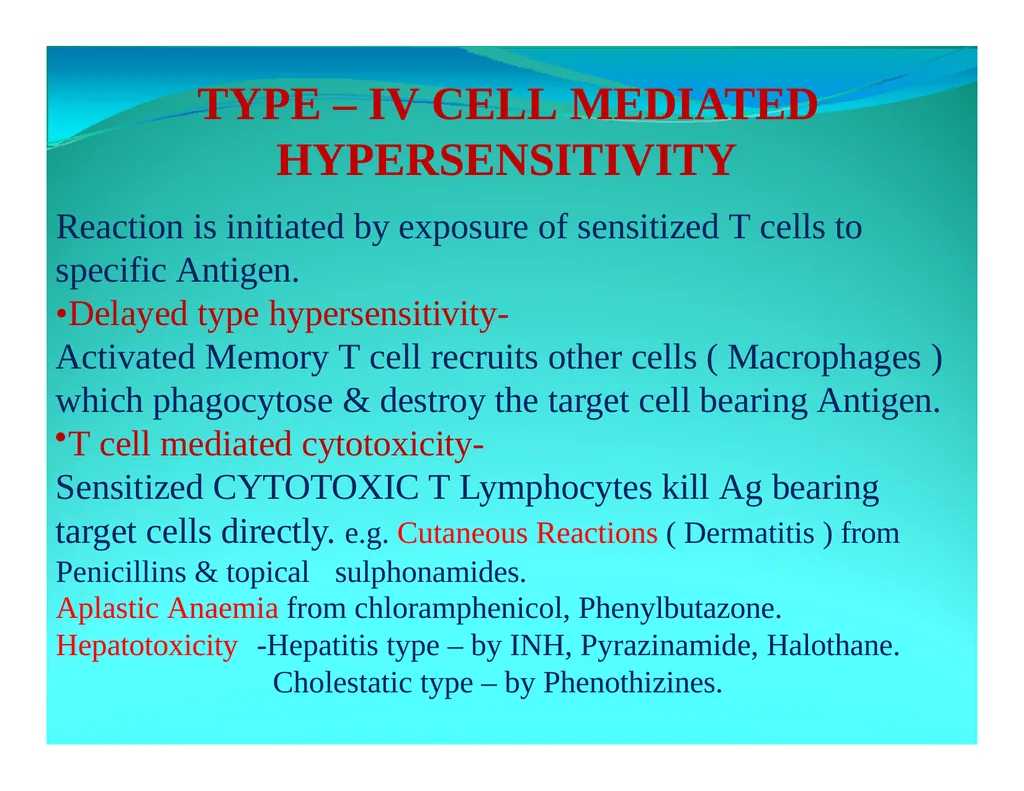
TYPE – IV CELL MEDIATED HYPERSENSITIVITY Reaction is initiated by exposure of sensitized T cells to specific Antigen.
•Delayed type hypersensitivity-
Activated Memory T cell recruits other cells ( Macrophages ) which phagocytose & destroy the target cell bearing Antigen.
T cell mediated cytotoxicity-
Sensitized CYTOTOXIC T Lymphocytes kill Ag bearing
target cells directly. e.g. Cutaneous Reactions ( Dermatitis ) from Penicillins & topical sulphonamides.
Aplastic Anaemia from chloramphenicol, Phenylbutazone.
Hepatotoxicity -Hepatitis type – by INH, Pyrazinamide, Halothane.
Cholestatic type – by Phenothizines.<br>
•Delayed type hypersensitivity-
Activated Memory T cell recruits other cells ( Macrophages ) which phagocytose & destroy the target cell bearing Antigen.
T cell mediated cytotoxicity-
Sensitized CYTOTOXIC T Lymphocytes kill Ag bearing
target cells directly. e.g. Cutaneous Reactions ( Dermatitis ) from Penicillins & topical sulphonamides.
Aplastic Anaemia from chloramphenicol, Phenylbutazone.
Hepatotoxicity -Hepatitis type – by INH, Pyrazinamide, Halothane.
Cholestatic type – by Phenothizines.<br>
16
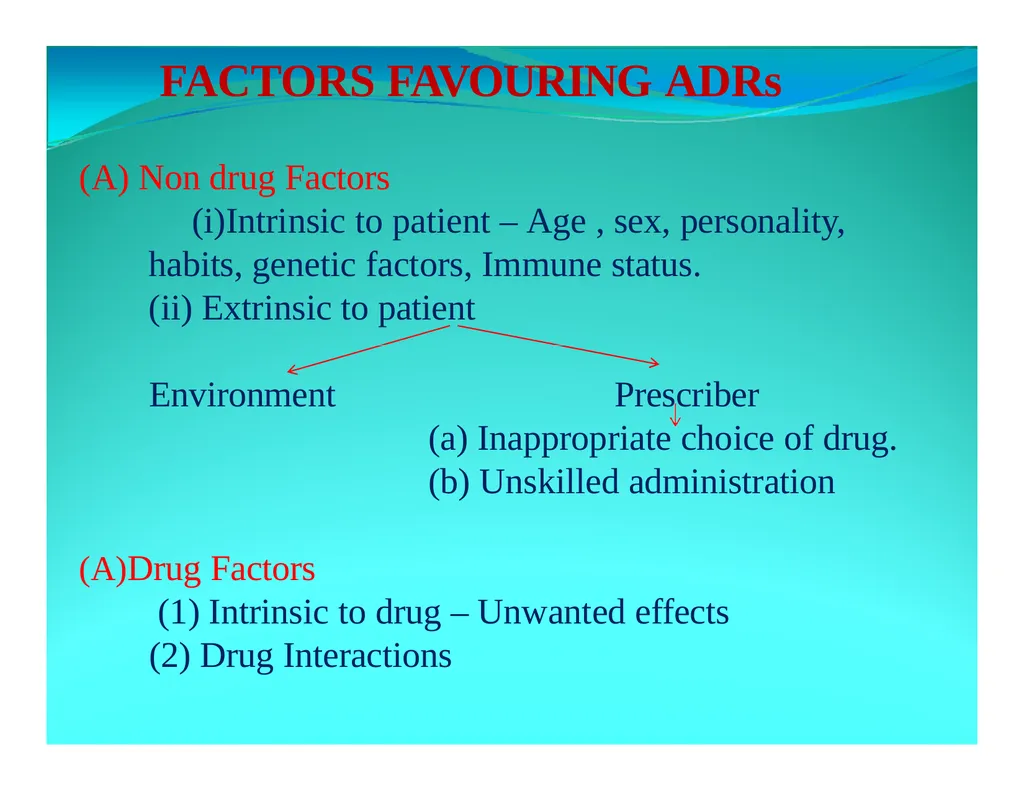
FACTORS FAVOURING ADRs Non drug Factors
Intrinsic to patient – Age , sex, personality, habits, genetic factors, Immune status.
Extrinsic to patient Environment Prescriber
Inappropriate choice of drug.
Unskilled administration Drug Factors
Intrinsic to drug – Unwanted effects
Drug Interactions<br>
Intrinsic to patient – Age , sex, personality, habits, genetic factors, Immune status.
Extrinsic to patient Environment Prescriber
Inappropriate choice of drug.
Unskilled administration Drug Factors
Intrinsic to drug – Unwanted effects
Drug Interactions<br>
17
ADVERSE EVENT / ADVERSE EXPERIENCE Any untoward occurrence (clinical phenomenon) that may present during treatment with a pharmaceutical product but which does not necessarily have causal relationship with this treatment.
SIGNAL / ALERT
Reported more than one adverse event may lead to generate a signal depending upon the seriousness of event & quality of information.<br>
SIGNAL / ALERT
Reported more than one adverse event may lead to generate a signal depending upon the seriousness of event & quality of information.<br>
18
ADVERSE REACTION
A response to drug which is noxious and unintended and which occurs at doses normally used in man for prophylaxis, diagnosis or therapy of disease or for the modification of physiological function. (WHO Technical Report No. 498 (1972)) UNEXPECTED ADRs – nature & severity is not consistent.
SERIOUS ADR
Results in death/disability/incapacity.
Is life threatening?
Requires hospitalisation or prolongation of existing hospitalisation.<br>
A response to drug which is noxious and unintended and which occurs at doses normally used in man for prophylaxis, diagnosis or therapy of disease or for the modification of physiological function. (WHO Technical Report No. 498 (1972)) UNEXPECTED ADRs – nature & severity is not consistent.
SERIOUS ADR
Results in death/disability/incapacity.
Is life threatening?
Requires hospitalisation or prolongation of existing hospitalisation.<br>
19
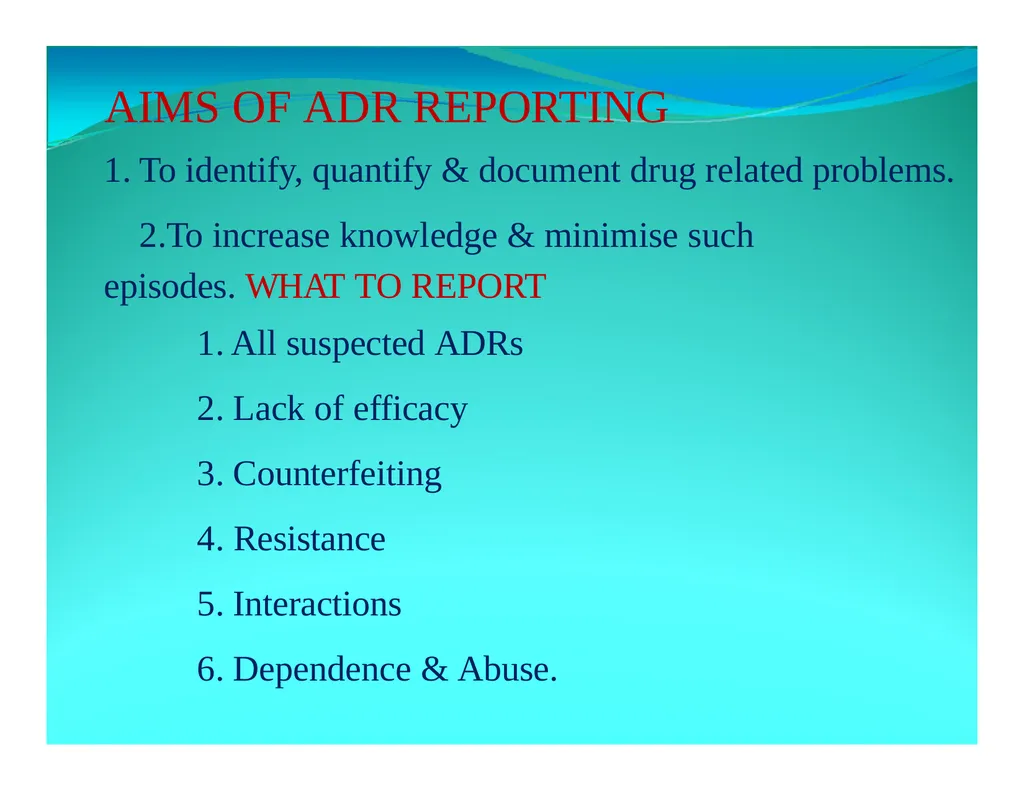
AIMS OF ADR REPORTING To identify, quantify & document drug related problems.
To increase knowledge & minimise such episodes. WHAT TO REPORT
All suspected ADRs
Lack of efficacy
Counterfeiting
Resistance
Interactions
Dependence & Abuse.<br>
To increase knowledge & minimise such episodes. WHAT TO REPORT
All suspected ADRs
Lack of efficacy
Counterfeiting
Resistance
Interactions
Dependence & Abuse.<br>
20
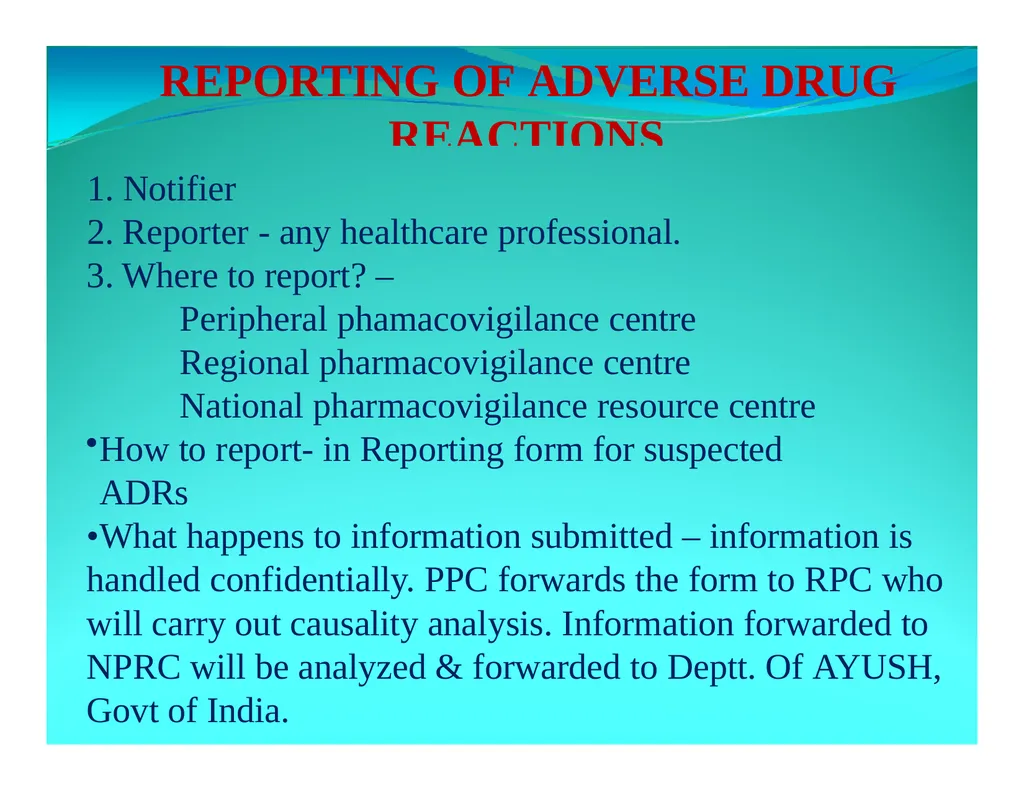
REPORTING OF ADVERSE DRUG REACTIONS Notifier
Reporter - any healthcare professional.
Where to report? –
Peripheral phamacovigilance centre Regional pharmacovigilance centre National pharmacovigilance resource centre
How to report- in Reporting form for suspected ADRs
•What happens to information submitted – information is handled confidentially. PPC forwards the form to RPC who will carry out causality analysis. Information forwarded to NPRC will be analyzed & forwarded to Deptt. Of AYUSH, Govt of India.<br>
Reporter - any healthcare professional.
Where to report? –
Peripheral phamacovigilance centre Regional pharmacovigilance centre National pharmacovigilance resource centre
How to report- in Reporting form for suspected ADRs
•What happens to information submitted – information is handled confidentially. PPC forwards the form to RPC who will carry out causality analysis. Information forwarded to NPRC will be analyzed & forwarded to Deptt. Of AYUSH, Govt of India.<br>
21
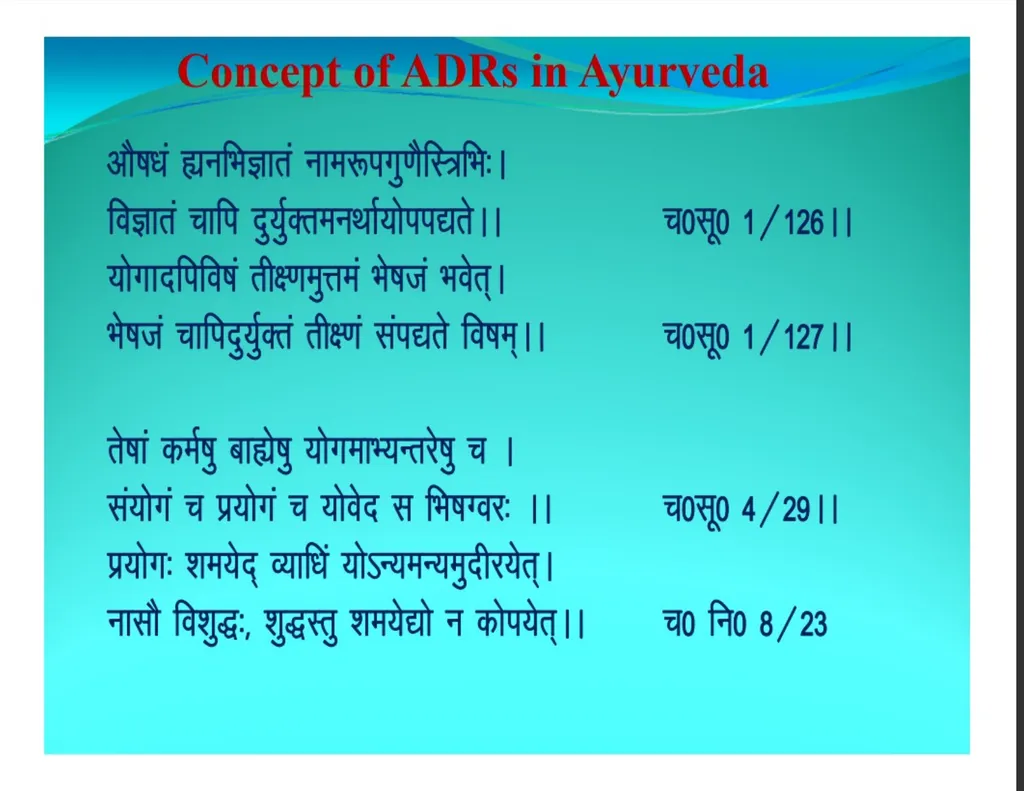
p0l˛˛0 1/126jj foKtr˙ ptfi n¸¸;¸¸'DreuFtt';t’ii4r’jj
;t’xtnfifoet˙ rी{.te¸Ùte˙ Ht’ett˙ Hto’r,j Ht’ett˙ ptfin¸;¸'Dr˙ rी{.t˙ l˙i4r’ foete,jj p0l˛0 1/127jj ’ ˙ ' ’ ’ p0l˛0 4/29jj ’ ’ ˙ ’ ’ rett weet¸ atáet¸ ;txetH;:rjet¸ p j l˙;t’x˙ p iz;t’x˙ p ;t’o’n l fHtetXoj: jj iz;t’x: ‘te;’n, O;tf/t ;t’s:;e:;e¸nीj;’r,j
utlt“ fo’t¸):, ‘t¸)Lr¸ ‘te;’4t’ u wt’i;’r,jj p0 fu0 8/23<br>
;t’xtnfifoet˙ rी{.te¸Ùte˙ Ht’ett˙ Hto’r,j Ht’ett˙ ptfin¸;¸'Dr˙ rी{.t˙ l˙i4r’ foete,jj p0l˛0 1/127jj ’ ˙ ' ’ ’ p0l˛0 4/29jj ’ ’ ˙ ’ ’ rett weet¸ atáet¸ ;txetH;:rjet¸ p j l˙;t’x˙ p iz;t’x˙ p ;t’o’n l fHtetXoj: jj iz;t’x: ‘te;’n, O;tf/t ;t’s:;e:;e¸nीj;’r,j
utlt“ fo’t¸):, ‘t¸)Lr¸ ‘te;’4t’ u wt’i;’r,jj p0 fu0 8/23<br>
22
bne’o˙izw`i;“o˙x¸.te’o˙izHttoefLeu, n’’t’ttrefLe:u`rto’o˙ x`gीre’o˙fufgre’oe¸iLw`reu;t p et=;t ;DrefLeu, O;t/tto’o˙fo/tL; i¸#etL;“orto:r˙nt’eteiwet'i;¸i’te;fr ot,
;n:;nfip“o˙fo/t˙Ht’ett˙Hto’ÙtPptu’ufo’t’et’.t ;¸Drfefr jj
p0fo08/87jj<br>
;n:;nfip“o˙fo/t˙Ht’ett˙Hto’ÙtPptu’ufo’t’et’.t ;¸Drfefr jj
p0fo08/87jj<br>
23
rLetntr¸j˙ijी{t’r, izw`frrÜp, fow`frrÜp, ltjrÜp, l˙guurÜp, izet.trÜp, ltiE;rÜp, lÙorÜp, vtgtj’tfDrrÜp,
O;t;te’tfDrrÜp, o;LrÜo’fr, ayizet.tfo’t’etxzg.tg’rt’:jj
p0fo8/94jj<br>
O;t;te’tfDrrÜp, o;LrÜo’fr, ayizet.tfo’t’etxzg.tg’rt’:jj
p0fo8/94jj<br>
24
gjीrwी, vteywी, fiIiyी, jlt’u, x¸Xx¸y¸, ‘t¸.Bी, l˛j.t, iul, /tt:;w, ‘tri¸eit, w¸yiFt, vrlी, izlg j<br>
25
Conclusion Hospitalization due to drugs is about 6-7 % of total admissions.
It is very expensive.
Do not force govt. physician to prescribe particular medicine (e.g. kaishor guggulu in place of kanchnar guggulu.)
Minimize multi drug prescription.
Please listen to your patient.<br>
It is very expensive.
Do not force govt. physician to prescribe particular medicine (e.g. kaishor guggulu in place of kanchnar guggulu.)
Minimize multi drug prescription.
Please listen to your patient.<br>