Afghanistan-Pakistan Relations: Sources and Outlook Karl Kaltenthaler Department of Political Science University of Akron and Case Western Reserve University A Brief Summary of the Present State of Afghan-Pakistan Relations Afghanistan and
Related Topics
Share
Embed code
Download this presentation From Below
"Afghanistan-Pakistan Relations: Sources and" is the property of its rightful owner. Permission is granted to
download and print the materials on this website for personal, non-commercial use only, and to display it
on your personal computer provided you do not modify the materials and that you retain all copyright
notices contained in the materials. By downloading content from our website, you accept the terms of this
agreement.
Presentation Transcript
01
Afghanistan-Pakistan Relations: Sources and Outlook Karl Kaltenthaler
Department of Political Science
University of Akron and Case Western Reserve University<br>
02
A Brief Summary of the Present State of Afghan-Pakistan Relations Afghanistan and Pakistan are locked into a complex security dilemma
There is very little trust
Both countries view the other as a crucial security threat
Attempts to improve relations by both sides have failed
These attempts fail because of the multiple, deeply-rooted reasons why the countries distrust each other<br>
03
Sources of the Afghanistan-Pakistan Security Dilemma Afghanistan does not recognize the Durand Line as the official border with Pakistan
Afghanistan sees itself as the home of the Pashtuns, who are split between the two countries
Pakistan deeply fears Pashtun nationalism
Afghanistan has fostered Pashtun nationalism in Pakistan from time to time<br>
04
Afghanistan-Pakistan Ethnic Population Distribution<br>
05
Sources of the Afghanistan-Pakistan Security Dilemma (Continued) Afghanistan has traditionally been friendly with India
Taliban rule was an exception
Afghanistan now has several anti-Pakistan groups operating from its side of the border
Tehrik-e-Taliban Pakistan (Pakistani Taliban)
Balochi nationalist militant organizations
ISIS in Afghanistan (Islamic State-Khorasan)
Large US military and intel presence in Afghanistan
Pakistan deeply distrusts US intentions in Afghanistan and toward itself
The US interests do not line up with those of Pakistan<br>
06
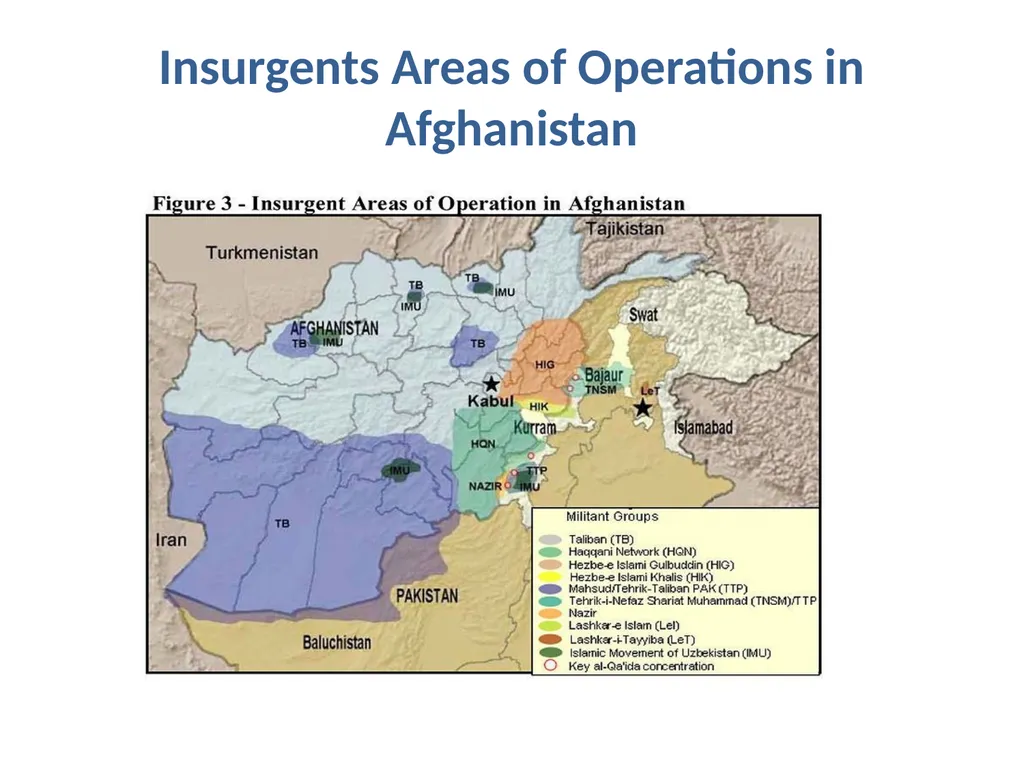
Insurgents Areas of Operations in Afghanistan<br>
07
Sources of the Afghanistan-Pakistan Security Dilemma (Continued) Pakistan has an active mixed modality campaign to topple the Afghan government and have it replaced by the Taliban
Pakistan actively supports the:
Quetta Shura Taliban
Haqqani Network
Other anti-Afghan regime elements
Pakistani jihadi groups that operate in Afghanistan<br>
08
Sources of the Afghanistan-Pakistan Security Dilemma (Continued) Supporting the Taliban serves several purposes for Pakistan:
Undermines Pashtun nationalism by offering militant Islamism in its place
Keeps Afghanistan weak and on its heels
Will hopefully result in a new Taliban government that will keep out Indian, US, Iranian, and Russian influence
Avoiding Indian encirclement is most important goal
A pro-Pakistan Afghanistan also provides strategic depth for Pakistan
Pakistan does not want chaos in Afghanistan<br>
09
The Way Forward for Pakistan and Afghanistan The Taliban is not winning nor is it losing
Pakistan will not abandon its efforts in Afghanistan
A destabilized Afghanistan is better than one that is safe for India to use against Pakistan
Pashtuns could turn away from Islamism toward nationalism
Pakistani jihadi groups could turn against the Pakistani state<br>
10
The Way Forward for Pakistan and Afghanistan (Continued) Pakistan views the situation as one of existential importance
It will not abandon its support for the Afghan Taliban
It does not matter how much pressure the US and others exert on it
Presently-configured Afghanistan represents an existential threat to Pakistan
Pakistani military-intelligence leaders would rather “eat grass” than allow India to take a permanent, unmolested foothold in Afghanistan<br>
11
Implications for the US Confidence-building measures from the Afghan side will do little
Security guarantees from the US will not be trusted by Pakistan
Ways to reduce the Afghanistan-Pakistan security dilemma:
A stabilized, neutral, Afghanistan that drops its claims to Pashtuns in Pakistan
Serious movement toward a lasting peace between India and Pakistan
These are very unlikely to occur in the near term, even with US diplomacy backing them<br>