
Agency Wellness Ohio Collaborative LE
EM
Published · 46 slides · 0 views
1 / 1
Description
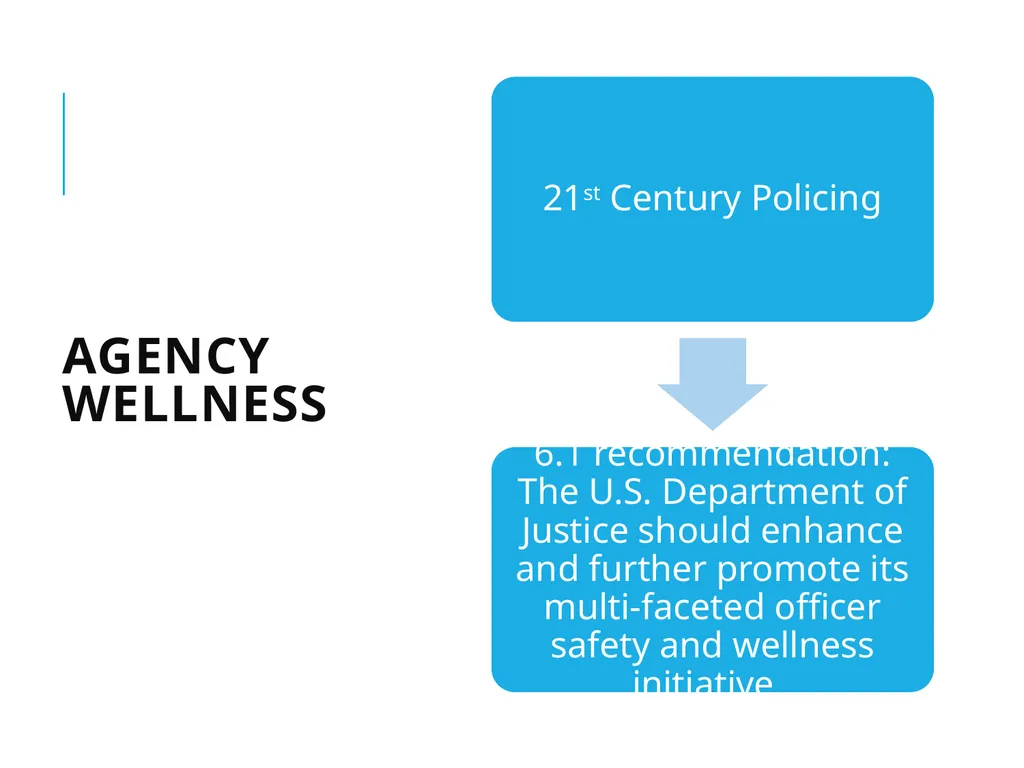
Agency Wellness Ohio Collaborative LE Certification Program 2023 Learning Objectives Agency Wellness Agency Wellness In 2021, The Ohio Collaborative Community-Police Advisory Board adopted the State of Ohio Standard for Agency Wellness
Related Topics
Share
Embed code
Download this presentation From Below
"Agency Wellness Ohio Collaborative LE" is the property of its rightful owner. Permission is granted to download and print the materials on this website for personal, non-commercial use only, and to display it on your personal computer provided you do not modify the materials and that you retain all copyright notices contained in the materials. By downloading content from our website, you accept the terms of this agreement.
Presentation Transcript
01
Agency Wellness Ohio Collaborative LE Certification Program 2023<br>
02
Learning Objectives<br>
03
Agency Wellness<br>
04
Agency Wellness In 2021, The Ohio Collaborative Community-Police Advisory Board adopted the State of Ohio Standard for Agency Wellness<br>
05
Agency Wellness Purpose:
Law enforcement agencies have an obligation to ensure the mental and physical health and safety of their agency personnel. Officer wellness is not only an individual issue-it is also an agency issue and a public issue, as the negative consequences of poor mental and physical health can impact officer performance and affect community relationships. Law enforcement agencies are uniquely situated to address issues of officer stress and trauma, to reduce the stigma of seeking help and to create an environment of support.<br>
Law enforcement agencies have an obligation to ensure the mental and physical health and safety of their agency personnel. Officer wellness is not only an individual issue-it is also an agency issue and a public issue, as the negative consequences of poor mental and physical health can impact officer performance and affect community relationships. Law enforcement agencies are uniquely situated to address issues of officer stress and trauma, to reduce the stigma of seeking help and to create an environment of support.<br>
06
Agency Wellness Standard
Law enforcement agencies shall establish a written policy specifically focused on the physical and mental wellness of agency personnel. The policy shall address the following areas:
Education of officers and executive-level staff on issues of physical health, including the importance of exercise and nutrition as a way of reducing stress and improving overall health outcomes.<br>
Law enforcement agencies shall establish a written policy specifically focused on the physical and mental wellness of agency personnel. The policy shall address the following areas:
Education of officers and executive-level staff on issues of physical health, including the importance of exercise and nutrition as a way of reducing stress and improving overall health outcomes.<br>
07
Agency Wellness Standard continued
Access to multiple resources for mental and physical support to officers and their families, such as:
Employee Assistance Program resources, such as in-house and/or external clinicians, and other wellness staff who have knowledge of the law enforcement experience.
Peer support teams to augment (not replace) EAPs or in-house/external clinicians.
Agency chaplains.
Non-clinical interventions that promote mental and physical well-being, such as physical exercise, dietary guidance and sleep hygiene.<br>
Access to multiple resources for mental and physical support to officers and their families, such as:
Employee Assistance Program resources, such as in-house and/or external clinicians, and other wellness staff who have knowledge of the law enforcement experience.
Peer support teams to augment (not replace) EAPs or in-house/external clinicians.
Agency chaplains.
Non-clinical interventions that promote mental and physical well-being, such as physical exercise, dietary guidance and sleep hygiene.<br>
08
Agency Wellness<br>
09
Agency Wellness<br>
10
Agency Wellness Commentary
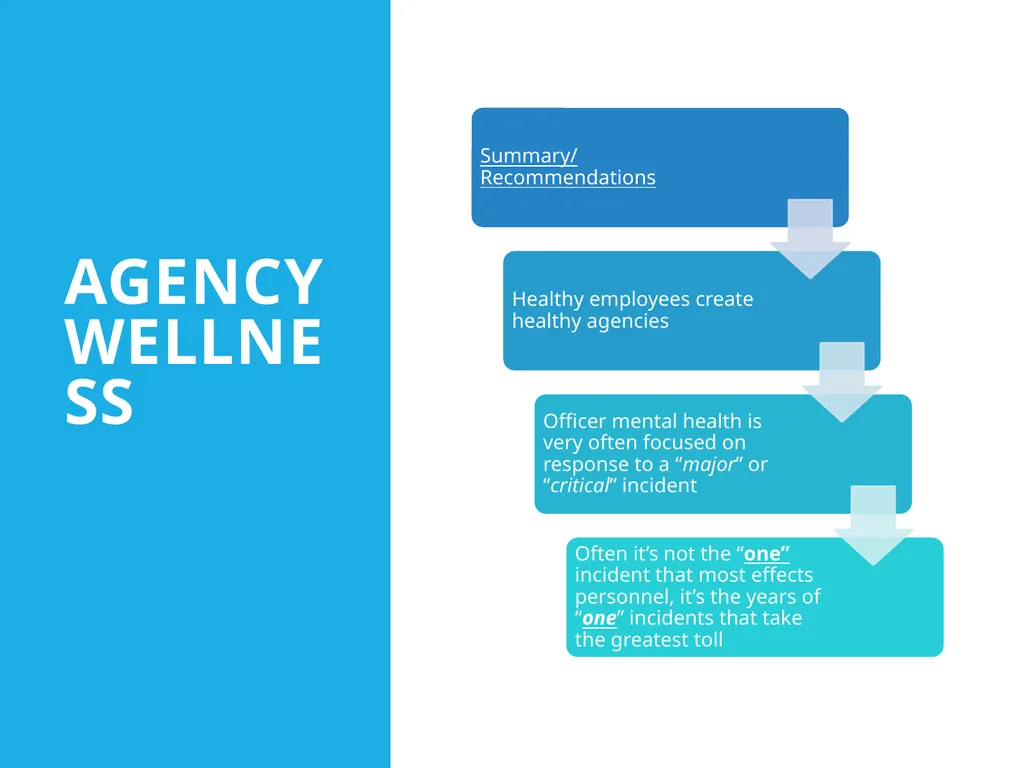
Healthy officers create healthy agencies. The mental and physical health and welfare of officers is often overlooked, yet it is a vital consideration, not only to the officer, but also to the officer’s family and loved ones, to the agency in which the officer is employed, and even to the community in which the officer lives and works. Investing in officer wellness is a significant step that agencies can take to positively impact their officers’ overall well-being and, as a result, to improve the community’s trust and perceptions of legitimacy in the organization.<br>
Healthy officers create healthy agencies. The mental and physical health and welfare of officers is often overlooked, yet it is a vital consideration, not only to the officer, but also to the officer’s family and loved ones, to the agency in which the officer is employed, and even to the community in which the officer lives and works. Investing in officer wellness is a significant step that agencies can take to positively impact their officers’ overall well-being and, as a result, to improve the community’s trust and perceptions of legitimacy in the organization.<br>
11
Agency Wellness Commentary continued
Officer mental health is usually discussed in terms of the impact of critical incidents that may have short or long-term consequences on an officer. Research has documented the relationships among exposure to traumatic events and resulting physical or behavioral health disorders. While the inclusion of a Critical Incident Stress Management (CISM) policy is beyond the scope of an officer wellness policy, agencies should strongly consider developing a stand-alone CISM policy or procedures, to include defining what constitutes a critical incident, identifying all involved and affected employees, and detailing all post-incident administrative procedures.<br>
Officer mental health is usually discussed in terms of the impact of critical incidents that may have short or long-term consequences on an officer. Research has documented the relationships among exposure to traumatic events and resulting physical or behavioral health disorders. While the inclusion of a Critical Incident Stress Management (CISM) policy is beyond the scope of an officer wellness policy, agencies should strongly consider developing a stand-alone CISM policy or procedures, to include defining what constitutes a critical incident, identifying all involved and affected employees, and detailing all post-incident administrative procedures.<br>
12
Agency Wellness Commentary continued
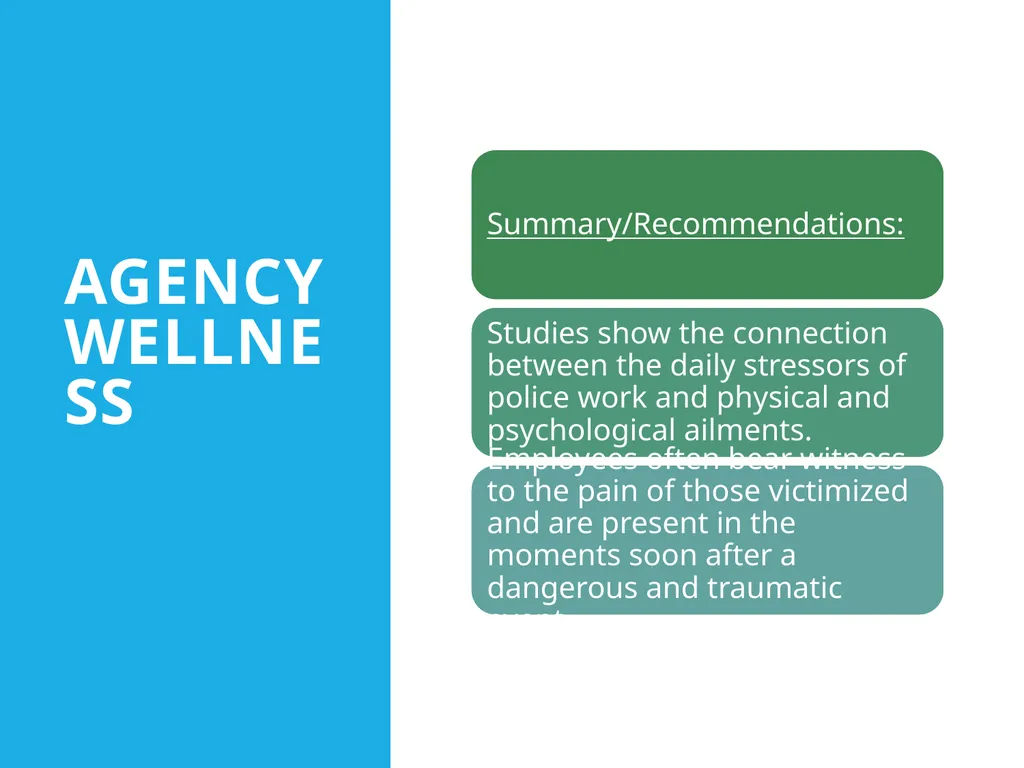
Despite the potential for critical incidents to have a significant impact on officers, officers encounter such situations relatively infrequently. In contrast, chronic stressors can be just as, if not more, damaging to an officer than a single traumatic incident. Studies show the connection between the daily stressors of police work and physical & psychological ailments. Officers often bear witness to the pain of those victimized and are present in the moments soon after a dangerous and traumatic event. Research also demonstrates the strong association between chronic stress and organizational climate.<br>
Despite the potential for critical incidents to have a significant impact on officers, officers encounter such situations relatively infrequently. In contrast, chronic stressors can be just as, if not more, damaging to an officer than a single traumatic incident. Studies show the connection between the daily stressors of police work and physical & psychological ailments. Officers often bear witness to the pain of those victimized and are present in the moments soon after a dangerous and traumatic event. Research also demonstrates the strong association between chronic stress and organizational climate.<br>
13
Agency Wellness Commentary continued
When officers perceive their organization to be procedurally fair—thus allowing for effective and open communication, involvement in decision-making, and equitable treatment—they are less likely to be psychologically and emotionally distressed, resulting in greater officer well-being. Left untreated, stress—regardless of its source—significantly increases the risk of mental and substance use disorders and chronic physical diseases. Thus, a policy on officer wellness needs to comprehensively consider the impacts of critical incident trauma, chronic exposure to traumatic events, and chronic exposure to organizational stress.<br>
When officers perceive their organization to be procedurally fair—thus allowing for effective and open communication, involvement in decision-making, and equitable treatment—they are less likely to be psychologically and emotionally distressed, resulting in greater officer well-being. Left untreated, stress—regardless of its source—significantly increases the risk of mental and substance use disorders and chronic physical diseases. Thus, a policy on officer wellness needs to comprehensively consider the impacts of critical incident trauma, chronic exposure to traumatic events, and chronic exposure to organizational stress.<br>
14
Agency Wellness Commentary continued
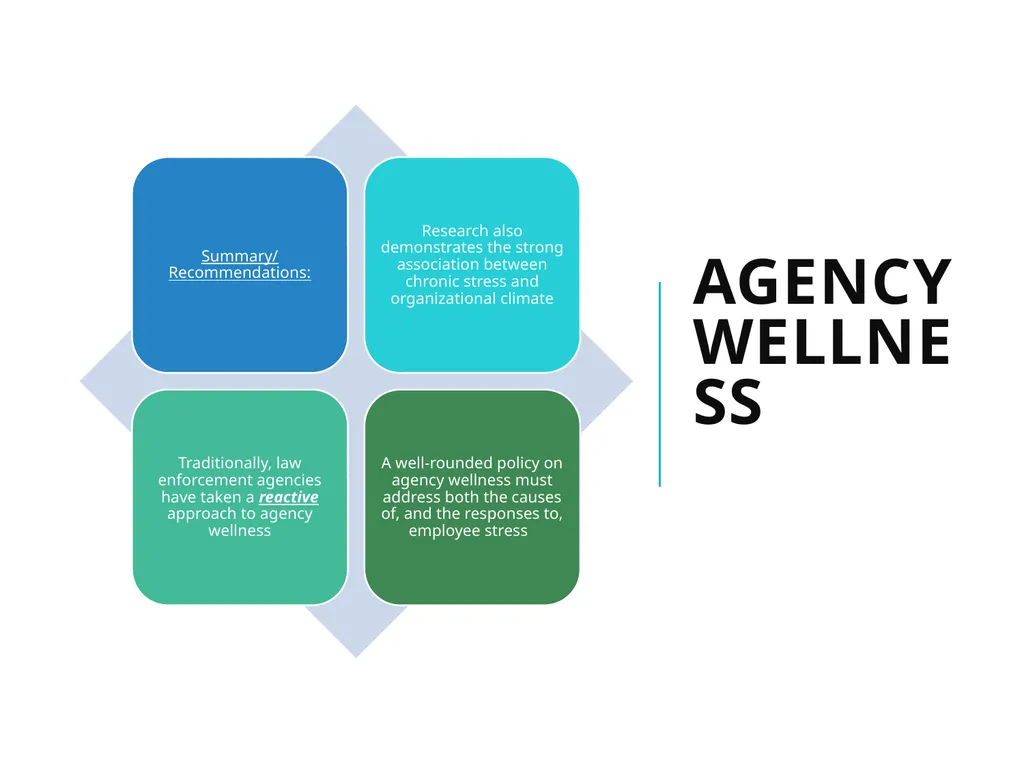
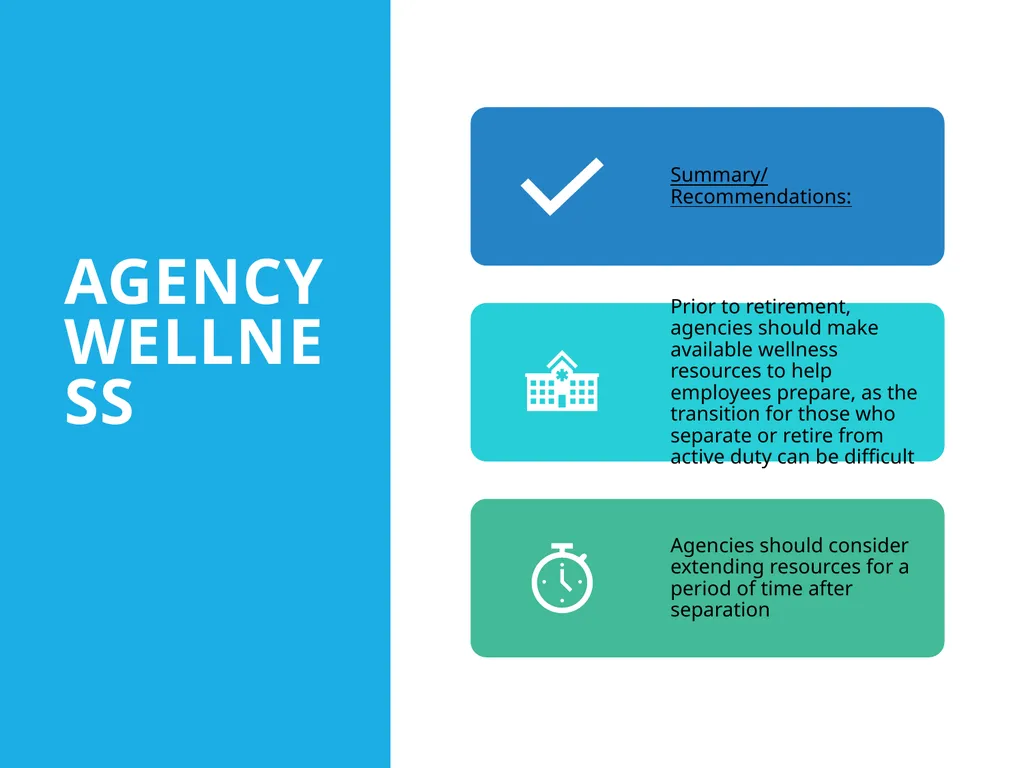
Traditionally, law enforcement agencies have taken a reactive approach to officer wellness. In short, they have viewed it as largely an individual responsibility to seek clinical intervention or develop coping mechanisms—resources which may or may not be provided by the agency—to mitigate the already-existing symptoms and effects of stress. While these tools are important components to a comprehensive approach to addressing officer wellness, it is ultimately more beneficial for law enforcement agencies to take a proactive approach to wellness and to address the root causes of officer stress. A well-rounded policy on officer wellness must address both the causes of, and the responses to, officer stress. Additionally, prior to retirement, agencies should make available wellness resources to help an officer prepare, as the transition for those who separate or retire from active duty can be difficult. If feasible, agencies should consider extending resources for a period of time after separation.<br>
Traditionally, law enforcement agencies have taken a reactive approach to officer wellness. In short, they have viewed it as largely an individual responsibility to seek clinical intervention or develop coping mechanisms—resources which may or may not be provided by the agency—to mitigate the already-existing symptoms and effects of stress. While these tools are important components to a comprehensive approach to addressing officer wellness, it is ultimately more beneficial for law enforcement agencies to take a proactive approach to wellness and to address the root causes of officer stress. A well-rounded policy on officer wellness must address both the causes of, and the responses to, officer stress. Additionally, prior to retirement, agencies should make available wellness resources to help an officer prepare, as the transition for those who separate or retire from active duty can be difficult. If feasible, agencies should consider extending resources for a period of time after separation.<br>
15
Agency Wellness Commentary continued
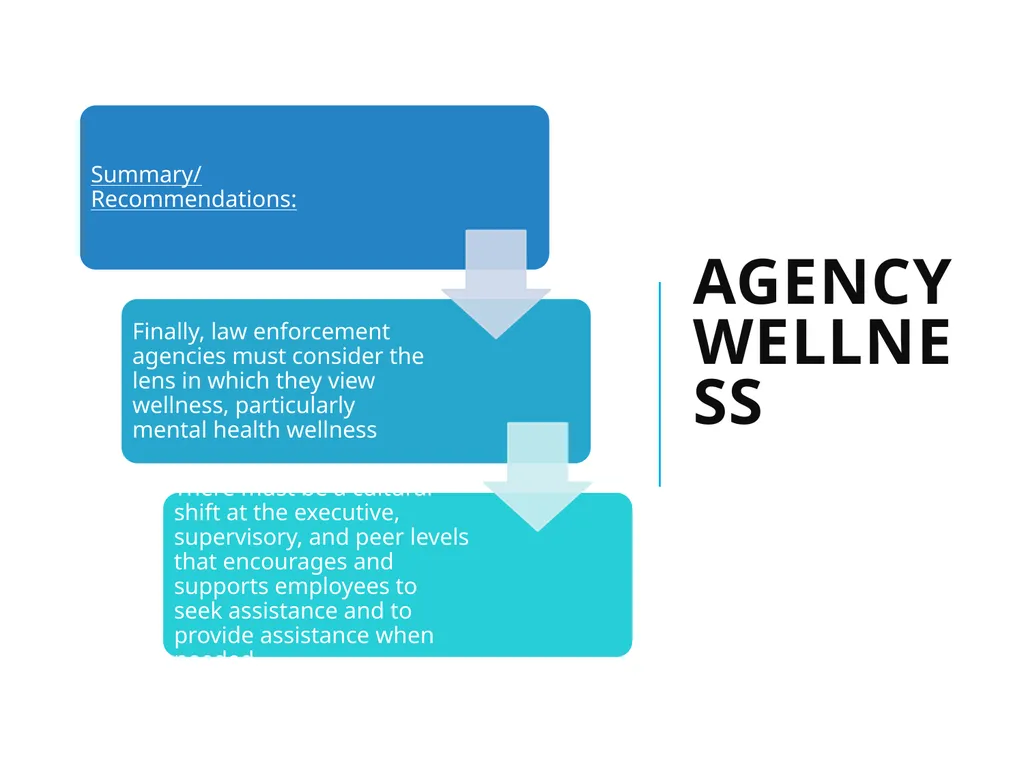
Finally, law enforcement agencies must consider the lens in which they view officer wellness, particularly mental health wellness. Officers play the role of being the helpers, not looking to others for help. One of the primary barriers to officers seeking help is the stigma associated with needing such treatment. Executives must acknowledge agency's investment in the mental health of its officers. There must be a cultural shift at the executive, supervisory, and peer levels that encourages and supports officers to seek assistance and to provide assistance when needed. Regularly-occurring communication with officers about mental health signs and symptoms, wellness strategies, and available resources will de-stigmatize mental health discussions and reinforce the agency’s commitment to their employees’ overall health and wellbeing.<br>
Finally, law enforcement agencies must consider the lens in which they view officer wellness, particularly mental health wellness. Officers play the role of being the helpers, not looking to others for help. One of the primary barriers to officers seeking help is the stigma associated with needing such treatment. Executives must acknowledge agency's investment in the mental health of its officers. There must be a cultural shift at the executive, supervisory, and peer levels that encourages and supports officers to seek assistance and to provide assistance when needed. Regularly-occurring communication with officers about mental health signs and symptoms, wellness strategies, and available resources will de-stigmatize mental health discussions and reinforce the agency’s commitment to their employees’ overall health and wellbeing.<br>
16
Agency Wellness Model Policy
It is the policy of this law enforcement agency to provide all personnel with access to mental health services to help them preempt and resolve emotional difficulties and to take those measures necessary in the provision of mental health services to ensure their wellness and safety. It is also the policy of this agency to take immediate action after traumatic incidents to safeguard the continued mental wellness of all involved personnel. Further, agencies have a duty to be aware of and provide resources relating to officers’ physical health, including cardiac health, sleep deprivation, physical fitness and maintenance of a healthy weight.<br>
It is the policy of this law enforcement agency to provide all personnel with access to mental health services to help them preempt and resolve emotional difficulties and to take those measures necessary in the provision of mental health services to ensure their wellness and safety. It is also the policy of this agency to take immediate action after traumatic incidents to safeguard the continued mental wellness of all involved personnel. Further, agencies have a duty to be aware of and provide resources relating to officers’ physical health, including cardiac health, sleep deprivation, physical fitness and maintenance of a healthy weight.<br>
17
Agency Wellness Purpose:
Law enforcement agencies have an obligation to ensure the mental and physical health and safety of their agency personnel. Wellness is not only an individual issue-- it is also an agency issue and a public issue, as the negative consequences of poor mental and physical health can impact officer performance and affect community relationships. Law enforcement agencies are uniquely situated to address issues of employee stress and trauma, to reduce the stigma of seeking help and to create an environment of support.<br>
Law enforcement agencies have an obligation to ensure the mental and physical health and safety of their agency personnel. Wellness is not only an individual issue-- it is also an agency issue and a public issue, as the negative consequences of poor mental and physical health can impact officer performance and affect community relationships. Law enforcement agencies are uniquely situated to address issues of employee stress and trauma, to reduce the stigma of seeking help and to create an environment of support.<br>
18
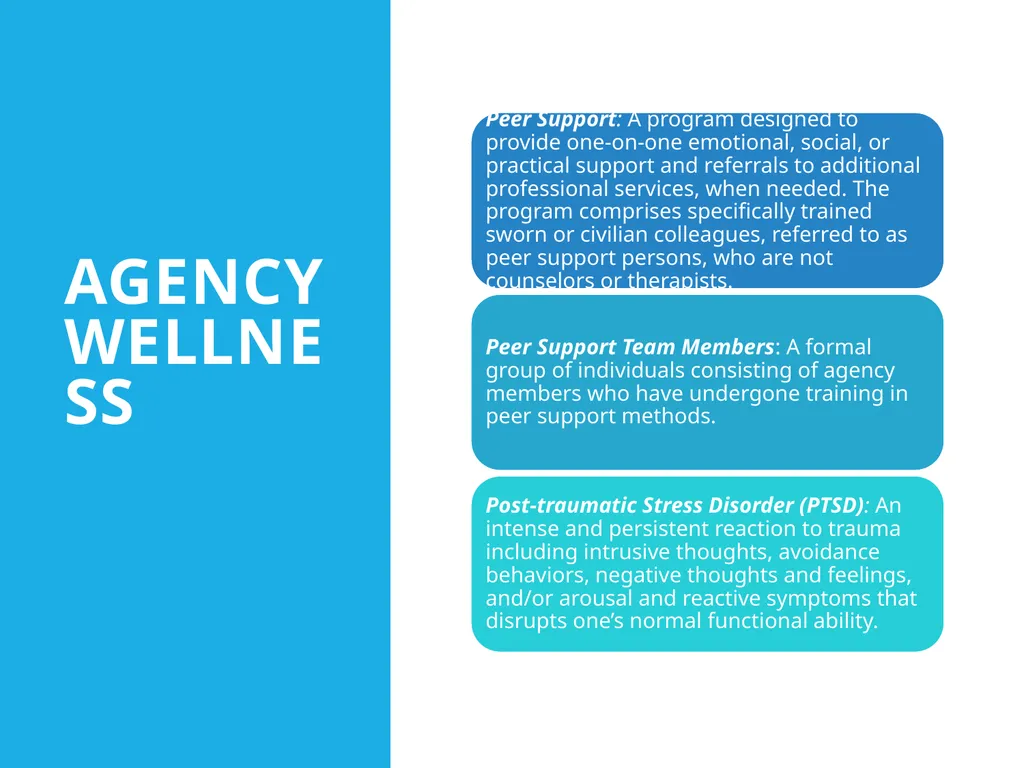
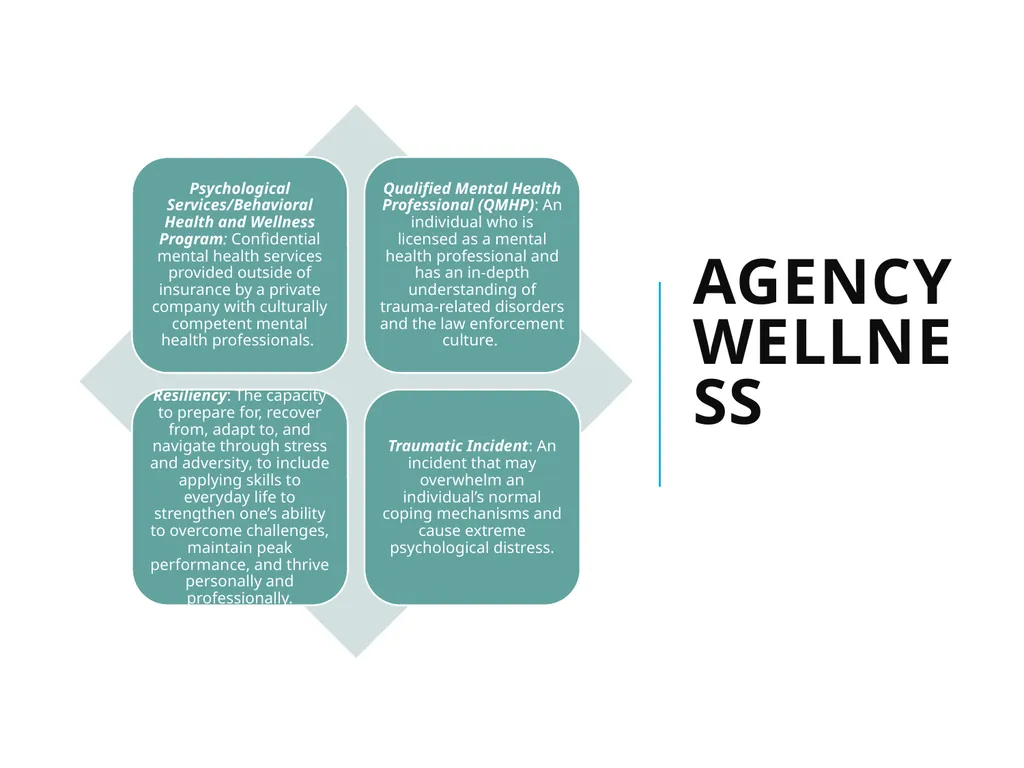
Agency Wellness Definitions
Acute Stress Disorder: An intense reaction (cognitive, emotional, and/or behavioral) to trauma within a month after a traumatic event.
Chaplain: A member of the clergy who serves in a nondenominational capacity to aid employees in their spiritual health as well as other aspects of health and wellness.
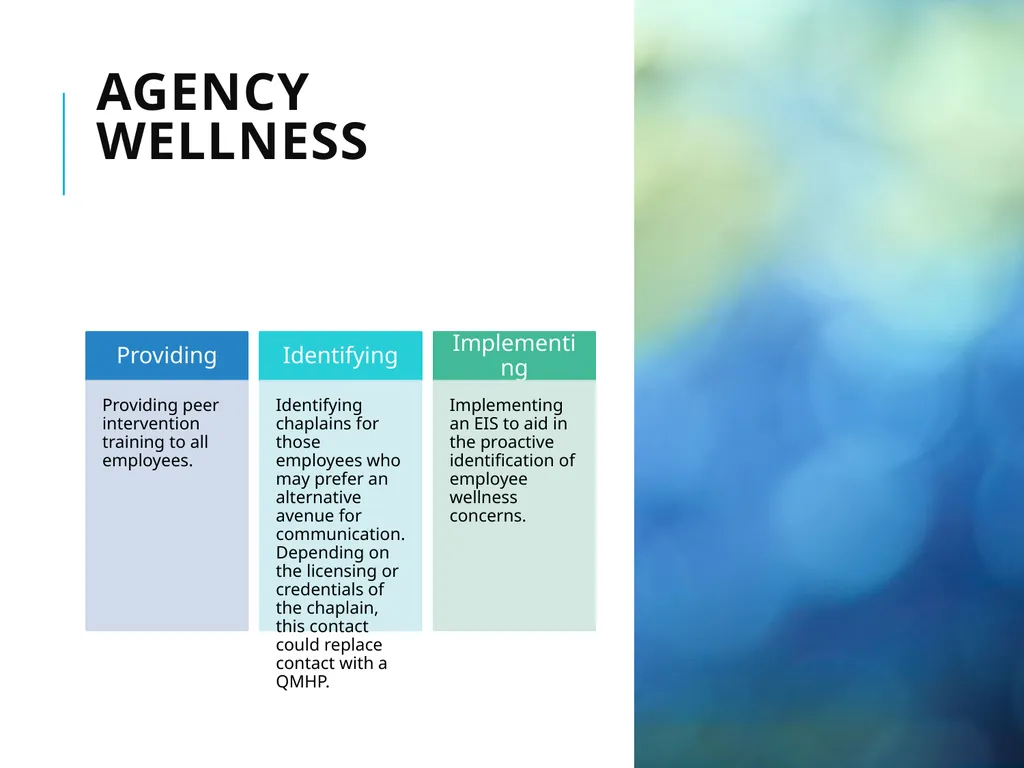
Early Identification System (EIS): A system designed to assist supervisors and managers in identifying employees whose performance warrants review and, where appropriate, outline intervention procedures in circumstances where the employee’s behavior may have negative consequences for the employee, coworkers, the agency, and/or the general public.
Employee Assistance Program (EAP): Confidential mental health services provided by a third party and sponsored by the employer.<br>
Acute Stress Disorder: An intense reaction (cognitive, emotional, and/or behavioral) to trauma within a month after a traumatic event.
Chaplain: A member of the clergy who serves in a nondenominational capacity to aid employees in their spiritual health as well as other aspects of health and wellness.
Early Identification System (EIS): A system designed to assist supervisors and managers in identifying employees whose performance warrants review and, where appropriate, outline intervention procedures in circumstances where the employee’s behavior may have negative consequences for the employee, coworkers, the agency, and/or the general public.
Employee Assistance Program (EAP): Confidential mental health services provided by a third party and sponsored by the employer.<br>
19
Agency Wellness Family Orientation: An opportunity for family members to tour agency facilities, including the communications center; meet the chief executives, chaplains, and peer support team; and learn about available support services, including those related to mental health.
Impacted Personnel: Any employee who is identified as being affected by a traumatic incident. This may include employees who are on the scene at the time of the incident, individuals who respond to the scene immediately following the incident, and/or support personnel participating in the response to the incident, such as communications personnel.
Mental Health Services: Services provided by an agency-employed and/or agency-contracted qualified mental health professional.
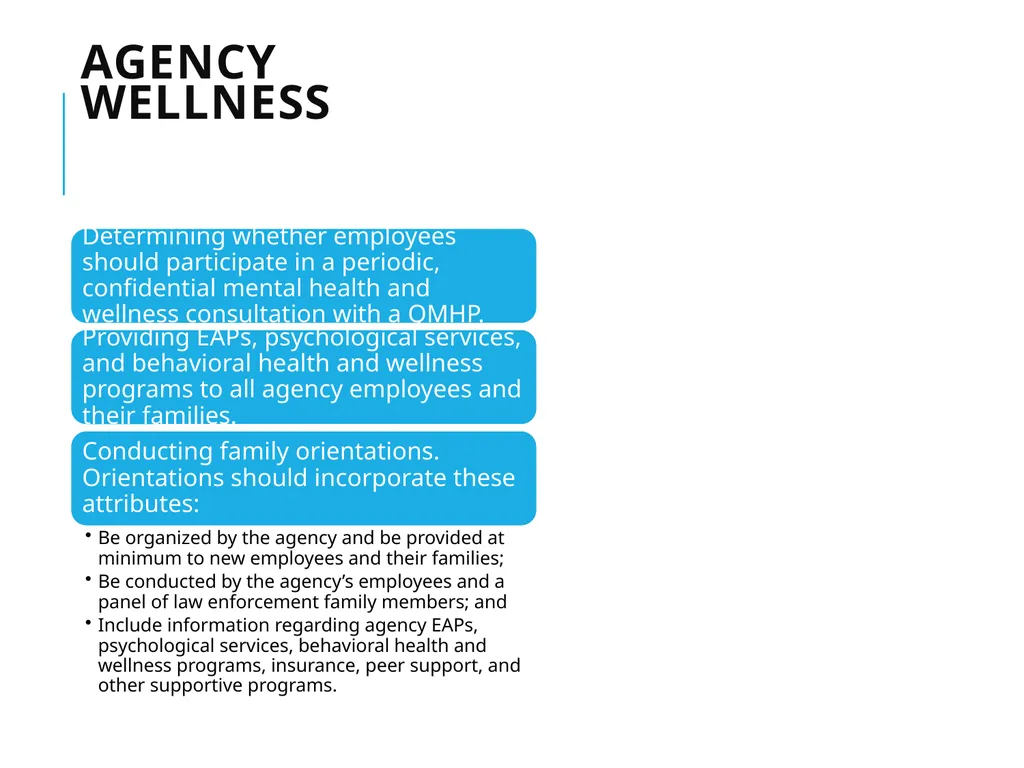
Mental Health Wellness Consultation: An opportunity for employees to meet with a qualified mental health professional of their choice for a confidential mental health discussion.<br>
Impacted Personnel: Any employee who is identified as being affected by a traumatic incident. This may include employees who are on the scene at the time of the incident, individuals who respond to the scene immediately following the incident, and/or support personnel participating in the response to the incident, such as communications personnel.
Mental Health Services: Services provided by an agency-employed and/or agency-contracted qualified mental health professional.
Mental Health Wellness Consultation: An opportunity for employees to meet with a qualified mental health professional of their choice for a confidential mental health discussion.<br>
20
Agency Wellness<br>
21
Agency Wellness<br>
22
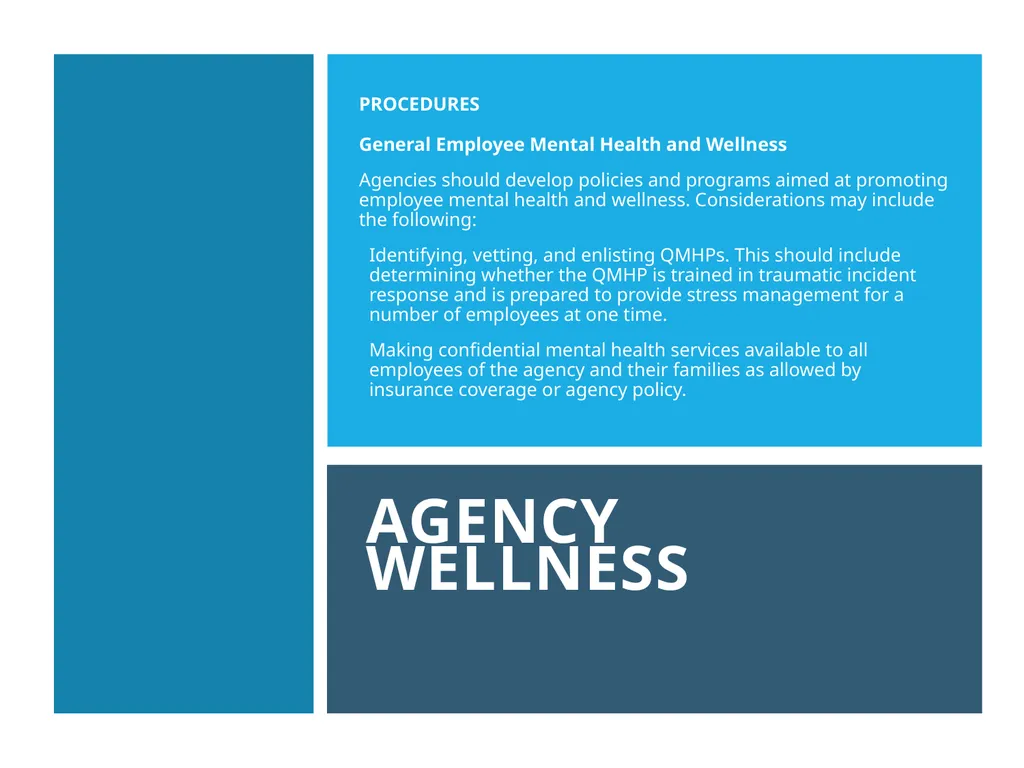
Agency Wellness PROCEDURES
General Employee Mental Health and Wellness
Agencies should develop policies and programs aimed at promoting employee mental health and wellness. Considerations may include the following:
Identifying, vetting, and enlisting QMHPs. This should include determining whether the QMHP is trained in traumatic incident response and is prepared to provide stress management for a number of employees at one time.
Making confidential mental health services available to all employees of the agency and their families as allowed by insurance coverage or agency policy.<br>
General Employee Mental Health and Wellness
Agencies should develop policies and programs aimed at promoting employee mental health and wellness. Considerations may include the following:
Identifying, vetting, and enlisting QMHPs. This should include determining whether the QMHP is trained in traumatic incident response and is prepared to provide stress management for a number of employees at one time.
Making confidential mental health services available to all employees of the agency and their families as allowed by insurance coverage or agency policy.<br>
23
Agency Wellness<br>
24
Agency Wellness<br>
25
Agency Wellness<br>
26
Agency Wellness<br>
27
Agency Wellness<br>
28
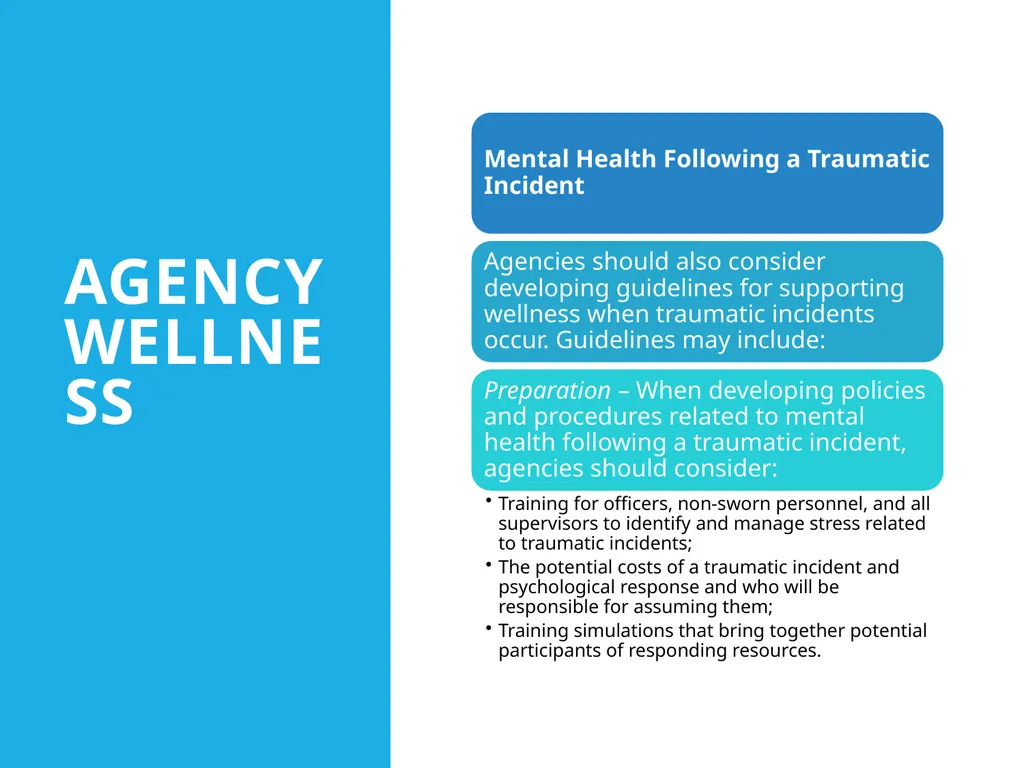
Agency Wellness Mental Health Following a Traumatic Incident continued
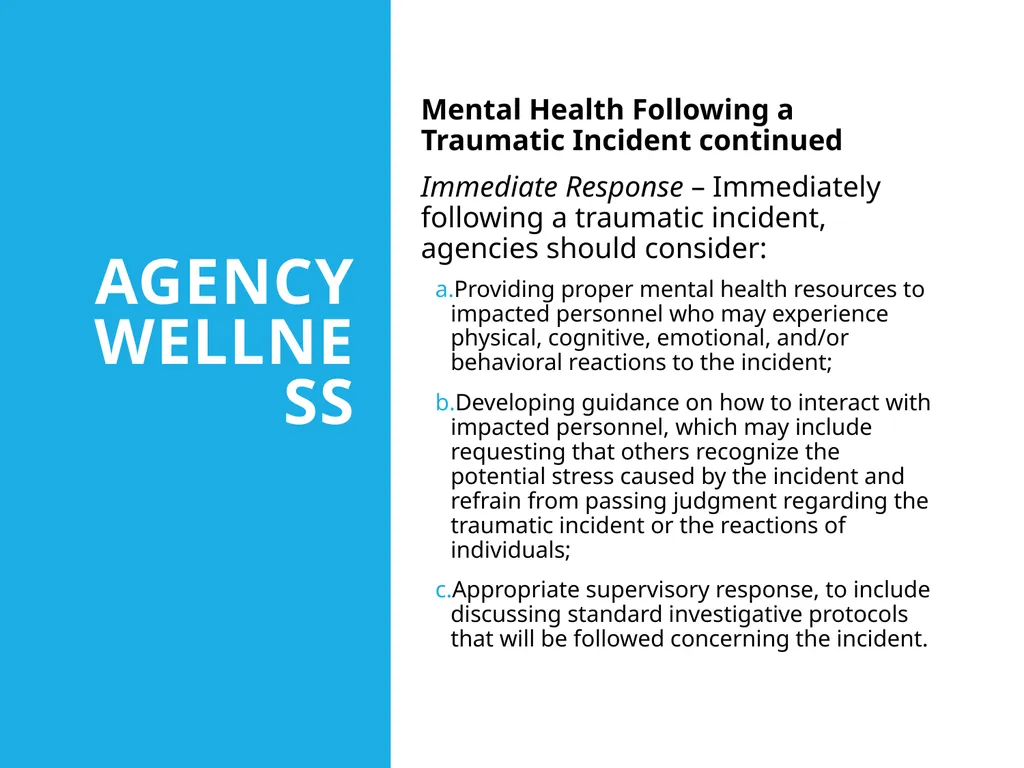
Immediate Response – Immediately following a traumatic incident, agencies should consider:
Providing proper mental health resources to impacted personnel who may experience physical, cognitive, emotional, and/or behavioral reactions to the incident;
Developing guidance on how to interact with impacted personnel, which may include requesting that others recognize the potential stress caused by the incident and refrain from passing judgment regarding the traumatic incident or the reactions of individuals;
Appropriate supervisory response, to include discussing standard investigative protocols that will be followed concerning the incident.<br>
Immediate Response – Immediately following a traumatic incident, agencies should consider:
Providing proper mental health resources to impacted personnel who may experience physical, cognitive, emotional, and/or behavioral reactions to the incident;
Developing guidance on how to interact with impacted personnel, which may include requesting that others recognize the potential stress caused by the incident and refrain from passing judgment regarding the traumatic incident or the reactions of individuals;
Appropriate supervisory response, to include discussing standard investigative protocols that will be followed concerning the incident.<br>
29
Agency Wellness Mental Health Following a Traumatic Incident continued
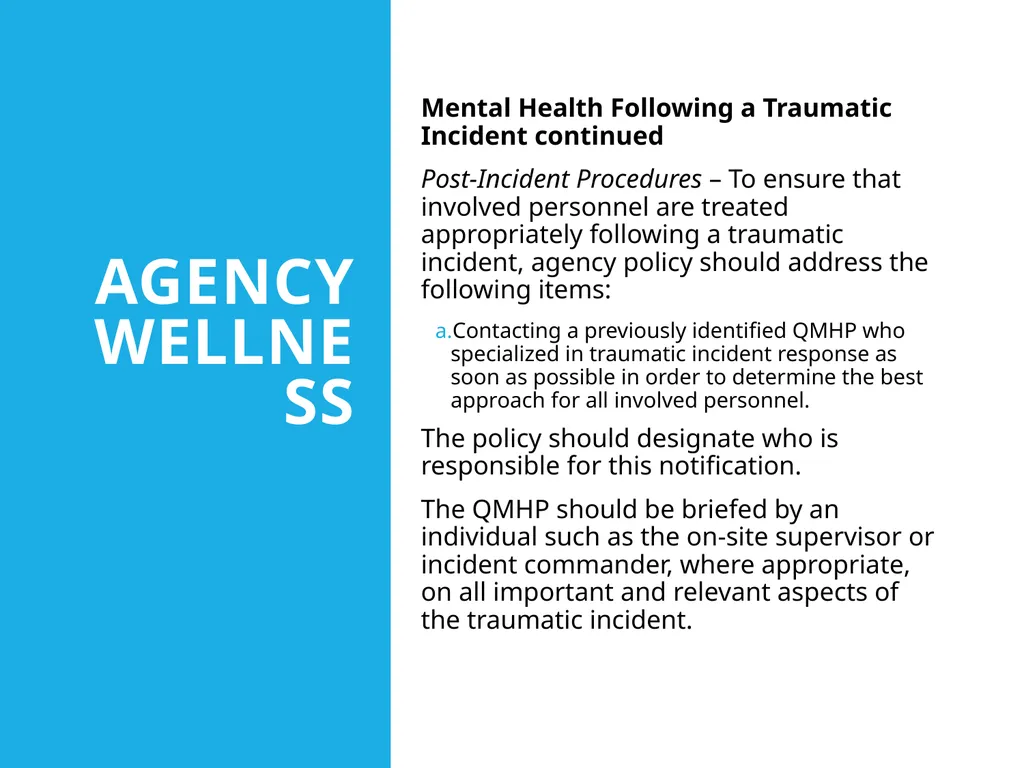
Post-Incident Procedures – To ensure that involved personnel are treated appropriately following a traumatic incident, agency policy should address the following items:
Contacting a previously identified QMHP who specialized in traumatic incident response as soon as possible in order to determine the best approach for all involved personnel.
The policy should designate who is responsible for this notification.
The QMHP should be briefed by an individual such as the on-site supervisor or incident commander, where appropriate, on all important and relevant aspects of the traumatic incident.<br>
Post-Incident Procedures – To ensure that involved personnel are treated appropriately following a traumatic incident, agency policy should address the following items:
Contacting a previously identified QMHP who specialized in traumatic incident response as soon as possible in order to determine the best approach for all involved personnel.
The policy should designate who is responsible for this notification.
The QMHP should be briefed by an individual such as the on-site supervisor or incident commander, where appropriate, on all important and relevant aspects of the traumatic incident.<br>
30
Agency Wellness<br>
31
Agency Wellness<br>
32
Agency Wellness Accessing follow-up counseling services. This may include assisting employees or families of impacted personnel to contact available counseling or support services.
Investigation – Agencies should address procedures for investigating a traumatic incident, where applicable, in separate policies and procedures. Agencies should consider:
Stressing that the investigation should be conducted as soon as practical, and every effort should be made to expedite the completion of any administrative or criminal investigation with the goal of decreasing the negative stress reactions that involved personnel may experience;
Assigning a liaison between the investigation and those involved personnel.<br>
Investigation – Agencies should address procedures for investigating a traumatic incident, where applicable, in separate policies and procedures. Agencies should consider:
Stressing that the investigation should be conducted as soon as practical, and every effort should be made to expedite the completion of any administrative or criminal investigation with the goal of decreasing the negative stress reactions that involved personnel may experience;
Assigning a liaison between the investigation and those involved personnel.<br>
33
Agency Wellness Mental Health Following a Traumatic Incident continued
Stress Recognition in the Aftermath of a Traumatic Incident – Physical, cognitive, emotional, and behavioral reactions or problems might not arise immediately. In addition, involved personnel may attempt to hide their negative responses to the traumatic incident. Therefore, agency policy should:
Encourage awareness and identification of potential negative responses in others by coworkers, supervisors, and PSP;
Provide guidance regarding potential responses when these reactions or symptoms are identified, such as contacting a supervisor or PSP and/or mandating that the individual seek assistance or counseling from a QMHP;
Recognize that effects of trauma are cumulative;
Recognize that inadvertent re-traumatization can occur from implementing standard organizational policies, procedures, and interventions with individuals who have experienced trauma.<br>
Stress Recognition in the Aftermath of a Traumatic Incident – Physical, cognitive, emotional, and behavioral reactions or problems might not arise immediately. In addition, involved personnel may attempt to hide their negative responses to the traumatic incident. Therefore, agency policy should:
Encourage awareness and identification of potential negative responses in others by coworkers, supervisors, and PSP;
Provide guidance regarding potential responses when these reactions or symptoms are identified, such as contacting a supervisor or PSP and/or mandating that the individual seek assistance or counseling from a QMHP;
Recognize that effects of trauma are cumulative;
Recognize that inadvertent re-traumatization can occur from implementing standard organizational policies, procedures, and interventions with individuals who have experienced trauma.<br>
34
Agency Wellness<br>
35
Agency Wellness<br>
36
Agency Wellness<br>
37
Agency Wellness<br>
38
Agency Wellness<br>
39
Agency Wellness<br>
40
Agency Wellness<br>
41
Agency Wellness<br>
42
Agency Wellness<br>
43
Agency Wellness<br>
44
Agency Wellness<br>
45
Agency Wellness<br>
46
Agency Wellness Contact Information
Steven M. Click, Director
Ohio Office of First Responder Wellness
Office Criminal Justice Services
1970 West Broad Street
Columbus, Ohio 43233
614-466-4470 Desk
614-949-2428 Cell
STClick@dps.ohio.gov<br>
Steven M. Click, Director
Ohio Office of First Responder Wellness
Office Criminal Justice Services
1970 West Broad Street
Columbus, Ohio 43233
614-466-4470 Desk
614-949-2428 Cell
STClick@dps.ohio.gov<br>
47
For more information on the Ohio Collaborative or other OCJS Law enforcement initiatives, contact
Ed Burkhammer
Director of LE services
Office of criminal justice services
edburkhammer@dps.ohio.gov
or visit https://ocjs.ohio.gov/law-enforcement-services<br>