
Agenda SNAP E&T Overview SNAP E&T Goals Strategy

Description: Agenda SNAP ET Overview SNAP ET Goals Strategy to Grow the Program QA 1 2 SNAP ET Overview WHAT IS SNAP ET? Required by federal partners some funding provided Helps SNAP participants gain skills and find work that moves them forward
Related Topics
Download Presentation
"Agenda SNAP E&T Overview SNAP E&T Goals Strategy" is the property of its rightful owner. Permission is granted to download and print the materials on this website for personal, non-commercial use only, and to display it on your personal computer provided you do not modify the materials and that you retain all copyright notices contained in the materials. By downloading content from our website, you accept the terms of this agreement.
Presentation Transcript
slide1. Agenda SNAP E&T Overview
SNAP E&T Goals
Strategy to Grow the Program
Q&A 1<br>
slide2. 2 SNAP E&T Overview<br>
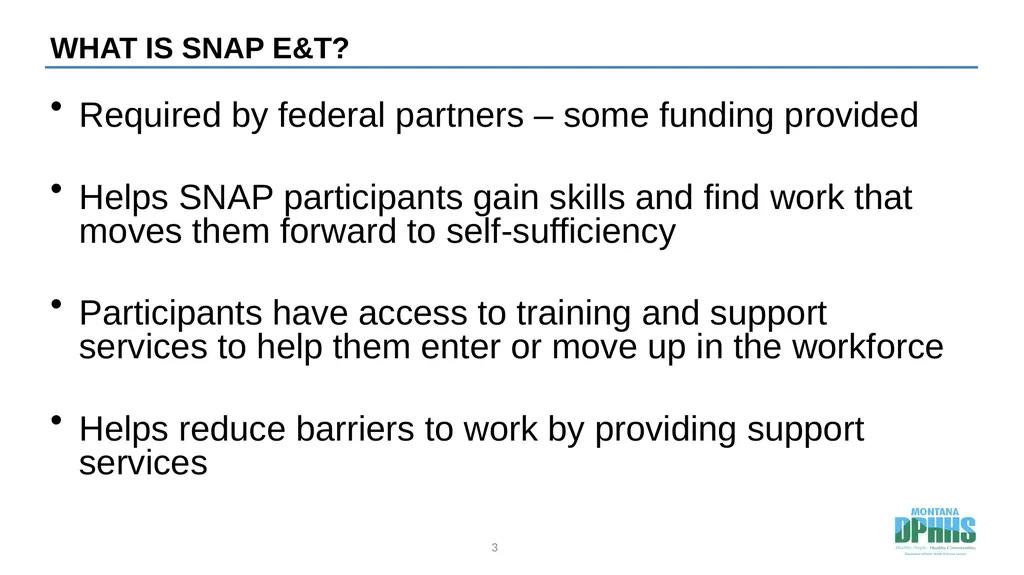
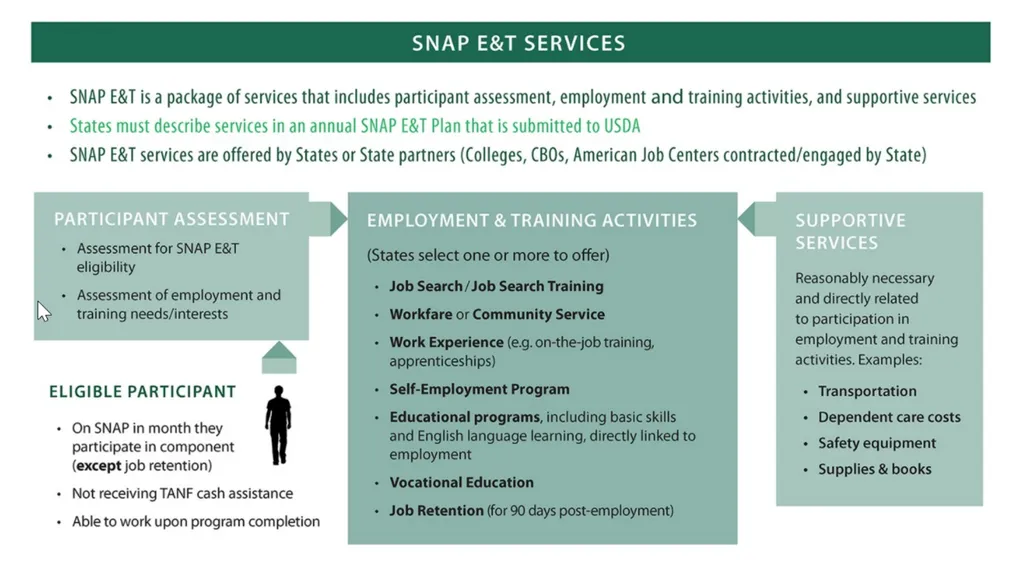
slide3. WHAT IS SNAP E&T? Required by federal partners – some funding provided
Helps SNAP participants gain skills and find work that moves them forward to self-sufficiency
Participants have access to training and support services to help them enter or move up in the workforce
Helps reduce barriers to work by providing support services 3<br>
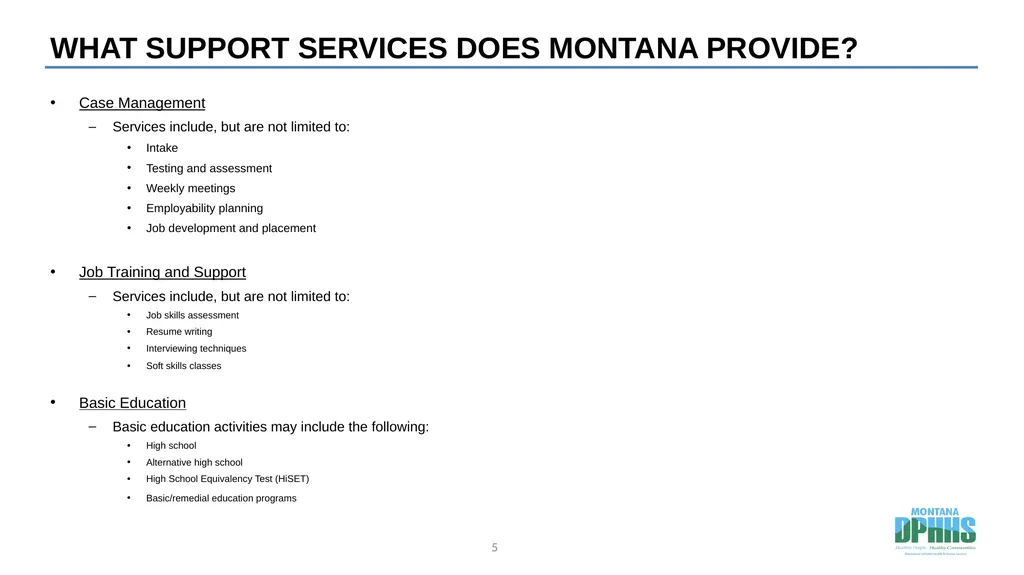
slide5. WHAT SUPPORT SERVICES DOES MONTANA PROVIDE? Case Management
Services include, but are not limited to:
Intake
Testing and assessment
Weekly meetings
Employability planning
Job development and placement
Job Training and Support
Services include, but are not limited to:
Job skills assessment
Resume writing
Interviewing techniques
Soft skills classes
Basic Education
Basic education activities may include the following:
High school
Alternative high school
High School Equivalency Test (HiSET)
Basic/remedial education programs 5<br>
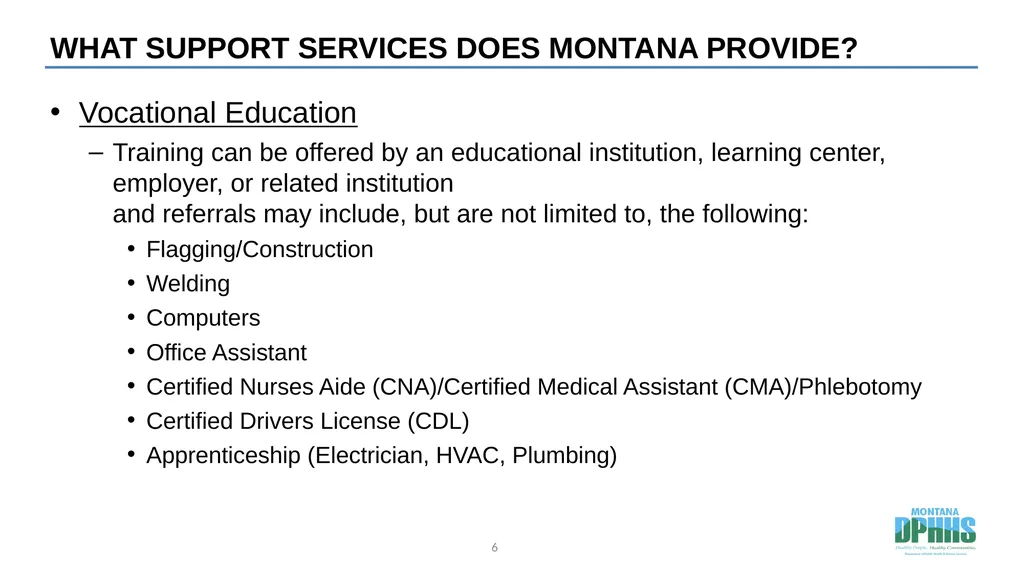
slide6. WHAT SUPPORT SERVICES DOES MONTANA PROVIDE? Vocational Education
Training can be offered by an educational institution, learning center, employer, or related institution and referrals may include, but are not limited to, the following:
Flagging/Construction
Welding
Computers
Office Assistant
Certified Nurses Aide (CNA)/Certified Medical Assistant (CMA)/Phlebotomy
Certified Drivers License (CDL)
Apprenticeship (Electrician, HVAC, Plumbing) 6<br>
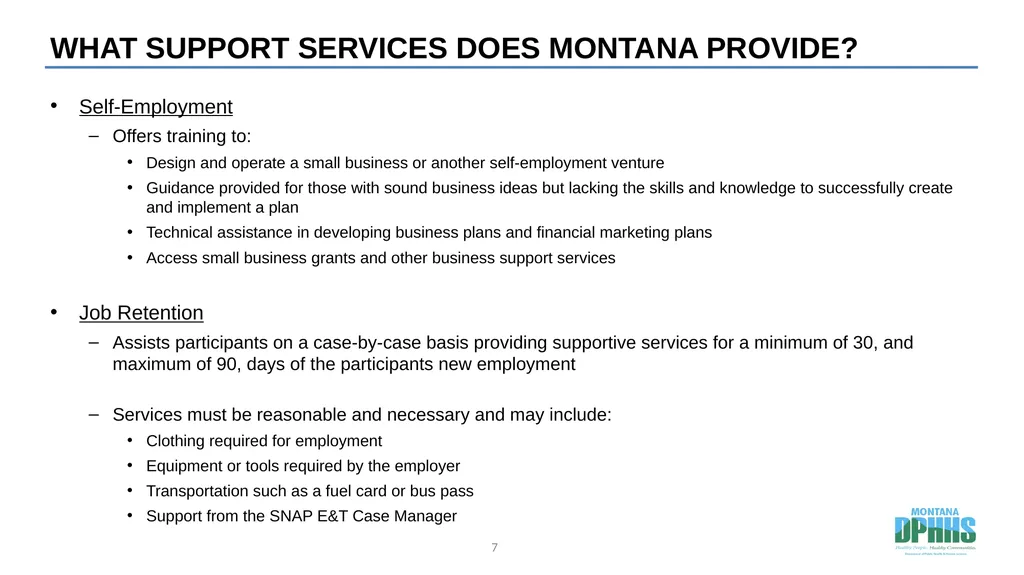
slide7. WHAT SUPPORT SERVICES DOES MONTANA PROVIDE? Self-Employment
Offers training to:
Design and operate a small business or another self-employment venture
Guidance provided for those with sound business ideas but lacking the skills and knowledge to successfully create and implement a plan
Technical assistance in developing business plans and financial marketing plans
Access small business grants and other business support services
Job Retention
Assists participants on a case-by-case basis providing supportive services for a minimum of 30, and maximum of 90, days of the participants new employment
Services must be reasonable and necessary and may include:
Clothing required for employment
Equipment or tools required by the employer
Transportation such as a fuel card or bus pass
Support from the SNAP E&T Case Manager 7<br>
slide8. 8 SNAP E&T Goals<br>
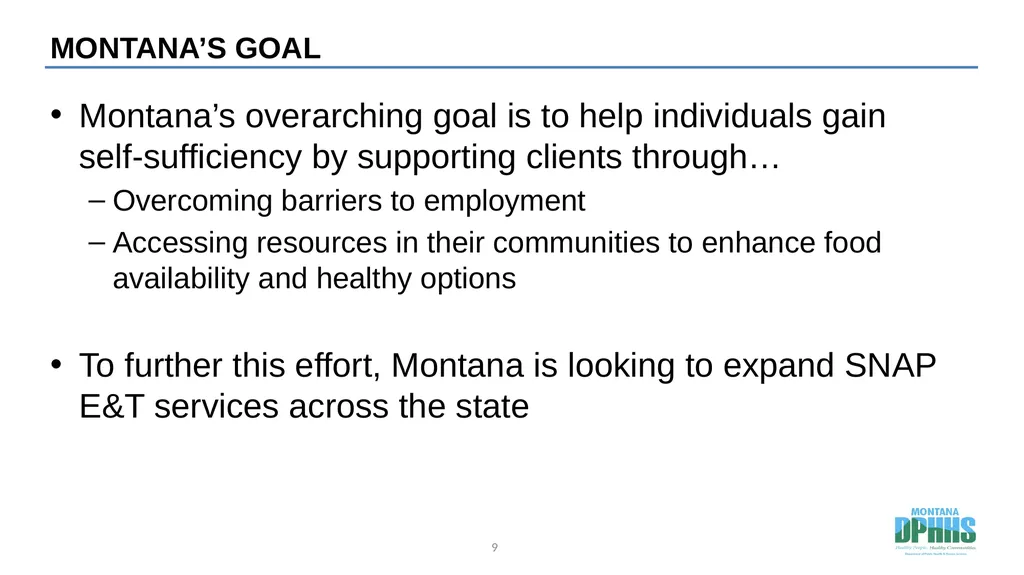
slide9. MONTANA’S GOAL Montana’s overarching goal is to help individuals gain self-sufficiency by supporting clients through…
Overcoming barriers to employment
Accessing resources in their communities to enhance food availability and healthy options
To further this effort, Montana is looking to expand SNAP E&T services across the state 9<br>
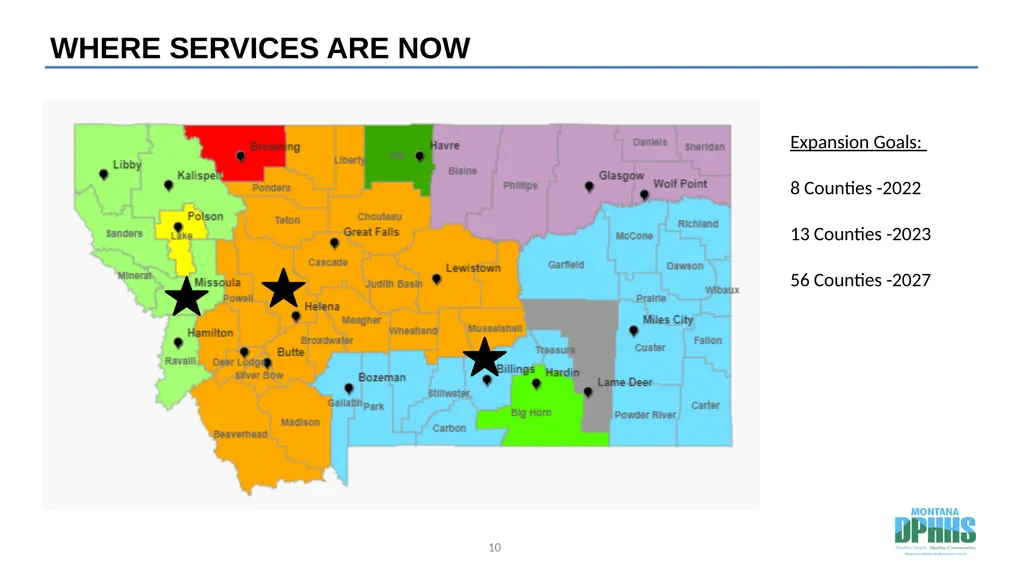
slide10. WHERE SERVICES ARE NOW 10 Expansion Goals:
8 Counties -2022
13 Counties -2023
56 Counties -2027<br>
slide11. 11 Strategy to Grow the Program<br>
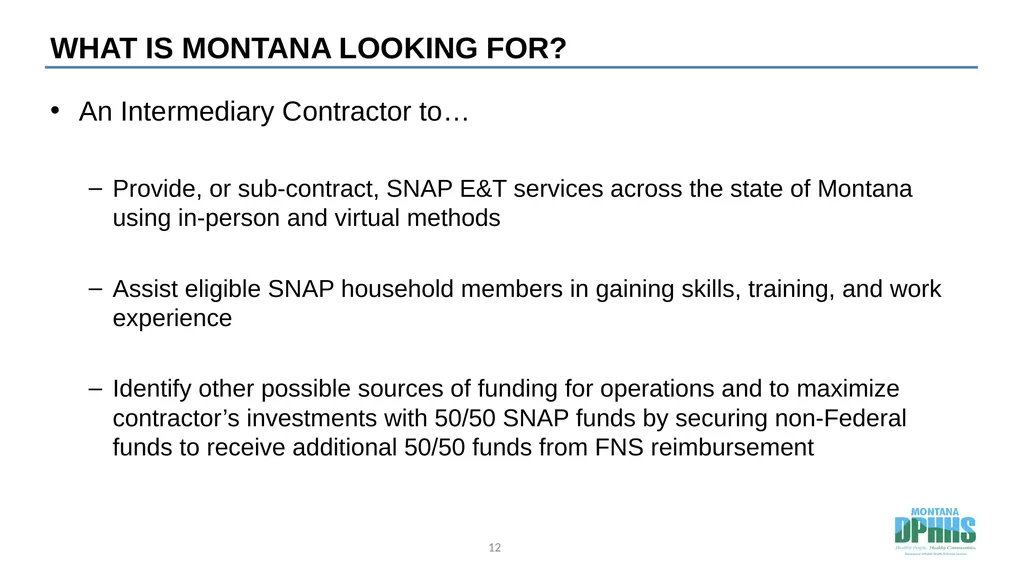
slide12. WHAT IS MONTANA LOOKING FOR? An Intermediary Contractor to…
Provide, or sub-contract, SNAP E&T services across the state of Montana using in-person and virtual methods
Assist eligible SNAP household members in gaining skills, training, and work experience
Identify other possible sources of funding for operations and to maximize contractor’s investments with 50/50 SNAP funds by securing non-Federal funds to receive additional 50/50 funds from FNS reimbursement 12<br>
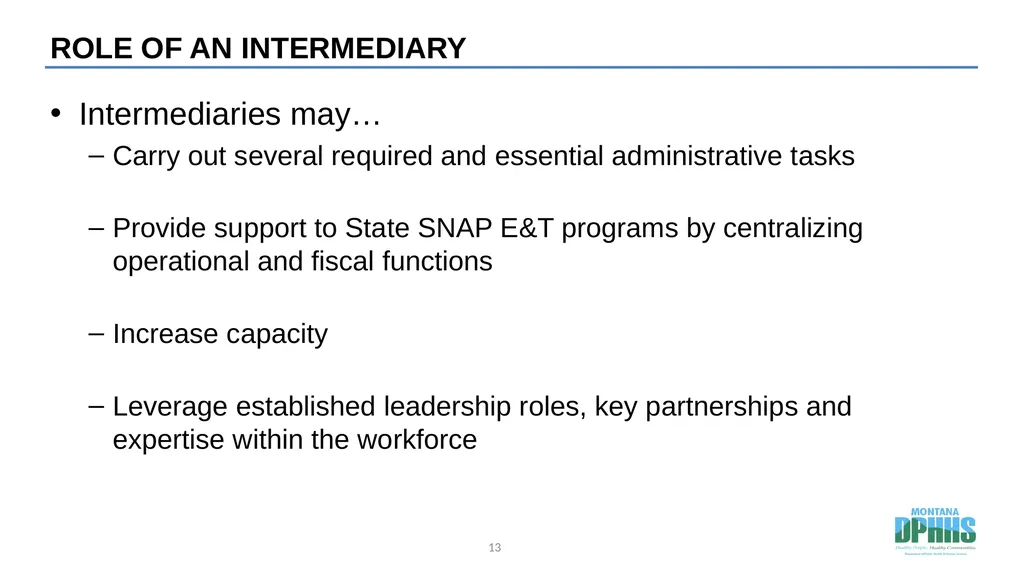
slide13. ROLE OF AN INTERMEDIARY Intermediaries may…
Carry out several required and essential administrative tasks
Provide support to State SNAP E&T programs by centralizing operational and fiscal functions
Increase capacity
Leverage established leadership roles, key partnerships and expertise within the workforce 13<br>
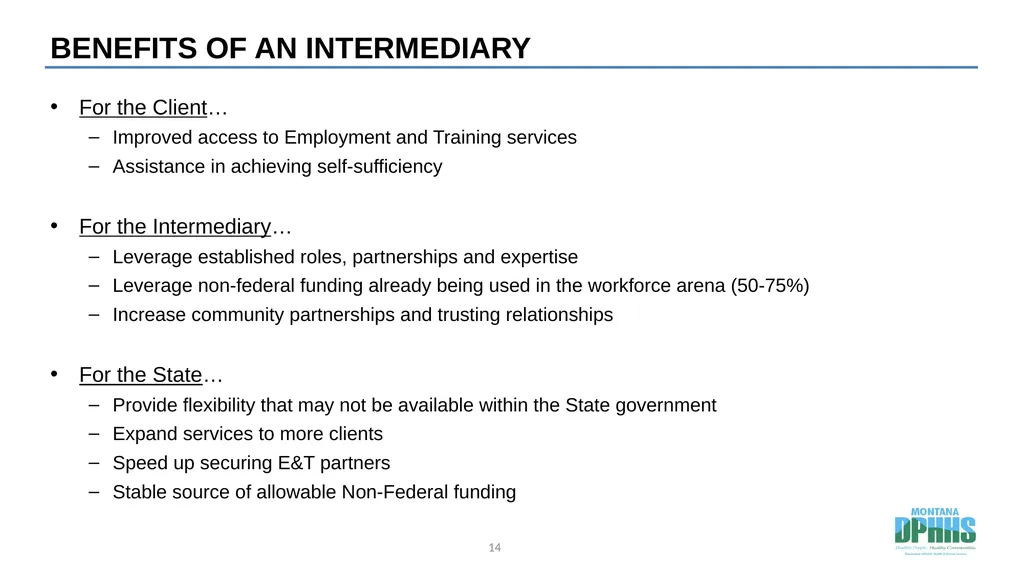
slide14. BENEFITS OF AN INTERMEDIARY For the Client…
Improved access to Employment and Training services
Assistance in achieving self-sufficiency
For the Intermediary…
Leverage established roles, partnerships and expertise
Leverage non-federal funding already being used in the workforce arena (50-75%)
Increase community partnerships and trusting relationships
For the State…
Provide flexibility that may not be available within the State government
Expand services to more clients
Speed up securing E&T partners
Stable source of allowable Non-Federal funding 14<br>
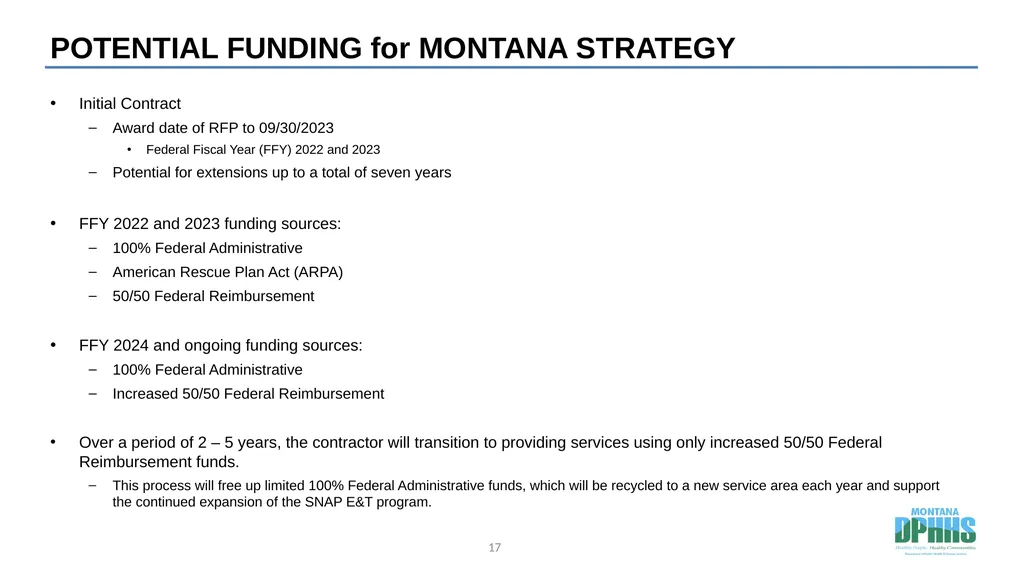
slide17. POTENTIAL FUNDING for MONTANA STRATEGY Initial Contract
Award date of RFP to 09/30/2023
Federal Fiscal Year (FFY) 2022 and 2023
Potential for extensions up to a total of seven years
FFY 2022 and 2023 funding sources:
100% Federal Administrative
American Rescue Plan Act (ARPA)
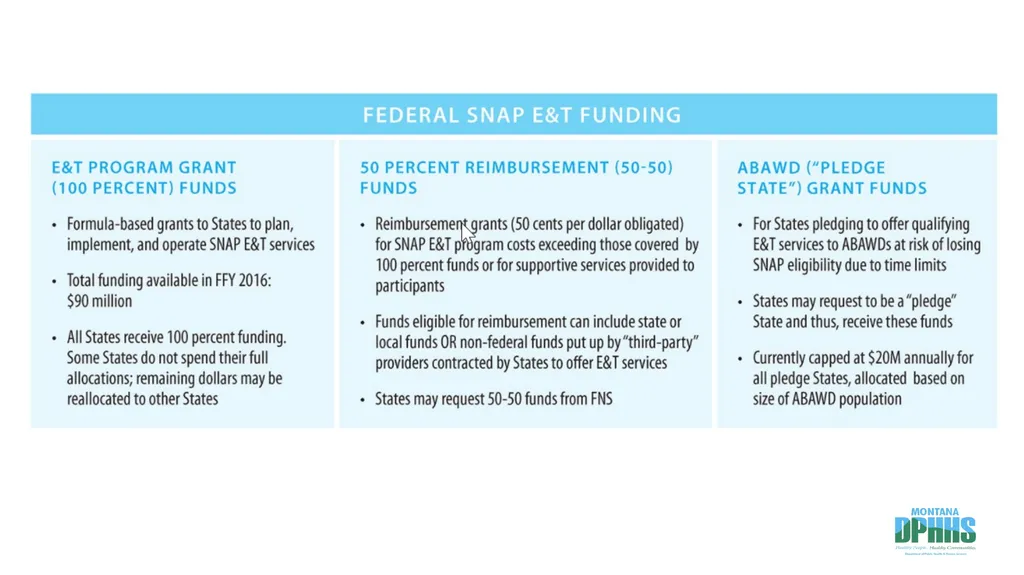
50/50 Federal Reimbursement
FFY 2024 and ongoing funding sources:
100% Federal Administrative
Increased 50/50 Federal Reimbursement
Over a period of 2 – 5 years, the contractor will transition to providing services using only increased 50/50 Federal Reimbursement funds.
This process will free up limited 100% Federal Administrative funds, which will be recycled to a new service area each year and support the continued expansion of the SNAP E&T program. 17<br>
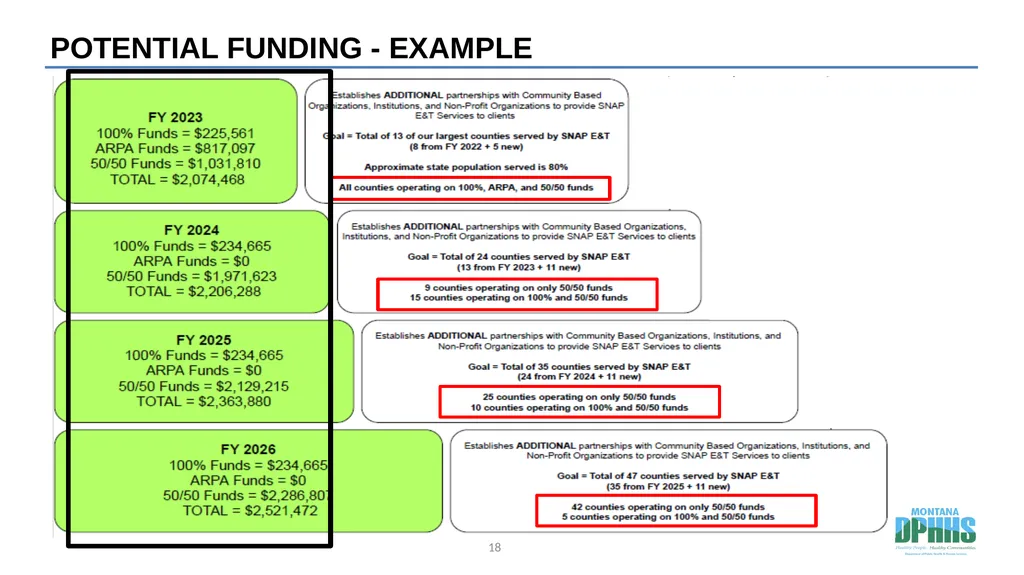
slide18. POTENTIAL FUNDING - EXAMPLE 18<br>
slide19. HOW THE FUNDING WORKS 19 Non-Federal E&T Funds (i.e., private donations) SNAP E&T Federal Funds Intermediary Sub-Contractor Sub-Contractor Sub-Contractor Sub-Contractor<br>
slide20. HOW THE FUNDING WORKS 20 Non-Federal E&T Funds (i.e., private donations) SNAP E&T Federal Funds Intermediary $5,000* CDL training paid, receipt submitted, reimbursement requested Sub-Contractor $2,500 approved and reimbursed through SNAP E&T 50/50 funds
(loses Federal identity) * Reimbursement can only occur on Non-Federal funds (FNS cannot reimburse FNS)<br>
slide21. BENEFITS OF AN INTERMEDIARY 21 2 MONTHS
Total Exp = $9,050
Total Reimbursement = $4,525 12 MONTHS
Total Exp = $54,300
Total Reimbursement = $27,150 ~ 27% Budget Increase<br>
slide22. Questions & Answers<br>
SNAP E&T Goals
Strategy to Grow the Program
Q&A 1<br>
slide2. 2 SNAP E&T Overview<br>
slide3. WHAT IS SNAP E&T? Required by federal partners – some funding provided
Helps SNAP participants gain skills and find work that moves them forward to self-sufficiency
Participants have access to training and support services to help them enter or move up in the workforce
Helps reduce barriers to work by providing support services 3<br>
slide5. WHAT SUPPORT SERVICES DOES MONTANA PROVIDE? Case Management
Services include, but are not limited to:
Intake
Testing and assessment
Weekly meetings
Employability planning
Job development and placement
Job Training and Support
Services include, but are not limited to:
Job skills assessment
Resume writing
Interviewing techniques
Soft skills classes
Basic Education
Basic education activities may include the following:
High school
Alternative high school
High School Equivalency Test (HiSET)
Basic/remedial education programs 5<br>
slide6. WHAT SUPPORT SERVICES DOES MONTANA PROVIDE? Vocational Education
Training can be offered by an educational institution, learning center, employer, or related institution and referrals may include, but are not limited to, the following:
Flagging/Construction
Welding
Computers
Office Assistant
Certified Nurses Aide (CNA)/Certified Medical Assistant (CMA)/Phlebotomy
Certified Drivers License (CDL)
Apprenticeship (Electrician, HVAC, Plumbing) 6<br>
slide7. WHAT SUPPORT SERVICES DOES MONTANA PROVIDE? Self-Employment
Offers training to:
Design and operate a small business or another self-employment venture
Guidance provided for those with sound business ideas but lacking the skills and knowledge to successfully create and implement a plan
Technical assistance in developing business plans and financial marketing plans
Access small business grants and other business support services
Job Retention
Assists participants on a case-by-case basis providing supportive services for a minimum of 30, and maximum of 90, days of the participants new employment
Services must be reasonable and necessary and may include:
Clothing required for employment
Equipment or tools required by the employer
Transportation such as a fuel card or bus pass
Support from the SNAP E&T Case Manager 7<br>
slide8. 8 SNAP E&T Goals<br>
slide9. MONTANA’S GOAL Montana’s overarching goal is to help individuals gain self-sufficiency by supporting clients through…
Overcoming barriers to employment
Accessing resources in their communities to enhance food availability and healthy options
To further this effort, Montana is looking to expand SNAP E&T services across the state 9<br>
slide10. WHERE SERVICES ARE NOW 10 Expansion Goals:
8 Counties -2022
13 Counties -2023
56 Counties -2027<br>
slide11. 11 Strategy to Grow the Program<br>
slide12. WHAT IS MONTANA LOOKING FOR? An Intermediary Contractor to…
Provide, or sub-contract, SNAP E&T services across the state of Montana using in-person and virtual methods
Assist eligible SNAP household members in gaining skills, training, and work experience
Identify other possible sources of funding for operations and to maximize contractor’s investments with 50/50 SNAP funds by securing non-Federal funds to receive additional 50/50 funds from FNS reimbursement 12<br>
slide13. ROLE OF AN INTERMEDIARY Intermediaries may…
Carry out several required and essential administrative tasks
Provide support to State SNAP E&T programs by centralizing operational and fiscal functions
Increase capacity
Leverage established leadership roles, key partnerships and expertise within the workforce 13<br>
slide14. BENEFITS OF AN INTERMEDIARY For the Client…
Improved access to Employment and Training services
Assistance in achieving self-sufficiency
For the Intermediary…
Leverage established roles, partnerships and expertise
Leverage non-federal funding already being used in the workforce arena (50-75%)
Increase community partnerships and trusting relationships
For the State…
Provide flexibility that may not be available within the State government
Expand services to more clients
Speed up securing E&T partners
Stable source of allowable Non-Federal funding 14<br>
slide17. POTENTIAL FUNDING for MONTANA STRATEGY Initial Contract
Award date of RFP to 09/30/2023
Federal Fiscal Year (FFY) 2022 and 2023
Potential for extensions up to a total of seven years
FFY 2022 and 2023 funding sources:
100% Federal Administrative
American Rescue Plan Act (ARPA)
50/50 Federal Reimbursement
FFY 2024 and ongoing funding sources:
100% Federal Administrative
Increased 50/50 Federal Reimbursement
Over a period of 2 – 5 years, the contractor will transition to providing services using only increased 50/50 Federal Reimbursement funds.
This process will free up limited 100% Federal Administrative funds, which will be recycled to a new service area each year and support the continued expansion of the SNAP E&T program. 17<br>
slide18. POTENTIAL FUNDING - EXAMPLE 18<br>
slide19. HOW THE FUNDING WORKS 19 Non-Federal E&T Funds (i.e., private donations) SNAP E&T Federal Funds Intermediary Sub-Contractor Sub-Contractor Sub-Contractor Sub-Contractor<br>
slide20. HOW THE FUNDING WORKS 20 Non-Federal E&T Funds (i.e., private donations) SNAP E&T Federal Funds Intermediary $5,000* CDL training paid, receipt submitted, reimbursement requested Sub-Contractor $2,500 approved and reimbursed through SNAP E&T 50/50 funds
(loses Federal identity) * Reimbursement can only occur on Non-Federal funds (FNS cannot reimburse FNS)<br>
slide21. BENEFITS OF AN INTERMEDIARY 21 2 MONTHS
Total Exp = $9,050
Total Reimbursement = $4,525 12 MONTHS
Total Exp = $54,300
Total Reimbursement = $27,150 ~ 27% Budget Increase<br>
slide22. Questions & Answers<br>