Aim: How did the decision in Plessy v. Ferguson impact African Americans? anxiety about an expanding government in the hands of those unwilling to work, who would enact welfare-type legislation to confiscate the property of the true
"Aim: How did the decision in Plessy v. Ferguson" is the property of its rightful owner. Permission is granted to
download and print the materials on this website for personal, non-commercial use only, and to display it
on your personal computer provided you do not modify the materials and that you retain all copyright
notices contained in the materials. By downloading content from our website, you accept the terms of this
agreement.
Presentation Transcript
01
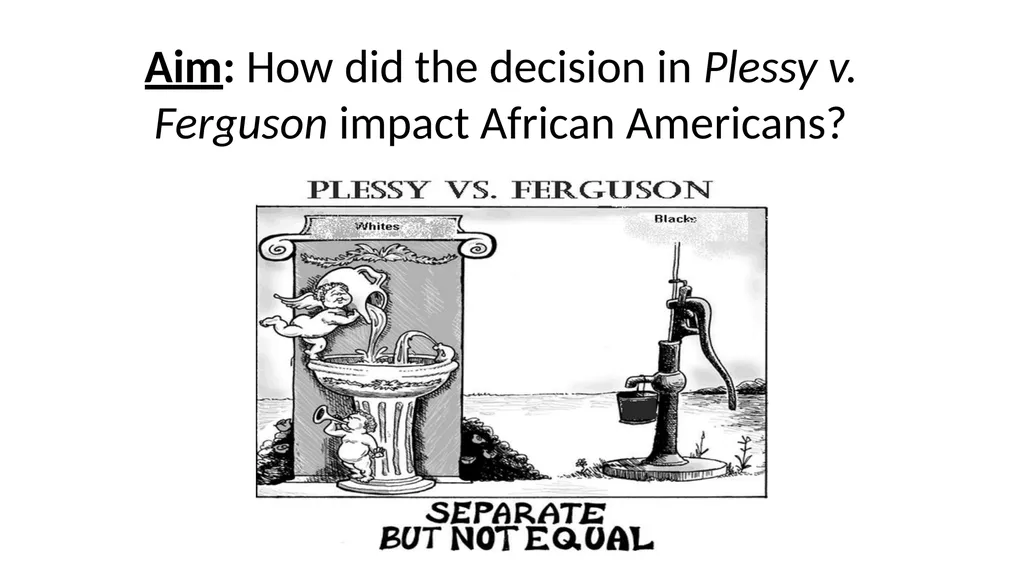
Aim: How did the decision in Plessy v. Ferguson impact African Americans?<br>
02
“…anxiety about an expanding government in the hands of those unwilling to work, who would enact welfare-type legislation to confiscate the property of the true workers in America.”
–Heather Cox Richardson, Harvard University January 1879 cartoon from Harper’s Weekly despicting “Mr. Solid South” writing out the straegy of racial resentment: The Blak man orter be eddikated afore he kin vote with us Wites.” How were white Americans reacting to an increasing African American stance in society?<br>
03
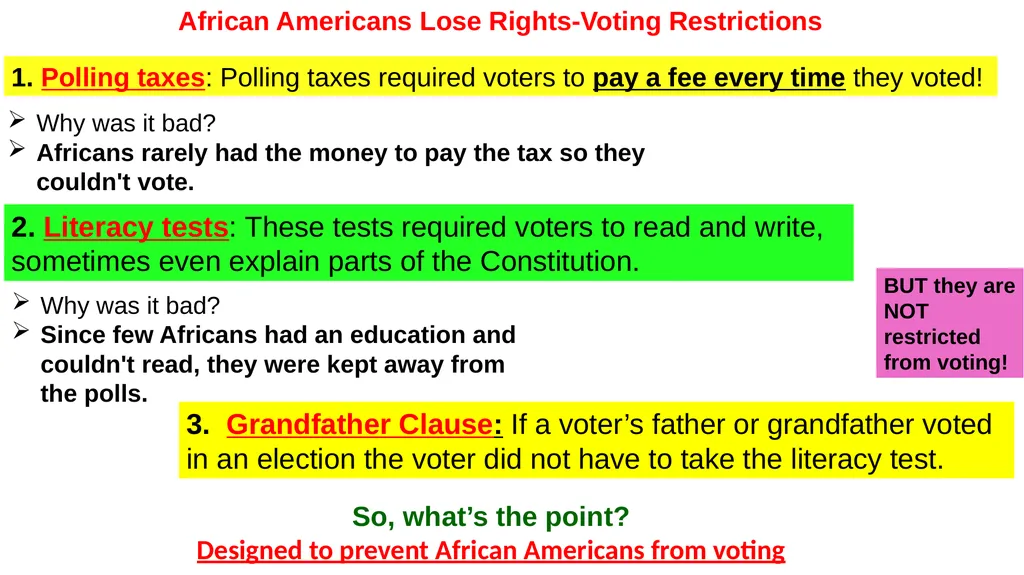
3. Grandfather Clause: If a voter’s father or grandfather voted in an election the voter did not have to take the literacy test. African Americans Lose Rights-Voting Restrictions 1. Polling taxes: Polling taxes required voters to pay a fee every time they voted! Why was it bad?
Since few Africans had an education and couldn't read, they were kept away from the polls. So, what’s the point?
Designed to prevent African Americans from voting Why was it bad?
Africans rarely had the money to pay the tax so they couldn't vote. 2. Literacy tests: These tests required voters to read and write, sometimes even explain parts of the Constitution. BUT they are NOT restricted from voting!<br>
04
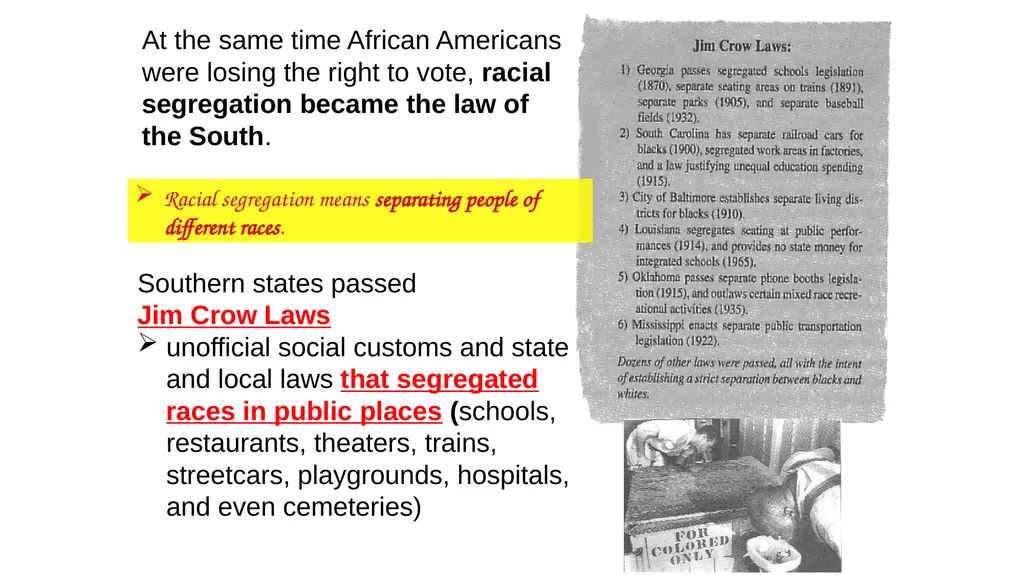
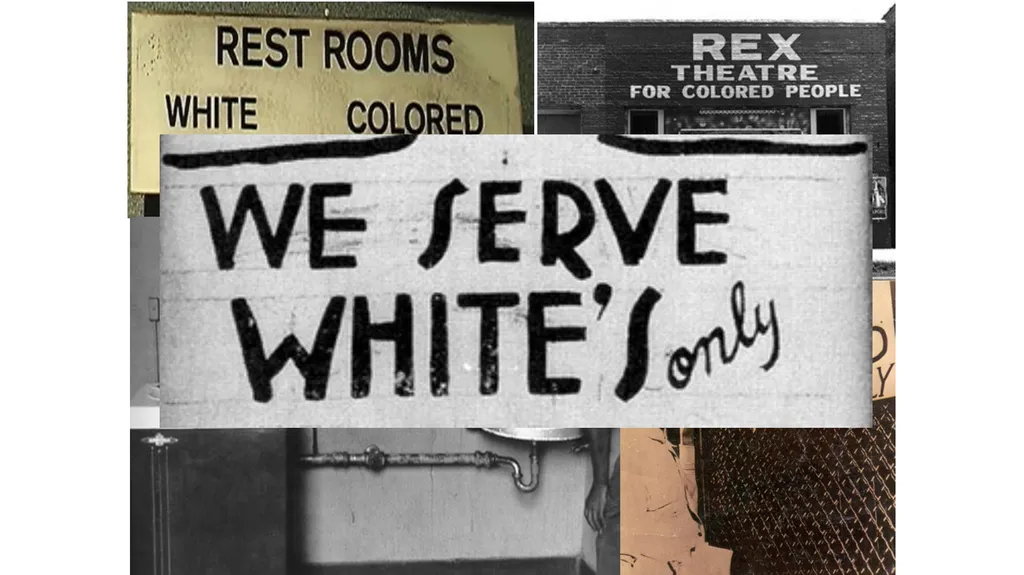
At the same time African Americans were losing the right to vote, racial segregation became the law of the South. Southern states passed
Jim Crow Laws
unofficial social customs and state and local laws that segregated races in public places (schools, restaurants, theaters, trains, streetcars, playgrounds, hospitals, and even cemeteries) Racial segregation means separating people of different races.<br>
05
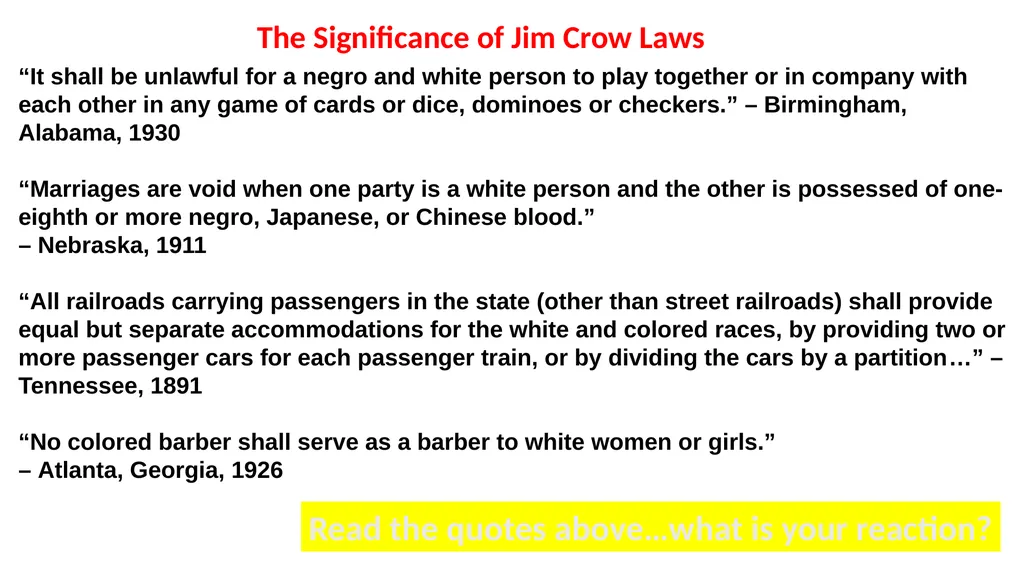
The Significance of Jim Crow Laws “It shall be unlawful for a negro and white person to play together or in company with each other in any game of cards or dice, dominoes or checkers.” – Birmingham, Alabama, 1930
“Marriages are void when one party is a white person and the other is possessed of one-eighth or more negro, Japanese, or Chinese blood.”
– Nebraska, 1911
“All railroads carrying passengers in the state (other than street railroads) shall provide equal but separate accommodations for the white and colored races, by providing two or more passenger cars for each passenger train, or by dividing the cars by a partition…” – Tennessee, 1891
“No colored barber shall serve as a barber to white women or girls.”
– Atlanta, Georgia, 1926 Read the quotes above…what is your reaction?<br>
06
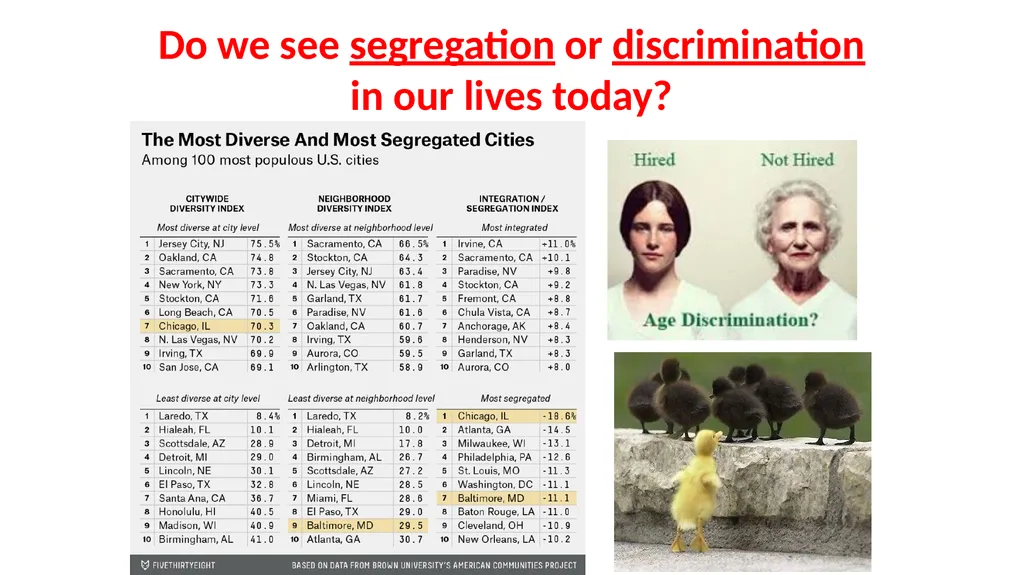
Do we see segregation or discrimination in our lives today?<br>
07
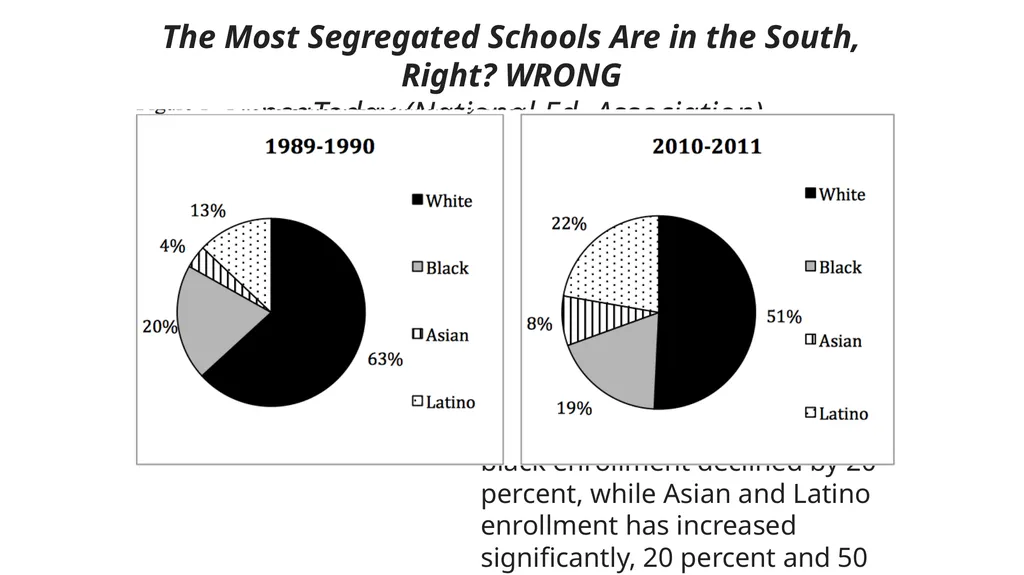
The Most Segregated Schools Are in the South, Right? WRONG
neaToday (National Ed. Association) A new report by UCLA’s Civil Rights Project (CRP) finds that public school students in New York are the most severely segregated in the nation. New York City, the largest school system in the country, is also one of the its most segregated. The share of white students enrolled in public schools declined by 10 percent in 2010 from 45 percent in 1989.
During the same time period, black enrollment declined by 20 percent, while Asian and Latino enrollment has increased significantly, 20 percent and 50 percent respectively.<br>
08
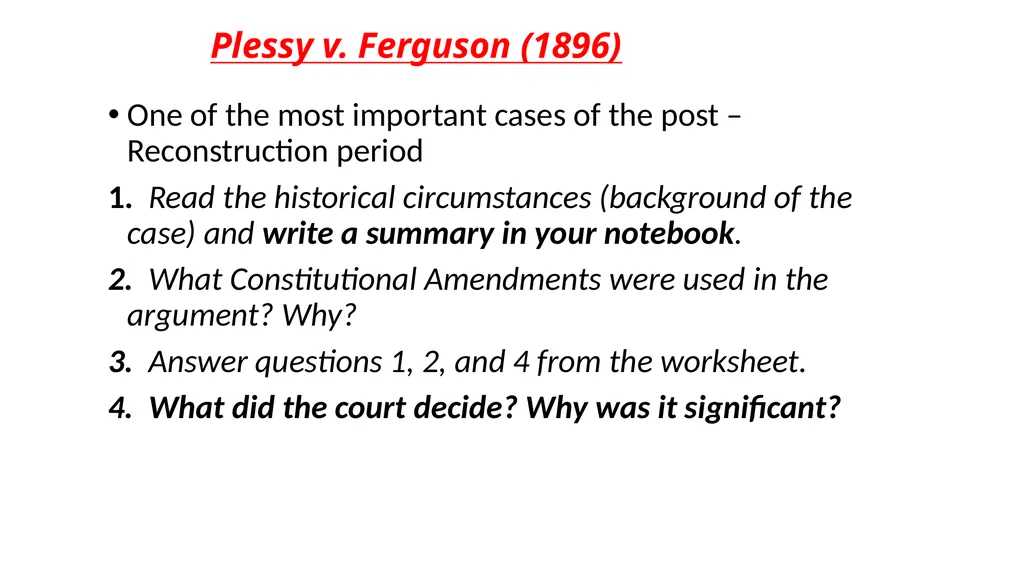
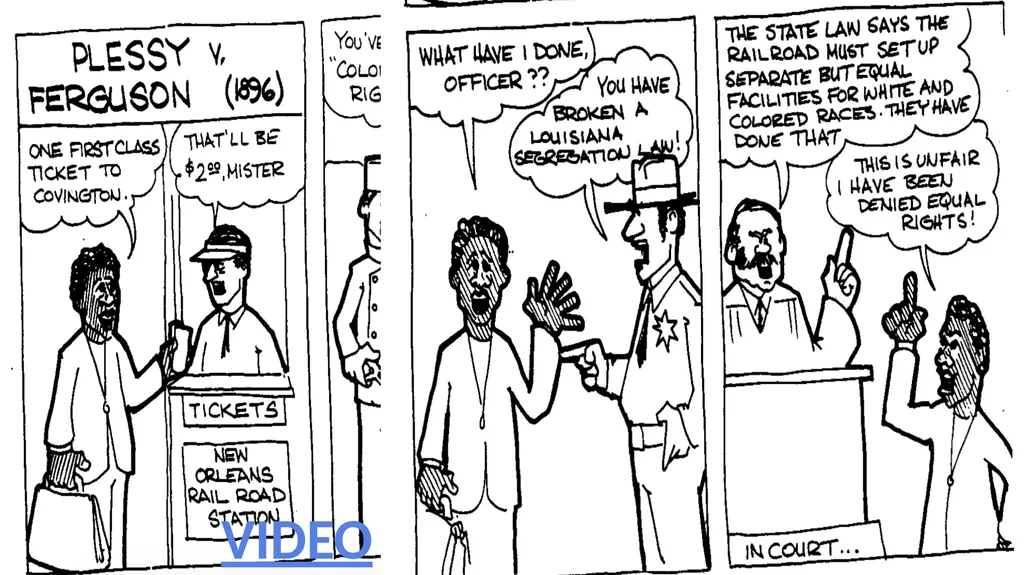
Plessy v. Ferguson (1896) One of the most important cases of the post – Reconstruction period
1. Read the historical circumstances (background of the case) and write a summary in your notebook.
2. What Constitutional Amendments were used in the argument? Why?
3. Answer questions 1, 2, and 4 from the worksheet.
4. What did the court decide? Why was it significant?<br>
09
VIDEO<br>
10
This was legal because of the Plessy case in which the Supreme Court decided that as long as accommodations were equal, segregation on the basis of race was legal.<br>
11
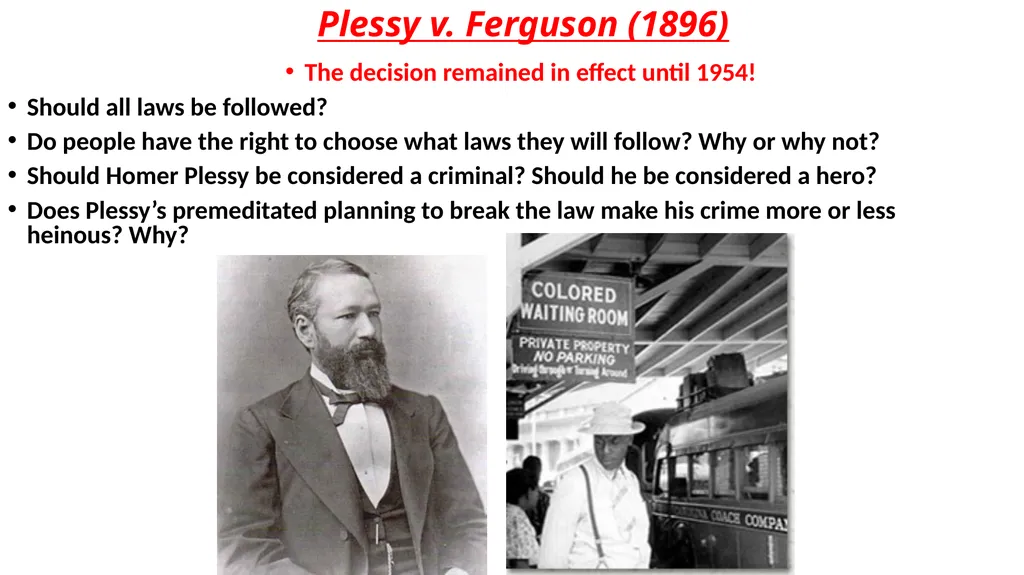
Plessy v. Ferguson (1896) The decision remained in effect until 1954!
Should all laws be followed?
Do people have the right to choose what laws they will follow? Why or why not?
Should Homer Plessy be considered a criminal? Should he be considered a hero?
Does Plessy’s premeditated planning to break the law make his crime more or less heinous? Why?<br>
12
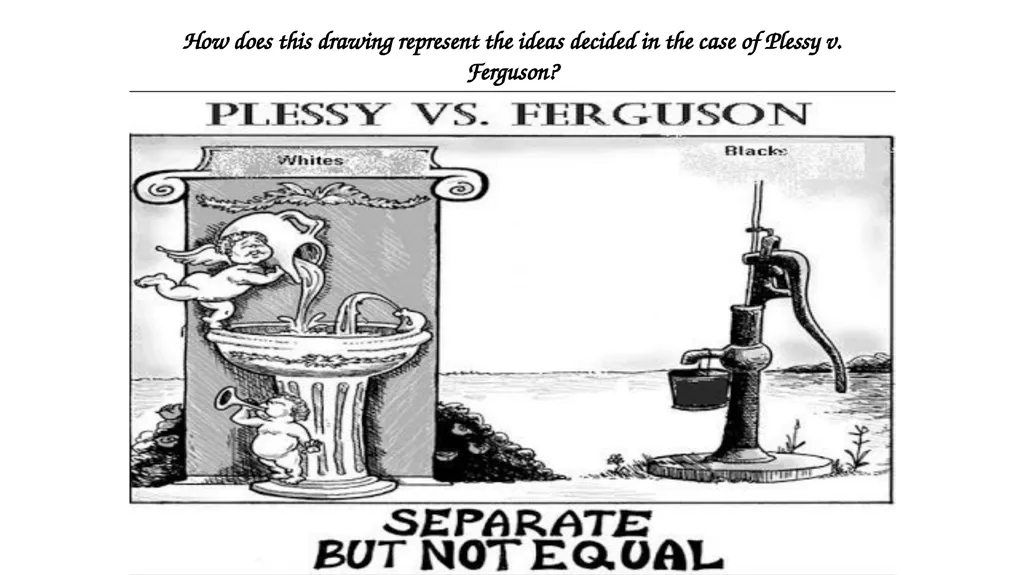
How does this drawing represent the ideas decided in the case of Plessy v. Ferguson?<br>
13
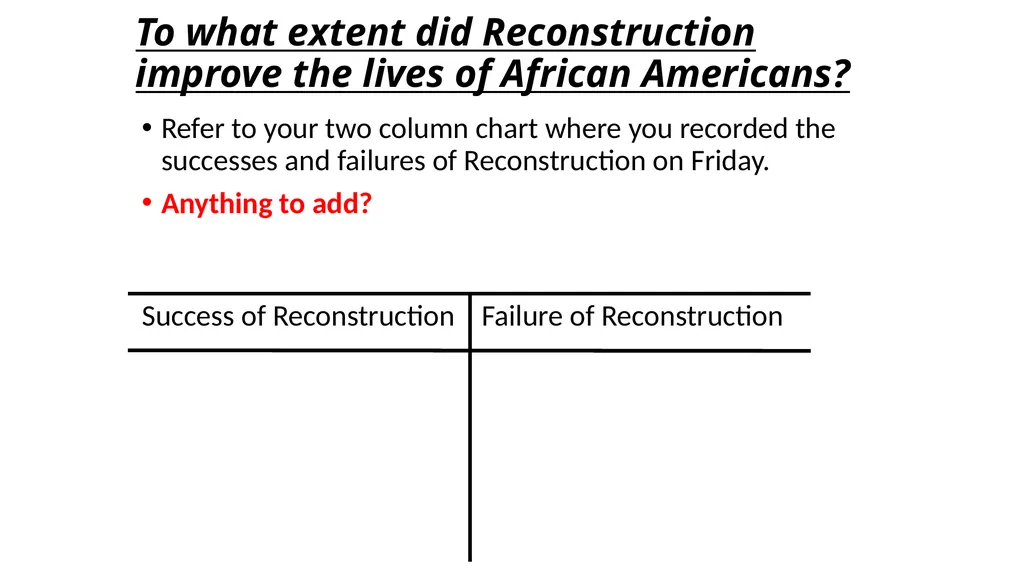
To what extent did Reconstruction improve the lives of African Americans? Refer to your two column chart where you recorded the successes and failures of Reconstruction on Friday.
Anything to add?
Success of Reconstruction Failure of Reconstruction<br>