Airway, Breathing and Oxygen Therapy Dr. Davidson Iroko 18032022 Outline Airway assessment and management Breathing assessment and management Oxygen therapy Introduction ABCDE approach provides a framework for the systematic and
"Airway, Breathing and Oxygen Therapy Dr. Davidson" is the property of its rightful owner. Permission is granted to
download and print the materials on this website for personal, non-commercial use only, and to display it
on your personal computer provided you do not modify the materials and that you retain all copyright
notices contained in the materials. By downloading content from our website, you accept the terms of this
agreement.
Presentation Transcript
01
Airway, Breathing and Oxygen Therapy Dr. Davidson Iroko
18/03/2022<br>
02
Outline Airway assessment and management
Breathing assessment and management
Oxygen therapy<br>
03
Introduction ABCDE approach provides a framework for the systematic and organized evaluation of acutely ill patients in order to rapidly identify and intervene for life-threatening conditions.
The following slides will focus on the Airway and Breathing component of the ABCDE.<br>
04
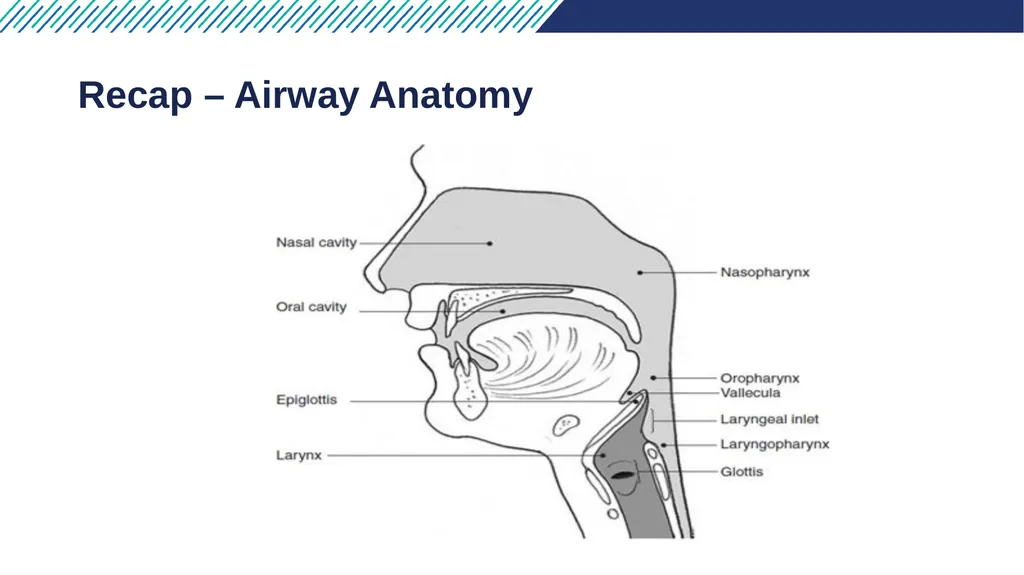
Recap – Airway Anatomy<br>
05
Airway Assessment MAIN CONCERN: IS THE AIRWAY PATENT?
Can the patient talk normally? If YES, the airway is open.
If the patient cannot talk normally:
look to see if the chest wall is moving and listen to see if there is air movement from the mouth or nose.
listen for abnormal sounds (such as stridor, grunting, or snoring) or a hoarse or raspy voice that indicates a partially obstructed airway.
Stridor plus swelling and/or hives suggest a severe allergic reaction (anaphylaxis).
Look and listen for fluid (such as blood, vomit) in the airway.
Look for foreign body or
abnormal swelling around the airway, and altered mental status.
Check if the patient is able to swallow saliva or is drooling.<br>
06
Airway management 1 AIM OF MANAGEMENT IS TO OPEN/KEEP AIRWAY OPENED.
If the patient is unconscious and not breathing normally and:
NO TRAUMA: open the airway using the head-tilt and chin-lift manoeuvre.
CONCERN FOR TRAUMA: maintain cervical spine immobilization and open the airway using the jaw thrust manoeuvre. <br>
07
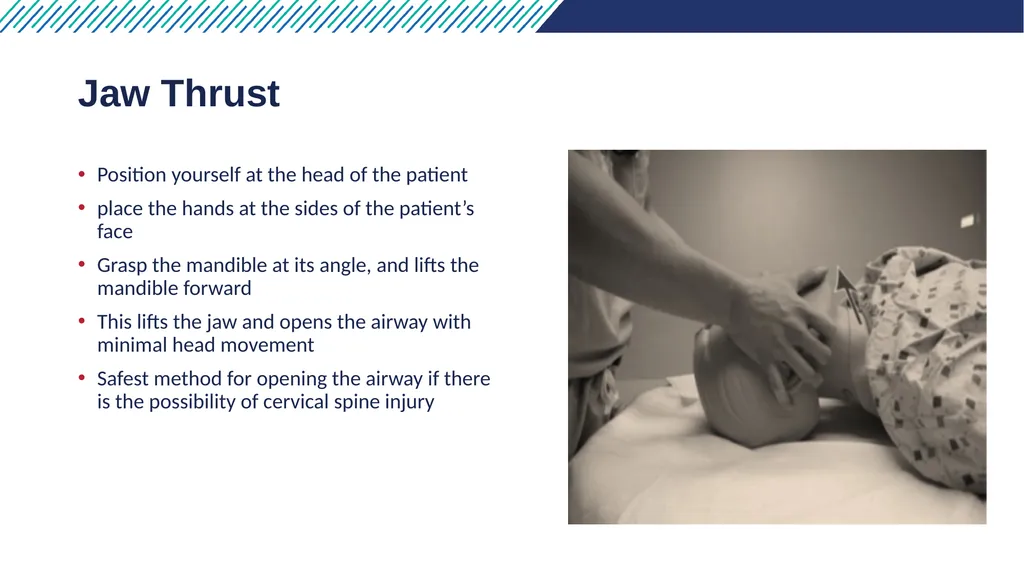
Jaw Thrust Position yourself at the head of the patient
place the hands at the sides of the patient’s face
Grasp the mandible at its angle, and lifts the mandible forward
This lifts the jaw and opens the airway with minimal head movement
Safest method for opening the airway if there is the possibility of cervical spine injury<br>
08
Airway management 2 If secretions or vomit are present, suction when available, or wipe clean.
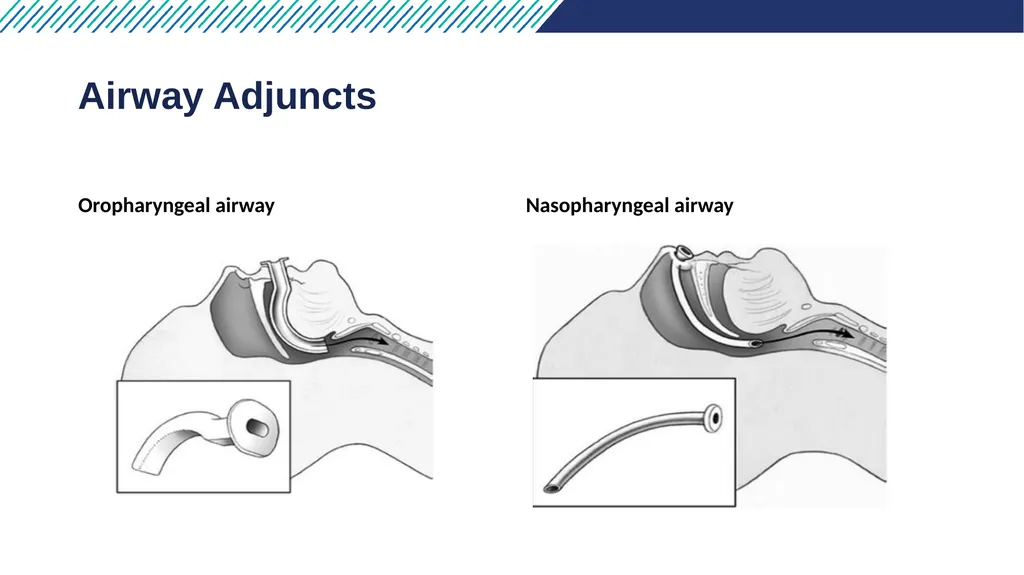
Place an oropharyngeal or nasopharyngeal airway to maintain the airway.
If a foreign body is suspected:
If the object is visible, remove it – be careful not to push the object any deeper.
If the patient is able to cough or make noises, keep the patient calm and encourage coughing.<br>
Airway Management 3 If the patient is choking and is unable to cough, not making sounds use age-appropriate chest thrusts/ abdominal thrusts/back blows.
If the patient becomes unconscious while choking, follow relevant CPR protocols.
Consider placing the patient in the recovery position if the rest of the ABCDE is normal and no trauma is suspected.
If the patient has swelling, hives or stridor, consider severe allergic reaction (anaphylaxis), and give intramuscular adrenaline.<br>
11
Breathing Assessment Look, listen, and feel to see if the patient is breathing.
Assess if breathing is very fast, very slow, or very shallow.
Look for signs of increased work of breathing (such as accessory muscle use, chest indrawing/retractions, nasal flaring) or abnormal chest wall movement.
Listen for abnormal breath sounds such as wheezing or crackles.
With severe wheezing, there may be limited/no breath sounds on examination because narrowing of the airways may be so severe that breathing cannot be heard.
Listen to see if breath sounds are equal on both sides.
Check for the absence of breath sounds and dull sounds with percussion on one side (large pleural effusion or haemothorax).
If there are no breath sounds on one side, and hypotension, check for distended neck veins or a shifted trachea (tension pneumothorax).
Check oxygen saturation with a pulse oximeter when available<br>
12
Breathing management 1 If unconscious with abnormal breathing, start bag-valve-mask ventilation and follow relevant CPR protocols.
If not breathing adequately (too slow for age or too shallow), begin bag-valve-mask ventilation with oxygen.
If oxygen not immediately available, DO NOT DELAY ventilation. Start ventilation while oxygen is being prepared.
If breathing fast or hypoxic, give oxygen.
If wheezing, consider giving nebulised salbutamol. Repeat salbutamol as needed.
If concern for severe allergic reaction (anaphylaxis), give intramuscular adrenaline.<br>
13
Breathing management 2 If breathing fast or hypoxic, give oxygen.
If wheezing, consider giving nebulised salbutamol. Repeat salbutamol as needed and treat underlying cause.
If concern for severe allergic reaction (anaphylaxis), give intramuscular adrenaline.
If concern for heart failure, provide oxygen as required and get help/treat as appropriate.<br>
14
Breathing management 3 If concern for tension pneumothorax, perform needle decompression immediately and give IV fluids and oxygen. Chest tube should be inserted. Plan for rapid handover/transfer especially if cannot insert chest tube.
If concern for large pleural effusion or haemothorax, give oxygen and plan for rapid handover/transfer.
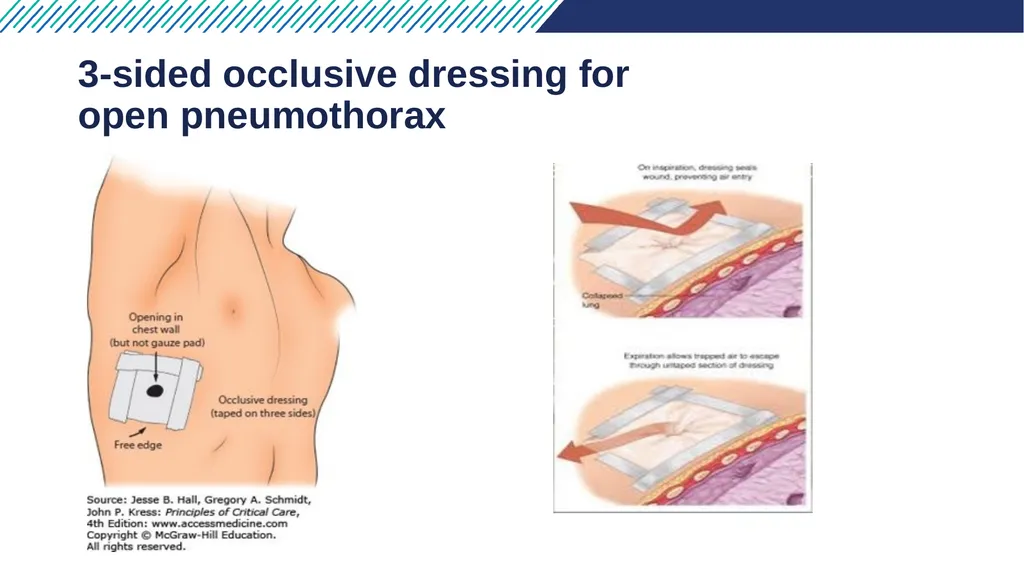
If sucking chest wound (open pneumothorax), apply 3-sided occlusive dressing while arranging for chest tube
Many of the life-threatening breathing conditions require chest tube insertion. If unable to perform this, refer after initial resuscitation.<br>
15
3-sided occlusive dressing for open pneumothorax<br>
16
Oxygen therapy This will be addressed in another presentation<br>
17
Conclusion The ABCDE approach provides a framework for the systematic and organized evaluation of acutely ill patients in order to rapidly identify and intervene for life-threatening conditions.
This presentation focused on the Airway and Breathing.
The other aspects of the ABCDE approach are assessment & management of circulation, disability (neurology) and exposure and environmental control.
In trauma, the life-threatening conditions one should identify include airway obstruction, tension pneumothorax, open pneumothorax, massive haemothorax, flail chest with underlying lung contusion, cardiac tamponade, and circulatory shock.
After resuscitating with ABCDE approach and patient is stable, take SAMPLE history and perform secondary survey.<br>