Algebra and Indices Introduction A binomial is an
Description: Algebra and Indices Introduction A binomial is an algebra expression containing 2 terms. For example, (x y) is a binomial. We know that For higher powers, the expansion gets very tedious. Hence, the binomial theorem gives us the expansion

Related Topics
Download Presentation
"Algebra and Indices Introduction A binomial is an" is the property of its rightful owner. Permission is granted to download and print the materials on this website for personal, non-commercial use only, and to display it on your personal computer provided you do not modify the materials and that you retain all copyright notices contained in the materials. By downloading content from our website, you accept the terms of this agreement.
Presentation Transcript
slide1. Algebra and Indices<br>
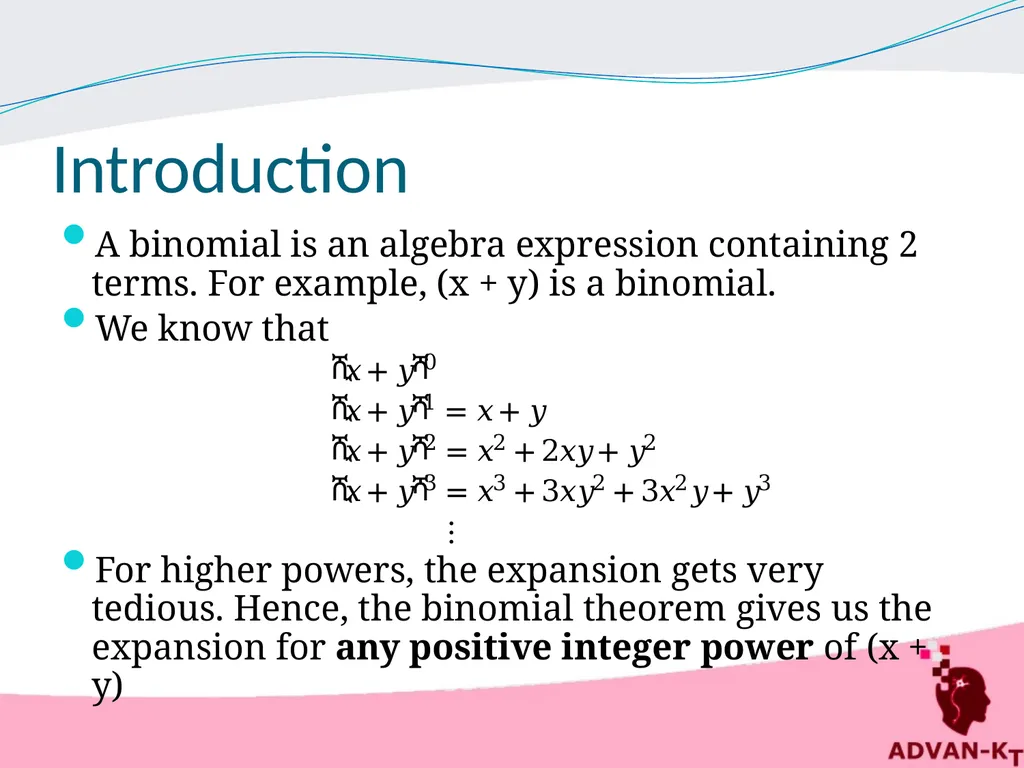
slide2. Introduction A binomial is an algebra expression containing 2 terms. For example, (x + y) is a binomial.
We know that
For higher powers, the expansion gets very tedious. Hence, the binomial theorem gives us the expansion for any positive integer power of (x + y)<br>
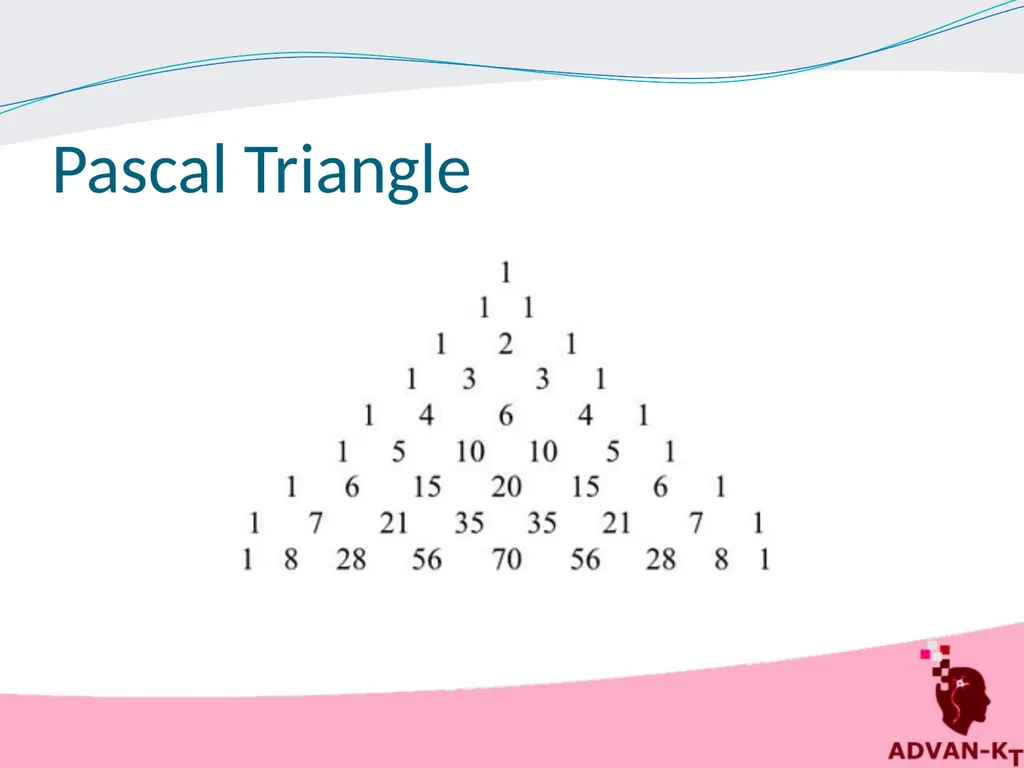
slide3. Pascal Triangle<br>
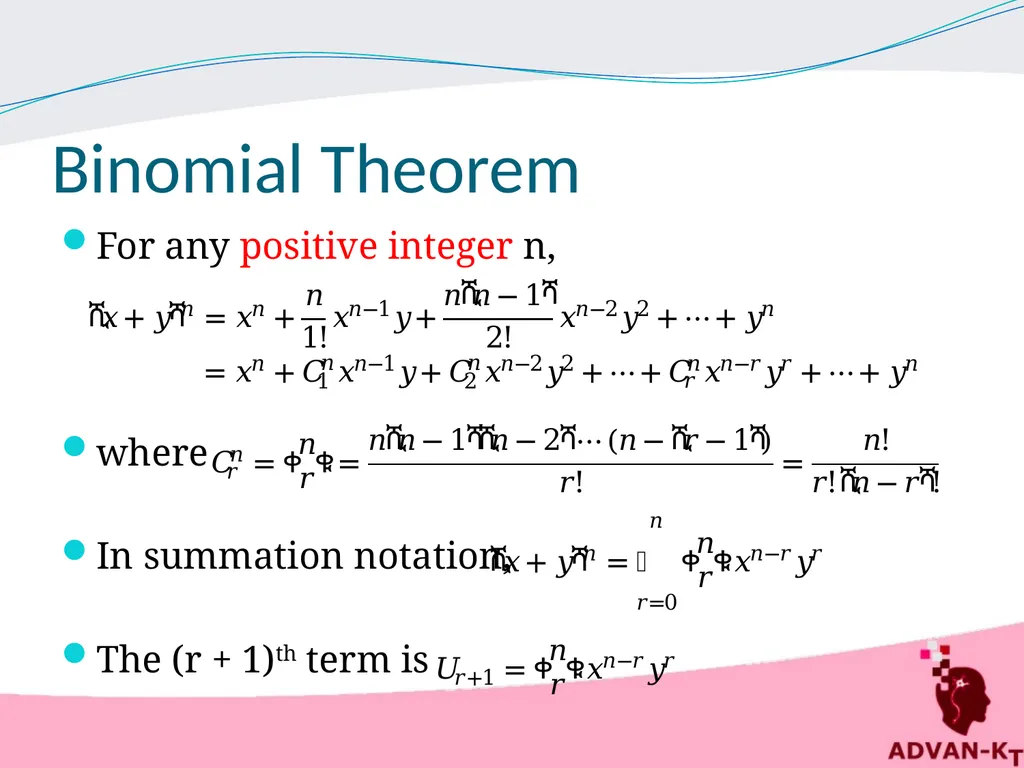
slide4. Binomial Theorem For any positive integer n,
where
In summation notation,
The (r + 1)th term is<br>
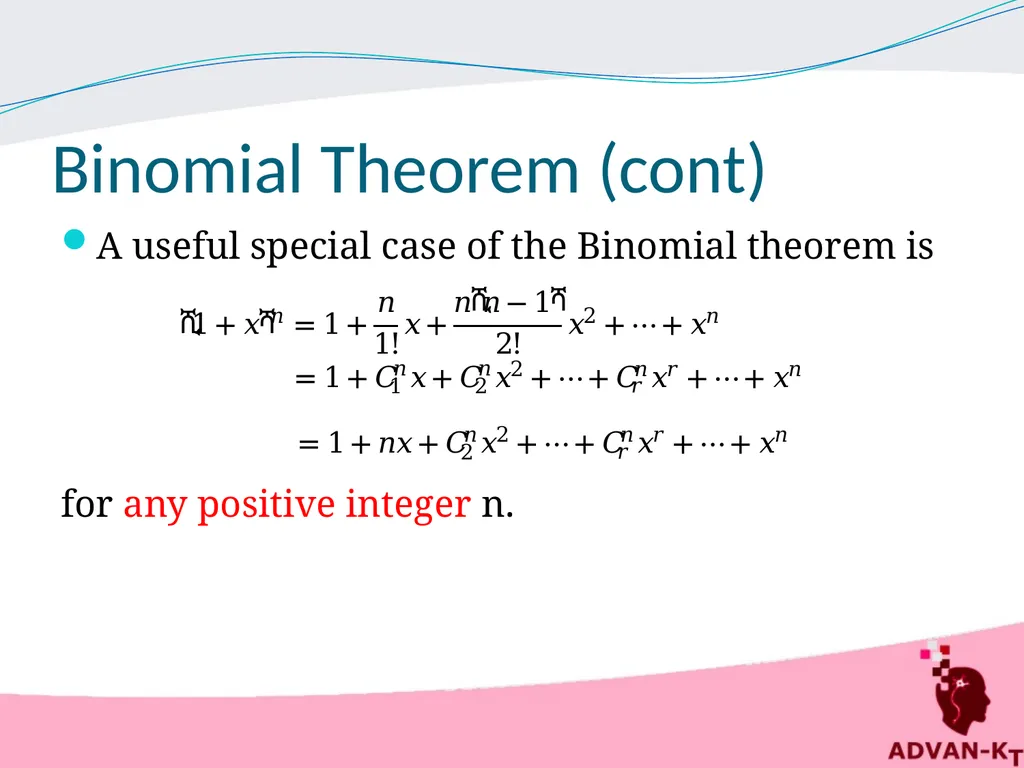
slide5. Binomial Theorem (cont) A useful special case of the Binomial theorem is
for any positive integer n.<br>
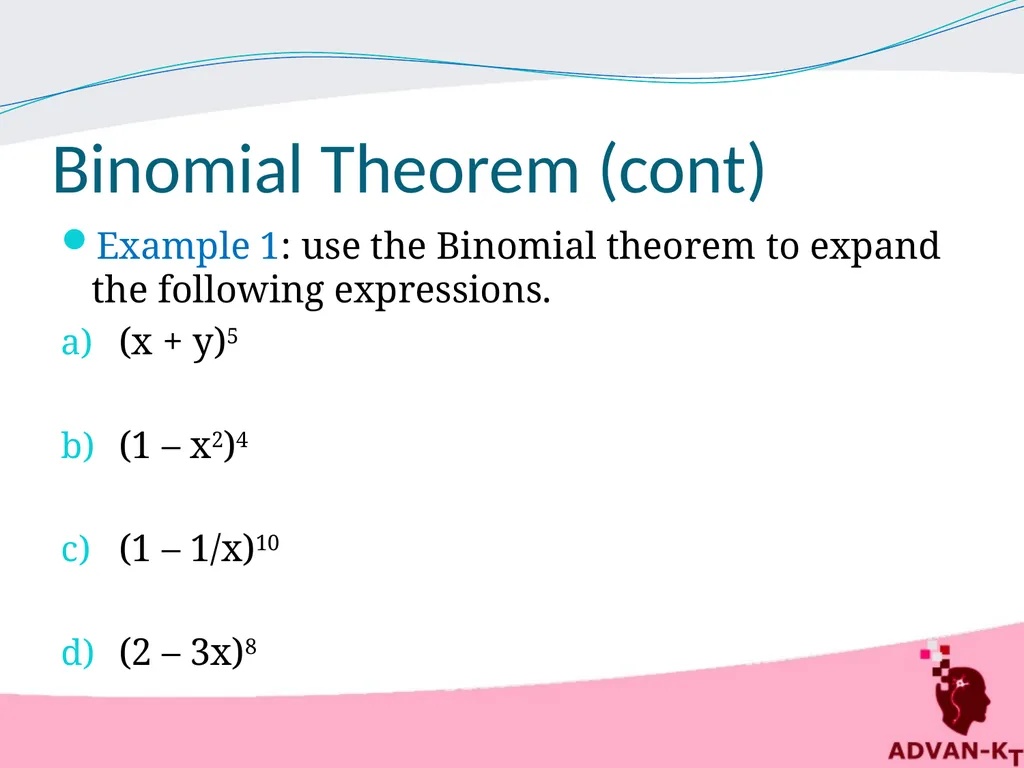
slide6. Binomial Theorem (cont) Example 1: use the Binomial theorem to expand the following expressions.
(x + y)5
(1 – x2)4
(1 – 1/x)10
(2 – 3x)8<br>
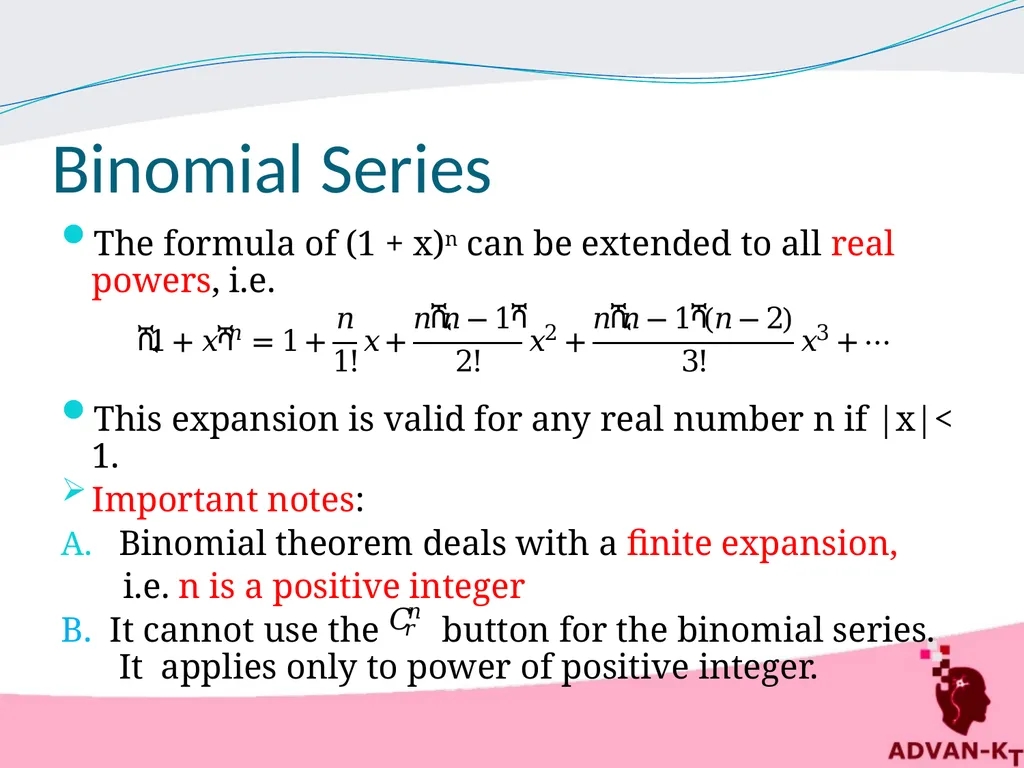
slide7. Binomial Series The formula of (1 + x)n can be extended to all real powers, i.e.
This expansion is valid for any real number n if |x|< 1.
Important notes:
Binomial theorem deals with a finite expansion,
i.e. n is a positive integer
B. It cannot use the button for the binomial series. It applies only to power of positive integer.<br>
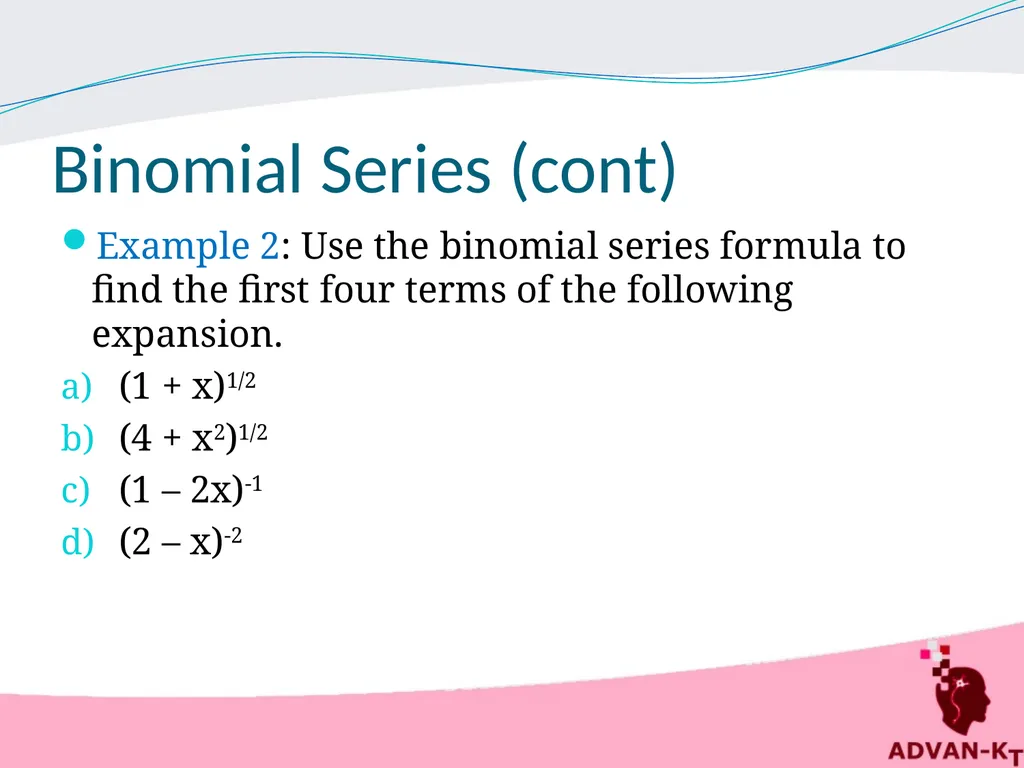
slide8. Binomial Series (cont) Example 2: Use the binomial series formula to find the first four terms of the following expansion.
(1 + x)1/2
(4 + x2)1/2
(1 – 2x)-1
(2 – x)-2<br>
slide2. Introduction A binomial is an algebra expression containing 2 terms. For example, (x + y) is a binomial.
We know that
For higher powers, the expansion gets very tedious. Hence, the binomial theorem gives us the expansion for any positive integer power of (x + y)<br>
slide3. Pascal Triangle<br>
slide4. Binomial Theorem For any positive integer n,
where
In summation notation,
The (r + 1)th term is<br>
slide5. Binomial Theorem (cont) A useful special case of the Binomial theorem is
for any positive integer n.<br>
slide6. Binomial Theorem (cont) Example 1: use the Binomial theorem to expand the following expressions.
(x + y)5
(1 – x2)4
(1 – 1/x)10
(2 – 3x)8<br>
slide7. Binomial Series The formula of (1 + x)n can be extended to all real powers, i.e.
This expansion is valid for any real number n if |x|< 1.
Important notes:
Binomial theorem deals with a finite expansion,
i.e. n is a positive integer
B. It cannot use the button for the binomial series. It applies only to power of positive integer.<br>
slide8. Binomial Series (cont) Example 2: Use the binomial series formula to find the first four terms of the following expansion.
(1 + x)1/2
(4 + x2)1/2
(1 – 2x)-1
(2 – x)-2<br>