04
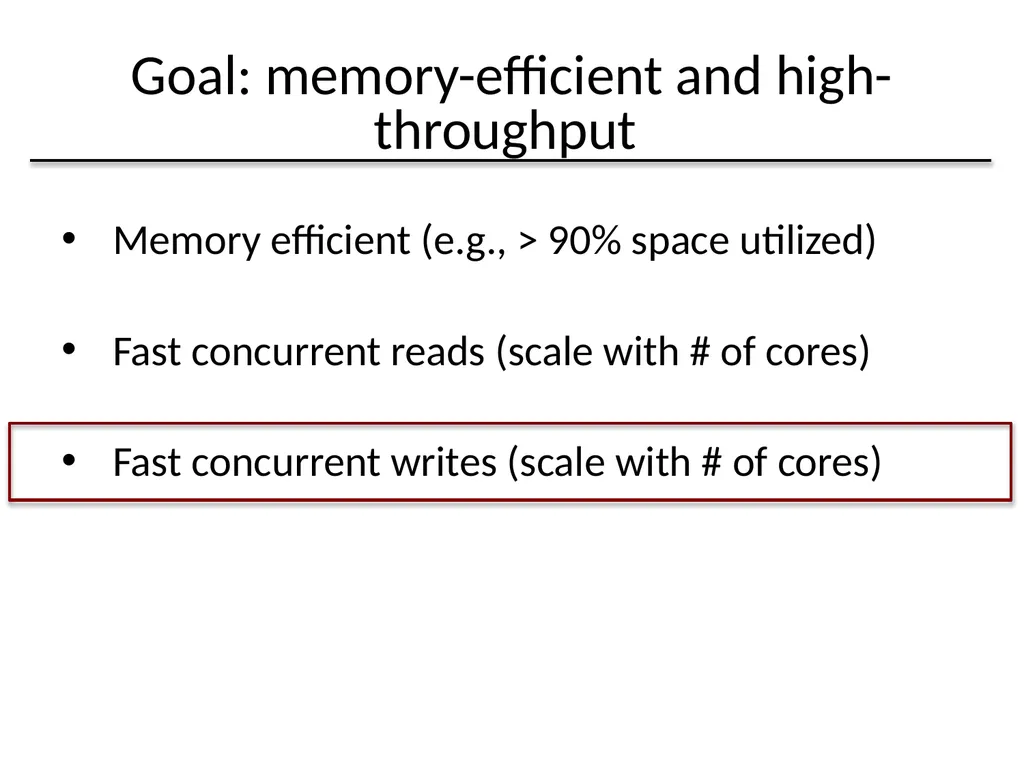
Goal: memory-efficient and high-throughput Memory efficient (e.g., > 90% space utilized)
Fast concurrent reads (scale with # of cores)
Fast concurrent writes (scale with # of cores)<br>
05
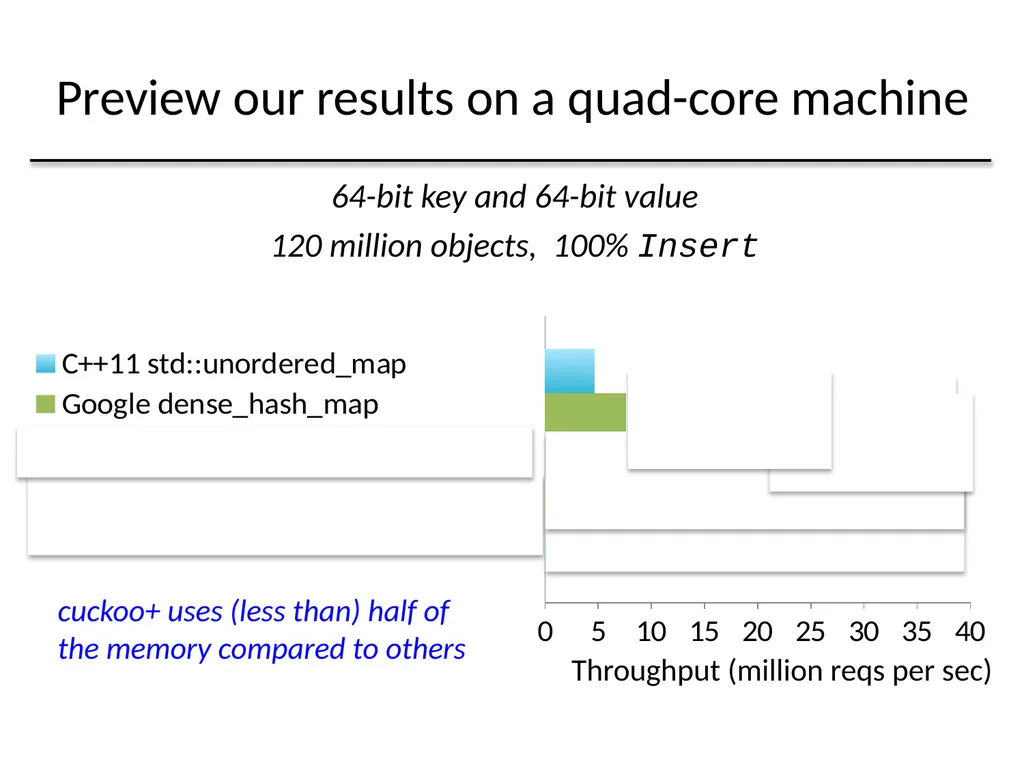
Preview our results on a quad-core machine Throughput (million reqs per sec) 64-bit key and 64-bit value
120 million objects, 100% Insert ★ ★ cuckoo+ uses (less than) half of the memory compared to others<br>
06
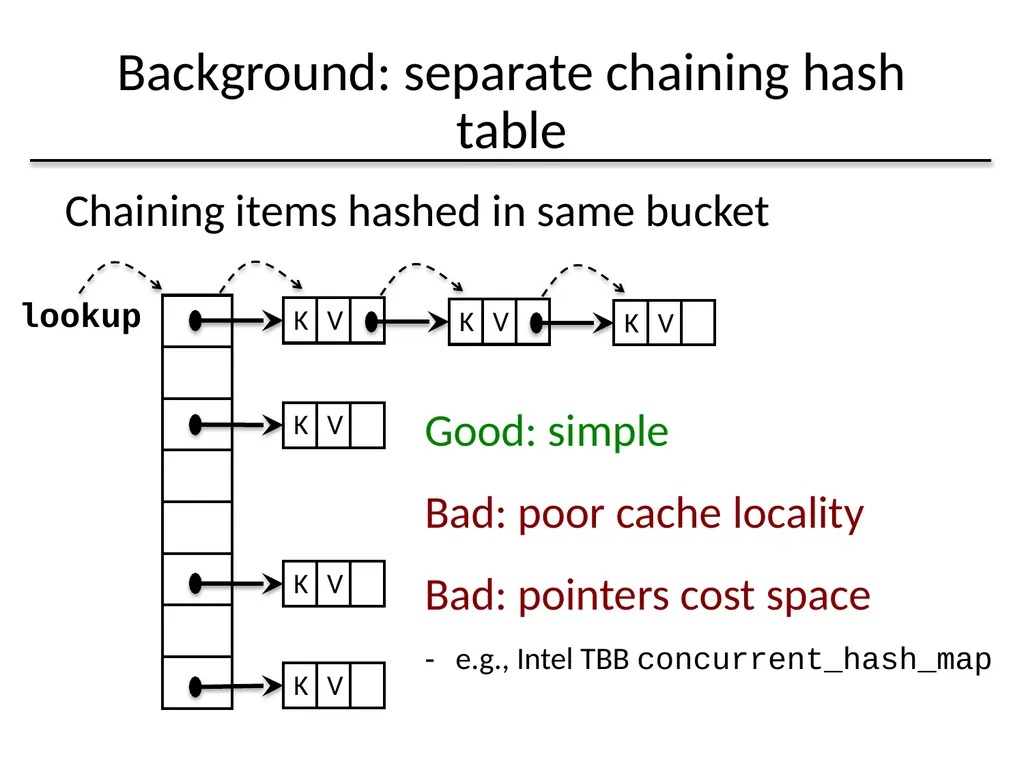
Background: separate chaining hash table Chaining items hashed in same bucket lookup Good: simple
Bad: poor cache locality
Bad: pointers cost space
e.g., Intel TBB concurrent_hash_map<br>
07
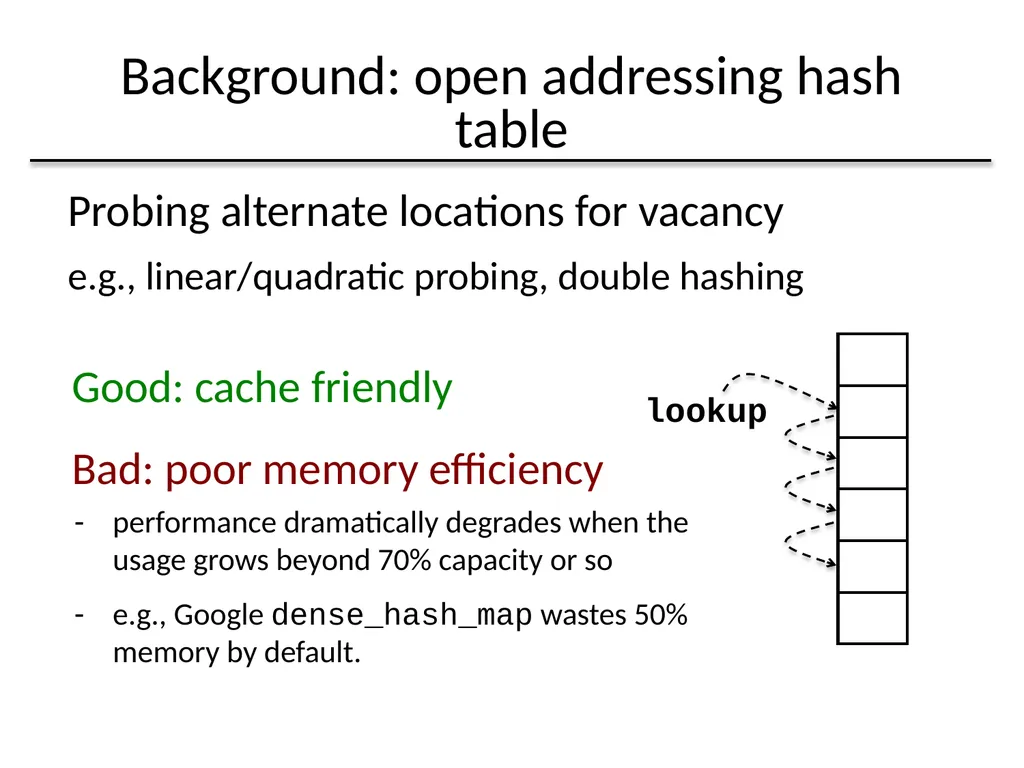
Background: open addressing hash table Probing alternate locations for vacancy
e.g., linear/quadratic probing, double hashing lookup Good: cache friendly
Bad: poor memory efficiency performance dramatically degrades when the usage grows beyond 70% capacity or so
e.g., Google dense_hash_map wastes 50% memory by default.<br>
08
Our starting point Multi-reader single-writer cuckoo hashing [Fan, NSDI’13]
Open addressing
Memory efficient
Optimized for read-intensive workloads<br>
09
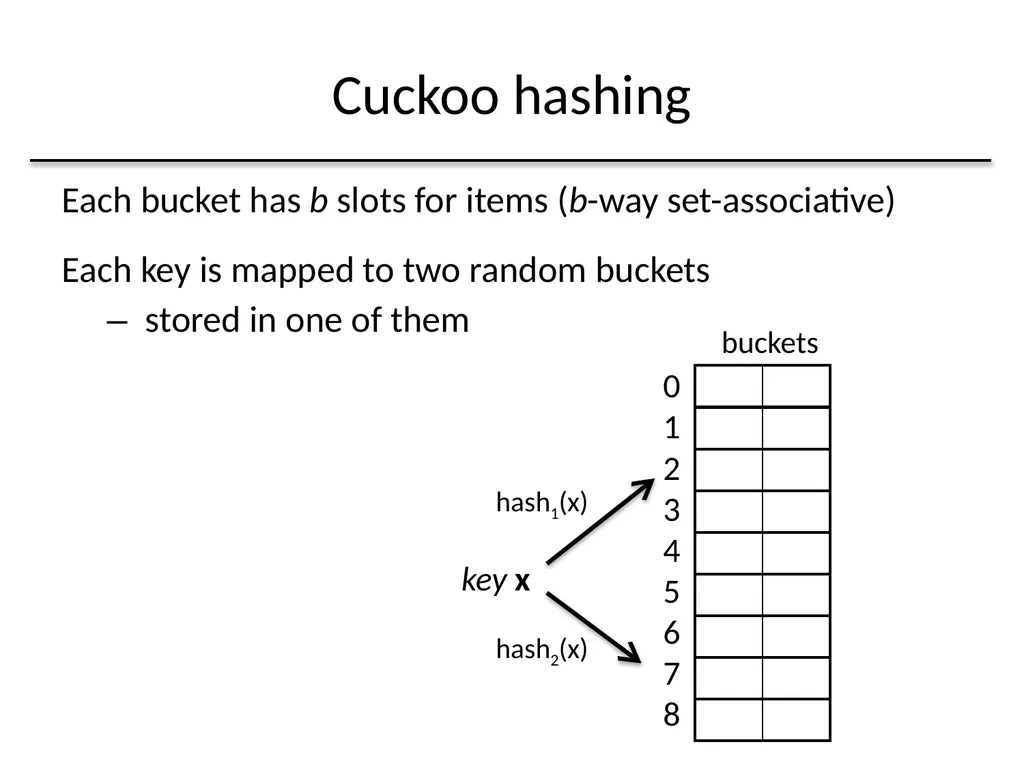
Each bucket has b slots for items (b-way set-associative)
Each key is mapped to two random buckets
stored in one of them buckets key x hash1(x) hash2(x) Cuckoo hashing<br>
10
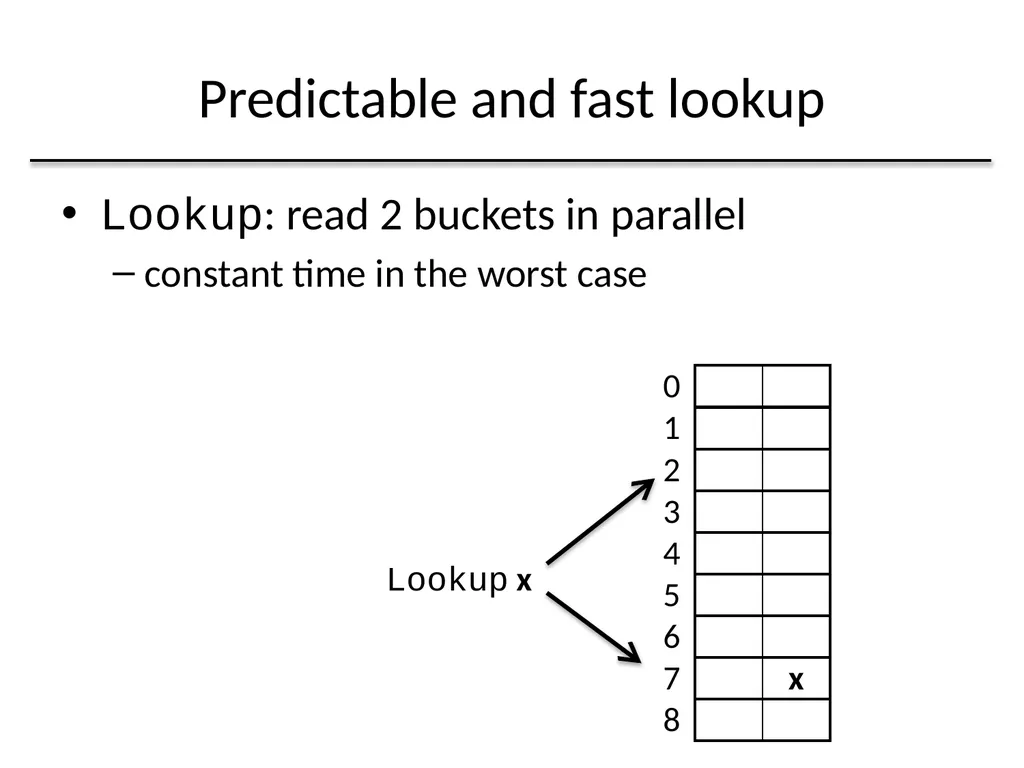
Predictable and fast lookup Lookup: read 2 buckets in parallel
constant time in the worst case Lookup x<br>
11
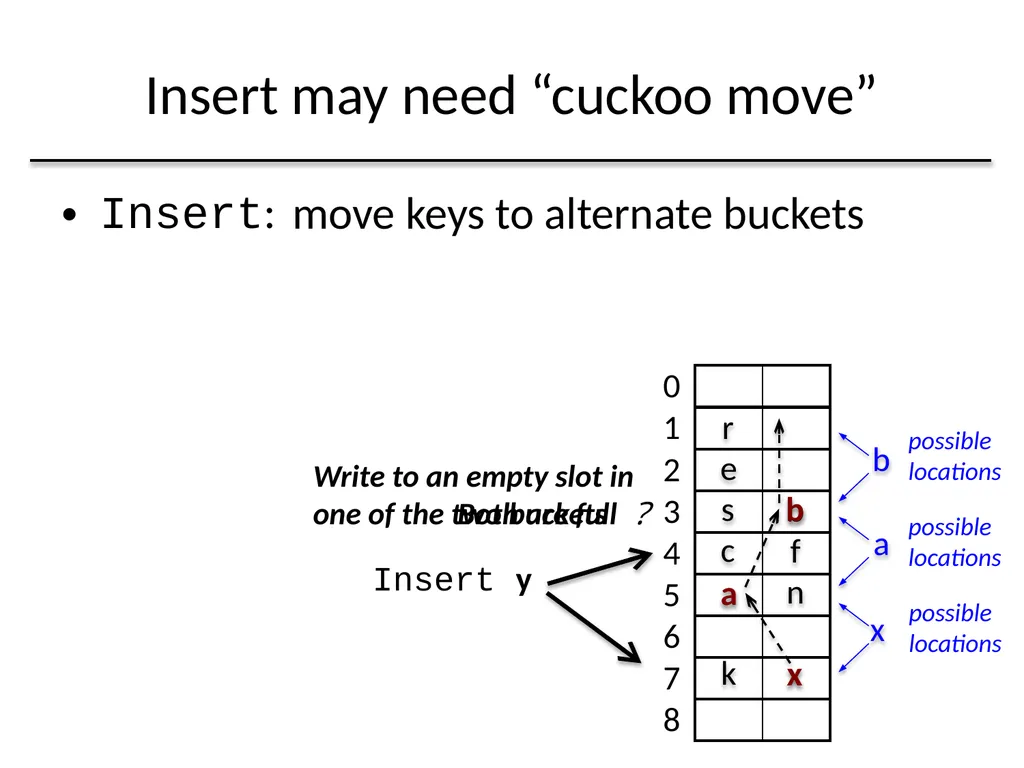
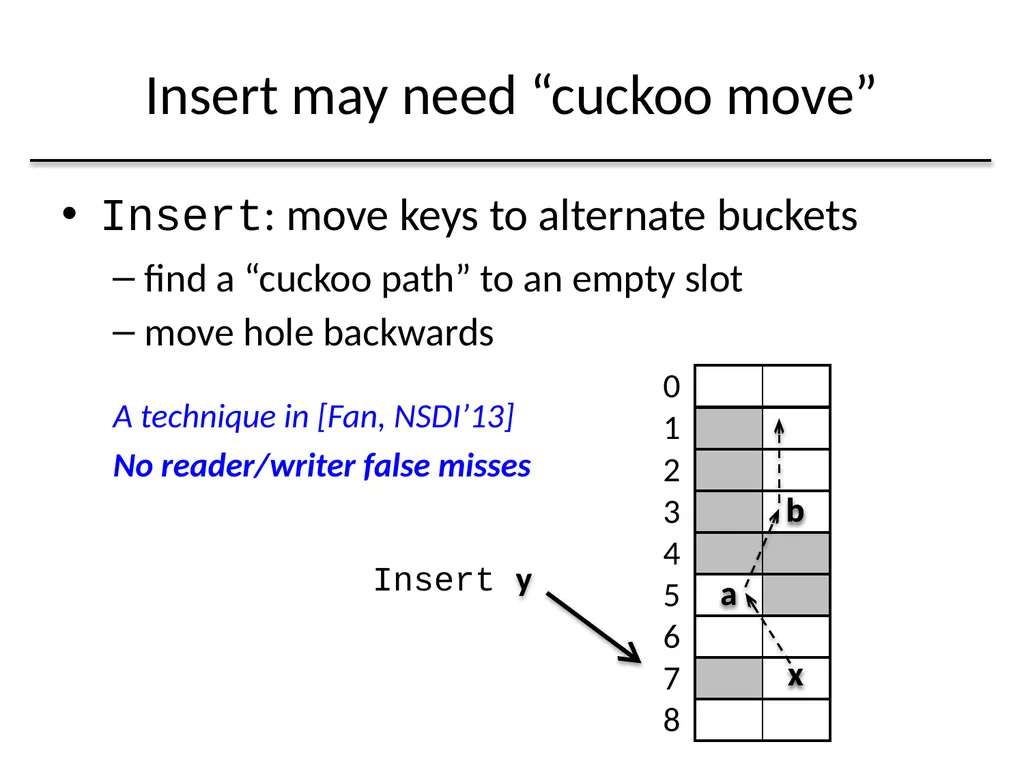
move keys to alternate buckets Insert may need “cuckoo move” Both are full? Insert y a x b k r c s e n f x a b Insert: Write to an empty slot in one of the two buckets possible locations x a b possible locations possible locations<br>
12
Insert: move keys to alternate buckets
find a “cuckoo path” to an empty slot
move hole backwards Insert y x a b y Insert may need “cuckoo move” A technique in [Fan, NSDI’13]
No reader/writer false misses b a x<br>
13
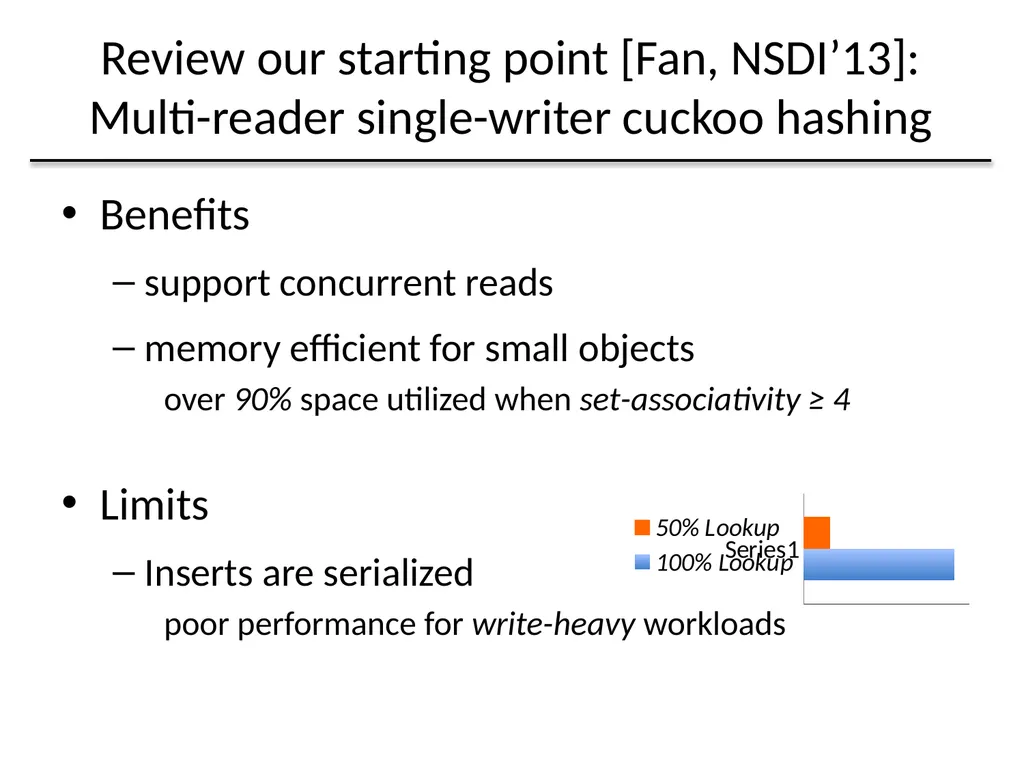
Review our starting point [Fan, NSDI’13]:�Multi-reader single-writer cuckoo hashing Benefits
support concurrent reads
memory efficient for small objects
over 90% space utilized when set-associativity ≥ 4
Limits
Inserts are serialized
poor performance for write-heavy workloads<br>
14
Improve write concurrency Algorithmic optimizations
Minimize critical sections
Exploit data locality
Explore two concurrency control mechanisms
Hardware transactional memory
Fine-grained locking<br>
15
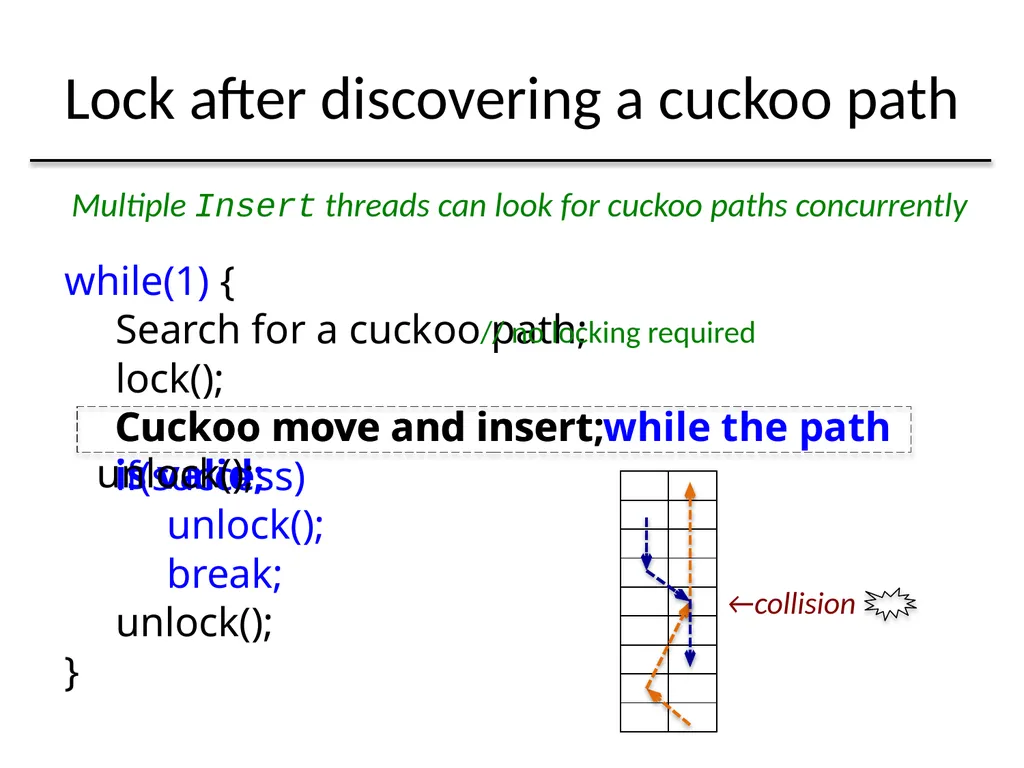
Algorithmic optimizations Lock after discovering a cuckoo path
minimize critical sections
Breadth-first search for an empty slot
fewer items displaced
enable prefetching
Increase set-associativity (see paper)
fewer random memory reads<br>
16
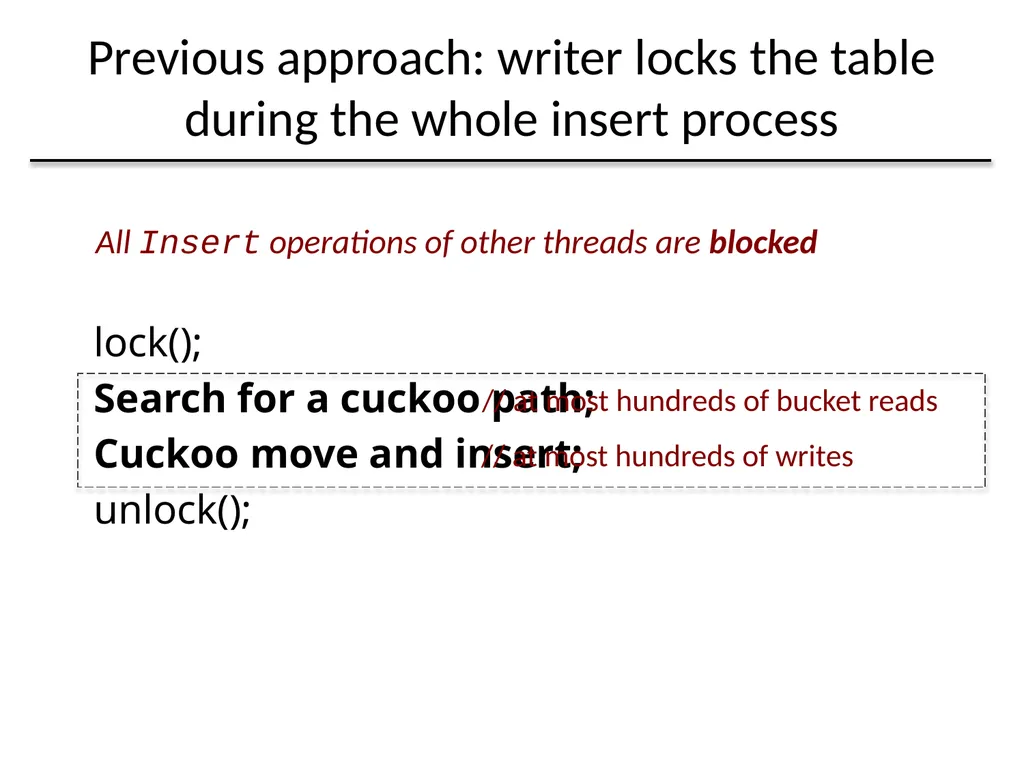
Previous approach: writer locks the table during the whole insert process lock();
Search for a cuckoo path;
Cuckoo move and insert;
unlock(); // at most hundreds of bucket reads // at most hundreds of writes All Insert operations of other threads are blocked<br>
17
Lock after discovering a cuckoo path while(1) {
Search for a cuckoo path;
lock();
Cuckoo move and insert;
if(success)
unlock();
break;
unlock();
} // no locking required Multiple Insert threads can look for cuckoo paths concurrently ←collision Cuckoo move and insert while the path is valid; unlock();<br>
18
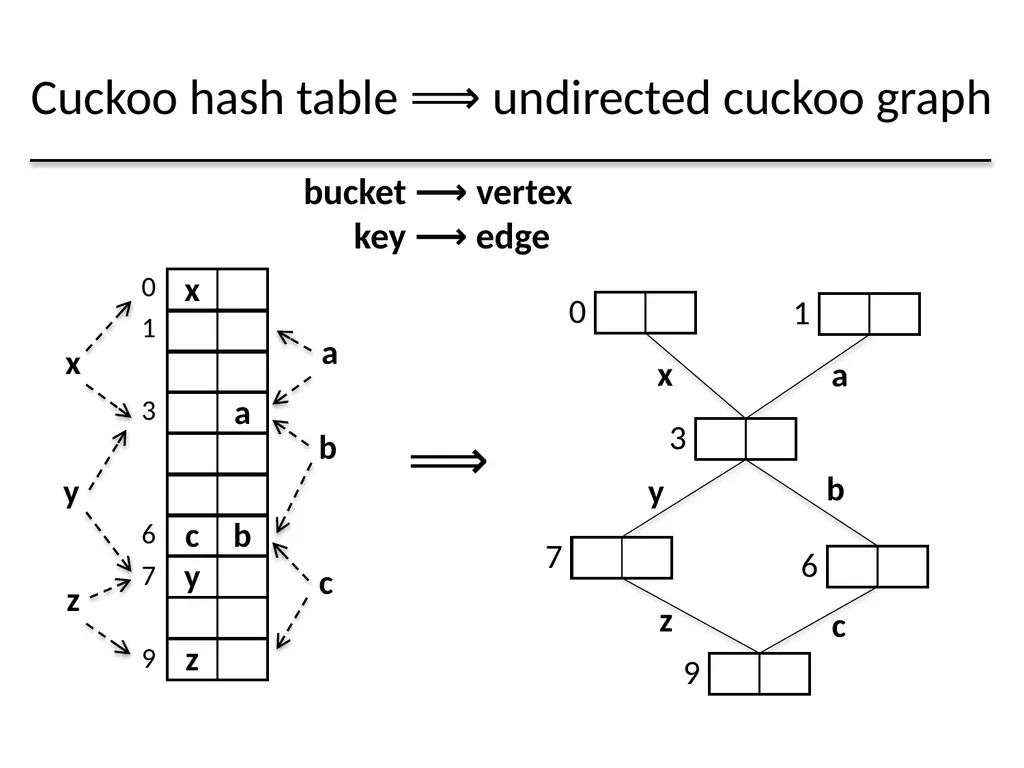
Cuckoo hash table ⟹ undirected cuckoo graph ⟹ x z y 0 a b c 3 1 7 6 9 a x y b z c bucket ⟶ vertex
key ⟶ edge<br>
19
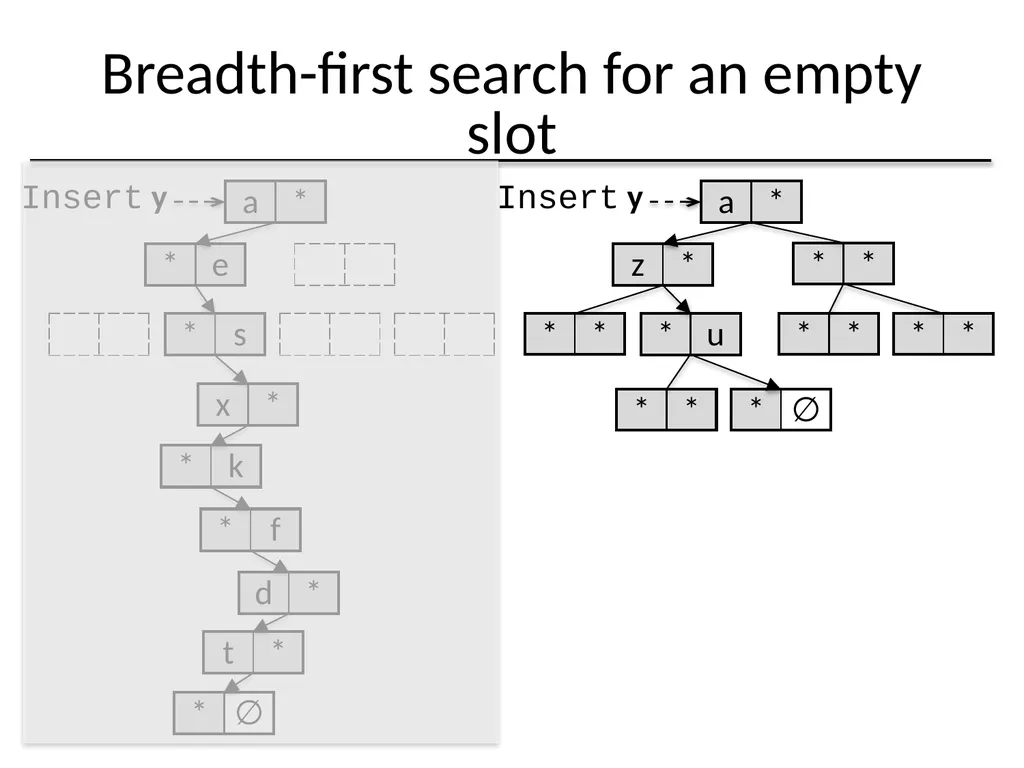
Previous approach to search for an empty slot: �random walk on the cuckoo graph One Insert may move at most hundreds of items when table occupancy > 90% cuckoo path:
a➝e➝s➝x➝k➝f➝d➝t➝∅
9 writes Insert y<br>
20
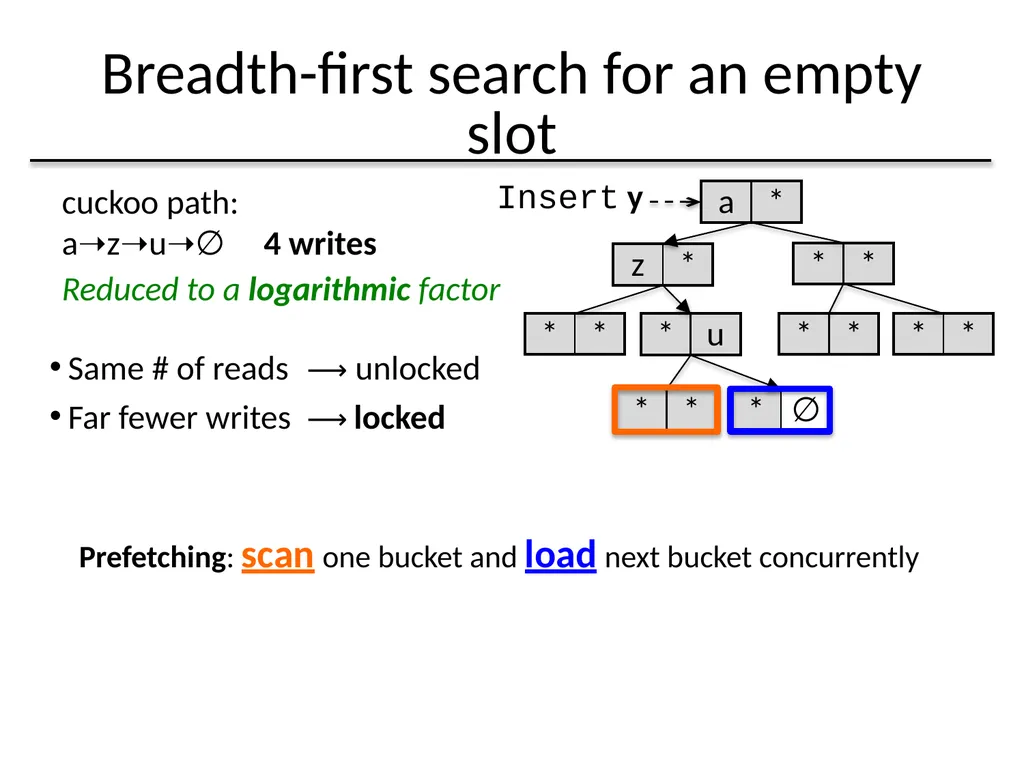
Insert y Breadth-first search for an empty slot Insert y<br>
21
Insert y Breadth-first search for an empty slot cuckoo path:
a➝z➝u➝∅ 4 writes Reduced to a logarithmic factor Same # of reads
Far fewer writes ⟶ unlocked
⟶ locked Prefetching: scan one bucket and load next bucket concurrently<br>
22
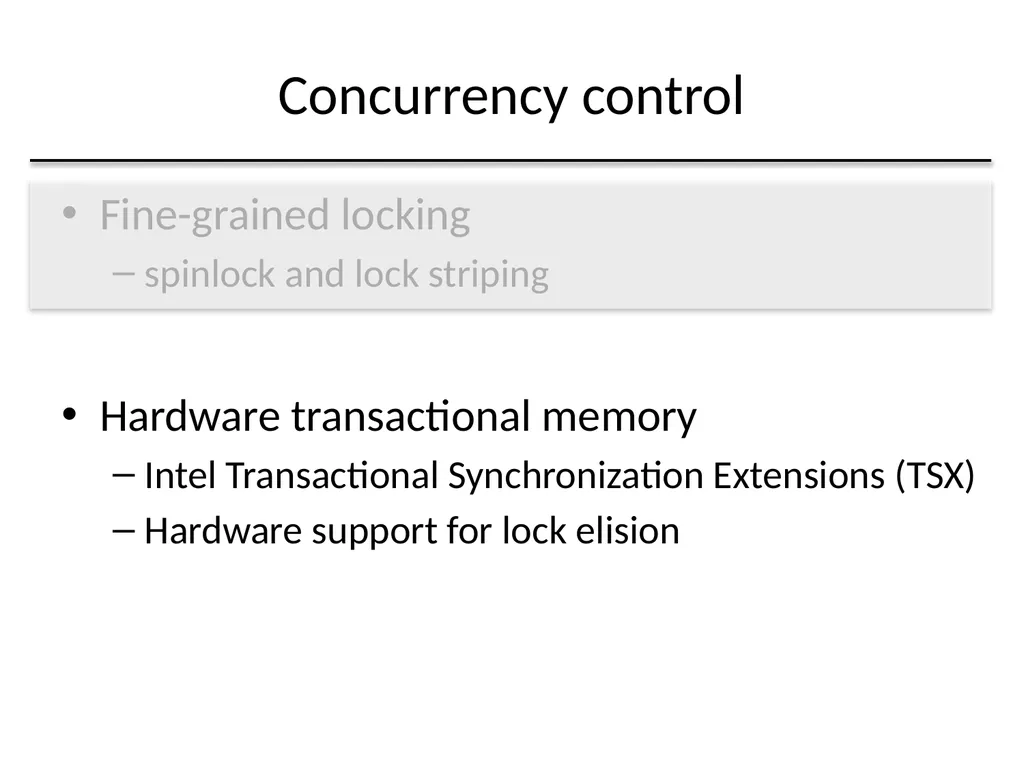
Concurrency control Fine-grained locking
spinlock and lock striping
Hardware transactional memory
Intel Transactional Synchronization Extensions (TSX)
Hardware support for lock elision<br>
23
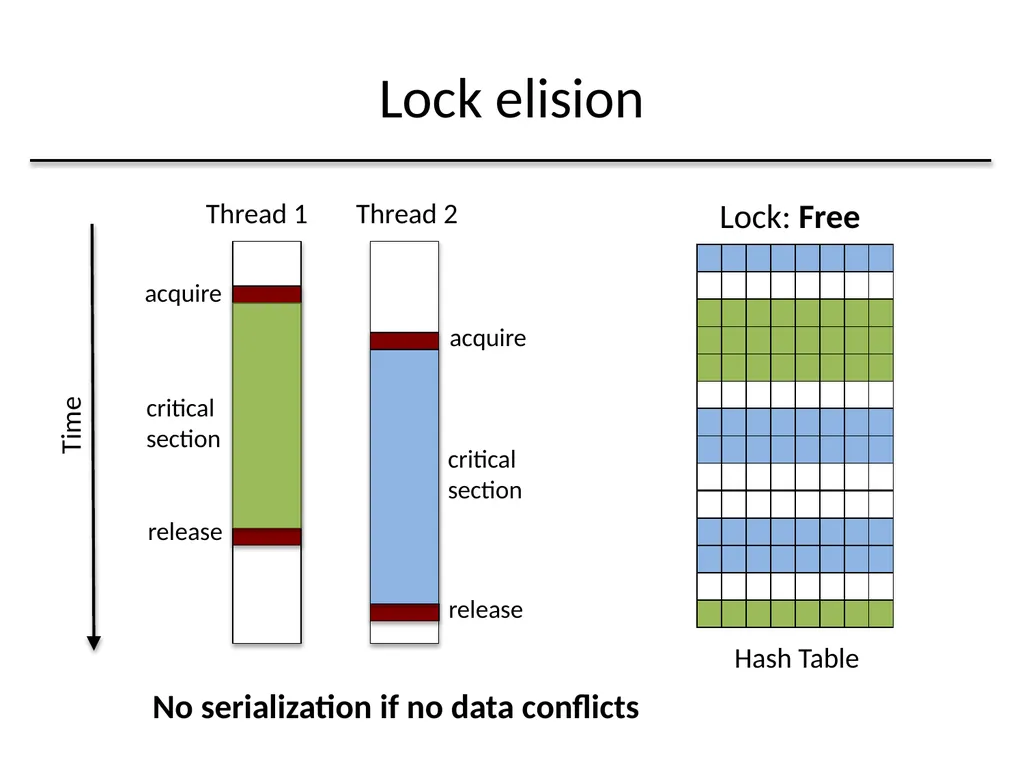
Lock elision acquire acquire release release critical section critical section Thread 1 Thread 2 Time Hash Table Lock: Free No serialization if no data conflicts<br>
24
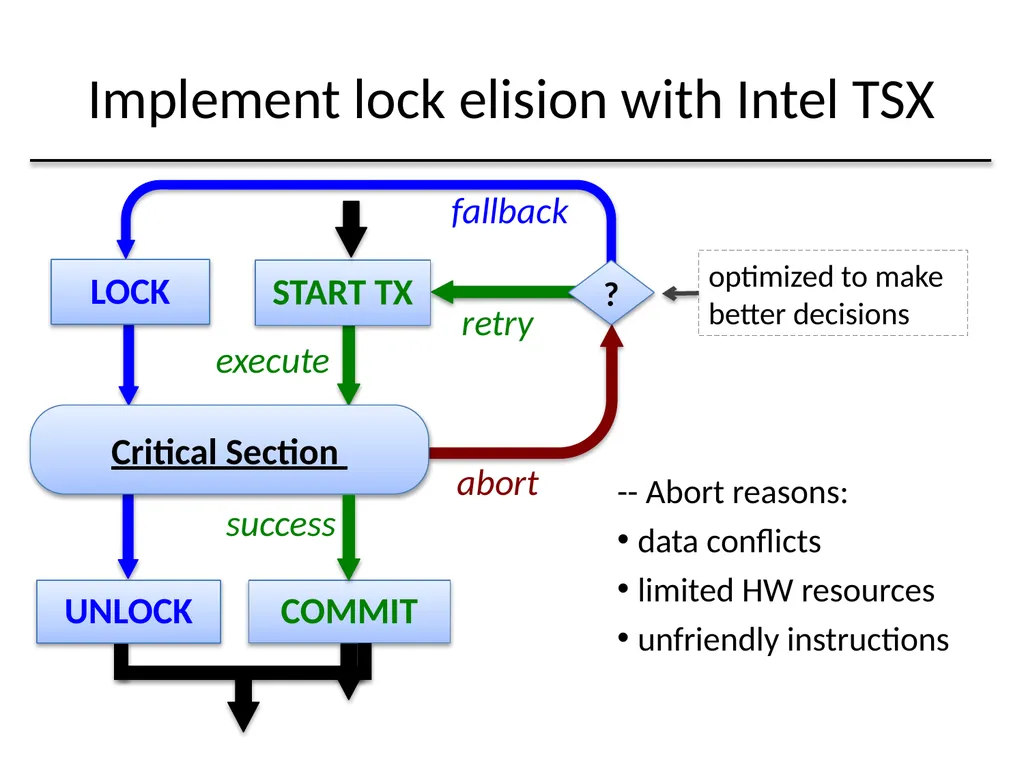
Implement lock elision with Intel TSX -- Abort reasons:
data conflicts
limited HW resources
unfriendly instructions execute success abort LOCK START TX Critical Section COMMIT UNLOCK fallback retry ? optimized to make better decisions<br>
25
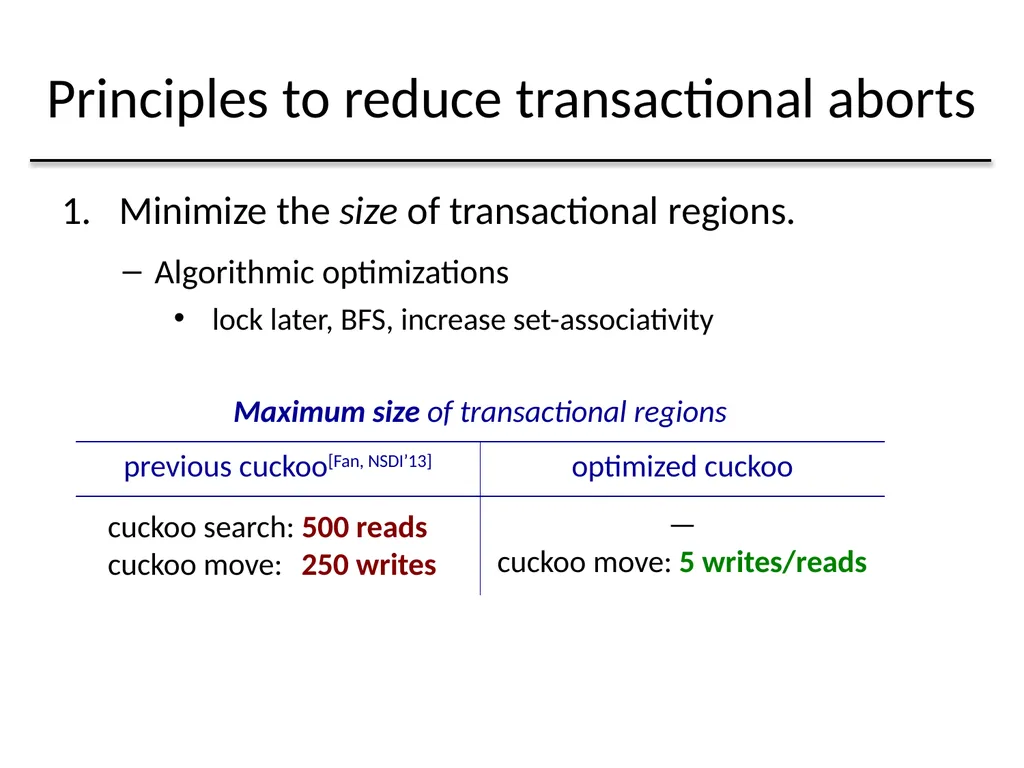
Principles to reduce transactional aborts Minimize the size of transactional regions.
Algorithmic optimizations
lock later, BFS, increase set-associativity cuckoo search: 500 reads
cuckoo move: 250 writes —
cuckoo move: 5 writes/reads<br>
26
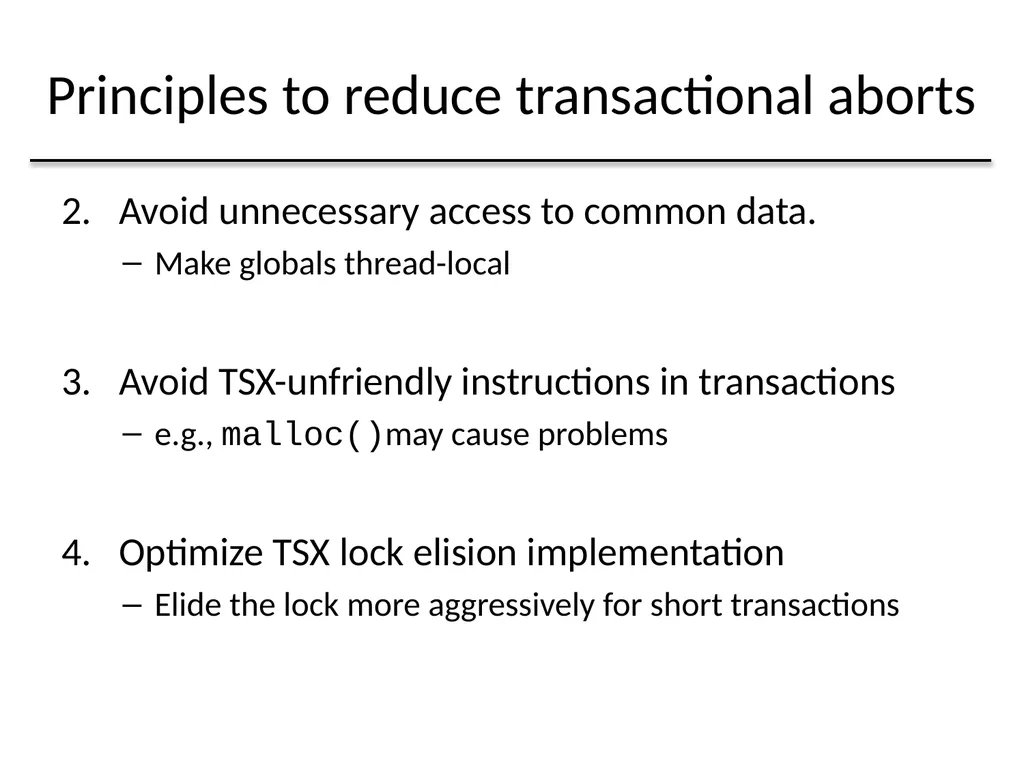
Principles to reduce transactional aborts Avoid unnecessary access to common data.
Make globals thread-local
Avoid TSX-unfriendly instructions in transactions
e.g., malloc()may cause problems
Optimize TSX lock elision implementation
Elide the lock more aggressively for short transactions<br>
27
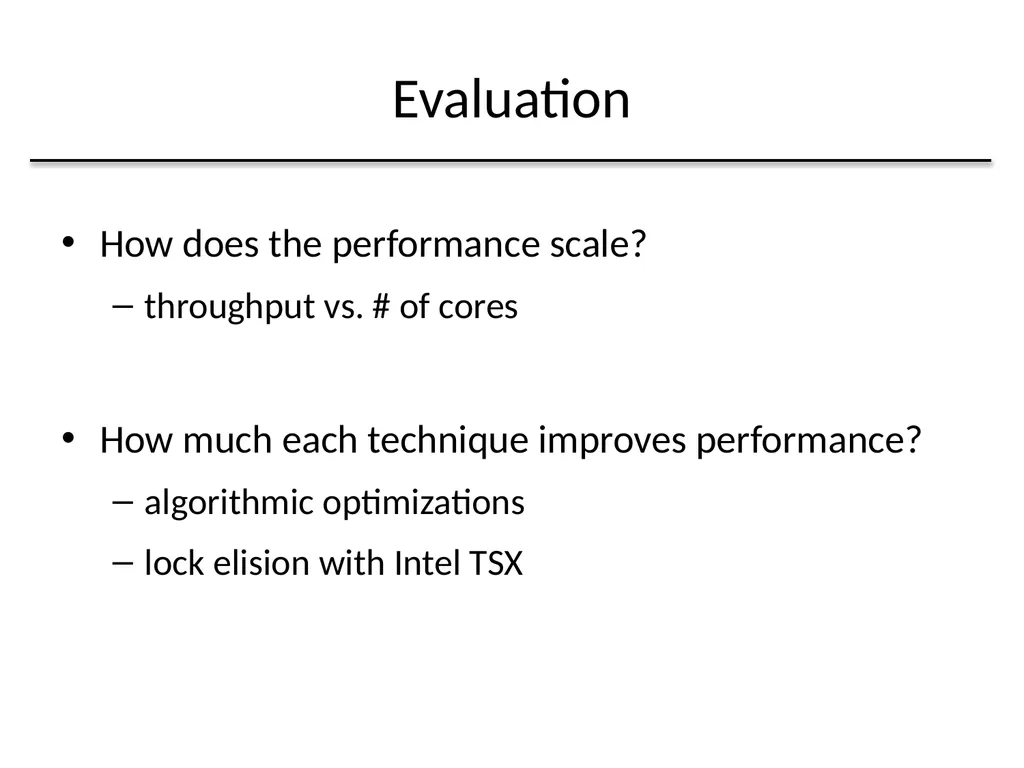
Evaluation How does the performance scale?
throughput vs. # of cores
How much each technique improves performance?
algorithmic optimizations
lock elision with Intel TSX<br>
28
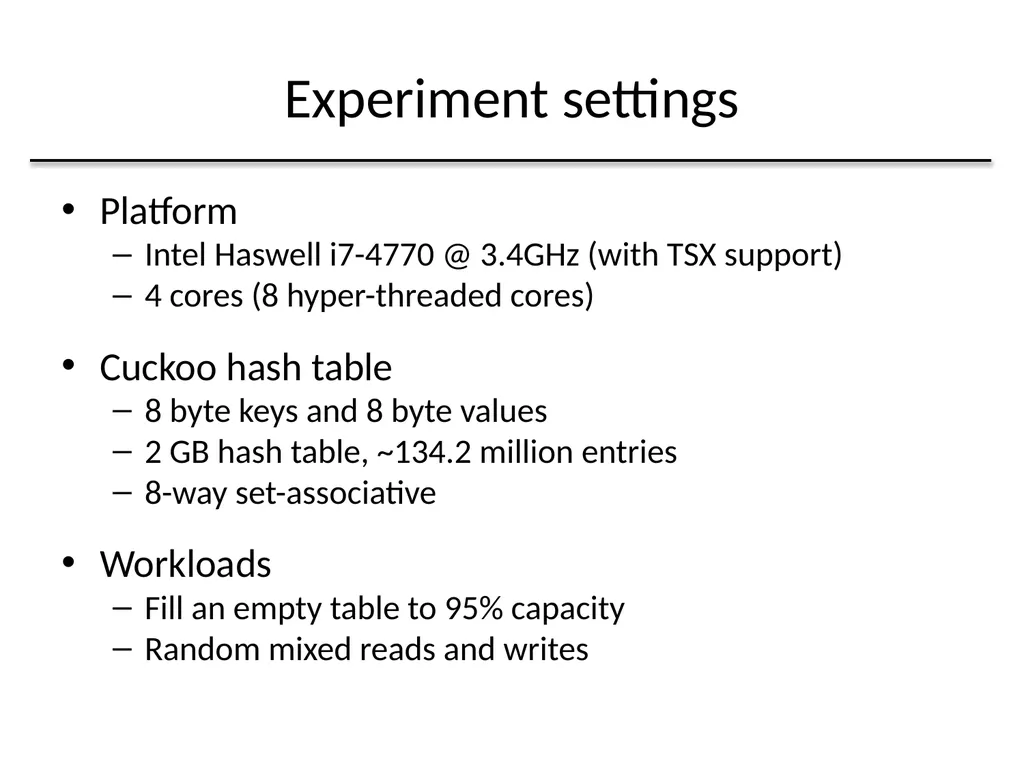
Experiment settings Platform
Intel Haswell i7-4770 @ 3.4GHz (with TSX support)
4 cores (8 hyper-threaded cores)
Cuckoo hash table
8 byte keys and 8 byte values
2 GB hash table, ~134.2 million entries
8-way set-associative
Workloads
Fill an empty table to 95% capacity
Random mixed reads and writes<br>
29
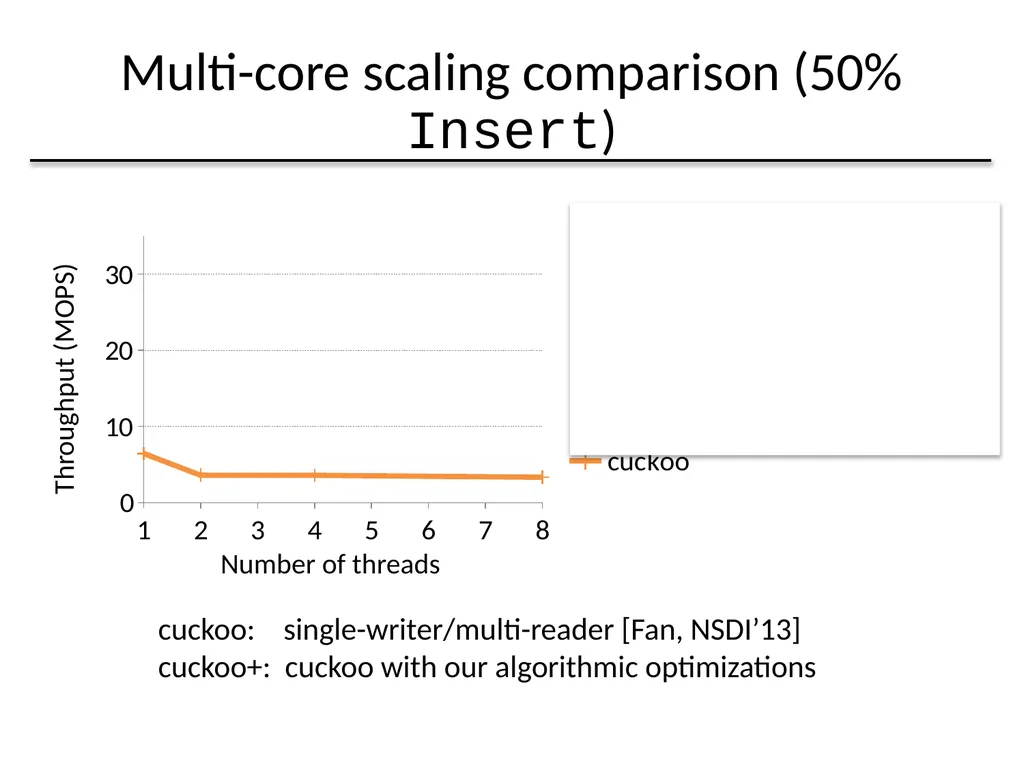
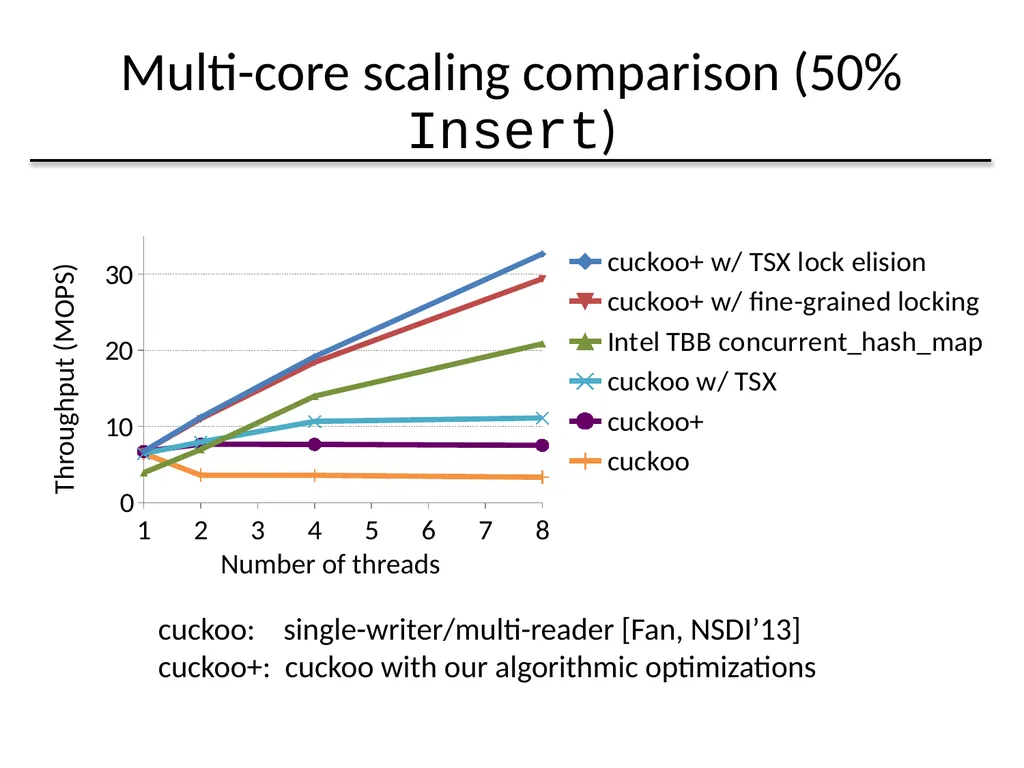
Multi-core scaling comparison (50% Insert) cuckoo: single-writer/multi-reader [Fan, NSDI’13]
cuckoo+: cuckoo with our algorithmic optimizations Number of threads Throughput (MOPS)<br>
30
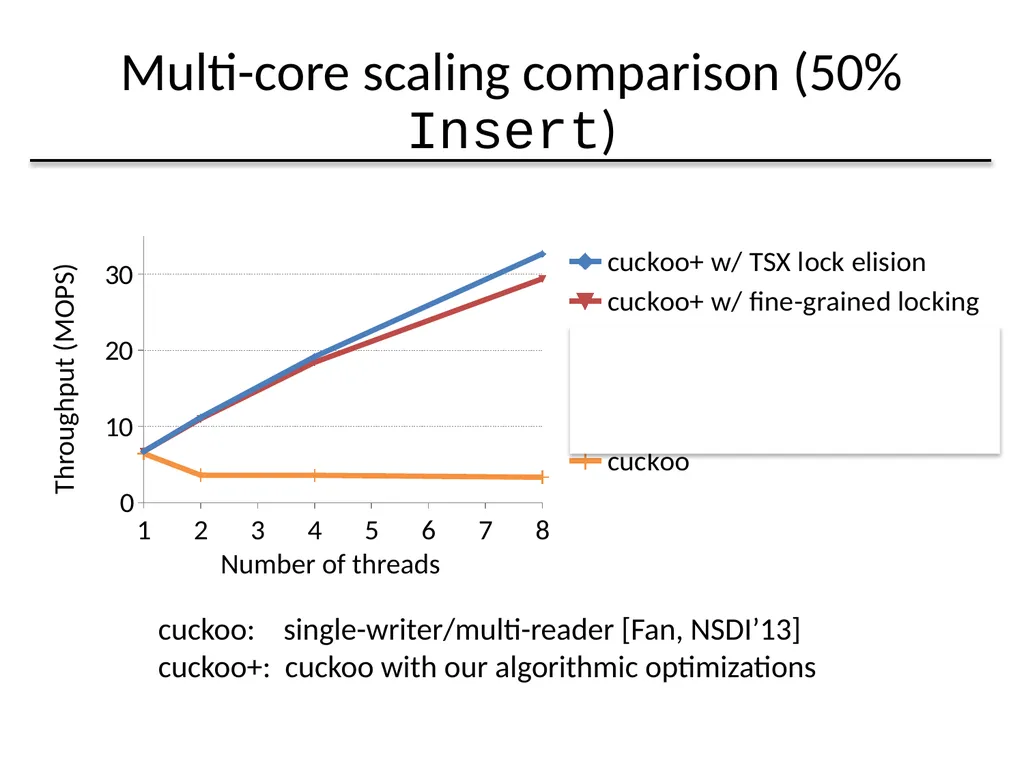
Multi-core scaling comparison (50% Insert) cuckoo: single-writer/multi-reader [Fan, NSDI’13]
cuckoo+: cuckoo with our algorithmic optimizations Number of threads Throughput (MOPS)<br>
31
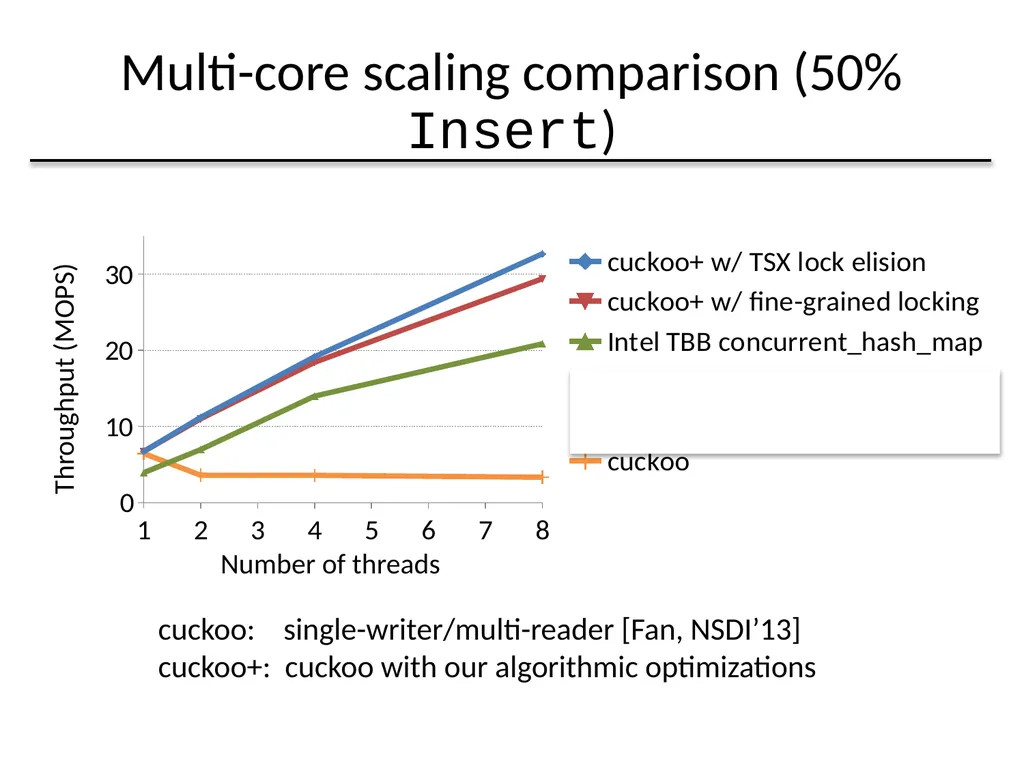
Multi-core scaling comparison (50% Insert) cuckoo: single-writer/multi-reader [Fan, NSDI’13]
cuckoo+: cuckoo with our algorithmic optimizations Number of threads Throughput (MOPS)<br>
32
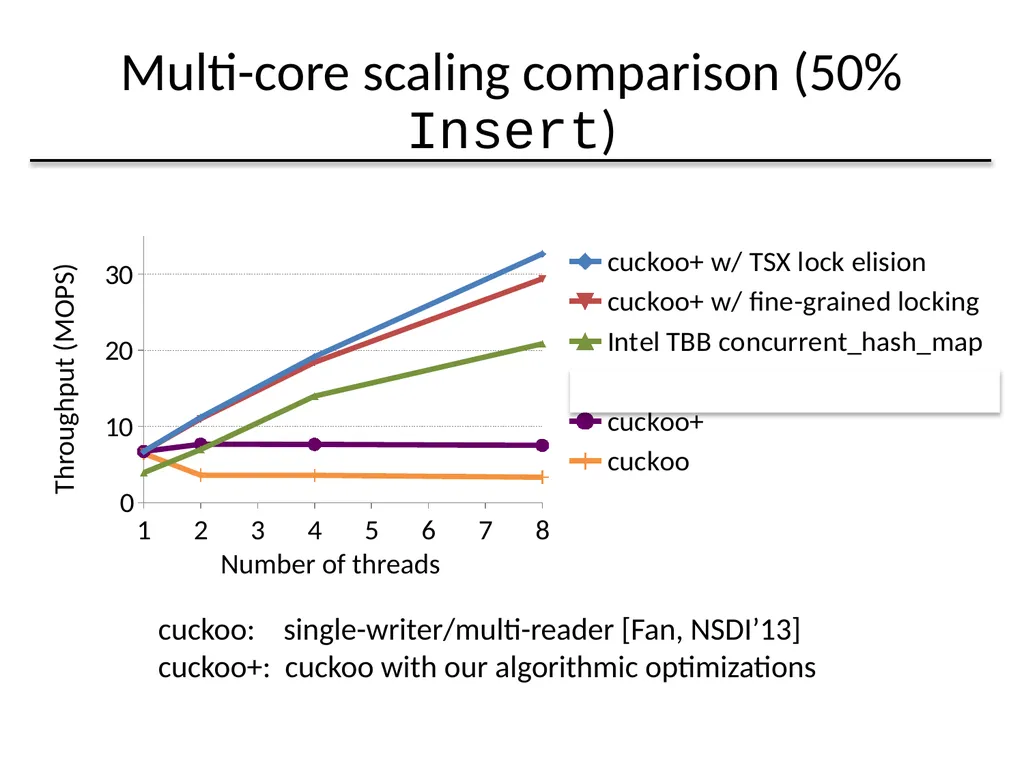
Multi-core scaling comparison (50% Insert) cuckoo: single-writer/multi-reader [Fan, NSDI’13]
cuckoo+: cuckoo with our algorithmic optimizations Number of threads Throughput (MOPS)<br>
33
Multi-core scaling comparison (50% Insert) cuckoo: single-writer/multi-reader [Fan, NSDI’13]
cuckoo+: cuckoo with our algorithmic optimizations Number of threads Throughput (MOPS)<br>
34
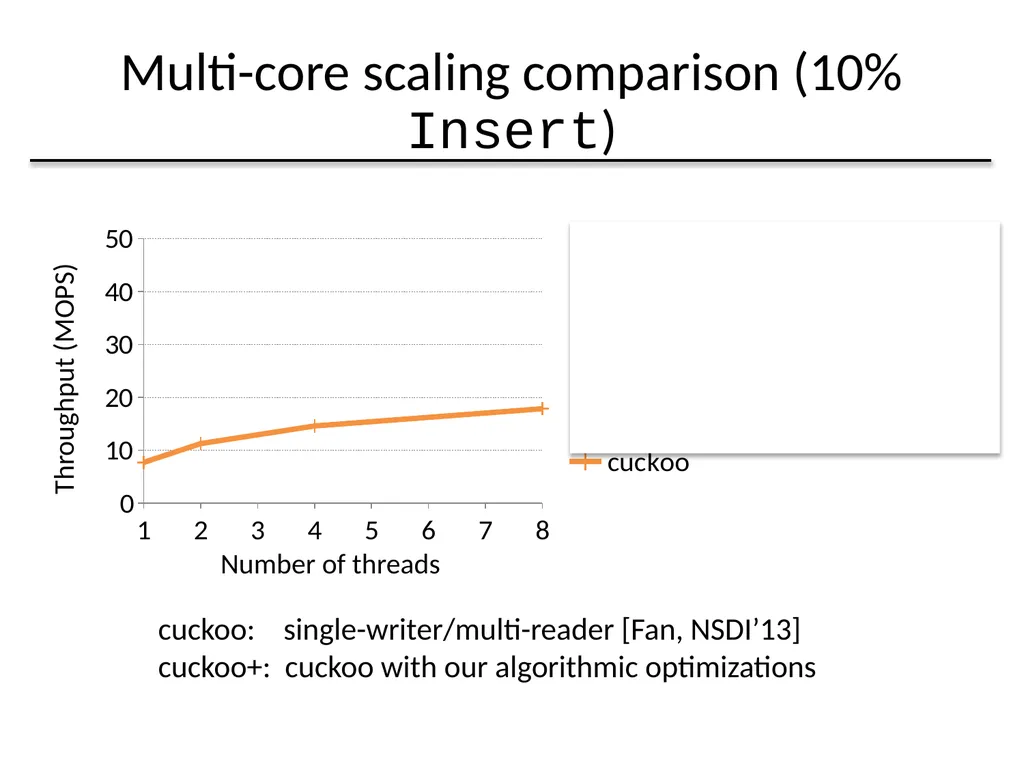
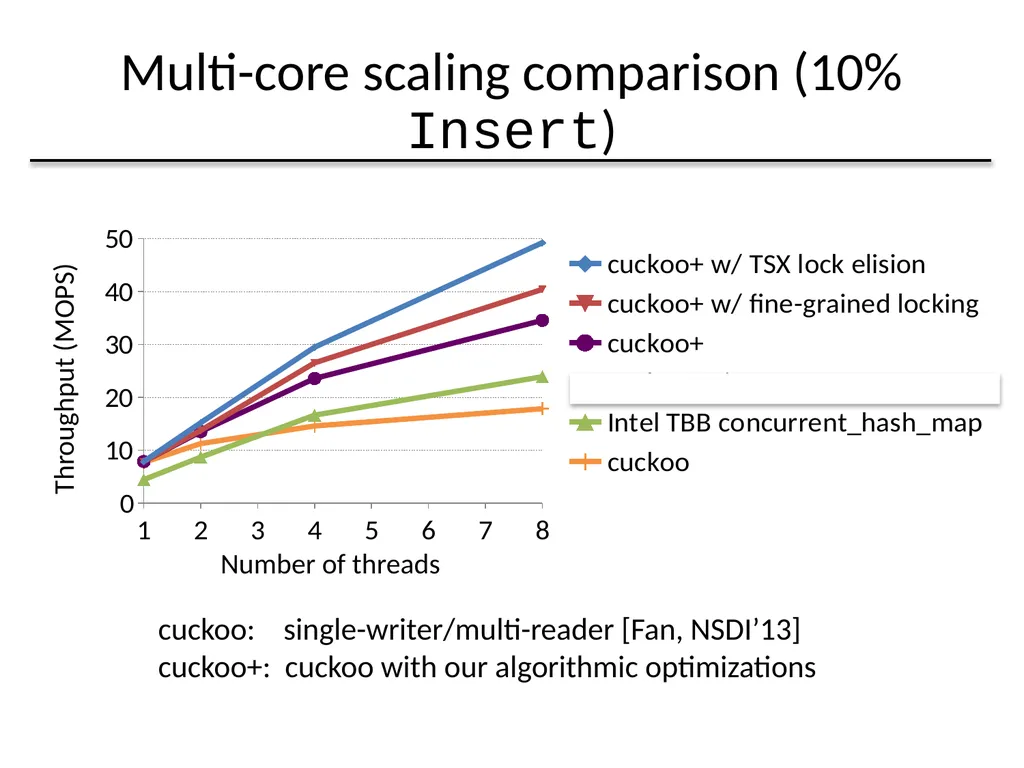
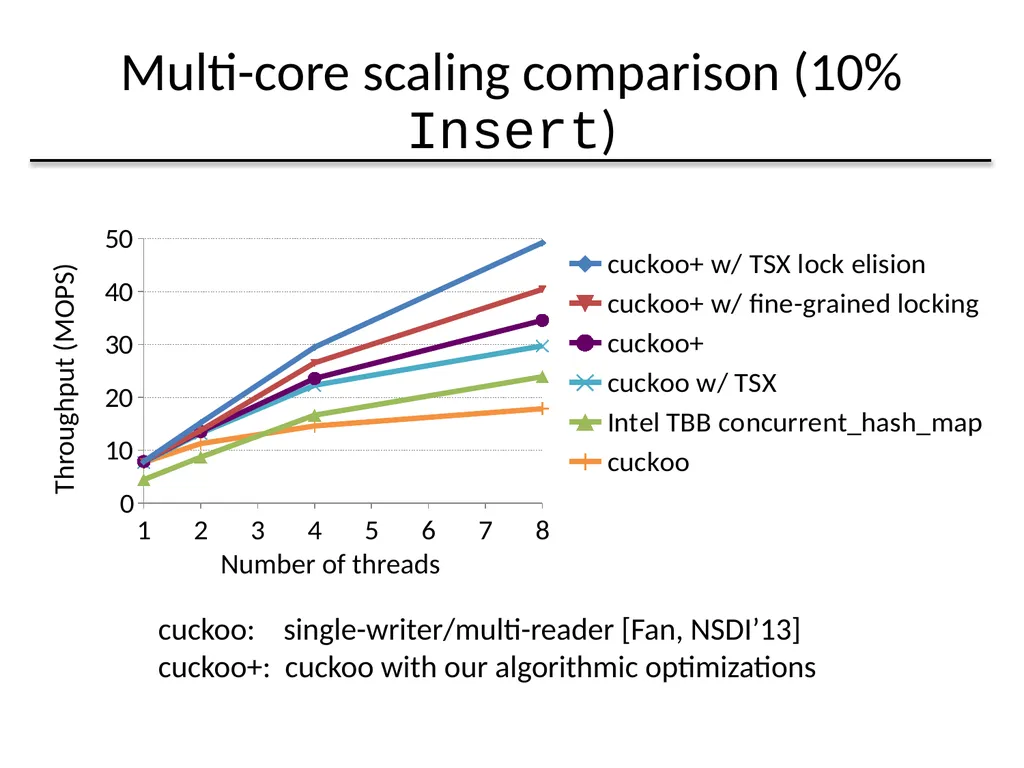
Multi-core scaling comparison (10% Insert) cuckoo: single-writer/multi-reader [Fan, NSDI’13]
cuckoo+: cuckoo with our algorithmic optimizations Number of threads Throughput (MOPS)<br>
35
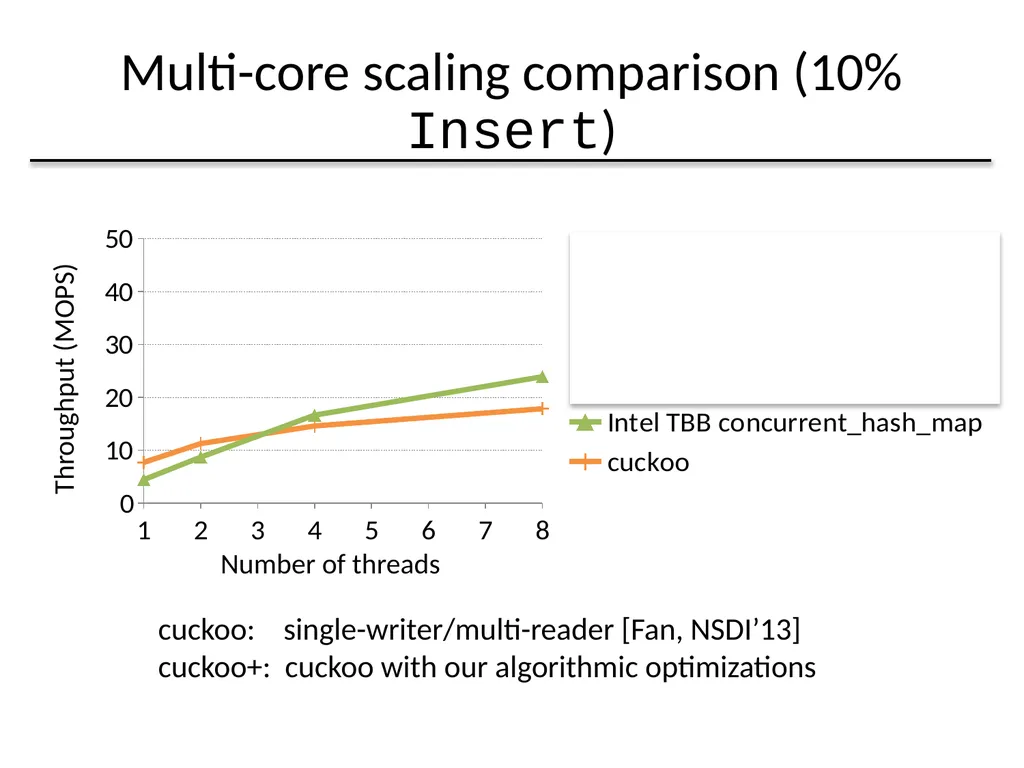
Multi-core scaling comparison (10% Insert) cuckoo: single-writer/multi-reader [Fan, NSDI’13]
cuckoo+: cuckoo with our algorithmic optimizations Number of threads Throughput (MOPS)<br>
36
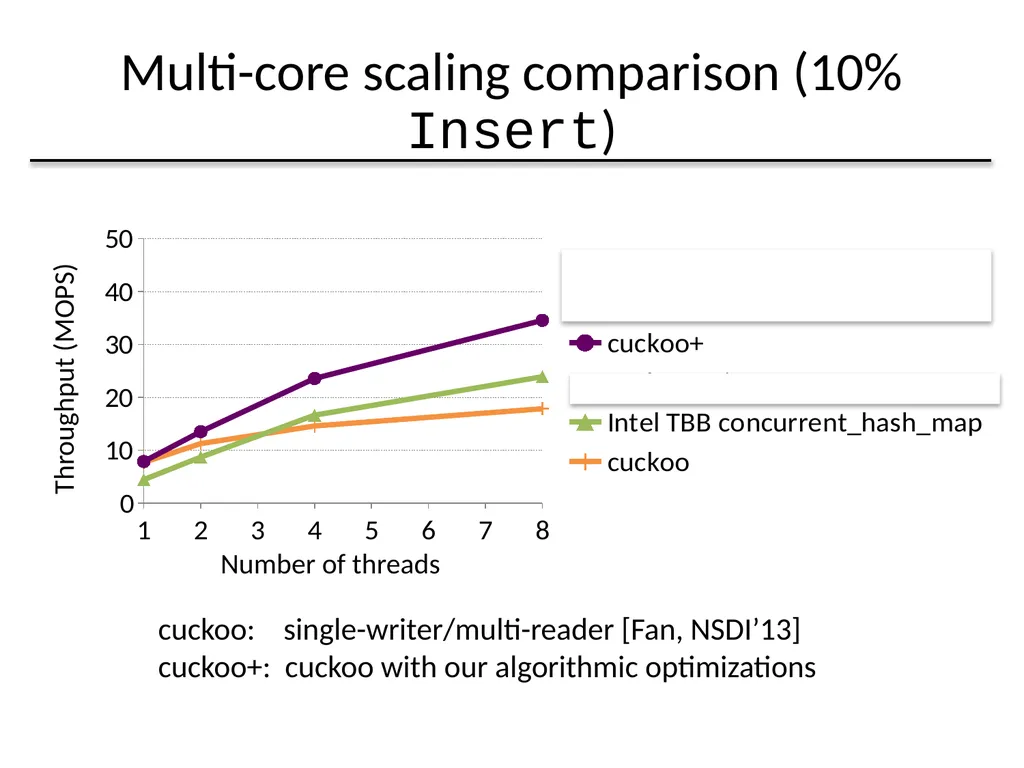
Multi-core scaling comparison (10% Insert) cuckoo: single-writer/multi-reader [Fan, NSDI’13]
cuckoo+: cuckoo with our algorithmic optimizations Number of threads Throughput (MOPS)<br>
37
Multi-core scaling comparison (10% Insert) cuckoo: single-writer/multi-reader [Fan, NSDI’13]
cuckoo+: cuckoo with our algorithmic optimizations Number of threads Throughput (MOPS)<br>
38
Multi-core scaling comparison (10% Insert) cuckoo: single-writer/multi-reader [Fan, NSDI’13]
cuckoo+: cuckoo with our algorithmic optimizations Number of threads Throughput (MOPS)<br>
39
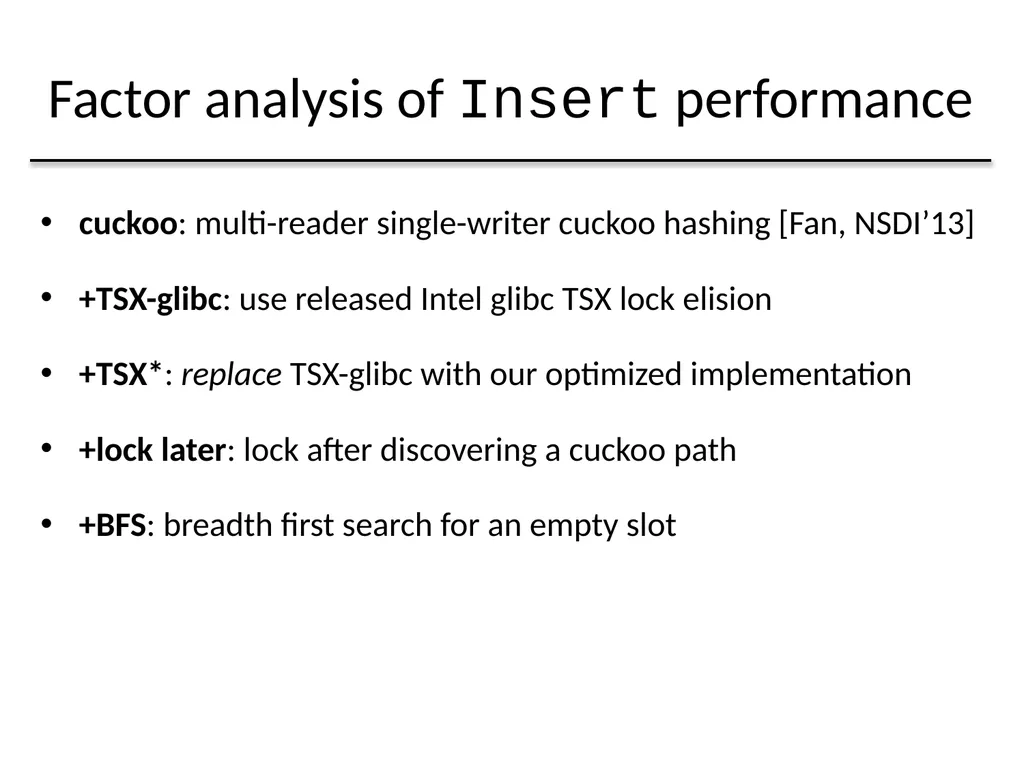
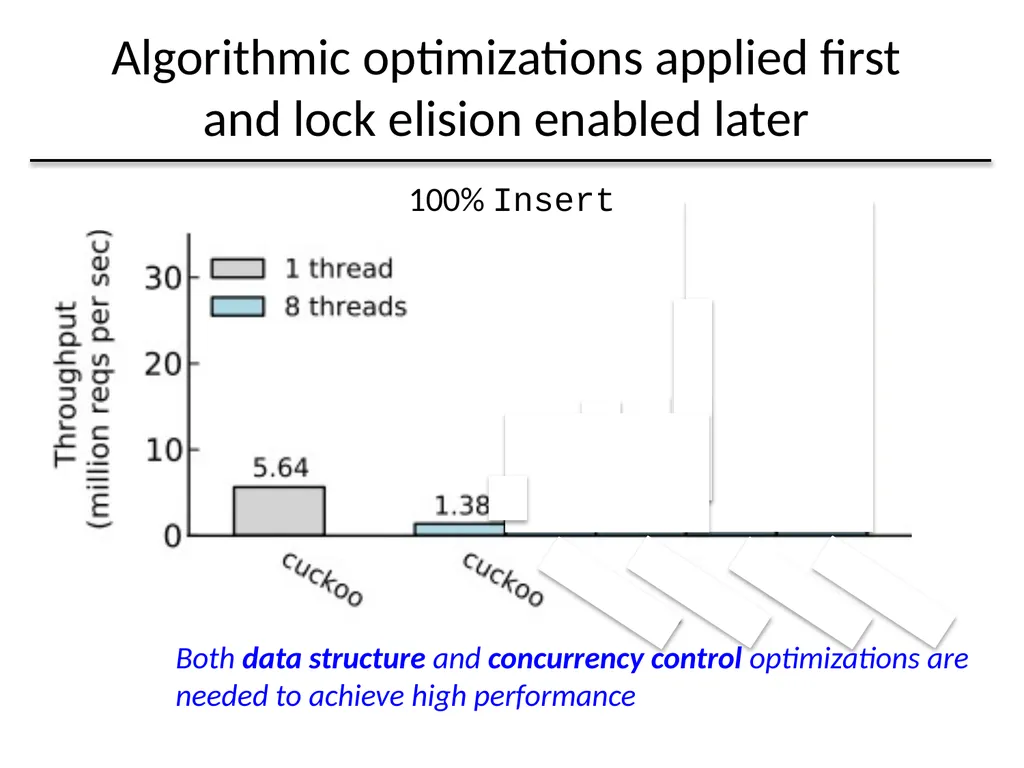
Factor analysis of Insert performance cuckoo: multi-reader single-writer cuckoo hashing [Fan, NSDI’13]
+TSX-glibc: use released Intel glibc TSX lock elision
+TSX*: replace TSX-glibc with our optimized implementation
+lock later: lock after discovering a cuckoo path
+BFS: breadth first search for an empty slot<br>
40
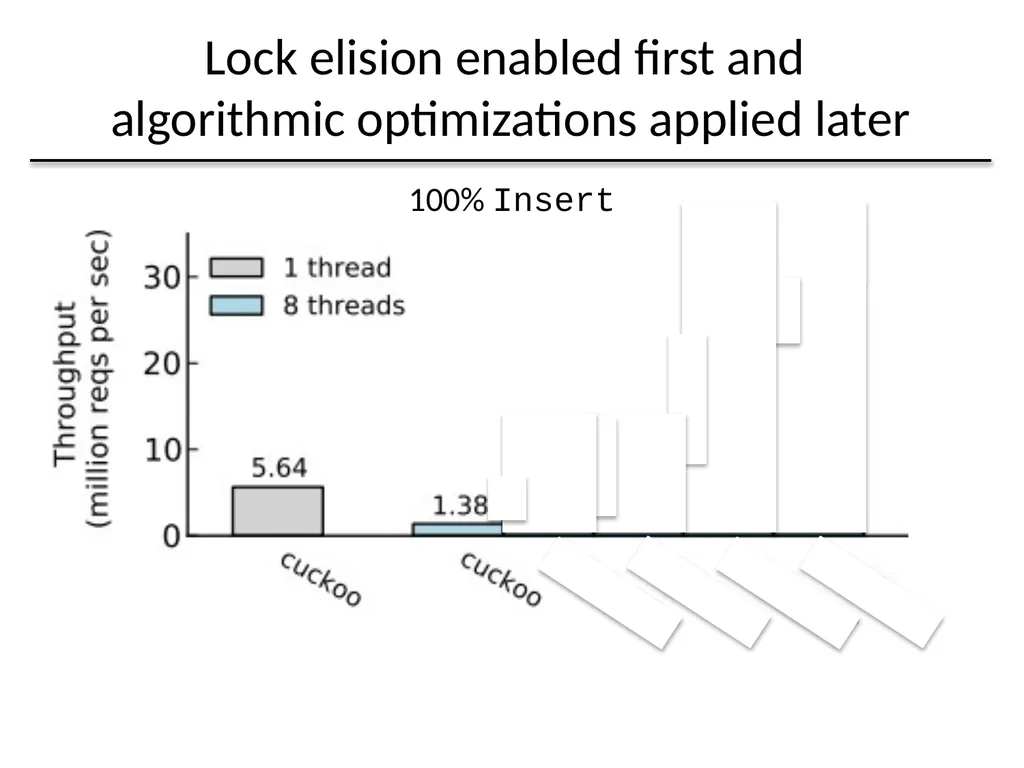
Lock elision enabled first and �algorithmic optimizations applied later 100% Insert<br>
41
Algorithmic optimizations applied first and lock elision enabled later 100% Insert Both data structure and concurrency control optimizations are needed to achieve high performance<br>
42
Conclusion Concurrent cuckoo hash table
high memory efficiency
fast concurrent writes and reads
Lessons with hardware transactional memory
algorithmic optimizations are necessary<br>
43
Q & A Source code available: github.com/efficient/libcuckoo
fine-grained locking implementation Thanks!<br>