
‘All hands on deck’ knowledge brokering reflection
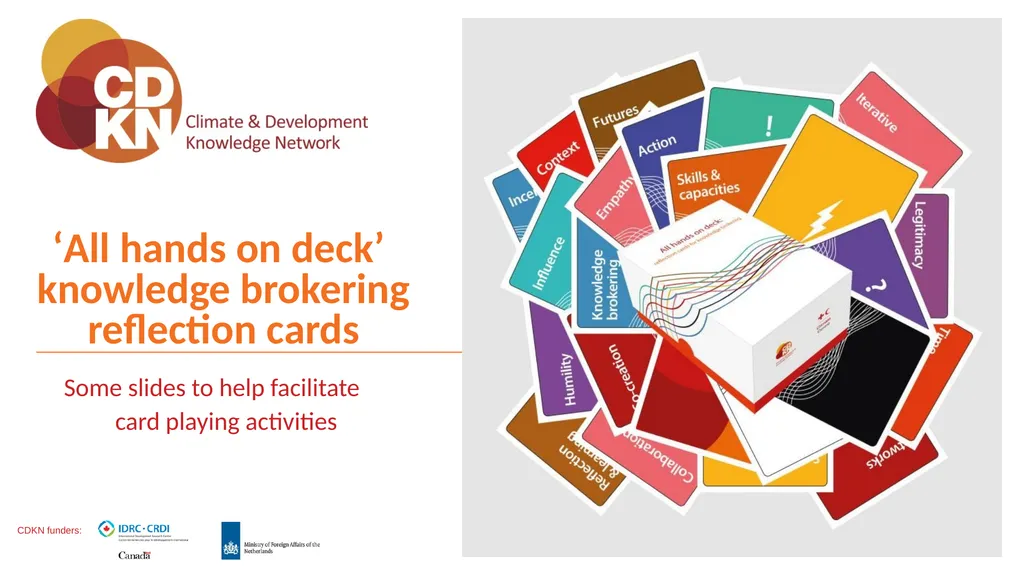









Description: All hands on deck knowledge brokering reflection cards Some slides to help facilitate card playing activities CDKN funders: Useful background information What are the All hands on deck cards? A set of 120 cards in English, French or
Related Topics
Download Presentation
"‘All hands on deck’ knowledge brokering reflection" is the property of its rightful owner. Permission is granted to download and print the materials on this website for personal, non-commercial use only, and to display it on your personal computer provided you do not modify the materials and that you retain all copyright notices contained in the materials. By downloading content from our website, you accept the terms of this agreement.
Presentation Transcript
slide1. ‘All hands on deck’
knowledge brokering reflection cards Some slides to help facilitate card playing activities CDKN funders:<br>
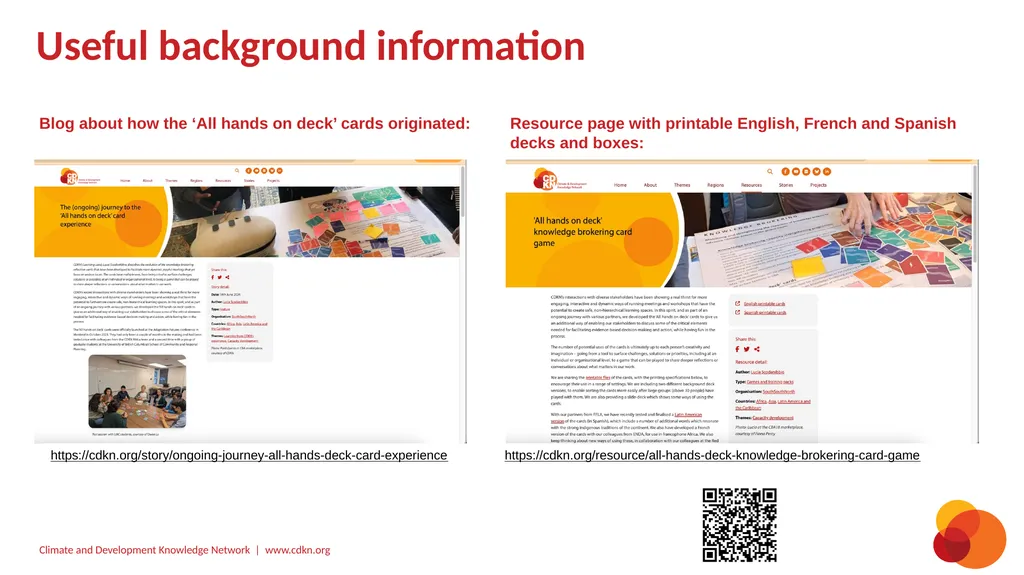
slide3. Useful background information<br>
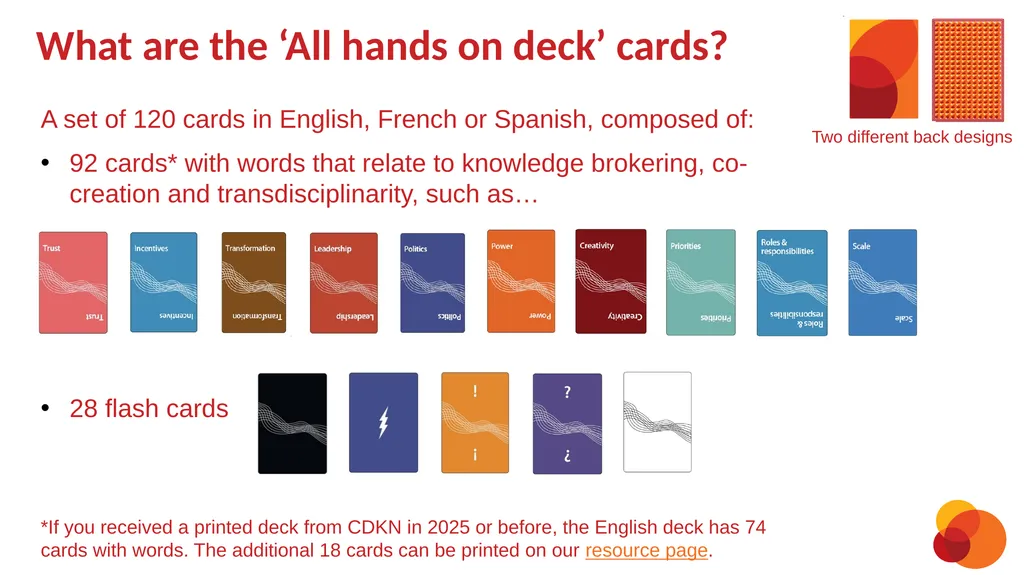
slide4. What are the ‘All hands on deck’ cards? A set of 120 cards in English, French or Spanish, composed of:
92 cards* with words that relate to knowledge brokering, co-creation and transdisciplinarity, such as…
28 flash cards
*If you received a printed deck from CDKN in 2025 or before, the English deck has 74 cards with words. The additional 18 cards can be printed on our resource page. Two different back designs<br>
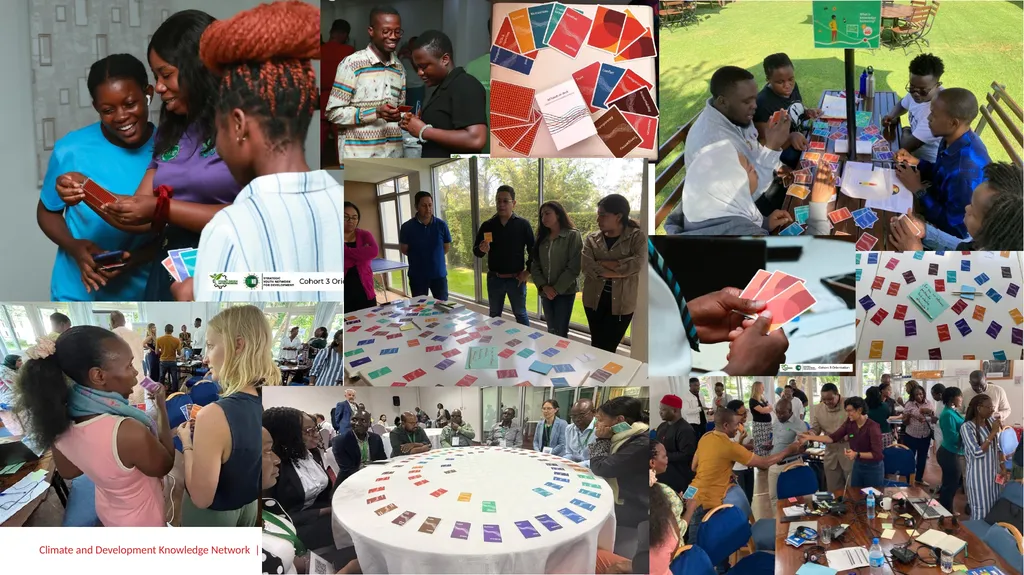
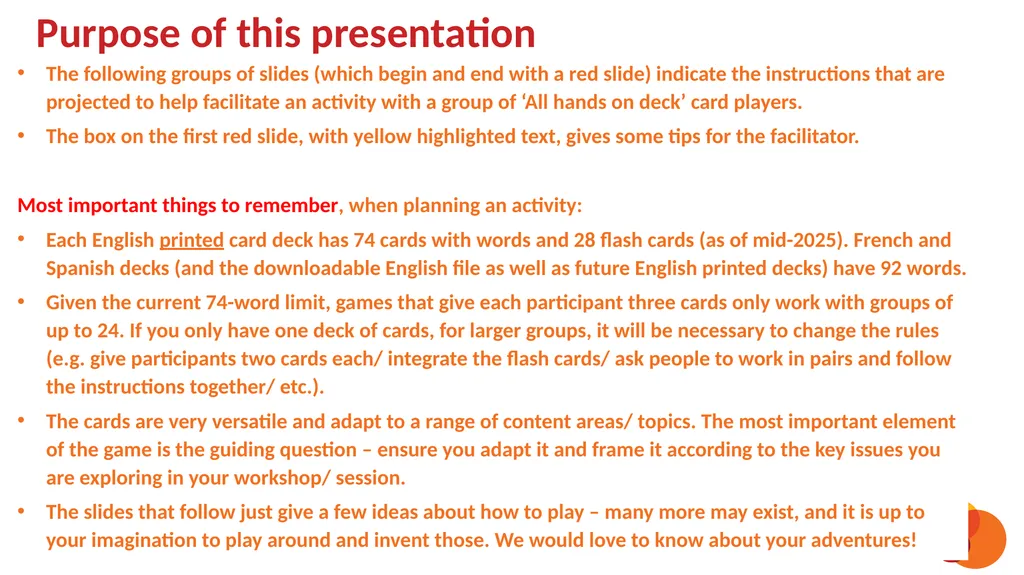
slide5. The following groups of slides (which begin and end with a red slide) indicate the instructions that are projected to help facilitate an activity with a group of ‘All hands on deck’ card players.
The box on the first red slide, with yellow highlighted text, gives some tips for the facilitator.
Most important things to remember, when planning an activity:
Each English printed card deck has 74 cards with words and 28 flash cards (as of mid-2025). French and Spanish decks (and the downloadable English file as well as future English printed decks) have 92 words.
Given the current 74-word limit, games that give each participant three cards only work with groups of up to 24. If you only have one deck of cards, for larger groups, it will be necessary to change the rules (e.g. give participants two cards each/ integrate the flash cards/ ask people to work in pairs and follow the instructions together/ etc.).
The cards are very versatile and adapt to a range of content areas/ topics. The most important element of the game is the guiding question – ensure you adapt it and frame it according to the key issues you are exploring in your workshop/ session.
The slides that follow just give a few ideas about how to play – many more may exist, and it is up to your imagination to play around and invent those. We would love to know about your adventures! Purpose of this presentation<br>
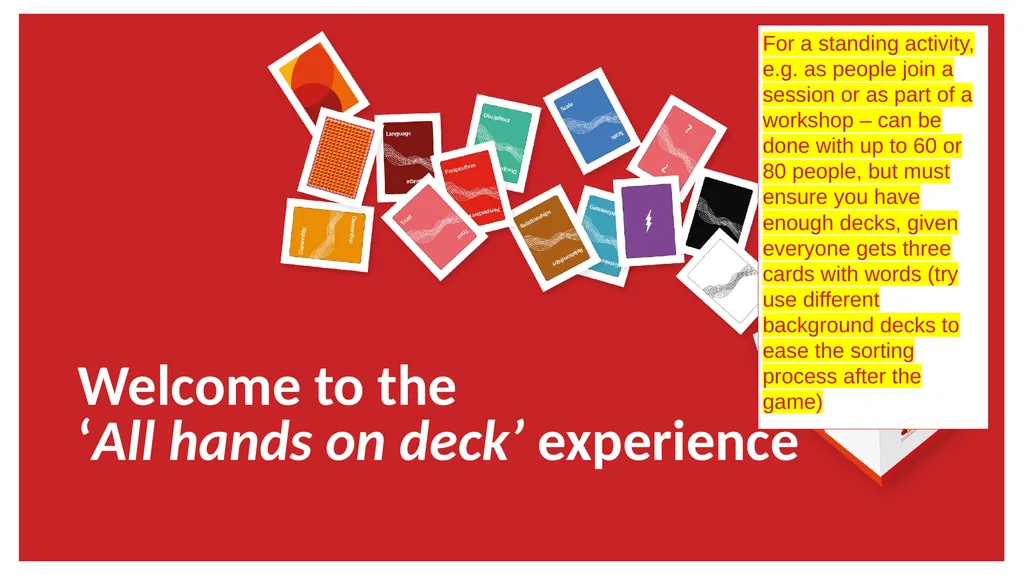
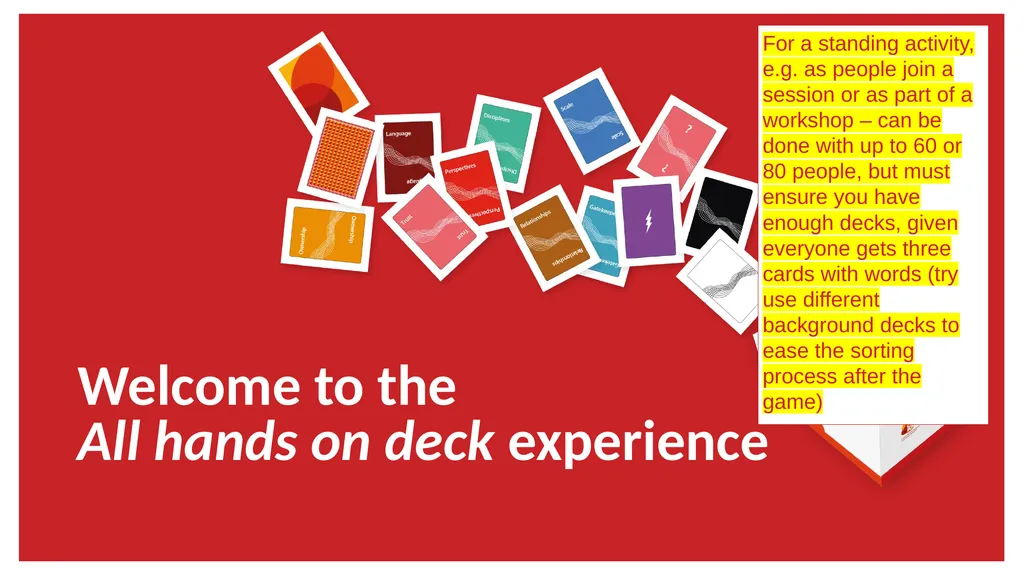
slide6. Welcome to the ‘All hands on deck’ experience For a standing activity, e.g. as people join a session or as part of a workshop – can be done with up to 60 or 80 people, but must ensure you have enough decks, given everyone gets three cards with words (try use different background decks to ease the sorting process after the game)<br>
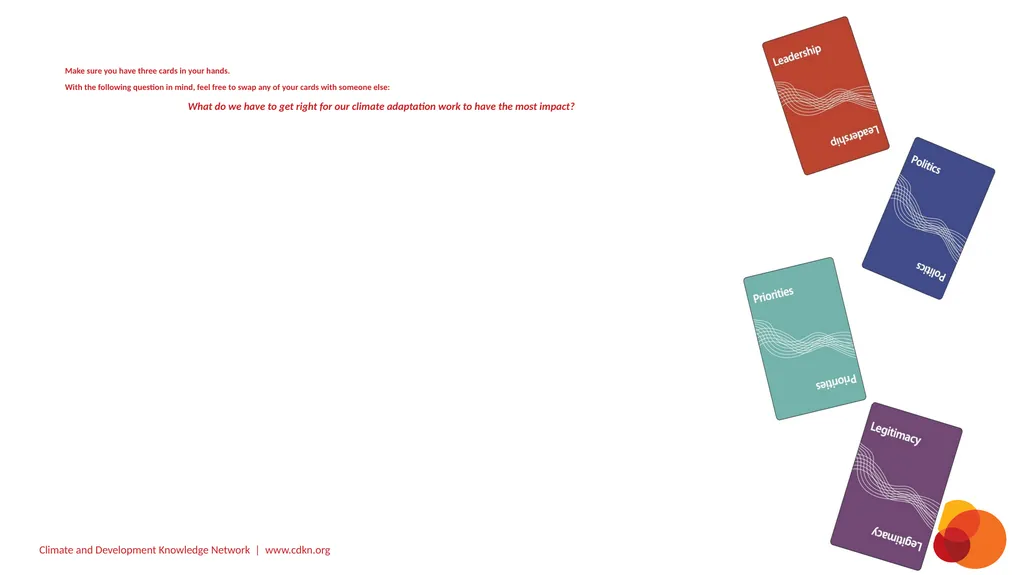
slide7. Make sure you have three cards in your hands.
With the following question in mind, feel free to swap any of your cards with someone else:
What do we have to get right for our climate adaptation work to have the most impact?<br>
slide8. Pair up with someone you don’t know.
Taking 2’ each, explain to one another why you have selected your three cards.
Still with the question in mind, together, decide which four cards to eliminate so that, as a pair, you are left with two cards.
What do we have to get right for our climate adaptation work to have the most impact? 5’<br>
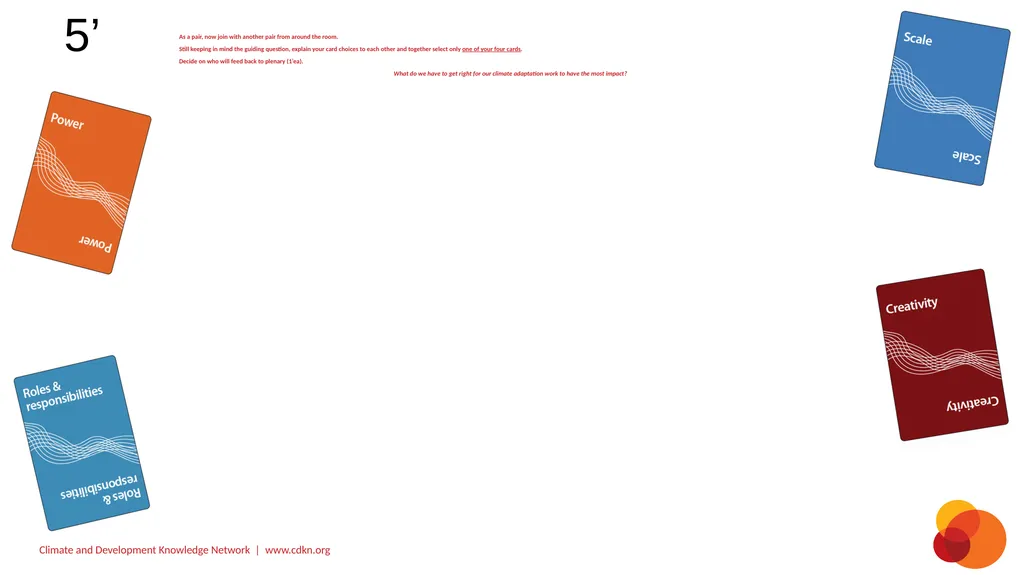
slide9. As a pair, now join with another pair from around the room. Still keeping in mind the guiding question, explain your card choices to each other and together select only one of your four cards. Decide on who will feed back to plenary (1’ea).
What do we have to get right for our climate adaptation work to have the most impact? 5’<br>
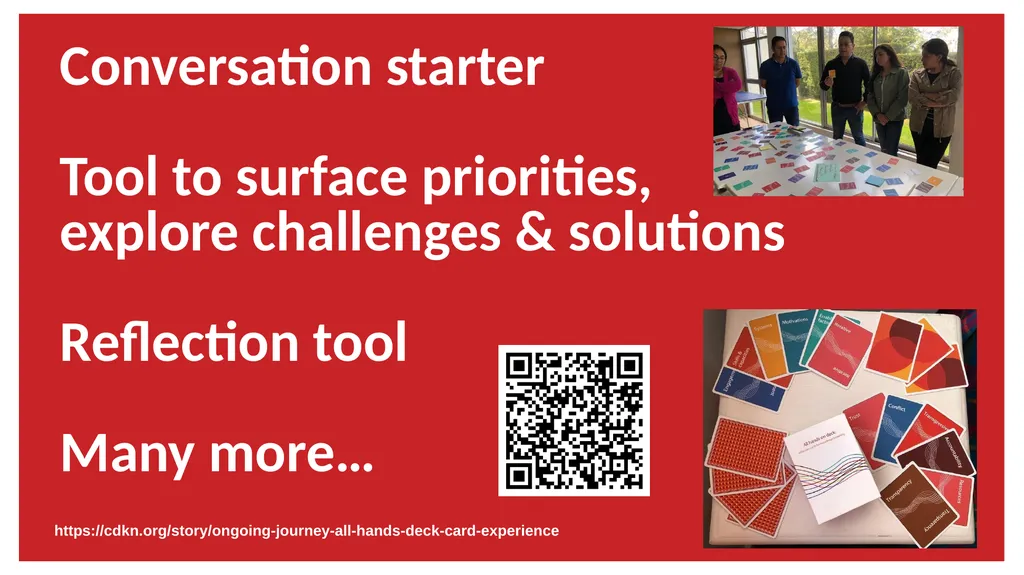
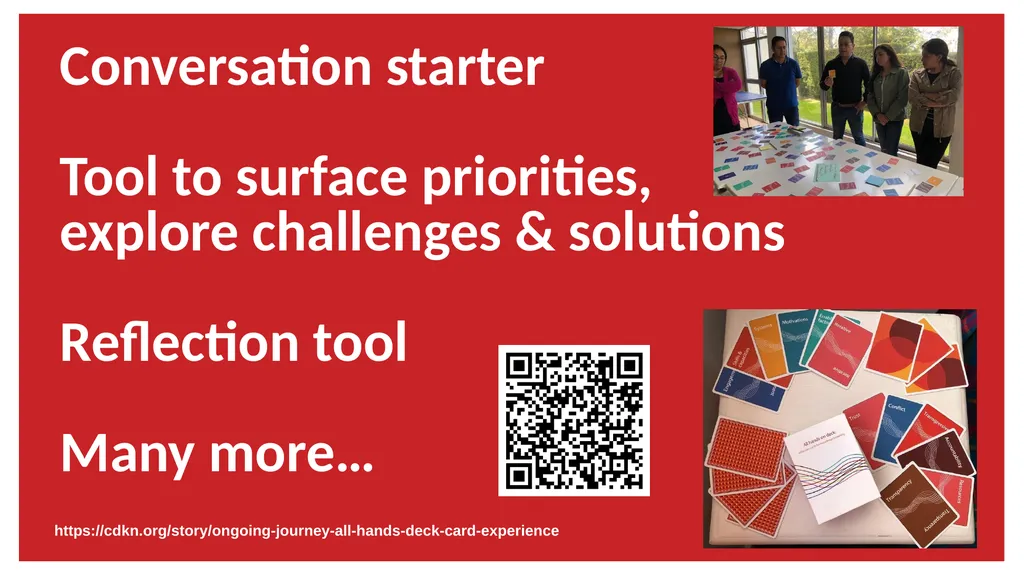
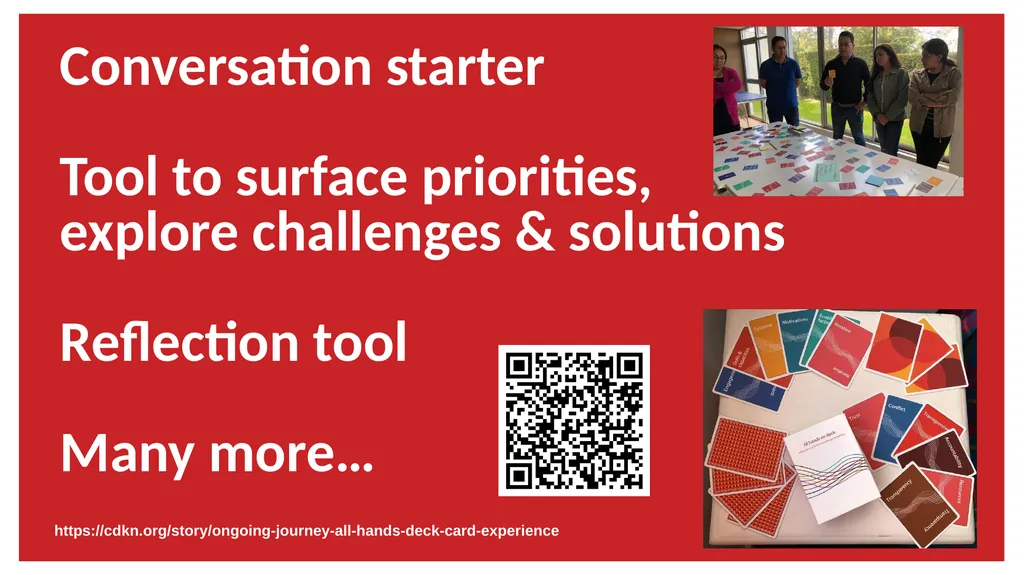
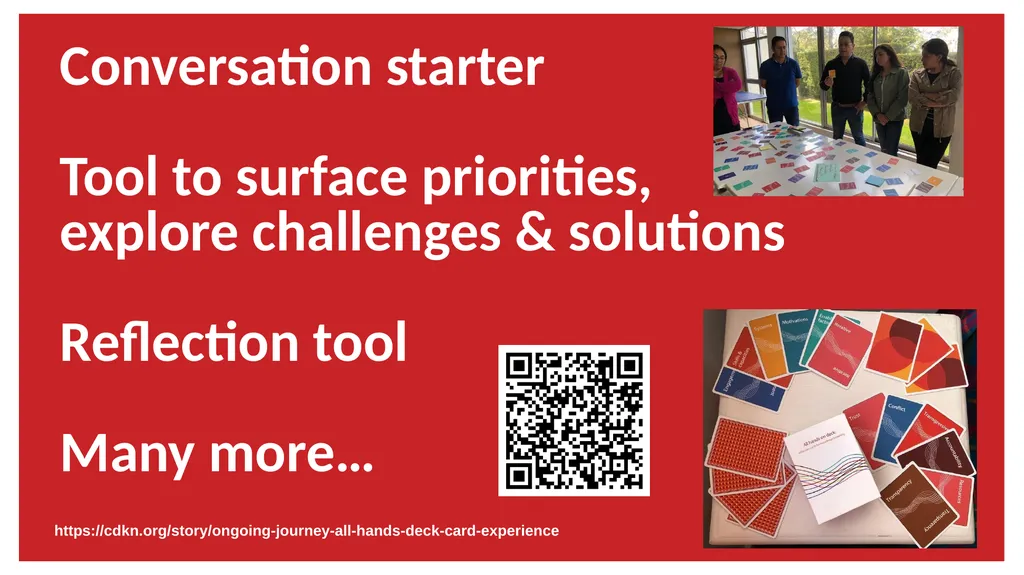
slide10. Conversation starter Tool to surface priorities, explore challenges & solutions Reflection tool Many more… https://cdkn.org/story/ongoing-journey-all-hands-deck-card-experience<br>
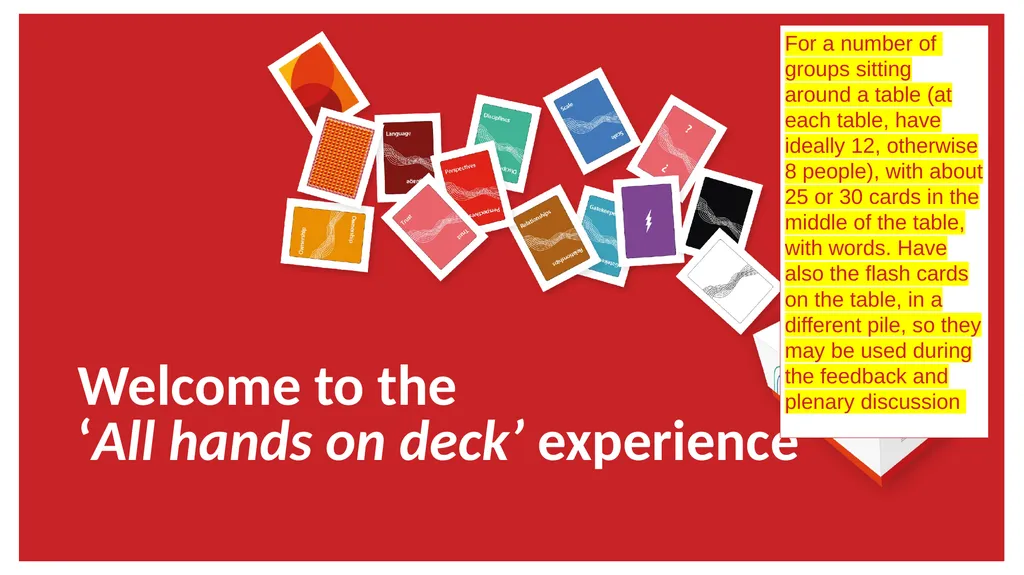
slide11. Welcome to the ‘All hands on deck’ experience For a number of groups sitting around a table (at each table, have ideally 12, otherwise 8 people), with about 25 or 30 cards in the middle of the table, with words. Have also the flash cards on the table, in a different pile, so they may be used during the feedback and plenary discussion<br>
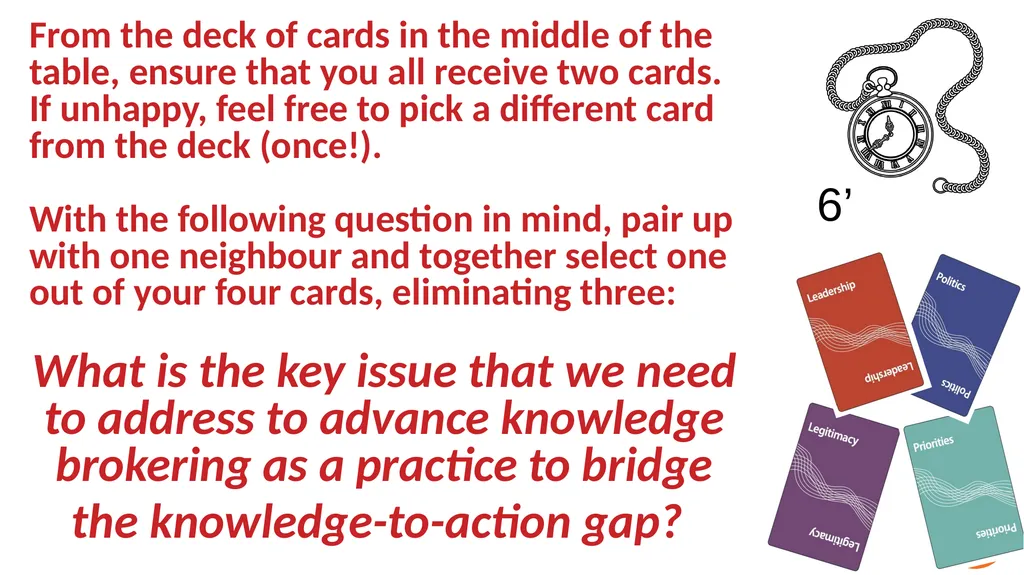
slide12. From the deck of cards in the middle of the table, ensure that you all receive two cards. If unhappy, feel free to pick a different card from the deck (once!).
With the following question in mind, pair up with one neighbour and together select one out of your four cards, eliminating three:
What is the key issue that we need to address to advance knowledge brokering as a practice to bridge the knowledge-to-action gap? 6’<br>
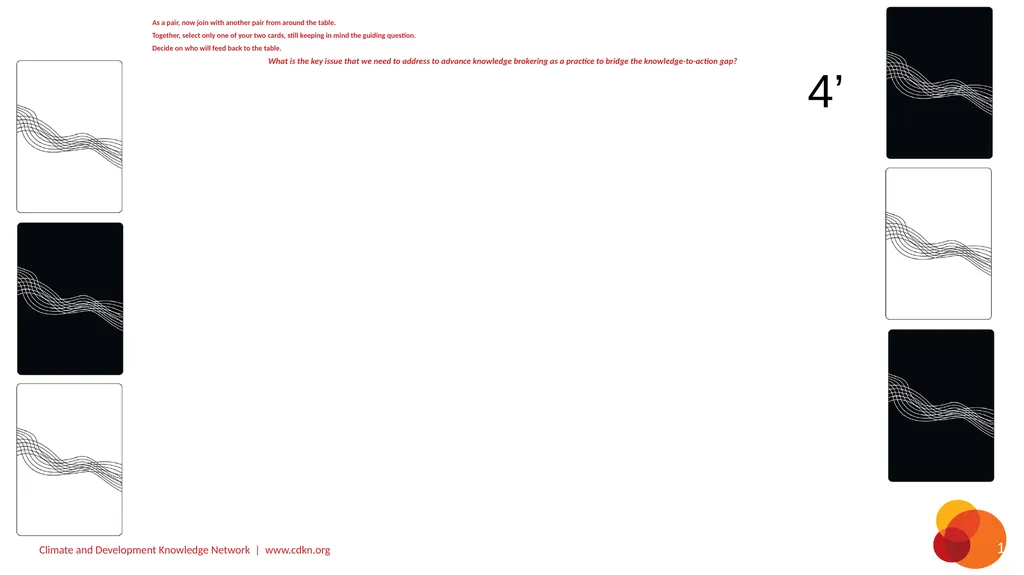
slide13. As a pair, now join with another pair from around the table.
Together, select only one of your two cards, still keeping in mind the guiding question.
Decide on who will feed back to the table.
What is the key issue that we need to address to advance knowledge brokering as a practice to bridge the knowledge-to-action gap? 4’<br>
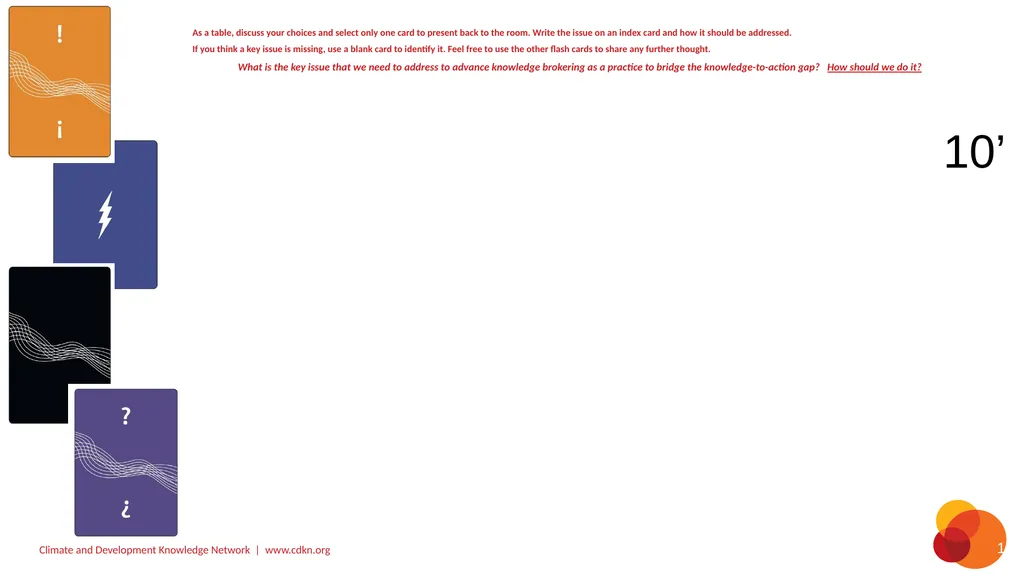
slide14. As a table, discuss your choices and select only one card to present back to the room. Write the issue on an index card and how it should be addressed. If you think a key issue is missing, use a blank card to identify it. Feel free to use the other flash cards to share any further thought.
What is the key issue that we need to address to advance knowledge brokering as a practice to bridge the knowledge-to-action gap? How should we do it? 10’<br>
slide15. Conversation starter Tool to surface priorities, explore challenges & solutions Reflection tool Many more… https://cdkn.org/story/ongoing-journey-all-hands-deck-card-experience<br>
slide16. Welcome to the All hands on deck experience For a standing activity, e.g. as people join a session or as part of a workshop – can be done with up to 60 or 80 people, but must ensure you have enough decks, given everyone gets three cards with words (try use different background decks to ease the sorting process after the game)<br>
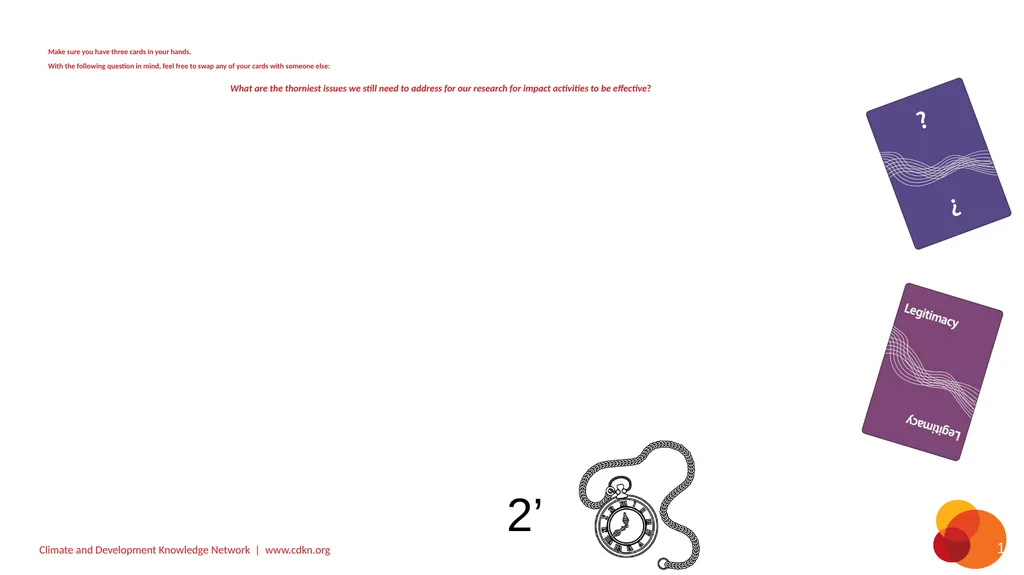
slide17. Make sure you have three cards in your hands.
With the following question in mind, feel free to swap any of your cards with someone else:
What are the thorniest issues we still need to address for our research for impact activities to be effective? 2’<br>
slide18. Pair up with someone you don’t know.
Taking 3’ each, explain to one another why you have selected your three cards.
Still with the question in mind, together, decide which two cards to eliminate so that you are both left with two cards each.
What are the thorniest issues we still need to address for our research for impact activities to be effective?<br>
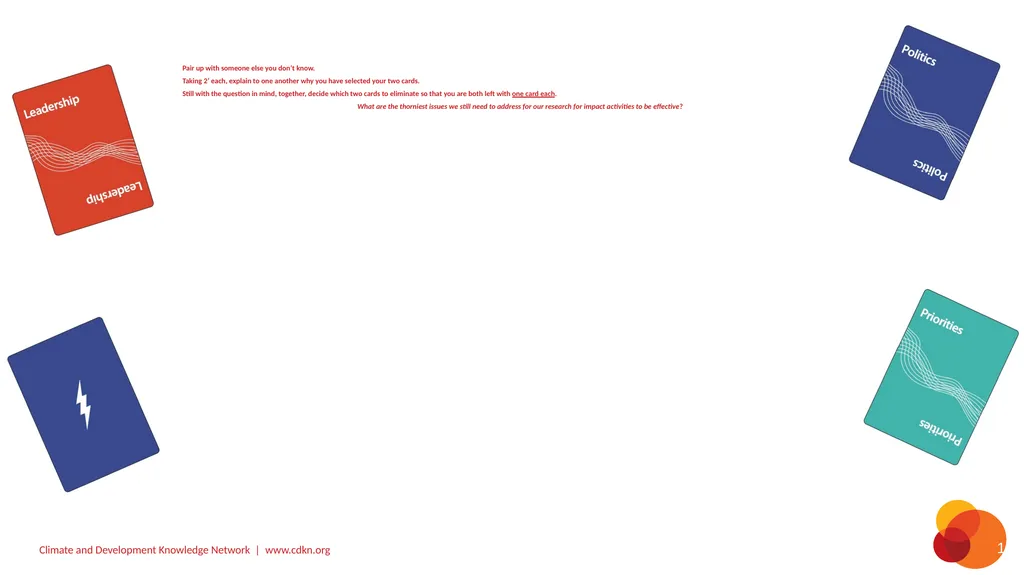
slide19. Pair up with someone else you don’t know.
Taking 2’ each, explain to one another why you have selected your two cards.
Still with the question in mind, together, decide which two cards to eliminate so that you are both left with one card each.
What are the thorniest issues we still need to address for our research for impact activities to be effective?<br>
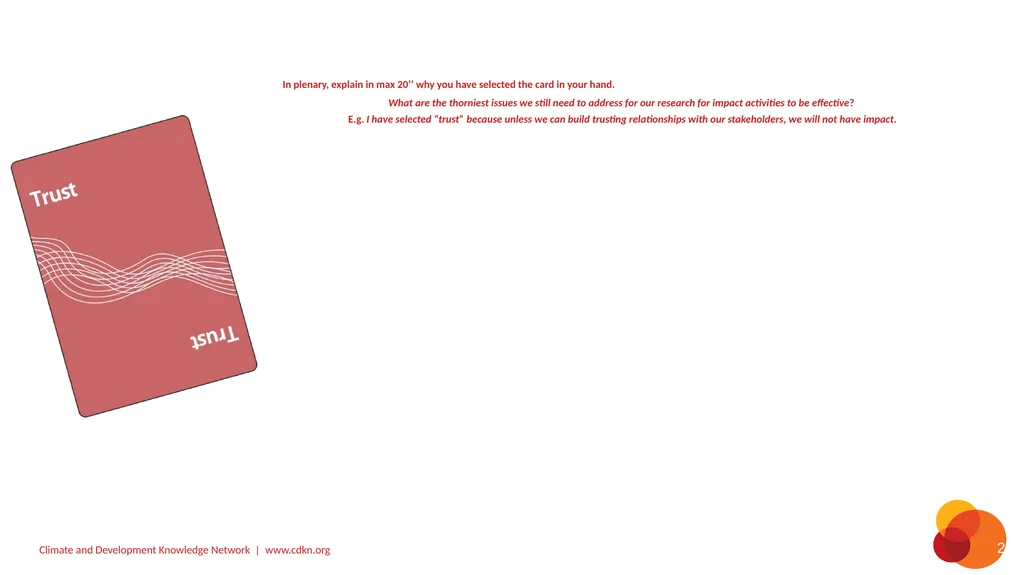
slide20. In plenary, explain in max 20’’ why you have selected the card in your hand.
What are the thorniest issues we still need to address for our research for impact activities to be effective? E.g. I have selected “trust” because unless we can build trusting relationships with our stakeholders, we will not have impact.<br>
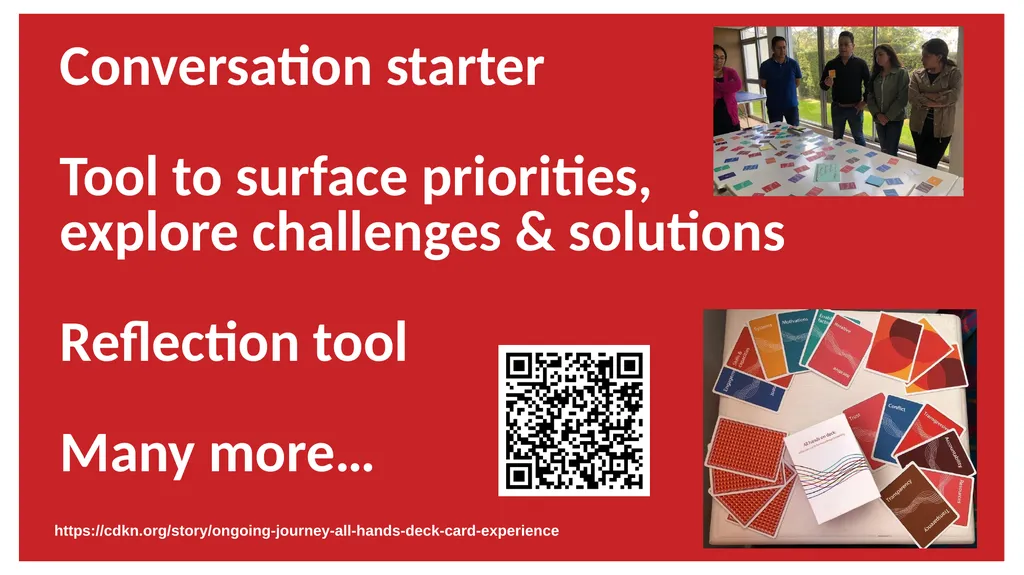
slide21. Conversation starter Tool to surface priorities, explore challenges & solutions Reflection tool Many more… https://cdkn.org/story/ongoing-journey-all-hands-deck-card-experience<br>
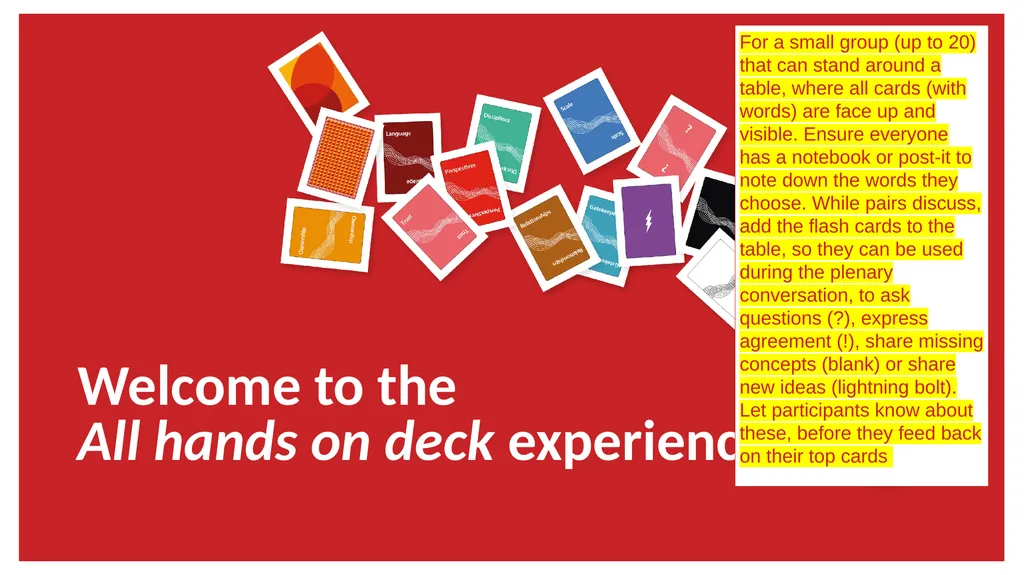
slide22. Welcome to the All hands on deck experience For a small group (up to 20) that can stand around a table, where all cards (with words) are face up and visible. Ensure everyone has a notebook or post-it to note down the words they choose. While pairs discuss, add the flash cards to the table, so they can be used during the plenary conversation, to ask questions (?), express agreement (!), share missing concepts (blank) or share new ideas (lightning bolt). Let participants know about these, before they feed back on their top cards<br>
slide23. Take a look at the cards on the table.
With the following question in mind, choose two or three cards by noting down the words on your post-it:
What are the stickiest issues you face as you seek to facilitate the co-creation of policy and practice-relevant knowledge? 3’<br>
slide24. Pair up with someone you don’t know.
Taking 3’ each, explain to one another why you have noted down those issues.
Decide on who will feed back to the group.
What are the stickiest issues you face as you seek to facilitate the co-creation of policy and practice-relevant knowledge?<br>
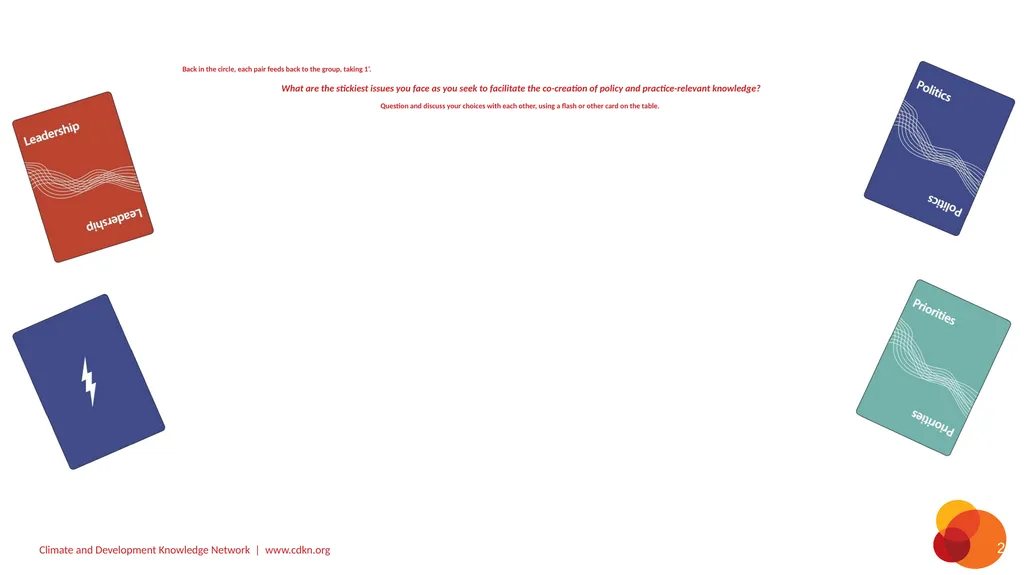
slide25. Back in the circle, each pair feeds back to the group, taking 1’.
What are the stickiest issues you face as you seek to facilitate the co-creation of policy and practice-relevant knowledge? Question and discuss your choices with each other, using a flash or other card on the table.<br>
slide26. Conversation starter Tool to surface priorities, explore challenges & solutions Reflection tool Many more… https://cdkn.org/story/ongoing-journey-all-hands-deck-card-experience<br>
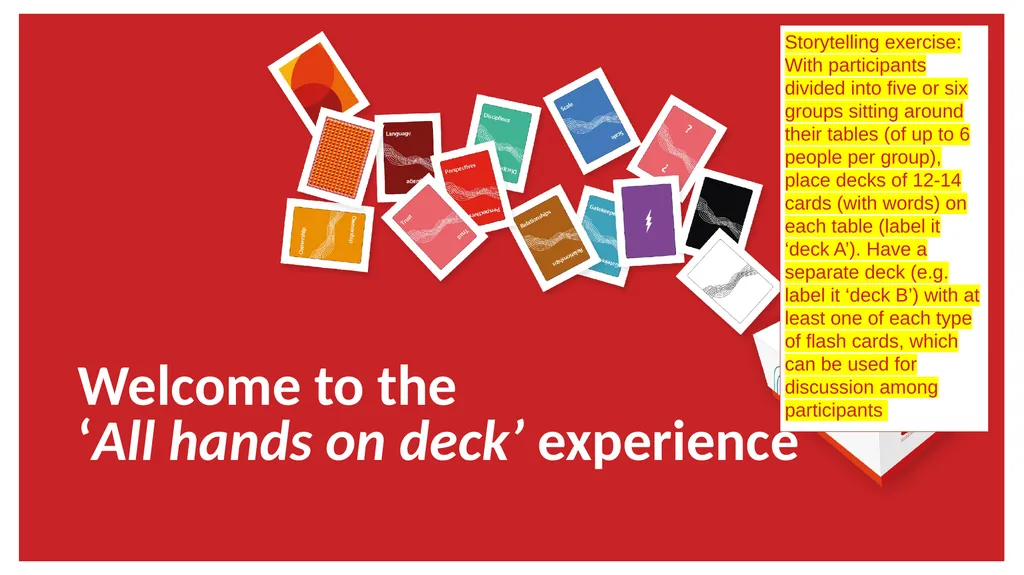
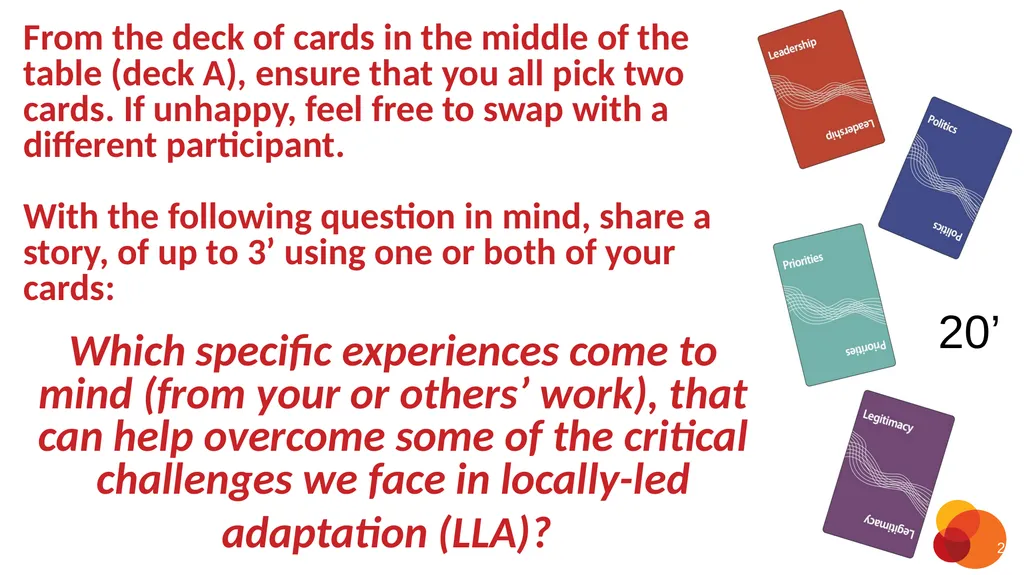
slide27. Welcome to the ‘All hands on deck’ experience Storytelling exercise: With participants divided into five or six groups sitting around their tables (of up to 6 people per group), place decks of 12-14 cards (with words) on each table (label it ‘deck A’). Have a separate deck (e.g. label it ‘deck B’) with at least one of each type of flash cards, which can be used for discussion among participants<br>
slide28. From the deck of cards in the middle of the table (deck A), ensure that you all pick two cards. If unhappy, feel free to swap with a different participant.
With the following question in mind, share a story, of up to 3’ using one or both of your cards:
Which specific experiences come to mind (from your or others’ work), that can help overcome some of the critical challenges we face in locally-led adaptation (LLA)? 20’<br>
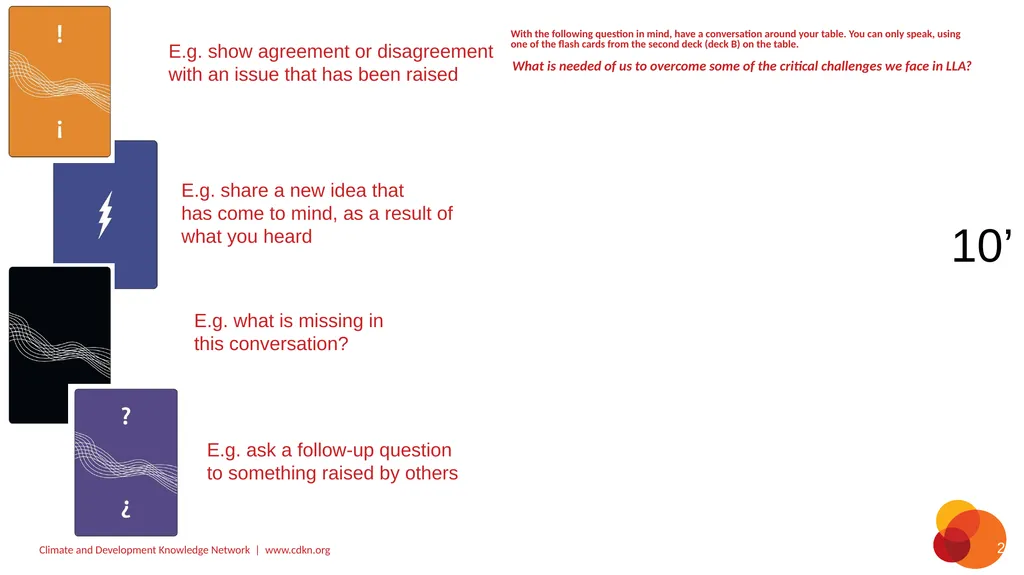
slide29. With the following question in mind, have a conversation around your table. You can only speak, using one of the flash cards from the second deck (deck B) on the table.
What is needed of us to overcome some of the critical challenges we face in LLA? 10’ E.g. show agreement or disagreement
with an issue that has been raised E.g. share a new idea that
has come to mind, as a result of
what you heard E.g. what is missing in
this conversation? E.g. ask a follow-up question
to something raised by others<br>
slide30. Conversation starter Tool to surface priorities, explore challenges & solutions Reflection tool Many more… https://cdkn.org/story/ongoing-journey-all-hands-deck-card-experience<br>
slide31. Bienvenue dans l’expérience
« Tous à vos cartes ! »<br>
slide32. Assurez-vous d’avoir trois cartes en main.
Avec la question suivante à l’esprit, n’hésitez pas à échanger n’importe laquelle de vos cartes avec quelqu’un d’autre :
Quel est le problème le plus épineux que vous pensez devoir résoudre pour que votre projet ait le plus d’impact possible ? 2’<br>
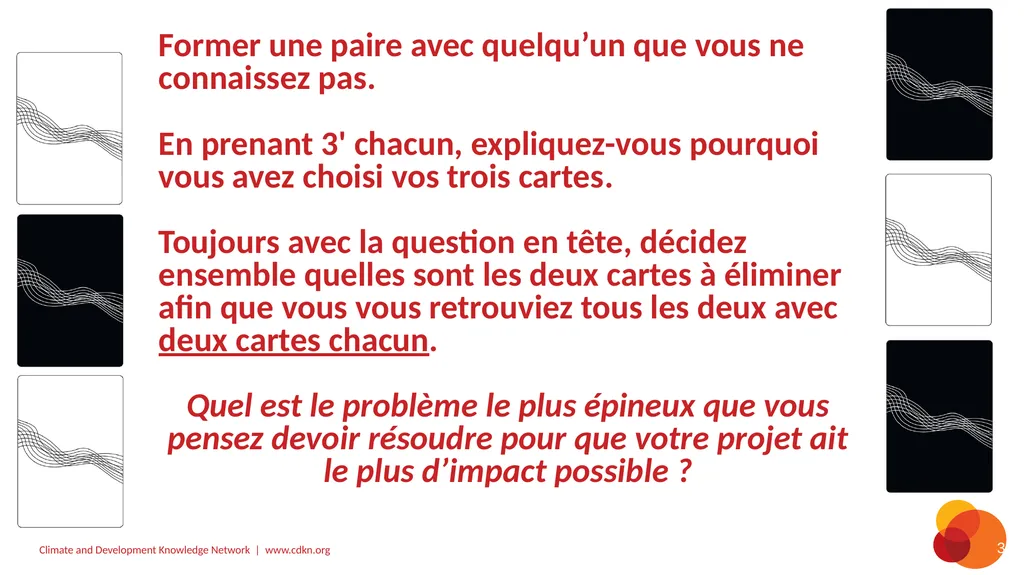
slide33. Former une paire avec quelqu’un que vous ne connaissez pas.
En prenant 3' chacun, expliquez-vous pourquoi vous avez choisi vos trois cartes.
Toujours avec la question en tête, décidez ensemble quelles sont les deux cartes à éliminer afin que vous vous retrouviez tous les deux avec deux cartes chacun.
Quel est le problème le plus épineux que vous pensez devoir résoudre pour que votre projet ait le plus d’impact possible ?<br>
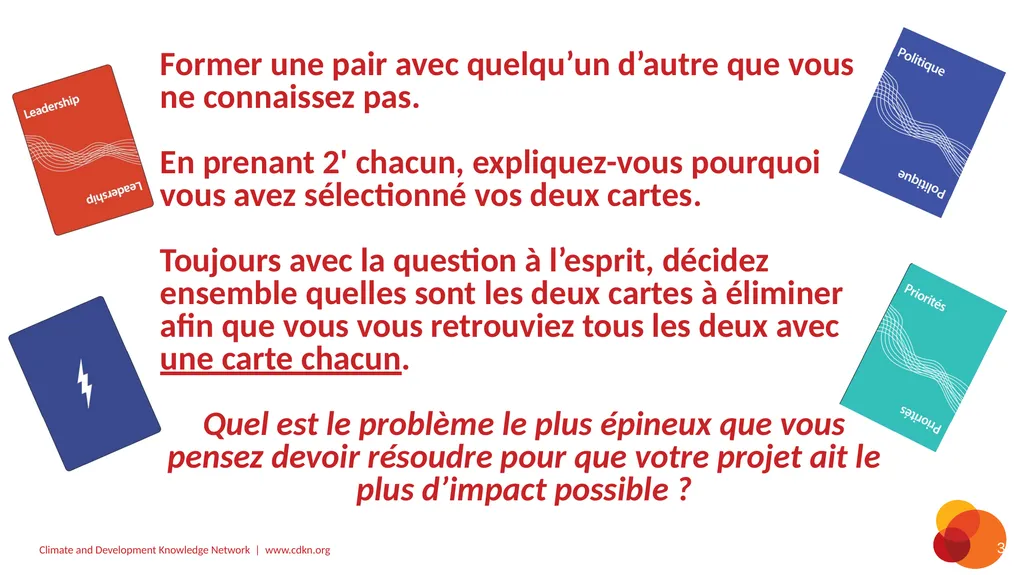
slide34. Former une pair avec quelqu’un d’autre que vous ne connaissez pas.
En prenant 2' chacun, expliquez-vous pourquoi vous avez sélectionné vos deux cartes.
Toujours avec la question à l’esprit, décidez ensemble quelles sont les deux cartes à éliminer afin que vous vous retrouviez tous les deux avec une carte chacun.
Quel est le problème le plus épineux que vous pensez devoir résoudre pour que votre projet ait le plus d’impact possible ?<br>
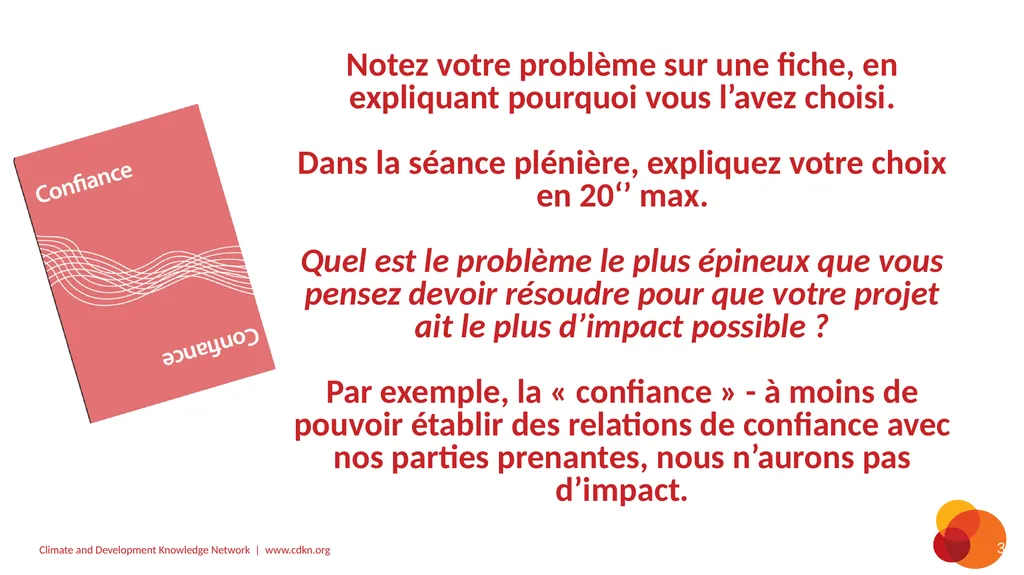
slide35. Notez votre problème sur une fiche, en expliquant pourquoi vous l’avez choisi. Dans la séance plénière, expliquez votre choix en 20‘’ max. Quel est le problème le plus épineux que vous pensez devoir résoudre pour que votre projet ait le plus d’impact possible ? Par exemple, la « confiance » - à moins de pouvoir établir des relations de confiance avec nos parties prenantes, nous n’aurons pas d’impact.<br>
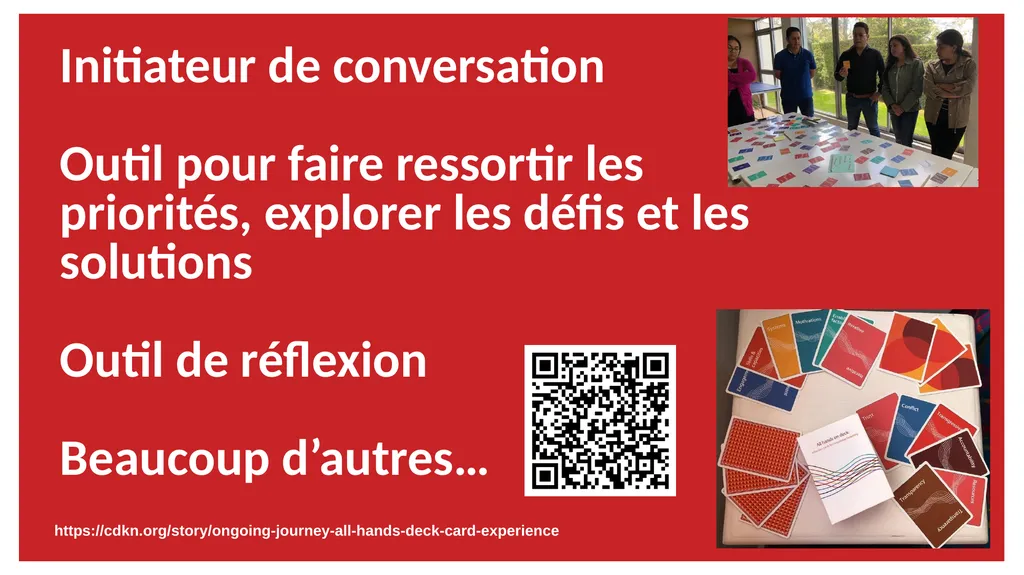
slide36. Initiateur de conversation Outil pour faire ressortir les priorités, explorer les défis et les solutions Outil de réflexion Beaucoup d’autres… https://cdkn.org/story/ongoing-journey-all-hands-deck-card-experience<br>
slide37. Bienvenidos/as a la experiencia
‘Manos a las cartas’<br>
slide38. Asegúrate de tener tres tarjetas en tus manos. En función de la pregunta que verás más abajo, siéntete libre de intercambiar cualquiera de tus tarjetas con alguien más: Pregunta: ¿Desde tu contexto y proyecto, cuáles son los elementos clave para lograr incidencia en la política y la acción? 2’<br>
slide39. Forma pareja con alguien que no conoces.
Tomando 3 minutos cada uno/a, expliquen por qué han guardado sus tres cartas. Aún con la pregunta en mente, decidan juntos/as eliminar dos cartas de tal manera que queden con dos cartas cada uno/a. ¿Desde tu contexto y proyecto, cuáles son los elementos clave para lograr incidencia en la política y la acción?<br>
slide40. Forma una nueva pareja con alguien que no conoces.
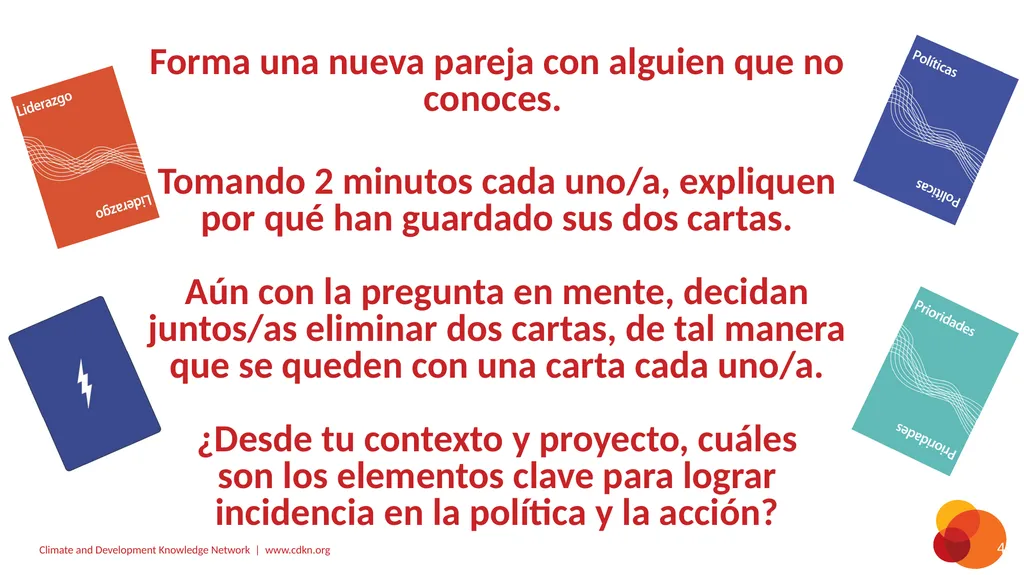
Tomando 2 minutos cada uno/a, expliquen por qué han guardado sus dos cartas. Aún con la pregunta en mente, decidan juntos/as eliminar dos cartas, de tal manera que se queden con una carta cada uno/a. ¿Desde tu contexto y proyecto, cuáles son los elementos clave para lograr incidencia en la política y la acción?<br>
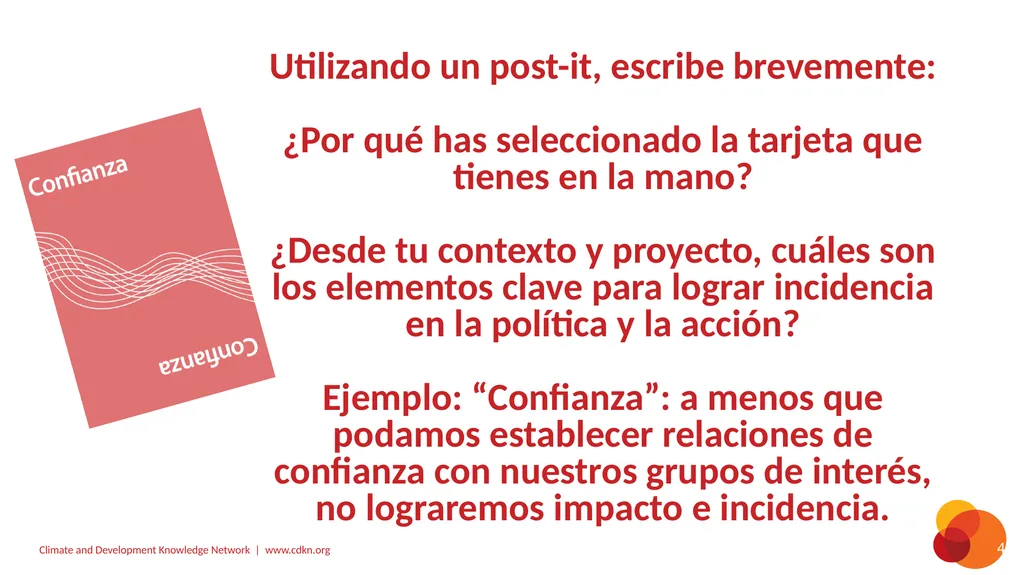
slide41. Utilizando un post-it, escribe brevemente: ¿Por qué has seleccionado la tarjeta que tienes en la mano? ¿Desde tu contexto y proyecto, cuáles son los elementos clave para lograr incidencia en la política y la acción? Ejemplo: “Confianza”: a menos que podamos establecer relaciones de confianza con nuestros grupos de interés, no lograremos impacto e incidencia.<br>
slide42. Las tarjetas pueden ser una herramienta para Empezar conversaciones Discutir prioridades, desafíos y soluciones Reflexión Mucho más… https://cdkn.org/es/story/el-viaje-en-curso-hacia-la-experiencia-con-las-tarjetas-manos-la-obra<br>
slide43. Please get in touch with any questions and to share how you have used the ‘All hands on deck’ cards:
lucia@southsouthnorth.org<br>
slide3. Useful background information<br>
slide4. What are the ‘All hands on deck’ cards? A set of 120 cards in English, French or Spanish, composed of:
92 cards* with words that relate to knowledge brokering, co-creation and transdisciplinarity, such as…
28 flash cards
*If you received a printed deck from CDKN in 2025 or before, the English deck has 74 cards with words. The additional 18 cards can be printed on our resource page. Two different back designs<br>
slide5. The following groups of slides (which begin and end with a red slide) indicate the instructions that are projected to help facilitate an activity with a group of ‘All hands on deck’ card players.
The box on the first red slide, with yellow highlighted text, gives some tips for the facilitator.
Most important things to remember, when planning an activity:
Each English printed card deck has 74 cards with words and 28 flash cards (as of mid-2025). French and Spanish decks (and the downloadable English file as well as future English printed decks) have 92 words.
Given the current 74-word limit, games that give each participant three cards only work with groups of up to 24. If you only have one deck of cards, for larger groups, it will be necessary to change the rules (e.g. give participants two cards each/ integrate the flash cards/ ask people to work in pairs and follow the instructions together/ etc.).
The cards are very versatile and adapt to a range of content areas/ topics. The most important element of the game is the guiding question – ensure you adapt it and frame it according to the key issues you are exploring in your workshop/ session.
The slides that follow just give a few ideas about how to play – many more may exist, and it is up to your imagination to play around and invent those. We would love to know about your adventures! Purpose of this presentation<br>
slide6. Welcome to the ‘All hands on deck’ experience For a standing activity, e.g. as people join a session or as part of a workshop – can be done with up to 60 or 80 people, but must ensure you have enough decks, given everyone gets three cards with words (try use different background decks to ease the sorting process after the game)<br>
slide7. Make sure you have three cards in your hands.
With the following question in mind, feel free to swap any of your cards with someone else:
What do we have to get right for our climate adaptation work to have the most impact?<br>
slide8. Pair up with someone you don’t know.
Taking 2’ each, explain to one another why you have selected your three cards.
Still with the question in mind, together, decide which four cards to eliminate so that, as a pair, you are left with two cards.
What do we have to get right for our climate adaptation work to have the most impact? 5’<br>
slide9. As a pair, now join with another pair from around the room. Still keeping in mind the guiding question, explain your card choices to each other and together select only one of your four cards. Decide on who will feed back to plenary (1’ea).
What do we have to get right for our climate adaptation work to have the most impact? 5’<br>
slide10. Conversation starter Tool to surface priorities, explore challenges & solutions Reflection tool Many more… https://cdkn.org/story/ongoing-journey-all-hands-deck-card-experience<br>
slide11. Welcome to the ‘All hands on deck’ experience For a number of groups sitting around a table (at each table, have ideally 12, otherwise 8 people), with about 25 or 30 cards in the middle of the table, with words. Have also the flash cards on the table, in a different pile, so they may be used during the feedback and plenary discussion<br>
slide12. From the deck of cards in the middle of the table, ensure that you all receive two cards. If unhappy, feel free to pick a different card from the deck (once!).
With the following question in mind, pair up with one neighbour and together select one out of your four cards, eliminating three:
What is the key issue that we need to address to advance knowledge brokering as a practice to bridge the knowledge-to-action gap? 6’<br>
slide13. As a pair, now join with another pair from around the table.
Together, select only one of your two cards, still keeping in mind the guiding question.
Decide on who will feed back to the table.
What is the key issue that we need to address to advance knowledge brokering as a practice to bridge the knowledge-to-action gap? 4’<br>
slide14. As a table, discuss your choices and select only one card to present back to the room. Write the issue on an index card and how it should be addressed. If you think a key issue is missing, use a blank card to identify it. Feel free to use the other flash cards to share any further thought.
What is the key issue that we need to address to advance knowledge brokering as a practice to bridge the knowledge-to-action gap? How should we do it? 10’<br>
slide15. Conversation starter Tool to surface priorities, explore challenges & solutions Reflection tool Many more… https://cdkn.org/story/ongoing-journey-all-hands-deck-card-experience<br>
slide16. Welcome to the All hands on deck experience For a standing activity, e.g. as people join a session or as part of a workshop – can be done with up to 60 or 80 people, but must ensure you have enough decks, given everyone gets three cards with words (try use different background decks to ease the sorting process after the game)<br>
slide17. Make sure you have three cards in your hands.
With the following question in mind, feel free to swap any of your cards with someone else:
What are the thorniest issues we still need to address for our research for impact activities to be effective? 2’<br>
slide18. Pair up with someone you don’t know.
Taking 3’ each, explain to one another why you have selected your three cards.
Still with the question in mind, together, decide which two cards to eliminate so that you are both left with two cards each.
What are the thorniest issues we still need to address for our research for impact activities to be effective?<br>
slide19. Pair up with someone else you don’t know.
Taking 2’ each, explain to one another why you have selected your two cards.
Still with the question in mind, together, decide which two cards to eliminate so that you are both left with one card each.
What are the thorniest issues we still need to address for our research for impact activities to be effective?<br>
slide20. In plenary, explain in max 20’’ why you have selected the card in your hand.
What are the thorniest issues we still need to address for our research for impact activities to be effective? E.g. I have selected “trust” because unless we can build trusting relationships with our stakeholders, we will not have impact.<br>
slide21. Conversation starter Tool to surface priorities, explore challenges & solutions Reflection tool Many more… https://cdkn.org/story/ongoing-journey-all-hands-deck-card-experience<br>
slide22. Welcome to the All hands on deck experience For a small group (up to 20) that can stand around a table, where all cards (with words) are face up and visible. Ensure everyone has a notebook or post-it to note down the words they choose. While pairs discuss, add the flash cards to the table, so they can be used during the plenary conversation, to ask questions (?), express agreement (!), share missing concepts (blank) or share new ideas (lightning bolt). Let participants know about these, before they feed back on their top cards<br>
slide23. Take a look at the cards on the table.
With the following question in mind, choose two or three cards by noting down the words on your post-it:
What are the stickiest issues you face as you seek to facilitate the co-creation of policy and practice-relevant knowledge? 3’<br>
slide24. Pair up with someone you don’t know.
Taking 3’ each, explain to one another why you have noted down those issues.
Decide on who will feed back to the group.
What are the stickiest issues you face as you seek to facilitate the co-creation of policy and practice-relevant knowledge?<br>
slide25. Back in the circle, each pair feeds back to the group, taking 1’.
What are the stickiest issues you face as you seek to facilitate the co-creation of policy and practice-relevant knowledge? Question and discuss your choices with each other, using a flash or other card on the table.<br>
slide26. Conversation starter Tool to surface priorities, explore challenges & solutions Reflection tool Many more… https://cdkn.org/story/ongoing-journey-all-hands-deck-card-experience<br>
slide27. Welcome to the ‘All hands on deck’ experience Storytelling exercise: With participants divided into five or six groups sitting around their tables (of up to 6 people per group), place decks of 12-14 cards (with words) on each table (label it ‘deck A’). Have a separate deck (e.g. label it ‘deck B’) with at least one of each type of flash cards, which can be used for discussion among participants<br>
slide28. From the deck of cards in the middle of the table (deck A), ensure that you all pick two cards. If unhappy, feel free to swap with a different participant.
With the following question in mind, share a story, of up to 3’ using one or both of your cards:
Which specific experiences come to mind (from your or others’ work), that can help overcome some of the critical challenges we face in locally-led adaptation (LLA)? 20’<br>
slide29. With the following question in mind, have a conversation around your table. You can only speak, using one of the flash cards from the second deck (deck B) on the table.
What is needed of us to overcome some of the critical challenges we face in LLA? 10’ E.g. show agreement or disagreement
with an issue that has been raised E.g. share a new idea that
has come to mind, as a result of
what you heard E.g. what is missing in
this conversation? E.g. ask a follow-up question
to something raised by others<br>
slide30. Conversation starter Tool to surface priorities, explore challenges & solutions Reflection tool Many more… https://cdkn.org/story/ongoing-journey-all-hands-deck-card-experience<br>
slide31. Bienvenue dans l’expérience
« Tous à vos cartes ! »<br>
slide32. Assurez-vous d’avoir trois cartes en main.
Avec la question suivante à l’esprit, n’hésitez pas à échanger n’importe laquelle de vos cartes avec quelqu’un d’autre :
Quel est le problème le plus épineux que vous pensez devoir résoudre pour que votre projet ait le plus d’impact possible ? 2’<br>
slide33. Former une paire avec quelqu’un que vous ne connaissez pas.
En prenant 3' chacun, expliquez-vous pourquoi vous avez choisi vos trois cartes.
Toujours avec la question en tête, décidez ensemble quelles sont les deux cartes à éliminer afin que vous vous retrouviez tous les deux avec deux cartes chacun.
Quel est le problème le plus épineux que vous pensez devoir résoudre pour que votre projet ait le plus d’impact possible ?<br>
slide34. Former une pair avec quelqu’un d’autre que vous ne connaissez pas.
En prenant 2' chacun, expliquez-vous pourquoi vous avez sélectionné vos deux cartes.
Toujours avec la question à l’esprit, décidez ensemble quelles sont les deux cartes à éliminer afin que vous vous retrouviez tous les deux avec une carte chacun.
Quel est le problème le plus épineux que vous pensez devoir résoudre pour que votre projet ait le plus d’impact possible ?<br>
slide35. Notez votre problème sur une fiche, en expliquant pourquoi vous l’avez choisi. Dans la séance plénière, expliquez votre choix en 20‘’ max. Quel est le problème le plus épineux que vous pensez devoir résoudre pour que votre projet ait le plus d’impact possible ? Par exemple, la « confiance » - à moins de pouvoir établir des relations de confiance avec nos parties prenantes, nous n’aurons pas d’impact.<br>
slide36. Initiateur de conversation Outil pour faire ressortir les priorités, explorer les défis et les solutions Outil de réflexion Beaucoup d’autres… https://cdkn.org/story/ongoing-journey-all-hands-deck-card-experience<br>
slide37. Bienvenidos/as a la experiencia
‘Manos a las cartas’<br>
slide38. Asegúrate de tener tres tarjetas en tus manos. En función de la pregunta que verás más abajo, siéntete libre de intercambiar cualquiera de tus tarjetas con alguien más: Pregunta: ¿Desde tu contexto y proyecto, cuáles son los elementos clave para lograr incidencia en la política y la acción? 2’<br>
slide39. Forma pareja con alguien que no conoces.
Tomando 3 minutos cada uno/a, expliquen por qué han guardado sus tres cartas. Aún con la pregunta en mente, decidan juntos/as eliminar dos cartas de tal manera que queden con dos cartas cada uno/a. ¿Desde tu contexto y proyecto, cuáles son los elementos clave para lograr incidencia en la política y la acción?<br>
slide40. Forma una nueva pareja con alguien que no conoces.
Tomando 2 minutos cada uno/a, expliquen por qué han guardado sus dos cartas. Aún con la pregunta en mente, decidan juntos/as eliminar dos cartas, de tal manera que se queden con una carta cada uno/a. ¿Desde tu contexto y proyecto, cuáles son los elementos clave para lograr incidencia en la política y la acción?<br>
slide41. Utilizando un post-it, escribe brevemente: ¿Por qué has seleccionado la tarjeta que tienes en la mano? ¿Desde tu contexto y proyecto, cuáles son los elementos clave para lograr incidencia en la política y la acción? Ejemplo: “Confianza”: a menos que podamos establecer relaciones de confianza con nuestros grupos de interés, no lograremos impacto e incidencia.<br>
slide42. Las tarjetas pueden ser una herramienta para Empezar conversaciones Discutir prioridades, desafíos y soluciones Reflexión Mucho más… https://cdkn.org/es/story/el-viaje-en-curso-hacia-la-experiencia-con-las-tarjetas-manos-la-obra<br>
slide43. Please get in touch with any questions and to share how you have used the ‘All hands on deck’ cards:
lucia@southsouthnorth.org<br>