
Allergic Rhinitis Faculty Dr. Jaclyn Quirt MD,





Description: Allergic Rhinitis Faculty Dr. Jaclyn Quirt MD, FRCPC Program Director, McMaster Pediatric and Adult Clinical Immunology and Allergy, McMaster University Assistant Clinical Professor, McMaster University Section Advisor of Rhinitis and
Related Topics
Download Presentation
"Allergic Rhinitis Faculty Dr. Jaclyn Quirt MD," is the property of its rightful owner. Permission is granted to download and print the materials on this website for personal, non-commercial use only, and to display it on your personal computer provided you do not modify the materials and that you retain all copyright notices contained in the materials. By downloading content from our website, you accept the terms of this agreement.
Presentation Transcript
slide1. Allergic Rhinitis<br>
slide2. Faculty Dr. Jaclyn Quirt
MD, FRCPC
Program Director, McMaster Pediatric and Adult Clinical Immunology and Allergy, McMaster University
Assistant Clinical Professor, McMaster University
Section Advisor of Rhinitis and Sinusitis at Canadian Society of Allergy & Clinical Immunology 2<br>
slide3. Faculty/Presenter Disclosure Faculty: [Speaker’s name]
Relationships with financial sponsors:
Any direct financial relationships including receipt of honoraria: PharmaCorp ABC, Canadian Cancer Org.
Memberships on advisory boards or speakers’ bureau: XYZ Biopharmaceuticals Ltd.
Patents for drugs or devices: Widget ABC
Other: financial relationships/investments Employee of XXY Hospital Group, consultant for Company X 3<br>
slide4. Disclosure of Financial Support This program has received financial support from [organization name] in the form of [describe support here – e.g. an educational grant].
This program has received in-kind support from [organization name] in the form of [describe support here – e.g. logistical support].
Potential for conflict(s) of interest:
[Speaker/Faculty name] has received [payment/funding, etc.] from [organization supporting this program AND/OR organization whose product(s) are being discussed in this program].
[Supporting organization name] [developed/licenses/distributes/benefits from the sale of, etc.] a product that will be discussed in this program 4<br>
slide5. Mitigating Potential Bias Potential sources of bias identified in slides 3 and 4 have been mitigated by the scientific planning committee by:
A review/approval of each presenter(s) COI slides
Discussing potential conflicts directly with presenter(s) including avoidance of personal recommendations and limiting discussion to solely evidence-based content (where identified conflict exists) 5<br>
slide6. Accreditation 6 This 1-credit-per-hour Group Learning program has been certified by the College of Family of Physicians of Canada and the [insert province] Chapter for up to [insert total # of credits] Mainpro+® credits. Certificates of attendance will be provided to participants following the event for CPD tracking/record keeping.<br>
slide7. Learning Objectives 7 Review the workup and diagnosis of patients with allergic rhinitis (AR) Optimize non-pharmacological and pharmacological therapy for AR Describe the indications for and process of initiating allergen immunotherapy Decide when to refer patients with rhinitis to an allergist By the end of the program, participants will be able to:<br>
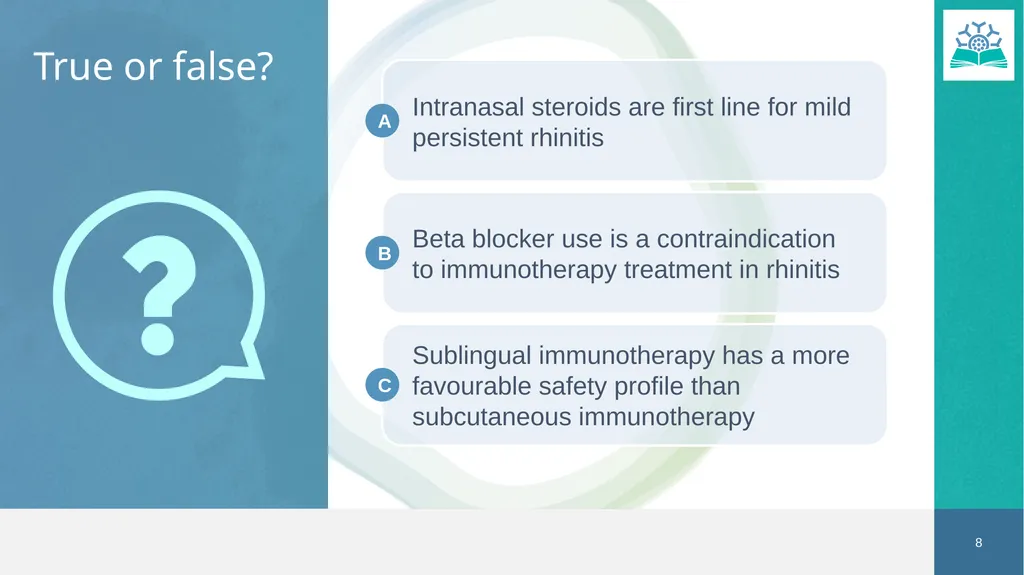
slide8. True or false? 8 Intranasal steroids are first line for mild persistent rhinitis A Beta blocker use is a contraindication to immunotherapy treatment in rhinitis B Sublingual immunotherapy has a more favourable safety profile than subcutaneous immunotherapy C<br>
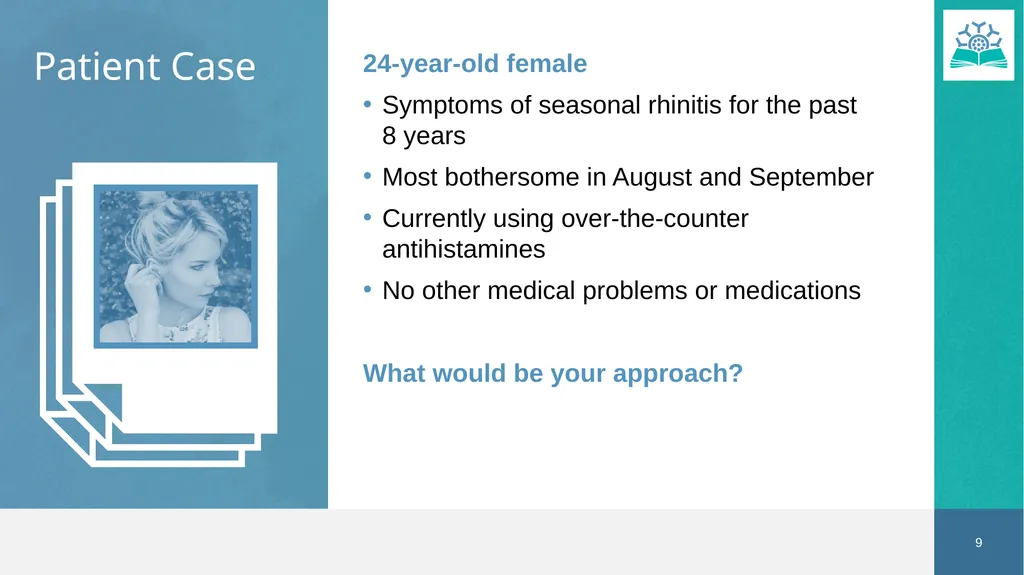
slide9. Patient Case 24-year-old female
Symptoms of seasonal rhinitis for the past 8 years
Most bothersome in August and September
Currently using over-the-counter antihistamines
No other medical problems or medications
What would be your approach? 9<br>
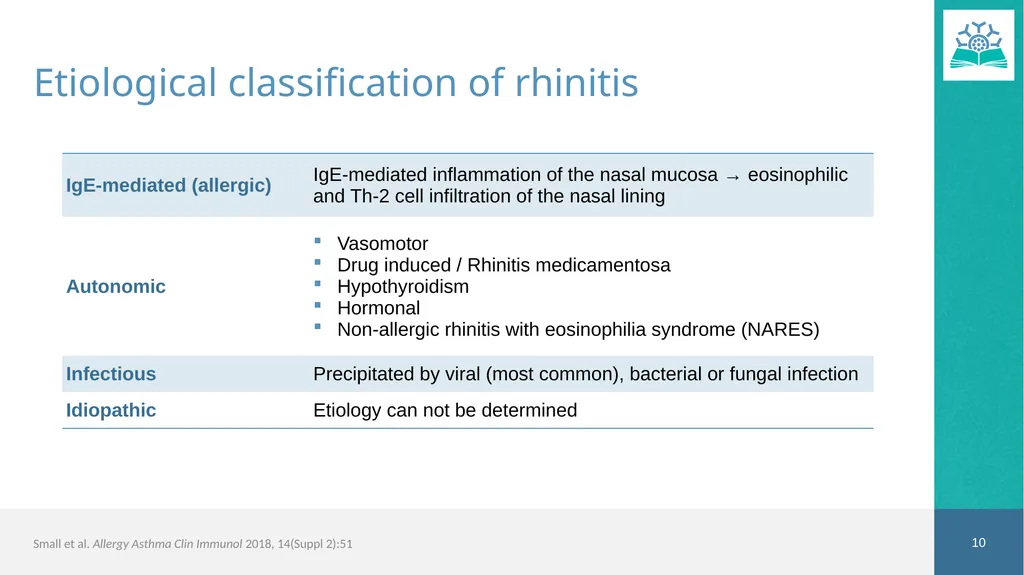
slide10. Etiological classification of rhinitis 10 Small et al. Allergy Asthma Clin Immunol 2018, 14(Suppl 2):51<br>
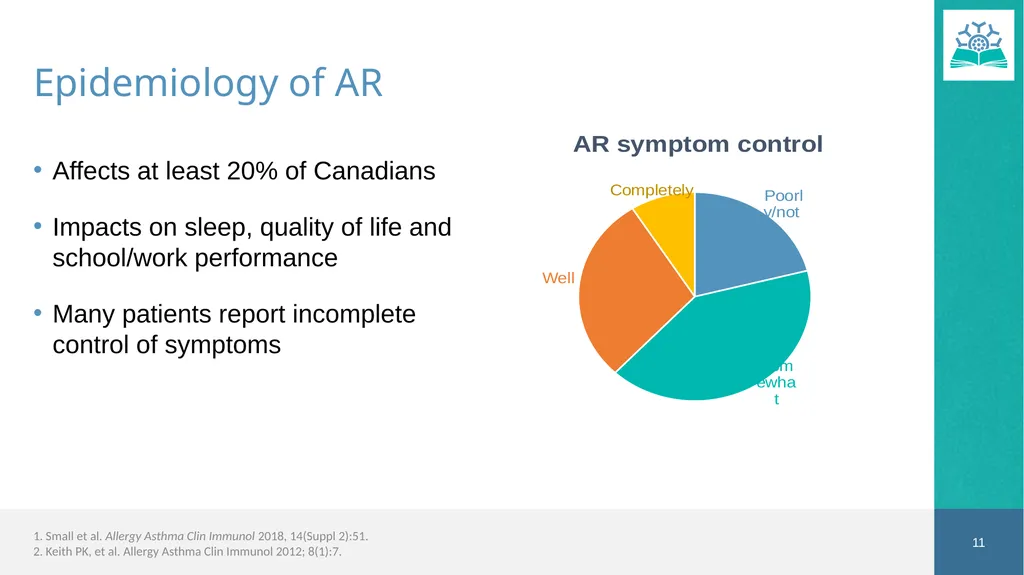
slide11. Epidemiology of AR Affects at least 20% of Canadians
Impacts on sleep, quality of life and school/work performance
Many patients report incomplete control of symptoms 1. Small et al. Allergy Asthma Clin Immunol 2018, 14(Suppl 2):51.
2. Keith PK, et al. Allergy Asthma Clin Immunol 2012; 8(1):7. 11<br>
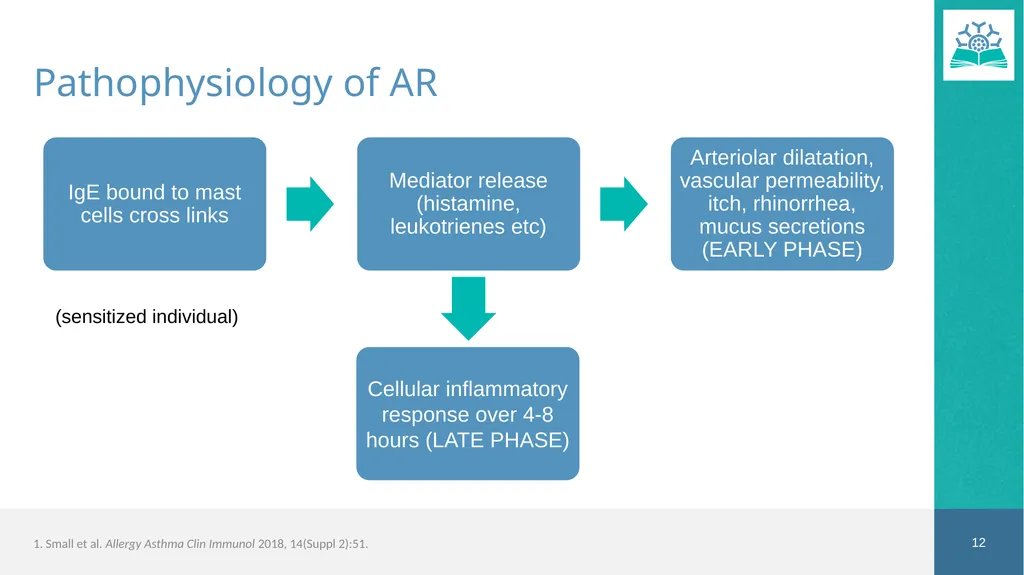
slide12. Pathophysiology of AR (sensitized individual) 12 1. Small et al. Allergy Asthma Clin Immunol 2018, 14(Suppl 2):51.<br>
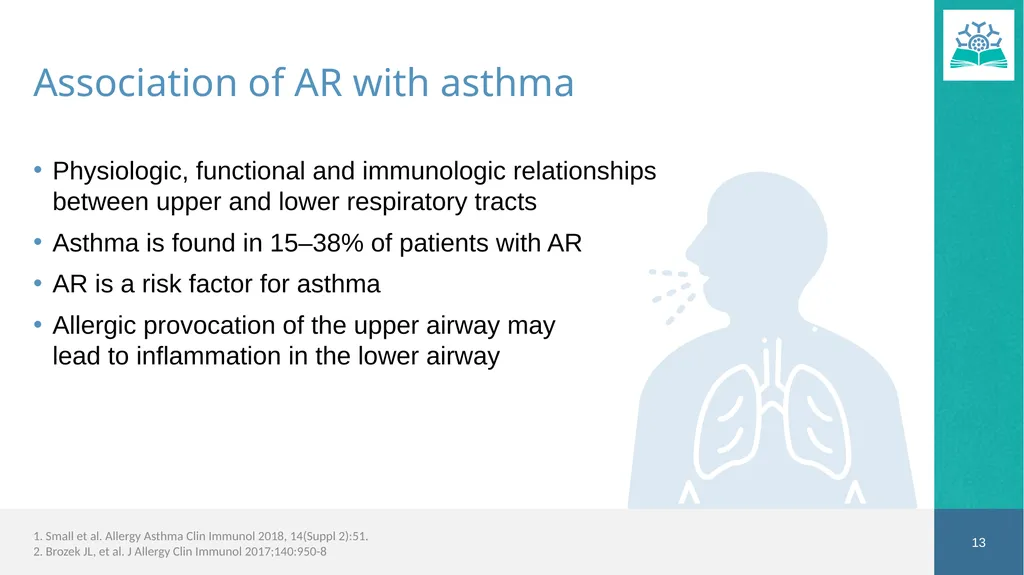
slide13. Association of AR with asthma Physiologic, functional and immunologic relationships between upper and lower respiratory tracts
Asthma is found in 15–38% of patients with AR
AR is a risk factor for asthma
Allergic provocation of the upper airway may lead to inflammation in the lower airway 13 1. Small et al. Allergy Asthma Clin Immunol 2018, 14(Suppl 2):51.
2. Brozek JL, et al. J Allergy Clin Immunol 2017;140:950-8<br>
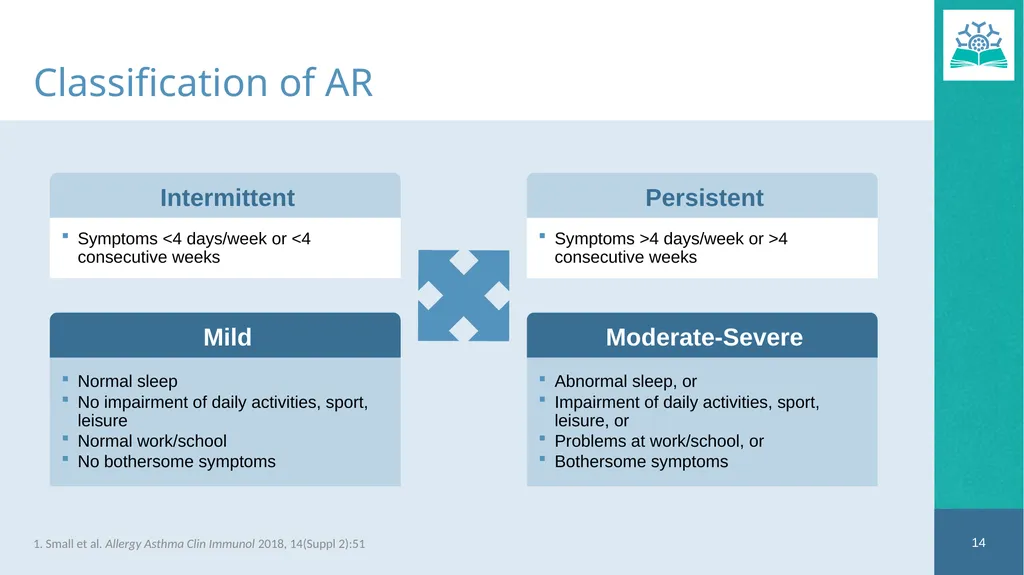
slide14. Classification of AR 1. Small et al. Allergy Asthma Clin Immunol 2018, 14(Suppl 2):51 14 Symptoms <4 days/week or <4 consecutive weeks Intermittent Symptoms >4 days/week or >4 consecutive weeks Persistent Normal sleep
No impairment of daily activities, sport, leisure
Normal work/school
No bothersome symptoms Mild Abnormal sleep, or
Impairment of daily activities, sport, leisure, or
Problems at work/school, or
Bothersome symptoms Moderate-Severe<br>
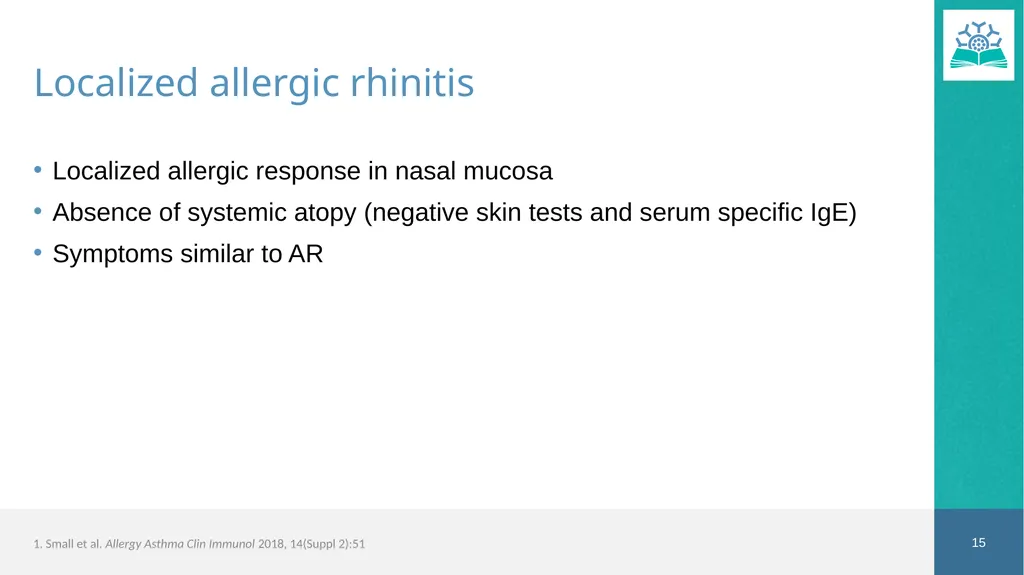
slide15. Localized allergic rhinitis Localized allergic response in nasal mucosa
Absence of systemic atopy (negative skin tests and serum specific IgE)
Symptoms similar to AR 15 1. Small et al. Allergy Asthma Clin Immunol 2018, 14(Suppl 2):51<br>
slide16. Diagnosing AR 16<br>
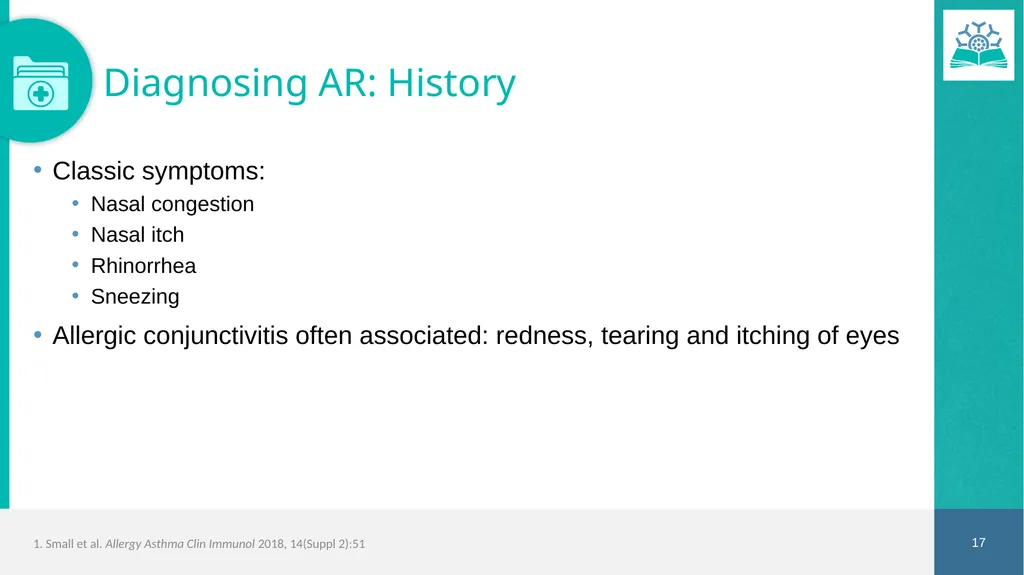
slide17. Diagnosing AR: History Classic symptoms:
Nasal congestion
Nasal itch
Rhinorrhea
Sneezing
Allergic conjunctivitis often associated: redness, tearing and itching of eyes 17 1. Small et al. Allergy Asthma Clin Immunol 2018, 14(Suppl 2):51<br>
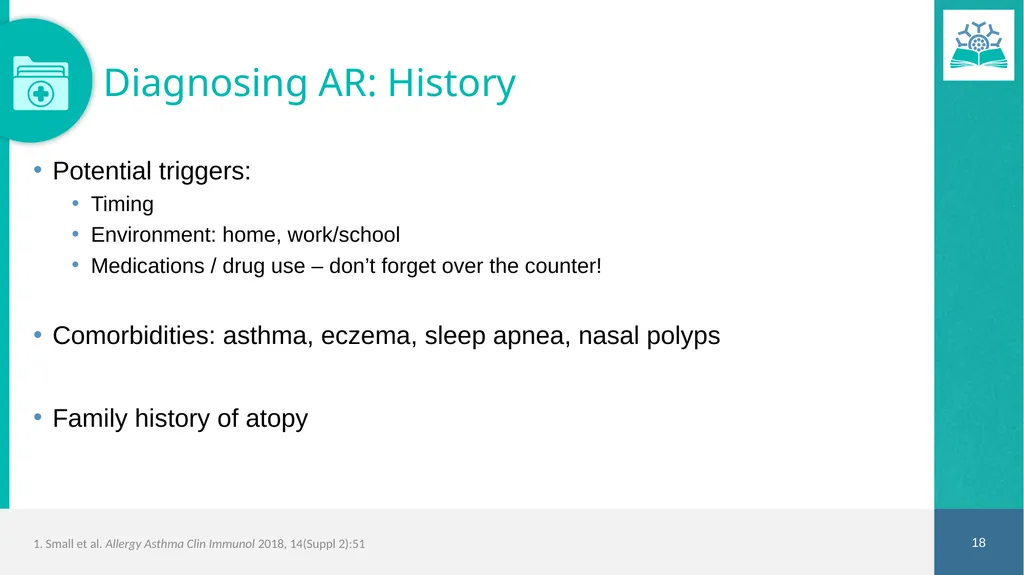
slide18. Potential triggers:
Timing
Environment: home, work/school
Medications / drug use – don’t forget over the counter!
Comorbidities: asthma, eczema, sleep apnea, nasal polyps
Family history of atopy 18 1. Small et al. Allergy Asthma Clin Immunol 2018, 14(Suppl 2):51 Diagnosing AR: History<br>
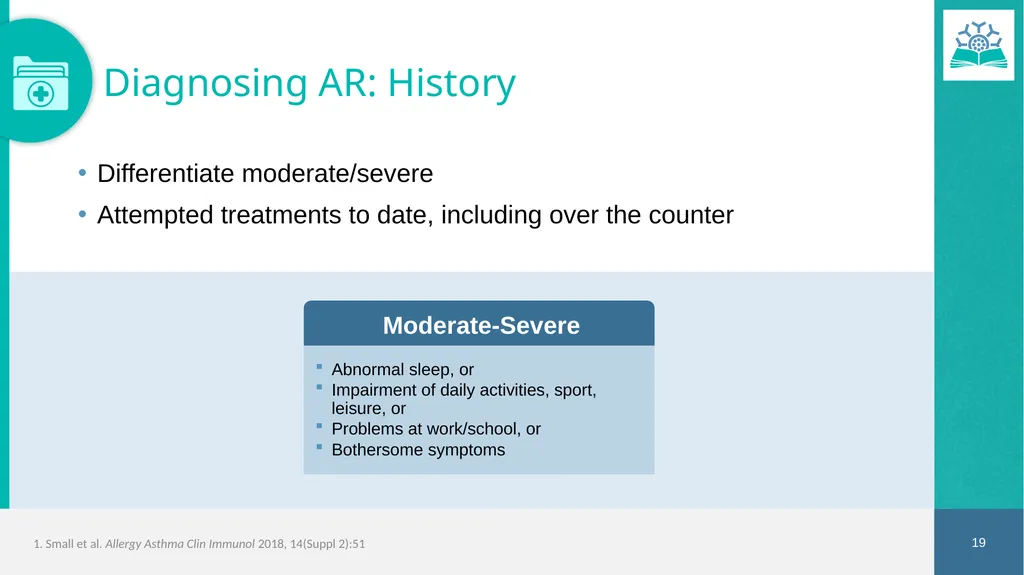
slide19. Differentiate moderate/severe
Attempted treatments to date, including over the counter 19 1. Small et al. Allergy Asthma Clin Immunol 2018, 14(Suppl 2):51 Diagnosing AR: History Abnormal sleep, or
Impairment of daily activities, sport, leisure, or
Problems at work/school, or
Bothersome symptoms Moderate-Severe<br>
slide20. Vasomotor rhinitis – activated by temperature change, irritants, strong odors
Gustatory rhinitis – clear rhinorrhea after eating (hot/spicy food especially)
Nasal polyposis – hyposmia/anosmia, +/- NSAID sensitivity, asthma 20 Kaliner MA. Clin Allergy Immunol 2007;19:351.
Raphael G, et al. J Allergy Clin Immunol 1989;83:110.
Desrosiers M, et al. Allergy Asthma Clin Immunol 2011;7(1):2. Diagnosing AR: History<br>
slide21. Diagnosing AR: Physical exam Observe patient behaviours and general appearance
Inspect the nose and posterior oropharynx: pale mucosa, thin secretions
Polyps, ulceration or septal devlation
Palpate the sinuses
Assess for atopic comorbidities (asthma, dermatitis) 21 1. Small et al. Allergy Asthma Clin Immunol 2018, 14(Suppl 2):51<br>
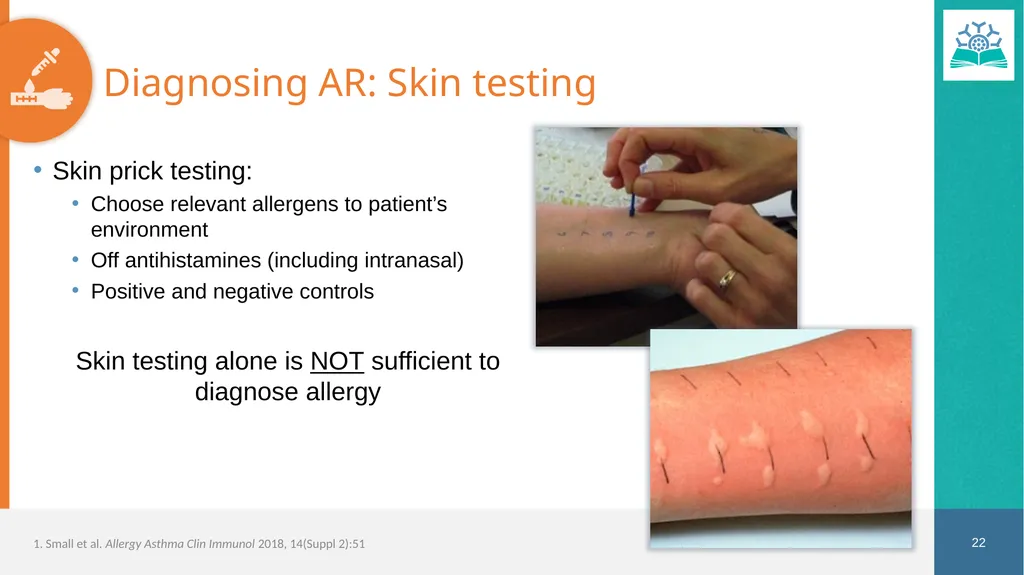
slide22. Diagnosing AR: Skin testing Skin prick testing:
Choose relevant allergens to patient’s environment
Off antihistamines (including intranasal)
Positive and negative controls
Skin testing alone is NOT sufficient to diagnose allergy 22 1. Small et al. Allergy Asthma Clin Immunol 2018, 14(Suppl 2):51<br>
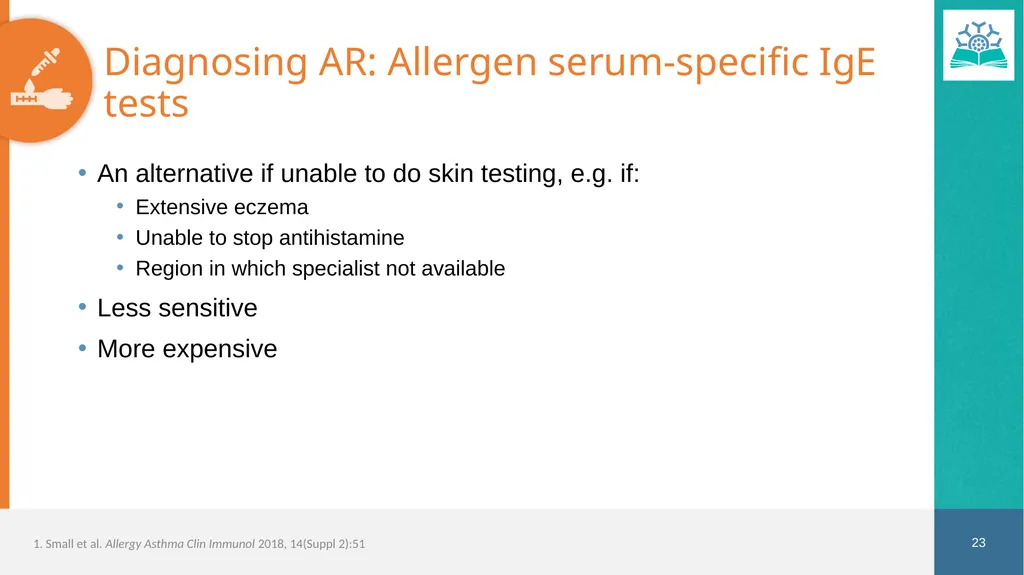
slide23. Diagnosing AR: Allergen serum-specific IgE tests An alternative if unable to do skin testing, e.g. if:
Extensive eczema
Unable to stop antihistamine
Region in which specialist not available
Less sensitive
More expensive 23 1. Small et al. Allergy Asthma Clin Immunol 2018, 14(Suppl 2):51<br>
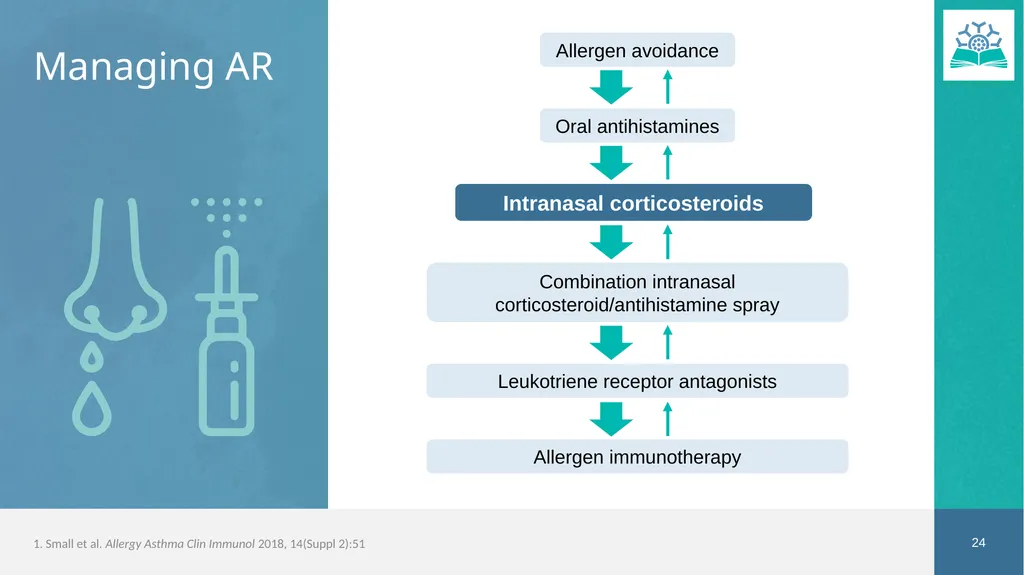
slide24. Managing AR 1. Small et al. Allergy Asthma Clin Immunol 2018, 14(Suppl 2):51 24 Intranasal corticosteroids Allergen avoidance Oral antihistamines Combination intranasal corticosteroid/antihistamine spray Leukotriene receptor antagonists Allergen immunotherapy<br>
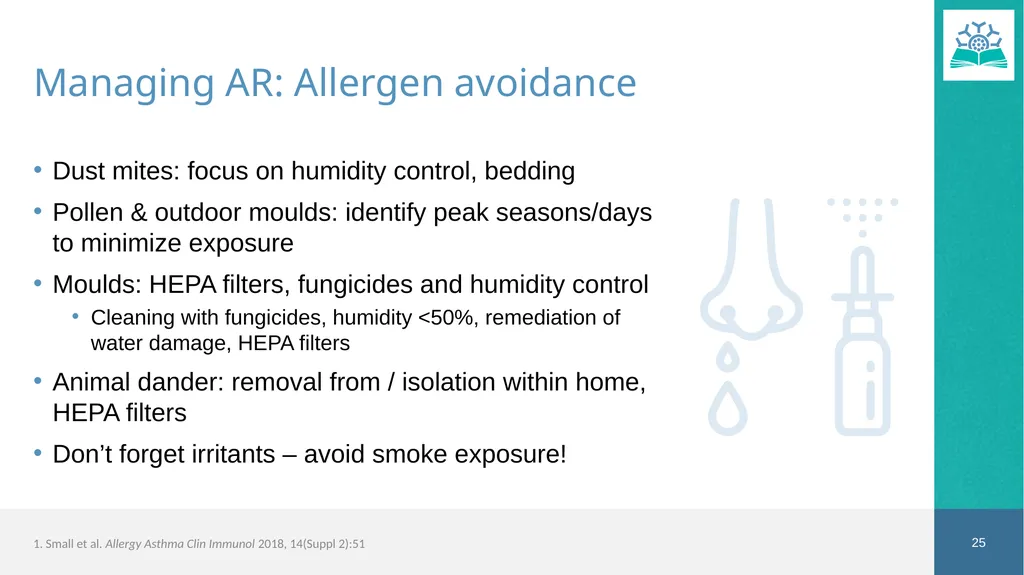
slide25. Managing AR: Allergen avoidance Dust mites: focus on humidity control, bedding
Pollen & outdoor moulds: identify peak seasons/days to minimize exposure
Moulds: HEPA filters, fungicides and humidity control
Cleaning with fungicides, humidity <50%, remediation of water damage, HEPA filters
Animal dander: removal from / isolation within home, HEPA filters
Don’t forget irritants – avoid smoke exposure! 25 1. Small et al. Allergy Asthma Clin Immunol 2018, 14(Suppl 2):51<br>
slide26. Managing AR: Antihistamines Second-generation oral antihistamines
Reduce sneezing, itching, rhinorrhea
Avoid first-generation antihistamines
Diphenhydramine, clorpheniramine
Negatively impact cognition and function 26 1. Small et al. Allergy Asthma Clin Immunol 2018, 14(Suppl 2):51.
2. Small P, et al. J Otolaryntol 2007;36(Suppl 1):S5-S27.<br>
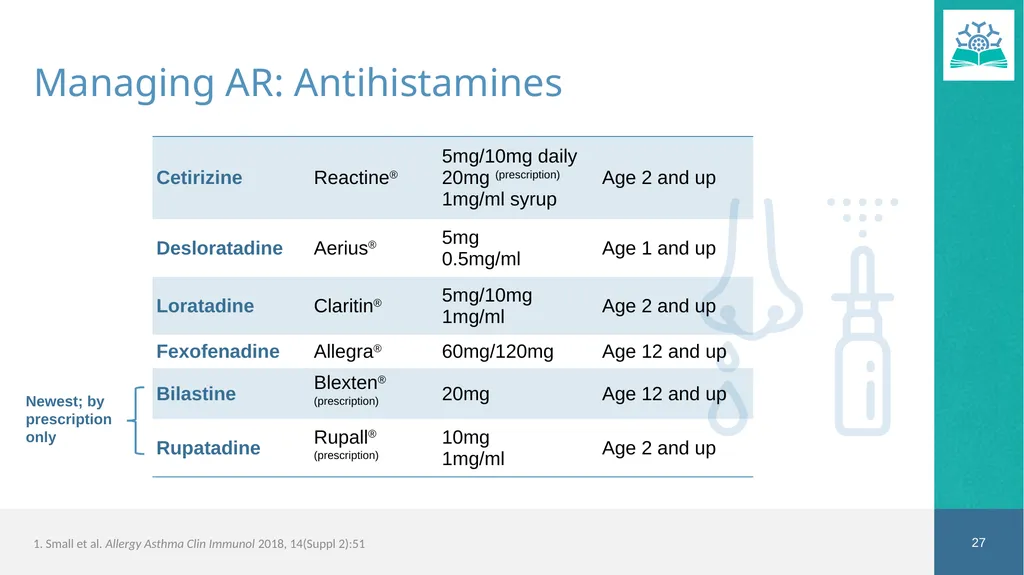
slide27. Managing AR: Antihistamines Newest; by prescription only 27 1. Small et al. Allergy Asthma Clin Immunol 2018, 14(Suppl 2):51<br>
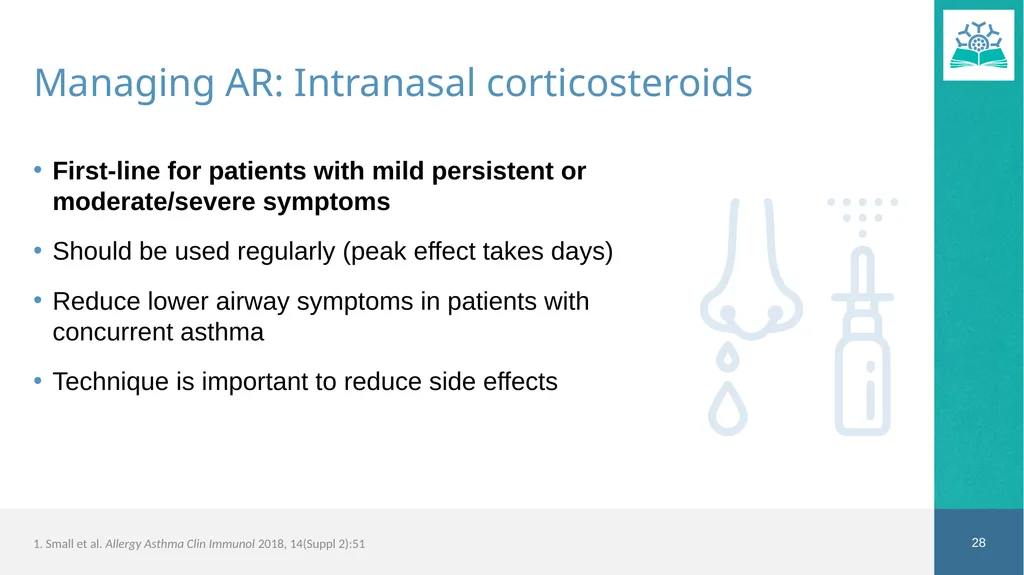
slide28. Managing AR: Intranasal corticosteroids First-line for patients with mild persistent or moderate/severe symptoms
Should be used regularly (peak effect takes days)
Reduce lower airway symptoms in patients with concurrent asthma
Technique is important to reduce side effects 28 1. Small et al. Allergy Asthma Clin Immunol 2018, 14(Suppl 2):51<br>
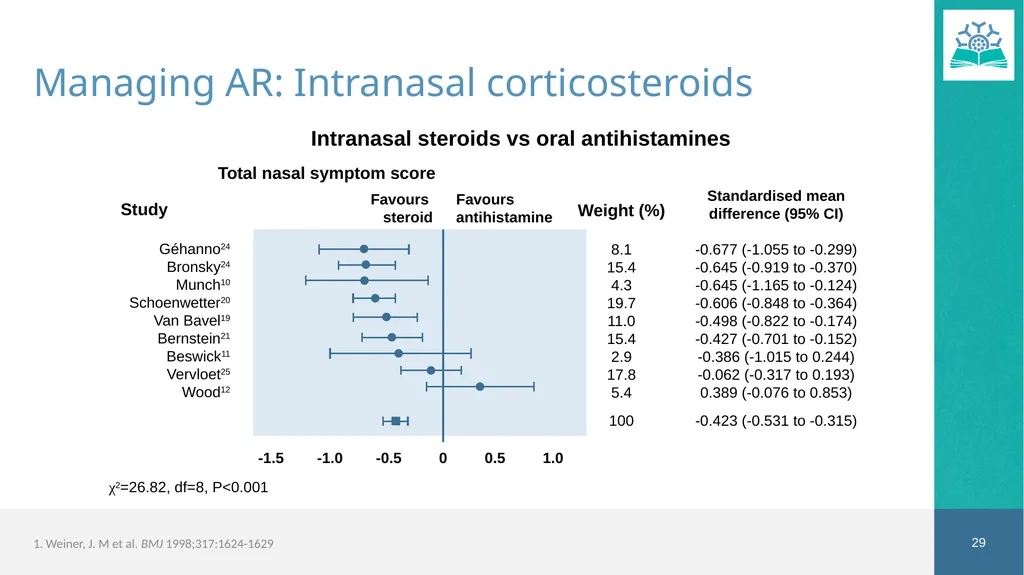
slide29. Managing AR: Intranasal corticosteroids Intranasal steroids vs oral antihistamines 29 1. Weiner, J. M et al. BMJ 1998;317:1624-1629 Total nasal symptom score Study
Géhanno24
Bronsky24
Munch10
Schoenwetter20
Van Bavel19
Bernstein21
Beswick11
Vervloet25
Wood12 χ2=26.82, df=8, P<0.001 Favours steroid Favours antihistamine Weight (%)
8.1
15.4
4.3
19.7
11.0
15.4
2.9
17.8
5.4
100 Standardised mean difference (95% CI)
-0.677 (-1.055 to -0.299)
-0.645 (-0.919 to -0.370)
-0.645 (-1.165 to -0.124)
-0.606 (-0.848 to -0.364)
-0.498 (-0.822 to -0.174)
-0.427 (-0.701 to -0.152)
-0.386 (-1.015 to 0.244)
-0.062 (-0.317 to 0.193)
0.389 (-0.076 to 0.853)
-0.423 (-0.531 to -0.315) -1.5 -1.0 -0.5 0 0.5 1.0<br>
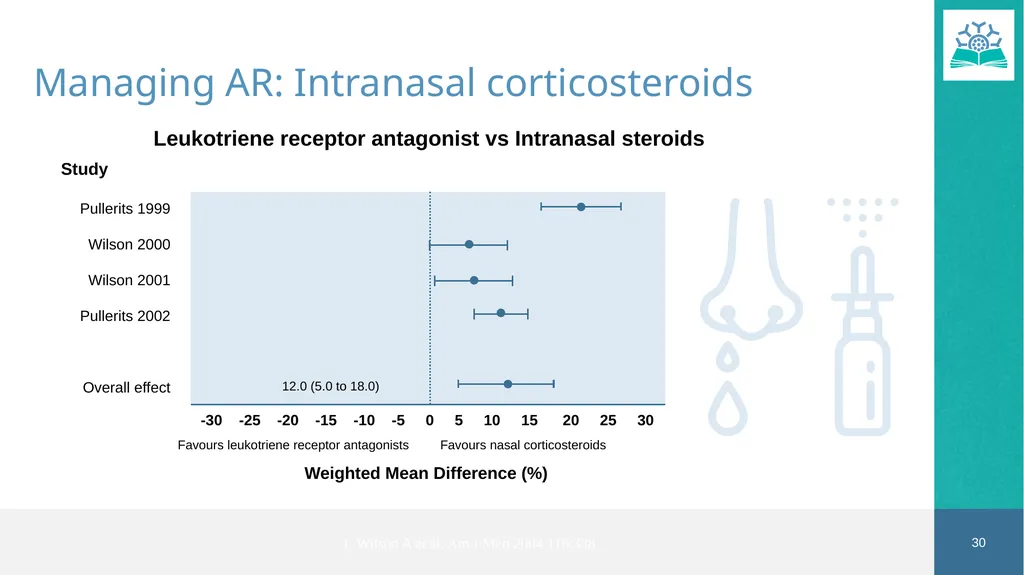
slide30. Managing AR: Intranasal corticosteroids 30 1. Wilson A et al. Am J Med 2004;116:338 Leukotriene receptor antagonist vs Intranasal steroids Study
Pullerits 1999
Wilson 2000
Wilson 2001
Pullerits 2002
Overall effect -30 -25 -20 -15 -10 -5 0 5 10 15 20 25 30 Favours leukotriene receptor antagonists Favours nasal corticosteroids Weighted Mean Difference (%) 12.0 (5.0 to 18.0)<br>
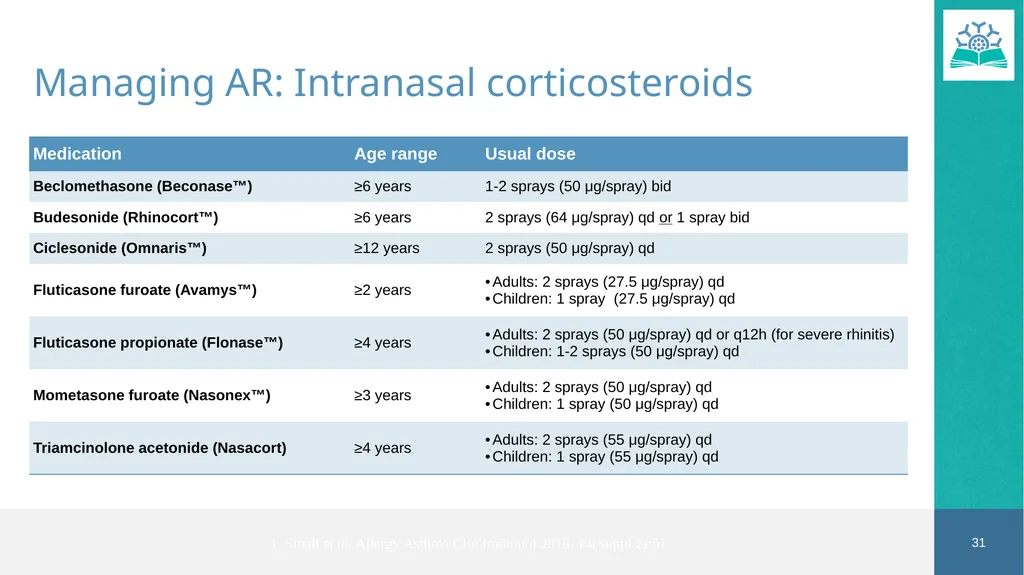
slide31. Managing AR: Intranasal corticosteroids 31 1. Small et al. Allergy Asthma Clin Immunol 2018, 14(Suppl 2):51<br>
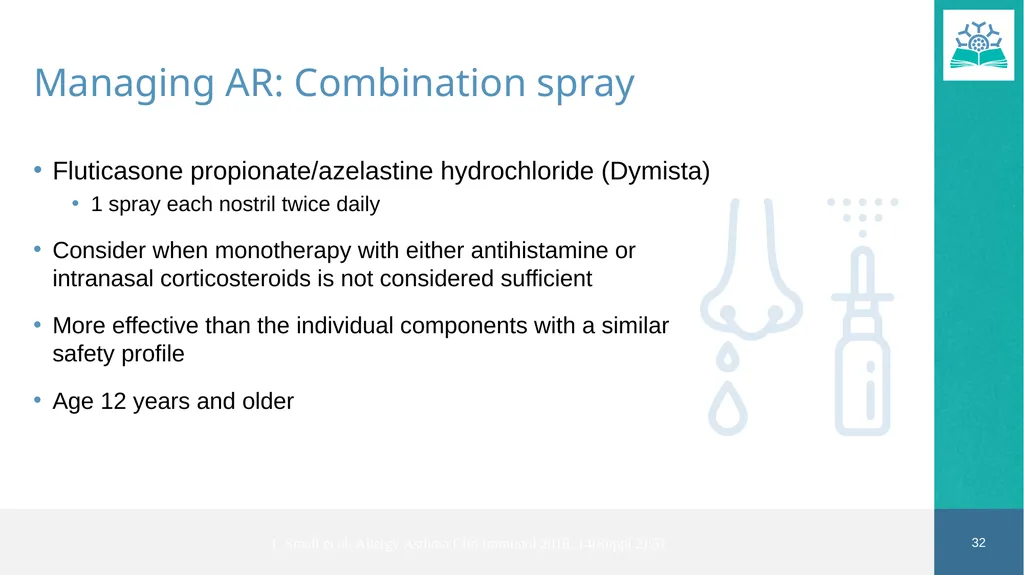
slide32. Managing AR: Combination spray Fluticasone propionate/azelastine hydrochloride (Dymista)
1 spray each nostril twice daily
Consider when monotherapy with either antihistamine or intranasal corticosteroids is not considered sufficient
More effective than the individual components with a similar safety profile
Age 12 years and older 32 1. Small et al. Allergy Asthma Clin Immunol 2018, 14(Suppl 2):51<br>
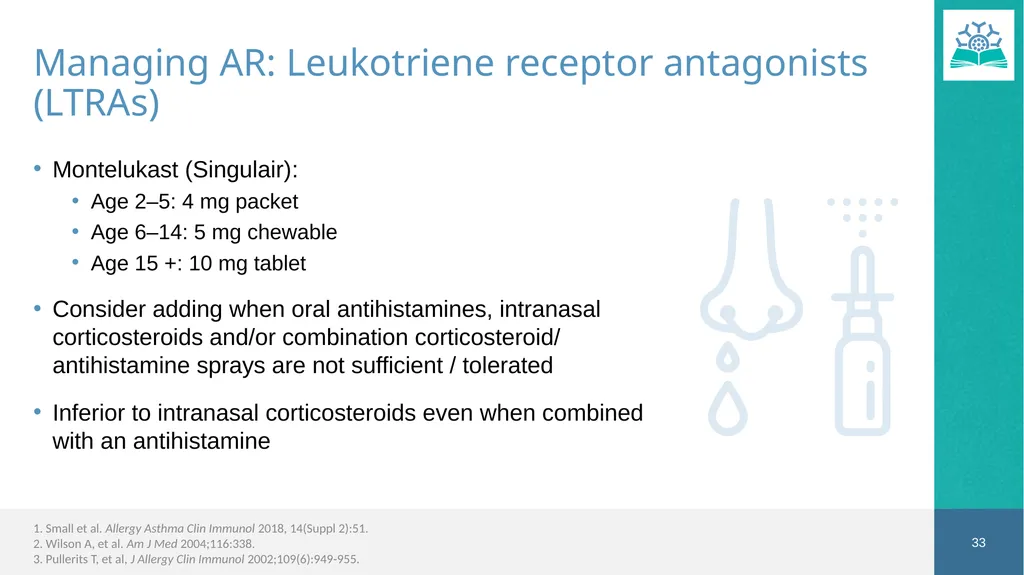
slide33. Managing AR: Leukotriene receptor antagonists (LTRAs) Montelukast (Singulair):
Age 2–5: 4 mg packet
Age 6–14: 5 mg chewable
Age 15 +: 10 mg tablet
Consider adding when oral antihistamines, intranasal corticosteroids and/or combination corticosteroid/ antihistamine sprays are not sufficient / tolerated
Inferior to intranasal corticosteroids even when combined with an antihistamine 33 1. Small et al. Allergy Asthma Clin Immunol 2018, 14(Suppl 2):51.
2. Wilson A, et al. Am J Med 2004;116:338.
3. Pullerits T, et al, J Allergy Clin Immunol 2002;109(6):949-955.<br>
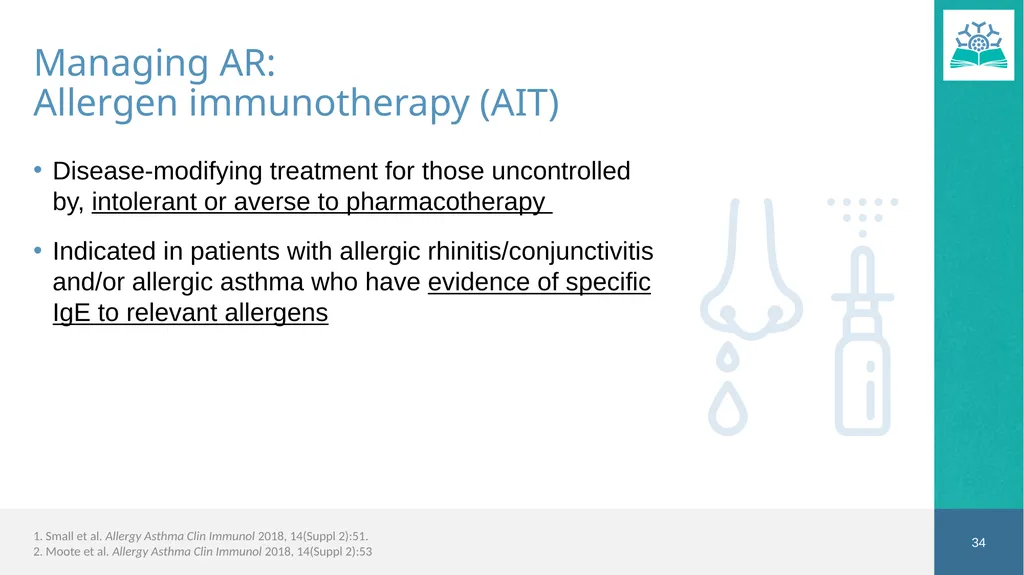
slide34. Managing AR: Allergen immunotherapy (AIT) Disease-modifying treatment for those uncontrolled by, intolerant or averse to pharmacotherapy
Indicated in patients with allergic rhinitis/conjunctivitis and/or allergic asthma who have evidence of specific IgE to relevant allergens 34 1. Small et al. Allergy Asthma Clin Immunol 2018, 14(Suppl 2):51.
2. Moote et al. Allergy Asthma Clin Immunol 2018, 14(Suppl 2):53<br>
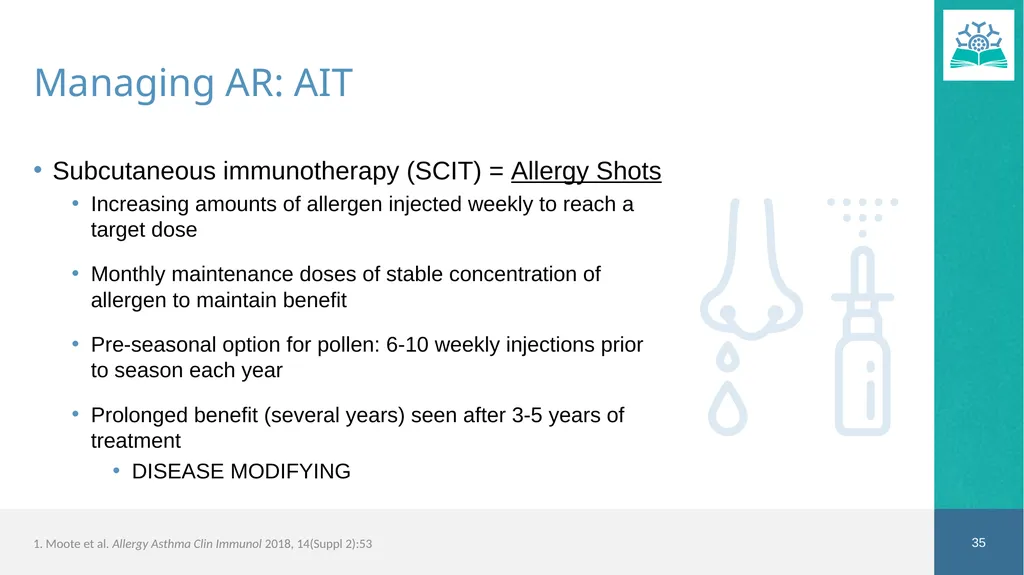
slide35. Managing AR: AIT Subcutaneous immunotherapy (SCIT) = Allergy Shots
Increasing amounts of allergen injected weekly to reach a target dose
Monthly maintenance doses of stable concentration of allergen to maintain benefit
Pre-seasonal option for pollen: 6-10 weekly injections prior to season each year
Prolonged benefit (several years) seen after 3-5 years of treatment
DISEASE MODIFYING 35 1. Moote et al. Allergy Asthma Clin Immunol 2018, 14(Suppl 2):53<br>
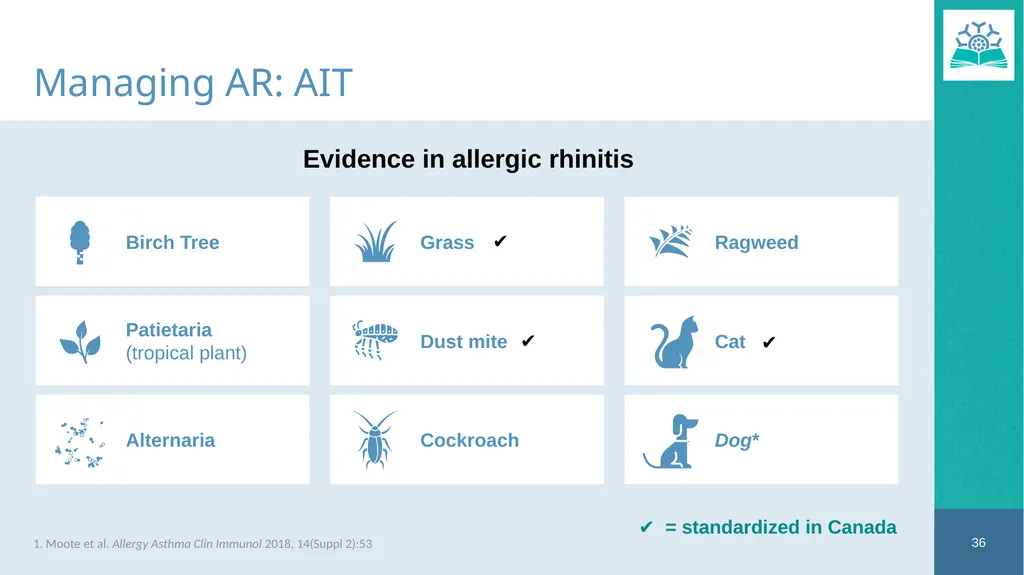
slide36. Managing AR: AIT Evidence in allergic rhinitis 36 1. Moote et al. Allergy Asthma Clin Immunol 2018, 14(Suppl 2):53 Birch Tree Grass Ragweed Patietaria (tropical plant) Dust mite Cat Alternaria Cockroach Dog* ✔️ ✔️ ✔️ ✔️ = standardized in Canada<br>
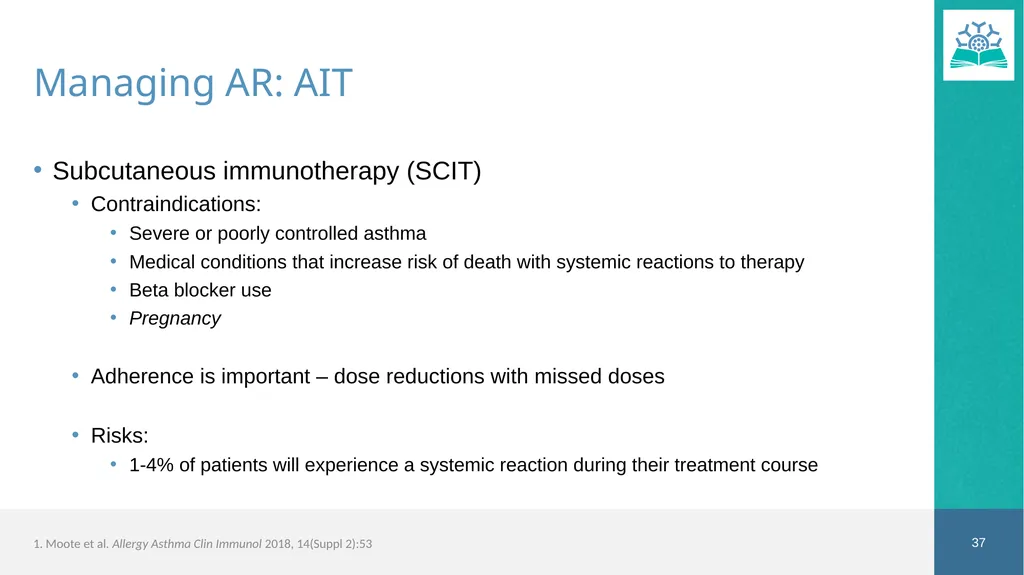
slide37. Managing AR: AIT Subcutaneous immunotherapy (SCIT)
Contraindications:
Severe or poorly controlled asthma
Medical conditions that increase risk of death with systemic reactions to therapy
Beta blocker use
Pregnancy
Adherence is important – dose reductions with missed doses
Risks:
1-4% of patients will experience a systemic reaction during their treatment course 37 1. Moote et al. Allergy Asthma Clin Immunol 2018, 14(Suppl 2):53<br>
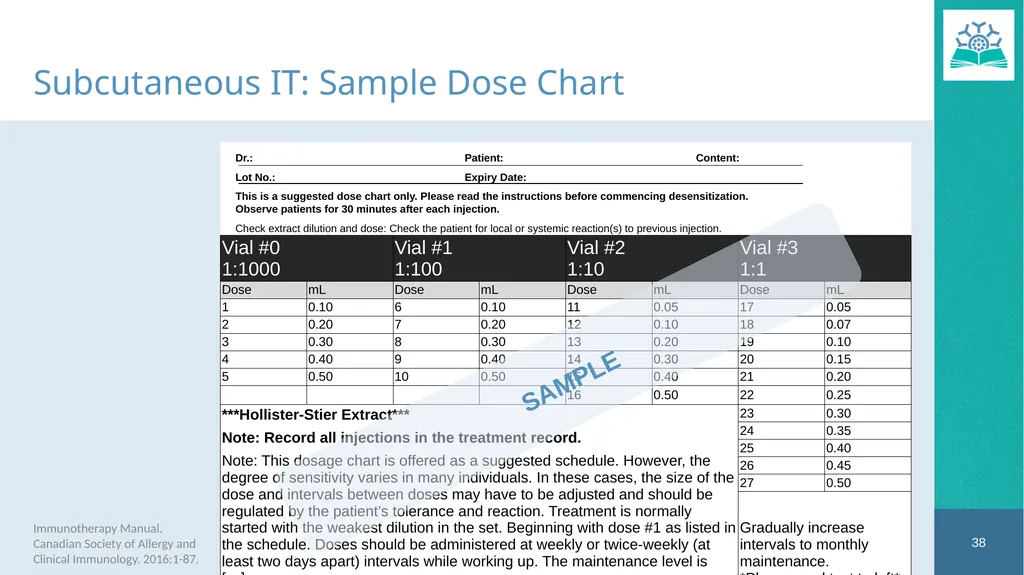
slide38. Subcutaneous IT: Sample Dose Chart Immunotherapy Manual. Canadian Society of Allergy and Clinical Immunology. 2016:1-87. 38<br>
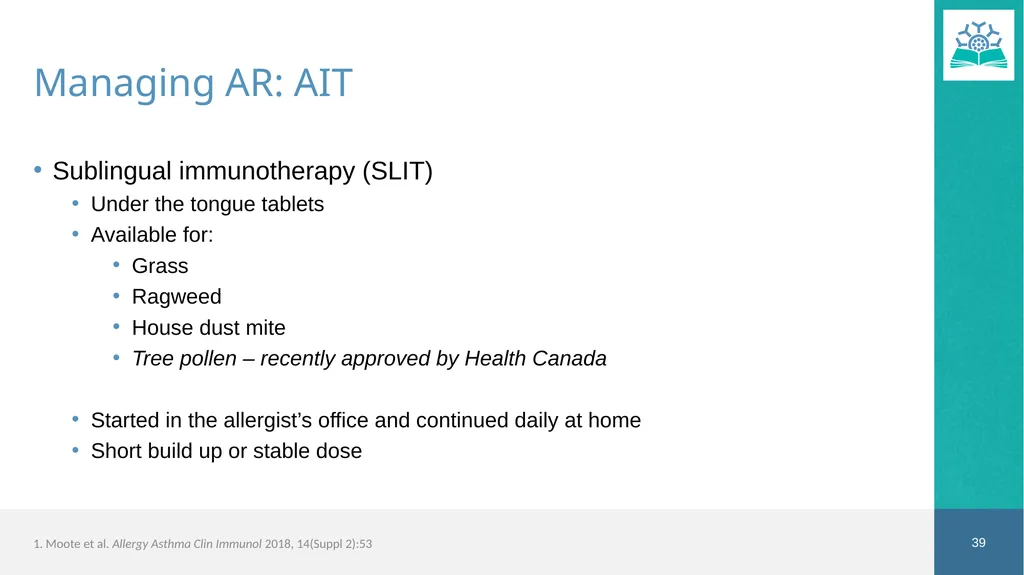
slide39. Managing AR: AIT Sublingual immunotherapy (SLIT)
Under the tongue tablets
Available for:
Grass
Ragweed
House dust mite
Tree pollen – recently approved by Health Canada
Started in the allergist’s office and continued daily at home
Short build up or stable dose 39 1. Moote et al. Allergy Asthma Clin Immunol 2018, 14(Suppl 2):53<br>
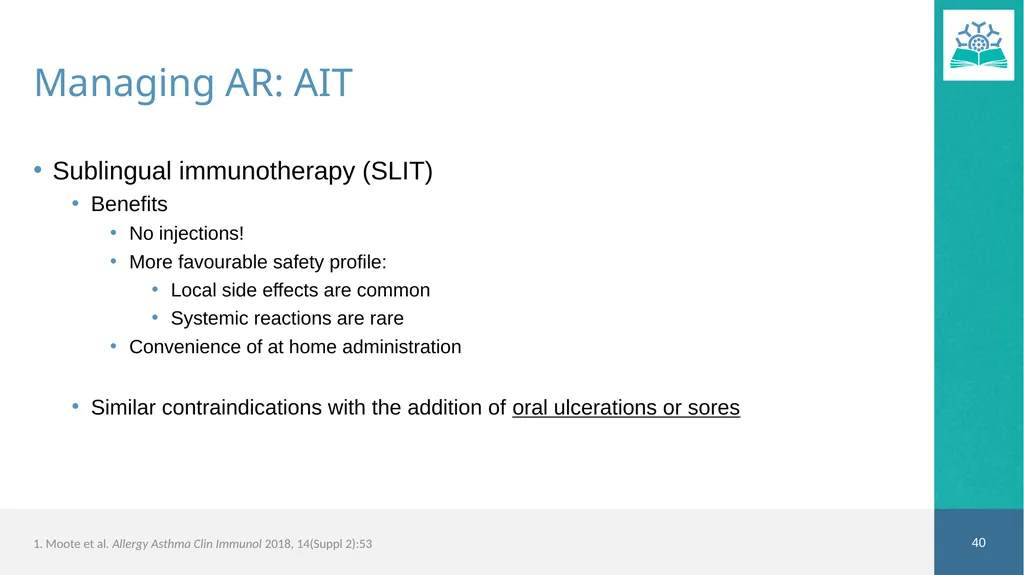
slide40. Managing AR: AIT Sublingual immunotherapy (SLIT)
Benefits
No injections!
More favourable safety profile:
Local side effects are common
Systemic reactions are rare
Convenience of at home administration
Similar contraindications with the addition of oral ulcerations or sores 40 1. Moote et al. Allergy Asthma Clin Immunol 2018, 14(Suppl 2):53<br>
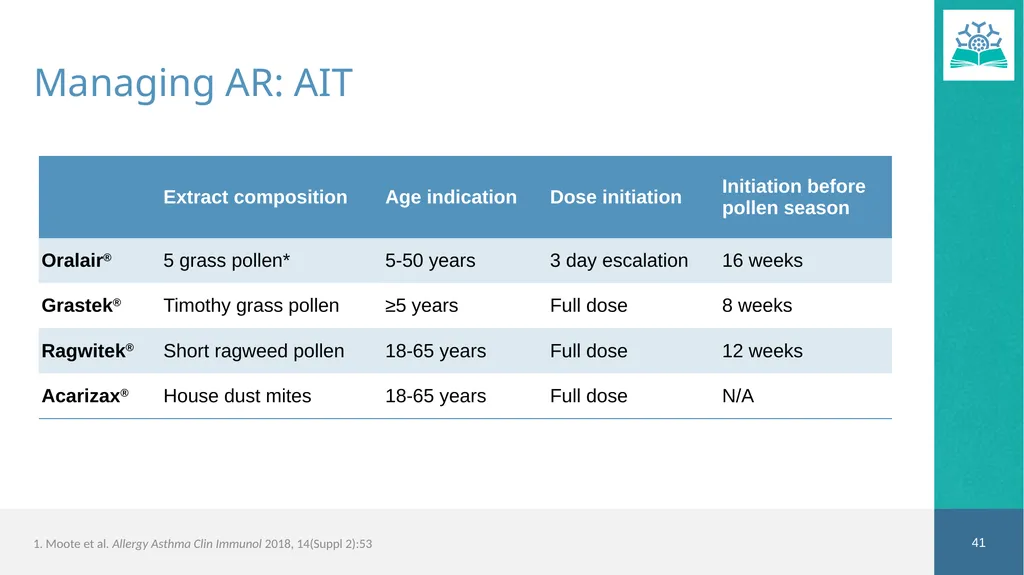
slide41. Managing AR: AIT 41 1. Moote et al. Allergy Asthma Clin Immunol 2018, 14(Suppl 2):53<br>
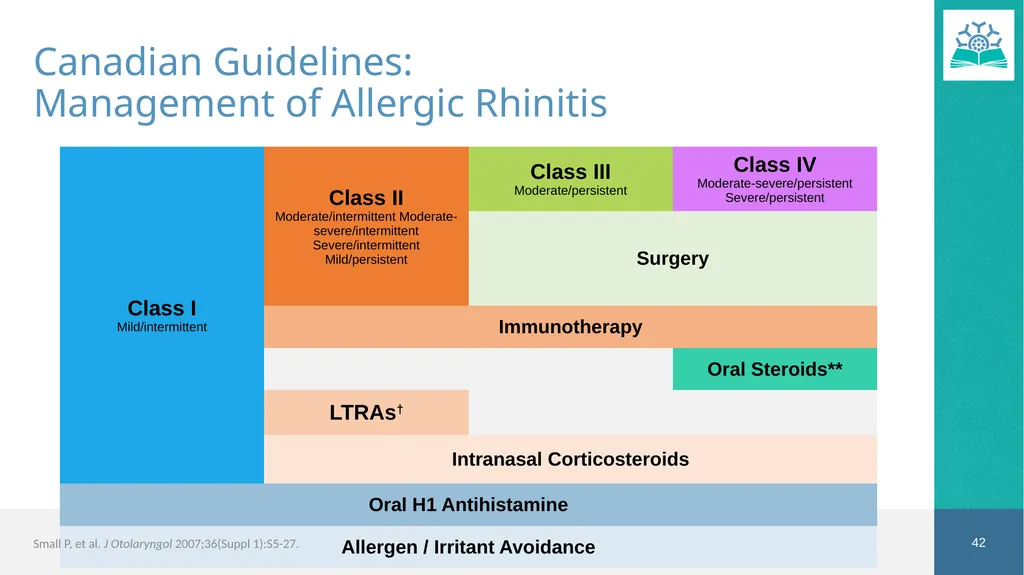
slide42. Canadian Guidelines: Management of Allergic Rhinitis LTRAs: leukotriene receptor antagonists. *Step up if there is no response or incomplete response to treatment, regardless of class.
†LTRAs may be used in class III and IV, but there is less supporting evidence.
**Oral steroids may be considered for class II (severe intermittent), but there is little supportive evidence. 42 Small P, et al. J Otolaryngol 2007;36(Suppl 1):S5-27.<br>
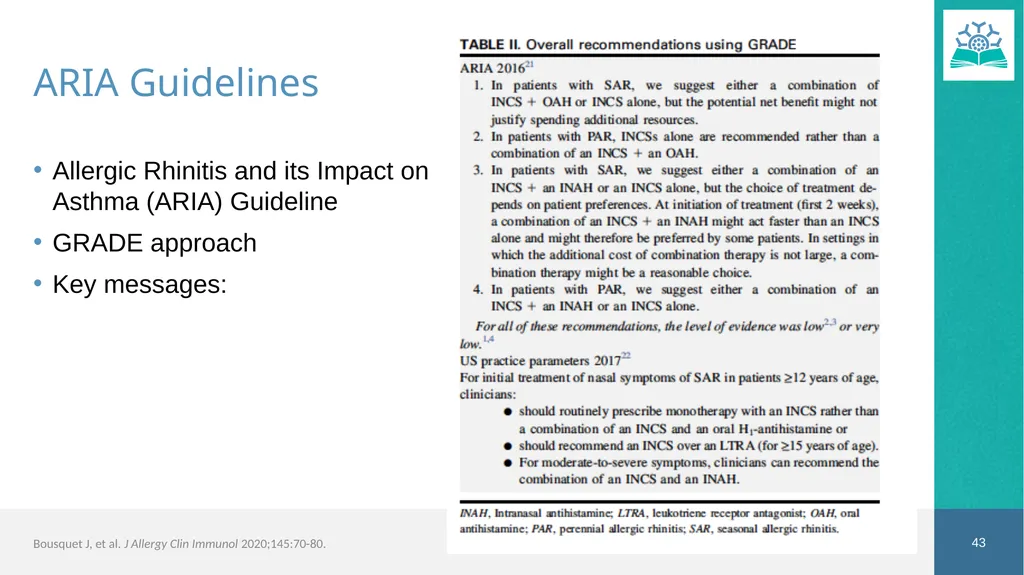
slide43. ARIA Guidelines Allergic Rhinitis and its Impact on Asthma (ARIA) Guideline
GRADE approach
Key messages: 43 Bousquet J, et al. J Allergy Clin Immunol 2020;145:70-80.<br>
slide44. When to Refer to a Specialist? The diagnosis of allergic rhinitis is in question
The culprit allergen is not clear (to assist with avoidance measures)
The patient’s response to therapy is not satisfactory
For consideration of disease modifying therapy (allergen immunotherapy) 44<br>
slide45. When to Refer to a Specialist? Consider referral or re-referral of patients with Chronic Sinusitis with Nasal Polyposis!
Dupixent (Dupilumab) - NEW biologic for treatment of CRSwNP 45<br>
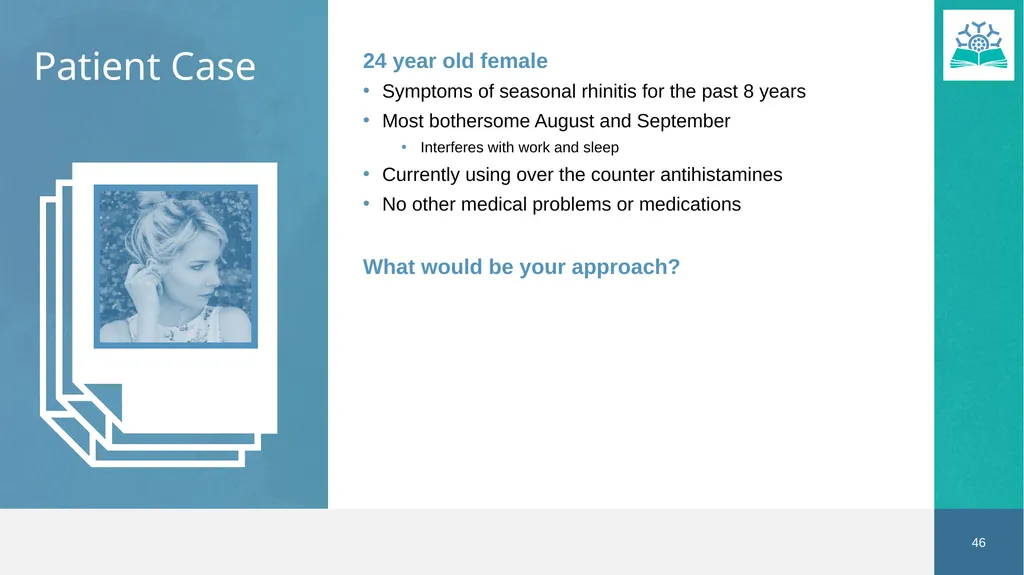
slide46. Patient Case 24 year old female
Symptoms of seasonal rhinitis for the past 8 years
Most bothersome August and September
Interferes with work and sleep
Currently using over the counter antihistamines
No other medical problems or medications
What would be your approach? 46<br>
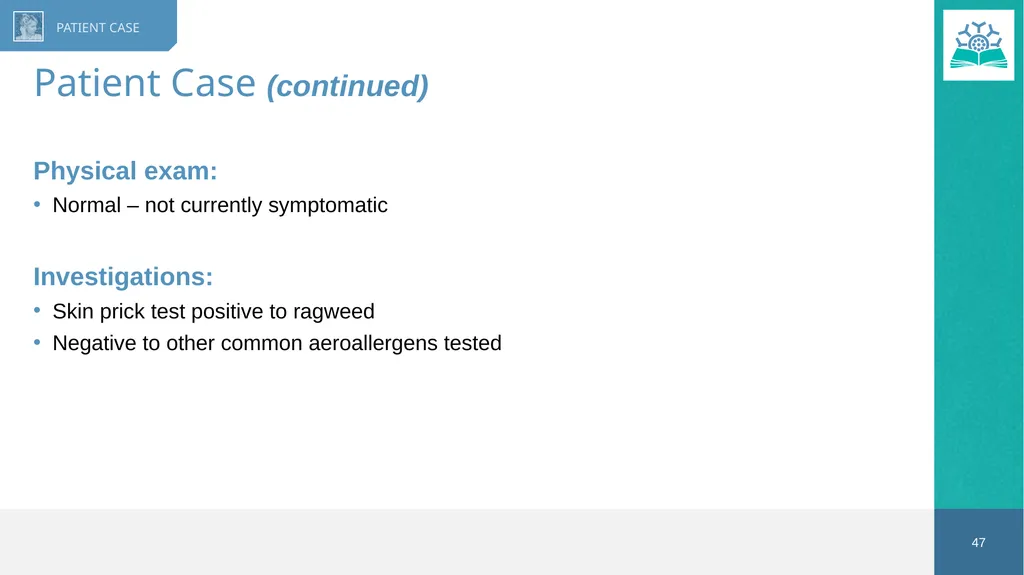
slide47. Patient Case (continued) Physical exam:
Normal – not currently symptomatic
Investigations:
Skin prick test positive to ragweed
Negative to other common aeroallergens tested 47<br>
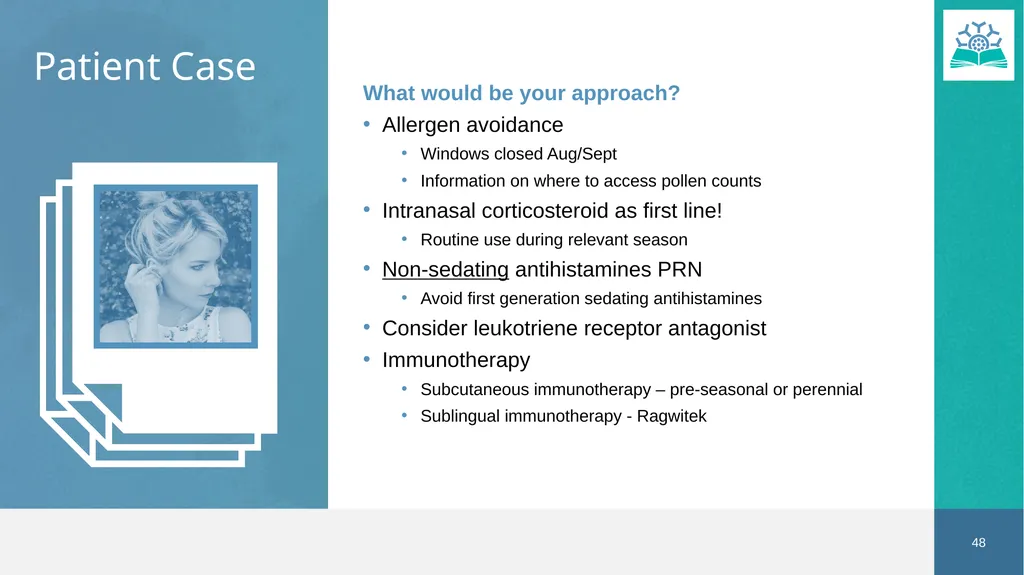
slide48. Patient Case What would be your approach?
Allergen avoidance
Windows closed Aug/Sept
Information on where to access pollen counts
Intranasal corticosteroid as first line!
Routine use during relevant season
Non-sedating antihistamines PRN
Avoid first generation sedating antihistamines
Consider leukotriene receptor antagonist
Immunotherapy
Subcutaneous immunotherapy – pre-seasonal or perennial
Sublingual immunotherapy - Ragwitek 48<br>
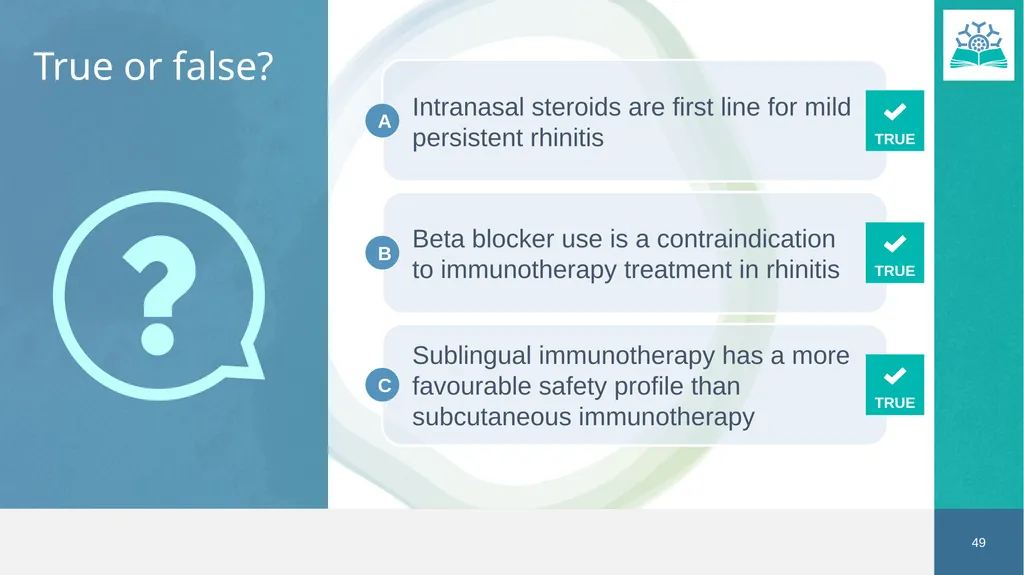
slide49. True or false? 49 Intranasal steroids are first line for mild persistent rhinitis A Beta blocker use is a contraindication to immunotherapy treatment in rhinitis B Sublingual immunotherapy has a more favourable safety profile than subcutaneous immunotherapy C<br>
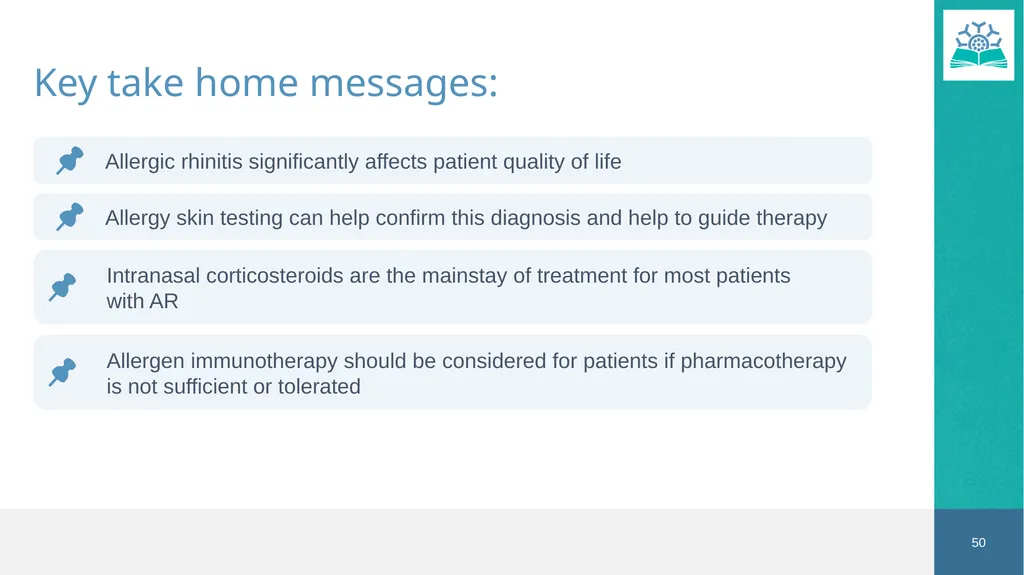
slide50. Key take home messages: 50 Allergic rhinitis significantly affects patient quality of life Allergen immunotherapy should be considered for patients if pharmacotherapy is not sufficient or tolerated Allergy skin testing can help confirm this diagnosis and help to guide therapy Intranasal corticosteroids are the mainstay of treatment for most patients with AR<br>
slide51. Thank you for your attention! Any questions?
Please complete your session evaluation – your feedback is appreciated!<br>
slide2. Faculty Dr. Jaclyn Quirt
MD, FRCPC
Program Director, McMaster Pediatric and Adult Clinical Immunology and Allergy, McMaster University
Assistant Clinical Professor, McMaster University
Section Advisor of Rhinitis and Sinusitis at Canadian Society of Allergy & Clinical Immunology 2<br>
slide3. Faculty/Presenter Disclosure Faculty: [Speaker’s name]
Relationships with financial sponsors:
Any direct financial relationships including receipt of honoraria: PharmaCorp ABC, Canadian Cancer Org.
Memberships on advisory boards or speakers’ bureau: XYZ Biopharmaceuticals Ltd.
Patents for drugs or devices: Widget ABC
Other: financial relationships/investments Employee of XXY Hospital Group, consultant for Company X 3<br>
slide4. Disclosure of Financial Support This program has received financial support from [organization name] in the form of [describe support here – e.g. an educational grant].
This program has received in-kind support from [organization name] in the form of [describe support here – e.g. logistical support].
Potential for conflict(s) of interest:
[Speaker/Faculty name] has received [payment/funding, etc.] from [organization supporting this program AND/OR organization whose product(s) are being discussed in this program].
[Supporting organization name] [developed/licenses/distributes/benefits from the sale of, etc.] a product that will be discussed in this program 4<br>
slide5. Mitigating Potential Bias Potential sources of bias identified in slides 3 and 4 have been mitigated by the scientific planning committee by:
A review/approval of each presenter(s) COI slides
Discussing potential conflicts directly with presenter(s) including avoidance of personal recommendations and limiting discussion to solely evidence-based content (where identified conflict exists) 5<br>
slide6. Accreditation 6 This 1-credit-per-hour Group Learning program has been certified by the College of Family of Physicians of Canada and the [insert province] Chapter for up to [insert total # of credits] Mainpro+® credits. Certificates of attendance will be provided to participants following the event for CPD tracking/record keeping.<br>
slide7. Learning Objectives 7 Review the workup and diagnosis of patients with allergic rhinitis (AR) Optimize non-pharmacological and pharmacological therapy for AR Describe the indications for and process of initiating allergen immunotherapy Decide when to refer patients with rhinitis to an allergist By the end of the program, participants will be able to:<br>
slide8. True or false? 8 Intranasal steroids are first line for mild persistent rhinitis A Beta blocker use is a contraindication to immunotherapy treatment in rhinitis B Sublingual immunotherapy has a more favourable safety profile than subcutaneous immunotherapy C<br>
slide9. Patient Case 24-year-old female
Symptoms of seasonal rhinitis for the past 8 years
Most bothersome in August and September
Currently using over-the-counter antihistamines
No other medical problems or medications
What would be your approach? 9<br>
slide10. Etiological classification of rhinitis 10 Small et al. Allergy Asthma Clin Immunol 2018, 14(Suppl 2):51<br>
slide11. Epidemiology of AR Affects at least 20% of Canadians
Impacts on sleep, quality of life and school/work performance
Many patients report incomplete control of symptoms 1. Small et al. Allergy Asthma Clin Immunol 2018, 14(Suppl 2):51.
2. Keith PK, et al. Allergy Asthma Clin Immunol 2012; 8(1):7. 11<br>
slide12. Pathophysiology of AR (sensitized individual) 12 1. Small et al. Allergy Asthma Clin Immunol 2018, 14(Suppl 2):51.<br>
slide13. Association of AR with asthma Physiologic, functional and immunologic relationships between upper and lower respiratory tracts
Asthma is found in 15–38% of patients with AR
AR is a risk factor for asthma
Allergic provocation of the upper airway may lead to inflammation in the lower airway 13 1. Small et al. Allergy Asthma Clin Immunol 2018, 14(Suppl 2):51.
2. Brozek JL, et al. J Allergy Clin Immunol 2017;140:950-8<br>
slide14. Classification of AR 1. Small et al. Allergy Asthma Clin Immunol 2018, 14(Suppl 2):51 14 Symptoms <4 days/week or <4 consecutive weeks Intermittent Symptoms >4 days/week or >4 consecutive weeks Persistent Normal sleep
No impairment of daily activities, sport, leisure
Normal work/school
No bothersome symptoms Mild Abnormal sleep, or
Impairment of daily activities, sport, leisure, or
Problems at work/school, or
Bothersome symptoms Moderate-Severe<br>
slide15. Localized allergic rhinitis Localized allergic response in nasal mucosa
Absence of systemic atopy (negative skin tests and serum specific IgE)
Symptoms similar to AR 15 1. Small et al. Allergy Asthma Clin Immunol 2018, 14(Suppl 2):51<br>
slide16. Diagnosing AR 16<br>
slide17. Diagnosing AR: History Classic symptoms:
Nasal congestion
Nasal itch
Rhinorrhea
Sneezing
Allergic conjunctivitis often associated: redness, tearing and itching of eyes 17 1. Small et al. Allergy Asthma Clin Immunol 2018, 14(Suppl 2):51<br>
slide18. Potential triggers:
Timing
Environment: home, work/school
Medications / drug use – don’t forget over the counter!
Comorbidities: asthma, eczema, sleep apnea, nasal polyps
Family history of atopy 18 1. Small et al. Allergy Asthma Clin Immunol 2018, 14(Suppl 2):51 Diagnosing AR: History<br>
slide19. Differentiate moderate/severe
Attempted treatments to date, including over the counter 19 1. Small et al. Allergy Asthma Clin Immunol 2018, 14(Suppl 2):51 Diagnosing AR: History Abnormal sleep, or
Impairment of daily activities, sport, leisure, or
Problems at work/school, or
Bothersome symptoms Moderate-Severe<br>
slide20. Vasomotor rhinitis – activated by temperature change, irritants, strong odors
Gustatory rhinitis – clear rhinorrhea after eating (hot/spicy food especially)
Nasal polyposis – hyposmia/anosmia, +/- NSAID sensitivity, asthma 20 Kaliner MA. Clin Allergy Immunol 2007;19:351.
Raphael G, et al. J Allergy Clin Immunol 1989;83:110.
Desrosiers M, et al. Allergy Asthma Clin Immunol 2011;7(1):2. Diagnosing AR: History<br>
slide21. Diagnosing AR: Physical exam Observe patient behaviours and general appearance
Inspect the nose and posterior oropharynx: pale mucosa, thin secretions
Polyps, ulceration or septal devlation
Palpate the sinuses
Assess for atopic comorbidities (asthma, dermatitis) 21 1. Small et al. Allergy Asthma Clin Immunol 2018, 14(Suppl 2):51<br>
slide22. Diagnosing AR: Skin testing Skin prick testing:
Choose relevant allergens to patient’s environment
Off antihistamines (including intranasal)
Positive and negative controls
Skin testing alone is NOT sufficient to diagnose allergy 22 1. Small et al. Allergy Asthma Clin Immunol 2018, 14(Suppl 2):51<br>
slide23. Diagnosing AR: Allergen serum-specific IgE tests An alternative if unable to do skin testing, e.g. if:
Extensive eczema
Unable to stop antihistamine
Region in which specialist not available
Less sensitive
More expensive 23 1. Small et al. Allergy Asthma Clin Immunol 2018, 14(Suppl 2):51<br>
slide24. Managing AR 1. Small et al. Allergy Asthma Clin Immunol 2018, 14(Suppl 2):51 24 Intranasal corticosteroids Allergen avoidance Oral antihistamines Combination intranasal corticosteroid/antihistamine spray Leukotriene receptor antagonists Allergen immunotherapy<br>
slide25. Managing AR: Allergen avoidance Dust mites: focus on humidity control, bedding
Pollen & outdoor moulds: identify peak seasons/days to minimize exposure
Moulds: HEPA filters, fungicides and humidity control
Cleaning with fungicides, humidity <50%, remediation of water damage, HEPA filters
Animal dander: removal from / isolation within home, HEPA filters
Don’t forget irritants – avoid smoke exposure! 25 1. Small et al. Allergy Asthma Clin Immunol 2018, 14(Suppl 2):51<br>
slide26. Managing AR: Antihistamines Second-generation oral antihistamines
Reduce sneezing, itching, rhinorrhea
Avoid first-generation antihistamines
Diphenhydramine, clorpheniramine
Negatively impact cognition and function 26 1. Small et al. Allergy Asthma Clin Immunol 2018, 14(Suppl 2):51.
2. Small P, et al. J Otolaryntol 2007;36(Suppl 1):S5-S27.<br>
slide27. Managing AR: Antihistamines Newest; by prescription only 27 1. Small et al. Allergy Asthma Clin Immunol 2018, 14(Suppl 2):51<br>
slide28. Managing AR: Intranasal corticosteroids First-line for patients with mild persistent or moderate/severe symptoms
Should be used regularly (peak effect takes days)
Reduce lower airway symptoms in patients with concurrent asthma
Technique is important to reduce side effects 28 1. Small et al. Allergy Asthma Clin Immunol 2018, 14(Suppl 2):51<br>
slide29. Managing AR: Intranasal corticosteroids Intranasal steroids vs oral antihistamines 29 1. Weiner, J. M et al. BMJ 1998;317:1624-1629 Total nasal symptom score Study
Géhanno24
Bronsky24
Munch10
Schoenwetter20
Van Bavel19
Bernstein21
Beswick11
Vervloet25
Wood12 χ2=26.82, df=8, P<0.001 Favours steroid Favours antihistamine Weight (%)
8.1
15.4
4.3
19.7
11.0
15.4
2.9
17.8
5.4
100 Standardised mean difference (95% CI)
-0.677 (-1.055 to -0.299)
-0.645 (-0.919 to -0.370)
-0.645 (-1.165 to -0.124)
-0.606 (-0.848 to -0.364)
-0.498 (-0.822 to -0.174)
-0.427 (-0.701 to -0.152)
-0.386 (-1.015 to 0.244)
-0.062 (-0.317 to 0.193)
0.389 (-0.076 to 0.853)
-0.423 (-0.531 to -0.315) -1.5 -1.0 -0.5 0 0.5 1.0<br>
slide30. Managing AR: Intranasal corticosteroids 30 1. Wilson A et al. Am J Med 2004;116:338 Leukotriene receptor antagonist vs Intranasal steroids Study
Pullerits 1999
Wilson 2000
Wilson 2001
Pullerits 2002
Overall effect -30 -25 -20 -15 -10 -5 0 5 10 15 20 25 30 Favours leukotriene receptor antagonists Favours nasal corticosteroids Weighted Mean Difference (%) 12.0 (5.0 to 18.0)<br>
slide31. Managing AR: Intranasal corticosteroids 31 1. Small et al. Allergy Asthma Clin Immunol 2018, 14(Suppl 2):51<br>
slide32. Managing AR: Combination spray Fluticasone propionate/azelastine hydrochloride (Dymista)
1 spray each nostril twice daily
Consider when monotherapy with either antihistamine or intranasal corticosteroids is not considered sufficient
More effective than the individual components with a similar safety profile
Age 12 years and older 32 1. Small et al. Allergy Asthma Clin Immunol 2018, 14(Suppl 2):51<br>
slide33. Managing AR: Leukotriene receptor antagonists (LTRAs) Montelukast (Singulair):
Age 2–5: 4 mg packet
Age 6–14: 5 mg chewable
Age 15 +: 10 mg tablet
Consider adding when oral antihistamines, intranasal corticosteroids and/or combination corticosteroid/ antihistamine sprays are not sufficient / tolerated
Inferior to intranasal corticosteroids even when combined with an antihistamine 33 1. Small et al. Allergy Asthma Clin Immunol 2018, 14(Suppl 2):51.
2. Wilson A, et al. Am J Med 2004;116:338.
3. Pullerits T, et al, J Allergy Clin Immunol 2002;109(6):949-955.<br>
slide34. Managing AR: Allergen immunotherapy (AIT) Disease-modifying treatment for those uncontrolled by, intolerant or averse to pharmacotherapy
Indicated in patients with allergic rhinitis/conjunctivitis and/or allergic asthma who have evidence of specific IgE to relevant allergens 34 1. Small et al. Allergy Asthma Clin Immunol 2018, 14(Suppl 2):51.
2. Moote et al. Allergy Asthma Clin Immunol 2018, 14(Suppl 2):53<br>
slide35. Managing AR: AIT Subcutaneous immunotherapy (SCIT) = Allergy Shots
Increasing amounts of allergen injected weekly to reach a target dose
Monthly maintenance doses of stable concentration of allergen to maintain benefit
Pre-seasonal option for pollen: 6-10 weekly injections prior to season each year
Prolonged benefit (several years) seen after 3-5 years of treatment
DISEASE MODIFYING 35 1. Moote et al. Allergy Asthma Clin Immunol 2018, 14(Suppl 2):53<br>
slide36. Managing AR: AIT Evidence in allergic rhinitis 36 1. Moote et al. Allergy Asthma Clin Immunol 2018, 14(Suppl 2):53 Birch Tree Grass Ragweed Patietaria (tropical plant) Dust mite Cat Alternaria Cockroach Dog* ✔️ ✔️ ✔️ ✔️ = standardized in Canada<br>
slide37. Managing AR: AIT Subcutaneous immunotherapy (SCIT)
Contraindications:
Severe or poorly controlled asthma
Medical conditions that increase risk of death with systemic reactions to therapy
Beta blocker use
Pregnancy
Adherence is important – dose reductions with missed doses
Risks:
1-4% of patients will experience a systemic reaction during their treatment course 37 1. Moote et al. Allergy Asthma Clin Immunol 2018, 14(Suppl 2):53<br>
slide38. Subcutaneous IT: Sample Dose Chart Immunotherapy Manual. Canadian Society of Allergy and Clinical Immunology. 2016:1-87. 38<br>
slide39. Managing AR: AIT Sublingual immunotherapy (SLIT)
Under the tongue tablets
Available for:
Grass
Ragweed
House dust mite
Tree pollen – recently approved by Health Canada
Started in the allergist’s office and continued daily at home
Short build up or stable dose 39 1. Moote et al. Allergy Asthma Clin Immunol 2018, 14(Suppl 2):53<br>
slide40. Managing AR: AIT Sublingual immunotherapy (SLIT)
Benefits
No injections!
More favourable safety profile:
Local side effects are common
Systemic reactions are rare
Convenience of at home administration
Similar contraindications with the addition of oral ulcerations or sores 40 1. Moote et al. Allergy Asthma Clin Immunol 2018, 14(Suppl 2):53<br>
slide41. Managing AR: AIT 41 1. Moote et al. Allergy Asthma Clin Immunol 2018, 14(Suppl 2):53<br>
slide42. Canadian Guidelines: Management of Allergic Rhinitis LTRAs: leukotriene receptor antagonists. *Step up if there is no response or incomplete response to treatment, regardless of class.
†LTRAs may be used in class III and IV, but there is less supporting evidence.
**Oral steroids may be considered for class II (severe intermittent), but there is little supportive evidence. 42 Small P, et al. J Otolaryngol 2007;36(Suppl 1):S5-27.<br>
slide43. ARIA Guidelines Allergic Rhinitis and its Impact on Asthma (ARIA) Guideline
GRADE approach
Key messages: 43 Bousquet J, et al. J Allergy Clin Immunol 2020;145:70-80.<br>
slide44. When to Refer to a Specialist? The diagnosis of allergic rhinitis is in question
The culprit allergen is not clear (to assist with avoidance measures)
The patient’s response to therapy is not satisfactory
For consideration of disease modifying therapy (allergen immunotherapy) 44<br>
slide45. When to Refer to a Specialist? Consider referral or re-referral of patients with Chronic Sinusitis with Nasal Polyposis!
Dupixent (Dupilumab) - NEW biologic for treatment of CRSwNP 45<br>
slide46. Patient Case 24 year old female
Symptoms of seasonal rhinitis for the past 8 years
Most bothersome August and September
Interferes with work and sleep
Currently using over the counter antihistamines
No other medical problems or medications
What would be your approach? 46<br>
slide47. Patient Case (continued) Physical exam:
Normal – not currently symptomatic
Investigations:
Skin prick test positive to ragweed
Negative to other common aeroallergens tested 47<br>
slide48. Patient Case What would be your approach?
Allergen avoidance
Windows closed Aug/Sept
Information on where to access pollen counts
Intranasal corticosteroid as first line!
Routine use during relevant season
Non-sedating antihistamines PRN
Avoid first generation sedating antihistamines
Consider leukotriene receptor antagonist
Immunotherapy
Subcutaneous immunotherapy – pre-seasonal or perennial
Sublingual immunotherapy - Ragwitek 48<br>
slide49. True or false? 49 Intranasal steroids are first line for mild persistent rhinitis A Beta blocker use is a contraindication to immunotherapy treatment in rhinitis B Sublingual immunotherapy has a more favourable safety profile than subcutaneous immunotherapy C<br>
slide50. Key take home messages: 50 Allergic rhinitis significantly affects patient quality of life Allergen immunotherapy should be considered for patients if pharmacotherapy is not sufficient or tolerated Allergy skin testing can help confirm this diagnosis and help to guide therapy Intranasal corticosteroids are the mainstay of treatment for most patients with AR<br>
slide51. Thank you for your attention! Any questions?
Please complete your session evaluation – your feedback is appreciated!<br>