
Altered Mental Status Basic Emergency Care Course
Description: Altered Mental Status Basic Emergency Care Course Objectives By the end of this presentation, you will be able to: Apply a SAMPLE history to a patient with altered mental status Recognize key history findings suggestive of different causes
Related Topics
Download Presentation
"Altered Mental Status Basic Emergency Care Course" is the property of its rightful owner. Permission is granted to download and print the materials on this website for personal, non-commercial use only, and to display it on your personal computer provided you do not modify the materials and that you retain all copyright notices contained in the materials. By downloading content from our website, you accept the terms of this agreement.
Presentation Transcript
slide1. Altered Mental Status Basic Emergency Care Course<br>
slide2. Objectives By the end of this presentation, you will be able to:
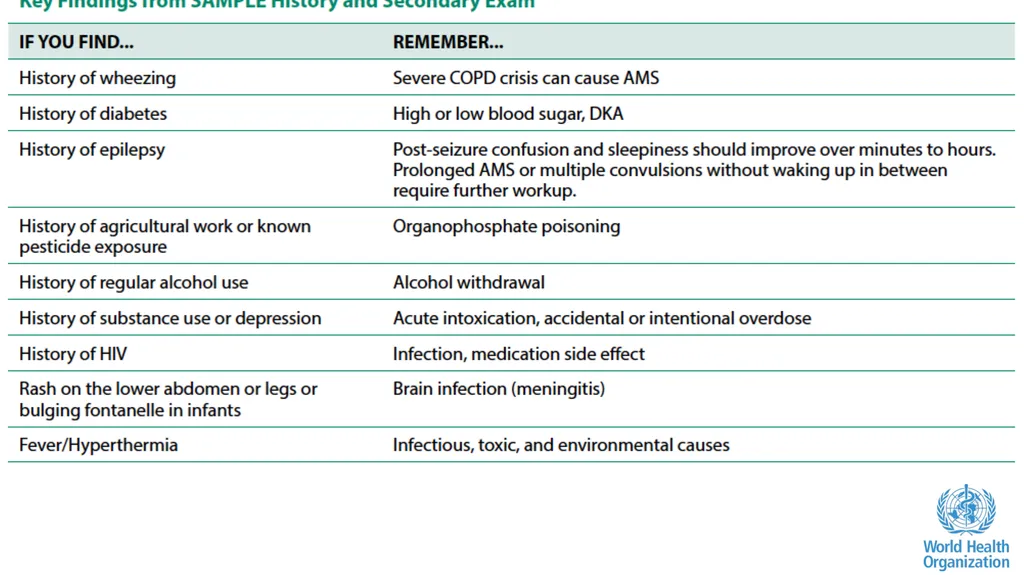
Apply a SAMPLE history to a patient with altered mental status
Recognize key history findings suggestive of different causes of altered mental status
List high-risk causes of altered mental status in adults and children
Describe how to perform a secondary exam in a patient with altered mental status
Recognize key examination findings suggestive of different causes of altered mental status
Describe critical actions to manage a patient with altered mental status (AMS)
Identify essential skills to manage for high-risk causes of altered mental status
Describe special paediatric considerations for altered mental status
Consider the disposition and transport of patients with altered mental status<br>
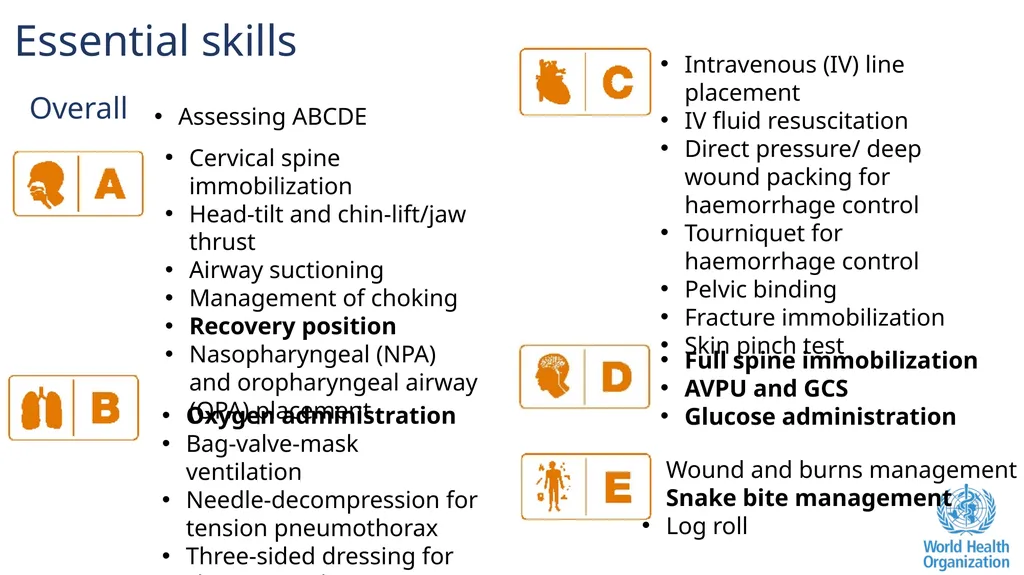
slide3. Essential skills Cervical spine immobilization
Head-tilt and chin-lift/jaw thrust
Airway suctioning
Management of choking
Recovery position
Nasopharyngeal (NPA) and oropharyngeal airway (OPA) placement Oxygen administration
Bag-valve-mask ventilation
Needle-decompression for tension pneumothorax
Three-sided dressing for chest wound Intravenous (IV) line placement
IV fluid resuscitation
Direct pressure/ deep wound packing for haemorrhage control
Tourniquet for haemorrhage control
Pelvic binding
Fracture immobilization
Skin pinch test Full spine immobilization
AVPU and GCS
Glucose administration Wound and burns management
Snake bite management
Log roll Overall Assessing ABCDE<br>
slide4. Overview Altered mental status is a term used for a range of presentations.
Sudden or gradual changes in behaviour
Disorientation
Confusion
Coma
May be due to conditions that affect the brain or the brain itself
Can be chronic psychiatric problems or dementia but must rule out other life-threatening causes first
Delirium always requires a full assessment.
Ask family about baseline mental status when possible.<br>
slide5. Goals: Altered Mental Status The goal of initial assessment is to identify rapidly reversible causes of altered mental status, and to recognize dangerous conditions requiring transfer.
The goal of acute management is to ensure that blood, oxygen and glucose reach the brain; and to protect the brain from additional injury.<br>
slide6. The ABCDE Approach REMEMBER …………
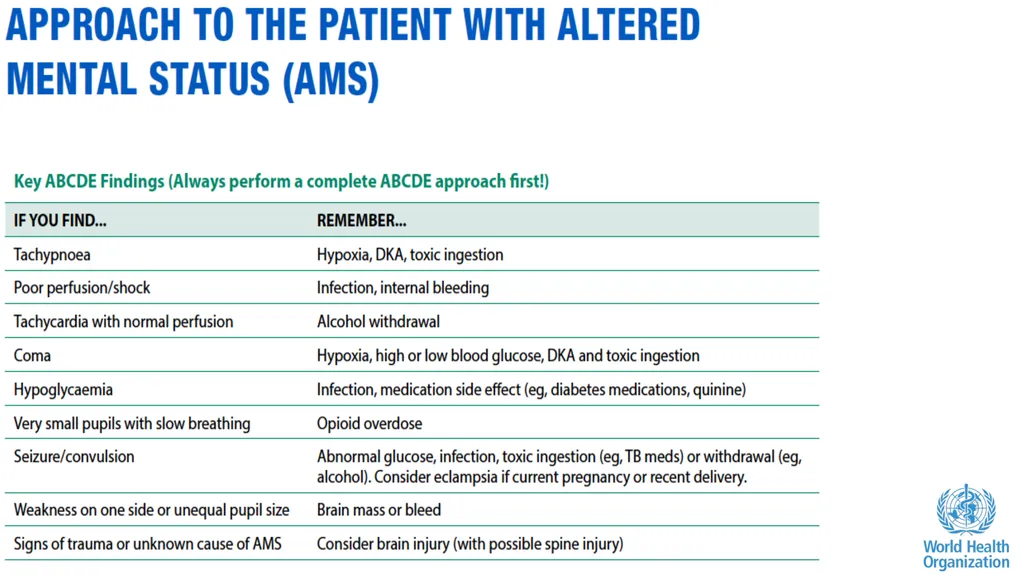
Always start with the ABCDE approach AND treat life-threatening conditions.
Then, take a SAMPLE history.
Then, do a Secondary Examination. !<br>
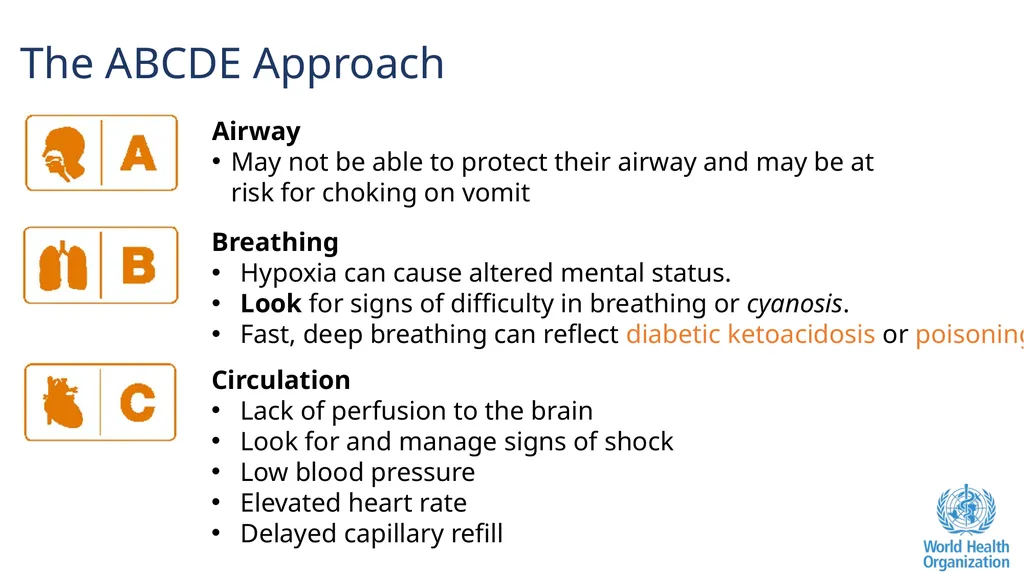
slide7. The ABCDE Approach Breathing
Hypoxia can cause altered mental status.
Look for signs of difficulty in breathing or cyanosis.
Fast, deep breathing can reflect diabetic ketoacidosis or poisoning. Airway
May not be able to protect their airway and may be at risk for choking on vomit Circulation
Lack of perfusion to the brain
Look for and manage signs of shock
Low blood pressure
Elevated heart rate
Delayed capillary refill<br>
slide8. The ABCDE Approach Disability
Check AVPU or GCS (trauma).
Check glucose.
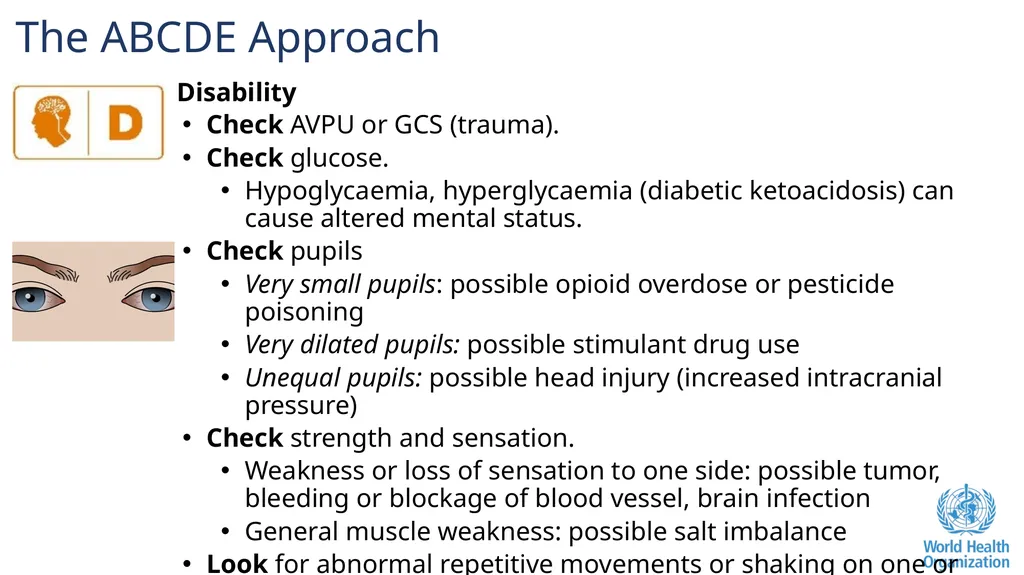
Hypoglycaemia, hyperglycaemia (diabetic ketoacidosis) can cause altered mental status.
Check pupils
Very small pupils: possible opioid overdose or pesticide poisoning
Very dilated pupils: possible stimulant drug use
Unequal pupils: possible head injury (increased intracranial pressure)
Check strength and sensation.
Weakness or loss of sensation to one side: possible tumor, bleeding or blockage of blood vessel, brain infection
General muscle weakness: possible salt imbalance
Look for abnormal repetitive movements or shaking on one or both sides (seizure).<br>
slide9. The ABCDE Approach Exposure
Look for signs that might cause altered mental status.
Check for infection, rashes, trauma, bites or stings.
Check arms for needle marks. REMEMBER …..
Altered patients may not report the history accurately. !<br>
slide10. Altered Mental Status Part 1: The SAMPLE history<br>
slide11. S: Signs and Symptoms ASK
How does the current condition compare to baseline mental status?
THINK
Ask family/friends about baseline when possible, to establish normal behaviour.<br>
slide12. S: Signs and Symptoms ASK
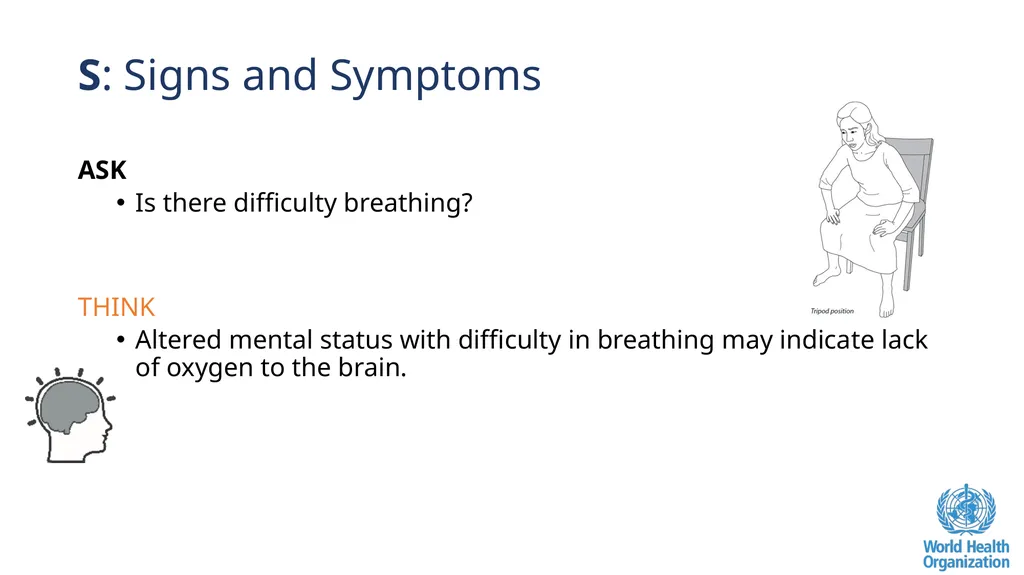
Is there difficulty breathing?
THINK
Altered mental status with difficulty in breathing may indicate lack of oxygen to the brain.<br>
slide13. S: Signs and Symptoms ASK:
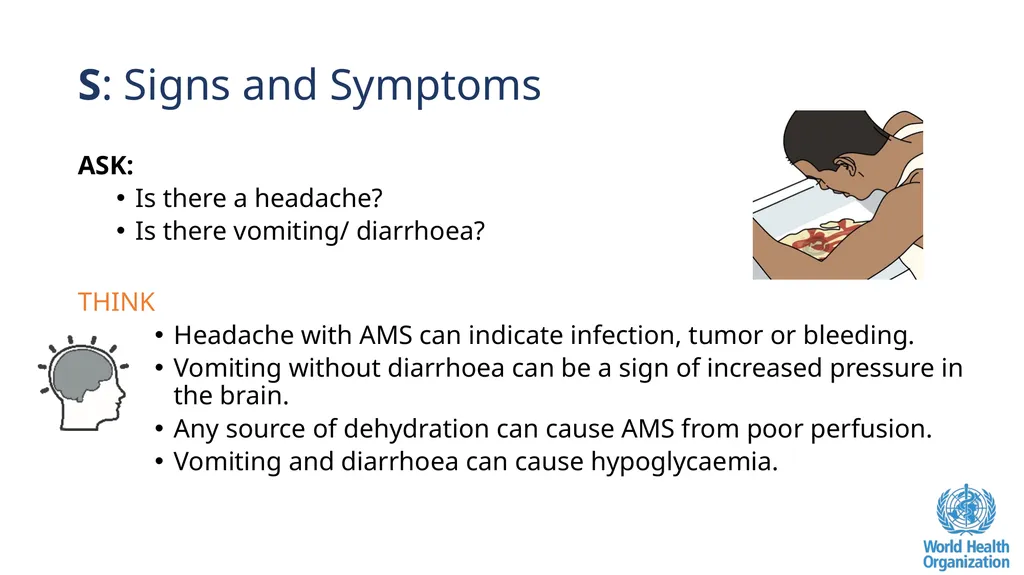
Is there a headache?
Is there vomiting/ diarrhoea?
THINK
Headache with AMS can indicate infection, tumor or bleeding.
Vomiting without diarrhoea can be a sign of increased pressure in the brain.
Any source of dehydration can cause AMS from poor perfusion.
Vomiting and diarrhoea can cause hypoglycaemia.<br>
slide14. S: Signs and Symptoms ASK
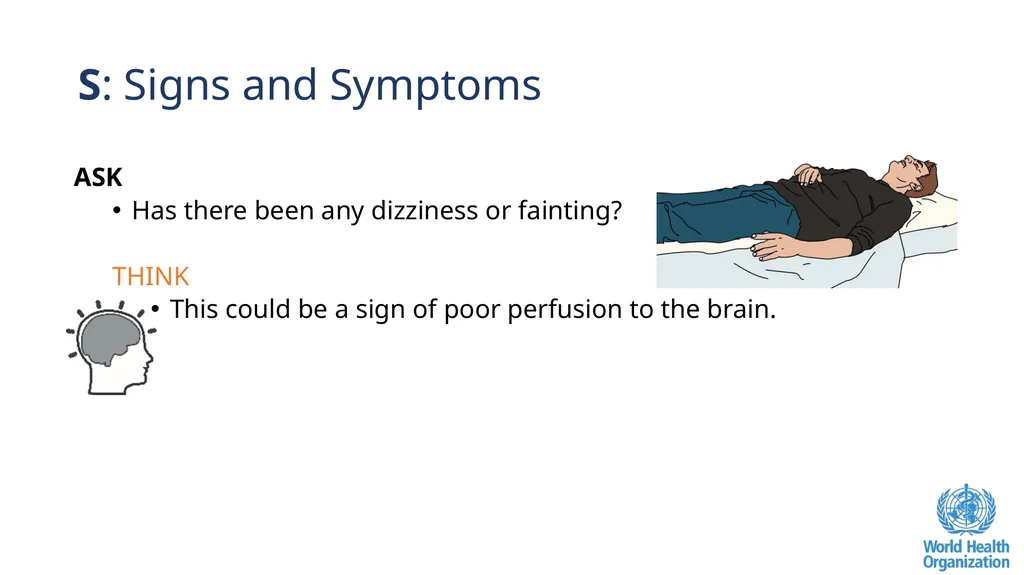
Has there been any dizziness or fainting?
THINK
This could be a sign of poor perfusion to the brain.<br>
slide15. S: Signs and Symptoms ASK
When did the symptoms start?
How long do they last?
Have they changed over time?
THINK
Rapid onset think infection, inflammation, bleeding or drugs/toxins
Gradual onset think less acute causes such as tumour or slow bleeding in the brain
Intermittent onset think seizures or psychiatric disease ?<br>
slide16. S: Signs and Symptoms ASK
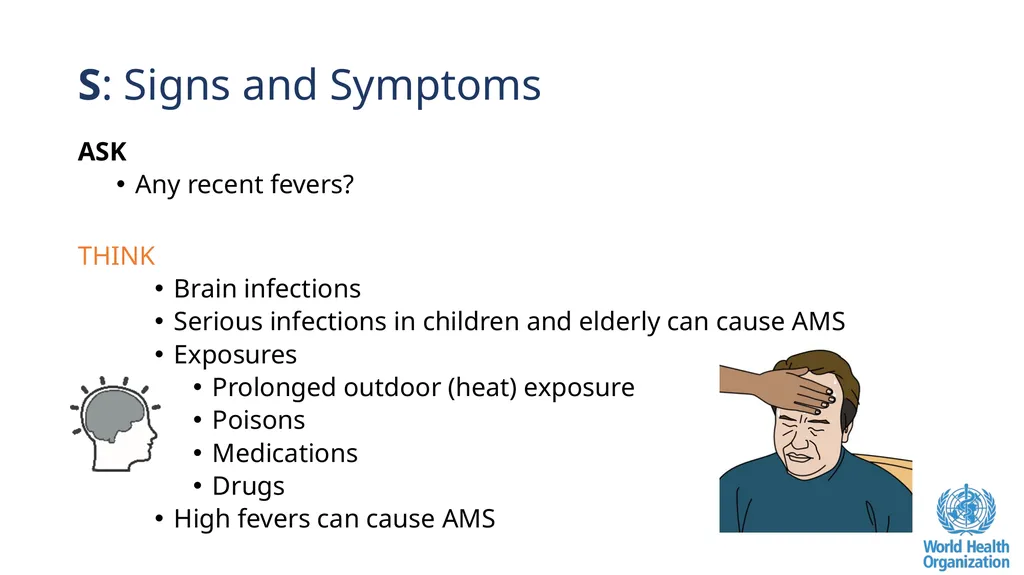
Any recent fevers?
THINK
Brain infections
Serious infections in children and elderly can cause AMS
Exposures
Prolonged outdoor (heat) exposure
Poisons
Medications
Drugs
High fevers can cause AMS<br>
slide17. S: Signs and Symptoms ASK:
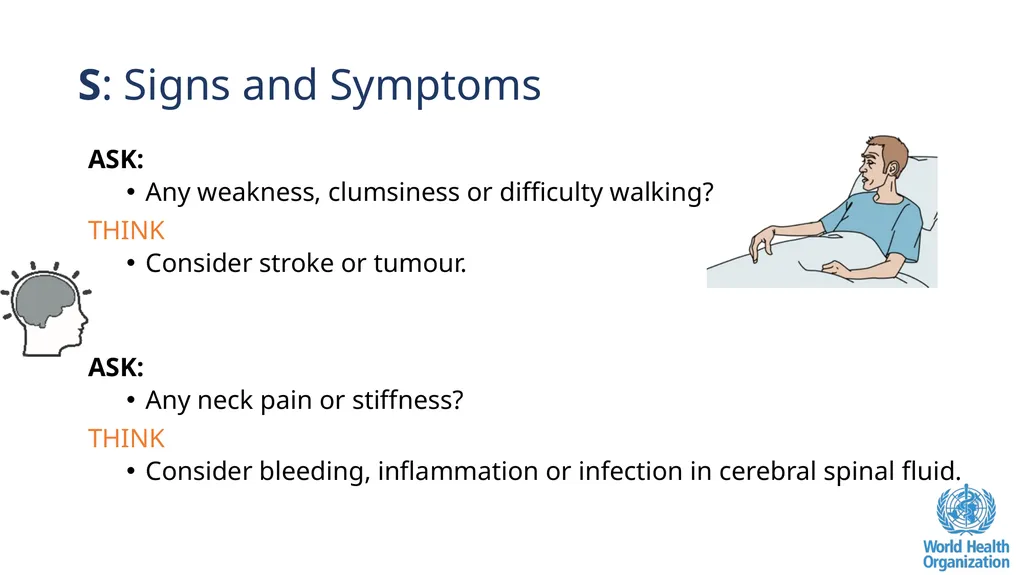
Any weakness, clumsiness or difficulty walking?
THINK
Consider stroke or tumour.
ASK:
Any neck pain or stiffness?
THINK
Consider bleeding, inflammation or infection in cerebral spinal fluid.<br>
slide18. S: Signs and Symptoms ASK:
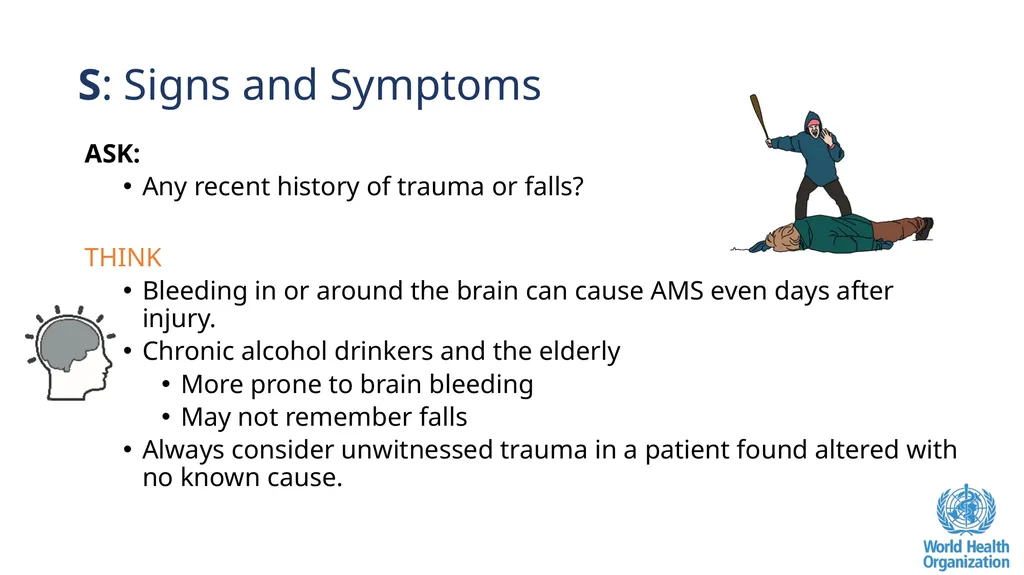
Any recent history of trauma or falls?
THINK
Bleeding in or around the brain can cause AMS even days after injury.
Chronic alcohol drinkers and the elderly
More prone to brain bleeding
May not remember falls
Always consider unwitnessed trauma in a patient found altered with no known cause.<br>
slide19. S: Signs and Symptoms ASK:
Any recent depression or changes in behaviour?
THINK
Drug and alcohol use or psychiatric problems
Consider possibility of suicide attempt by poisoning<br>
slide20. S: Signs and Symptoms ASK:
Does anyone else from the same family or location have symptoms?
THINK
Gaseous poisoning
Carbon monoxide is usually seen in cold climates with indoor heating.<br>
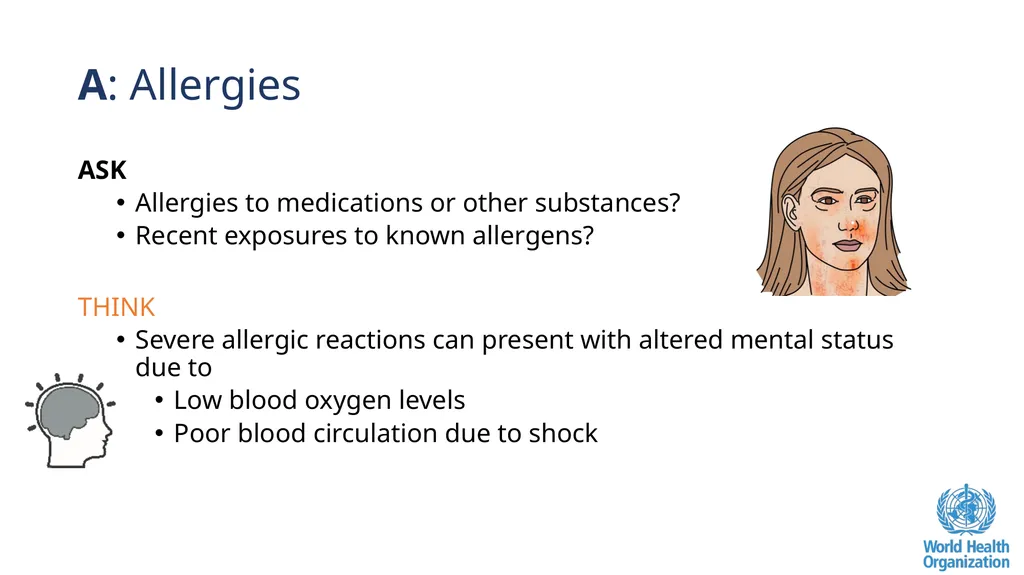
slide21. A: Allergies ASK
Allergies to medications or other substances?
Recent exposures to known allergens?
THINK
Severe allergic reactions can present with altered mental status due to
Low blood oxygen levels
Poor blood circulation due to shock<br>
slide22. M: Medications ASK
Currently taking any medications?
Collect medication list
Any new medications or changed doses?
THINK
Medication interactions
Medication side effects
Pain medications (opioids such as morphine, pethidine, heroin)
Sleeping medications
Seizure medications<br>
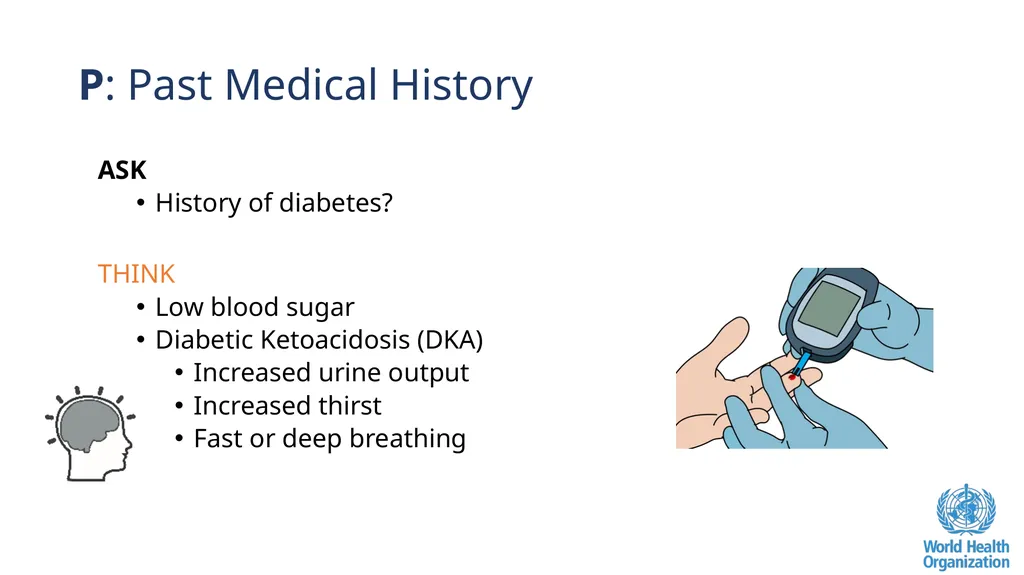
slide23. P: Past Medical History ASK
History of diabetes?
THINK
Low blood sugar
Diabetic Ketoacidosis (DKA)
Increased urine output
Increased thirst
Fast or deep breathing<br>
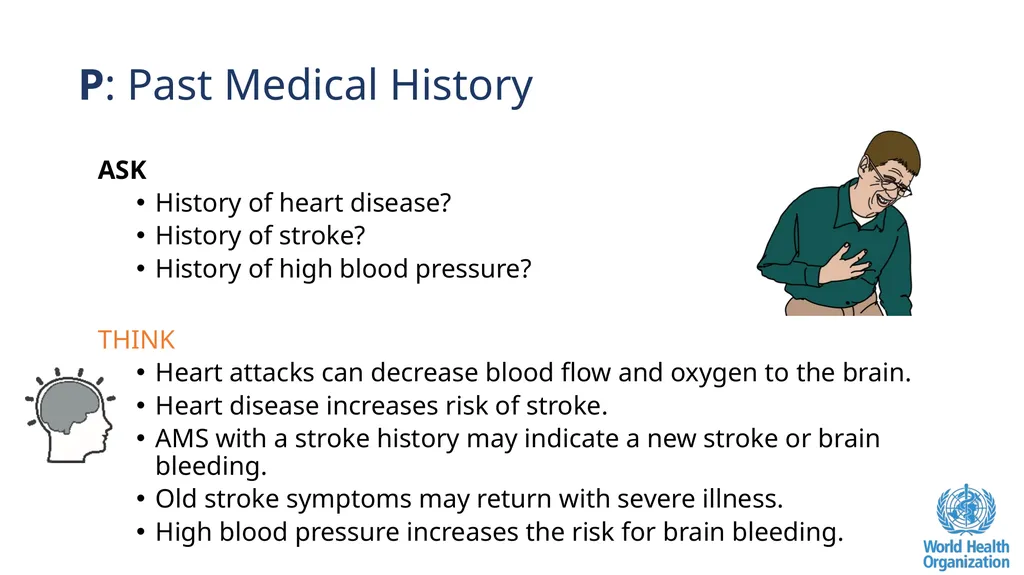
slide24. P: Past Medical History ASK
History of heart disease?
History of stroke?
History of high blood pressure?
THINK
Heart attacks can decrease blood flow and oxygen to the brain.
Heart disease increases risk of stroke.
AMS with a stroke history may indicate a new stroke or brain bleeding.
Old stroke symptoms may return with severe illness.
High blood pressure increases the risk for brain bleeding.<br>
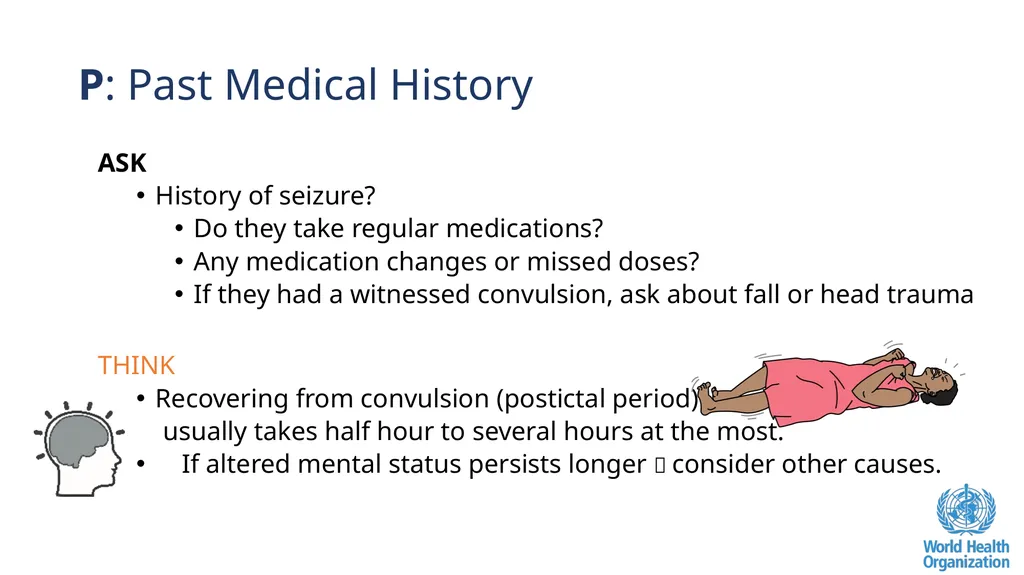
slide25. P: Past Medical History ASK
History of seizure?
Do they take regular medications?
Any medication changes or missed doses?
If they had a witnessed convulsion, ask about fall or head trauma
THINK
Recovering from convulsion (postictal period)
usually takes half hour to several hours at the most.
If altered mental status persists longer consider other causes.<br>
slide26. P: Past Medical History ASK
History of HIV infection?
History of tuberculosis?
History of liver or kidney failure?
THINK
With history of HIV or tuberculosis, consider infection around brain.
With liver or kidney failure, consider problems clearing toxins and waste.<br>
slide27. P: Past Medical History ASK
History of long standing alcohol use?
History of drug abuse?
THINK
Alcohol intoxication and alcohol withdrawal can present with altered mental status.
Alcoholics have a high risk for head injury and low blood sugar levels.
Sedatives and opiates can cause altered mental status.<br>
slide28. P: Past Medical History ASK
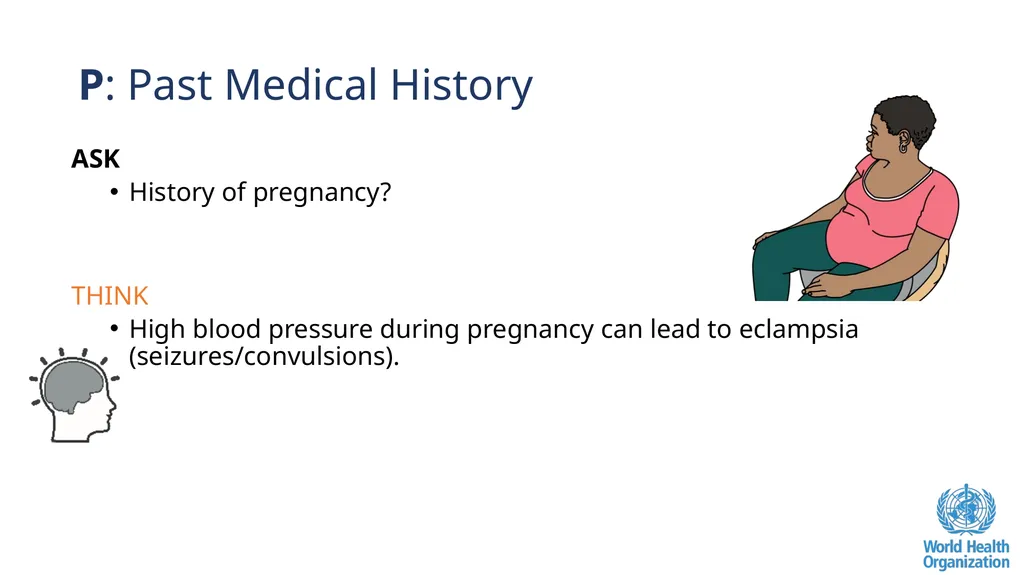
History of pregnancy?
THINK
High blood pressure during pregnancy can lead to eclampsia (seizures/convulsions).<br>
slide29. L: Last Oral Intake ASK
When did the patient last eat or drink?
THINK
Low blood sugar levels and dehydration can cause AMS.<br>
slide30. E: Events Surrounding Illness ASK
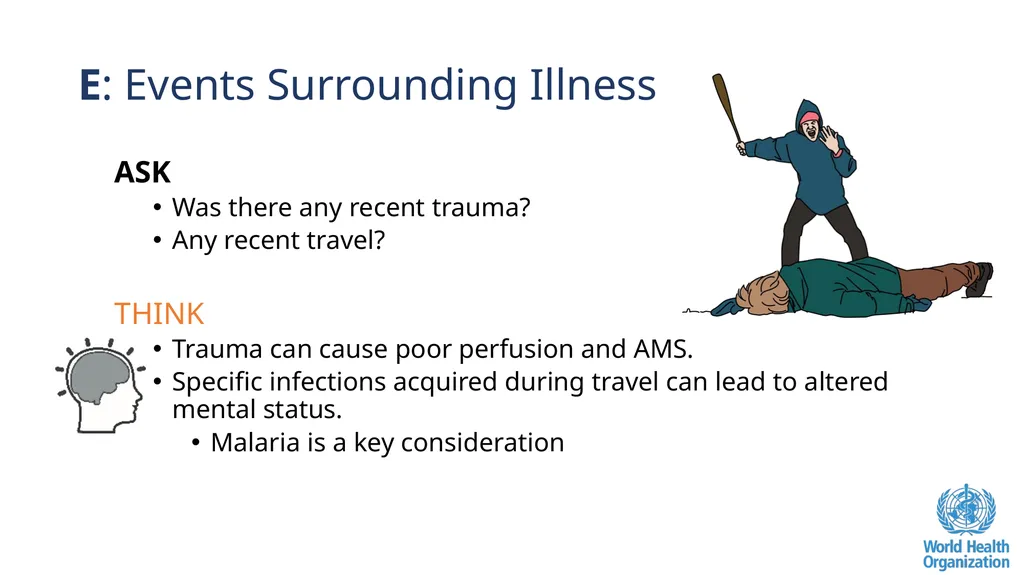
Was there any recent trauma?
Any recent travel?
THINK
Trauma can cause poor perfusion and AMS.
Specific infections acquired during travel can lead to altered mental status.
Malaria is a key consideration<br>
slide31. E: Events Surrounding Illness ASK
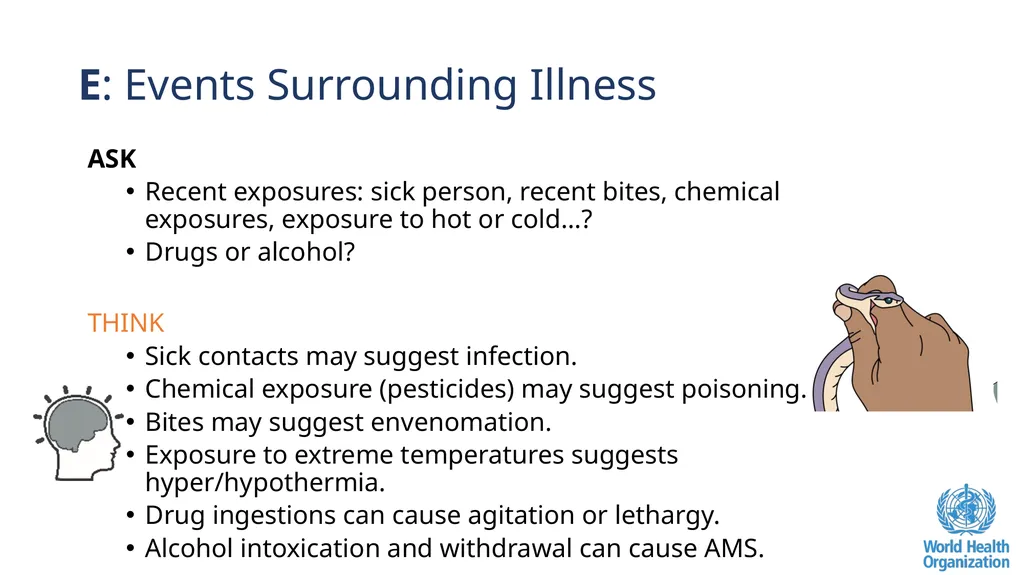
Recent exposures: sick person, recent bites, chemical exposures, exposure to hot or cold…?
Drugs or alcohol?
THINK
Sick contacts may suggest infection.
Chemical exposure (pesticides) may suggest poisoning.
Bites may suggest envenomation.
Exposure to extreme temperatures suggests hyper/hypothermia.
Drug ingestions can cause agitation or lethargy.
Alcohol intoxication and withdrawal can cause AMS.<br>
slide32. Workbook Question 1 Using the workbook section above, list 7 questions about SIGNS AND SYMPTOMS you would ask when taking a SAMPLE history
1.
2.
3.
4.
5.
6.
7.<br>
slide33. Altered Mental Status Part 2: The Secondary Exam and Causes of Altered Mental Status<br>
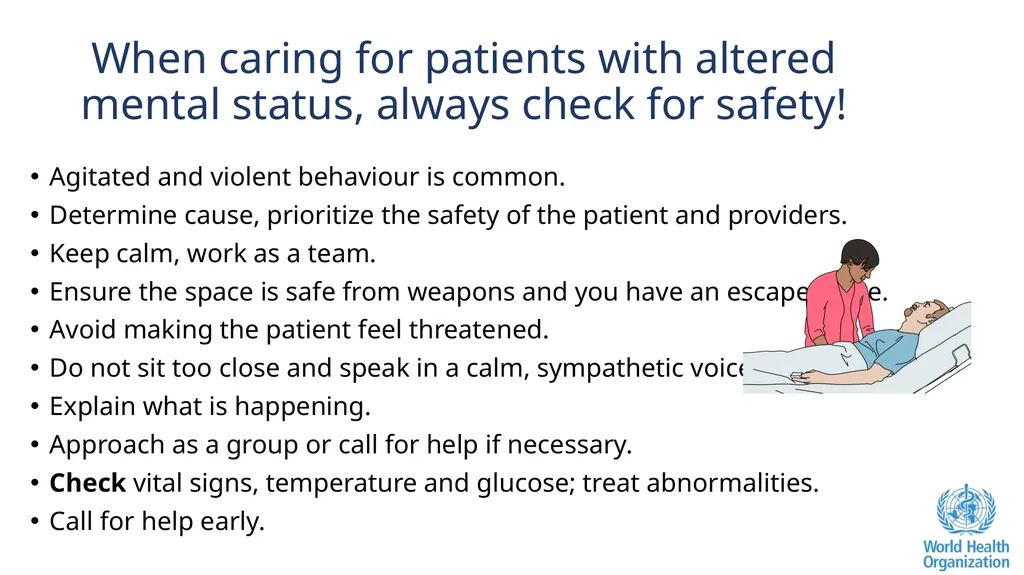
slide34. When caring for patients with altered mental status, always check for safety! Agitated and violent behaviour is common.
Determine cause, prioritize the safety of the patient and providers.
Keep calm, work as a team.
Ensure the space is safe from weapons and you have an escape route.
Avoid making the patient feel threatened.
Do not sit too close and speak in a calm, sympathetic voice.
Explain what is happening.
Approach as a group or call for help if necessary.
Check vital signs, temperature and glucose; treat abnormalities.
Call for help early.<br>
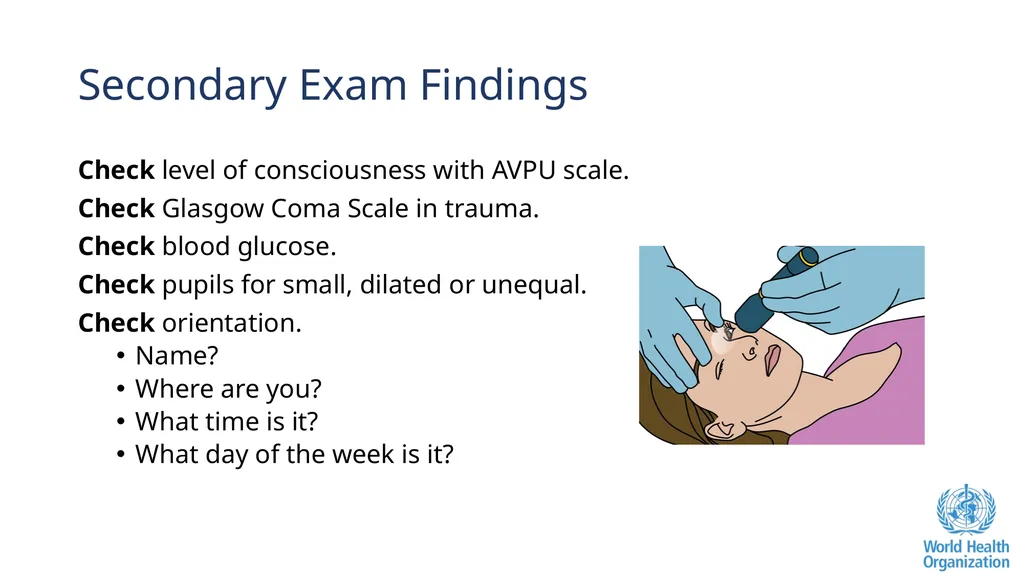
slide35. Secondary Exam Findings Check level of consciousness with AVPU scale.
Check Glasgow Coma Scale in trauma.
Check blood glucose.
Check pupils for small, dilated or unequal.
Check orientation.
Name?
Where are you?
What time is it?
What day of the week is it?<br>
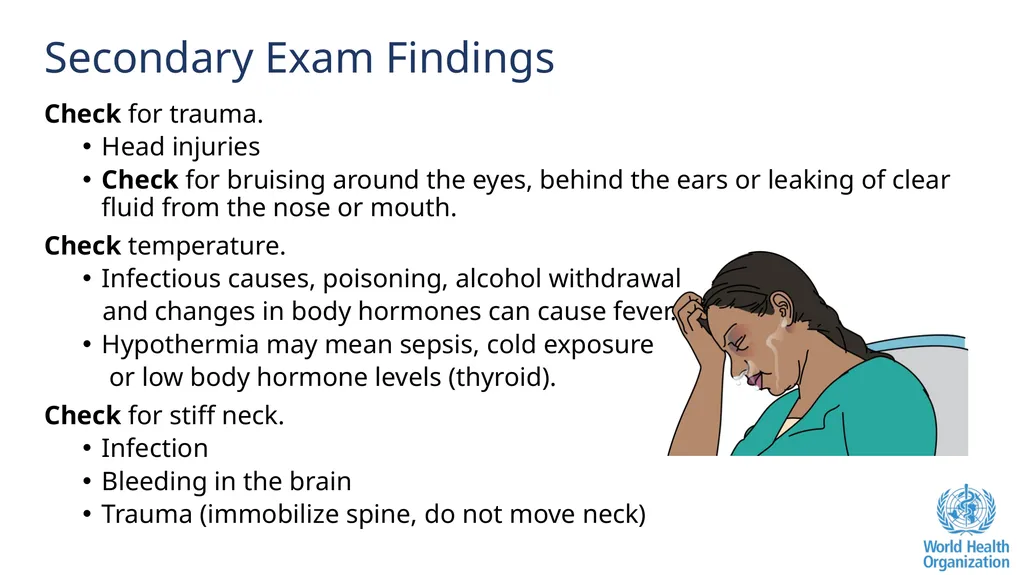
slide36. Secondary Exam Findings Check for trauma.
Head injuries
Check for bruising around the eyes, behind the ears or leaking of clear fluid from the nose or mouth.
Check temperature.
Infectious causes, poisoning, alcohol withdrawal
and changes in body hormones can cause fever.
Hypothermia may mean sepsis, cold exposure
or low body hormone levels (thyroid).
Check for stiff neck.
Infection
Bleeding in the brain
Trauma (immobilize spine, do not move neck)<br>
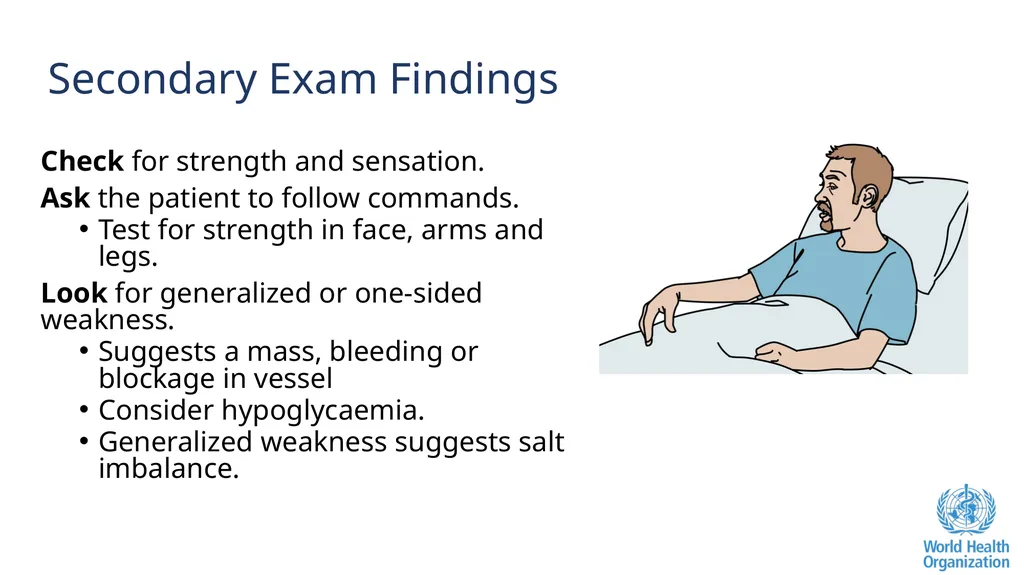
slide37. Secondary Exam Findings Check for strength and sensation.
Ask the patient to follow commands.
Test for strength in face, arms and legs.
Look for generalized or one-sided weakness.
Suggests a mass, bleeding or blockage in vessel
Consider hypoglycaemia.
Generalized weakness suggests salt imbalance.<br>
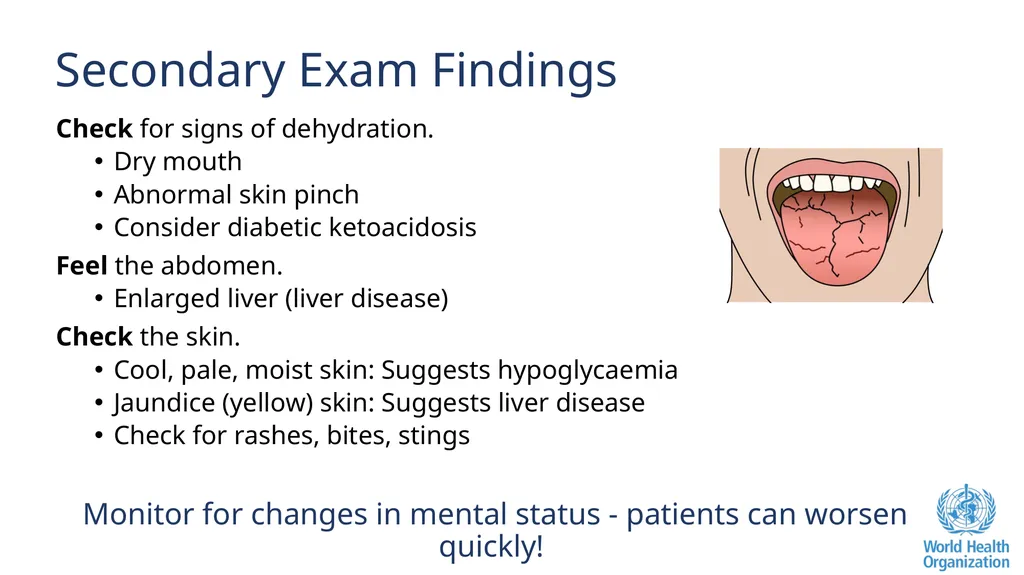
slide38. Secondary Exam Findings Check for signs of dehydration.
Dry mouth
Abnormal skin pinch
Consider diabetic ketoacidosis
Feel the abdomen.
Enlarged liver (liver disease)
Check the skin.
Cool, pale, moist skin: Suggests hypoglycaemia
Jaundice (yellow) skin: Suggests liver disease
Check for rashes, bites, stings
Monitor for changes in mental status - patients can worsen quickly!<br>
slide39. Workbook Question 2 Using the workbook section above, list 5 SECONDARY exam findings you would check for in a patient with altered mental status:
1.
2.
3.
4.
5.<br>
slide40. Altered Mental Status Part 2: The Secondary Exam and Causes of Altered Mental Status<br>
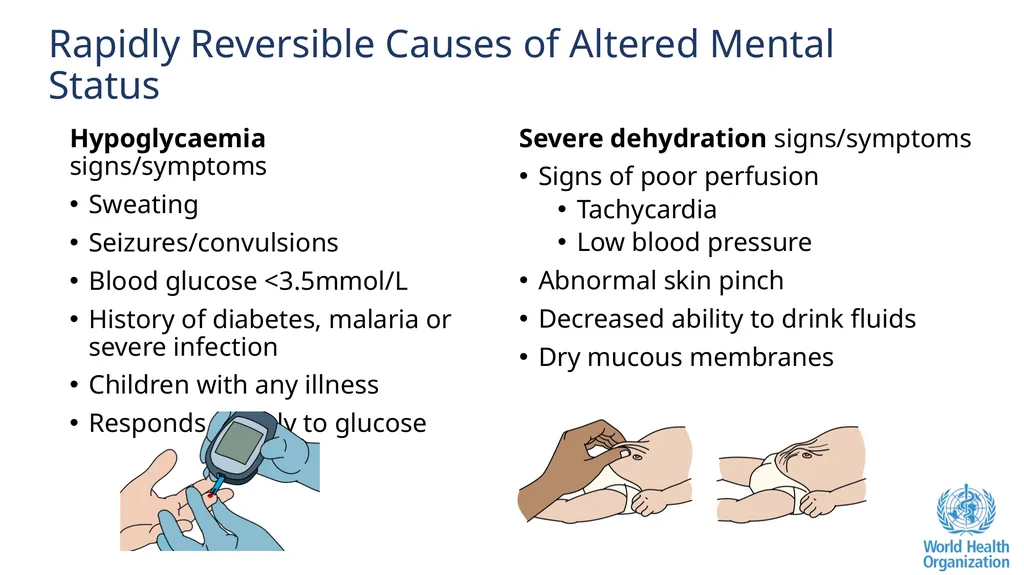
slide41. Rapidly Reversible Causes of Altered Mental Status Hypoglycaemia signs/symptoms
Sweating
Seizures/convulsions
Blood glucose <3.5mmol/L
History of diabetes, malaria or severe infection
Children with any illness
Responds quickly to glucose Severe dehydration signs/symptoms
Signs of poor perfusion
Tachycardia
Low blood pressure
Abnormal skin pinch
Decreased ability to drink fluids
Dry mucous membranes<br>
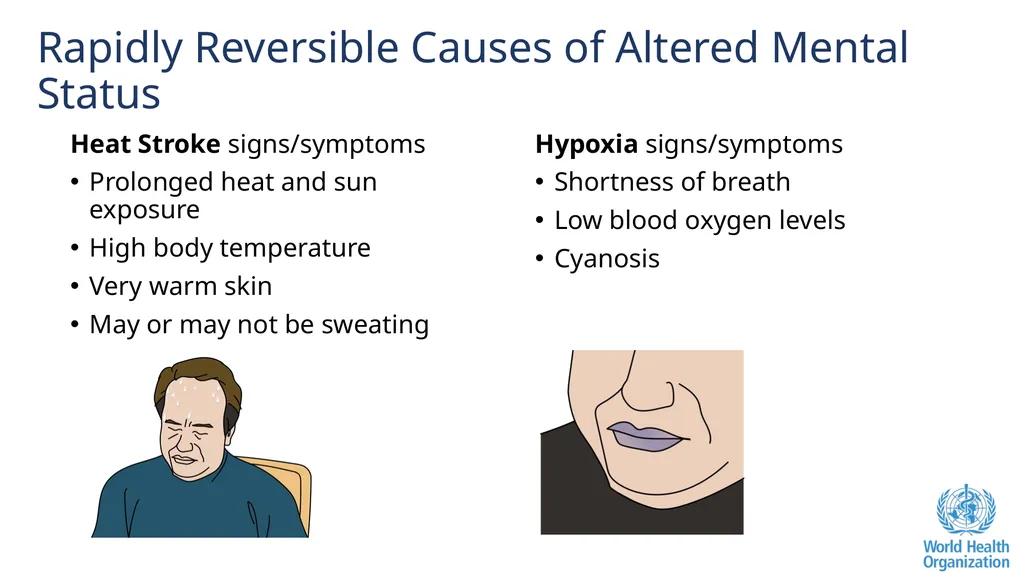
slide42. Rapidly Reversible Causes of Altered Mental Status Heat Stroke signs/symptoms
Prolonged heat and sun exposure
High body temperature
Very warm skin
May or may not be sweating Hypoxia signs/symptoms
Shortness of breath
Low blood oxygen levels
Cyanosis<br>
slide43. Infectious Causes of Altered Mental Status Cerebral malaria signs and symptoms
Fever
Rapid malaria test or smear positive
In or from an area with malaria Inflammation/infection around the brain (meningitis, encephalitis, brain abscess, bleeding)
Fever
Neck stiffness
Rash
Eye pain/ sensitivity to light
Headache
Known infectious epidemic or exposure
History of HIV or TB infection<br>
slide44. Infectious Causes of Altered Mental Status Severe infection signs and symptoms
Fever
Tachycardia
Tachypnoea
May have hypotension
Sign of infection
Skin infection
Cough
Crackles in lungs
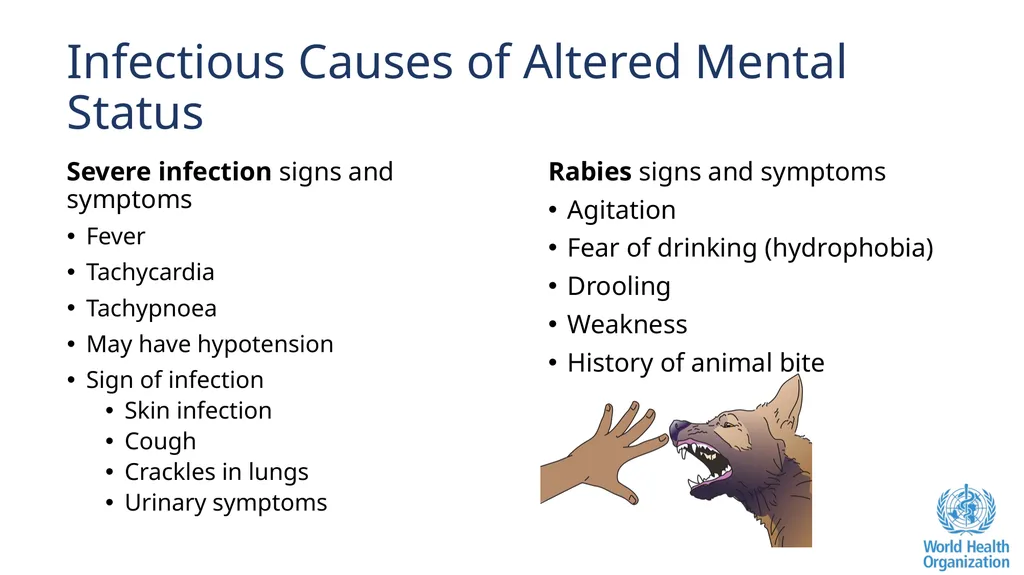
Urinary symptoms Rabies signs and symptoms
Agitation
Fear of drinking (hydrophobia)
Drooling
Weakness
History of animal bite<br>
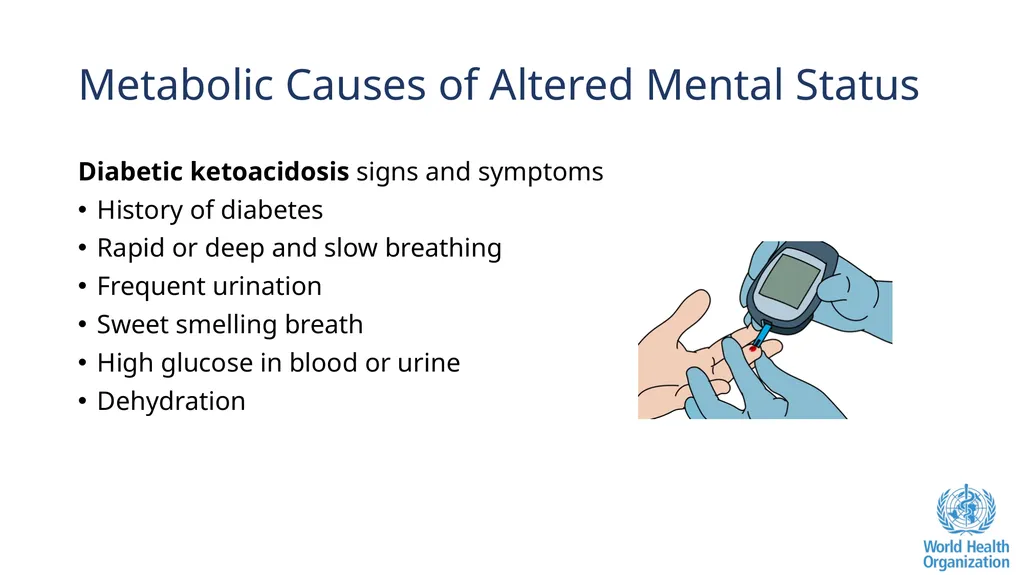
slide45. Metabolic Causes of Altered Mental Status Diabetic ketoacidosis signs and symptoms
History of diabetes
Rapid or deep and slow breathing
Frequent urination
Sweet smelling breath
High glucose in blood or urine
Dehydration<br>
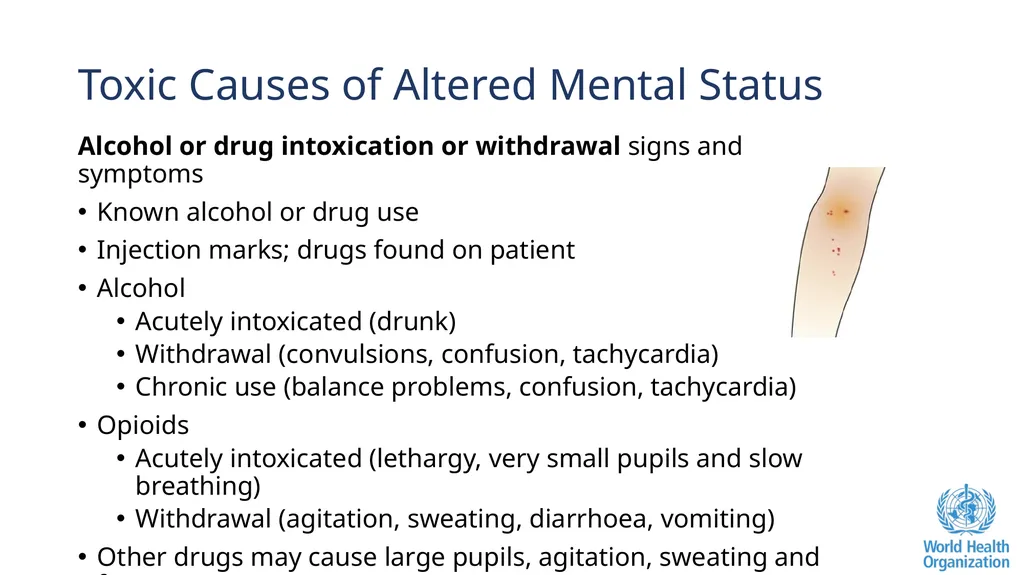
slide46. Toxic Causes of Altered Mental Status Alcohol or drug intoxication or withdrawal signs and symptoms
Known alcohol or drug use
Injection marks; drugs found on patient
Alcohol
Acutely intoxicated (drunk)
Withdrawal (convulsions, confusion, tachycardia)
Chronic use (balance problems, confusion, tachycardia)
Opioids
Acutely intoxicated (lethargy, very small pupils and slow breathing)
Withdrawal (agitation, sweating, diarrhoea, vomiting)
Other drugs may cause large pupils, agitation, sweating and fever<br>
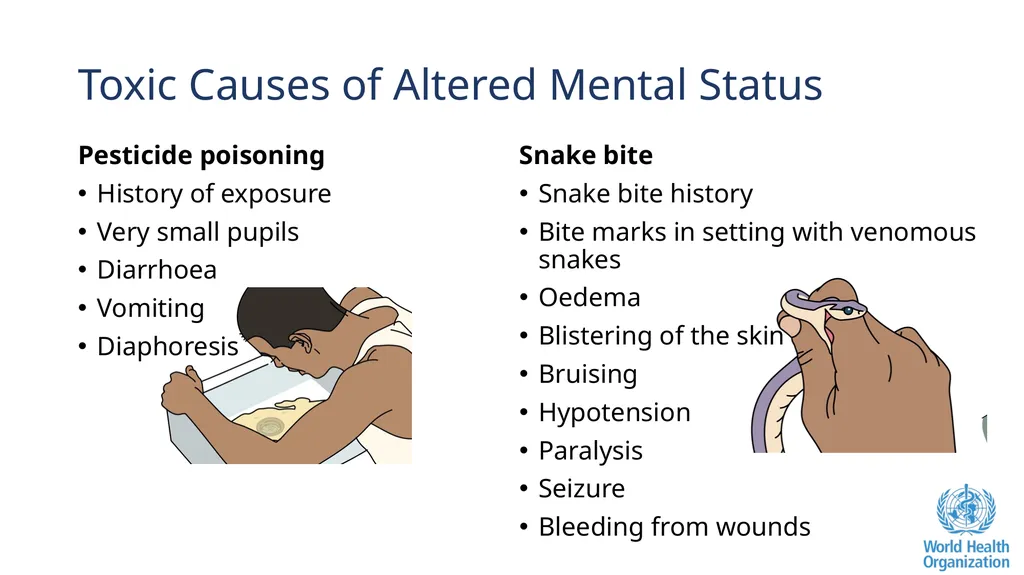
slide47. Toxic Causes of Altered Mental Status Pesticide poisoning
History of exposure
Very small pupils
Diarrhoea
Vomiting
Diaphoresis Snake bite
Snake bite history
Bite marks in setting with venomous snakes
Oedema
Blistering of the skin
Bruising
Hypotension
Paralysis
Seizure
Bleeding from wounds<br>
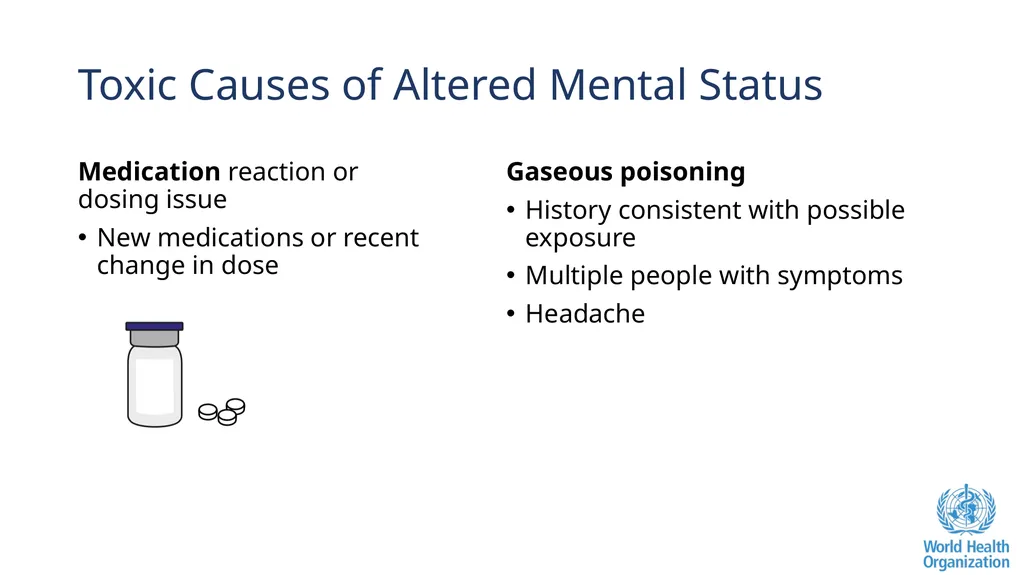
slide48. Toxic Causes of Altered Mental Status Medication reaction or dosing issue
New medications or recent change in dose Gaseous poisoning
History consistent with possible exposure
Multiple people with symptoms
Headache<br>
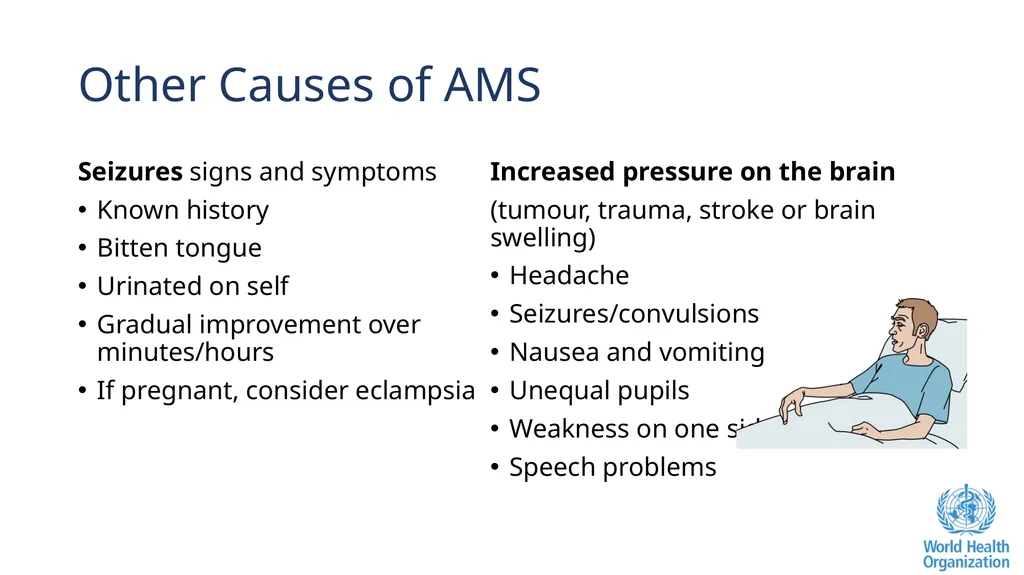
slide49. Other Causes of AMS Seizures signs and symptoms
Known history
Bitten tongue
Urinated on self
Gradual improvement over minutes/hours
If pregnant, consider eclampsia Increased pressure on the brain
(tumour, trauma, stroke or brain swelling)
Headache
Seizures/convulsions
Nausea and vomiting
Unequal pupils
Weakness on one side
Speech problems<br>
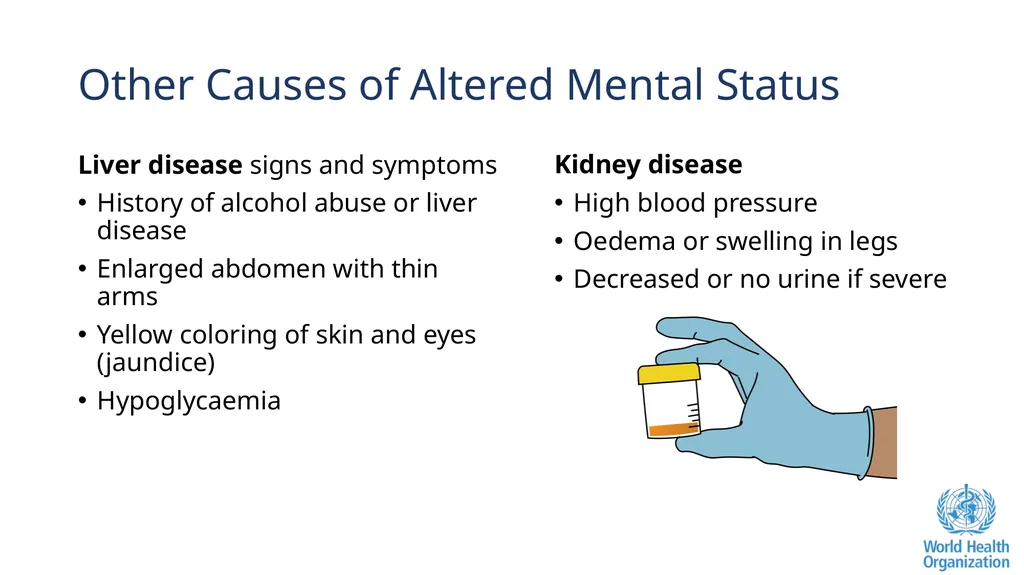
slide50. Other Causes of Altered Mental Status Liver disease signs and symptoms
History of alcohol abuse or liver disease
Enlarged abdomen with thin arms
Yellow coloring of skin and eyes (jaundice)
Hypoglycaemia Kidney disease
High blood pressure
Oedema or swelling in legs
Decreased or no urine if severe<br>
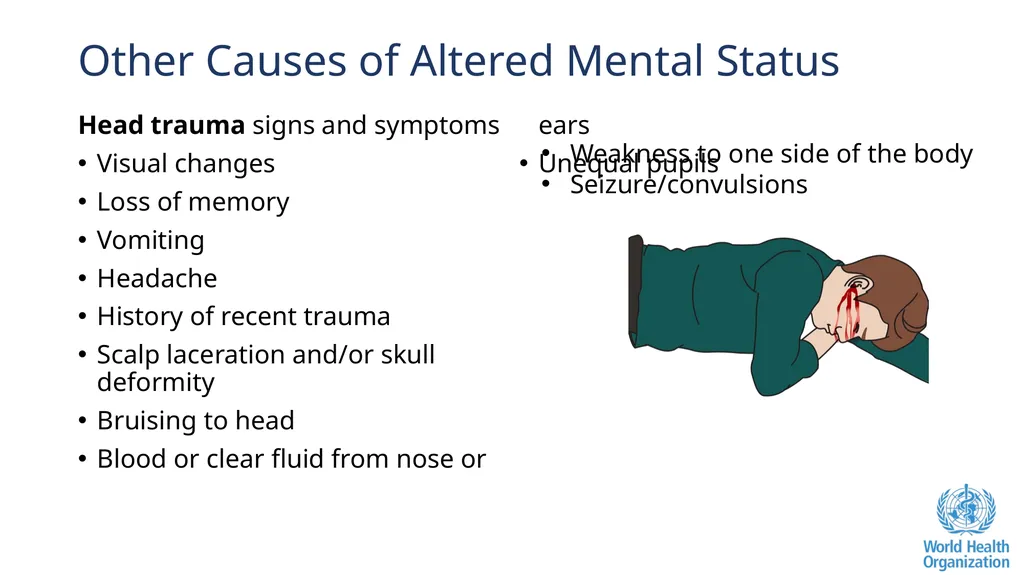
slide51. Other Causes of Altered Mental Status Head trauma signs and symptoms
Visual changes
Loss of memory
Vomiting
Headache
History of recent trauma
Scalp laceration and/or skull deformity
Bruising to head
Blood or clear fluid from nose or ears
Unequal pupils Weakness to one side of the body
Seizure/convulsions<br>
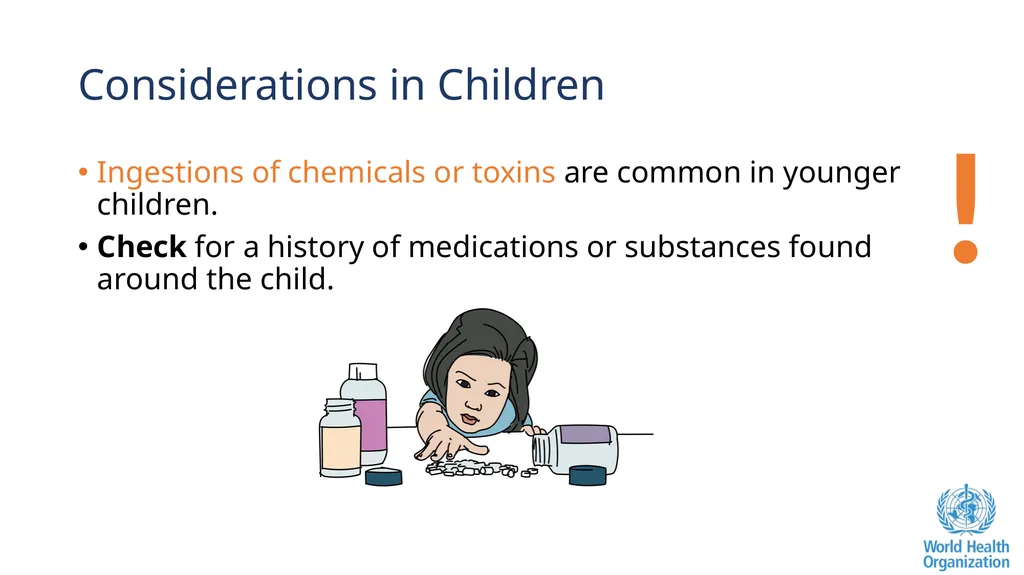
slide52. Considerations in Children Ingestions of chemicals or toxins are common in younger children.
Check for a history of medications or substances found around the child. !<br>
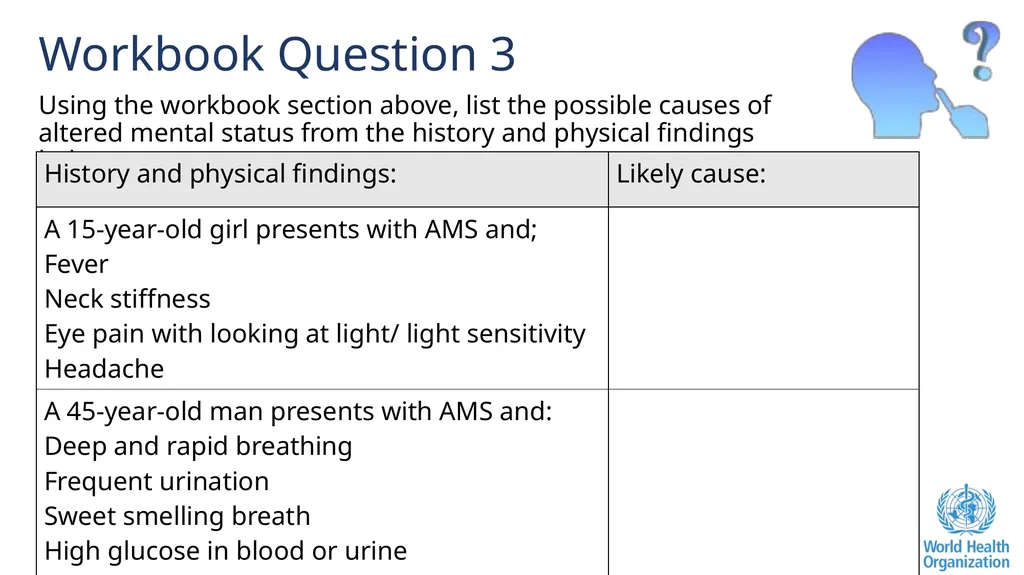
slide53. Workbook Question 3 Using the workbook section above, list the possible causes of altered mental status from the history and physical findings below:<br>
slide54. Altered Mental Status Part 3: Management, special paediatric considerations and disposition<br>
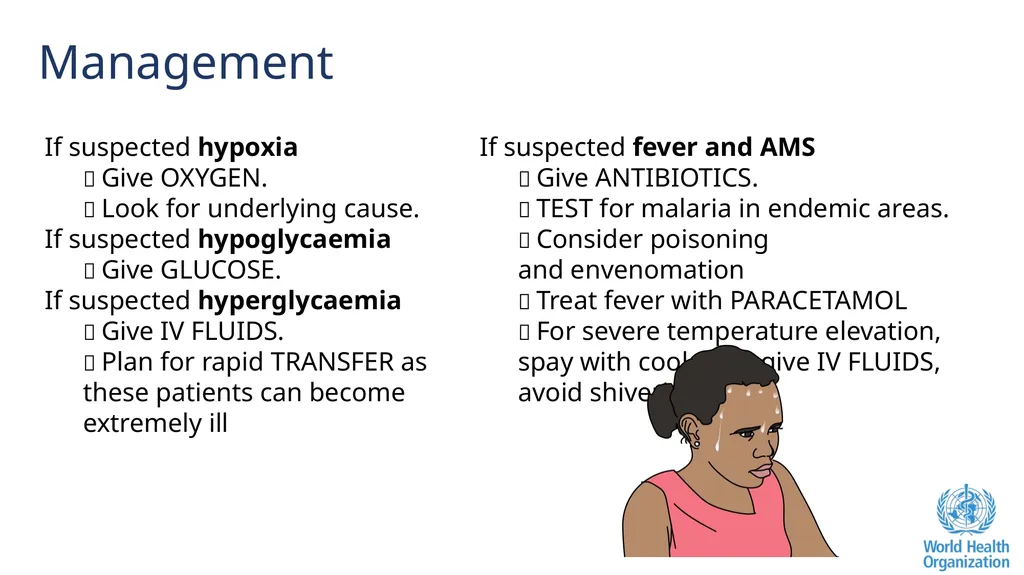
slide55. Management If suspected hypoxia
Give OXYGEN.
Look for underlying cause.
If suspected hypoglycaemia
Give GLUCOSE.
If suspected hyperglycaemia
Give IV FLUIDS.
Plan for rapid TRANSFER as these patients can become extremely ill If suspected fever and AMS
Give ANTIBIOTICS.
TEST for malaria in endemic areas.
Consider poisoning and envenomation
Treat fever with PARACETAMOL
For severe temperature elevation, spay with cool mist, give IV FLUIDS, avoid shivering.<br>
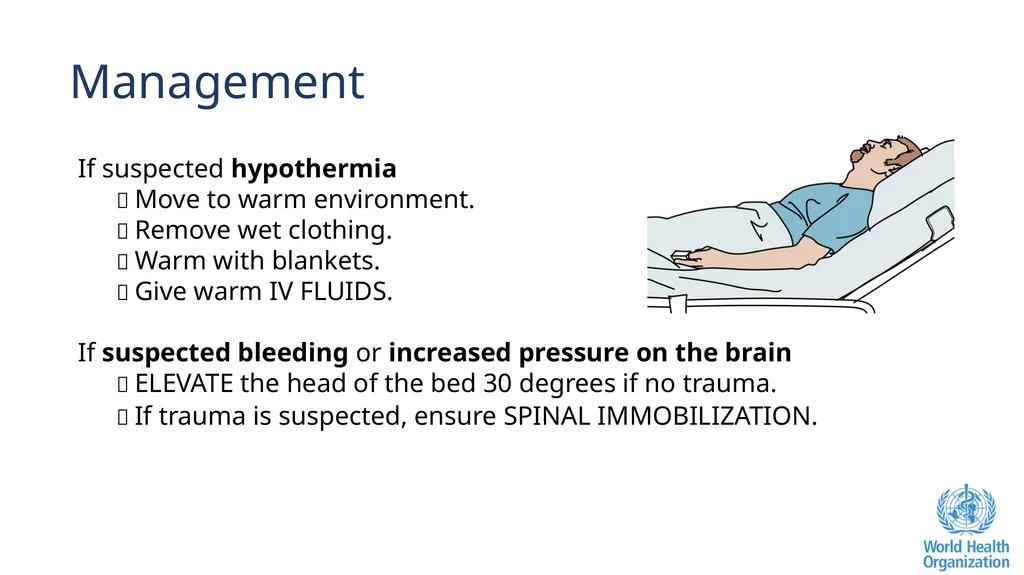
slide56. Management If suspected hypothermia
Move to warm environment.
Remove wet clothing.
Warm with blankets.
Give warm IV FLUIDS.
If suspected bleeding or increased pressure on the brain
ELEVATE the head of the bed 30 degrees if no trauma.
If trauma is suspected, ensure SPINAL IMMOBILIZATION.<br>
slide57. Management If suspected opioid overdose
Give NALOXONE by IV or IM.
Naloxone only lasts one hour while most opioids last longer.
Consider the need for re-dosing.
If active seizure/convulsions
Treat with BENZODIAZEPINE, monitor closely for slow breathing.
CHECK glucose or give GLUCOSE if unable to check.
Place patient in the recovery position (if no trauma).
If patient continues to seize or does not wake up, TRANSFER and MONITOR airway.<br>
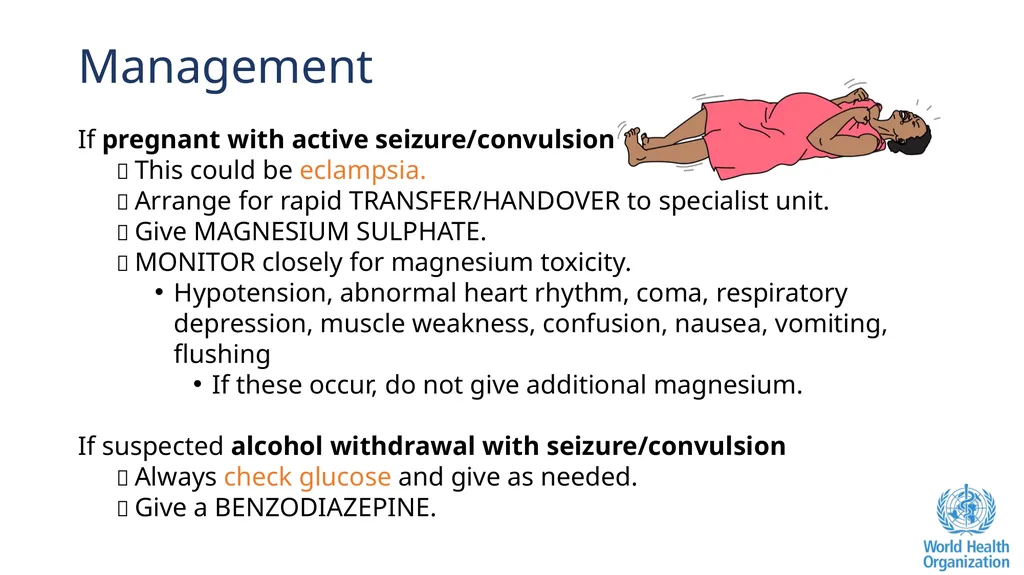
slide58. Management If pregnant with active seizure/convulsion
This could be eclampsia.
Arrange for rapid TRANSFER/HANDOVER to specialist unit.
Give MAGNESIUM SULPHATE.
MONITOR closely for magnesium toxicity.
Hypotension, abnormal heart rhythm, coma, respiratory depression, muscle weakness, confusion, nausea, vomiting, flushing
If these occur, do not give additional magnesium.
If suspected alcohol withdrawal with seizure/convulsion
Always check glucose and give as needed.
Give a BENZODIAZEPINE.<br>
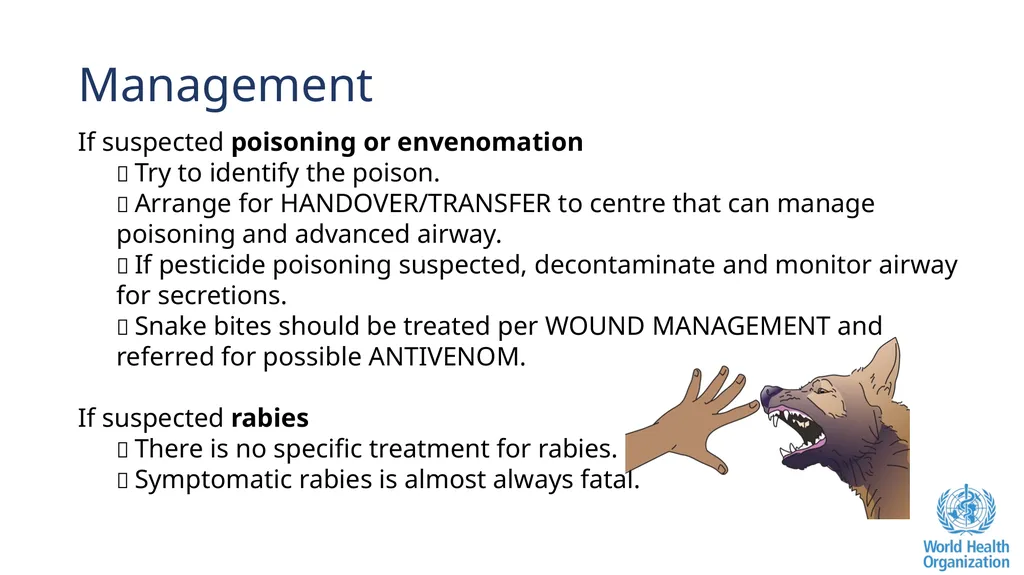
slide59. Management If suspected poisoning or envenomation
Try to identify the poison.
Arrange for HANDOVER/TRANSFER to centre that can manage poisoning and advanced airway.
If pesticide poisoning suspected, decontaminate and monitor airway for secretions.
Snake bites should be treated per WOUND MANAGEMENT and referred for possible ANTIVENOM.
If suspected rabies
There is no specific treatment for rabies.
Symptomatic rabies is almost always fatal.<br>
slide60. Management If the patient is agitated or violent
Protect the patient from harming self, you or others.
Ensure you have an escape/exit route.
Remove potential weapons/unsafe objects.
Call for help.
Speak in a calm, soft, non-threatening tone; explain what is happening.
Do not confront or judge.
Consider causes - check glucose and vital signs; treat abnormalities.
Arrange for a safe HANDOVER/TRANSFER to an advanced provider.
If suspected trauma
Assess GCS.
IMMOBILIZE the spine.
CHECK for signs of increased pressure on the brain.<br>
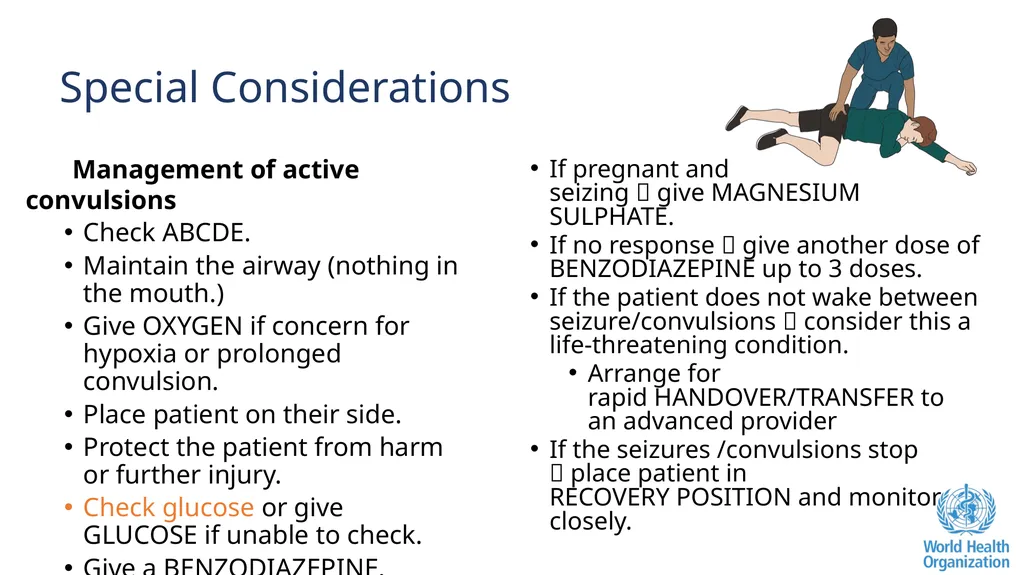
slide61. Special Considerations Management of active convulsions
Check ABCDE.
Maintain the airway (nothing in the mouth.)
Give OXYGEN if concern for hypoxia or prolonged convulsion.
Place patient on their side.
Protect the patient from harm or further injury.
Check glucose or give GLUCOSE if unable to check.
Give a BENZODIAZEPINE. If pregnant and seizing give MAGNESIUM SULPHATE.
If no response give another dose of BENZODIAZEPINE up to 3 doses.
If the patient does not wake between seizure/convulsions consider this a life-threatening condition.
Arrange for rapid HANDOVER/TRANSFER to an advanced provider
If the seizures /convulsions stop place patient in RECOVERY POSITION and monitor closely.<br>
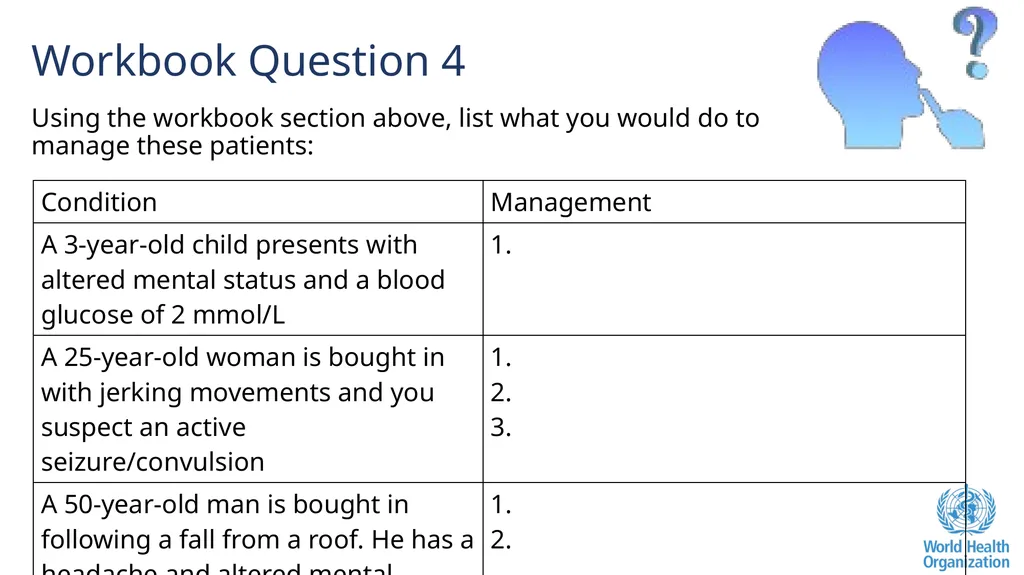
slide62. Workbook Question 4 Using the workbook section above, list what you would do to manage these patients:<br>
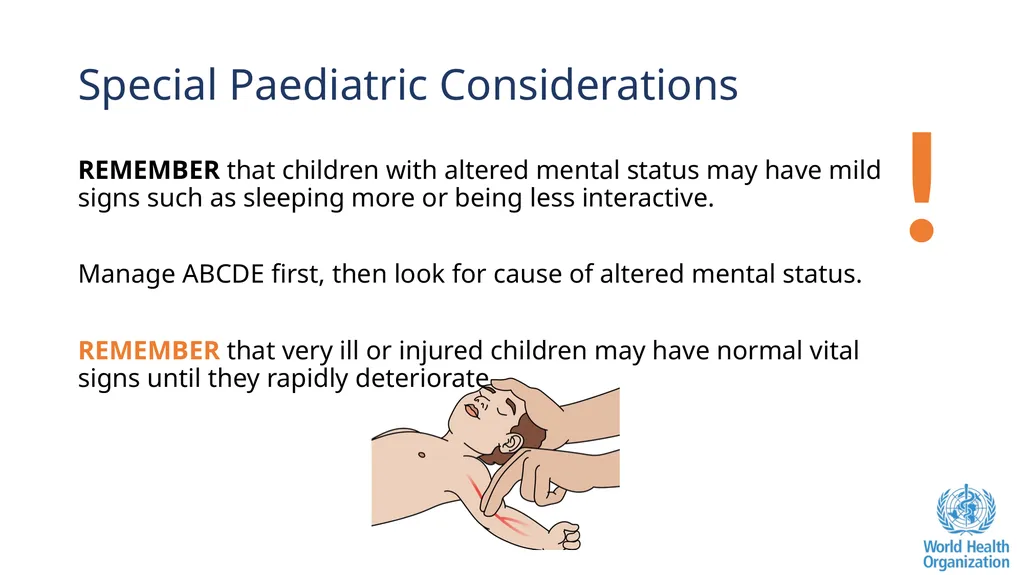
slide63. Special Paediatric Considerations REMEMBER that children with altered mental status may have mild signs such as sleeping more or being less interactive.
Manage ABCDE first, then look for cause of altered mental status.
REMEMBER that very ill or injured children may have normal vital signs until they rapidly deteriorate. !<br>
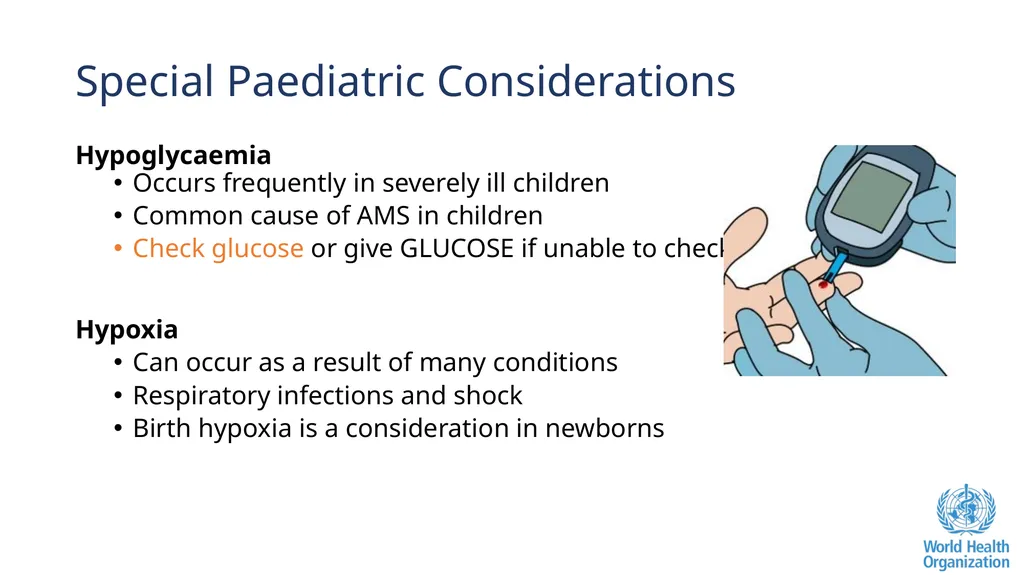
slide64. Special Paediatric Considerations Hypoglycaemia
Occurs frequently in severely ill children
Common cause of AMS in children
Check glucose or give GLUCOSE if unable to check.
Hypoxia
Can occur as a result of many conditions
Respiratory infections and shock
Birth hypoxia is a consideration in newborns<br>
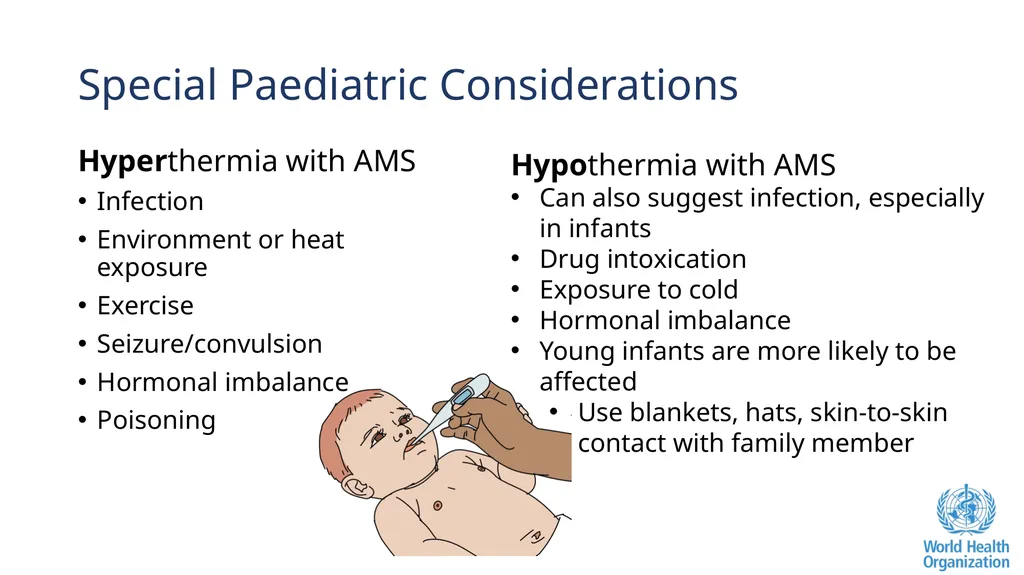
slide65. Special Paediatric Considerations Hyperthermia with AMS
Infection
Environment or heat exposure
Exercise
Seizure/convulsion
Hormonal imbalance
Poisoning Hypothermia with AMS
Can also suggest infection, especially in infants
Drug intoxication
Exposure to cold
Hormonal imbalance
Young infants are more likely to be affected
Use blankets, hats, skin-to-skin contact with family member<br>
slide66. Special Paediatric Considerations Seizures/convulsions
Can be due to fever alone
Can also suggest infection, hypoglycaemia or hyponatremia
Do not delay giving ANTIBIOTICS to children with suspected serious bacterial infection.
Always consider trauma.
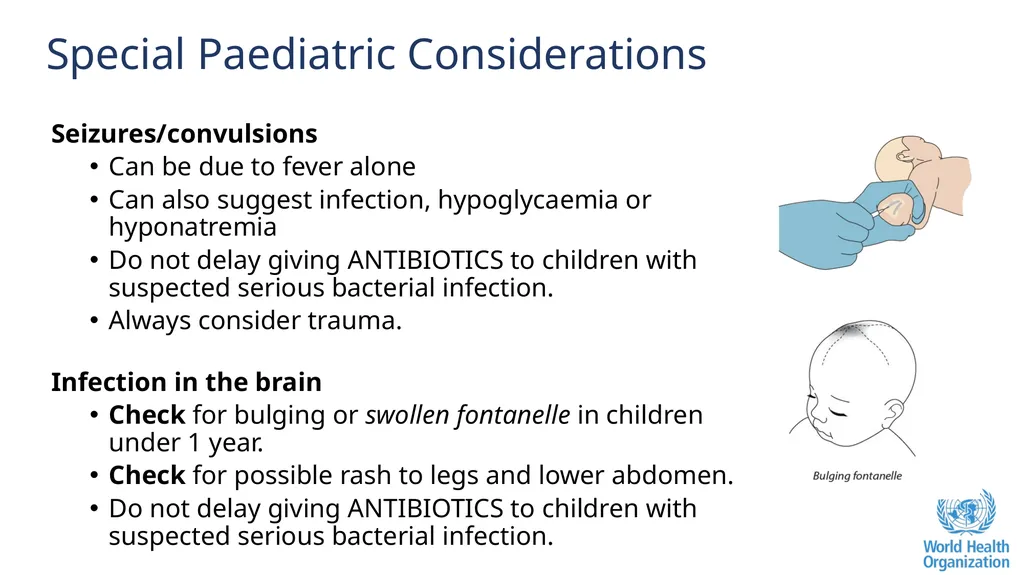
Infection in the brain
Check for bulging or swollen fontanelle in children under 1 year.
Check for possible rash to legs and lower abdomen.
Do not delay giving ANTIBIOTICS to children with suspected serious bacterial infection.<br>
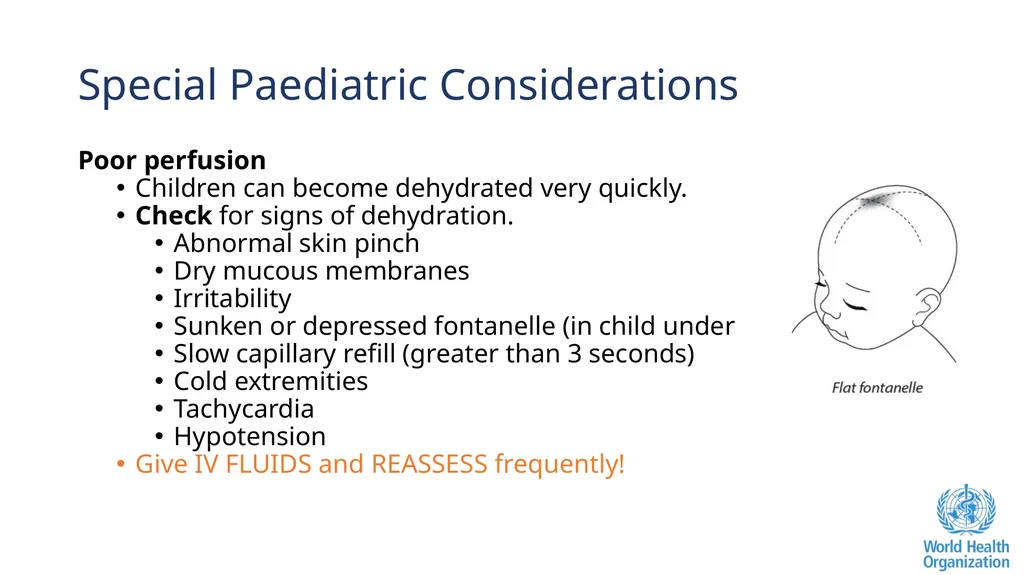
slide67. Special Paediatric Considerations Poor perfusion
Children can become dehydrated very quickly.
Check for signs of dehydration.
Abnormal skin pinch
Dry mucous membranes
Irritability
Sunken or depressed fontanelle (in child under 1 year)
Slow capillary refill (greater than 3 seconds)
Cold extremities
Tachycardia
Hypotension
Give IV FLUIDS and REASSESS frequently!<br>
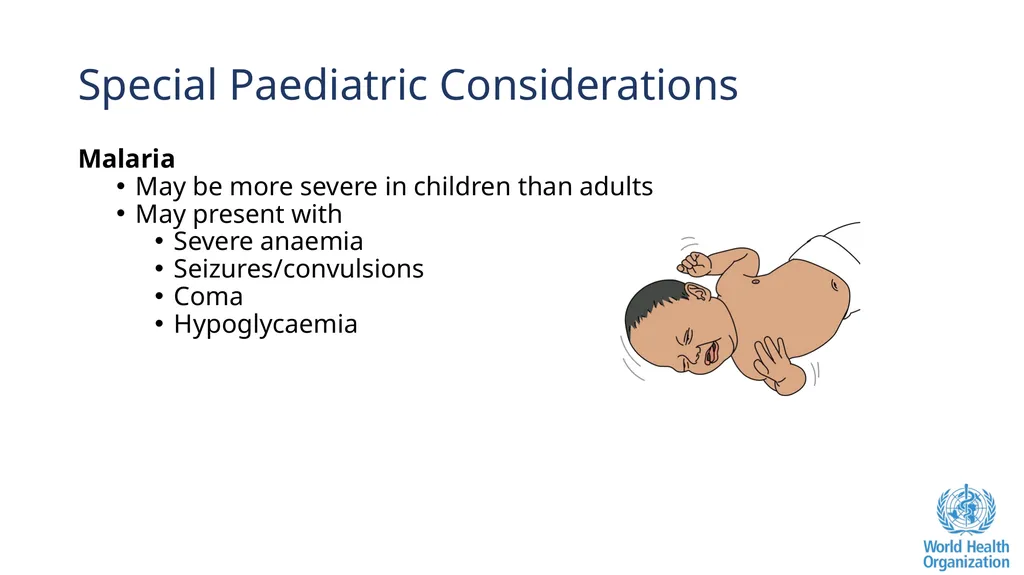
slide68. Special Paediatric Considerations Malaria
May be more severe in children than adults
May present with
Severe anaemia
Seizures/convulsions
Coma
Hypoglycaemia<br>
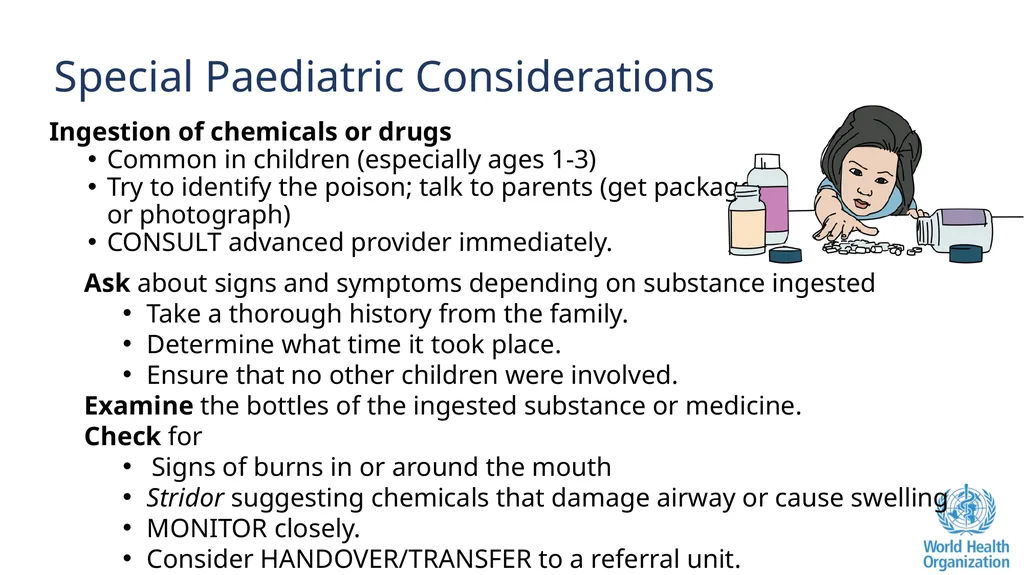
slide69. Special Paediatric Considerations Ingestion of chemicals or drugs
Common in children (especially ages 1-3)
Try to identify the poison; talk to parents (get package or photograph)
CONSULT advanced provider immediately. Ask about signs and symptoms depending on substance ingested
Take a thorough history from the family.
Determine what time it took place.
Ensure that no other children were involved.
Examine the bottles of the ingested substance or medicine.
Check for
Signs of burns in or around the mouth
Stridor suggesting chemicals that damage airway or cause swelling
MONITOR closely.
Consider HANDOVER/TRANSFER to a referral unit.<br>
slide70. Workbook Question 5 How would you assess for brain infection in a child?
_________________________________________________________
_________________________________________________________
Why does hypoglycemia occur frequently in severely ill children?
_________________________________________________________
_________________________________________________________
Seizures/convulsions in a young child can be a sign of what?
_________________________________________________________
_________________________________________________________<br>
slide71. Disposition of the Patient Disposition depends on the cause.
Causes that are not rapidly corrected or may return need management in a hospital.
Monitor closely for airway problems.
Consider HANDOVER/TRANSFER for advanced airway.
In hypoglycaemia, consider the cause and potential for it to develop again.
In opioid overdose, consider the need for repeat doses of Naloxone.<br>
slide72. Questions ?<br>
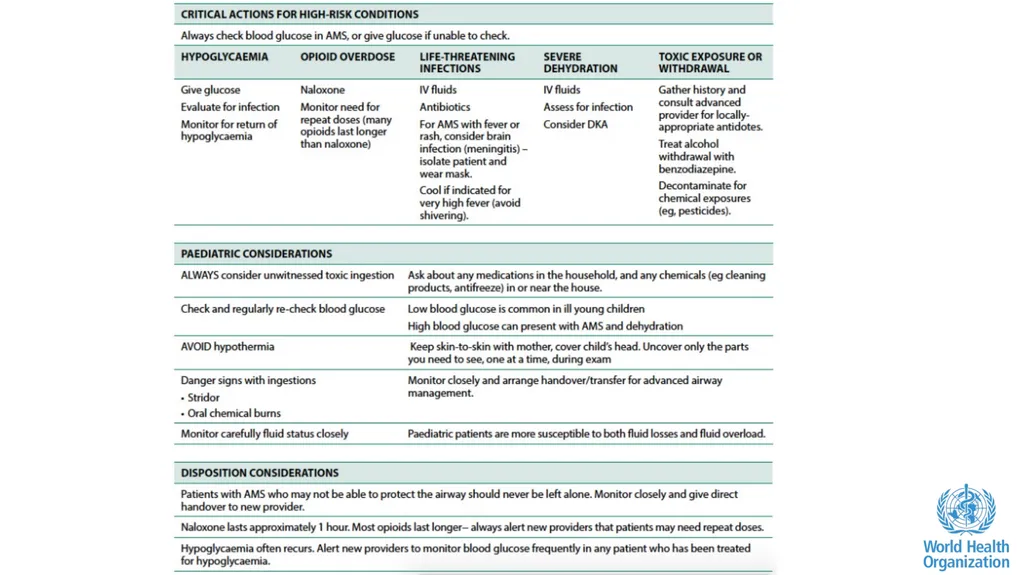
slide73. Quick Cards<br>
slide77. Summary In this presentation we have covered:
How to apply a SAMPLE history to a patient with altered mental status (AMS)
Key history findings suggestive of different causes of AMS
The high-risk causes of altered mental status in adults and children
How to perform a secondary exam in a patient with AMS
Key examination findings suggestive of different causes of AMS
Critical actions to manage a patient with AMS
Essential skills for high-risk causes of AMS
Special paediatric considerations for AMS
Disposition of patients with AMS<br>
slide2. Objectives By the end of this presentation, you will be able to:
Apply a SAMPLE history to a patient with altered mental status
Recognize key history findings suggestive of different causes of altered mental status
List high-risk causes of altered mental status in adults and children
Describe how to perform a secondary exam in a patient with altered mental status
Recognize key examination findings suggestive of different causes of altered mental status
Describe critical actions to manage a patient with altered mental status (AMS)
Identify essential skills to manage for high-risk causes of altered mental status
Describe special paediatric considerations for altered mental status
Consider the disposition and transport of patients with altered mental status<br>
slide3. Essential skills Cervical spine immobilization
Head-tilt and chin-lift/jaw thrust
Airway suctioning
Management of choking
Recovery position
Nasopharyngeal (NPA) and oropharyngeal airway (OPA) placement Oxygen administration
Bag-valve-mask ventilation
Needle-decompression for tension pneumothorax
Three-sided dressing for chest wound Intravenous (IV) line placement
IV fluid resuscitation
Direct pressure/ deep wound packing for haemorrhage control
Tourniquet for haemorrhage control
Pelvic binding
Fracture immobilization
Skin pinch test Full spine immobilization
AVPU and GCS
Glucose administration Wound and burns management
Snake bite management
Log roll Overall Assessing ABCDE<br>
slide4. Overview Altered mental status is a term used for a range of presentations.
Sudden or gradual changes in behaviour
Disorientation
Confusion
Coma
May be due to conditions that affect the brain or the brain itself
Can be chronic psychiatric problems or dementia but must rule out other life-threatening causes first
Delirium always requires a full assessment.
Ask family about baseline mental status when possible.<br>
slide5. Goals: Altered Mental Status The goal of initial assessment is to identify rapidly reversible causes of altered mental status, and to recognize dangerous conditions requiring transfer.
The goal of acute management is to ensure that blood, oxygen and glucose reach the brain; and to protect the brain from additional injury.<br>
slide6. The ABCDE Approach REMEMBER …………
Always start with the ABCDE approach AND treat life-threatening conditions.
Then, take a SAMPLE history.
Then, do a Secondary Examination. !<br>
slide7. The ABCDE Approach Breathing
Hypoxia can cause altered mental status.
Look for signs of difficulty in breathing or cyanosis.
Fast, deep breathing can reflect diabetic ketoacidosis or poisoning. Airway
May not be able to protect their airway and may be at risk for choking on vomit Circulation
Lack of perfusion to the brain
Look for and manage signs of shock
Low blood pressure
Elevated heart rate
Delayed capillary refill<br>
slide8. The ABCDE Approach Disability
Check AVPU or GCS (trauma).
Check glucose.
Hypoglycaemia, hyperglycaemia (diabetic ketoacidosis) can cause altered mental status.
Check pupils
Very small pupils: possible opioid overdose or pesticide poisoning
Very dilated pupils: possible stimulant drug use
Unequal pupils: possible head injury (increased intracranial pressure)
Check strength and sensation.
Weakness or loss of sensation to one side: possible tumor, bleeding or blockage of blood vessel, brain infection
General muscle weakness: possible salt imbalance
Look for abnormal repetitive movements or shaking on one or both sides (seizure).<br>
slide9. The ABCDE Approach Exposure
Look for signs that might cause altered mental status.
Check for infection, rashes, trauma, bites or stings.
Check arms for needle marks. REMEMBER …..
Altered patients may not report the history accurately. !<br>
slide10. Altered Mental Status Part 1: The SAMPLE history<br>
slide11. S: Signs and Symptoms ASK
How does the current condition compare to baseline mental status?
THINK
Ask family/friends about baseline when possible, to establish normal behaviour.<br>
slide12. S: Signs and Symptoms ASK
Is there difficulty breathing?
THINK
Altered mental status with difficulty in breathing may indicate lack of oxygen to the brain.<br>
slide13. S: Signs and Symptoms ASK:
Is there a headache?
Is there vomiting/ diarrhoea?
THINK
Headache with AMS can indicate infection, tumor or bleeding.
Vomiting without diarrhoea can be a sign of increased pressure in the brain.
Any source of dehydration can cause AMS from poor perfusion.
Vomiting and diarrhoea can cause hypoglycaemia.<br>
slide14. S: Signs and Symptoms ASK
Has there been any dizziness or fainting?
THINK
This could be a sign of poor perfusion to the brain.<br>
slide15. S: Signs and Symptoms ASK
When did the symptoms start?
How long do they last?
Have they changed over time?
THINK
Rapid onset think infection, inflammation, bleeding or drugs/toxins
Gradual onset think less acute causes such as tumour or slow bleeding in the brain
Intermittent onset think seizures or psychiatric disease ?<br>
slide16. S: Signs and Symptoms ASK
Any recent fevers?
THINK
Brain infections
Serious infections in children and elderly can cause AMS
Exposures
Prolonged outdoor (heat) exposure
Poisons
Medications
Drugs
High fevers can cause AMS<br>
slide17. S: Signs and Symptoms ASK:
Any weakness, clumsiness or difficulty walking?
THINK
Consider stroke or tumour.
ASK:
Any neck pain or stiffness?
THINK
Consider bleeding, inflammation or infection in cerebral spinal fluid.<br>
slide18. S: Signs and Symptoms ASK:
Any recent history of trauma or falls?
THINK
Bleeding in or around the brain can cause AMS even days after injury.
Chronic alcohol drinkers and the elderly
More prone to brain bleeding
May not remember falls
Always consider unwitnessed trauma in a patient found altered with no known cause.<br>
slide19. S: Signs and Symptoms ASK:
Any recent depression or changes in behaviour?
THINK
Drug and alcohol use or psychiatric problems
Consider possibility of suicide attempt by poisoning<br>
slide20. S: Signs and Symptoms ASK:
Does anyone else from the same family or location have symptoms?
THINK
Gaseous poisoning
Carbon monoxide is usually seen in cold climates with indoor heating.<br>
slide21. A: Allergies ASK
Allergies to medications or other substances?
Recent exposures to known allergens?
THINK
Severe allergic reactions can present with altered mental status due to
Low blood oxygen levels
Poor blood circulation due to shock<br>
slide22. M: Medications ASK
Currently taking any medications?
Collect medication list
Any new medications or changed doses?
THINK
Medication interactions
Medication side effects
Pain medications (opioids such as morphine, pethidine, heroin)
Sleeping medications
Seizure medications<br>
slide23. P: Past Medical History ASK
History of diabetes?
THINK
Low blood sugar
Diabetic Ketoacidosis (DKA)
Increased urine output
Increased thirst
Fast or deep breathing<br>
slide24. P: Past Medical History ASK
History of heart disease?
History of stroke?
History of high blood pressure?
THINK
Heart attacks can decrease blood flow and oxygen to the brain.
Heart disease increases risk of stroke.
AMS with a stroke history may indicate a new stroke or brain bleeding.
Old stroke symptoms may return with severe illness.
High blood pressure increases the risk for brain bleeding.<br>
slide25. P: Past Medical History ASK
History of seizure?
Do they take regular medications?
Any medication changes or missed doses?
If they had a witnessed convulsion, ask about fall or head trauma
THINK
Recovering from convulsion (postictal period)
usually takes half hour to several hours at the most.
If altered mental status persists longer consider other causes.<br>
slide26. P: Past Medical History ASK
History of HIV infection?
History of tuberculosis?
History of liver or kidney failure?
THINK
With history of HIV or tuberculosis, consider infection around brain.
With liver or kidney failure, consider problems clearing toxins and waste.<br>
slide27. P: Past Medical History ASK
History of long standing alcohol use?
History of drug abuse?
THINK
Alcohol intoxication and alcohol withdrawal can present with altered mental status.
Alcoholics have a high risk for head injury and low blood sugar levels.
Sedatives and opiates can cause altered mental status.<br>
slide28. P: Past Medical History ASK
History of pregnancy?
THINK
High blood pressure during pregnancy can lead to eclampsia (seizures/convulsions).<br>
slide29. L: Last Oral Intake ASK
When did the patient last eat or drink?
THINK
Low blood sugar levels and dehydration can cause AMS.<br>
slide30. E: Events Surrounding Illness ASK
Was there any recent trauma?
Any recent travel?
THINK
Trauma can cause poor perfusion and AMS.
Specific infections acquired during travel can lead to altered mental status.
Malaria is a key consideration<br>
slide31. E: Events Surrounding Illness ASK
Recent exposures: sick person, recent bites, chemical exposures, exposure to hot or cold…?
Drugs or alcohol?
THINK
Sick contacts may suggest infection.
Chemical exposure (pesticides) may suggest poisoning.
Bites may suggest envenomation.
Exposure to extreme temperatures suggests hyper/hypothermia.
Drug ingestions can cause agitation or lethargy.
Alcohol intoxication and withdrawal can cause AMS.<br>
slide32. Workbook Question 1 Using the workbook section above, list 7 questions about SIGNS AND SYMPTOMS you would ask when taking a SAMPLE history
1.
2.
3.
4.
5.
6.
7.<br>
slide33. Altered Mental Status Part 2: The Secondary Exam and Causes of Altered Mental Status<br>
slide34. When caring for patients with altered mental status, always check for safety! Agitated and violent behaviour is common.
Determine cause, prioritize the safety of the patient and providers.
Keep calm, work as a team.
Ensure the space is safe from weapons and you have an escape route.
Avoid making the patient feel threatened.
Do not sit too close and speak in a calm, sympathetic voice.
Explain what is happening.
Approach as a group or call for help if necessary.
Check vital signs, temperature and glucose; treat abnormalities.
Call for help early.<br>
slide35. Secondary Exam Findings Check level of consciousness with AVPU scale.
Check Glasgow Coma Scale in trauma.
Check blood glucose.
Check pupils for small, dilated or unequal.
Check orientation.
Name?
Where are you?
What time is it?
What day of the week is it?<br>
slide36. Secondary Exam Findings Check for trauma.
Head injuries
Check for bruising around the eyes, behind the ears or leaking of clear fluid from the nose or mouth.
Check temperature.
Infectious causes, poisoning, alcohol withdrawal
and changes in body hormones can cause fever.
Hypothermia may mean sepsis, cold exposure
or low body hormone levels (thyroid).
Check for stiff neck.
Infection
Bleeding in the brain
Trauma (immobilize spine, do not move neck)<br>
slide37. Secondary Exam Findings Check for strength and sensation.
Ask the patient to follow commands.
Test for strength in face, arms and legs.
Look for generalized or one-sided weakness.
Suggests a mass, bleeding or blockage in vessel
Consider hypoglycaemia.
Generalized weakness suggests salt imbalance.<br>
slide38. Secondary Exam Findings Check for signs of dehydration.
Dry mouth
Abnormal skin pinch
Consider diabetic ketoacidosis
Feel the abdomen.
Enlarged liver (liver disease)
Check the skin.
Cool, pale, moist skin: Suggests hypoglycaemia
Jaundice (yellow) skin: Suggests liver disease
Check for rashes, bites, stings
Monitor for changes in mental status - patients can worsen quickly!<br>
slide39. Workbook Question 2 Using the workbook section above, list 5 SECONDARY exam findings you would check for in a patient with altered mental status:
1.
2.
3.
4.
5.<br>
slide40. Altered Mental Status Part 2: The Secondary Exam and Causes of Altered Mental Status<br>
slide41. Rapidly Reversible Causes of Altered Mental Status Hypoglycaemia signs/symptoms
Sweating
Seizures/convulsions
Blood glucose <3.5mmol/L
History of diabetes, malaria or severe infection
Children with any illness
Responds quickly to glucose Severe dehydration signs/symptoms
Signs of poor perfusion
Tachycardia
Low blood pressure
Abnormal skin pinch
Decreased ability to drink fluids
Dry mucous membranes<br>
slide42. Rapidly Reversible Causes of Altered Mental Status Heat Stroke signs/symptoms
Prolonged heat and sun exposure
High body temperature
Very warm skin
May or may not be sweating Hypoxia signs/symptoms
Shortness of breath
Low blood oxygen levels
Cyanosis<br>
slide43. Infectious Causes of Altered Mental Status Cerebral malaria signs and symptoms
Fever
Rapid malaria test or smear positive
In or from an area with malaria Inflammation/infection around the brain (meningitis, encephalitis, brain abscess, bleeding)
Fever
Neck stiffness
Rash
Eye pain/ sensitivity to light
Headache
Known infectious epidemic or exposure
History of HIV or TB infection<br>
slide44. Infectious Causes of Altered Mental Status Severe infection signs and symptoms
Fever
Tachycardia
Tachypnoea
May have hypotension
Sign of infection
Skin infection
Cough
Crackles in lungs
Urinary symptoms Rabies signs and symptoms
Agitation
Fear of drinking (hydrophobia)
Drooling
Weakness
History of animal bite<br>
slide45. Metabolic Causes of Altered Mental Status Diabetic ketoacidosis signs and symptoms
History of diabetes
Rapid or deep and slow breathing
Frequent urination
Sweet smelling breath
High glucose in blood or urine
Dehydration<br>
slide46. Toxic Causes of Altered Mental Status Alcohol or drug intoxication or withdrawal signs and symptoms
Known alcohol or drug use
Injection marks; drugs found on patient
Alcohol
Acutely intoxicated (drunk)
Withdrawal (convulsions, confusion, tachycardia)
Chronic use (balance problems, confusion, tachycardia)
Opioids
Acutely intoxicated (lethargy, very small pupils and slow breathing)
Withdrawal (agitation, sweating, diarrhoea, vomiting)
Other drugs may cause large pupils, agitation, sweating and fever<br>
slide47. Toxic Causes of Altered Mental Status Pesticide poisoning
History of exposure
Very small pupils
Diarrhoea
Vomiting
Diaphoresis Snake bite
Snake bite history
Bite marks in setting with venomous snakes
Oedema
Blistering of the skin
Bruising
Hypotension
Paralysis
Seizure
Bleeding from wounds<br>
slide48. Toxic Causes of Altered Mental Status Medication reaction or dosing issue
New medications or recent change in dose Gaseous poisoning
History consistent with possible exposure
Multiple people with symptoms
Headache<br>
slide49. Other Causes of AMS Seizures signs and symptoms
Known history
Bitten tongue
Urinated on self
Gradual improvement over minutes/hours
If pregnant, consider eclampsia Increased pressure on the brain
(tumour, trauma, stroke or brain swelling)
Headache
Seizures/convulsions
Nausea and vomiting
Unequal pupils
Weakness on one side
Speech problems<br>
slide50. Other Causes of Altered Mental Status Liver disease signs and symptoms
History of alcohol abuse or liver disease
Enlarged abdomen with thin arms
Yellow coloring of skin and eyes (jaundice)
Hypoglycaemia Kidney disease
High blood pressure
Oedema or swelling in legs
Decreased or no urine if severe<br>
slide51. Other Causes of Altered Mental Status Head trauma signs and symptoms
Visual changes
Loss of memory
Vomiting
Headache
History of recent trauma
Scalp laceration and/or skull deformity
Bruising to head
Blood or clear fluid from nose or ears
Unequal pupils Weakness to one side of the body
Seizure/convulsions<br>
slide52. Considerations in Children Ingestions of chemicals or toxins are common in younger children.
Check for a history of medications or substances found around the child. !<br>
slide53. Workbook Question 3 Using the workbook section above, list the possible causes of altered mental status from the history and physical findings below:<br>
slide54. Altered Mental Status Part 3: Management, special paediatric considerations and disposition<br>
slide55. Management If suspected hypoxia
Give OXYGEN.
Look for underlying cause.
If suspected hypoglycaemia
Give GLUCOSE.
If suspected hyperglycaemia
Give IV FLUIDS.
Plan for rapid TRANSFER as these patients can become extremely ill If suspected fever and AMS
Give ANTIBIOTICS.
TEST for malaria in endemic areas.
Consider poisoning and envenomation
Treat fever with PARACETAMOL
For severe temperature elevation, spay with cool mist, give IV FLUIDS, avoid shivering.<br>
slide56. Management If suspected hypothermia
Move to warm environment.
Remove wet clothing.
Warm with blankets.
Give warm IV FLUIDS.
If suspected bleeding or increased pressure on the brain
ELEVATE the head of the bed 30 degrees if no trauma.
If trauma is suspected, ensure SPINAL IMMOBILIZATION.<br>
slide57. Management If suspected opioid overdose
Give NALOXONE by IV or IM.
Naloxone only lasts one hour while most opioids last longer.
Consider the need for re-dosing.
If active seizure/convulsions
Treat with BENZODIAZEPINE, monitor closely for slow breathing.
CHECK glucose or give GLUCOSE if unable to check.
Place patient in the recovery position (if no trauma).
If patient continues to seize or does not wake up, TRANSFER and MONITOR airway.<br>
slide58. Management If pregnant with active seizure/convulsion
This could be eclampsia.
Arrange for rapid TRANSFER/HANDOVER to specialist unit.
Give MAGNESIUM SULPHATE.
MONITOR closely for magnesium toxicity.
Hypotension, abnormal heart rhythm, coma, respiratory depression, muscle weakness, confusion, nausea, vomiting, flushing
If these occur, do not give additional magnesium.
If suspected alcohol withdrawal with seizure/convulsion
Always check glucose and give as needed.
Give a BENZODIAZEPINE.<br>
slide59. Management If suspected poisoning or envenomation
Try to identify the poison.
Arrange for HANDOVER/TRANSFER to centre that can manage poisoning and advanced airway.
If pesticide poisoning suspected, decontaminate and monitor airway for secretions.
Snake bites should be treated per WOUND MANAGEMENT and referred for possible ANTIVENOM.
If suspected rabies
There is no specific treatment for rabies.
Symptomatic rabies is almost always fatal.<br>
slide60. Management If the patient is agitated or violent
Protect the patient from harming self, you or others.
Ensure you have an escape/exit route.
Remove potential weapons/unsafe objects.
Call for help.
Speak in a calm, soft, non-threatening tone; explain what is happening.
Do not confront or judge.
Consider causes - check glucose and vital signs; treat abnormalities.
Arrange for a safe HANDOVER/TRANSFER to an advanced provider.
If suspected trauma
Assess GCS.
IMMOBILIZE the spine.
CHECK for signs of increased pressure on the brain.<br>
slide61. Special Considerations Management of active convulsions
Check ABCDE.
Maintain the airway (nothing in the mouth.)
Give OXYGEN if concern for hypoxia or prolonged convulsion.
Place patient on their side.
Protect the patient from harm or further injury.
Check glucose or give GLUCOSE if unable to check.
Give a BENZODIAZEPINE. If pregnant and seizing give MAGNESIUM SULPHATE.
If no response give another dose of BENZODIAZEPINE up to 3 doses.
If the patient does not wake between seizure/convulsions consider this a life-threatening condition.
Arrange for rapid HANDOVER/TRANSFER to an advanced provider
If the seizures /convulsions stop place patient in RECOVERY POSITION and monitor closely.<br>
slide62. Workbook Question 4 Using the workbook section above, list what you would do to manage these patients:<br>
slide63. Special Paediatric Considerations REMEMBER that children with altered mental status may have mild signs such as sleeping more or being less interactive.
Manage ABCDE first, then look for cause of altered mental status.
REMEMBER that very ill or injured children may have normal vital signs until they rapidly deteriorate. !<br>
slide64. Special Paediatric Considerations Hypoglycaemia
Occurs frequently in severely ill children
Common cause of AMS in children
Check glucose or give GLUCOSE if unable to check.
Hypoxia
Can occur as a result of many conditions
Respiratory infections and shock
Birth hypoxia is a consideration in newborns<br>
slide65. Special Paediatric Considerations Hyperthermia with AMS
Infection
Environment or heat exposure
Exercise
Seizure/convulsion
Hormonal imbalance
Poisoning Hypothermia with AMS
Can also suggest infection, especially in infants
Drug intoxication
Exposure to cold
Hormonal imbalance
Young infants are more likely to be affected
Use blankets, hats, skin-to-skin contact with family member<br>
slide66. Special Paediatric Considerations Seizures/convulsions
Can be due to fever alone
Can also suggest infection, hypoglycaemia or hyponatremia
Do not delay giving ANTIBIOTICS to children with suspected serious bacterial infection.
Always consider trauma.
Infection in the brain
Check for bulging or swollen fontanelle in children under 1 year.
Check for possible rash to legs and lower abdomen.
Do not delay giving ANTIBIOTICS to children with suspected serious bacterial infection.<br>
slide67. Special Paediatric Considerations Poor perfusion
Children can become dehydrated very quickly.
Check for signs of dehydration.
Abnormal skin pinch
Dry mucous membranes
Irritability
Sunken or depressed fontanelle (in child under 1 year)
Slow capillary refill (greater than 3 seconds)
Cold extremities
Tachycardia
Hypotension
Give IV FLUIDS and REASSESS frequently!<br>
slide68. Special Paediatric Considerations Malaria
May be more severe in children than adults
May present with
Severe anaemia
Seizures/convulsions
Coma
Hypoglycaemia<br>
slide69. Special Paediatric Considerations Ingestion of chemicals or drugs
Common in children (especially ages 1-3)
Try to identify the poison; talk to parents (get package or photograph)
CONSULT advanced provider immediately. Ask about signs and symptoms depending on substance ingested
Take a thorough history from the family.
Determine what time it took place.
Ensure that no other children were involved.
Examine the bottles of the ingested substance or medicine.
Check for
Signs of burns in or around the mouth
Stridor suggesting chemicals that damage airway or cause swelling
MONITOR closely.
Consider HANDOVER/TRANSFER to a referral unit.<br>
slide70. Workbook Question 5 How would you assess for brain infection in a child?
_________________________________________________________
_________________________________________________________
Why does hypoglycemia occur frequently in severely ill children?
_________________________________________________________
_________________________________________________________
Seizures/convulsions in a young child can be a sign of what?
_________________________________________________________
_________________________________________________________<br>
slide71. Disposition of the Patient Disposition depends on the cause.
Causes that are not rapidly corrected or may return need management in a hospital.
Monitor closely for airway problems.
Consider HANDOVER/TRANSFER for advanced airway.
In hypoglycaemia, consider the cause and potential for it to develop again.
In opioid overdose, consider the need for repeat doses of Naloxone.<br>
slide72. Questions ?<br>
slide73. Quick Cards<br>
slide77. Summary In this presentation we have covered:
How to apply a SAMPLE history to a patient with altered mental status (AMS)
Key history findings suggestive of different causes of AMS
The high-risk causes of altered mental status in adults and children
How to perform a secondary exam in a patient with AMS
Key examination findings suggestive of different causes of AMS
Critical actions to manage a patient with AMS
Essential skills for high-risk causes of AMS
Special paediatric considerations for AMS
Disposition of patients with AMS<br>