"An Algebra for Evaluating Path Queries Renzo" is the property of its rightful owner. Permission is granted to
download and print the materials on this website for personal, non-commercial use only, and to display it
on your personal computer provided you do not modify the materials and that you retain all copyright
notices contained in the materials. By downloading content from our website, you accept the terms of this
agreement.
Presentation Transcript
01
An Algebra for Evaluating Path Queries Renzo Angles, Sebastián Ferrada, Roberto García y Vicente Rojas.
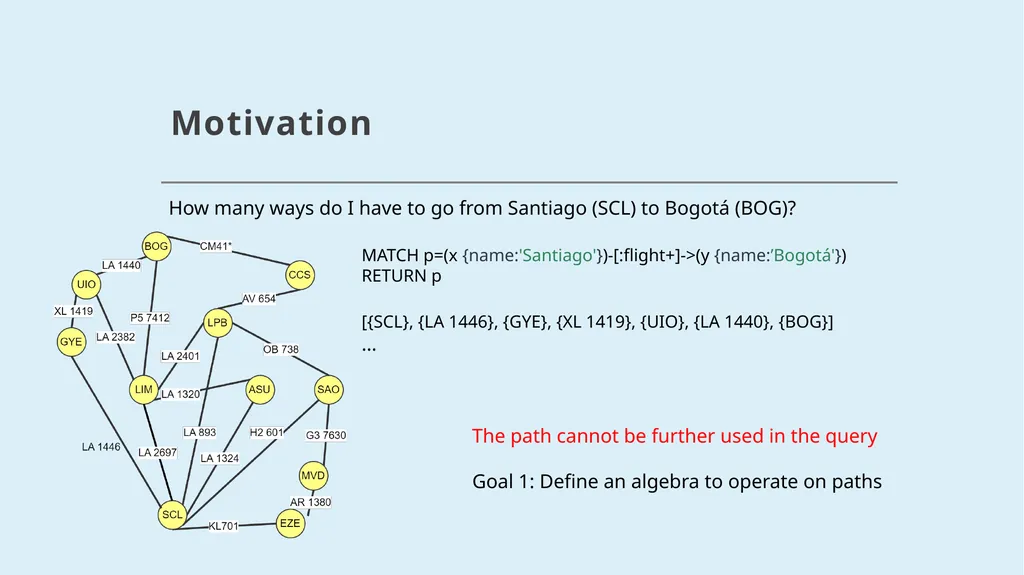
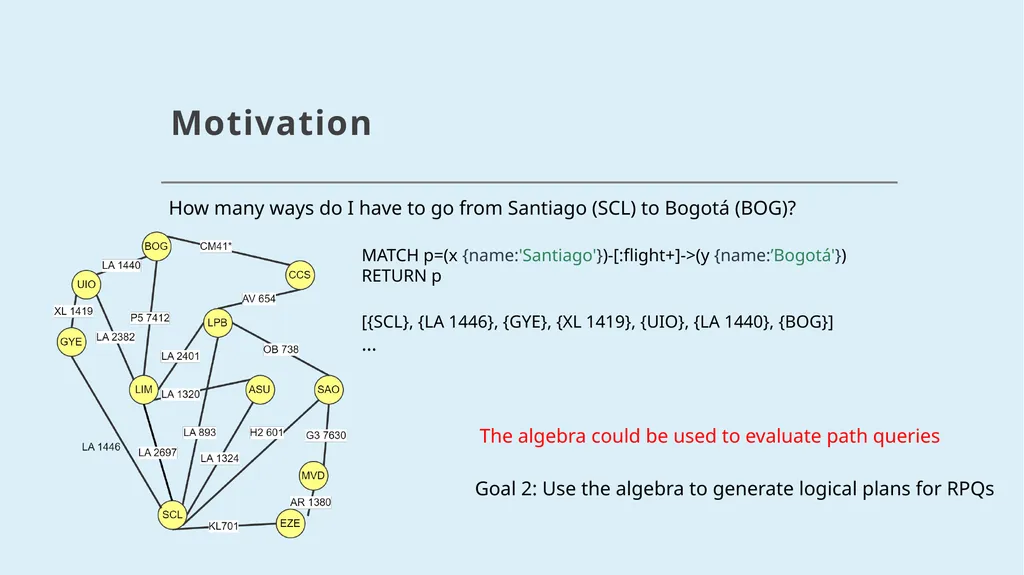
Motivation MATCH p=(x {name:'Santiago'})-[:flight+]->(y {name:’Bogotá'})
RETURN p How many ways do I have to go from Santiago (SCL) to Bogotá (BOG)? [{SCL}, {LA 1446}, {GYE}, {XL 1419}, {UIO}, {LA 1440}, {BOG}]
… The path cannot be further used in the query Goal 1: Define an algebra to operate on paths<br>
03
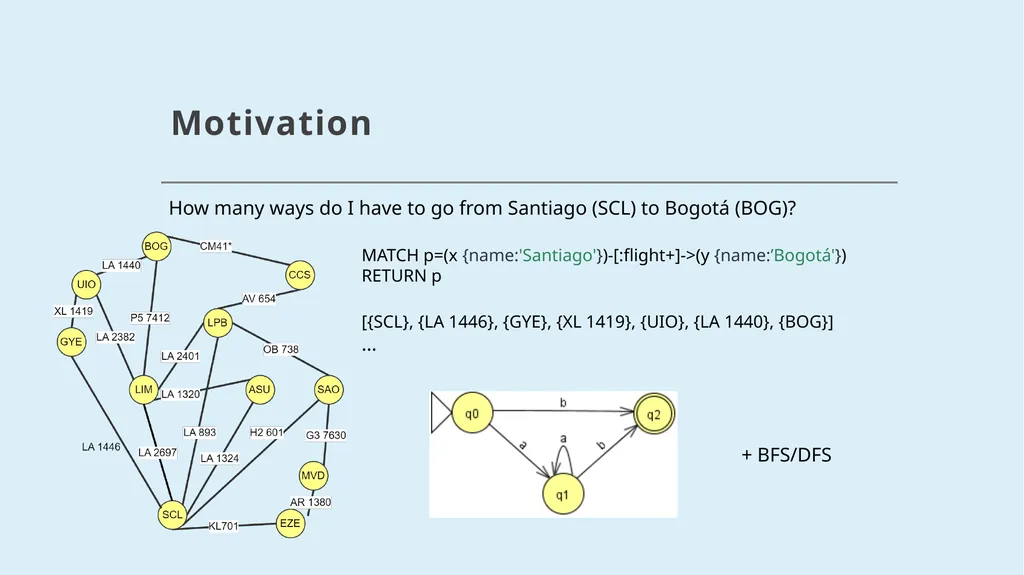
Motivation MATCH p=(x {name:'Santiago'})-[:flight+]->(y {name:’Bogotá'})
RETURN p How many ways do I have to go from Santiago (SCL) to Bogotá (BOG)? [{SCL}, {LA 1446}, {GYE}, {XL 1419}, {UIO}, {LA 1440}, {BOG}]
… + BFS/DFS<br>
04
Motivation MATCH p=(x {name:'Santiago'})-[:flight+]->(y {name:’Bogotá'})
RETURN p How many ways do I have to go from Santiago (SCL) to Bogotá (BOG)? [{SCL}, {LA 1446}, {GYE}, {XL 1419}, {UIO}, {LA 1440}, {BOG}]
… The algebra could be used to evaluate path queries Goal 2: Use the algebra to generate logical plans for RPQs<br>
05
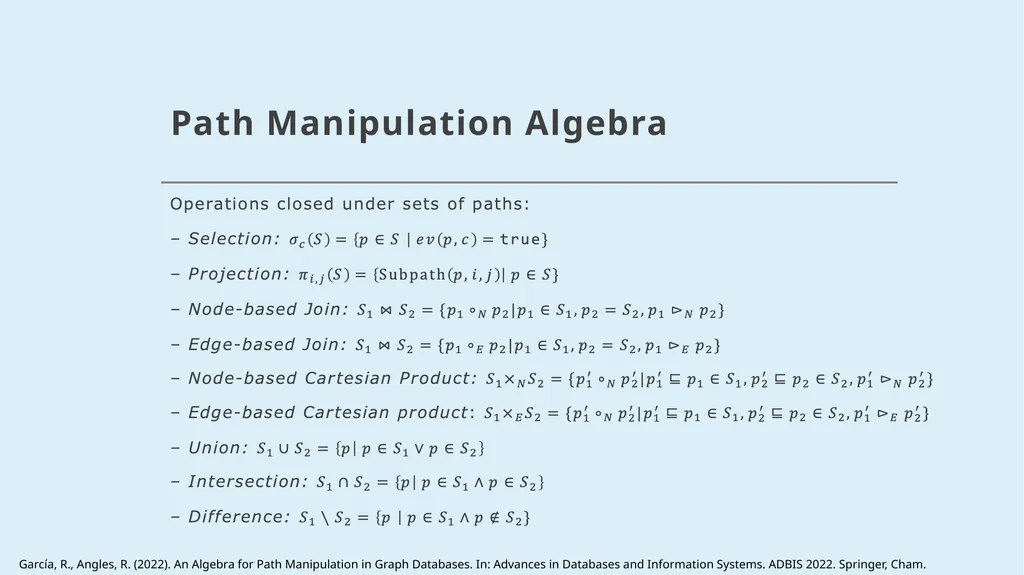
Path Manipulation Algebra García, R., Angles, R. (2022). An Algebra for Path Manipulation in Graph Databases. In: Advances in Databases and Information Systems. ADBIS 2022. Springer, Cham.<br>
06
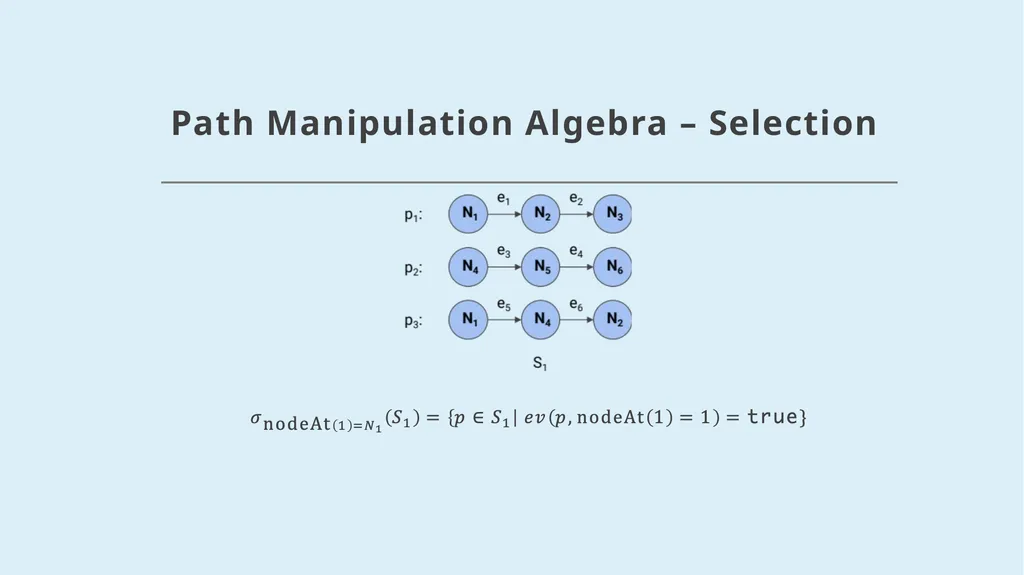
Path Manipulation Algebra – Selection<br>
07
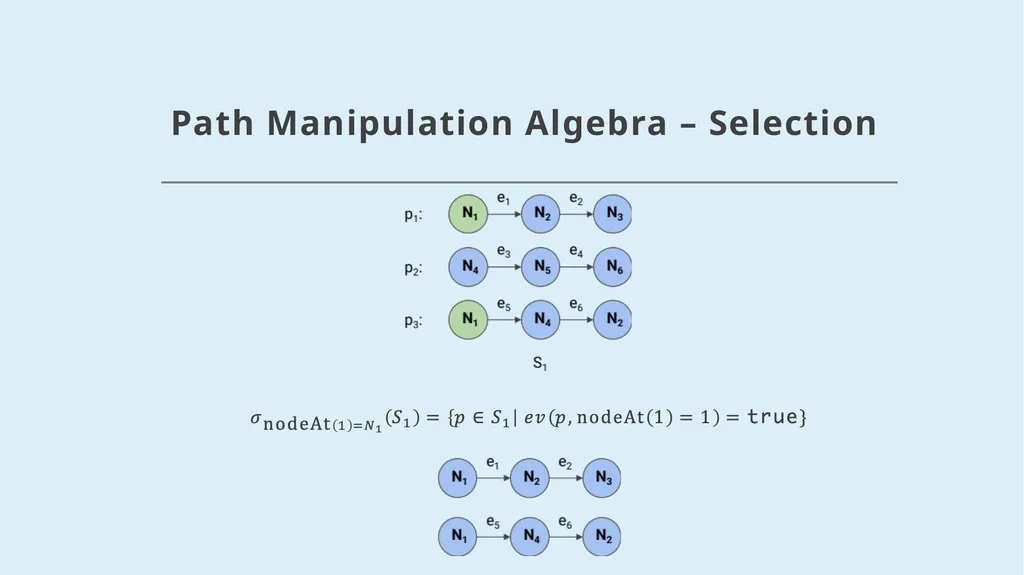
Path Manipulation Algebra – Selection<br>
08
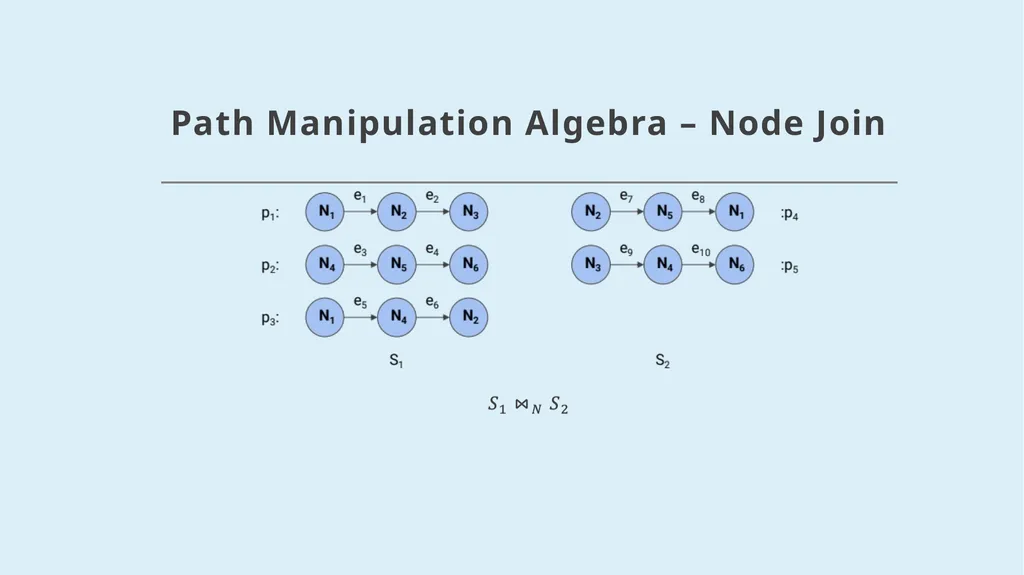
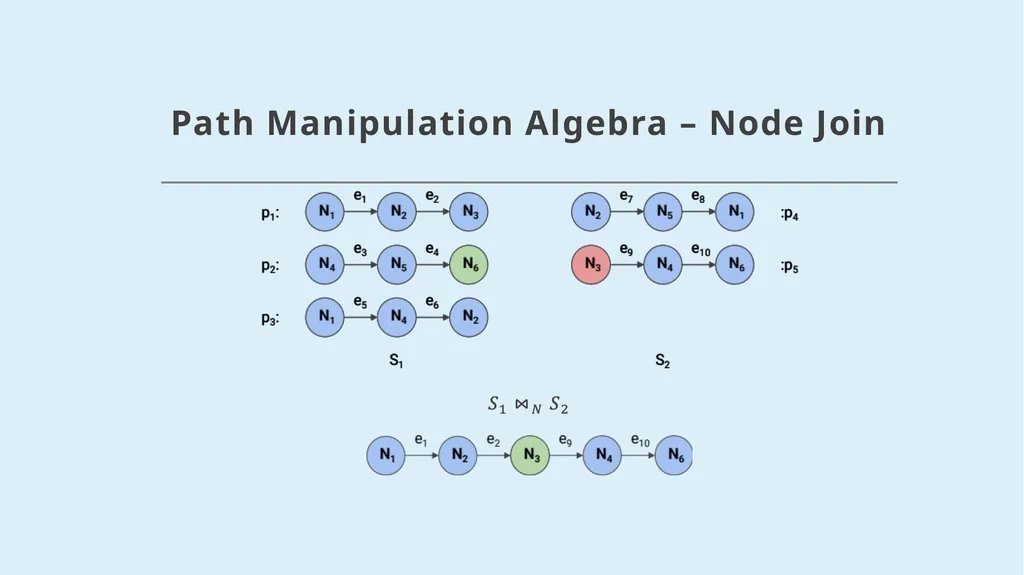
Path Manipulation Algebra – Node Join<br>
09
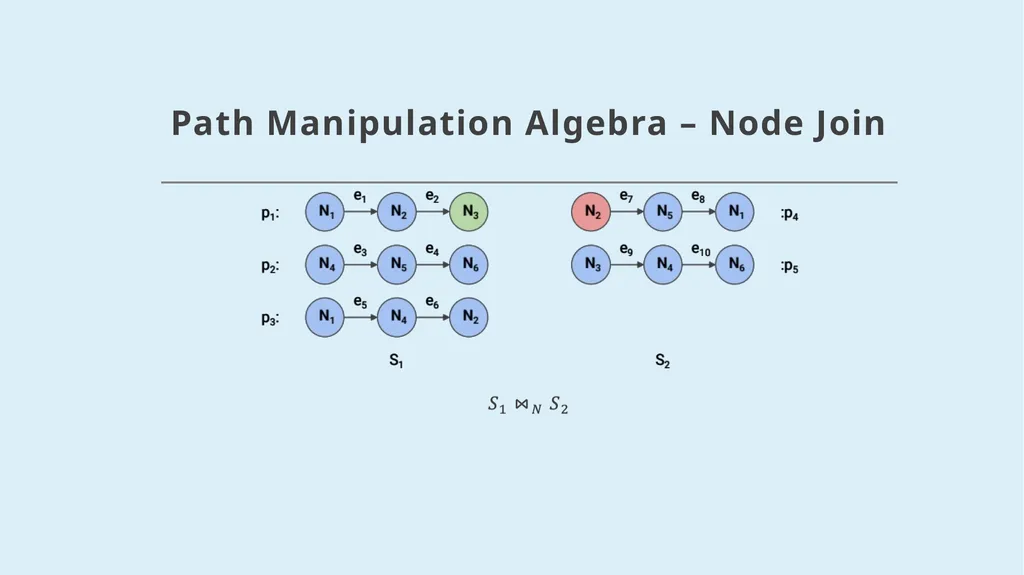
Path Manipulation Algebra – Node Join<br>
10
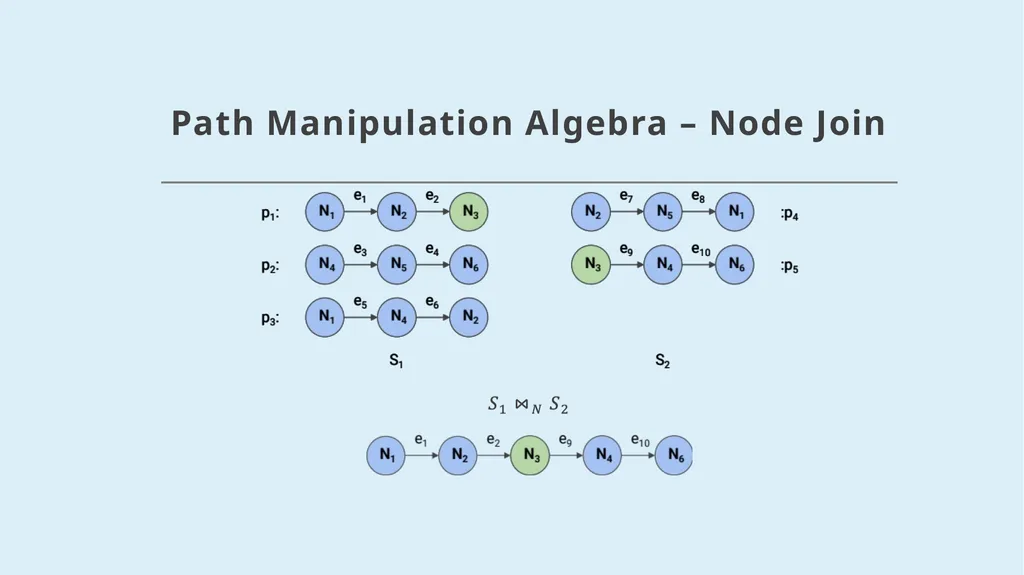
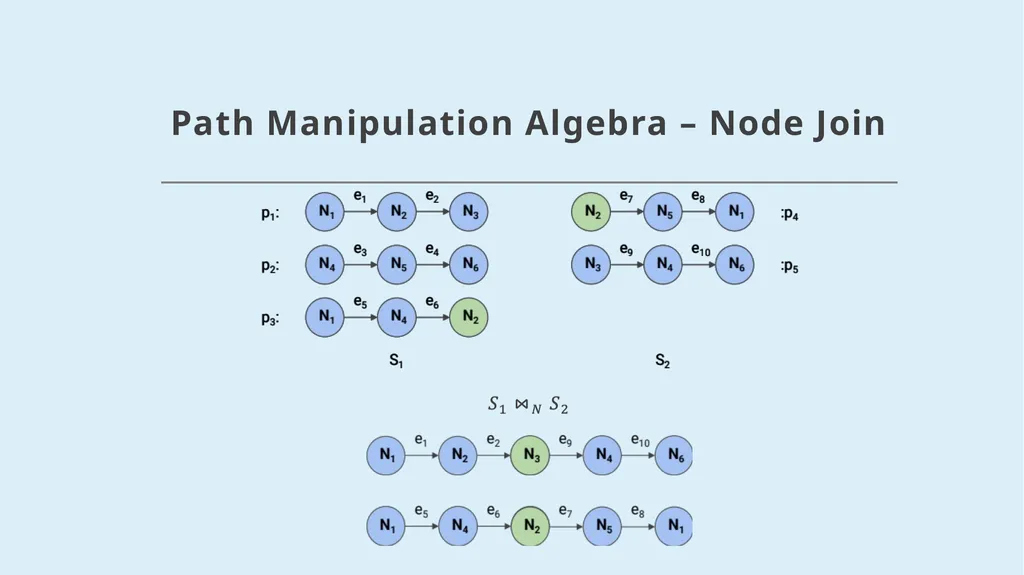
Path Manipulation Algebra – Node Join<br>
11
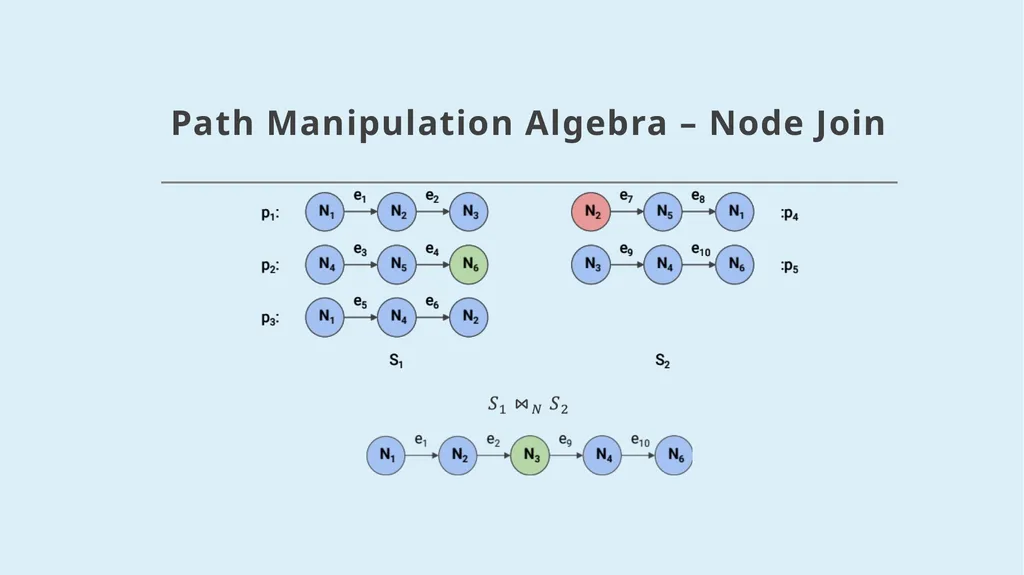
Path Manipulation Algebra – Node Join<br>
12
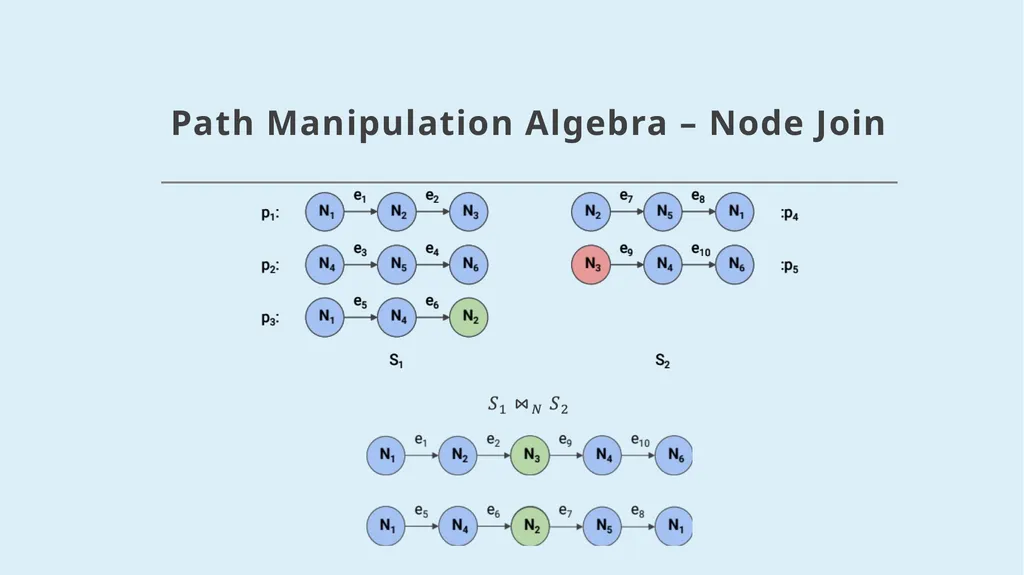
Path Manipulation Algebra – Node Join<br>
13
Path Manipulation Algebra – Node Join<br>
14
Path Manipulation Algebra – Node Join<br>
15
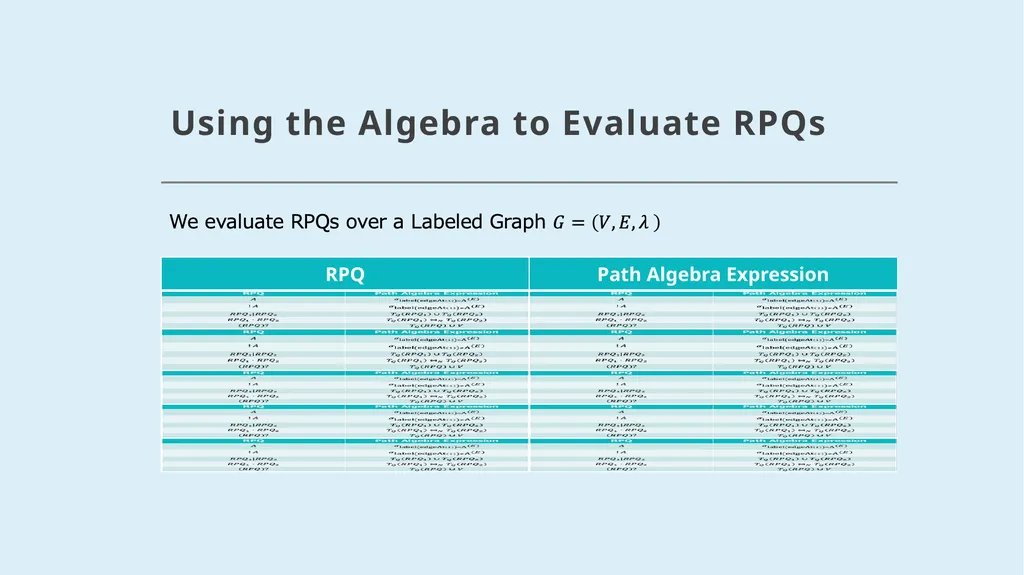
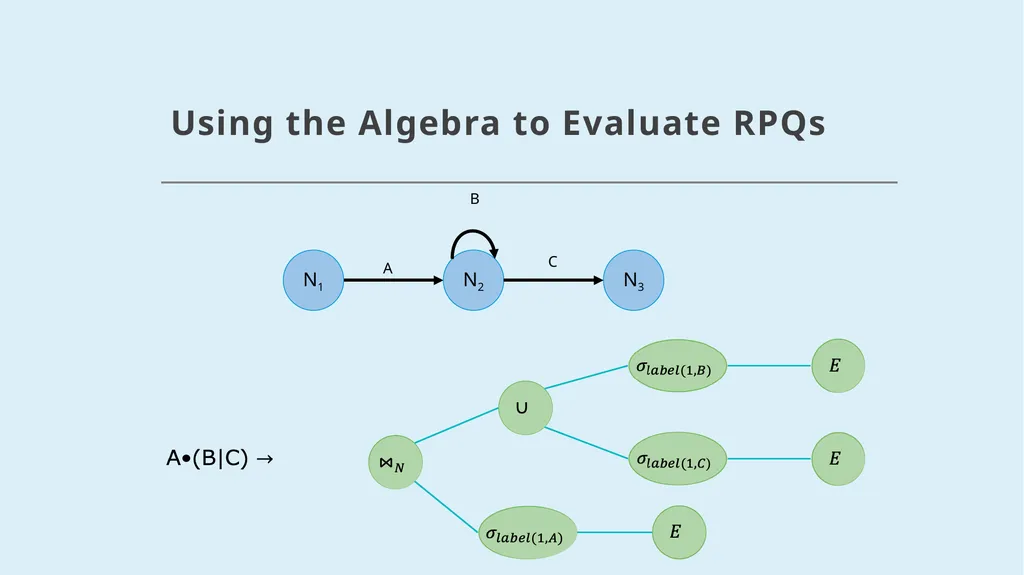
Using the Algebra to Evaluate RPQs<br>
16
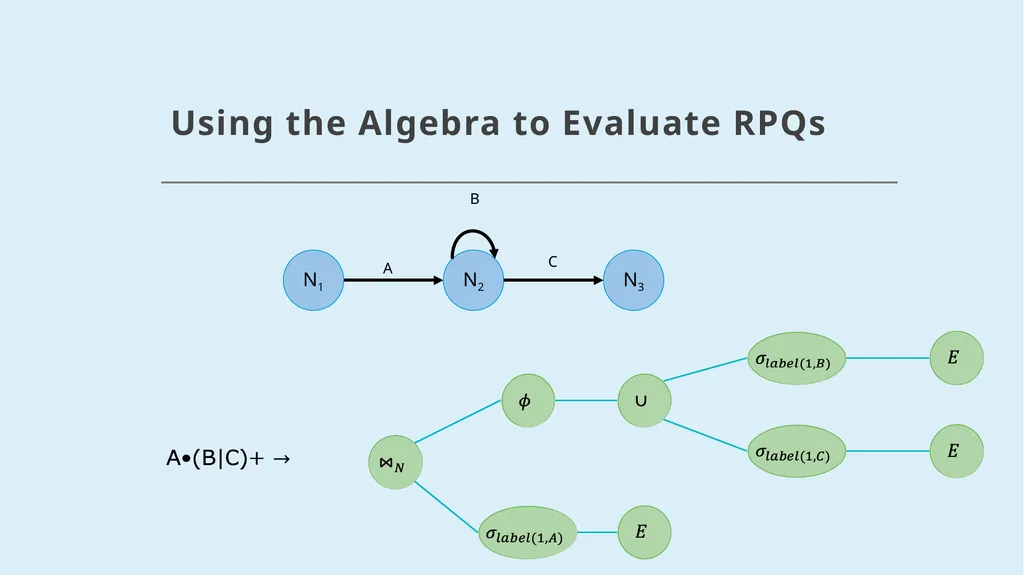
Using the Algebra to Evaluate RPQs N1 N2 N3 A B C<br>
17
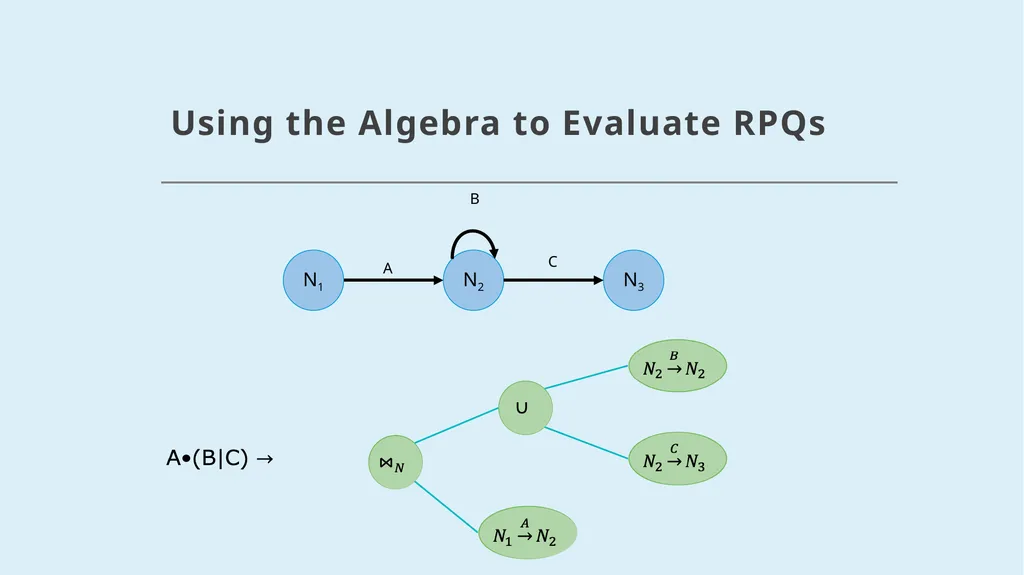
Using the Algebra to Evaluate RPQs N1 N2 N3 A B C<br>
18
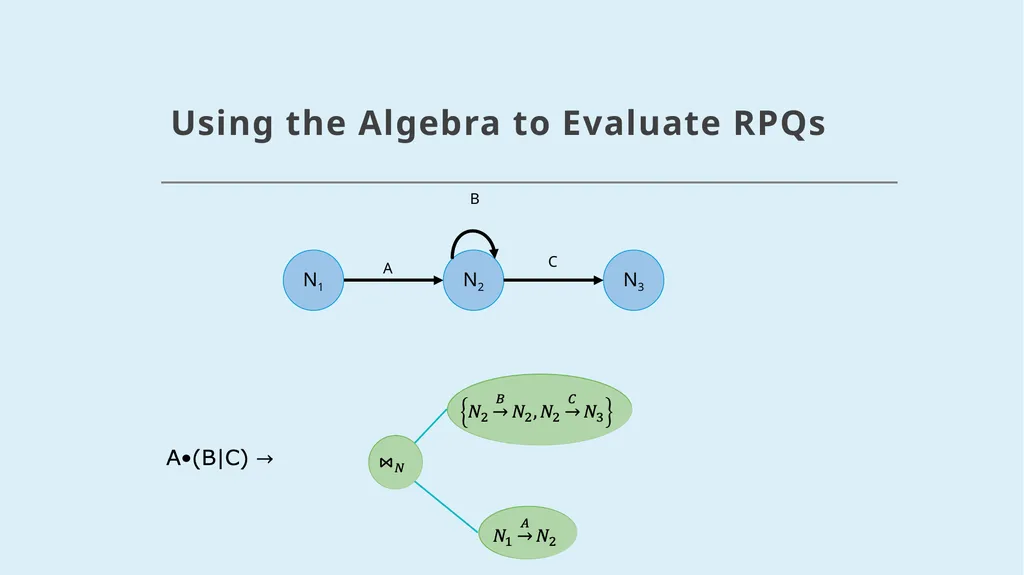
Using the Algebra to Evaluate RPQs N1 N2 N3 A B C<br>
19
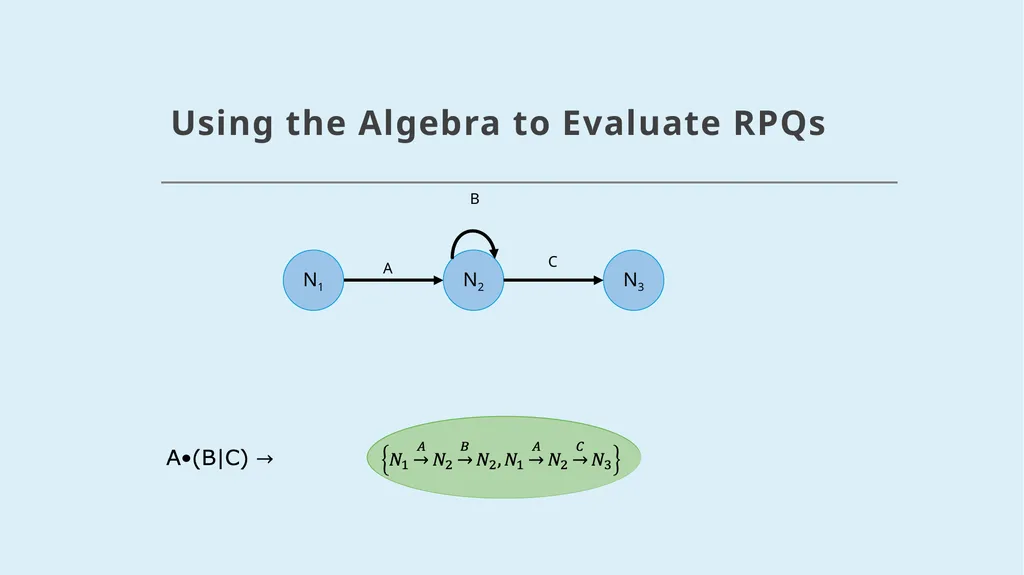
Using the Algebra to Evaluate RPQs N1 N2 N3 A B C<br>
20
What about + and *?<br>
21
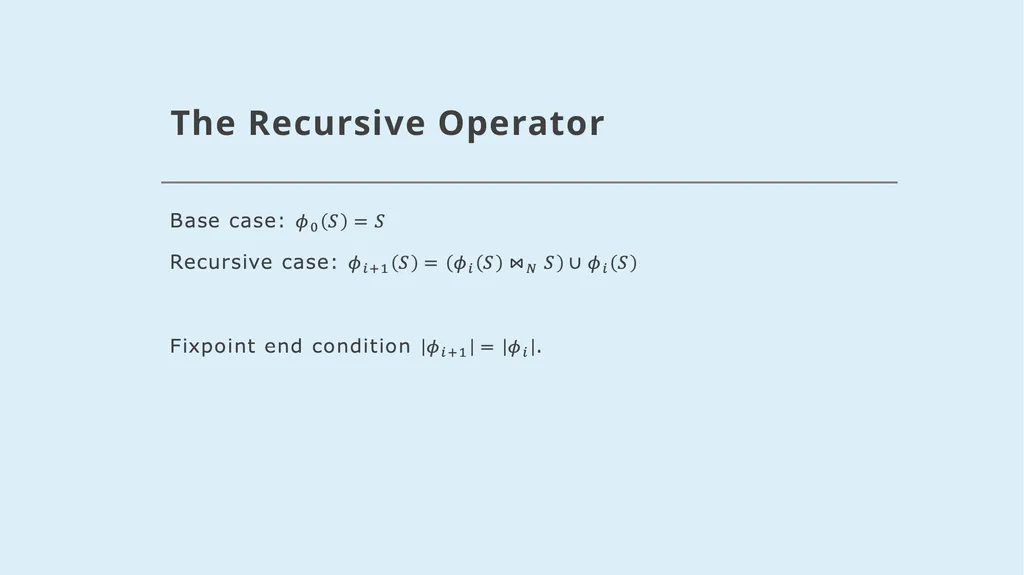
The Recursive Operator<br>
22
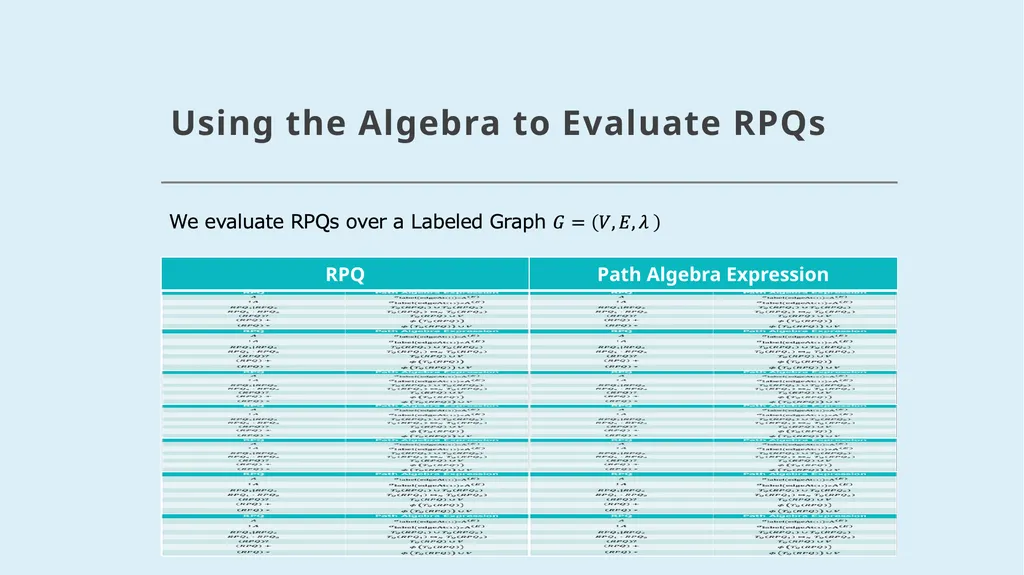
Using the Algebra to Evaluate RPQs<br>
23
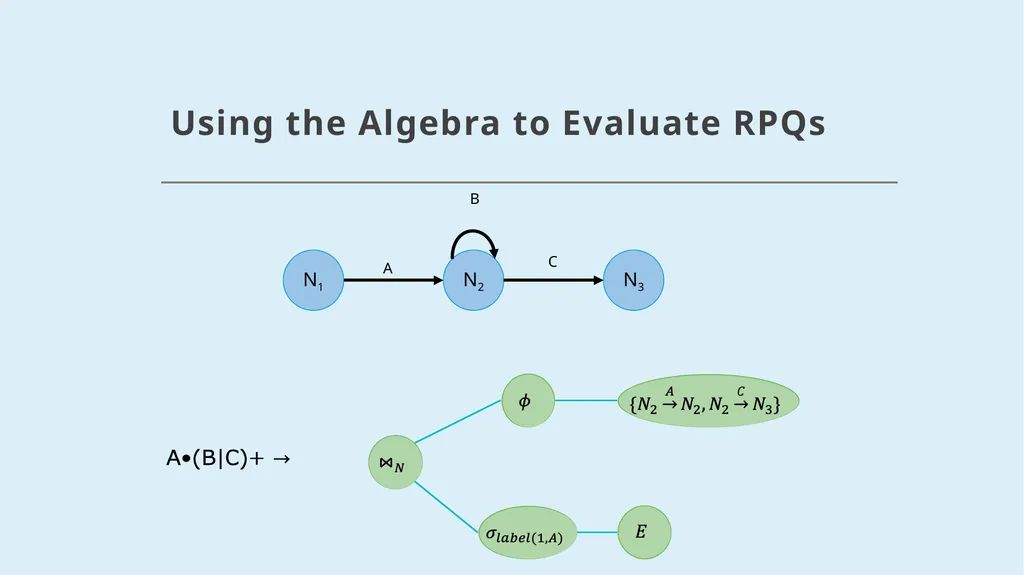
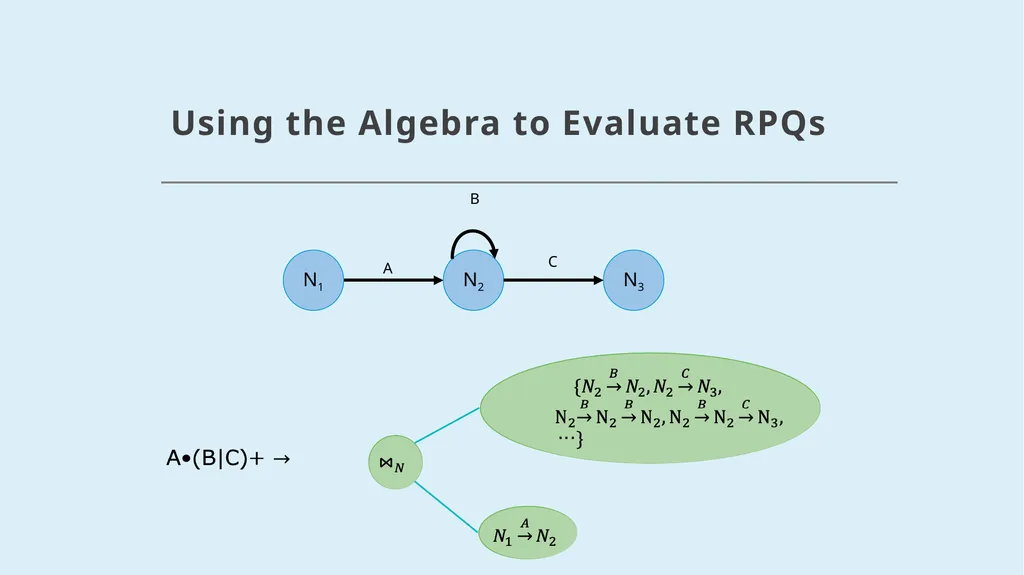
Using the Algebra to Evaluate RPQs N1 N2 N3 A B C<br>
24
Using the Algebra to Evaluate RPQs N1 N2 N3 A B C<br>
25
Using the Algebra to Evaluate RPQs N1 N2 N3 A B C<br>
26
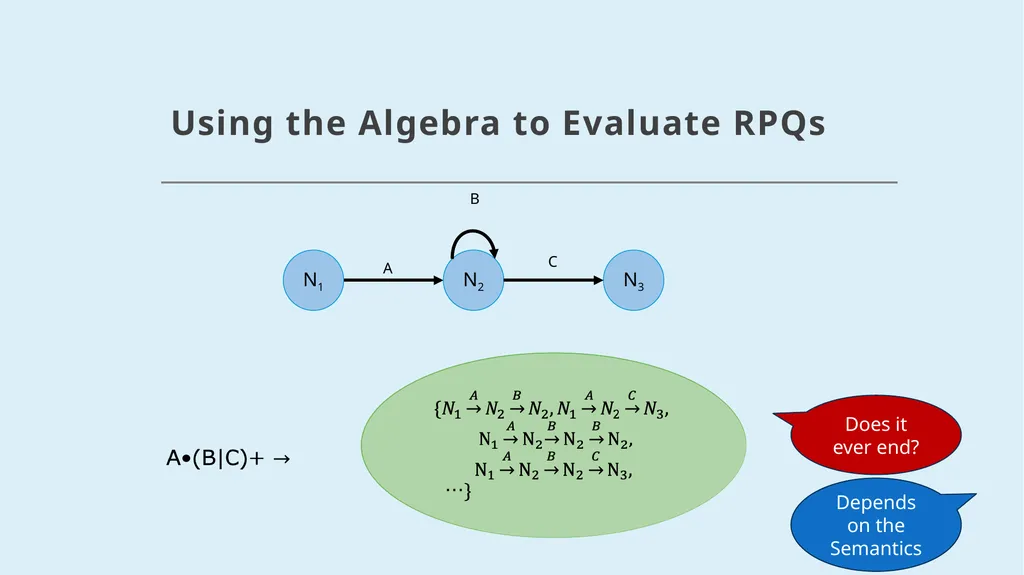
Using the Algebra to Evaluate RPQs N1 N2 N3 A B C Does it ever end? Depends on the Semantics<br>
27
Implementation RPQ Parser
RPQ to Logical Plan
Logical Plan Optimizer
Logical Plan to Physical Plan
Iterator-based executors
https://github.com/ramhgarcias/PathDatabase<br>
28
Future Steps Implement non-naïve physical operators
Implement dedicated physical operators for the different semantics
Compare with automaton-based evaluation
Study optimization rules
Study parallelization opportunities<br>
29
Conclusions Paths as fundamental datatypes in graph query languages
A path manipulation algebra to evaluate RPQs
The algebra can allow for optimization, parallelization, etc., of RPQs.
Ad-hoc algorithms can be developed to provide better physical operators
Specialized algorithms that consider the structure the graph is stored in can further improve performance<br>