
An Assessment: Think Pair Share Best procedures:

Description: An Assessment: Think Pair Share Best procedures: read quietly to yourself (so you dont give any subconscious clues) As the instructor, we read it too, for timing, then ask if anyone needs more time If not, its time to vote
Related Topics
Download Presentation
"An Assessment: Think Pair Share Best procedures:" is the property of its rightful owner. Permission is granted to download and print the materials on this website for personal, non-commercial use only, and to display it on your personal computer provided you do not modify the materials and that you retain all copyright notices contained in the materials. By downloading content from our website, you accept the terms of this agreement.
Presentation Transcript
slide1. An Assessment: Think Pair Share Best procedures: read quietly to yourself
(so you don’t give any subconscious clues)
As the instructor, we read it too, for timing, then ask if anyone needs more time
If not, it’s time to vote simultaneously—use your fingers, right in front of your chest so others don’t see<br>
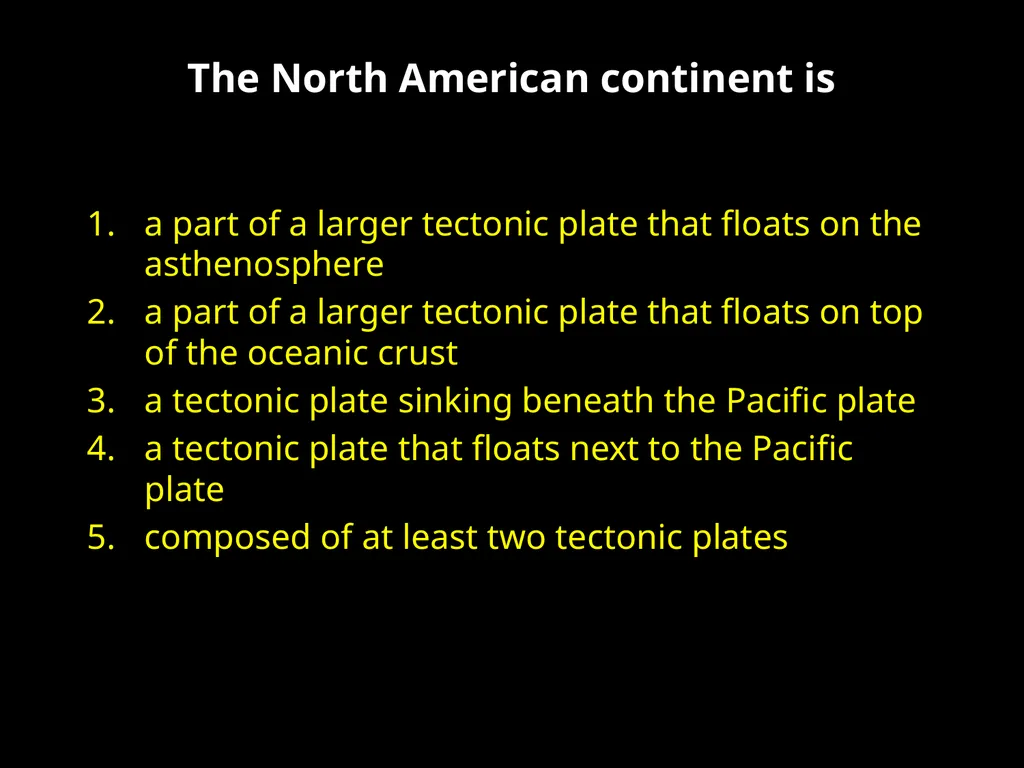
slide2. The North American continent is a part of a larger tectonic plate that floats on the asthenosphere
a part of a larger tectonic plate that floats on top of the oceanic crust
a tectonic plate sinking beneath the Pacific plate
a tectonic plate that floats next to the Pacific plate
composed of at least two tectonic plates<br>
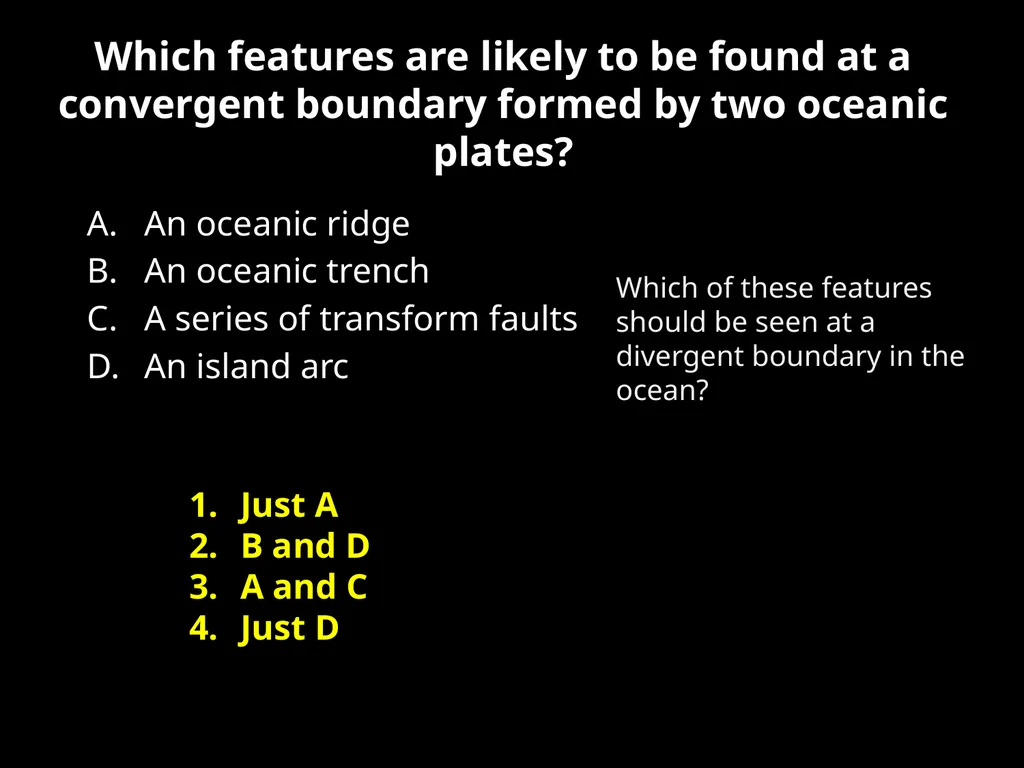
slide3. Which features are likely to be found at a convergent boundary formed by two oceanic plates? An oceanic ridge
An oceanic trench
A series of transform faults
An island arc Just A
B and D
A and C
Just D Which of these features should be seen at a divergent boundary in the ocean?<br>
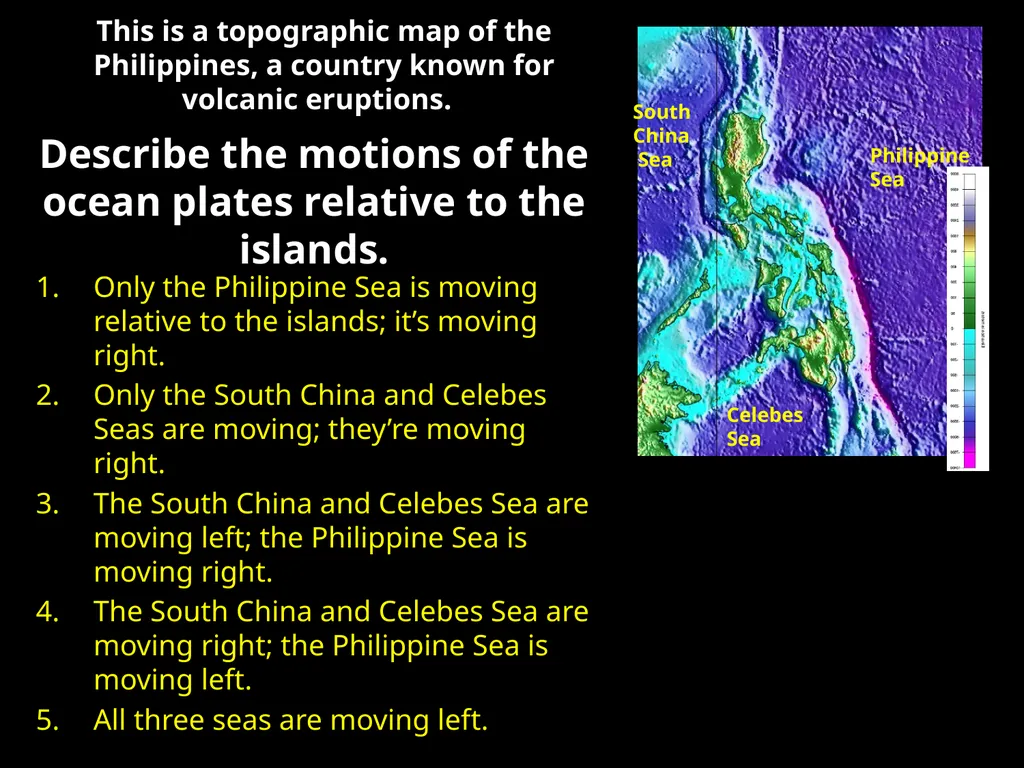
slide4. This is a topographic map of the Philippines, a country known for volcanic eruptions. Only the Philippine Sea is moving relative to the islands; it’s moving right.
Only the South China and Celebes Seas are moving; they’re moving right.
The South China and Celebes Sea are moving left; the Philippine Sea is moving right.
The South China and Celebes Sea are moving right; the Philippine Sea is moving left.
All three seas are moving left. Describe the motions of the ocean plates relative to the islands.<br>
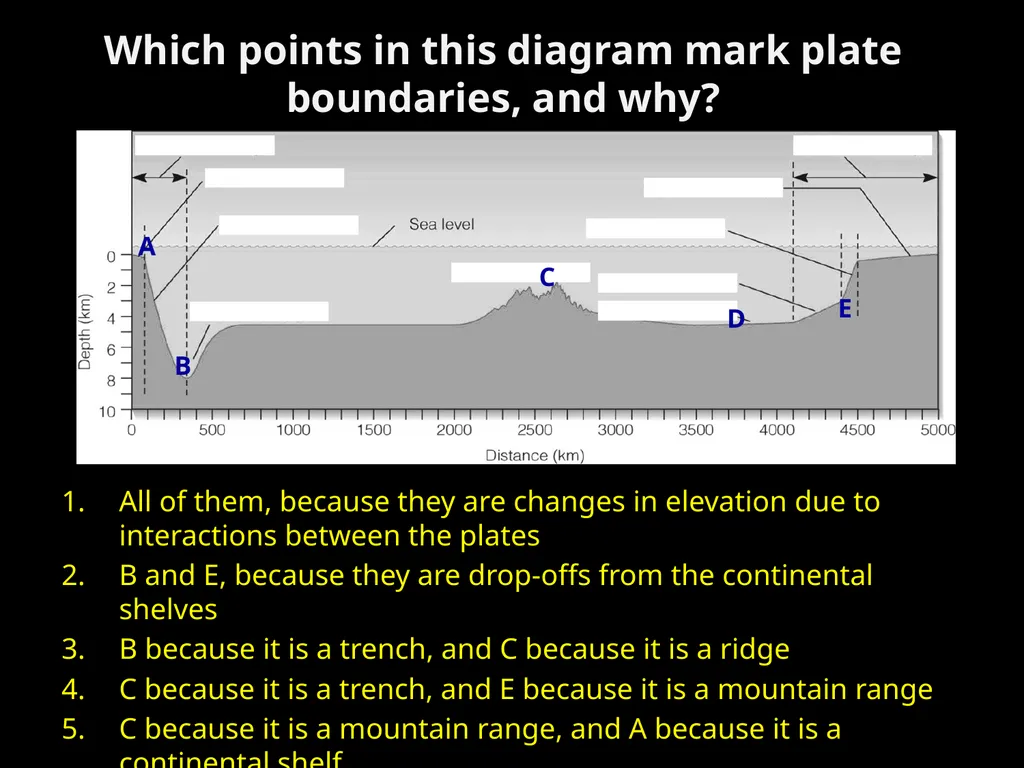
slide5. Which points in this diagram mark plate boundaries, and why? All of them, because they are changes in elevation due to interactions between the plates
B and E, because they are drop-offs from the continental shelves
B because it is a trench, and C because it is a ridge
C because it is a trench, and E because it is a mountain range
C because it is a mountain range, and A because it is a continental shelf E<br>
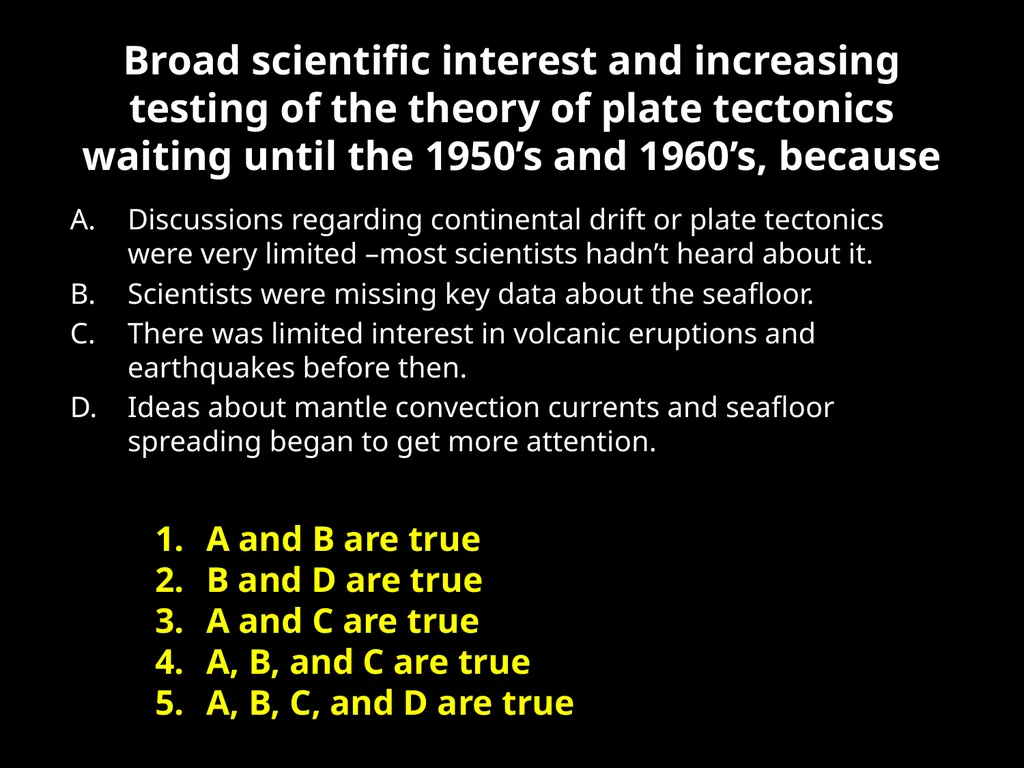
slide6. Broad scientific interest and increasing testing of the theory of plate tectonics waiting until the 1950’s and 1960’s, because Discussions regarding continental drift or plate tectonics were very limited –most scientists hadn’t heard about it.
Scientists were missing key data about the seafloor.
There was limited interest in volcanic eruptions and earthquakes before then.
Ideas about mantle convection currents and seafloor spreading began to get more attention. A and B are true
B and D are true
A and C are true
A, B, and C are true
A, B, C, and D are true<br>
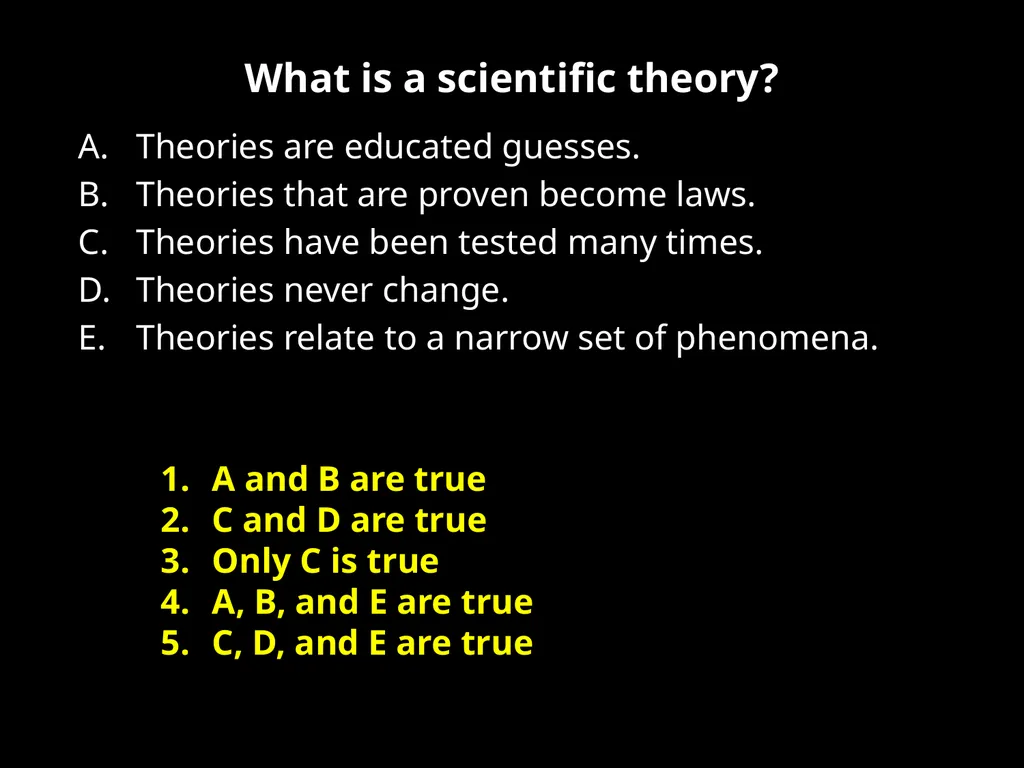
slide7. What is a scientific theory? Theories are educated guesses.
Theories that are proven become laws.
Theories have been tested many times.
Theories never change.
Theories relate to a narrow set of phenomena. A and B are true
C and D are true
Only C is true
A, B, and E are true
C, D, and E are true<br>
As the instructor, we read it too, for timing, then ask if anyone needs more time
If not, it’s time to vote simultaneously—use your fingers, right in front of your chest so others don’t see<br>
slide2. The North American continent is a part of a larger tectonic plate that floats on the asthenosphere
a part of a larger tectonic plate that floats on top of the oceanic crust
a tectonic plate sinking beneath the Pacific plate
a tectonic plate that floats next to the Pacific plate
composed of at least two tectonic plates<br>
slide3. Which features are likely to be found at a convergent boundary formed by two oceanic plates? An oceanic ridge
An oceanic trench
A series of transform faults
An island arc Just A
B and D
A and C
Just D Which of these features should be seen at a divergent boundary in the ocean?<br>
slide4. This is a topographic map of the Philippines, a country known for volcanic eruptions. Only the Philippine Sea is moving relative to the islands; it’s moving right.
Only the South China and Celebes Seas are moving; they’re moving right.
The South China and Celebes Sea are moving left; the Philippine Sea is moving right.
The South China and Celebes Sea are moving right; the Philippine Sea is moving left.
All three seas are moving left. Describe the motions of the ocean plates relative to the islands.<br>
slide5. Which points in this diagram mark plate boundaries, and why? All of them, because they are changes in elevation due to interactions between the plates
B and E, because they are drop-offs from the continental shelves
B because it is a trench, and C because it is a ridge
C because it is a trench, and E because it is a mountain range
C because it is a mountain range, and A because it is a continental shelf E<br>
slide6. Broad scientific interest and increasing testing of the theory of plate tectonics waiting until the 1950’s and 1960’s, because Discussions regarding continental drift or plate tectonics were very limited –most scientists hadn’t heard about it.
Scientists were missing key data about the seafloor.
There was limited interest in volcanic eruptions and earthquakes before then.
Ideas about mantle convection currents and seafloor spreading began to get more attention. A and B are true
B and D are true
A and C are true
A, B, and C are true
A, B, C, and D are true<br>
slide7. What is a scientific theory? Theories are educated guesses.
Theories that are proven become laws.
Theories have been tested many times.
Theories never change.
Theories relate to a narrow set of phenomena. A and B are true
C and D are true
Only C is true
A, B, and E are true
C, D, and E are true<br>