
An informative PowerPoint about identifying the



Description: An informative PowerPoint about identifying the features of kenning poems Story-reader Problem-solver Board-writer Homework-setter Playground-whistler Register-taker I dont know its beyond my ken! LO: to recognise the features of
Related Topics
Download Presentation
"An informative PowerPoint about identifying the" is the property of its rightful owner. Permission is granted to download and print the materials on this website for personal, non-commercial use only, and to display it on your personal computer provided you do not modify the materials and that you retain all copyright notices contained in the materials. By downloading content from our website, you accept the terms of this agreement.
Presentation Transcript
slide1. An informative PowerPoint about identifying the features of kenning poems Story-reader
Problem-solver
Board-writer
Homework-setter
Playground-whistler
Register-taker
I don’t know – it’s beyond my ken!<br>
slide2. LO: to recognise the features of kenning poems Success Criteria:
I know that a kenning can consist of either noun-noun phrases or noun-verb phrases;
I understand that kennings do not name the theme of the poem;
I use the language in the poem to work out the theme;
I understand that kennings are understood best when they are read aloud.<br>
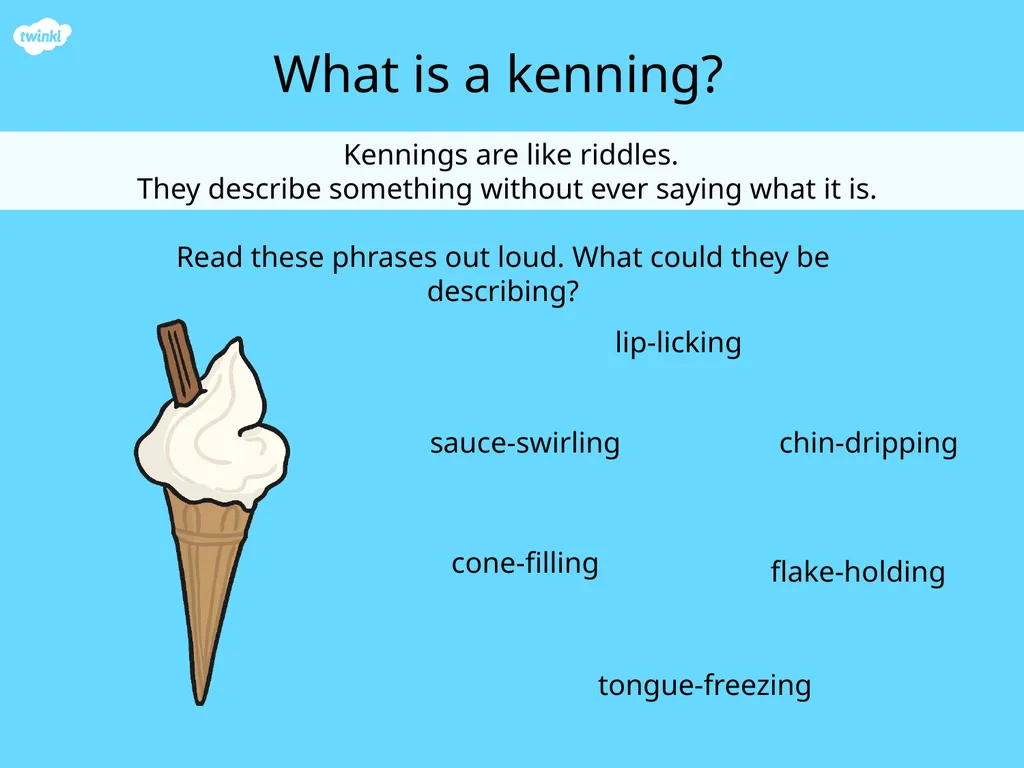
slide3. Kennings are like riddles.
They describe something without ever saying what it is. What is a kenning? Read these phrases out loud. What could they be describing? tongue-freezing chin-dripping cone-filling lip-licking flake-holding sauce-swirling<br>
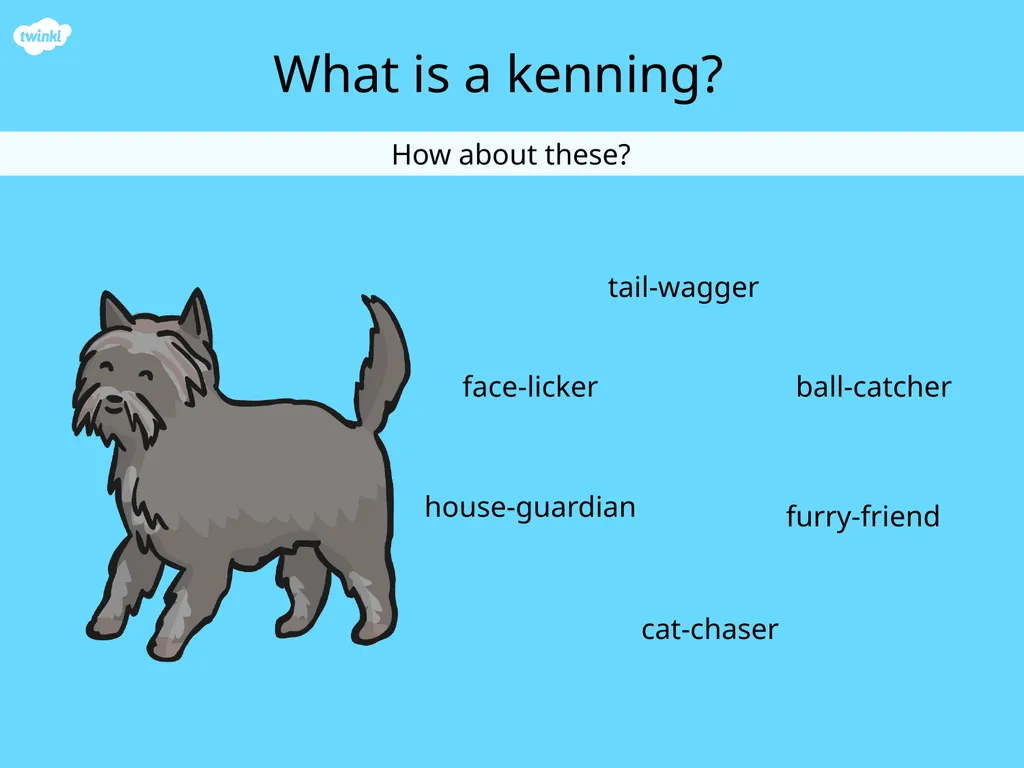
slide4. How about these? What is a kenning? cat-chaser ball-catcher house-guardian tail-wagger furry-friend face-licker<br>
slide5. What did you notice about the poems? What is a kenning? tail-wagger cat-chaser ball-catcher face-licker house-guardian furry-friend lip-licking tongue-freezing sauce-swirling chin-dripping cone-filling flake-holding<br>
slide6. What did you notice about the phrases in each poem? What is a kenning? house-guardian furry-friend lip-licking chin-dripping Here the phrases are made up of a noun + a noun. The words are joined by a hyphen. Here the phrases are made up of a noun + a verb (the verb usually ends in -ing).<br>
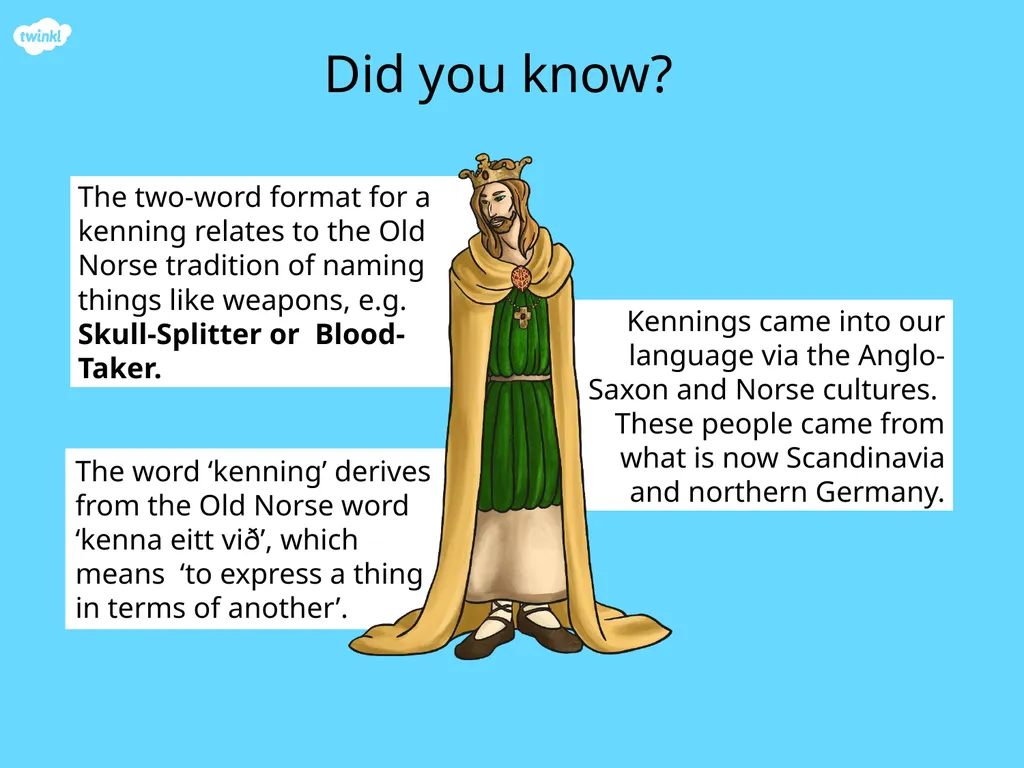
slide7. Did you know? Kennings came into our language via the Anglo-Saxon and Norse cultures. These people came from what is now Scandinavia and northern Germany. The two-word format for a kenning relates to the Old Norse tradition of naming things like weapons, e.g. Skull-Splitter or Blood-Taker. The word ‘kenning’ derives from the Old Norse word ‘kenna eitt við’, which means ‘to express a thing in terms of another’.<br>
slide8. A really sad film or story is often called a... sky-scraper tear-jerker How do we describe a very tall building? We even use them in everyday language!<br>
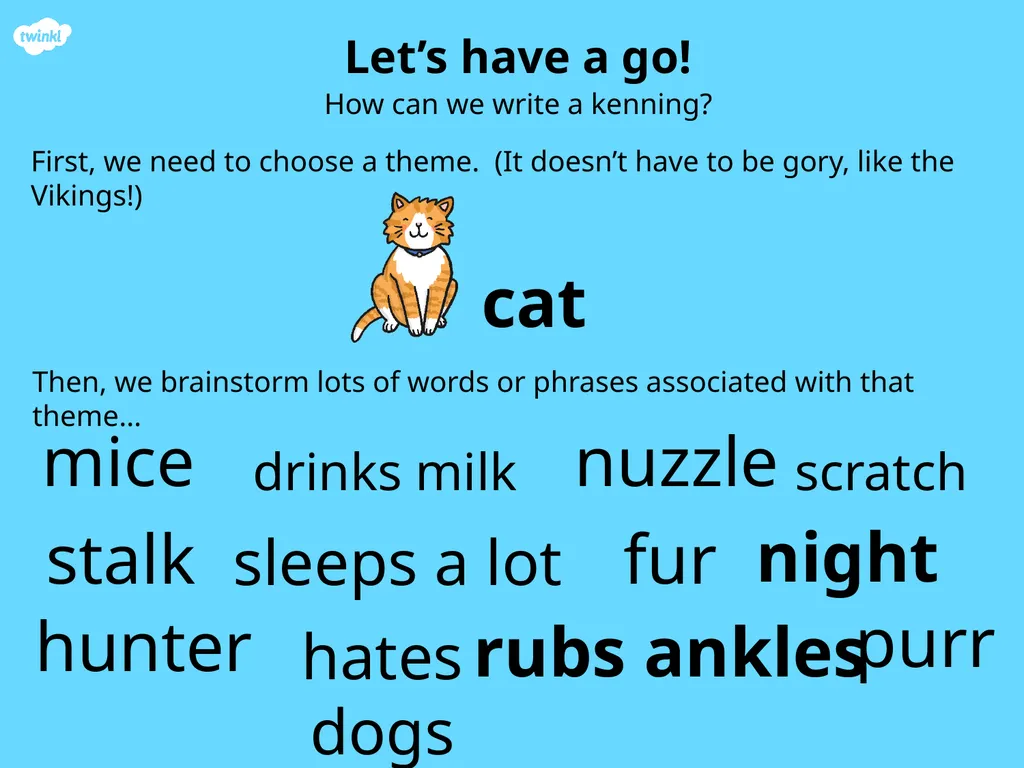
slide9. Let’s have a go! How can we write a kenning? First, we need to choose a theme. (It doesn’t have to be gory, like the Vikings!) Then, we brainstorm lots of words or phrases associated with that theme… mice drinks milk nuzzle purr stalk sleeps a lot fur scratch rubs ankles hunter hates dogs night<br>
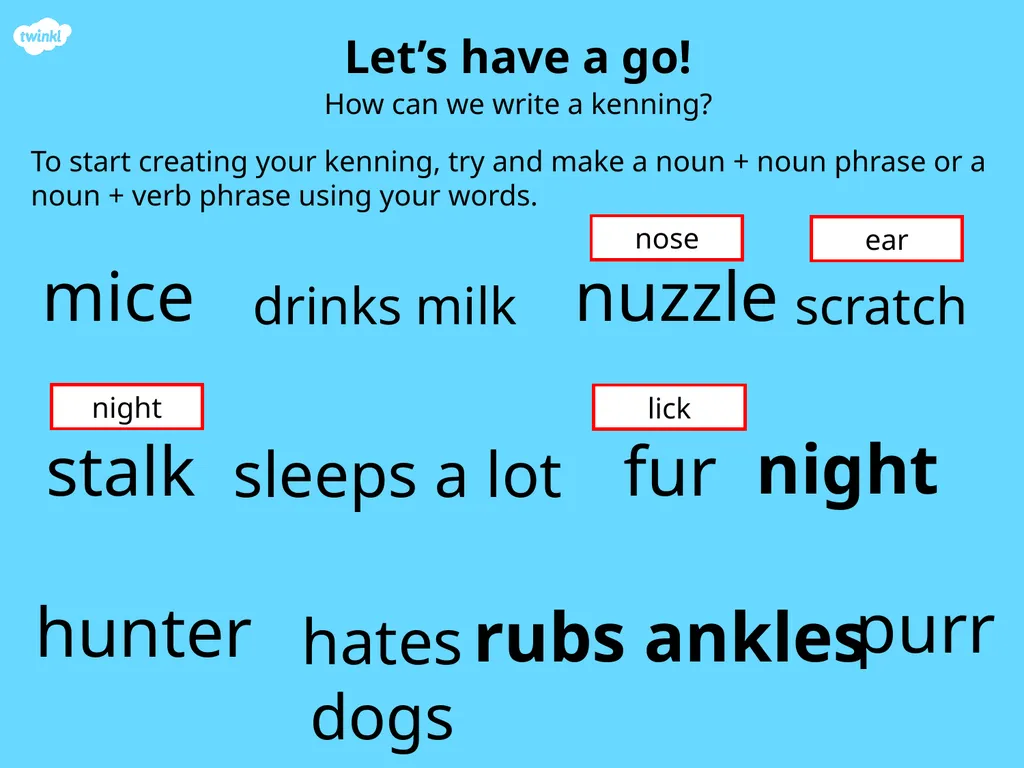
slide10. Let’s have a go! How can we write a kenning? To start creating your kenning, try and make a noun + noun phrase or a noun + verb phrase using your words. mice drinks milk nuzzle purr stalk sleeps a lot fur scratch rubs ankles hunter hates dogs night nose lick ear night<br>
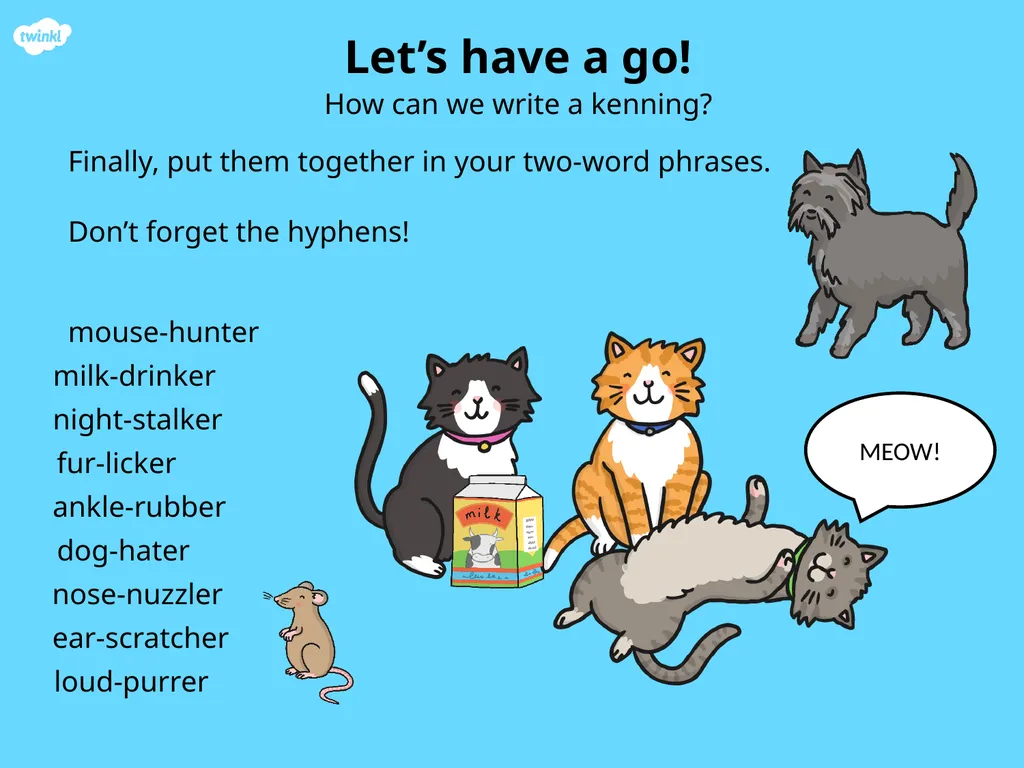
slide11. Let’s have a go! How can we write a kenning? Finally, put them together in your two-word phrases. Don’t forget the hyphens! mouse-hunter milk-drinker night-stalker fur-licker ankle-rubber dog-hater nose-nuzzler ear-scratcher loud-purrer MEOW!<br>
slide12. Let’s have a go! You could write a kenning about all sorts of things. Here are a few ideas... football mums or dads car winter pets teachers pizza<br>
slide13. What have we learned about Kennings? Plenary Kennings are like riddles – they describe a thing but don’t tell you its name. They usually have only two words- a noun plus a noun OR a noun plus a verb. Poetic devices like alliteration can be used. They’re great when you read them out loud so you can imagine the thing being describe.<br>
slide14. The End<br>
Problem-solver
Board-writer
Homework-setter
Playground-whistler
Register-taker
I don’t know – it’s beyond my ken!<br>
slide2. LO: to recognise the features of kenning poems Success Criteria:
I know that a kenning can consist of either noun-noun phrases or noun-verb phrases;
I understand that kennings do not name the theme of the poem;
I use the language in the poem to work out the theme;
I understand that kennings are understood best when they are read aloud.<br>
slide3. Kennings are like riddles.
They describe something without ever saying what it is. What is a kenning? Read these phrases out loud. What could they be describing? tongue-freezing chin-dripping cone-filling lip-licking flake-holding sauce-swirling<br>
slide4. How about these? What is a kenning? cat-chaser ball-catcher house-guardian tail-wagger furry-friend face-licker<br>
slide5. What did you notice about the poems? What is a kenning? tail-wagger cat-chaser ball-catcher face-licker house-guardian furry-friend lip-licking tongue-freezing sauce-swirling chin-dripping cone-filling flake-holding<br>
slide6. What did you notice about the phrases in each poem? What is a kenning? house-guardian furry-friend lip-licking chin-dripping Here the phrases are made up of a noun + a noun. The words are joined by a hyphen. Here the phrases are made up of a noun + a verb (the verb usually ends in -ing).<br>
slide7. Did you know? Kennings came into our language via the Anglo-Saxon and Norse cultures. These people came from what is now Scandinavia and northern Germany. The two-word format for a kenning relates to the Old Norse tradition of naming things like weapons, e.g. Skull-Splitter or Blood-Taker. The word ‘kenning’ derives from the Old Norse word ‘kenna eitt við’, which means ‘to express a thing in terms of another’.<br>
slide8. A really sad film or story is often called a... sky-scraper tear-jerker How do we describe a very tall building? We even use them in everyday language!<br>
slide9. Let’s have a go! How can we write a kenning? First, we need to choose a theme. (It doesn’t have to be gory, like the Vikings!) Then, we brainstorm lots of words or phrases associated with that theme… mice drinks milk nuzzle purr stalk sleeps a lot fur scratch rubs ankles hunter hates dogs night<br>
slide10. Let’s have a go! How can we write a kenning? To start creating your kenning, try and make a noun + noun phrase or a noun + verb phrase using your words. mice drinks milk nuzzle purr stalk sleeps a lot fur scratch rubs ankles hunter hates dogs night nose lick ear night<br>
slide11. Let’s have a go! How can we write a kenning? Finally, put them together in your two-word phrases. Don’t forget the hyphens! mouse-hunter milk-drinker night-stalker fur-licker ankle-rubber dog-hater nose-nuzzler ear-scratcher loud-purrer MEOW!<br>
slide12. Let’s have a go! You could write a kenning about all sorts of things. Here are a few ideas... football mums or dads car winter pets teachers pizza<br>
slide13. What have we learned about Kennings? Plenary Kennings are like riddles – they describe a thing but don’t tell you its name. They usually have only two words- a noun plus a noun OR a noun plus a verb. Poetic devices like alliteration can be used. They’re great when you read them out loud so you can imagine the thing being describe.<br>
slide14. The End<br>