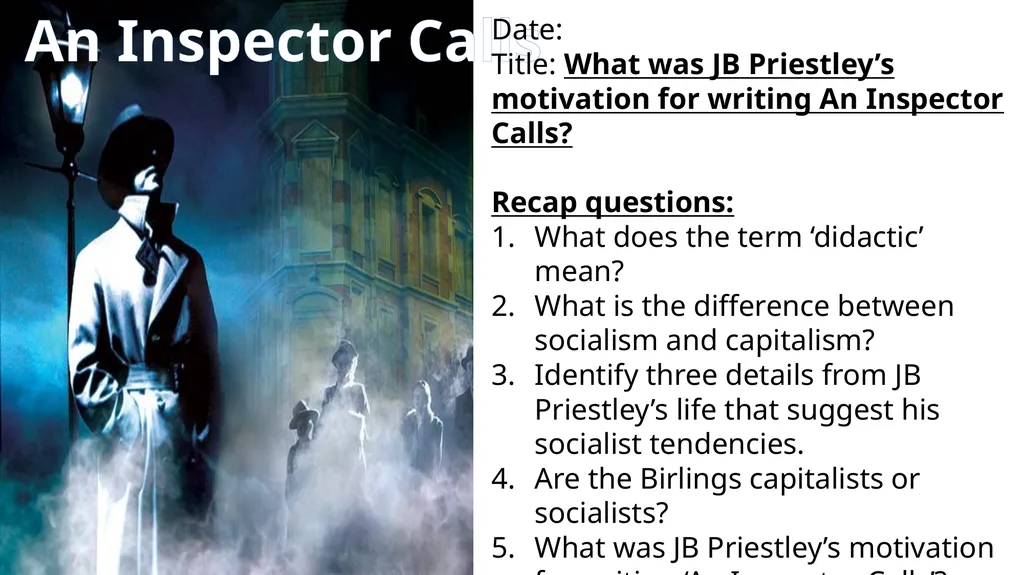
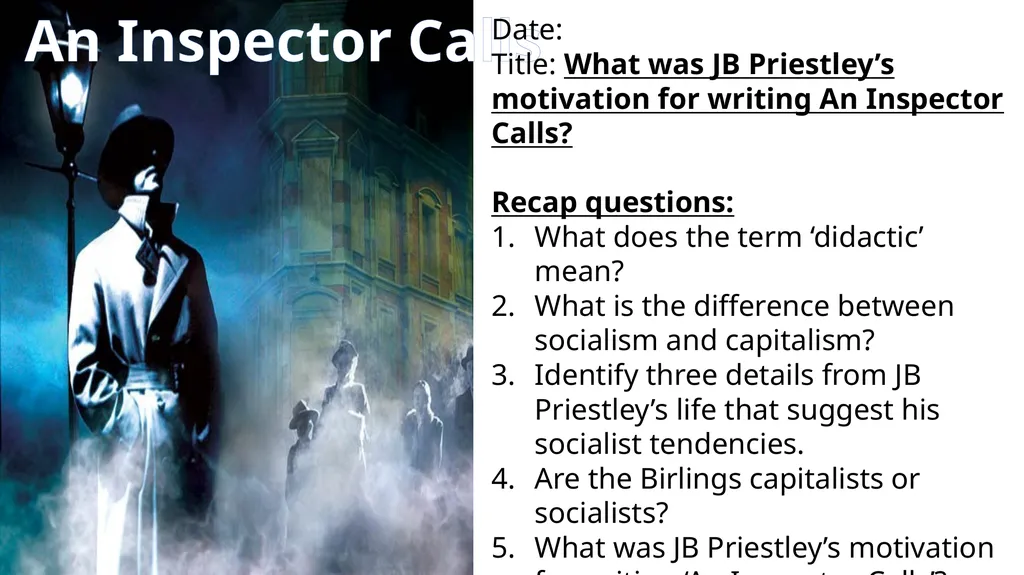
An Inspector Calls Date: Title: What was JB Priestleys motivation for writing An Inspector Calls? Recap questions: What does the term didactic mean? What is the difference between socialism and capitalism? Identify three details from JB
"An Inspector Calls Date: Title: What was JB" is the property of its rightful owner. Permission is granted to
download and print the materials on this website for personal, non-commercial use only, and to display it
on your personal computer provided you do not modify the materials and that you retain all copyright
notices contained in the materials. By downloading content from our website, you accept the terms of this
agreement.
Presentation Transcript
01
An Inspector Calls Date:
Title: What was JB Priestley’s motivation for writing An Inspector Calls?
Recap questions:
What does the term ‘didactic’ mean?
What is the difference between socialism and capitalism?
Identify three details from JB Priestley’s life that suggest his socialist tendencies.
Are the Birlings capitalists or socialists?
What was JB Priestley’s motivation for writing ‘An Inspector Calls’?<br>
02
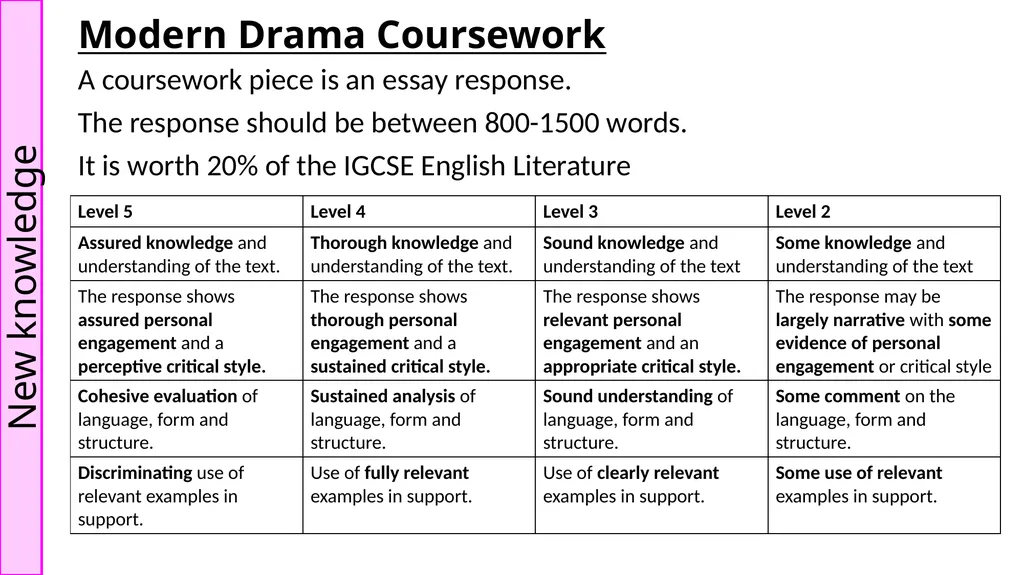
Modern Drama Coursework A coursework piece is an essay response.
The response should be between 800-1500 words.
It is worth 20% of the IGCSE English Literature New knowledge<br>
03
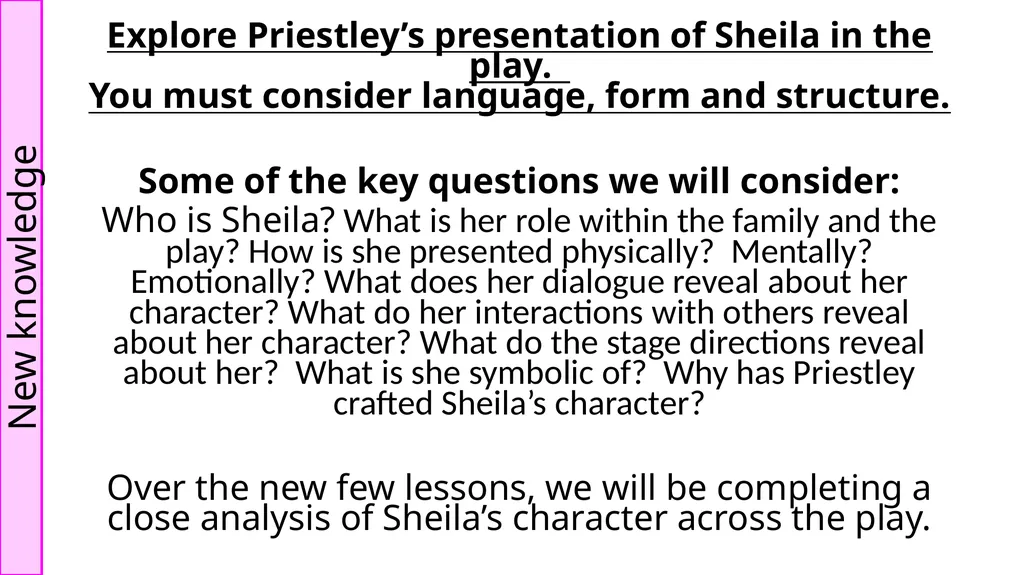
New knowledge Explore Priestley’s presentation of Sheila in the play. You must consider language, form and structure.
Some of the key questions we will consider:
Who is Sheila? What is her role within the family and the play? How is she presented physically? Mentally? Emotionally? What does her dialogue reveal about her character? What do her interactions with others reveal about her character? What do the stage directions reveal about her? What is she symbolic of? Why has Priestley crafted Sheila’s character?
Over the new few lessons, we will be completing a close analysis of Sheila’s character across the play.<br>
04
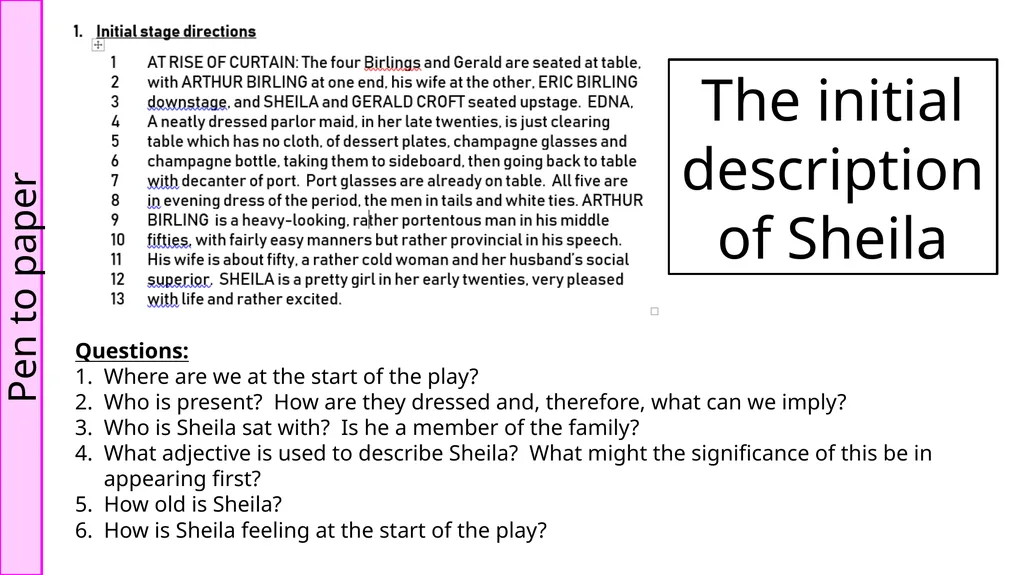
Pen to paper The initial description of Sheila Questions:
Where are we at the start of the play?
Who is present? How are they dressed and, therefore, what can we imply?
Who is Sheila sat with? Is he a member of the family?
What adjective is used to describe Sheila? What might the significance of this be in appearing first?
How old is Sheila?
How is Sheila feeling at the start of the play?<br>
05
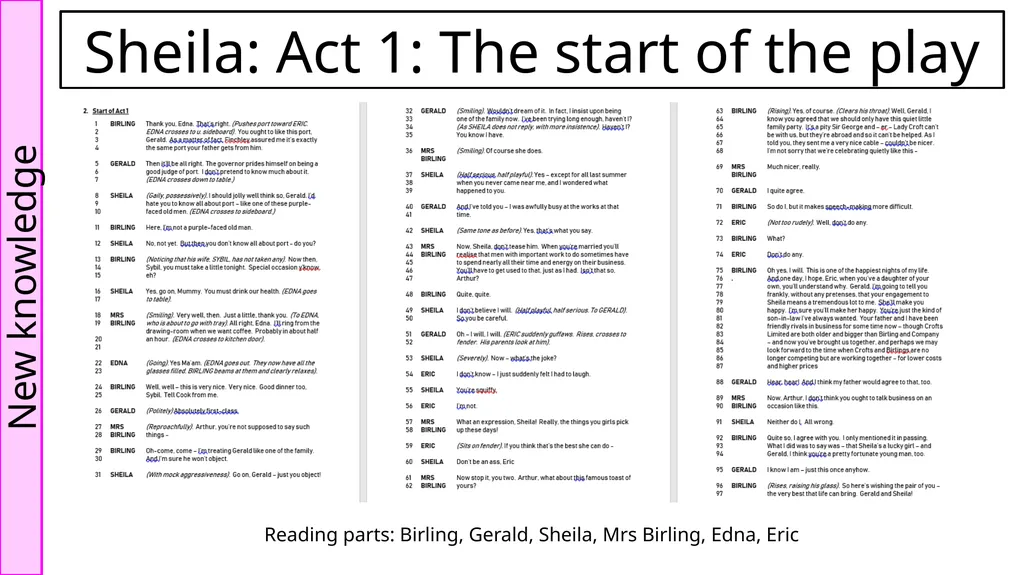
New knowledge Sheila: Act 1: The start of the play Reading parts: Birling, Gerald, Sheila, Mrs Birling, Edna, Eric<br>
06
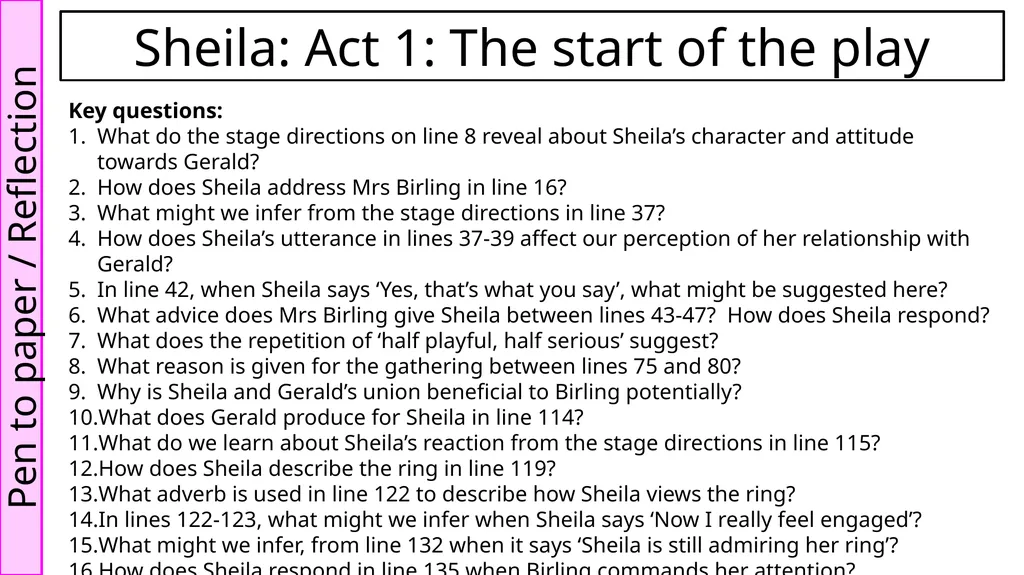
Pen to paper / Reflection Sheila: Act 1: The start of the play Key questions:
What do the stage directions on line 8 reveal about Sheila’s character and attitude towards Gerald?
How does Sheila address Mrs Birling in line 16?
What might we infer from the stage directions in line 37?
How does Sheila’s utterance in lines 37-39 affect our perception of her relationship with Gerald?
In line 42, when Sheila says ‘Yes, that’s what you say’, what might be suggested here?
What advice does Mrs Birling give Sheila between lines 43-47? How does Sheila respond?
What does the repetition of ‘half playful, half serious’ suggest?
What reason is given for the gathering between lines 75 and 80?
Why is Sheila and Gerald’s union beneficial to Birling potentially?
What does Gerald produce for Sheila in line 114?
What do we learn about Sheila’s reaction from the stage directions in line 115?
How does Sheila describe the ring in line 119?
What adverb is used in line 122 to describe how Sheila views the ring?
In lines 122-123, what might we infer when Sheila says ‘Now I really feel engaged’?
What might we infer, from line 132 when it says ‘Sheila is still admiring her ring’?
How does Sheila respond in line 135 when Birling commands her attention?<br>
07
Pen to paper Sheila: Act 1: The start of the play Having explored the presentation of Sheila at the start of the play, what one word would you use to describe her character?<br>