
An introduction to mitigation: a defendant’s
PM
Published · 40 slides · 0 views

1 / 1











Description
An introduction to mitigation: a defendants mental condition, personal and social history By Jessica Sutton What is mitigation? The empathy-evoking evidence that attempts to humanize the client in death penalty cases The suddering
Related Topics
Share
Embed code
Download this presentation From Below
"An introduction to mitigation: a defendant’s" is the property of its rightful owner. Permission is granted to download and print the materials on this website for personal, non-commercial use only, and to display it on your personal computer provided you do not modify the materials and that you retain all copyright notices contained in the materials. By downloading content from our website, you accept the terms of this agreement.
Presentation Transcript
01
An introduction to mitigation: a defendant’s mental condition, personal and social history
By Jessica Sutton<br>
02
What is mitigation? The empathy-evoking evidence that attempts to humanize the client in death penalty cases
The suddering recognition of a kinship which evokes, ‘there but for the grace of God go I’
“Juries want to kill monsters. They have a very hard time giving the go-ahead to kill somebody they see as a vulnerable human being” - Robert Dunham<br>
The suddering recognition of a kinship which evokes, ‘there but for the grace of God go I’
“Juries want to kill monsters. They have a very hard time giving the go-ahead to kill somebody they see as a vulnerable human being” - Robert Dunham<br>
03
What is mitigation? it is “arguably the central [] duty of counsel in a capital case [] to humanize the client in the eyes of those who will decide his fate”
Scope and nature of mitigation:
Mitigation evidence includes, but is not limited to: the ability to make a positive adjustment to incarceration, the realities of incarceration and the actual meaning of a life sentence, capacity for redemption, remorse, execution impact, vulnerabilities related to mental health, explanations of patterns of behavior, negation of aggravating evidence regardless of its designation as an aggravating factor, positive acts or qualities, responsible conduct in other areas of life (e.g. employment, education, military service, as a family member), any evidence bearing on the degree of moral culpability, and any other reason for a sentence less than death. 36 HOFSTRA L. REV. 677, 679 (2008).<br>
Scope and nature of mitigation:
Mitigation evidence includes, but is not limited to: the ability to make a positive adjustment to incarceration, the realities of incarceration and the actual meaning of a life sentence, capacity for redemption, remorse, execution impact, vulnerabilities related to mental health, explanations of patterns of behavior, negation of aggravating evidence regardless of its designation as an aggravating factor, positive acts or qualities, responsible conduct in other areas of life (e.g. employment, education, military service, as a family member), any evidence bearing on the degree of moral culpability, and any other reason for a sentence less than death. 36 HOFSTRA L. REV. 677, 679 (2008).<br>
04
What is mitigation? it is “arguably the central [] duty of counsel in a capital case [] to humanize the client in the eyes of those who will decide his fate”
Mitigation evidence includes, but is not limited to: the ability to make a positive adjustment to incarceration, the realities of incarceration and the actual meaning of a life sentence, capacity for redemption, remorse, execution impact, vulnerabilities related to mental health, explanations of patterns of behavior, negation of aggravating evidence regardless of its designation as an aggravating factor, positive acts or qualities, responsible conduct in other areas of life (e.g. employment, education, military service, as a family member), any evidence bearing on the degree of moral culpability, and any other reason for a sentence less than death.<br>
Mitigation evidence includes, but is not limited to: the ability to make a positive adjustment to incarceration, the realities of incarceration and the actual meaning of a life sentence, capacity for redemption, remorse, execution impact, vulnerabilities related to mental health, explanations of patterns of behavior, negation of aggravating evidence regardless of its designation as an aggravating factor, positive acts or qualities, responsible conduct in other areas of life (e.g. employment, education, military service, as a family member), any evidence bearing on the degree of moral culpability, and any other reason for a sentence less than death.<br>
05
Intergenerational bio-psycho-social history
“Mitigation investigation begins with the client, but it is inevitably a multigenerational inquiry aimed at identifying the genetic predispositions and environmental influences which molded the client’s life and defined his or her range of choices.” Russell Stetler, Mitigation Evidence in Death-Penalty Cases, 28:1 THE CHAMPION 35, 38 (January-February 1999).
Dual tracks of record collection and witness interviews
Competent life history investigations require “interviewing the client and virtually everyone who has ever known the client, and finding every piece of paper regarding the client ever generated.” Lee Norton, Capital Cases: Mitigation Investigations, CHAMPION 43 (May 1992)<br>
“Mitigation investigation begins with the client, but it is inevitably a multigenerational inquiry aimed at identifying the genetic predispositions and environmental influences which molded the client’s life and defined his or her range of choices.” Russell Stetler, Mitigation Evidence in Death-Penalty Cases, 28:1 THE CHAMPION 35, 38 (January-February 1999).
Dual tracks of record collection and witness interviews
Competent life history investigations require “interviewing the client and virtually everyone who has ever known the client, and finding every piece of paper regarding the client ever generated.” Lee Norton, Capital Cases: Mitigation Investigations, CHAMPION 43 (May 1992)<br>
06
medical history; complete prenatal, pediatric and
adult health information; exposure to harmful substances in utero and in the environment
substance abuse history
mental health history;
history of maltreatment and neglect; trauma history;
educational history;
employment and training history; military experience;
multi-generational family history, genetic disorders and vulnerabilities, as well as multi-generational patterns of behavior;
prior adult and juvenile correctional experience;
religious, gender, sexual orientation, ethnic, racial, cultural and community influences;
socio-economic, historical, and political factors.<br>
adult health information; exposure to harmful substances in utero and in the environment
substance abuse history
mental health history;
history of maltreatment and neglect; trauma history;
educational history;
employment and training history; military experience;
multi-generational family history, genetic disorders and vulnerabilities, as well as multi-generational patterns of behavior;
prior adult and juvenile correctional experience;
religious, gender, sexual orientation, ethnic, racial, cultural and community influences;
socio-economic, historical, and political factors.<br>
07
Records collection: Master documents<br>
08
What are the master documents
and when can I start assembling them? You start immediately.
The master documents are:
Bate Stamp Index
People List
Investigation Plan
Court House Search Log
Records Log
Records Log Narrative
Chronology
Theory Memo
Pleading Log
Activity Log<br>
The master documents are:
Bate Stamp Index
People List
Investigation Plan
Court House Search Log
Records Log
Records Log Narrative
Chronology
Theory Memo
Pleading Log
Activity Log<br>
09
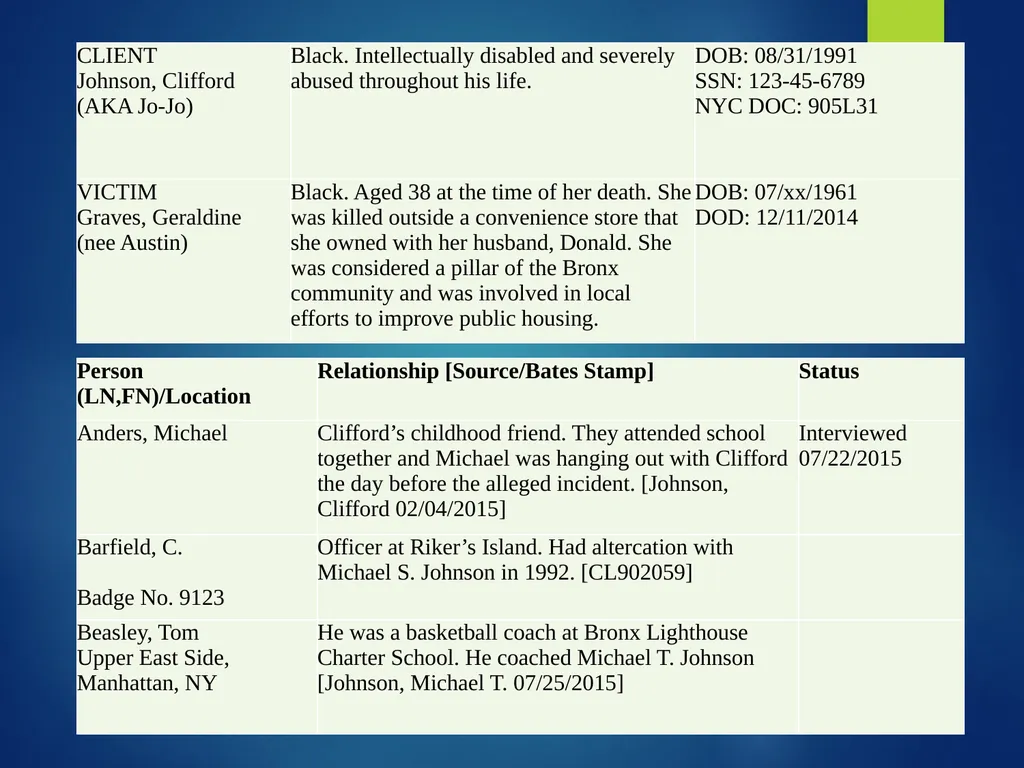
People List The people list is a comprehensive list of every single name that appears in all the documents you gather related to your client’s case as well as the name of any person you identify during the course of the investigation.<br>
10
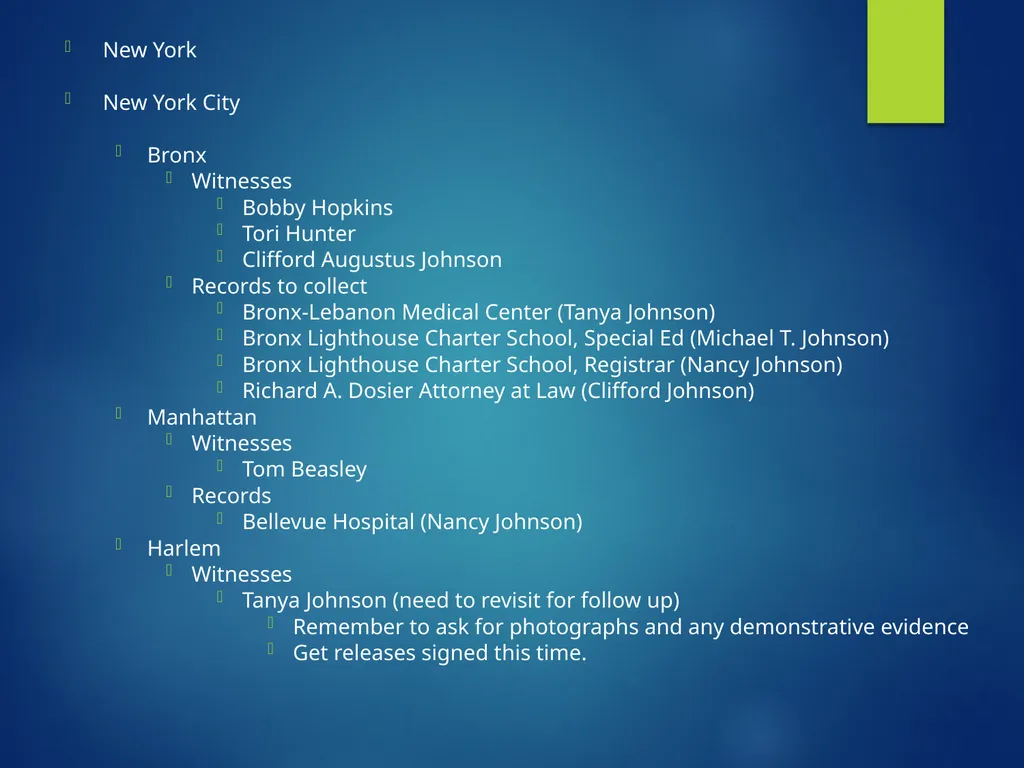
Investigation Plan The investigation plan is organized by geographic regions where your witnesses, records and other investigative tasks may be located. This is a handy document for purposes of organizing what remains to be done on your case. Once you have completed a task and are certain that it does not need to be followed up on you should remove the item from the list.<br>
11
New York
New York City
Bronx
Witnesses
Bobby Hopkins
Tori Hunter
Clifford Augustus Johnson
Records to collect
Bronx-Lebanon Medical Center (Tanya Johnson)
Bronx Lighthouse Charter School, Special Ed (Michael T. Johnson)
Bronx Lighthouse Charter School, Registrar (Nancy Johnson)
Richard A. Dosier Attorney at Law (Clifford Johnson)
Manhattan
Witnesses
Tom Beasley
Records
Bellevue Hospital (Nancy Johnson)
Harlem
Witnesses
Tanya Johnson (need to revisit for follow up)
Remember to ask for photographs and any demonstrative evidence
Get releases signed this time.<br>
New York City
Bronx
Witnesses
Bobby Hopkins
Tori Hunter
Clifford Augustus Johnson
Records to collect
Bronx-Lebanon Medical Center (Tanya Johnson)
Bronx Lighthouse Charter School, Special Ed (Michael T. Johnson)
Bronx Lighthouse Charter School, Registrar (Nancy Johnson)
Richard A. Dosier Attorney at Law (Clifford Johnson)
Manhattan
Witnesses
Tom Beasley
Records
Bellevue Hospital (Nancy Johnson)
Harlem
Witnesses
Tanya Johnson (need to revisit for follow up)
Remember to ask for photographs and any demonstrative evidence
Get releases signed this time.<br>
12
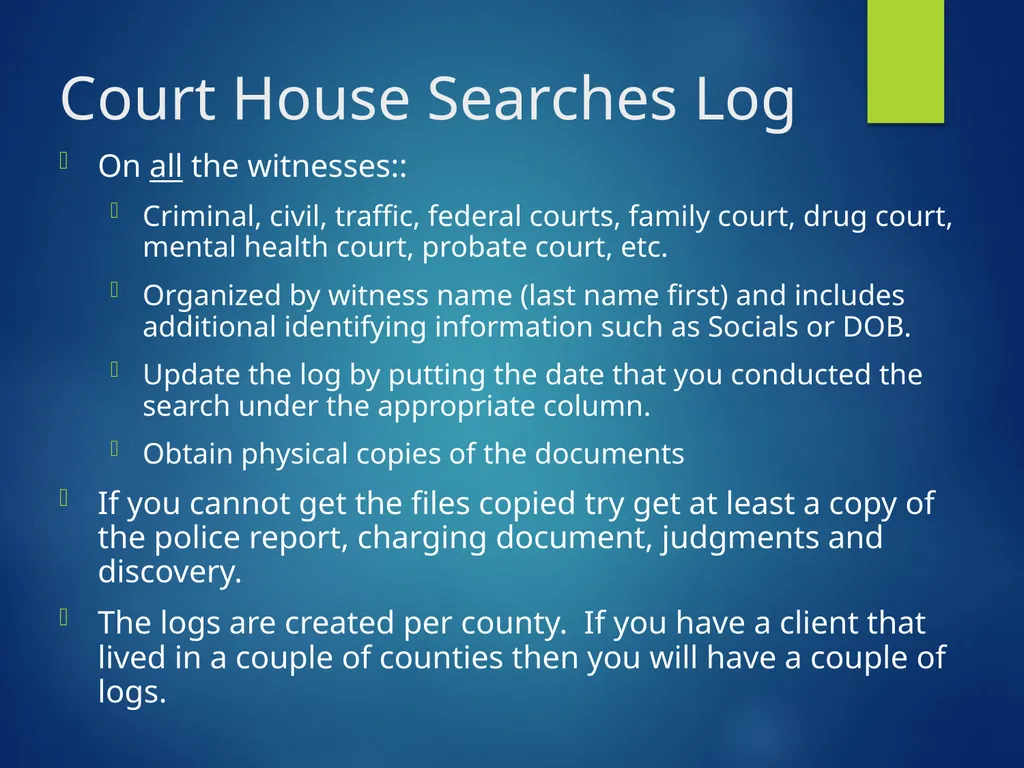
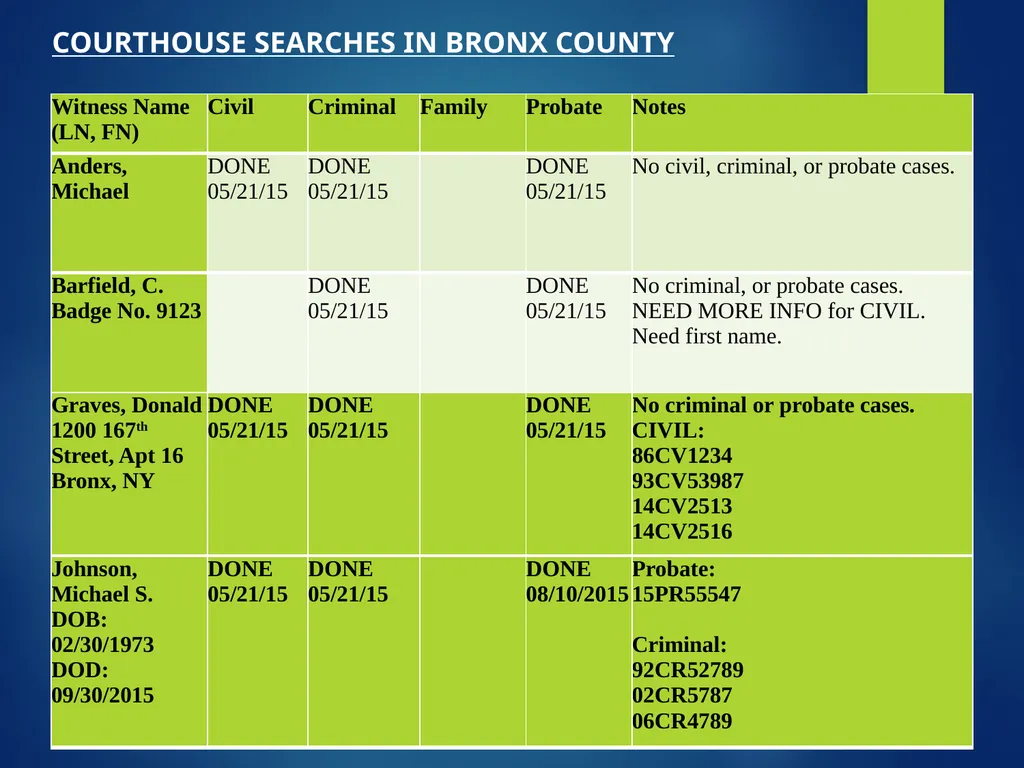
Court House Searches Log On all the witnesses::
Criminal, civil, traffic, federal courts, family court, drug court, mental health court, probate court, etc.
Organized by witness name (last name first) and includes additional identifying information such as Socials or DOB.
Update the log by putting the date that you conducted the search under the appropriate column.
Obtain physical copies of the documents
If you cannot get the files copied try get at least a copy of the police report, charging document, judgments and discovery.
The logs are created per county. If you have a client that lived in a couple of counties then you will have a couple of logs.<br>
Criminal, civil, traffic, federal courts, family court, drug court, mental health court, probate court, etc.
Organized by witness name (last name first) and includes additional identifying information such as Socials or DOB.
Update the log by putting the date that you conducted the search under the appropriate column.
Obtain physical copies of the documents
If you cannot get the files copied try get at least a copy of the police report, charging document, judgments and discovery.
The logs are created per county. If you have a client that lived in a couple of counties then you will have a couple of logs.<br>
13
COURTHOUSE SEARCHES IN BRONX COUNTY<br>
14
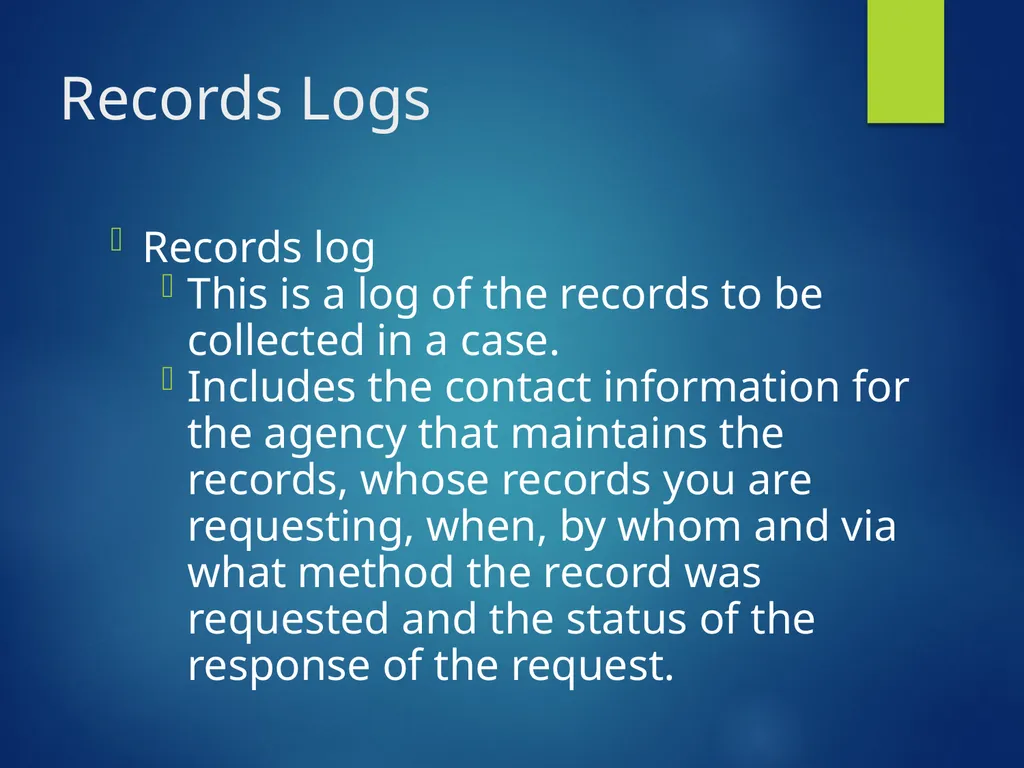
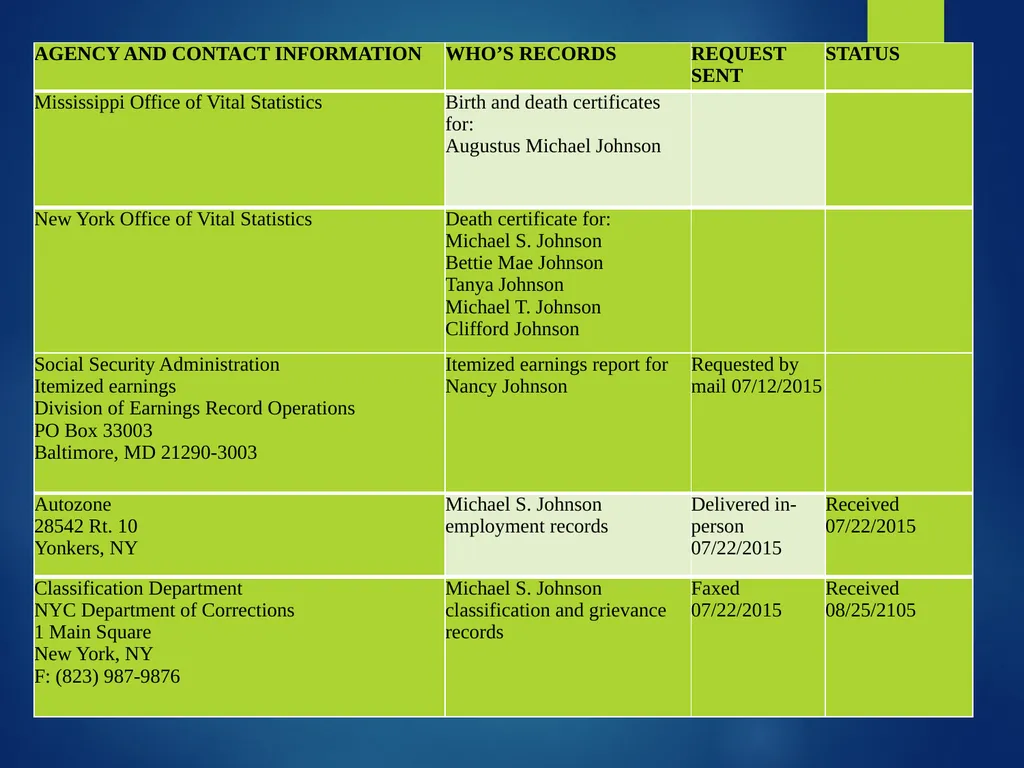
Records Logs Records log
This is a log of the records to be collected in a case.
Includes the contact information for the agency that maintains the records, whose records you are requesting, when, by whom and via what method the record was requested and the status of the response of the request.<br>
This is a log of the records to be collected in a case.
Includes the contact information for the agency that maintains the records, whose records you are requesting, when, by whom and via what method the record was requested and the status of the response of the request.<br>
15
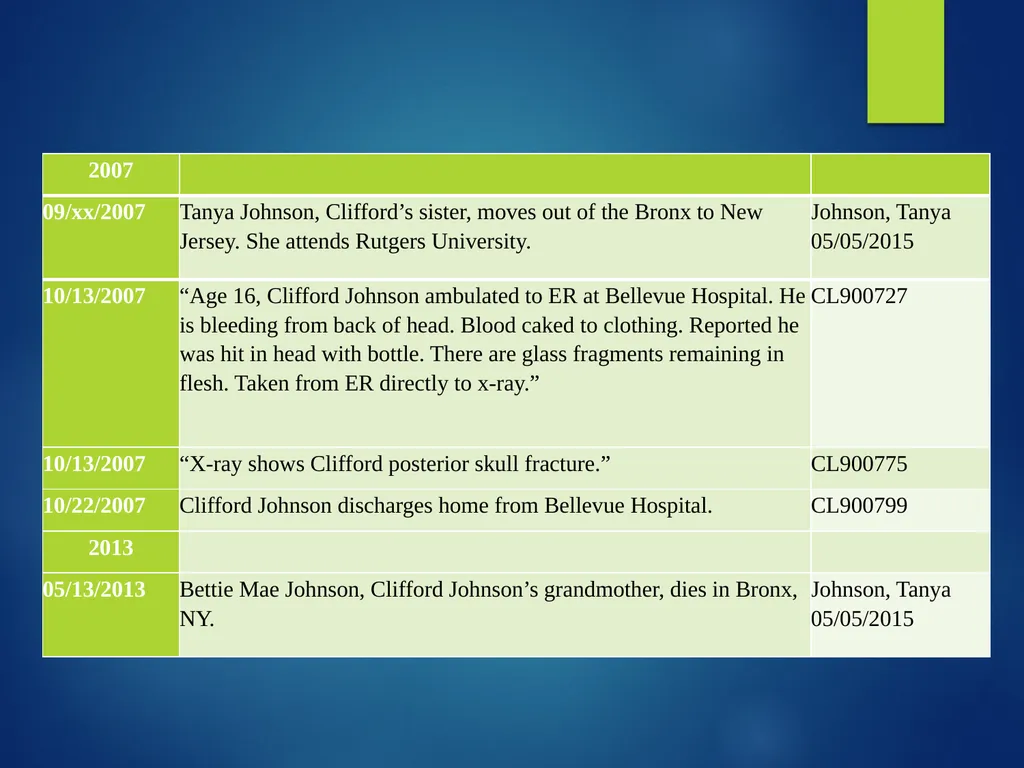
Chronology The Chronology is a timeline list of all the events that occurred in your client’s life.
Three generations backwards and forwards
Medical, Mental Health, Social, DFS, Employment, Interviews
Show the sequences of events that occurred in your client’s life as well as the people they were closest to.<br>
Three generations backwards and forwards
Medical, Mental Health, Social, DFS, Employment, Interviews
Show the sequences of events that occurred in your client’s life as well as the people they were closest to.<br>
16
Theory Memo The main purpose of a theory memo is the same as a brainstorming.
The headings should really tell a story rather than ask questions.
State theories as aphorisms. If you cannot state your theory in a simple phrase, you will not get it across to a jury<br>
The headings should really tell a story rather than ask questions.
State theories as aphorisms. If you cannot state your theory in a simple phrase, you will not get it across to a jury<br>
17
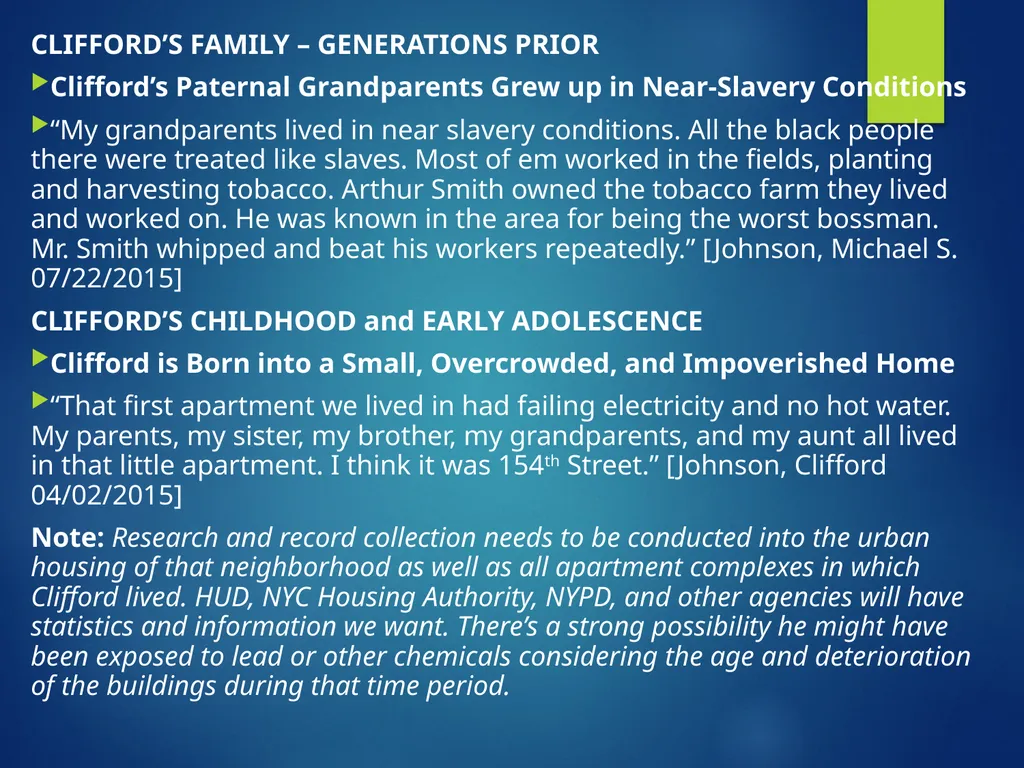
CLIFFORD’S FAMILY – GENERATIONS PRIOR
Clifford’s Paternal Grandparents Grew up in Near-Slavery Conditions
“My grandparents lived in near slavery conditions. All the black people there were treated like slaves. Most of em worked in the fields, planting and harvesting tobacco. Arthur Smith owned the tobacco farm they lived and worked on. He was known in the area for being the worst bossman. Mr. Smith whipped and beat his workers repeatedly.” [Johnson, Michael S. 07/22/2015]
CLIFFORD’S CHILDHOOD and EARLY ADOLESCENCE
Clifford is Born into a Small, Overcrowded, and Impoverished Home
“That first apartment we lived in had failing electricity and no hot water. My parents, my sister, my brother, my grandparents, and my aunt all lived in that little apartment. I think it was 154th Street.” [Johnson, Clifford 04/02/2015]
Note: Research and record collection needs to be conducted into the urban housing of that neighborhood as well as all apartment complexes in which Clifford lived. HUD, NYC Housing Authority, NYPD, and other agencies will have statistics and information we want. There’s a strong possibility he might have been exposed to lead or other chemicals considering the age and deterioration of the buildings during that time period.<br>
Clifford’s Paternal Grandparents Grew up in Near-Slavery Conditions
“My grandparents lived in near slavery conditions. All the black people there were treated like slaves. Most of em worked in the fields, planting and harvesting tobacco. Arthur Smith owned the tobacco farm they lived and worked on. He was known in the area for being the worst bossman. Mr. Smith whipped and beat his workers repeatedly.” [Johnson, Michael S. 07/22/2015]
CLIFFORD’S CHILDHOOD and EARLY ADOLESCENCE
Clifford is Born into a Small, Overcrowded, and Impoverished Home
“That first apartment we lived in had failing electricity and no hot water. My parents, my sister, my brother, my grandparents, and my aunt all lived in that little apartment. I think it was 154th Street.” [Johnson, Clifford 04/02/2015]
Note: Research and record collection needs to be conducted into the urban housing of that neighborhood as well as all apartment complexes in which Clifford lived. HUD, NYC Housing Authority, NYPD, and other agencies will have statistics and information we want. There’s a strong possibility he might have been exposed to lead or other chemicals considering the age and deterioration of the buildings during that time period.<br>
18
Records Collection<br>
19
Private records with releases;
Courthouse searches;
Public records requests (Right-to-Know Law in PA and/or FOIA);
Internet searches, social media, newspapers, archival research;
Subpoenas Duces Tecum.
Start immediately Types of Records<br>
Courthouse searches;
Public records requests (Right-to-Know Law in PA and/or FOIA);
Internet searches, social media, newspapers, archival research;
Subpoenas Duces Tecum.
Start immediately Types of Records<br>
20
Start immediately.
Releases from client and all family immediately. Get multiple copies. Records Collection<br>
Releases from client and all family immediately. Get multiple copies. Records Collection<br>
21
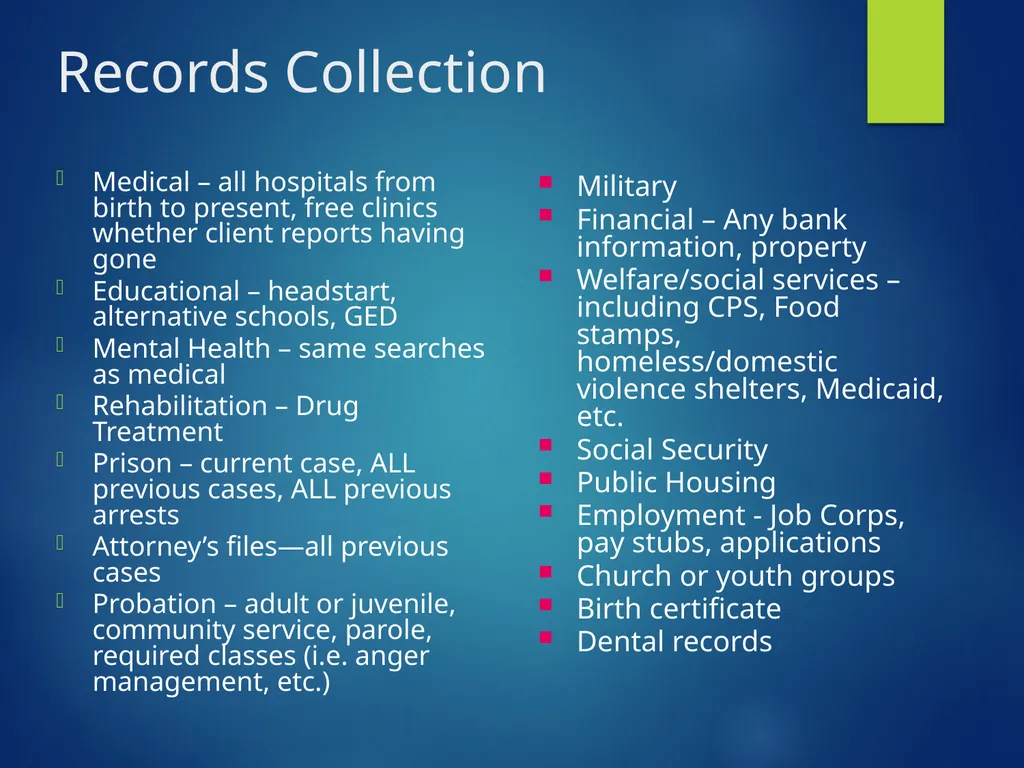
Records Collection Medical – all hospitals from birth to present, free clinics whether client reports having gone
Educational – headstart, alternative schools, GED
Mental Health – same searches as medical
Rehabilitation – Drug Treatment
Prison – current case, ALL previous cases, ALL previous arrests
Attorney’s files—all previous cases
Probation – adult or juvenile, community service, parole, required classes (i.e. anger management, etc.) Military
Financial – Any bank information, property
Welfare/social services – including CPS, Food stamps, homeless/domestic violence shelters, Medicaid, etc.
Social Security
Public Housing
Employment - Job Corps, pay stubs, applications
Church or youth groups
Birth certificate
Dental records<br>
Educational – headstart, alternative schools, GED
Mental Health – same searches as medical
Rehabilitation – Drug Treatment
Prison – current case, ALL previous cases, ALL previous arrests
Attorney’s files—all previous cases
Probation – adult or juvenile, community service, parole, required classes (i.e. anger management, etc.) Military
Financial – Any bank information, property
Welfare/social services – including CPS, Food stamps, homeless/domestic violence shelters, Medicaid, etc.
Social Security
Public Housing
Employment - Job Corps, pay stubs, applications
Church or youth groups
Birth certificate
Dental records<br>
22
Interviews<br>
23
Dual tracks of life history investigation: record collection and interviews
Nonlinear & organic process
Interview family, friends, who else?
School
Multigenerational family history
Why talk to so many people?
Barriers to Disclosure Life History Investigation: Interviews<br>
Nonlinear & organic process
Interview family, friends, who else?
School
Multigenerational family history
Why talk to so many people?
Barriers to Disclosure Life History Investigation: Interviews<br>
24
In person, Face-to-face
Vs. phone calls
One-on-one
Vs. group interviews
Multiple Interviews
Vs. one time meeting
Scheduling
Vs. showing up
Develop Rapport Life History Investigation: Interviews<br>
Vs. phone calls
One-on-one
Vs. group interviews
Multiple Interviews
Vs. one time meeting
Scheduling
Vs. showing up
Develop Rapport Life History Investigation: Interviews<br>
25
What is Rapport?
Rapport is a dynamic, harmonious relationship in which information flows freely because the other person feels accepted with both their assets and liabilities. “A relationship between the [client or witness] and [the defense team] that reflects warmth, genuine concern, and mutual trust.”
Sadock & Sadock, A Synopsis of Psychiatry Interviewing:<br>
Rapport is a dynamic, harmonious relationship in which information flows freely because the other person feels accepted with both their assets and liabilities. “A relationship between the [client or witness] and [the defense team] that reflects warmth, genuine concern, and mutual trust.”
Sadock & Sadock, A Synopsis of Psychiatry Interviewing:<br>
26
Be quiet, still, observe, and LISTEN
Observe
Allow for time
Respond only to what person is saying
Language & Silence
Open-ended Questions – no checklists, closed questions
Interrogation vs. Controlled Comfortable Conversation
Looping
Details & Stories – Humanizing Vignettes
Notes & Memos
Progression Interviewing: Field<br>
Observe
Allow for time
Respond only to what person is saying
Language & Silence
Open-ended Questions – no checklists, closed questions
Interrogation vs. Controlled Comfortable Conversation
Looping
Details & Stories – Humanizing Vignettes
Notes & Memos
Progression Interviewing: Field<br>
27
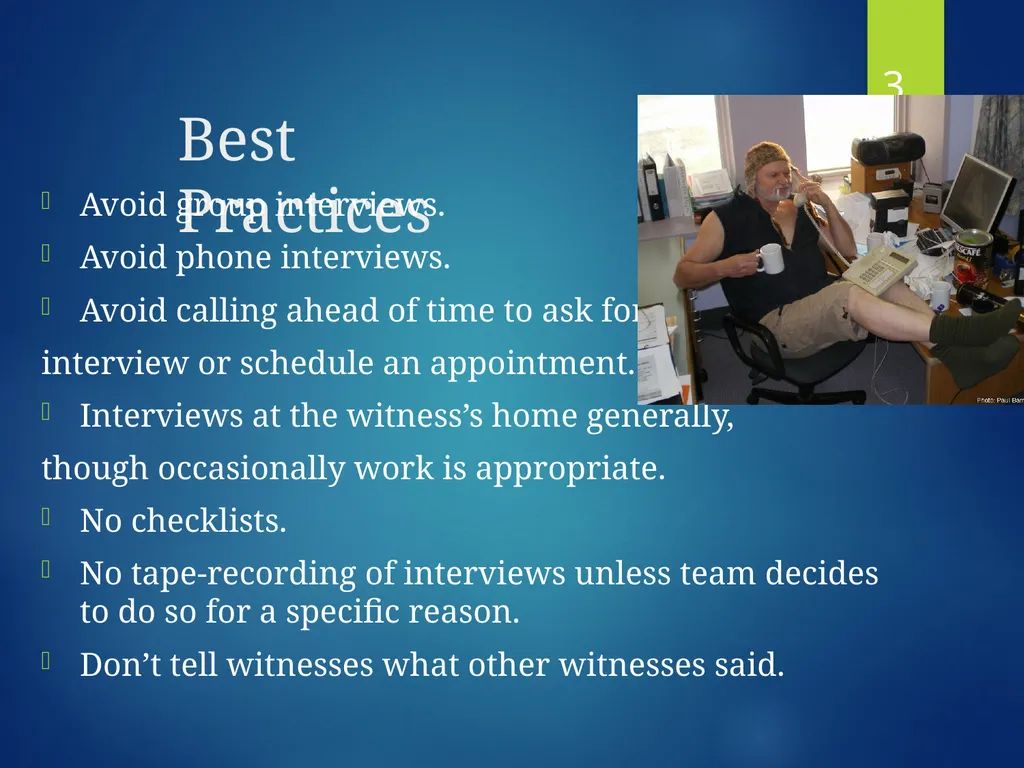
Best Practices Avoid group interviews.
Avoid phone interviews.
Avoid calling ahead of time to ask for an
interview or schedule an appointment.
Interviews at the witness’s home generally,
though occasionally work is appropriate.
No checklists.
No tape-recording of interviews unless team decides to do so for a specific reason.
Don’t tell witnesses what other witnesses said. 30<br>
Avoid phone interviews.
Avoid calling ahead of time to ask for an
interview or schedule an appointment.
Interviews at the witness’s home generally,
though occasionally work is appropriate.
No checklists.
No tape-recording of interviews unless team decides to do so for a specific reason.
Don’t tell witnesses what other witnesses said. 30<br>
28
Mental Health<br>
29
Mental Health mental health mitigation need not meet the legal definition for incompetence or insanity or involve a mental disease or defect, and yet mental impairments are powerfully mitigating disabilities that are given great weight when assessing individualized culpability.
Mitigation concerning mental health impairments may include evidence of mental illness, intellectual disability, brain damage, cognitive impairments, traumatic brain injury, fetal alcohol spectrum disorders, and other neuropsychological impairments.
the environment in which the client was raised and the effects of this environment upon his development and mental health as well as any mental and medical impairments that may have influenced his perception, judgment, and behavior at the time of the offense<br>
Mitigation concerning mental health impairments may include evidence of mental illness, intellectual disability, brain damage, cognitive impairments, traumatic brain injury, fetal alcohol spectrum disorders, and other neuropsychological impairments.
the environment in which the client was raised and the effects of this environment upon his development and mental health as well as any mental and medical impairments that may have influenced his perception, judgment, and behavior at the time of the offense<br>
30
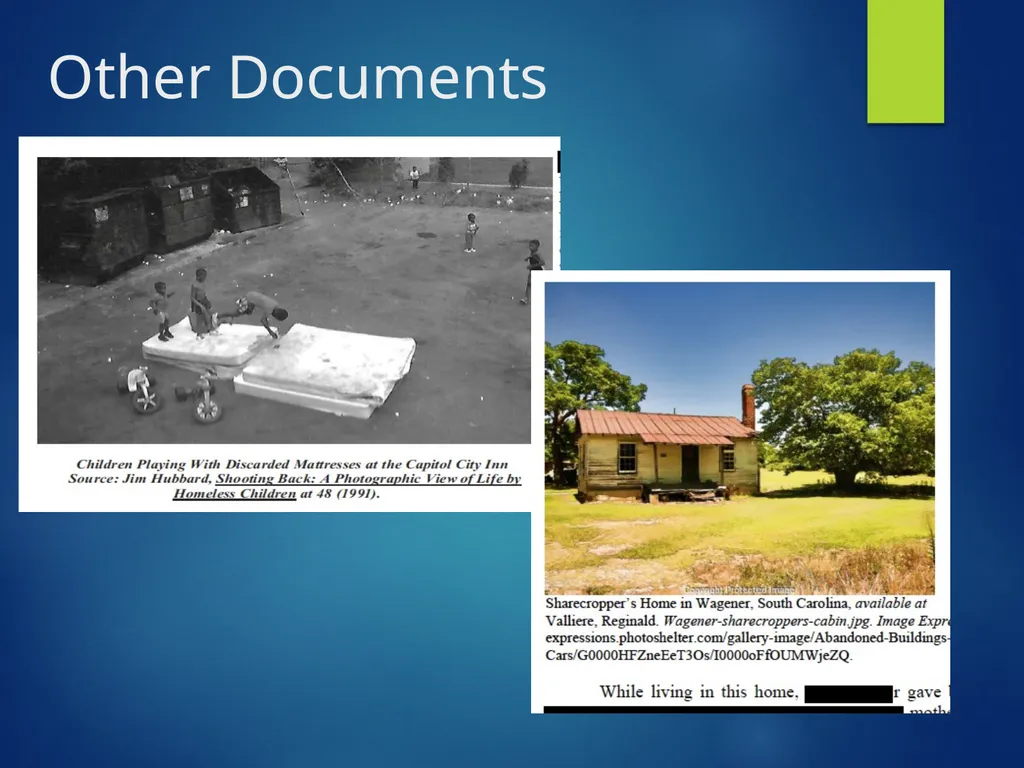
Other Documents<br>
31
Other Documents<br>
32
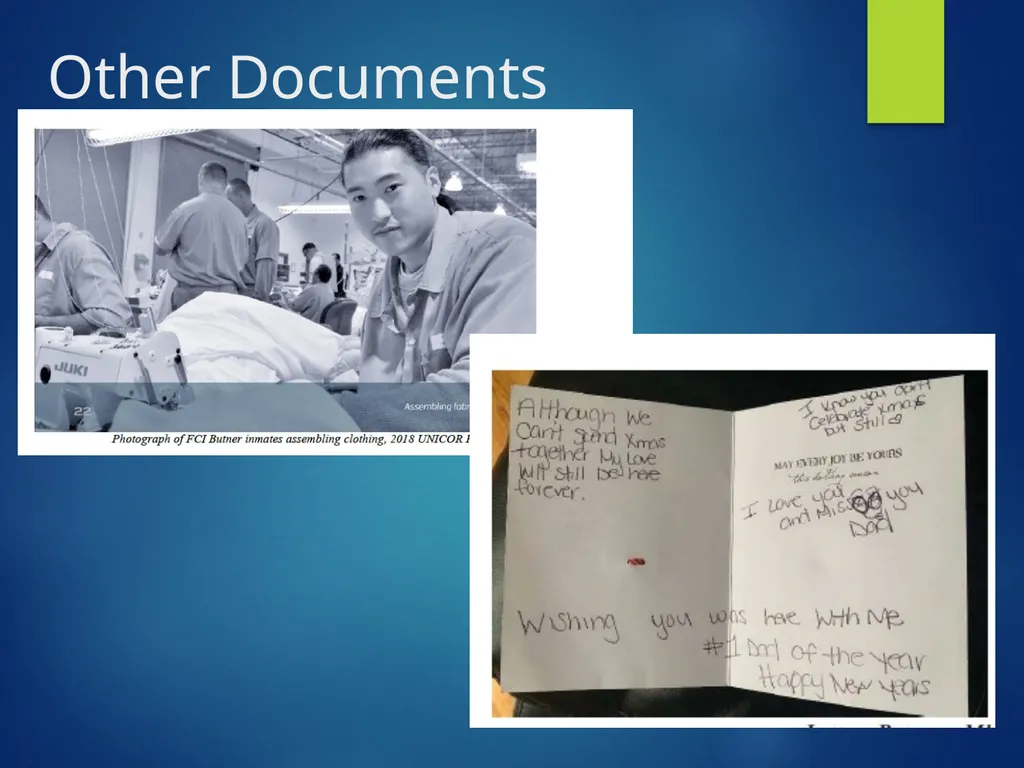
Other Documents<br>
33
Other Documents<br>
34
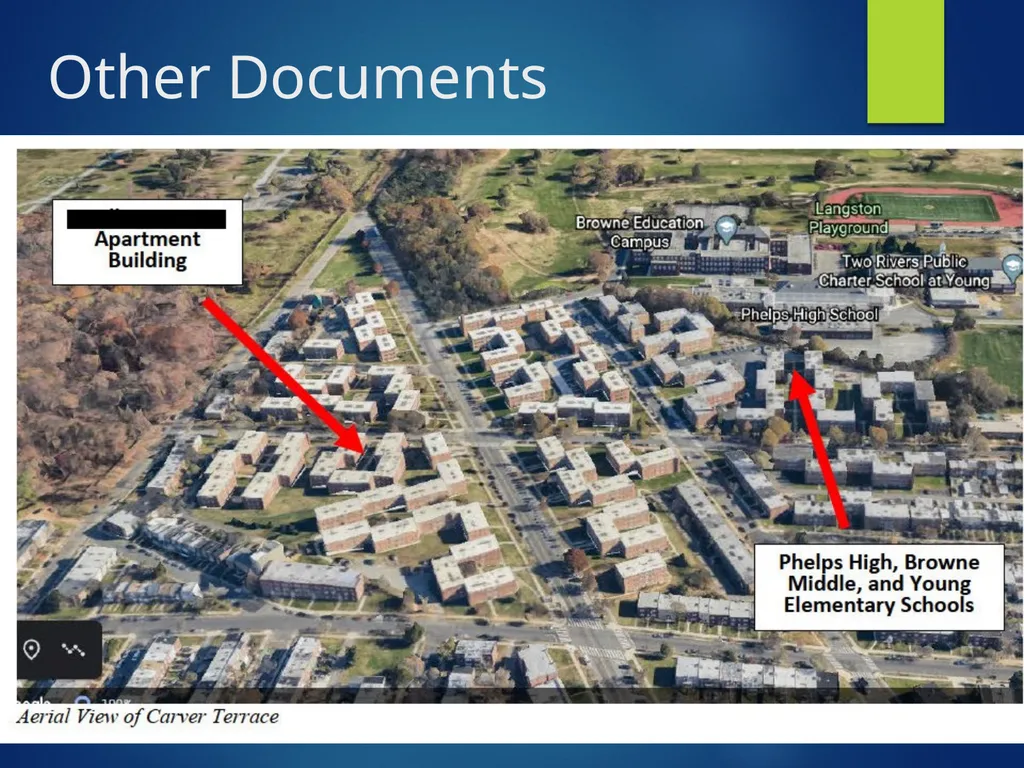
Other Documents<br>
35
How does this turn into a narrative? NYT Reporter
Early 80s - Investigate life and mind of client
blind spot between private investigator and the psychiatrist— Neither one was suited to discovering and then communicating the complex human reality of the defendant's personality in a sympathetic way.
the defendant's personal history and family life, his obsessions, aspirations, hopes, and flaws, are rarely a matter of physical evidence.
Instead, these are portrayed through narrative, incident, scene, memory, language, style, and even a whole array of intangibles like eye contact, body movement, patterns of speech-- things that to a jury convey as much information, if not more, as any set of facts.<br>
Early 80s - Investigate life and mind of client
blind spot between private investigator and the psychiatrist— Neither one was suited to discovering and then communicating the complex human reality of the defendant's personality in a sympathetic way.
the defendant's personal history and family life, his obsessions, aspirations, hopes, and flaws, are rarely a matter of physical evidence.
Instead, these are portrayed through narrative, incident, scene, memory, language, style, and even a whole array of intangibles like eye contact, body movement, patterns of speech-- things that to a jury convey as much information, if not more, as any set of facts.<br>
36
It's easy to tell someone what happened, when, where and why.
Must make someone feel the story
“It is hard to make someone truly bask in the glories, suffer the agonies of defeats, feel the sting of rebukes or the pride from accomplishments through words alone. It's hard because words, in and of themselves, are flat, unemotional, detached. Readers must be shown the story behind the words: the emotion, the humanity, the true meaning.”<br>
Must make someone feel the story
“It is hard to make someone truly bask in the glories, suffer the agonies of defeats, feel the sting of rebukes or the pride from accomplishments through words alone. It's hard because words, in and of themselves, are flat, unemotional, detached. Readers must be shown the story behind the words: the emotion, the humanity, the true meaning.”<br>
37
Legal issues alone-no matter how valid-are insufficient to withstand the “hydraulic pressure” of public opinion that drives executions. Capital defense lawyers know that more important than legal issues are “the stories of life-stories about treachery, ambition, betrayal, greed, sacrifice, commitment, devotion, love—and in these stories we find a reason, not a fancy argument but a reason, for life.” — Sean O’Brien<br>