
Analysis of Large Graphs: Link Analysis, PageRank
PM
Published · 60 slides · 0 views

1 / 1









Description
Analysis of Large Graphs: Link Analysis, PageRank Mining of Massive Datasets Jure Leskovec, Anand Rajaraman, Jeff Ullman Stanford University http:www.mmds.org Note to other teachers and users of these slides: We would be delighted if you
Related Topics
Share
Embed code
Download this presentation From Below
"Analysis of Large Graphs: Link Analysis, PageRank" is the property of its rightful owner. Permission is granted to download and print the materials on this website for personal, non-commercial use only, and to display it on your personal computer provided you do not modify the materials and that you retain all copyright notices contained in the materials. By downloading content from our website, you accept the terms of this agreement.
Presentation Transcript
01
Analysis of Large Graphs:
Link Analysis, PageRank Mining of Massive Datasets
Jure Leskovec, Anand Rajaraman, Jeff Ullman Stanford University
http://www.mmds.org Note to other teachers and users of these slides: We would be delighted if you found this our material useful in giving your own lectures. Feel free to use these slides verbatim, or to modify them to fit your own needs. If you make use of a significant portion of these slides in your own lecture, please include this message, or a link to our web site: http://www.mmds.org<br>
02
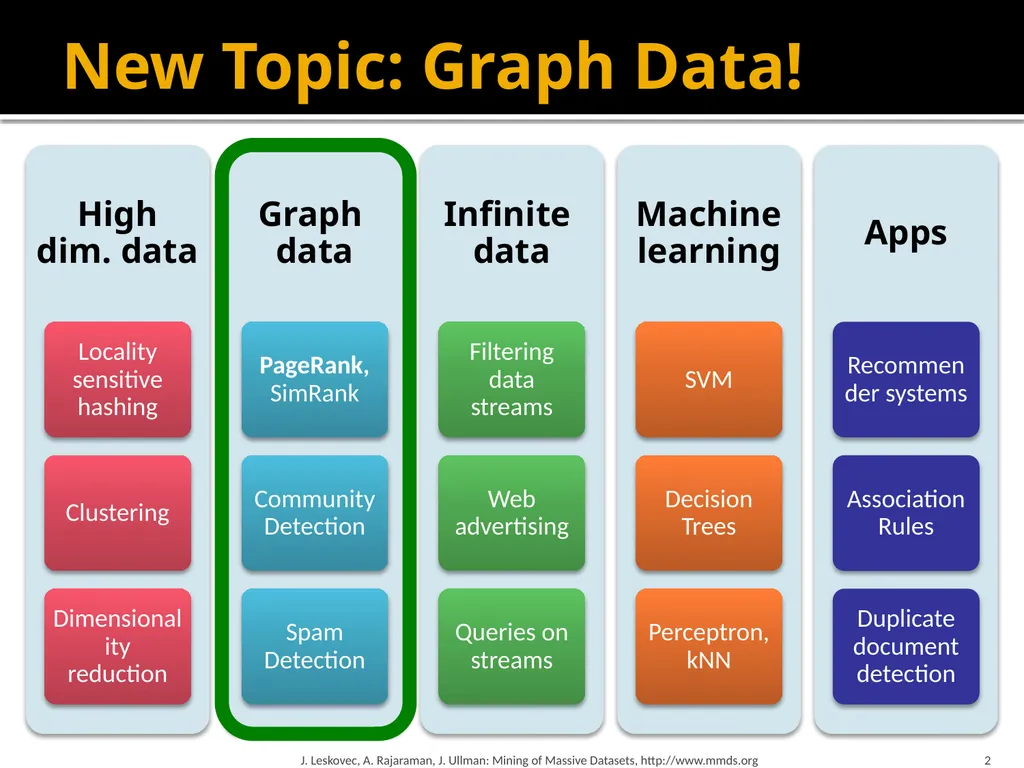
New Topic: Graph Data! J. Leskovec, A. Rajaraman, J. Ullman: Mining of Massive Datasets, http://www.mmds.org 2<br>
03
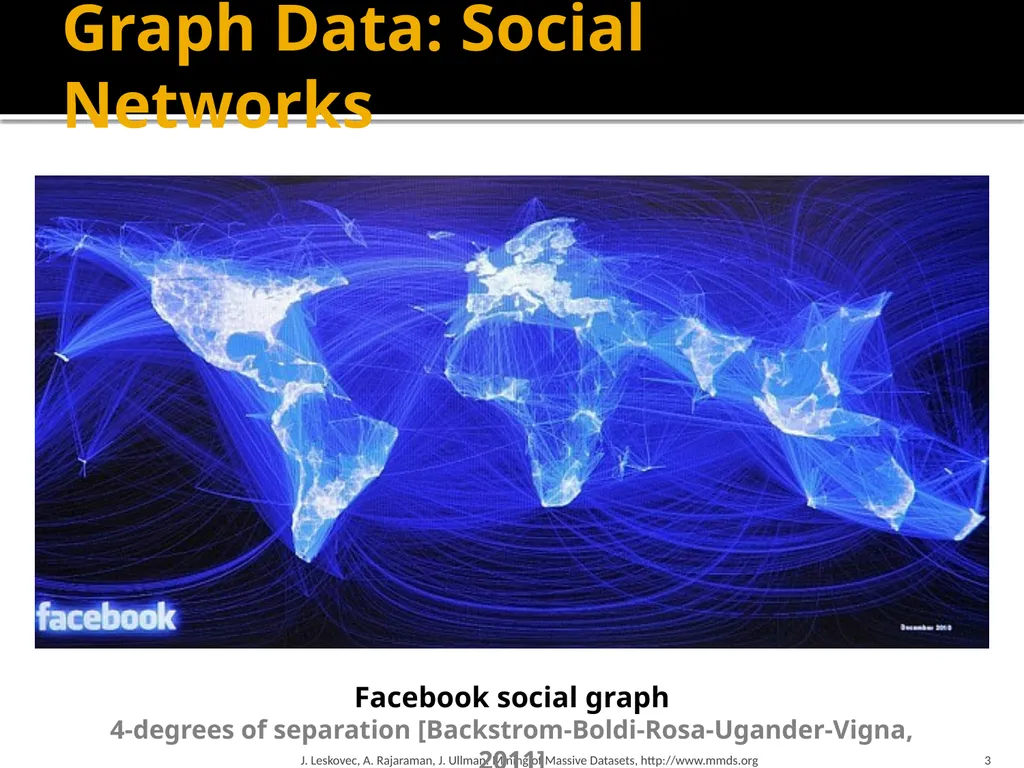
Graph Data: Social Networks J. Leskovec, A. Rajaraman, J. Ullman: Mining of Massive Datasets, http://www.mmds.org 3 Facebook social graph
4-degrees of separation [Backstrom-Boldi-Rosa-Ugander-Vigna, 2011]<br>
4-degrees of separation [Backstrom-Boldi-Rosa-Ugander-Vigna, 2011]<br>
04
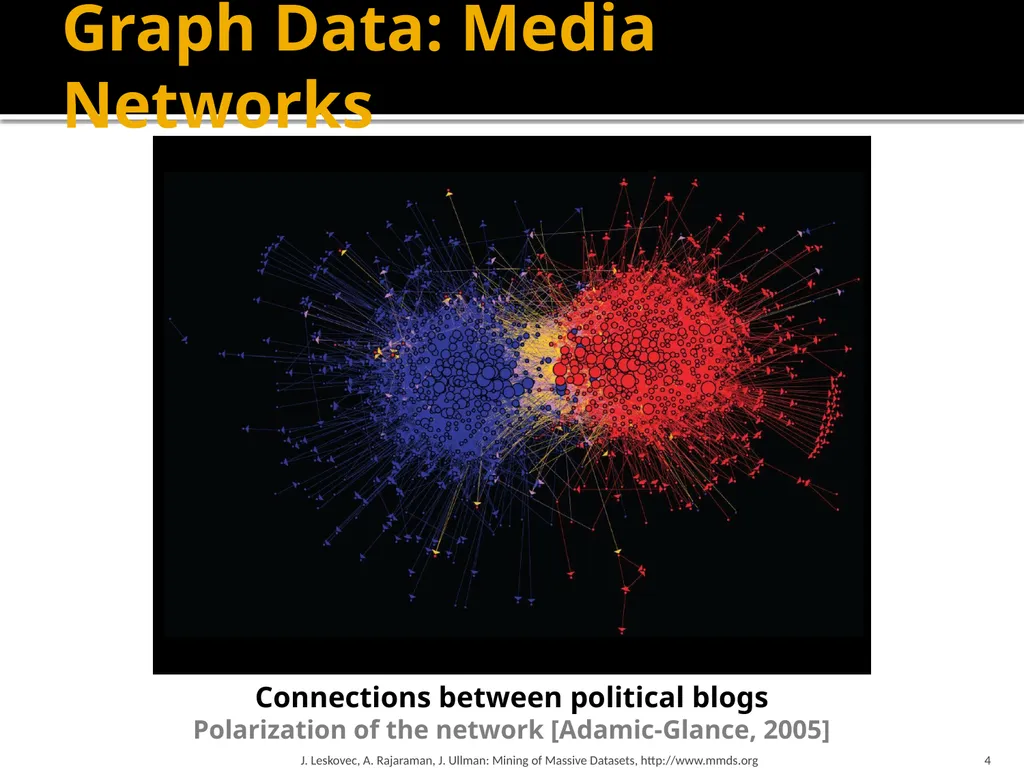
Graph Data: Media Networks J. Leskovec, A. Rajaraman, J. Ullman: Mining of Massive Datasets, http://www.mmds.org 4 Connections between political blogs
Polarization of the network [Adamic-Glance, 2005]<br>
Polarization of the network [Adamic-Glance, 2005]<br>
05
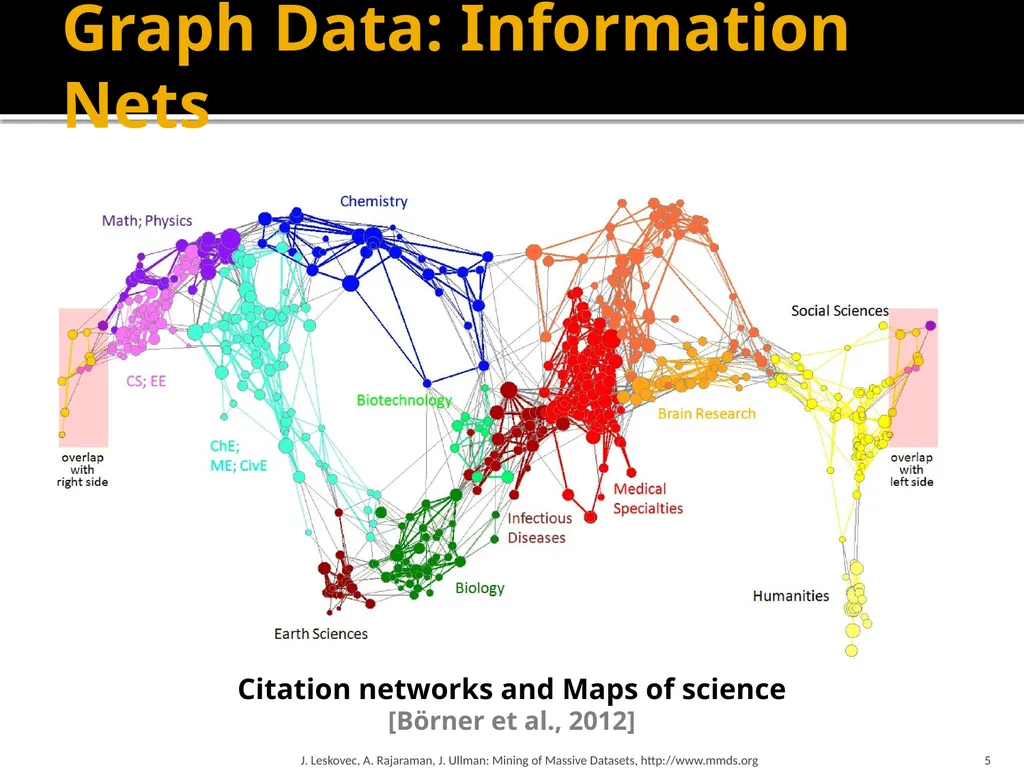
Graph Data: Information Nets J. Leskovec, A. Rajaraman, J. Ullman: Mining of Massive Datasets, http://www.mmds.org 5 Citation networks and Maps of science
[Börner et al., 2012]<br>
[Börner et al., 2012]<br>
06
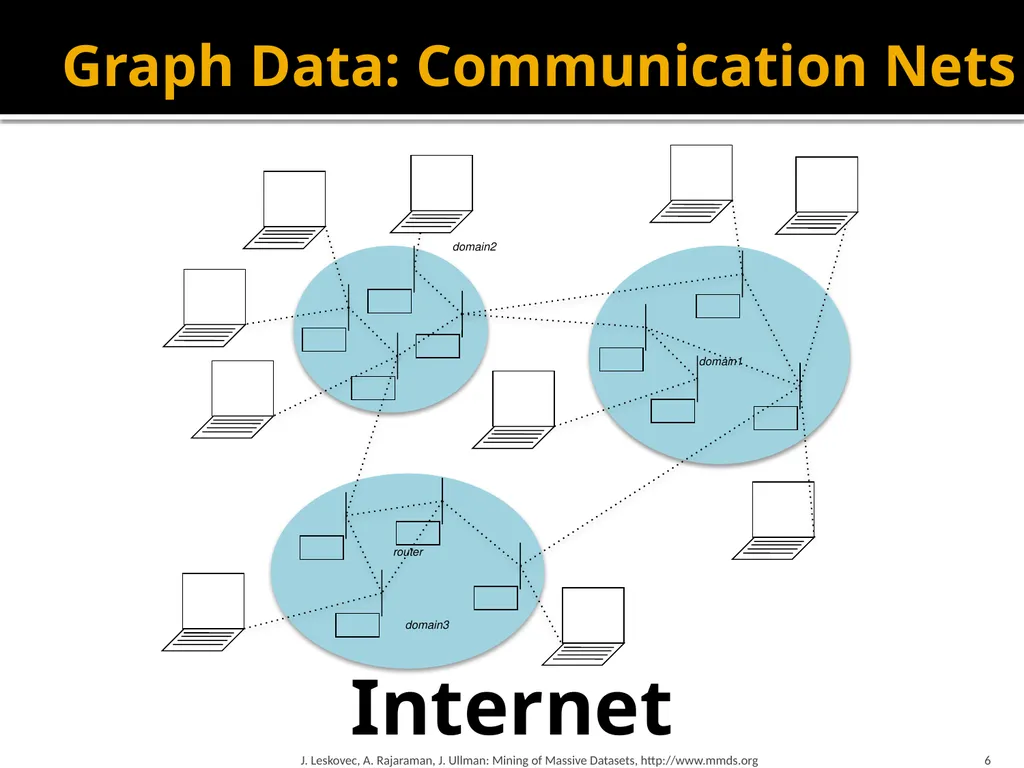
Internet Graph Data: Communication Nets J. Leskovec, A. Rajaraman, J. Ullman: Mining of Massive Datasets, http://www.mmds.org 6<br>
07
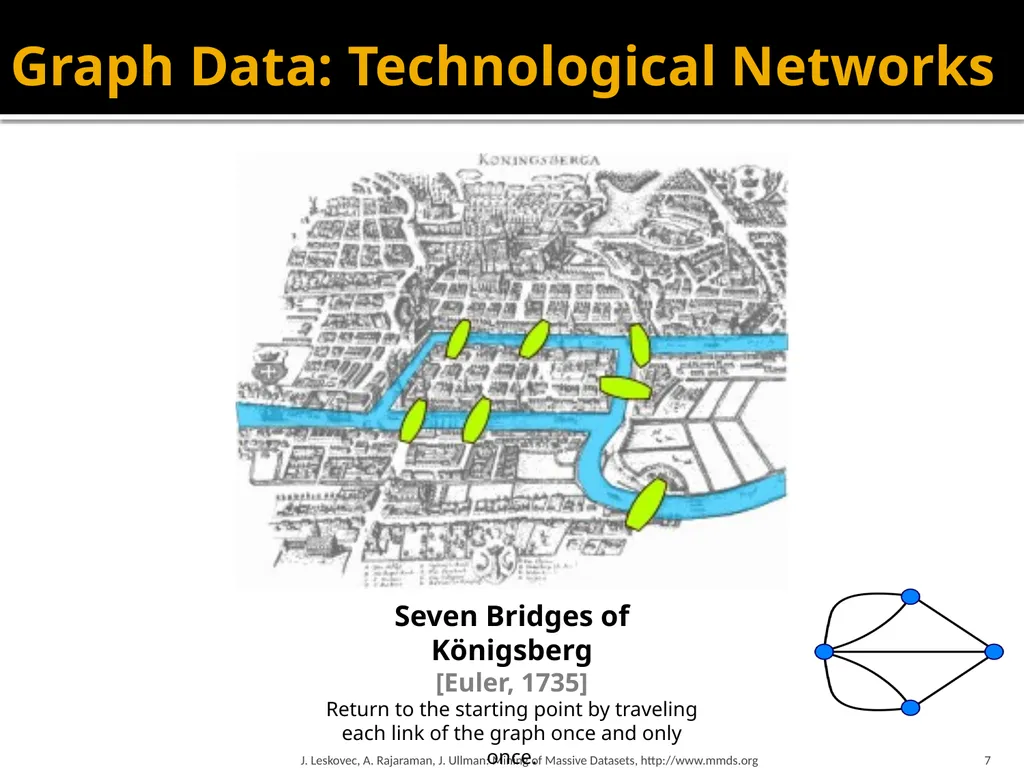
Graph Data: Technological Networks J. Leskovec, A. Rajaraman, J. Ullman: Mining of Massive Datasets, http://www.mmds.org 7 Seven Bridges of Königsberg
[Euler, 1735]
Return to the starting point by traveling each link of the graph once and only once.<br>
Return to the starting point by traveling each link of the graph once and only once.<br>
08
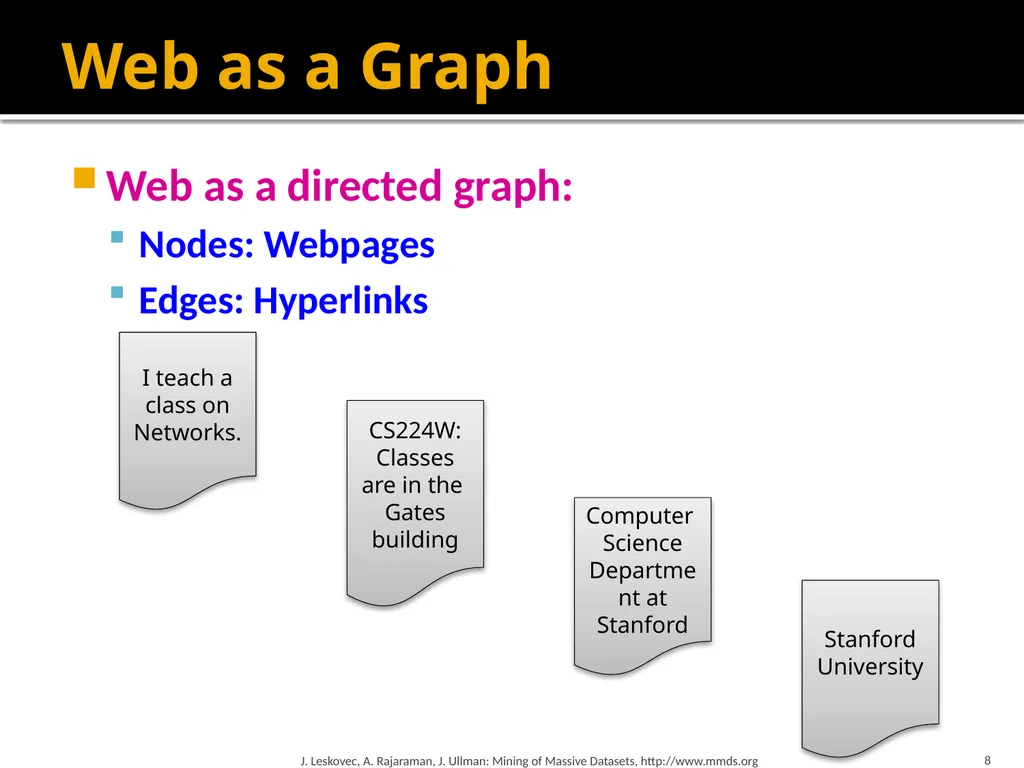
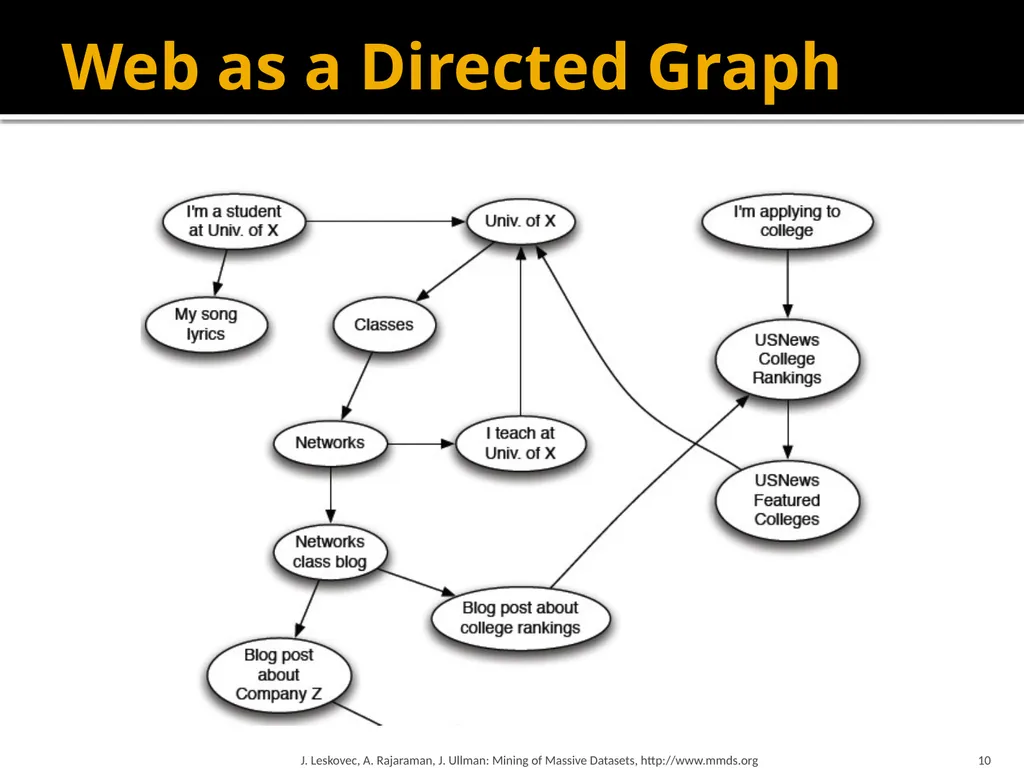
Web as a Graph Web as a directed graph:
Nodes: Webpages
Edges: Hyperlinks J. Leskovec, A. Rajaraman, J. Ullman: Mining of Massive Datasets, http://www.mmds.org 8 I teach a class on Networks. CS224W: Classes are in the Gates building Computer Science Department at Stanford Stanford University<br>
Nodes: Webpages
Edges: Hyperlinks J. Leskovec, A. Rajaraman, J. Ullman: Mining of Massive Datasets, http://www.mmds.org 8 I teach a class on Networks. CS224W: Classes are in the Gates building Computer Science Department at Stanford Stanford University<br>
09
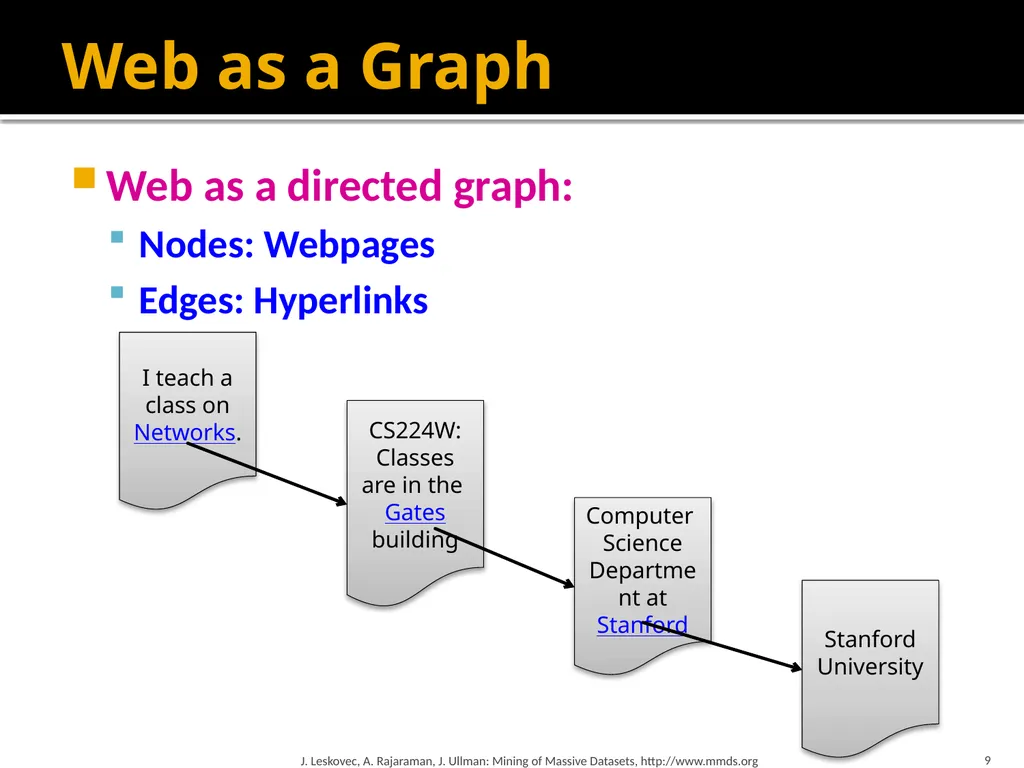
Web as a Graph Web as a directed graph:
Nodes: Webpages
Edges: Hyperlinks J. Leskovec, A. Rajaraman, J. Ullman: Mining of Massive Datasets, http://www.mmds.org 9 I teach a class on Networks. CS224W: Classes are in the Gates building Computer Science Department at Stanford Stanford University<br>
Nodes: Webpages
Edges: Hyperlinks J. Leskovec, A. Rajaraman, J. Ullman: Mining of Massive Datasets, http://www.mmds.org 9 I teach a class on Networks. CS224W: Classes are in the Gates building Computer Science Department at Stanford Stanford University<br>
10
Web as a Directed Graph J. Leskovec, A. Rajaraman, J. Ullman: Mining of Massive Datasets, http://www.mmds.org 10<br>
11
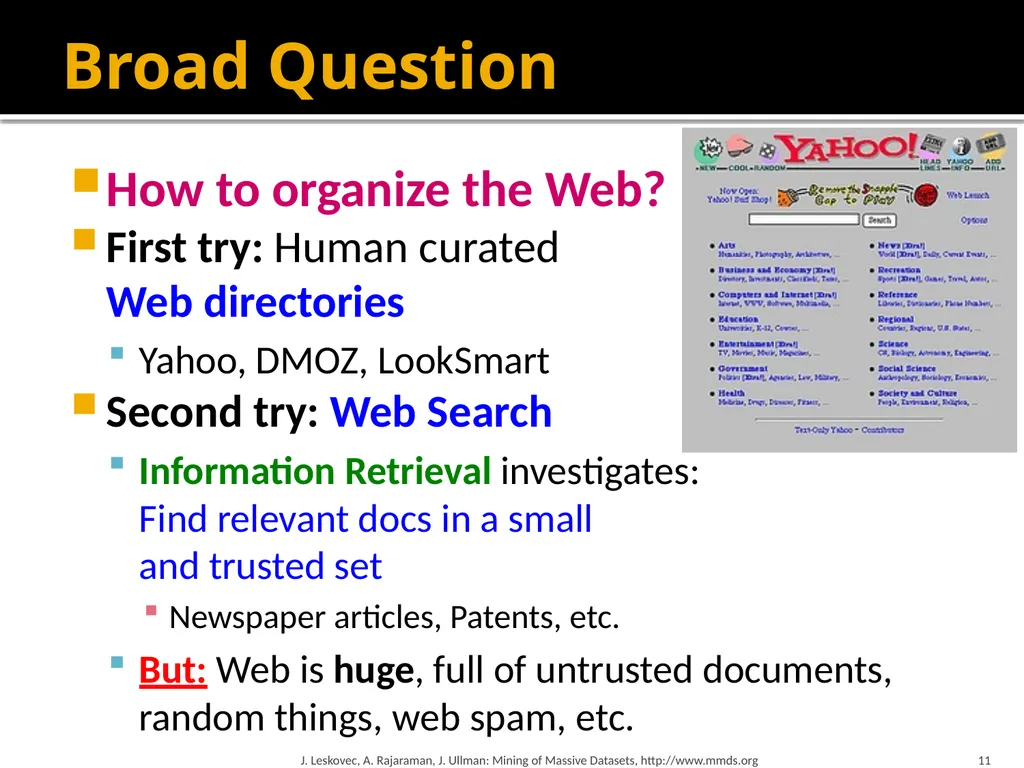
Broad Question How to organize the Web?
First try: Human curated Web directories
Yahoo, DMOZ, LookSmart
Second try: Web Search
Information Retrieval investigates: Find relevant docs in a small and trusted set
Newspaper articles, Patents, etc.
But: Web is huge, full of untrusted documents, random things, web spam, etc. J. Leskovec, A. Rajaraman, J. Ullman: Mining of Massive Datasets, http://www.mmds.org 11<br>
12
Web Search: 2 Challenges 2 challenges of web search:
(1) Web contains many sources of information Who to “trust”?
Trick: Trustworthy pages may point to each other!
(2) What is the “best” answer to query “newspaper”?
No single right answer
Trick: Pages that actually know about newspapers might all be pointing to many newspapers J. Leskovec, A. Rajaraman, J. Ullman: Mining of Massive Datasets, http://www.mmds.org 12<br>
13
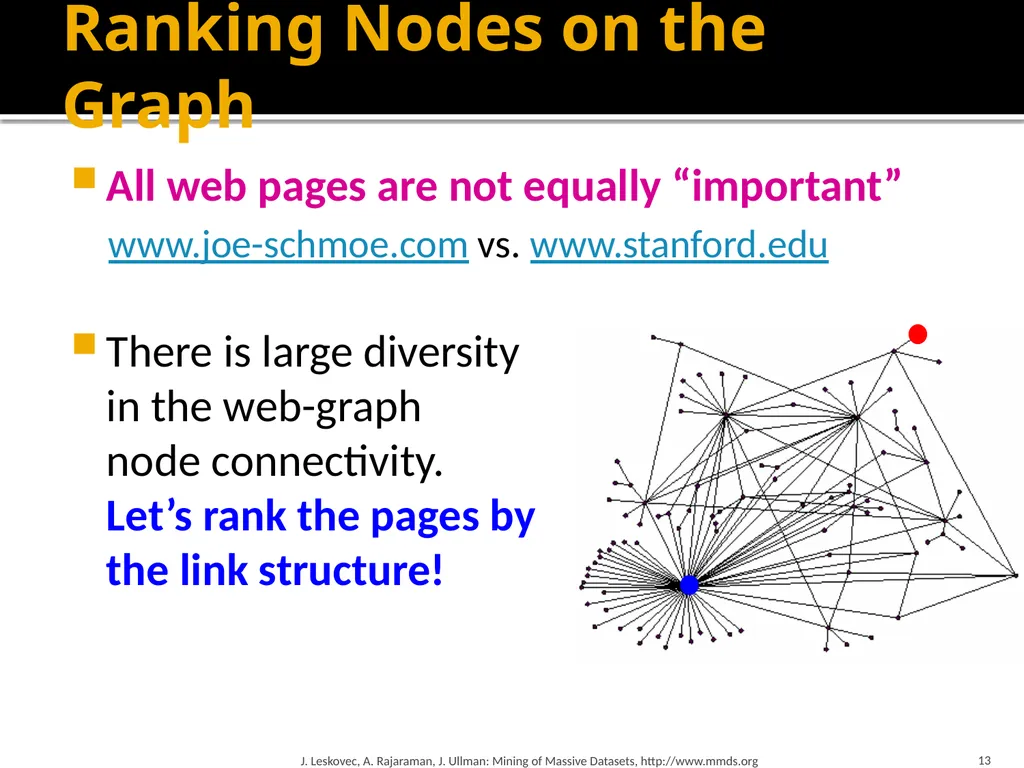
Ranking Nodes on the Graph All web pages are not equally “important”
www.joe-schmoe.com vs. www.stanford.edu
There is large diversity in the web-graph node connectivity. Let’s rank the pages by the link structure! J. Leskovec, A. Rajaraman, J. Ullman: Mining of Massive Datasets, http://www.mmds.org 13<br>
www.joe-schmoe.com vs. www.stanford.edu
There is large diversity in the web-graph node connectivity. Let’s rank the pages by the link structure! J. Leskovec, A. Rajaraman, J. Ullman: Mining of Massive Datasets, http://www.mmds.org 13<br>
14
Link Analysis Algorithms We will cover the following Link Analysis approaches for computing importances
of nodes in a graph:
Page Rank
Topic-Specific (Personalized) Page Rank
Web Spam Detection Algorithms 14 J. Leskovec, A. Rajaraman, J. Ullman: Mining of Massive Datasets, http://www.mmds.org<br>
Page Rank
Topic-Specific (Personalized) Page Rank
Web Spam Detection Algorithms 14 J. Leskovec, A. Rajaraman, J. Ullman: Mining of Massive Datasets, http://www.mmds.org<br>
15
PageRank:
The “Flow” Formulation<br>
16
Links as Votes Idea: Links as votes
Page is more important if it has more links
In-coming links? Out-going links?
Think of in-links as votes:
www.stanford.edu has 23,400 in-links
www.joe-schmoe.com has 1 in-link
Are all in-links are equal?
Links from important pages count more
Recursive question! 16 J. Leskovec, A. Rajaraman, J. Ullman: Mining of Massive Datasets, http://www.mmds.org<br>
17
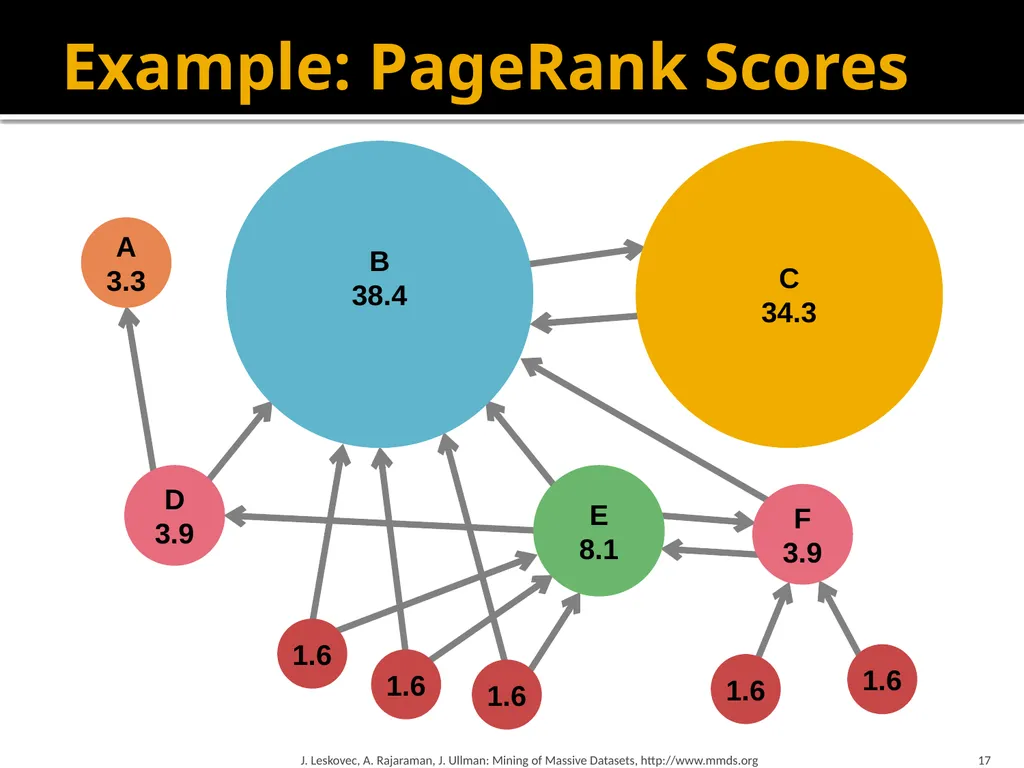
Example: PageRank Scores B
38.4 C
34.3 E
8.1 F
3.9 D
3.9 A
3.3 1.6 1.6 1.6 1.6 1.6 17 J. Leskovec, A. Rajaraman, J. Ullman: Mining of Massive Datasets, http://www.mmds.org<br>
38.4 C
34.3 E
8.1 F
3.9 D
3.9 A
3.3 1.6 1.6 1.6 1.6 1.6 17 J. Leskovec, A. Rajaraman, J. Ullman: Mining of Massive Datasets, http://www.mmds.org<br>
18
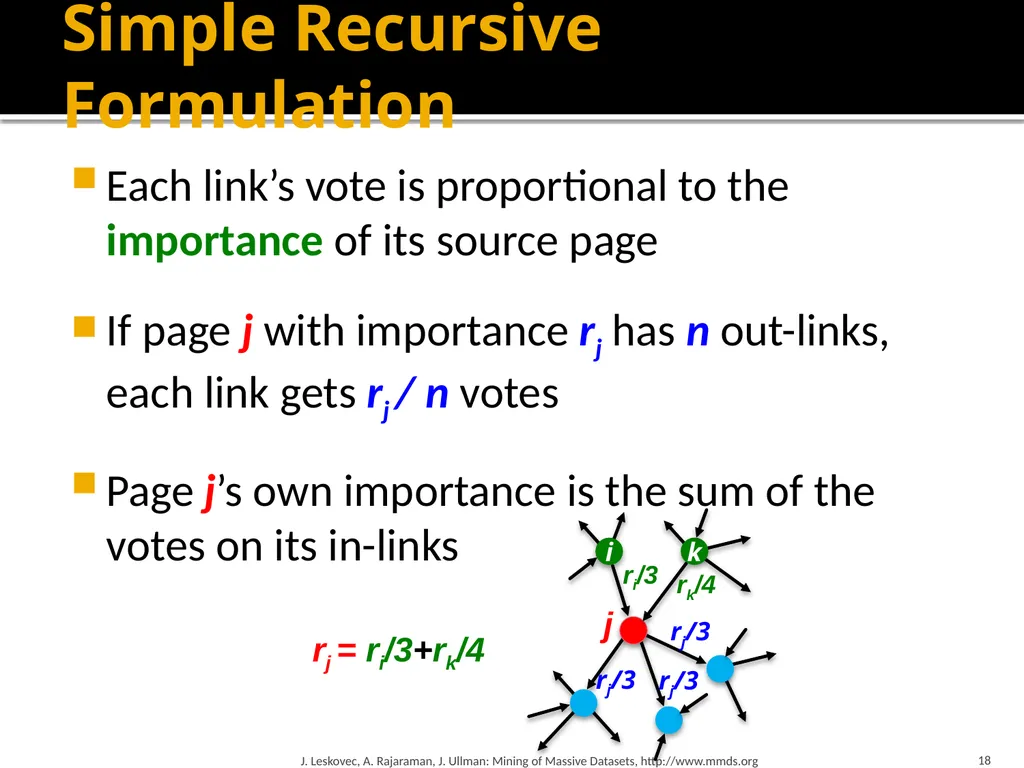
Simple Recursive Formulation Each link’s vote is proportional to the importance of its source page
If page j with importance rj has n out-links, each link gets rj / n votes
Page j’s own importance is the sum of the votes on its in-links 18 J. Leskovec, A. Rajaraman, J. Ullman: Mining of Massive Datasets, http://www.mmds.org j k i rj/3 rj/3 rj/3 rj = ri/3+rk/4 ri/3 rk/4<br>
If page j with importance rj has n out-links, each link gets rj / n votes
Page j’s own importance is the sum of the votes on its in-links 18 J. Leskovec, A. Rajaraman, J. Ullman: Mining of Massive Datasets, http://www.mmds.org j k i rj/3 rj/3 rj/3 rj = ri/3+rk/4 ri/3 rk/4<br>
19
PageRank: The “Flow” Model A “vote” from an important page is worth more
A page is important if it is pointed to by other important pages
Define a “rank” rj for page j J. Leskovec, A. Rajaraman, J. Ullman: Mining of Massive Datasets, http://www.mmds.org 19 The web in 1839 “Flow” equations: ry = ry /2 + ra /2
ra = ry /2 + rm
rm = ra /2<br>
A page is important if it is pointed to by other important pages
Define a “rank” rj for page j J. Leskovec, A. Rajaraman, J. Ullman: Mining of Massive Datasets, http://www.mmds.org 19 The web in 1839 “Flow” equations: ry = ry /2 + ra /2
ra = ry /2 + rm
rm = ra /2<br>
20
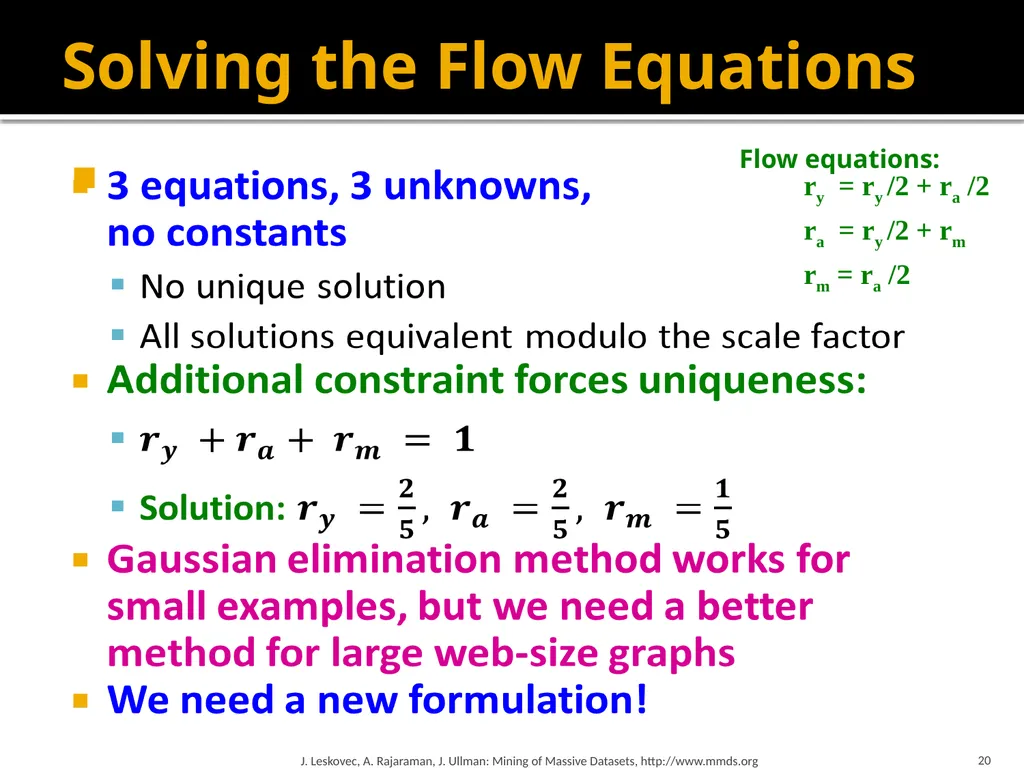
Solving the Flow Equations 20 J. Leskovec, A. Rajaraman, J. Ullman: Mining of Massive Datasets, http://www.mmds.org ry = ry /2 + ra /2
ra = ry /2 + rm
rm = ra /2 Flow equations:<br>
ra = ry /2 + rm
rm = ra /2 Flow equations:<br>
21
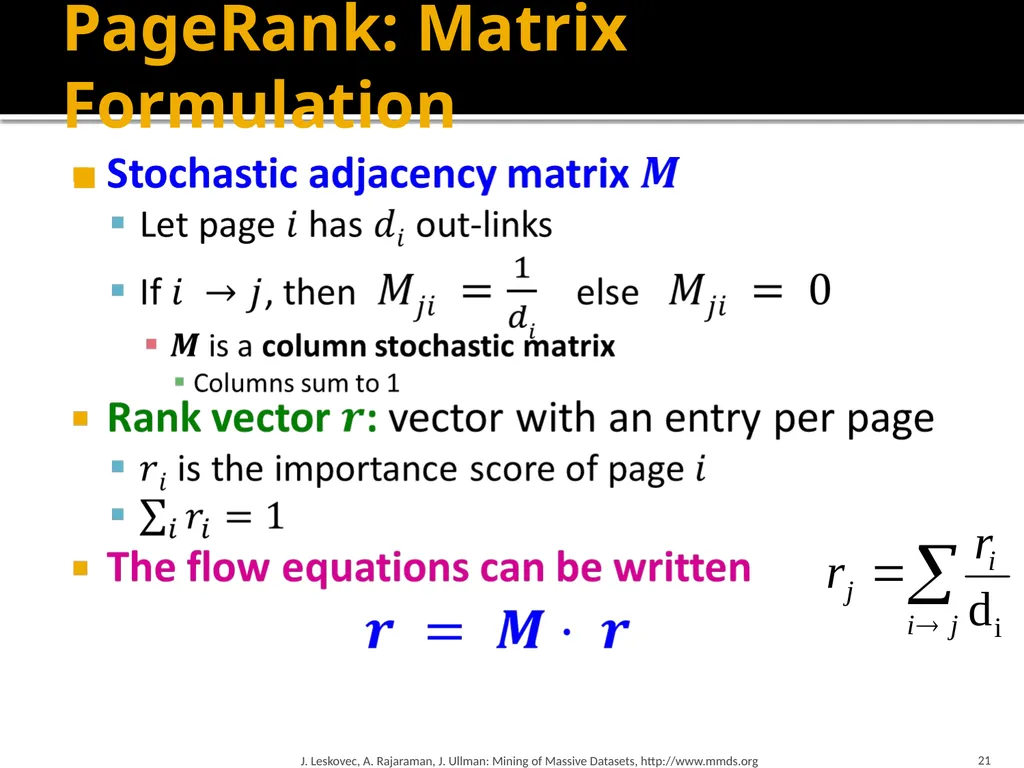
PageRank: Matrix Formulation J. Leskovec, A. Rajaraman, J. Ullman: Mining of Massive Datasets, http://www.mmds.org 21<br>
22
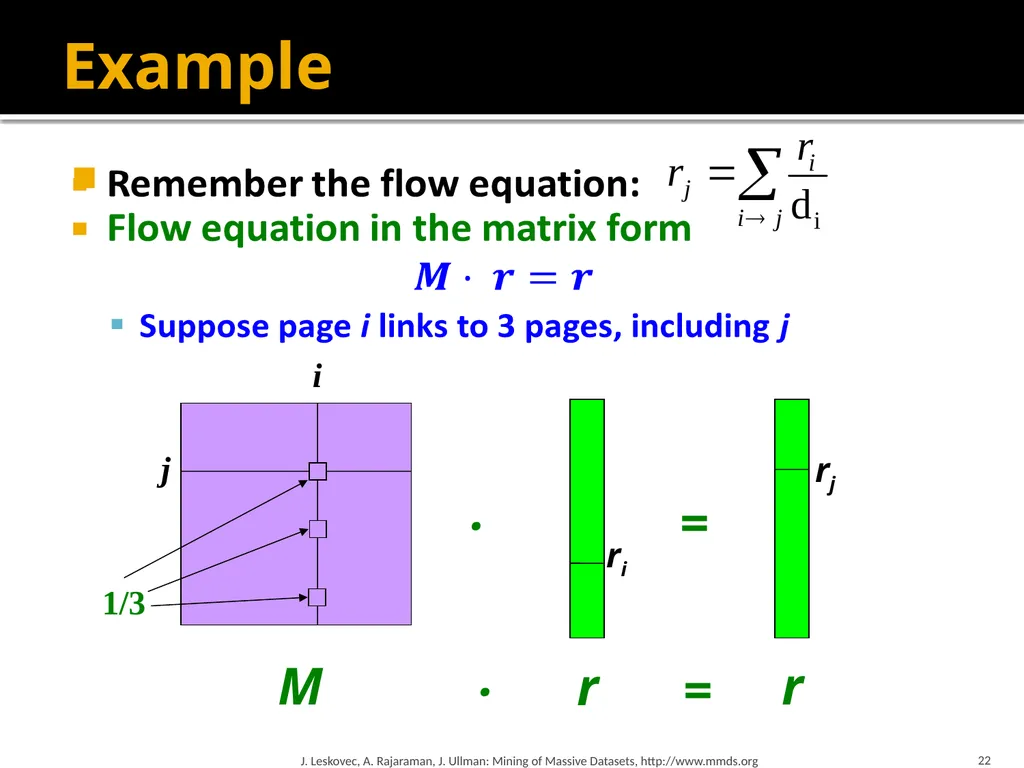
Example J. Leskovec, A. Rajaraman, J. Ullman: Mining of Massive Datasets, http://www.mmds.org 22 r ri . . =<br>
23
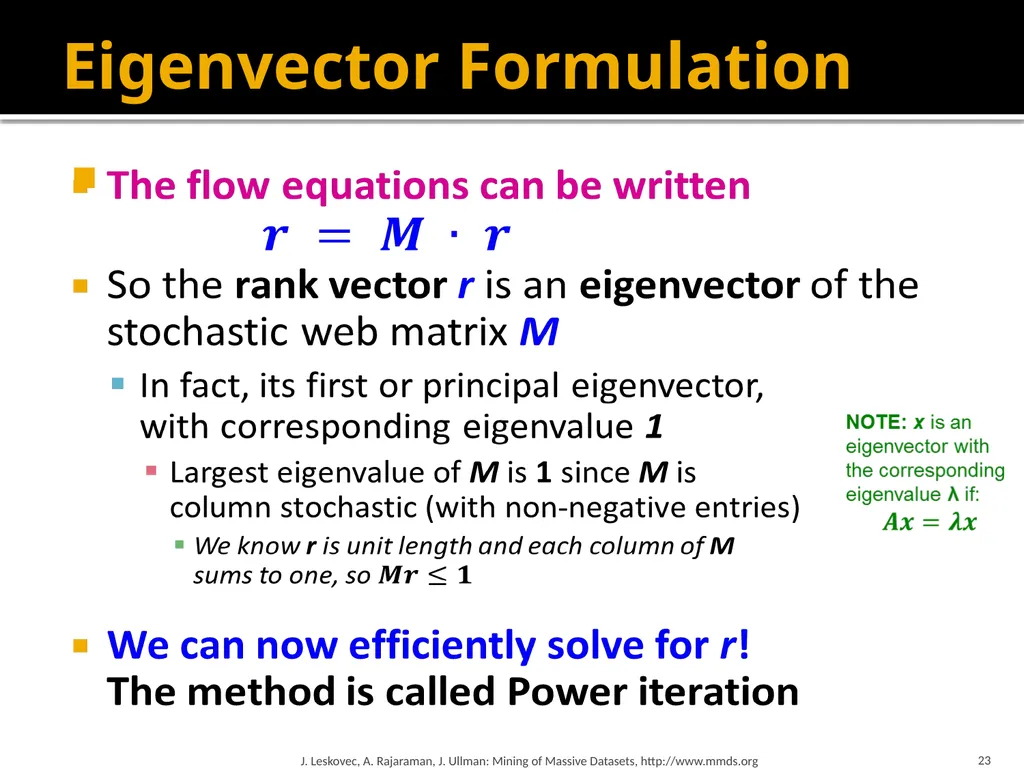
Eigenvector Formulation 23 J. Leskovec, A. Rajaraman, J. Ullman: Mining of Massive Datasets, http://www.mmds.org<br>
24
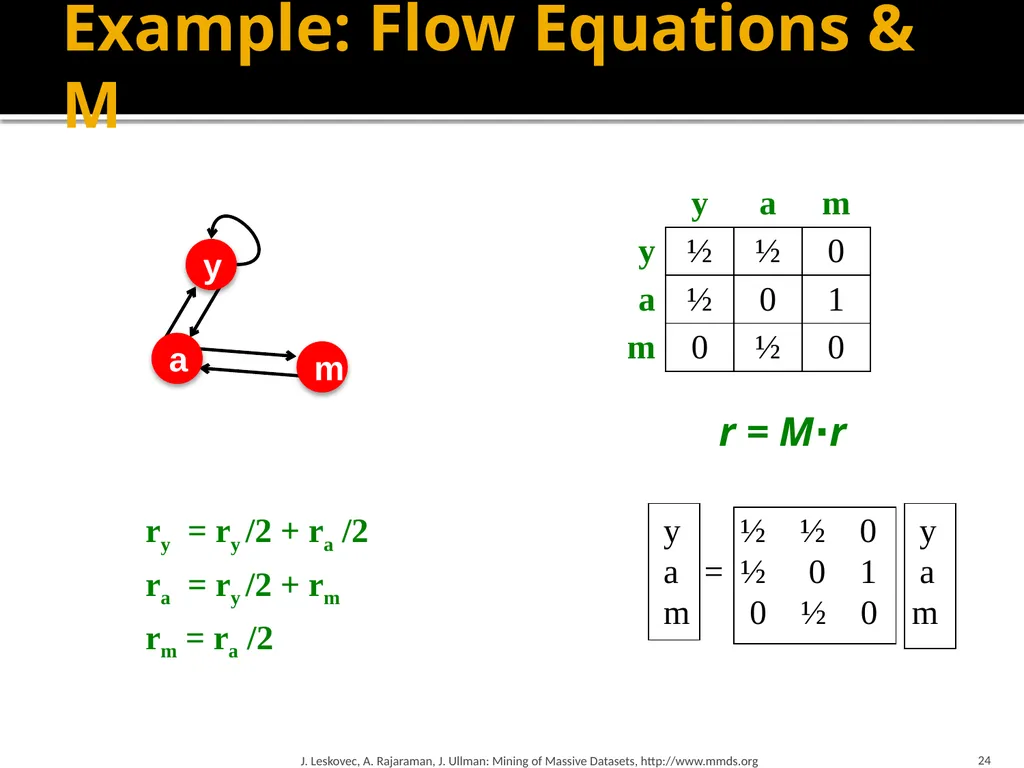
Example: Flow Equations & M 24 J. Leskovec, A. Rajaraman, J. Ullman: Mining of Massive Datasets, http://www.mmds.org ry = ry /2 + ra /2
ra = ry /2 + rm
rm = ra /2<br>
ra = ry /2 + rm
rm = ra /2<br>
25
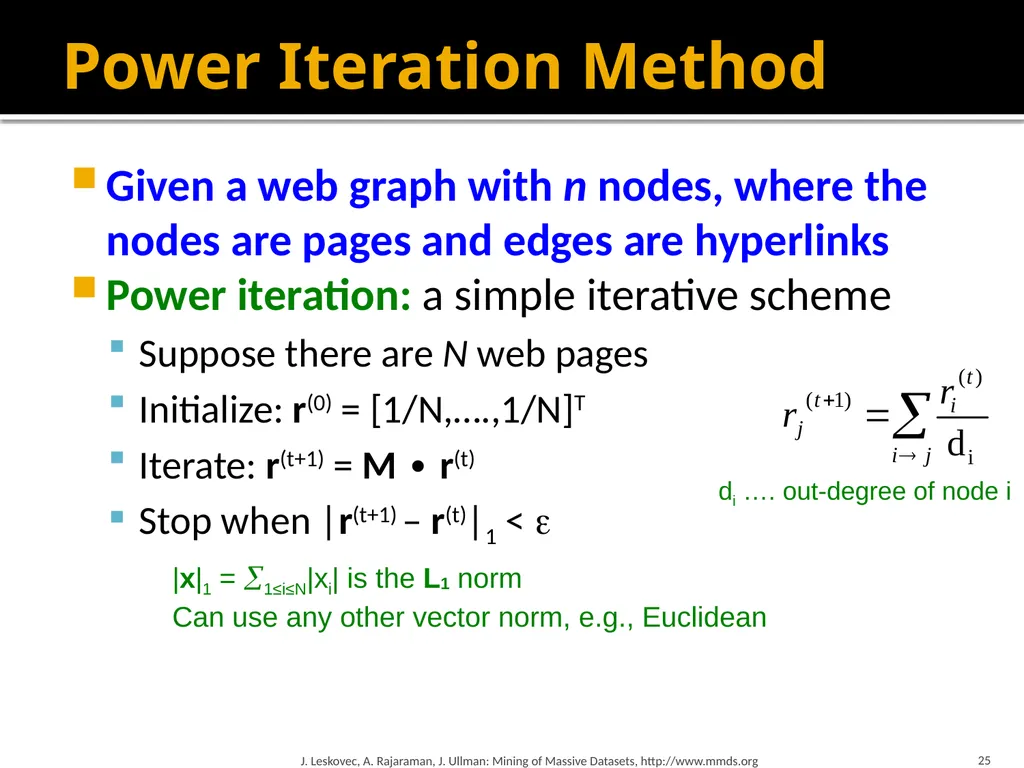
Power Iteration Method Given a web graph with n nodes, where the nodes are pages and edges are hyperlinks
Power iteration: a simple iterative scheme
Suppose there are N web pages
Initialize: r(0) = [1/N,….,1/N]T
Iterate: r(t+1) = M ∙ r(t)
Stop when |r(t+1) – r(t)|1 < 25 J. Leskovec, A. Rajaraman, J. Ullman: Mining of Massive Datasets, http://www.mmds.org di …. out-degree of node i |x|1 = 1≤i≤N|xi| is the L1 norm
Can use any other vector norm, e.g., Euclidean<br>
26
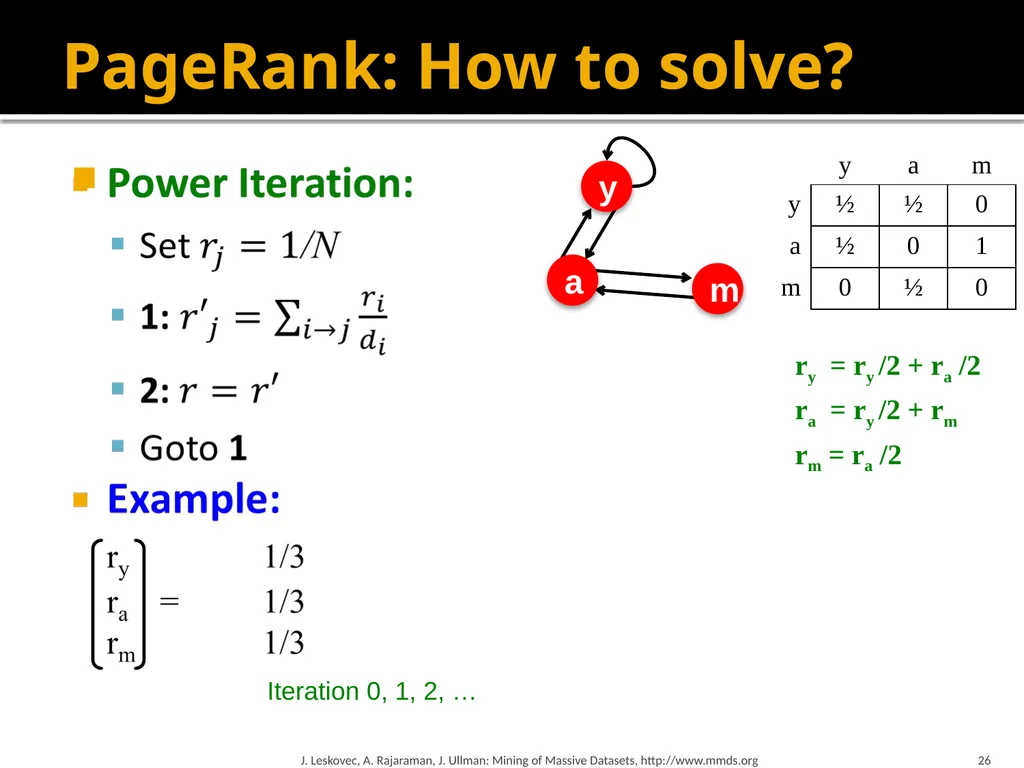
PageRank: How to solve? J. Leskovec, A. Rajaraman, J. Ullman: Mining of Massive Datasets, http://www.mmds.org 26 Iteration 0, 1, 2, … ry = ry /2 + ra /2
ra = ry /2 + rm
rm = ra /2<br>
ra = ry /2 + rm
rm = ra /2<br>
27
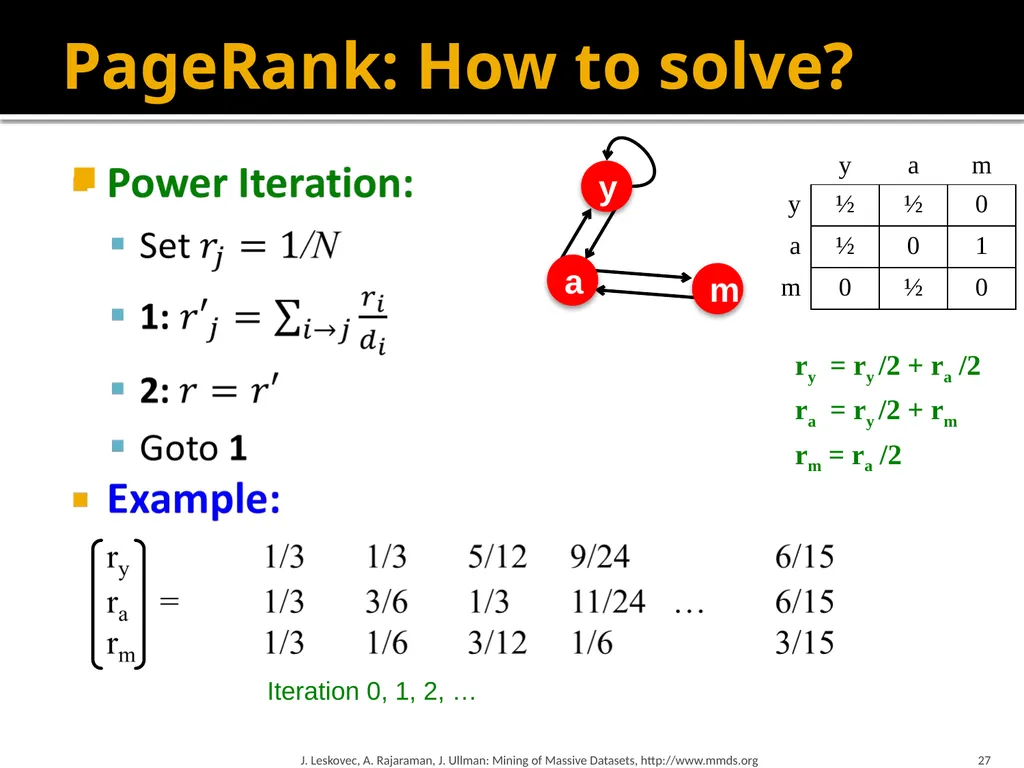
PageRank: How to solve? J. Leskovec, A. Rajaraman, J. Ullman: Mining of Massive Datasets, http://www.mmds.org 27 Iteration 0, 1, 2, … ry = ry /2 + ra /2
ra = ry /2 + rm
rm = ra /2<br>
ra = ry /2 + rm
rm = ra /2<br>
28
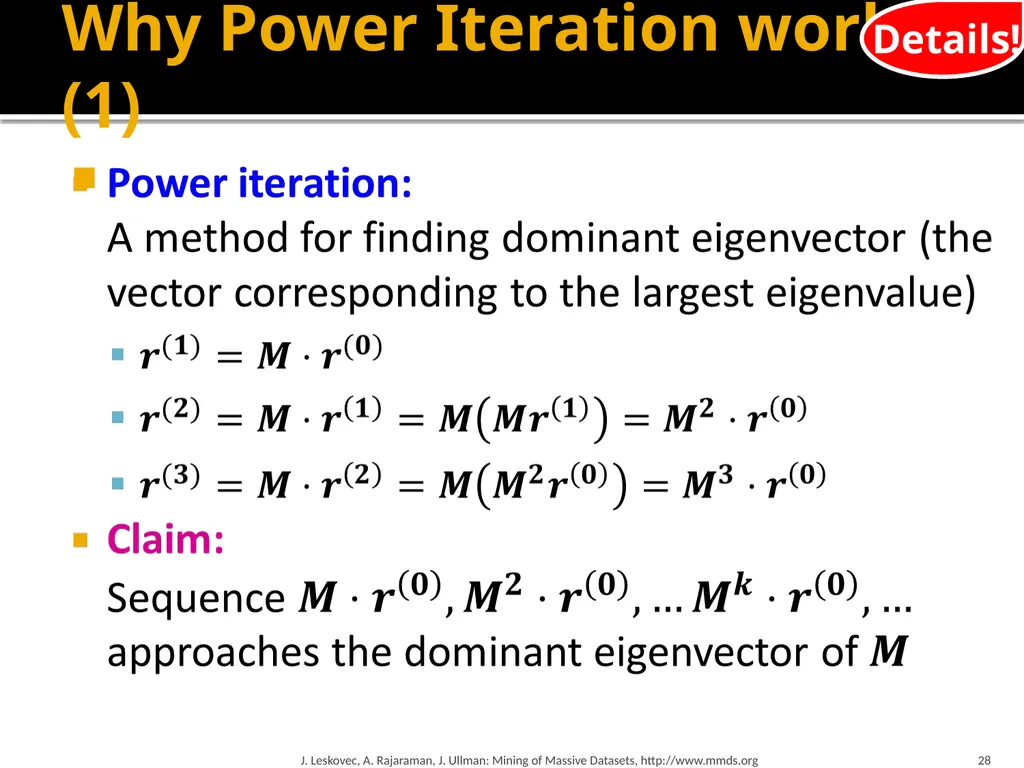
Why Power Iteration works? (1) J. Leskovec, A. Rajaraman, J. Ullman: Mining of Massive Datasets, http://www.mmds.org 28<br>
29
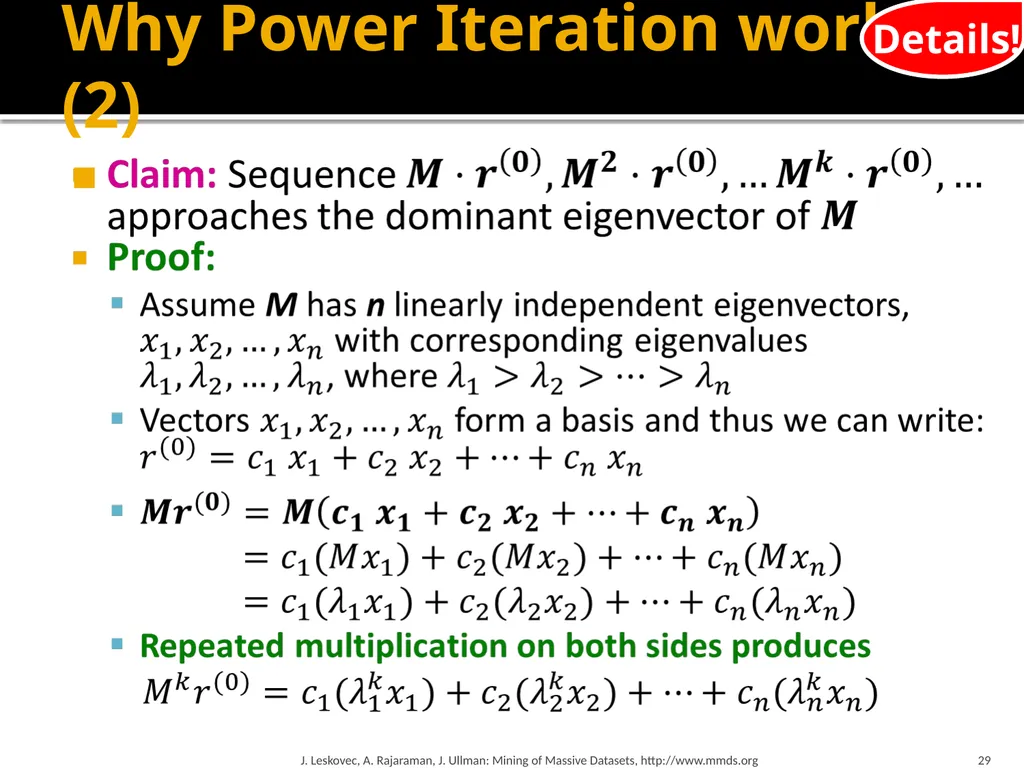
Why Power Iteration works? (2) J. Leskovec, A. Rajaraman, J. Ullman: Mining of Massive Datasets, http://www.mmds.org 29<br>
30
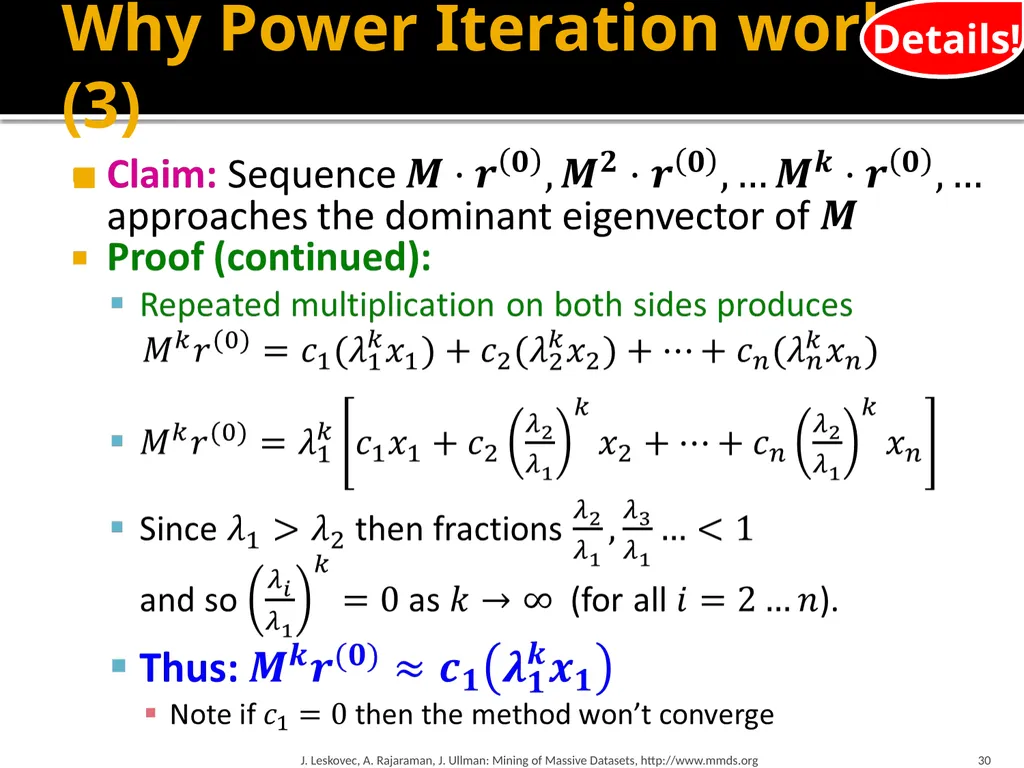
Why Power Iteration works? (3) J. Leskovec, A. Rajaraman, J. Ullman: Mining of Massive Datasets, http://www.mmds.org 30<br>
31
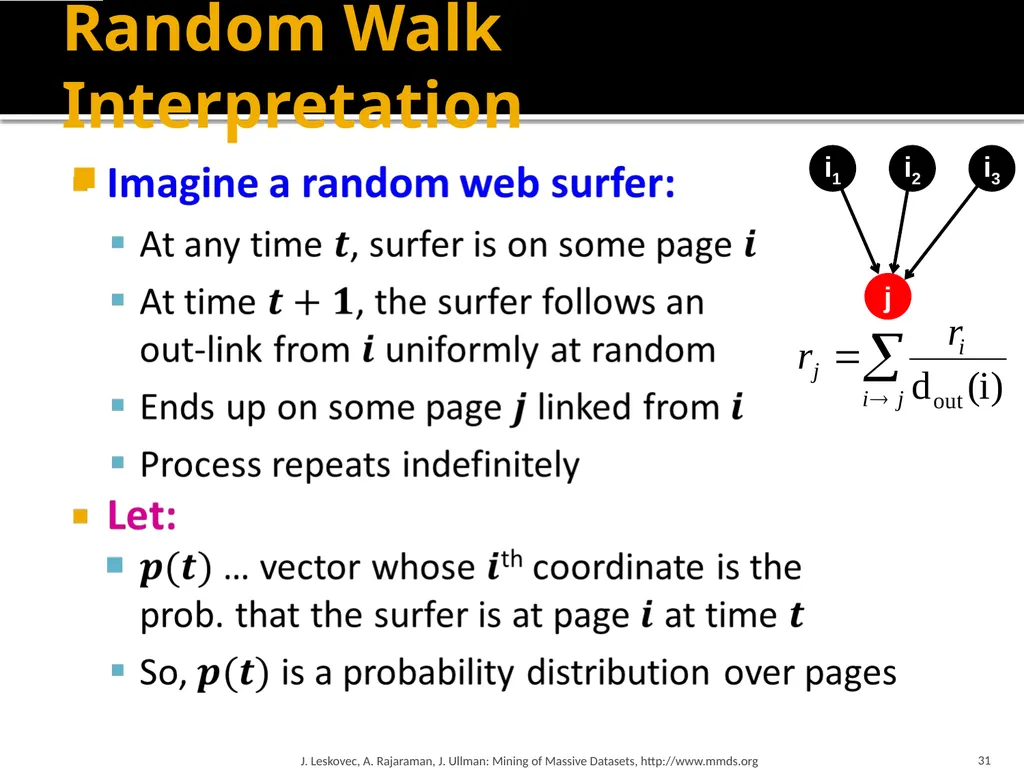
Random Walk Interpretation J. Leskovec, A. Rajaraman, J. Ullman: Mining of Massive Datasets, http://www.mmds.org 31 j i1 i2 i3<br>
32
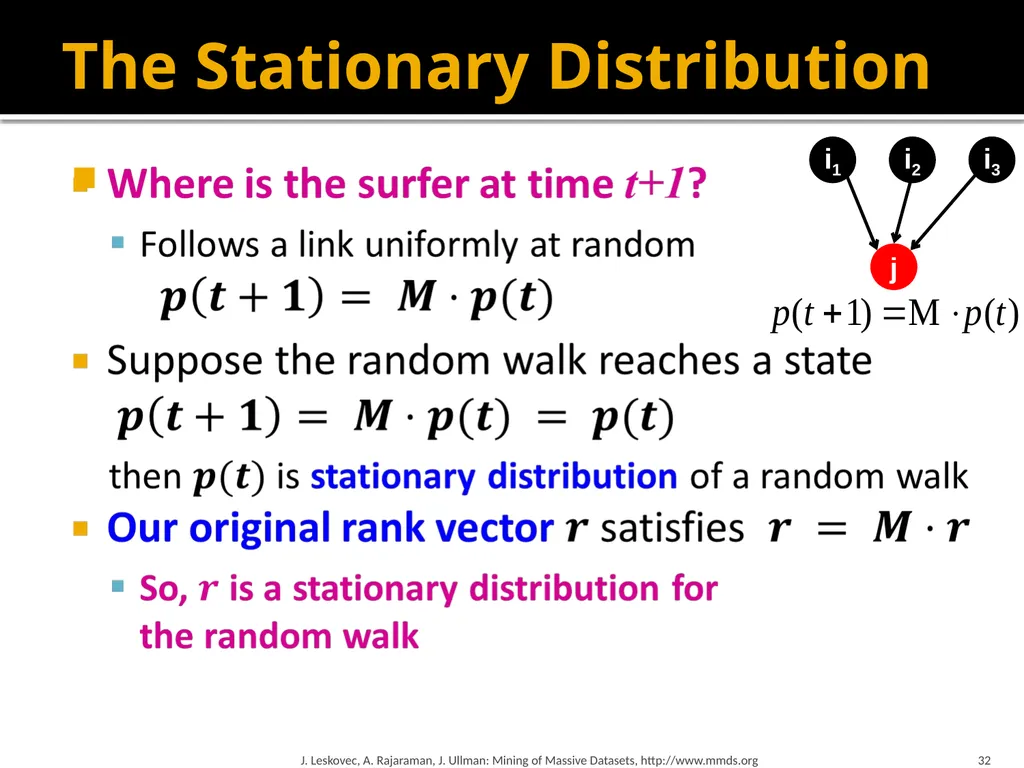
The Stationary Distribution j i1 i2 i3 32 J. Leskovec, A. Rajaraman, J. Ullman: Mining of Massive Datasets, http://www.mmds.org<br>
33
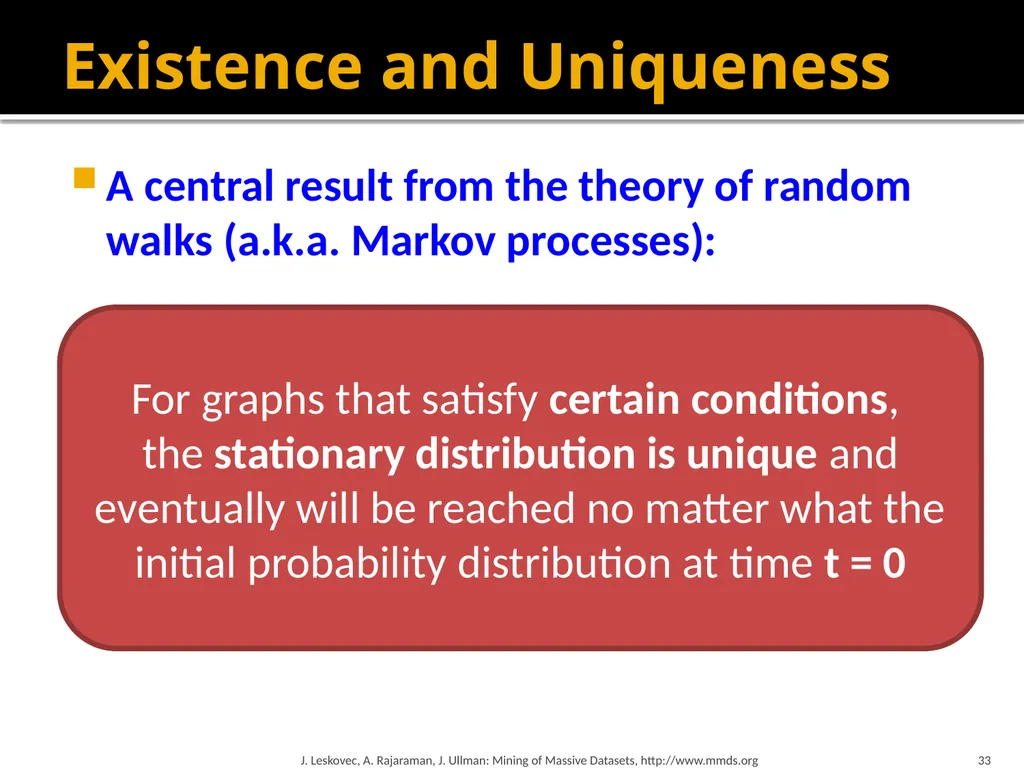
Existence and Uniqueness A central result from the theory of random walks (a.k.a. Markov processes): For graphs that satisfy certain conditions,
the stationary distribution is unique and eventually will be reached no matter what the initial probability distribution at time t = 0 33 J. Leskovec, A. Rajaraman, J. Ullman: Mining of Massive Datasets, http://www.mmds.org<br>
34
PageRank:
The Google Formulation<br>
35
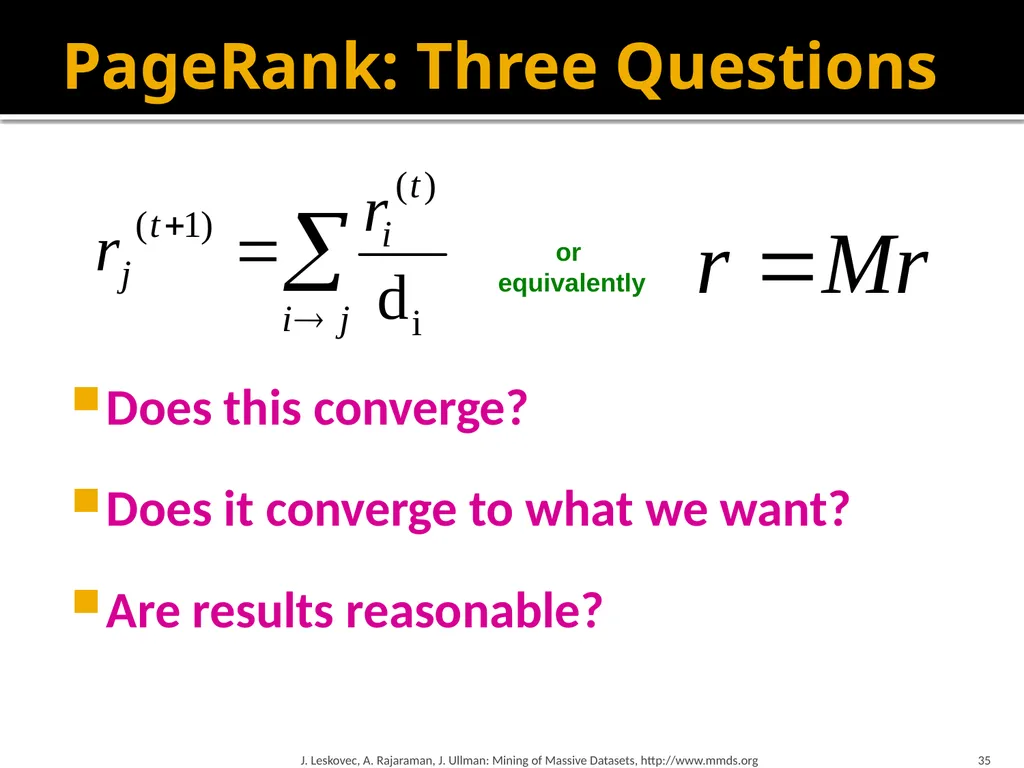
PageRank: Three Questions Does this converge?
Does it converge to what we want?
Are results reasonable? or
equivalently 35 J. Leskovec, A. Rajaraman, J. Ullman: Mining of Massive Datasets, http://www.mmds.org<br>
Does it converge to what we want?
Are results reasonable? or
equivalently 35 J. Leskovec, A. Rajaraman, J. Ullman: Mining of Massive Datasets, http://www.mmds.org<br>
36
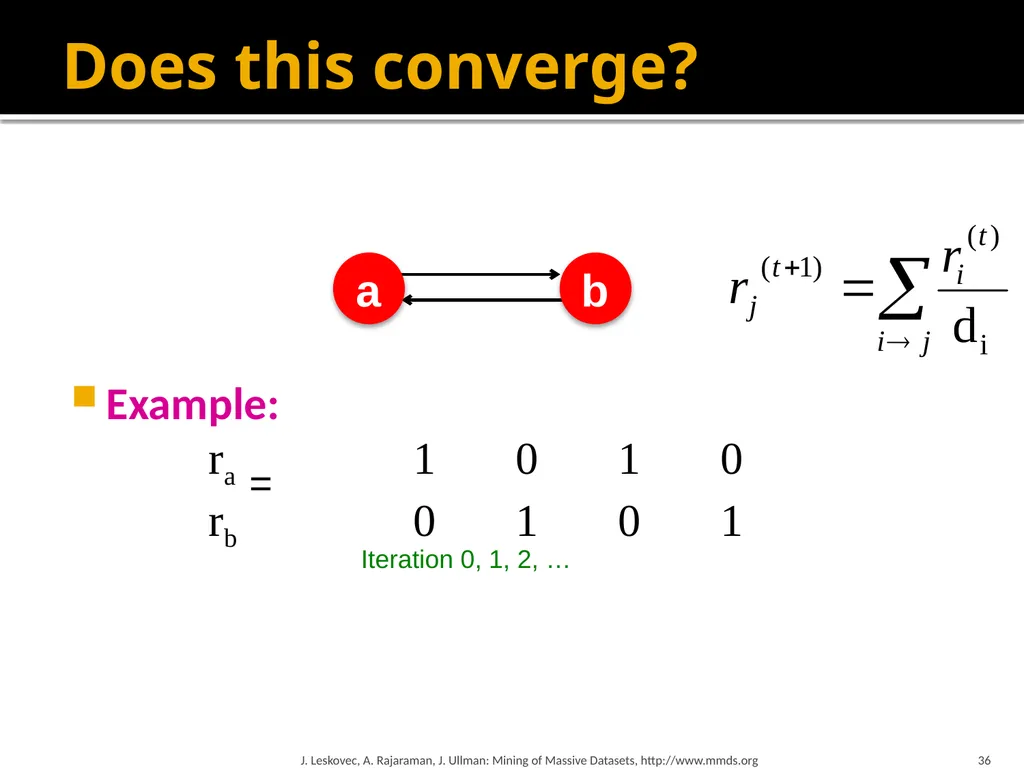
Does this converge? Example:
ra 1 0 1 0
rb 0 1 0 1 J. Leskovec, A. Rajaraman, J. Ullman: Mining of Massive Datasets, http://www.mmds.org 36 = b a Iteration 0, 1, 2, …<br>
ra 1 0 1 0
rb 0 1 0 1 J. Leskovec, A. Rajaraman, J. Ullman: Mining of Massive Datasets, http://www.mmds.org 36 = b a Iteration 0, 1, 2, …<br>
37
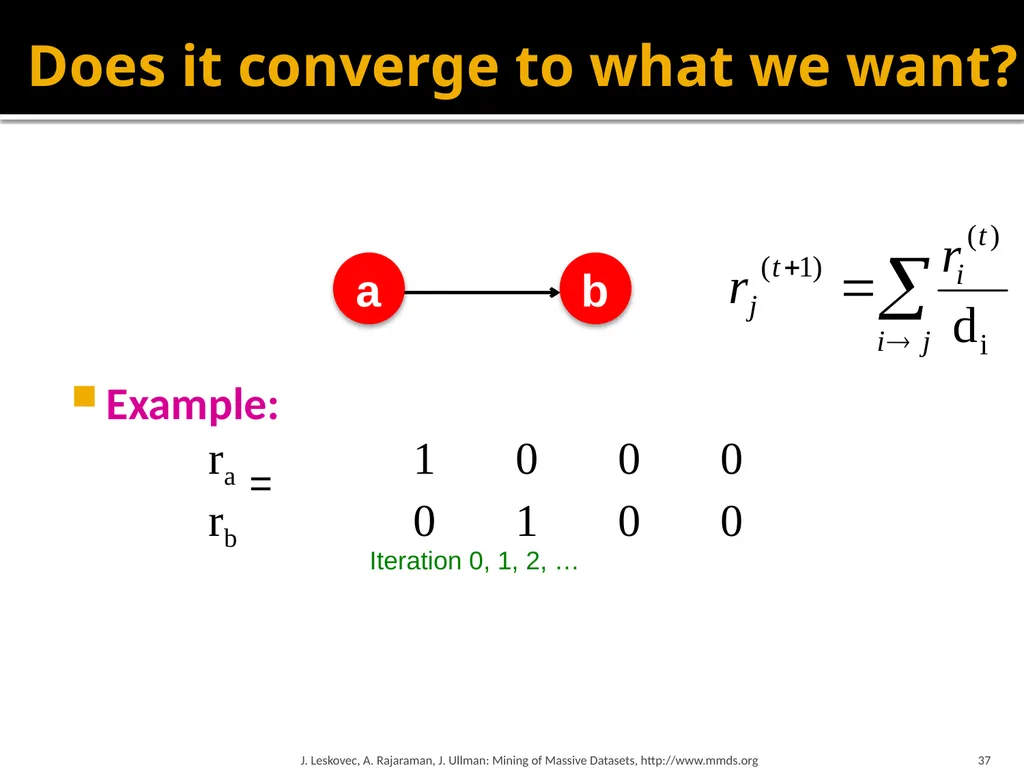
Does it converge to what we want? Example:
ra 1 0 0 0
rb 0 1 0 0 J. Leskovec, A. Rajaraman, J. Ullman: Mining of Massive Datasets, http://www.mmds.org 37 = b a Iteration 0, 1, 2, …<br>
ra 1 0 0 0
rb 0 1 0 0 J. Leskovec, A. Rajaraman, J. Ullman: Mining of Massive Datasets, http://www.mmds.org 37 = b a Iteration 0, 1, 2, …<br>
38
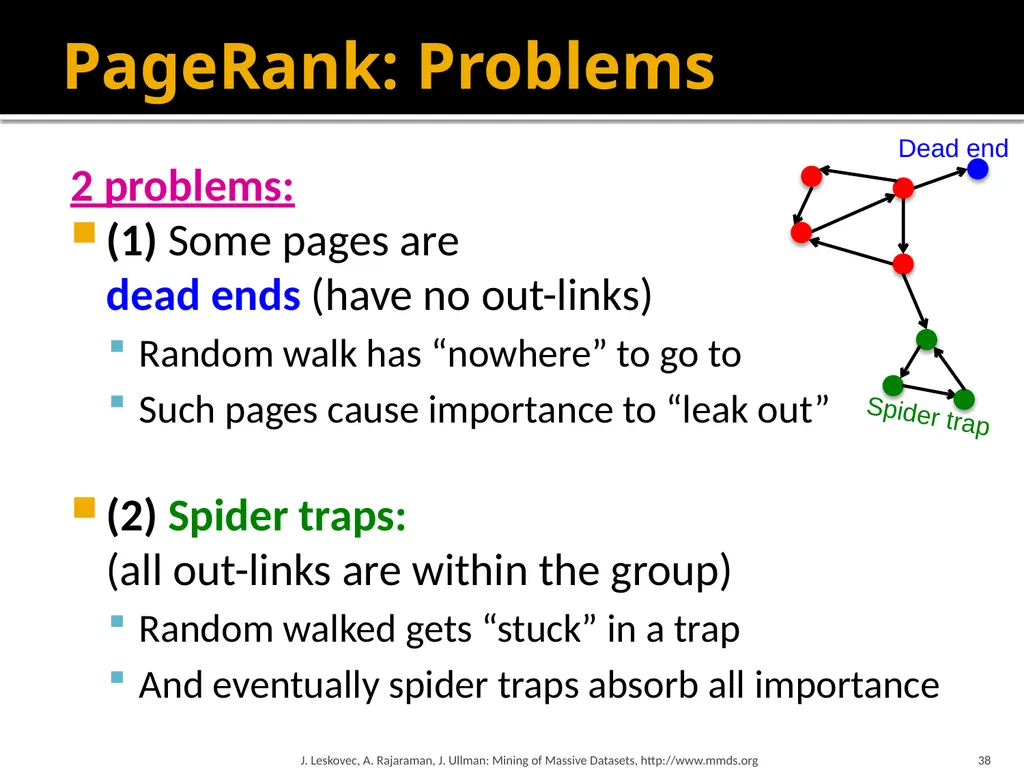
PageRank: Problems 2 problems:
(1) Some pages are dead ends (have no out-links)
Random walk has “nowhere” to go to
Such pages cause importance to “leak out”
(2) Spider traps: (all out-links are within the group)
Random walked gets “stuck” in a trap
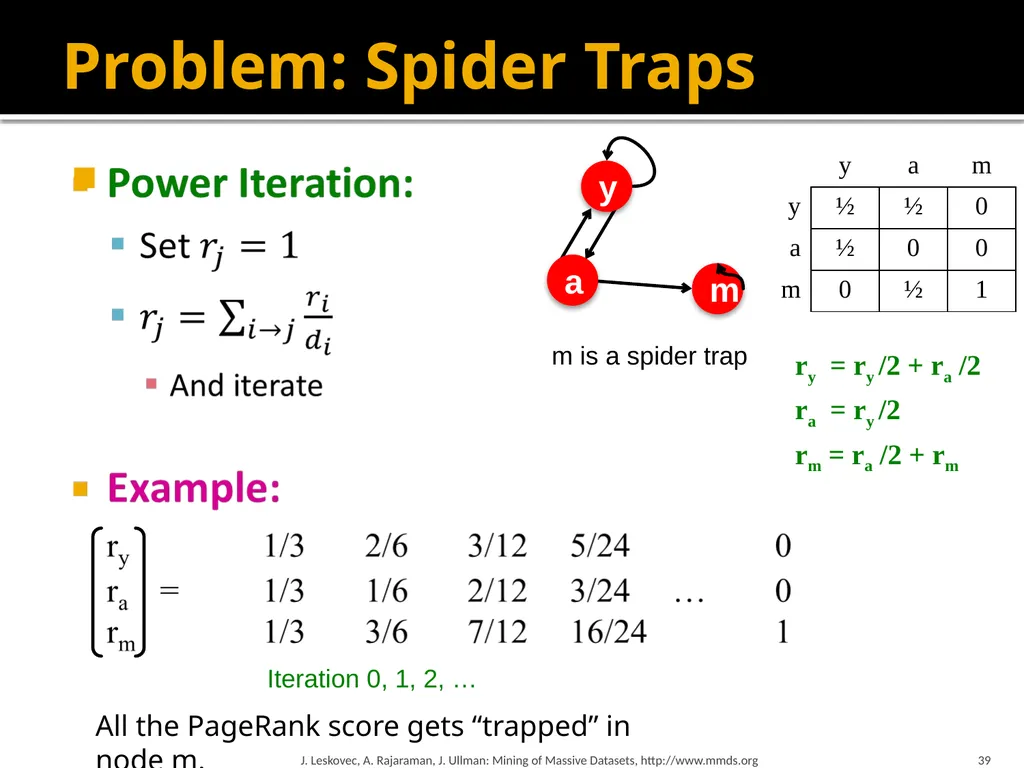
And eventually spider traps absorb all importance J. Leskovec, A. Rajaraman, J. Ullman: Mining of Massive Datasets, http://www.mmds.org 38 Dead end Spider trap<br>
39
Problem: Spider Traps J. Leskovec, A. Rajaraman, J. Ullman: Mining of Massive Datasets, http://www.mmds.org 39 Iteration 0, 1, 2, … ry = ry /2 + ra /2
ra = ry /2
rm = ra /2 + rm m is a spider trap All the PageRank score gets “trapped” in node m.<br>
ra = ry /2
rm = ra /2 + rm m is a spider trap All the PageRank score gets “trapped” in node m.<br>
40
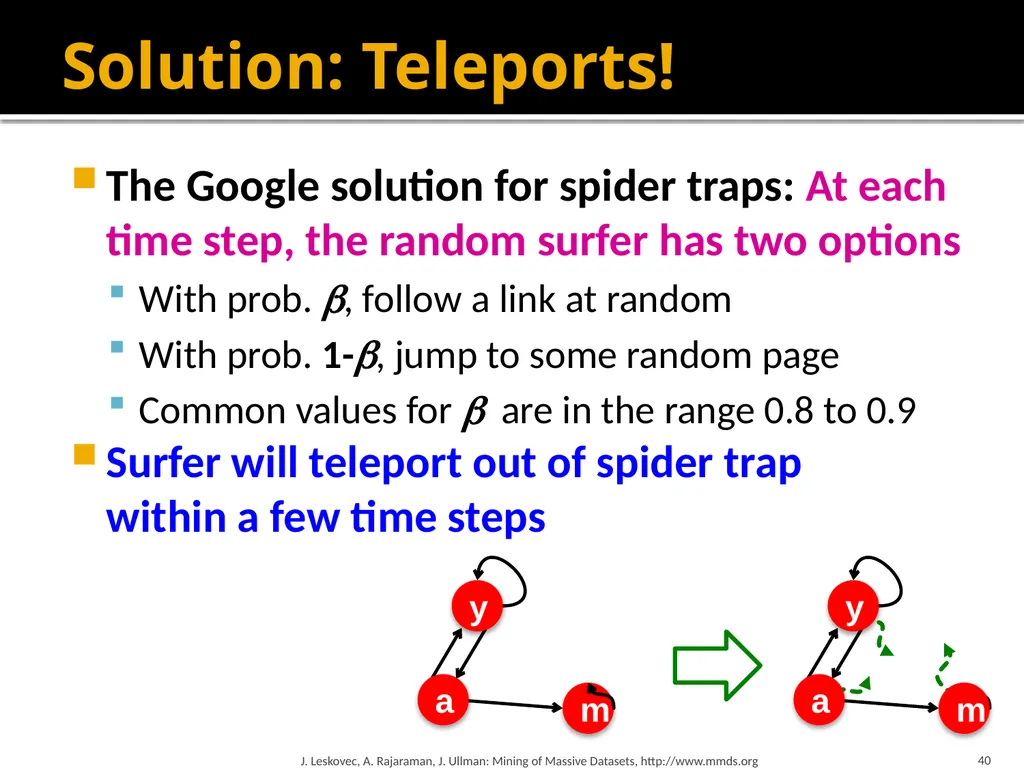
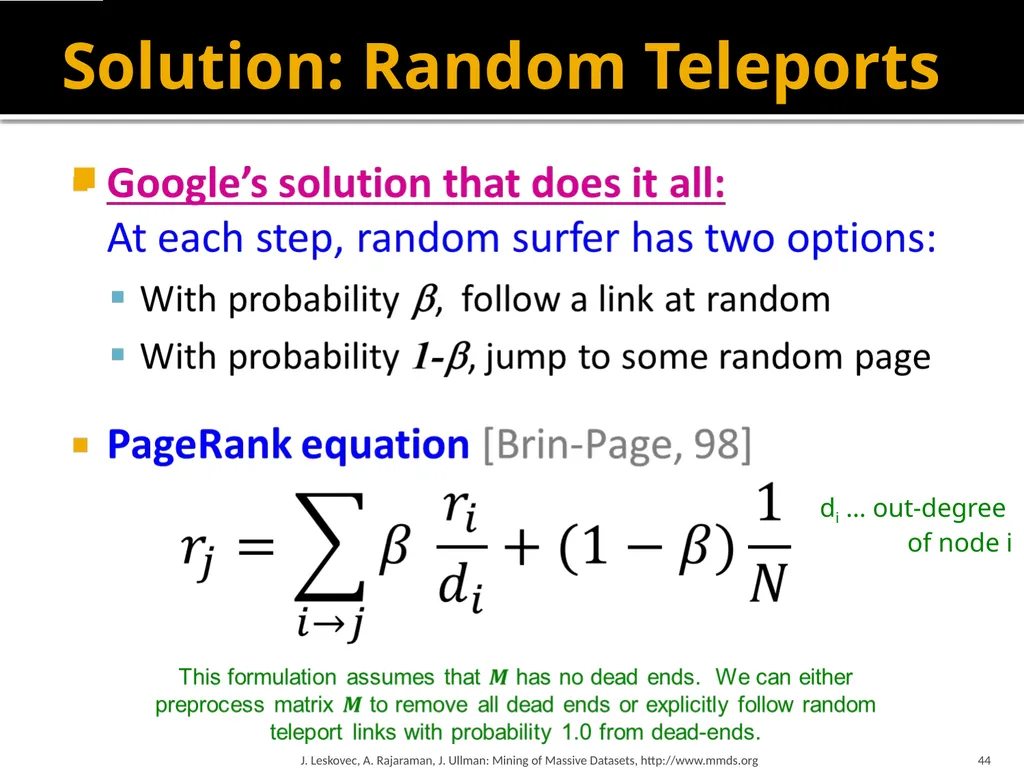
Solution: Teleports! The Google solution for spider traps: At each time step, the random surfer has two options
With prob. , follow a link at random
With prob. 1-, jump to some random page
Common values for are in the range 0.8 to 0.9
Surfer will teleport out of spider trap within a few time steps 40 J. Leskovec, A. Rajaraman, J. Ullman: Mining of Massive Datasets, http://www.mmds.org<br>
With prob. , follow a link at random
With prob. 1-, jump to some random page
Common values for are in the range 0.8 to 0.9
Surfer will teleport out of spider trap within a few time steps 40 J. Leskovec, A. Rajaraman, J. Ullman: Mining of Massive Datasets, http://www.mmds.org<br>
41
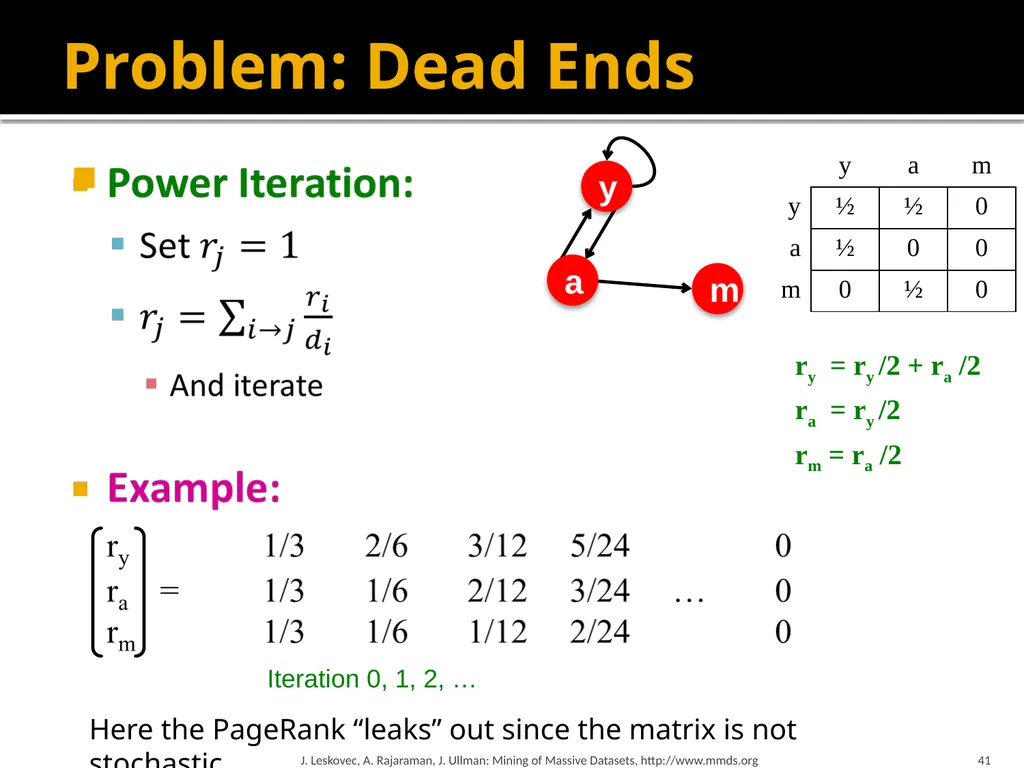
Problem: Dead Ends J. Leskovec, A. Rajaraman, J. Ullman: Mining of Massive Datasets, http://www.mmds.org 41 Iteration 0, 1, 2, … ry = ry /2 + ra /2
ra = ry /2
rm = ra /2 Here the PageRank “leaks” out since the matrix is not stochastic.<br>
ra = ry /2
rm = ra /2 Here the PageRank “leaks” out since the matrix is not stochastic.<br>
42
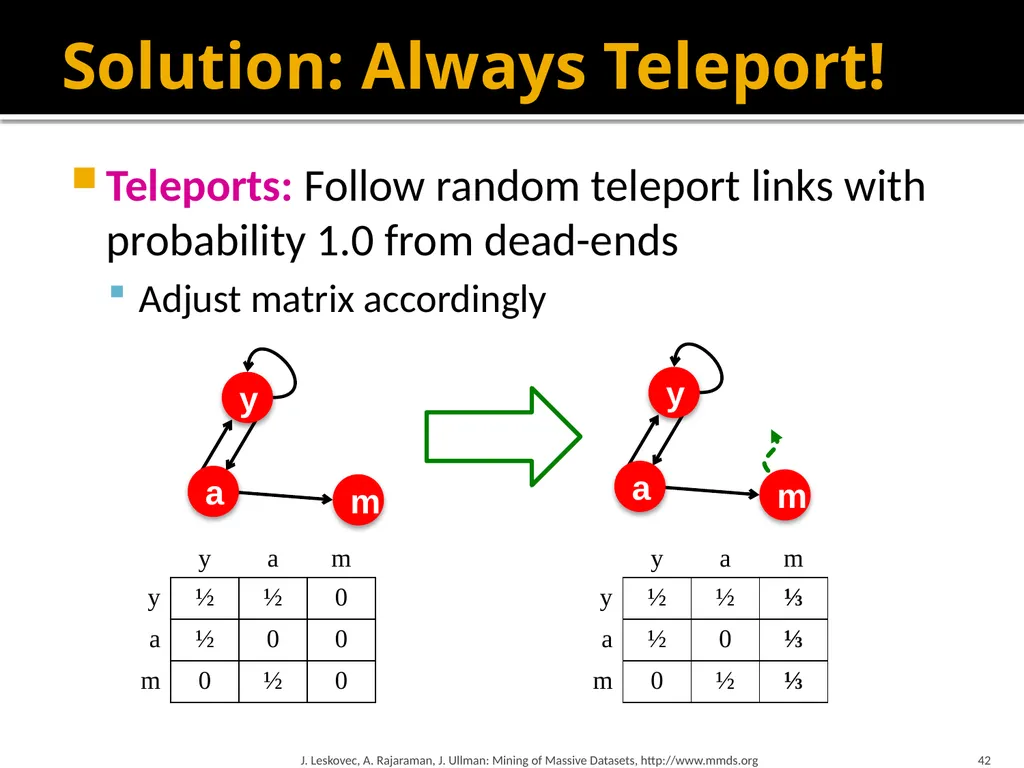
Solution: Always Teleport! Teleports: Follow random teleport links with probability 1.0 from dead-ends
Adjust matrix accordingly J. Leskovec, A. Rajaraman, J. Ullman: Mining of Massive Datasets, http://www.mmds.org 42<br>
Adjust matrix accordingly J. Leskovec, A. Rajaraman, J. Ullman: Mining of Massive Datasets, http://www.mmds.org 42<br>
43
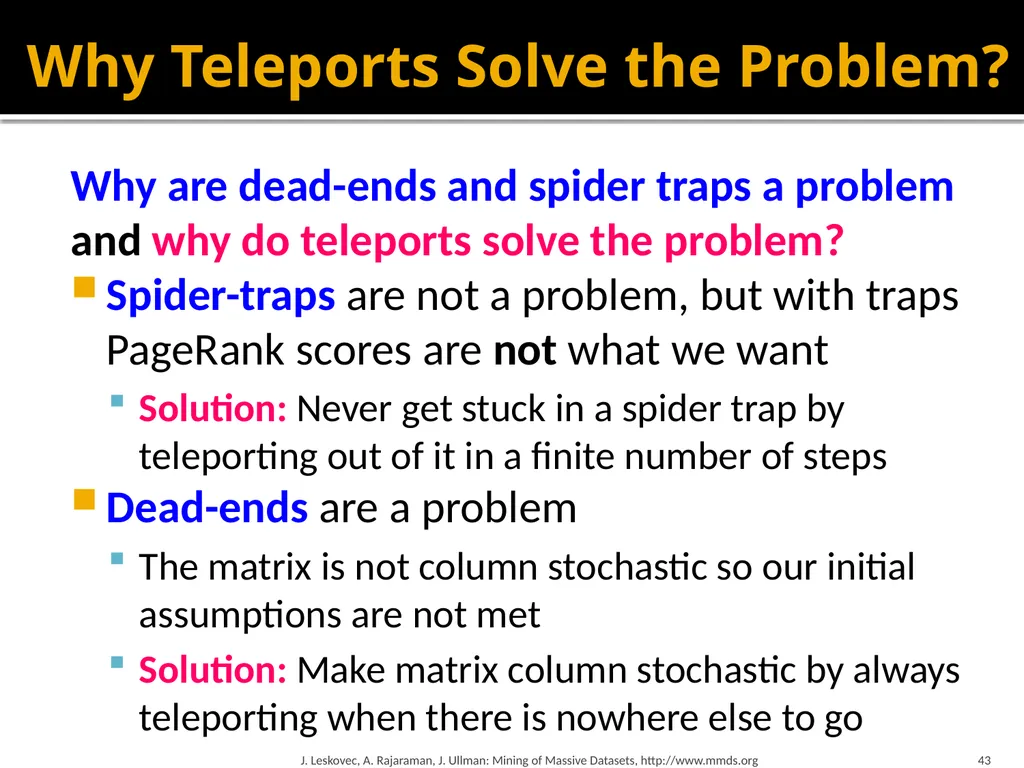
Why Teleports Solve the Problem? Why are dead-ends and spider traps a problem
and why do teleports solve the problem?
Spider-traps are not a problem, but with traps PageRank scores are not what we want
Solution: Never get stuck in a spider trap by teleporting out of it in a finite number of steps
Dead-ends are a problem
The matrix is not column stochastic so our initial assumptions are not met
Solution: Make matrix column stochastic by always teleporting when there is nowhere else to go J. Leskovec, A. Rajaraman, J. Ullman: Mining of Massive Datasets, http://www.mmds.org 43<br>
44
Solution: Random Teleports J. Leskovec, A. Rajaraman, J. Ullman: Mining of Massive Datasets, http://www.mmds.org 44 di … out-degree
of node i<br>
45
The Google Matrix J. Leskovec, A. Rajaraman, J. Ullman: Mining of Massive Datasets, http://www.mmds.org 45 [1/N]NxN…N by N matrix
where all entries are 1/N<br>
46
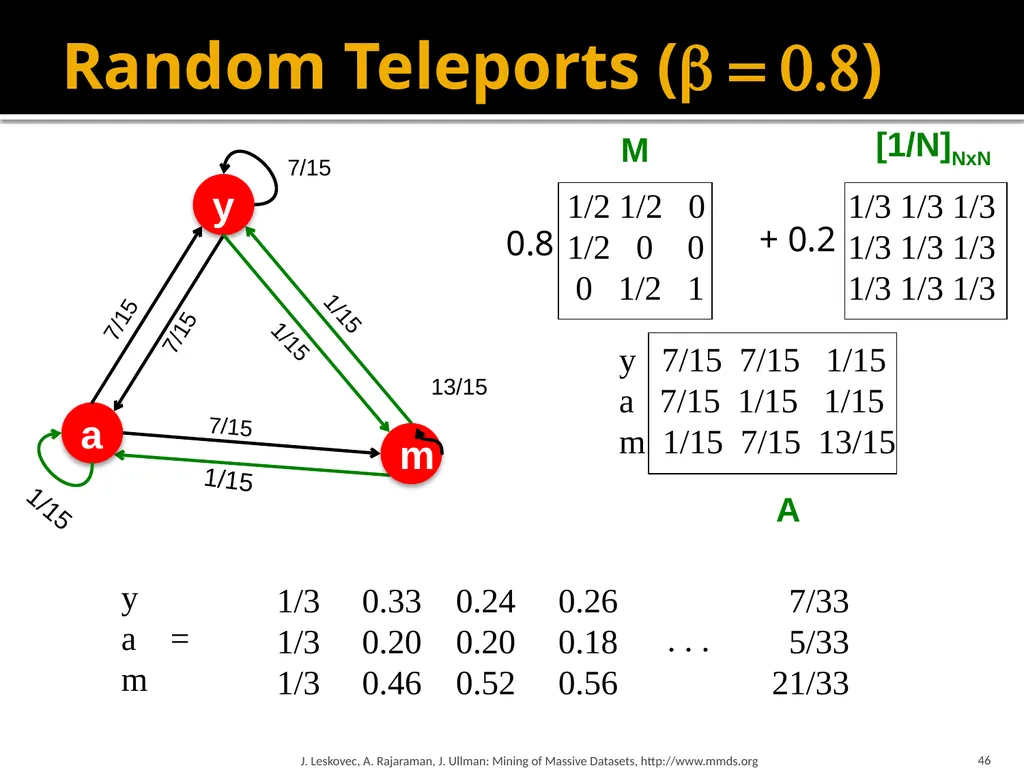
Random Teleports ( = 0.8) y
a =
m 1/3
1/3
1/3 0.33
0.20
0.46 0.24
0.20
0.52 0.26
0.18
0.56 7/33
5/33
21/33 . . . 46 J. Leskovec, A. Rajaraman, J. Ullman: Mining of Massive Datasets, http://www.mmds.org y a m 7/15 7/15 1/15 13/15 1/15 1/15 1/15 7/15 7/15 1/2 1/2 0
1/2 0 0
0 1/2 1 1/3 1/3 1/3
1/3 1/3 1/3
1/3 1/3 1/3 y 7/15 7/15 1/15
a 7/15 1/15 1/15
m 1/15 7/15 13/15 0.8 + 0.2 M [1/N]NxN A<br>
47
How do we actually compute the PageRank?<br>
48
Computing Page Rank Key step is matrix-vector multiplication
rnew = A ∙ rold
Easy if we have enough main memory to hold A, rold, rnew
Say N = 1 billion pages
We need 4 bytes for each entry (say)
2 billion entries for vectors, approx 8GB
Matrix A has N2 entries
1018 is a large number! J. Leskovec, A. Rajaraman, J. Ullman: Mining of Massive Datasets, http://www.mmds.org 48 ½ ½ 0
½ 0 0
0 ½ 1 1/3 1/3 1/3
1/3 1/3 1/3
1/3 1/3 1/3 7/15 7/15 1/15
7/15 1/15 1/15
1/15 7/15 13/15 0.8 +0.2 A = ∙M + (1-) [1/N]NxN = A =<br>
49
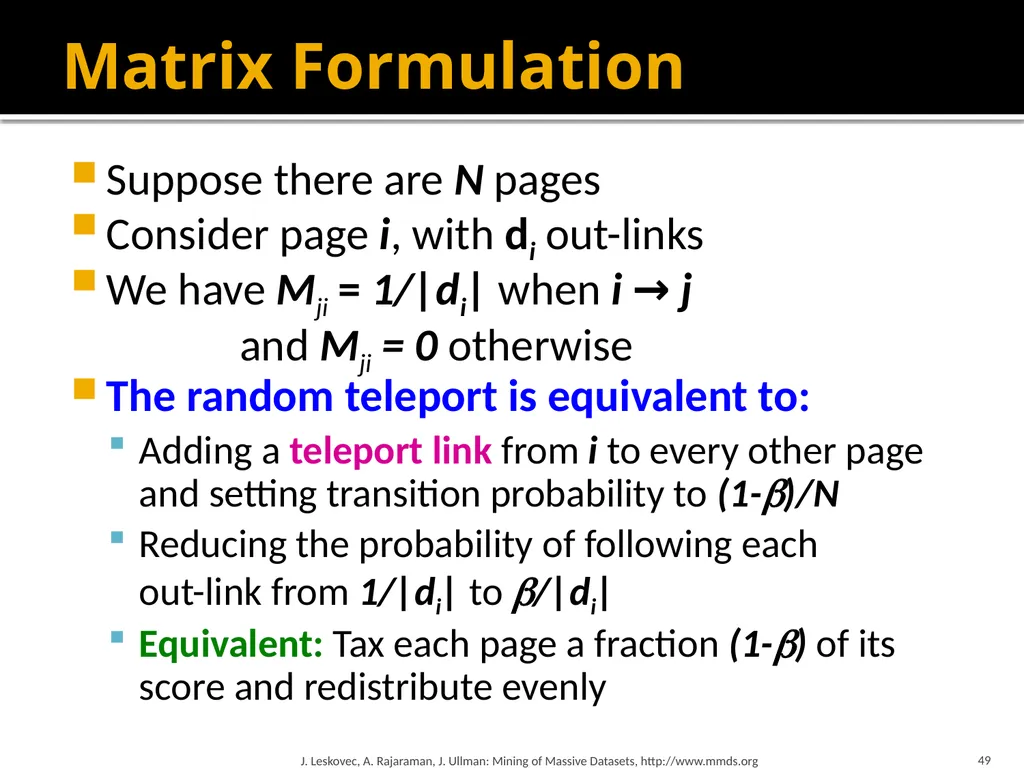
Matrix Formulation Suppose there are N pages
Consider page i, with di out-links
We have Mji = 1/|di| when i → j and Mji = 0 otherwise
The random teleport is equivalent to:
Adding a teleport link from i to every other page and setting transition probability to (1-)/N
Reducing the probability of following each out-link from 1/|di| to /|di|
Equivalent: Tax each page a fraction (1-) of its score and redistribute evenly 49 J. Leskovec, A. Rajaraman, J. Ullman: Mining of Massive Datasets, http://www.mmds.org<br>
50
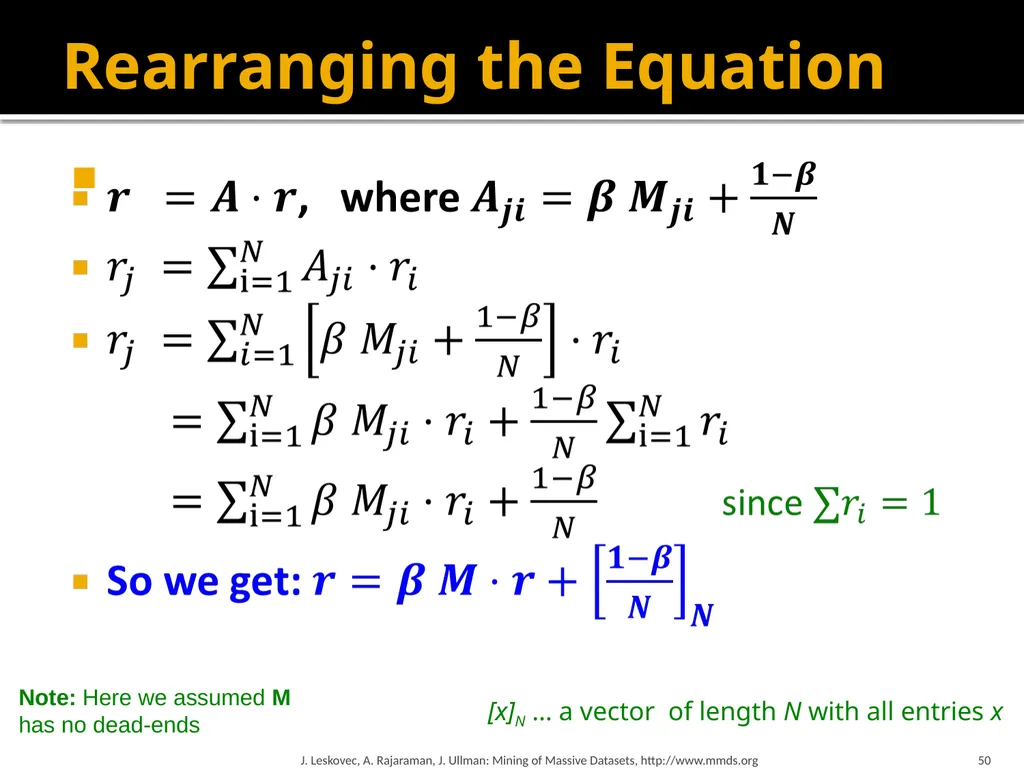
Rearranging the Equation J. Leskovec, A. Rajaraman, J. Ullman: Mining of Massive Datasets, http://www.mmds.org 50 [x]N … a vector of length N with all entries x Note: Here we assumed M has no dead-ends<br>
51
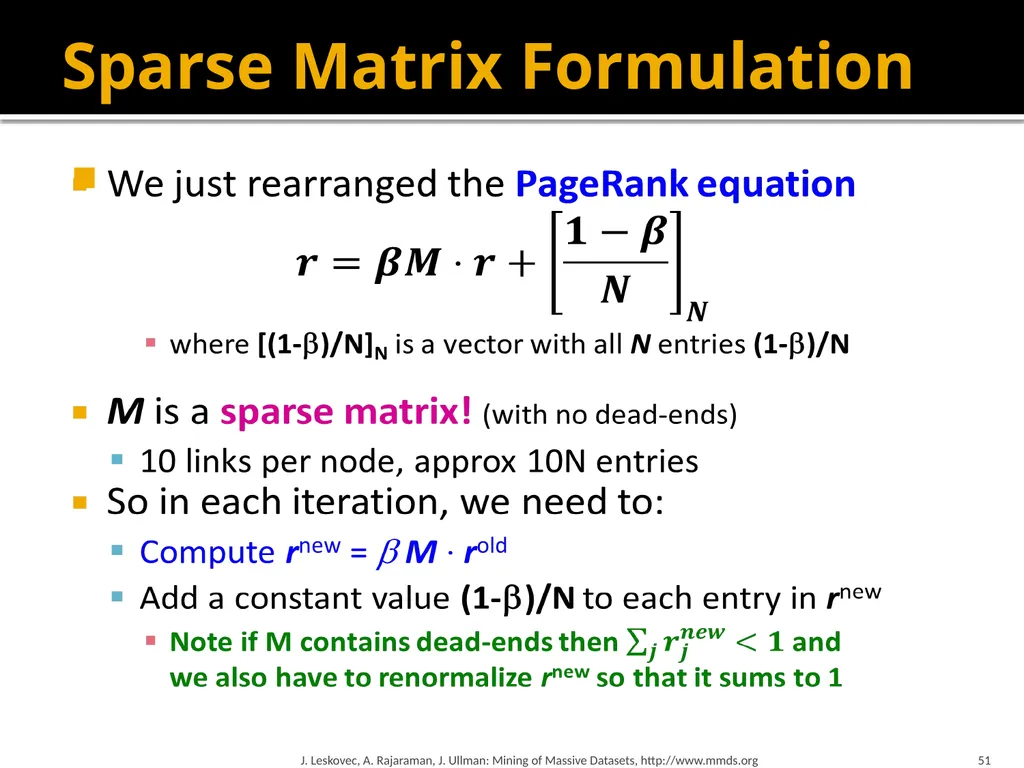
Sparse Matrix Formulation J. Leskovec, A. Rajaraman, J. Ullman: Mining of Massive Datasets, http://www.mmds.org 51<br>
52
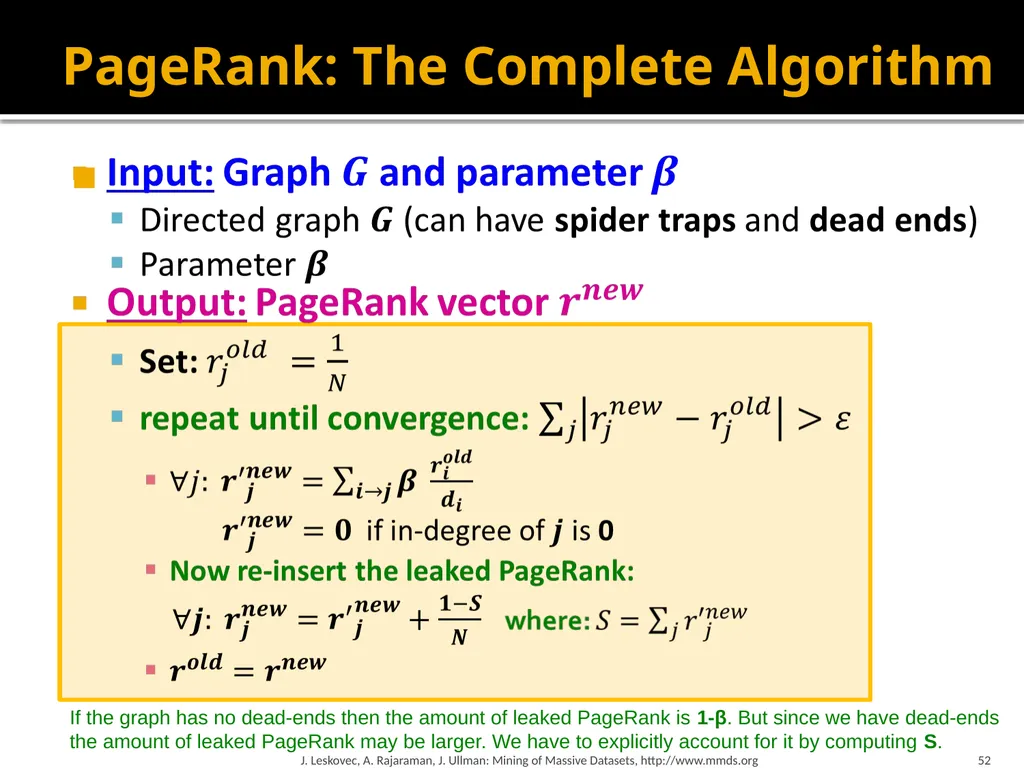
PageRank: The Complete Algorithm 52 If the graph has no dead-ends then the amount of leaked PageRank is 1-β. But since we have dead-ends the amount of leaked PageRank may be larger. We have to explicitly account for it by computing S. J. Leskovec, A. Rajaraman, J. Ullman: Mining of Massive Datasets, http://www.mmds.org<br>
53
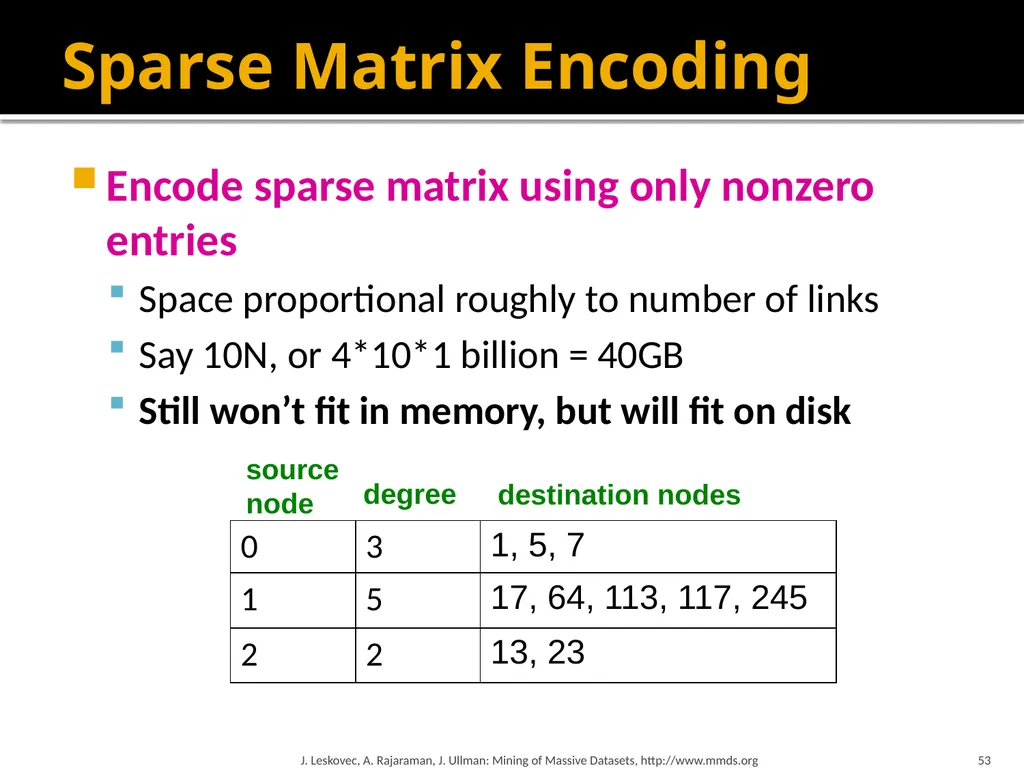
Sparse Matrix Encoding Encode sparse matrix using only nonzero entries
Space proportional roughly to number of links
Say 10N, or 4*10*1 billion = 40GB
Still won’t fit in memory, but will fit on disk J. Leskovec, A. Rajaraman, J. Ullman: Mining of Massive Datasets, http://www.mmds.org 53 source
node degree destination nodes<br>
Space proportional roughly to number of links
Say 10N, or 4*10*1 billion = 40GB
Still won’t fit in memory, but will fit on disk J. Leskovec, A. Rajaraman, J. Ullman: Mining of Massive Datasets, http://www.mmds.org 53 source
node degree destination nodes<br>
54
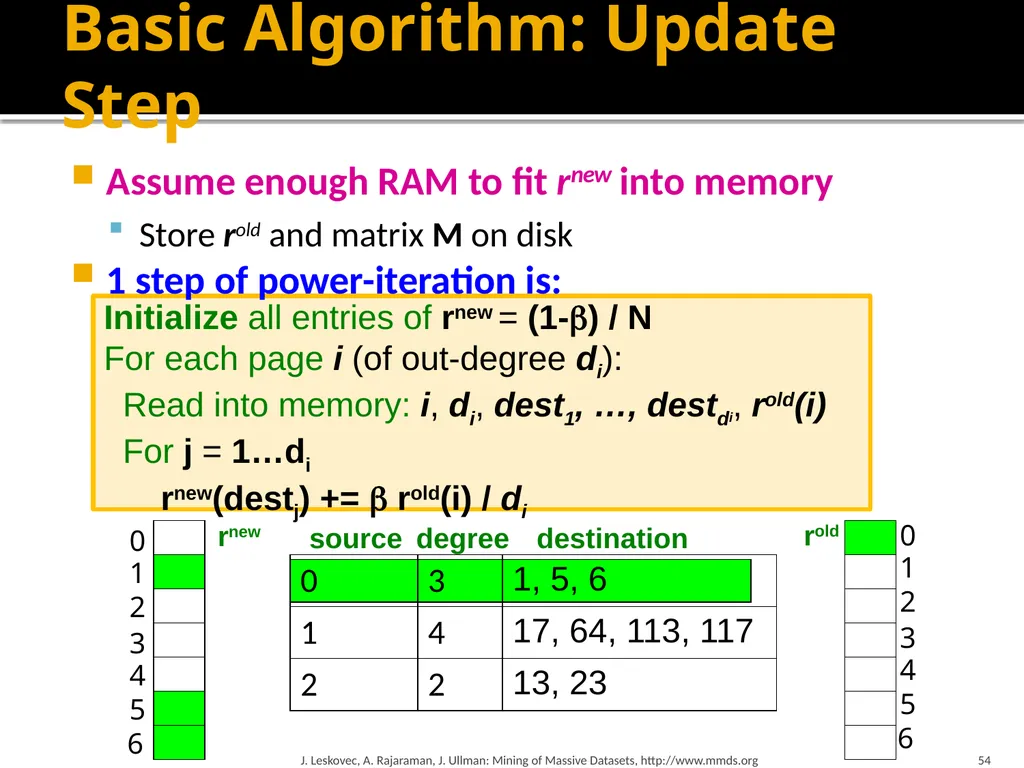
Basic Algorithm: Update Step Assume enough RAM to fit rnew into memory
Store rold and matrix M on disk
1 step of power-iteration is: J. Leskovec, A. Rajaraman, J. Ullman: Mining of Massive Datasets, http://www.mmds.org 54 source degree destination 0 1 2 3 4 5 6 0 1 2 3 4 5 6 rnew rold Initialize all entries of rnew = (1-) / N
For each page i (of out-degree di):
Read into memory: i, di, dest1, …, destdi, rold(i)
For j = 1…di
rnew(destj) += rold(i) / di<br>
55
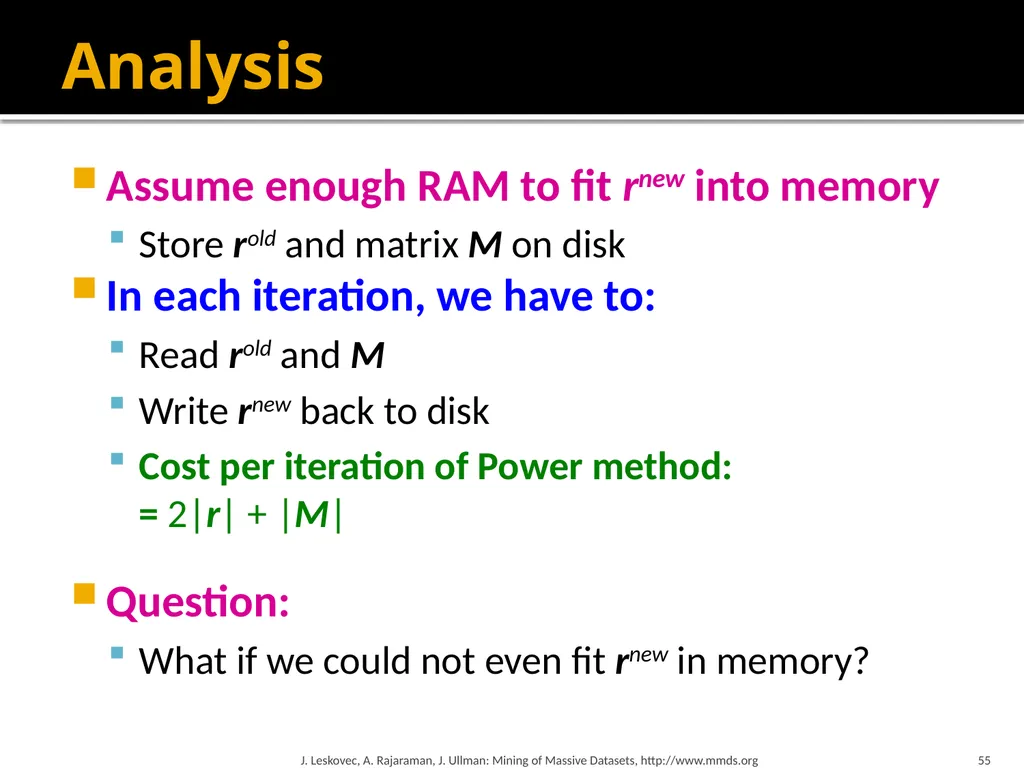
Analysis Assume enough RAM to fit rnew into memory
Store rold and matrix M on disk
In each iteration, we have to:
Read rold and M
Write rnew back to disk
Cost per iteration of Power method: = 2|r| + |M|
Question:
What if we could not even fit rnew in memory? J. Leskovec, A. Rajaraman, J. Ullman: Mining of Massive Datasets, http://www.mmds.org 55<br>
56
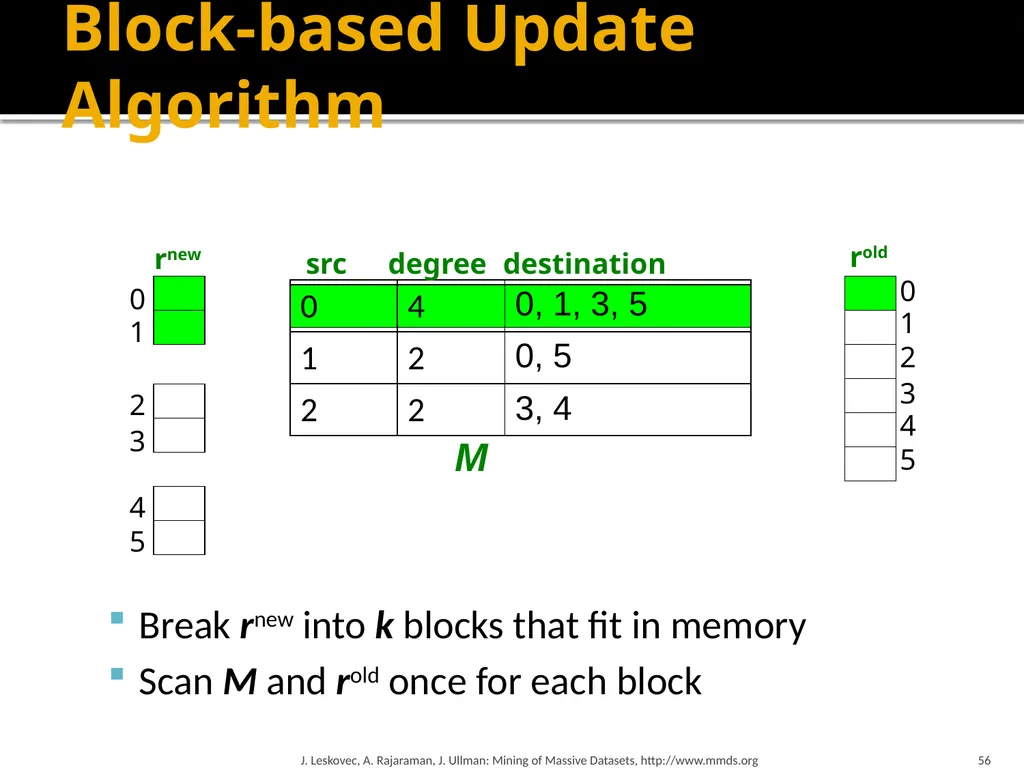
Block-based Update Algorithm Break rnew into k blocks that fit in memory
Scan M and rold once for each block J. Leskovec, A. Rajaraman, J. Ullman: Mining of Massive Datasets, http://www.mmds.org 56 src degree destination 0 1 2 3 4 5 0 1 2 3 4 5 rnew rold M<br>
Scan M and rold once for each block J. Leskovec, A. Rajaraman, J. Ullman: Mining of Massive Datasets, http://www.mmds.org 56 src degree destination 0 1 2 3 4 5 0 1 2 3 4 5 rnew rold M<br>
57
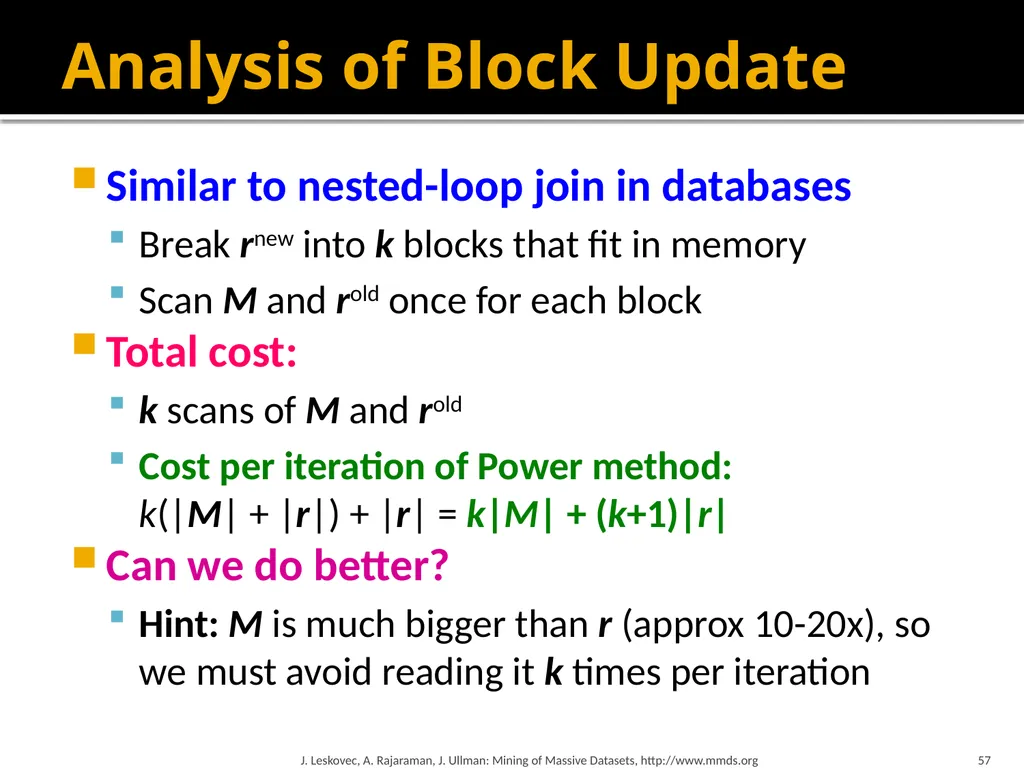
Analysis of Block Update Similar to nested-loop join in databases
Break rnew into k blocks that fit in memory
Scan M and rold once for each block
Total cost:
k scans of M and rold
Cost per iteration of Power method: k(|M| + |r|) + |r| = k|M| + (k+1)|r|
Can we do better?
Hint: M is much bigger than r (approx 10-20x), so we must avoid reading it k times per iteration J. Leskovec, A. Rajaraman, J. Ullman: Mining of Massive Datasets, http://www.mmds.org 57<br>
58
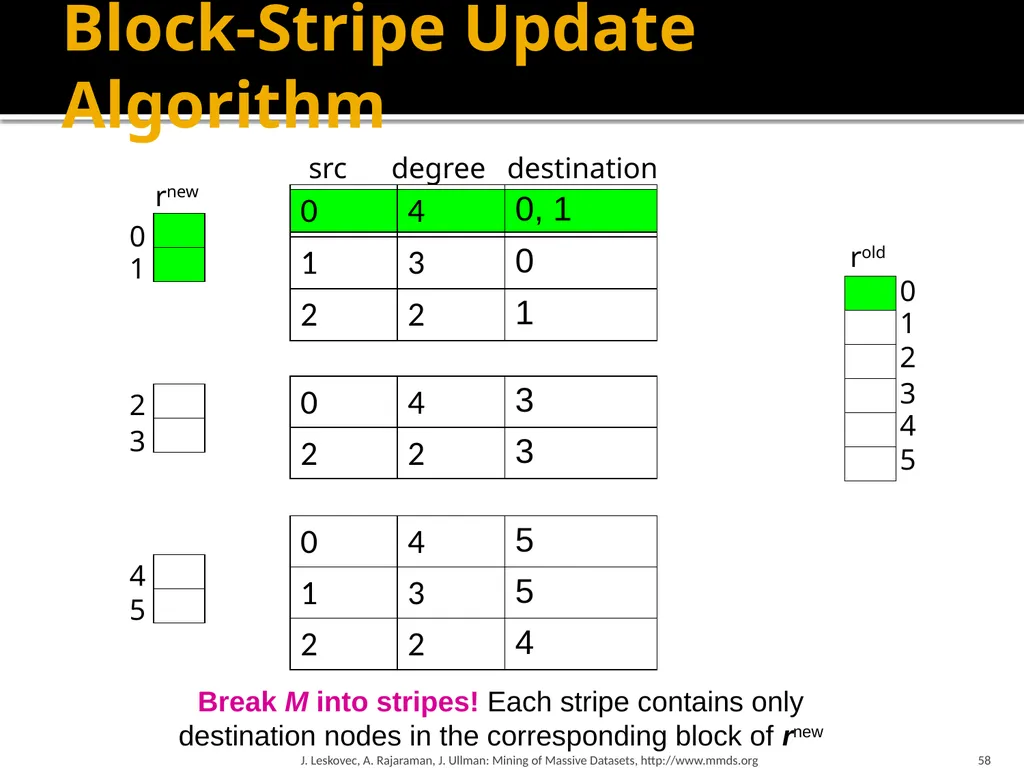
Block-Stripe Update Algorithm J. Leskovec, A. Rajaraman, J. Ullman: Mining of Massive Datasets, http://www.mmds.org 58 src degree destination 0 1 2 3 4 5 0 1 2 3 4 5 rnew rold Break M into stripes! Each stripe contains only destination nodes in the corresponding block of rnew<br>
59
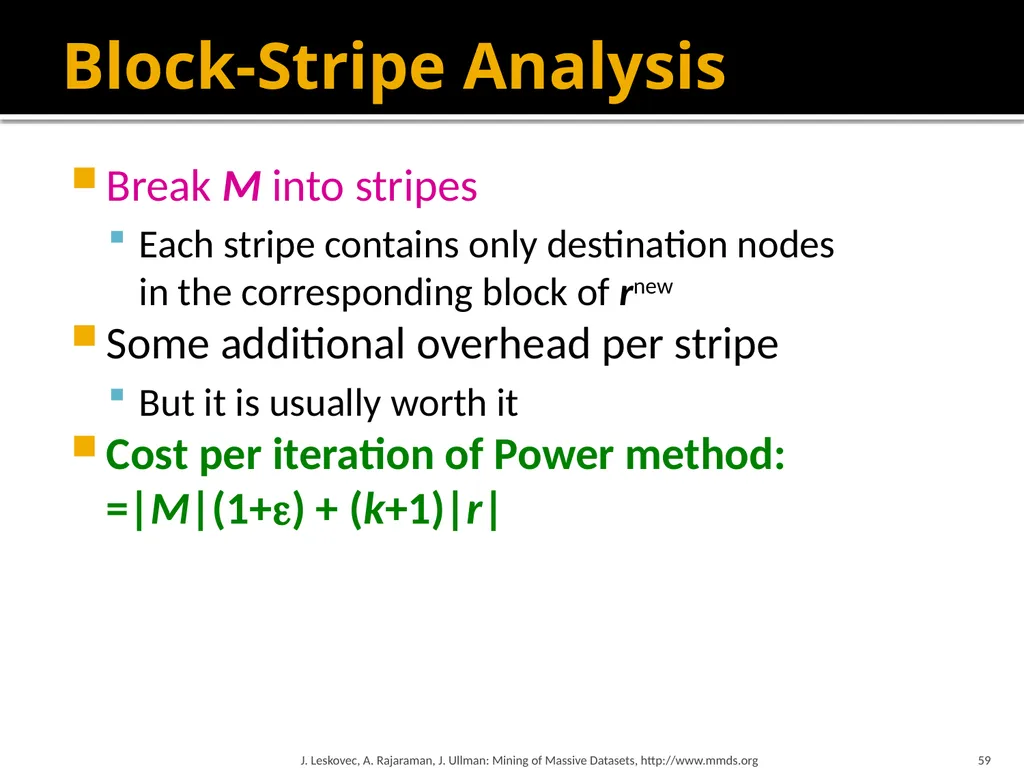
Block-Stripe Analysis Break M into stripes
Each stripe contains only destination nodes in the corresponding block of rnew
Some additional overhead per stripe
But it is usually worth it
Cost per iteration of Power method: =|M|(1+) + (k+1)|r| J. Leskovec, A. Rajaraman, J. Ullman: Mining of Massive Datasets, http://www.mmds.org 59<br>
Each stripe contains only destination nodes in the corresponding block of rnew
Some additional overhead per stripe
But it is usually worth it
Cost per iteration of Power method: =|M|(1+) + (k+1)|r| J. Leskovec, A. Rajaraman, J. Ullman: Mining of Massive Datasets, http://www.mmds.org 59<br>
60
Some Problems with Page Rank Measures generic popularity of a page
Biased against topic-specific authorities
Solution: Topic-Specific PageRank (next)
Uses a single measure of importance
Other models of importance
Solution: Hubs-and-Authorities
Susceptible to Link spam
Artificial link topographies created in order to boost page rank
Solution: TrustRank J. Leskovec, A. Rajaraman, J. Ullman: Mining of Massive Datasets, http://www.mmds.org 60<br>